EP1520607A1 - Spielprogramm und spielautomat - Google Patents
Spielprogramm und spielautomat Download PDFInfo
- Publication number
- EP1520607A1 EP1520607A1 EP03712967A EP03712967A EP1520607A1 EP 1520607 A1 EP1520607 A1 EP 1520607A1 EP 03712967 A EP03712967 A EP 03712967A EP 03712967 A EP03712967 A EP 03712967A EP 1520607 A1 EP1520607 A1 EP 1520607A1
- Authority
- EP
- European Patent Office
- Prior art keywords
- skill
- block
- game program
- arrangement
- space
- Prior art date
- Legal status (The legal status is an assumption and is not a legal conclusion. Google has not performed a legal analysis and makes no representation as to the accuracy of the status listed.)
- Ceased
Links
Images


Classifications
-
- A63F13/10—
-
- G—PHYSICS
- G06—COMPUTING OR CALCULATING; COUNTING
- G06Q—INFORMATION AND COMMUNICATION TECHNOLOGY [ICT] SPECIALLY ADAPTED FOR ADMINISTRATIVE, COMMERCIAL, FINANCIAL, MANAGERIAL OR SUPERVISORY PURPOSES; SYSTEMS OR METHODS SPECIALLY ADAPTED FOR ADMINISTRATIVE, COMMERCIAL, FINANCIAL, MANAGERIAL OR SUPERVISORY PURPOSES, NOT OTHERWISE PROVIDED FOR
- G06Q50/00—Information and communication technology [ICT] specially adapted for implementation of business processes of specific business sectors, e.g. utilities or tourism
- G06Q50/10—Services
-
- A—HUMAN NECESSITIES
- A63—SPORTS; GAMES; AMUSEMENTS
- A63F—CARD, BOARD, OR ROULETTE GAMES; INDOOR GAMES USING SMALL MOVING PLAYING BODIES; VIDEO GAMES; GAMES NOT OTHERWISE PROVIDED FOR
- A63F13/00—Video games, i.e. games using an electronically generated display having two or more dimensions
- A63F13/55—Controlling game characters or game objects based on the game progress
- A63F13/57—Simulating properties, behaviour or motion of objects in the game world, e.g. computing tyre load in a car race game
- A63F13/577—Simulating properties, behaviour or motion of objects in the game world, e.g. computing tyre load in a car race game using determination of contact between game characters or objects, e.g. to avoid collision between virtual racing cars
-
- A—HUMAN NECESSITIES
- A63—SPORTS; GAMES; AMUSEMENTS
- A63F—CARD, BOARD, OR ROULETTE GAMES; INDOOR GAMES USING SMALL MOVING PLAYING BODIES; VIDEO GAMES; GAMES NOT OTHERWISE PROVIDED FOR
- A63F13/00—Video games, i.e. games using an electronically generated display having two or more dimensions
- A63F13/45—Controlling the progress of the video game
-
- A—HUMAN NECESSITIES
- A63—SPORTS; GAMES; AMUSEMENTS
- A63F—CARD, BOARD, OR ROULETTE GAMES; INDOOR GAMES USING SMALL MOVING PLAYING BODIES; VIDEO GAMES; GAMES NOT OTHERWISE PROVIDED FOR
- A63F13/00—Video games, i.e. games using an electronically generated display having two or more dimensions
- A63F13/55—Controlling game characters or game objects based on the game progress
- A63F13/58—Controlling game characters or game objects based on the game progress by computing conditions of game characters, e.g. stamina, strength, motivation or energy level
-
- A—HUMAN NECESSITIES
- A63—SPORTS; GAMES; AMUSEMENTS
- A63F—CARD, BOARD, OR ROULETTE GAMES; INDOOR GAMES USING SMALL MOVING PLAYING BODIES; VIDEO GAMES; GAMES NOT OTHERWISE PROVIDED FOR
- A63F13/00—Video games, i.e. games using an electronically generated display having two or more dimensions
- A63F13/80—Special adaptations for executing a specific game genre or game mode
- A63F13/822—Strategy games; Role-playing games
-
- A—HUMAN NECESSITIES
- A63—SPORTS; GAMES; AMUSEMENTS
- A63F—CARD, BOARD, OR ROULETTE GAMES; INDOOR GAMES USING SMALL MOVING PLAYING BODIES; VIDEO GAMES; GAMES NOT OTHERWISE PROVIDED FOR
- A63F2300/00—Features of games using an electronically generated display having two or more dimensions, e.g. on a television screen, showing representations related to the game
- A63F2300/60—Methods for processing data by generating or executing the game program
- A63F2300/64—Methods for processing data by generating or executing the game program for computing dynamical parameters of game objects, e.g. motion determination or computation of frictional forces for a virtual car
- A63F2300/643—Methods for processing data by generating or executing the game program for computing dynamical parameters of game objects, e.g. motion determination or computation of frictional forces for a virtual car by determining the impact between objects, e.g. collision detection
-
- A—HUMAN NECESSITIES
- A63—SPORTS; GAMES; AMUSEMENTS
- A63F—CARD, BOARD, OR ROULETTE GAMES; INDOOR GAMES USING SMALL MOVING PLAYING BODIES; VIDEO GAMES; GAMES NOT OTHERWISE PROVIDED FOR
- A63F2300/00—Features of games using an electronically generated display having two or more dimensions, e.g. on a television screen, showing representations related to the game
- A63F2300/60—Methods for processing data by generating or executing the game program
- A63F2300/65—Methods for processing data by generating or executing the game program for computing the condition of a game character
-
- A—HUMAN NECESSITIES
- A63—SPORTS; GAMES; AMUSEMENTS
- A63F—CARD, BOARD, OR ROULETTE GAMES; INDOOR GAMES USING SMALL MOVING PLAYING BODIES; VIDEO GAMES; GAMES NOT OTHERWISE PROVIDED FOR
- A63F2300/00—Features of games using an electronically generated display having two or more dimensions, e.g. on a television screen, showing representations related to the game
- A63F2300/80—Features of games using an electronically generated display having two or more dimensions, e.g. on a television screen, showing representations related to the game specially adapted for executing a specific type of game
- A63F2300/8029—Fighting without shooting
Definitions
- This invention relates to game program and a game machine for setting a skill of a character appearing in a game with a block image represented on a display, having a predetermined size.
- a character appearing in the game is furnished with various kinds of skills, such as arms, a guard, special power, and fights against an enemy character with the power given by the skill owned by the character so as to develop the scenario.
- the number of the skills to be equipped is determined in advance for each category of the skill, such as arms, a guard, an accessory and special power, and the player can not furnish a character with the skills over the number determined for each category.
- the player When installing the skill, the player simply mechanically arranges the skill which was obtained in an event at a position determined in advance by the program, thereby decreasing the fun of the game.
- the invention is game program for getting a computer to execute the following procedures, comprising:
- the skill block corresponding to the skill with which the player expects to furnish the character is arranged in the block arrangement space having a predetermined shape without a collision with the other skill blocks already arranged in the block arrangement space, so that an optional category of skill can be inserted in the bounds of the block arrangement space so as to set the skill, thereby diversifying the power of the character.
- the collision judgment procedure computes and judges as to whether or not there is the collision between the position of the skill block to be inserted, which was instructed by the skill block insertion arrangement procedure and the skill block already inserted into the block arrangement space, and informs the player of the collision, if any, so that it is necessary for the player to arrange the skill block in the block arrangement space without the collision, thereby providing the player with the fun of a puzzle when installing the skill.
- said skill block has a plane shape, and said block arrangement space is set as a plane space where a plurality of said skill blocks can be arranged.
- the block arrangement space and the skill block can be dealt with the plane two-dimensional shape, thereby decreasing the burden of computing processing of the CPU. Besides, it is convenient when applying the invention to a two-dimensional game which basis is a sprite.
- said skill block has a three-dimensional shape, and said block arrangement space is set as a three-dimensional space where a plurality of said skill blocks can be arranged.
- the block arrangement space and the skill block have the cubical three-dimensional shapes, thereby improving the fun of a puzzle at the time of the skill installation.
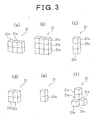
- said skill block is formed by combination of one or more block units (such as the shape as shown in Fig.3), and a shape of said block unit corresponds to a shape of said block arrangement location.
- the shapes of the block unit and the block arrangement location correspond with each other, so that the player can easily recognize the arrangement state of the block units inside the block arrangement space.
- the proper skill block can be modeled since a basic unit is one block unit, and the combination of a plurality of block units can be used.
- said block arrangement space setting procedure has a procedure for setting an arrangement prohibitive location (such as the cubical space 20a portion where the core block 22 is arranged), where said skill block is impossible to be arranged, in a specific block arrangement location inside said block arrangement space.
- the arrangement prohibitive location can limit the positions where the skill block can be arranged, thereby further improving the fun of a puzzle at the time of skill installation.
- said arrangement prohibitive location is set in almost center of said block arrangement space.
- the arrangement prohibitive location is set at almost center of the block arrangement space, so that the arrangement prohibitive location can give bigger influence to the arrangement of the skill blocks. Therefore, how to arrange the skill block directly influences the skills of the character to be equipped, thereby further improving the fun of a puzzle at the time of the skill installation.
- the invention is structured as a game machine having the above-mentioned features.
- a game machine 1 as a computer has a CPU 2, main body of which is a microprocessor unit, as shown in Fig.1.
- a ROM 4 and a RAM 5 which are main memories are connected with the CPU 2 through a bus 3.
- An operating system as program necessary for controlling the whole actions in the game machine 1 and data necessary for its execution are written into the ROM 4.
- Program and data for a game which are read out of a CD-ROM 6 as a storage medium through a CD-ROM reader 7 are written into the RAM 5.
- An area for temporarily storing various kinds of information necessary for a progress of a game is set according to the program read out of the CD-ROM 6 in the RAM 5.
- image data which was read out of the CD-ROM 6 and processed by the CPU 2, is also stored in a predetermined video area secured in the RAM 5.
- a RAM dedicated for display processing may be separately provided.
- the game program may be supplied with a semiconductor memory, a DVD-ROM or any other storage medium in place of the CD-ROM 6.
- An image processor 8 and a sound processor 9 are connected with the CPU 2 through the bus 3.
- the image processor 8 reads picture data from the video area of the RAM 5 so as to write a game picture in a frame memory 10, and converts the written picture into a video signal for displaying on a display 11 and outputs the converted with predetermined timing.
- the sound processor 9 converts the sound data in the CD-ROM 6 read out through the CD-ROM reader 7 into a predetermined analog signal so as to output through a speaker 12.
- the sound processor 9 produces data of effective sounds or music sounds on receipt of an instruction from the CPU 2, and converts the data into an analog signal so as to output through the speaker 12.
- the display 11 is a television receiver for home use and the speaker 12 is a built-in speaker of the television receiver.
- a controller 14 and an outside memory 15 are attachably and detachably connected with the bus 3 through an interface 13.
- the controller 14 has operational members for receiving operations by a player, such as a cross key 14a for inputting up, down, right and left directions and a push button switch 14b.
- the controller 14 outputs a signal corresponding to the operations of the operational members 14a, 14b at constant cycles (for instance, at 60 cycles per a second), and the CPU 2 judges the operation state of the controller 14 on the basis of the signal.
- the outside memory 15 has a rewritable semiconductor storage element which can memory, and data, such as one showing a state of a progress of a game, are stored therein according to the instruction by a player.
- the outside memory 15 may be an element of a portable game machine, which is attachable to and detachable from the interface 13.
- the CD-ROM 6 stores game program GPR, such as a role-playing game and an adventure game.
- GPR game program
- a character appearing in the game obtains various kinds of skills, being dependent of a development of the scenario and is equipped with such skills so as to have power corresponding to a category of the skill, and the later scenario is developed in such a state. That is, the skill of the character can be set in such a game program.
- the CPU 2 When executing a predetermined initializing operation (power-on operation, for instance) in the game machine 1, the CPU 2 firstly executes predetermined initializing processing according to the program of the ROM 4. When finishing initialization, the CPU 2 starts to read the game program GPR stored in the CD-ROM 6, and starts game processing according to the program. When a player operates the controller 14 so as to execute a predetermined game start operation, the CPU 2 starts various kinds of processes necessary for the execution of the game according to the procedures of the game program GPR on the basis of the instruction.
- a predetermined initializing operation power-on operation, for instance
- the game machine 1 executes predetermined processes according to the read game program GPR, controls to display a picture on the display 11, and controls the predetermined scenario to proceed.
- the character in a game world appearing by execution of the game program GPR can obtain various kinds of skills, such as predetermined arms, an item, a guard and special power, being dependent on the development of the scenario.
- the player furnishes a character who obtained a skill or the other character with the obtained skill by proper operation of the controller 14, referring to the representation on the display 11, and a power given to the skill can be added to the character who the player furnished.
- the player instructs the CPU 2 to display a skill setting picture on the display 11 through the operation of the controller 14 in order to equip a proper character who the player expects to equip with an obtained skill.
- the CPU 2 receives this instruction, the CPU 2 reads out ski-11 setting program SDP which is a sub-routine of the game program GPR, and executes a skill setting operation on each character on the basis of the skill setting program SDP.
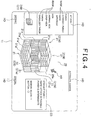
- the skill setting program SDP instructs the CPU 2 to read out a memory cube 20 which shows setting state of skills of the character whom the player instructed to set a skill. Receiving this instruction, the CPU 2 reads out the memory cube 20 for the character which is stored in the outside memory 15, thereby storing in the RAM 5 and displaying on the display 11, as shown in Fig.4 for instance.
- the outside memory 15 sets and stores data concerning the memory cube 20 of the character who finished skill setting by the player, of all characters appearing in the game world produced by the game program GPR, for whom the skill setting is possible, by the skill setting program SDP, and information concerning the memory cube 20 of the corresponding character is immediately read out through character selection operation of the controller 14 by the player, so that the picture of the memory cube 20 can be displayed on the display 11 on the basis of this information.
- the memory cube 20 is a space in the shape of a cube which is produced on a virtual three-dimensional coordinate, as shown in Fig. 2.
- each side has three units of length.
- the memory cube 20 is divided into equal twenty seven (27) parts in total by dividing each side into three equal parts and dividing the cubical space into small parts. That is, the memory cube 20 has twenty seven cubical spaces 20a, each having a length of one unit.
- Block unit (s) 21a comprising a skill block 21 for giving a predetermined skill to the character can be arranged in each cubical space 20a.
- Each block unit 21a is an object formed with a polygon or the like.
- the memory cube 20 is like a case having a predetermined shape, to be used when giving a correspondingcharacteraskill.
- the optional skill block 21 can be arranged in the virtual space inside the memory cube 20 as long as it does not interfere with the other arranged skill blocks 21.
- the skill setting program SDP controls so as to give the skill corresponding to the skill block 21 stored in the memory cube 20 to the character corresponding to the memory cube 20.
- a core block 22 as a core space CS is arranged in advance in the cubical space 20a which is at the center of the memory cube 20.
- the skill setting program SDP controls so that the player can not arrange the skill block 21 in the core space CS. Therefore, the core block 22 of the core space CS may be furnished with special skill for the corresponding character, such as basic power and basic equipment, as a default value. In another embodiment, the core space CS may not be at the center. And, the memory cube 20 may be comprised without the core space CS.
- the player After displaying the memory cube 20 of the character who is expected to be furnished with a skill on the display 11 through the operation of the controller 14 by the player as shown in Fig. 4, the player operates the controller 14 so as to arrange the skill obtained during the game in the memory cube 20.
- the skill obtained by the player in the game is any item in shape, such as a disc, a file, a crystal (The item which is defined as skill is referred to as "skill definition item” hereinafter.), and the item is converted into the skill block 21 by block conversion program BTP which is a subroutine of the skill setting program SDP with the operation of the player through the controller 14.
- System data HD showing a system of a skill are as follows.
- the above-mentioned system data HD can be optionally set when defining each skill, and can be properly set according to a kind or story contents of the game program GPR.
- the skill definition item table SDT is read out, and the CPU 2 produces through the picture processor 8 the appearance of the skill block 21 through which the player can easily recognize the system according to the system of the skill defined in the skill definition item and displays it on the display 11.
- the skill block 21 which represents the attack system of skill as shown in Fig.4 for instance, round patterns are attached, the defense system of skill, triangular patterns are attached, the attribute change system of skill, striped patterns are attached, and the special technique of skill, sand patterns are attached.
- Such display forms of the skill block 21 are exemplary, and various display forms, such as distinction with colors and change with brightness are available when displaying the respective skill blocks 21 by each system.
- the display forms of the skill definition item on the display 11 at the time of conversion into the skill block 21 are thus determined according to the system of skill which defines the skill definition item.
- the CPU 2 reads the cube data concerning the skill definition item out of the attribute data in the skill definition item table SDT by the block conversion program BTP, and judges the number of the cubical spaces 20a which the skill block 21 consumes in the memory cube 20, that is, the size of the skill block 21, and the shape of the skill block 21 on the basis of the cube data.
- Any skill block 21 has a shape obtained by the combination of one or more individual block units 21a, and is formed so as to being arranged in the memory cube 20.
- the skill block 21 in Fig.3(a) has the size and shape obtained by combination of six block units 21a in total so as to have a flat plate shape, having two in a longitudinal direction and three in a transverse direction
- the skill block 21 of Fig.3(b) has the size and shape obtained by combination of nine block units 21a in total so as to have a flat- plate shape, having three in a longitudinal direction and three in a transverse direction
- the skill block 21 in Fig.3(c) has the size and shape obtained by combination of three block units 21a in total so as to have a flat plate shape, having three in a longitudinal direction and one in a transverse direction
- the skill block 21 in Fig.3(d) has the size and shape obtained by combination of four block units 21a in total so as to have a flat plate shape, having two in a longitudinal direction and two in a transverse direction
- the skill block 21 in Fig.3(e) has the size and shape obtained by combination of two block units 21a in total so as to have
- the skill block 21 of Fig.3(f) has the size and shape obtained by combination of five block units 21a in total in the three-dimensional direction, the shape being obtained by attaching two more block units 21a in the transverse direction to two faces of the bottom block unit 21a of the skill block 21 of Fig.3(c) which are adjacent to each other.
- the CPU 2 refers to the attribute data of the skill definition item which is stored in the skill definition item table SDT on the basis of the block conversion program BTP, and produces an obj ect model 21M of the corresponding skill block 21 on the virtual three-dimensional space on the basis of the system of skill and cube data which correspond to the skill definition item, and displays the model 21M on the display 11 together with the corresponding system data HD through perspective projection and rendering, as shown in Fig.4.
- the system data HD is the attack system of skill, and concrete technique names of the attack system are represented.
- the image 21M of the skill block 21 which was converted from the skill definition item by the block conversion program BTP is represented.
- the skill block 21 represented in Fig.4 is one comprised of the individual block unit 21a.
- the other systems of skill, "defense”, “attribute change” and “special”, which can be selected to be represented through the operation of the controller 14 by the player, are displayed on the display 11.
- the other system of skill is displayed similar to "attack" skill of Fig.4 by opening a window of the corresponding system of skill determined on the skill definition item obtained by the player when converting this item into the skill block 21 by the block conversion program BTP.
- the skill block 21 already obtained by the player, which is stored in the outside memory 15 is displayed in such a way that the player operates the controller 14 so as to instruct the CPU 2 to display and then, the window of the corresponding skill is opened on the basis of the skill setting program SDP.
- the CPU 2 When the player instructs the CPU 2 to display detailed explanation concerning the displayed skill through the further operation of the controller 14 after displaying the system data HD, technique name NAM and object model 21M of the skill block 21 corresponding to the skill definition item which the player obtained in the game on the display 11, the CPU 2 reads the contents data showing the contents of the skill and the method of operation the controller 14 for getting the skill to appear which are the corresponding attribute data out of the skill definition item table SDT and displays both on the display 11 as explanation ED.
- the player can clearly understand the obtained skill through the skill definition item obtained by the player. Subsequently, the player refers to the memory cube 20 of the present character displayed on the display 11, and determines at which spatial position in the memory cube 20 the skill block 21 corresponding to the newly obtained skill is arranged.
- the player can freely arrange the newly obtained skill block 21 in the bounds where the new skill block does not collide with the already arranged one.
- the skill block 21 corresponding to each skill has various kinds of shapes by proper combination of the block units 21 as shown in Fig.3. For this reason, the player arranges the new skill block 21 in the space inside the memory cube 20, taking the arrangement of the skill blocks already located in the memory cube 20 into consideration, properly attaching or detaching the skill blocks 21.
- the CPU 2 computes and judges as to whether or not another skill block 21 has been already arranged on one or more cubical spaces 20a which were instructed to be inserted, that is, as to whether or not there is the arrangement of the empty cubical spaces 20a, where the skill block 21, having the same shape as the skill block 21 which was instructed to be inserted, has not been yet arranged at the position inside the memory cube 20, on the basis of the skill block arrangement judging program SBP.
- the CPU 2 allows the instruction of arrangement of the new skill block 21 through the controller 14, and arranges the object model of the skill block 21 at this position. And, an image, wherein the new skill block 21 was arranged on the position on the memory cube 20 which was instructed by the player, is newly produced by picturing through the picture processor 8, and is displayed on the display 11.
- the skill block arrangement judging program SBP displays such message that it is impossible to insert the skill block 21 into the memory cube 20, and displays a message on the display 11, which invites the player to produce the arrangement of the cubical spaces 20a in which the skill block 21 is to be inserted by proper attachment or detachment of the skill block 21 which has been arranged in the present memory cube.
- the player refers to the memory cube 20 displayed on the display 11, and detaches one or more skill blocks 21 which has been already arranged in the memory cube 20 so as to move the other cubical spaces 20a inside the memory cube 20 or so as to store the detached skill block 21 in a non-use skill block storage area (will be described hereinafter) without inserting in the memory cube 20.
- the player thus instructs the CPU 2 through the controller 14 to detach the skill block 21 in order to change the shape of the arrangement of the cubical spaces 20a having no skill block 21 so that the arrangement of the cubical spaces 20a corresponding to the skill block 21 to be newly arranged can be formed.
- the skill block arrangement judging program SBP computes the condition of the arrangement of the empty cubical space 20a inside the memory cube 20, and computes and judges as to whether or not the new skill block 21 can be arranged. If the ability of arranging the new skill block 21 was judged, the ability message is displayed on the display 11, and the image, wherein the new skill block 21 was arranged at the position in the memory cube 20 instructed by the player, is newly produced and is displayed on the display 22 through the picture processor 8.
- the player may judge some skill block 21 detached from the memory cube 20 not to be arranged in the memory cube 20 for a while.
- the skill block 21 is stored in the predetermined non-use skill block storage area of the outside memory 15 with the skill setting program SDP upon receipt of the instruction by the player through the controller 14.
- the skill block 21 stored in the non-use skill block storage area is controlled to be read out by the skill setting program SDP and to be enable to be arranged in the memory cube 20 whenever the player operates the controller 14.
- the player thus finds the position inside the memory cube 20 for locating the newly obtained skill block 21, having a feeling of solving a puzzle by detaching the already located skill block 21 or moving the detached to the other cubical space 20a portion, thereby giving fun of puzzle game to the skill setting action for the character. Besides, more skills can be obtained if each skill block 21 can be effectively inserted into the memory cube 20, so that the player can proceed with the game, enjoying the skill installation action itself.
- the system of the skill of the skill block 21 which is located in the memory cube 20 is not a problem when locating the skill block 21.
- the skill such as attack, defense, attribute change and special technique, can be freely furnished in the bounds where the skill block can be stored in the memory cube 20 regardless of the category. Then, the degree of freedom of skill installation can be rapidly increased, and the skill can be set on each character, matching the player's taste, so that the fun of the game increases.
- the skill setting program SDP computes all skills corresponding to all skill blocks 21 located inside the memory cube 20, and controls to give the skills to the character corresponding to the memory cube 20. Thereafter, the game program GPR controls the character to exert the skill corresponding to the skill block 21 installed in the memory cube 20 in the game world, and controls to display on the display 11.
- the memory cube 20 for locating the skill blocks 21 which is the block arrangement space set so as to correspond to the character is defined as a space comprised of twenty seven cubical spaces 20a in total having three on each side.
- the shapes of the block arrangement space and the cubical space are optional, and the block arrangement space may be a rectangular parallelepiped where each side has the different number of cubical spaces 20a, that is, the block arrangement locations, or may have the other solid shape.
- the shape of the cubical space may not be a cubic, but may be a rectangular parallelepiped or a tetrahedron.
- the block unit comprising the skill block may have two-dimensional plane shape, such as a square and the other optional plane shape, and the block arrangement space may be a square, a rectangle or a plane space having a proper shape, for locating a plurality of skill blocks.
- the block arrangement locations for locating each skill block are formed in the block arrangement space, corresponding to each block unit (formed with a sprite).
- the shapes and the sizes of the block arrangement space, the block arrangement location, the skill block and the block unit can be optionally set as long as the block arrangement space having a predetermined shape is provided with the predetermined number of block arrangement locations, and the skill block corresponding to the skill of the character is arranged at the block arrangement location in order to set the skill of each character.
- the CPU 2 is the game control device, and the combination of the CPU 2 and specified software comprises various kinds of means of the game control device. But, at least a part of such means may be replaced with a logical circuit.
- the invention may be comprised as the game system having various kinds of scales in addition to one for home use.
- a skill block corresponding to a skill which a player expects a character to be furnished is located in a block arrangement space having a predetermined shape without a collision with the other skill blocks in order to install optional category of skill-in the bounds of the size of the block arrangement space, thereby diversifying the power of the character.
- the game program for giving a fun of a puzzle to the player at the time of installation of the skill is possible to be provided.
Landscapes
- Engineering & Computer Science (AREA)
- Multimedia (AREA)
- Theoretical Computer Science (AREA)
- Business, Economics & Management (AREA)
- Human Computer Interaction (AREA)
- Tourism & Hospitality (AREA)
- General Health & Medical Sciences (AREA)
- Economics (AREA)
- Health & Medical Sciences (AREA)
- Human Resources & Organizations (AREA)
- Marketing (AREA)
- Primary Health Care (AREA)
- Strategic Management (AREA)
- Physics & Mathematics (AREA)
- General Business, Economics & Management (AREA)
- General Physics & Mathematics (AREA)
- Processing Or Creating Images (AREA)
- Management, Administration, Business Operations System, And Electronic Commerce (AREA)
Applications Claiming Priority (3)
| Application Number | Priority Date | Filing Date | Title |
|---|---|---|---|
| JP2002241955A JP3483252B1 (ja) | 2002-08-22 | 2002-08-22 | ゲームプログラム |
| JP2002241955 | 2002-08-22 | ||
| PCT/JP2003/003685 WO2004018061A1 (ja) | 2002-08-22 | 2003-03-26 | ゲームプログラム及びゲーム装置 |
Publications (2)
| Publication Number | Publication Date |
|---|---|
| EP1520607A1 true EP1520607A1 (de) | 2005-04-06 |
| EP1520607A4 EP1520607A4 (de) | 2005-07-13 |
Family
ID=30437816
Family Applications (1)
| Application Number | Title | Priority Date | Filing Date |
|---|---|---|---|
| EP03712967A Ceased EP1520607A4 (de) | 2002-08-22 | 2003-03-26 | Spielprogramm und spielautomat |
Country Status (7)
| Country | Link |
|---|---|
| US (1) | US7318772B2 (de) |
| EP (1) | EP1520607A4 (de) |
| JP (1) | JP3483252B1 (de) |
| KR (1) | KR20050031059A (de) |
| CN (1) | CN100377755C (de) |
| AU (1) | AU2003221166B2 (de) |
| WO (1) | WO2004018061A1 (de) |
Families Citing this family (14)
| Publication number | Priority date | Publication date | Assignee | Title |
|---|---|---|---|---|
| KR100885837B1 (ko) * | 2007-02-07 | 2009-02-27 | (주)엔도어즈 | 게임장치 및 그 제어방법과 제어방법을 수행하는 컴퓨터프로그램을 기록한 기록매체 |
| JP4392446B2 (ja) * | 2007-12-21 | 2010-01-06 | 株式会社コナミデジタルエンタテインメント | ゲーム装置、ゲーム処理方法、ならびに、プログラム |
| JP5072815B2 (ja) * | 2008-12-17 | 2012-11-14 | 株式会社スクウェア・エニックス | ビデオゲーム処理装置、ビデオゲーム処理方法、およびビデオゲーム処理プログラム |
| CN104063210A (zh) * | 2013-06-04 | 2014-09-24 | 腾讯科技(深圳)有限公司 | 一种道具的装备方法和装置 |
| WO2015153878A1 (en) * | 2014-04-02 | 2015-10-08 | Massachusetts Institute Of Technology | Modeling social identity in digital media with dynamic group membership |
| JP6570839B2 (ja) | 2015-01-27 | 2019-09-04 | 株式会社あかつき | 情報処理装置、及びゲームプログラム |
| CN105214309B (zh) | 2015-10-10 | 2017-07-11 | 腾讯科技(深圳)有限公司 | 一种信息处理方法、终端及计算机存储介质 |
| KR102524112B1 (ko) * | 2015-12-08 | 2023-04-19 | 주식회사 넥슨코리아 | 아이템 제공 장치 및 방법 |
| CN107015787B (zh) * | 2016-09-30 | 2020-05-05 | 腾讯科技(深圳)有限公司 | 一种交互式应用框架设计的方法及装置 |
| KR102026865B1 (ko) * | 2017-03-28 | 2019-09-30 | 주식회사 넥슨코리아 | 게임 제공 방법 및 장치 |
| KR102307394B1 (ko) * | 2017-03-28 | 2021-09-29 | 주식회사 넥슨코리아 | 게임 제공 방법 및 장치 |
| CN108031122B (zh) * | 2017-12-07 | 2021-07-09 | 网易(杭州)网络有限公司 | 游戏技能的制作方法和装置 |
| KR102474006B1 (ko) * | 2019-09-23 | 2022-12-02 | 주식회사 넥슨코리아 | 게임 제공 방법 및 장치 |
| KR102806601B1 (ko) * | 2023-02-24 | 2025-05-13 | 주식회사 네오위즈 | 퍼즐 게임을 제공하는 방법, 장치, 프로그램 및 기록매체 |
Family Cites Families (5)
| Publication number | Priority date | Publication date | Assignee | Title |
|---|---|---|---|---|
| JP2000157731A (ja) | 1998-11-30 | 2000-06-13 | Square Co Ltd | ゲーム装置、記録媒体およびキャラクタ動作設定方法 |
| JP3506641B2 (ja) | 1999-07-30 | 2004-03-15 | 任天堂株式会社 | 三次元パズルゲーム装置及び三次元パズルゲーム用記憶媒体 |
| JP3476759B2 (ja) | 2000-09-08 | 2003-12-10 | ラインシステム株式会社 | 電子ジグソーパズル及び記憶媒体 |
| US7013461B2 (en) * | 2001-01-05 | 2006-03-14 | International Business Machines Corporation | Systems and methods for service and role-based software distribution |
| JP3935771B2 (ja) | 2002-05-15 | 2007-06-27 | 日立マクセル株式会社 | インク組成物 |
-
2002
- 2002-08-22 JP JP2002241955A patent/JP3483252B1/ja not_active Expired - Lifetime
-
2003
- 2003-03-26 CN CNB038010690A patent/CN100377755C/zh not_active Expired - Fee Related
- 2003-03-26 EP EP03712967A patent/EP1520607A4/de not_active Ceased
- 2003-03-26 KR KR1020047004739A patent/KR20050031059A/ko not_active Ceased
- 2003-03-26 US US10/488,732 patent/US7318772B2/en not_active Expired - Fee Related
- 2003-03-26 AU AU2003221166A patent/AU2003221166B2/en not_active Ceased
- 2003-03-26 WO PCT/JP2003/003685 patent/WO2004018061A1/ja not_active Ceased
Non-Patent Citations (2)
| Title |
|---|
| No Search * |
| See also references of WO2004018061A1 * |
Also Published As
| Publication number | Publication date |
|---|---|
| US20040235544A1 (en) | 2004-11-25 |
| AU2003221166B2 (en) | 2008-10-30 |
| US7318772B2 (en) | 2008-01-15 |
| AU2003221166A1 (en) | 2004-03-11 |
| CN100377755C (zh) | 2008-04-02 |
| JP2004073741A (ja) | 2004-03-11 |
| EP1520607A4 (de) | 2005-07-13 |
| WO2004018061A1 (ja) | 2004-03-04 |
| CN1556722A (zh) | 2004-12-22 |
| KR20050031059A (ko) | 2005-04-01 |
| JP3483252B1 (ja) | 2004-01-06 |
Similar Documents
| Publication | Publication Date | Title |
|---|---|---|
| JP3426105B2 (ja) | ビデオゲームシステムおよびビデオゲーム用記憶媒体 | |
| US11872475B2 (en) | Storage medium, information processing system, information processing apparatus and game controlling method involving linkable player character and sub-character | |
| JP3442965B2 (ja) | ビデオゲームシステムおよびビデオゲーム用記憶媒体 | |
| US7318772B2 (en) | Game program and game machine with an obtained character attributes block arrangement | |
| EP1743680A1 (de) | Spiel-software und spielvorrichtung | |
| JPH08206357A (ja) | ゲーム装置及び画像合成方法 | |
| JP4189315B2 (ja) | ゲーム装置およびゲームプログラム | |
| JP4447568B2 (ja) | ゲーム装置、ゲーム装置の制御方法及びプログラム | |
| US8100765B2 (en) | Storage medium having game program and game apparatus | |
| US20030211877A1 (en) | Multi-player game system and multi-player game program | |
| JP3640384B2 (ja) | ビデオゲームシステムおよびビデオゲーム用記憶媒体 | |
| JPWO2000001454A1 (ja) | ゲームを実行する方法及び、これを実施するゲーム装置 | |
| JP3420220B2 (ja) | ゲームシステム及びゲーム用プログラム | |
| JP4553907B2 (ja) | ビデオゲームシステムおよびビデオゲーム用記憶媒体 | |
| JP3921361B2 (ja) | ビデオゲームシステムおよびビデオゲーム用記憶媒体 | |
| JP4980680B2 (ja) | ゲーム装置、プログラム及び情報記憶媒体 | |
| JP4313810B2 (ja) | ビデオゲームシステムおよびビデオゲーム用記憶媒体 | |
| JP4833702B2 (ja) | ゲーム装置、ゲーム装置の制御方法及びプログラム | |
| JP2003210827A (ja) | 戦闘技設定方法、ゲーム装置、プログラム及び記録媒体 | |
| JP2007083090A (ja) | ビデオゲームシステムおよびビデオゲーム用記憶媒体 | |
| JP2001269480A (ja) | ビデオゲーム装置及び画像表示方法及び振動制御方法及び記憶媒体 | |
| JP2000218042A (ja) | ゲーム装置、ゲーム制御方法およびその記録媒体 | |
| HK1015903B (en) | Video game system and video game processing method |
Legal Events
| Date | Code | Title | Description |
|---|---|---|---|
| PUAI | Public reference made under article 153(3) epc to a published international application that has entered the european phase |
Free format text: ORIGINAL CODE: 0009012 |
|
| 17P | Request for examination filed |
Effective date: 20041110 |
|
| AK | Designated contracting states |
Kind code of ref document: A1 Designated state(s): AT BE BG CH CY CZ DE DK EE ES FI FR GB GR HU IE IT LI LU MC NL PT RO SE SI SK TR |
|
| AX | Request for extension of the european patent |
Extension state: AL LT LV MK |
|
| A4 | Supplementary search report drawn up and despatched |
Effective date: 20050523 |
|
| DAX | Request for extension of the european patent (deleted) | ||
| RBV | Designated contracting states (corrected) |
Designated state(s): DE FR GB |
|
| RIN1 | Information on inventor provided before grant (corrected) |
Inventor name: TAKEUCHI, MAYUMI,C/O KONAMI CORPORATION Inventor name: HORIGAMI, ATSUSHI,C/O KONAMI CORPORATION |
|
| STAA | Information on the status of an ep patent application or granted ep patent |
Free format text: STATUS: THE APPLICATION HAS BEEN REFUSED |
|
| 18R | Application refused |
Effective date: 20070928 |