EP1519123A2 - Kühlkreislauf - Google Patents
Kühlkreislauf Download PDFInfo
- Publication number
- EP1519123A2 EP1519123A2 EP20040022996 EP04022996A EP1519123A2 EP 1519123 A2 EP1519123 A2 EP 1519123A2 EP 20040022996 EP20040022996 EP 20040022996 EP 04022996 A EP04022996 A EP 04022996A EP 1519123 A2 EP1519123 A2 EP 1519123A2
- Authority
- EP
- European Patent Office
- Prior art keywords
- evaporator
- coolant
- pressure
- radiator
- expansion device
- Prior art date
- Legal status (The legal status is an assumption and is not a legal conclusion. Google has not performed a legal analysis and makes no representation as to the accuracy of the status listed.)
- Withdrawn
Links
Images



Classifications
-
- F—MECHANICAL ENGINEERING; LIGHTING; HEATING; WEAPONS; BLASTING
- F25—REFRIGERATION OR COOLING; COMBINED HEATING AND REFRIGERATION SYSTEMS; HEAT PUMP SYSTEMS; MANUFACTURE OR STORAGE OF ICE; LIQUEFACTION SOLIDIFICATION OF GASES
- F25B—REFRIGERATION MACHINES, PLANTS OR SYSTEMS; COMBINED HEATING AND REFRIGERATION SYSTEMS; HEAT PUMP SYSTEMS
- F25B5/00—Compression machines, plants or systems, with several evaporator circuits, e.g. for varying refrigerating capacity
- F25B5/04—Compression machines, plants or systems, with several evaporator circuits, e.g. for varying refrigerating capacity arranged in series
-
- F—MECHANICAL ENGINEERING; LIGHTING; HEATING; WEAPONS; BLASTING
- F25—REFRIGERATION OR COOLING; COMBINED HEATING AND REFRIGERATION SYSTEMS; HEAT PUMP SYSTEMS; MANUFACTURE OR STORAGE OF ICE; LIQUEFACTION SOLIDIFICATION OF GASES
- F25B—REFRIGERATION MACHINES, PLANTS OR SYSTEMS; COMBINED HEATING AND REFRIGERATION SYSTEMS; HEAT PUMP SYSTEMS
- F25B5/00—Compression machines, plants or systems, with several evaporator circuits, e.g. for varying refrigerating capacity
- F25B5/02—Compression machines, plants or systems, with several evaporator circuits, e.g. for varying refrigerating capacity arranged in parallel
-
- F—MECHANICAL ENGINEERING; LIGHTING; HEATING; WEAPONS; BLASTING
- F25—REFRIGERATION OR COOLING; COMBINED HEATING AND REFRIGERATION SYSTEMS; HEAT PUMP SYSTEMS; MANUFACTURE OR STORAGE OF ICE; LIQUEFACTION SOLIDIFICATION OF GASES
- F25B—REFRIGERATION MACHINES, PLANTS OR SYSTEMS; COMBINED HEATING AND REFRIGERATION SYSTEMS; HEAT PUMP SYSTEMS
- F25B9/00—Compression machines, plants or systems, in which the refrigerant is air or other gas of low boiling point
- F25B9/002—Compression machines, plants or systems, in which the refrigerant is air or other gas of low boiling point characterised by the refrigerant
- F25B9/008—Compression machines, plants or systems, in which the refrigerant is air or other gas of low boiling point characterised by the refrigerant the refrigerant being carbon dioxide
-
- F—MECHANICAL ENGINEERING; LIGHTING; HEATING; WEAPONS; BLASTING
- F25—REFRIGERATION OR COOLING; COMBINED HEATING AND REFRIGERATION SYSTEMS; HEAT PUMP SYSTEMS; MANUFACTURE OR STORAGE OF ICE; LIQUEFACTION SOLIDIFICATION OF GASES
- F25B—REFRIGERATION MACHINES, PLANTS OR SYSTEMS; COMBINED HEATING AND REFRIGERATION SYSTEMS; HEAT PUMP SYSTEMS
- F25B2309/00—Gas cycle refrigeration machines
- F25B2309/06—Compression machines, plants or systems characterised by the refrigerant being carbon dioxide
- F25B2309/061—Compression machines, plants or systems characterised by the refrigerant being carbon dioxide with cycle highest pressure above the supercritical pressure
-
- F—MECHANICAL ENGINEERING; LIGHTING; HEATING; WEAPONS; BLASTING
- F25—REFRIGERATION OR COOLING; COMBINED HEATING AND REFRIGERATION SYSTEMS; HEAT PUMP SYSTEMS; MANUFACTURE OR STORAGE OF ICE; LIQUEFACTION SOLIDIFICATION OF GASES
- F25B—REFRIGERATION MACHINES, PLANTS OR SYSTEMS; COMBINED HEATING AND REFRIGERATION SYSTEMS; HEAT PUMP SYSTEMS
- F25B2400/00—Component parts or details not otherwise provided for in this subclass
- F25B2400/04—Refrigeration circuit bypassing means
- F25B2400/0409—Refrigeration circuit bypassing means for evaporators
-
- F—MECHANICAL ENGINEERING; LIGHTING; HEATING; WEAPONS; BLASTING
- F25—REFRIGERATION OR COOLING; COMBINED HEATING AND REFRIGERATION SYSTEMS; HEAT PUMP SYSTEMS; MANUFACTURE OR STORAGE OF ICE; LIQUEFACTION SOLIDIFICATION OF GASES
- F25B—REFRIGERATION MACHINES, PLANTS OR SYSTEMS; COMBINED HEATING AND REFRIGERATION SYSTEMS; HEAT PUMP SYSTEMS
- F25B2600/00—Control issues
- F25B2600/17—Control issues by controlling the pressure of the condenser
-
- F—MECHANICAL ENGINEERING; LIGHTING; HEATING; WEAPONS; BLASTING
- F25—REFRIGERATION OR COOLING; COMBINED HEATING AND REFRIGERATION SYSTEMS; HEAT PUMP SYSTEMS; MANUFACTURE OR STORAGE OF ICE; LIQUEFACTION SOLIDIFICATION OF GASES
- F25B—REFRIGERATION MACHINES, PLANTS OR SYSTEMS; COMBINED HEATING AND REFRIGERATION SYSTEMS; HEAT PUMP SYSTEMS
- F25B2600/00—Control issues
- F25B2600/25—Control of valves
- F25B2600/2501—Bypass valves
-
- F—MECHANICAL ENGINEERING; LIGHTING; HEATING; WEAPONS; BLASTING
- F25—REFRIGERATION OR COOLING; COMBINED HEATING AND REFRIGERATION SYSTEMS; HEAT PUMP SYSTEMS; MANUFACTURE OR STORAGE OF ICE; LIQUEFACTION SOLIDIFICATION OF GASES
- F25B—REFRIGERATION MACHINES, PLANTS OR SYSTEMS; COMBINED HEATING AND REFRIGERATION SYSTEMS; HEAT PUMP SYSTEMS
- F25B2600/00—Control issues
- F25B2600/25—Control of valves
- F25B2600/2507—Flow-diverting valves
Definitions
- the invention relates to a cooling cycle which uses a supercritical fluid such as carbon dioxide (CO 2 ) or the like as a coolant, and in particular relates to a cooling cycle used in a twin air-conditioning system.
- a supercritical fluid such as carbon dioxide (CO 2 ) or the like
- Cooling cycles which employ carbon dioxide as a coolant have a structure which has a compressor that compresses the coolant, a radiator which cools the coolant discharged from the compressor, an expansion device which reduces the pressure of the coolant flowing out from the radiator, and an evaporator which vaporizes the coolant flowing out from the expansion device, but with such a cooling cycle a so-called high-pressure control operation is carried out using the expansion device to control the pressure on the outlet side of said radiator (high-pressure) to a prescribed pressure level determined by the temperature of the coolant on the outlet side of said radiator.
- this kind of structure is applied in a twin air-conditioning system with two evaporators, but where the respective evaporators are both fitted with an expansion device for controlling the high pressure on the upstream side, it may be expected that the respective expansion devices will both attempt to control the high pressure, thus interfering with one another and failing to operate properly.
- a device which is provided with a compressor which compresses the coolant, a radiator which cools the coolant discharged from the compressor, a first pressure-reducer and second pressure-reducer which reduce the pressure of the coolant flowing from the radiator, a first evaporator which evaporates the coolant flowing from the first pressure reducer, and a second evaporator which evaporates the coolant flowing from the second pressure reducer, using the first pressure reducer to control the pressure on the outlet side of the radiator to a prescribed level determined by the temperature of the coolant on the outlet side of the radiator, with the second pressure reducer used to control the degree of superheating of the coolant on the outlet side of the second evaporator to a prescribed value.
- expansion devices first pressure reducer, second pressure reducer
- the expansion device itself is a relatively expensive component, and manufacturing costs will be high with an expansion valve fitted to each evaporator.
- a differing expansion device is provided for the control of each evaporator (first pressure reducer, second pressure reducer) with the above structure, it is not possible to use common parts, which not only increases manufacturing costs but makes tuning of the system more complicated.
- the theme of the invention is to provide a cooling cycle which has a structure for a cooling cycle in a twin air-conditioning system where the expansion valves do not interfere with one another, and where the above disadvantage caused by the provision of expansion devices with differing control methods on each of the evaporators is eliminated, thus not only holding down manufacturing costs but eliminating or simplifying the operation of tuning the system.
- the cooling cycle of the invention is characterized in that it has a structure having a compressor capable of increasing the pressure of the coolant to beyond the supercritical pressure, a radiator which cools the coolant compressed by said compressor, an expansion device which controls the pressure on the outlet side of said radiator to a prescribed pressure determined by the temperature of the coolant on the outlet side of said radiator, a first and a second evaporator which evaporate the coolant whose pressure has been reduced by said expansion device, and a flow regulator means which regulates the quantity of coolant distributed to the respective evaporators.
- the first evaporator and second evaporator may be connected in series downstream of the expansion device, the flow regulator means regulating the quantity of coolant supplied to the evaporator on the upstream side and the quantity of coolant supplied to the evaporator on the downstream side, or the first evaporator and second evaporator may be connected in parallel on the downstream side of the expansion device, the flow regulator means regulating the quantity of coolant supplied to the respective evaporators.
- the flow regulator means may control the quantities distributed so that the degree of superheating of the evaporator on the upstream side remains constant, or with respect to the second structure the flow regulator means may control the quantities distributed so that the degree of superheating of one of the evaporators remains constant.
- the abovementioned flow regulator means may comprise a three-way valve which simultaneously regulates the quantity supplied to the first evaporator and the quantity supplied to the second evaporator, or may be comprised of a two-way valve which regulates the flow supplied to one evaporator by regulating the flow supplied to the other evaporator.
- the three-way valve may be a device which continuously regulates the quantities distributed or a device which simply switches the direction of flow.
- the two-way valve may be a device which continuously regulates the degree of opening, or a device which simply opens or closes the passage.
- the cooling cycle of the invention may have a compressor capable of increasing the pressure of the coolant to beyond the supercritical pressure, a radiator which cools the coolant compressed by said compressor, first and second expansion devices which reduce the pressure of the coolant flowing from said radiator, a first evaporator which evaporates the coolant flowing from the first expansion device, and a second evaporator which evaporates the coolant flowing from the second expansion device, and be provided with a flow ratio determining means which determines the proportion of the flow quantity of coolant supplied to each evaporator by forecasting the thermal load on the respective evaporators, and a control means which controls and maintains the ratio determined by said ratio-determining means for the degree of opening of the valve of said first and second expansion devices so that the pressure on the outlet side of said radiator remains at a constant pressure determined by the temperature of the coolant on the outlet side of said radiator.
- the proportion of coolant supplied to each evaporator is determined from the forecast thermal load, the through flow between the first and second expansion devices being simultaneously regulated so that the pressure on the outlet side of the radiator is a constant pressure determined from the temperature of the coolant on the outlet side of the radiator so as to maintain the determined proportion, so it is possible to adjust the flow quantity according to load by using the same control system for the expansion devices.
- a twin air-conditioning system can be catered for without the need to provide expansion devices having different control systems on each evaporator.
- a cooling cycle of the type described above is suited to a supercritical vapour compression cooling cycle which uses carbon dioxide compressed to beyond the supercritical pressure by a compressor as the coolant.
- the cooling cycle is arranged to have a structure having a compressor capable of increasing the pressure of the coolant itself to beyond the supercritical pressure, a radiator which cools the coolant compressed by the compressor, an expansion device which controls the pressure on the outlet side of the radiator to a prescribed pressure determined by the temperature of the coolant on the outlet side of the radiator, first and second evaporators which evaporate the coolant whose pressure has been reduced by said expansion device, and a flow regulator means which regulates the amount of coolant distributed to the respective evaporators, so coolant whose pressure has been reduced by one of the expansion devices can be distributed according to the load on each evaporator without needing to provide an expansion device for each evaporator, thus allowing a twin air-conditioning system to be catered for with one expansion device. As a result it is not necessary to provide an expansion device for each evaporator, enabling manufacturing costs to be reduced.
- the cooling cycle is arranged to have a structure with a compressor capable of increasing the pressure of the coolant itself to beyond the supercritical pressure, a radiator which cools the coolant compressed by said compressor, first and second expansion devices which reduce the pressure of the coolant flowing from said radiator, a first evaporator which evaporates the coolant flowing from the first expansion device, and a second evaporator which evaporates the coolant flowing from the second expansion device, and is provided with a thermal load forecasting means which forecasts the thermal load on the respective evaporators, a ratio-determining means which determines the ratio of the degree of opening for each expansion device from the thermal load of each evaporator forecast using this thermal load forecasting means, and a control means which controls and maintains the ratio determined by said ratio-determining means for the degree of opening of the valves of said first and second expansion devices so that the pressure on the outlet side of said radiator remains at a constant pressure determined by the temperature of the coolant on the outlet side of said radiator, there is no need to provide an expansion device with a different control system
- cooling cycle 1 has a structure having compressor 2 which raises the pressure of the coolant, radiator 3 which cools the coolant compressed by compressor 2, expansion device 4 which reduces the pressure of the coolant cooled by radiator 3, first and second evaporators 5, 6 which evaporate coolant whose pressure has been reduced in expansion device 4, flow regulator valve 7 which regulates the quantity of coolant distributed to the respective evaporators, and accumulator 8 which separates the gas and liquid in the coolant flowing from the respective evaporators 5, 6.
- Flow regulator valve 7 comprises a three-way valve, and is provided with an inflow port ⁇ into which coolant flows from expansion device 4, a first outflow port ⁇ and a second outflow port ⁇ from which the inflowing coolant flows out, it being arranged that the proportion of the coolant flowing out from first outflow port ⁇ to the coolant flowing out from second outflow port ⁇ is continuously variable.
- First outflow port ⁇ of flow regulator valve 7 is connected to the inflow side of first evaporator 5, and second outflow port y is connected to the inflow side of second evaporator 6.
- the outflow side of second evaporator 6 is connected to the inlet side of compressor 2 via accumulator 8.
- Expansion device 4 is here a high-pressure control valve which reduces the pressure of the coolant flowing out from radiator 3 so that the pressure on the outlet side of the radiator is held at a constant pressure (the maximum pressure obtainable by COP) determined from the temperature of the coolant on the outlet side of the radiator, and is of a type known to the art disclosed for example in Japanese Patent 2000-35250.
- This expansion device 4 raises the pressure on the outlet side of radiator 3 by reducing the degree of opening with an increase in the detected temperature, and reducing the pressure on the outlet side of radiator 3 by increasing the degree of opening with a drop in the detected temperature, the degree of opening of the valve being controllable either electrically or mechanically.
- flow regulator valve 7 controls the quantities distributed so that the degree of superheating of first evaporator 5 on the upstream side is held constant, and thus may be controlled electrically or mechanically.
- the coolant flowing out of radiator 3 has its pressure reduced by expansion device 4 before flowing into flow regulator valve 7, being supplied to first evaporator 5 in such a way that the degree of superheating of this evaporator remains constant.
- the coolant supplied to first evaporator 5 undergoes heat exchange with the air passing through this first evaporator 5 and evaporates, being sent on to second evaporator 6.
- the coolant distributed to second evaporator 6 from flow regulator valve 7 is supplied to second evaporator 6 together with coolant that has passed through said first evaporator 5, where it undergoes heat exchange with the air passing through second evaporator 6 and evaporates, being sent to accumulator 8.
- the degree of opening of expansion device 4 is regulated according' to the total thermal load of first and second evaporators 5, 6, and particularly as flow regulator valve 7 is set to regulate the degree of opening so that the cooling performance of first evaporator 5 remains constant, it is possible to adjust the amount of flow according to the performance of second evaporator 6, allowing a twin air-conditioning system to be catered for with a single expansion device 4.
- a relatively inexpensive flow regulator valve 7 the number of costly expansion devices can be reduced, thus enabling a cooling cycle for a twin air-conditioning system to be manufactured at low cost.
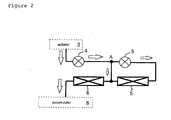
- flow regulator valve 7 comprises a three-way valve with first evaporator 5 and second evaporator 6 connected in series, but as shown in Figure 2, it may be arranged that flow regulator valve 9 is provided between junction A for the coolant flowing out of expansion device 4 and the inlet port of first evaporator 5, thus not only allowing the quantity flowing into first evaporator 5 to be regulated by regulating the flow passing through, but also regulating the quantity flowing into second evaporator 6.
- expansion device 4 As the degree of opening of expansion device 4 is regulated according to the total thermal load of first and second evaporators 5, 6, and as first evaporator 5 is set to regulate the degree of opening so that the cooling performance thereof remains constant, a single expansion device 4 is able to cater for a twin air-conditioning system, enabling a cooling cycle to be manufactured cheaply.
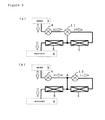
- first and second evaporators 5, 6 are arranged to be connected in series downstream of expansion device 4, but as shown in Figure 4a and 4b, first and second evaporators 5, 6 may also be connected in parallel downstream of expansion device 4, and flow regulator valve 7 comprising a three-way valve may be provided at the junction for the coolant flowing from expansion device 4.
- flow regulator valve 7 may be a device which controls the quantity distributed either electrically or mechanically so that the degree of superheating of one of the evaporators (for example, first evaporator 5) remains constant.
- the coolant flowing from radiator 3 has its pressure reduced by expansion device 4 so that the pressure of the coolant on the outlet side of the radiator is kept to a prescribed value determined by the temperature of the coolant on the outlet side of the radiator, entering flow regulator valve 7 after passing through this expansion device 4, being supplied to one of the evaporators 5 in such a way that the degree of superheating of this evaporator 5 remains constant.
- the coolant supplied to first evaporator 5 undergoes heat exchange with the coolant that has passed through this first evaporator 5 and evaporates, being sent on to accumulator 8.
- the remaining coolant not sent on to first evaporator 5 is conducted from flow regulator valve 7 to second evaporator 6, where it undergoes heat exchange with the air that has passed through second evaporator 6 and evaporates, being sent on to accumulator 8.
- the degree of opening of expansion device 4 is regulated according to the total thermal load on first and second evaporators 5, 6, and particularly as flow regulator valve 7 is set to regulate the degree of opening so that the cooling performance of first evaporator 5 remains constant, it is possible to adjust the flow according to the performance of first evaporator 5, allowing a twin air-conditioning system to be catered for with a single expansion device 4.
- the number of costly expansion devices can be reduced, thus enabling a cooling cycle for a twin air-conditioning system to be manufactured at low cost.
- flow regulator valve 7 is shown comprising a three-way valve, but as shown in Figure 4 (b), it may be arranged to have flow regulator valve 9 comprising a two-way valve provided between junction A for the coolant flowing from expansion device 4 and one of the evaporators (in the above example, the first evaporator) thus allowing regulation of the quantity flowing through here not only to regulate the quantity flowing into first evaporator 5 but also to regulate the quantity flowing into second evaporator 6.
- a three-way valve which continuously adjusts the quantities distributed is used as flow regulator valve 7, but alternatively a three-way valve which simply switches the direction of flow may be used, or, in the structure in Figure 4 (b), a two-way valve which simply opens and closes.
- cooling cycle 1 has a structure comprising compressor 2 which raises the pressure of the coolant itself to beyond the supercritical pressure, radiator 3 which cools the coolant compressed by compressor 2, first and second expansion devices 20, 21 which reduce the pressure of the coolant cooled by radiator 3, first evaporator 5 which evaporates the coolant whose pressure has been reduced by first expansion device 20, and a second evaporator 6 which evaporates the coolant whose pressure has been reduced by second expansion device 21, accumulator 8 which separates the gas and liquid in the coolant flowing from evaporators 5, 6 respectively, and internal heat exchanger 22 in which heat is exchanged between the low-pressure coolant conducted from accumulator 8 to compressor 2 and the high-pressure coolant conducted from radiator 3 to each expansion device 20, 21.
- cooling cycle 1 has a structure whereby the discharge side of compressor 2 is connected to high-pressure duct 22a of internal heat exchanger 22 via radiator 3, the outlet side of this high-pressure duct 22a being divided and connected to first expansion device 20 and second expansion device 21. Further, the outflow side of first expansion device 20 and the outflow side of second expansion device 21 are respectively connected to the inlet port of accumulator 8 via first evaporator 5 and second evaporator 6 respectively, the outflow port of accumulator 8 being connected to the inlet side of compressor 2 via low-pressure duct 22b of internal heat exchanger 22.
- high-pressure line 23 comprises the route from the discharge side of compressor 2 via radiator 3 and high-pressure duct 22a to expansion devices 20, 21, and low-pressure line 24 comprises the route from the outflow side of expansion devices 20, 21 via evaporators 5, 6, accumulator 8, and low-pressure duct 22b to compressor 2.
- control unit 25 the degree of opening of the valves of first expansion device 20 and second expansion device 21 is then controlled electrically by control unit 25.
- This control unit 25 has a structure comprising a central processing unit (CPU), a read-only memory (ROM) a random access memory (RAM), an in/out port and the like, being in itself a device known to the art with signals input from various sensors, it being arranged that the degree of opening of the respective expansion devices 20, 21 is controlled by a prescribed program which has been stored in the memory.
- CPU central processing unit
- ROM read-only memory
- RAM random access memory
- Figure 6 is a flow chart illustrating an example of the control operation of each of the expansion devices using control unit 25, and an example of this control operation will be described using this flow chart.
- control unit 25 embarks on this control routine after a series of initializing processes such as the initial setup, and inputs the parameters necessary for calculating the thermal load of first evaporator 5 (parameter A) and the parameters necessary for calculating the thermal load of second evaporator 6 (parameter B) (step 50).
- the parameters required for calculating the thermal load on first evaporator 5 may include, for example, the speed of rotation of the fan of the air-conditioning unit (blow rate), the air temperature on the inlet side of the first evaporator, room temperature, external temperature and the like, and parameters required for calculating the thermal load on second evaporator 6 may include the degree of superheating of second evaporator 6, the coolant temperature at the outlet of second evaporator 6, the pressure of the low-pressure line, and the air temperature of air passing through second evaporator 6 and the like.
- step 52 the thermal load of first evaporator 5 is calculated using input parameters A, and the thermal load of second evaporator 6 is calculated using parameters B.
- step 54 the ratio of the degree of opening for the valves in respective expansion devices 20, 21 is determined from the respective thermal loads that have been calculated, and in step 56 the pressure on the outlet side of the radiator is held at the prescribed pressure determined by the temperature of the coolant on the outlet side of the radiator (maximum pressure obtained by COP) while maintaining this'degree of opening of the valve ratio.
Landscapes
- Engineering & Computer Science (AREA)
- Physics & Mathematics (AREA)
- Mechanical Engineering (AREA)
- Thermal Sciences (AREA)
- General Engineering & Computer Science (AREA)
- Chemical & Material Sciences (AREA)
- Chemical Kinetics & Catalysis (AREA)
- Air Conditioning Control Device (AREA)
Applications Claiming Priority (2)
| Application Number | Priority Date | Filing Date | Title |
|---|---|---|---|
| JP2003337035 | 2003-09-29 | ||
| JP2003337035A JP4348610B2 (ja) | 2003-09-29 | 2003-09-29 | 冷凍サイクル |
Publications (2)
| Publication Number | Publication Date |
|---|---|
| EP1519123A2 true EP1519123A2 (de) | 2005-03-30 |
| EP1519123A3 EP1519123A3 (de) | 2015-05-13 |
Family
ID=34191552
Family Applications (1)
| Application Number | Title | Priority Date | Filing Date |
|---|---|---|---|
| EP20040022996 Withdrawn EP1519123A3 (de) | 2003-09-29 | 2004-09-28 | Kühlkreislauf |
Country Status (2)
| Country | Link |
|---|---|
| EP (1) | EP1519123A3 (de) |
| JP (1) | JP4348610B2 (de) |
Cited By (7)
| Publication number | Priority date | Publication date | Assignee | Title |
|---|---|---|---|---|
| US7467525B1 (en) | 2005-08-23 | 2008-12-23 | Denso Corporation | Supercritical refrigeration cycle system |
| US20120031121A1 (en) * | 2010-08-05 | 2012-02-09 | GM Global Technology Operations LLC | Air conditioner and method for operating an air conditioner |
| US20140260386A1 (en) * | 2013-03-14 | 2014-09-18 | Mitsubishi Electric Us, Inc. | Air conditioning system including pressure control device and bypass valve |
| US8991201B2 (en) | 2005-06-30 | 2015-03-31 | Denso Corporation | Ejector cycle system |
| EP2218986A3 (de) * | 2009-02-16 | 2016-01-06 | BSH Hausgeräte GmbH | Kältegerät mit mehreren Fächern |
| FR3043762A1 (fr) * | 2015-11-13 | 2017-05-19 | Valeo Systemes Thermiques | Systeme de pompe a chaleur avec valve d'expansion electrique pour un controle ameliore de l'humidite dans un habitacle |
| CN119042863A (zh) * | 2024-10-30 | 2024-11-29 | 上海能誉科技股份有限公司 | 制冷系统智能运行配置方法及系统 |
Families Citing this family (7)
| Publication number | Priority date | Publication date | Assignee | Title |
|---|---|---|---|---|
| JP5217121B2 (ja) * | 2005-06-30 | 2013-06-19 | 株式会社デンソー | エジェクタ式冷凍サイクル |
| JP4209881B2 (ja) * | 2005-10-18 | 2009-01-14 | 三星電子株式会社 | 空気調和装置 |
| FR2895786B1 (fr) * | 2006-01-04 | 2008-04-11 | Valeo Systemes Thermiques | Module de detente pour installation de climatisation a deux evaporateurs |
| JP2007071529A (ja) * | 2006-09-08 | 2007-03-22 | Denso Corp | 冷凍サイクル装置 |
| JP2008157305A (ja) | 2006-12-21 | 2008-07-10 | Denso Corp | 圧力制御弁および超臨界冷凍サイクル |
| DE102011109506B4 (de) * | 2011-08-05 | 2019-12-05 | Audi Ag | Kältemittelkreislauf |
| JP7386613B2 (ja) * | 2019-02-26 | 2023-11-27 | 三菱電機株式会社 | 熱交換器およびそれを備えた空気調和機 |
Citations (5)
| Publication number | Priority date | Publication date | Assignee | Title |
|---|---|---|---|---|
| EP0188630A2 (de) * | 1983-12-21 | 1986-07-30 | Daikin Industries, Limited | Klimaanlage |
| WO1995001538A1 (en) * | 1993-07-02 | 1995-01-12 | Alsenz Richard H | Refrigeration system utilizing a jet enthalpy compressor for elevating the suction line pressure |
| JP2000035250A (ja) | 1998-07-15 | 2000-02-02 | Nippon Soken Inc | 超臨界冷凍サイクル |
| JP2000065430A (ja) * | 1998-08-18 | 2000-03-03 | Nippon Soken Inc | 蒸気圧縮式冷凍サイクル |
| US6438978B1 (en) * | 1998-01-07 | 2002-08-27 | General Electric Company | Refrigeration system |
Family Cites Families (2)
| Publication number | Priority date | Publication date | Assignee | Title |
|---|---|---|---|---|
| DE1908722B1 (de) * | 1969-02-21 | 1970-08-20 | Aeg | Kuehl- oder Gefriermoebel mit Schnellgefriereinrichtung |
| JP2003139422A (ja) * | 2001-10-31 | 2003-05-14 | Daikin Ind Ltd | 冷凍機 |
-
2003
- 2003-09-29 JP JP2003337035A patent/JP4348610B2/ja not_active Expired - Fee Related
-
2004
- 2004-09-28 EP EP20040022996 patent/EP1519123A3/de not_active Withdrawn
Patent Citations (5)
| Publication number | Priority date | Publication date | Assignee | Title |
|---|---|---|---|---|
| EP0188630A2 (de) * | 1983-12-21 | 1986-07-30 | Daikin Industries, Limited | Klimaanlage |
| WO1995001538A1 (en) * | 1993-07-02 | 1995-01-12 | Alsenz Richard H | Refrigeration system utilizing a jet enthalpy compressor for elevating the suction line pressure |
| US6438978B1 (en) * | 1998-01-07 | 2002-08-27 | General Electric Company | Refrigeration system |
| JP2000035250A (ja) | 1998-07-15 | 2000-02-02 | Nippon Soken Inc | 超臨界冷凍サイクル |
| JP2000065430A (ja) * | 1998-08-18 | 2000-03-03 | Nippon Soken Inc | 蒸気圧縮式冷凍サイクル |
Cited By (9)
| Publication number | Priority date | Publication date | Assignee | Title |
|---|---|---|---|---|
| US8991201B2 (en) | 2005-06-30 | 2015-03-31 | Denso Corporation | Ejector cycle system |
| US7467525B1 (en) | 2005-08-23 | 2008-12-23 | Denso Corporation | Supercritical refrigeration cycle system |
| EP1757875A3 (de) * | 2005-08-23 | 2010-04-21 | Denso Corporation | Überkritischer Kältekreislauf |
| EP2218986A3 (de) * | 2009-02-16 | 2016-01-06 | BSH Hausgeräte GmbH | Kältegerät mit mehreren Fächern |
| US20120031121A1 (en) * | 2010-08-05 | 2012-02-09 | GM Global Technology Operations LLC | Air conditioner and method for operating an air conditioner |
| US20140260386A1 (en) * | 2013-03-14 | 2014-09-18 | Mitsubishi Electric Us, Inc. | Air conditioning system including pressure control device and bypass valve |
| US9605885B2 (en) * | 2013-03-14 | 2017-03-28 | Mitsubishi Electric Corporation | Air conditioning system including pressure control device and bypass valve |
| FR3043762A1 (fr) * | 2015-11-13 | 2017-05-19 | Valeo Systemes Thermiques | Systeme de pompe a chaleur avec valve d'expansion electrique pour un controle ameliore de l'humidite dans un habitacle |
| CN119042863A (zh) * | 2024-10-30 | 2024-11-29 | 上海能誉科技股份有限公司 | 制冷系统智能运行配置方法及系统 |
Also Published As
| Publication number | Publication date |
|---|---|
| EP1519123A3 (de) | 2015-05-13 |
| JP4348610B2 (ja) | 2009-10-21 |
| JP2005106318A (ja) | 2005-04-21 |
Similar Documents
| Publication | Publication Date | Title |
|---|---|---|
| CN112533782B (zh) | 用于运行用于车辆的制冷设备的方法 | |
| US6260367B1 (en) | Refrigerating cycle | |
| EP2232230B1 (de) | Kühlungssystem aufweisend eine testkammer mit temperatur- und feuchtigkeitskontrolle | |
| EP1519123A2 (de) | Kühlkreislauf | |
| US7062930B2 (en) | System and method for using hot gas re-heat for humidity control | |
| EP2313709B1 (de) | Kühlvorrichtung mit sollwerteinstellung | |
| EP3545243B1 (de) | Verfahren zur steuerung eines dampfkompressionssystems während einer gasbypassventilfehlfunktion | |
| CN106574813B (zh) | 用于控制可变能力喷射器单元的方法 | |
| US20110100035A1 (en) | Two-phase single circuit reheat cycle and method of operation | |
| EP3088809B1 (de) | Klimaanlage | |
| US20110030397A1 (en) | Start-up procedure for refrigerant systems having microchemical consensor and reheat cycle | |
| CN103874894A (zh) | 提供热回收的制冷系统和制冷方法 | |
| JPH0237253A (ja) | 密閉冷凍回路 | |
| JPH10147137A (ja) | 自動車の車室用空調装置 | |
| WO2010039385A2 (en) | Start-up for refrigerant system with hot gas reheat | |
| US20110138827A1 (en) | Improved operation of a refrigerant system | |
| US20080229764A1 (en) | Refrigerant Dehumidification System with Variable Condenser Unloading | |
| US6588223B2 (en) | Optimized CO2 operated air-conditioning system | |
| US11255573B2 (en) | Air conditioning apparatus for efficient supply air temperature control | |
| JP2006097972A (ja) | アキュムレータ冷凍サイクル | |
| JP2002228282A (ja) | 冷凍装置 | |
| WO2014172268A2 (en) | Variable capacity evaporator | |
| CN118794150A (zh) | 用于调节再热系统的制冷剂流管理 | |
| JPH1183128A (ja) | 異能力マルチエアコンシステム | |
| EP2137467A1 (de) | Mehrteiliges klimaanlagensystem und steuerverfahren dafür |
Legal Events
| Date | Code | Title | Description |
|---|---|---|---|
| PUAI | Public reference made under article 153(3) epc to a published international application that has entered the european phase |
Free format text: ORIGINAL CODE: 0009012 |
|
| AK | Designated contracting states |
Kind code of ref document: A2 Designated state(s): AT BE BG CH CY CZ DE DK EE ES FI FR GB GR HU IE IT LI LU MC NL PL PT RO SE SI SK TR |
|
| AX | Request for extension of the european patent |
Extension state: AL HR LT LV MK |
|
| RIC1 | Information provided on ipc code assigned before grant |
Ipc: F25B 5/02 20060101ALI20141121BHEP Ipc: F25B 9/00 20060101AFI20141121BHEP Ipc: F25B 5/04 20060101ALI20141121BHEP |
|
| PUAL | Search report despatched |
Free format text: ORIGINAL CODE: 0009013 |
|
| AK | Designated contracting states |
Kind code of ref document: A3 Designated state(s): AT BE BG CH CY CZ DE DK EE ES FI FR GB GR HU IE IT LI LU MC NL PL PT RO SE SI SK TR |
|
| AX | Request for extension of the european patent |
Extension state: AL HR LT LV MK |
|
| RIC1 | Information provided on ipc code assigned before grant |
Ipc: F25B 5/04 20060101ALI20150409BHEP Ipc: F25B 9/00 20060101AFI20150409BHEP Ipc: F25B 5/02 20060101ALI20150409BHEP |
|
| 17P | Request for examination filed |
Effective date: 20151102 |
|
| RBV | Designated contracting states (corrected) |
Designated state(s): AT BE BG CH CY CZ DE DK EE ES FI FR GB GR HU IE IT LI LU MC NL PL PT RO SE SI SK TR |
|
| AKX | Designation fees paid |
Designated state(s): AT BE BG CH CY CZ DE DK EE ES FI FR GB GR HU IE IT LI LU MC NL PL PT RO SE SI SK TR |
|
| AXX | Extension fees paid |
Extension state: AL Extension state: LV Extension state: LT Extension state: HR Extension state: MK |
|
| 17Q | First examination report despatched |
Effective date: 20160330 |
|
| STAA | Information on the status of an ep patent application or granted ep patent |
Free format text: STATUS: THE APPLICATION IS DEEMED TO BE WITHDRAWN |
|
| 18D | Application deemed to be withdrawn |
Effective date: 20180612 |
|
| RIC1 | Information provided on ipc code assigned before grant |
Ipc: F25B 9/00 20060101AFI20150409BHEP Ipc: F25B 5/02 20060101ALI20150409BHEP Ipc: F25B 5/04 20060101ALI20150409BHEP |