EP1518474B1 - Apparat zur Herstellung von Reissverschlüssen - Google Patents
Apparat zur Herstellung von Reissverschlüssen Download PDFInfo
- Publication number
- EP1518474B1 EP1518474B1 EP04017947A EP04017947A EP1518474B1 EP 1518474 B1 EP1518474 B1 EP 1518474B1 EP 04017947 A EP04017947 A EP 04017947A EP 04017947 A EP04017947 A EP 04017947A EP 1518474 B1 EP1518474 B1 EP 1518474B1
- Authority
- EP
- European Patent Office
- Prior art keywords
- slider
- upper stopper
- portions
- machining
- fastener chain
- Prior art date
- Legal status (The legal status is an assumption and is not a legal conclusion. Google has not performed a legal analysis and makes no representation as to the accuracy of the status listed.)
- Expired - Lifetime
Links
Images





Classifications
-
- A—HUMAN NECESSITIES
- A44—HABERDASHERY; JEWELLERY
- A44B—BUTTONS, PINS, BUCKLES, SLIDE FASTENERS, OR THE LIKE
- A44B19/00—Slide fasteners
- A44B19/42—Making by processes not fully provided for in one other class, e.g. B21D53/50, B21F45/18, B22D17/16, B29D5/00
- A44B19/62—Assembling sliders in position on stringer tapes
-
- A—HUMAN NECESSITIES
- A44—HABERDASHERY; JEWELLERY
- A44B—BUTTONS, PINS, BUCKLES, SLIDE FASTENERS, OR THE LIKE
- A44B19/00—Slide fasteners
- A44B19/24—Details
- A44B19/26—Sliders
-
- A—HUMAN NECESSITIES
- A44—HABERDASHERY; JEWELLERY
- A44B—BUTTONS, PINS, BUCKLES, SLIDE FASTENERS, OR THE LIKE
- A44B19/00—Slide fasteners
- A44B19/42—Making by processes not fully provided for in one other class, e.g. B21D53/50, B21F45/18, B22D17/16, B29D5/00
-
- A—HUMAN NECESSITIES
- A44—HABERDASHERY; JEWELLERY
- A44B—BUTTONS, PINS, BUCKLES, SLIDE FASTENERS, OR THE LIKE
- A44B19/00—Slide fasteners
- A44B19/42—Making by processes not fully provided for in one other class, e.g. B21D53/50, B21F45/18, B22D17/16, B29D5/00
- A44B19/60—Applying end stops upon stringer tapes
-
- Y—GENERAL TAGGING OF NEW TECHNOLOGICAL DEVELOPMENTS; GENERAL TAGGING OF CROSS-SECTIONAL TECHNOLOGIES SPANNING OVER SEVERAL SECTIONS OF THE IPC; TECHNICAL SUBJECTS COVERED BY FORMER USPC CROSS-REFERENCE ART COLLECTIONS [XRACs] AND DIGESTS
- Y10—TECHNICAL SUBJECTS COVERED BY FORMER USPC
- Y10T—TECHNICAL SUBJECTS COVERED BY FORMER US CLASSIFICATION
- Y10T29/00—Metal working
- Y10T29/49—Method of mechanical manufacture
- Y10T29/49782—Method of mechanical manufacture of a slide fastener
-
- Y—GENERAL TAGGING OF NEW TECHNOLOGICAL DEVELOPMENTS; GENERAL TAGGING OF CROSS-SECTIONAL TECHNOLOGIES SPANNING OVER SEVERAL SECTIONS OF THE IPC; TECHNICAL SUBJECTS COVERED BY FORMER USPC CROSS-REFERENCE ART COLLECTIONS [XRACs] AND DIGESTS
- Y10—TECHNICAL SUBJECTS COVERED BY FORMER USPC
- Y10T—TECHNICAL SUBJECTS COVERED BY FORMER US CLASSIFICATION
- Y10T29/00—Metal working
- Y10T29/51—Plural diverse manufacturing apparatus including means for metal shaping or assembling
- Y10T29/5101—Slide fastener or slide fastener element
-
- Y—GENERAL TAGGING OF NEW TECHNOLOGICAL DEVELOPMENTS; GENERAL TAGGING OF CROSS-SECTIONAL TECHNOLOGIES SPANNING OVER SEVERAL SECTIONS OF THE IPC; TECHNICAL SUBJECTS COVERED BY FORMER USPC CROSS-REFERENCE ART COLLECTIONS [XRACs] AND DIGESTS
- Y10—TECHNICAL SUBJECTS COVERED BY FORMER USPC
- Y10T—TECHNICAL SUBJECTS COVERED BY FORMER US CLASSIFICATION
- Y10T29/00—Metal working
- Y10T29/51—Plural diverse manufacturing apparatus including means for metal shaping or assembling
- Y10T29/5124—Plural diverse manufacturing apparatus including means for metal shaping or assembling with means to feed work intermittently from one tool station to another
-
- Y—GENERAL TAGGING OF NEW TECHNOLOGICAL DEVELOPMENTS; GENERAL TAGGING OF CROSS-SECTIONAL TECHNOLOGIES SPANNING OVER SEVERAL SECTIONS OF THE IPC; TECHNICAL SUBJECTS COVERED BY FORMER USPC CROSS-REFERENCE ART COLLECTIONS [XRACs] AND DIGESTS
- Y10—TECHNICAL SUBJECTS COVERED BY FORMER USPC
- Y10T—TECHNICAL SUBJECTS COVERED BY FORMER US CLASSIFICATION
- Y10T29/00—Metal working
- Y10T29/51—Plural diverse manufacturing apparatus including means for metal shaping or assembling
- Y10T29/5124—Plural diverse manufacturing apparatus including means for metal shaping or assembling with means to feed work intermittently from one tool station to another
- Y10T29/5127—Blank turret
- Y10T29/5128—Rotary work - vertical axis
-
- Y—GENERAL TAGGING OF NEW TECHNOLOGICAL DEVELOPMENTS; GENERAL TAGGING OF CROSS-SECTIONAL TECHNOLOGIES SPANNING OVER SEVERAL SECTIONS OF THE IPC; TECHNICAL SUBJECTS COVERED BY FORMER USPC CROSS-REFERENCE ART COLLECTIONS [XRACs] AND DIGESTS
- Y10—TECHNICAL SUBJECTS COVERED BY FORMER USPC
- Y10T—TECHNICAL SUBJECTS COVERED BY FORMER US CLASSIFICATION
- Y10T29/00—Metal working
- Y10T29/53—Means to assemble or disassemble
- Y10T29/53291—Slide fastener
-
- Y—GENERAL TAGGING OF NEW TECHNOLOGICAL DEVELOPMENTS; GENERAL TAGGING OF CROSS-SECTIONAL TECHNOLOGIES SPANNING OVER SEVERAL SECTIONS OF THE IPC; TECHNICAL SUBJECTS COVERED BY FORMER USPC CROSS-REFERENCE ART COLLECTIONS [XRACs] AND DIGESTS
- Y10—TECHNICAL SUBJECTS COVERED BY FORMER USPC
- Y10T—TECHNICAL SUBJECTS COVERED BY FORMER US CLASSIFICATION
- Y10T29/00—Metal working
- Y10T29/53—Means to assemble or disassemble
- Y10T29/53291—Slide fastener
- Y10T29/53296—Means to assemble stop onto stringer
-
- Y—GENERAL TAGGING OF NEW TECHNOLOGICAL DEVELOPMENTS; GENERAL TAGGING OF CROSS-SECTIONAL TECHNOLOGIES SPANNING OVER SEVERAL SECTIONS OF THE IPC; TECHNICAL SUBJECTS COVERED BY FORMER USPC CROSS-REFERENCE ART COLLECTIONS [XRACs] AND DIGESTS
- Y10—TECHNICAL SUBJECTS COVERED BY FORMER USPC
- Y10T—TECHNICAL SUBJECTS COVERED BY FORMER US CLASSIFICATION
- Y10T29/00—Metal working
- Y10T29/53—Means to assemble or disassemble
- Y10T29/53291—Slide fastener
- Y10T29/533—Means to assemble slider onto stringer
Definitions
- the present invention relates to a slide fastener manufacturing apparatus of the kind defined in the preamble of claim 1.
- US-A-3 138 852 discloses an apparatus for manufacturing a slide fastener component, having a rotatable turret which is indexed to several stations arranged there around whereby the components are successively positioned on and attached to products arranged circumferentially around the periphery of the turret.
- various machining portions such as a cutter portion 101, a slider inserting portion 102 and an upper stopper attaching portion 103 are sequentially arranged in series along a moving path in the longitudinal direction of a fastener chain C as shown in Fig. 16 .
- a tip portion in the longitudinal direction of the fastener chain C in a closing state is held horizontally by means of a pair of left and right inserting grippers 104 and 104 and the fastener chain C is transferred over the cutter portion 101, the slider inserting portion 102 and the upper stopper attaching portion 103.
- a slider 105 is inserted through the fastener chain C and an upper stopper 106 is attached to the fastener chain C divided into two portions by the insertion of the slider 105 respectively.
- the rear end of the fastener chain C reaching the cutter portion 101 is cut to finish the fastener chain C in a predetermined length. By sequentially repeating this operation, the next fastener chain C having a predetermined length is finished.
- JP-A-6-209810 , JP-B-6-71446 and JP-B-7-40962 have been proposed by the applicant.
- JP-A-6-209810 , JP-B-6-71446 , and JP-B-7-40962 are referred to as related art.
- the fastener chain manufacturing apparatus 100 described in each of JP-A-6-209810 , JP-B-6-71446 and JP-B-7-40962 is configured by serially providing each of the machining portions such as the cutter portion 101, the slider inserting portion 102 and the upper stopper attaching portion 103 along a transfer path extended on a straight line.
- the fastener chain C is transferred in a horizontal state over all of the machining portions 101 to 103 provided on the straight line from the supply side toward the discharge side of the fastener chain C so that the single fastener chain C having a predetermined length to be a product object can be processed as described above.
- the conventional fastener chain manufacturing apparatus 100 only the single fastener chain C can be transferred and predetermined machining are sequentially carried out one by one in the machining portions 101 to 103, and the next fastener chain C cannot be transferred until all of the machining works of the machining portions 101 to 103 are completed in respect of a structure thereof.
- the next fastener chain C cannot be started to be processed until the fastener chain C having the predetermined length to be formed into a product is transferred over all of the machining portions 101 to 103.
- the machining devices of the machining portions 101 to 103 completing the machining are to stop the operations until the operations of the machining devices of all the machining portions 101 to 103 for the fastener chain C are completed, and are to stand by for a time taken until the next fastener chain C is transferred.
- the machining device which has not carried out the machining is to stand by without doing anything until the fastener chain C reaches a machining position. Accordingly, there is a problem in that the standby time of the machining device is prolonged, resulting in a deterioration in the operation efficiency of the machining device.
- the cycle time of a machining is prolonged, resulting in an increase in a machining cost per product.
- the conventional fastener chain manufacturing apparatus has introduced various automatic apparatuses to be used for a necessary measurement for an automatic operation other than the machining to be carried out by each of the machining portions and the confirmation and check of a machining part.
- the automatic apparatus of this kind is to be introduced, there is also a problem in that the cycle time of the machining is prolonged still more together with the machining time of each of the machining portions and a machining cost per product is increased very sharply.
- An object of the invention is to provide a slide fastener manufacturing apparatus capable of shortening a time required for manufacture by a machining, reducing a machining cost and manufacturing a product at a high speed.
- the invention provides a slide fastener manufacturing apparatus for manufacturing a slide fastener, having: a fixed table portion; a plurality of machining portions for machining a fastener chain to manufacture the slide fastener, each of the machining portions is provided at the fixed table portion at a predetermined angle and in order of the machining by the plurality of the machining portions; a rotator for intermittently rotating at the predetermined angle and in parallel with the fixed table portion; and a plurality of holding portions for holding the fastener chain, each of the holding portions is disposed at the rotator at the predetermined angle.
- the holding portion has: a pair of left and right grippers for holding the fastener chain; and operating portions for operating the pair of grippers to be closed or be separated each other.
- the plurality of machining portions has, as each of the machining portions,: a cutter portion for cutting the fastener chain to have a predetermined length; a slider attaching portion for attaching a slider to the fastener chain cut by the cutter portion, an upper stopper attaching portion for attaching an upper stopper to the fastener chain to which the slider is attached; and a chain discharging portion for discharging a slide fastener as the fastener chain to which the slider and the upper stopper is attached out of a rotation and transfer path of the rotator.
- the cutter portion has: chain delivering portions for delivering the fastener chain toward the holding portion; and a cutting blade for cutting the fastener chain delivered by the chain delivering portions.
- the slider attaching portion includes: a slider delivering chute for delivering the slider; a slider stopper portion, which is urged on the slider delivering chute, for temporarily holding the slider delivered through the slider delivering chute; and a slider transferring portion for moving toward and backward the slider stopper portion to transfer the slider held by the slider stopper portion one by one, wherein when the slider transferring portion transfers the slider to a position where the slider is to be attached to the fastener chain, the slider stopper portion moves to an outside of a path of the slider transferring portion against an urging force thereof with the movement of the slider transferring portion, the slider stopper portion then returns to an original position by the urging force after the slider transferring portion moves beyond the slider stopper portion.
- the slider transferring portion has: a first slider fixing portion for supporting an upper blade plate of the slider, and a second slider fixing portion for supporting a lower blade plate of the slider, wherein the first slider fixing portion and the second slider fixing portion are closed or separated each other.
- the upper stopper attaching portion includes: an upper stopper delivering chute for aligning and delivering a plurality of upper stoppers; an upper stopper taking portion for taking the upper stoppers one by one out of the upper stopper delivering chute; and an upper stopper transferring portion for transferring the upper stopper taken our by the upper stopper taking portion to a position where the upper stopper is to be attached to the fastener chain, and the upper stopper transferring portion includes a fastening portion for fastening the upper stopper to the fastener chain.
- the upper stopper is in a U shape having two leg portions, and the upper stopper taking portion has a fitting protrusion for fitting between the leg portions to support the upper stopper.
- the fastening portion has a pair of first and second pressing portions which close or separate each other, and each of the pressing portions has a fitting concave portion to which the upper stopper supported by the fitting protrusion of the upper stopper taking portion is inserted.
- each of the machining portions has a driving portion to be independently operated respectively.
- the machining portions are provided at an edge of the fixed table portion, and the holding portions are disposed at an edge of the rotator.
- the machining portions are provided around a vertical axis of the fixed table portion, the rotator is provided to enable to rotate around the vertical axis.
- the machining portions are provided at the fixed table portion with a predetermined phase difference in order of the machining.
- the rotator is controllably rotatable intermittently at a predetermined angle.
- the holding portions for holding the fastener chain cut to have a predetermined length are fixed at the rotator at a predetermined angle.
- a space portion having no element train every predetermined interval is formed in a longitudinal direction on the fastener chain to be a machining object which has not been cut, and the element train in a mating state is formed between the space portions.
- a lower stopper is previously attached every tip portion in the direction of transfer of the element train.
- the fastener chain is transferred to the first machining portion of the fixed table portion.
- the fastener chain which is transferred is held by the holding portion provided on the rotator in the vicinity of the upper part of a portion having the element train between the space portions and is cut in the space portion of the fastener chain in the vicinity of the upper part of the holding portion.
- the fastener chain thus cut is intermittently rotated and transferred to the machining portions of the fixed table portion based on the rotation control of the rotator. More specifically, in the case that a machining time in each of the machining portions has a variation, the rotation of the rotator is intermittently controlled every time the machining in the machining portion which requires the longest machining time is completed.
- a predetermined machining is carried out over the fastener chain which is rotated and transferred. Every time the machining by each of the machining portions is entirely completed, the fastener chain is intermittently rotated and transferred to a next machining portion in a holding state by the holding portion on the rotator, and all of the machining for one fastener chain are ended while the rotator carries out one rotation.
- the hold of the fastener chain which is completely subjected to all of the machining is released by the holding portion, and is discharged from the rotation and transfer path of the rotator.
- the holding portion releasing the hold of the fastener chain is returned to the first machining portion.
- a new fastener chain having a predetermined length is held by the holding portion returned to the first machining portion.
- the operation is sequentially repeated every time the fastener chain held by the holding portion is intermittently rotated at a predetermined angle to the machining portions of the fixed table portion.
- the fastener chain thus cut can be intermittently rotated and transferred at a predetermined angle to each of the machining portions. Consequently, it is possible to carry out a predetermined machining for the cut fastener chains in order of the machining simultaneously and continuously.
- a standby time in each of the machining portions can be eliminated and the operation efficiency of each of the machining portions can be enhanced very greatly.
- a time required for the manufacture of the manufacturing apparatus can be shortened considerably, and furthermore, a machining cost per product can be reduced so that the output of a product can be increased sharply.
- the machining portions can be provided on a circumference. As compared with the case that the machining portions are provided linearly, therefore, a space for the slide fastener manufacturing apparatus can be reduced.
- the holding portion can be configured by a pair of left and right grippers for holding the fastener chain and the operating portions for operating the pair of grippers to be closed or be separated each other.
- the grippers can hold the fastener chain having a predetermined length and can be intermittently rotated and transferred at a predetermined angle to each of the machining portions of the fixed table portion by means of the rotator, and thereafter, a pair of left and right fastener tapes of the fastener chain can be moved in an optimum direction for a machining attitude in each of the machining portions by the operating portions for the pair of grippers.
- each fastener tape can be moved according to the machining attitude in each of the machining portions. Therefore, the fastener chain can be automatically aligned for each of the machining portions so that the machining of the fastener chain in each of the machining portions can always be carried out stably.
- the machining portion it is possible to sequentially provide, with a predetermined phase difference, the cutter portion for cutting the fastener chain to have a predetermined length around the vertical axis of the fixed table portion, the slider attaching portion for attaching the slider to the fastener chain thus cut, the upper stopper attaching portion for attaching the upper stopper to the fastener chain to which the slider is attached, and the chain discharging portion for discharging, from the rotation and transfer path of the rotator, the finished slide fastener having the slider and the upper stopper attached thereto.
- the fastener chain delivered continuously is transported to the cutter portion of the fixed table portion.
- the predetermined portion of the fastener chain that is, the vicinity of the upper part of the portion having the element train between the space portions as described above is held by each holding portion of the rotator provided in the cutter portion.
- the cutting is carried out in the space portion of the fastener chain in the vicinity of the upper part held by each holding portion, and the fastener chain cut to have the predetermined length is held in each holding portion.
- the rotator is intermittently rotated toward the slider attaching portion in the next step, and the fastener chain cut to have the predetermined length is intermittently rotated and transferred to the slider attaching portion at a predetermined angle in a state that the same fastener chain is held in each holding portion.
- the slider is attached to the fastener chain cut to have the predetermined length.
- the rotator is intermittently rotated toward the upper stopper attaching portion in the next step to intermittently rotate and transfer the fastener chain in the holding state in each holding portion from the slider attaching portion to the upper stopper attaching portion in the next step at a predetermined angle.
- the upper stopper In the upper stopper attaching portion, the upper stopper is attached to the fastener chain so that a finished fastener chain product can be obtained. Then, the rotator is intermittently rotated at a predetermined angle to intermittently rotate and transfer the finished fastener chain product toward the chain discharging portion. In the chain discharging portion, the hold of each holding portion for the finished fastener chain product is released and the finished fastener chain product is discharged from the rotator to the outside of the rotation and transfer path.
- the operation can be repeated sequentially every time the fastener chain is periodically rotated and transferred sequentially to the cutter portion, the slider attaching portion, the upper stopper attaching portion and the chain discharging portion.
- a plurality of fastener chains can be processed in parallel at the same time.
- the cutter portion can include the chain delivering portions for delivering the fastener chain toward the holding portion and the cutting blade for cutting the fastener chain delivered by the chain delivering portions.
- the cutting blade can be driven in closing and separating directions to and from the fastener chain. After the fastener chain is delivered to have a predetermined length by the chain delivering portions, the fastener chain is held in each holding portion. In this state, the cutting blade is caused to close to the fastener chain, thereby cutting the fastener chain in the space portion in the vicinity of the upper part of each of the holding portions.
- the fastener chain can be cut to have the predetermined length prior to each of the serial machining such as the insertion of the slider into the fastener chain and the attachment of the upper stopper to the fastener chain. Consequently, subsequent machining can be carried out independently and efficiently.
- the slider attaching portion can include the slider delivering chute for delivering the slider, the slider stopper portion for temporarily holding the slider delivered through the slider delivering chute, and the slider transferring portion for holding and transferring the sliders one by one.
- the slider stopper portion can be provided movably in an urged state in the position for crossing the slider delivering chute.
- the slider transferring portion can include the first slider fixing portion for supporting the upper blade plate of the slider, and the second slider fixing portion for supporting the lower blade plate of the slider, and the slider fixing portions is configured to freely close and separate each other.
- the slider delivered through the slider delivering chute can be temporarily held by the slider stopper portion provided movably in the urged state in the position for crossing the slider delivering chute.
- the slider transferring portion can hold the surface and back sides of the slider in the first and second slider fixing portions respectively and can move the held slider toward the position where the slider is to be inserted into the fastener chain.
- the slider stopper portion When the slider transferring portion is moved, the slider stopper portion can be retreated to the outside of the transfer path for the slider transferring portion against an urging force thereof with the movement of the slider transferring portion.
- the slider transferring portion is moved beyond the slider stopper portion, and at the same time, the slider stopper portion can be returned to an initial standby position for crossing the slider delivering chute by an urging force thereof and can stand by to hold a new slider.
- the slider transferring portion can be continuously moved toward the fastener chain held by the holding portion in a mating state and can introduce the upper end of the fastener chain into the slider.
- the pair of holding portions is moved in such a direction as to separate from each other in exact timing. Consequently, it is possible to open, like a Y shape, the tip portion of the fastener chain held by the pair of holding portions.
- the slider stopper portion and the slider transferring portion can be provided to close to the slider attaching portion. Consequently, the work for attaching the slider can be carried out efficiently and continuously without interfering with the other machining portions.
- the upper stopper attaching portion can include the upper stopper delivering chute for aligning and delivering a plurality of upper stoppers, the upper stopper taking portion for taking the upper stoppers out of the upper stopper delivering chute one by one, and the upper stopper transferring portion for holding and transferring the upper stopper taken out by the upper stopper taking portion to the position where the upper stopper is to be attached to the fastener chain.
- the upper stopper transferring portion can include the fastening portion for fastening the upper stopper to the fastener chain.
- the upper stopper taking portion can take the upper stoppers out of the upper stopper delivering chute one by one and can be moved forward and backward between a position where the upper stopper is taken out and a position where the upper stopper transferring portion stands by.
- the upper stopper transferring portion can be moved independently of the upper stopper taking portion from the position where the upper stopper is taken out to a position where the upper stopper is fixed.
- the upper stopper it is possible to use an upper stopper in a U shape having two leg portions. In this case, it is suitable that the upper stopper taking portion should be provided with the fitting protrusion for fitting between the leg portions to support the upper stopper.
- the fitting protrusion of the upper stopper taking portion can fit, support and hold the leg portions of the upper stopper delivered through the upper stopper delivering chute and can transfer the upper stopper held in the upper stopper taking portion toward the upper stopper transferring portion.
- the fastening means can be configured to cause a pair of first and second pressing portions to freely close and separate each other.
- Each of the pressing portions can be provided with the fitting concave portion to which the upper stopper supported by the fitting protrusion of the upper stopper taking portion is inserted.
- the pair of first and second pressing portions of the upper stopper transferring portion can insert, guide, fit and support the upper stopper fitted and supported by the fitting protrusion of the upper stopper taking portion.
- the left and right leg portions of the upper stopper When the two sharp leg portions of the upper stopper reach one of the fastener tapes of the fastener chain with the movement of the upper stopper transferring portion, the left and right leg portions of the upper stopper are inserted through the fastener tape across the upper end of the element train in an opening state. At the same time, the left and right leg portions of the upper stopper are bent like an almost C shape inward from each other by the press of the pair of pressing portions of the upper stopper transferring portion, and the upper stopper can be attached to the fastener tape.
- the upper stopper taking portion and the upper stopper transferring portion can be provided to close to the upper stopper attaching portion. Consequently, it is possible to efficiently carry out the work for attaching the upper stopper without interfering with the other machining portions.
- Each of the machining portions can include the driving portion to be independently operated respectively.
- the driving portion provided in each of the machining portions can be driven independently for each of the machining portions.
- the driving portion can be assembled into a single support portion and can be formed into a unit. Consequently, the size of the slide fastener manufacturing apparatus can be reduced. In addition, machining works can be carried out independently, smoothly and efficiently.
- the machining portions may be provided at an edge of the fixed table portion, and the holding portions may be disposed at an edge of the rotator.
- the machining portions may be provided around a vertical axis of the fixed table portion, the rotator may be provided to enable to rotate around the vertical axis.
- Fig. 1 is a general perspective view typically showing a slide fastener manufacturing apparatus according to a representative embodiment of the invention.
- the reference numeral 10 denotes a slide fastener manufacturing apparatus taking the shape of a rotary table according to the embodiment.
- the slide fastener manufacturing apparatus 10 comprises a hexagonal fixed table portion 12 fixed above a rack 11, and a hexagonal rotator 13 provided in parallel under the fixed table portion 12.
- the rotator 13 is intermittently fixed and supported onto the rack 11 to be horizontally rotatable around the same vertical axis together with the fixed table portion 12.
- a machining station for carrying out various machining over a fastener chain C obtained by cutting a long and continuous fastener chain C to have a predetermined length can be provided in the fixed table portion 12 around the same vertical axis in order of the machining with a predetermined phase difference.
- the fixed table portion 12 shown in the drawing has first to third machining portions and fourth to sixth processed portions. These machining and processed portions are provided with a phase difference of 60 degrees in the circumferential direction of the fixed table portion 12. Positions in which the machining and processed portions are to be provided are not restricted to an example shown in the drawing, but it is a matter of course that they can be provided in order of the machining with a phase difference of 45 or 72 degrees in the circumferential direction of the fixed table portion 12.
- the first to third machining portions are configured by a cutter portion 20 for cutting the fastener chain C to have a predetermined length, a slider attaching portion 30 for inserting a slider 1 through the fastener chain C transferred from the cutter portion 20 which is cut to have the predetermined length and is unprocessed, and an upper stopper attaching portion 40 for attaching an upper stopper 2 to the fastener chain C transferred from the slider attaching portion 30.
- the fourth and fifth processed portions are configured by a pull erecting portion 50 for bringing down a pull 1a of the slider 1, and a chain discharging portion 60 provided adjacently to the downstream side of the pull erecting portion 50.
- the fixed table portion 12 shown in the drawing has a spare portion 70 provided between the chain discharging portion 60 and the cutter portion 20.
- the spare portion 70 can be provided with a checking apparatus for confirming and checking a finished fastener chain product discharged from the chain discharging portion 60 to the outside of a rotation and transfer path for the rotator 13 or/and various automatic apparatuses (not shown) to be used for a necessary measurement for intermittently and automatically operating each of the machining portions 20 to 40 at a predetermined angle and the confirmation and check of a machining time for each of the machining portions 20 to 40.
- a detection value sent from a detecting sensor provided in each of the machining portions 20 to 40 can be input to various checking apparatuses provided in the spare portion 70. Moreover, the position of the spare portion 70 is exchanged with that of the chain discharging portion 60. Consequently, the finished fastener chain product checked in the spare portion 70 can also be discharged from the chain discharging portion 60 to an outside.
- a support table 14 is provided on an upper surface in the central part of the fixed table portion 12.
- a slider delivering feeder 15 for delivering the slider 1 ( Fig. 5 ) to the slider attaching portion 30 and an upper stopper delivering feeder 16 for delivering the upper stopper 2 ( Fig. 8 ) to the upper stopper attaching portion 40 are mounted and fixed onto the support base 14. All the starting operations of the slide fastener manufacturing apparatus 10 are carried out by the manipulation of an operation control panel which is not shown.
- the rotator 13 can be configured in such a manner that a rotation is intermittently controlled at a predetermined angle for each of the machining portions 20 to 40 and the processed portions 50 to 70 by a control device which is not shown.
- a pair of left and right holding portions 17 and 17 for holding fastener tapes T and T of a pair of left and right fastener stringers S and S in the fastener chain C having a predetermined length are fixedly provided at a predetermined angle in each of the machining portions 20 to 40 and the processed portions 50 to 70 in the rotator 13.
- Grippers 17 and 17 can be used as the holding portions 17 and 17.
- the fixed table portion 12 and the rotator 13 may be provided on a center and an outside over the same horizontal plane respectively, thereby holding the fastener chain C on the rotator 13 horizontally.
- a set of gripper pair 17 and 17 shown in the drawing is provided with a phase difference of 60 degrees in the circumferential direction of the rotator 13.
- the driving operation of each of the grippers 17 can be controlled independently in closing and separating directions to and from each other corresponding to the movement of each of the machining portions 20 to 40 by means for operating a cylinder or a cam which is attached to a support portion which is not shown.
- the gripper 17 and the operating means constitute holding means to form a part of a main feature portion according to the invention.
- a position in which the gripper 17 is to be provided is not particularly restricted.
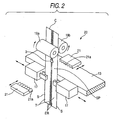
- Fig. 2 shows the enlarged main part of the cutter portion 20 to be applied to the slide fastener manufacturing apparatus 10.
- a space portion SP having no element train ER is formed at a predetermined interval as 'shown in Fig. 2 .
- the element train ER in a mating state is formed between the space portions SP, and a lower stopper 3 is previously attached for each tip portion in the direction of transfer of each element train ER.
- the fastener chain C is pulled out of a fastener supply portion (not shown) in a horizontal direction and is then hung in a downward direction through a guide roll 18 ( Fig. 1 ) supported rotatably around the horizontal axis of the support portion which is not shown.
- the tip portion of the fastener chain C can be transferred intermittently and vertically to the cutter portion 20 to be the first machining portion through a driving roll 19a and a driven roll 19b which are chain delivering means supported rotatably around the horizontal axis of the support portion which is not shown.
- the holding means is provided. Consequently, the fastener tape T can be held accurately and smoothly, and furthermore, the attitude of the fastener stringer S can always be maintained stably.
- Fig. 3 typically shows a state obtained immediately before the fastener chain C is cut and Fig. 4 shows a subsequent operation to Fig. 3 .
- the cutter portion 20 has a pair of cutting blades 21 and 21 provided horizontally in the vicinity of the upper part of the gripper 17 to interpose a transfer path for the fastener chain C formed between the pair of grippers 17 and 17 and between the pair of rolls 19a and 19b.
- Each of the cutting blades 21 has a blade portion 21a for zigzag cutting the cut portion of the fastener chain C.
- Each of the cutting blades 21 can be configured to singly control the driving operation in closing and separating directions to and from each other toward the fastener chain C by the operating means such as a motor which is attached to the support portion which is not shown.
- the fastener chain C can also be cut by a fixed die provided in the vicinity of the fastener chain C and a cutting blade closing toward the fixed die and coming in contact with the fastener chain C by a shock.
- the fastener chain C having a predetermined length is transferred by the rotation of the driving roll 19a and the driven roll 19b, and the fastener tapes T of the fastener chain C are held by the grippers 17 respectively as shown in Figs. 2 and 3 .
- the vicinity of the upper part of a portion having the element train ER between the space portions SP is held by each of the grippers 17.
- the fastener stringer S of the fastener chain C which is cut and set in the mating state is maintained to be held by each of the gripers 17 and is intermittently rotated and transferred to the slider attaching portion 30 of the second machining portion to be a next step through the rotator 13.
- a new fastener chain C is held by each of the grippers 17 of the rotator 13 returned with one rotation to the cutter portion 20 as described above, and the same operation as described above is repeated.
- Fig. 5 shows the enlarged main part of the slider attaching portion 30
- Fig. 6 typically shows a state obtained immediately before the slider 1 is inserted through the fastener stringer S
- Fig. 7 shows a subsequent operation to Fig. 6 .
- the slider attaching portion 30 includes a slider stopper portion 31 for temporarily holding the slider 1 slipping down through a slider delivering chute 15a (hereinafter referred to as a chute 15a) from the slider delivering feeder 15, and a slider transferring portion 32 for holding and transferring, in a non-operation state, an upper blade plate 1b and a lower blade plate 1c of the slider 1 held on the chute 15a in the slider stopper portion 31.
- a slider stopper portion 31 for temporarily holding the slider 1 slipping down through a slider delivering chute 15a (hereinafter referred to as a chute 15a) from the slider delivering feeder 15, and a slider transferring portion 32 for holding and transferring, in a non-operation state, an upper blade plate 1b and a lower blade plate 1c of the slider 1 held on the chute 15a in the slider stopper portion 31.
- the chute 15a serves to cause a rear port 1d of the slider 1 to slip down toward a slider introducing side in a state in which the pull 1a provided on the upper blade plate 1b of the slider 1 is erected upward as shown in Fig. 5 .
- the upstream side of the chute 15a is downward inclined and extended from the slider delivering feeder 15 toward the slider attaching portion 30 as shown in Fig. 1 .
- a downstream side thereof is bent and extended in a vertical direction toward a slider holding position by the slider transferring portion 32 as shown in Fig. 5 .
- the chute 15a is configured by a pair of slider introducing guide pieces 15a-1 and 15a-1 which are separated from each other at a predetermined interval as shown in Fig. 5 .
- a slider introducing guide space is formed between the slider introducing guide pieces 15a-1.
- Each of the slider introducing guide pieces 15a-1 can insert and support an insertion space formed from the rear port 1d of the slider 1 to the upper blade plate 1b and lower blade plate 1c of the slider 1 and can introduce and guide the slider 1 along the slider introducing guide space formed between the slider introducing guide pieces 15a-1.
- the slider stopper portion 31 is provided on the downstream side of the chute 15a.
- the slider stopper portion 31 is configured by an almost inverse L-shaped bent plate portion including a vertical portion 31a rocked between a position for crossing the chute 15a and a position for retreating from the chute 15a and a horizontal portion 31b bent from the lower end of the vertical portion 31a toward the downstream side of the chute 15a.
- the upper part of the vertical portion 31a of the slider stopper portion 31 is rockingly fixed and supported on a support portion which is not shown.
- the vertical portion 31a is always urged toward the chute 15a by urging means such as a compression coil spring which is not shown.
- the horizontal portion 31b of the slider stopper portion 31 can be configured to be elastically rotated in a direction for crossing the slider introducing guide pieces 15a-1 by setting the upper part of the vertical portion 31a to be a rocking fulcrum (clockwise and counterclockwise directions shown in an arrow of Fig. 5 ).
- the horizontal portion 31b of the slider stopper portion 31 can be caused to temporarily hold the slider 1 slipping down from the slider delivering feeder 15 through the chute 15a and only one slider 1 can be taken out of the chute 15a by means of the slider transferring portion 32 which will be described below.
- the slider transferring portion 32 is provided on an extended line at the downstream side of the chute 15a as shown in Fig. 5 .
- the slider transferring portion 32 is configured by first and second slider fixing portions 32a and 32b taking cubic shapes which are arranged on both sides in the diameter direction of the fixed table portion 12 with the horizontal portion 31b of the slider stopper portion 31 interposed therebetween.
- the slider fixing portions 32a and 32b are provided opposite to each other on the same horizontal plane and can be configured to close and separate each other.
- the slider fixing portions 32a and 32b can be assembled into the same support portion which is not shown and can be thus formed into a unit.
- the first slider fixing portion 32a has a fitting concave portion 32a-1 for fitting and supporting the upper blade plate 1b of the slider 1 in a state in which the pull 1a of the slider 1 is erected with the rear port 1d of the slider 1 turned toward the downstream side of the chute 15a as shown in Fig. 5 .
- the fitting concave portion 32a-1 is coincident with the shape of the contour of the upper blade plate 1b and has a bottom surface provided with a pull housing portion 32a-2 for accommodating the pull 1a in the erection state.
- the second slider fixing portion 32b to be the other part is provided at such an interval as to hold the upper blade plate 1b and the lower blade plate 1c of the slider 1 together with the first slider fixing portion 32a as shown in Fig. 5 .
- the second slider fixing portion 32b serves to fit and support the lower blade plate 1c of the slider 1 and has a fitting concave portion 32b-1 which is coincident with the configuration of the contour of the lower blade plate 1c.
- Each of the slider fixing portions 32a and 32b can be configured to be moved upward and downward in the same direction by a single operation through up-down driving means such as a cylinder (not shown) between a slider holding position in which the upper blade plate 1b and the lower blade plate 1c of the slider 1 are to be held and a slider inserting position in which the slider 1 is to be inserted into the fastener chain C, and to be opened or closed horizontally in the direction of the table diameter of the rotator 13 independently of the up-down driving means through horizontal driving means such as a cylinder which is not shown.
- up-down driving means such as a cylinder (not shown) between a slider holding position in which the upper blade plate 1b and the lower blade plate 1c of the slider 1 are to be held and a slider inserting position in which the slider 1 is to be inserted into the fastener chain C, and to be opened or closed horizontally in the direction of the table diameter of the rotator 13 independently of the up-down driving means through horizontal driving means such as a cylinder which
- each of the slider fixing portions 32a and 32b can be sensed by a sensing device which is not shown.
- Each of the slider fixing portions 32a and 32b can be configured to automatically stop in the slider holding position in which the upper blade plate 1b and the lower blade plate 1c of the slider 1 are to be held and the slider inserting position in which the slider 1 is to be inserted into the fastener chain C.
- a portion between the slider fixing portions 32a and 32b serves as a space portion for guiding the rear port 1d of the slider 1 toward the element train ER of the fastener chain C held by each of the grippers 17.
- the slider transferring portion 32 configured as described above stands by just below the chute 15a at such an interval as to avoid an interference with the horizontal portion 31b of the slider stopper portion 31 between the slider fixing portions 32a and 32b.
- the slider transferring portion 32 starts to be lifted toward the slider 1.
- the first and second slider fixing portions 32a and 32b of the slider transferring portion 32 are horizontally moved in an closing direction to each other.
- the pull 1a of the slider 1 is accommodated and supported in the pull housing portion 32a-2 of the first slider fixing portion 32a, and furthermore, the upper blade plate 1b of the slider 1 is fitted and supported in the fitting concave portion 32a-1.
- the lower blade plate 1c of the slider 1 is fitted and supported in the fitting concave portion 32b-1 of the second slider fixing portion 32b. Also in this state, the horizontal portion 31b of the slider stopper portion 31 stays below the slider transferring portion 32.
- the slider 1 is held in a non-operation state by the slider transferring portion 32 with the rear port 1d of the slider 1 turned toward the fastener stringer S, and the slider transferring portion 32 then starts to be moved downward.
- the slider transferring portion 32 is continuously moved downward, the edge on the rear port side of the upper blade plate 1b of the slider 1 presses the horizontal portion 31b of the slider stopper portion 31 downward in an abutment condition.
- the horizontal portion 31b of the slider stopper portion 31 is rotated in such a direction as to retreat from the chute 15a (the counterclockwise direction shown in the arrow of Fig. 5 ) by setting the upper part of the vertical portion 31a to be a rocking fulcrum with the downward movement of the first slider fixing portion 32a so that the horizontal portion 31b is retreated from the chute 15a against a spring force.
- the slider transferring portion 32 is moved downward beyond the horizontal portion 31b of the slider stopper portion 31, the horizontal portion 31b of the slider stopper portion 31 is rotated in the clockwise direction shown in the arrow of Fig. 5 by the spring force.
- the horizontal portion 31b is returned to an initial standby position shown in Fig. 5 and stands by to temporarily hold the new slider 1 slipping down from the slider delivering feeder 15 through the chute 15a.
- the slider stopper portion 31 can be reciprocated and rocked smoothly over a predetermined stroke in exact timing without requiring a special driving source.
- the first and second slider fixing portions 32a and 32b of the slider transferring portion 32 reach the vicinity of the upper part of the fastener chain C set in the mating state which is held by each of the grippers 17 as shown in Fig. 6 .
- each fastener stringer S is introduced from the space portion formed between the slider fixing portions 32a and 32b toward the rear port 1d of the slider 1.
- the fastener stringer S is introduced from the rear port 1d of the slider 1 to pass through a column portion erected between the upper blade plate 1b and the lower blade plate 1c of the slider 1, thereby separating and opening the element train ER of each fastener stringer S transversely.
- the grippers 17 are moved in a separating direction from each other in exact timing in the insertion of the slider 1 into the fastener stringer S.
- each of the grippers 17 can move the fastener tape T in a predetermined direction. Consequently, the slider transferring portion 32 and the fastener stringer S can be aligned automatically and the slider 1 can be inserted into the fastener stringer S easily and efficiently.
- each element train ER of the fastener chain C is intermittently rotated and transferred to the upper stopper attaching portion 40 of the third machining portion to be a next step while maintaining the transverse separating and opening state.
- the fastener chain C completely inserting the slider 1 therein is intermittently rotated and transferred to the upper stopper attaching portion 40, and at the same time, the fastener chain C held in the cutter portion 20 before the insertion of the slider is intermittently rotated and transferred to the slider attaching portion 30, and the same operation as the slider inserting operation is repeated.
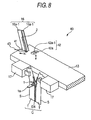
- Fig. 8 shows the enlarged main part of the upper stopper attaching portion 40
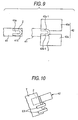
- Fig. 9 typically shows a state obtained immediately before the upper stopper 2 is attached
- Fig. 10 shows a subsequent operation to Fig. 9 .
- the upper stopper attaching portion 40 includes an upper stopper taking portion 41 for holding a plurality of upper stoppers 2, ... , 2 delivered continuously through an upper stopper delivering chute 16a (hereinafter referred to as a chute 16a) from the upper stopper delivering feeder 16. Furthermore, the upper stopper attaching portion 40 includes an upper stopper transferring portion 42 for transferring the single upper stopper 2 toward the fastener chain C held by a pair of grippers 17 and 17 rotated and transferred intermittently from the slider attaching portion 30. The upper stopper taking portion 41 can transfer the single upper stopper 2 toward the upper stopper transferring portion 42.
- the upper stopper attaching portion 40 is configured to introduce the metallic upper stopper 2 previously bent like an almost transverse U shape having two leg portions from the upper stopper delivering feeder 16 into an upper stopper introducing position through the chute 16a.
- the upstream side of the chute 16a is downward inclined and extended from the upper stopper delivering feeder 16 toward the upper stopper attaching portion 40 as shown in Fig. 1 , and the downstream side of the chute 16a is bent and extended toward the upper stopper inserting position as shown in Fig. 8 .
- the chute 16a is configured by a pair of upper stopper introducing guide pieces 16a-1 and 16a-1 separated from each other at a predetermined interval as shown in Fig. 8 .
- An upper stopper introducing guide space for aligning and introducing the upper stoppers 2, ... , 2 is formed between the upper stopper introducing guide pieces 16a-1.
- the upper stopper introducing guide piece 16a-1 can insert and support the lower end of the upper stopper 2 with two opened leg portions turned toward the opposite side of the upper stopper transferring portion 42.
- the upper stopper introducing guide piece 16a-1 serves to introduce and guide the upper stopper 2 along the introducing guide space formed between the introducing guide pieces 16a-1 and to cause the upper stopper 2 to slip down.
- the upper stopper taking portion 41 is configured by a block portion having the shape of a rectangular parallelepiped which is fixed to the tip portion of a piston rod 43 of a cylinder attached to a support portion which is not shown and extended in an orthogonal direction to the tip portion of the chute 16a.
- the body of the upper stopper taking portion 41 is provided to prevent the natural drop of the upper stopper 2 across the tip portion of the chute 16a during the operation of the upper stopper delivering feeder 16.
- a fitting protrusion 41a to be fitted in a portion between the leg portions of the upper stopper 2 is extended forward from a middle portion in a transverse direction as shown in Fig. 9 .
- a fitting step portion 41b for mounting the side end face of the upper stopper 2 is formed in the peripheral portion of the fitting protrusion 41a.
- the fitting step portion 41b constitutes a part of the upper stopper introducing guide space.
- the fitting protrusion 41a is configured to be reciprocated by the forward and backward movement of the piston rod 43 between the position of the lower end of the chute 16a and the position of the upper standby of the upper stopper transferring portion 42 as shown in Fig. 8 .
- the upper stopper transferring portion 42 is configured by first and second pressing portions 42a and 42a extended along the extended line of the upper stopper taking portion 41 above the chute 16a as shown in Fig. 8 .
- the pressing portions 42a are provided on the same horizontal plane in an identical configuration to each other and are configured to freely close and separate each other.
- the pressing portions 42a can be assembled into the same support portion which is not shown and can be thus formed into a unit.
- the pair of pressing portions 42a and 42a can be moved together by a simple operation in the same direction between an upper standby position in the vicinity of the upper stopper taking portion 41 and the fixing position of the upper stopper 2 by up-down moving and rotation driving means which is not shown. Furthermore, the pair of pressing portions 42a and 42a can be moved in opening and closing directions independently of the up-down moving and rotation driving means by press driving means such as a cylinder which is not shown. The pressing portions 42a are moved together between the upper standby position in the vicinity of the upper stopper taking portion 41 and the fixing position of the upper stopper 2. It is possible to have such a structure that each of the pressing portions 42a is automatically stopped by sensing these positions by means of a sensing device which is not shown.
- a fitting concave portion 42a-1 penetrating vertically is formed in the opposed corner portions of the pressing portions 42a respectively.
- the fitting concave portion 42a-1 can insert, guide and hold the upper stopper 2 fitted and supported in the fitting protrusion 41a of the upper stopper taking portion 41 and can fasten and fix the upper stopper 2 to the element train ER of the fastener chain C held by the pair of grippers 17 and 17 as shown in Figs. 9 and 10 .
- the upper stopper taking portion 41 and the upper stopper transferring portion 42 can be provided to close to each other without interfering with the other machining portions, and a work for attaching the upper stopper 2 can be carried out easily and efficiently.
- the upper stopper taking portion 41 fits and supports one of the upper stoppers 2, ..., 2 aligned and introduced into the chute 16a in the fitting protrusion 41a of the upper stopper taking portion 41 as shown in Fig. 8 and stands by in the tip position of the chute 16a.
- the upper stopper transferring portion 42 stands by in the upper standby position in the vicinity of the upper stopper taking portion 41.
- the upper stopper 2 is moved to the upper stopper transferring portion 42 in such a state as to be fitted and supported in the fitting protrusion 41a of the upper stopper taking portion 41 and the fitting protrusion 41a is pushed and introduced into the fitting concave portion 42a-1 of the upper stopper transferring portion 42 as shown in Fig. 9 .
- the upper stopper 2 is fitted in the fitting concave portion 42a-1, the movement of the upper stopper taking portion 41 is stopped.
- the upper stopper transferring portion 42 holds the upper stopper 2. With this state maintained, the upper stopper transferring portion 42 starts to be moved down toward one of the element trains ER of the fastener chain C held by the grippers 17. Simultaneously with the start of the operation for moving the upper stopper transferring portion 42 downward, the fitting protrusion 41a of the upper stopper taking portion 41 is returned to the tip position of the chute 16a.
- the left and right leg portions of the upper stopper 2 are inserted through the fastener tape T across the upper end of the element train ER set in an opening state as shown in Fig. 10 .
- the left and right leg portions of the upper stopper 2 are bent like an almost inverse C shape inward from each other in the fitting concave portion 42a-1 of each of the pressing portions 42a by the press of the upper stopper transferring portion 42 and are attached to the fastener tape T.
- the invention is not restricted thereto but the operation may be repeated to continuously attach the upper stopper 2 to one of the element trains ER after the work for attaching the upper stopper 2 to the other element train ER is completed, for example.
- two upper stopper attaching portions 40 may be provided adjacently in the fixed table portion 12. Moreover, it is also possible to invert the upper stopper transferring portion 42 toward the other element train ER by the up-down moving and rotation driving means which is not shown, thereby moving the upper stopper transferring portion 42 from the upper standby position in the vicinity of the upper stopper taking portion 41 to the fixing position of the upper stopper 2.
- the element train of the slide fastener is formed of a synthetic resin
- a wire for the stopper formed of the synthetic resin can also be used to supply the wire for the stopper to the element train of the fastener chain and to then pressurize, heat and attach the same wire by an ultrasonic machining.
- the ultrasonic machining is performed by a fixing portion including an ultrasonic horn and an anvil.
- Fig. 11 shows the enlarged main part of the pull erecting portion 50 for the slider 1 and Fig. 12 typically shows an operation for bringing down the pull 1d of the slider 1.
- the pull erecting portion 50 is provided with a pressing bar 52 fixed to the tip portion of a piston rod 51 of the cylinder attached to the support portion which is not shown.
- the pressing bar 52 is configured by a cylindrical block portion extended to the shaft portion of the cylinder.
- the pressing bar 52 is provided in a standby position placed below each of the grippers 17 holding the fastener chain C rotated and transferred intermittently from the upper stopper attaching portion 40 in a state in which the pull 1a of the slider 1 is erected upward as shown in Fig. 11 .
- the pressing bar 52 can close to and separate from the pull 1a based on the operation of the piston rod 51, and can be configured to sense the standby position placed below each of the grippers 17 and a position in which the pull 1a is to be brought down by means of a sensing device which is not shown, thereby automatically carrying out a stoppage.
- the fastener chain C having the pull 1a completely brought down is intermittently rotated and transferred to the chain discharging portion 60 to be a next step through the rotator 13.
- the fastener chain C held in the upper stopper attaching portion 40 is intermittently rotated and moved to the pull erecting portion 50 and the same operation as the pull erecting operation is repeated.
- Fig. 13 shows the enlarged main part of the chain discharging portion 60 and Fig. 14 typically shows an operation for discharging a slide fastener F.
- the chain discharging portion 60 is provided with a chain discharging chute 61 toward the fastener chain C which is intermittently rotated and transferred from the pull erecting portion 50 in a state in which the left and right element trains ER and ER are separated and opened.
- the chain discharging chute 61 is downward inclined and extended from the position placed below each of the grippers 17 holding the fastener chain C to a position in which the fastener chain C is to be stored, and can be configured to feed the fastener chain C from an end on the downstream side of the chain discharging chute 61 toward a chain storing portion 62.
- the chain discharging chute 61 is configured by a pair of chain introducing guide pieces 61a and 61a separated from each other at a predetermined interval for introducing the fastener chain C.
- the opposed surfaces of ends on the upstream side of the chain of the chain introducing guide pieces 61a are formed to be taper surfaces in such a manner that they are enlarged toward an introducing side and are gradually narrowed in a discharging direction.
- a space formed between the opposed surfaces of the chain introducing guide pieces 61a is formed linearly and continuously to a chain transfer space extended to the chain storing portion 62.
- the fastener chain C rotated and transferred from the pull erecting portion 50 is introduced into the chain transfer space formed between the opposed surfaces of the chain introducing guide pieces 61a through the taper surface formed on the inlet of the chain introducing guide piece 61a as shown in Figs. 13 and 14 .
- the fastener chain C thus introduced releases the holding state of the pair of left and right grippers 17 and 17 holding the left and right fastener tapes T and T of the fastener chain C while passing through the inside of the chain transfer space between the opposed surfaces of the chain introducing guide pieces 61a.
- the fastener chain C is dropped toward the chain discharging chute 61 and an edge on the rear port side of the slider 1 of the fastener chain C abuts on the chain discharging chute 61.
- the pair of left and right grippers 17 and 17 is returned to the original initial state.
- the fastener chain C slips down along the chain discharging chute 61 along the edge on the rear port side of the slider 1.
- the fastener chain C passes through the inside of the chain transfer space of the chain discharging chute 61 and is then fed into the chain storing portion 62 as shown in Fig. 14 .
- all the machining for the fastener chain C are completed and the slide fastener F to be a finished product is then taken out of the chain storing portion 62.
- the fastener chains C can be rotated and transferred simultaneously and intermittently to the next machining portion and the predetermined machining can be performed in each of the machining portions 20 to 40. Consequently, a large number of fastener chains C, ... , C can be continuously processed in order of the machining at the same time.
- the slide fastener manufacturing apparatus 10 can rotate and transfer all of the fastener chains C to the next machining portion simultaneously and intermittently every time a predetermined machining for the fastener chain C rotated and transferred intermittently to the cutter portion 20, the slider attaching portion 30 and the upper stopper attaching portion 40 is carried out. Consequently, all of the fastener chains C can be continuously processed in order of the machining at the same time, and a time required for the manufacture of the slide fastener manufacturing apparatus 10 can be shortened. As a result, a machining cost per product can be reduced, and furthermore, the output of a product can be increased.
- Fig. 15 shows a variant of the slide fastener manufacturing apparatus 10 which takes the shape of a rotary dividing table.
- the slide fastener manufacturing apparatus 10 has a cutter portion 20, a slider attaching portion 30, an upper stopper attaching portion 40 and a chain discharging portion 60 provided at a predetermined angle around the vertical axis of a shaft portion in order of machining every half part of a fixed table portion 12 fixed through the shaft portion above a base which is not shown.
- the same machining portions are provided with a phase difference of 180 degrees in the circumferential direction of the fixed table portion 12.
- the slide fastener manufacturing apparatus 10 comprises the cutter portion 20, the slider attaching portion 30, the upper stopper attaching portion 40 and the chain discharging portion 60 every half part of the fixed table portion 12. Therefore, more fastener chains C than those in the slide fastener manufacturing apparatus 10 according to the embodiment can be processed in parallel at the same time. As a result, a time required for the manufacture of the slide fastener manufacturing apparatus 10 can be shortened considerably as compared with the embodiment. In addition, a machining cost per product can be reduced sharply so that the output of the product can be increased greatly.
- the invention is not restricted to the embodiment and the variant but the optional numbers of necessary machining and processed portions can be provided around the same vertical axis of the fixed table portion with a predetermined phase difference in order of the machining, for example, and it is a matter of course that the technical scope which can be easily changed from the embodiment and the variant by the skilled in the art is also included therein.
Landscapes
- Slide Fasteners (AREA)
- Making Paper Articles (AREA)
Claims (11)
- Reißverschluss-Herstellvorrichtung (10), um einen Reißverschluss (F) herzustellen, wobei die Vorrichtung eine Vielzahl von Bearbeitungsteilen (20, 30, 40, 50, 60) umfasst, um eine Verschlusskette (C) zu bearbeiten, um den Reißverschluss (F) herzustellen;
gekennzeichnet durch:einen ortsfesten Tischteil (12);wobei jeder der Bearbeitungsteile (20, 30, 40, 50, 60) am Umfang des ortsfesten Tischteils (12) unter einem vorgegebenen Winkel und in der Reihenfolge der Bearbeitung durch die Vielzahl von Bearbeitungsteilen (20, 30, 40, 50, 60) vorgesehen ist;einen Drehteil (13), um eine schrittweise Drehung um den vorgegebenen Winkel parallel zum ortsfesten Tischteil (12) durchzuführen; undeine Vielzahl von Halteteilen (17), um die Verschlusskette (C) zu halten, wobei jeder der Halteteile (17) auf dem Drehteil (13) unter dem vorgegebenen Winkel angeordnet ist;wobei jeder der Halteteile besitzt:ein Paar von linken und rechten Greifern (17, 17), um die Verschlusskette (C) zu halten; undBetätigungsteile, um das Paar von Greifern (17, 17) so zu betätigen, dass sie geschlossen oder von einander getrennt werden. - Reißverschluss-Herstellvorrichtung gemäß Anspruch 1,
wobei die Vielzahl von Bearbeitungsteilen sowie jeder der Bearbeitungsteile besitzt:einen Schneideteil (20), um die Verschlusskette (C) so zu schneiden, dass sie eine vorgegebene Länge besitzt;einen Schieber-Befestigungsteil (30), um einen Schieber (1) an der Verschlusskette (C) zu befestigen, die vom Schneideteil (20) geschnitten wurde;einen Befestigungsteil für den oberen Anschlag (40), um einen oberen Anschlag (2) an der Verschlusskette (C) zu befestigen, an der der Schieber (1) angebracht wurde; und einen Ketten-Ausgabeteil (60), um einen Reißverschluss (F) als Verschlusskette (C), an der der Schieber (1) und der obere Anschlag (2) angebracht wurden, aus einer Dreh- und Transportbahn des Drehteils (13) auszugeben. - Reißverschluss-Herstellvorrichtung gemäß Anspruch 2,
wobei der Schneideteil (20) besitzt:Ketten-Zuführteile (19a, 19b), um die Verschlusskette (C) zum Halteteil zuzuführen; undein Schneidemesser (21), um die Verschlusskette (C) zu schneiden, die von den Ketten-Zuführteilen (19a, 19b) zugeführt wurde. - Reißverschluss-Herstellvorrichtung gemäß Anspruch 2,
wobei der Schieber-Befestigungsteil (30) aufweist:eine Schieber-Zuführungsrinne (15a), um den Schieber (1) zuzuführen;einen Schieber-Anhalteteil (31), der zur Schieber-Zuführungsrinne (15a) gedrückt wird, um den Schieber (1), der über die Schieber-Zuführungsrinne (15a) zugeführt wurde, vorübergehend zu halten; undeinen Schieber-Transportteil (32), um den Schieber-Anhalteteil (31) vorwärts und rückwärts zu bewegen, um einen Schieber (1) nach dem anderen, der vom Schieber-Aufhaltteil (31) gehalten wird, zu transportieren,wobei sich der Schieber-Anhalteteil (31) dann, wenn der Schieber-Transportteil (32) den Schieber (1) in eine Stellung transportiert, in der der Schieber an der Verschlusskette (C) angebracht werden soll, durch die Bewegung des Schieber-Transportteils (32) aus der Bahn des Schieber-Transportteils (32) gegen eine Druckkraft bewegt, wobei der Schieber-Anhalteteil (31) durch die Druckkraft in eine Ausgangsstellung zurückkehrt, nachdem sich der Schieber-Transportteil (32) über den Schieber-Anhalteteil (31) hinaus bewegt hat. - Reißverschluss-Herstellvorrichtung gemäß Anspruch 4,
wobei der Schieber-Transportteil (32) besitzt:einen ersten Schieber-Fixierteil (32a), um eine obere Platte (1b) des Schiebers (1) zu halten; undeinen zweiten Schieber-Fixierteil (32b), um eine untere Platte (1c) des Schiebers (1) zu halten,wobei der erste Schieber-Fixierteil (32a) und der zweite Schieber-Fixierteil (32b) geschlossen oder voneinander getrennt sind. - Reißverschluss-Herstellvorrichtung gemäß Anspruch 2,
wobei der Befestigungsteil für den oberen Anschlag (40) aufweist:eine Zuführungsrinne für den oberen Anschlag (16a), um eine Vielzahl von oberen Anschlägen (2) auszurichten und zuzuführen;einen Aufnahmeteil für den oberen Anschlag (41), um einen oberen Anschlag (2) nach dem anderen von der Zuführungsrinne für den oberen Anschlag (16a) aufzunehmen; undeinen Transportteil für den oberen Anschlag (42), um den oberen Anschlag (2), der vom Aufnahmeteil für den oberen Anschlag (41) aufgenommen wurde, in eine Stellung zu transportieren, in der der obere Anschlag (2) an der Verschlusskette (C) angebracht werden soll, undwobei der Transportteil für den oberen Anschlag (42) einen Befestigungsteil aufweist, um den oberen Anschlag (2) an der Verschlusskette (C) zu befestigen. - Reißverschluss-Herstellvorrichtung gemäß Anspruch 7,
wobei der obere Anschlag (2) U-förmig ausgebildet ist und zwei Schenkelteile besitzt und
der Aufnahmeteil für den oberen Anschlag (41) einen Einsetzvorsprung (41a) besitzt, der zwischen die Schenkelteile eingreift, um den Anschlagteil (2) zu halten. - Reißverschluss-Herstellvorrichtung gemäß Anspruch 7,
wobei der Befestigungsteil ein Paar von ersten und zweiten Pressteilen (42a, 42a) besitzt, die geschlossen oder voneinander getrennt sind, und
wobei jeder der Pressteile (42a) einen konkaven Einsetzteil (42a-1, 42a-2) besitzt, in den der obere Anschlag (2) eingesetzt wird, der vom Einsetzvorsprung (41a) des Aufnahmeteils für den oberen Anschlag (41) gehalten wird. - Reißverschluss-Herstellvorrichtung gemäß irgendeinem der Ansprüche 1 bis 8,
wobei jeder der Bearbeitungsteile (20, 30, 40) einen Antriebsteil besitzt, der unabhängig in Betrieb gesetzt werden kann. - Reißverschluss-Herstellvorrichtung gemäß Anspruch 1,
wobei die Bearbeitungsteile an einem Rand des ortsfesten Tischteils (12) vorgesehen sind und die Halteteile an einem Rand des Drehteils (13) angeordnet sind. - Reißverschluss-Herstellvorrichtung gemäß Anspruch 1,
wobei die Bearbeitungsteile rund um eine vertikale Achse des ortsfesten Tischteils (12) vorgesehen sind, wobei der Drehteil (13) so vorgesehen ist, dass er sich um die vertikale Achse drehen kann.
Applications Claiming Priority (2)
| Application Number | Priority Date | Filing Date | Title |
|---|---|---|---|
| JP2003336038A JP4064326B2 (ja) | 2003-09-26 | 2003-09-26 | スライドファスナーの製造装置 |
| JP2003336038 | 2003-09-26 |
Publications (2)
| Publication Number | Publication Date |
|---|---|
| EP1518474A1 EP1518474A1 (de) | 2005-03-30 |
| EP1518474B1 true EP1518474B1 (de) | 2009-10-28 |
Family
ID=34191532
Family Applications (1)
| Application Number | Title | Priority Date | Filing Date |
|---|---|---|---|
| EP04017947A Expired - Lifetime EP1518474B1 (de) | 2003-09-26 | 2004-07-29 | Apparat zur Herstellung von Reissverschlüssen |
Country Status (7)
| Country | Link |
|---|---|
| US (1) | US7150084B2 (de) |
| EP (1) | EP1518474B1 (de) |
| JP (1) | JP4064326B2 (de) |
| KR (1) | KR100571098B1 (de) |
| CN (1) | CN1259011C (de) |
| ES (1) | ES2333013T3 (de) |
| TW (1) | TWI240618B (de) |
Families Citing this family (22)
| Publication number | Priority date | Publication date | Assignee | Title |
|---|---|---|---|---|
| TWM263330U (en) * | 2004-06-17 | 2005-05-01 | Yes Tek Corp | Protection and exhibition device for storing medium |
| TR201504365T1 (tr) * | 2012-10-15 | 2015-07-21 | Ykk Corp | Fermuar montaj ci̇hazi. |
| CN104379227B (zh) * | 2014-01-20 | 2016-11-09 | Ykk株式会社 | 拉链组装装置 |
| WO2015128962A1 (ja) * | 2014-02-26 | 2015-09-03 | Ykk株式会社 | スライドファスナー組立装置 |
| WO2015136708A1 (ja) * | 2014-03-14 | 2015-09-17 | Ykk株式会社 | 切断装置 |
| CN104690631B (zh) * | 2015-03-30 | 2017-03-15 | 广州市海珠区精诚拉链厂 | 一种拉链抛光机的抱紧机构及应用该机构的拉链抛光机 |
| CN106312898B (zh) * | 2015-06-24 | 2018-04-20 | Ykk株式会社 | 止挡部安装装置 |
| KR101707567B1 (ko) * | 2015-09-10 | 2017-02-16 | 최재호 | 슬라이드 파스너용 슬라이더 제조장치 |
| CN105495879B (zh) * | 2016-01-15 | 2018-07-13 | 深圳市冠众科技有限公司 | 一种将拉链带进行切带、穿头、打上止的一体机 |
| WO2017183119A1 (ja) * | 2016-04-19 | 2017-10-26 | Ykk株式会社 | スライドファスナー製造装置及びスライドファスナーの製造方法 |
| TWI594709B (zh) | 2016-06-30 | 2017-08-11 | Ykk股份有限公司 | 拉鏈製造裝置及拉鏈的製造方法 |
| CN107549939B (zh) * | 2016-06-30 | 2021-02-02 | Ykk株式会社 | 拉链制造装置及拉链的制造方法 |
| TWI639398B (zh) * | 2017-01-12 | 2018-11-01 | 日商Ykk股份有限公司 | 拉頭排列裝置及其操作方法 |
| CN109303381B (zh) * | 2017-07-26 | 2021-05-11 | Ykk株式会社 | 拉链组装装置 |
| CN110913719B (zh) * | 2017-08-16 | 2023-06-09 | Ykk株式会社 | 拉链链条输送装置及方法、以及拉链链条处理装置及方法 |
| CN109393660B (zh) * | 2017-08-16 | 2021-05-04 | Ykk株式会社 | 拉链组装装置 |
| CN110547552B (zh) * | 2018-05-30 | 2022-07-29 | Ykk株式会社 | 拉链的制造方法、组装机、单元以及系统 |
| WO2020105128A1 (ja) * | 2018-11-20 | 2020-05-28 | Ykk株式会社 | テープ長さ調整装置 |
| CN112006382B (zh) * | 2019-05-31 | 2022-10-25 | Ykk株式会社 | 拉头组装装置的压紧装置 |
| CN110623378B (zh) * | 2019-08-20 | 2022-04-22 | 深圳市蓝瑟机电科技有限公司 | 尼龙拉链三合一机 |
| CN113940486B (zh) * | 2020-07-15 | 2024-04-30 | Ykk株式会社 | 拉头的锁定解除系统及锁定解除方法 |
| CN112385942A (zh) * | 2020-11-30 | 2021-02-23 | 福建浔兴拉链科技股份有限公司 | 一种穿头机及组装工艺 |
Citations (1)
| Publication number | Priority date | Publication date | Assignee | Title |
|---|---|---|---|---|
| US3138852A (en) * | 1961-12-26 | 1964-06-30 | Talon Inc | Automatic lock slider assembling machine |
Family Cites Families (17)
| Publication number | Priority date | Publication date | Assignee | Title |
|---|---|---|---|---|
| US2879588A (en) | 1952-06-24 | 1959-03-31 | Louis H Morin | Method of and apparatus for assembling sliders with separable fastener stringers |
| BE793057A (fr) * | 1971-12-22 | 1973-04-16 | Yoshida Kogyo Kk | Appareil combine pour l'assemblage des curseurs et l'application des arrets d'extremite de fermetures a |
| JPS5347083A (en) * | 1976-10-12 | 1978-04-27 | Seiko Seiki Co Ltd | Transfer machine |
| JPS5591302A (en) * | 1978-12-29 | 1980-07-10 | Yoshida Kogyo Kk | Knob incorporating device in slider assembling machine for slide fastener |
| JPS6194606A (ja) | 1984-10-17 | 1986-05-13 | ワイケイケイ株式会社 | スライドフアスナ−の検査装置 |
| JPH0636737Y2 (ja) * | 1986-07-15 | 1994-09-28 | 吉田工業株式会社 | スライドフアスナ−チエ−ンのスライダ−嵌插装置 |
| JPH0671446A (ja) | 1991-07-05 | 1994-03-15 | Mitsubishi Heavy Ind Ltd | 二重シールドtig溶接方法 |
| AU656279B2 (en) * | 1992-10-29 | 1995-01-27 | Ykk Corporation | Apparatus for automatically cutting welding and connecting ends of tape-like articles |
| JPH06209810A (ja) | 1993-01-20 | 1994-08-02 | Yoshida Kogyo Kk <Ykk> | スライドファスナーの仕上げ装置 |
| JPH0740962A (ja) | 1993-07-26 | 1995-02-10 | Yoshihiro Tsumoto | ファイバードラム |
| EP0771538B1 (de) | 1995-05-09 | 2003-12-10 | Ykk Corporation | Verfahren zur herstellung von reissverschluss |
| DE19533320C2 (de) * | 1995-09-08 | 1999-01-28 | Ottobeurer Facondreherei Alois | Rundtaktmaschine |
| EP0937539A1 (de) * | 1998-02-24 | 1999-08-25 | Mikron SA Agno | Rundtaktmaschine |
| US6178608B1 (en) * | 1999-03-26 | 2001-01-30 | Bourn & Koch Machine Tool Co. | Rotary transfer machine |
| US6442819B1 (en) * | 2000-07-06 | 2002-09-03 | Reynolds Consumer Products, Inc. | Method and apparatus of applying slider device to a recloseable zipper arrangement |
| CN2430877Y (zh) | 2000-07-26 | 2001-05-23 | 邱玉书 | 拉链头装配机 |
| US20030029697A1 (en) * | 2001-08-13 | 2003-02-13 | Lanny Green | Rotary transfer machine |
-
2003
- 2003-09-26 JP JP2003336038A patent/JP4064326B2/ja not_active Expired - Fee Related
-
2004
- 2004-06-30 TW TW093119653A patent/TWI240618B/zh not_active IP Right Cessation
- 2004-07-06 US US10/884,913 patent/US7150084B2/en not_active Expired - Lifetime
- 2004-07-29 EP EP04017947A patent/EP1518474B1/de not_active Expired - Lifetime
- 2004-07-29 ES ES04017947T patent/ES2333013T3/es not_active Expired - Lifetime
- 2004-08-24 CN CNB2004100641859A patent/CN1259011C/zh not_active Expired - Lifetime
- 2004-08-30 KR KR1020040068445A patent/KR100571098B1/ko not_active Expired - Lifetime
Patent Citations (1)
| Publication number | Priority date | Publication date | Assignee | Title |
|---|---|---|---|---|
| US3138852A (en) * | 1961-12-26 | 1964-06-30 | Talon Inc | Automatic lock slider assembling machine |
Also Published As
| Publication number | Publication date |
|---|---|
| TW200513208A (en) | 2005-04-16 |
| JP2005102715A (ja) | 2005-04-21 |
| HK1072882A1 (en) | 2005-09-16 |
| TWI240618B (en) | 2005-10-01 |
| CN1600194A (zh) | 2005-03-30 |
| KR20050030851A (ko) | 2005-03-31 |
| KR100571098B1 (ko) | 2006-04-13 |
| ES2333013T3 (es) | 2010-02-16 |
| CN1259011C (zh) | 2006-06-14 |
| EP1518474A1 (de) | 2005-03-30 |
| US20050066499A1 (en) | 2005-03-31 |
| JP4064326B2 (ja) | 2008-03-19 |
| US7150084B2 (en) | 2006-12-19 |
Similar Documents
| Publication | Publication Date | Title |
|---|---|---|
| US7150084B2 (en) | Slide fastener manufacturing apparatus | |
| WO2019149253A1 (zh) | 一种扎带工具的送料分料推料机构、自动扎带工具及自动扎带方法 | |
| KR102218337B1 (ko) | 도구 안팎으로 가공물을 운반하기 위한 디바이스 및 방법 | |
| JP4084750B2 (ja) | コイル及び新規な末端回旋部を有するコイル用のコイルヘッド成形ダイ | |
| US2954599A (en) | Lead making apparatus | |
| CN104379227B (zh) | 拉链组装装置 | |
| US3539086A (en) | Multi size variable center electronic component insertion machine | |
| KR100715422B1 (ko) | 다공정 프레스 시스템 | |
| CN105188459B (zh) | 拉链组装装置 | |
| JP3542365B2 (ja) | 汎用リード加工機 | |
| EP4385048B1 (de) | Verfahren und maschine zur herstellung von mindestens zwei verschiedenen spulen um ein bauteil eines artikels | |
| CN109068815B (zh) | 拉链制造装置以及拉链的制造方法 | |
| EP0286207B1 (de) | Einrichtung für die Herstellung von elektrischen Kabelanordnungen | |
| CA1180170A (en) | Automatic lead making apparatus | |
| CN115741090A (zh) | 一种反弹器总装配自动机 | |
| JP4046726B2 (ja) | インサート成形装置、インサート成形用端子材およびインサート成形方法 | |
| US4757600A (en) | Radial lead electrical component feeder | |
| JP2895054B1 (ja) | ピン打ち機 | |
| WO2018134912A1 (ja) | 部品挿入機 | |
| US2933733A (en) | Machine for securing wire fasteners to boxes | |
| CN208548268U (zh) | 小芯子堵孔机 | |
| JPH0581165B2 (de) | ||
| US12064897B2 (en) | Automatic pallet assembly system and method | |
| JPH084975B2 (ja) | アセンブリ−センタ− | |
| US6599382B2 (en) | Method and apparatus for manufacturing a tape strip folded about a workpiece |
Legal Events
| Date | Code | Title | Description |
|---|---|---|---|
| PUAI | Public reference made under article 153(3) epc to a published international application that has entered the european phase |
Free format text: ORIGINAL CODE: 0009012 |
|
| AK | Designated contracting states |
Kind code of ref document: A1 Designated state(s): AT BE BG CH CY CZ DE DK EE ES FI FR GB GR HU IE IT LI LU MC NL PL PT RO SE SI SK TR |
|
| AX | Request for extension of the european patent |
Extension state: AL HR LT LV MK |
|
| 17P | Request for examination filed |
Effective date: 20050920 |
|
| AKX | Designation fees paid |
Designated state(s): ES IT TR |
|
| REG | Reference to a national code |
Ref country code: DE Ref legal event code: 8566 |
|
| 17Q | First examination report despatched |
Effective date: 20070801 |
|
| GRAP | Despatch of communication of intention to grant a patent |
Free format text: ORIGINAL CODE: EPIDOSNIGR1 |
|
| GRAS | Grant fee paid |
Free format text: ORIGINAL CODE: EPIDOSNIGR3 |
|
| GRAA | (expected) grant |
Free format text: ORIGINAL CODE: 0009210 |
|
| AK | Designated contracting states |
Kind code of ref document: B1 Designated state(s): ES IT TR |
|
| REG | Reference to a national code |
Ref country code: ES Ref legal event code: FG2A Ref document number: 2333013 Country of ref document: ES Kind code of ref document: T3 |
|
| PLBE | No opposition filed within time limit |
Free format text: ORIGINAL CODE: 0009261 |
|
| STAA | Information on the status of an ep patent application or granted ep patent |
Free format text: STATUS: NO OPPOSITION FILED WITHIN TIME LIMIT |
|
| 26N | No opposition filed |
Effective date: 20100729 |
|
| P01 | Opt-out of the competence of the unified patent court (upc) registered |
Effective date: 20230428 |
|
| PGFP | Annual fee paid to national office [announced via postgrant information from national office to epo] |
Ref country code: IT Payment date: 20230612 Year of fee payment: 20 |
|
| PGFP | Annual fee paid to national office [announced via postgrant information from national office to epo] |
Ref country code: TR Payment date: 20230726 Year of fee payment: 20 Ref country code: ES Payment date: 20230801 Year of fee payment: 20 |
|
| REG | Reference to a national code |
Ref country code: ES Ref legal event code: FD2A Effective date: 20240805 |
|
| PG25 | Lapsed in a contracting state [announced via postgrant information from national office to epo] |
Ref country code: ES Free format text: LAPSE BECAUSE OF EXPIRATION OF PROTECTION Effective date: 20240730 |
|
| PG25 | Lapsed in a contracting state [announced via postgrant information from national office to epo] |
Ref country code: ES Free format text: LAPSE BECAUSE OF EXPIRATION OF PROTECTION Effective date: 20240730 |