EP1515983B1 - Antibakterielle amid-makrozyklen - Google Patents
Antibakterielle amid-makrozyklen Download PDFInfo
- Publication number
- EP1515983B1 EP1515983B1 EP03738012A EP03738012A EP1515983B1 EP 1515983 B1 EP1515983 B1 EP 1515983B1 EP 03738012 A EP03738012 A EP 03738012A EP 03738012 A EP03738012 A EP 03738012A EP 1515983 B1 EP1515983 B1 EP 1515983B1
- Authority
- EP
- European Patent Office
- Prior art keywords
- alkyl
- hydrogen
- amino
- substituents
- cycloalkyl
- Prior art date
- Legal status (The legal status is an assumption and is not a legal conclusion. Google has not performed a legal analysis and makes no representation as to the accuracy of the status listed.)
- Expired - Lifetime
Links
- 0 *N(*)C(Cc(cc(cc1)I)c1O*)C(O)=O Chemical compound *N(*)C(Cc(cc(cc1)I)c1O*)C(O)=O 0.000 description 6
- BCOXXXAOVBYCET-WZSNRRAMSA-N CC(C)(C)OC(N[C@@H](C[C@H](CN)O)C(N[C@@H](Cc(cc(cc1)-c(cc2)cc(C[C@@H](C(Oc(c(F)c(c(F)c3F)F)c3F)=O)NC(OCc3ccccc3)=O)c2OCc2ccccc2)c1OCc1ccccc1)C(OCc1ccccc1)=O)=O)=O Chemical compound CC(C)(C)OC(N[C@@H](C[C@H](CN)O)C(N[C@@H](Cc(cc(cc1)-c(cc2)cc(C[C@@H](C(Oc(c(F)c(c(F)c3F)F)c3F)=O)NC(OCc3ccccc3)=O)c2OCc2ccccc2)c1OCc1ccccc1)C(OCc1ccccc1)=O)=O)=O BCOXXXAOVBYCET-WZSNRRAMSA-N 0.000 description 1
- IPHXKPFTWWCETQ-RSYZFUPGSA-N CCNC([C@H](Cc(cc(cc1)-c(cc2C[C@@H](C(N[C@H]3C[C@H](CNC(OC(C)(C)C)=O)O)=O)NC(OC(C)(C)C)=O)ccc2O)c1O)NC3=O)=O Chemical compound CCNC([C@H](Cc(cc(cc1)-c(cc2C[C@@H](C(N[C@H]3C[C@H](CNC(OC(C)(C)C)=O)O)=O)NC(OC(C)(C)C)=O)ccc2O)c1O)NC3=O)=O IPHXKPFTWWCETQ-RSYZFUPGSA-N 0.000 description 1
- IWAOMANAXHYOGO-NXZABHCTSA-N CN(CCCN1)C1N(CC1)CCN1C([C@H](Cc(cc(cc1)-c(cc2C[C@@H](C(N[C@H]3CCCN)=O)N)ccc2O)c1O)NC3=O)=O Chemical compound CN(CCCN1)C1N(CC1)CCN1C([C@H](Cc(cc(cc1)-c(cc2C[C@@H](C(N[C@H]3CCCN)=O)N)ccc2O)c1O)NC3=O)=O IWAOMANAXHYOGO-NXZABHCTSA-N 0.000 description 1
- PUDKBMPFNDRMEC-VDBGWADVSA-N C[C@H](CCNC(OCc1ccccc1)=O)[C@@H](C(N[C@@H](Cc(cc(cc1)-c(cc2C[C@@H](C(Oc(c(F)c(c(F)c3F)F)c3F)=O)NC(OCC3C=CC=CC3)=O)ccc2OCc2ccccc2)c1OCc1ccccc1)C(OCc1ccccc1)=O)=O)NC(OC(C)(C)C)=O Chemical compound C[C@H](CCNC(OCc1ccccc1)=O)[C@@H](C(N[C@@H](Cc(cc(cc1)-c(cc2C[C@@H](C(Oc(c(F)c(c(F)c3F)F)c3F)=O)NC(OCC3C=CC=CC3)=O)ccc2OCc2ccccc2)c1OCc1ccccc1)C(OCc1ccccc1)=O)=O)NC(OC(C)(C)C)=O PUDKBMPFNDRMEC-VDBGWADVSA-N 0.000 description 1
- XYOLDAQDQSAITN-LCALOIESSA-N NC([C@H](Cc(cc(cc1)-c(cc2)cc(C[C@@H](C(N[C@@H](CCCNC(OCc3ccccc3)=O)C3=O)=O)NC(OCc4ccccc4)=O)c2OCc2ccccc2)c1OCc1ccccc1)N3[ClH]I)=O Chemical compound NC([C@H](Cc(cc(cc1)-c(cc2)cc(C[C@@H](C(N[C@@H](CCCNC(OCc3ccccc3)=O)C3=O)=O)NC(OCc4ccccc4)=O)c2OCc2ccccc2)c1OCc1ccccc1)N3[ClH]I)=O XYOLDAQDQSAITN-LCALOIESSA-N 0.000 description 1
- VBPCZEUTRWKKIL-MUGJNUQGSA-N NCCC[C@@H](C(N[C@@H](Cc(cc(cc1)-c(cc2C[C@@H]3N)ccc2O)c1O)C(N[C@@H](CC(N)=O)C(O)=O)=O)=O)NC3=O Chemical compound NCCC[C@@H](C(N[C@@H](Cc(cc(cc1)-c(cc2C[C@@H]3N)ccc2O)c1O)C(N[C@@H](CC(N)=O)C(O)=O)=O)=O)NC3=O VBPCZEUTRWKKIL-MUGJNUQGSA-N 0.000 description 1
- JWVJNNDBCGORPC-ANULTFPQSA-N NC[C@@H](C[C@@H](C(N[C@@H](Cc(cc(cc1)-c(cc2)cc(C[C@@H]3N)c2O)c1O)C(NC1CC1)=O)=O)NC3=O)O Chemical compound NC[C@@H](C[C@@H](C(N[C@@H](Cc(cc(cc1)-c(cc2)cc(C[C@@H]3N)c2O)c1O)C(NC1CC1)=O)=O)NC3=O)O JWVJNNDBCGORPC-ANULTFPQSA-N 0.000 description 1
- OXLPMCIPYGNLJD-OWSLCNJRSA-N NC[C@@H](C[C@@H](C(N[C@@H](Cc(cc(cc1)-c(cc2C[C@@H]3N)ccc2O)c1O)C(O)=O)=O)NC3=O)O Chemical compound NC[C@@H](C[C@@H](C(N[C@@H](Cc(cc(cc1)-c(cc2C[C@@H]3N)ccc2O)c1O)C(O)=O)=O)NC3=O)O OXLPMCIPYGNLJD-OWSLCNJRSA-N 0.000 description 1
- WNZCZZQZDUNCDC-MLNNCEHLSA-N NC[C@@H](C[C@@H](C(N[C@@H](Cc1cc(-c(cc2)cc(C[C@@H]3N)c2O)ccc1O)C(N1CCOCC1)=O)=O)NC3=O)O Chemical compound NC[C@@H](C[C@@H](C(N[C@@H](Cc1cc(-c(cc2)cc(C[C@@H]3N)c2O)ccc1O)C(N1CCOCC1)=O)=O)NC3=O)O WNZCZZQZDUNCDC-MLNNCEHLSA-N 0.000 description 1
Classifications
-
- C—CHEMISTRY; METALLURGY
- C07—ORGANIC CHEMISTRY
- C07K—PEPTIDES
- C07K5/00—Peptides containing up to four amino acids in a fully defined sequence; Derivatives thereof
- C07K5/04—Peptides containing up to four amino acids in a fully defined sequence; Derivatives thereof containing only normal peptide links
- C07K5/08—Tripeptides
-
- C—CHEMISTRY; METALLURGY
- C07—ORGANIC CHEMISTRY
- C07D—HETEROCYCLIC COMPOUNDS
- C07D245/00—Heterocyclic compounds containing rings of more than seven members having two nitrogen atoms as the only ring hetero atoms
- C07D245/04—Heterocyclic compounds containing rings of more than seven members having two nitrogen atoms as the only ring hetero atoms condensed with carbocyclic rings or ring systems
-
- A—HUMAN NECESSITIES
- A61—MEDICAL OR VETERINARY SCIENCE; HYGIENE
- A61P—SPECIFIC THERAPEUTIC ACTIVITY OF CHEMICAL COMPOUNDS OR MEDICINAL PREPARATIONS
- A61P31/00—Antiinfectives, i.e. antibiotics, antiseptics, chemotherapeutics
- A61P31/04—Antibacterial agents
-
- C—CHEMISTRY; METALLURGY
- C07—ORGANIC CHEMISTRY
- C07K—PEPTIDES
- C07K5/00—Peptides containing up to four amino acids in a fully defined sequence; Derivatives thereof
- C07K5/04—Peptides containing up to four amino acids in a fully defined sequence; Derivatives thereof containing only normal peptide links
- C07K5/08—Tripeptides
- C07K5/0802—Tripeptides with the first amino acid being neutral
- C07K5/0812—Tripeptides with the first amino acid being neutral and aromatic or cycloaliphatic
-
- C—CHEMISTRY; METALLURGY
- C07—ORGANIC CHEMISTRY
- C07K—PEPTIDES
- C07K5/00—Peptides containing up to four amino acids in a fully defined sequence; Derivatives thereof
- C07K5/04—Peptides containing up to four amino acids in a fully defined sequence; Derivatives thereof containing only normal peptide links
- C07K5/12—Cyclic peptides with only normal peptide bonds in the ring
-
- A—HUMAN NECESSITIES
- A61—MEDICAL OR VETERINARY SCIENCE; HYGIENE
- A61K—PREPARATIONS FOR MEDICAL, DENTAL OR TOILETRY PURPOSES
- A61K38/00—Medicinal preparations containing peptides
Definitions
- the invention relates to antibacterial amide macrocycles and processes for their preparation and their use for the preparation of medicaments for the treatment and / or prophylaxis of diseases, in particular of bacterial infections.
- biphenomycin B corresponds to the following formula (I) wherein R 1 , R 2 , R 3 ' , R 4 , R 7 , R 8 and R 9 are hydrogen, R 3 is 3-amino-2-hydroxy-prop Is -1-yl and C (O) NR 5 R 6 is replaced by carboxyl (COOH). Partial steps in the synthesis of biphenomycin B are described in Synlett (2003), 4, 522-525.
- An object of the present invention is therefore to provide new and alternative compounds having the same or improved antibacterial activity for the treatment of bacterial diseases in humans and animals.
- Compounds according to the invention are the compounds of the formula (I) and their salts, solvates and solvates of the salts, the compounds of the formula (I ') mentioned below and their salts, solvates and solvates of the salts and of the formula (I) I) and / or (I '), hereinafter referred to as embodiment (e) compounds and their salts, solvates and solvates of the salts, as far as those of the formula (I) and / or (I') included below Compounds are not already salts, solvates and solvates of the salts.
- the compounds of the invention may exist in stereoisomeric forms (enantiomers, diastereomers).
- the invention therefore relates to the enantiomers or diastereomers and their respective mixtures. From such mixtures of enantiomers and / or diastereomers can be isolated by known methods such as chromatography on chiral phase or crystallization with chiral amines or chiral acids, the stereoisomerically uniform components in a known manner.
- the invention also relates to tautomers of the compounds, depending on the structure of the compounds.
- physiologically acceptable salts of the compounds according to the invention are preferred in the context of the invention.
- Physiologically acceptable salts of the compounds (I) include acid addition salts of mineral acids, carboxylic acids and sulfonic acids, e.g. Salts of hydrochloric, hydrobromic, sulfuric, phosphoric, methanesulfonic, ethanesulfonic, toluenesulfonic, benzenesulfonic, naphthalenedisulfonic, acetic, propionic, lactic, tartaric, malic, citric, fumaric, maleic, trifluoroacetic and benzoic acids.
- salts of hydrochloric, hydrobromic, sulfuric, phosphoric, methanesulfonic, ethanesulfonic, toluenesulfonic, benzenesulfonic, naphthalenedisulfonic acetic, propionic, lactic, tartaric, malic, citric, fumaric, maleic, trifluoroacetic and benzoic acids.
- Physiologically acceptable salts of the compounds (I) also include salts of customary bases, such as, by way of example and by way of preference, alkali metal salts (eg sodium and potassium salts), alkaline earth salts (eg calcium and magnesium salts) and ammonium salts derived from ammonia or organic amines having 1 to 16 carbon atoms.
- customary bases such as, by way of example and by way of preference, alkali metal salts (eg sodium and potassium salts), alkaline earth salts (eg calcium and magnesium salts) and ammonium salts derived from ammonia or organic amines having 1 to 16 carbon atoms.
- Atoms such as, by way of example and by way of preference, ethylamine, diethylamine, triethylamine, ethyldiisopropylamine, monoethanolamine, diethanolamine, triethanolamine, dicyclohexylamine, dimethylaminoethanol, procaine, dibenzylamine, N-methylmorpholine, dihydroabietylamine, arginine, lysine, ethylenediamine and methylpiperidine.
- Solvates in the context of the invention are those forms of the compounds which form a complex in the solid or liquid state by coordination with solvent molecules. Hydrates are a special form of solvates that coordinate with water.
- oxycarbonyl derivatives such as carbamates and in particular the following groups: benzyloxycarbonyl, 4-bromo-benzyloxycarbonyl, 2-chlorobenzyloxycarbonyl, 3-chlorobenzyloxycarbonyl, dichlorobenzyloxycarbonyl, 3,4-dimethoxybenzyloxycarbonyl, 3,5-dimethoxybenzyloxycarbonyl, 2,4- Dimethoxybenzyloxycarbonyl, 4-methoxybenzyloxycarbonyl, 4-nitrobenzyloxycarbonyl, 2-nitrobenzyloxycarbonyl, 2-nitro-4,5-dimethoxybenzyloxycarbonyl, 3,4,5-trimethoxybenzyloxycarbonyl, methoxycarbonyl, ethoxycarbonyl, propoxycarbonyl, isopropoxycarbonyl, butoxycarbonyl, isobutoxycarbonyl, tert -butoxycarbonyl, pentoxycarbonyl, Isopent
- tert- butyloxycarbonyl (Boc), 9-fluorenylmethyloxycarbonyl (FMOC), benzyloxycarbonyl (Cbz- / Z-) and allyloxycarbonyl (Aloc).
- a symbol * on a bond means the point of attachment in the molecule.
- Preferred in the context of the present invention are compounds which are of the formula in which R 1 to R 9 have the same meaning as in formula (I), and their salts, their solvates, and the solvates of their salts.
- R 3 is 3-aminoprop-1-yl or 2-hydroxy-3-aminoprop-1-yl.
- R 4 is hydrogen or methyl
- R 6 is hydrogen or methyl
- R 5 and R 6 together with the nitrogen atom to which they are attached form a piperidinyl or morpholinyl.
- the invention further provides a process for the preparation of the compounds of the formula (I), where compounds of the formula wherein R 1 to R 4 and R 7 to R 9 have the abovementioned meaning, where the compounds (II) may optionally be present in activated form (acyl donor), with compounds of the formula H-NR 5 R 6 (III), wherein R 5 and R 6 have the meaning given above, are reacted.
- the blocking of reactive functionalities (eg, free amino functions) in compounds of the formula (II) is carried out before the reaction of compounds of the formula (II) with compounds of the formula (III).
- This is done by standard methods of protecting group chemistry. Preference is given to acid-labile protecting groups on R 1 (or R 2 ), or as substituents in the radicals R 3 and R 3 ' , particular preference being given to Boc.
- Reactive functionalities in the radicals R 5 and R 6 of compounds of the formula (III) are already protected with introduced into the synthesis, preferred are acid-labile protecting groups (eg Boc).
- the protective groups can be eliminated by deprotection reaction. This is done by standard methods of protecting group chemistry. Preferred are deprotection reactions under acidic conditions.
- carbodiimides such as N, N'-diethyl, N, N, '- dipropyl, N, N'-diisopropyl, N, N'-dicyclohexylcarbodiimide , N- (3-dimethylaminoisopropyl) -N'-ethylcarbodiimide hydrochloride (EDC) (optionally in the presence of pentafluorophenol (PFP)), N-cyclohexylcarbodiimide-N-propyloxymethyl-polystyrene (PS-carbodiimide) or carbonyl compounds such as carbonyldiimidazole, or 1,2-oxazolium compounds such as 2-ethyl-5-phenyl-1,2-oxazolium-3-sulfate or 2 tert -butyl 5-methyl-isoxazolium perchlorate
- Bases are, for example, alkali carbonates, e.g. Sodium or potassium carbonate, or bicarbonate, or organic bases such as trialkylamines e.g. Triethylamine, N-methylmorpholine, N-methylpiperidine, 4-dimethylaminopyridine or diisopropylethylamine.
- alkali carbonates e.g. Sodium or potassium carbonate, or bicarbonate
- organic bases such as trialkylamines e.g. Triethylamine, N-methylmorpholine, N-methylpiperidine, 4-dimethylaminopyridine or diisopropylethylamine.
- Suitable solvents are inert organic solvents which do not change under the reaction conditions. These include halogenated hydrocarbons such as dichloromethane or trichloromethane, hydrocarbons such as benzene, toluene, tetrahydrofuran, dioxane, acetonitrile or dimethylformamide. It is likewise possible to use mixtures of the solvents. Particularly preferred are anhydrous dichloromethane and dimethylformamide.
- the bases used are preferably aqueous lithium or sodium hydroxide.
- Suitable solvents are organic solvents which are partially or indefinitely miscible with water are. These include alcohols (preferably methanol and ethanol), tetrahydrofuran, dioxane and dimethylformamide. It is likewise possible to use mixtures of the solvents. Particularly preferred are methanol, tetrahydrofuran and dimethylformamide.
- carbodiimides such as N, N'-diethyl, N, N, '-dipropyl, N, N'-diisopropyl, N, N'-dicyclohexylcarbodiimide, N- (3-hydroxybenzyl) are useful for converting the compounds into the activated form.
- Bases are, for example, alkali carbonates, e.g. Sodium or potassium carbonate, or bicarbonate, or preferably organic bases such as trialkylamines e.g. Triethylamine, N-methylmorpholine, N-methylpiperidine, 4-dimethylaminopyridine or diisopropylethylamine.
- alkali carbonates e.g. Sodium or potassium carbonate, or bicarbonate
- organic bases such as trialkylamines e.g. Triethylamine, N-methylmorpholine, N-methylpiperidine, 4-dimethylaminopyridine or diisopropylethylamine.
- Suitable solvents are inert organic solvents which do not change under the reaction conditions. These include halogenated hydrocarbons such as dichloromethane or trichloromethane, hydrocarbons such as benzene, toluene, tetrahydrofuran, dioxane, dimethylformamide or acetonitrile. It is likewise possible to use mixtures of the solvents. Particularly preferred are dichloromethane and dimethylformamide.
- Suitable solvents are inert organic solvents which do not change under the reaction conditions. These include halogenated hydrocarbons such as dichloromethane, hydrocarbons such as benzene, toluene, tetrahydrofuran, dioxane and dimethylformamide. It is likewise possible to use mixtures of the solvents. Preferred solvents are tetrahydrofuran and dimethylformamide.
- carbodiimides such as N, N'-diethyl, N, N, '-dipropyl, N, N'-diisopropyl, N, N'-dicyclohexylcarbodiimide, N- (3-hydroxybenzyl) are useful for converting the compounds into the activated form.
- Bases are, for example, alkali carbonates, e.g. Sodium or potassium carbonate, or bicarbonate, or preferably organic bases such as trialkylamines e.g. Triethylamine, N-methylmorpholine, N-methylpiperidine, 4-dimethylaminopyridine or diisopropylethylamine.
- alkali carbonates e.g. Sodium or potassium carbonate, or bicarbonate
- organic bases such as trialkylamines e.g. Triethylamine, N-methylmorpholine, N-methylpiperidine, 4-dimethylaminopyridine or diisopropylethylamine.
- Suitable solvents are inert organic solvents which do not change under the reaction conditions. These include halogenated hydrocarbons such as dichloromethane or trichloromethane, hydrocarbons such as benzene, toluene, acetonitrile, tetrahydrofuran, dioxane or dimethylformamide. It is likewise possible to use mixtures of the solvents. Particularly preferred are anhydrous dichloromethane and dimethylformamide.
- reaction in the presence of HATU and N, N -diisopropylethylamine.
- Suitable solvents are inert organic solvents which do not change under the reaction conditions. These include hydrocarbons such as benzene, toluene, tetrahydrofuran, dioxane, dimethylformamide and dimethyl sulfoxide.
- Suitable solvents are inert organic solvents which do not change under the reaction conditions. These include hydrocarbons such as benzene, toluene, tetrahydrofuran, dioxane, dimethylformamide and dimethyl sulfoxide. It is likewise possible to use mixtures of the solvents. Particularly preferred are dimethylformamide and dimethyl sulfoxide.
- carbodiimides e.g. N, N'-diethyl, N, N, '- dipropyl, N, N'-diisopropyl, N, N'-dicyclohexylcarbodiimide, N- (3-dimethylaminoisopropyl) -N'-ethylcarbodiimide hydrochloride (EDC)
- EDC N Cyclohexylcarbodiimide-N'-propyloxymethyl-polystyrene
- PS-carbodiimide or carbonyl compounds such as carbonyldiimidazole.
- Suitable solvents are inert organic solvents which do not change under the reaction conditions. These include halogenated hydrocarbons such as dichloromethane or trichloromethane, hydrocarbons such as benzene, toluene, acetonitrile, tetrahydrofuran, dioxane or dimethylformamide. It is also possible Use mixtures of solvents. Particularly preferred are anhydrous dichloromethane and acetonitrile.
- R 1 , R 2 and R 8 have the abovementioned meaning after activation of the free carboxylate function with 11 R-OH (preferably 2-trimethylsilylethanol) are reacted in the presence of 4-dimethylaminopyridine.
- carbodiimides e.g. N, N'-diethyl, N, N, '- dipropyl, N, N'-diisopropyl, N, N'-dicyclohexylcarbodiimide, N- (3-dimethylaminoisopropyl) -N'-ethylcarbodiimide hydrochloride (EDC)
- EDC N Cyclohexylcarbodiimide-N'-propyloxymethyl-polystyrene
- PS-carbodiimide or carbonyl compounds such as carbonyldiimidazole.
- Suitable solvents are inert organic solvents which do not change under the reaction conditions. These include halogenated hydrocarbons such as dichloromethane or trichloromethane, hydrocarbons such as benzene, toluene, Acetonitrile, tetrahydrofuran, dioxane or dimethylformamide. It is likewise possible to use mixtures of the solvents. Particularly preferred are anhydrous dichloromethane and acetonitrile.
- Bases are, for example, alkali carbonates, e.g. Sodium or potassium carbonate, or bicarbonate, or organic bases such as trialkylamines e.g. Triethylamine, N-methylpiperidine, 4-dimethylaminopyridine or diisopropylethylamine.
- alkali carbonates e.g. Sodium or potassium carbonate, or bicarbonate
- organic bases such as trialkylamines e.g. Triethylamine, N-methylpiperidine, 4-dimethylaminopyridine or diisopropylethylamine.
- Suitable solvents are inert organic solvents which do not change under the reaction conditions. These include halogenated hydrocarbons such as dichloromethane or trichloromethane, hydrocarbons such as benzene, toluene, acetonitrile, tetrahydrofuran, dioxane, acetone or dimethylformamide. It is likewise possible to use mixtures of the solvents. Particularly preferred are dimethylformamide and dichloromethane.
- R 2 may optionally be a protecting group (eg Z, ie benzyloxycarbonyl).
- Suitable solvents are inert organic solvents which do not change under the reaction conditions. These include hydrocarbons such as Benzene, toluene, tetrahydrofuran, dioxane, dimethylformamide and dimethyl sulfoxide. It is likewise possible to use mixtures of the solvents. Particularly preferred are dimethylformamide and dimethyl sulfoxide.
- the compounds of the formula (VIIIa) can be prepared from the compounds of the formula (VIII) by the method described for the compounds (VII).
- the enantiomerically pure compounds of formulas (IX) and (IXb) are known or may be prepared from racemic precursors by known methods, such as e.g. Crystallization with chiral amine bases or by chromatography on chiral, stationary phases.
- Inert solvents are, for example, halogenated hydrocarbons such as methylene chloride, trichloromethane or 1,2-dichloroethane, ethers such as dioxane, tetrahydrofuran or 1,2-dimethoxyethane, or other solvents such as acetone, dimethylformamide, dimethylacetamide, 2-butanone or acetonitrile, preferably tetrahydrofuran, methylene chloride, acetone , 2-butanone, acetonitrile, dimethylformamide or 1,2-dimethoxyethane.
- halogenated hydrocarbons such as methylene chloride, trichloromethane or 1,2-dichloroethane
- ethers such as dioxane, tetrahydrofuran or 1,2-dimethoxyethane
- other solvents such as acetone, dimethylformamide, dimethylacetamide, 2-butanone or acetonitrile,
- bases are alkali metal carbonates, such as cesium carbonate, sodium or potassium carbonate, or sodium or potassium methoxide, or sodium or potassium ethanolate or potassium tert -butoxide, or amides such as sodium amide, lithium bis (trimethylsilyl) amide or lithium diisopropylamide, or organometallic compounds such as butyllithium or phenyllithium, tertiary amine bases such as triethylamine or diisopropylethylamine, or other bases such as sodium hydride, DBU, preferably potassium tert -butoxide, cesium carbonate, DBU, sodium hydride, potassium carbonate or sodium carbonate. Preference is given to potassium carbonate.
- alkali metal carbonates such as cesium carbonate, sodium or potassium carbonate, or sodium or potassium methoxide, or sodium or potassium ethanolate or potassium tert -butoxide
- amides such as sodium amide, lithium bis (trimethylsilyl) amide or
- the substituents R 5 and R 6 can also be introduced into the synthesis via the compounds of the formula (VII) or (VIIa).
- the compounds of the invention show an unpredictable, valuable pharmacological and pharmacokinetic activity spectrum.
- the compounds according to the invention can be used alone or in combination with other active compounds for the treatment and / or prevention of infectious diseases, in particular of bacterial infections.
- Gram-positive cocci eg staphylococci (Staph aureus, Staph epidermidis) and streptococci (Strept agalactiae, Strept faecalis, Strept pneumoniae, Strept pyogenes); Gram-negative cocci (Neisseria gonorrhoeae) as well as Gram-negative rods such as Enterobacteriaceae, eg Escherichia coli, Hemophilus influenzae, Citrobacter (Citrobanthusii, Citrob. divernis), Salmonella and Shigella; also Klebsiella (Klebs. pneumoniae, Klebs. oxytocy), Enterobacter (Ent. aerogenes, Ent.
- staphylococci Staph aureus, Staph epidermidis
- streptococci Strept agalactiae, Strept faecalis, Strept pneumoniae, Strept pyogenes
- the antibacterial spectrum includes the genus Pseudomonas (Ps. Aeruginosa, Ps. Maltophilia) and strictly anaerobic bacteria such as Bacteroides fragilis, members of the genus Peptococcus, Peptostreptococcus and the genus Clostridium; also mycoplasma (M. pneumoniae, M. hominis, M. urealyticum) as well as mycobacteria, eg Mycobacterium tuberculosis.
- pathogens are merely exemplary and by no means limiting.
- diseases which are caused by the named pathogens or mixed infections and which can be prevented, ameliorated or cured by the topically applicable preparations according to the invention are:
- Infectious diseases in humans such. As septic infections, bone and joint infections, skin infections, postoperative wound infections, abscesses, phlegmon, wound infections, infected burns, burns, infections in the mouth, infections after dental surgery, septic arthritis, mastitis, tonsillitis, genital infections and eye infections.
- bacterial diseases in the rearing and keeping of farmed and ornamental fish can be treated, with the antibacterial spectrum on the aforementioned pathogen addition to other pathogens such as Pasteurella, Brucella, Campylobacter, Listeria, Erysipelothris, Corynebacteria, Borellia, Treponema, Nocardia, Rikettsie, Yersinia.
- pathogens such as Pasteurella, Brucella, Campylobacter, Listeria, Erysipelothris, Corynebacteria, Borellia, Treponema, Nocardia, Rikettsie, Yersinia.
- the present invention furthermore relates to compounds of the formula (I) for controlling diseases, in particular bacterial diseases, medicaments containing compounds of the formula (I) and auxiliaries and to the use of compounds of the formula (I) for the production of a medicament for the treatment of bacterial diseases ,
- compositions containing at least one compound of the invention preferably together with one or more pharmacologically acceptable excipients or carriers, as well as their use for the purposes mentioned above.
- the active substance can act systemically and / or locally.
- it can be applied in a suitable manner, e.g. oral, parenteral, pulmonary, nasal, sublingual, lingual, buccal, rectal, transdermal, conjunctival, otic or implant.
- the active ingredient can be administered in suitable administration forms.
- Tablets uncoated and coated tablets, for example enteric coated tablets or film-coated tablets
- capsules dragees, granules, pellets, powders, emulsions, suspensions, solutions and aerosols.
- Parenteral administration can be done bypassing a resorption step (intravenous, intraarterial, intracardiac, intraspinal or intralumbar) or with involvement of resorption (intramuscular, subcutaneous, intracutaneous, percutaneous, or intraperitoneally).
- suitable application forms include injection and infusion preparations in the form of solutions, suspensions, emulsions, lyophilisates and sterile powders.
- Inhalant medicines including powder inhalers, nebulizers
- nasal drops / solutions, sprays lingual, sublingual or buccal tablets or capsules to be applied, suppositories, ear and eye preparations, vaginal capsules, aqueous suspensions (lotions, shake mixtures), lipophilic suspensions, ointments, creams, milk, pastes, powdered powders or implants.
- the active compounds can be converted in a manner known per se into the stated administration forms. This is done using inert non-toxic, pharmaceutically suitable excipients.
- excipients include u.a. Carriers (eg microcrystalline cellulose), solvents (eg liquid polyethylene glycols), emulsifiers (eg sodium dodecyl sulfate), dispersants (eg polyvinylpyrrolidone), synthetic and natural biopolymers (eg albumin), stabilizers (eg antioxidants like ascorbic acid), dyes (eg inorganic pigments like iron oxides ) or flavor and / or odor remedies.
- Carriers eg microcrystalline cellulose
- solvents eg liquid polyethylene glycols
- emulsifiers eg sodium dodecyl sulfate
- dispersants eg polyvinylpyrrolidone
- synthetic and natural biopolymers eg albumin
- stabilizers eg antioxidants like ascorbic acid
- Preparative RP-HPLC Column: YMC gel; Eluent: acetonitrile / water (gradient); Flow: 50 ml / min; Temperature: 25 ° C; Detection UV 210 nm.
- Method 5 Instrument Micromass Quattro LCZ; Column Symmetry C18, 50 mm x 2.1 mm, 3.5 ⁇ m; Temperature: 40 ° C; Flow: 0.5 ml / min; Eluent A: acetonitrile + 0.1% formic acid, eluent B: water + 0.1% formic acid, gradient: 0.0 min 10% A ⁇ 4 min 90% A ⁇ 6 min 90% A
- Method 6 Instrument Micromass Platform LCZ; Column Symmetry C18, 50 mm x 2.1 mm, 3.5 ⁇ m; Temperature: 40 ° C; Flow: 0.5 ml / min; Eluent A: acetonitrile + 0.1% formic acid, eluent B: water + 0.1% formic acid, gradient: 0.0 min 10% A ⁇ 4 min 90% A ⁇ 6 min 90% A.
- Method 7 Instrument Micromass Quattro LCZ; Column Symmetry C18, 50 mm x 2.1 mm, 3.5 ⁇ m; Temperature: 40 ° C; Flow: 0.5 ml / min; Eluent A: acetonitrile + 0.1% formic acid, eluent B: water + 0.1% formic acid, gradient: 0.0 min 5% A ⁇ 1 min 5% A ⁇ 5 min 90% A ⁇ 6 min 90% A
- Method 8 HPLC: Column: 250 * 4 mm, Kromasil 100, C-18, 5 ⁇ m; Temperature: 40 ° C; Flow: 1 ml / min; Eluent: acetonitrile 15% and 0.2% perchloric acid 85%; UV detection: 210 nm.
- Method 9 Instrument: Waters Alliance 2790 LC; Column: Symmetry C18, 50 mm x 2.1 mm, 3.5 ⁇ m; Eluent A: water + 0.1% formic acid, eluent B: acetonitrile + 0.1% formic acid; Gradient: 0.0 min 5% B ⁇ 5.0 min 10% B ⁇ 6.0 min 10% B; Temperature: 50 ° C; Flow: 1.0 ml / min; UV detection: 210 nm.
- Method 10 ZMD Waters; Column: Inertsil ODS3 50 mm x 2.1 mm, 3 ⁇ m; Temperature: 40 ° C; Flow: 0.5 ml / min; Eluent A: water + 0.05% formic acid, eluent B: acetonitrile + 0.05% formic acid, gradient: 0.0 min 5% B ⁇ 12 min ⁇ 100% B ⁇ 15 min 100% B.
- Method 11 MAT 900, Finnigan MAT, Bremen; Column: X-terra 50mm x 2.1mm, 2.5 ⁇ m; Temperature: 25 ° C; Flow: 0.5 ml / min; Eluent A: water + 0.01% formic acid, eluent B: acetonitrile + 0.01% formic acid, gradient: 0.0 min 10% B ⁇ 15 min ⁇ 90% B ⁇ 30 min 90% B.
- Method 12 (LC-MS): TSQ 7000, Finnigan MAT, Bremen; Column: Inertsil ODS3 50 mm x 2.1 mm, 3 ⁇ m; Temperature: 25 ° C; Flow: 0.5 ml / min; Eluent A: water + 0.05% formic acid, eluent B: acetonitrile + 0.05% formic acid, gradient: 0.0 min 15% B ⁇ 15 min ⁇ 100% B ⁇ 30 min 100% B.
- Method 13 7 Tesla Apex II with external electrospray ion source, Bruker Daltronics; Column: X-terra C18 50 mm x 2.1 mm, 2.5 ⁇ m; Temperature: 25 ° C; Flow: 0.5 ml / min; Eluent A: water + 0.1% formic acid, eluent B: acetonitrile + 0.1% formic acid, gradient: 0.0 min 5% B ⁇ 13 min ⁇ 100% B ⁇ 15 min 100% B.
- Method 14 (HPLC): Column: X-Terra TM from Waters, RP 8 , 5 ⁇ m, 3.9 ⁇ 150 mm; Start: 95% A, 5% B; 12min: 5% A, 95% B. Eluent A: water + 0.01% trifluoroacetic acid; Eluent B: acetonitrile +0.01% trifluoroacetic acid; Flow: 1.2 ml / min.
- Method 15 Device Type MS: Micromass ZQ; Device type HPLC: Waters Alliance 2795; Column: Merck Chromolith SpeedROD RP-18e 50x4.6mm; Eluent A: water + 500 ⁇ l 50% formic acid / 1; Eluent B: acetonitrile + 500 ⁇ l 50% formic acid / 1; Gradient: 0.0 min 10% B ⁇ 3.0 min 95% B ⁇ 4.0 min 95% B; Oven: 35 ° C; Flow: 0.0 min 1.0 ml / min ⁇ 3.0 min 3.0 ml / min ⁇ 4.0 min 3.0 ml / min; UV detection: 210 nm.
- Method 16 Device Type MS: Micromass ZQ; Device type HPLC: Waters Alliance 2795; Column: Merck Chromolith SpeedROD RP-18e 50x4.6mm; Eluent A: water + 500 ⁇ l 50% formic acid / 1; Eluent B: acetonitrile + 500 ⁇ l 50% formic acid / 1; Gradient: 0.0 min 10% B ⁇ 2.0 min 95% B ⁇ 4.0 min 95% B; Oven: 35 ° C; Flow: 0.0 min 1.0 ml / min ⁇ 2.0 min 3.0 ml / min ⁇ 4.0 min 3.0 ml / min; UV detection: 210 nm.
- Method 17 Instrument: Micromass Platform LCZ with HPLC Agilent Series 1100; Column: Grom-SIL120 ODS-4 HE, 50 mm x 2.0 mm, 3 ⁇ m; Eluent A: 1 liter of water + 1 ml of 50% formic acid, eluent B: 1 liter of acetonitrile + 1 ml of 50% formic acid; Gradient: 0.0 min 100% A ⁇ 0.2 min 100% A ⁇ 2.9 min 30% A ⁇ 3.1 min 10% A ⁇ 4.5 min 10% A; Oven: 55 ° C; Flow: 0.8 ml / min; UV detection: 210 nm.
- Method 18 Device Type MS: Micromass ZQ; Device type HPLC: Waters Alliance 2795; Column: Merck Chromolith SpeedROD RP-18e 50x4.6mm; Eluent A: water + 500 ⁇ l 50% formic acid / 1; Eluent B: acetonitrile + 500 ⁇ l 50% formic acid / 1; Gradient: 0.0 min 10% B ⁇ 3.0 min 95% B ⁇ 4.0 min 95% B; Oven: 35 ° C; Flow: 0.0 min 1.0 ml / min ⁇ 3.0 min 3.0 ml / min ⁇ 4.0 min 3.0 ml / min; UV detection: 210 nm.
- Method 19 Device Type MS: Micromass ZQ; Device type HPLC: Waters Alliance 2790; Column: Grom-Sil 120 ODS-4 HE 50 mm ⁇ 2 mm, 3.0 ⁇ m; Eluent B: Acetonitrile + 0.05% formic acid, eluent A: water + 0.05% formic acid; Gradient: 0.0 min 5% B ⁇ 2.0 min 40% B ⁇ 4.5 min 90% B ⁇ 5.5 min 90% B; Oven: 45 ° C; Flow: 0.0 min 0.75 ml / min ⁇ 4.5 min 0.75 ml / min ⁇ 5.5 min 1.25 ml / min; UV detection: 210 nm.
- Method 20 Device Type MS: Micromass ZQ; Device type HPLC: Waters Alliance 2790; Column: Uptisphere C 18, 50 mm x 2.0 mm, 3.0 ⁇ m; Eluent B: acetonitrile + 0.05% formic acid, eluent A: water + 0.05% formic acid; Gradient: 0.0 min 5% B ⁇ 2.0 min 40% B ⁇ 4.5 min 90% B ⁇ 5.5 min 90% B; Oven: 45 ° C; Flow: 0.0 min 0.75 ml / min ⁇ 4.5 min 0.75 ml / min ⁇ 5.5 min 1.25 ml / min; UV detection: 210 nm.
- Method 21 Instrument: Micromass Quattro LCZ with HPLC Agilent Series 1100; Column: UPTISPHERE HDO, 50 mm x 2.0 mm, 3 ⁇ m; Eluent A: 1 liter of water + 1 ml of 50% formic acid, eluent B: 1 liter of acetonitrile + 1 ml of 50% formic acid; Gradient: 0.0 min 100% A ⁇ 0.2 min 100% A ⁇ 2.9 min 30% A ⁇ 3.1 min 10% A ⁇ 4.5 min 10% A; Oven: 55 ° C; Flow: 0.8 ml / min; UV detection: 208-400 nm.
- Method 22 Device Type MS: Micromass ZQ; Device type HPLC: HP 1100 Series; UV DAD; Column: Grom-Sil 120 ODS-4 HE 50x2 mm, 3.0 ⁇ m; Eluent A: water + 500 ⁇ l 50% formic acid / 1, eluent B: acetonitrile + 500 ⁇ l 50% formic acid / 1; Gradient: 0.0 min 0% B ⁇ 2.9 min 70% B ⁇ 3.1 min 90% B ⁇ 4.5 min 90% B; Oven: 50 ° C; Flow: 0.8 ml / min; UV detection: 210 nm.
- Method 23 Device Type MS: Micromass ZQ; Device type HPLC: Waters Alliance 2795; Column: Phenomenex Synergi 2 ⁇ Hydro- RP Mercury 20x4 mm; Eluent A: 1 l of water + 0.5 ml of 50% formic acid, eluent B: 1 l of acetonitrile + 0.5 ml of 50% formic acid; Gradient: 0.0 min 90% A (flow: 1 ml / min) ⁇ 2.5 min 30% A (flow: 2 ml / min) ⁇ 3.0 min 5% A (flow: 2 ml / min) ⁇ 4.5 min 5% A ( Flow: 2 ml / min); Oven: 50 ° C; UV detection: 210 nm.
- Method 24 Device Type MS: Micromass ZQ; Device type HPLC: HP 1100 Series; UV DAD; Column: Phenomenex Synergi 2 ⁇ Hydro- RP Mercury 20x4 mm; Eluent A: 1 l of water + 0.5 ml of 50% formic acid, eluent B: 1 l of acetonitrile + 0.5 ml of 50% formic acid; Gradient: 0.0 min 90% A (flow: 1 ml / min) ⁇ 2.5 min 30% A (flow: 2 ml / min) ⁇ 3.0 min 5% A (flow: 2 ml / min) ⁇ 4.5 min 5% A ( Flow: 2 ml / min); Oven: 50 ° C; UV detection: 210 nm.
- Method 25 Device Type MS: Micromass ZQ; Device type HPLC: HP 1100 Series; UV DAD; Column: Grom-Sil 120 ODS-4 HE 50x2 mm, 3.0 ⁇ m; Eluent A: water + 500 ⁇ l 50% formic acid / 1, eluent B: acetonitrile + 500 ⁇ l 50% formic acid / 1; Gradient: 0.0 min 70% B ⁇ 4.5 min 90% B; Furnace: 50 ° C, flow: 0.8 ml / min, UV detection: 210 nm.
- Method 26 Instrument: Micromass Quattro LCZ, with HPLC Agilent Series 1100; Column: Grom-SIL120 ODS-4 HE, 50 mm x 2.0 mm, 3 ⁇ m; Eluent A: 1 liter of water + 1 ml of 50% formic acid, eluent B: 1 liter of acetonitrile + 1 ml of 50% formic acid; Gradient: 0.0 min 100% A ⁇ 0.2 min 100% A ⁇ 2.9 min 30% A ⁇ 3.1 min 10% A ⁇ 4.5 min 10% A; Oven: 55 ° C; Flow: 0.8 ml / min; UV detection: 208-400 nm.
- Example 6A [(+/-) - 3- (2-benzyloxy-5-iodo-phenyl) -2 (S) - tert -butoxycarbonylamino-propionic acid] is on a chiral stationary silica gel phase based on the selector poly ( N -methacryloyl-L-leucine-dicyclopropylmethylamide), separated with a mixture of i -hexane / ethyl acetate as eluent.
- the purity of the second, levorotatory enantiomer Example (-) - 6A, ie the ( S ) -enantiomer, is> 99% ee.
- the residual crude product is dissolved in 2.6 l of anhydrous methanol and, while stirring at 0 ° C., 6.3 g (28.8 mmol) of di- tert-butyl dicarbonate and 7.3 ml (52.43 mmol) of triethylamine are added. After 15 h, the reaction solution is evaporated and the residue taken up in 1 l of ethyl acetate. After separation of the phases, the organic phase is extracted by shaking twice with a 5% citric acid solution, twice with water and once with saturated aqueous sodium chloride solution, dried over sodium sulfate and concentrated. The crude product is purified by silica gel chromatography with toluene / acetone (5/1).
- the solution is concentrated, the residue taken up in dichloromethane and extracted twice with 0.1 N hydrochloric acid.
- the organic phase is separated and made alkaline with 14.7 g (114 mmol) of diisopropylamine.
- the solution is cooled to 0 ° C., admixed with 30.1 g (114 mmol) of trifluoromethanesulfonic acid dimethyl tert-butylsilyl ester and stirred at RT for 2.5 h.
- the organic phase is washed with saturated sodium bicarbonate solution, dried over sodium sulfate and concentrated by rotary evaporation.
- Example 17A tert- butoxycarbonylamino-4 ( R ) -hydroxy-pentanoylamino) -ethyl] -biphenyl-3-yl ⁇ -propionic acid
- Example 17A tert- butoxycarbonylamino-4 ( R ) -hydroxy-pentanoylamino) -ethyl] -biphenyl-3-yl ⁇ -propionic acid
- Example 17A tert- butoxycarbonylamino-4 ( R ) -hydroxy-pentanoylamino) -ethyl] -biphenyl-3-yl ⁇ -propionic acid
- Example 35A and 36A listed in the following table are prepared.
- the reaction mixture After 4 h of stirring at RT, the reaction mixture is cooled to 0 ° C and treated with 50 ml of water. After addition of 50 ml of ethyl acetate and 1 ml of 1 N aqueous hydrochloric acid, the phases are separated. The aqueous phase is extracted several times with ethyl acetate. After drying the organic phase over magnesium sulfate is concentrated in vacuo and dried in a high vacuum. The crude product is reacted without further purification.
- Example 63A to 66A listed in the following table can be prepared.
- the mixture is stirred for 6 hours at 80 ° C. It is taken up in water and ethyl acetate, the phases are separated and the aqueous phase is washed several times with ethyl acetate. The combined organic phases are dried over sodium sulfate and concentrated in vacuo. The crude product is purified by chromatography on silica gel (cyclohexane / ethyl acetate 10: 1).
- Examples 85A to 87A listed in the following table can be prepared.
- Example no. structure Analytical data 85A LC-MS (Method 15): R t 3.12 min.
- MS (EI): m / z 701 (M + H) +
- Examples 88A to 90A listed in the following table can be prepared.
- Example no. structure Analytical data 88A LC-MS (Method 16): R t 2.59 min.
- MS (EI): m / z 1078 (M + H) +
- Examples 94A to 96A listed in the following table can be prepared.
- examples 97A to 99A listed in the following table can be prepared.
- Examples 106A to 108A listed in the following table can be prepared.
- Example no. structure Analytical data 106A LC-MS (Method 15): R t 3.10 min.
- MS (EI): m / z 1124 (M + H) +
- Example 109A listed in the following table can be prepared.
- Example 8A Analogously to Example 8A, 380 mg (0.63 mmol) of the compound from Example IIIA in a heated flask in 4 ml of DMF are initially charged and stirred at room temperature with 184.5 mg (0.73 mmol) 4,4,4 ', 4', 5,5 , 5 ', 5'-octamethyl-2,2'-bi-1,3,2-dioxaborolane, 186 mg (1.9 mmol) of potassium acetate and 23.15 mg (0.03 mmol) of bis (diphenylphosphino) ferrocene-palladium (II) chloride added. It is allowed to react at 80 ° C for 4 h.
- MS (EI): m / z 917 (M + H) +
- the combined organic phases are dried over sodium sulfate and evaporated.
- the crude product is pre-purified on silica gel 60 (mobile phase: cyclohexane / ethyl acetate 10/1), the collected fractions are concentrated and stirred with cyclohexane / ethyl acetate 5/1. The remaining crystals are filtered off with suction and dried. This gives 2.34 g (21% of theory) of the desired Diastereomer. Is obtained from the mother liquor by chromatographic separation on Lichrospher diol 10 uM (eluent: ethanol / iso-hexane 5/95) additional 0.8 g (6.7%) of product.
- Example 16 and 17 listed in the following table can be prepared.
- Example 36 and 37 listed in the following table can be prepared.
- cAMP 11.25 mg / ml
- the test batch is 105 .mu.l, wherein 5 .mu.l of the substance to be tested in 5% DMSO are submitted.
- the transcription template used is 1 ⁇ g / 100 ⁇ l of the plasmid pBESTLuc (Promega, Germany).
- luciferin solution (20 mM tricine, 2.67 mM MgSO4, 0.1 mM EDTA, 33.3 mM DTT pH 7.8, 270 ⁇ M CoA, 470 ⁇ M luciferin, 530 ⁇ M ATP) was added and the resulting bioluminescence measured for 1 minute in a luminometer.
- IC 50 the concentration of an inhibitor is given resulting in a 50% inhibition of translation of firefly luciferase.
- the plasmid pBESTluc Promega Corporation, USA
- the E. coli tac promoter present in this plasmid in front of the firefly luciferase is protected against the capA1 promoter with a corresponding Shine-Dalgamo sequence from S. exchanged aureus .
- the primers CAPFor 5'-CGGCC-AAGCTTACTCGGATCCAGAGTTTGCAAATATACAGGGGATTATATATAATGGAAAACAAGAAAGGAAAATAGGAGGTTTATATGGAAGACGCCA-3 'and CAPRev 5'-GTCATCGTCGGGAAGACCTG-3' are used.
- the primer CAPFor contains the capA1 promoter, the ribosome binding site and the 5 'region of the luciferase gene. After PCR using pBESTluc as template, a PCR product containing the firefly luciferase gene with the fused capA1 promoter can be isolated.
- BHI medium Six liters of BHI medium are inoculated with a 250 ml overnight culture of a S. aureus strain and grown at 37 ° C to an OD600nm of 2-4.
- the cells are harvested by centrifugation and washed in 500 ml of cold buffer A (10 mM Tris-acetate, pH 8.0, 14 mM Mg-acetate, 1 mM DTT, 1 M KCl). After renewed centrifugation, the cells are washed in 250 ml of cold buffer A with 50 mM KCl and the resulting pellets are frozen at -20 ° C for 60 min.
- the pellets are thawed on ice in 30 to 60 minutes and taken up to a total volume of 99 ml in Buffer B (10 mM Tris-acetate, pH 8.0, 20 mM Mg-acetate, 1 mM DTT, 50 mM KCl). 1.5 ml each of lysostaphin (0.8 mg / ml) in Buffer B are placed in 3 pre-cooled centrifuge beakers and mixed with 33 ml each of the cell suspension. Samples are incubated for 45-60 min at 37 ° C with occasional shaking before adding 150 ⁇ l of a 0.5 M DTT solution. The lysed cells are centrifuged off at 30,000 xg for 30 min at 4 ° C.
- the cell pellet after uptake in Buffer B, is recentrifuged under the same conditions and the collected supernatants are pooled. The supernatants are again centrifuged under the same conditions and to the upper 2/3 of the supernatant, 0.25 volume of buffer C (670 mM Tris-acetate, pH 8.0, 20 mM Mg-acetate, 7 mM Na 3 phosphoenolpyruvate, 7 mM DTT, 5.5 mM ATP, 70 ⁇ M amino acids (complete from Promega), 75 ⁇ g pyruvate kinase (Sigma, Germany) / ml, The samples are incubated for 30 min at 37 ° C.
- buffer C 670 mM Tris-acetate, pH 8.0, 20 mM Mg-acetate, 7 mM Na 3 phosphoenolpyruvate, 7 mM DTT, 5.5 mM ATP, 70 ⁇ M amino acids (complete from Promega), 75 ⁇ g
- the supernatants are incubated overnight at 4 ° C dialyzed against 2 l dialysis buffer (10 mM Tris-acetate, pH 8.0, 14 mM Mg-acetate, 1 mM DTT, 60 mM K-acetate) with a buffer change in a dialysis tube with 3500 Da exclusion
- 2 l dialysis buffer 10 mM Tris-acetate, pH 8.0, 14 mM Mg-acetate, 1 mM DTT, 60 mM K-acetate
- Concentrated protein concentration of about 10 mg / ml by covering the dialysis tube with cold PEG 8000 powder (Sigma, Germany) at 4 ° C.
- the S30 extracts can be stored aliquoted at -70 ° C.
- Inhibition of protein biosynthesis of the compounds can be demonstrated in an in vitro transcription-translation assay.
- the assay is based on the cell-free transcription and translation of firefly luciferase using the reporter plasmid pla as template and cell-free S30 extracts obtained from S. aureus .
- the activity of the resulting luciferase can be detected by luminescence measurement.
- the amount of S30 extract or plasmid pla to be used must be re-tested for each preparation in order to achieve an optimal concentration in the test guarantee. 3 ⁇ l of the substance to be tested dissolved in 5% DMSO are placed in an MTP. Subsequently, 10 ⁇ l of a suitably concentrated plasmid solution p1a are added.
- luciferin solution (20 mM tricine, 2.67 mM MgSO 4 , 0.1 mM EDTA, 33.3 mM DTT pH 7.8, 270 ⁇ M CoA, 470 ⁇ M luciferin, 530 ⁇ M ATP) and the resulting bioluminescence measured for 1 min in a luminometer.
- the IC 50 is the concentration of an inhibitor which leads to a 50% inhibition of the translation of firefly luciferase.
- the minimum inhibitory concentration is the minimum concentration of antibiotic used to inhibit a test bacterium in its growth for 18-24 h.
- the inhibitor concentration can be determined according to standard microbiological procedures (see, for example, The National Committee for Clinical Laboratory Standards, Methods for dilution antimicrobial susceptibility tests for bacteria that grow aerobic, approved standard-fifth edition, NCCLS document M7-A5 [ISBN 1-56238-394 NCCLS, 940 West Valley Road, Suite 1400, Wayne, Pennsylvania 19087-98 USA, 2000).
- the MIC of the compounds of the invention is determined in the liquid dilution assay in 96-well microtiter plate scale.
- the bacterial germs were seeded in minimal medium (18.5 mM Na 2 HPO 4 , 5.7 mM KH 2 PO 4 , 9.3 mM NH 4 Cl, 2.8 mM MgSO 4 , 17.1 mM NaCl, 0.033 ⁇ g / ml Thiamine hydrochloride, 1.2 ⁇ g / ml nicotinic acid, 0.003 ⁇ g / ml biotin, 1% glucose, 25 ⁇ g / ml of each proteinogenic amino acid except phenylalanine [H.P. Kroll, unpublished]) with the addition of 0.4 % BH broth cultivated (test medium).
- minimal medium 18.5 mM Na 2 HPO 4 , 5.7 mM KH 2 PO 4 , 9.3 mM NH 4 Cl, 2.8 mM MgSO 4 , 17.1 mM NaCl, 0.033 ⁇ g / ml Thiamine hydrochloride, 1.2 ⁇ g
- test medium heat-inactivated fetal calf serum (FCS; GibcoBRL, Germany) at a final concentration of 10%.
- FCS fetal calf serum
- Overnight cultures of the test organisms are diluted to an OD 578 of 0.001 (in the case of enterococci to 0.01) in fresh test medium and incubated 1: 1 with dilutions of the test substances (dilution levels 1: 2) in test medium (150 ⁇ l final volume). The cultures are incubated at 37 ° C for 18-24 hours; Enterococci in the presence of 5% CO 2 .
- the lowest substance concentration at which no visible bacterial growth occurred is defined as MIC.
- the MIC values in ⁇ M of some of the compounds according to the invention compared to a number of test microbes are listed by way of example in the table below. The compounds show a graded antibacterial activity against most of the test bacteria. ⁇ b> Table A ⁇ / b> Example no. MIC S. aureus 133 MIC S. aureus RN4220 MIC S. aureus 25701 MIC E. faecalis. ICB 27159 MIC B. catarrhalis M3 IC50 E. coli MRE600 Translation IC50 S. aureus 133 Translation IC50 S.
- the suitability of the compounds according to the invention for the treatment of bacterial infections can be demonstrated in various animal models.
- the animals are generally infected with a suitable virulent germ and then treated with the compound to be tested, which is present in a formulation adapted to the respective therapeutic model.
- the suitability of the compounds of the invention for the treatment of bacterial Infections in a sepsis model in mice after infection with S. aureus are demonstrated.
- S. aureus 133 cells are grown overnight in BH broth (Oxoid, Germany).
- the overmix culture was diluted 1: 100 in fresh BH broth and spun for 3 hours.
- the bacteria in the logarithmic growth phase are centrifuged off and washed twice with buffered, physiological saline. Thereafter, a cell suspension in saline solution with an extinction of 50 units is set on the photometer (Dr. Lange LP 2W). After a dilution step (1:15), this suspension is mixed 1: 1 with a 10% mucin suspension.
- 0.2 ml / 20 g of mouse are administered ip from this infectious solution. This corresponds to a cell number of about 1-2 x 10E6 germs / mouse.
- IV therapy is given 30 minutes after infection.
- female CFW1 mice are used.
- the survival of the animals is recorded over 6 days.
- the animal model is adjusted so that untreated animals die within 24 hours of infection.
- the compounds according to the invention can be converted into pharmaceutical preparations as follows:
- Example 1 100 mg of the compound of Example 1, 50 mg of lactose (monohydrate), 50 mg of corn starch (native), 10 mg of polyvinylpyrrolidone (PVP 25) (BASF, Ludwigshafen, Germany) and 2 mg of magnesium stearate. Tablet weight 212 mg. Diameter 8 mm, radius of curvature 12 mm.
- the mixture of active ingredient, lactose and starch is granulated with a 5% solution (m / m) of the PVP in water.
- the granules after drying with the magnesium stearate for 5 min. mixed.
- This mixture is compressed with a conventional tablet press (for the tablet format see above).
- a pessure force of 15 kN is used.
- the rhodigel is suspended in ethanol, the active ingredient is added to the suspension. With stirring, the addition of the water takes place: until the completion of the swelling of Rhodigels is stirred for about 6h.
Landscapes
- Chemical & Material Sciences (AREA)
- Organic Chemistry (AREA)
- Health & Medical Sciences (AREA)
- General Health & Medical Sciences (AREA)
- Medicinal Chemistry (AREA)
- Life Sciences & Earth Sciences (AREA)
- Biochemistry (AREA)
- Proteomics, Peptides & Aminoacids (AREA)
- Molecular Biology (AREA)
- Genetics & Genomics (AREA)
- Biophysics (AREA)
- Pharmacology & Pharmacy (AREA)
- Communicable Diseases (AREA)
- Public Health (AREA)
- Veterinary Medicine (AREA)
- Animal Behavior & Ethology (AREA)
- Chemical Kinetics & Catalysis (AREA)
- Oncology (AREA)
- Nuclear Medicine, Radiotherapy & Molecular Imaging (AREA)
- General Chemical & Material Sciences (AREA)
- Pharmaceuticals Containing Other Organic And Inorganic Compounds (AREA)
- Peptides Or Proteins (AREA)
- Medicines That Contain Protein Lipid Enzymes And Other Medicines (AREA)
- Nitrogen And Oxygen Or Sulfur-Condensed Heterocyclic Ring Systems (AREA)
Description
- Die Erfindung betrifft antibakterielle Amid-Makrozyklen und Verfahren zu ihrer Herstellung sowie ihre Verwendung zur Herstellung von Arzneimitteln zur Behandlung und/oder Prophylaxe von Krankheiten, insbesondere von bakteriellen Infektionen.
- In US 3,452,136, Dissertation R. U. Meyer, Universität Stuttgart, Deutschland 1991, Dissertation V. Leitenberger, Universität Stuttgart, Deutschland 1991, Synthesis (1992), (10), 1025-30, J. Chem. Soc., Perkin Trans. 1 (1992), (1), 123-30, J. Chem. Soc., Chem. Commun. (1991), (10), 744, Synthesis (1991), (5), 409-13, J. Chem. Soc., Chem. Commun. (1991), (5), 275-7, J. Antibiot. (1985), 38(11), 1462-8, J. Antibiot. (1985), 38(11), 1453-61, wird der Naturstoff Biphenomycin B als antibakteriell wirksam beschrieben. Die Struktur von Biphenomycin B entspricht nachfolgender Formel (I), wobei R1, R2, R3', R4, R7, R8 und R9 gleich Wasserstoff sind, R3 gleich 3-Amino-2-hydroxy-prop-1-yl ist und C(O)NR5R6 durch Carboxyl (COOH) ersetzt ist. Teilschritte der Synthese von Biphenomycin B werden in Synlett (2003), 4, 522-525 beschrieben.
- Chirality (1995), 7(4), 181-92, J. Antibiot. (1991), 44(6), 674-7, J. Am. Chem. Soc. (1989), 111(19), 7323-7, J. Am. Chem. Soc. (1989), 111(19), 7328-33, J. Org. Chem. (1987), 52(24), 5435-7, Anal. Biochem. (1987), 165(1), 108-13, J. Org. Chem. (1985), 50(8), 1341-2, J. Antibiot. (1993), 46(3), C-2, J. Antibiot. (1993), 46(1), 135-40, Synthesis (1992), (12), 1248-54, Appl. Environ. Microbiol. (1992), 58(12), 3879-8, J. Chem. Soc., Chem. Commun. (1992), (13), 951-3 beschreiben einen strukturell verwandten Naturstoff, Biphenomycin A, der am Makrozyklus eine weitere Substitution mit einer Hydroxygruppe aufweist.
- Die Naturstoffe entsprechen hinsichtlich ihrer Eigenschaften nicht den Anforderungen, die an antibakterielle Arzneimittel gestellt werden. Auf dem Markt sind zwar strukturell andersartige antibakteriell wirkende Mittel vorhanden, es kann aber regelmäßig zu einer Resistenzentwicklung kommen. Neue Mittel für eine gute und wirksamere Therapie sind daher wünschenswert.
- Eine Aufgabe der vorliegenden Erfindung ist es daher, neue und alternative Verbindungen mit gleicher oder verbesserter antibakterieller Wirkung zur Behandlung von bakteriellen Erkrankungen bei Menschen und Tieren zur Verfügung zu stellen.
- Überraschenderweise wurde gefunden, dass Derivate dieser Naturstoffe, worin die Carboxylgruppe des Naturstoffs gegen eine Amidgruppe ausgetauscht wird, antibakteriell wirksam sind.
- Gegenstand der Erfindung sind Verbindungen der Formel

- R1
- gleich Wasserstoff, Alkyl, Aryl, Heteroaryl, Heterocyclyl, Alkylcarbonyl, Arylcarbonyl, Heterocyclylcarbonyl, Heteroarylcarbonyl, Alkoxycarbonyl, Aminocarbonyl, Alkylaminocarbonyl, Dialkylaminocarbonyl, Alkylsulfonyl, Arylsulfonyl, Heterocyclylsulfonyl, Heteroarylsulfonyl oder ein carbonylgebundener Aminosäurerest ist,
wobei R1 außer Wasserstoff substituiert sein kann mit 0, 1, 2 oder 3 Substituenten R1-1, wobei die Substituenten R1-1 unabhängig voneinander ausgewählt werden aus der Gruppe bestehend aus Halogen, Alkyl, Trifluormethyl, Trifluormethoxy, Nitro, Cyano, Amino, Alkylamino, Dialkylamino, Cycloalkyl, Aryl, Heteroaryl, Heterocyclyl, Hydroxy, Alkoxy und Carboxyl, - R2
- gleich Wasserstoff oder Alkyl ist,
wobei R2 außer Wasserstoff substituiert sein kann mit 0, 1, 2 oder 3 Substituenten R2-1, wobei die Substituenten R2-1 unabhängig voneinander ausgewählt werden aus der Gruppe bestehend aus Halogen, Amino, Alkylamino und Dialkylamino, - R1 und R2
- zusammen mit dem Stickstoffatom, an das sie gebunden sind, einen Heterocyclus bilden, der substituiert sein kann mit 0, 1 oder 2 Substituenten R1-2, wobei die Substituenten R1-2 unabhängig voneinander ausgewählt werden aus der Gruppe bestehend aus Halogen, Trifluormethyl, Amino, Alkylamino, Dialkylamino, Cycloalkyl, Aryl, Heteroaryl, Heterocyclyl, Hydroxy, Alkoxy, Carboxyl, Alkoxycarbonyl und Aminocarbonyl,
- R3
- gleich Wasserstoff, Alkyl oder die Seitengruppe einer Aminosäure ist, worin Alkyl substituiert sein kann mit 0, 1, 2 oder 3 Substituenten R3-1, wobei die Substituenten R3-1 unabhängig voneinander ausgewählt werden aus der Gruppe bestehend aus Trifluormethyl, Nitro, Amino, Alkylamino, Dialkylamino, Cycloalkyl, Aryl, Heteroaryl, Heterocyclyl, Hydroxy, Alkoxy, Carboxyl, Alkoxycarbonyl, Aminocarbonyl, Alkylaminocarbonyl, Dialkylaminocarbonyl, Guanidino und Amidino,
worin Cycloalkyl, Aryl, Heteroaryl und Heterocyclyl substituiert sein können mit 0, 1 oder 2 Substituenten R3-2, wobei die Substituenten R3-2 unabhängig voneinander ausgewählt werden aus der Gruppe bestehend aus Halogen, Alkyl, Trifluormethyl und Amino,
und worin freie Aminogruppen in der Seitengruppe der Aminosäure mit Alkyl, Alkenyl, Alkinyl, Cycloalkyl, Aryl, Heteroaryl, Heterocyclyl, Alkyl-carbonyl, Arylcarbonyl, Heteroarylcarbonyl, Heterocyclylcarbonyl, Alkoxy-carbonyl, Aminocarbonyl, Alkylaminocarbonyl, Dialkylamino-carbonyl, Arylaminocarbonyl, Alkylsulfonyl, Arylsulfonyl, Heterocyclyl-sulfonyl oder Heteroarylsulfonyl substituiert sein können, - R3'
- gleich Wasserstoff, C1-C6-Alkyl oder C3-C8-Cycloalkyl ist,
- R4
- gleich Wasserstoff, C1-C6-Alkyl oder C3-C8-Cycloalkyl ist,
- R5
- gleich Wasserstoff, Alkyl, Alkenyl, Cycloalkyl, Aryl, Heteroaryl, Hetero-cyclyl oder ein amingebundener Aminosäurerest ist,
wobei R5 substituiert sein kann mit 0, 1, 2 oder 3 Substituenten R5-1, wobei die Substituenten R5-1 unabhängig voneinander ausgewählt werden aus der Gruppe bestehend aus Halogen, Alkyl, Trifluormethyl, Trifluormethoxy, Nitro, Cyano, Amino, Alkylamino, Dialkylamino, Cycloalkyl, Aryl, Heteroaryl, Heterocyclyl, Hydroxy, Alkoxy, Carboxyl, Alkoxycarbonyl, Aminocarbonyl, Alkylaminocarbonyl, Dialkylaminocarbonyl, Aminosulfonyl, Alkylaminosulfonyl, Dialkylaminosulfonyl, Arylaminosulfonyl, Heterocyclyl-aminosulfonyl, Heteroarylaminosulfonyl, Aminocarbonylamino, Hydroxy-carbonylamino und Alkoxycarbonylamino,
worin Alkyl, Alkylamino, Dialkylamino, Cycloalkyl, Aryl, Heteroaryl und Heterocyclyl substituiert sein können mit 0, 1, 2 oder 3 Substituenten R5-2, wobei die Substituenten R5-2 unabhängig voneinander ausgewählt werden aus der Gruppe bestehend aus Hydroxy, Amino, Carboxyl und Aminocarbonyl, - R6
- gleich Wasserstoff, Alkyl oder Cycloalkyl ist,
- R5 und R6
- zusammen mit dem Stickstoffatom, an das sie gebunden sind, einen Heterocyclus bilden, der substituiert sein kann mit 0, 1, 2 oder 3 Substituenten R5-6, wobei die Substituenten R5-6 unabhängig voneinander ausgewählt werden aus der Gruppe bestehend aus Halogen, Alkyl, Trifluor-methyl, Nitro, Amino, Alkylamino, Dialkylamino, Cycloalkyl, Aryl, halogeniertes Aryl, Heteroaryl, Heterocyclyl, Hydroxy, Alkoxy, Carboxyl, Alkylcarbonyl, Alkoxycarbonyl, Aminocarbonyl, Alkylaminocarbonyl und Dialkylaminocarbonyl,
- R7
- gleich Wasserstoff, C1-C6-Alkyl, Alkylcarbonyl oder C3-C8-Cycloalkyl ist,
- R8
- gleich Wasserstoff oder C1-C6-Alkyl ist und
- R9
- gleich Wasserstoff oder C1-C6-Alkyl ist,
- Erfindungsgemäße Verbindungen sind die Verbindungen der Formel (I) und deren Salze, Solvate und Solvate der Salze, die von Formel (I) umfassten Verbindungen der nachfolgend genannten Formel (I') und deren Salze, Solvate und Solvate der Salze sowie die von Formel (I) und/oder (I') umfassten, nachfolgend als Ausführungsbeispiel(e) genannten Verbindungen und deren Salze, Solvate und Solvate der Salze, soweit es sich bei den von Formel (I) und/oder (I') umfassten, nachfolgend genannten Verbindungen nicht bereits um Salze, Solvate und Solvate der Salze handelt.
- Die erfindungsgemäßen Verbindungen können in Abhängigkeit von ihrer Struktur in stereoisomeren Formen (Enantiomere, Diastereomere) existieren. Die Erfindung betrifft deshalb die Enantiomeren oder Diastereomeren und ihre jeweiligen Mischungen. Aus solchen Mischungen von Enantiomeren und/oder Diastereomeren lassen sich durch bekannte Verfahren wie Chromatographie an chiraler Phase oder Kristallisation mit chiralen Aminen oder chiralen Säuren die stereoisomer einheitlichen Bestandteile in bekannter Weise isolieren.
- Die Erfindung betrifft in Abhängigkeit von der Struktur der Verbindungen auch Tautomere der Verbindungen.
- Als Salze sind im Rahmen der Erfindung physiologisch unbedenkliche Salze der erfindungsgemäßen Verbindungen bevorzugt.
- Physiologisch unbedenkliche Salze der Verbindungen (I) umfassen Säureadditionssalze von Mineralsäuren, Carbonsäuren und Sulfonsäuren, z.B. Salze der Chlorwasserstoffsäure, Bromwasserstoffsäure, Schwefelsäure, Phosphorsäure, Methansulfonsäure, Ethansulfonsäure, Toluolsulfonsäure, Benzolsulfonsäure, Naphthalindisulfonsäure, Essigsäure, Propionsäure, Milchsäure, Weinsäure, Äpfelsäure, Zitronensäure, Fumarsäure, Maleinsäure, Trifluoressigsäure und Benzoesäure.
- Physiologisch unbedenkliche Salze der Verbindungen (I) umfassen auch Salze üblicher Basen, wie beispielhaft und vorzugsweise Alkalimetallsalze (z.B. Natrium- und Kaliumsalze), Erdalkalisalze (z.B. Calcium- und Magnesiumsalze) und Ammoniumsalze, abgeleitet von Ammoniak oder organischen Aminen mit 1 bis 16 C-Atomen, wie beispielhaft und vorzugsweise Ethylamin, Diethylamin, Triethylamin, Ethyldiisopropylamin, Monoethanolamin, Diethanolamin, Triethanolamin, Dicyclohexylamin, Dimethylaminoethanol, Prokain, Dibenzylamin, N-Methylmorpholin, Dihydroabietylamin, Arginin, Lysin, Ethylendiamin und Methylpiperidin.
- Als Solvate werden im Rahmen der Erfindung solche Formen der Verbindungen bezeichnet, welche in festem oder flüssigem Zustand durch Koordination mit Lösungsmittelmolekülen einen Komplex bilden. Hydrate sind eine spezielle Form der Solvate, bei denen die Koordination mit Wasser erfolgt.
- Im Rahmen der vorliegenden Erfindung haben die Substituenten, soweit nicht anders spezifiziert, die folgende Bedeutung:
- Alkyl sowie die Alkylteile in Substituenten wie Alkoxy, Mono- und Dialkylamino, Alkylsulfonyl umfassen lineares und verzweigtes Alkyl, z.B. C1-C12-, insbesondere C1-C6- und C1-C4-Alkyl.
- C 1 -C 6 -Alkyl umfasst Methyl, Ethyl, n- und i-Propyl, n-, i-, sek.- und tert.-Butyl, n-Pentyl, Isopentyl, Neopentyl, Hexyl,
- C 1 -C 4 -Alkyl umfasst Methyl, Ethyl, n- und i-Propyl, n-, i-, sek.- und tert.-Butyl,
- Alkylcarbonyl steht im Rahmen der Erfindung vorzugsweise für einen geradkettigen oder verzweigten Alkylrest mit 1 bis 6 bzw. 1 bis 4 Kohlenstoffatomen. Beispielhaft und vorzugsweise seien genannt: Methylcarbonyl, Ethylcarbonyl, n-Propylcarbonyl, Isopropylcarbonyl und t-Butylcarbonyl.
- Alkenyl umfasst lineares und verzweigtes C2-C12-, insbesondere C2-C6- und C2-C4-Alkenyl, wie z.B. Vinyl, Allyl, Prop-1-en-1-yl, Isopropenyl, But-1-enyl, But-2-enyl, Buta-1.2-dienyl, Buta-1.3-dienyl.
- Alkinyl umfasst lineares und verzweigtes C2-C12-, insbesondere C2-C6- und C2-C4-Alkinyl, wie z.B. Ethinyl, Propargyl (2-Propinyl), 1-Propinyl, But-1-inyl, But-2-inyl.
- Cycloalkyl umfasst polycyclische gesättigte Kohlenwasserstoffreste mit bis zu 14 Kohlenstoffatomen, nämlich monocyclisches C3-C12-, vorzugsweise C3-C8-Alkyl, insbesondere C3-C6-Alkyl wie z.B. Cyclopropyl, Cyclobutyl, Cyclopentyl, Cyclohexyl, Cycloheptyl, Cyclooctyl, Cyclononyl, und polycyclisches Alkyl, d.h. vorzugsweise bicyclisches und tricyclisches, gegebenenfalls spirocyclisches C7-C14-Alkyl, wie z.B. Bicyclo[2.2.1]-hept-1-yl, Bicyclo[2.2.1]-hept-2-yl, Bicyclo[2.2.1]-hept-7-yl, Bicyclo[2.2.2]-oct-2-yl, Bicyclo[3.2.1]-oct-2-yl, Bicyclo[3.2.2]-non-2-yl und Adamantyl.
- Aryl steht im Rahmen der Erfindung für einen aromatischen Rest mit vorzugsweise 6 bis 10 Kohlenstoffatomen. Bevorzugte Arylreste sind Phenyl und Naphthyl.
- Alkoxy steht im Rahmen der Erfindung vorzugsweise für einen geradkettigen oder verzweigten Alkoxyrest insbesondere mit 1 bis 6, 1 bis 4 bzw. 1 bis 3 Kohlenstoffatomen. Bevorzugt ist ein geradkettiger oder verzweigter Alkoxyrest mit 1 bis 3 Kohlenstoffatomen. Beispielhaft und vorzugsweise seien genannt: Methoxy, Ethoxy, n-Propoxy, Isopropoxy, t-Butoxy, n-Pentoxy und n-Hexoxy.
- Alkoxycarbonyl steht im Rahmen der Erfindung vorzugsweise für einen geradkettigen oder verzweigten Alkoxyrest mit 1 bis 6 bzw. 1 bis 4 Kohlenstoffatomen, der über eine Carbonylgruppe verknüpft ist. Bevorzugt ist ein geradkettiger oder verzweigter Alkoxycarbonylrest mit 1 bis 4 Kohlenstoffatomen. Beispielhaft und vorzugsweise seien genannt: Methoxycarbonyl, Ethoxycarbonyl, n-Propoxycarbonyl, Isopropoxycarbonyl und t-Butoxycarbonyl.
- Monoalkylamino (Alkylamino) steht im Rahmen der Erfindung für eine Amino-Gruppe mit einem geradkettigen oder verzweigten Alkylsubstituenten, der vorzugsweise 1 bis 6, 1 bis 4 bzw. 1 oder 2 Kohlenstoffatome aufweist. Bevorzugt ist ein geradkettiger oder verzweigter Monoalkylamino-Rest mit 1 bis 4 Kohlenstoffatomen. Beispielhaft und vorzugsweise seien genannt: Methylamino, Ethylamino, n-Propylamino, Isopropylamino, t-Butylamino, n-Pentylamino und n-Hexylamino.
- Dialkylamino steht im Rahmen der Erfindung für eine Amino-Gruppe mit zwei gleichen oder verschiedenen geradkettigen oder verzweigten Alkylsubstituenten, die vorzugsweise jeweils 1 bis 6, 1 bis 4 bzw. 1 oder 2 Kohlenstoffatome aufweisen. Bevorzugt sind geradkettige oder verzweigte Dialkylamino-Reste mit jeweils 1, 2, 3 oder 4 Kohlenstoffatomen pro Alkylsubstituent. Beispielhaft und vorzugsweise seien genannt: N,N-Dimethylamino, N,N-Diethylamino, N-Ethyl-N-methylamino, N-Methyl-N-n-propylamino, N-Isopropyl-N-n-propylamino, N-t-Butyl-N-methylamino, N-Ethyl-N-n-pentylamino und N-n-Hexyl-N-methylamino.
- Monoalkylaminocarbonyl (Akylaminocarbonyl) oder Dialkylaminocarbonyl steht im Rahmen der Erfindung für eine Amino-Gruppe, die über eine Carbonylgruppe verknüpft ist und die einen geradkettigen oder verzweigten bzw. zwei gleiche oder verschiedene geradkettige oder verzweigte Alkylsubstituenten mit vorzugsweise jeweils 1 bis 4 bzw. 1 oder 2 Kohlenstoffatomen aufweist. Beispielhaft und vorzugsweise seien genannt: Methylaminocarbonyl, Ethylaminocarbonyl, Isopropylaminocarbonyl, t-Butylaminocarbonyl, N,N-Dimethylaminocarbonyl, N,N-Diethylaminocarbonyl, N-Ethyl-N-methylaminocarbonyl und N-t-Butyl-N-methylaminocarbonyl.
- Arylaminocarbonyl steht im Rahmen der Erfindung für einen aromatischen Rest mit vorzugsweise 6 bis 10 Kohlenstoffatomen, der über eine Aminocarbonyl-Gruppe verknüpft ist. Bevorzugte Reste sind Phenylaminocarbonyl und Naphthylaminocarbonyl.
- Alkylcarbonylamino (Acylamino) steht im Rahmen der Erfindung für eine Amino-Gruppe mit einem geradkettigen oder verzweigten Alkanoylsubstituenten, der vorzugsweise 1 bis 6, 1 bis 4 bzw. 1 oder 2 Kohlenstoffatome aufweist und über die Carbonylgruppe verknüpft ist. Bevorzugt ist ein Monoacylamino-Rest mit 1 oder 2 Kohlenstoffatomen. Beispielhaft und vorzugsweise seien genannt: Formamido, Acetamido, Propionamido, n-Butyramido und Pivaloylamido.
- Alkoxycarbonylamino steht im Rahmen der Erfindung für eine Amino-Gruppe mit einem geradkettigen oder verzweigten Alkoxycarbonylsubstituenten, der vorzugsweise im Alkoxyrest 1 bis 6 bzw. 1 bis 4 Kohlenstoffatome aufweist und über die Carbonylgruppe verknüpft ist. Bevorzugt ist ein Alkoxycarbonylamino-Rest mit 1 bis 4 Kohlenstoffatomen. Beispielhaft und vorzugsweise seien genannt: Methoxycarbonylamino, Ethoxycarbonylamino, n-Propoxycarbonylamino und t-Butoxycarbonylamino.
- Heterocyclyl (Heterocyclus) steht für einen mono- oder polycyclischen, heterocyclischen Rest mit 4 bis 10 Ringatomen und bis zu 3, vorzugsweise 1 Heteroatomen bzw. Heterogruppen aus der Reihe N, O, S, SO, SO2. 4- bis 8-gliedriges, insbesondere 5- bis 6-gliedriges Heterocyclyl ist bevorzugt. Mono- oder bicyclisches Heterocyclyl ist bevorzugt. Besonders bevorzugt ist monocyclisches Heterocyclyl. Als Heteroatome sind N und O bevorzugt. Die Heterocyclyl-Reste können gesättigt oder teilweise ungesättigt sein. Gesättigte Heterocyclyl-Reste sind bevorzugt. Die Heterocyclylreste können über ein Kohlenstoffatom oder ein Heteroatom gebunden sein. Besonders bevorzugt sind 5- bis 6-gliedrige, monocyclische gesättigte Heterocyclylreste mit bis zu zwei Heteroatomen aus der Reihe O, N und S. Beispielsweise und vorzugsweise seien genannt: Oxetan-3-yl, Pyrrolidin-2-yl, Pyrrolidin-3-yl, Pyrrolinyl, Tetrahydrofuranyl, Tetrahydrothienyl, Pyranyl, Piperidin-1-yl, Piperidin-2-yl, Piperidin-3-yl, Piperidin-4-yl, Thiopyranyl, Morpholin-1-yl, Morpholin-2-yl, Morpholin-3-yl, Perhydroazepinyl, Piperazin-1-yl, Piperazin-2-yl. Ein Stickstoff-Heterocyclylring ist dabei ein Heterocyclus, der als Heteroatome nur Stickstoffatome aufweist.
- Heteroaryl steht für einen aromatischen, mono- oder bicyclischen Rest mit 5 bis 10 Ringatomen und bis zu 5 Heteroatomen aus der Reihe S, O und/oder N. Bevorzugt sind 5- bis 6-gliedrige Heteroaryle mit bis zu 4 Heteroatomen. Der Heteroarylrest kann über ein Kohlenstoff- oder Heteroatom gebunden sein. Beispielsweise und vorzugsweise seien genannt: Thienyl, Furyl, Pyrrolyl, Thiazolyl, Oxazolyl, Imidazolyl, Pyridyl, Pyrimidyl, Pyridazinyl, Indolyl, Indazolyl, Benzofuranyl, Benzothiophenyl, Chinolinyl, Isochinolinyl.
- Carbonyl steht für eine -C(O)-Gruppe. Dementsprechend sind Arylcarbonyl, Heterocyclylcarbonyl und Heteroarylcarbonyl an der Carbonylgruppe mit den entsprechenden Resten substituiert, d.h. Aryl, Heterocyclyl etc.
- Sulfonyl steht für eine -S(O)2-Gruppe. Dementsprechend sind Alkylsulfonyl, Arylsulfonyl, Heterocyclylsulfonyl und Heteroarylsulfonyl an der Sulfonylgruppe mit den entsprechenden Resten substituiert, d.h. Alkyl, Aryl etc.
- Aminosulfonyl steht für eine -S(O)2NH2-Gruppe. Dementsprechend sind Alkylaminosulfonyl, Dialkylaminosulfonyl, Arylaminosulfonyl, Heterocyclylaminosulfonyl und Heteroarylaminosulfonyl an der Aminogruppe mit den entsprechenden Resten substituiert, d.h. Alkyl, Aryl etc.
- Halogen schließt im Rahmen der Erfindung Fluor, Chlor, Brom und Iod ein. Bevorzugt sind Fluor oder Chlor.
- Unter der Seitengruppe einer Aminosäure wird im Rahmen der Erfindung derjenige organische Rest eines α-Aminosäuremoleküls verstanden, der an das α-Kohlenstoffatom der Aminosäure gebunden ist. Bevorzugt sind dabei die Reste natürlich vorkommender α-Aminosäuren in der L- oder in der D-Konfiguration, insbesondere natürlich vorkommende α-Aminosäuren in der natürlichen L-Konfiguration.
- Hierzu zählen beispielsweise Wasserstoff (Glycin), Methyl (Alanin), Prop-2-yl (Valin), 2-Methyl-prop-1-yl (Leucin), 1-Methyl-prop-1-yl (Isoleucin), eine (3-Indolyl)-methylgruppe (Tryptophan), eine Benzylgruppe (Phenylalanin), eine Methylthioethylgruppe (Methionin), Hydroxymethyl (Serin), p-Hydroxybenzyl (Tyrosin), 1-Hydroxy-eth-1-yl (Threonin), Mercaptomethyl (Cystein), Carbamoylmethyl (Asparagin), Carbamoylethyl (Glutamin), Carboxymethyl (Asparaginsäure), Carboxyethyl (Glutaminsäure), 4-Aminobut-1-yl (Lysin), 3-Guanidinoprop-1-yl (Arginin), Imidazol-4-ylmethyl (Histidin), 3-Ureidoprop-1-yl (Citrullin), Mercaptoethyl (Homocystein), Hydroxyethyl (Homoserin), 4-Amino-3-hydroxybut-1-yl (Hydroxylysin), 3-Amino-prop-1-yl (Ornithin), 2-Hydroxy-3-amino-prop-1-yl (Hydroxyornithin).
- Carbonylgebundener Aminosäurerest steht für einen Aminosäurerest, der über die Carbonylgruppe der Aminosäure-Säurefunktion gebunden ist. Bevorzugt sind dabei α-Aminosäuren in der L- oder in der D-Konfiguration, insbesondere natürlich vorkommende α-Aminosäuren in der natürlichen L-Konfiguration, z.B. Glycin, L-Alanin und L-Prolin.
- Amingebundener Aminosäurerest steht für einen Aminosäurerest, der über die Aminogruppe der Aminosäure gebunden ist. Bevorzugt sind dabei α-Aminosäuren oder β-Aminosäuren. Besonders bevorzugt sind dabei α-Aminosäuren in der L- oder in der D-Konfiguration, insbesondere natürlich vorkommende α-Aminosäuren in der natürlichen L-Konfiguration, z.B. Glycin (R5 gleich Carboxylmethyl), Alanin (R5 gleich 1-Carboxyleth-1-yl). Die Säurefunktion der Aminosäure kann auch als Ester, z. B. Methyl-, Ethyl-, tert-Butylester, oder als Amid, z. B. Aminocarbonyl-, Alkylaminocarbonyl-, Dialkylaminocarbonyl-, Benzylaminocarbonyl-Gruppe, vorliegen.
- Unter Aminoschutzgruppen werden im Rahmen der vorliegenden Erfindung solche organischen Reste verstanden, mit denen Aminogruppen vorübergehend gegen den Angriff von Reagenzien geschützt werden können, so dass Reaktionen wie Oxidation, Reduktion, Substitution und Kondensation nur an den gewünschten (ungeschützten) Stellen stattfinden. Sie sind für die Dauer des Schutzes unter allen Bedingungen der durchzuführenden Reaktionen und Reinigungsoperationen stabil und wieder unter milden Bedingungen selektiv und mit hoher Ausbeute abspaltbar (Römpp Lexikon Chemie - Version 2.0, Stuttgart/New York: Georg Thieme Verlag 1999; T. W. Greene, P. G. Wuts, Protective Groups in Organic Synthesis, 3rd ed., John Wiley, New York, 1999)
- Bevorzugt sind hierbei Oxycarbonylderivative wie Carbamate und insbesondere die folgenden Gruppen: Benzyloxycarbonyl, 4-Brom-benzyloxycarbonyl, 2-Chlor-benzyloxycarbonyl, 3-Chlor-benzyloxycarbonyl, Dichlorbenzyloxycarbonyl, 3,4-Dimethoxybenzyloxycarbonyl, 3,5-Dimethoxybenzyloxycarbonyl, 2,4-Dimethoxybenzyloxycarbonyl, 4-Methoxybenzyloxycarbonyl, 4-Nitrobenzyloxycarbonyl, 2-Nitrobenzyloxycarbonyl, 2-Nitro-4,5-dimethoxybenzyloxycarbonyl, 3,4,5-Trimethoxybenzyloxycarbonyl, Methoxycarbonyl, Ethoxycarbonyl, Propoxycarbonyl, Isopropoxycarbonyl, Butoxycarbonyl, Isobutoxycarbonyl, tert-Butoxycarbonyl, Pentoxycarbonyl, Isopentoxycarbonyl, Hexoxycarbonyl, Cyclohexoxycarbonyl, Octoxycarbonyl, 2-Ethylhexoxycarbonyl, 2-Iodhexoxycarbonyl, 2-Bromethoxycarbonyl, 2-Chlorethoxycarbonyl, 2,2,2-Trichlorethoxycarbonyl, 2,2,2-Trichlor-tert-butoxycarbonyl, Benzhydryloxycarbonyl, Bis-(4-methoxyphenyl)methoxycarbonyl, Phenacyloxycarbonyl, 2-Trimethylsilylethoxycarbonyl, Phenacyloxycarbonyl, 2-Trimethylsilylethoxycarbonyl, 2-(Di-n-butyl-methyl-silyl)ethoxycarbonyl, 2-Triphenylsilylethoxycarbonyl, 2-(Dimethyl-tert-butylsilyl)ethoxycarbonyl, Methyloxycarbonyl, Vniyloxycarbonyl, Allyloxycarbonyl, Phenoxycarbonyl, Tolyloxycarbonyl, 2,4-Dinitrophenoxycarbonyl, 4-Nitrophenoxycarbonyl, 2,4,5-Trichlorphenoxycarbonyl, Naphthyloxycarboyl, Fluorenyl-9-methoxycarbonyl, Valeroyl, Isovaleroyl, Butyryl, Ethylthiocarbonyl, Methylthiocarbonyl, Butylthiocarboyl, tert-Butylthiocarbonyl, Phenylthiocarbonyl, Benzylthiocarbonyl, Methylaminocarbonyl, Ethylaminocarbonyl, Propylaminocarbonyl, iso-Propylaminocarbonyl, Formyl, Acetyl, Propionyl, Pivaloyl, 2-Chloracetyl, 2-Bromacetyl, 2-Iodacetyl, 2,2,2-Trifluoracetyl, 2,2,2-Trichloracetyl, Benzoyl, 4-Chlorbenzoyl, 4-Methoxybenzoyl, 4-Nitrobenzyl, 4-Nitrobenzoyl, Naphthylcarbonyl, Phenoxyacetyl, Adamantylcarbonyl, Dicyclohexylphosphoryl, Diphenylphosphoryl, Dibenzylphosphoryl, Di-(4-nitrobenzyl)-phophoryl, Phenoxyphenylphosphoryl, Diethylphosphinyl, Diphenylphosphinyl, Phthaloyl, Phthalimido oder Benzyloxymethylen.
- Besonders bevorzugt sind tert-Butyloxycarbonyl (Boc), 9-Fluorenylmethyloxycarbonyl (FMOC), Benzyloxycarbonyl (Cbz- / Z-) und Allyloxycarbonyl (Aloc).
- Ein Symbol * an einer Bindung bedeutet die Verknüpfungsstelle im Molekül.
- Bevorzugt im Rahmen der vorliegenden Erfindung sind Verbindungen, welche der Formel

und ihre Salze, ihre Solvate und die Solvate ihrer Salze. - Bevorzugt im Rahmen der vorliegenden Erfindung sind erfindungsgemäße Verbindungen, bei denen
- R1
- gleich Wasserstoff, Alkyl, Aryl, Heteroaryl, Heterocyclyl, Alkylcarbonyl, Arylcarbonyl, Heterocyclylcarbonyl, Heteroarylcarbonyl, Alkoxycarbonyl, Aminocarbonyl, Alkylaminocarbonyl, Dialkylaminocarbonyl, Alkylsulfonyl, Arylsulfonyl, Heterocyclylsulfonyl, Heteroarylsulfonyl oder ein carbonylgebundener Aminosäurerest ist,
wobei R1 außer Wasserstoff substituiert sein kann mit 0, 1, 2 oder 3 Substituenten R1-1, wobei die Substituenten R1-1 unabhängig voneinander ausgewählt werden aus der Gruppe bestehend aus Halogen, Alkyl, Trifluormethyl, Trifluormethoxy, Nitro, Cyano, Amino, Alkylamino, Dialkylamino, Cycloalkyl, Aryl, Heteroaryl, Heterocyclyl, Hydroxy, Alkoxy und Carboxyl, - R2
- gleich Wasserstoff oder Alkyl ist,
wobei R2 außer Wasserstoff substituiert sein kann mit 0, 1, 2 oder 3 Substituenten R2-1, wobei die Substituenten R2-1 unabhängig voneinander ausgewählt werden aus der Gruppe bestehend aus Halogen, Amino, Alkylamino und Dialkylamino, - R1 und R2
- zusammen mit dem Stickstoffatom, an das sie gebunden sind, einen Heterocyclus bilden, der substituiert sein kann mit 0, 1 oder 2 Substituenten R1-2, wobei die Substituenten R1-2 unabhängig voneinander ausgewählt werden aus der Gruppe bestehend aus Halogen, Trifluormethyl, Amino, Alkylamino, Dialkylamino, Cycloalkyl, Aryl, Heteroaryl, Heterocyclyl, Hydroxy, Alkoxy, Carboxyl, Alkoxycarbonyl und Aminocarbonyl,
- R3
- gleich Wasserstoff, Alkyl oder die Seitengruppe einer Aminosäure ist, worin Alkyl substituiert sein kann mit 0, 1, 2 oder 3 Substituenten R3-1, wobei die Substituenten R3-1 unabhängig voneinander ausgewählt werden aus der Gruppe bestehend aus Trifluormethyl, Nitro, Amino, Alkylamino, Dialkylamino, Cycloalkyl, Aryl, Heteroaryl, Heterocyclyl, Hydroxy, Alkoxy, Carboxyl, Alkoxycarbonyl, Aminocarbonyl, Alkylaminocarbonyl und Dialkylaminocarbonyl,
worin Cycloalkyl, Aryl, Heteroaryl und Heterocyclyl substituiert sein können mit 0, 1 oder 2 Substituenten R3-2, wobei die Substituenten R3-2 unabhängig voneinander ausgewählt werden aus der Gruppe bestehend aus Halogen, Alkyl, Trifluormethyl und Amino,
und worin freie Aminogruppen in der Seitengruppe der Aminosäure mit Alkyl, Alkenyl, Cycloalkyl, Alkylcarbonyl, Arylcarbonyl, Heteroarylcarbonyl, Heterocyclylcarbonyl, Alkoxycarbonyl, Aminocarbonyl, Alkylaminocarbonyl, Dialkylaminocarbonyl, Arylaminocarbonyl, Alkylsulfonyl, Arylsulfonyl, Heterocyclylsulfonyl oder Heteroarylsulfonyl substituiert sein können, - R3'
- gleich Wasserstoff oder C1-C6-Alkyl ist,
- R4
- gleich Wasserstoff, C1-C6-Alkyl oder C3-C8-Cycloalkyl ist,
- R5
- gleich Wasserstoff, Alkyl, Alkenyl, Cycloalkyl, Aryl, Heteroaryl, Heterocyclyl oder ein amingebundener Aminosäurerest ist,
wobei R5 substituiert sein kann mit 0, 1, 2 oder 3 Substituenten R5-1, wobei die Substituenten R5-1 unabhängig voneinander ausgewählt werden aus der Gruppe bestehend aus Halogen, Alkyl, Trifluormethyl, Trifluormethoxy, Cyano, Amino, Alkylamino, Dialkylamino, Cycloalkyl, Aryl, Heteroaryl, Heterocyclyl, Hydroxy, Alkoxy, Carboxyl, Alkoxycarbonyl, Aminocarbonyl, Alkylaminocarbonyl und Dialkylaminocarbonyl, - R6
- gleich Wasserstoff, Alkyl oder Cycloalkyl ist,
- R5 und R6
- zusammen mit dem Stickstoffatom, an das sie gebunden sind, einen Heterocyclus bilden, der substituiert sein kann mit 0, 1, 2 oder 3 Substituenten R5-6, wobei die Substituenten R5-6 unabhängig voneinander ausgewählt werden aus der Gruppe bestehend aus Halogen, Alkyl, Trifluormethyl, Nitro, Amino, Alkylamino, Dialkylamino, Cycloalkyl, Aryl, halogeniertes Aryl, Heteroaryl, Heterocyclyl, Hydroxy, Alkoxy, Carboxyl, Alkylcarbonyl, Alkoxycarbonyl, Aminocarbonyl, Alkylaminocarbonyl und Dialkylaminocarbonyl,
- R7
- gleich Wasserstoff oder C1-C6-Alkyl ist,
- R8
- gleich Wasserstoff oder C1-C6-Alkyl ist,
und - R9
- gleich Wasserstoff oder C1-C6-Alkyl ist.
- Bevorzugt im Rahmen der vorliegenden Erfindung sind auch erfindungsgemäße Verbindungen, bei denen
- R1
- gleich Wasserstoff, Alkyl, Alkylcarbonyl, Arylcarbonyl, Heterocyclylcarbonyl, Heteroarylcarbonyl, Alkoxycarbonyl oder ein carbonylgebundener Aminosäurerest ist,
wobei R1 außer Wasserstoff substituiert sein kann mit 0, 1 oder 2 Substituenten R1-1, wobei die Substituenten R1-1 unabhängig voneinander ausgewählt werden aus der Gruppe bestehend aus Halogen, Trifluormethyl, Amino, Alkylamino, Dialkylamino, Phenyl, 5- bis 6-gliedriges Heteroaryl, 5-bis 6-gliedriges Heterocyclyl, Hydroxy und Alkoxy, - R2
- gleich Wasserstoff oder Methyl ist,
- R3
- gleich Aminocarbonylmethyl, 3-Aminopropyl, 2 -Hydroxy-3-aminopropyl, 3-Guanidinopropyl, 2-Aminocarbonylethyl, 2-Hydroxycarbonylethyl, 4-Aminobutyl, Hydroxymethyl oder 2-Hydroxyethyl, 4-Amino-3-hydroxybutan-1-yl ist,
und worin freie Aminogruppen in der Seitengruppe der Aminosäure mit Alkyl, Alkenyl, C3-C6-Cycloalkyl, Alkylcarbonyl, Phenylcarbonyl, 5- bis 6-gliedriges Heteroarylcarbonyl, 5- bis 6-gliedriges Heterocyclylcarbonyl, Alkoxycarbonyl, Aminocarbonyl, Alkylaminocarbonyl, Dialkylaminocarbonyl, Phenylaminocarbonyl, Alkylsulfonyl, Arylsulfonyl, 5- bis 6-gliedriges Heterocyclylsulfonyl oder 5- bis 6-gliedriges Heteroarylsulfonyl substituiert sein können, - R3'
- gleich Wasserstoff ist,
- R4
- gleich Wasserstoff oder Methyl ist,
- R5
- gleich Wasserstoff, Alkyl, C3-C6-Cycloalkyl, Phenyl, 5- bis 6-gliedriges Heteroaryl, 5- bis 6-gliedriges Heterocyclyl oder ein amingebundener Aminosäurerest ist,
wobei für den Fall, dass R5 gleich Alkyl, C3-C6-Cycloalkyl oder 5- bis 6-gliedriges Heterocyclyl ist, dieses substituiert sein kann mit 0, 1 oder 2 Substituenten R5-2, wobei die Substituenten R5-2 unabhängig voneinander ausgewählt werden aus der Gruppe bestehend aus Alkyl, Trifluormethyl, Amino, Alkylamino, Dialkylamino, C3-C6-Cycloalkyl, Phenyl, 5- bis 6-gliedriges Heteroaryl, 5- bis 6-gliedriges Heterocyclyl, Hydroxy, Alkoxy, Carboxyl, Alkoxycarbonyl, Aminocarbonyl, Alkylaminocarbonyl und Dialkylaminocarbonyl,
und
wobei für den Fall, dass R5 gleich Phenyl oder 5- bis 6-gliedriges Heteroaryl ist, dieses substituiert sein kann mit 0, 1 oder 2 Substituenten R5-3, wobei die Substituenten R5-3 unabhängig voneinander ausgewählt werden aus der Gruppe bestehend aus Halogen, Trifluormethyl, Trifluormethoxy, Amino, Alkylamino, Dialkylamino, C3-C6-Cycloalkyl, 5- bis 6-gliedriges Heteroaryl, 5- bis 6-gliedriges Heterocyclyl, Hydroxy, Alkoxy, Carboxyl, Alkoxycarbonyl, Aminocarbonyl, Alkylaminocarbonyl und Dialkylaminocarbonyl,
und
wobei für den Fall, dass R5 gleich amingebundener Aminosäurerest, dieser substituiert sein kann mit 0, 1 oder 2 Substituenten R5-4, wobei die Substituenten R5-4 unabhängig voneinander ausgewählt werden aus der Gruppe bestehend aus Halogen, Trifluormethyl, Trifluormethoxy, Amino, Alkylamino, Dialkylamino, C3-C6-Cycloalkyl, Phenyl, 5- bis 6-gliedriges Heteroaryl, 5- bis 6-gliedriges Heterocyclyl, Hydroxy, Alkoxy, Carboxyl, Alkoxycarbonyl, Aminocarbonyl, Alkylaminocarbonyl und Dialkylaminocarbonyl, - R6
- gleich Wasserstoff, Alkyl oder C3-C6-Cycloalkyl ist,
- R5 und R6
- zusammen mit dem Stickstoffatom, an das sie gebunden sind, einen 5- bis 6-gliedrigen Heterocyclus bilden, der substituiert sein kann mit 0, 1 oder 2 Substituenten R5-6, wobei die Substituenten R5-6 unabhängig voneinander ausgewählt werden aus der Gruppe bestehend aus Amino, Alkylamino, Dialkylamino, C3-C6-Cycloalkyl, Phenyl, halogeniertes Phenyl, 5- bis 6-gliedriges Heteroaryl, Hydroxy, Alkoxy, Carboxyl und Aminocarbonyl,
- R7
- gleich Wasserstoff ist,
- R8
- gleich Wasserstoff ist, und
- R9
- gleich Wasserstoff oder Methyl ist.
- Bevorzugt im Rahmen der vorliegenden Erfindung sind auch erfindungsgemäße Verbindungen, bei denen
- R1
- gleich Wasserstoff, Alkyl oder Alkylcarbonyl ist,
- R2
- gleich Wasserstoff ist,
- R3
- gleich Alkyl oder die Seitengruppe einer Aminosäure ist, worin Alkyl substituiert sein kann mit 0, 1, 2 oder 3 Substituenten R3-1, wobei die Substituenten R3-1 unabhängig voneinander ausgewählt werden aus der Gruppe bestehend aus Trifluormethyl, Nitro, Amino, Alkylamino, Dialkylamino, Cycloalkyl, Aryl, Heteroaryl, Heterocyclyl, Hydroxy, Alkoxy, Carboxyl, Alkoxycarbonyl, Aminocarbonyl, Alkylaminocarbonyl, Dialkylaminocarbonyl, Guanidino und Amidino,
worin Cycloalkyl, Aryl, Heteroaryl und Heterocyclyl substituiert sein können mit 0, 1 oder 2 Substituenten R3-2, wobei die Substituenten R32 unabhängig voneinander ausgewählt werden aus der Gruppe bestehend aus Halogen, Alkyl, Trifluormethyl und Amino,
und worin freie Aminogruppen in der Seitengruppe der Aminosäure mit Alkyl substituiert sein können, - R3'
- gleich Wasserstoff, C1-C6-Alkyl oder C3-C8-Cycloalkyl ist,
- R4
- gleich Wasserstoff, C1-C6-Alkyl oder C3-C8-Cycloalkyl ist,
- R5
- gleich Wasserstoff, Alkyl, Alkenyl, Cycloalkyl, Aryl, Heteroaryl, Heterocyclyl oder ein amingebundener Aminosäurerest ist,
wobei Alkyl, Alkenyl, Cycloalkyl, Aryl, Heteroaryl und Heterocyclyl substituiert sein können mit 0, 1, 2 oder 3 Substituenten R5-1, wobei die Substituenten R5-1 unabhängig voneinander ausgewählt werden aus der Gruppe bestehend aus Halogen, Alkyl, Trifluormethyl, Trifluormethoxy, Nitro, Cyano, Amino, Alkylamino, Dialkylamino, Cycloalkyl, Aryl, Heteroaryl, Heterocyclyl, Hydroxy, Alkoxy, Carboxyl, Alkoxycarbonyl, Aminocarbonyl, Alkylaminocarbonyl und Dialkylaminocarbonyl,
worin Alkyl, Alkylamino, Dialkylamino, Cycloalkyl, Aryl, Heteroaryl und Heterocyclyl substituiert sein können mit 0, 1, 2 oder 3 Substituenten R5-2, wobei die Substituenten R5-2 unabhängig voneinander ausgewählt werden aus der Gruppe bestehend aus Hydroxy, Amino, Carboxyl und Aminocarbonyl, - R6
- gleich Wasserstoff, Alkyl oder Cycloalkyl ist,
- R5 und R6
- zusammen mit dem Stickstoffatom, an das sie gebunden sind, einen Heterocyclus bilden, der substituiert sein kann mit 0, 1, 2 oder 3 Substituenten R5-6, wobei die Substituenten R5-6 unabhängig voneinander ausgewählt werden aus der Gruppe bestehend aus Halogen, Alkyl, Amino, Alkylamino, Dialkylamino, Hydroxy, Alkoxy, Carboxyl, Alkoxycarbonyl, Aminocarbonyl, Alkylaminocarbonyl und Dialkylaminocarbonyl,
- R7
- gleich Wasserstoff, C1-C6-Alkyl, Alkylcarbonyl oder C3-C8-Cycloalkyl ist,
- R8
- gleich Wasserstoff ist,
und - R9
- gleich Wasserstoff ist.
- Bevorzugt im Rahmen der vorliegenden Erfindung sind auch erfindungsgemäße Verbindungen, bei denen
- R1
- gleich Wasserstoff ist,
- R2
- gleich Wasserstoff ist,
- R3
- gleich Alkyl oder die Seitengruppe einer Aminosäure ist, worin Alkyl substituiert sein kann mit 0, 1, 2 oder 3 Substituenten R3-1, wobei die Substituenten R3-1 unabhängig voneinander ausgewählt werden aus der Gruppe bestehend aus Amino, Alkylamino, Dialkylamino, Cycloalkyl, Heteroaryl, Heterocyclyl, Hydroxy, Alkoxy, Carboxyl, Alkoxycarbonyl, Aminocarbonyl, Alkylaminocarbonyl, Dialkylaminocarbonyl, Guanidino und Amidino,
worin Cycloalkyl, Heteroaryl und Heterocyclyl substituiert sein können mit 0, 1 oder 2 Substituenten R3-2, wobei die Substituenten R32 unabhängig voneinander ausgewählt werden aus der Gruppe bestehend aus Alkyl und Amino, - R3'
- gleich Wasserstoff ist,
- R4
- gleich Wasserstoff, C1-C6-Alkyl oder C3-C8-Cycloalkyl ist,
- R5
- gleich Wasserstoff, Alkyl, Cycloalkyl, Aryl, Heteroaryl, Heterocyclyl oder ein amingebundener Aminosäurerest ist,
wobei Alkyl, Cycloalkyl, Aryl, Heteroaryl und Heterocyclyl substituiert sein können mit 0, 1, 2 oder 3 Substituenten R5-1, wobei die Substituenten R5-1 unabhängig voneinander ausgewählt werden aus der Gruppe bestehend aus Halogen, Alkyl, Trifluormethyl, Trifluormethoxy, Nitro, Cyano, Amino, Alkylamino, Dialkylamino, Cycloalkyl, Aryl, Heteroaryl, Heterocyclyl, Hydroxy, Alkoxy, Carboxyl, Alkoxycarbonyl, Aminocarbonyl, Alkylaminocarbonyl und Dialkylaminocarbonyl,
worin Alkyl, Alkylamino, Dialkylamino, Cycloalkyl, Aryl, Heteroaryl und Heterocyclyl substituiert sein können mit 0, 1, 2 oder 3 Substituenten R5-2, wobei die Substituenten R5-2 unabhängig voneinander ausgewählt werden aus der Gruppe bestehend aus Hydroxy, Amino, Carboxyl und Aminocarbonyl, - R6
- gleich Wasserstoff, Alkyl oder C3-C8-Cycloalkyl ist,
- R5 und R6
- zusammen mit dem Stickstoffatom, an das sie gebunden sind, ein Piperidinyl, Morpholinyl, Piperazinyl oder Pyrrolidinyl bilden, wobei Piperidinyl, Morpholinyl, Piperazinyl und Pyrrolidinyl substitiuiert sein können mit 0, 1, 2 oder 3 Substituenten, wobei die Substituenten unabhängig voneinander ausgewählt werden aus der Gruppe bestehend aus Alkyl, Amino, Alkylamino, Dialkylamino, Hydroxy, Alkoxy, Carboxyl, Alkoxycarbonyl und Aminocarbonyl,
- R7
- gleich Wasserstoff ist,
- R8
- gleich Wasserstoff ist,
und - R9
- gleich Wasserstoff ist.
- Bevorzugt im Rahmen der vorliegenden Erfindung sind auch erfindungsgemäße Verbindungen, bei denen
- R1
- gleich Wasserstoff ist,
- R2
- gleich Wasserstoff ist,
- R3
- gleich Aminocarbonylmethyl, 3-Aminoprop-1-yl, 2-Hydroxy-3-aminoprop-1-yl, 1-Hydroxy-3-aminoprop-1-yl, 3-Guanidinoprop-1-yl, 2-Aminocarbonylethyl, 2-Hydroxycarbonylethyl, 4-Aminobut-1-yl, Hydroxymethyl, 2-Hydroxyethyl, 2-Aminoethyl, 4-Amino-3-hydroxybut-1-yl oder (1-Piperidin-3-yl)-methyl ist,
- R3'
- gleich Wasserstoff ist,
- R4
- gleich Wasserstoff, Methyl, Ethyl, iso-Propyl oder Cyclopropyl ist,
- R5
- gleich Wasserstoff, C1-C6-Alkyl oder C3-C8-Cycloalkyl ist,
wobei Alkyl und Cycloalkyl substituiert sein können mit 0, 1, 2 oder 3 Substituenten R5-1, wobei die Substituenten R5-1 unabhängig voneinander ausgewählt werden aus der Gruppe bestehend aus Halogen, C1-C6-Alkyl, Trifluormethyl, Trifluormethoxy, Amino, C1-C6-Alkylamino, C1-C6-Dialkylamino, C3-C8-Cycloalkyl, C6-C10-Aryl, 5- bis 10-gliedriges Heteroaryl, 5- bis 7-gliedriges Heterocyclyl, Hydroxy, Alkoxy, Carboxyl, C1-C6-Alkoxycarbonyl, Amino-carbonyl, C1-C6-Alkylaminocarbonyl und C1-C6-Dialkylaminocarbonyl, - R6
- gleich Wasserstoff oder Methyl ist,
- R5 und R6
- zusammen mit dem Stickstoffatom, an das sie gebunden sind, ein Piperidinyl oder Morpholinyl bilden,
- R7
- gleich Wasserstoff ist,
- R8
- gleich Wasserstoff ist,
und - R9
- gleich Wasserstoff ist.
- Besonders bevorzugt im Rahmen der vorliegenden Erfindung sind erfindungsgemäße Verbindungen, bei denen
- R1
- gleich Wasserstoff ist,
- R2
- gleich Wasserstoff ist,
- R3
- gleich 3-Aminoprop-1-yl oder 2-Hydroxy-3-aminoprop-1-yl ist,
- R3'
- gleich Wasserstoff ist,
- R4
- gleich Wasserstoff oder Methyl ist,
- R5
- gleich Wasserstoff, C1-C6-Alkyl oder Cyclopropyl ist,
wobei Alkyl substituiert sein kann mit 0, 1, 2 oder 3 Substituenten R5-1, wobei die Substituenten R5-1 unabhängig voneinander ausgewählt werden aus der Gruppe bestehend aus Trifluormethyl, Amino, Hydroxy, Carboxyl, Aminocarbonyl und Phenyl, - R6
- gleich Wasserstoff oder Methyl ist,
- R7
- gleich Wasserstoff ist,
- R8
- gleich Wasserstoff ist,
und - R9
- gleich Wasserstoff ist.
- Bevorzugt im Rahmen der vorliegenden Erfindung sind auch erfindungsgemäße Verbindungen, bei denen R1 gleich Wasserstoff ist.
- Bevorzugt im Rahmen der vorliegenden Erfindung sind auch erfindungsgemäße Verbindungen, bei denen R2 gleich Wasserstoff ist.
- Bevorzugt im Rahmen der vorliegenden Erfindung sind auch erfindungsgemäße Verbindungen, bei denen R3 gleich 3-Aminoprop-1-yl oder 2-Hydroxy-3-aminoprop-1-yl ist.
- Bevorzugt im Rahmen der vorliegenden Erfindung sind auch erfmdungsgemäße Verbindungen, bei denen R3' gleich Wasserstoff ist.
- Bevorzugt im Rahmen der vorliegenden Erfindung sind auch erfindungsgemäße Verbindungen, bei denen R4 gleich Wasserstoff oder Methyl ist.
- Bevorzugt im Rahmen der vorliegenden Erfindung sind auch erfindungsgemäße Verbindungen, bei denen
- R5
- gleich Wasserstoff, C1-C6-Alkyl oder Cyclopropyl ist,
wobei Alkyl substituiert sein kann mit 0, 1, 2 oder 3 Substituenten R5-1, wobei die Substituenten R5-1 unabhängig voneinander ausgewählt werden aus der Gruppe bestehend aus Trifluormethyl, Amino, Hydroxy, Carboxyl, Aminocarbonyl und Phenyl, - Bevorzugt im Rahmen der vorliegenden Erfindung sind auch erfindungsgemäße Verbindungen, bei denen R6 gleich Wasserstoff oder Methyl ist.
- Bevorzugt im Rahmen der vorliegenden Erfindung sind auch erfindungsgemäße Verbindungen, bei denen R5 und R6 zusammen mit dem Stickstoffatom, an das sie gebunden sind, ein Piperidinyl oder Morpholinyl bilden.
- Bevorzugt im Rahmen der vorliegenden Erfindung sind auch erfindungsgemäße Verbindungen, bei denen R7 gleich Wasserstoff ist.
- Bevorzugt im Rahmen der vorliegenden Erfindung sind aucherfindungsgemäße Verbindungen, bei denen R8 gleich Wasserstoff ist.
- Bevorzugt im Rahmen der vorliegenden Erfindung sind auch erfindungsgemäße Verbindungen, bei denen R9 gleich Wasserstoff ist.
- Gegenstand der Erfindung ist weiterhin ein Verfahren zur Herstellung der Verbindungen der Formel (I), wobei Verbindungen der Formel

mit Verbindungen der Formel
H-NR5R6 (III),
worin R5 und R6 die oben angegebene Bedeutung haben, umgesetzt werden. - Gegebenenfalls wird vor der Umsetzung von Verbindungen der Formel (II), mit Verbindungen der Formel (III) die Blockierung reaktiver Funktionalitäten (z.B. freie Aminofunktionen) in Verbindungen der Formel (II) vorgenommen. Dies geschieht nach Standardverfahren der Schutzgruppenchemie. Bevorzugt sind säurelabile Schutzgruppen an R1 (oder R2), oder als Substituenten in den Resten R3 und R3', insbesondere bevorzugt ist Boc. Reaktive Funktionalitäten in den Resten R5 und R6 von Verbindungen der Formel (III) werden bereits geschützt mit in die Synthese eingebracht, bevorzugt sind säurelabile Schutzgruppen (z.B. Boc). Nach erfolgter Umsetzung zu Verbindungen der Formel (I) können die Schutzgruppen durch Entschützungsreaktion abgespalten werden. Dies geschieht nach Standardverfahren der Schutzgruppenchemie. Bevorzugt sind Entschützungsreaktionen unter sauren Bedingungen.
- Stellt z.B. R2 in Verbindungen der Formel (I) eine selektiv abspaltbare Schutzgruppe dar, kann nach Entschützung (z.B. nach Hydrogenolyse im Fall R2 = Z) die freigelegte Aminofunktion (R2 = H) mit dem gewünschten Substituenten R2 funktionalisiert werden.
- Zur Überführung der Verbindungen (II) in die aktivierte Form (Acyldonor) sind beispielsweise Carbodiimide wie z.B. N,N'-Diethyl-, N,N,'-Dipropyl-, N,N'-Diisopropyl-, N,N'-Dicyclohexylcarbodiimid, N-(3-Dimethylaminoisopropyl)-N'-ethylcarbodiimid Hydrochlorid (EDC) (gegebenenfalls in Gegenwart von Pentafluorphenol (PFP)), N-Cyclohexylcarbodiimid-N-propyloxymethyl-Polystyrol (PS-Carbodiimid) oder Carbonylverbindungen wie Carbonyldiimidazol, oder 1,2-Oxazoliumverbindungen wie 2-Ethyl-5-phenyl-1,2-oxazolium-3-sulfat oder 2-tert.-Butyl-5-methyl-isoxazolium-perchlorat, oder Acylaminoverbindungen wie 2-Ethoxy-1-ethoxycarbonyl-1,2-dihydrochinolin, oder Propanphosphonsäureanhydrid, oder Isobutylchloroformat, oder Bis-(2-oxo-3-oxazolidinyl)-phosphorylchlorid oder Benzotriazolyloxy-tri(dimethylamino)phosphoniumhexafluorophosphat, oder O-(Benzotriazol-1-yl)-N,N,N',N'-tetra-methyluronium-hexafluorophosphat (HBTU), 2-(2-Oxo-1-(2H)-pyridyl)-1,1,3,3-tetramethyluroniumtetrafluoroborat (TPTU) oder O-(7-Azabenzotriazol-1-yl)-N,N,N',N'-tetramethyl-uroniumhexafluorophosphat (HATU), oder Benzotriazol-1-yloxytris(dimethylamino)-phosphoniumhexafluorophosphat (BOP), oder Mischungen aus diesen mit Basen, gegebenenfalls in Gegenwart von Kupplungsadditiven wie 1-Hydroxybenzotriazol (HOBt), geeignet.
- Basen sind beispielsweise Alkalicarbonate, wie z.B. Natrium- oder Kaliumcarbonat, oder -hydrogencarbonat, oder organische Basen wie Trialkylamine z.B. Triethylamin, N-Methylmorpholin, N-Methylpiperidin, 4-Dimethylaminopyridin oder Diisopropylethylamin.
- Als Lösemittel eignen sich hierbei inerte organische Lösemittel, die sich unter den Reaktionsbedingungen nicht verändern. Hierzu gehören Halogenkohlenwasserstoffe wie Dichlormethan oder Trichlormethan, Kohlenwasserstoffe wie Benzol, Toluol, Tetrahydrofuran, Dioxan, Acetonitril oder Dimethylformamid. Ebenso ist es möglich, Gemische der Lösemittel einzusetzen. Besonders bevorzugt sind wasserfreies Dichlormethan und Dimethylformamid.
- Bevorzugt ist die Aktivierung mit O-(7-Azabenzotriazol-1-yl)-N,N,N',N'-tetramethyl-uroniumhexafluorophosphat (HATU) in Dimethylformamid.
- Die Verbindungen der Formel (III) sind bekannt oder können analog bekannten Verfahren hergestellt werden.
- Die Verbindungen der Formel (II) sind bekannt oder können hergestellt werden, indem in Verbindungen der Formel
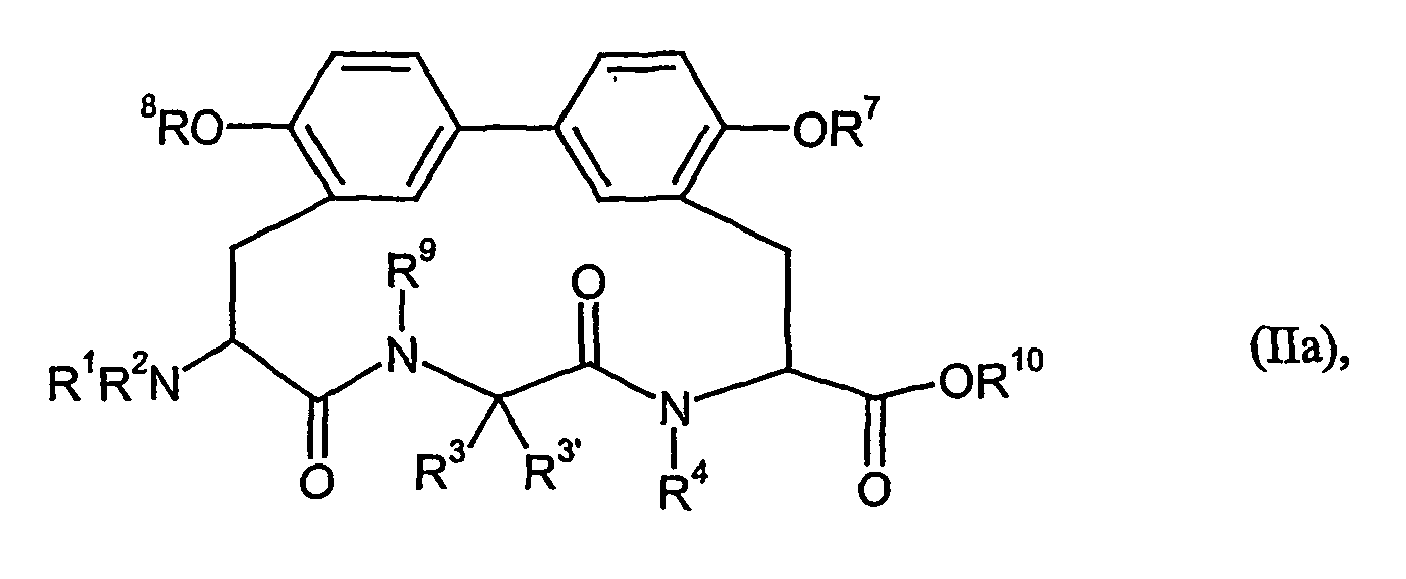
- R1 bis R4 und R7 bis R9
- die oben angegebene Bedeutung haben und
- R10
- gleich Benzyl (alternativ für Alkyl, z.B. Methyl oder Ethyl) ist,
- Alternativ können die Ester (R10 = Benzyl, Alkyl) auch durch basische Hydrolyse in die entsprechenden Carbonsäuren gespalten werden. Als Basen werden bevorzugt wässriges Lithium- oder Natriumhydroxid eingesetzt. Als Lösemittel eignen sich hierbei organische Lösemittel, die teilweise oder unbegrenzt mit Wasser mischbar sind. Hierzu gehören Alkohole (bevorzugt sind Methanol und Ethanol), Tetrahydrofuran, Dioxan und Dimethylformamid. Ebenso ist es möglich, Gemische der Lösemittel einzusetzen. Besonders bevorzugt sind Methanol, Tetrahydrofuran und Dimethylformamid.
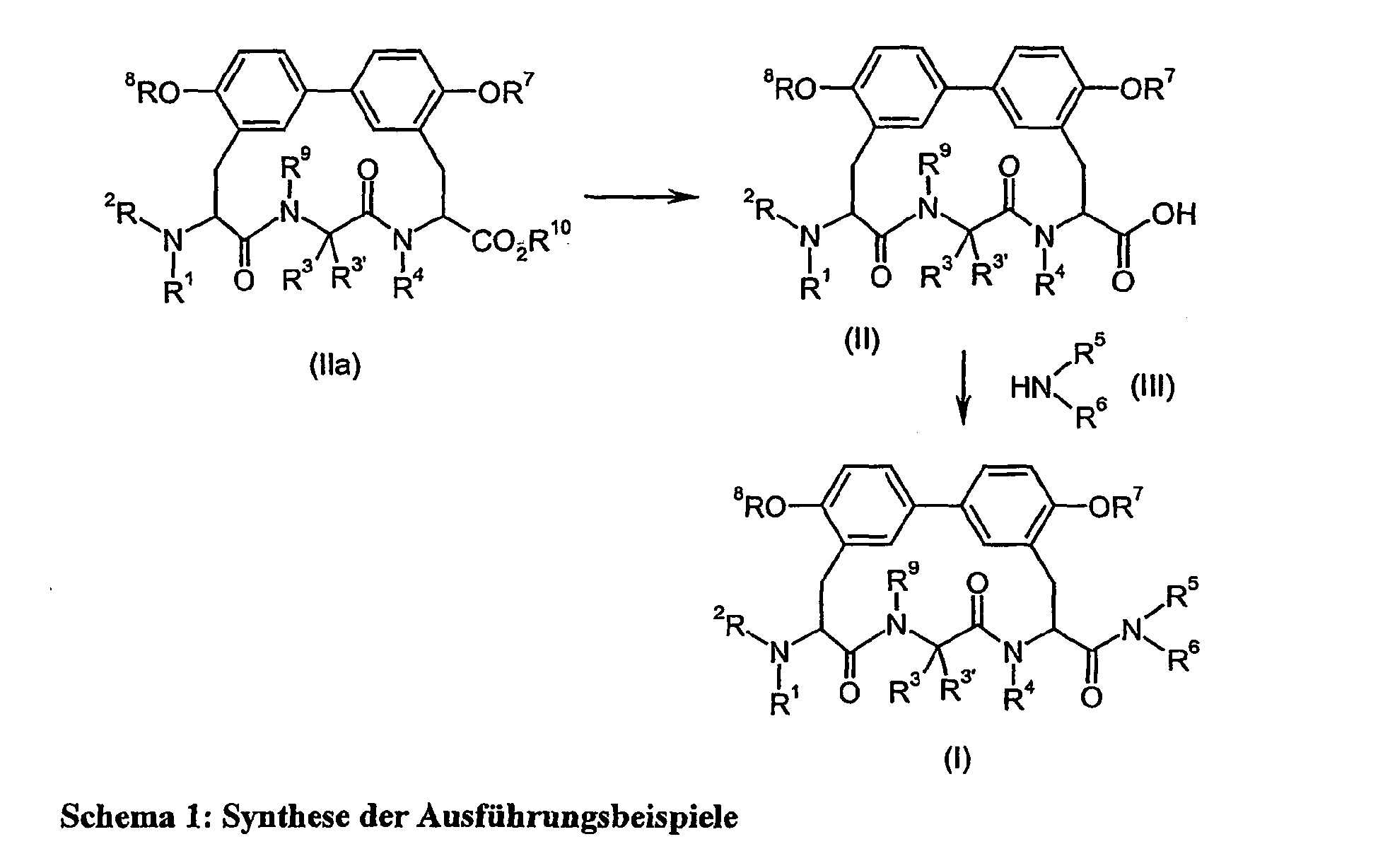
- Die Verbindungen der Formel (IIa) können hergestellt werden, indem Verbindungen der Formel

- R1 bis R4 und R7 bis R10
- die oben angegebene Bedeutung haben,
- R1 bis R4 und R7 bis R10
- die oben angegebene Bedeutung haben,
- R11
- nach Aktivierung gleich Pentafluorphenol ist und
- R12
- gleich eine Aminschutzgruppe (bevorzugt Boc) ist,
- Zur Überführung der Verbindungen in die aktivierte Form sind beispielsweise Carbodiimide wie z.B. N,N'-Diethyl-, N,N,'-Dipropyl-, N,N'-Diisopropyl-, N,N'-Dicyclohexylcarbodiimid, N-(3-Dimethylaminoisopropyl)-N'-ethylcarbodiimid-Hydrochlorid (EDC) (gegebenenfalls in Gegenwart von Pentafluorphenol (PFP)), N-Cyclohexylcarbodiimid-N'-propyloxymethyl-Polystyrol (PS-Carbodiimid) oder Carbonylverbindungen wie Carbonyldiimidazol, oder 1,2-Oxazoliumverbindungen wie 2-Ethyl-5-phenyl-1,2-oxazolium-3-sulfat oder 2-tert.-Butyl-5-methyl-isoxazolium-perchlorat, oder Acylaminoverbindungen wie 2-Ethoxy-1-ethoxycarbonyl-1,2-dihydrochinolin, oder Propanphosphonsäureanhydrid, oder Isobutylchloroformat, oder Bis-(2-oxo-3-oxazolidinyl)-phosphorylchlorid oder Benzotriazolyloxy-tri(dimethylamino)phosphoniumhexafluorophosphat, oder O-(Benzotriazol-1-yl)-N,N,N',N'-tetramethyluronium-hexafluorophosphat (HBTU), 2-(2-Oxo-1-(2H)-pyridyl)-1,1,3,3-tetramethyluroniumtetrafluoroborat (TPTU) oder O-(7-Azabenzotriazol-1-yl)-N,N,N',N'-tetramethyluroniumhexafluorophosphat (HATU), oder Benzotriazol-1-yloxytris(dimethylamino)-phosphoniumhexafluorophosphat (BOP), oder Mischungen aus diesen mit Basen, gegebenenfalls in Gegenwart von 1-Hydroxybenztriazol (HOBt), geeignet.
- Basen sind beispielsweise Alkalicarbonate, wie z.B. Natrium- oder Kaliumcarbonat, oder -hydrogencarbonat, oder bevorzugt organische Basen wie Trialkylamine z.B. Triethylamin, N-Methylmorpholin, N-Methylpiperidin, 4-Dimethylaminopyridin oder Diisopropylethylamin.
- Als Lösemittel eignen sich hierbei inerte organische Lösemittel, die sich unter den Reaktionsbedingungen nicht verändern. Hierzu gehören Halogenkohlenwasserstoffe wie Dichlormethan oder Trichlormethan, Kohlenwasserstoffe wie Benzol, Toluol, Tetrahydrofuran, Dioxan, Dimethylformamid oder Acetonitril. Ebenso ist es möglich, Gemische der Lösemittel einzusetzen. Besonders bevorzugt sind Dichlormethan und Dimethylformamid.
- Besonders bevorzugt ist die Aktivierung in Form eines Pentafluorphenylesters (R11 = C6F5) und anschließendem basenkatalysierten Ringschluss.
- Die Verbindungen der Formel (IV) sind bekannt, können analog bekannten Verfahren hergestellt werden oder indem Verbindungen der Formel

- R1 bis R4 und R7 bis R10 und R12
- die oben angegebene Bedeutung haben und
- R11
- gleich eine Silylschutzgruppe, insbesondere 2-(Trimethylsilyl)-ethyl, ist,
- Als Lösemittel eignen sich hierbei inerte organische Lösemittel, die sich unter den Reaktionsbedingungen nicht verändern. Hierzu gehören Halogenkohlenwasserstoffe wie Dichlormethan, Kohlenwasserstoffe wie Benzol, Toluol, Tetrahydrofuran, Dioxan und Dimethylformamid. Ebenso ist es möglich, Gemische der Lösemittel einzusetzen. Bevorzugte Lösungsmittel sind Tetrahydrofuran und Dimethylformamid.
- Die Verbindungen der Formel (IVb) sind bekannt, können analog bekannten Verfahren hergestellt werden oder indem Verbindungen der Formel

- R1, R2, R4, R7, R8 und R10
- die oben angegebene Bedeutung haben,
- R11
- gleich eine Silylschutzgruppe ist,
- R3, R3', R9 und R12
- die oben angegebene Bedeutung haben und
- Zur Überführung der Verbindungen in die aktivierte Form sind beispielsweise Carbodiimide wie z.B. N,N'-Diethyl-, N,N,'-Dipropyl-, N,N'-Diisopropyl-, N,N'-Dicyclohexylcarbodiimid, N-(3-Dimethylaminoisopropyl)-N'-ethylcarbodiimid Hydrochlorid (EDC) (gegebenenfalls in Gegenwart von Pentafluorphenol (PFP)), N-Cyclohexylcarbodiimid-N'-propyloxymethyl-Polystyrol (PS-Carbodiimid) oder Carbonylverbindungen wie Carbonyldiimidazol, oder 1,2-Oxazoliumverbindungen wie 2-Ethyl-5-phenyl-1,2-oxazolium-3-sulfat oder 2-tert.-Butyl-5-methyl-isoxazolium-perchlorat, oder Acylaminoverbindungen wie 2-Ethoxy-1-ethoxycarbonyl-1,2-dihydrochinolin, oder Propanphosphonsäureanhydrid, oder Isobutylchloroformat, oder Bis-(2-oxo-3-oxazolidinyl)-phosphorylchlorid oder Benzotriazolyloxy-tri(dimethylamino)phosphoniumhexafluorophosphat, oder O-(Benzotriazol-1-yl)-N,N,N',N'-tetra-methyluroniumhexafluorophosphat (HBTU), 2-(2-Oxo-1-(2H)-pyridyl)-1,1,3,3-tetramethyluroniumtetrafluoroborat (TPTU) oder O-(7-Azabenzotriazol-1-yl)-N,N,N',N'-tetramethyluroniumhexafluorophosphat (HATU), oder Benzotriazol-1-yloxytris(dimethylamino)-phosphoniumhexafluorophosphat (BOP), oder Mischungen aus diesen mit Basen, gegebenenfalls unter Zusatz von Kupplungsadditiven wie 1-Hydroxybenzotriazol (HOBt), geeignet.
- Basen sind beispielsweise Alkalicarbonate, wie z.B. Natrium- oder Kaliumcarbonat, oder -hydrogencarbonat, oder bevorzugt organische Basen wie Trialkylamine z.B. Triethylamin, N-Methylmorpholin, N-Methylpiperidin, 4-Dimethylaminopyridin oder Diisopropylethylamin.
- Als Lösemittel eignen sich hierbei inerte organische Lösemittel, die sich unter den Reaktionsbedingungen nicht verändern. Hierzu gehören Halogenkohlenwasserstoffe wie Dichlormethan oder Trichlormethan, Kohlenwasserstoffe wie Benzol, Toluol, Acetonitril, Tetrahydrofuran, Dioxan oder Dimethylformamid. Ebenso ist es möglich, Gemische der Lösemittel einzusetzen. Besonders bevorzugt sind wasserfreies Dichlormethan und Dimethylformamid.
- Besonders bevorzugt ist die Umsetzung in Gegenwart von HATU und N,N-Diisopropylethylamin.
- Die Verbindungen der Formel (VI) sind bekannt oder können analog bekannten Verfahren hergestellt werden.
- Die Verbindungen der Formel (V), beziehungsweise ihre Salze (z.B. Hydrochloride), sind bekannt, können analog bekannten Verfahren hergestellt werden oder indem Verbindungen der Formel

- R1, R2, R4, R7, R8 und R10
- die oben angegebene Bedeutung haben,
- R11
- gleich eine Silylschutzgruppe ist, und
- R13
- gleich eine Aminschutzgruppe, insbesondere Boc, ist,
- Die Verbindungen der Formel (Va) sind bekannt, können analog bekannten Verfahren hergestellt werden oder indem Verbindungen der Formel

- R4 und R7
- die oben angegebene Bedeutung haben,
- R10
- gleich Benzyl oder Alkyl ist und
- R13
- gleich eine Aminoschutzgruppe (bevorzugt Boc) ist,
- R1, R2 und R8
- die oben angegebene Bedeutung haben und
- R11
- gleich eine Silylschutzgruppe, insbesondere 2-(Trimethylsilyl)-ethyl, ist,
- Als Lösemittel eignen sich hierbei inerte organische Lösemittel, die sich unter den Reaktionsbedingungen nicht verändern. Hierzu gehören Kohlenwasserstoffe wie Benzol, Toluol, Tetrahydrofuran, Dioxan, Dimethylformamid und Dimethylsulfoxid.
- Ebenso ist es möglich, Gemische der Lösemittel einzusetzen. Besonders bevorzugt sind Dimethylformamid und Dimethylsulfoxid.
- Die Verbindungen der Formel (VII) sind bekannt, können analog bekannten Verfahren hergestellt werden oder indem Verbindungen der Formel
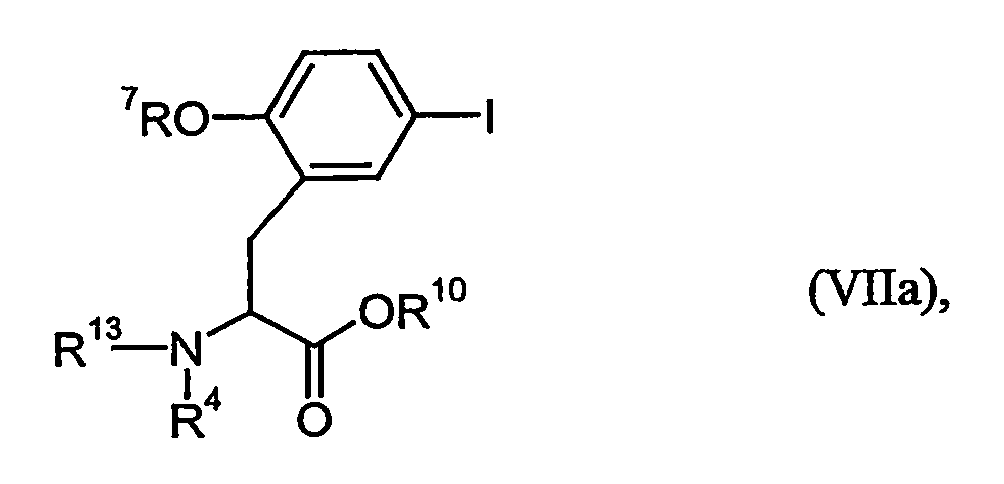
- R4 und R7
- die oben angegebene Bedeutung haben,
- R10
- gleich Benzyl oder Alkyl ist und
- R13
- gleich eine Aminoschutzgruppe (bevorzugt Boc) ist,
- Als Lösemittel eignen sich hierbei inerte organische Lösemittel, die sich unter den Reaktionsbedingungen nicht verändern. Hierzu gehören Kohlenwasserstoffe wie Benzol, Toluol, Tetrahydrofuran, Dioxan, Dimethylformamid und Dimethylsulfoxid. Ebenso ist es möglich, Gemische der Lösemittel einzusetzen. Besonders bevorzugt sind Dimethylformamid und Dimethylsulfoxid.
- Die Verbindungen der Formel (VIIa) sind bekannt, können analog bekannten Verfahren hergestellt werden oder indem Verbindungen der Formel

- R4 und R7
- die oben angegebene Bedeutung haben und
- R13
- gleich eine Aminoschutzgruppe (bevorzugt Boc) ist,
- Zur Überführung der Carbonsäuren in die aktivierte Form sind beispielsweise Carbodiimide wie z.B. N,N'-Diethyl-, N,N,'-Dipropyl-, N,N'-Diisopropyl-, N,N'-Dicyclohexylcarbodiimid, N-(3-Dimethylaminoisopropyl)-N'-ethylcarbodiimid-Hydrochlorid (EDC) N-Cyclohexylcarbodiimid-N'-propyloxymethyl-Polystyrol (PS-Carbodiimid) oder Carbonylverbindungen wie Carbonyldiimidazol geeignet.
- Als Lösemittel eignen sich hierbei inerte organische Lösemittel, die sich unter den Reaktionsbedingungen nicht verändern. Hierzu gehören Halogenkohlenwasserstoffe wie Dichlormethan oder Trichlormethan, Kohlenwasserstoffe wie Benzol, Toluol, Acetonitril, Tetrahydrofuran, Dioxan oder Dimethylformamid. Ebenso ist es möglich, Gemische der Lösemittel einzusetzen. Besonders bevorzugt sind wasserfreies Dichlormethan und Acetonitril.
- Bevorzugt sind Umsetzungen mit Aktivierung durch EDC oder DIC in absolutem Acetonitril oder Dichlormethan bei tiefer Temperatur (-10°C).
- Die Verbindungen der Formel (VIII) sind bekannt, können analog bekannten Verfahren hergestellt werden oder indem Verbindungen der Formel

R1, R2 und R8 die oben angegebene Bedeutung haben
nach Aktivierung der freien Carboxylatfunktion mit 11R-OH (bevorzugt 2-Trimethylsilylethanol) in Gegenwart von 4-Dimethylaminopyridin umgesetzt werden. - Zur Überführung der Carbonsäuren in die aktivierte Form sind beispielsweise Carbodiimide wie z.B. N,N'-Diethyl-, N,N,'-Dipropyl-, N,N'-Diisopropyl-, N,N'-Dicyclohexylcarbodiimid, N-(3-Dimethylaminoisopropyl)-N'-ethylcarbodiimid-Hydrochlorid (EDC) N-Cyclohexylcarbodiimid-N'-propyloxymethyl-Polystyrol (PS-Carbodiimid) oder Carbonylverbindungen wie Carbonyldiimidazol geeignet.
- Als Lösemittel eignen sich hierbei inerte organische Lösemittel, die sich unter den Reaktionsbedingungen nicht verändern. Hierzu gehören Halogenkohlenwasserstoffe wie Dichlormethan oder Trichlormethan, Kohlenwasserstoffe wie Benzol, Toluol, Acetonitril, Tetrahydrofuran, Dioxan oder Dimethylformamid. Ebenso ist es möglich, Gemische der Lösemittel einzusetzen. Besonders bevorzugt sind wasserfreies Dichlormethan und Acetonitril.
- Bevorzugt sind Umsetzungen mit Aktivierung durch EDC oder DIC in absolutem Acetonitril oder Dichlormethan bei tiefer Temperatur (-10°C).
- Die Carbonsäuren der Formel (IXa) sind bekannt, können analog bekannten Verfahren hergestellt werden oder indem Verbindungen der Formel

- R1 und R8
- die oben angegebene Bedeutung haben und
- R15
- gleich eine Aminoschutzgruppe, insbesondere Boc, ist,
- R1 und R8
- die oben angegebene Bedeutung haben,
- Basen sind beispielsweise Alkalicarbonate, wie z.B. Natrium- oder Kaliumcarbonat, oder -hydrogencarbonat, oder organische Basen wie Trialkylamine z.B. Triethylamin, N-Methylpiperidin, 4-Dimethylaminopyridin oder Diisopropylethylamin.
- Als Lösemittel eignen sich hierbei inerte organische Lösemittel, die sich unter den Reaktionsbedingungen nicht verändern. Hierzu gehören Halogenkohlenwasserstoffe wie Dichlormethan oder Trichlormethan, Kohlenwasserstoffe wie Benzol, Toluol, Acetonitril, Tetrahydrofuran, Dioxan, Aceton oder Dimethylformamid. Ebenso ist es möglich, Gemische der Lösemittel einzusetzen. Besonders bevorzugt sind Dimethylformamid und Dichlormethan.

- In einem Alternativverfahren können die Verbindungen der Formel (Va) hergestellt werden, indem Verbindungen der Formel

- R4 und R7
- die oben angegebene Bedeutung haben,
- R10
- gleich Benzyl oder Alkyl ist und
- R13
- gleich eine Aminoschutzgruppe (bevorzugt Boc) ist,
- R1, R2 und R8
- die oben angegebene Bedeutung haben und
- R11
- gleich eine Silylschutzgruppe, insbesondere 2-(Trimethylsilyl)-ethyl, ist,
- Als Lösemittel eignen sich hierbei inerte organische Lösemittel, die sich unter den Reaktionsbedingungen nicht verändern. Hierzu gehören Kohlenwasserstoffe wie Benzol, Toluol, Tetrahydrofuran, Dioxan, Dimethylformamid und Dimethylsulfoxid. Ebenso ist es möglich, Gemische der Lösemittel einzusetzen. Besonders bevorzugt sind Dimethylformamid und Dimethylsulfoxid.
- Die Verbindungen der Formel (VIIIa) können aus den Verbindungen der Formel (VIII) nach dem für die Verbindungen (VII) beschriebenen Verfahren hergestellt werden.
- Die enantiomerenreinen Verbindungen der Formeln (IX) und (IXb) sind bekannt oder können aus racemischen Vorläufern nach bekannten Verfahren, wie z.B. Kristallisation mit chiralen Aminbasen oder durch Chromatograpie an chiralen, stationären Phasen, erhalten werden.
- Die Verbindungen der Formeln (IX) und (IXb) sind bekannt, können analog bekannten Verfahren hergestellt werden oder indem Verbindungen der Formeln

- R4 und R7 und R1 und R8
- die oben angegebene Bedeutung haben,
- R13 und R15
- gleich eine Aminoschutzgruppe sind und
- R14
- gleich Alkyl (besonders bevorzugt Ethyl) ist,
- Die Verbindungen der Formeln (X) und (Xa) sind bekannt, können analog bekannten Verfahren hergestellt werden oder indem Verbindungen der Formeln

R7 und R8 die oben angegebene Bedeutung haben,
mit Verbindungen der Formeln
- R4 und R1
- die oben angegebene Bedeutung haben,
- R13 und R15
- gleich eine Aminoschutzgruppe sind und
- R14
- gleich Alkyl (bevorzugt Ethyl) ist,
- Die Verbindungen der Formeln (XII) und (XIIa) sind bekannt, können analog bekannten Verfahren hergestellt werden oder indem Verbindungen der Formeln

- R7 und R8
- die oben angegebene Bedeutung haben,
- Die Verbindungen der Formeln (XIIb) und (XIIc) sind bekannt, können analog bekannten Verfahren hergestellt werden oder indem Verbindungen der Formel

- R7 und R8
- die oben angegebene Bedeutung haben,
- Die Verbindungen der Formeln (XIId) und (XIIe) sind bekannt, können analog bekannten Verfahren hergestellt werden oder indem 2-Hydroxy-5-iod-benzaldehyd mit Verbindungen der Formeln

- R7 und R8
- die oben angegebene Bedeutung haben und
- X
- für eine Abgangsgruppe steht, in inerten Lösungsmitteln umgesetzt werden,
- Inerte Lösungsmittel sind beispielsweise Halogenkohlenwasserstoffe wie Methylenchlorid, Trichlormethan oder 1,2-Dichlorethan, Ether wie Dioxan, Tetrahydrofuran oder 1,2-Dimethoxyethan, oder andere Lösemittel wie Aceton, Dimethylformamid, Dimethylacetamid, 2-Butanon oder Acetonitril, bevorzugt Tetrahydrofuran, Methylenchlorid, Aceton, 2-Butanon, Acetonitril, Dimethylformamid oder 1,2-Dimethoxyethan. Bevorzugt ist Dimethylformamid.
- Basen sind beispielsweise Alkalicarbonate wie Cäsiumcarbonat, Natrium- oder Kaliumcarbonat, oder Natrium- oder Kaliummethanolat, oder Natrium- oder Kaliumethanolat oder Kalium-tert.-butylat, oder Amide wie Natriumamid, Lithium-bis-(trimethylsilyl)amid oder Lithiumdiisopropylamid, oder metallorganische Verbindungen wie Butyllithium oder Phenyllithium, tertiäre Aminbasen wie Triethylamin oder Diisopropylethylamin, oder andere Basen wie Natriumhydrid, DBU, bevorzugt Kalium-tert.-butylat, Cäsiumcarbonat, DBU, Natriumhydrid, Kaliumcarbonat oder Natriumcarbonat. Bevorzugt ist Kaliumcarbonat.
- Die Verbindungen der Formeln (XIII) und (XIIIa) sind bekannt oder können analog bekannten Verfahren hergestellt werden.
- Die Herstellung der erfindungsgemäßen Verbindungen kann durch folgendes Syntheseschema verdeutlicht werden. Hierbei ist der besseren Übersichtlichkeit halber die in der Beschreibung verwendete lateinische Nummerierung beibehalten, das Schema zeigt jedoch teilweise spezielle Ausführungsformen, insbesondere R14 in (XI) und (XIa) gleich Ethyl und R13 und R15 gleich Boc.

- In einem alternativen Verfahren können die Substituenten R5 und R6 auch über die Verbindungen der Formel (VII) bzw. (VIIa) in die Synthese eingebracht werden. Dazu wird die Säurefunktion der Verbindungen der Formel (VII) bzw. (VIIa) nach dem Fachmann bekannten Bedingungen freigesetzt und mit Verbindungen der Formel (III) nach dem Fachmann bekannten Bedingungen umgesetzt.
- Die erfindungsgemäßen Verbindungen zeigen ein nicht vorhersehbares, wertvolles pharmakologisches und pharmakokinetisches Wirkspektrum.
- Sie eignen sich daher zur Verwendung als Arzneimittel zur Behandlung und/oder Prophylaxe von Krankheiten bei Menschen und Tieren.
- Die erfindungsgemäßen Verbindungen können aufgrund ihrer pharmakologischen Eigenschaften allein oder in Kombination mit anderen Wirkstoffen zur Behandlung und/oder Prävention von Infektionskrankheiten, insbesondere von bakteriellen Infektionen, eingesetzt werden.
- Beispielsweise können lokale und/oder systemische Erkrankungen behandelt und/oder verhindert werden, die durch die folgenden Erreger oder durch Mischungen der folgenden Erreger verursacht werden:
- Gram-positive Kokken, z.B. Staphylokokken (Staph. aureus, Staph. epidermidis) und Streptokokken (Strept. agalactiae, Strept. faecalis, Strept. pneumoniae, Strept. pyogenes); gram-negative Kokken (neisseria gonorrhoeae) sowie gram-negative Stäbchen wie Enterobakteriaceen, z.B. Escherichia coli, Hämophilus influenzae, Citrobacter (Citrob. freundii, Citrob. divernis), Salmonella und Shigella; ferner Klebsiellen (Klebs. pneumoniae, Klebs. oxytocy), Enterobacter (Ent. aerogenes, Ent. agglomerans), Hafnia, Serratia (Serr. marcescens), Proteus (Pr. mirabilis, Pr. rettgeri, Pr. vulgaris), Providencia, Yersinia, sowie die Gattung Acinetobacter. Darüber hinaus umfaßt das antibakterielle Spektrum die Gattung Pseudomonas (Ps. aeruginosa, Ps. maltophilia) sowie strikt anaerobe Bakterien wie z.B. Bacteroides fragilis, Vertreter der Gattung Peptococcus, Peptostreptococcus sowie die Gattung Clostridium; ferner Mykoplasmen (M. pneumoniae, M. hominis, M. urealyticum) sowie Mykobakterien, z.B. Mycobacterium tuberculosis.
- Die obige Aufzählung von Erregern ist lediglich beispielhaft und keineswegs beschränkend aufzufassen. Als Krankheiten, die durch die genannten Erreger oder Mischinfektionen verursacht und durch die erfindungsgemäßen topisch anwendbaren Zubereitungen verhindert, gebessert oder geheilt werden können, seien beispielsweise genannt:
- Infektionskrankheiten beim Menschen wie z. B. septische Infektionen, Knochen- und Gelenkinfektionen, Hautinfektionen, postoperative Wundinfektionen, Abszesse, Phlegmone, Wundinfektionen, infizierte Verbrennungen, Brandwunden, Infektionen im Mundbereich, Infektionen nach Zahnoperationen, septische Arthritis, Mastitis, Tonsillitis, Genital-Infektionen und Augeninfektionen.
- Außer beim Menschen können bakterielle Infektionen auch bei anderen Spezies behandelt werden. Beispielhaft seien genannt:
- Schwein: Coli-diarrhoe, Enterotoxamie, Sepsis, Dysenterie, Salmonellose, Metritis-Mastitis-Agalaktiae-Syndrom, Mastitis;
- Wiederkäuer (Rind, Schaf, Ziege): Diarrhoe, Sepsis, Bronchopneumonie, Salmonellose, Pasteurellose, Mykoplasmose, Genitalinfektionen;
- Pferd: Bronchopneumonien, Fohlenlähme, puerperale und postpuerperale Infektionen, Salmonellose;
- Hund und Katze: Bronchopneumonie, Diarrhoe, Dermatitis, Otitis, Harnwegsinfekte, Prostatitis;
- Geflügel (Huhn, Pute, Wachtel, Taube, Ziervögel und andere): Mycoplasmose, E. coli-Infektionen, chronische Luftwegserkrankungen, Salmonellose, Pasteurellose, Psittakose.
- Ebenso können bakterielle Erkrankungen bei der Aufzucht und Haltung von Nutz- und Zierfischen behandelt werden, wobei sich das antibakterielle Spektrum über die vorher genannten Erreger hinaus auf weitere Erreger wie z.B. Pasteurella, Brucella, Campylobacter, Listeria, Erysipelothris, Corynebakterien, Borellia, Treponema, Nocardia, Rikettsie, Yersinia, erweitert.
- Die vorliegende Erfindung betrifft weiterhin Verbindungen der Formel (I) zur Bekämpfung von Erkrankungen, insbesondere bakterieller Erkrankungen, Arzneimittel, enthaltend Verbindungen der Formel (I) und Hilfsstoffe sowie die Verwendung von Verbindungen der Formel (I) zur Herstellung eines Arzneimittels zur Behandlung von bakteriellen Erkrankungen.
- Weiterer Gegenstand der vorliegenden Erfindung sind Arzneimittel, die mindestens eine erfindungsgemäße Verbindung, vorzugsweise zusammen mit einem oder mehreren pharmakologisch unbedenklichen Hilfs- oder Trägerstoffen enthalten, sowie deren Verwendung zu den zuvor genannten Zwecken.
- Der Wirkstoff kann systemisch und/oder lokal wirken. Zu diesem Zweck kann er auf geeignete Weise appliziert werden, wie z.B. oral, parenteral, pulmonal, nasal, sublingual, lingual, buccal, rectal, transdermal, conjunctival, otisch oder als Implantat.
- Für diese Applikationswege kann der Wirkstoff in geeigneten Applikationsformen verabreicht werden.
- Für die orale Applikation eignen sich bekannte, den Wirkstoff schnell und/oder modifiziert abgebende Applikationsformen, wie z.B. Tabletten (nicht überzogene sowie überzogene Tabletten, z.B. mit magensaftresistenten Überzüge versehene Tabletten oder Filmtabletten), Kapseln, Dragees, Granulate, Pellets, Pulver, Emulsionen, Suspensionen, Lösungen und Aerosole.
- Die parenterale Applikation kann unter Umgehung eines Resorptionsschrittes geschehen (intravenös, intraarteriell, intrakardial, intraspinal oder intralumbal) oder unter Einschaltung einer Resorption (intramuskulär, subcutan, intracutan, percutan, oder intraperitoneal). Für die parenterale Applikation eignen sich als Applikationsformen u.a. Injektions- und Infusionszubereitungen in Form von Lösungen, Suspensionen, Emulsionen, Lyophilisaten und sterilen Pulvern.
- Für die sonstigen Applikationswege eignen sich z.B. Inhalationsarzneiformen (u.a. Pulverinhalatoren, Nebulizer), Nasentropfen/-lösungen, Sprays; lingual, sublingual oder buccal zu applizierende Tabletten oder Kapseln, Suppositorien, Ohren- und Augen-präparationen, Vaginalkapseln, wässrige Suspensionen (Lotionen, Schüttelmixturen), lipophile Suspensionen, Salben, Cremes, Milch, Pasten, Streupuder oder Implantate.
- Die Wirkstoffe können in an sich bekannter Weise in die angeführten Applikationsformen überführt werden. Dies geschieht unter Verwendung inerter nichttoxischer, pharmazeutisch geeigneter Hilfsstoffe. Hierzu zählen u.a. Trägerstoffe (z.B. mikrokristalline Cellulose), Lösungsmittel (z.B. flüssige Polyethylenglycole), Emulgatoren (z.B. Natriumdodecylsulfat), Dispergiermittel (z.B. Polyvinylpyrrolidon), synthetische und natürliche Biopolymere (z.B. Albumin), Stabilisatoren (z.B. Antioxidantien wie Ascorbinsäure), Farbstoffe (z.B. anorganische Pigmente wie Eisenoxide) oder Geschmacks- und/oder Geruchskorrigentien.
- Im Allgemeinen hat es sich als vorteilhaft erwiesen, bei parenteraler Applikation Mengen von etwa 5 bis 250 mg/kg Körpergewicht je 24 h zur Erzielung wirksamer Ergebnisse zu verabreichen. Bei oraler Applikation beträgt die Menge etwa 5 bis 100 mg/kg Körpergewicht je 24 h.
- Trotzdem kann es gegebenenfalls erforderlich sein, von den genannten Mengen abzuweichen, und zwar in Abhängigkeit von Körpergewicht, Applikationsweg, individuellem Verhalten gegenüber dem Wirkstoff, Art der Zubereitung und Zeitpunkt bzw. Intervall, zu welchem die Applikation erfolgt. So kann es in einigen Fällen ausreichend sein, mit weniger als der vorgenannten Mindestmenge auszukommen, während in anderen Fällen die genannte obere Grenze überschritten werden muss. Im Falle der Applikation größerer Mengen kann es empfehlenswert sein, diese in mehreren Einzelgaben über den Tag zu verteilen.
- Die Prozentangaben in den folgenden Tests und Beispielen sind, sofern nicht anders angegeben, Gewichtsprozente; Teile sind Gewichtsteile. Lösungsmittelverhältnisse, Verdünnungsverhältnisse und Konzentrationsangaben von flüssig/flüssig-Lösungen beziehen sich jeweils auf das Volumen.
-
- Aloc
- Allyloxycarbonyl
- aq.
- Wässrig
- Äquiv.
- Äquivalent
- Bn
- Benzyl
- Boc
- tert.-Butoxycarbonyl
- CDCl3
- Chloroform
- CH
- Cyclohexan
- D
- dublett (im 1H-NMR)
- Dd
- Dublett von dublett
- DCM
- Dichlormethan
- DCC
- Dicyclohexylcarbodiimid
- DIC
- Diisopropylcarbodiimid
- DIPEA
- Diisopropylethylamin
- DMSO
- Dimethylsulfoxid
- DMAP
- 4-N,N-Dimethylaminopyridin
- DMF
- Dimethylformamid
- d. Th.
- der Theorie
- EDC
- N'-(3-Dimethylaminopropyl)-N-ethylcarbodiimid x HCl
- EE
- Ethylacetat (Essigsäureethylester)
- ESI
- Elektrospray-Ionisation (bei MS)
- ges.
- gesättigt
- HATU
- O-(7-Azabenzotriazol-1-yl)-N,N,N',N'-tetramethyluroniumhexafluorphosphat
- HBTU
- O-(Benzotriazol-1-yl)-N,N,N',N'-tetramethyluroniumhexafluorphosphat
- HOBt
- 1-Hydroxy-1H-benzotriazol x H2O
- H
- Stunde(n)
- HPLC
- Hochdruck-, Hochleistungsflüssigchromatographie
- LC-MS
- Flüssigchromatographie-gekoppelte Massenspektroskopie
- M
- multiplett (im 1H-NMR)
- Min
- Minuten
- MS
- Massenspektroskopie
- MeOH
- Methanol
- NMR
- Kernresonanzspektroskopie
- MTBE
- Methyl-tert. -butylether
- Pd/C
- Palladium/Kohle
- proz.
- Prozent
- Q
- quartett (im 1H-NMR)
- Rf
- Retentionsindex (bei DC)
- RT
- Raumtemperatur
- Rt
- Retentionszeit (bei HPLC)
- S
- singulett (im 1H-NMR)
- T
- triplett (im 1H-NMR)
- TBS
- tert.-Butyldimethylsilyl
- THF
- Tetrahydrofuran
- TMSE
- 2-(Trimethylsilyl)-ethyl
- TPTU
- 2-(2-Oxo-1(2H)-pyridyl)-1,1,3,3-tetramethyluroniumtetrafluoroborat
- Z
- Benzyloxycarbonyl
- Präparative RP-HPLC: Säule: YMC-Gel; Eluent: Acetonitril/Wasser (Gradient); Fluß: 50 ml/min; Temp.: 25°C; Detektion UV 210 nm.
- Methode 1 (HPLC): Säule: Kromasil C18, L-R Temperatur: 30°C; Fluss: 0.75 ml/min; Eluent A: 0.01 M HClO4, Eluent B: Acetonitril, Gradient: → 0.5 min 98%A → 4.5 min 10%A → 6.5 min 10%A.
- Methode 2 (HPLC): Säule: Kromasil C18 60*2 mm, L-R Temperatur: 30°C; Fluss: 0.75 ml/min, Eluent A: 0.01 M H3PO4, Eluent B: Acetonitril, Gradient: → 0.5 min 90%A → 4.5 min 10%A → 6.5 min 10%A.
- Methode 3 (HPLC): Säule: Kromasil C18 60*2 mm, L-R Temperatur: 30°C; Fluss: 0.75 ml/min; Eluent A: 0.005 M HClO4, Eluent B: Acetonitril, Gradient: → 0.5 min 98%A → 4.5 min 10%A → 6.5 min 10%A.
- Methode 4 (HPLC): Säule: Symmetry C18 2.1x150 mm; Säulenofen: 50°C; Fluss: 0.6 ml/min; Eluent A: 0.6 g 30%ige Salzsäure/ 1 Wasser, Eluent B: Acetonitril, Gradient: 0.0 min 90%A → 4.0 min 10%A → 9 min 10%A.
- Methode 5 (LC-MS): Instrument Micromass Quattro LCZ; Säule Symmetry C18, 50 mm x 2.1 mm, 3.5 µm; Temperatur: 40°C; Fluss: 0.5 ml/min; Eluent A: Acetonitril + 0.1 % Ameisensäure, Eluent B: Wasser + 0.1% Ameisensäure, Gradient: 0.0 min 10%A → 4 min 90%A → 6 min 90%A
- Methode 6 (LC-MS): Instrument Micromass Platform LCZ; Säule Symmetry C18, 50 mm x 2.1 mm, 3.5 µm; Temperatur: 40°C; Fluss: 0.5 ml/min; Eluent A: Acetonitril + 0.1% Ameisensäure, Eluent B: Wasser + 0.1% Ameisensäure, Gradient: 0.0 min 10%A → 4 min 90%A → 6 min 90%A.
- Methode 7 (LC-MS): Instrument Micromass Quattro LCZ; Säule Symmetry C18, 50 mm x 2.1 mm, 3.5 µm; Temperatur: 40°C; Fluss: 0.5 ml/min; Eluent A: Acetonitril + 0.1% Ameisensäure, Eluent B: Wasser + 0.1% Ameisensäure, Gradient: 0.0 min 5%A → 1 min 5%A → 5 min 90%A → 6 min 90%A
- Methode 8 (HPLC): Säule: 250*4 mm, Kromasil 100, C-18, 5 µm; Temperatur: 40°C; Fluss: 1 ml/min; Eluent: Acetonitril 15% und 0.2 %ige Perchlorsäure 85%; UV-Detektion: 210 nm.
- Methode 9 (LC-MS): Instrument: Waters Alliance 2790 LC; Säule: Symmetry C18, 50 mm x 2.1 mm, 3.5 µm; Eluent A: Wasser + 0.1% Ameisensäure, Eluent B: Acetonitril + 0.1% Ameisensäure; Gradient: 0.0 min 5%B → 5.0 min 10%B → 6.0 min 10%B; Temperatur: 50°C; Fluss: 1.0 ml/min; UV-Detektion: 210 nm.
- Methode 10 (LC-MS): ZMD Waters; Säule: Inertsil ODS3 50 mm x 2.1 mm, 3 µm; Temperatur: 40°C; Fluss: 0.5 ml/min; Eluent A: Wasser + 0.05 % Ameisensäure, Eluent B: Acetonitril + 0.05 % Ameisensäure, Gradient: 0.0 min 5%B → 12 min → 100 %B → 15 min 100%B.
- Methode 11 (LC-MS): MAT 900, Finnigan MAT, Bremen; Säule: X-terra 50mm x 2.1 mm, 2.5 µm; Temperatur: 25°C; Fluss: 0.5 ml/min; Eluent A: Wasser + 0.01 % Ameisensäure, Eluent B: Acetonitril + 0.01 % Ameisensäure, Gradient: 0.0 min 10 %B → 15 min → 90 %B → 30 min 90%B.
- Methode 12 (LC-MS): TSQ 7000, Finnigan MAT, Bremen; Säule: Inertsil ODS3 50 mm x 2.1 mm, 3 µm; Temperatur: 25°C; Fluss: 0.5 ml/min; Eluent A: Wasser + 0.05 % Ameisensäure, Eluent B: Acetonitril + 0.05 % Ameisensäure, Gradient: 0.0 min 15%B → 15 min → 100%B → 30 min 100%B.
- Methode 13 (LC-MS): 7 Tesla Apex II mit externer Elektrospray-Ionenquelle, Bruker Daltronics; Säule: X-terra C18 50 mm x 2.1 mm, 2.5 µm; Temperatur: 25°C; Fluss: 0.5 ml/min; Eluent A: Wasser + 0.1 % Ameisensäure, Eluent B: Acetonitril + 0.1 % Ameisensäure, Gradient: 0.0 min 5%B → 13 min → 100%B → 15 min 100%B.
- Methode 14 (HPLC): Säule: X-Terra™ der Firma Waters, RP8, 5 µm, 3.9×150 mm; Start: 95%A, 5%B; 12min: 5%A, 95%B. Eluent A: Wasser +0.01% Trifluoressigsäure; Eluent B: Acetonitril +0.01 % Trifluoressigsäure; Fluss: 1.2 ml/min.
- Methode 15 (LC-MS): Gerätetyp MS: Micromass ZQ; Gerätetyp HPLC: Waters Alliance 2795; Säule: Merck Chromolith SpeedROD RP-18e 50x4.6mm; Eluent A: Wasser + 500 µl 50%ige Ameisensäure / 1; Eluent B: Acetonitril + 500 µl 50%ige Ameisensäure / 1; Gradient: 0.0 min 10%B→ 3.0 min 95%B→ 4.0 min 95%B; Ofen: 35 °C; Fluss: 0.0 min 1.0 ml/min→ 3.0 min 3.0 ml/min→ 4.0 min 3.0 ml/min; UV-Detektion: 210 nm.
- Methode 16 (LC-MS): Gerätetyp MS: Micromass ZQ; Gerätetyp HPLC: Waters Alliance 2795; Säule: Merck Chromolith SpeedROD RP-18e 50x4.6mm; Eluent A: Wasser + 500 µl 50%ige Ameisensäure / 1; Eluent B: Acetonitril + 500 µl 50%ige Ameisensäure /1; Gradient: 0.0 min 10%B→ 2.0 min 95%B→ 4.0 min 95%B; Ofen: 35 °C; Fluss: 0.0 min 1.0 ml/min→ 2.0 min 3.0 ml/min→ 4.0 min 3.0 ml/min; UV-Detektion: 210 nm.
- Methode 17 (LC-MS): Instrument: Micromass Platform LCZ mit HPLC Agilent Serie 1100; Säule: Grom-SIL120 ODS-4 HE, 50 mm x 2.0 mm, 3 µm; Eluent A: 1 1 Wasser + 1 ml 50%ige Ameisensäure, Eluent B: 1 1 Acetonitril + 1 ml 50%ige Ameisensäure; Gradient: 0.0 min 100%A → 0.2 min 100%A → 2.9 min 30%A → 3.1 min 10%A → 4.5 min 10%A; Ofen: 55°C; Fluss: 0.8 ml/min; UV-Detektion: 210 nm.
- Methode 18 (LC-MS): Gerätetyp MS: Micromass ZQ; Gerätetyp HPLC: Waters Alliance 2795; Säule: Merck Chromolith SpeedROD RP-18e 50x4.6mm; Eluent A: Wasser + 500 µl 50%ige Ameisensäure / 1; Eluent B: Acetonitril + 500 µl 50%ige Ameisensäure / 1; Gradient: 0.0 min 10%B→ 3.0 min 95%B→ 4.0 min 95%B; Ofen: 35 °C; Fluss: 0.0 min 1.0 ml/min→ 3.0 min 3.0 ml/min→ 4.0 min 3.0 ml/min; UV-Detektion: 210 nm.
- Methode 19 (LC-MS): Gerätetyp MS: Micromass ZQ; Gerätetyp HPLC: Waters Alliance 2790; Säule: Grom-Sil 120 ODS-4 HE 50 mm x 2 mm, 3.0 µm; Eluent B: Acetonitril + 0.05% Ameisensäure, Eluent A: Wasser + 0.05% Ameisensäure; Gradient: 0.0 min 5%B → 2.0 min 40%B → 4.5 min 90%B→ 5.5 min 90%B; Ofen: 45 °C; Fluss: 0.0 min 0.75 ml/min → 4.5 min 0.75 ml/min→ 5.5 min 1.25 ml/min; UV-Detektion: 210 nm.
- Methode 20 (LC-MS): Gerätetyp MS: Micromass ZQ; Gerätetyp HPLC: Waters Alliance 2790; Säule: Uptisphere C 18, 50 mm x 2.0 mm, 3.0 µm; Eluent B: Acetonitril + 0.05% Ameisensäure, Eluent A: Wasser + 0.05% Ameisensäure; Gradient: 0.0 min 5%B → 2.0 min 40%B → 4.5 min 90%B→ 5.5 min 90%B; Ofen: 45 °C; Fluss: 0.0 min 0.75 ml/min → 4.5 min 0.75 ml/min→ 5.5 min 1.25 ml/min; UV-Detektion: 210 nm.
- Methode 21 (LC-MS): Instrument: Micromass Quattro LCZ mit HPLC Agilent Serie 1100 ; Säule: UPTISPHERE HDO, 50 mm x 2.0 mm, 3 µm; Eluent A: 1 1 Wasser + 1 ml 50%ige Ameisensäure, Eluent B: 1 1 Acetonitril + 1 ml 50%ige Ameisensäure; Gradient: 0.0 min 100%A → 0.2 min 100%A → 2.9 min 30%A → 3.1 min 10%A → 4.5 min 10%A; Ofen: 55°C; Fluss: 0.8 ml/min; UV-Detektion: 208-400 nm.
- Methode 22 (LC-MS): Gerätetyp MS: Micromass ZQ; Gerätetyp HPLC: HP 1100 Series; UV DAD; Säule: Grom-Sil 120 ODS-4 HE 50x2 mm, 3.0 µm; Eluent A: Wasser + 500 µl 50%ige Ameisensäure / 1, Eluent B: Acetonitril + 500 µl 50%ige Ameisensäure / 1; Gradient: 0.0 min 0%B → 2.9 min 70%B → 3.1 min 90%B → 4.5 min 90%B; Ofen: 50 °C; Fluss: 0.8 ml/min; UV-Detektion: 210 nm.
- Methode 23 (LC-MS): Gerätetyp MS: Micromass ZQ; Gerätetyp HPLC: Waters Alliance 2795; Säule: Phenomenex Synergi 2µ Hydro- RP Mercury 20x4 mm; Eluent A: 1 1 Wasser + 0.5 ml 50%ige Ameisensäure, Eluent B: 1 1 Acetonitril + 0.5 ml 50%ige Ameisensäure; Gradient: 0.0 min 90%A (Fluss: 1 ml/min) → 2.5 min 30%A (Fluss: 2 ml/min)→ 3.0 min 5%A (Fluss: 2 ml/min) → 4.5 min 5%A (Fluss: 2 ml/min); Ofen: 50°C; UV-Detektion: 210 nm.
- Methode 24 (LC-MS): Gerätetyp MS: Micromass ZQ; Gerätetyp HPLC: HP 1100 Series; UV DAD; Säule: Phenomenex Synergi 2µ Hydro- RP Mercury 20x4 mm; Eluent A: 1 l Wasser + 0.5 ml 50%ige Ameisensäure, Eluent B: 1 l Acetonitril + 0.5 ml 50%ige Ameisensäure; Gradient: 0.0 min 90%A (Fluss: 1 ml/min) → 2.5 min 30%A (Fluss: 2 ml/min) → 3.0 min 5%A (Fluss: 2 ml/min) → 4.5 min 5%A (Fluss: 2 ml/min); Ofen: 50°C; UV-Detektion: 210 nm.
- Methode 25 (LC-MS): Gerätetyp MS: Micromass ZQ; Gerätetyp HPLC: HP 1100 Series; UV DAD; Säule: Grom-Sil 120 ODS-4 HE 50x2 mm, 3.0 µm; Eluent A: Wasser + 500 µl 50%ige Ameisensäure / 1, Eluent B: Acetonitril + 500 µl 50%ige Ameisensäure / 1; Gradient: 0.0 min 70%B → 4.5 min 90%B; Ofen: 50 °C, Fluss: 0.8 ml/min, UV-Detektion: 210 nm.
- Methode 26 (LC-MS): Instrument: Micromass Quattro LCZ, mit HPLC Agilent Serie 1100; Säule: Grom-SIL120 ODS-4 HE, 50 mm x 2.0 mm, 3 µm; Eluent A: 1 1 Wasser + 1 ml 50%ige Ameisensäure, Eluent B: 1 1 Acetonitril + 1 ml 50%ige Ameisensäure; Gradient: 0.0 min 100%A → 0.2 min 100%A → 2.9 min 30%A → 3.1 min 10%A → 4.5 min 10%A; Ofen: 55°C; Fluss: 0.8 ml/min; UV-Detektion: 208-400 nm.
- Synthese von substituierten Phenylalaninderivaten am Beispiel von (-)-3-(2-Benzyloxy-5-iodophenyl)-2(S)-tert-butoxycarbonylamino-propionsäure [(-)-6A]

- Synthese von geschützten Biphenyl-bisaminosäuren am Beispiel von 2(S)-Benzyloxycarbonylamino-3-[4,4'-bis-benzyloxy-3'-(2(S)-benzyloxycarbonyl-2(S)-tert-butoxycarbonyl-amino-ethyl)-biphenyl-3-yl]-propionsäure-2(S)-trimethylsilanyl-ethylester (12A)
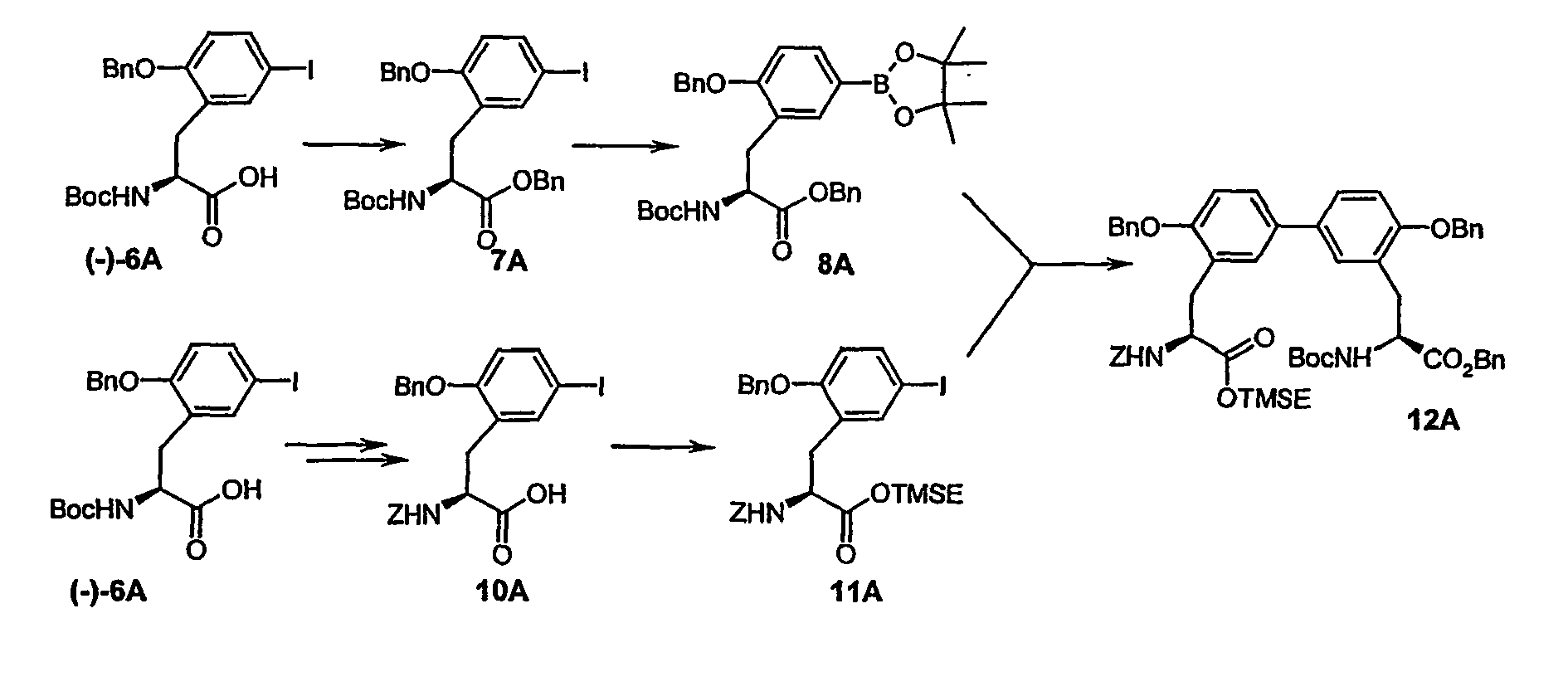
- Synthese geschützter Hydroxyornithinderivate am Beispiel von 5-Benzyloxycarbonylamino-2(S)-tert-butoxycarbonylamino-4(R)-(tert-butyldimethylsilyloxy)-pentansäure (14A)
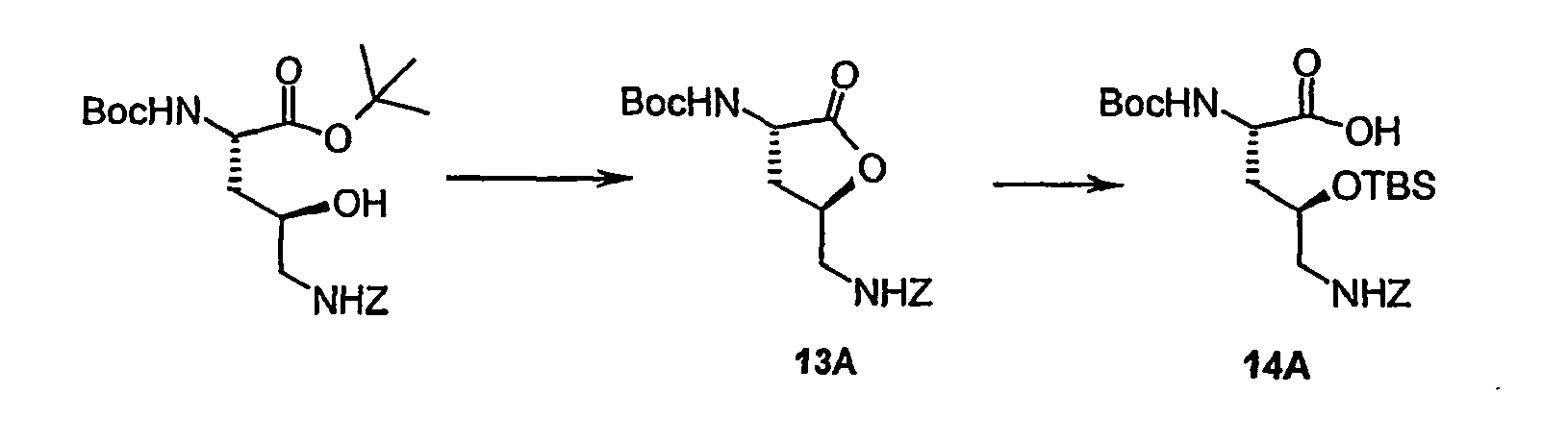
- Synthese geschützter Biphenomycin-Derivate am Beispiel von (8S,11S,14S)-14-[(tert-Butoxycarbonyl)amino]-11-{(2R)-3-[(tert-butoxycarbonyl)amino]-2-hydroxypropyl}-5,17-dihydroxy-10,13-dioxo-9,12-diazatricyclo[14.3.1.12,6]-henicosa-1(20),2(21),3,5,16,18-hexaen-8-carbonsäure (21A)

-

- Zu einer Lösung von 188 g (1.54 mol) Salicylaldehyd in 1 1 wasserfreiem Dichlormethan in einem ausgeheizten Kolben wird eine Lösung von 250 g (1.54 mol) Iodchlorid in 600 ml wasserfreiem Dichlormethan unter Argon über 2 h zugetropft. Nach 3 Tagen Rühren bei RT wird eine gesättigte wässrige Natriumsulfit-Lösung unter kräftigem Rühren hinzugegeben. Die organische Phase wird abgetrennt, einmal mit Wasser und gesättigter wässriger Natriumchlorid-Lösung gewaschen und über Natriumsulfat getrocknet. Das Lösungsmittel wird eingedampft und der Rückstand aus Essigsäureethylester umkristallisiert. Man erhält 216 g (57% d. Th.) des Produktes.
LC-MS (ESI, Methode 10): m/z = 246 (M-H)-.
1H-NMR (400 MHz, CDCl3): δ = 6.7 (d, 1H), 7.77 (dd, 1H), 7.85 (d, 1H), 9.83 (s, 1H), 10.95 (s, 1H). -

- Zu einer Lösung von 100 g (0.40 mol) 2-Hydroxy-5-iodbenzaldehyd (Beispiel 1A) in 1.5 1 Dimethylformamid werden 67.2 g (0.48 mol) Kaliumcarbonat und nach wenigen Minuten 51 ml (0.44 mol) Benzylchlorid hinzugegeben. Das Reaktionsgemisch wird 24 h bei 120°C unter Rückfluss gerührt. Nach weiteren 24 h Rühren bei RT und Zugabe von 1.51 Wasser kristallisiert ein Feststoff aus. Der Niederschlag wird abgesaugt, zweimal mit Wasser gewaschen und im Vakuum getrocknet. Der Feststoff wird aus 230 ml Ethanol umkristallisiert. Man erhält 122.9 g (90% d. Th.) des Produktes.
LC-MS (ESI, Methode 10): m/z = 338 (M+H)+.
1H-NMR (400 MHz, CDCl3): δ = 5.18 (s, 2H), 6.84 (d, 1H), 7.33-7.45 (m, 5H), 7.78 (dd, 1H), 8.12 (d, 1H), 10.4 (s, 1H). -

- Zu einer auf 0°C gekühlten Lösung von 33.98 g (100.5 mmol) 2-Benzyloxy-5-iodbenzaldehyd (Beispiel 2A) in 200 ml Dichlormethan werden 100 ml einer 1 M Diisobutylaluminiumhydrid-Lösung in Dichlormethan zugegeben. Nach 2 h Rühren bei 0°C wird unter Kühlung eine gesättigte Kaliumnatriumtartrat-Lösung hinzugegeben (stark exotherme Reaktion) und das Reaktionsgemisch 2 h weiter gerührt. Nach Abtrennung der Phasen wird die organische Phase zweimal mit Wasser und einmal mit gesättigter wässriger Natriumchlorid-Lösung gewaschen und über Natriumsulfat getrocknet. Das Lösungsmittel wird im Vakuum abgedampft. Man erhält 31.8 g (93% d. Th.) des Produktes.
1H-NMR (400 MHz, CDCl3): δ = 2.17 (t, 1H), 4.68 (d, 2H), 5.1 (s, 2H), 6.72 (d, 1H), 7.32-7.42 (m, 5H), 7.54 (dd, 1H), 7.63 (d, 1H). -

- Zu einer Lösung von 35 g (103 mmol) (2-Benzyloxy-5-iod-phenyl)-methanol (Beispiel 3A) in 350 ml Toluol werden bei 40°C 3.3 ml (35 mmol) Phosphortribromid hinzugetropft. Innerhalb von 15 min wird die Temperatur des Reaktionsgemisches auf 100°C erhöht und weitere 10 min bei dieser Temperatur gerührt. Nach Abkühlung werden die beiden Phasen getrennt. Die organische Phase wird zweimal mit destilliertem Wasser und einmal mit gesättigter wässriger Natriumchlorid-Lösung gewaschen. Die organische Phase wird über Natriumsulfat getrocknet und eingedampft. Die Ausbeute beträgt 41 g (99% d. Th.).
1H-NMR (300 MHz, CDCl3): δ = 4.45 (s, 2H), 5.06 (s, 2H), 7.30 (m, 8H). -

- Zu einer Lösung von 28 g (101.7 mmol) 2-[N-(tert-Butoxycarbonyl)amino]malonsäure-diethylester und 7.9 ml (101.7 mmol) Natriumethylat in 300 ml Ethanol werden 41 g (101.7 mmol) von 1-Benzyloxy-2-brommethyl-4-iodbenzol (Beispiel 4A) hinzugegeben. Nach 3 h Rühren bei RT saugt man das ausgefallene Produkt ab. Nach Trocknung im Vakuum werden 55 g (90% d. Th.) Produkt isoliert.
1H-NMR (400 MHz, CDCl3): δ = 1.12 (t, 6 H), 1.46 (s, 9H), 3.68 (s, 2H), 3.8-3.9 (m, 2H), 4.15-4.25 (m, 2H), 5.0 (s, 2H), 5.7 (s, 1H), 6.58 (d, 1H), 7.28-7.4 (m, 6H), 7.4 (dd, 1H). -

- Zu einer Suspension von 58 g (97 mmol) 2-(2-Benzyloxy-5-iod-benzyl)-2-tert-butoxycarbonylamino-malonsäurediethylester (Beispiel 5A) in 800 ml eines Gemisches von Ethanol und Wasser (7:3) werden 400 ml 1 N Natronlauge hinzugegeben. Nach 3 h unter Rückfluss wird der pH-Wert der Reaktionsmischung nach Abkühlung auf Raumtemperatur mit konz. Salzsäure auf ca. pH 2 eingestellt. Die Reaktionsmischung wird eingedampft. Der Rückstand wird in MTBE und Wasser aufgenommen. Die wässrige Phase wird dreimal mit MTBE extrahiert. Die vereinigten organischen Phasen werden über Natriumsulfat getrocknet, filtriert und eingeengt. Nach Trocknung im Vakuum erhält man 47 g (97% d. Th.) des Produkts.
1H-NMR (400 MHz, DMSO): δ = 1.32 (s, 9H), 2.68 (dd, 1H), 3.18 (dd, 1H), 4.25 (m, 1H), 5.15 (s, 2H), 6.88 (d, 1 H), 7.08 (d, 1H), 7.30-7.40 (m, 3 H), 7.45-7.55 (m, 3 H). -

- Das Racemat aus Beispiel 6A [(+/-)-3-(2-Benzyloxy-5-iod-phenyl)-2(S)-tert-butoxycarbonylamino-propionsäure] wird an einer chiralen stationären Kieselgelphase, basierend auf dem Selektor aus Poly(N-Methacryloyl-L-Leucin-dicyclopropylmethylamid), mit einem Gemisch aus i-Hexan/Ethylacetat als Elutionsmittel getrennt. Das zuerst eluierte Enantiomer (98.9% ee) ist in Dichlormethan rechtsdrehend ([α] D 21: + 3.0°, c = 0.54, Dichlormethan) und entspricht dem (R)-Enantiomer Beispiel (+)-6A, wie durch Einkristallröntgenstrukturanalyse bestimmt wurde. Die Reinheit des zweiten, linksdrehenden Enantiomers Beispiel (-)-6A, d.h. des (S)-Enantiomers, beträgt > 99% ee.
-
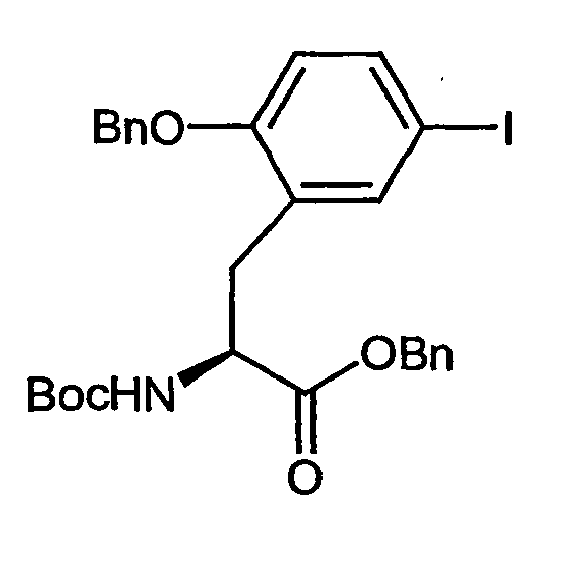
- Unter Argon werden 10 g (20.11 mmol) (-)-3-(2-Benzyloxy-5-iod-phenyl)-2(S)-tert-butoxycarbonylamino-propionsäure [Beispiel (-)-6A] in 200 ml Acetonitril gelöst. Dazu werden 246 mg (2.01 mmol) 4-Dimethylaminopyridin und 4.16 ml (40.22 mmol) Benzylalkohol hinzugefügt. Die Mischung wird auf -10°C abgekühlt und mit 4.63 g (24.13 mmol) EDC versetzt. Man lässt alles langsam auf RT kommen und rührt über Nacht. Nach ca. 16 h wird das Gemisch im Vakuum einrotiert und der Rückstand säulenchromatographisch an Silicagel (Laufmittel: Dichlormethan) gereinigt. Ausbeute: 10.65 g (88% d. Th.).
HPLC (Methode 3): Rt = 6.03 min; LC-MS (Methode 9): Rt = 4.70 min
MS (DCI): m/z = 605 (M+NH4)+.
1H-NMR (200 MHz, CDCl3): δ = 1.38 (s, 9H), 2.97 (dd, 1H), 3.12 (dd, 1H), 4.50-4.70 (m, 1H), 5.00-5.10 (m, 4H), 5.22 (d, 1H), 6.64 (d, 1H), 7.28-7.36 (m, 7H), 7.37-7.52 (m, 5H). -

- Zu einer Lösung von 10.30 g (17.53 mol) 3-(2-Benzyloxy-5-iod-phenyl)-2(S)-tert-butoxycarbonylamino-propionsäurebenzylester (Beispiel 7A) in 70 ml DMSO werden 5.15 g (52.60 mmol) Kaliumacetat zugegeben. Die Mischung wird deoxygeniert, indem durch die kräftig gerührte Lösung 15 min lang Argon durchgeleitet wird. Dann werden 5.17 g (20.16 mmol) Bis(pinacolato)diboran und 515 mg (0.70 mmol) Bis(diphenylphosphino)ferrocenpalladium(II)chlorid zugegeben. Unter leichtem Argonstrom wird nun auf 80°C erhitzt und nach 6 h wieder abgekühlt. Die Mischung wird säulenchromatographisch an Silicagel (Laufmittel: Dichlormethan) gereinigt. Vorhandene Reste an DMSO werden per Kugelrohrdestillation abgetrennt.
Der Rückstand wird erneut säulenchromatographisch an Silicagel (Laufmittel: Cyclohexan:Ethylacetat 4:1) gereinigt.
Ausbeute: 8.15 g (79% d. Th.).
HPLC (Methode 3): Rt = 6.26 min.
LC-MS (Methode 6): Rt = 5.93 und 6.09 min.
MS (EI): m/z = 588 (M+H)+.
1H-NMR (200 MHz, CDCl3): δ = 1.26 (s, 6H), 1.33 (s, 9H), 1.36 (s, 6H), 2.91-3.10 (m, 1H), 3.12-3.28 (m, 1H), 4.49-4.68 (m, 1H), 5.05 (dd, 2H), 5.11 (dd, 2H), 5.30 (d, 1H), 6.90 (d, 1H), 7.27-7.37 (m, 7H), 7.38-7.42 (m, 3H), 7.55-7.62 (m, 1H), 7.67 (dd, 1H). -

- 12 g (24.13 mmol) 3-(2-Benzyloxy-5-iod-phenyl)-2(S)-tert-butoxycarbonylaminopropionsäure [Beispiel (-)-6A] werden unter Argon in 60 ml 4 M Salzsäure-Lösung in Dioxan gegeben und 2 h bei RT gerührt. Die Reaktionslösung wird eingeengt und im Hochvakuum getrocknet.
Ausbeute: 10.47 g (100 % d. Th.).
HPLC (Methode 3): Rt = 4.10 min.
MS (EI): m/z = 398 (M+H-HCl)+.
1H-NMR (200 MHz, CDCl3): δ = 3.17-3.31 (m, 1H), 3.33-3.47 (m, 1H), 4.22 (t, 1H), 5.13 (s, 2H), 6.69 (d, 1 H), 7.24-7.40 (m, 2H), 7.41-7.45 (m, 2H), 7.48 (d, 1H), 7.52 (d, 1H), 7.60 (d, 1H), 8.66 (br.s, 2H). -

- Eine Lösung aus 10.46 g (24.13 mmol) 2(S)-Amino-3-(2-benzyloxy-5-iodphenyl)-propionsäure Hydrochlorid (Beispiel 9A) in DMF wird mit 9.25 ml (53.09 mol) N,N-Diisopropylethylamin versetzt. Dazu gibt man 6.615 g (26.54 mmol) N-(Benzyloxycarbonyl)succinimid (Z-OSuc) zu. Die resultierende Lösung wird über Nacht gerührt und dann im Vakuum einrotiert. Der Rückstand wird in Dichlormethan aufgenommen und jeweils zweimal mit 0.1 N Salzsäurelösung und gesättigter wässriger Natriumchlorid-Lösung ausgeschüttelt. Die organische Phase wird getrocknet, filtriert und eingeengt. Die Mischung wird durch Säulenchromatographie an Silicagel (Laufmittel: Cyclohexan/Diethylether 9:1 bis 8:2) gereinigt.
Ausbeute: 8.30 g (65% d. Th.).
HPLC (Methode 3): Rt = 5.01 min.
MS (EI): m/z = 532 (M+H)+.
1H-NMR (200 MHz, DMSO): δ = 3.14-3.3 (m, 2 H), 4.25-4.45 (m, 1H), 4.97 (s, 2H), 5.14 (s, 2H), 6.88 (d, 1 H), 7.20-7.56 (m, 12 H), 7.62 (d, 1 H), 12.73 (br.s, 1H). -
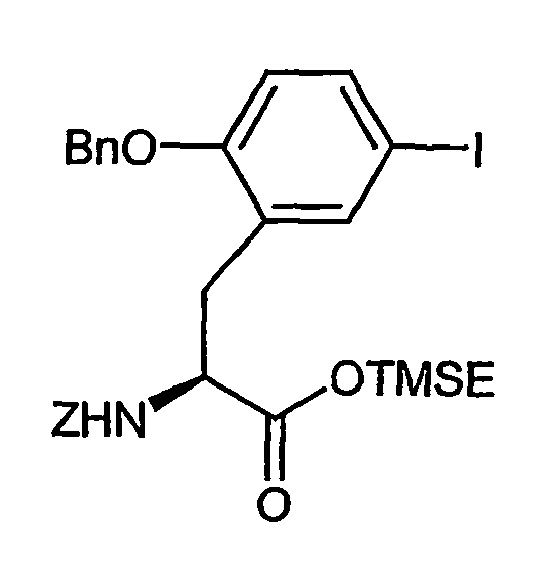
- 8.35 g (15.7 mmol) 2(S)-Benzyloxycarbonylamino-3-(2-benzyloxy-5-iod-phenyl)-propionsäure (Beispiel 10A) werden in 150 ml THF vorgelegt und mit 2.14 g (18.07 mmol) 2-Trimethylsilylethanol und 250 mg (2.04 mmol) 4-Dimethylaminopyridin versetzt. Die Mischung wird auf 0° abgekühlt und mit 2.38 g (2.95 ml, 18.86 mmol) N,N'-Diisopropylcarboddiimid, gelöst in 40 ml THF, versetzt. Es wird über Nacht bei RT gerührt und zur Aufarbeitung im Vakuum einrotiert. Der Rückstand wird in Dichlormethan aufgenommen und jeweils zweimal mit 0.1 N Salzsäurelösung und gesättigter wässriger Natriumchlorid-Lösung ausgeschüttelt. Die organische Phase wird getrocknet, filtriert und eingeengt. Die Mischung wird säulenchromatographisch (Silicagel, Laufmittel: Cyclohexan/Diethylether 9:1 bis 8:2) gereinigt.
Ausbeute: 8.2 g (83% d. Th.).
HPLC (Methode 3): Rt = 6.42 min
MS (EI): m/z = 532 (M+H)+.
1H-NMR (300 MHz, CDCl3): δ = 0.01 (s, 9H), 0.88 (t, 2H), 2.96 (dd, 1H), 3.13 (dd, 1H), 4.04-4.17 (m, 2H), 4.51-4.62 (m, 1H), 4.95-5.05 (m, 4H), 5.44 (d, 1H), 6.64 (d, 1H), 7.25-7.33 (m, 7 H), 7.37 (dd, 4H), 7.45 (dd, 1H). -
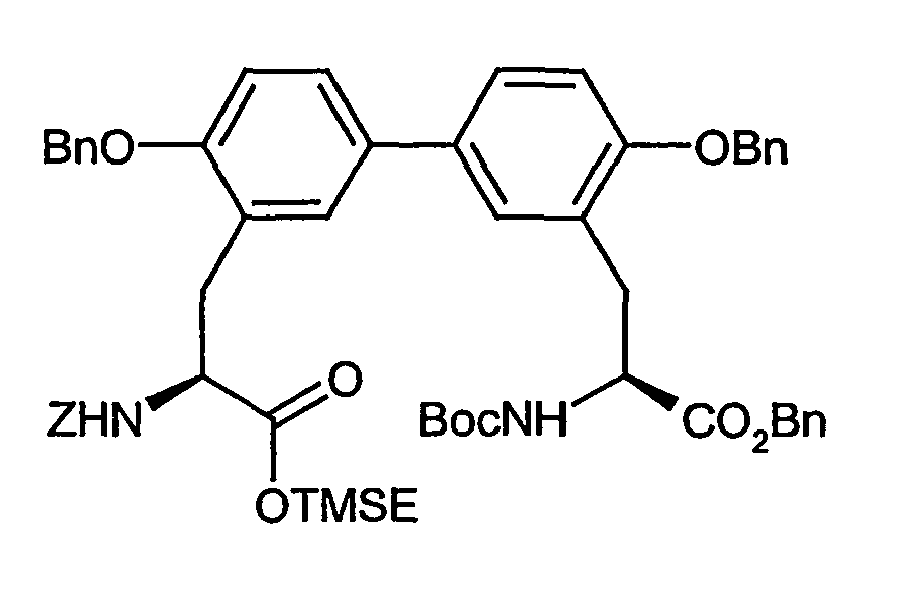
- Zu einer Lösung von 0.316 g (0.5 mmol) 2(S)-Benzyloxycarbonylamino-3-(2-benzyloxy-5-iod-phenyl)-propionsäure-(2-trimethylsilyl)-ethylester (Beispiel 11A) in 2.5 ml entgastem DMF werden unter Argon bei RT 45.8 mg (0.05 mmol) Bis(diphenylphosphino)ferrocen-palladium(II)chlorid (PdCl2(dppf)) und 0.325 g (1.0 mmol) Cäsiumcarbonat hinzugegeben. Das Reaktionsgemisch wird auf 40°C erhitzt. Innerhalb von 30 min wird eine Lösung von 0.294 g (0.5 mmol) 3-[2-Benzyloxy-5-(4,4,5,5-tetramethyl-[1,3,2]dioxaborolan-2-yl)-phenyl]-2(S)-tert-butoxycarbonylamino-propionsäurebenzylester (Beispiel 8A) in 2.5 ml entgastem DMF zugetropft. Das Reaktionsgemisch wird 4 h bei 40°C und weitere 2 h bei 50°C gerührt. Das Lösungsmittel wird eingedampft und der Rückstand in Essigsäureethylester aufgenommen. Die organische Phase wird zweimal mit Wasser ausgeschüttelt, über Natriumsulfat getrocknet und eingeengt. Das Rohprodukt wird durch Kieselgelchromatographie mit Dichlormethan/Essigsäureethylester (30/1) gereinigt. Man erhält 0.320 g (66% d. Th.) des Produktes.
- Eine Lösung von 6.99 g (11.06 mmol) 2(S)-Benzyloxycarbonylamino-3-(2-benzyloxy-5-iod-phenyl)-propionsäure-(2-trimethylsilyl)-ethylester (Beispiel 11A) und 6.50 g (11.06 mmol) 3-[2-Benzyloxy-5-(4,4,5,5-tetramethyl-[1,3,2]dioxaborolan-2-yl)-phenyl]-2(S)-tert-butoxycarbonylamino-propionsäurebenzylester (Beispiel 8A) in 40 ml DMF wird entgast, indem Argon durchgeleitet wird (ca. 30 min). Anschließend gibt man 812 mg (1.11 mmol) Bis(diphenylphosphino)ferrocenpalladium(II)chlorid (PdCl2(dppf)) und 7.21 g (22.13 mmol) Cäsiumcarbonat dazu. Das Reaktionsgemisch wird mit Argon leicht überströmt und für 2.5 h auf 80°C erhitzt. Die Mischung wird abgekühlt und säulenchromatographisch an Silicagel (Laufmittel: Cyclohexan/Ethylacetat 7:3) gereinigt. Vor der kompletten Einengung zur Trockne wird die Mischung mit Diisopropylether versetzt. Die entstandenen Kristalle werden abgesaugt und im Hochvakuum getrocknet.
Ausbeute: 6.54 g (61 % d. Th.).
HPLC (Methode 3): Rt = 7.65 min
MS (EI): m/z = 987 (M+Na), 965 (M+H)+.
1H-NMR (200 MHz, CDCl3): δ = 0.00 (s, 9H), 0.90 (t, 2H), 1.37 (s, 9H), 3.02-3.35 (m, 4H) 4.06-4.25 (m, 2H), 4.55-4.73 (m, 2H), 4.98-5.18 (m, 8H), 5.40 (d, 1H), 5.63 (d, 1H), 6.88-7.00 (m, 2H), 7.19-7.39 (m, 20H), 7.42-7.53 (m, 4H). -

- Eine Lösung von 7.60 g (17.3 mmol) 5-Benzyloxycarbonylamino-2(S)-tert-butoxycarbonylamino-4(R)-hydroxy-pentansäure-tert-butylester (Darstellung beschrieben in Org. Lett., 2001, 3, 20, 3153-3155) in 516 ml Dichlormethan und 516 ml Trifluoressigsäure wird 2 h bei RT gerührt. Das Lösungsmittel wird eingedampft.
- Das zurückbleibende Rohprodukt wird in 2.6 l wasserfreiem Methanol gelöst und unter Rühren bei 0°C werden 6.3 g (28.8 mmol) Di-tert-Butyldicarbonat und 7.3 ml (52.43 mmol) Triethylamin hinzugegeben. Nach 15 h wird die Reaktionslösung eingedampft und der Rückstand in 1 l Essigsäureethylester aufgenommen. Nach Trennung der Phasen wird die organische Phase zweimal mit einer 5%-igen Zitronensäure-Lösung, zweimal mit Wasser und einmal mit gesättigter wässriger Natriumchlorid-Lösung ausgeschüttelt, über Natriumsulfat getrocknet und eingeengt. Das Rohprodukt wird durch Kieselgelchromatographie mit Toluol/Aceton (5/1) gereinigt. Man erhält 4.92 g (78% d. Th.) des Produktes.
LC-HR-FT-ICR-MS (Methode13): ber. für C18H28N3O6 (M+NH4)+ 382.19726 gef. 382.19703.
1H-NMR (400 MHz, CDCl3): δ = 1.45 (s, 9H), 2.3-2.4 (m, 1H), 2.45-2.55 (m, 1H), 3.3-3.4 (m, 1H), 3.5-3.6 (m, 1H), 4.17-4.28 (m, 1H), 4.7-4.8 (m, 1H), 5.0-5.15 (m, 4H), 7.3-7.4 (m, 5H). -

- Zu einer Lösung von 0.73 g (2 mmol) N a-(tert-Butoxycarbonyl)-N ε(benzyloxycarbonyl)-(2S,4R)-hydroxyornithinlacton (13A) in 50 ml 1,4-Dioxan werden bei 0°C 2 ml 1 M Natronlauge hinzugegeben. Die Reaktionslösung wird 2 h gerührt und dann eingedampft. Der Rückstand wird in 50 ml Dichlormethan aufgenommen. Zu dieser Lösung werden 1.12 ml (8 mmol) Triethylamin hinzugegeben und nach einer kurzen Zeit 1.38 ml (6 mmol) Trifluormethansulfonsäure-tert-butyl-dimethylsilylester zugetropft. Nach 3 h Rühren bei RT wird das Reaktionsgemisch mit Dichlormethan verdünnt. Die organische Phase wird mit 1 N Natriumbicarbonat-Lösung gewaschen, über Natriumsulfat getrocknet und eingedampft. Das Rohprodukt wird in 7.4 ml 1,4-Dioxan gelöst und mit 36.2 ml 0.1 N Natronlauge versetzt. Nach 3 h Rühren bei RT wird die Reaktionslösung eingedampft und der Rückstand in Wasser und Essigsäureethylester aufgenommen. Die organische Phase wird dreimal mit Essigsäureethylester extrahiert. Die vereinigten organischen Phasen werden über Natriumsulfat getrocknet und eingedampft. Man erhält 0.90 g (90% d. Th.) des Produktes.
- Eine Lösung von 14.0 g (38 mmol) 2(S)-tert-Butoxycarbonylamino-4(R)-hydroxy-5-nitro-pentansäure-benzylester in 840 ml Ethanol/Wasser 9/1 wird mit 1.96 g Palladium auf Kohle (10%ig) versetzt und unter Normaldruck 24 h bei RT hydriert. Es wird über Kieselgur filtriert, und das Filtrat wird mit 14.7 g (114 mmol) Diisopropylethylamin versetzt. Anschließend werden 11.4 g (45.6 mmol) N-(Benzyloxycarbonyloxy)-succinimid hinzugegeben, und es wird 4 h bei RT gerührt. Die Lösung wird eingeengt, der Rückstand in Dichlormethan aufgenommen und zweimal mit 0.1 N Salzsäure ausgeschüttelt. Die organische Phase wird abgetrennt und mit 14.7 g (114 mmol) Diisopropylamin alkalisch gestellt. Die Lösung wird auf 0°C gekühlt, mit 30.1 g (114 mmol) Trifluormethansulfonsäure-dimethyl-tert-butylsilylester versetzt und bei RT 2.5 h gerührt. Die organische Phase wird mit gesättigter Natriumhydrogencarbonat-Lösung gewaschen, über Natriumsulfat getrocknet und einrotiert. Der Rückstand wird in 50 ml Dioxan gelöst, mit 200 ml 0.1N Natronlauge versetzt und 3 h bei RT gerührt. Es wird mehrmals mit Essigsäureethylester extrahiert, die gesammelten organischen Phasen werden über Natriumsulfat getrocknet und im Vakuum eingeengt. Der Rückstand wird an Kieselgel chromatographiert (Laufmittel: Dichlormethan/Ethanol 20/1, 9/1). Man erhält 8.11 g (43% d. Th.) des Produkts.
MS (ESI): m/z = 497 (M+H)+.
1H-NMR (300 MHz, d6-DMSO): δ = 0.00 (s, 6H), 0.99 (s, 9H), 1.33 (s, 9H), 1.59 (m, 1H), 1.80 (m, 1H), 2.75-3.15 (m, 2H), 3.81 (m, 1H), 3.98 (m, 1H), 4.96 (m, 2H), 7.04 (d, 1H), 7.19 (m, 1H), 7.30 (m, 5H), 12.37 (br. s, 1H). -

- Zu einer auf 0°C gekühlten Lösung von 2.65 g (2.75 mmol) 2(S)-Benzyloxycarbonylamino-3-[4,4'-bis-benzyloxy-3'-(2(S)-benzyloxycarbonyl-2-tert-butoxycarbonylamino-ethyl)-biphenyl-3-yl]-propionsäure-2-(trimethylsilyl)-ethylester (Beispiel 12A) in 50 ml wasserfreiem Dioxan werden 50 ml einer 4 M Salzsäure-Dioxan-Lösung über ca. 20 min hinzugegeben. Nach 3 h Rühren wird die Reaktionslösung eingedampft und im Hochvakuum getrocknet.
Ausbeute: 100% d. Th.
HPLC (Methode 3): Rt = 5.96 min.
MS (EI): m/z = 865 (M+H)+. -

- Zu einer auf 0°C gekühlten Lösung von 0.520 g (0.58 mmol) 3-[3'-(2(S)-Amino-2-benzyloxycarbonyl-ethyl)-4,4'-bis-benzyloxy-biphenyl-3-yl]-2(S)-benzyloxycarbonylamino-propionsäure-(2-trimethylsilyl)-ethylester Hydrochlorid (Beispiel 15A) und 0.287 g (0.58 mmol) 5-Benzyloxycarbonylamino-2(S)-tert-butoxycarbonylamino-4(R)-(tert-butyldimethylsilyloxy)-pentansäure (Beispiel 14A) in 7.3 ml wasserfreiem DMF werden 0.219 g (0.58 mmol) HATU und 0.082 g (0.63 mmol) N,N-Diisopropylethylamin hinzugegeben. Nach 30 min Rühren bei 0°C werden zusätzliche 0.164 g (1.26 mmol) N,N-Diisopropylethylamin hinzugegeben. Das Reaktionsgemisch wird 15 h bei RT gerührt. Das Lösungsmittel wird dann eingedampft und der Rückstand in Essigsäureethylester aufgenommen. Die organische Phase wird dreimal mit Wasser und einmal mit gesättigter wässriger Natriumchlorid-Lösung gewaschen, über Natriumsulfat getrocknet und eingeengt. Das Rohprodukt wird durch Kieselgelchromatographie mit Dichlormethan/Essigsäureethylester (Gradient 30/1→20/1→10/1) gereinigt. Man erhält 533 mg (66% d. Th.) des Produktes.
LC-MS (ESI, Methode 12): m/z =1342 (M+H)+, 1365 (M+Na)+. -
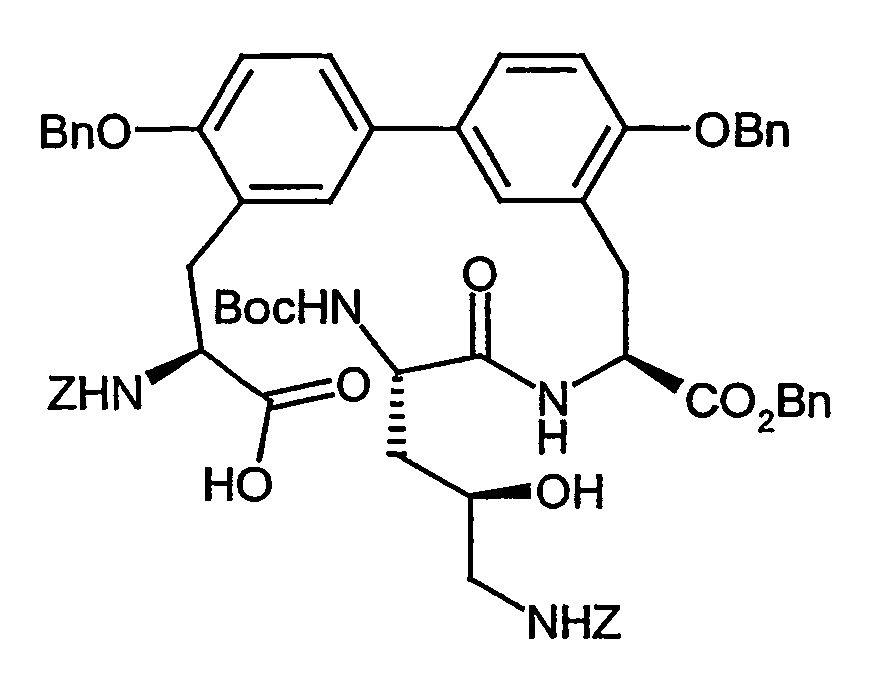
- Zu einer Lösung von 0.360 g (0.27 mmol) 2(S)-[5-Benzyloxycarbonylamino-2(S)-tert-butoxycarbonylamino-4(R)-(tert-butyldimethylsilyloxy)-pentanoylamino]-3-{4,4'-bis-benzyloxy-3'-[2(S)-benzyloxycarbonylamino-2-(2-trimethylsilyl-ethoxycarbonyl)-ethyl]-biphenyl-3-yl}-propionsäurebenzylester (Beispiel 16A) in 22.5 ml wasserfreiem DMF werden 0.80 ml einer 1.0 M Lösung von Tetrabutylammoniumfluorid in THF hinzugegeben. Nach 1 h Rühren bei RT wird das Reaktionsgemisch auf 0°C gekühlt und mit Wasser versetzt. Nach Zugabe von Essigsäureethylester werden die Phasen getrennt. Die organische Phase wird mit einer 1.0 M Lösung Kaliumhydrogensulfat gewaschen, über Natriumsulfat getrocknet und eingedampft. Man erhält 0.331 g des Rohproduktes. Das Rohprodukt wird ohne weitere Reinigung umgesetzt.
LC-MS (ESI, Methode 10): m/z = 1129 (M+H)+.
LC-HR-FT-ICR-MS: ber. für C65H69N4O14 (M+H)+ 1129.48048 gef. 1129.48123. - Zu einer Lösung von 800 mg (0.6 mmol) 2(S)-[5-Benzyloxycarbonylamino-2(S)-tert-butoxycarbonylamino-4(R)-(tert-butyldimethylsilyloxy)-pentanoylamino]-3-{4,4'-bis-benzyloxy-3'-[2(S)-benzyloxycarbonylamino-2-(2-trimethylsilyl-ethoxycarbonyl)-ethyl]-biphenyl-3-yl}-propionsäurebenzylester (Beispiel 16A) in 26 ml absolutem DMF werden bei RT tropfenweise 1.8 ml 1N Tetrabutylammoniumfluorid in THF hinzugegeben. Nach 25 min bei RT wird auf 0°C gekühlt und mit viel Eiswasser versetzt. Es wird sofort mit Ethylacetat und etwas 1N Salzsäure-Lösung versetzt. Die organische Phase mit Magnesiumsulfat getrocknet, eingeengt und 1 h im Hochvakuum getrocknet. Das Rohprodukt wird ohne weitere Reinigung umgesetzt.
-

- Zu einer auf -25°C gekühlten Lösung von 104 mg (92 µmol) 2(S)-Benzyloxycarbonylamino-3-{4,4'-bis-benzyloxy-3'-[2(S)-benzyloxycarbonyl-2-(5-benzyloxycarbonylamino-2(S)-tert-butoxycarbonylamino-4(R)-hydroxy-pentanoylamino)-ethyl]-biphenyl-3-yl}-propionsäure (Beispiel 17A) in 3 ml Dichlormethan werden unter Argon 90 mg Pentafluorphenol (0.49 mmol), in wenig Dichlormethan gelöst, 1.1 mg 4-Dimethylaminopyridin (10 µM) und 19.4 mg (0.10 mmol) EDC hinzugegeben. Nach 15 h Rühren wird das Reaktionsgemisch eingeengt. Das Rohprodukt wird ohne weitere Reinigung umgesetzt.
LC-MS (ESI, Methode 11): m/z = 1317 (M+Na)+, 1295 (M+H)+.
LC-HR-FT-ICR-MS: ber. für C71H68F5N4O14 (M+H)+ 1295.46467 gef. 1295.46430. - 691 mg (Rohgemisch, ca. 0.6 mmol) 2(S)-Benzyloxycarbonylamino-3-{4,4'-bis-benzyloxy-3'-[2(S)-benzyloxycarbonyl-2-(5-benzyloxycarbonylamino-2(S)-tert-butoxycarbonylamino-4(R)-hydroxy-pentanoylamino)-ethyl]-biphenyl-3-yl}-propionsäure (Beispiel 17A) werden in 25 ml Dichlormethan vorgelegt und mit 547.6 mg (2.98 mmol) Pentafluorphenol, gelöst in 6 ml Dichlormethan, versetzt. Man fügt 7.3 mg (0.06 mmol) DMAP hinzu und kühlt auf -25°C (Ethanol/Kohlendioxid-Bad). Bei -25°C werden 148 mg (0.774 mmol) EDC hinzugefügt. Die Mischung erwärmt sich über Nacht langsam auf RT. Die Reaktionsmischung wird im Vakuum eingeengt und im Hochvakuum kurz getrocknet. Das Rohprodukt wird ohne weitere Reinigung umgesetzt.
-

- Zu einer Lösung von 119.3 mg 2(S)-(5-Benzyloxycarbonylamino-2(S)-tert-butoxycarbonylamino-4(R)-hydroxy-pentanoylamino)-3-[4,4'-bis-benzyloxy-3'-(2(S)-benzyloxycarbonylamino-2-pentafluorphenyloxycarbonyl-ethyl)-biphenyl-3-yl]-propionsäurebenzylester (Beispiel 18A) in 2.7 ml 1,4-Dioxan werden 4 ml einer 4 M Salzsäure-Lösung in 1,4-Dioxan hinzugegeben. Bis zum Reaktionsende werden weitere 1.5 ml 4 M Salzsäure-Lösung in 1,4-Dioxan zugegeben. Die Reaktionslösung wird eingedampft und zweimal mit Chloroform codestilliert. Das Rohprodukt (LC-HR-FT-ICR-MS, Methode 13: ber. für C66H60F5N4O12 (M+H)+ 1195.41224, gef. 1195.41419) wird in 100 ml Chloroform gelöst und über 3 h zu einer sehr gut gerührten Suspension von 200 ml Chloroform und 100 ml gesättigter wässriger Natriumhydrogencarbonat-Lösung hinzugetropft. Die Reaktionsmischung wird 2 h kräftig gerührt. Nach Trennung der zwei Phasen wird die wässrige Phase mit Chloroform extrahiert. Die vereinigten organischen Phasen werden mit 5%-iger wässriger Zitronensäure-Lösung gewaschen, über Magnesiumsulfat getrocknet und zur Trockne eingedampft. Das Rohprodukt wird mit Acetonitril gewaschen und im Hochvakuum getrocknet.
Ausbeute: 60.5 mg (65% d. Th.)
LC-MS (ESI, Methode11): m/z = 1011 (M+H)+. - Circa 0.595 mmol 2(S)-(5-Benzyloxycarbonylamino-2(S)-tert-butoxycarbonylamino-4(R)-hydroxy-pentanoylamino)-3-[4,4'-bis-benzyloxy-3'-(2(S)-benzyloxycarbonyl-amino-2-pentafluorphenyloxycarbonyl-ethyl)-biphenyl-3-yl)-propionsäurebenzylester (Beispiel 18A) werden in 8 ml Dioxan gelöst und dann bei 0°C mit 16 ml 4 N Salzsäure-Lösung in Dioxan tropfenweise versetzt. Nach 45 min erfolgt erneute Zugabe von 6 ml 4 N Salzsäure-Lösung in Dioxan und nach 15 min nochmals 8 ml. Die Mischung wird 30 min bei 0°C gerührt, bevor die Reaktionslösung schonend eingeengt, mit Chloroform codestilliert (zweimal) und kurz im Hochvakuum getrocknet wird. Das Rohprodukt (732 mg, 0.59 mmol) wird in 1000 ml Chloroform gelöst und tropfenweise mit einer Lösung von 6 ml Triethylamin in 50 ml Chloroform versetzt. Es wird über Nacht bei RT gerührt. Zur Aufarbeitung wird das Gemisch schonend im Vakuum einrotiert und der Rückstand in Acetonitril verrührt. Die entstandenen Kristalle werden abgesaugt, mit Acetonitril gewaschen und im Hochvakuum getrocknet.
Ausbeute: 360 mg (60 % d. Th.).
MS (EI): m/z = 1011 (M+H)+.
HPLC (Methode 3): Rt = 5.59 min.
1H-NMR (400 MHz, d6-DMSO): δ = 1.52-1.65 (m, 1H), 1.73-1.84 (m, 1H), 2.82-3.01 (m, 3H), 3.02-3.11 (m, 1H), 3.46 (s, 1H), 3.57-3.68 (m, 1H), 4.47-4.56 (m, 1H), 4.64-4.71 (m, 1H), 4.73-4.85 (m, 2H), 4.88-5.00 (m, 4H), 5.09 (s, 2H), 5.14-5.20 (m, 4H), 6.29 (d, 1H), 7.00-7.11 (m, 4H), 7.21-7.40 (m, 20H), 7.41-7.48 (m, 9H), 8.77 (d, 1H), 8.87 (d, 1H). -
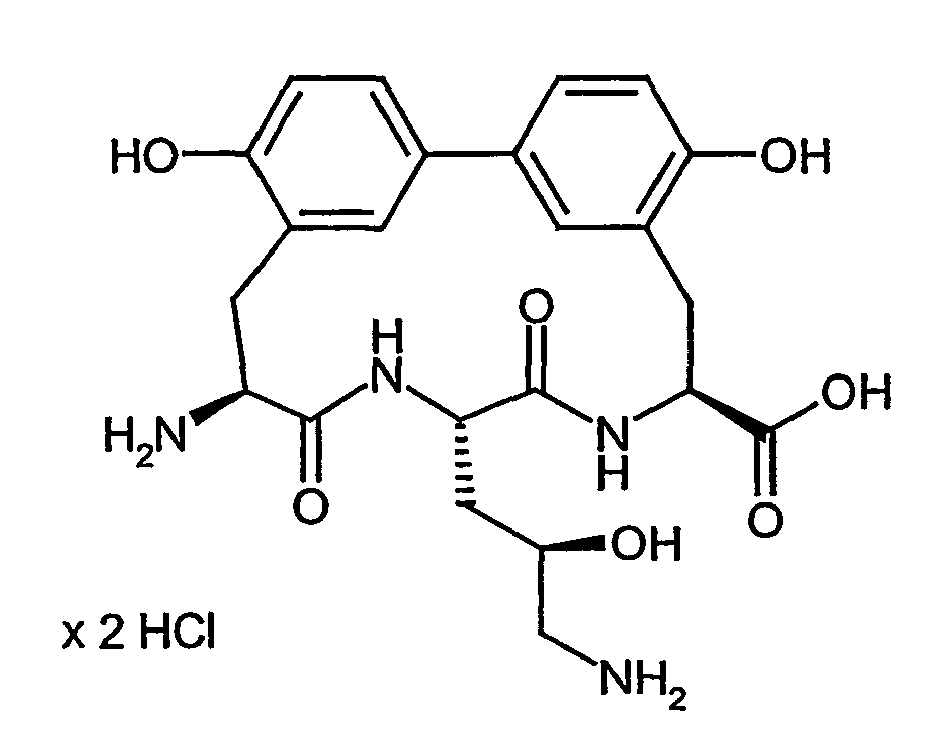
- Eine Lösung von 10 mg (9.9 µM) 5,17-Bis-benzyloxy-14(S)-benzyloxycarbonylamino-11(S)-(3-benzyloxycarbonylamino-2(R)-hydroxy-propyl)-10,13-dioxo-9,12-diaza-tricyclo[14.3.1.12,6]henicosa-1(19),2,4,6(21),16(20),17-hexaen-8(S)-carbonsäurebenzylester (Beispiel 19A) und 50 µl Ameisensäure in 10 ml Ethanol wird in Gegenwart von 10 mg Pd/C über 16 h unter Wasserstoff bei Normaldruck kräftig gerührt. Die Reaktionslösung wird eingedampft, der Rückstand in 1 N Salzsäure-Lösung aufgenommen und filtriert. Das Rohprodukt wird über eine RP 18 Kartusche mit Acetonitril/Wasser gereinigt. Man erhält 2 mg (42.8% d. Th.) des Produktes.
- Es werden 200 mg (0.20 mmol) 5,17-Bis-benzyloxy-14(S)-benzyloxycarbonylamino-11 (S)-(3-benzyloxycarbonylamino-2(R)-hydroxy-propyl)-10,13-dioxo-9,12-diaza-tri-cyclo[14.3.1.12,6]henicosa-1(19),2,4,6(21),16(20),17-hexaen-8(S)-carbonsäure-benzylester (Beispiel 19A) in einem Gemisch aus 220 ml Essigsäure/Wasser/Ethanol 4:1:1 gegeben (Ethanol kann durch THF substituiert werden). Dazu gibt man 73 mg 10 %ige Palladium/Kohle (10 % Pd/C) und hydriert anschließend 15 h bei Normaldruck. Das Reaktionsgemisch wird über vorgewaschenem Kieselgur filtriert und das Filtrat im Vakuum einrotiert. Der Rückstand wird mit 4.95 ml 0.1 N wässriger Salzsäure versetzt und eingeengt. Man verrührt den Rückstand mit 10 ml Diethylether und dekantiert ab. Der zurückgebliebene Feststoff wird im Hochvakuum getrocknet.
Ausbeute: 103 mg (95 % d. Th.).
HPLC (Methode 3): Rt = 3.04 min;
LC-MS (Methode 6): Rt = 0.38 min
MS (EI): m/z = 473 (M+H)+.
1H-NMR (400 MHz, D2O): δ = 2.06-2.20 (m, 1H), 2.74-2.89 (m, 1H), 2.94-3.05 (m, 1H), 3.12-3.25 (m, 2H), 3.53 (d, 1H), 3.61-3.72 (m, 1H), 3.97-4.07 (m, 1H), 4.53 (s, 1H), 4.61 (d, 1H), 4.76-4.91 (m, 12H), 7.01-7.05 (m, 2H), 7.07 (s, 1H), 7.40-7.45 (m, 2H), 7.51 (d, 1H). -

- 5.2 mg (9.5 µmol) 14(S)-Amino-11(S)-(3-amino-2(R)-hydroxy-propyl)-5,17-dihydroxy-10,13-dioxo-9,12-diaza-tricyclo[14.3.1.12,6]henicosa-1(19),2,4,6(21),16(20),17-hexaen-8(S)-carbonsäure Dihydrochlorid (Beispiel 20A) werden unter Argon in trockenem Methanol (p.a., 0.5 ml) gelöst. Unter starkem Rühren werden bei Raumtemperatur zunächst eine wässrige Natriumhydrogencarbonat-Lösung (1 M, 100 µl) und dann eine methanolische Lösung von Di-tert.-butylcarbonat (0.1 M, 570 µl, 57 µmol) zugetropft. Nach etwa 1-2 Tagen ist vollständiger Umsatz erreicht. Das Reaktionsgemisch wird im Vakuum eingedampft und im Hochvakuum getrocknet. Das erhaltene Rohprodukt wird durch Gelchromatographie [Sephadex LH-20; Methanol/1 M Natriumhydrogencarbonat-Lösung (1:0.0001)] aufgereinigt. Man erhält 5.3 mg (83% d. Th.). Produkt.
HPLC/UV-Vis (Methode 14) Rt = 7.4 min.
λmax (qualitativ) = ~193 nm(s), 206 (sh), 269 (m), ~284 (sh) (H2O/Acetonitril + 0.01% TFA [4:6]).
LC-HR-FT-ICR-MS: ber. für C33H44N4O11 [M+H]+ 673.3079 gef. 673.3082. - 50 mg (0.09 mmol) 14(S)-Amino-11(S)-(3-amino-2(R)-hydroxy-propyl)-5,17-di-hydroxy-10,13-dioxo-9,12-diaza-tricyclo[14.3.1.12,6]henicosa-1(19),2,4,6(21),16(20),17-hexaen-8(S)-carbonsäure Dihydrochlorid (Beispiel 20A) werden in einem Gemisch von 8 ml Methanol/Wasser (9:1) vorgelegt. Dazu gibt man 1 ml 1 N Natriumhydrogencarbonatlösung und anschließend 80 mg (0.37 mmol) Di-tert-butyldicarbonat in 2 ml Methanol/Wasser (9:1). Es wird über Nacht bei RT gerührt. Die Lösung wird zur Aufarbeitung mit 60 ml Ethylacetat und 30 ml Wasser versetzt. Die organische Phase wird einmal mit 0.1 normaler Salzsäure gewaschen, getrocknet und im Vakuum einrotiert.
Ausbeute: 49 mg (79 % d. Th.).
LC-MS (Methode 9): Rt = 2.56 min.
MS (EI): m/z = 673 (M+H)+. -

- 4.1 mg (6.1 µmol) (8S,11S,14S)-14-[(tert-Butoxycarbonyl)amino]-11-{(2R)-3-[(tert-butoxycarbonyl)amino]-2-hydroxypropyl}-5,17-dihydroxy-10,13-dioxo-9,12-diazatricyclo[14.3.1.12,6]henicosa-1(20),2(21),3,5,16,18-hexaen-8-carbonsäure (Beispiel 21A) werden unter Argonschutzgasatmosphäre in trockenem N,N-Dimethylformamid (p.a., 0.5 ml) gelöst. Nach Zugabe von festem Natriumdisulfit (6.1 µmol) wird bei RT eine frisch zubereitete Lösung von Diisopropylethylamin (7.9 mg, 61 µmol), Ammoniumchlorid (1.6 mg, 30 µmol) und HATU (4.6 mg, 12.2 µmol) in Dimethylformamid (0.5 ml, Lösung A) zugetropft. Bis zum vollständigen Eduktumsatz muss Lösung A noch zweifach zugegeben werden (nach 1.5 h Reaktionszeit und nach 2 h Reaktionszeit). Man rührt weitere 20 min und bricht die Reaktion dann durch Zugabe von Wasser (0.5 ml) ab. Das Reaktionsgemisch wird eingefroren und anschließend gefriergetrocknet. Das erhaltene Rohprodukt wird durch Gelchromatographie [Sephadex LH-20; Methanol/Essigsäure (1:0.0001) dotiert mit Natriumdisulfit] aufgereinigt. Ausbeute: 2.2 mg ( 52% d. Th.).
HPLC-UV-Vis (Methode 14): Rt = 7.06 min.
λmax (qualitativ) = ~202 nm (s), 268 (m), ~285 (sh). (H2O/Acetonitril + 0.01% TFA [4:6]).
LC-HR-FT-ICR-MS (Methode 13): ber. für C33H46N5O10 [M+H]+ 672.3239 gef. 672.3239. - Unter Argon werden 49 mg (0.07 mmol) (8S,11S,14S)-14-[(Tert-butoxycarbonyl)amino]-11-{(2R)-3-[(tert-butoxycarbonyl)amino]-2-hydroxypropyl}-5,17-dihydroxy-10,13-dioxo-9,12-diazatricyclo[14.3.1.12,6]henicosa-1(20),2(21),3,5,16,18-hexaen-8-carbonsäure (Beispiel 21A) in 1 ml DMF gelöst und auf 0°C abgekühlt. Dazu gibt man 42 mg (0.11 mmol) HATU hinzu und lässt 10 min bei 0°C nachrühren. 1.46 ml (0.73 mmol) einer 0.5 molaren Ammoniaklösung in Dioxan werden zugetropft und über Nacht bei RT gerührt. Nach ca. 18 h werden die gleichen Mengen an Reagenzien noch einmal dazu gegeben. Nach 3 Tagen wird das Gemisch im Vakuum einrotiert und mittels RP-HPLC präparativ gereinigt.
Ausbeute: 16 mg (33 % d. Th.).
HPLC (Methode 3): Rt = 3.83 min. -

- Zu einer auf 0°C gekühlten Lösung von 7 mg (0.01 mmol) ((8S,11S,14S)-14-[(tert-butoxycarbonyl)amino]-11-{(2R)-3-[(tert-butoxycarbonyl)amino]-2-hydroxypropyl}-5,17-dihydroxy-10,13-dioxo-9,12-diazatricyclo[14.3.1.12,6]henicosa-1(20),2(21),3,5,16,18-hexaen-8-carbonsäure (Beispiel 21A) in 0.5 ml absolutem DMF werden unter Argon 7.9 mg (0.021 mmol) HATU zugegeben. Nach 10 min bei 0°C werden 2.3 mg (0.021 mmol) Benzylamin zugeben, und es wird über Nacht bei RT gerührt. Die Reaktionsmischung wird im Vakuum eingeengt und der Rückstand mittels präparativer RP-HPLC getrennt.
Ausbeute: 1.5 mg (18.9 % d. Th.).
LC-MS (Methode 6): Rt = 4.4 min.
MS (ESI-pos): m/z = 785 (M+Na)+, 762 (M+H)+. -

- Unter Argon werden 15 mg (0.022 mmol) (8S,11S,14S)-14-[(tert-Butoxycarbonyl)amino]-11-{(2R)-3-[(tert-butoxycarbonyl)amino]-2-hydroxypropyl}-5,17-dihydroxy-10,13-dioxo-9,12-diazatricyclo[14.3.1.12,6]henicosa-1(20),2(21),3,5,16,18-hexaen-8-carbonsäure (Beispiel 21A) in 0.5 ml DMF gelöst und auf 0°C abgekühlt. Dazu gibt man 10.2 mg (0.027 mmol) HATU und 8.64 mg (0.067 mmol) N,N-Diisopropylethylamin und lässt 10 min bei 0°C nachrühren. 3.34 mg (0.045 mmol) 2-Methylaminoethanol werden hinzugegeben und über Nacht bei RT gerührt. Das Reaktionsgemisch wird eingeengt und mittels Gilson-HPLC gereinigt.
Ausbeute: 3.8 mg (23% d. Th.).
LC-MS (Methode 21): Rt= 3.90 min. - In Analogie zu Beispiel 24A können die in der folgenden Tabelle aufgeführten Beispiele 25A bis 32A hergestellt werden.
Beispiel-Nr. Struktur Analytische Daten 25A 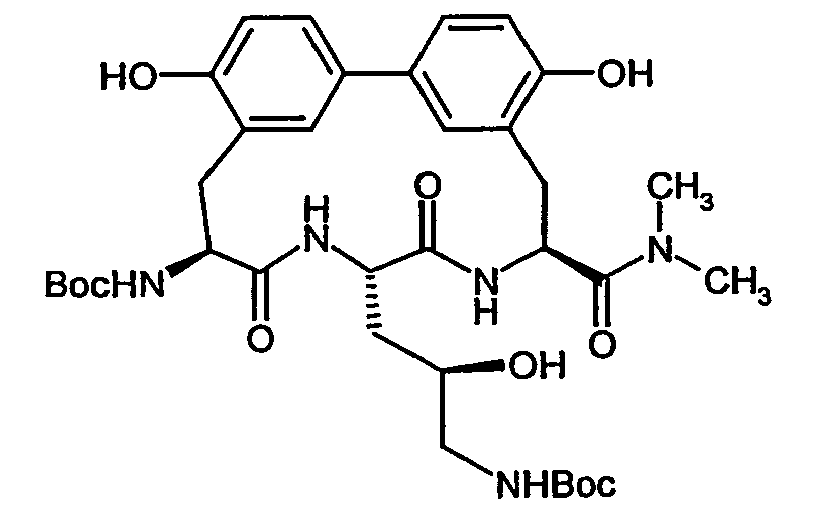
HPLC (Methode 3): Rt = 3.15 min. 26A 
HPLC (Methode 3): Rt = 3.18 min. 27A 
HPLC (Methode 3): Rt= 3.10 min. 28A 
LC-MS (Methode 21): Rt = 3.97 min. 29A 
HPLC (Methode 4): Rt = 4.15 min. 30A 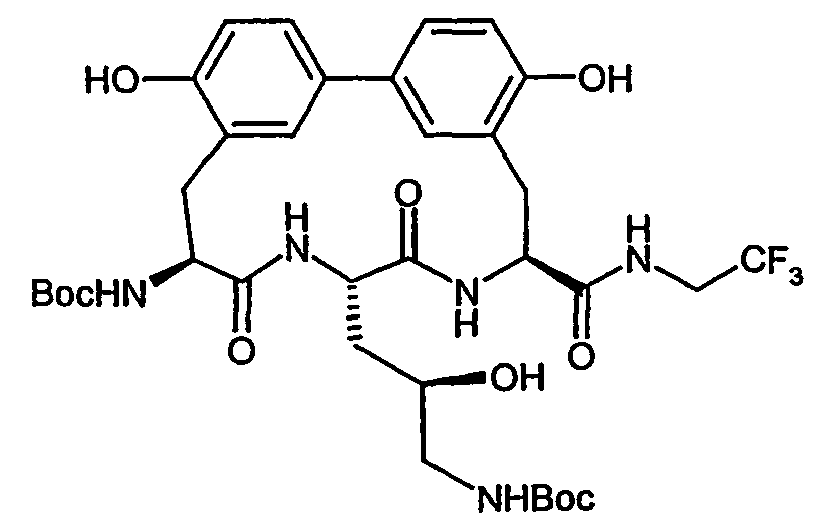
HPLC (Methode 3): Rt = 3.42 min. 31A 
LC-MS (Methode 15): Rt = 2.18 min MS (EI): m/z = 834 (M+H)+ 32A 
HPLC (Methode 4): Rt = 4.16 min. - In Analogie zu Beispiel 24A können unter Verwendung von 2 Äquiv. HATU und 3 Äquiv. Amin die in der folgenden Tabelle aufgeführten Beispiele 33A und 34A hergestellt werden.
Beispiel-Nr. Struktur Analytische Daten 33A 
HPLC (Methode 3): Rt = 3.18 min. 34A 
HPLC (Methode 3): Rt = 3.37 min. - In Analogie zu Beispiel 24A können unter Verwendung von 2 Äquiv. HATU, 2 Äquiv. Amin und ohne Zugabe von DIPEA die in der folgenden Tabelle aufgeführten Beispiele 35A und 36A hergestellt werden.
Beispiel-Nr. Struktur Analytische Daten 35A 
HPLC (Methode 3): Rt = 3.04 min 36A 
HPLC (Methode 1): Rt = 1.75 min. -

- 0.4 g (0.8 mmol) 2-(Benzyloxy)-N-(tert-butoxycarbonyl)-5-iod-L-phenylalanin (Beispiel 6A) und 0.282 g (0.970 mmol, 1.2 Äquiv.) L-Phenylalaninbenzylester Hydrochlorid werden unter Argon in 6 ml DMF vorgelegt und nacheinander mit 0.382 g (1.01 mmol, 1.25 Äquiv.) HATU und 0.49 ml (0.36 mg, 2.8 mmol, 3.5 Äquiv.) Diisopropylethylamin bei RT versetzt. Die Mischung wird 12 Stunden bei RT nachgerührt. Nach Versetzen mit 150 ml Wasser fällt das Produkt in Form weißer Kristalle aus. Die Kristalle werden abgesaugt, mit Wasser gewaschen und im Vakuum getrocknet.
Ausbeute: 0.669 g (quant.)
LC-MS (Methode 15): Rt = 3.11 min.
MS (EI): m/z = 735 (M+H)+ - In Analogie zu Beispiel 37A können die in der folgenden Tabelle aufgeführten Beispiele 38A bis 41A hergestellt werden.
Beispiel-Nr. Struktur Analytische Daten 38A 
LC-MS (Methode 15): Rt = 2.86 min. MS (EI): m/z = 659 (M+H)+ 39A 
LC-MS (Methode 15): Rt = 2.96 min. MS (EI): m/z = 659 (M+H)+ 40A 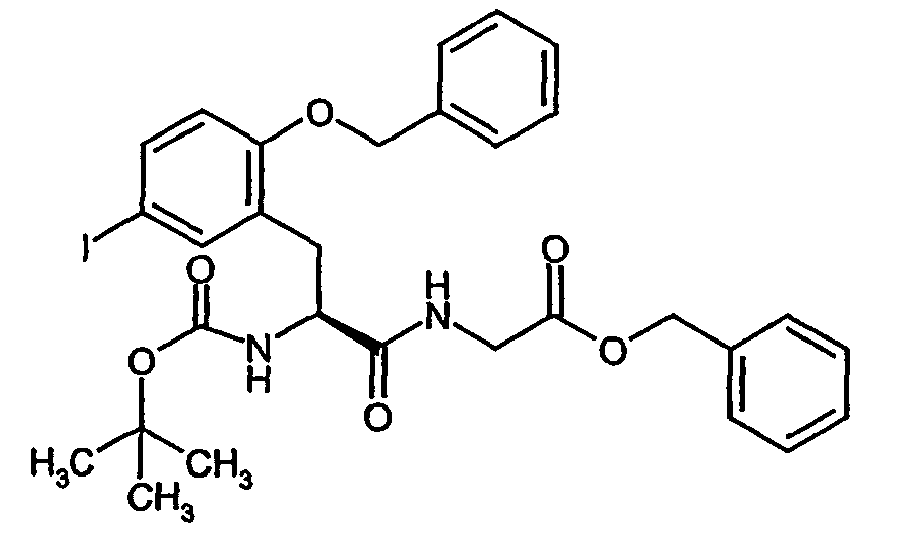
LC-MS (Methode 15): Rt = 2.85 min. MS (EI): m/z = 644 (M+H)+ 41A 
LC-MS (Methode 15): Rt = 2.93 min. MS (EI): m/z = 659 (M+H)+ -

- 0.593 g (0.939 mmol) 2-(Trimethylsilyl)ethyl-2-(benzyloxy)-N-[(benzyloxy)-carbonyl]-5-(4,4,5,5-tetramethyl-1,3,2-dioxaborolan-2-yl)-L-phenylalaninat (Beispiel 84A) und 0.734 g (0.939 mmol) Benzyl-2-(benzyloxy)-N-(tert-butoxycarbonyl)-5-iod-L-phenylalanyl-L-phenylalaninat (Beispiel 37A) werden unter Argon in 6 ml DMSO gelöst. Die entstehende Lösung wird 30 min mit Argon gespült. Anschließend versetzt man mit 0.069 g (0.094 mmol, 0.1 Äquiv.) Bis(diphenylphosphino)ferrocen-palladium(II)chlorid und 0.612 g (1.88 mmol, 2.0 Äquiv.) Cäsiumcarbonat. Nach 10-minütigem Spülen mit Argon erhitzt man für 3 Tage bei 80°C, wobei weiterhin mit Argon gespült wird. Nach Abkühlen auf RT reinigt man die Rohlösung durch Chromatographie an Kieselgel (Cyclohexan/Essigsäureethylester 2:1). Anschließend werden die eingeengten produkthaltigen Fraktionen über eine präparative RP-HPLC gereinigt.
Ausbeute: 0.367 g (29 % d. Th.)
LC-MS (Methode 15): Rt = 3.50 min. - In Analogie zu Beispiel 42A können die in der folgenden Tabelle aufgeführten Beispiele 43A bis 46A hergestellt werden.
Beispiel-Nr. Struktur Analytische Daten 43A 
LC-MS (Methode 15): Rt = 3.39 min. MS (EI): m/z = 1036 (M+H)+ 44A 
LC-MS (Methode 15): Rt = 3.42 min. MS (EI): m/z = 1036 (M+H)+ 45A 
LC-MS (Methode 15): Rt = 3.38 min. MS (EI): m/z = 1022 (M+H)+ 46A 
LC-MS (Methode 15): Rt = 3.40 min. MS (EI): m/z = 1036 (M+H)+ -

- 0.37 g (0.27 mmol) 2-(Trimethylsilyl)ethyl-2-(S)-benzyloxycarbonylamino-3-[3'[-2-[tert-butoxycarbonylamino(3-amino-[1-(S)-benzyloxy-1-oxo-2-phenyl-ethyl]-3-oxopropyl)]-4,4'-bis(benzyloxy)-1,1'-biphenyl-3-yl]]propanoat (Beispiel 42A) wird unter Argon in 10 ml einer 4 M Lösung von Chlorwasserstoff in Dioxan gelöst und 3 h bei RT gerührt. Man engt am Rotationsverdampfer ein und trocknet im Vakuum. Das Rohprodukt wird ohne weitere Charakterisierung weiter umgesetzt.
- In Analogie zu Beispiel 47A können die in der folgenden Tabelle aufgeführten Beispiele 48A bis 51A hergestellt werden.
Beispiel-Nr. Struktur 48A 
49A 
50A 
51A 
-

- 0.27 g (0.27 mmol) 2-(Trimethylsilyl)ethyl-2-(S)-benzyloxycarbonylamino-3-[3'[-2-[amino(3-amino-[1-(S)-benzyloxy-1-oxo-2-phenyl-ethyl]-3-oxopropyl)]-4,4'-bis(benzyloxy)-1,1'-biphenyl-3-yl]]propanoat (Beispiel 47A) und 0.16 g (0.32 mmol, 1.2 Äquiv.) 5-Benzyloxycarbonylamino-2(S)-tert-butoxycarbonylamino-4(R)-(tert-butyldimethylsilyloxy)-pentansäure werden unter Argon in 5 ml wasserfreiem DMF gelöst. Bei RT wird 0.13 g (0.34 mmol, 1.25 Äquiv.) HATU und 0.16 ml (0.12 g, 0.95 mmol, 3.5 Äquiv.) N,N-Diisopropylethylamin hinzugegeben. Das Reaktionsgemisch wird 12 h bei RT gerührt. Das Reaktionsgemisch wird direkt per präparativer RP-HPLC gereinigt und ohne weitere Charakterisierung umgesetzt. Ausbeute: 0.288 g (71 % d. Th.)
- In Analogie zu Beispiel 52A können die in der folgenden Tabelle aufgeführten Beispiel 53A bis 56A hergestellt werden.
Beispiel-Nr. Struktur Analytische Daten 53A 
LC-MS (Methode 15): Rt = 3.84 min. MS (EI): m/z = 1415 (M+H)+ 54A 
LC-MS (Methode 15): Rt = 3.92 min. MS (EI): m/z = 1415 (M+H)+ 55A 
LC/MS (Methode 15): Rt = 3.97 min MS (EI): m/z = 1401 (M+H)+ 56A 
LC-MS (Methode 16): Rt = 2.98 min. MS (EI): m/z = 1415 (M+H)+ -

- Zu einer Lösung von 0.29 g (0.19 mmol) 2-(Trimethylsilyl)ethyl-2-(S)-benzyloxycarbonylamino-3-[3'[-2-[5-benzyloxycarbonylamino-2(S)-tert-butoxycarbonylamino-4(R)-(tert-butyldimethylsilyloxy)-pentanoylamino(3-amino-[1-(S)-benzyloxy-1-oxo-2-phenyl-ethyl]-3-oxopropyl)]-4,4'-bis(benzyloxy)-1,1'-biphenyl-3-yl]]propanoat (Beispiel 52A) in 3 ml DMF werden 1.2 ml einer 1.0 M Lösung von Tetrabutylammoniumfluorid in THF (1.2 mmol, 6.3 Äquiv.) hinzugegeben. Nach 4 h Rühren bei RT wird das Reaktionsgemisch auf 0°C gekühlt und mit 50 ml Wasser versetzt. Nach Zugabe von 50 ml Essigsäureethylester und 1 ml 1 N wässriger Salzsäure werden die Phasen getrennt. Die wässrige Phase wird mehrfach mit Essigsäureethylester extrahiert. Nach Trocknen der organischen Phase über Magnesiumsulfat wird im Vakuum eingeengt und am Hochvakuum getrocknet. Das Rohprodukt wird ohne weitere Reinigung umgesetzt.
- In Analogie zu Beispiel 57A können die in der folgenden Tabelle aufgeführten Beispiele 58A bis 61A hergestellt werden.
Beispiel-Nr. Struktur 58A 
59A 
60A 
61A 
-

- 0.25 g (Rohgemisch, ca. 0.19 mmol) 2-(S)-Benzyloxycarbonylamino-3-[3'[-2-[5-benzyloxycarbonylamino-2(S)-tert-butoxycarbonylamino-4(R)-(hydroxyoxy)-pentanoylamino(3-amino-[1-(S)-benzyloxy-1-oxo-2-phenyl-ethyl]-3-oxopropyl)]-4,4'-bis-(benzyloxy)-1,1'-biphenyl-3-yl]]propionsäure (Beispiel 57A) werden in 4 ml DCM vorgelegt und mit 0.18 g (0.97 mmol, 5.0 Äquiv.) Pentafluorphenol und 0.02 g (0.02 mmol, 0.1 Äquiv.) DMAP versetzt. Man kühlt auf -25°C und gibt 0.048 g (0.25 mmol, 1.3 Äquiv.) EDC hinzu. Die Mischung erwärmt sich über Nacht langsam auf RT. Die Reaktionsmischung wird im Vakuum eingeengt und im Hochvakuum kurz getrocknet. Das Rohprodukt wird ohne weitere Reinigung umgesetzt.
- In Analogie zu Beispiel 62A können die in der folgenden Tabelle aufgeführten Beispiele 63A bis 66A hergestellt werden.
Beispiel-Nr. Struktur 63A 
64A 
65A 
66A 
-
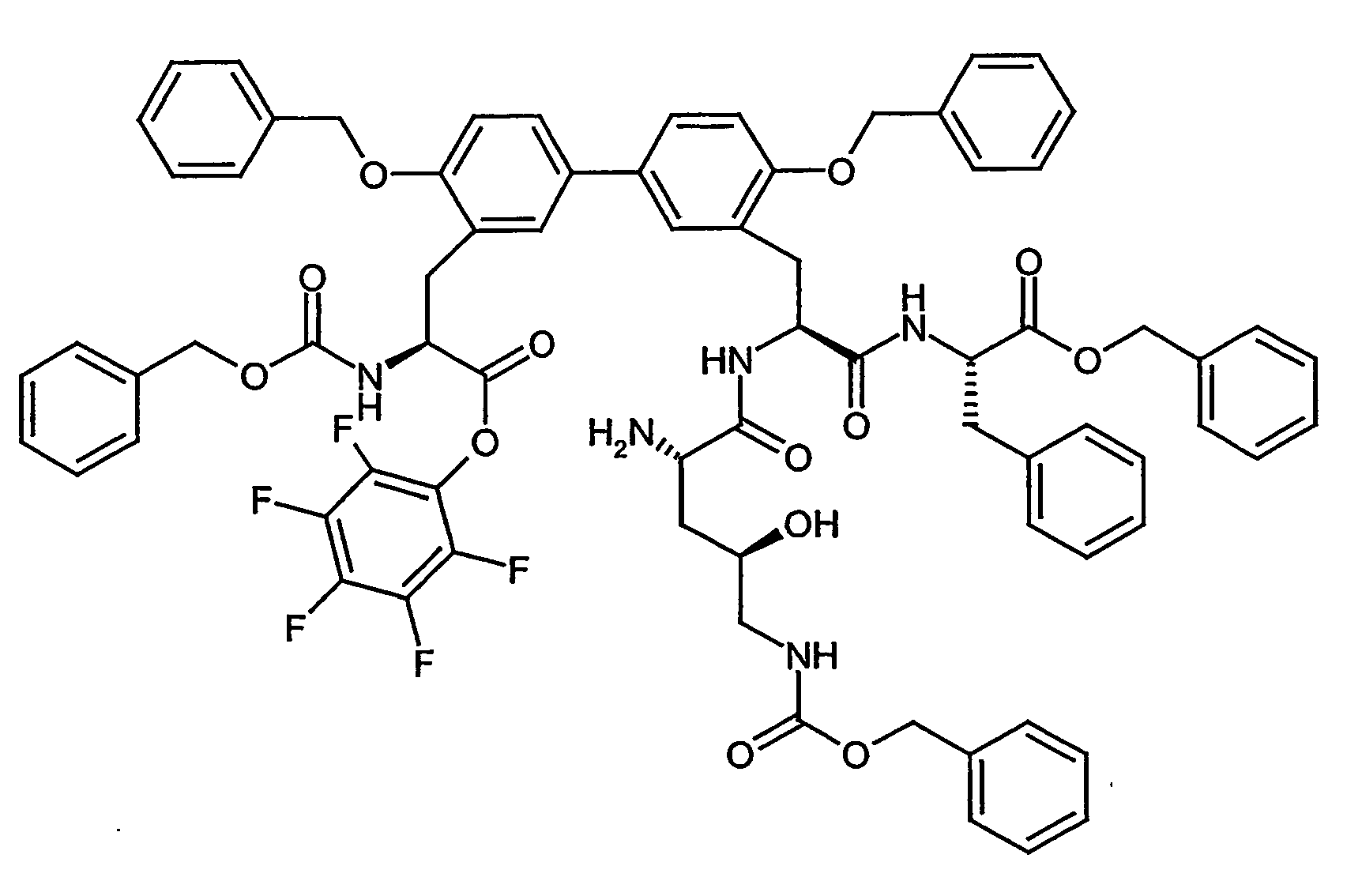
- 0.28 g (0.19 mmol) Pentafluorphenyl-2-(S)-benzyloxycarbonylamino-3-[3'[-2-[5-benzyloxycarbonylamino-2(S)-tert-butoxycarbonylamino-4(R)-(hydroxyoxy)-pentanoylamino(3-amino-[1-(S)-benzyloxy-1-oxo-2-phenyl-ethyl]-3-oxopropyl)]-4,4'-bis-(benzyloxy)-1,1'-biphenyl-3-yl]]propionat (Beispiel 62A) werden bei RT in 4 ml einer 4 M Chlorwasserstoff-Dioxan-Lösung gelöst. Nach 3 h bei RT wird die Reaktionslösung bei 30°C im Vakuum eingeengt und im Hochvakuum getrocknet. Das Rohprodukt wird ohne weitere Reinigung umgesetzt.
- In Analogie zu Beispiel 67A können die in der folgenden Tabelle aufgeführten Beispiele 68A bis 71A hergestellt werden.
Beispiel-Nr. Struktur 68A 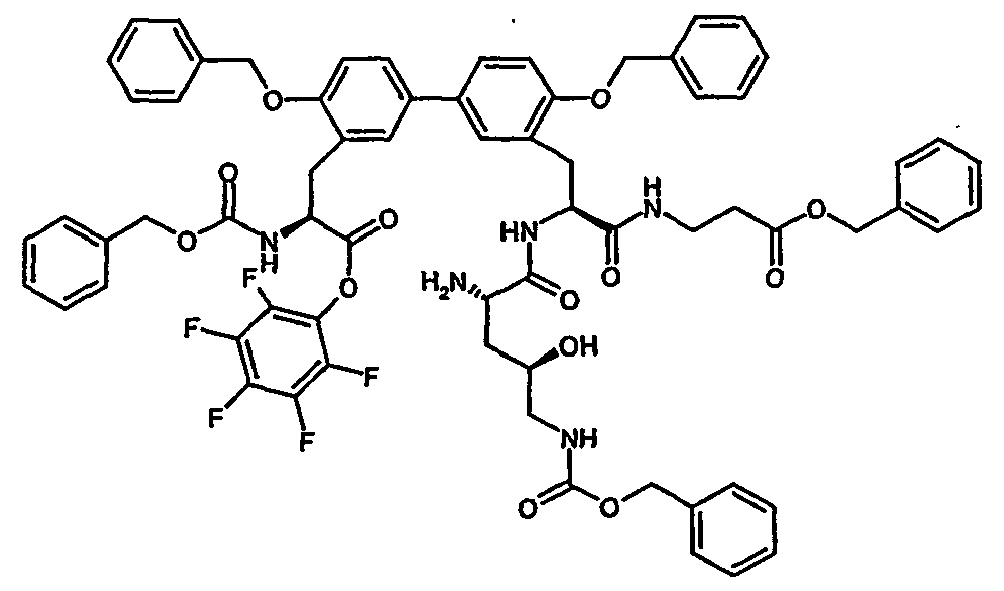
69A 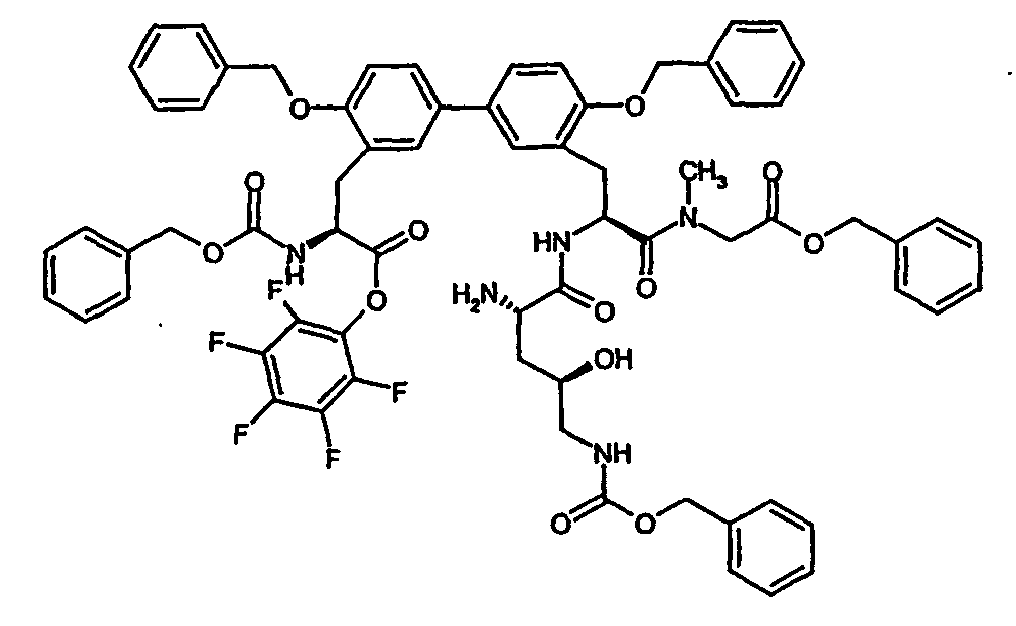
70A 
71A 
-
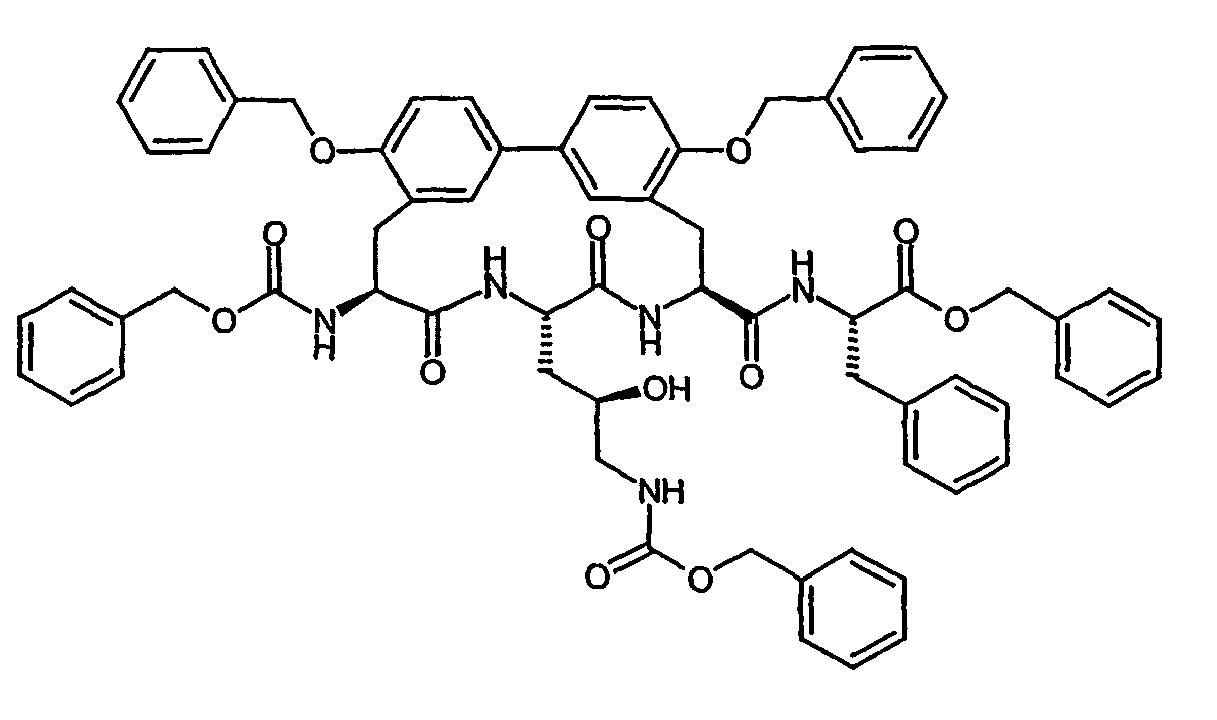
- 0.26 g (0.19 mmol) Pentafluorphenyl-2-(S)-benzyloxycarbonylamino-3-[3'[-2-[5-benzyloxycarbonylamino-2(S)-amino-4(R)-(hydroxyoxy)-pentanoylamino-(3-amino-[1-(S)-benzyloxy-1-oxo-2-phenyl-ethyl]-3-oxopropyl)]-4,4'-bis(benzyloxy)-1,1'-biphenyl-3-yl]]propionat (Beispiel 67A) werden in 200 ml Chloroform gelöst und bei RT innerhalb von 4 h zu einer Lösung aus 2000 ml Chloroform und gesättigter wässriger Natriumhydrogencarbonat-Lösung getropft. Nach beendeter Zugabe wird 1 h nachgerührt. Anschließend werden die Phasen getrennt. Die wässrige Phase wird zweimal mit 500 ml DCM gewaschen. Die vereinigten organischen Phasen mit 2000 ml 0.1 M wässriger Salzsäure gewaschen, über Natriumsulfat getrocknet und im Vakuum eingeengt. Der Rückstand wird in 15 ml Acetonitril : Methanol (2:1) suspendiert und 1 h bei RT gerührt. Der ungelöste Feststoff wird abfiltriert und im Vakuum getrocknet. Zur weiteren Reinigung wird der Feststoff 15 min in Methanol gekocht. Man filtriert erneut ab, trocknet im Vakuum und erhält so das Produkt.
Ausbeute: 0.022 g (10 % d. Th.)
LC-MS (Methode 15): Rt = 3.13 min.
MS (EI): m/z = 1158 (M+H)+ - In Analogie zu Beispiel 72A können die in der folgenden Tabelle aufgeführten Beispiele 73A bis 76A hergestellt werden.
Beispiel-Nr. Struktur Analytische Daten 73A 
LC-MS (Methode 15): Rt = 2.97min. MS (EI): m/z = 1082 (M+H)+ 74A 
LC-MS (Methode 15): Rt = 3.00 min. MS (EI): m/z = I082 (M+H)+ 75A 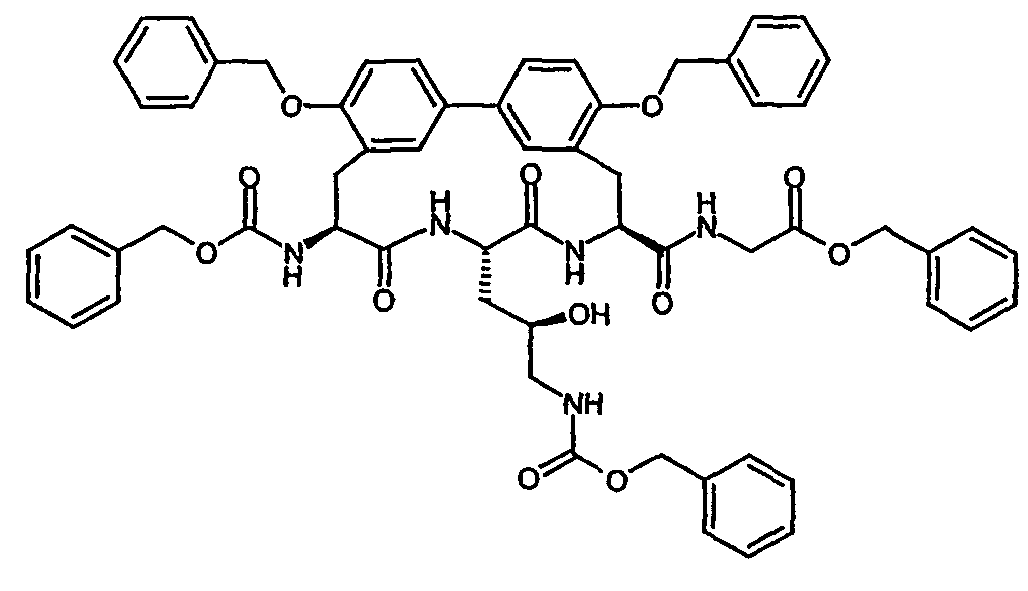
LC/MS (Methode 15): Rt = 2.94 min. MS (EI): m/z = 1068 (M+H)+ 76A 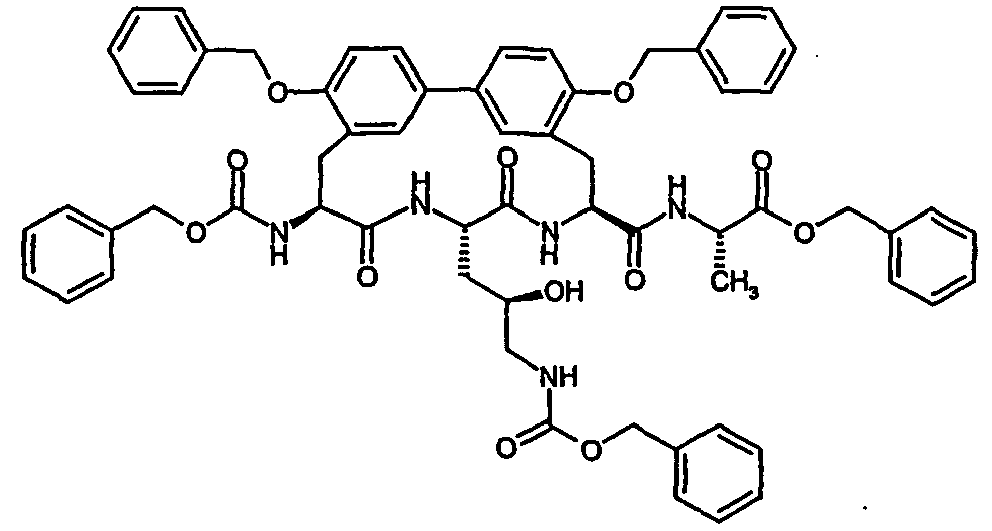
LC/MS (Methode 15): Rt = 2.95 min. MS (EI): m/z = 1083 (M+H)+ -

- Die Herstellung erfolgt analog Beispiel 16A aus 0.47 g (0.51 mmol) der Verbindung aus Beispiel 15A und 0.19 g (0.51 mmol) Nα-Boc-Nδ-Z-L-Ornithin mit 0.19 g (0.51 mmol) HATU und 0.35 ml (1.65 mmol) N,N-Diisopropylethylamin in 5.55 ml trockenem DMF.
Ausbeute: 0.58 g (92% d.Th.)
LC-MS (Methode 18): Rt = 3.46 min
MS: m/z = 1212 (M+H)+ -

- Die Herstellung erfolgt analog Beispiel 17A aus 0.82 g (0.68 mmol) der Verbindung aus Beispiel 77A mit 2 Äquiv. (1.3 ml) Tetrabutylammoniumfluorid (1 M in THF) in 30 ml getrocknetem DMF.
Ausbeute: 772 mg (94% d.Th.)
LC-MS (Methode 20): Rt= 1.62 min.
MS: m/z =1112 (M+H)+ -

- Die Herstellung erfolgt analog Beispiel 18A (Methode A) aus 422 mg (0.38 mmol) der Verbindung aus Beispiel 78A und 349 mg (1.9 mmol) Pentafluorphenol mit 80 mg (0.42 mmol) EDCI und 4.63 mg (0.04 mmol) DMAP in 4 ml Dichlormethan.
Ausbeute: 502 mg (95% d.Th.)
LC-MS (Methode 20): Rt = 3.13 min.
MS: m/z = 1278 (M+H)+ -

- 215 mg (0.17 mmol) der Verbindung aus Beispiel 79A werden in einem Eisbad unter Rühren mit 5 ml 4 M Dioxan / Chlorwasserstoff-Lösung versetzt. Man lässt eine Stunde rühren und dampft alles im Vakuum bis zur Gewichtskonstanz ein.
Ausbeute: 200 mg (92% d.Th.)
LC-MS (Methode 20): Rt = 4.25 min.
MS: m/z = 1178 (M+H)+ -
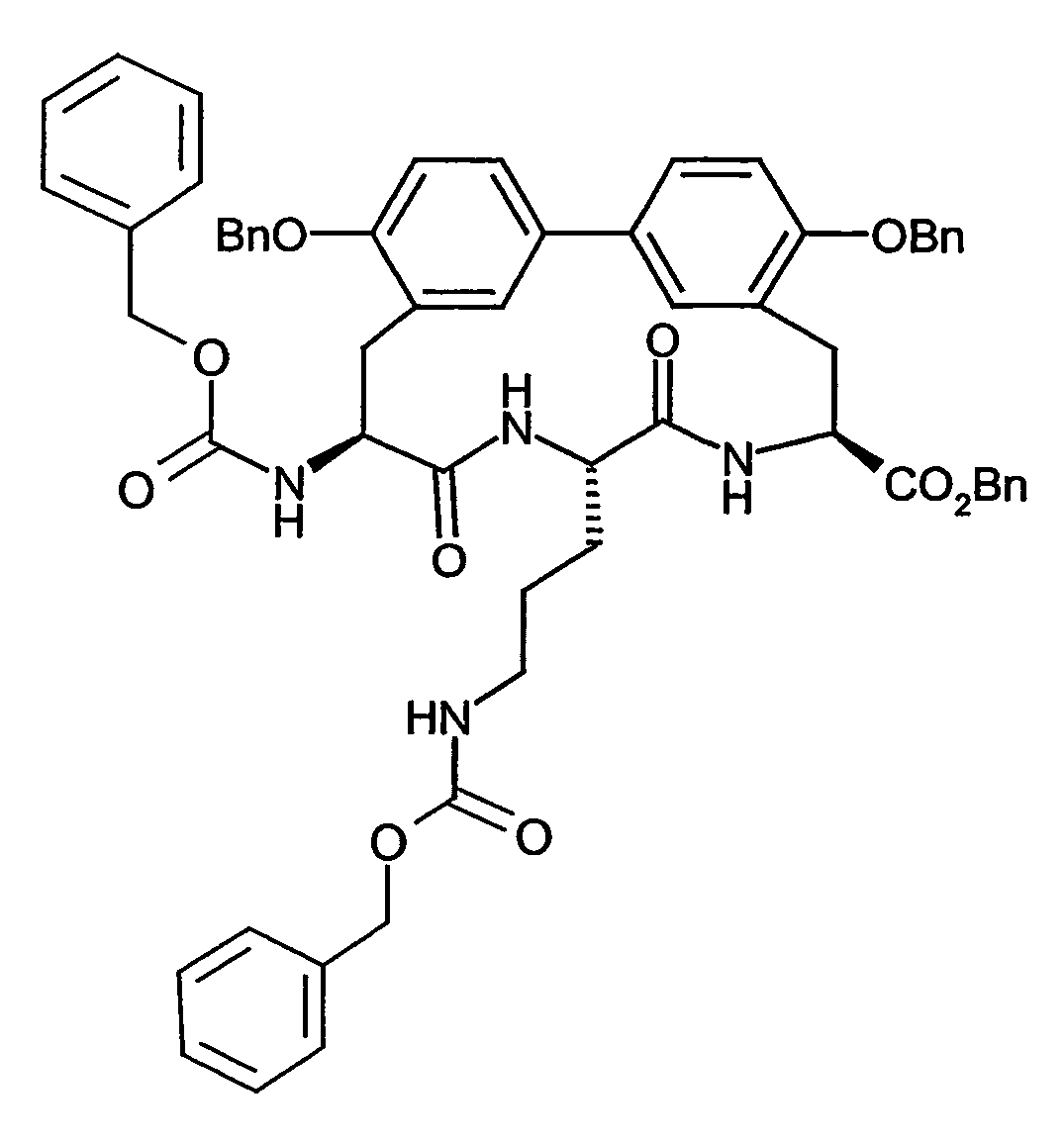
- 1.35 g (0.91 mmol) der Verbindung aus Beispiel 80A werden in 3 1 Chloroform vorgelegt und unter kräftigem Rühren innerhalb von 20 min bei RT mit 2.54 ml (18.2 mmol) Triethylamin in 50 ml Chloroform versetzt. Man lässt über Nacht nachrühren und dampft alles im Vakuum zur Trockne ein. Den Rückstand verrührt man mit 5 ml Acetonitril, filtriert und trocknet den Rückstand bis zur Gewichtskonstanz.
Ausbeute: 890 mg (93% d.Th.)
LC-MS (Methode 20): Rt = 5.10 min.
MS: m/z = 994 (M+H)+ -

- 50 mg (0.05 mmol) der Verbindung aus Beispiel 81A werden in 50 ml Eisessig /Wasser / Ethanol (4 / 1 / 1) suspendiert, mit 30 mg Pd/C (10%-ig)-Katalysator versetzt und 20 Stunden bei RT hydriert. Nach Abfiltrieren des Katalysators über Kieselgur dampft man das Filtrat im Vakuum zur Trockne ein und versetzt unter Rühren mit 2.5 ml 0.1 N Salzsäure. Man dampft im Vakuum zur Trockne ein und trocknet bis zur Gewichtskonstanz.
Ausbeute: 17 mg (63% d. Th.)
DC (Methanol / Dichlormethan / 25%-iger Ammoniak = 5 / 3 / 2): Rf = 0.6
LC-MS (Methode 9) Rt = 0.28 min.
MS: m/z = 457 (M+H)+ -

- 225 mg (0.42 mmol) der Verbindung aus Beispiel 82A werden in 2.25 ml Wasser und 2.25 ml 1 N Natronlauge gelöst, im Eisbad gekühlt und unter Rühren mit 278 mg (1.27 mmol) Di-tert-butyl-dicarbonat versetzt. Man erwärmt nach der Zugabe kurz auf 30°C und lässt über Nacht bei RT weiterreagieren. Man säuert mit 0.1 N Salzsäure bis etwa pH = 5 an und dampft alles vorsichtig im Vakuum bei RT zur Trockne ein. Den Rückstand rührt man mit Diethylether aus, filtriert und trocknet ihn bis zur Gewichtskonstanz.
Ausbeute: 259 mg (93% d.Th.)
LC-MS (Methode 18): Rt = 1.96 min.
MS: m/z = 656 (M+H)+ -

- 0.924 g (3.64 mmol, 1.15 Äquiv.) 4,4,4',4',5,5,5',5'-Octamethyl-2,2'-bi-1,3,2-dioxaborolan, 0.932 g (9.50 mmol, 3 Äquiv.) Kaliumacetat und 0.116 g (0.160 mmol, 0.05 Äquiv.) Bis-(diphenylphosphino)ferrocenpalladium(II)chlorid werden bei RT zu einer entgasten Lösung von 2.00 g (3.17 mmol) 2(S)-Benzyloxycarbonylamino-3-(2-benzyloxy-5-iod-phenyl)-propionsäure-(2-trimethylsilyl)-ethylester (Beispiel 11A) in 20 ml DMF gegeben. Die Mischung wird 6 Stunden bei 80°C nachgerührt. Man nimmt in Wasser und Essigsäureethylester auf, trennt die Phasen und wäscht die wässrige Phase mehrfach mit Essigsäureethylester. Die vereinigten organischen Phasen werden über Natriumsulfat getrocknet und im Vakuum eingeengt. Das Rohprodukt wird durch Chromatographie an Kieselgel (Cyclohexan/ Essigsäureethylester 10:1) gereinigt.
Ausbeute: 1.12 g (56% d. Th.)
LC-MS (Methode 22): Rt = 4.50 min
MS (EI): m/z = 632 (M+H)+
1H-NMR (200 MHz, CDCl3): δ = 0.92 (dd, 2H), 1.31 (s, 12H), 2.95-3.95 (m, 2H), 4.11 (mc, 2H), 4.55 (11 (mc, 1H), 4.99 (s, 2H), 5.08 (s, 2H), 5.53 (d, 1H), 6.90 (d, 1H), 7.15-7.47 (m, 10 H), 7.58 (d, 1H), 7.67 (dd, 1H). - In Analogie zu Beispiel 37A können die in der folgenden Tabelle aufgeführten Beispiele 85A bis 87A hergestellt werden.
Beispiel-Nr. Struktur Analytische Daten 85A 
LC-MS (Methode 15): Rt = 3.12 min. MS (EI): m/z = 701 (M+H)+ 86A 
LC-MS (Methode 15): Rt = 3.08 min. MS (EI): m/z = 687 (M+H)+ 87A 
LC-MS (Methode 15): Rt = 3.14 min. MS (EI): m/z = 701 (M+H)+ - In Analogie zu Beispiel 42A können die in der folgenden Tabelle aufgeführten Beispiele 88A bis 90A hergestellt werden.
Beispiel- Nr. Struktur Analytische Daten 88A 
LC-MS (Methode 16): Rt = 2.59 min. MS (EI): m/z = 1078 (M+H)+ 89A 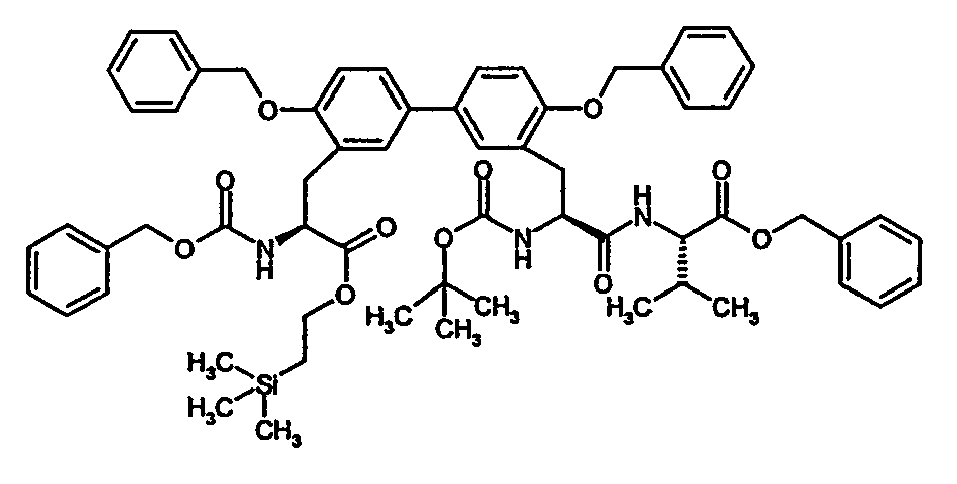
LC-MS (Methode 15): Rt = 3.49 min. MS (EI): m/z = 1064 (M+H)+ 90A 
LC-MS (Methode 15): Rt = 3.55 min. MS (EI): m/z = 1078 (M+H)+ - In Analogie zu Beispiel 47A können die in der folgenden Tabelle aufgeführten Beispiele 91A bis 93A hergestellt werden.
Beispiel-Nr. Struktur Analytische Daten 91A 
LC-MS (Methode 16): Rt = 2.59 min. MS (EI): m/z = 1078 (M+H)+ 92A 
-- 93A 
-- - In Analogie zu Beispiel 52A können die in der folgenden Tabelle aufgeführten Beispiel 94A bis 96A hergestellt werden.
Beispiel-Nr. Struktur Analytische Daten 94A 
LC-MS (Methode 16): Rt = 3.40 min. MS (EI): m/z = 1457 (M+H)+ 95A 
LC-MS (Methode 16): Rt = 3.17 min MS (EI): m/z = 1442 (M+H)+ 96A 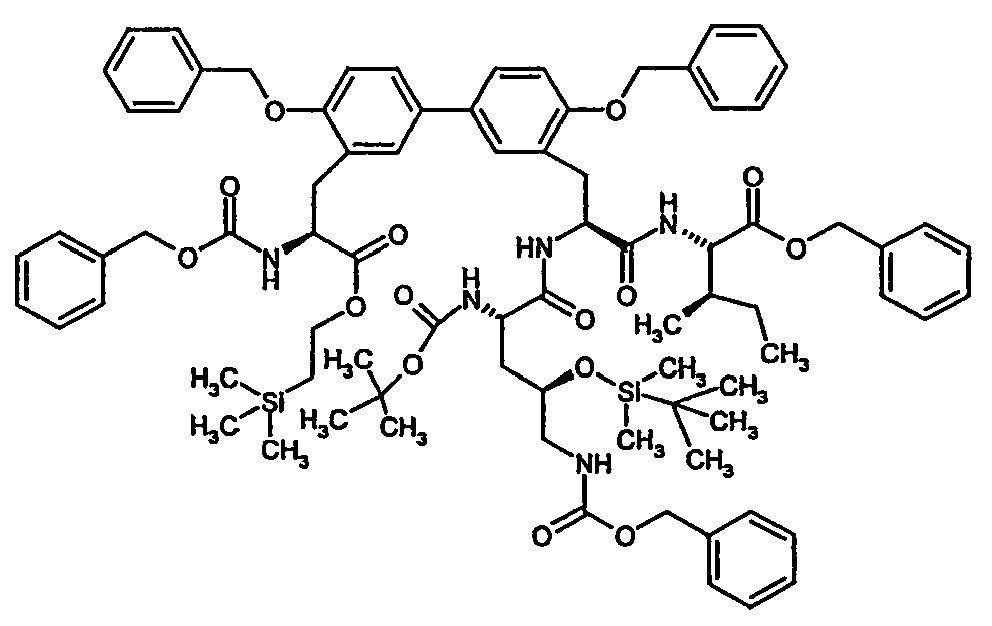
LC-MS (Methode 16): Rt = 3.33 min MS (EI): m/z = 1457 (M+H)+ - In Analogie zu Beispiel 57A können die in der folgenden Tabelle aufgeführten Beispiele 97A bis 99A hergestellt werden.
Beispiel-Nr. Struktur 97A 
98A 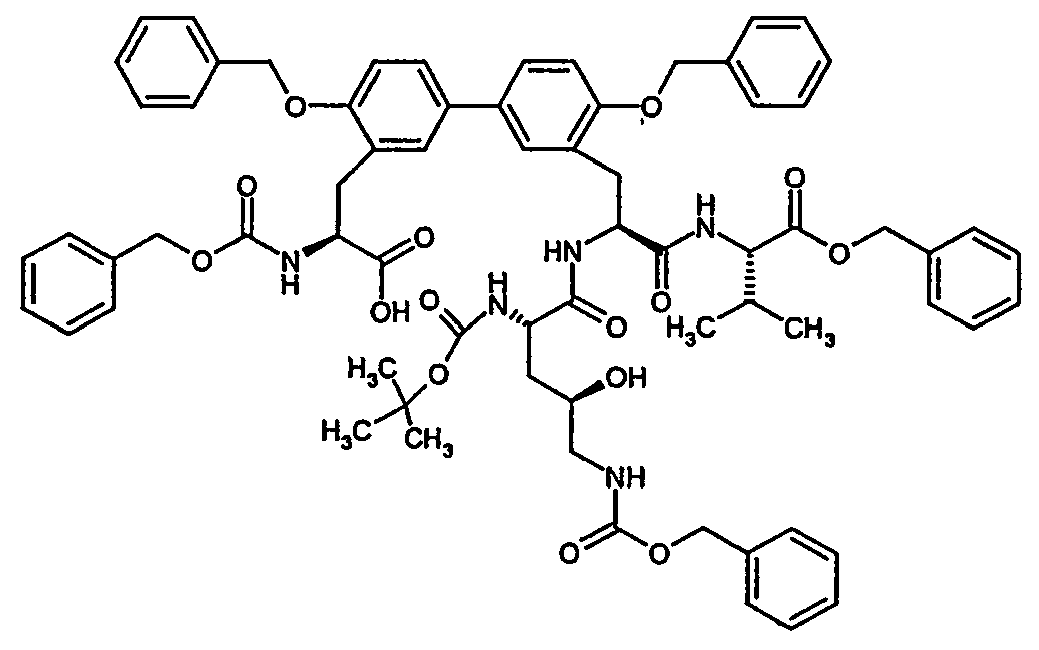
99A 
- In Analogie zu Beispiel 62A können die in der folgenden Tabelle aufgeführten Beispiele 100A bis 102A hergestellt werden.
Beispiel-Nr. Struktur 100A 
101A 
102A 
- In Analogie zu Beispiel 67A können die in der folgenden Tabelle aufgeführten Beispiele 103A bis 105A hergestellt werden.
Beispiel-Nr. Struktur 103A 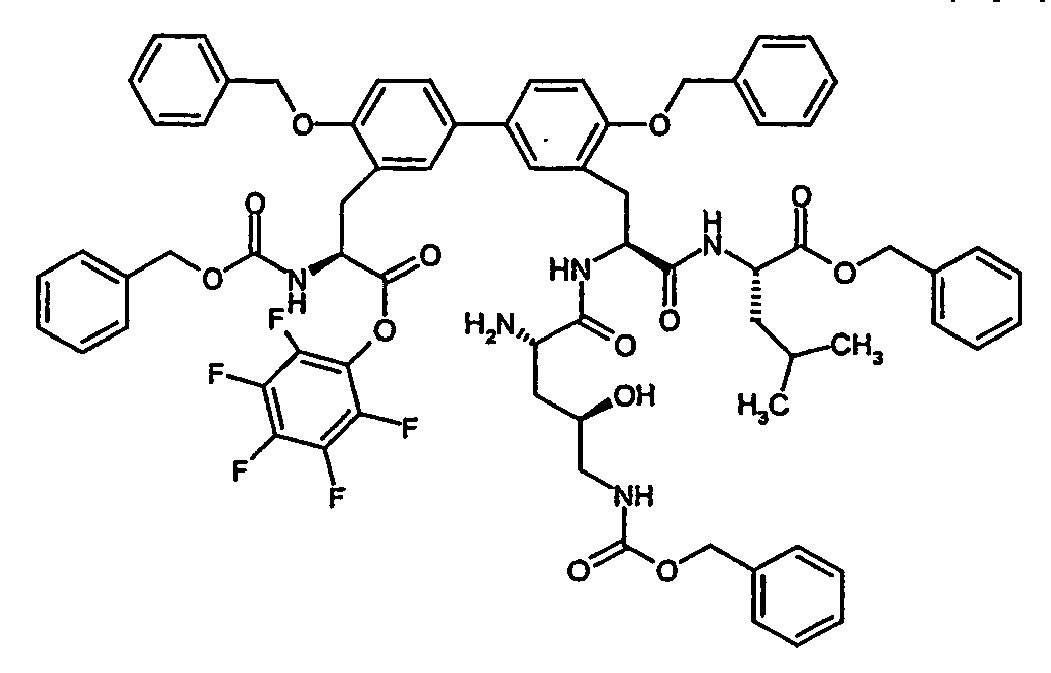
104A 
105A 
- In Analogie zu Beispiel 72A können die in der folgenden Tabelle aufgeführten Beispiele 106A bis 108A hergestellt werden.
Beispiel-Nr. Struktur Analytische Daten 106A 
LC-MS (Methode 15): Rt = 3.10 min. MS (EI): m/z = 1124 (M+H)+ 107A 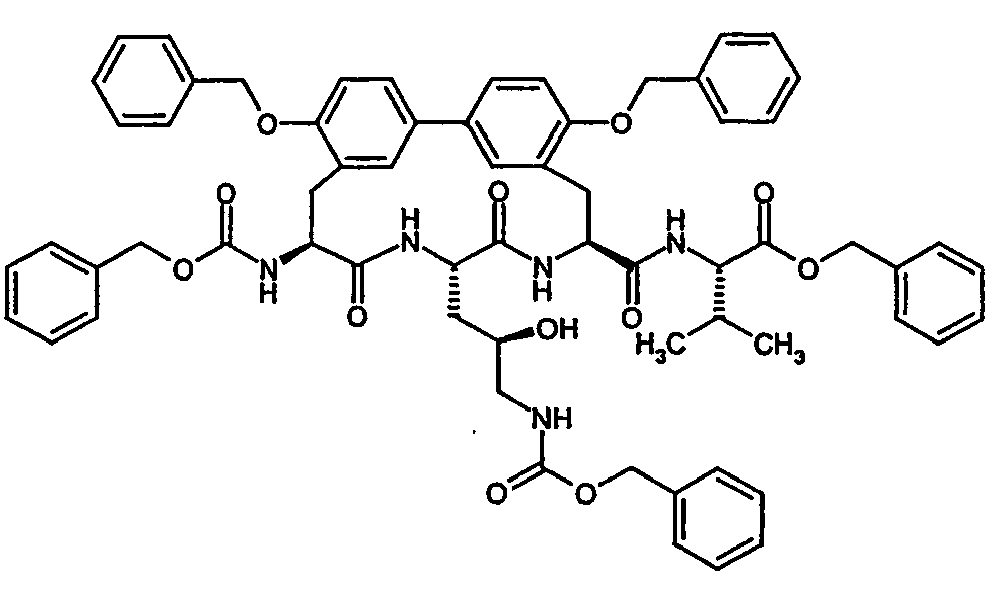
LC-MS (Methode 24): Rt = 3.31 min. MS (EI): m/z = 1110 (M+H)+ 108A 
LC-MS (Methode 24): Rt = 3.32 min. MS (EI): m/z = 1124 (M+H)+ - In Analogie zu Beispiel 24A kann das in der folgenden Tabelle aufgeführte Beispiel 109A hergestellt werden.
Beispiel-Nr. Struktur Analytische Daten 109A 
LC-MS (Methode 24): Rt = 1.94 min MS (EI): m/z = 729 (M+H)+ -
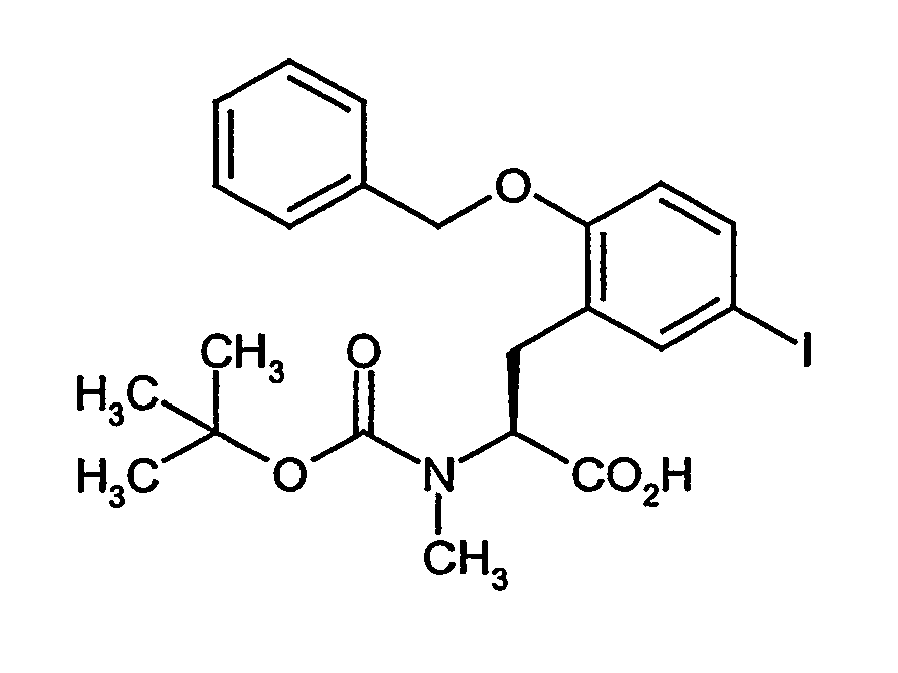
- Unter Argonatmosphäre werden 500 mg (1 mmol) der Verbindung aus Beispiel 6A in 20 ml THF gelöst, mit 90.5 mg (3.02 mmol) Natriumhydrid und 0.51 ml (1141.6 mg; 8.04 mmol) Methyliodid (80%-ig) versetzt und über Nacht bei Raumtemperatur gerührt. Man verdünnt mit 25 ml Essigsäureethylester und 25 ml Wasser und stellt mit 0.1 N Salzsäure auf pH = 9 ein. Man engt im Vakuum auf ein kleines Volumen ein. Man versetzt mit 10 ml Essigsäureethylester und 10 ml Wasser, schüttelt alles heftig und trennt die organische Phase ab. Nach Trocknen mit Natriumsulfat und Einengen im Vakuum erhält man 140 mg Produkt (19% d. Th.).
- Die wässrige Phase säuert man an (pH = 3) und schüttelt sie dreimal mit 20 ml Essigsäureethylester aus. Nach Einengen im Vakuum und Trocknen im Vakuum erhält man 351 mg Produkt (68% d. Th.).
LC-MS (Methode 17): Rt = 3.9 min.
MS (EI): m/z = 511 (M+H)+ -
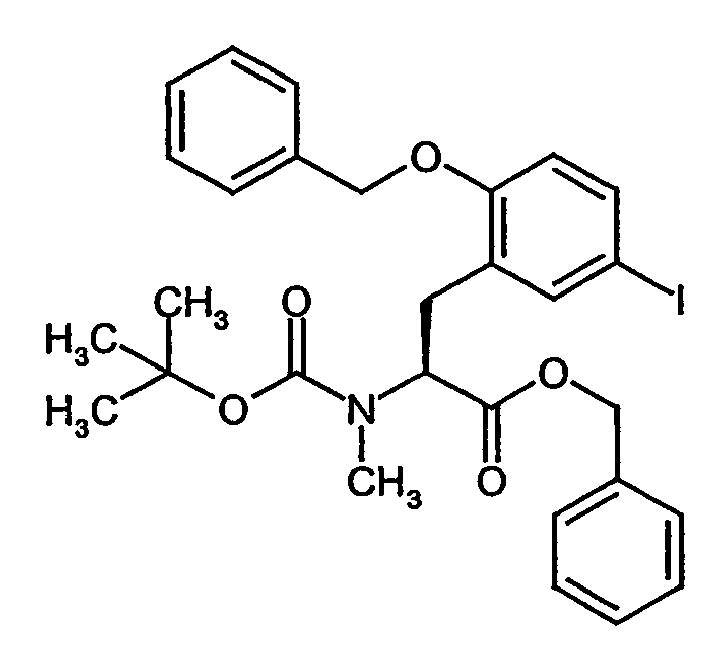
- Die Herstellung erfolgt analog zu Beispiel 7A aus 350 mg (0.68 mmol) der Verbindung aus Beispiel 110A, 8.29 mg (0.07 mmol) DMAP, 148 mg (1.37 mmol) Benzylalkohol und 157.46 mg (0.82 mmol) EDC in 3 ml Acetonitril.
Ausbeute: 382 mg (93% d. Th.)
LC-MS (Methode 17): Rt = 4.8 min.
MS (EI): m/z = 601 (M+H)+ -

- Analog zu Beispiel 8A werden 380 mg (0.63 mmol) der Verbindung aus Beispiel 111A in einem ausgeheizten Kolben in 4 ml DMF vorgelegt und unter Rühren bei Raumtemperatur mit 184.5 mg (0.73 mmol) 4,4,4',4',5,5,5',5'-Octamethyl-2,2'-bi-1,3,2-dioxaborolan, 186 mg (1.9 mmol) Kaliumacetat und 23.15 mg (0.03 mmol) Bis(diphenylphosphino)-ferrocen-palladium(II)chlorid versetzt. Man lässt 4 h bei 80°C reagieren. Nach der Aufarbeitung und Chromatographie (Kieselgel 60, Laufmittel: Cyclohexan/Essigsäureethylester = 4/1) erhält man das Produkt.
Ausbeute: 196 mg
LC-MS (Methode 17): Rt = 4.9 min.
MS (EI): m/z = 601 (M+H)+ -

- Die Herstellung erfolgt analog Beispiel 12A (Methode B) aus 190 mg (0.32 mmol) der Verbindung aus Beispiel 112A, 199.5 mg (0.32 mmol) der Verbindung aus Beispiel 11A, 195.5 mg (0.63 mmol) Cäsiumcarbonat und 23.15 mg (0.03 mmol) Bis(diphenylphosphino)ferrocen-palladium(II)chlorid in 1.5 ml DMF unter Argonatmosphäre.
Ausbeute: 212 mg (66% d. Th.)
LC-MS (Methode 25): Rt= 4.86 min.
MS (EI): m/z = 978 (M+H)+ -

- Die Herstellung erfolgt analog Beispiel 15A aus 930 mg (0.95 mmol) der Verbindung aus Beispiel 113A und 22.14 ml einer 4 M Dioxan/-Chlorwasserstofflösung in 15 ml Dioxan.
Ausbeute: 915 mg (78% d. Th.)
LC-MS (Methode 25): Rt = 2.53 min.
MS (EI): m/z = 878 (M+H)+ -

- Die Herstellung erfolgt analog Beispiel 16A aus 922 mg (1.01 mmol) der Verbindung aus Beispiel 114A, 0.5 g (1.01 mmol) der Verbindung aus Beispiel 14A, 421 mg (1.11 mmol) HATU und 0.7 ml (518 mg; 3.27 mmol) DIPEA in 4.2 ml DMF.
Ausbeute: 703 mg (51% d. Th.)
LC-MS (Methode 16): Rt = 3.17 min.
MS (EI): m/z = 1356 (M+H)+ -

- Die Herstellung erfolgt analog Beispiel 17A aus 360 mg (0.27 mmol) der Verbindung aus Beispiel 115A und 0.8 ml (3 Äquiv.) 1 M Tetrabutylammoniumfluorid-Lösung (THF) in 20 ml DMF.
Ausbeute: 159 mg (53% d. Th.)
LC-MS (Methode 23): Rt = 3.19 min.
MS (EI): m/z = 1142 (M+H)+ -

- Die Herstellung erfolgt analog Beispiel 18A (Methode A) aus 330 mg (0.29 mmol) der Verbindung aus Beispiel 116A, 265.6 mg (1.44 mmol) Pentafluorphenol, 3.53 mg (0.03 mmol) DMAP und 60.87 mg (0.32 mmol) EDC in 10 ml Dichlormethan.
Ausbeute: 271 mg (69% d. Th.)
LC-MS (Methode 23): Rt = 3.38 min.
MS (EI): m/z =1308 (M+H)+ -

- 130 mg (0.1 mmol) der Verbindung aus Beispiel 117A werden in 0.5 ml Dioxan gelöst und vorsichtig mit 5 ml 4 M Dioxan-Chlorwasserstoff-Lösung versetzt (Eisbad). Nach 30 Minuten lässt man bei Raumtemperatur noch 2 h weiterreagieren. Man dampft alles im Vakuum zur Trockne ein und trocknet im Hochvakuum bis zur Gewichtskonstanz.
Ausbeute: 130 mg (70% d. Th.)
LC-MS (Methode 15): Rt = 2.68 min.
MS (EI): m/z = 1208 (M+H)+ -

- 130 mg (0.1 mmol) der Verbindung aus Beispiel 118A werden in 220 ml trockenem Chloroform vorgelegt. Bei Raumtemperatur versetzt man unter Rühren innerhalb von 20 Minuten mit 23 ml (20 Äquiv.) Triethylamin in 5 ml Dichlormethan. Man lässt über Nacht nachrühren. Anschließend wird alles im Vakuum zur Trockne eingedampft. Der Rückstand wird mit Acetonitril ausgerührt. Nach dem Trocknen des Rückstandes gewinnt man 44 mg Produkt. Aus der Mutterlauge wird durch RP-HPLC noch weiteres Produkt gewonnen (30 mg).
Ausbeute: 74 mg (69% d. Th.)
LC-MS (Methode 15): Rt = 3.13 min.
MS (EI): m/z = 1024 (M+H)+ -

- 33 mg (0.032 mmol) der Verbindung aus Beispiel 119A werden mit verdünnter Trifluoressigsäure vorsichtig behandelt. Die entstandene klare Lösung wird anschließend lyophilisiert.
Ausbeute: 23 mg (quantitativ)
LC-MS (Methode 15): Rt = 0.92 min.
MS (EI): m/z = 486 (M+H)+ -

- 37 mg (0.04 mmol) der Verbindung aus Beispiel 119A werden in 2 ml THF gelöst, mit 0.14 ml 1 N Lithiumhydroxid-Lösung versetzt und 3 h bei Raumtemperatur gerührt. Anschließend säuert man mit 1 N Salzsäure an und dampft alles im Hochvakuum zur Trockne ein.
Ausbeute: 33 mg (71% d. Th.)
LC-MS (Methode 23): Rt = 2.90 min.
MS (EI): m/z = 934 (M+H)+ -

- 30 mg (0.03 mmol) der Verbindung aus Beispiel 121A werden in 1 ml DMF gelöst und mit 0.01 ml (3 Äquiv.) Triethylamin versetzt. Nach Abkühlen der Reaktionslösung im Eisbad versetzt man mit 8.76 mg (2 Äquiv.) Chlorameisensäureisobutylester und lässt 30 Minuten reagieren. Nach einer weiteren Stunde Rühren bei Raumtemperatur versetzt man mit 0.64 ml (10 Äquiv.) 0.5 N Dioxan-Ammoniak-Lösung und rührt über Nacht. Nach Einengen im Vakuum wird der Rückstand mittels RP-HPLC gereinigt.
Ausbeute: 11 mg (37% d. Th.)
LC-MS (Methode 23): Rt = 2.91 min.
MS (EI): m/z = 934 (M+H)+ - Analog zu den oben aufgeführten Vorschriften der Beispiele 115A bis 122A werden die in der folgenden Tabelle aufgeführten Beispiele 123A bis 129A aus den entsprechenden Edukten hergestellt:
Beispiel-Nr. Struktur hergestellt analog Analytische Daten 123A 
115A LC-MS (Methode 25): Rt = 4.85 min. MS (EI): m/z = 1226 (M+H)+ 124A 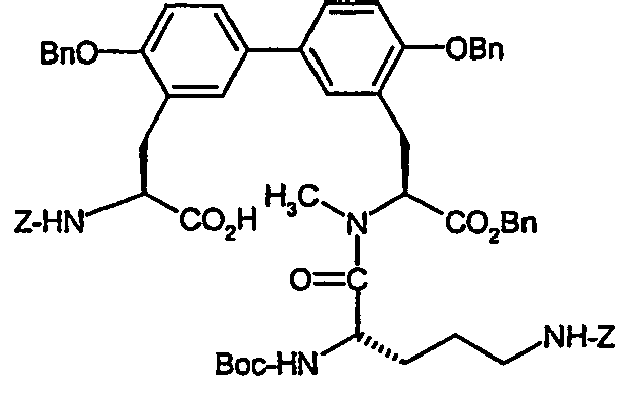
116A LC-MS (Methode 25): Rt = 2.04 min. MS (EI): m/z = 1126 (M+H)+ 125A 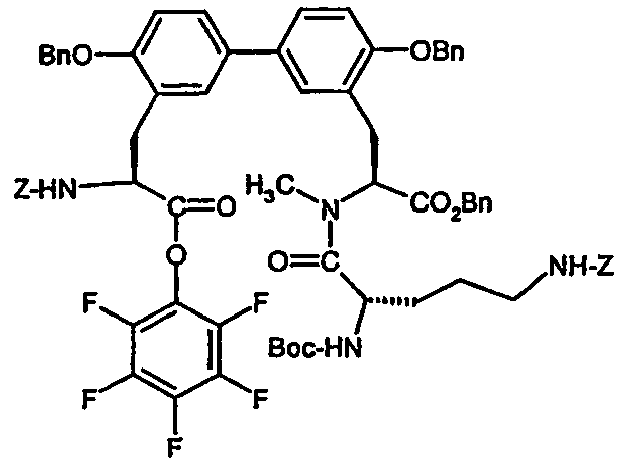
117A LC-MS (Methode 25): Rt = 3.79 min. MS (EI): m/z = 1292 (M+H)+ 126A 
118A LC-MS (Methode 25): Rt = 3.72 min. MS (EI): m/z = 1192 (M+H)+ 127A 
119A LC-MS (Methode 25): Rt = 4.39 min. MS (EI): m/z = 1008 (M+H)+ 128A 
121A LC-MS (Methode 26): Rt = 3.64 min. MS (EI): m/z = 918 (M+H)+ 129A 
122A LC-MS (Methode 25): Rt = 3.8 min. MS (EI): m/z = 917 (M+H)+ -

- Eine Lösung A von 10 g (30.9 mmol) 2(S)-tert-Butoxycarbonylamino-bernsteinsäure-1-benzylester und 5.27 g (32.5 mmol) 1,1'-Carbonyldiimidazol in 100 ml Tetrahydrofuran wird 5 h bei RT gerührt. Zu einer Lösung B von 3.2 g (34.2 mmol) Kalium-tert-butylat in 100 ml Tetrahydrofuran werden bei 0°C 18.8 g (30.9 mmol) Nitromethan zugetropft. Die Lösung B wird unter Erwärmen auf RT nachgerührt, und anschließend wird bei RT Lösung A zugetropft. Die resultierende Mischung wird 16 h bei RT gerührt und mit 20%iger Salzsäure auf pH 2 eingestellt. Das Lösungsmittel wird eingedampft. Das zurückbleibende Rohprodukt wird in Essigsäureethylester/Wasser aufgenommen. Nach Trennung der Phasen wird die organische Phase zweimal mit Wasser ausgeschüttelt, über Natriumsulfat getrocknet und eingeengt. Man erhält 13 g (99% d. Th.) des Produkts.
MS (ESI): m/z = 334 (M+H)+
1H-NMR (300 MHz, d6-DMSO): δ = 1.37 (s, 9H), 2.91 (m, 1H), 3.13 (m, 1H), 4.44 (m, 1H), 5.12 (s, 2H), 5.81 (m, 2H), 7.2-7.5 (m, 5H). -
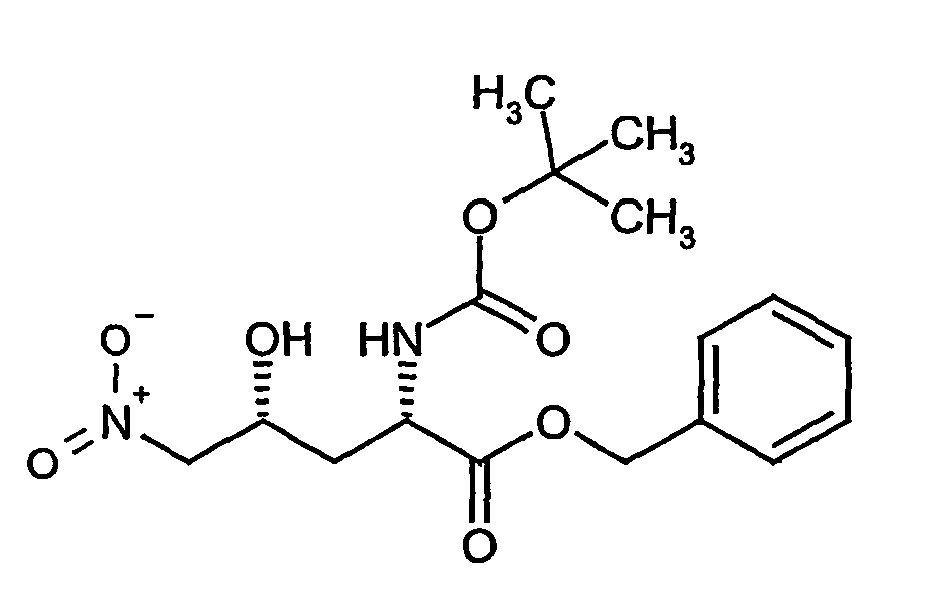
- Eine Lösung von 11.3 g (30.8 mmol) 2(S)-tert-Butoxycarbonylamino-5-nitro-4-oxopentansäure-benzylester in 300 ml Tetrahydrofuran wird auf -78°C gekühlt, mit 30.8 ml einer 1M Lösung von L-Selectrid® in Tetrahydrofuran tropfenweise versetzt und 1 h bei -78°C nachgerührt. Nach Erwärmen auf RT wird die Lösung vorsichtig mit gesättigter Ammoniumchlorid-Lösung versetzt. Die Reaktionslösung wird eingeengt und der Rückstand in Wasser und Essigsäureethylester aufgenommen. Die wässrige Phase wird dreimal mit Essigsäureethylester extrahiert. Die vereinigten organischen Phasen werden über Natriumsulfat getrocknet und eingedampft. Das Rohprodukt wird an Kieselgel 60 vorgereinigt (Laufmittel: Cyclohexan/Essigsäureethylester 10/1), die gesammelten Fraktionen werden eingeengt und mit Cyclohexan/Essigsäureethylester 5/1 ausgerührt. Die zurückbleibenden Kristalle werden abgesaugt und getrocknet. Man erhält 2.34 g (21% d. Th.) des gewünschten Diastereomers. Aus der Mutterlauge erhält man durch chromatographische Trennung an Lichrospher Diol 10 µM (Laufmittel: Ethanol/iso-Hexan 5/95) weitere 0.8 g (6.7%) des Produkts.
MS (ESI): m/z = 369 (M+H)+.
1H-NMR (300 MHz, d6-DMSO): δ = 1.38 (s, 9H), 1.77 (m, 1H), 1.97 (m, 1H), 4.10-4.44 (m, 3H), 4.67 (m, 1H), 5.12 (m, 2H), 5.49 (d, 1H), 7.25-7.45 (m, 5H). - Die Synthese von Ausführungsbeispielen kann ausgehend von partiell geschützten Biphenomycin-Derivaten (wie z.B. 21A) erfolgen.

-

- Zu einer Lösung von 2.15 mg (3.2 µmol) tert-Butyl-(2R)-3-[(8S,11S,14S)-8-(aminocarbonyl)-14-[(tert-butoxycarbonyl)amino]-5,17-dihydroxy-10,13-dioxo-9,12-diazatricyclo[14.3.1.12,6]hericosa-1(20),2(21),3,5,16,18-hexaen-11-yl]-2-hydroxy-propylcarbamat (Beispiel 22A) in trockenem Dioxan (p.a., 1.0 ml) wird unter Argon eine 4 M Lösung von Salzsäuregas in Dioxan (1.0 ml) zugetropft. Nach ca. 30 min ist vollständiger Umsatz erreicht. Das Reaktionsgemisch wird eingefroren und mittels Gefriertrocknung von Lösungsmitteln befreit. Die Aufreinigung erfolgt durch Gelchromatographie [Sephadex LH-20; Methanol / konzentrierte Salzsäure (1:0.0001) dotiert mit Natriumdisulfit], wobei 1.4 mg (80% d. Th.) Produkt erhalten werden. HPLC-UV-Vis (Methode 14): Rt = 3.09 min.
λmax (qualitativ) = ~204 nm (s), 269 (m), ~285 (sh) (H2O/Acetonitril + 0.01% TFA [7:3]).
1H-NMR (500 MHz, CD3OD): δ = 1.79 (ddd, 1H, J = 13.6, 9.2, 5.9Hz), 1.99 (ddd, 1H, J = 13.6, 9.6, 4.0Hz), 2.82 (dd, 1H, J = 12.8, 9.6Hz), 2.87 (dd, 1H, J = 17.1, 12.1Hz), 3.04 (dd, 1H, J =12.8, 2.9Hz), 3.11 (dd, 1H, J =14.8, 3.0Hz), 3.38 (dd, 1H, J = 16.9, 1.9Hz), 3.57 (dd, 1H, J = 11.7, 5.4Hz), 3.92 (tt, 1H, J = 9.4, 3.5Hz), 4.23 (dd, 1H, J = 4.9, 3.0Hz), 4.90 (m, 1H), 4.91 (m, 1H), 6.79 (d, 1H, J = 8.3Hz), 6.85 (d, 1H, J = 8.4Hz), 7.10 (d, 1H, J = 2.3Hz), 7.25 (dd, 1H, J = 8.3, 2.3Hz), 7.36 (dd, 1H, J = 8.5, 2.4Hz), 7.44 (d, 1H, J = 2.1Hz).
13C NMR (125.5 MHz, CD3OD): δ = 30.3, 30.8, 39.5, 45.4, 50.6, 53.8, 55.3, 65.3, 115.6, 116.3, 120.8, 125.3, 126.2, 126.8, 127.0, 130.9, 132.7, 133.5, 155.0, 155.7, 168.4, 172.8, 177.0.
LC-HR-FT-ICR-MS (Methode 13): ber. für C23H30N5O6 [M+H]+ 472.2191 gef. 472.2191. - Unter Argon werden 14.8 mg (0.02 mmol) tert-Butyl-(2R)-3-[(8S,11S,14S)-8-(aminocarbonyl)-14-[(tert-butoxycarbonyl)amino]-5,17-dihydroxy-10,13-dioxo-9,12-diazatricyclo[14.3.1.12,6]henicosa-1(20),2(21),3,5,16,18-hexaen-11-yl]-2-hydroxypropylcarbamat (Beispiel 22A) in 0.5 ml Dioxan vorgelegt. Die Mischung wird auf 0°C abgekühlt und mit 0.8 ml 4 M Salzsäurelösung in Dioxan tropfenweise versetzt. Nach 45 min wird das Gemisch im Vakuum einrotiert und der Rückstand noch zweimal mit Dioxan aufgenommen und erneut im Vakuum einrotiert. Das Produkt wird am Hochvakuum getrocknet.
Ausbeute: 12 mg (100 % d. Th.).
HPLC (Methode 8): Rt = 4.87 min.
MS (EI): m/z = 472 (M+H-2HCl)+.
1H-NMR (400 MHz, D2O): δ = 0.58-0.67 (m, 2H), 1.65-1.86 (m, 3H), 1.88-1.98 (m, 1H), 2.03-2.13 (m, 1H), 2.87-3.02 (m, 4H), 3.09-3.19 (m, 2H), 3.38 (d, 1H), 3.59-3.69 (m, 2H), 3.88-3.96 (m, 1H), 4.46-4.51 (m, 1 H), 4.85-5.01 (m, 5H), 6.98 (dd, 2H), 7.05 (dd, 1H), 7.36 (s, 1H), 7.43 (dd, 1H), 7.50 (dd, 1H). -

- Zu einer Lösung von tert-Butyl-(2R)-3-[(8S,11S,14S)-8-[(benzylamino)carbonyl]-14-[(tert-butoxycarbonyl)amino]-5,17-dihydroxy-10,13-dioxo-9,12-diazatricyclo-[14.3.1.12,6]henicosa-1(20),2(21),3,5,16,18-hexaen-11-yl]-2-hydroxypropylcarbamat (Beispiel 23A) in 0.5 ml 1,4-Dioxan werden unter Eiskühlung 0.5 ml 4 N Salzsäure-Lösung in Dioxan getropft. Die Eiskühlung wird entfernt und die Mischung wird 2 h bei RT gerührt, bevor im Vakuum eingeengt und im Hochvakuum getrocknet wird. Der Rückstand wird in einem Gemisch von Dichlormethan und Methanol aufgenommen und die Lösungsmittel über Nacht abgedampft.
LC-MS (Methode 7): Rt = 2.02 min.
MS (ESI-pos): m/z = 562 (M+H-2HCl)+.
1H-NMR (400MHz, D2O): δ = 1.70-1.81 (m, 1H), 1.82-1.91 (m, 1H), 2.71-2.84 (m, 2H), 2.89-2.97 (m, 2H), 3.18 (d, 1H), 3.42-3.53 (m, 1H), 3.67-3.73 (m, 1H), 4.21-4.26 (m, 1H), 4.29 (d, 1H), 4.27-4.33 (m, 1H), 4.34 (d, 1H), 6.80-6.83 (m, 2H), 6.89 (s, 1H), 7.19-7.24 (m, 4H), 7.26-7.31 (m, 3H), 7.35 (d, 1H). - Analog zu Beispiel 1 können die in der folgenden Tabelle aufgeführten Beispiele 3 bis 14 hergestellt werden.
Beispiel-Nr. Struktur Analytische Daten 3 
LC-MS (Methode 20): Rt = 1.13 min. MS (ESIpos): m/z = 512 (M+H)+ 4 
LC-MS (Methode 20): Rt = 2.09 min. MS (ESIpos): m/z = 540 (M+H)+ 5 
LC-MS (Methode 20): Rt = 1.44 min. MS (ESIpos): m/z = 500 (M+H)+ 6 
LC-MS (Methode 20): Rt = 0.35 min. MS (ESIpos): m/z = 500 (M+H)+ 7 
LC-MS (Methode 20): Rt = 0.32 min. MS (ESIpos): m/z = 486 (M+H)+ 8 
LC-MS (Methode 20): Rt = 0.35 min. MS (ESIpos): m/z = 516 (M+H)+ 9 
LC-MS (Methode 21): Rt = 2.79 min. MS (ESIpos): m/z = 530 (M+H)+ 10 
LC-MS (Methode 21): Rt = 2.85 min. MS (ESIpos): m/z = 542 (M+H)+ 11 
LC-MS (Methode 21): Rt = 3.09 min. MS (ESIpos): m/z = 576 (M+H)+ 12 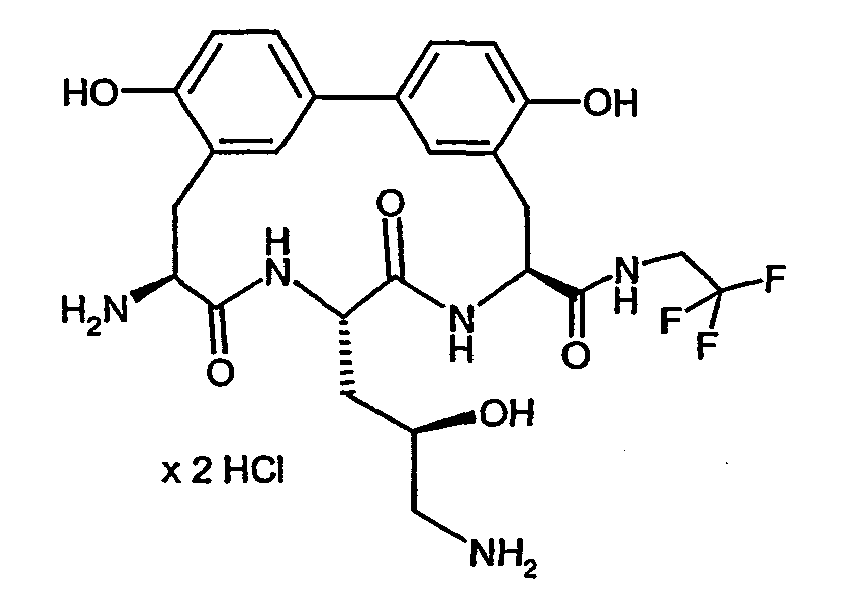
LC-MS (Methode 21): Rt = 2.88 min. MS (ESIpos): m/z = 554 (M+H)+ 13 
LC-MS (Methode 21): Rt = 3.10 min. MS (ESIpos): m/z = 576 (M+H)+ 14 
1H-NMR (400MHz, D2O): δ = 1.78-1.88 (m, 1H), 1.93-2.00 (m, 1H), 2.78-2.88 (m, 2H), 2.98-3.06 (m, 2H), 3.17-3.30 (m, 2H), 3.33 (d, 1H), 3.42- 3.57 (m, 3H), 3.73- 3.84 (m, 1H), 4.68- 4.82 (m, 2H), 6.86 (d, 1H), 6.87 (d, 1H), 7.24 (m, 1H), 7.32 (d, 1H), 7.40 (d, 1H). MS (EI): m/z = 546 (M+H)+, 568 (M+Na)+ -

- 0.02 g (0.02 mmol) Benzyl-N-{[(8S,11S,14S)-5,17-bis(benzyloxy)-14-{[(benzyloxy)-carbonyl]amino}-11-((2R)-3-{[(benzyloxy)carbonyl]amino}-2-hydroxypropyl)-10,13-dioxo-9,12-diazatricyclo[14.3.1.12.6]henicosa-1(20),2(21),3,5,16,18-hexaen-8-yl]carbonyl}-L-phenylalaninat werden in 6 ml Essigsäure:Wasser:Ethanol (4:1:1) suspendiert und mit 0.01 g Pd/C versetzt. Man hydriert bei Normaldruck unter kräftigem Rühren für 48 h. Die Reaktionslösung wird filtriert. Der Rückstand wird mit 0.25 ml 0.1 N Salzsäure versetzt. Nach Einengen am Rotationsverdampfer trocknet man im Vakuum. Zur weiteren Reinigung wird in Isopropanol:Diethylether (1:1) ausgerührt.
Ausbeute: 0.0037 g (28 % d. Th.)
LC-MS (Methode 15): Rt = 1.27 min.
MS (EI): m/z = 620 (M+H)+ - In Analogie zu Beispiel 15 können die in der folgenden Tabelle aufgeführten Beispiele 16 und 17 hergestellt werden.
Beispiel-Nr. Struktur Analytische Daten 16 
LC-MS (Methode 15): Rt = 0.701 min. MS (EI): m/z = 544 (M+H)+ 17 
LC-MS (Methode 17): Rt = 1.55 min. MS (EI): m/z = 544 (M+H)+ - Ausgehend von (8S,11S,14S)-14-[(tert-Butoxycarbonyl)-amino-11-[3-[(tert-butoxycarbonyl)amino]propyl}-5,17-dihydroxy-10,13-dioxo-9,12-diazatricyclo[14.3.1.12,6]-henicosa-1(20),2(21),3,5,16,18-hexaen-8-carbonsäure (Beispiel 83A) können die in der folgenden Tabelle aufgeführten L-Ornithin-haltigen Amide hergestellt werden (Beispiele 18 bis 24).
Beispiel-Nr. Struktur Analytische Daten 18 
LC-MS (Methode 20): Rt = 0.33 min MS (EI): m/z = 456 (M+H)+ 19 
LC-MS (Methode 19): Rt =1.54 min. MS (EI): m/z = 514 (M+H)+ 20 
LC-MS (Methode 18): Rt = 0.66 min. MS (EI): m/z = 528 (M+H)+ 21 
LC-MS (Methode 19): Rt =1.6 min. MS (EI): m/z = 592 (M+H)+ 22 
MS (EI): m/z = 587 (M+H)+ 23 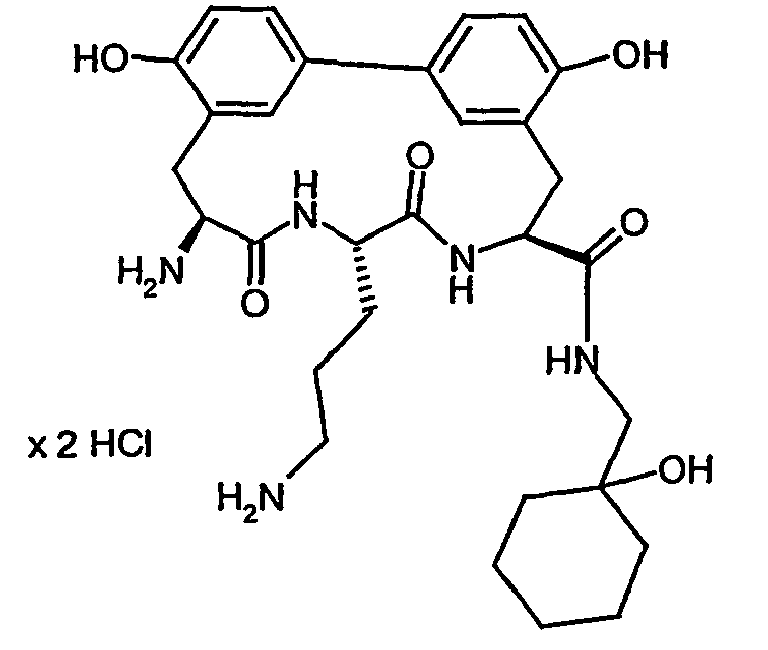
LC-MS (Methode 18): Rt = 1.21 min. MS (EI): m/z = 568 (M+H)+ 24 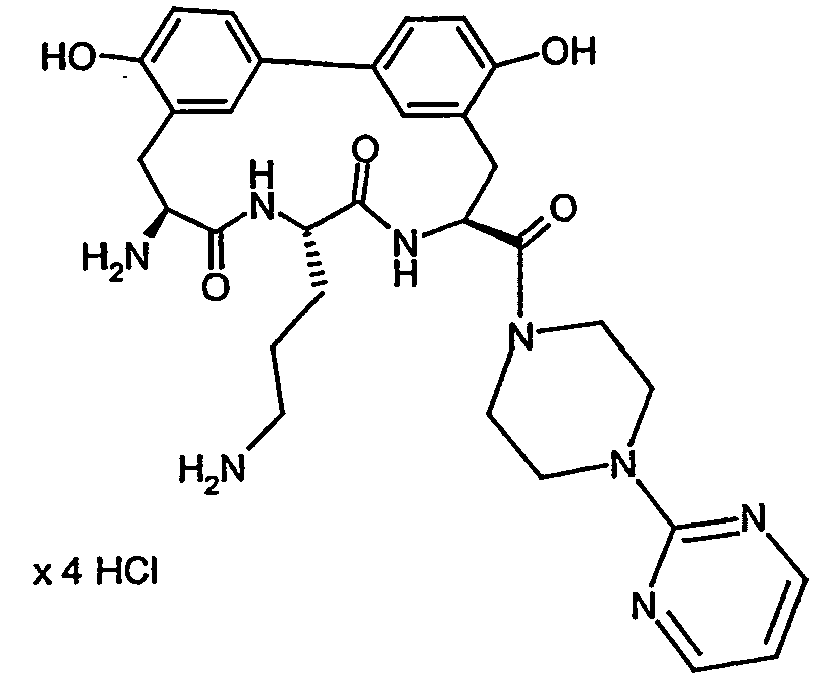
LC-MS (Methode 18): Rt =1.27 min. MS (EI): m/z = 603 (M+H)+ - In Analogie zu Beispiel 15 können die in der folgenden Tabelle aufgeführten Beispiele 25 und 26 hergestellt werden.
Beispiel-Nr. Struktur Analytische Daten 25 
LC-MS (Methode 22): Rt = 0.30 min MS (EI): m/z = 530 (M+H)+ 26 
LC-MS (Methode 15): Rt = 0.88 min MS (EI): m/z = 544 (M+H)+ - Ausgehend von (8S,11S,14S)-14-[(tert-Butoxycarbonyl)-amino-11-[3-[(tert-butoxycarbonyl)amino]propyl}-5,17-dihydroxy-10,13-dioxo-9,12-diazatricyclo[14.3.1.12,6]-henicosa-1(20),2(21),3,5,16,18-hexaen-8-carbonsäure (Beispiel 83A) können die in der folgenden Tabelle aufgeführten L-Ornithin-haltigen Amide hergestellt werden (Beispiele 27 bis 33).
Beispiel-Nr. Struktur Analytische Daten 27 
LC-MS (Methode 15): Rt = 0.72 min. MS (EI): m/z = 584 (M+H)+ 28 
LC-MS (Methode 15): Rt = 0.69 min MS (EI): m/z = 583 (M+H)+ 29 
LC-MS (Methode 15): Rt = 0.72 min. MS (EI): m/z = 543 (M+H)+ 30 
LC-MS (Methode 15): Rt = 0.83 min. MS (EI): m/z = 585 (M+H)+ 31 
LC-MS (Methode 23): Rt = 1.04 min. MS (EI): m/z = 571 (M+H)+ 32 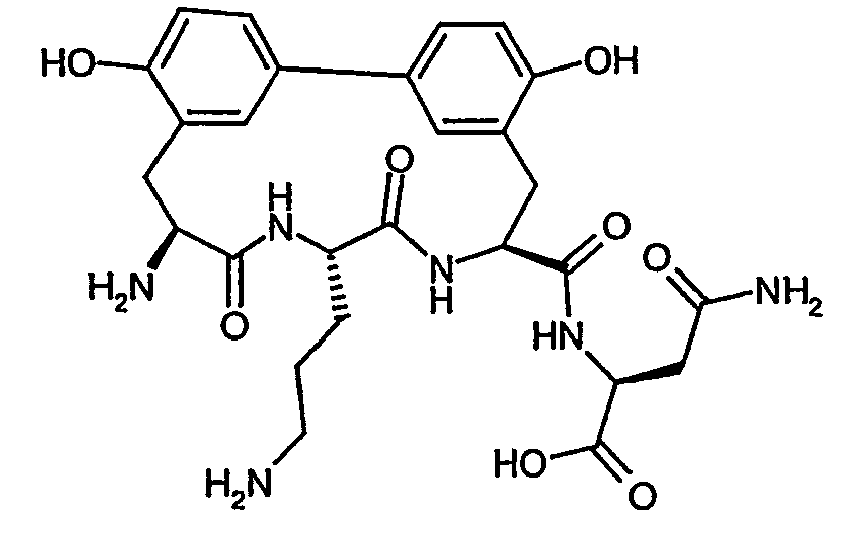
LC-MS (Methode 23): Rt = 1.00 min. MS (EI): m/z = 570 (M+H)+ 33 
LC-MS (Methode 24): Rt = 0.27 min. MS (EI): m/z = 541 (M+H)+ -

- 11 mg (0.01 mmol) der Verbindung aus Beispiel 122A werden in 10 ml Eisessig/Ethanol/Wasser (4/1/1) gelöst, mit 6 mg Pd-C (10%-ig)-Katalysator versetzt und bei Raumtemperatur über Nacht hydriert. Nach Abfiltrieren des Katalysators dampft man den Rückstand im Vakuum zur Trockne ein, versetzt mit 0.1 N Salzsäure und dampft erneut zur Trockne ein.
Ausbeute: 7 mg (96% d. Th.)
MS (EI): m/z = 485 (M+H)+ - Analog der Vorschrift des Beispiels 34 kann das in der folgenden Tabelle aufgeführte Beispiel 35 hergestellt werden:
Beispiel-Nr. Struktur Analytische Daten 35 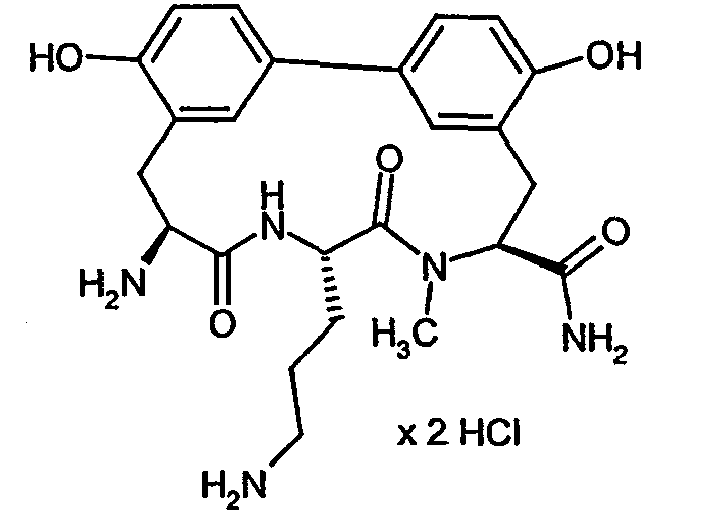
LC-MS (Methode 22): Rt = 1.46 min. MS (EI): m/z = 469 (M+H)+ - In Analogie zu Beispiel 1 können die in der folgenden Tabelle aufgeführten Beispiele 36 und 37 hergestellt werden.
Beispiel-Nr. Struktur Analytische Daten 36 
LC-MS(Methode 15): Rt=1.52 min MS (EI): m/z = 558 (M+H)+ 37 
LC-MS(Methode 24): Rt= 0.42 min MS (EI): m/z = 529 (M+H)+ - In Analogie zu Beispiel 15 können die in der folgenden Tabelle aufgeführten Beispiele 38 bis 40 hergestellt werden.
Beispiel-Nr. Struktur Analytische Daten 38 
LC-MS (Methode 23): Rt = 0.95 min. MS (EI): m/z = 586 (M+H)+ 39 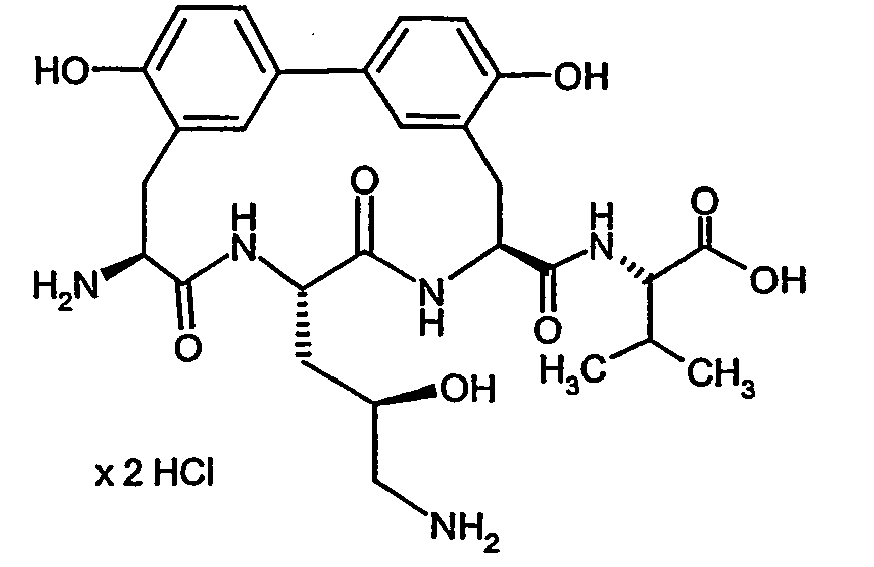
LC-MS (Methode 24): Rt= 0.80 min. MS (EI): m/z = 572 (M+H)+ 40 
LC-MS (Methode 24): Rt = 0.94 min. MS (EI): m/z = 586 (M+H)+ - Die in vitro-Wirkung der erfindungsgemäßen Verbindungen kann in folgenden Assays gezeigt werden:
- Zur Herstellung eines S30-Extraktes werden logarithmisch wachsende Escherichia coli MRE 600 (M. Müller; University Freiburg) geerntet, gewaschen und wie beschrieben für den in vitro Transkriptions-Translations-Test eingesetzt (Müller, M. and Blobel, G. Proc Natl Acad Sci U S A (1984) 81, pp.7421-7425).
- Dem Reaktionsmix des in vitro Transkriptions-Translations-Tests werden zusätzlich 1 µl cAMP (11,25 mg/ml) je 50 µl Reaktionsmix zugegeben. Der Testansatz beträgt 105 µl, wobei 5 µl der zu testenden Substanz in 5%igem DMSO vorgelegt werden. Als Transkriptionsmatrize werden 1 µg/100µl Ansatz des Plasmides pBESTLuc (Promega, Deutschland) verwendet. Nach Inkubation für 60 min bei 30°C werden 50 µl Luziferinlösung (20 mM Tricine, 2,67 mM MgSO4, 0,1 mM EDTA, 33,3 mM DTT pH 7,8, 270 µM CoA, 470 µM Luziferin, 530 µM ATP) zugegeben und die entstehende Biolumineszenz für 1 Minute in einem Luminometer gemessen. Als IC50 wird die Konzentration eines Inhibitors angegeben, die zu einer 50%igen Inhibition der Translation von Firefly Luziferase führt.
- Zur Konstruktion eines Reporterplasmids, welches in einem in vitro Transkriptions-Translations-Assay aus S. aureus verwendet werden kann, wird das Plasmid pBESTluc (Promega Corporation, USA) verwendet. Der in diesem Plasmid vor der Firefly Luziferase vorhandene E. coli tac Promoter wird gegen den capA1 Promoter mit entsprechender Shine-Dalgamo Sequence aus S. aureus ausgetauscht. Dazu werden die Primer CAPFor 5'-CGGCC-AAGCTTACTCGGATCCAGAGTTTGCAAAATATACAGGGGATTATATATAATGGAAAACAAGAAAGGAAAATAGGAGGTTTATATGGAAGACGCCA-3' und CAPRev 5'-GTCATCGTCGGGAAGACCTG-3' verwendet. Der Primer CAPFor enthält den capA1 Promotor, die Ribosomenbindestelle und die 5'-Region des Luziferase Gens. Nach PCR unter Verwendung von pBESTluc als Template kann ein PCR-Produkt isoliert werden, welches das Firefly Luziferase Gen mit dem fusionierten capA1 Promotor enthält. Dieses wird nach einer Restriktion mit ClaI und HindIII in den ebenfalls mit ClaI und HindIII verdauten Vektor pBESTluc ligiert. Das entstandene Plasmid pla kann in E. coli repliziert werden und als Template im S. aureus in vitro Transkriptions-Translations-Test verwendet werden.
- Sechs Liter BHI Medium werden mit einer 250 ml Übernachtkultur eines S. aureus Stammes inokuliert und bei 37°C bis zu einer OD600nm von 2-4 wachsen gelassen. Die Zellen werden durch Zentrifugation geerntet und in 500 ml kaltem Puffer A (10 mM Tris-acetat, pH 8,0, 14 mM Mg-acetat, 1 mM DTT, 1 M KCl) gewaschen. Nach erneutem Abzentrifugieren werden die Zellen in 250 ml kaltem Puffer A mit 50 mM KCl gewaschen und die erhaltenen Pellets bei -20°C für 60 min eingefroren.
- Die Pellets werden in 30 bis 60 min auf Eis aufgetaut und bis zu einem Gesamtvolumen von 99 ml in Puffer B (10 mM Tris-acetat, pH 8,0, 20 mM Mg-acetat, 1 mM DTT, 50 mM KCl) aufgenommen. Je 1,5 ml Lysostaphin (0,8 mg/ml) in Puffer B werden in 3 vorgekühlte Zentrifugenbecher vorgelegt und mit je 33 ml der Zellsuspension vermischt. Die Proben werden für 45 bis 60 min bei 37°C unter gelegentlichem Schütteln inkubiert, bevor 150 µl einer 0,5 M DTT Lösung zugesetzt werden. Die lysierten Zellen werden bei 30.000 x g 30 min bei 4°C abzentrifugiert. Das Zellpellet wird nach Aufnahme in Puffer B unter den gleichen Bedingungen nochmals zentrifugiert und die gesammelten Überstände werden vereinigt. Die Überstände werden nochmals unter gleichen Bedingungen zentrifugiert und zu den oberen 2/3 des Überstandes werden 0,25 Volumen Puffer C (670 mM Tris-acetat, pH 8,0, 20 mM Mg-acetat, 7 mM Na3-Phosphoenolpyruvat, 7 mM DTT, 5,5 mM ATP, 70 µM Aminosäuren (complete von Promega), 75 µg Pyruvatkinase (Sigma, Deutschland)/ml gegeben. Die Proben werden für 30 min bei 37°C inkubiert. Die Überstände werden über Nacht bei 4°C gegen 2 1 Dialysepuffer (10 mM Tris-acetat, pH 8,0, 14 mM Mg-acetat, 1 mM DTT, 60 mM K-acetat) mit einem Pufferwechsel in einem Dialyseschlauch mit 3500 Da Ausschluss dialysiert. Das Dialysat wird auf eine Proteinkonzentration von etwa 10 mg/ml konzentriert, indem der Dialyseschlauch mit kaltem PEG 8000 Pulver (Sigma, Deutschland) bei 4°C bedeckt wird. Die S30 Extrakte können aliquotiert bei -70°C gelagert werden.
- Die Inhibition der Proteinbiosynthese der Verbindungen kann in einem in vitro Transkriptions-Translations-Assay gezeigt werden. Der Assay beruht auf der zellfreien Transkription und Translation von Firefly Luziferase unter Verwendung des Reporterplasmids pla als Template und aus S. aureus gewonnenen zellfreien S30 Extrakten. Die Aktivität der entstandenen Luziferase kann durch Lumineszenzmessung nachgewiesen werden.
- Die Menge an einzusetzenden S30 Extrakt bzw. Plasmid pla muss für jede Präparation erneut ausgetestet werden, um eine optimale Konzentration im Test zu gewährleisten. 3 µl der zu testenden Substanz gelöst in 5% DMSO werden in eine MTP vorgelegt. Anschließend werden 10 µl einer geeignet konzentrierten Plasmidlösung p1a zugegeben. Anschließend werden 46 µl eines Gemisches aus 23 µl Premix (500 mM K-acetat, 87,5 mM Tris-acetat, pH 8,0, 67,5 mM Ammoniumacetat, 5 mM DTT, 50 µg Folsäure/ml, 87,5 mg PEG 8000/ml, 5 mM ATP, 1,25 mM je NTP, 20 µM je Aminosäure, 50 mM PEP (Na3-Salz), 2,5 mM cAMP, 250 µg je E. coli tRNA/ml) und 23 µl einer geeigneten Menge S. aureus S30 Extrakt zugegeben und vermischt. Nach Inkubation für 60 min bei 30°C werden 50 µl Luziferinlösung (20 mM Tricine, 2,67 mM MgSO4, 0,1 mM EDTA, 33,3 mM DTT pH 7,8, 270 µM CoA, 470 µM Luziferin, 530 µM ATP) und die entstehende Biolumineszenz für 1 min in einem Luminometer gemessen. Als IC50 wird die Konzentration eines Inhibitors angegeben, die zu einer 50%igen Inhibition der Translation von Firefly Luziferase führt.
- Die minimale Hemmkonzentration (MHK) ist die minimale Konzentration eines Antibiotikums, mit der ein Testkeim in seinem Wachstum über 18-24 h inhibiert wird. Die Hemmstoffkonzentration kann dabei nach mikrobiologischen Standardverfahren bestimmt werden (siehe z.B. The National Committee for Clinical Laboratory Standards. Methods for dilution antimicrobial susceptibility tests for bacteria that grow aerobically; approved standard-fifth edition. NCCLS document M7-A5 [ISBN 1-56238-394-9]. NCCLS, 940 West Valley Road, Suite 1400, Wayne, Pennsylvania 19087-1898 USA, 2000). Die MHK der erfindungsgemäßen Verbindungen wird im Flüssigdilutionstest im 96er-Mikrotiter-Platten-Maßstab bestimmt. Die Bakterienkeime wurden in einem Minimalmedium (18,5 mM Na2HPO4, 5,7 mM KH2PO4, 9,3 mM NH4Cl, 2,8 mM MgSO4, 17,1 mM NaCl, 0,033 µg/ml Thiaminhydrochlorid, 1,2 µg/ml Nicotinsäure, 0,003 µg/ml Biotin, 1% Glucose, 25 µg/ml von jeder proteinogenen Aminosäure mit Ausnahme von Phenylalanin; [H.-P. Kroll; unveröffentlicht]) unter Zusatz von 0,4% BH Bouillon kultiviert (Testmedium). Im Fall von Enterococcus faecalis ICB 27159 wird dem Testmedium hitzeinaktiviertes fötales Kälberserum (FCS; GibcoBRL, Deutschland) in einer Endkonzentration von 10% zugesetzt. Übernachtkulturen der Testkeime werden auf eine OD578 von 0,001 (im Falle der Enterokokken auf 0,01) in frisches Testmedium verdünnt und 1:1 mit Verdünnungen der Testsubstanzen (Verdünnungsstufen 1:2) in Testmedium inkubiert (150 µl Endvolumen). Die Kulturen werden bei 37°C für 18-24 Stunden inkubiert; Enterokokken in Gegenwart von 5% CO2.
- Die jeweils niedrigste Substanzkonzentration, bei der kein sichtbares Bakterienwachstum mehr auftrat, wird als MHK definiert. Die MHK-Werte in µM einiger erfindungsgemäßer Verbindungen gegenüber einer Reihe von Testkeimen sind in der nachstehenden Tabelle beispielhaft aufgeführt. Die Verbindungen zeigen eine abgestufte antibakterielle Wirkung gegen die meisten der Testkeime.
Tabelle A Bsp. Nr. MHK S. aureus 133 MHK S. aureus RN4220 MHK S. aureus 25701 MHK E. faecalis. ICB 27159 MHK B. catarrhalis M3 IC50 E. coli MRE600 Translation IC50 S. aureus 133 Translation IC50 S. aureus RN4220 Translation 1 0,2 0,1 6,25 6,25 1,56 0,15 0,9 0,5 2 25 12,5 50 25 25 0,55 1,3-4,5 3,4 37 0,8 ---- ---- ---- ---- ---- 0,5 ---- Alle Konzentrationsangaben in µM. - Die Eignung der erfindungsgemäßen Verbindungen zur Behandlung von bakteriellen Infektionen kann in verschiedenen Tiermodellen gezeigt werden. Dazu werden die Tiere im allgemeinen mit einem geeigneten virulenten Keim infiziert und anschließend mit der zu testenden Verbindung, die in einer an das jeweilige Therapiemodell angepassten Formulierung vorliegt, behandelt. Speziell kann die Eignung der erfindungsgemäßen Verbindungen zur Behandlung von bakteriellen Infektionen in einem Sepsismodell an Mäusen nach Infektion mit S. aureus demonstriert werden.
- Dazu werden S. aureus 133 Zellen über Nacht in BH-Bouillon (Oxoid, Deutschland) angezüchtet. Die Übemachtkultur wurde 1:100 in frische BH-Bouillon verdünnt und für 3 Stunden hochgedreht. Die in der logarithmischen Wachstumsphase befindlichen Bakterien werden abzentrifugiert und 2 x mit gepufferter, physiologischer Kochsalzlösung gewaschen. Danach wird am Photometer (Dr. Lange LP 2W) eine Zellsuspension in Kochsalzlösung mit einer Extinktion von 50 Einheiten eingestellt. Nach einem Verdünnungsschritt (1:15) wird diese Suspension 1:1 mit einer 10 %-igen Mucinsuspension gemischt. Von dieser Infektionslösung wird 0,2 ml/20 g Maus i.p. appliziert. Dies entspricht einer Zellzahl von etwa 1-2 x 10E6 Keimen/Maus. Die i.v.-Therapie erfolgt 30 Minuten nach der Infektion. Für den Infektionsversuch werden weibliche CFW1-Mäuse verwendet. Das Überleben der Tiere wird über 6 Tage protokolliert. Das Tiermodell ist so eingestellt, daß unbehandelte Tiere innerhalb von 24 h nach der Infektion versterben. Für die Beispielverbindung 2 konnte in diesem Modell eine therapeutische Wirkung von ED100 = 1.25 mg/kg demonstriert werden.
- Die erfindungsgemäßen Verbindungen können folgendermaßen in pharmazeutische Zubereitungen überführt werden:
- 100 mg der Verbindung von Beispiel 1, 50 mg Lactose (Monohydrat), 50 mg Maisstärke (nativ), 10 mg Polyvinylpyrolidon (PVP 25) (Fa. BASF, Ludwigshafen, Deutschland) und 2 mg Magnesiumstearat.
Tablettengewicht 212 mg. Durchmesser 8 mm, Wölbungsradius 12 mm. - Die Mischung aus Wirkstoff, Lactose und Stärke wird mit einer 5%-igen Lösung (m/m) des PVPs in Wasser granuliert. Das Granulat wird nach dem Trocknen mit dem Magnesiumstearat für 5 min. gemischt. Diese Mischung wird mit einer üblichen Tablettenpresse verpresst (Format der Tablette siehe oben). Als Richtwert für die Verpressung wird eine Pesskraft von 15 kN verwendet.
- 1000 mg der Verbindung von Beispiel 1, 1000 mg Ethanol (96%), 400 mg Rhodigel (Xanthan gum der Fa. FMC, Pennsylvania, USA) und 99 g Wasser.
Einer Einzeldosis von 100 mg der erfindungsgemäßen Verbindung entsprechen 10 ml orale Suspension. - Das Rhodigel wird in Ethanol suspendiert, der Wirkstoff wird der Suspension zugefügt. Unter Rühren erfolgt die Zugabe des Wassers: Bis zum Abschluss der Quellung des Rhodigels wird ca. 6h gerührt.
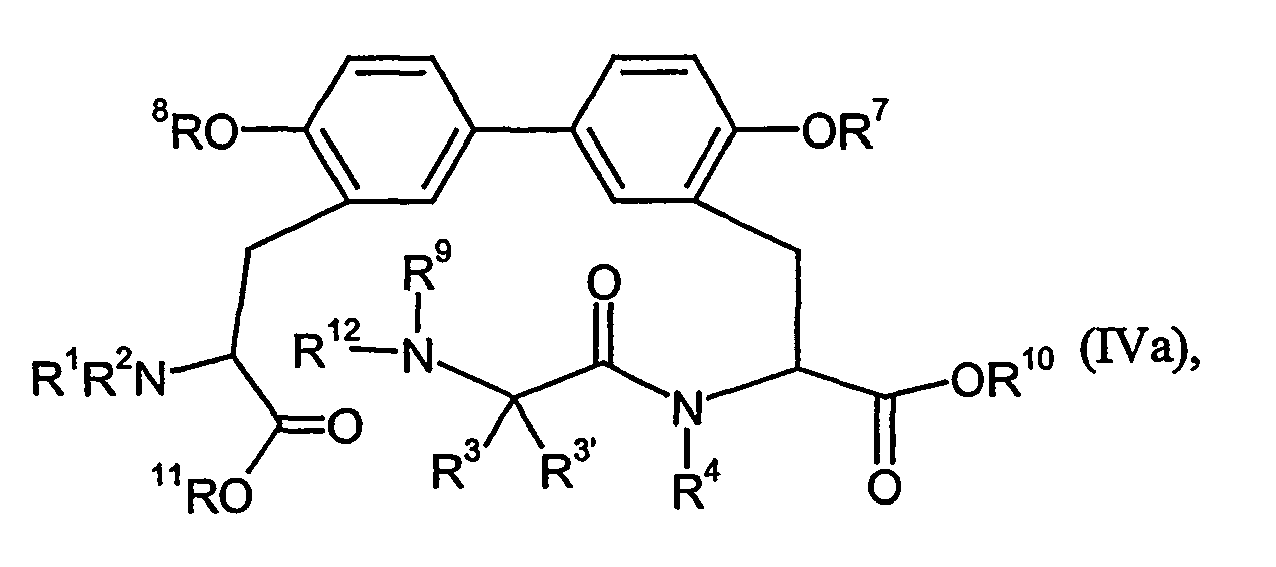
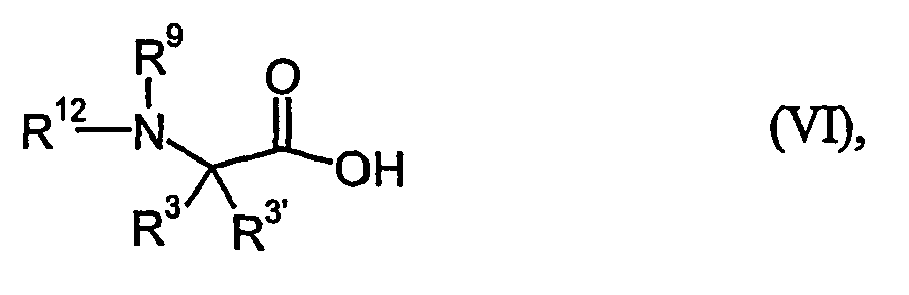


wird in der zweiten Stufe mit R2-X, worin R2 die oben angegebene Bedeutung hat und X für eine Abgangsgruppe steht, in Gegenwart einer Base in inerten Lösungsmitteln umgesetzt, gegebenenfalls in Gegenwart von Kaliumiodid, bevorzugt in einem Temperaturbereich von 0°C über Raumtemperatur bis zum Rückfluss der Lösungsmittel bei Normaldruck um. Bevorzugt für X sind Mesylat, Tosylat, Succinat oder Halogen, wobei für Halogen Chlor, Brom oder Iod bevorzugt ist.

Claims (21)
- Verbindung der Formel
 R1 gleich Wasserstoff, C1-C6-Alkyl, C6-C10-Aryl, 5- bis 10-gliedriges Heteroaryl, 4- bis 10-gliedriges Heterocyclyl, C1-C6-Alkylcarbonyl, C6-C10-Arylcarbonyl, 4- bis 10-gliedriges Heterocyclylcarbonyl, 5- bis 10-gliedriges Heteroarylcarbonyl, C1-C6-Alkoxycarbonyl, Aminocarbonyl, C1-C6-Alkylaminocarbonyl, C1-C6-Dialkylaminocarbonyl, C1-C6-Alkylsulfonyl, C6-C10-Arylsulfonyl, 4- bis 10-gliedriges Heterocyclylsulfonyl, 5- bis 10-gliedriges Heteroarylsulfonyl oder ein über die Carbonylgruppe der Aminosäure-Säurefunktion gebundener α-Aminosäurerest in der L- oder in der D-Konfiguration ist,
wobei R1 außer Wasserstoff substituiert sein kann mit 0, 1, 2 oder 3 Substituenten R1-1, wobei die Substituenten R1-1 unabhängig voneinander ausgewählt werden aus der Gruppe bestehend aus Halogen, C1-C6-Alkyl, Trifluormethyl, Trifluormethoxy, Nitro, Cyano, Amino, C1-C6-Alkylamino, C1-C6-Dialkylamino, C3-C8-Cycloalkyl, C6-C10-Aryl, 5- bis 10-gliedriges Heteroaryl, 4- bis 10-gliedriges Heterocyclyl, Hydroxy, C1-C6-Alkoxy und Carboxyl,R2 gleich Wasserstoff oder C1-C6-Alkyl ist,oder
wobei R2 außer Wasserstoff substituiert sein kann mit 0, 1, 2 oder 3 Substituenten R2-1, wobei die Substituenten R2-1 unabhängig voneinander ausgewählt werden aus der Gruppe bestehend aus Halogen, Amino, C1-C6-Alkylamino und C1-C6-Dialkylamino,R1 und R2 zusammen mit dem Stickstoffatom, an das sie gebunden sind, einen 4- bis 10-gliedrigen Heterocyclus bilden, der substituiert sein kann mit 0, 1 oder 2 Substituenten R1-2, wobei die Substituenten R1-2 unabhängig voneinander ausgewählt werden aus der Gruppe bestehend aus Halogen, Trifluormethyl, Amino, C1-C6-Alkylamino, C1-C6-Dialkylamino, C3-C8-Cycloalkyl, C6-C10-Aryl, 5- bis 10-gliedriges Heteroaryl, 4- bis 10-gliedriges Heterocyclyl, Hydroxy, C1-C6-Alkoxy, Carboxyl, C1-C6-Alkoxycarbonyl und Aminocarbonyl,R3 gleich Wasserstoff, C1-C6-Alkyl oder die Seitengruppe einer natürlich vorkommenden α-Aminosäure in der L- oder in der D-Konfiguration ist, worin Alkyl substituiert sein kann mit 0, 1, 2 oder 3 Substituenten R3-1, wobei die Substituenten R3-1 unabhängig voneinander ausgewählt werden aus der Gruppe bestehend aus Trifluormethyl, Nitro, Amino, C1-C6-Alkylamino, C1-C6-Dialkylamino, C3-C8-Cycloalkyl, C6-C10-Aryl, 5- bis 10-gliedriges Heteroaryl, 4- bis 10-gliedriges Heterocyclyl, Hydroxy, C1-C6-Alkoxy, Carboxyl, C1-C6-Alkoxycarbonyl, Aminocarbonyl, C1-C6-Alkylaminocarbonyl, C1-C6-Dialkylaminocarbonyl, Guanidino und Amidino,
worin Cycloalkyl, Aryl, Heteroaryl und Heterocyclyl substituiert sein können mit 0, 1 oder 2 Substituenten R3-2, wobei die Substituenten R32 unabhängig voneinander ausgewählt werden aus der Gruppe bestehend aus Halogen, C1-C6-Alkyl, Trifluormethyl und Amino,
und worin freie Aminogruppen in der Seitengruppe der Aminosäure mit C1-C6-Alkyl, C2-C6-Alkenyl, C2-C6-Alkinyl, C3-C8-Cycloalkyl, C6-C10-Aryl, 5- bis 10-gliedriges Heteroaryl, 4- bis 10-gliedriges Heterocyclyl, C1-C6-Alkylcarbonyl, C6-C10-Arylcarbonyl, 5- bis 10-gliedriges Heteroarylcarbonyl, 4- bis 10-gliedriges Hetero-cyclylcarbonyl, C1-C6-Alkoxycarbonyl, Aminocarbonyl, C1-C6-Alkyl-aminocarbonyl, C1-C6-Dialkylaminocarbonyl, C6-C10-Arylaminocarbonyl, C1-C6-Alkylsulfonyl, C6-C10-Arylsulfonyl, 4- bis 10-gliedriges Heterocyclylsulfonyl oder 5- bis 10-gliedriges Heteroarylsulfonyl substituiert sein können,R3' gleich Wasserstoff, C1-C6-Alkyl oder C3-C8-Cycloalkyl ist,R4 gleich Wasserstoff, C1-C6-Alkyl oder C3-C8-Cycloalkyl ist,R5 gleich Wasserstoff, C1-C6-Alkyl, C2-C6-Alkenyl, C3-C8-Cycloalkyl, C6-C10-Aryl, 5- bis 10-gliedriges Heteroaryl, 4- bis 10-gliedriges Heterocyclyl oder ein über die Aminogruppe der Aminosäure gebundener α-Aminosäurerest in der L- oder in der D-Konfiguration ist,
wobei R5 substituiert sein kann mit 0, 1, 2 oder 3 Substituenten R5-1, wobei die Substituenten R5-1 unabhängig voneinander ausgewählt werden aus der Gruppe bestehend aus Halogen, C1-C6-Alkyl, Trifluormethyl, Trifluormethoxy, Nitro, Cyano, Amino, C1-C6-Alkylamino, C1-C6-Dialkylamino, C3-C8-Cycloalkyl, C6-C10-Aryl, 5- bis 10-glied-riges Heteroaryl, 4- bis 10-gliedriges Heterocyclyl, Hydroxy, C1-C6-Alkoxy, Carboxyl, C1-C6-Alkoxycarbonyl, Aminocarbonyl, C1-C6-Alkylaminocarbonyl, C1-C6-Dialkylaminocarbonyl, Aminosulfonyl, C1-C6-Alkylaminosulfonyl, C1-C6-Dialkylaminosulfonyl, C6-C10-Arylaminosulfonyl, 4- bis 10-gliedriges Heterocyclylaminosulfonyl, 5-bis 10-gliedriges Heteroarylaminosulfonyl, Aminocarbonylamino, Hydroxycarbonylamino und C1-C6-Alkoxycarbonylamino,
worin Alkyl, Alkylamino, Dialkylamino, Cycloalkyl, Aryl, Heteroaryl und Heterocyclyl substituiert sein können mit 0, 1, 2 oder 3 Substituenten R5-2, wobei die Substituenten R5-2 unabhängig voneinander ausgewählt werden aus der Gruppe bestehend aus Hydroxy, Amino, Carboxyl und Aminocarbonyl,R6 gleich Wasserstoff, C1-C6-Alkyl oder C3-C8-Cycloalkyl ist,oderR5 und R6 zusammen mit dem Stickstoffatom, an das sie gebunden sind, einen 4- bis 10-gliedrigen Heterocyclus bilden, der substituiert sein kann mit 0, 1, 2 oder 3 Substituenten R5-6, wobei die Substituenten R5-6 unabhängig voneinander ausgewählt werden aus der Gruppe bestehend aus Halogen, C1-C6-Alkyl, Trifluormethyl, Nitro, Amino, C1-C6-Alkylamino, C1-C6-Dialkylamino, C3-C8-Cycloalkyl, C6-C10-Aryl, halogeniertes C6-C10-Aryl, 5- bis 10-gliedriges Heteroaryl, 4- bis 10-gliedriges Heterocyclyl, Hydroxy, C1-C6-Alkoxy, Carboxyl, C1-C6-Alkylcarbonyl, C1-C6-Alkoxycarbonyl, Aminocarbonyl, C1-C6-Alkylaminocarbonyl und C1-C6-Dialkylaminocarbonyl,R7 gleich Wasserstoff, C1-C6-Alkyl, C1-C6-Alkylcarbonyl oder C3-C8-Cycloalkyl ist,R8 gleich Wasserstoff oder C1-C6-Alkyl ist undR9 gleich Wasserstoff oder C1-C6-Alkyl istoder eines ihrer Salze, ihrer Solvate oder der Solvate ihrer Salze. - Verbindung nach Anspruch 1, dadurch gekennzeichnet, dass sie der Formel

- Verbindung nach Anspruch 1 oder 2, dadurch gekennzeichnet, dassR1 gleich Wasserstoff, C1-C6-Alkyl oder C1-C6-Alkylcarbonyl ist,R2 gleich Wasserstoff ist,R3 gleich C1-C6-Alkyl oder die Seitengruppe einer natürlich vorkommenden α-Aminosäure in der L- oder in der D-Konfiguration ist, worin Alkyl substituiert sein kann mit 0, 1, 2 oder 3 Substituenten R3-1, wobei die Substituenten R3-1 unabhängig voneinander ausgewählt werden aus der Gruppe bestehend aus Trifluormethyl, Nitro, Amino, C1-C6-Alkylamino, C1-C6-Dialkylamino, C3-C8-Cycloalkyl, C6-C10-Aryl, 5- bis 10-gliedriges Heteroaryl, 4- bis 10-gliedriges Heterocyclyl, Hydroxy, C1-C6-Alkoxy, Carboxyl, C1-C6-Alkoxycarbonyl, Aminocarbonyl, C1-C6-Alkylaminocarbonyl, C1-C6-Dialkylaminocarbonyl, Guanidino und Amidino,
worin Cycloalkyl, Aryl, Heteroaryl und Heterocyclyl substituiert sein können mit 0, 1 oder 2 Substituenten R3-2, wobei die Substituenten R32 unabhängig voneinander ausgewählt werden aus der Gruppe bestehend aus Halogen, C1-C6-Alkyl, Trifluormethyl und Amino,
und worin freie Aminogruppen in der Seitengruppe der Aminosäure mit C1-C6-Alkyl substituiert sein können,R3' gleich Wasserstoff, C1-C6-Alkyl oder C3-C8-Cycloalkyl ist,R4 gleich Wasserstoff, C1-C6-Alkyl oder C3-C8-Cycloalkyl ist,R5 gleich Wasserstoff, C1-C6-Alkyl, C2-C6-Alkenyl, C3-C8-Cycloalkyl, C6-C10-Aryl, 5- bis 10-gliedriges Heteroaryl, 4- bis 10-gliedriges Heterocyclyl oder ein über die Aminogruppe der Aminosäure gebundener α-Aminosäurerest in der L- oder in der D-Konfiguration ist,
wobei Alkyl, Alkenyl, Cycloalkyl, Aryl, Heteroaryl und Heterocyclyl substituiert sein können mit 0, 1, 2 oder 3 Substituenten R5-1, wobei die Substituenten R5-1 unabhängig voneinander ausgewählt werden aus der Gruppe bestehend aus Halogen, C1-C6-Alkyl, Trifluormethyl, Trifluormethoxy, Nitro, Cyano, Amino, C1-C6-Alkylamino, C1-C6-Dialkylamino, C3-C8-Cycloalkyl, C6-C10-Aryl, 5- bis 10-gliedriges Heteroaryl, 4- bis 10-gliedriges Heterocyclyl, Hydroxy, C1-C6-Alkoxy, Carboxyl, C1-C6-Alkoxycarbonyl, Aminocarbonyl, C1-C6-Alkylaminocarbonyl und C1-C6-Dialkylaminocarbonyl,
worin Alkyl, Alkylamino, Dialkylamino, Cycloalkyl, Aryl, Heteroaryl und Heterocyclyl substituiert sein können mit 0, 1, 2 oder 3 Substituenten R5-2, wobei die Substituenten R5-2 unabhängig voneinander ausgewählt werden aus der Gruppe bestehend aus Hydroxy, Amino, Carboxyl und Aminocarbonyl,R6 gleich Wasserstoff, C1-C6-Alkyl oder C3-C8-Cycloalkyl ist,oderR5 und R6 zusammen mit dem Stickstoffatom, an das sie gebunden sind, einen 4- bis 10-gliedrigen Heterocyclus bilden, der substituiert sein kann mit 0, 1, 2 oder 3 Substituenten R5-6, wobei die Substituenten R5-6 unabhängig voneinander ausgewählt werden aus der Gruppe bestehend aus Halogen, C1-C6-Alkyl, Amino, C1-C6-Alkylamino, C1-C6-Dialkylamino, Hydroxy, C1-C6-Alkoxy, Carboxyl, C1-C6-Alkoxycarbonyl, Aminocarbonyl, C1-C6-Alkylaminocarbonyl und C1-C6-Dialkylaminocarbonyl,R7 gleich Wasserstoff, C1-C6-Alkyl, C1-C6-Alkylcarbonyl oder C3-C8-Cycloalkyl ist,R8 gleich Wasserstoff ist,
undR9 gleich Wasserstoff ist. - Verbindung nach einem der Ansprüche 1 bis 3, dadurch gekennzeichnet, dassR1 gleich Wasserstoff ist,R2 gleich Wasserstoff ist,R3 gleich Aminocarbonylmethyl, 3-Aminoprop-1-yl, 2-Hydroxy-3-aminoprop-1-yl, 1-Hydroxy-3-aminoprop-1-yl, 3-Guanidinoprop-1-yl, 2-Aminocarbonyl-ethyl, 2-Hydroxycarbonylethyl, 4-Aminobut-1-yl, Hydroxymethyl, 2-Hydroxyethyl, 2-Aminoethyl, 4-Amino-3-hydroxybut-1-yl oder (1-Piperidin-3-yl)-methyl ist,R3' gleich Wasserstoff ist,R4 gleich Wasserstoff, Methyl, Ethyl, iso-Propyl oder Cyclopropyl ist,R5 gleich Wasserstoff, C1-C6-Alkyl oder C3-C8-Cycloalkyl ist,
wobei Alkyl und Cycloalkyl substituiert sein können mit 0, 1, 2 oder 3 Substituenten R5-1, wobei die Substituenten R5-1 unabhängig voneinander ausgewählt werden aus der Gruppe bestehend aus Halogen, C1-C6-Alkyl, Trifluormethyl, Trifluormethoxy, Amino, C1-C6-Alkylamino, C1-C6-Dialkylamino, C3-C8-Cycloalkyl, C6-C10-Aryl, 5- bis 10-gliedriges Heteroaryl, 5- bis 7-gliedriges Heterocyclyl, Hydroxy, C1-C6-Alkoxy, Carboxyl, C1-C6-Alkoxycarbonyl, Aminocarbonyl, C1-C6-Alkylaminocarbonyl und C1-C6-Dialkylaminocarbonyl,R6 gleich Wasserstoff oder Methyl ist,oderR5 und R6 zusammen mit dem Stickstoffatom, an das sie gebunden sind, ein Piperidinyl oder Morpholinyl bilden,R7 gleich Wasserstoff ist,R8 gleich Wasserstoff ist,
undR9 gleich Wasserstoff ist. - Verbindung nach einem der Ansprüche 1 bis 4, dadurch gekennzeichnet, dassR1 gleich Wasserstoff ist,R2 gleich Wasserstoff ist,R3 gleich 3-Aminoprop-1-yl oder 2-Hydroxy-3-aminoprop-1-yl ist,R3' gleich Wasserstoff ist,R4 gleich Wasserstoff oder Methyl ist,R5 gleich Wasserstoff, C1-C6-Alkyl oder Cyclopropyl ist,
wobei Alkyl substituiert sein kann mit 0, 1, 2 oder 3 Substituenten R5-1, wobei die Substituenten R5-1 unabhängig voneinander ausgewählt werden aus der Gruppe bestehend aus Trifluormethyl, Amino, Hydroxy, Carboxyl, Aminocarbonyl und Phenyl,R6 gleich Wasserstoff oder Methyl ist,R7 gleich Wasserstoff ist,R8 gleich Wasserstoff ist,
undR9 gleich Wasserstoff ist. - Verbindung nach einem der Ansprüche 1 bis 3, dadurch gekennzeichnet, dass R1 gleich Wasserstoff ist.
- Verbindung nach einem der Ansprüche 1, 2 und 6, dadurch gekennzeichnet, dass R2 gleich Wasserstoff ist.
- Verbindung nach einem der Ansprüche 1 bis 4, 6 und 7, dadurch gekennzeichnet, dass R3 gleich 3-Aminoprop-1-yl oder 2-Hydroxy-3-aminoprop-1-yl ist.
- Verbindung nach einem der Ansprüche 1 bis 3 oder 6 bis 8, dadurch gekennzeichnet, dass R3' gleich Wasserstoff ist.
- Verbindung nach einem der Ansprüche 1 bis 4 oder 6 bis 9, dadurch gekennzeichnet, dass R4 gleich Wasserstoff oder Methyl.
- Verbindung nach einem der Ansprüche 1 bis 4 oder 6 bis 10, dadurch gekennzeichnet, dassR5 gleich Wasserstoff, C1-C6-Alkyl oder Cyclopropyl ist,
wobei Alkyl substituiert sein kann mit 0, 1, 2 oder 3 Substituenten R5-1, wobei die Substituenten R5-1 unabhängig voneinander ausgewählt werden aus der Gruppe bestehend aus Trifluormethyl, Amino, Hydroxy, Carboxyl, Aminocarbonyl und Phenyl. - Verbindung nach einem der Ansprüche 1 bis 3 oder 6 bis 11, dadurch gekennzeichnet, dass R6 gleich Wasserstoff oder Methyl ist.
- Verbindung nach einem der Ansprüche 1 bis 4 oder 6 bis 12, dadurch gekennzeichnet, dass R5 und R6 zusammen mit dem Stickstoffatom, an das sie gebunden sind, ein Piperidinyl oder Morpholinyl bilden.
- Verbindung nach einem der Ansprüche 1 bis 3 oder 6 bis 13, dadurch gekennzeichnet, dass R7 gleich Wasserstoff ist.
- Verbindung nach einem der Ansprüche 1, 2, 6 bis 14, dadurch gekennzeichnet, dass R8 gleich Wasserstoff ist.
- Verbindung nach einem der Ansprüche 1, 2, 6 bis 15, dadurch gekennzeichnet, dass R9 gleich Wasserstoff ist.
- Verfahren zur Herstellung einer Verbindung der Formel (I) nach Anspruch 1, dadurch gekennzeichnet, dass eine Verbindung der Formel

mit einer Verbindung der Formel
H-NR5R6 (III),
worin R5 und R6 die in Anspruch 1 angegebene Bedeutung haben, umgesetzt wird. - Verbindung nach einem der Ansprüche 1 bis 16 zur Behandlung und/oder Prophylaxe von Krankheiten.
- Arzneimittel enthaltend mindestens eine Verbindung nach einem der Ansprüche 1 bis 16 in Kombination mit mindestens einem pharmazeutisch verträglichen, pharmazeutisch unbedenklichen Träger oder sonstigen Exzipienten.
- Verwendung einer Verbindung nach einem der Ansprüche 1 bis 16 zur Herstellung eines Arzneimittels zur Behandlung und/oder Prophylaxe von bakteriellen Erkrankungen.
- Arzneimittel nach Anspruch 19 zur Behandlung und/oder Prophylaxe von bakteriellen Infektionen.
Applications Claiming Priority (3)
| Application Number | Priority Date | Filing Date | Title |
|---|---|---|---|
| DE10226921A DE10226921A1 (de) | 2002-06-17 | 2002-06-17 | Antibakterielle Amid-Makrozyklen |
| DE10226921 | 2002-06-17 | ||
| PCT/EP2003/006078 WO2003106480A1 (de) | 2002-06-17 | 2003-06-10 | Antibakterielle amid-makrozyklen |
Publications (2)
| Publication Number | Publication Date |
|---|---|
| EP1515983A1 EP1515983A1 (de) | 2005-03-23 |
| EP1515983B1 true EP1515983B1 (de) | 2007-02-21 |
Family
ID=29594575
Family Applications (1)
| Application Number | Title | Priority Date | Filing Date |
|---|---|---|---|
| EP03738012A Expired - Lifetime EP1515983B1 (de) | 2002-06-17 | 2003-06-10 | Antibakterielle amid-makrozyklen |
Country Status (21)
| Country | Link |
|---|---|
| US (1) | US20070129288A1 (de) |
| EP (1) | EP1515983B1 (de) |
| JP (1) | JP4437078B2 (de) |
| KR (1) | KR20050010060A (de) |
| CN (1) | CN1326870C (de) |
| AT (1) | ATE354585T1 (de) |
| AU (1) | AU2003245928B2 (de) |
| BR (1) | BR0311948A (de) |
| CA (1) | CA2489454A1 (de) |
| DE (2) | DE10226921A1 (de) |
| EC (1) | ECSP045499A (de) |
| ES (1) | ES2282643T3 (de) |
| HR (1) | HRP20050043A2 (de) |
| MA (1) | MA28613B1 (de) |
| MX (1) | MXPA04012438A (de) |
| NO (1) | NO20050210L (de) |
| PL (1) | PL374554A1 (de) |
| PT (1) | PT1515983E (de) |
| RU (1) | RU2005100954A (de) |
| WO (1) | WO2003106480A1 (de) |
| ZA (1) | ZA200410006B (de) |
Families Citing this family (22)
| Publication number | Priority date | Publication date | Assignee | Title |
|---|---|---|---|---|
| EP2210612B1 (de) | 2003-06-18 | 2016-10-05 | Ocera Therapeutics, Inc. | Makrozyklische Motilin Rezeptorantagonisten |
| CA2540646A1 (en) * | 2003-10-01 | 2005-04-14 | Bayer Healthcare Ag | Antibacterial amide macrocycles |
| DE10358824A1 (de) * | 2003-12-16 | 2005-07-21 | Bayer Healthcare Ag | Antibakterielle Makrozyklen mit substituiertem Biphenyl |
| DE102004018405A1 (de) * | 2004-04-16 | 2005-11-03 | Bayer Healthcare Ag | Antibakterielle Amid-Makrozyklen II |
| DE102004025731A1 (de) * | 2004-05-26 | 2005-12-15 | Bayer Healthcare Ag | Antibakterielle Amid-Makrozyklen III |
| DE102005014240A1 (de) * | 2004-09-24 | 2006-03-30 | Bayer Healthcare Ag | Antibakterielle Amid-Makrozyklen IV |
| DE102005014247A1 (de) * | 2005-03-30 | 2006-10-05 | Aicuris Gmbh & Co. Kg | Antibakterielle Amid-Makrozyklen VI |
| DE102005014245A1 (de) * | 2005-03-30 | 2006-10-05 | Aicuris Gmbh & Co. Kg | Antibakterielle Amid-Makrozyklen V |
| DE102005032781A1 (de) * | 2005-07-14 | 2007-01-18 | Aicuris Gmbh & Co. Kg | Antibakterielle Amid-Markozyklen VII |
| UA96936C2 (uk) * | 2005-12-29 | 2011-12-26 | Лексикон Фармасьютикалз, Инк. | Поліциклічні похідні амінокислот і їх застосування |
| JP2012510958A (ja) * | 2008-12-04 | 2012-05-17 | バイエル ファーマ アクチエンゲゼルシャフト | 放射性同位体で標識されたリジン及びオルニチン誘導体、それらの使用及び製造方法 |
| US10501493B2 (en) | 2011-05-27 | 2019-12-10 | Rqx Pharmaceuticals, Inc. | Broad spectrum antibiotics |
| CN104903302B (zh) * | 2012-11-21 | 2019-03-29 | 阿奇克斯制药公司 | 大环广谱抗生素 |
| JP5437525B1 (ja) * | 2012-12-28 | 2014-03-12 | 株式会社ナード研究所 | チロシン誘導体およびチロシン誘導体の製造方法 |
| MX2016015218A (es) | 2014-05-20 | 2017-07-04 | Genentech Inc | Antibioticos macrociclicos de amplio espectro. |
| US10118890B2 (en) | 2014-10-10 | 2018-11-06 | The Research Foundation For The State University Of New York | Trifluoromethoxylation of arenes via intramolecular trifluoromethoxy group migration |
| PE20180796A1 (es) | 2015-10-27 | 2018-05-09 | Hoffmann La Roche | Macrociclos peptidicos contra acinetobacter baumannii |
| MX387476B (es) | 2015-11-20 | 2025-03-18 | Rqx Pharmaceuticals Inc | Antibióticos de amplio espectro macrocíclico. |
| EP3388444A1 (de) | 2017-04-10 | 2018-10-17 | F. Hoffmann-La Roche AG | Antibakterielle peptidmakrozyklen und verwendung davon |
| US11505573B2 (en) | 2018-03-28 | 2022-11-22 | Hoffmann-La Roche Inc. | Peptide macrocycles against Acinetobacter baumannii |
| US11819532B2 (en) | 2018-04-23 | 2023-11-21 | Hoffmann-La Roche Inc. | Peptide macrocycles against Acinetobacter baumannii |
| CA3141853A1 (en) | 2019-05-28 | 2020-12-03 | F. Hoffmann-La Roche Ag | Macrocyclic broad spectrum antibiotics |
Family Cites Families (6)
| Publication number | Priority date | Publication date | Assignee | Title |
|---|---|---|---|---|
| US3452136A (en) * | 1968-04-17 | 1969-06-24 | American Cyanamid Co | Antibiotic af283 and production thereof |
| FR2720066B1 (fr) * | 1994-05-20 | 1996-06-28 | Rhone Poulenc Rorer Sa | Peptides antagonistes de la neurotensine. |
| DE10234422A1 (de) * | 2002-07-29 | 2004-02-12 | Bayer Ag | Antibakterielle Ester-Makrozyklen |
| CA2540646A1 (en) * | 2003-10-01 | 2005-04-14 | Bayer Healthcare Ag | Antibacterial amide macrocycles |
| DE10358824A1 (de) * | 2003-12-16 | 2005-07-21 | Bayer Healthcare Ag | Antibakterielle Makrozyklen mit substituiertem Biphenyl |
| DE102005014240A1 (de) * | 2004-09-24 | 2006-03-30 | Bayer Healthcare Ag | Antibakterielle Amid-Makrozyklen IV |
-
2002
- 2002-06-17 DE DE10226921A patent/DE10226921A1/de not_active Withdrawn
-
2003
- 2003-06-10 JP JP2004513311A patent/JP4437078B2/ja not_active Expired - Fee Related
- 2003-06-10 AU AU2003245928A patent/AU2003245928B2/en not_active Ceased
- 2003-06-10 CN CNB038192144A patent/CN1326870C/zh not_active Expired - Fee Related
- 2003-06-10 KR KR10-2004-7020473A patent/KR20050010060A/ko not_active Abandoned
- 2003-06-10 US US10/518,600 patent/US20070129288A1/en not_active Abandoned
- 2003-06-10 HR HR20050043A patent/HRP20050043A2/hr not_active Application Discontinuation
- 2003-06-10 EP EP03738012A patent/EP1515983B1/de not_active Expired - Lifetime
- 2003-06-10 DE DE50306587T patent/DE50306587D1/de not_active Expired - Lifetime
- 2003-06-10 MX MXPA04012438A patent/MXPA04012438A/es active IP Right Grant
- 2003-06-10 PL PL03374554A patent/PL374554A1/xx not_active IP Right Cessation
- 2003-06-10 ES ES03738012T patent/ES2282643T3/es not_active Expired - Lifetime
- 2003-06-10 PT PT03738012T patent/PT1515983E/pt unknown
- 2003-06-10 WO PCT/EP2003/006078 patent/WO2003106480A1/de not_active Ceased
- 2003-06-10 AT AT03738012T patent/ATE354585T1/de not_active IP Right Cessation
- 2003-06-10 CA CA002489454A patent/CA2489454A1/en not_active Abandoned
- 2003-06-10 BR BR0311948-3A patent/BR0311948A/pt not_active IP Right Cessation
- 2003-06-10 RU RU2005100954/04A patent/RU2005100954A/ru not_active Application Discontinuation
-
2004
- 2004-12-10 ZA ZA200410006A patent/ZA200410006B/xx unknown
- 2004-12-15 MA MA28006A patent/MA28613B1/fr unknown
- 2004-12-17 EC EC2004005499A patent/ECSP045499A/es unknown
-
2005
- 2005-01-13 NO NO20050210A patent/NO20050210L/no not_active Application Discontinuation
Also Published As
| Publication number | Publication date |
|---|---|
| WO2003106480A1 (de) | 2003-12-24 |
| BR0311948A (pt) | 2005-03-29 |
| EP1515983A1 (de) | 2005-03-23 |
| NO20050210L (no) | 2005-03-01 |
| CA2489454A1 (en) | 2004-12-14 |
| CN1326870C (zh) | 2007-07-18 |
| HK1083511A1 (zh) | 2006-07-07 |
| MA28613B1 (fr) | 2007-06-01 |
| JP4437078B2 (ja) | 2010-03-24 |
| ES2282643T3 (es) | 2007-10-16 |
| ECSP045499A (es) | 2005-03-10 |
| RU2005100954A (ru) | 2005-07-10 |
| PL374554A1 (en) | 2005-10-31 |
| DE10226921A1 (de) | 2003-12-24 |
| AU2003245928A1 (en) | 2003-12-31 |
| JP2006511446A (ja) | 2006-04-06 |
| US20070129288A1 (en) | 2007-06-07 |
| DE50306587D1 (de) | 2007-04-05 |
| CN1675236A (zh) | 2005-09-28 |
| ZA200410006B (en) | 2006-02-22 |
| KR20050010060A (ko) | 2005-01-26 |
| MXPA04012438A (es) | 2005-04-19 |
| AU2003245928B2 (en) | 2009-03-05 |
| HRP20050043A2 (hr) | 2006-04-30 |
| ATE354585T1 (de) | 2007-03-15 |
| PT1515983E (pt) | 2007-03-30 |
Similar Documents
| Publication | Publication Date | Title |
|---|---|---|
| EP1515983B1 (de) | Antibakterielle amid-makrozyklen | |
| EP1526896A1 (de) | Antibakterielle ester-makrozyklen | |
| EP1697400B1 (de) | Antibakterielle makrozyklen mit substituiertem biphenyl | |
| EP1869068A1 (de) | Antibakterielle amid-makrozyklen v | |
| WO2005033129A1 (de) | Antibakterielle amid-makrozyklen | |
| EP1797110B1 (de) | Antibakterielle amid-makrozyklen iv | |
| EP1430075B1 (de) | Antibakterielle makrozyklen | |
| EP1866291B1 (de) | Antibakterielle amid-makrozyklen vi | |
| DE102004025731A1 (de) | Antibakterielle Amid-Makrozyklen III | |
| IL165630A (en) | Antibacterial amide macrocycles | |
| HK1083511B (en) | Antibacterial amide macrocycles | |
| DE102004018405A1 (de) | Antibakterielle Amid-Makrozyklen II | |
| EP1907413A2 (de) | Antibakterielle amid-makrozyklen vii | |
| DE10164147A1 (de) | Antibakterielle Makrozyklen |
Legal Events
| Date | Code | Title | Description |
|---|---|---|---|
| PUAI | Public reference made under article 153(3) epc to a published international application that has entered the european phase |
Free format text: ORIGINAL CODE: 0009012 |
|
| 17P | Request for examination filed |
Effective date: 20050117 |
|
| AK | Designated contracting states |
Kind code of ref document: A1 Designated state(s): AT BE BG CH CY CZ DE DK EE ES FI FR GB GR HU IE IT LI LU MC NL PT RO SE SI SK TR |
|
| AX | Request for extension of the european patent |
Extension state: AL LT LV MK |
|
| 17Q | First examination report despatched |
Effective date: 20050511 |
|
| RAX | Requested extension states of the european patent have changed |
Extension state: LV Payment date: 20050117 Extension state: LT Payment date: 20050117 |
|
| RIN1 | Information on inventor provided before grant (corrected) |
Inventor name: WEIGAND, STEFAN Inventor name: MICHELS, MARTIN Inventor name: SCHUMACHER, ANDREAS Inventor name: SCHIFFER, GUIDO Inventor name: RUDOLPH, JOACHIM Inventor name: RADDATZ, SIEGFRIED Inventor name: KROLL, HEIN-PETER Inventor name: EHLERT, KERSTIN Inventor name: ENDERMANN, RAINER Inventor name: BRUNNER, NINA Inventor name: BEYER, DIETER Inventor name: ADELT, ISABELLE Inventor name: LAMPE, THOMAS Inventor name: CANCHO-GRANDE, YOLANDA Inventor name: VON NUSSBAUM, FRANZ |
|
| RAP1 | Party data changed (applicant data changed or rights of an application transferred) |
Owner name: AICURIS GMBH & CO. KG |
|
| GRAP | Despatch of communication of intention to grant a patent |
Free format text: ORIGINAL CODE: EPIDOSNIGR1 |
|
| GRAS | Grant fee paid |
Free format text: ORIGINAL CODE: EPIDOSNIGR3 |
|
| GRAA | (expected) grant |
Free format text: ORIGINAL CODE: 0009210 |
|
| AK | Designated contracting states |
Kind code of ref document: B1 Designated state(s): AT BE BG CH CY CZ DE DK EE ES FI FR GB GR HU IE IT LI LU MC NL PT RO SE SI SK TR |
|
| AX | Request for extension of the european patent |
Extension state: LT LV |
|
| PG25 | Lapsed in a contracting state [announced via postgrant information from national office to epo] |
Ref country code: SI Free format text: LAPSE BECAUSE OF FAILURE TO SUBMIT A TRANSLATION OF THE DESCRIPTION OR TO PAY THE FEE WITHIN THE PRESCRIBED TIME-LIMIT Effective date: 20070221 Ref country code: NL Free format text: LAPSE BECAUSE OF FAILURE TO SUBMIT A TRANSLATION OF THE DESCRIPTION OR TO PAY THE FEE WITHIN THE PRESCRIBED TIME-LIMIT Effective date: 20070221 Ref country code: DK Free format text: LAPSE BECAUSE OF FAILURE TO SUBMIT A TRANSLATION OF THE DESCRIPTION OR TO PAY THE FEE WITHIN THE PRESCRIBED TIME-LIMIT Effective date: 20070221 Ref country code: FI Free format text: LAPSE BECAUSE OF FAILURE TO SUBMIT A TRANSLATION OF THE DESCRIPTION OR TO PAY THE FEE WITHIN THE PRESCRIBED TIME-LIMIT Effective date: 20070221 |
|
| REG | Reference to a national code |
Ref country code: GB Ref legal event code: FG4D Free format text: NOT ENGLISH |
|
| REG | Reference to a national code |
Ref country code: CH Ref legal event code: NV Representative=s name: E. BLUM & CO. AG PATENT- UND MARKENANWAELTE VSP Ref country code: CH Ref legal event code: EP |
|
| REG | Reference to a national code |
Ref country code: PT Ref legal event code: SC4A Free format text: AVAILABILITY OF NATIONAL TRANSLATION Effective date: 20070316 |
|
| REF | Corresponds to: |
Ref document number: 50306587 Country of ref document: DE Date of ref document: 20070405 Kind code of ref document: P |
|
| RIN2 | Information on inventor provided after grant (corrected) |
Inventor name: WEIGANG, STEFAN Inventor name: MICHELS, MARTIN Inventor name: SCHUMACHER, ANDREAS Inventor name: SCHIFFER, GUIDO Inventor name: RUDOLPH, JOACHIM Inventor name: VON NUSSBAUM, FRANZ Inventor name: EHLERT, KERSTIN Inventor name: ENDERMANN, RAINER Inventor name: BRUNNER, NINA Inventor name: BEYER, DIETER Inventor name: ADELT, ISABELLE Inventor name: LAMPE, THOMAS Inventor name: CANCHO-GRANDE, YOLANDA Inventor name: RADDATZ, SIEGFRIED Inventor name: KROLL, HEIN-PETER |
|
| REG | Reference to a national code |
Ref country code: IE Ref legal event code: FG4D Free format text: LANGUAGE OF EP DOCUMENT: GERMAN |
|
| RAP2 | Party data changed (patent owner data changed or rights of a patent transferred) |
Owner name: AICURIS GMBH & CO. KG |
|
| PG25 | Lapsed in a contracting state [announced via postgrant information from national office to epo] |
Ref country code: SE Free format text: LAPSE BECAUSE OF FAILURE TO SUBMIT A TRANSLATION OF THE DESCRIPTION OR TO PAY THE FEE WITHIN THE PRESCRIBED TIME-LIMIT Effective date: 20070521 |
|
| PG25 | Lapsed in a contracting state [announced via postgrant information from national office to epo] |
Ref country code: BG Free format text: LAPSE BECAUSE OF EXPIRATION OF PROTECTION Effective date: 20070522 |
|
| GBT | Gb: translation of ep patent filed (gb section 77(6)(a)/1977) |
Effective date: 20070518 |
|
| NLT2 | Nl: modifications (of names), taken from the european patent patent bulletin |
Owner name: AICURIS GMBH & CO. KG Effective date: 20070502 |
|
| LTIE | Lt: invalidation of european patent or patent extension |
Effective date: 20070221 |
|
| NLV1 | Nl: lapsed or annulled due to failure to fulfill the requirements of art. 29p and 29m of the patents act | ||
| ET | Fr: translation filed | ||
| REG | Reference to a national code |
Ref country code: ES Ref legal event code: FG2A Ref document number: 2282643 Country of ref document: ES Kind code of ref document: T3 |
|
| PG25 | Lapsed in a contracting state [announced via postgrant information from national office to epo] |
Ref country code: SK Free format text: LAPSE BECAUSE OF FAILURE TO SUBMIT A TRANSLATION OF THE DESCRIPTION OR TO PAY THE FEE WITHIN THE PRESCRIBED TIME-LIMIT Effective date: 20070221 |
|
| PLBE | No opposition filed within time limit |
Free format text: ORIGINAL CODE: 0009261 |
|
| STAA | Information on the status of an ep patent application or granted ep patent |
Free format text: STATUS: NO OPPOSITION FILED WITHIN TIME LIMIT |
|
| PG25 | Lapsed in a contracting state [announced via postgrant information from national office to epo] |
Ref country code: CZ Free format text: LAPSE BECAUSE OF FAILURE TO SUBMIT A TRANSLATION OF THE DESCRIPTION OR TO PAY THE FEE WITHIN THE PRESCRIBED TIME-LIMIT Effective date: 20070221 Ref country code: RO Free format text: LAPSE BECAUSE OF FAILURE TO SUBMIT A TRANSLATION OF THE DESCRIPTION OR TO PAY THE FEE WITHIN THE PRESCRIBED TIME-LIMIT Effective date: 20070221 |
|
| 26N | No opposition filed |
Effective date: 20071122 |
|
| PG25 | Lapsed in a contracting state [announced via postgrant information from national office to epo] |
Ref country code: MC Free format text: LAPSE BECAUSE OF NON-PAYMENT OF DUE FEES Effective date: 20070630 |
|
| PG25 | Lapsed in a contracting state [announced via postgrant information from national office to epo] |
Ref country code: GR Free format text: LAPSE BECAUSE OF FAILURE TO SUBMIT A TRANSLATION OF THE DESCRIPTION OR TO PAY THE FEE WITHIN THE PRESCRIBED TIME-LIMIT Effective date: 20070522 |
|
| PG25 | Lapsed in a contracting state [announced via postgrant information from national office to epo] |
Ref country code: EE Free format text: LAPSE BECAUSE OF FAILURE TO SUBMIT A TRANSLATION OF THE DESCRIPTION OR TO PAY THE FEE WITHIN THE PRESCRIBED TIME-LIMIT Effective date: 20070221 |
|
| PG25 | Lapsed in a contracting state [announced via postgrant information from national office to epo] |
Ref country code: CY Free format text: LAPSE BECAUSE OF FAILURE TO SUBMIT A TRANSLATION OF THE DESCRIPTION OR TO PAY THE FEE WITHIN THE PRESCRIBED TIME-LIMIT Effective date: 20070221 |
|
| PG25 | Lapsed in a contracting state [announced via postgrant information from national office to epo] |
Ref country code: LU Free format text: LAPSE BECAUSE OF NON-PAYMENT OF DUE FEES Effective date: 20070610 |
|
| PG25 | Lapsed in a contracting state [announced via postgrant information from national office to epo] |
Ref country code: TR Free format text: LAPSE BECAUSE OF FAILURE TO SUBMIT A TRANSLATION OF THE DESCRIPTION OR TO PAY THE FEE WITHIN THE PRESCRIBED TIME-LIMIT Effective date: 20070221 Ref country code: HU Free format text: LAPSE BECAUSE OF FAILURE TO SUBMIT A TRANSLATION OF THE DESCRIPTION OR TO PAY THE FEE WITHIN THE PRESCRIBED TIME-LIMIT Effective date: 20070822 |
|
| PGFP | Annual fee paid to national office [announced via postgrant information from national office to epo] |
Ref country code: ES Payment date: 20100625 Year of fee payment: 8 Ref country code: FR Payment date: 20100706 Year of fee payment: 8 Ref country code: IE Payment date: 20100618 Year of fee payment: 8 Ref country code: PT Payment date: 20100601 Year of fee payment: 8 |
|
| PGFP | Annual fee paid to national office [announced via postgrant information from national office to epo] |
Ref country code: AT Payment date: 20100614 Year of fee payment: 8 Ref country code: IT Payment date: 20100621 Year of fee payment: 8 |
|
| PGFP | Annual fee paid to national office [announced via postgrant information from national office to epo] |
Ref country code: BE Payment date: 20100611 Year of fee payment: 8 Ref country code: CH Payment date: 20100623 Year of fee payment: 8 |
|
| PGFP | Annual fee paid to national office [announced via postgrant information from national office to epo] |
Ref country code: DE Payment date: 20100723 Year of fee payment: 8 Ref country code: GB Payment date: 20100618 Year of fee payment: 8 |
|
| REG | Reference to a national code |
Ref country code: DE Ref legal event code: R231 Ref document number: 50306587 Country of ref document: DE |
|
| REG | Reference to a national code |
Ref country code: PT Ref legal event code: MM4A Free format text: LAPSE DUE TO NON-PAYMENT OF FEES Effective date: 20111212 |
|
| BERE | Be: lapsed |
Owner name: AICURIS G.M.B.H. & CO. KG Effective date: 20110630 |
|
| PG25 | Lapsed in a contracting state [announced via postgrant information from national office to epo] |
Ref country code: PT Free format text: LAPSE BECAUSE OF NON-PAYMENT OF DUE FEES Effective date: 20111212 |
|
| REG | Reference to a national code |
Ref country code: CH Ref legal event code: PL |
|
| GBPC | Gb: european patent ceased through non-payment of renewal fee |
Effective date: 20110610 |
|
| PG25 | Lapsed in a contracting state [announced via postgrant information from national office to epo] |
Ref country code: IT Free format text: LAPSE BECAUSE OF NON-PAYMENT OF DUE FEES Effective date: 20110610 Ref country code: AT Free format text: LAPSE BECAUSE OF NON-PAYMENT OF DUE FEES Effective date: 20110610 |
|
| REG | Reference to a national code |
Ref country code: AT Ref legal event code: MM01 Ref document number: 354585 Country of ref document: AT Kind code of ref document: T Effective date: 20110610 |
|
| REG | Reference to a national code |
Ref country code: FR Ref legal event code: ST Effective date: 20120229 |
|
| REG | Reference to a national code |
Ref country code: IE Ref legal event code: MM4A |
|
| PG25 | Lapsed in a contracting state [announced via postgrant information from national office to epo] |
Ref country code: BE Free format text: LAPSE BECAUSE OF NON-PAYMENT OF DUE FEES Effective date: 20110630 |
|
| PG25 | Lapsed in a contracting state [announced via postgrant information from national office to epo] |
Ref country code: LI Free format text: LAPSE BECAUSE OF NON-PAYMENT OF DUE FEES Effective date: 20110630 Ref country code: IE Free format text: LAPSE BECAUSE OF NON-PAYMENT OF DUE FEES Effective date: 20110610 Ref country code: FR Free format text: LAPSE BECAUSE OF NON-PAYMENT OF DUE FEES Effective date: 20110630 Ref country code: CH Free format text: LAPSE BECAUSE OF NON-PAYMENT OF DUE FEES Effective date: 20110630 |
|
| PG25 | Lapsed in a contracting state [announced via postgrant information from national office to epo] |
Ref country code: GB Free format text: LAPSE BECAUSE OF NON-PAYMENT OF DUE FEES Effective date: 20110610 |
|
| REG | Reference to a national code |
Ref country code: ES Ref legal event code: FD2A Effective date: 20130606 |
|
| PG25 | Lapsed in a contracting state [announced via postgrant information from national office to epo] |
Ref country code: DE Free format text: LAPSE BECAUSE OF THE APPLICANT RENOUNCES Effective date: 20110628 |
|
| PG25 | Lapsed in a contracting state [announced via postgrant information from national office to epo] |
Ref country code: ES Free format text: LAPSE BECAUSE OF NON-PAYMENT OF DUE FEES Effective date: 20110611 |