EP1514116B1 - Oxaliplatin-antiresistenzverfahren - Google Patents
Oxaliplatin-antiresistenzverfahren Download PDFInfo
- Publication number
- EP1514116B1 EP1514116B1 EP03760054A EP03760054A EP1514116B1 EP 1514116 B1 EP1514116 B1 EP 1514116B1 EP 03760054 A EP03760054 A EP 03760054A EP 03760054 A EP03760054 A EP 03760054A EP 1514116 B1 EP1514116 B1 EP 1514116B1
- Authority
- EP
- European Patent Office
- Prior art keywords
- oxaliplatin
- resistance
- cancer
- mitochondrial apoptosis
- apoptosis
- Prior art date
- Legal status (The legal status is an assumption and is not a legal conclusion. Google has not performed a legal analysis and makes no representation as to the accuracy of the status listed.)
- Expired - Lifetime
Links
Images


Classifications
-
- G—PHYSICS
- G01—MEASURING; TESTING
- G01N—INVESTIGATING OR ANALYSING MATERIALS BY DETERMINING THEIR CHEMICAL OR PHYSICAL PROPERTIES
- G01N33/00—Investigating or analysing materials by specific methods not covered by groups G01N1/00 - G01N31/00
- G01N33/48—Biological material, e.g. blood, urine; Haemocytometers
- G01N33/50—Chemical analysis of biological material, e.g. blood, urine; Testing involving biospecific ligand binding methods; Immunological testing
- G01N33/53—Immunoassay; Biospecific binding assay; Materials therefor
- G01N33/575—Immunoassay; Biospecific binding assay; Materials therefor for cancer
- G01N33/57535—Immunoassay; Biospecific binding assay; Materials therefor for cancer of the large intestine, e.g. colon, rectum or anus
-
- A—HUMAN NECESSITIES
- A61—MEDICAL OR VETERINARY SCIENCE; HYGIENE
- A61K—PREPARATIONS FOR MEDICAL, DENTAL OR TOILETRY PURPOSES
- A61K31/00—Medicinal preparations containing organic active ingredients
- A61K31/28—Compounds containing heavy metals
- A61K31/282—Platinum compounds
-
- A—HUMAN NECESSITIES
- A61—MEDICAL OR VETERINARY SCIENCE; HYGIENE
- A61K—PREPARATIONS FOR MEDICAL, DENTAL OR TOILETRY PURPOSES
- A61K38/00—Medicinal preparations containing peptides
- A61K38/16—Peptides having more than 20 amino acids; Gastrins; Somatostatins; Melanotropins; Derivatives thereof
- A61K38/17—Peptides having more than 20 amino acids; Gastrins; Somatostatins; Melanotropins; Derivatives thereof from animals; from humans
- A61K38/19—Cytokines; Lymphokines; Interferons
- A61K38/191—Tumor necrosis factors [TNF], e.g. lymphotoxin [LT], i.e. TNF-beta
-
- A—HUMAN NECESSITIES
- A61—MEDICAL OR VETERINARY SCIENCE; HYGIENE
- A61P—SPECIFIC THERAPEUTIC ACTIVITY OF CHEMICAL COMPOUNDS OR MEDICINAL PREPARATIONS
- A61P35/00—Antineoplastic agents
-
- A—HUMAN NECESSITIES
- A61—MEDICAL OR VETERINARY SCIENCE; HYGIENE
- A61P—SPECIFIC THERAPEUTIC ACTIVITY OF CHEMICAL COMPOUNDS OR MEDICINAL PREPARATIONS
- A61P43/00—Drugs for specific purposes, not provided for in groups A61P1/00-A61P41/00
Definitions
- the invention relates to the diagnosis of the resistance of cancers, in particular colorectal cancers, to the anti-tumor drug "oxaliplatin" (international nonproprietary name of this product, whose trade name is Eloxatin).
- the invention also relates to a method for selecting "anti-resistance" agents to improve the efficacy of treatment with oxaliplatin (in combination with oxaliplatin or second-line, after development of resistance to oxaliplatin). oxaliplatin).
- chemotherapeutic treatments of colorectal cancers despite the availability of active anti-tumor molecules such as oxaliplatin, are very limited in their effectiveness by the frequent occurrence of tumor cell resistance to the cytotoxic effects of the drugs, used alone or in combination.
- Oxaliplatin is a platinum salt with a much broader spectrum of anti-tumor activity than conventional platinum salts such as cisplatin or carboplatin. Resistance mechanisms to cisplatin have been largely elucidated but do not account for resistance to oxaliplatin. In particular, deregulations of the MMR or NER repair systems associated with cisplatin resistance do not confer resistance to oxaliplatin. Resistance to oxaliplatin remained until the present invention was unexplained.
- Oxaliplatin (CgH, 4N 2 O 4 Pt, [(1R, 2R) -1,2-cyclohexanediamine-N, N '] [oxalato (2 -) - O, O'] platinum), is a diaminocyclohexane known to damage DNA. .
- the present invention covers resistance to oxaliplatin, as well as, where appropriate, to oxaliplatin derivatives which also give rise to resistance.
- the invention aims to overcome the disadvantages of the prior art, and in particular to elucidate the mechanisms of resistance of cancers, including colorectal cancers, oxaliplatin, to be able to implement an early diagnosis of resistance to course of treatment, and design a rational pharmacological approach that may result in the development of "anti-resistance” treatments better targeted at these mechanisms.
- the inventors had to solve several technical problems including the establishment of a reliable experimental model (selection and characterization of oxaliplatin-resistant cell lines from referenced lines) and the exploration of this model (identification of the alteration of mitochondrial apoptosis as a marker of specific resistance to oxaliplatin).
- the inventors have succeeded in demonstrating that resistance to oxaliplatin is associated with the abnormal expression of mitochondrial apoptosis genes.
- the prior art describes apoptosis inducing compounds acting directly and specifically at the mitochondrial level.
- the link between mitochondrial apoptosis (AM) and mechanisms of resistance to oxaliplatin is not described or suggested in the prior art.
- the inventors have thus developed a method for diagnosing resistance to oxaliplatin, based on the detection of markers of the alteration of mitochondrial apoptosis in tumor cells, by any appropriate means: biochemical as the immunodetection, genetics such as sequencing or quantification of transcripts.
- the invention relates to a method for detecting, in vitro or in vivo, the resistance of cancer cells to oxaliplatin treatment, comprising the measurement of the mitochondrial apoptosis of cancer cells treated or capable of or to be treated with oxaliplatin, this measurement comprising at least the measurement of the expression of the mitochondrial apoptosis gene encoding the Bar protein.
- resistance of cancer cells treated with oxaliplatin is meant that cancer cells, a patient or in culture, are resistant to treatment with oxaliplatin so that this treatment is not completely satisfactory because not allowing them to destroy to a sufficient level.
- This detection method relates in particular to colorectal cancers.
- other cancers whose treatment comprises the administration of oxaliplatin are also part of the invention, in particular certain cancers of the ovaries, germinal cells, the lungs, the digestive tract, the prostate, the pancreas, small intestine, stomach.
- a detection method comprising measuring the expression of at least one mitochondrial apoptosis gene.
- expression of at least one mitochondrial apoptosis gene is meant the level of expression of at least one effector gene or mitochondrial apoptosis marker.
- effector gene is meant a gene responsible at least in part for mitochondrial apoptosis, this expression being able to be expressed in particular by the quantity of mRNA produced, the quantity of proteins encoded by these genes, the level of activity of these proteins. .
- a low level of apoptosis may be due to the synthesis of an apoptosis protein whose sequence differs from that of a non-resistant patient, the amount of protein being normal but its biological activity being lower.
- marker gene is meant a gene that is not necessarily involved in the mechanisms of mitochondrial apoptosis, but whose level of expression is correlated with a determined level of apoptosis.
- quantification of cytochrome c can utilize a spectrophotometric, immunochemical method.
- the cytochrome c release of mitochondria can be monitored, for example, using immunological methods, MALDI-TOF spectrometry coupled with affinity capture (in particular for apocytochrome c and holo cytochrome c), SELDI system. (Ciphergen, Palo Alto, USA).
- the measurement of caspase activity can use tests on caspase substrates ( Ellerby et al., 1997 J. Neurosci. 17: 6165 ), such as the Z-Tyr-Val-Ala-Asp-AFC synthetic labeled peptide, Z being a benzoyl carbonyl group and AFC 7-amino-4-trifluoromethylcoumarin, on nuclear proteins such as UI-70 kDa and DNA-PKcs ( Rosen and Casciola-Rosen, 1997, J. Cell. Biochem. 64:50 ; Cohen, 1997, Biochem. J. 326: 1 ).
- the detection may involve the measurement of the level of expression of several apoptosis genes: we can thus determine the expression profile of several genes compared. between patients whose resistance is diagnosed and non-resistant patients. By determining sufficiently precise expression patterns, the clinician will be able to detect a resistant phenotype, but also provide resistance to optimize the therapy.
- Mitochondrial apoptosis genes may be part of mitochondrial DNA or nuclear DNA.
- the detection method comprises measuring the amount and / or activity of the Bax protein in the cancer cells, or measuring the transcribed mRNAs encoding the Bax protein.
- the invention relates to a method for detecting the resistance of cancer cells to oxaliplatin treatment comprising in vitro detection of at least one mutation indicative of mitochondrial apoptosis deficient in a region of the Bax gene containing a series of 8 deoxyguanines.
- the invention also relates to a method for detecting cancer cells resistant to oxaliplatin using at least one primer sequence or specific probe of mitochondrial apoptosis Bax gene, obtained by appropriate construction techniques using sequences identified for example in GenBank.
- a diagnostic kit for resistance to oxaliplatin comprising means for extracting mitochondrial DNA from cancer cells, means for detecting and amplifying mRNA of mitochondrial apoptosis genes, for example Bax gene, or genomic DNA.
- the invention relates to a method for selecting oxaliplatin-resistant compounds, known as anti-resistance compounds, the process comprising the addition of at least one candidate compound to cancer cells taken from an oxaliplatin-resistant patient, comparing the level of expression of the mitochondrial apoptosis Bax gene in the presence and absence of the compound, the deduction of the anti-resistance effect when the level of expression of the Bax gene is greater after the addition of the compound.
- the anti-resistance effect is also deduced if the level of expression after addition of the compound is greater when the gene is an apoptosis-stimulating gene, and lower when the gene is a mitochondrial apoptosis inhibitory gene.
- the anti-resistance effect is also deduced if the level of expression is higher in the second sample when the gene is an apoptosis-stimulating gene, and lower if the gene is a mitochondrial apoptosis inhibitory gene.
- Such in vivo methods preferably relate to compounds derived from compounds already identified as anti-resistant.
- anti-resistance agent is meant a compound capable of decreasing, preferably completely offsetting, the resistance of patients to oxaliplatin.
- These anti-resistance agents are intended to restore the normal level of expression of at least one mitochondrial apoptosis gene, either directly or indirectly, for example by activation or inhibition of molecules regulating the expression of these genes.
- an anti-resistance agent may block the activity of a compound responsible for abnormal inhibition of apoptosis gene activity at the level of transcription, translation, or activity of a protein .
- Candidate compounds can be sought especially from small molecules, polypeptides (eg oligopeptides, antibodies, antibody fragments), nucleic acids.
- the methods for screening anti-resistance agents with oxaliplatin typically involve libraries of molecules known to those skilled in the art such as libraries of biological substances (proteins in particular), libraries of synthetic substances.
- Compound libraries can be in solution form (eg, Houghten, 1992, Biotechniques 13: 412-421 ), on balls ( Lam, 1991, Nature 354: 82-84 ), on chips ( Fodor, 1993, Nature 364: 555-556 ). It is also possible to use banks described in the documents US5,292,646 and 5270281 .
- TNF tumor necrosis factor
- FasL mitochondrial apoptosis
- glutamate glutamate
- Herbimycin A Mancini et al., J. Cell. Biol.
- At least one mitochondrial apoptosis stimulatory anti-resistance agent for the preparation of a medicament in patients having or likely to exhibit resistance to oxaliplatin.
- resistant patient is meant a patient having cancer cells resistant to oxaliplatin.
- Such an anti-resistance agent can be used in patients having a partial response to oxaliplatin treatment to improve the efficacy of the treatment.
- the anti-resistance compounds are derived from a selection process as described above.
- Those skilled in the art have sufficiently described tests in the application to select these compounds; the invention therefore also covers the use of these compounds, even if the precise chemical structure of the compounds is not fully identified: if a test compound meets the selection criteria (in particular stimulation of apoptosis, increase of the expression of at least one apoptosis-stimulating gene, decrease in the expression of at least one apoptosis-inhibiting gene), then the person skilled in the art may use it for the preparation of an anti-resistance drug to oxaliplatin without necessarily having to know its chemical structure.
- the treatment will specifically target cancer cells that have acquired resistance to oxaliplatin.
- the treatment aims to restore a level of expression or activity of genes involved in mitochondrial apoptosis sufficient for resistant cancer cells to re-engage the process more actively. Normal apoptosis will be sought similar to non-resistant cancer cells, or at least an increase in mitochondrial apoptosis sufficient to reduce clinical symptoms.
- Treatment of the patient will typically involve the combination of oxaliplatin and at least one anti-resistance agent, in an administration that may be simultaneous, separate or spread over time.
- the amount of anti-resistance agents to be administered to patients should be sufficient to be therapeutically effective, to at least partially reduce the resistance to oxaliplatin.
- the treatment combining oxaliplatin and at least one anti-resistance agent with oxaliplatin, in a resistant patient is preferably aimed at obtaining a therapeutic efficacy at least equal to that of an oxaliplatin treatment in a patient not resistant.
- the toxicity and therapeutic efficacy of the anti-resistance agents can be determined by standard techniques of experimentation on cell cultures or laboratory animals. Transposition to human patients experiencing this data is obtained using appropriate methods.
- a formulation may comprise oxaliplatin typically in an amount of 1 to about 10 mg / ml, preferably 1 to 5 mg / ml, and more preferably 2 to 5 mg / ml.
- the doses of oxaliplatin administered to the resistant patient will typically be in the range of 10 mg / m 2 / day to 250 mg / m 2 / day, preferably 20 mg / m 2 / day to 200 mg / m 2 / day, preferably 50 and 150 mg / m2 / day.
- Administration may be repeated for 1-5 day cycles spaced 1 to 5 weeks apart.
- the clinician will determine the appropriate dose of oxaliplatin, the dose of anti-resistance agents, the duration of treatment.
- oxaliplatin and the anti-resistance agent may be combined with at least one compound known to those skilled in the art to enhance the efficacy and / or stability of oxaliplatin; such agents are described in the documents EP 0 943 331 and WO 01/66102 .
- Oxaliplatin will typically be associated with a pharmaceutically acceptable carrier, such as a suitable solvent.
- the carrier will generally be water, or one or more solvents, or a mixture of water and one or more suitable solvents. It is possible to prefer pure sterile water for injection and among the solvents: polyalkylene glycols such as polyethylene glycol, polypropylene glycol, polybutylene glycol and the like, ethanol, 1-vinyl-2-pyrrolidone polymer, solutions of pharmaceutically acceptable sugars such as lactose, dextrose, sucrose, mannose, mannitol, cyclodextrins or the like.
- the pH of the oxaliplatin solution formulations is typically from 2 to 5, preferably from 3 to 4.5.
- the formulations will be administered to patients by appropriate conventional routes, typically parenterally (eg intravenously, intraperitoneally and the like). Intravenous administration will be for example over a period of 12 hours to 5 days.
- the percentage of the active compound in the mixed formulations according to the invention comprising oxaliplatin and at least one resistance agent is adapted according to the dosage and the degree of resistance to oxaliplatin in particular.
- the appropriate dosage for a particular patient will be determined in particular according to the type of administration chosen, the duration of the treatment, the size, the age, the physical condition of the patient, the degree of resistance to oxaliplatin, of the patient's response to the composition.
- the incorporation of the anti-resistance agent into the oxaliplatin composition is carried out by the appropriate techniques.
- excipients such as lactose, sodium chloride, sucrose, glucose, urea, starch, calcium, kaolin, crystalline cellulose, salicyllic acid, methyl cellulose, glycerol, sodium alginate, gum arabic and the like.
- Usual binding agents such as glucose solutions, starch solutions, gelatin solutions can be used.
- Disintegrants such as starch, sodium alginate, agar powder, calcium carbonate can be used.
- the absorbing agents it is possible to use starch, lactose, kaolin and bentonite.
- lubricants it is possible to use purified talc, stearic acid salts, polyethylene glycol.
- a therapeutic oxaliplatin composition will typically comprise 0.005% to 95%, preferably 0.5 to 50% oxaliplatin and anti-resistance agents.
- the anti-resistance agent is a stimulating agent for the expression of at least one mitochondrial apoptosis gene.
- the anti-resistance agent is a molecule capable of inhibiting the expression of genes that inhibit mitochondrial apoptosis.
- Antisense oligonucleotides complementary to mRNA encoding molecules inhibiting the expression of apoptosis-effecting genes can be used.
- the antisense oligonucleotide will bind specifically to the mRNA of such inhibitory molecules by inhibiting their translation. The complementarity must be sufficient for the hybridization with the mRNA of the inhibitory molecule to lead to the formation of stable hybrids.
- antisense with a length of between 6 and 50 nucleotides typically of at least 10 to 20 nucleotides will be used.
- Antisense can be synthesized by methods known to those skilled in the art using modified nucleotides to increase the stability of the antisense / sense duplex.
- modified nucleotides may be used: 5-fluorouracil, 5-bromouracil, 5-chlorouracil, 5-iodouracil, hypoxanthine, xanthine, 4-acetylcytosine, 5- (carboxyhydroxylmethyl) uracil, 5-carboxymethylamino-methyl-2-thiouridine, 5-carboxymethylaminomethyluracil, dihydrouracil, beta-D-galactosylqueosine, inosine, N6-isopentenyladenine, 1-methylguanine, 1-methylinosine, 2,2-dimethylguanine, 2-methyladenine, 2-methylguanine, 3-methylcytosine, 5-methylcytosine, N6 adenine, 7-methylguanine, 5-methylaminomethyluracil, 5-meth
- the antisense may optionally be conjugated with peptide molecules facilitating its transport or its activity at the targeted site of action.
- the antisense molecules can be injected directly into a target area of the tissue, the antisense can be bound to molecules such as peptides or antibodies capable of binding specifically to receptors expressed on the surface of the target cells.
- antisense will be such that these molecules can act at a sufficient level in the mitochondria.
- composition comprising oxaliplatin and at least one anti-resistance agent capable of stimulating mitochondrial apoptosis, stimulating expression of mitochondrial apoptosis genes or blocking effectors responsible for resistance.
- the anti-resistance agent is a regulatory agent-stimulating the expression of the Bax gene, and / or a resistance effect blocking agent.
- mitochondrial apoptosis genes can be enhanced by the transfer of nucleic acids containing a coding sequence for the apoptosis gene and / or a regulatory sequence, using appropriate mitochondrial transfer techniques. These sequences can be linked in expression vectors and transferred into the cells, for example using plasmids.
- the nucleic acid inserted into the vector may encode the complete sequence of the apoptosis protein or a biologically active fragment having an activity of preferably at least 50, 70, 90, 95% of the protein activity. complete apoptosis.
- Nucleic acids useful in expression vectors may be operably linked to regulatory sequences such as a promoter or enhancer sequence that stimulates their expression. These regulatory sequences may be those naturally associated with the genes encoding apoptosis proteins.
- plasmid such as the liposome-polybrene technique, DEAE dextran transfection ( Felgner et al., Proc. Natl. Acad., Sci. USA, 84: 7413, 1987 ; Ono et al., Nuerosci. Lett. 117: 259, 1990 ; Brigham et al., Am. J. Med. Sci.
- Suitable vectors will preferably be used for gene transfer at the mitochondrial level, for example the HBV (hepatitis B virus) virus, described for example in the document US 6,100,068 .
- the treatment of oxaliplatin resistance is based on the use of new therapeutic methods, in particular the use of chemical substances and / or gene therapies, capable of reducing the resistance by restoring the activation of the drug.
- mitochondrial apoptosis normally caused by oxaliplatin in tumor cells of colorectal cancers.
- the present invention describes a HCT116 / S cell as deposited on June 16, 2003, under the number: I-3051, from the National Collection of Microorganism Cultures (CNCM), Institut Pasteur, Paris, France.
- HCT116 / S The line called HCT116 / S is derived from a subcloning of the ATCC wild-type HCT116 line (in order to ensure the clonality of these cells).
- This line HCT116 / S was the subject of a deposit on June 16, 2003, under the number: I-3051, with the National Collection of Cultures of Microorganisms (CNCM) of the Institut Pasteur, Paris, France, in the framework of the Budapest Treaty.
- CNCM National Collection of Cultures of Microorganisms
- HCT116 / S cell as deposited at the CNCM on June 16, 2003, under the number: I-3051, or of any cell derived from this HCT116 / S cell, to study the correlation between the resistance of cancer cells, preferably colorectal cells, to anti-cancer treatment and the expression of a mitochondrial apoptosis gene.
- any daughter cell from this line HCT116 / S or any variant cell issue of this line HCT116 / S having preferably acquired a resistance to a compound, such as an anti-cancer compound such as oxaliplatin, or having found a sensitivity to such a compound (see, for example, the cell lines derived from HCT116 / S described below in the section "Experimental model placement").
- a compound such as an anti-cancer compound such as oxaliplatin
- Such HCT116 / S cells as deposited at the CNCM on June 16, 2003, under the number: I-3051, or their derived cells may also be used for the detection and identification of a mitochondrial apoptosis gene. whose expression is linked to the resistance of cancer cells, preferably colorectal cells, to anti-cancer treatment, in particular treatment with oxaliplatin.
- Such HCT116 / S cells as deposited at the CNCM on June 16, 2003, under the number: I-3051, or their derived cells may also be used for the selection of a compound capable of stimulating mitochondrial apoptosis of a cancer cell, said compound being intended to be associated with an anti-cancer agent for which said cancer cell is resistant, preferably said anti-cancer agent for which said cancer cell is resistant is oxaliplatin and, if appropriate, said cell; is a colorectal cancer cell.
- Such a method will comprise in particular a step in which, said test compound and the anti-cancer agent for which said cancer cell is resistant, will be brought into contact with said HCT116 / S cells or their derived cells, and then the observation of the resistance of these cells, in particular by studying the activity of mitochondrial apoptosis genes, such as Bax and / or Bak activity, or genes involved in mitochondrial apoptosis as mentioned above.
- said test compound and the anti-cancer agent for which said cancer cell is resistant will be brought into contact with said HCT116 / S cells or their derived cells, and then the observation of the resistance of these cells, in particular by studying the activity of mitochondrial apoptosis genes, such as Bax and / or Bak activity, or genes involved in mitochondrial apoptosis as mentioned above.
- CCR colorectal cancer
- the lines HCT116 / R1 and Rev1 do not carry the homozygous mutation of the Bax gene identified on HCT116 / R2 (controlled by sequencing of the region containing codons 38 to 41).
- the expression level of Bax is equivalent for HCT116 / S, R1 and Rev1.
- the HCT116 / Rev2 variant retains the homozygous mutation identified on HCT116 / R2 as well as the absence of Bax expression characteristic of this mutation.
- HCT116R and SW620R lines derived from CCR lines HCT116 and SW620 are specifically resistant to oxaliplatin" IC 50 ( ⁇ M) a Cell line oxaliplatin cisplatin irinotecan HCT116 0.32 ⁇ 0.08 (1.0) b 4.7 ⁇ 1.8 (1.0) 7.7 ⁇ 3.8 (1.0) HCT116 / R 21.9 ⁇ 6.3 (68.4) 13.4 ⁇ 6.6 (2.9) 9.5 ⁇ 4.2 (1.2) SW620 3.4 ⁇ 0.6 (1.0) 7 ⁇ 1.7 (1.0) 23.3 ⁇ 0.6 (1.0) SW620 / R 62.3 ⁇ 12.9 (18.3) 9 ⁇ 1.7 (1.4) 11.7 ⁇ 2.5 (0.5) a
- the inhibitory concentration or IC 50 is the drug concentration which reduces cell growth by 50%.
- the IC 50 values were measured by the wst1 colorimetric test after incubation of the drug for 48 hours. The values correspond to the mean ⁇ SD obtained from at least three independent experiments. b The numbers in parentheses correspond to the relative resistance, determined by the ratio of the IC 50 of the clone resistance divided by the IC 50 of the parental clone.
- Table 1 shows that lines HCT116R and SW620R are approximately 70 times and 20 times more resistant to oxaliplatin than the lines from which they are derived. They have little or no cross-resistance to cisplatin and irinotecan. Their resistance is therefore specific to oxaliplatin.
- the SW620 line is derived from a metastasis and has a mutated p53 regulatory protein while the HCT116 line is derived from a microsatelllite instability primitive tumor and has a wild-type p53 protein.
- the inventors have compared the gene expression of the sensitive and resistant phenotypes in the HCT116 model (transcriptome analysis). The inventors have succeeded in identifying a marked lowering of the messenger RNA level of certain genes linked to apoptosis, in particular the Bax gene involved in the so-called “mitochondrial apoptosis” (AM) pathway.
- AM mitochondrial apoptosis
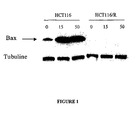
- the figure 1 shows that the HCT116R line does not express the Bax protein, with or without oxaliplatin treatment, whereas the original HCT116 line expresses it without treatment and over-expresses it after treatment with oxaliplatin.
- Sequencing has demonstrated that the HCT116R line is a homozygous mutant (deletion of a deoxyguanosine) in a region of the Bax gene containing a series of 8 deoxyguanosines (codons 38 to 41), which prevents its expression by shift of the reading frame. Since the original HCT116 line is heterozygous G8 / G7, it therefore normally expresses the Bax gene.
- FIG. 1 detection of Bax by Western-blotting in the absence or under the effect of a treatment, with oxaliplatin in model HCT116.
- the cells are untreated or treated with oxaliplatin at 15 ⁇ M for 48 h (or 50 ⁇ M for 24 h) before the preparation of the cell lysates.
- the expression of tubulin is used as a control of equivalent protein deposits.
- the inventors have demonstrated that the resistance to apoptosis is exerted at the mitochondrial level. This is demonstrated in particular by tests with direct drivers of AM. These alterations are therefore diagnostic markers for the resistance of colorectal cancers to oxaliplatin. In addition, it is likely that the pharmacological modulation of the AM pathway will restore all or part of the sensitivity of RCCs to oxaliplatin.
- the inventors have further developed the purification of mitochondria from sensitive and resistant lines in order to isolate and test the putative effectors of resistance (such as PTPC), as well as blocking agents of these effectors (antisense RNA). , substances already known to block a physiological mechanism at the level of the AM, ).
- the invention also covers the implementation of gene transfers that restore the phenotype of sensitivity to oxaliplatin, and methods for screening new chemical entities that make it possible to counter or circumvent the resistance, from the effectors as targets and chemical substances as sources.
- Bax is present in cells in two forms: a latent (inactive) form and an active form that participates in the apoptotic process
- the pro-apoptotic molecule Bak plays a predominant role in the same way as Bax in apoptosis mediated by mitochondrial permeabilization. These two molecules seem to have very similar and sometimes redundant functions. The inventors have therefore also sought to know whether there was a relationship between the level of activation of Bak and a response to oxaliplatin on all the lines including the HCT116 / R2 and Rev2 lines mutated on Bax.
- FIGS. 5A to 5E Detection of Bak activation by an antibody specific to the active conformation of Bak and intracellular analysis by flow cytometry.
- the cells are fixed, permeabilized and then incubated with the antibody specific for the active conformation of Bax. Finally the revelation is done by the incubation of the antibody secondary school coupled with FITC.
- the marking of the untreated cells is represented by the curve in fine black line. That of the treated cells (12, 24 or 48 hours with 15 ⁇ M oxaliplatin) is represented by the curves in thick black line.
- the appearance of strongly marked cells curves in thick black line shifted to the right testifies to the activation of Bak. This experiment has been reproduced twice.
- FIGS. 5A to 5E Bak activation in response to oxaliplatin treatment is delayed on HCT116 / R1 resistant lines ( Figure 5B ) and HCT116 / R2 ( Figure 5C ).
- the revertants Rev1 ( figure 5D ) and Rev2 ( figure 5E ) find the level of Bak activation of the sensitive line HCT116 / S ( Figure 5A ).
- the activation of Bak is finely correlated with the response of cells to oxaliplatin.
Landscapes
- Health & Medical Sciences (AREA)
- Life Sciences & Earth Sciences (AREA)
- Chemical & Material Sciences (AREA)
- Engineering & Computer Science (AREA)
- Immunology (AREA)
- Medicinal Chemistry (AREA)
- General Health & Medical Sciences (AREA)
- Animal Behavior & Ethology (AREA)
- Veterinary Medicine (AREA)
- Public Health (AREA)
- Pharmacology & Pharmacy (AREA)
- Biomedical Technology (AREA)
- Urology & Nephrology (AREA)
- Molecular Biology (AREA)
- Epidemiology (AREA)
- Hematology (AREA)
- Bioinformatics & Cheminformatics (AREA)
- Proteomics, Peptides & Aminoacids (AREA)
- Biochemistry (AREA)
- Organic Chemistry (AREA)
- Gastroenterology & Hepatology (AREA)
- Biotechnology (AREA)
- Cell Biology (AREA)
- Zoology (AREA)
- Microbiology (AREA)
- General Chemical & Material Sciences (AREA)
- Nuclear Medicine, Radiotherapy & Molecular Imaging (AREA)
- Food Science & Technology (AREA)
- Physics & Mathematics (AREA)
- Analytical Chemistry (AREA)
- Chemical Kinetics & Catalysis (AREA)
- General Physics & Mathematics (AREA)
- Pathology (AREA)
- Acyclic And Carbocyclic Compounds In Medicinal Compositions (AREA)
- Measuring Or Testing Involving Enzymes Or Micro-Organisms (AREA)
- Investigating Or Analysing Biological Materials (AREA)
- Micro-Organisms Or Cultivation Processes Thereof (AREA)
- Medicines That Contain Protein Lipid Enzymes And Other Medicines (AREA)
- Inorganic Compounds Of Heavy Metals (AREA)
- Steroid Compounds (AREA)
Claims (11)
- In vitro-Nachweisverfahren der Resistenz von Krebszellen auf eine Behandlung mit Oxaliplatin, dadurch gekennzeichnet, dass es das Messen der Veränderung der mitrochondrialen Apoptose von Krebszellen umfasst, die mit Oxaliplatin behandelt wurden oder werden können oder müssen, wobei diese Messung mindestens das Messen der Expression des Gens der mitrochondrialen Apoptose umfasst, das für das Bax-Protein codiert.
- Verfahren nach Anspruch 1, dadurch gekennzeichnet, dass das Karzinom ein mit Oxaliplatin behandeltes Karzinom ist, vor allem ein kolorektales Karzinom, ein Karzinom der Eierstöcke, ein Karzinom der Keimzellen, ein Karzinom der Lunge, ein Karzinom der Verdauungskanäle, ein Karzinom der Prostata, ein Karzinom der Bauspeicheldrüse, ein Karzinom des Dünndarms, ein Karzinom des Magens.
- Verfahren nach Anspruch 1 oder 2, dadurch gekennzeichnet, dass es das Messen der transkribierten mRNAs des Bax-Gens der mitrochondrialen Apoptose umfasst.
- Verfahren nach Anspruch 1 oder 2, dadurch gekennzeichnet, dass es das Messen der Menge und/oder der Aktivität des Bax-Proteins der mitrochondrialen Apoptose in den Krebszellen umfasst.
- In vitro-Nachweisverfahren der Resistenz von Krebszellen auf eine Behandlung mit Oxaliplatin, dadurch gekennzeichnet, dass es den Nachweis von mindestens einer Mutation umfasst, die auf eine defiziente mitrochondriale Apoptose bei einer Behandlung mit Oxaliplatin in einer Region des Bax-Gens mit einer Reihe von 8 Deoxyguaninen umfasst.
- Verfahren nach einem der Ansprüche 1 bis 4, dadurch gekennzeichnet, dass es umfasst:a) die Bestimmung des Niveaus der Expression mindestens eines Bax-Gens der mitrochondrialen Apoptose auf den einem Patienten entnommenen Krebszellen,b) den Vergleich des gemessenen Niveaus mit einer Kontrollprobe von Zellen, die nicht oxaliplantinresistent sind.
- Verfahren nach Anspruch 4, dadurch gekennzeichnet, dass es die Herstellung des Kontakts der Krebszellen mit einem Antikörper umfasst, der imstande ist, das Bax-Gen der mitrochondrialen Apoptose oder eines seiner biologisch aktiven Fragmente zu erkennen, und den Nachweis des eventuell gebildeten Antigen-Antikörper-Komplexes.
- Verfahren nach einem der Ansprüche 1 bis 3, dadurch gekennzeichnet, dass es eine Primersequenz oder spezifische Sonde des Bax-Gens der mitrochondrialen Apoptose umsetzt.
- Verfahren nach Anspruch 8, dadurch gekennzeichnet, dass es umfasst:a) eventuell die Isolierung der mitrochondrialen DNA aus der zu prüfenden biologischen Probe, oder die Herstellung einer cDNA aus der RNA der biologischen Probe oder der Genom-DNA,b) die spezifische Amplifizierung der DNA von a) mit Hilfe des spezifischen Amplifikationsprimers des Bax-Gens der mitrochondrialen Apoptose.
- Verfahren nach Anspruch 8, dadurch gekennzeichnet, dass es umfasst:a) die Herstellung des Kontakts einer Nukleotidsonde des Bax-Gens der mitrochondrialen Apoptose mit der analysierten biologischen Probe, wobei die Nukleinsäure der Probe gegebenenfalls vorher für die Hybridisierung zugänglich gemacht wurde, unter Bedingungen, die die Hybridisierung der Sonde und der Nukleinsäure der Probe erlauben,b) den Nachweis des eventuell gebildeten Hybrids.
- In vitro-Selektionsverfahren von Verbindungen, die die Oxaliplatinresistenz von Krebszellen inhibieren, dadurch gekennzeichnet, dass es umfasst:a) die Zugabe mindestens einer Kandidatverbindung zu den oxaliplatinresistenten Krebszellen,b) den Vergleich des Expressionsniveaus des Bax-Gens der mitrochondrialen Apoptose bei Anwesenheit und in Abwesenheit der Verbindung,c) den Rückschluss auf die Anti-Resistenz-Wirkung, wenn das Expressionsniveau des Bax-Gens nach Zugabe der Verbindung höher ist.
Applications Claiming Priority (3)
| Application Number | Priority Date | Filing Date | Title |
|---|---|---|---|
| FR0207417A FR2840923B1 (fr) | 2002-06-17 | 2002-06-17 | Agent anti-resistance a l'oxaliplatine |
| FR0207417 | 2002-06-17 | ||
| PCT/FR2003/001842 WO2003107006A1 (fr) | 2002-06-17 | 2003-06-17 | Agent anti-resestance a l'oxaliplatine |
Publications (3)
| Publication Number | Publication Date |
|---|---|
| EP1514116A1 EP1514116A1 (de) | 2005-03-16 |
| EP1514116B1 true EP1514116B1 (de) | 2009-08-12 |
| EP1514116B9 EP1514116B9 (de) | 2010-07-14 |
Family
ID=29595290
Family Applications (1)
| Application Number | Title | Priority Date | Filing Date |
|---|---|---|---|
| EP03760054A Expired - Lifetime EP1514116B9 (de) | 2002-06-17 | 2003-06-17 | Oxaliplatin-antiresistenzverfahren |
Country Status (10)
| Country | Link |
|---|---|
| US (1) | US20060093575A1 (de) |
| EP (1) | EP1514116B9 (de) |
| JP (1) | JP4538316B2 (de) |
| AT (1) | ATE439596T1 (de) |
| AU (1) | AU2003260595A1 (de) |
| CA (1) | CA2489605A1 (de) |
| DE (1) | DE60328784D1 (de) |
| ES (1) | ES2331992T3 (de) |
| FR (1) | FR2840923B1 (de) |
| WO (1) | WO2003107006A1 (de) |
Families Citing this family (10)
| Publication number | Priority date | Publication date | Assignee | Title |
|---|---|---|---|---|
| JP2007528730A (ja) * | 2004-03-12 | 2007-10-18 | ザ クイーンズ ユニヴァーシティ オブ ベルファスト | 治療および測定法 |
| US20060019268A1 (en) * | 2004-03-26 | 2006-01-26 | Research Development Foundation | Molecular markers of cisplatin resistance in cancer and uses thereof |
| CA2474442A1 (en) * | 2004-07-09 | 2006-01-09 | Cnrs | Cancer treatment resistance and agents modulating such resistance |
| WO2007038579A1 (en) * | 2005-09-26 | 2007-04-05 | University Of Florida Research Foundation, Inc. | Bax expression predicts hematologic disease response to treatment |
| JP2010516717A (ja) * | 2007-01-22 | 2010-05-20 | プリヴァ−ラケマ,エー.エス. | アルコール性糖ベースのバッファーを有するオキサリプラチン薬学的組成物 |
| KR101711860B1 (ko) * | 2008-01-25 | 2017-03-03 | 베르그 엘엘씨 | 발암성, 종양 진행 및 치료 효능을 평가하는 분석 시스템 |
| EP3139172A3 (de) * | 2011-03-24 | 2017-06-14 | Keio University | Marker zur bestimmung der empfindlichkeit gegen ein antikrebsmittel |
| CN109507436B (zh) * | 2019-01-10 | 2021-09-03 | 南方医科大学南方医院 | Atxn2l作为预测胃癌奥沙利铂原发性耐药的标志物的应用 |
| CN111394465A (zh) * | 2020-04-27 | 2020-07-10 | 南京大学 | 结直肠癌奥沙利铂耐药相关的lncRNA的筛选及应用 |
| CN118831095B (zh) * | 2024-06-19 | 2025-08-05 | 中南大学湘雅医院 | 一种治疗奥沙利铂耐药结直肠癌的多功能双金属纳米酶及其制备方法与应用 |
-
2002
- 2002-06-17 FR FR0207417A patent/FR2840923B1/fr not_active Expired - Fee Related
-
2003
- 2003-06-17 AT AT03760054T patent/ATE439596T1/de not_active IP Right Cessation
- 2003-06-17 EP EP03760054A patent/EP1514116B9/de not_active Expired - Lifetime
- 2003-06-17 DE DE60328784T patent/DE60328784D1/de not_active Expired - Lifetime
- 2003-06-17 AU AU2003260595A patent/AU2003260595A1/en not_active Abandoned
- 2003-06-17 US US10/516,946 patent/US20060093575A1/en not_active Abandoned
- 2003-06-17 ES ES03760054T patent/ES2331992T3/es not_active Expired - Lifetime
- 2003-06-17 WO PCT/FR2003/001842 patent/WO2003107006A1/fr not_active Ceased
- 2003-06-17 CA CA002489605A patent/CA2489605A1/fr not_active Abandoned
- 2003-06-17 JP JP2004513774A patent/JP4538316B2/ja not_active Expired - Fee Related
Also Published As
| Publication number | Publication date |
|---|---|
| ES2331992T3 (es) | 2010-01-22 |
| AU2003260595A8 (en) | 2003-12-31 |
| EP1514116A1 (de) | 2005-03-16 |
| JP2005529617A (ja) | 2005-10-06 |
| US20060093575A1 (en) | 2006-05-04 |
| JP4538316B2 (ja) | 2010-09-08 |
| DE60328784D1 (de) | 2009-09-24 |
| FR2840923B1 (fr) | 2007-07-06 |
| CA2489605A1 (fr) | 2003-12-24 |
| AU2003260595A1 (en) | 2003-12-31 |
| EP1514116B9 (de) | 2010-07-14 |
| ATE439596T1 (de) | 2009-08-15 |
| WO2003107006A1 (fr) | 2003-12-24 |
| HK1074486A1 (zh) | 2005-11-11 |
| FR2840923A1 (fr) | 2003-12-19 |
Similar Documents
| Publication | Publication Date | Title |
|---|---|---|
| KR20210049117A (ko) | 기관지 전암성 병변 중증도 및 진행과 관련된 방법 | |
| US20220017905A1 (en) | Methods for identifying therapeutic targets and treating and monitoring cancers | |
| TR201819859T4 (tr) | Akciğer kanseri metastazının tanısı ve prognozu için yöntem. | |
| JP5748656B2 (ja) | 過剰増殖細胞の腫瘍抑制因子に基づいた腫瘍崩壊ウイルスに対する感受性を判定する方法 | |
| EP1514116B1 (de) | Oxaliplatin-antiresistenzverfahren | |
| US20080233562A1 (en) | Method of Estimating Antitumor Effect of Histone Deacetylase Inhibitor | |
| JP6830458B2 (ja) | 疾患および障害を検出、治療、および予防するための組成物および方法 | |
| US20140348749A1 (en) | Identification and treatment of tumors sensitive to glucose limitation | |
| JP2023504786A (ja) | 抗がん効果増進のためのERRγ抑制剤を有効成分として含む組成物の用途 | |
| KR20220054312A (ko) | 특정의 유전자 마커를 갖는 환자에게 사용하는 암 치료용의 의약 조성물 | |
| Lazaris et al. | Markers of drug resistance in relapsing colon cancer | |
| US20210137883A1 (en) | Anti-neoplastic compounds and methods targeting qsox1 | |
| KR20240035368A (ko) | 고형암 환자의 화학요법 내성 억제용 약학 조성물 및 이의 용도 | |
| TW200831536A (en) | Method of diagnosing and treating glioma | |
| WO2021075536A1 (ja) | 幹細胞遊走剤を使用した糖尿病治療 | |
| CN110244056A (zh) | Znf521基因在制备肝癌治疗药物、诊断及预后评估试剂中的应用 | |
| TW201036613A (en) | Method for predicting therapeutic efficacy of chemotherapy on non-small-cell lung cancer | |
| US12161635B2 (en) | Compositions and methods of treating PIK3CA helical domain mutant cancers | |
| US11993775B2 (en) | Ubiquitin-specific peptidase 24 inhibitor, medicinal composition and method of delaying or reversing multidrug resistance in cancers using the same | |
| Moore et al. | Primary brain tumors: Characteristics, practical diagnostic and treatment approaches | |
| EP2998742A1 (de) | Verfahren zur vorhersage einer therapiewirkung bei einem patienten mit kolorektalkrebs und gestiegener tk1-protein-expression | |
| Wu et al. | Cell-permeated peptide P-T3H2 inhibits malignancy on hepatocellular carcinoma through stabilizing HNF4α protein | |
| TWI335327B (en) | Pharmaceutical composition for huntington's disease treatment | |
| WO2025217297A1 (en) | Prmt5 inhibitors for use in methods of treating mta-accumulating cancer | |
| Ren et al. | The DDUP protein encoded by the DNA damage-induced CTBP1-DT lncRNA confers chemoresistance in ovarian cancer |
Legal Events
| Date | Code | Title | Description |
|---|---|---|---|
| PUAI | Public reference made under article 153(3) epc to a published international application that has entered the european phase |
Free format text: ORIGINAL CODE: 0009012 |
|
| 17P | Request for examination filed |
Effective date: 20050103 |
|
| AK | Designated contracting states |
Kind code of ref document: A1 Designated state(s): AT BE BG CH CY CZ DE DK EE ES FI FR GB GR HU IE IT LI LU MC NL PT RO SE SI SK TR |
|
| AX | Request for extension of the european patent |
Extension state: AL LT LV MK |
|
| 17Q | First examination report despatched |
Effective date: 20050627 |
|
| DAX | Request for extension of the european patent (deleted) | ||
| REG | Reference to a national code |
Ref country code: HK Ref legal event code: DE Ref document number: 1074486 Country of ref document: HK |
|
| 17Q | First examination report despatched |
Effective date: 20050627 |
|
| GRAP | Despatch of communication of intention to grant a patent |
Free format text: ORIGINAL CODE: EPIDOSNIGR1 |
|
| RIC1 | Information provided on ipc code assigned before grant |
Ipc: C12Q 1/68 20060101ALI20090303BHEP Ipc: A61P 35/00 20060101ALI20090303BHEP Ipc: G01N 33/574 20060101AFI20090303BHEP Ipc: A61K 31/00 20060101ALI20090303BHEP |
|
| RTI1 | Title (correction) |
Free format text: OXALIPLATIN ANTI-RESISTANCE METHOD |
|
| GRAS | Grant fee paid |
Free format text: ORIGINAL CODE: EPIDOSNIGR3 |
|
| RAP1 | Party data changed (applicant data changed or rights of an application transferred) |
Owner name: UNIVERSITE DE MONTPELLIER I Owner name: CENTRE NATIONAL DE LA RECHERCHE SCIENTIFIQUE (CNRS Owner name: INSTITUT PASTEUR |
|
| GRAA | (expected) grant |
Free format text: ORIGINAL CODE: 0009210 |
|
| AK | Designated contracting states |
Kind code of ref document: B1 Designated state(s): AT BE BG CH CY CZ DE DK EE ES FI FR GB GR HU IE IT LI LU MC NL PT RO SE SI SK TR |
|
| REG | Reference to a national code |
Ref country code: GB Ref legal event code: FG4D Free format text: NOT ENGLISH |
|
| REG | Reference to a national code |
Ref country code: CH Ref legal event code: EP |
|
| REG | Reference to a national code |
Ref country code: IE Ref legal event code: FG4D |
|
| REF | Corresponds to: |
Ref document number: 60328784 Country of ref document: DE Date of ref document: 20090924 Kind code of ref document: P |
|
| REG | Reference to a national code |
Ref country code: CH Ref legal event code: NV Representative=s name: MICHELI & CIE SA |
|
| REG | Reference to a national code |
Ref country code: ES Ref legal event code: FG2A Ref document number: 2331992 Country of ref document: ES Kind code of ref document: T3 |
|
| PG25 | Lapsed in a contracting state [announced via postgrant information from national office to epo] |
Ref country code: AT Free format text: LAPSE BECAUSE OF FAILURE TO SUBMIT A TRANSLATION OF THE DESCRIPTION OR TO PAY THE FEE WITHIN THE PRESCRIBED TIME-LIMIT Effective date: 20090812 Ref country code: FI Free format text: LAPSE BECAUSE OF FAILURE TO SUBMIT A TRANSLATION OF THE DESCRIPTION OR TO PAY THE FEE WITHIN THE PRESCRIBED TIME-LIMIT Effective date: 20090812 Ref country code: SE Free format text: LAPSE BECAUSE OF FAILURE TO SUBMIT A TRANSLATION OF THE DESCRIPTION OR TO PAY THE FEE WITHIN THE PRESCRIBED TIME-LIMIT Effective date: 20090812 |
|
| NLV1 | Nl: lapsed or annulled due to failure to fulfill the requirements of art. 29p and 29m of the patents act | ||
| REG | Reference to a national code |
Ref country code: HK Ref legal event code: GR Ref document number: 1074486 Country of ref document: HK |
|
| PG25 | Lapsed in a contracting state [announced via postgrant information from national office to epo] |
Ref country code: SI Free format text: LAPSE BECAUSE OF FAILURE TO SUBMIT A TRANSLATION OF THE DESCRIPTION OR TO PAY THE FEE WITHIN THE PRESCRIBED TIME-LIMIT Effective date: 20090812 Ref country code: NL Free format text: LAPSE BECAUSE OF FAILURE TO SUBMIT A TRANSLATION OF THE DESCRIPTION OR TO PAY THE FEE WITHIN THE PRESCRIBED TIME-LIMIT Effective date: 20090812 |
|
| REG | Reference to a national code |
Ref country code: IE Ref legal event code: FD4D |
|
| PG25 | Lapsed in a contracting state [announced via postgrant information from national office to epo] |
Ref country code: PT Free format text: LAPSE BECAUSE OF FAILURE TO SUBMIT A TRANSLATION OF THE DESCRIPTION OR TO PAY THE FEE WITHIN THE PRESCRIBED TIME-LIMIT Effective date: 20091212 Ref country code: BG Free format text: LAPSE BECAUSE OF FAILURE TO SUBMIT A TRANSLATION OF THE DESCRIPTION OR TO PAY THE FEE WITHIN THE PRESCRIBED TIME-LIMIT Effective date: 20091112 |
|
| PG25 | Lapsed in a contracting state [announced via postgrant information from national office to epo] |
Ref country code: RO Free format text: LAPSE BECAUSE OF FAILURE TO SUBMIT A TRANSLATION OF THE DESCRIPTION OR TO PAY THE FEE WITHIN THE PRESCRIBED TIME-LIMIT Effective date: 20090812 Ref country code: DK Free format text: LAPSE BECAUSE OF FAILURE TO SUBMIT A TRANSLATION OF THE DESCRIPTION OR TO PAY THE FEE WITHIN THE PRESCRIBED TIME-LIMIT Effective date: 20090812 Ref country code: EE Free format text: LAPSE BECAUSE OF FAILURE TO SUBMIT A TRANSLATION OF THE DESCRIPTION OR TO PAY THE FEE WITHIN THE PRESCRIBED TIME-LIMIT Effective date: 20090812 Ref country code: CZ Free format text: LAPSE BECAUSE OF FAILURE TO SUBMIT A TRANSLATION OF THE DESCRIPTION OR TO PAY THE FEE WITHIN THE PRESCRIBED TIME-LIMIT Effective date: 20090812 Ref country code: IE Free format text: LAPSE BECAUSE OF FAILURE TO SUBMIT A TRANSLATION OF THE DESCRIPTION OR TO PAY THE FEE WITHIN THE PRESCRIBED TIME-LIMIT Effective date: 20090812 |
|
| PG25 | Lapsed in a contracting state [announced via postgrant information from national office to epo] |
Ref country code: SK Free format text: LAPSE BECAUSE OF FAILURE TO SUBMIT A TRANSLATION OF THE DESCRIPTION OR TO PAY THE FEE WITHIN THE PRESCRIBED TIME-LIMIT Effective date: 20090812 |
|
| PLBE | No opposition filed within time limit |
Free format text: ORIGINAL CODE: 0009261 |
|
| STAA | Information on the status of an ep patent application or granted ep patent |
Free format text: STATUS: NO OPPOSITION FILED WITHIN TIME LIMIT |
|
| 26N | No opposition filed |
Effective date: 20100517 |
|
| PGFP | Annual fee paid to national office [announced via postgrant information from national office to epo] |
Ref country code: ES Payment date: 20100611 Year of fee payment: 8 |
|
| PGFP | Annual fee paid to national office [announced via postgrant information from national office to epo] |
Ref country code: IT Payment date: 20100603 Year of fee payment: 8 |
|
| PG25 | Lapsed in a contracting state [announced via postgrant information from national office to epo] |
Ref country code: GR Free format text: LAPSE BECAUSE OF FAILURE TO SUBMIT A TRANSLATION OF THE DESCRIPTION OR TO PAY THE FEE WITHIN THE PRESCRIBED TIME-LIMIT Effective date: 20091113 |
|
| PGFP | Annual fee paid to national office [announced via postgrant information from national office to epo] |
Ref country code: BE Payment date: 20100526 Year of fee payment: 8 Ref country code: CH Payment date: 20100525 Year of fee payment: 8 |
|
| PGFP | Annual fee paid to national office [announced via postgrant information from national office to epo] |
Ref country code: DE Payment date: 20100610 Year of fee payment: 8 Ref country code: FR Payment date: 20100729 Year of fee payment: 8 Ref country code: GB Payment date: 20100527 Year of fee payment: 8 |
|
| PG25 | Lapsed in a contracting state [announced via postgrant information from national office to epo] |
Ref country code: MC Free format text: LAPSE BECAUSE OF NON-PAYMENT OF DUE FEES Effective date: 20100630 |
|
| BERE | Be: lapsed |
Owner name: UNIVERSITE DE MONTPELLIER I Effective date: 20110630 Owner name: INSTITUT PASTEUR Effective date: 20110630 Owner name: CENTRE NATIONAL DE LA RECHERCHE SCIENTIFIQUE (CNR Effective date: 20110630 |
|
| REG | Reference to a national code |
Ref country code: CH Ref legal event code: PL |
|
| GBPC | Gb: european patent ceased through non-payment of renewal fee |
Effective date: 20110617 |
|
| PG25 | Lapsed in a contracting state [announced via postgrant information from national office to epo] |
Ref country code: IT Free format text: LAPSE BECAUSE OF NON-PAYMENT OF DUE FEES Effective date: 20110617 |
|
| REG | Reference to a national code |
Ref country code: FR Ref legal event code: ST Effective date: 20120229 |
|
| PG25 | Lapsed in a contracting state [announced via postgrant information from national office to epo] |
Ref country code: BE Free format text: LAPSE BECAUSE OF NON-PAYMENT OF DUE FEES Effective date: 20110630 |
|
| REG | Reference to a national code |
Ref country code: DE Ref legal event code: R119 Ref document number: 60328784 Country of ref document: DE Effective date: 20120103 |
|
| PG25 | Lapsed in a contracting state [announced via postgrant information from national office to epo] |
Ref country code: LI Free format text: LAPSE BECAUSE OF NON-PAYMENT OF DUE FEES Effective date: 20110630 Ref country code: DE Free format text: LAPSE BECAUSE OF NON-PAYMENT OF DUE FEES Effective date: 20120103 Ref country code: FR Free format text: LAPSE BECAUSE OF NON-PAYMENT OF DUE FEES Effective date: 20110630 Ref country code: CH Free format text: LAPSE BECAUSE OF NON-PAYMENT OF DUE FEES Effective date: 20110630 |
|
| PG25 | Lapsed in a contracting state [announced via postgrant information from national office to epo] |
Ref country code: GB Free format text: LAPSE BECAUSE OF NON-PAYMENT OF DUE FEES Effective date: 20110617 |
|
| PG25 | Lapsed in a contracting state [announced via postgrant information from national office to epo] |
Ref country code: CY Free format text: LAPSE BECAUSE OF FAILURE TO SUBMIT A TRANSLATION OF THE DESCRIPTION OR TO PAY THE FEE WITHIN THE PRESCRIBED TIME-LIMIT Effective date: 20090812 |
|
| PG25 | Lapsed in a contracting state [announced via postgrant information from national office to epo] |
Ref country code: LU Free format text: LAPSE BECAUSE OF NON-PAYMENT OF DUE FEES Effective date: 20100617 Ref country code: HU Free format text: LAPSE BECAUSE OF FAILURE TO SUBMIT A TRANSLATION OF THE DESCRIPTION OR TO PAY THE FEE WITHIN THE PRESCRIBED TIME-LIMIT Effective date: 20100213 |
|
| PG25 | Lapsed in a contracting state [announced via postgrant information from national office to epo] |
Ref country code: TR Free format text: LAPSE BECAUSE OF FAILURE TO SUBMIT A TRANSLATION OF THE DESCRIPTION OR TO PAY THE FEE WITHIN THE PRESCRIBED TIME-LIMIT Effective date: 20090812 |
|
| REG | Reference to a national code |
Ref country code: ES Ref legal event code: FD2A Effective date: 20130606 |
|
| PG25 | Lapsed in a contracting state [announced via postgrant information from national office to epo] |
Ref country code: ES Free format text: LAPSE BECAUSE OF NON-PAYMENT OF DUE FEES Effective date: 20110618 |