EP1511097A1 - Mit leitfähigem material gemischtes elektrodenaktivmaterial, elektrodenstruktur, sekundärzelle, amd-verfahren zur herstellung eines mit leitfähigem material gemischten elektrodenaktivmaterials - Google Patents
Mit leitfähigem material gemischtes elektrodenaktivmaterial, elektrodenstruktur, sekundärzelle, amd-verfahren zur herstellung eines mit leitfähigem material gemischten elektrodenaktivmaterials Download PDFInfo
- Publication number
- EP1511097A1 EP1511097A1 EP03730813A EP03730813A EP1511097A1 EP 1511097 A1 EP1511097 A1 EP 1511097A1 EP 03730813 A EP03730813 A EP 03730813A EP 03730813 A EP03730813 A EP 03730813A EP 1511097 A1 EP1511097 A1 EP 1511097A1
- Authority
- EP
- European Patent Office
- Prior art keywords
- active electrode
- electrode material
- current collecting
- conductor
- conductive material
- Prior art date
- Legal status (The legal status is an assumption and is not a legal conclusion. Google has not performed a legal analysis and makes no representation as to the accuracy of the status listed.)
- Withdrawn
Links
Images




Classifications
-
- H—ELECTRICITY
- H01—ELECTRIC ELEMENTS
- H01M—PROCESSES OR MEANS, e.g. BATTERIES, FOR THE DIRECT CONVERSION OF CHEMICAL ENERGY INTO ELECTRICAL ENERGY
- H01M4/00—Electrodes
- H01M4/02—Electrodes composed of, or comprising, active material
- H01M4/62—Selection of inactive substances as ingredients for active masses, e.g. binders, fillers
- H01M4/624—Electric conductive fillers
-
- H—ELECTRICITY
- H01—ELECTRIC ELEMENTS
- H01M—PROCESSES OR MEANS, e.g. BATTERIES, FOR THE DIRECT CONVERSION OF CHEMICAL ENERGY INTO ELECTRICAL ENERGY
- H01M4/00—Electrodes
- H01M4/02—Electrodes composed of, or comprising, active material
- H01M4/04—Processes of manufacture in general
- H01M4/0402—Methods of deposition of the material
- H01M4/0404—Methods of deposition of the material by coating on electrode collectors
-
- H—ELECTRICITY
- H01—ELECTRIC ELEMENTS
- H01M—PROCESSES OR MEANS, e.g. BATTERIES, FOR THE DIRECT CONVERSION OF CHEMICAL ENERGY INTO ELECTRICAL ENERGY
- H01M4/00—Electrodes
- H01M4/02—Electrodes composed of, or comprising, active material
- H01M4/62—Selection of inactive substances as ingredients for active masses, e.g. binders, fillers
- H01M4/624—Electric conductive fillers
- H01M4/625—Carbon or graphite
-
- H—ELECTRICITY
- H01—ELECTRIC ELEMENTS
- H01M—PROCESSES OR MEANS, e.g. BATTERIES, FOR THE DIRECT CONVERSION OF CHEMICAL ENERGY INTO ELECTRICAL ENERGY
- H01M4/00—Electrodes
- H01M4/02—Electrodes composed of, or comprising, active material
- H01M4/64—Carriers or collectors
- H01M4/70—Carriers or collectors characterised by shape or form
-
- H—ELECTRICITY
- H01—ELECTRIC ELEMENTS
- H01M—PROCESSES OR MEANS, e.g. BATTERIES, FOR THE DIRECT CONVERSION OF CHEMICAL ENERGY INTO ELECTRICAL ENERGY
- H01M4/00—Electrodes
- H01M4/02—Electrodes composed of, or comprising, active material
- H01M2004/021—Physical characteristics, e.g. porosity, surface area
-
- H—ELECTRICITY
- H01—ELECTRIC ELEMENTS
- H01M—PROCESSES OR MEANS, e.g. BATTERIES, FOR THE DIRECT CONVERSION OF CHEMICAL ENERGY INTO ELECTRICAL ENERGY
- H01M4/00—Electrodes
- H01M4/02—Electrodes composed of, or comprising, active material
-
- H—ELECTRICITY
- H01—ELECTRIC ELEMENTS
- H01M—PROCESSES OR MEANS, e.g. BATTERIES, FOR THE DIRECT CONVERSION OF CHEMICAL ENERGY INTO ELECTRICAL ENERGY
- H01M4/00—Electrodes
- H01M4/02—Electrodes composed of, or comprising, active material
- H01M4/04—Processes of manufacture in general
- H01M4/043—Processes of manufacture in general involving compressing or compaction
- H01M4/0435—Rolling or calendering
-
- Y—GENERAL TAGGING OF NEW TECHNOLOGICAL DEVELOPMENTS; GENERAL TAGGING OF CROSS-SECTIONAL TECHNOLOGIES SPANNING OVER SEVERAL SECTIONS OF THE IPC; TECHNICAL SUBJECTS COVERED BY FORMER USPC CROSS-REFERENCE ART COLLECTIONS [XRACs] AND DIGESTS
- Y02—TECHNOLOGIES OR APPLICATIONS FOR MITIGATION OR ADAPTATION AGAINST CLIMATE CHANGE
- Y02E—REDUCTION OF GREENHOUSE GAS [GHG] EMISSIONS, RELATED TO ENERGY GENERATION, TRANSMISSION OR DISTRIBUTION
- Y02E60/00—Enabling technologies; Technologies with a potential or indirect contribution to GHG emissions mitigation
- Y02E60/10—Energy storage using batteries
Definitions
- the present invention relates to active materials for use as electrodes in electrical components, and also to electrode structures and batteries.
- Rechargeable nonaqueous electrolytic batteries are chemical batteries. Upon charging and discharging of a battery, an electrical current which is applied from a current collecting material is sent toward a positive polarity material of a positive electrode layer, followed by reaction of the positive pole material of the positive electrode layer. This results in outward release of ions, which are then absorbed in a negative electrode layer. Adversely, during discharge, those ions which were absorbed in the negative electrode layer are drawn out to return to the positive electrode layer. It has generally been believed that this reaction time controls charge/discharge speeds.
- a coated film can disturb or impede the release and absorption of ions by means of the active electrode material made of LiCoO 2 or the like, and that a membrane adhered by vapor deposition or sputtering to the active electrode material surface blocks a location for reaction of the active electrode material. Note here that the presence of such membrane makes it difficult to enhance the electrical conductivity between active electrode materials, because it does not protrude from the active electrode material surface.
- An object of the present invention is to enhance the electrical conductivity between active electrode materials.
- an object of this invention is to enhance the conductivity between an active electrode material and a conduction assistant agent.
- An alternative object of the invention is to enhance the conductivity between an active electrode material and a current collecting material.
- Another alternative object of the invention is to provide an electrode structure which is excellent in performance.
- a further another alternative object of the invention is to provide an electrical component having an electrode structure, which is excellent in performance.
- a conductor-mixed active electrode material with excellent characteristics is manufacturable by performing the stirring and mixing (stirring blend) of an active electrode material and a conductive material together with hard balls.
- stirring and mixing stir blend
- a conductor-mixed active electrode material with the conductive material and active electrode material mixed together or a conductor-mixed active electrode material or a conductor-coupled active electrode material in which a conductive material is considered to be coupled.
- electrode structures of electrical components such as batteries and capacitors or equivalents thereto, it is likely that electrons and ions can increase in electrical conductivity.
- a principal concept of the present invention lies in a conductor-mixed active electrode material, which is characterized in that its active electrode material and conductive material are specifically processed so that these are stirred and blended together with hard balls.
- Another concept of this invention lies in an electrode structure which is characterized by comprising a current collecting material, and an electrode layer having a conductor-mixed active electrode material as processed by stirring and blending an active electrode material and a conductive material together with hard balls, wherein the electrode layer is formed on or above a surface of the current collecting material.
- Another concept of this invention lies in a rechargeable battery which is featured by using, as at least one electrode, an electrode structure that comprises a current collecting material and an electrode layer having a conductor-mixed active electrode material as processed by stirring and blending an active electrode material and a conductive material together with hard balls, while letting the electrode layer be formed on or above a surface of the current collecting material.
- Another concept of the invention lies in a method of manufacturing a conductor-mixed active electrode material, wherein an active electrode material and a conductive material are processed through stirring and mixing with hard balls.
- Still another concept of the invention lies in a current collecting structure which comprises a current collecting material and a current collection layer having a conductor-mixed active electrode material with a flocculent conductive material being coupled around an active electrode material, wherein the current collection layer is situated on or above a surface of the current collecting material.
- Yet another concept of the invention lies in a current collector structure which comprises a current collecting material, a current collection layer that has an electrical conduction assistant agent, and an anchor layer having a conductor-mixed active electrode material with a flocculent conductive material coupled thereto, wherein the conductor-mixed active electrode material bites into the current collection layer, while letting the current collection layer be disposed above a surface of the current collecting material and also letting the anchor layer overlie a surface of the current collector layer in a multilayer fashion.
- Another concept of the invention lies in an electrode structure which comprises a current collecting material and an electrode layer having a conductor-mixed active electrode material with a flocculent conductive material coupled around an active electrode material, wherein the electrode layer is disposed on or above a surface of the conductive material.
- a further another concept of the invention lies in either a rechargeable battery or a capacitor, which comprises a pair of electrode structures consisting essentially of an electrode structure that has on the surface of a current collecting material an electrode layer having a conductor-mixed active electrode material with a flocculent conductive material coupled around an active electrode material and an electrode structure having a current collecting material, characterized by having an electrolytic composition between the pair of electrode structures.
- Electrode Structure 11 .. Electrode Layer, 12 .. Positive Electrode Structure, 13 .. Negative Electrode Structure, 2 ... Current Collecting Structure, 21 .. Current Collection Layer, 22 .. Anchor Layer, 23 .. Electrical Conduction Assistant, 24 .. Active electrode Material, 25 .. Anchor Material, 3 ... Current Collecting Material, 31 .. Oxide Membrane, 4 ... Battery, 41 .. Electrolytic Substance; 42 .. Separator, 5 ... Manufacturing Apparatus of Conductor-Mixed Active electrode Material, 51 .. Active electrode Material Powder, 52 .. Conductive Material Powder, 53 .. Processing Vessel, 6 ... Barrel, 61 .. In/Out Port, 62 ..
- Electrodes of Electrical Component such as Battery or Capacitor
- An electrode of a battery or a capacitor is the one that is capable of passing and receiving electricity to and from ions or the one with an ability to attract ions.
- the electrode is designed to have an electrode structure 1 such as shown in Fig. 1 for example, which has an ion-receivable/passable electrode layer 11 formed on a top surface of a current collecting material 3.
- the electrode structure 1 there is a structure which has the electrode layer 11 formed on the surface of current collecting material 3 as shown in Fig. 1(A), a structure having a current collection layer 21 formed on the surface of current collecting material 3 and also having an electrode layer 11 formed thereon as shown in Fig.
- the electrode layer of a positive electrode structure 12 of a battery is typically made of an active electrode material such as LiMn 2 O 4 or equivalents thereto.
- an active electrode material such as graphite or hard carbon or else is used.
- the electrode layers of the positive and negative electrode structures of a capacitor are made of an active electrode material which has an increased surface area and thus offers the attachability of a great number of ions, such as lithium ions.
- Either a battery 4 or a capacitor is arranged for example as shown in Fig. 2(B) so that the positive electrode structure 12 and the negative electrode structure 13 are disposed to spatially oppose each other with a separator 42 being intermediately situated therebetween, while letting an electrolytic substance 41, such as an electrolysis solution, be laid out between the electrode structures and the separator.
- An active electrode material 42 is the one that sends and receives ions.
- the active material for use as its positive electrode may be lithium-based active material such as LiCoO 2 , LiNiO 2 , LiM n 2O 4 or the like.
- Examples of a negative active material are chosen metals, such as carbon-based material, lithium metal or else.
- a large surface-area material is usable as an active electrode material 24 of capacitor.
- an active carbon is preferable, which is obtained through activation of a carbon material by use of a vapor activation processing method, fused-KOH activation processing method or equivalents thereof.
- the active carbon include, but not limited to, palm-based active carbon, phenol-based active carbon, petroleum coke-based active carbon, and poly-acene.
- palm-based active carbon phenol-based active carbon
- phenol-based active carbon phenol-based active carbon
- petroleum coke-based active carbon and poly-acene.
- the phenol-based active carbon, petroleum coke-based active carbon and/or polyacene is preferable in order to realize large electrostatic capacitances.
- a conduction assistant agent 23 is the one that is high in electrical conducting property and thus enhances the conductivity of the electrode structure 1.
- the conduction assistant 23 may be the one that is less in diameter than the anchor material 25 and is readily attachable to portions around the anchor material 25.
- the conduction assistant 23 is in contact with a passive-state aluminum skin film or membrane, the conduction assistant 23 is preferably made of carbon material. Recent estimates show that the passive membrane increases in conductivity at portions whereat the carbon material is attached to the passive membrane.
- Examples of the conduction assistant 23 are carbon fibers including, but not limited to, carbon black, Ketjen Black, acetylene black, carbon whisker, native black lead or graphite, artificial graphite, VGCF, and carbon nanotube, any one of which is usable in sole or more than two of which are employable in combination.
- Ketjen Black or acetylene black is preferable, which is one kind of carbon black material.
- the conductor-mixed active electrode material is the one that has a mixture of a conductive material and an active electrode material 24 or alternatively the one having a conductive material and active electrode material 24 coupled together.
- the term "mixture” or “coupled” as used herein may refer to a state capable of exerting the characteristics and functionalities of the active electrode material to thereby provide certain capabilities including an ability to facilitate movement or migration of electrons between the conductive material and the active electrode material without the use of a binder, and an ability to permit entry and exit of ions, such as ion release and absorption.
- the coupling is a state that the conductive material is coupled to part around the active electrode material in a flocculent form.
- the flocculent form refers to a state that consists essentially of a floc-like form, mold-like form, whiskery form, linear shape, filiform and others.
- the conductor-mixed active electrode material is considered so that small flocculent conductive material components are coupled around the active electrode material 24 in the form of dots.
- the dot-like form should not be limited to a single dot and may also consist of a plurality of dots: this form refers to a state that eliminates sheet-like coverage to thereby avoid substantial restraint of the release and absorption of the ions of active electrode material.
- the conductor-mixed active electrode material is adaptable for use in electrical components such as batteries or capacitors (condensers).
- the current collecting material 3 certain material is used which is extremely high in electrical conduction property.
- Aluminum foil is typically used as the current collecting material 3 of a positive electrode, whereas copper foil or metal (Li metal in the case of a Li battery) is used as the current collection material 3 of a negative electrode, by way of example. It is recommendable to form one or more recess portions in the surface of current collecting material 3 of at least one, preferably both, of a pair of electrode structures 1. With such an arrangement, it is possible to increase the area of an interface with a layer in contact with the current collecting material 3, such as for example the electrode layer 11 or the current collector layer 21, thereby making it possible to reduce the electrical contact resistance.
- the presence of such recesses makes it possible to enhance the close physical contact with the layer being in contact with the current collecting material 3, thereby enabling achievement of rigid adhesion of the electrode layer 11 or current collector layer 21 to be contacted with the current collecting material 3.
- the recesses of the current collecting material 3 are designed to measure approximately 0.1 ⁇ m to 2 ⁇ m in center-line average roughness Ra relying on surface irregularity standards.
- the aluminum foil has its surface on which an oxide membrane is naturally formed at the stage of electrode fabrication. After having assembled into a battery or a capacitor, when an electrolytic solution is injected resulting in a flow of current, a membrane with passivity can sometimes takes place on the surface thereof.
- This passive membrane is capable of preventing corrosion of the current collecting material 3 otherwise occurring due to the electrolyte. It is also possible to permit the current collecting material 3 to obtain improvements in corrosion resistance.
- the passive membrane has dielectricity so that this limits the magnitude of a current flowing in the electrode, it is contemplated that the resulting conductivity gets higher for the following reason: contacting carbon particles with the passive membrane results in occurrence of dot-like defects in part of the passive membrane adjacent to the carbon particle's contact portions.
- the current collecting material 3 may be arranged so that an electrode layer 11 is formed on its one-side surface or, alternatively, electrode layers 11 are formed on the both surfaces. Whether the one-side or the both-side design is to be employed is determinable depending upon how the electrode structure 1 is used in electrical equipment with a battery or a capacitor.
- the current collector structure 2 is such that a current collection layer 21 is formed at the current collecting material 3 to thereby reduce the electrical resistance of the interface of current collecting material 3.
- the current collector structure 2 is used for the electrode structure 1 of a battery or a capacitor.
- the current collector layer 21 has an electrical conduction assistant agent 23 and a binder, and is formed by adhesion of the conduction assistant 23 to the surface of current collecting material 3 as shown in Fig. 1(B) by way of example. This may be thinly formed to a thickness of about several microns, for example. It is also permissible to further add an anchor material 25 to the current collecting material 3.
- the anchor material 25 is partly depressed by strong push force against the current collecting material 3 to thereby provide tight adhesion therebetween. It is recommendable to rigidly adhere the conduction assistant 23 to the surface of current collecting material 3.
- the anchor material 25 is rigidly adhered to the current collecting material 3.
- the conduction assistant 23 be attached also to peripheral portions of the anchor material 25, thereby making it possible to fix it to nearby portions of the surface of current collecting material 3 along with anchor material 25. It is also possible for conduction assistant 23 to come much closer to the surface of current collecting material 3.
- the current collector layer has a thickness ranging from 0.5 ⁇ m to 10 ⁇ m; more preferably, it is set at 1 to 3 ⁇ m.
- a current collector layer which consists essentially of a conduction assistant 23 and a binder.
- a second layer that is comprised of an anchor material 25 and conduction assistant 23 plus binder, thereby completing an anchor layer 22.
- strong compressive force e.g., rotation pressure
- the anchor material 25 is rigidly attached to either the current collector layer 21 or the current collecting material 3.
- the anchor layer is 2 ⁇ m to 20 ⁇ m in thickness; more preferably, 5 to 10 ⁇ m.
- the current collecting materials 3 of Figs. 1(A) to 1(C) are examples that employ those having recess portions.
- the anchor material 25 is latched to the surface of the current collecting material 3-that is, rigidly attached and fixed to the surface. For example, strong push force is applied to tightly adhere the material to the surface of current collecting material 3 so that it is strongly adhered by use of the bonding force of the binder.
- the anchor material 25 may be the one having its surface to which the conduction assistant 23 is readily attachable. To this end, certain material is preferable which has convexo-concave portions on its surface and which is larger than conduction assistant 23.
- the anchor material 25 may preferably be conductive material, active electrode material 24 or conductor-mixed active electrode material. The conductive material can enhance, together with the functionality of the anchor, the electrical conduction property with respect to the current collecting material interface.
- the active electrode material 24 is also capable of playing a role of ion-exchangeable electrode layer 11, together with the functionality of the anchor. It is considered that as shown in Fig. 2(A), the anchor material 25 bites into the surface of the current collecting material 3 together with the conduction assistant 23 thus attached, which can lead to breaks in a membrane such as an oxide skin film on the surface of current collecting material, resulting in direct contact with metal part of the current collecting material. What is required for the anchor material 25 is merely to provide the anchor function. Preferably, unitary particles with a diameter of 0.5 ⁇ m to 30 ⁇ m or an ensemble of tuft-like coupled particles resembling in shape grape clusters may be used.
- the electrode layer 11 has a conductor-mixed active electrode material and conduction assistant 23 plus binder, for causing ions to reversibly flow to and from an electrolytic material 41.
- the electrode layer 11 is formed on the surfaces of current collecting material 3, current collector layer 21 or anchor layer 22.
- the electrode layer 11 is designable to contain less amounts of conduction assistant 23 and binder.
- the electrode layer 11 is such that conductor-mixed active electrode material is used for at least one of the positive active electrode material 12 and negative active electrode material 13.
- the electrode layer is 10 ⁇ m to 120 ⁇ m thick; more preferably, 50 to 80 ⁇ m.
- the binder is for attachment of the current collector layer 21, electrode layer 11, active electrode material 24 and conduction assistant 23 or the like onto the surface of the current collecting material 3.
- PVDF or the like is used.
- the electrolytic substance 41 is in the form of a liquid, gel or solid, and is the one that allows ions to move or flow between the positive electrode structure 12 and the negative electrode structure 13.
- dibutyl ether or 1,2-dimethoxyethane or else is usable.
- the separator 42 is the one that prevents any electrical contact between positive and negative electrode structures and enables penetration of ions.
- porous material such as polyethylene, polypropylene or else is employable.
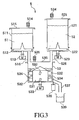
- FIG. 3 An exemplary manufacturing apparatus of a conductor-mixed active electrode material is shown in Fig. 3. Shown herein is an H-type fabrication apparatus (vertical rotation type).
- This fabrication apparatus comprises an active electrode material supplying vessel 511 which contains therein active electrode material powder 51, and a conductive material supplying vessel 521 that contains conductive material power 52.
- Each vessel 511, 521 has a constant-amount cut-out blade 512, 521, which is driven by a driving device 513, 523, such as a motor.
- each vessel 511, 521 has a breather 514, 524 for adjustment of air pressure.
- Each vessel 511, 521 is sealable by a lid 515, 525.
- Each vessel 511, 521 is connected to a processing vessel 53 by an intake passage 516, 526.
- Attached to the processing vessel 53 are a core 531 that is rotation-driven by a driving device 533, such as a motor, and stirring blades 532 mounted around the core 531.
- a driving device 533 such as a motor
- stirring blades 532 mounted around the core 531.
- a large number of hard balls 534 are stored, such as those made of steel, stainless-steel or the like.
- the hard balls 534 are such that steel balls, stainless-steel balls, ceramic balls, Teflon (R) lining balls or other similar suitable ones are usable.
- the core 531 is rotatable at speeds covering from a low speed up to a high speed of several thousand revolutions per minute, for example.
- the processing vessel 53 is air-tightly sealable by a lid 535, and is provided with a breather 536.
- the processing vessel 53 is coupled to an exhaust passage 537.
- This exhaust passage 537 is opened and closed by an open-close device 538.
- the exhaust passage 537 is installed to extend up to a processed-material storing vessel or reservoir 539.
- FIG. 4 Shown herein is an L-type fabrication apparatus (horizontal rotation type).
- This fabrication apparatus comprises a barrel 6 that is rotatable horizontally.
- the barrel 6 includes an inflow/outflow port 61 having a lid 62.
- An active electrode material or conductive material is taken into and out of the in/out port 61, along with hard balls 63.
- the hard balls 63 of this apparatus may preferably be certain ones that are large in weight.
- Flowage plates 64 are mounted within the barrel 6.
- an active electrode material 51 in the form of finely-divided particulates is put in the active electrode material-use vessel 511 while letting a powdery conductive material 52 in the form of fine particles be stored in the conductive material-use vessel 521.
- These particulate materials are such that an appropriate amount of powder is taken out while causing the driver device 513, 523 to drive the constant-amount cutout blade 512, 522 of each vessel 511, 521, and then introduced into the processing vessel 53 via the intake passage 516, 526.
- the breather 514, 524 operates to adjust an internal pressure of each vessel 511, 521.
- the driver device 533 of processing vessel 53 drives the core 531 whereby the active electrode material and the conductive material are stirred by the blades 532 together with the hard balls 534 in the processing vessel 53 so that impact force or shock is applied by hard balls 534 or else to the active electrode material and conductive material to thereby enable execution of stirring and mixing processes, resulting in the conductive material being blended with the active electrode material.
- a conductor-mixed active electrode material is obtained.
- the processed particulates and conductor-mixed active electrode material are exhausted to the processed vessel 539 while causing the exhaust passage 537 to be opened and closed by the open-close device 538.
- the L-type fabrication apparatus introduce into the barrel 6 the particulates of an active electrode material and a conductive material to be processed together.
- the active electrode material and conductive material are rotated and mixed together with hard balls 63 by the flowage plates 64 or the like, and then behave to drop down along with the hard balls 63; thus, the intended stirring and blending operations are performed.
- the active electrode material and conductive material are applied shocks so that the conductive material is blended with the active electrode material.
- a conductor-mixed active electrode material is obtained. Open the lid 62 to take it out of the in/out port 61.
- a hydro-honing method is employable. This method includes the step of uniformly spraying, by a compressed air, a composite material with a mixture of an abradant and a fluid such as water along with an oxidation inhibitor or antioxidant from one or more nozzles onto a foil surface of the current collecting material 3. Immediately after the processing, cleaning is done, followed by the blowing of hot air to dry a cleaning liquid. The resultant surface roughness is set so that the along-the-center-line average roughness Ra is about 0.1 ⁇ m to 2 ⁇ m.
- the conductor-mixed active material for electrodes is manufacturable by conductor-mixed active electrode material fabrication apparatus using a chosen positive active material and an electrical conduction assistant agent made of a conductive material.
- a lithiated intercalation compound such as lithium manganate LiMn 2 O 4 (LM-9, manufactured by Nikki Chemical Co., Ltd.).
- the conductive material used was Ketjen Black (Ketjen Black EC commercially available from Ketjen Black International Company) KB.
- the LiMn 2 O 4 and KB are mixed together at a ratio of 82.22% to 17.78% (by weight) and then introduced into the fabrication apparatus of conductor-mixed active electrode material, followed by execution of the processing for about 4 hours.
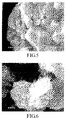
- FIG. 5 A scanning electron microscope (SEM) photograph of the particulate of lithium manganate LiMn2O4 for use as a raw material is shown in Fig. 5.
- SEM scanning electron microscope
- FIG. 6 An electron microscope photograph (SEM) of the powder particles of the conductor-mixed active electrode material thus processed is shown in Fig. 6.
- SEM electron microscope photograph
- Fig. 6 shows that the surfaces of lithium manganate are in a flocculent state, which is different from a surface state prior to processing.
- a mixture of innumerable flocculent conductive material components is present around the lithium manganate.
- myriad flocculent conductive materials are coupled to the surfaces of crushed and lessened lithium manganate particulates.
- the presence of this flocculent conductive material leads to enhancement of the electrical conductivity between active electrode materials. Additionally, since the surfaces of such active electrode materials are not coated against the entry and exit of ions, it is possible to sufficiently derive the characteristics and functionalities inherent to the active electrode material(s).
- a hydro-honing processing technique is employable. This method includes the step of uniformly spraying, by a compressed air, a composite material with a blend of an abradant, a fluid such as water and an antioxidant from a nozzle(s) onto a foil surface of the current collecting material 3. Immediately after the processing, cleaning is done, followed by the blowing of hot air to dry a cleaning fluid. The surface roughness obtained thereby is set so that the along-the-center-line average roughness Ra is about 0.1 to 2 ⁇ m.
- the positive electrode structure was formed by coating on aluminum foil a mixture of a conductor-blended active electrode material and binder plus solvent.
- a current collecting material as used herein was aluminum foil (manufactured by Showa Denko Kabushiki Kaisha, with its along-the-center-line average roughness Ra of 0.623 ⁇ m).
- the binder used was PVDF (available from Kureha Chemical Industry Co., Ltd.). Ratios of electrode layer components are set as follows: 71.20 percent by weight of LiMn 2 O 4 , 15.40% by wt of KB, and 13.40 wt% of PVDF. Added to this material was NMP (N-methyl-2-pyrrolidone) so that its solid components become about 50%. This mixture is stirred by a mixer.
- a slurry is coated by a doctor blade method onto the aluminum foil to a thickness of over ten microns.
- a doctor blade method For example as shown in Fig. 7, wind a sheet of current collecting material 3 out of an unwind unit 71; then, let it travel through a coating device 73 and drier device 7; next, transfer by a conveyer 75 and transfer rollers 76; then, wind up by a rewinding unit 72.
- the coater device 73 contains therein a mixture for the electrode layer use.
- the mixture 732 is coated onto the current collecting material 3 by a doctor blade coater head 731.
- the current collector 3 with the mixture 732 coated thereon is then guided to enter the drier device 7 whereby the coated mixture 732 is blown with hot air from nozzles 741 so that the solvent is vaporized and dried. Vapored gasses are exhausted from an exhaust port 74.
- a compressor device After having dried, a compressor device is used to perform rolling processing.
- An electrode structure 1 having the dried coat layer is pressed by a thermal presser device 8 as shown in Fig. 8 for example.
- a thermal presser device 8 For this pressing, there are options which follow: pressing is performed at room temperature (room-temperature press); and, press is done during heating (hot press).
- heaters 82 of a heating unit 81 are used to heat up to a temperature of 80°C to 130°C, for example.
- a presser unit 83 has a super press of our company (including a pair of work rolls 84, i.e., a small-diameter roll with a diameter of 15 cm, and a large-diameter roll with its diameter of 25cm), wherein it is desirable to set at 300 to 1000 kg/cm. It should be noted here that the small-diameter work roll 84 and large-diameter work roll 84 are replaceable with a pair of small-diameter rolls.
- the above-noted super press of the presser device 7 is arranged so that the work roll 84 is made smaller in diameter while lessening its contact area with an object to be pressed, such as an electrode structure, thereby making it possible to apply a large pressing force (this is called the rolling pressure since it is a pressure occurring due to rotation).
- a large-diameter backup roll 85 is used to prevent flexure of the work roll(s) 84.
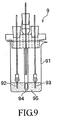
- the lithium rechargeable battery may be a beaker cell 9 using a beaker-like vessel 91 such as shown in Fig. 9.
- a positive pole 92 is a positive electrode structure that uses a conductor-mixed active electrode material having its area of about 0.4cm 2 .
- a counter electrode or anti-pole 93 was made of Pt metal. The positive pole and antipole are spaced apart from each other by a distance of 1cm.
- a reference pole 94 was made of Ag.
- An electrolytic solution 95 used here was LiPF 6 /PC+DME (50:50) of 1M.
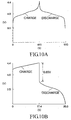
- FIG. 10(A) One exemplary voltage-versus-time curve at the time the lithium rechargeable battery is charged and discharged by a current of 0.2mA is graphically shown in Fig. 10(A). This graph shows that charging is carried out for 450 seconds up to a cut-off voltage of 4.4V, followed by discharge during the next 450 seconds. As apparent from viewing'this curve, the charge capacity becomes 90mAs and the discharge capacity was 90mAs.
- FIG. 10(B) Another exemplary voltage-time curve during charge-up of the lithium rechargeable battery using a current of 26mA is shown in Fig. 10(B).
- This graph shows that charge is done for 17.4 seconds up to a cutoff voltage of 4.4V, followed by discharge for the next 17.6 seconds.
- the charge capacity becomes 45.24mAs and the discharge capacity was 45.76mAs.
- the electrical resistance of the electrolyte is obtainable from a voltage difference of 0.65V when switching from the chargeup to discharge-it was 125 ⁇ .
- Table 1 shows measurement results obtained while varying the charge/discharge current to 0.2mA, 0.4mA, et seq.
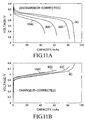
- Fig. 11 shows, in regard to some of them, curves of the relationship of voltage and charge/discharge capacity (with iR correction applied thereto). These measurements were performed at a temperature of 23°C, with repeated execution of 21 cycles of charge/discharge operations. The cutoff voltage was 3.0 to 4.4V.
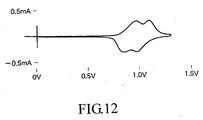
- a voltamograph of the positive electrode structure is shown in Fig. 12.
- a potential sweep speed of 1mV/s when sweeping with a voltage potential of the positive electrode, twin peaks unique to the lithium manganate were found near a 0.96-V point and a 1.1V point.
- twin peaks appeared near 1.0V and 0.85V points (peak current: -0.3mA or more or less).
- the present invention is capable of obtaining the efficacy which follows.
- This invention is able to enhance the electrical conductivity between active electrode materials.
- the invention can enhance the conductivity between an active electrode material and an electrical connection assistant agent.
- the invention can enhance the conductivity between an active electrode material and a current collecting material.
- the invention can provide a battery and/or a capacitor excellent in performance.
Landscapes
- Chemical & Material Sciences (AREA)
- Chemical Kinetics & Catalysis (AREA)
- Electrochemistry (AREA)
- General Chemical & Material Sciences (AREA)
- Engineering & Computer Science (AREA)
- Manufacturing & Machinery (AREA)
- Battery Electrode And Active Subsutance (AREA)
Applications Claiming Priority (5)
| Application Number | Priority Date | Filing Date | Title |
|---|---|---|---|
| JP2002163396 | 2002-06-04 | ||
| JP2002163396 | 2002-06-04 | ||
| JP2002167507 | 2002-06-07 | ||
| JP2002167507 | 2002-06-07 | ||
| PCT/JP2003/007043 WO2003103076A1 (ja) | 2002-06-04 | 2003-06-03 | 導電材混合電極活物質、電極構造、二次電池、及び導電材混合電極活物質の製造方法 |
Publications (2)
| Publication Number | Publication Date |
|---|---|
| EP1511097A1 true EP1511097A1 (de) | 2005-03-02 |
| EP1511097A4 EP1511097A4 (de) | 2008-09-17 |
Family
ID=29714339
Family Applications (1)
| Application Number | Title | Priority Date | Filing Date |
|---|---|---|---|
| EP03730813A Withdrawn EP1511097A4 (de) | 2002-06-04 | 2003-06-03 | Mit leitfähigem material gemischtes elektrodenaktivmaterial, elektrodenstruktur, sekundärzelle, amd-verfahren zur herstellung eines mit leitfähigem material gemischten elektrodenaktivmaterials |
Country Status (6)
| Country | Link |
|---|---|
| US (1) | US20050221186A1 (de) |
| EP (1) | EP1511097A4 (de) |
| JP (1) | JPWO2003103076A1 (de) |
| CN (1) | CN1310354C (de) |
| AU (1) | AU2003241997A1 (de) |
| WO (1) | WO2003103076A1 (de) |
Families Citing this family (9)
| Publication number | Priority date | Publication date | Assignee | Title |
|---|---|---|---|---|
| JP2006164689A (ja) * | 2004-12-06 | 2006-06-22 | Enerstruct Kk | 電極構造体、二次電池及びキャパシタ |
| CN102077392B (zh) * | 2009-01-26 | 2013-08-28 | 丰田自动车株式会社 | 锂二次电池用正极及其利用 |
| AU2010254037B2 (en) * | 2009-05-29 | 2014-05-01 | Arkema Inc. | Aqueous polyvinylidene fluoride composition |
| US8840687B2 (en) * | 2010-08-23 | 2014-09-23 | Corning Incorporated | Dual-layer method of fabricating ultracapacitor current collectors |
| WO2012124687A1 (ja) * | 2011-03-17 | 2012-09-20 | 三洋電機株式会社 | 非水電解質二次電池及びその製造方法 |
| JP2013058451A (ja) * | 2011-09-09 | 2013-03-28 | Mitsubishi Chemicals Corp | リチウム二次電池用正極及びリチウム二次電池 |
| US20150280239A1 (en) | 2014-04-01 | 2015-10-01 | Ppg Industries Ohio, Inc. | Aqueous binder composition for lithium ion electrical storage devices |
| US9385374B2 (en) | 2014-04-01 | 2016-07-05 | Ppg Industries Ohio, Inc. | Electrode binder composition for lithium ion electrical storage devices |
| KR101936339B1 (ko) * | 2015-08-31 | 2019-04-03 | 주식회사 엘지화학 | 전극 합제층 형성 몰드를 포함하는 이차전지용 전극 제조 장치 |
Family Cites Families (29)
| Publication number | Priority date | Publication date | Assignee | Title |
|---|---|---|---|---|
| JP2611265B2 (ja) * | 1987-10-17 | 1997-05-21 | ソニー株式会社 | 非水電解液二次電池 |
| JP3601124B2 (ja) * | 1995-09-22 | 2004-12-15 | 株式会社デンソー | 非水溶液を用いる二次電池の正極活物質、および正極。 |
| JPH0997625A (ja) * | 1995-09-29 | 1997-04-08 | Seiko Instr Inc | 非水電解質二次電池およびその製造方法 |
| JP3373989B2 (ja) * | 1995-11-16 | 2003-02-04 | 三洋電機株式会社 | 水素吸蔵合金粉末及び製法 |
| JPH09249407A (ja) * | 1996-03-14 | 1997-09-22 | Toyota Central Res & Dev Lab Inc | 黒鉛複合物およびその製造方法 |
| JP3677975B2 (ja) * | 1996-12-26 | 2005-08-03 | 三菱電機株式会社 | 電極及びこれを用いた電池 |
| JP3525710B2 (ja) * | 1997-11-19 | 2004-05-10 | 株式会社デンソー | 二次電池及びその正極活物質 |
| GB9809964D0 (en) * | 1998-05-08 | 1998-07-08 | Danionics As | Electrochemical cell |
| JP4236308B2 (ja) * | 1998-08-31 | 2009-03-11 | 三洋電機株式会社 | リチウムイオン電池 |
| JP2000268879A (ja) * | 1999-03-18 | 2000-09-29 | Hitachi Ltd | リチウム二次電池 |
| JP2000285910A (ja) * | 1999-03-30 | 2000-10-13 | Kyocera Corp | リチウム電池 |
| CA2308346A1 (en) * | 1999-05-14 | 2000-11-14 | Mitsubishi Cable Industries, Ltd. | Positive electrode active material, positive electrode active material composition and lithium ion secondary battery |
| DE19929172B4 (de) * | 1999-06-25 | 2006-12-28 | Infineon Technologies Ag | Integrierter Speicher |
| JP4534291B2 (ja) * | 2000-03-06 | 2010-09-01 | 株式会社豊田中央研究所 | リチウム二次電池 |
| JP3838878B2 (ja) * | 2000-04-28 | 2006-10-25 | 松下電器産業株式会社 | 電池用電極板およびその製造方法 |
| JP2001351612A (ja) * | 2000-06-06 | 2001-12-21 | Matsushita Battery Industrial Co Ltd | 非水電解液二次電池 |
| JP4632005B2 (ja) * | 2000-07-17 | 2011-02-16 | 株式会社Gsユアサ | リチウム二次電池 |
| JP2002042812A (ja) * | 2000-07-27 | 2002-02-08 | Yuasa Corp | リチウム二次電池用正極活物質及びそれを用いたリチウム二次電池 |
| JP4002829B2 (ja) * | 2000-09-06 | 2007-11-07 | 日立マクセル株式会社 | 電気化学素子用電極材料とその製造方法および電気化学素子 |
| JP4678927B2 (ja) * | 2000-09-29 | 2011-04-27 | 株式会社Gsユアサ | 非水電解液およびこれを用いたリチウム電池 |
| JP4491950B2 (ja) * | 2000-10-06 | 2010-06-30 | ソニー株式会社 | 正極活物質の製造方法及び非水電解質電池の製造方法 |
| JP4697912B2 (ja) * | 2000-11-17 | 2011-06-08 | 日立マクセル株式会社 | 二次電源用電極材料およびそれを用いた二次電源 |
| JP4075451B2 (ja) * | 2001-05-15 | 2008-04-16 | 株式会社豊田中央研究所 | リチウム二次電池 |
| JP2003086174A (ja) * | 2001-06-25 | 2003-03-20 | Hosokawa Micron Corp | 電極用複合粒子材料、電極板及びそれらの製造方法 |
| JP2003059492A (ja) * | 2001-08-17 | 2003-02-28 | Matsushita Electric Ind Co Ltd | リチウム二次電池およびその製造方法 |
| JP2003173777A (ja) * | 2001-12-07 | 2003-06-20 | Hitachi Metals Ltd | 非水系リチウム二次電池用正極活物質と導電助材の複合方法およびその複合材料、それを用いた正極および非水系リチウム二次電池 |
| US7049031B2 (en) * | 2002-01-29 | 2006-05-23 | The University Of Chicago | Protective coating on positive lithium-metal-oxide electrodes for lithium batteries |
| JP2003308845A (ja) * | 2002-04-17 | 2003-10-31 | Mikuni Color Ltd | リチウム二次電池用電極及びこれを用いたリチウム二次電池 |
| JP2003317707A (ja) * | 2002-04-26 | 2003-11-07 | Matsushita Electric Ind Co Ltd | 非水電解質二次電池用負極とその製造方法 |
-
2003
- 2003-06-03 AU AU2003241997A patent/AU2003241997A1/en not_active Abandoned
- 2003-06-03 EP EP03730813A patent/EP1511097A4/de not_active Withdrawn
- 2003-06-03 JP JP2004510054A patent/JPWO2003103076A1/ja active Pending
- 2003-06-03 US US10/516,959 patent/US20050221186A1/en not_active Abandoned
- 2003-06-03 CN CNB038127881A patent/CN1310354C/zh not_active Expired - Fee Related
- 2003-06-03 WO PCT/JP2003/007043 patent/WO2003103076A1/ja not_active Ceased
Also Published As
| Publication number | Publication date |
|---|---|
| EP1511097A4 (de) | 2008-09-17 |
| JPWO2003103076A1 (ja) | 2005-10-06 |
| AU2003241997A1 (en) | 2003-12-19 |
| CN1659727A (zh) | 2005-08-24 |
| US20050221186A1 (en) | 2005-10-06 |
| CN1310354C (zh) | 2007-04-11 |
| WO2003103076A1 (ja) | 2003-12-11 |
Similar Documents
| Publication | Publication Date | Title |
|---|---|---|
| JP4777593B2 (ja) | リチウムイオン二次電池の製造方法 | |
| CN119480907A (zh) | 非水电解质二次电池用负极以及非水电解质二次电池 | |
| US12021229B2 (en) | Multifunctional engineered particle for a secondary battery and method of manufacturing the same | |
| CN111816856A (zh) | 复合材料及其制备方法和负极 | |
| JP7565281B2 (ja) | 負極材料、負極片、電気化学装置及び電子装置 | |
| CN103891020B (zh) | 电极材料、电极材料的制造方法、电极和二次电池 | |
| WO2008012765A2 (en) | Batteries, electrodes for batteries, and methods of their manufacture | |
| CN114156602B (zh) | 具有多涂层的固态电解质隔膜及制备方法和应用 | |
| WO2013014742A1 (ja) | 非水電解質二次電池 | |
| WO2011101987A1 (ja) | リチウムイオン二次電池とその製造方法 | |
| KR20240121318A (ko) | 분리막 및 이를 사용하는 이차 전지, 배터리 모듈, 배터리 팩 및 전기 장치 | |
| JP2024144468A (ja) | 二次電池及び二次電池システム | |
| EP1511097A1 (de) | Mit leitfähigem material gemischtes elektrodenaktivmaterial, elektrodenstruktur, sekundärzelle, amd-verfahren zur herstellung eines mit leitfähigem material gemischten elektrodenaktivmaterials | |
| KR100842930B1 (ko) | 리튬 이차 전지용 음극, 및 이를 포함하는 리튬 이차 전지 | |
| US8709648B2 (en) | Conductor-mixed active electrode material, electrode structure, rechargeable battery, and manufacturing method of conductor-mixed active electrode material | |
| WO2017160897A1 (en) | Separators for high density electrochemical energy storage | |
| CN118572031A (zh) | 正极极片和电池 | |
| JP7704700B2 (ja) | 集電体及び二次電池 | |
| CN117012976A (zh) | 集流体及其制备方法、电池、电池包和车辆 | |
| CN117317125A (zh) | 正极极片及电池和用电设备 | |
| JP2008204836A (ja) | 非水電解質二次電池用負極およびその製造方法ならびにそれを用いた非水電解質二次電池 | |
| JP7643377B2 (ja) | 電極材料、電極材料の製造方法、及び、二次電池 | |
| JP7787540B2 (ja) | 蓄電デバイスの電極の製造方法、蓄電デバイスの電極用の短繊維の製造方法、容器に入った蓄電デバイスの電極用の短繊維、および蓄電デバイスの電極 | |
| JP2024013898A (ja) | 全固体二次電池用負極、全固体二次電池及びその製造方法 | |
| WO2026079122A1 (ja) | 二次電池用負極及び二次電池 |
Legal Events
| Date | Code | Title | Description |
|---|---|---|---|
| PUAI | Public reference made under article 153(3) epc to a published international application that has entered the european phase |
Free format text: ORIGINAL CODE: 0009012 |
|
| 17P | Request for examination filed |
Effective date: 20041203 |
|
| AK | Designated contracting states |
Kind code of ref document: A1 Designated state(s): AT BE BG CH CY CZ DE DK EE ES FI FR GB GR HU IE IT LI LU MC NL PT RO SE SI SK TR |
|
| AX | Request for extension of the european patent |
Extension state: AL LT LV MK |
|
| DAX | Request for extension of the european patent (deleted) | ||
| RBV | Designated contracting states (corrected) |
Designated state(s): DE FR IT |
|
| A4 | Supplementary search report drawn up and despatched |
Effective date: 20080820 |
|
| 17Q | First examination report despatched |
Effective date: 20091126 |
|
| RAP1 | Party data changed (applicant data changed or rights of an application transferred) |
Owner name: ENERL, INC. |
|
| STAA | Information on the status of an ep patent application or granted ep patent |
Free format text: STATUS: THE APPLICATION IS DEEMED TO BE WITHDRAWN |
|
| 18D | Application deemed to be withdrawn |
Effective date: 20120809 |