EP1510274A2 - Magnetpulver und Herstellungsverfahren - Google Patents
Magnetpulver und Herstellungsverfahren Download PDFInfo
- Publication number
- EP1510274A2 EP1510274A2 EP04018230A EP04018230A EP1510274A2 EP 1510274 A2 EP1510274 A2 EP 1510274A2 EP 04018230 A EP04018230 A EP 04018230A EP 04018230 A EP04018230 A EP 04018230A EP 1510274 A2 EP1510274 A2 EP 1510274A2
- Authority
- EP
- European Patent Office
- Prior art keywords
- magnetic powder
- magnetic
- sites
- less
- basic
- Prior art date
- Legal status (The legal status is an assumption and is not a legal conclusion. Google has not performed a legal analysis and makes no representation as to the accuracy of the status listed.)
- Granted
Links
Images
Classifications
-
- H—ELECTRICITY
- H01—ELECTRIC ELEMENTS
- H01F—MAGNETS; INDUCTANCES; TRANSFORMERS; SELECTION OF MATERIALS FOR THEIR MAGNETIC PROPERTIES
- H01F1/00—Magnets or magnetic bodies characterised by the magnetic materials therefor; Selection of materials for their magnetic properties
- H01F1/01—Magnets or magnetic bodies characterised by the magnetic materials therefor; Selection of materials for their magnetic properties of inorganic materials
- H01F1/03—Magnets or magnetic bodies characterised by the magnetic materials therefor; Selection of materials for their magnetic properties of inorganic materials characterised by their coercivity
- H01F1/032—Magnets or magnetic bodies characterised by the magnetic materials therefor; Selection of materials for their magnetic properties of inorganic materials characterised by their coercivity of hard-magnetic materials
- H01F1/04—Magnets or magnetic bodies characterised by the magnetic materials therefor; Selection of materials for their magnetic properties of inorganic materials characterised by their coercivity of hard-magnetic materials metals or alloys
- H01F1/047—Alloys characterised by their composition
- H01F1/053—Alloys characterised by their composition containing rare earth metals
-
- G—PHYSICS
- G11—INFORMATION STORAGE
- G11B—INFORMATION STORAGE BASED ON RELATIVE MOVEMENT BETWEEN RECORD CARRIER AND TRANSDUCER
- G11B5/00—Recording by magnetisation or demagnetisation of a record carrier; Reproducing by magnetic means; Record carriers therefor
- G11B5/62—Record carriers characterised by the selection of the material
- G11B5/68—Record carriers characterised by the selection of the material comprising one or more layers of magnetisable material homogeneously mixed with a bonding agent
- G11B5/70—Record carriers characterised by the selection of the material comprising one or more layers of magnetisable material homogeneously mixed with a bonding agent on a base layer
- G11B5/712—Record carriers characterised by the selection of the material comprising one or more layers of magnetisable material homogeneously mixed with a bonding agent on a base layer characterised by the surface treatment or coating of magnetic particles
-
- B—PERFORMING OPERATIONS; TRANSPORTING
- B22—CASTING; POWDER METALLURGY
- B22F—WORKING METALLIC POWDER; MANUFACTURE OF ARTICLES FROM METALLIC POWDER; MAKING METALLIC POWDER; APPARATUS OR DEVICES SPECIALLY ADAPTED FOR METALLIC POWDER
- B22F1/00—Metallic powder; Treatment of metallic powder, e.g. to facilitate working or to improve properties
- B22F1/16—Metallic particles coated with a non-metal
-
- H—ELECTRICITY
- H01—ELECTRIC ELEMENTS
- H01F—MAGNETS; INDUCTANCES; TRANSFORMERS; SELECTION OF MATERIALS FOR THEIR MAGNETIC PROPERTIES
- H01F1/00—Magnets or magnetic bodies characterised by the magnetic materials therefor; Selection of materials for their magnetic properties
- H01F1/01—Magnets or magnetic bodies characterised by the magnetic materials therefor; Selection of materials for their magnetic properties of inorganic materials
- H01F1/03—Magnets or magnetic bodies characterised by the magnetic materials therefor; Selection of materials for their magnetic properties of inorganic materials characterised by their coercivity
- H01F1/032—Magnets or magnetic bodies characterised by the magnetic materials therefor; Selection of materials for their magnetic properties of inorganic materials characterised by their coercivity of hard-magnetic materials
- H01F1/09—Magnets or magnetic bodies characterised by the magnetic materials therefor; Selection of materials for their magnetic properties of inorganic materials characterised by their coercivity of hard-magnetic materials mixtures of metallic and non-metallic particles; metallic particles having oxide skin
-
- H—ELECTRICITY
- H01—ELECTRIC ELEMENTS
- H01F—MAGNETS; INDUCTANCES; TRANSFORMERS; SELECTION OF MATERIALS FOR THEIR MAGNETIC PROPERTIES
- H01F1/00—Magnets or magnetic bodies characterised by the magnetic materials therefor; Selection of materials for their magnetic properties
- H01F1/01—Magnets or magnetic bodies characterised by the magnetic materials therefor; Selection of materials for their magnetic properties of inorganic materials
- H01F1/03—Magnets or magnetic bodies characterised by the magnetic materials therefor; Selection of materials for their magnetic properties of inorganic materials characterised by their coercivity
- H01F1/12—Magnets or magnetic bodies characterised by the magnetic materials therefor; Selection of materials for their magnetic properties of inorganic materials characterised by their coercivity of soft-magnetic materials
- H01F1/33—Magnets or magnetic bodies characterised by the magnetic materials therefor; Selection of materials for their magnetic properties of inorganic materials characterised by their coercivity of soft-magnetic materials mixtures of metallic and non-metallic particles; metallic particles having oxide skin
-
- B—PERFORMING OPERATIONS; TRANSPORTING
- B22—CASTING; POWDER METALLURGY
- B22F—WORKING METALLIC POWDER; MANUFACTURE OF ARTICLES FROM METALLIC POWDER; MAKING METALLIC POWDER; APPARATUS OR DEVICES SPECIALLY ADAPTED FOR METALLIC POWDER
- B22F2998/00—Supplementary information concerning processes or compositions relating to powder metallurgy
-
- B—PERFORMING OPERATIONS; TRANSPORTING
- B22—CASTING; POWDER METALLURGY
- B22F—WORKING METALLIC POWDER; MANUFACTURE OF ARTICLES FROM METALLIC POWDER; MAKING METALLIC POWDER; APPARATUS OR DEVICES SPECIALLY ADAPTED FOR METALLIC POWDER
- B22F2998/00—Supplementary information concerning processes or compositions relating to powder metallurgy
- B22F2998/10—Processes characterised by the sequence of their steps
-
- Y—GENERAL TAGGING OF NEW TECHNOLOGICAL DEVELOPMENTS; GENERAL TAGGING OF CROSS-SECTIONAL TECHNOLOGIES SPANNING OVER SEVERAL SECTIONS OF THE IPC; TECHNICAL SUBJECTS COVERED BY FORMER USPC CROSS-REFERENCE ART COLLECTIONS [XRACs] AND DIGESTS
- Y10—TECHNICAL SUBJECTS COVERED BY FORMER USPC
- Y10T—TECHNICAL SUBJECTS COVERED BY FORMER US CLASSIFICATION
- Y10T428/00—Stock material or miscellaneous articles
- Y10T428/25—Web or sheet containing structurally defined element or component and including a second component containing structurally defined particles
- Y10T428/256—Heavy metal or aluminum or compound thereof
-
- Y—GENERAL TAGGING OF NEW TECHNOLOGICAL DEVELOPMENTS; GENERAL TAGGING OF CROSS-SECTIONAL TECHNOLOGIES SPANNING OVER SEVERAL SECTIONS OF THE IPC; TECHNICAL SUBJECTS COVERED BY FORMER USPC CROSS-REFERENCE ART COLLECTIONS [XRACs] AND DIGESTS
- Y10—TECHNICAL SUBJECTS COVERED BY FORMER USPC
- Y10T—TECHNICAL SUBJECTS COVERED BY FORMER US CLASSIFICATION
- Y10T428/00—Stock material or miscellaneous articles
- Y10T428/29—Coated or structually defined flake, particle, cell, strand, strand portion, rod, filament, macroscopic fiber or mass thereof
- Y10T428/2982—Particulate matter [e.g., sphere, flake, etc.]
- Y10T428/2991—Coated
Definitions
- An object of the present invention is to overcome this problem.
- the size of the particles as expressed in particle volume is preferably 1000 -10000 nm 3 .
- the particle volume is smaller than 1000 nm 3 , superparamagnetism occurs owing to thermal fluctuation and dispersion becomes difficult.
- a magnetic powder whose particle volume is greater than 10000 nm 3 is not suitable for a medium of low noise in terms of magnetic conversion property.
- average particle diameter means the average major axis length of the acicular particles.
- the particles of a magnetic powder are not required to be of any particular shape such as acicular (including spindle-like and flat-acicular-like), ellipsoid, granular, spherical or the like.
- the effect of the present invention is especially great when a magnetic powder having particles of acicular (including spindle-like and flat-acicular-like) shape are used, because such a magnetic powder is usually added with one or more elements like Al, Si and Ra whose oxides have an effect on the catalytic activity of the magnetic powder.
- the Al content of the magnetic powder expressed as Al/Fe atomic percent is preferably 5 - 35 at.%, more preferably 10 - 30 at.%
- the Si content thereof expressed as Si/Fe atomic percent is preferably 0.1 - 10 at.%, more preferably 1- 6 at.%
- the Ra (rare earth element, defined as including Y) content thereof expressed as Ra/Fe atomic percent is preferably 4 - 20 at.%, more preferably 5 - 10 at.%.
- Special care is required regarding the Ra content because when excessive Ra is added, the Ra oxide exhibits strong catalytic activity and the number of basic sites and acidic sites becomes very high.
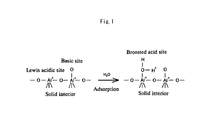
- the sintering-preventing effect and shape-retaining effect of these added elements generally tend to decrease with increasing fineness of the magnetic powder. It is therefore advantageous to increase the amount of adhering rare earth element(s) (Ra). However, it was found that while increasing the amount of Ra adherence enhanced the sinter-preventing and shape-retaining effects, it also tended to increase catalytic activity. But experiments conducted by the inventor showed that in an acicular magnetic powder whose Ra/Fe atomic percent is less than 10 at.%, it is possible by regulating the powder to not greater than 0.85 basic site/nm 2 and not greater than 0.75 acidic site/nm 2 to achieve ⁇ T of less than 8.0 °C and ⁇ C of less than 120 at.%.
- the present invention provides a magnetic powder composed chiefly of Fe that has not greater than 0.85 basic site/nm 2 and not greater than 0.75 acidic site/nm 2 even though its particles have an average diameter of less than 70 nm and contain oxides of Al, Si and Ra in their surface layers.
- a magnetic powder can be obtained by subjecting the magnetic powder consisting of particles composed chiefly of Fe whose surface layer contains an oxide of at least one of Al, Si and Ra and whose average particle diameter is less than 70 nm that was obtained by the final heat treatment to gentle oxidation treatment after once heat-treating it at a temperature higher than 180 °C.
- This heat treatment following reduction is preferably carried out in a reducing or inert gas atmosphere or optionally in a wet hydrogen atmosphere to which steam has been added.
- heat treatment can be carried out in a hydrogen gas atmosphere containing 2 - 20 vol.% of steam for 5 -60 min. at a temperature in the range of 180 - 400 °C, followed by gentle oxidation treatment.
- the gentle oxidation treatment can be conducted by holding the magnetic powder at a temperature of 40 - 200 °C for about 10 - 120 min. in a nitrogen gas atmosphere having an oxygen concentration of 0.01 - 1 vol.%.
- the number of basic sites and acidic sites can be regulated to not greater than 0.85 site/nm 2 and not greater than 0.75 site/nm 2 , respectively, and the values of ⁇ T and ⁇ C mentioned earlier can be made less than 8.0 °C and less than 120 at.%, respectively.
- the desired number of basic sites and acidic sites cannot be achieved owing to some other factor, it suffices to repeat the aforesaid processing multiple times.
- the number of basic and acidic sites can be regulated by a method of magnetic powder particle surface treatment instead of said gentle oxidation treatment.
- One such method that can be used is to treat the surface of the magnetic powder with an alcohol and/or polyalcohol.
- Another is to treat the surface of the magnetic powder with a coupling agent such as a silane coupling agent.
- the magnetic powder to which the present invention applies is a very fine one having an average particle diameter of less than 70 nm
- method (3) is preferably adopted.
- the individual particles are monodispersed and the entire surface of each particle is surface-treated. It is therefore preferable to implement a measure for dispersing the magnetic powder in the organic solvent so that the degree of dispersion ß is not greater than 10, thereby ensuring that the entire surface of the magnetic powder prior to the surface treatment exhibits hydrophilicity.
- the action of the silane coupling agent is for its Y side to strongly bond with the surface of the hydrophilic magnetic powder and its organofunctional group to bond with the resin of the coating, thereby producing a strong bond among the magnetic powder - silane coupling agent - resin.
- R' can be any of the foregoing groups, it is preferably an epoxy group, amino group or methacryl group, more preferably an amino group or methacryl group, most preferably a methacryl group. From the practical viewpoint, however, it is best to select R' in accordance with the type of resin used to form the magnetic layer.
- Y can be any of a methoxy group, ethoxy group or the like but is preferably a methoxy group.
- a magnetic powder according to the present invention can be obtained wherein the number of basic sites is not greater than 0.85 site/nm 2 and the number of acidic sites is not greater than 0.75 site/nm 2 .
- the values of the aforesaid ⁇ T and ⁇ C of this powder are less than 8.0 °C and less than 120 at.%, respectively.
- 0.500 g of magnetic powder was weighed out and placed in a pot (inside diameter: 45 mm, depth: 13 mm) and allowed to stand for 10 min. with the cover open.
- 0.700 mL of a vehicle [mixed solution of vinyl chloride resin MR-110 (22 wt%), cyclohexanone (38.7 wt%), acetylacetone (0.3 wt%), butyl stearate (0.3 wt%) and methyl ethyl ketone (MEK, 38.7%)] was added to the pot using a micropipette.
- a steel ball (2 ⁇ ) 30 g and ten nylon balls (8 ⁇ ) were immediately added to the pot and the pot was covered and allowed to stand for 10 min.
- the pot was then set in a centrifugal ball mill (Fritsch P-6) and gradually raised to a final rotating speed of 600 rpm, at which dispersion was continued for 60 min.
- the centrifugal ball mill was stopped and the pot removed.
- the pot was added with 1.8 mL of a liquid adjuster prepared in advance by mixing MEK and toluene at a ratio of 1 : 1.
- the pot was again set in the centrifugal ball mill and rotated at 600 rpm for 5 minutes. This completed the dispersion and the preparation of the magnetic coating material.
- the cover of the pot was opened and the nylon balls removed.
- the coating material, together with the steel ball, was placed in an applicator (55 ⁇ m) and coated onto a support film (15 ⁇ m polyethylene film marketed by Toray Industries under the product designation 15C-B500).
- the coated film was promptly placed at the center of the coil of a 5.5 kG magnetic orientation device to orient its magnetic field, and then dried.
- the cover of the pot was opened and the nylon balls removed.
- the coating material, together with the steel ball, was placed in an applicator (55 ⁇ m) and coated onto a glass plate (4 cm length x 15 cm width x 1 mm thickness).
- the coated film was promptly placed at the center of the coil of a 5.5 kG magnetic orientation device to orient its magnetic field and then dried, thus completing preparation of a specimen substrate for durability evaluation.
- the glass plate coated with the specimen was attached to a sliding steel ball tester (Heidon-14DR marketed by Shinto Scientific Co., Ltd.) and a 10-mm diameter steel ball was slid thereon under a load of 5 g.
- the steel ball was run across the coated glass plate 580 times at a velocity of 2,320 mm/min (38.7 mm/sec).
- the condition of the surface over which the steel ball was slid was then observed (to determine whether the coating had been abraded through to the glass substrate) and the width of the scratch was measured using a 100X optical microscope.
- Iron oxyhydroxide starting material including Al, Y(yttrium), Si and Co was dehydrated and baked, then reduced under heating in a hydrogen atmosphere to obtain an acicular metallic magnetic powder having an average major axis length of 61 nm, an Al content expressed as Al/Fe atomic percent of 11.6 at.%, Y content expressed as Y/Fe (indicated as R/Fe in Table 1) atomic percent of 9.6 at.%, Co (cobalt) content expressed as Co/Fe atomic percent of 24.1 at.%, and Si (silicon) content expressed as Si/Fe atomic percent of 0.1 at.%.
- the magnetic powder was processed as described below.
- the reduction under heating in a hydrogen atmosphere was conducted by the two-stage method using a heating temperature of 440 °C in the first stage and heating temperature of 550 °C in the ensuing second stage.
- the magnetic powder was subjected to gentle oxidation treatment at 80 °C in a low oxidizing atmosphere, the oxygen content of the gentle oxidation stage varying from 0.1 vol.% at the start to 1.0 vol.% at the end of the stage, next to heat treatment in an N 2 atmosphere at 180 °C for 30 min, and then again to same gentle oxidation treatment at 80 °C. It was further subjected to heat treatment in a hydrogen atmosphere containing 10 vol.% of H 2 O at 350 °C for 30 min and then to same gentle oxidation treatment at 80 °C.
- the obtained magnetic powder had 0.71 basic site/nm 2 and 0.63 acidic site/nm 2 .
- the properties of the magnetic powder were measured as in Example 1. The results are shown in Table 1.
- Iron oxy-hydroxide starting material including Al, Y and Co was dehydrated and baked, then reduced under heating in a hydrogen atmosphere to obtain an acicular metallic magnetic powder having an average major axis length of 45 nm, an Al content expressed as Al/Fe atomic percent of 11.3 at.%, Y content expressed as Y/Fe atomic percent of 9.6 at.%, and Co content expressed as Co/Fe atomic percent of 23.7 at.%.
- the magnetic powder was processed as described below.
- the reduction under heating in a hydrogen atmosphere was conducted by the two-stage method using a heating temperature of 440 °C in the first stage and heating temperature of 550 °C in the,ensuing second stage.
- the magnetic powder as obtained by the reduction was directly dispersed in alcohol under a nitrogen atmosphere.
- a coupling agent y-methacryloxy propyl trimethoxy silane
- Pure water was then added to conduct hydrolysis, followed by aging.
- the obtained magnetic powder had 0.00 basic site/nm 2 and 0.42 acidic site/nm 2 .
- the properties of the magnetic powder were measured as in Example 1. The results are shown in Table 1.
- An acicular metallic magnetic powder like that of Example 3 except for having an average major axis length of 33 nm, Al/Fe of 26 at.%, Y/Fe of 16.1 at.% and Co/Fe of 23.7 at.% was under the same conditions as in Example 3 subjected to two-stage reduction ⁇ silane coupling treatment.
- the amount coupling agent added was such that the Si content of the magnetic powder measured after processing was 4.6 at.% expressed as Si/Fe.
- the obtained magnetic powder had 0.00 basic site/nm 2 and 0.39 acidic site/nm 2 .
- the properties of the magnetic powder were measured as in Example 1. The results are shown in Table 1.
- Example 2 was repeated except that Y/Fe was changed from 9.5 to 19.1 at.%. (The contents of the other components differed slightly from those in Example 2 owing to difficulty of exact replication but were within allowable ranges.)
- the obtained acicular metallic magnetic powder had 1.09 basic sites/nm 2 and 0.57 acidic site/nm 2 .
- the properties of the magnetic powder were measured as in Example 1. The results are shown in Table 1.
- Example 4 was repeated except that silane coupling treatment was not conducted. However, in order to prevent surface oxidation, the acicular metallic magnetic powder after the two-stage reduction was subjected to gentle oxidation at 80 °C in an oxidizing atmosphere, heat treatment in an N 2 atmosphere at 180 °C for 30 min, and again to same gentle oxidation at 80 °C.
- the obtained magnetic powder had 0.62 basic site/nm 2 and 0.87 acidic site/nm 2 .
- the properties of the magnetic powder were measured as in Example 1. The results are shown in Table 1.
- An acicular metallic ferromagnetic magnetic powder was obtained in the manner of Example 1 except that the reduction step was conducted in a single stage at 450 °C.
- the magnetic powder was subjected to gentle oxidation at 80 °C in an oxidizing atmosphere, heat treatment in an N 2 atmosphere at 180 °C for 30 min, and again to same gentle oxidation at 80 °C.
- high-temperature heat treatment in a wet hydrogen atmosphere was not conducted
- the obtained magnetic powder had 0.53 basic site/nm 2 and 0.87 acidic site/nm 2 .
- the properties of the magnetic powder were measured as in Example 1. The results are shown in Table 1.
- the magnetic powder of Comparative Example 1 which had 0.57 acidic site/nm 2 , fewer than the maximum of 0.75 stipulated by the present invention, but had 1.05 basic site/nm 2 , greater than the maximum of 0.85 stipulated by the present invention, had a high ⁇ C of 150 at.% and was inferior in tape surface smoothness and poor in durability.
- the magnetic powders of Comparative Examples 2 and 3 which had 0.62 and 0.53 basic site/nm 2 , fewer than the maximum of 0.85 stipulated by the present invention, but had 0.85 acidic site/nm 2 , greater than the maximum of 0.75 stipulated by the present invention, were both high in ⁇ T and ⁇ C and were inferior in tape surface smoothness and durability.
Landscapes
- Engineering & Computer Science (AREA)
- Power Engineering (AREA)
- Chemical & Material Sciences (AREA)
- Dispersion Chemistry (AREA)
- Magnetic Record Carriers (AREA)
- Hard Magnetic Materials (AREA)
- Powder Metallurgy (AREA)
Applications Claiming Priority (2)
| Application Number | Priority Date | Filing Date | Title |
|---|---|---|---|
| JP2003304930 | 2003-08-28 | ||
| JP2003304930 | 2003-08-28 |
Publications (3)
| Publication Number | Publication Date |
|---|---|
| EP1510274A2 true EP1510274A2 (de) | 2005-03-02 |
| EP1510274A3 EP1510274A3 (de) | 2006-06-07 |
| EP1510274B1 EP1510274B1 (de) | 2009-12-02 |
Family
ID=34101224
Family Applications (1)
| Application Number | Title | Priority Date | Filing Date |
|---|---|---|---|
| EP04018230A Expired - Lifetime EP1510274B1 (de) | 2003-08-28 | 2004-08-02 | Magnetpulver und Herstellungsverfahren |
Country Status (6)
| Country | Link |
|---|---|
| US (2) | US7344779B2 (de) |
| EP (1) | EP1510274B1 (de) |
| JP (1) | JP5076118B2 (de) |
| KR (1) | KR20050021954A (de) |
| CN (1) | CN100550220C (de) |
| DE (1) | DE602004024357D1 (de) |
Cited By (3)
| Publication number | Priority date | Publication date | Assignee | Title |
|---|---|---|---|---|
| EP2386370A3 (de) * | 2010-05-12 | 2012-02-15 | The Arizona Board Of Regents Of Behalf Of The University Of Arizona | Metallisches, magnetisches Pulver und Verfahren zu dessen Herstellung, magnetische Lackierung, magnetisches Pulver für Magnettherapie und magnetisches Aufzeichnungsmedium |
| EP2425915A3 (de) * | 2010-09-01 | 2012-07-04 | Directa Plus S.p.A. | Mehrmodusherstellungskomplex für Metallnanopartikel |
| US8986602B2 (en) | 2010-09-01 | 2015-03-24 | Directa Plus S.P.A. | Multiple feeder reactor for the production of nano-particles of metal |
Families Citing this family (6)
| Publication number | Priority date | Publication date | Assignee | Title |
|---|---|---|---|---|
| US20060068232A1 (en) * | 2004-09-24 | 2006-03-30 | Hitachi Maxell, Ltd. | Magnetic tape |
| KR101413958B1 (ko) * | 2013-05-24 | 2014-07-04 | 고센바이오비드 주식회사 | 다 작용기를 가지는 자성나노입자 제조방법 |
| JP5668879B1 (ja) * | 2014-03-07 | 2015-02-12 | 住友金属鉱山株式会社 | ニッケル粉末 |
| JP2015197302A (ja) * | 2014-03-31 | 2015-11-09 | 住友金属鉱山株式会社 | 金属粉末表面の評価方法及び金属粉末製造条件の決定方法 |
| JP2015197303A (ja) * | 2014-03-31 | 2015-11-09 | 住友金属鉱山株式会社 | 金属粉末表面の評価方法及びニッケル粉末 |
| CN114082942A (zh) * | 2020-11-18 | 2022-02-25 | 宁波磁性材料应用技术创新中心有限公司 | 一种金属磁粉芯的制备方法 |
Family Cites Families (18)
| Publication number | Priority date | Publication date | Assignee | Title |
|---|---|---|---|---|
| JP2894495B2 (ja) * | 1988-08-24 | 1999-05-24 | 同和鉱業株式会社 | 磁気記録媒体用金属磁性粉の製造法 |
| DE68918836T2 (de) * | 1989-01-27 | 1995-02-23 | Toda Kogyo Corp | Nadelförmige magnetische Teilchen aus einer Eisenlegierung für magnetische Aufzeichnung und Verfahren zu ihrer Herstellung. |
| JPH06163234A (ja) * | 1992-11-26 | 1994-06-10 | Kao Corp | 表面処理磁性粉の製造方法及び磁気記録媒体用塗膜 |
| CA2114913C (en) * | 1993-02-05 | 2003-12-09 | Takafumi Atarashi | Powder having at least one layer and process for preparing the same |
| JPH07210856A (ja) * | 1994-01-19 | 1995-08-11 | Tdk Corp | 磁気記録媒体 |
| US5735969A (en) * | 1996-03-07 | 1998-04-07 | Imation Corp. | Method of producing acicular magnetic alloy particles |
| JPH1187121A (ja) * | 1997-04-28 | 1999-03-30 | Sony Corp | 金属磁性粉末および磁気記録媒体の製造方法 |
| US6139946A (en) * | 1997-05-30 | 2000-10-31 | Imation Corp. | Magnetic recording media incorporating a quaternary ammonium functional binder and magnetic pigment surface treated with compound having acidic and electron withdrawing functionalities |
| US6083600A (en) * | 1998-03-10 | 2000-07-04 | International Business Machines Corporation | Stabilized perfluoropolyether lubricant |
| JPH11306538A (ja) * | 1998-04-21 | 1999-11-05 | Fuji Photo Film Co Ltd | 磁気記録媒体の製造方法 |
| JP4182310B2 (ja) * | 1999-10-28 | 2008-11-19 | 戸田工業株式会社 | 磁気記録用Fe及びCoを主成分とする紡錘状合金磁性粒子粉末の製造法 |
| JP4010098B2 (ja) * | 2000-01-07 | 2007-11-21 | Jfeスチール株式会社 | 粉末冶金用鉄基粉末混合物、その製造方法および成形体の製造方法 |
| JP4154111B2 (ja) * | 2000-06-09 | 2008-09-24 | 富士フイルム株式会社 | 磁気記録媒体 |
| JP4038655B2 (ja) | 2000-12-27 | 2008-01-30 | 戸田工業株式会社 | 磁気記録用紡錘状合金磁性粒子粉末及び磁気記録媒体 |
| JP2002367141A (ja) * | 2001-03-12 | 2002-12-20 | Hitachi Maxell Ltd | 磁気記録媒体と、これに用いられる磁性粉および充填材粉末と、磁気記録媒体の製造方法 |
| JP2002327202A (ja) * | 2001-04-27 | 2002-11-15 | Toda Kogyo Corp | 鉄を主成分とする複合金属磁性粒子粉末及びその製造法並びに磁気記録媒体 |
| JP3866074B2 (ja) * | 2001-10-12 | 2007-01-10 | 富士フイルムホールディングス株式会社 | 強磁性金属粉末及びその製造方法並びに磁気記録媒体 |
| US20040112472A1 (en) * | 2002-12-17 | 2004-06-17 | Imation Corp. | Metal particle data recording medium having enhanced elastic modulus |
-
2004
- 2004-08-02 DE DE602004024357T patent/DE602004024357D1/de not_active Expired - Lifetime
- 2004-08-02 EP EP04018230A patent/EP1510274B1/de not_active Expired - Lifetime
- 2004-08-06 US US10/912,156 patent/US7344779B2/en not_active Expired - Fee Related
- 2004-08-27 KR KR1020040068180A patent/KR20050021954A/ko not_active Withdrawn
- 2004-08-27 CN CNB2004100579650A patent/CN100550220C/zh not_active Expired - Fee Related
-
2008
- 2008-01-11 US US12/007,493 patent/US20080118386A1/en not_active Abandoned
-
2010
- 2010-08-02 JP JP2010173396A patent/JP5076118B2/ja not_active Expired - Fee Related
Cited By (5)
| Publication number | Priority date | Publication date | Assignee | Title |
|---|---|---|---|---|
| EP2386370A3 (de) * | 2010-05-12 | 2012-02-15 | The Arizona Board Of Regents Of Behalf Of The University Of Arizona | Metallisches, magnetisches Pulver und Verfahren zu dessen Herstellung, magnetische Lackierung, magnetisches Pulver für Magnettherapie und magnetisches Aufzeichnungsmedium |
| EP2559503A1 (de) * | 2010-05-12 | 2013-02-20 | The Arizona Board Of Regents On Behalf Of The University Of Arizona | Metallisches magnetisches Pulver und Verfahren zu dessen Herstellung, magnetische Lackierung, magnetisches Pulver für Magnettherapie und magnetisches Aufzeichnungsmedium |
| US8932668B2 (en) | 2010-05-12 | 2015-01-13 | The Arizona Board Of Regents On Behalf Of The University Of Arizona | Metallic magnetic powder and manufacturing method of the same, magnetic painting, magnetic powder for magnetic therapy, and magnetic recording medium |
| EP2425915A3 (de) * | 2010-09-01 | 2012-07-04 | Directa Plus S.p.A. | Mehrmodusherstellungskomplex für Metallnanopartikel |
| US8986602B2 (en) | 2010-09-01 | 2015-03-24 | Directa Plus S.P.A. | Multiple feeder reactor for the production of nano-particles of metal |
Also Published As
| Publication number | Publication date |
|---|---|
| CN100550220C (zh) | 2009-10-14 |
| JP2011009759A (ja) | 2011-01-13 |
| US20080118386A1 (en) | 2008-05-22 |
| US20050048282A1 (en) | 2005-03-03 |
| EP1510274A3 (de) | 2006-06-07 |
| US7344779B2 (en) | 2008-03-18 |
| DE602004024357D1 (de) | 2010-01-14 |
| CN1610022A (zh) | 2005-04-27 |
| KR20050021954A (ko) | 2005-03-07 |
| JP5076118B2 (ja) | 2012-11-21 |
| EP1510274B1 (de) | 2009-12-02 |
Similar Documents
| Publication | Publication Date | Title |
|---|---|---|
| US20080118386A1 (en) | Method of producing magnetic powder | |
| JP5623301B2 (ja) | 磁性粒子およびその製造方法、ならびに磁気記録媒体 | |
| EP0717397B1 (de) | Magnetische, spindelförmige Legierungsteilchen mit Kobalt und Eisen als Hauptbestandteilen sowie Verfahren zu deren Herstellung | |
| EP1577907A2 (de) | Eisennitridpulver und Verfahren zu seiner Herstellung | |
| EP0660309B1 (de) | Nichtmagnetische Unterschicht für magnetischer Aufzeichnungsmedium, magnetisches Aufzeichnungsmedium und nichtmagnetische Teilchen | |
| EP1622175B1 (de) | Verfahren zur oberflächenbehandlung eines magnetpulvers | |
| EP1073042A1 (de) | Nichtmagnetische Kompositteilchen,Verfahren zur Herstellung und diese enthaltendes magnetisches Aufzeichnungsmedium | |
| EP0995720A1 (de) | Hematitteilchen für nicht-magnetische Unterschicht eines magnetischen Aufzeichnungsträgers, Herstellungsverfahren und magnetisches Aufzeichnungsmedium | |
| EP0379776B1 (de) | Nadelförmige magnetische Teilchen aus einer Eisenlegierung für magnetische Aufzeichnung und Verfahren zu ihrer Herstellung | |
| JP4599573B2 (ja) | 磁性粉末の製法 | |
| EP0367159A2 (de) | Magnetischer Aufzeichnungsträger mit einem nadelförmigen Pulver aus einer magnetischen Legierung | |
| JPH11100213A (ja) | ヘマタイトの製造方法及び該ヘマタイトを用いた強磁性粉末の製造方法及び磁気記録媒体 | |
| US6569530B2 (en) | Magnetic recording medium and magnetic composite particles or magnetic recording medium | |
| US6689452B2 (en) | Magnetic recording medium | |
| EP1253585A1 (de) | Eisen-enthaltende magnetische Verbundteilchen, Verfahren zu deren Herstellung und magnetisches Aufzeichnungsmittel | |
| EP1063639A1 (de) | Magnetische Kompositteilchen,Verfahren zur Herstellung und diese enthaltendes magnetisches Aufzeichnungsmedium | |
| US5238483A (en) | Acicular magnetic iron based alloy particles for magnetic recording and method of producing the same | |
| EP0941966B1 (de) | Nadelförmige Hämatitteilchen und magnetischer Aufzeichnungsträger | |
| EP0898269A2 (de) | Magnetisches Aufzeichnungsmedium | |
| EP0433894A1 (de) | Verfahren zur Erzeugung eines magnetischen Metallpulvers zur magnetischen Aufzeichnung | |
| JPH0794310A (ja) | 鉄を主成分とする針状合金磁性微粒子粉末及びその製造法 | |
| EP0923068A2 (de) | Magnetischer Aufzeichnungsträger | |
| JPH09227126A (ja) | ヘマタイト粒子の製造方法及び該粒子を用いた強磁性粉末の製造方法及び磁気記録媒体 | |
| JPH01277324A (ja) | 磁気記録媒体 |
Legal Events
| Date | Code | Title | Description |
|---|---|---|---|
| PUAI | Public reference made under article 153(3) epc to a published international application that has entered the european phase |
Free format text: ORIGINAL CODE: 0009012 |
|
| AK | Designated contracting states |
Kind code of ref document: A2 Designated state(s): AT BE BG CH CY CZ DE DK EE ES FI FR GB GR HU IE IT LI LU MC NL PL PT RO SE SI SK TR |
|
| AX | Request for extension of the european patent |
Extension state: AL HR LT LV MK |
|
| PUAL | Search report despatched |
Free format text: ORIGINAL CODE: 0009013 |
|
| AK | Designated contracting states |
Kind code of ref document: A3 Designated state(s): AT BE BG CH CY CZ DE DK EE ES FI FR GB GR HU IE IT LI LU MC NL PL PT RO SE SI SK TR |
|
| AX | Request for extension of the european patent |
Extension state: AL HR LT LV MK |
|
| 17P | Request for examination filed |
Effective date: 20061206 |
|
| AKX | Designation fees paid |
Designated state(s): DE FR GB |
|
| RAP1 | Party data changed (applicant data changed or rights of an application transferred) |
Owner name: DOWA HOLDINGS CO., LTD. |
|
| RAP1 | Party data changed (applicant data changed or rights of an application transferred) |
Owner name: DOWA ELECTRONICS MATERIALS CO., LTD. |
|
| 17Q | First examination report despatched |
Effective date: 20080514 |
|
| GRAP | Despatch of communication of intention to grant a patent |
Free format text: ORIGINAL CODE: EPIDOSNIGR1 |
|
| GRAS | Grant fee paid |
Free format text: ORIGINAL CODE: EPIDOSNIGR3 |
|
| GRAA | (expected) grant |
Free format text: ORIGINAL CODE: 0009210 |
|
| AK | Designated contracting states |
Kind code of ref document: B1 Designated state(s): DE FR GB |
|
| REG | Reference to a national code |
Ref country code: GB Ref legal event code: FG4D |
|
| REF | Corresponds to: |
Ref document number: 602004024357 Country of ref document: DE Date of ref document: 20100114 Kind code of ref document: P |
|
| PLBE | No opposition filed within time limit |
Free format text: ORIGINAL CODE: 0009261 |
|
| STAA | Information on the status of an ep patent application or granted ep patent |
Free format text: STATUS: NO OPPOSITION FILED WITHIN TIME LIMIT |
|
| 26N | No opposition filed |
Effective date: 20100903 |
|
| REG | Reference to a national code |
Ref country code: FR Ref legal event code: PLFP Year of fee payment: 13 |
|
| REG | Reference to a national code |
Ref country code: FR Ref legal event code: PLFP Year of fee payment: 14 |
|
| REG | Reference to a national code |
Ref country code: FR Ref legal event code: PLFP Year of fee payment: 15 |
|
| PGFP | Annual fee paid to national office [announced via postgrant information from national office to epo] |
Ref country code: DE Payment date: 20180717 Year of fee payment: 15 Ref country code: FR Payment date: 20180712 Year of fee payment: 15 |
|
| PGFP | Annual fee paid to national office [announced via postgrant information from national office to epo] |
Ref country code: GB Payment date: 20180801 Year of fee payment: 15 |
|
| REG | Reference to a national code |
Ref country code: DE Ref legal event code: R119 Ref document number: 602004024357 Country of ref document: DE |
|
| GBPC | Gb: european patent ceased through non-payment of renewal fee |
Effective date: 20190802 |
|
| PG25 | Lapsed in a contracting state [announced via postgrant information from national office to epo] |
Ref country code: DE Free format text: LAPSE BECAUSE OF NON-PAYMENT OF DUE FEES Effective date: 20200303 Ref country code: FR Free format text: LAPSE BECAUSE OF NON-PAYMENT OF DUE FEES Effective date: 20190831 |
|
| PG25 | Lapsed in a contracting state [announced via postgrant information from national office to epo] |
Ref country code: GB Free format text: LAPSE BECAUSE OF NON-PAYMENT OF DUE FEES Effective date: 20190802 |