EP1508588B1 - Geschäumtes staubdichtes Material und staubdichte, dieses Material enthaltende Anordnung - Google Patents
Geschäumtes staubdichtes Material und staubdichte, dieses Material enthaltende Anordnung Download PDFInfo
- Publication number
- EP1508588B1 EP1508588B1 EP20040019979 EP04019979A EP1508588B1 EP 1508588 B1 EP1508588 B1 EP 1508588B1 EP 20040019979 EP20040019979 EP 20040019979 EP 04019979 A EP04019979 A EP 04019979A EP 1508588 B1 EP1508588 B1 EP 1508588B1
- Authority
- EP
- European Patent Office
- Prior art keywords
- foamed
- material according
- dustproof
- pressure
- foamed body
- Prior art date
- Legal status (The legal status is an assumption and is not a legal conclusion. Google has not performed a legal analysis and makes no representation as to the accuracy of the status listed.)
- Expired - Lifetime
Links
- 239000000463 material Substances 0.000 title claims abstract description 100
- 229920001169 thermoplastic Polymers 0.000 claims description 47
- 238000000034 method Methods 0.000 claims description 41
- 239000011261 inert gas Substances 0.000 claims description 39
- 239000010410 layer Substances 0.000 claims description 37
- CURLTUGMZLYLDI-UHFFFAOYSA-N Carbon dioxide Chemical compound O=C=O CURLTUGMZLYLDI-UHFFFAOYSA-N 0.000 claims description 36
- 230000003287 optical effect Effects 0.000 claims description 31
- 239000004820 Pressure-sensitive adhesive Substances 0.000 claims description 28
- 230000008569 process Effects 0.000 claims description 28
- 229920002725 thermoplastic elastomer Polymers 0.000 claims description 20
- 239000001569 carbon dioxide Substances 0.000 claims description 18
- 229910002092 carbon dioxide Inorganic materials 0.000 claims description 18
- 230000003247 decreasing effect Effects 0.000 claims description 17
- 239000000203 mixture Substances 0.000 claims description 17
- 238000010438 heat treatment Methods 0.000 claims description 11
- NIXOWILDQLNWCW-UHFFFAOYSA-N acrylic acid group Chemical group C(C=C)(=O)O NIXOWILDQLNWCW-UHFFFAOYSA-N 0.000 claims description 10
- 239000000314 lubricant Substances 0.000 claims description 9
- 238000000465 moulding Methods 0.000 claims description 8
- 150000002430 hydrocarbons Chemical class 0.000 claims description 3
- 239000004215 Carbon black (E152) Substances 0.000 claims description 2
- 239000002253 acid Substances 0.000 claims description 2
- 125000001931 aliphatic group Chemical group 0.000 claims description 2
- 150000002148 esters Chemical class 0.000 claims description 2
- 229930195733 hydrocarbon Natural products 0.000 claims description 2
- 210000004027 cell Anatomy 0.000 description 60
- 239000007789 gas Substances 0.000 description 26
- 239000000853 adhesive Substances 0.000 description 21
- -1 polyethylene Polymers 0.000 description 18
- 238000005187 foaming Methods 0.000 description 15
- 229920000642 polymer Polymers 0.000 description 13
- XLYOFNOQVPJJNP-UHFFFAOYSA-N water Substances O XLYOFNOQVPJJNP-UHFFFAOYSA-N 0.000 description 11
- 239000003570 air Substances 0.000 description 9
- 230000000052 comparative effect Effects 0.000 description 9
- 239000004088 foaming agent Substances 0.000 description 9
- 238000012360 testing method Methods 0.000 description 9
- 229920001577 copolymer Polymers 0.000 description 8
- 239000004743 Polypropylene Substances 0.000 description 7
- 238000004458 analytical method Methods 0.000 description 7
- 239000003795 chemical substances by application Substances 0.000 description 7
- 230000035699 permeability Effects 0.000 description 7
- 229920001155 polypropylene Polymers 0.000 description 7
- 229920005989 resin Polymers 0.000 description 7
- 239000011347 resin Substances 0.000 description 7
- 229910000831 Steel Inorganic materials 0.000 description 6
- 210000003855 cell nucleus Anatomy 0.000 description 6
- 230000006835 compression Effects 0.000 description 6
- 238000007906 compression Methods 0.000 description 6
- 229920001971 elastomer Polymers 0.000 description 6
- 239000006260 foam Substances 0.000 description 6
- 238000005470 impregnation Methods 0.000 description 6
- 239000008188 pellet Substances 0.000 description 6
- 229920002635 polyurethane Polymers 0.000 description 6
- 239000004814 polyurethane Substances 0.000 description 6
- 239000010959 steel Substances 0.000 description 6
- 239000004698 Polyethylene Substances 0.000 description 5
- 239000000654 additive Substances 0.000 description 5
- 239000004973 liquid crystal related substance Substances 0.000 description 5
- 229920000573 polyethylene Polymers 0.000 description 5
- 239000000126 substance Substances 0.000 description 5
- PPBRXRYQALVLMV-UHFFFAOYSA-N Styrene Chemical compound C=CC1=CC=CC=C1 PPBRXRYQALVLMV-UHFFFAOYSA-N 0.000 description 4
- 230000000996 additive effect Effects 0.000 description 4
- 229910052799 carbon Inorganic materials 0.000 description 4
- 238000000576 coating method Methods 0.000 description 4
- 230000000694 effects Effects 0.000 description 4
- 239000000806 elastomer Substances 0.000 description 4
- 238000005401 electroluminescence Methods 0.000 description 4
- 238000004519 manufacturing process Methods 0.000 description 4
- OKTJSMMVPCPJKN-UHFFFAOYSA-N Carbon Chemical compound [C] OKTJSMMVPCPJKN-UHFFFAOYSA-N 0.000 description 3
- VGGSQFUCUMXWEO-UHFFFAOYSA-N Ethene Chemical compound C=C VGGSQFUCUMXWEO-UHFFFAOYSA-N 0.000 description 3
- 239000005977 Ethylene Substances 0.000 description 3
- 239000004677 Nylon Substances 0.000 description 3
- YXFVVABEGXRONW-UHFFFAOYSA-N Toluene Chemical compound CC1=CC=CC=C1 YXFVVABEGXRONW-UHFFFAOYSA-N 0.000 description 3
- 239000012298 atmosphere Substances 0.000 description 3
- 238000011109 contamination Methods 0.000 description 3
- 238000010924 continuous production Methods 0.000 description 3
- 238000001514 detection method Methods 0.000 description 3
- 238000011156 evaluation Methods 0.000 description 3
- 239000000945 filler Substances 0.000 description 3
- 239000012535 impurity Substances 0.000 description 3
- 239000004615 ingredient Substances 0.000 description 3
- 238000002347 injection Methods 0.000 description 3
- 239000007924 injection Substances 0.000 description 3
- 229910001872 inorganic gas Inorganic materials 0.000 description 3
- 150000002500 ions Chemical class 0.000 description 3
- 239000007788 liquid Substances 0.000 description 3
- VTHJTEIRLNZDEV-UHFFFAOYSA-L magnesium dihydroxide Chemical compound [OH-].[OH-].[Mg+2] VTHJTEIRLNZDEV-UHFFFAOYSA-L 0.000 description 3
- 239000000347 magnesium hydroxide Substances 0.000 description 3
- 229910001862 magnesium hydroxide Inorganic materials 0.000 description 3
- 229920003052 natural elastomer Polymers 0.000 description 3
- 229920001194 natural rubber Polymers 0.000 description 3
- 229920001778 nylon Polymers 0.000 description 3
- 229920006124 polyolefin elastomer Polymers 0.000 description 3
- 238000009738 saturating Methods 0.000 description 3
- 239000000565 sealant Substances 0.000 description 3
- 239000003566 sealing material Substances 0.000 description 3
- 125000006850 spacer group Chemical group 0.000 description 3
- 229920003051 synthetic elastomer Polymers 0.000 description 3
- 239000005061 synthetic rubber Substances 0.000 description 3
- 239000004416 thermosoftening plastic Substances 0.000 description 3
- HNSDLXPSAYFUHK-UHFFFAOYSA-N 1,4-bis(2-ethylhexyl) sulfosuccinate Chemical compound CCCCC(CC)COC(=O)CC(S(O)(=O)=O)C(=O)OCC(CC)CCCC HNSDLXPSAYFUHK-UHFFFAOYSA-N 0.000 description 2
- VBICKXHEKHSIBG-UHFFFAOYSA-N 1-monostearoylglycerol Chemical compound CCCCCCCCCCCCCCCCCC(=O)OCC(O)CO VBICKXHEKHSIBG-UHFFFAOYSA-N 0.000 description 2
- ULQISTXYYBZJSJ-UHFFFAOYSA-N 12-hydroxyoctadecanoic acid Chemical compound CCCCCCC(O)CCCCCCCCCCC(O)=O ULQISTXYYBZJSJ-UHFFFAOYSA-N 0.000 description 2
- IJGRMHOSHXDMSA-UHFFFAOYSA-N Atomic nitrogen Chemical compound N#N IJGRMHOSHXDMSA-UHFFFAOYSA-N 0.000 description 2
- 229920002943 EPDM rubber Polymers 0.000 description 2
- 239000004952 Polyamide Substances 0.000 description 2
- 229920000122 acrylonitrile butadiene styrene Polymers 0.000 description 2
- 150000001336 alkenes Chemical class 0.000 description 2
- 238000005266 casting Methods 0.000 description 2
- 238000001311 chemical methods and process Methods 0.000 description 2
- 239000011248 coating agent Substances 0.000 description 2
- 238000002485 combustion reaction Methods 0.000 description 2
- UKMSUNONTOPOIO-UHFFFAOYSA-N docosanoic acid Chemical compound CCCCCCCCCCCCCCCCCCCCCC(O)=O UKMSUNONTOPOIO-UHFFFAOYSA-N 0.000 description 2
- 238000010097 foam moulding Methods 0.000 description 2
- 238000004255 ion exchange chromatography Methods 0.000 description 2
- 238000004898 kneading Methods 0.000 description 2
- 238000002156 mixing Methods 0.000 description 2
- 238000010295 mobile communication Methods 0.000 description 2
- 239000002667 nucleating agent Substances 0.000 description 2
- JRZJOMJEPLMPRA-UHFFFAOYSA-N olefin Natural products CCCCCCCC=C JRZJOMJEPLMPRA-UHFFFAOYSA-N 0.000 description 2
- 229920002647 polyamide Polymers 0.000 description 2
- 229920000728 polyester Polymers 0.000 description 2
- 229920005672 polyolefin resin Polymers 0.000 description 2
- QQONPFPTGQHPMA-UHFFFAOYSA-N propylene Natural products CC=C QQONPFPTGQHPMA-UHFFFAOYSA-N 0.000 description 2
- 125000004805 propylene group Chemical group [H]C([H])([H])C([H])([*:1])C([H])([H])[*:2] 0.000 description 2
- 238000004445 quantitative analysis Methods 0.000 description 2
- 239000005060 rubber Substances 0.000 description 2
- 241000894007 species Species 0.000 description 2
- QMMJWQMCMRUYTG-UHFFFAOYSA-N 1,2,4,5-tetrachloro-3-(trifluoromethyl)benzene Chemical compound FC(F)(F)C1=C(Cl)C(Cl)=CC(Cl)=C1Cl QMMJWQMCMRUYTG-UHFFFAOYSA-N 0.000 description 1
- 229940114072 12-hydroxystearic acid Drugs 0.000 description 1
- RNFJDJUURJAICM-UHFFFAOYSA-N 2,2,4,4,6,6-hexaphenoxy-1,3,5-triaza-2$l^{5},4$l^{5},6$l^{5}-triphosphacyclohexa-1,3,5-triene Chemical compound N=1P(OC=2C=CC=CC=2)(OC=2C=CC=CC=2)=NP(OC=2C=CC=CC=2)(OC=2C=CC=CC=2)=NP=1(OC=1C=CC=CC=1)OC1=CC=CC=C1 RNFJDJUURJAICM-UHFFFAOYSA-N 0.000 description 1
- SMZOUWXMTYCWNB-UHFFFAOYSA-N 2-(2-methoxy-5-methylphenyl)ethanamine Chemical compound COC1=CC=C(C)C=C1CCN SMZOUWXMTYCWNB-UHFFFAOYSA-N 0.000 description 1
- 239000004925 Acrylic resin Substances 0.000 description 1
- 229920000178 Acrylic resin Polymers 0.000 description 1
- 235000021357 Behenic acid Nutrition 0.000 description 1
- 239000004709 Chlorinated polyethylene Substances 0.000 description 1
- IMROMDMJAWUWLK-UHFFFAOYSA-N Ethenol Chemical compound OC=C IMROMDMJAWUWLK-UHFFFAOYSA-N 0.000 description 1
- JOYRKODLDBILNP-UHFFFAOYSA-N Ethyl urethane Chemical compound CCOC(N)=O JOYRKODLDBILNP-UHFFFAOYSA-N 0.000 description 1
- YCKRFDGAMUMZLT-UHFFFAOYSA-N Fluorine atom Chemical compound [F] YCKRFDGAMUMZLT-UHFFFAOYSA-N 0.000 description 1
- 244000043261 Hevea brasiliensis Species 0.000 description 1
- 239000004831 Hot glue Substances 0.000 description 1
- CERQOIWHTDAKMF-UHFFFAOYSA-N Methacrylic acid Chemical compound CC(=C)C(O)=O CERQOIWHTDAKMF-UHFFFAOYSA-N 0.000 description 1
- AFCARXCZXQIEQB-UHFFFAOYSA-N N-[3-oxo-3-(2,4,6,7-tetrahydrotriazolo[4,5-c]pyridin-5-yl)propyl]-2-[[3-(trifluoromethoxy)phenyl]methylamino]pyrimidine-5-carboxamide Chemical compound O=C(CCNC(=O)C=1C=NC(=NC=1)NCC1=CC(=CC=C1)OC(F)(F)F)N1CC2=C(CC1)NN=N2 AFCARXCZXQIEQB-UHFFFAOYSA-N 0.000 description 1
- GWFGDXZQZYMSMJ-UHFFFAOYSA-N Octadecansaeure-heptadecylester Natural products CCCCCCCCCCCCCCCCCOC(=O)CCCCCCCCCCCCCCCCC GWFGDXZQZYMSMJ-UHFFFAOYSA-N 0.000 description 1
- CBENFWSGALASAD-UHFFFAOYSA-N Ozone Chemical compound [O-][O+]=O CBENFWSGALASAD-UHFFFAOYSA-N 0.000 description 1
- 229930182556 Polyacetal Natural products 0.000 description 1
- 239000004962 Polyamide-imide Substances 0.000 description 1
- 239000004697 Polyetherimide Substances 0.000 description 1
- 239000004642 Polyimide Substances 0.000 description 1
- 229920002367 Polyisobutene Polymers 0.000 description 1
- 239000004734 Polyphenylene sulfide Substances 0.000 description 1
- 239000004793 Polystyrene Substances 0.000 description 1
- 235000021355 Stearic acid Nutrition 0.000 description 1
- XTXRWKRVRITETP-UHFFFAOYSA-N Vinyl acetate Chemical compound CC(=O)OC=C XTXRWKRVRITETP-UHFFFAOYSA-N 0.000 description 1
- OCKWAZCWKSMKNC-UHFFFAOYSA-N [3-octadecanoyloxy-2,2-bis(octadecanoyloxymethyl)propyl] octadecanoate Chemical compound CCCCCCCCCCCCCCCCCC(=O)OCC(COC(=O)CCCCCCCCCCCCCCCCC)(COC(=O)CCCCCCCCCCCCCCCCC)COC(=O)CCCCCCCCCCCCCCCCC OCKWAZCWKSMKNC-UHFFFAOYSA-N 0.000 description 1
- 238000010521 absorption reaction Methods 0.000 description 1
- 229920000800 acrylic rubber Polymers 0.000 description 1
- XECAHXYUAAWDEL-UHFFFAOYSA-N acrylonitrile butadiene styrene Chemical compound C=CC=C.C=CC#N.C=CC1=CC=CC=C1 XECAHXYUAAWDEL-UHFFFAOYSA-N 0.000 description 1
- 239000004676 acrylonitrile butadiene styrene Substances 0.000 description 1
- 230000003712 anti-aging effect Effects 0.000 description 1
- 239000003963 antioxidant agent Substances 0.000 description 1
- 230000003078 antioxidant effect Effects 0.000 description 1
- 239000002216 antistatic agent Substances 0.000 description 1
- 238000010923 batch production Methods 0.000 description 1
- 229940116226 behenic acid Drugs 0.000 description 1
- 230000015572 biosynthetic process Effects 0.000 description 1
- 229920000402 bisphenol A polycarbonate polymer Polymers 0.000 description 1
- 238000009835 boiling Methods 0.000 description 1
- 230000003139 buffering effect Effects 0.000 description 1
- FACXGONDLDSNOE-UHFFFAOYSA-N buta-1,3-diene;styrene Chemical compound C=CC=C.C=CC1=CC=CC=C1.C=CC1=CC=CC=C1 FACXGONDLDSNOE-UHFFFAOYSA-N 0.000 description 1
- 239000004359 castor oil Substances 0.000 description 1
- 235000019438 castor oil Nutrition 0.000 description 1
- 230000008859 change Effects 0.000 description 1
- YACLQRRMGMJLJV-UHFFFAOYSA-N chloroprene Chemical compound ClC(=C)C=C YACLQRRMGMJLJV-UHFFFAOYSA-N 0.000 description 1
- 230000003749 cleanliness Effects 0.000 description 1
- 239000003086 colorant Substances 0.000 description 1
- 150000001875 compounds Chemical class 0.000 description 1
- 230000006378 damage Effects 0.000 description 1
- 238000007606 doctor blade method Methods 0.000 description 1
- 239000000839 emulsion Substances 0.000 description 1
- 230000007613 environmental effect Effects 0.000 description 1
- 229920006332 epoxy adhesive Polymers 0.000 description 1
- 125000005670 ethenylalkyl group Chemical group 0.000 description 1
- RTZKZFJDLAIYFH-UHFFFAOYSA-N ether Substances CCOCC RTZKZFJDLAIYFH-UHFFFAOYSA-N 0.000 description 1
- 239000005038 ethylene vinyl acetate Substances 0.000 description 1
- 230000001747 exhibiting effect Effects 0.000 description 1
- 239000003063 flame retardant Substances 0.000 description 1
- 229910052731 fluorine Inorganic materials 0.000 description 1
- 239000011737 fluorine Substances 0.000 description 1
- 238000004817 gas chromatography Methods 0.000 description 1
- 230000009477 glass transition Effects 0.000 description 1
- ZEMPKEQAKRGZGQ-XOQCFJPHSA-N glycerol triricinoleate Natural products CCCCCC[C@@H](O)CC=CCCCCCCCC(=O)OC[C@@H](COC(=O)CCCCCCCC=CC[C@@H](O)CCCCCC)OC(=O)CCCCCCCC=CC[C@H](O)CCCCCC ZEMPKEQAKRGZGQ-XOQCFJPHSA-N 0.000 description 1
- 229920001903 high density polyethylene Polymers 0.000 description 1
- 239000004700 high-density polyethylene Substances 0.000 description 1
- 230000001771 impaired effect Effects 0.000 description 1
- 230000006872 improvement Effects 0.000 description 1
- 238000011835 investigation Methods 0.000 description 1
- 229920000092 linear low density polyethylene Polymers 0.000 description 1
- 239000004707 linear low-density polyethylene Substances 0.000 description 1
- 229940057995 liquid paraffin Drugs 0.000 description 1
- 229920001684 low density polyethylene Polymers 0.000 description 1
- 239000004702 low-density polyethylene Substances 0.000 description 1
- 229920001179 medium density polyethylene Polymers 0.000 description 1
- 239000004701 medium-density polyethylene Substances 0.000 description 1
- 239000004200 microcrystalline wax Substances 0.000 description 1
- 239000000178 monomer Substances 0.000 description 1
- 229910052757 nitrogen Inorganic materials 0.000 description 1
- QIQXTHQIDYTFRH-UHFFFAOYSA-N octadecanoic acid Chemical compound CCCCCCCCCCCCCCCCCC(O)=O QIQXTHQIDYTFRH-UHFFFAOYSA-N 0.000 description 1
- OQCDKBAXFALNLD-UHFFFAOYSA-N octadecanoic acid Natural products CCCCCCCC(C)CCCCCCCCC(O)=O OQCDKBAXFALNLD-UHFFFAOYSA-N 0.000 description 1
- NKBWPOSQERPBFI-UHFFFAOYSA-N octadecyl octadecanoate Chemical compound CCCCCCCCCCCCCCCCCCOC(=O)CCCCCCCCCCCCCCCCC NKBWPOSQERPBFI-UHFFFAOYSA-N 0.000 description 1
- 239000003921 oil Substances 0.000 description 1
- 239000012188 paraffin wax Substances 0.000 description 1
- 239000000049 pigment Substances 0.000 description 1
- 239000004014 plasticizer Substances 0.000 description 1
- 229920001200 poly(ethylene-vinyl acetate) Polymers 0.000 description 1
- 229920003229 poly(methyl methacrylate) Polymers 0.000 description 1
- 229920000058 polyacrylate Polymers 0.000 description 1
- 229920002312 polyamide-imide Polymers 0.000 description 1
- 229920001083 polybutene Polymers 0.000 description 1
- 229920001707 polybutylene terephthalate Polymers 0.000 description 1
- 239000004417 polycarbonate Substances 0.000 description 1
- 229920000515 polycarbonate Polymers 0.000 description 1
- 229920001601 polyetherimide Polymers 0.000 description 1
- 229920000139 polyethylene terephthalate Polymers 0.000 description 1
- 239000005020 polyethylene terephthalate Substances 0.000 description 1
- 229920001721 polyimide Polymers 0.000 description 1
- 239000004926 polymethyl methacrylate Substances 0.000 description 1
- 239000011116 polymethylpentene Substances 0.000 description 1
- 229920000098 polyolefin Polymers 0.000 description 1
- 229920006324 polyoxymethylene Polymers 0.000 description 1
- 229920000069 polyphenylene sulfide Polymers 0.000 description 1
- 229920002223 polystyrene Polymers 0.000 description 1
- 229920006327 polystyrene foam Polymers 0.000 description 1
- 239000004800 polyvinyl chloride Substances 0.000 description 1
- 229920000915 polyvinyl chloride Polymers 0.000 description 1
- 229920002620 polyvinyl fluoride Polymers 0.000 description 1
- 238000003825 pressing Methods 0.000 description 1
- 230000002265 prevention Effects 0.000 description 1
- 238000012545 processing Methods 0.000 description 1
- 238000004080 punching Methods 0.000 description 1
- 239000012744 reinforcing agent Substances 0.000 description 1
- 239000000523 sample Substances 0.000 description 1
- 238000007789 sealing Methods 0.000 description 1
- 230000035939 shock Effects 0.000 description 1
- 239000013464 silicone adhesive Substances 0.000 description 1
- 239000002356 single layer Substances 0.000 description 1
- 239000007787 solid Substances 0.000 description 1
- 239000002904 solvent Substances 0.000 description 1
- 229960004274 stearic acid Drugs 0.000 description 1
- 239000008117 stearic acid Substances 0.000 description 1
- 229920000468 styrene butadiene styrene block copolymer Polymers 0.000 description 1
- 239000000758 substrate Substances 0.000 description 1
- 239000004094 surface-active agent Substances 0.000 description 1
- 229920001897 terpolymer Polymers 0.000 description 1
- 238000005979 thermal decomposition reaction Methods 0.000 description 1
- 229920006346 thermoplastic polyester elastomer Polymers 0.000 description 1
- 229920002803 thermoplastic polyurethane Polymers 0.000 description 1
- 229920005992 thermoplastic resin Polymers 0.000 description 1
- 230000001988 toxicity Effects 0.000 description 1
- 231100000419 toxicity Toxicity 0.000 description 1
- 239000012801 ultraviolet ray absorbent Substances 0.000 description 1
- 238000004073 vulcanization Methods 0.000 description 1
- 238000003809 water extraction Methods 0.000 description 1
- 239000001993 wax Substances 0.000 description 1
- 239000004711 α-olefin Substances 0.000 description 1
Images
Classifications
-
- C—CHEMISTRY; METALLURGY
- C08—ORGANIC MACROMOLECULAR COMPOUNDS; THEIR PREPARATION OR CHEMICAL WORKING-UP; COMPOSITIONS BASED THEREON
- C08J—WORKING-UP; GENERAL PROCESSES OF COMPOUNDING; AFTER-TREATMENT NOT COVERED BY SUBCLASSES C08B, C08C, C08F, C08G or C08H
- C08J9/00—Working-up of macromolecular substances to porous or cellular articles or materials; After-treatment thereof
- C08J9/0061—Working-up of macromolecular substances to porous or cellular articles or materials; After-treatment thereof characterized by the use of several polymeric components
-
- C—CHEMISTRY; METALLURGY
- C08—ORGANIC MACROMOLECULAR COMPOUNDS; THEIR PREPARATION OR CHEMICAL WORKING-UP; COMPOSITIONS BASED THEREON
- C08J—WORKING-UP; GENERAL PROCESSES OF COMPOUNDING; AFTER-TREATMENT NOT COVERED BY SUBCLASSES C08B, C08C, C08F, C08G or C08H
- C08J9/00—Working-up of macromolecular substances to porous or cellular articles or materials; After-treatment thereof
- C08J9/04—Working-up of macromolecular substances to porous or cellular articles or materials; After-treatment thereof using blowing gases generated by a previously added blowing agent
- C08J9/12—Working-up of macromolecular substances to porous or cellular articles or materials; After-treatment thereof using blowing gases generated by a previously added blowing agent by a physical blowing agent
- C08J9/122—Hydrogen, oxygen, CO2, nitrogen or noble gases
-
- C—CHEMISTRY; METALLURGY
- C09—DYES; PAINTS; POLISHES; NATURAL RESINS; ADHESIVES; COMPOSITIONS NOT OTHERWISE PROVIDED FOR; APPLICATIONS OF MATERIALS NOT OTHERWISE PROVIDED FOR
- C09J—ADHESIVES; NON-MECHANICAL ASPECTS OF ADHESIVE PROCESSES IN GENERAL; ADHESIVE PROCESSES NOT PROVIDED FOR ELSEWHERE; USE OF MATERIALS AS ADHESIVES
- C09J7/00—Adhesives in the form of films or foils
- C09J7/20—Adhesives in the form of films or foils characterised by their carriers
- C09J7/22—Plastics; Metallised plastics
- C09J7/26—Porous or cellular plastics
-
- C—CHEMISTRY; METALLURGY
- C09—DYES; PAINTS; POLISHES; NATURAL RESINS; ADHESIVES; COMPOSITIONS NOT OTHERWISE PROVIDED FOR; APPLICATIONS OF MATERIALS NOT OTHERWISE PROVIDED FOR
- C09J—ADHESIVES; NON-MECHANICAL ASPECTS OF ADHESIVE PROCESSES IN GENERAL; ADHESIVE PROCESSES NOT PROVIDED FOR ELSEWHERE; USE OF MATERIALS AS ADHESIVES
- C09J7/00—Adhesives in the form of films or foils
- C09J7/30—Adhesives in the form of films or foils characterised by the adhesive composition
- C09J7/38—Pressure-sensitive adhesives [PSA]
-
- C—CHEMISTRY; METALLURGY
- C08—ORGANIC MACROMOLECULAR COMPOUNDS; THEIR PREPARATION OR CHEMICAL WORKING-UP; COMPOSITIONS BASED THEREON
- C08J—WORKING-UP; GENERAL PROCESSES OF COMPOUNDING; AFTER-TREATMENT NOT COVERED BY SUBCLASSES C08B, C08C, C08F, C08G or C08H
- C08J2201/00—Foams characterised by the foaming process
- C08J2201/02—Foams characterised by the foaming process characterised by mechanical pre- or post-treatments
- C08J2201/03—Extrusion of the foamable blend
-
- C—CHEMISTRY; METALLURGY
- C08—ORGANIC MACROMOLECULAR COMPOUNDS; THEIR PREPARATION OR CHEMICAL WORKING-UP; COMPOSITIONS BASED THEREON
- C08J—WORKING-UP; GENERAL PROCESSES OF COMPOUNDING; AFTER-TREATMENT NOT COVERED BY SUBCLASSES C08B, C08C, C08F, C08G or C08H
- C08J2201/00—Foams characterised by the foaming process
- C08J2201/02—Foams characterised by the foaming process characterised by mechanical pre- or post-treatments
- C08J2201/032—Impregnation of a formed object with a gas
-
- C—CHEMISTRY; METALLURGY
- C08—ORGANIC MACROMOLECULAR COMPOUNDS; THEIR PREPARATION OR CHEMICAL WORKING-UP; COMPOSITIONS BASED THEREON
- C08J—WORKING-UP; GENERAL PROCESSES OF COMPOUNDING; AFTER-TREATMENT NOT COVERED BY SUBCLASSES C08B, C08C, C08F, C08G or C08H
- C08J2203/00—Foams characterized by the expanding agent
- C08J2203/08—Supercritical fluid
-
- C—CHEMISTRY; METALLURGY
- C08—ORGANIC MACROMOLECULAR COMPOUNDS; THEIR PREPARATION OR CHEMICAL WORKING-UP; COMPOSITIONS BASED THEREON
- C08J—WORKING-UP; GENERAL PROCESSES OF COMPOUNDING; AFTER-TREATMENT NOT COVERED BY SUBCLASSES C08B, C08C, C08F, C08G or C08H
- C08J2323/00—Characterised by the use of homopolymers or copolymers of unsaturated aliphatic hydrocarbons having only one carbon-to-carbon double bond; Derivatives of such polymers
- C08J2323/02—Characterised by the use of homopolymers or copolymers of unsaturated aliphatic hydrocarbons having only one carbon-to-carbon double bond; Derivatives of such polymers not modified by chemical after treatment
- C08J2323/10—Homopolymers or copolymers of propene
- C08J2323/14—Copolymers of propene
-
- C—CHEMISTRY; METALLURGY
- C08—ORGANIC MACROMOLECULAR COMPOUNDS; THEIR PREPARATION OR CHEMICAL WORKING-UP; COMPOSITIONS BASED THEREON
- C08J—WORKING-UP; GENERAL PROCESSES OF COMPOUNDING; AFTER-TREATMENT NOT COVERED BY SUBCLASSES C08B, C08C, C08F, C08G or C08H
- C08J2423/00—Characterised by the use of homopolymers or copolymers of unsaturated aliphatic hydrocarbons having only one carbon-to-carbon double bond; Derivatives of such polymers
-
- Y—GENERAL TAGGING OF NEW TECHNOLOGICAL DEVELOPMENTS; GENERAL TAGGING OF CROSS-SECTIONAL TECHNOLOGIES SPANNING OVER SEVERAL SECTIONS OF THE IPC; TECHNICAL SUBJECTS COVERED BY FORMER USPC CROSS-REFERENCE ART COLLECTIONS [XRACs] AND DIGESTS
- Y10—TECHNICAL SUBJECTS COVERED BY FORMER USPC
- Y10T—TECHNICAL SUBJECTS COVERED BY FORMER US CLASSIFICATION
- Y10T428/00—Stock material or miscellaneous articles
- Y10T428/249921—Web or sheet containing structurally defined element or component
- Y10T428/249953—Composite having voids in a component [e.g., porous, cellular, etc.]
-
- Y—GENERAL TAGGING OF NEW TECHNOLOGICAL DEVELOPMENTS; GENERAL TAGGING OF CROSS-SECTIONAL TECHNOLOGIES SPANNING OVER SEVERAL SECTIONS OF THE IPC; TECHNICAL SUBJECTS COVERED BY FORMER USPC CROSS-REFERENCE ART COLLECTIONS [XRACs] AND DIGESTS
- Y10—TECHNICAL SUBJECTS COVERED BY FORMER USPC
- Y10T—TECHNICAL SUBJECTS COVERED BY FORMER US CLASSIFICATION
- Y10T428/00—Stock material or miscellaneous articles
- Y10T428/249921—Web or sheet containing structurally defined element or component
- Y10T428/249953—Composite having voids in a component [e.g., porous, cellular, etc.]
- Y10T428/249976—Voids specified as closed
-
- Y—GENERAL TAGGING OF NEW TECHNOLOGICAL DEVELOPMENTS; GENERAL TAGGING OF CROSS-SECTIONAL TECHNOLOGIES SPANNING OVER SEVERAL SECTIONS OF THE IPC; TECHNICAL SUBJECTS COVERED BY FORMER USPC CROSS-REFERENCE ART COLLECTIONS [XRACs] AND DIGESTS
- Y10—TECHNICAL SUBJECTS COVERED BY FORMER USPC
- Y10T—TECHNICAL SUBJECTS COVERED BY FORMER US CLASSIFICATION
- Y10T428/00—Stock material or miscellaneous articles
- Y10T428/249921—Web or sheet containing structurally defined element or component
- Y10T428/249953—Composite having voids in a component [e.g., porous, cellular, etc.]
- Y10T428/249976—Voids specified as closed
- Y10T428/249977—Specified thickness of void-containing component [absolute or relative], numerical cell dimension or density
-
- Y—GENERAL TAGGING OF NEW TECHNOLOGICAL DEVELOPMENTS; GENERAL TAGGING OF CROSS-SECTIONAL TECHNOLOGIES SPANNING OVER SEVERAL SECTIONS OF THE IPC; TECHNICAL SUBJECTS COVERED BY FORMER USPC CROSS-REFERENCE ART COLLECTIONS [XRACs] AND DIGESTS
- Y10—TECHNICAL SUBJECTS COVERED BY FORMER USPC
- Y10T—TECHNICAL SUBJECTS COVERED BY FORMER US CLASSIFICATION
- Y10T428/00—Stock material or miscellaneous articles
- Y10T428/249921—Web or sheet containing structurally defined element or component
- Y10T428/249953—Composite having voids in a component [e.g., porous, cellular, etc.]
- Y10T428/249978—Voids specified as micro
-
- Y—GENERAL TAGGING OF NEW TECHNOLOGICAL DEVELOPMENTS; GENERAL TAGGING OF CROSS-SECTIONAL TECHNOLOGIES SPANNING OVER SEVERAL SECTIONS OF THE IPC; TECHNICAL SUBJECTS COVERED BY FORMER USPC CROSS-REFERENCE ART COLLECTIONS [XRACs] AND DIGESTS
- Y10—TECHNICAL SUBJECTS COVERED BY FORMER USPC
- Y10T—TECHNICAL SUBJECTS COVERED BY FORMER US CLASSIFICATION
- Y10T428/00—Stock material or miscellaneous articles
- Y10T428/249921—Web or sheet containing structurally defined element or component
- Y10T428/249953—Composite having voids in a component [e.g., porous, cellular, etc.]
- Y10T428/249978—Voids specified as micro
- Y10T428/249979—Specified thickness of void-containing component [absolute or relative] or numerical cell dimension
-
- Y—GENERAL TAGGING OF NEW TECHNOLOGICAL DEVELOPMENTS; GENERAL TAGGING OF CROSS-SECTIONAL TECHNOLOGIES SPANNING OVER SEVERAL SECTIONS OF THE IPC; TECHNICAL SUBJECTS COVERED BY FORMER USPC CROSS-REFERENCE ART COLLECTIONS [XRACs] AND DIGESTS
- Y10—TECHNICAL SUBJECTS COVERED BY FORMER USPC
- Y10T—TECHNICAL SUBJECTS COVERED BY FORMER US CLASSIFICATION
- Y10T428/00—Stock material or miscellaneous articles
- Y10T428/249921—Web or sheet containing structurally defined element or component
- Y10T428/249953—Composite having voids in a component [e.g., porous, cellular, etc.]
- Y10T428/249987—With nonvoid component of specified composition
Definitions
- the present invention relates to the use of a foamed dustproof material and the use of a dustproof structure using the foamed dustproof material, and more particularly, relates to the use of such a foamed dustproof material that has excellent dustproof property and can successfully follow a minute clearance.
- a dustproof material has been used upon mounting an image displaying member fixed to an image displaying device, such as a liquid crystal display, an electroluminescence display and a plasma display, and an optical member, such as a camera and a lens, fixed to a portable phone or a portable information device, on a prescribed site, such as a fixing part.
- a dustproof material has also been used for preventing a toner from leaking from a toner cartridge used in an image forming apparatus, such as a duplicator and a printer.
- a polyethylene foamed body having closed cells and a foaming factor of about 30 has been used, as well as a fine cell polyurethane foamed body having a low foaming degree and a closed cell structure, and a compressed and molded article of a highly foamed polyurethane.
- a gasket formed of a polyurethane foamed body having a density of from 0.3 to 0.5 g/cm 3 (as described in Patent Document 1) and a sealing material for an electric or electronic device formed of a foamed structure having an average foam diameter of from 1 to 500 ⁇ m (as described in Patent Document 2) have been used.
- a part where the dustproof material is applied has a clearance (i.e., a gap or a distance) that is sufficiently large for using the dustproof material without substantial compression. Therefore, there has been no necessity in consideration of the compression repulsive force of the dustproof materials.
- EP - A - 1186392 describes a polypropylene foam having a relative density of 0.077 g/cm 3 as well as an average cell diameter of 80 ⁇ m. A 50% compression load 2.34N/cm 2 is mentioned. The relative density translates to an apparent density of 0.0693 g/cm 3 .
- the foam is obtained by impregnating polypropylene with carbon dioxide at 150°C, and at a pressure of 15 MPa the provision of a pressure sensitive adhesive layer on one or each side of the expanded material is described. The foam is used as a soundproofing material.
- EP - A - 0610953 describes a thermoplastic foamed article.
- a polystyrene foam is disclosed which has an average cell diameter of 25 ⁇ m and a density of 0.078g/cm 3 .
- the gasket disclosed in JP-A-2001-100216 i.e., a gasket formed with a polyurethane foamed material having a density of from 0.3 to 0.5 g/cm 3 ) prevents a liquid crystal display from jolting by suppressing the foaming factor thereof, but is still insufficient in flexibility and buffering property.
- the sealing material for an electric or electronic device disclosed in JP-A-2002-309198 does not refer to a compression repulsive force of the foamed material.
- an object of the invention is to provide such a dustproof material that exerts excellent dustproof property and has excellent flexibility capable of following a minute clearance, and to provide a dustproof structure using the dustproof material.
- Another object of the invention is to provide such a foamed dustproof material (hereinafter referred to as a dustproof material) that can be suitably used upon mounting an optical member on a product having a thin profile, and to provide a dustproof structure using the dustproof material.
- a dustproof material foamed dustproof material
- the present invention has the following constitution.
- the foamed dustproof material may be preferably used upon mounting an optical member on a prescribed site, and upon preventing a toner from leaking from a toner cartridge.
- the invention also relates to the use of a dustproof structure for mounting an optical member on a prescribed site, and the dustproof structure comprises the optical member mounted on the site through the use of the formed dustproof material according to the invention.
- the dustproof material exerts excellent dustproof property and has excellent flexibility capable of following a minute clearance.
- the dustproof material can also be suitably used upon mounting an optical member on a product having a thin profile.
- the foamed dustproof material i.e., a dustproof material (sealant) composed of a foamed body
- a foamed body having an average cell diameter of from 10 to 90 ⁇ m, a load against repulsion upon compressing to 50% (i.e., a repulsive force upon compressing to 50%) of from 0.1 to 3.0 N/cm 2 , and an apparent density of from 0.01 to 0.10 g/cm 3 .
- the upper limit of the average cell diameter of the foamed body set to 90 ⁇ m improves dustproof property and improves light shielding property.
- the lower limit of the average cell diameter of the foamed body set to 10 ⁇ m improves cushioning property (shock absorption property).
- the upper limit of the load against repulsion upon compressing to 50% (i.e., the repulsive force upon compressing to 50%) of the foamed body set to 3.0 N/cm 2 (preferably 2.0 N/cm 2 , and more preferably 1.8 N/cm 2 ) can prevent problems due to repulsion of the foamed dustproof material from occurring even in a narrow clearance.
- the lower limit of the load against repulsion upon compressing to 50% of the foamed body set to 0.1 N/cm 2 (preferably 0.2 N/cm 2 ) can ensure excellent dustproof property.
- the upper limit of the apparent density of the foamed body set to 0.10 g/cm 3 (preferably 0.08 g/cm 3 ) can improve flexibility.
- the lower limit of the apparent density of the foamed body set to 0.01 g/cm 3 (preferably 0.02 g/cm 3 ) can ensure excellent dustproof property.
- the foamed body is not limited in composition and cell structure as far as the aforementioned characteristics are satisfied.
- the cell structure is preferably a closed cell structure or a semi-closed and semi-open cell structure (i.e., a cell structure having a closed cell structure and an open cell structure mixed with each other with the ratio thereof being not limited), and such a cell structure is particularly preferred that the foamed body has 80% or more (further preferably 90% or more) of a closed cell structure part.
- a process for producing the foamed body may be those processes that have been ordinarily used for foam molding, such as a physical process and a chemical process.
- a low boiling point liquid (foaming agent) such as a chlorofluorocarbon compound and a hydrocarbon compound
- a gas generated through thermal decomposition of a compound (foaming agent) added to a polymer base so as to obtain a foamed body.
- the physical process is preferred.
- the foamed body can be produced, for example, by the following processes. Constitutional components including natural or synthetic rubber (such as a chloroprene rubber-ethylene-propylene terpolymer), a vulcanizing agent, a foaming agent and a filler are kneaded in a kneading machine, such as a Banbury mixer and a pressure kneader, to obtain a kneaded mixture. The kneaded mixture is then molded into a sheet form or a rod form while being continuously kneaded in a calender machine, an extruder or a conveyer belt casting machine, and then vulcanized and foamed by heating to obtain a vulcanized foamed body.
- a kneading machine such as a Banbury mixer and a pressure kneader
- the resulting vulcanized foamed body may be cut into a prescribed shape depending on necessity.
- constitutional components including natural or synthetic rubber, a vulcanizing agent, a foaming agent and a filler are kneaded with mixing rolls to obtain a kneaded composition, and the kneaded composition is then subjected to vulcanization, foaming and molding in a mold by a batchwise process.
- a process using a high-pressure inert gas as a foaming agent is preferably used since a foamed body having a small cell diameter and a high cell density can be obtained.
- a thermoplastic polymer is impregnated with an inert gas at a high pressure, and then the pressure is decreased to form a foamed body.
- Carbon dioxide is preferably used as the foaming agent since a clean foamed body with less amounts of impurities can be obtained.
- the foamed body is preferably produced by a production process using an inert gas at a high pressure as a foaming agent, and such a process is preferably employed that a thermoplastic polymer is impregnated with an inert gas at a high pressure, and the pressure is decreased.
- a non-foamed molded article having been previously molded is impregnated with an inert gas, or in alternative, a molten thermoplastic polymer is impregnated with an inert gas under a pressurized state.
- preferred examples of the specific production process include a process, in which a thermoplastic polymer is impregnated with an inert gas at a high pressure, and then the pressure is decreased; a process, in which a non-foamed molded article formed of a thermoplastic polymer is impregnated with an inert gas at a high pressure, and then the pressure is decreased; and a process, in which a molten thermoplastic polymer is impregnated with an inert gas under a pressurized state, and the thermoplastic polymer is molded while decreasing the pressure.
- thermoplastic polymer used as a material for the foamed body (resin foamed body) in the invention is not particularly limited as far as it is a polymer exhibiting thermoplastic property and is capable of being impregnated with a high-pressure gas.
- thermoplastic polymer examples include an olefin polymer, such as low density polyethylene, medium density polyethylene, high density polyethylene, linear low density polyethylene, polypropylene, a copolymer of ethylene and propylene, a copolymer of ethylene or propylene and other ⁇ -olefin and a copolymer of ethylene and an ethylenic unsaturated monomer (e.g., vinyl acetate, acrylic acid, an acrylate ester, methacrylic acid, a methacrylate ester and vinyl alcohol) ; a styrene polymer, such as polystyrene and an acrylonitrile-butadiene-styrene copolymer (ABS resin); polyamide, such as 6-nylon, 66-nylon and 12-nylon; polyamideimide; polyimide; a polyetherimide; an acrylic resin, such as polymethyl methacrylate; polyvinyl chloride; polyvinyl fluoride; an
- the thermoplastic resin also includes a thermoplastic elastomer, which exhibits rubber nature at ordinary temperature and exhibits thermoplasticity at an elevated temperature.
- thermoplastic elastomer examples include an olefin elastomer, such as an ethylene-propylene copolymer, an ethylene-propylene-diene copolymer, an ethylene-vinyl acetate copolymer, polybutene, polyisobutylene and chlorinated polyethylene; a styrene elastomer, such as a styrene-butadiene-styrene copolymer a styrene-isoprene-styrene copolymer, a styrene-isoprene-butadiene-styrene copolymer and hydrogenated polymers thereof; a thermoplastic polyester elastomer; a thermoplastic urethane elastomer; and a thermoplastic acrylic elastomer.
- olefin elastomer such as an ethylene-propylene copolymer, an ethylene-propylene-
- thermoplastic elastomers have a glass transition temperature lower than room temperature (for example, 20°C or lower), and thus are considerably excellent in flexibility and shape followability as a dustproof material and a sealant.
- thermoplastic polymer may be used solely or as a mixture of two or more kinds thereof. Any of a thermoplastic elastomer, a thermoplastic polymer other than the thermoplastic elastomer, and mixtures of a thermoplastic elastomer and a thermoplastic polymer other than the thermoplastic elastomer may be used as the material for the foamed body (i.e., the thermoplastic polymer).
- thermoplastic elastomer and a thermoplastic polymer other than the thermoplastic elastomer examples include a mixture of an olefin elastomer, such as an ethylene-propylene copolymer, and an olef in polymer, such as polypropylene.
- the mixing ratio thereof may be about from 1/99 to 99/1, preferably about from 10/90 to 90/10, and more preferably about from 20/80 to 80/20.
- the inert gas that can be used in the invention is not particularly limited as far as it is inert to the thermoplastic polymer and can be impregnated therein, and examples thereof include carbon dioxide, nitrogen and air.
- the gases may be used as a mixture.
- carbon dioxide is preferably used since it can be impregnated in the thermoplastic polymer as the material for the foamed body in a large amount at a high impregnation speed.
- the inert gas is preferably in a supercritical state upon impregnating in the thermoplastic polymer.
- the solubility of the gas in the thermoplastic polymer is increased in a supercritical state to enable impregnation in a high concentration.
- cell nuclei are formed in a large amount owing to the high concentration, whereby fine cells can be obtained since the density of cells formed as a result of growth of the cell nuclei becomes larger with equal porosities.
- Carbon dioxide has a critical temperature of 31°C and a critical pressure of 7.4 MPa.
- An additive may be added to the thermoplastic polymer depending on necessity upon molding the foamed body.
- the kind of the additive is not particularly limited, and various kinds of additives that have been ordinarily used for foam molding can be used.
- the additive examples include a cell nucleating agent, a crystalline nucleating agent, a plasticizer, a lubricating agent, a coloring agent (such as a pigment and a dye) , an ultraviolet ray absorbent, an antioxidant, an antiaging agent, a filler, a reinforcing agent, a flame retardant, an antistatic agent, a surface active agent, a vulcanizing agent and a surface treating agent.
- the addition amount of the additive may be appropriately selected within such a range that the formation of cells is not impaired, which may be an addition amount used upon molding an ordinary thermoplastic polymer, such as a thermoplastic elastomer.
- the lubricating agent used is not particularly limited as far as it exerts an effect on improvement in flowability of the thermoplastic polymer, and examples thereof include a hydrocarbon lubricating agent, such as liquid paraffin, paraffin wax, micro wax and polyethylene wax; an aliphatic acid lubricating agent, such as stearic acid, behenic acid and 12-hydroxystearic acid; and an ester lubricating agent, such as butyl stearate, stearic monoglyceride, pentaerythritol tetrastearate, hardened castor oil and stearyl stearate.
- a hydrocarbon lubricating agent such as liquid paraffin, paraffin wax, micro wax and polyethylene wax
- an aliphatic acid lubricating agent such as stearic acid, behenic acid and 12-hydroxystearic acid
- an ester lubricating agent such as butyl stearate, stearic monoglyceride, pentaerythritol
- thermoplastic polymer As the production process for producing the foamed body by impregnating a thermoplastic polymer with an inert gas at a high pressure, specifically such a process may be conducted that contains an impregnating step of impregnating a thermoplastic polymer with an inert gas at a high pressure, a depressurizing step of decreasing the pressure after the impregnating step to foam the polymer, and depending on necessity, a heating step of heating to grow the cells.
- a non-foamed molded article having been previously molded may be impregnated with the inert gas, or in alternative, amolten thermoplastic polymer is impregnated with the inert gas under a pressurized state, followed by molding while decreasing the pressure.
- process steps may be carried out as a batchwise process or a continuous process.
- the foamed body can be produced in the following manner.
- a thermoplastic polymer such as a polyolefin resin or a thermoplastic elastomer
- an extruder such as a uniaxial extruder or a biaxial extruder, to form a non-foamed molded article (such as a resin sheet for forming a foamed body).
- thermoplastic polymer such as a polyolefin resin or a thermoplastic elastomer
- a thermoplastic polymer such as a polyolefin resin or a thermoplastic elastomer
- a kneader provided with a roller, a cam, a kneader or a Banbury blade
- the polymer is press-molded by using a pressing machine with heated plates to form a non-foamed molded article (such as a resin sheet for forming a foamedbody) containing the thermoplastic polymer as a base resin.
- the resulting non-foamed molded article is placed in a pressure resistant container, to which an inert gas is then introduced at a high pressure, so as to impregnate the non-foamed molded article with the inert gas.
- the shape of the non-foamed molded article is not particularly limited, and may be any of a roll form, a plate form and the like.
- the inert gas may be introduced continuously or discontinuously. After the article is sufficiently impregnated with the inert gas at a high pressure, the pressure is released (ordinarily to the atmospheric pressure) to generate cell nuclei in the base resin.
- the cell nuclei may be grown by leaving at room temperature or may be grown by heating depending on necessity.
- the method of heating may be those having been known and ordinarily used, such as a water bath, an oil bath, a heat roll, a hot air oven, a far-infrared ray, a near-infrared ray and a microwave.
- the article is quickly cooled, for example, with cold water to fix the shape thereof.
- the foamed body can be produced in the following manner.
- An inert gas is injected at a high pressure to a thermoplastic polymer while kneading by using an extruder, such as a uniaxial extruder or a biaxial extruder, and after the thermoplastic polymer is sufficiently impregnated with the inert gas, the polymer is extruded to release the pressure (ordinarily to the atmospheric pressure) to effect foaming and molding simultaneously with each other, followed by growing cells by heating depending on necessity. After growing the cells, the article is quickly cooled, for example, with cold water to fix the shape thereof.
- the pressure in the gas impregnating step may be 6 MPa or more (for example, about from 6 to 100 MPa), and preferably 8 MPa or more (for example, about from 8 to 100 MPa).
- the pressure is lower than 6 MPa, cells are grown significantly upon foaming to provide a too large cell diameter, and thus a smaller average cell diameter (average cell (bubble) diameter) within the aforementioned range cannot be obtained to impair the dustproof property.
- the temperature in the gas impregnating step varies depending on the species of the inert gas and the thermoplastic polymer used and can be selected from wide ranges. Under consideration of operationality, the temperature may be about from 10 to 350°C.
- the impregnation temperature in a batch process may be about from 10 to 200°C, and preferably about from 40 to 200°C.
- the impregnation temperature in a continuous process is generally about from 60 to 350°C.
- the temperature upon impregnating is preferably 32°C or more, and more preferably 40°C or more, in order to maintain the supercritical state.
- the depressurizing rate in the depressurizing step is not particularly limited and is preferably about from 5 to 300 MPa/sec for obtaining uniform fine cells.
- the heating temperature in the heating step is, for example, about from 40 to 250°C, and preferably about from 60 to 250°C.
- the average cell diameter, the load against repulsion upon compressing to 50% and the apparent density can be adjusted, for example, by appropriately setting the operation conditions on the gas impregnating step, such as the temperature, the pressure and the time, the operation conditions on the depressurizing step, such as the depressurizing rate, the temperature and the pressure, and the heating temperature after the depressurizing step, depending on the species of the inert gas and the thermoplastic polymer or the thermoplastic elastomer used.
- the foamed dustproof material is constituted by a foamed body having the aforementioned particular characteristic features.
- the foamed body may constitute the foamed dustproof material solely by itself to exert the functions thereof effectively, and may be combined with another layer or substrate (particularly a pressure sensitive adhesive layer) provided on one surface or both surfaces thereof to constitute the foamed dustproof material.
- a member or a part such as an optical member, can be fixed or preliminarily fixed to an adherend.
- the foamed dustproof material preferably has a pressure sensitive adhesive layer on at least one surface (i.e., on one surface or both surfaces) of a foamed body constituting the foamed dustproof material.
- An adhesive agent (an pressure sensitive adhesive) for forming the pressure sensitive adhesive layer is not particularly limited, and known adhesive agents may be used through appropriate selection, examples of which include an acrylic pressure sensitive adhesive, a rubber adhesive agent (such as a natural rubber adhesive agent and a synthetic rubber adhesive agent), a silicone adhesive agent, a polyester adhesive agent, a urethane adhesive agent, a polyamide adhesive agent, an epoxy adhesive agent, a vinyl alkyl ether adhesive agent and a fluorine adhesive agent.
- the adhesive agent may be a hot-melt adhesive agent.
- the adhesive agent may be used solely or in combination of two or more thereof.
- the adhesive agent may be any form including an emulsion adhesive agent, a solvent adhesive agent, an oligomer adhesive agent and a solid adhesive agent.
- the adhesive agent is preferably an acrylic pressure sensitive adhesive from the standpoint of prevention of contamination of the adherend.
- the pressure sensitive adhesive layer may be formed by a method having been known and ordinarily used in the art, and examples thereof include a method of coating an adhesive agent on a prescribed part or surface (coating method), and a method coating an adhesive agent on a releasing film, such as a releasing liner, to form a pressure sensitive adhesive layer, and transferring the pressure sensitive adhesive layer to a prescribed part or surface (transferring method).
- a coating method having been known in the art may be employed, examples of which include a flow casting method, a roll coater method, a reverse coater method and a doctor blade method.
- the pressure sensitive adhesive layer generally has a thickness of about from 2 to 100 ⁇ m, and preferably about from 10 to 100 ⁇ m.
- the pressure sensitive adhesive layer is preferably as thin as possible because the thinner pressure sensitive adhesive layer has, on an edge thereof, higher effect of preventing dusts from being adhered.
- the pressure sensitive adhesive layer may have a single layer structure or an accumulated multi-layer structure.
- the pressure sensitive adhesive layer may be formed on the foamed body through another layer (lower layer).
- the lower layer include an intermediate layer and an undercoating layer, as well as a base material layer (particularly, a film layer) and another pressure sensitive adhesive layer.
- the pressure sensitive adhesive layer may be only one surface (one side) of the foamed body
- another layer may be formed on the other surfaces, examples of which include a pressure sensitive adhesive layer of another kind and a base material layer.
- the shape and the thickness of the foamed dustproof material are not particularly limited and may be appropriately selected depending on purposes.
- the thickness of the foamed dustproof material may be about from 0.5 to 5 mm, and preferably from 0.8 to 3 mm.
- the foamed dustproof material is generally commoditized after processing into various shapes corresponding to devices, to which the dustproof material is to be applied.
- the foamed dustproof material has extremely fine cells, a low load against repulsion upon compressing to 50% with high flexibility, and has a low apparent density, owing to the aforementioned characteristic features. That is, excellent flexibility capable of following a minute clearance is exerted with the small cell diameter maintained, and thereby the material can follow aminute clearance while the dustproof capability, which is primarily demanded. Furthermore, the material is highly foamed and is light in weight.
- the foamed dustproof material is excellent in flexibility owing to the foamed body containing a thermoplastic polymer, such as a thermoplastic elastomer, and is clean without harmful substances generated or contaminating substance remained owing to the use of an inert gas, such as carbon dioxide, as a foaming agent, which is different from the conventional physical and chemical foaming processes.
- a thermoplastic polymer such as a thermoplastic elastomer
- an inert gas such as carbon dioxide
- the foamed dustproof material is useful as a dustproof material for mounting (installing) various kinds of members and parts (for example, an optical member) on a prescribed site.
- the foamed dustproof material can be suitably used even in the case where a small sized member or part (for example, a small sized optical member) is mounted on a product having a thin profile.
- Examples of the optical member capable of being mounted (installed) by utilizing the foamed dustproof material include an image displaying member (in particular, an image displaying member with small size) to be mounted on an image displaying device, such as a liquid crystal display, an electroluminescence display and a plasma display, and a camera and a lens (in particular, a camera and a lens with small size) to be fixed to a mobile communication device, such as a potable phone and a portable information device.
- an image displaying member in particular, an image displaying member with small size
- an image displaying device such as a liquid crystal display, an electroluminescence display and a plasma display
- a camera and a lens in particular, a camera and a lens with small size
- the foamed dustproof material can also be used as a dustproof material for preventing a toner from leaking from a toner cartridge.
- Examples of the toner cartridge capable of being attached by utilizing the foamed dustproof material include a toner cartridge used in an image forming device, such as a duplicator and a printer.
- the optical member is mounted on (installed in) the prescribed site through the foamed dustproof material.
- the structure include an image displaying device, such as a liquid crystal display, an electroluminescence display and a plasma display (in particular, an image displaying device having a small sized image displaying member mounted thereon as an optical member) , and a mobile communication device, such as a potable phone and a portable information device, having a camera or a lens (in particular a camera and a lens with small size) mounted thereon.
- the structure may be a product having a thinner profile than the conventional products and is not particularly limited in thickness and size.
- the dustproof structure (i.e., the dustproof structure having an optical member mounted on a prescribed site) has such a structure that the optical member is mounted through the foamed dustproof material.
- the dustproof structure is not particularly limited in other structures than the structure where the foamed dustproof material is used upon mounting (installing) the optical member on the prescribed site.
- the optical member and the prescribed site, on which the optical member is mounted are not particularly limited and can be appropriately selected.
- Examples of the optical member include those having been enumerated hereinabove.
- the average cell diameter, the load against repulsion upon compressing to 50% (i.e., a repulsive force upon compressing to 50%), and the apparent density of the foamed body were obtained in the following manner.
- An enlarged image of a cell part of a foamed body was imported by a digital microscope (VH-8000, a trade name, produced by Keyence Corp.), and analyzed by using an image analysis software (Win ROOF, a trade name, produced by Mitani Corp.) to obtain an average cell diameter ( ⁇ m).
- the load against repulsion upon compressing to 50% was measured according to the method for measuring compression hardness defined in JIS K6767. Specifically, plural pieces of test specimens cut out into a circular shape having a diameter of 30 mm were accumulated to a thickness of about 25 mm, and a stress per unit area (cm 2 ) measured upon compressing the accumulated specimens to 50% at a compression rate of 10 mm/min was designated as the load against repulsion upon compressing to 50% (N/cm 2 ).
- a foamed body was punched out with a punching die of 40 mm x 40 mm, and the specimen thus punched out was measured for dimension. The specimen was also measured for thickness by using a 1/100 dial gauge with a diameter of a measuring probe of 20 mm. The volume of the foamed body was calculated from the measured values.
- the weight of the foamed body was measured with an even balance with minimal measurable weight of 0.01 g or less.
- the apparent density (g/cm 3 ) of the foamed body was calculated from these values.
- the carbon dioxide gas was injected in a ratio of 5% by mass based on the total amount of the polymer. After sufficiently saturating the carbon dioxide gas, the mixture was cooled to a temperature suitable for foaming, and then extruded from a die to obtain a foamed body.
- the foamed body thus obtained had an average cell diameter of 70 ⁇ m, a load against repulsion upon compressing to 50% (i.e., a repulsive force upon compressing to 50%) of 1.5 N/cm 2 , and an apparent density of 0.05 g/cm 3 .
- the carbon dioxide gas was injected in a ratio of 5% by mass based on the total amount of the polymer. After sufficiently saturating the carbon dioxide gas, the mixture was cooled to a temperature suitable for foaming, and then extruded from a die to obtain a foamed body.
- the foamed body thus obtained had an average cell diameter of 80 ⁇ m, a repulsive force upon compressing to 50% of 1.0 N/cm 2 , and an apparent density of 0.05 g/cm 3 .
- 60 parts by weight of polypropylene, 30 parts by weight of a polyolefin elastomer, 10 parts by weight of polyethylene, 10 parts by weight of magnesium hydroxide, 10 parts by weight of carbon and 1 part by weight of stearic acid monoglyceride were kneaded in a biaxial kneader produced by Japan Steel Works, Ltd. at a temperature of 200°C, and extruded into a strand form, which was then cooled with water and molded, into pellets.
- the pellets were placed in a uniaxial extruder produced by Japan Steel Works, Ltd., to which a carbon dioxide gas was injected under an atmosphere of 220°C at a pressure of 13 MPa, which was lowered to 12 MPa after completing the injection.
- the carbon dioxide gas was injected in a ratio of 5% by mass based on the total amount of the polymer. After sufficiently saturating the carbon dioxide gas, the mixture was cooled to a temperature suitable for foaming, and then extruded from a die to obtain a foamed body.
- the foamed body thus obtained had an average cell diameter of 80 ⁇ m, a repulsive force upon compressing to 50% of 2.4 N/cm 2 , and an apparent density of 0.03 g/cm 3 .
- a foamed body mainly containing polyurethane having an average cell diameter of 70 ⁇ m, a repulsive force upon compressing to 50% of 8 N/cm 2 , and an apparent density of 0.4 g/cm 3 was used.
- a foamed body mainly containing polyurethane having an average cell diameter of 250 ⁇ m and an apparent density of 0.03 g/cm 3 was compressed to 50% of the original thickness, and then hot-molded to obtain a molded article.
- the molded article had an average cell diameter of 90 ⁇ m, a repulsive force upon compressing to 50% of 5 N/cm 2 , and an apparent density of 0.06 g/cm 3 .
- a foamed body mainly containing ethylene-propylene-diene rubber (EPDM) having an average cell diameter of 400 ⁇ m, a repulsive force upon compressing to 50% of 0.5 N/cm 2 , and an apparent density of 0.09 g/cm 3 was used.
- the foamed bodies obtained in Examples 1 to 3 and Comparative Examples 1 to 3 were evaluated for air permeability upon compressing to 50% and clearance followability by the following methods for measuring the air permeability upon compressing to 50% and the clearance followability.
- the evaluation results are shown in Table 1 below.
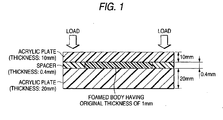
- a foamed body was placed in a jig shown in Fig. 1 , and the state of deformation of the acrylic plate on the upper surface was visually observed. Specifically, spacers having a thickness of 0.4 mm were placed on both end parts of an acrylic plate having a thickness of 20 mm, and a foamed body having a thickness of 1 mm was placed on the central part between the spacers.
- Example Comparative Example 1 2 3 1 2 3 Apparent density (g/cm 3 ) 0.05 0.05 0.03 0.4 0.06 0.09 Repulsive force upon compressing to 50% (N/cm 2 ) 1.5 1.0 2.4 8 5 0.5 Average cell diameter ( ⁇ m) 70 80 80 70 90 400 Air permeability upon compressing to 50% (cc/cm 2 /sec) could not measured could not measured could not measured could not measured 0.04 Clearance followability fair fair fair deformation observed deformation observed fair
- Example 1 and Comparative Example 1 were evaluated for cleanliness by analysis of an inorganic gas generating amount, analysis of an organic gas generating amount and analysis of ion ingredient amounts extracted with warm water. The results are shown in Tables 2 to 4 below.
- test piece having an area of 10 cm 2 and a thickness of about 1mm was cut out from the specimen and weighed on a specimen boat for a combustion device.
- the test piece was heated at 100°C for 1 hour by using the combustion device, and the generating gas was collected in a collecting liquid (pure water).
- the collecting liquid was subjected to quantitative analysis by using ion chromatography (DX-500, a trade name, produced by Dionex Corp.).
- test piece having an area of 50 cm 2 and a thickness of about 1mm was cut out from the specimen and weighed in a vial container. After sealing hermetically the container, the test piece was heated at 100°C for 1 hour by using a head space autosampler, and the generating gas in a heated state was subjected to quantitative analysis by using gas chromatography (HP6980, a trade name, produced by Hewlett-Packard Co.).
- gas chromatography HP6980, a trade name, produced by Hewlett-Packard Co.
- test piece having an area of 50 cm 2 and a thickness of about 1mm was cut out from the specimen and weighed in a container formed of a polymethylpentene (PMP) resin. 50 mL of pure water was added to the container, and warm water extraction was carried out in a dryer at 100°C for 2 hours. The extract was subjected to quantitative
- the foamed bodies of Examples 1 to 3 had no air permeability upon compressing to 50% to exert excellent dustproof property.
- the foamed bodies of Examples 1 to 3 exerted good clearance followability even when they were compressed to a thickness of 0.4 mm, and thus it was confirmed that they did not deform an optical member, which was mounted on a prescribed site with a minute clearance between the optical member and the prescribed site.
- the foamed dustproof material could be suitably used as a dustproof material for preventing a toner from leaking from a toner cartridge.
Landscapes
- Chemical & Material Sciences (AREA)
- Organic Chemistry (AREA)
- Polymers & Plastics (AREA)
- Health & Medical Sciences (AREA)
- Chemical Kinetics & Catalysis (AREA)
- Medicinal Chemistry (AREA)
- Materials Engineering (AREA)
- Engineering & Computer Science (AREA)
- Manufacture Of Porous Articles, And Recovery And Treatment Of Waste Products (AREA)
- Laminated Bodies (AREA)
- Sealing Material Composition (AREA)
- Golf Clubs (AREA)
- Materials For Medical Uses (AREA)
Claims (15)
- Verwendung von einem geschäumten Material als staubdichtes Material, das einen geschäumten Körper umfasst, wobei der geschäumte Körper einen durchschnittlichen Zellendurchmesser von 10 bis 90 µm, eine Rückform-Widerstandskraft nach einem Zusammendrücken bis auf 50 % von 0,1 bis 3,0 N/cm2 und eine Fülldichte von 0,01 bis 0,10 g/cm3 aufweist, und wobei der geschäumte Körper eine Mischung aus einem thermoplastischen Elastomer und einem thermoplastischen Polymer, das sich von dem thermoplastischen Elastomer unterscheidet, umfasst.
- Verwendung von dem geschäumten Material nach Anspruch 1, wobei der geschäumte Körper eine geschlossene Zellstruktur oder eine halb geschlossene und halb offene Zellstruktur aufweist.
- Verwendung von dem geschäumten Material nach Anspruch 1 oder 2, wobei das Material weiter eine druckempfindliche Klebstoffschicht auf einer Oberfläche oder beiden Oberflächen des geschäumten Körpers umfasst.
- Verwendung von dem geschäumten Material nach Anspruch 3, wobei die druckempfindliche Klebstoffschicht auf dem geschäumten Körper durch eine Filmschicht ausgebildet wird.
- Verwendung von dem geschäumten Material nach Anspruch 3 oder 4, wobei die druckempfindliche Klebstoffschicht einen druckempfindlichen Akrylklebstoff umfasst.
- Verwendung von dem geschäumten Material nach irgendeinem der Ansprüche 1 bis 5, wobei die Mischung weiter einen Gleitmittelstoff enthält, ausgewählt aus der Gruppe bestehend aus einem Kohlenwasserstoff-Gleitmittelstoff, einem aliphatisch sauren Gleitmittelstoff und einem Ester-Gleitmittelstoff..
- Verwendung von dem geschäumten Material nach irgendeinem der Ansprüche 1 bis 6, wobei der geschäumte Körper durch einen Prozess erreichbar ist, umfassend die Schritte von:Imprägnieren eines thermoplastischen Polymers mit einem Inertgas unter einem Hochdruck von 6 MPa oder mehr; undVerringerung des Drucks.
- Verwendung von dem geschäumten staubdichten Material nach Anspruch 7, wobei der geschäumte Körper durch einen Prozess erreichbar ist, umfassend die Schritte von:Imprägnieren eines nicht geschäumten geformten Artikels, der ein thermoplastisches Polymer umfasst, mit einem Inertgas unter einem Hochdruck von 6 MPa oder mehr; undVerringerung des Drucks.
- Verwendung des geschäumten Materials nach Anspruch 7, wobei der geschäumte Körper durch einen Prozess erreichbar ist, umfassend die Schritte von:Imprägnieren eines geschmolzenen thermoplastischen Polymers mit einem Inertgas in einem unter Druck stehenden Zustand; undSpritzgießen des thermoplastischen Polymers während der Verringerung des Drucks.
- Verwendung von dem geschäumten Material nach irgendeinem der Ansprüche 7 bis 9, wobei der Prozess weiter den Schritt des Aufheizens nach der Verringerung des Drucks umfasst.
- Verwendung des geschäumten Materials nach irgendeinem der Ansprüche 7 bis 10, wobei das Inertgas Kohlendioxid ist.
- Verwendung von dem geschäumten Material nach irgendeinem der Ansprüche 7 bis 11, wobei das Inertgas bei der Imprägnierung in einem überkritischen Zustand ist.
- Verwendung von dem geschäumten staubdichten Material nach irgendeinem der Ansprüche 1 bis 12, zur Befestigung eines optischen Teils an einem vorgesehenen Anbringort.
- Verwendung von einer staubdichten Struktur zur Befestigung eines optischen Teils an einem vorgesehenen Anbringort, wobei die Struktur das durch die Verwendung des geschäumten Materials nach irgendeinem der Ansprüche 1 bis 12 an dem Anbringort befestigte optische Teil umfasst.
- Verwendung von dem geschäumten Material nach irgendeinem der Ansprüche 1 bis 12, um das Durchsickern eines Toners aus einer Tonerpatrone zu verhindern.
Applications Claiming Priority (2)
| Application Number | Priority Date | Filing Date | Title |
|---|---|---|---|
| JP2003298409 | 2003-08-22 | ||
| JP2003298409 | 2003-08-22 |
Publications (2)
| Publication Number | Publication Date |
|---|---|
| EP1508588A1 EP1508588A1 (de) | 2005-02-23 |
| EP1508588B1 true EP1508588B1 (de) | 2011-10-12 |
Family
ID=34056260
Family Applications (1)
| Application Number | Title | Priority Date | Filing Date |
|---|---|---|---|
| EP20040019979 Expired - Lifetime EP1508588B1 (de) | 2003-08-22 | 2004-08-23 | Geschäumtes staubdichtes Material und staubdichte, dieses Material enthaltende Anordnung |
Country Status (8)
| Country | Link |
|---|---|
| US (1) | US20050053779A1 (de) |
| EP (1) | EP1508588B1 (de) |
| JP (1) | JP5317905B2 (de) |
| KR (1) | KR100720207B1 (de) |
| CN (1) | CN1322088C (de) |
| AT (1) | ATE528340T1 (de) |
| SG (2) | SG109581A1 (de) |
| TW (1) | TWI308162B (de) |
Families Citing this family (19)
| Publication number | Priority date | Publication date | Assignee | Title |
|---|---|---|---|---|
| JP4355652B2 (ja) * | 2004-12-27 | 2009-11-04 | 埼玉日本電気株式会社 | 電子機器及びその防塵構造 |
| WO2006095948A1 (en) * | 2005-03-08 | 2006-09-14 | Young Bae Namkung | Roll type gasket of lcd panel and method of manufacturing thereof |
| JP4878869B2 (ja) * | 2005-04-08 | 2012-02-15 | 日東電工株式会社 | 発泡部材、発泡部材積層体及び発泡部材が用いられた電気・電子機器類 |
| JP5153110B2 (ja) * | 2006-10-02 | 2013-02-27 | 日東電工株式会社 | ポリオレフィン系樹脂発泡体とその製造方法 |
| TWI479877B (zh) * | 2007-07-13 | 2015-04-01 | Chi Mei Comm Systems Inc | 通訊裝置 |
| JP5289871B2 (ja) * | 2007-09-21 | 2013-09-11 | 日東電工株式会社 | 微細セル構造を有する発泡防塵材 |
| JP5594938B2 (ja) * | 2008-02-26 | 2014-09-24 | 日東電工株式会社 | 微細セル構造を有する発泡防水材 |
| US8124231B2 (en) * | 2009-02-09 | 2012-02-28 | 3M Innovative Properties Company | Dust suppressants |
| JP5701508B2 (ja) * | 2009-03-04 | 2015-04-15 | 日東電工株式会社 | 導電性を有する樹脂発泡体 |
| JP2010215805A (ja) * | 2009-03-17 | 2010-09-30 | Nitto Denko Corp | 衝撃吸収材 |
| JP2010242061A (ja) * | 2009-03-19 | 2010-10-28 | Nitto Denko Corp | 難燃性樹脂発泡体及び難燃性発泡部材 |
| JP2011012235A (ja) * | 2009-07-06 | 2011-01-20 | Nitto Denko Corp | 樹脂発泡体 |
| ES2383747B1 (es) * | 2010-11-30 | 2013-05-06 | Universitat Politècnica De Catalunya | Procedimiento para conformar pet celular a partir de preformas sólidas |
| JP5856448B2 (ja) * | 2010-12-14 | 2016-02-09 | 日東電工株式会社 | 樹脂発泡体及び発泡シール材 |
| JP5969260B2 (ja) * | 2011-07-14 | 2016-08-17 | 日東電工株式会社 | 樹脂発泡体、その製造方法、及び発泡シール材 |
| CN103131286A (zh) * | 2011-11-22 | 2013-06-05 | 上海立昌环境工程有限公司 | 常温粘尘剂 |
| JP6039502B2 (ja) | 2012-05-28 | 2016-12-07 | 日東電工株式会社 | 樹脂発泡体及び発泡部材 |
| CN104552900A (zh) * | 2015-01-13 | 2015-04-29 | 马立胜 | 一种环保发泡材料成型的方法 |
| CN107502223B (zh) * | 2017-08-31 | 2022-10-21 | 美信新材料股份有限公司 | 一种无孔导电泡棉胶带及其制备方法 |
Family Cites Families (20)
| Publication number | Priority date | Publication date | Assignee | Title |
|---|---|---|---|---|
| CN1032943A (zh) * | 1988-06-30 | 1989-05-17 | 哈尔滨市泡沫塑料制品厂 | 一种聚乙烯泡沫塑料 |
| CN1021804C (zh) * | 1988-11-28 | 1993-08-18 | 三井石油化学工业株式会社 | 层合模塑体及其制造方法 |
| US5049328A (en) * | 1990-07-02 | 1991-09-17 | Arco Chemical Technology, Inc. | Purification, impregnation and foaming of polymer particles with carbon dioxide |
| US5670102A (en) * | 1993-02-11 | 1997-09-23 | Minnesota Mining And Manufacturing Company | Method of making thermoplastic foamed articles using supercritical fluid |
| EP0908487B1 (de) * | 1994-05-10 | 2002-06-05 | Asahi Kasei Kabushiki Kaisha | Herstellungsverfahren eines Fluorharz Schaums |
| JPH08146714A (ja) * | 1994-11-24 | 1996-06-07 | Canon Inc | 接触帯電部材 |
| US5844731A (en) * | 1995-06-23 | 1998-12-01 | The Furukawa Electric Co.,Ltd. | Light reflecting plate |
| JPH09226036A (ja) * | 1996-02-26 | 1997-09-02 | Nippon Zeon Co Ltd | 半導電性発泡ロール |
| JP3833157B2 (ja) * | 1997-09-30 | 2006-10-11 | キヤノン株式会社 | トナー供給容器及び電子写真画像形成装置 |
| JP3408166B2 (ja) * | 1997-09-30 | 2003-05-19 | キヤノン株式会社 | トナー供給容器及び電子写真画像形成装置 |
| AU3099799A (en) * | 1998-03-18 | 1999-10-11 | World Properties Inc. | Microcellular thermoplastic elastomer foams and method of manufacture thereof |
| US6613811B1 (en) * | 1999-06-03 | 2003-09-02 | Trexel, Inc. | Microcellular thermoplastic elastomeric structures |
| JP3649385B2 (ja) * | 2000-01-12 | 2005-05-18 | 東洋ゴム工業株式会社 | 熱可塑性エラストマー微孔質発泡体、その製造方法および研磨シート |
| MY135745A (en) * | 2000-08-30 | 2008-06-30 | Nitto Denko Corp | Microporous soundproofing material |
| JP4125875B2 (ja) | 2001-04-13 | 2008-07-30 | 日東電工株式会社 | 電気・電子機器用シール材 |
| JP2003049018A (ja) * | 2001-08-08 | 2003-02-21 | Idemitsu Petrochem Co Ltd | 発泡体、その製造方法および反射板 |
| JP2003147112A (ja) * | 2001-09-03 | 2003-05-21 | Nitto Denko Corp | ゴム発泡体 |
| JP4459494B2 (ja) * | 2001-12-03 | 2010-04-28 | 日東電工株式会社 | 難燃性樹脂発泡体 |
| US6913517B2 (en) * | 2002-05-23 | 2005-07-05 | Cabot Microelectronics Corporation | Microporous polishing pads |
| JP2003176466A (ja) * | 2002-12-17 | 2003-06-24 | Minnesota Mining & Mfg Co <3M> | 多層発泡状感圧接着テープ |
-
2004
- 2004-08-20 KR KR1020040065771A patent/KR100720207B1/ko not_active Expired - Fee Related
- 2004-08-20 TW TW93125148A patent/TWI308162B/zh not_active IP Right Cessation
- 2004-08-20 SG SG200404741A patent/SG109581A1/en unknown
- 2004-08-20 SG SG200705125-3A patent/SG134325A1/en unknown
- 2004-08-20 US US10/921,845 patent/US20050053779A1/en not_active Abandoned
- 2004-08-22 CN CNB2004100119661A patent/CN1322088C/zh not_active Expired - Lifetime
- 2004-08-23 EP EP20040019979 patent/EP1508588B1/de not_active Expired - Lifetime
- 2004-08-23 AT AT04019979T patent/ATE528340T1/de not_active IP Right Cessation
-
2009
- 2009-09-18 JP JP2009216884A patent/JP5317905B2/ja not_active Expired - Fee Related
Also Published As
| Publication number | Publication date |
|---|---|
| TWI308162B (en) | 2009-04-01 |
| ATE528340T1 (de) | 2011-10-15 |
| JP5317905B2 (ja) | 2013-10-16 |
| US20050053779A1 (en) | 2005-03-10 |
| CN1618918A (zh) | 2005-05-25 |
| EP1508588A1 (de) | 2005-02-23 |
| KR100720207B1 (ko) | 2007-05-21 |
| SG109581A1 (en) | 2005-03-30 |
| SG134325A1 (en) | 2007-08-29 |
| TW200513489A (en) | 2005-04-16 |
| CN1322088C (zh) | 2007-06-20 |
| JP2009293043A (ja) | 2009-12-17 |
| KR20050020695A (ko) | 2005-03-04 |
Similar Documents
| Publication | Publication Date | Title |
|---|---|---|
| EP1508588B1 (de) | Geschäumtes staubdichtes Material und staubdichte, dieses Material enthaltende Anordnung | |
| JP5594938B2 (ja) | 微細セル構造を有する発泡防水材 | |
| JP4563109B2 (ja) | 発泡防塵材の製造方法、および発泡防塵材が用いられた防塵構造の製造方法 | |
| KR102209173B1 (ko) | 수지 발포체 및 발포 시일재 | |
| US8846774B2 (en) | Resin composition for polyolefin resin foam, polyolefin resin foam and foamed sealing material | |
| US20110262744A1 (en) | Resin foam and foamed member | |
| JP2009091556A (ja) | 微細セル構造を有する発泡防塵材 | |
| KR101991534B1 (ko) | 수지 발포체 시트 및 수지 발포 복합체 | |
| US20110003124A1 (en) | Resin foam | |
| EP1186392B1 (de) | Mikroporöses Schallschutzmaterial | |
| EP1512713B1 (de) | Zusammensetzung geeignet zur Herstellung eines Polyolefin-Schaums, daraus hergestellter Schaum und Verfahren zur Herstellung des Schaums | |
| KR20100105448A (ko) | 충격 흡수재 | |
| JP5833213B2 (ja) | 衝撃吸収材 | |
| EP2141518A1 (de) | Lichtreflektierendes element mit polyesterharzschaum und herstellungsverfahren dafür | |
| JP2013253241A (ja) | 樹脂発泡体及び発泡シール材 | |
| JP6110213B2 (ja) | 熱可塑性樹脂発泡体、発泡シール材及び熱可塑性樹脂発泡体の製造方法 | |
| JP2016088977A (ja) | 樹脂発泡体及び発泡部材 | |
| JP4980198B2 (ja) | 段差構造装着用スリットを備える発泡材 | |
| JP2014077136A (ja) | 微細セル構造を有する発泡防水材 | |
| JP2014094575A (ja) | 衝撃吸収材 | |
| JP5620022B2 (ja) | 樹脂発泡体及び発泡部材 | |
| JP2013147663A (ja) | 衝撃吸収材 |
Legal Events
| Date | Code | Title | Description |
|---|---|---|---|
| PUAI | Public reference made under article 153(3) epc to a published international application that has entered the european phase |
Free format text: ORIGINAL CODE: 0009012 |
|
| AK | Designated contracting states |
Kind code of ref document: A1 Designated state(s): AT BE BG CH CY CZ DE DK EE ES FI FR GB GR HU IE IT LI LU MC NL PL PT RO SE SI SK TR |
|
| AX | Request for extension of the european patent |
Extension state: AL HR LT LV MK |
|
| 17P | Request for examination filed |
Effective date: 20050401 |
|
| AKX | Designation fees paid |
Designated state(s): AT BE BG CH CY CZ DE DK EE ES FI FR GB GR HU IE IT LI LU MC NL PL PT RO SE SI SK TR |
|
| 17Q | First examination report despatched |
Effective date: 20060126 |
|
| GRAP | Despatch of communication of intention to grant a patent |
Free format text: ORIGINAL CODE: EPIDOSNIGR1 |
|
| GRAS | Grant fee paid |
Free format text: ORIGINAL CODE: EPIDOSNIGR3 |
|
| GRAA | (expected) grant |
Free format text: ORIGINAL CODE: 0009210 |
|
| AK | Designated contracting states |
Kind code of ref document: B1 Designated state(s): AT BE BG CH CY CZ DE DK EE ES FI FR GB GR HU IE IT LI LU MC NL PL PT RO SE SI SK TR |
|
| REG | Reference to a national code |
Ref country code: GB Ref legal event code: FG4D |
|
| REG | Reference to a national code |
Ref country code: CH Ref legal event code: EP |
|
| REG | Reference to a national code |
Ref country code: IE Ref legal event code: FG4D |
|
| REG | Reference to a national code |
Ref country code: DE Ref legal event code: R096 Ref document number: 602004034784 Country of ref document: DE Effective date: 20111215 |
|
| REG | Reference to a national code |
Ref country code: NL Ref legal event code: VDEP Effective date: 20111012 |
|
| REG | Reference to a national code |
Ref country code: AT Ref legal event code: MK05 Ref document number: 528340 Country of ref document: AT Kind code of ref document: T Effective date: 20111012 |
|
| PG25 | Lapsed in a contracting state [announced via postgrant information from national office to epo] |
Ref country code: BE Free format text: LAPSE BECAUSE OF FAILURE TO SUBMIT A TRANSLATION OF THE DESCRIPTION OR TO PAY THE FEE WITHIN THE PRESCRIBED TIME-LIMIT Effective date: 20111012 |
|
| PG25 | Lapsed in a contracting state [announced via postgrant information from national office to epo] |
Ref country code: PT Free format text: LAPSE BECAUSE OF FAILURE TO SUBMIT A TRANSLATION OF THE DESCRIPTION OR TO PAY THE FEE WITHIN THE PRESCRIBED TIME-LIMIT Effective date: 20120213 Ref country code: NL Free format text: LAPSE BECAUSE OF FAILURE TO SUBMIT A TRANSLATION OF THE DESCRIPTION OR TO PAY THE FEE WITHIN THE PRESCRIBED TIME-LIMIT Effective date: 20111012 Ref country code: SE Free format text: LAPSE BECAUSE OF FAILURE TO SUBMIT A TRANSLATION OF THE DESCRIPTION OR TO PAY THE FEE WITHIN THE PRESCRIBED TIME-LIMIT Effective date: 20111012 Ref country code: SI Free format text: LAPSE BECAUSE OF FAILURE TO SUBMIT A TRANSLATION OF THE DESCRIPTION OR TO PAY THE FEE WITHIN THE PRESCRIBED TIME-LIMIT Effective date: 20111012 Ref country code: GR Free format text: LAPSE BECAUSE OF FAILURE TO SUBMIT A TRANSLATION OF THE DESCRIPTION OR TO PAY THE FEE WITHIN THE PRESCRIBED TIME-LIMIT Effective date: 20120113 |
|
| PG25 | Lapsed in a contracting state [announced via postgrant information from national office to epo] |
Ref country code: CY Free format text: LAPSE BECAUSE OF FAILURE TO SUBMIT A TRANSLATION OF THE DESCRIPTION OR TO PAY THE FEE WITHIN THE PRESCRIBED TIME-LIMIT Effective date: 20111012 |
|
| PG25 | Lapsed in a contracting state [announced via postgrant information from national office to epo] |
Ref country code: BG Free format text: LAPSE BECAUSE OF FAILURE TO SUBMIT A TRANSLATION OF THE DESCRIPTION OR TO PAY THE FEE WITHIN THE PRESCRIBED TIME-LIMIT Effective date: 20120112 Ref country code: EE Free format text: LAPSE BECAUSE OF FAILURE TO SUBMIT A TRANSLATION OF THE DESCRIPTION OR TO PAY THE FEE WITHIN THE PRESCRIBED TIME-LIMIT Effective date: 20111012 Ref country code: CZ Free format text: LAPSE BECAUSE OF FAILURE TO SUBMIT A TRANSLATION OF THE DESCRIPTION OR TO PAY THE FEE WITHIN THE PRESCRIBED TIME-LIMIT Effective date: 20111012 Ref country code: DK Free format text: LAPSE BECAUSE OF FAILURE TO SUBMIT A TRANSLATION OF THE DESCRIPTION OR TO PAY THE FEE WITHIN THE PRESCRIBED TIME-LIMIT Effective date: 20111012 Ref country code: SK Free format text: LAPSE BECAUSE OF FAILURE TO SUBMIT A TRANSLATION OF THE DESCRIPTION OR TO PAY THE FEE WITHIN THE PRESCRIBED TIME-LIMIT Effective date: 20111012 |
|
| PLBE | No opposition filed within time limit |
Free format text: ORIGINAL CODE: 0009261 |
|
| STAA | Information on the status of an ep patent application or granted ep patent |
Free format text: STATUS: NO OPPOSITION FILED WITHIN TIME LIMIT |
|
| PG25 | Lapsed in a contracting state [announced via postgrant information from national office to epo] |
Ref country code: IT Free format text: LAPSE BECAUSE OF FAILURE TO SUBMIT A TRANSLATION OF THE DESCRIPTION OR TO PAY THE FEE WITHIN THE PRESCRIBED TIME-LIMIT Effective date: 20111012 Ref country code: PL Free format text: LAPSE BECAUSE OF FAILURE TO SUBMIT A TRANSLATION OF THE DESCRIPTION OR TO PAY THE FEE WITHIN THE PRESCRIBED TIME-LIMIT Effective date: 20111012 Ref country code: RO Free format text: LAPSE BECAUSE OF FAILURE TO SUBMIT A TRANSLATION OF THE DESCRIPTION OR TO PAY THE FEE WITHIN THE PRESCRIBED TIME-LIMIT Effective date: 20111012 |
|
| 26N | No opposition filed |
Effective date: 20120713 |
|
| REG | Reference to a national code |
Ref country code: DE Ref legal event code: R097 Ref document number: 602004034784 Country of ref document: DE Effective date: 20120713 |
|
| PG25 | Lapsed in a contracting state [announced via postgrant information from national office to epo] |
Ref country code: AT Free format text: LAPSE BECAUSE OF FAILURE TO SUBMIT A TRANSLATION OF THE DESCRIPTION OR TO PAY THE FEE WITHIN THE PRESCRIBED TIME-LIMIT Effective date: 20111012 |
|
| REG | Reference to a national code |
Ref country code: CH Ref legal event code: PL |
|
| PG25 | Lapsed in a contracting state [announced via postgrant information from national office to epo] |
Ref country code: MC Free format text: LAPSE BECAUSE OF NON-PAYMENT OF DUE FEES Effective date: 20120831 |
|
| GBPC | Gb: european patent ceased through non-payment of renewal fee |
Effective date: 20120823 |
|
| PG25 | Lapsed in a contracting state [announced via postgrant information from national office to epo] |
Ref country code: CH Free format text: LAPSE BECAUSE OF NON-PAYMENT OF DUE FEES Effective date: 20120831 Ref country code: ES Free format text: LAPSE BECAUSE OF FAILURE TO SUBMIT A TRANSLATION OF THE DESCRIPTION OR TO PAY THE FEE WITHIN THE PRESCRIBED TIME-LIMIT Effective date: 20120123 Ref country code: LI Free format text: LAPSE BECAUSE OF NON-PAYMENT OF DUE FEES Effective date: 20120831 |
|
| REG | Reference to a national code |
Ref country code: FR Ref legal event code: ST Effective date: 20130430 |
|
| REG | Reference to a national code |
Ref country code: IE Ref legal event code: MM4A |
|
| PG25 | Lapsed in a contracting state [announced via postgrant information from national office to epo] |
Ref country code: FI Free format text: LAPSE BECAUSE OF FAILURE TO SUBMIT A TRANSLATION OF THE DESCRIPTION OR TO PAY THE FEE WITHIN THE PRESCRIBED TIME-LIMIT Effective date: 20111012 |
|
| PG25 | Lapsed in a contracting state [announced via postgrant information from national office to epo] |
Ref country code: IE Free format text: LAPSE BECAUSE OF NON-PAYMENT OF DUE FEES Effective date: 20120823 Ref country code: GB Free format text: LAPSE BECAUSE OF NON-PAYMENT OF DUE FEES Effective date: 20120823 |
|
| PG25 | Lapsed in a contracting state [announced via postgrant information from national office to epo] |
Ref country code: FR Free format text: LAPSE BECAUSE OF NON-PAYMENT OF DUE FEES Effective date: 20120831 |
|
| PG25 | Lapsed in a contracting state [announced via postgrant information from national office to epo] |
Ref country code: TR Free format text: LAPSE BECAUSE OF FAILURE TO SUBMIT A TRANSLATION OF THE DESCRIPTION OR TO PAY THE FEE WITHIN THE PRESCRIBED TIME-LIMIT Effective date: 20111012 |
|
| PG25 | Lapsed in a contracting state [announced via postgrant information from national office to epo] |
Ref country code: LU Free format text: LAPSE BECAUSE OF NON-PAYMENT OF DUE FEES Effective date: 20120823 |
|
| PG25 | Lapsed in a contracting state [announced via postgrant information from national office to epo] |
Ref country code: HU Free format text: LAPSE BECAUSE OF FAILURE TO SUBMIT A TRANSLATION OF THE DESCRIPTION OR TO PAY THE FEE WITHIN THE PRESCRIBED TIME-LIMIT Effective date: 20040823 |
|
| PGFP | Annual fee paid to national office [announced via postgrant information from national office to epo] |
Ref country code: DE Payment date: 20140821 Year of fee payment: 11 |
|
| REG | Reference to a national code |
Ref country code: DE Ref legal event code: R119 Ref document number: 602004034784 Country of ref document: DE |
|
| PG25 | Lapsed in a contracting state [announced via postgrant information from national office to epo] |
Ref country code: DE Free format text: LAPSE BECAUSE OF NON-PAYMENT OF DUE FEES Effective date: 20160301 |