EP1472298B1 - Polymerfilm - Google Patents
Polymerfilm Download PDFInfo
- Publication number
- EP1472298B1 EP1472298B1 EP20030701623 EP03701623A EP1472298B1 EP 1472298 B1 EP1472298 B1 EP 1472298B1 EP 20030701623 EP20030701623 EP 20030701623 EP 03701623 A EP03701623 A EP 03701623A EP 1472298 B1 EP1472298 B1 EP 1472298B1
- Authority
- EP
- European Patent Office
- Prior art keywords
- film
- polyethylene
- molecular weight
- ethylene
- polymer
- Prior art date
- Legal status (The legal status is an assumption and is not a legal conclusion. Google has not performed a legal analysis and makes no representation as to the accuracy of the status listed.)
- Expired - Lifetime
Links
- 229920006254 polymer film Polymers 0.000 title description 3
- 229920000642 polymer Polymers 0.000 claims abstract description 90
- VGGSQFUCUMXWEO-UHFFFAOYSA-N Ethene Chemical compound C=C VGGSQFUCUMXWEO-UHFFFAOYSA-N 0.000 claims abstract description 59
- VXNZUUAINFGPBY-UHFFFAOYSA-N 1-Butene Chemical compound CCC=C VXNZUUAINFGPBY-UHFFFAOYSA-N 0.000 claims abstract description 47
- 239000005977 Ethylene Substances 0.000 claims abstract description 44
- 230000002902 bimodal effect Effects 0.000 claims abstract description 20
- 238000009826 distribution Methods 0.000 claims abstract description 13
- 230000003287 optical effect Effects 0.000 claims abstract description 6
- 229920000573 polyethylene Polymers 0.000 claims description 41
- 239000004698 Polyethylene Substances 0.000 claims description 36
- LIKMAJRDDDTEIG-UHFFFAOYSA-N 1-hexene Chemical compound CCCCC=C LIKMAJRDDDTEIG-UHFFFAOYSA-N 0.000 claims description 32
- -1 polyethylene Polymers 0.000 claims description 32
- 239000004711 α-olefin Substances 0.000 claims description 31
- 229920001684 low density polyethylene Polymers 0.000 claims description 20
- 239000004702 low-density polyethylene Substances 0.000 claims description 20
- 239000000203 mixture Substances 0.000 claims description 20
- KWKAKUADMBZCLK-UHFFFAOYSA-N 1-octene Chemical compound CCCCCCC=C KWKAKUADMBZCLK-UHFFFAOYSA-N 0.000 claims description 16
- 239000003054 catalyst Substances 0.000 claims description 14
- 238000006116 polymerization reaction Methods 0.000 claims description 14
- 238000004519 manufacturing process Methods 0.000 claims description 13
- WSSSPWUEQFSQQG-UHFFFAOYSA-N 4-methyl-1-pentene Chemical compound CC(C)CC=C WSSSPWUEQFSQQG-UHFFFAOYSA-N 0.000 claims description 12
- ZGEGCLOFRBLKSE-UHFFFAOYSA-N 1-Heptene Chemical compound CCCCCC=C ZGEGCLOFRBLKSE-UHFFFAOYSA-N 0.000 claims description 10
- 239000003446 ligand Substances 0.000 claims description 9
- AFFLGGQVNFXPEV-UHFFFAOYSA-N 1-decene Chemical compound CCCCCCCCC=C AFFLGGQVNFXPEV-UHFFFAOYSA-N 0.000 claims description 8
- 239000000654 additive Substances 0.000 claims description 6
- 230000000996 additive effect Effects 0.000 claims description 3
- 239000007788 liquid Substances 0.000 claims description 3
- 238000001125 extrusion Methods 0.000 claims 1
- 229920001577 copolymer Polymers 0.000 abstract description 26
- 229920001897 terpolymer Polymers 0.000 abstract description 14
- 229920001519 homopolymer Polymers 0.000 abstract description 6
- 229920006158 high molecular weight polymer Polymers 0.000 abstract description 4
- 238000000034 method Methods 0.000 description 21
- 238000007789 sealing Methods 0.000 description 20
- 239000007789 gas Substances 0.000 description 14
- 239000000155 melt Substances 0.000 description 13
- 239000012071 phase Substances 0.000 description 11
- 230000008569 process Effects 0.000 description 11
- 239000010410 layer Substances 0.000 description 9
- VLKZOEOYAKHREP-UHFFFAOYSA-N n-Hexane Chemical compound CCCCCC VLKZOEOYAKHREP-UHFFFAOYSA-N 0.000 description 9
- UFHFLCQGNIYNRP-UHFFFAOYSA-N Hydrogen Chemical compound [H][H] UFHFLCQGNIYNRP-UHFFFAOYSA-N 0.000 description 8
- 239000001257 hydrogen Substances 0.000 description 8
- 229910052739 hydrogen Inorganic materials 0.000 description 8
- 229920000092 linear low density polyethylene Polymers 0.000 description 8
- 239000004707 linear low-density polyethylene Substances 0.000 description 8
- 229920001038 ethylene copolymer Polymers 0.000 description 7
- 230000035699 permeability Effects 0.000 description 7
- ATUOYWHBWRKTHZ-UHFFFAOYSA-N Propane Chemical compound CCC ATUOYWHBWRKTHZ-UHFFFAOYSA-N 0.000 description 6
- YXFVVABEGXRONW-UHFFFAOYSA-N Toluene Chemical compound CC1=CC=CC=C1 YXFVVABEGXRONW-UHFFFAOYSA-N 0.000 description 6
- 238000004806 packaging method and process Methods 0.000 description 5
- 229930195733 hydrocarbon Natural products 0.000 description 4
- 150000002430 hydrocarbons Chemical class 0.000 description 4
- 238000005259 measurement Methods 0.000 description 4
- 239000012968 metallocene catalyst Substances 0.000 description 4
- 239000011541 reaction mixture Substances 0.000 description 4
- XLYOFNOQVPJJNP-UHFFFAOYSA-N water Substances O XLYOFNOQVPJJNP-UHFFFAOYSA-N 0.000 description 4
- BLDFSDCBQJUWFG-UHFFFAOYSA-N 2-(methylamino)-1,2-diphenylethanol Chemical compound C=1C=CC=CC=1C(NC)C(O)C1=CC=CC=C1 BLDFSDCBQJUWFG-UHFFFAOYSA-N 0.000 description 3
- QVGXLLKOCUKJST-UHFFFAOYSA-N atomic oxygen Chemical compound [O] QVGXLLKOCUKJST-UHFFFAOYSA-N 0.000 description 3
- 239000003085 diluting agent Substances 0.000 description 3
- 229920001903 high density polyethylene Polymers 0.000 description 3
- 239000004700 high-density polyethylene Substances 0.000 description 3
- 238000010348 incorporation Methods 0.000 description 3
- 229920001179 medium density polyethylene Polymers 0.000 description 3
- 239000004701 medium-density polyethylene Substances 0.000 description 3
- 229910052751 metal Inorganic materials 0.000 description 3
- 239000002184 metal Substances 0.000 description 3
- 239000001301 oxygen Substances 0.000 description 3
- 229910052760 oxygen Inorganic materials 0.000 description 3
- 239000008188 pellet Substances 0.000 description 3
- 239000001294 propane Substances 0.000 description 3
- 229920005989 resin Polymers 0.000 description 3
- 239000011347 resin Substances 0.000 description 3
- 239000002002 slurry Substances 0.000 description 3
- 239000003381 stabilizer Substances 0.000 description 3
- AQZWEFBJYQSQEH-UHFFFAOYSA-N 2-methyloxaluminane Chemical compound C[Al]1CCCCO1 AQZWEFBJYQSQEH-UHFFFAOYSA-N 0.000 description 2
- IJGRMHOSHXDMSA-UHFFFAOYSA-N Atomic nitrogen Chemical compound N#N IJGRMHOSHXDMSA-UHFFFAOYSA-N 0.000 description 2
- VTYYLEPIZMXCLO-UHFFFAOYSA-L Calcium carbonate Chemical compound [Ca+2].[O-]C([O-])=O VTYYLEPIZMXCLO-UHFFFAOYSA-L 0.000 description 2
- 239000004215 Carbon black (E152) Substances 0.000 description 2
- VYPSYNLAJGMNEJ-UHFFFAOYSA-N Silicium dioxide Chemical compound O=[Si]=O VYPSYNLAJGMNEJ-UHFFFAOYSA-N 0.000 description 2
- GWEVSGVZZGPLCZ-UHFFFAOYSA-N Titan oxide Chemical compound O=[Ti]=O GWEVSGVZZGPLCZ-UHFFFAOYSA-N 0.000 description 2
- 230000008901 benefit Effects 0.000 description 2
- 239000012986 chain transfer agent Substances 0.000 description 2
- 230000007423 decrease Effects 0.000 description 2
- 239000003599 detergent Substances 0.000 description 2
- ALSOCDGAZNNNME-UHFFFAOYSA-N ethene;hex-1-ene Chemical group C=C.CCCCC=C ALSOCDGAZNNNME-UHFFFAOYSA-N 0.000 description 2
- 229910052735 hafnium Inorganic materials 0.000 description 2
- 230000006872 improvement Effects 0.000 description 2
- NNPPMTNAJDCUHE-UHFFFAOYSA-N isobutane Chemical compound CC(C)C NNPPMTNAJDCUHE-UHFFFAOYSA-N 0.000 description 2
- 238000003475 lamination Methods 0.000 description 2
- 239000007791 liquid phase Substances 0.000 description 2
- 239000000463 material Substances 0.000 description 2
- 238000002844 melting Methods 0.000 description 2
- 230000008018 melting Effects 0.000 description 2
- 150000002739 metals Chemical class 0.000 description 2
- 238000002156 mixing Methods 0.000 description 2
- 239000000178 monomer Substances 0.000 description 2
- TVMXDCGIABBOFY-UHFFFAOYSA-N n-Octanol Natural products CCCCCCCC TVMXDCGIABBOFY-UHFFFAOYSA-N 0.000 description 2
- 239000000049 pigment Substances 0.000 description 2
- 229920001200 poly(ethylene-vinyl acetate) Polymers 0.000 description 2
- 229920002959 polymer blend Polymers 0.000 description 2
- 239000002685 polymerization catalyst Substances 0.000 description 2
- 239000000843 powder Substances 0.000 description 2
- 238000012360 testing method Methods 0.000 description 2
- 229910052726 zirconium Inorganic materials 0.000 description 2
- NIXOWILDQLNWCW-UHFFFAOYSA-M Acrylate Chemical compound [O-]C(=O)C=C NIXOWILDQLNWCW-UHFFFAOYSA-M 0.000 description 1
- OKTJSMMVPCPJKN-UHFFFAOYSA-N Carbon Chemical compound [C] OKTJSMMVPCPJKN-UHFFFAOYSA-N 0.000 description 1
- VYZAMTAEIAYCRO-UHFFFAOYSA-N Chromium Chemical compound [Cr] VYZAMTAEIAYCRO-UHFFFAOYSA-N 0.000 description 1
- IMROMDMJAWUWLK-UHFFFAOYSA-N Ethenol Chemical compound OC=C IMROMDMJAWUWLK-UHFFFAOYSA-N 0.000 description 1
- JIGUQPWFLRLWPJ-UHFFFAOYSA-N Ethyl acrylate Chemical compound CCOC(=O)C=C JIGUQPWFLRLWPJ-UHFFFAOYSA-N 0.000 description 1
- 229920010126 Linear Low Density Polyethylene (LLDPE) Polymers 0.000 description 1
- 229910019142 PO4 Inorganic materials 0.000 description 1
- 239000004952 Polyamide Substances 0.000 description 1
- 229910000831 Steel Inorganic materials 0.000 description 1
- KUNZSLJMPCDOGI-UHFFFAOYSA-L [Cl-].[Cl-].[Hf+2] Chemical compound [Cl-].[Cl-].[Hf+2] KUNZSLJMPCDOGI-UHFFFAOYSA-L 0.000 description 1
- 238000010521 absorption reaction Methods 0.000 description 1
- 239000012190 activator Substances 0.000 description 1
- 239000012790 adhesive layer Substances 0.000 description 1
- 150000001338 aliphatic hydrocarbons Chemical class 0.000 description 1
- 239000003963 antioxidant agent Substances 0.000 description 1
- IRERQBUNZFJFGC-UHFFFAOYSA-L azure blue Chemical compound [Na+].[Na+].[Na+].[Na+].[Na+].[Na+].[Na+].[Na+].[Al+3].[Al+3].[Al+3].[Al+3].[Al+3].[Al+3].[S-]S[S-].[O-][Si]([O-])([O-])[O-].[O-][Si]([O-])([O-])[O-].[O-][Si]([O-])([O-])[O-].[O-][Si]([O-])([O-])[O-].[O-][Si]([O-])([O-])[O-].[O-][Si]([O-])([O-])[O-] IRERQBUNZFJFGC-UHFFFAOYSA-L 0.000 description 1
- 230000004888 barrier function Effects 0.000 description 1
- 230000005540 biological transmission Effects 0.000 description 1
- 238000009835 boiling Methods 0.000 description 1
- IAQRGUVFOMOMEM-UHFFFAOYSA-N butene Natural products CC=CC IAQRGUVFOMOMEM-UHFFFAOYSA-N 0.000 description 1
- 229910000019 calcium carbonate Inorganic materials 0.000 description 1
- CJZGTCYPCWQAJB-UHFFFAOYSA-L calcium stearate Chemical compound [Ca+2].CCCCCCCCCCCCCCCCCC([O-])=O.CCCCCCCCCCCCCCCCCC([O-])=O CJZGTCYPCWQAJB-UHFFFAOYSA-L 0.000 description 1
- 239000008116 calcium stearate Substances 0.000 description 1
- 235000013539 calcium stearate Nutrition 0.000 description 1
- 229910052799 carbon Inorganic materials 0.000 description 1
- 239000006229 carbon black Substances 0.000 description 1
- 239000003795 chemical substances by application Substances 0.000 description 1
- 229910052804 chromium Inorganic materials 0.000 description 1
- 239000011651 chromium Substances 0.000 description 1
- 239000004927 clay Substances 0.000 description 1
- 229910052570 clay Inorganic materials 0.000 description 1
- 239000003426 co-catalyst Substances 0.000 description 1
- 230000001143 conditioned effect Effects 0.000 description 1
- 239000000470 constituent Substances 0.000 description 1
- 238000001816 cooling Methods 0.000 description 1
- 125000004122 cyclic group Chemical group 0.000 description 1
- 125000000058 cyclopentadienyl group Chemical group C1(=CC=CC1)* 0.000 description 1
- 230000000694 effects Effects 0.000 description 1
- 229920006245 ethylene-butyl acrylate Polymers 0.000 description 1
- 229920006225 ethylene-methyl acrylate Polymers 0.000 description 1
- 239000012632 extractable Substances 0.000 description 1
- 238000000605 extraction Methods 0.000 description 1
- 230000002349 favourable effect Effects 0.000 description 1
- 238000012685 gas phase polymerization Methods 0.000 description 1
- 125000000623 heterocyclic group Chemical group 0.000 description 1
- 239000011261 inert gas Substances 0.000 description 1
- 229920000554 ionomer Polymers 0.000 description 1
- 239000001282 iso-butane Substances 0.000 description 1
- CPOFMOWDMVWCLF-UHFFFAOYSA-N methyl(oxo)alumane Chemical compound C[Al]=O CPOFMOWDMVWCLF-UHFFFAOYSA-N 0.000 description 1
- 238000003541 multi-stage reaction Methods 0.000 description 1
- 229910052757 nitrogen Inorganic materials 0.000 description 1
- 239000012299 nitrogen atmosphere Substances 0.000 description 1
- PNJWIWWMYCMZRO-UHFFFAOYSA-N pent‐4‐en‐2‐one Natural products CC(=O)CC=C PNJWIWWMYCMZRO-UHFFFAOYSA-N 0.000 description 1
- 150000002989 phenols Chemical class 0.000 description 1
- 235000021317 phosphate Nutrition 0.000 description 1
- AQSJGOWTSHOLKH-UHFFFAOYSA-N phosphite(3-) Chemical class [O-]P([O-])[O-] AQSJGOWTSHOLKH-UHFFFAOYSA-N 0.000 description 1
- XRBCRPZXSCBRTK-UHFFFAOYSA-N phosphonous acid Chemical class OPO XRBCRPZXSCBRTK-UHFFFAOYSA-N 0.000 description 1
- 150000003013 phosphoric acid derivatives Chemical class 0.000 description 1
- 229920002647 polyamide Polymers 0.000 description 1
- 239000002952 polymeric resin Substances 0.000 description 1
- 229920002451 polyvinyl alcohol Polymers 0.000 description 1
- 238000000518 rheometry Methods 0.000 description 1
- 238000000926 separation method Methods 0.000 description 1
- 239000000377 silicon dioxide Substances 0.000 description 1
- 238000005507 spraying Methods 0.000 description 1
- 239000010959 steel Substances 0.000 description 1
- 238000003860 storage Methods 0.000 description 1
- 125000001424 substituent group Chemical group 0.000 description 1
- 229920003002 synthetic resin Polymers 0.000 description 1
- 239000000454 talc Substances 0.000 description 1
- 229910052623 talc Inorganic materials 0.000 description 1
- 229910052719 titanium Inorganic materials 0.000 description 1
- 239000010936 titanium Substances 0.000 description 1
- 239000004408 titanium dioxide Substances 0.000 description 1
- 238000012546 transfer Methods 0.000 description 1
- 235000013799 ultramarine blue Nutrition 0.000 description 1
- XOOUIPVCVHRTMJ-UHFFFAOYSA-L zinc stearate Chemical compound [Zn+2].CCCCCCCCCCCCCCCCCC([O-])=O.CCCCCCCCCCCCCCCCCC([O-])=O XOOUIPVCVHRTMJ-UHFFFAOYSA-L 0.000 description 1
Images
Classifications
-
- C—CHEMISTRY; METALLURGY
- C08—ORGANIC MACROMOLECULAR COMPOUNDS; THEIR PREPARATION OR CHEMICAL WORKING-UP; COMPOSITIONS BASED THEREON
- C08F—MACROMOLECULAR COMPOUNDS OBTAINED BY REACTIONS ONLY INVOLVING CARBON-TO-CARBON UNSATURATED BONDS
- C08F10/00—Homopolymers and copolymers of unsaturated aliphatic hydrocarbons having only one carbon-to-carbon double bond
- C08F10/02—Ethene
-
- C—CHEMISTRY; METALLURGY
- C08—ORGANIC MACROMOLECULAR COMPOUNDS; THEIR PREPARATION OR CHEMICAL WORKING-UP; COMPOSITIONS BASED THEREON
- C08F—MACROMOLECULAR COMPOUNDS OBTAINED BY REACTIONS ONLY INVOLVING CARBON-TO-CARBON UNSATURATED BONDS
- C08F210/00—Copolymers of unsaturated aliphatic hydrocarbons having only one carbon-to-carbon double bond
- C08F210/16—Copolymers of ethene with alpha-alkenes, e.g. EP rubbers
-
- C—CHEMISTRY; METALLURGY
- C08—ORGANIC MACROMOLECULAR COMPOUNDS; THEIR PREPARATION OR CHEMICAL WORKING-UP; COMPOSITIONS BASED THEREON
- C08F—MACROMOLECULAR COMPOUNDS OBTAINED BY REACTIONS ONLY INVOLVING CARBON-TO-CARBON UNSATURATED BONDS
- C08F297/00—Macromolecular compounds obtained by successively polymerising different monomer systems using a catalyst of the ionic or coordination type without deactivating the intermediate polymer
- C08F297/06—Macromolecular compounds obtained by successively polymerising different monomer systems using a catalyst of the ionic or coordination type without deactivating the intermediate polymer using a catalyst of the coordination type
- C08F297/08—Macromolecular compounds obtained by successively polymerising different monomer systems using a catalyst of the ionic or coordination type without deactivating the intermediate polymer using a catalyst of the coordination type polymerising mono-olefins
-
- C—CHEMISTRY; METALLURGY
- C08—ORGANIC MACROMOLECULAR COMPOUNDS; THEIR PREPARATION OR CHEMICAL WORKING-UP; COMPOSITIONS BASED THEREON
- C08J—WORKING-UP; GENERAL PROCESSES OF COMPOUNDING; AFTER-TREATMENT NOT COVERED BY SUBCLASSES C08B, C08C, C08F, C08G or C08H
- C08J5/00—Manufacture of articles or shaped materials containing macromolecular substances
- C08J5/18—Manufacture of films or sheets
-
- C—CHEMISTRY; METALLURGY
- C08—ORGANIC MACROMOLECULAR COMPOUNDS; THEIR PREPARATION OR CHEMICAL WORKING-UP; COMPOSITIONS BASED THEREON
- C08F—MACROMOLECULAR COMPOUNDS OBTAINED BY REACTIONS ONLY INVOLVING CARBON-TO-CARBON UNSATURATED BONDS
- C08F110/00—Homopolymers of unsaturated aliphatic hydrocarbons having only one carbon-to-carbon double bond
- C08F110/02—Ethene
-
- C—CHEMISTRY; METALLURGY
- C08—ORGANIC MACROMOLECULAR COMPOUNDS; THEIR PREPARATION OR CHEMICAL WORKING-UP; COMPOSITIONS BASED THEREON
- C08J—WORKING-UP; GENERAL PROCESSES OF COMPOUNDING; AFTER-TREATMENT NOT COVERED BY SUBCLASSES C08B, C08C, C08F, C08G or C08H
- C08J2323/00—Characterised by the use of homopolymers or copolymers of unsaturated aliphatic hydrocarbons having only one carbon-to-carbon double bond; Derivatives of such polymers
- C08J2323/02—Characterised by the use of homopolymers or copolymers of unsaturated aliphatic hydrocarbons having only one carbon-to-carbon double bond; Derivatives of such polymers not modified by chemical after treatment
- C08J2323/04—Homopolymers or copolymers of ethene
- C08J2323/08—Copolymers of ethene
-
- Y—GENERAL TAGGING OF NEW TECHNOLOGICAL DEVELOPMENTS; GENERAL TAGGING OF CROSS-SECTIONAL TECHNOLOGIES SPANNING OVER SEVERAL SECTIONS OF THE IPC; TECHNICAL SUBJECTS COVERED BY FORMER USPC CROSS-REFERENCE ART COLLECTIONS [XRACs] AND DIGESTS
- Y10—TECHNICAL SUBJECTS COVERED BY FORMER USPC
- Y10T—TECHNICAL SUBJECTS COVERED BY FORMER US CLASSIFICATION
- Y10T428/00—Stock material or miscellaneous articles
- Y10T428/31504—Composite [nonstructural laminate]
- Y10T428/31855—Of addition polymer from unsaturated monomers
-
- Y—GENERAL TAGGING OF NEW TECHNOLOGICAL DEVELOPMENTS; GENERAL TAGGING OF CROSS-SECTIONAL TECHNOLOGIES SPANNING OVER SEVERAL SECTIONS OF THE IPC; TECHNICAL SUBJECTS COVERED BY FORMER USPC CROSS-REFERENCE ART COLLECTIONS [XRACs] AND DIGESTS
- Y10—TECHNICAL SUBJECTS COVERED BY FORMER USPC
- Y10T—TECHNICAL SUBJECTS COVERED BY FORMER US CLASSIFICATION
- Y10T428/00—Stock material or miscellaneous articles
- Y10T428/31504—Composite [nonstructural laminate]
- Y10T428/31855—Of addition polymer from unsaturated monomers
- Y10T428/31909—Next to second addition polymer from unsaturated monomers
Definitions
- This invention relates to polyethylene films, in particular heat-sealable films, for use for example in product packaging.
- PE polyethylene
- LLDPE linear low density polyethylene
- films are widely used for packaging products, for example foodstuffs, liquids (e.g. detergent refills), etc.
- the sealing properties of the film are particularly important.
- a comonomer in the PE in order to provide a lower melting point component in the polymer and so increase the hot tack property of the film.
- incorporation of a hexene-ethylene copolymer in the LLDPE provides superior sealing properties to an LLDPE incorporating a butene-ethylene copolymer and that incorporation of an octene-ethylene copolymer provides superior properties to an LLDPE incorporating a hexene-ethylene copolymer.
- the invention provides a film of a polyethylene produced by polymerization catalysed by a single site catalyst having more than one ⁇ 5 -cyclic ligand and comprising as comonomers to ethylene at least two C 4-12 alpha olefins, preferably at least two alpha olefins selected from but-1-ene, hex-1-ene, 4-methyl-pent-1-ene, hept-1-ene, oct-1-ene, and dec-1-ene, particularly but-1-ene and hex-1-ene.
- the films of the invention are especially suitable for use as heat sealable films; e.g. 5 or 7 layer coextruded layer films, e.g. for food packaging and medical packaging applications. They may also be used for industrial FFS (form fill and seal) where a combination of sealing and mechanical properties is important.
- FFS form fill and seal
- the seal which is formed between the film and article to be sealed, is put under load while it is still warm. This means that the hot-tack properties of the sealing layer are crucial to ensure a strong seal is formed even before cooling.
- All heat sealable films have a window within which sealing may occur, i.e. in which the sealing layer becomes partially molten. Traditionally this sealing window has been rather narrow meaning that temperature control during the heat sealing process is critical.
- the films of the invention allow a broader sealing window so allowing the sealing operation to take place at lower temperature and ensuring that temperature control during heat sealing is less important. By operating at lower temperature there are the benefits that the article to be sealed is not exposed to high temperature and the other layers of the film which may not be involved in sealing are also not exposed to high temperature. There are also economic advantages since lower temperatures are of course cheaper to generate and maintain.
- the polyethylene of the film of the invention is typically a mixture of two or more polyethylenes, e.g. produced by blending or by two-or-more stage polymerization reactions.
- the constituent polyethylenes may be homopolymers, copolymers, terpolymers or polymers of four or more comonomers; preferably however at least one polymer is a terpolymer or at least two polymers are copolymers, in particular in which one monomer, the major component, is ethylene and one or two comonomers, the minor components, are C 4 and/or C 6 ⁇ -olefins.
- the polymer be prepared in a two or more stage polymerization in which in an earlier stage the lower ⁇ -olefin comonomer is incorporated and in which in a later stage the higher ⁇ -olefin comonomer is incorporated. Nonetheless, it is within the scope of the invention to produce the polymer in a two stage polymerization reaction in which an ethylene homopolymer is produced in the first stage and an ethylene terpolymer is produced in the second stage or vice versa or in which an ethylene copolymer with the higher ⁇ -olefin comonomer is produced in the first stage and an ethylene copolymer with the lower ⁇ -olefin comonomer is produced in the second stage. Likewise, an ethylene copolymer may be produced in the first stage and an ethylene terpolymer in the second stage and vice versa.
- homopolymer of ethylene refers to a polyethylene that consists substantially, i.e. at least 98% by weight, preferably at least 99% by weight, more preferably at least 99.5% by weight, most preferably at least 99.8% by weight, of ethylene.
- the ethylene polymers of the polymer film of the invention are produced using a so-called single site catalyst comprising a metal coordinated by more than are cyclic ⁇ 5 -bonding ligands.
- ⁇ -bonded metals are normally referred to as metallocenes and the metals are typically Zr, Hf or Ti, especially Zr or Hf.
- the n-bonding ligand is an ⁇ 5 -cyclic ligand, i.e. a homo or heterocyclic cyclopentadienyl group optionally with fused or pendant substituents.
- Such metallocene catalysts have been widely described in the scientific and patent literature for about twenty years. Such metallocene catalysts are frequently used with catalyst activators or co-catalysts, e.g. alumoxanes such as methylaluminoxane, again as widely described in the literature.
- the polymer used in the film of the invention preferably is bimodal or multimodal, i.e. its molecular weight profile does not comprise a single peak but instead comprises the combination of two or more peaks (which may or may not be distinguishable) centred about different average molecular weights as a result of the fact that the polymer comprises two or more separately produced components.
- a higher molecular weight component preferably corresponds to a copolymer (or terpolymer etc.) of the higher ⁇ -olefin comonomer and a lower molecular weight component preferably corresponds to an ethylene homopolymer or a copolymer (or terpolymer etc.) of the lower ⁇ -olefin comonomer.
- Such bimodal ethylene polymers may be prepared for example by two or more stage polymerization or by the use of two or more different polymerization catalysts in a one stage polymerization. Preferably however they are produced in a two-stage polymerization using the same catalyst, e.g. a metallocene catalyst, in particular a slurry polymerization in a loop reactor followed by a gas phase polymerization in a gas phase reactor.
- a metallocene catalyst in particular a slurry polymerization in a loop reactor followed by a gas phase polymerization in a gas phase reactor.
- a loop reactor - gas phase reactor system is marketed by Borealis A/S, Denmark as a BORSTAR reactor system.
- the low molecular weight polymer fraction is produced in a continuously operating loop reactor where ethylene is polymerized in the presence of a polymerization catalyst as stated above and a chain transfer agent such as hydrogen.
- the diluent is typically an inert aliphatic hydrocarbon, preferably isobutane or propane.
- a C 4 to C 12 ⁇ -olefin comonomer is preferably added to control the density of the low molecular weight copolymer fraction.
- the hydrogen concentration is selected so that the low molecular weight copolymer fraction has the desired melt flow rate. More preferably, the molar ratio of hydrogen to ethylene is between 0.1 and 1.5 mol/kmol, most preferably, between 0.2 and 1.0 mol/kmol.
- the target density of the low molecular weight copolymer fraction exceeds 955 kg/m 3
- a preferred range of temperature is then from 90 to 110°C and the range of pressures is from 50 to 80 bar.
- the slurry is intermittently or continuously removed from the loop reactor and transferred to a separation unit where at least the chain transfer agents (e.g. hydrogen) are separated from the polymer.
- the polymer containing the active catalyst is then introduced into a gas phase reactor where the polymerization proceeds in the presence of additional ethylene, comonomer(s) and optionally chain transfer agent to produce the high molecular weight copolymer fraction.
- the polymer is intermittently or continuously withdrawn from the gas phase reactor and the remaining hydrocarbons are separated from the polymer.
- the polymer collected from the gas phase reactor is the bimodal terpolymer.
- the conditions in the gas phase reactor are selected so that the ethylene polymer has the desired properties.
- the temperature in the reactor is between 70 and 100°C and the pressure is between 10 to 40 bar.
- the hydrogen to ethylene molar ratio ranges from preferably 0 to 1 mol/kmol, more preferably 0 to 0.5 mol/kmol and the ⁇ -olefin comonomer to ethylene molar ratio ranges from preferably 1 to 100 mol/kmol, more preferably 5 to 50 mol/kmol and most preferably 5 to 30 mol/kmol.
- the film of the invention may be prepared using conventional film production techniques.
- the film will typically be 10 to 1000 ⁇ m in thickness, especially 20 to 100 ⁇ m.
- the specific thickness will be selected according to the nature of the product to be packaged by the film and its expected subsequent handling conditions.
- the films however are preferably extruded, particularly preferably with a blow up ratio of 2:1 to 4:1.
- the film may be multilayered, e.g. as a result of lamination or coextrusion.
- the other layers may comprise any film grade polymer resin having the desired properties and processabiiity.
- polymers include: barrier layer PA (polyamide) and EVA; polar copolymers of ethylene, such as copolymers of ethylene and vinyl alcohol or copolymers of ethylene and an acrylate monomer; adhesive layers, e.g. ionomers, copolymers of ethylene and ethyl acrylate, etc; HDPE for stiffness; LDPE resins produced in a high-pressure process; LLDPE resins produced by polymerising ethylene and alpha-olefin comonomers in the presence of a Ziegler, chromium or metallocene catalyst; and MDPE resins.
- the multilayer film however preferably has at least one sealing layer, preferably an outer layer, which is a bimodal ethylene polymer containing at least two other ⁇ -olefin comonomers.
- the invention also provides a polyethylene composition for film production, said composition comprising a polyethylene produced by polymerization catalysed by a single site catalyst having more than one ⁇ -cyclic ligand and having as comonomers to ethylene at least two C 4-12 alpha olefins, preferably at least two alpha olefins selected from but-1-ene, hex-1-ene, 4-methyl-pent-1-ene, hept-1-ene, oct-1-ene, and dec-1-ene particularly but-1-ene and hex-1-ene.
- the invention provides a product (e.g. foodstuff, a liquid such as detergent, etc) packaged within a heat-sealed film of a polyethylene produce by polymerization catalysed by a single site catalyst having more than one ⁇ 5 -cyclic ligand and which comprises as comonomers to ethylene at least two C 4-12 alpha olefins, preferably at least two alpha olefins selected from but-1-ene, hex-1-ene, 4-methyl-pent-1-ene, hept-1-ene, oct-1-ene, and dec-1-ene particularly but-1-ene and hex-1-ene.
- a product e.g. foodstuff, a liquid such as detergent, etc
- the film of the invention preferably either a bimodal terpolymer comprising
- the present invention provides a film of a bimodal polymer with a relatively narrow molecular weight distribution (MWD) and excellent sealing properties, good processability, low permeability and a low level of extractibles.
- MWD molecular weight distribution
- the MWD is preferably 2.5 to 10, especially 3.0 to 8.0.
- the expression of modality of a polymer refers to the form of its molecular weight distribution (MWD) curve, i.e. the appearance of the graph of the polymer weight fraction as a function of its molecular weight. If the polymer is produced in a sequential step process i.e. by utilizing reactors coupled in series and using different conditions in each reactor, the different polymer fraction produced in the different reactors will each have their own molecular weight distribution which may considerably differ from each another.
- MWD molecular weight distribution
- the molecular weight distribution curve of the resulting final polymer can be looked at as the superposition of the molecular weight distribution curve of the polymer fractions which will accordingly show two or more distinct maxima or at least be distinctly broadened compared with the curves of the individual fractions.
- a polymer showing such a molecular weight distribution curve is called bimodal or multimodal, respectively.
- Multimodal, especially bimodal, polymers can be produced according to several processes which are described e.g. in EP-0 517 868 B1 or WO-A-96/18662.
- the multimodal polyethylene preferably is produced in a multi stage process in a multi step reaction sequence such as described in EP-0 517 868 B1 and WO-A-96/18662. The contents of these documents are included herein by reference.
- ethylene is polymerized in a loop reactor in the liquid phase of an inert low boiling hydrocarbon medium. Then the reaction mixture is discharged from the loop reactor and at least the inert hydrocarbon medium is removed from the reaction mixture and the polymers transferred into one or more gas phase reactors where the polymerisation is continued in the presence of gaseous ethylene.
- the multimodal polymer produced according to this process has a superior homogeneity with respect to the distribution of the different polymer fractions which cannot be obtained e.g. by a polymer mix.
- the catalyst for the production of the ethylene polymer may be a single-site catalyst like one of those disclosed in WO 97/28170, WO 00/34341 and WO 00/40620 is used. The contents of these publications are incorporated herein by reference.
- the bimodal polymer composition preferably comprises a low molecular weight copolymer fraction and a high molecular weight copolymer fraction.
- the low molecular weight copolymer fraction provided that a binary copolymer is used, preferably contains a C 4 to C 12 ⁇ -olefin, especially one selected from the group of 1-butene, 1-hexene, 4-methyl-1-pentene, 1-octene and 1-decene.
- the C 6 to C 12 ⁇ -olefin of the high molecular weight copolymer fraction is preferably selected from the group of 1-hexene, 4-methyl-1-pentene, 1-heptene, 1-octene and 1-decene.
- the weight average molecular weight of the bimodal polymer is preferably between 50,000 and 250,000 g/mol.
- the low molecular weight polymer fraction preferably has a weight average molecular weight preferably of 5000 to 100,000 g/mol, more preferably of 10,000 to 70,000 g/mol and the high molecular weight polymer fraction preferably has a weight average molecular weight preferably of 50,000 to 500,000 g/mol, more preferably of 100,000 to 300,000 g/mol.
- the molecular weight distribution of the polymer is further characterized by the way of its melt flow rate (MFR) according to ISO 1133 at 190°C.
- MFR melt flow rate
- the melt flow rate is preliminary depending on the mean molecular weight. This is, because larger molecules give the material a lower flow tendency than smaller molecules.
- An increase in molecular weight means a decrease in MFR value.
- the melt flow rate is measured in g/10mm of the polymer discharge under a specified temperature and pressure condition and is a measure of the viscosity of the polymer, which in turn for each type of polymer is mainly influenced by its molecular weight distribution, but also by its degree of branching etc.
- the melt flow rate measured under a load 2.16 kg (ISO 1133) is denoted as MFR 2 .
- the melt flow rate measured with 21.6 kg is denoted as MFR 21 .
- the final bimodal polymer preferably has a melt flow rate MFR 2 of 0.3 to 5 g/10min, more preferably of 0.4 to 3 g/10min.
- the low molecular weight polymer fraction preferably has a melt index MFR 2 of 50 to 1000 g/10min, more preferably of 50 to 300 g/10min.
- melt flow rate and the density of the material are decisive for strength properties, while the density only is decisive for the melting point, surface hardness, permeability and water absorption.
- the density of the final bimodal polymer is preferably 905 to 940 kg/m 3 , more preferably of 905 to 930 kg/m 3 .
- the density of the low molecular weight polymer fraction is preferably 925 to 945 kg/m 3 , more preferably 925 to 940 kg/m 3 .
- the bimodal polymer according to the present invention preferably comprises 30 to 70%, more preferably 35 to 60% and most preferably 38 to 55% by weight of the low molecular weight copolymer fraction with regard to the total composition.
- the overall comonomer content in the polymer is preferably 0.1 to 10% mol, preferably 0.5 to 7% mol and in the low molecular weight polymer the comonomer content is preferably 0 to 3.0% mol, preferably 0 to 2.5% mol. In the high molecular weight polymer the comonomer content is preferably 0.1 to 10% mol, preferably 0.1 to 7% mol. Comonomer contents may be measured by nmr.
- the molecular weight of the high molecular weight copolymer fraction should be such that when the low molecular weight copolymer fraction has the melt index and density specified above, the final bimodal polymer has the melt index and density as discussed above.
- composition and film of the invention may also contain antioxidants, process stabilizers, pigments and other additives known in the art.
- the bimodal SSC ethylene polymer with two other ⁇ -olefin comonomers may be blended with other polymers while retaining sealing and mechanical properties suitable for the desired end-uses of the polymer film.
- further polymers which may be used include LDPE, HDPE, MDPE, LLDPE, EMA, EBA, and EVA.
- up to about 50% wt of the overall polymer may be constituted by much further polymers, more preferably up to 30% wt in the case of HDPE, MDPE or LLDPE.
- the inclusion in this way of LDPE is especially favourable in view of the significant improvement in the optical properties of the film which can be obtained.
- films are to be used for packaging certain products, in particular foodstuffs, it is especially important that the film has high clarity and gloss.
- films are made only of SSC polymers (i.e. polymers produced using single site catalysts), they often are relatively hazy and/or matt in appearance.
- SSC polymers i.e. polymers produced using single site catalysts
- LDPE low density polyethylene
- up to 5% wt, more preferably 1 to 5% wt, especially 3 to 4% wt, particularly about 3.5% wt of the polymer blend is the LDPE.
- LDPE of relatively high density, e.g. 925 to 932 kg/m 3
- Himod LDPE is produced by tubular high pressure processes.
- the invention provides the use of a relatively high density LDPE, e.g. having a density of 925 to 932 kg/m 3 , as an additive in a polyethylene composition (e.g. as 1 to 5% wt of the composition) for film production to improve the optical characteristics of the film produced therefrom.
- a relatively high density LDPE e.g. having a density of 925 to 932 kg/m 3
- a polyethylene composition e.g. as 1 to 5% wt of the composition
- stabilizers are hindered phenols, hindered aminés, phosphates, phosphites and phosphonites.
- pigments are carbon black, ultra marine blue and titanium dioxide.
- additives examples include clay, talc, calcium carbonate, calcium stearate, zinc stearate and antistatic additives like those sold under trademark name Lankrostat.
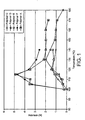
- Figure 1 is a plot of hot tack against temperature for films blown from the polymers of Example 2 and four comparison polymers.
- Hot tack is a method for measuring the strength of heat seal of film and lamination immediately after the sealing operation. This property is measured on a DTC International Hot tack tester model 52-D, w-4236.
- Samples are cut with a width of 15 mm.
- the sealing time is 0.5 sec, a delay time is 0.1 sec and the sealing pressure is 90N.
- the sealing at different temperatures are measured and for each test temperature 5 parallels are taken.
- the specimens have been conditioned, allowed to stand, at ambient temperature for a minimum of 24 hours before testing.
- MFR was measured according to ISO 1133 at 190°C.
- the load has been indicated as a subscript, i.e. MFR 2 denotes the measurement has been carried out under a load of 2.16 kg and MFR 21 denotes the measurement has been carried out under a load of 21.6 kg, respectively.
- Flow Rate Ratio is a ratio of two melt flow rates, measured under different loads. The loads are denoted in the subscript. Thus, FRR 21/2 denotes the ratio of MFR 21 to MFR 2 .
- the main difference between this method and the method used is the temperature; the ISO method being at room temperature while the method used being at 140°C.
- the ratio of M w and M n is a measure of the broadness of the distribution, since each is influenced by the opposite end of the "population".
- Density is measured according to ISO 1183/D.
- Oxygen permeability is carried out using ASTM D3985.
- viscosity at low shear rates (0.05 rad/s) is plotted against viscosity at high shear rates (300 rad/s) as a measure of processability; a high viscosity at low shear rates combined with a low viscosity at high shear rates giving superior processability.
- a continuously operating loop reactor having a volume of 500 dm 3 was operated at 85°C temperature and 60 bar pressure.
- propane diluent, ethylene, 1-butene comononer, hydrogen and the polymerisation catalyst described in Example 1 were introduced into the reactor in such amounts that the ethylene concentration in the liquid phase of the loop reactor was 5.8% by mole, the ratio of hydrogen to ethylene was 0.48 mol/kmol, the ratio of 1-butene to ethylene was 118 mol/kmol and the polymer production rate in the reactor was 30 kg/h.
- the thus formed polymer had a melt index MFR 2 of 79 g/10 min and a density of 938 kg/m 3 .
- the slurry was intermittently withdrawn from the reactor by using a settling leg and directed to a flash tank operated at a temperature of about 50°C and a pressure of about 3 bar.
- the polymer powder containing a small amount of residual hydrocarbons, was transferred into a gas phase reactor operated at 75°C temperature and 20 bar pressure.
- a gas phase reactor operated at 75°C temperature and 20 bar pressure.
- additional ethylene, 1-hexene comonomer and nitrogen as inert gas in such amounts that the ethylene concentration in the circulating gas was 37% by mole, the ratio of 1-hexene to ethylene was 10 mol/kmol and the polymer production rate was 37 kg/h.
- the concentrations of 1-butene and hydrogen were so low that they could not be detected by the on-line gas chromatograph which was used to monitor the gas composition.
- the polymer collected from the gas phase reactor was stabilised by adding 0.15% wt of stabilizer, Trganox B561, to the powder.
- the stabilised polymer was then extruded and pelletised with a CIM90P extruder, manufactured by Japan Steel Works.
- the production split between the loop and gas phase reactors was thus 45/55.
- the polymer pellets had a melt index MFR 2 of 0.78 g/10 min, a density of 919 kg/m 3 , a 1-butene content of 1.4% by weight, a content of 1-hexene of 7.1% by weight, a weight average molecular weight M w of 131000 g/mol, a number average molecular weight M n of 28200 g/mol and a z-average molecular weight M z of 333000 g/mol.
- the polymer had a zero shear rate viscosity ⁇ o of 11700 Pa.s and a shear thinning index SHI 0/100 of 3.9.
- Example 2 The procedure of Example 2 was repeated except that the process conditions were adjusted as shown in Table 1.
- the polymer pellets had a melt index MFR 2 of 0.76 g/10 min, a density of 919 kg/m 3 , a 1-butene content of 2.0% by weight, a content of 1-hexene of 6.8% by weight, a weight average molecular weight M w of 126000 g/mol, a number average molecular weight M n of 16600 g/mol and a z-average molecular weight M z of 349000 g/mol. Further, the polymer had a zero shear rate viscosity ⁇ 0 of 12900 Pa.s and a shear thinning index SHI 0/100 of 5.4.
- Example 2 3 C 2 in loop, mol-% 5.8 7.0 H 2 /C 2 in loop, mol/kmol 0.48 0.78 C 4/ C 2 in loop, mol/kmol 118 139 C 6/ C 2 in loop, mol/kmol 0 0 MFR 2 of loop polymer, g/10 min 79 340 Density of loop polymer, kg/m 3 938 937 Production rate in loop, kg/h 30 30 C 2 in gpr, mol-% 37 43 H 2/ C 2 in gpr, mol/kmol * C 4 /C 2 in gpr, mol/kmol * * C 6/ C 2 in gpr, mol/kmol 10 12 Production rate in gpr, kg/h 37 30 Production split, loop/gpr 45/55 50/50
- the hot tack for the films were measured and are plotted in Figure 1.
- the films according to the invention are comparable to those using PE with octene as a comonomer and superior to those using lower ⁇ -olefin comonomers.
- Example 3 The polymer of Example 3 was blended with 4% wt of an autoclave produced LDPE (FA 5223 from Borealis A/s, MFR 2 1.2 g/10 min, 922 kg/m 3 density) or with 4% wt of an autoclave produced LDPE (CA 8200 from Borealis A/s, MFR 2 7.5 g/10 min, density 920 kg/m 3 ).
- the resulting blends, polymers (G) and (H) respectively, and Polymer B itself were processed to form films of 40 ⁇ m thickness using an Ankutec film blower, 30 mm, LD ratio 25:1, die diameter 50mm, die gap 2.4 mm.
- the gloss and haze were assessed by ASTM D2457 and ASTM D1003 respectively and the results are set out in Table 3 below: Polymer G H B Gloss 60° (%) 71 63.6 39.1 Haze (%) 15.9 15.4 31.9
- Example 6 The polymer of Example 6 was similarly blended with 4% wt of FA5223 or 4% wt of a tubular LDPE with relatively high density (FA5270 from Borealis A/S) or with 4% wt of CA8200.
- the results are set out in Table 4 below: Polymer I J K L Gloss 60° (%) 88.9 95.6 72.4 45.7 Haze (%) 12.7 11.6 14.8 29.5
- Example 2 The procedure of Example 2 was repeated except that the process conditions were adjusted as shown in Table 1.
- the polymer pellets had a melt index MFR 2 of 0.86 g/10 min, a density of 919 kg/m 3 , a 1-butene content of 1.5% by weight, a content of 1-hexene of 7.3% by weight, a weight average molecular weight M w of 127000 g/mol, a number average molecular weight M n of 22200 g/mol and a z-average molecular weight M z of 324000 g/mol. Further, the polymer had a zero shear rate viscosity ⁇ 0 of 11000 Pa.s and a shear thinning index SHI 0/100 of 4.
Landscapes
- Chemical & Material Sciences (AREA)
- Organic Chemistry (AREA)
- Health & Medical Sciences (AREA)
- Chemical Kinetics & Catalysis (AREA)
- Medicinal Chemistry (AREA)
- Polymers & Plastics (AREA)
- Manufacturing & Machinery (AREA)
- Engineering & Computer Science (AREA)
- Inorganic Chemistry (AREA)
- Materials Engineering (AREA)
- Manufacture Of Macromolecular Shaped Articles (AREA)
- Addition Polymer Or Copolymer, Post-Treatments, Or Chemical Modifications (AREA)
- Compositions Of Macromolecular Compounds (AREA)
- Laminated Bodies (AREA)
- Treatments Of Macromolecular Shaped Articles (AREA)
Claims (21)
- Folie aus Polyethylen, das durch eine Polymerisation hergestellt ist, die von einem Katalysator mit einheitlichen aktiven Zentren katalysiert worden ist, der mehr als einen η5-cyclischen Liganden aufweist, und das als Comonomere für Ethylen zumindest zwei C4-12-α-Olefine umfaßt.
- Folie nach Anspruch 1, wobei diese Comonomere aus Buten-1, Hexen-1, 4-Methylpenten-1, Hepten-1, Octen-1 und Decen-1 ausgewählt sind.
- Folie nach Anspruch 2, wobei die Comonomere Buten-1 und Hexen-1 sind.
- Folie nach einem der Ansprüche 1 bis 3, wobei das Polyethylen ein bimodales Polyethylen ist, wobei die Kopmponente mit geringerem Molekulargewicht 30 bis 70 Gew.-% des Polyethylens ausmacht.
- Folie nach einem der Ansprüche 1 bis 4, wobei der Comonomergehalt des Polyethylens 0,1 bis 10 Mol-% beträgt.
- Folie nach einem der Ansprüche 1 bis 5, wobei die Dichte des Polyethylens 905 bis 930 kg/m3 beträgt.
- Folie nach einem der Ansprüche 1 bis 6, wobei das Gewichtsmittel des Molekulargewichts des Polyethylens 50.000 bis 250.000 g/Mol beträgt.
- Folie nach einem der Ansprüche 1 bis 7, wobei die Molekulargewichtsverteilung des Polyethylens 3 bis 8 beträgt.
- Folie nach einem der Ansprüche 1 bis 8, wobei der MFR2-Wert des Polyethylens 0,4 bis 3 g/10 min beträgt.
- Folie nach einem der Ansprüche 1 bis 9, wobei das Polyethylen mit einem weiteren Polymer gemischt ist.
- Folie nach Anspruch 10, wobei das weitere Polymer ein Polyethylen niedriger Dichte (LDPE) ist.
- Folie nach einem der Ansprüche 1 bis 11, die eine Vielzahl von Schichten umfaßt.
- Folie nach einem der Ansprüche 1 bis 12, die durch Extrusion bei einem Aufblasverhältnis von 2:1 bis 4:1 hergestellt ist.
- Polyethylenzusammensetzung für die Folienherstelluing, wobei die Zusammensetzung ein Polyethylen umfaßt, das durch eine Polymerisation hergestellt ist, die von einem Katalysator mit einheitlichen aktiven Zentren katalysiert worden ist, der mehr als einen η5-cyclischen Liganden aufweist, und das als Comonomere für Ethylen zumindest zwei C4-12-α-Olefine umfaßt.
- Zusammensetzung nach Anspruch 14, die ein Polyethylen nach einem der Ansprüche 2 bis 9 umfaßt.
- Zusammensetzung nach einem der Ansprüche 14 und 15, die ein Gemisch dieses Polyethylens und eines weiteren Polymers umfaßt.
- Zusammensetzung nach Anspruch 16, wobei dieses weitere Polymer ein Polyethylen niedriger Dichte (LDPE) ist.
- Produkt, das in einer Heißsiegelfolie aus einem Polyethylen abgepackt ist, das durch eine Polymerisation hergestellt ist, die von einem Katalysator mit einheitlichen aktiven Zentren katalysiert worden ist, der mehr als einen η5-cyclischen Liganden aufweist, und das als Comonomere für Ethylen zumindest zwei C4-12-α-Olefine umfaßt.
- Produkt nach Anspruch 18, wobei die Folie wie in einem der Ansprüche 2 bis 13 angegeben ist.
- Produkt nach einem der Ansprüche 18 und 19, das ein abgepacktes Lebensmittel oder eine abgepackte Flüssigkeit ist.
- Verwendung von LDPE mit einer Dichte von 925 bis 932 kg/m3 als ein Zusatz, der mit 1 bis 5 Gew.-% in einer Polyethylenzusammensetzung für die Folienherstellung vorliegt, um die optischen Eigenschaften der daraus hergestellten Folie zu verbessern.
Priority Applications (1)
| Application Number | Priority Date | Filing Date | Title |
|---|---|---|---|
| EP20030701623 EP1472298B1 (de) | 2002-02-04 | 2003-02-04 | Polymerfilm |
Applications Claiming Priority (4)
| Application Number | Priority Date | Filing Date | Title |
|---|---|---|---|
| EP20020002578 EP1333044B2 (de) | 2002-02-04 | 2002-02-04 | Film mit hoher Schlagfestigkeit |
| EP02002578 | 2002-02-04 | ||
| PCT/GB2003/000480 WO2003066699A1 (en) | 2002-02-04 | 2003-02-04 | Polymer film |
| EP20030701623 EP1472298B1 (de) | 2002-02-04 | 2003-02-04 | Polymerfilm |
Publications (2)
| Publication Number | Publication Date |
|---|---|
| EP1472298A1 EP1472298A1 (de) | 2004-11-03 |
| EP1472298B1 true EP1472298B1 (de) | 2005-09-14 |
Family
ID=8185431
Family Applications (2)
| Application Number | Title | Priority Date | Filing Date |
|---|---|---|---|
| EP20020002578 Expired - Lifetime EP1333044B2 (de) | 2002-02-04 | 2002-02-04 | Film mit hoher Schlagfestigkeit |
| EP20030701623 Expired - Lifetime EP1472298B1 (de) | 2002-02-04 | 2003-02-04 | Polymerfilm |
Family Applications Before (1)
| Application Number | Title | Priority Date | Filing Date |
|---|---|---|---|
| EP20020002578 Expired - Lifetime EP1333044B2 (de) | 2002-02-04 | 2002-02-04 | Film mit hoher Schlagfestigkeit |
Country Status (13)
| Country | Link |
|---|---|
| US (2) | US7524897B2 (de) |
| EP (2) | EP1333044B2 (de) |
| JP (1) | JP2005533131A (de) |
| KR (1) | KR100702098B1 (de) |
| CN (2) | CN100506868C (de) |
| AT (2) | ATE287420T1 (de) |
| AU (2) | AU2003206823A1 (de) |
| BR (1) | BR0307246A (de) |
| DE (2) | DE60202660T3 (de) |
| ES (2) | ES2236371T5 (de) |
| PL (1) | PL373445A1 (de) |
| RU (2) | RU2354669C2 (de) |
| WO (2) | WO2003066698A1 (de) |
Cited By (2)
| Publication number | Priority date | Publication date | Assignee | Title |
|---|---|---|---|---|
| US10328678B2 (en) | 2013-11-21 | 2019-06-25 | Borealis Ag | Films |
| US10494465B2 (en) | 2014-11-26 | 2019-12-03 | Borealis Ag | Film layer |
Families Citing this family (94)
| Publication number | Priority date | Publication date | Assignee | Title |
|---|---|---|---|---|
| GB0315275D0 (en) * | 2003-06-30 | 2003-08-06 | Borealis Tech Oy | Extrusion coating |
| GB0317012D0 (en) * | 2003-07-21 | 2003-08-27 | Borealis Tech Oy | Injection moulding polymer |
| GB0418581D0 (en) * | 2004-08-20 | 2004-09-22 | Solvay | Polymer composition |
| EP1674490A1 (de) * | 2004-12-23 | 2006-06-28 | Borealis Technology Oy | Copolymer |
| PL1712574T3 (pl) | 2005-04-12 | 2008-08-29 | Borealis Tech Oy | Folia polietylenowa o ulepszonych właściwościach przetwórczych i mechanicznych |
| ATE427329T1 (de) * | 2005-06-30 | 2009-04-15 | Borealis Tech Oy | Polyethylenzusammensetzung mit verbesserter verarbeitbarkeit |
| DE602006009540D1 (de) * | 2005-08-24 | 2009-11-12 | Dow Global Technologies Inc | L und herstellungsverfahren dafür |
| EP1777238B1 (de) | 2005-10-18 | 2007-05-02 | Borealis Technology Oy | Polyethylenmischungskomponente und diese enthaltende Mischungen |
| US8124202B2 (en) * | 2006-09-15 | 2012-02-28 | The Coca-Cola Company | Multilayer container for enhanced gas barrier properties |
| PL1927626T3 (pl) * | 2006-12-01 | 2010-03-31 | Borealis Tech Oy | Wielomodalne żywice polietylenowe do produkcji rur, wytwarzane w obecności katalizatora z jednym miejscem aktywnym |
| EP1950233A1 (de) * | 2007-01-25 | 2008-07-30 | Borealis Technology Oy | Polymer |
| EP1950241A1 (de) | 2007-01-25 | 2008-07-30 | Borealis Technology Oy | Multimodale Polyethylenzusammensetzung |
| DE602007011259D1 (de) | 2007-08-10 | 2011-01-27 | Borealis Tech Oy | Artikel der eine Polypropylenzusammensetzung beinhaltet |
| EP2033976A1 (de) | 2007-09-03 | 2009-03-11 | INEOS Manufacturing Belgium NV | Polymerisationsprozess in der Schlammphase |
| WO2009071323A1 (en) * | 2007-12-05 | 2009-06-11 | Borealis Technology Oy | Multi-modal linear low density polyethylene polymer |
| EP2067799A1 (de) * | 2007-12-05 | 2009-06-10 | Borealis Technology OY | Polymer |
| RU2372360C1 (ru) * | 2008-06-06 | 2009-11-10 | Открытое акционерное общество "НИИ шинной промышленности" | Способ производства термоусадочных пленок |
| FR2932604B1 (fr) | 2008-06-11 | 2010-05-28 | Nexans | Cable electrique a haute tension |
| EP2133389A1 (de) | 2008-06-12 | 2009-12-16 | Borealis AG | Polypropylenzusammensetzung |
| RU2509782C2 (ru) | 2008-09-25 | 2014-03-20 | Базелль Полиолефине Гмбх | Ударопрочная композиция лпэнп и полученные из нее пленки |
| EP2337811A1 (de) * | 2008-09-25 | 2011-06-29 | Basell Polyolefine GmbH | Schlagzähe lldpe-zusammensetzungen und daraus hergestellte folien |
| JP2012503687A (ja) | 2008-09-25 | 2012-02-09 | バーゼル・ポリオレフィン・ゲーエムベーハー | 耐衝撃性lldpe組成物及びそれから製造されるフィルム |
| US8907035B2 (en) | 2009-01-13 | 2014-12-09 | Basell Polyolefine Gmbh | Polyethylene Copolymers |
| KR101743312B1 (ko) | 2009-07-27 | 2017-06-02 | 바젤 폴리올레핀 게엠베하 | 유기금속성 전이금속 화합물, 촉매계 및 폴리올레핀의 제조 |
| EP2348057A1 (de) | 2010-01-21 | 2011-07-27 | INEOS Manufacturing Belgium NV | Neuartige Polymere |
| EP2354183B1 (de) | 2010-01-29 | 2012-08-22 | Borealis AG | Formungszusammensetzung |
| PL2354184T3 (pl) | 2010-01-29 | 2013-01-31 | Borealis Ag | Tłoczywo polietylenowe o ulepszonym stosunku odporność na pękanie /sztywność i ulepszone udarności |
| ES2455694T3 (es) | 2010-08-06 | 2014-04-16 | Borealis Ag | Película multicapa |
| KR101595679B1 (ko) | 2011-12-09 | 2016-02-18 | 보레알리스 아게 | 신규한 폴리에틸렌 |
| US10144789B2 (en) | 2012-05-31 | 2018-12-04 | Borealis Ag | Low density polyethylene for extrusion coating |
| ES2639126T5 (es) | 2012-05-31 | 2024-07-24 | Borealis Ag | Polímeros de etileno para recubrimiento por extrusión |
| BR112014025580B1 (pt) * | 2012-06-26 | 2022-04-05 | Dow Global Technologies Llc | Composição-mistura de polietileno apropriada para película soprada |
| CN104769031A (zh) * | 2012-09-14 | 2015-07-08 | 埃克森美孚化学专利公司 | 基于乙烯的聚合物和由其制造的制品 |
| JP6211088B2 (ja) | 2012-10-09 | 2017-10-11 | ダウ グローバル テクノロジーズ エルエルシー | シーラント組成物 |
| EP2730612B1 (de) * | 2012-11-09 | 2016-09-14 | Abu Dhabi Polymers Company Limited (Borouge) | Polymerzusammensetzung mit einer Mischung aus multimodalem Polyethylen und weiteres Ethylenpolymer, das für die Produktion eines Tropfenbewässerungsrohres geeignet ist |
| EP2970535B1 (de) | 2013-03-15 | 2022-01-26 | Univation Technologies, LLC | Polymerprodukte und mehrstufiges polymerisationsverfahren zur herstellung davon |
| ES2651456T3 (es) | 2013-08-14 | 2018-01-26 | Borealis Ag | Composición de propileno con mejor resistencia al impacto a baja temperatura |
| JP6190961B2 (ja) | 2013-08-21 | 2017-08-30 | ボレアリス・アクチェンゲゼルシャフトBorealis Ag | 高い剛性および靭性を有する高流動ポリオレフィン組成物 |
| BR112016002682A8 (pt) | 2013-08-21 | 2020-01-28 | Borealis Ag | composição de poliolefina de alto fluxo com alta rigidez e tenacidade |
| PT2853563T (pt) | 2013-09-27 | 2016-07-14 | Borealis Ag | Filmes adequados para processamento de bopp a partir de polímeros com xs elevada e tm elevado |
| EP2860031B1 (de) * | 2013-10-11 | 2016-03-30 | Borealis AG | In Maschinenrichtung ausgerichtete Folien für Etiketten |
| EP3060589B9 (de) | 2013-10-24 | 2018-04-18 | Borealis AG | Propylenhomopolymer mit geringer schmelztemperatur mit hohem gehalt an regiodefekten und hohem molekulargewicht |
| ES2574428T3 (es) | 2013-10-24 | 2016-06-17 | Borealis Ag | Artículo moldeado por soplado basado en copolímero al azar bimodal |
| WO2015062936A1 (en) | 2013-10-29 | 2015-05-07 | Borealis Ag | Solid single site catalysts with high polymerisation activity |
| FR3012998B1 (fr) | 2013-11-12 | 2016-01-01 | Michelin & Cie | Pneumatique comportant un temoin d'adherence sonore |
| MX368147B (es) | 2013-11-22 | 2019-09-20 | Borealis Ag | Homopolímero de propileno de baja emisión con alto flujo de masa fundida. |
| BR112016011829B1 (pt) | 2013-12-04 | 2022-01-18 | Borealis Ag | Composição de polipropileno, fibra e trama soprada em fusão, artigo e uso da composição de polipropileno |
| FR3014807B1 (fr) | 2013-12-18 | 2016-02-05 | Michelin & Cie | Estimation du potentiel d'adherence par evaluation du rayon de roulement |
| US9637602B2 (en) | 2013-12-18 | 2017-05-02 | Borealis Ag | BOPP film with improved stiffness/toughness balance |
| CN105829364B (zh) | 2014-01-17 | 2017-11-10 | 博里利斯股份公司 | 用于制备丙烯/1‑丁烯共聚物的方法 |
| WO2015117958A1 (en) | 2014-02-06 | 2015-08-13 | Borealis Ag | Soft copolymers with high impact strength |
| PL3102634T3 (pl) | 2014-02-06 | 2020-11-16 | Borealis Ag | Miękkie i przezroczyste kopolimery odporne na uderzenia |
| TWI668112B (zh) * | 2014-02-11 | 2019-08-11 | 美商陶氏全球科技有限責任公司 | 用於增強聚烯烴薄膜之無光澤外觀的丙烯酸系珠粒 |
| EP2907841A1 (de) | 2014-02-14 | 2015-08-19 | Borealis AG | Polypropylenverbundstoff |
| ES2659731T3 (es) | 2014-05-20 | 2018-03-19 | Borealis Ag | Composición de polipropileno para aplicaciones en interiores de automóviles |
| BR112016026856B1 (pt) | 2014-05-28 | 2022-06-07 | Basell Polyolefine Gmbh | Composição de polímero de etileno, composições de poliolefina e artigos formados compreendendo a composição de polímero de etileno |
| DK3009457T3 (da) * | 2014-10-14 | 2017-07-31 | Abu Dhabi Polymers Co Ltd (Borouge) Llc | Geomembrananvendelser baseret på polyethylen |
| ES2788424T3 (es) * | 2014-11-26 | 2020-10-21 | Borealis Ag | Composición de polietileno para una capa de película |
| PL3261838T3 (pl) | 2015-02-27 | 2019-07-31 | Borealis Ag | Laminowana struktura folii wyłącznie na bazie polietylenu |
| EP3101060B1 (de) | 2015-06-03 | 2017-12-27 | Borealis AG | In maschinenrichtung ausgerichteter film mit ausgeglichenen eigenschaften bei niedrigen streckverhältnissen |
| ES2743481T3 (es) * | 2015-06-10 | 2020-02-19 | Borealis Ag | Copolímero multimodal de etileno y al menos dos comonómeros de alfa-olefina y artículos finales hechos del mismo |
| CN106632783B (zh) * | 2015-10-30 | 2019-02-15 | 中国石油天然气股份有限公司 | 茂金属透明薄膜树脂及其制备方法与薄膜 |
| WO2017102704A1 (en) | 2015-12-15 | 2017-06-22 | Borealis Ag | Polyethylene based laminated film structure with barrier properties |
| JP2019517938A (ja) | 2016-06-03 | 2019-06-27 | ボレアリス エージー | 多層構造体 |
| US10982025B2 (en) | 2016-11-25 | 2021-04-20 | Borealis Ag | Process for producing polyolefin film composition and films prepared thereof |
| WO2018106388A1 (en) | 2016-12-05 | 2018-06-14 | Exxonmobil Chemical Patents Inc. | Broad orthogonal distribution metallocene polyethylenes for films |
| WO2019081611A1 (en) | 2017-10-24 | 2019-05-02 | Borealis Ag | MULTILAYER POLYMER FILM |
| WO2020109556A1 (en) | 2018-11-29 | 2020-06-04 | Borealis Ag | Polymer composition and process for making the same |
| EP3887412A1 (de) | 2018-11-29 | 2021-10-06 | Borealis AG | Verfahren zur herstellung eines polymers sowie polymer |
| WO2020136165A1 (en) | 2018-12-28 | 2020-07-02 | Borealis Ag | A process for producing polyolefin film composition and films prepared thereof |
| EP3902850A1 (de) | 2018-12-28 | 2021-11-03 | Borealis AG | Verfahren zur herstellung einer polyolefinfolienzusammensetzung und daraus hergestellte folien |
| CN111662402B (zh) * | 2019-03-08 | 2023-02-28 | 浙江大学 | 一种聚烯烃组合物及其制备方法和应用 |
| EP4126993A1 (de) | 2020-03-24 | 2023-02-08 | Borealis AG | Polyethylenzusammensetzung für eine folienschicht |
| EP4126994A1 (de) | 2020-03-24 | 2023-02-08 | Borealis AG | Polyethylenzusammensetzung für eine folienschicht |
| EP4185620A1 (de) | 2020-07-23 | 2023-05-31 | Borealis AG | Multimodales ethylencopolymer |
| EP4000924A1 (de) | 2020-11-19 | 2022-05-25 | Borealis AG | Polyethylenfolienstrukturen für sicherere feinschrumpffolien |
| EP4052902B1 (de) | 2021-03-01 | 2026-01-07 | Borealis GmbH | Hochsperrende polyethylenfolie für verpackungen |
| EP4052903A1 (de) | 2021-03-01 | 2022-09-07 | Borealis AG | Blasfolienpolyolefinlösungen mit hoher sperrwirkung für sperrbeschichtung |
| EP4053194B1 (de) | 2021-03-03 | 2023-08-02 | Borealis AG | Einschichtige blasfolie |
| ES2986541T3 (es) | 2021-07-07 | 2024-11-11 | Borealis Ag | Película soplada de una capa |
| EP4116091A1 (de) | 2021-07-07 | 2023-01-11 | Borealis AG | Mehrschichtige folie |
| CN117794962B (zh) * | 2021-08-06 | 2026-02-13 | 北欧化工公司 | 用于膜层的聚乙烯共聚物 |
| US20240336714A1 (en) * | 2021-08-06 | 2024-10-10 | Borealis Ag | Polyethylene copolymer for a film layer |
| WO2023012256A1 (en) * | 2021-08-06 | 2023-02-09 | Borealis Ag | Polyethylene copolymer for a film layer |
| CN118265608A (zh) | 2021-09-02 | 2024-06-28 | 博里利斯股份公司 | 含回收聚合物的低摩擦聚乙烯密封膜 |
| EP4144528A1 (de) | 2021-09-02 | 2023-03-08 | Borealis AG | Polyethylenbasierte siegelfolie mit hoher verpackungsleistung |
| EP4201674A1 (de) | 2021-12-23 | 2023-06-28 | Borealis AG | Mehrschichtenfilmstruktur enthaltend multimodal ethylen-terpolymere und recyceltes ldpe für feinschrumpffolien |
| US20250313002A1 (en) | 2022-04-11 | 2025-10-09 | Borealis Ag | Multilayer film |
| WO2023198612A1 (en) | 2022-04-11 | 2023-10-19 | Borealis Ag | Film |
| EP4275889B1 (de) | 2022-05-12 | 2024-10-16 | Borealis AG | Ausgerichteter mehrschichtiger film |
| EP4286156A1 (de) | 2022-06-03 | 2023-12-06 | Borealis AG | Pet-freie verpackung mit pp-evoh-pe-mehrschichtstruktur |
| EP4403350B1 (de) | 2023-01-19 | 2025-03-05 | Borealis AG | Mehrschichtfolie |
| EP4650377A1 (de) | 2024-05-13 | 2025-11-19 | Borealis GmbH | Multimodale ethylencopolymerzusammensetzung mit mittlerer dichte und film mit verbesserter zähigkeit |
| EP4650376A1 (de) | 2024-05-13 | 2025-11-19 | Borealis GmbH | Multimodale ethylencopolymerzusammensetzung, rezyklathaltige polymerzusammensetzung damit und film mit verbesserter zähigkeit |
Family Cites Families (32)
| Publication number | Priority date | Publication date | Assignee | Title |
|---|---|---|---|---|
| SU585102A1 (ru) | 1975-12-01 | 1977-12-25 | Экспериментально-Конструкторский И Технологический Институт Автомабильной Промышленности | Способ упаковки пакета изделий в термоусадочную пленку |
| ZA802850B (en) † | 1979-06-18 | 1981-05-27 | Union Carbide Corp | High tear strength polymers |
| US4367256A (en) † | 1981-05-15 | 1983-01-04 | Union Carbide Corporation | Cling-wrap polyethylene film |
| IL71357A (en) | 1983-03-29 | 1987-03-31 | Union Carbide Corp | Process for producing low density ethylene copolymers |
| US4508842A (en) | 1983-03-29 | 1985-04-02 | Union Carbide Corporation | Ethylene polymerization using supported vanadium catalyst |
| US4536550A (en) * | 1983-04-21 | 1985-08-20 | Asahi Kasei Kogyo Kabushiki Kaisha | Polyethylene composition |
| CA2003882C (en) | 1988-12-19 | 1997-01-07 | Edwin Rogers Smith | Heat shrinkable very low density polyethylene terpolymer film |
| FI86867C (fi) | 1990-12-28 | 1992-10-26 | Neste Oy | Flerstegsprocess foer framstaellning av polyeten |
| US6270867B1 (en) * | 1993-06-24 | 2001-08-07 | Pechiney Plastic Packaging, Inc. | Structures of polymers made from single site catalysts |
| CA2185469A1 (en) † | 1994-03-15 | 1995-09-21 | Prasadarao Meka | Polymers blends, films and articles thereof |
| US5580725A (en) * | 1994-04-19 | 1996-12-03 | North Carolina State Universtiy | Method of eliminating genetic routes for bacteriophage evolution and products produced thereby |
| FI942949A0 (fi) † | 1994-06-20 | 1994-06-20 | Borealis Polymers Oy | Prokatalysator foer producering av etenpolymerer och foerfarande foer framstaellning daerav |
| US5503914A (en) * | 1994-07-08 | 1996-04-02 | Union Carbide Chemicals & Plastics Technology Corporation | Film extruded from an in situ blend of ethylene copolymers |
| FI101546B1 (fi) * | 1994-12-16 | 1998-07-15 | Borealis Polymers Oy | Polyeteenikompositio |
| US5814413A (en) * | 1995-06-07 | 1998-09-29 | Huntsman United Films Corporation | Multilayer protective garment film |
| SE504455C2 (sv) * | 1995-07-10 | 1997-02-17 | Borealis Polymers Oy | Kabelmantlingskomposition, dess användning samt sätt för dess framställning |
| DE19526340A1 (de) † | 1995-07-19 | 1997-01-23 | Basf Ag | Polyethylenformmassen geringer Schwindungsneigung |
| DE29518396U1 (de) † | 1995-11-12 | 1996-02-22 | Pelikan Gmbh, 30177 Hannover | Schild zur Kennzeichnung von Schreibgeräten |
| US5665818A (en) * | 1996-03-05 | 1997-09-09 | Union Carbide Chemicals & Plastics Technology Corporation | High activity staged reactor process |
| US5718974A (en) * | 1996-06-24 | 1998-02-17 | Union Carbide Chemicals & Plastics Technology Corporation | Cable jacket |
| US5736237A (en) † | 1996-11-25 | 1998-04-07 | Union Carbide Chemicals & Plastics Technology Corporation | Geomembranes |
| IL138733A0 (en) † | 1998-04-06 | 2001-10-31 | Borealis Tech Oy | High density polyethylene compositions, a process for the production thereof and films prepared thereof |
| FI981034A7 (fi) † | 1998-05-08 | 1999-11-09 | Borealis Polymers Oy | HD-polyeteenikoostumukset ja menetelmä niiden valmistamiseksi |
| US6130293A (en) * | 1998-08-11 | 2000-10-10 | Eastman Chemical Company | High clarity polyethylene compositions |
| GB9911934D0 (en) † | 1999-05-21 | 1999-07-21 | Borealis As | Polymer |
| US6534137B1 (en) | 1999-10-12 | 2003-03-18 | Cryovac, Inc. | Two-component, heat-sealable films |
| US20020006482A1 (en) * | 2000-01-24 | 2002-01-17 | Falla Daniel J. | Multilayer blown film structure with polypropylene non-sealant layer and polyethylene sealant layer |
| DE60025551T2 (de) * | 2000-04-13 | 2006-08-24 | Borealis Technology Oy | Polymerzusammensetzung für Rohre |
| GB0014547D0 (en) | 2000-06-14 | 2000-08-09 | Borealis Tech Oy | Improvements in or relating to polymers |
| US6734265B1 (en) * | 2000-10-06 | 2004-05-11 | Univation Technologies, Llc. | Linear low density polyethylenes with high melt strength and high melt index ratio |
| GB0315275D0 (en) * | 2003-06-30 | 2003-08-06 | Borealis Tech Oy | Extrusion coating |
| EP1674490A1 (de) * | 2004-12-23 | 2006-06-28 | Borealis Technology Oy | Copolymer |
-
2002
- 2002-02-04 AT AT02002578T patent/ATE287420T1/de not_active IP Right Cessation
- 2002-02-04 DE DE2002602660 patent/DE60202660T3/de not_active Expired - Lifetime
- 2002-02-04 EP EP20020002578 patent/EP1333044B2/de not_active Expired - Lifetime
- 2002-02-04 ES ES02002578T patent/ES2236371T5/es not_active Expired - Lifetime
-
2003
- 2003-02-03 CN CNB038028557A patent/CN100506868C/zh not_active Expired - Lifetime
- 2003-02-03 WO PCT/EP2003/001042 patent/WO2003066698A1/en not_active Ceased
- 2003-02-03 US US10/503,611 patent/US7524897B2/en not_active Expired - Lifetime
- 2003-02-03 RU RU2004123882A patent/RU2354669C2/ru active
- 2003-02-03 AU AU2003206823A patent/AU2003206823A1/en not_active Abandoned
- 2003-02-04 DE DE2003601617 patent/DE60301617T2/de not_active Expired - Lifetime
- 2003-02-04 US US10/501,625 patent/US7256239B2/en not_active Expired - Lifetime
- 2003-02-04 BR BR0307246A patent/BR0307246A/pt not_active IP Right Cessation
- 2003-02-04 ES ES03701623T patent/ES2244917T3/es not_active Expired - Lifetime
- 2003-02-04 WO PCT/GB2003/000480 patent/WO2003066699A1/en not_active Ceased
- 2003-02-04 EP EP20030701623 patent/EP1472298B1/de not_active Expired - Lifetime
- 2003-02-04 JP JP2003566066A patent/JP2005533131A/ja active Pending
- 2003-02-04 AT AT03701623T patent/ATE304562T1/de not_active IP Right Cessation
- 2003-02-04 PL PL37344503A patent/PL373445A1/xx not_active Application Discontinuation
- 2003-02-04 AU AU2003202712A patent/AU2003202712B2/en not_active Ceased
- 2003-02-04 CN CNB038032392A patent/CN1304448C/zh not_active Expired - Fee Related
- 2003-02-04 RU RU2004121679A patent/RU2296775C2/ru not_active IP Right Cessation
- 2003-02-04 KR KR1020047011624A patent/KR100702098B1/ko not_active Expired - Fee Related
Cited By (2)
| Publication number | Priority date | Publication date | Assignee | Title |
|---|---|---|---|---|
| US10328678B2 (en) | 2013-11-21 | 2019-06-25 | Borealis Ag | Films |
| US10494465B2 (en) | 2014-11-26 | 2019-12-03 | Borealis Ag | Film layer |
Also Published As
Similar Documents
| Publication | Publication Date | Title |
|---|---|---|
| US7256239B2 (en) | Polymer film | |
| JP7138788B2 (ja) | フィルム用途用ポリエチレン組成物 | |
| EP1325073B1 (de) | Metallocenkatalysatoren hergestelltem polyethylen sehr niedriger dichte | |
| EP2158262B1 (de) | Polyethylenzusammensetzungen, herstellungsverfahren dafür und gegenstände daraus | |
| US7812094B2 (en) | Polymer blend | |
| CN101400732B (zh) | 高密度聚乙烯 | |
| EP2895550B1 (de) | Ethylenbasierte polymere und daraus gefertigte artikel | |
| EP1814941B1 (de) | Zusammensetzung | |
| TWI758318B (zh) | 多層膜及包括其之層製品及製品 | |
| CA2530361A1 (en) | Extrusion coating | |
| WO2009071323A1 (en) | Multi-modal linear low density polyethylene polymer | |
| US7247680B2 (en) | High shrink polyethylene films | |
| WO2022144275A1 (en) | Polyethylene composition for film applications with improved toughness and stiffness | |
| KR20010022071A (ko) | 넓은 분자량 분포도 및 조성상 균일성을 갖는 에틸렌상호중합체 조성물, 이의 제조 방법 및 이로부터 제조된제품 | |
| WO2007065644A1 (en) | Polymer | |
| CN120457031A (zh) | 多层整理收缩膜 |
Legal Events
| Date | Code | Title | Description |
|---|---|---|---|
| PUAI | Public reference made under article 153(3) epc to a published international application that has entered the european phase |
Free format text: ORIGINAL CODE: 0009012 |
|
| 17P | Request for examination filed |
Effective date: 20040714 |
|
| AK | Designated contracting states |
Kind code of ref document: A1 Designated state(s): AT BE BG CH CY CZ DE DK EE ES FI FR GB GR HU IE IT LI LU MC NL PT SE SI SK TR |
|
| AX | Request for extension of the european patent |
Extension state: AL LT LV MK RO |
|
| 17Q | First examination report despatched |
Effective date: 20041104 |
|
| GRAP | Despatch of communication of intention to grant a patent |
Free format text: ORIGINAL CODE: EPIDOSNIGR1 |
|
| GRAS | Grant fee paid |
Free format text: ORIGINAL CODE: EPIDOSNIGR3 |
|
| GRAA | (expected) grant |
Free format text: ORIGINAL CODE: 0009210 |
|
| AK | Designated contracting states |
Kind code of ref document: B1 Designated state(s): AT BE BG CH CY CZ DE DK EE ES FI FR GB GR HU IE IT LI LU MC NL PT SE SI SK TR |
|
| PG25 | Lapsed in a contracting state [announced via postgrant information from national office to epo] |
Ref country code: CZ Free format text: LAPSE BECAUSE OF FAILURE TO SUBMIT A TRANSLATION OF THE DESCRIPTION OR TO PAY THE FEE WITHIN THE PRESCRIBED TIME-LIMIT Effective date: 20050914 Ref country code: CH Free format text: LAPSE BECAUSE OF FAILURE TO SUBMIT A TRANSLATION OF THE DESCRIPTION OR TO PAY THE FEE WITHIN THE PRESCRIBED TIME-LIMIT Effective date: 20050914 Ref country code: NL Free format text: LAPSE BECAUSE OF FAILURE TO SUBMIT A TRANSLATION OF THE DESCRIPTION OR TO PAY THE FEE WITHIN THE PRESCRIBED TIME-LIMIT Effective date: 20050914 Ref country code: SK Free format text: LAPSE BECAUSE OF FAILURE TO SUBMIT A TRANSLATION OF THE DESCRIPTION OR TO PAY THE FEE WITHIN THE PRESCRIBED TIME-LIMIT Effective date: 20050914 Ref country code: SI Free format text: LAPSE BECAUSE OF FAILURE TO SUBMIT A TRANSLATION OF THE DESCRIPTION OR TO PAY THE FEE WITHIN THE PRESCRIBED TIME-LIMIT Effective date: 20050914 Ref country code: AT Free format text: LAPSE BECAUSE OF FAILURE TO SUBMIT A TRANSLATION OF THE DESCRIPTION OR TO PAY THE FEE WITHIN THE PRESCRIBED TIME-LIMIT Effective date: 20050914 Ref country code: LI Free format text: LAPSE BECAUSE OF FAILURE TO SUBMIT A TRANSLATION OF THE DESCRIPTION OR TO PAY THE FEE WITHIN THE PRESCRIBED TIME-LIMIT Effective date: 20050914 |
|
| REG | Reference to a national code |
Ref country code: GB Ref legal event code: FG4D |
|
| REG | Reference to a national code |
Ref country code: CH Ref legal event code: EP |
|
| REG | Reference to a national code |
Ref country code: IE Ref legal event code: FG4D |
|
| REF | Corresponds to: |
Ref document number: 60301617 Country of ref document: DE Date of ref document: 20051020 Kind code of ref document: P |
|
| PG25 | Lapsed in a contracting state [announced via postgrant information from national office to epo] |
Ref country code: SE Free format text: LAPSE BECAUSE OF FAILURE TO SUBMIT A TRANSLATION OF THE DESCRIPTION OR TO PAY THE FEE WITHIN THE PRESCRIBED TIME-LIMIT Effective date: 20051214 Ref country code: GR Free format text: LAPSE BECAUSE OF FAILURE TO SUBMIT A TRANSLATION OF THE DESCRIPTION OR TO PAY THE FEE WITHIN THE PRESCRIBED TIME-LIMIT Effective date: 20051214 Ref country code: DK Free format text: LAPSE BECAUSE OF FAILURE TO SUBMIT A TRANSLATION OF THE DESCRIPTION OR TO PAY THE FEE WITHIN THE PRESCRIBED TIME-LIMIT Effective date: 20051214 Ref country code: BG Free format text: LAPSE BECAUSE OF FAILURE TO SUBMIT A TRANSLATION OF THE DESCRIPTION OR TO PAY THE FEE WITHIN THE PRESCRIBED TIME-LIMIT Effective date: 20051214 |
|
| REG | Reference to a national code |
Ref country code: ES Ref legal event code: FG2A Ref document number: 2244917 Country of ref document: ES Kind code of ref document: T3 |
|
| PG25 | Lapsed in a contracting state [announced via postgrant information from national office to epo] |
Ref country code: IE Free format text: LAPSE BECAUSE OF NON-PAYMENT OF DUE FEES Effective date: 20060206 |
|
| PG25 | Lapsed in a contracting state [announced via postgrant information from national office to epo] |
Ref country code: PT Free format text: LAPSE BECAUSE OF FAILURE TO SUBMIT A TRANSLATION OF THE DESCRIPTION OR TO PAY THE FEE WITHIN THE PRESCRIBED TIME-LIMIT Effective date: 20060214 |
|
| PG25 | Lapsed in a contracting state [announced via postgrant information from national office to epo] |
Ref country code: MC Free format text: LAPSE BECAUSE OF NON-PAYMENT OF DUE FEES Effective date: 20060228 Ref country code: LU Free format text: LAPSE BECAUSE OF NON-PAYMENT OF DUE FEES Effective date: 20060228 |
|
| NLV1 | Nl: lapsed or annulled due to failure to fulfill the requirements of art. 29p and 29m of the patents act | ||
| PG25 | Lapsed in a contracting state [announced via postgrant information from national office to epo] |
Ref country code: HU Free format text: LAPSE BECAUSE OF FAILURE TO SUBMIT A TRANSLATION OF THE DESCRIPTION OR TO PAY THE FEE WITHIN THE PRESCRIBED TIME-LIMIT Effective date: 20060315 |
|
| REG | Reference to a national code |
Ref country code: CH Ref legal event code: PL |
|
| ET | Fr: translation filed | ||
| PLBE | No opposition filed within time limit |
Free format text: ORIGINAL CODE: 0009261 |
|
| STAA | Information on the status of an ep patent application or granted ep patent |
Free format text: STATUS: NO OPPOSITION FILED WITHIN TIME LIMIT |
|
| 26N | No opposition filed |
Effective date: 20060615 |
|
| REG | Reference to a national code |
Ref country code: IE Ref legal event code: MM4A |
|
| PG25 | Lapsed in a contracting state [announced via postgrant information from national office to epo] |
Ref country code: EE Free format text: LAPSE BECAUSE OF FAILURE TO SUBMIT A TRANSLATION OF THE DESCRIPTION OR TO PAY THE FEE WITHIN THE PRESCRIBED TIME-LIMIT Effective date: 20050914 |
|
| PG25 | Lapsed in a contracting state [announced via postgrant information from national office to epo] |
Ref country code: TR Free format text: LAPSE BECAUSE OF FAILURE TO SUBMIT A TRANSLATION OF THE DESCRIPTION OR TO PAY THE FEE WITHIN THE PRESCRIBED TIME-LIMIT Effective date: 20050914 |
|
| PG25 | Lapsed in a contracting state [announced via postgrant information from national office to epo] |
Ref country code: CY Free format text: LAPSE BECAUSE OF FAILURE TO SUBMIT A TRANSLATION OF THE DESCRIPTION OR TO PAY THE FEE WITHIN THE PRESCRIBED TIME-LIMIT Effective date: 20050914 |
|
| PGFP | Annual fee paid to national office [announced via postgrant information from national office to epo] |
Ref country code: FI Payment date: 20090217 Year of fee payment: 7 |
|
| PGFP | Annual fee paid to national office [announced via postgrant information from national office to epo] |
Ref country code: IT Payment date: 20090220 Year of fee payment: 7 |
|
| PGFP | Annual fee paid to national office [announced via postgrant information from national office to epo] |
Ref country code: BE Payment date: 20090408 Year of fee payment: 7 |
|
| BERE | Be: lapsed |
Owner name: *BOREALIS TECHNOLOGY OY Effective date: 20100228 |
|
| PG25 | Lapsed in a contracting state [announced via postgrant information from national office to epo] |
Ref country code: FI Free format text: LAPSE BECAUSE OF NON-PAYMENT OF DUE FEES Effective date: 20100204 |
|
| PG25 | Lapsed in a contracting state [announced via postgrant information from national office to epo] |
Ref country code: BE Free format text: LAPSE BECAUSE OF NON-PAYMENT OF DUE FEES Effective date: 20100228 |
|
| PG25 | Lapsed in a contracting state [announced via postgrant information from national office to epo] |
Ref country code: IT Free format text: LAPSE BECAUSE OF NON-PAYMENT OF DUE FEES Effective date: 20100204 |
|
| REG | Reference to a national code |
Ref country code: FR Ref legal event code: PLFP Year of fee payment: 14 |
|
| REG | Reference to a national code |
Ref country code: FR Ref legal event code: PLFP Year of fee payment: 15 |
|
| REG | Reference to a national code |
Ref country code: FR Ref legal event code: PLFP Year of fee payment: 16 |
|
| PGFP | Annual fee paid to national office [announced via postgrant information from national office to epo] |
Ref country code: GB Payment date: 20200219 Year of fee payment: 18 Ref country code: ES Payment date: 20200322 Year of fee payment: 18 Ref country code: DE Payment date: 20200219 Year of fee payment: 18 |
|
| PGFP | Annual fee paid to national office [announced via postgrant information from national office to epo] |
Ref country code: FR Payment date: 20200219 Year of fee payment: 18 |
|
| REG | Reference to a national code |
Ref country code: DE Ref legal event code: R119 Ref document number: 60301617 Country of ref document: DE |
|
| GBPC | Gb: european patent ceased through non-payment of renewal fee |
Effective date: 20210204 |
|
| PG25 | Lapsed in a contracting state [announced via postgrant information from national office to epo] |
Ref country code: DE Free format text: LAPSE BECAUSE OF NON-PAYMENT OF DUE FEES Effective date: 20210901 Ref country code: GB Free format text: LAPSE BECAUSE OF NON-PAYMENT OF DUE FEES Effective date: 20210204 Ref country code: FR Free format text: LAPSE BECAUSE OF NON-PAYMENT OF DUE FEES Effective date: 20210228 |
|
| REG | Reference to a national code |
Ref country code: ES Ref legal event code: FD2A Effective date: 20220504 |
|
| PG25 | Lapsed in a contracting state [announced via postgrant information from national office to epo] |
Ref country code: ES Free format text: LAPSE BECAUSE OF NON-PAYMENT OF DUE FEES Effective date: 20210205 |