EP1439173A2 - Verfahren zur Herstellung linearer organischer Oligomere - Google Patents
Verfahren zur Herstellung linearer organischer Oligomere Download PDFInfo
- Publication number
- EP1439173A2 EP1439173A2 EP03022655A EP03022655A EP1439173A2 EP 1439173 A2 EP1439173 A2 EP 1439173A2 EP 03022655 A EP03022655 A EP 03022655A EP 03022655 A EP03022655 A EP 03022655A EP 1439173 A2 EP1439173 A2 EP 1439173A2
- Authority
- EP
- European Patent Office
- Prior art keywords
- compounds
- copper
- general formula
- oder
- meaning given
- Prior art date
- Legal status (The legal status is an assumption and is not a legal conclusion. Google has not performed a legal analysis and makes no representation as to the accuracy of the status listed.)
- Withdrawn
Links
- 0 C*(*)c1c(*)c(*)c(*(C)*)[s]1 Chemical compound C*(*)c1c(*)c(*)c(*(C)*)[s]1 0.000 description 1
Classifications
-
- C—CHEMISTRY; METALLURGY
- C07—ORGANIC CHEMISTRY
- C07D—HETEROCYCLIC COMPOUNDS
- C07D409/00—Heterocyclic compounds containing two or more hetero rings, at least one ring having sulfur atoms as the only ring hetero atoms
- C07D409/14—Heterocyclic compounds containing two or more hetero rings, at least one ring having sulfur atoms as the only ring hetero atoms containing three or more hetero rings
-
- C—CHEMISTRY; METALLURGY
- C07—ORGANIC CHEMISTRY
- C07D—HETEROCYCLIC COMPOUNDS
- C07D333/00—Heterocyclic compounds containing five-membered rings having one sulfur atom as the only ring hetero atom
- C07D333/02—Heterocyclic compounds containing five-membered rings having one sulfur atom as the only ring hetero atom not condensed with other rings
- C07D333/04—Heterocyclic compounds containing five-membered rings having one sulfur atom as the only ring hetero atom not condensed with other rings not substituted on the ring sulphur atom
- C07D333/06—Heterocyclic compounds containing five-membered rings having one sulfur atom as the only ring hetero atom not condensed with other rings not substituted on the ring sulphur atom with only hydrogen atoms, hydrocarbon or substituted hydrocarbon radicals, directly attached to the ring carbon atoms
- C07D333/14—Radicals substituted by singly bound hetero atoms other than halogen
- C07D333/18—Radicals substituted by singly bound hetero atoms other than halogen by sulfur atoms
-
- C—CHEMISTRY; METALLURGY
- C07—ORGANIC CHEMISTRY
- C07D—HETEROCYCLIC COMPOUNDS
- C07D409/00—Heterocyclic compounds containing two or more hetero rings, at least one ring having sulfur atoms as the only ring hetero atoms
- C07D409/02—Heterocyclic compounds containing two or more hetero rings, at least one ring having sulfur atoms as the only ring hetero atoms containing two hetero rings
- C07D409/04—Heterocyclic compounds containing two or more hetero rings, at least one ring having sulfur atoms as the only ring hetero atoms containing two hetero rings directly linked by a ring-member-to-ring-member bond
-
- H—ELECTRICITY
- H10—SEMICONDUCTOR DEVICES; ELECTRIC SOLID-STATE DEVICES NOT OTHERWISE PROVIDED FOR
- H10K—ORGANIC ELECTRIC SOLID-STATE DEVICES
- H10K85/00—Organic materials used in the body or electrodes of devices covered by this subclass
- H10K85/10—Organic polymers or oligomers
- H10K85/111—Organic polymers or oligomers comprising aromatic, heteroaromatic, or aryl chains, e.g. polyaniline, polyphenylene or polyphenylene vinylene
- H10K85/113—Heteroaromatic compounds comprising sulfur or selene, e.g. polythiophene
-
- Y—GENERAL TAGGING OF NEW TECHNOLOGICAL DEVELOPMENTS; GENERAL TAGGING OF CROSS-SECTIONAL TECHNOLOGIES SPANNING OVER SEVERAL SECTIONS OF THE IPC; TECHNICAL SUBJECTS COVERED BY FORMER USPC CROSS-REFERENCE ART COLLECTIONS [XRACs] AND DIGESTS
- Y02—TECHNOLOGIES OR APPLICATIONS FOR MITIGATION OR ADAPTATION AGAINST CLIMATE CHANGE
- Y02E—REDUCTION OF GREENHOUSE GAS [GHG] EMISSIONS, RELATED TO ENERGY GENERATION, TRANSMISSION OR DISTRIBUTION
- Y02E10/00—Energy generation through renewable energy sources
- Y02E10/50—Photovoltaic [PV] energy
- Y02E10/549—Organic PV cells
-
- Y—GENERAL TAGGING OF NEW TECHNOLOGICAL DEVELOPMENTS; GENERAL TAGGING OF CROSS-SECTIONAL TECHNOLOGIES SPANNING OVER SEVERAL SECTIONS OF THE IPC; TECHNICAL SUBJECTS COVERED BY FORMER USPC CROSS-REFERENCE ART COLLECTIONS [XRACs] AND DIGESTS
- Y02—TECHNOLOGIES OR APPLICATIONS FOR MITIGATION OR ADAPTATION AGAINST CLIMATE CHANGE
- Y02P—CLIMATE CHANGE MITIGATION TECHNOLOGIES IN THE PRODUCTION OR PROCESSING OF GOODS
- Y02P70/00—Climate change mitigation technologies in the production process for final industrial or consumer products
- Y02P70/50—Manufacturing or production processes characterised by the final manufactured product
Definitions
- the invention relates to a method for producing linear organic oligomers, semiconducting layers of these oligomers and their use in semiconductor technology.
- OFETs By simple structuring and Integration of OFETs into integrated organic semiconductor circuits inexpensive solutions for smart cards or price tags possible, which so far has been using silicon technology due to the price and the lack of flexibility of the silicon components. Likewise OFET's could be used as switching elements in large-area flexible matrix displays become.
- Vaporizable compounds usually have the advantage that during the processing step by evaporation further cleaning is difficult and difficult evaporable contaminants are not applied. Impurities that this results in that in addition to the desired compounds small amount other but very similar compounds exist that are in a similar manner evaporate, but cannot be separated in this way. So it is particularly necessary to provide vaporizable compound that do not have such impurities.
- oligomeric semiconducting compounds are, for example Oligothiophenes, especially those with terminal alkyl substituents (Adv. Mater., 2002, Volume 14, p.99).
- Oligothiophenes for Production of organic field effect transistors is described, for example, in WO-A 92/01313 and JP-A 04 133 351.
- EP-A 402 269 describes the production of Oligothiophenes by oxidative coupling, for example using Iron chloride is described (p. 7, lines 20-30, p. 9, lines 45-55).
- oligothiophenes which in the cationic form, also known as doped form in the technical field (EP-A 402.269, p. 8, Lines 28-29). These oligothiophenes are therefore suitable for use in semiconductor electronics unusable since the oligothiophenes are in the cationic form conduct electricity well, but have no semiconductor effect. It is possible, cationic oligothiophenes e.g. by electrochemical or chemical To reduce the reaction, but this is complex and does not lead to the desired one Result.
- the object of the present invention was therefore such a method provide.
- Suitable substituents for Ar are, for example, linear or branched C 1 -C 20 -alkyl radicals, preferably C 1 -C 12 -alkyl radicals, or linear C 1 -C 20 -alkyl radicals interrupted by one or more O atoms. Any substituents (one or more) present on the 2,7-fluorene units are preferably located at the 9 position.
- Suitable substituents for R 2 and R 3 are in principle those which do not react with organolithium compounds under the given reaction conditions, for example linear or branched, optionally substituted C 1 -C 20 -alkyl radicals, optionally substituted C 5 -C 12 -cycloalkyl radicals , optionally substituted C 6 -C 14 aryl radicals.
- C 1 -C 20 -alkyl radicals are, for example, methyl, ethyl, n- or isopropyl, n-, iso-, sec- or tert-butyl, n-pentyl, 1-methylbutyl, 2-methylbutyl, 3 -Methylbutyl, 1-ethylpropyl, 1,1-dimethylpropyl, 1,2-dimethylpropyl, 2,2-dimethylpropyl, n-hexyl, n-heptyl, n-octyl, 2-ethylhexyl, n-nonyl, n-decyl, n - Undecyl, n-dodecyl, n-tridecyl, n-tetradecyl, n-hexadecyl or n-octadecyl, C 5 -C 12 cycloalkyl, 1,1-d
- solvents or come as organic solvents Solvent mixtures in question, which with organolithium compounds such as for example those of the general formula (II) or (II-a) or others therein Registration listed, do not respond. These are usually connections which have no halogen atoms or reactive towards organolithium compounds Have hydrogen atoms.
- Suitable solvents are, for example, alkanes, such as. Pentane, hexane and heptane, aromatics such as e.g. Benzene, toluene and xylenes, as well as compounds containing ether groups, e.g.
- Copper (II) compounds for example, in the process according to the invention Copper (II) halides, preferably copper (II) chloride, copper (II) bromide or Copper (II) iodide, or those in the aforementioned solvents at least are partially soluble, such as a copper (II) salt of a carboxylic acid or Sulfonic acid, preferably copper (II) acetate, copper (II) citrate, copper (II) acetylacetonate, Copper (II) glycinate, copper (II) methyl sulfonate, copper (II) trifluoromethanesulfonate or Copper (II) toluenesulfonate, or a copper (II) alcoholate, preferably copper (II) methylate, Copper (II) ethylate, or mixtures of these can be used. Is preferred Copper (II) chloride used.
- the copper (II) compounds are in the process according to the invention as Coupling reagents used. You will the reaction solution in crystalline, dissolved or partially dissolved form added. They are preferred in their anhydrous form used. The addition can gradually be made in several portions or in one portion. Copper (II) chloride is preferred in one portion crystalline anhydrous form added.
- the copper (II) connections can both in an equimolar ratio to the compounds of the general formula (II) or (II-a) or in excess.
- the compounds of general formula (II) or (II-a) can either be isolated Form used or prepared directly in the reaction solution ("in situ") and can be used without further processing.
- the "in situ” production is economical Reasons preferred.
- Suitable organolithium compounds are, for example, organolithium compounds Compound such as lithium alkyl compounds e.g. n- or tert-butyllithium, methyl lithium or lithium compounds with other alkyl radicals, which, if appropriate modified before the reaction to reduce their reactivity and side reactions, such as suppressing alkylation. Such a modification can, for example, by reacting the lithium alkyl compounds with Amines can be achieved, producing lithium amides. Amines suitable for this contain at least one hydrogen-nitrogen bond.
- Another possibility for modification is complexation the lithium alkyl compound, e.g. by tetramethylethylenediamine.
- Lithium amides preferably lithium diisopropylamide, or a are preferred optionally complexed lithium alkyl compound used, preferably n- or tert-butyllithium or methyl lithium.
- the coupling reaction is initiated at temperatures from -100 ° C to + 20 ° C, preferably at -80 ° C to -60 ° C by adding the copper (II) compound. After adding the copper (II) compound, for example, for a period of 5 Minutes to 5 hours, possibly longer, at a temperature of -100 ° C stirred up to + 20 ° C. After that, it may be necessary to complete the coupling reaction Post-reaction to be completed at temperatures from -80 ° C to + 40 ° C. For example, the temperature of the reaction mixture can first be slowly increased and the reaction by stirring at a higher temperature eventually be completed. The time it takes for the coupling reaction to complete required depends on the selected temperature.
- the completeness the reaction can be carried out by simple methods, for example thin layer chromatography be checked. With a suitable choice of reaction conditions the coupling reaction proceeds largely completely. Is largely complete in the context of the invention, the coupling reaction when no further conversion more can be observed. This is independent of the amount of substance converted of the output connections.
- the reaction mixture is worked up by methods known per se, e.g. by dilution, precipitation, filtration, extraction, washing, recrystallization suitable solvents, chromatography and / or sublimation.
- a mixture of acidic water or ice water e.g. made from water or ice water and 1 M HCl in a volume ratio of 20: 1, and Poured diethyl ether, the organic phase separated, washed with water, the product contained as a solid is filtered off, washed with diethyl ether and is then dried in vacuo.
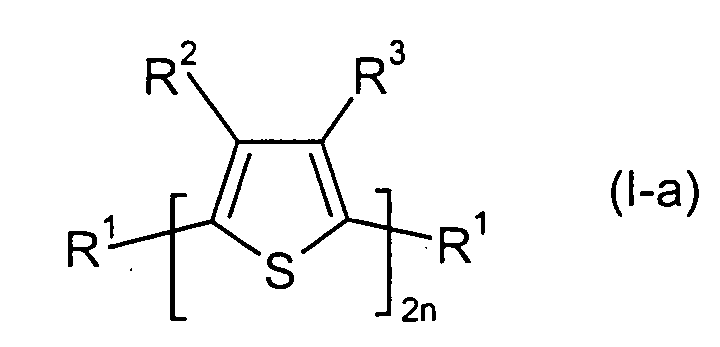
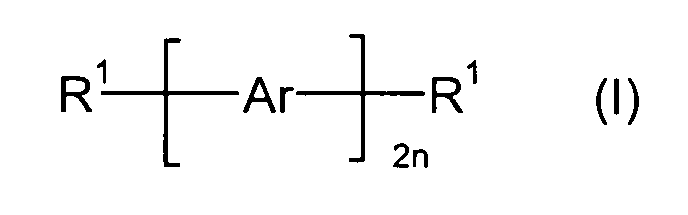
- connections of the general Formula (I) or (I-a) are semiconducting and can already be followed by no further ones Cleaning processes of high quality and purity are preserved and contained only small amounts of impurities, e.g. 0.5% by weight of chlorine and less, preferably 0.3% by weight chlorine and less, particularly preferably even 0.03% by weight Chlorine and less and / or 0.1% by weight copper and less, preferably even 0.02 % By weight copper and less.
- impurities e.g. 0.5% by weight of chlorine and less, preferably 0.3% by weight chlorine and less, particularly preferably even 0.03% by weight Chlorine and less and / or 0.1% by weight copper and less, preferably even 0.02 % By weight copper and less.
- impurities e.g. 0.5% by weight of chlorine and less, preferably 0.3% by weight chlorine and less, particularly preferably even 0.03% by weight Chlorine and less and / or 0.1% by weight copper and less, preferably even 0.02 % By weight copper and less.
- Another advantage of the method according to the invention over Kagan et al. is that an "in situ" preparation especially of the preferred compounds of the general formula (II) or (II-a) is possible since no excess of the compounds of the general formula (III) or (III-a) is required.
- Kagan et al. a double excess of thiophene is used, otherwise the formation considerable amounts of undesired by-products (e.g. dimers) were observed which are difficult to separate from the desired product. The excess However, thiophene must be removed before coupling, which is not only additional effort means, but also a loss of 15% of the im Excess thiophene used leads (Heterocycles, 1983, 20, 1937).
- the compounds of the general formula (I) or (I-a) can according to the process of the invention largely free of oligomers with higher or lower molecular weight can be produced, with the elaborate purification mixtures that are difficult to separate are eliminated.
- the general compounds prepared by the process of the invention Formula (I) or (I-a) are neutral and semiconducting and are suitable due to Their purity is particularly good for use as a semiconductor in active and light-emitting electronic components such as field effect transistors, organic Luminescent diodes, photovoltaic cells, lasers or sensors.
- the compounds of the general Formula (I) or (I-a) in the form of layers on suitable substrates, for example on silicon wafers provided with electrical or electronic structures, Polymer films or glass panes applied. In principle come for the order all application methods known to the person skilled in the art.
- the compounds of general formula (I) or (I-a) can be applied from solution be, wherein the solvent is then evaporated.
- the application from solution by the known methods for example by Spraying, dipping, printing and knife coating, spin coating and by ink jet printing respectively.
- the compounds of general formula (I) or (I-a) can also from the gas phase, e.g. by vapor deposition.
- the present invention therefore furthermore relates to layers comprising, preferably consisting essentially of, compounds of the general formula (I) wherein n, R 1 and A have the meaning given above characterized in that they contain 0.5% by weight of chlorine and less, preferably 0.3% by weight of chlorine and less, particularly preferably 0.03% by weight of chlorine and less and are semiconducting.
- chlorine and less are 0% by weight to 0.5% by weight Chlorine, 0% by weight to 0.3% by weight of chlorine or 0% by weight to 0.03% by weight understand.
- the chlorine impurities which may be present can both chemically bound chlorine as well as not chemically bound chlorine for example in the form of chlorine compounds, e.g. Chlorine salts.
- the layers according to the invention can be further modified after application e.g. by heat treatment e.g. under going through a liquid crystalline phase, or for structuring e.g. by laser ablation.
- reaction mixture After the cold bath (acetone / dry ice) had been removed, the temperature of the reaction mixture was allowed to slowly rise to room temperature (23 ° C.) After stirring for a further 16 h at room temperature, the reaction mixture became 200 poured ml of diethyl ether and a mixture of 200 ml of deionized (distilled) water and 10 ml of 1 M HCl was added. The organic phase, which contained orange-colored precipitate, was separated off, washed with distilled water and filtered. Diethyleth he washed and dried in vacuo. 605 mg (61% of theory) of the product were obtained in the form of an orange powder. According to elemental analysis, the product contained 0.02% by weight of chlorine and 0.014% by weight of copper.
Landscapes
- Chemical & Material Sciences (AREA)
- Organic Chemistry (AREA)
- Engineering & Computer Science (AREA)
- Materials Engineering (AREA)
- Heterocyclic Carbon Compounds Containing A Hetero Ring Having Oxygen Or Sulfur (AREA)
- Led Devices (AREA)
- Polyoxymethylene Polymers And Polymers With Carbon-To-Carbon Bonds (AREA)
Abstract

- n
- eine ganze Zahl von 2 bis 5 ist,
- R1
- für H oder eine gegebenenfalls durch ein oder mehrere O- oder S-Atome, Silylen-, Phosphonoyl- oder Phosphorylgruppen unterbrochene C1-C20-Alkylgruppe steht und
- Ar
- für gegebenenfalls substituiertes 1,4-Phenylen, 2,7-Fluoren oder 2,5-Thiophen steht, wobei Ar gleich oder verschieden sein kann,
Description

- n
- eine ganze Zahl von 2 bis 5, bevorzugt 2 oder 3 ist,
- R1
- für H oder eine gegebenenfalls durch ein(e) oder mehrere O- oder S-Atome, Silylen-, Phosphonoyl- oder Phosphorylgruppen unterbrochene C1-C20-Alkylgruppe, bevorzugt für eine C1-C12-Alkylgruppe steht und
- Ar
- für gegebenenfalls substituiertes 1,4-Phenylen, 2,7-Fluoren oder 2,5-Thiophen steht, wobei Ar gleich oder verschieden sein kann, bevorzugt jedoch gleich ist,
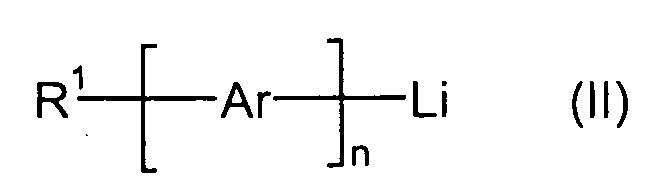
bei einer Temperatur von -100°C bis +20°C in einem organischen Lösungsmittel oder Lösungsmittelgemisch vollständig gelöst und mithilfe einer oder mehrerer Kupfer(II)verbindung(en) bei Temperaturen von -100°C bis +20°C miteinander gekuppelt werden.
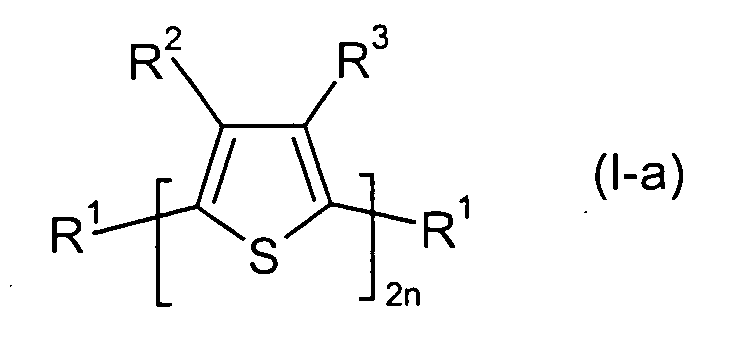
- n
- eine ganze Zahl von 2 bis 4, bevorzugt 2 oder 3 ist,
- R1
- für H oder eine gegebenenfalls durch ein(e) oder mehrere O- oder S-Atome, Silylen-, Phosphonoyl- oder Phosphorylgruppen unterbrochene C1-C20-Alkylgruppe, bevorzugt für eine C1-C12-Alkylgruppe steht und
- R2, R3
- unabhängig voneinander jeweils für H oder eine gegebenenfalls substituierte C1-C20-Alkylgruppe, eine gegebenenfalls substituierte C1-C20-Alkoxygruppe oder gemeinsam für eine gegebenenfalls substituierte C1-C6-Dioxyalkylengruppe, bevorzugt unabhängig voneinander jeweils für H oder eine C1-C6-Alkylgruppe, besonders bevorzugt für H stehen,

bei einer Temperatur von -100°C bis +20°C in einem organischen Lösungsmittel oder Lösungsmittelgemisch vollständig gelöst und mithilfe einer oder mehrerer Kupfer(II)verbindung(en) bei Temperaturen von -100°C bis +20°C miteinander gekuppelt werden.
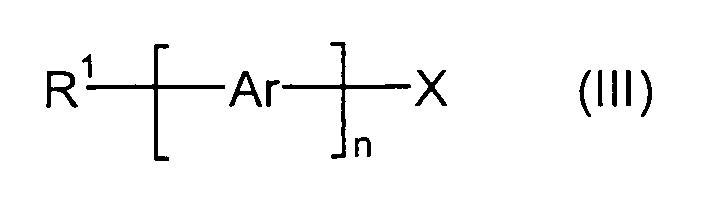
- n, R1 und Ar
- die oben genannte Bedeutung haben und
- X
- für H, Cl, Br oder I steht,
wobei, gegebenenfalls bei oder nach Erwärmen auf eine Temperatur von -20°C bis +40°C, nachgerührt und anschließend wieder auf eine Temperatur von -100°C bis +20°C abgekühlt wird und
ohne weitere Aufarbeitung die Kupfer(II)verbindung zugegeben wird.

- n, R1, R2 und R3
- die oben genannte Bedeutung haben und
- X
- für H, Cl, Br oder I, bevorzugt jedoch für H steht.
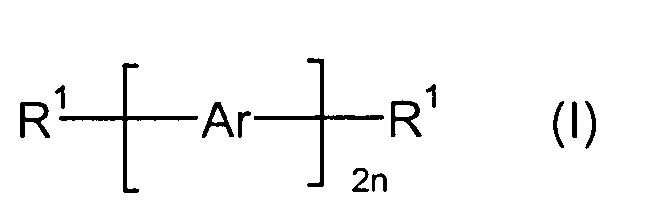
dadurch gekennzeichnet, dass sie 0,5 Gew.-% Chlor und weniger, bevorzugt 0,3 Gew.-% Chlor und weniger, besonders bevorzugt 0,03 Gew.-% Chlor und weniger enthalten und halbleitend sind.
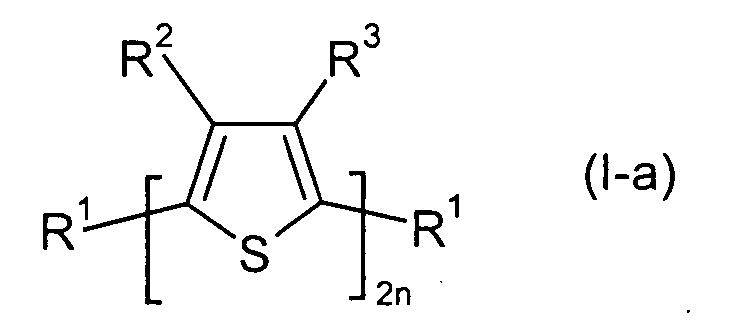

Das Produkt enthielt gemäß Elementaranalyse 0.02 Gew.-% Chlor und 0,014 Gew.-% Kupfer.
FD MS Analyse: M•+ 100%, m/e = 662.2
Schmelzverhalten (°C): K 297 SmX 304 N 312 I (K = kristallin, SmX = smektisch flüssigkristallin, N = nematisch flüssigkristallin, I = isotrop flüssig; die Zahlenwerte zwischen den Phasenbezeichnungen geben die Übergangstemperatur in °C an, z.B. K 297 SmX = Übergang von der kristallinen zur smektisch flüssigkristallinen Phase bei 297°C)
(Schmelzverhalten bestimmt mit DSC (Differential Scanning Calorimeter) Mettler TA-4000 Thermosystem, Scanning rate 1K/min)

Das Produkt enthielt gemäß Elementaranalyse 0.13-0.14 Gew.-% Chlor.
FD MS Analyse: M•+ 100%, m/e = 550.1
Schmelzverhalten (°C): K 300 I (K = kristallin, I = isotrop flüssig)
Claims (20)
- Verfahren zur Herstellung von Verbindungen der allgemeinen Formel (I),worin
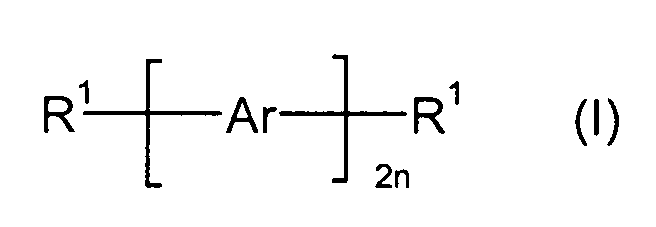
- n
- eine ganze Zahl von 2 bis 5 ist,
- R1
- für H oder eine gegebenenfalls durch ein(e) oder mehrere O- oder S-Atome, Silylen-, Phosphonoyl- oder Phosphorylgruppen unterbrochene C1-C20-Alkylgruppe steht und
- Ar
- für gegebenenfalls substituiertes 1,4-Phenylen, 2,7-Fluoren oder 2,5-Thiophen steht, wobei Ar gleich oder verschieden sein kann,
worin n, R1 und Ar die für die allgemeine Formel (I) genannte Bedeutung haben,
bei einer Temperatur von -100°C bis +20°C in einem organischen Lösungsmittel oder Lösungsmittelgemisch vollständig gelöst und mithilfe einer oder mehrerer Kupfer(II)verbindung(en) bei Temperaturen von -100°C bis +20°C miteinander gekuppelt werden. - Verfahren zur Herstellung von Verbindungen der allgemeinen Formel (I-a),worin

- n
- eine ganze Zahl von 2 bis 4 ist,
- R1
- für H oder eine gegebenenfalls durch ein(e) oder mehrere O- oder S-Atome, Silylen-, Phosphonoyl- oder Phosphorylgruppen unterbrochene C1-C20-Alkylgruppe steht und
- R2, R3
- unabhängig voneinander jeweils für H oder eine gegebenenfalls substituierte C1-C20-Alkylgruppe, eine gegebenenfalls substituierte C1-C20-Alkoxygruppe oder gemeinsam für eine gegebenenfalls substituierte C1-C6-Dioxyalkylengruppe stehen,
worin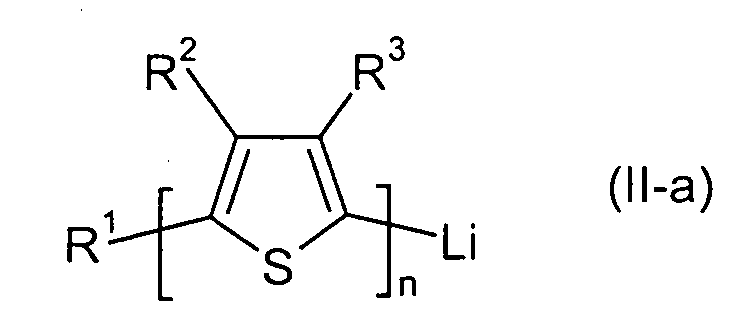
- n, R1, R2 und R3
- die für die allgemeine Formel (I-a) genannte Bedeutung haben,
- Verfahren gemäß Anspruch 1 oder 2, dadurch gekennzeichnet, dass n für 2 oder 3 steht.
- Verfahren gemäß wenigstens einem der Ansprüche 1 bis 3, dadurch gekennzeichnet, dass R1 für eine C1-C12-Alkylgruppe steht.
- Verfahren gemäß wenigstens einem der Ansprüche 2 bis 4, dadurch gekennzeichnet, dass R2 und R3 unabhängig voneinander jeweils für H oder eine C1-C6-Alkylgruppe stehen.
- Verfahren gemäß wenigstens einem der Ansprüche 2 bis 5, dadurch gekennzeichnet, dass R2 und R3 für H stehen.
- Verfahren gemäß wenigstens einem der Ansprüche 1 bis 6, dadurch gekennzeichnet, dass als Lösungsmittel Alkane, Aromaten oder Ethergruppen enthaltende Verbindungen oder Mischungen aus zwei oder mehreren dieser Lösungsmittel eingesetzt werden.
- Verfahren gemäß wenigstens einem der Ansprüche 1 bis 7, dadurch gekennzeichnet, dass als Lösungsmittel Tetrahydrofuran oder Mischungen aus Tetrahydrofuran mit Alkanen, bevorzugt mit Hexan, eingesetzt werden.
- Verfahren gemäß wenigstens einem der Ansprüche 1 bis 8, dadurch gekennzeichnet, dass die Verbindungen der allgemeinen Formel (II) durch Umsetzung von Verbindungen der allgemeinen Formel (III),worin

- n, R1 und Ar
- die in wenigstens einem der Ansprüche 1 bis 4 genannte Bedeutung haben und
- X
- für H, Cl, Br oder I steht,
wobei, gegebenenfalls nach Erwärmen auf eine Temperatur von -20°C bis 40°C, nachgerührt und anschließend wieder auf eine Temperatur von -100°C bis +20°C abgekühlt wird und
ohne weitere Aufarbeitung die Kupfer(II)verbindung zugegeben wird. - Verfahren gemäß Anspruch 9, dadurch gekennzeichnet, dass die Verbindungen der allgemeinen Formel (III) Verbindungen der allgemeinen Formel (III-a) sind,worin
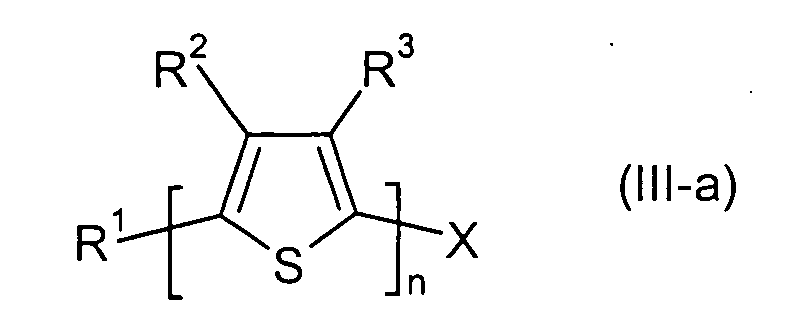
- n, R1, R2 und R3
- die in wenigstens einem der Ansprüche 1 bis 6 genannte Bedeutung haben und
- X
- für H, Cl, Br oder I steht.
- Verfahren gemäß Anspruch 9 oder 10, dadurch gekennzeichnet, dass die lithiumorganische Verbindung ein Lithiumamid, bevorzugt Lithiumdiisopropylamid, oder eine gegebenenfalls komplexierte Lithiumalkylverbindung, bevorzugt n- oder tert-Butyllithium oder Methyllithium, ist.
- Verfahren gemäß wenigstens einem der Ansprüche 1 bis 11, dadurch gekennzeichnet, dass die Kupfer(II)verbindung ein Kupfer(II)halogenid, bevorzugt Kupfer(II)chlorid, Kupfer(II)bromid oder Kupfer(II)iodid, ein Kupfer(II)salz einer Carbonsäure oder Sulfonsäure, bevorzugt Kupfer(II)-acetat, Kupfer(II)citrat, Kupfer(II)acetylacetonat, Kupfer(II)glycinat, Kupfer(II)methylsulfonat, Kupfer(II)trifluormethansulfonat oder Kupfer(II)-toluolsulfonat, oder ein Kupfer(II)alkoholat, bevorzugt Kupfer(II)methylat, Kupfer(II)ethylat, ist.
- Verfahren gemäß wenigstens einem der Ansprüche 1 bis 12, dadurch gekennzeichnet, dass zur Vervollständigung der Kupplungsreaktion bei Temperaturen von -80°C bis +40°C nachgerührt wird.
- Schichten enthaltend Verbindungen der allgemeinen Formel (I)worin

- n, R1 und A
- die in wenigstens einem der Ansprüche 1 bis 4 genannte Bedeutung haben
- Schichten gemäß Anspruch 14, dadurch gekennzeichnet, dass sie 0,3 Gew.-% Chlor und weniger enthalten.
- Schichten gemäß Anspruch 14 oder 15, dadurch gekennzeichnet, dass die Verbindungen der allgemeinen Formel (I) solche der allgemeinen Formel (I-a) sind,worin n, R1, R2 und R3 die in wenigstens einem der Ansprüche 1 bis 6 genannte Bedeutung haben.
- Verwendung der Schichten gemäß wenigstens einem der Ansprüche 14 bis 16 als Halbleiter in aktiven und lichtemittierenden elektronischen Bauelementen wie Feldeffekt-Transistoren, organischen Lumineszenzdioden, photovoltaischen Zellen, Lasern oder Sensoren.
- Verfahren zur Herstellung der Schichten gemäß wenigstens einem der Ansprüche 14 bis 16, dadurch gekennzeichnet, dass Verbindungen der allgemeinen Formel (I),worin

- n, R1 und A
- die in wenigstens einem der Ansprüche 1 bis 4 genannte Bedeutung haben,
- Verfahren gemäß Anspruch 18, dadurch gekennzeichnet, dass die Verbindungen der allgemeinen Formel (I) aus der Gasphase aufgebracht werden.
- Verbindungen der allgemeinen Formel (I)worin
- n, R1 und A
- die in wenigstens einem der Ansprüche 1 bis 4 genannte Bedeutung haben
Priority Applications (1)
| Application Number | Priority Date | Filing Date | Title |
|---|---|---|---|
| EP10012037A EP2336118A1 (de) | 2002-10-18 | 2003-10-07 | Lineare organische Oligomere und diese enthaltende Schichten |
Applications Claiming Priority (2)
| Application Number | Priority Date | Filing Date | Title |
|---|---|---|---|
| DE10248876 | 2002-10-18 | ||
| DE10248876A DE10248876B4 (de) | 2002-10-18 | 2002-10-18 | Verfahren zur Herstellung linearer organischer Oligomere |
Publications (2)
| Publication Number | Publication Date |
|---|---|
| EP1439173A2 true EP1439173A2 (de) | 2004-07-21 |
| EP1439173A3 EP1439173A3 (de) | 2005-09-14 |
Family
ID=32087049
Family Applications (2)
| Application Number | Title | Priority Date | Filing Date |
|---|---|---|---|
| EP03022655A Withdrawn EP1439173A3 (de) | 2002-10-18 | 2003-10-07 | Verfahren zur Herstellung linearer organischer Oligomere |
| EP10012037A Withdrawn EP2336118A1 (de) | 2002-10-18 | 2003-10-07 | Lineare organische Oligomere und diese enthaltende Schichten |
Family Applications After (1)
| Application Number | Title | Priority Date | Filing Date |
|---|---|---|---|
| EP10012037A Withdrawn EP2336118A1 (de) | 2002-10-18 | 2003-10-07 | Lineare organische Oligomere und diese enthaltende Schichten |
Country Status (6)
| Country | Link |
|---|---|
| US (1) | US7288663B2 (de) |
| EP (2) | EP1439173A3 (de) |
| JP (1) | JP2004137502A (de) |
| KR (1) | KR101222200B1 (de) |
| DE (1) | DE10248876B4 (de) |
| TW (1) | TWI332002B (de) |
Cited By (1)
| Publication number | Priority date | Publication date | Assignee | Title |
|---|---|---|---|---|
| WO2015135867A1 (de) * | 2014-03-12 | 2015-09-17 | Ludwig-Maximilians-Universität München | Terminal substituierte oligothiophene und ihre verwendung in optischen signalübertragungssystemen und/oder als farbpigmente |
Families Citing this family (11)
| Publication number | Priority date | Publication date | Assignee | Title |
|---|---|---|---|---|
| DE102006043039A1 (de) * | 2006-09-14 | 2008-03-27 | H.C. Starck Gmbh | Halbleiterschichten bildende Mischungen von organischen Verbindungen |
| JP2009108228A (ja) * | 2007-10-31 | 2009-05-21 | Sumitomo Chemical Co Ltd | 非ハロゲン系高分子化合物の製造方法 |
| JP7426986B2 (ja) | 2018-08-10 | 2024-02-02 | キョーセラ・エイブイエックス・コンポーネンツ・コーポレーション | ポリアニリンを含む固体電解キャパシタ |
| US11114250B2 (en) | 2018-08-10 | 2021-09-07 | Avx Corporation | Solid electrolytic capacitor formed from conductive polymer particles |
| CN117912850A (zh) | 2018-08-10 | 2024-04-19 | 京瓷Avx元器件公司 | 包含本征导电聚合物的固体电解电容器 |
| CN113196429A (zh) | 2018-12-11 | 2021-07-30 | 阿维科斯公司 | 含有本征导电聚合物的固体电解电容器 |
| WO2020236573A1 (en) | 2019-05-17 | 2020-11-26 | Avx Corporation | Solid electrolytic capacitor |
| DE112020004416T5 (de) | 2019-09-18 | 2022-06-15 | KYOCERA AVX Components Corporation | Festelektrolytkondensator zur Verwendung bei hohen Spannungen |
| WO2021119065A1 (en) | 2019-12-10 | 2021-06-17 | Avx Corporation | Solid electrolytic capacitor containing a pre-coat and intrinsically conductive polymer |
| DE112020006024T5 (de) | 2019-12-10 | 2022-10-06 | KYOCERA AVX Components Corporation | Tantalkondensator mit erhöhter Stabilität |
| US11631548B2 (en) | 2020-06-08 | 2023-04-18 | KYOCERA AVX Components Corporation | Solid electrolytic capacitor containing a moisture barrier |
Family Cites Families (15)
| Publication number | Priority date | Publication date | Assignee | Title |
|---|---|---|---|---|
| JPH02250881A (ja) | 1989-03-24 | 1990-10-08 | Matsushita Electric Ind Co Ltd | チオフェンオリゴマー及びその製造方法 |
| FR2648140B1 (fr) * | 1989-06-08 | 1991-05-03 | Centre Nat Rech Scient | Procede de preparation d'oligomeres d'heterocycles aromatiques par couplage oxydant d'oligomeres inferieurs |
| WO1991003142A1 (en) * | 1989-08-18 | 1991-03-07 | Idemitsu Kosan Co., Ltd. | Organic electroluminescent element |
| FR2664430B1 (fr) * | 1990-07-04 | 1992-09-18 | Centre Nat Rech Scient | Transistor a effet de champ en couche mince de structure mis, dont l'isolant et le semiconducteur sont realises en materiaux organiques. |
| JP3006718B2 (ja) | 1990-09-25 | 2000-02-07 | 科学技術振興事業団 | オリゴチオフェンを用いた電子素子 |
| FR2689135B1 (fr) * | 1992-03-30 | 1994-07-01 | Telemecanique | Procede de preparation d'oligomeres d'heterocycles aromatiques, nouveaux oligomeres substitues en position alpha et/ou alpha', utilisation de ceux-ci sous forme de couche mince dans les dispositifs electroniques et optoelectroniques. |
| WO1994015368A1 (en) * | 1992-12-29 | 1994-07-07 | Rijksuniversiteit Te Groningen | Multi-bloc copolymer based tunable light emitting diode, polymers suitable therefor and oligomers |
| US5556706A (en) | 1993-10-06 | 1996-09-17 | Matsushita Electric Industrial Co., Ltd. | Conductive layered product and method of manufacturing the same |
| US6107117A (en) * | 1996-12-20 | 2000-08-22 | Lucent Technologies Inc. | Method of making an organic thin film transistor |
| US6878801B2 (en) * | 1999-03-11 | 2005-04-12 | Japan Science And Technology | Optically active polythiophenes |
| US6414164B1 (en) * | 2000-07-12 | 2002-07-02 | International Business Machines Corporation | Synthesis of soluble derivatives of sexithiophene and their use as the semiconducting channels in thin-film filed-effect transistors |
| AU2001286527A1 (en) * | 2000-08-17 | 2002-02-25 | Lumera Corporation | Design and synthesis of advanced nlo materials for electro-optic applications |
| US7074886B2 (en) * | 2001-05-07 | 2006-07-11 | E. I. Du Pont De Memours And Company | Electroactive fluorene polymers having perfluoroalkyl groups, process for preparing such polymers and devices made with such polymers |
| JP3963693B2 (ja) * | 2001-10-15 | 2007-08-22 | 富士通株式会社 | 導電性有機化合物及び電子素子 |
| US7102017B2 (en) * | 2004-06-10 | 2006-09-05 | Xerox Corporation | Processes to prepare small molecular thiophene compounds |
-
2002
- 2002-10-18 DE DE10248876A patent/DE10248876B4/de not_active Expired - Fee Related
-
2003
- 2003-10-07 EP EP03022655A patent/EP1439173A3/de not_active Withdrawn
- 2003-10-07 EP EP10012037A patent/EP2336118A1/de not_active Withdrawn
- 2003-10-16 JP JP2003356372A patent/JP2004137502A/ja active Pending
- 2003-10-16 US US10/687,148 patent/US7288663B2/en not_active Expired - Fee Related
- 2003-10-17 KR KR1020030072534A patent/KR101222200B1/ko not_active Expired - Fee Related
- 2003-10-17 TW TW092128777A patent/TWI332002B/zh not_active IP Right Cessation
Cited By (1)
| Publication number | Priority date | Publication date | Assignee | Title |
|---|---|---|---|---|
| WO2015135867A1 (de) * | 2014-03-12 | 2015-09-17 | Ludwig-Maximilians-Universität München | Terminal substituierte oligothiophene und ihre verwendung in optischen signalübertragungssystemen und/oder als farbpigmente |
Also Published As
| Publication number | Publication date |
|---|---|
| DE10248876A1 (de) | 2004-05-06 |
| US7288663B2 (en) | 2007-10-30 |
| EP1439173A3 (de) | 2005-09-14 |
| TW200422295A (en) | 2004-11-01 |
| JP2004137502A (ja) | 2004-05-13 |
| EP2336118A1 (de) | 2011-06-22 |
| KR20040034521A (ko) | 2004-04-28 |
| US20040138476A1 (en) | 2004-07-15 |
| TWI332002B (en) | 2010-10-21 |
| DE10248876B4 (de) | 2006-07-06 |
| KR101222200B1 (ko) | 2013-01-15 |
Similar Documents
| Publication | Publication Date | Title |
|---|---|---|
| EP1678190B1 (de) | Metallkomplexe mit bipodalen liganden | |
| DE69505708T2 (de) | Bipyridyl-Oligothiophenderivate als elektronenleitende Materialien | |
| DE10248876B4 (de) | Verfahren zur Herstellung linearer organischer Oligomere | |
| DE10310887A1 (de) | Matallkomplexe | |
| DE10215010A1 (de) | Rhodium- und Iridium-Komplexe | |
| EP3228622B1 (de) | Synthetisches verfahren einer kondensierten heteroaromatischen verbindung und kondensierte heteroaromatische verbindung sowie zwischenprodukt davon | |
| EP1248780B1 (de) | Di(het)arylaminothiophen-derivate | |
| EP2092041B9 (de) | Neuartiges hochleitfähiges organisches ladungsträgertransportmaterial | |
| DE602005000959T2 (de) | Verfahren zur Herstellung oligomerer Thiophenverbindungen | |
| DE1668578A1 (de) | Fluor-und cyanosubstitrierte 7,7,8,8-Tetracyanochinodimethane und Verfahren zu ihrer Herstellung | |
| EP1398341B1 (de) | Organische Verbindungen mit Kern-Schale-Struktur | |
| US10249833B2 (en) | Phthalocyanine compound and synthesis method and use thereof | |
| DE69318045T2 (de) | Elektrisch leitendes alternierendes Copolymer und Verfahren zur Herstellung eines derartigen Copolymers | |
| DE60132489T2 (de) | Neues rotes fluoreszenzmaterial und eine das material enthaltende organische elektrolumineszenzvorrichtung | |
| DE2739584A1 (de) | Derivate von schwefel- und/oder selenhaltigen heterofulvalenen und verfahren zu ihrer herstellung | |
| DE69706646T2 (de) | Halbleitfähiges polymer | |
| EP1598358B1 (de) | Verbindungen enthaltend 3,4-Methylendioxythiopen-Einheiten | |
| DE69514604T2 (de) | Verfahren zur Herstellung von Polymeren aus Alpha, Omega ungesättigten konjugierten Verbindungen | |
| DE102018105179B4 (de) | Organometallischer Iridiumkomplex, synthetisches Verfahren dafür und organische, lichtemittierende Vorrichtung, die ihn verwendet | |
| EP1531155B1 (de) | Unsymmetrische lineare organische Oligomere | |
| KR20170046399A (ko) | 헤테로아센 화합물의 중간체 및 이를 이용한 헤테로아센 화합물의 합성 방법 | |
| JP3885244B2 (ja) | オリゴチオフェン重合体、及びオリゴチオフェン化合物の製造方法 | |
| DE69325351T2 (de) | Leitfähiges N-Typ-Polymer und Methode zur Herstellung desselben | |
| EP0162804B1 (de) | Substituierte Dibenzotetraaza-[14]-annulenmetallkomplexe, Verfahren zu ihrer Herstellung und ihre Verwendung | |
| KR102835699B1 (ko) | 신규한 화합물 및 그 용도 |
Legal Events
| Date | Code | Title | Description |
|---|---|---|---|
| PUAI | Public reference made under article 153(3) epc to a published international application that has entered the european phase |
Free format text: ORIGINAL CODE: 0009012 |
|
| AK | Designated contracting states |
Kind code of ref document: A2 Designated state(s): AT BE BG CH CY CZ DE DK EE ES FI FR GB GR HU IE IT LI LU MC NL PT RO SE SI SK TR |
|
| AX | Request for extension of the european patent |
Extension state: AL LT LV MK |
|
| PUAL | Search report despatched |
Free format text: ORIGINAL CODE: 0009013 |
|
| AK | Designated contracting states |
Kind code of ref document: A3 Designated state(s): AT BE BG CH CY CZ DE DK EE ES FI FR GB GR HU IE IT LI LU MC NL PT RO SE SI SK TR |
|
| AX | Request for extension of the european patent |
Extension state: AL LT LV MK |
|
| 17P | Request for examination filed |
Effective date: 20060314 |
|
| AKX | Designation fees paid |
Designated state(s): BE DE GB NL |
|
| RAP1 | Party data changed (applicant data changed or rights of an application transferred) |
Owner name: H.C. STARCK GMBH & CO. KG |
|
| RAP1 | Party data changed (applicant data changed or rights of an application transferred) |
Owner name: H.C. STARCK GMBH |
|
| 17Q | First examination report despatched |
Effective date: 20070926 |
|
| RAP1 | Party data changed (applicant data changed or rights of an application transferred) |
Owner name: H.C. STARCK CLEVIOS GMBH |
|
| RAP1 | Party data changed (applicant data changed or rights of an application transferred) |
Owner name: HERAEUS CLEVIOS GMBH |
|
| RAP1 | Party data changed (applicant data changed or rights of an application transferred) |
Owner name: HERAEUS PRECIOUS METALS GMBH & CO. KG |
|
| STAA | Information on the status of an ep patent application or granted ep patent |
Free format text: STATUS: THE APPLICATION IS DEEMED TO BE WITHDRAWN |
|
| 18D | Application deemed to be withdrawn |
Effective date: 20130918 |