EP1437340A1 - Verfahren zur Herstellung von Aminodiphenylaminen - Google Patents
Verfahren zur Herstellung von Aminodiphenylaminen Download PDFInfo
- Publication number
- EP1437340A1 EP1437340A1 EP03029845A EP03029845A EP1437340A1 EP 1437340 A1 EP1437340 A1 EP 1437340A1 EP 03029845 A EP03029845 A EP 03029845A EP 03029845 A EP03029845 A EP 03029845A EP 1437340 A1 EP1437340 A1 EP 1437340A1
- Authority
- EP
- European Patent Office
- Prior art keywords
- copper
- mmol
- nitrohalobenzenes
- preparation
- nitrodiphenylamines
- Prior art date
- Legal status (The legal status is an assumption and is not a legal conclusion. Google has not performed a legal analysis and makes no representation as to the accuracy of the status listed.)
- Granted
Links
Classifications
-
- C—CHEMISTRY; METALLURGY
- C07—ORGANIC CHEMISTRY
- C07C—ACYCLIC OR CARBOCYCLIC COMPOUNDS
- C07C209/00—Preparation of compounds containing amino groups bound to a carbon skeleton
- C07C209/30—Preparation of compounds containing amino groups bound to a carbon skeleton by reduction of nitrogen-to-oxygen or nitrogen-to-nitrogen bonds
- C07C209/32—Preparation of compounds containing amino groups bound to a carbon skeleton by reduction of nitrogen-to-oxygen or nitrogen-to-nitrogen bonds by reduction of nitro groups
- C07C209/36—Preparation of compounds containing amino groups bound to a carbon skeleton by reduction of nitrogen-to-oxygen or nitrogen-to-nitrogen bonds by reduction of nitro groups by reduction of nitro groups bound to carbon atoms of six-membered aromatic rings in presence of hydrogen-containing gases and a catalyst
-
- C—CHEMISTRY; METALLURGY
- C07—ORGANIC CHEMISTRY
- C07C—ACYCLIC OR CARBOCYCLIC COMPOUNDS
- C07C209/00—Preparation of compounds containing amino groups bound to a carbon skeleton
- C07C209/04—Preparation of compounds containing amino groups bound to a carbon skeleton by substitution of functional groups by amino groups
- C07C209/06—Preparation of compounds containing amino groups bound to a carbon skeleton by substitution of functional groups by amino groups by substitution of halogen atoms
- C07C209/10—Preparation of compounds containing amino groups bound to a carbon skeleton by substitution of functional groups by amino groups by substitution of halogen atoms with formation of amino groups bound to carbon atoms of six-membered aromatic rings or from amines having nitrogen atoms bound to carbon atoms of six-membered aromatic rings
Definitions
- the invention relates to a process for the preparation of aminodiphenylamines, in particular of 4-aminodiphenylamine (4-ADPA), by reacting nitrohalobenzenes with anilines in the presence of a base and a copper-phosphorus complex and subsequent hydrogenation of the intermediate nitrodiphenylamines.
- 4-aminodiphenylamine (4-ADPA) 4-aminodiphenylamine
- 4-Aminodiphenylamine (4-ADPA) is an important intermediate for the synthesis of anti-aging agents and stabilizers in the rubber and polymer industry (Kirk-Othmer, Encyclopedia of Chemical Technology, 4 th Edition, 1992, Vol 3, pages 424-456; Ullmann's Encylopedia of Industrial Chemistry, 5 th Edition, Vol A3, 1985, pages 91-111).
- 4-ADPA can be manufactured using various methods.
- a possibility, To produce 4-ADPA is the two-step implementation of aniline or aniline derivatives with p-nitrochlorobenzene in the presence of an acid acceptor or a neutralizing agent, optionally in the presence of a catalyst.
- the production This method is described, for example, in DE-A 3 246 151, DE-A 3,501,698, DE-A 185 663, US-A 4 670 595, US-A 4 187 249, US-A 4 683 332 and US-A 4 187 248.
- the first stage is mostly with copper catalysts, the second with different metal components, e.g. Nickel, carried out (see here e.g. US-A 5 840 982).
- Implementations of e.g. also halogenated nitrobenzenes Amines in the presence of palladium catalysts are described in US-A 5 576 460 and EP-A 846 676.
- a disadvantage of the above-mentioned production method using copper catalysis is that comparatively poor selectivity of the reaction with regard to the formation of the desired diarylamine.
- the usually 5-15% of the Triarylamins both lead to increased distillation effort when cleaning of the end product, as well as economic losses due to increased consumption the value component halogen nitrobenzene, since triarylamine formed per equivalent two equivalents of halonitrobenzene are consumed. Furthermore, disposal of the by-product is an ecological problem.
- Venkataraman et al. [Tetrahedron Letters, 2001 , 42, 4791-4793] were able to show that the use of a preformed complex of copper dibromide and triphenylphosphine results in a novel catalyst that catalyzes the addition of aryl halides to secondary aromatic amines to the triarylamine.
- z is preferably the number 1 or 2
- m is the number 1, 2 or 3
- r for the numbers 1 or 2
- s for 0.
- the general formula (I) above includes both copper-phosphine complexes and Copper-phosphonite complexes as well as copper-phosphite complexes.
- suitable copper-phosphine complexes are those whose Phosphine ligands based on compounds such as tri-o-tolylphosphine, tricyclohexylphosphine, Tricyclopentylphosphine, tri-t-butylphosphine, tri-n-butylphosphine, Bisdiphenylphosphinethane, bisdiphenylphosphinopropane, bisdiphenylphospbinobutane, Bisdicyclohexylphosphinoethane, bisdiphenylphosphino-ferrocene, 5,5'-dichloro-6,6'-dimethoxy-biphenyl-2,2'-diyl-bis-diphenylphosphine, Bis-4,4'-dibenzofuran-3,3'-yl-bisdiphenylphosphin, 1,1'-bis-diphenylphosphino-diphenyl ether, bis
- Particularly preferred copper-phosphine complexes are those 2- (di-tertiary-butylphosphino) biphenyl and 2- (dicyclohexylphosphino) biphenyl ligands and copper (I) bromide or trifluoromethanesulfonate as copper or Copper compound.
- Copper-phosphonite complexes are used, for example, in the process according to the invention those used as phosphonite ligands compounds such as 1,1'-biphenyl-2-yl-dialkylphosphonites, preferably 1,1'-biphenyl-2-yl-dicyclohexylphosphonite and 1,1'-biphenyl-2-yl-ditert.-butylphosphonite, 3 - [(diisopropylphosphino) oxy] phenyl diisopropylphosphonite, 3 - [(di-tert. butyl-phosphino) oxy] phenyl di-tert.
- 1,1'-biphenyl-2-yl-dialkylphosphonites preferably 1,1'-biphenyl-2-yl-dicyclohexylphosphonite and 1,1'-biphenyl-2-yl-ditert.-butylphosphonite
- suitable copper-phosphite complexes are those based on subsequent phosphites and based on the copper compounds described above or copper itself.
- copper-phosphite complexes are mentioned, those as phosphite triphenyl phosphite, Tris (2,4-di-tertiary-butylphenyl) phosphite, 1,1'-binaphthyl-2,2'-diyl) isopropyl phosphite or 2,4,8,10-tetratert-butyl-6-phenoxy-12H-dibenzo [d, g] [1,3,2] dioxaphosphocin wear.
- Copper-phosphite complexes are preferred, which are triphenyl phosphite, or Wear tris (2,4-di-tertiary-butylphenyl) phosphite.
- the copper-phosphorus complexes mentioned can be used both individually and in any mixture can be used with each other.
- the cheapest mixture can be determined by appropriate preliminary tests.
- the copper-phosphorus complexes of the formula (I) to be used according to the invention are obtained by reacting phosphorus compounds of the formula (II) with copper compounds of the formula (III) Cu Y r where M, X, Y, s, z and r have the meaning given in the formula (I).
- the starting products of the general formula (II) and the general formula (III) in such a molar ratio that the desired target complex of the general formula (I).
- the molar ratio is Phosphorus compounds of formula (II) to the copper compounds of the Formula (III) about 40: 1 to 0.5: 1, preferably 5: 1 to 1: 1, particularly preferably 4: 1 to 1: 1.
- the copper-phosphorus complexes can be separated in a suitable inert organic solvents such as tetrahydrofuran, diethyl ether, Toluene, xylene, chloroform, dichloromethane, methanol and / or ethanol.
- a suitable inert organic solvents such as tetrahydrofuran, diethyl ether, Toluene, xylene, chloroform, dichloromethane, methanol and / or ethanol.
- the cheapest amount of solvent can be used by appropriate Preliminary tests can be determined.
- the preparation of the copper-phosphorus complexes from the starting compounds described of the formulas (II) and (III) is carried out by simply combining the two starting compounds in solution at room temperature.
- Nitrohalobenzenes can add with anilines or - as mentioned - during the the entire implementation can finally be formed in situ.
- the amount of copper-phosphorus complexes to be used is usually 0.02 mol% to 10 mol%, preferably 0.1 mol% to 3 mol%, based on the Amount of nitrohalobenzenes used.
- nitrohalobenzenes used in the process according to the invention are those which in which the nitro group is preferably in the para position to the halogen radical.
- Halogen residues are e.g. in question: fluorine, chromium or bromine, preferably fluorine or chrome.
- other activated nitrobenzenes can also be used are used, e.g. those which have a trifluoromethanesulfonic acid ester or contain a nonafluorobutanesulfonic acid ester or a carbamate substituent.
- Nitrobenzenes can be activated as well as the others Nitrobenzenes may be substituted one or more times, for example by alkyl radicals, preferably those which contain 1 to 12 carbon atoms, in particular 1 to 4 carbon atoms.
- alkyl radicals preferably those which contain 1 to 12 carbon atoms, in particular 1 to 4 carbon atoms.
- the position of the nitro group relative to the halogen radicals or the activated groups may also be other than the para position, for example an ortho or meta position.
- nitrohalobenzenes are: 4-nitro-2-methylchlorobenzene, 4-nitro-3-methylfluorobenzene, 4-nitrochlorobenzene, 3-nitrochlorobenzene or 2-nitrochlorobenzene, preferably 4-nitrochlorobenzene.
- nitrobenzenes e.g. to name: 4-nitrophenyl-trifluoromethanesulfonic acid ester, 4-nitrophenyl-nonafluorobutanesulfonic acid ester or 4-nitrophenyl carbamate, preferably 4-nitrophenyl-trifluoromethylsulfonic acid ester.
- anilines can also be used as anilines in the process according to the invention.
- suitable substituents are: branched or unbranched C 1 -C 29 -alkyl or C 1 -C 29 -alkenyl radicals, acyl, alkylthio, alkylamino or alkoxy radicals having 1 to 29 carbon atoms, carboxylic acid esters having 1 to 29 carbon atoms in the carboxylic acid part and 1 to 29 carbon atoms in the ester part and sulfonic acid residues with 1 to 9 carbon atoms in the ester part.
- substituents branched or unbranched alkyl, alkenyl or alkylthio radicals with the numbers of carbon atoms mentioned.
- substituents branched or unbranched alkyl, alkenyl or alkylthio radicals with the numbers of carbon atoms mentioned.
- substituents branched or unbranched alkyl, alkenyl or alkylthio radicals with the numbers of carbon atoms mentioned.
- substituents branched or unbranched alkyl, alkenyl or alkylthio radicals with the numbers of carbon atoms mentioned.
- substituted anilines vinylaniline, 4-tert. butylaniline, p-anisidine, o-anisidine, o-toluidine, p-toluidine, anthranilic acid methyl ester, o-aminobenzonitrile, p-aminobenzonitrile and 4-ethylaniline.
- Aniline is preferred used.
- nitrohalobenzene or 1 to 10 mol, preferably 1.5 to, per mole of activated nitrobenzene 8 moles, particularly preferably 2 to 6 moles, of the corresponding aniline are used.
- Potassium carbonate is particularly preferably used.
- the bases can also be used in excess up to ten times equivalent amount based on the nitrohalobenzene become.
- the bases are particularly preferably in the 0.3 to 2 equivalent amount, based on nitrohalobenzene.
- the bases used can be pretreated by grinding and / or drying.
- grinding can be carried out, for example, in commercially available Mills are done.
- the measure of grinding causes a drastic one Enlargement of the specific surface, which leads to a significant increase in the Sales leads.
- the grinding increases the specific surface area by a factor of 10 to 20.
- the specific surface areas of the bases are approximately 0.1 to 10 m 2 / g, preferably 0.2 to 1 m 2 / g (BET).
- Bases used in the process especially the phosphates and carbonates tend to more or less strong absorption of atmospheric components, such as water and Carbon dioxide. From an absorption of approx. 30 percent by weight of atmospheric Constituents, there is a clear influence on the sales to be achieved. Therefore, in addition to grinding, drying of the bases is often indicated.
- the bases are dried, for example, depending on the nature of the base used such that under reduced pressure of about 0.01 to 100 mbar for several hours at temperatures of approximately 50 to 200 ° C, preferably 100 to 160 ° C, is heated.
- the first stage of the process according to the invention can be carried out at temperatures in the Range of 20 to 250 ° C, preferably carried out at temperatures of 110 to 210 ° C. become.
- the reaction temperatures depend in particular on the type of Starting products, the catalyst and the bases used.
- the method according to the invention can be used both in the presence and in the absence a suitable solvent.
- a suitable solvent for example inert, organic hydrocarbons such as xylene and toluene; in Question.
- the aromatic amines used themselves as solvents act.
- the amount of solvent used can easily be determined by preliminary tests be determined.
- the method according to the invention can be carried out by customary methods done in a continuous or discontinuous manner.
- Suitable materials for use as catalyst supports are all commercially customary catalyst supports based on carbon, element oxides, element carbides or element salts in various application forms.
- carbonaceous carriers are coke, graphite, carbon black or activated carbon.
- element oxide catalyst supports are SiO 2 (natural or synthetic silica, quartz) Al 2 O 3 ( ⁇ , ⁇ -Al 2 O 3 ), clays, natural or synthetic aluminosilicates (zeolites), layered silicates such as bentonite and montmorillonite, TiO 2 (Rutile, anatase), ZrO 2 , MgO or ZnO.
- element carbides and salts are SiC, AlPO 4 , BaSO 4 , CaCO 3 .
- both synthetic materials and carriers from natural sources such as pumice, kaolin, bleaching earth, bauxite, bentonite, diatomaceous earth, asbestos or zeolites can be used.
- Activated carbons and Si, Al, Mg, Zr and Ti-containing materials are preferred Carrier materials used.
- Activated carbon is particularly preferred.
- the hydrogenation can also be carried out using other reduction methods, such as they are known to the person skilled in the art and e.g. in “Reductions in Organic Chemistry, Second Edition, ACS Monograph 188 "are performed.
- the temperatures during the hydrogenation are approximately 0 to 200 ° C., in particular 40 to 150 ° C; the pressures (hydrogen pressure) are approximately 0.1 to 150 bar, in particular 0.5 to 70 bar, very particularly preferably 1 to 50 bar.
- the corresponding aminodiphenylamines with high selectivity > 95%) and yields up to 97% of theory Th. receive.
- Another object of the present invention is the production of Nitrodiphenylamines used in the reaction of nitrohalobenzenes according to the invention with anilines in the presence of a base and a copper-phosphorus complex of the general formula (I) can be obtained as an intermediate.
- the temperature of the mixture rose from initially 189 ° C to 196 ° C.
- the composition of the reaction mixture was determined by sampling (unfiltered) with HPLC and the 4-NDPA / triarylamine ratio was determined with HPLC and the reaction mixture was cooled. This resulted in a residual pNCB value of 6.2% by weight (corresponds to 84% conversion), a 4-NDPA / triarylamine ratio of 59 (corresponds to 82.4% 4-NDPA yield and 98% selectivity based on p-NCB).
- the temperature of the mixture rose from initially 189 ° C to 198 ° C. Samples were taken every 30 minutes (unfiltered) and the conversion and the 4-NDPA / triarylamine ratio were determined by HPLC. The experiment was ended after 7 hours. This resulted in a residual pNCB value of 4.2% by weight (corresponds to 89% conversion), a 4-NDPA content of 37.2% by weight, 4,4'-dinitrotriphenylamine content of 1, 9% and 4-NDPA / triarylamine ratio of 33 (corresponds to 86% 4-NDPA yield and 97% selectivity based on p-NCB).
- test catalyst Turnover [%] Yield (4-NDPA) [%] Selectivity 4-NDPA / triarylamine Cu (II) O / CsHCO 3 (reference) 70 67 22: 1 1,1'-biphenyl-2-yl di-tert-butylphosphine / Cu (II) acetylacetonate 87 85 57: 1 1,1'-biphenyl-2-yl di-tert-butylphosphine / Cu (II) acetate 86 85 63: 1 1,1'-biphenyl-2-yldicyclohexylphosphonite copper (I) chloride dimer. 75 73 39: 1 Cu (II) O / 2 PPh 3 (comparative example ) 50 48 25: 1
- the composition of the reaction mixture was determined by HPLC. This resulted in a residual p-NCB value of 0.1% by weight (p-NCB conversion> 99%), a 4-NDPA content of 44.8% by weight and 4,4'-dinitrotriphenylamine Content of 2.1% and a 4-NDPA / triarylamine ratio of 21 (corresponds to 87.5% of theory of 4-NDPA and 88% selectivity based on p-NCB).
Landscapes
- Chemical & Material Sciences (AREA)
- Organic Chemistry (AREA)
- Chemical Kinetics & Catalysis (AREA)
- Organic Low-Molecular-Weight Compounds And Preparation Thereof (AREA)
- Low-Molecular Organic Synthesis Reactions Using Catalysts (AREA)
Abstract
Description
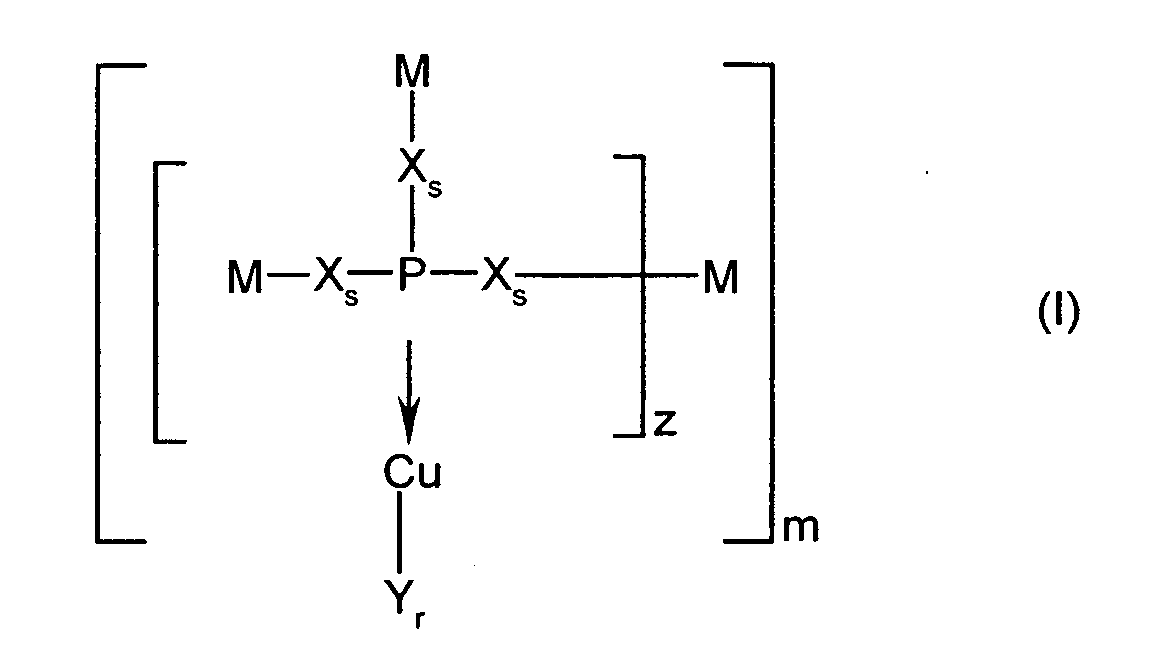
- X
- gleich oder verschieden sein kann und für O, NH, S oder CnH2n steht, mit der Maßgabe, dass n für jedes X beliebig gewählt werden kann und für 0, 1, 2 oder 3 steht,
- M
- gleich oder verschieden sein kann und für C6-C18Aryl, C1-C19-Alkyl, C7-C19-Aralkyl oder für Heteroaryl mit 1 bis 3 Heteroatome und 6 bis 19 C-Atomen steht, wobei zwei oder mehrere Reste M durch eine kovalente Brücke oder durch eine 1 bis 4 Kohlenstoffatome enthaltene Alkyliden-Brücke beliebig verbrückt sein können,
- Y
- für Halogen oder einen Trifluoracetyl-, Trifluormethansulfonyl-, Nonafluorobutansulfonyl-, Cyanid-, Acetyl-, einen gegebenenfalls fluorierten Acetylacetonyl-, einen Nitrat-, Arylsulfonyl-, Oxinat-, Phosphat-, Carbonatoder Tetrafluorborat-Rest steht,
- z
- für 1, 2 oder 3 steht,
- m
- für ganze Zahlen von 1 bis 6 steht,
- r
- 0, 1 oder 2 bedeutet und
- s
- für 0 oder 1 steht,
- M
- für einen Phenyl, Biphenyl oder Naphthylrest, oder für einen Heteroarylrest mit 1 bis 3 Stickstoffatomen und 5 bis 12 Kohlenstoffatomen, insbesondere für einen Pyridyl- oder Chinolinylrest, oder für einen C1-C12-Alkylrest, der auch verzweigt sein kann, wie einen Methyl-, Ethyl-, n-Propyl-, i-Propyl-, n-Butyl-, tert.-Butyl- , Cyclopentyl- oder Cyclohexyl-Rest,
- Y
- für Chlor, Brom oder Iod oder für einen Trifluormethylsulfonyl- oder einen Acetonyl-Rest.

| Testkatalysator | Umsatz (pNCB) [%] | Ausbeute (4-NDPA) [%] | Selektivität 4-NDPA/ Triarylamin |
| Cu(II)O/CsHCO3 (Referenz) | 70 | 67 | 22:1 |
| 1,1'-Biphenyl-2-yl ditert.-butylphosphin/ Cu-(II)-acetylacetonat | 87 | 85 | 57:1 |
| 1,1'-Biphenyl-2-yl ditert.-butylphosphin/ Cu-(II)-acetat | 86 | 85 | 63:1 |
| 1,1'-Biphenyl-2-yldicyclohexyl- phosphonit- Kupfer(I)chlorid-Dimer. | 75 | 73 | 39:1 |
| Cu(II)O/ 2 PPh3 (Vergleichsbsp. ) | 50 | 48 | 25:1 |
Claims (2)
- Verfahren zur Herstellung von Aminodiphenylaminen, das dadurch gekennzeichnet ist, dass man Nitrohalogenbenzole mit Anilinen in Gegenwart einer Base und eines Katalysators umsetzt und anschließend die dabei intermediär entstehenden Nitrodiphenylamine in üblicher Weise hydriert, wobei als Katalysator Kupfer-Phosphor-Komplexe der allgemeinen Formelworin
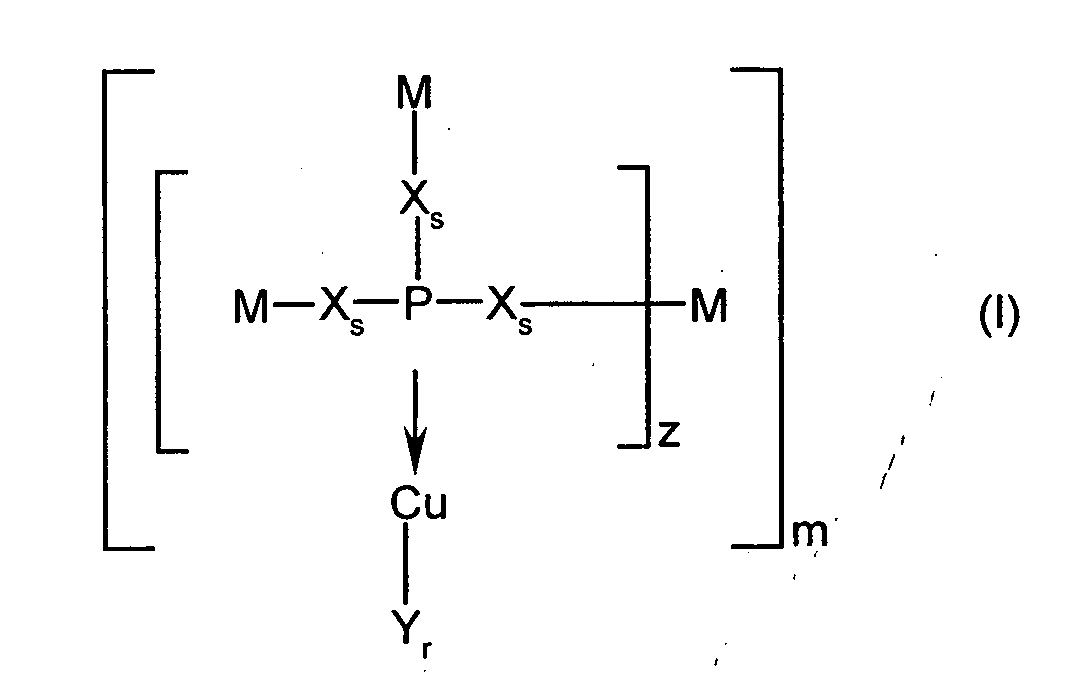
- X
- gleich oder verschieden sein kann und für O, NH, S oder CnH2n steht, mit der Maßgabe, dass n für jedes X beliebig gewählt werden kann und für 0, 1, 2 oder 3 steht,
- M
- gleich oder verschieden sein kann und für C6-C18-Aryl, C1-C19-Alkyl, C7-C19-Aralkyl oder für Heteroaryl mit 1 bis 3 Heteroatome und 6 bis 9 C-Atomen steht, wobei zwei oder mehrere Reste M durch eine kovalente Brücke oder durch eine 1 bis 4 Kohlenstoffatome enthaltene Alkyliden-Brücke beliebig verbrückt sein können,
- Y
- für Halogen oder einen Trifluoracetyl-, Trifluormethansulfonyl-, Nonafluorobutansulfonyl-, Cyanid-, Acetyl-, einen gegebenenfalls fluorierten Acetylacetonyl-, einen Nitrat-, Arylsulfonyl-, Oxinat-, Phosphat-, Carbonat- oder Tetrafluorborat-Rest steht,
- z
- für 1, 2 oder 3 steht,
- m
- für ganze Zahlen von 1 bis 6 steht,
- r
- 0, 1 oder 2 bedeutet und
- s
- für 0 oder 1 steht,
- Verfahren zur Herstellung von Nitrodiphenylaminen durch Umsetzung von Nitrohalogenbenzolen mit Anilin in Gegenwart einer Base und eines Kupfer-Phosphor-Komplexes der allgemeinen Formel (I).
Applications Claiming Priority (2)
| Application Number | Priority Date | Filing Date | Title |
|---|---|---|---|
| DE10300126A DE10300126A1 (de) | 2003-01-07 | 2003-01-07 | Verfahren zur Herstellung von Aminodiphenylaminen |
| DE10300126 | 2003-01-07 |
Publications (2)
| Publication Number | Publication Date |
|---|---|
| EP1437340A1 true EP1437340A1 (de) | 2004-07-14 |
| EP1437340B1 EP1437340B1 (de) | 2010-07-14 |
Family
ID=32478154
Family Applications (1)
| Application Number | Title | Priority Date | Filing Date |
|---|---|---|---|
| EP03029845A Expired - Lifetime EP1437340B1 (de) | 2003-01-07 | 2003-12-24 | Verfahren zur Herstellung von Aminodiphenylaminen |
Country Status (8)
| Country | Link |
|---|---|
| US (1) | US6946577B2 (de) |
| EP (1) | EP1437340B1 (de) |
| JP (1) | JP2004210787A (de) |
| KR (1) | KR20040063808A (de) |
| CN (1) | CN100457713C (de) |
| AT (1) | ATE473959T1 (de) |
| CA (1) | CA2454455A1 (de) |
| DE (2) | DE10300126A1 (de) |
Families Citing this family (6)
| Publication number | Priority date | Publication date | Assignee | Title |
|---|---|---|---|---|
| JP5261870B2 (ja) * | 2004-10-20 | 2013-08-14 | 三菱化学株式会社 | アミン化合物の製造方法 |
| JP5186721B2 (ja) * | 2004-12-28 | 2013-04-24 | 三菱化学株式会社 | アミン化合物の製造方法 |
| US20060165580A1 (en) * | 2005-01-26 | 2006-07-27 | The Regents Of The University Of California | Heterogeneous copper catalysts |
| JP4876707B2 (ja) * | 2006-05-10 | 2012-02-15 | 住友化学株式会社 | 4−ニトロソジフェニルアミン及び4−ニトロジフェニルアミンの製造方法 |
| JP2012046463A (ja) * | 2010-08-30 | 2012-03-08 | Sumitomo Chemical Co Ltd | 芳香族アミン化合物の製造方法 |
| CN106946720A (zh) * | 2017-03-23 | 2017-07-14 | 康爱特维迅(蓬莱)化学有限公司 | 一种二苯胺的制备方法 |
Citations (13)
| Publication number | Priority date | Publication date | Assignee | Title |
|---|---|---|---|---|
| DE185663C (de) | ||||
| DE2633811A1 (de) | 1976-07-28 | 1978-02-02 | Bayer Ag | Katalysator und verfahren zur herstellung von nitrodiphenylaminen |
| US4187248A (en) | 1977-11-23 | 1980-02-05 | Monsanto Company | Making a nitrodiarylamine by reacting an alkali metal salt of a formamide with a nitrohaloarene |
| US4187249A (en) | 1977-12-27 | 1980-02-05 | Monsanto Company | Promoting the reaction of sodium salts of formyl derivatives of aromatic amines to form nitrodiarylamines |
| DE3246151A1 (de) | 1982-12-14 | 1984-06-14 | Bayer Ag, 5090 Leverkusen | Verfahren zur herstellung von 4-nitrodiphenylaminen |
| DE3501698A1 (de) | 1985-01-19 | 1986-07-24 | Bayer Ag, 5090 Leverkusen | Verfahren zur herstellung von 4-nitrodiphenylaminen |
| US4670595A (en) | 1985-02-09 | 1987-06-02 | Bayer Aktiengesellschaft | Process for the production of 4-nitrodiphenylamines |
| US4683332A (en) | 1985-05-20 | 1987-07-28 | The Goodyear Tire & Rubber Company | Para-nitrodiphenylamine synthesis |
| US5576460A (en) | 1994-07-27 | 1996-11-19 | Massachusetts Institute Of Technology | Preparation of arylamines |
| EP0846676A1 (de) | 1996-12-04 | 1998-06-10 | Hoechst Aktiengesellschaft | Synthese von aromatischen Aminen aus Chloraromaten |
| US5840982A (en) | 1998-06-04 | 1998-11-24 | Uniroyal Chemical Company, Inc. | Process for preparing para-phenylenediamine derivatives |
| US6316673B2 (en) * | 2000-02-09 | 2001-11-13 | Bayer Aktiengesellschaft | Process for producing aminodiphenylamines |
| WO2002085838A1 (en) * | 2001-04-24 | 2002-10-31 | Massachusetts Institute Of Technology | Copper-catalyzed formation of carbon-heteroatom and carbon-carbon bonds |
Family Cites Families (3)
| Publication number | Priority date | Publication date | Assignee | Title |
|---|---|---|---|---|
| DE3247151A1 (de) | 1982-12-21 | 1984-06-28 | Alex 4600 Dortmund Brose | Broetchen mit fuellung, insbesondere baquettebroetchen sowie verfahren und vorrichtung zur herstellung |
| WO2000026343A2 (en) * | 1998-10-30 | 2000-05-11 | Case Western Reserve University | Tissue specific promoters and transgenic animals for the screening of pharmaceuticals |
| DE10300097A1 (de) * | 2003-01-07 | 2004-07-22 | Bayer Ag | Kupfer-Komplexe und ihre Verwendung |
-
2003
- 2003-01-07 DE DE10300126A patent/DE10300126A1/de not_active Withdrawn
- 2003-12-24 AT AT03029845T patent/ATE473959T1/de not_active IP Right Cessation
- 2003-12-24 DE DE50312884T patent/DE50312884D1/de not_active Expired - Lifetime
- 2003-12-24 EP EP03029845A patent/EP1437340B1/de not_active Expired - Lifetime
- 2003-12-30 CA CA002454455A patent/CA2454455A1/en not_active Abandoned
-
2004
- 2004-01-02 US US10/751,314 patent/US6946577B2/en not_active Expired - Fee Related
- 2004-01-06 KR KR1020040000492A patent/KR20040063808A/ko not_active Withdrawn
- 2004-01-06 JP JP2004001261A patent/JP2004210787A/ja not_active Withdrawn
- 2004-01-07 CN CNB2004100028658A patent/CN100457713C/zh not_active Expired - Fee Related
Patent Citations (13)
| Publication number | Priority date | Publication date | Assignee | Title |
|---|---|---|---|---|
| DE185663C (de) | ||||
| DE2633811A1 (de) | 1976-07-28 | 1978-02-02 | Bayer Ag | Katalysator und verfahren zur herstellung von nitrodiphenylaminen |
| US4187248A (en) | 1977-11-23 | 1980-02-05 | Monsanto Company | Making a nitrodiarylamine by reacting an alkali metal salt of a formamide with a nitrohaloarene |
| US4187249A (en) | 1977-12-27 | 1980-02-05 | Monsanto Company | Promoting the reaction of sodium salts of formyl derivatives of aromatic amines to form nitrodiarylamines |
| DE3246151A1 (de) | 1982-12-14 | 1984-06-14 | Bayer Ag, 5090 Leverkusen | Verfahren zur herstellung von 4-nitrodiphenylaminen |
| DE3501698A1 (de) | 1985-01-19 | 1986-07-24 | Bayer Ag, 5090 Leverkusen | Verfahren zur herstellung von 4-nitrodiphenylaminen |
| US4670595A (en) | 1985-02-09 | 1987-06-02 | Bayer Aktiengesellschaft | Process for the production of 4-nitrodiphenylamines |
| US4683332A (en) | 1985-05-20 | 1987-07-28 | The Goodyear Tire & Rubber Company | Para-nitrodiphenylamine synthesis |
| US5576460A (en) | 1994-07-27 | 1996-11-19 | Massachusetts Institute Of Technology | Preparation of arylamines |
| EP0846676A1 (de) | 1996-12-04 | 1998-06-10 | Hoechst Aktiengesellschaft | Synthese von aromatischen Aminen aus Chloraromaten |
| US5840982A (en) | 1998-06-04 | 1998-11-24 | Uniroyal Chemical Company, Inc. | Process for preparing para-phenylenediamine derivatives |
| US6316673B2 (en) * | 2000-02-09 | 2001-11-13 | Bayer Aktiengesellschaft | Process for producing aminodiphenylamines |
| WO2002085838A1 (en) * | 2001-04-24 | 2002-10-31 | Massachusetts Institute Of Technology | Copper-catalyzed formation of carbon-heteroatom and carbon-carbon bonds |
Non-Patent Citations (5)
| Title |
|---|
| GUJADHUR ET AL.: "Tetrahedron letters", vol. 42, 16 July 2001, ELSEVIER SCIENCE PUBLISHERS, pages: 4791 - 4793 |
| GUJADHUR R ET AL: "Formation of aryl@?nitrogen bonds using a soluble copper(I) catalyst", TETRAHEDRON LETTERS, ELSEVIER SCIENCE PUBLISHERS, AMSTERDAM, NL, vol. 42, no. 29, 16 July 2001 (2001-07-16), pages 4791 - 4793, XP004247353, ISSN: 0040-4039 * |
| KIRK-OTHMER, ENCYCLOPEDIA OF CHEMICAL TECHNOLOGY, vol. 3, 1992, pages 424 - 456 |
| ULLMANN'S ENCYLOPEDIA OF INDUSTRIAL CHEMISTRY, vol. A3, 1985, pages 91 - 111 |
| VENKATARAMAN ET AL., TETRAHEDRON LETTERS, vol. 42, 2001, pages 4791 - 4793 |
Also Published As
| Publication number | Publication date |
|---|---|
| CN100457713C (zh) | 2009-02-04 |
| DE10300126A1 (de) | 2004-07-15 |
| JP2004210787A (ja) | 2004-07-29 |
| CA2454455A1 (en) | 2004-07-07 |
| ATE473959T1 (de) | 2010-07-15 |
| US20040143139A1 (en) | 2004-07-22 |
| EP1437340B1 (de) | 2010-07-14 |
| US6946577B2 (en) | 2005-09-20 |
| DE50312884D1 (de) | 2010-08-26 |
| CN1517332A (zh) | 2004-08-04 |
| KR20040063808A (ko) | 2004-07-14 |
Similar Documents
| Publication | Publication Date | Title |
|---|---|---|
| DE112014002844B4 (de) | NHC-Palladium-Katalysator sowie dessen Herstellungsverfahren und Verwendung | |
| DE60131985T2 (de) | Katalysator für aromatische c-o, c-n und c-c-bindungsbildung | |
| EP2185500B1 (de) | Verfahren zur herstellung von biarylen | |
| SK3297A3 (en) | Method of manufacturing possibly substituted 4-aminodiphenylamines | |
| EP1856024B1 (de) | Verfahren zur herstellung substituierter biphenyle | |
| EP1123916B1 (de) | Verfahren zur Herstellung von Aminodiphenylaminen | |
| EP2398764B1 (de) | Verfahren zur herstellung von 2-aminobiphenylen | |
| DE10300098A1 (de) | Kupfer-Carben-Komplexe und ihre Verwendung | |
| EP1437341B1 (de) | Verfahren zur Herstellung von Nitrodiphenylaminen | |
| EP1437340B1 (de) | Verfahren zur Herstellung von Aminodiphenylaminen | |
| DE1768381A1 (de) | Verfahren zur Umsetzung aromatischer Verbindungen | |
| EP0979809B1 (de) | Vefahren zur Herstellung von 4-Chlorbiphenylen | |
| DE19942394C1 (de) | Verfahren zur Herstellung von Nitrodiphenylaminen | |
| DE19801598C2 (de) | Katalytische Synthese von N-alkylierten Anilinen aus Olefinen und Anilinen | |
| EP0039810A1 (de) | Verfahren zur Herstellung von 2-Trifluormethylanilin | |
| EP0854856A1 (de) | Verfahren zur reduktion von nitroverbindungen | |
| EP1115679A1 (de) | Verfahren zur herstellung von olefinen | |
| EP0470375B1 (de) | Verfahren zur Herstellung von in p-Stellung durch C1-C4-alkoxysubstituierten aromatischen Aminen | |
| DD142331A5 (de) | Verfahren zur herstellung von p-amino-diphenylamin | |
| EP0433811A2 (de) | Verfahren zur Herstellung von N-alkylierten aromatischen Aminen | |
| DE69328046T2 (de) | Verfahren zur Herstellung von Diphenylamin oder kernsubstituierten Derivaten | |
| EP0292885A2 (de) | Katalytische Transferhydrierungen mit aromatischen Nitroverbindungen als Wasserstoffacceptor | |
| DE10235834A1 (de) | Verfahren zur Herstellung von Alkenylnitro- und Alkenylaminodiphenylaminen | |
| DE10134160A1 (de) | Verfahren zur Herstellung von Mono-Propargylaminen | |
| DE1768845A1 (de) | Organometallkomplexe und ihre Verwendung bei chemischen Verfahren |
Legal Events
| Date | Code | Title | Description |
|---|---|---|---|
| PUAI | Public reference made under article 153(3) epc to a published international application that has entered the european phase |
Free format text: ORIGINAL CODE: 0009012 |
|
| AK | Designated contracting states |
Kind code of ref document: A1 Designated state(s): AT BE BG CH CY CZ DE DK EE ES FI FR GB GR HU IE IT LI LU MC NL PT RO SE SI SK TR |
|
| AX | Request for extension of the european patent |
Extension state: AL LT LV MK |
|
| 17P | Request for examination filed |
Effective date: 20050114 |
|
| AKX | Designation fees paid |
Designated state(s): AT BE BG CH CY CZ DE DK EE ES FI FR GB GR HU IE IT LI LU MC NL PT RO SE SI SK TR |
|
| RAP1 | Party data changed (applicant data changed or rights of an application transferred) |
Owner name: LANXESS DEUTSCHLAND GMBH |
|
| 17Q | First examination report despatched |
Effective date: 20060120 |
|
| GRAP | Despatch of communication of intention to grant a patent |
Free format text: ORIGINAL CODE: EPIDOSNIGR1 |
|
| GRAS | Grant fee paid |
Free format text: ORIGINAL CODE: EPIDOSNIGR3 |
|
| GRAA | (expected) grant |
Free format text: ORIGINAL CODE: 0009210 |
|
| AK | Designated contracting states |
Kind code of ref document: B1 Designated state(s): AT BE BG CH CY CZ DE DK EE ES FI FR GB GR HU IE IT LI LU MC NL PT RO SE SI SK TR |
|
| REG | Reference to a national code |
Ref country code: GB Ref legal event code: FG4D Free format text: NOT ENGLISH |
|
| REG | Reference to a national code |
Ref country code: CH Ref legal event code: EP |
|
| REG | Reference to a national code |
Ref country code: IE Ref legal event code: FG4D |
|
| REF | Corresponds to: |
Ref document number: 50312884 Country of ref document: DE Date of ref document: 20100826 Kind code of ref document: P |
|
| REG | Reference to a national code |
Ref country code: NL Ref legal event code: VDEP Effective date: 20100714 |
|
| REG | Reference to a national code |
Ref country code: SK Ref legal event code: T3 Ref document number: E 7952 Country of ref document: SK |
|
| PG25 | Lapsed in a contracting state [announced via postgrant information from national office to epo] |
Ref country code: NL Free format text: LAPSE BECAUSE OF FAILURE TO SUBMIT A TRANSLATION OF THE DESCRIPTION OR TO PAY THE FEE WITHIN THE PRESCRIBED TIME-LIMIT Effective date: 20100714 Ref country code: FI Free format text: LAPSE BECAUSE OF FAILURE TO SUBMIT A TRANSLATION OF THE DESCRIPTION OR TO PAY THE FEE WITHIN THE PRESCRIBED TIME-LIMIT Effective date: 20100714 |
|
| REG | Reference to a national code |
Ref country code: IE Ref legal event code: FD4D |
|
| PG25 | Lapsed in a contracting state [announced via postgrant information from national office to epo] |
Ref country code: CY Free format text: LAPSE BECAUSE OF FAILURE TO SUBMIT A TRANSLATION OF THE DESCRIPTION OR TO PAY THE FEE WITHIN THE PRESCRIBED TIME-LIMIT Effective date: 20100714 Ref country code: BG Free format text: LAPSE BECAUSE OF FAILURE TO SUBMIT A TRANSLATION OF THE DESCRIPTION OR TO PAY THE FEE WITHIN THE PRESCRIBED TIME-LIMIT Effective date: 20101014 Ref country code: SI Free format text: LAPSE BECAUSE OF FAILURE TO SUBMIT A TRANSLATION OF THE DESCRIPTION OR TO PAY THE FEE WITHIN THE PRESCRIBED TIME-LIMIT Effective date: 20100714 Ref country code: PT Free format text: LAPSE BECAUSE OF FAILURE TO SUBMIT A TRANSLATION OF THE DESCRIPTION OR TO PAY THE FEE WITHIN THE PRESCRIBED TIME-LIMIT Effective date: 20101115 |
|
| PG25 | Lapsed in a contracting state [announced via postgrant information from national office to epo] |
Ref country code: SE Free format text: LAPSE BECAUSE OF FAILURE TO SUBMIT A TRANSLATION OF THE DESCRIPTION OR TO PAY THE FEE WITHIN THE PRESCRIBED TIME-LIMIT Effective date: 20100714 Ref country code: GR Free format text: LAPSE BECAUSE OF FAILURE TO SUBMIT A TRANSLATION OF THE DESCRIPTION OR TO PAY THE FEE WITHIN THE PRESCRIBED TIME-LIMIT Effective date: 20101015 |
|
| PG25 | Lapsed in a contracting state [announced via postgrant information from national office to epo] |
Ref country code: IE Free format text: LAPSE BECAUSE OF FAILURE TO SUBMIT A TRANSLATION OF THE DESCRIPTION OR TO PAY THE FEE WITHIN THE PRESCRIBED TIME-LIMIT Effective date: 20100714 Ref country code: DK Free format text: LAPSE BECAUSE OF FAILURE TO SUBMIT A TRANSLATION OF THE DESCRIPTION OR TO PAY THE FEE WITHIN THE PRESCRIBED TIME-LIMIT Effective date: 20100714 |
|
| PLBE | No opposition filed within time limit |
Free format text: ORIGINAL CODE: 0009261 |
|
| STAA | Information on the status of an ep patent application or granted ep patent |
Free format text: STATUS: NO OPPOSITION FILED WITHIN TIME LIMIT |
|
| PG25 | Lapsed in a contracting state [announced via postgrant information from national office to epo] |
Ref country code: EE Free format text: LAPSE BECAUSE OF FAILURE TO SUBMIT A TRANSLATION OF THE DESCRIPTION OR TO PAY THE FEE WITHIN THE PRESCRIBED TIME-LIMIT Effective date: 20100714 Ref country code: RO Free format text: LAPSE BECAUSE OF FAILURE TO SUBMIT A TRANSLATION OF THE DESCRIPTION OR TO PAY THE FEE WITHIN THE PRESCRIBED TIME-LIMIT Effective date: 20100714 Ref country code: IT Free format text: LAPSE BECAUSE OF FAILURE TO SUBMIT A TRANSLATION OF THE DESCRIPTION OR TO PAY THE FEE WITHIN THE PRESCRIBED TIME-LIMIT Effective date: 20100714 Ref country code: CZ Free format text: LAPSE BECAUSE OF FAILURE TO SUBMIT A TRANSLATION OF THE DESCRIPTION OR TO PAY THE FEE WITHIN THE PRESCRIBED TIME-LIMIT Effective date: 20100714 |
|
| 26N | No opposition filed |
Effective date: 20110415 |
|
| PG25 | Lapsed in a contracting state [announced via postgrant information from national office to epo] |
Ref country code: ES Free format text: LAPSE BECAUSE OF FAILURE TO SUBMIT A TRANSLATION OF THE DESCRIPTION OR TO PAY THE FEE WITHIN THE PRESCRIBED TIME-LIMIT Effective date: 20101025 |
|
| REG | Reference to a national code |
Ref country code: DE Ref legal event code: R097 Ref document number: 50312884 Country of ref document: DE Effective date: 20110415 |
|
| PG25 | Lapsed in a contracting state [announced via postgrant information from national office to epo] |
Ref country code: AT Free format text: LAPSE BECAUSE OF NON-PAYMENT OF DUE FEES Effective date: 20101224 |
|
| REG | Reference to a national code |
Ref country code: AT Ref legal event code: MM01 Ref document number: 473959 Country of ref document: AT Kind code of ref document: T Effective date: 20101224 |
|
| PG25 | Lapsed in a contracting state [announced via postgrant information from national office to epo] |
Ref country code: HU Free format text: LAPSE BECAUSE OF FAILURE TO SUBMIT A TRANSLATION OF THE DESCRIPTION OR TO PAY THE FEE WITHIN THE PRESCRIBED TIME-LIMIT Effective date: 20110115 |
|
| PG25 | Lapsed in a contracting state [announced via postgrant information from national office to epo] |
Ref country code: TR Free format text: LAPSE BECAUSE OF FAILURE TO SUBMIT A TRANSLATION OF THE DESCRIPTION OR TO PAY THE FEE WITHIN THE PRESCRIBED TIME-LIMIT Effective date: 20100714 |
|
| PGFP | Annual fee paid to national office [announced via postgrant information from national office to epo] |
Ref country code: CH Payment date: 20121213 Year of fee payment: 10 Ref country code: MC Payment date: 20121109 Year of fee payment: 10 |
|
| PGFP | Annual fee paid to national office [announced via postgrant information from national office to epo] |
Ref country code: SK Payment date: 20121206 Year of fee payment: 10 Ref country code: LU Payment date: 20130103 Year of fee payment: 10 Ref country code: GB Payment date: 20121219 Year of fee payment: 10 |
|
| PGFP | Annual fee paid to national office [announced via postgrant information from national office to epo] |
Ref country code: FR Payment date: 20130107 Year of fee payment: 10 |
|
| PGFP | Annual fee paid to national office [announced via postgrant information from national office to epo] |
Ref country code: BE Payment date: 20121217 Year of fee payment: 10 Ref country code: DE Payment date: 20121219 Year of fee payment: 10 |
|
| BERE | Be: lapsed |
Owner name: LANXESS DEUTSCHLAND G.M.B.H. Effective date: 20131231 |
|
| REG | Reference to a national code |
Ref country code: DE Ref legal event code: R119 Ref document number: 50312884 Country of ref document: DE |
|
| PG25 | Lapsed in a contracting state [announced via postgrant information from national office to epo] |
Ref country code: MC Free format text: LAPSE BECAUSE OF NON-PAYMENT OF DUE FEES Effective date: 20131231 |
|
| REG | Reference to a national code |
Ref country code: CH Ref legal event code: PL |
|
| GBPC | Gb: european patent ceased through non-payment of renewal fee |
Effective date: 20131224 |
|
| PG25 | Lapsed in a contracting state [announced via postgrant information from national office to epo] |
Ref country code: LU Free format text: LAPSE BECAUSE OF NON-PAYMENT OF DUE FEES Effective date: 20131224 |
|
| REG | Reference to a national code |
Ref country code: SK Ref legal event code: MM4A Ref document number: E 7952 Country of ref document: SK Effective date: 20131224 |
|
| REG | Reference to a national code |
Ref country code: FR Ref legal event code: ST Effective date: 20140829 |
|
| REG | Reference to a national code |
Ref country code: DE Ref legal event code: R119 Ref document number: 50312884 Country of ref document: DE Effective date: 20140701 |
|
| PG25 | Lapsed in a contracting state [announced via postgrant information from national office to epo] |
Ref country code: LI Free format text: LAPSE BECAUSE OF NON-PAYMENT OF DUE FEES Effective date: 20131231 Ref country code: CH Free format text: LAPSE BECAUSE OF NON-PAYMENT OF DUE FEES Effective date: 20131231 Ref country code: DE Free format text: LAPSE BECAUSE OF NON-PAYMENT OF DUE FEES Effective date: 20140701 Ref country code: BE Free format text: LAPSE BECAUSE OF NON-PAYMENT OF DUE FEES Effective date: 20131231 |
|
| PG25 | Lapsed in a contracting state [announced via postgrant information from national office to epo] |
Ref country code: GB Free format text: LAPSE BECAUSE OF NON-PAYMENT OF DUE FEES Effective date: 20131224 Ref country code: FR Free format text: LAPSE BECAUSE OF NON-PAYMENT OF DUE FEES Effective date: 20131231 Ref country code: SK Free format text: LAPSE BECAUSE OF NON-PAYMENT OF DUE FEES Effective date: 20131224 |