EP1428802B1 - Verfahren und Ofen zum Ziehen einer optischen Faser aus einer Vorform - Google Patents
Verfahren und Ofen zum Ziehen einer optischen Faser aus einer Vorform Download PDFInfo
- Publication number
- EP1428802B1 EP1428802B1 EP03028198A EP03028198A EP1428802B1 EP 1428802 B1 EP1428802 B1 EP 1428802B1 EP 03028198 A EP03028198 A EP 03028198A EP 03028198 A EP03028198 A EP 03028198A EP 1428802 B1 EP1428802 B1 EP 1428802B1
- Authority
- EP
- European Patent Office
- Prior art keywords
- chamber
- preform
- furnace
- vapor products
- recited
- Prior art date
- Legal status (The legal status is an assumption and is not a legal conclusion. Google has not performed a legal analysis and makes no representation as to the accuracy of the status listed.)
- Expired - Lifetime
Links
- 238000000034 method Methods 0.000 title claims description 24
- 239000013307 optical fiber Substances 0.000 title description 45
- 239000000835 fiber Substances 0.000 claims abstract description 31
- 238000010926 purge Methods 0.000 claims abstract description 28
- 238000010438 heat treatment Methods 0.000 claims abstract description 20
- 239000000155 melt Substances 0.000 claims abstract description 11
- 239000007789 gas Substances 0.000 claims description 51
- 239000011261 inert gas Substances 0.000 claims description 21
- 239000002245 particle Substances 0.000 claims description 18
- 238000009833 condensation Methods 0.000 claims description 5
- 230000005494 condensation Effects 0.000 claims description 5
- 238000002347 injection Methods 0.000 claims description 4
- 239000007924 injection Substances 0.000 claims description 4
- 238000002844 melting Methods 0.000 abstract description 4
- 230000008018 melting Effects 0.000 abstract description 4
- VYPSYNLAJGMNEJ-UHFFFAOYSA-N Silicium dioxide Chemical compound O=[Si]=O VYPSYNLAJGMNEJ-UHFFFAOYSA-N 0.000 description 14
- 238000000576 coating method Methods 0.000 description 9
- OKTJSMMVPCPJKN-UHFFFAOYSA-N Carbon Chemical compound [C] OKTJSMMVPCPJKN-UHFFFAOYSA-N 0.000 description 7
- 239000011248 coating agent Substances 0.000 description 7
- 230000006698 induction Effects 0.000 description 7
- 239000000463 material Substances 0.000 description 7
- 239000000377 silicon dioxide Substances 0.000 description 5
- XKRFYHLGVUSROY-UHFFFAOYSA-N Argon Chemical compound [Ar] XKRFYHLGVUSROY-UHFFFAOYSA-N 0.000 description 4
- 238000001816 cooling Methods 0.000 description 4
- 229910002804 graphite Inorganic materials 0.000 description 4
- 239000010439 graphite Substances 0.000 description 4
- 235000012239 silicon dioxide Nutrition 0.000 description 4
- 229910052799 carbon Inorganic materials 0.000 description 3
- 239000012774 insulation material Substances 0.000 description 3
- 239000012768 molten material Substances 0.000 description 3
- 229910052786 argon Inorganic materials 0.000 description 2
- 239000000470 constituent Substances 0.000 description 2
- 239000000356 contaminant Substances 0.000 description 2
- 239000002019 doping agent Substances 0.000 description 2
- 239000001307 helium Substances 0.000 description 2
- 229910052734 helium Inorganic materials 0.000 description 2
- SWQJXJOGLNCZEY-UHFFFAOYSA-N helium atom Chemical compound [He] SWQJXJOGLNCZEY-UHFFFAOYSA-N 0.000 description 2
- 239000011810 insulating material Substances 0.000 description 2
- 238000009413 insulation Methods 0.000 description 2
- 230000003287 optical effect Effects 0.000 description 2
- 230000001681 protective effect Effects 0.000 description 2
- 239000010453 quartz Substances 0.000 description 2
- HBMJWWWQQXIZIP-UHFFFAOYSA-N silicon carbide Chemical compound [Si+]#[C-] HBMJWWWQQXIZIP-UHFFFAOYSA-N 0.000 description 2
- 229910010271 silicon carbide Inorganic materials 0.000 description 2
- 238000003860 storage Methods 0.000 description 2
- 235000007575 Calluna vulgaris Nutrition 0.000 description 1
- RYGMFSIKBFXOCR-UHFFFAOYSA-N Copper Chemical compound [Cu] RYGMFSIKBFXOCR-UHFFFAOYSA-N 0.000 description 1
- PXGOKWXKJXAPGV-UHFFFAOYSA-N Fluorine Chemical compound FF PXGOKWXKJXAPGV-UHFFFAOYSA-N 0.000 description 1
- 229910004012 SiCx Inorganic materials 0.000 description 1
- 238000005299 abrasion Methods 0.000 description 1
- QVGXLLKOCUKJST-UHFFFAOYSA-N atomic oxygen Chemical compound [O] QVGXLLKOCUKJST-UHFFFAOYSA-N 0.000 description 1
- 230000004888 barrier function Effects 0.000 description 1
- 238000004140 cleaning Methods 0.000 description 1
- 238000002485 combustion reaction Methods 0.000 description 1
- 150000001875 compounds Chemical class 0.000 description 1
- 238000011109 contamination Methods 0.000 description 1
- 229910052802 copper Inorganic materials 0.000 description 1
- 239000010949 copper Substances 0.000 description 1
- 230000000694 effects Effects 0.000 description 1
- 229910052731 fluorine Inorganic materials 0.000 description 1
- 239000011737 fluorine Substances 0.000 description 1
- 238000011010 flushing procedure Methods 0.000 description 1
- 229910052732 germanium Inorganic materials 0.000 description 1
- GNPVGFCGXDBREM-UHFFFAOYSA-N germanium atom Chemical compound [Ge] GNPVGFCGXDBREM-UHFFFAOYSA-N 0.000 description 1
- 238000004519 manufacturing process Methods 0.000 description 1
- 239000001301 oxygen Substances 0.000 description 1
- 229910052760 oxygen Inorganic materials 0.000 description 1
- 230000000704 physical effect Effects 0.000 description 1
- 229910052814 silicon oxide Inorganic materials 0.000 description 1
- 239000007787 solid Substances 0.000 description 1
- 239000007790 solid phase Substances 0.000 description 1
- 238000010408 sweeping Methods 0.000 description 1
Images

Classifications
-
- C—CHEMISTRY; METALLURGY
- C03—GLASS; MINERAL OR SLAG WOOL
- C03B—MANUFACTURE, SHAPING, OR SUPPLEMENTARY PROCESSES
- C03B37/00—Manufacture or treatment of flakes, fibres, or filaments from softened glass, minerals, or slags
- C03B37/01—Manufacture of glass fibres or filaments
- C03B37/02—Manufacture of glass fibres or filaments by drawing or extruding, e.g. direct drawing of molten glass from nozzles; Cooling fins therefor
- C03B37/025—Manufacture of glass fibres or filaments by drawing or extruding, e.g. direct drawing of molten glass from nozzles; Cooling fins therefor from reheated softened tubes, rods, fibres or filaments, e.g. drawing fibres from preforms
- C03B37/029—Furnaces therefor
-
- C—CHEMISTRY; METALLURGY
- C03—GLASS; MINERAL OR SLAG WOOL
- C03B—MANUFACTURE, SHAPING, OR SUPPLEMENTARY PROCESSES
- C03B2205/00—Fibre drawing or extruding details
- C03B2205/60—Optical fibre draw furnaces
- C03B2205/90—Manipulating the gas flow through the furnace other than by use of upper or lower seals, e.g. by modification of the core tube shape or by using baffles
- C03B2205/98—Manipulating the gas flow through the furnace other than by use of upper or lower seals, e.g. by modification of the core tube shape or by using baffles using annular gas inlet distributors
Definitions
- the present invention is directed to an apparatus and method for drawing optical fibers. More specifically, the invention is directed to an apparatus and method for reducing fiber breakage during draw of optical fiber from a preform.
- Optical fibers are widely used in telecommunications.
- Optical fibers are generally drawn from a silica preform by heating an end of the preform to a temperature sufficient to melt the silica, then drawing a thin strand of molten material from the heated preform. Continuous drawing of the molten material, followed by cooling of the molten material, results in creation of an optical fiber.
- vapor products such as silicon dioxide and silicon carbide are present near the preform. These vapor products correspond to the equilibrium vapor pressure of compounds above their respective solid phase, and their subsequent products from reacting with their environment. Particles often condense from these vapor products as the gasses cool. These particles can then come in contact with the optical fiber, potentially damaging or breaking the optical fiber.
- JP 06 056458 relates to a furnace for drawing optical fiber, in which the furnace is equipped at an inlet of a preform with an insulation member through which the preform is passed and which is openable and closable and intercepts the furnace from the outside.
- a computer maintains the gap between the isolating member and the preform at a given value so that the temperature and the flow velocity of the inlet gas in the furnace are kept constant and the outer diameter of the optical fiber is fixed.
- U.S. patent No. 4,988,374 relates to a method and apparatus for contaminant removal in manufacturing optical fiber, wherein the furnace is purged with inlet gas during the drawing process and during the cleaning, and the duct is formed by a removal insert which is removed and replaced by a similar insert to effect the removal of the contaminant.
- U.S. patent No. 4,030,901 A discloses a method for drawing fibers comprising the steps : heating a preform in a furnace so that the preform begins to flow forming a fiber pulling the fiber from the furnace, and flushing the preform, the fiber and a heather within a chamber located in the furnace with counteracting inert gas flows, by injecting the gas from parts located at opposite ends of the furnace into the chamber and exhausting the gas from the chamber through a part located near the heater within the chamber, the gas flows protecting the preform and the fiber from contamination.
- a furnace in a first aspect of the present invention, includes a chamber for heating a portion of a preform to draw a fiber.
- the chamber has a melt region for melting the preform, and at least one port disposed proximate to the melt region.
- the furnace also includes a purge gas supply for supplying a purge gas into the chamber. The purge gas moves vapor products away from the fiber and exits the chamber through at least one port.
- a fiber forming device in a second aspect of the present invention, includes heat generating means for melting a portion of a preform, and gas supply means.
- the gas supply means supplies a purge gas for purging vapor products from the heat generating means.
- the exhausting means exhausts the purge gas and the vapor products out of the heat generating means before particles condense from the vapor products.
- a method of drawing fiber includes the steps of providing a chamber having a preform opening for accepting a preform and a melt region for melting the preform, and heating the preform in the melt region of the chamber until a portion of the preform is molten and vapor products are present.
- the method further includes the step of exhausting the vapor products from the chamber before particles condense from the vapor products.
- Figure 1 illustrates a schematic view of a fiber draw apparatus according to the present invention.
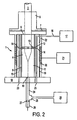
- Figure 2 illustrates a draw furnace in accordance with a preferred embodiment of the present invention.
- a preferred embodiment of the present invention provides an apparatus and method for exhausting gas during the fiber draw process.
- the present invention should not be limited to solely such features.
- Figure 1 illustrates a preform draw furnace 1 for drawing an optical fiber 2 from a preform 3.
- the preform is primarily silica glass having dopants such as fluorine and germanium to provide predetermined optical properties.
- the preform 3 may be made of materials other than silica, and may include dopants other than those listed above.
- the preform 3 is heated in a chamber 4 until a lower portion of the preform 3 is molten and the optical fiber 2 may be continuously drawn from the preform 3.
- the drawn optical fiber 2 passes through a fiber coating device 5 in which a coating is applied to the optical fiber 2. After being coated, the optical fiber 2 is wound onto a spool or other storage device.
- the preform 3 may be positioned in the draw furnace 1 such that the chamber 4 of the draw furnace 1 heats the lower portion of the preform 3 from which the optical fiber 2 is drawn.
- the chamber 4, and other areas of the draw furnace 1 includes carbon and other materials maintained at a relatively high temperature. The carbon and other materials would undesirably burn if brought into contact with oxygen.
- the draw furnace 1 includes a first seal 6 through which the preform 3 is lowered. The first seal 6 prevents air from entering the interior of the draw furnace 1 thereby preventing combustion within the draw furnace 1.
- the first seal 6 includes the combination of a mechanical seal and a gas pressure differential for preventing air from entering the furnace.
- the mechanical seal includes features such as carbon paper that physically contact the preform 3 to create a physical barrier around the preform 3 as the preform 3 is lowered into the draw furnace 1. Further, a positive pressure of an inert gas is maintained within the first seal 6 relative to the atmosphere to resist the entry of air into the draw furnace 1.
- the first seal 6 also physically and thermally isolates the chamber 4 so that the chamber 4 may be kept at or near an elevated operating temperature when the preform 3 is not present in the chamber 4.
- the first seal 6 includes a mechanical shutter 7 that may be opened to receive the preform 3 during fiber draw, and closed when the preform 3 is mounted or removed from the draw furnace 1.
- any seal that adequately prevents air from entering the chamber 4 and isolates the heating area, without damaging the preform 3, is suitable and is considered to be within the scope of the present invention.
- the preform 3 is lowered through the first seal 6 and into the chamber 4 at a predetermined rate during the fiber draw process.
- the chamber 4 is defined by a heating element 8 having two opposing openings. As shown in Figure 2, a first opening 9 is disposed near to the first seal 6, and a second opening 10 opposes the first opening 9.
- the heating element 8 couples with an applied magnetic field and generates heat inside the chamber 4.
- the portion of the preform 3 disposed in the chamber 4 is thereby heated to form the molten area from which the optical fiber 2 is drawn.
- the temperature of the molten area is preferably from 1700 to 2000 degrees Celsius.
- the invention is not limited to these preferred temperatures, and the preform 3 may be heated to any sufficient temperature outside the indicated range in order to create a molten area on the preform 3.
- the heating element 8 is primarily graphite, but other materials that couple with the applied magnetic field may also be used while remaining within the spirit of the invention.
- Other means of generating heat other than the applied magnetic field such as a resistive furnace, may also be used to heat the preform 3.
- Vapor products are present when the preform 3 is heated.
- the vapor products include, for example, silicon dioxide and silicon carbide and are at a temperature of approximately 1400 to 1800 degrees Celsius.
- additional vapor products such as other SiO x and SiC x may also be present during the draw process, and other temperatures are also considered to be within the scope of the present invention.
- the amount of vapor products corresponds to the equilibrium vapor pressure over the corresponding solid. Particles condense from the vapor products when the vapor products cool below the corresponding condensation temperature, and the optical fiber 2 is prone to break during the fiber draw process if the optical fiber 2 is contacted by the particles. To prevent the particles from contacting the optical fiber 2, the vapor products are exhausted from the chamber 4 before the particles are formed.
- the heating element 8 includes a collar 12 located near the molten portion of the preform 3 and having a plurality of ports 13 disposed symmetrically around the circumference of the chamber 4 and through the wall of the heating element 8. Vapor products in the chamber 4 are exhausted through the ports 13 at a temperature above the vapor products' lowest condensation temperature. In a preferred embodiment the plurality of ports 13 are located between the first opening 9 and a melt region of the chamber 4 where the preform 3 becomes molten. A purge gas is introduced into the chamber 4 to assist in exhausting the vapor products. The purge gas is introduced through the second opening 10 of the chamber 4, flows through the chamber 4, and out the ports 13.
- the purge gas sweeps the vapor products away from the optical fiber 2 and out of the chamber 4 through the ports 13.
- the purge gas and vapor products exit through the ports 13 at a temperature of approximately 1200 to 1800 degrees Celsius.
- the temperature of the gasses is above the condensation temperature of the particles and the particles do not form within the chamber 4.
- the purge gas is an inert gas such as argon and/or helium and is introduced at a rate of 2-10 liters per minute and a temperature of approximately to 100 to 1000 degrees Celsius.
- other gasses, flow rates and temperatures suitable for sweeping the vapor products through the ports 13 may also be used and are considered to be within the scope of the present invention.
- the purge gas may be introduced into the chamber 4 from locations other than the second opening 10.
- the purge gas may be introduced through a single port, or through multiple ports, disposed through the side of the chamber 4 at a location between the first opening 9 and the second opening 10.
- the ports 13 for exhausting the gasses may be disposed asymmetrically around the circumference of the chamber 4, or one port 13 may be used instead of a plurality of ports 13 while remaining within the spirit of the present invention. Further, the ports 13 may be located at a position adjacent the region where the preform 3 is molten, or at a suitable location between the second opening 10 and the region where the preform 3 is molten, or other locations suitable for exhausting the gasses.
- passages 14 communicate with the ports 13 and facilitate exhausting the vapor products through the ports 13.
- the passages 14 are formed through a support structure 15.
- the support structure 15 provides mechanical support for the chamber 4 and includes one or more layers of a thermal insulation material for insulating the chamber 4 to prevent heat loss.
- the passages 14 pass through and are bounded by materials that couple with the applied magnetic field.
- the passages 14 may be defined by structures incorporating graphite which couples with the applied magnetic field to generate heat. In this manner the gasses passing through the passages 14 do not fall below the condensation temperature of the constituent vapor products and particles do not condense in the passages 14.
- the thermal insulation material may be graphite felt, rigidized graphite, or any thermal oxide insulation material.
- thermal insulation may be used, and other configurations and materials may be used to define the passages 14 while remaining within the spirit of the invention.
- the passages 14 may be defined by structures that do not generate heat if the particles are otherwise prevented from condensing in the passages 14.
- the passages 14 communicate with a gas inlet 16.
- the gas inlet 16 is configured to accept an inert gas supplied from a gas supply 17.
- the inert gas flows from the gas inlet 16, through the passages 14, and entrains the vapor products and purge gasses flowing through the passages 14.
- the combined gasses then flow to a second seal 18 and are exhausted from the draw furnace 1, as discussed below in more detail.
- the inert gas introduced through the gas inlet 16 may be, for example, argon and helium. Of course, other suitable gasses may also be used.
- the gas supply 17 may be a conventional gas supply 17 such as pressurized bottles, or other gas supplies may be used either concurrently with or instead of such bottles.
- the inert gas is preferably provided at a temperature of approximately 100 to 1000 degrees Celsius and at a flow rate of approximately 2-10 liters per minute, although other temperatures and flow rates are also possible.
- the support structure 15 is surrounded by a globe 19.
- the globe 19 encloses the heating element 8 and the support structure 15, and other elements of the draw furnace 1, as illustrated in Figure 2.
- the globe 19 helps maintain the inert gas atmosphere inside the draw furnace 1, acts as an additional layer of thermal and physical protection, and is constructed of a material that does not couple with the applied magnetic field.
- the globe 19 is constructed of quartz, either in whole or in part, or any other suitable insulating material.
- the induction coil 20 is connected to a power supply 21 that applies a magnetic field to the chamber 4.
- the induction coil 20 is a copper coil that carries an oscillating current supplied by the power supply 21.
- the induction coil 20 creates a perpendicular magnetic field that induces an oscillating current in the heating element 8, and any other structures that couple with the applied magnetic field, to generate heat.
- the power supply 21 may be any conventional power supply suitable for providing an oscillating current of sufficient magnitude to generate the above-discussed magnetic field.
- a protective cover 22 is disposed around the exposed outer surfaces of the globe 19 and the induction coil 20.
- the draw furnace 1 may be constructed without the protective cover 22.
- the second seal 18 includes second seal passages 23 communicating with the passages 14 and opening to the atmosphere. The gasses flowing through the passages 14 are thus exhausted from the draw furnace 1 after passing through the second seal 18.
- the second seal 18 is also configured to allow the drawn optical fiber 2 to exit the chamber 4 while preventing air from entering the chamber 4.
- the second seal 18 includes an extension tube 24 disposed generally co-axially with the chamber 4. The optical fiber 2 passes from the chamber 4 longitudinally through the extension tube 24 while an inert gas is fed through the extension tube 24. A portion of the inert gas flows in a direction opposing the direction of flow of the optical fiber 2 and passes through the second opening 10 of the chamber 4.
- a gas injection port 25 for injecting the inert gas communicates with the extension tube 24.
- the gas injection port 25 has two 90 degree gas injectors that direct inert gasses into the extension tube 24 toward the second opening 10 of the chamber 4, and also into the extension tube 24 away from the second opening 10.
- the gas flowing toward the second opening 10 passes through the second opening 10 and into the chamber 4.
- This gas flows through the chamber 4 parallel to the optical fiber 2 and is the purge gas used to flush the vapor products from the chamber 4 in the manner previously discussed.
- the extension tube 24 and the inert gas insulate the optical fiber 2 from severe temperature gradients and allow controlled cooling of the optical fiber 2.
- the optical fiber 2 thus has relatively low residual stresses and correspondingly low attenuation characteristics.
- the inert gas is supplied by a gas supply 28 which may be any conventional gas supply.
- the gas injection port 25 also directs the inert gas away from the second opening 10 and along the direction of travel of the optical fiber 2 as the optical fiber 2 exits the draw furnace 1.
- the inert gas flowing in the optical fiber 2's direction of travel prevents air from entering the draw furnace 1.
- a distal end 26 of the extension tube 24 terminates with an extension tube shutter 27.
- the extension tube shutter 27 can be opened to allow passage of the optical fiber 2 during the fiber draw process, and can be closed when the optical fiber 2 is not being drawn. Closing the extension tube shutter 27 maintains positive pressure of the inert gas within the draw furnace 1 and helps to prevent air from entering the draw furnace 1.
- the extension tube 24 may be made of quartz or any other suitable insulating material, and the inert gas may be supplied by any known gas supply 17.
- the inert gas may be introduced into the second seal 18 at a location other than through the extension tube 24. As previously discussed, the inert gas may be introduced directly into the chamber rather than into the second seal 18, and the portion of the inert gas that does not sweep through the ports 13 may flow into the second seal 18 from the chamber 4. Further, exhausting the gasses flowing through the second seal passages 23 may be assisted by a fan or pump, a gas entraining the gasses from the passages 14, or any other pressure differential to draw or force the gasses through the second seal passages 23. The gasses may be vented to the atmosphere or may be cooled or treated to remove constituent gasses.
- the heating element 8, and other elements couple with the applied magnetic field generated by the induction coil 20 to generate heat.
- the heat melts a lower portion of the preform 3, and the optical fiber 2 is drawn from the melted area and passes out of the chamber 4.
- Vapor products are generated during the draw process and these gasses are flushed from the chamber 4 by the purging gas.
- the gasses exit the chamber 4 by passing through the ports 13, passages 14, and second seal 18 and out of the draw furnace 1 at a sufficiently high temperature to prevent particles from condensing from the gasses. In this manner the particles do not condense from the vapor products until the vapor products exit the draw furnace 1. The particles thus condense away from the optical fiber 2, and the optical fiber 2 is protected from unwanted breakage.
- the optical fiber 2 exits the extension tube 24 and passes through the fiber coating device 5 ( Figure 1).
- the optical fiber 2 is coated with one or more layers of coatings having predetermined physical and optical properties.
- the coatings protect the surface of the optical fiber 2 from scratches, abrasions and moisture.
- the coating device may include one or more curing stages for curing the coating, and one or more cooling stages for cooling the optical fiber 2 and/or the coating. Subsequent to being coated, the optical fiber 2 is wound on a spool for storage.
Landscapes
- Engineering & Computer Science (AREA)
- Chemical & Material Sciences (AREA)
- Life Sciences & Earth Sciences (AREA)
- General Life Sciences & Earth Sciences (AREA)
- Geochemistry & Mineralogy (AREA)
- Manufacturing & Machinery (AREA)
- Materials Engineering (AREA)
- Organic Chemistry (AREA)
- Manufacture, Treatment Of Glass Fibers (AREA)
Claims (12)
- Ofen (1) mit :einer Kammer (4) zum Erwärmen eines Teils einer Vorform (3) zum Ziehen einer Faser (2), wobei die Kammer (4) aus einem Heizelement (8) mit zwei einander gegenüberliegenden Öffnungen (9, 10) besteht ; und- einer Spülgasversorgung, um Spülgas in die Kammer (4) zu führen, wobei durch das Spülgas Dämpfe von der Faser (2) weggeführt werden und die Kammer (4) durch mindestens eine Öffnung (13) verlassen, wobei- das Heizelement (8) einen Bund (12) besitzt, der sich in der Nähe des geschmolzenen Teils der Vorform (3) befindet, wobei die mindestens eine Öffnung (13) am Umfang der Kammer (4) und durch die Wand des Elementes (8) angeordnet ist.
- Ofen nach Anspruch 1, wobei die Kammer (4) eine Vorform-Öffnung (9) besitzt, durch die die Vorform (3) verläuft, und mindestens eine Öffnung (13) zwischen der Vorform-Öffnung (9) und dem geschmolzenen Bereich angeordnet ist.
- Ofen nach Anspruch 1, der weiterhin eine Tragkonstruktion (15) mit Durchgängen (14) besitzt, die mit der mindestens einen Öffnung (13) in Verbindung stehen, um die Dämpfe und das Spülgas aus der Kammer (4) abzuführen.
- Ofen nach Anspruch 1, wobei die Spülgasversorgung das Spülgas in einer Richtung im allgemeinen parallel zu der Faser (2) in die Kammer (4) führt.
- Ofen nach den Ansprüchen 3 bis 4,dadurch gekennzeichnet, dass die Gase, die durch die Durchgänge (14) fließen, einer Dichtung (18) einschließlich Dichtungsdurchlässen (23) zugeführt werden, die mit den Durchgängen (14) in Verbindung stehen und in die Atmosphäre führen.
- Ofen nach Anspruch 5, dadurch gekennzeichnet, dass die Dichtung (18) ein Verlängerungsrohr (24) besitzt, das koaxial zu der Kammer (4) angeordnet ist.
- Ofen nach Anspruch 6, dadurch gekennzeichnet, dass eine Gaseinblasöffnung (25) zum Einblasen von Schutzgas mit dem Verlängerungsrohr (24) in Verbindung steht.
- Ofen nach Anspruch 7, dadurch gekennzeichnet, dass ein distales Ende (26) des Verlängerungsrohres (24) in einem Klappelement (27) des Verlängerungsrohres endet.
- Verfahren zum Ziehen einer Faser (2) mit folgenden Schritten:- Bereitstellen einer Kammer (4) mit einer Vorform-Öffnung (9) zur Aufnahme einer Vorform (3), wobei die Kammer (4), die aus einem Heizelement (8) besteht, zwei einander gegenüberliegende Öffnungen (9, 10) besitzt,- Erwärmen der Vorform (3) in einem geschmolzenen Bereich der Kammer (4), bis ein Teil der Vorform (3) geschmolzen ist und Dämpfe vorhanden sind ; und- Ablassen der Dämpfe aus der Kammer (4), bevor die Partikel aus den Dämpfen kondensieren, wobei die Dämpfe durch ein Spülgas aus der Kammer (4) abgezogen werden, wobei sowohl das Spülgas als auch die Dämpfe über Öffnungen (13) aus der Kammer (4) austreten, die am Umfang der Kammer (4) angeordnet sind, sowie durch die Wand der Heizelemente (8).
- Verfahren zum Ziehen einer Faser (2) nach Anspruch 9, das weiterhin den Schritt des Abzugs der Dämpfe bei einer Temperatur über ihrer jeweiligen Kondensierungstemperatur beinhaltet.
- Verfahren zum Ziehen einer Faser nach Anspruch 9, das weiterhin den Schritt des Abzugs der Dämpfe aus der Kammer (4) an einer Stelle zwischen der Öffnung (9) der Vorform und dem geschmolzenen Bereich beinhaltet.
- Verfahren zum Ziehen einer Faser nach Anspruch 9, das weiterhin den Schritt umfasst, dass das Spülgas und die Dämpfe über Durchgänge (14) und eine Dichtung (18) verlaufen.
Applications Claiming Priority (2)
| Application Number | Priority Date | Filing Date | Title |
|---|---|---|---|
| US10/314,137 US20040107736A1 (en) | 2002-12-09 | 2002-12-09 | Pure upflow furnace |
| US314137 | 2002-12-09 |
Publications (3)
| Publication Number | Publication Date |
|---|---|
| EP1428802A2 EP1428802A2 (de) | 2004-06-16 |
| EP1428802A3 EP1428802A3 (de) | 2004-07-21 |
| EP1428802B1 true EP1428802B1 (de) | 2007-02-07 |
Family
ID=32325885
Family Applications (1)
| Application Number | Title | Priority Date | Filing Date |
|---|---|---|---|
| EP03028198A Expired - Lifetime EP1428802B1 (de) | 2002-12-09 | 2003-12-09 | Verfahren und Ofen zum Ziehen einer optischen Faser aus einer Vorform |
Country Status (4)
| Country | Link |
|---|---|
| US (1) | US20040107736A1 (de) |
| EP (1) | EP1428802B1 (de) |
| AT (1) | ATE353315T1 (de) |
| DE (1) | DE60311630T2 (de) |
Cited By (1)
| Publication number | Priority date | Publication date | Assignee | Title |
|---|---|---|---|---|
| WO2021216652A1 (en) * | 2020-04-24 | 2021-10-28 | Corning Incorporated | Particle exhaust apparatus for optical fiber draw furnace |
Families Citing this family (7)
| Publication number | Priority date | Publication date | Assignee | Title |
|---|---|---|---|---|
| KR100393612B1 (ko) * | 2001-01-29 | 2003-08-02 | 삼성전자주식회사 | 비접촉식으로 광섬유 편광모드분산 제어를 위한 광섬유인출 장치 |
| KR100545814B1 (ko) * | 2002-08-31 | 2006-01-24 | 엘에스전선 주식회사 | 광섬유 인선 용해로 및 이를 이용한 광섬유 인선방법 |
| NL1024943C2 (nl) * | 2003-12-04 | 2005-06-07 | Draka Fibre Technology Bv | Werkwijze ter vervaardiging van een optische vezel. |
| US8573008B2 (en) * | 2010-05-27 | 2013-11-05 | Corning Incorporated | Method for producing optical fiber at reduced pressure |
| US10773990B2 (en) * | 2016-10-21 | 2020-09-15 | Corning Incorporated | Purge device for an optical fiber draw system |
| WO2019226445A1 (en) | 2018-05-23 | 2019-11-28 | Corning Incorporated | Vacuum slow cooling device for optical fiber draw |
| CN113292241B (zh) * | 2021-05-26 | 2024-05-14 | 中天科技光纤有限公司 | 光纤拉丝炉、光纤制备装置、光纤制备方法及细径光纤 |
Family Cites Families (15)
| Publication number | Priority date | Publication date | Assignee | Title |
|---|---|---|---|---|
| US4101300A (en) * | 1975-11-27 | 1978-07-18 | Hitachi, Ltd. | Method and apparatus for drawing optical fiber |
| US4030901A (en) * | 1976-07-19 | 1977-06-21 | Bell Telephone Laboratories, Incorporated | Method for drawing fibers |
| JPS5913640A (ja) * | 1982-07-09 | 1984-01-24 | Nippon Telegr & Teleph Corp <Ntt> | 光フアイバの製造方法 |
| NL8203843A (nl) * | 1982-10-04 | 1984-05-01 | Philips Nv | Werkwijze en inrichting voor het trekken van een optische vezel uit een vaste voorvorm die in hoofdzaak uit sio2 en gedoteerd sio2 bestaat. |
| US4578098A (en) * | 1984-06-15 | 1986-03-25 | At&T Technologies, Inc. | Apparatus for controlling lightguide fiber tension during drawing |
| IT1184909B (it) * | 1985-03-18 | 1987-10-28 | Cselt Centro Studi Lab Telecom | Procedimento ed apparecchiatura per la riduzione dei difetti di volume e di superficie nelle fibre ottiche in silice |
| GB2212151B (en) * | 1987-11-12 | 1991-07-17 | Stc Plc | Contaminant removal in manufacture of optical fibre |
| US5242477A (en) * | 1989-10-19 | 1993-09-07 | At&T Bell Laboratories | Apparatus for coating optical fibers |
| US5199993A (en) * | 1989-10-19 | 1993-04-06 | At&T Bell Laboratories | Methods of and apparatus for coating optical fibers |
| US5112215A (en) * | 1991-06-20 | 1992-05-12 | Physical Sciences, Inc. | Apparatus for combustion, pollution and chemical process control |
| JPH0656458A (ja) * | 1992-08-10 | 1994-03-01 | Fujikura Ltd | 光ファイバー紡糸炉 |
| US5544195A (en) * | 1994-12-19 | 1996-08-06 | Massachusetts Institute Of Technology | High-bandwidth continuous-flow arc furnace |
| KR0165211B1 (ko) * | 1995-09-29 | 1998-12-15 | 김광호 | 광섬유의 인출 장치 |
| EP0849232B1 (de) * | 1996-12-17 | 1999-05-26 | Alcatel | Verfahren und Vorrichtung zum Ziehen einer optischen Faser aus einer Vorform |
| US6044664A (en) * | 1997-09-29 | 2000-04-04 | Nikon Corporation | Synthetic silica glass manufacturing apparatus |
-
2002
- 2002-12-09 US US10/314,137 patent/US20040107736A1/en not_active Abandoned
-
2003
- 2003-12-09 AT AT03028198T patent/ATE353315T1/de not_active IP Right Cessation
- 2003-12-09 DE DE60311630T patent/DE60311630T2/de not_active Expired - Lifetime
- 2003-12-09 EP EP03028198A patent/EP1428802B1/de not_active Expired - Lifetime
Cited By (1)
| Publication number | Priority date | Publication date | Assignee | Title |
|---|---|---|---|---|
| WO2021216652A1 (en) * | 2020-04-24 | 2021-10-28 | Corning Incorporated | Particle exhaust apparatus for optical fiber draw furnace |
Also Published As
| Publication number | Publication date |
|---|---|
| DE60311630T2 (de) | 2007-11-22 |
| ATE353315T1 (de) | 2007-02-15 |
| EP1428802A2 (de) | 2004-06-16 |
| US20040107736A1 (en) | 2004-06-10 |
| EP1428802A3 (de) | 2004-07-21 |
| DE60311630D1 (de) | 2007-03-22 |
Similar Documents
| Publication | Publication Date | Title |
|---|---|---|
| EP0567961B1 (de) | Verfahren und Vorrichtung zum Ziehen von optischen Fasern | |
| HK1000532B (en) | Method and apparatus for drawing optical fibers | |
| US4309201A (en) | Method of and apparatus for manufacturing optical fibres | |
| US7823419B2 (en) | Optical fiber drawing furnace with gas flow tubes | |
| KR950010808B1 (ko) | 광 도파관 섬유 제조용 가열 오븐 | |
| EP1428802B1 (de) | Verfahren und Ofen zum Ziehen einer optischen Faser aus einer Vorform | |
| US4668262A (en) | Protective coating for refractory metal substrates | |
| US20020078714A1 (en) | Method and apparatus for continuously manufacturing optical preform and fiber | |
| US5676863A (en) | Induction plasma torch | |
| JP5459977B2 (ja) | プラズマ化学蒸着法を実行するための装置および光学的予備成形品を製造する方法 | |
| JP4667686B2 (ja) | 光ファイバ母材の端部加熱・加工方法および光ファイバ母材の端部加熱・加工処理装置 | |
| JP2944534B2 (ja) | 光ファイバの引出方法及び装置 | |
| JPH0672736A (ja) | 光ファイバ線引き用誘導炉 | |
| JP2006248842A (ja) | 光ファイバ線引炉及び光ファイバの線引方法 | |
| AU734347B2 (en) | Apparatus and method for drawing waveguide fibers | |
| US20020029591A1 (en) | Method of reducing break sources in drawn fibers by active oxidation of contaminants in a reducing atmoshere | |
| CN1986467B (zh) | 用于制造oh基团含量低的外包层的方法和设备 | |
| JP2002173333A (ja) | 光ファイバの線引用加熱炉および線引方法 | |
| US6658897B2 (en) | Optical fiber draw furnace having a SiC or Silicon Nitride tube | |
| JP4479189B2 (ja) | ガラス体の製造方法、光ファイバ母材の製造方法、及び光ファイバの製造方法 | |
| GB1559768A (en) | Optical fibre preform manufacture | |
| KR100702738B1 (ko) | 광섬유 인선용 전기로 및 광섬유 인선 방법 | |
| JPH02145462A (ja) | ハーメチックコートフアイバの製造方法 | |
| JP2004256367A (ja) | 光ファイバ素線の製造方法 | |
| KR100528752B1 (ko) | 광섬유 모재봉의 오버클래딩 방법 및 장치 |
Legal Events
| Date | Code | Title | Description |
|---|---|---|---|
| PUAI | Public reference made under article 153(3) epc to a published international application that has entered the european phase |
Free format text: ORIGINAL CODE: 0009012 |
|
| PUAL | Search report despatched |
Free format text: ORIGINAL CODE: 0009013 |
|
| AK | Designated contracting states |
Kind code of ref document: A2 Designated state(s): AT BE BG CH CY CZ DE DK EE ES FI FR GB GR HU IE IT LI LU MC NL PT RO SE SI SK TR |
|
| AX | Request for extension of the european patent |
Extension state: AL LT LV MK |
|
| AK | Designated contracting states |
Kind code of ref document: A3 Designated state(s): AT BE BG CH CY CZ DE DK EE ES FI FR GB GR HU IE IT LI LU MC NL PT RO SE SI SK TR |
|
| AX | Request for extension of the european patent |
Extension state: AL LT LV MK |
|
| 17P | Request for examination filed |
Effective date: 20041109 |
|
| RAP1 | Party data changed (applicant data changed or rights of an application transferred) |
Owner name: DRAKA COMTEQ B.V. |
|
| AKX | Designation fees paid |
Designated state(s): AT BE BG CH CY CZ DE DK EE ES FI FR GB GR HU IE IT LI LU MC NL PT RO SE SI SK TR |
|
| 17Q | First examination report despatched |
Effective date: 20050613 |
|
| GRAP | Despatch of communication of intention to grant a patent |
Free format text: ORIGINAL CODE: EPIDOSNIGR1 |
|
| GRAS | Grant fee paid |
Free format text: ORIGINAL CODE: EPIDOSNIGR3 |
|
| GRAA | (expected) grant |
Free format text: ORIGINAL CODE: 0009210 |
|
| AK | Designated contracting states |
Kind code of ref document: B1 Designated state(s): AT BE BG CH CY CZ DE DK EE ES FI FR GB GR HU IE IT LI LU MC NL PT RO SE SI SK TR |
|
| PG25 | Lapsed in a contracting state [announced via postgrant information from national office to epo] |
Ref country code: SI Free format text: LAPSE BECAUSE OF FAILURE TO SUBMIT A TRANSLATION OF THE DESCRIPTION OR TO PAY THE FEE WITHIN THE PRESCRIBED TIME-LIMIT Effective date: 20070207 Ref country code: NL Free format text: LAPSE BECAUSE OF FAILURE TO SUBMIT A TRANSLATION OF THE DESCRIPTION OR TO PAY THE FEE WITHIN THE PRESCRIBED TIME-LIMIT Effective date: 20070207 Ref country code: BE Free format text: LAPSE BECAUSE OF FAILURE TO SUBMIT A TRANSLATION OF THE DESCRIPTION OR TO PAY THE FEE WITHIN THE PRESCRIBED TIME-LIMIT Effective date: 20070207 Ref country code: FI Free format text: LAPSE BECAUSE OF FAILURE TO SUBMIT A TRANSLATION OF THE DESCRIPTION OR TO PAY THE FEE WITHIN THE PRESCRIBED TIME-LIMIT Effective date: 20070207 Ref country code: LI Free format text: LAPSE BECAUSE OF FAILURE TO SUBMIT A TRANSLATION OF THE DESCRIPTION OR TO PAY THE FEE WITHIN THE PRESCRIBED TIME-LIMIT Effective date: 20070207 Ref country code: DK Free format text: LAPSE BECAUSE OF FAILURE TO SUBMIT A TRANSLATION OF THE DESCRIPTION OR TO PAY THE FEE WITHIN THE PRESCRIBED TIME-LIMIT Effective date: 20070207 Ref country code: AT Free format text: LAPSE BECAUSE OF FAILURE TO SUBMIT A TRANSLATION OF THE DESCRIPTION OR TO PAY THE FEE WITHIN THE PRESCRIBED TIME-LIMIT Effective date: 20070207 Ref country code: CH Free format text: LAPSE BECAUSE OF FAILURE TO SUBMIT A TRANSLATION OF THE DESCRIPTION OR TO PAY THE FEE WITHIN THE PRESCRIBED TIME-LIMIT Effective date: 20070207 |
|
| REG | Reference to a national code |
Ref country code: GB Ref legal event code: FG4D |
|
| REG | Reference to a national code |
Ref country code: CH Ref legal event code: EP |
|
| REG | Reference to a national code |
Ref country code: IE Ref legal event code: FG4D |
|
| REF | Corresponds to: |
Ref document number: 60311630 Country of ref document: DE Date of ref document: 20070322 Kind code of ref document: P |
|
| PG25 | Lapsed in a contracting state [announced via postgrant information from national office to epo] |
Ref country code: SE Free format text: LAPSE BECAUSE OF FAILURE TO SUBMIT A TRANSLATION OF THE DESCRIPTION OR TO PAY THE FEE WITHIN THE PRESCRIBED TIME-LIMIT Effective date: 20070507 |
|
| PG25 | Lapsed in a contracting state [announced via postgrant information from national office to epo] |
Ref country code: BG Free format text: LAPSE BECAUSE OF EXPIRATION OF PROTECTION Effective date: 20070508 |
|
| PG25 | Lapsed in a contracting state [announced via postgrant information from national office to epo] |
Ref country code: ES Free format text: LAPSE BECAUSE OF FAILURE TO SUBMIT A TRANSLATION OF THE DESCRIPTION OR TO PAY THE FEE WITHIN THE PRESCRIBED TIME-LIMIT Effective date: 20070518 |
|
| ET | Fr: translation filed | ||
| RAP2 | Party data changed (patent owner data changed or rights of a patent transferred) |
Owner name: DRAKA COMTEQ B.V. |
|
| PG25 | Lapsed in a contracting state [announced via postgrant information from national office to epo] |
Ref country code: PT Free format text: LAPSE BECAUSE OF FAILURE TO SUBMIT A TRANSLATION OF THE DESCRIPTION OR TO PAY THE FEE WITHIN THE PRESCRIBED TIME-LIMIT Effective date: 20070709 |
|
| RAP2 | Party data changed (patent owner data changed or rights of a patent transferred) |
Owner name: DRAKA COMTEQ B.V. |
|
| NLV1 | Nl: lapsed or annulled due to failure to fulfill the requirements of art. 29p and 29m of the patents act | ||
| REG | Reference to a national code |
Ref country code: CH Ref legal event code: PL |
|
| PG25 | Lapsed in a contracting state [announced via postgrant information from national office to epo] |
Ref country code: SK Free format text: LAPSE BECAUSE OF FAILURE TO SUBMIT A TRANSLATION OF THE DESCRIPTION OR TO PAY THE FEE WITHIN THE PRESCRIBED TIME-LIMIT Effective date: 20070207 |
|
| PLBE | No opposition filed within time limit |
Free format text: ORIGINAL CODE: 0009261 |
|
| STAA | Information on the status of an ep patent application or granted ep patent |
Free format text: STATUS: NO OPPOSITION FILED WITHIN TIME LIMIT |
|
| PG25 | Lapsed in a contracting state [announced via postgrant information from national office to epo] |
Ref country code: RO Free format text: LAPSE BECAUSE OF FAILURE TO SUBMIT A TRANSLATION OF THE DESCRIPTION OR TO PAY THE FEE WITHIN THE PRESCRIBED TIME-LIMIT Effective date: 20070207 Ref country code: CZ Free format text: LAPSE BECAUSE OF FAILURE TO SUBMIT A TRANSLATION OF THE DESCRIPTION OR TO PAY THE FEE WITHIN THE PRESCRIBED TIME-LIMIT Effective date: 20070207 |
|
| 26N | No opposition filed |
Effective date: 20071108 |
|
| PG25 | Lapsed in a contracting state [announced via postgrant information from national office to epo] |
Ref country code: GR Free format text: LAPSE BECAUSE OF FAILURE TO SUBMIT A TRANSLATION OF THE DESCRIPTION OR TO PAY THE FEE WITHIN THE PRESCRIBED TIME-LIMIT Effective date: 20070508 |
|
| PG25 | Lapsed in a contracting state [announced via postgrant information from national office to epo] |
Ref country code: MC Free format text: LAPSE BECAUSE OF NON-PAYMENT OF DUE FEES Effective date: 20071231 |
|
| GBPC | Gb: european patent ceased through non-payment of renewal fee |
Effective date: 20071209 |
|
| PG25 | Lapsed in a contracting state [announced via postgrant information from national office to epo] |
Ref country code: IE Free format text: LAPSE BECAUSE OF NON-PAYMENT OF DUE FEES Effective date: 20071210 |
|
| PG25 | Lapsed in a contracting state [announced via postgrant information from national office to epo] |
Ref country code: GB Free format text: LAPSE BECAUSE OF NON-PAYMENT OF DUE FEES Effective date: 20071209 |
|
| PG25 | Lapsed in a contracting state [announced via postgrant information from national office to epo] |
Ref country code: EE Free format text: LAPSE BECAUSE OF FAILURE TO SUBMIT A TRANSLATION OF THE DESCRIPTION OR TO PAY THE FEE WITHIN THE PRESCRIBED TIME-LIMIT Effective date: 20070207 |
|
| PG25 | Lapsed in a contracting state [announced via postgrant information from national office to epo] |
Ref country code: CY Free format text: LAPSE BECAUSE OF FAILURE TO SUBMIT A TRANSLATION OF THE DESCRIPTION OR TO PAY THE FEE WITHIN THE PRESCRIBED TIME-LIMIT Effective date: 20070207 |
|
| PG25 | Lapsed in a contracting state [announced via postgrant information from national office to epo] |
Ref country code: LU Free format text: LAPSE BECAUSE OF NON-PAYMENT OF DUE FEES Effective date: 20071209 |
|
| PG25 | Lapsed in a contracting state [announced via postgrant information from national office to epo] |
Ref country code: TR Free format text: LAPSE BECAUSE OF FAILURE TO SUBMIT A TRANSLATION OF THE DESCRIPTION OR TO PAY THE FEE WITHIN THE PRESCRIBED TIME-LIMIT Effective date: 20070207 Ref country code: HU Free format text: LAPSE BECAUSE OF FAILURE TO SUBMIT A TRANSLATION OF THE DESCRIPTION OR TO PAY THE FEE WITHIN THE PRESCRIBED TIME-LIMIT Effective date: 20070808 |
|
| PGFP | Annual fee paid to national office [announced via postgrant information from national office to epo] |
Ref country code: FR Payment date: 20141217 Year of fee payment: 12 |
|
| PGFP | Annual fee paid to national office [announced via postgrant information from national office to epo] |
Ref country code: IT Payment date: 20141223 Year of fee payment: 12 Ref country code: DE Payment date: 20141230 Year of fee payment: 12 |
|
| REG | Reference to a national code |
Ref country code: DE Ref legal event code: R119 Ref document number: 60311630 Country of ref document: DE |
|
| REG | Reference to a national code |
Ref country code: FR Ref legal event code: ST Effective date: 20160831 |
|
| PG25 | Lapsed in a contracting state [announced via postgrant information from national office to epo] |
Ref country code: DE Free format text: LAPSE BECAUSE OF NON-PAYMENT OF DUE FEES Effective date: 20160701 |
|
| PG25 | Lapsed in a contracting state [announced via postgrant information from national office to epo] |
Ref country code: FR Free format text: LAPSE BECAUSE OF NON-PAYMENT OF DUE FEES Effective date: 20151231 |
|
| PG25 | Lapsed in a contracting state [announced via postgrant information from national office to epo] |
Ref country code: IT Free format text: LAPSE BECAUSE OF NON-PAYMENT OF DUE FEES Effective date: 20151209 |