EP1421437B1 - System mit verglasungselement und gasversorgungsvorrichtung - Google Patents
System mit verglasungselement und gasversorgungsvorrichtung Download PDFInfo
- Publication number
- EP1421437B1 EP1421437B1 EP02797594A EP02797594A EP1421437B1 EP 1421437 B1 EP1421437 B1 EP 1421437B1 EP 02797594 A EP02797594 A EP 02797594A EP 02797594 A EP02797594 A EP 02797594A EP 1421437 B1 EP1421437 B1 EP 1421437B1
- Authority
- EP
- European Patent Office
- Prior art keywords
- gas
- oxide
- mixtures
- glazing element
- gas supply
- Prior art date
- Legal status (The legal status is an assumption and is not a legal conclusion. Google has not performed a legal analysis and makes no representation as to the accuracy of the status listed.)
- Expired - Lifetime
Links
- 239000000203 mixture Substances 0.000 claims abstract description 44
- 238000005868 electrolysis reaction Methods 0.000 claims abstract description 34
- 239000003792 electrolyte Substances 0.000 claims abstract description 29
- 239000000758 substrate Substances 0.000 claims abstract description 14
- 239000011248 coating agent Substances 0.000 claims abstract description 11
- 238000000576 coating method Methods 0.000 claims abstract description 11
- 230000003287 optical effect Effects 0.000 claims abstract description 9
- 230000000704 physical effect Effects 0.000 claims abstract description 7
- 239000007789 gas Substances 0.000 claims description 171
- 239000010410 layer Substances 0.000 claims description 88
- 239000001257 hydrogen Substances 0.000 claims description 46
- 229910052739 hydrogen Inorganic materials 0.000 claims description 46
- UFHFLCQGNIYNRP-UHFFFAOYSA-N Hydrogen Chemical compound [H][H] UFHFLCQGNIYNRP-UHFFFAOYSA-N 0.000 claims description 43
- QVGXLLKOCUKJST-UHFFFAOYSA-N atomic oxygen Chemical compound [O] QVGXLLKOCUKJST-UHFFFAOYSA-N 0.000 claims description 40
- 239000001301 oxygen Substances 0.000 claims description 40
- 229910052760 oxygen Inorganic materials 0.000 claims description 40
- 239000003054 catalyst Substances 0.000 claims description 27
- XLYOFNOQVPJJNP-UHFFFAOYSA-N water Substances O XLYOFNOQVPJJNP-UHFFFAOYSA-N 0.000 claims description 20
- 229910052987 metal hydride Inorganic materials 0.000 claims description 19
- 150000004681 metal hydrides Chemical class 0.000 claims description 19
- 239000012528 membrane Substances 0.000 claims description 16
- BASFCYQUMIYNBI-UHFFFAOYSA-N platinum Substances [Pt] BASFCYQUMIYNBI-UHFFFAOYSA-N 0.000 claims description 16
- 239000011261 inert gas Substances 0.000 claims description 12
- PXHVJJICTQNCMI-UHFFFAOYSA-N nickel Substances [Ni] PXHVJJICTQNCMI-UHFFFAOYSA-N 0.000 claims description 12
- IJGRMHOSHXDMSA-UHFFFAOYSA-N Atomic nitrogen Chemical compound N#N IJGRMHOSHXDMSA-UHFFFAOYSA-N 0.000 claims description 10
- 229910052741 iridium Inorganic materials 0.000 claims description 10
- XEEYBQQBJWHFJM-UHFFFAOYSA-N iron Substances [Fe] XEEYBQQBJWHFJM-UHFFFAOYSA-N 0.000 claims description 10
- 229910052697 platinum Inorganic materials 0.000 claims description 10
- 229910052703 rhodium Inorganic materials 0.000 claims description 10
- 229910052759 nickel Inorganic materials 0.000 claims description 9
- 229910052762 osmium Inorganic materials 0.000 claims description 9
- 229910052763 palladium Inorganic materials 0.000 claims description 9
- 229910052702 rhenium Inorganic materials 0.000 claims description 9
- 229910052707 ruthenium Inorganic materials 0.000 claims description 9
- QGLKJKCYBOYXKC-UHFFFAOYSA-N nonaoxidotritungsten Chemical compound O=[W]1(=O)O[W](=O)(=O)O[W](=O)(=O)O1 QGLKJKCYBOYXKC-UHFFFAOYSA-N 0.000 claims description 8
- 150000003839 salts Chemical class 0.000 claims description 8
- 229910001930 tungsten oxide Inorganic materials 0.000 claims description 8
- 229910052801 chlorine Inorganic materials 0.000 claims description 7
- 239000000460 chlorine Substances 0.000 claims description 7
- XKRFYHLGVUSROY-UHFFFAOYSA-N Argon Chemical compound [Ar] XKRFYHLGVUSROY-UHFFFAOYSA-N 0.000 claims description 6
- HEMHJVSKTPXQMS-UHFFFAOYSA-M Sodium hydroxide Chemical compound [OH-].[Na+] HEMHJVSKTPXQMS-UHFFFAOYSA-M 0.000 claims description 6
- 239000000654 additive Substances 0.000 claims description 6
- 239000007787 solid Substances 0.000 claims description 6
- 230000005540 biological transmission Effects 0.000 claims description 5
- 229910052748 manganese Inorganic materials 0.000 claims description 5
- 239000011572 manganese Substances 0.000 claims description 5
- 229910052757 nitrogen Inorganic materials 0.000 claims description 5
- 239000011241 protective layer Substances 0.000 claims description 5
- 238000006479 redox reaction Methods 0.000 claims description 5
- 229910052709 silver Inorganic materials 0.000 claims description 5
- 229910052719 titanium Inorganic materials 0.000 claims description 5
- 239000010936 titanium Substances 0.000 claims description 5
- WKBOTKDWSSQWDR-UHFFFAOYSA-N Bromine atom Chemical compound [Br] WKBOTKDWSSQWDR-UHFFFAOYSA-N 0.000 claims description 4
- ZAMOUSCENKQFHK-UHFFFAOYSA-N Chlorine atom Chemical compound [Cl] ZAMOUSCENKQFHK-UHFFFAOYSA-N 0.000 claims description 4
- VEXZGXHMUGYJMC-UHFFFAOYSA-N Hydrochloric acid Chemical compound Cl VEXZGXHMUGYJMC-UHFFFAOYSA-N 0.000 claims description 4
- NBIIXXVUZAFLBC-UHFFFAOYSA-N Phosphoric acid Chemical compound OP(O)(O)=O NBIIXXVUZAFLBC-UHFFFAOYSA-N 0.000 claims description 4
- KWYUFKZDYYNOTN-UHFFFAOYSA-M Potassium hydroxide Chemical compound [OH-].[K+] KWYUFKZDYYNOTN-UHFFFAOYSA-M 0.000 claims description 4
- FAPWRFPIFSIZLT-UHFFFAOYSA-M Sodium chloride Chemical compound [Na+].[Cl-] FAPWRFPIFSIZLT-UHFFFAOYSA-M 0.000 claims description 4
- XLOMVQKBTHCTTD-UHFFFAOYSA-N Zinc monoxide Chemical compound [Zn]=O XLOMVQKBTHCTTD-UHFFFAOYSA-N 0.000 claims description 4
- -1 alkalis Chemical class 0.000 claims description 4
- GDTBXPJZTBHREO-UHFFFAOYSA-N bromine Substances BrBr GDTBXPJZTBHREO-UHFFFAOYSA-N 0.000 claims description 4
- 229910052794 bromium Inorganic materials 0.000 claims description 4
- 229910052737 gold Inorganic materials 0.000 claims description 4
- 150000002431 hydrogen Chemical class 0.000 claims description 4
- AMWRITDGCCNYAT-UHFFFAOYSA-L hydroxy(oxo)manganese;manganese Chemical compound [Mn].O[Mn]=O.O[Mn]=O AMWRITDGCCNYAT-UHFFFAOYSA-L 0.000 claims description 4
- 150000002500 ions Chemical class 0.000 claims description 4
- 229910052742 iron Inorganic materials 0.000 claims description 4
- 230000002441 reversible effect Effects 0.000 claims description 4
- 229910052718 tin Inorganic materials 0.000 claims description 4
- 239000011135 tin Substances 0.000 claims description 4
- 229910052721 tungsten Inorganic materials 0.000 claims description 4
- QAOWNCQODCNURD-UHFFFAOYSA-N Sulfuric acid Chemical compound OS(O)(=O)=O QAOWNCQODCNURD-UHFFFAOYSA-N 0.000 claims description 3
- 229910052786 argon Inorganic materials 0.000 claims description 3
- 229910052797 bismuth Inorganic materials 0.000 claims description 3
- 229910052804 chromium Inorganic materials 0.000 claims description 3
- 239000011651 chromium Substances 0.000 claims description 3
- 239000011521 glass Substances 0.000 claims description 3
- 239000010931 gold Substances 0.000 claims description 3
- 239000001307 helium Substances 0.000 claims description 3
- 229910052734 helium Inorganic materials 0.000 claims description 3
- SWQJXJOGLNCZEY-UHFFFAOYSA-N helium atom Chemical compound [He] SWQJXJOGLNCZEY-UHFFFAOYSA-N 0.000 claims description 3
- 229910052743 krypton Inorganic materials 0.000 claims description 3
- DNNSSWSSYDEUBZ-UHFFFAOYSA-N krypton atom Chemical compound [Kr] DNNSSWSSYDEUBZ-UHFFFAOYSA-N 0.000 claims description 3
- 239000000463 material Substances 0.000 claims description 3
- 229910052751 metal Inorganic materials 0.000 claims description 3
- 239000002184 metal Substances 0.000 claims description 3
- 229910044991 metal oxide Inorganic materials 0.000 claims description 3
- 150000004706 metal oxides Chemical class 0.000 claims description 3
- 229910052754 neon Inorganic materials 0.000 claims description 3
- GKAOGPIIYCISHV-UHFFFAOYSA-N neon atom Chemical compound [Ne] GKAOGPIIYCISHV-UHFFFAOYSA-N 0.000 claims description 3
- 229910000314 transition metal oxide Inorganic materials 0.000 claims description 3
- 229910052720 vanadium Inorganic materials 0.000 claims description 3
- 229910052724 xenon Inorganic materials 0.000 claims description 3
- FHNFHKCVQCLJFQ-UHFFFAOYSA-N xenon atom Chemical compound [Xe] FHNFHKCVQCLJFQ-UHFFFAOYSA-N 0.000 claims description 3
- GWEVSGVZZGPLCZ-UHFFFAOYSA-N Titan oxide Chemical compound O=[Ti]=O GWEVSGVZZGPLCZ-UHFFFAOYSA-N 0.000 claims description 2
- WGLPBDUCMAPZCE-UHFFFAOYSA-N Trioxochromium Chemical compound O=[Cr](=O)=O WGLPBDUCMAPZCE-UHFFFAOYSA-N 0.000 claims description 2
- XHCLAFWTIXFWPH-UHFFFAOYSA-N [O-2].[O-2].[O-2].[O-2].[O-2].[V+5].[V+5] Chemical compound [O-2].[O-2].[O-2].[O-2].[O-2].[V+5].[V+5] XHCLAFWTIXFWPH-UHFFFAOYSA-N 0.000 claims description 2
- 239000002253 acid Substances 0.000 claims description 2
- 150000007513 acids Chemical class 0.000 claims description 2
- 229910000147 aluminium phosphate Inorganic materials 0.000 claims description 2
- 229910052799 carbon Inorganic materials 0.000 claims description 2
- 229910000420 cerium oxide Inorganic materials 0.000 claims description 2
- 229910000423 chromium oxide Inorganic materials 0.000 claims description 2
- 229910000428 cobalt oxide Inorganic materials 0.000 claims description 2
- IVMYJDGYRUAWML-UHFFFAOYSA-N cobalt(ii) oxide Chemical compound [Co]=O IVMYJDGYRUAWML-UHFFFAOYSA-N 0.000 claims description 2
- 150000001875 compounds Chemical class 0.000 claims description 2
- HTXDPTMKBJXEOW-UHFFFAOYSA-N dioxoiridium Chemical compound O=[Ir]=O HTXDPTMKBJXEOW-UHFFFAOYSA-N 0.000 claims description 2
- 229910003437 indium oxide Inorganic materials 0.000 claims description 2
- PJXISJQVUVHSOJ-UHFFFAOYSA-N indium(iii) oxide Chemical compound [O-2].[O-2].[O-2].[In+3].[In+3] PJXISJQVUVHSOJ-UHFFFAOYSA-N 0.000 claims description 2
- PNDPGZBMCMUPRI-UHFFFAOYSA-N iodine Chemical compound II PNDPGZBMCMUPRI-UHFFFAOYSA-N 0.000 claims description 2
- 229910000457 iridium oxide Inorganic materials 0.000 claims description 2
- 150000002739 metals Chemical class 0.000 claims description 2
- 229910000476 molybdenum oxide Inorganic materials 0.000 claims description 2
- 229910000480 nickel oxide Inorganic materials 0.000 claims description 2
- 229910000484 niobium oxide Inorganic materials 0.000 claims description 2
- URLJKFSTXLNXLG-UHFFFAOYSA-N niobium(5+);oxygen(2-) Chemical compound [O-2].[O-2].[O-2].[O-2].[O-2].[Nb+5].[Nb+5] URLJKFSTXLNXLG-UHFFFAOYSA-N 0.000 claims description 2
- BMMGVYCKOGBVEV-UHFFFAOYSA-N oxo(oxoceriooxy)cerium Chemical compound [Ce]=O.O=[Ce]=O BMMGVYCKOGBVEV-UHFFFAOYSA-N 0.000 claims description 2
- PQQKPALAQIIWST-UHFFFAOYSA-N oxomolybdenum Chemical compound [Mo]=O PQQKPALAQIIWST-UHFFFAOYSA-N 0.000 claims description 2
- GNRSAWUEBMWBQH-UHFFFAOYSA-N oxonickel Chemical compound [Ni]=O GNRSAWUEBMWBQH-UHFFFAOYSA-N 0.000 claims description 2
- 229920000642 polymer Polymers 0.000 claims description 2
- 239000011780 sodium chloride Substances 0.000 claims description 2
- XOLBLPGZBRYERU-UHFFFAOYSA-N tin dioxide Chemical compound O=[Sn]=O XOLBLPGZBRYERU-UHFFFAOYSA-N 0.000 claims description 2
- 229910001887 tin oxide Inorganic materials 0.000 claims description 2
- OGIDPMRJRNCKJF-UHFFFAOYSA-N titanium oxide Inorganic materials [Ti]=O OGIDPMRJRNCKJF-UHFFFAOYSA-N 0.000 claims description 2
- 229910001935 vanadium oxide Inorganic materials 0.000 claims description 2
- 239000011787 zinc oxide Substances 0.000 claims description 2
- 230000000996 additive effect Effects 0.000 claims 3
- 239000000284 extract Substances 0.000 claims 1
- 239000002985 plastic film Substances 0.000 claims 1
- 229920006255 plastic film Polymers 0.000 claims 1
- 239000001117 sulphuric acid Substances 0.000 claims 1
- 235000011149 sulphuric acid Nutrition 0.000 claims 1
- 229910052723 transition metal Inorganic materials 0.000 claims 1
- 150000003624 transition metals Chemical class 0.000 claims 1
- LWIHDJKSTIGBAC-UHFFFAOYSA-K tripotassium phosphate Chemical compound [K+].[K+].[K+].[O-]P([O-])([O-])=O LWIHDJKSTIGBAC-UHFFFAOYSA-K 0.000 claims 1
- 229910000404 tripotassium phosphate Inorganic materials 0.000 claims 1
- KDLHZDBZIXYQEI-UHFFFAOYSA-N Palladium Chemical compound [Pd] KDLHZDBZIXYQEI-UHFFFAOYSA-N 0.000 description 10
- 238000006243 chemical reaction Methods 0.000 description 9
- 238000009833 condensation Methods 0.000 description 8
- 230000005494 condensation Effects 0.000 description 8
- 238000001035 drying Methods 0.000 description 8
- 238000003860 storage Methods 0.000 description 8
- 238000000034 method Methods 0.000 description 7
- 239000002274 desiccant Substances 0.000 description 6
- GKOZUEZYRPOHIO-UHFFFAOYSA-N iridium atom Chemical compound [Ir] GKOZUEZYRPOHIO-UHFFFAOYSA-N 0.000 description 6
- 239000010948 rhodium Substances 0.000 description 6
- MHOVAHRLVXNVSD-UHFFFAOYSA-N rhodium atom Chemical compound [Rh] MHOVAHRLVXNVSD-UHFFFAOYSA-N 0.000 description 6
- KJTLSVCANCCWHF-UHFFFAOYSA-N Ruthenium Chemical compound [Ru] KJTLSVCANCCWHF-UHFFFAOYSA-N 0.000 description 5
- 238000004040 coloring Methods 0.000 description 5
- 238000004042 decolorization Methods 0.000 description 5
- SYQBFIAQOQZEGI-UHFFFAOYSA-N osmium atom Chemical compound [Os] SYQBFIAQOQZEGI-UHFFFAOYSA-N 0.000 description 5
- WUAPFZMCVAUBPE-UHFFFAOYSA-N rhenium atom Chemical compound [Re] WUAPFZMCVAUBPE-UHFFFAOYSA-N 0.000 description 5
- 230000003197 catalytic effect Effects 0.000 description 4
- 238000004519 manufacturing process Methods 0.000 description 4
- BQCADISMDOOEFD-UHFFFAOYSA-N Silver Chemical compound [Ag] BQCADISMDOOEFD-UHFFFAOYSA-N 0.000 description 3
- 238000001816 cooling Methods 0.000 description 3
- 238000012423 maintenance Methods 0.000 description 3
- 239000004332 silver Substances 0.000 description 3
- ZCYVEMRRCGMTRW-UHFFFAOYSA-N 7553-56-2 Chemical compound [I] ZCYVEMRRCGMTRW-UHFFFAOYSA-N 0.000 description 2
- 239000012080 ambient air Substances 0.000 description 2
- 230000006735 deficit Effects 0.000 description 2
- 238000004043 dyeing Methods 0.000 description 2
- 238000005265 energy consumption Methods 0.000 description 2
- PCHJSUWPFVWCPO-UHFFFAOYSA-N gold Chemical compound [Au] PCHJSUWPFVWCPO-UHFFFAOYSA-N 0.000 description 2
- 238000010438 heat treatment Methods 0.000 description 2
- 238000010348 incorporation Methods 0.000 description 2
- 229910052740 iodine Inorganic materials 0.000 description 2
- 239000011630 iodine Substances 0.000 description 2
- 238000005259 measurement Methods 0.000 description 2
- 229910052750 molybdenum Inorganic materials 0.000 description 2
- 230000001590 oxidative effect Effects 0.000 description 2
- OKTJSMMVPCPJKN-UHFFFAOYSA-N Carbon Chemical compound [C] OKTJSMMVPCPJKN-UHFFFAOYSA-N 0.000 description 1
- RYGMFSIKBFXOCR-UHFFFAOYSA-N Copper Chemical compound [Cu] RYGMFSIKBFXOCR-UHFFFAOYSA-N 0.000 description 1
- MYMOFIZGZYHOMD-UHFFFAOYSA-N Dioxygen Chemical compound O=O MYMOFIZGZYHOMD-UHFFFAOYSA-N 0.000 description 1
- PXGOKWXKJXAPGV-UHFFFAOYSA-N Fluorine Chemical compound FF PXGOKWXKJXAPGV-UHFFFAOYSA-N 0.000 description 1
- ZOKXTWBITQBERF-UHFFFAOYSA-N Molybdenum Chemical compound [Mo] ZOKXTWBITQBERF-UHFFFAOYSA-N 0.000 description 1
- 229920000557 Nafion® Polymers 0.000 description 1
- ATJFFYVFTNAWJD-UHFFFAOYSA-N Tin Chemical compound [Sn] ATJFFYVFTNAWJD-UHFFFAOYSA-N 0.000 description 1
- RTAQQCXQSZGOHL-UHFFFAOYSA-N Titanium Chemical compound [Ti] RTAQQCXQSZGOHL-UHFFFAOYSA-N 0.000 description 1
- 230000002745 absorbent Effects 0.000 description 1
- 239000002250 absorbent Substances 0.000 description 1
- 230000006978 adaptation Effects 0.000 description 1
- 238000013459 approach Methods 0.000 description 1
- 230000015572 biosynthetic process Effects 0.000 description 1
- 229910001451 bismuth ion Inorganic materials 0.000 description 1
- 239000012159 carrier gas Substances 0.000 description 1
- 239000003795 chemical substances by application Substances 0.000 description 1
- 230000006835 compression Effects 0.000 description 1
- 238000007906 compression Methods 0.000 description 1
- 238000010276 construction Methods 0.000 description 1
- 229910052802 copper Inorganic materials 0.000 description 1
- 239000010949 copper Substances 0.000 description 1
- 230000002950 deficient Effects 0.000 description 1
- 238000001514 detection method Methods 0.000 description 1
- 238000011161 development Methods 0.000 description 1
- 230000018109 developmental process Effects 0.000 description 1
- 229910001882 dioxygen Inorganic materials 0.000 description 1
- 238000007599 discharging Methods 0.000 description 1
- 238000002845 discoloration Methods 0.000 description 1
- 239000011737 fluorine Substances 0.000 description 1
- 229910052731 fluorine Inorganic materials 0.000 description 1
- 229910052736 halogen Inorganic materials 0.000 description 1
- 150000002367 halogens Chemical class 0.000 description 1
- 150000004678 hydrides Chemical class 0.000 description 1
- 239000012535 impurity Substances 0.000 description 1
- 238000009434 installation Methods 0.000 description 1
- 239000012212 insulator Substances 0.000 description 1
- 229910052746 lanthanum Inorganic materials 0.000 description 1
- 239000007788 liquid Substances 0.000 description 1
- 239000011244 liquid electrolyte Substances 0.000 description 1
- 230000007774 longterm Effects 0.000 description 1
- WPBNNNQJVZRUHP-UHFFFAOYSA-L manganese(2+);methyl n-[[2-(methoxycarbonylcarbamothioylamino)phenyl]carbamothioyl]carbamate;n-[2-(sulfidocarbothioylamino)ethyl]carbamodithioate Chemical compound [Mn+2].[S-]C(=S)NCCNC([S-])=S.COC(=O)NC(=S)NC1=CC=CC=C1NC(=S)NC(=O)OC WPBNNNQJVZRUHP-UHFFFAOYSA-L 0.000 description 1
- QSHDDOUJBYECFT-UHFFFAOYSA-N mercury Chemical compound [Hg] QSHDDOUJBYECFT-UHFFFAOYSA-N 0.000 description 1
- 229910052753 mercury Inorganic materials 0.000 description 1
- 238000002156 mixing Methods 0.000 description 1
- 239000011733 molybdenum Substances 0.000 description 1
- 229910052756 noble gas Inorganic materials 0.000 description 1
- 150000002835 noble gases Chemical class 0.000 description 1
- 229910000510 noble metal Inorganic materials 0.000 description 1
- 229920000767 polyaniline Polymers 0.000 description 1
- 229920000515 polycarbonate Polymers 0.000 description 1
- 239000004417 polycarbonate Substances 0.000 description 1
- 229920006254 polymer film Polymers 0.000 description 1
- 239000002861 polymer material Substances 0.000 description 1
- 229920000193 polymethacrylate Polymers 0.000 description 1
- 229920000128 polypyrrole Polymers 0.000 description 1
- 229920000123 polythiophene Polymers 0.000 description 1
- 239000011148 porous material Substances 0.000 description 1
- 238000012552 review Methods 0.000 description 1
- 229910001220 stainless steel Inorganic materials 0.000 description 1
- 239000010935 stainless steel Substances 0.000 description 1
- 239000000126 substance Substances 0.000 description 1
- 208000011117 substance-related disease Diseases 0.000 description 1
- 230000002123 temporal effect Effects 0.000 description 1
- 230000007704 transition Effects 0.000 description 1
- WFKWXMTUELFFGS-UHFFFAOYSA-N tungsten Chemical compound [W] WFKWXMTUELFFGS-UHFFFAOYSA-N 0.000 description 1
- 239000010937 tungsten Substances 0.000 description 1
- 230000000007 visual effect Effects 0.000 description 1
Images

Classifications
-
- G—PHYSICS
- G02—OPTICS
- G02F—OPTICAL DEVICES OR ARRANGEMENTS FOR THE CONTROL OF LIGHT BY MODIFICATION OF THE OPTICAL PROPERTIES OF THE MEDIA OF THE ELEMENTS INVOLVED THEREIN; NON-LINEAR OPTICS; FREQUENCY-CHANGING OF LIGHT; OPTICAL LOGIC ELEMENTS; OPTICAL ANALOGUE/DIGITAL CONVERTERS
- G02F1/00—Devices or arrangements for the control of the intensity, colour, phase, polarisation or direction of light arriving from an independent light source, e.g. switching, gating or modulating; Non-linear optics
- G02F1/01—Devices or arrangements for the control of the intensity, colour, phase, polarisation or direction of light arriving from an independent light source, e.g. switching, gating or modulating; Non-linear optics for the control of the intensity, phase, polarisation or colour
- G02F1/19—Devices or arrangements for the control of the intensity, colour, phase, polarisation or direction of light arriving from an independent light source, e.g. switching, gating or modulating; Non-linear optics for the control of the intensity, phase, polarisation or colour based on variable-reflection or variable-refraction elements not provided for in groups G02F1/015 - G02F1/169
-
- E—FIXED CONSTRUCTIONS
- E06—DOORS, WINDOWS, SHUTTERS, OR ROLLER BLINDS IN GENERAL; LADDERS
- E06B—FIXED OR MOVABLE CLOSURES FOR OPENINGS IN BUILDINGS, VEHICLES, FENCES OR LIKE ENCLOSURES IN GENERAL, e.g. DOORS, WINDOWS, BLINDS, GATES
- E06B3/00—Window sashes, door leaves, or like elements for closing wall or like openings; Layout of fixed or moving closures, e.g. windows in wall or like openings; Features of rigidly-mounted outer frames relating to the mounting of wing frames
- E06B3/66—Units comprising two or more parallel glass or like panes permanently secured together
- E06B3/677—Evacuating or filling the gap between the panes ; Equilibration of inside and outside pressure; Preventing condensation in the gap between the panes; Cleaning the gap between the panes
-
- E—FIXED CONSTRUCTIONS
- E06—DOORS, WINDOWS, SHUTTERS, OR ROLLER BLINDS IN GENERAL; LADDERS
- E06B—FIXED OR MOVABLE CLOSURES FOR OPENINGS IN BUILDINGS, VEHICLES, FENCES OR LIKE ENCLOSURES IN GENERAL, e.g. DOORS, WINDOWS, BLINDS, GATES
- E06B3/00—Window sashes, door leaves, or like elements for closing wall or like openings; Layout of fixed or moving closures, e.g. windows in wall or like openings; Features of rigidly-mounted outer frames relating to the mounting of wing frames
- E06B3/66—Units comprising two or more parallel glass or like panes permanently secured together
- E06B3/67—Units comprising two or more parallel glass or like panes permanently secured together characterised by additional arrangements or devices for heat or sound insulation or for controlled passage of light
- E06B3/6715—Units comprising two or more parallel glass or like panes permanently secured together characterised by additional arrangements or devices for heat or sound insulation or for controlled passage of light specially adapted for increased thermal insulation or for controlled passage of light
- E06B3/6722—Units comprising two or more parallel glass or like panes permanently secured together characterised by additional arrangements or devices for heat or sound insulation or for controlled passage of light specially adapted for increased thermal insulation or for controlled passage of light with adjustable passage of light
-
- G—PHYSICS
- G02—OPTICS
- G02F—OPTICAL DEVICES OR ARRANGEMENTS FOR THE CONTROL OF LIGHT BY MODIFICATION OF THE OPTICAL PROPERTIES OF THE MEDIA OF THE ELEMENTS INVOLVED THEREIN; NON-LINEAR OPTICS; FREQUENCY-CHANGING OF LIGHT; OPTICAL LOGIC ELEMENTS; OPTICAL ANALOGUE/DIGITAL CONVERTERS
- G02F2202/00—Materials and properties
- G02F2202/34—Metal hydrides materials
Definitions
- the invention relates to a system with glazing element and Gas supply device.
- This glazing element comprises at least two disks containing a gas-filled one Include gap.
- the gas contains, among other things Hydrogen and oxygen, the content of hydrogen and oxygen are variably adjusted in the gas atmosphere can be.
- a reactive one Layer On one of the gap facing Surface of one of the two disks is a reactive one Layer and applied over it a catalyst layer.
- the reactive layer and the catalyst layer act such that the reactive layer in Dependence on the hydrogen and oxygen content in the gas atmosphere reversibly their optical properties to change.
- the aforementioned layer structure of reactive layer and catalyst layer is also called gasochromic layer or Coating referred.
- the gas supply one using a gasochromic Layer produced glazing element requires hydrogen and oxygen in small amounts or low concentrations, preferably lie below the flammability limit.
- the reactive gases for example hydrogen and oxygen, with inert gas, such as nitrogen, Helium, neon, argon, krypton or xenon, diluted.
- Gasochromic layer During the dyeing or decolorization process of Gasochromic layer is made up of hydrogen and oxygen again water, which from the two slices enclosed gas atmosphere must be removed, as it otherwise condensation of water may occur.
- a condensation of water in a glazing element For example, a double glazing, is undesirable since it interferes with the review and overall the visual appearance and / or a Impairment of the gasochromic layer leads.
- a supply of the gas atmosphere in the space of Glazing element with hydrogen and oxygen could in principle by gas supplied from gas cylinders, by oxygen from the ambient air, by hydrogen from metal hydride storage or by hydrogen and Oxygen provided by electrolysis be done.
- Impairments When using oxygen, get out of the ambient air inevitably gaseous and / or particulate impurities into the system, in the long run too Impairments, for example in the form of pollution of the system.
- the supply of hydrogen could basically also done using hydride storage. However, leads this in principle to the same difficulties as in the use of a gas cylinder. Basically it would be one Metal hydride system for the supply and discharge of Hydrogen well suited. By heating the Metal hydride system could be hydrogen expelled and by cooling, hydrogen back into the metal hydride system be stored. The exclusive provision of However, hydrogen is sufficient for the switching operation of a Glazing element using a gasochromic Do not shuffle. Furthermore, for decolorization of a gasochromic Layer also oxygen necessary.
- condensation of water in the glazing element may occur. This can occur in particular when there has been a heating of the glazing element and the gas, for example in the dyed state during intensive solar irradiation, and subsequent cooling of the glazing element, for example after sunset. As a result, the relative humidity in the glazing element can quickly increase to 100%, whereupon a condensation of water begins.
- the object of the present invention is a system to provide a gasochromic layer having a Glazing element, for example for the Building glazing or for window elements in driving or Aircraft or ships, where the Composition of the gas atmosphere in a simple manner can be reliably controlled, and a system to provide the proportion of moisture in the Gas atmosphere can be limited.
- the inventive system with glazing element and Gas supply device may in particular in the field of Building glazing or window elements for driving or Aircraft or ships are used.
- Around Building glazing can use the glazing element as Window system comprising two, three or more panes, be educated.
- the substrates such as glass or glass transparent polymer material, for example polymethacrylate or polycarbonate, a glazing element point to at least one area that is the space is facing, a coating whose physical Properties depending on the composition of the Gases are changeable, up.
- This coating can be composed of several layers be. For example, directly on the substrate a be reactive layer applied and on this reactive layer may be a catalyst layer be upset.
- the reactive layer and the catalyst layer work together by depending on the composition a gas's physical properties, in particular the optical and / or electrical Properties, change.
- a reactive layer for example, a so-called electrochromic layer can be used.
- Farther may also be a metal hydride layer as a reactive layer be used.
- an electrochromic layer becomes a layer understood that under incorporation of positive ions, such as for example, hydrogen ions, and / or electrons reversible their physical properties, in particular their optical properties such as color the shift, change.
- positive ions such as for example, hydrogen ions, and / or electrons reversible their physical properties, in particular their optical properties such as color the shift, change.
- a change in physical properties, in particular the optical properties, can also be due to a reaction of oxides with hydrogen to form water and Oxygen vacancies occur in the layer.
- a electrochromic layer may include metal oxides such as Manganese oxide, cobalt oxide, tungsten oxide, molybdenum oxide, Titanium oxide, chromium oxide, vanadium oxide, cerium oxide, iridium oxide, Niobium oxide, nickel oxide or mixtures or compounds thereof include.
- electrochromic polymers such as for example, polythiophene, polyaniline, polypyrrole or Mixtures thereof are used.
- the electrochromic layer or electrochromic layers can have a layer thickness in a range of about 100 nm up to about 1000 nm, preferably about 200 nm to about 600 nm, exhibit.
- gasochromic layer and catalyst layer The structure of an electrochromic layer and catalyst layer is also called gasochrome layer or coating designated. Accordingly, using a or more gasochromic layers Glazing elements as gasochromic glazing elements, For example, referred to as a gasochromic window.
- the catalyst layer accelerates the reaction rate on or in the electrochromic layer occurring reaction.
- the catalyst layer may be on the electrochromic layer a thin layer of, for example, platinum, iridium, Palladium, rhodium, osmium, rhenium, nickel and / or Ruthenium be applied.
- the Katalyator für can a Layer thickness of about 0.5 nm to about 10 nm, preferably from 1 nm to about 3 nm.
- the catalyst layer does not have to be a separate layer be applied, but the catalyst or the Catalysts can also be used as an admixture in the be contained electrochromic layer.
- the metal hydride layers can have a layer thickness in one Range of about 10 nm to about 500 nm, preferably about 20 nm to 50 nm.
- metal hydride layer may accelerate the reaction rate at or in the metal hydride layer proceeding reaction a catalyst layer be upset.
- a catalyst layer can on the Metallhydrid Anlagen a thin layer of, for example Platinum, iridium, palladium, rhodium, osmium, rhenium, and / or ruthenium.
- the catalyst layer must not be applied as a separate layer, but the Catalyst or catalysts can also be used as Contain addition in the metal hydride layer.
- the catalyst layer may, if used as a separate layer on the metal hydride layer is extremely advantageous at the same time as a protective layer for the partially sensitive to oxygen and / or water Metal hydride act.
- the layer thickness of the catalyst layer can be in one Range from about 0.5 nm to about 50 nm, preferably 5 nm about 30 nm, if the catalyst layer should also act as a protective layer at the same time. If the Catalyst layer should not act as a protective layer, the layer thickness can be further reduced. According to one preferred embodiment, the catalyst layer in In this case, a layer thickness of, for example, about 1 nm to about 3 nm.
- the reactive layer and the catalyst layer act together so that the reactive layer in Dependence on the composition of the gas or the Gas atmosphere reversibly their physical properties, prefers its optical properties, for example the Coloring and thus their transmission and / or reflection, to change.
- the electrical Change properties For example, increases in tungsten oxide the conductivity by orders of magnitude when the Composition of the gas that is in contact with the electrochromic layer and the catalyst layer, changes.
- the electrical conductivity changes at Metal-insulator transitions of metal hydrides.
- the or with the or the reactive layer (s) in the glazing element reacts and can be generated in the gas supply device, is an oxidizing and a reducing gas or a oxidizing and a reducing gas mixture used.
- the halogens fluorine, chlorine, Bromine, iodine or mixtures thereof are used.
- gas Used hydrogen and oxygen are used.
- the gaseous atmosphere disposed in the space enclosed by at least two substrates contains hydrogen and oxygen in small amounts and at low concentrations, which are preferably below the combustibility limit.
- a WO 3 or MoO 3 layer or a W 1-y M oy O 3 mixed oxide layer (0 ⁇ y ⁇ 1, preferably 0 ⁇ y ⁇ 0.4, particularly preferably 0 ⁇ y ⁇ 0, 25) with a thin catalyst layer, for example of platinum, rhodium and / or iridium, depending on the hydrogen or oxygen concentration, there is a coloring or decolorization process of the coated substrate.
- hydrogen or oxygen is provided, for example, when using a WO 3 layer.
- concentration of hydrogen or oxygen is usually below 3%, based on the volume of the gas composition, and thus below the flammability limit.
- any inert gas or inert gas mixture may be used.
- nitrogen and / or noble gases such as helium, neon, argon, krypton, xenon, etc. or mixtures thereof may be used.
- 0.2 ml of gas per second is produced for 5 minutes, 0.1 ml of gas per second for 10 minutes and 6 ml of gas per second for 10 seconds.
- For smaller substrate surfaces of the required gas consumption is correspondingly lower, ie, for example, 0.1 m 2 and 60 seconds switching time about 0.1 ml gas / second, 0.01 m 2 corresponding to 0.01 ml gas / second or 10 m 2 and 60 seconds switching time 10 ml gas / second.
- Other values for switching times, substrate areas and / or gas generation rates can be calculated accordingly.
- the Energy consumption of the gas supply device i. of the Energy consumption for electrolysis to produce gas of secondary importance.
- 25,000 cycles can be readily provided with 50 ml of produced gas per 1 m 2 , ie a total of 1250 1 gas / m 2 .
- the operating time is for example 25,000 x 2 min, ie a total of 35 days.
- longer operating times can be obtained or larger amounts of gas generated can be provided.
- the system according to the invention therefore has extremely advantageous an extraordinary long-term stability.
- the inventive system is thus ideal for the use in the building area, where the service life is about 25 Years.
- the invention is System easily into the facade of a building, of a vehicle, airplane or ship.
- the humidity may also be too low Moisture contents are limited if desired is.
- These means are particularly preferred for influencing the Moisture content of the gas in the gas supply device arranged. More preferred are these agents arranged in the electrolyte of the electrolysis device.
- the one in the gas moisture is absorbed by this moisture withdrawing additives in the electrolyte from the gas into the Transferred to electrolyte.
- a drying of the gas and a return of water from the gas in the Electrolyzer, namely the electrolyte causes.
- the extent of drying of the gas is determined by the Concentration and type of additives in the electrolyte certainly.
- the system gets over the one in the system Preferably, circulating gas stream moisture in one deprived of the desired extent. That is, at the According to the invention there is no condensation of Water in the glazing element. Furthermore, the Moisture is preferably transferred to the electrolyte, i. it becomes inherent in terms of moisture stable circulatory system provided.
- hydrochloric acid, sulfuric acid, phosphoric acid, NaCl, K 3 PO 4 , NaOH, KOH and mixtures thereof are added to the electrolyte.
- Fig. 1 shows an exemplary embodiment of a Inventive System 1.
- a double-glazed window (Glazing element 2) with a gap 3 is with a gas supply device 4 and a pump 5 in one closed circuit 6 is arranged.
- the discs 18 and 19 of the double window 2 are each on the space 3 facing surface with a gasochromic coating (not shown).
- the gaschrome coating can also only on the space 3 facing the surface of the Discs 18 or 19 may be applied.
- the window (Glazing element 2) the gas supply device 4 and the pump 5, a control unit 7 is connected. About the Control unit 7 is also the electrical Power supply of the gas supply device 4 and the Pump 5.
- the arrow indicates the direction of the gas flow 8.
- multiple glazing for example a triple glazing, be used.
- the gas supply device 4 is hydrogen and Oxygen from a water-containing electrolyte in one Electrolysis generated.
- the gas stream 8, which in the closed circuit 6 pumped using the pump 5 is hydrogen or oxygen is supplied.
- the pump is circulated in the closed loop system or circulated.
- the accessories in the Electrolytes of the electrolysis device in the gas supply device 4 cause that in the gas stream. 8 entrained water or the entrained moisture of the Electrolyte is absorbed.
- the temperature of the gas supply device 4 is lower, equal or not significantly above the temperature of the Window (glazing element 2) is located.
- the Gas supply device 4 has a higher temperature as the window (glazing element 2). In this case can it happens that the relative humidity in the Gas supply device 4 is well below 100%, the relative humidity in the window (glazing element 2) due to the lower window temperature, however, 100% can reach, causing condensation of water in the Window (glazing element 2) can lead.
- Fig. 1 the pump 5 between the window (glazing element 2) and the gas supply device 4 is arranged.
- the pump 5 can of course also between Gas supply device 4 and the window (Glazing element 2) may be arranged.
- the Input variable for the control unit 7, a measurement signal a physical parameter of the window.
- the am Window measured physical parameters for example the electrical resistance of the gasochromic layer, the transmission or reflection of the window (Glazing element 2), the temperature in the space 3 of the Window (glazing element 2), the outside temperature, the Internal temperature, the irradiance in the space 3 or outside the window (glazing element 2), the Moisture content of the gas atmosphere in the window (Glazing element 2), etc., as well as combinations of these Be parameter.
- the parameters may be before (e.g., outside a building, vehicle, etc.), in and / or behind (e.g. Inside of a building, vehicle, etc.) the window (Glazing element 2) are determined.
- the initial values of the sensors are then fed to the control unit 7 and there for example, using a microprocessor processed.
- a microprocessor processed For example, for capturing the Temperature thermocouples, temperature sensors, etc. be used.
- the gasochromic layer can be optical sensors be used.
- the electrical conductivity can, for example via a conventional resistance measurement be determined.
- one or more Sensor elements in the gas cycle and / or the Gas supply system for detection of gas composition__ to get integrated can be z.
- a Lead and / or lag time be defined during the pre Beginning and / or after the end of the gas production in the Gas supply device 4, the gas pumped 8 or is circulated.
- drying elements that are suitable To influence or buffer gas moisture, arranged be.
- These drying elements such as chemical Desiccant, may be in the frame or at any Make, preferably in the edge region, the gap 3 of the Window (glazing element 2) can be arranged.
- the Use of additional drying agents causes the gas is less often used for drying Gas supply pre-4 or by the electrolysis device must be guided or pumped.
- Prefers are used as drying agents such that the absorbed water or the absorbed moisture Return operating conditions.
- These extra drying elements can also be outside the gap 3 of the window (glazing element 2), for example, in the closed circuit 6, arranged be.
- An arrangement of the drying agent outside the Window (glazing element 2) allows one, if required, simplified exchange, if that Desiccant, for example in the form of a cartridge in the outer circuit 6 is arranged.
- the inventive system extremely advantageous to operate without valves. This is especially with regard to the long periods of use, For example, about 25 years in the building sector or about 10 Years in the automotive sector, of great advantage.
- the switching process is started by starting the gas generation (oxygen or Hydrogen) in the electrolyzer in the gas supply device 4 initiated.
- the system according to the invention allows extremely advantageous Modular adaptation of the gas supply device in terms on the requirements of gas quantity and gas generation rate.
- the gas supply device may have a plurality of electrolysis devices in series or in parallel with each other be connected.
- a flexible system is available at depending on the external requirements, for example, on the number of gasochromes to be controlled Windows (glazing element 2) according to electrolysis can be switched on.
- the Power supply of the gas supply devices 4 can also via a series or parallel connection.
- the inventive system 1 may further comprise a Inert gas storage, for example in the form of a replaceable gas cartridge, include.
- This Inert gas storage which is not shown in Fig. 1, can placed at any suitable location in the circulatory system be.
- the concentration of the Inert gas in the gas mixture for example by Gas sensors, suitably measured and the measured value to the Control unit 7 are transmitted.
- About the Control unit 7 can then supply additional Inert gas from the inert gas storage to the gas mixture in the Gas cycle are controlled in the system 1 according to the invention.
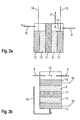
- Fig. 2a shows an exemplary construction of a Electrolysis device 4, in the inventive System 1 can be used.
- the electrolyzer 4 comprises electrodes 9 and 10 which are separated by a membrane 11 from each other. On the Electrodes 9 and 10 are power leads 12 and 13, respectively arranged. The power supply lines 12 and 13 are over the electrically conductive connections 16 with a Voltage supply (not shown) connected.
- the electrode 9 is in the circuit 6, which in this figure not shown, arranged. That at the electrode 9 (Working electrode) resulting gas, for example Hydrogen or oxygen enters the gas stream 14, in the closed circuit 6 by the invention System can be circulated. That at the Counter electrode 10 generated gas can via the gas outlet 15 at the environment submitted or stored.
- the electrodes 9 and 10, are here as catalytic Electrodes, as in preferred embodiments whose materials are chosen so that at the Surface prefer the gas generation or the redox reaction takes place.
- the electrodes may be, for example, palladium, Platinum, iridium, osmium, rhodium, rhenium, ruthenium, nickel or mixtures of these metals, contained or derived therefrom be prepared.
- the electrode has a porous texture on.
- the power supply lines 12 and 13 are for improved electrical power line to the electrodes 9 and 10 respectively arranged.
- the power supplies can, for example Ruthenium, rhodium, palladium, silver, rhenium, osmium, Iridium, platinum, gold, nickel, titanium, carbon, stainless steel or mixtures thereof or produced therefrom or of a less noble metal with a protective layer a nobler metal, for example ruthenium, rhodium, Palladium, Silver, Rhenium, Osmium, Iridium, Platinum, Gold, or electrically conductive metal oxides, such as doped tungsten oxide, tin oxide, zinc oxide, indium oxide or Mixtures thereof be prepared.
- the power supply lines 12 and 13 can already sufficient have catalytic properties.
- the catalytic Electrodes 9 and 10 may, for example, a have sufficient electrical conductivity. Then can the power supply through the electrodes or the Electrodes replaced by the power supplies, i. either the power supplies or the electrodes can be omitted.
- the membrane 11 is the separating element between the Electrodes 9 and 10.
- the membrane 11 may, for example, a Ion-conducting, for example a proton-conducting, Polymer film, such as Nafion® the company Du Pont, Bad Homburg, Germany. But the membrane 11 can also a porous solid filled with electrolyte, be.
- the electrolysis device in the gas supply device 4 for example, be constructed so that the Electrodes 9 and 10 directly on the membrane 11th are applied. Furthermore, the power supply lines 12 and 13 applied directly to the electrodes 9 and 10, respectively be.
- gas channels For removal of the generated hydrogen or Oxygen gases are provided in this case gas channels.
- gas channels For example, between the power supply 12 and the Electrode be provided 9 gas channels. These channels for Discharging the generated gas (gas channels) are shown in Fig. 2a Not shown.
- gas channels are shown in Fig. 2a Not shown.
- gas channels filled with electrolyte.
- gas channels can also predominantly with Gas, i. not be filled with electrolyte. In the latter In this case, only the membrane 11 would be filled with electrolyte.
- Fig. 2b shows an exemplary embodiment in which the electrolysis device is designed in a lying form.
- the reference numerals correspond to those of Fig. 2a.
- the Indian Electrode 9 resulting hydrogen or oxygen is the Gas stream 14, which circulates in the closed circuit 6 can be fed.
- the at the counter electrode 10th resulting gas can through the gas outlet 15, for example for delivery to the environment or for storage in one Memory element to be dissipated.
- With the exception of shortened membrane 11 corresponds to this illustration of the Representation on Fig. 2a.
- Fig. 3 illustrates another embodiment of the Electrolysis in a standing form.
- the electrodes 9 and 10 are respectively on the Power supply 12 and 13 applied.
- the electrodes 9 and 10 are not on the Membrane 11 applied.
- the between the electrodes 9 and 10 is over the membrane 11 extending gap at least partially filled with an electrolyte 17.
- the Membrane 11 serves to separate the electrodes 9 and 10 resulting hydrogen or oxygen gas. Furthermore corresponds to the representation of the representation of Fig. 2a.
- the electrolysis device no gas outlet 15 on the counter electrode side, as in the Fig. 2a, 2b and 3, on.
- This reverse reaction can through the (catalytic) counterelectrode alone or through additional catalysts are accelerated.
- the back reaction is also possible by adding a salt or a solid or a liquid to the electrolyte on the counter electrode side, which is then subjected to a redox reaction upon application of a voltage such that the redox reaction occurs instead of gas generation.
- a salt or a solid or a liquid to the electrolyte on the counter electrode side, which is then subjected to a redox reaction upon application of a voltage such that the redox reaction occurs instead of gas generation.
- the necessary voltage difference between the electrodes is reduced, since now only the voltage difference from the gas generating reaction of hydrogen (or oxygen) on the working electrode side to the redox potential of the salt redox reaction on the counter electrode side
- (Fe 2+ / Fe 3+ ) and not for gas generation of oxygen or hydrogen on the counter electrode side must be provided.
- This voltage difference is less than the voltage difference between hydrogen and oxygen in suitable redox pairs, such as Fe 2+ / Fe 3+ .
- suitable redox pairs such as Fe 2+ / Fe 3+ .
- suitable redox pairs such as Fe 2+ / Fe 3+ .
- suitable redox pairs such as Fe 2+ / Fe 3+ .
- salts are salts with iron, manganese, tin, tungsten, molybdenum, mercury, silver, iodine, copper, bromine, chlorine and bismuth ions or their oxides or complexes thereof and mixtures thereof.
- Electrolyte on the counter electrode side solids the Fe, Mn, Sn, W, Mo, Hg, Ag, J, Cu, Br, Cl, Bi, Co, Ti, Cr, Ni, V ions or their oxides or their complexes or mixtures thereof.
- solids are used as storage element on the Counterelectrode side possible.
- Protons and electrons embedded in the tungsten oxide are produced in the production of oxygen on the working electrode side.
- the protons leave the tungsten oxide, wander through the membrane and form hydrogen gas on the working electrode side.
- Transition metal oxides such as e.g. the oxides of Mo, Ti, V, Cr, Mn, Co, Ni, Ce or mixtures (mixed oxides) thereof.
Landscapes
- Physics & Mathematics (AREA)
- Nonlinear Science (AREA)
- Optics & Photonics (AREA)
- Structural Engineering (AREA)
- Civil Engineering (AREA)
- General Physics & Mathematics (AREA)
- Engineering & Computer Science (AREA)
- Electrolytic Production Of Non-Metals, Compounds, Apparatuses Therefor (AREA)
- Feeding, Discharge, Calcimining, Fusing, And Gas-Generation Devices (AREA)
- Toys (AREA)
- Glass Compositions (AREA)
- Electrochromic Elements, Electrophoresis, Or Variable Reflection Or Absorption Elements (AREA)
- Joining Of Glass To Other Materials (AREA)
Description
- Fig. 1
- zeigt eine schematische Darstellung einer beispielhaften Ausführungsform des erfindungsgemäßen Systems.
- Fig. 2a
- zeigt eine beispielhafte Ausführungsform einer Elektrolyseeinrichtung, die in dem erfindungsgemäßen System verwendet werden kann.
- Fig. 2b
- zeigt eine weitere beispielhafte Ausführungsform einer Elektrolyseeinrichtung, die in dem erfindungsgemäßen System verwendet werden kann.
- Fig. 3
- zeigt eine weitere beispielhafte Ausführungsform einer Elektrolyseeinrichtung, die im erfindungsgemäßen System verwendet werden kann.
Claims (36)
- System zum steuern des Lichttransmission (1) mit einem Verglasungselement (2) und einer Gasversorgungsvorrichtung (4),
wobei
das Verglasungselement (2) wenigstens zwei einen Zwischenraum (3) einschließende Substrate (18, 19) und wenigstens ein in dem Zwischenraum (3) angeordnetes Gas mit definierter Zusammensetzung umfaßt, wobei wenigstens auf einer der dem Zwischenraum (3) zugewandten Flächen eines Substrates (18, 19) eine Beschichtung, deren physikalische Eigenschaften, insbesondere optische und/oder elektrische Eigenschaften, in Abhängigkeit von der Zusammensetzung des Gases änderbar sind, aufgebracht ist,
das Verglasungselement (2) und die Gasversorgungsvorrichtung (4) so miteinander verbunden sind, daß das Gas in einem geschlossenen Kreislauf (6) zwischen Verglasungselement (2) und Gasversorgungsvorrichtung (4) führbar ist, und
in dem System Mittel zur Beeinflussung des Feuchtigkeitsgehaltes des Gases angeordnet sind,
dadurch gekenzeichnet daß die Gasversorgungsvorrichtung (4) wenigstens eine Elektrolyseeinrichtung, enthält die eine Arbeitselektrode (9), eine Gegenelektrode (10) und wenigstens einen Elektrolyten (17) zur Erzeugung von Gas umfaßt. - System nach Anspruch 1,
dadurch gekennzeichnet, daß die Beschichtung wenigstens eine elektrochrome Schicht umfaßt. - System nach Anspruch 2,
dadurch gekennzeichnet, daß die wenigstens eine elektrochrome Schicht Oxide von Übergangsmetallen, insbesondere Wolframoxid, Molybdänoxid, Titanoxid, Chromoxid, Vanadiumoxid, Ceroxid, Iridiumoxid, Manganoxid, Kobaltoxid, Nioboxid, Nickeloxid und/oder Mischungen oder Verbindungen davon, und/oder elektrochrome Polymere umfaßt. - System nach Anspruch 1,
dadurch gekennzeichnet, daß die Beschichtung wenigstens eine Schicht, die schaltbare Metallhydride enthält, umfaßt. - System nach Anspruch 4,
dadurch gekennzeichnet, daß die Schicht, die schaltbare Metallhydride enthält, seltene Erden und/oder Übergangsmetalloxide umfaßt. - System nach Anspruch 4 oder 5,
dadurch gekennzeichnet, daß die schaltbaren Metallhydride aus der Gruppe, die aus La1-zMgzHx, YHx, ZaHx, Gd1-ZMgzHx, NiMgZHx, CoMgZHx, SmHx, Y1-zMgzHx, und Mischungen davon besteht, ausgewählt werden. - System nach einem der vorhergehenden Ansprüche,
dadurch gekennzeichnet daß die Beschichtung Katalysatoren als Beimengung und/oder als separate Schicht umfaßt. - System nach Anspruch 7,
dadurch gekennzeichnet, daß die Katalysatoren Bestandteile aus der Gruppe, die aus Pt, Ir, Pd, Rh, Os, Re, Ni, Ru und Mischungen davon besteht, enthalten. - System nach einem der vorhergehenden Ansprüche,
dadurch gekennzeichnet daß die Erzeugung von Gas mit einer Gaserzeugungsrate erfolgt, die in einem Bereich von 10 ml/min bis 500 ml/min, bevorzugt 20 ml/min bis 200 ml/min, liegt. - System nach einem der vorhergehenden Ansprüche,
dadurch gekennzeichnet daß das in der Gasversorgungseinrichtung (4) erzeugbare Gas mit Inertgas, bevorzugt Stickstoff, Helium, Neon, Argon, Krypton, Xenon oder Mischungen davon, verdünnt werden kann. - System nach Anspruch 10,
dadurch gekennzeichnet, daß die Konzentration des in der Gasversorgungseinrichtung (4) erzeugbaren Gases durch Zuführung von Inertgas auf unter 5 %, bevorzugt unter 3 %, bezogen auf das Gesamtvolumen der Gasmischung, einstellbar ist. - System nach einem der vorhergehenden Ansprüche,
dadurch gekennzeichnet, daß die Elektrolyseeinrichtung Wasserstoff und Sauerstoff aus einem wasserhaltigen Elektrolyten (17) erzeugt, wobei der Wasserstoff und/oder Sauerstoff in das Verglasungselement (2) überführbar ist. - System nach einem der vorhergehenden Ansprüche,
dadurch gekennzeichnet, daß die Elektrolyseeinrichtung umpolbar ist. - System nach einem der vorhergehenden Ansprüche,
dadurch gekennzeichnet, daß in dem Verglasungselement (2) vorhandene oder entstehende Feuchtigkeit in den Elektrolyt (17) der Elektrolyseeinrichtung überführbar ist. - System nach einem der vorhergehenden Ansprüche,
dadurch gekennzeichnet, daß das System ohne Ventile betreibbar ist. - System nach einem der vorhergehenden Ansprüche,
dadurch gekennzeichnet, daß die Mittel zur Beeinflussung des Feuchtigkeitsgehaltes des Gases in der Gasversorgungsvorrichtung (4) angeordnet sind. - System nach einem der vorhergehenden Ansprüche,
dadurch gekennzeichnet, daß der Elektrolyt (17) wenigstens einen Zusatz, der dem Gas Feuchtigkeit entzieht, enthält. - System nach Anspruch 17,
dadurch gekennzeichnet, daß der Zusatz aus der Gruppe ausgewählt wird, die aus Säuren, Laugen, Salze und Mischungen davon besteht. - System nach Anspruch 18,
dadurch gekennzeichnet, daß der Zusatz aus der Gruppe ausgewählt wird, die aus Salzsäure, Schwefelsäure, Phosphorsäure, NaCl, K3PO4, NaOH, KOH und Mischungen davon besteht. - System nach einem der vorhergehenden Ansprüche,
dadurch gekennzeichnet, daß in dem System (4) wenigstens ein Mittel zur Erzeugung eines gerichteten Gasstromes (8, 14) in dem geschlossenen Kreislauf (6), bevorzugt eine Pumpe (5), angeordnet ist. - System nach einem der vorhergehenden Ansprüche,
dadurch gekennzeichnet, daß die Elektroden (9, 10) der Elektrolyseeinrichtung unmittelbar auf einer Membran (11) aufgebracht sind. - System nach Anspruch 21,
dadurch gekennzeichnet, daß die Membran (11) eine ionenleitende Kunststoffolie oder einen mit Elektrolyt (17) gefüllten porösen Feststoff umfaßt. - System nach einem der vorhergehenden Ansprüche,
dadurch gekennzeichnet, daß die Elektroden (9, 10) Ru, Rh, Pd, Re, Os, Ir, Pt, Ni oder Mischungen davon enthalten. - System nach einem der vorhergehenden Ansprüche,
dadurch gekennzeichnet, daß Stromzuführungen (12, 13) in der Elektrolyseeinrichtung, die unmittelbar auf den Elektroden (9, 10) aufgebracht sind, vorgesehen sind. - System nach Anspruch 24,
dadurch gekennzeichnet, daß die Stromzuführungen (12, 13) Kanäle zur Führung von Gas aufweisen. - System nach Anspruch 25,
dadurch gekennzeichnet, daß die Stromzuführungen (12, 13) Ti, C, Ni, Fe, Ru, Rh, Pd, Ag, Re, Os, Ir, Pt, Au, Ni oder Mischungen davon oder unedlere Metalle, die mit einer Schutzschicht aus Ru, Rh, Pd, Ag, Re, Os, Ir, Pt, Au, elektrisch leitenden Metalloxiden, insbesondere dotiertem Wolframoxid, Zinnoxid, Zinkoxid, Indiumoxid oder Mischungen davon, versehen sind, enthalten. - System nach einem der vorhergehenden Ansprüche,
dadurch gekennzeichnet, daß der Elektrolyt (17) auf der Gegenelektrodenseite (10) zusätzliche Redoxpaare, die beim Anlegen einer Spannung an die Elektrolyseeinrichtung (4) einer Redoxreaktion unterliegen, enthält. - System nach Anspruch 27,
dadurch gekennzeichnet, daß im Elektrolyt (17) auf der Gegenelektrodenseite (10) Salze, die Wasserstoff, Sauerstoff, Fe-, Mn-, Sn-, W-, Mo-, Hg-, Ag-, J-, Cu-, Br-, Cl-, Bi-Ionen oder deren Oxide oder deren Komplexe oder Mischungen davon umfassen, gelöst sind. - System nach Anspruch 27,
dadurch gekennzeichnet, daß im Elektrolyt (17) auf der Gegenelektrodenseite (10) Feststoffe, die Fe-, Mn-, Sn-, W-, Mo-, Hg-, Ag-, J-, Cu-, Br-, Cl-, Bi-, Co-, Mn-, Ti-, Cr-, Ni-, V-Ionen oder deren Oxide oder deren Komplexe oder Mischungen davon umfassen, enthalten sind. - System nach Anspruch 27,
dadurch gekennzeichnet, daß im Elektrolyt (17) auf der Gegenelektrodenseite (10) Gase, die Wasserstoff, Sauerstoff, Chlor, Brom, Jod oder Mischungen davon umfassen, enthalten sind. - System nach einem der vorhergehenden Ansprüche,
dadurch gekennzeichnet, daß die Substrate (18, 19) aus Glas oder transparentem Polymermaterial hergestellt sind. - System nach einem der vorhergehenden Ansprüche,
dadurch gekennzeichnet, daß die Gasversorgungsvorrichtung (4) mehrere Elektrolyseeinrichtungen, die in Reihe und/oder parallel miteinander verbunden sind, umfaßt. - System nach einem der vorhergehenden Ansprüche,
dadurch gekennzeichnet, daß das System (1) Mittel zum Erfassen eines oder mehrerer physikalischen Parameters des Verglasungselements und eine Regelungseinheit (7) zum Auswerten des oder der erfaßten Parameter und Einstellen eines vorgegebenen Wertes des physikalischen Parameters umfaßt. - System nach einem der vorhergehenden Ansprüche,
dadurch gekennzeichnet, daß das System (1) Mittel zum Erfassen eines oder mehrerer physikalischer Parameter eines im Gasversorgungssystem oder im Gaskreislauf integrierten Sensorelementes, insbesondere zur Detektion der Gaszusammensetzung, und eine Regelungseinheit, die diesen/diese Parameter bei der Regelung der Elektrolyseeinrichtung berücksichtigt, aufweist. - System nach einem der vorhergehenden Ansprüche,
dadurch gekennzeichnet, daß das System Mittel zur Erfassung von physikalischen Parametern wie Temperatur, Bestrahlungsstärke, Feuchtigkeit, in und/oder an dem System, insbesondere auf der Innen- oder Außenseite des Verglasungselementes (2), und eine Regelungseinheit (7) zum Auswerten der erfaßten Parameter und Regelung des Systems aufweist. - System nach einem der vorhergehenden Ansprüche,
dadurch gekennzeichnet, daß in dem System weitere Feuchtigkeit aufnehmende und/oder speichernde Elemente angeordnet sind.
Applications Claiming Priority (3)
| Application Number | Priority Date | Filing Date | Title |
|---|---|---|---|
| DE10141897A DE10141897C1 (de) | 2001-08-28 | 2001-08-28 | System mit Verglasungselement und Gasversorgungsvorrichtung |
| DE10141897 | 2001-08-28 | ||
| PCT/EP2002/009254 WO2003021344A1 (de) | 2001-08-28 | 2002-08-19 | System mit verglasungselement und gasversorgungsvorrichtung |
Publications (2)
| Publication Number | Publication Date |
|---|---|
| EP1421437A1 EP1421437A1 (de) | 2004-05-26 |
| EP1421437B1 true EP1421437B1 (de) | 2005-01-19 |
Family
ID=7696732
Family Applications (1)
| Application Number | Title | Priority Date | Filing Date |
|---|---|---|---|
| EP02797594A Expired - Lifetime EP1421437B1 (de) | 2001-08-28 | 2002-08-19 | System mit verglasungselement und gasversorgungsvorrichtung |
Country Status (7)
| Country | Link |
|---|---|
| US (1) | US7774997B2 (de) |
| EP (1) | EP1421437B1 (de) |
| JP (1) | JP2005525484A (de) |
| AT (1) | ATE287549T1 (de) |
| CA (1) | CA2456111C (de) |
| DE (2) | DE10141897C1 (de) |
| WO (1) | WO2003021344A1 (de) |
Cited By (1)
| Publication number | Priority date | Publication date | Assignee | Title |
|---|---|---|---|---|
| WO2007065657A1 (de) * | 2005-12-08 | 2007-06-14 | Fraunhofer-Gesellschaft zur Förderung der angewandten Forschung e.V. | Optisch transparentes leichtbauelement |
Families Citing this family (18)
| Publication number | Priority date | Publication date | Assignee | Title |
|---|---|---|---|---|
| DE502005011338D1 (de) | 2004-05-12 | 2011-06-16 | Gig Holding Gmbh | Einrichtung zum kontrollieren der atmosphäre in einem raum |
| ATE386144T1 (de) | 2004-06-01 | 2008-03-15 | Applied Materials Gmbh & Co Kg | Messvorrichtung für die messung des transmissionsgrads einer beschichtung |
| ATE377580T1 (de) | 2004-07-12 | 2007-11-15 | Cardinal Cg Co | Wartungsarme beschichtungen |
| DE102005039838B4 (de) * | 2005-08-23 | 2008-03-13 | Airbus Deutschland Gmbh | Transmissionsgesteuerte Fensterverglasung |
| WO2007121215A1 (en) | 2006-04-11 | 2007-10-25 | Cardinal Cg Company | Photocatalytic coatings having improved low-maintenance properties |
| US20080011599A1 (en) | 2006-07-12 | 2008-01-17 | Brabender Dennis M | Sputtering apparatus including novel target mounting and/or control |
| WO2008144634A2 (en) * | 2007-05-18 | 2008-11-27 | Cabot Corporation | Filling fenestration units |
| DE102007028911A1 (de) * | 2007-06-22 | 2009-01-02 | Solan Gmbh | Vorrichtung zum Druckausgleich für ein Gasvolumen beinhaltende Isolierglaseinheiten |
| CA2664369A1 (en) | 2007-09-14 | 2009-03-19 | Cardinal Cg Company | Low-maintenance coatings, and methods for producing low-maintenance coatings |
| DE102010016919B4 (de) * | 2010-05-12 | 2011-12-01 | Armin Schwab | Isolierbauteil, Verfahren zur Herstellung eines einen Isolierraum aufweisenden Isolierbauteils und Verfahren zur Zustandsüberprüfung der Atmosphäre in einem Isolierraum |
| BE1019558A3 (fr) * | 2010-10-28 | 2012-08-07 | Agc Glass Europe | Panneau de vitrage isolant comprenant au moins un espace interne comprenant une lame d'un gaz isolant. |
| JP5900954B2 (ja) * | 2011-09-30 | 2016-04-06 | 国立研究開発法人産業技術総合研究所 | 反射型調光素子、該反射型調光素子を用いた反射型調光部材、及び、複層ガラス。 |
| DE102011118428A1 (de) * | 2011-11-11 | 2013-05-16 | Luca Marius Meyers | Thermow (thermal window) Fenstersystem, welches durch Regulation der Gaskonzentration im Zwischenraum zweier Fensterscheiben die thermische Wärmeleitfähigkeit des gesamten Systems ändert |
| JP6204206B2 (ja) * | 2014-01-22 | 2017-09-27 | 株式会社アツミテック | 自立型調光システム |
| CN107111202B (zh) * | 2014-12-26 | 2020-05-26 | 国立研究开发法人产业技术综合研究所 | 气致变色调光机构 |
| WO2017188410A1 (ja) * | 2016-04-28 | 2017-11-02 | 国立研究開発法人産業技術総合研究所 | ガスクロミック調光素子及びその製造方法、ガスクロミック調光部材並びに複層ガラス |
| US10247997B2 (en) | 2016-08-16 | 2019-04-02 | Cardinal Cg Company | Switchable hydride smart window and the methods for producing the same |
| US10604442B2 (en) | 2016-11-17 | 2020-03-31 | Cardinal Cg Company | Static-dissipative coating technology |
Family Cites Families (18)
| Publication number | Priority date | Publication date | Assignee | Title |
|---|---|---|---|---|
| US3410770A (en) * | 1966-02-18 | 1968-11-12 | Allis Chalmers Mfg Co | Electrolytic method for producing oxygen and hydrogen |
| US3755128A (en) * | 1970-09-15 | 1973-08-28 | Isotopes Inc | Electrolysis system and method |
| US4093352A (en) * | 1977-03-17 | 1978-06-06 | Pisar Robert J | Window adapted to be flooded with liquid |
| CA1043070A (en) * | 1978-01-24 | 1978-11-28 | Marcel Dube | Double-glazed building panel structure and filling system |
| US5096549A (en) * | 1987-03-08 | 1992-03-17 | Mitsubishi Denki Kabushiki Kaisha | Dehumidifier and method of using |
| US5318108A (en) * | 1988-04-15 | 1994-06-07 | Midwest Research Institute | Gas-controlled dynamic vacuum insulation with gas gate |
| JPH05505038A (ja) * | 1990-03-06 | 1993-07-29 | ザ ダウ ケミカル カンパニー | シールされたエレクトロクロミックデバイス |
| US5139595A (en) * | 1990-07-16 | 1992-08-18 | Taylor Donald M | Gas filling system for glazing panels |
| US5635039A (en) * | 1993-07-13 | 1997-06-03 | Lynntech, Inc. | Membrane with internal passages to permit fluid flow and an electrochemical cell containing the same |
| DE4440572C2 (de) * | 1994-11-14 | 1997-05-07 | Fraunhofer Ges Forschung | Verglasungselement mit variabler Transmission |
| US5575835A (en) * | 1995-08-11 | 1996-11-19 | W. L. Gore & Associates, Inc. | Apparatus for removing moisture from an environment |
| DE19631420B4 (de) * | 1996-08-06 | 2004-03-04 | Fraunhofer-Gesellschaft zur Förderung der angewandten Forschung e.V. | Verglasungselement |
| JP3836158B2 (ja) * | 1997-05-09 | 2006-10-18 | グラスエックス アーゲー | 建物内の透明断熱用装置 |
| DE19824610A1 (de) * | 1998-06-02 | 1999-12-16 | Wolfgang Hagel | Fenstervorrichtung mit variabler Transparenz |
| DE19840186C2 (de) * | 1998-09-03 | 2003-03-13 | Daimler Chrysler Ag | Verbundglasscheibe mit elektrisch steuerbarem Reflexionsgrad |
| US6084702A (en) * | 1998-10-15 | 2000-07-04 | Pleotint, L.L.C. | Thermochromic devices |
| KR20030037176A (ko) * | 2001-11-02 | 2003-05-12 | 주식회사 한국하우톤 | 이중 유리창 장치 |
| US7133181B2 (en) * | 2004-07-23 | 2006-11-07 | Sage Electrochromics, Inc. | Control system for electrochromic devices |
-
2001
- 2001-08-28 DE DE10141897A patent/DE10141897C1/de not_active Expired - Fee Related
-
2002
- 2002-08-19 EP EP02797594A patent/EP1421437B1/de not_active Expired - Lifetime
- 2002-08-19 AT AT02797594T patent/ATE287549T1/de not_active IP Right Cessation
- 2002-08-19 JP JP2003525369A patent/JP2005525484A/ja not_active Withdrawn
- 2002-08-19 US US10/488,122 patent/US7774997B2/en not_active Expired - Fee Related
- 2002-08-19 DE DE50202071T patent/DE50202071D1/de not_active Expired - Lifetime
- 2002-08-19 WO PCT/EP2002/009254 patent/WO2003021344A1/de not_active Ceased
- 2002-08-19 CA CA2456111A patent/CA2456111C/en not_active Expired - Fee Related
Cited By (3)
| Publication number | Priority date | Publication date | Assignee | Title |
|---|---|---|---|---|
| WO2007065657A1 (de) * | 2005-12-08 | 2007-06-14 | Fraunhofer-Gesellschaft zur Förderung der angewandten Forschung e.V. | Optisch transparentes leichtbauelement |
| DE102005058712A1 (de) * | 2005-12-08 | 2007-06-14 | Fraunhofer-Gesellschaft zur Förderung der angewandten Forschung e.V. | Optisch transparentes Leichtbauelement |
| DE102005058712B4 (de) * | 2005-12-08 | 2007-11-08 | Fraunhofer-Gesellschaft zur Förderung der angewandten Forschung e.V. | Optisch transparentes Leichtbauelement |
Also Published As
| Publication number | Publication date |
|---|---|
| DE10141897C1 (de) | 2003-04-17 |
| US20040206024A1 (en) | 2004-10-21 |
| EP1421437A1 (de) | 2004-05-26 |
| CA2456111A1 (en) | 2003-03-13 |
| WO2003021344A1 (de) | 2003-03-13 |
| US7774997B2 (en) | 2010-08-17 |
| JP2005525484A (ja) | 2005-08-25 |
| CA2456111C (en) | 2012-04-10 |
| ATE287549T1 (de) | 2005-02-15 |
| DE50202071D1 (de) | 2005-02-24 |
Similar Documents
| Publication | Publication Date | Title |
|---|---|---|
| DE10141897C1 (de) | System mit Verglasungselement und Gasversorgungsvorrichtung | |
| DE69727551T2 (de) | Gerät für optische Kommunikation | |
| DE2433044C2 (de) | Steuerbare elektrochrome Anzeigevorrichtung mit nichtpolarisierbarer Elektrode | |
| DE69012902T2 (de) | Elektrochrome Verglasung. | |
| DE19840186C2 (de) | Verbundglasscheibe mit elektrisch steuerbarem Reflexionsgrad | |
| DE2739613C2 (de) | Elektrochromatische Anzeigevorrichtung | |
| DE69731454T2 (de) | Elektooptische schaltvorrichtung | |
| DE2744771A1 (de) | Elektrolytische zelle zur bestimmung der konzentration von elektrochemisch aktiven substanzen in einem fluid | |
| DE69319476T2 (de) | Einrichtung zur Regelung der Sauerstoffkonzentration oder der Feuchte | |
| WO1998006000A1 (de) | Elektrochromes verglasungselement | |
| EP0681339B1 (de) | Elektrochemische Zelle | |
| DE112018000011T5 (de) | Elekrolyte für Eisen-Flow-Batterie | |
| EP1227362A1 (de) | Elektrochromes Verbundglas | |
| DE69132341T2 (de) | Elektrochrome Festkörpervorrichtung | |
| DE69016385T2 (de) | Festkörpersensor zur Bestimmung der Konzentration von mit Wasserstoff reaktionsfähigen Gasen. | |
| EP0305961A2 (de) | Elektrochemische Messzelle mit einem sauren Elektrolyten | |
| DE19681487B3 (de) | Elektrochemischer Sensor zum Aufspüren von Stickstoffdioxid | |
| DE2039924C3 (de) | Sauerstoff-Sensor | |
| DE2443037B2 (de) | Elektrochemisches Sauerstoffmeßelement | |
| DE69612531T2 (de) | Elektrochemische Vorrichtung | |
| EP0408039A2 (de) | Grenzstromsensor zum Messen des Partialdrucks eines Gases | |
| DE2101339A1 (de) | Ionenselektive Elektrode | |
| DE4226537C2 (de) | Polarographischer Sensor | |
| Pacheco et al. | Electrodegradation of Azo Dyes Using the Oxide BaPb0. 9Sb0. 1O3-as Anode M aterial | |
| DE3727485A1 (de) | Festkoerper-ableitsystem zur verwendung mit einem ionenselektiven element |
Legal Events
| Date | Code | Title | Description |
|---|---|---|---|
| PUAI | Public reference made under article 153(3) epc to a published international application that has entered the european phase |
Free format text: ORIGINAL CODE: 0009012 |
|
| 17P | Request for examination filed |
Effective date: 20040115 |
|
| AK | Designated contracting states |
Kind code of ref document: A1 Designated state(s): AT BE BG CH CY CZ DE DK EE ES FI FR GB GR IE IT LI LU MC NL PT SE SK TR |
|
| GRAP | Despatch of communication of intention to grant a patent |
Free format text: ORIGINAL CODE: EPIDOSNIGR1 |
|
| RIN1 | Information on inventor provided before grant (corrected) |
Inventor name: ROX, RAINER Inventor name: GRAF, WOLFGANG |
|
| GRAS | Grant fee paid |
Free format text: ORIGINAL CODE: EPIDOSNIGR3 |
|
| GRAA | (expected) grant |
Free format text: ORIGINAL CODE: 0009210 |
|
| AK | Designated contracting states |
Kind code of ref document: B1 Designated state(s): AT BE BG CH CY CZ DE DK EE ES FI FR GB GR IE IT LI LU MC NL PT SE SK TR |
|
| PG25 | Lapsed in a contracting state [announced via postgrant information from national office to epo] |
Ref country code: EE Free format text: LAPSE BECAUSE OF FAILURE TO SUBMIT A TRANSLATION OF THE DESCRIPTION OR TO PAY THE FEE WITHIN THE PRESCRIBED TIME-LIMIT Effective date: 20050119 Ref country code: IE Free format text: LAPSE BECAUSE OF FAILURE TO SUBMIT A TRANSLATION OF THE DESCRIPTION OR TO PAY THE FEE WITHIN THE PRESCRIBED TIME-LIMIT Effective date: 20050119 Ref country code: FI Free format text: LAPSE BECAUSE OF FAILURE TO SUBMIT A TRANSLATION OF THE DESCRIPTION OR TO PAY THE FEE WITHIN THE PRESCRIBED TIME-LIMIT Effective date: 20050119 Ref country code: CZ Free format text: LAPSE BECAUSE OF FAILURE TO SUBMIT A TRANSLATION OF THE DESCRIPTION OR TO PAY THE FEE WITHIN THE PRESCRIBED TIME-LIMIT Effective date: 20050119 Ref country code: BG Free format text: LAPSE BECAUSE OF FAILURE TO SUBMIT A TRANSLATION OF THE DESCRIPTION OR TO PAY THE FEE WITHIN THE PRESCRIBED TIME-LIMIT Effective date: 20050119 Ref country code: TR Free format text: LAPSE BECAUSE OF FAILURE TO SUBMIT A TRANSLATION OF THE DESCRIPTION OR TO PAY THE FEE WITHIN THE PRESCRIBED TIME-LIMIT Effective date: 20050119 Ref country code: NL Free format text: LAPSE BECAUSE OF FAILURE TO SUBMIT A TRANSLATION OF THE DESCRIPTION OR TO PAY THE FEE WITHIN THE PRESCRIBED TIME-LIMIT Effective date: 20050119 Ref country code: SK Free format text: LAPSE BECAUSE OF FAILURE TO SUBMIT A TRANSLATION OF THE DESCRIPTION OR TO PAY THE FEE WITHIN THE PRESCRIBED TIME-LIMIT Effective date: 20050119 |
|
| REG | Reference to a national code |
Ref country code: GB Ref legal event code: FG4D Free format text: NOT ENGLISH |
|
| REG | Reference to a national code |
Ref country code: CH Ref legal event code: NV Representative=s name: ALTHOFF PATENTANWALTSBUERO Ref country code: CH Ref legal event code: EP |
|
| GBT | Gb: translation of ep patent filed (gb section 77(6)(a)/1977) |
Effective date: 20050119 |
|
| REG | Reference to a national code |
Ref country code: IE Ref legal event code: FG4D Free format text: GERMAN |
|
| REF | Corresponds to: |
Ref document number: 50202071 Country of ref document: DE Date of ref document: 20050224 Kind code of ref document: P |
|
| PG25 | Lapsed in a contracting state [announced via postgrant information from national office to epo] |
Ref country code: SE Free format text: LAPSE BECAUSE OF FAILURE TO SUBMIT A TRANSLATION OF THE DESCRIPTION OR TO PAY THE FEE WITHIN THE PRESCRIBED TIME-LIMIT Effective date: 20050419 Ref country code: GR Free format text: LAPSE BECAUSE OF FAILURE TO SUBMIT A TRANSLATION OF THE DESCRIPTION OR TO PAY THE FEE WITHIN THE PRESCRIBED TIME-LIMIT Effective date: 20050419 Ref country code: DK Free format text: LAPSE BECAUSE OF FAILURE TO SUBMIT A TRANSLATION OF THE DESCRIPTION OR TO PAY THE FEE WITHIN THE PRESCRIBED TIME-LIMIT Effective date: 20050419 |
|
| PG25 | Lapsed in a contracting state [announced via postgrant information from national office to epo] |
Ref country code: ES Free format text: LAPSE BECAUSE OF FAILURE TO SUBMIT A TRANSLATION OF THE DESCRIPTION OR TO PAY THE FEE WITHIN THE PRESCRIBED TIME-LIMIT Effective date: 20050430 |
|
| NLV1 | Nl: lapsed or annulled due to failure to fulfill the requirements of art. 29p and 29m of the patents act | ||
| PG25 | Lapsed in a contracting state [announced via postgrant information from national office to epo] |
Ref country code: LU Free format text: LAPSE BECAUSE OF NON-PAYMENT OF DUE FEES Effective date: 20050819 Ref country code: AT Free format text: LAPSE BECAUSE OF NON-PAYMENT OF DUE FEES Effective date: 20050819 Ref country code: CY Free format text: LAPSE BECAUSE OF FAILURE TO SUBMIT A TRANSLATION OF THE DESCRIPTION OR TO PAY THE FEE WITHIN THE PRESCRIBED TIME-LIMIT Effective date: 20050819 |
|
| REG | Reference to a national code |
Ref country code: IE Ref legal event code: FD4D |
|
| PG25 | Lapsed in a contracting state [announced via postgrant information from national office to epo] |
Ref country code: MC Free format text: LAPSE BECAUSE OF NON-PAYMENT OF DUE FEES Effective date: 20050831 Ref country code: BE Free format text: LAPSE BECAUSE OF NON-PAYMENT OF DUE FEES Effective date: 20050831 |
|
| REG | Reference to a national code |
Ref country code: CH Ref legal event code: PUE Owner name: FRAUNHOFER-GESELLSCHAFT ZUR FOERDERUNG DER ANGEWA Free format text: INTERPANE ENTWICKLUNGS- UND BERATUNGSGESELLSCHAFT MBH & CO. KG#SOHNREYSTRASSE 21#D-37697 LAUENFOERDE (DE) -TRANSFER TO- FRAUNHOFER-GESELLSCHAFT ZUR FOERDERUNG DER ANGEWANDTEN FORSCHUNG E.V.#HANSASTRASSE 27C#80686 MUENCHEN (DE) |
|
| PLBE | No opposition filed within time limit |
Free format text: ORIGINAL CODE: 0009261 |
|
| STAA | Information on the status of an ep patent application or granted ep patent |
Free format text: STATUS: NO OPPOSITION FILED WITHIN TIME LIMIT |
|
| REG | Reference to a national code |
Ref country code: GB Ref legal event code: 732E |
|
| ET | Fr: translation filed | ||
| 26N | No opposition filed |
Effective date: 20051020 |
|
| REG | Reference to a national code |
Ref country code: FR Ref legal event code: TP |
|
| BERE | Be: lapsed |
Owner name: INTERPANE ENTWICKLUNGS- UND BERATUNGSGESELLSCHAFT Effective date: 20050831 |
|
| PG25 | Lapsed in a contracting state [announced via postgrant information from national office to epo] |
Ref country code: PT Free format text: LAPSE BECAUSE OF NON-PAYMENT OF DUE FEES Effective date: 20050619 |
|
| PGFP | Annual fee paid to national office [announced via postgrant information from national office to epo] |
Ref country code: CH Payment date: 20130826 Year of fee payment: 12 Ref country code: DE Payment date: 20130823 Year of fee payment: 12 |
|
| PGFP | Annual fee paid to national office [announced via postgrant information from national office to epo] |
Ref country code: GB Payment date: 20130823 Year of fee payment: 12 Ref country code: FR Payment date: 20130820 Year of fee payment: 12 |
|
| PGFP | Annual fee paid to national office [announced via postgrant information from national office to epo] |
Ref country code: IT Payment date: 20130823 Year of fee payment: 12 |
|
| REG | Reference to a national code |
Ref country code: DE Ref legal event code: R119 Ref document number: 50202071 Country of ref document: DE |
|
| REG | Reference to a national code |
Ref country code: CH Ref legal event code: PL |
|
| GBPC | Gb: european patent ceased through non-payment of renewal fee |
Effective date: 20140819 |
|
| PG25 | Lapsed in a contracting state [announced via postgrant information from national office to epo] |
Ref country code: IT Free format text: LAPSE BECAUSE OF NON-PAYMENT OF DUE FEES Effective date: 20140819 Ref country code: CH Free format text: LAPSE BECAUSE OF NON-PAYMENT OF DUE FEES Effective date: 20140831 Ref country code: LI Free format text: LAPSE BECAUSE OF NON-PAYMENT OF DUE FEES Effective date: 20140831 |
|
| REG | Reference to a national code |
Ref country code: DE Ref legal event code: R119 Ref document number: 50202071 Country of ref document: DE Effective date: 20150303 |
|
| REG | Reference to a national code |
Ref country code: FR Ref legal event code: ST Effective date: 20150430 |
|
| PG25 | Lapsed in a contracting state [announced via postgrant information from national office to epo] |
Ref country code: GB Free format text: LAPSE BECAUSE OF NON-PAYMENT OF DUE FEES Effective date: 20140819 Ref country code: DE Free format text: LAPSE BECAUSE OF NON-PAYMENT OF DUE FEES Effective date: 20150303 |
|
| PG25 | Lapsed in a contracting state [announced via postgrant information from national office to epo] |
Ref country code: FR Free format text: LAPSE BECAUSE OF NON-PAYMENT OF DUE FEES Effective date: 20140901 |