EP1381664B1 - Klare weichspüler - Google Patents
Klare weichspüler Download PDFInfo
- Publication number
- EP1381664B1 EP1381664B1 EP02764015A EP02764015A EP1381664B1 EP 1381664 B1 EP1381664 B1 EP 1381664B1 EP 02764015 A EP02764015 A EP 02764015A EP 02764015 A EP02764015 A EP 02764015A EP 1381664 B1 EP1381664 B1 EP 1381664B1
- Authority
- EP
- European Patent Office
- Prior art keywords
- weight
- crude
- acid
- process according
- less
- Prior art date
- Legal status (The legal status is an assumption and is not a legal conclusion. Google has not performed a legal analysis and makes no representation as to the accuracy of the status listed.)
- Expired - Lifetime
Links
- 239000002979 fabric softener Substances 0.000 title claims abstract description 25
- 239000000203 mixture Substances 0.000 claims abstract description 67
- 239000006185 dispersion Substances 0.000 claims abstract description 39
- 239000000839 emulsion Substances 0.000 claims abstract description 36
- 238000000034 method Methods 0.000 claims abstract description 22
- 238000000265 homogenisation Methods 0.000 claims abstract description 17
- 230000003750 conditioning effect Effects 0.000 claims abstract description 8
- 239000004753 textile Substances 0.000 claims abstract description 7
- 230000008569 process Effects 0.000 claims description 18
- 125000000217 alkyl group Chemical group 0.000 claims description 13
- 239000004744 fabric Substances 0.000 claims description 13
- QLAJNZSPVITUCQ-UHFFFAOYSA-N 1,3,2-dioxathietane 2,2-dioxide Chemical compound O=S1(=O)OCO1 QLAJNZSPVITUCQ-UHFFFAOYSA-N 0.000 claims description 12
- 239000003960 organic solvent Substances 0.000 claims description 12
- 239000003381 stabilizer Substances 0.000 claims description 12
- 239000002245 particle Substances 0.000 claims description 9
- 150000002191 fatty alcohols Chemical class 0.000 claims description 8
- 150000003856 quaternary ammonium compounds Chemical class 0.000 claims description 8
- QGZKDVFQNNGYKY-UHFFFAOYSA-O Ammonium Chemical compound [NH4+] QGZKDVFQNNGYKY-UHFFFAOYSA-O 0.000 claims description 7
- 238000007046 ethoxylation reaction Methods 0.000 claims description 6
- 238000005406 washing Methods 0.000 claims description 4
- 125000003368 amide group Chemical group 0.000 claims description 2
- 125000004185 ester group Chemical group 0.000 claims description 2
- 238000009472 formulation Methods 0.000 abstract description 18
- 238000002360 preparation method Methods 0.000 abstract description 10
- 238000004519 manufacturing process Methods 0.000 abstract description 5
- 239000000463 material Substances 0.000 abstract description 2
- -1 alkyl radicals Chemical class 0.000 description 77
- IAYPIBMASNFSPL-UHFFFAOYSA-N Ethylene oxide Chemical compound C1CO1 IAYPIBMASNFSPL-UHFFFAOYSA-N 0.000 description 37
- 239000003795 chemical substances by application Substances 0.000 description 36
- 150000001875 compounds Chemical class 0.000 description 29
- LFQSCWFLJHTTHZ-UHFFFAOYSA-N Ethanol Chemical compound CCO LFQSCWFLJHTTHZ-UHFFFAOYSA-N 0.000 description 26
- 125000004432 carbon atom Chemical group C* 0.000 description 23
- 102000004190 Enzymes Human genes 0.000 description 21
- 108090000790 Enzymes Proteins 0.000 description 21
- 229940088598 enzyme Drugs 0.000 description 21
- XLYOFNOQVPJJNP-UHFFFAOYSA-N water Substances O XLYOFNOQVPJJNP-UHFFFAOYSA-N 0.000 description 19
- LYCAIKOWRPUZTN-UHFFFAOYSA-N ethylene glycol Natural products OCCO LYCAIKOWRPUZTN-UHFFFAOYSA-N 0.000 description 18
- 239000004014 plasticizer Substances 0.000 description 18
- 239000002253 acid Substances 0.000 description 17
- 239000002904 solvent Substances 0.000 description 17
- 235000014113 dietary fatty acids Nutrition 0.000 description 16
- 239000000194 fatty acid Substances 0.000 description 16
- 229930195729 fatty acid Natural products 0.000 description 16
- 230000000845 anti-microbial effect Effects 0.000 description 13
- 150000004665 fatty acids Chemical class 0.000 description 13
- 239000002562 thickening agent Substances 0.000 description 13
- PEDCQBHIVMGVHV-UHFFFAOYSA-N Glycerine Chemical compound OCC(O)CO PEDCQBHIVMGVHV-UHFFFAOYSA-N 0.000 description 12
- 239000007788 liquid Substances 0.000 description 12
- 150000003839 salts Chemical class 0.000 description 12
- RTZKZFJDLAIYFH-UHFFFAOYSA-N Diethyl ether Chemical compound CCOCC RTZKZFJDLAIYFH-UHFFFAOYSA-N 0.000 description 11
- 150000001298 alcohols Chemical class 0.000 description 11
- DNIAPMSPPWPWGF-UHFFFAOYSA-N monopropylene glycol Natural products CC(O)CO DNIAPMSPPWPWGF-UHFFFAOYSA-N 0.000 description 11
- 229920000642 polymer Polymers 0.000 description 11
- VGGSQFUCUMXWEO-UHFFFAOYSA-N Ethene Chemical compound C=C VGGSQFUCUMXWEO-UHFFFAOYSA-N 0.000 description 10
- 239000005977 Ethylene Substances 0.000 description 10
- 239000004599 antimicrobial Substances 0.000 description 10
- 229940123208 Biguanide Drugs 0.000 description 9
- 108091005804 Peptidases Proteins 0.000 description 9
- 239000004365 Protease Substances 0.000 description 9
- 150000007513 acids Chemical class 0.000 description 9
- 239000008139 complexing agent Substances 0.000 description 9
- 229920001577 copolymer Polymers 0.000 description 9
- 229910052757 nitrogen Inorganic materials 0.000 description 9
- 239000002736 nonionic surfactant Substances 0.000 description 9
- 239000000047 product Substances 0.000 description 9
- DBVJJBKOTRCVKF-UHFFFAOYSA-N Etidronic acid Chemical compound OP(=O)(O)C(O)(C)P(O)(O)=O DBVJJBKOTRCVKF-UHFFFAOYSA-N 0.000 description 8
- KFZMGEQAYNKOFK-UHFFFAOYSA-N Isopropanol Chemical compound CC(C)O KFZMGEQAYNKOFK-UHFFFAOYSA-N 0.000 description 8
- 239000000975 dye Substances 0.000 description 8
- 239000003205 fragrance Substances 0.000 description 8
- 239000002304 perfume Substances 0.000 description 8
- 239000004094 surface-active agent Substances 0.000 description 8
- 239000000654 additive Substances 0.000 description 7
- UREZNYTWGJKWBI-UHFFFAOYSA-M benzethonium chloride Chemical compound [Cl-].C1=CC(C(C)(C)CC(C)(C)C)=CC=C1OCCOCC[N+](C)(C)CC1=CC=CC=C1 UREZNYTWGJKWBI-UHFFFAOYSA-M 0.000 description 7
- 239000007844 bleaching agent Substances 0.000 description 7
- WGCNASOHLSPBMP-UHFFFAOYSA-N hydroxyacetaldehyde Natural products OCC=O WGCNASOHLSPBMP-UHFFFAOYSA-N 0.000 description 7
- 230000002366 lipolytic effect Effects 0.000 description 7
- 150000003254 radicals Chemical class 0.000 description 7
- 239000000126 substance Substances 0.000 description 7
- 108010084185 Cellulases Proteins 0.000 description 6
- 102000005575 Cellulases Human genes 0.000 description 6
- 108090001060 Lipase Proteins 0.000 description 6
- 102000004882 Lipase Human genes 0.000 description 6
- 239000004367 Lipase Substances 0.000 description 6
- 102100037486 Reverse transcriptase/ribonuclease H Human genes 0.000 description 6
- 229940027983 antiseptic and disinfectant quaternary ammonium compound Drugs 0.000 description 6
- 125000002091 cationic group Chemical group 0.000 description 6
- 150000002148 esters Chemical class 0.000 description 6
- 235000019421 lipase Nutrition 0.000 description 6
- 235000019419 proteases Nutrition 0.000 description 6
- 108010059892 Cellulase Proteins 0.000 description 5
- 239000006096 absorbing agent Substances 0.000 description 5
- 150000001412 amines Chemical class 0.000 description 5
- 239000003792 electrolyte Substances 0.000 description 5
- 239000003112 inhibitor Substances 0.000 description 5
- 125000002496 methyl group Chemical group [H]C([H])([H])* 0.000 description 5
- BDERNNFJNOPAEC-UHFFFAOYSA-N propan-1-ol Chemical compound CCCO BDERNNFJNOPAEC-UHFFFAOYSA-N 0.000 description 5
- 229960004063 propylene glycol Drugs 0.000 description 5
- 150000003512 tertiary amines Chemical class 0.000 description 5
- OSCJHTSDLYVCQC-UHFFFAOYSA-N 2-ethylhexyl 4-[[4-[4-(tert-butylcarbamoyl)anilino]-6-[4-(2-ethylhexoxycarbonyl)anilino]-1,3,5-triazin-2-yl]amino]benzoate Chemical compound C1=CC(C(=O)OCC(CC)CCCC)=CC=C1NC1=NC(NC=2C=CC(=CC=2)C(=O)NC(C)(C)C)=NC(NC=2C=CC(=CC=2)C(=O)OCC(CC)CCCC)=N1 OSCJHTSDLYVCQC-UHFFFAOYSA-N 0.000 description 4
- 125000000954 2-hydroxyethyl group Chemical group [H]C([*])([H])C([H])([H])O[H] 0.000 description 4
- 108010065511 Amylases Proteins 0.000 description 4
- 102000013142 Amylases Human genes 0.000 description 4
- 244000303965 Cyamopsis psoralioides Species 0.000 description 4
- GLZPCOQZEFWAFX-UHFFFAOYSA-N Geraniol Chemical compound CC(C)=CCCC(C)=CCO GLZPCOQZEFWAFX-UHFFFAOYSA-N 0.000 description 4
- 102000004157 Hydrolases Human genes 0.000 description 4
- 108090000604 Hydrolases Proteins 0.000 description 4
- XEEYBQQBJWHFJM-UHFFFAOYSA-N Iron Chemical compound [Fe] XEEYBQQBJWHFJM-UHFFFAOYSA-N 0.000 description 4
- GOOHAUXETOMSMM-UHFFFAOYSA-N Propylene oxide Chemical compound CC1CO1 GOOHAUXETOMSMM-UHFFFAOYSA-N 0.000 description 4
- 125000001931 aliphatic group Chemical group 0.000 description 4
- 235000019418 amylase Nutrition 0.000 description 4
- XNEFYCZVKIDDMS-UHFFFAOYSA-N avobenzone Chemical compound C1=CC(OC)=CC=C1C(=O)CC(=O)C1=CC=C(C(C)(C)C)C=C1 XNEFYCZVKIDDMS-UHFFFAOYSA-N 0.000 description 4
- 229940106157 cellulase Drugs 0.000 description 4
- YMKDRGPMQRFJGP-UHFFFAOYSA-M cetylpyridinium chloride Chemical compound [Cl-].CCCCCCCCCCCCCCCC[N+]1=CC=CC=C1 YMKDRGPMQRFJGP-UHFFFAOYSA-M 0.000 description 4
- 150000001805 chlorine compounds Chemical class 0.000 description 4
- MTHSVFCYNBDYFN-UHFFFAOYSA-N diethylene glycol Chemical compound OCCOCCO MTHSVFCYNBDYFN-UHFFFAOYSA-N 0.000 description 4
- 230000000694 effects Effects 0.000 description 4
- 150000002170 ethers Chemical class 0.000 description 4
- RRAFCDWBNXTKKO-UHFFFAOYSA-N eugenol Chemical compound COC1=CC(CC=C)=CC=C1O RRAFCDWBNXTKKO-UHFFFAOYSA-N 0.000 description 4
- TWRQCVNFACGORI-UHFFFAOYSA-N hexane;dihydrochloride Chemical compound Cl.Cl.CCCCCC TWRQCVNFACGORI-UHFFFAOYSA-N 0.000 description 4
- 150000002576 ketones Chemical class 0.000 description 4
- 239000003921 oil Substances 0.000 description 4
- YGSDEFSMJLZEOE-UHFFFAOYSA-N salicylic acid Chemical compound OC(=O)C1=CC=CC=C1O YGSDEFSMJLZEOE-UHFFFAOYSA-N 0.000 description 4
- 239000003760 tallow Substances 0.000 description 4
- OAYXUHPQHDHDDZ-UHFFFAOYSA-N 2-(2-butoxyethoxy)ethanol Chemical compound CCCCOCCOCCO OAYXUHPQHDHDDZ-UHFFFAOYSA-N 0.000 description 3
- ZWEHNKRNPOVVGH-UHFFFAOYSA-N 2-Butanone Chemical compound CCC(C)=O ZWEHNKRNPOVVGH-UHFFFAOYSA-N 0.000 description 3
- ZNQVEEAIQZEUHB-UHFFFAOYSA-N 2-ethoxyethanol Chemical compound CCOCCO ZNQVEEAIQZEUHB-UHFFFAOYSA-N 0.000 description 3
- CSCPPACGZOOCGX-UHFFFAOYSA-N Acetone Chemical compound CC(C)=O CSCPPACGZOOCGX-UHFFFAOYSA-N 0.000 description 3
- WEVYAHXRMPXWCK-UHFFFAOYSA-N Acetonitrile Chemical compound CC#N WEVYAHXRMPXWCK-UHFFFAOYSA-N 0.000 description 3
- LZZYPRNAOMGNLH-UHFFFAOYSA-M Cetrimonium bromide Chemical compound [Br-].CCCCCCCCCCCCCCCC[N+](C)(C)C LZZYPRNAOMGNLH-UHFFFAOYSA-M 0.000 description 3
- VEXZGXHMUGYJMC-UHFFFAOYSA-M Chloride anion Chemical compound [Cl-] VEXZGXHMUGYJMC-UHFFFAOYSA-M 0.000 description 3
- KCXVZYZYPLLWCC-UHFFFAOYSA-N EDTA Chemical compound OC(=O)CN(CC(O)=O)CCN(CC(O)=O)CC(O)=O KCXVZYZYPLLWCC-UHFFFAOYSA-N 0.000 description 3
- 241000196324 Embryophyta Species 0.000 description 3
- WSFSSNUMVMOOMR-UHFFFAOYSA-N Formaldehyde Chemical compound O=C WSFSSNUMVMOOMR-UHFFFAOYSA-N 0.000 description 3
- LRHPLDYGYMQRHN-UHFFFAOYSA-N N-Butanol Chemical class CCCCO LRHPLDYGYMQRHN-UHFFFAOYSA-N 0.000 description 3
- SJRJJKPEHAURKC-UHFFFAOYSA-N N-Methylmorpholine Chemical compound CN1CCOCC1 SJRJJKPEHAURKC-UHFFFAOYSA-N 0.000 description 3
- 102000035195 Peptidases Human genes 0.000 description 3
- GSEJCLTVZPLZKY-UHFFFAOYSA-N Triethanolamine Chemical compound OCCN(CCO)CCO GSEJCLTVZPLZKY-UHFFFAOYSA-N 0.000 description 3
- 239000013543 active substance Substances 0.000 description 3
- 150000001299 aldehydes Chemical class 0.000 description 3
- 229910052784 alkaline earth metal Inorganic materials 0.000 description 3
- 150000001450 anions Chemical class 0.000 description 3
- 125000003118 aryl group Chemical group 0.000 description 3
- 150000008366 benzophenones Chemical class 0.000 description 3
- CADWTSSKOVRVJC-UHFFFAOYSA-N benzyl(dimethyl)azanium;chloride Chemical class [Cl-].C[NH+](C)CC1=CC=CC=C1 CADWTSSKOVRVJC-UHFFFAOYSA-N 0.000 description 3
- WQZGKKKJIJFFOK-VFUOTHLCSA-N beta-D-glucose Chemical compound OC[C@H]1O[C@@H](O)[C@H](O)[C@@H](O)[C@@H]1O WQZGKKKJIJFFOK-VFUOTHLCSA-N 0.000 description 3
- LLEMOWNGBBNAJR-UHFFFAOYSA-N biphenyl-2-ol Chemical compound OC1=CC=CC=C1C1=CC=CC=C1 LLEMOWNGBBNAJR-UHFFFAOYSA-N 0.000 description 3
- 150000001767 cationic compounds Chemical class 0.000 description 3
- 229920002678 cellulose Polymers 0.000 description 3
- 235000010980 cellulose Nutrition 0.000 description 3
- 150000005690 diesters Chemical class 0.000 description 3
- 238000009826 distribution Methods 0.000 description 3
- 150000004820 halides Chemical class 0.000 description 3
- OGBDBLQBNVXCJX-UHFFFAOYSA-N hexane tetrahydrochloride Chemical compound Cl.Cl.Cl.Cl.CCCCCC OGBDBLQBNVXCJX-UHFFFAOYSA-N 0.000 description 3
- 125000002887 hydroxy group Chemical group [H]O* 0.000 description 3
- 239000004615 ingredient Substances 0.000 description 3
- WSFSSNUMVMOOMR-NJFSPNSNSA-N methanone Chemical compound O=[14CH2] WSFSSNUMVMOOMR-NJFSPNSNSA-N 0.000 description 3
- 238000002156 mixing Methods 0.000 description 3
- CUQCMXFWIMOWRP-UHFFFAOYSA-N phenyl biguanide Chemical compound NC(N)=NC(N)=NC1=CC=CC=C1 CUQCMXFWIMOWRP-UHFFFAOYSA-N 0.000 description 3
- 239000003755 preservative agent Substances 0.000 description 3
- 230000002829 reductive effect Effects 0.000 description 3
- 229920006395 saturated elastomer Polymers 0.000 description 3
- PUPZLCDOIYMWBV-UHFFFAOYSA-N (+/-)-1,3-Butanediol Chemical compound CC(O)CCO PUPZLCDOIYMWBV-UHFFFAOYSA-N 0.000 description 2
- GQCZPFJGIXHZMB-UHFFFAOYSA-N 1-tert-Butoxy-2-propanol Chemical compound CC(O)COC(C)(C)C GQCZPFJGIXHZMB-UHFFFAOYSA-N 0.000 description 2
- SBASXUCJHJRPEV-UHFFFAOYSA-N 2-(2-methoxyethoxy)ethanol Chemical compound COCCOCCO SBASXUCJHJRPEV-UHFFFAOYSA-N 0.000 description 2
- XNWFRZJHXBZDAG-UHFFFAOYSA-N 2-METHOXYETHANOL Chemical compound COCCO XNWFRZJHXBZDAG-UHFFFAOYSA-N 0.000 description 2
- POAOYUHQDCAZBD-UHFFFAOYSA-N 2-butoxyethanol Chemical compound CCCCOCCO POAOYUHQDCAZBD-UHFFFAOYSA-N 0.000 description 2
- SVTBMSDMJJWYQN-UHFFFAOYSA-N 2-methylpentane-2,4-diol Chemical compound CC(O)CC(C)(C)O SVTBMSDMJJWYQN-UHFFFAOYSA-N 0.000 description 2
- WRMNZCZEMHIOCP-UHFFFAOYSA-N 2-phenylethanol Chemical compound OCCC1=CC=CC=C1 WRMNZCZEMHIOCP-UHFFFAOYSA-N 0.000 description 2
- MFKRHJVUCZRDTF-UHFFFAOYSA-N 3-methoxy-3-methylbutan-1-ol Chemical compound COC(C)(C)CCO MFKRHJVUCZRDTF-UHFFFAOYSA-N 0.000 description 2
- QGZKDVFQNNGYKY-UHFFFAOYSA-N Ammonia Chemical compound N QGZKDVFQNNGYKY-UHFFFAOYSA-N 0.000 description 2
- 239000004382 Amylase Substances 0.000 description 2
- ZCTQGTTXIYCGGC-UHFFFAOYSA-N Benzyl salicylate Chemical compound OC1=CC=CC=C1C(=O)OCC1=CC=CC=C1 ZCTQGTTXIYCGGC-UHFFFAOYSA-N 0.000 description 2
- UYWQUFXKFGHYNT-UHFFFAOYSA-N Benzylformate Chemical compound O=COCC1=CC=CC=C1 UYWQUFXKFGHYNT-UHFFFAOYSA-N 0.000 description 2
- NPBVQXIMTZKSBA-UHFFFAOYSA-N Chavibetol Natural products COC1=CC=C(CC=C)C=C1O NPBVQXIMTZKSBA-UHFFFAOYSA-N 0.000 description 2
- GHXZTYHSJHQHIJ-UHFFFAOYSA-N Chlorhexidine Chemical compound C=1C=C(Cl)C=CC=1NC(N)=NC(N)=NCCCCCCN=C(N)N=C(N)NC1=CC=C(Cl)C=C1 GHXZTYHSJHQHIJ-UHFFFAOYSA-N 0.000 description 2
- KRKNYBCHXYNGOX-UHFFFAOYSA-K Citrate Chemical compound [O-]C(=O)CC(O)(CC([O-])=O)C([O-])=O KRKNYBCHXYNGOX-UHFFFAOYSA-K 0.000 description 2
- 244000060011 Cocos nucifera Species 0.000 description 2
- 235000013162 Cocos nucifera Nutrition 0.000 description 2
- RGHNJXZEOKUKBD-SQOUGZDYSA-N D-gluconic acid Chemical compound OC[C@@H](O)[C@@H](O)[C@H](O)[C@@H](O)C(O)=O RGHNJXZEOKUKBD-SQOUGZDYSA-N 0.000 description 2
- SRBFZHDQGSBBOR-IOVATXLUSA-N D-xylopyranose Chemical compound O[C@@H]1COC(O)[C@H](O)[C@H]1O SRBFZHDQGSBBOR-IOVATXLUSA-N 0.000 description 2
- RUPBZQFQVRMKDG-UHFFFAOYSA-M Didecyldimethylammonium chloride Chemical compound [Cl-].CCCCCCCCCC[N+](C)(C)CCCCCCCCCC RUPBZQFQVRMKDG-UHFFFAOYSA-M 0.000 description 2
- 229940120146 EDTMP Drugs 0.000 description 2
- 239000005770 Eugenol Substances 0.000 description 2
- IAJILQKETJEXLJ-UHFFFAOYSA-N Galacturonsaeure Natural products O=CC(O)C(O)C(O)C(O)C(O)=O IAJILQKETJEXLJ-UHFFFAOYSA-N 0.000 description 2
- 239000005792 Geraniol Substances 0.000 description 2
- GLZPCOQZEFWAFX-YFHOEESVSA-N Geraniol Natural products CC(C)=CCC\C(C)=C/CO GLZPCOQZEFWAFX-YFHOEESVSA-N 0.000 description 2
- WQZGKKKJIJFFOK-GASJEMHNSA-N Glucose Natural products OC[C@H]1OC(O)[C@H](O)[C@@H](O)[C@@H]1O WQZGKKKJIJFFOK-GASJEMHNSA-N 0.000 description 2
- DHMQDGOQFOQNFH-UHFFFAOYSA-N Glycine Chemical compound NCC(O)=O DHMQDGOQFOQNFH-UHFFFAOYSA-N 0.000 description 2
- AEMRFAOFKBGASW-UHFFFAOYSA-N Glycolic acid Chemical compound OCC(O)=O AEMRFAOFKBGASW-UHFFFAOYSA-N 0.000 description 2
- BTJXBZZBBNNTOV-UHFFFAOYSA-N Linalyl benzoate Chemical compound CC(C)=CCCC(C)(C=C)OC(=O)C1=CC=CC=C1 BTJXBZZBBNNTOV-UHFFFAOYSA-N 0.000 description 2
- SECXISVLQFMRJM-UHFFFAOYSA-N N-Methylpyrrolidone Chemical compound CN1CCCC1=O SECXISVLQFMRJM-UHFFFAOYSA-N 0.000 description 2
- WHNWPMSKXPGLAX-UHFFFAOYSA-N N-Vinyl-2-pyrrolidone Chemical compound C=CN1CCCC1=O WHNWPMSKXPGLAX-UHFFFAOYSA-N 0.000 description 2
- ISWSIDIOOBJBQZ-UHFFFAOYSA-N Phenol Chemical compound OC1=CC=CC=C1 ISWSIDIOOBJBQZ-UHFFFAOYSA-N 0.000 description 2
- 239000004952 Polyamide Substances 0.000 description 2
- 229920000388 Polyphosphate Polymers 0.000 description 2
- 229920000289 Polyquaternium Polymers 0.000 description 2
- ATUOYWHBWRKTHZ-UHFFFAOYSA-N Propane Chemical compound CCC ATUOYWHBWRKTHZ-UHFFFAOYSA-N 0.000 description 2
- UVMRYBDEERADNV-UHFFFAOYSA-N Pseudoeugenol Natural products COC1=CC(C(C)=C)=CC=C1O UVMRYBDEERADNV-UHFFFAOYSA-N 0.000 description 2
- JUJWROOIHBZHMG-UHFFFAOYSA-N Pyridine Chemical compound C1=CC=NC=C1 JUJWROOIHBZHMG-UHFFFAOYSA-N 0.000 description 2
- FAPWRFPIFSIZLT-UHFFFAOYSA-M Sodium chloride Chemical compound [Na+].[Cl-] FAPWRFPIFSIZLT-UHFFFAOYSA-M 0.000 description 2
- 229920002125 Sokalan® Polymers 0.000 description 2
- DKGAVHZHDRPRBM-UHFFFAOYSA-N Tert-Butanol Chemical compound CC(C)(C)O DKGAVHZHDRPRBM-UHFFFAOYSA-N 0.000 description 2
- XSQUKJJJFZCRTK-UHFFFAOYSA-N Urea Chemical compound NC(N)=O XSQUKJJJFZCRTK-UHFFFAOYSA-N 0.000 description 2
- 239000004480 active ingredient Substances 0.000 description 2
- 150000001342 alkaline earth metals Chemical class 0.000 description 2
- 150000004703 alkoxides Chemical class 0.000 description 2
- 108090000637 alpha-Amylases Proteins 0.000 description 2
- 229940025131 amylases Drugs 0.000 description 2
- 239000003945 anionic surfactant Substances 0.000 description 2
- 150000005840 aryl radicals Chemical class 0.000 description 2
- QVGXLLKOCUKJST-UHFFFAOYSA-N atomic oxygen Chemical compound [O] QVGXLLKOCUKJST-UHFFFAOYSA-N 0.000 description 2
- 229960001716 benzalkonium Drugs 0.000 description 2
- SRSXLGNVWSONIS-UHFFFAOYSA-N benzenesulfonic acid Chemical compound OS(=O)(=O)C1=CC=CC=C1 SRSXLGNVWSONIS-UHFFFAOYSA-N 0.000 description 2
- 229940092714 benzenesulfonic acid Drugs 0.000 description 2
- WPYMKLBDIGXBTP-UHFFFAOYSA-N benzoic acid Chemical compound OC(=O)C1=CC=CC=C1 WPYMKLBDIGXBTP-UHFFFAOYSA-N 0.000 description 2
- QUKGYYKBILRGFE-UHFFFAOYSA-N benzyl acetate Chemical compound CC(=O)OCC1=CC=CC=C1 QUKGYYKBILRGFE-UHFFFAOYSA-N 0.000 description 2
- 229920001222 biopolymer Polymers 0.000 description 2
- 235000010290 biphenyl Nutrition 0.000 description 2
- RYYVLZVUVIJVGH-UHFFFAOYSA-N caffeine Chemical compound CN1C(=O)N(C)C(=O)C2=C1N=CN2C RYYVLZVUVIJVGH-UHFFFAOYSA-N 0.000 description 2
- 229910052799 carbon Inorganic materials 0.000 description 2
- 239000000969 carrier Substances 0.000 description 2
- 229920006317 cationic polymer Polymers 0.000 description 2
- 239000001913 cellulose Substances 0.000 description 2
- NEHMKBQYUWJMIP-UHFFFAOYSA-N chloromethane Chemical compound ClC NEHMKBQYUWJMIP-UHFFFAOYSA-N 0.000 description 2
- WBYWAXJHAXSJNI-UHFFFAOYSA-N cinnamic acid Chemical class OC(=O)C=CC1=CC=CC=C1 WBYWAXJHAXSJNI-UHFFFAOYSA-N 0.000 description 2
- NEHNMFOYXAPHSD-UHFFFAOYSA-N citronellal Chemical compound O=CCC(C)CCC=C(C)C NEHNMFOYXAPHSD-UHFFFAOYSA-N 0.000 description 2
- QMVPMAAFGQKVCJ-UHFFFAOYSA-N citronellol Chemical compound OCCC(C)CCC=C(C)C QMVPMAAFGQKVCJ-UHFFFAOYSA-N 0.000 description 2
- 238000004140 cleaning Methods 0.000 description 2
- 230000000052 comparative effect Effects 0.000 description 2
- 230000000536 complexating effect Effects 0.000 description 2
- 239000008406 cosmetic ingredient Substances 0.000 description 2
- 239000006184 cosolvent Substances 0.000 description 2
- 230000006378 damage Effects 0.000 description 2
- UMGXUWVIJIQANV-UHFFFAOYSA-M didecyl(dimethyl)azanium;bromide Chemical compound [Br-].CCCCCCCCCC[N+](C)(C)CCCCCCCCCC UMGXUWVIJIQANV-UHFFFAOYSA-M 0.000 description 2
- XXJWXESWEXIICW-UHFFFAOYSA-N diethylene glycol monoethyl ether Chemical compound CCOCCOCCO XXJWXESWEXIICW-UHFFFAOYSA-N 0.000 description 2
- VAYGXNSJCAHWJZ-UHFFFAOYSA-N dimethyl sulfate Chemical compound COS(=O)(=O)OC VAYGXNSJCAHWJZ-UHFFFAOYSA-N 0.000 description 2
- ZUOUZKKEUPVFJK-UHFFFAOYSA-N diphenyl Chemical compound C1=CC=CC=C1C1=CC=CC=C1 ZUOUZKKEUPVFJK-UHFFFAOYSA-N 0.000 description 2
- 238000002296 dynamic light scattering Methods 0.000 description 2
- 239000003995 emulsifying agent Substances 0.000 description 2
- 230000007613 environmental effect Effects 0.000 description 2
- 229960002217 eugenol Drugs 0.000 description 2
- 235000019387 fatty acid methyl ester Nutrition 0.000 description 2
- 239000000835 fiber Substances 0.000 description 2
- 239000000417 fungicide Substances 0.000 description 2
- 229940113087 geraniol Drugs 0.000 description 2
- 239000008103 glucose Substances 0.000 description 2
- 150000004676 glycans Chemical class 0.000 description 2
- KWIUHFFTVRNATP-UHFFFAOYSA-N glycine betaine Chemical compound C[N+](C)(C)CC([O-])=O KWIUHFFTVRNATP-UHFFFAOYSA-N 0.000 description 2
- 125000003147 glycosyl group Chemical group 0.000 description 2
- 150000002357 guanidines Chemical class 0.000 description 2
- 229930195733 hydrocarbon Natural products 0.000 description 2
- 150000002430 hydrocarbons Chemical class 0.000 description 2
- 229910052739 hydrogen Inorganic materials 0.000 description 2
- 239000003752 hydrotrope Substances 0.000 description 2
- 125000002768 hydroxyalkyl group Chemical group 0.000 description 2
- 230000002401 inhibitory effect Effects 0.000 description 2
- XMGQYMWWDOXHJM-UHFFFAOYSA-N limonene Chemical compound CC(=C)C1CCC(C)=CC1 XMGQYMWWDOXHJM-UHFFFAOYSA-N 0.000 description 2
- CDOSHBSSFJOMGT-UHFFFAOYSA-N linalool Chemical compound CC(C)=CCCC(C)(O)C=C CDOSHBSSFJOMGT-UHFFFAOYSA-N 0.000 description 2
- UWKAYLJWKGQEPM-LBPRGKRZSA-N linalyl acetate Chemical compound CC(C)=CCC[C@](C)(C=C)OC(C)=O UWKAYLJWKGQEPM-LBPRGKRZSA-N 0.000 description 2
- BDAGIHXWWSANSR-UHFFFAOYSA-N methanoic acid Natural products OC=O BDAGIHXWWSANSR-UHFFFAOYSA-N 0.000 description 2
- 230000000813 microbial effect Effects 0.000 description 2
- 229920005615 natural polymer Polymers 0.000 description 2
- 150000007524 organic acids Chemical class 0.000 description 2
- 229910052760 oxygen Inorganic materials 0.000 description 2
- 239000001301 oxygen Substances 0.000 description 2
- FJKROLUGYXJWQN-UHFFFAOYSA-N papa-hydroxy-benzoic acid Natural products OC(=O)C1=CC=C(O)C=C1 FJKROLUGYXJWQN-UHFFFAOYSA-N 0.000 description 2
- 150000004965 peroxy acids Chemical class 0.000 description 2
- MDHYEMXUFSJLGV-UHFFFAOYSA-N phenethyl acetate Chemical compound CC(=O)OCCC1=CC=CC=C1 MDHYEMXUFSJLGV-UHFFFAOYSA-N 0.000 description 2
- 150000002989 phenols Chemical class 0.000 description 2
- NBIIXXVUZAFLBC-UHFFFAOYSA-K phosphate Chemical compound [O-]P([O-])([O-])=O NBIIXXVUZAFLBC-UHFFFAOYSA-K 0.000 description 2
- 229940085991 phosphate ion Drugs 0.000 description 2
- 229920000435 poly(dimethylsiloxane) Polymers 0.000 description 2
- 229920002647 polyamide Polymers 0.000 description 2
- 229920001223 polyethylene glycol Polymers 0.000 description 2
- 229920000151 polyglycol Polymers 0.000 description 2
- 239000010695 polyglycol Substances 0.000 description 2
- 229920005862 polyol Polymers 0.000 description 2
- 239000001205 polyphosphate Substances 0.000 description 2
- 235000011176 polyphosphates Nutrition 0.000 description 2
- 229920001282 polysaccharide Polymers 0.000 description 2
- 239000005017 polysaccharide Substances 0.000 description 2
- 229920002635 polyurethane Polymers 0.000 description 2
- 239000004814 polyurethane Substances 0.000 description 2
- 230000002028 premature Effects 0.000 description 2
- YPFDHNVEDLHUCE-UHFFFAOYSA-N propane-1,3-diol Chemical compound OCCCO YPFDHNVEDLHUCE-UHFFFAOYSA-N 0.000 description 2
- HNJBEVLQSNELDL-UHFFFAOYSA-N pyrrolidin-2-one Chemical compound O=C1CCCN1 HNJBEVLQSNELDL-UHFFFAOYSA-N 0.000 description 2
- 238000006268 reductive amination reaction Methods 0.000 description 2
- 229960004889 salicylic acid Drugs 0.000 description 2
- 239000007787 solid Substances 0.000 description 2
- 125000006850 spacer group Chemical group 0.000 description 2
- 238000004659 sterilization and disinfection Methods 0.000 description 2
- 238000003756 stirring Methods 0.000 description 2
- 238000003860 storage Methods 0.000 description 2
- 150000003458 sulfonic acid derivatives Chemical class 0.000 description 2
- 229920001059 synthetic polymer Polymers 0.000 description 2
- YAPQBXQYLJRXSA-UHFFFAOYSA-N theobromine Chemical compound CN1C(=O)NC(=O)C2=C1N=CN2C YAPQBXQYLJRXSA-UHFFFAOYSA-N 0.000 description 2
- ZFXYFBGIUFBOJW-UHFFFAOYSA-N theophylline Chemical compound O=C1N(C)C(=O)N(C)C2=C1NC=N2 ZFXYFBGIUFBOJW-UHFFFAOYSA-N 0.000 description 2
- MGSRCZKZVOBKFT-UHFFFAOYSA-N thymol Chemical compound CC(C)C1=CC=C(C)C=C1O MGSRCZKZVOBKFT-UHFFFAOYSA-N 0.000 description 2
- RUVINXPYWBROJD-ONEGZZNKSA-N trans-anethole Chemical compound COC1=CC=C(\C=C\C)C=C1 RUVINXPYWBROJD-ONEGZZNKSA-N 0.000 description 2
- 239000001226 triphosphate Substances 0.000 description 2
- 229920001285 xanthan gum Polymers 0.000 description 2
- HEOCBCNFKCOKBX-RELGSGGGSA-N (1s,2e,4r)-4,7,7-trimethyl-2-[(4-methylphenyl)methylidene]bicyclo[2.2.1]heptan-3-one Chemical compound C1=CC(C)=CC=C1\C=C/1C(=O)[C@]2(C)CC[C@H]\1C2(C)C HEOCBCNFKCOKBX-RELGSGGGSA-N 0.000 description 1
- JNYAEWCLZODPBN-JGWLITMVSA-N (2r,3r,4s)-2-[(1r)-1,2-dihydroxyethyl]oxolane-3,4-diol Chemical compound OC[C@@H](O)[C@H]1OC[C@H](O)[C@H]1O JNYAEWCLZODPBN-JGWLITMVSA-N 0.000 description 1
- OMDQUFIYNPYJFM-XKDAHURESA-N (2r,3r,4s,5r,6s)-2-(hydroxymethyl)-6-[[(2r,3s,4r,5s,6r)-4,5,6-trihydroxy-3-[(2s,3s,4s,5s,6r)-3,4,5-trihydroxy-6-(hydroxymethyl)oxan-2-yl]oxyoxan-2-yl]methoxy]oxane-3,4,5-triol Chemical compound O[C@@H]1[C@@H](O)[C@@H](O)[C@@H](CO)O[C@@H]1OC[C@@H]1[C@@H](O[C@H]2[C@H]([C@@H](O)[C@H](O)[C@@H](CO)O2)O)[C@H](O)[C@H](O)[C@H](O)O1 OMDQUFIYNPYJFM-XKDAHURESA-N 0.000 description 1
- PDHSAQOQVUXZGQ-JKSUJKDBSA-N (2r,3s)-2-(3,4-dihydroxyphenyl)-3-methoxy-3,4-dihydro-2h-chromene-5,7-diol Chemical compound C1([C@H]2OC3=CC(O)=CC(O)=C3C[C@@H]2OC)=CC=C(O)C(O)=C1 PDHSAQOQVUXZGQ-JKSUJKDBSA-N 0.000 description 1
- OIQXFRANQVWXJF-QBFSEMIESA-N (2z)-2-benzylidene-4,7,7-trimethylbicyclo[2.2.1]heptan-3-one Chemical compound CC1(C)C2CCC1(C)C(=O)\C2=C/C1=CC=CC=C1 OIQXFRANQVWXJF-QBFSEMIESA-N 0.000 description 1
- 239000001490 (3R)-3,7-dimethylocta-1,6-dien-3-ol Substances 0.000 description 1
- AALXZHPCKJILAZ-UHFFFAOYSA-N (4-propan-2-ylphenyl)methyl 2-hydroxybenzoate Chemical compound C1=CC(C(C)C)=CC=C1COC(=O)C1=CC=CC=C1O AALXZHPCKJILAZ-UHFFFAOYSA-N 0.000 description 1
- WEFHSZAZNMEWKJ-KEDVMYETSA-N (6Z,8E)-undeca-6,8,10-trien-2-one (6E,8E)-undeca-6,8,10-trien-2-one (6Z,8E)-undeca-6,8,10-trien-3-one (6E,8E)-undeca-6,8,10-trien-3-one (6Z,8E)-undeca-6,8,10-trien-4-one (6E,8E)-undeca-6,8,10-trien-4-one Chemical compound CCCC(=O)C\C=C\C=C\C=C.CCCC(=O)C\C=C/C=C/C=C.CCC(=O)CC\C=C\C=C\C=C.CCC(=O)CC\C=C/C=C/C=C.CC(=O)CCC\C=C\C=C\C=C.CC(=O)CCC\C=C/C=C/C=C WEFHSZAZNMEWKJ-KEDVMYETSA-N 0.000 description 1
- ALSTYHKOOCGGFT-KTKRTIGZSA-N (9Z)-octadecen-1-ol Chemical compound CCCCCCCC\C=C/CCCCCCCCO ALSTYHKOOCGGFT-KTKRTIGZSA-N 0.000 description 1
- 125000004178 (C1-C4) alkyl group Chemical group 0.000 description 1
- AFDXODALSZRGIH-QPJJXVBHSA-N (E)-3-(4-methoxyphenyl)prop-2-enoic acid Chemical compound COC1=CC=C(\C=C\C(O)=O)C=C1 AFDXODALSZRGIH-QPJJXVBHSA-N 0.000 description 1
- QMVPMAAFGQKVCJ-SNVBAGLBSA-N (R)-(+)-citronellol Natural products OCC[C@H](C)CCC=C(C)C QMVPMAAFGQKVCJ-SNVBAGLBSA-N 0.000 description 1
- CDOSHBSSFJOMGT-JTQLQIEISA-N (R)-linalool Natural products CC(C)=CCC[C@@](C)(O)C=C CDOSHBSSFJOMGT-JTQLQIEISA-N 0.000 description 1
- DYLIWHYUXAJDOJ-OWOJBTEDSA-N (e)-4-(6-aminopurin-9-yl)but-2-en-1-ol Chemical compound NC1=NC=NC2=C1N=CN2C\C=C\CO DYLIWHYUXAJDOJ-OWOJBTEDSA-N 0.000 description 1
- 229920003067 (meth)acrylic acid ester copolymer Polymers 0.000 description 1
- YYMCVDNIIFNDJK-XFQWXJFMSA-N (z)-1-(3-fluorophenyl)-n-[(z)-(3-fluorophenyl)methylideneamino]methanimine Chemical compound FC1=CC=CC(\C=N/N=C\C=2C=C(F)C=CC=2)=C1 YYMCVDNIIFNDJK-XFQWXJFMSA-N 0.000 description 1
- WBYWAXJHAXSJNI-VOTSOKGWSA-M .beta-Phenylacrylic acid Natural products [O-]C(=O)\C=C\C1=CC=CC=C1 WBYWAXJHAXSJNI-VOTSOKGWSA-M 0.000 description 1
- NPMRPDRLIHYOBW-UHFFFAOYSA-N 1-(2-butoxyethoxy)propan-2-ol Chemical compound CCCCOCCOCC(C)O NPMRPDRLIHYOBW-UHFFFAOYSA-N 0.000 description 1
- BNHGVULTSGNVIX-UHFFFAOYSA-N 1-(2-ethoxyethoxy)ethanol Chemical compound CCOCCOC(C)O BNHGVULTSGNVIX-UHFFFAOYSA-N 0.000 description 1
- MITNMQMWBBEWFQ-UHFFFAOYSA-N 1-(4-chlorophenyl)-1-(3,4-dichlorophenyl)urea Chemical compound C=1C=C(Cl)C(Cl)=CC=1N(C(=O)N)C1=CC=C(Cl)C=C1 MITNMQMWBBEWFQ-UHFFFAOYSA-N 0.000 description 1
- SQZCAOHYQSOZCE-UHFFFAOYSA-N 1-(diaminomethylidene)-2-(2-methylphenyl)guanidine Chemical compound CC1=CC=CC=C1N=C(N)N=C(N)N SQZCAOHYQSOZCE-UHFFFAOYSA-N 0.000 description 1
- WCIQNYOXLZQQMU-UHFFFAOYSA-N 1-Phenylethyl propanoate Chemical compound CCC(=O)OC(C)C1=CC=CC=C1 WCIQNYOXLZQQMU-UHFFFAOYSA-N 0.000 description 1
- PBLNBZIONSLZBU-UHFFFAOYSA-N 1-bromododecane Chemical compound CCCCCCCCCCCCBr PBLNBZIONSLZBU-UHFFFAOYSA-N 0.000 description 1
- RQRTXGHHWPFDNG-UHFFFAOYSA-N 1-butoxy-1-propoxypropan-1-ol Chemical compound CCCCOC(O)(CC)OCCC RQRTXGHHWPFDNG-UHFFFAOYSA-N 0.000 description 1
- IDQBJILTOGBZCR-UHFFFAOYSA-N 1-butoxypropan-1-ol Chemical compound CCCCOC(O)CC IDQBJILTOGBZCR-UHFFFAOYSA-N 0.000 description 1
- UIEVCEQLNUHDIF-UHFFFAOYSA-N 1-chloro-2,4-dimethylbenzene Chemical group CC1=CC=C(Cl)C(C)=C1 UIEVCEQLNUHDIF-UHFFFAOYSA-N 0.000 description 1
- OSSNTDFYBPYIEC-UHFFFAOYSA-N 1-ethenylimidazole Chemical compound C=CN1C=CN=C1 OSSNTDFYBPYIEC-UHFFFAOYSA-N 0.000 description 1
- JOLQKTGDSGKSKJ-UHFFFAOYSA-N 1-ethoxypropan-2-ol Chemical compound CCOCC(C)O JOLQKTGDSGKSKJ-UHFFFAOYSA-N 0.000 description 1
- ARXJGSRGQADJSQ-UHFFFAOYSA-N 1-methoxypropan-2-ol Chemical compound COCC(C)O ARXJGSRGQADJSQ-UHFFFAOYSA-N 0.000 description 1
- IXPNQXFRVYWDDI-UHFFFAOYSA-N 1-methyl-2,4-dioxo-1,3-diazinane-5-carboximidamide Chemical compound CN1CC(C(N)=N)C(=O)NC1=O IXPNQXFRVYWDDI-UHFFFAOYSA-N 0.000 description 1
- LALVCWMSKLEQMK-UHFFFAOYSA-N 1-phenyl-3-(4-propan-2-ylphenyl)propane-1,3-dione Chemical compound C1=CC(C(C)C)=CC=C1C(=O)CC(=O)C1=CC=CC=C1 LALVCWMSKLEQMK-UHFFFAOYSA-N 0.000 description 1
- FRPZMMHWLSIFAZ-UHFFFAOYSA-N 10-undecenoic acid Chemical compound OC(=O)CCCCCCCCC=C FRPZMMHWLSIFAZ-UHFFFAOYSA-N 0.000 description 1
- OWEGMIWEEQEYGQ-UHFFFAOYSA-N 100676-05-9 Natural products OC1C(O)C(O)C(CO)OC1OCC1C(O)C(O)C(O)C(OC2C(OC(O)C(O)C2O)CO)O1 OWEGMIWEEQEYGQ-UHFFFAOYSA-N 0.000 description 1
- SZWQORDLLFKZQK-UHFFFAOYSA-N 17-[ethyl(2-hydroxyethyl)amino]tritriacontane-16,18-dione Chemical compound CCCCCCCCCCCCCCCC(=O)C(C(=O)CCCCCCCCCCCCCCC)N(CC)CCO SZWQORDLLFKZQK-UHFFFAOYSA-N 0.000 description 1
- MEZZCSHVIGVWFI-UHFFFAOYSA-N 2,2'-Dihydroxy-4-methoxybenzophenone Chemical compound OC1=CC(OC)=CC=C1C(=O)C1=CC=CC=C1O MEZZCSHVIGVWFI-UHFFFAOYSA-N 0.000 description 1
- LRMSQVBRUNSOJL-UHFFFAOYSA-N 2,2,3,3,3-pentafluoropropanoic acid Chemical class OC(=O)C(F)(F)C(F)(F)F LRMSQVBRUNSOJL-UHFFFAOYSA-N 0.000 description 1
- AEQDJSLRWYMAQI-UHFFFAOYSA-N 2,3,9,10-tetramethoxy-6,8,13,13a-tetrahydro-5H-isoquinolino[2,1-b]isoquinoline Chemical compound C1CN2CC(C(=C(OC)C=C3)OC)=C3CC2C2=C1C=C(OC)C(OC)=C2 AEQDJSLRWYMAQI-UHFFFAOYSA-N 0.000 description 1
- FSBGUSGSQKUNCC-UHFFFAOYSA-N 2-(1,3-dioxoisoindol-2-yl)hexaneperoxoic acid Chemical compound C1=CC=C2C(=O)N(C(CCCC)C(=O)OO)C(=O)C2=C1 FSBGUSGSQKUNCC-UHFFFAOYSA-N 0.000 description 1
- GZMAAYIALGURDQ-UHFFFAOYSA-N 2-(2-hexoxyethoxy)ethanol Chemical compound CCCCCCOCCOCCO GZMAAYIALGURDQ-UHFFFAOYSA-N 0.000 description 1
- IEORSVTYLWZQJQ-UHFFFAOYSA-N 2-(2-nonylphenoxy)ethanol Chemical class CCCCCCCCCC1=CC=CC=C1OCCO IEORSVTYLWZQJQ-UHFFFAOYSA-N 0.000 description 1
- ZXIYZDSEASMXPI-UHFFFAOYSA-N 2-(methylamino)ethane-1,1,1-triol Chemical compound CNCC(O)(O)O ZXIYZDSEASMXPI-UHFFFAOYSA-N 0.000 description 1
- FLUWAIIVLCVEKF-UHFFFAOYSA-N 2-Methyl-1-phenyl-2-propanyl acetate Chemical compound CC(=O)OC(C)(C)CC1=CC=CC=C1 FLUWAIIVLCVEKF-UHFFFAOYSA-N 0.000 description 1
- MJTPMXWJHPOWGH-UHFFFAOYSA-N 2-Phenoxyethyl isobutyrate Chemical compound CC(C)C(=O)OCCOC1=CC=CC=C1 MJTPMXWJHPOWGH-UHFFFAOYSA-N 0.000 description 1
- LSZBMXCYIZBZPD-UHFFFAOYSA-N 2-[(1-hydroperoxy-1-oxohexan-2-yl)carbamoyl]benzoic acid Chemical compound CCCCC(C(=O)OO)NC(=O)C1=CC=CC=C1C(O)=O LSZBMXCYIZBZPD-UHFFFAOYSA-N 0.000 description 1
- COBPKKZHLDDMTB-UHFFFAOYSA-N 2-[2-(2-butoxyethoxy)ethoxy]ethanol Chemical compound CCCCOCCOCCOCCO COBPKKZHLDDMTB-UHFFFAOYSA-N 0.000 description 1
- LCZVSXRMYJUNFX-UHFFFAOYSA-N 2-[2-(2-hydroxypropoxy)propoxy]propan-1-ol Chemical compound CC(O)COC(C)COC(C)CO LCZVSXRMYJUNFX-UHFFFAOYSA-N 0.000 description 1
- BYACHAOCSIPLCM-UHFFFAOYSA-N 2-[2-[bis(2-hydroxyethyl)amino]ethyl-(2-hydroxyethyl)amino]ethanol Chemical compound OCCN(CCO)CCN(CCO)CCO BYACHAOCSIPLCM-UHFFFAOYSA-N 0.000 description 1
- URDCARMUOSMFFI-UHFFFAOYSA-N 2-[2-[bis(carboxymethyl)amino]ethyl-(2-hydroxyethyl)amino]acetic acid Chemical compound OCCN(CC(O)=O)CCN(CC(O)=O)CC(O)=O URDCARMUOSMFFI-UHFFFAOYSA-N 0.000 description 1
- YXSJRZBKSLLIOM-UHFFFAOYSA-N 2-[2-[bis(carboxymethyl)amino]ethyl-(carboxymethyl)amino]acetate;tris(2-hydroxyethyl)azanium Chemical compound OCCN(CCO)CCO.OC(=O)CN(CC(O)=O)CCN(CC(O)=O)CC(O)=O YXSJRZBKSLLIOM-UHFFFAOYSA-N 0.000 description 1
- RNMCCPMYXUKHAZ-UHFFFAOYSA-N 2-[3,3-diamino-1,2,2-tris(carboxymethyl)cyclohexyl]acetic acid Chemical compound NC1(N)CCCC(CC(O)=O)(CC(O)=O)C1(CC(O)=O)CC(O)=O RNMCCPMYXUKHAZ-UHFFFAOYSA-N 0.000 description 1
- KAHYBVSIENJMEL-UHFFFAOYSA-N 2-aminoethyl hexadecanoate Chemical compound CCCCCCCCCCCCCCCC(=O)OCCN KAHYBVSIENJMEL-UHFFFAOYSA-N 0.000 description 1
- NCKMMSIFQUPKCK-UHFFFAOYSA-N 2-benzyl-4-chlorophenol Chemical compound OC1=CC=C(Cl)C=C1CC1=CC=CC=C1 NCKMMSIFQUPKCK-UHFFFAOYSA-N 0.000 description 1
- KXTAOXNYQGASTA-UHFFFAOYSA-N 2-benzylidenepropanedioic acid Chemical compound OC(=O)C(C(O)=O)=CC1=CC=CC=C1 KXTAOXNYQGASTA-UHFFFAOYSA-N 0.000 description 1
- DHVLDKHFGIVEIP-UHFFFAOYSA-N 2-bromo-2-(bromomethyl)pentanedinitrile Chemical compound BrCC(Br)(C#N)CCC#N DHVLDKHFGIVEIP-UHFFFAOYSA-N 0.000 description 1
- TYBHZVUFOINFDV-UHFFFAOYSA-N 2-bromo-6-[(3-bromo-5-chloro-2-hydroxyphenyl)methyl]-4-chlorophenol Chemical compound OC1=C(Br)C=C(Cl)C=C1CC1=CC(Cl)=CC(Br)=C1O TYBHZVUFOINFDV-UHFFFAOYSA-N 0.000 description 1
- DKAKITCMBOHHQU-UHFFFAOYSA-N 2-butoxypropan-2-ol Chemical compound CCCCOC(C)(C)O DKAKITCMBOHHQU-UHFFFAOYSA-N 0.000 description 1
- XMVBHZBLHNOQON-UHFFFAOYSA-N 2-butyl-1-octanol Chemical compound CCCCCCC(CO)CCCC XMVBHZBLHNOQON-UHFFFAOYSA-N 0.000 description 1
- JGUMTYWKIBJSTN-UHFFFAOYSA-N 2-ethylhexyl 4-[[4,6-bis[4-(2-ethylhexoxycarbonyl)anilino]-1,3,5-triazin-2-yl]amino]benzoate Chemical compound C1=CC(C(=O)OCC(CC)CCCC)=CC=C1NC1=NC(NC=2C=CC(=CC=2)C(=O)OCC(CC)CCCC)=NC(NC=2C=CC(=CC=2)C(=O)OCC(CC)CCCC)=N1 JGUMTYWKIBJSTN-UHFFFAOYSA-N 0.000 description 1
- NPSJHQMIVNJLNN-UHFFFAOYSA-N 2-ethylhexyl 4-nitrobenzoate Chemical compound CCCCC(CC)COC(=O)C1=CC=C([N+]([O-])=O)C=C1 NPSJHQMIVNJLNN-UHFFFAOYSA-N 0.000 description 1
- 239000004808 2-ethylhexylester Substances 0.000 description 1
- LJHHULVWBAVMNF-UHFFFAOYSA-N 2-ethylpentyl(iodo)carbamic acid Chemical compound CCCC(CC)CN(I)C(O)=O LJHHULVWBAVMNF-UHFFFAOYSA-N 0.000 description 1
- WSSJONWNBBTCMG-UHFFFAOYSA-N 2-hydroxybenzoic acid (3,3,5-trimethylcyclohexyl) ester Chemical compound C1C(C)(C)CC(C)CC1OC(=O)C1=CC=CC=C1O WSSJONWNBBTCMG-UHFFFAOYSA-N 0.000 description 1
- PYTGEDDGSASHSK-UHFFFAOYSA-N 2-iodo-4,5-dihydro-1,3-thiazole Chemical compound IC1=NCCS1 PYTGEDDGSASHSK-UHFFFAOYSA-N 0.000 description 1
- QCDWFXQBSFUVSP-UHFFFAOYSA-N 2-phenoxyethanol Chemical compound OCCOC1=CC=CC=C1 QCDWFXQBSFUVSP-UHFFFAOYSA-N 0.000 description 1
- YEYKMVJDLWJFOA-UHFFFAOYSA-N 2-propoxyethanol Chemical compound CCCOCCO YEYKMVJDLWJFOA-UHFFFAOYSA-N 0.000 description 1
- MFZOUWVHEQAVLP-UHFFFAOYSA-N 3-(10-methylundec-1-enyl)oxolane-2,5-dione Chemical compound CC(C)CCCCCCCC=CC1CC(=O)OC1=O MFZOUWVHEQAVLP-UHFFFAOYSA-N 0.000 description 1
- BUIXEGYUDCDLCD-UHFFFAOYSA-N 3-(2-methylpropoxy)propan-1-ol Chemical compound CC(C)COCCCO BUIXEGYUDCDLCD-UHFFFAOYSA-N 0.000 description 1
- QCAHUFWKIQLBNB-UHFFFAOYSA-N 3-(3-methoxypropoxy)propan-1-ol Chemical group COCCCOCCCO QCAHUFWKIQLBNB-UHFFFAOYSA-N 0.000 description 1
- QQQNPVHFBDPNNA-UHFFFAOYSA-N 3-(3-phenylphenyl)prop-2-enoic acid Chemical compound OC(=O)C=CC1=CC=CC(C=2C=CC=CC=2)=C1 QQQNPVHFBDPNNA-UHFFFAOYSA-N 0.000 description 1
- JRJBVWJSTHECJK-PKNBQFBNSA-N 3-Methyl-4-(2,6,6-trimethyl-2-cyclohexen-1-yl)-3-buten-2-one Chemical compound CC(=O)C(\C)=C\C1C(C)=CCCC1(C)C JRJBVWJSTHECJK-PKNBQFBNSA-N 0.000 description 1
- UWRBFYBQPCJRRL-UHFFFAOYSA-N 3-[bis(carboxymethyl)amino]propanoic acid Chemical compound OC(=O)CCN(CC(O)=O)CC(O)=O UWRBFYBQPCJRRL-UHFFFAOYSA-N 0.000 description 1
- JSGVZVOGOQILFM-UHFFFAOYSA-N 3-methoxy-1-butanol Chemical compound COC(C)CCO JSGVZVOGOQILFM-UHFFFAOYSA-N 0.000 description 1
- XPFCZYUVICHKDS-UHFFFAOYSA-N 3-methylbutane-1,3-diol Chemical compound CC(C)(O)CCO XPFCZYUVICHKDS-UHFFFAOYSA-N 0.000 description 1
- GUUULVAMQJLDSY-UHFFFAOYSA-N 4,5-dihydro-1,2-thiazole Chemical class C1CC=NS1 GUUULVAMQJLDSY-UHFFFAOYSA-N 0.000 description 1
- OSWFIVFLDKOXQC-UHFFFAOYSA-N 4-(3-methoxyphenyl)aniline Chemical compound COC1=CC=CC(C=2C=CC(N)=CC=2)=C1 OSWFIVFLDKOXQC-UHFFFAOYSA-N 0.000 description 1
- MOMKYJPSVWEWPM-UHFFFAOYSA-N 4-(chloromethyl)-2-(4-methylphenyl)-1,3-thiazole Chemical compound C1=CC(C)=CC=C1C1=NC(CCl)=CS1 MOMKYJPSVWEWPM-UHFFFAOYSA-N 0.000 description 1
- UNDXPKDBFOOQFC-UHFFFAOYSA-N 4-[2-nitro-4-(trifluoromethyl)phenyl]morpholine Chemical compound [O-][N+](=O)C1=CC(C(F)(F)F)=CC=C1N1CCOCC1 UNDXPKDBFOOQFC-UHFFFAOYSA-N 0.000 description 1
- 150000005418 4-aminobenzoic acid derivatives Chemical class 0.000 description 1
- CFKMVGJGLGKFKI-UHFFFAOYSA-N 4-chloro-m-cresol Chemical compound CC1=CC(O)=CC=C1Cl CFKMVGJGLGKFKI-UHFFFAOYSA-N 0.000 description 1
- 125000004172 4-methoxyphenyl group Chemical group [H]C1=C([H])C(OC([H])([H])[H])=C([H])C([H])=C1* 0.000 description 1
- MBZRJSQZCBXRGK-UHFFFAOYSA-N 4-tert-Butylcyclohexyl acetate Chemical compound CC(=O)OC1CCC(C(C)(C)C)CC1 MBZRJSQZCBXRGK-UHFFFAOYSA-N 0.000 description 1
- XSVSPKKXQGNHMD-UHFFFAOYSA-N 5-bromo-3-methyl-1,2-thiazole Chemical compound CC=1C=C(Br)SN=1 XSVSPKKXQGNHMD-UHFFFAOYSA-N 0.000 description 1
- UZJGVXSQDRSSHU-UHFFFAOYSA-N 6-(1,3-dioxoisoindol-2-yl)hexaneperoxoic acid Chemical compound C1=CC=C2C(=O)N(CCCCCC(=O)OO)C(=O)C2=C1 UZJGVXSQDRSSHU-UHFFFAOYSA-N 0.000 description 1
- CJIJXIFQYOPWTF-UHFFFAOYSA-N 7-hydroxycoumarin Natural products O1C(=O)C=CC2=CC(O)=CC=C21 CJIJXIFQYOPWTF-UHFFFAOYSA-N 0.000 description 1
- ZCYVEMRRCGMTRW-UHFFFAOYSA-N 7553-56-2 Chemical compound [I] ZCYVEMRRCGMTRW-UHFFFAOYSA-N 0.000 description 1
- GJCOSYZMQJWQCA-UHFFFAOYSA-N 9H-xanthene Chemical compound C1=CC=C2CC3=CC=CC=C3OC2=C1 GJCOSYZMQJWQCA-UHFFFAOYSA-N 0.000 description 1
- 244000215068 Acacia senegal Species 0.000 description 1
- KWOLFJPFCHCOCG-UHFFFAOYSA-N Acetophenone Chemical class CC(=O)C1=CC=CC=C1 KWOLFJPFCHCOCG-UHFFFAOYSA-N 0.000 description 1
- 229920002126 Acrylic acid copolymer Polymers 0.000 description 1
- 229920000178 Acrylic resin Polymers 0.000 description 1
- 239000004925 Acrylic resin Substances 0.000 description 1
- 229920001817 Agar Polymers 0.000 description 1
- GUBGYTABKSRVRQ-XLOQQCSPSA-N Alpha-Lactose Chemical compound O[C@@H]1[C@@H](O)[C@@H](O)[C@@H](CO)O[C@H]1O[C@@H]1[C@@H](CO)O[C@H](O)[C@H](O)[C@H]1O GUBGYTABKSRVRQ-XLOQQCSPSA-N 0.000 description 1
- 241000416162 Astragalus gummifer Species 0.000 description 1
- 241000193422 Bacillus lentus Species 0.000 description 1
- 241000194108 Bacillus licheniformis Species 0.000 description 1
- 244000063299 Bacillus subtilis Species 0.000 description 1
- 235000014469 Bacillus subtilis Nutrition 0.000 description 1
- 108010062877 Bacteriocins Proteins 0.000 description 1
- 239000005711 Benzoic acid Substances 0.000 description 1
- OMPJBNCRMGITSC-UHFFFAOYSA-N Benzoylperoxide Chemical compound C=1C=CC=CC=1C(=O)OOC(=O)C1=CC=CC=C1 OMPJBNCRMGITSC-UHFFFAOYSA-N 0.000 description 1
- LSNNMFCWUKXFEE-UHFFFAOYSA-M Bisulfite Chemical compound OS([O-])=O LSNNMFCWUKXFEE-UHFFFAOYSA-M 0.000 description 1
- 241000717739 Boswellia sacra Species 0.000 description 1
- 0 CC(*)CC(C)NNC Chemical compound CC(*)CC(C)NNC 0.000 description 1
- GAWIXWVDTYZWAW-UHFFFAOYSA-N C[CH]O Chemical group C[CH]O GAWIXWVDTYZWAW-UHFFFAOYSA-N 0.000 description 1
- OYPRJOBELJOOCE-UHFFFAOYSA-N Calcium Chemical compound [Ca] OYPRJOBELJOOCE-UHFFFAOYSA-N 0.000 description 1
- 240000007436 Cananga odorata Species 0.000 description 1
- OKTJSMMVPCPJKN-UHFFFAOYSA-N Carbon Chemical group [C] OKTJSMMVPCPJKN-UHFFFAOYSA-N 0.000 description 1
- 239000004215 Carbon black (E152) Substances 0.000 description 1
- 229920002134 Carboxymethyl cellulose Polymers 0.000 description 1
- 108010008885 Cellulose 1,4-beta-Cellobiosidase Proteins 0.000 description 1
- 240000003538 Chamaemelum nobile Species 0.000 description 1
- 235000007866 Chamaemelum nobile Nutrition 0.000 description 1
- 229920002101 Chitin Polymers 0.000 description 1
- 229920001661 Chitosan Polymers 0.000 description 1
- WBYWAXJHAXSJNI-SREVYHEPSA-N Cinnamic acid Chemical compound OC(=O)\C=C/C1=CC=CC=C1 WBYWAXJHAXSJNI-SREVYHEPSA-N 0.000 description 1
- 244000223760 Cinnamomum zeylanicum Species 0.000 description 1
- 240000008772 Cistus ladanifer Species 0.000 description 1
- 235000005241 Cistus ladanifer Nutrition 0.000 description 1
- WTEVQBCEXWBHNA-UHFFFAOYSA-N Citral Natural products CC(C)=CCCC(C)=CC=O WTEVQBCEXWBHNA-UHFFFAOYSA-N 0.000 description 1
- 241000207199 Citrus Species 0.000 description 1
- 235000008733 Citrus aurantifolia Nutrition 0.000 description 1
- RYGMFSIKBFXOCR-UHFFFAOYSA-N Copper Chemical compound [Cu] RYGMFSIKBFXOCR-UHFFFAOYSA-N 0.000 description 1
- OCUCCJIRFHNWBP-IYEMJOQQSA-L Copper gluconate Chemical class [Cu+2].OC[C@@H](O)[C@@H](O)[C@H](O)[C@@H](O)C([O-])=O.OC[C@@H](O)[C@@H](O)[C@H](O)[C@@H](O)C([O-])=O OCUCCJIRFHNWBP-IYEMJOQQSA-L 0.000 description 1
- 229920000858 Cyclodextrin Polymers 0.000 description 1
- RGHNJXZEOKUKBD-UHFFFAOYSA-N D-gluconic acid Natural products OCC(O)C(O)C(O)C(O)C(O)=O RGHNJXZEOKUKBD-UHFFFAOYSA-N 0.000 description 1
- WQZGKKKJIJFFOK-QTVWNMPRSA-N D-mannopyranose Chemical compound OC[C@H]1OC(O)[C@@H](O)[C@@H](O)[C@@H]1O WQZGKKKJIJFFOK-QTVWNMPRSA-N 0.000 description 1
- QXKAIJAYHKCRRA-BXXZVTAOSA-N D-ribonic acid Chemical compound OC[C@@H](O)[C@@H](O)[C@@H](O)C(O)=O QXKAIJAYHKCRRA-BXXZVTAOSA-N 0.000 description 1
- 229920001353 Dextrin Polymers 0.000 description 1
- 239000004375 Dextrin Substances 0.000 description 1
- QXNVGIXVLWOKEQ-UHFFFAOYSA-N Disodium Chemical compound [Na][Na] QXNVGIXVLWOKEQ-UHFFFAOYSA-N 0.000 description 1
- 239000003109 Disodium ethylene diamine tetraacetate Substances 0.000 description 1
- QZKRHPLGUJDVAR-UHFFFAOYSA-K EDTA trisodium salt Chemical compound [Na+].[Na+].[Na+].OC(=O)CN(CC([O-])=O)CCN(CC([O-])=O)CC([O-])=O QZKRHPLGUJDVAR-UHFFFAOYSA-K 0.000 description 1
- 108090000371 Esterases Proteins 0.000 description 1
- JOYRKODLDBILNP-UHFFFAOYSA-N Ethyl urethane Chemical compound CCOC(N)=O JOYRKODLDBILNP-UHFFFAOYSA-N 0.000 description 1
- 241000116713 Ferula gummosa Species 0.000 description 1
- 239000004863 Frankincense Substances 0.000 description 1
- 229930091371 Fructose Natural products 0.000 description 1
- RFSUNEUAIZKAJO-ARQDHWQXSA-N Fructose Chemical compound OC[C@H]1O[C@](O)(CO)[C@@H](O)[C@@H]1O RFSUNEUAIZKAJO-ARQDHWQXSA-N 0.000 description 1
- 239000005715 Fructose Substances 0.000 description 1
- 241000233866 Fungi Species 0.000 description 1
- DSLZVSRJTYRBFB-UHFFFAOYSA-N Galactaric acid Natural products OC(=O)C(O)C(O)C(O)C(O)C(O)=O DSLZVSRJTYRBFB-UHFFFAOYSA-N 0.000 description 1
- 229920000926 Galactomannan Polymers 0.000 description 1
- 108010010803 Gelatin Proteins 0.000 description 1
- 241000206672 Gelidium Species 0.000 description 1
- 229920002148 Gellan gum Polymers 0.000 description 1
- 239000004471 Glycine Substances 0.000 description 1
- 229920002907 Guar gum Polymers 0.000 description 1
- 229920000084 Gum arabic Polymers 0.000 description 1
- 241001480714 Humicola insolens Species 0.000 description 1
- CPELXLSAUQHCOX-UHFFFAOYSA-N Hydrogen bromide Chemical class Br CPELXLSAUQHCOX-UHFFFAOYSA-N 0.000 description 1
- 229920001479 Hydroxyethyl methyl cellulose Polymers 0.000 description 1
- SHBUUTHKGIVMJT-UHFFFAOYSA-N Hydroxystearate Chemical compound CCCCCCCCCCCCCCCCCC(=O)OO SHBUUTHKGIVMJT-UHFFFAOYSA-N 0.000 description 1
- IMQLKJBTEOYOSI-GPIVLXJGSA-N Inositol-hexakisphosphate Chemical compound OP(O)(=O)O[C@H]1[C@H](OP(O)(O)=O)[C@@H](OP(O)(O)=O)[C@H](OP(O)(O)=O)[C@H](OP(O)(O)=O)[C@@H]1OP(O)(O)=O IMQLKJBTEOYOSI-GPIVLXJGSA-N 0.000 description 1
- 108010028688 Isoamylase Proteins 0.000 description 1
- LPHGQDQBBGAPDZ-UHFFFAOYSA-N Isocaffeine Natural products CN1C(=O)N(C)C(=O)C2=C1N(C)C=N2 LPHGQDQBBGAPDZ-UHFFFAOYSA-N 0.000 description 1
- 235000010254 Jasminum officinale Nutrition 0.000 description 1
- 240000005385 Jasminum sambac Species 0.000 description 1
- 241000721662 Juniperus Species 0.000 description 1
- 239000004869 Labdanum Substances 0.000 description 1
- 108010023244 Lactoperoxidase Proteins 0.000 description 1
- 102000045576 Lactoperoxidases Human genes 0.000 description 1
- GUBGYTABKSRVRQ-QKKXKWKRSA-N Lactose Natural products OC[C@H]1O[C@@H](O[C@H]2[C@H](O)[C@@H](O)C(O)O[C@@H]2CO)[C@H](O)[C@@H](O)[C@H]1O GUBGYTABKSRVRQ-QKKXKWKRSA-N 0.000 description 1
- 229920002011 Lauryl methyl gluceth-10 hydroxypropyl dimonium chloride Polymers 0.000 description 1
- 241000234269 Liliales Species 0.000 description 1
- 229920000161 Locust bean gum Polymers 0.000 description 1
- FYYHWMGAXLPEAU-UHFFFAOYSA-N Magnesium Chemical compound [Mg] FYYHWMGAXLPEAU-UHFFFAOYSA-N 0.000 description 1
- JLVVSXFLKOJNIY-UHFFFAOYSA-N Magnesium ion Chemical compound [Mg+2] JLVVSXFLKOJNIY-UHFFFAOYSA-N 0.000 description 1
- WSMYVTOQOOLQHP-UHFFFAOYSA-N Malondialdehyde Chemical class O=CCC=O WSMYVTOQOOLQHP-UHFFFAOYSA-N 0.000 description 1
- GUBGYTABKSRVRQ-PICCSMPSSA-N Maltose Natural products O[C@@H]1[C@@H](O)[C@H](O)[C@@H](CO)O[C@@H]1O[C@@H]1[C@@H](CO)OC(O)[C@H](O)[C@H]1O GUBGYTABKSRVRQ-PICCSMPSSA-N 0.000 description 1
- 235000007232 Matricaria chamomilla Nutrition 0.000 description 1
- 244000062730 Melissa officinalis Species 0.000 description 1
- 235000010654 Melissa officinalis Nutrition 0.000 description 1
- 235000006679 Mentha X verticillata Nutrition 0.000 description 1
- 235000002899 Mentha suaveolens Nutrition 0.000 description 1
- 235000001636 Mentha x rotundifolia Nutrition 0.000 description 1
- CERQOIWHTDAKMF-UHFFFAOYSA-N Methacrylic acid Chemical compound CC(=C)C(O)=O CERQOIWHTDAKMF-UHFFFAOYSA-N 0.000 description 1
- QWZLBLDNRUUYQI-UHFFFAOYSA-M Methylbenzethonium chloride Chemical compound [Cl-].CC1=CC(C(C)(C)CC(C)(C)C)=CC=C1OCCOCC[N+](C)(C)CC1=CC=CC=C1 QWZLBLDNRUUYQI-UHFFFAOYSA-M 0.000 description 1
- 229920000881 Modified starch Polymers 0.000 description 1
- 108010014251 Muramidase Proteins 0.000 description 1
- 102000016943 Muramidase Human genes 0.000 description 1
- 108010062010 N-Acetylmuramoyl-L-alanine Amidase Proteins 0.000 description 1
- CTQNGGLPUBDAKN-UHFFFAOYSA-N O-Xylene Chemical group CC1=CC=CC=C1C CTQNGGLPUBDAKN-UHFFFAOYSA-N 0.000 description 1
- TTZMPOZCBFTTPR-UHFFFAOYSA-N O=P1OCO1 Chemical compound O=P1OCO1 TTZMPOZCBFTTPR-UHFFFAOYSA-N 0.000 description 1
- YBGZDTIWKVFICR-JLHYYAGUSA-N Octyl 4-methoxycinnamic acid Chemical compound CCCCC(CC)COC(=O)\C=C\C1=CC=C(OC)C=C1 YBGZDTIWKVFICR-JLHYYAGUSA-N 0.000 description 1
- 102000004316 Oxidoreductases Human genes 0.000 description 1
- 108090000854 Oxidoreductases Proteins 0.000 description 1
- QVHMSMOUDQXMRS-UHFFFAOYSA-N PPG n4 Chemical compound CC(O)COC(C)COC(C)COC(C)CO QVHMSMOUDQXMRS-UHFFFAOYSA-N 0.000 description 1
- WYWZRNAHINYAEF-UHFFFAOYSA-N Padimate O Chemical compound CCCCC(CC)COC(=O)C1=CC=C(N(C)C)C=C1 WYWZRNAHINYAEF-UHFFFAOYSA-N 0.000 description 1
- ALQSHHUCVQOPAS-UHFFFAOYSA-N Pentane-1,5-diol Chemical compound OCCCCCO ALQSHHUCVQOPAS-UHFFFAOYSA-N 0.000 description 1
- 108700020962 Peroxidase Proteins 0.000 description 1
- 102000003992 Peroxidases Human genes 0.000 description 1
- IMQLKJBTEOYOSI-UHFFFAOYSA-N Phytic acid Natural products OP(O)(=O)OC1C(OP(O)(O)=O)C(OP(O)(O)=O)C(OP(O)(O)=O)C(OP(O)(O)=O)C1OP(O)(O)=O IMQLKJBTEOYOSI-UHFFFAOYSA-N 0.000 description 1
- 240000008299 Pinus lambertiana Species 0.000 description 1
- 240000002505 Pogostemon cablin Species 0.000 description 1
- 235000011751 Pogostemon cablin Nutrition 0.000 description 1
- 239000004698 Polyethylene Substances 0.000 description 1
- 108010059820 Polygalacturonase Proteins 0.000 description 1
- ZLMJMSJWJFRBEC-UHFFFAOYSA-N Potassium Chemical compound [K] ZLMJMSJWJFRBEC-UHFFFAOYSA-N 0.000 description 1
- 108010009736 Protein Hydrolysates Proteins 0.000 description 1
- 241000220317 Rosa Species 0.000 description 1
- 240000000513 Santalum album Species 0.000 description 1
- 235000008632 Santalum album Nutrition 0.000 description 1
- 239000004115 Sodium Silicate Substances 0.000 description 1
- 229920002472 Starch Polymers 0.000 description 1
- VBIIFPGSPJYLRR-UHFFFAOYSA-M Stearyltrimethylammonium chloride Chemical compound [Cl-].CCCCCCCCCCCCCCCCCC[N+](C)(C)C VBIIFPGSPJYLRR-UHFFFAOYSA-M 0.000 description 1
- QAOWNCQODCNURD-UHFFFAOYSA-L Sulfate Chemical compound [O-]S([O-])(=O)=O QAOWNCQODCNURD-UHFFFAOYSA-L 0.000 description 1
- LSNNMFCWUKXFEE-UHFFFAOYSA-N Sulfurous acid Chemical class OS(O)=O LSNNMFCWUKXFEE-UHFFFAOYSA-N 0.000 description 1
- 235000016639 Syzygium aromaticum Nutrition 0.000 description 1
- 244000223014 Syzygium aromaticum Species 0.000 description 1
- NSOXQYCFHDMMGV-UHFFFAOYSA-N Tetrakis(2-hydroxypropyl)ethylenediamine Chemical compound CC(O)CN(CC(C)O)CCN(CC(C)O)CC(C)O NSOXQYCFHDMMGV-UHFFFAOYSA-N 0.000 description 1
- 239000005844 Thymol Substances 0.000 description 1
- 240000006909 Tilia x europaea Species 0.000 description 1
- 235000011941 Tilia x europaea Nutrition 0.000 description 1
- 229920001615 Tragacanth Polymers 0.000 description 1
- XSTXAVWGXDQKEL-UHFFFAOYSA-N Trichloroethylene Chemical compound ClC=C(Cl)Cl XSTXAVWGXDQKEL-UHFFFAOYSA-N 0.000 description 1
- XEFQLINVKFYRCS-UHFFFAOYSA-N Triclosan Chemical compound OC1=CC(Cl)=CC=C1OC1=CC=C(Cl)C=C1Cl XEFQLINVKFYRCS-UHFFFAOYSA-N 0.000 description 1
- 244000284012 Vetiveria zizanioides Species 0.000 description 1
- 235000007769 Vetiveria zizanioides Nutrition 0.000 description 1
- 229920004482 WACKER® Polymers 0.000 description 1
- LMETVDMCIJNNKH-UHFFFAOYSA-N [(3,7-Dimethyl-6-octenyl)oxy]acetaldehyde Chemical compound CC(C)=CCCC(C)CCOCC=O LMETVDMCIJNNKH-UHFFFAOYSA-N 0.000 description 1
- JLQNGQMMEBGCMK-UHFFFAOYSA-N [N-2]CC(C(CC(O)(O)O)O)[N-2].[K+].[K+].[K+].[K+] Chemical compound [N-2]CC(C(CC(O)(O)O)O)[N-2].[K+].[K+].[K+].[K+] JLQNGQMMEBGCMK-UHFFFAOYSA-N 0.000 description 1
- FENRSEGZMITUEF-ATTCVCFYSA-E [Na+].[Na+].[Na+].[Na+].[Na+].[Na+].[Na+].[Na+].[Na+].OP(=O)([O-])O[C@@H]1[C@@H](OP(=O)([O-])[O-])[C@H](OP(=O)(O)[O-])[C@H](OP(=O)([O-])[O-])[C@H](OP(=O)(O)[O-])[C@H]1OP(=O)([O-])[O-] Chemical compound [Na+].[Na+].[Na+].[Na+].[Na+].[Na+].[Na+].[Na+].[Na+].OP(=O)([O-])O[C@@H]1[C@@H](OP(=O)([O-])[O-])[C@H](OP(=O)(O)[O-])[C@H](OP(=O)([O-])[O-])[C@H](OP(=O)(O)[O-])[C@H]1OP(=O)([O-])[O-] FENRSEGZMITUEF-ATTCVCFYSA-E 0.000 description 1
- YDONNITUKPKTIG-UHFFFAOYSA-N [Nitrilotris(methylene)]trisphosphonic acid Chemical compound OP(O)(=O)CN(CP(O)(O)=O)CP(O)(O)=O YDONNITUKPKTIG-UHFFFAOYSA-N 0.000 description 1
- 235000010489 acacia gum Nutrition 0.000 description 1
- 239000000205 acacia gum Substances 0.000 description 1
- 150000001242 acetic acid derivatives Chemical class 0.000 description 1
- TYVWLCJTWHVKRD-UHFFFAOYSA-N acetylphosphonic acid Chemical compound CC(=O)P(O)(O)=O TYVWLCJTWHVKRD-UHFFFAOYSA-N 0.000 description 1
- 229920006322 acrylamide copolymer Polymers 0.000 description 1
- 150000001252 acrylic acid derivatives Chemical class 0.000 description 1
- NIXOWILDQLNWCW-UHFFFAOYSA-N acrylic acid group Chemical group C(C=C)(=O)O NIXOWILDQLNWCW-UHFFFAOYSA-N 0.000 description 1
- 239000012190 activator Substances 0.000 description 1
- 125000002252 acyl group Chemical group 0.000 description 1
- 230000010933 acylation Effects 0.000 description 1
- 238000005917 acylation reaction Methods 0.000 description 1
- 235000010419 agar Nutrition 0.000 description 1
- 238000005054 agglomeration Methods 0.000 description 1
- 230000002776 aggregation Effects 0.000 description 1
- IAJILQKETJEXLJ-QTBDOELSSA-N aldehydo-D-glucuronic acid Chemical compound O=C[C@H](O)[C@@H](O)[C@H](O)[C@H](O)C(O)=O IAJILQKETJEXLJ-QTBDOELSSA-N 0.000 description 1
- 235000010443 alginic acid Nutrition 0.000 description 1
- 229920000615 alginic acid Polymers 0.000 description 1
- 239000003513 alkali Substances 0.000 description 1
- 229910052783 alkali metal Inorganic materials 0.000 description 1
- 150000001340 alkali metals Chemical class 0.000 description 1
- 125000003342 alkenyl group Chemical group 0.000 description 1
- 150000003973 alkyl amines Chemical class 0.000 description 1
- 125000005210 alkyl ammonium group Chemical group 0.000 description 1
- 150000008055 alkyl aryl sulfonates Chemical class 0.000 description 1
- 239000002168 alkylating agent Substances 0.000 description 1
- 229940100198 alkylating agent Drugs 0.000 description 1
- 230000029936 alkylation Effects 0.000 description 1
- 238000005804 alkylation reaction Methods 0.000 description 1
- 102000004139 alpha-Amylases Human genes 0.000 description 1
- WQZGKKKJIJFFOK-PHYPRBDBSA-N alpha-D-galactose Chemical compound OC[C@H]1O[C@H](O)[C@H](O)[C@@H](O)[C@H]1O WQZGKKKJIJFFOK-PHYPRBDBSA-N 0.000 description 1
- AEMOLEFTQBMNLQ-WAXACMCWSA-N alpha-D-glucuronic acid Chemical compound O[C@H]1O[C@H](C(O)=O)[C@@H](O)[C@H](O)[C@H]1O AEMOLEFTQBMNLQ-WAXACMCWSA-N 0.000 description 1
- QUMXDOLUJCHOAY-UHFFFAOYSA-N alpha-methylbenzyl acetate Natural products CC(=O)OC(C)C1=CC=CC=C1 QUMXDOLUJCHOAY-UHFFFAOYSA-N 0.000 description 1
- WUOACPNHFRMFPN-UHFFFAOYSA-N alpha-terpineol Chemical compound CC1=CCC(C(C)(C)O)CC1 WUOACPNHFRMFPN-UHFFFAOYSA-N 0.000 description 1
- 229910052782 aluminium Inorganic materials 0.000 description 1
- 150000001408 amides Chemical class 0.000 description 1
- 150000001414 amino alcohols Chemical class 0.000 description 1
- 229920013822 aminosilicone Polymers 0.000 description 1
- 229910021529 ammonia Inorganic materials 0.000 description 1
- 239000002280 amphoteric surfactant Substances 0.000 description 1
- 229940011037 anethole Drugs 0.000 description 1
- 125000000129 anionic group Chemical group 0.000 description 1
- 230000000844 anti-bacterial effect Effects 0.000 description 1
- 239000012753 anti-shrinkage agent Substances 0.000 description 1
- 239000003963 antioxidant agent Substances 0.000 description 1
- 229940111121 antirheumatic drug quinolines Drugs 0.000 description 1
- 239000002216 antistatic agent Substances 0.000 description 1
- 239000012736 aqueous medium Substances 0.000 description 1
- 239000003125 aqueous solvent Substances 0.000 description 1
- PYMYPHUHKUWMLA-UHFFFAOYSA-N arabinose Natural products OCC(O)C(O)C(O)C=O PYMYPHUHKUWMLA-UHFFFAOYSA-N 0.000 description 1
- 230000001580 bacterial effect Effects 0.000 description 1
- 239000003899 bactericide agent Substances 0.000 description 1
- 238000010923 batch production Methods 0.000 description 1
- 235000012216 bentonite Nutrition 0.000 description 1
- 229960000686 benzalkonium chloride Drugs 0.000 description 1
- 150000003937 benzamidines Chemical class 0.000 description 1
- 229960003872 benzethonium Drugs 0.000 description 1
- 229960001950 benzethonium chloride Drugs 0.000 description 1
- JBIROUFYLSSYDX-UHFFFAOYSA-M benzododecinium chloride Chemical compound [Cl-].CCCCCCCCCCCC[N+](C)(C)CC1=CC=CC=C1 JBIROUFYLSSYDX-UHFFFAOYSA-M 0.000 description 1
- 235000010233 benzoic acid Nutrition 0.000 description 1
- 229960004365 benzoic acid Drugs 0.000 description 1
- 150000001558 benzoic acid derivatives Chemical class 0.000 description 1
- 239000012965 benzophenone Substances 0.000 description 1
- 150000001565 benzotriazoles Chemical class 0.000 description 1
- UUSQFLGKGQEVCM-UHFFFAOYSA-M benzoxonium chloride Chemical compound [Cl-].CCCCCCCCCCCC[N+](CCO)(CCO)CC1=CC=CC=C1 UUSQFLGKGQEVCM-UHFFFAOYSA-M 0.000 description 1
- 229960001574 benzoxonium chloride Drugs 0.000 description 1
- 235000019400 benzoyl peroxide Nutrition 0.000 description 1
- 229940007550 benzyl acetate Drugs 0.000 description 1
- KCXMKQUNVWSEMD-UHFFFAOYSA-N benzyl chloride Chemical compound ClCC1=CC=CC=C1 KCXMKQUNVWSEMD-UHFFFAOYSA-N 0.000 description 1
- 229940073608 benzyl chloride Drugs 0.000 description 1
- SRBFZHDQGSBBOR-UHFFFAOYSA-N beta-D-Pyranose-Lyxose Natural products OC1COC(O)C(O)C1O SRBFZHDQGSBBOR-UHFFFAOYSA-N 0.000 description 1
- 108010047754 beta-Glucosidase Proteins 0.000 description 1
- 102000006995 beta-Glucosidase Human genes 0.000 description 1
- JGQFVRIQXUFPAH-UHFFFAOYSA-N beta-citronellol Natural products OCCC(C)CCCC(C)=C JGQFVRIQXUFPAH-UHFFFAOYSA-N 0.000 description 1
- GUBGYTABKSRVRQ-QUYVBRFLSA-N beta-maltose Chemical compound OC[C@H]1O[C@H](O[C@H]2[C@H](O)[C@@H](O)[C@H](O)O[C@@H]2CO)[C@H](O)[C@@H](O)[C@@H]1O GUBGYTABKSRVRQ-QUYVBRFLSA-N 0.000 description 1
- 229960003237 betaine Drugs 0.000 description 1
- 239000004305 biphenyl Substances 0.000 description 1
- 125000006267 biphenyl group Chemical group 0.000 description 1
- 238000004061 bleaching Methods 0.000 description 1
- FZJUFJKVIYFBSY-UHFFFAOYSA-N bourgeonal Chemical compound CC(C)(C)C1=CC=C(CCC=O)C=C1 FZJUFJKVIYFBSY-UHFFFAOYSA-N 0.000 description 1
- CDQSJQSWAWPGKG-UHFFFAOYSA-N butane-1,1-diol Chemical compound CCCC(O)O CDQSJQSWAWPGKG-UHFFFAOYSA-N 0.000 description 1
- VJEONQKOZGKCAK-UHFFFAOYSA-N caffeine Natural products CN1C(=O)N(C)C(=O)C2=C1C=CN2C VJEONQKOZGKCAK-UHFFFAOYSA-N 0.000 description 1
- 229960001948 caffeine Drugs 0.000 description 1
- 239000011575 calcium Substances 0.000 description 1
- 239000001201 calcium disodium ethylene diamine tetra-acetate Substances 0.000 description 1
- 235000011188 calcium disodium ethylene diamine tetraacetate Nutrition 0.000 description 1
- 229910001424 calcium ion Inorganic materials 0.000 description 1
- SHWNNYZBHZIQQV-UHFFFAOYSA-L calcium;disodium;2-[2-[bis(carboxylatomethyl)azaniumyl]ethyl-(carboxylatomethyl)azaniumyl]acetate Chemical compound [Na+].[Na+].[Ca+2].[O-]C(=O)C[NH+](CC([O-])=O)CC[NH+](CC([O-])=O)CC([O-])=O SHWNNYZBHZIQQV-UHFFFAOYSA-L 0.000 description 1
- KHAVLLBUVKBTBG-UHFFFAOYSA-N caproleic acid Natural products OC(=O)CCCCCCCC=C KHAVLLBUVKBTBG-UHFFFAOYSA-N 0.000 description 1
- 239000004202 carbamide Substances 0.000 description 1
- 235000010948 carboxy methyl cellulose Nutrition 0.000 description 1
- 239000001768 carboxy methyl cellulose Substances 0.000 description 1
- 150000001733 carboxylic acid esters Chemical class 0.000 description 1
- 239000008112 carboxymethyl-cellulose Substances 0.000 description 1
- 108010085318 carboxymethylcellulase Proteins 0.000 description 1
- 235000010418 carrageenan Nutrition 0.000 description 1
- 239000000679 carrageenan Substances 0.000 description 1
- 229920001525 carrageenan Polymers 0.000 description 1
- 229940113118 carrageenan Drugs 0.000 description 1
- 239000005018 casein Substances 0.000 description 1
- BECPQYXYKAMYBN-UHFFFAOYSA-N casein, tech. Chemical compound NCCCCC(C(O)=O)N=C(O)C(CC(O)=O)N=C(O)C(CCC(O)=N)N=C(O)C(CC(C)C)N=C(O)C(CCC(O)=O)N=C(O)C(CC(O)=O)N=C(O)C(CCC(O)=O)N=C(O)C(C(C)O)N=C(O)C(CCC(O)=N)N=C(O)C(CCC(O)=N)N=C(O)C(CCC(O)=N)N=C(O)C(CCC(O)=O)N=C(O)C(CCC(O)=O)N=C(O)C(COP(O)(O)=O)N=C(O)C(CCC(O)=N)N=C(O)C(N)CC1=CC=CC=C1 BECPQYXYKAMYBN-UHFFFAOYSA-N 0.000 description 1
- 235000021240 caseins Nutrition 0.000 description 1
- 239000004359 castor oil Substances 0.000 description 1
- 235000019438 castor oil Nutrition 0.000 description 1
- 230000015556 catabolic process Effects 0.000 description 1
- 239000003054 catalyst Substances 0.000 description 1
- 239000002752 cationic softener Substances 0.000 description 1
- 150000001768 cations Chemical class 0.000 description 1
- 229920003086 cellulose ether Polymers 0.000 description 1
- 229960000800 cetrimonium bromide Drugs 0.000 description 1
- 229960001927 cetylpyridinium chloride Drugs 0.000 description 1
- WOWHHFRSBJGXCM-UHFFFAOYSA-M cetyltrimethylammonium chloride Chemical compound [Cl-].CCCCCCCCCCCCCCCC[N+](C)(C)C WOWHHFRSBJGXCM-UHFFFAOYSA-M 0.000 description 1
- 239000002738 chelating agent Substances 0.000 description 1
- 238000006243 chemical reaction Methods 0.000 description 1
- 229960003260 chlorhexidine Drugs 0.000 description 1
- NEHMKBQYUWJMIP-NJFSPNSNSA-N chloro(114C)methane Chemical compound [14CH3]Cl NEHMKBQYUWJMIP-NJFSPNSNSA-N 0.000 description 1
- 235000013985 cinnamic acid Nutrition 0.000 description 1
- 229930016911 cinnamic acid Natural products 0.000 description 1
- 150000001851 cinnamic acid derivatives Chemical class 0.000 description 1
- 235000017803 cinnamon Nutrition 0.000 description 1
- 229940043350 citral Drugs 0.000 description 1
- 150000001860 citric acid derivatives Chemical class 0.000 description 1
- 229930003633 citronellal Natural products 0.000 description 1
- 235000000983 citronellal Nutrition 0.000 description 1
- 235000000484 citronellol Nutrition 0.000 description 1
- 235000020971 citrus fruits Nutrition 0.000 description 1
- 239000002734 clay mineral Substances 0.000 description 1
- 239000013065 commercial product Substances 0.000 description 1
- 238000010668 complexation reaction Methods 0.000 description 1
- 238000010924 continuous production Methods 0.000 description 1
- 229910052802 copper Inorganic materials 0.000 description 1
- 239000010949 copper Substances 0.000 description 1
- 230000007797 corrosion Effects 0.000 description 1
- 238000005260 corrosion Methods 0.000 description 1
- 239000002537 cosmetic Substances 0.000 description 1
- 150000001896 cresols Chemical class 0.000 description 1
- 108010005400 cutinase Proteins 0.000 description 1
- 125000004093 cyano group Chemical group *C#N 0.000 description 1
- 229940019836 cyclamen aldehyde Drugs 0.000 description 1
- DIOQZVSQGTUSAI-NJFSPNSNSA-N decane Chemical class CCCCCCCCC[14CH3] DIOQZVSQGTUSAI-NJFSPNSNSA-N 0.000 description 1
- UNWDCFHEVIWFCW-UHFFFAOYSA-N decanediperoxoic acid Chemical compound OOC(=O)CCCCCCCCC(=O)OO UNWDCFHEVIWFCW-UHFFFAOYSA-N 0.000 description 1
- 238000000354 decomposition reaction Methods 0.000 description 1
- 238000006731 degradation reaction Methods 0.000 description 1
- SQIFACVGCPWBQZ-UHFFFAOYSA-N delta-terpineol Natural products CC(C)(O)C1CCC(=C)CC1 SQIFACVGCPWBQZ-UHFFFAOYSA-N 0.000 description 1
- 239000003599 detergent Substances 0.000 description 1
- 230000001627 detrimental effect Effects 0.000 description 1
- 235000019425 dextrin Nutrition 0.000 description 1
- 239000012933 diacyl peroxide Substances 0.000 description 1
- KYQODXQIAJFKPH-UHFFFAOYSA-N diazanium;2-[2-[bis(carboxymethyl)amino]ethyl-(carboxylatomethyl)amino]acetate Chemical compound [NH4+].[NH4+].OC(=O)CN(CC([O-])=O)CCN(CC(O)=O)CC([O-])=O KYQODXQIAJFKPH-UHFFFAOYSA-N 0.000 description 1
- 229960004670 didecyldimethylammonium chloride Drugs 0.000 description 1
- 229940028356 diethylene glycol monobutyl ether Drugs 0.000 description 1
- 229940090960 diethylenetriamine pentamethylene phosphonic acid Drugs 0.000 description 1
- GPLRAVKSCUXZTP-UHFFFAOYSA-N diglycerol Chemical compound OCC(O)COCC(O)CO GPLRAVKSCUXZTP-UHFFFAOYSA-N 0.000 description 1
- 238000007865 diluting Methods 0.000 description 1
- 238000010790 dilution Methods 0.000 description 1
- 239000012895 dilution Substances 0.000 description 1
- 239000000539 dimer Substances 0.000 description 1
- 229940095104 dimethyl benzyl carbinyl acetate Drugs 0.000 description 1
- 235000013870 dimethyl polysiloxane Nutrition 0.000 description 1
- OWMBTIRJFMGPAC-UHFFFAOYSA-N dimethylamino 2-methylprop-2-enoate Chemical compound CN(C)OC(=O)C(C)=C OWMBTIRJFMGPAC-UHFFFAOYSA-N 0.000 description 1
- REZZEXDLIUJMMS-UHFFFAOYSA-M dimethyldioctadecylammonium chloride Chemical compound [Cl-].CCCCCCCCCCCCCCCCCC[N+](C)(C)CCCCCCCCCCCCCCCCCC REZZEXDLIUJMMS-UHFFFAOYSA-M 0.000 description 1
- 150000002009 diols Chemical class 0.000 description 1
- XPPKVPWEQAFLFU-UHFFFAOYSA-J diphosphate(4-) Chemical compound [O-]P([O-])(=O)OP([O-])([O-])=O XPPKVPWEQAFLFU-UHFFFAOYSA-J 0.000 description 1
- 235000011180 diphosphates Nutrition 0.000 description 1
- QLBHNVFOQLIYTH-UHFFFAOYSA-L dipotassium;2-[2-[bis(carboxymethyl)amino]ethyl-(carboxylatomethyl)amino]acetate Chemical compound [K+].[K+].OC(=O)CN(CC([O-])=O)CCN(CC(O)=O)CC([O-])=O QLBHNVFOQLIYTH-UHFFFAOYSA-L 0.000 description 1
- POLCUAVZOMRGSN-UHFFFAOYSA-N dipropyl ether Chemical compound CCCOCCC POLCUAVZOMRGSN-UHFFFAOYSA-N 0.000 description 1
- 238000004851 dishwashing Methods 0.000 description 1
- 235000019820 disodium diphosphate Nutrition 0.000 description 1
- 235000019301 disodium ethylene diamine tetraacetate Nutrition 0.000 description 1
- GYQBBRRVRKFJRG-UHFFFAOYSA-L disodium pyrophosphate Chemical compound [Na+].[Na+].OP([O-])(=O)OP(O)([O-])=O GYQBBRRVRKFJRG-UHFFFAOYSA-L 0.000 description 1
- 229940038485 disodium pyrophosphate Drugs 0.000 description 1
- VTIIJXUACCWYHX-UHFFFAOYSA-L disodium;carboxylatooxy carbonate Chemical compound [Na+].[Na+].[O-]C(=O)OOC([O-])=O VTIIJXUACCWYHX-UHFFFAOYSA-L 0.000 description 1
- 239000002270 dispersing agent Substances 0.000 description 1
- 239000004664 distearyldimethylammonium chloride (DHTDMAC) Substances 0.000 description 1
- LMHUUGBQXBBNIY-UHFFFAOYSA-N dodecane;dihydrochloride Chemical compound Cl.Cl.CCCCCCCCCCCC LMHUUGBQXBBNIY-UHFFFAOYSA-N 0.000 description 1
- ZZVAPPCNIIULIO-UHFFFAOYSA-N dodecane;tetrahydrochloride Chemical compound Cl.Cl.Cl.Cl.CCCCCCCCCCCC ZZVAPPCNIIULIO-UHFFFAOYSA-N 0.000 description 1
- BRDYCNFHFWUBCZ-UHFFFAOYSA-N dodecaneperoxoic acid Chemical compound CCCCCCCCCCCC(=O)OO BRDYCNFHFWUBCZ-UHFFFAOYSA-N 0.000 description 1
- PGQAXGHQYGXVDC-UHFFFAOYSA-N dodecyl(dimethyl)azanium;chloride Chemical compound Cl.CCCCCCCCCCCCN(C)C PGQAXGHQYGXVDC-UHFFFAOYSA-N 0.000 description 1
- DUYCTCQXNHFCSJ-UHFFFAOYSA-N dtpmp Chemical compound OP(=O)(O)CN(CP(O)(O)=O)CCN(CP(O)(=O)O)CCN(CP(O)(O)=O)CP(O)(O)=O DUYCTCQXNHFCSJ-UHFFFAOYSA-N 0.000 description 1
- 229940058180 edetate dipotassium anhydrous Drugs 0.000 description 1
- NFDRPXJGHKJRLJ-UHFFFAOYSA-N edtmp Chemical compound OP(O)(=O)CN(CP(O)(O)=O)CCN(CP(O)(O)=O)CP(O)(O)=O NFDRPXJGHKJRLJ-UHFFFAOYSA-N 0.000 description 1
- 230000002708 enhancing effect Effects 0.000 description 1
- UVCJGUGAGLDPAA-UHFFFAOYSA-N ensulizole Chemical compound N1C2=CC(S(=O)(=O)O)=CC=C2N=C1C1=CC=CC=C1 UVCJGUGAGLDPAA-UHFFFAOYSA-N 0.000 description 1
- 230000002255 enzymatic effect Effects 0.000 description 1
- 125000001033 ether group Chemical group 0.000 description 1
- 125000001495 ethyl group Chemical group [H]C([H])([H])C([H])([H])* 0.000 description 1
- PHXUXIXKBHUYCF-UHFFFAOYSA-N ethyl prop-2-enoate;2-methylprop-2-enoic acid;prop-2-enoic acid Chemical compound OC(=O)C=C.CC(=C)C(O)=O.CCOC(=O)C=C PHXUXIXKBHUYCF-UHFFFAOYSA-N 0.000 description 1
- XDFYWAPQDKBIHB-UHFFFAOYSA-N ethyl prop-2-enoate;prop-2-enamide Chemical compound NC(=O)C=C.CCOC(=O)C=C XDFYWAPQDKBIHB-UHFFFAOYSA-N 0.000 description 1
- 108010093305 exopolygalacturonase Proteins 0.000 description 1
- 239000010419 fine particle Substances 0.000 description 1
- 150000002222 fluorine compounds Chemical class 0.000 description 1
- 239000006260 foam Substances 0.000 description 1
- 238000005187 foaming Methods 0.000 description 1
- 235000019253 formic acid Nutrition 0.000 description 1
- VZCYOOQTPOCHFL-OWOJBTEDSA-L fumarate(2-) Chemical class [O-]C(=O)\C=C\C([O-])=O VZCYOOQTPOCHFL-OWOJBTEDSA-L 0.000 description 1
- 125000000524 functional group Chemical group 0.000 description 1
- 230000001408 fungistatic effect Effects 0.000 description 1
- DSLZVSRJTYRBFB-DUHBMQHGSA-N galactaric acid Chemical compound OC(=O)[C@H](O)[C@@H](O)[C@@H](O)[C@H](O)C(O)=O DSLZVSRJTYRBFB-DUHBMQHGSA-N 0.000 description 1
- 229930182830 galactose Natural products 0.000 description 1
- 239000004864 galbanum Substances 0.000 description 1
- 239000000499 gel Substances 0.000 description 1
- 239000008273 gelatin Substances 0.000 description 1
- 229920000159 gelatin Polymers 0.000 description 1
- 235000019322 gelatine Nutrition 0.000 description 1
- 235000011852 gelatine desserts Nutrition 0.000 description 1
- 235000010492 gellan gum Nutrition 0.000 description 1
- 239000000216 gellan gum Substances 0.000 description 1
- WTEVQBCEXWBHNA-JXMROGBWSA-N geranial Chemical compound CC(C)=CCC\C(C)=C\C=O WTEVQBCEXWBHNA-JXMROGBWSA-N 0.000 description 1
- 230000002070 germicidal effect Effects 0.000 description 1
- 239000000174 gluconic acid Substances 0.000 description 1
- 235000012208 gluconic acid Nutrition 0.000 description 1
- 229940097043 glucuronic acid Drugs 0.000 description 1
- JFCQEDHGNNZCLN-UHFFFAOYSA-N glutaric acid Chemical class OC(=O)CCCC(O)=O JFCQEDHGNNZCLN-UHFFFAOYSA-N 0.000 description 1
- 229960005150 glycerol Drugs 0.000 description 1
- ZEMPKEQAKRGZGQ-XOQCFJPHSA-N glycerol triricinoleate Natural products CCCCCC[C@@H](O)CC=CCCCCCCCC(=O)OC[C@@H](COC(=O)CCCCCCCC=CC[C@@H](O)CCCCCC)OC(=O)CCCCCCCC=CC[C@H](O)CCCCCC ZEMPKEQAKRGZGQ-XOQCFJPHSA-N 0.000 description 1
- 150000002314 glycerols Chemical class 0.000 description 1
- 150000002332 glycine derivatives Chemical class 0.000 description 1
- 229930182470 glycoside Natural products 0.000 description 1
- 229920000578 graft copolymer Polymers 0.000 description 1
- 239000008187 granular material Substances 0.000 description 1
- 235000010417 guar gum Nutrition 0.000 description 1
- 239000000665 guar gum Substances 0.000 description 1
- 229960002154 guar gum Drugs 0.000 description 1
- 150000002366 halogen compounds Chemical class 0.000 description 1
- 238000010438 heat treatment Methods 0.000 description 1
- 229910001385 heavy metal Inorganic materials 0.000 description 1
- 235000008216 herbs Nutrition 0.000 description 1
- 125000000623 heterocyclic group Chemical group 0.000 description 1
- VLKZOEOYAKHREP-UHFFFAOYSA-N hexane Substances CCCCCC VLKZOEOYAKHREP-UHFFFAOYSA-N 0.000 description 1
- XXMIOPMDWAUFGU-UHFFFAOYSA-N hexane-1,6-diol Chemical compound OCCCCCCO XXMIOPMDWAUFGU-UHFFFAOYSA-N 0.000 description 1
- 229940051250 hexylene glycol Drugs 0.000 description 1
- 229960004881 homosalate Drugs 0.000 description 1
- 150000003840 hydrochlorides Chemical class 0.000 description 1
- 239000001257 hydrogen Substances 0.000 description 1
- 125000004435 hydrogen atom Chemical class [H]* 0.000 description 1
- 230000002209 hydrophobic effect Effects 0.000 description 1
- 125000001165 hydrophobic group Chemical group 0.000 description 1
- 125000004356 hydroxy functional group Chemical group O* 0.000 description 1
- WPFVBOQKRVRMJB-UHFFFAOYSA-N hydroxycitronellal Chemical compound O=CCC(C)CCCC(C)(C)O WPFVBOQKRVRMJB-UHFFFAOYSA-N 0.000 description 1
- MTNDZQHUAFNZQY-UHFFFAOYSA-N imidazoline Chemical group C1CN=CN1 MTNDZQHUAFNZQY-UHFFFAOYSA-N 0.000 description 1
- NBZBKCUXIYYUSX-UHFFFAOYSA-N iminodiacetic acid Chemical class OC(=O)CNCC(O)=O NBZBKCUXIYYUSX-UHFFFAOYSA-N 0.000 description 1
- 230000000415 inactivating effect Effects 0.000 description 1
- 238000010348 incorporation Methods 0.000 description 1
- PNDPGZBMCMUPRI-UHFFFAOYSA-N iodine Chemical compound II PNDPGZBMCMUPRI-UHFFFAOYSA-N 0.000 description 1
- 229910052740 iodine Inorganic materials 0.000 description 1
- 239000011630 iodine Substances 0.000 description 1
- MGFYSGNNHQQTJW-UHFFFAOYSA-N iodonium Chemical compound [IH2+] MGFYSGNNHQQTJW-UHFFFAOYSA-N 0.000 description 1
- 229930002839 ionone Natural products 0.000 description 1
- 150000002499 ionone derivatives Chemical class 0.000 description 1
- 150000002500 ions Chemical class 0.000 description 1
- 229910052742 iron Inorganic materials 0.000 description 1
- 229940057428 lactoperoxidase Drugs 0.000 description 1
- 239000008101 lactose Substances 0.000 description 1
- SDQFDHOLCGWZPU-UHFFFAOYSA-N lilial Chemical compound O=CC(C)CC1=CC=C(C(C)(C)C)C=C1 SDQFDHOLCGWZPU-UHFFFAOYSA-N 0.000 description 1
- 239000004571 lime Substances 0.000 description 1
- 235000001510 limonene Nutrition 0.000 description 1
- 229940087305 limonene Drugs 0.000 description 1
- 229930007744 linalool Natural products 0.000 description 1
- UWKAYLJWKGQEPM-UHFFFAOYSA-N linalool acetate Natural products CC(C)=CCCC(C)(C=C)OC(C)=O UWKAYLJWKGQEPM-UHFFFAOYSA-N 0.000 description 1
- 235000010420 locust bean gum Nutrition 0.000 description 1
- 239000000711 locust bean gum Substances 0.000 description 1
- 150000004668 long chain fatty acids Chemical class 0.000 description 1
- 239000004325 lysozyme Substances 0.000 description 1
- 229960000274 lysozyme Drugs 0.000 description 1
- 235000010335 lysozyme Nutrition 0.000 description 1
- 239000011777 magnesium Substances 0.000 description 1
- 229910052749 magnesium Inorganic materials 0.000 description 1
- 229910001425 magnesium ion Inorganic materials 0.000 description 1
- 230000014759 maintenance of location Effects 0.000 description 1
- 150000002688 maleic acid derivatives Chemical class 0.000 description 1
- 230000010534 mechanism of action Effects 0.000 description 1
- 238000002844 melting Methods 0.000 description 1
- 230000008018 melting Effects 0.000 description 1
- BRMYZIKAHFEUFJ-UHFFFAOYSA-L mercury diacetate Chemical compound CC(=O)O[Hg]OC(C)=O BRMYZIKAHFEUFJ-UHFFFAOYSA-L 0.000 description 1
- 229910021645 metal ion Inorganic materials 0.000 description 1
- 229920003145 methacrylic acid copolymer Polymers 0.000 description 1
- 125000005528 methosulfate group Chemical group 0.000 description 1
- 229940050176 methyl chloride Drugs 0.000 description 1
- 229960002285 methylbenzethonium chloride Drugs 0.000 description 1
- MJVGBKJNTFCUJM-UHFFFAOYSA-N mexenone Chemical compound OC1=CC(OC)=CC=C1C(=O)C1=CC=C(C)C=C1 MJVGBKJNTFCUJM-UHFFFAOYSA-N 0.000 description 1
- 239000000693 micelle Substances 0.000 description 1
- 210000001724 microfibril Anatomy 0.000 description 1
- 235000013336 milk Nutrition 0.000 description 1
- 239000008267 milk Substances 0.000 description 1
- 210000004080 milk Anatomy 0.000 description 1
- 235000019426 modified starch Nutrition 0.000 description 1
- 229910052901 montmorillonite Inorganic materials 0.000 description 1
- CFNHVUGPXZUTRR-UHFFFAOYSA-N n'-propylethane-1,2-diamine Chemical compound CCCNCCN CFNHVUGPXZUTRR-UHFFFAOYSA-N 0.000 description 1
- DNTMQTKDNSEIFO-UHFFFAOYSA-N n-(hydroxymethyl)-2-methylprop-2-enamide Chemical compound CC(=C)C(=O)NCO DNTMQTKDNSEIFO-UHFFFAOYSA-N 0.000 description 1
- ALQWDAJTEFASRJ-UHFFFAOYSA-N n-hexadecylhexadecan-1-amine;hydrochloride Chemical compound [Cl-].CCCCCCCCCCCCCCCC[NH2+]CCCCCCCCCCCCCCCC ALQWDAJTEFASRJ-UHFFFAOYSA-N 0.000 description 1
- 239000005445 natural material Substances 0.000 description 1
- 229930014626 natural product Natural products 0.000 description 1
- SLCVBVWXLSEKPL-UHFFFAOYSA-N neopentyl glycol Chemical compound OCC(C)(C)CO SLCVBVWXLSEKPL-UHFFFAOYSA-N 0.000 description 1
- IJGRMHOSHXDMSA-UHFFFAOYSA-N nitrogen Substances N#N IJGRMHOSHXDMSA-UHFFFAOYSA-N 0.000 description 1
- 125000004433 nitrogen atom Chemical group N* 0.000 description 1
- SMGTYJPMKXNQFY-UHFFFAOYSA-N octenidine dihydrochloride Chemical compound Cl.Cl.C1=CC(=NCCCCCCCC)C=CN1CCCCCCCCCCN1C=CC(=NCCCCCCCC)C=C1 SMGTYJPMKXNQFY-UHFFFAOYSA-N 0.000 description 1
- FMJSMJQBSVNSBF-UHFFFAOYSA-N octocrylene Chemical group C=1C=CC=CC=1C(=C(C#N)C(=O)OCC(CC)CCCC)C1=CC=CC=C1 FMJSMJQBSVNSBF-UHFFFAOYSA-N 0.000 description 1
- 229960000601 octocrylene Drugs 0.000 description 1
- 239000002674 ointment Substances 0.000 description 1
- XMLQWXUVTXCDDL-UHFFFAOYSA-N oleyl alcohol Natural products CCCCCCC=CCCCCCCCCCCO XMLQWXUVTXCDDL-UHFFFAOYSA-N 0.000 description 1
- 229940055577 oleyl alcohol Drugs 0.000 description 1
- 238000006384 oligomerization reaction Methods 0.000 description 1
- 230000003287 optical effect Effects 0.000 description 1
- 235000005985 organic acids Nutrition 0.000 description 1
- 150000002894 organic compounds Chemical class 0.000 description 1
- 235000010292 orthophenyl phenol Nutrition 0.000 description 1
- 238000006864 oxidative decomposition reaction Methods 0.000 description 1
- DXGLGDHPHMLXJC-UHFFFAOYSA-N oxybenzone Chemical compound OC1=CC(OC)=CC=C1C(=O)C1=CC=CC=C1 DXGLGDHPHMLXJC-UHFFFAOYSA-N 0.000 description 1
- 125000003854 p-chlorophenyl group Chemical group [H]C1=C([H])C(*)=C([H])C([H])=C1Cl 0.000 description 1
- AFDXODALSZRGIH-UHFFFAOYSA-N p-coumaric acid methyl ether Natural products COC1=CC=C(C=CC(O)=O)C=C1 AFDXODALSZRGIH-UHFFFAOYSA-N 0.000 description 1
- 239000003002 pH adjusting agent Substances 0.000 description 1
- RUVINXPYWBROJD-UHFFFAOYSA-N para-methoxyphenyl Natural products COC1=CC=C(C=CC)C=C1 RUVINXPYWBROJD-UHFFFAOYSA-N 0.000 description 1
- 235000010987 pectin Nutrition 0.000 description 1
- 239000001814 pectin Substances 0.000 description 1
- 229920001277 pectin Polymers 0.000 description 1
- JLFNLZLINWHATN-UHFFFAOYSA-N pentaethylene glycol Chemical compound OCCOCCOCCOCCOCCO JLFNLZLINWHATN-UHFFFAOYSA-N 0.000 description 1
- 235000019831 pentapotassium triphosphate Nutrition 0.000 description 1
- ATGAWOHQWWULNK-UHFFFAOYSA-I pentapotassium;[oxido(phosphonatooxy)phosphoryl] phosphate Chemical compound [K+].[K+].[K+].[K+].[K+].[O-]P([O-])(=O)OP([O-])(=O)OP([O-])([O-])=O ATGAWOHQWWULNK-UHFFFAOYSA-I 0.000 description 1
- QPTMDBQLCWRDCK-UHFFFAOYSA-I pentasodium;[2-[bis[[hydroxy(oxido)phosphoryl]methyl]amino]ethyl-(phosphonatomethyl)amino]methyl-hydroxyphosphinate Chemical compound [Na+].[Na+].[Na+].[Na+].[Na+].OP([O-])(=O)CN(CP(O)([O-])=O)CCN(CP(O)([O-])=O)CP([O-])([O-])=O QPTMDBQLCWRDCK-UHFFFAOYSA-I 0.000 description 1
- HWGNBUXHKFFFIH-UHFFFAOYSA-I pentasodium;[oxido(phosphonatooxy)phosphoryl] phosphate Chemical compound [Na+].[Na+].[Na+].[Na+].[Na+].[O-]P([O-])(=O)OP([O-])(=O)OP([O-])([O-])=O HWGNBUXHKFFFIH-UHFFFAOYSA-I 0.000 description 1
- MCLZMWVEJOJWRA-UHFFFAOYSA-I pentasodium;pentaacetate Chemical compound [Na+].[Na+].[Na+].[Na+].[Na+].CC([O-])=O.CC([O-])=O.CC([O-])=O.CC([O-])=O.CC([O-])=O MCLZMWVEJOJWRA-UHFFFAOYSA-I 0.000 description 1
- SNGREZUHAYWORS-UHFFFAOYSA-N perfluorooctanoic acid Chemical class OC(=O)C(F)(F)C(F)(F)C(F)(F)C(F)(F)C(F)(F)C(F)(F)C(F)(F)F SNGREZUHAYWORS-UHFFFAOYSA-N 0.000 description 1
- 150000002978 peroxides Chemical class 0.000 description 1
- XCRBXWCUXJNEFX-UHFFFAOYSA-N peroxybenzoic acid Chemical compound OOC(=O)C1=CC=CC=C1 XCRBXWCUXJNEFX-UHFFFAOYSA-N 0.000 description 1
- 150000004968 peroxymonosulfuric acids Chemical class 0.000 description 1
- JRKICGRDRMAZLK-UHFFFAOYSA-L persulfate group Chemical group S(=O)(=O)([O-])OOS(=O)(=O)[O-] JRKICGRDRMAZLK-UHFFFAOYSA-L 0.000 description 1
- 238000005191 phase separation Methods 0.000 description 1
- 229960005323 phenoxyethanol Drugs 0.000 description 1
- 229940067107 phenylethyl alcohol Drugs 0.000 description 1
- ACVYVLVWPXVTIT-UHFFFAOYSA-N phosphinic acid Chemical class O[PH2]=O ACVYVLVWPXVTIT-UHFFFAOYSA-N 0.000 description 1
- AQSJGOWTSHOLKH-UHFFFAOYSA-N phosphite(3-) Chemical class [O-]P([O-])[O-] AQSJGOWTSHOLKH-UHFFFAOYSA-N 0.000 description 1
- UEZVMMHDMIWARA-UHFFFAOYSA-M phosphonate Chemical compound [O-]P(=O)=O UEZVMMHDMIWARA-UHFFFAOYSA-M 0.000 description 1
- XYFCBTPGUUZFHI-UHFFFAOYSA-O phosphonium Chemical compound [PH4+] XYFCBTPGUUZFHI-UHFFFAOYSA-O 0.000 description 1
- XKJCHHZQLQNZHY-UHFFFAOYSA-N phthalimide Chemical class C1=CC=C2C(=O)NC(=O)C2=C1 XKJCHHZQLQNZHY-UHFFFAOYSA-N 0.000 description 1
- 229910052615 phyllosilicate Inorganic materials 0.000 description 1
- 235000002949 phytic acid Nutrition 0.000 description 1
- 229940068041 phytic acid Drugs 0.000 description 1
- 239000000467 phytic acid Substances 0.000 description 1
- 229920001748 polybutylene Polymers 0.000 description 1
- 229920000570 polyether Polymers 0.000 description 1
- 229920000573 polyethylene Polymers 0.000 description 1
- 229920001296 polysiloxane Polymers 0.000 description 1
- 230000008092 positive effect Effects 0.000 description 1
- 239000011591 potassium Substances 0.000 description 1
- 229910052700 potassium Inorganic materials 0.000 description 1
- 238000001556 precipitation Methods 0.000 description 1
- 239000002243 precursor Substances 0.000 description 1
- 150000003138 primary alcohols Chemical class 0.000 description 1
- 150000003141 primary amines Chemical class 0.000 description 1
- 125000002924 primary amino group Chemical group [H]N([H])* 0.000 description 1
- 239000001294 propane Substances 0.000 description 1
- WZXKPNYMUZGZIA-UHFFFAOYSA-N propyl 3-(4-methoxyphenyl)prop-2-enoate Chemical compound CCCOC(=O)C=CC1=CC=C(OC)C=C1 WZXKPNYMUZGZIA-UHFFFAOYSA-N 0.000 description 1
- 125000001436 propyl group Chemical group [H]C([*])([H])C([H])([H])C([H])([H])[H] 0.000 description 1
- PXGPLTODNUVGFL-JZFBHDEDSA-N prostaglandin F2beta Chemical compound CCCCC[C@H](O)\C=C\[C@H]1[C@H](O)C[C@@H](O)[C@@H]1C\C=C/CCCC(O)=O PXGPLTODNUVGFL-JZFBHDEDSA-N 0.000 description 1
- 239000003531 protein hydrolysate Substances 0.000 description 1
- 235000018102 proteins Nutrition 0.000 description 1
- 102000004169 proteins and genes Human genes 0.000 description 1
- 108090000623 proteins and genes Proteins 0.000 description 1
- UMJSCPRVCHMLSP-UHFFFAOYSA-N pyridine Natural products COC1=CC=CN=C1 UMJSCPRVCHMLSP-UHFFFAOYSA-N 0.000 description 1
- 150000003222 pyridines Chemical class 0.000 description 1
- JUJWROOIHBZHMG-UHFFFAOYSA-O pyridinium Chemical compound C1=CC=[NH+]C=C1 JUJWROOIHBZHMG-UHFFFAOYSA-O 0.000 description 1
- 125000001453 quaternary ammonium group Chemical group 0.000 description 1
- UKHVLWKBNNSRRR-TYYBGVCCSA-M quaternium-15 Chemical compound [Cl-].C1N(C2)CN3CN2C[N+]1(C/C=C/Cl)C3 UKHVLWKBNNSRRR-TYYBGVCCSA-M 0.000 description 1
- 238000005956 quaternization reaction Methods 0.000 description 1
- 150000003248 quinolines Chemical class 0.000 description 1
- 230000005855 radiation Effects 0.000 description 1
- 230000009467 reduction Effects 0.000 description 1
- 238000006722 reduction reaction Methods 0.000 description 1
- 239000005871 repellent Substances 0.000 description 1
- 230000002940 repellent Effects 0.000 description 1
- 235000002020 sage Nutrition 0.000 description 1
- YGSDEFSMJLZEOE-UHFFFAOYSA-M salicylate Chemical compound OC1=CC=CC=C1C([O-])=O YGSDEFSMJLZEOE-UHFFFAOYSA-M 0.000 description 1
- 229960001860 salicylate Drugs 0.000 description 1
- 150000003902 salicylic acid esters Chemical class 0.000 description 1
- HFHDHCJBZVLPGP-UHFFFAOYSA-N schardinger α-dextrin Chemical compound O1C(C(C2O)O)C(CO)OC2OC(C(C2O)O)C(CO)OC2OC(C(C2O)O)C(CO)OC2OC(C(O)C2O)C(CO)OC2OC(C(C2O)O)C(CO)OC2OC2C(O)C(O)C1OC2CO HFHDHCJBZVLPGP-UHFFFAOYSA-N 0.000 description 1
- 150000003335 secondary amines Chemical class 0.000 description 1
- 239000003352 sequestering agent Substances 0.000 description 1
- 150000004760 silicates Chemical class 0.000 description 1
- 229920002545 silicone oil Polymers 0.000 description 1
- 239000012748 slip agent Substances 0.000 description 1
- 235000010413 sodium alginate Nutrition 0.000 description 1
- 239000000661 sodium alginate Substances 0.000 description 1
- 229940005550 sodium alginate Drugs 0.000 description 1
- 239000011780 sodium chloride Substances 0.000 description 1
- 239000001509 sodium citrate Substances 0.000 description 1
- NLJMYIDDQXHKNR-UHFFFAOYSA-K sodium citrate Chemical compound O.O.[Na+].[Na+].[Na+].[O-]C(=O)CC(O)(CC([O-])=O)C([O-])=O NLJMYIDDQXHKNR-UHFFFAOYSA-K 0.000 description 1
- FQENQNTWSFEDLI-UHFFFAOYSA-J sodium diphosphate Chemical compound [Na+].[Na+].[Na+].[Na+].[O-]P([O-])(=O)OP([O-])([O-])=O FQENQNTWSFEDLI-UHFFFAOYSA-J 0.000 description 1
- 239000000176 sodium gluconate Substances 0.000 description 1
- 235000012207 sodium gluconate Nutrition 0.000 description 1
- 229940005574 sodium gluconate Drugs 0.000 description 1
- 235000019982 sodium hexametaphosphate Nutrition 0.000 description 1
- GCLGEJMYGQKIIW-UHFFFAOYSA-H sodium hexametaphosphate Chemical compound [Na]OP1(=O)OP(=O)(O[Na])OP(=O)(O[Na])OP(=O)(O[Na])OP(=O)(O[Na])OP(=O)(O[Na])O1 GCLGEJMYGQKIIW-UHFFFAOYSA-H 0.000 description 1
- 235000019983 sodium metaphosphate Nutrition 0.000 description 1
- 235000019795 sodium metasilicate Nutrition 0.000 description 1
- DZCAZXAJPZCSCU-UHFFFAOYSA-K sodium nitrilotriacetate Chemical compound [Na+].[Na+].[Na+].[O-]C(=O)CN(CC([O-])=O)CC([O-])=O DZCAZXAJPZCSCU-UHFFFAOYSA-K 0.000 description 1
- 239000012418 sodium perborate tetrahydrate Substances 0.000 description 1
- 229940045872 sodium percarbonate Drugs 0.000 description 1
- 239000001488 sodium phosphate Substances 0.000 description 1
- 229940083982 sodium phytate Drugs 0.000 description 1
- NTHWMYGWWRZVTN-UHFFFAOYSA-N sodium silicate Chemical compound [Na+].[Na+].[O-][Si]([O-])=O NTHWMYGWWRZVTN-UHFFFAOYSA-N 0.000 description 1
- 229910052911 sodium silicate Inorganic materials 0.000 description 1
- UGTZMIPZNRIWHX-UHFFFAOYSA-K sodium trimetaphosphate Chemical compound [Na+].[Na+].[Na+].[O-]P1(=O)OP([O-])(=O)OP([O-])(=O)O1 UGTZMIPZNRIWHX-UHFFFAOYSA-K 0.000 description 1
- 235000019832 sodium triphosphate Nutrition 0.000 description 1
- IBDSNZLUHYKHQP-UHFFFAOYSA-N sodium;3-oxidodioxaborirane;tetrahydrate Chemical compound O.O.O.O.[Na+].[O-]B1OO1 IBDSNZLUHYKHQP-UHFFFAOYSA-N 0.000 description 1
- 239000011877 solvent mixture Substances 0.000 description 1
- 238000001228 spectrum Methods 0.000 description 1
- 235000013599 spices Nutrition 0.000 description 1
- 238000010561 standard procedure Methods 0.000 description 1
- 235000019698 starch Nutrition 0.000 description 1
- 239000008107 starch Substances 0.000 description 1
- 230000003068 static effect Effects 0.000 description 1
- 125000004079 stearyl group Chemical group [H]C([*])([H])C([H])([H])C([H])([H])C([H])([H])C([H])([H])C([H])([H])C([H])([H])C([H])([H])C([H])([H])C([H])([H])C([H])([H])C([H])([H])C([H])([H])C([H])([H])C([H])([H])C([H])([H])C([H])([H])C([H])([H])[H] 0.000 description 1
- PJANXHGTPQOBST-UHFFFAOYSA-N stilbene Chemical class C=1C=CC=CC=1C=CC1=CC=CC=C1 PJANXHGTPQOBST-UHFFFAOYSA-N 0.000 description 1
- 125000001424 substituent group Chemical group 0.000 description 1
- 239000000758 substrate Substances 0.000 description 1
- 150000005846 sugar alcohols Polymers 0.000 description 1
- RWSOTUBLDIXVET-UHFFFAOYSA-O sulfonium Chemical compound [SH3+] RWSOTUBLDIXVET-UHFFFAOYSA-O 0.000 description 1
- 150000003467 sulfuric acid derivatives Chemical class 0.000 description 1
- CXVGEDCSTKKODG-UHFFFAOYSA-N sulisobenzone Chemical compound C1=C(S(O)(=O)=O)C(OC)=CC(O)=C1C(=O)C1=CC=CC=C1 CXVGEDCSTKKODG-UHFFFAOYSA-N 0.000 description 1
- 230000000475 sunscreen effect Effects 0.000 description 1
- 239000000516 sunscreening agent Substances 0.000 description 1
- 230000008961 swelling Effects 0.000 description 1
- 150000003899 tartaric acid esters Chemical class 0.000 description 1
- 150000003505 terpenes Chemical class 0.000 description 1
- 235000007586 terpenes Nutrition 0.000 description 1
- 229940116411 terpineol Drugs 0.000 description 1
- UWHCKJMYHZGTIT-UHFFFAOYSA-N tetraethylene glycol Chemical compound OCCOCCOCCOCCO UWHCKJMYHZGTIT-UHFFFAOYSA-N 0.000 description 1
- 235000019818 tetrasodium diphosphate Nutrition 0.000 description 1
- 239000001577 tetrasodium phosphonato phosphate Substances 0.000 description 1
- UEUXEKPTXMALOB-UHFFFAOYSA-J tetrasodium;2-[2-[bis(carboxylatomethyl)amino]ethyl-(carboxylatomethyl)amino]acetate Chemical compound [Na+].[Na+].[Na+].[Na+].[O-]C(=O)CN(CC([O-])=O)CCN(CC([O-])=O)CC([O-])=O UEUXEKPTXMALOB-UHFFFAOYSA-J 0.000 description 1
- 229960004559 theobromine Drugs 0.000 description 1
- 229960000278 theophylline Drugs 0.000 description 1
- 150000003567 thiocyanates Chemical class 0.000 description 1
- 229960000790 thymol Drugs 0.000 description 1
- 235000010487 tragacanth Nutrition 0.000 description 1
- 239000000196 tragacanth Substances 0.000 description 1
- 229940116362 tragacanth Drugs 0.000 description 1
- LOIYMIARKYCTBW-OWOJBTEDSA-N trans-urocanic acid Chemical compound OC(=O)\C=C\C1=CNC=N1 LOIYMIARKYCTBW-OWOJBTEDSA-N 0.000 description 1
- LOIYMIARKYCTBW-UHFFFAOYSA-N trans-urocanic acid Natural products OC(=O)C=CC1=CNC=N1 LOIYMIARKYCTBW-UHFFFAOYSA-N 0.000 description 1
- 150000003918 triazines Chemical class 0.000 description 1
- CYRMSUTZVYGINF-UHFFFAOYSA-N trichlorofluoromethane Chemical compound FC(Cl)(Cl)Cl CYRMSUTZVYGINF-UHFFFAOYSA-N 0.000 description 1
- 150000005691 triesters Chemical class 0.000 description 1
- ZIBGPFATKBEMQZ-UHFFFAOYSA-N triethylene glycol Chemical compound OCCOCCOCCO ZIBGPFATKBEMQZ-UHFFFAOYSA-N 0.000 description 1
- FAGMGMRSURYROS-UHFFFAOYSA-M trihexadecyl(methyl)azanium;chloride Chemical compound [Cl-].CCCCCCCCCCCCCCCC[N+](C)(CCCCCCCCCCCCCCCC)CCCCCCCCCCCCCCCC FAGMGMRSURYROS-UHFFFAOYSA-M 0.000 description 1
- 125000003258 trimethylene group Chemical group [H]C([H])([*:2])C([H])([H])C([H])([H])[*:1] 0.000 description 1
- FYZXEMANQYHCFX-UHFFFAOYSA-K tripotassium;2-[2-[bis(carboxylatomethyl)amino]ethyl-(carboxymethyl)amino]acetate Chemical compound [K+].[K+].[K+].OC(=O)CN(CC([O-])=O)CCN(CC([O-])=O)CC([O-])=O FYZXEMANQYHCFX-UHFFFAOYSA-K 0.000 description 1
- 229940117565 trisodium dicarboxymethyl alaninate Drugs 0.000 description 1
- 229940048198 trisodium hedta Drugs 0.000 description 1
- RYFMWSXOAZQYPI-UHFFFAOYSA-K trisodium phosphate Chemical compound [Na+].[Na+].[Na+].[O-]P([O-])([O-])=O RYFMWSXOAZQYPI-UHFFFAOYSA-K 0.000 description 1
- 229910000406 trisodium phosphate Inorganic materials 0.000 description 1
- 235000019801 trisodium phosphate Nutrition 0.000 description 1
- WHNXAQZPEBNFBC-UHFFFAOYSA-K trisodium;2-[2-[bis(carboxylatomethyl)amino]ethyl-(2-hydroxyethyl)amino]acetate Chemical compound [Na+].[Na+].[Na+].OCCN(CC([O-])=O)CCN(CC([O-])=O)CC([O-])=O WHNXAQZPEBNFBC-UHFFFAOYSA-K 0.000 description 1
- OHOTVSOGTVKXEL-UHFFFAOYSA-K trisodium;2-[bis(carboxylatomethyl)amino]propanoate Chemical compound [Na+].[Na+].[Na+].[O-]C(=O)C(C)N(CC([O-])=O)CC([O-])=O OHOTVSOGTVKXEL-UHFFFAOYSA-K 0.000 description 1
- HFTAFOQKODTIJY-UHFFFAOYSA-N umbelliferone Natural products Cc1cc2C=CC(=O)Oc2cc1OCC=CC(C)(C)O HFTAFOQKODTIJY-UHFFFAOYSA-N 0.000 description 1
- ORHBXUUXSCNDEV-UHFFFAOYSA-N umbelliferone Chemical compound C1=CC(=O)OC2=CC(O)=CC=C21 ORHBXUUXSCNDEV-UHFFFAOYSA-N 0.000 description 1
- 229960002703 undecylenic acid Drugs 0.000 description 1
- AQLJVWUFPCUVLO-UHFFFAOYSA-N urea hydrogen peroxide Chemical compound OO.NC(N)=O AQLJVWUFPCUVLO-UHFFFAOYSA-N 0.000 description 1
- 150000003672 ureas Chemical class 0.000 description 1
- 235000013311 vegetables Nutrition 0.000 description 1
- 229920002554 vinyl polymer Polymers 0.000 description 1
- 239000000341 volatile oil Substances 0.000 description 1
- 238000009736 wetting Methods 0.000 description 1
- 230000037303 wrinkles Effects 0.000 description 1
- 235000010493 xanthan gum Nutrition 0.000 description 1
- 239000000230 xanthan gum Substances 0.000 description 1
- 229940082509 xanthan gum Drugs 0.000 description 1
- ZFNVDHOSLNRHNN-UHFFFAOYSA-N xi-3-(4-Isopropylphenyl)-2-methylpropanal Chemical compound O=CC(C)CC1=CC=C(C(C)C)C=C1 ZFNVDHOSLNRHNN-UHFFFAOYSA-N 0.000 description 1
- 239000010457 zeolite Substances 0.000 description 1
- UHVMMEOXYDMDKI-JKYCWFKZSA-L zinc;1-(5-cyanopyridin-2-yl)-3-[(1s,2s)-2-(6-fluoro-2-hydroxy-3-propanoylphenyl)cyclopropyl]urea;diacetate Chemical compound [Zn+2].CC([O-])=O.CC([O-])=O.CCC(=O)C1=CC=C(F)C([C@H]2[C@H](C2)NC(=O)NC=2N=CC(=CC=2)C#N)=C1O UHVMMEOXYDMDKI-JKYCWFKZSA-L 0.000 description 1
Classifications
-
- C—CHEMISTRY; METALLURGY
- C11—ANIMAL OR VEGETABLE OILS, FATS, FATTY SUBSTANCES OR WAXES; FATTY ACIDS THEREFROM; DETERGENTS; CANDLES
- C11D—DETERGENT COMPOSITIONS; USE OF SINGLE SUBSTANCES AS DETERGENTS; SOAP OR SOAP-MAKING; RESIN SOAPS; RECOVERY OF GLYCEROL
- C11D11/00—Special methods for preparing compositions containing mixtures of detergents
- C11D11/0094—Process for making liquid detergent compositions, e.g. slurries, pastes or gels
-
- C—CHEMISTRY; METALLURGY
- C11—ANIMAL OR VEGETABLE OILS, FATS, FATTY SUBSTANCES OR WAXES; FATTY ACIDS THEREFROM; DETERGENTS; CANDLES
- C11D—DETERGENT COMPOSITIONS; USE OF SINGLE SUBSTANCES AS DETERGENTS; SOAP OR SOAP-MAKING; RESIN SOAPS; RECOVERY OF GLYCEROL
- C11D1/00—Detergent compositions based essentially on surface-active compounds; Use of these compounds as a detergent
- C11D1/38—Cationic compounds
- C11D1/62—Quaternary ammonium compounds
-
- C—CHEMISTRY; METALLURGY
- C11—ANIMAL OR VEGETABLE OILS, FATS, FATTY SUBSTANCES OR WAXES; FATTY ACIDS THEREFROM; DETERGENTS; CANDLES
- C11D—DETERGENT COMPOSITIONS; USE OF SINGLE SUBSTANCES AS DETERGENTS; SOAP OR SOAP-MAKING; RESIN SOAPS; RECOVERY OF GLYCEROL
- C11D3/00—Other compounding ingredients of detergent compositions covered in group C11D1/00
- C11D3/0005—Other compounding ingredients characterised by their effect
- C11D3/001—Softening compositions
- C11D3/0015—Softening compositions liquid
Definitions
- the invention relates to clear and translucent softener formulations and to a process for the preparation of such agents. Furthermore, the invention relates to the use of the fabric for fabric softening of textiles in the rinse cycle of a household washing machine.
- Clear fabric softening compositions with high solvent contents are likewise known, in which case, for example, quaternized ester-ammonium compounds ( " esterquats") having unsaturated, branched or short-chain alkyl radicals are used as plasticizing substances.
- esterquats quaternized ester-ammonium compounds
- Such systems have the disadvantage that agglomerates can form which are absorbed by the fiber and cause stains and reduced softness there.
- the storage and cold stability of such agents is often unsatisfactory, so that they thicken between 18 ° C and 4 ° C or show precipitations or phase separations.
- WO 97/03169 Procter & Gamble proposes the use of less than 40% by weight of solvents having a ClogP value between 0.15 and 0.64.
- the active substances described in this document have unsaturated or relatively short (C 12-14 ) alkyl chains and are used in amounts of from 2 to 80% by weight, preferably from 13 to 75% by weight and in particular from 17 to 70% by weight. % included in the funds.
- a special preparation process requiring a premix of esterquat, solvents and perfume must be used, otherwise the agents will remain cloudy.
- WO 99/27050 (Procter & Gamble) describes clear and translucent softener formulations based on blending quaternary ammonium compounds with specific solvents and electrolytes.
- WO 99/45089 (Procter & Gamble) also describes clear formulations which, however, rely on the use of from 1 to 40% by weight of plasticizer component, up to 15% by weight of solvent and from 0.1 to 10% by weight of a solubilizer , such as oils, hydrotropes or electrolytes.
- European patent application EP-A-1018541 (Goldschmidt Rewo GmbH) describes clear softener formulations obtained by mixing diester quats with specific glycol ethers.
- US Pat. No. 3,954,634 describes a process for the preparation of stable aqueous fabric-softening dispersions in which first a premix containing a cationic softener is provided and subsequently subjected to a homogenization step.
- the invention therefore in a first embodiment, a process for the preparation of a clear and translucent fabric softener, by providing a crude dispersion or crude emulsion containing a plasticizer component and a fatty alcohol having a degree of ethoxylation greater than 20 EO, and a subsequent homogenization step.
- a raw dispersion or crude emulsion containing a plasticizer component may be prepared in any manner known to those skilled in the art.
- the crude dispersions or crude emulsions are preferably in aqueous form.
- Crude emulsions are generated, for example, by stirring in liquid plasticizer components in water and / or an organic solvent.
- heating of the crude emulsion may be indicated - typically at temperatures between 20 and 80 ° C.
- aqueous crude dispersions are used.
- solid plasticizer components and optionally present additives can be stirred into water and / or organic solvent.
- the solid plasticizers are melted - usually at temperatures between 40 and 80 ° C - and then dispersed with vigorous stirring in an aqueous medium.
- the crude emulsions and crude dispersions are thoroughly mixed before the homogenization step.
- the mixing is preferably carried out under shear, more preferably in a high-dispersing device with high shear.
- the mixture is passed, for example, through at least one rapidly rotating, perforated dispersing disk, whereby a fine crude dispersion or crude emulsion of water and / or solvent is formed with the plasticizer component and optionally added additives.
- the components of the mixture can be mixed in a stirred tank, and the mixture is sheared with one or more Zahnusionnrmixern, so-called dissolver discs, or with one or more rotor-stator stirrers (eg., Ultra-Turrax®) and or severely sheared in a dispersing machine (eg a Cavitron) or a ball mill.
- a dispersing machine eg a Cavitron
- the crude emulsion or crude dispersion can be provided both in a continuous process and in a batch process.
- Fabric softening components such as quaternary ammonium compounds, cationic polymers and emulsifiers such as those used in hair care products and also in textile salves are suitable as plasticizer components for the preparation of the crude dispersions or crude emulsions.
- Suitable examples are quaternary ammonium compounds of the formulas (I) and (II), wherein in (I) R and R 1 is an acyclic alkyl radical having 12 to 24 carbon atoms, R 2 is a saturated C 1 -C 4 alkyl or hydroxyalkyl radical, R 3 is either R, R 1 or R 2 or is a aromatic residue stands.
- X - is either a halide, methosulfate, methophosphate or phosphate ion and mixtures thereof.
- Examples of cationic compounds of the formula (I) are didecyldimethylammonium chloride, ditallowdimethylammonium chloride or dihexadecylammonium chloride.
- Ester quats are so-called ester quats. Esterquats are characterized by excellent biodegradability.
- R 4 is an aliphatic alkyl radical having 12 to 22 carbon atoms with 0, 1, 2 or 3 double bonds
- R 5 is H, OH or O (CO)
- R 7 is independently of R 5 is H, OH or O (CO) R 8 , wherein R 7 and R 8 are each independently an aliphatic alkyl radical having 12 to 22 carbon atoms with 0, 1, 2 or 3 double bonds.
- m, n and p can each independently be 1, 2 or 3.
- X - may be either a halide, methosulfate, methophosphate or phosphate ion, as well as mixtures of these.
- Examples of compounds of the formula (II) are methyl N- (2-hydroxyethyl) -N, N-di (tallowacyl-oxyethyl) ammonium methosulfate, bis (palmitoyl) -ethyl-hydroxyethyl-methyl-ammonium methosulfate or methyl -N, N-bis (acyloxyethyl) -N- (2-hydroxyethyl) ammonium methosulfate.
- quaternized compounds of the formula (II) which have unsaturated alkyl chains preference is given to the acyl groups whose corresponding fatty acids have an iodine value between 5 and 80, preferably between 10 and 60 and in particular between 15 and 45 and which has a cis / trans isomer ratio (in wt .-%) of greater than 30: 70, preferably greater than 50: 50 and especially greater than 70:30.
- methylhydroxyalkyldialkoyloxyalkylammonium methosulfates sold by Stepan under the trademark Stepantex® or the products from Cognis known under Dehyquart® or the products from Goldschmidt-Witco known under Rewoquat®.
- Further preferred compounds are the diester quats of the formula (III) which are obtainable under the name Rewoquat® W 222 LM or CR 3099 and, in addition to the softness, also provide stability and color protection.
- R 21 and R 22 are each independently an aliphatic radical having 12 to 22 carbon atoms with 0, 1, 2 or 3 double bonds.
- quaternary imidazolinium compounds of the formula (IV) where R 9 is H or a saturated alkyl radical having 1 to 4 carbon atoms, R 10 and R 11 are each independently an aliphatic, saturated or unsaturated alkyl radical having 12 to 18 carbon atoms, R 10 may alternatively be O (CO) R 20 where R 20 is an aliphatic, saturated or unsaturated alkyl radical having 12 to 18 Carbon atoms and Z is an NH group or oxygen and X - is an anion.
- q can take integer values between 1 and 4.
- R 12 , R 13 and R 14 independently represent a C 1-4 alkyl, alkenyl or hydroxyalkyl group, each of R 15 and R 16 independently represents a C 8-28 alkyl group and r is a number between 0 and 5 is.
- short-chain, water-soluble, quaternary ammonium compounds such as trihydroxyethylmethylammonium methosulfate or the alkyltrimethylammonium chlorides, dialkyldimethylammonium chlorides and trialkylmethylammonium chlorides, eg. Cetyl trimethyl ammonium chloride, stearyl trimethyl ammonium chloride, distearyl dimethyl ammonium chloride, lauryl dimethyl ammonium chloride, lauryl dimethyl benzyl ammonium chloride and tricetylmethyl ammonium chloride.
- quaternary ammonium compounds such as trihydroxyethylmethylammonium methosulfate or the alkyltrimethylammonium chlorides, dialkyldimethylammonium chlorides and trialkylmethylammonium chlorides, eg. Cetyl trimethyl ammonium chloride, stearyl trimethyl ammonium chloride, distearyl dimethyl ammonium chloride, lauryl dimethyl
- protonated alkylamine compounds which have plasticizing effect, as well as the non-quaternized, protonated precursors of cationic emulsifiers are suitable.
- cationic compounds which can be used according to the invention are the quaternized protein hydrolysates.
- Suitable cationic polymers include the polyquaternium polymers as described in the CTFA Cosmetic Ingredient Dictionary (The Cosmetic, Toiletry and Fragrance, Inc., 1997), in particular the Polyquaternium-6, Polyquaternium-7, Polyquaternium, also known as Merquats.
- 10-polymers (Ucare Polymer IR 400, Amerchol), polyquaternium-4-copolymers, such as graft copolymers having a cellulose backbone and quaternary ammonium groups bonded via allyldimethylammonium chloride, cationic cellulose derivatives such as cationic guar such as guar hydroxypropyl triammonium chloride, and similar quaternized guar derivatives (e.g., Cosmedia Guar, manufactured by Cognis GmbH), cationic quaternary sugar derivatives (cationic alkyl polyglucosides), e.g.
- polyquaternium-4-copolymers such as graft copolymers having a cellulose backbone and quaternary ammonium groups bonded via allyldimethylammonium chloride
- cationic cellulose derivatives such as cationic guar such as guar hydroxypropyl triammonium chloride
- similar quaternized guar derivatives
- Glucquat® 100 As the commercial product Glucquat® 100, according to CTFA nomenclature a "Lauryl Methyl Gluceth-10 hydroxypropyl Dimonium Chloride", copolymers of PVP and dimethylaminomethacrylate, copolymers of vinylimidazole and vinylpyrrolidone, aminosilicone polymers and copolymers.
- polyquaternized polymers eg Luviquat Care from BASF
- cationic biopolymers based on chitin and derivatives thereof for example the polymer available under the trade name Chitosan® (manufacturer: Cognis).
- cationic silicone oils such as the commercially available products Q2-7224 (manufacturer: Dow Coming, a stabilized trimethylsilylamodimethicone), Dow Corning 929 emulsion (containing a hydroxylamino-modified silicone, also referred to as amodimethicone), SM -2059 (manufacturer: General Electric), SLM-55067 (manufacturer: Wacker) Abil®-Quat 3270 and 3272 (manufacturer: Goldschmidt-Rewo; diquatäre polydimethylsiloxanes, Quaternium-80), as well as siliconequat Rewoquat® SQ 1 (Tegopren® 6922, Manufacturer: Goldschmidt-Rewo).
- the alkylamidoamines may be in their quaternized or, as shown, their quaternized form.
- R 17 may be an aliphatic alkyl radical having 12 to 22 carbon atoms with 0, 1, 2 or 3 double bonds. s can take values between 0 and 5.
- R 18 and R 19 are each independently H, C 1-4 alkyl or hydroxyalkyl.
- Preferred compounds are fatty acid amidoamines such as that under the name Tego Amid® S 18 obtainable Stearylamidopropyldimethylamin or under the name Stepantex® X 9124 available 3-Talgamidopropyl-trimethylammonium methosulfate, which are distinguished not only a good conditioning effect by dye transfer inhibiting effect and especially by their good biodegradability.
- alkylated quaternary ammonium compounds of which at least one alkyl chain is interrupted by an ester group and / or amido group, in particular N-methyl-N (2-hydroxyethyl) -N, N- (ditalgacyloxyethyl) ammonium methosulfate and / or N-methyl -N (2-hydroxyethyl) -N, N- (palmitoyloxyethyl) ammonium methosulfate.
- nonionic plasticizers used are, in particular, polyoxyalkylene glycol alkanoates, as described in British patent specification GB 2,202,244, polybutylenes, as described in British patent specification GB 2,199,855, long-chain fatty acids, as described in EP 0 013 780, ethoxylated fatty acid ethanolamides, as described in EP 0 043 547, alkylpolyglycosides, in particular sorbitan mono-, di- and triesters, as described in EP 0 698 140 and fatty acid esters of polycarboxylic acids, as described in German Patent DE 2,822,891 .
- the crude dispersions or crude emulsions contain plasticizer components in amounts of up to 50% by weight, preferably from 0.1 to 45% by weight, more preferably from 2 to 40% by weight, most preferably from 3 to 30% by weight and in particular from 5 to 20% by weight, based in each case on the entire emulsion or dispersion.
- the preferably aqueous crude dispersions or crude emulsions may contain organic solvents.
- Solvents that can be used in the crude dispersions or crude emulsions for example, from the group of monohydric or polyhydric alcohols, alkanolamines or glycol ethers, provided that they are miscible in the specified concentration range with water.
- the solvents are selected from ethanol, n- or i-propanol, butanols, glycol, propane or butanediol, glycerol, diglycol, propyl or butyl diglycol, hexylene glycol, ethylene glycol methyl ether, ethylene glycol ethyl ether, ethylene glycol propyl ether, ethylene glycol mono-n-butyl ether, diethylene glycol methyl ether , Diethylene glycol ethyl ether, propylene glycol methyl, ethyl or propyl ether, butoxy-propoxy-propanol (BPP), dipropylene glycol monomethyl, or ethyl ether, di-isopropylene glycol monomethyl, or -ethyl ether, methoxy, ethoxy or Butoxytriglykol, 1-butoxyethoxy-2-propanol, 3-methyl-3-methoxybutanol,
- glycol ethers are available under the trade names Arcosolv® (Arco Chemical Co.) or Cellosolve®, Carbitol® or Propasol® (Union Carbide Corp.); these include, for example, ButylCarbitol®, HexylCarbitol®, MethylCarbitol®, and Carbitol® itself, (2- (2-ethoxy) ethoxy) ethanol.
- Arcosolv® Arco Chemical Co.
- Cellosolve® Carbitol®
- Propasol® Union Carbide Corp.
- ButylCarbitol® HexylCarbitol®, MethylCarbitol®, and Carbitol® itself, (2- (2-ethoxy) ethoxy) ethanol.
- the choice of glycol ether can be readily made by one skilled in the art on the basis of its volatility, water solubility, its weight percentage of total raw dispersion or crude emulsion, and the like.
- Pyrrolidone solvents such as N-alkylpyrrolidones, for example N-methyl-2-pyrrolidone or NC 8- C 12 -alkylpyrrolidone, or 2-pyrrolidone, may also be used. Further preferred as the sole solvent or as part of a solvent mixture are glycerol derivatives.
- the alcohols which may be used as cosolvents in the crude or crude emulsions of the present invention are low molecular weight liquid polyethylene glycols, for example polyethylene glycols having a molecular weight of 200, 300, 400 or 600.
- suitable cosolvents are other alcohols, for example (a) lower alcohols such as ethanol, propanol, isopropanol and n-butanol, (b) ketones such as acetone and methyl ethyl ketone, (c) C 2 -C 4 polyols such as a diol or a triol, for example ethylene glycol, propylene glycol, glycerol or mixtures thereof.
- lower alcohols such as ethanol, propanol, isopropanol and n-butanol
- ketones such as acetone and methyl ethyl ketone
- C 2 -C 4 polyols such as a diol or a triol, for example ethylene glycol, propylene glycol, glycerol or mixtures thereof.
- the crude dispersions or crude emulsions may in one preferred embodiment contain one or more water-soluble organic solvents.
- Water-soluble is understood to mean that the organic solvent is soluble in the amount contained in an optionally aqueous agent.
- the crude dispersions or crude emulsions contain one or more solvents from the group comprising C 1 to C 4 monoalcohols, C 2 to C 6 glycols, C 3 to C 12 glycol ethers and glycerol, in particular ethanol.
- Preferred C 1 to C 4 monohydric alcohols are ethanol, n -propanol, isopropanol and tert- butanol.
- Preferred C 2 to C 6 glycols are ethylene glycol, 1,2-propylene glycol, 1,3-propylene glycol, 1,5-pentanediol, neopentyl glycol and 1,6-hexanediol, in particular ethylene glycol and 1,2-propylene glycol.
- Preferred C 3 - to C 12 glycol ethers are di-, tri-, tetra- and pentaethylene glycol, di-, tri- and tetrapropylene glycol, propylene glycol monotertiary butyl ether and propylene glycol monoethyl ether and the solvents designated according to INCI butoxydiglycol, butoxyethanol, butoxyisopropanol, butoxypropanol, butyloctanol, ethoxydiglycol, Ethoxyethanol, ethyllexanediol, isobutoxypropanol, isopentyldiol, 3-methoxybutanol, methoxyethanol, methoxyisopropanol and methoxymethylbutanol.
- aqueous raw dispersions or aqueous crude emulsion are present, containing organic solvent in an amount of less than 20 wt .-%, preferably less than 10 wt .-%, more preferably less than 5 wt .-%, each based on the total dispersion or emulsion.
- the aqueous crude dispersions or aqueous crude emulsions are free from organic solvents.
- solvent-free is to be understood as meaning agents which, due to their production, contain only small amounts or traces of organic solvents and mixtures of these solvents.
- solvent-free dispersions or emulsions of the present invention small amounts of non-aqueous solvents are tolerable, which are below 5 wt .-%, preferably below 3 wt .-%, each based on the total dispersion or emulsion.
- the preparation of clear and translucent fabric softeners is carried out by homogenization of the crude dispersion or crude emulsion.
- the liquid systems (crude dispersion or crude emulsion) are homogenized.
- the liquid systems are homogenized.
- By homogenizing high amounts of mechanical energy per volume unit are introduced into the liquid system. This leads to a comminution and even distribution of the particles or droplets in the liquid down to the submicron range ( ⁇ 1 ⁇ m). Decisive here is the intensity of the energy input.
- amounts of energy of about 1 ⁇ 10 5 (100,000) to 3 ⁇ 10 6 kJ / m 3 , preferably from 7 ⁇ 10 5 to 2.5 ⁇ 10 8 kJ / m 3 over a period of about 10 -7 s to 1 s, preferably 10 -6 s to 10 -1 (0.1) s and in particular from 10 -5 s to 10 -2 s used.
- the homogenized particles or Droplets are intensified material and Energyaaschaschvon.
- the homogenization technology in particular the use of high pressure homogenizers has been found.
- high-pressure homogenizers are used to homogenize the liquid systems.
- the crucial components of the high-pressure homogenizers are the homogenization valves or the homogenizing nozzles in which the comminution takes place.
- the passage of the liquid system under high pressure (homogenizing pressure) and controlled flow conditions through the narrow openings of the Homogentechnischsventile or the homogenizing nozzles generates large shear and strain forces and high turbulence and cavitation, which are the particles and droplets crushed in the most effective manner.
- the process according to the invention is preferably carried out at homogenization pressures of from 1 to 500 MPa (10 to 5000 bar), more preferably from 5 to 400 MPa (50 to 4000 bar), most preferably from 10 to 300 MPa (100 to 3000 bar) and especially from 70 up to 250 MPa (700 to 2500 bar) performed.
- homogenization pressures of from 1 to 500 MPa (10 to 5000 bar), more preferably from 5 to 400 MPa (50 to 4000 bar), most preferably from 10 to 300 MPa (100 to 3000 bar) and especially from 70 up to 250 MPa (700 to 2500 bar) performed.
- the homogenized dispersed particles preferably have an average particle size of less than 1 .mu.m, particularly preferably less than 700 nm, more preferably less than 400 nm and in particular less than 200 nm.
- the values were determined by photon correlation spectroscopy using the principle of quasi-elastic light scattering with a Malvern Zetasizer.
- Stabilizers are additionally used to stabilize the clear and translucent fabric softeners. Stabilizers prevent the agglomeration of the fine particles and thus ensure that the clear and translucent appearance of the fabric softener is maintained.
- the stabilizers include Fatty alcohols having a degree of ethoxylation of greater than 20 ethylene oxide units (EO), such as tallow fatty alcohol with 20 EO, 25 EO, 30 EO, 40 EO, 100 EO or 120 EO or oxystearyl alcohol with 73 EO.
- EO ethylene oxide units
- amphoteric surfactants in particular betaine, other nonionic surfactants and organic thickeners can be used as further stabilizers.
- the stabilizer may be used in amounts of up to 50% by weight, preferably from 0.1 to 25% by weight, more preferably from 0.1 to 10% by weight and in particular from 0.1 to 3% by weight, each based on the total fabric softener present.
- Advantages of the preparation process according to the invention for clear and translucent fabric softeners over the prior art also consist in the fact that fabric softeners with a low concentration of plasticizer component ( ⁇ 25% by weight) can be produced in particular.
- the dilution behavior of the compositions according to the invention should be emphasized.
- the agent prepared according to the invention can be easily diluted to plasticizer component concentrations of from 0.01 to 22% by weight, in each case based on the total agent, with water without the translucent and clear appearance of the agents changing.
- the clear fabric softening formulations described in the prior art are based on being bonded to a particular solvent window. If you move outside of this window, for example, by diluting the funds, turbidity phenomena occur.
- a further object of the invention was now to provide a clear and translucent fabric softener which solves the problems known from the above-described prior art, at least in part.
- Second object of the invention is a clear and translucent fabric softener, which is obtainable by the production process according to the invention.
- the clear and translucent fabric softener according to the invention consists of the above-described crude dispersion or crude emulsion containing at least one plasticizer component and at least one stabilizer and is obtainable by the production process according to the invention.
- composition according to the invention is preferably present as a dispersion and has an average particle size of less than 1 ⁇ m, more preferably less than 700 nm, most preferably less than 400 nm and in particular less than 200 nm.
- composition according to the invention can contain further additives and auxiliaries which can be added to the dispersion or emulsion both before and after the homogenization step.
- auxiliaries and additives presents no difficulty to the skilled person and is chosen so that the clear and translucent properties of the agents are preserved.
- the fabric softener according to the invention may additionally contain nonionic surfactants, which may also act as a stabilizer.
- nonionic surfactants are preferably alkoxylated, advantageously ethoxylated and / or propoxylated, in particular primary alcohols having preferably 8 to 18 carbon atoms and an average of 1 to 12 moles of ethylene oxide (EO) and / or 1 to 10 moles of propylene oxide (PO) per mole of alcohol, used.
- C 8 -C 16 -alcohol alkoxylates advantageously ethoxylated and / or propoxylated C 10 -C 15 -alcohol alkoxylates, in particular C 12 -C 14 -alcohol alkoxylates, having a degree of ethoxylation of between 2 and 10, preferably between 3 and 8, and / or a degree of propoxylation between 1 and 6, preferably between 1.5 and 5.
- the alcohol radical may preferably be linear or more preferably methyl-branched in the 2-position or contain linear and methyl-branched radicals in the mixture, as they are usually present in Oxoalkoholresten.
- alcohol ethoxylates with linear radicals of alcohols of natural origin having 12 to 18 carbon atoms, for example of coconut, palm, tallow or oleyl alcohol, and on average 2 to 8 EO per mole of alcohol are preferred.
- the preferred ethoxylated alcohols include, for example, C 12-14 alcohols with 3 EO or 4 EO, C 9-11 alcohol with 7 EO, C 13-15 alcohols with 3 EO, 5 EO, 7 EO or 8 EO, C 12-18 alcohols with 3 EO, 5 EO or 7 EO and mixtures of these, such as mixtures of C 12-14 -alcohol with 3 EO and C 12-18 -alcohol with 5 EO.
- the indicated degrees of ethoxylation and propoxylation represent statistical averages which may be an integer or a fractional number for a particular product.
- Preferred alcohol ethoxylates and propoxylates have a narrow homolog distribution (narrow range ethoxylates / propoxylates, NRE / NRP).
- fatty alcohols with more than 12 EO can also be used.
- Examples include tallow fatty alcohol with 14 EO
- alkoxylated amines advantageously ethoxylated and / or propoxylated, in particular primary and secondary amines having preferably 1 to 18 carbon atoms per alkyl chain and an average of 1 to 12 moles of ethylene oxide (EO) and / or 1 to 10 moles of propylene oxide (PO) per Mole of amine.
- EO ethylene oxide
- PO propylene oxide
- R is a primary straight-chain or methyl-branched, especially in the 2-position methyl-branched aliphatic radical having 8 to 22, preferably 12 to 18 carbon atoms and G is the symbol that represents a glycose unit having 5 or 6 C atoms, preferably glucose.
- the degree of oligomerization x which indicates the distribution of monoglycosides and oligoglycosides, is any number between 1 and 10; preferably x is 1.2 to 1.4.
- nonionic surfactants used either as the sole nonionic surfactant or in combination with other nonionic surfactants are alkoxylated, preferably ethoxylated or ethoxylated and propoxylated fatty acid alkyl esters, preferably having from 1 to 4 carbon atoms in the alkyl chain, especially fatty acid methyl esters as they are for example, in Japanese Patent Application JP 58/217598 , or which are preferably prepared according to the method described in International Patent Application WO-A-90/13533 .
- Nonionic surfactants of the amine oxide type for example N-cocoalkyl-N, N-dimethylamine oxide and N-tallowalkyl-N, N-dihydroxyethylamine oxide, and the fatty acid alkanolamides may also be suitable.
- Other suitable surfactants are so-called gemini surfactants. These are generally understood as meaning those compounds which have two hydrophilic groups and two hydrophobic groups per molecule. These groups are usually separated by a so-called "spacer". This spacer is usually a carbon chain, which should be long enough that the hydrophilic groups have sufficient Have space to act independently of each other.
- Such surfactants are generally characterized by an unusually low critical micelle concentration and the ability to greatly reduce the surface tension of the water. In exceptional cases, however, the term gemini surfactants is understood to mean not only dimeric but also trimeric surfactants.
- Suitable gemini surfactants are, for example, sulfated hydroxy mixed ethers according to German patent application DE-A-43 21 022 or dimer alcohol bis- and trimeralcohol tris-sulfates and ether sulfates according to international patent application WO-A-96/23768.
- End-capped dimeric and trimeric mixed ethers according to the German patent application DE-A-195 13 391 are distinguished in particular by their bi-and multifunctionality.
- the end-capped surfactants mentioned have good wetting properties and are low foaming, so that they are particularly suitable for use in machine washing or cleaning processes.
- gemini polyhydroxy fatty acid amides or poly-polyhydroxy fatty acid amides as described in international patent applications WO-A-95/19953, WO-A-95/19954 and WO-A-95/19955 .
- polyhydroxy fatty acid amides of the following formula wherein RCO is an aliphatic acyl radical having 6 to 22 carbon atoms, R 5 is hydrogen, an alkyl or hydroxyalkyl radical having 1 to 4 carbon atoms and [Z] is a linear or branched polyhydroxyalkyl radical having 3 to 10 carbon atoms and 3 to 10 hydroxyl groups.
- the polyhydroxy fatty acid amides are known substances which can usually be obtained by reductive amination of a reducing sugar with ammonia, an alkylamine or an alkanolamine and subsequent acylation with a fatty acid, a fatty acid alkyl ester or a fatty acid chloride.
- the group of polyhydroxy fatty acid amides also includes compounds of the following formula R is a linear or branched alkyl or alkenyl radical having 7 to 12 carbon atoms, R 6 is a linear, branched or cyclic alkyl radical or an aryl radical having 2 to 8 carbon atoms and R 7 is a linear, branched or cyclic alkyl radical or an aryl radical or an oxyalkyl radical having 1 to 8 carbon atoms, with C 1-4 alkyl or phenyl radicals being preferred and [Z] being a linear polyhydroxyalkyl radical whose alkyl chain is substituted by at least two hydroxyl groups, or alkoxylated, preferably ethoxylated or propoxylated Derivatives of this residue.
- [Z] is preferably obtained by reductive amination of a reduced sugar, for example glucose, fructose, maltose, lactose, galactose, mannose or xylose.
- a reduced sugar for example glucose, fructose, maltose, lactose, galactose, mannose or xylose.
- the N-alkoxy- or N-aryloxy-substituted compounds can then be converted into the desired polyhydroxy fatty acid amides according to the teaching of international application WO-A-95/07331, for example, by reaction with fatty acid methyl esters in the presence of an alkoxide as catalyst.
- the agents according to the invention optionally additionally contain electrolytes.
- Electrolytes serve to regulate the viscosity (viscosity regulator) and can usually be used in amounts of up to 15% by weight, preferably up to 10% by weight, particularly preferably from 0.5 to 8% by weight and in particular from 1 to 6% by weight. %, in each case based on the total mean.
- electrolytes from the group of inorganic salts a wide number of different salts can be used.
- Preferred cations are the alkali and alkaline earth metals, preferred anions are the halides and sulfates. From a manufacturing point of view, the use of NaCl, CaCl 2 or MgCl 2 in the agents according to the invention is preferred.
- pH adjusting agents may be indicated.
- Can be used here are all known acids or alkalis, unless their use is not for technical application or environmental reasons or for reasons of consumer protection prohibited. Usually, the amount of these adjusting agents does not exceed 2% by weight of the total formulation.
- the composition according to the invention has a pH of from 1 to 7, preferably from 1.5 to 5 and in particular from 2.0 to 3.5.
- compositions according to the invention may optionally contain other customary auxiliaries and additives, in particular from the group of builders, enzymes, bleaches, bleach activators, complexing agents, fragrances, perfume carriers, fluorescers, dyes, thickeners, foam inhibitors, grayness inhibitors, wrinkle inhibitors, antimicrobial Active ingredients, germicides, fungicides, antioxidants, antistatic agents, UV absorbers, optical brighteners, anti-redeposition agents, pearlescers, color transfer inhibitors, anti-shrinkage agents, corrosion inhibitors, preservatives, repellents and impregnating agents, hydrotropes and swelling and anti-slip agents.
- auxiliaries and additives in particular from the group of builders, enzymes, bleaches, bleach activators, complexing agents, fragrances, perfume carriers, fluorescers, dyes, thickeners, foam inhibitors, grayness inhibitors, wrinkle inhibitors, antimicrobial Active ingredients, germicides, fungicides, antioxidants, antistatic agents, UV absorbers, optical brighteners,
- the agent according to the invention may optionally additionally contain one or more complexing agents.
- INCI chelating agents also called sequestrants, are ingredients that are capable of complexing and inactivating metal ions to prevent their detrimental effects on the stability or appearance of the agents, such as clouding. On the one hand, it is important to complex the incompatible with numerous ingredients calcium and magnesium ions of water hardness. The complexation of the ions of heavy metals such as iron or copper retards the oxidative decomposition of the finished agents.
- Preferred complexing agents are tertiary amines, in particular tertiary alkanolamines (amino alcohols).
- the alkanolamines have both amino and hydroxy and / or ether groups as functional groups.
- Particularly preferred tertiary alkanolamines are triethanolamine and tetra-2-hydroxypropylethylenediamine (N, N, N ', N'-tetrakis- (2-hydroxypropyl) ethylenediamine).
- a particularly preferred complexing agent is etidronic acid (1-hydroxyethylidene-1,1-diphosphonic acid, 1-hydroxy-ethane-1,1-diphosphonic acid, HEDP, acetophosphonic acid, INCI Etidronic Acid) including their salts.
- the agent according to the invention accordingly contains etidronic acid and / or one or more of its salts as complexing agent.
- the agent prepared according to the invention may be a complexing agent combination of one or more tertiary amines and one or more further complexing agents, preferably one or more complexing acids or their salts, in particular triethanolamine and / or tetra-2-hydroxy propylethylenediamine and etidronic acid and / or one or more of their salts.
- the agent optionally contains complexing agents in an amount of usually 0 to 20 wt .-%, preferably 0.1 to 15 wt .-%, in particular 0.5 to 10 wt .-%, particularly preferably 1 to 8 wt .-%, most preferably 1.5 to 6 wt .-%, for example, 1.5, 2.1, 3 or 4.2 wt .-% contain.
- the agent optionally contains one or more thickening agents.
- the viscosity of the optionally liquid agents can be measured by conventional standard methods (for example Brookfield Viscometer RVD-VII at 20 rpm and 20 ° C., spindle 3) and is preferably in the range from 10 to 5000 mPas.
- Preferred liquid to gel compositions have viscosities of 20 to 4000 mPas, with values between 40 and 2000 mPas being particularly preferred.
- Suitable thickeners are inorganic or polymeric organic compounds. It is also possible to use mixtures of several thickeners.
- the inorganic thickeners include, for example, polysilicic acids, clay minerals such as montmorillonites, zeolites, silicas, aluminum silicates, phyllosilicates and bentonites.
- the organic thickeners which can also act as a stabilizer at the same time, come from the groups of natural polymers, modified natural polymers and fully synthetic polymers.
- Naturally derived polymers which are used as thickeners are, for example, xanthan gum, agar agar, carrageenan, tragacanth, gum arabic, alginates, pectins, polyoses, guar gum, gellan gum, locust bean gum, starch, dextrins, gelatin and casein ,
- Modified natural products are mainly from the group of modified starches and celluloses, examples being carboxymethylcellulose and other cellulose ethers, Hydroxyethyl and propylcellulose, highly etherified methylhydroxyethylcellulose and Kernmehlether called.
- a large group of thickeners which find wide use in a variety of applications, are the fully synthetic polymers such as polyacrylic and polymethacrylic compounds which may be crosslinked or uncrosslinked and optionally cationically modified, vinyl polymers, polycarboxylic acids, polyethers, activated polyamide derivatives, castor oil derivatives, Polyimines, polyamides and polyurethanes.
- polymers examples include acrylic resins, ethyl acrylate-acrylamide copolymers, acrylic ester-methacrylic acid ester copolymers, ethyl acrylate-acrylic acid-methacrylic acid copolymers, N-methylol methacrylamide, maleic anhydride-methyl vinyl ether copolymers, polyether-polyol copolymers and butadiene-styrene copolymers.
- thickeners are derivatives of organic acids and their alkoxide adducts, for example aryl polyglycol ethers, carboxylated nonylphenol ethoxylate derivatives, sodium alginate, diglycerol monoisostearate, nonionic ethylene oxide adducts, coconut fatty acid diethanolamide, isododecenylsuccinic anhydride and galactomannan
- Thickeners from the mentioned substance classes are commercially available and are described, for example, under the trade names Acusol®-820 (methacrylic acid (stearyl alcohol-20-EO) ester-acrylic acid copolymer, 30% in water, Rohm & Haas), Dapral®-GT-282 -S (alkyl polyglycol ether, Akzo), Deuterol® polymer 11 (dicarboxylic acid copolymer, Schöner GmbH), Deuteron®-XG (anionic heteropolysaccharide based on ⁇ -D-glucose, D-manose, D-glucuronic acid, Schöner GmbH) , Deuteron®-XN (nonionic polysaccharide, Schöner GmbH), Dicrylan® thickener O (ethylene oxide adduct, 50% in water / isopropanol, Pfersse Chemie), EMA®-81 and EMA®-91 (ethylene-maleic anhydride).
- Acusol®-820 meth
- the agent optionally contains one or more enzymes.
- Particularly suitable enzymes are those from the classes of hydrolases such as the proteases, esterases, lipases or lipolytic enzymes, amylases, cellulases or other glycosyl hydrolases and mixtures of the enzymes mentioned. All of these hydrolases contribute to the removal of blemishes such as proteinaceous, greasy or starchy stains and graying in the laundry.
- cellulases and other glycosyl hydrolases may contribute to color retention and to enhancing the softness of the fabric by removing pilling and microfibrils. Oxireductases can also be used for bleaching or inhibiting color transfer.
- Bacillus subtilis Bacillus licheniformis, Streptomyceus griseus and Humicola insolens derived enzymatic agents.
- Bacillus subtilis Bacillus subtilis
- Bacillus licheniformis Bacillus licheniformis
- Streptomyceus griseus and Humicola insolens derived enzymatic agents.
- subtilisin-type proteases and in particular proteases derived from Bacillus lentus are used.
- enzyme mixtures for example from protease and amylase or protease and lipase or lipolytic enzymes or protease and cellulase or from cellulase and lipase or lipolytic enzymes or from protease, amylase and lipase or lipolytic enzymes or protease, lipase or lipolytic enzymes and cellulase, but in particular protease and / or lipase-containing mixtures or mixtures with lipolytic enzymes of particular interest.
- lipolytic enzymes are the known cutinases. Peroxidases or oxidases have also proved suitable in some cases.
- Suitable amylases include in particular ⁇ -amylases, iso-amylases, pullulanases and pectinases.
- As cellulases are preferably cellobiohydrolases, endoglucanases and ⁇ -glucosidases, which are also called cellobiases, or mixtures thereof used. Since different cellulase types differ by their CMCase and avicelase activities, the desired activities can be set by targeted mixtures of the cellulases.
- the addition of enzymes is advantageously carried out after the homogenization step in order to avoid destruction of the enzyme activity by the high mechanical load of the homogenization process. It is important that the enzymes and enzyme particles are present in sizes that do not affect the translucent and clear appearance of the fabric softener formulations.
- the enzymes may be adsorbed as a shaped body to carriers or embedded coated to protect against premature decomposition.
- the proportion of enzymes, enzyme mixtures or enzyme granules may be, for example, about 0.1 to 5 wt .-%, preferably 0.12 to about 2 wt .-%.
- the agents may optionally contain bleaching agents.
- bleaching agents include sodium percarbonate, sodium perborate tetrahydrate and sodium perborate monohydrate are of particular importance.
- Other useful bleaching agents are, for example, peroxopyrophosphates, citrate perhydrates and H 2 O 2 -producing peracidic salts or peracids, such as persulfates or persulfuric acid.
- peroxopyrophosphates citrate perhydrates
- H 2 O 2 -producing peracidic salts or peracids such as persulfates or persulfuric acid.
- urea peroxohydrate percarbamide which can be described by the formula H 2 N-CO-NH 2 .H 2 O 2 .
- the means for cleaning hard surfaces for example in automatic dishwashing, they may, if desired, also contain bleaching agents from the group of organic bleaches, although their use is also possible in principle for laundry detergents.
- Typical organic bleaches are the diacyl peroxides, such as dibenzoyl peroxide.
- Other typical organic bleaches are the peroxyacids, examples of which include the alkyl peroxyacids and the aryl peroxyacids.
- Preferred representatives are the peroxybenzoic acid and its ring-substituted derivatives, such as alkylperoxybenzoic acids, but also peroxy- ⁇ -naphthoic acid and magnesium monoperphthalate, the aliphatic or substituted aliphatic peroxyacids, such as peroxylauric acid, peroxystearic acid, ⁇ -phthalimidoperoxycaproic acid (phthalimidoperoxyhexanoic acid, PAP), o-carboxybenzamidoperoxycaproic acid, N-nonenylamidoperadipic acid and N-nonenylamidopersuccinates, and aliphatic and araliphatic peroxydicarboxylic acids such as 1,12-diperoxycarboxylic acid, 1,9-diperoxyazelaic acid, diperoxysebacic acid, diperoxybrassic acid, the diperoxyphthalic acids, 2-decyldiperoxybutane-1,4-di
- the agent optionally contains one or more perfumes in an amount of usually up to 10 wt .-%, preferably 0.01 to 5 wt .-%, in particular 0.05 to 3 wt .-%, particularly preferably 0, 1 to 2 wt .-%, most preferably 0.2 to 1.8 wt .-%.
- fragrance compounds e.g. the synthetic products of the ester, ether, aldehyde, ketone, alcohol and hydrocarbon type are used.
- Fragrance compounds of the ester type are known e.g. Benzyl acetate, phenoxyethyl isobutyrate, p-tert-butylcyclohexyl acetate, linalyl acetate, dimethylbenzyl carbinyl acetate, phenylethyl acetate, linalyl benzoate, benzyl formate, ethylmethylphenyl glycinate, allyl cyclohexyl propionate, styrallyl propionate and benzyl salicylate.
- the ethers include, for example, benzyl ethyl ether, to the aldehydes e.g. the linear alkanals having 8-18 C atoms, citral, citronellal, citronellyloxyacetaldehyde, cyclamen aldehyde, hydroxycitronellal, lilial and bourgeonal, to the ketones e.g.
- terpenes such as limonene and pinene.
- mixtures of different fragrances are used, which together produce an attractive fragrance.
- perfume oils may also contain natural fragrance mixtures such as are available from vegetable sources, e.g. Pine, citrus, jasmine, patchouly, rose or ylang-ylang oil.
- Dyes may optionally be used in the composition according to the invention, wherein the amount of one or more dyes is to be chosen so small that after application of the agent, the clear and translucent character of the agent is maintained.
- the agent according to the invention is free of dyes.
- the agent according to the invention may optionally contain one or more antimicrobial agents or preservatives in an amount of usually 0.0001 to 3 wt .-%, preferably 0.0001 to 2 wt .-%, in particular 0.0002 to 1 wt .-%, particularly preferably 0.0002 to 0.2 wt .-%, most preferably 0.0003 to 0 , 1 wt .-%, contained.
- Antimicrobial agents or preservatives are differentiated depending on the antimicrobial spectrum and mechanism of action between bacteriostats and bactericides, fungistatics and fungicides, etc.
- Important substances from these groups are, for example, benzalkonium chlorides, alkylarylsulfonates, halophenols and phenol mercuriacetate.
- antimicrobial action and antimicrobial active substance have the usual meaning within the scope of the teaching according to the invention, which is described, for example, by KH Wall conferenceußer in "Praxis der Sterilisation, Disinfection - Conservation: Germ Identification - Company Hygiene” (5th edition - Stuttgart, New York: Thieme, 1995 ), wherein all the substances described there can be used with antimicrobial activity.
- Suitable antimicrobial agents are preferably selected from the groups of the alcohols, amines, aldehydes, antimicrobial acids or their salts, carboxylic acid esters, acid amides, phenols, phenol derivatives, diphenyls, diphenylalkanes, urea derivatives, oxygen, nitrogen acetals and formals, benzamidines, isothiazolines , Phthalimide derivatives, pyridine derivatives, antimicrobial surface active compounds, guanidines, antimicrobial amphoteric compounds, quinolines, 1,2-dibromo-2,4-dicyanobutane, iodo-2-propyl-butyl-carbamate, iodine, iodophores, peroxo compounds, halogen compounds and any mixtures of above.
- the antimicrobial agent may be selected from ethanol, n-propanol, i-propanol, 1,3-butanediol, phenoxyethanol, 1,2-propylene glycol, glycerol, undecylenic acid, benzoic acid, salicylic acid, dihydracetic acid, o-phenylphenol, N-methylmorpholine.
- acetonitrile MMA
- 2-benzyl-4-chlorophenol 2,2'-methylenebis (6-bromo-4-chlorophenol), 4,4'-dichloro-2'-hydroxydiphenyl ether (dichlosan), 2,4 , 4'-trichloro-2'-hydroxydiphenylether (trichlosan), chlorhexidine, N- (4-chlorophenyl) -N- (3,4-dichlorophenyl) -urea, N, N '- (1,10-decanediyldi- 1-pyridinyl-4-ylidene) bis- (1-octanamine) dihydrochloride, N, N'-bis (4-chlorophenyl) -3,12-diimino-2,4,11,13-tetraaza-tetradecane diimidamide, Glucoprotamines, antimicrobial quaternary surface active compounds, guanidines including the bi- and polyguanidine
- halogenated xylene and cresol derivatives such as p-chlorometacresol or p-chloro-meta-xylene, as well as natural antimicrobial agents of plant origin (eg from spices or herbs), animal and microbial origin.
- antimicrobial surface-active quaternary compounds a natural antimicrobial agent of plant origin and / or a natural antimicrobial agent of animal origin, most preferably at least one natural antimicrobial agent of plant origin from the group comprising caffeine, theobromine and theophylline and essential oils such as eugenol, thymol and geraniol, and / or at least one natural antimicrobial Active ingredient of animal origin from the group comprising enzymes such as protein from milk, lysozyme and lactoperoxidase, and / or at least one antimicrobial surface-active quaternary compound having an ammonium, sulfonium, phosphonium, iodonium or Arsonium distr, peroxo compounds and chlorine compounds are used.
- bacteriocins substances of microbial origin, so-called bacteriocins.
- Glycine, glycine derivatives, formaldehyde, compounds which readily split off formaldehyde, formic acid and peroxides are preferably used.
- the conditioner according to the invention is used as the impregnating liquid for the conditioning substrates according to the invention, in particular the dehydraacetic acid and the glycolic acid are suitable.
- the quaternary ammonium compounds (QAV) suitable as antimicrobial agents have the general formula (R 1 ) (R 2 ) (R 3 ) (R 4 ) N + X - , in which R 1 to R 4 are the same or different C 1 -C 22 -alkyl radicals, C 7 -C 28 -aralkyl radicals or heterocyclic radicals, where two or, in the case of an aromatic inclusion as in pyridine, even three radicals together with the nitrogen atom form the heterocycle, eg a pyridinium or imidazolinium compound, and X - halide ions, Sulfate ions, hydroxide ions or similar anions are.
- at least one of the radicals has a chain length of 8 to 18, in particular 12 to 16, carbon atoms.
- QACs are prepared by reacting tertiary amines with alkylating agents, e.g. Methyl chloride, benzyl chloride, dimethyl sulfate, dodecyl bromide, but also ethylene oxide produced.
- alkylating agents e.g. Methyl chloride, benzyl chloride, dimethyl sulfate, dodecyl bromide, but also ethylene oxide produced.
- alkylating agents e.g. Methyl chloride, benzyl chloride, dimethyl sulfate, dodecyl bromide, but also ethylene oxide produced.
- alkylating agents e.g. Methyl chloride, benzyl chloride, dimethyl sulfate, dodecyl bromide, but also ethylene oxide produced.
- alkylating agents e.g. Methyl chloride, benzyl chloride, dimethyl sulfate, dodecy
- Suitable QAVs are benzalkonium chloride (N-alkyl-N, N-dimethylbenzylammonium chloride, CAS No. 8001-54-5), benzalkone B ( m, p- dichlorobenzyl-dimethyl-C 12 -alkylammonium chloride, CAS No. 58390-78-6), benzoxonium chloride (benzyldodecyl-bis (2-hydroxyethyl) ammonium chloride), cetrimonium bromide (N-hexadecyl-N, N-trimethyl-ammonium bromide, CAS No.
- Benzetonium chloride N, N-dimethyl-N- [2- [2- [p- (1,1,3,3-tetramethylbutyl) phenoxy] ethoxy] ethyl] benzyl ammonium chloride, CAS No. 121-54-0
- Dialkyldimethylammonium chlorides such as di-n-decyl-dimethyl-ammonium chloride (CAS No. 7173-51-5-5), didecyldi-methylammonium bromide (CAS No. 2390-68-3), dioctyl-dimethylammoniumchloric, 1-cetylpyridinium chloride ( CAS No.
- QACs are the benzalkonium chlorides having C 8 -C 18 -alkyl radicals, in particular C 12 -C 14 -alkyl-benzyl-dimethyl-ammonium chloride.
- Benzalkonium halides and / or substituted benzalkonium halides are commercially available, for example, as Barquat® ex Lonza, Marquat® ex Mason, Variquat® ex Witco / Sherex and Hyamine® ex Lonza, and Bardac® ex Lonza.
- antimicrobial agents are N- (3-chloroallyl) -hexaminium chloride such as Dowicide® and Dowicil® ex Dow, benzethonium chloride such as Hyamine® 1622 ex Rohm & Haas, methylbenzethonium chloride such as Hyamine® 10X ex Rohm & Haas, cetylpyridinium chloride such as Cepacolchloride ex Merrell Labs ,
- the agents may further optionally contain UV absorbers which are applied to the treated fabrics and improve the lightfastness of the fibers and / or the lightfastness of the other formulation ingredients.
- UV absorber are organic substances (sunscreen) to understand, which are able to absorb ultraviolet rays and the absorbed energy in the form of longer-wave radiation, eg heat to give back.
- Compounds having these desired properties include, for example, the non-radiative deactivating compounds and derivatives of benzophenone having substituents in the 2- and / or 4-position.
- substituted benzotriazoles such as the water-soluble benzenesulfonic acid 3- (2H-benzotriazol-2-yl) -4-hydroxy-5- (methylpropyl) monosodium salt (Cibafast® H), in the 3-position phenyl-substituted acrylates (cinnamic acid derivatives) , optionally with cyano groups in the 2-position, salicylates, organic Ni complexes and natural substances such as umbelliferone and the body's urocanic acid suitable. Special Of importance are biphenyl and especially stilbene derivatives as described, for example, in EP 0 728 749 A and commercially available as Tinosorb® FD or Tinosorb® FR ex Ciba.
- Suitable UV-B absorbers are 3-benzylidene camphor or 3-benzylidene norcamphor and its derivatives, for example 3- (4-methylbenzylidene) camphor, as described in EP 0 693 471 B1; 4-aminobenzoic acid derivatives, preferably 2-ethylhexyl 4- (dimethylamino) benzoate, 2-octyl 4- (dimethylamino) benzoate and 4- (dimethylamino) benzoic acid ester; Esters of cinnamic acid, preferably 4-methoxycinnamic acid 2-ethylhexyl ester, 4-methoxycinnamic acid propyl ester, 4-methoxycinnamic acid oylate, 2-cyano-3,3-phenylcinnamic acid 2-ethylhexyl ester (octocrylene); Esters of salicylic acid, preferably 2-ethylhexyl salicylate, 4-
- 2-phenylbenzimidazole-5-sulfonic acid and its alkali metal, alkaline earth metal, ammonium, alkylammonium, alkanolammonium and glucammonium salts Sulfonic acid derivatives of benzophenones, preferably 2-hydroxy-4-methoxybenzophenone-5-sulfonic acid and its salts
- Sulfonic acid derivatives of 3-Benzylidencamphers such as 4- (2-oxo-3-bomylidenemethyl) benzenesulfonic acid and 2-methyl-5- (2-oxo-3-bomylidene) sulfonic acid and salts thereof.
- UV-A filter in particular derivatives of benzoylmethane are suitable, such as 1- (4'-tert-butylphenyl) -3- (4'-methoxyphenyl) propane-1,3-dione, 4-tert-butyl 4'-methoxydibenzoylmethane (Parsol 1789), 1-phenyl-3- (4'-isopropylphenyl) -propane-1,3-dione and enamine compounds, as described in DE 197 12 033 A1 (BASF).
- the UV-A and UV-B filters can also be used in mixtures.
- the UV absorbers are usually used in amounts of from 0.01% by weight to 5% by weight, preferably from 0.03% by weight to 1% by weight.
- the third object of the invention is the use of the agent according to the invention for the conditioning of textile fabrics in a rinse cycle in a washing process.
- the term conditioning means the avivating treatment of textiles, fabrics and fabrics.
- the conditioning gives the textiles positive properties, such as improved softness, increased gloss and color brilliance, reduction of creasing behavior and static charge.
- the formulations according to the invention E1, E2, E4, E5, E7, E8, E10, E11 and E13 (Tables 1 to 3) and the comparative formulations V1 to V6 (Tables 1 to 3) were dispersed by means of a dispersing agent (Ultraturrax).
- the crude dispersions of the other formulations were expanded in a high-pressure homogenizer from Microfluids at 250 MPa (2500 bar).
- the agents E1 and E2 prepared according to the invention were clear and translucent and stable over a period of 20 days at a temperature of 20 ° C. and did not show turbidity phenomena.
- the comparative formulation V1 is cloudy and was not homogenized.
- Table 2 Composition in% by weight E4 E5 V3 E7 E8 V4 Stepantex VL 90 [a] 4.5 4.5 4.5 20.0 20.0 20.0 Dehydol TA 40 [b] 0.7 --- --- 2.0 --- Oxystearyl alcohol + 73 EO --- 0.2 --- --- 0.7 --- Perfume + + + + + + dye + + + + + + + + + + Water, demineralized ad 100 ad 100 ad 100 ad 100 ad 100 ad 100 ad 100 ad 100 ad 100 ad 100 ad 100 ad 100 ad 100
- the agents E10, E11 and E13 prepared according to the invention were clear and translucent and remained stable for several days.
- the softener compositions E10 to E11 produced according to the invention were readily thinned down with water to plasticizer component concentrations of 4.5% by weight, 15% by weight and 20% by weight, based in each case on the entire composition, without a loss of translucency. Clarity or stability was observed. Mean thinning down without a loss of translucency, clarity or stability was observed.
Landscapes
- Chemical & Material Sciences (AREA)
- Life Sciences & Earth Sciences (AREA)
- Engineering & Computer Science (AREA)
- Chemical Kinetics & Catalysis (AREA)
- Oil, Petroleum & Natural Gas (AREA)
- Wood Science & Technology (AREA)
- Organic Chemistry (AREA)
- Treatments For Attaching Organic Compounds To Fibrous Goods (AREA)
- Treatment Of Water By Ion Exchange (AREA)
- Addition Polymer Or Copolymer, Post-Treatments, Or Chemical Modifications (AREA)
Description
- Die Erfindung betrifft klare und transluzente Weichspülerformulierungen sowie ein Verfahren zur Herstellung solcher Mittel. Weiterhin betrifft die Erfindung die Verwendung des Mittels zum Gewebeweichmachen von Textilien im Spülgang einer Haushaltswaschmaschine.
- Die Bereitstellung klarer und transluzenter Weichspülerformulierungen, die ihren Einsatz in der Wäschnachbehandlung und Textilbadavivage finden, kann aufgrund der Produktästhetik vom Verbraucher gewünscht sein. In den vergangenen Jahren wurden große Anstrengungen unternommen durchscheinende, klare Weichspüler zur Verfügung zu stellen, die sich optisch von den bekannten Produkten abheben. Aufgrund der Einarbeitung von kationischen Verbindungen, die nur eine geringe Wasserlöslichkeit aufweisen, liegen übliche Weichspülerzusammensetzungen in Form von Dispersionen vor, besitzen ein milchig-trübes Aussehen und sind nicht durchscheinend.
Die Herstellung klarer Weichspüler und die mit ihrer Herstellung verbundenen Probleme sind im Stand der Technik umfassend beschrieben. So beschreibt die europäische Patentanmeldung EP-A-0 404 471 (Unilever) isotrope flüssige Textilweichmacher-zusammensetzungen, die mindestens 20 Gew.-% Softener und mindestens 5 Gew.-% einer kurzkettigen organischen Säure enthalten. - Klare Textilweichmacherzusammensetzungen mit hohen Lösungsmittelanteilen sind ebenfalls bekannt, wobei als weichmachende Stoffe hier beispielsweise quaternierte Ester-Ammoniumverbindungen ("Esterquats") mit ungesättigten, verzweigten oder kurzkettigen Alkylresten eingesetzt werden. Solche Systeme weisen den Nachteil auf, daß sich Agglomerate bilden können, die auf die Faser aufziehen und dort zu Flecken und reduzierter Weichheit führen. Auch die Lager- und Kältestabilität solcher Mittel ist oft unbefriedigend, so daß diese zwischen 18°C und 4°C verdicken oder Ausfällungen bzw. Phasenseparationen zeigen.
- Zur Lösung dieser Probleme schlägt die WO 97/03169 (Procter & Gamble) den Einsatz von weniger als 40 Gew.-% von Lösungsmitteln vor, die einen ClogP-Wert zwischen 0,15 und 0,64 aufweisen. Die in dieser Schrift beschriebenen Aktivsubstanzen haben dabei ungesättigte oder relativ kurze (C12-14) Alkylketten und sind in Mengen von 2 bis 80 Gew.-%, vorzugsweise von 13 bis 75 Gew.-% und insbesondere von 17 bis 70 Gew.-% in den Mitteln enthalten. Um klare Weichspüler mit 2 bis 10 Gew.-% Aktivsubstanz zu erhalten, muß ein spezielles Herstellverfahren, das ein Prämix aus Esterquat, Lösungsmitteln und Parfüm erfordert, angewendet werden, da die Mittel sonst trüb bleiben.
- Die WO 99/27050 (Procter & Gamble) beschreibt klare und transluzente Weichspülerformulierungen, die durch Vermischen von quaternären Ammoniumverbindungen mit speziellen Lösungsmittel und Elektrolyten basieren. Auch die WO 99/45089 (Procter & Gamble) beschreibt klare Formulierungen, die jedoch auf den Einsatz von 1 bis 40 Gew.-% Weichmacherkomponente, bis zu 15 Gew.-% Lösungsmittel und 0,1 bis 10 Gew.-% eines Lösungsvermittlers, wie etwa Öle, Hydrotrope oder Elektrolyte beruhen. Die europäische Patentanmeldung EP-A-1018541 (Goldschmidt Rewo GmbH) beschreibt klare Weichspülerformulierungen, die durch Mischen von Diesterquats mit speziellen Glycolethem erhalten werden.
- Traditionell werden klare und transluzente Weichmacherformulierungen somit durch einen hohen Gehalt an organischen Lösungsmitteln erhalten. Lösungsmittel sorgen jedoch in vielen Fällen für einen hohen Preis der Produkte, eine schlechte Umweltverträglichkeit und auch für eine verminderte Lagerstabilität und Gewebeweichmacherleistung.
- In der US 3,954,634 wird ein Verfahren zur Herstellung von stabilen wässrigen gewebeweichmachenden Dispersionen, bei dem zunächst ein Premix enthaltend einen kationischen Weichmacher bereitgestellt wird und dieser anschließend einem Homogenisierungsschritt unterworfen wird.
- Entgegen der Offenbarung der WO 99/45089, daß klare und transluzente Weichmacherzusammensetzungen nicht durch den Eintrag von Energie, aufgrund von Trübungsphänomenen, herstellbar sind, wurde überraschend gefunden, daß durch den Eintrag von hohen volumenspezifischen Energiedichten in Dispersionen oder Emulsionen, die Weichmacherkomponenten enthalten, klare und transluzente Weichmacherformulierungen erhalten werden können.
- Aufgabe der vorliegenden Erfindung war es nun, ein Verfahren zur Herstellung eines transluzenten und klaren Weichspülmittels bereitzustellen.
- Gegenstand der Erfindung ist daher in einer ersten Ausführungsform ein Verfahren zur Herstellung eines klaren und transluzenten Weichspülmittels, durch Bereitstellung einer Rohdispersion oder Rohemulsion, enthaltend eine Weichmacherkomponente und einen Fettalkohol mit einem Ethoxylierungsgrad von größer 20 EO, und einem anschließenden Homogenisierungsschritt.
- Eine Weichmacherkomponente enthaltende Rohdispersion oder Rohemulsion kann auf jede dem Fachmann bekannte Weise hergestellt werden. Vorzugsweise liegen die Rohdispersionen oder Rohmulsionen in wäßriger Form vor. Rohemulsionen werden beispielsweise durch Einrühren flüssiger Weichmacherkomponenten in Wasser und/oder einem organischen Lösungsmittel generiert. In Abhängigkeit von den Schmelzpunkten der Weichmacherkomponenten und der gegebenenfalls zugefügten weiteren Zusatzstoffe kann ein Erwärmen der Rohemulsion angezeigt sein - in der Regel auf Temperaturen zwischen 20 und 80°C. In einer besonders bevorzugten Ausführungsform werden jedoch wäßrige Rohdispersionen eingesetzt. Hierzu können feste Weichmacherkomponenten und gegebenenfalls vorhandene Zusatzstoffe in Wasser und/oder organischem Lösungsmittel eingerührt werden. Vorzugsweise werden die festen Weichmacher geschmolzen - in der Regel auf Temperaturen zwischen 40 und 80°C- und anschließend unter intensivem Rühren in einem wäßrigen Medium dispergiert. Vorteilhafterweise werden die Rohemulsionen und Rohdispersionen vor dem Homogenisierungsschritt intensiv gemischt. Das Vermischen erfolgt vorzugsweise unter Scherung, besonders bevorzugt in einem hochdispergierenden Gerät mit starker Scherwirkung. Das Gemisch wird hierbei beispielsweise durch mindestens eine, sich schnell drehende, mit Löchern versehene Dispergierscheibe geleitet, wodurch eine feine Rohdispersion oder Rohemulsion aus Wasser und/oder Lösungsmittel mit der Weichmacherkomponente und gegebenenfalls beigefügter Zusatzstoffe entsteht. In einer weiteren Ausfohrungsform können die Komponenten der Mischung in einem Rührbehälter vermischt, und die Mischung wird mit einem oder mehreren Zahnscheibenrührern, sogenannten Dissolverscheiben, oder mit einem oder mehreren Rotor-Stator-Rührern (z. B. Ultra-Turrax®) stark geschert und/oder in einer Dispergiermaschine (z. B. einem Cavitron) oder einer Kugelmühle stark geschert. Die Rohemulsion oder Rohdispersion kann dabei sowohl in einem kontinuierlichen Verfahren als auch in einem batch-Verfahren zur Verfügung gestellt werden.
- Als Weichmacherkomponenten zur Herstellung der Rohdispersionen oder Rohemulsionen eigenen sich gewebeweichmachende Komponenten, wie beispielsweise quartäre Ammoniumverbindungen, kationische Polymere und Emulgatoren, wie sie in Haarpflegemitteln und auch in Mitteln zur Textilavivage eingesetzt werden.
Geeignete Beispiele sind quartäre Ammoniumverbindungen der Formeln (I) und (II),
- Verbindungen der Formel (II) sind sogenannte Esterquats. Esterquats zeichnen sich durch eine hervorragende biologische Abbaubarkeit aus. Hierbei steht R4 für einen aliphatischen Alkylrest mit 12 bis 22 Kohlenstoffatomen mit 0, 1, 2 oder 3 Doppelbindungen; R5 steht für H, OH oder O(CO)R7, R6 steht unabhängig von R5 für H, OH oder O(CO)R8, wobei R7 und R8 unabhängig voneinander jeweils für einen aliphatischen Alkylrest mit 12 bis 22 Kohlenstoffatomen mit 0, 1, 2 oder 3 Doppelbindungen steht. m, n und p können jeweils unabhängig voneinander den Wert 1, 2 oder 3 haben. X- kann entweder ein Halogenid-, Methosulfat-, Methophosphat- oder Phosphation sowie Mischungen aus diesen sein. Bevorzugt sind Verbindungen, die für R5 die Gruppe O(CO)R7 und für R4 und R7 Alkylreste mit 16 bis 18 Kohlenstoffatomen enthalten. Besonders bevorzugt sind Verbindungen, bei denen R6 zudem für OH steht. Beispiele für Verbindungen der Formel (II) sind Methyl-N-(2-hydroxyethyl)-N,N-di(talgacyl-oxyethyl)ammonium-methosulfat, Bis-(palmitoyl)-ethyl-hydroxyethyl-methyl-ammonium-methosulfat oder Methyl-N,N-bis(acyloxyethyl)-N-(2-hydroxyethyl)ammonium-methosulfat. Werden quarternierte Verbindungen der Formel (II) eingesetzt, die ungesättigte Alkylketten aufweisen, sind die Acylgruppen bevorzugt, deren korrespondierenden Fettsäuren eine Jodzahl zwischen 5 und 80, vorzugsweise zwischen 10 und 60 und insbesondere zwischen 15 und 45 aufweisen und die ein cis/trans-Isomerenverhältnis (in Gew.-%) von größer als 30 : 70, vorzugsweise größer als 50 : 50 und insbesondere größer als 70 : 30 haben. Handelsübliche Beispiele sind die von Stepan unter dem Warenzeichen Stepantex® vertriebenen Methylhydroxyalkyldialkoyloxyalkylammoniummethosulfate oder die unter Dehyquart® bekannten Produkte von Cognis bzw. die unter Rewoquat® bekannten Produkte von Goldschmidt-Witco. Weitere bevorzugte Verbindungen sind die Diesterquats der Formel (III), die unter dem Namen Rewoquat® W 222 LM bzw. CR 3099 erhältlich sind und neben der Weichheit auch für Stabilität und Farbschutz sorgen.

- R21 und R22 stehen dabei unabhängig voneinander jeweils für einen aliphatischen Rest mit 12 bis 22 Kohlenstoffatomen mit 0, 1, 2 oder 3 Doppelbindungen.
- Neben den oben beschriebenen quartären Verbindungen können auch andere bekannte Verbindungen eingesetzt werden, wie beispielsweise quartäre Imidazoliniumverbindungen der Formel (IV),
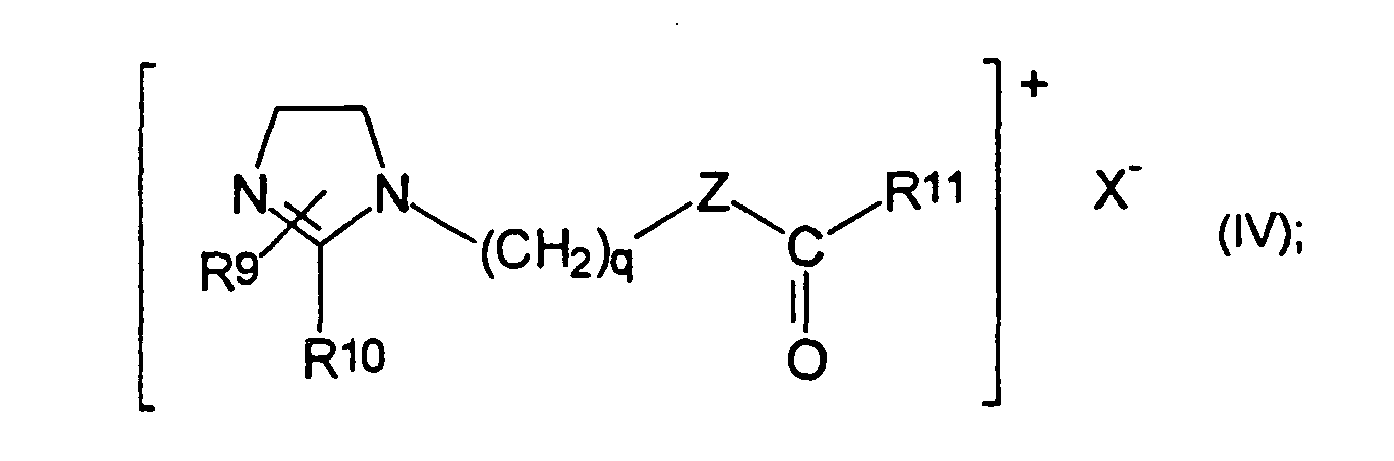
- Weitere geeignete quartäre Verbindungen sind durch Formel (V) beschrieben,

- Neben den Verbindungen der Formeln (I) und (II) können auch kurzkettige, wasserlösliche, quartäre Ammoniumverbindungen eingesetzt werden, wie Trihydroxyethylmethylammonium-methosulfat oder die Alkyltrimethylammoniumchloride, Dialkyldimethylammoniumchloride und Trialkylmethylammoniumchloride, z. B. Cetyltrimethylammoniumchlorid, Stearyltrimethylammoniumchlorid, Distearyldimethylammoniumchlorid, Lauryldimethylammoniumchlorid, Lauryldimethylbenzylammoniumchlorid und Tricetylmethylammoniumchlorid.
- Auch protonierte Alkylaminverbindungen, die weichmachende Wirkung aufweisen, sowie die nicht quaternierten, protonierten Vorstufen der kationischen Emulgatoren sind geeignet.
- Weitere erfindungsgemäß verwendbare kationische Verbindungen stellen die quaternisierten Proteinhydrolysate dar.
- Zu den geeigneten kationischen Polymeren zählen die Polyquatemium-Polymere, wie sie im CTFA Cosmetic Ingredient Dictionary (The Cosmetic, Toiletry und Fragrance, Inc., 1997), insbesondere die auch als Merquats bezeichneten Polyquaternium-6-, Polyquaternium-7-, Polyquaternium-10-Polymere (Ucare Polymer IR 400; Amerchol), Polyquaternium-4-Copolymere, wie Pfropfcopolymere mit einem Cellulosegerüst und quartären Ammoniumgruppen, die über Allyldimethylammoniumchlorid gebunden sind, kationische Cellulosederivate, wie kationisches Guar, wie Guar-hydroxypropyltriammoniumchlorid, und ähnliche quaternierte Guar-Derivate (z. B. Cosmedia Guar, Hersteller: Cognis GmbH), kationische quartäre Zuckerderivate (kationische Alkylpolyglucoside), z. B. das Handelsrodukt Glucquat® 100, gemäß CTFA-Nomenklatur ein "Lauryl Methyl Gluceth-10 Hydroxypropyl Dimonium Chloride", Copolymere von PVP und Dimethylaminomethacrylat, Copolymere von Vinylimidazol und Vinylpyrrolidon, Aminosilicon-polymere und Copolymere.
- Ebenfalls einsetzbar sind polyquaternierte Polymere (z. B. Luviquat Care von BASF) und auch kationische Biopolymere auf Chitinbasis und deren Derivate, beispielsweise das unter der Handelsbezeichnung Chitosan® (Hersteller: Cognis) erhältliche Polymer.
- Erfindungsgemäß ebenfalls geeignet sind kationische Silikonöle wie beispielsweise die im Handel erhältlichen Produkte Q2-7224 (Hersteller: Dow Coming; ein stabilisiertes Trimethylsilylamodimethicon), Dow Corning 929 Emulsion (enthaltend ein hydroxyl-amino-modifiziertes Silicon, das auch als Amodimethicone bezeichnet wird), SM-2059 (Hersteller: General Electric), SLM-55067 (Hersteller: Wacker) Abil® -Quat 3270 und 3272 (Hersteller: Goldschmidt-Rewo; diquartäre Polydimethylsiloxane, Quaternium-80), sowie Siliconquat Rewoquat® SQ 1 (Tegopren® 6922, Hersteller: Goldschmidt-Rewo).
- Ebenfalls einsetzbar sind Verbindungen der Formel (VI),

- Als nichtionische Weichmacher kommen vor allem Polyoxyalkylenglycerolalkanoate, wie sie in der britischen Patentschrift GB 2,202,244, Polybutylene, wie sie in der britischen Patentschrift GB 2,199,855, langkettige Fettsäuren, wie sie in der EP 0 013 780, ethoxylierte Fettsäureethanolamide, wie sie in der EP 0 043 547, Alkylpolyglycoside, insbesondere Sorbitan- mono,-di- und triester, wie sie in der EP 0 698 140 und Fettsäureester von Polycarbonsäuren, wie sie in der deutschen Patentschrift DE 2,822,891 beschrieben werden.
- Die Rohdispersionen oder Rohemulsionen enthalten Weichmacherkomponenten in Mengen bis zu 50 Gew.-%, vorzugsweise von 0,1 bis 45 Gew.%, besonders bevorzugt von 2 bis 40 Gew.-%, äußerst bevorzugt von 3 bis 30 Gew.-% und insbesondere von 5 bis 20 Gew.%, jeweils bezogen auf die gesamte Emulsion oder Dispersion.
- Die vorzugsweise wäßrigen Rohdispersionen oder Rohemulsionen können organische Lösungsmittel enthalten.
Lösungsmittel, die in den Rohdispersionen oder Rohemulsionen eingesetzt werden können, stammen beispielsweise aus der Gruppe ein- oder mehrwertiger Alkohole, Alkanolamine oder Glycolether, sofern sie im angegebenen Konzentrationsbereich mit Wasser mischbar sind. Vorzugsweise werden die Lösungsmittel ausgewählt aus Ethanol, n- oder i-Propanol, Butanolen, Glykol, Propan- oder Butandiol, Glycerin, Diglykol, Propyl- oder Butyldiglykol, Hexylenglycol, Ethylenglykolmethylether, Ethylenglykolethylether, Ethylenglykolpropylether, Ethylenglykolmono-n-butylether, Diethylenglykol-methylether, Diethylenglykolethylether, Propylenglykolmethyl-, -ethyl- oder -propyl-ether, Butoxy-propoxy-propanol (BPP), Dipropylenglykolmonomethyl-, oder -ethylether, Di-isopropylenglykolmonomethyl-, oder -ethylether, Methoxy-, Ethoxy- oder Butoxytriglykol, 1-Butoxyethoxy-2-propanol, 3-Methyl-3-methoxybutanol, Propylen-glykol-t-butylether sowie Mischungen dieser Lösungsmittel.
Einige Glykolether sind unter den Handelsnamen Arcosolv® (Arco Chemical Co.) oder Cellosolve® , Carbitol® oder Propasol® (Union Carbide Corp.) erhältlich; dazu gehören auch z.B. ButylCarbitol® , HexylCarbitol® , MethylCarbitol® , und Carbitol® selbst, (2-(2-Ethoxy)ethoxy)ethanol. Die Wahl des Glykolethers kann vom Fachmann leicht auf der Basis seiner Flüchtigkeit, Wasserlöslichkeit, seines Gewichtsprozentanteils an der gesamten Rohdispersion oder Rohemulsion und dergleichen getroffen werden. Pyrrolidon-Lösungsmittel, wie N-Alkylpyrrolidone, beispielsweise N-Methyl-2-pyrrolidon oder N-C8-C12-Alkylpyrrolidon, oder 2-Pyrrolidon, können ebenfalls eingesetzt werden. Weiterhin bevorzugt als alleinige Lösungsmittel oder als Bestandteil eines Lösungsmittelgemisches sind Glycerinderivate. Zu den Alkoholen, die in den Rohdispersionen oder Rohemulsionen der vorliegenden Erfindung als Cosolvention eingesetzt werden können, gehören flüssige Polyethylenglykole, mit niederem Molekulargewicht, beispielsweise Polyethylenglykole mit einem Molekulargewicht von 200, 300, 400 oder 600. Weitere geeignete Cosolventien sind andere Alkohole, zum Beispiel (a) niedere Alkohole wie Ethanol, Propanol, Iso-propanol und n-Butanol, (b) Ketone wie Aceton und Methylethylketon, (c) C2-C4-Polyole wie ein Diol oder ein Triol, beispielsweise Ethylenglykol, Propylenglykol, Glycerin oder Gemische davon. - Die Rohdispersionen oder Rohemulsionen können in einer bevorzugten Ausführungsform ein oder mehrere wasserlösliche organische Lösungsmittel enthalten. Unter wasserlöslich wird hierbei verstanden, daß das organische Lösungsmittel in der enthaltenen Menge in einem gegebenenfalls wäßrigen Mittel löslich ist.
- In einer bevorzugten Ausführungsform enthalten die Rohdispersionen oder Rohemulionen ein oder mehrere Lösungsmittel aus der Gruppe, umfassend C1- bis C4-Monoalkohole, C2- bis C6-Glykole, C3- bis C12-Glykolether und Glycerin, insbesondere Ethanol.
- Bevorzugte C1- bis C4-Monoalkohole sind Ethanol, n-Propanol, iso-Propanol und tert-Butanol. Bevorzugte C2- bis C6-Glykole sind Ethylenglykol, 1,2-Propylenglykol, 1,3-Propylenglykol, 1,5-Pentandiol, Neopentylglykol und 1,6-Hexandiol, insbesondere Ethylenglykol und 1,2-Propylenglykol. Bevorzugte C3- bis C12-Glykolether sind Di-, Tri-, Tetra- und Pentaethylenglykol, Di-, Tri-und Tetrapropylenglykol, Propylenglykolmonotertiärbutylether und Propylenglykolmonoethylether sowie die gemäß INCI bezeichneten Lösungsmittel Butoxydiglycol, Butoxyethanol, Butoxyisopropanol, Butoxypropanol, Butyloctanol, Ethoxydiglycol, Ethoxyethanol, Ethylexandiol, Isobutoxypropanol, Isopentyldiol, 3-Methoxybutanol, Methoxyethanol, Methoxyisopropanol und Methoxymethylbutanol.
- In einer bevorzugten Ausführungsform liegen wäßrige Rohdispersionen oder wäßrige Rohemulsion vor, enthaltend organisches Lösungsmittel in einer Menge von weniger als 20 Gew.-%, vorzugsweise weniger als 10 Gew.-%, besonders bevorzugt weniger als 5 Gew.-%, jeweils bezogen auf die gesamte Dispersion oder Emulsion. In einer besonders bevorzugten Ausführungsform sind die wäßrigen Rohdispersionen oder wäßrigen Rohemulsionen frei von organisichen Lösungsmitteln.
Unter dem Begriff "lösungsmittelfrei" sind im Rahmen der vorliegenden Erfindung Mittel zu verstehen, die herstellungsbedingt nur geringe Mengen oder Spuren von organischen Lösungsmitteln sowie Mischungen dieser Lösungsmittel enthalten. In den "lösungsmittelfreien" Dispersionen oder Emulsionen der vorliegenden Erfindung sind also geringe Mengen an nichtwäßrigen Lösungsmitteln tolerierbar, die unter 5 Gew.-%, vorzugsweise unter 3 Gew.-%, jeweils bezogen auf die gesamte Dispersion oder Emulsion, liegen. - Die Herstellung klarer und transluzenter Weichspülmittel erfolgt durch Homogenisierung der Rohdispersion oder Rohemulsion. Nach Bereitstellung der Rohdispersion oder Rohemulsion, enthaltend einen Fettalkohol mit einem Ethoxylierungs grad von gröβer 20 EO als Stabilisator und mindestens eine Weichmacherkomponente und gegebenenfalls weitere Zusatzstoffe ,werden die flüssigen Systeme (Rohdispersion oder Rohemulsion) homogenisiert. Durch das Homogenisieren werden hohe mechanische Energiemengen pro Volumeneinheit in das flüssige System eingebracht. Dies führt zu einer Zerkleinerung und gleichmäßigen Verteilung der in der Flüssigkeit befindlichen Partikel oder Tröpfchen bis in den Submikronbereich (< 1 µm). Entscheidend ist dabei die Intensität des Energieeintrags. So werden zum Zerkleinern der Partikel Energiemengen von etwa 1×10⁵ (100000) bis 3x10⁶ kJ/m3, vorzugsweise von 7×10⁵ bis 2,5x10⁸ kJ/m3über einen Zeitraum von etwa 10-7s bis 1 s, vorzugsweise 10-6 s bis 10-1 (0,1) s und insbesondere von 10-5 s bis 10-2 s eingesetzt. Durch die Vergrößerung der Oberfläche, der homogenisierten Partikel bezieh-ungsweise Tröpfchen werden Stoff- und Energieaustaschprozesse intensiviert. Als besonders geeignet zum Einbringen hoher Energiemengen in flüssige Systeme hat sich die Homogenisierungstechnologie, insbesondere der Einsatz von Hochdruckhomogenisatoren herausgestellt. In einer bevorzugten Ausführungsform werden deshalb Hochdruckhomogenisatoren zum homogenisieren der flüssigen Systeme eingesetzt. Die entscheidenden Baugruppen der Hochdruckhomogenisatoren sind die Homogenisierungsventile oder auch die Homogenisierungsdüsen in denen die Zerkleinerung stattfindet. Der Durchgang des flüssigen Systems unter hohem Druck (Homogenisierungsdruck) und kontrollierten Fließbedingungen durch die engen Öffnungen der Homogenisierungsventile bzw. der Homogenisierungsdüsen erzeugt große Scher- und Dehnungskräfte sowie hohe Turbulenzen und Kavitationen, wodurch die Partikel und Tröpfchen auf wirkungsvollste Weise zerkleinert werden.
- Das erfindungsgemäße Verfahren wird vorzugsweise bei Homogenisierungsdrücken von 1 bis 500 MPa (10 bis 5000 bar), besonders bevorzugt von 5 bis 400 MPa (50 bis 4000 bar), äußerst bevorzugt von 10 bis 300 MPa (100 bis 3000 bar) und insbesondere von 70 bis 250 MPa (700 bis 2500 bar) durchgeführt. Es kann jedoch auch vorteilhaft sein die Rohdispersionen oder Rohemulsionen mehrfach bei gegebenenfalls unterschiedlichen Drücken zu homogenisieren.
- Die homogensierten dispergierten Partikel weisen vorzugsweise eine mittlere Partikelgröße von kleiner 1 µm, besonders bevorzugt von kleiner 700 nm, äußerst bevorzugt von kleiner 400 nm und insbesondere von kleiner 200 nm. Bestimmt wurden die Werte mittels der Photonenkorrelationsspektroskopie nach dem Prinzip der quasielastischen Lichtstreuung mit einem Malvern Zetasizer.
- Zur Stabilisierung der klaren und transluzenten Weichspülmittel werden zusätzlich Stabilisatoren eingesetzt. Stabilisatoren verhindern das Agglomerieren der feinen Partikel und sorgen somit dafür, daß das klare und transluzente Erscheinungsbild der Weichspülmittel erhalten bleibt.
- Die Stabilisatoren umfassen Fettalkohole mit einem Ethoxylierungsgrad von größer 20 Ethylen-oxideinheiten (EO), wie etwa Talgfettalkohol mit 20 EO, 25 EO, 30 EO, 40 EO, 100 EO oder 120 EO oder Oxystearylalkohol mit 73 EO. Zusätzlich können amphotere Tenside inbesondere Betaire, andere nichtionische Tenside sowie organische Verdickungsmittel als weitere Stabilisatoren eingesetzt werden.
- Der Stabilisator kann in Mengen bis zu 50 Gew.-%, vorzugsweise von 0,1 bis 25 Gew.-%, besonders bevorzugt von 0,1 bis 10 Gew.-% und insbesondere von 0,1 bis 3 Gew.-%, jeweils bezogen auf das gesamte Weichspülmittel, vorliegen.
- Vorteile des erfindungsgemäßen Herstellverfahrens für klare und transluzente Weichspülmittel gegenüber dem Stand der Technik bestehen auch darin, daß insbesondere auch Weichspülmittel mit einer niedrigen Konzentration an Weichmacherkomponente (< 25 Gew.-%) hergestellt werde können. Insbesondere das Verdünnugsverhalten der erfindungsgemäß hergestellten Mittel ist hervorzuheben. So läßt sich das erfindungsgemäß hergestellte Mittel problemlos auf Weichmacherkomponentenkonzentrationen von 0,01 bis 22 Gew.-%, jeweils bezogen auf das gesamte Mittel, mit Wasser verdünnen ohne das sich das transluzente und klare Aussehen der Mittel verändert. Die im Stand der Technik beschriebenen klaren Weichspülformulierungen basieren darauf, daß sie an ein bestimmtes Lösungsmittelfenster gebunden sind. Bewegt man sich außerhalb dieses Fensters, beispielsweise in dem man die Mittel verdünnt, so treten Trübungserscheinungen auf.
- Eine weitere Aufgabe der Erfindung war es nun ein klares und transluzentes Weichspülmittel zur Verfügung zu stellen, die die aus dem vorbeschriebenen Stand der Technik bekannten Probleme zumindest in Teilen löst.
- Zweiter Gegenstand der Erfindung ist ein klares und transluzentes Weichspülmittel, das durch das erfindungsgemäße Herstellverfahren erhältlich ist.
- Das erfindungsgemäße klare und transluzente Weichspülmittel besteht aus der zuvor beschriebenen Rohdispersion oder Rohemulsion, enthaltend mindestens eine Weichmacherkomponente und mindestens einen Stabilisator und ist durch das erfindungsgemäße Herstellverfahren erhältlich.
- Das erfindungsgemäße Mittel liegt vorzugsweise als Dispersion vor und weist eine mittlere Partikelgröße von kleiner 1 µm, besonders bevorzugt von kleiner 700 nm, äußerst bevorzugt von kleiner 400 nm und insbesondere von kleiner 200 nm auf.
- Das erfindungsgemäße Mittel kann weitere Zusatz- und Hilfsstoffe enthalten, die sowohl vor als auch nach dem Homogenisierungsschritt der Dispersion oder Emulsion zugesetzt werden können. Die Auswahl der Hilfs- und Zusatzstoffe bereitet dem Fachmann keinerlei Schwierigkeiten und wird so gewählt, daß die klaren und transluzenten Eigenschaften der Mittel gewahrt bleiben.
- In einer bevorzugten Ausführungsform können das erfindungsgemäße Weichspülmittel zusätzlich nichtionische Tenside enthalten, die auch gleichfalls als Stabilisator wirken können.
Als nichtionische Tenside werden vorzugsweise alkoxylierte, vorteilhafterweise ethoxylierte und/oder propoxylierte, insbesondere primäre Alkohole mit vorzugsweise 8 bis 18 C-Atomen und durchschnittlich 1 bis 12 Mol Ethylenoxid (EO) und/oder 1 bis 10 Mol Propylenoxid (PO) pro Mol Alkohol, eingesetzt. Besonders bevorzugt sind C8-C16-Alkoholalkoxylate, vorteilhafterweise ethoxylierte und/oder propoxylierte C10-C15-Alkoholalkoxylate, insbesondere C12-C14-Alkoholalkoxylate, mit einem Ethoxylierungsgrad zwischen 2 und 10, vorzugsweise zwischen 3 und 8, und/oder einem Propoxylierungsgrad zwischen 1 und 6, vorzugsweise zwischen 1,5 und 5. Der Alkoholrest kann vorzugsweise linear oder besonders bevorzugt in 2-Stellung methylverzweigt sein bzw. lineare und methylverzweigte Reste im Gemisch enthalten, so wie sie üblicherweise in Oxoalkoholresten vorliegen. Insbesondere sind jedoch Alkoholethoxylate mit linearen Resten aus Alkoholen nativen Ursprungs mit 12 bis 18 C-Atomen, z.B. aus Kokos-, Palm-, Talgfett- oder Oleylalkohol, und durchschnittlich 2 bis 8 EO pro Mol Alkohol bevorzugt. Zu den bevorzugten ethoxylierten Alkoholen gehören beispielsweise C12-14-Alkohole mit 3 EO oder 4 EO, C9-11-Alkohol mit 7 EO, C13-15-Alkohole mit 3 EO, 5 EO, 7 EO oder 8 EO, C12-18-Alkohole mit 3 EO, 5 EO oder 7 EO und Mischungen aus diesen, wie Mischungen aus C12-14-Alkohol mit 3 EO und C12-18-Alkohol mit 5 EO. Die angegebenen Ethoxylierungs- und Propoxylierungsgrade stellen statistische Mittelwerte dar, die für ein spezielles Produkt eine ganze oder eine gebrochene Zahl sein können. Bevorzugte Alkoholethoxylate und -propoxylate weisen eine eingeengte Homologenverteilung auf (narrow range ethoxylates/propoxylates, NRE/NRP). Zusätzlich zu diesen nichtionischen Tensiden können auch Fettalkohole mit mehr als 12 EO eingesetzt werden. Beispiele hierfür sind Talgfettalkohol mit 14 EO
Weiterhin geeignet sind alkoxylierte Amine, vorteilhafterweise ethoxylierte und/oder propoxylierte, insbesondere primäre und sekundäre Amine mit vorzugsweise 1 bis 18 C-Atomen pro Alkylkette und durchschnittlich 1 bis 12 Mol Ethylenoxid (EO) und/oder 1 bis 10 Mol Propylenoxid (PO) pro Mol Amin.
Außerdem können als weitere nichtionische Tenside auch Alkylglykoside der allgemeinen Formel RO(G)x, z. B. als Compounds, besonders mit anionischen Tensiden, eingesetzt werden, in der R einen primären geradkettigen oder methylverzweigten, insbesondere in 2-Stellung methylverzweigten aliphatischen Rest mit 8 bis 22, vorzugsweise 12 bis 18 C-Atomen bedeutet und G das Symbol ist, das für eine Glykoseeinheit mit 5 oder 6 C-Atomen, vorzugsweise für Glucose, steht. Der Oligomerisierungsgrad x, der die Verteilung von Monoglykosiden und Oligoglykosiden angibt, ist eine beliebige Zahl zwischen 1 und 10; vorzugsweise liegt x bei 1,2 bis 1,4. - Eine weitere Klasse bevorzugt eingesetzter nichtionischer Tenside, die entweder als alleiniges nichtionisches Tensid oder in Kombination mit anderen nichtionischen Tensiden eingesetzt werden, sind alkoxylierte, vorzugsweise ethoxylierte oder ethoxylierte und propoxylierte Fettsäurealkylester, vorzugsweise mit 1 bis 4 Kohlenstoffatomen in der Alkylkette, insbesondere Fettsäuremethylester, wie sie beispielsweise in der japanischen Patentanmeldung JP 58/217598 beschrieben sind oder die vorzugsweise nach dem in der internationalen Patentanmeldung WO-A-90/13533 beschriebenen Verfahren hergestellt werden.
- Auch nichtionische Tenside vom Typ der Aminoxide, beispielsweise N-Kokosalkyl-N,N-dimethylaminoxid und N-Talgalkyl-N,N-dihydroxyethylaminoxid, und der Fettsäurealkanolamide können geeignet sein.
Als weitere Tenside kommen sogenannte Gemini-Tenside in Betracht. Hierunter werden im allgemeinen solche Verbindungen verstanden, die zwei hydrophile Gruppen und zwei hydrophobe Gruppen pro Molekül besitzen. Diese Gruppen sind in der Regel durch einen sogenannten "Spacer" voneinander getrennt. Dieser Spacer ist in der Regel eine Kohlenstoffkette, die lang genug sein sollte, daß die hydrophilen Gruppen einen ausreichenden Abstand haben, damit sie unabhängig voneinander agieren können. Derartige Tenside zeichnen sich im allgemeinen durch eine ungewöhnlich geringe kritische Micellkonzentration und die Fähigkeit, die Oberflächenspannung des Wassers stark zu reduzieren, aus. In Ausnahmefällen werden jedoch unter dem Ausdruck Gemini-Tenside nicht nur dimere, sondern auch trimere Tenside verstanden. - Geeignete Gemini-Tenside sind beispielsweise sulfatierte Hydroxymischether gemäß der deutschen Patentanmeldung DE-A-43 21 022 oder Dimeralkohol-bis- und Trimeralkoholtris-sulfate und -ethersulfate gemäß der internationalen Patentanmeldung WO-A-96/23768. Endgruppenverschlossene dimere und trimere Mischether gemäß der deutschen Patentanmeldung DE-A-195 13 391 zeichnen sich insbesondere durch ihre Bi- und Multifunktionalität aus. So besitzen die genannten endgruppenverschlossenen Tenside gute Netzeigenschaften und sind dabei schaumarm, so daß sie sich insbesondere für den Einsatz in maschinellen Wasch- oder Reinigungsverfahren eignen.
- Eingesetzt werden können aber auch Gemini-Polyhydroxyfettsäureamide oder Poly-Polyhydroxyfettsäureamide, wie sie in den internationalen Patentanmeldungen WO-A-95/19953, WO-A-95/19954 und WO-A-95/19955 beschrieben werden.
- Weitere geeignete Tenside sind Polyhydroxyfettsäureamide der folgenden Formel,

- Zur Gruppe der Polyhydroxyfettsäureamide gehören auch Verbindungen der folgenden Formel,

- [Z] wird vorzugsweise durch reduktive Aminierung eines reduzierten Zuckers erhalten, beispielsweise Glucose, Fructose, Maltose, Lactose, Galactose, Mannose oder Xylose. Die N-Alkoxy- oder N-Aryloxy-substituierten Verbindungen können dann beispielsweise nach der Lehre der internationalen Anmeldung WO-A-95/07331 durch Umsetzung mit Fettsäuremethylestern in Gegenwart eines Alkoxids als Katalysator in die gewünschten Polyhydroxyfettsäureamide überführt werden.
- In einer weiteren bevorzugten Ausführungsform enthalten die erfindungsgemäßen Mittel zusätzlich gegebenenfalls Elektrolyte. Elektrolyte dienen der Viskositätsregulation (Viskositätsregulator) und können üblicherweise in Mengen bis zu 15 Gew.-%, vorzugsweise bis zu 10 Gew.-%, besonders bevorzugt von 0,5 bis 8 Gew.-% und insbesondere von 1 bis 6 Gew.-%, jeweils bezogen auf das gesamte Mittel, eingesetzt werden.
Als Elektrolyte aus der Gruppe der anorganischen Salze kann eine breite Anzahl der verschiedensten Salze eingesetzt werden. Bevorzugte Kationen sind die Alkali- und Erdalkalimetalle, bevorzugte Anionen sind die Halogenide und Sulfate. Aus herstellungstechnischer Sicht ist der Einsatz von NaCl, CaCl2 oder MgCl2 in den erfindungsgemäßen Mitteln bevorzugt. - Um den pH-Wert der erfindungsgemäßen Mittel in den gewünschten Bereich zu bringen, kann der Einsatz von pH-Stellmitteln angezeigt sein. Einsetzbar sind hier sämtliche bekannten Säuren bzw. Laugen, sofern sich ihr Einsatz nicht aus anwendungstechnischen oder ökologischen Gründen bzw. aus Gründen des Verbraucherschutzes verbietet. Üblicherweise überschreitet die Menge dieser Stellmittel 2 Gew.-% der Gesamtformulierung nicht.
Das erfindungsgemäße Mittel weist einen pH-Wert von 1 bis 7, vorzugsweise von 1,5 bis 5 und insbesondere von 2,0 bis 3,5 auf. - Neben geringeren Mengen von anionischen Tensiden können die erfindungsgemäßen Mittel gegebenenfalls weitere übliche Hilfs- und Zusatzstoffe, insbesondere aus der Gruppe der Gerüststoffe, Enzyme, Bleichmittel, Bleichaktivatoren, Komplexbildner, Duftstoffe, Parfümträger, Fluoreszenzmittel, Farbstoffe, Verdickungsmittel, Schauminhibitoren, Vergrauungsinhibitoren, Knitterschutzmittel, antimikrobielle Wirkstoffe, Germizide, Fungizide, Antioxidantien, Antistatika, UV-Absorber, optischen Aufheller, Antiredepositionsmittel, Perlglanzgeber, Farbübertragungsinhibitoren, Einlaufverhinderer, Korrosionsinhibitoren, Konservierungsmittel, Phobier- und Imprägniermittel, Hydrotrope sowie Quell- und Schiebefestmittel enthalten.
- In einer bevorzugten Ausführungsform kann das erfindungsgemäße Mittel gegebenenfalls zusätzlich ein oder mehrere Komplexbildner enthalten.
- Komplexbildner (INCI Chelating Agents), auch Sequestriermittel genannt, sind Inhaltsstoffe, die Metallionen zu komplexieren und inaktivieren vermögen, um ihre nachteiligen Wirkungen auf die Stabilität oder das Aussehen der Mittel, beispielsweise Trübungen, zu verhindern. Einerseits ist es dabei wichtig, die mit zahlreichen Inhaltsstoffen inkompatiblen Calcium- und Magnesiumionen der Wasserhärte zu komplexieren. Die Komplexierung der Ionen von Schwermetallen wie Eisen oder Kupfer verzögert die oxidative Zersetzung der fertigen Mittel.
- Geeignet sind beispielsweise die folgenden gemäß INCI bezeichneten Komplexbildner, die im International Cosmetic Ingredient Dictionary and Handbook näher beschrieben sind: Aminotrimethylenphosphonsäure, Beta-Alanindiessigsäure, Calciumdinatrium-EDTA, Zironensäure, Cyclodextrin, Cyclohexandiamintetraessigsäure, Dlammoniumcitrat, Diammonium-EDTA, Diethylentriaminepentamethylenphosphonsäure, Dikalium-EDTA, Dinatriumazacycloheptandlphosphonat, Dinatrium-EDTA, Dinatriumpyrophosphat, EDTA, Etidronsäure, Galactarsäure, Gluconsäure, Glucuronsäure, HEDTA, Hydroxypropylcyclodextrin, Methylcyclodextrin, Pentakaliumtriphosphat, Pentanatriumaminatrimethylenphosphonat, Pentanatriumethylendiamintetramethylenphosphonat, Pentanatriumpentetat, Pentanatriumtriphosphat, Pentet säure, Phytinsäure, Kallumcitrat, Kalium-EDTMP, Kallumgluconat, Kallumpolyphosphat, Kallumtrisphosphonomethylaminoxid, Ribonsäure, Natriumchitosan Methylenphosphonat, Natriumcitrat, Natriumdiethylentriaminpentamethylenphosphonat, Natriumdihydroxyethylglycinat, Natrlum-EDTMP, Natriumgluceptat, Natriumgluconat, Natriumglycereth-1 polyphosphat, Natriumhexametaphosphat, Natriummetaphosphat, Natriummetasilicat, Natriumphytat, Natriumpolydimethylglycinophenolsulfonat, Natriumtrimetaphosphat, TEA-EDTA, TEA-Polyphosphat, Tetrahydroxyethylethylendiamin, Tetrahydroxypropylethylendiamin, Tetrakaliumetidronat, Tetrakallumpyrophosphat, Tetranatrium-EDTA, Tetranatriumetidronat, Tetranatriumpyrophosphat, Trikalium-EDTA, Trinatriumdicarboxymethylalaninat, Trinatrium-EDTA, Trinatrium-HEDTA, Trinatrium-NTA und Trinatriumphosphat.
- Bevorzugte Komplexbildner sind tertiäre Amine, insbesondere tertiäre Alkanolamine (Aminoalkohole). Die Alkanolamine besitzen sowohl Amino- als auch Hydroxy- und/oder Ethergruppen als funktionelle Gruppen. Besonders bevorzugte tertiäre Alkanolamine sind Triethanolamin und Tetra-2-hydraxypropylethylendiamin (N,N,N',N'-Tetrakis-(2-hydroxy-propyl)ethylendiamin).
- Ein besonders bevorzugter Komplexbildner ist die Etidronsäure (1-Hydroxyethyliden-1,1-diphosphonsäure, 1-Hydroxyethyan-1,1-diphosphonsäure, HEDP, Acetophosphonsaure, INCI Etidronic Acid) einschließlich ihrer Salze. In einer bevorzugten Ausführungsform enthält das erfindungsgemäße Mittel demgemäß als Komplexbildner Etidronsäure und/oder eines oder mehrere ihrer Salze.
- In einer besonderen Ausführungsform kann das erfindungsgemäß hergestellte Mittel eine Komplexbildnerkombination aus einem oder mehreren tertiären Aminen und einer oder mehreren weiteren Komblexbildnern, vorzugsweise einer oder mehreren Komplexbildnersäuren oder deren Salzen, insbesondere aus Triethanolamin und/oder Tetra-2-hydroxy propylethylendiamin und Etidronsäure und/oder einem oder mehrerer ihrer Salze enthalten.
- Das Mittel enthält gegebenenfalls Komplexbildner in einer Menge von üblicherweise 0 bis 20 Gew.-%, vorzugsweise 0,1 bis 15 Gew.-%, insbesondere 0,5 bis 10 Gew.-%, besonders bevorzugt 1 bis 8 Gew.-%, äußerst bevorzugt 1,5 bis 6 Gew.-%, beispielsweise 1,5, 2,1, 3 oder 4,2 Gew.-% enthalten.
- In einer weiteren Ausführungsform enthält das Mittel gegebenenfalls ein oder mehrere Verdickungsmittel.
Die Viskosität der gegebenenfalls flüssigen Mittel kann mit üblichen Standardmethoden (beispielsweise Brookfield-Viskosimeter RVD-VII bei 20 U/min und 20°C, Spindel 3) gemessen werden und liegt vorzugsweise im Bereich von 10 bis 5000 mPas. Bevorzugte flüssige bis gelförmige Mittel haben Viskositäten von 20 bis 4000 mPas, wobei Werte zwischen 40 und 2000 mPas besonders bevorzugt sind. - Geeignete Verdicker sind anorganische oder polymere organische Verbindungen. Es können auch Gemische aus mehreren Verdickern eingesetzt werden.
- Zu den anorganischen Verdickern zählen beispielsweise Polykieselsäuren, Tonmineralien wie Montmorillonite, Zeolithe, Kieselsäuren, Aluminiumsilikate, Schichtsilikate und Bentonite.
- Die organischen Verdicker, die auch gleichzeitig als Stabilisator wirken können, stammen aus den Gruppen der natürlichen Polymere, der abgewandelten natürlichen Polymere und der vollsynthetischen Polymere.
- Aus der Natur stammende Polymere, die als Verdicker Verwendung finden, sind beispielsweise Xanthan, Agar-Agar, Carrageen, Tragant, Gummi arabicum, Alginate, Pektine, Polyosen, Guar-Mehl, Gellan-Gum, Johannisbrotbaumkernmehl, Stärke, Dextrine, Gelatine und Casein.
- Abgewandelte Naturstoffe stammen vor allem aus der Gruppe der modifizierten Stärken und Cellulosen, beispielhaft seien hier Carboxymethylcellulose und andere Celluloseether, Hydroxyethyl- und -propylcellulose, hochveretherte Methylhydroxyethylcellulose sowie Kernmehlether genannt.
- Eine große Gruppe von Verdickern, die breite Verwendung in den unterschiedlichsten Anwendungsgebieten finden, sind die vollsynthetischen Polymere wie Polyacryl- und Polymethacryl-Verbindungen, die vernetzt oder unvernetzt und ggf. kationisch modifiziert sein können, Vinylpolymere, Polycarbonsäuren, Polyether, aktivierte Polyamidderivate, Rizinusölderivate, Polyimine, Polyamide und Polyurethane. Beispiele für derartige Polymer sind Acrylharze, Ethylacrylat-Acrylamid-Copolymere, Acrylsäureester-Methacrylsäureester-Copolymere, Ethylacrylat-Acrylsäure-Methacrylsäure-Copolymere, N-Methylolmethacrylamid, Maleinsäureanhydrid-Methylvinylether-Copolymere, Polyether-Polyol-Copolymere sowie Butadien-Styrol-Copolymere.
- Weitere geeignete Verdicker sind Derivate organischer Säuren sowie deren Alkoxid-Addukte, beispielsweise Arylpolyglykolether, carboxylierte Nonylphenolethoxylatderivate, Natriumalginat, Diglycerinmonoisostearat, Nichtionogene Ethylenoxid-Addukte, Kokosfettsäurediethanolamid, Isododecenylbernsteinsäureanhydrid sowie Galactomannan
- Verdicker aus den genannten Substanzklassen sind kommerziell erhältlich und werden beispielsweise unter den Handelsnamen Acusol®-820 (Methacrylsäure(stearylalkohol-20-EO)ester-Acrylsäure-Copolymer, 30%ig in Wasser, Rohm & Haas), Dapral®-GT-282-S (Alkylpolyglykolether, Akzo), Deuterol®-Polymer-11 (Dicarbonsäure-Copolymer, Schöner GmbH), Deuteron®-XG (anionisches Heteropolysaccharid auf Basis von β-D-Glucose, D-Manose, D-Glucuronsäure, Schöner GmbH), Deuteron®-XN (nichtionogenes Polysaccharid, Schöner GmbH), Dicrylan®-Verdicker-O (Ethylenoxid-Addukt, 50%ig in Wasser/Isopropanol, Pfersse Chemie), EMA®-81 und EMA®-91 (Ethylen-Maleinsäureanhydrid-Copolymer, Monsanto), Verdicker-QR-1001 (Polyurethan-Emulsion, 19-21%ig in Wasser/Diglykolether, Rohm & Haas), Mirox®-AM (anionische Acrylsäure-Acrylsäureester-Copolymer-Dispersion, 25%ig in Wasser, Stockhausen), SER-AD-FX-1100 (hydrophobes Urethanpolymer, Servo Delden), Shellflo®-S (hochmolekulares Polysaccharid, mit Formaldehyd stabilisiert, Shell), Shellflo®-XA (Xanthan-Biopolymer, mit Formaldehyd stabilisiert, Shell), Kelzan, Keltrol T (Kelco) angeboten.
- In einer weiteren bevorzugten Ausführungsform enthält das Mittel gegebenenfalls ein oder mehrere Enzyme.
Als Enzyme kommen insbesondere solche aus der Klassen der Hydrolasen wie der Proteasen, Esterasen, Lipasen bzw. lipolytisch wirkende Enzyme, Amylasen, Cellulasen bzw. andere Glykosylhydrolasen und Gemische der genannten Enzyme in Frage. Alle diese Hydrolasen tragen in der Wäsche zur Entfernung von Vertleckungen wie protein-, fett- oder stärkehaltigen Verfleckungen und Vergrauungen bei. Cellulasen und andere Glykosylhydrolasen können darüber hinaus durch das Entfernen von Pilling und Mikrofibrillen zur Farberhaltung und zur Erhöhung der Weichheit des Textils beitragen. Zur Bleiche bzw. zur Hemmung der Farbübertragung können auch Oxireduktasen eingesetzt werden. Besonders gut geeignet sind aus Bakterienstämmen oder Pilzen wie Bacillus subtilis, Bacillus licheniformis, Streptomyceus griseus und Humicola insolens gewonnene enzymatische Wirkstoffe. Vorzugsweise werden Proteasen vom Subtilisin-Typ und insbesondere Proteasen, die aus Bacillus lentus gewonnen werden, eingesetzt. Dabei sind Enzymmischungen, beispielsweise aus Protease und Amylase oder Protease und Lipase bzw. lipolytisch wirkenden Enzymen oder Protease und Cellulase oder aus Cellulase und Lipase bzw. lipolytisch wirkenden Enzymen oder aus Protease, Amylase und Lipase bzw. lipolytisch wirkenden Enzymen oder Protease, Lipase bzw. lipolytisch wirkenden Enzymen und Cellulase, insbesondere jedoch Protease und/oder Lipase-haltige Mischungen bzw. Mischungen mit lipolytisch wirkenden Enzymen von besonderem Interesse. Beispiele für derartige lipolytisch wirkende Enzyme sind die bekannten Cutinasen. Auch Peroxidasen oder Oxidasen haben sich in einigen Fällen als geeignet erwiesen. Zu den geeigneten Amylasen zählen insbesondere α-Amylasen, Iso-Amylasen, Pullulanasen und Pektinasen. Als Cellulasen werden vorzugsweise Cellobiohydrolasen, Endoglucanasen und β-Glucosidasen, die auch Cellobiasen genannt werden, bzw. Mischungen aus diesen eingesetzt. Da sich verschiedene Cellulase-Typen durch ihre CMCase- und Avicelase-Aktivitäten unterscheiden, können durch gezielte Mischungen der Cellulasen die gewünschten Aktivitäten eingestellt werden.
Die Zugabe von Enzymen erfolgt vorteilhafterweise nach dem Homogenisierungsschritt, um Zerstörungen der Enzymaktivität durch die hohe mechanische Belastung des Homogenisierungsvorgangs zu vermeiden. Wichtig ist hierbei, daß die Enzyme und Enzympartikel in Größen vorliegen, die das transluzente und klare Aussehen der Weichspülerformulierungen nicht beeinträchtigen. - Die Enzyme können als Formkörper an Trägerstoffe adsorbiert oder gecoated eingebettet sein, um sie gegen vorzeitige Zersetzung zu schützen. Der Anteil der Enzyme, Enzymmischungen oder Enzymgranulate kann beispielsweise etwa 0,1 bis 5 Gew.-%, vorzugsweise 0,12 bis etwa 2 Gew.-% betragen.
- Die Mittel können gegebenenfalls Bleichmittel enthalten. Unter den als Bleichmittel dienenden, in Wasser H2O2 liefernden Verbindungen haben das Natriumpercarbonat, das Natriumperborattetrahydrat und das Natriumperboratmonohydrat besondere Bedeutung. Weitere brauchbare Bleichmittel sind beispielsweise Peroxopyrophosphate, Citratperhydrate sowie H2O2 liefernde persaure Salze oder Persäuren, wie Persulfate beziehungsweise Perschwefelsäure. Brauchbar ist auch das Harnstoffperoxohydrat Percarbamid, das durch die Formel H2N-CO-NH2·H2O2 beschrieben werden kann. Insbesondere beim Einsatz der Mittel für das Reinigen harter Oberflächen, zum Beispiel beim maschinellen Geschirrspülen, können sie gewünschtenfalls auch Bleichmittel aus der Gruppe der organischen Bleichmittel enthalten, obwohl deren Einsatz prinzipiell auch bei Mitteln für die Textilwäsche möglich ist. Typische organische Bleichmittel sind die Diacylperoxide, wie zum Beispiel Dibenzoylperoxid. Weitere typische organische Bleichmittel sind die Peroxysäuren, wobei als Beispiele besonders die Alkylperoxysäuren und die Arylperoxysäuren genannt werden. Bevorzugte Vertreter sind die Peroxybenzoesäure und ihre ringsubstituierten Derivate, wie Alkylperoxybenzoesäuren, aber auch Peroxy-α-Naphtoesäure und Magnesium-monoperphthalat, die aliphatischen oder substituiert aliphatischen Peroxysäuren, wie Peroxylaurinsäure, Peroxystearinsäure, ε-Phthalimidoperoxycapronsäure (Phthalimidoperoxyhexansäure, PAP), o-Carboxybenzamidoperoxycapronsäure, N-Nonenylamidoperadipinsäure und N-Nonenylamidopersuccinate, und aliphatische und araliphatische Peroxydicarbonsäuren, wie 1,12-Diperoxycarbonsäure, 1,9-Diperoxyazelainsäure, Diperoxysebacinsäure, Diperoxybrassylsäure, die Diperoxyphthalsäuren, 2-Decyldiperoxybutan-1,4-disäure, N,N-Terephthaloyl-di(6-aminopercapronsäure) können eingesetzt werden.
Die Bleichmittel können gecoated sein, um sie gegen vorzeitige Zersetzung zu schützen.
Die optionale Zugabe von Bleichmitteln erfolgt vorteilhafterweise nach dem Homogenisierungsschritt, um Zerstörungen der Bleichmittelaktivität durch die hohe mechanische Belastung des Homogenisierungsvorgangs zu vermeiden. - In einer bevorzugten Ausführungsform enthält das Mittel gegebenenfalls ein oder mehrere Parfüms in einer Menge von üblicherweise bis 10 Gew.-%, vorzugsweise 0,01 bis 5 Gew.-%, insbesondere 0,05 bis 3 Gew.-%, besonders bevorzugt 0,1 bis 2 Gew.-%, äußerst bevorzugt 0,2 bis 1,8 Gew.-%.
- Als Parfümöle bzw. Duftstoffe können einzelne Riechstoffverbindungen, z.B. die synthetischen Produkte vom Typ der Ester, Ether, Aldehyde, Ketone, Alkohole und Kohlenwasserstoffe verwendet werden. Riechstoffverbindungen vom Typ der Ester sind z.B. Benzylacetat, Phenoxyethylisobutyrat, p-tert.-Butylcyclohexylacetat, Linalylacetat, Dimethylbenzyl-carbinylacetat, Phenylethylacetat, Linalylbenzoat, Benzylformiat, Ethylmethylphenyl-glycinat, Allylcyclohexylpropionat, Styrallylpropionat und Benzylsalicylat. Zu den Ethern zählen beispielsweise Benzylethylether, zu den Aldehyden z.B. die linearen Alkanale mit 8-18 C-Atomen, Citral, Citronellal, Citronellyloxyacetaldehyd, Cyclamenaldehyd, Hydroxycitronellal, Lilial und Bourgeonal, zu den Ketonen z.B. die Jonone, ∝-Isomethylionon und Methyl-cedrylketon, zu den Alkoholen Anethol, Citronellol, Eugenol, Geraniol, Linalool, Phenylethylalkohol und Terpineol, zu den Kohlenwasserstoffen gehören hauptsächlich die Terpene wie Limonen und Pinen. Bevorzugt werden jedoch Mischungen verschiedener Riechstoffe verwendet, die gemeinsam eine ansprechende Duftnote erzeugen. Solche Parfümöle können auch natürliche Riechstoffgemische enthalten, wie sie aus pflanzlichen Quellen zugänglich sind, z.B. Pine-, Citrus-, Jasmin-, Patchouly-, Rosen- oder Ylang-Ylang-Öl. Ebenfalls geeignet sind Muskateller, Salbeiöl, Kamillenöl, Nelkenöl, Melissenöl, Minzöl, Zimtblätteröl, Lindenblütenöl, Wacholderbeeröl, Vetiveröl, Olibanumöl, Galbanumöl und Labdanumöl sowie Orangenblütenöl, Neroliol, Orangenschalenöl und Sandelholzöl.
- Farbstoffe können gegebenenfalls im erfindungsgemäßen Mittel eingesetzt werden, wobei die Menge an einem oder mehreren Farbstoffen so gering zu wählen ist, daß nach der Anwendung des Mittels der klare und transluzente Charakter des Mittels gewahrt bleibt. Vorzugsweise ist das erfindungsgemäße Mittel aber frei von Farbstoffen.
- Weiterhin kann das erfindungsgemäße Mittel gegebenenfalls einen oder mehrere antimikrobielle Wirkstoffe bzw. Konservierungsmittel in einer Menge von üblicherweise 0,0001 bis 3 Gew.-%, vorzugsweise 0,0001 bis 2 Gew.-%, insbesondere 0,0002 bis 1 Gew.-%, besonders bevorzugt 0,0002 bis 0,2 Gew.-%, äußerst bevorzugt 0,0003 bis 0,1 Gew.-%, enthalten.
Antimikrobielle Wirkstoffe bzw. Konservierungsmittel unterscheidet man je nach antimikrobiellem Spektrum und Wirkungsmechanismus zwischen Bakteriostatika und Bakteriziden, Fungistatika und Fungiziden usw. Wichtige Stoffe aus diesen Gruppen sind beispielsweise Benzalkoniumchloride, Alkylarylsulfonate, Halogenphenole und Phenolmercuriacetat. Die Begriffe antimikrobielle Wirkung und antimikrobieller Wirkstoff haben im Rahmen der erfindungsgemäßen Lehre die fachübliche Bedeutung, die beispielsweise von K. H. Wallhäußer in "Praxis der Sterilisation, Desinfektion - Konservierung : Keimidentifizierung - Betriebshygiene" (5. Aufl. - Stuttgart; New York : Thieme, 1995) wiedergegeben wird, wobei alle dort beschriebenen Substanzen mit antimikrobieller Wirkung eingesetzt werden können. Geeignete antimikrobielle Wirkstoffe sind vorzugsweise ausgewählt aus den Gruppen der Alkohole, Amine, Aldehyde, antimikrobiellen Säuren bzw. deren Salze, Carbonsäureester, Säureamide, Phenole, Phenolderivate, Diphenyle, Diphenylalkane, Harnstoffderivate, Sauerstoff-, Stickstoff-acetale sowie -formale, Benzamidine, Isothiazoline, Phthalimidderivate, Pyridinderivate, antimikrobiellen oberflächenaktiven Verbindungen, Guanidine, antimikrobiellen amphoteren Verbindungen, Chinoline, 1,2-Dibrom-2,4-dicyanobutan, Iodo-2-propyl-butyl-carbamat, Iod, lodophore, Peroxoverbindungen, Halogenverbindungen sowie beliebigen Gemischen der voranstehenden.
Der antimikrobielle Wirkstoff kann dabei ausgewählt sein aus Ethanol, n-Propanol, i-Propanol, 1,3-Butandiol, Phenoxyethanol, 1,2-Propylenglykol, Glycerin, Undecylensäure, Benzoesäure, Salicylsäure, Dihydracetsäure, o-Phenylphenol, N-Methylmorpholin-acetonitril (MMA), 2-Benzyl-4-chlorphenol, 2,2'-Methylen-bis-(6-brom-4-chlorphenol), 4,4'-Dichlor-2'-hydroxydiphenylether (Dichlosan), 2,4,4'-Trichlor-2'-hydroxydiphenylether (Trichlosan), Chlorhexidin, N-(4-Chlorphenyl)-N-(3,4-dichlorphenyl)-harnstoff, N,N'-(1,10-decan-diyldi-1-pyridinyl-4-yliden)-bis-(1-octanamin)-dihydrochlorid, N,N'-Bis-(4-chlorphenyl)-3,12-diimino-2,4,11,13-tetraaza-tetradecandiimidamid, Glucoprotaminen, antimikrobiellen oberflächenaktiven quaternären Verbindungen, Guanidinen einschl. den Bi- und Polyguanidinen, wie beispielsweise 1,6-Bis-(2-ethylhexyl-biguanido-hexan)-dihydrochlorid, 1,6-Di-(N1,N1'-phenyldiguanido-N5,N5')-hexan-tetrahydochlorid, 1,6-Di-(N1,N1'-phenyl-N1,N1-methyldiguanido-N5,N5')-hexan-dihydrochlorid, 1,6-Di-(N1,N1'-o-chlorophenyldiguanido- N5,N5')-hexan-dihydrochlorid, 1,6-Di-(N1,N1'-2,6-dichlorophenyldiguanido-N5,N5')-hexan-dihydrochlorid, 1,6-Di-[N1,N1'-beta-(p-methoxyphenyl) diguanido-N5,N5']-hexane-dihydrochlorid, 1,6-Di-(N1,N1'-alpha-methyl-beta-phenyldiguanido-N5,N5')-hexan-dihydrochlorid, 1,6-Di-(N1,N1'-p-nitrophenyldiguanido-N5,N5')hexan-dihydrochlorid, omega:omega-Di-(N1,N1'-phenyldiguanido-N5,N5')-di-n-propylether-dihydrochlorid, omega:omega'-Di-(N1,N1'-p-chlorophenyldiguanido-N5,N5')-di-n-propylether-tetrahydrochlorid, 1,6-Di-(N1,N1'-2,4-dichlorophenyldiguanido-N5,N5')hexan-tetrahydrochlorid, 1,6-Di-(N1,N1'-p-methylphenyldiguanido- N5,N5')hexan-dihydrochlorid, 1,6-Di-(N1,N1'-2,4,5-trichlorophenyldiguanido-N5,N5')hexan-tetrahydrochlorid, 1,6-Di-[N1,N1'-alpha-(p-chlorophenyl) ethyldiguanido-N5,N5'] hexan-dihydrochlorid, omega:omega-Di-(N1,N1'-p-chlorophenyldiguanido-N5,N5')m-xylene-dihydrochlorid, 1,12-Di-(N1,N1'-p-chlorophenyldiguanido-N5,N5') dodecan-dihydrochlorid, 1,10-Di-(N1,N1'-phenyldiguanido- N5,N5')-decan-tetrahydrochlorid, 1,12-Di-(N1,N1'-phenyldiguanido- N5,N5') dodecan-tetrahydrochlorid, 1,6-Di-(N1,N1'-o-chlorophenyldigu-anido- N5,N5') hexan-dihydrochlorid, 1,6-Di-(N1,N1'-o-chlorophenyldiguanido- N5,N5') hexan-tetrahydrochlorid, Ethylen-bis-(1-tolyl biguanid), Ethylen-bis-(p-tolyl biguanide), Ethylen-bis-(3,5-dimethylphenylbiguanid), Ethylen-bis-(p-tert-amylphenylbiguanid), Ethylen-bis-(nonylphenylbiguanid), Ethylen-bis-(phenylbiguanid), Ethylen-bis-(N-butylphenyl-biguanid), Ethylen-bis (2,5-diethoxyphenylbiguanid), Ethylen-bis (2,4-dimethylphenyl biguanid), Ethylen-bis (o-diphenylbiguanid), Ethylen-bis (mixed amyl naphthylbiguanid), N-Butyl-ethylen-bis-(phenylbiguanid), Trimethylen bis (o-tolylbiguanid), N-Butyl-trimethylebis-(phenyl biguanide) und die entsprechenden Salze wie Acetate, Gluconate, Hydrochloride, Hydrobromide, Citrate, Bisulfite, Fluoride, Polymaleate, N-Cocosalkylsarcosinate, Phosphite, Hypophosphite, Perfluorooctanoate, Silicate, Sorbate, Salicylate, Maleate, Tartrate, Fumarate, Ethylendiamintetraacetate, Iminodiacetate, Cinnamate, Thiocyanate, Arginate, Pyromellitate, Tetracarboxybutyrate, Benzoate, Glutarate, Monofluorphosphate, Perfluorpropionate sowie beliebige Mischungen davon. Weiterhin eignen sich halogenierte Xylol- und Kresolderivate, wie p-Chlormetakresol oder p-Chlor-meta-xylol, sowie natürliche antimikrobielle Wirkstoffe pflanzlicher Herkunft (z.B. aus Gewürzen oder Kräutern), tierischer sowie mikrobieller Herkunft. Vorzugsweise können antimikrobiell wirkende oberflächenaktive quaternäre Verbindungen, ein natürlicher antimikrobieller Wirkstoff pflanzlicher Herkunft und/oder ein natürlicher antimikrobieller Wirkstoff tierischer Herkunft, äußerst bevorzugt mindestens ein natürlicher antimikrobieller Wirkstoff pflanzlicher Herkunft aus der Gruppe, umfassend Coffein, Theobromin und Theophyllin sowie etherische Öle wie Eugenol, Thymol und Geraniol, und/ oder mindestens ein natürlicher antimikrobieller Wirkstoff tierischer Herkunft aus der Gruppe, umfassend Enzyme wie Eiweiß aus Milch, Lysozym und Lactoperoxidase, und/ oder mindestens eine antimikrobiell wirkende oberflächenaktive quaternäre Verbindung mit einer Ammonium-, Sulfonium-, Phosphonium-, lodonium- oder Arsoniumgruppe, Peroxoverbindungen und Chlorverbindungen eingesetzt werden. Auch Stoffe mikrobieller Herkunft, sogenannte Bakteriozine, können eingesetzt werden. Vorzugsweise finden Glycin, Glycinderivate, Formaldehyd, Verbindungen, die leicht Formaldehyd abspalten, Ameisensäure und Peroxide Verwendung.
Bei Einsatz des erfindungsgemäßen Konditioniermittels als Tränkflüssigkeit für die erfindungsgemäßen Konditioniersubstrate eignen sich insbesondere die Dehydrazetsäure und die Glykolsäure. - Die als antimikrobielle Wirkstoffe geeigneten quaternären Ammoniumverbindungen (QAV) weisen die allgemeine Formel (R1)(R2)(R3)(R4) N+ X- auf, in der R1 bis R4 gleiche oder verschiedene C1-C22-Alkylreste, C7-C28-Aralkylreste oder heterozyklische Reste, wobei zwei oder im Falle einer aromatischen Einbindung wie im Pyridin sogar drei Reste gemeinsam mit dem Stickstoffatom den Heterozyklus, z.B. eine Pyridinium- oderlmidazoliniumverbindung, bilden, darstellen und X- Halogenidionen, Sulfationen, Hydroxidionen oder ähnliche Anionen sind. Für eine optimale antimikrobielle Wirkung weist vorzugsweise wenigstens einer der Reste eine Kettenlänge von 8 bis 18, insbesondere12 bis 16, C-Atomen auf.
- QAV sind durch Umsetzung tertiärer Amine mit Alkylierungsmitteln, wie z.B. Methylchlorid, Benzylchlorid, Dimethylsulfat, Dodecylbromid, aber auch Ethylenoxid herstellbar. DieAlkylierung von tertiären Aminen mit einem langen Alkyl-Rest und zwei Methyl-Gruppen gelingt besonders leicht, auch die Quaternierung von tertiären Aminen mit zwei langen Resten und einer Methyl-Gruppe kann mit Hilfe von Methylchlorid unter milden Bedingungen durchgeführt werden. Amine, die über drei lange Alkyl-Reste oder Hydroxy-substituierte Alkyl-Reste verfügen, sind wenig reaktiv und werden bevorzugt mit Dimethylsulfat quaterniert.
- Geeignete QAV sind beispielsweise Benzalkoniumchlorid (N-Alkyl-N,N-dimethyl-benzylammoniumchlorid, CAS No. 8001-54-5), Benzalkon B (m,p-Dichlorbenzyl-dimethyl-C12-alkylammoniumchlorid, CAS No. 58390-78-6), Benzoxoniumchlorid (Benzyl-dodecyl-bis-(2-hydroxyethyl)-ammonium-chlorid), Cetrimoniumbromid (N-Hexadecyl-N,N-trimethyl-ammoniumbromid, CAS No. 57-09-0), Benzetoniumchlorid (N,N-Dimethyl-N-[2-[2-[p-(1,1,3,3-tetramethylbutyl)-pheno-xy]ethoxy]ethyl]-benzylammoniumchlorid, CAS No. 121-54-0), Dialkyldimethylammonium-chloride wie Di-n-decyl-dimethyl-ammoniumchlorid (CAS No. 7173-51-5-5), Didecyldi-methylammoniumbromid (CAS No. 2390-68-3), Dioctyl-dimethylammoniumchloric, 1-Cetylpyridiniumchlorid (CAS No. 123-03-5) und Thiazoliniodid (CAS No. 15764-48-1) sowie deren Mischungen. Besonders bevorzugte QAV sind die Benzalkoniumchloride mit C8-C18-Alkylresten, insbesondere C12-C14-Aklyl-benzyl-dimethyl-ammoniumchlorid.
- Benzalkoniumhalogenide und/ oder substituierte Benzalkoniumhalogenide sind beispielsweise kommerziell erhältlich als Barquat® ex Lonza, Marquat® ex Mason, Variquat® ex Witco/ Sherex und Hyamine® ex Lonza, sowie Bardac® ex Lonza. Weitere kommerziell erhältliche antimikrobielle Wirkstoffe sind N-(3-Chlorallyl)-hexaminiumchlorid wie Dowicide® und Dowicil® ex Dow, Benzethoniumchlorid wie Hyamine® 1622 ex Rohm & Haas, Methylbenzethoniumchlorid wie Hyamine® 10X ex Rohm & Haas, Cetylpyridiniumchlorid wie Cepacolchlorid ex Merrell Labs.
- Die Mittel können weiterhin gegebenenfalls UV-Absorber enthalten, die auf die behandelten Textilien aufziehen und die Lichtbeständigkeit der Fasern und/oder die Lichtbeständigkeit des sonstiger Rezepturbestandteile verbessern. Unter UV-Absorber sind organische Substanzen (Lichtschutzfilter) zu verstehen, die in der Lage sind, ultraviolette Strahlen zu absorbieren und die aufgenommene Energie in Form längerwelliger Strahlung, z.B. Wärme wieder abzugeben. Verbindungen, die diese gewünschten Eigenschaften aufweisen, sind beispielsweise die durch strahlungslose Desaktivierung wirksamen Verbindungen und Derivate des Benzophenons mit Substituenten in 2- und/oder 4-Stellung. Weiterhin sind auch substituierte Benzotriazole, wie beispielsweise das wasserlösliche Benzolsulfonsäure-3-(2H-benzotriazol-2-yl)-4-hydroxy-5-(methylpropyl)-mononatriumsalz (Cibafast® H), in 3-Stellung Phenylsubstituierte Acrylate (Zimtsäurederivate), gegebenenfalls mit Cyanogruppen in 2-Stellung, Salicylate, organische Ni-Komplexe sowie Naturstoffe wie Umbelliferon und die körpereigene Urocansäure geeignet. Besondere Bedeutung haben Biphenyl- und vor allem Stilbenderivate wie sie beispielsweise in der EP 0 728 749 A beschrieben werden und kommerziell als Tinosorb® FD oder Tinosorb® FR ex Ciba erhältlich sind. Als UV-B-Absorber sind zu nennen 3-Benzylidencampher bzw. 3-Benzylidennorcampher und dessen Derivate, z.B. 3-(4-Methylbenzyliden)campher, wie in der EP 0 693 471 B1 beschrieben; 4-Aminobenzoesäurederivate, vorzugsweise 4-(Dimethylamino)benzoesäure-2-ethylhexylester, 4-(Dimethylamino)benzoesäure-2-octylster und 4-(Dimethylamino)benzoesäureamylester; Ester der Zimtsäure, vorzugsweise 4-Methoxyzimtsäure-2-ethylhexylester, 4-Methoxyzimtsäurepropylester, 4-Methoxyzimtsäuresoamylester, 2-Cyano-3,3-phenylzimtsäure-2-ethylhexylester (Octocrylene); Ester der Salicylsäure, vorzugsweise Salicylsäure-2-ethylhexylester, Salicylsäure-4-isopropylbenzylester, Salicylsäurehomomenthylester; Derivate des Benzophenons, vorzugsweise 2-Hydroxy-4-methoxybenzophenon, 2-Hydroxy-4-methoxy-4'-methylbenzophenon, 2,2'-Dihydroxy-4-methoxybenzophenon; Ester der Benzalmalonsäure, vorzugsweise 4-Methoxybenzmalonsäuredi-2-ethylhexylester; Triazinderivate, wie z.B. 2,4,6-Trianilino-(p-carbo-2'-ethyl-1'-hexyloxy)-1,3,5-triazin und Octyl Triazon, wie in der EP 0 818 450 A1 beschrieben oder Dioctyl Butamido Triazone (Uvasorb® HEB); Propan-1,3-dione, wie z.B. 1-(4-tert.Butylphenyl)-3-(4'methoxyphenyl)propan-1,3-dion; Ketotricyclo(5.2.1.0)decan-Derivate, wie in der EP 0 694 521 B1 beschrieben. Weiterhin geeignet sind 2-Phenyl-benzimidazol-5-sulfonsäure und deren Alkali-, Erdalkali-, Ammonium-, Alkylammonium-, Alkanolammonium- und Glucammoniumsalze; Sulfonsäurederivate von Benzophenonen, vorzugsweise 2-Hydroxy-4-methoxybenzophenon-5-sulfonsäure und ihre Salze; Sulfonsäurederivate des 3-Benzylidencamphers, wie z.B. 4-(2-Oxo-3-bornylidenmethyl)benzolsulfonsäure und 2-Methyl-5-(2-oxo-3-bornyliden)sulfonsäure und deren Salze.
Als typische UV-A-Filter kommen insbesondere Derivate des Benzoylmethans in Frage, wie beispielsweise 1-(4'-tert.Butylphenyl)-3-(4'-methoxyphenyl)propan-1,3-dion, 4-tert.-Butyl-4'-methoxydibenzoylmethan (Parsol 1789), 1-Phenyl-3-(4'-isopropylphenyl)-propan-1,3-dion sowie Enaminverbindungen, wie beschrieben in der DE 197 12 033 A1 (BASF). Die UV-A und UV-B-Filter können selbstverständlich auch in Mischungen eingesetzt werden.
Die UV-Absorber werden üblicherweise in Mengen von 0,01 Gew.-% bis 5 Gew.-%, vorzugsweise von 0,03 Gew.-% bis 1 Gew.-%, eingesetzt. - Dritter Gegenstand der Erfindung ist die Verwendung des erfindungsgemäßen Mittels zur Konditionierung von textilen Geweben in einem Nachspülgang in einem Waschverfahren.
- Unter dem Begriff Konditionierung ist im Sinne dieser Erfindung die avivierende Behandlung von Textilien, Stoffen und Geweben zu verstehen. Durch die Konditionierung werden den Textilien positive Eigenschaften verliehen, wie beispielsweise ein verbesserter Weichgriff, eine erhöhte Glanz- und Farbbrillanz, Verringerung des Knitterverhaltens und der statischen Aufladung.
- Die erfindungsgemäß hergestellten Rezepturen E1, E2, E4, E5, E7, E8, E10, E11 und E13 (Tabelle 1 bis 3) und die Vergleichsrezepturen V1 bis V6 (Tabelle 1 bis 3) wurden mittels eines Dispergators (Ultraturrax) dispergiert. Die Rohdispersionen der anderen Rezepturen wurden in einem Hochdruckhomogenisator der Firma Microfluids bei 250 MPa (2500 bar) entspannt.
Tabelle 1: Zusammensetzung in Gew.-% E1 E2 V2 V1 Stepantex VL 90[a] 15,1 15,1 15,1 15,1 Dehydol TA 40[b] 1,5 --- --- --- Oxystearylalkohol + 73 EO --- 0,5 --- --- Parfüm + + + 0,9 Farbstoff + + + + Wasser, vollentsalzt ad 100 ad 100 ad 100 ad 100 [a] N-Methyl-N(2-hydroxyethyl)-N,N-(ditalgacytoxyethyl)ammonium-methosulfat ex Stepan Europe [b] Talgfettalkohol + 40 EO - Die erfindungsgemäß hergestellten Mittel E1 und E2 waren klar und transluzent und über einen Zeitraum von 20 Tagen bei einer Temperatur von 20 °C stabil und zeigten keine Trübungserscheinungen.
- Die Vergleichsrezeptur V1 ist trüb und wurde nicht homogenisiert.
Tabelle 2: Zusammensetzung in Gew.-% E4 E5 V3 E7 E8 V4 Stepantex VL 90[a] 4,5 4,5 4,5 20,0 20,0 20,0 Dehydol TA 40[b] 0,7 --- --- 2,0 --- --- Oxystearylalkohol + 73 EO --- 0,2 --- --- 0,7 --- Parfüm + + + + + + Farbstoff + + + + + + Wasser, vollentsalzt ad 100 ad 100 ad 100 ad 100 ad 100 ad 100 - Die erfindungsgemäß hergestellten Mittel E4, E5, E7 und E8 waren klar und transluzent und blieben über mehrere Tage stabil.
Tabelle 3: Zusammensetzung in Gew.-% E10 E11 V5 E13 V6 Stepantex VL 90[a] 30,0 30,0 30,0 11,0 11,0 Dehydol TA 40[b] 3,0 --- --- 20,0 --- Oxystearylalkohol + 73 EO --- 1,0 --- --- --- Acusol 882- Polymer[c] --- --- --- --- 3,0 Parfüm + + + + + Farbstoff + + + + + Wasser, vollentsalzt ad 100 ad 100 ad 100 ad 100 ad 100 [c] Polyethylenglykol-modifiziert, in-Diethylenglykolmonobuylether-Wasser ex Rohm & Haas - Die erfindungsgemäß hergestellten Mittel E10, E11 und E13 waren klar und transluzent und blieben über mehrere Tage stabil. Die erfindungsgemäß hergestellten Weichspülermittel E10 bis E11 ließen sich problemlos mit Wasser auf Weichmacherkomponentenkonzentrationen von 4,5 Gew.-%, 15 Gew.-% und 20 Gew.-%, jeweils bezogen auf das gesamte Mittel, herunterverdünnen ohne das ein Verlust an Transluzens, Klarheit oder Stabilität zu beobachten war. Mittel, herunterverdünnen ohne das ein Verlust an Transluzens, Klarheit oder Stabilität zu beobachten war.
Claims (14)
- Verfahren zur Herstellung eines klaren und transluzenten Weichspülmittels, durcha) Bereitstellung einer Rohdispersion oder Rohemulsion, enthaltend eine alkylierte quaternäre Ammoniumverbindungen, von denen mindestens eine Alkylkette durch eine Estergruppe und/oder Amidogruppe unterbrochen ist, und einen Fettalkohol mit einem Ethoxylierungsgrad von größer 20 EO als Stabilisator undb) einem anschließenden Homogenisierungsschritt.
- Verfahren nach Anspruch 1, dadurch gekennzeichnet, daß als Weichmacherkomponente N-Methyl-N(2-hydroxyethyl)-N,N-(ditalgacyloxyethyl)ammonium-methosulfat oder N-Methyl-N(2-hydroxyethyl)-N,N-(dipalmitoylethyl)ammonium-methosulfat, vorliegen.
- Verfahren nach Anspruch 1 oder 2, dadurch gekennzeichnet, daß die Weichmacherkomponente in Mengen von bis zu 50 Gew.-%, vorzugsweise von 0,1 bis 45 Gew.-%, besonders bevorzugt von 2 bis 40 Gew.-%, äußerst bevorzugt von 3 bis 30 Gew.-% und insbesondere von 5 bis 20 Gew.-%, jeweils bezogen auf die gesamte Rohemulsion oder Rohdispersion, vorliegt.
- Verfahren nach einem der Ansprüche 1 bis 3, dadurch gekennzeichnet, daß a) als wäßrige Rohdispersion oder Rohemulsion vorliegt.
- Verfahren nach Anspruch 4, dadurch gekennzeichnet, daß a) als wäßrige Rohdispersion vorliegt, enthaltend weniger als 10 Gew.-%, vorzugsweise weniger als 5 Gew.-% organische Lösungsmittel und insbesondere frei von organischen Lösungsmitteln ist.
- Verfahren nach einem der Ansprüche 1 bis 5, dadurch gekennzeichnet, daß der Homogenisierungsschritt durch einen Energieeintrag in die Rohdispersion oder Rohemulsion von 1×10⁵ bis 3×10⁶ kJ/m3, vorzugsweise von 7×10⁵ bis 2,5×10⁶ kJ/m3 über einen Zeitraum von etwa 10-7S bis 1 s, vorzugsweise 10-6 s bis 10-1 s und insbesondere von 10-5 s bis 10-2s erfolgt.
- Verfahren nach einem der Ansprüche 1 bis 6, dadurch gekennzeichnet, daß der Homogenisierungsschritt durch einen Hochdruckhomogenisator erfolgt.
- Verfahren nach Anspruch 7, dadurch gekennzeichnet, daß die Homogenisierung bei einem Druck von 1 bis 500 MPa (10 bis 5000 bar), besonders bevorzugt von 5 bis 400 MPa (50 bis 4000 bar), äußerst bevorzugt von 10 bis 300 MPa (100 bis 3000 bar) und insbesondere von 70 bis 250 MPa (700 bis 2500 bar) erfolgt.
- Verfahren nach einem der Ansprüche 7 oder 8, dadurch gekennzeichnet, daß der Stabilisator in Mengen bis zu 50 Gew.%, vorzugsweise von 0,1 bis 25 Gew.%, besonders bevorzugt von 0,1 bis 10 Gew.-% und insbesondere von 0,1 bis 3 Gew.-%, jeweils bezogen auf das gesamte Weichspülmittel, vorliegt.
- Klares und transluzentes Weichspülmittel, erhältlich durch ein Verfahren nach einem der Ansprüche 1 bis 9.
- Mittel nach Anspruch 10, dadurch gekennzeichnet, daß es als Dispersion vorliegt, vorzugsweise mit einer mittleren Partikelgröße von kleiner 1 µm, besonders bevorzugt von kleiner 700 nm, äußerst bevorzugt von kleiner 400 nm und insbesondere von kleiner 200 nm.
- Mittel nach einem der Ansprüche 10 oder 11, dadurch gekennzeichnet, daß es im wesentlichen frei von organischen Lösungsmitteln ist.
- Mittel nach einem der Ansprüche 10 bis 12, dadurch gekennzeichnet, daß es einen Stabilisator in Mengen bis zu 50 Gew.%, vorzugsweise von 0,1 bis 25 Gew.-%, besonders bevorzugt von 0,1 bis 10 Gew.-% und insbesondere von 0,1 bis 3 Gew.-%, jeweils bezogen auf das gesamte Weichspülmittel, enthält.
- Verwendung eines Mittels nach einem der Ansprüche 10 bis 13 zur Konditionierung von textilen Geweben in einem Nachspülgang in einem Waschverfahren.
Applications Claiming Priority (3)
| Application Number | Priority Date | Filing Date | Title |
|---|---|---|---|
| DE10120176 | 2001-04-24 | ||
| DE10120176A DE10120176A1 (de) | 2001-04-24 | 2001-04-24 | Klare Weichspüler |
| PCT/EP2002/004127 WO2002086044A1 (de) | 2001-04-24 | 2002-04-13 | Klare weichspüler |
Publications (2)
| Publication Number | Publication Date |
|---|---|
| EP1381664A1 EP1381664A1 (de) | 2004-01-21 |
| EP1381664B1 true EP1381664B1 (de) | 2006-05-31 |
Family
ID=7682620
Family Applications (1)
| Application Number | Title | Priority Date | Filing Date |
|---|---|---|---|
| EP02764015A Expired - Lifetime EP1381664B1 (de) | 2001-04-24 | 2002-04-13 | Klare weichspüler |
Country Status (5)
| Country | Link |
|---|---|
| EP (1) | EP1381664B1 (de) |
| AT (1) | ATE328059T1 (de) |
| DE (2) | DE10120176A1 (de) |
| ES (1) | ES2263812T3 (de) |
| WO (1) | WO2002086044A1 (de) |
Families Citing this family (4)
| Publication number | Priority date | Publication date | Assignee | Title |
|---|---|---|---|---|
| WO2019048556A1 (en) | 2017-09-06 | 2019-03-14 | Evonik Degussa Gmbh | MICROEMULSION COMPRISING A QUATERNARY AMMONIUM COMPOUND, ESPECIALLY FOR THE PRODUCTION OF SOFTENER FORMULATIONS |
| ES2939182T3 (es) | 2017-09-25 | 2023-04-19 | Evonik Operations Gmbh | Concentrados estables al almacenamiento que contienen polisiloxanos y su empleo, preferentemente en composiciones de mantenimiento textil |
| CN111448301A (zh) * | 2017-12-14 | 2020-07-24 | 高露洁-棕榄公司 | 透明织物护理组合物 |
| EP3818137B1 (de) | 2018-07-05 | 2022-11-09 | Evonik Operations GmbH | Aktivstoffe für hochviskose wasch- und reinigungsformulierungen |
Family Cites Families (5)
| Publication number | Priority date | Publication date | Assignee | Title |
|---|---|---|---|---|
| US3954634A (en) * | 1973-07-27 | 1976-05-04 | S. C. Johnson & Son, Inc. | Stable, low-viscosity fabric softener |
| US5288417A (en) * | 1992-07-06 | 1994-02-22 | Lever Brothers Company, Division Of Conopco, Inc. | Fabric conditioning compositions and process for making them |
| US5447644A (en) * | 1994-05-12 | 1995-09-05 | International Flavors & Fragrances Inc. | Method of controlling viscosity of fabric softeners |
| ID28312A (id) * | 1997-11-24 | 2001-05-10 | Procter & Gamble | Komposisi-komposisi pelembut kain yang berair jernih atau bening yang mengandung elektrolit dengan kandungan tinggi dan opsi penstabil fasa |
| EP1018541A1 (de) * | 1999-01-07 | 2000-07-12 | Goldschmidt Rewo GmbH & Co. KG | Klare Weichspülmittelformulierungen |
-
2001
- 2001-04-24 DE DE10120176A patent/DE10120176A1/de not_active Ceased
-
2002
- 2002-04-13 EP EP02764015A patent/EP1381664B1/de not_active Expired - Lifetime
- 2002-04-13 DE DE50207008T patent/DE50207008D1/de not_active Expired - Lifetime
- 2002-04-13 AT AT02764015T patent/ATE328059T1/de not_active IP Right Cessation
- 2002-04-13 ES ES02764015T patent/ES2263812T3/es not_active Expired - Lifetime
- 2002-04-13 WO PCT/EP2002/004127 patent/WO2002086044A1/de not_active Ceased
Also Published As
| Publication number | Publication date |
|---|---|
| WO2002086044A1 (de) | 2002-10-31 |
| DE10120176A1 (de) | 2002-11-07 |
| DE50207008D1 (de) | 2006-07-06 |
| ATE328059T1 (de) | 2006-06-15 |
| EP1381664A1 (de) | 2004-01-21 |
| ES2263812T3 (es) | 2006-12-16 |
Similar Documents
| Publication | Publication Date | Title |
|---|---|---|
| EP1032626A1 (de) | Klare weichspüler mit mikroemulgierten parfümölen | |
| EP1468068B1 (de) | Konditioniermittel zur textilschonung | |
| DE10112318A1 (de) | Konditioniermittel | |
| EP1979451A1 (de) | Wasch- oder reinigungsmittel mit farbübertragungsinhibitor | |
| DE60101480T3 (de) | Wäscheweichspülmittel | |
| DE10021538B4 (de) | Wäschenachbehandlungsmittel mit Farbschutz | |
| EP1381664A1 (de) | Klare weichspüler | |
| DE10203192A1 (de) | Konditioniermittel zur Textilschonung | |
| EP1639066B1 (de) | Frostresistente konditioniermittel | |
| DE60213107T2 (de) | Verfahren zur senkung der viskosität von weichspülern | |
| EP1339821A2 (de) | Granuläre konditioniermittel | |
| WO2007033731A1 (de) | Wasch- und reinigungsmittel mit hautpflegenden inhaltsstoffen | |
| DE10159000B4 (de) | Konditioniermittel mit verbesserter Wiederbenetzbarkeit | |
| DE10043118A1 (de) | Waschmittel mit desodorierender Wirkung | |
| EP0893490B1 (de) | Stickstofffreier Weichspüler | |
| EP4098728B1 (de) | Verfahren zur herstellung viskositätsmodifizierter handgeschirrspülmittel | |
| WO2001094523A1 (de) | Tensidsysteme für flüssigwaschmittel | |
| DE10029284A1 (de) | Flüssiges bis gelförmiges Textilbehandlungsmittel | |
| DE10021169B4 (de) | Zusammensetzung zur Wäschenachbehandlung | |
| EP4098727B1 (de) | Viskositätsmodifizierte handgeschirrspülmittel | |
| WO2001074986A1 (de) | Flüssigwaschmittel mit polyamid | |
| DE10119923A1 (de) | Mehrphasiges Konditioniermittel | |
| WO2008037619A2 (de) | Textilbehandlungsmittel | |
| DE10126921A1 (de) | Bügelwasser | |
| WO2001074981A1 (de) | Flüssigwaschmittel mit alkylenglycolcarbonsäureester |
Legal Events
| Date | Code | Title | Description |
|---|---|---|---|
| PUAI | Public reference made under article 153(3) epc to a published international application that has entered the european phase |
Free format text: ORIGINAL CODE: 0009012 |
|
| 17P | Request for examination filed |
Effective date: 20031015 |
|
| AK | Designated contracting states |
Kind code of ref document: A1 Designated state(s): AT BE CH CY DE DK ES FI FR GB GR IE IT LI LU MC NL PT SE TR |
|
| AX | Request for extension of the european patent |
Extension state: RO SI |
|
| RIN1 | Information on inventor provided before grant (corrected) |
Inventor name: STRIEPLING, GERT-LOTHAR Inventor name: HLOUCHA, MATTHIAS Inventor name: SUNDER, MATTHIAS Inventor name: SCHEIDGEN, ARNDT Inventor name: KREIENBAUM, MARCUS Inventor name: SCHEFFLER, KARL-HEINZ |
|
| 17Q | First examination report despatched |
Effective date: 20040504 |
|
| GRAP | Despatch of communication of intention to grant a patent |
Free format text: ORIGINAL CODE: EPIDOSNIGR1 |
|
| GRAS | Grant fee paid |
Free format text: ORIGINAL CODE: EPIDOSNIGR3 |
|
| GRAA | (expected) grant |
Free format text: ORIGINAL CODE: 0009210 |
|
| AK | Designated contracting states |
Kind code of ref document: B1 Designated state(s): AT BE CH CY DE DK ES FI FR GB GR IE IT LI LU MC NL PT SE TR |
|
| PG25 | Lapsed in a contracting state [announced via postgrant information from national office to epo] |
Ref country code: IT Free format text: LAPSE BECAUSE OF FAILURE TO SUBMIT A TRANSLATION OF THE DESCRIPTION OR TO PAY THE FEE WITHIN THE PRESCRIBED TIME-LIMIT;WARNING: LAPSES OF ITALIAN PATENTS WITH EFFECTIVE DATE BEFORE 2007 MAY HAVE OCCURRED AT ANY TIME BEFORE 2007. THE CORRECT EFFECTIVE DATE MAY BE DIFFERENT FROM THE ONE RECORDED. Effective date: 20060531 Ref country code: IE Free format text: LAPSE BECAUSE OF FAILURE TO SUBMIT A TRANSLATION OF THE DESCRIPTION OR TO PAY THE FEE WITHIN THE PRESCRIBED TIME-LIMIT Effective date: 20060531 Ref country code: FI Free format text: LAPSE BECAUSE OF FAILURE TO SUBMIT A TRANSLATION OF THE DESCRIPTION OR TO PAY THE FEE WITHIN THE PRESCRIBED TIME-LIMIT Effective date: 20060531 Ref country code: NL Free format text: LAPSE BECAUSE OF FAILURE TO SUBMIT A TRANSLATION OF THE DESCRIPTION OR TO PAY THE FEE WITHIN THE PRESCRIBED TIME-LIMIT Effective date: 20060531 |
|
| REG | Reference to a national code |
Ref country code: CH Ref legal event code: EP Ref country code: GB Ref legal event code: FG4D Free format text: NOT ENGLISH |
|
| REG | Reference to a national code |
Ref country code: IE Ref legal event code: FG4D Free format text: LANGUAGE OF EP DOCUMENT: GERMAN |
|
| REF | Corresponds to: |
Ref document number: 50207008 Country of ref document: DE Date of ref document: 20060706 Kind code of ref document: P |
|
| PG25 | Lapsed in a contracting state [announced via postgrant information from national office to epo] |
Ref country code: DK Free format text: LAPSE BECAUSE OF FAILURE TO SUBMIT A TRANSLATION OF THE DESCRIPTION OR TO PAY THE FEE WITHIN THE PRESCRIBED TIME-LIMIT Effective date: 20060831 Ref country code: SE Free format text: LAPSE BECAUSE OF FAILURE TO SUBMIT A TRANSLATION OF THE DESCRIPTION OR TO PAY THE FEE WITHIN THE PRESCRIBED TIME-LIMIT Effective date: 20060831 |
|
| GBT | Gb: translation of ep patent filed (gb section 77(6)(a)/1977) |
Effective date: 20060920 |
|
| PG25 | Lapsed in a contracting state [announced via postgrant information from national office to epo] |
Ref country code: PT Free format text: LAPSE BECAUSE OF FAILURE TO SUBMIT A TRANSLATION OF THE DESCRIPTION OR TO PAY THE FEE WITHIN THE PRESCRIBED TIME-LIMIT Effective date: 20061031 |
|
| NLV1 | Nl: lapsed or annulled due to failure to fulfill the requirements of art. 29p and 29m of the patents act | ||
| ET | Fr: translation filed | ||
| REG | Reference to a national code |
Ref country code: ES Ref legal event code: FG2A Ref document number: 2263812 Country of ref document: ES Kind code of ref document: T3 |
|
| REG | Reference to a national code |
Ref country code: IE Ref legal event code: FD4D |
|
| PLBE | No opposition filed within time limit |
Free format text: ORIGINAL CODE: 0009261 |
|
| STAA | Information on the status of an ep patent application or granted ep patent |
Free format text: STATUS: NO OPPOSITION FILED WITHIN TIME LIMIT |
|
| 26N | No opposition filed |
Effective date: 20070301 |
|
| REG | Reference to a national code |
Ref country code: CH Ref legal event code: PL |
|
| BERE | Be: lapsed |
Owner name: HENKEL K.G.A.A. Effective date: 20070430 |
|
| PG25 | Lapsed in a contracting state [announced via postgrant information from national office to epo] |
Ref country code: CH Free format text: LAPSE BECAUSE OF NON-PAYMENT OF DUE FEES Effective date: 20070430 Ref country code: LI Free format text: LAPSE BECAUSE OF NON-PAYMENT OF DUE FEES Effective date: 20070430 |
|
| PG25 | Lapsed in a contracting state [announced via postgrant information from national office to epo] |
Ref country code: BE Free format text: LAPSE BECAUSE OF NON-PAYMENT OF DUE FEES Effective date: 20070430 |
|
| PG25 | Lapsed in a contracting state [announced via postgrant information from national office to epo] |
Ref country code: GR Free format text: LAPSE BECAUSE OF FAILURE TO SUBMIT A TRANSLATION OF THE DESCRIPTION OR TO PAY THE FEE WITHIN THE PRESCRIBED TIME-LIMIT Effective date: 20060901 |
|
| PG25 | Lapsed in a contracting state [announced via postgrant information from national office to epo] |
Ref country code: AT Free format text: LAPSE BECAUSE OF NON-PAYMENT OF DUE FEES Effective date: 20070413 |
|
| PG25 | Lapsed in a contracting state [announced via postgrant information from national office to epo] |
Ref country code: MC Free format text: LAPSE BECAUSE OF NON-PAYMENT OF DUE FEES Effective date: 20070430 |
|
| PG25 | Lapsed in a contracting state [announced via postgrant information from national office to epo] |
Ref country code: CY Free format text: LAPSE BECAUSE OF FAILURE TO SUBMIT A TRANSLATION OF THE DESCRIPTION OR TO PAY THE FEE WITHIN THE PRESCRIBED TIME-LIMIT Effective date: 20060531 Ref country code: LU Free format text: LAPSE BECAUSE OF NON-PAYMENT OF DUE FEES Effective date: 20070413 |
|
| PGFP | Annual fee paid to national office [announced via postgrant information from national office to epo] |
Ref country code: TR Payment date: 20110321 Year of fee payment: 10 |
|
| PGFP | Annual fee paid to national office [announced via postgrant information from national office to epo] |
Ref country code: FR Payment date: 20110426 Year of fee payment: 10 Ref country code: DE Payment date: 20110406 Year of fee payment: 10 Ref country code: ES Payment date: 20110518 Year of fee payment: 10 |
|
| PGFP | Annual fee paid to national office [announced via postgrant information from national office to epo] |
Ref country code: GB Payment date: 20110413 Year of fee payment: 10 |
|
| PGFP | Annual fee paid to national office [announced via postgrant information from national office to epo] |
Ref country code: IT Payment date: 20110419 Year of fee payment: 10 |
|
| GBPC | Gb: european patent ceased through non-payment of renewal fee |
Effective date: 20120413 |
|
| REG | Reference to a national code |
Ref country code: FR Ref legal event code: ST Effective date: 20121228 |
|
| PG25 | Lapsed in a contracting state [announced via postgrant information from national office to epo] |
Ref country code: GB Free format text: LAPSE BECAUSE OF NON-PAYMENT OF DUE FEES Effective date: 20120413 |
|
| REG | Reference to a national code |
Ref country code: DE Ref legal event code: R119 Ref document number: 50207008 Country of ref document: DE Effective date: 20121101 |
|
| PG25 | Lapsed in a contracting state [announced via postgrant information from national office to epo] |
Ref country code: IT Free format text: LAPSE BECAUSE OF NON-PAYMENT OF DUE FEES Effective date: 20120413 Ref country code: FR Free format text: LAPSE BECAUSE OF NON-PAYMENT OF DUE FEES Effective date: 20120430 |
|
| REG | Reference to a national code |
Ref country code: ES Ref legal event code: FD2A Effective date: 20131030 |
|
| PG25 | Lapsed in a contracting state [announced via postgrant information from national office to epo] |
Ref country code: ES Free format text: LAPSE BECAUSE OF NON-PAYMENT OF DUE FEES Effective date: 20120414 |
|
| PG25 | Lapsed in a contracting state [announced via postgrant information from national office to epo] |
Ref country code: TR Free format text: LAPSE BECAUSE OF NON-PAYMENT OF DUE FEES Effective date: 20120413 |
|
| PG25 | Lapsed in a contracting state [announced via postgrant information from national office to epo] |
Ref country code: DE Free format text: LAPSE BECAUSE OF NON-PAYMENT OF DUE FEES Effective date: 20121101 |