EP1375563A1 - Isoliermaterial für Aluminium und Kupfermetallisierungen - Google Patents
Isoliermaterial für Aluminium und Kupfermetallisierungen Download PDFInfo
- Publication number
- EP1375563A1 EP1375563A1 EP03014160A EP03014160A EP1375563A1 EP 1375563 A1 EP1375563 A1 EP 1375563A1 EP 03014160 A EP03014160 A EP 03014160A EP 03014160 A EP03014160 A EP 03014160A EP 1375563 A1 EP1375563 A1 EP 1375563A1
- Authority
- EP
- European Patent Office
- Prior art keywords
- formula
- poly
- polymer
- solution
- trenches
- Prior art date
- Legal status (The legal status is an assumption and is not a legal conclusion. Google has not performed a legal analysis and makes no representation as to the accuracy of the status listed.)
- Granted
Links
- 239000010949 copper Substances 0.000 title description 18
- RYGMFSIKBFXOCR-UHFFFAOYSA-N Copper Chemical compound [Cu] RYGMFSIKBFXOCR-UHFFFAOYSA-N 0.000 title description 17
- 229910052802 copper Inorganic materials 0.000 title description 17
- 229910052782 aluminium Inorganic materials 0.000 title description 5
- XAGFODPZIPBFFR-UHFFFAOYSA-N aluminium Chemical compound [Al] XAGFODPZIPBFFR-UHFFFAOYSA-N 0.000 title description 5
- 239000012774 insulation material Substances 0.000 title 1
- 238000001465 metallisation Methods 0.000 title 1
- 229920002577 polybenzoxazole Polymers 0.000 claims abstract description 59
- 238000000034 method Methods 0.000 claims abstract description 38
- 239000002904 solvent Substances 0.000 claims abstract description 27
- 239000004020 conductor Substances 0.000 claims abstract description 21
- 239000000758 substrate Substances 0.000 claims abstract description 16
- 125000003118 aryl group Chemical group 0.000 claims abstract description 14
- 238000004519 manufacturing process Methods 0.000 claims abstract description 14
- 230000003213 activating effect Effects 0.000 claims abstract description 5
- 239000000178 monomer Substances 0.000 claims abstract description 5
- OFOBLEOULBTSOW-UHFFFAOYSA-N Malonic acid Chemical compound OC(=O)CC(O)=O OFOBLEOULBTSOW-UHFFFAOYSA-N 0.000 claims description 32
- 230000008569 process Effects 0.000 claims description 23
- 125000004432 carbon atom Chemical group C* 0.000 claims description 15
- 125000000217 alkyl group Chemical group 0.000 claims description 13
- 238000006243 chemical reaction Methods 0.000 claims description 11
- 125000001072 heteroaryl group Chemical group 0.000 claims description 8
- 238000002360 preparation method Methods 0.000 claims description 7
- 125000002947 alkylene group Chemical group 0.000 claims description 4
- 125000000732 arylene group Chemical group 0.000 claims description 4
- 125000002993 cycloalkylene group Chemical group 0.000 claims description 4
- 150000001990 dicarboxylic acid derivatives Chemical class 0.000 claims description 4
- 125000003178 carboxy group Chemical group [H]OC(*)=O 0.000 claims description 3
- 125000002887 hydroxy group Chemical group [H]O* 0.000 claims description 3
- 229920000642 polymer Polymers 0.000 abstract description 115
- JUJWROOIHBZHMG-UHFFFAOYSA-N Pyridine Chemical compound C1=CC=NC=C1 JUJWROOIHBZHMG-UHFFFAOYSA-N 0.000 abstract description 14
- RTZKZFJDLAIYFH-UHFFFAOYSA-N Diethyl ether Chemical compound CCOCC RTZKZFJDLAIYFH-UHFFFAOYSA-N 0.000 abstract description 8
- UMJSCPRVCHMLSP-UHFFFAOYSA-N pyridine Natural products COC1=CC=CN=C1 UMJSCPRVCHMLSP-UHFFFAOYSA-N 0.000 abstract description 7
- 238000010438 heat treatment Methods 0.000 abstract description 6
- 125000005842 heteroatom Chemical group 0.000 abstract description 6
- YLQBMQCUIZJEEH-UHFFFAOYSA-N Furan Chemical compound C=1C=COC=1 YLQBMQCUIZJEEH-UHFFFAOYSA-N 0.000 abstract description 5
- -1 furan-tetrayl Chemical group 0.000 abstract description 4
- 125000000325 methylidene group Chemical group [H]C([H])=* 0.000 abstract description 3
- 238000000151 deposition Methods 0.000 abstract description 2
- 150000002148 esters Chemical class 0.000 abstract description 2
- UHOVQNZJYSORNB-UHFFFAOYSA-N Benzene Chemical compound C1=CC=CC=C1 UHOVQNZJYSORNB-UHFFFAOYSA-N 0.000 abstract 6
- UFWIBTONFRDIAS-UHFFFAOYSA-N Naphthalene Chemical compound C1=CC=CC2=CC=CC=C21 UFWIBTONFRDIAS-UHFFFAOYSA-N 0.000 abstract 4
- KYQCOXFCLRTKLS-UHFFFAOYSA-N Pyrazine Chemical compound C1=CN=CC=N1 KYQCOXFCLRTKLS-UHFFFAOYSA-N 0.000 abstract 2
- 239000011248 coating agent Substances 0.000 abstract 2
- 238000000576 coating method Methods 0.000 abstract 2
- 238000001704 evaporation Methods 0.000 abstract 2
- PFHTYDZPRYLZHX-UHFFFAOYSA-N 2-(2,5-dihydroxyphenyl)benzene-1,4-diol Chemical group OC1=CC=C(O)C(C=2C(=CC=C(O)C=2)O)=C1 PFHTYDZPRYLZHX-UHFFFAOYSA-N 0.000 abstract 1
- BVKZGUZCCUSVTD-UHFFFAOYSA-L Carbonate Chemical compound [O-]C([O-])=O BVKZGUZCCUSVTD-UHFFFAOYSA-L 0.000 abstract 1
- PCNDJXKNXGMECE-UHFFFAOYSA-N Phenazine Natural products C1=CC=CC2=NC3=CC=CC=C3N=C21 PCNDJXKNXGMECE-UHFFFAOYSA-N 0.000 abstract 1
- 125000005571 adamantylene group Chemical group 0.000 abstract 1
- 125000003368 amide group Chemical group 0.000 abstract 1
- 125000004104 aryloxy group Chemical group 0.000 abstract 1
- 150000001991 dicarboxylic acids Chemical class 0.000 abstract 1
- 150000002576 ketones Chemical class 0.000 abstract 1
- JFNLZVQOOSMTJK-KNVOCYPGSA-N norbornene Chemical compound C1[C@@H]2CC[C@H]1C=C2 JFNLZVQOOSMTJK-KNVOCYPGSA-N 0.000 abstract 1
- 125000001997 phenyl group Chemical group [H]C1=C([H])C([H])=C(*)C([H])=C1[H] 0.000 abstract 1
- 125000000843 phenylene group Chemical group C1(=C(C=CC=C1)*)* 0.000 abstract 1
- 125000002924 primary amino group Chemical group [H]N([H])* 0.000 abstract 1
- YEJRWHAVMIAJKC-UHFFFAOYSA-N 4-Butyrolactone Chemical compound O=C1CCCO1 YEJRWHAVMIAJKC-UHFFFAOYSA-N 0.000 description 42
- SECXISVLQFMRJM-UHFFFAOYSA-N N-Methylpyrrolidone Chemical compound CN1CCCC1=O SECXISVLQFMRJM-UHFFFAOYSA-N 0.000 description 32
- 235000012431 wafers Nutrition 0.000 description 28
- 238000001816 cooling Methods 0.000 description 24
- 239000011541 reaction mixture Substances 0.000 description 22
- XUIMIQQOPSSXEZ-UHFFFAOYSA-N Silicon Chemical compound [Si] XUIMIQQOPSSXEZ-UHFFFAOYSA-N 0.000 description 21
- 229910052710 silicon Inorganic materials 0.000 description 20
- 239000010703 silicon Substances 0.000 description 20
- XLYOFNOQVPJJNP-UHFFFAOYSA-N water Substances O XLYOFNOQVPJJNP-UHFFFAOYSA-N 0.000 description 20
- ZMANZCXQSJIPKH-UHFFFAOYSA-N Triethylamine Chemical compound CCN(CC)CC ZMANZCXQSJIPKH-UHFFFAOYSA-N 0.000 description 18
- 230000015572 biosynthetic process Effects 0.000 description 15
- VYPSYNLAJGMNEJ-UHFFFAOYSA-N Silicium dioxide Chemical compound O=[Si]=O VYPSYNLAJGMNEJ-UHFFFAOYSA-N 0.000 description 14
- NRTOMJZYCJJWKI-UHFFFAOYSA-N Titanium nitride Chemical compound [Ti]#N NRTOMJZYCJJWKI-UHFFFAOYSA-N 0.000 description 14
- 239000000463 material Substances 0.000 description 13
- 238000003756 stirring Methods 0.000 description 12
- 238000003786 synthesis reaction Methods 0.000 description 12
- CSCPPACGZOOCGX-UHFFFAOYSA-N Acetone Chemical compound CC(C)=O CSCPPACGZOOCGX-UHFFFAOYSA-N 0.000 description 10
- 0 NC(*C(*I)=O)=O Chemical compound NC(*C(*I)=O)=O 0.000 description 10
- 239000002253 acid Substances 0.000 description 10
- 239000010936 titanium Substances 0.000 description 10
- 229910052581 Si3N4 Inorganic materials 0.000 description 9
- HQVNEWCFYHHQES-UHFFFAOYSA-N silicon nitride Chemical compound N12[Si]34N5[Si]62N3[Si]51N64 HQVNEWCFYHHQES-UHFFFAOYSA-N 0.000 description 9
- IJGRMHOSHXDMSA-UHFFFAOYSA-N Atomic nitrogen Chemical compound N#N IJGRMHOSHXDMSA-UHFFFAOYSA-N 0.000 description 8
- RTAQQCXQSZGOHL-UHFFFAOYSA-N Titanium Chemical compound [Ti] RTAQQCXQSZGOHL-UHFFFAOYSA-N 0.000 description 8
- 239000002318 adhesion promoter Substances 0.000 description 8
- JHIVVAPYMSGYDF-UHFFFAOYSA-N cyclohexanone Chemical compound O=C1CCCCC1 JHIVVAPYMSGYDF-UHFFFAOYSA-N 0.000 description 8
- 230000009977 dual effect Effects 0.000 description 8
- 229910052814 silicon oxide Inorganic materials 0.000 description 8
- 239000000126 substance Substances 0.000 description 8
- MZLGASXMSKOWSE-UHFFFAOYSA-N tantalum nitride Chemical compound [Ta]#N MZLGASXMSKOWSE-UHFFFAOYSA-N 0.000 description 8
- 229910052719 titanium Inorganic materials 0.000 description 8
- 239000000203 mixture Substances 0.000 description 7
- QTBSBXVTEAMEQO-UHFFFAOYSA-N Acetic acid Chemical compound CC(O)=O QTBSBXVTEAMEQO-UHFFFAOYSA-N 0.000 description 6
- QGZKDVFQNNGYKY-UHFFFAOYSA-N Ammonia Chemical compound N QGZKDVFQNNGYKY-UHFFFAOYSA-N 0.000 description 6
- LFQSCWFLJHTTHZ-UHFFFAOYSA-N Ethanol Chemical compound CCO LFQSCWFLJHTTHZ-UHFFFAOYSA-N 0.000 description 6
- XEKOWRVHYACXOJ-UHFFFAOYSA-N Ethyl acetate Chemical compound CCOC(C)=O XEKOWRVHYACXOJ-UHFFFAOYSA-N 0.000 description 6
- KFZMGEQAYNKOFK-UHFFFAOYSA-N Isopropanol Chemical compound CC(C)O KFZMGEQAYNKOFK-UHFFFAOYSA-N 0.000 description 6
- HEMHJVSKTPXQMS-UHFFFAOYSA-M Sodium hydroxide Chemical compound [OH-].[Na+] HEMHJVSKTPXQMS-UHFFFAOYSA-M 0.000 description 6
- WYURNTSHIVDZCO-UHFFFAOYSA-N Tetrahydrofuran Chemical compound C1CCOC1 WYURNTSHIVDZCO-UHFFFAOYSA-N 0.000 description 6
- YXFVVABEGXRONW-UHFFFAOYSA-N Toluene Chemical compound CC1=CC=CC=C1 YXFVVABEGXRONW-UHFFFAOYSA-N 0.000 description 6
- 239000002585 base Substances 0.000 description 6
- 230000007547 defect Effects 0.000 description 6
- 239000003989 dielectric material Substances 0.000 description 6
- LZCLXQDLBQLTDK-UHFFFAOYSA-N ethyl 2-hydroxypropanoate Chemical compound CCOC(=O)C(C)O LZCLXQDLBQLTDK-UHFFFAOYSA-N 0.000 description 6
- 239000012299 nitrogen atmosphere Substances 0.000 description 6
- 238000007363 ring formation reaction Methods 0.000 description 6
- HBMJWWWQQXIZIP-UHFFFAOYSA-N silicon carbide Chemical compound [Si+]#[C-] HBMJWWWQQXIZIP-UHFFFAOYSA-N 0.000 description 6
- 229910010271 silicon carbide Inorganic materials 0.000 description 6
- 229910052715 tantalum Inorganic materials 0.000 description 6
- GUVRBAGPIYLISA-UHFFFAOYSA-N tantalum atom Chemical compound [Ta] GUVRBAGPIYLISA-UHFFFAOYSA-N 0.000 description 6
- XKRFYHLGVUSROY-UHFFFAOYSA-N Argon Chemical compound [Ar] XKRFYHLGVUSROY-UHFFFAOYSA-N 0.000 description 4
- 150000007513 acids Chemical class 0.000 description 4
- 230000004888 barrier function Effects 0.000 description 4
- 229940125904 compound 1 Drugs 0.000 description 4
- BGTOWKSIORTVQH-UHFFFAOYSA-N cyclopentanone Chemical compound O=C1CCCC1 BGTOWKSIORTVQH-UHFFFAOYSA-N 0.000 description 4
- 238000005516 engineering process Methods 0.000 description 4
- 238000011049 filling Methods 0.000 description 4
- 239000011521 glass Substances 0.000 description 4
- 238000000227 grinding Methods 0.000 description 4
- 125000004435 hydrogen atom Chemical group [H]* 0.000 description 4
- 239000012528 membrane Substances 0.000 description 4
- 229910052757 nitrogen Inorganic materials 0.000 description 4
- 239000003960 organic solvent Substances 0.000 description 4
- 238000001020 plasma etching Methods 0.000 description 4
- 239000011148 porous material Substances 0.000 description 4
- 235000012239 silicon dioxide Nutrition 0.000 description 4
- LYCAIKOWRPUZTN-UHFFFAOYSA-N Ethylene glycol Chemical compound OCCO LYCAIKOWRPUZTN-UHFFFAOYSA-N 0.000 description 3
- OKKJLVBELUTLKV-UHFFFAOYSA-N Methanol Chemical compound OC OKKJLVBELUTLKV-UHFFFAOYSA-N 0.000 description 3
- 239000004642 Polyimide Substances 0.000 description 3
- 238000010521 absorption reaction Methods 0.000 description 3
- 239000000853 adhesive Substances 0.000 description 3
- 230000001070 adhesive effect Effects 0.000 description 3
- 229910021529 ammonia Inorganic materials 0.000 description 3
- QVGXLLKOCUKJST-UHFFFAOYSA-N atomic oxygen Chemical compound [O] QVGXLLKOCUKJST-UHFFFAOYSA-N 0.000 description 3
- 239000003153 chemical reaction reagent Substances 0.000 description 3
- 150000001875 compounds Chemical class 0.000 description 3
- 229940116333 ethyl lactate Drugs 0.000 description 3
- 239000007789 gas Substances 0.000 description 3
- 238000001459 lithography Methods 0.000 description 3
- 238000004377 microelectronic Methods 0.000 description 3
- 239000001301 oxygen Substances 0.000 description 3
- 229910052760 oxygen Inorganic materials 0.000 description 3
- 229920001721 polyimide Polymers 0.000 description 3
- 238000001878 scanning electron micrograph Methods 0.000 description 3
- CCTFMNIEFHGTDU-UHFFFAOYSA-N 3-methoxypropyl acetate Chemical compound COCCCOC(C)=O CCTFMNIEFHGTDU-UHFFFAOYSA-N 0.000 description 2
- XDTMQSROBMDMFD-UHFFFAOYSA-N Cyclohexane Chemical compound C1CCCCC1 XDTMQSROBMDMFD-UHFFFAOYSA-N 0.000 description 2
- LRHPLDYGYMQRHN-UHFFFAOYSA-N N-Butanol Chemical compound CCCCO LRHPLDYGYMQRHN-UHFFFAOYSA-N 0.000 description 2
- 206010067482 No adverse event Diseases 0.000 description 2
- 229910004298 SiO 2 Inorganic materials 0.000 description 2
- QAOWNCQODCNURD-UHFFFAOYSA-N Sulfuric acid Chemical compound OS(O)(=O)=O QAOWNCQODCNURD-UHFFFAOYSA-N 0.000 description 2
- 229910052786 argon Inorganic materials 0.000 description 2
- 150000001805 chlorine compounds Chemical class 0.000 description 2
- 230000000052 comparative effect Effects 0.000 description 2
- 239000007822 coupling agent Substances 0.000 description 2
- 238000005336 cracking Methods 0.000 description 2
- 238000013036 cure process Methods 0.000 description 2
- 239000008367 deionised water Substances 0.000 description 2
- 229910021641 deionized water Inorganic materials 0.000 description 2
- XXJWXESWEXIICW-UHFFFAOYSA-N diethylene glycol monoethyl ether Chemical compound CCOCCOCCO XXJWXESWEXIICW-UHFFFAOYSA-N 0.000 description 2
- 238000009826 distribution Methods 0.000 description 2
- 238000001035 drying Methods 0.000 description 2
- 230000008030 elimination Effects 0.000 description 2
- 238000003379 elimination reaction Methods 0.000 description 2
- 239000000706 filtrate Substances 0.000 description 2
- 238000005227 gel permeation chromatography Methods 0.000 description 2
- 150000004820 halides Chemical class 0.000 description 2
- 238000007373 indentation Methods 0.000 description 2
- 125000002496 methyl group Chemical group [H]C([H])([H])* 0.000 description 2
- 125000004433 nitrogen atom Chemical group N* 0.000 description 2
- 238000000623 plasma-assisted chemical vapour deposition Methods 0.000 description 2
- 238000006116 polymerization reaction Methods 0.000 description 2
- 229920002717 polyvinylpyridine Polymers 0.000 description 2
- 230000001681 protective effect Effects 0.000 description 2
- 239000010453 quartz Substances 0.000 description 2
- 150000003254 radicals Chemical class 0.000 description 2
- 239000000377 silicon dioxide Substances 0.000 description 2
- 238000012360 testing method Methods 0.000 description 2
- FIXBBOOKVFTUMJ-UHFFFAOYSA-N 1-(2-aminopropoxy)propan-2-amine Chemical compound CC(N)COCC(C)N FIXBBOOKVFTUMJ-UHFFFAOYSA-N 0.000 description 1
- NFDXQGNDWIPXQL-UHFFFAOYSA-N 1-cyclooctyldiazocane Chemical compound C1CCCCCCC1N1NCCCCCC1 NFDXQGNDWIPXQL-UHFFFAOYSA-N 0.000 description 1
- SBASXUCJHJRPEV-UHFFFAOYSA-N 2-(2-methoxyethoxy)ethanol Chemical compound COCCOCCO SBASXUCJHJRPEV-UHFFFAOYSA-N 0.000 description 1
- NUKZWGJIAXDCEL-UHFFFAOYSA-N 2-amino-4-[10-(3-amino-4-hydroxyphenyl)anthracen-9-yl]phenol Chemical compound C1=C(O)C(N)=CC(C=2C3=CC=CC=C3C(C=3C=C(N)C(O)=CC=3)=C3C=CC=CC3=2)=C1 NUKZWGJIAXDCEL-UHFFFAOYSA-N 0.000 description 1
- ZGDMDBHLKNQPSD-UHFFFAOYSA-N 2-amino-5-(4-amino-3-hydroxyphenyl)phenol Chemical group C1=C(O)C(N)=CC=C1C1=CC=C(N)C(O)=C1 ZGDMDBHLKNQPSD-UHFFFAOYSA-N 0.000 description 1
- QDBOAKPEXMMQFO-UHFFFAOYSA-N 4-(4-carbonochloridoylphenyl)benzoyl chloride Chemical compound C1=CC(C(=O)Cl)=CC=C1C1=CC=C(C(Cl)=O)C=C1 QDBOAKPEXMMQFO-UHFFFAOYSA-N 0.000 description 1
- WVDRSXGPQWNUBN-UHFFFAOYSA-N 4-(4-carboxyphenoxy)benzoic acid Chemical compound C1=CC(C(=O)O)=CC=C1OC1=CC=C(C(O)=O)C=C1 WVDRSXGPQWNUBN-UHFFFAOYSA-N 0.000 description 1
- MPLIKDBXWSLPFZ-UHFFFAOYSA-N 5-(2-phenylethynyl)benzene-1,3-dicarbonyl chloride Chemical compound ClC(=O)C1=CC(C(=O)Cl)=CC(C#CC=2C=CC=CC=2)=C1 MPLIKDBXWSLPFZ-UHFFFAOYSA-N 0.000 description 1
- OZMHCDOSPHJOKL-UHFFFAOYSA-N 5-prop-2-enoxybenzene-1,3-dicarboxylic acid Chemical compound OC(=O)C1=CC(OCC=C)=CC(C(O)=O)=C1 OZMHCDOSPHJOKL-UHFFFAOYSA-N 0.000 description 1
- XVMSFILGAMDHEY-UHFFFAOYSA-N 6-(4-aminophenyl)sulfonylpyridin-3-amine Chemical compound C1=CC(N)=CC=C1S(=O)(=O)C1=CC=C(N)C=N1 XVMSFILGAMDHEY-UHFFFAOYSA-N 0.000 description 1
- KNDQHSIWLOJIGP-UHFFFAOYSA-N 826-62-0 Chemical compound C1C2C3C(=O)OC(=O)C3C1C=C2 KNDQHSIWLOJIGP-UHFFFAOYSA-N 0.000 description 1
- 229910016570 AlCu Inorganic materials 0.000 description 1
- NLXLAEXVIDQMFP-UHFFFAOYSA-N Ammonium chloride Substances [NH4+].[Cl-] NLXLAEXVIDQMFP-UHFFFAOYSA-N 0.000 description 1
- VHUUQVKOLVNVRT-UHFFFAOYSA-N Ammonium hydroxide Chemical compound [NH4+].[OH-] VHUUQVKOLVNVRT-UHFFFAOYSA-N 0.000 description 1
- XKNMOTDZWGTEKY-UHFFFAOYSA-N CC(C)(CC(C)(C)OC(C)=O)c1ccccc1 Chemical compound CC(C)(CC(C)(C)OC(C)=O)c1ccccc1 XKNMOTDZWGTEKY-UHFFFAOYSA-N 0.000 description 1
- PIEKZLXSLMXBTG-UHFFFAOYSA-N CO[NH+]([N-]=[NH+]c1ccccc1)[O-] Chemical compound CO[NH+]([N-]=[NH+]c1ccccc1)[O-] PIEKZLXSLMXBTG-UHFFFAOYSA-N 0.000 description 1
- OKTJSMMVPCPJKN-UHFFFAOYSA-N Carbon Chemical group [C] OKTJSMMVPCPJKN-UHFFFAOYSA-N 0.000 description 1
- QOSSAOTZNIDXMA-UHFFFAOYSA-N Dicylcohexylcarbodiimide Chemical compound C1CCCCC1N=C=NC1CCCCC1 QOSSAOTZNIDXMA-UHFFFAOYSA-N 0.000 description 1
- FXHOOIRPVKKKFG-UHFFFAOYSA-N N,N-Dimethylacetamide Chemical compound CN(C)C(C)=O FXHOOIRPVKKKFG-UHFFFAOYSA-N 0.000 description 1
- DDINRZKLZPCBLG-UHFFFAOYSA-N Nc(c(O)c1)ccc1Oc1ccc(C(c2ccccc2)(c2ccccc2)c(cc2)ccc2Oc(cc2O)ccc2N)cc1 Chemical compound Nc(c(O)c1)ccc1Oc1ccc(C(c2ccccc2)(c2ccccc2)c(cc2)ccc2Oc(cc2O)ccc2N)cc1 DDINRZKLZPCBLG-UHFFFAOYSA-N 0.000 description 1
- OHQIAVBPOXYFFQ-UHFFFAOYSA-N O=C(C#Cc1ccccc1)I Chemical compound O=C(C#Cc1ccccc1)I OHQIAVBPOXYFFQ-UHFFFAOYSA-N 0.000 description 1
- ZCQWOFVYLHDMMC-UHFFFAOYSA-N Oxazole Chemical compound C1=COC=N1 ZCQWOFVYLHDMMC-UHFFFAOYSA-N 0.000 description 1
- NINIDFKCEFEMDL-UHFFFAOYSA-N Sulfur Chemical compound [S] NINIDFKCEFEMDL-UHFFFAOYSA-N 0.000 description 1
- ATJFFYVFTNAWJD-UHFFFAOYSA-N Tin Chemical compound [Sn] ATJFFYVFTNAWJD-UHFFFAOYSA-N 0.000 description 1
- 101100107923 Vitis labrusca AMAT gene Proteins 0.000 description 1
- OVYSROHHULTZGD-UHFFFAOYSA-N [O-][NH+](C1CC=CCC1)OI Chemical compound [O-][NH+](C1CC=CCC1)OI OVYSROHHULTZGD-UHFFFAOYSA-N 0.000 description 1
- 150000001298 alcohols Chemical class 0.000 description 1
- 150000001412 amines Chemical class 0.000 description 1
- 125000003277 amino group Chemical group 0.000 description 1
- 235000011114 ammonium hydroxide Nutrition 0.000 description 1
- HXYXVFUUHSZSNV-UHFFFAOYSA-N bicyclo[2.2.1]hept-2-ene-5-carbonyl chloride Chemical compound C1C2C(C(=O)Cl)CC1C=C2 HXYXVFUUHSZSNV-UHFFFAOYSA-N 0.000 description 1
- 238000012661 block copolymerization Methods 0.000 description 1
- 238000007664 blowing Methods 0.000 description 1
- WYEMLYFITZORAB-UHFFFAOYSA-N boscalid Chemical compound C1=CC(Cl)=CC=C1C1=CC=CC=C1NC(=O)C1=CC=CN=C1Cl WYEMLYFITZORAB-UHFFFAOYSA-N 0.000 description 1
- 239000007795 chemical reaction product Substances 0.000 description 1
- 229940125782 compound 2 Drugs 0.000 description 1
- 238000007796 conventional method Methods 0.000 description 1
- 230000008878 coupling Effects 0.000 description 1
- 238000010168 coupling process Methods 0.000 description 1
- 238000005859 coupling reaction Methods 0.000 description 1
- 125000000113 cyclohexyl group Chemical group [H]C1([H])C([H])([H])C([H])([H])C([H])(*)C([H])([H])C1([H])[H] 0.000 description 1
- 125000001511 cyclopentyl group Chemical group [H]C1([H])C([H])([H])C([H])([H])C([H])(*)C1([H])[H] 0.000 description 1
- 238000000354 decomposition reaction Methods 0.000 description 1
- 230000001934 delay Effects 0.000 description 1
- 239000012973 diazabicyclooctane Substances 0.000 description 1
- 150000002009 diols Chemical class 0.000 description 1
- 238000010292 electrical insulation Methods 0.000 description 1
- 238000005530 etching Methods 0.000 description 1
- ZINJLDJMHCUBIP-UHFFFAOYSA-N ethametsulfuron-methyl Chemical compound CCOC1=NC(NC)=NC(NC(=O)NS(=O)(=O)C=2C(=CC=CC=2)C(=O)OC)=N1 ZINJLDJMHCUBIP-UHFFFAOYSA-N 0.000 description 1
- 125000000816 ethylene group Chemical group [H]C([H])([*:1])C([H])([H])[*:2] 0.000 description 1
- 238000002474 experimental method Methods 0.000 description 1
- 238000001914 filtration Methods 0.000 description 1
- 229910052739 hydrogen Inorganic materials 0.000 description 1
- 150000004679 hydroxides Chemical class 0.000 description 1
- 230000006872 improvement Effects 0.000 description 1
- 238000009413 insulation Methods 0.000 description 1
- 230000010354 integration Effects 0.000 description 1
- 230000007246 mechanism Effects 0.000 description 1
- 229910052751 metal Inorganic materials 0.000 description 1
- 239000002184 metal Substances 0.000 description 1
- VHRYZQNGTZXDNX-UHFFFAOYSA-N methacryloyl chloride Chemical compound CC(=C)C(Cl)=O VHRYZQNGTZXDNX-UHFFFAOYSA-N 0.000 description 1
- MQWFLKHKWJMCEN-UHFFFAOYSA-N n'-[3-[dimethoxy(methyl)silyl]propyl]ethane-1,2-diamine Chemical compound CO[Si](C)(OC)CCCNCCN MQWFLKHKWJMCEN-UHFFFAOYSA-N 0.000 description 1
- NZZGQZMNFCTNAM-UHFFFAOYSA-N naphthalene-2,6-dicarbonyl chloride Chemical compound C1=C(C(Cl)=O)C=CC2=CC(C(=O)Cl)=CC=C21 NZZGQZMNFCTNAM-UHFFFAOYSA-N 0.000 description 1
- 230000007935 neutral effect Effects 0.000 description 1
- 239000000615 nonconductor Substances 0.000 description 1
- 125000002971 oxazolyl group Chemical group 0.000 description 1
- 229920002120 photoresistant polymer Polymers 0.000 description 1
- XNGIFLGASWRNHJ-UHFFFAOYSA-L phthalate(2-) Chemical compound [O-]C(=O)C1=CC=CC=C1C([O-])=O XNGIFLGASWRNHJ-UHFFFAOYSA-L 0.000 description 1
- 229920006254 polymer film Polymers 0.000 description 1
- 239000002861 polymer material Substances 0.000 description 1
- 229920001451 polypropylene glycol Polymers 0.000 description 1
- 239000002243 precursor Substances 0.000 description 1
- 238000011045 prefiltration Methods 0.000 description 1
- 230000009467 reduction Effects 0.000 description 1
- 239000004065 semiconductor Substances 0.000 description 1
- 150000003384 small molecules Chemical class 0.000 description 1
- 238000004528 spin coating Methods 0.000 description 1
- 239000007921 spray Substances 0.000 description 1
- 239000007858 starting material Substances 0.000 description 1
- 238000003860 storage Methods 0.000 description 1
- 150000003459 sulfonic acid esters Chemical class 0.000 description 1
- 229910052717 sulfur Inorganic materials 0.000 description 1
- 239000011593 sulfur Substances 0.000 description 1
- LXEJRKJRKIFVNY-UHFFFAOYSA-N terephthaloyl chloride Chemical compound ClC(=O)C1=CC=C(C(Cl)=O)C=C1 LXEJRKJRKIFVNY-UHFFFAOYSA-N 0.000 description 1
- 238000012546 transfer Methods 0.000 description 1
Images

Classifications
-
- C—CHEMISTRY; METALLURGY
- C08—ORGANIC MACROMOLECULAR COMPOUNDS; THEIR PREPARATION OR CHEMICAL WORKING-UP; COMPOSITIONS BASED THEREON
- C08G—MACROMOLECULAR COMPOUNDS OBTAINED OTHERWISE THAN BY REACTIONS ONLY INVOLVING UNSATURATED CARBON-TO-CARBON BONDS
- C08G73/00—Macromolecular compounds obtained by reactions forming a linkage containing nitrogen with or without oxygen or carbon in the main chain of the macromolecule, not provided for in groups C08G12/00 - C08G71/00
- C08G73/02—Polyamines
-
- C—CHEMISTRY; METALLURGY
- C08—ORGANIC MACROMOLECULAR COMPOUNDS; THEIR PREPARATION OR CHEMICAL WORKING-UP; COMPOSITIONS BASED THEREON
- C08G—MACROMOLECULAR COMPOUNDS OBTAINED OTHERWISE THAN BY REACTIONS ONLY INVOLVING UNSATURATED CARBON-TO-CARBON BONDS
- C08G69/00—Macromolecular compounds obtained by reactions forming a carboxylic amide link in the main chain of the macromolecule
- C08G69/02—Polyamides derived from amino-carboxylic acids or from polyamines and polycarboxylic acids
- C08G69/26—Polyamides derived from amino-carboxylic acids or from polyamines and polycarboxylic acids derived from polyamines and polycarboxylic acids
- C08G69/265—Polyamides derived from amino-carboxylic acids or from polyamines and polycarboxylic acids derived from polyamines and polycarboxylic acids from at least two different diamines or at least two different dicarboxylic acids
-
- C—CHEMISTRY; METALLURGY
- C08—ORGANIC MACROMOLECULAR COMPOUNDS; THEIR PREPARATION OR CHEMICAL WORKING-UP; COMPOSITIONS BASED THEREON
- C08G—MACROMOLECULAR COMPOUNDS OBTAINED OTHERWISE THAN BY REACTIONS ONLY INVOLVING UNSATURATED CARBON-TO-CARBON BONDS
- C08G69/00—Macromolecular compounds obtained by reactions forming a carboxylic amide link in the main chain of the macromolecule
- C08G69/02—Polyamides derived from amino-carboxylic acids or from polyamines and polycarboxylic acids
- C08G69/26—Polyamides derived from amino-carboxylic acids or from polyamines and polycarboxylic acids derived from polyamines and polycarboxylic acids
-
- C—CHEMISTRY; METALLURGY
- C08—ORGANIC MACROMOLECULAR COMPOUNDS; THEIR PREPARATION OR CHEMICAL WORKING-UP; COMPOSITIONS BASED THEREON
- C08G—MACROMOLECULAR COMPOUNDS OBTAINED OTHERWISE THAN BY REACTIONS ONLY INVOLVING UNSATURATED CARBON-TO-CARBON BONDS
- C08G69/00—Macromolecular compounds obtained by reactions forming a carboxylic amide link in the main chain of the macromolecule
- C08G69/02—Polyamides derived from amino-carboxylic acids or from polyamines and polycarboxylic acids
- C08G69/26—Polyamides derived from amino-carboxylic acids or from polyamines and polycarboxylic acids derived from polyamines and polycarboxylic acids
- C08G69/32—Polyamides derived from amino-carboxylic acids or from polyamines and polycarboxylic acids derived from polyamines and polycarboxylic acids from aromatic diamines and aromatic dicarboxylic acids with both amino and carboxylic groups aromatically bound
-
- C—CHEMISTRY; METALLURGY
- C08—ORGANIC MACROMOLECULAR COMPOUNDS; THEIR PREPARATION OR CHEMICAL WORKING-UP; COMPOSITIONS BASED THEREON
- C08G—MACROMOLECULAR COMPOUNDS OBTAINED OTHERWISE THAN BY REACTIONS ONLY INVOLVING UNSATURATED CARBON-TO-CARBON BONDS
- C08G73/00—Macromolecular compounds obtained by reactions forming a linkage containing nitrogen with or without oxygen or carbon in the main chain of the macromolecule, not provided for in groups C08G12/00 - C08G71/00
- C08G73/06—Polycondensates having nitrogen-containing heterocyclic rings in the main chain of the macromolecule
- C08G73/22—Polybenzoxazoles
-
- Y—GENERAL TAGGING OF NEW TECHNOLOGICAL DEVELOPMENTS; GENERAL TAGGING OF CROSS-SECTIONAL TECHNOLOGIES SPANNING OVER SEVERAL SECTIONS OF THE IPC; TECHNICAL SUBJECTS COVERED BY FORMER USPC CROSS-REFERENCE ART COLLECTIONS [XRACs] AND DIGESTS
- Y10—TECHNICAL SUBJECTS COVERED BY FORMER USPC
- Y10T—TECHNICAL SUBJECTS COVERED BY FORMER US CLASSIFICATION
- Y10T428/00—Stock material or miscellaneous articles
- Y10T428/31504—Composite [nonstructural laminate]
-
- Y—GENERAL TAGGING OF NEW TECHNOLOGICAL DEVELOPMENTS; GENERAL TAGGING OF CROSS-SECTIONAL TECHNOLOGIES SPANNING OVER SEVERAL SECTIONS OF THE IPC; TECHNICAL SUBJECTS COVERED BY FORMER USPC CROSS-REFERENCE ART COLLECTIONS [XRACs] AND DIGESTS
- Y10—TECHNICAL SUBJECTS COVERED BY FORMER USPC
- Y10T—TECHNICAL SUBJECTS COVERED BY FORMER US CLASSIFICATION
- Y10T428/00—Stock material or miscellaneous articles
- Y10T428/31504—Composite [nonstructural laminate]
- Y10T428/31678—Of metal
-
- Y—GENERAL TAGGING OF NEW TECHNOLOGICAL DEVELOPMENTS; GENERAL TAGGING OF CROSS-SECTIONAL TECHNOLOGIES SPANNING OVER SEVERAL SECTIONS OF THE IPC; TECHNICAL SUBJECTS COVERED BY FORMER USPC CROSS-REFERENCE ART COLLECTIONS [XRACs] AND DIGESTS
- Y10—TECHNICAL SUBJECTS COVERED BY FORMER USPC
- Y10T—TECHNICAL SUBJECTS COVERED BY FORMER US CLASSIFICATION
- Y10T428/00—Stock material or miscellaneous articles
- Y10T428/31504—Composite [nonstructural laminate]
- Y10T428/31678—Of metal
- Y10T428/31681—Next to polyester, polyamide or polyimide [e.g., alkyd, glue, or nylon, etc.]
-
- Y—GENERAL TAGGING OF NEW TECHNOLOGICAL DEVELOPMENTS; GENERAL TAGGING OF CROSS-SECTIONAL TECHNOLOGIES SPANNING OVER SEVERAL SECTIONS OF THE IPC; TECHNICAL SUBJECTS COVERED BY FORMER USPC CROSS-REFERENCE ART COLLECTIONS [XRACs] AND DIGESTS
- Y10—TECHNICAL SUBJECTS COVERED BY FORMER USPC
- Y10T—TECHNICAL SUBJECTS COVERED BY FORMER US CLASSIFICATION
- Y10T428/00—Stock material or miscellaneous articles
- Y10T428/31504—Composite [nonstructural laminate]
- Y10T428/31721—Of polyimide
Definitions
- the invention relates to high temperature resistant polymers Process for their preparation, polybenzoxazoles, and a Process for their production, an electronic component, which contains the polybenzoxazoles as a dielectric, and a method for producing such electronic components.
- the dielectric in the Trenches between the conductor tracks are filled, structured the dielectric is first used in the copper damascene technique.
- the trenches that arise are initially included a very thin barrier coated, for example made of titanium, titanium nitride, tantalum, tantalum nitride, silicon carbide, Silicon nitride or silicon carbonitride exists.
- the trenches are first filled with copper and then Excess copper is mechanically ground.
- the dielectric must therefore be stable compared to those used for grinding Materials and sufficient adhesion on the Have subsurface to during the mechanical grinding process not to be relieved.
- the dielectrics sufficient stability in the subsequent process steps have in which other components of the Microchips are generated. To do this, for example, you must have and may have sufficient temperature stability no decomposition even at temperatures above 400 ° C suffer.
- the dielectrics have to be compared to process chemicals, such as solvents, strippers, bases, acids or aggressive gases. Other requirements are one good solubility and sufficient storage stability of the preliminary stages, from which the dielectrics are produced.
- Polybenzoxazoles are polymers that have a very high heat resistance exhibit. The substances are already becoming Manufacture of protective and insulating layers in microchips used. Polybenzoxazoles can be cyclized from poly-o-hydroxyamides getting produced. The poly-o-hydroxyamides show good solubility in organic solvents as well as good film formation properties. You let yourself be simply by means of centrifugal technology on electronic components muster. After a temperature treatment in which the Poly-o-hydroxyamide is cyclized to polybenzoxazole, obtained a polymer that has the desired properties. Polybenzoxazoles can also be cyclized directly Process shape. Usually, however, in this case Difficulties with the solubility of the polymer. building blocks for poly-o-hydroxyamides are described, for example, in DE 100 11 608.
- the components In order to maximize the number on the surface of a microchip to be able to accommodate components, the components the smallest possible space requirement on the chip surface exhibit. To ensure adequate functionality to guarantee the components is increasingly used the depth of the substrate, i.e. the components have a small area on the chip surface, while their expansion increases perpendicular to the chip surface.
- the Manufacture of the microchips therefore increasingly have trenches with a high aspect ratio.
- the dielectric without the formation of bubbles or cracks can be filled in narrow and deep trenches can.
- the aspect ratios of the trenches to be filled are up to 4, the width of the trenches to Example is only 100 nm to 200 nm.
- the object of the invention is to provide new polymers places that are easy to apply to electronic components let and after their cyclization a very good one have electronic insulation, as well as sufficient Stability against chemicals and high temperatures as well as good adhesive and filling properties.
- the poly-o-hydroxyamides of the formula I according to the invention very well even in narrow trenches with a high aspect ratio fill in and cyclize by heating. Show the filled trenches have no defects, such as bubbles or cracks.
- the polybenzoxazoles obtained after the cyclization have dielectric constants less than 2.7 and are therefore very suitable as an electrical insulator.
- the Adhesion of the poly-o-hydroxyamide of formula I produced Polybenzoxazoles on relevant for chip technology Surfaces such as silicon, silicon carbide, silicon carbonitride. Silicon nitride, silicon oxide, titanium, tantalum, titanium nitride, Tantalum nitride or silicon oxynitride is very good.
- the polybenzoxazoles have a high resistance to Chemicals based on how they are used in the manufacture of microchips are used, such as solvents, strippers, bases, Acids or aggressive gases.
- the polymer materials are therefore very well suited for microelectronic applications.
- the materials are also ideal for the copper damascene technique. During the grinding process copper has no adverse effects, such as detachment, Cracking or blistering.
- Poly-o-hydroxyamides of the formula I are organic in many Solvents very soluble.
- a solvent for example acetone, cyclohexanone, diethylene glycol mono- or diethyl ether, N-methylpyrrolidone, ⁇ -butyrolactone, ethyl lactate, Methoxypropyl acetate, tetrahydrofuran, ethyl acetate and mixtures of the solvents mentioned become.
- the solutions can be, for example, Spin, spray or dip process very well on surfaces apply electronic components and show one very good film quality. Even trenches with a width of less than 100 m and an aspect ratio of> 4 fill up without difficulty.
- Poly-o-hydroxyamides of the formula I can be heated Cycle to temperatures from 200 to 500 ° C. Doing so despite the elimination of water, no defects are formed, like cracks, observed in the filled trenches.
- the structural units M 1 , M 2 , M 3 , M 4 , M 5 and M 6 can be randomly distributed in the polymer. However, it is also possible to produce sections in the polymer by block copolymerization which are formed only by part of the repeating units M 1 to M 6 . According to one embodiment, the polymer can comprise only the units M 2 , the ends of the polymer chain being able to be terminated by the groups M 1 and M 5 or the terminal groups A. The properties of the polymer can be varied by optionally providing the repeating units M 2 to M 5 in the polymer.
- the chain length determined by the indices a, b, c, d, e and f can be controlled via the stoichiometric ratios of the starting materials and the reaction conditions in the preparation of the poly-o-hydroxyamide of the formula I. It is understood that a distribution of the chain lengths is obtained in such a polymerization, the reaction being carried out in such a way that the average chain length lies within the value ranges given above for the indices a to f.
- the aim is a narrow molecular weight distribution of the polymers.
- the reaction is controlled in such a way that values in the range from 1 to 200, preferably 5 to 100, result.
- the reaction is controlled so that values in the range from 0 to 200, preferably 0 to 50, result.
- the reaction is carried out in such a way that values between 0 and 50, preferably 0 to 20, result.
- the reaction for index e is carried out in such a way that values of 0 to 50, preferably 0 to 20, result.
- the molecular weights or average chain lengths can be determined using conventional methods, for example gel permeation chromatography (GPC).
- the structure of the terminal groups A is influenced by the terminal groups M 1 and M 6 .
- the terminal groups A can be introduced into the polymer via corresponding activated precursors, for example acid chlorides or halides or hydroxides or amines.
- the poly-o-hydroxyamide of the formula I can be varied within wide limits in individual sections.
- alkyl groups with 1 to 10 carbon atoms can be used for R 2 , these alkyl groups may be straight-chain or branched, or may also be present as a ring, for example as a cyclohexyl ring or cyclopentyl ring.
- R 2 is in the form of an aryl group, this preferably comprises 6 to 12 carbon atoms, it being possible for individual hydrogen atoms in the base body to be replaced by alkyl groups, in particular methyl groups.
- R 2 groups with 4 to 10 carbon atoms can be used as heteroaryl groups, 1 or 2 nitrogen atoms preferably being present in the ring as the hetero atom.
- other heteroatoms can also be used, such as oxygen or sulfur.
- the heteroaryl radical preferably comprises at least one 5- or 6-membered ring.
- Substituted or unsubstituted alkylene, arylene or cycloalkylene groups can be used for the radicals R 3 and / or R 4 .
- the alkylene groups preferably comprise 1 to 10 carbon atoms and can be linear or branched.
- R 3 is particularly preferably a methylene or ethylene group.
- the arylene groups preferably comprise 6 to 10 carbon atoms, and here, too, individual hydrogen atoms of the aromatic backbone can be substituted by alkyl groups with 1 to 10 carbon atoms, a methyl group preferably being used here.
- Groups with 5 to 10 carbon atoms are preferably used as cycloalkylene groups, these groups preferably comprising 5- and / or 6-membered rings.
- individual hydrogen atoms of the carbon skeleton can generally be substituted by heteroatom-poor groups, for example halides, hydroxyl groups or amino groups.
- Alkyl groups with 1 to 10 carbon atoms can also be used for the groups R 8 , these groups being linear or branched.
- Groups with preferably 6 to 12 carbon atoms can be used as aryl groups, it being possible for individual hydrogen atoms of the aromatic carbon skeleton to be substituted by alkyl groups with 1 to 10 carbon atoms.
- Groups with 4 to 12 carbon atoms which contain, for example, 1 or 2 nitrogen atoms as heteroatoms in the aromatic system can be used as heteroaryl groups.
- poly-o-hydroxyamides of formula I polybenzoxazoles obtained by cyclization advantageous properties in terms of temperature resistance, mechanical strength and electrical insulation on.
- the invention therefore also relates to polybenzoxazoles which are obtained from poly-o-hydroxyamides of the formula I.
- the mechanism involved in the cyclization of poly-o-hydroxyamides of the formula I to polybenzoxazoles is shown schematically below:
- the poly-o-hydroxyamides of the formula I can be prepared by reacting bis-o-aminophenols with dicarboxylic acid or its activated derivatives.
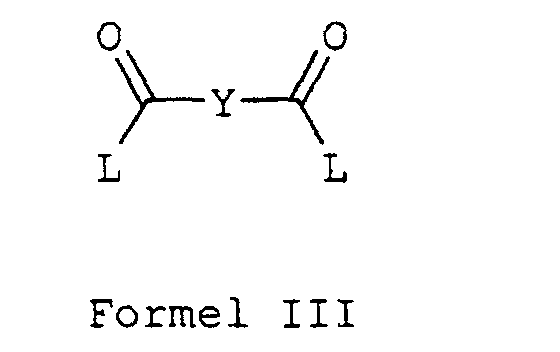
- the invention therefore also relates to a process for the preparation of poly-o-hydroxyamides of the formula I, at least one monomer of the formula II where Z stands for Z 1 , Z 2 or Z 3 , and Z 1 , Z 2 , Z 3 and R 1 have the meaning given above, is reacted with at least one dicarboxylic acid or an activated dicarboxylic acid derivative of the formula III, where L is a hydroxyl group or an activating group and Y is Y 1 , Y 2 , Y 3 , Y 4 , Y 5 , and Y 1 , Y 2 , Y 3 , Y 4 , Y 5 have the meaning given above.
- activating group L for the dicarboxylic acid derivatives Formula III can, for example, acid chlorides or activated Esters, for example sulfonic acid esters can be used.
- the Implementation of the monomers of formula II and the dicarboxylic acid of the formula III can, however, also in the presence of a dicarboxylic acid activating connection, such as Dicarbonyldiimidazole or dicyclohexylcarbodiimide. Basically all reagents are suitable, which is the result of the reaction Bind water to yourself.
- poly-o-hydroxyamides of the formula I are the monomers of the formula II and the dicarboxylic acid (s) or optionally the dicarboxylic acid derivatives of formula III in an organic solvent at -20 ° C to 150 ° C within 5 to 20 hours Brought reaction. If necessary, the end groups of the polymer with a suitable reagent to block the to introduce terminal groups A. Suitable reagents are already described in the explanation of the compounds of formula I. Service. Suitable solvents for polymer synthesis in particular ⁇ -butyrolactone, tetrahydrofuran, N-methylpyrrolidone and dimethylacetamide. However, in principle it can any solvent can be used in which the starting components are readily soluble.
- the one that emerged after the reaction Poly-o-hydroxyamide of formula I is added dropwise precipitated the reaction solution in a precipitant, washed and dried.
- Suitable precipitants are water and Alcohols, such as isopropanol, butanol or ethanol. It can mixtures of these precipitants can also be used. Suitable the precipitant can also be from 0.1% to 10% ammonia contain.
- the precipitated polymer can after filtration and Drying can be processed immediately and for example for application on a semiconductor substrate in a suitable Solvent are dissolved.
- Suitable solvents are, for example, acetone, cyclohexanone, diethylene glycol mono- or diethyl ether, N-methylpyrrolidone, ⁇ -butyrolactone, Ethyl lactate, methoxypropyl acetate, tetrahydrofuran or else Ethyl acetate.
- the polymerization to poly-o-hydroxyamide of formula I can to be released in the presence of a base To trap acid.
- Suitable basic acid scavengers are, for example Pyridine, triethylamine, diazabicyclooctane or polyvinylpyridine. However, other basic acid scavengers can also be used be used. Compounds are particularly preferred used in the solvent used for the synthesis, for example N-methylpyrrolidone, and in the precipitant, for example water or water-alcohol mixtures, are readily soluble, or those that are in the solvent are completely insoluble, such as cross-linked polyvinyl pyridine.
- the acid scavengers can then be processed of the reaction product slightly from the resulting poly-o-hydroxyamide split off.
- Another object of the invention is a method for Preparation of the polybenzoxazoles described above, using poly-o-hydroxyamides of formula I are heated. When heating takes place with the elimination of a small molecule, in general Water, the formation of an oxazole ring, the invention Polybenzoxazoles can be obtained.
- the polybenzoxazole produced by the process according to the invention has a very low dielectric constant from ⁇ 2.7. It adheres very well to those for chip technology relevant surfaces such as silicon, silicon carbide, silicon carbonitride, Silicon nitride, silicon oxide, titanium, tantalum, Titanium nitride, tantalum nitride or silicon oxynitride.
- the invention therefore also relates to an electronic one Component which contains the polybenzoxazole described above.
- the polybenzoxazole can be used, for example, as a dielectric be arranged between conductor tracks or conductor track levels or as a buffer layer between the microchip and one of these surrounding housing.
- the dielectrics according to the invention are outstandingly suitable for the copper damascene technique. During the grinding process there are no adverse effects such as peeling, cracking or Blistering on.
- the invention further relates to a method for the production of an electronic component, initially one Solution of the poly-o-hydroxyamide of the formula I in a solvent will be produced. The solution is placed on a substrate applied and the solvent evaporated, leaving a film is obtained. The film is then heated to the poly-o-hydroxyamide to cyclize the formula I and into the polybenzoxazole to convict. The film is then structured to to obtain a resist structure, which trenches and / or contact holes having. Then on the resist structure deposited a conductive material, for example copper, so the trenches and / or contact holes with the conductive Material are filled out. Finally, there will be excess conductive material removed.
- a conductive material for example copper
- lithographic processes are used, one etch-resistant mass is produced on the film.
- the structure the mask is then etched into the film from the Transfer polybenzoxazole invention.
- a leader Material is preferably copper.
- dielectric and conductive material may provide a barrier become. Suitable materials for the barrier are, for example the materials already mentioned above. Excess conductive material is removed for example by chemical-mechanical planarization.
- the invention further relates to a method of manufacture of an electronic component, with a solution of the Poly-o-hydroxyamids of formula I prepared in a solvent becomes.
- the solution is then placed on a substrate applied, which is already metallic on its surface Has structures between which trenches and / or contact holes are arranged. Such structures are, for example Interconnects.
- the solvent is evaporated so that the trenches and / or contact holes with the poly-o-hydroxyamide Formula I are completed. In the end it will Heated substrate to form the poly-o-hydroxyamide of formula I Cyclize polybenzoxazole.
- the liability of the poly-o-hydroxyamides of the formula I or this obtained polybenzoxazoles in microelectronics relevant surfaces can be improved by adding adhesion promoters.
- NMP N-methylpyrrolidone
- This solution will be at 10 ° C with stirring a solution of 23.93 g (0.095 mol) of dicarboxylic acid chloride 1 dissolved in 200 ml dist. Dropped NMP. It is at 1 ° C for 1 hour and then at 1 hour Stirred at 20 ° C. After cooling again to 10 ° C., the reaction mixture becomes 1.64 g (0.01 mol) endcap 3 dissolved in 50 ml least.
- ⁇ -Butyrolactone ( ⁇ -BL) added dropwise, 1 hour at 10 ° C and then stirred at 20 ° C for 1 hour. After cooling on 10 ° C, the reaction mixture with 19.76 g (0.25 mol) of pyridine dissolved in 30 ml dist. ⁇ -BL shifted to room temperature warmed and stirred for 2 hours.
- the reaction mixture is filtered to isolate the polymer and the filtrate in a mixture of 1 1 demineralized (VE) water and 200 ml of isopropanol are added dropwise with stirring, with a further 3 1 VE of water being added during the dropping become.
- the precipitated polymer is suctioned off and washed with 2 1 cold deionized water. After vacuuming the polymer twice for 1 hour at room temperature in 2.5 1 each a 3% ammonia solution stirred and then suction filtered.
- the polymer is washed neutral with deionized water, filtered off and dried for 72 hours at 50 ° C / 10 mbar.
- the polymer produced in this way is in solvents such as NMP, ⁇ -BL, cyclohexanone, cyclopentanone or mixtures of which well soluble.
- the reaction mixture is filtered to isolate the polymer and the filtrate in cyclohexane or a mixture of 4 l Cyclohexane and 2 1 VE water added dropwise with stirring and 12 h stirred at room temperature. That is at the phase boundary separating polymer is suctioned off and with 2 1 cold VE Washed water. After suction, the polymer is twice Stirred for 1 hour at 50 ° C in 2.5 1 VE water and then aspirated. The polymer is washed with demineralized water filtered off and dried for 72 hours at 50 ° C / 10 mbar.
- the polymer produced in this way is in solvents such as NMP, ⁇ -BL, cyclohexanone, cyclopentanone, diethylene glycol monomethyl ether, Ethyl lactate or mixtures thereof are good soluble.
- the polymer 3 was isolated and worked up analogously Example 1.
- the polymer 4 was isolated and worked up analogously Example 2.
- the polymer 5 was isolated and worked up analogously Example 1.
- the polymer 6 was isolated and worked up analogously Example 2.
- the polymer 7 was isolated and worked up analogously Example 1.
- the polymer 8 was isolated and worked up analogously Example 1.
- the polymer 9 was isolated and worked up analogously Example 2.
- the polymer 10 was isolated and worked up analogously Example 1.
- the adhesion of the polymers can be increased by using adhesion promoters on surfaces relevant in microelectronics such as z.
- adhesion promoters on surfaces relevant in microelectronics such as z.
- adhesion promoter z. B As an adhesion promoter z. B. the following connections are used: 0.5 g coupling agent (e.g. N- (2-aminoethyl) -3-aminopropylmethyldimethoxysilane) is dissolved in a cleaned, particle-free sample glass at room temperature in 95 g methanol, ethanol or isopropanol (VLSI-Selectipur®) and 5 g demineralized water. After 24 hours at room temperature, the adhesion promoter solution is ready for use. This solution can be used for a maximum of 3 weeks.
- coupling agent e.g. N- (2-aminoethyl) -3-aminopropylmethyldimethoxysilane
- VLSI-Selectipur® isopropanol
- the adhesion promoter is said to be a monomolecular layer on the Surface of the parts to be glued.
- the adhesion promoter can conveniently be applied by centrifugal technology become.
- the adhesion promoter solution is over a 0.2 ⁇ m Pre-filter applied to the surface to be glued and 30s at Spun at 5000 rpm. Then there is a Drying step 60 s at 100 ° C.
- Example 14 Application of a polymer by Spin process and cyclization to polybenzoxazole
- a processed silicon wafer, the ridges and trenches up to has a minimum dimension of approx. 150 nm each, like described in Example 13, coated with the coupling agent.
- the filtered solution of that obtained in Example 1 Polymer 1 applied to the wafer using a syringe and evenly distributed with a slingshot.
- the Spin speed is 2000 rpm.
- the polymer is on a hot plate for 1 min. at 120 ° C and for 2 min. heated to 200 ° C.
- the polybenzoxazole thus obtained is inert to acids, bases and organic solvents.
- Example 15 Determination of the Adhesion of the Polymers to a Titanium nitride layer
- a 4 "silicon wafer is sputtered with a 50 nm thick titanium nitride layer.
- the solution of polymer 1 obtained in Example 12 is spun onto this wafer, 5 s at 500 rpm and 25 s at 2000 rpm.
- 10 silicon chips of size 4x4 mm 2 which were also sputtered on the surface with 50 nm titanium nitride, are pressed onto the polymer film with a force of 2 N.
- This stack is then pressed for 1 h at 425 C. in an oven in a nitrogen atmosphere After cooling to room temperature, an adhesion test is carried out using a shear tester, Dage 400 series.
- the average force for polymer 1, which was required to shear the chips, is 17.84 N / mm 2 .
- Example 16 Determination of the Adhesion of the Polymers to a Tantalum nitride layer
- Example 15 was repeated, but the surface of the wafer and the chips was not titanium nitride but tantalum nitride.
- the mean value of the force for polymer 1, which was required to shear the chips, is 16.79 N / mm 2 .
- Example 17 Determination of the adhesion of the polymers to silicon
- Example 15 was repeated, but the surface of the wafer and chips was not silicon nitride but silicon.
- Example 18 Determination of the Adhesion of the Polymers to a Silicon nitride layer
- Example 15 was repeated, but the surface of the wafer and the chips was not made of titanium nitride but silicon nitride.
- the average force for polymer 1, which was required to shear the chips, is 16.52 N / mm 2 .
- Example 19 Determination of the Adhesion of the Polymers to a Silicon oxide layer
- Example 15 was repeated, but the surface of the wafer and the chips was not made of titanium nitride but of silicon oxide.
- the average force for polymer 1, which was required to shear the chips, is 17.88 N / mm 2 .
- Example 20 Determination of the Adhesion of the Polymers to a Silicon carbide layer
- Example 15 was repeated, but the surface of the wafer and chips was not made of titanium nitride but silicon carbide.
- the average force for polymer 1, which was required to shear the chips, is 16.75 N / mm 2 .
- Example 21 Determination of the Adhesion of the Polymers to a Tantalum layer
- Example 15 was repeated, but the surface of the wafer and chips was not titanium nitride but tantalum.
- the average force for polymer 1, which was required to shear the chips, is 16.20 N / mm 2 .
- Example 22 Determination of the Adhesion of the Polymers to a Titanium layer
- Example 15 was repeated, but the surface of the wafer and chips was not titanium nitride but titanium.
- the average force for polymer 1, which was required to shear the chips, is 17.06 N / mm 2 .
- Example 23 Determination of the Adhesion of the Polymers to a Polyimide layer
- Example 15 was repeated, but the surface of the wafer and chips was not made of titanium nitride but polyimide.
- the average force for polymer 1, which was required to shear the chips, is 18.04 N / mm 2 .
- a polymer which was produced analogously to Example 1 of US Pat. No. 5,077,378 is dissolved in NMP as described in Example 12. Examples 15 to 23 are repeated with this solution, a solution of the polymer from US Pat. No. 5,077,378 being used instead of the solution of polymer 1.
- Titanium nitride surface 14.71 N / mm 2 Tantalum nitride surface: 15.69 N / mm 2 Silicon surface: 15.21 N / mm 2 Silicon nitride surface 14.03 N / mm 2 Silicon oxide surface 14.94 N / mm 2 Silicon carbide surface 13.37 N / mm 2 Tantalum surface 13.96 N / mm 2 Titanium surface 14.07 N / mm 2 Polyimide surface 13.02 N / mm 2
- Polymer 1 was spun on three 4 "silicon wafers from 20% by weight solution (solvent NMP), 5 s at 500 rpm and 25 s at 2000 rpm. After a short softbake of 1 minute at 120 ° C. and 2 minutes at 200 ° C. on a hotplate, the wafers were annealed in an oven in a nitrogen atmosphere at 400 ° C. After cooling to room temperature, each coated wafer was heated to 50 ° in NMP, in acetone and in toluene for 5 hours C. The wafers are then dried in vacuo for 60 min at 200 ° C. and the mass difference is determined, and no signs of detachment were observed. Mass order: NMP 0.9% acetone 0.5% toluene 0.7%
- Polymer 2 was spun on three 4 "silicon wafers from 20% by weight solution (solvent NMP), 5 s at 500 rpm and 25 s at 2000 rpm. After a short softbake of 1 minute at 120 ° C. and 2 minutes at 200 ° C. on a hotplate, the wafers were annealed in an oven in a nitrogen atmosphere at 400 ° C. After cooling to room temperature, one coated wafer each was concentrated in concentrated HCl, 50%, for 5 hours Sulfuric acid and heated in acetic acid to 40 ° C. The wafers were then dried in vacuo for 60 min at 200 ° C. and the mass difference was determined. Mass order: conc. HCl 0.5% 50% H 2 SO 4 0.6% acetic acid 0.2%
- Polymer 3 was spun on three 4 "silicon wafers from 20% by weight solution (solvent NMP), 5 s at 500 rpm and 25 s at 2000 rpm. After a short softbake of 1 min at 120 ° C and 2 minutes at 200 ° C. on a hot plate, the wafers were annealed in an oven in a nitrogen atmosphere at 400 ° C. After cooling to room temperature, each coated wafer was exposed to 50% NaOH and 47% for 5 hours KOH and heated in concentrated ammonia to 40 ° C. The wafers were then dried in vacuo for 60 min at 200 ° C. and the mass difference was determined. Mass order: 50% NaOH 0.9% 47% KOH 0.7% conc. ammonia 0.1%
- the one used to determine the dielectric constant Experimental setup is shown in Fig. 1.
- the polymer 1 was dissolved in NMP (25% solution) and the solution over a Pressure-filtered membrane with 0.2 ⁇ m pores. This solution will on a substrate 1 on which there is already a 600 nm thickness Ti layer 2 is spun.
- Layer 3 is at 120 ° C and 200 ° C for 2 min each. dried on a hot plate and then at 430 ° C for one hour in a nitrogen atmosphere annealed. On this layer 3 are then via a shadow mask shown in FIG. 2 titanium electrodes 4 sputtered.
- the shadow mask comprises openings 5, the dimensions of which and correspond in their arrangement to the titanium electrodes 4.
- the dielectric constant is measured with the impedance spectrometer 6 determined and is in a frequency range determined from 100 Hz to 1 MHz at 2.47.
- the dielectric constant of polymer 2 was determined analogous to Example 28 and gave a value of 2.58.
- the dielectric constant of polymer 3 was determined analogous to Example 28 and gave a value of 2.63.
- the dielectric constant of polymer 4 was determined analogous to Example 28 and gave a value of 2.51.
- the polymer was placed on a 4 "silicon wafer of known mass 1 spun from 20% by weight solution (solvent NMP), 5 s at 500 rpm and 25 s at 3500 rpm. To a short softbake of 1 min. at 120 ° C on a hot plate the wafer is heated in an oven at 400 ° C for 1 hour Annealed nitrogen atmosphere. Using an analytical balance AT261 Delta Range, the mass of polymer 1 is determined. Subsequently the coated wafer is 10 h at 80 ° C in water stored. After blowing off the water there was a further weight determination. The mass difference became the percentage of water absorption based on the mass of polybenzoxazole calculated.
- Polymer 1 was dissolved in NMP (20% by weight solution) and the solution was pressure-filtered through a membrane with 0.2 ⁇ m pores. The solution is spun onto a silicon substrate at 2500 rpm, 25 s, the layer is dried on a hot plate at 100 ° C. for 2 minutes and then at 140 ° C. for 2 minutes. Through the subsequent cure process, 1 hour at 400 ° C under nitrogen, the material is converted into the corresponding polybenzoxazole. A 150 nm thick SiO 2 layer is deposited as a hard mask on this approximately 700 nm thick PBO layer in a PECVD system (Novellus Concept 1). This hard mask is structured using standard lithography and etching techniques.
- the structured hardmask is then used to structure the PBO layer in an RIE system (Lam XL) in the oxygen plasma.
- RIE system Li XL
- the structures are galvanically filled with copper (Novellus SABER system). The excess copper is then ground back in a CMP process.
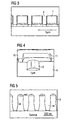
- the Copper lines 7 are embedded in polybenzoxazole 8, wherein the structures of polybenzoxazole 8 homogeneous, bubble and are free of cracks and show no liability problems.
- the copper lines 7 have a width of 0.5 microns, during the Space between the copper lines 7, that with the polybenzoxazole 8 is filled, has a width of 0.3 microns.
- Example 35 was repeated, using 1 instead of the polymer however, polymer 3 was used. Here too you get strong, structures free of bubbles and cracks.
- Example 35 was repeated, using 1 instead of the polymer however, polymer 4 was used. Here too you get strong, structures free of bubbles and cracks.
- Example 35 was repeated, using 1 instead of the polymer however, polymer 7 was used. You get that here too same result, adhesive, bubble and crack-free structures.
- Example 35 was repeated, using 1 instead of the polymer however, the material from EP 0264678 B1, Example 1, is used has been.
- the structures show such a process sequence Cracks and liability problems.
- Example 40 Dual damascene structure 1
- Polymer 1 was dissolved in NMP (20% by weight solution) and the solution was pressure-filtered through a membrane with 0.2 ⁇ m pores. The solution is spun onto a silicon substrate at 2500 rpm, 25s, the layer 2 min at 100 ° C and then 2 min. dried at 140 ° C on a hot plate. Through the subsequent cure process, 1 hour at 400 ° C under nitrogen, the material is converted into the corresponding polybenzoxazole. A 150 nm silicon oxide layer is then applied to this approximately 700 nm thick PBO layer using a PECVD system (Novellus Concept 1) as a so-called hard mask. The hard mask is patterned using a standard lithography and plasma etching process and the photoresist removed.
- PECVD system Novellus Concept 1
- a second layer of polymer 1 is applied to the structured hard mask.
- the 20% solution of polymer 1 is spun on at 3000 rpm, 2 min each. dried at 100 ° C and 140 ° C and annealed at 400 ° C for 1 h.
- a 150 nm thick silicon dioxide layer is also deposited as a hard mask on the second PBO layer.
- This layer is structured using a standard lithography followed by a plasma etching process.
- the two PBO layers are then structured in a RIE system (Lam XL) in the oxygen plasma using the SiO 2 masks.
- the structure shown was examined in the SEM.
- the recording is shown in Fig. 4.
- an upper layer 10 is arranged, which is also made of polybenzoxazole. Indentations are etched into each of the two layers 9, 10, the vertical flanks 11, 12 of the indentations having no irregularities and having a smooth surface.
- Example 40 was repeated, but instead of the polymer 1 polymer 3 was used. Here you also get defect-free Dual damascene structures with vertical and smooth Sidewalls.
- Example 40 was repeated, but instead of the polymer 1 polymer 8 was used. Here you also get defect-free Dual damascene structures with vertical and smooth Sidewalls.
- Example 40 was repeated, but instead of the polymer 1 polymer 10 was used. Here you also get defect-free Dual damascene structures with vertical and smooth Sidewalls.
- Polymer 1 was dissolved in NMP (20% by weight solution) and the solution is pressure filtered through a membrane with 0.2 ⁇ m pores. This solution was spun onto a substrate on which there were already metallic structures. After spin coating the solution is the layer for 2 min at 100 ° C, 140 ° C. and dried at 200 ° C on a hot plate and then Annealed at 400 ° C under nitrogen.
- the metal structures some of which have an aspect ratio above 4, where the distance between the structures is sometimes only 120 nm, are electrically isolated from each other in this process.
- a break was made from the substrate shown, polished and examined with a scanning electron microscope. The recording is shown in Fig. 5. Between lines 13 made of aluminum are spaces, which are filled with polybenzoxazole 14. The polybenzoxazole shows no defects.
- Example 44 was repeated, but instead of the polymer 1 the polymer 7 was used. Here, too Trenches filled without defects.
- Example 44 was repeated, but instead of the polymer 1 the polymer 9 was used. Here, too Trenches filled without defects.
Landscapes
- Chemical & Material Sciences (AREA)
- Health & Medical Sciences (AREA)
- Chemical Kinetics & Catalysis (AREA)
- Medicinal Chemistry (AREA)
- Polymers & Plastics (AREA)
- Organic Chemistry (AREA)
- Macromolecular Compounds Obtained By Forming Nitrogen-Containing Linkages In General (AREA)
- Polyamides (AREA)
- Organic Insulating Materials (AREA)
Abstract
Description

- M1:
-

- M2:
-

- M3, M4, M5,
- jeweils unabhängig:
oder
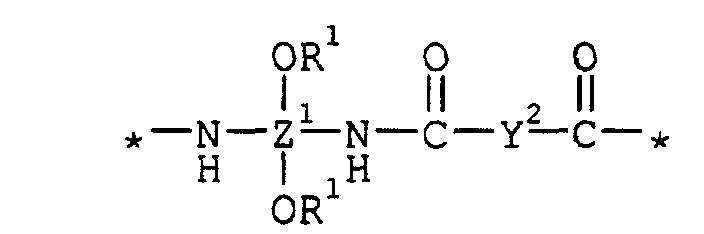
 oder
oder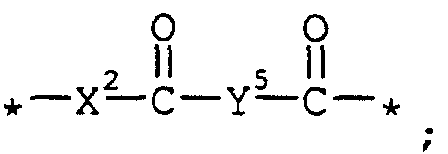
- M6:
-
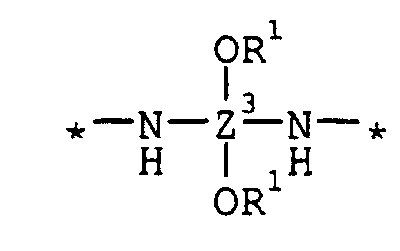
- Z2:
-

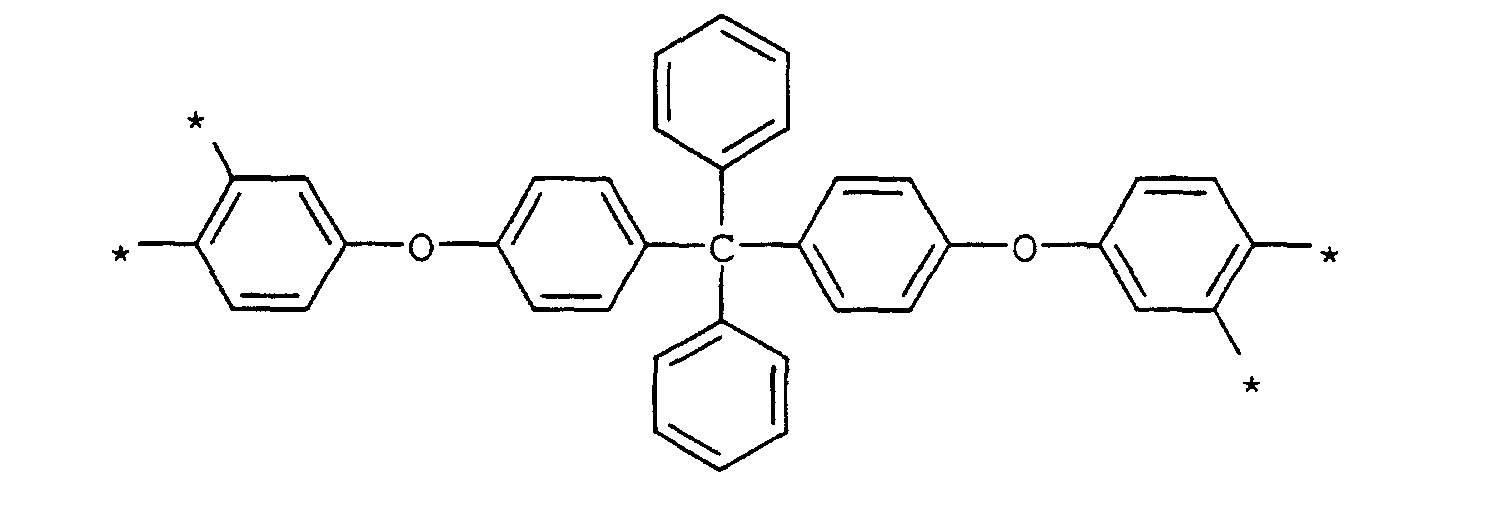
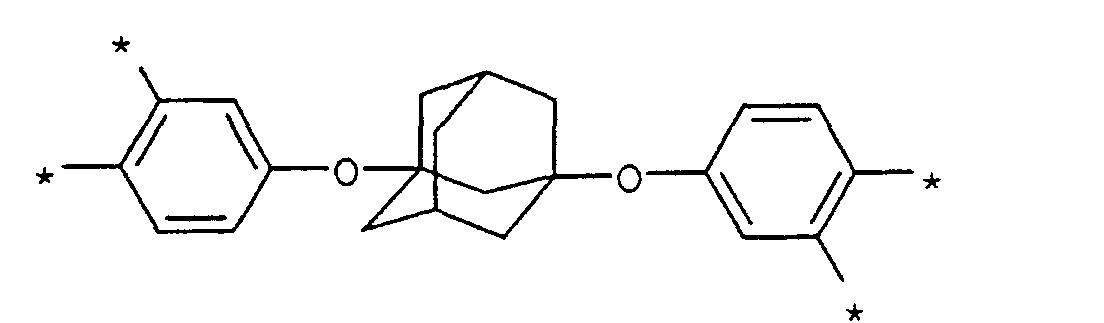
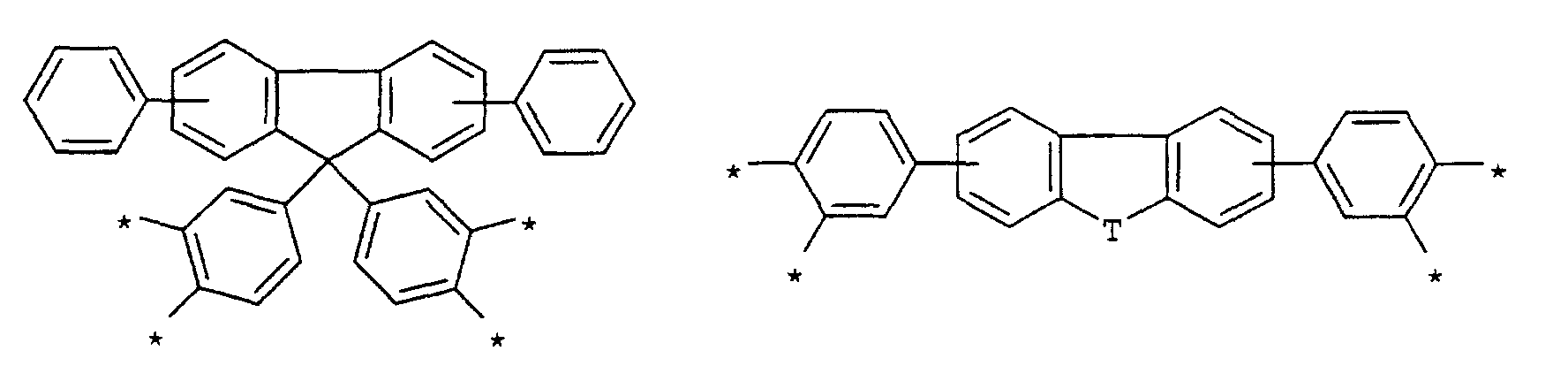


- Z1, Z3:
- jeweils unabhängig die gleiche Bedeutung wie für
Z2 angegeben, sowie weiter


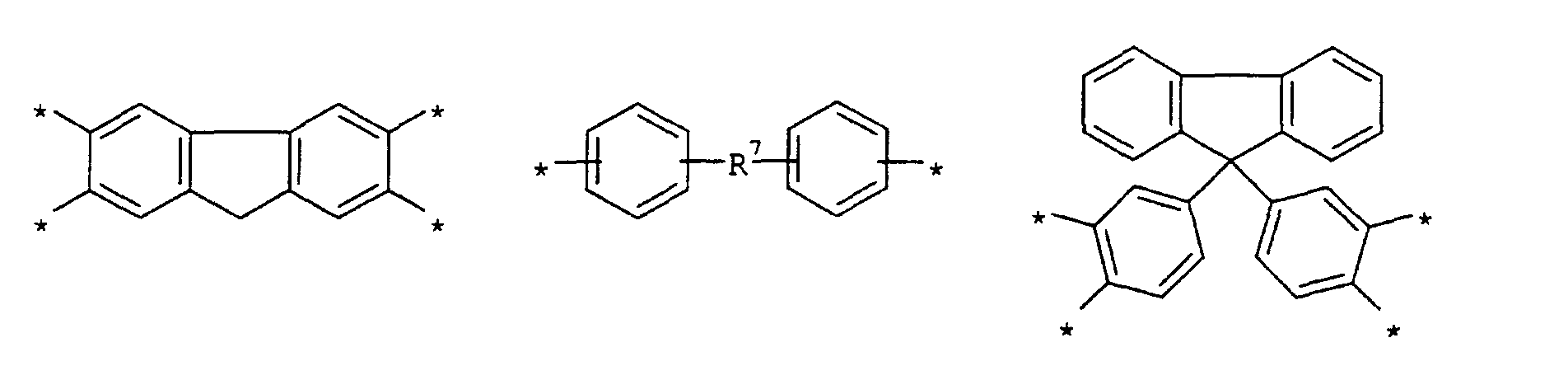

- Y1, Y2, Y3, Y4, Y5,:
-

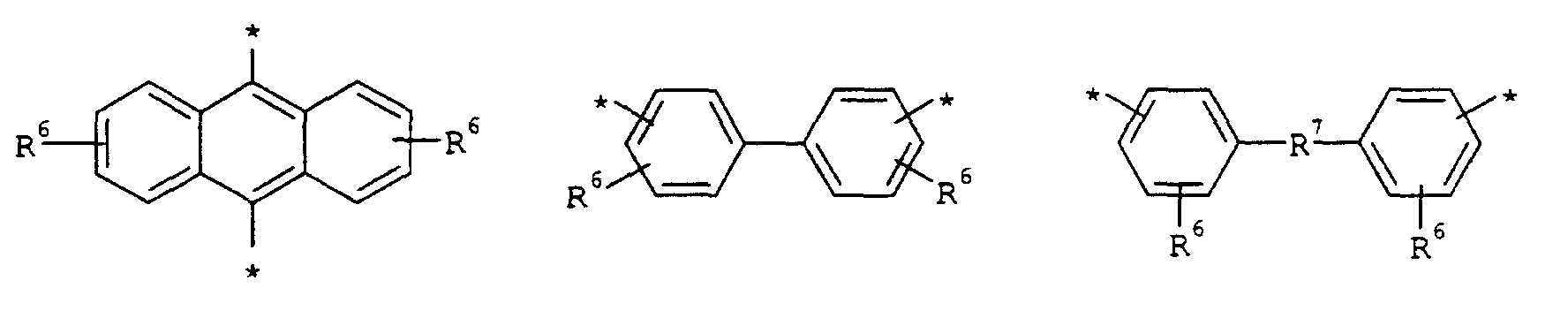




- X1, X2,
- jeweils unabhängig:




- T:
-

- A: wenn a = 0 und/oder f = 1 ist
-


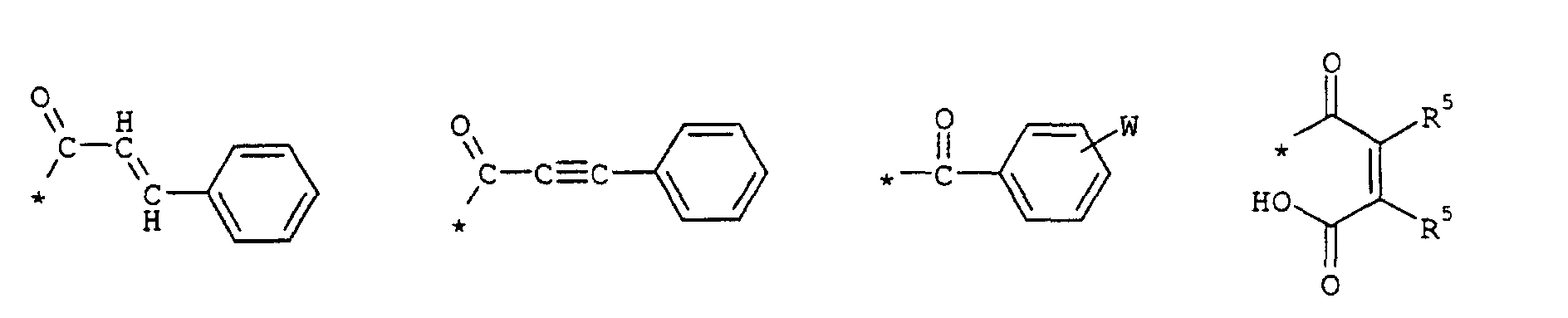 wenn a = 1 und/oder f = 0 ist A:


- W:
-





- Q:
-

- R1:
-

- R1:
-


- R2:
- -H, eine Alkylgruppe mit 1 bis 10 Kohlenstoffatomen, eine Aryl- oder eine Heteroarylgruppe
- R3, R4:
- jeweils unabhängig eine substituierte oder unsubstituierte Alkylen-, Arylen- oder Cycloalkylengruppe;
- R5:
-


- R6:
- -H, -CF3, -OH, -SH, -COOH, -N (R2)2, eine Alkyl-,
Aryl- oder eine Heteroarylgruppe, sowie





- R7:
- -O-, -CO-, -NR4-, -S-, -SO2-, -CH2-, -S2-, sowie






- R8:
- eine Alkylgruppe mit 1 bis 10 Kohlenstoffatomen, eine Arylgruppe oder eine Heteroarylgruppe;
- a:
- 0 oder 1;
- b:
- 1 - 200;
- c:
- 0 - 200;
- d:
- 0 - 50;
- e:
- 0 - 50;
- f:
- 0 oder 1;
- g:
- 0 - 100;
- h:
- 0 - 100;
- i:
- 0 - 10;
- k:
- 0 - 10;
- l:
- 1 - 10;
- m:
- 1 - 10;


mit zumindest einer Dicarbonsäure oder einem aktivierten Dicarbonsäurederivat der Formel III umgesetzt wird,
- Fig. 1:
- eine schematische Darstellung des Versuchsaufbaus zur Bestimmung der Dielektrizitätskonstante;
- Fig. 2
- eine Schattenmaske, wie sie in den Beispielen 28 bis 33 zur Herstellung von Elektroden verwendet wird;
- Fig. 3
- eine rasterelektronenmikroskopische Aufnahme eines polierten Bruchs durch in einem erfindungsgemäßen Polybenzoxazol angeordnete Kupferleiterbahnen, welche in einem Damascene-Prozess hergestellt wurden;
- Fig. 4
- eine rasterelektronenmikroskopische Aufnahme eines Bruchs durch eine aus dem erfindungsgemäßen Polybenzoxazol hergestellte Dual-DamasceneStruktur;
- Fig. 5
- eine rasterelektronenmikroskopische Aufnahme eines polierten Bruchs durch Aluminium-Leiterbahnen, wobei die Räume zwischen den Al-Strukturen mit dem erfindungsgemäßen Polybenzoxazol gefüllt wurden.
(Bisaminophenol 1)
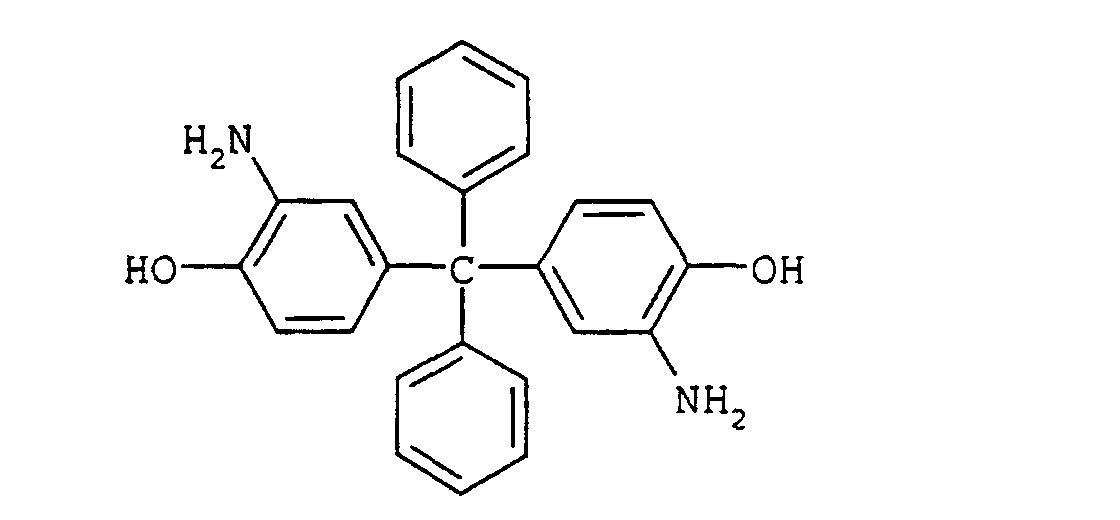
(Bisaminophen 2)

(Bisaminophenol 3)
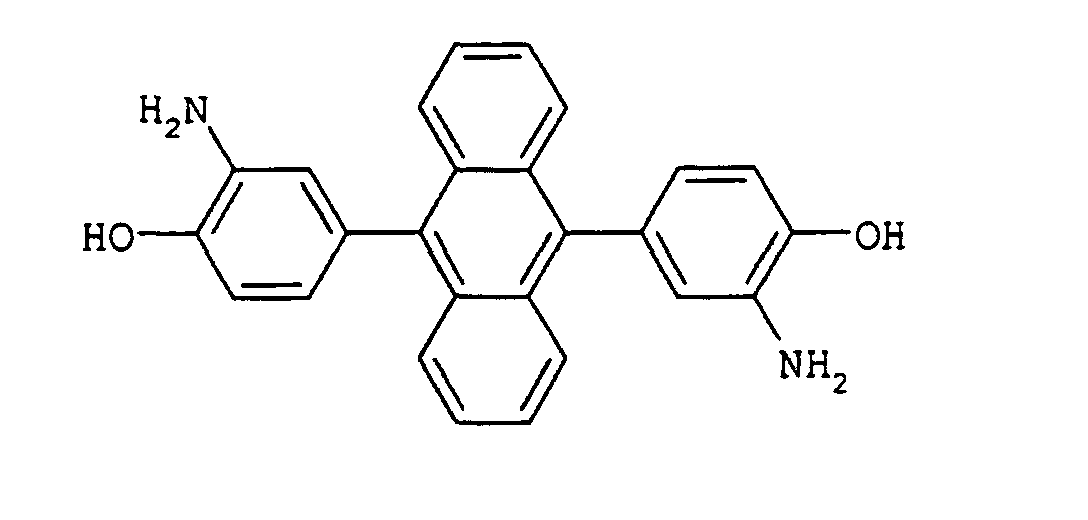
(Bisaminophenol 4)
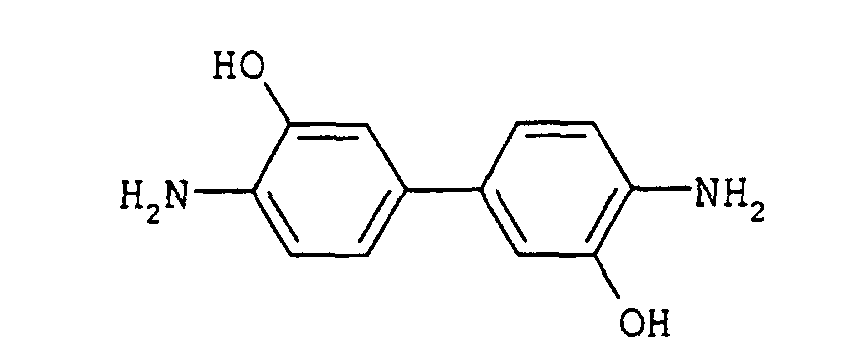
(Bisaminophenol 5)

(Dicarbonsäurechlorid 1)
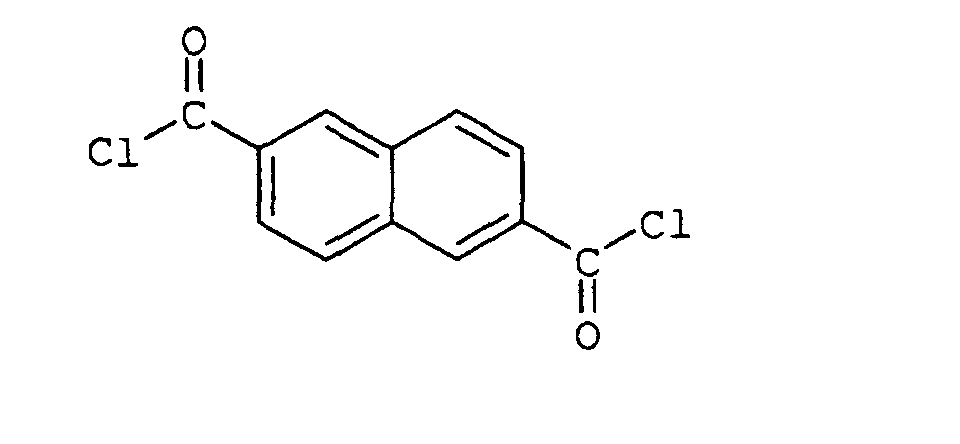
(Dicarbonsäurechlorid 2)
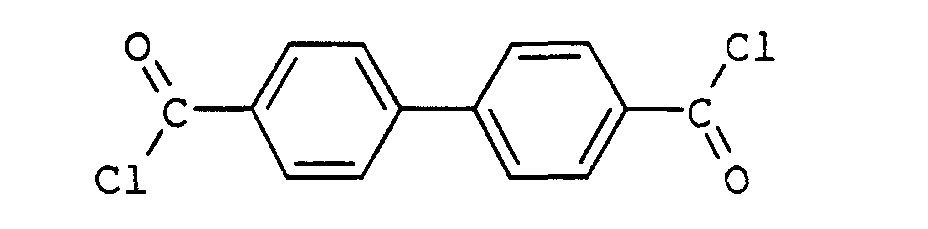
(Dicarbonsäurechlorid 3)
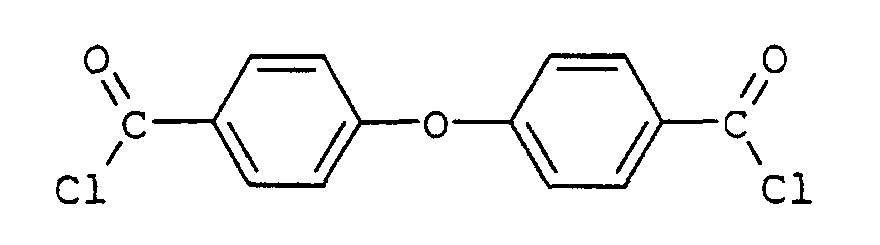
(Dicarbonsäurechlorid 4)

(Dicarbonsäurechlorid 5)

(Dicarbonsäurechlorid 6)

(Bisaminoverbindung 1)

(Bishydroxyverbindung 1)

(Bishydroxyverbindung 2)

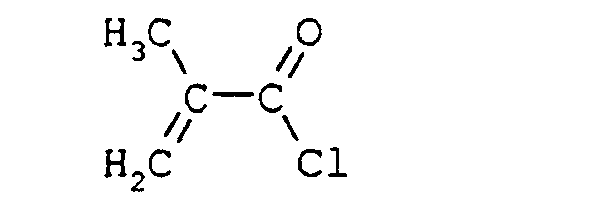
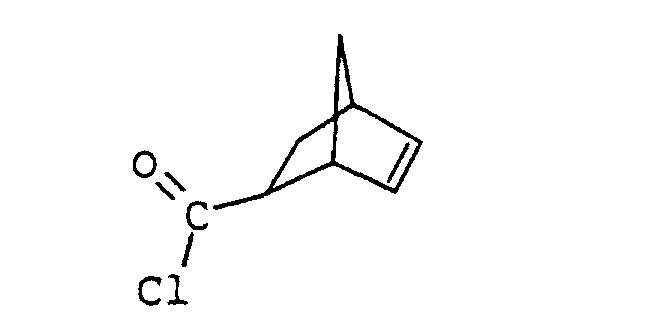
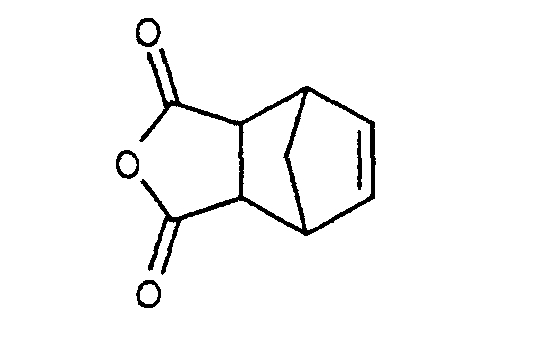


| Oberfläche Titannitrid: | 14,71 N/mm2 |
| Oberfläche Tantalnitrid: | 15,69 N/mm2 |
| Oberfläche Silizium: | 15,21 N/mm2 |
| Oberfläche Siliziumnitrid | 14,03 N/mm2 |
| Oberfläche Siliziumoxid | 14,94 N/mm2 |
| Oberfläche Siliziumcarbid | 13,37 N/mm2 |
| Oberfläche Tantal | 13,96 N/mm2 |
| Oberfläche Titan | 14,07 N/mm2 |
| Oberfläche Polyimid | 13,02 N/mm2 |
| Masseabnahme: | NMP | 0,9% |
| Aceton | 0,5% | |
| Toluol | 0,7% |
| Masseabnahme: | konz. HCl | 0,5% |
| 50 %ige H2SO4 | 0,6% | |
| Essigsäure | 0,2% |
| Masseabnahme: | 50 %ige NaOH | 0,9% |
| 47 %ige KOH | 0,7% | |
| konz. Ammoniak | 0,1% |
Claims (10)
- Poly-o-hydroxyamide der Formel Iwobei bedeutet:

- M1:
-
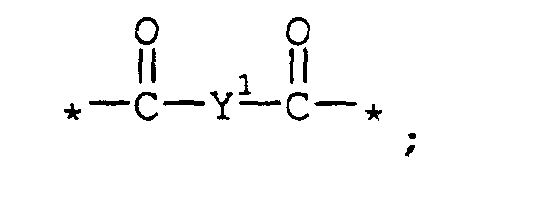
- M2:
-
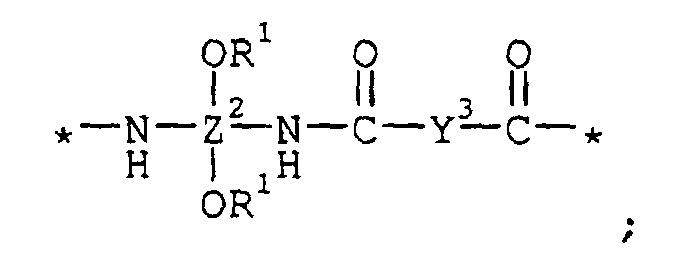
- M3, M4, M5, jeweile unabhängig:
- oder
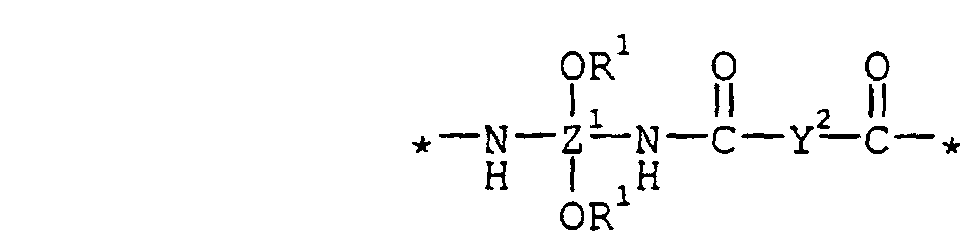 oder
oder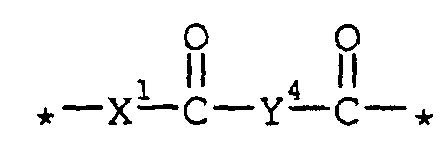
- M6:
-
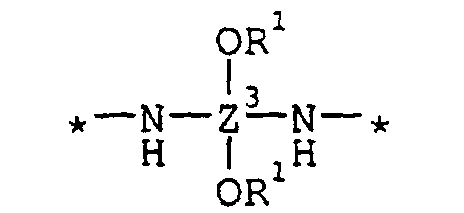
- z2:
-

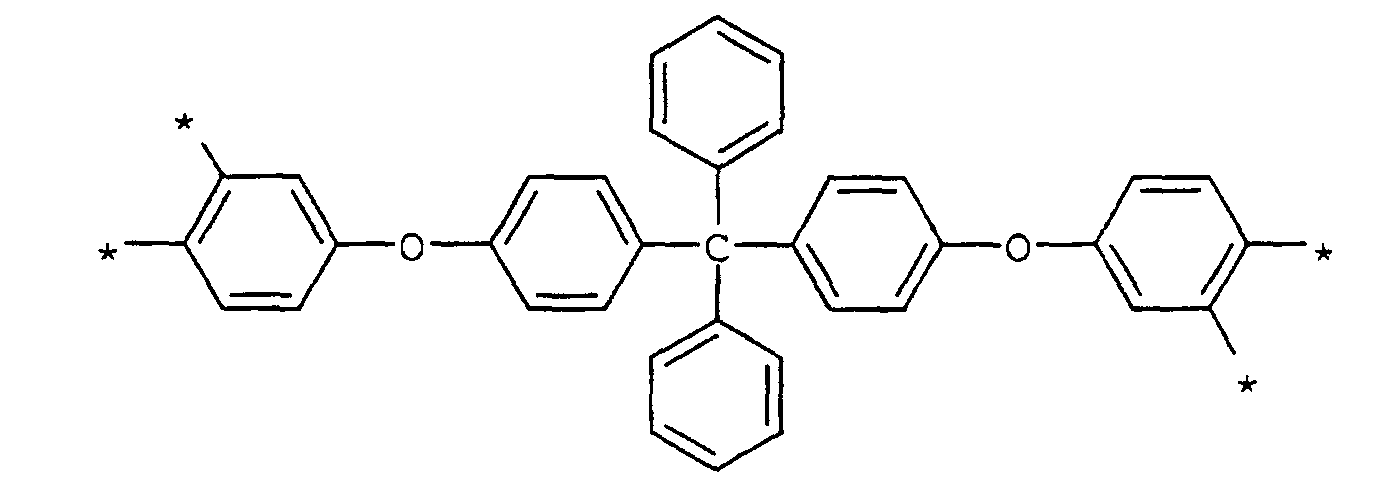
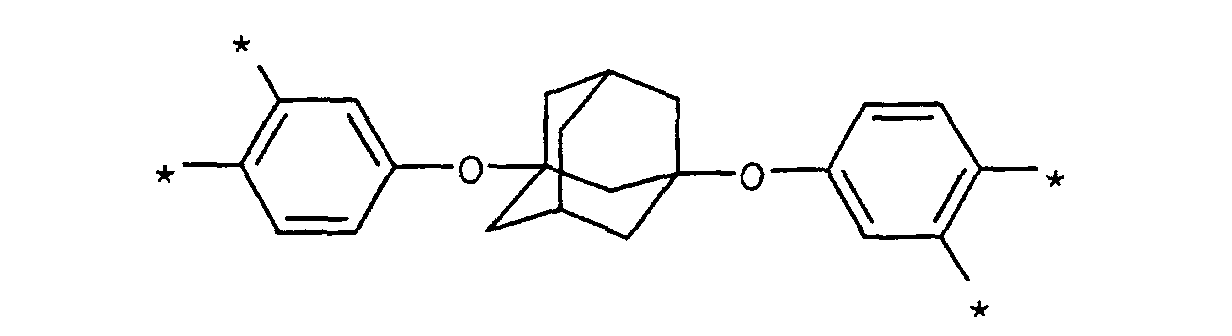
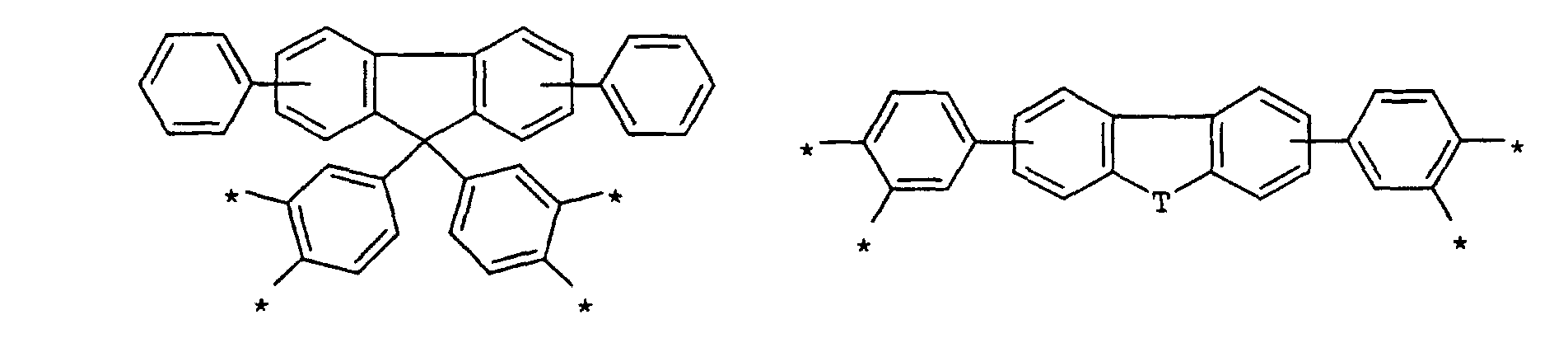
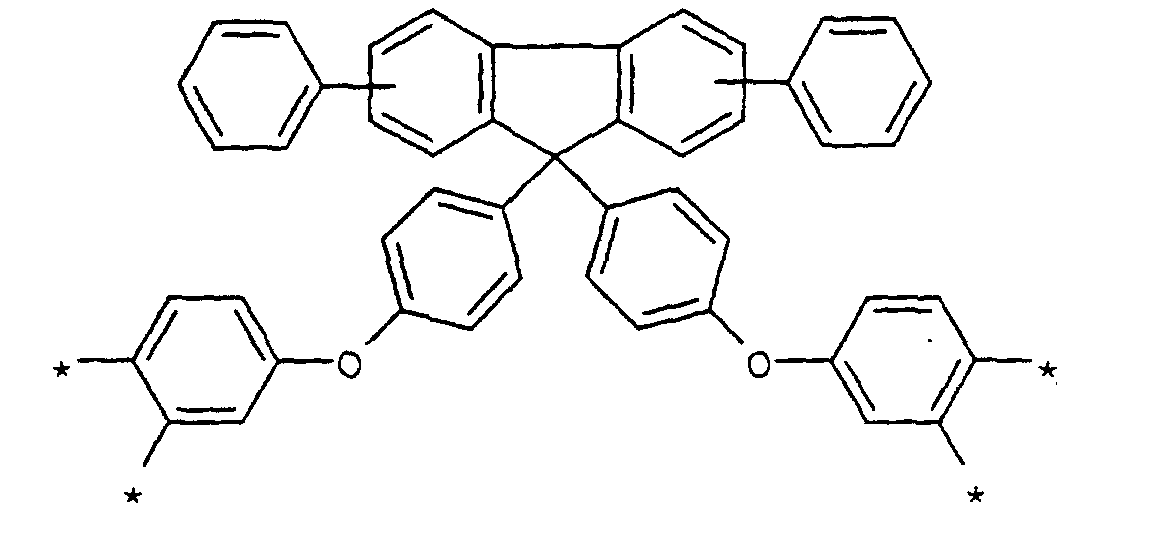

- Z1, Z3:
- jeweils unabhängig die gleiche Bedeutung wie für
Z2 angegeben, sowie weiter

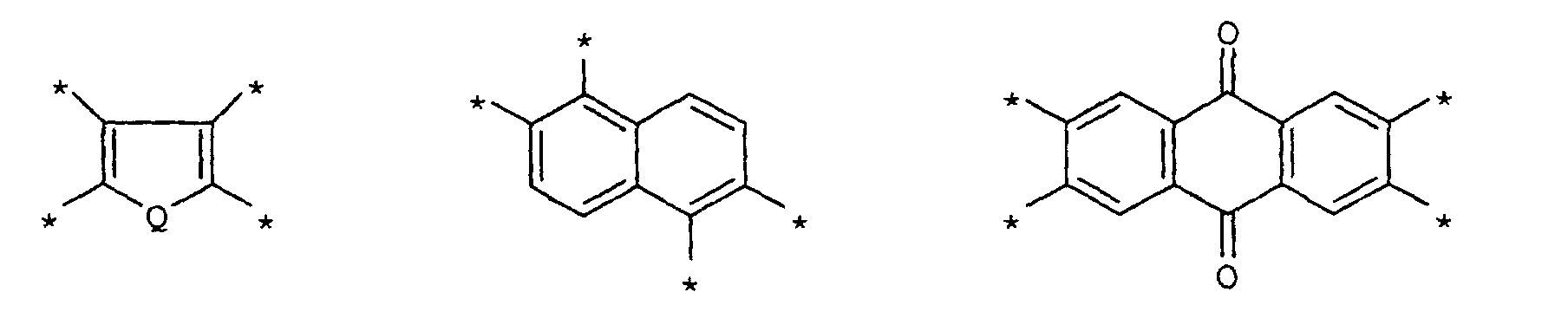
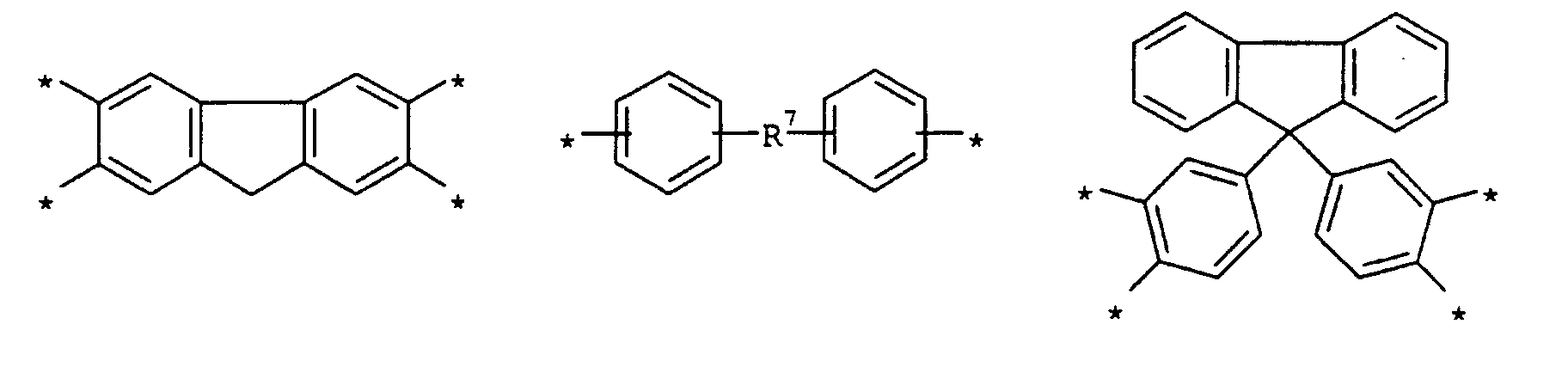
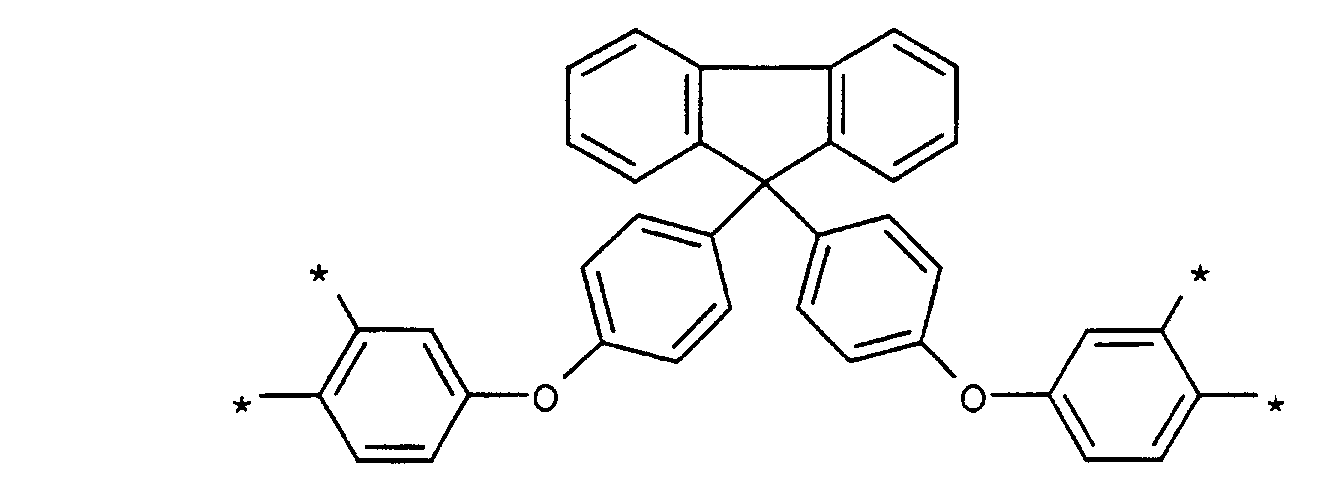

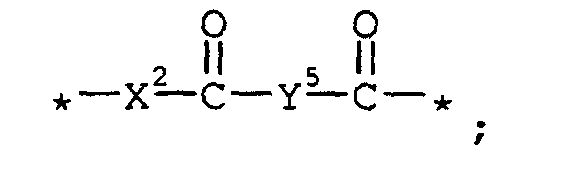
- Y1, Y2, Y3, Y4, Y5,:
-






- X1, X2,
- jeweils unabhängig:






- T:
-

- A:
- wenn a = 0 und/oder f = 1 ist


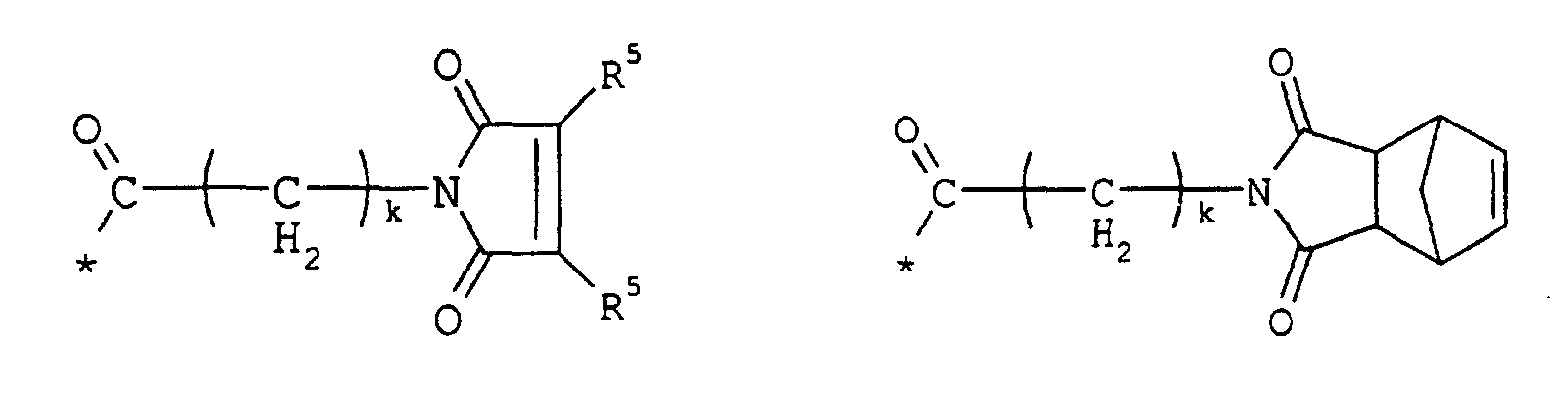



- W:
-


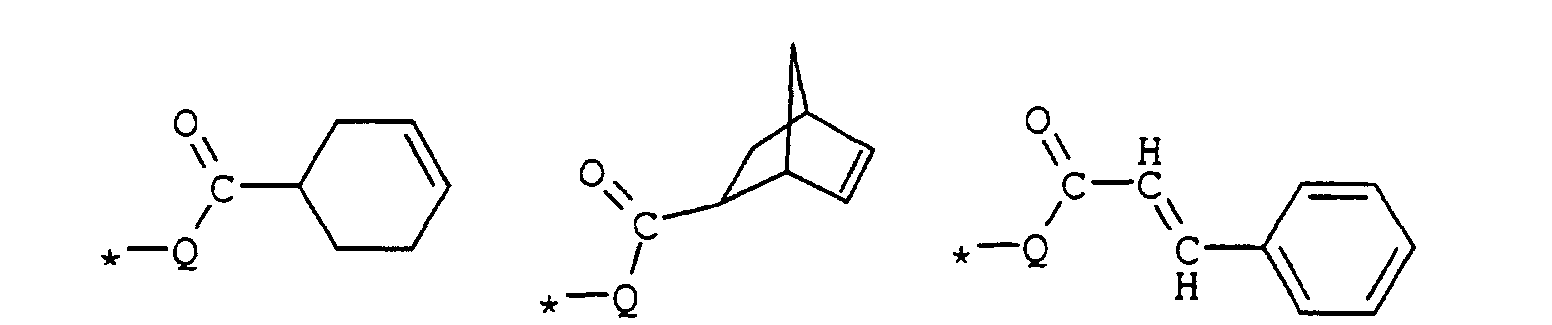


- Q:
-

- R1:
-


- R2:
- -H, eine Alkylgruppe mit 1 bis 10 Kohlenstoffatomen, eine Aryl- oder eine Heteroarylgruppe
- R3, R4:
- jeweils unabhängig eine substituierte oder unsubstituierte
Alkylen-, Arylen- oder Cycloalkylengruppe;

- R5:
-
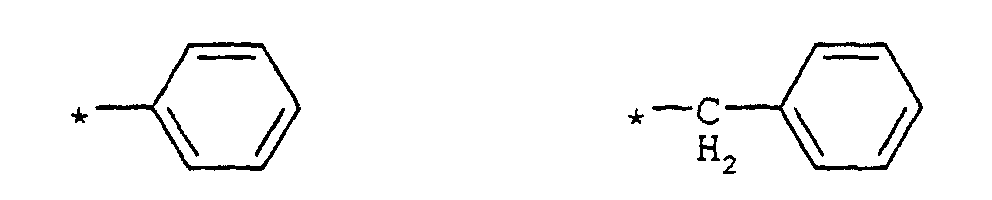
- R6:
- -H, -CF3, -OH, -SH, -COOH, -N (R2)2, eine Alkyl-,
Aryl- oder eine Heteroarylgruppe, sowie


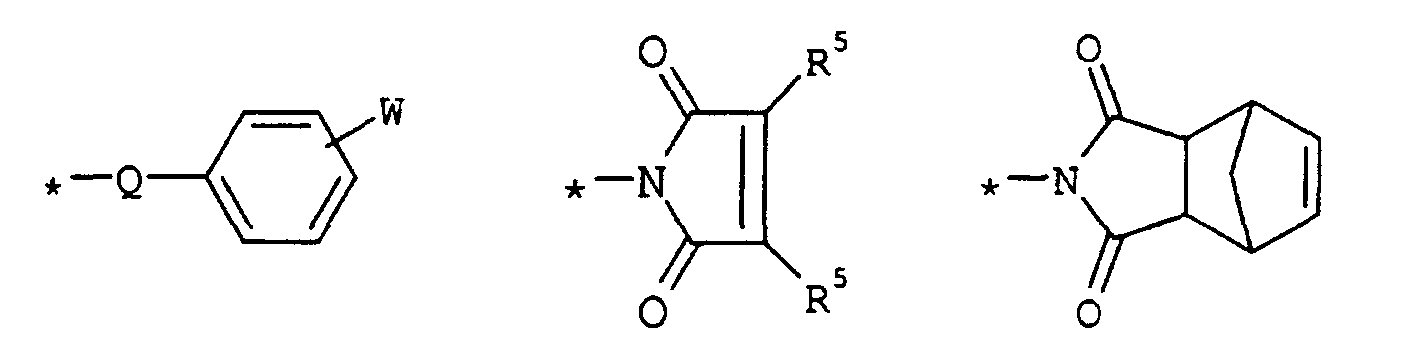
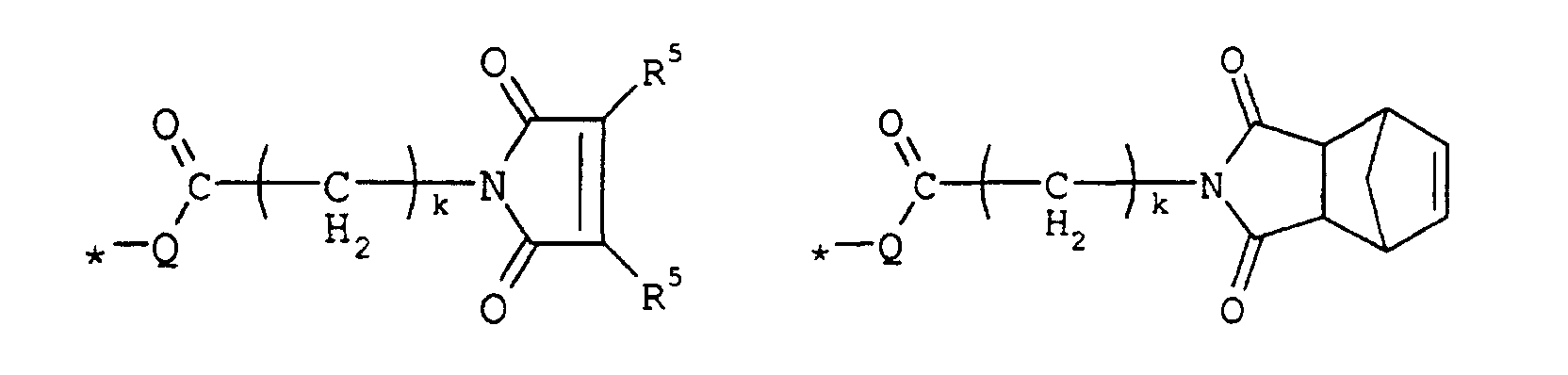
- R7:
- -O-, -CO-, -NR4-, -S-, -SO2-, -CH2-, -S2-, sowie






- R8:
- eine Alkylgruppe mit 1 bis 10 Kohlenstoffatomen, eine Arylgruppe oder eine Heteroarylgruppe;
- a:
- 0 oder 1;
- b:
- 1 - 200;
- c:
- 0 - 200;
- d:
- 0 - 50;
- e:
- 0 - 50;
- f:
- 0 oder 1;
- g:
- 0 - 100;
- h:
- 0 - 100;
- i:
- 0 - 10;
- k:
- 0 - 10;
- l:
- 1 - 10;
- m:
- 1 - 10;
- Poly-o-hydroxyamide nach Anspruch 1, wobei mindestens eine der folgenden Bedingungen gilt:b = 5 - 100;c = 0 - 50;d = 0 - 20;e = 0 - 20.
- Poly-o-hydroxyamide nach Anspruch 1 oder 2, wobei zumindest einer der Indices c, d und e ungleich Null ist.
- Polybenzoxazole, erhalten aus Poly-o-hydroxyamiden der Formel I.
- Verfahren zur Herstellung von Poly-o-hydroxyamiden der Formel I, wobei zumindest ein Monomer der Formel IIwobei Z steht für Z1, Z2 oder Z3, und Z1, Z2, Z3 sowie R1 die in Anspruch 1 angegebene Bedeutung aufweisen,
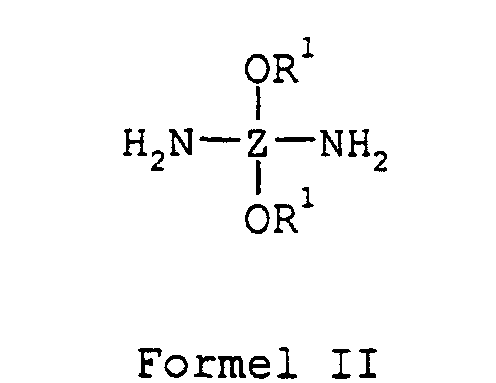
mit zumindest einer Dicarbonsäure oder einem aktivierten Dicarbonsäurederivat der Formel III umgesetzt wird,wobei 1 für eine Hydroxygruppe oder eine aktivierende Gruppe steht und Y für Y1, Y2, Y3, Y4, Y5 steht, und Y1, Y2, Y3, Y4, Y5 die in Anspruch 1 angegebene Bedeutung aufweisen.
- Verfahren nach Anspruch 5, wobei die Umsetzung in Gegenwart einer Base durchgeführt wird.
- Verfahren zur Herstellung von Polybenzoxazolen nach Anspruch 4, wobei Poly-o-hydroxyamide der Formel I erhitzt werden.
- Elektronisches Bauteil, umfassend ein Dielektrikum, welches ein Polybenzoxazol nach Anspruch 4 enthält.
- Verfahren zur Herstellung eines elektronischen Bauteils nach Anspruch 8, wobei eine Lösung eines Poly-o-hydroxyamids der Formel I in einem Lösungsmittel hergestellt wird, die Lösung auf ein Substrat aufgebracht und das Lösungsmittel verdampft wird, so dass ein Film erhalten wird, der Film erhitzt wird, um das Poly-o-hydroxyamid der Formel I zum Polybenzoxazol nach Anspruch 4 zu cyclisieren und der Film strukturiert wird, um eine Resiststruktur zu erhalten, welche Gräben aufweist, auf der Resiststruktur ein leitendes Material abgeschieden wird, so dass die Gräben mit dem leitenden Material ausgefüllt sind, und überschüssiges leitendes Material entfernt wird.
- Verfahren zur Herstellung eines elektronischen Bauteils nach Anspruch 8, wobei eine Lösung eines Poly-o-hydroxyamids der Formel I in einem Lösungsmittel hergestellt wird, die Lösung auf ein Substrat aufgebracht wird, welches auf seiner Oberfläche metallische Strukturen aufweist, zwischen denen Gräben angeordnet sind, das Lösungsmittel verdampft wird, so dass die Gräben mit dem Poly-o-hydroxyamid der Formel I ausgefüllt sind, und das Substrat erhitzt wird, um das Poly-o-hydroxyamid der Formel I zum Polybenzoxazol nach Anspruch 4 zu cyclisieren.
Applications Claiming Priority (2)
| Application Number | Priority Date | Filing Date | Title |
|---|---|---|---|
| DE10228769 | 2002-06-27 | ||
| DE2002128769 DE10228769A1 (de) | 2002-06-27 | 2002-06-27 | Isoliermaterial für Aluminium und Kupfermetallisierungen |
Publications (2)
| Publication Number | Publication Date |
|---|---|
| EP1375563A1 true EP1375563A1 (de) | 2004-01-02 |
| EP1375563B1 EP1375563B1 (de) | 2005-03-30 |
Family
ID=29716687
Family Applications (1)
| Application Number | Title | Priority Date | Filing Date |
|---|---|---|---|
| EP03014160A Expired - Lifetime EP1375563B1 (de) | 2002-06-27 | 2003-06-24 | Isoliermaterial für Aluminium und Kupfermetallisierungen |
Country Status (7)
| Country | Link |
|---|---|
| US (1) | US7244803B2 (de) |
| EP (1) | EP1375563B1 (de) |
| JP (1) | JP3779285B2 (de) |
| KR (1) | KR100573674B1 (de) |
| CN (1) | CN100577642C (de) |
| DE (2) | DE10228769A1 (de) |
| SG (1) | SG106149A1 (de) |
Families Citing this family (6)
| Publication number | Priority date | Publication date | Assignee | Title |
|---|---|---|---|---|
| KR100624407B1 (ko) * | 2003-01-02 | 2006-09-18 | 삼성에스디아이 주식회사 | 디페닐안트라센 유도체 및 이를 채용한 유기 전계 발광 소자 |
| TWI341554B (en) * | 2007-08-02 | 2011-05-01 | Enthone | Copper metallization of through silicon via |
| CN104513392B (zh) * | 2013-09-30 | 2016-09-07 | 北京大学 | 含羟基和烯丙基芳香族聚酰胺树脂及其制备方法与应用 |
| CN104513391B (zh) * | 2013-09-30 | 2017-02-15 | 北京大学 | 含烯丙氧基芳香族聚酰胺树脂及其制备方法与应用 |
| KR101788093B1 (ko) * | 2014-03-19 | 2017-10-19 | 제일모직 주식회사 | 모노머, 상기 모노머를 포함하는 하드마스크 조성물 및 상기 하드마스크 조성물을 사용하는 패턴형성방법 |
| US9905457B2 (en) * | 2014-12-26 | 2018-02-27 | Taiwan Semiconductor Manufacturing Company, Ltd. | High boiling temperature solvent additives for semiconductor processing |
Citations (2)
| Publication number | Priority date | Publication date | Assignee | Title |
|---|---|---|---|---|
| EP0997488A1 (de) * | 1998-10-28 | 2000-05-03 | Sumitomo Bakelite Company Limited | Polybenzoxazol-Harz und dessen Vorstufe |
| US6235436B1 (en) * | 1996-05-13 | 2001-05-22 | Sumitomo Bakelite Company Limited | Semiconductor device using positive photosensitive resin composition and process for preparation thereof |
Family Cites Families (7)
| Publication number | Priority date | Publication date | Assignee | Title |
|---|---|---|---|---|
| DE59606492D1 (de) * | 1995-08-31 | 2001-04-05 | Infineon Technologies Ag | Herstellung von Poly-o-hydroxyamiden und Poly-o-mercaptoamiden |
| US20030064568A1 (en) * | 1998-08-25 | 2003-04-03 | Benoit Giffard | Device comprising electronic components in regions of a layer of semiconducting material insulated from each other and manufacturing process for such a device |
| DE10011608A1 (de) * | 2000-03-10 | 2001-10-18 | Infineon Technologies Ag | Bis-o-aminophenole und o-Aminophenolcarbonsäuren |
| DE10011604A1 (de) * | 2000-03-10 | 2001-10-04 | Infineon Technologies Ag | Polybenzoxazol-Vorstufen |
| DE10147927B8 (de) * | 2001-09-28 | 2004-07-08 | Infineon Technologies Ag | Poly-o-hydroxyamide, Polybenzoxazole, elektronisches Bauteil sowie Verfahren zu ihrer Herstellung |
| JP2004018593A (ja) | 2002-06-13 | 2004-01-22 | Hitachi Chemical Dupont Microsystems Ltd | ポリベンゾオキサゾール前駆体、感光性樹脂組成物及び電子部品 |
| DE10228770A1 (de) | 2002-06-27 | 2004-02-12 | Infineon Technologies Ag | Dielektrikum mit Sperrwirkung gegen Kupferdiffusion |
-
2002
- 2002-06-27 DE DE2002128769 patent/DE10228769A1/de not_active Withdrawn
-
2003
- 2003-06-24 EP EP03014160A patent/EP1375563B1/de not_active Expired - Lifetime
- 2003-06-24 DE DE50300404T patent/DE50300404D1/de not_active Expired - Lifetime
- 2003-06-25 SG SG200303514A patent/SG106149A1/en unknown
- 2003-06-26 KR KR1020030042132A patent/KR100573674B1/ko not_active Expired - Fee Related
- 2003-06-27 CN CN03145750A patent/CN100577642C/zh not_active Expired - Fee Related
- 2003-06-27 JP JP2003184081A patent/JP3779285B2/ja not_active Expired - Fee Related
- 2003-06-27 US US10/609,453 patent/US7244803B2/en not_active Expired - Fee Related
Patent Citations (2)
| Publication number | Priority date | Publication date | Assignee | Title |
|---|---|---|---|---|
| US6235436B1 (en) * | 1996-05-13 | 2001-05-22 | Sumitomo Bakelite Company Limited | Semiconductor device using positive photosensitive resin composition and process for preparation thereof |
| EP0997488A1 (de) * | 1998-10-28 | 2000-05-03 | Sumitomo Bakelite Company Limited | Polybenzoxazol-Harz und dessen Vorstufe |
Also Published As
| Publication number | Publication date |
|---|---|
| KR20040002754A (ko) | 2004-01-07 |
| US20040082756A1 (en) | 2004-04-29 |
| KR100573674B1 (ko) | 2006-04-25 |
| SG106149A1 (en) | 2004-09-30 |
| DE50300404D1 (de) | 2005-05-04 |
| CN100577642C (zh) | 2010-01-06 |
| JP3779285B2 (ja) | 2006-05-24 |
| EP1375563B1 (de) | 2005-03-30 |
| DE10228769A1 (de) | 2004-02-05 |
| US7244803B2 (en) | 2007-07-17 |
| CN1472195A (zh) | 2004-02-04 |
| JP2004099873A (ja) | 2004-04-02 |
Similar Documents
| Publication | Publication Date | Title |
|---|---|---|
| DE69913011T2 (de) | Funktionelle Gruppen für die Vernetzung von Polymeren | |
| EP1375559B1 (de) | Dielektrikum mit Sperrwirkung gegen Kupferdiffusion | |
| DE69822918T2 (de) | Elektronisches Teil und Verfahren zu seiner Herstellung | |
| EP1375563B1 (de) | Isoliermaterial für Aluminium und Kupfermetallisierungen | |
| DE10147927C1 (de) | Poly-o-hyodroxyamide, Polybenzoxazole, elektronisches Bauteil sowie Verfahren zu ihrer Herstellung | |
| EP0761716B1 (de) | Verfahren zur Herstellung von Poly-o-hydroxyamiden und Poly-o-mercaptoamiden | |
| EP0905170B1 (de) | Polybenzoxazol- und Polybenzothiazol-Vorstufen | |
| DE10136382A1 (de) | Phenylverknüpfte Oxazolcyanurate als Dielektrikum mit guten Klebe-und Fülleigenschaften | |
| EP0761721B1 (de) | Verfahren zur Herstellung von Poly-o-hydroxyamiden und Poly-o-mercaptoamiden | |
| DE10152939A1 (de) | Polythiophene mit hohen Ladungsträgerbeweglichkeiten | |
| KR101514767B1 (ko) | 저장 안정성이 우수한 카본 하드마스크 중합체 및 이를 포함하는 카본 하드마스크 조성물, 및 이를 이용한 반도체 소자의 패턴 형성 방법 | |
| DE10115882B4 (de) | Polyhydroxamide, daraus durch Cyclisierung erhältliche Polybenzoxazole, Verfahren zur Herstellung der Polyhydroxamide und Polybenzoxazole, Beschichtungsmaterial für elektronische Bauelemente, elektronische Bauteile mit einer Schicht der Polybenzoxazole, Verfahren zur Beschichtung von Substraten mit den Polyhydroxamiden, Verwendung von Polybenzoxazolen als Isolier- und/oder Schutzschicht und Zusammensetzung enthaltend das Polyhydroxamid | |
| EP0761720B1 (de) | Verfahren zur Herstellung von Poly-o-hydroxyamiden und Poly-o-mercaptoamiden | |
| DE3700301C2 (de) | Verfahren zur Herstellung einer Vielschicht-Verdrahtungsstruktur | |
| DE3485758T2 (de) | Verfahren zur bildung einer schicht aus dielektrischem material aus polyimid auf einer elektronischen komponente und nach diesem verfahren hergestellte komponente. | |
| KR20140038809A (ko) | 스핀 온 카본 하드마스크용 중합체를 포함하는 스핀 온 카본 하드마스크 조성물 및 이를 이용한 반도체 소자의 패턴 형성 방법 | |
| DE10112561C2 (de) | Verfahren zur Erzeugung von auf einem Substrat haftenden porösen organischen Schichten | |
| DE10218788A1 (de) | Dielektrika mit selbstgenerierten Poren und Monomere für poröse Dielektrika | |
| EP0765894B1 (de) | Herstellung von Poly-o-hydroxyamiden und Poly-o-mercaptoamiden | |
| DE10130601A1 (de) | Substanz und Verfahren zur Herstellung einer porösen Schicht unter Verwendung der Substanz | |
| DE10126572A1 (de) | Material und Additiv für hochvernetzte chemisch und thermisch stabile Polymere | |
| KR102936650B1 (ko) | 하드마스크 조성물, 하드마스크 층 및 패턴 형성 방법 | |
| JP2001106880A (ja) | 硬化性オリゴマーを含む組成物 | |
| JP3534575B2 (ja) | 有機絶縁膜材料及びその製造方法 | |
| EP0503420A1 (de) | Amphiphile Polymere mit Silan-Einheiten und Film aus mindestens einer monomolekularen Schicht daraus |
Legal Events
| Date | Code | Title | Description |
|---|---|---|---|
| PUAI | Public reference made under article 153(3) epc to a published international application that has entered the european phase |
Free format text: ORIGINAL CODE: 0009012 |
|
| AK | Designated contracting states |
Kind code of ref document: A1 Designated state(s): AT BE BG CH CY CZ DE DK EE ES FI FR GB GR HU IE IT LI LU MC NL PT RO SE SI SK TR |
|
| AX | Request for extension of the european patent |
Extension state: AL LT LV MK |
|
| 17P | Request for examination filed |
Effective date: 20040623 |
|
| GRAP | Despatch of communication of intention to grant a patent |
Free format text: ORIGINAL CODE: EPIDOSNIGR1 |
|
| AKX | Designation fees paid |
Designated state(s): DE FR GB IE IT |
|
| GRAS | Grant fee paid |
Free format text: ORIGINAL CODE: EPIDOSNIGR3 |
|
| GRAA | (expected) grant |
Free format text: ORIGINAL CODE: 0009210 |
|
| AK | Designated contracting states |
Kind code of ref document: B1 Designated state(s): DE FR GB IE IT |
|
| REG | Reference to a national code |
Ref country code: GB Ref legal event code: FG4D Free format text: NOT ENGLISH |
|
| REF | Corresponds to: |
Ref document number: 50300404 Country of ref document: DE Date of ref document: 20050504 Kind code of ref document: P |
|
| REG | Reference to a national code |
Ref country code: IE Ref legal event code: FG4D Free format text: LANGUAGE OF EP DOCUMENT: GERMAN |
|
| GBT | Gb: translation of ep patent filed (gb section 77(6)(a)/1977) |
Effective date: 20050519 |
|
| PLBE | No opposition filed within time limit |
Free format text: ORIGINAL CODE: 0009261 |
|
| STAA | Information on the status of an ep patent application or granted ep patent |
Free format text: STATUS: NO OPPOSITION FILED WITHIN TIME LIMIT |
|
| ET | Fr: translation filed | ||
| 26N | No opposition filed |
Effective date: 20060102 |
|
| PGFP | Annual fee paid to national office [announced via postgrant information from national office to epo] |
Ref country code: IT Payment date: 20080621 Year of fee payment: 6 |
|
| PGFP | Annual fee paid to national office [announced via postgrant information from national office to epo] |
Ref country code: IE Payment date: 20080619 Year of fee payment: 6 |
|
| PGFP | Annual fee paid to national office [announced via postgrant information from national office to epo] |
Ref country code: FR Payment date: 20080613 Year of fee payment: 6 |
|
| PGFP | Annual fee paid to national office [announced via postgrant information from national office to epo] |
Ref country code: GB Payment date: 20080620 Year of fee payment: 6 |
|
| GBPC | Gb: european patent ceased through non-payment of renewal fee |
Effective date: 20090624 |
|
| REG | Reference to a national code |
Ref country code: FR Ref legal event code: ST Effective date: 20100226 |
|
| REG | Reference to a national code |
Ref country code: IE Ref legal event code: MM4A |
|
| PG25 | Lapsed in a contracting state [announced via postgrant information from national office to epo] |
Ref country code: FR Free format text: LAPSE BECAUSE OF NON-PAYMENT OF DUE FEES Effective date: 20090630 Ref country code: IE Free format text: LAPSE BECAUSE OF NON-PAYMENT OF DUE FEES Effective date: 20090624 |
|
| PG25 | Lapsed in a contracting state [announced via postgrant information from national office to epo] |
Ref country code: GB Free format text: LAPSE BECAUSE OF NON-PAYMENT OF DUE FEES Effective date: 20090624 |
|
| PG25 | Lapsed in a contracting state [announced via postgrant information from national office to epo] |
Ref country code: IT Free format text: LAPSE BECAUSE OF NON-PAYMENT OF DUE FEES Effective date: 20090624 |
|
| PGFP | Annual fee paid to national office [announced via postgrant information from national office to epo] |
Ref country code: DE Payment date: 20140723 Year of fee payment: 12 |
|
| REG | Reference to a national code |
Ref country code: DE Ref legal event code: R081 Ref document number: 50300404 Country of ref document: DE Owner name: INFINEON TECHNOLOGIES AG, DE Free format text: FORMER OWNER: QIMONDA AG, 81739 MUENCHEN, DE Ref country code: DE Ref legal event code: R081 Ref document number: 50300404 Country of ref document: DE Owner name: POLARIS INNOVATIONS LTD., IE Free format text: FORMER OWNER: QIMONDA AG, 81739 MUENCHEN, DE |
|
| REG | Reference to a national code |
Ref country code: DE Ref legal event code: R081 Ref document number: 50300404 Country of ref document: DE Owner name: POLARIS INNOVATIONS LTD., IE Free format text: FORMER OWNER: INFINEON TECHNOLOGIES AG, 85579 NEUBIBERG, DE |
|
| REG | Reference to a national code |
Ref country code: DE Ref legal event code: R119 Ref document number: 50300404 Country of ref document: DE |
|
| PG25 | Lapsed in a contracting state [announced via postgrant information from national office to epo] |
Ref country code: DE Free format text: LAPSE BECAUSE OF NON-PAYMENT OF DUE FEES Effective date: 20160101 |