EP1365458A1 - Barrier layer for an article and method of making said barrier layer by expanding thermal plasma - Google Patents
Barrier layer for an article and method of making said barrier layer by expanding thermal plasma Download PDFInfo
- Publication number
- EP1365458A1 EP1365458A1 EP20030253239 EP03253239A EP1365458A1 EP 1365458 A1 EP1365458 A1 EP 1365458A1 EP 20030253239 EP20030253239 EP 20030253239 EP 03253239 A EP03253239 A EP 03253239A EP 1365458 A1 EP1365458 A1 EP 1365458A1
- Authority
- EP
- European Patent Office
- Prior art keywords
- barrier layer
- substrate
- metal
- reagent
- layer
- Prior art date
- Legal status (The legal status is an assumption and is not a legal conclusion. Google has not performed a legal analysis and makes no representation as to the accuracy of the status listed.)
- Withdrawn
Links
Images


Classifications
-
- H—ELECTRICITY
- H10—SEMICONDUCTOR DEVICES; ELECTRIC SOLID-STATE DEVICES NOT OTHERWISE PROVIDED FOR
- H10W—GENERIC PACKAGES, INTERCONNECTIONS, CONNECTORS OR OTHER CONSTRUCTIONAL DETAILS OF DEVICES COVERED BY CLASS H10
- H10W42/00—Arrangements for protection of devices
-
- C—CHEMISTRY; METALLURGY
- C23—COATING METALLIC MATERIAL; COATING MATERIAL WITH METALLIC MATERIAL; CHEMICAL SURFACE TREATMENT; DIFFUSION TREATMENT OF METALLIC MATERIAL; COATING BY VACUUM EVAPORATION, BY SPUTTERING, BY ION IMPLANTATION OR BY CHEMICAL VAPOUR DEPOSITION, IN GENERAL; INHIBITING CORROSION OF METALLIC MATERIAL OR INCRUSTATION IN GENERAL
- C23C—COATING METALLIC MATERIAL; COATING MATERIAL WITH METALLIC MATERIAL; SURFACE TREATMENT OF METALLIC MATERIAL BY DIFFUSION INTO THE SURFACE, BY CHEMICAL CONVERSION OR SUBSTITUTION; COATING BY VACUUM EVAPORATION, BY SPUTTERING, BY ION IMPLANTATION OR BY CHEMICAL VAPOUR DEPOSITION, IN GENERAL
- C23C16/00—Chemical coating by decomposition of gaseous compounds, without leaving reaction products of surface material in the coating, i.e. chemical vapour deposition [CVD] processes
- C23C16/22—Chemical coating by decomposition of gaseous compounds, without leaving reaction products of surface material in the coating, i.e. chemical vapour deposition [CVD] processes characterised by the deposition of inorganic material, other than metallic material
- C23C16/30—Deposition of compounds, mixtures or solid solutions, e.g. borides, carbides, nitrides
- C23C16/34—Nitrides
- C23C16/345—Silicon nitride
-
- C—CHEMISTRY; METALLURGY
- C23—COATING METALLIC MATERIAL; COATING MATERIAL WITH METALLIC MATERIAL; CHEMICAL SURFACE TREATMENT; DIFFUSION TREATMENT OF METALLIC MATERIAL; COATING BY VACUUM EVAPORATION, BY SPUTTERING, BY ION IMPLANTATION OR BY CHEMICAL VAPOUR DEPOSITION, IN GENERAL; INHIBITING CORROSION OF METALLIC MATERIAL OR INCRUSTATION IN GENERAL
- C23C—COATING METALLIC MATERIAL; COATING MATERIAL WITH METALLIC MATERIAL; SURFACE TREATMENT OF METALLIC MATERIAL BY DIFFUSION INTO THE SURFACE, BY CHEMICAL CONVERSION OR SUBSTITUTION; COATING BY VACUUM EVAPORATION, BY SPUTTERING, BY ION IMPLANTATION OR BY CHEMICAL VAPOUR DEPOSITION, IN GENERAL
- C23C16/00—Chemical coating by decomposition of gaseous compounds, without leaving reaction products of surface material in the coating, i.e. chemical vapour deposition [CVD] processes
- C23C16/44—Chemical coating by decomposition of gaseous compounds, without leaving reaction products of surface material in the coating, i.e. chemical vapour deposition [CVD] processes characterised by the method of coating
- C23C16/50—Chemical coating by decomposition of gaseous compounds, without leaving reaction products of surface material in the coating, i.e. chemical vapour deposition [CVD] processes characterised by the method of coating using electric discharges
- C23C16/513—Chemical coating by decomposition of gaseous compounds, without leaving reaction products of surface material in the coating, i.e. chemical vapour deposition [CVD] processes characterised by the method of coating using electric discharges using plasma jets
-
- C—CHEMISTRY; METALLURGY
- C09—DYES; PAINTS; POLISHES; NATURAL RESINS; ADHESIVES; COMPOSITIONS NOT OTHERWISE PROVIDED FOR; APPLICATIONS OF MATERIALS NOT OTHERWISE PROVIDED FOR
- C09K—MATERIALS FOR MISCELLANEOUS APPLICATIONS, NOT PROVIDED FOR ELSEWHERE
- C09K2323/00—Functional layers of liquid crystal optical display excluding electroactive liquid crystal layer characterised by chemical composition
-
- Y—GENERAL TAGGING OF NEW TECHNOLOGICAL DEVELOPMENTS; GENERAL TAGGING OF CROSS-SECTIONAL TECHNOLOGIES SPANNING OVER SEVERAL SECTIONS OF THE IPC; TECHNICAL SUBJECTS COVERED BY FORMER USPC CROSS-REFERENCE ART COLLECTIONS [XRACs] AND DIGESTS
- Y02—TECHNOLOGIES OR APPLICATIONS FOR MITIGATION OR ADAPTATION AGAINST CLIMATE CHANGE
- Y02T—CLIMATE CHANGE MITIGATION TECHNOLOGIES RELATED TO TRANSPORTATION
- Y02T50/00—Aeronautics or air transport
- Y02T50/60—Efficient propulsion technologies, e.g. for aircraft
-
- Y—GENERAL TAGGING OF NEW TECHNOLOGICAL DEVELOPMENTS; GENERAL TAGGING OF CROSS-SECTIONAL TECHNOLOGIES SPANNING OVER SEVERAL SECTIONS OF THE IPC; TECHNICAL SUBJECTS COVERED BY FORMER USPC CROSS-REFERENCE ART COLLECTIONS [XRACs] AND DIGESTS
- Y10—TECHNICAL SUBJECTS COVERED BY FORMER USPC
- Y10S—TECHNICAL SUBJECTS COVERED BY FORMER USPC CROSS-REFERENCE ART COLLECTIONS [XRACs] AND DIGESTS
- Y10S428/00—Stock material or miscellaneous articles
- Y10S428/913—Material designed to be responsive to temperature, light, moisture
-
- Y—GENERAL TAGGING OF NEW TECHNOLOGICAL DEVELOPMENTS; GENERAL TAGGING OF CROSS-SECTIONAL TECHNOLOGIES SPANNING OVER SEVERAL SECTIONS OF THE IPC; TECHNICAL SUBJECTS COVERED BY FORMER USPC CROSS-REFERENCE ART COLLECTIONS [XRACs] AND DIGESTS
- Y10—TECHNICAL SUBJECTS COVERED BY FORMER USPC
- Y10T—TECHNICAL SUBJECTS COVERED BY FORMER US CLASSIFICATION
- Y10T428/00—Stock material or miscellaneous articles
- Y10T428/26—Web or sheet containing structurally defined element or component, the element or component having a specified physical dimension
- Y10T428/263—Coating layer not in excess of 5 mils thick or equivalent
- Y10T428/264—Up to 3 mils
- Y10T428/265—1 mil or less
-
- Y—GENERAL TAGGING OF NEW TECHNOLOGICAL DEVELOPMENTS; GENERAL TAGGING OF CROSS-SECTIONAL TECHNOLOGIES SPANNING OVER SEVERAL SECTIONS OF THE IPC; TECHNICAL SUBJECTS COVERED BY FORMER USPC CROSS-REFERENCE ART COLLECTIONS [XRACs] AND DIGESTS
- Y10—TECHNICAL SUBJECTS COVERED BY FORMER USPC
- Y10T—TECHNICAL SUBJECTS COVERED BY FORMER US CLASSIFICATION
- Y10T428/00—Stock material or miscellaneous articles
- Y10T428/26—Web or sheet containing structurally defined element or component, the element or component having a specified physical dimension
- Y10T428/266—Web or sheet containing structurally defined element or component, the element or component having a specified physical dimension of base or substrate
-
- Y—GENERAL TAGGING OF NEW TECHNOLOGICAL DEVELOPMENTS; GENERAL TAGGING OF CROSS-SECTIONAL TECHNOLOGIES SPANNING OVER SEVERAL SECTIONS OF THE IPC; TECHNICAL SUBJECTS COVERED BY FORMER USPC CROSS-REFERENCE ART COLLECTIONS [XRACs] AND DIGESTS
- Y10—TECHNICAL SUBJECTS COVERED BY FORMER USPC
- Y10T—TECHNICAL SUBJECTS COVERED BY FORMER US CLASSIFICATION
- Y10T428/00—Stock material or miscellaneous articles
- Y10T428/31504—Composite [nonstructural laminate]
- Y10T428/31507—Of polycarbonate
-
- Y—GENERAL TAGGING OF NEW TECHNOLOGICAL DEVELOPMENTS; GENERAL TAGGING OF CROSS-SECTIONAL TECHNOLOGIES SPANNING OVER SEVERAL SECTIONS OF THE IPC; TECHNICAL SUBJECTS COVERED BY FORMER USPC CROSS-REFERENCE ART COLLECTIONS [XRACs] AND DIGESTS
- Y10—TECHNICAL SUBJECTS COVERED BY FORMER USPC
- Y10T—TECHNICAL SUBJECTS COVERED BY FORMER US CLASSIFICATION
- Y10T428/00—Stock material or miscellaneous articles
- Y10T428/31504—Composite [nonstructural laminate]
- Y10T428/31678—Of metal
- Y10T428/31681—Next to polyester, polyamide or polyimide [e.g., alkyd, glue, or nylon, etc.]
-
- Y—GENERAL TAGGING OF NEW TECHNOLOGICAL DEVELOPMENTS; GENERAL TAGGING OF CROSS-SECTIONAL TECHNOLOGIES SPANNING OVER SEVERAL SECTIONS OF THE IPC; TECHNICAL SUBJECTS COVERED BY FORMER USPC CROSS-REFERENCE ART COLLECTIONS [XRACs] AND DIGESTS
- Y10—TECHNICAL SUBJECTS COVERED BY FORMER USPC
- Y10T—TECHNICAL SUBJECTS COVERED BY FORMER US CLASSIFICATION
- Y10T428/00—Stock material or miscellaneous articles
- Y10T428/31504—Composite [nonstructural laminate]
- Y10T428/31721—Of polyimide
-
- Y—GENERAL TAGGING OF NEW TECHNOLOGICAL DEVELOPMENTS; GENERAL TAGGING OF CROSS-SECTIONAL TECHNOLOGIES SPANNING OVER SEVERAL SECTIONS OF THE IPC; TECHNICAL SUBJECTS COVERED BY FORMER USPC CROSS-REFERENCE ART COLLECTIONS [XRACs] AND DIGESTS
- Y10—TECHNICAL SUBJECTS COVERED BY FORMER USPC
- Y10T—TECHNICAL SUBJECTS COVERED BY FORMER US CLASSIFICATION
- Y10T428/00—Stock material or miscellaneous articles
- Y10T428/31504—Composite [nonstructural laminate]
- Y10T428/31855—Of addition polymer from unsaturated monomers
Definitions
- the invention relates to a barrier layer that is resistant to the transmission of moisture and oxygen. More particularly, the present invention relates to an article having such a barrier layer and methods of applying such a barrier layer to an article.
- each device includes at least one substrate and at least one "active" layer.
- Electrode materials in LEDs and OELDs are sensitive to air and moisture, as are the polymeric and organic compounds that are used in OELDs and the liquid crystal materials in LCDs. Exposure to the elements-particularly oxygen and water - may severely limit the lifetime of such devices.
- substantially impermeable substrate such as glass
- Selection of a substantially impermeable substrate, such as glass provides protection from environmental attack.
- Polymeric substrates that are used in flexible versions of such devices do not provide adequate protection against oxygen and moisture. Consequently, at least one coating that is substantially impermeable to oxygen and water vapor must be applied to the polymeric substrate to achieve the desired level of protection.
- Barrier materials have been applied to substrates using a variety of coating processes.
- Plasma enhanced chemical vapor deposition (PECVD) for example, has been used to deposit barrier materials.
- Typical PECVD processes are relatively slow; i.e. the barrier material is deposited on the substrate at a rate of about 30 to 60 nm/min or less.
- the barrier coating In order to be commercially viable, the barrier coating must be applied to the substrate at a significantly higher deposition rate.
- barrier materials are needed to extend lifetimes of flexible display devices such as LCDs, LEDs, and OELDs to acceptable levels, the methods that are currently used to apply the needed barrier materials to substrates are too slow. Therefore, what is needed is a method of forming a barrier layer on a substrate at a high rate of deposition. What is also needed is a method of forming a barrier layer on a substrate to form an article having acceptable water vapor and oxygen transmission rates. What is further needed is an article having a barrier layer, the article having acceptable water vapor and oxygen transmission rates.
- the present invention meets these and other needs by providing an article comprising a substrate having a barrier layer disposed on the surface of the substrate and methods of depositing such a barrier layer on the substrate, wherein the barrier layer is resistant to transmission of moisture and oxygen therethrough.
- the article may include additional layers, such as, but not limited to, an adhesion layer, abrasion resistant layers, radiation-absorbing layers, radiation-reflective layers, and conductive layers.
- Such articles include, but are not limited to, light emitting diodes (LEDs), liquid crystal displays (LCDs), photovoltaic articles, electrochromic articles, organic integrated circuits, and organic electroluminescent devices (OELDs).
- one aspect of the invention is to provide an article.
- the article comprises a substrate and at least one barrier layer disposed on at least one surface of the substrate, wherein the barrier layer comprises an inorganic material, and wherein the barrier layer is resistant to transmission of moisture and oxygen therethrough and has a water vapor transmission rate (WVTR) at 25°C and 100% relative humidity of less than about 2 g/m 2 -day and an oxygen transmission rate (OTR) at 25°C and 100% oxygen concentration of less than about 2 cc/m 2 -day.
- WVTR water vapor transmission rate
- OTR oxygen transmission rate
- a second aspect of the invention is to provide a barrier layer that is resistant to transmission of moisture and oxygen therethrough.
- the barrier layer comprises at least one of a metal oxide, a metal nitride, a metal carbide, and combinations thereof.
- Each of the metal nitride, the metal carbide, and the metal oxide contains at least one of silicon, aluminum, zinc, indium, tin, a transition metal, and combinations thereof.
- the barrier layer has a water vapor transmission rate (WVTR) at 25°C and 100% relative humidity of less than about 2 g/m 2 -day and an oxygen transmission rate (OTR) at 25°C and 100% oxygen concentration of less than about 2 cc/m 2 -day.
- WVTR water vapor transmission rate
- OTR oxygen transmission rate
- a third aspect of the invention is to provide an article.
- the article comprises a substrate and at least one barrier layer, the at least one barrier layer comprising at least one of a metal oxide, a metal nitride, a metal carbide, and combinations thereof, wherein each of the metal nitride, the metal carbide, and the metal oxide contains at least one of silicon, aluminum, zinc, indium, tin, a transition metal, and combinations thereof, and wherein the barrier layer is resistant to transmission of moisture and oxygen therethrough and has a water vapor transmission rate (WVTR) at 25°C and 100% relative humidity of less than about 2 g/m 2 -day and an oxygen transmission rate (OTR) at 25°C and 100% oxygen concentration of less than about 2 cc/m 2 -day.
- WVTR water vapor transmission rate
- OTR oxygen transmission rate
- a fourth aspect of the invention is to provide a method of forming a coated article.
- the coated article comprises a substrate and a barrier layer disposed thereon, wherein the barrier layer is resistant to transmission of moisture and oxygen therethrough and has a water vapor transmission rate (WVTR) at 25°C and 100% relative humidity of less than about 2 g/m 2 -day and an oxygen transmission rate (OTR) at 25°C and 100% oxygen concentration of less than about 2 cc/m 2 -day.
- WVTR water vapor transmission rate
- OTR oxygen transmission rate
- the method comprises the steps of: providing a substrate; generating a thermal plasma, the thermal plasma having an electron temperature of less than about 1eV; injecting at least one reagent into the thermal plasma; reacting the at least one reagent in the thermal plasma to form at least one deposition precursor; and depositing the at least one deposition precursor on the substrate at a rate of at least about 200 nm/min to form the barrier layer on the substrate.
- a fifth aspect of the invention is to provide a method of forming a barrier layer on a substrate.
- the barrier layer is resistant to transmission of moisture and oxygen therethrough and has a water vapor transmission rate (WVTR) at 25°C and 100% relative humidity of less than about 2 g/m 2 -day and an oxygen transmission rate (OTR) at 25°C and 100% oxygen concentration of less than about 2 cc/m 2 -day, and comprises at least one of at least one of a metal oxide, a metal nitride, a metal carbide, and combinations thereof, wherein each of the metal nitride, the metal carbide, and the metal oxide contains at least one of silicon, aluminum, zinc, indium, tin, a transition metal, and combinations thereof.
- WVTR water vapor transmission rate
- OTR oxygen transmission rate
- the method comprises the steps of: generating a thermal plasma, the thermal plasma having an electron temperature of less than about 1eV; injecting a first reagent into the thermal plasma, the first reagent comprising at least one of silicon, aluminum, zinc, indium, tin, a transition metal, and combinations thereof; injecting a second reagent into the thermal plasma, the second reagent comprising at least one of oxygen, nitrogen, and ammonia; decomposing the first reagent and the second reagent in the thermal plasma to form a plurality of decomposition products; reacting the at least one reagent in the thermal plasma to form at least one deposition precursor; and depositing the at least one deposition precursor on the substrate at a rate of at least about 200 nm/min to form the barrier layer comprising at least one of a metal oxide, a metal nitride, a metal carbide, and combinations thereof on the substrate.
- a sixth aspect of the invention is to provide a method of forming a coated article.
- the coated article comprises a substrate and a barrier layer disposed thereon.
- the barrier layer is resistant to transmission of moisture and oxygen therethrough and has a water vapor transmission rate (WVTR) at 25°C and 100% relative humidity of less than about 2 g/m 2 -day and an oxygen transmission rate (OTR) at 25°C and 100% oxygen concentration of less than about 2 cc/m 2 -day, and comprises at least one of a metal oxide, a metal nitride, a metal carbide, and combinations thereof, wherein each of the metal nitride, the metal carbide, and the metal oxide contains at least one of silicon, aluminum, zinc, indium, tin, a transition metal, and combinations thereof.
- WVTR water vapor transmission rate
- OTR oxygen transmission rate
- the method comprises the steps of: providing a substrate; generating a thermal plasma, the thermal plasma having an electron temperature of less than about 1eV; injecting a first reagent into the thermal plasma, the first reagent comprising at least one of silicon, aluminum, zinc, indium, tin, a transition metal, and combinations thereof; injecting a second reagent into the thermal plasma, the second reagent comprising at least one of oxygen, nitrogen, and ammonia; reacting the first reagent and the second reagent in the thermal plasma to form at least one deposition precursor; and depositing the at least one deposition precursor on the substrate at a rate of at least about 200 nm/min, thereby forming the barrier layer comprising at least one of a metal oxide, a metal nitride, a metal carbide, and combinations thereof on the substrate.
- each device includes at least one substrate and at least one "active" layer.
- Light emitting diodes and organic electroluminescent devices may include a cathode layer, an electron transport layer, an emission layer, a hole transport layer, and an anode layer disposed on a substrate.
- Liquid crystal displays may include two substrates, each having an electrically conductive layer disposed thereon, and a liquid crystal layer sandwiched between the two substrates.
- Electrode materials in LEDs and OELDs are sensitive to air and moisture, as are the polymeric and organic compounds that are used in OELDs and the liquid crystal materials in LCDs. Exposure to the elements-particularly oxygen and water - may severely limit the lifetime of such devices.
- substantially impermeable substrate such as glass
- Selection of a substantially impermeable substrate, such as glass provides protection from environmental attack.
- Polymeric substrates that are used in flexible versions of such devices do not provide adequate protection against oxygen and moisture. Consequently, at least one barrier layer that is substantially impermeable to oxygen and water vapor must be applied to the polymeric substrate to achieve the desired level of protection.
- a coating, device, or coated substrate that is described as being “substantially impermeable” is understood as having a water vapor transmission rate (also referred hereinafter as “WVTR”) and an oxygen transmission rate (also referred hereinafter as “OTR”) of less than about 2 g/m 2 -day at 25°C and 100% relative humidity and less than about 2 cc/m 2 -day at 25°C and 100% oxygen concentration, respectively.
- WVTR water vapor transmission rate
- OTR oxygen transmission rate
- Figure 1 is a schematic representation of an article 100 of the present invention.
- Article 100 comprises a substrate 102 and at least one barrier layer 106 disposed on a surface of substrate 102.
- An additional layer 104 such as, but not limited to, an adhesion layer, may be optionally disposed between substrate 102 and the at least one barrier layer 106.
- Substrate 102 may comprise one of glass, a polymeric material, silicon, a metallic web, and fiberglass.
- substrate 102 is a polymeric material
- substrate 102 comprises at least one of a polycarbonate, a polyethylene terephtalene, a polyethylene naphthalene, a polyimide, a polyethersulfone, a polyacrylate, a polynorbomene, and combinations thereof.
- substrate 102 is a metallic web comprising one of aluminum and steel.
- the at least one barrier layer 106 comprises an inorganic material and is resistant to the transmission of moisture and oxygen therethrough.
- the at least one barrier layer 106 has a WVTR of less than about 2 g/m 2 -day at 25°C and 100% relative humidity and an OTR of less than about 2 cc/m 2 -day at 25°C and 100% oxygen concentration.
- the at least one moisture layer 106 has a WVTR of less than about 1.7 g/m 2 -day at 25°C and 100% relative humidity and an OTR of less than about 0.21 cc/m 2 -day at 25°C and 100% oxygen concentration.
- the at least one barrier layer 106 has a WVTR of less than about 0.157 g/m 2 -day at 25°C and 100% relative humidity and an OTR of less than about 0.13 cc/m 2 -day at 25°C and 100% oxygen concentration.
- the at least one barrier layer 106 comprises at least one of a metal oxide, a metal nitride, a metal carbide, and combinations thereof, wherein the metal is one of silicon, aluminum, zinc, indium, tin, and a transition metal, such as, but not limited to, titanium.
- the at least one barrier layer 106 comprises titanium oxide.
- the at least one barrier layer 106 comprises silicon nitride.
- the at least one barrier layer 106 has a thickness in a range from about 10 nm to about 10,000 nm. In one embodiment, the at least one barrier layer has a thickness in a range from about 20 nm to about 500 nm.
- Article 100 may further include at least one layer 110, which is disposed adjacent to the at least one barrier layer 106.
- the at least one layer may include at least one transparent electrically conductive layer comprising an oxide of tin, cadmium, indium, zinc, magnesium, gallium, and combinations thereof.
- the at least one layer may include, for example, a cathode layer, an electron transport layer, an emission layer (in OELDs), a hole transport layer, and an anode layer, wherein the electron transport and hole transport layers may be either organic or inorganic material, and wherein the emission layer comprises an organic material.
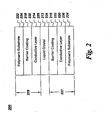
- FIG. 2 is a schematic representation of the structure of a flexible liquid crystal display of the present invention.
- Flexible LCD 200 comprises a center liquid crystal layer 212, a first and a second conductive layer 214, 216, a first and a second barrier layer 218, 220 and a first and a second polymeric substrate 222, 224.
- First polymeric substrate 222, first conductive layer 214 and first barrier layer 218 combine to form a first plate 225 and second polymeric substrate 224, second conductive layer 216 and second barrier layer 220 combine to form a second plate 227.
- First and second plates 225, 227 are disposed substantially parallel to one another and liquid crystal layer 212 is interposed therebetween.
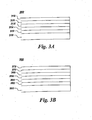
- Figures 3a and 3b are schematic representations of a light emitting diode (LED) and an organic electroluminescent device (OELD), respectively.
- LED 300 Figure 3a
- barrier layer 312 is disposed on substrate 310.
- Anode 314 is disposed on barrier layer 312 opposite substrate 310.
- Hole transport layer 315 which comprises at least one of the n-type (negative charge accepting) semiconductors known in the art, such as, but not limited to, silicon doped with phosphorous, is disposed on top of - and in contact with - anode 314.
- Electron transport layer 316 comprising at least one the p-type (positive hole) semiconductors known in the art, such as, but not limited to, silicon doped with aluminum, is disposed on top of and in contact with hole transport layer 315.
- Cathode 318 is disposed on top of - and in contact with - electron transport layer 316.
- OELD 350 ( Figure 3b) also includes a substrate 360, barrier layer 362, anode 364, hole transport layer 366, electron transport layer 370, and cathode 372 in substantially the same relation as in LED 300, with the exception that emission layer 368 is disposed between hole transport layer 366 and electron transport layer 370.
- Hole transport layer 366, emission layer 368, and electron transport layer 370 each comprise an organic material in either molecular or polymeric form. Electron transport layer 370 and emission layer 368 may be combined into a single layer. Alternatively, hole transport layer 366, emission layer 368, and electron transport layer 370 may be combined into a single layer.
- the at least one layer 110 may comprise at least one of an adhesion layer, an abrasion-resistant layer, an ultraviolet radiation-absorbing layer, and an infrared radiation-reflecting layer.
- the adhesion layer comprises at least one of a metal in elemental form, a metal carbide, a metal oxycarbide, a metal oxide, a metal nitride, a metal oxynitride, and a metal carbonitride, wherein the metal is one of silicon, aluminum, titanium, zirconium, hafnium, tantalum, gallium, germanium, zinc, tin, cadmium, tungsten, molybdenum, chromium, vanadium, and platinum.
- the adhesion layer may comprise at least one of: amorphous carbon; a ceramic comprising at least one of glass, silica, alumina, zirconia, boron nitride, boron carbide, and boron carbonitride; a silicone; monomers; oligomers; a siloxane; a polymer; an epoxide; an acrylate; an acrylonitrile; a xylene; a styrene; and the like, as well as combinations thereof.
- the ultraviolet radiation-absorbing layer comprises at least one of titanium oxide, zinc oxide, cerium oxide, an ultraviolet radiation-absorbing organic material in either polymeric or molecular form, and combinations thereof.
- the infrared radiation-reflecting layer when included in the at least one layer 110, comprises at least one of silver, aluminum, indium, tin, indium tin oxide, cadmium stannate, zinc, and combinations thereof.
- the at least one barrier layer 106 is interposed between the at least one layer 110 and substrate 102.
- the at least one layer 110 may be disposed between barrier layer 106 and a second barrier layer 105.
- the at least one layer 110 need only be disposed between a portion of barrier layer 106 and second barrier layer 105, as seen in Figure 1.
- Such a configuration provides all-around encapsulation and protection of the at least one layer 110 from exposure to water vapor and oxygen.
- the at least one layer 110 is interposed between the at least one barrier layer 106 and substrate 102 (as represented by 104 in Figure 1).
- One example of the latter embodiment is when the at least one layer 110 comprises an adhesion layer.
- the present invention also includes a method of forming the article 100 having barrier layer 106 disposed on substrate 102, as described herein, and a method of forming barrier layer 106, which is described herein, on substrate 102.
- Barrier layer 106 is formed on substrate 102 by injecting at least one reactant gas into a plasma, which is generated by at least one plasma source.
- the at least one plasma source is preferably an expanding thermal plasma (also referred to hereinafter as "ETP") source that produces an expanding thermal plasma.
- EDP expanding thermal plasma
- Either a single plasma source or an array of a plurality of plasma sources may be used to generate the plasma.
- Systems having single and multiple plasma sources have been described in: "Protective Coating by High Rate Arc Plasma Deposition," U.S.
- Patent 6,110,544, by Barry Lee-Mean Yang et al. "Apparatus and Method for Large Area Chemical Vapor Deposition Using Expanding Thermal Plasma Generators," U.S. Patent Application 09/681,820, by Barry Lee-Mean Yang et al.; “Large Area Plasma Coating Using Multiple Expanding Thermal Plasma Sources in Combination with a Common Injection Source,” U.S. Patent Application 09/683,149, by Marc Schaepkens; and “Apparatus and Method for Depositing Large Area Coatings on Non-Planar Surfaces," U.S. Patent Application 09/683,148, by Marc Schaepkens, all of which are incorporated herein by reference in their entirety.
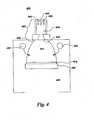
- ETP deposition system 400 includes high pressure plasma chamber 410 and a low pressure deposition chamber 420, the latter containing substrate 424.
- ETP source 402 includes a cathode 404, an anode 406, and a plasma source gas inlet 408, of which the latter two are disposed in plasma chamber 410.
- the plasma source gas is an inert gas, such as a noble gas; i.e., argon, helium, neon, krypton, or xenon.
- chemically reactive gases such as, but not limited to, nitrogen and hydrogen, may be used as the plasma source gas.
- argon is used as the plasma source gas.
- a plasma 412 which is an expanding thermal plasma, is generated in ETP source 402 by striking an arc between cathode 404 and anode 406 while introducing the plasma source gas into the arc through plasma source gas inlet 408.
- Plasma chamber 410 and deposition chamber 420 are in fluid communication with each other through opening 418.
- Deposition chamber 420 is in fluid communication with a vacuum system (not shown), which is capable of maintaining the deposition chamber at a pressure that is lower than that of plasma chamber 410.
- the deposition chamber 420 is maintained at a pressure of less than about 1 torr (about 133 Pa) and, preferably, at a pressure of less than about 100 millitorr (about 0. 133 Pa), while plasma chamber 410 is maintained at a pressure of at least about 0.1 atmosphere (about 1.01 ⁇ 10 4 Pa).
- At least one reactant gas injector 422 is located in deposition chamber 420 for providing at least one reactant gas at a predetermined flow rate into the plasma generated by plasma source 402.
- the at least one reactant gas is provided through at least one reactant gas injector 422 to plasma 412 as the plasma 412 enters deposition chamber 420 through opening 418.
- the at least one reactant gas may comprise a single reactant gas or a mixture of reactant gases.
- the at least one reactant gas may be provided from a single reactant gas source or separate, multiple reactant gas sources to either a single reactant gas injector system or separate reactant gas injector systems.
- a plasma is generated by ionizing the plasma source gas in the arc generated between the cathode and anode to produce a positive ion and an electron.
- the following reaction for example, occurs when an argon plasma is generated: Are ⁇ Ar + + e - .
- the plasma is then expanded into a high volume at low pressure, thereby cooling the electrons and positive ions.
- plasma 412 is generated in plasma chamber 410 and expanded into deposition chamber 420 through opening 418.
- deposition chamber 420 is maintained at a significantly lower pressure than plasma chamber 410. Consequently, the electrons in the ETP are too cold and thus have insufficient energy to cause direct dissociation of the at least one reactant gas within the ETP. Instead, the at least one reactant gas that is introduced into the plasma may undergo charge exchange and dissociative recombination reactions with the ions and electrons within the ETP to form at least one deposition precursor.
- the positive ion and electron temperatures are approximately equal and in the range of about 0.1 eV (about 1000 K).
- other types of plasmas produce electrons having a sufficiently high temperature to substantially affect the chemistry of the plasma.
- the positive ions typically have a temperature of greater than 0.1 eV, and the electrons have a temperature of at least 1 eV, or about 10,000 K.
- the at least one reactant gas undergoes a reaction within the ETP to form at least one deposition precursor.
- Such reactions may include, but are not limited to, charge exchange reactions, dissociative recombination reactions, and fragmentation reactions.
- the at least one deposition precursor that is formed within the ETP is then deposited on a surface of substrate 424 to form the barrier layer 106 on substrate 424.
- the at least one deposition precursor is deposited on substrate 424 at a rate of at least about 200 nm/min to form the at least one barrier layer 106 on substrate 424, although higher deposition rates are within the scope of the invention.
- the at least one deposition precursor is deposited on substrate 424 at a rate of at least about 600 nm/min.
- the at least one deposition precursor is deposited on substrate 424 at a rate of at least about 3,000 nm/min.
- the at least one deposition precursor is deposited on a surface of substrate 424 at a rate of at least about 10,000 nm/min.
- the at least one barrier layer 106 comprises at least one of a metal oxide, a metal nitride, a metal carbide, and combinations thereof, wherein the metal is one of silicon, aluminum, zinc, indium, tin, and a transition metal, such as, but not limited to, titanium.
- the at least one reactant gas includes a first gaseous reagent comprising at least one of a silane, a metal vapor, a metal halide, and an organic compound of a metal, wherein the metal is one of titanium, zinc, aluminum, indium, and tin.
- Exemplary silanes include disilanes, aminosilanes, and chlorosilanes.
- Exemplary organic compounds include titanium isopropoxide, diethyl zinc, dimethyl zinc, indium isopropoxide, indium tert-butoxide, aluminum isopropoxide, and combinations thereof.
- Exemplary metal halides include the chlorides of titanium, tin, and aluminum.
- the at least one reactant may also comprise elemental zinc, indium, tin, and aluminum in vapor form.
- the first gaseous reagent is injected into plasma 412 along with a second gaseous reagent comprising at least one of oxygen, nitrogen, hydrogen, water, and ammonia.
- a first gaseous reagent comprising at least one of titanium chloride and titanium isopropoxide is injected into plasma 412 along with a second reagent, which, in addition to - or instead of - oxygen, nitrogen, hydrogen, water, and ammonia, may include propane, butane, acetylene, and the like, as well as combinations thereof.
- a first gaseous reagent comprising at least one of a silane, a disilane, an aminosilane, and a chlorosilane is injected into plasma 412 along with the second reagent.
- a silicon nitride barrier layer may be deposited by injecting silane (SiH 4 ), diluted in helium to a concentration of about 2% and ammonia into an expanding thermal argon plasma.
- article 100 may further include at least one layer 110 in addition to the at least one barrier layer 106.
- the method of forming the article 100 having barrier layer 106 disposed on substrate 102, and the method of forming barrier layer 106 on substrate 102, both of which are described herein, may further include at least one step in which the at least one layer 110 is applied to either substrate 102 or barrier layer 106.
- the method by which the at least one layer 110 is deposited will depend upon the nature and properties (e.g., composition, desired physical properties, and the like) of the at least one coating.
- the at least one layer 110 may be deposited using the ETP plasma apparatus and method described herein.
- the at least one layer 110 may be deposited using methods such as, for example, sputtering, evaporation, ion beam assisted deposition (IBAD), plasma enhanced chemical vapor deposition (PEVCD), high intensity plasma chemical vapor deposition (HIPCVD) using either an inductively coupled plasma (ICP) or electron cyclotron resonance (ECR), and the like.
- IBAD ion beam assisted deposition
- PEVCD plasma enhanced chemical vapor deposition
- HPCVD high intensity plasma chemical vapor deposition
- ICP inductively coupled plasma
- ECR electron cyclotron resonance
- a polycarbonate substrate having a thickness of 30 mil (about 0.76 mm) was placed in the deposition chamber of a plasma deposition system similar to that described in the present application and schematically shown in Figure 4.
- the substrate was positioned at a working distance (WD) ranging from about 25 cm to about 60 cm from the expanding thermal plasma (ETP) source.
- the vacuum vessel was evacuated to a pressure of less than about 100 mTorr (millitorr), argon gas was flowed through into the plasma chamber and the ETP source at a rate in a range from about 2 slm (standard liters per minute) to about 3 slm, and the plasma source was ignited.
- the ETP operated at a current level in the range form about 40 A to about 70 A.
- the pressure within the plasma chamber was in the range from about 300 torr to about 800 torr, whereas the pressure within the deposition chamber was in the range from about 45 mtorr to about 100 mtorr.
- the pressure differential caused the argon thermal plasma to expand into the deposition chamber, where reagents, comprising silane diluted in helium to a concentration of about 2% and ammonia, were injected through a ring injector into the expanding argon thermal plasma.
- the reagents reacted with the ETP to form deposition precursors, which then combined to deposit a silicon nitride material barrier layer on the polycarbonate substrate at a deposition rate of at least 200 nm/min.
- a plot of the water vapor transmission rate (WVTR) at 25°C and 100% relative humidity and 100% relative humidity of the silicon nitride barrier layer as a function of reagent (in this case, ammonia) flow rate is shown in Figure 5.
- the WVTR for an uncoated polycarbonate film having a thickness of 30 mil is also shown in Figure 5.
- a single 350 nm thick silicon nitride barrier layer deposited on a polycarbonate film having a thickness of about 30 mil reduces the WVTR to less than 0.2 g/m 2 -day.
- the films are highly transparent and colorless; the polycarbonate film with the silicon nitride barrier layer has a transparency of at least 89% and a yellow-index of less than 0.7.
- articles other than flexible LCD displays, LEDs and OELDs, that comprise a substrate and a barrier having the properties described herein are also considered to be within the scope of the present invention.
- Such articles include, but are not limited to, photovoltaic devices, electrochromic devices, x-ray imaging devices, organic integrated circuits, and rigid-substrate display devices. Accordingly, various modifications, adaptations, and alternatives may occur to one skilled in the art without departing from the scope of the present invention.
Landscapes
- Chemical & Material Sciences (AREA)
- Engineering & Computer Science (AREA)
- Organic Chemistry (AREA)
- Physics & Mathematics (AREA)
- General Chemical & Material Sciences (AREA)
- Materials Engineering (AREA)
- Mechanical Engineering (AREA)
- Metallurgy (AREA)
- Plasma & Fusion (AREA)
- Chemical Kinetics & Catalysis (AREA)
- Inorganic Chemistry (AREA)
- Laminated Bodies (AREA)
- Coating Of Shaped Articles Made Of Macromolecular Substances (AREA)
- Chemical Vapour Deposition (AREA)
- Led Device Packages (AREA)
- Liquid Crystal (AREA)
- Electroluminescent Light Sources (AREA)
Applications Claiming Priority (2)
| Application Number | Priority Date | Filing Date | Title |
|---|---|---|---|
| US63917 | 2002-05-23 | ||
| US10/063,917 US6743524B2 (en) | 2002-05-23 | 2002-05-23 | Barrier layer for an article and method of making said barrier layer by expanding thermal plasma |
Publications (1)
| Publication Number | Publication Date |
|---|---|
| EP1365458A1 true EP1365458A1 (en) | 2003-11-26 |
Family
ID=29399092
Family Applications (1)
| Application Number | Title | Priority Date | Filing Date |
|---|---|---|---|
| EP20030253239 Withdrawn EP1365458A1 (en) | 2002-05-23 | 2003-05-23 | Barrier layer for an article and method of making said barrier layer by expanding thermal plasma |
Country Status (3)
| Country | Link |
|---|---|
| US (3) | US6743524B2 (enExample) |
| EP (1) | EP1365458A1 (enExample) |
| JP (1) | JP2004160977A (enExample) |
Cited By (6)
| Publication number | Priority date | Publication date | Assignee | Title |
|---|---|---|---|---|
| WO2004061155A1 (en) * | 2002-12-20 | 2004-07-22 | General Electric Company (A New York Corporation) | High rate deposition of titanium dioxide |
| WO2006102013A1 (en) * | 2005-03-18 | 2006-09-28 | Exatec, Llc | Light emissive plastic glazing |
| DE102005025083A1 (de) * | 2005-05-30 | 2006-12-07 | Infineon Technologies Ag | Thermoplast-Duroplast-Verbund und Verfahren zum Verbinden eines thermoplastischen Materials mit einem duroplastischen Material |
| WO2007122426A1 (en) * | 2006-04-20 | 2007-11-01 | Pilkington Group Limited | Laminated glazing |
| WO2011100085A3 (en) * | 2010-02-09 | 2012-10-04 | Dow Global Technologies Llc | Moisture resistant photovoltaic devices with improved adhesion of barrier film |
| US8921148B2 (en) | 2010-01-14 | 2014-12-30 | Dow Global Technologies Llc | Moisture resistant photovoltaic devices with exposed conductive grid |
Families Citing this family (98)
| Publication number | Priority date | Publication date | Assignee | Title |
|---|---|---|---|---|
| US8138413B2 (en) | 2006-04-13 | 2012-03-20 | Daniel Luch | Collector grid and interconnect structures for photovoltaic arrays and modules |
| US20090111206A1 (en) | 1999-03-30 | 2009-04-30 | Daniel Luch | Collector grid, electrode structures and interrconnect structures for photovoltaic arrays and methods of manufacture |
| US8222513B2 (en) | 2006-04-13 | 2012-07-17 | Daniel Luch | Collector grid, electrode structures and interconnect structures for photovoltaic arrays and methods of manufacture |
| US7507903B2 (en) | 1999-03-30 | 2009-03-24 | Daniel Luch | Substrate and collector grid structures for integrated series connected photovoltaic arrays and process of manufacture of such arrays |
| US8076568B2 (en) * | 2006-04-13 | 2011-12-13 | Daniel Luch | Collector grid and interconnect structures for photovoltaic arrays and modules |
| US8664030B2 (en) | 1999-03-30 | 2014-03-04 | Daniel Luch | Collector grid and interconnect structures for photovoltaic arrays and modules |
| US6866901B2 (en) | 1999-10-25 | 2005-03-15 | Vitex Systems, Inc. | Method for edge sealing barrier films |
| US20100330748A1 (en) | 1999-10-25 | 2010-12-30 | Xi Chu | Method of encapsulating an environmentally sensitive device |
| US7198832B2 (en) * | 1999-10-25 | 2007-04-03 | Vitex Systems, Inc. | Method for edge sealing barrier films |
| US6413645B1 (en) | 2000-04-20 | 2002-07-02 | Battelle Memorial Institute | Ultrabarrier substrates |
| US6623861B2 (en) | 2001-04-16 | 2003-09-23 | Battelle Memorial Institute | Multilayer plastic substrates |
| US7898054B2 (en) | 2000-02-04 | 2011-03-01 | Daniel Luch | Substrate structures for integrated series connected photovoltaic arrays and process of manufacture of such arrays |
| US8198696B2 (en) | 2000-02-04 | 2012-06-12 | Daniel Luch | Substrate structures for integrated series connected photovoltaic arrays and process of manufacture of such arrays |
| US7898053B2 (en) | 2000-02-04 | 2011-03-01 | Daniel Luch | Substrate structures for integrated series connected photovoltaic arrays and process of manufacture of such arrays |
| FR2827396B1 (fr) * | 2001-07-12 | 2003-11-14 | Saint Gobain | Dispositif electrocommandable a proprietes optiques et/ou energetiques variables |
| US8808457B2 (en) | 2002-04-15 | 2014-08-19 | Samsung Display Co., Ltd. | Apparatus for depositing a multilayer coating on discrete sheets |
| US8900366B2 (en) | 2002-04-15 | 2014-12-02 | Samsung Display Co., Ltd. | Apparatus for depositing a multilayer coating on discrete sheets |
| US20040229051A1 (en) | 2003-05-15 | 2004-11-18 | General Electric Company | Multilayer coating package on flexible substrates for electro-optical devices |
| US7086918B2 (en) * | 2002-12-11 | 2006-08-08 | Applied Materials, Inc. | Low temperature process for passivation applications |
| US7648925B2 (en) | 2003-04-11 | 2010-01-19 | Vitex Systems, Inc. | Multilayer barrier stacks and methods of making multilayer barrier stacks |
| US7510913B2 (en) | 2003-04-11 | 2009-03-31 | Vitex Systems, Inc. | Method of making an encapsulated plasma sensitive device |
| US7002292B2 (en) * | 2003-07-22 | 2006-02-21 | E. I. Du Pont De Nemours And Company | Organic electronic device |
| DE102004001603B4 (de) * | 2004-01-09 | 2009-03-05 | Schott Ag | Behälter mit Innendekor |
| US20050202263A1 (en) * | 2004-03-09 | 2005-09-15 | Jonathan Sargent | Barrier layer to prevent the loss of additives in an underlying layer |
| US7106488B2 (en) * | 2004-03-23 | 2006-09-12 | Air Products And Chemicals, Inc. | Hybrid process for depositing electrochromic coating |
| JP2005285659A (ja) * | 2004-03-30 | 2005-10-13 | Toyota Industries Corp | 有機el装置及びその製造方法 |
| WO2006007313A2 (en) * | 2004-06-25 | 2006-01-19 | Applied Materials, Inc. | Improving water-barrier performance of an encapsulating film |
| US7695805B2 (en) * | 2004-11-30 | 2010-04-13 | Tdk Corporation | Transparent conductor |
| JP4573673B2 (ja) * | 2005-02-28 | 2010-11-04 | 富士フイルム株式会社 | 水蒸気バリアフィルム |
| US20060278965A1 (en) * | 2005-06-10 | 2006-12-14 | Foust Donald F | Hermetically sealed package and methods of making the same |
| US20070020451A1 (en) * | 2005-07-20 | 2007-01-25 | 3M Innovative Properties Company | Moisture barrier coatings |
| US20070040501A1 (en) | 2005-08-18 | 2007-02-22 | Aitken Bruce G | Method for inhibiting oxygen and moisture degradation of a device and the resulting device |
| US7829147B2 (en) | 2005-08-18 | 2010-11-09 | Corning Incorporated | Hermetically sealing a device without a heat treating step and the resulting hermetically sealed device |
| US7722929B2 (en) | 2005-08-18 | 2010-05-25 | Corning Incorporated | Sealing technique for decreasing the time it takes to hermetically seal a device and the resulting hermetically sealed device |
| US7767498B2 (en) | 2005-08-25 | 2010-08-03 | Vitex Systems, Inc. | Encapsulated devices and method of making |
| FR2893427B1 (fr) * | 2005-11-16 | 2008-01-04 | Saint Gobain | Systeme electrochimique sur plastique |
| US9236512B2 (en) | 2006-04-13 | 2016-01-12 | Daniel Luch | Collector grid and interconnect structures for photovoltaic arrays and modules |
| US8822810B2 (en) | 2006-04-13 | 2014-09-02 | Daniel Luch | Collector grid and interconnect structures for photovoltaic arrays and modules |
| US8729385B2 (en) | 2006-04-13 | 2014-05-20 | Daniel Luch | Collector grid and interconnect structures for photovoltaic arrays and modules |
| US9006563B2 (en) | 2006-04-13 | 2015-04-14 | Solannex, Inc. | Collector grid and interconnect structures for photovoltaic arrays and modules |
| US9865758B2 (en) | 2006-04-13 | 2018-01-09 | Daniel Luch | Collector grid and interconnect structures for photovoltaic arrays and modules |
| US8884155B2 (en) | 2006-04-13 | 2014-11-11 | Daniel Luch | Collector grid and interconnect structures for photovoltaic arrays and modules |
| GB0607746D0 (en) * | 2006-04-20 | 2006-05-31 | Pilkington Plc | Glazing |
| US20080006819A1 (en) * | 2006-06-19 | 2008-01-10 | 3M Innovative Properties Company | Moisture barrier coatings for organic light emitting diode devices |
| US8115326B2 (en) * | 2006-11-30 | 2012-02-14 | Corning Incorporated | Flexible substrates having a thin-film barrier |
| US20080138538A1 (en) * | 2006-12-06 | 2008-06-12 | General Electric Company | Barrier layer, composite article comprising the same, electroactive device, and method |
| EP2111562B1 (en) | 2007-01-22 | 2018-09-19 | E Ink Corporation | Multi-layer sheet for use in electro-optic displays |
| US8241713B2 (en) * | 2007-02-21 | 2012-08-14 | 3M Innovative Properties Company | Moisture barrier coatings for organic light emitting diode devices |
| US20100118376A1 (en) * | 2007-04-09 | 2010-05-13 | Dong-Joo Kwon | Multi-layered photochromic sheet and photochromic glass prepared therefrom |
| US9660205B2 (en) * | 2007-06-22 | 2017-05-23 | Regents Of The University Of Colorado | Protective coatings for organic electronic devices made using atomic layer deposition and molecular layer deposition techniques |
| US20090200553A1 (en) * | 2007-11-30 | 2009-08-13 | Applied Materials, Inc | High temperature thin film transistor on soda lime glass |
| EP2232575A4 (en) * | 2007-12-14 | 2012-07-11 | Miasole | BEFORE THE ENVIRONMENT PROTECTED PHOTOVOLTAIC ARRANGEMENTS |
| US8628820B2 (en) * | 2008-03-11 | 2014-01-14 | Ppg Industries Ohio, Inc. | Reflective article and method of making a reflective article |
| US20110197947A1 (en) | 2008-03-20 | 2011-08-18 | Miasole | Wire network for interconnecting photovoltaic cells |
| US8912429B2 (en) * | 2008-03-20 | 2014-12-16 | Hanergy Holding Group Ltd. | Interconnect assembly |
| US20100043863A1 (en) * | 2008-03-20 | 2010-02-25 | Miasole | Interconnect assembly |
| US20090283140A1 (en) * | 2008-05-19 | 2009-11-19 | James Freitag | Method of making contact to a solar cell employing a group ibiiiavia compound absorber layer |
| US8207012B2 (en) * | 2008-04-28 | 2012-06-26 | Solopower, Inc. | Method and apparatus for achieving low resistance contact to a metal based thin film solar cell |
| ITMI20081374A1 (it) * | 2008-07-25 | 2010-01-26 | Getters Spa | Assorbitore composito di h2o per dispositivi medicali sigillati |
| JP5374980B2 (ja) * | 2008-09-10 | 2013-12-25 | ソニー株式会社 | 固体撮像装置 |
| US20100122730A1 (en) * | 2008-11-17 | 2010-05-20 | Corneille Jason S | Power-loss-inhibiting current-collector |
| KR20100071650A (ko) * | 2008-12-19 | 2010-06-29 | 삼성전자주식회사 | 가스차단성박막, 이를 포함하는 전자소자 및 이의 제조방법 |
| US9337446B2 (en) | 2008-12-22 | 2016-05-10 | Samsung Display Co., Ltd. | Encapsulated RGB OLEDs having enhanced optical output |
| US9184410B2 (en) | 2008-12-22 | 2015-11-10 | Samsung Display Co., Ltd. | Encapsulated white OLEDs having enhanced optical output |
| CN101783395A (zh) * | 2009-01-20 | 2010-07-21 | 京东方科技集团股份有限公司 | 有机电致发光器件及其制造方法 |
| JP5319342B2 (ja) * | 2009-03-17 | 2013-10-16 | 富士フイルム株式会社 | ガスバリア膜の製造方法、太陽電池用ガスバリアフィルム、および、ディスプレイ用ガスバリアフィルム |
| US9007674B2 (en) * | 2011-09-30 | 2015-04-14 | View, Inc. | Defect-mitigation layers in electrochromic devices |
| TWI391886B (zh) * | 2009-06-12 | 2013-04-01 | Au Optronics Corp | 可撓性觸控顯示裝置 |
| CN103597119B (zh) | 2009-07-08 | 2017-03-08 | 艾克斯特朗欧洲公司 | 用于等离子体处理的装置和方法 |
| US8362356B2 (en) * | 2009-08-13 | 2013-01-29 | Gtat Corporation | Intermetal stack for use in a photovoltaic device |
| CN102482796A (zh) * | 2009-08-24 | 2012-05-30 | 第一太阳能有限公司 | 掺杂的透明导电氧化物 |
| US8590338B2 (en) | 2009-12-31 | 2013-11-26 | Samsung Mobile Display Co., Ltd. | Evaporator with internal restriction |
| US9061344B1 (en) | 2010-05-26 | 2015-06-23 | Apollo Precision (Fujian) Limited | Apparatuses and methods for fabricating wire current collectors and interconnects for solar cells |
| US8766240B2 (en) | 2010-09-21 | 2014-07-01 | Universal Display Corporation | Permeation barrier for encapsulation of devices and substrates |
| US10026859B2 (en) | 2010-10-04 | 2018-07-17 | Beijing Apollo Ding Rong Solar Technology Co., Ltd. | Small gauge wire solar cell interconnect |
| CN102560490A (zh) * | 2010-12-28 | 2012-07-11 | 鸿富锦精密工业(深圳)有限公司 | 铝及铝合金表面防腐处理方法及其制品 |
| US8765232B2 (en) | 2011-01-10 | 2014-07-01 | Plasmasi, Inc. | Apparatus and method for dielectric deposition |
| JP5922919B2 (ja) * | 2011-03-25 | 2016-05-24 | 富士フイルム株式会社 | 熱線遮蔽材および貼合せ構造体 |
| US8951824B1 (en) | 2011-04-08 | 2015-02-10 | Apollo Precision (Fujian) Limited | Adhesives for attaching wire network to photovoltaic cells |
| US8358066B1 (en) * | 2011-08-10 | 2013-01-22 | General Electric Company | Organic light emitting diode package with energy blocking layer |
| US8901015B2 (en) | 2012-02-15 | 2014-12-02 | Applied Materials, Inc. | Method for depositing an inorganic encapsulating film |
| US9299956B2 (en) | 2012-06-13 | 2016-03-29 | Aixtron, Inc. | Method for deposition of high-performance coatings and encapsulated electronic devices |
| US10526708B2 (en) | 2012-06-19 | 2020-01-07 | Aixtron Se | Methods for forming thin protective and optical layers on substrates |
| US20140048013A1 (en) * | 2012-08-17 | 2014-02-20 | Intermolecular, Inc. | SEED LAYER FOR ZnO AND DOPED-ZnO THIN FILM NUCLEATION AND METHODS OF SEED LAYER DEPOSITION |
| CN104051357B (zh) | 2013-03-15 | 2017-04-12 | 财团法人工业技术研究院 | 环境敏感电子装置以及其封装方法 |
| WO2014201287A1 (en) | 2013-06-12 | 2014-12-18 | View, Inc. | Pretreatment of transparent conductive oxide (tco) thin films for improved electrical contact |
| US10712454B2 (en) | 2014-07-25 | 2020-07-14 | General Electric Company | X-ray detectors supported on a substrate having a metal barrier |
| US9513380B2 (en) | 2014-07-25 | 2016-12-06 | General Electric Company | X-ray detectors supported on a substrate having a surrounding metal barrier |
| DE102015102870A1 (de) * | 2015-02-27 | 2016-09-01 | Fraunhofer-Gesellschaft zur Förderung der angewandten Forschung e.V. | Reflektorelement und Verfahren zu dessen Herstellung |
| JP6451579B2 (ja) | 2015-09-30 | 2019-01-16 | 日亜化学工業株式会社 | 発光装置 |
| CN114265251B (zh) | 2016-04-19 | 2024-12-06 | Sage电致变色显示有限公司 | 包括透明导电氧化物层和汇流条的电致变色装置和其形成方法 |
| JP6907032B2 (ja) * | 2017-06-06 | 2021-07-21 | 株式会社ジャパンディスプレイ | 表示装置及びその製造方法 |
| JP7000581B2 (ja) | 2017-09-12 | 2022-01-19 | セイジ・エレクトロクロミクス,インコーポレイテッド | 非発光式の可変透過デバイス及びそれを形成する方法 |
| US11567384B2 (en) | 2017-11-20 | 2023-01-31 | Sage Electrochromics, Inc. | Non-light-emitting, variable transmission device and a process of fabricating the same |
| US11362293B2 (en) * | 2018-05-31 | 2022-06-14 | Massachusetts Institute Of Technology | Interlayers and associated systems, devices, and methods |
| US11028805B2 (en) | 2019-01-09 | 2021-06-08 | Saudi Arabian Oil Company | System and method for on-board catalytic upgrading of hydrocarbon fuels |
| KR102506156B1 (ko) * | 2020-11-13 | 2023-03-06 | 한국광기술원 | 구멍을 포함하는 태양전지 모듈 및 그를 제조하는 방법 |
| US20260098336A1 (en) * | 2024-10-04 | 2026-04-09 | Entegris, Inc. | Metal carbide films and related devices and related methods |
Citations (6)
| Publication number | Priority date | Publication date | Assignee | Title |
|---|---|---|---|---|
| EP0460966A2 (en) * | 1990-06-08 | 1991-12-11 | Flex Products, Inc. | Barrier film having high colorless transparency and method of manufacture thereof |
| EP0628407A1 (en) * | 1993-06-08 | 1994-12-14 | Ajinomoto Co., Inc. | Double-packaged easily oxidizable article |
| FR2712310A1 (fr) * | 1993-11-09 | 1995-05-19 | Pechiney Recherche | Revêtement transparent à propriété barrière pour film plastique d'emballage flexible. |
| EP1148386A1 (en) * | 2000-04-20 | 2001-10-24 | Eastman Kodak Company | Self-contained humidity stabilized imaging media comprising microencapsulated color formers |
| WO2001081649A1 (en) * | 2000-04-20 | 2001-11-01 | Battelle Memorial Institute | Barrier coating |
| WO2004076716A1 (en) * | 2003-02-20 | 2004-09-10 | General Electric Company | Apparatus and method for depositing large area coatings on planar surfaces |
Family Cites Families (10)
| Publication number | Priority date | Publication date | Assignee | Title |
|---|---|---|---|---|
| US4709991A (en) * | 1983-04-26 | 1987-12-01 | Seiko Epson Kabushiki Kaisha | Liquid crystal display with barrier layer to reduce permeability |
| NL8701530A (nl) | 1987-06-30 | 1989-01-16 | Stichting Fund Ond Material | Werkwijze voor het behandelen van oppervlakken van substraten met behulp van een plasma en reactor voor het uitvoeren van die werkwijze. |
| MX9303141A (es) * | 1992-05-28 | 1994-04-29 | Polar Materials Inc | Metodos y aparatos para depositar recubrimientos de barrera. |
| JP3017912B2 (ja) * | 1993-12-13 | 2000-03-13 | シャープ株式会社 | 液晶表示装置用電極基板及び液晶表示装置 |
| JPH10154824A (ja) * | 1996-11-21 | 1998-06-09 | Nippon Oil Co Ltd | 光電変換装置 |
| JP3290375B2 (ja) * | 1997-05-12 | 2002-06-10 | 松下電器産業株式会社 | 有機電界発光素子 |
| US6110544A (en) | 1997-06-26 | 2000-08-29 | General Electric Company | Protective coating by high rate arc plasma deposition |
| DE69931334T2 (de) * | 1998-12-22 | 2007-02-01 | Matsushita Electric Industrial Co., Ltd., Kadoma | Flexibler Dünnfilmkondensator und Herstellungsverfahren |
| US6355125B1 (en) * | 1999-03-26 | 2002-03-12 | Agfa-Gevaert | Method for making an electric or electronic module comprising a glass laminate |
| JP4595276B2 (ja) * | 2000-12-25 | 2010-12-08 | 東洋製罐株式会社 | マイクロ波プラズマ処理方法及び装置 |
-
2002
- 2002-05-23 US US10/063,917 patent/US6743524B2/en not_active Expired - Lifetime
-
2003
- 2003-05-22 JP JP2003144218A patent/JP2004160977A/ja active Pending
- 2003-05-23 EP EP20030253239 patent/EP1365458A1/en not_active Withdrawn
-
2004
- 2004-03-16 US US10/802,101 patent/US20040175580A1/en not_active Abandoned
- 2004-03-16 US US10/802,102 patent/US20040175512A1/en not_active Abandoned
Patent Citations (6)
| Publication number | Priority date | Publication date | Assignee | Title |
|---|---|---|---|---|
| EP0460966A2 (en) * | 1990-06-08 | 1991-12-11 | Flex Products, Inc. | Barrier film having high colorless transparency and method of manufacture thereof |
| EP0628407A1 (en) * | 1993-06-08 | 1994-12-14 | Ajinomoto Co., Inc. | Double-packaged easily oxidizable article |
| FR2712310A1 (fr) * | 1993-11-09 | 1995-05-19 | Pechiney Recherche | Revêtement transparent à propriété barrière pour film plastique d'emballage flexible. |
| EP1148386A1 (en) * | 2000-04-20 | 2001-10-24 | Eastman Kodak Company | Self-contained humidity stabilized imaging media comprising microencapsulated color formers |
| WO2001081649A1 (en) * | 2000-04-20 | 2001-11-01 | Battelle Memorial Institute | Barrier coating |
| WO2004076716A1 (en) * | 2003-02-20 | 2004-09-10 | General Electric Company | Apparatus and method for depositing large area coatings on planar surfaces |
Non-Patent Citations (3)
| Title |
|---|
| FUKUMASA O: "Synthesis of new ceramics from powder mixtures using thermal plasma processing", THIN SOLID FILMS, ELSEVIER-SEQUOIA S.A. LAUSANNE, CH, vol. 390, no. 1-2, 30 June 2001 (2001-06-30), pages 37 - 43, XP004246646, ISSN: 0040-6090 * |
| MIHAILESCU I.N. ET AL: "Synthesis and deposition of silicon nitride films by laser reactive ablation of silicon in low pressure ammonia: a parametric study", JOURNAL OF VACUUM SCIENCE AND TECHNOLOGY, vol. 14, no. 4, July 1996 (1996-07-01), AIP FOR AMERICAN VACUUM SOC, USA, pages 1986 - 1993 * |
| NUMASAWA Y.; YAMAZAKI K.; HAMANO K.: "Photo-chemical vapor deposition of silicon nitride film by direct photolysis", JAPANESE JOURNAL OF APPLIED PHYSICS, PART 2, LETTERS, vol. 22, no. 12, December 1983 (1983-12-01), JAPAN, pages L792 - L794 * |
Cited By (12)
| Publication number | Priority date | Publication date | Assignee | Title |
|---|---|---|---|---|
| WO2004061155A1 (en) * | 2002-12-20 | 2004-07-22 | General Electric Company (A New York Corporation) | High rate deposition of titanium dioxide |
| US6890656B2 (en) | 2002-12-20 | 2005-05-10 | General Electric Company | High rate deposition of titanium dioxide |
| WO2006102013A1 (en) * | 2005-03-18 | 2006-09-28 | Exatec, Llc | Light emissive plastic glazing |
| US9315148B2 (en) | 2005-03-18 | 2016-04-19 | Exatec Llc | Light emissive plastic glazing |
| US9871199B2 (en) | 2005-03-18 | 2018-01-16 | Sabic Global Technologies B.V. | Light emissive plastic glazing having a multilayered configuration for illuminating passenger compartment |
| DE102005025083A1 (de) * | 2005-05-30 | 2006-12-07 | Infineon Technologies Ag | Thermoplast-Duroplast-Verbund und Verfahren zum Verbinden eines thermoplastischen Materials mit einem duroplastischen Material |
| DE102005025083B4 (de) * | 2005-05-30 | 2007-05-24 | Infineon Technologies Ag | Thermoplast-Duroplast-Verbund und Verfahren zum Verbinden eines thermoplastischen Materials mit einem duroplastischen Material |
| US8507080B2 (en) | 2005-05-30 | 2013-08-13 | Infineon Technologies Ag | Thermoplastic-thermosetting composite and method for bonding a thermoplastic material to a thermosetting material |
| WO2007122426A1 (en) * | 2006-04-20 | 2007-11-01 | Pilkington Group Limited | Laminated glazing |
| US8921148B2 (en) | 2010-01-14 | 2014-12-30 | Dow Global Technologies Llc | Moisture resistant photovoltaic devices with exposed conductive grid |
| WO2011100085A3 (en) * | 2010-02-09 | 2012-10-04 | Dow Global Technologies Llc | Moisture resistant photovoltaic devices with improved adhesion of barrier film |
| US9059349B2 (en) | 2010-02-09 | 2015-06-16 | Dow Global Technologies Llc | Moisture resistant photovoltaic devices with improved adhesion of barrier film |
Also Published As
| Publication number | Publication date |
|---|---|
| US20040175512A1 (en) | 2004-09-09 |
| US20030219632A1 (en) | 2003-11-27 |
| US20040175580A1 (en) | 2004-09-09 |
| JP2004160977A (ja) | 2004-06-10 |
| US6743524B2 (en) | 2004-06-01 |
Similar Documents
| Publication | Publication Date | Title |
|---|---|---|
| US6743524B2 (en) | Barrier layer for an article and method of making said barrier layer by expanding thermal plasma | |
| US7074501B2 (en) | Coatings with low permeation of gases and vapors | |
| CN104115300B (zh) | 沉积包封膜的方法 | |
| KR101513871B1 (ko) | 다층 장벽 스택 및 그 제조 방법 | |
| CN102828164B (zh) | 包埋层水阻障性的改进 | |
| US11283043B2 (en) | Laminated film and process for manufacturing the same | |
| KR101423446B1 (ko) | 원자층 증착에 의해 제작된 플라스틱 기판용 배리어 필름 | |
| EP2241165B1 (en) | Method for manufacturing a multi_layer stack structure with improved wvtr barrier property | |
| JP5725865B2 (ja) | プラズマ処理装置、及び大気圧グロー放電電極構成を使用して基板を処理するための方法 | |
| US20060158101A1 (en) | Organic light-emitting diode | |
| JP2006510170A (ja) | パッシベーション用途のための低温プロセス | |
| US11038145B2 (en) | Laminated film and process for manufacturing the same, as well as method for analyzing laminated film | |
| WO2006014591A2 (en) | Permeation barriers for flexible electronics | |
| US20050181212A1 (en) | Composite articles having diffusion barriers and devices incorporating the same | |
| US20090286010A1 (en) | High throughput processes and systems for barrier film deposition and/or encapsulation of optoelectronic devices | |
| Chen | Realizing Thin‐Film Encapsulation's Benefits for Large‐Scale OLED Panels | |
| CN110114897B (zh) | 电子设备 | |
| CN118355743A (zh) | 用于导电接触位于涂层外部的母线的电气部件的导电涂层 | |
| WO2017153747A1 (en) | Barrier coated substrates |
Legal Events
| Date | Code | Title | Description |
|---|---|---|---|
| PUAI | Public reference made under article 153(3) epc to a published international application that has entered the european phase |
Free format text: ORIGINAL CODE: 0009012 |
|
| AK | Designated contracting states |
Kind code of ref document: A1 Designated state(s): AT BE BG CH CY CZ DE DK EE ES FI FR GB GR HU IE IT LI LU MC NL PT RO SE SI SK TR |
|
| AX | Request for extension of the european patent |
Extension state: AL LT LV MK |
|
| 17P | Request for examination filed |
Effective date: 20040526 |
|
| AKX | Designation fees paid |
Designated state(s): AT BE BG CH CY CZ DE DK EE ES FI FR GB GR HU IE IT LI LU MC NL PT RO SE SI SK TR |
|
| 17Q | First examination report despatched |
Effective date: 20050726 |
|
| RTI1 | Title (correction) |
Free format text: METHOD OF MAKING A BARRIER LAYER FOR AN ARTICLE BY EXPANDING THERMAL PLASMA |
|
| GRAP | Despatch of communication of intention to grant a patent |
Free format text: ORIGINAL CODE: EPIDOSNIGR1 |
|
| RIC1 | Information provided on ipc code assigned before grant |
Ipc: C23C 14/08 20060101ALI20071126BHEP Ipc: H01L 23/00 20060101ALI20071126BHEP Ipc: B32B 27/08 20060101ALI20071126BHEP Ipc: H01L 51/52 20060101AFI20071126BHEP |
|
| STAA | Information on the status of an ep patent application or granted ep patent |
Free format text: STATUS: THE APPLICATION IS DEEMED TO BE WITHDRAWN |
|
| 18D | Application deemed to be withdrawn |
Effective date: 20080409 |