EP1335618A2 - Funkressourcenzuweisungsverfahren, Funkressourcenzuweisungsgerät, und Mobilkommunikationssystem - Google Patents
Funkressourcenzuweisungsverfahren, Funkressourcenzuweisungsgerät, und Mobilkommunikationssystem Download PDFInfo
- Publication number
- EP1335618A2 EP1335618A2 EP03002487A EP03002487A EP1335618A2 EP 1335618 A2 EP1335618 A2 EP 1335618A2 EP 03002487 A EP03002487 A EP 03002487A EP 03002487 A EP03002487 A EP 03002487A EP 1335618 A2 EP1335618 A2 EP 1335618A2
- Authority
- EP
- European Patent Office
- Prior art keywords
- mobile station
- mobile
- transmission
- reception
- radio resources
- Prior art date
- Legal status (The legal status is an assumption and is not a legal conclusion. Google has not performed a legal analysis and makes no representation as to the accuracy of the status listed.)
- Granted
Links
Images




Classifications
-
- H—ELECTRICITY
- H04—ELECTRIC COMMUNICATION TECHNIQUE
- H04B—TRANSMISSION
- H04B7/00—Radio transmission systems, i.e. using radiation field
- H04B7/02—Diversity systems; Multi-antenna system, i.e. transmission or reception using multiple antennas
- H04B7/04—Diversity systems; Multi-antenna system, i.e. transmission or reception using multiple antennas using two or more spaced independent antennas
- H04B7/06—Diversity systems; Multi-antenna system, i.e. transmission or reception using multiple antennas using two or more spaced independent antennas at the transmitting station
- H04B7/0613—Diversity systems; Multi-antenna system, i.e. transmission or reception using multiple antennas using two or more spaced independent antennas at the transmitting station using simultaneous transmission
- H04B7/0615—Diversity systems; Multi-antenna system, i.e. transmission or reception using multiple antennas using two or more spaced independent antennas at the transmitting station using simultaneous transmission of weighted versions of same signal
- H04B7/0617—Diversity systems; Multi-antenna system, i.e. transmission or reception using multiple antennas using two or more spaced independent antennas at the transmitting station using simultaneous transmission of weighted versions of same signal for beam forming
-
- H—ELECTRICITY
- H01—ELECTRIC ELEMENTS
- H01Q—ANTENNAS, i.e. RADIO AERIALS
- H01Q1/00—Details of, or arrangements associated with, antennas
- H01Q1/12—Supports; Mounting means
- H01Q1/125—Means for positioning
- H01Q1/1257—Means for positioning using the received signal strength
-
- H—ELECTRICITY
- H04—ELECTRIC COMMUNICATION TECHNIQUE
- H04W—WIRELESS COMMUNICATION NETWORKS
- H04W72/00—Local resource management
- H04W72/50—Allocation or scheduling criteria for wireless resources
- H04W72/54—Allocation or scheduling criteria for wireless resources based on quality criteria
- H04W72/542—Allocation or scheduling criteria for wireless resources based on quality criteria using measured or perceived quality
-
- H—ELECTRICITY
- H04—ELECTRIC COMMUNICATION TECHNIQUE
- H04B—TRANSMISSION
- H04B7/00—Radio transmission systems, i.e. using radiation field
- H04B7/02—Diversity systems; Multi-antenna system, i.e. transmission or reception using multiple antennas
- H04B7/04—Diversity systems; Multi-antenna system, i.e. transmission or reception using multiple antennas using two or more spaced independent antennas
- H04B7/0408—Diversity systems; Multi-antenna system, i.e. transmission or reception using multiple antennas using two or more spaced independent antennas using two or more beams, i.e. beam diversity
-
- H—ELECTRICITY
- H04—ELECTRIC COMMUNICATION TECHNIQUE
- H04W—WIRELESS COMMUNICATION NETWORKS
- H04W16/00—Network planning, e.g. coverage or traffic planning tools; Network deployment, e.g. resource partitioning or cells structures
- H04W16/24—Cell structures
- H04W16/28—Cell structures using beam steering
-
- H—ELECTRICITY
- H04—ELECTRIC COMMUNICATION TECHNIQUE
- H04W—WIRELESS COMMUNICATION NETWORKS
- H04W24/00—Supervisory, monitoring or testing arrangements
- H04W24/08—Testing, supervising or monitoring using real traffic
-
- H—ELECTRICITY
- H04—ELECTRIC COMMUNICATION TECHNIQUE
- H04W—WIRELESS COMMUNICATION NETWORKS
- H04W72/00—Local resource management
- H04W72/04—Wireless resource allocation
- H04W72/044—Wireless resource allocation based on the type of the allocated resource
- H04W72/046—Wireless resource allocation based on the type of the allocated resource the resource being in the space domain, e.g. beams
-
- H—ELECTRICITY
- H04—ELECTRIC COMMUNICATION TECHNIQUE
- H04W—WIRELESS COMMUNICATION NETWORKS
- H04W72/00—Local resource management
- H04W72/50—Allocation or scheduling criteria for wireless resources
- H04W72/54—Allocation or scheduling criteria for wireless resources based on quality criteria
-
- H—ELECTRICITY
- H04—ELECTRIC COMMUNICATION TECHNIQUE
- H04W—WIRELESS COMMUNICATION NETWORKS
- H04W72/00—Local resource management
- H04W72/50—Allocation or scheduling criteria for wireless resources
- H04W72/56—Allocation or scheduling criteria for wireless resources based on priority criteria
-
- Y—GENERAL TAGGING OF NEW TECHNOLOGICAL DEVELOPMENTS; GENERAL TAGGING OF CROSS-SECTIONAL TECHNOLOGIES SPANNING OVER SEVERAL SECTIONS OF THE IPC; TECHNICAL SUBJECTS COVERED BY FORMER USPC CROSS-REFERENCE ART COLLECTIONS [XRACs] AND DIGESTS
- Y10—TECHNICAL SUBJECTS COVERED BY FORMER USPC
- Y10S—TECHNICAL SUBJECTS COVERED BY FORMER USPC CROSS-REFERENCE ART COLLECTIONS [XRACs] AND DIGESTS
- Y10S370/00—Multiplex communications
- Y10S370/901—Wide area network
- Y10S370/902—Packet switching
-
- Y—GENERAL TAGGING OF NEW TECHNOLOGICAL DEVELOPMENTS; GENERAL TAGGING OF CROSS-SECTIONAL TECHNOLOGIES SPANNING OVER SEVERAL SECTIONS OF THE IPC; TECHNICAL SUBJECTS COVERED BY FORMER USPC CROSS-REFERENCE ART COLLECTIONS [XRACs] AND DIGESTS
- Y10—TECHNICAL SUBJECTS COVERED BY FORMER USPC
- Y10S—TECHNICAL SUBJECTS COVERED BY FORMER USPC CROSS-REFERENCE ART COLLECTIONS [XRACs] AND DIGESTS
- Y10S370/00—Multiplex communications
- Y10S370/901—Wide area network
- Y10S370/902—Packet switching
- Y10S370/903—Osi compliant network
-
- Y—GENERAL TAGGING OF NEW TECHNOLOGICAL DEVELOPMENTS; GENERAL TAGGING OF CROSS-SECTIONAL TECHNOLOGIES SPANNING OVER SEVERAL SECTIONS OF THE IPC; TECHNICAL SUBJECTS COVERED BY FORMER USPC CROSS-REFERENCE ART COLLECTIONS [XRACs] AND DIGESTS
- Y10—TECHNICAL SUBJECTS COVERED BY FORMER USPC
- Y10S—TECHNICAL SUBJECTS COVERED BY FORMER USPC CROSS-REFERENCE ART COLLECTIONS [XRACs] AND DIGESTS
- Y10S370/00—Multiplex communications
- Y10S370/901—Wide area network
- Y10S370/902—Packet switching
- Y10S370/903—Osi compliant network
- Y10S370/905—Asynchronous transfer mode, ASN
Definitions
- the present invention relates to a radio resources allocating method, a radio resources allocating apparatus, and a mobile communication system and, more particularly, to a radio resources allocating method in which a base station capable of forming a plurality of directional beams by applying a directional antenna capable of adaptively varying directivity, to a reception-reception antenna, allocates radio resources to a plurality of mobile stations, a radio resources allocating apparatus for carrying out the method, and a mobile communication system comprising a base station with the radio resources allocating function.
- the conventional mobile communication systems used antennas to radiate omnidirectional beams, as transmission-reception antennas of base stations, and thus each base station performed scheduling of transmission and reception without the need for paying attention to detailed location information of a destination mobile station in a cell or in a sector as long as it was known that the destination mobile station existed in the cell or the sector.
- Adaptive Array Antenna AAA
- interference power ratios between beams are small, i.e., if the beams are spatially separated from each other, with the directional beams being directed to the respective mobile stations, it becomes feasible to implement simultaneous transmission and reception of packet data to different mobile stations with the respective directional beams, without the application of code division multiplex or frequency division multiplex.
- An object of the present invention is to provide a radio resources allocating method, a radio resources allocating apparatus, and a mobile communication system capable of selecting destination mobile stations so as to prevent directional beams directed to the respective mobile stations from interfering with each other in application of the directional antenna as described above, and allocating the radio resources to the mobile stations selected.
- a radio resources allocating method is a radio resources allocating method in which a base station capable of forming a plurality of directional beams by applying a directional antenna capable of adaptively varying directivity, to a transmission-reception antenna, allocates radio resources to a plurality of mobile stations, wherein the plurality of directional beams are allocated to the plurality of mobile stations, based on reception quality information of each mobile station, location information of each mobile station, and transmission priorities of packets to be transmitted.
- the location information of each mobile station herein is assumed to include information about a direction of arrival of one radio wave or directions of arrival of plural radio waves out of radio waves arriving at the mobile station and information about a propagation distance of the radio wave or propagation distances of the radio waves, in addition to information about a relative location of the mobile station to the base station. It is also assumed that the radio resources include directional beams, and frequencies and codes as objects of multiplexing in data transmission.
- the directional antenna can be a smart antenna capable of adaptively varying directivity, e.g., an adaptive array antenna or the like.
- the radio resources were allocated based on the reception quality information of each mobile station and the transmission priorities of packets, without paying attention to the locations of the respective mobile stations, whereas in the present invention a plurality of directional beams are allocated to a plurality of mobile stations, based on the three types of information including the location information of each mobile station: the reception quality information of each mobile station, the location information of each mobile station, and the transmission priorities of packets to be transmitted; therefore, the destination mobile stations can be selected so as to prevent the beams directed to the respective mobile stations from interfering with each other, and the radio resources are allocated to the mobile stations, whereby it is feasible to improve efficiency of use of the radio resources and to implement increase of throughput.
- the method is characterized, so that, after the plurality of directional beams are allocated to the plurality of mobile stations, packet data is simultaneously transmitted to and received by the plurality of mobile stations. Namely, the data transmission to the plurality of mobile stations is concurrently carried out.
- the method is characterized, so that on the occasion of allocating the radio resources used in transmission with the plurality of directional beams, the mobile stations allocated to the plurality of directional beams are selected, based on the reception quality information of each mobile station, the location information of each mobile station, and the transmission priorities of packets to be transmitted.
- the mobile stations allocated to the plurality of directional beams are selected, based on the reception quality information of each mobile station, the location information of each mobile station, and the transmission priorities of packets to be transmitted.
- the reception quality information of each mobile station can be a ratio of carrier power to interference power (CIR), and a rate of interference power due to a transmitted signal from another base station in interference power.
- the interference power herein means a power of an interference signal and this interference signal is assumed to include noise as well.
- the rate of the interference power due to the transmitted signal from another base station in the interference power it is feasible to estimate whether the other base station is performing communication with a directional beam being directed in the direction in which the mobile station exists. For this reason, it is desirable to avoid communication with any mobile station existing in the direction in which the other base station presumably directs its directional beam, in order to prevent interference with the communication of the other base station.
- the above CIR may be replaced by a signal power to interference power ratio (SIR), i.e., a value of any signal power to interference power, or a signal power to noise power ratio (SN ratio or SNR).
- SIR signal power to interference power ratio
- SN ratio signal power to noise power ratio
- the reception quality information of each mobile station can be a reception quality at the mobile station estimated in the case where communication with a directional beam is carried out, based on a reception quality at the mobile station for a predetermined reference signal transmitted from the base station.
- predetermined reference signals e.g., control signals such as pilot signals or the like
- reception qualities in communication with such stationary beams are normally different from those in communication with directional beams. Therefore, when the reception qualities of signals transmitted with the omnidirectional beams such as the pilot signals from the base station are used as reception qualities of the respective mobile stations, it is necessary to convert them into reception qualities expected in the use of the directional beams. For execution of this conversion, it is necessary to give consideration to the fact that gains in the use of the directional beams are different among the mobile stations because of ⁇ difference among spreads of incident angles of plural paths and ⁇ control over transmission power according to the distance to each mobile station, depending upon the locational relation between each mobile station and the base station.
- the location information of each mobile station can be information about a direction of arrival of a signal transmitted from the mobile station, or location information of the mobile station estimated from the direction of arrival.
- the location of the mobile station can be expressed by the direction and distance from the base station.
- a potential method of estimating the direction of the mobile station among them is a method of estimating the direction from phase differences of signals received by respective antenna elements constituting an array. Radio waves can arrive from different directions of plural paths because of reflection on ground and objects or the like, and in this case it is desirable to estimate a direction of arrival for each path.
- a potential method of estimating the distance of the mobile station is a method in which, where a signal transmission power of the mobile station is known by signaling or the like, the reception power from the mobile station is measured whereby the distance from the base station can be estimated to some extent.
- the location information of each mobile station can be location information acquired based on measured location information notified of by the mobile station where the mobile station comprises location measuring means (e.g., GPS equipment or the like).
- location measuring means e.g., GPS equipment or the like.
- the transmission priority of a packet to be transmitted can be an index set based on a permissible delay determined by a required communication quality of the packet (so called QoS (Quality of Services)), the maximum number of retransmissions, a desired transmission speed, reception quality information of a destination mobile station, and a transmission waiting time at the base station. Consideration may also be given to whether a packet is one addressed to a mobile station having moved from another cell by handover.
- QoS Quality of Services
- a combination of mobile stations existing in directions of a plurality of directional beams preliminarily set on a stationary basis can be selected as the mobile stations subjected to simultaneous transmission and reception of packet data with the plurality of directional beams.
- a mobile station corresponding to the directional beam can be selected, based on both or either of the reception quality information of each mobile station and the transmission priority of packet data to each mobile station.
- the mobile station with the highest reception quality may be selected as the mobile station corresponding to the directional beam, or the mobile station with the highest transmission priority of packet data may be selected as the mobile station corresponding to the directional beam.
- the mobile station may also be selected on the basis of a comprehensive judgment on the both of the reception quality and the transmission priority of packet data.
- a combination of mobile stations existing in directions in which a plurality of directional beams with a mutual interference power ratio therebetween being not more than a desired value can be formed can be selected as the mobile stations subjected to simultaneous transmission and reception of packet data with the plurality of directional beams.
- the combination of mobile stations may be selected in favor of a combination of mobile stations providing the maximum number of mobile stations capable of undergoing simultaneous transmission; the combination of mobile stations may be selected in favor of a combination of mobile stations with which reception states of the mobile stations in the combination become comprehensively the best; the combination of mobile stations may be selected in favor of a combination of mobile stations with which transmission priorities for packet data to the mobile stations in the combination are comprehensively the highest.
- the combination of mobile stations may also be selected on the basis of comprehensive evaluation on a combination of two or more out of the above three ways.
- the selection of the combination of mobile stations may be arranged to first select a single mobile station and then select as another mobile station, a mobile station existing in a direction of at least one directional beam that can be formed so that an interference power ratio with a directional beam directed to the single mobile station selected becomes not more than a preset value.
- the single mobile station is selected on the basis of the reception states of the respective mobile stations or the transmission priorities of packet data to be transmitted, and the mobile station existing in the direction of at least one directional beam that can be formed so that the interference power ratio with the directional beam directed to the single mobile station becomes not more than the preset value, is selected, as the mobile stations subjected to simultaneous transmission and reception of packet data with the plurality of directional beams.
- a mobile station in a best reception state can be selected as the single mobile station; or a mobile station with the highest transmission priority of packet data to be transmitted can be selected as the single mobile station.
- the packet data to the plurality of mobile stations may be simultaneously transmitted by code division multiplex or frequency division multiplex, whereby the simultaneous transmission of packet data to the plurality of mobile stations existing in the same direction can be implemented by code division multiplex or frequency division multiplex.
- the transmission and reception of packet data may also be carried out to the plurality of mobile stations by code division multiplex or frequency division multiplex of packet data, i.e., by code division multiplex or frequency division multiplex with a single directional beam or with a plurality of directional beams.
- the radio resources allocating method according to the present invention can also be described as an aspect of the invention associated with the radio resources allocating apparatus and as an aspect of the invention associated with the mobile communication system.
- a radio resources allocating apparatus is a radio resources allocating apparatus in a base station capable of forming a plurality of directional beams by applying a directional antenna capable of adaptively varying directivity, to a transmission-reception antenna, the radio resources allocating apparatus comprising: allocating means for allocating the plurality of directional beams to the plurality of mobile stations, based on reception quality information of each mobile station with which the base station is about to perform transmission and reception, location information of each mobile station, and transmission priorities of packets to be transmitted.
- This allocating means is desirably configured to determine the number and directions of directional beams to be formed, based on the reception quality information of each mobile station, the location information of each mobile station, and the transmission priorities of packets to be transmitted.
- the radio resources allocating apparatus is desirably configured to further comprise location estimating means for estimating a location of each mobile station, based on orientation information of the directional antenna; and location information storing means for storing the location information of each mobile station acquired by estimation.
- the radio resources allocating apparatus is desirably configured to further comprise location information receiving means for receiving the location information of each mobile station notified of by each mobile station; and location information storing means for storing the location information of each mobile station acquired by reception.
- the radio resources allocating apparatus is desirably configured to further comprise interference power ratio calculating means for calculating an interference power ratio of each beam with the other beams, where it is supposed that the base station forms a plurality of directional beams.
- the radio resources allocating apparatus is desirably configured to further comprise quality information receiving means for receiving information about a reception quality at each mobile station for a reference signal from the base station, from each mobile station; quality estimating means for estimating a reception quality at each mobile station in the case where each mobile station is subjected to transmission and reception with a directional beam directed to the mobile station, based on the information about the reception quality at each mobile station obtained by reception; and quality information storing means for storing the reception quality information of each mobile station acquired by estimation.
- quality information receiving means for receiving information about a reception quality at each mobile station for a reference signal from the base station, from each mobile station
- quality estimating means for estimating a reception quality at each mobile station in the case where each mobile station is subjected to transmission and reception with a directional beam directed to the mobile station, based on the information about the reception quality at each mobile station obtained by reception
- quality information storing means for storing the reception quality information of each mobile station acquired by estimation.
- the reception quality of each mobile station herein is desirably a power ratio of carrier power to interference power at each mobile station.
- the radio resources allocating apparatus is desirably configured to further comprise transmission priority calculating means for calculating a transmission priority of each mobile station, based on at least one of the reception quality information of each mobile station, requirements from a communication quality of packet data to each mobile station, and a transmission waiting time of each packet data.
- a mobile communication system is a mobile communication system comprising a base station capable of forming a plurality of directional beams by applying a directional antenna capable of adaptively varying directivity, to a transmission-reception antenna, and a plurality of mobile stations locating in a cell of the base station, wherein the base station comprises: allocating means for allocating the plurality of directional beams to the plurality of mobile stations, based on reception quality information of each mobile station with which the base station is about to perform transmission and reception, location information of each mobile station, and transmission priorities of packets to be transmitted.
- This allocating means is desirably configured to determine the number and directions of directional beams to be formed, based on the reception quality information of each mobile station, the location information of each mobile station, and the transmission priorities of packets to be transmitted.
- the mobile communication system according to the present invention is desirably configured so that the base station further comprises: location estimating means for estimating a location of each mobile station, based on orientation information of the directional antenna; and location information storing means for storing the location information of each mobile station acquired by estimation.
- the mobile communication system is desirably configured so that at least one mobile station comprises: location measuring means for measuring a location of the mobile station; and location information notifying means for notifying the base station of the location information of the mobile station acquired by measurement; and so that the base station further comprises: location information receiving means for receiving the location information of the mobile station notified of by the mobile station; and location information storing means for storing the location information of the mobile station acquired by reception.
- the mobile communication system according to the present invention is desirably configured so that the base station further comprises: interference power ratio calculating means for calculating an interference power ratio of each beam with the other beams, where it is supposed that the base station forms a plurality of directional beams.
- the mobile communication system is desirably configured so that at least one mobile station comprises: quality calculating means for calculating a reception quality at the mobile station for a reference signal from the base station; and quality information notifying means for notifying the base station of information about the reception quality acquired by calculation; and so that the base station further comprises: quality information receiving means for receiving the information about the reception quality from the mobile station; quality estimating means for estimating a reception quality at the mobile station in the case where the mobile station is subjected to transmission and reception with a directional beam directed to the mobile station, based on the information about the reception quality at the mobile station acquired by reception; and quality information storing means for storing the reception quality information of the mobile station acquired by estimation.
- the reception quality of the mobile station herein is desirably a power ratio of carrier power to interference power at the mobile station.
- the mobile communication system is desirably configured so that the base station further comprises: transmission priority calculating means for calculating a transmission priority of each mobile station, based on at least one of the reception quality information of each mobile station, requirements from a communication quality of packet data to each mobile station, and a transmission waiting time of each packet data.
- Embodiments of the present invention will be described below with reference to the drawings.
- the embodiments are directed toward fast packet transmission services of downlinks. It is also assumed that pilot signals are transmitted with omnidirectional beams.
- Fig. 1 shows the configuration of mobile communication system 1 of the present embodiment.
- the mobile communication system 1 comprises a base station 10, and a plurality of mobile stations 30 locating in a cell 2 of the base station 10.
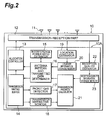
- Fig. 2 shows a device configuration example of the base station 10.
- the base station 10 is comprised of adaptive array antennas (hereinafter referred to as "array antennas") 11 as a directional antenna capable of adaptively varying directivity, a transmission-reception part 12 for performing transmission and reception of packet data, and a radio resources allocating part 10A for performing radio resources allocating processing described later.
- the base station 10 is arranged to be able to form a plurality of directional beams by applying a plurality of array antennas 11 to a transmission-reception antenna. Any other smart antenna capable of adaptively varying directivity may also be adopted instead of the array antennas.
- the radio resources allocating part 10A is comprised of a location estimator 19 for estimating the location of each mobile station 30 (Fig. 1) (including a direction of arrival of a radio wave or directions of arrival of radio waves out of those arriving at the mobile station 30, and a propagation distance of the radio wave or propagation distances of the radio waves, in addition to the relative location thereof to the base station 10); a location information storage memory 20 for storing the location information thus estimated; a reception quality estimator 22 for estimating a reception quality with a directional beam on the basis of a reception quality of a pilot signal notified of by each mobile station; a reception quality information storage memory 23 for storing the reception quality information thus estimated; a transmission priority calculator 21 for determining a transmission priority of each mobile station on the basis of the communication quality of packet data (QoS), a transmission waiting time of each data, and the reception quality information of each mobile station; an antenna pattern and transmitted data determiner 16 for evaluating the transmission priorities and location information of the respective mobile stations to determine the number and directions of directional beams,
- the transmission-reception part 12 performs processing including superposition of transmitted signals, separation of received signals, amplification of transmitted and received signals, and so on.
- the base station 10 is assumed to include all the components necessary for constitution of ordinary base station equipment, in addition to the components shown in Fig. 2.
- Fig. 3 shows the components associated with the present invention in the mobile station 30.
- the mobile station 30 is comprised of a location measuring part 33 incorporating GPS equipment and configured to measure the location of the mobile station 30; a quality calculator 34 for calculating a reception quality at the mobile station 30 of a pilot signal from the base station 10; and a transmission-reception part 32 equipped with an antenna 31 and configured to perform transmission and reception of packet data and send the location information of the mobile station 30 and the reception quality information of the reference signal to the base station 10.
- Fig. 4 shows a flowchart of the radio resources allocating processing.
- step S41 of Fig. 4 when receiving a communication start request from a mobile station 30, the base station 10 first preliminarily acquires the location information of the mobile station 30 and stores the location information in the location information storage memory 20.
- the mobile station 30 may notify the base station 10 of the location information acquired by measurement, as uplink control information.
- the location estimator 19 of the base station 10 may estimate the location information of the mobile station 30 from a direction of arrival and a reception power of a signal transmitted from the mobile station 30.
- the base station 10 is configured to update the location information of each mobile station 30 in an adequate period according to a moving speed of each mobile station 30 or the like.
- Next step S42 is to perform processing of acquiring and storing the reception quality information of each mobile station 30.
- one mobile station 30 as a target is first set out of mobile stations 30 as destinations of all packets (transmission waiting packets) in the transmission waiting state in the transmission waiting buffer 14 (S51), and it is determined whether the mobile station 30 of the target is in communication (S52). If the mobile station 30 of the target is in communication, the base station acquires the reception quality information during communication at the mobile station 30, e.g., a ratio of carrier power to interference power in a communicating channel (received CIR) (S53), and the reception quality information acquired is stored in the reception quality information storage memory 23 (S57).
- a signal power to interference power ratio SIR
- SNR signal power to noise power ratio
- the base station acquires the reception quality information of the pilot signal at the mobile station 30, e.g., received CIR of a pilot channel (S54), and estimates a gain with a directional beam being directed to the mobile station, based on the location information of the mobile station 30 (S55). Then the reception quality information is corrected for the gain (S56), and the reception quality information after the correction is stored in the reception quality information storage memory 23 (S57).
- the reception quality information e.g., received CIR of a pilot channel (S54), and estimates a gain with a directional beam being directed to the mobile station, based on the location information of the mobile station 30 (S55).
- the reception quality information is corrected for the gain (S56), and the reception quality information after the correction is stored in the reception quality information storage memory 23 (S57).
- the processing of S51 to S57 as described above is carried out for each mobile station 30 to acquire and store the reception quality information of each mobile station 30.
- the processing of Fig. 5 is terminated to return to step S43 of Fig. 4.
- the base station may also be configured to determine the communication quality information on the basis of received CIR of the pilot signal, regardless of whether each mobile station is in communication.
- the mobile station 30 in communication decreases the received CIR, because a directional beam is directed to itself, while the mobile station 30 with no directional beam being directed thereto (not in communication) increases the received CIR; therefore, the processing is expected to present the effect of keeping down deviation of radio channel allocating opportunities among the mobile stations 30. In this case, however, the reception quality is not always good in practical communication even if the received CIR of the pilot signal is good. Therefore, the base station can be configured to estimate the interference with the directional beam of its own cell at each mobile station 30 from the shape of the current beam, the location information of each mobile station 30, etc. if possible, and subtract it to suppose and compare reception qualities in practical communication environments.
- next step S43 is a step in which the transmission priority calculator 21 calculates a transmission priority as an index indicating how to allocate the radio resources in favor of which mobile station 30, for each of the mobile stations 30 as destinations of the transmission waiting packets.
- the transmission priorities are comprehensively determined in consideration of requirements from QoS of the respective packets, the reception quality information of the destination mobile stations 30, and the transmission waiting times.
- Next step S44 is to perform sequencing (ranking) of the transmission priorities of all the mobile stations 30 under connection.
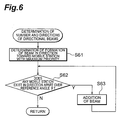
- next step S45 the antenna pattern and transmitted data determiner executes processing of determining the number and directions of directional beams (Fig. 6).
- the first step is to determine formation of a directional beam toward the mobile station 30 with the highest transmission priority according to the ranking obtained in S44 (S61). It is then determined whether, with this beam as a reference, there exists any mobile station 30 in a direction in which an interference power ratio with a new beam is within a range of not more than a desired value (for example, an angle from the direction of the reference beam is not less than a reference angle ⁇ preliminarily determined by experiment or the like ( ⁇ is a minimum angle at which the mutual interference power becomes not more than a desired value)) (S62).
- the interference power ratio estimator 15 estimates the interference power ratio of each beam on the assumption that the directional beam is formed, and it is determined that the beam can be formed when the resultant interference power ratio is lower than a desired value.
- next step S46 is to determine a multiplexity of users in accordance with the number of mobile stations 30 existing in a specified direction, and the margins of the radio resources such as code resources, transmission power, frequencies, etc., for each of the directional beams thus determined, and step S47 is to allocate the mobile stations 30 to each directional beam, according to the user multiplexity for each directional beam.
- This permits implementation of simultaneous transmission of packet data to a plurality of mobile stations 30 by code division multiplex or frequency division multiplex of packet data to the plurality of mobile stations 30 even if the plurality of mobile stations 30 exist in a certain direction.
- a combination of mobile stations 30 may be selected in favor of a combination of mobile stations 30 with which the number of mobile stations 30 capable of undergoing simultaneous transmission becomes maximum, or a combination of mobile stations 30 may be selected in favor of a combination of mobile stations 30 with which reception states of the mobile stations 30 in the combination become comprehensively the best.
- a combination of mobile stations 30 may also be selected in favor of a combination of mobile stations 30 with which transmission priorities for packet data to the mobile stations 30 in the combination become comprehensively the highest.
- a combination of mobile stations 30 may also be selected by combining two or more out of the above three ways and comprehensively evaluating the combinations.
- S48 is carried out to perform generation of antenna weights, addition of error-correction codes, modulation, etc. and transmit the packet data.
- the radio resources were allocated before on the basis of the reception quality information of each mobile station 30 and the transmission priorities of packets, without paying attention to the location of each mobile station 30, whereas the present invention employs the above radio resources allocating processing to allocate the plurality of directional beams to the plurality of mobile stations 30, based on the three types of information including the location information of each mobile station 30: the reception quality information of each mobile station 30, the location information of each mobile station 30, and the transmission priorities of the packets to be transmitted; therefore, the destination mobile stations 30 can be selected so as to prevent the beams directed to the respective mobile stations 30 from interfering with each other, and the radio resources are allocated to the mobile stations 30, whereby it is feasible to improve the efficiency of use of the radio resources and achieve the increase of throughput.
- a combination of mobile stations 30 existing in directions of plural directional beams preliminarily set on a stationary basis may be selected as the mobile stations 30 subjected to the simultaneous transmission and reception of packet data with the plurality of directional beams.
- a mobile station 30 corresponding to the directional beam can be selected, based on both or either of the reception quality information of each mobile station 30 and the transmission priority of packet data to each mobile station 30. Namely, among the plurality of mobile stations 30 thus existing, the mobile station 30 with the highest reception quality may be selected as the mobile station 30 corresponding to the directional beam, or the mobile station 30 with the highest transmission priority of packet data may be selected as the mobile station 30 corresponding to the directional beam. The mobile station 30 may also be selected based on a comprehensive judgment on the both of the reception quality and the transmission priority of packet data.
- the processing of determining the number and directions of directional beams and selecting the destination mobile stations 30 may be performed by the method of first determining the number and directions of directional beams and then selecting the destination mobile stations 30, as in above Fig. 6, but it may also be performed according to the procedure of first determining a single mobile station 30 and a directional beam toward the mobile station and then determining other directional beams and other mobile stations 30 on the basis of the first determined directional beam as a reference, as shown in Fig. 7.
- the mobile station 30 with the highest transmission priority is set as a target according to the ranking obtained in S44 of Fig. 4 (S71), and formation of one directional beam is determined in a direction toward the mobile station 30 (S72). It is noted that S71 is not limited to the use of the transmission priority as a reference, but the mobile station to be selected may be the mobile station 30 with the highest reception quality, or the mobile station 30 closest to the sector boundary.
- steps S73 and S74 is executed for each of the mobile stations in order from the mobile station 30 with the highest transmission priority.
- the processing of steps S73 and S74 is terminated.
- This processing of Fig. 7 can also properly determine the number and directions of directional beams capable of keeping the interference between directional beams at or below the desired value. It is noted that the processing of steps S73 and S74 may also be executed in order from the mobile station 30 with the highest reception quality.
- the present invention has successfully accomplished the following: while the radio resources were allocated before based on the reception quality information of each mobile station and the packet transmission priorities, without paying attention to the location of each mobile station, the present invention realized the allocation of the plurality of directional beams to the plurality of mobile stations, based on the three types of information including the location information of each mobile station: the reception quality information of each mobile station, the location information of each mobile station, and the transmission priorities of packets to be transmitted; therefore, the destination mobile stations can be selected so as to prevent the beams directed to the respective mobile stations from interfering with each other, and the radio resources are allocated to the mobile stations, whereby it is feasible to improve the efficiency of use of the radio resources and achieve the increase of throughput.
Landscapes
- Engineering & Computer Science (AREA)
- Computer Networks & Wireless Communication (AREA)
- Signal Processing (AREA)
- Quality & Reliability (AREA)
- Mobile Radio Communication Systems (AREA)
- Small-Scale Networks (AREA)
- Radio Transmission System (AREA)
Applications Claiming Priority (2)
| Application Number | Priority Date | Filing Date | Title |
|---|---|---|---|
| JP2002030043A JP2003235072A (ja) | 2002-02-06 | 2002-02-06 | 無線リソース割当て方法、無線リソース割当て装置及び移動通信システム |
| JP2002030043 | 2002-02-06 |
Publications (3)
| Publication Number | Publication Date |
|---|---|
| EP1335618A2 true EP1335618A2 (de) | 2003-08-13 |
| EP1335618A3 EP1335618A3 (de) | 2004-03-31 |
| EP1335618B1 EP1335618B1 (de) | 2005-11-02 |
Family
ID=27606504
Family Applications (1)
| Application Number | Title | Priority Date | Filing Date |
|---|---|---|---|
| EP20030002487 Expired - Lifetime EP1335618B1 (de) | 2002-02-06 | 2003-02-05 | Funkressourcenzuweisungsverfahren, Funkressourcenzuweisungsgerät, und Mobilkommunikationssystem |
Country Status (9)
| Country | Link |
|---|---|
| US (1) | US7136624B2 (de) |
| EP (1) | EP1335618B1 (de) |
| JP (1) | JP2003235072A (de) |
| KR (1) | KR100564075B1 (de) |
| CN (1) | CN1299518C (de) |
| AU (1) | AU2003200401B2 (de) |
| CA (1) | CA2418524C (de) |
| DE (1) | DE60302080T2 (de) |
| SG (1) | SG112873A1 (de) |
Cited By (13)
| Publication number | Priority date | Publication date | Assignee | Title |
|---|---|---|---|---|
| EP1536658A3 (de) * | 2003-11-26 | 2005-06-08 | Lucent Technologies Inc. | Opportunistische Strahlformung und Benutzerablaufsteuerung in einem Kommunikationssystem |
| WO2006125226A1 (en) * | 2005-05-19 | 2006-11-23 | Intel Corporation | Directional transmissions to multiple wireless devices |
| EP1792420A4 (de) * | 2004-09-10 | 2007-09-05 | Interdigital Tech Corp | Messunterstützung für eine intelligente antenne in einem drahtlosen kommunikationssystem |
| CN100443918C (zh) * | 2003-09-03 | 2008-12-17 | Lg电子株式会社 | 用于形成移动终端的阵列天线波束的方法和装置 |
| EP2111065A1 (de) * | 2008-04-18 | 2009-10-21 | Alcatel-Lucent Deutschland AG | Verfahren zur Zuweisung von Kommunikationsressourcen zu einem mobilen Funkgerät |
| KR101214642B1 (ko) | 2005-12-05 | 2012-12-21 | 삼성전자주식회사 | 적응적 안테나 시스템에서 무선 자원 할당을 위한 장치 및방법 |
| EP2654334A1 (de) * | 2012-04-19 | 2013-10-23 | Raytheon Company | Phasengesteuerte-antenne und Zuweisungsverfahren |
| US8588053B2 (en) | 2007-12-05 | 2013-11-19 | Fujitsu Limited | Transmitting apparatus, transmission control method, and communication apparatus |
| GB2506638A (en) * | 2012-08-29 | 2014-04-09 | Cambridge Silicon Radio Ltd | Location-assisted beamforming system |
| WO2015195375A1 (en) * | 2014-06-16 | 2015-12-23 | Qualcomm Incorporated | Beamform scheduling based on the directionality of ues |
| EP2947943A4 (de) * | 2013-01-18 | 2016-01-06 | Huawei Tech Co Ltd | Planungsverfahren und planungsvorrichtung für eine benutzervorrichtung in einem kommunikationssystem |
| US9368868B2 (en) | 2006-10-31 | 2016-06-14 | Qualcomm Incorporated | Apparatus and method for sensor-based wireless receive diversity |
| WO2018106483A1 (en) * | 2016-12-09 | 2018-06-14 | At&T Intellectual Property I, L.P. | Cloud-based packet controller and methods for use therewith |
Families Citing this family (109)
| Publication number | Priority date | Publication date | Assignee | Title |
|---|---|---|---|---|
| US7295509B2 (en) | 2000-09-13 | 2007-11-13 | Qualcomm, Incorporated | Signaling method in an OFDM multiple access system |
| US9130810B2 (en) | 2000-09-13 | 2015-09-08 | Qualcomm Incorporated | OFDM communications methods and apparatus |
| US6768459B2 (en) * | 2002-07-31 | 2004-07-27 | Interdigital Technology Corporation | Method and system for positioning mobile units based on angle measurements |
| EP1389884A1 (de) * | 2002-08-13 | 2004-02-18 | Siemens Aktiengesellschaft | Verfahren zum Betrieb eines Funksystems mittels Richtantennen sowie sendende Station und Funksystem |
| US7321562B2 (en) * | 2003-06-02 | 2008-01-22 | Nokia Corporation | Packet transmission method, network element and arrangement |
| KR100771715B1 (ko) * | 2003-09-02 | 2007-10-30 | 엘지전자 주식회사 | 무선 랜의 데이터 통신 제어장치 및 방법 |
| US7720509B2 (en) * | 2003-10-02 | 2010-05-18 | Toshiba America Research, Inc. | Harmonized adaptive arrays |
| JP4241440B2 (ja) * | 2004-03-03 | 2009-03-18 | 株式会社日立製作所 | パケットスケジュール方法及び無線通信装置 |
| JP4457382B2 (ja) * | 2004-06-30 | 2010-04-28 | 株式会社日立製作所 | 無線通信基地局 |
| US8385937B2 (en) * | 2004-07-07 | 2013-02-26 | Toshiba America Research Inc. | Load equalizing antennas |
| US9137822B2 (en) | 2004-07-21 | 2015-09-15 | Qualcomm Incorporated | Efficient signaling over access channel |
| US9148256B2 (en) | 2004-07-21 | 2015-09-29 | Qualcomm Incorporated | Performance based rank prediction for MIMO design |
| US20060067269A1 (en) * | 2004-09-27 | 2006-03-30 | Enrico Jugl | Method of scheduling users in wireless communication networks |
| JP2006135674A (ja) * | 2004-11-05 | 2006-05-25 | Ntt Docomo Inc | 移動通信用受信装置、移動通信用送信装置、移動通信用受信方法、および、移動通信用送信方法 |
| US20060120310A1 (en) * | 2004-12-03 | 2006-06-08 | Interdigital Technology Corporation | Method for improving wireless network performance in a multi-cell communication network |
| KR100654316B1 (ko) * | 2004-12-08 | 2006-12-08 | 한국과학기술원 | 직교 주파수 및 직교 부호 도약 다중화 통신 방식 |
| US8477754B2 (en) | 2005-01-19 | 2013-07-02 | Nec Corporation | Wireless communication apparatus and antenna directivity/radio resource assigning method |
| JP4648015B2 (ja) * | 2005-01-28 | 2011-03-09 | 株式会社エヌ・ティ・ティ・ドコモ | 送信装置及び送信方法 |
| US9246560B2 (en) | 2005-03-10 | 2016-01-26 | Qualcomm Incorporated | Systems and methods for beamforming and rate control in a multi-input multi-output communication systems |
| US9154211B2 (en) | 2005-03-11 | 2015-10-06 | Qualcomm Incorporated | Systems and methods for beamforming feedback in multi antenna communication systems |
| US9520972B2 (en) | 2005-03-17 | 2016-12-13 | Qualcomm Incorporated | Pilot signal transmission for an orthogonal frequency division wireless communication system |
| US9143305B2 (en) | 2005-03-17 | 2015-09-22 | Qualcomm Incorporated | Pilot signal transmission for an orthogonal frequency division wireless communication system |
| US9461859B2 (en) | 2005-03-17 | 2016-10-04 | Qualcomm Incorporated | Pilot signal transmission for an orthogonal frequency division wireless communication system |
| JP4559270B2 (ja) | 2005-03-22 | 2010-10-06 | 株式会社日立製作所 | 無線通信システム |
| US9184870B2 (en) | 2005-04-01 | 2015-11-10 | Qualcomm Incorporated | Systems and methods for control channel signaling |
| US9036538B2 (en) | 2005-04-19 | 2015-05-19 | Qualcomm Incorporated | Frequency hopping design for single carrier FDMA systems |
| US9408220B2 (en) * | 2005-04-19 | 2016-08-02 | Qualcomm Incorporated | Channel quality reporting for adaptive sectorization |
| US7986680B2 (en) | 2005-04-28 | 2011-07-26 | Qualcomm Incorporated | Transmit format selection with consideration for resource reuse |
| US8565194B2 (en) | 2005-10-27 | 2013-10-22 | Qualcomm Incorporated | Puncturing signaling channel for a wireless communication system |
| JP4641218B2 (ja) * | 2005-06-13 | 2011-03-02 | 三菱電機株式会社 | 無線通信システムおよび基地局装置 |
| JP4699099B2 (ja) * | 2005-06-14 | 2011-06-08 | 富士通株式会社 | 通信制御装置および通信制御方法 |
| US9179319B2 (en) | 2005-06-16 | 2015-11-03 | Qualcomm Incorporated | Adaptive sectorization in cellular systems |
| US7519013B2 (en) * | 2005-06-30 | 2009-04-14 | Nokia Corporation | Spatial reuse in a wireless communications network |
| US8885628B2 (en) | 2005-08-08 | 2014-11-11 | Qualcomm Incorporated | Code division multiplexing in a single-carrier frequency division multiple access system |
| US20070041457A1 (en) | 2005-08-22 | 2007-02-22 | Tamer Kadous | Method and apparatus for providing antenna diversity in a wireless communication system |
| US9209956B2 (en) | 2005-08-22 | 2015-12-08 | Qualcomm Incorporated | Segment sensitive scheduling |
| US7738422B2 (en) * | 2005-08-23 | 2010-06-15 | Alcatel-Lucent Usa Inc. | Interference-reducing method of forward link scheduling for wireless networks |
| US9136974B2 (en) | 2005-08-30 | 2015-09-15 | Qualcomm Incorporated | Precoding and SDMA support |
| US7567822B2 (en) * | 2005-10-11 | 2009-07-28 | Cisco Technology, Inc. | Automated configuration of RF WLANs via selected sensors |
| US9144060B2 (en) | 2005-10-27 | 2015-09-22 | Qualcomm Incorporated | Resource allocation for shared signaling channels |
| US9210651B2 (en) | 2005-10-27 | 2015-12-08 | Qualcomm Incorporated | Method and apparatus for bootstraping information in a communication system |
| US9225488B2 (en) | 2005-10-27 | 2015-12-29 | Qualcomm Incorporated | Shared signaling channel |
| US9172453B2 (en) | 2005-10-27 | 2015-10-27 | Qualcomm Incorporated | Method and apparatus for pre-coding frequency division duplexing system |
| US9088384B2 (en) | 2005-10-27 | 2015-07-21 | Qualcomm Incorporated | Pilot symbol transmission in wireless communication systems |
| US9225416B2 (en) | 2005-10-27 | 2015-12-29 | Qualcomm Incorporated | Varied signaling channels for a reverse link in a wireless communication system |
| JP4791158B2 (ja) * | 2005-11-24 | 2011-10-12 | 株式会社日立製作所 | 無線基地局装置および空間多重送信数制御装置 |
| CN1972174A (zh) * | 2005-11-24 | 2007-05-30 | 松下电器产业株式会社 | 多天线通信系统中数据重传和检测方法 |
| WO2007088624A1 (ja) * | 2006-02-02 | 2007-08-09 | Fujitsu Limited | 無線伝送方法並びに無線送信機及び無線受信機 |
| JP4684124B2 (ja) | 2006-02-16 | 2011-05-18 | 富士通株式会社 | 移動局装置及び同装置における送信電力制御方法 |
| KR101222768B1 (ko) * | 2006-02-23 | 2013-01-15 | 삼성전자주식회사 | 무선 통신 시스템을 위한 단말의 위치 추정 방법 |
| US8670802B2 (en) * | 2006-04-05 | 2014-03-11 | Danko Antolovic | Wireless network radiolocation apparatuses, systems and methods |
| KR100781521B1 (ko) * | 2006-05-03 | 2007-12-03 | 삼성전자주식회사 | 무선 네트워크 환경 하에서 기기의 변경을 발견하는 방법및 장치 |
| JP2007318579A (ja) * | 2006-05-29 | 2007-12-06 | Kyocera Corp | 移動体通信システム、基地局装置、及び干渉波判定方法 |
| US7659850B1 (en) | 2006-06-13 | 2010-02-09 | Sprint Spectrum L.P. | Method and system for determining locations of mobile stations using directional corrections |
| US7844273B2 (en) | 2006-07-14 | 2010-11-30 | Lgc Wireless, Inc. | System for and method of for providing dedicated capacity in a cellular network |
| US7848770B2 (en) | 2006-08-29 | 2010-12-07 | Lgc Wireless, Inc. | Distributed antenna communications system and methods of implementing thereof |
| JP4345800B2 (ja) * | 2006-10-19 | 2009-10-14 | ソニー株式会社 | 無線通信装置 |
| EP2077636A4 (de) * | 2006-10-24 | 2013-10-16 | Mitsubishi Electric Corp | Sendervorrichtung, empfängervorrichtung, kommunikationsverfahren und kommunikationssystem |
| WO2008050745A1 (en) * | 2006-10-24 | 2008-05-02 | Panasonic Corporation | Radio communication device and radio communication method |
| US20100330940A1 (en) * | 2006-10-31 | 2010-12-30 | Qualcomm Incorporated | Sensor-aided wireless combining |
| KR100852151B1 (ko) | 2006-12-07 | 2008-08-13 | 한국전자통신연구원 | 이동통신 시스템에서 무선 자원을 할당하는 장치 및 그방법 |
| US7817958B2 (en) | 2006-12-22 | 2010-10-19 | Lgc Wireless Inc. | System for and method of providing remote coverage area for wireless communications |
| WO2008100189A1 (en) * | 2007-02-15 | 2008-08-21 | Telefonaktiebolaget Lm Ericsson (Publ) | A method of managing radio resources based on cell patterns |
| US8005050B2 (en) * | 2007-03-23 | 2011-08-23 | Lgc Wireless, Inc. | Localization of a mobile device in distributed antenna communications system |
| US8010116B2 (en) | 2007-06-26 | 2011-08-30 | Lgc Wireless, Inc. | Distributed antenna communications system |
| US8224241B1 (en) * | 2007-07-05 | 2012-07-17 | Nextel Communications Inc. | System and method for antenna orientation for mobile applications |
| US8428511B1 (en) | 2007-08-10 | 2013-04-23 | Nextel Communications Inc. | System and method for a high available and survivable communication system |
| KR100935069B1 (ko) | 2007-08-10 | 2009-12-31 | 연세대학교 산학협력단 | 다중 송수신 안테나의 빔 형성을 이용한 비디오 데이터전송 방법 |
| US9112547B2 (en) | 2007-08-31 | 2015-08-18 | Adc Telecommunications, Inc. | System for and method of configuring distributed antenna communications system |
| JP4977568B2 (ja) * | 2007-09-28 | 2012-07-18 | 日産自動車株式会社 | 現在位置情報通知システム、センタ装置及び誤差補正方法 |
| US7953418B2 (en) * | 2007-11-28 | 2011-05-31 | Mediatek Inc. | Method for allocating spatial radio resource in communication system |
| JP2009141438A (ja) * | 2007-12-03 | 2009-06-25 | Kddi Corp | 無線通信装置 |
| JP5188257B2 (ja) * | 2008-04-30 | 2013-04-24 | キヤノン株式会社 | 通信装置及びその制御方法、プログラム |
| US9083573B2 (en) * | 2008-10-15 | 2015-07-14 | Stmicroelectronics Asia Pacific Pte. Ltd. | Simultaneous transmission of signals, such as orthogonal-frequency-division-multiplexed (OFDM) signals, that include a same frequency |
| US9130789B2 (en) | 2008-10-15 | 2015-09-08 | Stmicroelectronics Asia Pacific Pte. Ltd. | Recovering data from a secondary one of simultaneous signals, such as orthogonal-frequency-division-multiplexed (OFDM) signals, that include a same frequency |
| US9338033B2 (en) | 2008-10-15 | 2016-05-10 | Stmicroelectronics, Inc. | Recovering data from a primary one of simultaneous signals, such as orthogonal-frequency-division-multiplexed (OFDM) signals, that include a same frequency |
| US20100131123A1 (en) * | 2008-11-24 | 2010-05-27 | Honeywell International Inc. | Input/steering mechanisms and aircraft control systems |
| US8380222B2 (en) * | 2008-11-26 | 2013-02-19 | Andrew Llc | System and method for multiple range estimation location |
| CN101854638A (zh) * | 2009-03-30 | 2010-10-06 | 中兴通讯股份有限公司 | 一种资源块分组波束赋形的方法和装置 |
| US9191093B2 (en) * | 2009-10-20 | 2015-11-17 | The Regents Of The University Of California | Interference management for concurrent transmission in downlink wireless communications |
| KR101397985B1 (ko) | 2010-07-22 | 2014-05-27 | 한국전자통신연구원 | 무선 통신 장치 및 방법 |
| US8559294B2 (en) * | 2010-07-29 | 2013-10-15 | Motorola Mobility Llc | Method and apparatus for major group scheduling in a fixed beam communication system |
| CN102457867B (zh) * | 2010-10-21 | 2014-10-08 | 富士通株式会社 | 无线网络设备、无线网络系统和无线网络节点控制方法 |
| CN103002497A (zh) * | 2011-09-08 | 2013-03-27 | 华为技术有限公司 | 基于aas的信息交互方法、系统、ue及基站 |
| US9100146B2 (en) * | 2012-03-08 | 2015-08-04 | Alcatel Lucent | Virtual sectorization using an active anntenna array |
| US9271296B2 (en) * | 2013-03-07 | 2016-02-23 | Atc Technologies, Llc | Methods and devices for allocating resource blocks in an LTE network |
| CN104333403B (zh) * | 2013-07-22 | 2018-09-11 | 财团法人工业技术研究院 | 天线阵列通信系统的通信方法、用户装置及基站 |
| JP5714072B2 (ja) * | 2013-09-11 | 2015-05-07 | 株式会社東芝 | 無線通信装置、接続制御方法及び接続制御プログラム |
| US9491776B2 (en) * | 2014-07-23 | 2016-11-08 | Intel Corporation | Systems and methods for scheduling communication between wireless devices to reduce interference associated with full duplex communication in multi-cell networks |
| US9903937B2 (en) | 2014-08-18 | 2018-02-27 | Qualcomm Incorporated | Using known geographical information in directional wireless communication systems |
| US9578644B2 (en) * | 2014-09-26 | 2017-02-21 | Mediatek Inc. | Beam misalignment detection for wireless communication system with beamforming |
| JP6601789B2 (ja) * | 2015-04-13 | 2019-11-06 | パナソニックIpマネジメント株式会社 | 通信装置及びセル選択方法 |
| US11191097B2 (en) * | 2015-08-17 | 2021-11-30 | Qualcomm Incorporated | Reception of multiple uplink control messages at a same time slot |
| JP6425139B2 (ja) * | 2015-08-31 | 2018-11-21 | パナソニックIpマネジメント株式会社 | 基地局装置および制御方法 |
| US11196462B2 (en) | 2016-02-22 | 2021-12-07 | Qualcomm Incorporated | Multi-layer beamforming in millimeter-wave multiple-input/multiple-output systems |
| WO2018064009A1 (en) | 2016-09-28 | 2018-04-05 | Idac Holding, Inc. | Uplink power control |
| JP2018054416A (ja) * | 2016-09-28 | 2018-04-05 | パナソニック インテレクチュアル プロパティ コーポレーション オブ アメリカPanasonic Intellectual Property Corporation of America | 位置推定システム及び位置推定方法 |
| US10432276B2 (en) * | 2016-09-29 | 2019-10-01 | Intel IP Corporation | Wireless link control and recovery using positional data |
| EP3520480B1 (de) * | 2016-09-30 | 2020-05-27 | Telefonaktiebolaget LM Ericsson (PUBL) | Verfahren und vorrichtungen zur übertragung und messung von referenzsignalen |
| JP6903450B2 (ja) * | 2017-02-23 | 2021-07-14 | 株式会社Nttドコモ | ユーザ端末およびセル選択方法 |
| EP3669466B1 (de) | 2017-10-02 | 2025-12-03 | Lenovo (Singapore) Pte. Ltd. | Uplink-leistungssteuerung |
| WO2019100244A1 (zh) * | 2017-11-22 | 2019-05-31 | 华为技术有限公司 | 波束分配方法及装置 |
| KR101916636B1 (ko) * | 2018-06-29 | 2018-11-07 | 경희대학교 산학협력단 | 수신기 위치를 확인하여 무선전력을 전송하는 무선전력 전송 장치 및 방법 |
| JP7366815B2 (ja) * | 2020-03-23 | 2023-10-23 | 株式会社東海理化電機製作所 | 通信ユニット、通信装置及び位置推定方法 |
| WO2021201491A1 (en) * | 2020-03-29 | 2021-10-07 | Samsung Electronics Co., Ltd. | Method and system for beam alignment in wireless network |
| CA3178604A1 (en) * | 2020-05-26 | 2021-12-02 | XCOM Labs, Inc. | Interference-aware beamforming |
| WO2022000358A1 (en) * | 2020-07-01 | 2022-01-06 | Qualcomm Incorporated | Techniques for self-awareness based interference measurement of sensing signals |
| WO2023089790A1 (ja) * | 2021-11-19 | 2023-05-25 | 株式会社Nttドコモ | 基地局及び通信方法 |
| CN114205835B (zh) * | 2021-12-08 | 2023-07-07 | 珠海格力电器股份有限公司 | 定向通信的方法、装置、电子设备及存储介质 |
Family Cites Families (17)
| Publication number | Priority date | Publication date | Assignee | Title |
|---|---|---|---|---|
| JP3224189B2 (ja) | 1995-11-27 | 2001-10-29 | モトローラ株式会社 | 通信システム |
| FI107851B (fi) * | 1996-05-22 | 2001-10-15 | Nokia Networks Oy | Menetelmä antennikeilan valitsemiseksi, tukiasema ja solukkoradiojärjestelmä |
| FI105596B (fi) | 1996-05-27 | 2000-09-15 | Nokia Networks Oy | Menetelmä matkaviestimen sijainnin selvittämiseksi |
| US5890067A (en) * | 1996-06-26 | 1999-03-30 | Bnr Inc. | Multi-beam antenna arrays for base stations in which the channel follows the mobile unit |
| GB2317786B (en) * | 1996-09-25 | 2001-05-30 | Motorola Ltd | Communication system with a deamformed control channel and method of system control |
| US5953325A (en) * | 1997-01-02 | 1999-09-14 | Telefonaktiebolaget L M Ericsson (Publ) | Forward link transmission mode for CDMA cellular communications system using steerable and distributed antennas |
| US6353601B1 (en) | 1997-03-05 | 2002-03-05 | Nokia Telecommunications Oy | Method for selecting a signal, and a cellular radio system |
| JP2000022618A (ja) | 1998-07-03 | 2000-01-21 | Hitachi Ltd | 基地局およびアンテナビームの制御方法 |
| US6609012B1 (en) | 1998-08-24 | 2003-08-19 | Telefonaktiebolaget Lm Ericsson | Mobile terminal initiated and assisted antenna selection |
| AU3467800A (en) * | 1999-02-26 | 2000-09-14 | Telefonaktiebolaget Lm Ericsson (Publ) | Smart antenna beam assignment at mobile station call setup |
| US6275488B1 (en) * | 1999-11-17 | 2001-08-14 | Motorola, Inc. | Variable rate spread spectrum communication method and apparatus |
| EP1111812A1 (de) * | 1999-12-20 | 2001-06-27 | Nortel Matra Cellular | Omni send und sectorempfang eines Zellulares Telekommunikationsnetz und entsprechende Bedienungsmethode |
| US6611695B1 (en) * | 1999-12-20 | 2003-08-26 | Nortel Networks Limited | Method and apparatus for assigning frequency channels to a beam in a multi-beam cellular communications system |
| CA2302461A1 (en) | 2000-03-27 | 2001-09-27 | William Martin Snelgrove | Wireless local loop |
| CN1254968C (zh) * | 2000-03-28 | 2006-05-03 | 松下电器产业株式会社 | 记录装置和同时录放方法 |
| JP2002051375A (ja) | 2000-05-26 | 2002-02-15 | Matsushita Electric Ind Co Ltd | 基地局装置及びパケット送信方法 |
| US6611231B2 (en) * | 2001-04-27 | 2003-08-26 | Vivato, Inc. | Wireless packet switched communication systems and networks using adaptively steered antenna arrays |
-
2002
- 2002-02-06 JP JP2002030043A patent/JP2003235072A/ja active Pending
-
2003
- 2003-02-05 DE DE2003602080 patent/DE60302080T2/de not_active Expired - Lifetime
- 2003-02-05 CA CA002418524A patent/CA2418524C/en not_active Expired - Fee Related
- 2003-02-05 US US10/358,341 patent/US7136624B2/en not_active Expired - Fee Related
- 2003-02-05 EP EP20030002487 patent/EP1335618B1/de not_active Expired - Lifetime
- 2003-02-06 SG SG200300478A patent/SG112873A1/en unknown
- 2003-02-06 AU AU2003200401A patent/AU2003200401B2/en not_active Ceased
- 2003-02-06 KR KR20030007388A patent/KR100564075B1/ko not_active Expired - Fee Related
- 2003-02-08 CN CNB031025072A patent/CN1299518C/zh not_active Expired - Fee Related
Cited By (25)
| Publication number | Priority date | Publication date | Assignee | Title |
|---|---|---|---|---|
| CN100443918C (zh) * | 2003-09-03 | 2008-12-17 | Lg电子株式会社 | 用于形成移动终端的阵列天线波束的方法和装置 |
| US7239879B2 (en) | 2003-11-26 | 2007-07-03 | Lucent Technologies Inc. | Opportunistic beamforming and scheduling of users in a communication system |
| US7760685B2 (en) | 2003-11-26 | 2010-07-20 | Alcatel-Lucent Usa Inc. | Opportunistic beamforming and scheduling of users in a communication system |
| EP1536658A3 (de) * | 2003-11-26 | 2005-06-08 | Lucent Technologies Inc. | Opportunistische Strahlformung und Benutzerablaufsteuerung in einem Kommunikationssystem |
| US8995921B2 (en) | 2004-09-10 | 2015-03-31 | Interdigital Technology Corporation | Measurement support for a smart antenna in a wireless communication system |
| EP1792420A4 (de) * | 2004-09-10 | 2007-09-05 | Interdigital Tech Corp | Messunterstützung für eine intelligente antenne in einem drahtlosen kommunikationssystem |
| US9967016B2 (en) | 2004-09-10 | 2018-05-08 | Interdigital Technology Corporation | Measurement support for a smart antenna in a wireless communication system |
| WO2006125226A1 (en) * | 2005-05-19 | 2006-11-23 | Intel Corporation | Directional transmissions to multiple wireless devices |
| GB2441099A (en) * | 2005-05-19 | 2008-02-20 | Intel Corp | Directional transmissions to multiple wireless devices |
| US7397782B2 (en) | 2005-05-19 | 2008-07-08 | Intel Corporation | Directional transmissions to multiple wireless devices |
| GB2441099B (en) * | 2005-05-19 | 2009-07-15 | Intel Corp | Directional transmissions to multiple wireless devices |
| KR101214642B1 (ko) | 2005-12-05 | 2012-12-21 | 삼성전자주식회사 | 적응적 안테나 시스템에서 무선 자원 할당을 위한 장치 및방법 |
| US9368868B2 (en) | 2006-10-31 | 2016-06-14 | Qualcomm Incorporated | Apparatus and method for sensor-based wireless receive diversity |
| US8588053B2 (en) | 2007-12-05 | 2013-11-19 | Fujitsu Limited | Transmitting apparatus, transmission control method, and communication apparatus |
| EP2111065A1 (de) * | 2008-04-18 | 2009-10-21 | Alcatel-Lucent Deutschland AG | Verfahren zur Zuweisung von Kommunikationsressourcen zu einem mobilen Funkgerät |
| US9026161B2 (en) | 2012-04-19 | 2015-05-05 | Raytheon Company | Phased array antenna having assignment based control and related techniques |
| EP2654334A1 (de) * | 2012-04-19 | 2013-10-23 | Raytheon Company | Phasengesteuerte-antenne und Zuweisungsverfahren |
| GB2506638A (en) * | 2012-08-29 | 2014-04-09 | Cambridge Silicon Radio Ltd | Location-assisted beamforming system |
| EP2947943A4 (de) * | 2013-01-18 | 2016-01-06 | Huawei Tech Co Ltd | Planungsverfahren und planungsvorrichtung für eine benutzervorrichtung in einem kommunikationssystem |
| US9894660B2 (en) | 2013-01-18 | 2018-02-13 | Huawei Technologies Co., Ltd. | Scheduling method and scheduling apparatus for user equipment in communications system |
| WO2015195375A1 (en) * | 2014-06-16 | 2015-12-23 | Qualcomm Incorporated | Beamform scheduling based on the directionality of ues |
| US9609648B2 (en) | 2014-06-16 | 2017-03-28 | Qualcomm Incorporated | Beamform scheduling based on the directionality of UEs |
| WO2018106483A1 (en) * | 2016-12-09 | 2018-06-14 | At&T Intellectual Property I, L.P. | Cloud-based packet controller and methods for use therewith |
| US10264586B2 (en) | 2016-12-09 | 2019-04-16 | At&T Mobility Ii Llc | Cloud-based packet controller and methods for use therewith |
| US10779286B2 (en) | 2016-12-09 | 2020-09-15 | At&T Intellectual Property I, L.P. | Cloud-based packet controller and methods for use therewith |
Also Published As
| Publication number | Publication date |
|---|---|
| EP1335618A3 (de) | 2004-03-31 |
| KR20030067539A (ko) | 2003-08-14 |
| CN1299518C (zh) | 2007-02-07 |
| US20030181163A1 (en) | 2003-09-25 |
| CA2418524A1 (en) | 2003-08-06 |
| KR100564075B1 (ko) | 2006-03-27 |
| US7136624B2 (en) | 2006-11-14 |
| JP2003235072A (ja) | 2003-08-22 |
| EP1335618B1 (de) | 2005-11-02 |
| AU2003200401B2 (en) | 2004-11-18 |
| SG112873A1 (en) | 2005-07-28 |
| DE60302080T2 (de) | 2006-08-03 |
| AU2003200401A1 (en) | 2003-08-21 |
| DE60302080D1 (de) | 2005-12-08 |
| CN1437420A (zh) | 2003-08-20 |
| CA2418524C (en) | 2007-07-24 |
Similar Documents
| Publication | Publication Date | Title |
|---|---|---|
| EP1335618B1 (de) | Funkressourcenzuweisungsverfahren, Funkressourcenzuweisungsgerät, und Mobilkommunikationssystem | |
| US6041237A (en) | Method of channel allocation | |
| US6907269B2 (en) | Mobile communication base station equipment | |
| CN1218189C (zh) | 用来确定信号到达方向的方法和设备 | |
| US7359735B2 (en) | Radio communication apparatus and packet scheduling method | |
| US8548378B2 (en) | Communication system for transmitting data using cooperative communication relay | |
| US7668555B2 (en) | Method for computing beamforming weighting vectors with collaborated uplink sounding | |
| JPH09215052A (ja) | 空間分割多元接続無線通信システムおよび同システムにおいてチャネルを割り当てる方法 | |
| JP4059871B2 (ja) | 異常検出方法およびそれを利用した基地局装置 | |
| WO1998036471A1 (en) | Method and apparatus for directional radio communication | |
| KR100957413B1 (ko) | 무선 이동 통신 시스템에서 간섭 제거를 위한 장치 및 방법그리고 그 시스템 | |
| US11297620B2 (en) | Joint beam selection and resource partitioning in a mm-wave network | |
| WO2005055466A1 (ja) | マルチビーム送受信装置および送受信方法 | |
| US7940690B2 (en) | Apparatus and method for determining transmission mode in wireless communication system | |
| US7894402B2 (en) | High rate packet data spatial division multiple access (SDMA) | |
| KR20140016319A (ko) | 다중-안테나 전송 프로세스 및 시스템 및 관련 모바일 단말 | |
| WO2002027970A1 (en) | Beam steering in a cellular communication system | |
| JP2001169325A (ja) | セル切替方式 | |
| JP3431542B2 (ja) | 無線基地局 | |
| US6968212B1 (en) | Base station apparatus that directively transmits a modulated packet signal to a priority destination and packet transmission method thereto | |
| KR100667187B1 (ko) | 파일롯 신호를 이용한 스위치드 빔 선택 시스템 및 그 방법 | |
| KR101524587B1 (ko) | 셀 탐색 시스템 | |
| US20050064909A1 (en) | Beam assigning apparatus and method in a smart antenna system | |
| CN107534979A (zh) | 一种无线通信设备和方法 | |
| US20250211260A1 (en) | Full duplex interference management based on device location |
Legal Events
| Date | Code | Title | Description |
|---|---|---|---|
| PUAI | Public reference made under article 153(3) epc to a published international application that has entered the european phase |
Free format text: ORIGINAL CODE: 0009012 |
|
| 17P | Request for examination filed |
Effective date: 20030205 |
|
| AK | Designated contracting states |
Designated state(s): AT BE BG CH CY CZ DE DK EE ES FI FR GB GR HU IE IT LI LU MC NL PT SE SI SK TR |
|
| AX | Request for extension of the european patent |
Extension state: AL LT LV MK RO |
|
| PUAL | Search report despatched |
Free format text: ORIGINAL CODE: 0009013 |
|
| AK | Designated contracting states |
Kind code of ref document: A3 Designated state(s): AT BE BG CH CY CZ DE DK EE ES FI FR GB GR HU IE IT LI LU MC NL PT SE SI SK TR |
|
| AX | Request for extension of the european patent |
Extension state: AL LT LV MK RO |
|
| 17Q | First examination report despatched |
Effective date: 20040603 |
|
| AKX | Designation fees paid |
Designated state(s): DE FR GB IT |
|
| GRAP | Despatch of communication of intention to grant a patent |
Free format text: ORIGINAL CODE: EPIDOSNIGR1 |
|
| GRAS | Grant fee paid |
Free format text: ORIGINAL CODE: EPIDOSNIGR3 |
|
| GRAA | (expected) grant |
Free format text: ORIGINAL CODE: 0009210 |
|
| AK | Designated contracting states |
Kind code of ref document: B1 Designated state(s): DE FR GB IT |
|
| REG | Reference to a national code |
Ref country code: GB Ref legal event code: FG4D |
|
| REF | Corresponds to: |
Ref document number: 60302080 Country of ref document: DE Date of ref document: 20051208 Kind code of ref document: P |
|
| ET | Fr: translation filed | ||
| PLBE | No opposition filed within time limit |
Free format text: ORIGINAL CODE: 0009261 |
|
| STAA | Information on the status of an ep patent application or granted ep patent |
Free format text: STATUS: NO OPPOSITION FILED WITHIN TIME LIMIT |
|
| 26N | No opposition filed |
Effective date: 20060803 |
|
| PGFP | Annual fee paid to national office [announced via postgrant information from national office to epo] |
Ref country code: IT Payment date: 20120215 Year of fee payment: 10 |
|
| PGFP | Annual fee paid to national office [announced via postgrant information from national office to epo] |
Ref country code: FR Payment date: 20130301 Year of fee payment: 11 Ref country code: GB Payment date: 20130130 Year of fee payment: 11 Ref country code: DE Payment date: 20130131 Year of fee payment: 11 |
|
| REG | Reference to a national code |
Ref country code: DE Ref legal event code: R119 Ref document number: 60302080 Country of ref document: DE |
|
| REG | Reference to a national code |
Ref country code: DE Ref legal event code: R079 Ref document number: 60302080 Country of ref document: DE Free format text: PREVIOUS MAIN CLASS: H04Q0007360000 Ipc: H04W0016000000 |
|
| GBPC | Gb: european patent ceased through non-payment of renewal fee |
Effective date: 20140205 |
|
| REG | Reference to a national code |
Ref country code: FR Ref legal event code: ST Effective date: 20141031 |
|
| REG | Reference to a national code |
Ref country code: DE Ref legal event code: R079 Ref document number: 60302080 Country of ref document: DE Free format text: PREVIOUS MAIN CLASS: H04Q0007360000 Ipc: H04W0016000000 Effective date: 20141017 Ref country code: DE Ref legal event code: R119 Ref document number: 60302080 Country of ref document: DE Effective date: 20140902 |
|
| PG25 | Lapsed in a contracting state [announced via postgrant information from national office to epo] |
Ref country code: FR Free format text: LAPSE BECAUSE OF NON-PAYMENT OF DUE FEES Effective date: 20140228 Ref country code: GB Free format text: LAPSE BECAUSE OF NON-PAYMENT OF DUE FEES Effective date: 20140205 Ref country code: DE Free format text: LAPSE BECAUSE OF NON-PAYMENT OF DUE FEES Effective date: 20140902 |
|
| PG25 | Lapsed in a contracting state [announced via postgrant information from national office to epo] |
Ref country code: IT Free format text: LAPSE BECAUSE OF NON-PAYMENT OF DUE FEES Effective date: 20140205 |