EP1333059B1 - Polyacetalharz und Metalleinsatzformverfahren - Google Patents
Polyacetalharz und Metalleinsatzformverfahren Download PDFInfo
- Publication number
- EP1333059B1 EP1333059B1 EP03250711A EP03250711A EP1333059B1 EP 1333059 B1 EP1333059 B1 EP 1333059B1 EP 03250711 A EP03250711 A EP 03250711A EP 03250711 A EP03250711 A EP 03250711A EP 1333059 B1 EP1333059 B1 EP 1333059B1
- Authority
- EP
- European Patent Office
- Prior art keywords
- polyacetal resin
- polymer
- resin composition
- metal insert
- core
- Prior art date
- Legal status (The legal status is an assumption and is not a legal conclusion. Google has not performed a legal analysis and makes no representation as to the accuracy of the status listed.)
- Expired - Lifetime
Links
- 229930182556 Polyacetal Natural products 0.000 title claims abstract description 65
- 229920006324 polyoxymethylene Polymers 0.000 title claims abstract description 65
- 238000000465 moulding Methods 0.000 title claims abstract description 38
- 229910052751 metal Inorganic materials 0.000 title claims abstract description 35
- 239000002184 metal Substances 0.000 title claims abstract description 35
- 239000011342 resin composition Substances 0.000 title claims abstract description 21
- 229920005989 resin Polymers 0.000 claims abstract description 47
- 239000011347 resin Substances 0.000 claims abstract description 47
- 239000000203 mixture Substances 0.000 claims abstract description 23
- 239000000806 elastomer Substances 0.000 claims abstract description 20
- 229920001971 elastomer Polymers 0.000 claims abstract description 19
- 229920000785 ultra high molecular weight polyethylene Polymers 0.000 claims abstract description 17
- 239000004699 Ultra-high molecular weight polyethylene Substances 0.000 claims abstract description 16
- 229920002545 silicone oil Polymers 0.000 claims abstract description 13
- 239000000155 melt Substances 0.000 claims abstract description 7
- 229920000642 polymer Polymers 0.000 claims description 56
- 239000002245 particle Substances 0.000 claims description 10
- 239000004433 Thermoplastic polyurethane Substances 0.000 claims description 5
- 229920002803 thermoplastic polyurethane Polymers 0.000 claims description 5
- 239000000126 substance Substances 0.000 claims description 3
- 239000000178 monomer Substances 0.000 description 23
- -1 oxytetramethylene Chemical group 0.000 description 17
- 238000006116 polymerization reaction Methods 0.000 description 13
- 238000000034 method Methods 0.000 description 11
- 150000001450 anions Chemical class 0.000 description 9
- 238000007720 emulsion polymerization reaction Methods 0.000 description 9
- PPBRXRYQALVLMV-UHFFFAOYSA-N Styrene Chemical compound C=CC1=CC=CC=C1 PPBRXRYQALVLMV-UHFFFAOYSA-N 0.000 description 8
- 230000000694 effects Effects 0.000 description 7
- 239000002736 nonionic surfactant Substances 0.000 description 7
- VVQNEPGJFQJSBK-UHFFFAOYSA-N Methyl methacrylate Chemical compound COC(=O)C(C)=C VVQNEPGJFQJSBK-UHFFFAOYSA-N 0.000 description 6
- NLHHRLWOUZZQLW-UHFFFAOYSA-N Acrylonitrile Chemical compound C=CC#N NLHHRLWOUZZQLW-UHFFFAOYSA-N 0.000 description 5
- 150000001993 dienes Chemical class 0.000 description 5
- 125000000118 dimethyl group Chemical group [H]C([H])([H])* 0.000 description 5
- 150000002009 diols Chemical class 0.000 description 5
- 239000000463 material Substances 0.000 description 5
- 238000002156 mixing Methods 0.000 description 5
- 239000008188 pellet Substances 0.000 description 5
- 239000003505 polymerization initiator Substances 0.000 description 5
- 239000004094 surface-active agent Substances 0.000 description 5
- SOGAXMICEFXMKE-UHFFFAOYSA-N Butylmethacrylate Chemical compound CCCCOC(=O)C(C)=C SOGAXMICEFXMKE-UHFFFAOYSA-N 0.000 description 4
- 125000005250 alkyl acrylate group Chemical group 0.000 description 4
- CQEYYJKEWSMYFG-UHFFFAOYSA-N butyl acrylate Chemical compound CCCCOC(=O)C=C CQEYYJKEWSMYFG-UHFFFAOYSA-N 0.000 description 4
- 125000004432 carbon atom Chemical group C* 0.000 description 4
- 125000005704 oxymethylene group Chemical group [H]C([H])([*:2])O[*:1] 0.000 description 4
- 229920001296 polysiloxane Polymers 0.000 description 4
- QTBSBXVTEAMEQO-UHFFFAOYSA-N Acetic acid Chemical compound CC(O)=O QTBSBXVTEAMEQO-UHFFFAOYSA-N 0.000 description 3
- KAKZBPTYRLMSJV-UHFFFAOYSA-N Butadiene Chemical compound C=CC=C KAKZBPTYRLMSJV-UHFFFAOYSA-N 0.000 description 3
- JIGUQPWFLRLWPJ-UHFFFAOYSA-N Ethyl acrylate Chemical compound CCOC(=O)C=C JIGUQPWFLRLWPJ-UHFFFAOYSA-N 0.000 description 3
- LYCAIKOWRPUZTN-UHFFFAOYSA-N Ethylene glycol Chemical compound OCCO LYCAIKOWRPUZTN-UHFFFAOYSA-N 0.000 description 3
- 239000007864 aqueous solution Substances 0.000 description 3
- 238000006243 chemical reaction Methods 0.000 description 3
- 229920001577 copolymer Polymers 0.000 description 3
- PNJWIWWMYCMZRO-UHFFFAOYSA-N pent‐4‐en‐2‐one Natural products CC(=O)CC=C PNJWIWWMYCMZRO-UHFFFAOYSA-N 0.000 description 3
- 239000003381 stabilizer Substances 0.000 description 3
- 238000012360 testing method Methods 0.000 description 3
- 239000006097 ultraviolet radiation absorber Substances 0.000 description 3
- 229920002554 vinyl polymer Polymers 0.000 description 3
- MYRTYDVEIRVNKP-UHFFFAOYSA-N 1,2-Divinylbenzene Chemical compound C=CC1=CC=CC=C1C=C MYRTYDVEIRVNKP-UHFFFAOYSA-N 0.000 description 2
- VOBUAPTXJKMNCT-UHFFFAOYSA-N 1-prop-2-enoyloxyhexyl prop-2-enoate Chemical compound CCCCCC(OC(=O)C=C)OC(=O)C=C VOBUAPTXJKMNCT-UHFFFAOYSA-N 0.000 description 2
- OZAIFHULBGXAKX-UHFFFAOYSA-N 2-(2-cyanopropan-2-yldiazenyl)-2-methylpropanenitrile Chemical compound N#CC(C)(C)N=NC(C)(C)C#N OZAIFHULBGXAKX-UHFFFAOYSA-N 0.000 description 2
- FCYVWWWTHPPJII-UHFFFAOYSA-N 2-methylidenepropanedinitrile Chemical compound N#CC(=C)C#N FCYVWWWTHPPJII-UHFFFAOYSA-N 0.000 description 2
- KUDUQBURMYMBIJ-UHFFFAOYSA-N 2-prop-2-enoyloxyethyl prop-2-enoate Chemical compound C=CC(=O)OCCOC(=O)C=C KUDUQBURMYMBIJ-UHFFFAOYSA-N 0.000 description 2
- JHWGFJBTMHEZME-UHFFFAOYSA-N 4-prop-2-enoyloxybutyl prop-2-enoate Chemical compound C=CC(=O)OCCCCOC(=O)C=C JHWGFJBTMHEZME-UHFFFAOYSA-N 0.000 description 2
- FERIUCNNQQJTOY-UHFFFAOYSA-N Butyric acid Chemical compound CCCC(O)=O FERIUCNNQQJTOY-UHFFFAOYSA-N 0.000 description 2
- MHAJPDPJQMAIIY-UHFFFAOYSA-N Hydrogen peroxide Chemical compound OO MHAJPDPJQMAIIY-UHFFFAOYSA-N 0.000 description 2
- RRHGJUQNOFWUDK-UHFFFAOYSA-N Isoprene Chemical compound CC(=C)C=C RRHGJUQNOFWUDK-UHFFFAOYSA-N 0.000 description 2
- GYCMBHHDWRMZGG-UHFFFAOYSA-N Methylacrylonitrile Chemical compound CC(=C)C#N GYCMBHHDWRMZGG-UHFFFAOYSA-N 0.000 description 2
- ISWSIDIOOBJBQZ-UHFFFAOYSA-N Phenol Chemical compound OC1=CC=CC=C1 ISWSIDIOOBJBQZ-UHFFFAOYSA-N 0.000 description 2
- 229920009382 Polyoxymethylene Homopolymer Polymers 0.000 description 2
- GOOHAUXETOMSMM-UHFFFAOYSA-N Propylene oxide Chemical group CC1CO1 GOOHAUXETOMSMM-UHFFFAOYSA-N 0.000 description 2
- 241001237745 Salamis Species 0.000 description 2
- 239000000654 additive Substances 0.000 description 2
- 125000000217 alkyl group Chemical group 0.000 description 2
- XYLMUPLGERFSHI-UHFFFAOYSA-N alpha-Methylstyrene Chemical compound CC(=C)C1=CC=CC=C1 XYLMUPLGERFSHI-UHFFFAOYSA-N 0.000 description 2
- WDIHJSXYQDMJHN-UHFFFAOYSA-L barium chloride Chemical compound [Cl-].[Cl-].[Ba+2] WDIHJSXYQDMJHN-UHFFFAOYSA-L 0.000 description 2
- 229910001626 barium chloride Inorganic materials 0.000 description 2
- 229920001400 block copolymer Polymers 0.000 description 2
- 230000000052 comparative effect Effects 0.000 description 2
- 150000001875 compounds Chemical class 0.000 description 2
- 239000000470 constituent Substances 0.000 description 2
- 238000000354 decomposition reaction Methods 0.000 description 2
- 238000013461 design Methods 0.000 description 2
- 238000010586 diagram Methods 0.000 description 2
- 125000005442 diisocyanate group Chemical group 0.000 description 2
- XBDQKXXYIPTUBI-UHFFFAOYSA-N dimethylselenoniopropionate Natural products CCC(O)=O XBDQKXXYIPTUBI-UHFFFAOYSA-N 0.000 description 2
- STVZJERGLQHEKB-UHFFFAOYSA-N ethylene glycol dimethacrylate Substances CC(=C)C(=O)OCCOC(=O)C(C)=C STVZJERGLQHEKB-UHFFFAOYSA-N 0.000 description 2
- 230000009477 glass transition Effects 0.000 description 2
- WGCNASOHLSPBMP-UHFFFAOYSA-N hydroxyacetaldehyde Natural products OCC=O WGCNASOHLSPBMP-UHFFFAOYSA-N 0.000 description 2
- 238000001746 injection moulding Methods 0.000 description 2
- 238000004898 kneading Methods 0.000 description 2
- 239000004611 light stabiliser Substances 0.000 description 2
- 238000004519 manufacturing process Methods 0.000 description 2
- 125000006353 oxyethylene group Chemical group 0.000 description 2
- 229920000728 polyester Polymers 0.000 description 2
- 229920005862 polyol Polymers 0.000 description 2
- FBCQUCJYYPMKRO-UHFFFAOYSA-N prop-2-enyl 2-methylprop-2-enoate Chemical compound CC(=C)C(=O)OCC=C FBCQUCJYYPMKRO-UHFFFAOYSA-N 0.000 description 2
- HJWLCRVIBGQPNF-UHFFFAOYSA-N prop-2-enylbenzene Chemical compound C=CCC1=CC=CC=C1 HJWLCRVIBGQPNF-UHFFFAOYSA-N 0.000 description 2
- 235000015175 salami Nutrition 0.000 description 2
- 230000035939 shock Effects 0.000 description 2
- SQGYOTSLMSWVJD-UHFFFAOYSA-N silver(1+) nitrate Chemical compound [Ag+].[O-]N(=O)=O SQGYOTSLMSWVJD-UHFFFAOYSA-N 0.000 description 2
- 230000035882 stress Effects 0.000 description 2
- KQBSGRWMSNFIPG-UHFFFAOYSA-N trioxane Chemical compound C1COOOC1 KQBSGRWMSNFIPG-UHFFFAOYSA-N 0.000 description 2
- XLYOFNOQVPJJNP-UHFFFAOYSA-N water Substances O XLYOFNOQVPJJNP-UHFFFAOYSA-N 0.000 description 2
- 229920002818 (Hydroxyethyl)methacrylate Polymers 0.000 description 1
- WNXJIVFYUVYPPR-UHFFFAOYSA-N 1,3-dioxolane Chemical compound C1COCO1 WNXJIVFYUVYPPR-UHFFFAOYSA-N 0.000 description 1
- 229940008841 1,6-hexamethylene diisocyanate Drugs 0.000 description 1
- OGBWMWKMTUSNKE-UHFFFAOYSA-N 1-(2-methylprop-2-enoyloxy)hexyl 2-methylprop-2-enoate Chemical compound CCCCCC(OC(=O)C(C)=C)OC(=O)C(C)=C OGBWMWKMTUSNKE-UHFFFAOYSA-N 0.000 description 1
- YMJYLTPQKXWZJL-UHFFFAOYSA-N 2-(1,2,2,6,6-pentamethylpiperidin-4-yl)decanedioic acid Chemical compound CN1C(C)(C)CC(C(CCCCCCCC(O)=O)C(O)=O)CC1(C)C YMJYLTPQKXWZJL-UHFFFAOYSA-N 0.000 description 1
- GOXQRTZXKQZDDN-UHFFFAOYSA-N 2-Ethylhexyl acrylate Chemical compound CCCCC(CC)COC(=O)C=C GOXQRTZXKQZDDN-UHFFFAOYSA-N 0.000 description 1
- PSMAFHYZQLOGMG-MDZDMXLPSA-N 2-[(e)-2-aminopropan-2-yldiazenyl]propan-2-amine Chemical compound CC(C)(N)\N=N\C(C)(C)N PSMAFHYZQLOGMG-MDZDMXLPSA-N 0.000 description 1
- YNEOEWCVUWMRLA-UHFFFAOYSA-N 2-[1,3-bis(2-hydroxyphenyl)-2,4-dihydrotriazin-5-yl]phenol Chemical compound OC1=C(C=CC=C1)N1NN(CC(=C1)C1=C(C=CC=C1)O)C1=C(C=CC=C1)O YNEOEWCVUWMRLA-UHFFFAOYSA-N 0.000 description 1
- 125000003903 2-propenyl group Chemical group [H]C([*])([H])C([H])=C([H])[H] 0.000 description 1
- FRIBMENBGGCKPD-UHFFFAOYSA-N 3-(2,3-dimethoxyphenyl)prop-2-enal Chemical compound COC1=CC=CC(C=CC=O)=C1OC FRIBMENBGGCKPD-UHFFFAOYSA-N 0.000 description 1
- DBCAQXHNJOFNGC-UHFFFAOYSA-N 4-bromo-1,1,1-trifluorobutane Chemical compound FC(F)(F)CCCBr DBCAQXHNJOFNGC-UHFFFAOYSA-N 0.000 description 1
- IAYPIBMASNFSPL-UHFFFAOYSA-N Ethylene oxide Chemical compound C1CO1 IAYPIBMASNFSPL-UHFFFAOYSA-N 0.000 description 1
- WOBHKFSMXKNTIM-UHFFFAOYSA-N Hydroxyethyl methacrylate Chemical compound CC(=C)C(=O)OCCO WOBHKFSMXKNTIM-UHFFFAOYSA-N 0.000 description 1
- 239000005058 Isophorone diisocyanate Substances 0.000 description 1
- CERQOIWHTDAKMF-UHFFFAOYSA-N Methacrylic acid Chemical compound CC(=C)C(O)=O CERQOIWHTDAKMF-UHFFFAOYSA-N 0.000 description 1
- 229930040373 Paraformaldehyde Natural products 0.000 description 1
- 239000004698 Polyethylene Substances 0.000 description 1
- 229920001213 Polysorbate 20 Polymers 0.000 description 1
- 229920000297 Rayon Polymers 0.000 description 1
- XUIMIQQOPSSXEZ-UHFFFAOYSA-N Silicon Chemical compound [Si] XUIMIQQOPSSXEZ-UHFFFAOYSA-N 0.000 description 1
- QAOWNCQODCNURD-UHFFFAOYSA-L Sulfate Chemical compound [O-]S([O-])(=O)=O QAOWNCQODCNURD-UHFFFAOYSA-L 0.000 description 1
- DAKWPKUUDNSNPN-UHFFFAOYSA-N Trimethylolpropane triacrylate Chemical compound C=CC(=O)OCC(CC)(COC(=O)C=C)COC(=O)C=C DAKWPKUUDNSNPN-UHFFFAOYSA-N 0.000 description 1
- OKKRPWIIYQTPQF-UHFFFAOYSA-N Trimethylolpropane trimethacrylate Chemical compound CC(=C)C(=O)OCC(CC)(COC(=O)C(C)=C)COC(=O)C(C)=C OKKRPWIIYQTPQF-UHFFFAOYSA-N 0.000 description 1
- GCNKJQRMNYNDBI-UHFFFAOYSA-N [2-(hydroxymethyl)-2-(2-methylprop-2-enoyloxymethyl)butyl] 2-methylprop-2-enoate Chemical compound CC(=C)C(=O)OCC(CO)(CC)COC(=O)C(C)=C GCNKJQRMNYNDBI-UHFFFAOYSA-N 0.000 description 1
- TUOBEAZXHLTYLF-UHFFFAOYSA-N [2-(hydroxymethyl)-2-(prop-2-enoyloxymethyl)butyl] prop-2-enoate Chemical compound C=CC(=O)OCC(CO)(CC)COC(=O)C=C TUOBEAZXHLTYLF-UHFFFAOYSA-N 0.000 description 1
- IKHGUXGNUITLKF-XPULMUKRSA-N acetaldehyde Chemical compound [14CH]([14CH3])=O IKHGUXGNUITLKF-XPULMUKRSA-N 0.000 description 1
- 230000000996 additive effect Effects 0.000 description 1
- 230000032683 aging Effects 0.000 description 1
- 150000001299 aldehydes Chemical class 0.000 description 1
- 239000003963 antioxidant agent Substances 0.000 description 1
- 230000003078 antioxidant effect Effects 0.000 description 1
- 239000007869 azo polymerization initiator Substances 0.000 description 1
- BJFLSHMHTPAZHO-UHFFFAOYSA-N benzotriazole Chemical compound [CH]1C=CC=C2N=NN=C21 BJFLSHMHTPAZHO-UHFFFAOYSA-N 0.000 description 1
- 239000012964 benzotriazole Substances 0.000 description 1
- 230000015572 biosynthetic process Effects 0.000 description 1
- ZPOLOEWJWXZUSP-AATRIKPKSA-N bis(prop-2-enyl) (e)-but-2-enedioate Chemical compound C=CCOC(=O)\C=C\C(=O)OCC=C ZPOLOEWJWXZUSP-AATRIKPKSA-N 0.000 description 1
- ZPOLOEWJWXZUSP-WAYWQWQTSA-N bis(prop-2-enyl) (z)-but-2-enedioate Chemical compound C=CCOC(=O)\C=C/C(=O)OCC=C ZPOLOEWJWXZUSP-WAYWQWQTSA-N 0.000 description 1
- 150000001732 carboxylic acid derivatives Chemical class 0.000 description 1
- 239000012986 chain transfer agent Substances 0.000 description 1
- 239000003795 chemical substances by application Substances 0.000 description 1
- YACLQRRMGMJLJV-UHFFFAOYSA-N chloroprene Chemical compound ClC(=C)C=C YACLQRRMGMJLJV-UHFFFAOYSA-N 0.000 description 1
- 239000003086 colorant Substances 0.000 description 1
- 239000013065 commercial product Substances 0.000 description 1
- 238000007796 conventional method Methods 0.000 description 1
- 238000001816 cooling Methods 0.000 description 1
- 238000007334 copolymerization reaction Methods 0.000 description 1
- 238000005336 cracking Methods 0.000 description 1
- SPTHWAJJMLCAQF-UHFFFAOYSA-M ctk4f8481 Chemical compound [O-]O.CC(C)C1=CC=CC=C1C(C)C SPTHWAJJMLCAQF-UHFFFAOYSA-M 0.000 description 1
- 150000004292 cyclic ethers Chemical class 0.000 description 1
- KBLWLMPSVYBVDK-UHFFFAOYSA-N cyclohexyl prop-2-enoate Chemical compound C=CC(=O)OC1CCCCC1 KBLWLMPSVYBVDK-UHFFFAOYSA-N 0.000 description 1
- 238000011161 development Methods 0.000 description 1
- 230000018109 developmental process Effects 0.000 description 1
- 235000014113 dietary fatty acids Nutrition 0.000 description 1
- VVYDVQWJZWRVPE-UHFFFAOYSA-L dimethyltin(2+);diiodide Chemical compound C[Sn](C)(I)I VVYDVQWJZWRVPE-UHFFFAOYSA-L 0.000 description 1
- 239000006185 dispersion Substances 0.000 description 1
- 230000032050 esterification Effects 0.000 description 1
- 238000005886 esterification reaction Methods 0.000 description 1
- SUPCQIBBMFXVTL-UHFFFAOYSA-N ethyl 2-methylprop-2-enoate Chemical compound CCOC(=O)C(C)=C SUPCQIBBMFXVTL-UHFFFAOYSA-N 0.000 description 1
- 229930195729 fatty acid Natural products 0.000 description 1
- 239000000194 fatty acid Substances 0.000 description 1
- 150000004665 fatty acids Chemical class 0.000 description 1
- 239000000706 filtrate Substances 0.000 description 1
- 125000000524 functional group Chemical group 0.000 description 1
- VOZRXNHHFUQHIL-UHFFFAOYSA-N glycidyl methacrylate Chemical compound CC(=C)C(=O)OCC1CO1 VOZRXNHHFUQHIL-UHFFFAOYSA-N 0.000 description 1
- 125000003827 glycol group Chemical group 0.000 description 1
- 229910052736 halogen Inorganic materials 0.000 description 1
- RRAMGCGOFNQTLD-UHFFFAOYSA-N hexamethylene diisocyanate Chemical compound O=C=NCCCCCCN=C=O RRAMGCGOFNQTLD-UHFFFAOYSA-N 0.000 description 1
- 229920001903 high density polyethylene Polymers 0.000 description 1
- 239000004700 high-density polyethylene Substances 0.000 description 1
- 238000002347 injection Methods 0.000 description 1
- 239000007924 injection Substances 0.000 description 1
- 238000005342 ion exchange Methods 0.000 description 1
- 239000012948 isocyanate Substances 0.000 description 1
- NIMLQBUJDJZYEJ-UHFFFAOYSA-N isophorone diisocyanate Chemical compound CC1(C)CC(N=C=O)CC(C)(CN=C=O)C1 NIMLQBUJDJZYEJ-UHFFFAOYSA-N 0.000 description 1
- 239000000314 lubricant Substances 0.000 description 1
- 238000005259 measurement Methods 0.000 description 1
- WSFSSNUMVMOOMR-NJFSPNSNSA-N methanone Chemical compound O=[14CH2] WSFSSNUMVMOOMR-NJFSPNSNSA-N 0.000 description 1
- ZQMHJBXHRFJKOT-UHFFFAOYSA-N methyl 2-[(1-methoxy-2-methyl-1-oxopropan-2-yl)diazenyl]-2-methylpropanoate Chemical compound COC(=O)C(C)(C)N=NC(C)(C)C(=O)OC ZQMHJBXHRFJKOT-UHFFFAOYSA-N 0.000 description 1
- 230000007935 neutral effect Effects 0.000 description 1
- QJGQUHMNIGDVPM-UHFFFAOYSA-N nitrogen group Chemical group [N] QJGQUHMNIGDVPM-UHFFFAOYSA-N 0.000 description 1
- 239000003921 oil Substances 0.000 description 1
- 125000005702 oxyalkylene group Chemical group 0.000 description 1
- 229920002866 paraformaldehyde Polymers 0.000 description 1
- 150000002978 peroxides Chemical class 0.000 description 1
- JRKICGRDRMAZLK-UHFFFAOYSA-L peroxydisulfate Chemical compound [O-]S(=O)(=O)OOS([O-])(=O)=O JRKICGRDRMAZLK-UHFFFAOYSA-L 0.000 description 1
- 125000001997 phenyl group Chemical group [H]C1=C([H])C([H])=C(*)C([H])=C1[H] 0.000 description 1
- 230000000704 physical effect Effects 0.000 description 1
- 239000000049 pigment Substances 0.000 description 1
- 229920000058 polyacrylate Polymers 0.000 description 1
- 229920000573 polyethylene Polymers 0.000 description 1
- 229920000193 polymethacrylate Polymers 0.000 description 1
- 229920000259 polyoxyethylene lauryl ether Polymers 0.000 description 1
- 239000000256 polyoxyethylene sorbitan monolaurate Substances 0.000 description 1
- 235000010486 polyoxyethylene sorbitan monolaurate Nutrition 0.000 description 1
- 229920002503 polyoxyethylene-polyoxypropylene Polymers 0.000 description 1
- 229920003225 polyurethane elastomer Polymers 0.000 description 1
- 229920005749 polyurethane resin Polymers 0.000 description 1
- 238000002360 preparation method Methods 0.000 description 1
- 239000000047 product Substances 0.000 description 1
- QTECDUFMBMSHKR-UHFFFAOYSA-N prop-2-enyl prop-2-enoate Chemical compound C=CCOC(=O)C=C QTECDUFMBMSHKR-UHFFFAOYSA-N 0.000 description 1
- 235000019260 propionic acid Nutrition 0.000 description 1
- PNXMTCDJUBJHQJ-UHFFFAOYSA-N propyl prop-2-enoate Chemical compound CCCOC(=O)C=C PNXMTCDJUBJHQJ-UHFFFAOYSA-N 0.000 description 1
- IUVKMZGDUIUOCP-BTNSXGMBSA-N quinbolone Chemical compound O([C@H]1CC[C@H]2[C@H]3[C@@H]([C@]4(C=CC(=O)C=C4CC3)C)CC[C@@]21C)C1=CCCC1 IUVKMZGDUIUOCP-BTNSXGMBSA-N 0.000 description 1
- 150000003254 radicals Chemical class 0.000 description 1
- 150000003839 salts Chemical class 0.000 description 1
- 229910052710 silicon Inorganic materials 0.000 description 1
- 239000010703 silicon Substances 0.000 description 1
- 229920002379 silicone rubber Polymers 0.000 description 1
- 229910001961 silver nitrate Inorganic materials 0.000 description 1
- 230000006641 stabilisation Effects 0.000 description 1
- 238000011105 stabilization Methods 0.000 description 1
- 230000002195 synergetic effect Effects 0.000 description 1
- 238000003786 synthesis reaction Methods 0.000 description 1
- 229920001897 terpolymer Polymers 0.000 description 1
- 229920005992 thermoplastic resin Polymers 0.000 description 1
- DVKJHBMWWAPEIU-UHFFFAOYSA-N toluene 2,4-diisocyanate Chemical compound CC1=CC=C(N=C=O)C=C1N=C=O DVKJHBMWWAPEIU-UHFFFAOYSA-N 0.000 description 1
- 125000000391 vinyl group Chemical group [H]C([*])=C([H])[H] 0.000 description 1
- 239000004207 white and yellow bees wax Substances 0.000 description 1
Images
Classifications
-
- C—CHEMISTRY; METALLURGY
- C08—ORGANIC MACROMOLECULAR COMPOUNDS; THEIR PREPARATION OR CHEMICAL WORKING-UP; COMPOSITIONS BASED THEREON
- C08L—COMPOSITIONS OF MACROMOLECULAR COMPOUNDS
- C08L59/00—Compositions of polyacetals; Compositions of derivatives of polyacetals
-
- B—PERFORMING OPERATIONS; TRANSPORTING
- B29—WORKING OF PLASTICS; WORKING OF SUBSTANCES IN A PLASTIC STATE IN GENERAL
- B29C—SHAPING OR JOINING OF PLASTICS; SHAPING OF MATERIAL IN A PLASTIC STATE, NOT OTHERWISE PROVIDED FOR; AFTER-TREATMENT OF THE SHAPED PRODUCTS, e.g. REPAIRING
- B29C45/00—Injection moulding, i.e. forcing the required volume of moulding material through a nozzle into a closed mould; Apparatus therefor
- B29C45/0001—Injection moulding, i.e. forcing the required volume of moulding material through a nozzle into a closed mould; Apparatus therefor characterised by the choice of material
-
- B—PERFORMING OPERATIONS; TRANSPORTING
- B29—WORKING OF PLASTICS; WORKING OF SUBSTANCES IN A PLASTIC STATE IN GENERAL
- B29C—SHAPING OR JOINING OF PLASTICS; SHAPING OF MATERIAL IN A PLASTIC STATE, NOT OTHERWISE PROVIDED FOR; AFTER-TREATMENT OF THE SHAPED PRODUCTS, e.g. REPAIRING
- B29C45/00—Injection moulding, i.e. forcing the required volume of moulding material through a nozzle into a closed mould; Apparatus therefor
- B29C45/14—Injection moulding, i.e. forcing the required volume of moulding material through a nozzle into a closed mould; Apparatus therefor incorporating preformed parts or layers, e.g. injection moulding around inserts or for coating articles
-
- B—PERFORMING OPERATIONS; TRANSPORTING
- B29—WORKING OF PLASTICS; WORKING OF SUBSTANCES IN A PLASTIC STATE IN GENERAL
- B29K—INDEXING SCHEME ASSOCIATED WITH SUBCLASSES B29B, B29C OR B29D, RELATING TO MOULDING MATERIALS OR TO MATERIALS FOR MOULDS, REINFORCEMENTS, FILLERS OR PREFORMED PARTS, e.g. INSERTS
- B29K2059/00—Use of polyacetals, e.g. POM, i.e. polyoxymethylene or derivatives thereof, as moulding material
-
- Y—GENERAL TAGGING OF NEW TECHNOLOGICAL DEVELOPMENTS; GENERAL TAGGING OF CROSS-SECTIONAL TECHNOLOGIES SPANNING OVER SEVERAL SECTIONS OF THE IPC; TECHNICAL SUBJECTS COVERED BY FORMER USPC CROSS-REFERENCE ART COLLECTIONS [XRACs] AND DIGESTS
- Y10—TECHNICAL SUBJECTS COVERED BY FORMER USPC
- Y10T—TECHNICAL SUBJECTS COVERED BY FORMER US CLASSIFICATION
- Y10T428/00—Stock material or miscellaneous articles
- Y10T428/31504—Composite [nonstructural laminate]
- Y10T428/31652—Of asbestos
- Y10T428/31663—As siloxane, silicone or silane
Definitions
- the present invention relates to a polyacetal resin composition having a significantly improved creep rupture life (creep characteristic) of a polyacetal resin in a metal insert molding and the like and a molded article thereof.
- a polyacetal resin has such excellent properties as mechanical properties, thermal properties, electric properties, slidability, moldability, and dimensional stability of a molding and is widely used as a structural material or a mechanism element in electrical apparatuses, automobile parts and precision instrument parts.
- the polyacetal resin is less liable to cause creep than other thermoplastic resins, it is subjected to creep rupture depending on the form of an article molded therefrom and a usage pattern of the molding.
- a metal insert molding using the polyacetal resin due to stress caused by molding distortion at the time of molding or aftercontraction of the polyacetal resin after molding, cracks may occur in a portion when the stress converges in a very short time or even the product itself may be broken.
- JP-A 2000-265036 shows a resin composition obtained by mixing a silicone oil and an elastomer with a polyacetal resin.
- the resin composition has a significantly improved creep rupture life, as compared with conventional polyacetal resin materials.
- the resin composition will have to be further improved and meet higher demands.
- the present inventors have made intensive studies so as to solve the above problems. As a result, they have found that a creep rupture life in a metal insert molding or the like is unexpectedly improved by mixing trace amounts of silicone oil, elastomer and ultra high molecular weight polyethylene into a high molecular weight polyacetal resin.
- the present invention has been completed by this finding.
- the present invention relates to a polyacetal resin composition prepared by mixing
- composition of the invention comprises (A), (B), (C) and (D) in the specified contents.
- a polyacetal resin (A) in the present invention is a polymer compound containing an oxymethylene group (-CH 2 O-) as a main recurring unit.
- the polyacetal resin includes a polyoxymethylene homopolymer and a polyacetal copolymer.
- the copolymer contains, in addition to the oxymethylene group, an oxyalkylene unit having about 2 to 6 carbon atoms, preferably about 2 to 4 carbon atoms (such as an oxyethylene group (-CH 2 CH 2 O-), an oxypropylene group or an oxytetramethylene group) as a constituent. Its amount is about 0.1 to 15 moles, preferably about 1 to 10 moles, based on 100 moles of the oxymethylene unit which is a main constitutional unit.
- the polyacetal copolymer may comprise a plurality of components such as a copolymer comprising two components and a terpolymer comprising three components and may be a block copolymer or the like. Further, the polyacetal resin may have a branched structure or a crosslinked structure as well as a linear structure. In addition, terminals of the polyacetal resin may be stabilized through esterification with a carboxylic acid such as acetic acid, propionic acid or butyric acid. The degree of polymerization, degree of branching and degree of crosslinkage of the polyacetal resin are not particularly limited as long as the polyacetal resin is melt-moldable.
- Preferable polyacetal resins include a polyoxymethylene homopolymer and a polyacetal copolymer (such as a copolymer comprising at least an oxymethylene unit and an oxyethylene unit) . From the viewpoint of heat stability, the polyacetal copolymer is preferred.
- the above polyacetal resin can be produced by a conventional method, e.g., polymerization of an aldehyde such as formaldehyde, paraformaldehyde or acetaldehyde, polymerization of trioxane, or copolymerization of trioxane with a cyclic ether such as ethylene oxide, propylene oxide or 1,3-dioxolane.
- an aldehyde such as formaldehyde, paraformaldehyde or acetaldehyde
- trioxane polymerization of trioxane
- a cyclic ether such as ethylene oxide, propylene oxide or 1,3-dioxolane.
- a polyacetal resin having a melt index of 3.0 or less is used among the polyacetal resins.
- a polyacetal resin having a melt index of more than 3.0 is used, a creep characteristic that the present invention intends to improve cannot be improved satisfactorily.
- the polyacetal resin having a melt index of 3.0 or less can be obtained by adjusting, generally reducing, the amount of chain transfer agent to be used in its production.
- melt index refers to a melt index measured in accordance with ASTM D238 at 190°C under a load of 2,160 kg.
- a silicone oil (B) used in the present invention is an important additive to improve creep rupture in a metal insert article of a polyacetal.
- a dimethyl silicone oil is desirable.
- the molecular weight of the dimethyl silicone oil is preferably 20,000 to 100,000, particularly more preferably 30,000 to 70,000, in terms of dispersibility and ease of handling at the time of mixing into the polyacetal.
- the molecular weight of the dimethyl silicone oil is lower than 20,000, heat resistance is unsatisfactory, while when the molecular weight is higher than 100,000, its dispersion in the polyacetal is poor, peeling and a decrease in weld strength occur, and ease of handling is also degraded disadvantageously.
- the silicone oil (B) exhibits its effect with a trace amount. Its amount in the composition is 0.05 to 3.0 wt%, preferably 0.1 to 1.0 wt%. When the amount is less than 0.05 wt%, an improvement in a creep rupture life in the metal insert article of the polyacetal resin cannot be seen, while when the amount is more than 3.0 wt%, the mechanical strength and weld strength of the polyacetal resin deteriorate disadvantageously.
- the elastomer (C) desirably has a good affinity for the polyacetal resin and excellent compatibility with the polyacetal resin.
- a core/shell polymer comprising a thermoplastic polyurethane elastomer or rubber-like polymer as a core and a glass-like polymer as a shell is particularly preferred.
- thermoplastic polyurethane elastomer may have a branched structure as well as a linear structure or may be crosslinked as far as thermoplasticity can be maintained.
- a thermoplastic polyurethane elastomer resulting from reaction of a diisocyanate component with a diol component such as polyoxyalkylene glycol or a polyester diol containing a polyoxyalkylene glycol unit is desirable.
- diisocyanate component examples include an aliphatic isocyanate (such as 1,6-hexamethylene diisocyanate), an alicyclic diisocyanate (such as isophorone diisocyanate), and an aromatic diisocyanate (such as 2,4-toluene diisocyanate).
- aliphatic isocyanate such as 1,6-hexamethylene diisocyanate
- alicyclic diisocyanate such as isophorone diisocyanate
- aromatic diisocyanate such as 2,4-toluene diisocyanate
- diol component examples include an alkylene diol, a polyoxyalkylene diol, and a polyester diol.
- the core/shell polymer having a rubber-like polymer core and a glass-like polymer shell can be prepared by a known method.
- a commercial product can be used as the core/shell polymer.
- Representative examples thereof include ACRYLOID KM330 and ACRYLOID KM653 of Rohm & Haas Company, PARALOID KCA-102 and PARALOID KCA-301 of KUREHA CHEMICAL INDUSTRY CO., LTD., STAFILOID PO-0198 and STAFILOID PO-0820 of GANZ CHEMICAL CO., LTD., KANEACE FM of KANEKA CORPORATION, and METABRANE C-102, METABRANE E-901, METABRANE W-800 and METABRANE S-2001 of MITSUBISHI RAYON CO., LTD.
- a core/shell polymer comprising a rubber-like polymer as a core and a glass-like polymer composed essentially of methyl methacrylate as a shell, particularly a core/shell polymer in which anions are substantially not detected.
- a core/shell polymer in which anions are detected it may accelerate decomposition of the polyacetal at the time of melt-kneading or injection molding, and desired properties may not be obtained accordingly. Further, melt-kneading may be impossible to perform due to excessive decomposition.
- the core/shell polymer in which anions are substantially not detected refers to a core/shell polymer in which anions are not detected by a general qualitative test of anions.
- anions can be confirmed by a method (qualitative test of sulfate ions) in which 5 g of a sample (core/shell polymer) is weighed into a 50-ml Erlenmeyer flask, 20 ml of ion exchange water is added, the mixture is stirred by means of a magnetic stirrer for 3 hours and then filtered by use of a No5C filter paper, the resulting filtrate is divided into two portions, 0.5 ml of 1% barium chloride aqueous solution is added to one of the portions, and occurrence of turbidity is compared and observed or a method (qualitative test of halogen ions) in which the same steps as in the above method are carried out, a 0.1N silver nitrate aqueous solution is added in place of the 1% barium chloride aqueous solution, and occurrence of turbidity is compared.
- a core/shell polymer which is completely free from these anions is suitably
- a core/shell polymer which is preferably used in the present invention is one obtained by emulsion polymerization using a nonionic surfactant and a polymerization initiator which produces a neutral radical.
- the core/shell polymer can be produced by, for example, an emulsion polymerization technique described in JP-A 3-14856.
- the emulsion polymerization can be carried out by use of the following surfactants and polymerization initiators, for example.
- nonionic surfactant most of widely and generally used nonionic surfactants including ether-type nonionic surfactants such as polyoxyethylene nonylphenyl ether, polyoxyethylene stearyl ether and polyoxyethylene lauryl ether; ester-type nonionic surfactants such as polyoxyethylene monostearate; sorbitan-ester-type nonionic surfactants such as polyoxyethylene sorbitan monolaurate; and block-copolymer-type nonionic surfactants such as a polyoxyethylene polyoxypropylene block copolymer can be used. Its amount to be added is selected as appropriate according to the particle stabilization capability of the surfactant.
- ether-type nonionic surfactants such as polyoxyethylene nonylphenyl ether, polyoxyethylene stearyl ether and polyoxyethylene lauryl ether
- ester-type nonionic surfactants such as polyoxyethylene monostearate
- sorbitan-ester-type nonionic surfactants such as
- an azo polymerization initiator such as azobisisobutyronitrile, dimethyl 2,2'-azobisisobutyrate or 2,2'-azobis(2-aminopropane)dihydrochloride or a peroxide polymerization initiator such as cumene hydroperoxide, diisopropyl benzene hydroperoxide or hydrogen peroxide can be used alone or in combination of two or more.
- a core/shell polymer which contains substantially no anions or contains only a trace amount of anions can be obtained.
- the core/shell polymer used in the present invention comprises a rubber-like polymer as a core and a glass-like polymer as a shell and is obtained by seed emulsion polymerization, generally, continuous multi-step emulsion polymerization in which a polymer in a preceding step is covered with a polymer in the subsequent step successively.
- seed emulsion polymerization generally, continuous multi-step emulsion polymerization in which a polymer in a preceding step is covered with a polymer in the subsequent step successively.
- the intermediate phase may be formed by multi-step emulsion polymerization in which a polymer in a subsequent step enters a polymer in the preceding step.
- an emulsion polymerization reaction is preferably initiated by charging monomers, a surfactant and water into a reactor and then adding a polymerization initiator thereto.
- First polymerization is a reaction for forming the rubber-like polymer.
- monomers constituting the rubber-like polymer include a conjugated diene, an alkyl acrylate having an alkyl group of 2 to 8 carbon atoms, and a mixture thereof. These monomers are polymerized to form the rubber-like polymer. These monomers are polymerized to form a rubber-like polymer having a glass transition temperature of not higher than -30°C.
- Illustrative examples of such a conjugated diene include butadiene, isoprene and chloroprene.
- Illustrative examples of the alkyl acrylate having an alkyl group having 2 to 8 carbon atoms include ethyl acrylate, propyl acrylate, butyl acrylate, cyclohexyl acrylate, and 2-ethylhexyl acrylate.
- butyl acrylate is particularly preferably used.
- monomers copolymerizable with the conjugated diene and the alkyl acrylate such as an aromatic vinyl and an aromatic vinylidene, e.g., styrene, vinyltoluene and ⁇ -methylstyrene, a vinyl cyanide and a vinylidene cyanide, e.g., acrylonitrile and methacrylonitrile, and an alkyl methacrylate, e.g., methyl methacrylate and butyl methacrylate can be copolymerized.
- an aromatic vinyl and an aromatic vinylidene e.g., styrene, vinyltoluene and ⁇ -methylstyrene
- a vinyl cyanide and a vinylidene cyanide e.g., acrylonitrile and methacrylonitrile
- an alkyl methacrylate e.g., methyl methacrylate and butyl methacrylate
- the first polymerization does not involve the conjugated diene or when the amount of the conjugated diene in the first polymerization is 20 wt% or less of a total amount of monomers in the first polymerization, a polymer having high shock resistance can be obtained by use of small amounts of crosslinkable monomer and graftable monomer.
- crosslinkable monomer examples include aromatic divinyl monomers such as divinylbenzene, and alkane polyol polyacrylates and alkane polyol polymethacrylates such as ethylene glycol diacrylate, ethylene glycol dimethacrylate, butylene glycol diacrylate, hexanediol diacrylate, hexanediol dimethacrylate, oligoethylene glycol diacrylate, oligoethylene glycol dimethacrylate, trimethylolpropane diacrylate, trimethylolpropane dimethacrylate, trimethylolpropane triacrylate, and trimethylolpropane trimethacrylate.
- aromatic divinyl monomers such as divinylbenzene
- ethylene glycol diacrylate ethylene glycol dimethacrylate
- butylene glycol diacrylate hexanediol diacrylate
- butylene glycol diacrylate and hexanediol diacrylate are preferably used.
- the graftable monomer include unsaturated carboxylic allyl esters such as allyl acrylate, allyl methacrylate, diallyl maleate, diallyl fumarate, and diallyl itaconate.
- allyl methacrylate is preferably used.
- Such crosslinkable and graftable monomers each are used in an amount of 0 to 5 wt%, preferably 0.1 to 2 wt% of a total amount of monomers in the first polymerization.
- the rubber-like polymer core preferably constitutes 50 to 90 wt% of the whole core/shell polymer.
- the shock resistance improving effect of a resin composition obtained by melt-mixing the produced core/shell polymer may not be satisfactory.
- the outermost shell layer (shell phase) a glass-like polymer is formed.
- a monomer constituting the glass-like polymer is a mixture of methyl methacrylate and a monomer copolymerizable with methyl methacrylate and forms a glass-like polymer having a glass transition temperature of not lower than 60°C.
- Illustrative examples of the monomer copolymerizable with methyl methacrylate include vinyl polymerizable monomers such as an alkyl methacrylate, e.g., ethyl methacrylate and butyl methacrylate, an alkyl acrylate, e.g., ethyl acrylate and butyl acrylate, an aromatic vinyl and an aromatic vinylidene, e.g., styrene, vinyltoluene and ⁇ -methylstyrene, and a vinyl cyanide and a vinylidene cyanide, e.g., acrylonitrile and methacrylonitrile.
- vinyl polymerizable monomers such as an alkyl methacrylate, e.g., ethyl methacrylate and butyl methacrylate, an alkyl acrylate, e.g., ethyl acrylate and butyl acrylate, an aromatic vinyl and an aromatic vinyl
- the outermost shell layer preferably constitutes 10 to 50 wt% of the whole core/shell polymer.
- an intermediate phase may exist between a first polymer phase and a last polymer phase.
- the intermediate phase is formed by seed emulsion polymerization of a polymerizable monomer having a functional group such as glycidyl methacrylate, methacrylic acid or hydroxyethyl methacrylate, a polymerizable monomer which forms a glass-like polymer such as methyl methacrylate, a polymerizable monomer which forms a rubber-like polymer such as butyl acrylate.
- a polymerizable monomer which forms a glass-like polymer such as methyl methacrylate
- a polymerizable monomer which forms a rubber-like polymer such as butyl acrylate.
- Such an intermediate phase can be selected as appropriate according to the characteristic of a desired core/shell polymer. Further, its polymerization ratio is also selected as appropriate according to monomers to be used. For example, when a glass-like polymer is the intermediate layer, its polymerization ratio is calculated as a portion of a shell, while when a rubber-like polymer is the intermediate
- a core/shell polymer having such an intermediate phase may have, for example, a multilayer structure in which another layer exists between a core and a shell or a salami structure in which an intermediate phase is dispersed in a core in particulate form.
- an intermediate phase to be dispersed may form another core in a central portion of a core.
- a core/shell polymer having such a structure may be produced when a monomer represented by styrene is used as a monomer constituting an intermediate phase.
- the foregoing elastomer (C) fully exhibits its effect with a trace amount.
- Its amount in the composition is 0.1 to 5.0 wt%, preferably 0.5 to 4.0 wt%.
- the amount is less than 0.1 wt%, a significant improvement in a creep rupture life in a metal insert article of the polyacetal resin cannot be seen, while when the amount is more than 5.0 wt%, the mechanical strength of the polyacetal resin deteriorates disadvantageously.
- the ultra high molecular weight polyethylene (D) in the present invention refers to a polyethylene obtained by significantly increasing the molecular weight of an ordinary high density polyethylene and having a weight average molecular weight of not lower than about 1,000,000.
- the ultra high molecular weight polyethylene is generally synthesized by a Ziegler process. However, its synthesis process is not particularly limited in the present invention.
- Illustrative examples of the ultra high molecular weight polyethylene include HIZEX MILLION of Mitsui Chemicals, Inc. and GUR MICROPOWDER of TICONA JAPAN CO., LTD. Further, since the ultra high molecular weight polyethylene is hardly soften and molten when heated, the influence of its particle size on physical properties is not little.
- the ultra high molecular weight polyethylene (D) in the present invention preferably has an average particle diameter of 15 to 150 ⁇ m, more preferably 30 to 90 ⁇ m.
- the average particle diameter is smaller than 15 ⁇ m, an effect of improving a heat aging cracking life in a metal insert article is small, and the occurrence of black foreign matter is observed in the molding disadvantageously, while when the average particle diameter is larger than 150 ⁇ m, the molding has a poor appearance and is therefore unsuitable for actual use.
- the ultra high molecular weight polyethylene (D) fully exhibits its effect with a trace amount. Its amount in the composition is 0.1 to 5.0 wt%, preferably 0.5 to 4.0 wt%. When the amount is less than 0.1 wt%, a significant improvement in a creep rupture life in a metal insert article of the polyacetal resin is not seen, while when the amount is more than 5.0 wt%, the mechanical strength of the polyacetal resin deteriorates disadvantageously.
- the total amount of (C) and (D) in the whole composition is preferably 2.0 to 7.0 wt%, particularly preferably 3.0 to 5.0 wt%.
- the elastomer (C) and the ultra high molecular weight polyethylene (D) causes a synergistic effect, so that the creep rupture life in the metal insert article of the polyacetal resin is improved with the aforementioned total amount of the components (C) and (D).
- the total amount of (C) + (D) is 2.0 wt% or more, their effect becomes significant, and the creep rupture life is unexpectedly improved.
- the total amount of (C) + (D) is more than 7.0 wt%, the mechanical strength of the polyacetal resin deteriorates disadvantageously.
- a stabilizer for improving heat stability to the resin composition of the present invention.
- the stabilizer include a hindered phenol-based antioxidant, various nitrogen-containing compounds and fatty acid metal salts.
- additives such as an ultraviolet absorber, a lubricant, a mold releasing agent, colorants including a dye and a pigment, and a surfactant can also be added.
- a specific example of applications of a metal insert molding using the resin composition of the present invention is a through anchor for an automobile.
- the through anchor is used in the automobile, it is particularly preferable to add, as a weathering stabilizer, one or two or more of compounds selected from an ultraviolet absorber and a light stabilizer.
- the ultraviolet absorber include 1,3,5-tris(2'-hydroxyphenyl)triazine and 2-[2'-hydroxy-5'-methyl-3'-(3",4",5",6"-tetrahydrophthal imideylomethyl)phenyl]benzotriazole.
- the light stabilizer include HALS. Specific examples thereof include (2,2,6,6-tetramethyl-4-pipezylsebacate) and bis(1,2,2,6,6-pentamethyl-4-piperidylsebacate).
- the composition of the present invention is prepared easily by a known method which is generally used as a conventional resin composition preparation method.
- a known method which is generally used as a conventional resin composition preparation method.
- the polyacetal resin composition of the present invention is suitable for use in metal insert moldings in particular.
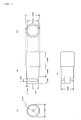
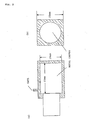
- the metal insert moldings refer to all moldings prepared by placing a metal part in the core of a mold in advance and then injection-molding a resin thereinto so as to integrate the metal part with the resin and are not particularly limited by shapes or the like. In general, creep rupture is liable to occur in a metal insert molding having such a shape that a portion of a metal part is covered with a resin. Therefore, the polyacetal resin of the present invention is useful particularly for a molding having such a shape.
- the polyacetal resin composition of the present invention significantly improves a creep rupture life in a metal insert article molded from a polyacetal resin and can be used in use of a polyacetal resin in a metal insert molding stably for a long time and can be used for a through anchor for automobiles.
- Polyacetal resins (A), silicon oils (B), elastomers (C) and ultra high molecular weight polyethylenes (D) of types shown in Table 1 were mixed together in amounts shown in Table 1 and then melt-kneaded at 200°C by a 30-mm twinscrew extruder so as to prepare pellets. Then, using the polyacetal resin composition pellets, metal insert articles are molded and evaluated.
- Creep characteristics of the metal insert moldings were evaluated in the following manner.
- the foregoing metal insert molding was left to stand in a gear oven set at 120°C, and time taken to have cracks in the resin portion was measured.
Landscapes
- Chemical & Material Sciences (AREA)
- Engineering & Computer Science (AREA)
- Manufacturing & Machinery (AREA)
- Mechanical Engineering (AREA)
- Health & Medical Sciences (AREA)
- Chemical Kinetics & Catalysis (AREA)
- Medicinal Chemistry (AREA)
- Polymers & Plastics (AREA)
- Organic Chemistry (AREA)
- Injection Moulding Of Plastics Or The Like (AREA)
- Compositions Of Macromolecular Compounds (AREA)
Claims (8)
- Polyacetalharzzusammensetzung, umfassend:(A) ein Polyacetalharz mit einem Schmelzindex von 3,0 oder weniger, gemessen gemäß ASTM D238 bei 190°C unter einer Last von 2,160 kg;(B) 0,05 bis 3,0 Gew.-% der Zusammensetzung an Silikonöl;(C) 0,1 bis 5,0 Gew.-% der Zusammensetzung eines Elastomers; und(D) 0,1 bis 5,0 Gew.-% der Zusammensetzung an Polyethylen mit ultrahohem Molekulargewicht.
- Polyacetalharzzusammensetzung gemäß Anspruch 1, wobei das Elastomer (C) und das Polyethylen mit ultrahohem Molekulargewicht (D) in einer Menge von 2,0 bis 7,0 Gew.-% der Zusammensetzung als Gesamtmenge an (C) und (D) enthalten sind.
- Polyacetalharzzusammensetzung gemäß Anspruch 1 oder 2, wobei es sich bei dem Silikonöl (B) um Dimethylsilikon mit einem Molekulargewicht von 20 000 bis 100 000 handelt.
- Polyacetalharzzusammensetzung gemäß Anspruch 1 oder 2, wobei das Elastomer (C) ein thermoplastisches Polyurethanelastömer ist.
- Polyacetalharzzusammensetzung gemäß Anspruch 1 oder 2, wobei das Elastomer (C) ein Kern/Hülle-Polymer mit einem Kern aus einem kautschukartigen Polymer und einer Hülle aus einem glasartigen Polymer ist.
- Polyacetalharzzusammensetzung gemäß Anspruch 1 oder 2, wobei das Polyethylen mit ultrahohem Molekulargewicht (D) eine Suhstanz in der Form von Teilchen mit einer mittleren Teilchengröße von 15 bis 150 µm ist.
- Formteil mit einem Metalleinpressteil, erhalten durch Formen der in Anspruch 1 oder 2 definierten Polyacetalharzzusammensetzung zusammen mit einem Metallteil im Verbund mittels Insert-Molding-Verfahren.
- Formteil mit Metalleinpressteil gemäß Anspruch 7, wobei das Formteil mit dem Metalleinpressteil eine Durchsteckverbindung für Autos ist.
Applications Claiming Priority (2)
| Application Number | Priority Date | Filing Date | Title |
|---|---|---|---|
| JP2002026442A JP4515010B2 (ja) | 2002-02-04 | 2002-02-04 | ポリアセタール樹脂組成物及び金属インサート成形品 |
| JP2002026442 | 2002-02-04 |
Publications (2)
| Publication Number | Publication Date |
|---|---|
| EP1333059A1 EP1333059A1 (de) | 2003-08-06 |
| EP1333059B1 true EP1333059B1 (de) | 2006-05-17 |
Family
ID=19192353
Family Applications (1)
| Application Number | Title | Priority Date | Filing Date |
|---|---|---|---|
| EP03250711A Expired - Lifetime EP1333059B1 (de) | 2002-02-04 | 2003-02-04 | Polyacetalharz und Metalleinsatzformverfahren |
Country Status (5)
| Country | Link |
|---|---|
| US (1) | US6821630B2 (de) |
| EP (1) | EP1333059B1 (de) |
| JP (1) | JP4515010B2 (de) |
| AT (1) | ATE326504T1 (de) |
| DE (1) | DE60305219T2 (de) |
Cited By (1)
| Publication number | Priority date | Publication date | Assignee | Title |
|---|---|---|---|---|
| WO2021249819A1 (en) * | 2020-06-10 | 2021-12-16 | Basf Se | Microcellular foaming process for producing low density thermoplastic polyurethane foam |
Families Citing this family (21)
| Publication number | Priority date | Publication date | Assignee | Title |
|---|---|---|---|---|
| JP4563004B2 (ja) * | 2003-07-08 | 2010-10-13 | ポリプラスチックス株式会社 | ポリアセタール樹脂製摺動部品 |
| US20060025507A1 (en) * | 2004-07-26 | 2006-02-02 | Moore David T | Low wear resin composition having improved surface appearance |
| KR20080025129A (ko) * | 2005-06-08 | 2008-03-19 | 이 아이 듀폰 디 네모아 앤드 캄파니 | 내마모성 고분자량 폴리아세탈-초고분자량 폴리에틸렌조성물 및 이로부터 형성된 물품 |
| JP4694327B2 (ja) * | 2005-09-16 | 2011-06-08 | ポリプラスチックス株式会社 | 金属インサート樹脂成形品のクリープ破壊寿命の推定方法、材料選定方法、設計方法及び製造方法 |
| CN101466785B (zh) * | 2006-06-15 | 2012-04-04 | 三菱工程塑料株式会社 | 聚缩醛树脂组合物及其制备方法、和将该组合物成型而成的滑动部件 |
| DE102008018967A1 (de) | 2008-04-16 | 2009-10-22 | Ticona Gmbh | Oxymethylenpolymere, Verfahren zu deren Herstellung und deren Verwendung |
| JP5295992B2 (ja) * | 2010-02-16 | 2013-09-18 | ポリプラスチックス株式会社 | 金属複合成形品のクリープ破壊寿命の予測方法 |
| US8840976B2 (en) | 2010-10-14 | 2014-09-23 | Ticona Llc | VOC or compressed gas containment device made from a polyoxymethylene polymer |
| CN101974177B (zh) * | 2010-11-02 | 2012-07-04 | 徐州百安居建材科技有限公司 | 多功能聚乙烯管材和制造方法 |
| EP2505609B1 (de) | 2011-04-01 | 2015-01-21 | Ticona GmbH | Polyoxymethylen mit hoher schlagfestigkeit für extrusionsblasformung |
| BR112014009812B1 (pt) * | 2011-10-28 | 2020-12-01 | Ticona Llc | sistema para moldagem por injeção de um artigo de polímero e processo para moldar um material polimérico |
| WO2013101624A1 (en) | 2011-12-30 | 2013-07-04 | Ticona Llc | Printable molded articles made from a polyoxymethylene polymer composition |
| EP2647666A1 (de) | 2012-04-05 | 2013-10-09 | Ticona GmbH | Tribologisch modifiziertes Polyoxymethylen |
| CN103869519B (zh) * | 2012-12-13 | 2016-06-01 | 京东方科技集团股份有限公司 | 制造薄膜晶体管液晶显示器的方法 |
| WO2014105670A1 (en) | 2012-12-27 | 2014-07-03 | Ticona Llc | Impact modified polyoxymethylene composition and articles made therefrom that are stable when exposed to ultraviolet light |
| JP6700178B2 (ja) | 2013-10-21 | 2020-05-27 | ティコナ ゲゼルシャフト ミット ベシュレンクテル ハフツング | 本質的に低摩擦のポリオキシメチレン |
| CN117304644A (zh) | 2015-09-30 | 2023-12-29 | 塞拉尼斯销售德国有限公司 | 低摩擦无刺耳音的组合件 |
| US11225559B2 (en) | 2017-03-10 | 2022-01-18 | Ticona Gmbh | Polyester polymer compositions |
| EP3827050A1 (de) * | 2018-07-26 | 2021-06-02 | Dupont Polymers, Inc. | Metall-polyacetalanordnung |
| CN112341752A (zh) * | 2020-10-26 | 2021-02-09 | 天津大沽化工股份有限公司 | 一种增韧pom汽车专用材料及其制备方法 |
| CN114536660B (zh) * | 2022-02-15 | 2023-07-21 | 大同机械科技(江苏)有限公司 | 一种预防输料通道内残留余料的注塑机 |
Family Cites Families (9)
| Publication number | Priority date | Publication date | Assignee | Title |
|---|---|---|---|---|
| JPH0662831B2 (ja) * | 1986-07-28 | 1994-08-17 | 三ツ星ベルト株式会社 | ポリアセタ−ル樹脂組成物の製造方法 |
| JPH01126359A (ja) | 1987-11-11 | 1989-05-18 | Mitsuboshi Belting Ltd | ポリアセタール樹脂組成物 |
| US5183858A (en) * | 1989-03-31 | 1993-02-02 | Takeda Chemical Industries, Ltd. | Core-shell polymer, production and use thereof |
| JP2628095B2 (ja) | 1989-03-31 | 1997-07-09 | 武田薬品工業株式会社 | コアシェルポリマー |
| JP3734311B2 (ja) * | 1995-06-20 | 2006-01-11 | 旭化成ケミカルズ株式会社 | ポリオキシメチレン樹脂組成物 |
| DE19606948A1 (de) * | 1996-02-23 | 1997-08-28 | Hoechst Ag | Kunststoff-Formmassen mit geringerem Verschleiß |
| JP3965251B2 (ja) * | 1998-10-28 | 2007-08-29 | オイレス工業株式会社 | ポリアセタール樹脂組成物ならびに複写機等に用いられる滑り軸受 |
| JP4087002B2 (ja) * | 1999-03-16 | 2008-05-14 | ポリプラスチックス株式会社 | ポリアセタール樹脂組成物及び金属インサート成形品 |
| JP4931275B2 (ja) * | 1999-12-17 | 2012-05-16 | 旭化成ケミカルズ株式会社 | ポリアセタール樹脂組成物 |
-
2002
- 2002-02-04 JP JP2002026442A patent/JP4515010B2/ja not_active Expired - Fee Related
-
2003
- 2003-01-28 US US10/352,020 patent/US6821630B2/en not_active Expired - Fee Related
- 2003-02-04 DE DE60305219T patent/DE60305219T2/de not_active Expired - Lifetime
- 2003-02-04 EP EP03250711A patent/EP1333059B1/de not_active Expired - Lifetime
- 2003-02-04 AT AT03250711T patent/ATE326504T1/de not_active IP Right Cessation
Cited By (1)
| Publication number | Priority date | Publication date | Assignee | Title |
|---|---|---|---|---|
| WO2021249819A1 (en) * | 2020-06-10 | 2021-12-16 | Basf Se | Microcellular foaming process for producing low density thermoplastic polyurethane foam |
Also Published As
| Publication number | Publication date |
|---|---|
| JP2003226794A (ja) | 2003-08-12 |
| US20030148117A1 (en) | 2003-08-07 |
| DE60305219T2 (de) | 2007-03-01 |
| DE60305219D1 (de) | 2006-06-22 |
| JP4515010B2 (ja) | 2010-07-28 |
| ATE326504T1 (de) | 2006-06-15 |
| US6821630B2 (en) | 2004-11-23 |
| EP1333059A1 (de) | 2003-08-06 |
Similar Documents
| Publication | Publication Date | Title |
|---|---|---|
| EP1333059B1 (de) | Polyacetalharz und Metalleinsatzformverfahren | |
| KR101320326B1 (ko) | 충격성과 유동성이 우수한 열가소성 수지 조성물 | |
| EP1679324B1 (de) | Fliessfähigkeitsverbesserer für technische kunststoffe, diese enthaltende thermoplastische harzzusammensetzung und formkörper aus den zusammensetzungen | |
| US5256733A (en) | Thermoplastic polyoxymethylene molding composition of high toughness and its use | |
| EP2341102A1 (de) | Thermoplastische Harzzusammensetzung mit verbesserter Stoßfestigkeit und Schmelzflusseigenschaft | |
| EP0435171B1 (de) | Mittel zur Verbesserung des Schiebewiderstandes | |
| EP1101799B1 (de) | Stossfeste thermoplastische harzzusammensetzung | |
| EP2530097A1 (de) | Aufprallveränderer für Polycarbonat-Harzzusammensetzung mit hervorragender Schlagfestigkeit und Transparenz und Herstellungsverfahren dafür | |
| KR20210033419A (ko) | 열가소성 수지 조성물, 이의 제조방법 및 이로부터 제조된 성형품 | |
| EP0375648A2 (de) | Harz-Zusammensetzungen | |
| EP2399950A1 (de) | Silikonschlagzähmodifikator mit hohem Brechungsindex und Verfahren zu seiner Herstellung | |
| KR20030055445A (ko) | 인장특성 및 내열성이 우수한 열가소성 수지 조성물 | |
| KR101827613B1 (ko) | 고무변성 비닐계 그라프트 공중합체 및 이를 포함하는 열가소성 수지 조성물 | |
| KR100555423B1 (ko) | 충격보강제 및 이를 포함하는 공업용 수지 조성물 | |
| JP4087002B2 (ja) | ポリアセタール樹脂組成物及び金属インサート成形品 | |
| KR20220012639A (ko) | 열가소성 수지 조성물, 이의 제조방법 및 이를 포함하는 성형품 | |
| JPH06100759A (ja) | クリップ用樹脂組成物 | |
| JP3281242B2 (ja) | ポリアセタール樹脂組成物 | |
| JP3590447B2 (ja) | ポリアセタール樹脂組成物 | |
| DE69326178T2 (de) | Polyacetal Harzzusammensetzung | |
| KR100774821B1 (ko) | 내열성, 증착광택 및 신율이 우수한 열가소성 수지 조성물 | |
| JP2003020378A (ja) | 透明摺動性熱可塑性樹脂組成物 | |
| JP2005187667A (ja) | 耐白化性に優れた透明持続性帯電防止熱可塑性樹脂組成物 | |
| EP0940441A1 (de) | Zusammensetzung auf der Basis von vinylaromatischen Polymeren und Ketonpolymeren | |
| KR102935728B1 (ko) | 열가소성 수지 조성물 및 이로부터 제조되는 성형품 |
Legal Events
| Date | Code | Title | Description |
|---|---|---|---|
| PUAI | Public reference made under article 153(3) epc to a published international application that has entered the european phase |
Free format text: ORIGINAL CODE: 0009012 |
|
| AK | Designated contracting states |
Designated state(s): AT BE BG CH CY CZ DE DK EE ES FI FR GB GR HU IE IT LI LU MC NL PT SE SI SK TR |
|
| AX | Request for extension of the european patent |
Extension state: AL LT LV MK RO |
|
| 17P | Request for examination filed |
Effective date: 20040127 |
|
| AKX | Designation fees paid |
Designated state(s): AT BE BG CH CY CZ DE DK EE ES FI FR GB GR HU IE IT LI LU MC NL PT SE SI SK TR |
|
| GRAP | Despatch of communication of intention to grant a patent |
Free format text: ORIGINAL CODE: EPIDOSNIGR1 |
|
| GRAS | Grant fee paid |
Free format text: ORIGINAL CODE: EPIDOSNIGR3 |
|
| GRAA | (expected) grant |
Free format text: ORIGINAL CODE: 0009210 |
|
| RAP1 | Party data changed (applicant data changed or rights of an application transferred) |
Owner name: POLYPLASTICS CO LTD |
|
| AK | Designated contracting states |
Kind code of ref document: B1 Designated state(s): AT BE BG CH CY CZ DE DK EE ES FI FR GB GR HU IE IT LI LU MC NL PT SE SI SK TR |
|
| PG25 | Lapsed in a contracting state [announced via postgrant information from national office to epo] |
Ref country code: CZ Free format text: LAPSE BECAUSE OF FAILURE TO SUBMIT A TRANSLATION OF THE DESCRIPTION OR TO PAY THE FEE WITHIN THE PRESCRIBED TIME-LIMIT Effective date: 20060517 Ref country code: BE Free format text: LAPSE BECAUSE OF FAILURE TO SUBMIT A TRANSLATION OF THE DESCRIPTION OR TO PAY THE FEE WITHIN THE PRESCRIBED TIME-LIMIT Effective date: 20060517 Ref country code: SI Free format text: LAPSE BECAUSE OF FAILURE TO SUBMIT A TRANSLATION OF THE DESCRIPTION OR TO PAY THE FEE WITHIN THE PRESCRIBED TIME-LIMIT Effective date: 20060517 Ref country code: LI Free format text: LAPSE BECAUSE OF FAILURE TO SUBMIT A TRANSLATION OF THE DESCRIPTION OR TO PAY THE FEE WITHIN THE PRESCRIBED TIME-LIMIT Effective date: 20060517 Ref country code: FI Free format text: LAPSE BECAUSE OF FAILURE TO SUBMIT A TRANSLATION OF THE DESCRIPTION OR TO PAY THE FEE WITHIN THE PRESCRIBED TIME-LIMIT Effective date: 20060517 Ref country code: CH Free format text: LAPSE BECAUSE OF FAILURE TO SUBMIT A TRANSLATION OF THE DESCRIPTION OR TO PAY THE FEE WITHIN THE PRESCRIBED TIME-LIMIT Effective date: 20060517 Ref country code: SK Free format text: LAPSE BECAUSE OF FAILURE TO SUBMIT A TRANSLATION OF THE DESCRIPTION OR TO PAY THE FEE WITHIN THE PRESCRIBED TIME-LIMIT Effective date: 20060517 Ref country code: NL Free format text: LAPSE BECAUSE OF FAILURE TO SUBMIT A TRANSLATION OF THE DESCRIPTION OR TO PAY THE FEE WITHIN THE PRESCRIBED TIME-LIMIT Effective date: 20060517 Ref country code: AT Free format text: LAPSE BECAUSE OF FAILURE TO SUBMIT A TRANSLATION OF THE DESCRIPTION OR TO PAY THE FEE WITHIN THE PRESCRIBED TIME-LIMIT Effective date: 20060517 Ref country code: IT Free format text: LAPSE BECAUSE OF FAILURE TO SUBMIT A TRANSLATION OF THE DESCRIPTION OR TO PAY THE FEE WITHIN THE PRESCRIBED TIME-LIMIT;WARNING: LAPSES OF ITALIAN PATENTS WITH EFFECTIVE DATE BEFORE 2007 MAY HAVE OCCURRED AT ANY TIME BEFORE 2007. THE CORRECT EFFECTIVE DATE MAY BE DIFFERENT FROM THE ONE RECORDED. Effective date: 20060517 |
|
| REG | Reference to a national code |
Ref country code: GB Ref legal event code: FG4D |
|
| REG | Reference to a national code |
Ref country code: CH Ref legal event code: EP |
|
| REG | Reference to a national code |
Ref country code: IE Ref legal event code: FG4D |
|
| REF | Corresponds to: |
Ref document number: 60305219 Country of ref document: DE Date of ref document: 20060622 Kind code of ref document: P |
|
| PG25 | Lapsed in a contracting state [announced via postgrant information from national office to epo] |
Ref country code: SE Free format text: LAPSE BECAUSE OF FAILURE TO SUBMIT A TRANSLATION OF THE DESCRIPTION OR TO PAY THE FEE WITHIN THE PRESCRIBED TIME-LIMIT Effective date: 20060817 Ref country code: DK Free format text: LAPSE BECAUSE OF FAILURE TO SUBMIT A TRANSLATION OF THE DESCRIPTION OR TO PAY THE FEE WITHIN THE PRESCRIBED TIME-LIMIT Effective date: 20060817 |
|
| PG25 | Lapsed in a contracting state [announced via postgrant information from national office to epo] |
Ref country code: ES Free format text: LAPSE BECAUSE OF FAILURE TO SUBMIT A TRANSLATION OF THE DESCRIPTION OR TO PAY THE FEE WITHIN THE PRESCRIBED TIME-LIMIT Effective date: 20060828 |
|
| PG25 | Lapsed in a contracting state [announced via postgrant information from national office to epo] |
Ref country code: PT Free format text: LAPSE BECAUSE OF FAILURE TO SUBMIT A TRANSLATION OF THE DESCRIPTION OR TO PAY THE FEE WITHIN THE PRESCRIBED TIME-LIMIT Effective date: 20061017 |
|
| NLV1 | Nl: lapsed or annulled due to failure to fulfill the requirements of art. 29p and 29m of the patents act | ||
| REG | Reference to a national code |
Ref country code: CH Ref legal event code: PL |
|
| ET | Fr: translation filed | ||
| PG25 | Lapsed in a contracting state [announced via postgrant information from national office to epo] |
Ref country code: MC Free format text: LAPSE BECAUSE OF NON-PAYMENT OF DUE FEES Effective date: 20070228 |
|
| PLBE | No opposition filed within time limit |
Free format text: ORIGINAL CODE: 0009261 |
|
| STAA | Information on the status of an ep patent application or granted ep patent |
Free format text: STATUS: NO OPPOSITION FILED WITHIN TIME LIMIT |
|
| RAP2 | Party data changed (patent owner data changed or rights of a patent transferred) |
Owner name: POLYPLASTICS CO., LTD. |
|
| 26N | No opposition filed |
Effective date: 20070220 |
|
| PG25 | Lapsed in a contracting state [announced via postgrant information from national office to epo] |
Ref country code: IE Free format text: LAPSE BECAUSE OF NON-PAYMENT OF DUE FEES Effective date: 20070205 |
|
| PG25 | Lapsed in a contracting state [announced via postgrant information from national office to epo] |
Ref country code: GR Free format text: LAPSE BECAUSE OF FAILURE TO SUBMIT A TRANSLATION OF THE DESCRIPTION OR TO PAY THE FEE WITHIN THE PRESCRIBED TIME-LIMIT Effective date: 20060818 |
|
| PG25 | Lapsed in a contracting state [announced via postgrant information from national office to epo] |
Ref country code: BG Free format text: LAPSE BECAUSE OF FAILURE TO SUBMIT A TRANSLATION OF THE DESCRIPTION OR TO PAY THE FEE WITHIN THE PRESCRIBED TIME-LIMIT Effective date: 20060817 |
|
| PG25 | Lapsed in a contracting state [announced via postgrant information from national office to epo] |
Ref country code: EE Free format text: LAPSE BECAUSE OF FAILURE TO SUBMIT A TRANSLATION OF THE DESCRIPTION OR TO PAY THE FEE WITHIN THE PRESCRIBED TIME-LIMIT Effective date: 20060517 |
|
| PGFP | Annual fee paid to national office [announced via postgrant information from national office to epo] |
Ref country code: GB Payment date: 20090204 Year of fee payment: 7 |
|
| PG25 | Lapsed in a contracting state [announced via postgrant information from national office to epo] |
Ref country code: CY Free format text: LAPSE BECAUSE OF FAILURE TO SUBMIT A TRANSLATION OF THE DESCRIPTION OR TO PAY THE FEE WITHIN THE PRESCRIBED TIME-LIMIT Effective date: 20060517 Ref country code: LU Free format text: LAPSE BECAUSE OF NON-PAYMENT OF DUE FEES Effective date: 20070204 |
|
| PG25 | Lapsed in a contracting state [announced via postgrant information from national office to epo] |
Ref country code: HU Free format text: LAPSE BECAUSE OF FAILURE TO SUBMIT A TRANSLATION OF THE DESCRIPTION OR TO PAY THE FEE WITHIN THE PRESCRIBED TIME-LIMIT Effective date: 20061118 Ref country code: TR Free format text: LAPSE BECAUSE OF FAILURE TO SUBMIT A TRANSLATION OF THE DESCRIPTION OR TO PAY THE FEE WITHIN THE PRESCRIBED TIME-LIMIT Effective date: 20060517 |
|
| PGFP | Annual fee paid to national office [announced via postgrant information from national office to epo] |
Ref country code: FR Payment date: 20090213 Year of fee payment: 7 |
|
| GBPC | Gb: european patent ceased through non-payment of renewal fee |
Effective date: 20100204 |
|
| REG | Reference to a national code |
Ref country code: FR Ref legal event code: ST Effective date: 20101029 |
|
| PG25 | Lapsed in a contracting state [announced via postgrant information from national office to epo] |
Ref country code: FR Free format text: LAPSE BECAUSE OF NON-PAYMENT OF DUE FEES Effective date: 20100301 |
|
| PG25 | Lapsed in a contracting state [announced via postgrant information from national office to epo] |
Ref country code: GB Free format text: LAPSE BECAUSE OF NON-PAYMENT OF DUE FEES Effective date: 20100204 |
|
| PGFP | Annual fee paid to national office [announced via postgrant information from national office to epo] |
Ref country code: DE Payment date: 20120131 Year of fee payment: 10 |
|
| REG | Reference to a national code |
Ref country code: DE Ref legal event code: R119 Ref document number: 60305219 Country of ref document: DE Effective date: 20130903 |
|
| PG25 | Lapsed in a contracting state [announced via postgrant information from national office to epo] |
Ref country code: DE Free format text: LAPSE BECAUSE OF NON-PAYMENT OF DUE FEES Effective date: 20130903 |