EP1329259A2 - Kontinuirliches Verfahren zur Hydrolyse einer lösungsmittelhaltigen organischen Verbindung - Google Patents
Kontinuirliches Verfahren zur Hydrolyse einer lösungsmittelhaltigen organischen Verbindung Download PDFInfo
- Publication number
- EP1329259A2 EP1329259A2 EP03000648A EP03000648A EP1329259A2 EP 1329259 A2 EP1329259 A2 EP 1329259A2 EP 03000648 A EP03000648 A EP 03000648A EP 03000648 A EP03000648 A EP 03000648A EP 1329259 A2 EP1329259 A2 EP 1329259A2
- Authority
- EP
- European Patent Office
- Prior art keywords
- organic compound
- solvent
- circulation pipe
- hydrolysis
- pump
- Prior art date
- Legal status (The legal status is an assumption and is not a legal conclusion. Google has not performed a legal analysis and makes no representation as to the accuracy of the status listed.)
- Withdrawn
Links
- GAZWKJNMLLGPKV-UHFFFAOYSA-N CCC(C1)C1N Chemical compound CCC(C1)C1N GAZWKJNMLLGPKV-UHFFFAOYSA-N 0.000 description 1
Images
Classifications
-
- C—CHEMISTRY; METALLURGY
- C07—ORGANIC CHEMISTRY
- C07B—GENERAL METHODS OF ORGANIC CHEMISTRY; APPARATUS THEREFOR
- C07B63/00—Purification; Separation; Stabilisation; Use of additives
- C07B63/02—Purification; Separation; Stabilisation; Use of additives by treatment giving rise to a chemical modification
-
- B—PERFORMING OPERATIONS; TRANSPORTING
- B01—PHYSICAL OR CHEMICAL PROCESSES OR APPARATUS IN GENERAL
- B01J—CHEMICAL OR PHYSICAL PROCESSES, e.g. CATALYSIS OR COLLOID CHEMISTRY; THEIR RELEVANT APPARATUS
- B01J19/00—Chemical, physical or physico-chemical processes in general; Their relevant apparatus
- B01J19/24—Stationary reactors without moving elements inside
- B01J19/2455—Stationary reactors without moving elements inside provoking a loop type movement of the reactants
- B01J19/2465—Stationary reactors without moving elements inside provoking a loop type movement of the reactants externally, i.e. the mixture leaving the vessel and subsequently re-entering it
-
- C—CHEMISTRY; METALLURGY
- C07—ORGANIC CHEMISTRY
- C07B—GENERAL METHODS OF ORGANIC CHEMISTRY; APPARATUS THEREFOR
- C07B37/00—Reactions without formation or introduction of functional groups containing hetero atoms, involving either the formation of a carbon-to-carbon bond between two carbon atoms not directly linked already or the disconnection of two directly linked carbon atoms
-
- C—CHEMISTRY; METALLURGY
- C07—ORGANIC CHEMISTRY
- C07B—GENERAL METHODS OF ORGANIC CHEMISTRY; APPARATUS THEREFOR
- C07B37/00—Reactions without formation or introduction of functional groups containing hetero atoms, involving either the formation of a carbon-to-carbon bond between two carbon atoms not directly linked already or the disconnection of two directly linked carbon atoms
- C07B37/04—Substitution
-
- C—CHEMISTRY; METALLURGY
- C07—ORGANIC CHEMISTRY
- C07B—GENERAL METHODS OF ORGANIC CHEMISTRY; APPARATUS THEREFOR
- C07B41/00—Formation or introduction of functional groups containing oxygen
- C07B41/02—Formation or introduction of functional groups containing oxygen of hydroxy or O-metal groups
-
- C—CHEMISTRY; METALLURGY
- C07—ORGANIC CHEMISTRY
- C07B—GENERAL METHODS OF ORGANIC CHEMISTRY; APPARATUS THEREFOR
- C07B41/00—Formation or introduction of functional groups containing oxygen
- C07B41/06—Formation or introduction of functional groups containing oxygen of carbonyl groups
-
- C—CHEMISTRY; METALLURGY
- C07—ORGANIC CHEMISTRY
- C07C—ACYCLIC OR CARBOCYCLIC COMPOUNDS
- C07C45/00—Preparation of compounds having >C = O groups bound only to carbon or hydrogen atoms; Preparation of chelates of such compounds
- C07C45/45—Preparation of compounds having >C = O groups bound only to carbon or hydrogen atoms; Preparation of chelates of such compounds by condensation
- C07C45/46—Friedel-Crafts reactions
-
- C—CHEMISTRY; METALLURGY
- C07—ORGANIC CHEMISTRY
- C07F—ACYCLIC, CARBOCYCLIC OR HETEROCYCLIC COMPOUNDS CONTAINING ELEMENTS OTHER THAN CARBON, HYDROGEN, HALOGEN, OXYGEN, NITROGEN, SULFUR, SELENIUM OR TELLURIUM
- C07F9/00—Compounds containing elements of Groups 5 or 15 of the Periodic Table
- C07F9/02—Phosphorus compounds
- C07F9/547—Heterocyclic compounds, e.g. containing phosphorus as a ring hetero atom
- C07F9/6564—Heterocyclic compounds, e.g. containing phosphorus as a ring hetero atom having phosphorus atoms, with or without nitrogen, oxygen, sulfur, selenium or tellurium atoms, as ring hetero atoms
- C07F9/6571—Heterocyclic compounds, e.g. containing phosphorus as a ring hetero atom having phosphorus atoms, with or without nitrogen, oxygen, sulfur, selenium or tellurium atoms, as ring hetero atoms having phosphorus and oxygen atoms as the only ring hetero atoms
- C07F9/657163—Heterocyclic compounds, e.g. containing phosphorus as a ring hetero atom having phosphorus atoms, with or without nitrogen, oxygen, sulfur, selenium or tellurium atoms, as ring hetero atoms having phosphorus and oxygen atoms as the only ring hetero atoms the ring phosphorus atom being bound to at least one carbon atom
-
- B—PERFORMING OPERATIONS; TRANSPORTING
- B01—PHYSICAL OR CHEMICAL PROCESSES OR APPARATUS IN GENERAL
- B01J—CHEMICAL OR PHYSICAL PROCESSES, e.g. CATALYSIS OR COLLOID CHEMISTRY; THEIR RELEVANT APPARATUS
- B01J2219/00—Chemical, physical or physico-chemical processes in general; Their relevant apparatus
- B01J2219/00002—Chemical plants
- B01J2219/00004—Scale aspects
- B01J2219/00006—Large-scale industrial plants
-
- B—PERFORMING OPERATIONS; TRANSPORTING
- B01—PHYSICAL OR CHEMICAL PROCESSES OR APPARATUS IN GENERAL
- B01J—CHEMICAL OR PHYSICAL PROCESSES, e.g. CATALYSIS OR COLLOID CHEMISTRY; THEIR RELEVANT APPARATUS
- B01J2219/00—Chemical, physical or physico-chemical processes in general; Their relevant apparatus
- B01J2219/00049—Controlling or regulating processes
- B01J2219/00051—Controlling the temperature
- B01J2219/00074—Controlling the temperature by indirect heating or cooling employing heat exchange fluids
- B01J2219/00087—Controlling the temperature by indirect heating or cooling employing heat exchange fluids with heat exchange elements outside the reactor
- B01J2219/00103—Controlling the temperature by indirect heating or cooling employing heat exchange fluids with heat exchange elements outside the reactor in a heat exchanger separate from the reactor
-
- B—PERFORMING OPERATIONS; TRANSPORTING
- B01—PHYSICAL OR CHEMICAL PROCESSES OR APPARATUS IN GENERAL
- B01J—CHEMICAL OR PHYSICAL PROCESSES, e.g. CATALYSIS OR COLLOID CHEMISTRY; THEIR RELEVANT APPARATUS
- B01J2219/00—Chemical, physical or physico-chemical processes in general; Their relevant apparatus
- B01J2219/00049—Controlling or regulating processes
- B01J2219/00051—Controlling the temperature
- B01J2219/00074—Controlling the temperature by indirect heating or cooling employing heat exchange fluids
- B01J2219/00105—Controlling the temperature by indirect heating or cooling employing heat exchange fluids part or all of the reactants being heated or cooled outside the reactor while recycling
- B01J2219/0011—Controlling the temperature by indirect heating or cooling employing heat exchange fluids part or all of the reactants being heated or cooled outside the reactor while recycling involving reactant liquids
-
- B—PERFORMING OPERATIONS; TRANSPORTING
- B01—PHYSICAL OR CHEMICAL PROCESSES OR APPARATUS IN GENERAL
- B01J—CHEMICAL OR PHYSICAL PROCESSES, e.g. CATALYSIS OR COLLOID CHEMISTRY; THEIR RELEVANT APPARATUS
- B01J2219/00—Chemical, physical or physico-chemical processes in general; Their relevant apparatus
- B01J2219/00049—Controlling or regulating processes
- B01J2219/00186—Controlling or regulating processes controlling the composition of the reactive mixture
Definitions
- the invention relates to a continuous process for the hydrolysis of a solvent-containing organic compound or a solvent-based Mixture of organic compounds.
- the solution is based on a continuous hydrolysis process a solvent-containing organic compound or a solvent-containing one Mixture of organic compounds.
- the invention is characterized in that the method in one Loop reactor with an outer loop, comprising a circuit tube and carries out a circulation pump, whereby a feed stream comprising the solvent-containing organic compound or the solvent-containing Mixture of organic compounds and a feed stream containing water or aqueous hydrochloric acid solution on the pressure side the pump metered in continuously and the hydrolyzed reaction mixture continuously withdraws from the circulation pipe.
- Loop reactors are known in chemical engineering and for example in the textbook on technical chemistry by M. Baerns: Chemical reaction technology, 2nd edition 1992, published by Thieme. In such reactors, the reaction mixture is continuously with high turbulence circulated, and continuously a compared to the circulated Electricity much lower educt stream supplied from the outside or a corresponding product stream is withdrawn from the reactor.
- the loop reactor can be used as a cylindrical apparatus with a central guide tube be formed, the circulation between the guide tube and the intermediate space between the guide tube and the inner wall of the reactor in an inner one Loop takes place or in the form of a circulation pipe through which the circulation by means of a pump (loop reactors with so-called outer loop).
- the present invention relates to a loop reactor with outer loop.
- the same includes as main elements Circulation pipe and a circulation pump.
- a reactant stream which is compared to the circulated Liquid flow is low, fed on the suction side of the pump and a corresponding product flow on the pressure side of the pump deducted.
- the pump causes a high flow rate in the Circulation and thus a turbulent flow, which ensures good mixing in the circulation pipe.
- the heat released during hydrolysis first becomes capacitive means recorded by an increase in temperature in the circulating stream. Often, it is then passed through one or more in the circulation pipe arranged heat exchangers, corresponding to those carried out in individual cases Hydrolysis reaction and the amount of heat developed, dissipated.
- a buffer container in the circulation pipe for the reaction mixture on the suction side of the pump with a Overflow arranged for the hydrolyzed reaction mixture to be drawn off.
- the volume of the buffer container is advantageously chosen so that that the residence time of the hydrolyzed reaction mixture in the buffer tank 10 minutes, preferably 5 minutes, particularly preferably 1 minute, does not exceed.
- the volume of the buffer tank is advantageously as defined above limit at the top, so that the loop reactor enters the stationary operating state passes over, as well as for safety reasons.
- the ratio between the volume flow in the circulation pipe is preferably and the metered volume flow 5: 1 to 15: 1, in particular 10: 1.
- the one drawn off from the circulation pipe, preferably as an overflow of the buffer container hydrolyzed reaction mixture is preferably continuous fed to a phase separator.
- the phase separator it will be Organic phase, which is often the upper phase, separated from the aqueous phase, often the lower phase.
- the organic compound is the addition complex of aluminum trichloride to the carbonyl group of the acylation product of a Friedel-Crafts reaction, the hydrolysis is carried out in aqueous hydrochloric acid.
- Friedel-Crafts acylations of aromatic compounds are the most important Synthetic method for aromatic and aromatic / aliphatic ketones known.
- the aromatic compound is mixed with an acylating agent, in usually an acid halide, often an acid chloride, an acid anhydride or optionally a carboxylic acid in the presence of aluminum trichloride implemented as a Fiedel-Crafts catalyst. It forms first the addition complex of aluminum trichloride to the carbonyl group of the acylation product, which is then hydrolyzed, often in aqueous hydrochloric acid solution, and finally extracted.
- an acylating agent in usually an acid halide, often an acid chloride, an acid anhydride or optionally a carboxylic acid in the presence of aluminum trichloride implemented as a Fiedel-Crafts catalyst. It forms first the addition complex of aluminum trichloride to the carbonyl group of the acylation product, which is then hydrolyzed, often in aqueous hydrochloric acid
- the aromatic acylated according to Friedel-Crafts is preferably trans-n-alkylcyclohexylbenzene, the n-alkyl radical preferably having 2 to 7 carbon atoms, particularly preferably contains 2, 3 or 5 carbon atoms.
- Preferred solvents are one or more of the compounds Toluene, benzene, xylene, octane, hexane, heptane, tetrahydrofuran, dichloromethane, Chloroform or diethylene glycol used.
- Processes can also use low boiling solvents such as dichloromethane or chloroform without any problems in the highly exothermic hydrolysis process be used because the hot spot problem known from agitator apparatus does not occur in the method according to the invention.
- the organic compound is the magnesium or lithium alcoholate, which is obtained by adding a ketone was formed on an organometallic compound.
- the organic compound is the Palladium addition complex, which in a Suzuki coupling by reaction an aryl boronic acid was formed with an aryl bromide.
- the organic compound is an alcoholate obtained by coordinating the aluminum atom of lithium aluminum hydride on the oxygen atom of the carbonyl group of an organic Acid was formed.
- the organic compound is a dimethyl borate, by reacting a bifluorinated organic compound was obtained with lithium diisopropylamine and trimethyl borate.
- the invention also includes a method according to which the organic compound is an oxaphosphetane by the Wittig reaction of an aldehyde or ketones with a phosphonium iodide.
- the method according to the invention thus has the advantage that it is highly exothermic Hydrolysis reactions of organic compounds containing solvents or mixtures of organic compounds are safely controllable, since the reactive educt flow to a much larger circulation flow from already reacted and thus quasi-inert reaction mixture is metered in, which dilutes the educt stream. So the temperature increase per volume element through the ratio of educt to Circulation flow can be precisely controlled and adjusted. The temperature fluctuations can be limited to a narrow range of approximately ⁇ 3 ° C. This allows boiling, especially of the solvent, and thus avoiding the hot spot problem. Even with overdosing a reactant always has sufficient capacitive cooling capacity, since the amount of reactants compared to the recycle stream is small. If a reactant is overdosed, it simply enriches itself in the system and the reaction and thus the released reaction energy can continue to be controlled via the metering of the second reactant become.
- the modular design of the hydrolysis reactor enables it to be compact Design that keeps the space requirement small.
- the module be designed to be portable so that it can be carried Operation can be used. This requires a robust design, which is then also able to prevent any solid failures occurring in the Easy to process the circuit.
- the hazard potential can thus be determined using the method according to the invention of hydrolysis reactors drastically reduce.
- the space-time yield is due to better reactor utilization and shorter occupancy times increased, product quality improved and subsequent refurbishment steps are associated with less effort.
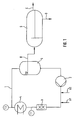
- a loop reactor with an outer loop comprising a circulation pipe 1 and a pump 2.
- the educt streams aqueous Hydrochloric acid solution, A1 and organic compound, A2 are on the Pressure side of pump 2 is metered in and on the suction side of the pump withdrawn a product stream B from the hydrolyzed reaction mixture.
- Fig. 1 In the particular embodiment shown in Fig. 1 is in the circulation pipe 1 After the feed streams A1 and A2 have been metered in, a static mixer 3 and downstream of the same a heat exchanger 4 is arranged. Before and after the heat exchanger 4 are temperature measuring points T1 and T2 arranged. On the suction side of the pump 2 is in the circulation pipe 1 Buffer container 5 is provided, the overflow B of which forms the product stream. The product stream B drawn off from the circulation pipe becomes a phase separator 6 fed and there in an organic upper phase C and aqueous lower phase D separated.
- the low pressure level on the suction side favors the Circulation pump the partial evaporation of the solvent, in particular if it is a low-boiling solvent, if one approaches the boiling point of the solvent.
- the emerging Steam bubbles on the suction side and in the circulation pump lead to cavitation and thus damage to the circulating pump and to one sharp drop in output. This also reduces the Cooling capacity, which leads to further evaporation. This has collapsed of the loop current when, for example, by Dosing error is pushed into critical temperature ranges.
- the method according to the invention with metering on the pressure side of the Circulation pump is much more stable and easier to control, since any steam bubbles that are formed collapse in the heat exchanger, before they pass the circulation pump. This is not how it happens Breakdown of the loop current. Furthermore, that is critical Temperature level on the pressure side of the circulation pump increased and thus the problem associated with the formation of steam bubbles already thereby defused.
Landscapes
- Chemical & Material Sciences (AREA)
- Organic Chemistry (AREA)
- Chemical Kinetics & Catalysis (AREA)
- Health & Medical Sciences (AREA)
- Life Sciences & Earth Sciences (AREA)
- Biochemistry (AREA)
- General Health & Medical Sciences (AREA)
- Molecular Biology (AREA)
- Organic Low-Molecular-Weight Compounds And Preparation Thereof (AREA)
Abstract
Description
- Figur 1
- zeigt die schematische Darstellung einer bevorzugten Anlage zur Durchführung des erfindungsgemäßen Verfahrens.
Claims (15)
- Kontinuierliches Verfahren zur Hydrolyse einer lösungsmittelhaltigen organischen Verbindung oder eines lösungsmittelhaltigen Gemisches organischer Verbindungen, dadurch gekennzeichnet, dass man das Verfahren in einem Schlaufenreaktor mit einer äußeren Schlaufe, aufweisend ein Kreislaufrohr (1) und eine Umwälzpumpe (2) durchführt, wobei man einen Eduktstrom (A1) umfassend die lösungsmittelhaltige organische Verbindung oder das lösungsmittelhaltige Gemisch organischer Verbindungen und einem Eduktstrom (A2) enthaltend Wasser oder wässrige Salzsäurelösung auf der Druckseite der Pumpe (2) kontinuierlich zudosiert und das hydrolysierte Reaktionsgemisch (B) kontinuierlich aus dem Kreislaufrohr (1) abzieht.
- Verfahren nach Anspruch 1, dadurch gekennzeichnet, dass das Verhältnis aus dem Volumenstrom im Kreislaufrohr (1) und dem zudosierten Volumenstrom im Bereich von 5 : 1 bis 15 : 1, bevorzugt bei 10 : 1 liegt.
- Verfahren nach Anspruch 1 oder 2, dadurch gekennzeichnet, dass im Kreislaufrohr (1) nach der Dosierstelle für die Eduktströme (A1, A2) ein oder mehrere Wärmetauscher (4) angeordnet sind.
- Verfahren nach einem der Ansprüche 1 bis 3, dadurch gekennzeichnet, dass nach der Dosierstelle für die Eduktströme (A1, A2) und vor dem Wärmetauscher (den Wärmetauschern) (4) ein oder mehrere statische Mischer (3) angeordnet sind.
- Verfahren nach einem der Ansprüche 1 bis 4, dadurch gekennzeichnet, dass im Kreislaufrohr (1) auf der Saugseite der Pumpe (2) ein Pufferbehälter (5) mit einem Überlauf vorgesehen ist, aus dem kontinuierlich das hydrolysierte Reaktionsgemisch (B) abgezogen wird.
- Verfahren nach Anspruch 5, dadurch gekennzeichnet, dass man das Volumen des Pufferbehälters (5) dergestalt dimensioniert, dass die Verweilzeit des hydrolysierten Reaktionsgemisches (B) im Pufferbehälter (5) maximal 10 Minuten, bevorzugt maximal 5 Minuten, bevorzugt maximal 1 Minute, beträgt.
- Verfahren nach einem der Ansprüche 1 bis 6, dadurch gekennzeichnet, dass das aus dem Kreislaufrohr (1)abgezogene hydrolysierte Reaktionsgemisch (B) kontinuierlich einem Phasenscheider (6) zugeführt wird.
- Verfahren nach einem der Ansprüche 1 bis 7, dadurch gekennzeichnet, dass die organische Verbindung der Anlagerungskomplex von Aluminiumtrichlorid an die Carbonylgruppe des Acylierungsproduktes einer Friedel-Crafts-Reaktion ist und dass die Hydrolyse in wässriger Salzsäurelösung durchgeführt wird.
- Verfahren nach Anspruch 8, dadurch gekennzeichnet, dass in der Friedel-Crafts-Reaktion ein trans-n-Alkyl-cylcohexyl-benzol acetyliert wird, wobei der n-Alkyl-Rest insbesondere 2 bis 7 Kohlenstoffatome, besonders bevorzugt 2, 3 oder 5 Kohlenstoffatome, enthält.
- Verfahren nach Anspruch 8 oder 9, dadurch gekennzeichnet, dass das Lösungsmittel eine oder mehrere der Verbindungen Toluol, Benzol, Xylol, Oktan, Hexan, Heptan, Tetrahydrofuran, Dichlormethan, Chloroform oder Diethylenglykol ist.
- Verfahren nach einem der Ansprüche 1 bis 7, dadurch gekennzeichnet, dass die organische Verbindung das Magnesium- oder Lithiumalkoholat ist, das durch Addition eines Ketons an eine metallorganische Verbindung gebildet wurde.
- Verfahren nach einem der Ansprüche 1 bis 7, dadurch gekennzeichnet, dass die organische Verbindung der Palladiumanlagerungskomplex ist, der in einer Suzuki-Kopplung durch Reaktion einer Arylboronsäure mit einem Arylbromid gebildet wurde.
- Verfahren nach einem der Ansprüche 1 bis 7, dadurch gekennzeichnet, dass die organische Verbindung ein Alkoholat ist, das durch Koordination des Aluminiumatoms von Lithiumaluminiumhydrid am Sauerstoffatom der Carbonylgruppe einer organischen Säure gebildet wurde.
- Verfahren nach einem der Ansprüche 1 bis 7, dadurch gekennzeichnet, dass die organische Verbindung ein Borsäuredimethylester ist, der durch Umsetzung einer bifluorierten organischen Verbindung mit Lithiumdiisopropylamin und Trimethylborat erhalten wurde.
- Verfahren nach einem der Ansprüche 1 bis 7, dadurch gekennzeichnet, dass die organische Verbindung ein Oxaphosphetan ist, das durch Wittig-Reaktion eines Aldehyds oder Ketons mit einem Phosphoniumjodid erhalten wurde.
Applications Claiming Priority (2)
| Application Number | Priority Date | Filing Date | Title |
|---|---|---|---|
| DE2002101689 DE10201689A1 (de) | 2002-01-17 | 2002-01-17 | Kontinuierliches Verfahren zur Hydrolyse einer lösungsmittelhaltigen organischen Verbindung |
| DE10201689 | 2002-01-17 |
Publications (2)
| Publication Number | Publication Date |
|---|---|
| EP1329259A2 true EP1329259A2 (de) | 2003-07-23 |
| EP1329259A3 EP1329259A3 (de) | 2006-01-04 |
Family
ID=7712418
Family Applications (1)
| Application Number | Title | Priority Date | Filing Date |
|---|---|---|---|
| EP03000648A Withdrawn EP1329259A3 (de) | 2002-01-17 | 2003-01-16 | Kontinuierliches Verfahren zur Hydrolyse einer lösungsmittelhaltigen organischen Verbindung |
Country Status (2)
| Country | Link |
|---|---|
| EP (1) | EP1329259A3 (de) |
| DE (1) | DE10201689A1 (de) |
Cited By (8)
| Publication number | Priority date | Publication date | Assignee | Title |
|---|---|---|---|---|
| WO2006008495A1 (en) * | 2004-07-20 | 2006-01-26 | Fujifilm Imaging Colorants Limited | Manufacturing process |
| DE102010000578A1 (de) * | 2010-02-26 | 2011-09-01 | G+R Technology Group Ag | Reaktor zur hydrothermalen Karbonisierung von Biomasse und Verfahren zum Betrieb des Reaktors |
| DE102010014992A1 (de) * | 2010-04-14 | 2011-10-20 | Uhde Gmbh | Verfahren zum Aufheizen oder Warmhalten der Strömungswege einer Prozessanlage |
| EP3228587A1 (de) * | 2013-12-09 | 2017-10-11 | Chemtura Corporation | Schlaufenreaktor zur herstellung von bromiden |
| CN108499504A (zh) * | 2017-10-30 | 2018-09-07 | 赵君 | 一种连续中和装置及其工艺 |
| CN108863857A (zh) * | 2018-06-29 | 2018-11-23 | 浙江龙盛化工研究有限公司 | 对乙酰氨基苯磺酰氯降温析晶的连续稀释装置及方法 |
| CN112588250A (zh) * | 2020-11-04 | 2021-04-02 | 四川大学 | 一种利用硫酸钛液生产双效晶种的管壳式晶种设备及制造方法 |
| CN114931765A (zh) * | 2022-04-28 | 2022-08-23 | 中国瑞林工程技术股份有限公司 | 一种提升分相稳定性的大型萃取澄清室 |
Families Citing this family (1)
| Publication number | Priority date | Publication date | Assignee | Title |
|---|---|---|---|---|
| DE102013215664A1 (de) * | 2013-08-08 | 2015-02-12 | Evonik Industries Ag | Apparatur zur Durchführung eines ringöffnenden Polymerisationsverfahrens |
Family Cites Families (5)
| Publication number | Priority date | Publication date | Assignee | Title |
|---|---|---|---|---|
| IT1094930B (it) * | 1978-04-24 | 1985-08-10 | Montedison Spa | Procedimento di polimerizzazione sotto pressione in apparecchiatura di tipo anolare |
| NL9001888A (nl) * | 1990-08-29 | 1992-03-16 | Gen Electric | Werkwijze voor de continue bereiding van carbonaatoligomeren. |
| EP0510596A3 (en) * | 1991-04-26 | 1993-01-20 | Hoechst Aktiengesellschaft | Process for preparing perfluoroether carboxylic acids |
| DE4345224C2 (de) * | 1993-12-18 | 1999-07-01 | Asta Medica Ag | Verfahren zur Herstellung von Säureadditionssalzen des Azelastins und Flezelastins |
| US5599964A (en) * | 1996-04-19 | 1997-02-04 | Albemarle Corporation | Continuous process for preparing hydrocarbylaluminoxanes |
-
2002
- 2002-01-17 DE DE2002101689 patent/DE10201689A1/de not_active Withdrawn
-
2003
- 2003-01-16 EP EP03000648A patent/EP1329259A3/de not_active Withdrawn
Cited By (12)
| Publication number | Priority date | Publication date | Assignee | Title |
|---|---|---|---|---|
| WO2006008495A1 (en) * | 2004-07-20 | 2006-01-26 | Fujifilm Imaging Colorants Limited | Manufacturing process |
| US7772376B2 (en) | 2004-07-20 | 2010-08-10 | Fujifilm Imaging Colorants Limited | Manufacturing process |
| DE102010000578A1 (de) * | 2010-02-26 | 2011-09-01 | G+R Technology Group Ag | Reaktor zur hydrothermalen Karbonisierung von Biomasse und Verfahren zum Betrieb des Reaktors |
| DE102010014992A1 (de) * | 2010-04-14 | 2011-10-20 | Uhde Gmbh | Verfahren zum Aufheizen oder Warmhalten der Strömungswege einer Prozessanlage |
| EP3228587A1 (de) * | 2013-12-09 | 2017-10-11 | Chemtura Corporation | Schlaufenreaktor zur herstellung von bromiden |
| US10351436B2 (en) | 2013-12-09 | 2019-07-16 | Lanxess Solutions Us Inc. | Reactor and method for making bromides |
| CN108499504A (zh) * | 2017-10-30 | 2018-09-07 | 赵君 | 一种连续中和装置及其工艺 |
| CN108499504B (zh) * | 2017-10-30 | 2023-12-19 | 烟台国邦化工机械科技有限公司 | 一种连续中和装置及其工艺 |
| CN108863857A (zh) * | 2018-06-29 | 2018-11-23 | 浙江龙盛化工研究有限公司 | 对乙酰氨基苯磺酰氯降温析晶的连续稀释装置及方法 |
| CN108863857B (zh) * | 2018-06-29 | 2024-04-30 | 浙江龙盛化工研究有限公司 | 对乙酰氨基苯磺酰氯降温析晶的连续稀释装置及方法 |
| CN112588250A (zh) * | 2020-11-04 | 2021-04-02 | 四川大学 | 一种利用硫酸钛液生产双效晶种的管壳式晶种设备及制造方法 |
| CN114931765A (zh) * | 2022-04-28 | 2022-08-23 | 中国瑞林工程技术股份有限公司 | 一种提升分相稳定性的大型萃取澄清室 |
Also Published As
| Publication number | Publication date |
|---|---|
| EP1329259A3 (de) | 2006-01-04 |
| DE10201689A1 (de) | 2003-07-31 |
Similar Documents
| Publication | Publication Date | Title |
|---|---|---|
| EP2408731B1 (de) | Verfahren zur herstellung von a,b-ungesättigten c10-aldehyden | |
| DE3520019C2 (de) | ||
| DE2358410C2 (de) | Verfahren zur Regenerierung einer erschöpften Katalysatorlösung | |
| DE69313506T2 (de) | Verfahren zur Herstellung von Essigsäure aus Methanol und Kohlenmonoxyd unter Verwendung eines Rhodiumkatalysators auf einem Träger | |
| DE2847457C2 (de) | Verfahren zur Herstellung von Alkalisalzen der Fettsäuren in kontinuierlicher Arbeitsweise | |
| DE2217003A1 (de) | Verfahren und vorrichtung zur kontinuierlichen herstellung von gesaettigten aliphatischen dicarbonsaeuren | |
| DE69203859T2 (de) | Verfahren zur herstellung von polytetramethylenätherglykol mittels eines sauren zirkoniumkatalysator. | |
| DE10201689A1 (de) | Kontinuierliches Verfahren zur Hydrolyse einer lösungsmittelhaltigen organischen Verbindung | |
| EP1220824B1 (de) | Kontinuierliches verfahren zur herstellung von zimtaldehyd- und dihydrozimtaldehydderivaten | |
| EP3539943A1 (de) | Verfahren zur herstellung von n-alkyl-nitratoethylnitraminen | |
| DE102005052457A1 (de) | Verfahren zur Synthese von DMAPA | |
| DE2939052A1 (de) | Verfahren und vorrichtung zur herstellung von l-ascorbinsaeure | |
| DE112021000998T5 (de) | Ein Verfahren zur Herstellung von 1,4-Cyclohexandion | |
| WO2001009064A1 (de) | Friedel-crafts acylierung im statischen mikromischer | |
| EP0617003A1 (de) | Verfahren zur Herstellung von Methylformiat | |
| DE2459122C2 (de) | Verfahren zur kontinuierlichen Herstellung von Sorbinsäure | |
| DE1099172B (de) | Verfahren zur Herstellung trocknender polymerer Kohlenwasserstoffoele | |
| EP3774749B1 (de) | Verfahren zur herstellung von 3,4-dichlor-n-(2-cyanophenyl)-5-isothiazolcarboxamid | |
| DE69010892T2 (de) | Verfahren zur herstellung von nitrosylfluorid. | |
| DE2509968B2 (de) | Verfahren zur herstellung von tetrahydrofuran | |
| DE69010611T2 (de) | VERFAHREN ZUR HERSTELLUNG VON alpha-(3-BENZOYLPHENYL)PROPIONSÄURE-DERIVATEN. | |
| EP0017058B1 (de) | Verfahren zur kontinuierlichen Herstellung von Phthalimid | |
| DE69515729T2 (de) | Verfahren zur Synthese von Halogenalkylferrocenen | |
| DE1543656A1 (de) | Kontinuierliches Verfahren zur Herstellung von Trihalogenphenolen | |
| DE2710969A1 (de) | Verfahren zur herstellung einer waesserigen eisen(iii)-chlorid-sulfatloesung |
Legal Events
| Date | Code | Title | Description |
|---|---|---|---|
| PUAI | Public reference made under article 153(3) epc to a published international application that has entered the european phase |
Free format text: ORIGINAL CODE: 0009012 |
|
| AK | Designated contracting states |
Designated state(s): AT BE BG CH CY CZ DE DK EE ES FI FR GB GR HU IE IT LI LU MC NL PT SE SI SK TR |
|
| AX | Request for extension of the european patent |
Extension state: AL LT LV MK RO |
|
| RIN1 | Information on inventor provided before grant (corrected) |
Inventor name: SCHUETZ, CHRISTOPH Inventor name: RIEBEL, REINHOLD Inventor name: STORK, HOLGER Inventor name: GRUND, MICHAEL, DR. |
|
| PUAL | Search report despatched |
Free format text: ORIGINAL CODE: 0009013 |
|
| AK | Designated contracting states |
Kind code of ref document: A3 Designated state(s): AT BE BG CH CY CZ DE DK EE ES FI FR GB GR HU IE IT LI LU MC NL PT SE SI SK TR |
|
| AX | Request for extension of the european patent |
Extension state: AL LT LV MK RO |
|
| RIC1 | Information provided on ipc code assigned before grant |
Ipc: C07B 41/00 20060101ALI20051115BHEP Ipc: C07B 37/00 20060101ALI20051115BHEP Ipc: C07B 37/04 20060101ALI20051115BHEP Ipc: C07B 41/02 20060101ALI20051115BHEP Ipc: C07B 41/06 20060101ALI20051115BHEP Ipc: B01J 19/24 20060101AFI20030514BHEP |
|
| 17P | Request for examination filed |
Effective date: 20060704 |
|
| AKX | Designation fees paid |
Designated state(s): AT BE BG CH CY CZ DE DK EE ES FI FR GB GR HU IE IT LI LU MC NL PT SE SI SK TR |
|
| 17Q | First examination report despatched |
Effective date: 20070403 |
|
| STAA | Information on the status of an ep patent application or granted ep patent |
Free format text: STATUS: THE APPLICATION IS DEEMED TO BE WITHDRAWN |
|
| 18D | Application deemed to be withdrawn |
Effective date: 20120215 |