EP1323767A2 - Protonenleitfähige Membranen/Schichten und Verfahren zu deren Herstellung - Google Patents
Protonenleitfähige Membranen/Schichten und Verfahren zu deren Herstellung Download PDFInfo
- Publication number
- EP1323767A2 EP1323767A2 EP02028627A EP02028627A EP1323767A2 EP 1323767 A2 EP1323767 A2 EP 1323767A2 EP 02028627 A EP02028627 A EP 02028627A EP 02028627 A EP02028627 A EP 02028627A EP 1323767 A2 EP1323767 A2 EP 1323767A2
- Authority
- EP
- European Patent Office
- Prior art keywords
- silane
- styryl
- condensing
- proton
- resin composition
- Prior art date
- Legal status (The legal status is an assumption and is not a legal conclusion. Google has not performed a legal analysis and makes no representation as to the accuracy of the status listed.)
- Granted
Links
Images


Classifications
-
- C—CHEMISTRY; METALLURGY
- C08—ORGANIC MACROMOLECULAR COMPOUNDS; THEIR PREPARATION OR CHEMICAL WORKING-UP; COMPOSITIONS BASED THEREON
- C08L—COMPOSITIONS OF MACROMOLECULAR COMPOUNDS
- C08L83/00—Compositions of macromolecular compounds obtained by reactions forming in the main chain of the macromolecule a linkage containing silicon with or without sulfur, nitrogen, oxygen or carbon only; Compositions of derivatives of such polymers
- C08L83/04—Polysiloxanes
- C08L83/08—Polysiloxanes containing silicon bound to organic groups containing atoms other than carbon, hydrogen and oxygen
-
- B—PERFORMING OPERATIONS; TRANSPORTING
- B01—PHYSICAL OR CHEMICAL PROCESSES OR APPARATUS IN GENERAL
- B01D—SEPARATION
- B01D71/00—Semi-permeable membranes for separation processes or apparatus characterised by the material; Manufacturing processes specially adapted therefor
- B01D71/06—Organic material
- B01D71/70—Polymers having silicon in the main chain, with or without sulfur, nitrogen, oxygen or carbon only
- B01D71/701—Polydimethylsiloxane
-
- C—CHEMISTRY; METALLURGY
- C08—ORGANIC MACROMOLECULAR COMPOUNDS; THEIR PREPARATION OR CHEMICAL WORKING-UP; COMPOSITIONS BASED THEREON
- C08G—MACROMOLECULAR COMPOUNDS OBTAINED OTHERWISE THAN BY REACTIONS ONLY INVOLVING UNSATURATED CARBON-TO-CARBON BONDS
- C08G77/00—Macromolecular compounds obtained by reactions forming a linkage containing silicon with or without sulfur, nitrogen, oxygen or carbon in the main chain of the macromolecule
- C08G77/04—Polysiloxanes
- C08G77/22—Polysiloxanes containing silicon bound to organic groups containing atoms other than carbon, hydrogen and oxygen
- C08G77/26—Polysiloxanes containing silicon bound to organic groups containing atoms other than carbon, hydrogen and oxygen nitrogen-containing groups
-
- C—CHEMISTRY; METALLURGY
- C08—ORGANIC MACROMOLECULAR COMPOUNDS; THEIR PREPARATION OR CHEMICAL WORKING-UP; COMPOSITIONS BASED THEREON
- C08G—MACROMOLECULAR COMPOUNDS OBTAINED OTHERWISE THAN BY REACTIONS ONLY INVOLVING UNSATURATED CARBON-TO-CARBON BONDS
- C08G77/00—Macromolecular compounds obtained by reactions forming a linkage containing silicon with or without sulfur, nitrogen, oxygen or carbon in the main chain of the macromolecule
- C08G77/04—Polysiloxanes
- C08G77/22—Polysiloxanes containing silicon bound to organic groups containing atoms other than carbon, hydrogen and oxygen
- C08G77/28—Polysiloxanes containing silicon bound to organic groups containing atoms other than carbon, hydrogen and oxygen sulfur-containing groups
-
- H—ELECTRICITY
- H01—ELECTRIC ELEMENTS
- H01M—PROCESSES OR MEANS, e.g. BATTERIES, FOR THE DIRECT CONVERSION OF CHEMICAL ENERGY INTO ELECTRICAL ENERGY
- H01M8/00—Fuel cells; Manufacture thereof
- H01M8/10—Fuel cells with solid electrolytes
- H01M8/1016—Fuel cells with solid electrolytes characterised by the electrolyte material
- H01M8/1018—Polymeric electrolyte materials
- H01M8/102—Polymeric electrolyte materials characterised by the chemical structure of the main chain of the ion-conducting polymer
- H01M8/1037—Polymeric electrolyte materials characterised by the chemical structure of the main chain of the ion-conducting polymer having silicon, e.g. sulfonated crosslinked polydimethylsiloxanes
-
- H—ELECTRICITY
- H01—ELECTRIC ELEMENTS
- H01M—PROCESSES OR MEANS, e.g. BATTERIES, FOR THE DIRECT CONVERSION OF CHEMICAL ENERGY INTO ELECTRICAL ENERGY
- H01M8/00—Fuel cells; Manufacture thereof
- H01M8/10—Fuel cells with solid electrolytes
- H01M8/1016—Fuel cells with solid electrolytes characterised by the electrolyte material
- H01M8/1018—Polymeric electrolyte materials
- H01M8/1041—Polymer electrolyte composites, mixtures or blends
- H01M8/1046—Mixtures of at least one polymer and at least one additive
- H01M8/1048—Ion-conducting additives, e.g. ion-conducting particles, heteropolyacids, metal phosphate or polybenzimidazole with phosphoric acid
-
- H—ELECTRICITY
- H01—ELECTRIC ELEMENTS
- H01M—PROCESSES OR MEANS, e.g. BATTERIES, FOR THE DIRECT CONVERSION OF CHEMICAL ENERGY INTO ELECTRICAL ENERGY
- H01M8/00—Fuel cells; Manufacture thereof
- H01M8/10—Fuel cells with solid electrolytes
- H01M8/1016—Fuel cells with solid electrolytes characterised by the electrolyte material
- H01M8/1018—Polymeric electrolyte materials
- H01M8/1069—Polymeric electrolyte materials characterised by the manufacturing processes
- H01M8/1072—Polymeric electrolyte materials characterised by the manufacturing processes by chemical reactions, e.g. in situ polymerisation or in situ crosslinking
- H01M8/1074—Sol-gel processes
-
- Y—GENERAL TAGGING OF NEW TECHNOLOGICAL DEVELOPMENTS; GENERAL TAGGING OF CROSS-SECTIONAL TECHNOLOGIES SPANNING OVER SEVERAL SECTIONS OF THE IPC; TECHNICAL SUBJECTS COVERED BY FORMER USPC CROSS-REFERENCE ART COLLECTIONS [XRACs] AND DIGESTS
- Y02—TECHNOLOGIES OR APPLICATIONS FOR MITIGATION OR ADAPTATION AGAINST CLIMATE CHANGE
- Y02E—REDUCTION OF GREENHOUSE GAS [GHG] EMISSIONS, RELATED TO ENERGY GENERATION, TRANSMISSION OR DISTRIBUTION
- Y02E60/00—Enabling technologies; Technologies with a potential or indirect contribution to GHG emissions mitigation
- Y02E60/30—Hydrogen technology
- Y02E60/50—Fuel cells
-
- Y—GENERAL TAGGING OF NEW TECHNOLOGICAL DEVELOPMENTS; GENERAL TAGGING OF CROSS-SECTIONAL TECHNOLOGIES SPANNING OVER SEVERAL SECTIONS OF THE IPC; TECHNICAL SUBJECTS COVERED BY FORMER USPC CROSS-REFERENCE ART COLLECTIONS [XRACs] AND DIGESTS
- Y02—TECHNOLOGIES OR APPLICATIONS FOR MITIGATION OR ADAPTATION AGAINST CLIMATE CHANGE
- Y02P—CLIMATE CHANGE MITIGATION TECHNOLOGIES IN THE PRODUCTION OR PROCESSING OF GOODS
- Y02P70/00—Climate change mitigation technologies in the production process for final industrial or consumer products
- Y02P70/50—Manufacturing or production processes characterised by the final manufactured product
Definitions
- the present invention relates to proton-conductive layers, in particular Membranes, based on co-condensed styryl and sulfonyl functionalized Alkoxysilanes and a method for producing such layers / membranes.
- PEMFC polymer electrolyte membrane fuel cells
- Most PEM fuel cell systems still use polymer electrolytes that belong to the Nafion® family of perfluorinated sulfonated ionomers and that are manufactured by Du Pont de Nemours.
- the class of perfluorinated sulfonated materials also include FlemionTM from Asahi Glass and AciplexTM from Asahi Chemical.
- Ballard Advanced Materials Corp. developed a fuel cell with a membrane from the Dow Chemical Company that improved PEMFC performance. It was of the same type as the Nafion® membrane, but had a shorter side chain, which increased the SO 3 H content and thus the conductivity of the polymer.
- Du Pont tried to upgrade his membrane by reducing the membrane thickness and increasing the amount of SO 3 H.
- these polymers still have some disadvantages, such as high costs, which hindered mass production.
- alkoxysilanes with sulfonated groups for example (3-sulfonyl) -1-propenyltrimethoxysilane, alkoxysilanes with sulfonamide groups, for example 2- (4-sulfamoylphenyl) ethyltrimethoxysilane, and alkoxysilanes with polymerizable organic groups such as the epoxy group in 3- (glycidoxypropyl) methyldimethoxysilane (GLYMO). Hydrolytic condensation followed by organic polymerization resulted in the proton-conducting membrane.
- sulfonated groups for example (3-sulfonyl) -1-propenyltrimethoxysilane
- alkoxysilanes with sulfonamide groups for example 2- (4-sulfamoylphenyl) ethyltrimethoxysilane
- alkoxysilanes with polymerizable organic groups such as the epoxy group in
- the object of the present invention is to provide a proton-conducting layer / membrane to provide excellent conduction properties, the working temperatures enabled above 90 ° C and their redox stability is improved. Should be preferred The invention provides membranes that operate at temperatures in the range of about 140 ° C show good conductivity properties.
- Styrylsilanes as used in the present application are known, e.g. from the Use in paint particles, oxygen permeable membranes or electrophotographic materials. According to the invention are in particular Styrylalkoxysilane can be used.
- the yield was in the synthesis of such Compounds so far below 40% because the vinyl group increases during synthesis Polymerization reactions tend and by-products are formed.
- the inventors however, the exploitation of this process has been significantly improved. there become styryl-functionalized silanes as is known via a Grignard reagent synthesized, the process using two separate steps using chlorine-free alkoxysilanes as the starting silane component.
- the solvent used for this should at least essentially from ether with tetrahydrofuran in a mixing ratio of 30:70 to 70:30 (v: v), preferably from 50:50 to 60:40.
- the later implementation of the Grignard compound with the silane chosen as the starting material should be at temperatures of not above 20 ° C, preferably not above 15 ° C, the same or one Similar solvent is usable and only after most of the reaction of the reaction approach to complete the implementation Temperature increase to about 40 ° C can be made.
- the layers / membranes according to the invention are made up of at least three Ingredients formed, namely from (1) sulfanes containing silanes, (2) styryl-functionalized silanes and (3) at least one nitrogenous one Heterocycle, an amine function or a sulfonamide functional silanes. All three components can consist of one or more silanes of the type mentioned consist. There may also be other components.
- At least the silanes mentioned above under (1) and (3) have at least a group that can be split off under hydrolytic conditions, so that the compounds are accessible to hydrolytic condensation.
- silanes containing sulfonic acid groups that can be used for the invention are preferably selected from silanes of the formula (I): P a R 1 b SiX 4-ab in which P is HOSO 2 -R-, in which R is or comprises an aliphatic or aromatic organic radical, preferably an optionally substituted alkylene, alkenylene or phenylene group, R 1 represents a group bonded to the silicon via carbon, for example if appropriate substituted alkyl, alkenyl, alkynyl, aryl, alkylaryl or arylalkyl, X is a group which dissociates under hydrolytic conditions, a is 1 or 2, b is 0, 1 or 2 and a + b together are 1, 2 or 3.
- P a R 1 b SiX 4-ab in which P is HOSO 2 -R-, in which R is or comprises an aliphatic or aromatic organic radical, preferably an optionally substituted alkylene, alkenylene or phenylene group
- R is bonded to the silicon via the radical R, preferably via an alkylene, alkenylene or phenylene group; when R is an aliphatic group, it preferably has 1-6 carbon atoms, more preferably 2-4 carbon atoms. It is very particularly preferably propylene or propenylene.
- R 1 can be, for example, methyl, ethyl, a propyl radical (n- or iso-) or a butyl radical (n-, iso- or t-).
- the hydrolysis-sensitive radical X can be hydrogen, halogen, alkoxy, aryloxy or NR 2 2 with R 2 being hydrogen or lower alkyl and is preferably C 1 -C 12 alkoxy, very particularly preferably C 1 -C 4 alkoxy.
- A is preferably 1 and b is 0.
- the styryl group-containing silanes of the present invention are preferably selected from those of the general formula (II) (St) a R 1 b SiX 4-ab wherein (St) is an optionally substituted styryl radical, R 1 is a group which is bonded to the silicon via a carbon atom, for example optionally substituted alkyl, alkenyl, alkynyl, aryl, alkylaryl or arylalkyl, X is a radical sensitive to hydrolysis, a 1, 2 or 3 means b means 0, 1, 2 or 3 and a + b together are 1, 2, 3 or 4.
- (St) can optionally be substituted with a group bonded via carbon, for example alkyl, aryl, alkylaryl or arylalkyl.
- a + b is not more than 3, ie the silane of the formula (II) contains one (or more) hydrolyzable group X.
- the styryl-containing silane can be co-condensed with one or another silane (s) , (St) p-vinylphenyl is also preferred.
- R 1 can be, for example, methyl, ethyl, a propyl radical (n- or iso-) or a butyl radical (n-, iso- or t-) and is preferably methyl or ethyl.
- the hydrolyzable radical X can be hydrogen, halogen, alkoxy, aryloxy or NR 2 2 where R 2 is hydrogen or lower alkyl and is preferably C 1 -C 6 alkoxy, very particularly preferably C 1 -C 4 alkoxy.
- A is preferably 1 or 2 and b is 0 or 1.
- the at least one nitrogen-containing heterocycle, an amine function or a sulfonamide function-bearing silane are preferably selected from those of the general formula (III) (Q) a R 1 b SiX 4-ab wherein the radicals R 1 and X and the indices a and b are as defined for formula (I), (Q) can be Het-R- or NH 2 SO 2 -R- or NHR 2 -R-, where R and R 2 are as defined for formula (I) above and Het is a heterocycle containing nitrogen in the ring.
- the radical R of group Q is preferably bonded to the silicon via an alkylene, alkenylene or phenylene group; when R is an aliphatic group, it preferably has 1-6 carbon atoms, more preferably 2-4 carbon atoms. It is very particularly preferably propylene or propenylene.
- R 1 can be, for example, methyl, ethyl, a propyl radical (n- or iso-) or a butyl radical (n-, iso- or t-).
- Het can be, for example, a five- or six-membered ring containing one or two nitrogen atoms or one nitrogen and one oxygen or sulfur atom. Condensed ring systems are also possible.
- suitable heterocycles are pyrrole or imidazole.
- the hydrolysis-sensitive radical X can be hydrogen, halogen, alkoxy, aryloxy or NR 2 2 with R 2 being hydrogen or lower alkyl and is preferably C 1 -C 12 alkoxy, very particularly preferably C 1 -C 4 alkoxy.
- A is preferably 1 and b is 0.
- silanes described above can in principle be combined in any sequence and, if appropriate in the presence of further components such as silanes of the formula (IV) R 4 a SiX 4-1 wherein X has the meaning given for the above formula (I), R 4 is optionally substituted alkyl, alkenyl, alkynyl, aryl, alkylaryl or arylalkyl and denotes an integer from 0 to 4, and / or compounds of the formula (VI) M (OR 5 ) c where M is a metal which can form alkoxy groups in water-containing systems, in particular Ge, Sn, Pb, Ti or Zr, where c is 4, or B or Al, where c is 3, and R 5 is an alkyl or alkenyl, preferably a C 1 -C 4 alkyl is hydrolyzed and condensed, usually with a catalyst added.
- other additives such as fillers, pigments, polymerization initiators (e.g. for UV or thermally initiated polymerization) etc.
- the silanes (1) and (3) are first at least partially hydrolyzed separately and only then are mixed together when they are already substantially condensed.
- the component (2) that is the styryl-functionalized silane (s)
- a first sol (A) is preferably replaced by a preferably in acidic range hydrolytic condensation (sol-gel process) under Use of at least one silane containing sulfonic acid groups and at least a silane containing styryl groups, which is preferably at least one hydrolyzable Group has produced.
- a second sol (B) is also hydrolytic Obtain condensation (sol-gel method), using at least one a nitrogen-containing heterocycle, an amine function or one Silanes carrying sulfonamide function and the same or another Styryl groups, also preferably at least one hydrolyzable Group X containing silane as mentioned for (A), if appropriate in the presence of further Ingredients.
- the hydrolysis / condensation of this component (B) is preferred basic catalyzed.
- the hydrolytic condensation of both systems usually takes place in a suitable solvent, e.g. an alcohol like methanol, water can be added.
- a suitable solvent e.g. an alcohol like methanol
- water can be added.
- the two hydrolytically condensed components mixed, and the resulting sol is preferably stirred for a while.
- Silane containing sulfonic acid groups first hydrolyzed and condensed. After that the styryl-functionalized silane and the silane, which contains nitrogen Heterocycle, an amine function or a sulfonamide function, with the amount of Water required for hydrolysis and co-condensation is added.
- the times required or at least favorable for the hydrolytic condensation are generally in the range of a few hours to a few, often only a few Days.
- the number of sulfonic acid groups and those of the sulfonamide, amine or heterocycle nitrogen groups (the latter, insofar as they are basic) in the mixture is approximately the same, or the number of Sulfonic acid groups predominate.
- the sulfonic acid groups act as Proton donors, and the sulfonamide, amine and basic heterocycle nitrogen groups act as proton acceptors. So that works from these Components generated layer proton conductive.
- the amount of styryl groups is in essentially depending on the desired mechanical properties of the membrane to be selected. For example, an amount of 20-60 is suitable Mol%, based on the amount of silicon atoms. Whole are preferred 30-50 mol% especially about 40 mol%.
- any solvent present is removed, e.g. distilled off. If necessary, solvent can also be added or a Solvent exchange take place.
- the resulting resin can, if necessary stored appropriately, e.g. at -20 ° C. It suitably has one Viscosity, which is its filling in molds, e.g. Teflon or aluminum molds, or Spreading / doctoring or other application on substrates allowed. In a such form, it can be conveniently by thermal and / or UV polymerization of the styryl groups can be hardened. Thermal hardening not only enables starting of organic polymerization, but also the volatilization of possibly remaining solvent.
- UV polymerization can use photoinitiators like Irgacure 369, and for the thermal polymerization thermal initiators such as dibenzoyl peroxide. With thermal From around 70 ° C, polymerization can also be done without an initiator, since from about 50 ° C reactive radicals of the styryl groups begin to form.
- the conductivity of the resulting layers or membranes can in particular to be improved by giving them before or after the Networking adds conductivity-enhancing substances that act as vehicles for the Proton transport on or through the layer or membrane can serve.
- conductivity-enhancing substances that act as vehicles for the Proton transport on or through the layer or membrane can serve.
- Examples for this are substances like water or imidazole, which have the role of a solvent can play for acidic protons.
- Other examples include K.D. Kreuer et al., Electrochimica Acta 43, 1281 (1998).
- Some of these Liquids, e.g. Water, from the already organically polymerized Layer or film are adsorbed. You can therefore before or as you wish add after the organic polymerization.
- Other substances e.g.
- imidazole become reluctant or not at all from the finished layer or membrane added or attached, so that it is recommended that the silane resin composition add before organic polymerization.
- the layer or membrane the opportunity Adsorb water, e.g. in the form of humidity, or imidazole is added, before, during or after that used for the hydrolysis / condensation Solvent was removed and before organic crosslinking takes place.
- Styryl magnesium bromide is prepared as in Example 1. Then 39.9 g (262 mmol) of tetramethoxysilane in 80 ml of dried diethyl ether are added to the cold solution (2 ° C.) of the Grignard reagent. After the addition, the mixture is heated to 45 ° C. for one and a half hours so that the substitution takes place completely and then stirred at room temperature overnight. The approach is worked up as in Example 1. After removal of the solvent, 105.3 g of a light yellow mixture are obtained.
- the 29 Si NMR spectroscopy shows that the crude product contains p-vinylphenyltrimethoxysilane, bis (p-vinylphenyl) dimethoxysilane and tris (pvinylphenyl) methoxysilane.
- Components C, D and 2.4 g (7.5.10 -2 mol) of methanol are mixed together in a first flask at room temperature. For this, 0.17 g (9.7.10 -3 mol) of water is added. After 24 hours, components A, B and 1.6 g (5.0.10 -2 mol) of methanol are mixed together at RT and then 0.17 g (9.7.10 -3 mol) of water are added. After another 24 hours, the two systems are mixed together. The mixture is stirred for a further 24 hours. 1.2 g (1.8.10 -2 mol) of imidazole are then added and the solvent is removed (in a rotary evaporator).
- the resistance is 922 ⁇ , which results in a conductivity of 1.6 ⁇ 10 -4 S / cm
- the resistance at 120 ° C is 23.5 ⁇ , which results in an unexpectedly high conductivity of 6 ⁇ 10 -3 S / cm.
- FIG. 2 With the same composition, but without the addition of imidazole, a sample with a conductivity of 7.6 ⁇ 10 -7 S / cm was obtained at room temperature. If water is added to the sample instead of imidazole (absorption of 20%), a conductivity of 2.2 ⁇ 10 -4 S / cm is achieved at room temperature.
- This membrane was produced as in Example 3.
- the resistance of a selected sample (diameter: 1.15 cm, thickness: 0.12 cm) with a content of 1.02 g (1.5.10-2 mol) imidazole is 113 ⁇ , which results in an unexpectedly high conductivity of 1, 0.10-3 S / cm at room temperature.
- the Nyquist diagram of this sample is shown in Figure 3 .
- A was stirred with 1.4 g (4.5 ⁇ 10 -2 mol) of methanol at room temperature. 0.12 g (6.7 x 10 -3 mol) of water was added. 24 hours later, B, C, 0.96 g (3.0 x 10 -2 mol) of methanol and 7.1 x 10 -2 g (3.9 x 10 -3 mol) of water were added.
- the resistance is 145 ⁇ , ie the sample has a conductivity of 2.7 ⁇ 10 -4 S /cm.
- a resistance of 3.9 ⁇ is measured at 115 ° C, so the sample there has a conductivity of 1.0 ⁇ 10 -2 S / cm.
Landscapes
- Chemical & Material Sciences (AREA)
- Chemical Kinetics & Catalysis (AREA)
- Manufacturing & Machinery (AREA)
- General Chemical & Material Sciences (AREA)
- Engineering & Computer Science (AREA)
- Life Sciences & Earth Sciences (AREA)
- Polymers & Plastics (AREA)
- Sustainable Development (AREA)
- Sustainable Energy (AREA)
- Electrochemistry (AREA)
- Organic Chemistry (AREA)
- Health & Medical Sciences (AREA)
- Medicinal Chemistry (AREA)
- Composite Materials (AREA)
- Dispersion Chemistry (AREA)
- Crystallography & Structural Chemistry (AREA)
- Silicon Polymers (AREA)
- Conductive Materials (AREA)
- Manufacture Of Macromolecular Shaped Articles (AREA)
- Laminated Bodies (AREA)
- Compositions Of Macromolecular Compounds (AREA)
Abstract
Description
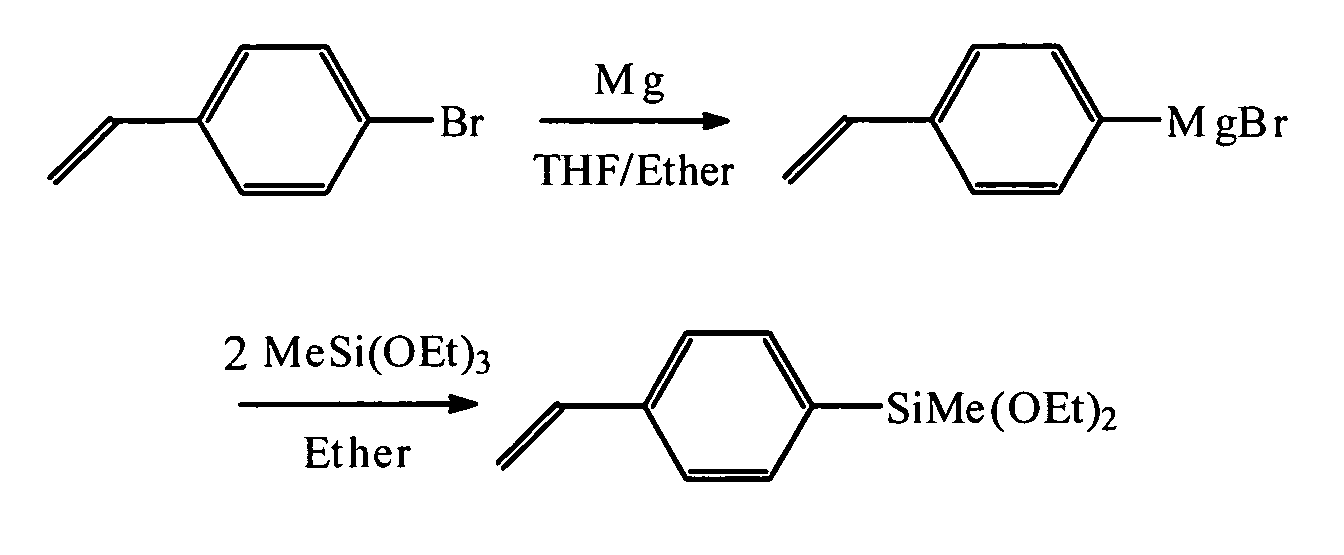
- Vinylphenyltrimethoxysilan (monosubstituiertes Alkoxysilan) 15,8 g (70,5 mmol), Ausbeute 34,9 %, Siedepunkt: 59-60°C (0,03 mbar)
- Bis-(p-vinylphenyl)-dimethoxysilan (disubstituiertes Alkoxysilan) 24,5 g (82,8 mmol) Ausbeute: 41,0 %
| A | (3-Sulfonyl)-1-propenyltrimethoxysilan | 1,1 g (4,5·10-3 mol) |
| B | p-Vinylphenylmethyldiethoxysilan | 0,71 g (3,0·10-3 mol) |
| C | p-Vinylphenylmethyldiethoxysilan | 0,71 g (3,0·10-3 mol) |
| D | N-(3-Triethoxysilylpropyl)-4,5-dihydroimidazol | 1,2 g (4,5·10-3 mol) |
| A | (3-Sulfonyl)-1-propenyltrimethoxysilan | 1,2 g (5,0·10-3 mol) |
| B | p-Vinylphenylmethyldiethoxysilan | 0,39 g (1,7·10-3 mol) |
| C | p-Vinylphenylmethyldiethoxysilan | 0,66 g (2,8·10-3 mol) |
| D | N-(3-Triethoxysilylpropyl)-4,5-dihydroimidazol | 0,46 g (1,7·10-3 mol) |
| A | (3-Sulfonyl)-1-propenyltrimethoxysilan | 1,1 g (4,5·10-3 mol) |
| B | p-Vinylphenylmethyldiethoxysilan | 0,44 g (1,9·10-3 mol) |
| C | N-(3-Triethoxysilylpropyl)-4,5-dihydroimidazol | 0,31 g (1,1·10-3 mol) |
Claims (17)
- Silanharz-Zusammensetzung, erhältlich durch zumindest teilweise hydrolytische Kondensation mindestens der folgenden Bestandteile:Vermischen der Bestandteile vor, während oder nach der hydrolytischen Kondensation.(1) einem oder mehreren sulfonsäuregruppenhaltigen Silan(en) mit mindestens einer Gruppe, die unter hydrolytischen Bedingungen abgespalten werden kann,(2) einem oder mehreren styrylfunktionalisierten Silan(en) und(3) einem oder mehreren einen stickstoffhaltigen Heterocyclus, eine Aminfunktion oder eine Sulfonamidfunktion tragenden Silan(en) mit mindestens einer Gruppe, die unter hydrolytischen Bedingungen abgespalten werden kann, und
- Silanharz-Zusammensetzung nach Anspruch 1, worinworin die Reste R1 und X und die Indices a und b wie in Formel (I) definiert sind, (Q) Het-R- oder NH2SO2-R- oder NHR2-R- ist, wobei R wie in Formel (I) oben definiert ist, R2 Wasserstoff oder Niederalkyl bedeutet und Het ein im Ring stickstoffhaltiger Heterocyclus ist.(1) die sulfonsäuregruppenhaltigen Silane ausgewählt sind unter Silanen der Formel (I):(2) die styrylgruppenhaltigen Silane ausgewählt sind unter solchen der allgemeinen Formel (II)(3) die mindestens einen stickstoffhaltigen Heterocyclus, eine Aminfunktion oder eine Sulfonamidfunktion tragenden Silane ausgewählt sind unter solchen der allgemeinen Formel (III)
- Silanharz-Zusammensetzung nach Anspruch 2, worin zumindest einer der nachstehenden Reste und Indices in den Formeln (I), (II) bzw. (III) die folgende Bedeutung hat:(St) ist p-VinylphenylHet ist ein ggf. substituierter Pyrrol-, Imidazol- oder Dihydroimidazolrest,R ist eine ggf. substituierte Alkylen-, Alkenylen- oder PhenylengruppeR1 ist ein substituiertes Alkyl, Alkenyl, Alkinyl, Aryl, Alkylaryl oder Arylalkyl, bevorzugt Methyl, Ethyl, n- oder i-Propyl oder n-, i- oder t-Butyl,X ist Wasserstoff, Halogen, Alkoxy, Aryloxy oder NR2 mit der für Formel (III) angegebenen Bedeutung von R2, darunter vorzugsweise Alkoxy und ganz besonders bevorzugt C1-C4-Alkoxy,a ist 1, im Falle der Formel (II) oder auch 2b ist 0 oder 1.
- Silanharz-Zusammensetzung nach Anspruch 3, worin(1) die sulfonsäuregruppenhaltigen Silane der Formel (I) ausgewählt sind unter (ω-Sulfonyl)-1-alkyl- oder -alkenyl-trialkoxysilanen,(2) die styrylgruppenhaltigen Silane der Formel (II) ausgewählt sind unter p-Vinylphenylalkyldialkoxysilanen und(3) die mindestens einen stickstoffhaltigen Heterocyclus, eine Aminfunktion oder eine Sulfonamidfunktion tragenden Silane der Formel (III) ausgewählt sind unter N-(Trialkoxysilylalkyl oder -alkenyl)-4,5-dihydroimidazolen und 2-(Trialkoxysilylalkyl- oder -alkenyl)imidazolen.
- Silanharz-Zusammensetzung nach einem der voranstehenden Ansprüche, erhältlich durch die folgenden Schritte(a) zumindest teilweise erfolgendes Hydrolysieren und Kondensieren mindestens eines sulfonsäuregruppenhaltigen Silans wie in einem der Ansprüche 1 bis 4 definiert,(b) Zugeben mindestens eines styrylfuntionalisierten Silans, wie in einem der Ansprüche 1 bis 4 definiert, und mindestens eines einen stickstoffhaltigen Heterocyclus, eine Aminfunktion oder eine Sulfonamidfunktion tragenden Silans, wie in einem der Ansprüche 1 bis 4 definiert zu dem (Teil-)Hydrolysat/(Teil-)Kondensat gemäß (a) und Fortsetzen der Hydrolyse und Kondensation der Mischungsbestandteile.
- Silanharz-Zusammensetzung nach einem der Ansprüche 1 bis 4, erhältlich durch die folgenden Schritte:(a) zumindest teilweise erfolgendes Hydrolysieren und Kondensieren einer Mischung (A), bestehend aus oder enthaltend mindestens ein sulfonsäuregruppenhaltiges Silan wie in einem der Ansprüche 1 bis 4 definiert und mindestens ein styrylfuntionalisiertes Silan wie in einem der Ansprüche 1 bis 4 definiert,(b) zumindest teilweise erfolgendes Hydrolysieren und Kondensieren einer Mischung (B), bestehend aus oder enthaltend mindestens ein einen stickstoffhaltigen Heterocyclus, eine Aminfunktion oder eine Sulfonamidfunktion tragendes Silan wie in einem der Ansprüche 1 bis 4 definiert und mindestens ein styrylfunktionalisiertes Silan wie in einem der Ansprüche 1 bis 4 definiert,(c) Zusammengeben der Mischungen (A) und (B) und ggf. weiteres Hydrolysieren und Kondensieren der Mischungsbestandteile.
- Silanharz-Zusammensetzung nach Anspruch 5 oder 6, erhältlich dadurch, dass die Hydrolyse- und Kondensationsschritte in einem geeigneten Lösungsmittel erfolgen und nach Abschluss dieser Schritte(d) das vorhandene Lösungsmittel entfernt oder zumindest teilweise entfernt und/oder zumindest teilweise gegen eine die Protonenleitfähigkeit erhöhende Substanz, insbesondere Imidazol, ausgetauscht wurde.
- Verfahren zum Herstellen einer Silanharz-Zusammensetzung wie in einem der Ansprüche 1 bis 4 definiert, gekennzeichnet durch die folgenden Schritte:(a) zumindest teilweise erfolgendes Hydrolysieren und Kondensieren einer Mischung (A), bestehend aus oder enthaltend mindestens ein sulfonsäuregruppenhaltiges Silan wie in einem der Ansprüche 1 bis 4 definiert und mindestens ein styrylfuntionalisiertes Silan wie in einem der Ansprüche 1 bis 4 definiert,(b) zumindest teilweise erfolgendes Hydrolysieren und Kondensieren einer Mischung (B), bestehend aus oder enthaltend mindestens ein einen stickstoffhaltigen Heterocyclus, eine Aminfunktion oder eine Sulfonamidfunktion tragendes Silan wie in einem der Ansprüche 1 bis 4 definiert und mindestens ein styrylfunktionalisiertes Silan wie in einem der Ansprüche 1 bis 4 definiert,(c) Zusammengeben der Mischungen (A) und (B) und ggf. weiteres Hydrolysieren und Kondensieren der Mischungsbestandteile.
- Verfahren zum Herstellen einer Silanharz-Zusammensetzung wie in einem der Ansprüche 1 bis 4 definiert, gekennzeichnet durch die folgenden Schritte:(a) zumindest teilweise erfolgendes Hydrolysieren und Kondensieren mindestens eines sulfonsäuregruppenhaltigen Silans wie in einem der Ansprüche 1 bis 4 definiert,(b) Zugeben mindestens eines styrylfuntionalisierten Silans, wie in einem der Ansprüche 1 bis 4 definiert, und mindestens eines einen stickstoffhaltigen Heterocyclus, eine Aminfunktion oder eine Sulfonamidfunktion tragenden Silans, wie in einem der Ansprüche 1 bis 4 definiert zu dem (Teil-)Hydrolysat/(Teil-)Kondensat gemäß (a) und Fortsetzen der Hydrolyse und Kondensation der Mischungsbestandteile.
- Verfahren zum Herstellen einer Silanharz-Zusammensetzung nach Anspruch 8 oder 9, dadurch gekennzeichnet, dass die Hydrolyse- und Kondensationsschritte in einem polaren Lösungsmittel, vorzugsweise in einem Alkohol, in Gegenwart von Wasser erfolgen, und/oder dass das Wasser in einer unterstöchiometrischen Menge, bezogen auf alle hydrolyseempfindlichen Gruppen in der bzw. den Mischung(en), vorliegt.
- Verfahren nach Ansprüche 9 oder 10, dadurch gekennzeichnet, dass nach Abschluss der Hydrolyse- und Kondensationsschritte(d) das Lösungsmittel entfernt oder zumindest teilweise entfernt und/oder zumindest teilweise gegen eine die Protonenleitfähigkeit erhöhende Flüssigkeit, insbesondere Imidazol, ausgetauscht wird.
- Protonenleitfähiges organisch vernetztes Heteropolysiloxan, erhältlich durch die folgenden Schritte:(a) zumindest teilweise erfolgendes Hydrolysieren und Kondensieren einer Mischung (A), bestehend aus oder enthaltend mindestens ein sulfonsäuregruppenhaltiges Silan wie in einem der Ansprüche 1 bis 4 definiert und mindestens ein styrylfuntionalisiertes Silan wie in einem der Ansprüche 1 bis 4 definiert,(b) zumindest teilweise erfolgendes Hydrolysieren und Kondensieren einer Mischung (B), bestehend aus oder enthaltend mindestens ein einen stickstoffhaltigen Heterocyclus, eine Aminfunktion oder eine Sulfonamidfunktion tragendes Silan wie in einem der Ansprüche 1 bis 4 definiert und mindestens ein styrylfunktionalisiertes Silan wie in einem der Ansprüche 1 bis 4 definiert,(c) Zusammengeben der Mischungen (A) und (B) und ggf. weiteres Hydrolysieren und Kondensieren der Mischungsbestandteile, wobei eine Silanharz-Zusammensetzung erhalten wird,
und(f) Bewirken der organischen Vernetzung zwischen vorhandenen Styrylgruppen. - Protonenleitfähiges organisch vernetztes Heteropolysiloxan, erhältlich durch die folgenden Schritte:(a) zumindest teilweise erfolgendes Hydrolysieren und Kondensieren mindestens eines sulfonsäuregruppenhaltigen Silans wie in einem der Ansprüche 1 bis 4 definiert,(b) Zugeben mindestens eines styrylfuntionalisierten Silans, wie in einem der Ansprüche 1 bis 4 definiert, und mindestens eines einen stickstoffhaltigen Heterocyclus, eine Aminfunktion oder eine Sulfonamidfunktion tragenden Silans, wie in einem der Ansprüche 1 bis 4 zu dem (Teil-)Hydrolysat/(Teil-)Kondensat gemäß (a) und Fortsetzen der Hydrolyse und Kondensation der Mischungsbestandteile,
und(f) Bewirken der organischen Vernetzung zwischen vorhandenen Styrylgruppen. - Protonenleitfähiges, organisch vernetztes Heteropolysiloxan nach Anspruch 12 oder 13, erhältlich dadurch, dass die Hydrolyse- und Kondensationsschritte in einem geeigneten Lösungsmittel erfolgen und nach Abschluss der Hydrolyse- und Kondensationschritte(d) das Lösungsmittel entfernt oder zumindest teilweise entfernt und/oder zumindest teilweise gegen eine die Protonenleitfähigkeit erhöhende Substanz, insbesondere gegen Imidazol, ausgetauscht wird.
- Protonenleitfähiges, organisch vernetztes Heteropolysiloxan nach Anspruch 13 oder 14, erhältlich dadurch, dass man dem Heteropolysiloxan nach der gemäß Schritt (f) bewirkten organischen Vernetzung zwischen vorhandenen Styrylgruppen(g) die Gelegenheit gegeben hat, eine die Protonenleitfähigkeit erhöhende Flüssigkeit zu absorbieren.
- Protonenleitfähiges, organisch vernetztes Heteropolysiloxan nach Anspruch 15, dadurch gekennzeichnet, dass die die Protonenleitfähigkeit erhöhende Flüssigkeit Wasser ist, das ggf. aus der Gas- oder Dampfphase absorbiert wurde.
- Protonenleitfähiges, organisch vernetztes Heteropolysiloxan nach einem der Ansprüche 12 bis 16 in Form einer Schicht oder Membran.
Applications Claiming Priority (2)
| Application Number | Priority Date | Filing Date | Title |
|---|---|---|---|
| DE10163518A DE10163518A1 (de) | 2001-12-21 | 2001-12-21 | Protonenleitfähige Membranen/Schichten und Verfahren zu deren Herstellung |
| DE10163518 | 2001-12-21 |
Publications (3)
| Publication Number | Publication Date |
|---|---|
| EP1323767A2 true EP1323767A2 (de) | 2003-07-02 |
| EP1323767A3 EP1323767A3 (de) | 2003-08-27 |
| EP1323767B1 EP1323767B1 (de) | 2008-03-12 |
Family
ID=7710545
Family Applications (1)
| Application Number | Title | Priority Date | Filing Date |
|---|---|---|---|
| EP02028627A Expired - Lifetime EP1323767B1 (de) | 2001-12-21 | 2002-12-20 | Protonenleitfähige Membranen/Schichten und Verfahren zu deren Herstellung |
Country Status (5)
| Country | Link |
|---|---|
| US (2) | US6949616B2 (de) |
| EP (1) | EP1323767B1 (de) |
| AT (1) | ATE388982T1 (de) |
| DE (2) | DE10163518A1 (de) |
| ES (1) | ES2301601T3 (de) |
Cited By (5)
| Publication number | Priority date | Publication date | Assignee | Title |
|---|---|---|---|---|
| EP2148383A4 (de) * | 2007-04-18 | 2010-07-14 | Univ Shizuoka Nat Univ Corp | Polymerelektrolytmaterial und membranelektrolytanordnung für eine brennstoffzelle damit |
| WO2012116782A1 (en) * | 2011-03-03 | 2012-09-07 | Daimler Ag | Proton conducting electrolytes with cross-linked copolymer additives for use in fuel cells |
| EP2415515A4 (de) * | 2009-03-31 | 2013-08-28 | Toray Industries | Halbdurchlässige verbundmembran und herstellungsverfahren dafür |
| US8710108B2 (en) | 2011-03-03 | 2014-04-29 | Daimler Ag | Proton conducting electrolytes with cross-linked copolymer additives for use in fuel cells |
| US8709677B2 (en) | 2011-03-03 | 2014-04-29 | Daimler Ag | Proton conducting electrolytes with cross-linked copolymer additives for use in fuel cells |
Families Citing this family (20)
| Publication number | Priority date | Publication date | Assignee | Title |
|---|---|---|---|---|
| CN1230832C (zh) * | 2001-10-30 | 2005-12-07 | 积水化学工业株式会社 | 质子传导性膜、其制造方法和使用其的燃料电池 |
| EP1465277A1 (de) * | 2003-03-19 | 2004-10-06 | HONDA MOTOR CO., Ltd. | Feststoff Polymerelektrolyt und Protonenleitende Membran |
| CN1809606B (zh) | 2003-05-28 | 2010-10-27 | 美国丰田技术中心公司 | 由具有官能团的硅烷形成的传导膜 |
| US7183370B2 (en) | 2003-09-11 | 2007-02-27 | Toyota Technical Center Usa, Inc | Phosphonic-acid grafted hybrid inorganic-organic proton electrolyte membranes (PEMs) |
| US7576165B2 (en) * | 2004-01-27 | 2009-08-18 | Georgia Institute Of Technology | Heterocycle grafted monomers and related polymers and hybrid inorganic-organic polymer membranes |
| DE102004023586A1 (de) * | 2004-05-13 | 2005-12-08 | Universität Bremen | Protonenleitfähiges, vernetztes Heteropolysiloxan, protonenleitfähige Membran und Verfahren zu deren Herstellung |
| JP2006114277A (ja) * | 2004-10-13 | 2006-04-27 | Toyota Motor Corp | プロトン伝導材料、固体高分子電解質膜、及び燃料電池 |
| DE102005044433A1 (de) * | 2005-09-16 | 2007-03-22 | Universität Bremen | Katalytisch aktive Zusammensetzung, Membran-Elektroden-Einheit mit der Zusammensetzung und Katalysator mit/aus der Zusammensetzung |
| KR100837395B1 (ko) * | 2005-12-28 | 2008-06-12 | 삼성에스디아이 주식회사 | 연료전지용 연료 조성물 및 이를 이용한 연료전지 |
| JP2008066113A (ja) * | 2006-09-07 | 2008-03-21 | Toyota Motor Corp | プロトン伝導材料、固体高分子電解質膜、及び燃料電池 |
| US7964651B2 (en) * | 2006-12-21 | 2011-06-21 | Toyota Motor Engineering & Manufacturing North America, Inc. | Sulfonyl grafted heterocycle materials for proton conducting electrolytes |
| DE102007037197A1 (de) * | 2007-08-07 | 2009-02-12 | Wacker Chemie Ag | Vernetzbare Massen auf der Basis von Organosiliciumverbindungen |
| AU2009292436A1 (en) * | 2008-09-12 | 2010-03-18 | Toray Industries, Inc. | Composite semitransparent film and manufacturing method therefor |
| KR101744207B1 (ko) * | 2010-03-30 | 2017-06-07 | 도레이 카부시키가이샤 | 복합 반투막 |
| WO2011136029A1 (ja) * | 2010-04-28 | 2011-11-03 | 国立大学法人神戸大学 | 複合半透膜 |
| KR101923014B1 (ko) * | 2010-12-07 | 2018-11-28 | 도레이 카부시키가이샤 | 복합 반투막 및 그 제조 방법 |
| CN102983344B (zh) * | 2012-11-23 | 2014-11-26 | 清华大学 | 一种制备多孔硅基质子交换膜的方法 |
| SG11201810722PA (en) * | 2016-05-30 | 2018-12-28 | Nissan Chemical Corp | Polymerizable silane compound |
| EP3466994B1 (de) * | 2016-05-30 | 2020-09-16 | Nissan Chemical Corporation | Reaktives polysiloxan und polymerisierbare zusammensetzung damit |
| CN112928328B (zh) * | 2019-12-06 | 2024-07-23 | 孚能科技(赣州)股份有限公司 | 一种含有硅烷基磺酰胺化合物的锂离子电池电解液和锂离子二次电池 |
Family Cites Families (17)
| Publication number | Priority date | Publication date | Assignee | Title |
|---|---|---|---|---|
| GB1421373A (en) | 1972-03-21 | 1976-01-14 | Franchi Woods Mosaic Co Ltd | Marine decking |
| JPS606236B2 (ja) | 1981-02-16 | 1985-02-16 | 株式会社クラレ | 水膨潤性止水剤 |
| DE3217047A1 (de) * | 1982-05-06 | 1983-11-10 | Fraunhofer-Gesellschaft zur Förderung der angewandten Forschung e.V., 8000 München | Membranen auf der basis von kieselsaeureheteropolykondensaten, verfahren zu ihrer herstellung und ihre verwendung |
| FR2577696B1 (fr) * | 1985-02-19 | 1990-02-09 | Canon Kk | Element porte-image |
| JPH0242448A (ja) * | 1988-08-02 | 1990-02-13 | Asahi Shiyueebell Kk | 紫外線吸収能に優れたシラン組成物 |
| US5096942A (en) * | 1990-05-29 | 1992-03-17 | Eastman Kodak Company | Organic/inorganic composites |
| FR2670212A1 (fr) * | 1990-12-05 | 1992-06-12 | Centre Nat Rech Scient | Nouveaux electrolytes a base de polyorganosiloxanes sulfones, leur preparation et leur application comme conducteurs ioniques solides. |
| EP0532408A1 (de) * | 1991-09-13 | 1993-03-17 | Saint-Gobain Vitrage International | Protonenleitendes Polymer und seine Verwendung als Elektrolyt in elektrochemischen Verbindungen |
| EP0574791B1 (de) | 1992-06-13 | 1999-12-22 | Aventis Research & Technologies GmbH & Co. KG | Polymerelektrolyt-Membran und Verfahren zu ihrer Herstellung |
| CH691209A5 (de) * | 1993-09-06 | 2001-05-15 | Scherrer Inst Paul | Herstellungsverfahren für einen Polmerelektrolyten und elektrochemische Zelle mit diesem Polymerelektrolyten. |
| US5834523A (en) * | 1993-09-21 | 1998-11-10 | Ballard Power Systems, Inc. | Substituted α,β,β-trifluorostyrene-based composite membranes |
| RU2144045C1 (ru) | 1993-12-22 | 2000-01-10 | З Би.эФ.Гудрич Кампэни | Акриловый сополимер, влагоотверждаемая уплотняющая композиция |
| US5525436A (en) * | 1994-11-01 | 1996-06-11 | Case Western Reserve University | Proton conducting polymers used as membranes |
| JPH09102322A (ja) * | 1995-07-31 | 1997-04-15 | Imura Zairyo Kaihatsu Kenkyusho:Kk | 燃料電池用の固体高分子電解質膜およびその製造方法 |
| US5716727A (en) * | 1996-04-01 | 1998-02-10 | Case Western Reserve University | Proton conducting polymers prepared by direct acid casting |
| US5981097A (en) * | 1996-12-23 | 1999-11-09 | E.I. Du Pont De Nemours And Company | Multiple layer membranes for fuel cells employing direct feed fuels |
| US6359019B1 (en) | 1997-11-12 | 2002-03-19 | Ballard Power Systems Inc. | Graft polymeric membranes and ion-exchange membranes formed therefrom |
-
2001
- 2001-12-21 DE DE10163518A patent/DE10163518A1/de not_active Withdrawn
-
2002
- 2002-12-20 ES ES02028627T patent/ES2301601T3/es not_active Expired - Lifetime
- 2002-12-20 AT AT02028627T patent/ATE388982T1/de active
- 2002-12-20 US US10/324,079 patent/US6949616B2/en not_active Expired - Fee Related
- 2002-12-20 DE DE50211882T patent/DE50211882D1/de not_active Expired - Lifetime
- 2002-12-20 EP EP02028627A patent/EP1323767B1/de not_active Expired - Lifetime
-
2005
- 2005-08-23 US US11/208,553 patent/US7470761B2/en not_active Expired - Fee Related
Cited By (5)
| Publication number | Priority date | Publication date | Assignee | Title |
|---|---|---|---|---|
| EP2148383A4 (de) * | 2007-04-18 | 2010-07-14 | Univ Shizuoka Nat Univ Corp | Polymerelektrolytmaterial und membranelektrolytanordnung für eine brennstoffzelle damit |
| EP2415515A4 (de) * | 2009-03-31 | 2013-08-28 | Toray Industries | Halbdurchlässige verbundmembran und herstellungsverfahren dafür |
| WO2012116782A1 (en) * | 2011-03-03 | 2012-09-07 | Daimler Ag | Proton conducting electrolytes with cross-linked copolymer additives for use in fuel cells |
| US8710108B2 (en) | 2011-03-03 | 2014-04-29 | Daimler Ag | Proton conducting electrolytes with cross-linked copolymer additives for use in fuel cells |
| US8709677B2 (en) | 2011-03-03 | 2014-04-29 | Daimler Ag | Proton conducting electrolytes with cross-linked copolymer additives for use in fuel cells |
Also Published As
| Publication number | Publication date |
|---|---|
| US20030144450A1 (en) | 2003-07-31 |
| ES2301601T3 (es) | 2008-07-01 |
| EP1323767B1 (de) | 2008-03-12 |
| US6949616B2 (en) | 2005-09-27 |
| ATE388982T1 (de) | 2008-03-15 |
| DE10163518A1 (de) | 2003-07-10 |
| US20060058485A1 (en) | 2006-03-16 |
| DE50211882D1 (de) | 2008-04-24 |
| EP1323767A3 (de) | 2003-08-27 |
| US7470761B2 (en) | 2008-12-30 |
Similar Documents
| Publication | Publication Date | Title |
|---|---|---|
| EP1323767B1 (de) | Protonenleitfähige Membranen/Schichten und Verfahren zu deren Herstellung | |
| DE112004000920B4 (de) | Protonenleitende Membran enthaltend ein Copolymerisationsprodukt aus mindestens einem ersten Silan und einem zweiten Silan und deren Verwendung, sowie Silanverbindung und Verfahren zu deren Herstellung | |
| DE102009020181B4 (de) | Sulfonierte Perfluorcyclobutanblockcopolymere und protonenleitende Polymermembranen | |
| DE60314816T2 (de) | Neue aromatische sulfonsäureester Derivate, Polyarylen, Sulfonsäuregruppen enthaltendes Polarylen, Verfahren zu ihrer Herstellung, Feststoffelektrolyt basiert auf einem Polymer und Protonen leitendes Membran | |
| JP5171042B2 (ja) | ポリマー電解質膜及びそれを含む燃料電池 | |
| EP1373379A2 (de) | Verfahren zur herstellung einer membran aus verbrücktem polymer und brennstoffzelle | |
| EP1954747B1 (de) | Polymerelektrolytmembran mit koordinationspolymer | |
| KR101826539B1 (ko) | 폴리아릴렌계 중합체, 이의 제조방법 및 이를 이용한 연료전지용 고분자 전해질 막 | |
| DE102009020129A1 (de) | Protonenleitende Polymerelektrolyte und Brennstoffzellen | |
| WO2003022892A2 (de) | Sulfinatgruppen enthaltende oligomere und polymere und verfahren zu ihrer herstellung | |
| DE102008041421B4 (de) | Polymergemisch-Elektrolytmembran zur Verwendung bei hoher Temperatur und Herstellungsverfahren sowie Verwendung derselben | |
| DE60305137T2 (de) | Aromatische Sulfonatederivate, Polyarylen, sulphonierte Polyarylen, Verfahren zu ihrer Herstellung, makromolekularer Feststoffelektrolyt und Protonen leitendes Membran | |
| EP3239193A1 (de) | Wasserunlösliche anionenaustauschermaterialien | |
| DE102007060692B4 (de) | Sulfonylgepfropfte Heterozyklusmaterialien für protonenleitende Elektrolyte | |
| DE10347530A1 (de) | Blockcopolymer und dessen Verwendung | |
| DE2719305C2 (de) | Silan-Endgruppen aufweisende Polyarylen-Polyäther, Verfahren zu deren Herstellung und deren Verwendung | |
| CN107834089A (zh) | 一种可用于膜燃料电池的高温质子交换膜及其制备方法和应用 | |
| DE102008043935A1 (de) | Polymere MEA fpr eine Brennstoffzelle | |
| DE112006003489B4 (de) | Neuer Metall(III)-Chrom-Phosphat-Komplex und Verwendung desselben | |
| DE2210534A1 (de) | Neue Organosilane | |
| DE10047551B4 (de) | Direct Methanol Fuel Cell-Membran | |
| JP3572302B2 (ja) | 固体電解質及び固体電解質型燃料電池 | |
| EP2392046B1 (de) | Brennstoffzellmembran | |
| KR102011418B1 (ko) | 고분자 전해질막의 제조방법, 이를 이용하여 제조된 고분자 전해질막, 상기 고분자 전해질막을 포함하는 막전극 접합체 및 상기 막전극 접합체를 포함하는 연료전지 | |
| DE102004023586A1 (de) | Protonenleitfähiges, vernetztes Heteropolysiloxan, protonenleitfähige Membran und Verfahren zu deren Herstellung |
Legal Events
| Date | Code | Title | Description |
|---|---|---|---|
| PUAI | Public reference made under article 153(3) epc to a published international application that has entered the european phase |
Free format text: ORIGINAL CODE: 0009012 |
|
| AK | Designated contracting states |
Designated state(s): AT BE BG CH CY CZ DE DK EE ES FI FR GB GR IE IT LI LU MC NL PT SE SI SK TR |
|
| AX | Request for extension of the european patent |
Extension state: AL LT LV MK RO |
|
| PUAL | Search report despatched |
Free format text: ORIGINAL CODE: 0009013 |
|
| AK | Designated contracting states |
Designated state(s): AT BE BG CH CY CZ DE DK EE ES FI FR GB GR IE IT LI LU MC NL PT SE SI SK TR |
|
| AX | Request for extension of the european patent |
Extension state: AL LT LV MK RO |
|
| RIC1 | Information provided on ipc code assigned before grant |
Ipc: 7C 08G 77/20 B Ipc: 7C 08G 77/26 B Ipc: 7B 01D 71/00 B Ipc: 7H 01M 8/00 B Ipc: 7H 01M 8/10 B Ipc: 7C 08G 77/28 A Ipc: 7B 01D 71/70 B |
|
| RAP1 | Party data changed (applicant data changed or rights of an application transferred) |
Owner name: FRAUNHOFER-GESELLSCHAFT ZUR FOERDERUNG DERANGEWAND |
|
| 17P | Request for examination filed |
Effective date: 20040130 |
|
| AKX | Designation fees paid |
Designated state(s): AT BE BG CH CY CZ DE DK EE ES FI FR GB GR IE IT LI LU MC NL PT SE SI SK TR |
|
| RAP1 | Party data changed (applicant data changed or rights of an application transferred) |
Owner name: FRAUNHOFER-GESELLSCHAFT ZUR FOERDERUNG DER ANGEWAN |
|
| GRAP | Despatch of communication of intention to grant a patent |
Free format text: ORIGINAL CODE: EPIDOSNIGR1 |
|
| GRAS | Grant fee paid |
Free format text: ORIGINAL CODE: EPIDOSNIGR3 |
|
| GRAA | (expected) grant |
Free format text: ORIGINAL CODE: 0009210 |
|
| AK | Designated contracting states |
Kind code of ref document: B1 Designated state(s): AT BE BG CH CY CZ DE DK EE ES FI FR GB GR IE IT LI LU MC NL PT SE SI SK TR |
|
| REG | Reference to a national code |
Ref country code: GB Ref legal event code: FG4D Free format text: NOT ENGLISH |
|
| REG | Reference to a national code |
Ref country code: CH Ref legal event code: NV Representative=s name: PA ALDO ROEMPLER Ref country code: CH Ref legal event code: EP |
|
| REG | Reference to a national code |
Ref country code: IE Ref legal event code: FG4D Free format text: LANGUAGE OF EP DOCUMENT: GERMAN |
|
| REF | Corresponds to: |
Ref document number: 50211882 Country of ref document: DE Date of ref document: 20080424 Kind code of ref document: P |
|
| REG | Reference to a national code |
Ref country code: ES Ref legal event code: FG2A Ref document number: 2301601 Country of ref document: ES Kind code of ref document: T3 |
|
| PG25 | Lapsed in a contracting state [announced via postgrant information from national office to epo] |
Ref country code: FI Free format text: LAPSE BECAUSE OF FAILURE TO SUBMIT A TRANSLATION OF THE DESCRIPTION OR TO PAY THE FEE WITHIN THE PRESCRIBED TIME-LIMIT Effective date: 20080312 |
|
| NLV1 | Nl: lapsed or annulled due to failure to fulfill the requirements of art. 29p and 29m of the patents act | ||
| REG | Reference to a national code |
Ref country code: CH Ref legal event code: PCAR Free format text: ALDO ROEMPLER PATENTANWALT;BRENDENWEG 11 POSTFACH 154;9424 RHEINECK (CH) |
|
| ET | Fr: translation filed | ||
| PG25 | Lapsed in a contracting state [announced via postgrant information from national office to epo] |
Ref country code: SI Free format text: LAPSE BECAUSE OF FAILURE TO SUBMIT A TRANSLATION OF THE DESCRIPTION OR TO PAY THE FEE WITHIN THE PRESCRIBED TIME-LIMIT Effective date: 20080312 |
|
| REG | Reference to a national code |
Ref country code: IE Ref legal event code: FD4D |
|
| PG25 | Lapsed in a contracting state [announced via postgrant information from national office to epo] |
Ref country code: PT Free format text: LAPSE BECAUSE OF FAILURE TO SUBMIT A TRANSLATION OF THE DESCRIPTION OR TO PAY THE FEE WITHIN THE PRESCRIBED TIME-LIMIT Effective date: 20080818 Ref country code: SE Free format text: LAPSE BECAUSE OF FAILURE TO SUBMIT A TRANSLATION OF THE DESCRIPTION OR TO PAY THE FEE WITHIN THE PRESCRIBED TIME-LIMIT Effective date: 20080612 Ref country code: CZ Free format text: LAPSE BECAUSE OF FAILURE TO SUBMIT A TRANSLATION OF THE DESCRIPTION OR TO PAY THE FEE WITHIN THE PRESCRIBED TIME-LIMIT Effective date: 20080312 Ref country code: SK Free format text: LAPSE BECAUSE OF FAILURE TO SUBMIT A TRANSLATION OF THE DESCRIPTION OR TO PAY THE FEE WITHIN THE PRESCRIBED TIME-LIMIT Effective date: 20080312 |
|
| PG25 | Lapsed in a contracting state [announced via postgrant information from national office to epo] |
Ref country code: NL Free format text: LAPSE BECAUSE OF FAILURE TO SUBMIT A TRANSLATION OF THE DESCRIPTION OR TO PAY THE FEE WITHIN THE PRESCRIBED TIME-LIMIT Effective date: 20080312 |
|
| PLBE | No opposition filed within time limit |
Free format text: ORIGINAL CODE: 0009261 |
|
| STAA | Information on the status of an ep patent application or granted ep patent |
Free format text: STATUS: NO OPPOSITION FILED WITHIN TIME LIMIT |
|
| PG25 | Lapsed in a contracting state [announced via postgrant information from national office to epo] |
Ref country code: DK Free format text: LAPSE BECAUSE OF FAILURE TO SUBMIT A TRANSLATION OF THE DESCRIPTION OR TO PAY THE FEE WITHIN THE PRESCRIBED TIME-LIMIT Effective date: 20080312 Ref country code: IE Free format text: LAPSE BECAUSE OF FAILURE TO SUBMIT A TRANSLATION OF THE DESCRIPTION OR TO PAY THE FEE WITHIN THE PRESCRIBED TIME-LIMIT Effective date: 20080312 |
|
| 26N | No opposition filed |
Effective date: 20081215 |
|
| PG25 | Lapsed in a contracting state [announced via postgrant information from national office to epo] |
Ref country code: EE Free format text: LAPSE BECAUSE OF FAILURE TO SUBMIT A TRANSLATION OF THE DESCRIPTION OR TO PAY THE FEE WITHIN THE PRESCRIBED TIME-LIMIT Effective date: 20080312 Ref country code: BG Free format text: LAPSE BECAUSE OF FAILURE TO SUBMIT A TRANSLATION OF THE DESCRIPTION OR TO PAY THE FEE WITHIN THE PRESCRIBED TIME-LIMIT Effective date: 20080612 |
|
| PG25 | Lapsed in a contracting state [announced via postgrant information from national office to epo] |
Ref country code: MC Free format text: LAPSE BECAUSE OF NON-PAYMENT OF DUE FEES Effective date: 20081231 |
|
| PG25 | Lapsed in a contracting state [announced via postgrant information from national office to epo] |
Ref country code: IT Free format text: LAPSE BECAUSE OF FAILURE TO SUBMIT A TRANSLATION OF THE DESCRIPTION OR TO PAY THE FEE WITHIN THE PRESCRIBED TIME-LIMIT Effective date: 20080312 |
|
| PG25 | Lapsed in a contracting state [announced via postgrant information from national office to epo] |
Ref country code: CY Free format text: LAPSE BECAUSE OF FAILURE TO SUBMIT A TRANSLATION OF THE DESCRIPTION OR TO PAY THE FEE WITHIN THE PRESCRIBED TIME-LIMIT Effective date: 20080312 |
|
| REG | Reference to a national code |
Ref country code: IE Ref legal event code: RNTA |
|
| PG25 | Lapsed in a contracting state [announced via postgrant information from national office to epo] |
Ref country code: LU Free format text: LAPSE BECAUSE OF NON-PAYMENT OF DUE FEES Effective date: 20081220 |
|
| PG25 | Lapsed in a contracting state [announced via postgrant information from national office to epo] |
Ref country code: TR Free format text: LAPSE BECAUSE OF FAILURE TO SUBMIT A TRANSLATION OF THE DESCRIPTION OR TO PAY THE FEE WITHIN THE PRESCRIBED TIME-LIMIT Effective date: 20080312 |
|
| PG25 | Lapsed in a contracting state [announced via postgrant information from national office to epo] |
Ref country code: GR Free format text: LAPSE BECAUSE OF FAILURE TO SUBMIT A TRANSLATION OF THE DESCRIPTION OR TO PAY THE FEE WITHIN THE PRESCRIBED TIME-LIMIT Effective date: 20080613 |
|
| PGFP | Annual fee paid to national office [announced via postgrant information from national office to epo] |
Ref country code: AT Payment date: 20101220 Year of fee payment: 9 |
|
| PGFP | Annual fee paid to national office [announced via postgrant information from national office to epo] |
Ref country code: IE Payment date: 20111216 Year of fee payment: 10 Ref country code: CH Payment date: 20111222 Year of fee payment: 10 Ref country code: ES Payment date: 20111219 Year of fee payment: 10 |
|
| PGFP | Annual fee paid to national office [announced via postgrant information from national office to epo] |
Ref country code: BE Payment date: 20111220 Year of fee payment: 10 |
|
| PGFP | Annual fee paid to national office [announced via postgrant information from national office to epo] |
Ref country code: GB Payment date: 20121218 Year of fee payment: 11 |
|
| PGFP | Annual fee paid to national office [announced via postgrant information from national office to epo] |
Ref country code: FR Payment date: 20130123 Year of fee payment: 11 Ref country code: DE Payment date: 20130220 Year of fee payment: 11 |
|
| BERE | Be: lapsed |
Owner name: FRAUNHOFER-GESELLSCHAFT ZUR FORDERUNG DER ANGEWAN Effective date: 20121231 |
|
| REG | Reference to a national code |
Ref country code: CH Ref legal event code: PL |
|
| REG | Reference to a national code |
Ref country code: AT Ref legal event code: MM01 Ref document number: 388982 Country of ref document: AT Kind code of ref document: T Effective date: 20121220 |
|
| REG | Reference to a national code |
Ref country code: IE Ref legal event code: MM4A |
|
| PG25 | Lapsed in a contracting state [announced via postgrant information from national office to epo] |
Ref country code: BE Free format text: LAPSE BECAUSE OF NON-PAYMENT OF DUE FEES Effective date: 20121231 |
|
| PG25 | Lapsed in a contracting state [announced via postgrant information from national office to epo] |
Ref country code: AT Free format text: LAPSE BECAUSE OF NON-PAYMENT OF DUE FEES Effective date: 20121220 Ref country code: CH Free format text: LAPSE BECAUSE OF NON-PAYMENT OF DUE FEES Effective date: 20121231 Ref country code: LI Free format text: LAPSE BECAUSE OF NON-PAYMENT OF DUE FEES Effective date: 20121231 Ref country code: IE Free format text: LAPSE BECAUSE OF NON-PAYMENT OF DUE FEES Effective date: 20121220 |
|
| REG | Reference to a national code |
Ref country code: ES Ref legal event code: FD2A Effective date: 20140527 |
|
| PG25 | Lapsed in a contracting state [announced via postgrant information from national office to epo] |
Ref country code: ES Free format text: LAPSE BECAUSE OF NON-PAYMENT OF DUE FEES Effective date: 20121221 |
|
| REG | Reference to a national code |
Ref country code: DE Ref legal event code: R119 Ref document number: 50211882 Country of ref document: DE |
|
| GBPC | Gb: european patent ceased through non-payment of renewal fee |
Effective date: 20131220 |
|
| REG | Reference to a national code |
Ref country code: FR Ref legal event code: ST Effective date: 20140829 |
|
| REG | Reference to a national code |
Ref country code: DE Ref legal event code: R119 Ref document number: 50211882 Country of ref document: DE Effective date: 20140701 |
|
| PG25 | Lapsed in a contracting state [announced via postgrant information from national office to epo] |
Ref country code: DE Free format text: LAPSE BECAUSE OF NON-PAYMENT OF DUE FEES Effective date: 20140701 |
|
| PG25 | Lapsed in a contracting state [announced via postgrant information from national office to epo] |
Ref country code: FR Free format text: LAPSE BECAUSE OF NON-PAYMENT OF DUE FEES Effective date: 20131231 Ref country code: GB Free format text: LAPSE BECAUSE OF NON-PAYMENT OF DUE FEES Effective date: 20131220 |