EP1316632B1 - Faden mit einer Codierung und Verfahren zur Herstellung eines codierten Fadens - Google Patents
Faden mit einer Codierung und Verfahren zur Herstellung eines codierten Fadens Download PDFInfo
- Publication number
- EP1316632B1 EP1316632B1 EP02023315A EP02023315A EP1316632B1 EP 1316632 B1 EP1316632 B1 EP 1316632B1 EP 02023315 A EP02023315 A EP 02023315A EP 02023315 A EP02023315 A EP 02023315A EP 1316632 B1 EP1316632 B1 EP 1316632B1
- Authority
- EP
- European Patent Office
- Prior art keywords
- thread
- coding
- accordance
- coded
- jacket
- Prior art date
- Legal status (The legal status is an assumption and is not a legal conclusion. Google has not performed a legal analysis and makes no representation as to the accuracy of the status listed.)
- Expired - Lifetime
Links
- 238000004519 manufacturing process Methods 0.000 title claims description 13
- 239000002904 solvent Substances 0.000 claims abstract description 9
- 238000000034 method Methods 0.000 claims description 15
- 239000000463 material Substances 0.000 claims description 10
- XLYOFNOQVPJJNP-UHFFFAOYSA-N water Substances O XLYOFNOQVPJJNP-UHFFFAOYSA-N 0.000 claims description 4
- 238000009958 sewing Methods 0.000 description 5
- 239000000835 fiber Substances 0.000 description 3
- 230000015572 biosynthetic process Effects 0.000 description 2
- 230000006378 damage Effects 0.000 description 2
- 230000000694 effects Effects 0.000 description 2
- 238000012360 testing method Methods 0.000 description 2
- 206010039203 Road traffic accident Diseases 0.000 description 1
- 239000000853 adhesive Substances 0.000 description 1
- 230000001070 adhesive effect Effects 0.000 description 1
- 238000007743 anodising Methods 0.000 description 1
- 238000001704 evaporation Methods 0.000 description 1
- 230000008020 evaporation Effects 0.000 description 1
- 238000007654 immersion Methods 0.000 description 1
- 238000013031 physical testing Methods 0.000 description 1
- 230000003068 static effect Effects 0.000 description 1
- 238000009281 ultraviolet germicidal irradiation Methods 0.000 description 1
- 238000007738 vacuum evaporation Methods 0.000 description 1
Images

Classifications
-
- D—TEXTILES; PAPER
- D02—YARNS; MECHANICAL FINISHING OF YARNS OR ROPES; WARPING OR BEAMING
- D02G—CRIMPING OR CURLING FIBRES, FILAMENTS, THREADS, OR YARNS; YARNS OR THREADS
- D02G3/00—Yarns or threads, e.g. fancy yarns; Processes or apparatus for the production thereof, not otherwise provided for
- D02G3/44—Yarns or threads characterised by the purpose for which they are designed
- D02G3/46—Sewing-cottons or the like
Definitions
- the invention relates to a thread with a coding according to the preamble of claim 1, a method for producing a coded thread according to the preamble of claim 8, as well as uses of a coded thread.
- a yarn which contains at least one legible fiber identifiable by a suitable reading sensor which is hidden inside the yarn.
- This fiber is used to ensure the authenticity of the yarn and product, e.g. of a garment in which the yarn was processed. So with the help of the fiber conclusions can be drawn on the manufacturer of the yarn or the garment.
- the object of the invention is to provide a thread with a coding that allows the simplest possible identification, processing and testing of the thread, the coded thread should be as easy to produce.
- the object is achieved in particular in that the surface of the thread is formed as the coding and the coding comprises length information.
- the fact that the surface of the thread forms the coding a simple method for reading the coding is sufficient.
- this makes it possible that after the production of the thread, the coding can be applied subsequently in a simple manner.
- the length information causes the coding to serve not only as information about the thread or about the product in which the thread is processed, the associated manufacturer and the associated batch, but also for detecting changes in the length of the thread during or after its processing z. B. caused by an accident.
- the thread consumption during the processing of the thread can be determined and controlled and thus the stitch formation with effects, e.g. on seam strength or elongation.
- the coding may have a marking which extends at predetermined intervals, preferably at intervals of about 5-100 mm, along the Thread repeated.
- the distances can be chosen so that they are characteristic both for the manufacturer of the thread, for the thread and its batch, as well as for the length of individual sections of the thread.
- the coding may be configured such that each mark contains information about the manufacturer, the thread and its charge, for example in the form of a bar code, a magnetic code or a two-dimensional dot code, and the distances form a length information with which the thread consumption and the the thread acting forces can be determined.
- the distances can be used so that portions of the thread that are less damaged and contain a mark, can be used to identify the thread and its batch.
- it can be determined by determining the distances during processing, whether the thread consumption changes.
- the forces acting on the thread forces can be determined by determining the distances, for example, before and after a stress with a corresponding change in length without destroying the thread.
- the surface of the thread may have a sheath which is formed as the coding.
- the surface of the thread is formed by the sheath.
- the coding may be provided in or on the sheathing of the thread. This avoids that the thread itself is changed.
- the sheath may be provided in the form of a film applied to the thread.
- the sheath may further be at least partially removable, especially with a solvent.
- the coding in particular with a solvent, can be removable.
- the uncoded state of the thread is restored, or in the case of a thread with a sheathing on which the coding is applied, the sheathed thread remains after the coding has been removed.
- the coding can be formed by deformation of the surface of the thread, in particular by plastic deformation.
- the thread or - in a thread with sheath - its sheath plastically deformable and the coding be obtainable in that the thread z. B. is processed with heated dies in such a way that the outer surface receives a structure containing the desired information.
- the coding may be formed by an optically readable encoding material on the surface of the thread.
- the coding can z. B. consist of a printed dye that is visible only under UV irradiation. Thus, the recognizable under normal lighting appearance of the thread is not changed by the coding.
- the object is also achieved by the features of the independent method claim, and in particular by the fact that the surface of the thread is formed as an encoding, wherein by means of the coding length information is encoded. As explained above, it can be achieved that a simple method for reading the coding is sufficient. In addition, by forming the surface of the thread as the coding allows that after manufacture the thread coding can be applied subsequently in a simple manner.
- the coding of a length information allows a simple determination of the thread length or the thread supply during the processing of the thread.
- the thread may be provided with a marking repeated at predetermined intervals, preferably at intervals of about 5-100 mm, along the thread to form the code.
- the surface of the thread can be deformed, in particular plastically deformed. This can be z. Example be done by the surface of the thread, which consists of plastically deformable material, or a sheath of plastically deformable material by means of stamping is structured such that the desired information is included.
- an adhesive on the surface of the thread coding material can be applied.
- an optically readable encoding material can be used.
- the surface of the thread can be provided with a coding forming the sheath.
- the coding can be provided in or on the sheath of the thread.
- a, in particular with a solvent, at least partially removable and preferably water-soluble sheath can be used. Therefore, the thread z. B. after its processing by Removing the sheath be restored to its original state or in its original appearance.
- a coded thread can be used to identify the thread or a product comprising the thread. If the surface of the thread is formed in a plurality of areas as coding, in case of damage to the thread or an associated garment, the identification of the thread is facilitated because undamaged areas can be used for identification. So each thread has its own identity and the complex registration of batches for tracing in case of complaints is eliminated. The identity of the thread can also be used in the prosecution of product piracy.
- the surface formed as coding is easily accessible from the outside, which means that the coding is simple, d. H. is readable with a simple reading method. Furthermore, the coding after the manufacture of the thread, i. be provided subsequently.
- a coded thread can be used to determine and / or control the thread consumption in the thread processing and in particular in the production of seams.
- An encoding with a length information allows accurate statements about the thread consumption based on a given seam length, but also z. B. in Nähstichtypen with more than one thread statements about the thread ratio of z. B. needle to looper thread. From this it can then be detected by means of appropriate readers during the sewing process, whether the stitch formation is optimal in terms of seam strength and seam elongation. So can be controlled by controlling the thread consumption of the thread supply in the seam and thus the seam behavior.
- the invention may further comprise a coded thread for the determination of acting on the thread or on a product comprising the thread comprehensive and in particular to thread expansions leading forces are used.
- the coding contains a length information, by determining the length before and after the sewing, excessive stretching of the thread during the sewing process can be determined. Even after a traffic accident, the length of a section of a z. B. processed in the safety belt coded thread with the original length and from an accidental elongation of the thread and thus the seat belt can be determined. As a result, the effects of force can be determined without physical destruction of the thread and length changes can be assigned to the forces and their possible causes. This can be advantageously used in criminalistics.
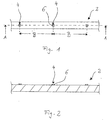
- a thread 2 has a marking 4 on its surface at constant intervals B.
- the marking 4 consists of a visible only in UV light dye, which is applied in the form of a characteristic of the manufacturer, the thread and its batch bar code 6 on the thread 2.
- the distances B serve as length information for controlling the thread consumption during the sewing process and for realizing a controlled seam behavior. Since the bar code is greatly reduced selectively provided as so-called micro-coding and also only visible in UV light, the appearance of the thread is virtually unaffected.
- the bar code 6 is printed with a corresponding plunger after the production of the uncoded thread 2 at the intervals B on the unclaimed and unstretched thread.
- Conventional production lines for threads can be easily and inexpensively converted by installing a corresponding coding station.
- the encoded thread is irradiated with UV light by a reading device, the strip code is detected and read by a sensor active in the wavelength range of the UV dye, and the distances B are determined along the thread.
- the surface of the thread 8 consists of a sheath 10 which encloses the core 12 of the thread 8.
- the sheath 10 is made of a material soluble in water or other solvent.
- the sheath 10 is provided at intervals C and D with recesses 14, wherein the different sized distances C and D are characteristic of the manufacturer, the thread and its batch as a code.
- the recesses 14 are provided only in the sheath 10, so that the core 12 of the thread 8 remains unchanged. This allows for after reading the code information contained the sheath 10 dissolved in water or the solvent and the uncoded core 12 of the thread 8 can be exposed.
- the manufacture of the thread 8 begins with the production of the core 12, which is a conventional uncoded thread. This is then provided by immersion in a solution of the plasticizable material of the sheath and by evaporation of the solvent with the sheath 10. Furthermore, the sheath 10 may be e.g. be generated by static charging of the thread in the manner of flocking or by vacuum evaporation (anodizing). After the sheath 10 has dried, it is z. B. structured with heated dies by the depressions 14 are imprinted in the distances C and D.
- a reading device When reading the coding of the second embodiment, a reading device is used, along the thread, the recesses 14 z. B. with a height difference sensor detecting, for example, has a laser registered, and thus determines the distances C and D.
Landscapes
- Engineering & Computer Science (AREA)
- Mechanical Engineering (AREA)
- Textile Engineering (AREA)
- Treatment Of Fiber Materials (AREA)
- Yarns And Mechanical Finishing Of Yarns Or Ropes (AREA)
- Iron Core Of Rotating Electric Machines (AREA)
- Seeds, Soups, And Other Foods (AREA)
- Sewing Machines And Sewing (AREA)
- Decoration Of Textiles (AREA)
Description
- Die Erfindung betrifft einen Faden mit einer Codierung gemäß dem Oberbegriff des Anspruchs 1, ein Verfahren zur Herstellung eines codierten Fadens gemäß dem Oberbegriff des Anspruchs 8, sowie Verwendungen eines codierten Fadens.
- Bei bekannten codierten Fäden kann, wenn z. B. ein Kleidungsstück, in dem der Faden verarbeitet ist, stark beansprucht bzw. beschädigt ist, nicht auf den Ursprungszustand des Fadens vor oder kurz nach dem Nähvorgang geschlossen werden. Daher kann der Faden, d.h. ein Garn oder ein Zwirn, meist nicht einer einzelnen Charge zugeordnet werden. Dadurch wird es schwierig, die Ursache einer Reklamation zu bestimmen. Ferner können bei der Verarbeitung eines bekannten codierten Fadens keine Aussagen über den Fadenverbrauch, d.h. über die Verarbeitungsqualität getroffen werden. Zudem muß zur Bestimmung von auf den Faden wirkenden Kräften eine physikalische Prüfung unter Zerstörung des Fadens durchgeführt werden, beispielsweise durch Prüfung auf Reißfestigkeit und Bruchdehnung.
- Aus der WO98/38365 ist ein Garn bekannt, das mindestens eine lesbare, durch einen geeigneten Lesesensor identifizierbare Faser enthält, die im Inneren des Garns versteckt ist. Diese Faser wird zur Sicherung der Authentizität des Garns und des Produktes, z.B. eines Kleidungsstücks, in dem das Garn verarbeitet wurde, verwendet. So können mit Hilfe der Faser Rückschlüsse auf den Hersteller des Garns bzw. des Kleidungsstücks gezogen werden.
- US 4,527,383 betrifft Fäden gemäß dem Oberbegriff der Ansprüche 1 und 8, die nur Identifizierung von Kleidungstücken dienen.
- Aufgabe der Erfindung ist es, einen Faden mit einer Codierung anzugeben, die eine möglichst einfache Identifizierung, Verarbeitung und Prüfung des Fadens ermöglicht, wobei der codierte Faden möglichst einfach herstellbar sein soll.
- Die Lösung dieser Aufgabe erfolgt durch die Merkmale der unabhängigen Ansprüche.
- Vorteilhafte Ausführungsformen der Erfindung sind in der Beschreibung, der Zeichnung und den Unteransprüchen beschrieben.
- Die Aufgabe wird insbesondere dadurch gelöst, dass die Oberfläche des Fadens als die Codierung ausgebildet ist und die Codierung eine Längeninformation umfasst. Dadurch, daß die Oberfläche des Fadens die Codierung bildet, genügt ein einfaches Verfahren zum Lesen der Codierung. Außerdem wird dadurch ermöglicht, dass nach der Herstellung des Fadens die Codierung auf einfache Weise nachträglich aufgebracht werden kann.
- Die Längeninformation bewirkt, dass die Codierung nicht nur als Information über den Faden bzw. über das Produkt, in dem der Faden verarbeitet ist, den zugehörigen Hersteller und die zugehörige Charge, sondern auch zur Feststellung von Änderungen der Länge des Fadens dienen kann, die während oder nach seiner Verarbeitung z. B. durch einen Unfall verursacht werden. Zudem kann mittels der Längeninformation der Fadenverbrauch während der Verarbeitung des Fadens bestimmt und gesteuert werden und somit die Stichbildung mit Auswirkungen z.B. auf Nahtfestigkeit oder Dehnung.
- Die Codierung kann eine Markierung aufweisen, die sich in vorbestimmten Abständen, bevorzugt in Abständen von etwa 5 - 100 mm, entlang des Fadens wiederholt. Die Abstände können dabei so gewählt sein, dass sie sowohl für den Hersteller des Fadens, für den Faden und seine Charge, als auch für die Länge einzelner Abschnitte des Fadens charakteristisch sind. Alternativ kann die Codierung so ausgestaltet sein, dass jede Markierung Informationen über den Hersteller, den Faden und seine Charge, beispielsweise in Form eines Streifencodes, eines magnetischen Codes oder eines zweidimensionalen Punktcodes enthält und die Abstände eine Längeninformation bilden, mit der der Fadenverbrauch und die auf den Faden wirkenden Kräfte bestimmt werden können. Durch die Abstände kann erreicht werden, dass Abschnitte des Fadens, die weniger stark beschädigt sind und eine Markierung enthalten, zur Identifizierung des Fadens und seiner Charge dienen können. Zudem kann durch Bestimmen der Abstände während der Verarbeitung festgestellt werden, ob sich der Fadenverbrauch ändert. Auch die auf die Faden wirkenden Kräfte können durch Bestimmen der Abstände z.B. vor und nach einer Beanspruchung mit entsprechender Längenänderung ohne Zerstörung des Fadens ermittelt werden.
- In einer bevorzugten Ausgestaltung kann die Oberfläche des Fadens eine Ummantelung aufweisen, die als die Codierung ausgebildet ist. Dabei wird die Oberfläche des Fadens von der Ummantelung gebildet. So kann die Codierung in oder auf der Ummantelung des Fadens vorgesehen sein. Dadurch wird vermieden, dass der Faden selbst verändert wird.
- Die Ummantelung kann in Form eines auf dem Faden aufgebrachten Films vorgesehen sein.
- Die Ummantelung kann ferner zumindest teilweise, insbesondere mit einem Lösungsmittel, entfernbar sein. Durch Entfernen der Ummantelung kann nach dem Lesen der Codierung, beispielsweise nach der Verarbeitung des Fadens, der Zustand des unbedeckten Fadens wiederhergestellt werden.
- Alternativ kann auch nur die Codierung, insbesondere mit einem Lösungsmittel, entfernbar sein. So wird nach dem Entfernen der Codierung der uncodierte Zustand des Fadens wiederhergestellt, bzw. bei einem Faden mit Ummantelung, auf der die Codierung aufgebracht ist, verbleibt nach dem Entfernen der Codierung der ummantelte Faden.
- Die Codierung kann durch Verformung der Oberfläche des Fadens, insbesondere durch plastische Verformung, gebildet sein. Beispielsweise kann der Faden oder - bei einem Faden mit Ummantelung - seine Ummantelung plastisch verformbar und die Codierung dadurch erhältlich sein, dass der Faden z. B. mit erhitzten Prägestempeln derart bearbeitet wird, daß die äußere Oberfläche eine Struktur erhält, die die gewünschte Information beinhaltet.
- Die Codierung kann von einem optisch lesbaren Codiermaterial auf der Oberfläche des Fadens gebildet sein. Das Codiermaterial kann z. B. aus einem aufgedruckten Farbstoff bestehen, der nur unter UV-Bestrahlung sichtbar ist. So wird das bei normaler Beleuchtung erkennbare Erscheinungsbild des Fadens durch die Codierung nicht verändert.
- Die Lösung der Aufgabe erfolgt außerdem durch die Merkmale des unabhängigen Verfahrensanspruchs und insbesondere dadurch, dass die Oberfläche des Fadens als eine Codierung ausgebildet wird wobei mittels der Codierung eine Längeninformation codiert wird. Wie oben erläutert kann dadurch erreicht werden, dass ein einfaches Verfahren zum Lesen der Codierung genügt. Außerdem wird durch Ausbildung der Oberfläche des Fadens als die Codierung ermöglicht, dass nach der Herstellung des Fadens die Codierung auf einfache Weise nachträglich aufgebracht werden kann.
- Die Codierung einer Längeninformation ermöglicht eine einfache Bestimmung der Fadenlänge bzw. des Fadenvorrats während der Verarbeitung des Fadens.
- Der Faden kann zur Bildung der Codierung mit einer Markierung, die sich in vorbestimmten Abständen, bevorzugt in Abständen von etwa 5-100 mm, entlang des Fadens wiederholt, versehen werden.
- Zur Bildung der Codierung kann die Oberfläche des Fadens verformt, insbesondere plastisch verformt werden. Dies kann z. B. dadurch geschehen, dass die Oberfläche des Fadens, die aus plastisch verformbaren Material besteht, bzw. eine Ummantelung aus plastisch verformbaren Material mittels Prägestempeln derart strukturiert wird, dass die gewünschte Information enthalten ist.
- Ferner kann beim Ausbilden der Codierung ein auf der Oberfläche des Fadens haftendes Codiermaterial aufgebracht werden.
- Dabei kann ein optisch lesbares Codiermaterial verwendet werden.
- Die Oberfläche des Fadens kann mit einer die Codierung bildenden Ummantelung versehen werden. Die Codierung kann dabei in oder auf der Ummantelung des Fadens vorgesehen werden.
- Dabei kann eine, insbesondere mit einem Lösungsmittel, zumindest teilweise entfernbare und bevorzugt wasserlösliche Ummantelung verwendet werden. Daher kann der Faden z. B. nach seiner Verarbeitung durch Entfernen der Ummantelung wieder in seinen ursprünglichen Zustand bzw. in sein ursprüngliches Erscheinungsbild überführt werden.
- Erfindungsgemäß kann ein codierter Faden zur Identifizierung des Fadens oder eines den Faden umfassenden Produktes verwendet werden. Wenn die Oberfläche des Fadens in einer Mehrzahl von Bereichen als Codierung ausgebildet ist, wird im Falle einer Beschädigung des Fadens bzw. eines zugehörigen Kleidungsstückes, die Identifizierung des Fadens erleichtert, da unbeschädigte Bereiche zur Identifizierung dienen können. So hat jeder Faden seine eigene Identität und das aufwendige Registrieren von Chargen für das Nachvollziehen bei Reklamationen entfällt. Die Identität des Fadens kann ferner bei der Verfolgung von Produktpiraterie eingesetzt werden. Zudem ist die als Codierung ausgebildete Oberfläche von außen leicht zugänglich, was dazu führt, dass die Codierung einfach, d. h. mit einem einfachen Leseverfahren lesbar ist. Ferner kann die Codierung nach der Herstellung des Fadens, d.h. nachträglich vorgesehen werden.
- Außerdem kann erfindungsgemäß ein codierter Faden zur Bestimmung und/oder Steuerung des Fadenverbrauchs bei der Fadenverarbeitung und insbesondere bei der Herstellung von Nähten verwendet werden. Eine Codierung mit einer Längeninformation ermöglicht genaue Aussagen über den Fadenverbrauch bezogen auf eine vorgegebene Nahtlänge, aber auch z. B. bei Nähstichtypen mit mehr als einem Faden Aussagen über das Fadenverhältnis von z. B. Nadel- zu Greiferfaden. Daraus ist dann mittels entsprechender Lesegeräte beim Nähvorgang zu erkennen, ob die Stichbildung optimal ist im Hinblick auf die Nahtfestigkeit und die Nahtdehnung. So kann über eine Steuerung des Fadenverbrauchs der Fadenvorrat in der Naht und damit das Nahtverhalten kontrolliert werden.
- Erfindungsgemäß kann ferner ein codierter Faden zur Bestimmung von auf den Faden oder auf ein den Faden umfassendes Produkt einwirkenden und insbesondere zu Fadendehnungen führenden Kräften verwendet werden. Enthält die Codierung eine Längeninformation, können durch Ermittlung der Länge vor und nach dem Nähen übermäßige Dehnungen des Fadens beim Nähvorgang bestimmt werden. Auch nach einem Verkehrsunfall kann die Länge eines Abschnitts eines z. B. im Sicherheitsgurt verarbeiteten codierten Fadens mit der ursprünglichen Länge verglichen und daraus eine unfallbedingte Dehnung des Fadens und damit des Sicherheitsgurtes bestimmt werden. Dadurch können Krafteinwirkungen ohne physikalische Zerstörung des Fadens ermittelt und Längenveränderungen den Kräften und deren möglichen Ursachen zugeordnet werden. Dies kann vorteilhaft auch in der Kriminalistik eingesetzt werden.
- Nachfolgend wird die Erfindung rein beispielhaft unter Bezugnahme auf die beigefügten Zeichnungen beschrieben. Es zeigen:
- Fig. 1
- eine Draufsicht auf eine erste Ausführungsform eines erfindungsgemäßen Fadens;
- Fig. 2
- einen Querschnitt entlang der Linie A-A der in Fig. 1 dargestellten ersten Ausführungsform;
- Fig. 3
- eine Draufsicht auf eine zweite Ausführungsform des erfindungsgemäßen Fadens;
- Fig. 4
- eine Querschnittsansicht der zweiten Ausführungsform.
- In der ersten Ausführungsform gemäß Fig. 1 und 2 weist ein Faden 2 auf seiner Oberfläche in gleichbleibenden Abständen B eine Markierung 4 auf. Die Markierung 4 besteht aus einem nur im UV-Licht sichtbaren Farbstoff, der in Form eines für den Hersteller, den Faden und seine Charge charakteristischen Streifencodes 6 auf den Faden 2 aufgebracht ist. Mit dem Streifencode 6 besitzt daher jeder Faden seine eigene Identität. Die Abstände B dienen als Längeninformation zur Steuerung des Fadenverbrauchs beim Nähvorgang und zur Realisierung eines kontrollierten Nahtverhaltens. Da der Streifencode stark verkleinert punktuell als sogenannte Mikrocodierung vorgesehen und zudem nur im UV-Licht erkennbar ist, wird das äußere Erscheinungsbild des Fadens praktisch nicht beeinflusst.
- Der Streifencode 6 wird mit einem entsprechenden Druckstempel nach der Herstellung des uncodierten Fadens 2 in den Abständen B auf den unbeanspruchten und ungedehnten Faden aufgedruckt. Herkömmliche Produktionslinien für Fäden können durch Einbau einer entsprechenden Codierstation einfach und kostengünstig umgerüstet werden.
- Zum Lesen der Codierung gemäß der ersten Ausführungsform wird mit einem Lesegerät der codierte Faden mit UV-Licht bestrahlt, der Streifencode mit einem im Wellenlängenbereich des UV-Farbstoffs aktiven Sensor erfasst und ausgelesen und entlang des Fadens die Abstände B bestimmt.
- In der zweiten Ausführungsform gemäß Fig. 3 und 4 besteht die Oberfläche des Fadens 8 aus einer Ummantelung 10, die den Kern 12 des Fadens 8 einhüllt. Die Ummantelung 10 besteht aus einem in Wasser oder einem anderen Lösungsmittel löslichen Material. Außerdem ist die Ummantelung 10 in Abständen C und D mit Vertiefungen 14 versehen, wobei die verschieden großen Abstände C und D für den Hersteller, den Faden und seine Charge als Code kennzeichnend sind. Die Vertiefungen 14 sind nur in der Ummantelung 10 vorgesehen, so dass der Kern 12 des Fadens 8 unverändert bleibt. Dies ermöglicht, dass nach dem Lesen der im Code enthaltenen Information die Ummantelung 10 in Wasser bzw. dem Lösungsmittel aufgelöst und der uncodierte Kern 12 des Fadens 8 freigelegt werden kann.
- Die Herstellung des Fadens 8 beginnt mit der Erzeugung des Kerns 12, der ein herkömmlicher uncodierter Faden ist. Dieser wird dann durch Eintauchen in eine Lösung des plastifizierbaren Materials der Ummantelung und durch Verdampfen des Lösungsmittels mit der Ummantelung 10 versehen. Weiterhin kann die Ummantelung 10 z.B. durch statische Aufladung des Fadens in Art einer Beflockung oder durch Aufdampfen im Vakuum (Eloxalverfahren) erzeugt werden. Nachdem die Ummantelung 10 getrocknet ist, wird sie z. B. mit erhitzten Prägestempeln strukturiert, indem die Vertiefungen 14 in den Abständen C und D eingeprägt werden.
- Beim Lesen der Codierung der zweiten Ausführungsform wird ein Lesegerät eingesetzt, das entlang des Fadens die Vertiefungen 14 z. B. mit einem Höhenunterschiede erfassenden Sensor, der beispielsweise einen Laser aufweist, registriert und damit auch die Abstände C und D bestimmt.
-
- 2
- Faden
- 4
- Markierung
- 6
- Streifencode
- 8
- Faden
- 10
- Ummantelung
- 12
- Kern
- 14
- Vertiefung
Claims (18)
- Faden mit einer Codierung,
wobei die Oberfläche des Fadens (2; 8) als die Codierung (4; 14) ausgebildet ist,
dadurch gekennzeichnet, dass
die Codierung (4; 14) eine Längeninformation umfasst. - Faden nach Anspruch 1,
dadurch gekennzeichnet, dass
die Codierung (4; 14) eine Markierung (4) aufweist, die sich in vorbestimmten Abständen, bevorzugt in Abständen von etwa 5 - 100 mm, entlang des Fadens (2; 8) wiederholt. - Faden nach einem der vorstehenden Ansprüche,
dadurch gekennzeichnet, dass
die Oberfläche des Fadens (2; 8) eine Ummantelung (10) aufweist, die als die Codierung (4; 14) ausgebildet ist. - Faden nach Anspruch 3,
dadurch gekennzeichnet, dass
die Ummantelung (10) in Form eines auf den Faden (8) aufgebrachten Films vorgesehen ist. - Faden nach Anspruch 3 oder 4,
dadurch gekennzeichnet, dass
die Ummantelung (10) zumindest teilweise, insbesondere mit einem Lösungsmittel, entfernbar und bevorzugt wasserlöslich ist. - Faden nach einem der vorstehenden Ansprüche,
dadurch gekennzeichnet, dass
die Codierung (4; 14) durch Verformung der Oberfläche des Fadens (2; 8), insbesondere durch plastische Verformung, gebildet ist. - Faden nach einem der vorstehenden Ansprüche,
dadurch gekennzeichnet, dass
die Codierung (4; 14) von einem optisch lesbaren Codiermaterial (6) auf der Oberfläche des Fadens (2; 8) gebildet ist. - Verfahren zur Herstellung eines codierten Fadens, insbesondere gemäß einem der vorstehenden Ansprüche,
wobei die Oberfläche des Fadens (2; 8) als Codierung (4; 14) ausgebildet wird,
dadurch gekennzeichnet, dass
mittels der Codierung (4; 14) eine Längeninformation codiert wird. - Verfahren nach Anspruch 8,
dadurch gekennzeichnet, dass
zur Bildung der Codierung (4; 14) der Faden (2; 8) mit einer Markierung (4) versehen wird, die sich in vorbestimmten Abständen, bevorzugt in Abständen von etwa 5 - 100 mm, entlang des Fadens (2; 8) wiederholt. - Verfahren nach einem der Ansprüche 8 bis 9,
dadurch gekennzeichnet, dass
zur Bildung der Codierung (4; 14) die Oberfläche des Fadens (2; 8) verformt, insbesondere plastisch verformt wird. - Verfahren nach einem der Ansprüche 8 bis 10,
dadurch gekennzeichnet, dass
zur Bildung der Codierung (4; 14) ein auf der Oberfläche des Fadens (2; 8) haftendes Codiermaterial (6; 10) aufgebracht wird. - Verfahren nach Anspruch 11,
dadurch gekennzeichnet, dass
ein optisch lesbares Codiermaterial (6) verwendet wird. - Verfahren nach einem der Ansprüche 8 bis 12,
dadurch gekennzeichnet, dass
die Oberfläche des Fadens (2; 8) mit einer die Codierung bildenden Ummantelung (10) versehen wird. - Verfahren nach Anspruch 13,
dadurch gekennzeichnet, dass
eine, insbesondere mit einem Lösungsmittel, zumindest teilweise entfembare und bevorzugt wasserlösliche Ummantelung (10) verwendet wird. - Verfahren nach einem der Ansprüche 8 bis 14,
dadurch gekennzeichnet, dass
die Codierung (4; 14) im Anschluss an die Herstellung des Fadens (2; 8) aufgebracht wird, insbesondere in einem unbeanspruchten oder ungedehnten Zustand des Fadens (2; 8). - Verwendung eines codierten Faden nach einem der Ansprüche 1 bis 7 zur Identifizierung des Fadens (2; 8) oder eines den Faden (2; 8) umfassenden Produktes.
- Verwendung eines codierten Fadens, nach einem der Ansprüche 1 bis 7, zur Bestimmung und/oder Steuerung des Fadenverbrauchs bei der Fadenverarbeitung und insbesondere bei der Herstellung von Nähten.
- Verwendung eines codierten Fadens, nach einem der Ansprüche 1 bis 7, zur Bestimmung von auf den Faden (2; 8) oder auf ein den Faden (2; 8) umfassendes Produkt einwirkenden und insbesondere zu Fadendehnungen führenden Kräften.
Applications Claiming Priority (2)
| Application Number | Priority Date | Filing Date | Title |
|---|---|---|---|
| DE10159047 | 2001-11-30 | ||
| DE10159047A DE10159047A1 (de) | 2001-11-30 | 2001-11-30 | Faden mit einer Codierung und Verfahren zur Herstellung eines codierten Fadens |
Publications (2)
| Publication Number | Publication Date |
|---|---|
| EP1316632A1 EP1316632A1 (de) | 2003-06-04 |
| EP1316632B1 true EP1316632B1 (de) | 2006-01-04 |
Family
ID=7707695
Family Applications (1)
| Application Number | Title | Priority Date | Filing Date |
|---|---|---|---|
| EP02023315A Expired - Lifetime EP1316632B1 (de) | 2001-11-30 | 2002-10-17 | Faden mit einer Codierung und Verfahren zur Herstellung eines codierten Fadens |
Country Status (5)
| Country | Link |
|---|---|
| EP (1) | EP1316632B1 (de) |
| AT (1) | ATE315117T1 (de) |
| DE (2) | DE10159047A1 (de) |
| DK (1) | DK1316632T3 (de) |
| ES (1) | ES2251557T3 (de) |
Families Citing this family (8)
| Publication number | Priority date | Publication date | Assignee | Title |
|---|---|---|---|---|
| DE102005047786A1 (de) * | 2005-10-05 | 2007-04-19 | Urs Isler | Verfahren zur Behandlung von Gamen zur Authentifizierung und Vorrichtung zum Nachweis der Authentizität |
| DE102007030017A1 (de) * | 2007-06-29 | 2009-01-08 | Matthias Lydike | Kennzeichnen von Textilien |
| AT506966B1 (de) | 2008-12-29 | 2010-01-15 | Matthias Lydike | Verfahren und vorrichtung zum kennzeichnen einer kunststofffaser |
| DE102017101742A1 (de) | 2017-01-30 | 2018-08-02 | Trw Automotive Gmbh | Gassack für ein Fahrzeuginsassen-Rückhaltesystem sowie Verfahren zur Qualitätskontrolle und/oder Ermittlung des Garnverbrauchs für eine Gassacknaht eines solchen Gassacks |
| EP3476617A1 (de) | 2017-10-25 | 2019-05-01 | Österreichische Staatsdruckerei GmbH | Dokument mit naht |
| CN111237593A (zh) * | 2020-01-15 | 2020-06-05 | 杭州淘控电子商务有限公司 | 一种电商用条码自动识别装置 |
| DE102023115021A1 (de) * | 2023-06-07 | 2024-12-12 | SeamBit GmbH | Textilprodukt mit fälschungssicherem Zertifikat |
| DE102023115011A1 (de) * | 2023-06-07 | 2024-12-12 | Silana Gmbh | Kleidungsstück mit informationscodierter Naht |
Family Cites Families (6)
| Publication number | Priority date | Publication date | Assignee | Title |
|---|---|---|---|---|
| US1822098A (en) * | 1927-06-02 | 1931-09-08 | Plymouth Cordage Co | Marking device |
| CH309531A (de) * | 1952-06-30 | 1955-09-15 | Bindfadenfabrik Schweizerische | Verfahren zum Markieren von Garn oder dergleichen. |
| US4397142A (en) * | 1981-12-07 | 1983-08-09 | Minnesota Mining And Manufacturing Company | Coded threads and sheet material useful for making such coded threads |
| US4527383A (en) * | 1983-03-28 | 1985-07-09 | Minnesota Mining And Manufacturing Company | Threads for identification of garments |
| US5573851A (en) * | 1994-05-16 | 1996-11-12 | U.S. Textile Corporation | Ultraviolet-detectable marking yarn and a textile fabric product therewith |
| DE19518231A1 (de) * | 1995-05-12 | 1996-11-14 | Bornemann & Bick Kg | Textiles Gewebe |
-
2001
- 2001-11-30 DE DE10159047A patent/DE10159047A1/de not_active Withdrawn
-
2002
- 2002-10-17 DK DK02023315T patent/DK1316632T3/da active
- 2002-10-17 EP EP02023315A patent/EP1316632B1/de not_active Expired - Lifetime
- 2002-10-17 ES ES02023315T patent/ES2251557T3/es not_active Expired - Lifetime
- 2002-10-17 DE DE50205508T patent/DE50205508D1/de not_active Expired - Lifetime
- 2002-10-17 AT AT02023315T patent/ATE315117T1/de active
Also Published As
| Publication number | Publication date |
|---|---|
| DE10159047A1 (de) | 2003-06-12 |
| DK1316632T3 (da) | 2006-03-06 |
| ATE315117T1 (de) | 2006-02-15 |
| DE50205508D1 (de) | 2006-03-30 |
| ES2251557T3 (es) | 2006-05-01 |
| EP1316632A1 (de) | 2003-06-04 |
Similar Documents
| Publication | Publication Date | Title |
|---|---|---|
| DE3634857C2 (de) | Ausweiskarte mit visuell sichtbarem Echtheitsmerkmal und Verfahren zur Herstellung derselben | |
| EP0354362B1 (de) | Verfahren zum Aufbringen und Lesen von und Flasche mit optisch lesbaren Codemarkierungen | |
| DE69429266T3 (de) | Prägen von wertscheinbogen mit echtheitsmerkmalen | |
| EP0548858A1 (de) | Ausweiskarte sowie Verfahren und Vorrichtung zur Herstellung derselben | |
| DE2905441A1 (de) | Wertpapier mit gedruckten echtheitskennzeichen in einer papierschicht | |
| EP2164707A1 (de) | Sicherheitsmerkmal und verfahren zu seiner herstellung | |
| EP1646507B1 (de) | Mehrschichtkörper, vorrichtung und verfahren zur erzeugung eines flächenmusters hoher auflösung | |
| EP1316632A1 (de) | Faden mit einer Codierung und Verfahren zur Herstellung eines codierten Fadens | |
| DE3628353A1 (de) | Verfahren zur unauffaelligen markierung von dokumenten und verfahren zur pruefung solcher dokumente | |
| WO1998033659A1 (de) | Wertdokument und verfahren zu seiner herstellung | |
| DE1904172A1 (de) | Verfahren zur Herstellung von Bildern hoher Bildaufloesung und eine zur Ausfuehrung dieses Verfahrens verwendete Vorrichtung | |
| DE3820348A1 (de) | Verfahren und vorrichtung zum herstellen eines gehaeuses fuer einen sensor und katheter mit sensorgehaeuse | |
| DE1961013A1 (de) | Elektrische Mustervorrichtung fuer mehrsystemige Rundstrickmaschinen mit umlaufendem Nadelzylinder | |
| EP3291999B1 (de) | Sicherheitsmerkmal und verfahren zu dessen herstellung | |
| DE3307411C2 (de) | Verfahren und Vorrichtung zum Erkennen von Kennzeichnungsmarken auf einer Materialbahn | |
| EP0897784A1 (de) | Chipkarte, Verfahren zum Herstellen von Chipkarten sowie eine Vorrichtung zum Durchführen des Verfahrens | |
| DE10242565A1 (de) | Verfahren und Vorrichtung zur Werkstückbezeichnung | |
| EP2992539B1 (de) | Verfahren zum herstellen eines induktionsbauteils und induktionsbauteil | |
| EP1858605B1 (de) | Sichern von information | |
| AT525543A4 (de) | Lichtleiterfaserband und Verfahren zu dessen Herstellung | |
| DE69600763T2 (de) | Verfahren sowie vorrichtung zum perforieren | |
| EP1112159B1 (de) | Verfahren zur herstellung eines hybridrahmens oder hybridgehäuses sowie ein derartiger hybridrahmen oder ein hybridgehäuse | |
| EP4114149A1 (de) | Durchkontaktierung in einer beidseitig bedruckten trägerfolie | |
| DE2611687B2 (de) | Verfahren und Vorrichtung zur Herstellung eines Zählmusters für die Anfertigung von Gobelinbildern und anderen Stickarbeiten | |
| EP4717465A2 (de) | Verfahren zur herstellung eines wertdokuments und wertdokument |
Legal Events
| Date | Code | Title | Description |
|---|---|---|---|
| PUAI | Public reference made under article 153(3) epc to a published international application that has entered the european phase |
Free format text: ORIGINAL CODE: 0009012 |
|
| AK | Designated contracting states |
Designated state(s): AT BE BG CH CY CZ DE DK EE ES FI FR GB GR IE IT LI LU MC NL PT SE SK TR |
|
| AX | Request for extension of the european patent |
Extension state: AL LT LV MK RO SI |
|
| 17P | Request for examination filed |
Effective date: 20031127 |
|
| AKX | Designation fees paid |
Designated state(s): AT BE BG CH CY CZ DE DK EE ES FI FR GB GR IE IT LI LU MC NL PT SE SK TR |
|
| 17Q | First examination report despatched |
Effective date: 20040326 |
|
| GRAP | Despatch of communication of intention to grant a patent |
Free format text: ORIGINAL CODE: EPIDOSNIGR1 |
|
| RAP1 | Party data changed (applicant data changed or rights of an application transferred) |
Owner name: GUETERMANN & CO. AG |
|
| GRAS | Grant fee paid |
Free format text: ORIGINAL CODE: EPIDOSNIGR3 |
|
| GRAA | (expected) grant |
Free format text: ORIGINAL CODE: 0009210 |
|
| AK | Designated contracting states |
Kind code of ref document: B1 Designated state(s): AT BE BG CH CY CZ DE DK EE ES FI FR GB GR IE IT LI LU MC NL PT SE SK TR |
|
| PG25 | Lapsed in a contracting state [announced via postgrant information from national office to epo] |
Ref country code: IT Free format text: LAPSE BECAUSE OF FAILURE TO SUBMIT A TRANSLATION OF THE DESCRIPTION OR TO PAY THE FEE WITHIN THE PRESCRIBED TIME-LIMIT;WARNING: LAPSES OF ITALIAN PATENTS WITH EFFECTIVE DATE BEFORE 2007 MAY HAVE OCCURRED AT ANY TIME BEFORE 2007. THE CORRECT EFFECTIVE DATE MAY BE DIFFERENT FROM THE ONE RECORDED. Effective date: 20060104 Ref country code: SK Free format text: LAPSE BECAUSE OF FAILURE TO SUBMIT A TRANSLATION OF THE DESCRIPTION OR TO PAY THE FEE WITHIN THE PRESCRIBED TIME-LIMIT Effective date: 20060104 |
|
| REG | Reference to a national code |
Ref country code: GB Ref legal event code: FG4D Free format text: NOT ENGLISH |
|
| REG | Reference to a national code |
Ref country code: CH Ref legal event code: EP |
|
| REG | Reference to a national code |
Ref country code: CH Ref legal event code: NV Representative=s name: DR. BRUNO HAMMER |
|
| REG | Reference to a national code |
Ref country code: IE Ref legal event code: FG4D Free format text: LANGUAGE OF EP DOCUMENT: GERMAN |
|
| REG | Reference to a national code |
Ref country code: SE Ref legal event code: TRGR |
|
| REG | Reference to a national code |
Ref country code: DK Ref legal event code: T3 |
|
| GBT | Gb: translation of ep patent filed (gb section 77(6)(a)/1977) |
Effective date: 20060222 |
|
| REG | Reference to a national code |
Ref country code: GR Ref legal event code: EP Ref document number: 20060400140 Country of ref document: GR |
|
| REF | Corresponds to: |
Ref document number: 50205508 Country of ref document: DE Date of ref document: 20060330 Kind code of ref document: P |
|
| PG25 | Lapsed in a contracting state [announced via postgrant information from national office to epo] |
Ref country code: BG Free format text: LAPSE BECAUSE OF FAILURE TO SUBMIT A TRANSLATION OF THE DESCRIPTION OR TO PAY THE FEE WITHIN THE PRESCRIBED TIME-LIMIT Effective date: 20060404 |
|
| REG | Reference to a national code |
Ref country code: ES Ref legal event code: FG2A Ref document number: 2251557 Country of ref document: ES Kind code of ref document: T3 |
|
| ET | Fr: translation filed | ||
| PG25 | Lapsed in a contracting state [announced via postgrant information from national office to epo] |
Ref country code: MC Free format text: LAPSE BECAUSE OF NON-PAYMENT OF DUE FEES Effective date: 20061031 |
|
| PLBE | No opposition filed within time limit |
Free format text: ORIGINAL CODE: 0009261 |
|
| STAA | Information on the status of an ep patent application or granted ep patent |
Free format text: STATUS: NO OPPOSITION FILED WITHIN TIME LIMIT |
|
| 26N | No opposition filed |
Effective date: 20061005 |
|
| PG25 | Lapsed in a contracting state [announced via postgrant information from national office to epo] |
Ref country code: CZ Free format text: LAPSE BECAUSE OF FAILURE TO SUBMIT A TRANSLATION OF THE DESCRIPTION OR TO PAY THE FEE WITHIN THE PRESCRIBED TIME-LIMIT Effective date: 20060104 |
|
| PG25 | Lapsed in a contracting state [announced via postgrant information from national office to epo] |
Ref country code: EE Free format text: LAPSE BECAUSE OF FAILURE TO SUBMIT A TRANSLATION OF THE DESCRIPTION OR TO PAY THE FEE WITHIN THE PRESCRIBED TIME-LIMIT Effective date: 20060104 |
|
| PG25 | Lapsed in a contracting state [announced via postgrant information from national office to epo] |
Ref country code: CY Free format text: LAPSE BECAUSE OF FAILURE TO SUBMIT A TRANSLATION OF THE DESCRIPTION OR TO PAY THE FEE WITHIN THE PRESCRIBED TIME-LIMIT Effective date: 20060104 |
|
| PGFP | Annual fee paid to national office [announced via postgrant information from national office to epo] |
Ref country code: AT Payment date: 20101014 Year of fee payment: 9 |
|
| PGFP | Annual fee paid to national office [announced via postgrant information from national office to epo] |
Ref country code: GR Payment date: 20101018 Year of fee payment: 9 |
|
| PGFP | Annual fee paid to national office [announced via postgrant information from national office to epo] |
Ref country code: TR Payment date: 20110926 Year of fee payment: 10 |
|
| PGFP | Annual fee paid to national office [announced via postgrant information from national office to epo] |
Ref country code: BE Payment date: 20111013 Year of fee payment: 10 Ref country code: LU Payment date: 20111024 Year of fee payment: 10 Ref country code: FI Payment date: 20111013 Year of fee payment: 10 Ref country code: IE Payment date: 20111020 Year of fee payment: 10 Ref country code: DK Payment date: 20111019 Year of fee payment: 10 Ref country code: SE Payment date: 20111021 Year of fee payment: 10 Ref country code: NL Payment date: 20111025 Year of fee payment: 10 Ref country code: CH Payment date: 20111024 Year of fee payment: 10 |
|
| BERE | Be: lapsed |
Owner name: *GUTERMANN & CO. A.G. Effective date: 20121031 |
|
| REG | Reference to a national code |
Ref country code: NL Ref legal event code: V1 Effective date: 20130501 |
|
| REG | Reference to a national code |
Ref country code: CH Ref legal event code: PL |
|
| REG | Reference to a national code |
Ref country code: DK Ref legal event code: EBP |
|
| REG | Reference to a national code |
Ref country code: AT Ref legal event code: MM01 Ref document number: 315117 Country of ref document: AT Kind code of ref document: T Effective date: 20121017 |
|
| REG | Reference to a national code |
Ref country code: GR Ref legal event code: ML Ref document number: 20060400140 Country of ref document: GR Effective date: 20130508 |
|
| REG | Reference to a national code |
Ref country code: IE Ref legal event code: MM4A |
|
| PG25 | Lapsed in a contracting state [announced via postgrant information from national office to epo] |
Ref country code: SE Free format text: LAPSE BECAUSE OF NON-PAYMENT OF DUE FEES Effective date: 20121018 Ref country code: CH Free format text: LAPSE BECAUSE OF NON-PAYMENT OF DUE FEES Effective date: 20121031 Ref country code: LI Free format text: LAPSE BECAUSE OF NON-PAYMENT OF DUE FEES Effective date: 20121031 Ref country code: BE Free format text: LAPSE BECAUSE OF NON-PAYMENT OF DUE FEES Effective date: 20121031 Ref country code: AT Free format text: LAPSE BECAUSE OF NON-PAYMENT OF DUE FEES Effective date: 20121017 Ref country code: IE Free format text: LAPSE BECAUSE OF NON-PAYMENT OF DUE FEES Effective date: 20121017 |
|
| PG25 | Lapsed in a contracting state [announced via postgrant information from national office to epo] |
Ref country code: GR Free format text: LAPSE BECAUSE OF NON-PAYMENT OF DUE FEES Effective date: 20130508 Ref country code: NL Free format text: LAPSE BECAUSE OF NON-PAYMENT OF DUE FEES Effective date: 20130501 Ref country code: FI Free format text: LAPSE BECAUSE OF NON-PAYMENT OF DUE FEES Effective date: 20121017 |
|
| PG25 | Lapsed in a contracting state [announced via postgrant information from national office to epo] |
Ref country code: DK Free format text: LAPSE BECAUSE OF NON-PAYMENT OF DUE FEES Effective date: 20121031 |
|
| PG25 | Lapsed in a contracting state [announced via postgrant information from national office to epo] |
Ref country code: TR Free format text: LAPSE BECAUSE OF NON-PAYMENT OF DUE FEES Effective date: 20121017 |
|
| PG25 | Lapsed in a contracting state [announced via postgrant information from national office to epo] |
Ref country code: LU Free format text: LAPSE BECAUSE OF NON-PAYMENT OF DUE FEES Effective date: 20121017 |
|
| PGFP | Annual fee paid to national office [announced via postgrant information from national office to epo] |
Ref country code: ES Payment date: 20141028 Year of fee payment: 13 |
|
| PGFP | Annual fee paid to national office [announced via postgrant information from national office to epo] |
Ref country code: PT Payment date: 20141016 Year of fee payment: 13 |
|
| REG | Reference to a national code |
Ref country code: FR Ref legal event code: PLFP Year of fee payment: 14 |
|
| PGFP | Annual fee paid to national office [announced via postgrant information from national office to epo] |
Ref country code: GB Payment date: 20151021 Year of fee payment: 14 Ref country code: IT Payment date: 20151028 Year of fee payment: 14 |
|
| PGFP | Annual fee paid to national office [announced via postgrant information from national office to epo] |
Ref country code: FR Payment date: 20151023 Year of fee payment: 14 |
|
| REG | Reference to a national code |
Ref country code: PT Ref legal event code: MM4A Free format text: LAPSE DUE TO NON-PAYMENT OF FEES Effective date: 20160418 |
|
| PGFP | Annual fee paid to national office [announced via postgrant information from national office to epo] |
Ref country code: DE Payment date: 20151230 Year of fee payment: 14 |
|
| PG25 | Lapsed in a contracting state [announced via postgrant information from national office to epo] |
Ref country code: PT Free format text: LAPSE BECAUSE OF NON-PAYMENT OF DUE FEES Effective date: 20160418 |
|
| REG | Reference to a national code |
Ref country code: ES Ref legal event code: FD2A Effective date: 20161125 |
|
| PG25 | Lapsed in a contracting state [announced via postgrant information from national office to epo] |
Ref country code: ES Free format text: LAPSE BECAUSE OF NON-PAYMENT OF DUE FEES Effective date: 20151018 |
|
| REG | Reference to a national code |
Ref country code: DE Ref legal event code: R119 Ref document number: 50205508 Country of ref document: DE |
|
| GBPC | Gb: european patent ceased through non-payment of renewal fee |
Effective date: 20161017 |
|
| REG | Reference to a national code |
Ref country code: FR Ref legal event code: ST Effective date: 20170630 |
|
| PG25 | Lapsed in a contracting state [announced via postgrant information from national office to epo] |
Ref country code: DE Free format text: LAPSE BECAUSE OF NON-PAYMENT OF DUE FEES Effective date: 20170503 Ref country code: GB Free format text: LAPSE BECAUSE OF NON-PAYMENT OF DUE FEES Effective date: 20161017 Ref country code: FR Free format text: LAPSE BECAUSE OF NON-PAYMENT OF DUE FEES Effective date: 20161102 |
|
| PG25 | Lapsed in a contracting state [announced via postgrant information from national office to epo] |
Ref country code: IT Free format text: LAPSE BECAUSE OF NON-PAYMENT OF DUE FEES Effective date: 20161017 |