EP1302993A2 - Verfahren zur Herstellung eines Elektroden-/Separatorverbundes für galvanische Elemente - Google Patents
Verfahren zur Herstellung eines Elektroden-/Separatorverbundes für galvanische Elemente Download PDFInfo
- Publication number
- EP1302993A2 EP1302993A2 EP02021947A EP02021947A EP1302993A2 EP 1302993 A2 EP1302993 A2 EP 1302993A2 EP 02021947 A EP02021947 A EP 02021947A EP 02021947 A EP02021947 A EP 02021947A EP 1302993 A2 EP1302993 A2 EP 1302993A2
- Authority
- EP
- European Patent Office
- Prior art keywords
- separator
- electrode
- polymer
- polyolefin
- electrodes
- Prior art date
- Legal status (The legal status is an assumption and is not a legal conclusion. Google has not performed a legal analysis and makes no representation as to the accuracy of the status listed.)
- Withdrawn
Links
Images
Classifications
-
- H—ELECTRICITY
- H01—ELECTRIC ELEMENTS
- H01M—PROCESSES OR MEANS, e.g. BATTERIES, FOR THE DIRECT CONVERSION OF CHEMICAL ENERGY INTO ELECTRICAL ENERGY
- H01M50/00—Constructional details or processes of manufacture of the non-active parts of electrochemical cells other than fuel cells, e.g. hybrid cells
- H01M50/40—Separators; Membranes; Diaphragms; Spacing elements inside cells
- H01M50/403—Manufacturing processes of separators, membranes or diaphragms
-
- H—ELECTRICITY
- H01—ELECTRIC ELEMENTS
- H01M—PROCESSES OR MEANS, e.g. BATTERIES, FOR THE DIRECT CONVERSION OF CHEMICAL ENERGY INTO ELECTRICAL ENERGY
- H01M10/00—Secondary cells; Manufacture thereof
- H01M10/05—Accumulators with non-aqueous electrolyte
-
- H—ELECTRICITY
- H01—ELECTRIC ELEMENTS
- H01M—PROCESSES OR MEANS, e.g. BATTERIES, FOR THE DIRECT CONVERSION OF CHEMICAL ENERGY INTO ELECTRICAL ENERGY
- H01M10/00—Secondary cells; Manufacture thereof
- H01M10/05—Accumulators with non-aqueous electrolyte
- H01M10/052—Li-accumulators
-
- H—ELECTRICITY
- H01—ELECTRIC ELEMENTS
- H01M—PROCESSES OR MEANS, e.g. BATTERIES, FOR THE DIRECT CONVERSION OF CHEMICAL ENERGY INTO ELECTRICAL ENERGY
- H01M50/00—Constructional details or processes of manufacture of the non-active parts of electrochemical cells other than fuel cells, e.g. hybrid cells
- H01M50/40—Separators; Membranes; Diaphragms; Spacing elements inside cells
- H01M50/409—Separators, membranes or diaphragms characterised by the material
- H01M50/411—Organic material
- H01M50/414—Synthetic resins, e.g. thermoplastics or thermosetting resins
- H01M50/417—Polyolefins
-
- H—ELECTRICITY
- H01—ELECTRIC ELEMENTS
- H01M—PROCESSES OR MEANS, e.g. BATTERIES, FOR THE DIRECT CONVERSION OF CHEMICAL ENERGY INTO ELECTRICAL ENERGY
- H01M50/00—Constructional details or processes of manufacture of the non-active parts of electrochemical cells other than fuel cells, e.g. hybrid cells
- H01M50/40—Separators; Membranes; Diaphragms; Spacing elements inside cells
- H01M50/46—Separators, membranes or diaphragms characterised by their combination with electrodes
-
- H—ELECTRICITY
- H01—ELECTRIC ELEMENTS
- H01M—PROCESSES OR MEANS, e.g. BATTERIES, FOR THE DIRECT CONVERSION OF CHEMICAL ENERGY INTO ELECTRICAL ENERGY
- H01M50/00—Constructional details or processes of manufacture of the non-active parts of electrochemical cells other than fuel cells, e.g. hybrid cells
- H01M50/40—Separators; Membranes; Diaphragms; Spacing elements inside cells
- H01M50/46—Separators, membranes or diaphragms characterised by their combination with electrodes
- H01M50/461—Separators, membranes or diaphragms characterised by their combination with electrodes with adhesive layers between electrodes and separators
-
- H—ELECTRICITY
- H01—ELECTRIC ELEMENTS
- H01M—PROCESSES OR MEANS, e.g. BATTERIES, FOR THE DIRECT CONVERSION OF CHEMICAL ENERGY INTO ELECTRICAL ENERGY
- H01M10/00—Secondary cells; Manufacture thereof
- H01M10/05—Accumulators with non-aqueous electrolyte
- H01M10/052—Li-accumulators
- H01M10/0525—Rocking-chair batteries, i.e. batteries with lithium insertion or intercalation in both electrodes; Lithium-ion batteries
-
- Y—GENERAL TAGGING OF NEW TECHNOLOGICAL DEVELOPMENTS; GENERAL TAGGING OF CROSS-SECTIONAL TECHNOLOGIES SPANNING OVER SEVERAL SECTIONS OF THE IPC; TECHNICAL SUBJECTS COVERED BY FORMER USPC CROSS-REFERENCE ART COLLECTIONS [XRACs] AND DIGESTS
- Y02—TECHNOLOGIES OR APPLICATIONS FOR MITIGATION OR ADAPTATION AGAINST CLIMATE CHANGE
- Y02E—REDUCTION OF GREENHOUSE GAS [GHG] EMISSIONS, RELATED TO ENERGY GENERATION, TRANSMISSION OR DISTRIBUTION
- Y02E60/00—Enabling technologies; Technologies with a potential or indirect contribution to GHG emissions mitigation
- Y02E60/10—Energy storage using batteries
-
- Y—GENERAL TAGGING OF NEW TECHNOLOGICAL DEVELOPMENTS; GENERAL TAGGING OF CROSS-SECTIONAL TECHNOLOGIES SPANNING OVER SEVERAL SECTIONS OF THE IPC; TECHNICAL SUBJECTS COVERED BY FORMER USPC CROSS-REFERENCE ART COLLECTIONS [XRACs] AND DIGESTS
- Y02—TECHNOLOGIES OR APPLICATIONS FOR MITIGATION OR ADAPTATION AGAINST CLIMATE CHANGE
- Y02P—CLIMATE CHANGE MITIGATION TECHNOLOGIES IN THE PRODUCTION OR PROCESSING OF GOODS
- Y02P70/00—Climate change mitigation technologies in the production process for final industrial or consumer products
- Y02P70/50—Manufacturing or production processes characterised by the final manufactured product
-
- Y—GENERAL TAGGING OF NEW TECHNOLOGICAL DEVELOPMENTS; GENERAL TAGGING OF CROSS-SECTIONAL TECHNOLOGIES SPANNING OVER SEVERAL SECTIONS OF THE IPC; TECHNICAL SUBJECTS COVERED BY FORMER USPC CROSS-REFERENCE ART COLLECTIONS [XRACs] AND DIGESTS
- Y10—TECHNICAL SUBJECTS COVERED BY FORMER USPC
- Y10T—TECHNICAL SUBJECTS COVERED BY FORMER US CLASSIFICATION
- Y10T29/00—Metal working
- Y10T29/49—Method of mechanical manufacture
- Y10T29/49002—Electrical device making
- Y10T29/49108—Electric battery cell making
- Y10T29/49112—Electric battery cell making including laminating of indefinite length material
Definitions
- the invention relates to a method for producing an electrode / separator assembly for galvanic elements that at least contain a lithium intercalating electrode in its polymer matrix finely dispersed electrochemically active materials insoluble in the polymer are.
- the invention further relates to a galvanic element with separator / electrode assembly produced by the process.
- Document EP 954 042 A1 includes a lithium-ion battery remove, in which the positive and negative foil electrodes with connected to a separator by an adhesion-promoting resin layer are.
- the layers which impart adhesion can in particular have one undesirable insulation effect between electrode and separator, namely the inhibition of electrolyte diffusion and thus an increased internal resistance entail. In addition, through such Layers of unwanted substances get into the cell.
- a lithium-ion cell can be found in document EP 1 056 142 A1, in between positive and negative electrode foils Gel electrolyte is arranged.
- the gel consists in particular of polyvinylidene fluoride or copolymers of polyvinylidene fluoride such as Hexafluoropropylene.
- the production of such cells is complex, since processing of the electrodes and the gel electrolyte in the drying room necessary is. In addition, such electrolytes often does not achieve sufficient conductivity.
- a method is known in which, for example, a copper foil, a graphite-containing paste mixture and then a separator tape, consisting of a polymer mixture and SiO 2 in paste form, is applied to a mechanically stable carrier film and processed into a film.
- a separator tape consisting of a polymer mixture and SiO 2 in paste form
- an electrode lies in such galvanic elements is used, based on a wet-chemical manufactured film, with a significant amount, usually more than 70 percent by weight active material suspended in a dissolved binder polymer and is drawn out to a film by means of doctor blades.
- the suspension contains optionally plasticizers and conductivity improvers.
- the Cell composite is produced by lamination of the electrode foils foil-like arrester electrodes, and the composite thus obtained is with connected to the separator in a further lamination step.
- the lamination temperature is usually 110 ° C to 140 ° C and takes place at a defined pressure in a tape laminator.
- U.S. Patent 5,460,904 describes such an approach.
- This publication shows lithium intercalating electrodes in which the active composition is distributed in a matrix made of polyvinylidene difluoride-hexafluoropropylene copolymer.
- a gel separator made of the same materials with SiO 2 as filler is arranged between these electrodes. The electrodes and the separator are then laminated into a cell assembly.
- Filler separators with a polymer as a binder and a binary oxygen compound such as Al 2 O 3 or, in particular, fumed SiO 2 as a filler with a very large effective surface area involve several inherent problems. Since, for reasons of stability, only fluorine-containing conductive salts such as LiPF 6 , LiBF 4 , etc. can be used in 4-volt systems, but these are also very sensitive to hydrolysis, and due to the large-scale technical requirements, a residual water content in the range of a few tens to a few hundred ppm is always accepted oxygen-containing fillers can initiate a cycle as described below.
- the conductive salt initially breaks down according to LiPF 6 ⁇ PF 5 ⁇ + LiF ⁇ .
- PF 5 is the hydrolysis-sensitive first decomposition product, it reacts with traces of water to release HF PF 5 + H 2 O ⁇ POF 3 + 2HF.
- HF usually reacts with oxygen-containing compounds with the release of water.
- the reaction with SiO 2 is carried out as an example. SiO 2 + 4HF ⁇ SiF 4 + 2H 2 O.
- reaction takes place only to a very small extent at room temperature, but is always maintained by the subsequent delivery of H 2 O.
- a too high HF content inevitably has a negative effect over time Corrosion or passivation of the lead electrodes as well as destruction and dissolution of the so-called SEIs ("Solid Electrolyte Interfaces"), ion-conducting solid electrolyte layers that are at least kinetically stable Reaction product of the first decomposition of the liquid organic electrolyte form when loading the cell and thus further decomposition prevent the liquid organic lithium electrolyte.
- SEIs Solid Electrolyte Interfaces
- the dissolution process can take place especially at elevated temperatures (60 ° C - 80 ° C) must be strongly accelerated and lead to gassing of the cell.
- On slow growth of the SEIs at room temperature by dissolving and Reconstruction increases the cell resistance, this is done with the same discharge current noticeable by a decrease in capacity over the number of cycles.
- a second major weakness of these filler separators is in their mechanical consistency. This makes these more separate, in particular if significant amounts of plasticizers are still incorporated have to be very sensitive to lamination, and you have to Compensate for the risk of short circuits due to the thickness. This in turn increases resistance, reduces energy density and brings more filler material according to the reaction pathways described above reciprocally and rocking water and hydrofluoric acid generated.
- the plasticizer may have to be used again can be extracted in a complex manner, since this is usually electrochemical is incompatible.
- Polyolefins such as polypropylene (PP), polyethylene (PE) or sequences (e.g. PE / PP / PE) of these materials meet in high Measure these requirements and therefore come in wound lithium cells used for a long time.
- the polyolefin separators have an inherent security mechanism, the so-called “Shut down”: In a critical cell situation such as a short circuit or external mechanical penetration associated with rapid increase The pores filled with liquid electrolyte are sealed against the temperature by melting the separator itself, the inner, Ionic current flow of the cell is interrupted, the cell resistance rises rapidly and the cell can no longer heat up.
- coated PP, PE separators or sequences out of these which are coated with the electrode binder.
- a lithium-ion cell is known from document WO / 0069010 removable, as a separator between positive and negative electrodes a polyolefin separator is used, which is coated with the same binder polymer that is in the electrodes is used.
- this procedure is complex, because the separator is first coated with a wet chemical and then still has to be laminated and limits the manufacturing parameters for the cell network strongly.
- the invention has for its object a method for manufacturing specify an electrode / separator assembly of the type mentioned at the outset, which is easy to carry out, in which in particular the Processing in any atmosphere and with a wide selection Polyolefin-based separators and electrode material performed can be.
- a temperature close to the Melting point or softening point of the polymer material of the electrode as a lamination temperature and a separator its melting temperature is higher to prevent through-plating.
- An example PVDF-HFP is the electrode polymer for such a configuration (Polyvinylidene fluoride-hexafluoropropylene) with a so tuned PVDF / HFP ratio that the melting or softening point in the Range of 140 ° C - 150 ° C (e.g. Powerflex from Elf Atofina).
- the Separator is a single-layer PP separator whose melting point is approx. 160 ° C.
- the electrode binder PVDF-HFP penetrates when it softens something in the pores of the PP separator, and this creates a Anchoring between electrode and separator reached.
- a partially or point-coated separator can also be used, the spot coating with a material that increases the adhesion takes on the task of a thermoplastic adhesive.
- the area of the dot coating typically 5%, is included chosen so low that a missing or insufficient electrolyte penetration in these areas as well as electrochemical side reactions at the phase boundary separator / negative electrode, wherever the Coating is localized, can be accepted with approval.
- the additional coating can be 1% - 60% of the separator area, preferably 5% - 10% of the separator surface, cover and can in particular made of polyvinylidene fluoride or polyvinylidene fluoride and hexafluoropropylene consist.
- a lower or locally even missing adhesion of the separator can upon activation of the cell, i.e. the impregnation with liquid organic Lithium electrolyte, for its uniform and quick penetration be an advantage.
- This is also advantageous in terms of safety because in the event of an undesired overloading of the cell, gas development leads as a result of the decomposition of the liquid electrolyte to a lighter one Decontacting and thus preventing further current flow.
- polymers become polyvinylidene fluoride and hexafluoropropylene or also used water-soluble binders. Then as a solvent for example, N-methylpyrolidin-2-one, acetone or water Find.
- the porous separator material consists of polyolefins, Made of polypropylene, polyethylene or can be multi-layered from different of these materials, the porosity of which may vary.
- the Electrodes and / or the separator coating can be a plasticizer contain.
- Metallic lithium, lithium-alloyable metals or graphitized carbon with modifications come into consideration as the material of the negative electrode, and intercalation compounds of mixed oxides with a suitable voltage level, such as Li 4/3 [Ti 5/3 ] O 4 , while the positive electrode as lithium intercalating material Contains lithium cobalt, nickel or manganese oxygen compound, which can optionally be additionally stabilized with lithium, magnesium, aluminum or fluorine.
- the paste mixtures for negative electrode foils contain between 55 and 95 percent by weight, preferably 65 to 85 percent by weight of the material classes mentioned.
- the paste mix for positive electrodes contains 65 to 98 percent by weight, preferably 65 to 95 percent by weight of the positive electrode material, each based on the dry matter.
- Contain wet paste mixtures according to the invention 25 to 50 percent by weight, preferably 35 to 45 percent by weight, Dry matter. The rest is solvent that is then 100% based is filled up to the total wet mass.
- the PVDF / HFP ratio is between 99.5 and minimal for positive electrode foils 0.5, preferably between a maximum of 80 and a minimum of 20.
- the ratio the molecular weights between PVDF / HFP are between 3.2 and 2.8, preferably between 2.3 and 2.5.
- the PVDF / HFP ratio is between 99.5 and 0.5, preferably between 85 and 15.
- the ratio of the molecular weights is between 3.2 and 2.8, preferably between 2.3 and 2.5.
- the mass is made so that the viscosity of the starting paste is set to 1 to 10 Pascals, preferably 3 to 6 Pascals.
- the electrodes are first used to manufacture galvanic elements either doctored directly onto the arrester or via the intermediate step of knife coating onto a carrier film and subsequent hot lamination manufactured.
- the cells are built up by hot lamination of the electrodes and the separator, preferably in a symmetrical structure of the type electrode B / separator / electrode A / separator / electrode B to bend the cell due to an asymmetrical structure prevention.
- a pasty mass for the negative electrode is produced by intimately mixing 4812 g spherical graphite (MCMB 25-28, Osaka Gas) with 138 g conductive carbon black (Super P, Erachem / Sedema) and 619 g Powerflex in 5 l acetone and then directly on a Copper foil can be scraped out on both sides. A surface roughness was previously impressed on the copper foil by the electrochemical deposition of copper crystallites, and the foil thus obtained was chromated to prevent corrosion until the final processing.
- MCMB 25-28 Osaka Gas
- Super P Erachem / Sedema
- a pasty mass for the positive electrode is produced by intimately mixing 2973 g LiCoO 2 , 206 g conductive carbon black (Super P, Erachem / Sedema) and 310 g Powerflex in 5 l acetone and then directly on an untreated expanded aluminum (2 Al 6-077 F, Delker) are scraped out on both sides.
- the negative electrode is punched into 6 x 3 cm pieces with lead flags, a single-layer PP separator (Celgard 2500) is laminated onto it at 130 ° C and 10 kg pressure. Appropriately punched cathode pieces with lead flags are laminated on both sides at 140 ° C. and a pressure of 10 kg onto the composite thus obtained.
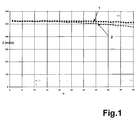
- the capacitance C is a function of the number of cycles n two cells produced according to the example are shown.
- the two cells 1.15 or 1.4 C constant current (corresponding to 600 mAh for curve 1 and 750 mAh for curve 2) are charged to 4.2 volts The voltage was then held for 3 hours and then constant at 1.15 or 1.4 C.
- Current 600 mAh for curve 1 and 750 mAh for curve 2 to 3.0 volts discharged. From the slight drop in the curves thus obtained, it can be seen that the cells produced in this way are highly reliable.
Landscapes
- Chemical & Material Sciences (AREA)
- Chemical Kinetics & Catalysis (AREA)
- Electrochemistry (AREA)
- General Chemical & Material Sciences (AREA)
- Engineering & Computer Science (AREA)
- Manufacturing & Machinery (AREA)
- Secondary Cells (AREA)
- Cell Separators (AREA)
- Battery Electrode And Active Subsutance (AREA)
Abstract
Description
Claims (10)
- Verfahren zur Herstellung eines Elektroden-/Separatorverbunds für galvanische Elemente, die mindestens eine Lithium interkalierende Elektrode, in deren Polymermatrix im Polymer unlösliche elektrochemisch aktive Materialien fein dispergiert sind, und einen Polyolefinseparator enthalten, dadurch gekennzeichnet, dass die Herstellung des Elektroden-/Separatorverbunds durch Heißlamination bei Temperaturen erfolgt, die im Bereich des Schmelz- bzw. Erweichungspunktes wenigstens eines Teils der Elektrodenoberfläche und/oder eines Teils der Separatoroberfläche liegt.
- Verfahren nach Anspruch 1, dadurch gekennzeichnet, dass der Separator mit einer die Haftung erhöhenden Teilbeschichtung seiner Oberfläche versehen ist.
- Verfahren nach Anspruch 2, dadurch gekennzeichnet, dass die Teilbeschichtung 1% - 60% der Separatoroberfläche, vorzugsweise 5% - 10% der Separatoroberfläche, bedeckt.
- Verfahren nach wenigstens einem der vorhergehenden Ansprüche, dadurch gekennzeichnet, dass Polyvinylidenfluorid und/oder Hexafluorproplyen als Elektrodenbinder und zusätzliche Teilbeschichtung der Separatoroberfläche verwendet wird.
- Verfahren nach wenigstens einem der vorhergehenden Ansprüche, dadurch gekennzeichnet, dass als Lösungsmittel für den Elektrodenbinder N-Methylpyrolidin-2-on, Aceton oder Wasser verwendet werden.
- Verfahren nach wenigstens einem der vorhergehenden Ansprüche, dadurch gekennzeichnet, dass die Elektroden und/oder die Separatorbeschichtung eine Plastifizierer enthalten.
- Verfahren nach wenigstens einem der vorhergehenden Ansprüche, dadurch gekennzeichnet, dass der Polyolefinseparator aus einer Sequenz verschiedener Polyolefine besteht, wobei vorzugsweise die Polyolefine unterschiedliche Porositäten besitzen.
- Verfahren nach wenigstens einem der vorhergehenden Ansprüche, dadurch gekennzeichnet, dass die Oberfläche des Separators einer Coronabehandlung unterworfen wird.
- Galvanisches Element mit mindestens einem Elektroden-/Separatorverbund, dadurch gekennzeichnet, dass der Elektroden-/Separatorverbund nach einem Verfahren gemäß einem der Ansprüche 1 bis 8 hergestellt ist.
- Galvanisches Element nach Anspruch 9, dadurch gekennzeichnet, dass der Elektroden-/Separatorverbund auf mindestens eine Ableitelektrode oder Elektrode auflaminiert ist und der Stapel mit einem flüssigen organischen Elektrolyten getränkt ist.
Applications Claiming Priority (2)
| Application Number | Priority Date | Filing Date | Title |
|---|---|---|---|
| DE10150227 | 2001-10-11 | ||
| DE10150227A DE10150227A1 (de) | 2001-10-11 | 2001-10-11 | Verfahren zur Herstellung eines Elektroden-/Separatorverbundes für galvanische Elemente |
Publications (2)
| Publication Number | Publication Date |
|---|---|
| EP1302993A2 true EP1302993A2 (de) | 2003-04-16 |
| EP1302993A3 EP1302993A3 (de) | 2005-03-02 |
Family
ID=7702197
Family Applications (1)
| Application Number | Title | Priority Date | Filing Date |
|---|---|---|---|
| EP02021947A Withdrawn EP1302993A3 (de) | 2001-10-11 | 2002-09-28 | Verfahren zur Herstellung eines Elektroden-/Separatorverbundes für galvanische Elemente |
Country Status (6)
| Country | Link |
|---|---|
| US (1) | US20030072999A1 (de) |
| EP (1) | EP1302993A3 (de) |
| JP (1) | JP2003163033A (de) |
| KR (1) | KR20030030960A (de) |
| CN (1) | CN1417873A (de) |
| DE (1) | DE10150227A1 (de) |
Families Citing this family (16)
| Publication number | Priority date | Publication date | Assignee | Title |
|---|---|---|---|---|
| JP2005158816A (ja) * | 2003-11-20 | 2005-06-16 | Tdk Corp | 電気化学デバイスの製造方法及び電気化学デバイス |
| US8784595B2 (en) * | 2004-07-26 | 2014-07-22 | Bathium Canana Inc. | Process for laminating components of an electrochemical cell |
| JP4581547B2 (ja) * | 2004-08-05 | 2010-11-17 | パナソニック株式会社 | 非水電解液二次電池 |
| JP4984448B2 (ja) * | 2005-07-12 | 2012-07-25 | 日産自動車株式会社 | 二次電池の製造方法 |
| CN102144058B (zh) | 2008-09-04 | 2012-07-11 | 大和纺控股株式会社 | 纤维集合物、导电性基材与纤维集合物的复合体以及它们的制造方法 |
| JP5381078B2 (ja) * | 2008-12-19 | 2014-01-08 | 日産自動車株式会社 | 電極およびその製造方法 |
| JP2012527738A (ja) | 2009-05-20 | 2012-11-08 | ポーラス パワー テクノロジーズ,エルエルシー | 微多孔膜の処理と接着剤 |
| KR101254693B1 (ko) * | 2011-02-15 | 2013-04-15 | 주식회사 엘지화학 | 세퍼레이터, 그 제조방법 및 이를 구비한 전기화학소자 |
| WO2014014118A1 (ja) | 2012-07-18 | 2014-01-23 | 住友化学株式会社 | 接着層、層及び組成物 |
| JP5964951B2 (ja) * | 2012-07-30 | 2016-08-03 | 帝人株式会社 | 非水電解質電池用セパレータおよび非水電解質電池 |
| EP2988356A1 (de) * | 2014-08-18 | 2016-02-24 | Manz AG | Verfahren und Vorrichtung zur Herstellung eines galvanischen Elements sowie galvanisches Element |
| JP6570926B2 (ja) * | 2015-09-03 | 2019-09-04 | 株式会社エンビジョンAescジャパン | リチウムイオン二次電池の製造方法 |
| HUE060491T2 (hu) * | 2017-05-17 | 2023-03-28 | Teijin Ltd | Elválasztó nem-vizes akkumulátorhoz, nem-vizes akkumulátor, és eljárás nem-vizes akkumulátor elõállítására |
| KR102293887B1 (ko) * | 2017-07-25 | 2021-08-25 | 주식회사 엘지에너지솔루션 | 불산을 저감하는 물질을 포함하는 전지 분리막 |
| DE102023110104A1 (de) | 2023-04-20 | 2024-10-24 | Audi Aktiengesellschaft | Verfahren zum Aufbringen eines thermischen Interfacematerials auf einem Bereich einer Batterieaufnahme sowie Batteriegehäuse zur Aufnahme eines Batteriemoduls |
| CN117185505B (zh) * | 2023-09-27 | 2026-04-28 | 昆山怡口净水系统有限公司 | 电化学水软化设备出水硬度的调节方法及其系统 |
Family Cites Families (6)
| Publication number | Priority date | Publication date | Assignee | Title |
|---|---|---|---|---|
| JP3397351B2 (ja) * | 1992-12-18 | 2003-04-14 | キヤノン株式会社 | 角型あるいはシート型電池及びその製造方法 |
| US5460904A (en) * | 1993-08-23 | 1995-10-24 | Bell Communications Research, Inc. | Electrolyte activatable lithium-ion rechargeable battery cell |
| US5720780A (en) * | 1996-11-04 | 1998-02-24 | Valence Technology, Inc. | Film forming method for lithium ion rechargeable batteries |
| US5778515A (en) * | 1997-04-11 | 1998-07-14 | Valence Technology, Inc. | Methods of fabricating electrochemical cells |
| JP2001520439A (ja) * | 1997-10-09 | 2001-10-30 | ビーエーエスエフ アクチェンゲゼルシャフト | 電気化学電池に適した複合材 |
| US6391069B1 (en) * | 2000-03-29 | 2002-05-21 | Valence Technology (Nevada), Inc. | Method of making bonded-electrode rechargeable electrochemical cells |
-
2001
- 2001-10-11 DE DE10150227A patent/DE10150227A1/de not_active Withdrawn
-
2002
- 2002-09-28 EP EP02021947A patent/EP1302993A3/de not_active Withdrawn
- 2002-10-08 JP JP2002294982A patent/JP2003163033A/ja active Pending
- 2002-10-10 US US10/268,454 patent/US20030072999A1/en not_active Abandoned
- 2002-10-11 KR KR1020020061959A patent/KR20030030960A/ko not_active Withdrawn
- 2002-10-11 CN CN02151410A patent/CN1417873A/zh active Pending
Also Published As
| Publication number | Publication date |
|---|---|
| KR20030030960A (ko) | 2003-04-18 |
| EP1302993A3 (de) | 2005-03-02 |
| JP2003163033A (ja) | 2003-06-06 |
| DE10150227A1 (de) | 2003-04-17 |
| CN1417873A (zh) | 2003-05-14 |
| US20030072999A1 (en) | 2003-04-17 |
Similar Documents
| Publication | Publication Date | Title |
|---|---|---|
| DE60103407T2 (de) | Elektrode aus teilchen und mit elektrolyt für eine wiederaufladbare lithium-ionen batterie | |
| DE69720386T2 (de) | Sekundär Lithium-Ion Batterien und Verfahren zur Herstellung | |
| DE69900347T2 (de) | Zusammengesetzte polymerelektrolytstruktur für eine wiederaufladbare lithiumbatterie | |
| DE102015112182B4 (de) | Feststoff-Lithium-Sekundärbatterie und Herstellungsverfahren dafür | |
| EP3208869B1 (de) | Wiederaufladbare elektrochemische zelle | |
| EP1359637B1 (de) | Verfahren zur Herstellung eines galvanischen Elements | |
| EP1302993A2 (de) | Verfahren zur Herstellung eines Elektroden-/Separatorverbundes für galvanische Elemente | |
| DE112014003358T5 (de) | Lithiumbasierte Batterieelektroden | |
| DE69631751T2 (de) | Elektrolytische zelle und elektrolytisches verfahren | |
| EP3586389B1 (de) | Wiederaufladbare batteriezelle mit einem separator | |
| DE69900713T2 (de) | Separatormaterial für Lithium-Akkumulatoren | |
| DE102013203485A1 (de) | Galvanisches Element mit verbesserten Sicherheitseigenschaften | |
| DE10104988A1 (de) | Verfahren zur Herstellung von Elektrodenfolien | |
| DE10151830B4 (de) | Verfahren zur Herstellung von Lithium-Sekundär-Batterien, vorzugsweise von Lithium-Polymer-Batterien, und Lithium-Polymer-Batterie | |
| DE102019211857B3 (de) | Lithium-sekundärbatterie, verwendung einer lithium-sekundärbatterie und verfahren zur herstellung einer lithium-sekundärbatterie | |
| DE602004002276T2 (de) | Sekundärzelle mit polymerbeschichter anode | |
| DE10159230A1 (de) | Verfahren zur Herstellung von galvanischen Elementen mit einem flüssigen organischen Elektrolyten | |
| DE102004053479A1 (de) | Hochleistungsbatterien mit Titanaten als negativem und Eisenphosphat als positivem Elektrodenmaterial und Verfahren zur Herstellung der Hochleistungsbatterien | |
| DE10251241B4 (de) | Verfahren zur Herstellung von Lithium-Polymer-Batterien | |
| EP1235286A2 (de) | Galvanisches Element mit mindestens einer lithiuminterkalierenden Elektrode | |
| DE102023127458B3 (de) | Freistehender Elektrodenfilm für eine elektrochemische Zelle und Verfahren zum Herstellen dafür | |
| EP1261046B1 (de) | Verfahren zur Herstellung eines Separator/ Elektrodenverbundes für galvanische Elemente | |
| DE3816199A1 (de) | Elektrische zelle und verfahren zu ihrer herstellung | |
| DE112019001780B4 (de) | Alkalischer Akkumulator und Verfahren zur Herstellung desselben | |
| DE10251194B4 (de) | Verfahren zur Herstellung eines Lithium-Polymer-Batterievorläufers und Verwendung des Verfahrens |
Legal Events
| Date | Code | Title | Description |
|---|---|---|---|
| PUAI | Public reference made under article 153(3) epc to a published international application that has entered the european phase |
Free format text: ORIGINAL CODE: 0009012 |
|
| AK | Designated contracting states |
Designated state(s): AT BE BG CH CY CZ DE DK EE ES FI FR GB GR IE IT LI LU MC NL PT SE SK TR |
|
| AX | Request for extension of the european patent |
Extension state: AL LT LV MK RO SI |
|
| PUAL | Search report despatched |
Free format text: ORIGINAL CODE: 0009013 |
|
| AK | Designated contracting states |
Kind code of ref document: A3 Designated state(s): AT BE BG CH CY CZ DE DK EE ES FI FR GB GR IE IT LI LU MC NL PT SE SK TR |
|
| AX | Request for extension of the european patent |
Extension state: AL LT LV MK RO SI |
|
| AKX | Designation fees paid | ||
| REG | Reference to a national code |
Ref country code: DE Ref legal event code: 8566 |
|
| 18D | Application deemed to be withdrawn |
Effective date: 20030524 |
|
| STAA | Information on the status of an ep patent application or granted ep patent |
Free format text: STATUS: THE APPLICATION IS DEEMED TO BE WITHDRAWN |
|
| R18D | Application deemed to be withdrawn (corrected) |
Effective date: 20050903 |