EP1291939A2 - Galvanisches Element mit Wickelelektrodensatz - Google Patents
Galvanisches Element mit Wickelelektrodensatz Download PDFInfo
- Publication number
- EP1291939A2 EP1291939A2 EP02013778A EP02013778A EP1291939A2 EP 1291939 A2 EP1291939 A2 EP 1291939A2 EP 02013778 A EP02013778 A EP 02013778A EP 02013778 A EP02013778 A EP 02013778A EP 1291939 A2 EP1291939 A2 EP 1291939A2
- Authority
- EP
- European Patent Office
- Prior art keywords
- electrode
- shaped
- galvanic element
- element according
- current collector
- Prior art date
- Legal status (The legal status is an assumption and is not a legal conclusion. Google has not performed a legal analysis and makes no representation as to the accuracy of the status listed.)
- Granted
Links
Images


Classifications
-
- H—ELECTRICITY
- H01—ELECTRIC ELEMENTS
- H01M—PROCESSES OR MEANS, e.g. BATTERIES, FOR THE DIRECT CONVERSION OF CHEMICAL ENERGY INTO ELECTRICAL ENERGY
- H01M10/00—Secondary cells; Manufacture thereof
- H01M10/04—Construction or manufacture in general
- H01M10/0431—Cells with wound or folded electrodes
-
- H—ELECTRICITY
- H01—ELECTRIC ELEMENTS
- H01M—PROCESSES OR MEANS, e.g. BATTERIES, FOR THE DIRECT CONVERSION OF CHEMICAL ENERGY INTO ELECTRICAL ENERGY
- H01M50/00—Constructional details or processes of manufacture of the non-active parts of electrochemical cells other than fuel cells, e.g. hybrid cells
- H01M50/50—Current conducting connections for cells or batteries
- H01M50/531—Electrode connections inside a battery casing
- H01M50/533—Electrode connections inside a battery casing characterised by the shape of the leads or tabs
-
- H—ELECTRICITY
- H01—ELECTRIC ELEMENTS
- H01M—PROCESSES OR MEANS, e.g. BATTERIES, FOR THE DIRECT CONVERSION OF CHEMICAL ENERGY INTO ELECTRICAL ENERGY
- H01M50/00—Constructional details or processes of manufacture of the non-active parts of electrochemical cells other than fuel cells, e.g. hybrid cells
- H01M50/50—Current conducting connections for cells or batteries
- H01M50/531—Electrode connections inside a battery casing
- H01M50/538—Connection of several leads or tabs of wound or folded electrode stacks
-
- H—ELECTRICITY
- H01—ELECTRIC ELEMENTS
- H01M—PROCESSES OR MEANS, e.g. BATTERIES, FOR THE DIRECT CONVERSION OF CHEMICAL ENERGY INTO ELECTRICAL ENERGY
- H01M6/00—Primary cells; Manufacture thereof
- H01M6/04—Cells with aqueous electrolyte
- H01M6/06—Dry cells, i.e. cells wherein the electrolyte is rendered non-fluid
- H01M6/10—Dry cells, i.e. cells wherein the electrolyte is rendered non-fluid with wound or folded electrodes
-
- Y—GENERAL TAGGING OF NEW TECHNOLOGICAL DEVELOPMENTS; GENERAL TAGGING OF CROSS-SECTIONAL TECHNOLOGIES SPANNING OVER SEVERAL SECTIONS OF THE IPC; TECHNICAL SUBJECTS COVERED BY FORMER USPC CROSS-REFERENCE ART COLLECTIONS [XRACs] AND DIGESTS
- Y02—TECHNOLOGIES OR APPLICATIONS FOR MITIGATION OR ADAPTATION AGAINST CLIMATE CHANGE
- Y02E—REDUCTION OF GREENHOUSE GAS [GHG] EMISSIONS, RELATED TO ENERGY GENERATION, TRANSMISSION OR DISTRIBUTION
- Y02E60/00—Enabling technologies; Technologies with a potential or indirect contribution to GHG emissions mitigation
- Y02E60/10—Energy storage using batteries
-
- Y—GENERAL TAGGING OF NEW TECHNOLOGICAL DEVELOPMENTS; GENERAL TAGGING OF CROSS-SECTIONAL TECHNOLOGIES SPANNING OVER SEVERAL SECTIONS OF THE IPC; TECHNICAL SUBJECTS COVERED BY FORMER USPC CROSS-REFERENCE ART COLLECTIONS [XRACs] AND DIGESTS
- Y02—TECHNOLOGIES OR APPLICATIONS FOR MITIGATION OR ADAPTATION AGAINST CLIMATE CHANGE
- Y02P—CLIMATE CHANGE MITIGATION TECHNOLOGIES IN THE PRODUCTION OR PROCESSING OF GOODS
- Y02P70/00—Climate change mitigation technologies in the production process for final industrial or consumer products
- Y02P70/50—Manufacturing or production processes characterised by the final manufactured product
Definitions
- the invention relates to a galvanic element with a winding electrode set consisting of a ribbon-shaped positive electrode, a ribbon-shaped negative electrode and one intermediate band-shaped separator, which are rolled up in a spiral, in which the Edge of at least one winding electrode with at least one current collector for electrical and mechanical connection of the electrode with a pole, mechanically and is electrically connected.
- the invention is particularly useful for lithium, nickel-metal hydride, Nickel-cadmium and other galvanic elements in the form of round cells Winding electrode set applicable.
- Another current collector with radial breakthroughs according to the document DE 30 19 186 C2 has a bevelled and angled contact tab on its long sides, which is bent back against the current collector and, after being connected to the current-conducting inside of the cell lid firmly connected and the lid closed was resiliently supported against the collector plate with the molded webs.
- the embodiment according to document EP 0 413 867 B1 combines several current collectors each with a contact tab in a segmented or nested manner, which around an opening is grouped in the middle of the collector assembly.
- This construction has the disadvantage that it is difficult and expensive to assemble. In the version shown no more than two contact flags or contact flag stacks can be realized.
- the invention has for its object a galvanic element with a winding electrode set specify where the easy to assemble, inexpensive yet high Current-carrying connection elements ensure reliable contacting of the winding electrodes ensure with the poles of the galvanic element.
- the galvanic element according to the invention sets the electric current through the new one Current collectors with more than one contact lug offer the least possible resistance. These current collectors are much easier to assemble than known collector designs in galvanic elements for high current applications. Due to the space-saving Flat design of the current collectors results in a high degree of utilization of the capacity of the galvanic element.
- the invention is preferably applicable to lithium, nickel-metal hydride, Nickel-cadmium and other galvanic elements in the form of round cells wound electrodes.
- the particular advantage of the invention is that with the same component a high performance Current collector system with a low electrical resistance at the positive and the negative electrode of an electrode coil is realized. To do this are a or several current collectors with the positive and the negative edge at the end faces of the winding electrodes conductively connected.
- the contact lugs of the current collector of the one winding electrode are on the edge of the current collector bent inwards so that the contact lugs after installation of the galvanic Do not touch the housing cup.
- the end of each contact flag is preferably bent outwards in a Z-shape and, for example by welding or Pressing, mechanically and electrically connected to the electrically conductive cover.
- the contact lugs of the current collector of the other electrode, which are in the housing cup should be introduced, are bent so that they are on the outer surface of the electrode coil issue. After insertion, the contact tabs lie largely on the inner surface of the housing cup and thus ensure optimal power transmission from the winding electrode to the housing cup.
- the current collectors are structurally shaped are and thus have knobs, tips or burrs on their surface.
- An improvement in the connection between the current collector and the edges of the Winding electrodes can also be achieved in that the current collector runs radially Beads are embossed. Another way of improving this It is in contact to provide the current collector with openings.
- Figures 1a-f show the preassembly of a current collector on the cover.
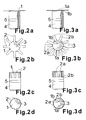
- FIGS. 2a-d show the preassembly of the current collector on the housing cup side a collector disc.
- FIGS. 3a-d show the pre-assembly of the current collector on the housing cup side two collector discs twisted against each other.
- FIG. 4 shows the insertion of the one equipped with the current collectors according to the invention and the cell cover connected electrode coil in the housing cup.
- Figure 5 shows an assembly sketch of a finished, with current collectors according to the invention equipped galvanic element.
- Figure 1a is a collector disc 1, for example by welding or Pressing, mechanically and electrically conductive with the edge of an electrode with one Bandage 5 connected winding electrode set 4 connected.
- Figure 1b shows one Top view of the arrangement shown in Figure 1a, in which those shown as examples Structural embossments 3 of the current collector can be seen.
- the contact lugs 2 are Z-shaped in the manner shown in detail in FIG. 1f bent inwards and then outwards.
- Figure 1e are the ends of the contact tabs mechanically and electrically conductive, preferably by welding or pressing connected to the cell cover 6, which on the circumferential edge with an electrically insulating Seal 10 is provided.
- Figure 2a is a collector disc 1 with the edge of the other electrode Electrode coil 4 electrically connected and mechanically connected.
- Figure 2b shows a top view to the arrangement shown in FIG. 2a, in which the examples present Structural embossments 3 of the current collector can be seen.
- Figure 2c and the top view Figure 2d are the contact lugs 2 in the direction of the outer surface of the winding electrode set 4 bent.
- FIG. 3a two are alternatively, preferably by one contact lug division twisted, superimposed contact disks 1a, 1b with the edge of the other Electrode of the electrode set 4 electrically connected and mechanically connected so as to to further reduce electrical resistance.
- Figure 3b shows a plan view of the in FIG. 3a shows the arrangement in which the structural embossments 3 present as an example of the current collector can be seen.
- 3c and the top view according to FIG. 3d the contact tabs 2a, 2b are bent in the direction of the outer surface of the winding electrode set.
- Figure 5 shows the fully assembled galvanic element, in which the housing cup through Beading the rim of the cup is closed with an electric valve plug conductive cap 11 is provided. Inside the electrically conductive cup-shaped housing 7, the winding electrode set 4 with bandage 5 can be seen. The electrically conductive Cover (6) is sealed against the housing with an electrically insulating seal (10).
- One or more current collectors 1, 1a, 1b with several radially distributed thereon Contact lugs 2, 2a, 2b form the connecting elements, which are the spatial distance between the poles of the galvanic element by the cover 6 and the housing 7 are formed, and conductively bridge the edge of the winding electrode set 4.
Landscapes
- Chemical & Material Sciences (AREA)
- Chemical Kinetics & Catalysis (AREA)
- Electrochemistry (AREA)
- General Chemical & Material Sciences (AREA)
- Engineering & Computer Science (AREA)
- Manufacturing & Machinery (AREA)
- Connection Of Batteries Or Terminals (AREA)
- Secondary Cells (AREA)
- Primary Cells (AREA)
- Coils Or Transformers For Communication (AREA)
Abstract
Description
Claims (9)
- Galvanisches Element mit Wickelelektrodensatz, bestehend aus einer bandförmigen positiven Elektrode, einer bandförmigen negativen Elektrode und einem zwischenliegenden bandförmigen Separator, die spiralförmig aufgerollt sind, bei dem der Rand mindestens einer Wickelelektrode mit zumindest einem Stromkollektor, der zur elektrischen und mechanischen Verbindung der Elektrode mit einem Pol dient, mechanisch und elektrisch leitend verbunden ist, dadurch gekennzeichnet, dass der scheibenförmige Stromkollektor (1) mit mehr als einer Kontaktfahne (2) versehen ist.
- Galvanisches Element nach Anspruch 1, dadurch gekennzeichnet, dass die Kontaktfahnen (2) am deckelseitigen Stromkollektor (1) im spitzen Winkel Z-förmig nach innen und nach außen gebogen und mit dem Zellendeckel (6) verbunden sind.
- Galvanisches Element nach Anspruch 1, dadurch gekennzeichnet, dass an der deckelseitigen Elektrode zwei oder mehrere scheibenförmige Kollektoren (1) übereinander befestigt sind und mit dem Zellendecke (6) elektrisch leitend und mechanisch verbunden sind.
- Galvanisches Element nach Anspruch 1, dadurch gekennzeichnet, dass an der gehäusebecherseitigen Elektrode ein oder mehrere übereinanderliegende scheibenförmige Stromkollektoren (1, 1a, 1b) befestigt sind und die Kontaktfahnen (2, 2a, 2b) so gebogen sind, dass sie an Innenflächen des Gehäusebechers (7) anliegen.
- Galvanisches Element nach Anspruch 1und 4, dadurch gekennzeichnet, dass an der gehäusebecherseitigen Elektrode übereinanderliegend befestigte scheibenförmige Stromkollektoren (1a, 1b) gegeneinander verdreht sind,
- Galvanisches Element nach Anspruch 1und 4, dadurch gekennzeichnet, dass die Kontaktfahnen (2a, 2b) der gehäusebecherseitigen Elektrode nach der Montage zwischen der äußeren Mantelfläche des Wickelelektrodensatzes (4) und der inneren Mantelfläche des Gehäusebechers (7) liegen.
- Galvanisches Element nach Anspruch 1, dadurch gekennzeichnet, dass die Stromkollektoren (1, 1a, 1b) strukturgeprägt sind und Noppen, Spitzen oder Grate (3) aufweisen.
- Galvanisches Element nach Anspruch 1, dadurch gekennzeichnet, dass die Stromkollektoren radial verlaufende Sicken aufweisen.
- Galvanisches Element nach Anspruch 1, dadurch gekennzeichnet, dass die Stromkollektoren mit Durchbrüchen versehen sind.
Applications Claiming Priority (2)
| Application Number | Priority Date | Filing Date | Title |
|---|---|---|---|
| DE10144281 | 2001-09-08 | ||
| DE10144281A DE10144281A1 (de) | 2001-09-08 | 2001-09-08 | Galvanisches Element mit Wickelektrodensatz |
Publications (3)
| Publication Number | Publication Date |
|---|---|
| EP1291939A2 true EP1291939A2 (de) | 2003-03-12 |
| EP1291939A3 EP1291939A3 (de) | 2005-06-22 |
| EP1291939B1 EP1291939B1 (de) | 2009-03-04 |
Family
ID=7698325
Family Applications (1)
| Application Number | Title | Priority Date | Filing Date |
|---|---|---|---|
| EP02013778A Expired - Lifetime EP1291939B1 (de) | 2001-09-08 | 2002-06-21 | Galvanisches Element mit Wickelelektrodensatz |
Country Status (6)
| Country | Link |
|---|---|
| US (1) | US7332246B2 (de) |
| EP (1) | EP1291939B1 (de) |
| JP (1) | JP4758593B2 (de) |
| CN (1) | CN1265487C (de) |
| AT (1) | ATE424626T1 (de) |
| DE (2) | DE10144281A1 (de) |
Cited By (2)
| Publication number | Priority date | Publication date | Assignee | Title |
|---|---|---|---|---|
| WO2007033645A1 (de) * | 2005-09-23 | 2007-03-29 | Varta Automotive Systems Gmbh | Akkumulator, akkumulatorblock und verfahren zur herstellung derselben |
| EP4160755A4 (de) * | 2021-05-21 | 2024-10-09 | Eve Power Co., Ltd. | Stromsammelplatte und batterie |
Families Citing this family (27)
| Publication number | Priority date | Publication date | Assignee | Title |
|---|---|---|---|---|
| US8734421B2 (en) | 2003-06-30 | 2014-05-27 | Johnson & Johnson Consumer Companies, Inc. | Methods of treating pores on the skin with electricity |
| JP5051410B2 (ja) * | 2005-05-30 | 2012-10-17 | 株式会社Gsユアサ | 密閉形電池用リード、そのリードを用いた密閉形電池及びその電池の製造方法 |
| JP5082256B2 (ja) * | 2006-02-23 | 2012-11-28 | パナソニック株式会社 | 密閉型蓄電池 |
| KR100879297B1 (ko) * | 2007-09-27 | 2009-01-19 | 삼성에스디아이 주식회사 | 이차 전지 |
| EP2659896A3 (de) * | 2007-09-28 | 2014-06-11 | Johnson & Johnson Consumer Companies Inc. | Stromerzeugende Teilchen und Verwendung davon |
| US20100082088A1 (en) * | 2008-08-27 | 2010-04-01 | Ali Fassih | Treatment of sweating and hyperhydrosis |
| US20120089232A1 (en) | 2009-03-27 | 2012-04-12 | Jennifer Hagyoung Kang Choi | Medical devices with galvanic particulates |
| KR101084947B1 (ko) * | 2009-06-15 | 2011-11-17 | 삼성에스디아이 주식회사 | 보호회로모듈을 구비하는 이차 전지 |
| KR20110091461A (ko) * | 2010-02-05 | 2011-08-11 | 존슨 앤드 존슨 컨수머 캄파니즈, 인코포레이티드 | 갈바니 미립자를 포함하는 립 조성물 |
| EP2542209A1 (de) * | 2010-03-01 | 2013-01-09 | Johnson & Johnson Consumer Companies, Inc. | Hautpflegezusammensetzung mit erwünschter farbe in loser form |
| US20110236491A1 (en) * | 2010-03-25 | 2011-09-29 | Jeannette Chantalat | Topical anti-inflammatory composition |
| DE102010023915A1 (de) * | 2010-06-16 | 2011-12-22 | Continental Automotive Gmbh | Energiespeicher und Kontaktelement für Energiespeicher |
| US8488301B2 (en) * | 2011-02-28 | 2013-07-16 | Corning Incorporated | Ultracapacitor package design having slideably engagable bent tabs |
| CN102299388B (zh) * | 2011-07-19 | 2013-07-24 | 泉州劲鑫电子有限公司 | 一种镍氢动力电池的生产工艺 |
| KR102177485B1 (ko) * | 2015-01-14 | 2020-11-11 | 엘에스엠트론 주식회사 | 내부 터미널의 결합 구조가 개선된 전기에너지 저장장치 |
| KR102535745B1 (ko) * | 2017-10-11 | 2023-05-23 | 삼성에스디아이 주식회사 | 이차 전지 |
| EP3605697B1 (de) * | 2018-07-31 | 2025-04-23 | VARTA Microbattery GmbH | Verfahren zur herstellung eines elektroden-separator-wickels, elektroden-separator-wickel und knopfzelle mit einem solchen wickel |
| CA3202317A1 (en) | 2021-01-19 | 2022-07-28 | Lg Energy Solution, Ltd. | Battery and current collector applied thereto, and battery pack and vehicle including the same |
| US12132227B2 (en) | 2021-01-19 | 2024-10-29 | Lg Energy Solution, Ltd. | Battery, and battery pack and vehicle comprising the same |
| JP7721647B2 (ja) * | 2021-02-19 | 2025-08-12 | エルジー エナジー ソリューション リミテッド | バッテリー、それを含むバッテリーパック及び自動車 |
| CN116349066A (zh) * | 2021-02-19 | 2023-06-27 | 株式会社Lg新能源 | 电池、以及电池组和包括该电池组的车辆 |
| US12407028B2 (en) | 2021-02-19 | 2025-09-02 | Lg Energy Solution, Ltd. | Electrode assembly, battery, and battery pack and vehicle including the same |
| CN219350421U (zh) * | 2021-10-22 | 2023-07-14 | 株式会社Lg新能源 | 圆筒形电池、应用于其的集电板、包括其的电池组及汽车 |
| CN116014310A (zh) * | 2021-10-22 | 2023-04-25 | 株式会社Lg新能源 | 圆筒形电池、包括该圆筒形电池的电池组及汽车 |
| CN114976494B (zh) * | 2022-06-14 | 2024-05-28 | 广州小鹏汽车科技有限公司 | 一种用于圆柱电池的集流盘 |
| SE546430C2 (en) * | 2022-09-16 | 2024-10-29 | Northvolt Ab | A method of manufacturing a secondary cell |
| WO2026023900A1 (ko) * | 2024-07-24 | 2026-01-29 | 주식회사 엘지에너지솔루션 | 배터리 셀 및 이를 포함하는 배터리 팩 및 자동차 |
Family Cites Families (12)
| Publication number | Priority date | Publication date | Assignee | Title |
|---|---|---|---|---|
| US3960603A (en) * | 1974-04-15 | 1976-06-01 | Sanyo Electric Co., Ltd. | Alkaline battery |
| US4322484A (en) * | 1978-09-05 | 1982-03-30 | General Electric Company | Spiral wound electrochemical cell having high capacity |
| DE3019186A1 (de) | 1980-05-20 | 1981-11-26 | Varta Batterie Ag, 3000 Hannover | Gasdicht verschlossener akkumulator |
| US4554227A (en) * | 1983-07-18 | 1985-11-19 | Japan Storage Battery Company Limited | Alkaline battery |
| US4529675A (en) * | 1984-11-21 | 1985-07-16 | General Electric Company | Rechargeable electrochemical cell having improved current collector means |
| FR2616970B1 (fr) * | 1987-06-18 | 1995-05-19 | Elf Aquitaine | Ensemble multi-couches pour la realisation de l'assemblage d'un generateur, procede d'elaboration de cet ensemble et de realisation du generateur complet, et generateur ainsi realise |
| US4879190A (en) | 1988-08-30 | 1989-11-07 | Mhb Joint Venture | Electrochemical cell |
| JP2762599B2 (ja) | 1989-08-23 | 1998-06-04 | 松下電器産業株式会社 | アルカリ蓄電池 |
| FR2752089B1 (fr) * | 1996-07-30 | 1998-09-04 | Accumulateurs Fixes | Generateur electrochimique cylindrique |
| JP3488064B2 (ja) * | 1997-12-05 | 2004-01-19 | 松下電器産業株式会社 | 円筒型蓄電池 |
| US6214490B1 (en) * | 1998-12-17 | 2001-04-10 | Eveready Battery Company, Inc. | Foam collector for electrochemical cells |
| CN1277330C (zh) * | 1999-08-10 | 2006-09-27 | 三洋电机株式会社 | 非水电解液二次蓄电池及其制造方法 |
-
2001
- 2001-09-08 DE DE10144281A patent/DE10144281A1/de not_active Withdrawn
-
2002
- 2002-06-21 DE DE50213328T patent/DE50213328D1/de not_active Expired - Lifetime
- 2002-06-21 AT AT02013778T patent/ATE424626T1/de not_active IP Right Cessation
- 2002-06-21 EP EP02013778A patent/EP1291939B1/de not_active Expired - Lifetime
- 2002-07-16 JP JP2002206948A patent/JP4758593B2/ja not_active Expired - Fee Related
- 2002-09-06 US US10/236,510 patent/US7332246B2/en not_active Expired - Fee Related
- 2002-09-06 CN CNB021318271A patent/CN1265487C/zh not_active Expired - Fee Related
Cited By (2)
| Publication number | Priority date | Publication date | Assignee | Title |
|---|---|---|---|---|
| WO2007033645A1 (de) * | 2005-09-23 | 2007-03-29 | Varta Automotive Systems Gmbh | Akkumulator, akkumulatorblock und verfahren zur herstellung derselben |
| EP4160755A4 (de) * | 2021-05-21 | 2024-10-09 | Eve Power Co., Ltd. | Stromsammelplatte und batterie |
Also Published As
| Publication number | Publication date |
|---|---|
| EP1291939A3 (de) | 2005-06-22 |
| US7332246B2 (en) | 2008-02-19 |
| JP4758593B2 (ja) | 2011-08-31 |
| CN1265487C (zh) | 2006-07-19 |
| US20030049536A1 (en) | 2003-03-13 |
| DE10144281A1 (de) | 2003-03-27 |
| ATE424626T1 (de) | 2009-03-15 |
| EP1291939B1 (de) | 2009-03-04 |
| DE50213328D1 (de) | 2009-04-16 |
| JP2003100279A (ja) | 2003-04-04 |
| CN1407642A (zh) | 2003-04-02 |
Similar Documents
| Publication | Publication Date | Title |
|---|---|---|
| EP1291939B1 (de) | Galvanisches Element mit Wickelelektrodensatz | |
| DE2127823C3 (de) | Galvanisches Element | |
| DE112021005111T5 (de) | Runde Lithiumbatterie und zugehöriges Herstellungsverfahren | |
| DE69701778T2 (de) | Zylindrischer elektrochemischer Generator mit spiralförmig gewickelten Elektroden | |
| DE69403930T2 (de) | Durchlochte Batterie | |
| DE202021004405U1 (de) | Eine zylindrische Batteriezelle, ein Batteriepack enthalted der zylindrischen Batteriezelle und ein Fahrzeug enthalted der zylindrischen Batteriezelle bzw. dem Batteriepack | |
| DE2324491C3 (de) | Festkörperbatterie | |
| DE202023102577U1 (de) | Zylindrische Batterie und Batteriegruppe | |
| EP2211398B1 (de) | Galvanisches Element für hohe Beanspruchungen | |
| EP3218966B1 (de) | Vorrichtung zur leistungskontaktierung | |
| DE212022000397U1 (de) | Oberdeckelanordnung und Batteriestruktur | |
| DE102022103728B3 (de) | Batteriezelle | |
| DE10046885B4 (de) | Sekundärbatterie mit einer Vielzahl von durch einen Sammelanschluß verbundenen Elektrodenanschlüssen und Herstellungsverfahren dafür | |
| DE112013004439T5 (de) | Elektrische Speichervorrichtung | |
| EP3017527A2 (de) | Elektronisch kommutierter motor | |
| DE2628080A1 (de) | Zylindrischer elektrochemischer generator | |
| EP4125149A1 (de) | Zellmodul mit einer mehrzahl von elektrochemischen pouch-zellen und fahrzeug | |
| DE112017000549T5 (de) | Energiespeichereinrichtung | |
| CH662008A5 (de) | Saeulenbatterie mit elliptischem querschnitt. | |
| EP1139464A2 (de) | Alkalischer Akkumulator | |
| DE202023003091U1 (de) | Batteriezelle, Batteriepack und Fahrzeug | |
| DE3000469C2 (de) | Zylindrisches elektrochemisches Element | |
| DE10159231A1 (de) | Galvanisches Element mit Wickelelektrodensatz | |
| WO2011012209A1 (de) | Einzelzelle für eine batterie | |
| DE3046009C2 (de) | Galvanisches Element mit einer Elektrodenanordnung |
Legal Events
| Date | Code | Title | Description |
|---|---|---|---|
| PUAI | Public reference made under article 153(3) epc to a published international application that has entered the european phase |
Free format text: ORIGINAL CODE: 0009012 |
|
| AK | Designated contracting states |
Kind code of ref document: A2 Designated state(s): AT BE CH CY DE DK ES FI FR GB GR IE IT LI LU MC NL PT SE TR |
|
| AX | Request for extension of the european patent |
Extension state: AL LT LV MK RO SI |
|
| RAP1 | Party data changed (applicant data changed or rights of an application transferred) |
Owner name: VARTA AUTOMOTIVE SYSTEMS GMBH |
|
| PUAL | Search report despatched |
Free format text: ORIGINAL CODE: 0009013 |
|
| AK | Designated contracting states |
Kind code of ref document: A3 Designated state(s): AT BE CH CY DE DK ES FI FR GB GR IE IT LI LU MC NL PT SE TR |
|
| AX | Request for extension of the european patent |
Extension state: AL LT LV MK RO SI |
|
| 17P | Request for examination filed |
Effective date: 20050809 |
|
| AKX | Designation fees paid |
Designated state(s): AT BE CH CY DE DK ES FI FR GB GR IE IT LI LU MC NL PT SE TR |
|
| GRAP | Despatch of communication of intention to grant a patent |
Free format text: ORIGINAL CODE: EPIDOSNIGR1 |
|
| RAP1 | Party data changed (applicant data changed or rights of an application transferred) |
Owner name: JOHNSON CONTROLS HYBRID AND RECYCLING GMBH |
|
| GRAS | Grant fee paid |
Free format text: ORIGINAL CODE: EPIDOSNIGR3 |
|
| GRAA | (expected) grant |
Free format text: ORIGINAL CODE: 0009210 |
|
| AK | Designated contracting states |
Kind code of ref document: B1 Designated state(s): AT BE CH CY DE DK ES FI FR GB GR IE IT LI LU MC NL PT SE TR |
|
| REG | Reference to a national code |
Ref country code: GB Ref legal event code: FG4D Free format text: NOT ENGLISH |
|
| REG | Reference to a national code |
Ref country code: CH Ref legal event code: EP |
|
| REG | Reference to a national code |
Ref country code: IE Ref legal event code: FG4D Free format text: LANGUAGE OF EP DOCUMENT: GERMAN |
|
| REF | Corresponds to: |
Ref document number: 50213328 Country of ref document: DE Date of ref document: 20090416 Kind code of ref document: P |
|
| PG25 | Lapsed in a contracting state [announced via postgrant information from national office to epo] |
Ref country code: NL Free format text: LAPSE BECAUSE OF FAILURE TO SUBMIT A TRANSLATION OF THE DESCRIPTION OR TO PAY THE FEE WITHIN THE PRESCRIBED TIME-LIMIT Effective date: 20090304 Ref country code: FI Free format text: LAPSE BECAUSE OF FAILURE TO SUBMIT A TRANSLATION OF THE DESCRIPTION OR TO PAY THE FEE WITHIN THE PRESCRIBED TIME-LIMIT Effective date: 20090304 |
|
| NLV1 | Nl: lapsed or annulled due to failure to fulfill the requirements of art. 29p and 29m of the patents act | ||
| PG25 | Lapsed in a contracting state [announced via postgrant information from national office to epo] |
Ref country code: SE Free format text: LAPSE BECAUSE OF FAILURE TO SUBMIT A TRANSLATION OF THE DESCRIPTION OR TO PAY THE FEE WITHIN THE PRESCRIBED TIME-LIMIT Effective date: 20090604 |
|
| REG | Reference to a national code |
Ref country code: IE Ref legal event code: FD4D |
|
| PG25 | Lapsed in a contracting state [announced via postgrant information from national office to epo] |
Ref country code: ES Free format text: LAPSE BECAUSE OF FAILURE TO SUBMIT A TRANSLATION OF THE DESCRIPTION OR TO PAY THE FEE WITHIN THE PRESCRIBED TIME-LIMIT Effective date: 20090615 Ref country code: PT Free format text: LAPSE BECAUSE OF FAILURE TO SUBMIT A TRANSLATION OF THE DESCRIPTION OR TO PAY THE FEE WITHIN THE PRESCRIBED TIME-LIMIT Effective date: 20090819 Ref country code: IE Free format text: LAPSE BECAUSE OF FAILURE TO SUBMIT A TRANSLATION OF THE DESCRIPTION OR TO PAY THE FEE WITHIN THE PRESCRIBED TIME-LIMIT Effective date: 20090304 |
|
| BERE | Be: lapsed |
Owner name: JOHNSON CONTROLS HYBRID AND RECYCLING G.M.B.H. Effective date: 20090630 |
|
| PLBE | No opposition filed within time limit |
Free format text: ORIGINAL CODE: 0009261 |
|
| STAA | Information on the status of an ep patent application or granted ep patent |
Free format text: STATUS: NO OPPOSITION FILED WITHIN TIME LIMIT |
|
| PG25 | Lapsed in a contracting state [announced via postgrant information from national office to epo] |
Ref country code: MC Free format text: LAPSE BECAUSE OF NON-PAYMENT OF DUE FEES Effective date: 20090630 Ref country code: DK Free format text: LAPSE BECAUSE OF FAILURE TO SUBMIT A TRANSLATION OF THE DESCRIPTION OR TO PAY THE FEE WITHIN THE PRESCRIBED TIME-LIMIT Effective date: 20090304 |
|
| REG | Reference to a national code |
Ref country code: CH Ref legal event code: PL |
|
| 26N | No opposition filed |
Effective date: 20091207 |
|
| GBPC | Gb: european patent ceased through non-payment of renewal fee |
Effective date: 20090621 |
|
| PG25 | Lapsed in a contracting state [announced via postgrant information from national office to epo] |
Ref country code: CH Free format text: LAPSE BECAUSE OF NON-PAYMENT OF DUE FEES Effective date: 20090630 Ref country code: LI Free format text: LAPSE BECAUSE OF NON-PAYMENT OF DUE FEES Effective date: 20090630 |
|
| PG25 | Lapsed in a contracting state [announced via postgrant information from national office to epo] |
Ref country code: GB Free format text: LAPSE BECAUSE OF NON-PAYMENT OF DUE FEES Effective date: 20090621 |
|
| PG25 | Lapsed in a contracting state [announced via postgrant information from national office to epo] |
Ref country code: BE Free format text: LAPSE BECAUSE OF NON-PAYMENT OF DUE FEES Effective date: 20090630 |
|
| PG25 | Lapsed in a contracting state [announced via postgrant information from national office to epo] |
Ref country code: AT Free format text: LAPSE BECAUSE OF NON-PAYMENT OF DUE FEES Effective date: 20090621 |
|
| PG25 | Lapsed in a contracting state [announced via postgrant information from national office to epo] |
Ref country code: GR Free format text: LAPSE BECAUSE OF FAILURE TO SUBMIT A TRANSLATION OF THE DESCRIPTION OR TO PAY THE FEE WITHIN THE PRESCRIBED TIME-LIMIT Effective date: 20090605 |
|
| PG25 | Lapsed in a contracting state [announced via postgrant information from national office to epo] |
Ref country code: IT Free format text: LAPSE BECAUSE OF FAILURE TO SUBMIT A TRANSLATION OF THE DESCRIPTION OR TO PAY THE FEE WITHIN THE PRESCRIBED TIME-LIMIT Effective date: 20090304 |
|
| PG25 | Lapsed in a contracting state [announced via postgrant information from national office to epo] |
Ref country code: LU Free format text: LAPSE BECAUSE OF NON-PAYMENT OF DUE FEES Effective date: 20090621 |
|
| PG25 | Lapsed in a contracting state [announced via postgrant information from national office to epo] |
Ref country code: TR Free format text: LAPSE BECAUSE OF FAILURE TO SUBMIT A TRANSLATION OF THE DESCRIPTION OR TO PAY THE FEE WITHIN THE PRESCRIBED TIME-LIMIT Effective date: 20090304 |
|
| PG25 | Lapsed in a contracting state [announced via postgrant information from national office to epo] |
Ref country code: CY Free format text: LAPSE BECAUSE OF FAILURE TO SUBMIT A TRANSLATION OF THE DESCRIPTION OR TO PAY THE FEE WITHIN THE PRESCRIBED TIME-LIMIT Effective date: 20090304 |
|
| PGFP | Annual fee paid to national office [announced via postgrant information from national office to epo] |
Ref country code: DE Payment date: 20120613 Year of fee payment: 11 |
|
| PGFP | Annual fee paid to national office [announced via postgrant information from national office to epo] |
Ref country code: FR Payment date: 20130624 Year of fee payment: 12 |
|
| REG | Reference to a national code |
Ref country code: DE Ref legal event code: R119 Ref document number: 50213328 Country of ref document: DE Effective date: 20140101 |
|
| PG25 | Lapsed in a contracting state [announced via postgrant information from national office to epo] |
Ref country code: DE Free format text: LAPSE BECAUSE OF NON-PAYMENT OF DUE FEES Effective date: 20140101 |
|
| REG | Reference to a national code |
Ref country code: FR Ref legal event code: ST Effective date: 20150227 |
|
| PG25 | Lapsed in a contracting state [announced via postgrant information from national office to epo] |
Ref country code: FR Free format text: LAPSE BECAUSE OF NON-PAYMENT OF DUE FEES Effective date: 20140630 |