EP1267338A2 - Optical recording medium, optical recording method and optical recording device - Google Patents
Optical recording medium, optical recording method and optical recording device Download PDFInfo
- Publication number
- EP1267338A2 EP1267338A2 EP02013100A EP02013100A EP1267338A2 EP 1267338 A2 EP1267338 A2 EP 1267338A2 EP 02013100 A EP02013100 A EP 02013100A EP 02013100 A EP02013100 A EP 02013100A EP 1267338 A2 EP1267338 A2 EP 1267338A2
- Authority
- EP
- European Patent Office
- Prior art keywords
- substituent
- group
- optical recording
- ring
- recording medium
- Prior art date
- Legal status (The legal status is an assumption and is not a legal conclusion. Google has not performed a legal analysis and makes no representation as to the accuracy of the status listed.)
- Granted
Links
Images


Classifications
-
- G—PHYSICS
- G11—INFORMATION STORAGE
- G11B—INFORMATION STORAGE BASED ON RELATIVE MOVEMENT BETWEEN RECORD CARRIER AND TRANSDUCER
- G11B7/00—Recording or reproducing by optical means, e.g. recording using a thermal beam of optical radiation by modifying optical properties or the physical structure, reproducing using an optical beam at lower power by sensing optical properties; Record carriers therefor
- G11B7/24—Record carriers characterised by shape, structure or physical properties, or by the selection of the material
- G11B7/241—Record carriers characterised by shape, structure or physical properties, or by the selection of the material characterised by the selection of the material
- G11B7/242—Record carriers characterised by shape, structure or physical properties, or by the selection of the material characterised by the selection of the material of recording layers
- G11B7/244—Record carriers characterised by shape, structure or physical properties, or by the selection of the material characterised by the selection of the material of recording layers comprising organic materials only
-
- G—PHYSICS
- G11—INFORMATION STORAGE
- G11B—INFORMATION STORAGE BASED ON RELATIVE MOVEMENT BETWEEN RECORD CARRIER AND TRANSDUCER
- G11B7/00—Recording or reproducing by optical means, e.g. recording using a thermal beam of optical radiation by modifying optical properties or the physical structure, reproducing using an optical beam at lower power by sensing optical properties; Record carriers therefor
- G11B7/24—Record carriers characterised by shape, structure or physical properties, or by the selection of the material
- G11B7/241—Record carriers characterised by shape, structure or physical properties, or by the selection of the material characterised by the selection of the material
- G11B7/242—Record carriers characterised by shape, structure or physical properties, or by the selection of the material characterised by the selection of the material of recording layers
- G11B7/244—Record carriers characterised by shape, structure or physical properties, or by the selection of the material characterised by the selection of the material of recording layers comprising organic materials only
- G11B7/246—Record carriers characterised by shape, structure or physical properties, or by the selection of the material characterised by the selection of the material of recording layers comprising organic materials only containing dyes
- G11B7/2467—Record carriers characterised by shape, structure or physical properties, or by the selection of the material characterised by the selection of the material of recording layers comprising organic materials only containing dyes azo-dyes
-
- G—PHYSICS
- G11—INFORMATION STORAGE
- G11B—INFORMATION STORAGE BASED ON RELATIVE MOVEMENT BETWEEN RECORD CARRIER AND TRANSDUCER
- G11B7/00—Recording or reproducing by optical means, e.g. recording using a thermal beam of optical radiation by modifying optical properties or the physical structure, reproducing using an optical beam at lower power by sensing optical properties; Record carriers therefor
- G11B7/24—Record carriers characterised by shape, structure or physical properties, or by the selection of the material
- G11B7/241—Record carriers characterised by shape, structure or physical properties, or by the selection of the material characterised by the selection of the material
- G11B7/242—Record carriers characterised by shape, structure or physical properties, or by the selection of the material characterised by the selection of the material of recording layers
- G11B7/244—Record carriers characterised by shape, structure or physical properties, or by the selection of the material characterised by the selection of the material of recording layers comprising organic materials only
- G11B7/249—Record carriers characterised by shape, structure or physical properties, or by the selection of the material characterised by the selection of the material of recording layers comprising organic materials only containing organometallic compounds
-
- G—PHYSICS
- G11—INFORMATION STORAGE
- G11B—INFORMATION STORAGE BASED ON RELATIVE MOVEMENT BETWEEN RECORD CARRIER AND TRANSDUCER
- G11B7/00—Recording or reproducing by optical means, e.g. recording using a thermal beam of optical radiation by modifying optical properties or the physical structure, reproducing using an optical beam at lower power by sensing optical properties; Record carriers therefor
- G11B7/24—Record carriers characterised by shape, structure or physical properties, or by the selection of the material
- G11B7/241—Record carriers characterised by shape, structure or physical properties, or by the selection of the material characterised by the selection of the material
- G11B7/242—Record carriers characterised by shape, structure or physical properties, or by the selection of the material characterised by the selection of the material of recording layers
- G11B7/243—Record carriers characterised by shape, structure or physical properties, or by the selection of the material characterised by the selection of the material of recording layers comprising inorganic materials only, e.g. ablative layers
- G11B2007/24302—Metals or metalloids
- G11B2007/24304—Metals or metalloids group 2 or 12 elements (e.g. Be, Ca, Mg, Zn, Cd)
-
- G—PHYSICS
- G11—INFORMATION STORAGE
- G11B—INFORMATION STORAGE BASED ON RELATIVE MOVEMENT BETWEEN RECORD CARRIER AND TRANSDUCER
- G11B7/00—Recording or reproducing by optical means, e.g. recording using a thermal beam of optical radiation by modifying optical properties or the physical structure, reproducing using an optical beam at lower power by sensing optical properties; Record carriers therefor
- G11B7/24—Record carriers characterised by shape, structure or physical properties, or by the selection of the material
- G11B7/241—Record carriers characterised by shape, structure or physical properties, or by the selection of the material characterised by the selection of the material
- G11B7/242—Record carriers characterised by shape, structure or physical properties, or by the selection of the material characterised by the selection of the material of recording layers
- G11B7/243—Record carriers characterised by shape, structure or physical properties, or by the selection of the material characterised by the selection of the material of recording layers comprising inorganic materials only, e.g. ablative layers
- G11B7/2433—Metals or elements of Groups 13, 14, 15 or 16 of the Periodic Table, e.g. B, Si, Ge, As, Sb, Bi, Se or Te
-
- G—PHYSICS
- G11—INFORMATION STORAGE
- G11B—INFORMATION STORAGE BASED ON RELATIVE MOVEMENT BETWEEN RECORD CARRIER AND TRANSDUCER
- G11B7/00—Recording or reproducing by optical means, e.g. recording using a thermal beam of optical radiation by modifying optical properties or the physical structure, reproducing using an optical beam at lower power by sensing optical properties; Record carriers therefor
- G11B7/24—Record carriers characterised by shape, structure or physical properties, or by the selection of the material
- G11B7/241—Record carriers characterised by shape, structure or physical properties, or by the selection of the material characterised by the selection of the material
- G11B7/242—Record carriers characterised by shape, structure or physical properties, or by the selection of the material characterised by the selection of the material of recording layers
- G11B7/244—Record carriers characterised by shape, structure or physical properties, or by the selection of the material characterised by the selection of the material of recording layers comprising organic materials only
- G11B7/246—Record carriers characterised by shape, structure or physical properties, or by the selection of the material characterised by the selection of the material of recording layers comprising organic materials only containing dyes
-
- G—PHYSICS
- G11—INFORMATION STORAGE
- G11B—INFORMATION STORAGE BASED ON RELATIVE MOVEMENT BETWEEN RECORD CARRIER AND TRANSDUCER
- G11B7/00—Recording or reproducing by optical means, e.g. recording using a thermal beam of optical radiation by modifying optical properties or the physical structure, reproducing using an optical beam at lower power by sensing optical properties; Record carriers therefor
- G11B7/24—Record carriers characterised by shape, structure or physical properties, or by the selection of the material
- G11B7/241—Record carriers characterised by shape, structure or physical properties, or by the selection of the material characterised by the selection of the material
- G11B7/252—Record carriers characterised by shape, structure or physical properties, or by the selection of the material characterised by the selection of the material of layers other than recording layers
-
- G—PHYSICS
- G11—INFORMATION STORAGE
- G11B—INFORMATION STORAGE BASED ON RELATIVE MOVEMENT BETWEEN RECORD CARRIER AND TRANSDUCER
- G11B7/00—Recording or reproducing by optical means, e.g. recording using a thermal beam of optical radiation by modifying optical properties or the physical structure, reproducing using an optical beam at lower power by sensing optical properties; Record carriers therefor
- G11B7/24—Record carriers characterised by shape, structure or physical properties, or by the selection of the material
- G11B7/241—Record carriers characterised by shape, structure or physical properties, or by the selection of the material characterised by the selection of the material
- G11B7/252—Record carriers characterised by shape, structure or physical properties, or by the selection of the material characterised by the selection of the material of layers other than recording layers
- G11B7/253—Record carriers characterised by shape, structure or physical properties, or by the selection of the material characterised by the selection of the material of layers other than recording layers of substrates
- G11B7/2533—Record carriers characterised by shape, structure or physical properties, or by the selection of the material characterised by the selection of the material of layers other than recording layers of substrates comprising resins
- G11B7/2534—Record carriers characterised by shape, structure or physical properties, or by the selection of the material characterised by the selection of the material of layers other than recording layers of substrates comprising resins polycarbonates [PC]
-
- G—PHYSICS
- G11—INFORMATION STORAGE
- G11B—INFORMATION STORAGE BASED ON RELATIVE MOVEMENT BETWEEN RECORD CARRIER AND TRANSDUCER
- G11B7/00—Recording or reproducing by optical means, e.g. recording using a thermal beam of optical radiation by modifying optical properties or the physical structure, reproducing using an optical beam at lower power by sensing optical properties; Record carriers therefor
- G11B7/24—Record carriers characterised by shape, structure or physical properties, or by the selection of the material
- G11B7/241—Record carriers characterised by shape, structure or physical properties, or by the selection of the material characterised by the selection of the material
- G11B7/252—Record carriers characterised by shape, structure or physical properties, or by the selection of the material characterised by the selection of the material of layers other than recording layers
- G11B7/254—Record carriers characterised by shape, structure or physical properties, or by the selection of the material characterised by the selection of the material of layers other than recording layers of protective topcoat layers
- G11B7/2542—Record carriers characterised by shape, structure or physical properties, or by the selection of the material characterised by the selection of the material of layers other than recording layers of protective topcoat layers consisting essentially of organic resins
-
- G—PHYSICS
- G11—INFORMATION STORAGE
- G11B—INFORMATION STORAGE BASED ON RELATIVE MOVEMENT BETWEEN RECORD CARRIER AND TRANSDUCER
- G11B7/00—Recording or reproducing by optical means, e.g. recording using a thermal beam of optical radiation by modifying optical properties or the physical structure, reproducing using an optical beam at lower power by sensing optical properties; Record carriers therefor
- G11B7/24—Record carriers characterised by shape, structure or physical properties, or by the selection of the material
- G11B7/241—Record carriers characterised by shape, structure or physical properties, or by the selection of the material characterised by the selection of the material
- G11B7/252—Record carriers characterised by shape, structure or physical properties, or by the selection of the material characterised by the selection of the material of layers other than recording layers
- G11B7/258—Record carriers characterised by shape, structure or physical properties, or by the selection of the material characterised by the selection of the material of layers other than recording layers of reflective layers
- G11B7/2595—Record carriers characterised by shape, structure or physical properties, or by the selection of the material characterised by the selection of the material of layers other than recording layers of reflective layers based on gold
-
- Y—GENERAL TAGGING OF NEW TECHNOLOGICAL DEVELOPMENTS; GENERAL TAGGING OF CROSS-SECTIONAL TECHNOLOGIES SPANNING OVER SEVERAL SECTIONS OF THE IPC; TECHNICAL SUBJECTS COVERED BY FORMER USPC CROSS-REFERENCE ART COLLECTIONS [XRACs] AND DIGESTS
- Y10—TECHNICAL SUBJECTS COVERED BY FORMER USPC
- Y10T—TECHNICAL SUBJECTS COVERED BY FORMER US CLASSIFICATION
- Y10T428/00—Stock material or miscellaneous articles
- Y10T428/21—Circular sheet or circular blank
Definitions
- the present invention relates to an optical recording medium, an optical recording method, and an optical recording device, and particularly to an optical recording medium capable of recording information therein, reproducing the information thereof, and overwriting therein by exposing them to light beams, thereby causing a change in optical properties in the transmittance and reflectivity of the recording material constituting the media.
- DVD-R is under development as a next generation disc with a large capacity.
- image compression techniques such as MPEG 2
- technical development to shorten the wavelength of a semiconductor laser for the recording pit reading are necessary.
- An AlGaInP laser diode having a wavelength of 670 nm is the only red semiconductor laser available in the market for use in a bar code reader and a measuring instrument. With a trend toward high-density optical discs, the red semiconductor laser has been introduced into the optical storage market.
- laser diodes having wavelengths of 630 and 670 nm are employed now for a light source.
- driving systems for a read-only DVD-ROM are put on the market, with the light sources for the driving systems having a wavelength of about 650 nm.
- DVD-R media capable of recording information therein and reading the information therefrom at wavelengths of 630 to 690 nm.
- a squarylium compound can be given as one example of the materials used for a recording layer of an optical recording medium which carries out recording and reading by the light pickup using a laser having a wavelength of 630 to 690 nm.
- the squarylium compound however is not generally suited for use in an optical recording medium because of insufficient photo stability.
- An azo metal chelate compound can be given as one example of a dye having high light resistance. However, it involves the problem that the reflectivity is insufficient when it is used alone as a recording material.
- An object of the present invention is therefore to provide a recording material for an optical recording medium suited for a DVD-R system using a semiconductor laser having an oscillation wavelength in a short wavelength region compared with the above-described conventional system, an optical recording medium showing excellent light resistance and shelf life, in particular, when it contains a squarylium compound; an optical recording method and an optical recording device each using the above-described optical recording medium.
- an optical recording medium with high reliability, high reflectivity and low jitter can be provided by using a metal-chelated squarylium compound, thereby improving optical stability; by mixing therewith an azo metal chelate compound having high light resistance, thereby imparting the recording medium with higher light resistance and higher shelf life; and by using a metal-chelated squarylium compound, thereby improving the absorption coefficient of the recording medium, leading to the completion of the first and second optical recording media of the present invention.
- an optical recording medium suitable for use in a next-generation optical disc system with a large capacity using a semiconductor laser having an oscillation wavelength of 690 nm or less and at the same time having excellent light resistance and shelf life is available by using, as a main component of a recording layer, a mixture of a dye obtained by metal chelating a squarylium compound and a formazan metal chelate compound, leading to the completion of the third optical recording medium of the present invention.
- an optical recording medium suitable for use in a next-generation optical disc system with a large capacity using a semiconductor laser having an oscillation wavelength of 690 nm or less is available by using as the main component of a recording layer, a mixture of a squarylium compound and a formazan metal chelate compound, leading to the completion of the fourth optical recording medium of the present invention.
- the first recording medium of the present invention is described below in ⁇ A-1>.
- Preferred embodiments of the first optical recording medium will be described below in ⁇ A-2> to ⁇ A-12>.
- An optical recording medium comprising a substrate and at least a recording layer disposed on the substrate, the recording layer comprises: at least one squarylium metal chelate compound which comprises a squarylium compound and a metal; and at least one azo metal chelate compound which comprises another metal and an azo compound expressed by the following formula (A-I): where A and B each independently expresses a residue forming one of a) a heterocyclic ring which may comprise a substituent and b) aromatic ring which may comprise a substituent, by combination with corresponding carbon atoms respectively bonded to A or B, and X expresses an active-hydrogen-containing substituent group.
- optical recording medium according to ⁇ A-1>, wherein a contained amount of the squarylium metal chelate compound and the azo metal chelate compound are at a weight ratio ranging from 90:10 to 20:80.
- the optical recording medium according to ⁇ A-1> wherein the metal atom of the azo metal chelate compound is at least one metal atom selected from the group consisting of manganese, cobalt, nickel and copper.
- optical recording medium according to ⁇ A-1>, wherein the azo metal chelate compound is ionized and forms a salt with another compound ion.
- optical recording medium according to ⁇ A-4>, wherein the another compound ion has an amino group.
- R 1 and R 2 are substituent groups which may be the same or may be different, and each expresses a hydrogen atom, an alkyl group which may have a substituent, an aralkyl group which may have a substituent, an aryl group which may have a substituent, or a heterocyclic group which may have a substituent;
- M 1 expresses a metal atom having a coordination capacity;
- m1 stands for an integer of 2 or 3.
- optical recording medium of according to ⁇ A-6> wherein Z in the formula (A-II) is expressed by the following formula (A-II-II): where, R 3 and R 4 may be the same or may be different and each expresses an alkyl group which may have a substituent, or R 3 and R 4 may form an alicyclic hydrocarbon ring or a heterocyclic ring by combination with adjacent carbon atoms; R 5 expresses a hydrogen atom, an alkyl group which may have a substituent, an aralkyl group which may have a substituent, or an aryl group which may have a substituent; R 6 expresses a halogen atom, an alkyl group which may have a substituent, an aralkyl group which may have a substituent, an aryl group which may have a substituent, a nitro group, a cyano group, or an alkoxy group which may have a substituent, n stands for an integer of 0 to 4, with the
- a single layer of the recording layer has a refractive index (n) of 1.5 ⁇ n ⁇ 3.0 a refractive index (n) of a single layer of the recording layer is 1.5 ⁇ n ⁇ 3.0, and an extinction coefficient (k) is 0.02 ⁇ k ⁇ 0.3 against a light having a wavelength in the range of recording or reproducing wavelength ⁇ 5 nm.
- optical recording medium according to ⁇ A-1>, further comprising a reflective layer containing gold, silver, copper, aluminum or an alloy thereof
- optical recording medium wherein a track pitch on the substrate falls within a range of 0.7 to 0.8 ⁇ m, and a groove width at a half bandwidth falls within a range of 0.18 to 0.40 ⁇ m.
- optical recording medium according to ⁇ A-1>, wherein the optical recording medium can be recorded at a wavelength of 600 to 720 nm.
- optical information recording media capable of recording and reading by a laser light within a wavelength range of 600 nm to 720 nm, and having excellent light resistance and shelf life can be provided.
- the optical recording media obtained above are superior in light resistance to those using a squarylium metal chelate compound alone.
- optical recording media in addition to having the above-described advantages, capable of recording and reading at a stably high reflectivity and high degree of modulation can be provided.
- the second optical recording medium of the present invention is described below in ⁇ B-1>.
- the preferred embodiments of the second optical recording medium will be described below in ⁇ B-2> to ⁇ B-10>.
- An optical recording medium having a substrate and at least a recording layer disposed on the substrate, the recording layer comprising: at least one squarylium metal chelate compound which comprises a squarylium compound and a metal; and at least one azo metal chelate compound which comprises another metal and an azo compound expressed by the following formula (B-I): where A expresses a residue forming a heterocyclic ring which may have a substituent by combination with both the carbon atom and the nitrogen atom bonded to A, and B expresses a residue forming one of a) an aromatic ring which may have a substituent and b) a heterocyclic ring which may have a substituent, by combination with the two carbon atoms bonded to B, and X expresses an active-hydrogen-containing substituent group.
- optical recording medium according to ⁇ B-1>, wherein the squarylium metal chelate compound and the azo metal chelate compound are contained in the recording layer at a weight ratio of 90:10 to 20:80.
- the optical recording medium according to ⁇ B-1> wherein the metal atom of the azo metal chelate compound is at least one metal atom selected from the group consisting of manganese, cobalt, nickel and copper.
- R 1 and R 2 are substituent groups which may be the same or may be different, and each expresses a hydrogen atom, an alkyl group which may have a substituent, an aralkyl group which may have a substituent, an aryl group which may have a substituent or a heterocyclic group which may have a substituent;
- M 1 expresses a metal atom having a coordination capacity;
- m1 stands for an integer of 2 or 3.
- optical recording medium of ⁇ B-3> wherein Z in the formula (A-II) is expressed by the following formula (A-II-II): where, R 3 and R 4 may be the same or may be different and each expresses an alkyl group which may have a substituent, or R 3 and R 4 form an alicyclic hydrocarbon ring or a heterocyclic ring by combination with the adjacent carbon atoms; R 5 expresses a hydrogen atom, an alkyl group which may have a substituent, an aralkyl group which may have a substituent or an aryl group which may have a substituent; R 6 expresses a halogen atom, an alkyl group which may have a substituent, an aralkyl group which may have a substituent, an aryl group which may have a substituent, a nitro group, a cyano group, or an alkoxy group which may have a substituent, n stands for an integer of 0 to 4, with the proviso
- a refractive index (n) of a single layer of the recording layer is 1.5 ⁇ n ⁇ 3.0 and an extinction coefficient (k) is 0.02 ⁇ k ⁇ 0.3 against the light having a wavelength range of a recording or reproducing wavelength ⁇ 5 nm.
- optical recording medium of ⁇ B-1> further comprising a reflective layer containing gold, silver, copper, aluminum or an alloy thereof.
- optical recording medium wherein a track pitch on the substrate falls within a range of 0.7 to 0.8 ⁇ m, and groove width at a half bandwidth falls within a range of 0.18 to 0.40 ⁇ m.
- optical recording medium according to ⁇ B-1>, wherein the optical recording medium is recordable at a wavelength of 600 to 720 nm.
- optical information recording media capable of recording and reading by a laser light within a wavelength range of 600 nm to 720 nm, and having excellent light resistance and shelf life can be provided.
- the optical recording media obtained above are superior in light resistance to those using a squarylium metal chelate compound alone.
- optical recording media in addition to having the above-described advantages, capable of recording and reading at a stably high reflectivity and high degree of modulation can be provided.
- the third optical recording medium of the present invention is described below in ⁇ C-1>.
- the preferred embodiments of the second optical recording medium will be described below in ⁇ C-2> to ⁇ C-10>.
- An optical recording medium comprising a substrate and at least a recording layer disposed on the substrate, the recording layer comprises: at least one squarylium metal chelate compound which comprises a squarylium compound and a metal; and at least one formazan metal chelate compound which comprises another metal and at least one of a formazan compound expressed by one of the following formulae (C-I) and (C-II): where, Z expresses a residue forming a 5-membered or 6-membered nitrogen-containing heterocyclic ring which may have a substituent by combination with both the carbon atom and the nitrogen atom bonded to Z, and may be condensed with another aromatic ring; A expresses an alkyl group which may have a substituent, an aryl group which may have a substituent, an alkylcarbonyl group which may have a substituent, an arylcarbonyl group which may have a substituent, an alkenyl group which may have a substituent, a heterocyclic residue which may have
- optical recording medium according to ⁇ C-1>, wherein the squarylium metal chelate compound and the formazan metal chelate compound are contained in the recording layer at a weight ratio of 90:10 to 50:50.
- the optical recording medium according to ⁇ C-1> wherein the metal atom of the formazan metal chelate compound is at least one metal atom selected from the group consisting of vanadium, manganese, iron, cobalt, nickel, copper, zinc and palladium, and oxides or halides thereof.
- R 1 and R 2 are substituent groups which may be the same or may be different, and each expresses a hydrogen atom, an alkyl group which may have a substituent, an aralkyl group which may have a substituent, an aryl group which may have a substituent or a heterocyclic group which may have a substituent;
- M 1 expresses a metal atom having a coordination capacity;
- m1 stands for an integer of 2 or 3.
- optical recording medium wherein Z in the formula (A-II) is expressed by the following formula (A-II-II): where, R 3 and R 4 may be the same or may be different and each expresses an alkyl group which may have a substituent, or R 3 and R 4 form an alicyclic hydrocarbon ring or a heterocyclic ring by combination with the adjacent carbon atoms; R 5 expresses a hydrogen atom, an alkyl group which may have a substituent, an aralkyl group which may have a substituent, or an aryl group which may have a substituent; R 6 expresses a halogen atom, an alkyl group which may have a substituent, an aralkyl group which may have a substituent, an aryl group which may have a substituent, a nitro group, a cyano group, or an alkoxy group which may have a substituent, n stands for an integer of 0 to 4, with the pro
- a refractive index (n) of a single layer of the recording layer is 1.5 ⁇ n ⁇ 3.0 and an extinction coefficient (k) is 0.02 ⁇ k ⁇ 0.3 against the light having a wavelength range of a recording or reproducing wavelength ⁇ 5 nm.
- optical recording medium according to ⁇ C-1>, further comprising a reflective layer containing gold, silver, copper, aluminum, or an alloy thereof.
- optical recording medium wherein a track pitch on the substrate falls within a range of 0.7 to 0.8 ⁇ m, and groove width at a half bandwidth falls within a range of 0.18 to 0.40 ⁇ m.
- optical recording medium according to ⁇ C-1>, wherein the optical recording medium is recordable at a wavelength of 600 to 720 nm.
- optical information recording medium capable of recording and reading by a laser light within a wavelength range of 600 nm to 720 nm, and having excellent light resistance and shelf life can be provided.
- the optical recording media obtained above are superior in light resistance to those using a squarylium metal chelate compound alone.
- optical recording media in addition to having the above-described advantage, capable of recording and reading information at a stably high reflectivity and high degree of modulation can be provided.
- an optical recording medium in addition to having the above-described advantages, capable of stably recording and reading information can be provided.
- the fourth optical recording medium of the present invention is described below in ⁇ D-1>.
- the preferred embodiments of the fourth optical recording medium will be described below in ⁇ D-2> to ⁇ D-8>.
- An optical recording medium comprising a substrate and at least a recording layer disposed on the substrate, the recording layer comprises: at least one squarylium compound; and at least one formazan metal chelate compound which comprises a metal and at least one of a formazan compound expressed by one of the following formulae (D-I) and (D-II): where, Z expresses a residue forming a 5-membered or 6-membered nitrogen-containing heterocyclic ring which may have a substituent by combination with both the carbon atom and the nitrogen atom bonded to Z, and may be condensed with another aromatic ring; A expresses an alkyl group which may have a substituent, an aryl group which may have a substituent, an alkylcarbonyl group which may have a substituent, an arylcarbonyl group which may have a substituent, an alkenyl group which may have a substituent, a heterocyclic residue which may have a substituent, or an alkoxycarbonyl group which may have
- optical recording medium according to ⁇ D-1>, wherein the squarylium compound and the formazan metal chelate compound are contained in the recording layer at a weight ratio of 90:10 to 50:50.
- the optical recording medium according to ⁇ D-1> wherein the metal atom of the formazan metal chelate compound is at least one selected from the group consisting of vanadium, manganese, iron, cobalt, nickel, copper, zinc and palladium, and oxides or halides thereof.
- the optical recording medium according to ⁇ D-1> wherein the metal atom of the formazan metal chelate compound is at least one selected from the group consisting of vanadium, manganese, iron, cobalt, nickel, copper, zinc and palladium, and oxides or halides thereof.
- the squarylium compound is at least one of a compound expressed by one of the following formulae (D-III) and (D-VI): where, R 1 and R 2 may be the same or may be different, and each expresses a hydrogen atom, an alkyl group which may have a substituent, an aralkyl group which may have a substituent, an aryl group which may have a substituent, or a heterocyclic residue which may have a substituent, or R 1 and R 2 form a heterocyclic ring which may have a substituent by combination with the adjacent nitrogen atom; and R 3 is a compound expressed by one of the following formulae (D-IV) and (D-V): where, R 4 and R 5 may be the same or may be different and each independently expresses a hydrogen atom or an alkyl group which may have a substituent, or R 4 and R 5 form a heterocyclic ring which may have a substituent by combination with the adjacent
- a refractive index (n) of a single layer of the recording layer is 1.5 ⁇ n ⁇ 3.0 and an extinction coefficient (k) is 0.02 ⁇ k ⁇ 0.3 against the light having a wavelength range of a recording or reproducing wavelength ⁇ 5 nm.
- optical recording medium according to ⁇ D-1>, further comprising a reflective layer containing gold, silver, copper, or aluminum, or an alloy thereof.
- optical recording medium wherein a track pitch on the substrate falls within a range of 0.7 to 0.8 ⁇ m, and a groove width at a half bandwidth falls within a range of 0.18 to 0.40 ⁇ m.
- optical information recording media capable of recording and reading by a laser light within a wavelength range of 600 nm to 720 nm, and having excellent light resistance and shelf life can be provided.
- the optical recording media obtained above are superior in light resistance to those using a squarylium metal chelate compound alone.
- optical recording media in addition to having the above-described advantages, capable of recording and reading information at a stably high reflectivity and high degree of modulation can be provided.
- an optical recording medium in addition to having the above-described advantages, capable of stably recording and reading information can be provided.
- the optical recording method of the present invention comprises exposing the optical recording medium of the present invention to light beams of 600 to 720 nm, thereby recording information. Accordingly, a novel optical recording method permitting exhibition of the advantages of the above-described optical recording media can be provided.
- the optical recording device of the present invention comprises the optical recording medium of the present invention mounted on the substrate. Accordingly, a novel optical recording device permitting exhibition of the advantages of the above-described optical recording medium can be provided.
- the first optical recording medium of the present invention comprises a substrate and at least a recording layer disposed on the substrate, the recording layer comprising at least one squarylium metal chelate compound which comprises a squarylium compound and a metal and at least one azo metal chelate compound which comprises another metal and an azo compound expressed by the following formula (A-I): where A and B each independently expresses a residue forming one of a) a heterocyclic ring which may have a substituent and b) an aromatic ring which may have a substituent, by combination with corresponding carbon atoms bonded to A or B, and X represents an active-hydrogen-containing substituent group.
- R 1 and R 2 are substituent groups which may be the same or may be different, and each expresses a hydrogen atom, an alkyl group which may have a substituent, an aralkyl group which may have a substituent, an aryl group which may have a substituent or a heterocyclic group which may have a substituent;
- M 1 expresses a metal atom having a coordination capacity;
- m1 stands for an integer of 2 or 3.
- Z in the formula (A-II) is expressed by the following formula (A-II-II): where, R 3 and R 4 may be the same or may be different and each expresses an alkyl group which may have a substituent, or R 3 and R 4 may form an alicyclic hydrocarbon ring or heterocyclic ring by combination with the adjacent carbon atoms; R 5 expresses a hydrogen atom, an alkyl group which may have a substituent, an aralkyl group which may have a substituent or an aryl group which may have a substituent; R 6 expresses a halogen atom, an alkyl group which may have a substituent, an aralkyl group which may have a substituent, an aryl group which may have a substituent, nitro group, cyano group, or an alkoxy group which may have a substituent, n stands for an integer of 0 to 4, with the proviso that when n stands for 2 to 4, R 6 s may be the same
- the ion pair structure in Compound (A-I), that is, an ion which forms a pair to an azo metal chelate compound when it is a salt forming compound may be a hydrogen atom, an amino-containing compound or a counter ion of another dye such as cyanine or styryl dye.
- a counter ion if any, an amino-containing compound is particularly preferred from the viewpoint of solubility control, because in the case of another dye, cost matters and optical properties must be taken into consideration. Hydrogen atom and a counter ion of another dye are next preferred in that order.
- cyanine dyes and styryl dyes those having absorption in a short wavelength region than a recording or reproducing wavelength are generally preferred. Trimethinecyanine is more preferred as the cyanine dye, while an indolenine-containing dyes are preferred as the styryl dye.
- Amino-containing compounds such as alkylamine are, on the other hand, accompanied with such advantages that large degree of freedom in selection of the length of the alkyl carbon chain facilitates solubility control; and since the alkylamino group itself hardly exhibits absorption in a recording and reproducing wavelength, the optical properties of the recording layer can be controlled easily and the resulting optical recording medium is able to have improved reflectivity, degree of modulation and jitter.
- a and B in formula (A-I) include residues capable of forming a benzene ring, a naphthalene ring, a pyridine ring, and a quinoline ring. These aromatic rings or heterocyclic rings may have a substituent.
- substituents for the aromatic ring or heterocyclic ring include a hydrogen atom, halogen atoms, nitro group, cyano group, hydroxyl group, carboxyl group, amino group, carbamoyl group, alkyl group which may have a substituent, aryl group which may have a substituent, residues of a heterocyclic group which may have a substituent, alkoxy group which may have a substituent, aryloxy group which may have a substituent, alkylthio group which may have a substituent, arylthio group which may have a substituent, alkylamino group which may have a substituent, arylamino group which may have a substituent, alkoxycarbonyl group which may have a substituent, aryloxycarbonyl group which may have a substituent, alkylcarboxamide group which may have a substituent, arylcarboxamide group which may have a substituent, alkylcarbamoyl group
- alkyl group examples include groups having C 1-15 . Specific examples include straight chain alkyl group such as methyl, ethyl, n-propyl, n-butyl, n-pentyl, n-hexyl, n-heptyl, n-octyl, n-nonyl, and n-decyl; branched alkyl groups such as isobutyl, isoamyl, 2-methylbutyl, 2-methylpentyl, 3-methylpentyl, 4-methylpentyl, 2-ethylbutyl, 2-methylhexyl, 3-methylhexyl, 4-methylhexyl, 5-methylhexyl, 2-ethylpentyl, 3-ethylpentyl, 2-methylheptyl, 3-methylheptyl, 4-methylheptyl, 5-methylheptyl, 2-ethylhexyl, 3-ethylhexyl, isoprop
- the above-described straight or branched alkyl groups may have a substituent such as hydroxyl group, halogen atom, nitro group, carboxyl group, cyano group, aryl group optionally having a specific substituent (for example, halogen atom or nitro group), or a residue of a heterocyclic ring. Further, they may be substituted further with the above-described alkyl groups via an oxygen atom, sulfur atom, or nitrogen atom.
- Examples of the alkyl group substituted via an oxygen atom include methoxymethyl group, methoxyethyl group, ethoxymethyl group, ethoxyethyl group, butoxyethyl group, ethoxyethoxyethyl group, methoxypropyl group, and ethoxypropyl group.
- Examples of the alkyl group substituted via a sulfur atom include methylthioethyl group, ethylthioethyl group, and ethylthiopropyl group.
- Examples of the alkyl group substituted via a nitrogen atom include dimethylaminoethyl group, diethylaminoethyl group, and diethylaminopropyl group.
- Examples of the alkylene group include a hydrogen atom deleted alkyl group which is above-mentioned.
- aryl group examples include phenyl group, naphthyl group, anthryl group, fluorenyl group, phenalenyl group, phenanthranyl group, triphenylenyl group, and pyrenyl group.
- aryl groups may each be substituted by hydroxyl group, halogen atom, nitro group, carboxyl group, cyano group, aryl group which may have a specific substituent (for example, halogen atom or nitro group), or residue of a heterocyclic ring. Further, they may be substituted with the above-described alkyl group via an oxygen atom, sulfur atom or nitrogen atom.
- residue of the heterocyclic ring examples include furyl group, thienyl group, pyrrolyl group, benzofuranyl group, isobenzofuranyl group, benzothienyl group, indolinyl group, isoindolinyl group, carbazolyl group, pyridyl group, piperidyl group, quinolyl group, isoquinolyl group, oxazolyl group, isoxazolyl group, thiazolyl group, isothiazolyl group, imidazolyl group, pyrazolyl group, benzimidazolyl group, pyrazinyl group, pyrimidinyl group, pyridazinyl group, and quinoxalinyl group.
- these residues of the heterocyclic ring may have a substituent such as hydroxyl group, a halogen atom, nitro group, carboxyl group, cyano group, an aryl group which may have a specific substituent (for example, halogen atom or nitro group), or a residue of a heterocyclic ring. Further, they may be substituted with the above-described alkyl group via an oxygen atom, sulfur atom, or nitrogen atom.
- alkenyl group examples include groups having C 2-6 such as vinyl group, allyl, 1-propenyl group, methacryl group, crotyl group, 1-butenyl group, 3-butenyl group, 2-pentenyl group, 4-pentenyl group, 2-hexenyl group and 5-hexenyl group.
- the substituents for these alkenyl group are the same with aforementioned alkyl group.
- halogen atom examples include fluorine, chlorine, bromine, and iodine.
- alkoxy group which may have a substituent those having an alkyl group, which may have a substituent, directly bonded to an oxygen atom may be used.
- Specific examples of the alkyl group and substituent are similar to those described above.
- aryloxyl group which may have a substituent those having an aryl group, which may have a substituent, directly bonded to an oxygen atom may be used. Specific examples of the aryl group and substituent are similar to those described above.
- alkylthio group which may have a substituent those having an alkyl group, which may have a substituent, directly bonded to a sulfur atom may be used. Specific examples of the alkyl group and substituent are similar to those described above.
- arylthio group which may have a substituent those having an aryl group, which may have a substituent, directly bonded to a sulfur atom may be used. Specific examples of the aryl group and substituent are similar to those described above.
- alkylamino group which may have a substituent those having an alkyl group, which may have a substituent, directly bonded to a nitrogen atom may be used. Specific examples of the alkyl group and substituent are similar to those described above. In this case, alkyl groups may be bonded each other to form a ring such as piperidino group, morpholino group, pyrrolidinyl group, piperazinyl group, indolinyl group, or isoindolinyl group.
- arylamino group which may have a substituent those having an aryl group, which may have a substituent, directly bonded to a nitrogen atom may be used.
- Specific examples of the aryl group and substituent are similar to those described above.
- alkoxycarbonyl group which may have a substituent those having an alkyl group, which may have a substituent, directly bonded to an oxygen atom may be used.
- Specific examples of the alkyl group and substituent are similar to those described above.
- aryloxycarbonyl group which may have a substituent those having an aryl group, which may have a substituent, directly bonded to an oxygen atom may be used. Specific examples of the aryl group and substituent are similar to those described above.
- alkylcarboxamide group which may have a substituent
- those having an alkyl group, which may have a substituent, directly bonded to a carbon atom may be used.
- Specific examples of the alkyl group and substituent are similar to those described above.
- arylcarboxamide group which may have a substituent those having an aryl group, which may have a substituent, directly bonded to a carbon atom may be used. Specific examples of the aryl group and substituent are similar to those described above.
- alkylcarbamoyl group which may have a substituent those having an alkyl group, which may have a substituent, directly bonded to a nitrogen atom may be used. Specific examples of the alkyl group and substituent are similar to those described above. In this case, alkyl groups may be bonded to each other to form a ring such as piperidino group, morpholino group, pyrrolidinyl group, piperazinyl group, indolinyl group, or isoindolinyl group.
- arylcarbamoyl group which may have a substituent those having an aryl group, which may have a substituent, directly bonded to a nitrogen atom may be used. Specific examples of the aryl group and substituent are similar to those described above.
- alkylsulfamoyl group which may have a substituent those having an alkyl group, which may have a substituent, directly bonded to a nitrogen atom of the sulfamoyl group may be used.
- Specific examples of the aryl group and substituent are similar to those described above.
- active-hydrogen-containing substituent expressed by X include hydroxyl group, carboxyl group, amino group, alkylcarboxamide groups, arylcarboxamide groups, alkylsulfonamide groups, arylsulfonamide groups, carbamoyl group, alkylcarbamoyl groups, arylcarbamoyl groups, sulfo group, sulfino group, sulfeno group, and sulfamoyl group.
- alkylcarboxamide group arylcarboxamide group, alkylcarbamoyl group, and arylcarbamoyl group are similar to those described above.
- alkylsulfonamide group which may have a substituent
- those having an alkyl group, which may have a substituent, directly bonded to a sulfur atom may be used.
- Specific examples of the alkyl group and substituent are similar to those described above.
- arylsulfonamide group which may have a substituent those having an aryl group which may have a substituent directly bonded to the sulfur atom of the sulfonamide may be used.
- alkyl group and substituent are similar to those described above.
- metal atom for forming by combination with the compound (A-I), aluminum, titanium, vanadium, chromium, manganese, iron, cobalt, nickel, copper, zinc, zirconium, niobium, molybdenum, ruthenium, rhodium, and palladium may be employed.
- manganese, nickel, copper, aluminum and vanadium are preferred.
- an azo metal chelate compound containing a metal such as manganese, cobalt, nickel, or copper exhibits excellent optical properties as an optical recording material.
- the compound (A-I) of the present invention is a recording material markedly suited for providing an inexpensive optical recording medium having an excellent productivity, because the raw materials for use upon synthesis of the compound are cheap and the number of synthesizing steps is very small.
- Compound (A-II) is preferred. A description will next be made of Compound (A-II).
- examples of the alkyl group or the alkyl moiety of the alkoxy group include straight or branched C 1-6 alkyl groups and cyclic C 3-8 alkyl groups.
- Specific examples include methyl, ethyl, propyl, isopropyl, butyl, iso-butyl, sec-butyl, tert-butyl, pentyl, isopentyl, 1-methylbutyl, 2-methylbutyl, tert-pentyl, hexyl, cyclopropyl, cyclobutyl, cyclopentyl, cyclohexyl, cycloheptyl, and cyclooctyl.
- aralkyl group examples include C 7-15 aralkyl groups such as benzyl, phenethyl, phenylpropyl and naphthylmethyl.
- aryl group examples include phenyl, naphthyl, anthryl and azulenyl.
- halogen atom examples include chlorine, bromine, fluorine and iodine.
- the substituents for the aralkyl group, aryl group, alkoxy group, aromatic ring or heterocyclic group may be the same or may be different. Examples include C 1-5 substituents such as hydroxyl group, carboxyl group, halogen atoms, alkyl groups, alkoxy groups, nitro group, a trifluoromethyl group, and amino group which may have a substituent.
- the halogen atoms, alkyl groups and alkoxy groups are similar to those described above, respectively.
- the alkyl group may be substituted by 1 to 3 substituents which may be the same or may be different. Examples include hydroxyl group, carboxyl group, halogen atoms and alkoxy groups. The halogen atoms and alkoxy groups are similar to those described above, respectively.
- the amino group may be substituted by 1 to 2 alkyl groups which may be the same or may be different.
- the alkyl groups usable here are similar to those described above.
- Examples of the metal atom (M 1 ) having a coordination capacity include aluminum, zinc, copper, iron, nickel, chromium, cobalt, manganese, iridium, vanadium and titanium, of which aluminum, copper, nickel and cobalt are preferred, with aluminum being more preferred.
- a benzene ring may be mentioned as an example.
- Examples of the heterocyclic ring in the heterocyclic group which may have a substituent and is expressed by Y in the formula (A-II), or the heterocyclic ring in the formula (A-II-II) formed by R 3 and R 4 combined with an adjacent carbon atom include 5- or 6-membered monocyclic aromatic or aliphatic heterocyclic rings containing at least one atom selected from a nitrogen atom, an oxygen atom, and a sulfur atom; and 3- to 8-membered-ring-condensed, bicyclic or tricyclic, aromatic or aliphatic heterocyclic rings containing at least one atom selected from a nitrogen atom, an oxygen atom, and a sulfur atom.
- pyridine ring pyrazine ring, pyrimidine ring, pyridazine ring, quinoline ring, isoquinoline ring, phthalazine ring, quinazoline ring, quinoxalirie ring, naphthyridine ring, cinnoline ring, pyrrole ring, pyrazole ring, imidazole ring, triazole ring, tetrazole ring, thiophene ring, furan ring, thiazole ring, oxazole ring, indole ring, isoindole ring, indazole ring, benzimidazole ring, benzotriazole ring, benzothiazole ring, benzoxazole ring, purine ring, carbazole ring, pyrrolidine ring, piperidine ring, piperazine ring, morpholine ring, thiomorpholine ring, homopipe
- heterocyclic group expressed by Y in the formula (A-II) examples include indolin-2-ylidene, benz[e]indolin-2-ylidene, 2-benzothiazolinylidene, naphtho[2,1-d]thiazol-2(3H)-ylidene, naphtho[1,2-d]thiazol-2(1H)-ylidene, 1,4-dihydroquinolin-4-ylidene, 1,2-dihydroquinolin-2-ylidene, and 2-benzoselenazolinylidene.
- Examples of the alicyclic hydrocarbon ring formed by R 3 and R 4 combined with the adjacent carbon atom include C 3-8 rings which may be saturated or unsaturated, more specifically, cyclopropane ring, cyclobutane ring, cyclopentane ring, cyclohexane ring, cycloheptane ring, cyclooctane ring, cyclopentene ring, 1,3-cyclopentaadiene ring, cyclohexene ring, and cyclohexadiene ring.
- R 1 , R 2 , Z, M 1 and m1 have the same meanings as described above, Q expresses hydrogen, potassium or sodium, and Me expresses methyl.
- Compound (A-V) is available by reacting Compound (A-III) with 0.5 to 2 times the mole of Compound (A-IV), in the presence of a base if necessary, in a solvent at room temperature to 40°C for 30 minutes to 15 hours.
- the base examples include inorganic bases such as potassium carbonate, sodium carbonate and potassium hydroxide and organic bases such as triethylamine and sodium methoxide.
- inorganic bases such as potassium carbonate, sodium carbonate and potassium hydroxide
- organic bases such as triethylamine and sodium methoxide.
- solvent methanol, ethanol and dimethylformamide may be used.
- Compound (A-VI) is available by treating Compound (A-V) in an alkaline solvent or an acid solvent at room temperature to 40°C for 30 minutes to 15 hours.
- alkaline solvent usable here examples include aqueous solution of potassium carbonate, aqueous solution of sodium carbonate, and aqueous solution of potassium hydroxide, while those of the acid solvent include a 50% vol/vol dimethyl sulfoxide solution of hydrochloric acid and a 50% vol/vol dimethylformamide solution of hydrochloric acid.
- Compound (A-VII) is available by reacting Compound (A-VI) with 0.5 to 2 times the mole of Z-H in the presence of 0.5 to 2 times the mole of a base if necessary, in a solvent, at 80 to 120°C for 1 to 15 hours.
- Examples of the solvent include C 2-8 alcohol solvents such as ethanol, propanol, isopropanol, butanol and octanol and mixed solvents of any one of these alcohol solvents with benzene, toluene or xylene (containing at least 50 vol/vol% of the alcohol).
- Examples of the base include organic bases such as quinoline, triethylamine and pyridine and inorganic bases such as potassium carbonate, potassium bicarbonate and sodium bicarbonate.
- Compound (A-II) is available by reacting Compound (A-VII) with 0.5 to 2 times the mole of M 1 m1+ in the presence of 0.5 to 2 times the mole of acetic acid if necessary, in a solvent at room temperature to 120°C for 1 to 15 hours.
- Examples of the material for providing M 1 m1+ include aluminum trisacetylacetonate, aluminum trisethylacetoacetate, aluminum isopropoxide, aluminum sec-butoxide, aluminum ethoxide, aluminum chloride, copper chloride, copper acetate and nickel acetate.
- Example of the solvent include halogen solvents such as chloroform and dichloromethane, aromatic solvents such as toluene and xylene, ether solvents such as tetrahydrofuran and methyl-tert-butyl ether and ester solvents such as ethyl acetate.
- halogen solvents such as chloroform and dichloromethane
- aromatic solvents such as toluene and xylene
- ether solvents such as tetrahydrofuran and methyl-tert-butyl ether
- ester solvents such as ethyl acetate.
- the optical recording medium of the present invention is characterized in that it has, in its recording layer, at least one azo metal chelate compound (A-I) and at least one squarylium metal chelate compound. Incorporation of the azo metal chelate compound (A-I) in the squarylium metal chelate compound suppresses photo deterioration of the squarylium metal chelate compound, making it possible to obtain an optical recording medium excellent in light resistance.
- the weight ratio of the squarylium metal chelate compound to the azo metal chelate compound (A-I) preferably falls within a range of 90:10 to 20:80, with 80:20 to 30:70 being more preferred. At weight ratios within the above-described range, the resulting optical recording medium has desirable light resistance, reflectivity and degree of modulation.
- azo metal chelate compound (A-I) to be used in the first optical recording medium of the present invention are shown below in Tables 1 to 3.
- Me, Et 3 BU and t-Bu represent methyl, ethyl, n-butyl and tert-butyl.
- Tables 4 to 6 shown are specific examples of the squarylium metal chelate compound to be used in the first optical recording medium of the present invention.
- II-16 is a squarylium compound of Comparative Example.
- Me, Et, nPr, iPr, Bu, nBu and tBu represent methyl, ethyl, n-propyl, isopropyl, butyl, n-butyl, tert-butyl groups, respectively.
- the second optical recording medium of the present invention has a substrate and at least a recording layer disposed on the substrate, the recording layer comprises at least one squarylium metal chelate compound which comprises a squarylium compound and a metal and an azo metal chelate compound which comprises another metal and an azo compound expressed by the following formula (B-I): where A expresses a residue forming a heterocyclic ring which may have a substituent by combination with both the carbon atom and the nitrogen atom bonded to A, and B expresses a residue forming one of a) an aromatic ring which may have a substituent and b) a heterocyclic ring which may have a substituent, by combination with the two carbon atoms bonded to B, and X expresses an active-hydrogen-containing substituent group.
- a in the formula (B-I) include residues for forming a thiazole ring, benzothiazole ring, imidazole ring, benzimidazole ring, thiadiazole ring, oxazole ring, benzoxazole ring, triazole ring, pyrazole ring, oxadiazole ring, pyridine ring, pyridazine ring, pyrimidine ring, pyrazine ring, triazine ring and quinoline ring.
- These nitrogen-containing heterocyclic rings may have a substituent.
- substituent for these nitrogen-containing heterocyclic rings include a hydrogen atom, halogen atoms, nitro group, cyano group, hydroxyl group, carboxyl group, amino group, carbamoyl group, alkyl groups which may have a substituent, aryl groups which may have a substituent, residues of a heterocyclic group which may have a substituent, alkoxy groups which may have a substituent, aryloxy groups which may have a substituent, alkylthio groups which may have a substituent, arylthio groups which may have a substituent, alkylamino groups which may have a substituent, arylamino groups which may have a substituent, alkoxycarbonyl groups which may have a substituent, aryloxycarbonyl groups which may have a substituent, alkylcarboxamide groups which may have a substituent, arylcarboxamide groups which may have a substituent, alkylsulfonamide groups which may have a
- C 1-15 alkyl groups can be given as examples. Specific examples include straight chain alkyl groups such as methyl, ethyl, n-propyl, n-butyl, n-pentyl, n-hexyl, n-heptyl, n-octyl, n-nonyl, and n-decyl group; branched alkyl groups such as isobutyl, isoamyl, 2-methylbutyl, 2-methylpentyl, 3-methylpentyl, 4-methylpentyl, 2-ethylbutyl, 2-methylhexyl, 3-methylhexyl, 4-methylhexyl, 5-methylhexyl, 2-ethylpentyl, 3-ethylpentyl, 2-methylheptyl, 3-methylheptyl, 4-methylheptyl, 5-methylheptyl, 2-ethylhexyl, 3-ethylhexyl, 4-methylh
- These straight or branched alkyl groups may have a substituent such as hydroxyl group, a halogen atom, nitro group, carboxyl group, cyano group, an aryl group which may have a specific substituent (for example, a halogen atom or nitro group), or a residue of a heterocyclic ring. Further, they may be substituted by the above-described alkyl or aryl group via an oxygen atom, sulfur atom, or nitrogen atom.
- Examples of the alkyl group substituted via an oxygen atom include methoxymethyl group, methoxyethyl group, ethoxymethyl group, ethoxyethyl group, butoxyethyl group, ethoxyethoxyethyl group, methoxypropyl group, and ethoxypropyl group.
- Examples of the alkyl group substituted via a sulfur atom include methylthioethyl group, ethylthioethyl group, and ethylthiopropyl group.
- Examples of the alkyl group substituted via a nitrogen atom include dimethylaminoethyl group, diethylaminoethyl group, and diethylaminopropyl group.
- aryl group examples include phenyl group, naphthyl group, anthryl group, fluorenyl group, phenalenyl group, phenanthranyl group, triphenylenyl group, and pyrenyl group.
- These aryl groups may each be substituted by an alkyl group, hydroxyl group, a halogen atom, nitro group, carboxyl group, cyano group, an aryl group which may have a specific substituent (for example, a halogen atom or nitro group), or a residue of a heterocyclic ring. Further, they may be substituted by the above-described alkyl group via an oxygen atom, sulfur atom or nitrogen atom.
- residue of a heterocyclic ring examples include furyl group, thienyl group, pyrrolyl group, benzofuryl group, isobenzofuranyl group, benzothienyl group, indolinyl group, isoindolinyl group, carbazolyl group, pyridyl group, piperidyl group, quinolyl group, isoquinolyl group, oxazolyl group, isoxazolyl group, thiazolyl group, isothiazolyl group, imidazolyl group, pyrazolyl group, benzimidazolyl group, pyrazinyl group, pyrimidinyl group, pyridazinyl group, and quinoxalinyl group.
- These residues of the heterocyclic ring may be substituted by hydroxyl group, a halogen atom, nitro group, carboxyl group, cyano group, an aryl group which may have a specific substituent (for example, a halogen atom or nitro group), or a residue of a heterocyclic ring. Further, they may be substituted with the above-described alkyl group via an oxygen atom, sulfur atom, or nitrogen atom.
- halogen atom examples include fluorine, chlorine, bromine and iodine atoms.
- alkoxy group which may have a substituent those having an alkyl group, which may have a substituent, directly bonded to an oxygen atom may be used.
- Specific examples of the alkyl group and substituent are similar to those described above.
- aryloxyl group which may have a substituent those having an aryl group, which may have a substituent, directly bonded to an oxygen atom may be used. Specific examples of the aryl group and substituent are similar to those described above.
- alkylthio group which may have a substituent those having an alkyl group, which may have a substituent, directly bonded to a sulfur atom may be used. Specific examples of the alkyl group and substituent are similar to those described above.
- arylthio group which may have a substituent those having an aryl group, which may have a substituent, directly bonded to a sulfur atom may be used. Specific examples of the aryl group and substituent are similar to those described above.
- alkylamino group which may have a substituent those having an alkyl group, which may have a substituent, directly bonded to a nitrogen atom may be used. Specific examples of the alkyl group and substituent are similar to those described above. In this case, alkyl groups may be bonded each other to form a ring such as piperidino group, morpholino group, pyrrolidinyl group, piperazinyl group, indolinyl group, or isoindolinyl group.
- arylamino group which may have a substituent those having an aryl group, which may have a substituent, directly bonded to a nitrogen atom may be used. Specific examples of the aryl group and substituent are similar to those described above.
- alkoxycarbonyl group which may have a substituent those having an alkyl group, which may have a substituent, directly bonded to an oxygen atom may be used.
- Specific examples of the alkyl group and substituent are similar to those described above.
- aryloxycarbonyl group which may have a substituent those having an aryl group, which may have a substituent, directly bonded to an oxygen atom may be used. Specific examples of the aryl group and substituent are similar to those described above.
- alkylcarboxamide group which may have a substituent
- those having an alkyl group, which may have a substituent, directly bonded to a carbon atom may be used.
- Specific examples of the alkyl group and substituent are similar to those described above.
- arylcarboxamide group which may have a substituent those having an aryl group, which may have a substituent, directly bonded to a carbon atom may be used. Specific examples of the aryl group and substituent are similar to those described above.
- alkylsulfonamide group which may have a substituent
- those having an alkyl group, which may have a substituent, directly bonded to a carbon atom may be used.
- Specific examples of the alkyl group and substituent are similar to those described above.
- alkylcarbamoyl group which may have a substituent those having an alkyl group, which may have a substituent, directly bonded to a nitrogen atom may be used. Specific examples of the alkyl group and substituent are similar to those described above. In this case, alkyl groups may be bonded each other to form a ring such as piperidino group, morpholino group, pyrrolidinyl group, piperazinyl group, indolinyl group, or isoindolinyl group.
- arylcarbamoyl group which may have a substituent those having an aryl group, which may have a substituent, directly bonded to a nitrogen atom may be used. Specific examples of the aryl group and substituent are similar to those described above.
- alkylsulfamoyl group which may have a substituent those having an alkyl group, which may have a substituent, directly bonded to the nitrogen atom of the sulfamoyl group may be used.
- Specific examples of the aryl group and substituent are similar to those described above.
- alkenyl group examples include C 2-6 ones such as vinyl, allyl, 1-propenyl, methacryl, crotyl, 1-butenyl, 3-butenyl, 2-pentenyl, 4-pentenyl, 2-hexenyl and 5-hexenyl.
- substituent for these alkenyl groups those described as the substituents for the alkyl group may be used.
- B include residues for forming a benzene ring, naphthalene ring, pyridine ring or quinoline ring. These aromatic or heterocyclic rings may have a substituent. Specific examples of the substituent are similar to those described above as the substituents for A.
- active-hydrogen-containing substituent group expressed by X include hydroxyl group, carboxyl group, amino group, alkylcarboxamide groups, arylcarboxamide groups, alkylsulfonamide groups, arylsulfonamide groups, carbamoyl group, alkylcarbamoyl groups, arylcarbamoyl groups, sulfo group, sulfino group, sulfeno group, and sulfamoyl group, and the like.
- alkylcarboxamide groups arylcarboxamide groups, alkylcarbamoyl groups, and arylcarbamoyl groups are similar to those described above.
- alkylsulfonamide group which may have a substituent
- those having an alkyl group, which may have a substituent, directly bonded to a sulfur atom may be used.
- Specific examples of the alkyl group and substituent are similar to those described above.
- arylsulfonamide group which may have a substituent those having an aryl group, which may have a substituent, directly bonded to a sulfur atom may be used.
- alkyl group and substituent are similar to those described above.
- an azo metal chelate compound aluminum, titanium, vanadium, chromium, manganese, iron, cobalt, nickel, copper, zinc, zirconium, niobium, molybdenum, ruthenium, rhodium, and palladium can be employed.
- manganese, cobalt, nickel, copper, aluminum, and vanadium are preferred.
- Manganese, cobalt, nickel and copper are more preferred, because azo metal chelate compound (B-I) containing any one of them exhibits excellent optical properties as an optical recording material.
- the azo metal chelate compound (B-I) of the present invention is superior in optical properties to other azo metal chelate compounds and by mixing with a squarylium metal chelate compound, an optical recording medium having a high reflectivity can be provided.
- the above-described compound (A-II) is preferred.
- squarylium metal chelate compounds to be used for the second optical recording medium of the present invention are similar to those used for the first optical recording medium.
- the third optical recording medium of the present invention has a substrate and at least a recording layer disposed on the substrate, the recording layer comprising at least one squarylium metal chelate compound which comprises a squarylium compound and a metal, and at least one formazan metal chelate compound which comprises another metal and a formazan compound expressed by the following formula (C-I): where, Z expresses a residue forming a 5-membered or 6-membered nitrogen-containing heterocyclic ring which may have a substituent by combination with both the carbon atom and the nitrogen atom bonded to Z, and may be condensed with another aromatic ring; A expresses an alkyl group which may have a substituent, an aryl group which may have a substituent, an alkylcarbonyl group which may have a substituent, an arylcarbonyl group which may have a substituent, an alkenyl group which may have a substituent, the residue of a heterocyclic which may have a substituent, or an alk
- the present invention will hereinafter be described more specifically.
- the third optical recording medium of the present invention is characterized in the use of the above-described squarylium metal chelate compound and a formazan metal chelate compound in combination.
- the squarylium metal chelate compound and formazan metal chelate compound are added preferably at a weight ratio of 90:10 to 50:50. Weight ratios within the above-described range are preferred from the viewpoints of light resistance and reflectivity.
- Z, Z 1 and Z 2 include residues for forming thiazole ring, benzothiazole ring, imidazole ring, benzimidazole ring, thiadiazole ring, oxazole ring, benzoxazole ring, triazole ring, pyrazole ring, oxadiazole ring, pyridine ring, pyridazine ring, pyrimidine ring, pyrazine ring, triazine ring and quinoline ring.
- These nitrogen-containing heterocyclic rings may have a substituent or may be condensed with another aromatic ring.
- substituents include a hydrogen atom, halogen atoms, nitro group, cyano group, hydroxyl group, carboxyl group, amino group, carbamoyl group, alkyl groups which may have a substituent, aryl groups which may have a substituent, residues of a heterocyclic group which may have a substituent, alkoxy groups which may have a substituent, aryloxy groups which may have a substituent, alkylthio groups which may have a substituent, arylthio groups which may have a substituent, alkylamino groups which may have a substituent, arylamino groups which may have a substituent, alkoxycarbonyl groups which may have a substituent, aryloxycarbonyl groups which may have a substituent, alkylcarboxamide groups which may have a substituent, arylcarboxamide groups which may have a substituent, alkylsulfonamide groups which may have a substituent, alkylcarbam
- A, A 1 and A 2 include alkyl groups which may have a substituent, aryl groups which may have a substituent, alkylcarbonyl groups which may have a substituent, arylcarbonyl groups which may have a substituent and alkoxycarbonyl groups which may have a substituent.
- B examples include alkyl groups which may have a substituent, alkenyl groups which may have a substituent and aryl groups which may have a substituent.
- B 1 and B 2 include alkylene groups which may have a substituent and arylene groups which may have a substituent.
- alkyl group examples include C 1-15 alkyl groups. Specific examples include straight chain alkyl groups such as methyl, ethyl, n-propyl, n-butyl, n-pentyl, n-hexyl, n-heptyl, n-octyl, n-nonyl, and n-decyl; branched alkyl groups such as isobutyl, isoamyl, 2-methylbutyl, 2-methylpentyl, 3-methylpentyl, 4-methylpentyl, 2-ethylbutyl, 2-methylhexyl, 3-methylhexyl, 4-methylhexyl, 5-methylhexyl, 2-ethylpentyl, 3-ethylpentyl, 2-methylheptyl, 3-methylheptyl, 4-methylheptyl, 5-methylheptyl, 2-ethylhexyl, 3-ethylhexyl, iso
- alkylene groups those obtained by removing one hydrogen atom from the above-described alkyl groups can be mentioned as examples.
- alkyl groups may be substituted by hydroxyl group, a halogen atom, nitro group, carboxyl group, cyano group, an aryl group which may have a specific substituent (for example, a halogen atom or nitro group), or a residue of a heterocyclic ring. Further, they may be substituted by the above-described alkyl group via an oxygen atom, sulfur atom, or nitrogen atom.
- Examples of the alkyl group substituted via an oxygen atom include methoxymethyl group, methoxyethyl group, ethoxymethyl group, ethoxyethyl group, butoxyethyl group, ethoxyethoxyethyl group, methoxypropyl group, and ethoxypropyl group.
- Examples of the alkyl group substituted via a sulfur atom include methylthioethyl group, ethylthioethyl group, ethylthiopropyl and phenylthioethyl group.
- Examples of the alkyl group substituted via a nitrogen atom include dimethylaminoethyl group, diethylaminoethyl group, and diethylaminopropyl group.
- alkenyl group examples include C 2-6 alkenyl groups such as vinyl, allyl, 1-propenyl, methacryl, crotyl, 1-butenyl, 3-butenyl, 2-pentenyl, 4-pentenyl, 2-hexenyl and 5-hexenyl. Substituents for these alkenyl groups are similar to those for the above-described alkyl groups.
- aryl group examples include phenyl group, naphthyl group, anthryl group, fluorenyl group, phenalenyl group, phenanthranyl group, triphenylenyl group, and pyrenyl group.
- arylene group those obtained by removing one hydrogen atom from the above-described aryl groups can be mentioned as examples.
- aryl groups may be substituted by an alkyl group, hydroxyl group, a halogen atom, nitro group, carboxyl group, cyano group, trifluoromethyl group, an aryl group which may have a specific substituent (for example, a halogen atom or nitro group), or a residue of a heterocyclic ring. Further, they may be substituted by the above-described alkyl group via an oxygen atom, sulfur atom or nitrogen atom.
- residue of the heterocyclic ring examples include furyl group, thienyl group, pyrrolyl group, benzofuryl group, isobenzofuranyl group, benzothienyl group, indolinyl group, isoindolinyl group, carbazolyl group, pyridyl group, piperidyl group, quinolyl group, isoquinolyl group, oxazolyl group, isoxazolyl group, thiazolyl group, isothiazolyl group, imidazolyl group, pyrazolyl group, benzimidazolyl group, pyrazyl group, pyrimidinyl group, pyridazinyl group, and quinoxalinyl group.
- These residues of the heterocyclic ring may be substituted by hydroxyl group, a halogen atom, nitro group, carboxyl group, cyano group, an aryl group which may have a specific substituent (for example, a halogen atom or nitro group), or a residue of a heterocyclic ring. Further, they may be substituted with the above-described alkyl group via an oxygen atom, sulfur atom, or nitrogen atom.
- halogen atom examples include fluorine, chlorine, bromine and iodine.
- alkoxy group which may have a substituent those having an alkyl group, which may have a substituent, directly bonded to an oxygen atom may be used.
- Specific examples of the alkyl group and substituent are similar to those described above.
- aryloxyl group which may have a substituent those having an aryl group, which may have a substituent, directly bonded to an oxygen atom may be used. Specific examples of the aryl group and substituent are similar to those described above.
- alkylthio group which may have a substituent those having an alkyl group, which may have a substituent, directly bonded to a sulfur atom may be used. Specific examples of the alkyl group and substituent are similar to those described above.
- arylthio group which may have a substituent those having an aryl group, which may have a substituent, directly bonded to a sulfur atom may be used. Specific examples of the aryl group and substituent are similar to those described above.
- alkylamino group which may have a substituent those having an alkyl group, which may have a substituent, directly bonded to a nitrogen atom may be used. Specific examples of the alkyl group and substituent are similar to those described above. In this case, alkyl groups may be bonded each other to form a ring, while containing an oxygen atom or nitrogen atom. Examples of the ring include piperidino group, morpholino group, pyrrolidinyl group, piperazinyl group, indolinyl group, and isoindolinyl group.
- arylamino group which may have a substituent those having an aryl group, which may have a substituent, directly bonded to a nitrogen atom may be used. Specific examples of the aryl group and substituent are similar to those described above.
- alkylcarbonyl group which may have a substituent
- those having an alkyl group, which may have a substituent, directly bonded to the carbon atom of the carbonyl group may be used.
- Specific examples of the alkyl group and substituent are similar to those described above.
- arylcarbonyl group which may have a substituent those having an aryl group, which may have a substituent, directly bonded to the carbon atom of the carbonyl group may be used. Specific examples of the aryl group and substituent are similar to those described above.
- Specific examples of the alkyl group and substituent are similar to those described above.
- aryloxycarbonyl group which may have a substituent
- Specific examples of the aryl group and substituent are similar to those described above.
- alkylcarboxamide group which may have a substituent those having an alkyl group, which may have a substituent, directly bonded to the carbon atom of the carboxamide may be used.
- Specific examples of the alkyl group and substituent are similar to those described above.
- arylcarboxamide group which may have a substituent those having an aryl group, which may have a substituent, directly bonded to the carbon atom of the carboxamide may be used.
- Specific examples of the aryl group and substituent are similar to those described above.
- alkylcarbamoyl group which may have a substituent those having an alkyl group, which may have a substituent, directly bonded to the nitrogen atom of the carbamoyl group may be used.
- alkyl group and substituent are similar to those described above.
- alkyl groups may be bonded each other to form a ring, while containing an oxygen atom or a nitrogen atom.
- the ring include piperidino group, morpholino group, pyrrolidinyl group, piperazinyl group, indolinyl group, and isoindolinyl group.
- arylcarbamoyl group which may have a substituent those having an aryl group, which may have a substituent, directly bonded to the nitrogen atom of the carbamoyl group may be used.
- Specific examples of the aryl group and substituent are similar to those described above.
- alkylsulfamoyl group which may have a substituent those having an alkyl group, which may have a substituent, directly bonded to the nitrogen atom of the sulfamoyl group may be used.
- Specific examples of the aryl group and substituent are similar to those described above.
- the metal atom constituting the formazan metal chelate compound include titanium, vanadium, chromium, manganese, iron, cobalt, nickel, copper, zinc, zirconium, niobium, molybdenum, technetium, ruthenium, rhodium, and palladium, and oxides or halides thereof.
- formazan metal chelate compounds containing a metal such as vanadium, manganese, iron, cobalt, nickel, copper, zinc or palladium are excellent in optical properties as an optical recording material.
- halides chlorides are preferred.
- the optical recording medium of the present invention use of a laser light of 600 to 720 nm as a recording or reproducing wavelength is desired. From the viewpoint of optical properties at this wavelength, the squarylium metal chelate compounds of the formula (A-II) are especially preferred.
- nPr, iPr, nBu and Ph represent n-propyl, isopropyl, n-butyl and phenyl groups respectively.
- dye mixtures of the present invention may be used either alone or in combination.
- another organic dye may be mixed or stacked in order to improve optical properties, recording sensitivity and signal characteristics.
- the fourth optical recording medium of the present invention has a substrate and at least a recording layer disposed on the substrate, the recording layer comprising at least one squarylium compound, and at least one formazan metal chelate compound which comprises a metal and a formazan compound expressed by the following Formula (D-I): where, Z expresses a residue forming a 5-membered or 6-membered nitrogen-containing heterocyclic ring which may have a substituent by combination with the carbon atom and the nitrogen atom bonded to Z, and may be condensed with another aromatic ring, A expresses an alkyl group which may have a substituent, an aryl group which may have a substituent, an alkylcarbonyl group which may have a substituent, an arylcarbonyl group which may have a substituent, an alkenyl group which may have a substituent, a residue of a heterocyclic ring which may have a substituent, or an alkoxycarbonyl group which may have a substituent; and B
- the squarylium compound is preferably a compound expressed by the below-described formula (D-III) and/or (D-VI).
- R 1 and R 2 may be the same or may be different, and each expresses a hydrogen atom, an alkyl group which may have a substituent, an aralkyl group which may have a substituent, an aryl group which may have a substituent or a residue of a heterocyclic ring which may have a substituent, or R 1 and R 2 may form a heterocyclic ring which may have a substituent by combination with the adjacent two carbon atoms; and R 3 expresses a compound expressed by one of the following formulae (D-IV) and (D-V): where, R 4 and R 5 may be the same or may be different and each independently expresses a hydrogen atom or an alkyl group which may have a substituent, or R 4 and R 5 may form a heterocyclic ring which may have a substituent by combination with the adjacent nitrogen atom;
- the fourth optical recording medium of the present invention is characterized by the use of the above-described squarylium compound and formazan metal chelate compound in combination.
- the squarylium compound and formazan metal chelate compound are added preferably at a weight ratio of 90:10 to 50:50. Weight ratios within the above-described range are preferred, because the resulting optical recording medium has high light resistance and reflectivity.
- the optical recording medium of the present invention preferred is the use of a laser light of 600 to 720 nm for a recording or reproducing wavelength.
- the squarylium compounds expressed by the formulas (D-III) and (D-VI) are preferred.
- examples of the alkyl or the alkyl moiety of the alkoxy group include straight or branched C 1-6 alkoxy groups and cyclic C 3-8 alkyl groups.
- Specific examples include methyl group, ethyl group, propyl group, isopropyl group, butyl group, iso-butyl group, sec-butyl group, tert-butyl group, pentyl group, isopentyl group, 1-methylbutyl group, 2-methylbutyl group, tert-pentyl group, hexyl group, cyclopropyl group, cyclobutyl group, cyclopentyl group, cyclohexyl group, cycloheptyl group, and cyclooctyl group.
- aryl group and an aryl moiety of the aralkyl group examples include phenyl group, naphthyl group, and anthryl group.
- halogen atom examples include fluorine atom, chlorine atom, bromine atom, and iodine atom.
- heterocyclic ring in the heterocyclic group and the heterocyclic ring formed by a pair of R 13 and R 14 or R 17 and R 18 by combination with (two) carbon atoms adjacent thereto there are aromatic heterocyclic rings and alicyclic heterocyclic rings.
- aromatic heterocyclic ring examples include 5-or 6-membered monocyclic aromatic heterocyclic rings containing at least one atom selected from a nitrogen atom, an oxygen atom, and a sulfur atom, and bicyclic or tricyclic, 3- to 8-membered-ring-condensed aromatic heterocyclic rings containing at least one atom selected from a nitrogen atom, an oxygen atom, and a sulfur atom.
- pyridine ring pyrazine ring, pyrimidine ring, pyridazine ring, quinoline ring, isoquinoline ring, phthalazine ring, quinazoline ring, quinoxaline ring, naphthyridine ring, cinnoline ring, pyrrole ring, pyrazole ring, imidazole ring, triazole ring, tetrazole ring, thiophene ring, furan ring, thiazole ring, oxazole ring, indole ring, isoindole ring, indazole ring, benzimidazole ring, benzotriazole ring, benzothiazole ring, benzoxazole ring, purine ring, and carbazole ring.
- Examples of the alicyclic heterocyclic ring include 5-or 6-membered monocyclic alicyclic heterocyclic rings containing at least one atom selected from a nitrogen atom, an oxygen atom, and a sulfur atom, and bicyclic or tricyclic, 3- to 8-membered-ring-condensed alicyclic heterocyclic rings containing at least one atom selected from a nitrogen atom, an oxygen atom, and a sulfur atom.
- pyrrolidine ring piperidine ring, piperazine ring, morpholine ring, thiomorpholine ring, homopiperidine ring, homopiperazine ring, tetrahydropyridine ring, tetrahydroquinoline ring, tetrahydroisoquinoline ring, tetrahydrofuran ring, tetrahydropyran ring, dihydrobenzofuran ring, and tetrahydrocarbazole ring.
- heterocyclic rings formed by R 1 and R 2 or R 4 and R 5 by combination with the adjacent nitrogen atom and nitrogen-containing heterocyclic rings formed by R 4 and R 6 or R 5 and R 7 by combination with the N-C-C adjacent thereto nitrogen-containing aromatic heterocyclic rings and nitrogen-containing alicyclic heterocyclic rings can be mentioned as examples.
- aromatic heterocyclic ring containing a nitrogen atom examples include 5- or 6-membered monocyclic aromatic heterocyclic rings containing at least one nitrogen atom, and bicyclic or tricyclic, 3- to 8-membered-ring-condensed aromatic heterocyclic rings containing at least one nitrogen atom.
- pyridine ring pyrazine ring, pyrimidine ring, pyridazine ring, quinoline ring, isoquinoline ring, phthalazine ring, quinazoline ring, quinoxaline ring, naphthyridine ring, cinnoline ring, pyrrole ring, pyrazole ring, imidazole ring, triazole ring, tetrazole ring, thiazole ring, oxazole ring, indole ring, isoindole ring, indazole ring, benzimidazole ring, benzotriazole ring, benzothiazole ring, benzoxazole ring, purine ring, and carbazole ring.
- nitrogen-containing alicyclic heterocyclic ring examples include 5- or 6-membered monocyclic alicyclic heterocyclic rings containing at least one nitrogen atom, and dicyclic or tricyclic, 3- to 8-membered-ring-condensed alicyclic heterocyclic rings containing at least one nitrogen atom.
- Specific examples include pyrrolidine ring, piperidine ring, piperazine ring, morpholine ring, thiomorpholine ring, homopiperidine ring, homopiperazine ring, tetrahydropyridine ring, tetrahydroquinoline ring, tetrahydroisoquinoline ring, and tetrahydrocarbazole ring.
- alicyclic C 3-8 hydrocarbon rings which may be saturated or unsaturated can be given as examples. Examples include cyclopropane ring, cyclobutane ring, cyclopentane ring, cyclohexane ring, cycloheptane ring, cyclooctane ring, cyclopentene ring, 1,3-cyclopentadiene ring, cyclohexene ring, and cyclohexadiene ring.
- Examples of the aromatic ring formed by R 13 and R 14 by combination with the two carbon atoms adjacent thereto, and aromatic rings formed by two adjacent R 20 s by combination with the two carbon atoms adjacent thereto include C 6-14 aromatic rings such as benzene, naphthalene, and anthracene.
- the substituents for the aryl group, aralkyl group, heterocyclic group, aromatic ring, nitrogen-containing heterocyclic ring, or heterocyclic ring may be the same or may be different and their number is from one to the permissible number, preferably, 1 to 5.
- alkyl group, alkoxy group, aralkyl group, aryl group, and halogen atom are similar to those described above.
- the substituents for the alkyl group or alkoxy group may be the same or may be different and their number is from one to the permissible number, preferably, from 1 to 3.
- Examples of the substituents include hydroxyl group, carboxyl group, nitro group, alkoxy groups, aryl groups, and halogen atoms. Examples of the alkoxy groups, aryl groups and halogen atoms are similar to those described above.
- the amino group may be substituted by one or two substituents which may be the same or may be different.
- substituents include alkyl groups and aryl groups. Examples of the alkyl and aryl groups are similar to those described above, respectively.
- a process for preparing the squarylium compound to be used in the present invention will next be described with the compounds expressed by the formula (D-III) and (D-VI) as examples.
- the compounds expressed by the formulas (D-III) and (D-VI) may hereinafter be called Compound (D-III) and Compound (D-VI), respectively. This will be equally applied to compounds with another formula number.
- R 1 , R 2 and R 3 have the same meanings as described above, and Y expresses a halogen atom such as chlorine or bromine, or OR 21 (in which, R 21 expresses an alkyl group.
- R 21 expresses an alkyl group.
- Specific examples of the alkyl group of R 21 are similar to those of the alkyl group in the formulas (D-III) to (D-VI).
- Compound (C) is available by reacting Compound (A) with 0.4 to 2 times the mole of Compound (B), in the presence of 0.4 to 2 times the mole of a base if necessary, in a solvent at room temperature to the boiling point of the solvent for 1 to 4 hours.
- solvent examples include chloroform, dichloromethane, 1,2-dichloroethane, ethyl acetate, diethyl ether, methyl-tert-butyl ether, tetrahydrofuran, toluene, benzene, dimethylformamide, and dimethyl sulfoxide.
- the base examples include organic bases such as quinoline, triethylamine, and pyridine; and inorganic bases such as potassium bicarbonate and sodium bicarbonate.
- Compound (D) is available by treating Compound (C) in a 50 to 90 vol/wt.% aqueous solution of acetic acid at 90 to 110°C for 1 to 7 hours or in a 50 to 99 wt.% aqueous solution of trifluoroacetic acid at 40 to 60°C for 1 to 3 hours.
- Compound (D-III) is available by reacting Compound (D) with 0.5 to 2 times the mole of Compound (E), in the presence of 1.0 to 2.0 times the mole of a base if necessary, in a solvent at 80 to 120°C for 1 to 15 hours.
- an alcohol solvent having 2 to 8 carbon atoms such as ethanol, propanol, isopropanol, butanol or octanol is used alone, or a mixed solvent of such an alcohol solvent with benzene or toluene (the mixed solvent containing 50 vol/vol% or greater of the alcohol) is used.
- Examples of the base include organic bases such as quinoline, triethylamine, and pyridine; and inorganic bases such as potassium carbonate, potassium bicarbonate, and sodium bicarbonate.
- Compound (D-III) is isolated and purified, for example, by distilling off the solvent from the reaction product or filtration thereof. If necessary, further purification can be performed by the method (column chromatography, recrystallization, washing with a solvent or the like) ordinarily employed in the synthetic organic chemistry.
- Q 2 , R 15 , R 16 , R 17 , R 18 , R 19 , R 20 and n have the same meanings as described above
- X expresses a halogen atom such as chlorine, bromine or iodine, a tosyl group or a mesyl group
- Y has the same meaning as described above.
- Compound (J) is available by reacting Compound (A) with 1 to 2 times the mole of Compound (Ha) or Compound (Hb), in the presence of 1 to 2 times the mole of a base if necessary, in a solvent at 0°C to room temperature for 30 minutes to 70 hours.
- solvent usable here examples include chloroform, dichloromethane, 1,2-dichloroethane, ethyl acetate, diethyl ether, methyl-tert-butyl ether, tetrahydrofuran, toluene, benzene, dimethylformamide and dimethyl sulfoxide.
- the base examples include organic bases such as quinoline, triethylamine and pyridine and inorganic bases such as potassium bicarbonate and sodium bicarbonate.
- Compound (K) is available by treating Compound (J) in a 50 to 90 vol/vol% aqueous acetic acid solution at 90 to 100°C for 1 to 7 hours, or in a 50 to 99 wt.% aqueous solution of trifluoroacetic acid at 45 to 50°C for 1 to 3 hours.
- Compound (D-VI) is available by reacting Compound (K) with 0.5 to 2 times the mole of Compound (L), in the presence of 0.5 to 2 times the mole of a base if necessary, in a solvent at 80 to 120°C for 1 to 15 hours.
- an alcohol solvent having 2 to 8 carbon atoms such as ethanol, propanol, isopropanol, butanol or octanol is used alone, or a mixed solvent of such an alcohol solvent with benzene or toluene (the mixed solvent containing 50 vol/vol% or greater of the alcohol) is used.
- Examples of the base include organic bases such as quinoline, triethylamine, and pyridine; and inorganic bases such as potassium carbonate, potassium bicarbonate, and sodium bicarbonate.
- reaction product is distilled to remove the solvent therefrom or filtered, followed by, if necessary, further purification by the method (column chromatography, recrystallization, washing with a solvent or the like) ordinarily employed in the synthetic organic chemistry, whereby Compound (D-VI) is isolated and purified.
- nPr, iPr and Ph represent an n-propyl group, an isopropyl group and a phenyl group, respectively.
- Materials for a recording layer are required to have physical properties such as optical properties, thermal properties and light resistance.
- the material for a recording layer has a great absorption band on a shorter wavelength region than 600 to 720 nm which is a recording or reproducing wavelength of DVD-R or the like, preferably 630 to 690 nm, and at the same time, the recording or reproducing wavelength exists in the vicinity of a long wavelength end of the above-described absorption band.
- the material for a recording layer has a large refractive index and a predetermined extinction coefficient at a wavelength of 600 to 720 nm which is a recording or reproducing wavelength.
- a single recording layer has a refractive index (n) of 1.5 or greater but not greater than 3.0, as great as possible within this range, and an extinction coefficient (k) is 0.02 or greater but not greater than 0.3.
- n refractive index
- k extinction coefficient
- the extinction coefficient (k) is 0.02 or greater, recording sensitivity can be improved, and at the same time, when the coefficient (k) is 0.3 or less, a reflectivity of 50% or greater can be easily obtained.
- the extinction coefficient within the above-described range is therefore preferred.
- the material preferably has the maximum absorption wavelength ( ⁇ max), as measured in the chloroform solution, ranging from 550 to 600 nm. Its refractive index (n) can be made higher when it has a higher adsorptivity so that the material having log ⁇ ( ⁇ : molar adsorptivity) of 5 or greater is preferred.
- the material for a recording layer has preferably a thermal decomposition point within a specific temperature range.
- the decomposition temperature is preferably 350°C or less, more preferably within a range of 250 to 350°C.
- Decomposition starting temperatures not greater than 350°C do not need an increase in the power of a recording laser light and those of 250°C or greater bring about recording stability. Decomposition starting temperatures within the above-described range are therefore preferred.
- the recording layer material preferably has reproduction stability even after reproduction is repeated 1 million times or more and has light fastness enough to be free from fading when left indoors.
- the substrate usually has a guide groove having a depth of 1000 to 2500 ⁇ .
- the track pitch of the guide groove is preferably 0.7 to 0.8 ⁇ m, although it is usually set at 0.7 to 1.0 ⁇ m.
- the groove width is, at a half bandwidth, preferably 0.18 to 0.40 ⁇ m. At the half bandwidth of 0.18 ⁇ m or greater, tracking error signals having a sufficient intensity can be attained easily. When the half bandwidth is 0.40 ⁇ m or less, spreading of a recorded portion in the width direction can be prevented. The half bandwidth within the above-described range is therefore preferred.
- FIG. 1 illustrates one example of a layer constitution which can be applied to the optical recording medium of the present invention. This is an example of a write-once-read-many optical disc.
- a recording layer 2 via a undercoat layer 3 if necessary.
- a protective layer 4 is disposed on the recording layer 2 if necessary.
- a hard coat layer 5 can be disposed on the back side of the substrate 1 if necessary.
- FIG. 2 illustrates an example of another layer constitution which can be applied to the optical recording medium of the present invention. This is an example of CD-R medium. Over the recording layer 2 of the constitution as illustrated in FIG. 1, a metal reflective layer 6 is disposed.
- FIG. 3 illustrates an example of a further layer constitution (for DVD-R) which can be applied to the optical recording medium of the present invention.
- an adhesive layer 8 and a protective substrate 7 are disposed over the protective layer 4 of the constitution as illustrated in FIG. 2.
- the optical recording medium of the present invention can also be constructed as an air sandwiched structure by hermetically sealing, via another substrate and a space, any two of the above-mentioned recording media as illustrated in FIG. 1 and FIG. 2 with their respective recording layers being disposed inside, or by laminating and adhering the two recording media via the protective layer.
- the optical recording medium of the present invention When used as DVD-R, it has, as a basic structure, a structure having a first substrate and a second substrate adhered with an adhesive, while interposing a recording layer therebetween.
- the recording layer may be a single organic dye layer or may have an organic dye layer and a metal reflective layer stacked alternately in order to heighten reflective layer.
- the recording layer may be laid over a substrate while having an undercoat layer or a protective layer disposed therebetween or they may be stacked alternately for improving the performance.
- One of the most commonly employed structures comprises a first substrate, an organic dye layer, a metal reflective layer, a protective layer, an adhesive layer and a second substrate.
- the substrate When recording or reproducing is carried out from the direction of the substrate, the substrate needs to be transparent to the employed laser beam. Such transparency is not required when recording or reproducing is carried out on the recording layer. In the present invention, when two substrates are used in the sandwiched form and one of these substrates is transparent, transparency of the other substrate is not necessary.
- Examples of the material usable for the substrate include plastics such as polyester, acrylic resin, polyamide, polycarbonate resin, polyolefin resin, phenol resin, epoxy resin, and polyimide; glass; ceramics; and metals.
- Guide grooves or guide pits for tracking may be formed on the surface of the substrate when the substrate is used alone, or on the surface of the first substrate when two substrates are used in the sandwiched structure. Furthermore, pre-formats for address signals may also be formed on the surface of the substrate.
- the recording layer is required to contain a mixture of a squarylium metal chelate compound and an azo metal chelate compound comprising an azo compound expressed by the formula (A-I) and a metal; in the second optical recording medium of the present invention, the recording layer is required to contain a mixture of a squarylium metal chelate compound and an azo metal chelate compound comprising an azo compound expressed by the formula (B-1) and a metal; in the third optical recording medium of the present invention, the recording layer is required to contain a mixture of a squarylium metal chelate compound and a formazan metal chelate compound which comprises a formazan compound expressed by the formula (C-I) and/or another formazan compound expressed by the formula (C-2) and a metal; and in the fourth optical recording medium of the present invention, the recording layer is required to contain a mixture of
- the above-described compounds used in the present invention may be mixed with another organic dye, metal or metal compound or they may be laminated as layers in order to improve the optical properties, recording sensitivity, and signal characteristics.
- Examples of the another organic dye include (poly)methine dye, naphthalocyanine dye, phthalocyanine dye, squarylium dye, croconium dye, pyrillium dye, naphthoquinone dye, anthraquinone (indanthrene) dye, xanthene dye, triphenylmethane dye, azulene dye, tetrahydrocholine dye, phenanthrene dye, and triphenothiazine dye.
- metal complex compounds may be used. Examples of the metal and metal compound include In, Te, Bi, Se, Sb, Ge, Sn, Al, Be, TeO, SnO, As, and Cd.
- They may be used in the dispersed and mixed form or laminated form.
- various materials for example, polymers such as ionomer resin, polyamide resin, vinyl resin, natural polymers, silicone, and liquid rubber, and a silane coupling agent may be mixed in the dispersed form.
- a stabilizer for example, a transition metal complex
- dispersant for example, flame retardant, lubricant, antistatic, surfactant and/or plasticizer can be used in combination.
- the recording layer can be formed by an ordinarily employed method such as deposition, sputtering, CVD, or solution coating.
- solution coating the above-described compounds and other materials are dissolved in an organic solvent and the resulting solution is coated by a conventional coating method such as spray coating, roller coating, dip coating, or spin coating.
- Examples of the organic solvent used for forming a recording layer include alcohols such as methanol, ethanol, isopropanol and 2,2,3,3-tetrafluoropropanol; ketones such as acetone, methyl ethyl ketone, and cyclohexanone; amides such as N,N-dimethylformamide and N,N-dimethylacetamide; sulfoxides such as dimethyl sulfoxide; ethers such as tetrahydrofuran, dioxane, diethyl ether, and ethylene glycol monomethyl ether; esters such as methyl acetate and ethyl acetate; aliphatic halogenated hydrocarbons such as chloroform, methylene chloride, dichloroethane, carbon tetrachloride, and trichloroethane; aromatic solvents such as benzene, xylene, monochlorobenzene, and dichlorobenzene; Cell
- the recording layer has preferably a thickness ranging from 100 ⁇ to 10 ⁇ m, more preferably from 200 ⁇ to 2000 ⁇ .
- the undercoat layer is disposed for the purposes of: (1) improving the adhesion, (2) serving as a barrier layer against water or gases; (3) improving the shelf life of the recording layer, (4) increasing the reflectivity of the recording layer, (5) protecting the substrate from solvents, and (6) forming guide grooves, guide pits, pre-formats, and the like.
- polymer compounds such as ionomer resin, polyamide resin, vinyl resin, natural resins, natural polymers, silicone, and liquid rubber; and silane coupling agents may be employed.
- inorganic compounds such as SiO, MgF 2 , SiO 2 , TiO 2 , ZnO, TiN, and SiN can be used as well as the above-described polymer materials.
- metals and semimetals such as Zn, Cu, Ni, Cr, Ge, Se, Au, Ag, and Al can be used.
- metals such as Al, Au and Ag, and organic thin films having a metal luster such as methine dye and xanthene dye may be used.
- an ultraviolet-curing resin, a thermosetting resin, and a thermoplastic resin can be used.
- the undercoat layer is formed to have a film thickness of 0.01 to 30 ⁇ m, preferably 0.05 to 10 ⁇ m.
- the metal reflective layer is made of a metal or semimetal exhibiting a high reflectivity even if it is used alone and is corrosion resistant. Specific examples of such a metal include Au, Ag, Cr, Ni, Al, Fe, and Sn. Of these metals, Au, Ag, and Al are particularly preferred in view of the reflectivity and the productivity. These metals and semimetals may be used either alone or in combination of two as an alloy.
- the metal reflective layer can be formed, for example, by deposition or sputtering.
- the reflective layer has a thickness of 50 to 5000 ⁇ , more preferably 100 to 3000 ⁇ .
- the protective layer and the substrate-surface hard coat layer are laid in order to (1) protect the recording layer (or the reflection absorbing layer) from scratches, dust, and contamination, (2) improve the shelf life of the recording layer (or the reflection absorbing layer), and (3) improve the reflectivity.
- materials similar to those used for the undercoat layer may be used.
- inorganic materials SiO and SiO 2 may be used.
- organic material examples include heat softening resins, hot-melt resins and ultraviolet-curing resins such as poly(methyl acrylate), polycarbonate, epoxy resin, polystyrene, polyester resin, vinyl resin, cellulose, aliphatic hydrocarbon resin, natural rubber, styrene - butadiene resin, chloroprene rubber, wax, alkyd resin, drying oil, and rosin.
- heat softening resins hot-melt resins
- ultraviolet-curing resins such as poly(methyl acrylate), polycarbonate, epoxy resin, polystyrene, polyester resin, vinyl resin, cellulose, aliphatic hydrocarbon resin, natural rubber, styrene - butadiene resin, chloroprene rubber, wax, alkyd resin, drying oil, and rosin.
- ultraviolet-curing resins are most preferred because of excellent productivity.
- the protective layer or the substrate-surface hard coat layer has a thickness of 0.01 to 30 ⁇ m, preferably 0.05 to 10 ⁇ m.
- a stabilizer, dispersant, flame retardant, lubricant, antistatic, surfactant, and/or plasticizer may be incorporated in the undercoat layer, the protective layer, or the substrate-surface hard coat layer as in the case of the recording layer.
- the protective substrate needs to be transparent to a laser light to which it is exposed. However, such transparency is unnecessary when the protective substrate is used only for protection.
- the materials for the protective substrate are utterly same as those for the substrate. For example, plastics such as polyester, acrylic resin, polyamide, polycarbonate resin, polyolefin resin, phenol resin, epoxy resin, and polyimide; glass; ceramics; and metals may be used.
- Example A Any material can be used insofar as two recording media can be adhered therewith. From the viewpoint of the productivity, an ultraviolet-curing adhesive or hot-melt adhesive is preferred. [Example A] Examples and Comparative Examples of the present invention will hereinafter be described, but the present invention is not limited to or by them. First, Examples of the first optical recording medium of the present invention will be described. Evaluation results of the optical recording media available by Examples and Comparative Examples are shown below in Table 24. Compounds to be used in Examples and Comparative Examples are those described in Tables 1 to 6.
- a gold reflective layer of 1300 ⁇ thick was then overlaid by sputtering, followed by the formation thereon of a protective layer of 6 ⁇ m thick by using an acrylic photopolymer.
- Another injection molded polycarbonate substrate of 0.6 mm thick was stacked over the protective layer and they were adhered with an acrylic photopolymer, whereby an optical recording medium was obtained.
- ExampleA-1 In a similar manner to ExampleA-1 except for the use of only Compound (I-15) in Table 2 which was a squarylium metal chelate compound, an optical recording medium was formed.
- Example A-1 I-1 (50) II-1 (50)
- Example A-2 I-2 (40) II-2 (40), II-9 (20)
- Example A-3 I-1 (30), I-3 (20) II-3 (50)
- Example A-7 I-10 (60) II-7 (40)
- Example A-8 I-16 (40) II-4 60)
- Example A-10 I-18 30) II-15 (70)
- EFM signals linear velocity: 3.5 m/sec
- EFM signals linear velocity: 3.5 m/sec
- a semiconductor laser beam having a wavelength of 658 nm and a beam diameter of 0.9 ⁇ m, while tracking.
- the recorded signals were then reproduced using a continuous laser beam having a wavelength of 658 nm (power applied for reproduction: 0.7 mW).
- the reproduced waveform and jitter were measured.
- Example B Examples and Comparative Examples of the second optical recording media according to the present invention will hereinafter be described. Evaluation results of the optical recording media available by Examples and Comparative Examples are shown below in Table 26. Compounds to be used in Examples and Comparative Examples are those described in Tables 7 to 10 and Tables 3 to 6, respectively.
- Example B-1 In a similar manner to Example B-1 except for the use of raw materials in combination as shown in Table 25, an optical recording media were formed.
- Example B-1 I'-1 (40) II-1 (60)
- Example B-2 I'-2 (40) II-2 (40), B-II-9 (20)
- Example B-3 I'-1 (30), I'-3 (20) II-3 (50)
- Example B-4 I'-4 (50) II-4 (50)
- Example B-5 I'-5 (30) II-5 (70)
- Example B-6 I'-6 (40) II-6 (60)
- Example B-7 I'-10 (60) II-7 (40)
- Example B-8 I'-16 (40) II-4 60)
- Example B-9 I'-17 (50) II-13 (50)
- Example B-10 I'-18 30) II-15 (70)
- EFM signals linear velocity: 3.5 m/sec
- EFM signals linear velocity: 3.5 m/sec
- a semiconductor laser beam having a wavelength of 658 nm and a beam diameter of 0.9 ⁇ m, while tracking.
- the recorded signals were then reproduced using a continuous laser beam having a wavelength of 658 nm (power applied for reproduction: 0.7 mW).
- the reproduced waveform and jitter were measured.
- a reflective layer of 1300 ⁇ thick was then overlaid by sputtering, followed by the formation thereon of a protective layer of 5 ⁇ m thick by using an acrylic photopolymer.
- Another injection molded polycarbonate substrate of 0.6 mm thick was stacked over the protective layer and they were adhered with an acrylic photopolymer, whereby an optical recording medium was obtained.
- EFM signals linear velocity: 3.5 m/sec
- EFM signals linear velocity: 3.5 m/sec
- the recorded signals were then reproduced using a continuous laser beam having a wavelength of 658 nm (power applied for reproduction: 0.7 mW). The reproduced waveform was observed.
- Example D Examples and Comparative Examples of the fourth optical recording media according to the present invention will hereinafter be described more specifically. Evaluation results of the optical recording media available by these Examples and Comparative Examples are shown in Table 28. Compounds used in Examples and Comparative Examples are those described in Tables 17 to 22.
- a gold reflective layer of 1300 ⁇ thick was then overlaid by sputtering, followed by the formation thereon of a protective layer of 5 ⁇ m thick by using an acrylic photopolymer.
- Another injection molded polycarbonate substrate of 0.6 mm thick was stacked over the protective layer and they were adhered with an acrylic photopolymer, whereby an optical recording medium was obtained.
- Example D-1 In a similar manner to Example D-1 except for the use of only Compound (S'-2) in Talbe 20 which was a squarylium compound, an optical recording medium was formed.
- EFM signals linear velocity: 3.5 m/sec
- EFM signals linear velocity: 3.5 m/sec
- the recorded signals were then reproduced using a continuous laser beam having a wavelength of 658 nm (power applied for reproduction: 0.7 mW). The reproduced waveform was observed.
Landscapes
- Chemical & Material Sciences (AREA)
- Organic Chemistry (AREA)
- Thermal Transfer Or Thermal Recording In General (AREA)
- Optical Record Carriers And Manufacture Thereof (AREA)
- Optical Head (AREA)
- Optical Recording Or Reproduction (AREA)
Abstract
Description
- The present invention relates to an optical recording medium, an optical recording method, and an optical recording device, and particularly to an optical recording medium capable of recording information therein, reproducing the information thereof, and overwriting therein by exposing them to light beams, thereby causing a change in optical properties in the transmittance and reflectivity of the recording material constituting the media.
-
- a. Related art concerning an optical recording medium
having overwritable capability (for information recording):
- (1) A recording medium using a cyanine dye as a recording material: disclosed in Japanese Patent Laid-Open Nos. 82093/1982, 56892/1983, 112790/1983, 114989/1983, 85791/1984, 83236/1985, 89842/1985, and 25886/1986.
- (2) A recording medium using a phthalocyanine dye as a recording material: disclosed in Japanese Patent Laid-Open Nos. 150243/1986, 177287/1986, 154888/1986, 246091/1986, 39286/1987, 37991/1988, and 39888/1988.
- b. Related art concerning Compact Disc Recordable (CD-R)
which is overwritable:
- (1) Those using the combination of a cyanine dye and a metal reflective layer as a recording material: disclosed in Japanese Patent Laid-Open Nos. 159842/1989, 42652/1990, 13656/1990, and 168446/1990.
- (2) Those using a phthalocyanine dye (azaanulene dye) as a recording material: disclosed in Japanese Patent Laid-Open Nos. 176585/1989, 215466/1991, 113886/1992, 226390/1992, 1272/1993, 171052/1993, 116456/1993, 268227/1995, and 314897/1995.
- (3) Those using an azo metal chelate dye as a recording material: disclosed in Japanese Patent Laid-Open Nos. 46186/1992, 141489/1992, 361088/1992, 279580/1993, 51673/1995, 161069/1995, 37272/1995, 71867/1995, 231866/1996, and 295811/1996.
- c. Related art concerning a Digital Versatile Disc Recordable
(DVD-R) having a large capacity:
- (1) Those using the combination of a cyanine dye and a metal reflective layer as a recording material: reported in PIONEER R&D vol. 6, No. 2 (1996), "Development of DVD-Recordable" and "Fundamental Development of DVD-R dye disc"; ISOM/ODS '96 (1996), and "High Density of Recording on Dye Material Disc Approach for 4.7G".
- (2) Those using a polymethine dye as a recording material: disclosed in Japanese Patent Laid-Open Nos. 83577/1998, 119434/1998, 149583/1998, 188339/1998 and 278426/1998.
- (3) Those using the combination of a polymethine dye and an optical stabilizing material as a recording material: disclosed in Japanese Patent Laid-Open No. 109475/1998, 109476/1998, 134413/1998 and 166739/1998.
- (4) Those using the combination of an azo metal chelate dye and a metal reflective layer as a recording material; disclosed in Japanese Patent Publication No. 67438/1993 and Japanese Patent Laid-Open Nos. 161069/1995, 156408/1996, 231866/1996, 332772/1996, 58123/1997, 175031/1997, 193545/1998, 274732/1998, 277703/1997, 6644/1998, 6650/1998, 6651/1998, 36693/1998, 44606/1998, 58828/1998, 86519/1998, 149584/1998, 157293/1998, 157300/1998, 157301/1998, 157302/1998, 181199/1998, 181201/1998, 181203/1998, 181206/1998, 188340/1998, 188341/1998, 188358/1998, 208303/1998, 214423/1998, 228671/1998, and 12483/1999.
- (5) Those using the combination of a tetraazaporphyrin (polphyrazine) dye and a metal reflective layer as a recording material: disclosed in Japanese Patent Laid-Open No. 267562/1997, 309268/1997 and 856/1998.
- (6) Those using, as a recording material, the combination of a dye other than those described above and a metal reflective layer: disclosed in Japanese Patent Laid-Open Nos. 86517/1998, 93788/1998, 226172/1998, 244752/1998, 287819/1998, 297103/1998, 309871/1998, and 309872/1998.
- (7) Those using, as a recording material, the combination of a cyanine dye, an azo metal chelate dye (salt forming dye) and a metal reflective layer: disclosed in Japanese Patent Publication No. 51682/1995 and Japanese Patent Laid-Open No. 34499/1999, WO98/29257, Japanese Patent Laid-Open Nos. 323478/1997, 195242/1999, 250505/1999, 168237/2000, 190641/2000, 190642/2000 and 198273/2000.
- (8) Those using, as a recording material, the combination of a formazan (metal chelate) dye and a dye other than those described above: disclosed in Japanese Patent No. 2791944, Japanese Patent Laid-Open Nos. 295079/1996, 95520/1997, 193546/1997 and 337958/1998.
- (9) Those using, as a recording material, the combination of a dipyrromethene (metal chelate) dye and a dye other than those described above: Japanese Patent Laid-Open Nos. 162430/1998, 166732/1998, 226172/1998, 42858/1999, 92682/1999, 165465/1998, 208111/1999, 227332/1999, 227333/1999, 255774/1999 and 256057/1999.
-
- As described above, a number of optical recording media have been so far proposed. Now, DVD-R is under development as a next generation disc with a large capacity. To increase the recording capacity of DVD-R, development of various recording materials that can minimize the size of a recording pit, adoption of image compression techniques such as
MPEG 2 and technical development to shorten the wavelength of a semiconductor laser for the recording pit reading are necessary. - An AlGaInP laser diode having a wavelength of 670 nm is the only red semiconductor laser available in the market for use in a bar code reader and a measuring instrument. With a trend toward high-density optical discs, the red semiconductor laser has been introduced into the optical storage market.
- To standardize a driving system for a DVD, laser diodes having wavelengths of 630 and 670 nm are employed now for a light source. On the other hand, driving systems for a read-only DVD-ROM are put on the market, with the light sources for the driving systems having a wavelength of about 650 nm. Under such circumstances, the most preferred are DVD-R media capable of recording information therein and reading the information therefrom at wavelengths of 630 to 690 nm. A squarylium compound can be given as one example of the materials used for a recording layer of an optical recording medium which carries out recording and reading by the light pickup using a laser having a wavelength of 630 to 690 nm. The squarylium compound however is not generally suited for use in an optical recording medium because of insufficient photo stability. An azo metal chelate compound, on the other hand, can be given as one example of a dye having high light resistance. However, it involves the problem that the reflectivity is insufficient when it is used alone as a recording material.
- An object of the present invention is therefore to provide a recording material for an optical recording medium suited for a DVD-R system using a semiconductor laser having an oscillation wavelength in a short wavelength region compared with the above-described conventional system, an optical recording medium showing excellent light resistance and shelf life, in particular, when it contains a squarylium compound; an optical recording method and an optical recording device each using the above-described optical recording medium.
- The present inventors have carried out an extensive investigation. As a result, it has been found that an optical recording medium with high reliability, high reflectivity and low jitter can be provided by using a metal-chelated squarylium compound, thereby improving optical stability; by mixing therewith an azo metal chelate compound having high light resistance, thereby imparting the recording medium with higher light resistance and higher shelf life; and by using a metal-chelated squarylium compound, thereby improving the absorption coefficient of the recording medium, leading to the completion of the first and second optical recording media of the present invention.
- It has also been found that an optical recording medium suitable for use in a next-generation optical disc system with a large capacity using a semiconductor laser having an oscillation wavelength of 690 nm or less and at the same time having excellent light resistance and shelf life is available by using, as a main component of a recording layer, a mixture of a dye obtained by metal chelating a squarylium compound and a formazan metal chelate compound, leading to the completion of the third optical recording medium of the present invention.
- It has further been found that an optical recording medium suitable for use in a next-generation optical disc system with a large capacity using a semiconductor laser having an oscillation wavelength of 690 nm or less is available by using as the main component of a recording layer, a mixture of a squarylium compound and a formazan metal chelate compound, leading to the completion of the fourth optical recording medium of the present invention.
- The first recording medium of the present invention is described below in <A-1>. Preferred embodiments of the first optical recording medium will be described below in <A-2> to <A-12>.
- An optical recording medium comprising a substrate and at least a recording layer disposed on the substrate, the recording layer comprises: at least one squarylium metal chelate compound which comprises a squarylium compound and a metal; and at least one azo metal chelate compound which comprises another metal and an azo compound expressed by the following formula (A-I):where A and B each independently expresses a residue forming one of a) a heterocyclic ring which may comprise a substituent and b) aromatic ring which may comprise a substituent, by combination with corresponding carbon atoms respectively bonded to A or B, and X expresses an active-hydrogen-containing substituent group.
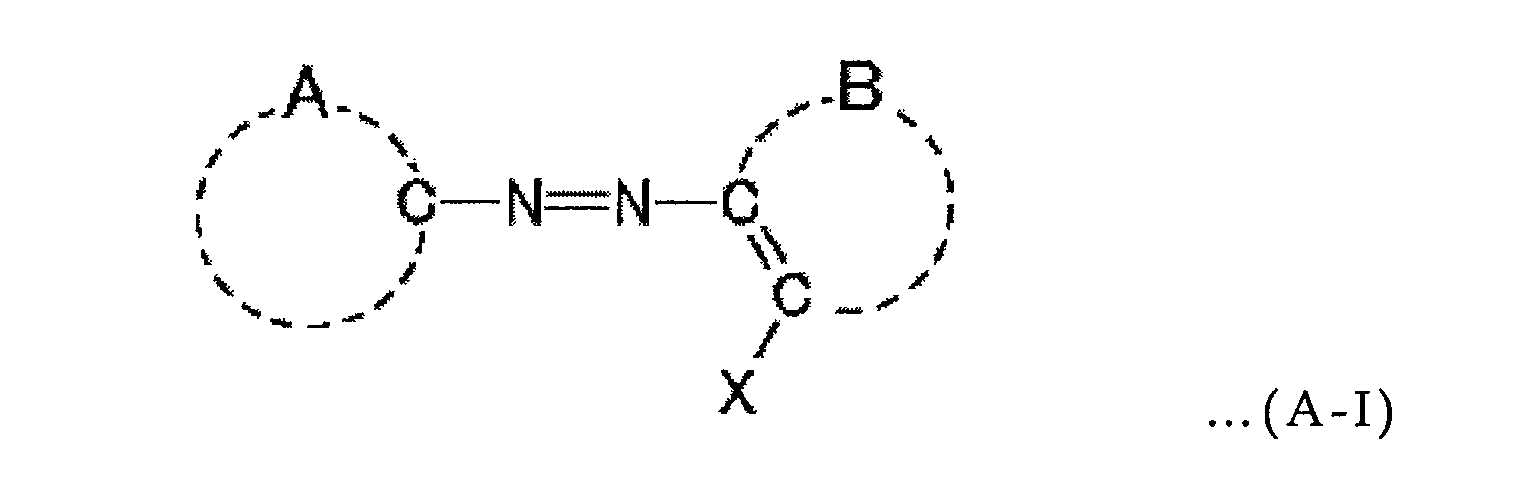
- The optical recording medium according to <A-1>, wherein a contained amount of the squarylium metal chelate compound and the azo metal chelate compound are at a weight ratio ranging from 90:10 to 20:80.
- The optical recording medium according to <A-1>, wherein the metal atom of the azo metal chelate compound is at least one metal atom selected from the group consisting of manganese, cobalt, nickel and copper.
- The optical recording medium according to <A-1>, wherein the azo metal chelate compound is ionized and forms a salt with another compound ion.
- The optical recording medium according to <A-4>, wherein the another compound ion has an amino group.
- The optical recording medium according to <A-1>, wherein the squarylium metal chelate compound is expressed by the following formula (A-II):where, R1 and R2 are substituent groups which may be the same or may be different, and each expresses a hydrogen atom, an alkyl group which may have a substituent, an aralkyl group which may have a substituent, an aryl group which may have a substituent, or a heterocyclic group which may have a substituent; M1 expresses a metal atom having a coordination capacity; Z expresses an aryl group which may have a substituent, a heterocyclic group which may have a substituent, or Y=CH- (Y expresses a heterocyclic group which may have a substituent); and m1 stands for an integer of 2 or 3.
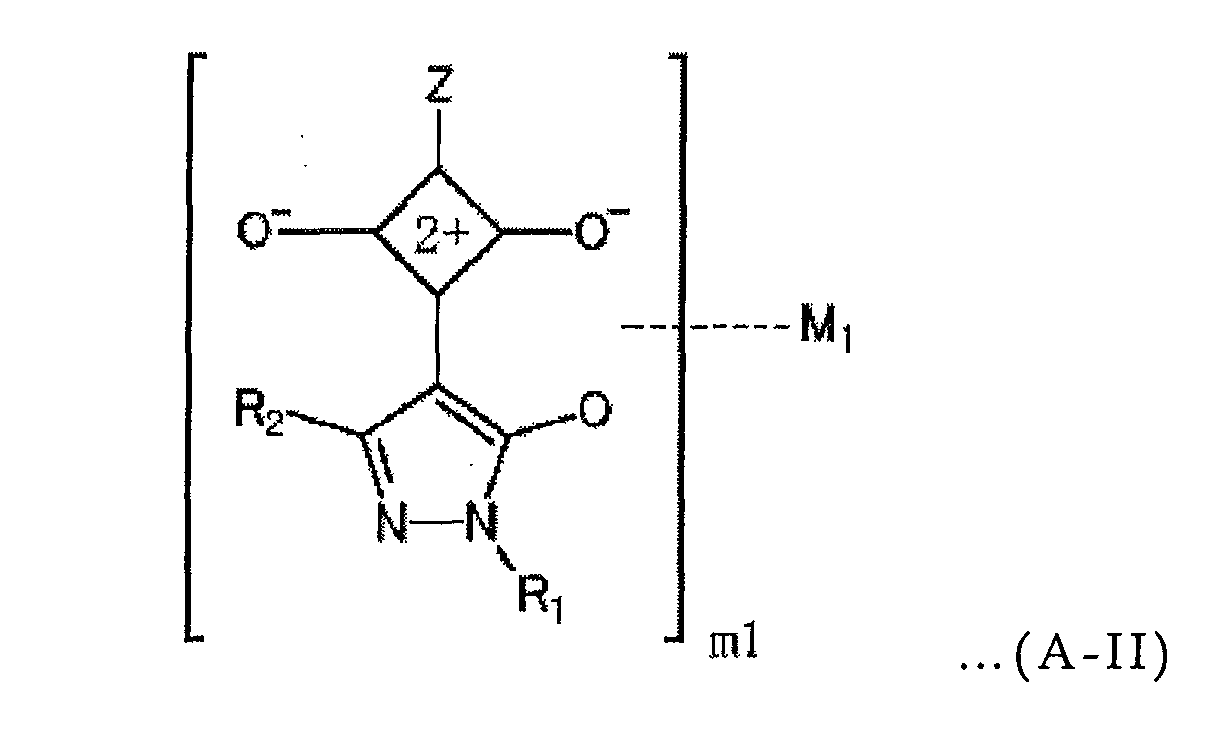
- The optical recording medium of according to <A-6>, wherein Z in the formula (A-II) is expressed by the following formula (A-II-II):where, R3 and R4 may be the same or may be different and each expresses an alkyl group which may have a substituent, or R3 and R4 may form an alicyclic hydrocarbon ring or a heterocyclic ring by combination with adjacent carbon atoms; R5 expresses a hydrogen atom, an alkyl group which may have a substituent, an aralkyl group which may have a substituent, or an aryl group which may have a substituent; R6 expresses a halogen atom, an alkyl group which may have a substituent, an aralkyl group which may have a substituent, an aryl group which may have a substituent, a nitro group, a cyano group, or an alkoxy group which may have a substituent, n stands for an integer of 0 to 4, with the proviso that when n stands for 2 to 4, R6 may be the same or may be different to each other and by combination with the adjacent two carbon atoms form an aromatic ring which may have a substituent.

- The optical recording medium according to <A-6>, wherein M1 expresses aluminum.
- The optical recording medium of according to <A-1>, wherein a single layer of the recording layer has a refractive index (n) of 1.5 ≦ n ≦ 3.0 a refractive index (n) of a single layer of the recording layer is 1.5 ≦ n ≦ 3.0, and an extinction coefficient (k) is 0.02 ≦ k ≦ 0.3 against a light having a wavelength in the range of recording or reproducing wavelength ± 5 nm.
- The optical recording medium according to <A-1>, further comprising a reflective layer containing gold, silver, copper, aluminum or an alloy thereof
- The optical recording medium according to <A-1>, wherein a track pitch on the substrate falls within a range of 0.7 to 0.8 µm, and a groove width at a half bandwidth falls within a range of 0.18 to 0.40 µm.
- The optical recording medium according to <A-1>, wherein the optical recording medium can be recorded at a wavelength of 600 to 720 nm.
- In the embodiments <A-1> to <A-8> and <A-12>, optical information recording media capable of recording and reading by a laser light within a wavelength range of 600 nm to 720 nm, and having excellent light resistance and shelf life can be provided. In particular, the optical recording media obtained above are superior in light resistance to those using a squarylium metal chelate compound alone.
- In the embodiments <A-9> to <A-11>, optical recording media, in addition to having the above-described advantages, capable of recording and reading at a stably high reflectivity and high degree of modulation can be provided.
- The second optical recording medium of the present invention is described below in <B-1>. The preferred embodiments of the second optical recording medium will be described below in <B-2> to <B-10>.
- An optical recording medium having a substrate and at least a recording layer disposed on the substrate, the recording layer comprising: at least one squarylium metal chelate compound which comprises a squarylium compound and a metal; and at least one azo metal chelate compound which comprises another metal and an azo compound expressed by the following formula (B-I):where A expresses a residue forming a heterocyclic ring which may have a substituent by combination with both the carbon atom and the nitrogen atom bonded to A, and B expresses a residue forming one of a) an aromatic ring which may have a substituent and b) a heterocyclic ring which may have a substituent, by combination with the two carbon atoms bonded to B, and X expresses an active-hydrogen-containing substituent group.
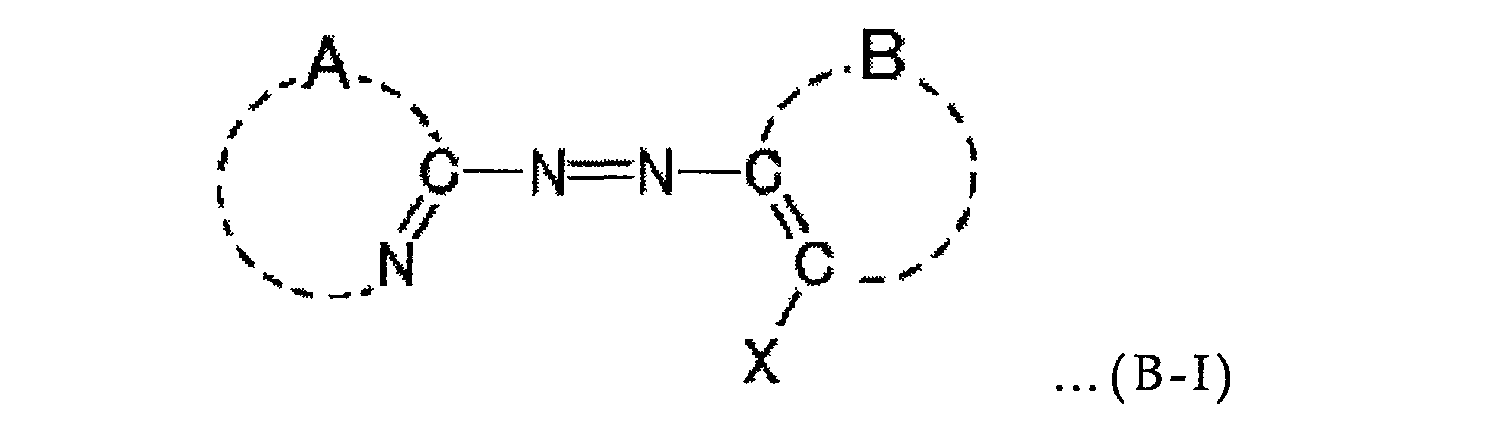
- The optical recording medium according to <B-1>, wherein the squarylium metal chelate compound and the azo metal chelate compound are contained in the recording layer at a weight ratio of 90:10 to 20:80.
- The optical recording medium according to <B-1>, wherein the metal atom of the azo metal chelate compound is at least one metal atom selected from the group consisting of manganese, cobalt, nickel and copper.
- The optical recording medium according to <B-1>, wherein the squarylium metal chelate compound is expressed by the following formula (A-II):where, R1 and R2 are substituent groups which may be the same or may be different, and each expresses a hydrogen atom, an alkyl group which may have a substituent, an aralkyl group which may have a substituent, an aryl group which may have a substituent or a heterocyclic group which may have a substituent; M1 expresses a metal atom having a coordination capacity; Z expresses an aryl group which may have a substituent, a heterocyclic group which may have a substituent, or Y=CH- (Y expresses a heterocyclic group which may have a substituent); and m1 stands for an integer of 2 or 3.

- The optical recording medium of <B-3>, wherein Z in the formula (A-II) is expressed by the following formula (A-II-II):where, R3 and R4 may be the same or may be different and each expresses an alkyl group which may have a substituent, or R3 and R4 form an alicyclic hydrocarbon ring or a heterocyclic ring by combination with the adjacent carbon atoms; R5 expresses a hydrogen atom, an alkyl group which may have a substituent, an aralkyl group which may have a substituent or an aryl group which may have a substituent; R6 expresses a halogen atom, an alkyl group which may have a substituent, an aralkyl group which may have a substituent, an aryl group which may have a substituent, a nitro group, a cyano group, or an alkoxy group which may have a substituent, n stands for an integer of 0 to 4, with the proviso that when n stands for 2 to 4, R6 may be the same or may be different to each other and form an aromatic ring which may have a substituent, by combination with the adjacent two carbon atoms.

- The optical recording medium according to <B-3>, wherein M1 expresses aluminum.
- The optical recording medium according to <B-1>, wherein a refractive index (n) of a single layer of the recording layer is 1.5 ≦ n ≦ 3.0 and an extinction coefficient (k) is 0.02 ≦ k ≦ 0.3 against the light having a wavelength range of a recording or reproducing wavelength ± 5 nm.
- The optical recording medium of <B-1>, further comprising a reflective layer containing gold, silver, copper, aluminum or an alloy thereof.
- The optical recording medium according to <B-1>, wherein a track pitch on the substrate falls within a range of 0.7 to 0.8 µm, and groove width at a half bandwidth falls within a range of 0.18 to 0.40 µm.
- The optical recording medium according to <B-1>, wherein the optical recording medium is recordable at a wavelength of 600 to 720 nm.
- In the embodiments of <B-1> to <B-6> and <B-10>, optical information recording media capable of recording and reading by a laser light within a wavelength range of 600 nm to 720 nm, and having excellent light resistance and shelf life can be provided. In particular, the optical recording media obtained above are superior in light resistance to those using a squarylium metal chelate compound alone.
- In the embodiments <B-7> to <B-9>, optical recording media, in addition to having the above-described advantages, capable of recording and reading at a stably high reflectivity and high degree of modulation can be provided.
- The third optical recording medium of the present invention is described below in <C-1>. The preferred embodiments of the second optical recording medium will be described below in <C-2> to <C-10>.
- An optical recording medium comprising a substrate and at least a recording layer disposed on the substrate, the recording layer comprises: at least one squarylium metal chelate compound which comprises a squarylium compound and a metal; and at least one formazan metal chelate compound which comprises another metal and at least one of a formazan compound expressed by one of the following formulae (C-I) and (C-II):where, Z expresses a residue forming a 5-membered or 6-membered nitrogen-containing heterocyclic ring which may have a substituent by combination with both the carbon atom and the nitrogen atom bonded to Z, and may be condensed with another aromatic ring; A expresses an alkyl group which may have a substituent, an aryl group which may have a substituent, an alkylcarbonyl group which may have a substituent, an arylcarbonyl group which may have a substituent, an alkenyl group which may have a substituent, a heterocyclic residue which may have a substituent, or an alkoxycarbonyl group which may have a substituent; and B expresses an alkyl group which may have a substituent, an alkenyl group which may have a substituent or an aryl group which may have a substituent,
 where, Z1 and Z2 each expresses a residue forming a 5-membered or 6-membered nitrogen-containing heterocyclic ring which may have a substituent by combination with both the carbon atom and the nitrogen atom bonded to Z1 and Z2, respectively, and may be condensed with another aromatic ring; A1 and A2 each independently expresses an alkyl group which may have a substituent, an aryl group which may have a substituent, an alkylcarbonyl group which may have a substituent, an arylcarbonyl group which may have a substituent, an alkenyl group which may have a substituent, a heterocyclic residue which may have a substituent, or an alkoxycarbonyl group which may have a substituent; B1 and B2 each independently expresses an alkylene group which may have a substituent or an arylene group which may have a substituent; W expresses -CH2- or -SO2-; and n stands for an integer of 0 or 1.
- The optical recording medium according to <C-1>, wherein the squarylium metal chelate compound and the formazan metal chelate compound are contained in the recording layer at a weight ratio of 90:10 to 50:50.
- The optical recording medium according to <C-1>, wherein the metal atom of the formazan metal chelate compound is at least one metal atom selected from the group consisting of vanadium, manganese, iron, cobalt, nickel, copper, zinc and palladium, and oxides or halides thereof.
- The optical recording medium according to <C-1>, wherein the squarylium metal chelate compound is expressed by the following formula (A-II):where, R1 and R2 are substituent groups which may be the same or may be different, and each expresses a hydrogen atom, an alkyl group which may have a substituent, an aralkyl group which may have a substituent, an aryl group which may have a substituent or a heterocyclic group which may have a substituent; M1 expresses a metal atom having a coordination capacity; Z expresses an aryl group which may have a substituent, a heterocyclic group which may have a substituent, or Y=CH- (Y representing a heterocyclic group which may have a substituent); and m1 stands for an integer of 2 or 3.
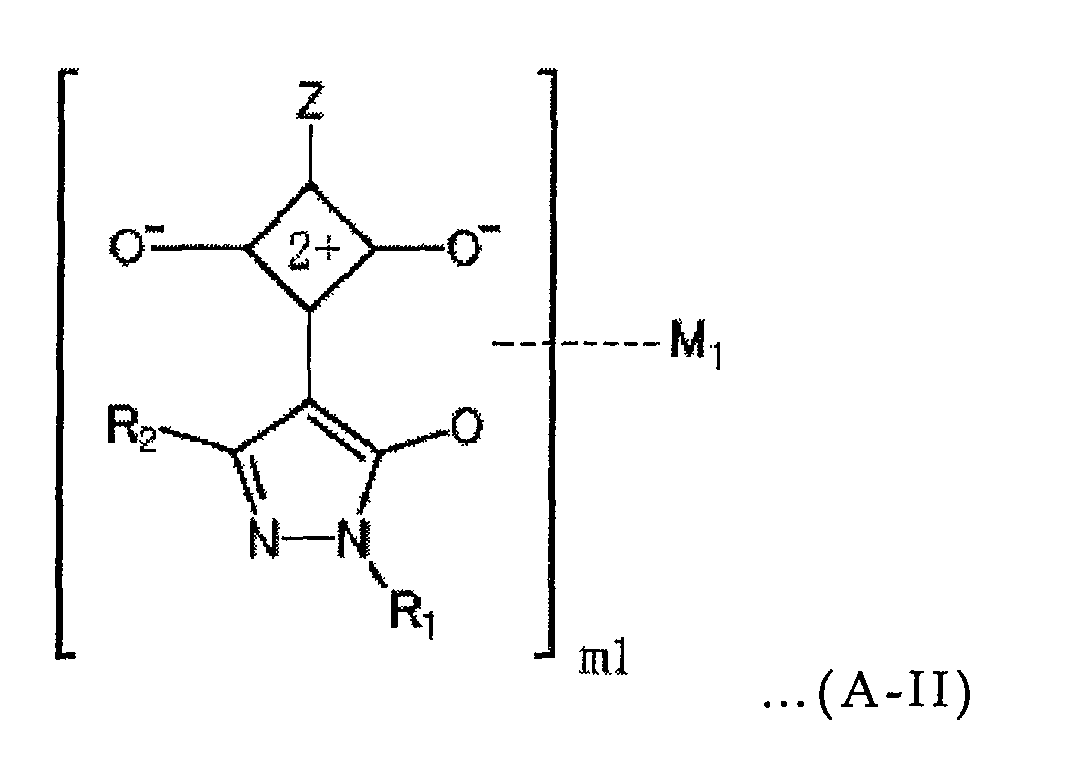
- The optical recording medium according to <C-4>, wherein Z in the formula (A-II) is expressed by the following formula (A-II-II):where, R3 and R4 may be the same or may be different and each expresses an alkyl group which may have a substituent, or R3 and R4 form an alicyclic hydrocarbon ring or a heterocyclic ring by combination with the adjacent carbon atoms; R5 expresses a hydrogen atom, an alkyl group which may have a substituent, an aralkyl group which may have a substituent, or an aryl group which may have a substituent; R6 expresses a halogen atom, an alkyl group which may have a substituent, an aralkyl group which may have a substituent, an aryl group which may have a substituent, a nitro group, a cyano group, or an alkoxy group which may have a substituent, n stands for an integer of 0 to 4, with the proviso that when n stands for 2 to 4, R6 may be the same or may be different to each other and form an aromatic ring which may have a substituent by combination with the adjacent two carbon atoms.

- The optical recording medium according to <C-4>, wherein M1 expresses aluminum.
- The optical recording medium according to <C-1>, wherein a refractive index (n) of a single layer of the recording layer is 1.5 ≦ n ≦ 3.0 and an extinction coefficient (k) is 0.02 ≦ k ≦ 0.3 against the light having a wavelength range of a recording or reproducing wavelength ± 5 nm.
- The optical recording medium according to <C-1>, further comprising a reflective layer containing gold, silver, copper, aluminum, or an alloy thereof.
- The optical recording medium according to <C-1>, wherein a track pitch on the substrate falls within a range of 0.7 to 0.8 µm, and groove width at a half bandwidth falls within a range of 0.18 to 0.40 µm.
- The optical recording medium according to <C-1>, wherein the optical recording medium is recordable at a wavelength of 600 to 720 nm.
- In the embodiments of <C-1> to <C-6> and <C-10>, optical information recording medium capable of recording and reading by a laser light within a wavelength range of 600 nm to 720 nm, and having excellent light resistance and shelf life can be provided. In particular, the optical recording media obtained above are superior in light resistance to those using a squarylium metal chelate compound alone.
- In the embodiments <C-7> and <C-8>, optical recording media, in addition to having the above-described advantage, capable of recording and reading information at a stably high reflectivity and high degree of modulation can be provided.
- In the embodiment <C-9>, an optical recording medium, in addition to having the above-described advantages, capable of stably recording and reading information can be provided.
- The fourth optical recording medium of the present invention is described below in <D-1>. The preferred embodiments of the fourth optical recording medium will be described below in <D-2> to <D-8>.
- An optical recording medium comprising a substrate and at least a recording layer disposed on the substrate, the recording layer comprises: at least one squarylium compound; and at least one formazan metal chelate compound which comprises a metal and at least one of a formazan compound expressed by one of the following formulae (D-I) and (D-II):where, Z expresses a residue forming a 5-membered or 6-membered nitrogen-containing heterocyclic ring which may have a substituent by combination with both the carbon atom and the nitrogen atom bonded to Z, and may be condensed with another aromatic ring; A expresses an alkyl group which may have a substituent, an aryl group which may have a substituent, an alkylcarbonyl group which may have a substituent, an arylcarbonyl group which may have a substituent, an alkenyl group which may have a substituent, a heterocyclic residue which may have a substituent, or an alkoxycarbonyl group which may have a substituent; and B expresses an alkyl group which may have a substituent or aryl group which may have a substituent;
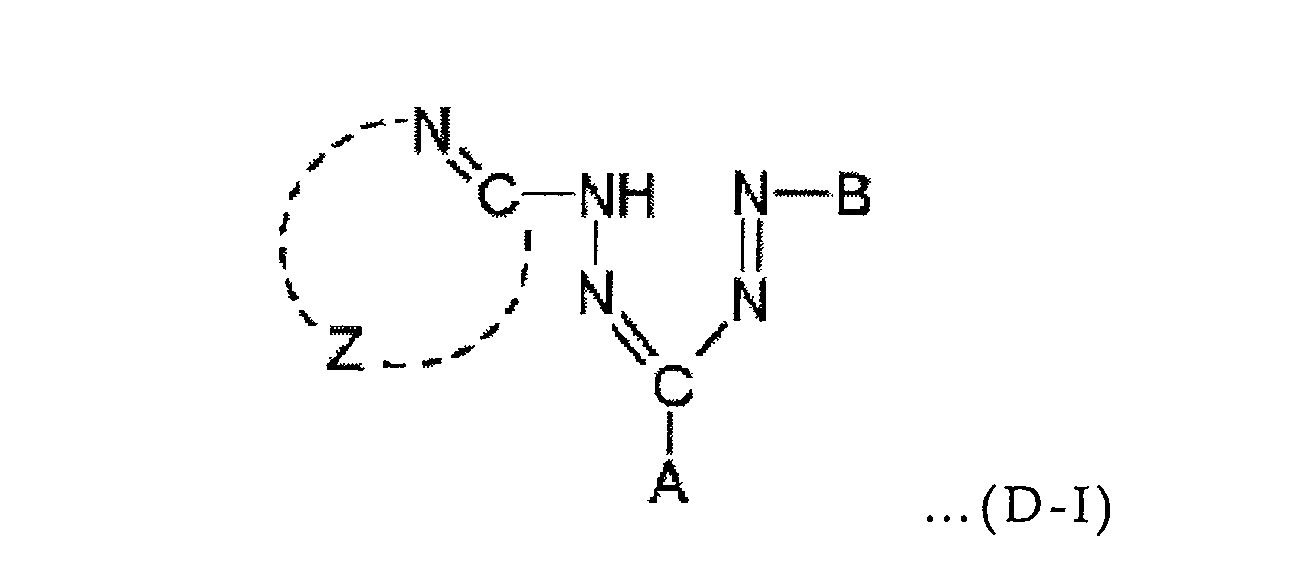 where, Z1 and Z2 each expresses a residue forming a 5-membered or 6-membered nitrogen-containing heterocyclic ring which may have a substituent by combination with both the carbon atom and the nitrogen atom bonded to Z1 and Z2, respectively, and may be condensed with another aromatic ring; A1 and A2 each independently expresses an alkyl group which may have a substituent, an aryl group which may have a substituent, an alkylcarbonyl group which may have a substituent, an arylcarbonyl group which may have a substituent, an alkenyl group which may have a substituent, a heterocyclic residue which may have a substituent, or an alkoxycarbonyl group which may have a substituent; B1 and B2 each independently expresses an alkylene group which may have a substituent or an arylene group which may have a substituent; W expresses -CH2- or -SO2-; and m stands for an integer of 0 or 1.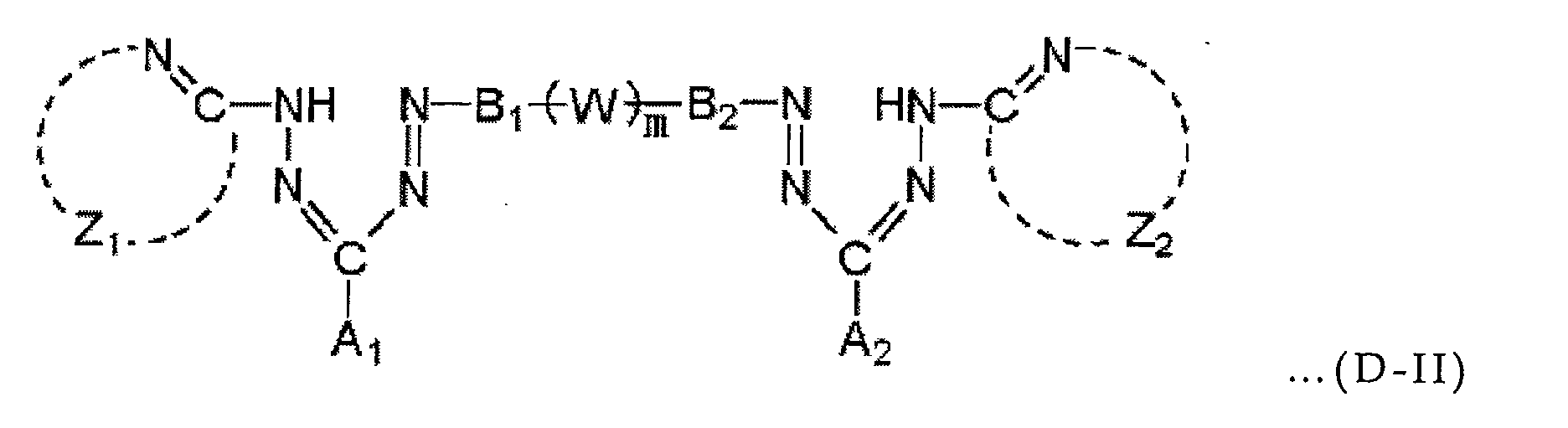
- The optical recording medium according to <D-1>, wherein the squarylium compound and the formazan metal chelate compound are contained in the recording layer at a weight ratio of 90:10 to 50:50.
- The optical recording medium according to <D-1>, wherein the metal atom of the formazan metal chelate compound is at least one selected from the group consisting of vanadium, manganese, iron, cobalt, nickel, copper, zinc and palladium, and oxides or halides thereof.
- The optical recording medium according to <D-1>, wherein the metal atom of the formazan metal chelate compound is at least one selected from the group consisting of vanadium, manganese, iron, cobalt, nickel, copper, zinc and palladium, and oxides or halides thereof.
- The optical recording medium according to <D-1>, wherein the squarylium compound is at least one of a compound expressed by one of the following formulae (D-III) and (D-VI):where, R1 and R2 may be the same or may be different, and each expresses a hydrogen atom, an alkyl group which may have a substituent, an aralkyl group which may have a substituent, an aryl group which may have a substituent, or a heterocyclic residue which may have a substituent, or R1 and R2 form a heterocyclic ring which may have a substituent by combination with the adjacent nitrogen atom; and R3 is a compound expressed by one of the following formulae (D-IV) and (D-V):
 where, R4 and R5 may be the same or may be different and each independently expresses a hydrogen atom or an alkyl group which may have a substituent, or R4 and R5 form a heterocyclic ring which may have a substituent by combination with the adjacent nitrogen atom; and R6, R7, R8 and R9 may be the same or may be different and each independently expresses a hydrogen atom, an alkyl group which may have a substituent, an alkoxy group which may have a substituent, a hydroxyl group or a halogen atom, a pair of R4 and R6 or a pair of R5 and R7 may form a nitrogen-containing heterocyclic ring by combination with the adjacent N-C-C, the nitrogen-containing heterocyclic ring which may have a substituent:
 where, Q1 expresses a carbon atom or a nitrogen atom, R10 and R11 may be the same or may be different and each independently expresses a hydrogen atom an alkyl group which may have a substituent, an aryl group which may have a substituent, an aralkyl group which may have a substituent or a hydroxyl group, with the proviso that when Q1 expresses a nitrogen atom, R11 does not exist, R12 expresses a hydrogen atom, an alkyl group which may have a substituent, an aryl group which may have a substituent or an aralkyl group which may have a substituent; R13 and R14 may be the same or may be different and each independently expresses a hydrogen atom, an alkyl group which may have a substituent, an alkoxy group which may have a substituent or a halogen atom, or R13 and R14 may form an alicyclic hydrocarbon ring, or an aromatic ring which may have a substituent, or a heterocyclic ring which may have a substituent, by combination with the adjacent two carbon atoms;
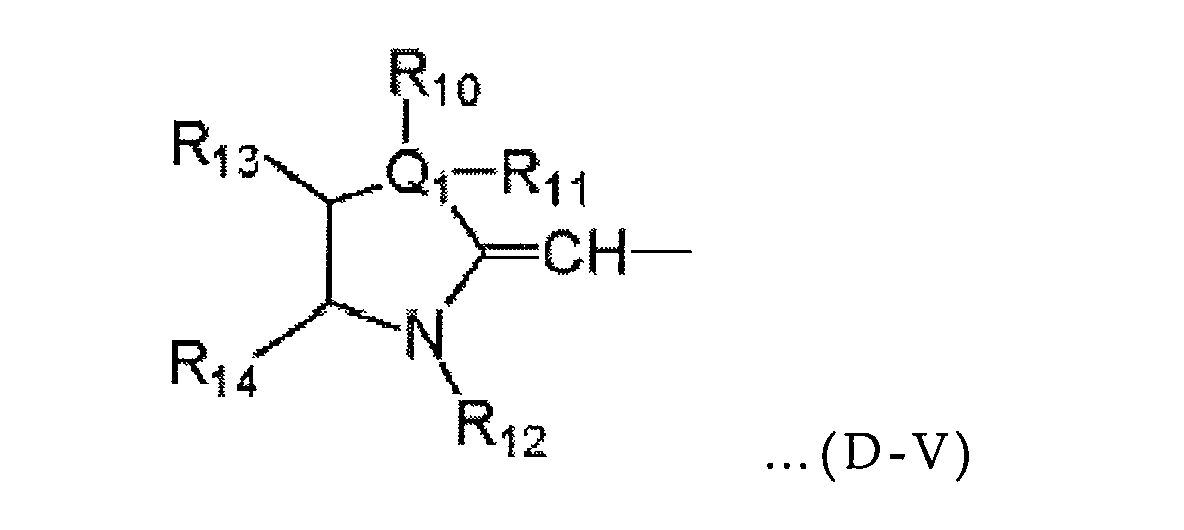 where, Q2 expresses a carbon atom or a nitrogen atom, R15 expresses a hydrogen atom, an alkyl group which may have a substituent, an aryl group which may have a substituent or a heterocyclic group which may have a substituent, R16 expresses a hydrogen atom, a halogen atom, an alkyl group which may have a substituent, an alkoxy group which may have a substituent, an aralkyl group which may have a substituent, an aryl group which may have a substituent, an amino group which may have a substituent or a heterocyclic group which may have a substituent, R17 and R18 may be the same or may be different and each independently expresses an alkyl group which may have a substituent, or R17 and R18 may form an alicyclic hydrocarbon ring or a heterocyclic ring which may have a substituent by combination with the adjacent carbon atom, with the proviso that Q2 expresses a nitrogen atom, R18 does not exist, R19 expresses a hydrogen atom, an alkyl group which may have a substituent, an aralkyl group which may have a substituent, or an aryl group which may have a substituent, R20 expresses a halogen atom, an alkyl group which may have a substituent, an aralkyl group which may have a substituent, an aryl group which may have a substituent, a trifluoromethyl group, a nitro group, a cyano group, or an alkoxy group which may have a substituent, n stands for an integer of 0 to 4 with the proviso that when n stands for an integer of 2 to 4, R20s may be the same or may be different from each other and any adjacent two R20s may form an aromatic ring which may have a substituent by combination with the adjacent two carbon atoms.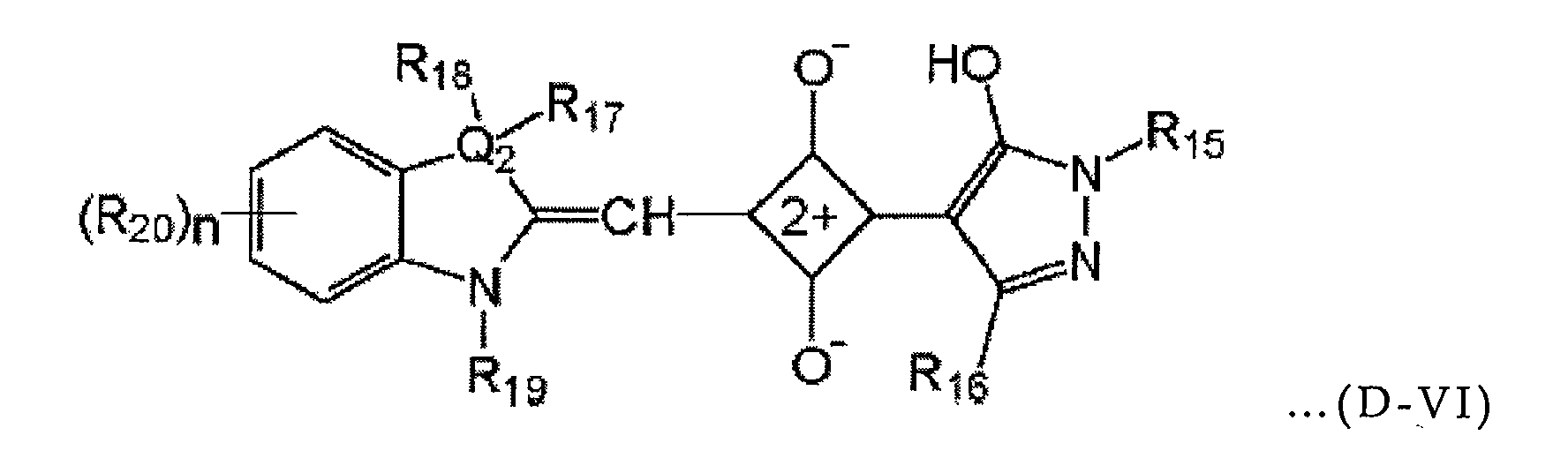
- The optical recording medium according to <D-1>, wherein a refractive index (n) of a single layer of the recording layer is 1.5 ≦ n ≦ 3.0 and an extinction coefficient (k) is 0.02 ≦ k ≦ 0.3 against the light having a wavelength range of a recording or reproducing wavelength ± 5 nm.
- The optical recording medium according to <D-1>, further comprising a reflective layer containing gold, silver, copper, or aluminum, or an alloy thereof.
- The optical recording medium according to <D-1>, wherein a track pitch on the substrate falls within a range of 0.7 to 0.8 µm, and a groove width at a half bandwidth falls within a range of 0.18 to 0.40 µm.
- In the embodiments of <D-1> to <D-4> and <D-8>, optical information recording media capable of recording and reading by a laser light within a wavelength range of 600 nm to 720 nm, and having excellent light resistance and shelf life can be provided. In particular, the optical recording media obtained above are superior in light resistance to those using a squarylium metal chelate compound alone.
- In the embodiments <D-5> and <D-6>, optical recording media, in addition to having the above-described advantages, capable of recording and reading information at a stably high reflectivity and high degree of modulation can be provided.
- In the embodiment <D-7>, an optical recording medium, in addition to having the above-described advantages, capable of stably recording and reading information can be provided.
- The optical recording method of the present invention comprises exposing the optical recording medium of the present invention to light beams of 600 to 720 nm, thereby recording information. Accordingly, a novel optical recording method permitting exhibition of the advantages of the above-described optical recording media can be provided.
- The optical recording device of the present invention comprises the optical recording medium of the present invention mounted on the substrate. Accordingly, a novel optical recording device permitting exhibition of the advantages of the above-described optical recording medium can be provided.
-
- FIG. 1(a) to FIG. 1(d) are schematic cross-sectional views showing one example of the general overwritable optical recording media to which the optical recording medium of the present invention has been applied;
- FIG. 2(a) to FIG. 2(c) are schematic cross-sectional views showing one constitution example of a medium for CD-R to which the optical recording medium of the present invention is applied; and
- FIG. 3(a) to FIG. 3(c) are schematic cross-sectional views showing one constitution example of a medium for DVD-R to which the optical recording medium of the present invention is applied.
-
- In the figures, numerals respectively represents the following elements.
- 1: substrate
- 2: recording layer
- 3: undercoat layer
- 4: protective layer
- 5: hard coat layer
- 6: reflective layer
- 7: protective layer
- 8: adhesive layer
-
- The first optical recording medium of the present invention comprises a substrate and at least a recording layer disposed on the substrate, the recording layer comprising at least one squarylium metal chelate compound which comprises a squarylium compound and a metal and at least one azo metal chelate compound which comprises another metal and an azo compound expressed by the following formula (A-I):where A and B each independently expresses a residue forming one of a) a heterocyclic ring which may have a substituent and b) an aromatic ring which may have a substituent, by combination with corresponding carbon atoms bonded to A or B, and X represents an active-hydrogen-containing substituent group.

- The above-described squarylium metal compound is preferably expressed by the following formula (A-II):where, R1 and R2 are substituent groups which may be the same or may be different, and each expresses a hydrogen atom, an alkyl group which may have a substituent, an aralkyl group which may have a substituent, an aryl group which may have a substituent or a heterocyclic group which may have a substituent; M1 expresses a metal atom having a coordination capacity; Z expresses an aryl group which may have a substituent, a heterocyclic group which may have a substituent, or Y=CH- (Y representing a heterocyclic group which may have a substituent); and m1 stands for an integer of 2 or 3.

- It is preferred that Z in the formula (A-II) is expressed by the following formula (A-II-II):where, R3 and R4 may be the same or may be different and each expresses an alkyl group which may have a substituent, or R3 and R4 may form an alicyclic hydrocarbon ring or heterocyclic ring by combination with the adjacent carbon atoms; R5 expresses a hydrogen atom, an alkyl group which may have a substituent, an aralkyl group which may have a substituent or an aryl group which may have a substituent; R6 expresses a halogen atom, an alkyl group which may have a substituent, an aralkyl group which may have a substituent, an aryl group which may have a substituent, nitro group, cyano group, or an alkoxy group which may have a substituent, n stands for an integer of 0 to 4, with the proviso that when n stands for 2 to 4, R6s may be the same or may be different to each other and may form an aromatic ring which may have a substituent by combination with the adjacent two carbon atoms.

- The present invention will hereinafter be described more specifically. The term "compound expressed by the formula (A-I)" as used herein will be called "Compound (A-I)", which will be applied equally to a compound with another formula number. The term "azo metal chelate compound which comprises Compound (A-I) and a metal" will hereinafter be called "azo metal chelate compound (A-I)".
- First, a description will be made of Compound (A-I). The definition of the substituents in the formula (A-I) are as described above.
- The ion pair structure in Compound (A-I), that is, an ion which forms a pair to an azo metal chelate compound when it is a salt forming compound may be a hydrogen atom, an amino-containing compound or a counter ion of another dye such as cyanine or styryl dye. As the counter ion, if any, an amino-containing compound is particularly preferred from the viewpoint of solubility control, because in the case of another dye, cost matters and optical properties must be taken into consideration. Hydrogen atom and a counter ion of another dye are next preferred in that order.
- Of the above-described cyanine dyes and styryl dyes, those having absorption in a short wavelength region than a recording or reproducing wavelength are generally preferred. Trimethinecyanine is more preferred as the cyanine dye, while an indolenine-containing dyes are preferred as the styryl dye.
- When hydrogen is used as the counter ion, introduction of a soluble substituent such as a long-chain alkyl group into an azo structure is sometimes necessary. When a salt forming compound with another dye is used as the counter ion, the optical properties of the another dye have an influence on the recording layer so that optical properties of such a dye mixture cannot be forecast easily and simply. Amino-containing compounds such as alkylamine are, on the other hand, accompanied with such advantages that large degree of freedom in selection of the length of the alkyl carbon chain facilitates solubility control; and since the alkylamino group itself hardly exhibits absorption in a recording and reproducing wavelength, the optical properties of the recording layer can be controlled easily and the resulting optical recording medium is able to have improved reflectivity, degree of modulation and jitter.
- Specific examples of A and B in formula (A-I) include residues capable of forming a benzene ring, a naphthalene ring, a pyridine ring, and a quinoline ring. These aromatic rings or heterocyclic rings may have a substituent. Specific examples of such a substituent for the aromatic ring or heterocyclic ring include a hydrogen atom, halogen atoms, nitro group, cyano group, hydroxyl group, carboxyl group, amino group, carbamoyl group, alkyl group which may have a substituent, aryl group which may have a substituent, residues of a heterocyclic group which may have a substituent, alkoxy group which may have a substituent, aryloxy group which may have a substituent, alkylthio group which may have a substituent, arylthio group which may have a substituent, alkylamino group which may have a substituent, arylamino group which may have a substituent, alkoxycarbonyl group which may have a substituent, aryloxycarbonyl group which may have a substituent, alkylcarboxamide group which may have a substituent, arylcarboxamide group which may have a substituent, alkylcarbamoyl group which may have a substituent, arylcarbamoyl group which may have a substituent, alkenyl group which may have a substituent, and alkylsulfamoyl group which may have a substituent.
- Examples of the alkyl group include groups having C1-15. Specific examples include straight chain alkyl group such as methyl, ethyl, n-propyl, n-butyl, n-pentyl, n-hexyl, n-heptyl, n-octyl, n-nonyl, and n-decyl; branched alkyl groups such as isobutyl, isoamyl, 2-methylbutyl, 2-methylpentyl, 3-methylpentyl, 4-methylpentyl, 2-ethylbutyl, 2-methylhexyl, 3-methylhexyl, 4-methylhexyl, 5-methylhexyl, 2-ethylpentyl, 3-ethylpentyl, 2-methylheptyl, 3-methylheptyl, 4-methylheptyl, 5-methylheptyl, 2-ethylhexyl, 3-ethylhexyl, isopropyl, sec-butyl, 1-ethylpropyl, 1-methylbutyl, 1,2-dimethylpropyl, 1-methylheptyl, 1-ethylbutyl, 1,3-dimethylbutyl, 1,2-dimethylbutyl, 1-ethyl-2-methylpropyl, 1-methylhexyl, 1-ethylheptyl, 1-propylbutyl, 1-isopropyl-2-methylpropyl, 1-ethyl-2-methylbutyl, 1-propyl-2-methylpropyl, 1-methylheptyl, 1-ethylhexyl, 1-propylpentyl, 1-isopropylpentyl, 1-isopropyl-2-methylbutyl, 1-isopropyl-3-methylbutyl, 1-methyloctyl, 1-ethylheptyl, 1-propylhexyl, 1-isobutyl-3-methylbutyl, neopentyl, tert-butyl, tert-hexyl, tert-amyl, and tert-octyl; and cycloalkyl groups such as cyclohexyl, 4-methylcyclohexyl, 4-ethylcyclohexyl, 4-tert-butylcyclohexyl, 4-(2-ethylhexyl)cyclohexyl, bornyl, isobornyl, and adamantyl. Of these, C1-8 alkyl groups are preferred.
- The above-described straight or branched alkyl groups may have a substituent such as hydroxyl group, halogen atom, nitro group, carboxyl group, cyano group, aryl group optionally having a specific substituent (for example, halogen atom or nitro group), or a residue of a heterocyclic ring. Further, they may be substituted further with the above-described alkyl groups via an oxygen atom, sulfur atom, or nitrogen atom.
- Examples of the alkyl group substituted via an oxygen atom include methoxymethyl group, methoxyethyl group, ethoxymethyl group, ethoxyethyl group, butoxyethyl group, ethoxyethoxyethyl group, methoxypropyl group, and ethoxypropyl group. Examples of the alkyl group substituted via a sulfur atom include methylthioethyl group, ethylthioethyl group, and ethylthiopropyl group. Examples of the alkyl group substituted via a nitrogen atom include dimethylaminoethyl group, diethylaminoethyl group, and diethylaminopropyl group. Examples of the alkylene group include a hydrogen atom deleted alkyl group which is above-mentioned.
- Examples of the aryl group include phenyl group, naphthyl group, anthryl group, fluorenyl group, phenalenyl group, phenanthranyl group, triphenylenyl group, and pyrenyl group.
- These aryl groups may each be substituted by hydroxyl group, halogen atom, nitro group, carboxyl group, cyano group, aryl group which may have a specific substituent (for example, halogen atom or nitro group), or residue of a heterocyclic ring. Further, they may be substituted with the above-described alkyl group via an oxygen atom, sulfur atom or nitrogen atom.
- Specific examples of the residue of the heterocyclic ring include furyl group, thienyl group, pyrrolyl group, benzofuranyl group, isobenzofuranyl group, benzothienyl group, indolinyl group, isoindolinyl group, carbazolyl group, pyridyl group, piperidyl group, quinolyl group, isoquinolyl group, oxazolyl group, isoxazolyl group, thiazolyl group, isothiazolyl group, imidazolyl group, pyrazolyl group, benzimidazolyl group, pyrazinyl group, pyrimidinyl group, pyridazinyl group, and quinoxalinyl group. Moreover, these residues of the heterocyclic ring may have a substituent such as hydroxyl group, a halogen atom, nitro group, carboxyl group, cyano group, an aryl group which may have a specific substituent (for example, halogen atom or nitro group), or a residue of a heterocyclic ring. Further, they may be substituted with the above-described alkyl group via an oxygen atom, sulfur atom, or nitrogen atom.
- Specific examples of the alkenyl group include groups having C2-6 such as vinyl group, allyl, 1-propenyl group, methacryl group, crotyl group, 1-butenyl group, 3-butenyl group, 2-pentenyl group, 4-pentenyl group, 2-hexenyl group and 5-hexenyl group. The substituents for these alkenyl group are the same with aforementioned alkyl group.
- Specific examples of the halogen atom include fluorine, chlorine, bromine, and iodine.
- As the alkoxy group which may have a substituent, those having an alkyl group, which may have a substituent, directly bonded to an oxygen atom may be used. Specific examples of the alkyl group and substituent are similar to those described above.
- As the aryloxyl group which may have a substituent, those having an aryl group, which may have a substituent, directly bonded to an oxygen atom may be used. Specific examples of the aryl group and substituent are similar to those described above.
- As the alkylthio group which may have a substituent, those having an alkyl group, which may have a substituent, directly bonded to a sulfur atom may be used. Specific examples of the alkyl group and substituent are similar to those described above.
- As the arylthio group which may have a substituent, those having an aryl group, which may have a substituent, directly bonded to a sulfur atom may be used. Specific examples of the aryl group and substituent are similar to those described above.
- As the alkylamino group which may have a substituent, those having an alkyl group, which may have a substituent, directly bonded to a nitrogen atom may be used. Specific examples of the alkyl group and substituent are similar to those described above. In this case, alkyl groups may be bonded each other to form a ring such as piperidino group, morpholino group, pyrrolidinyl group, piperazinyl group, indolinyl group, or isoindolinyl group.
- For the arylamino group which may have a substituent, those having an aryl group, which may have a substituent, directly bonded to a nitrogen atom may be used. Specific examples of the aryl group and substituent are similar to those described above.
- As the alkoxycarbonyl group which may have a substituent, those having an alkyl group, which may have a substituent, directly bonded to an oxygen atom may be used. Specific examples of the alkyl group and substituent are similar to those described above.
- As the aryloxycarbonyl group which may have a substituent, those having an aryl group, which may have a substituent, directly bonded to an oxygen atom may be used. Specific examples of the aryl group and substituent are similar to those described above.
- As the alkylcarboxamide group which may have a substituent, those having an alkyl group, which may have a substituent, directly bonded to a carbon atom may be used. Specific examples of the alkyl group and substituent are similar to those described above.
- As the arylcarboxamide group which may have a substituent, those having an aryl group, which may have a substituent, directly bonded to a carbon atom may be used. Specific examples of the aryl group and substituent are similar to those described above.
- As the alkylcarbamoyl group which may have a substituent, those having an alkyl group, which may have a substituent, directly bonded to a nitrogen atom may be used. Specific examples of the alkyl group and substituent are similar to those described above. In this case, alkyl groups may be bonded to each other to form a ring such as piperidino group, morpholino group, pyrrolidinyl group, piperazinyl group, indolinyl group, or isoindolinyl group.
- As the arylcarbamoyl group which may have a substituent, those having an aryl group, which may have a substituent, directly bonded to a nitrogen atom may be used. Specific examples of the aryl group and substituent are similar to those described above.
- As the alkylsulfamoyl group which may have a substituent, those having an alkyl group, which may have a substituent, directly bonded to a nitrogen atom of the sulfamoyl group may be used. Specific examples of the aryl group and substituent are similar to those described above.
- Specific examples of the active-hydrogen-containing substituent expressed by X include hydroxyl group, carboxyl group, amino group, alkylcarboxamide groups, arylcarboxamide groups, alkylsulfonamide groups, arylsulfonamide groups, carbamoyl group, alkylcarbamoyl groups, arylcarbamoyl groups, sulfo group, sulfino group, sulfeno group, and sulfamoyl group.
- Specific examples of the alkylcarboxamide group, arylcarboxamide group, alkylcarbamoyl group, and arylcarbamoyl group are similar to those described above.
- As the alkylsulfonamide group which may have a substituent, those having an alkyl group, which may have a substituent, directly bonded to a sulfur atom may be used. Specific examples of the alkyl group and substituent are similar to those described above.
- As the arylsulfonamide group which may have a substituent, those having an aryl group which may have a substituent directly bonded to the sulfur atom of the sulfonamide may be used. Specific examples of the alkyl group and substituent are similar to those described above.
- As a metal atom for forming, by combination with the compound (A-I), aluminum, titanium, vanadium, chromium, manganese, iron, cobalt, nickel, copper, zinc, zirconium, niobium, molybdenum, ruthenium, rhodium, and palladium may be employed. Of these, manganese, nickel, copper, aluminum and vanadium are preferred. In particular, an azo metal chelate compound containing a metal such as manganese, cobalt, nickel, or copper exhibits excellent optical properties as an optical recording material.
- The compound (A-I) of the present invention is a recording material markedly suited for providing an inexpensive optical recording medium having an excellent productivity, because the raw materials for use upon synthesis of the compound are cheap and the number of synthesizing steps is very small.
- Of the squarylium metal chelate compounds, Compound (A-II) is preferred. A description will next be made of Compound (A-II).
- In the definition of the substituents cited in formulas (A-II) or (A-II-II), examples of the alkyl group or the alkyl moiety of the alkoxy group include straight or branched C1-6 alkyl groups and cyclic C3-8 alkyl groups.
- Specific examples include methyl, ethyl, propyl, isopropyl, butyl, iso-butyl, sec-butyl, tert-butyl, pentyl, isopentyl, 1-methylbutyl, 2-methylbutyl, tert-pentyl, hexyl, cyclopropyl, cyclobutyl, cyclopentyl, cyclohexyl, cycloheptyl, and cyclooctyl.
- Examples of the aralkyl group include C7-15 aralkyl groups such as benzyl, phenethyl, phenylpropyl and naphthylmethyl.
- Examples of the aryl group include phenyl, naphthyl, anthryl and azulenyl.
- Examples of the halogen atom include chlorine, bromine, fluorine and iodine.
- The substituents for the aralkyl group, aryl group, alkoxy group, aromatic ring or heterocyclic group may be the same or may be different. Examples include C1-5 substituents such as hydroxyl group, carboxyl group, halogen atoms, alkyl groups, alkoxy groups, nitro group, a trifluoromethyl group, and amino group which may have a substituent. The halogen atoms, alkyl groups and alkoxy groups are similar to those described above, respectively.
- The alkyl group may be substituted by 1 to 3 substituents which may be the same or may be different. Examples include hydroxyl group, carboxyl group, halogen atoms and alkoxy groups. The halogen atoms and alkoxy groups are similar to those described above, respectively.
- The amino group may be substituted by 1 to 2 alkyl groups which may be the same or may be different. The alkyl groups usable here are similar to those described above.
- Examples of the metal atom (M1) having a coordination capacity include aluminum, zinc, copper, iron, nickel, chromium, cobalt, manganese, iridium, vanadium and titanium, of which aluminum, copper, nickel and cobalt are preferred, with aluminum being more preferred.
- As for the aromatic ring formed by two adjacent R6s combined with two carbon atoms adjacent thereto, a benzene ring may be mentioned as an example.
- Examples of the heterocyclic ring in the heterocyclic group which may have a substituent and is expressed by Y in the formula (A-II), or the heterocyclic ring in the formula (A-II-II) formed by R3 and R4 combined with an adjacent carbon atom include 5- or 6-membered monocyclic aromatic or aliphatic heterocyclic rings containing at least one atom selected from a nitrogen atom, an oxygen atom, and a sulfur atom; and 3- to 8-membered-ring-condensed, bicyclic or tricyclic, aromatic or aliphatic heterocyclic rings containing at least one atom selected from a nitrogen atom, an oxygen atom, and a sulfur atom. Specific examples include pyridine ring, pyrazine ring, pyrimidine ring, pyridazine ring, quinoline ring, isoquinoline ring, phthalazine ring, quinazoline ring, quinoxalirie ring, naphthyridine ring, cinnoline ring, pyrrole ring, pyrazole ring, imidazole ring, triazole ring, tetrazole ring, thiophene ring, furan ring, thiazole ring, oxazole ring, indole ring, isoindole ring, indazole ring, benzimidazole ring, benzotriazole ring, benzothiazole ring, benzoxazole ring, purine ring, carbazole ring, pyrrolidine ring, piperidine ring, piperazine ring, morpholine ring, thiomorpholine ring, homopiperidine ring, homopiperazine ring, tetrahydropyridine ring, tetrahydroquinoline ring, tetrahydroisoquinoline ring, tetrahydrofurane ring, tetrahydropyrane ring, dihydrobenzofurane and tetrahydrocarbazole ring.
- Examples of the heterocyclic group expressed by Y in the formula (A-II) include indolin-2-ylidene, benz[e]indolin-2-ylidene, 2-benzothiazolinylidene, naphtho[2,1-d]thiazol-2(3H)-ylidene, naphtho[1,2-d]thiazol-2(1H)-ylidene, 1,4-dihydroquinolin-4-ylidene, 1,2-dihydroquinolin-2-ylidene, and 2-benzoselenazolinylidene.
- Examples of the alicyclic hydrocarbon ring formed by R3 and R4 combined with the adjacent carbon atom include C3-8 rings which may be saturated or unsaturated, more specifically, cyclopropane ring, cyclobutane ring, cyclopentane ring, cyclohexane ring, cycloheptane ring, cyclooctane ring, cyclopentene ring, 1,3-cyclopentaadiene ring, cyclohexene ring, and cyclohexadiene ring.
- An ordinarily employed process for preparing Compound (A-II) will next be described.
-

-


-

-

- In the above-described reaction schemes, R1, R2, Z, M1 and m1 have the same meanings as described above, Q expresses hydrogen, potassium or sodium, and Me expresses methyl.
- In the reaction scheme (1-a), Compound (A-V) is available by reacting Compound (A-III) with 0.5 to 2 times the mole of Compound (A-IV), in the presence of a base if necessary, in a solvent at room temperature to 40°C for 30 minutes to 15 hours.
- Examples of the base include inorganic bases such as potassium carbonate, sodium carbonate and potassium hydroxide and organic bases such as triethylamine and sodium methoxide. As the solvent, methanol, ethanol and dimethylformamide may be used.
- In the above-described reaction scheme (1-b), Compound (A-VI) is available by treating Compound (A-V) in an alkaline solvent or an acid solvent at room temperature to 40°C for 30 minutes to 15 hours.
- Examples of the alkaline solvent usable here include aqueous solution of potassium carbonate, aqueous solution of sodium carbonate, and aqueous solution of potassium hydroxide, while those of the acid solvent include a 50% vol/vol dimethyl sulfoxide solution of hydrochloric acid and a 50% vol/vol dimethylformamide solution of hydrochloric acid.
- In the reaction scheme (1-c), Compound (A-VII) is available by reacting Compound (A-VI) with 0.5 to 2 times the mole of Z-H in the presence of 0.5 to 2 times the mole of a base if necessary, in a solvent, at 80 to 120°C for 1 to 15 hours.
- Examples of the solvent include C2-8 alcohol solvents such as ethanol, propanol, isopropanol, butanol and octanol and mixed solvents of any one of these alcohol solvents with benzene, toluene or xylene (containing at least 50 vol/vol% of the alcohol). Examples of the base include organic bases such as quinoline, triethylamine and pyridine and inorganic bases such as potassium carbonate, potassium bicarbonate and sodium bicarbonate.
- In the above-described reaction scheme (1-d), Compound (A-II) is available by reacting Compound (A-VII) with 0.5 to 2 times the mole of M1 m1+ in the presence of 0.5 to 2 times the mole of acetic acid if necessary, in a solvent at room temperature to 120°C for 1 to 15 hours.
- Examples of the material for providing M1 m1+ include aluminum trisacetylacetonate, aluminum trisethylacetoacetate, aluminum isopropoxide, aluminum sec-butoxide, aluminum ethoxide, aluminum chloride, copper chloride, copper acetate and nickel acetate.
- Example of the solvent include halogen solvents such as chloroform and dichloromethane, aromatic solvents such as toluene and xylene, ether solvents such as tetrahydrofuran and methyl-tert-butyl ether and ester solvents such as ethyl acetate.
- The optical recording medium of the present invention is characterized in that it has, in its recording layer, at least one azo metal chelate compound (A-I) and at least one squarylium metal chelate compound. Incorporation of the azo metal chelate compound (A-I) in the squarylium metal chelate compound suppresses photo deterioration of the squarylium metal chelate compound, making it possible to obtain an optical recording medium excellent in light resistance.
- In the optical recording medium of the present invention, the weight ratio of the squarylium metal chelate compound to the azo metal chelate compound (A-I) preferably falls within a range of 90:10 to 20:80, with 80:20 to 30:70 being more preferred. At weight ratios within the above-described range, the resulting optical recording medium has desirable light resistance, reflectivity and degree of modulation.
- Specific examples of the azo metal chelate compound (A-I) to be used in the first optical recording medium of the present invention are shown below in Tables 1 to 3. In Tables, Me, Et3BU and t-Bu represent methyl, ethyl, n-butyl and tert-butyl.
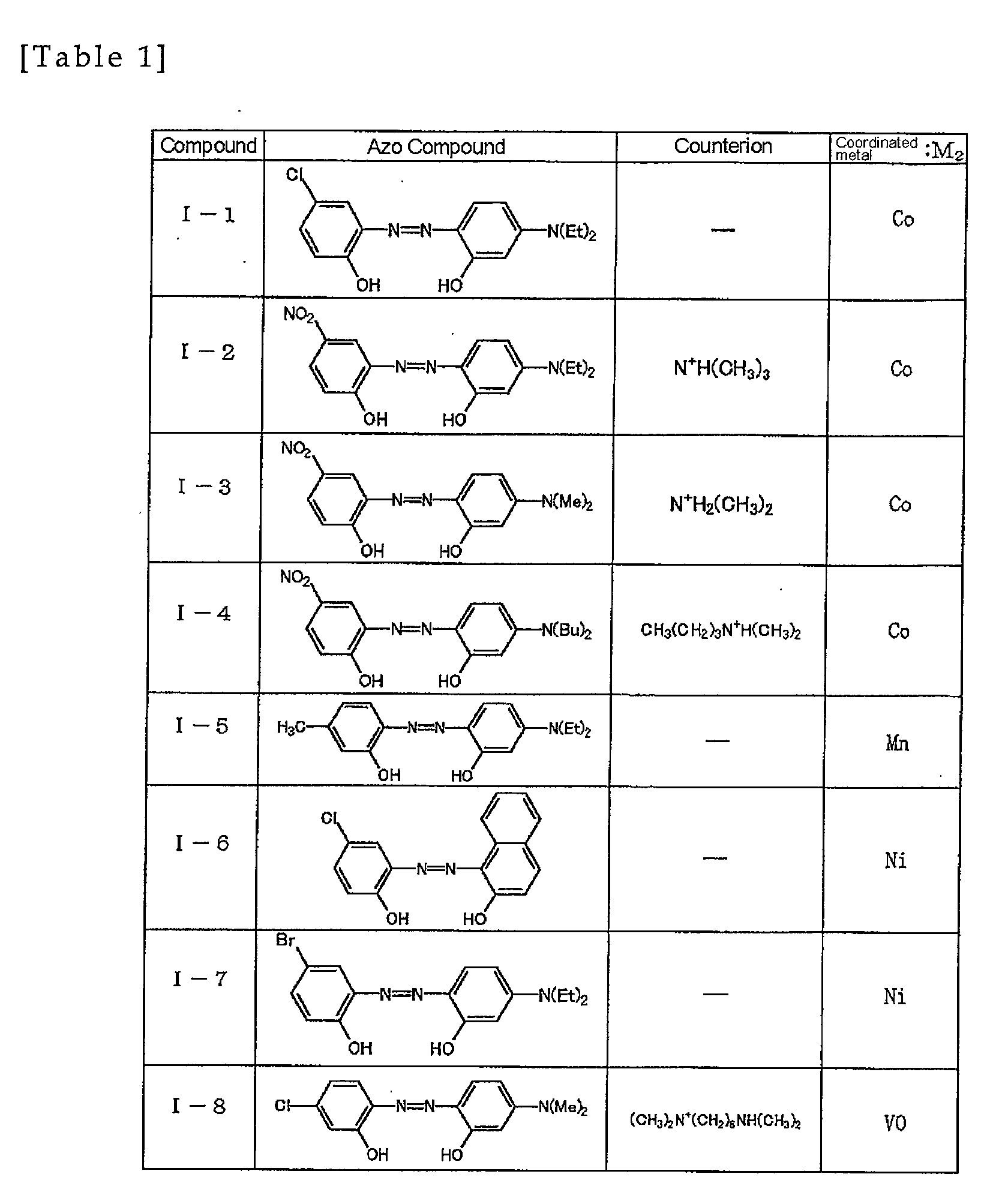
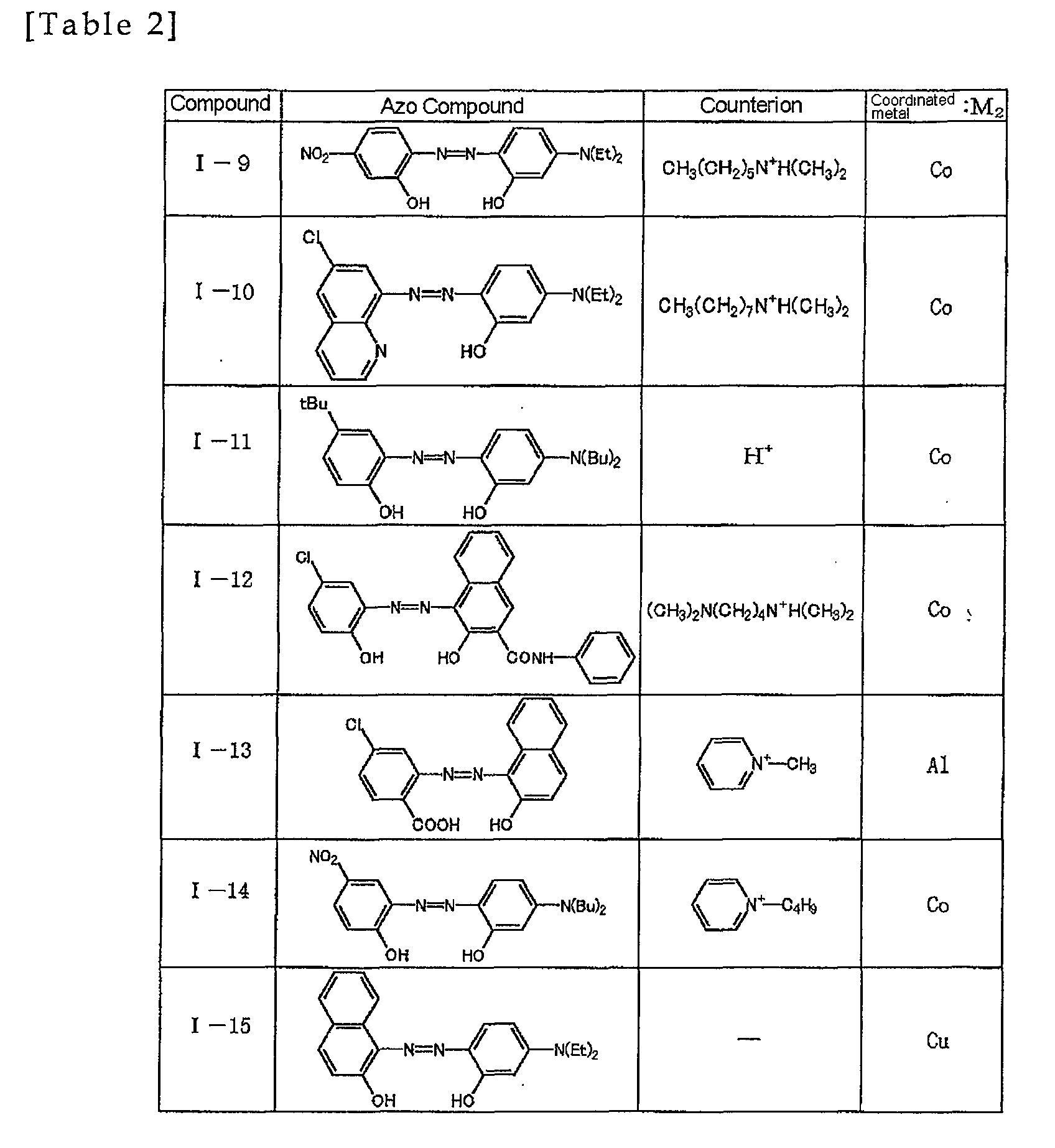
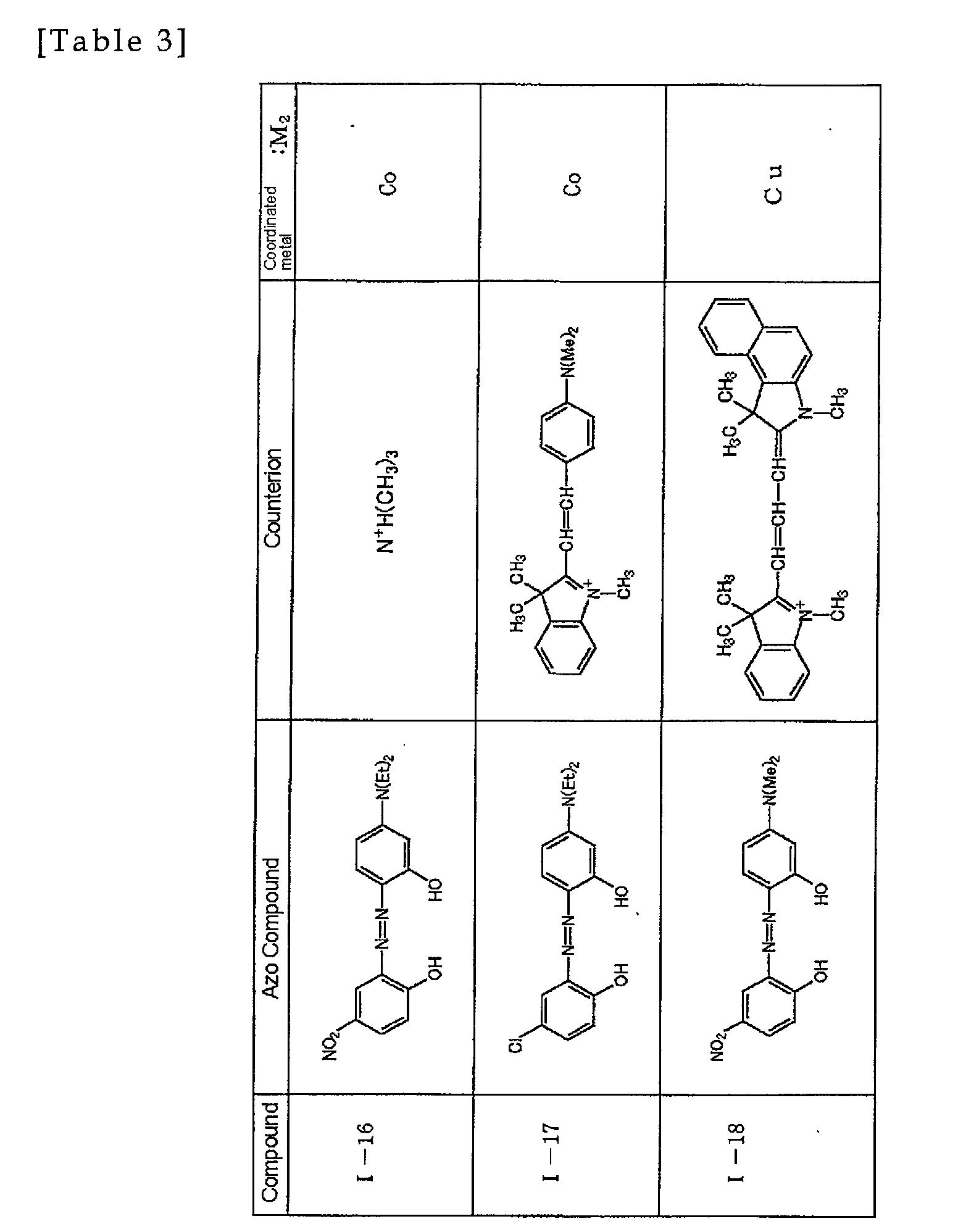
- In the below-described Tables 4 to 6, shown are specific examples of the squarylium metal chelate compound to be used in the first optical recording medium of the present invention. In tables, II-16 is a squarylium compound of Comparative Example. In tables, Me, Et, nPr, iPr, Bu, nBu and tBu represent methyl, ethyl, n-propyl, isopropyl, butyl, n-butyl, tert-butyl groups, respectively.

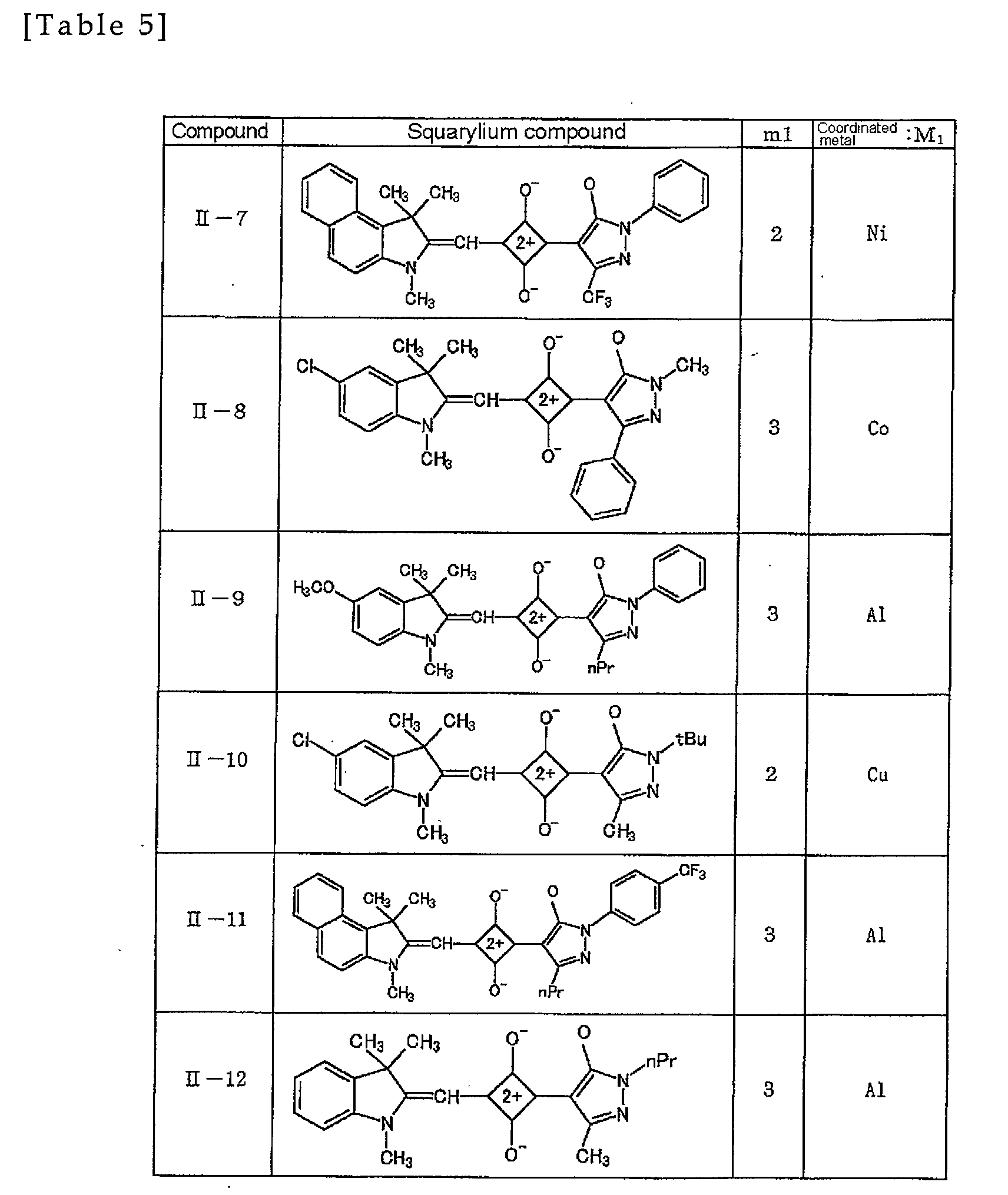

- The second optical recording medium of the present invention has a substrate and at least a recording layer disposed on the substrate, the recording layer comprises at least one squarylium metal chelate compound which comprises a squarylium compound and a metal and an azo metal chelate compound which comprises another metal and an azo compound expressed by the following formula (B-I):where A expresses a residue forming a heterocyclic ring which may have a substituent by combination with both the carbon atom and the nitrogen atom bonded to A, and B expresses a residue forming one of a) an aromatic ring which may have a substituent and b) a heterocyclic ring which may have a substituent, by combination with the two carbon atoms bonded to B, and X expresses an active-hydrogen-containing substituent group.

- The present invention will hereinafter be described more specifically. The term "compound expressed by the formula (B-I)" as used herein will be called "Compound (B-I)", which will be applied equally to compounds with another formula number. The term "azo metal chelate compound which comprises Compound (B-I) and another metal" will hereinafter be called "azo metal chelate compound (B-I)".
- First, a description will be made of Compound (B-I). The definition of the substituents in the formula (B-I) are as described above.
- Specific examples of A in the formula (B-I) include residues for forming a thiazole ring, benzothiazole ring, imidazole ring, benzimidazole ring, thiadiazole ring, oxazole ring, benzoxazole ring, triazole ring, pyrazole ring, oxadiazole ring, pyridine ring, pyridazine ring, pyrimidine ring, pyrazine ring, triazine ring and quinoline ring. These nitrogen-containing heterocyclic rings may have a substituent.
- Specific examples of the substituent for these nitrogen-containing heterocyclic rings include a hydrogen atom, halogen atoms, nitro group, cyano group, hydroxyl group, carboxyl group, amino group, carbamoyl group, alkyl groups which may have a substituent, aryl groups which may have a substituent, residues of a heterocyclic group which may have a substituent, alkoxy groups which may have a substituent, aryloxy groups which may have a substituent, alkylthio groups which may have a substituent, arylthio groups which may have a substituent, alkylamino groups which may have a substituent, arylamino groups which may have a substituent, alkoxycarbonyl groups which may have a substituent, aryloxycarbonyl groups which may have a substituent, alkylcarboxamide groups which may have a substituent, arylcarboxamide groups which may have a substituent, alkylsulfonamide groups which may have a substituent, alkylcarbamoyl groups which may have a substituent, arylcarbamoyl groups which may have a substituent, alkenyl groups which may have a substituent, and alkylsulfamoyl groups which may have a substituent.
- As the alkyl group, C1-15 alkyl groups can be given as examples. Specific examples include straight chain alkyl groups such as methyl, ethyl, n-propyl, n-butyl, n-pentyl, n-hexyl, n-heptyl, n-octyl, n-nonyl, and n-decyl group; branched alkyl groups such as isobutyl, isoamyl, 2-methylbutyl, 2-methylpentyl, 3-methylpentyl, 4-methylpentyl, 2-ethylbutyl, 2-methylhexyl, 3-methylhexyl, 4-methylhexyl, 5-methylhexyl, 2-ethylpentyl, 3-ethylpentyl, 2-methylheptyl, 3-methylheptyl, 4-methylheptyl, 5-methylheptyl, 2-ethylhexyl, 3-ethylhexyl, isopropyl, sec-butyl, 1-ethylpropyl, 1-methylbutyl, 1,2-dimethylpropyl, 1-methylheptyl, 1-ethylbutyl, 1,3-dimethylbutyl, 1,2-dimethylbutyl, 1-ethyl-2-methylpropyl, 1-methylhexyl, 1-ethylheptyl, 1-propylbutyl, 1-isopropyl-2-methylpropyl, 1-ethyl-2-methylbutyl, 1-propyl-2-methylpropyl, 1-methylheptyl, 1-ethylhexyl, 1-propylpentyl, 1-isopropylpentyl, 1-isopropyl-2-methylbutyl, 1-isopropyl-3-methylbutyl, 1-methyloctyl, 1-ethylheptyl, 1-propylhexyl, 1-isobutyl-3-methylbutyl, neopentyl, tert-butyl, tert-hexyl, tert-amyl, and tert-octyl; and cycloalkyl groups such as cyclohexyl, 4-methylcyclohexyl, 4-ethylcyclohexyl, 4-tert-butylcyclohexyl, 4-(2-ethylhexyl)cyclohexyl, bornyl, isobornyl, and adamantyl. Of these, C1-8 alkyl groups are preferred.
- These straight or branched alkyl groups may have a substituent such as hydroxyl group, a halogen atom, nitro group, carboxyl group, cyano group, an aryl group which may have a specific substituent (for example, a halogen atom or nitro group), or a residue of a heterocyclic ring. Further, they may be substituted by the above-described alkyl or aryl group via an oxygen atom, sulfur atom, or nitrogen atom.
- Examples of the alkyl group substituted via an oxygen atom include methoxymethyl group, methoxyethyl group, ethoxymethyl group, ethoxyethyl group, butoxyethyl group, ethoxyethoxyethyl group, methoxypropyl group, and ethoxypropyl group. Examples of the alkyl group substituted via a sulfur atom include methylthioethyl group, ethylthioethyl group, and ethylthiopropyl group. Examples of the alkyl group substituted via a nitrogen atom include dimethylaminoethyl group, diethylaminoethyl group, and diethylaminopropyl group.
- Examples of the aryl group include phenyl group, naphthyl group, anthryl group, fluorenyl group, phenalenyl group, phenanthranyl group, triphenylenyl group, and pyrenyl group. These aryl groups may each be substituted by an alkyl group, hydroxyl group, a halogen atom, nitro group, carboxyl group, cyano group, an aryl group which may have a specific substituent (for example, a halogen atom or nitro group), or a residue of a heterocyclic ring. Further, they may be substituted by the above-described alkyl group via an oxygen atom, sulfur atom or nitrogen atom.
- Specific examples of the residue of a heterocyclic ring include furyl group, thienyl group, pyrrolyl group, benzofuryl group, isobenzofuranyl group, benzothienyl group, indolinyl group, isoindolinyl group, carbazolyl group, pyridyl group, piperidyl group, quinolyl group, isoquinolyl group, oxazolyl group, isoxazolyl group, thiazolyl group, isothiazolyl group, imidazolyl group, pyrazolyl group, benzimidazolyl group, pyrazinyl group, pyrimidinyl group, pyridazinyl group, and quinoxalinyl group. These residues of the heterocyclic ring may be substituted by hydroxyl group, a halogen atom, nitro group, carboxyl group, cyano group, an aryl group which may have a specific substituent (for example, a halogen atom or nitro group), or a residue of a heterocyclic ring. Further, they may be substituted with the above-described alkyl group via an oxygen atom, sulfur atom, or nitrogen atom.
- Specific examples of the halogen atom include fluorine, chlorine, bromine and iodine atoms.
- As the alkoxy group which may have a substituent, those having an alkyl group, which may have a substituent, directly bonded to an oxygen atom may be used. Specific examples of the alkyl group and substituent are similar to those described above.
- As the aryloxyl group which may have a substituent, those having an aryl group, which may have a substituent, directly bonded to an oxygen atom may be used. Specific examples of the aryl group and substituent are similar to those described above.
- As the alkylthio group which may have a substituent, those having an alkyl group, which may have a substituent, directly bonded to a sulfur atom may be used. Specific examples of the alkyl group and substituent are similar to those described above.
- As the arylthio group which may have a substituent, those having an aryl group, which may have a substituent, directly bonded to a sulfur atom may be used. Specific examples of the aryl group and substituent are similar to those described above.
- As the alkylamino group which may have a substituent, those having an alkyl group, which may have a substituent, directly bonded to a nitrogen atom may be used. Specific examples of the alkyl group and substituent are similar to those described above. In this case, alkyl groups may be bonded each other to form a ring such as piperidino group, morpholino group, pyrrolidinyl group, piperazinyl group, indolinyl group, or isoindolinyl group.
- As the arylamino group which may have a substituent, those having an aryl group, which may have a substituent, directly bonded to a nitrogen atom may be used. Specific examples of the aryl group and substituent are similar to those described above.
- As the alkoxycarbonyl group which may have a substituent, those having an alkyl group, which may have a substituent, directly bonded to an oxygen atom may be used. Specific examples of the alkyl group and substituent are similar to those described above.
- As the aryloxycarbonyl group which may have a substituent, those having an aryl group, which may have a substituent, directly bonded to an oxygen atom may be used. Specific examples of the aryl group and substituent are similar to those described above.
- As the alkylcarboxamide group which may have a substituent, those having an alkyl group, which may have a substituent, directly bonded to a carbon atom may be used. Specific examples of the alkyl group and substituent are similar to those described above.
- As the arylcarboxamide group which may have a substituent, those having an aryl group, which may have a substituent, directly bonded to a carbon atom may be used. Specific examples of the aryl group and substituent are similar to those described above.
- As the alkylsulfonamide group which may have a substituent, those having an alkyl group, which may have a substituent, directly bonded to a carbon atom may be used. Specific examples of the alkyl group and substituent are similar to those described above.
- As the alkylcarbamoyl group which may have a substituent, those having an alkyl group, which may have a substituent, directly bonded to a nitrogen atom may be used. Specific examples of the alkyl group and substituent are similar to those described above. In this case, alkyl groups may be bonded each other to form a ring such as piperidino group, morpholino group, pyrrolidinyl group, piperazinyl group, indolinyl group, or isoindolinyl group.
- As the arylcarbamoyl group which may have a substituent, those having an aryl group, which may have a substituent, directly bonded to a nitrogen atom may be used. Specific examples of the aryl group and substituent are similar to those described above.
- As the alkylsulfamoyl group which may have a substituent, those having an alkyl group, which may have a substituent, directly bonded to the nitrogen atom of the sulfamoyl group may be used. Specific examples of the aryl group and substituent are similar to those described above.
- Specific examples of the alkenyl group include C2-6 ones such as vinyl, allyl, 1-propenyl, methacryl, crotyl, 1-butenyl, 3-butenyl, 2-pentenyl, 4-pentenyl, 2-hexenyl and 5-hexenyl. As the substituent for these alkenyl groups, those described as the substituents for the alkyl group may be used.
- Specific examples of B include residues for forming a benzene ring, naphthalene ring, pyridine ring or quinoline ring. These aromatic or heterocyclic rings may have a substituent. Specific examples of the substituent are similar to those described above as the substituents for A.
- Specific examples of the active-hydrogen-containing substituent group expressed by X include hydroxyl group, carboxyl group, amino group, alkylcarboxamide groups, arylcarboxamide groups, alkylsulfonamide groups, arylsulfonamide groups, carbamoyl group, alkylcarbamoyl groups, arylcarbamoyl groups, sulfo group, sulfino group, sulfeno group, and sulfamoyl group, and the like.
- Specific examples of the alkylcarboxamide groups, arylcarboxamide groups, alkylcarbamoyl groups, and arylcarbamoyl groups are similar to those described above.
- As the alkylsulfonamide group which may have a substituent, those having an alkyl group, which may have a substituent, directly bonded to a sulfur atom may be used. Specific examples of the alkyl group and substituent are similar to those described above.
- As the arylsulfonamide group which may have a substituent, those having an aryl group, which may have a substituent, directly bonded to a sulfur atom may be used. Specific examples of the alkyl group and substituent are similar to those described above.
- As a metal atom for forming, by combination with the compound (B-I), an azo metal chelate compound, aluminum, titanium, vanadium, chromium, manganese, iron, cobalt, nickel, copper, zinc, zirconium, niobium, molybdenum, ruthenium, rhodium, and palladium can be employed. Of these, manganese, cobalt, nickel, copper, aluminum, and vanadium are preferred. Manganese, cobalt, nickel and copper are more preferred, because azo metal chelate compound (B-I) containing any one of them exhibits excellent optical properties as an optical recording material.
- The azo metal chelate compound (B-I) of the present invention is superior in optical properties to other azo metal chelate compounds and by mixing with a squarylium metal chelate compound, an optical recording medium having a high reflectivity can be provided.
- As the squarylium metal chelate compound, the above-described compound (A-II) is preferred.
- In the below-described Tables 7 to 10, specific examples of the azo metal chelate compound (B-I) to be used for the second optical recording medium of the present invention are shown. In tables, Et, Bu and tBu represent ethyl, n-butyl and tert-butyl, respectively.
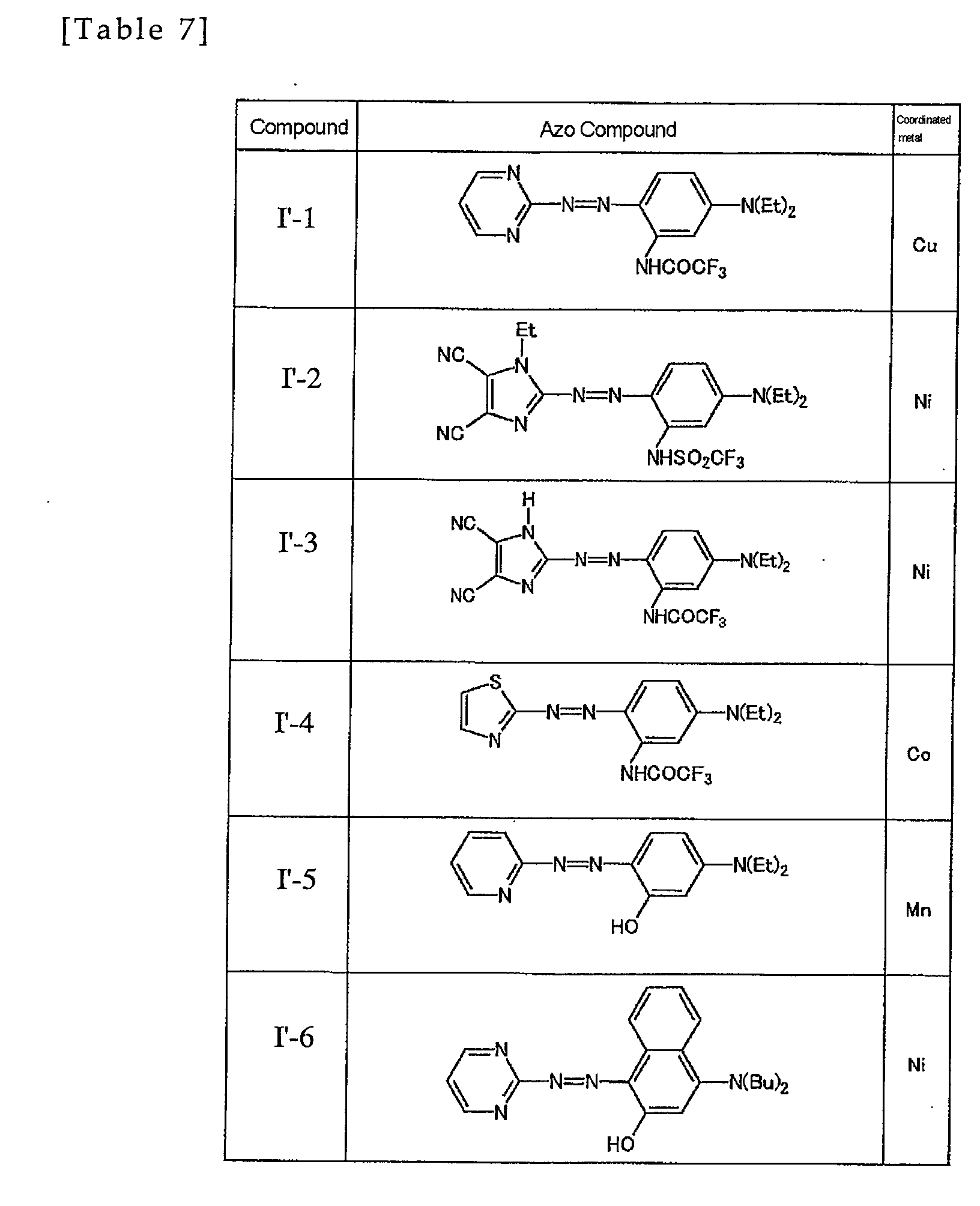


- Specific examples of the squarylium metal chelate compounds to be used for the second optical recording medium of the present invention are similar to those used for the first optical recording medium.
- The third optical recording medium of the present invention has a substrate and at least a recording layer disposed on the substrate, the recording layer comprising at least one squarylium metal chelate compound which comprises a squarylium compound and a metal, and at least one formazan metal chelate compound which comprises another metal and a formazan compound expressed by the following formula (C-I):
 where, Z expresses a residue forming a 5-membered or 6-membered nitrogen-containing heterocyclic ring which may have a substituent by combination with both the carbon atom and the nitrogen atom bonded to Z, and may be condensed with another aromatic ring; A expresses an alkyl group which may have a substituent, an aryl group which may have a substituent, an alkylcarbonyl group which may have a substituent, an arylcarbonyl group which may have a substituent, an alkenyl group which may have a substituent, the residue of a heterocyclic which may have a substituent, or an alkoxycarbonyl group which may have a substituent; and B expresses an alkyl group which may have a substituent, an alkenyl group which may have a substituent or an aryl group which may have a substituent, and/or a formazan compound expressed by the following formula (C-II):
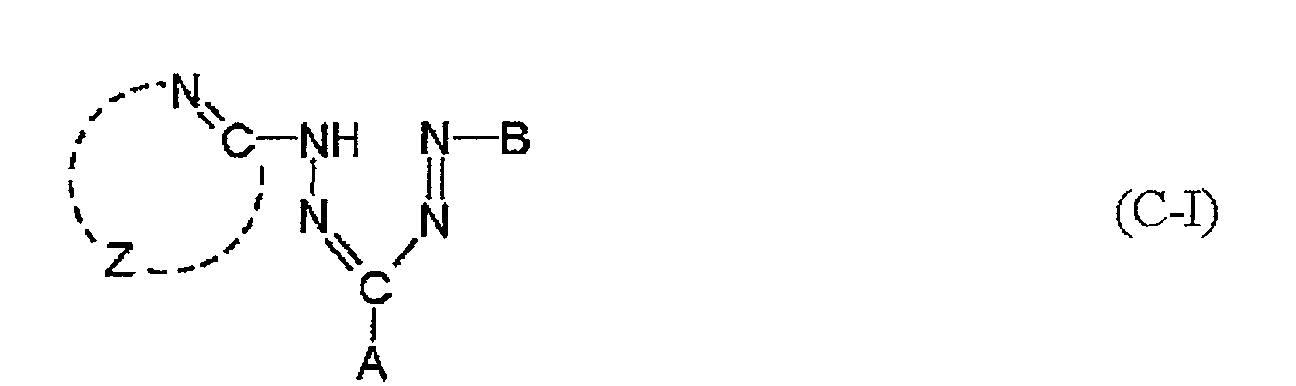 where, Z1 and Z2 each expresses a residue forming a 5-membered or 6-membered nitrogen-containing heterocyclic ring which may have a substituent by combination with both the carbon atom and the nitrogen atom bonded to Z1 and Z2, respectively, and may be condensed with another aromatic ring; A1 and A2 each independently expresses an alkyl group which may have a substituent, an aryl group which may have a substituent, an alkylcarbonyl group which may have a substituent, an arylcarbonyl group which may have a substituent, an alkenyl group which may have a substituent, the residue of a heterocyclic ring which may have a substituent, or an alkoxycarbonyl group which may have a substituent; B1 and B2 each independently expresses an alkylene group which may have a substituent or an arylene group which may have a substituent; W expresses -CH2- or -SO2-; and n stands for an integer of 0 or 1.
- The present invention will hereinafter be described more specifically. The third optical recording medium of the present invention is characterized in the use of the above-described squarylium metal chelate compound and a formazan metal chelate compound in combination. The squarylium metal chelate compound and formazan metal chelate compound are added preferably at a weight ratio of 90:10 to 50:50. Weight ratios within the above-described range are preferred from the viewpoints of light resistance and reflectivity.
- First, the formazan metal chelate compound will be described.
- The substituents Z, Z1 and Z2 in the formulas (C-I) and (C-II) each expresses a residue forming a 5-membered or 6-membered nitrogen-containing heterocyclic ring which may have a substituent; A, B, A1, A2, B1 and B2 each expresses a substituent bonded to the respective position as shown in the formulas (C-I) and (C-II); W expresses -CH2- or -SO2. When n=0, B1 and B2 are bonded directly.
- Specific examples of Z, Z1 and Z2 include residues for forming thiazole ring, benzothiazole ring, imidazole ring, benzimidazole ring, thiadiazole ring, oxazole ring, benzoxazole ring, triazole ring, pyrazole ring, oxadiazole ring, pyridine ring, pyridazine ring, pyrimidine ring, pyrazine ring, triazine ring and quinoline ring. These nitrogen-containing heterocyclic rings may have a substituent or may be condensed with another aromatic ring.
- Specific examples of the substituent include a hydrogen atom, halogen atoms, nitro group, cyano group, hydroxyl group, carboxyl group, amino group, carbamoyl group, alkyl groups which may have a substituent, aryl groups which may have a substituent, residues of a heterocyclic group which may have a substituent, alkoxy groups which may have a substituent, aryloxy groups which may have a substituent, alkylthio groups which may have a substituent, arylthio groups which may have a substituent, alkylamino groups which may have a substituent, arylamino groups which may have a substituent, alkoxycarbonyl groups which may have a substituent, aryloxycarbonyl groups which may have a substituent, alkylcarboxamide groups which may have a substituent, arylcarboxamide groups which may have a substituent, alkylsulfonamide groups which may have a substituent, alkylcarbamoyl groups which may have a substituent, arylcarbamoyl groups which may have a substituent, alkenyl groups which may have a substituent, and alkylsulfamoyl groups which may have a substituent.
- Specific examples of A, A1 and A2 include alkyl groups which may have a substituent, aryl groups which may have a substituent, alkylcarbonyl groups which may have a substituent, arylcarbonyl groups which may have a substituent and alkoxycarbonyl groups which may have a substituent.
- Specific examples of B include alkyl groups which may have a substituent, alkenyl groups which may have a substituent and aryl groups which may have a substituent.
- Specific examples of B1 and B2 include alkylene groups which may have a substituent and arylene groups which may have a substituent.
- Examples of the alkyl group include C1-15 alkyl groups. Specific examples include straight chain alkyl groups such as methyl, ethyl, n-propyl, n-butyl, n-pentyl, n-hexyl, n-heptyl, n-octyl, n-nonyl, and n-decyl; branched alkyl groups such as isobutyl, isoamyl, 2-methylbutyl, 2-methylpentyl, 3-methylpentyl, 4-methylpentyl, 2-ethylbutyl, 2-methylhexyl, 3-methylhexyl, 4-methylhexyl, 5-methylhexyl, 2-ethylpentyl, 3-ethylpentyl, 2-methylheptyl, 3-methylheptyl, 4-methylheptyl, 5-methylheptyl, 2-ethylhexyl, 3-ethylhexyl, isopropyl, sec-butyl, 1-ethylpropyl, 1-methylbutyl, 1,2-dimethylpropyl, 1-methylheptyl, 1-ethylbutyl, 1,3-dimethylbutyl, 1,2-dimethylbutyl, 1-ethyl-2-methylpropyl, 1-methylhexyl, 1-ethylheptyl, 1-propylbutyl, 1-isopropyl-2-methylpropyl, 1-ethyl-2-methylbutyl, 1-propyl-2-methylpropyl, 1-methylheptyl, 1-ethylhexyl, 1-propylpentyl, 1-isopropylpentyl, 1-isopropyl-2-methylbutyl, 1-isopropyl-3-methylbutyl, 1-methyloctyl, 1-ethylheptyl, 1-propylhexyl, 1-isobutyl-3-methylbutyl, neopentyl, tert-butyl, tert-hexyl, tert-amyl, and tert-octyl; and cycloalkyl groups such as cyclohexyl, 4-methylcyclohexyl, 4-ethylcyclohexyl, 4-tert-butylcyclohexyl, 4-(2-ethylhexyl)cyclohexyl, bornyl, and isobornyl (adamantyl). Of these, C1-8 alkyl groups are preferred.
- As the alkylene groups, those obtained by removing one hydrogen atom from the above-described alkyl groups can be mentioned as examples.
- The above-described alkyl groups may be substituted by hydroxyl group, a halogen atom, nitro group, carboxyl group, cyano group, an aryl group which may have a specific substituent (for example, a halogen atom or nitro group), or a residue of a heterocyclic ring. Further, they may be substituted by the above-described alkyl group via an oxygen atom, sulfur atom, or nitrogen atom.
- Examples of the alkyl group substituted via an oxygen atom include methoxymethyl group, methoxyethyl group, ethoxymethyl group, ethoxyethyl group, butoxyethyl group, ethoxyethoxyethyl group, methoxypropyl group, and ethoxypropyl group. Examples of the alkyl group substituted via a sulfur atom include methylthioethyl group, ethylthioethyl group, ethylthiopropyl and phenylthioethyl group. Examples of the alkyl group substituted via a nitrogen atom include dimethylaminoethyl group, diethylaminoethyl group, and diethylaminopropyl group.
- Specific examples of the alkenyl group include C2-6 alkenyl groups such as vinyl, allyl, 1-propenyl, methacryl, crotyl, 1-butenyl, 3-butenyl, 2-pentenyl, 4-pentenyl, 2-hexenyl and 5-hexenyl. Substituents for these alkenyl groups are similar to those for the above-described alkyl groups.
- Examples of the aryl group include phenyl group, naphthyl group, anthryl group, fluorenyl group, phenalenyl group, phenanthranyl group, triphenylenyl group, and pyrenyl group.
- As the arylene group, those obtained by removing one hydrogen atom from the above-described aryl groups can be mentioned as examples.
- The above-described aryl groups may be substituted by an alkyl group, hydroxyl group, a halogen atom, nitro group, carboxyl group, cyano group, trifluoromethyl group, an aryl group which may have a specific substituent (for example, a halogen atom or nitro group), or a residue of a heterocyclic ring. Further, they may be substituted by the above-described alkyl group via an oxygen atom, sulfur atom or nitrogen atom.
- Specific examples of the residue of the heterocyclic ring include furyl group, thienyl group, pyrrolyl group, benzofuryl group, isobenzofuranyl group, benzothienyl group, indolinyl group, isoindolinyl group, carbazolyl group, pyridyl group, piperidyl group, quinolyl group, isoquinolyl group, oxazolyl group, isoxazolyl group, thiazolyl group, isothiazolyl group, imidazolyl group, pyrazolyl group, benzimidazolyl group, pyrazyl group, pyrimidinyl group, pyridazinyl group, and quinoxalinyl group.
- These residues of the heterocyclic ring may be substituted by hydroxyl group, a halogen atom, nitro group, carboxyl group, cyano group, an aryl group which may have a specific substituent (for example, a halogen atom or nitro group), or a residue of a heterocyclic ring. Further, they may be substituted with the above-described alkyl group via an oxygen atom, sulfur atom, or nitrogen atom.
- Specific examples of the halogen atom include fluorine, chlorine, bromine and iodine.
- As the alkoxy group which may have a substituent, those having an alkyl group, which may have a substituent, directly bonded to an oxygen atom may be used. Specific examples of the alkyl group and substituent are similar to those described above.
- As the aryloxyl group which may have a substituent, those having an aryl group, which may have a substituent, directly bonded to an oxygen atom may be used. Specific examples of the aryl group and substituent are similar to those described above.
- As the alkylthio group which may have a substituent, those having an alkyl group, which may have a substituent, directly bonded to a sulfur atom may be used. Specific examples of the alkyl group and substituent are similar to those described above.
- As the arylthio group which may have a substituent, those having an aryl group, which may have a substituent, directly bonded to a sulfur atom may be used. Specific examples of the aryl group and substituent are similar to those described above.
- As the alkylamino group which may have a substituent, those having an alkyl group, which may have a substituent, directly bonded to a nitrogen atom may be used. Specific examples of the alkyl group and substituent are similar to those described above. In this case, alkyl groups may be bonded each other to form a ring, while containing an oxygen atom or nitrogen atom. Examples of the ring include piperidino group, morpholino group, pyrrolidinyl group, piperazinyl group, indolinyl group, and isoindolinyl group.
- As the arylamino group which may have a substituent, those having an aryl group, which may have a substituent, directly bonded to a nitrogen atom may be used. Specific examples of the aryl group and substituent are similar to those described above.
- As the alkylcarbonyl group which may have a substituent, those having an alkyl group, which may have a substituent, directly bonded to the carbon atom of the carbonyl group may be used. Specific examples of the alkyl group and substituent are similar to those described above.
- As the arylcarbonyl group which may have a substituent, those having an aryl group, which may have a substituent, directly bonded to the carbon atom of the carbonyl group may be used. Specific examples of the aryl group and substituent are similar to those described above.
- As the alkoxycarbonyl group which may have a substituent, those having an alkyl group, which may have a substituent, directly bonded to the oxygen atom of O(C=O) may be used. Specific examples of the alkyl group and substituent are similar to those described above.
- As the aryloxycarbonyl group which may have a substituent, those having an aryl group, which may have a substituent, directly bonded to the oxygen atom of O(C=O) may be used. Specific examples of the aryl group and substituent are similar to those described above.
- As the alkylcarboxamide group which may have a substituent, those having an alkyl group, which may have a substituent, directly bonded to the carbon atom of the carboxamide may be used. Specific examples of the alkyl group and substituent are similar to those described above.
- As the arylcarboxamide group which may have a substituent, those having an aryl group, which may have a substituent, directly bonded to the carbon atom of the carboxamide may be used. Specific examples of the aryl group and substituent are similar to those described above.
- As the alkylcarbamoyl group which may have a substituent, those having an alkyl group, which may have a substituent, directly bonded to the nitrogen atom of the carbamoyl group may be used. Specific examples of the alkyl group and substituent are similar to those described above. In this case, alkyl groups may be bonded each other to form a ring, while containing an oxygen atom or a nitrogen atom. Examples of the ring include piperidino group, morpholino group, pyrrolidinyl group, piperazinyl group, indolinyl group, and isoindolinyl group.
- As the arylcarbamoyl group which may have a substituent, those having an aryl group, which may have a substituent, directly bonded to the nitrogen atom of the carbamoyl group may be used. Specific examples of the aryl group and substituent are similar to those described above.
- As the alkylsulfamoyl group which may have a substituent, those having an alkyl group, which may have a substituent, directly bonded to the nitrogen atom of the sulfamoyl group may be used. Specific examples of the aryl group and substituent are similar to those described above.
- Specific examples of the metal atom constituting the formazan metal chelate compound include titanium, vanadium, chromium, manganese, iron, cobalt, nickel, copper, zinc, zirconium, niobium, molybdenum, technetium, ruthenium, rhodium, and palladium, and oxides or halides thereof. In particular, formazan metal chelate compounds containing a metal such as vanadium, manganese, iron, cobalt, nickel, copper, zinc or palladium are excellent in optical properties as an optical recording material. Of the halides, chlorides are preferred.
- Next, the squarylium metal chelate compound will be described.
- In the optical recording medium of the present invention, use of a laser light of 600 to 720 nm as a recording or reproducing wavelength is desired. From the viewpoint of optical properties at this wavelength, the squarylium metal chelate compounds of the formula (A-II) are especially preferred.
- Specific examples of the compounds expressed by the formula (C-I) or (C-II) for use in the third optical recording medium of the present invention are shown in Tables 11 to 13, while specific examples of the squarylium metal chelate compounds expressed by the formula (A-II) are shown in Tables 14 to 16.
- In the tables, nPr, iPr, nBu and Ph represent n-propyl, isopropyl, n-butyl and phenyl groups respectively.
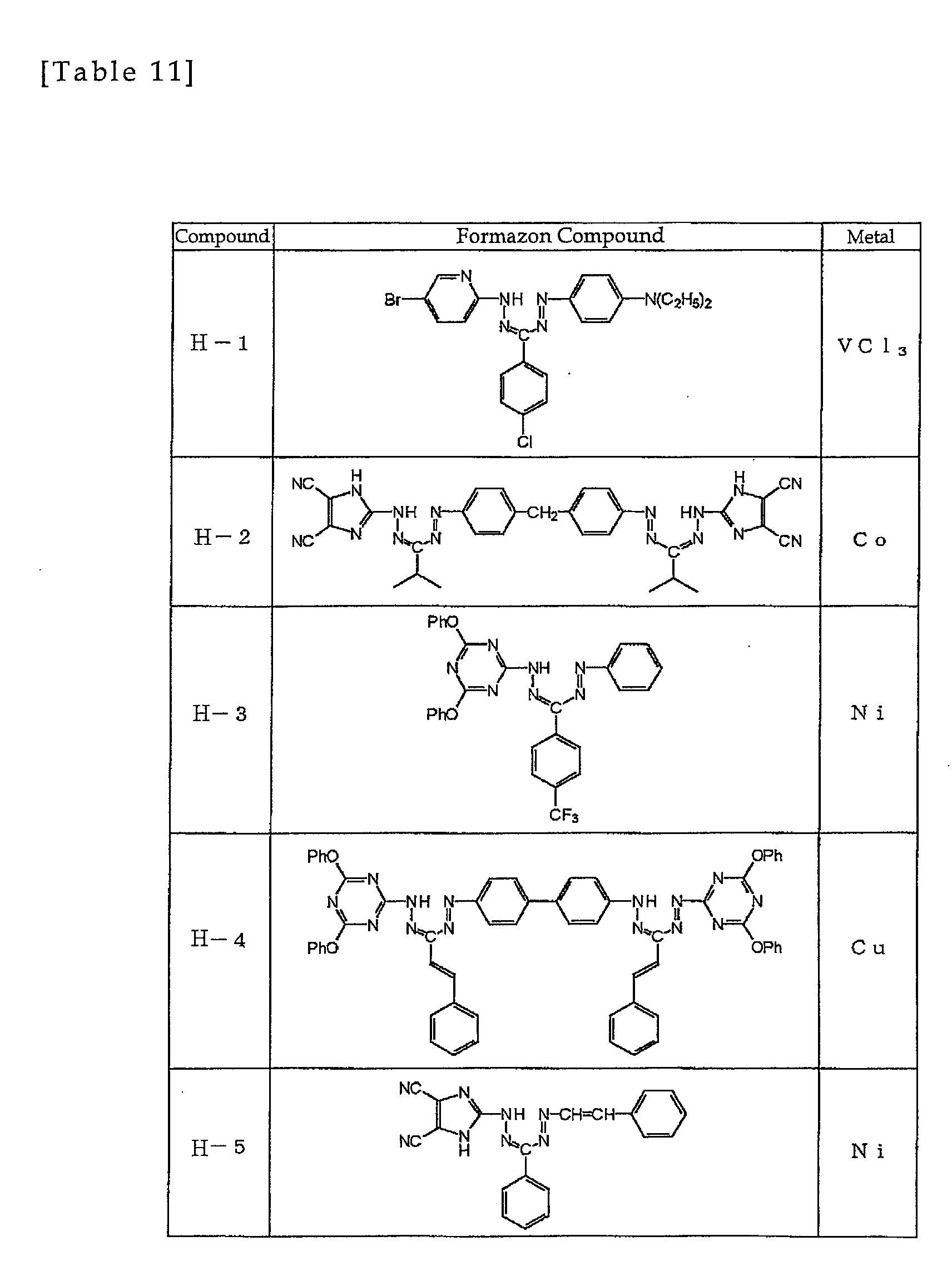
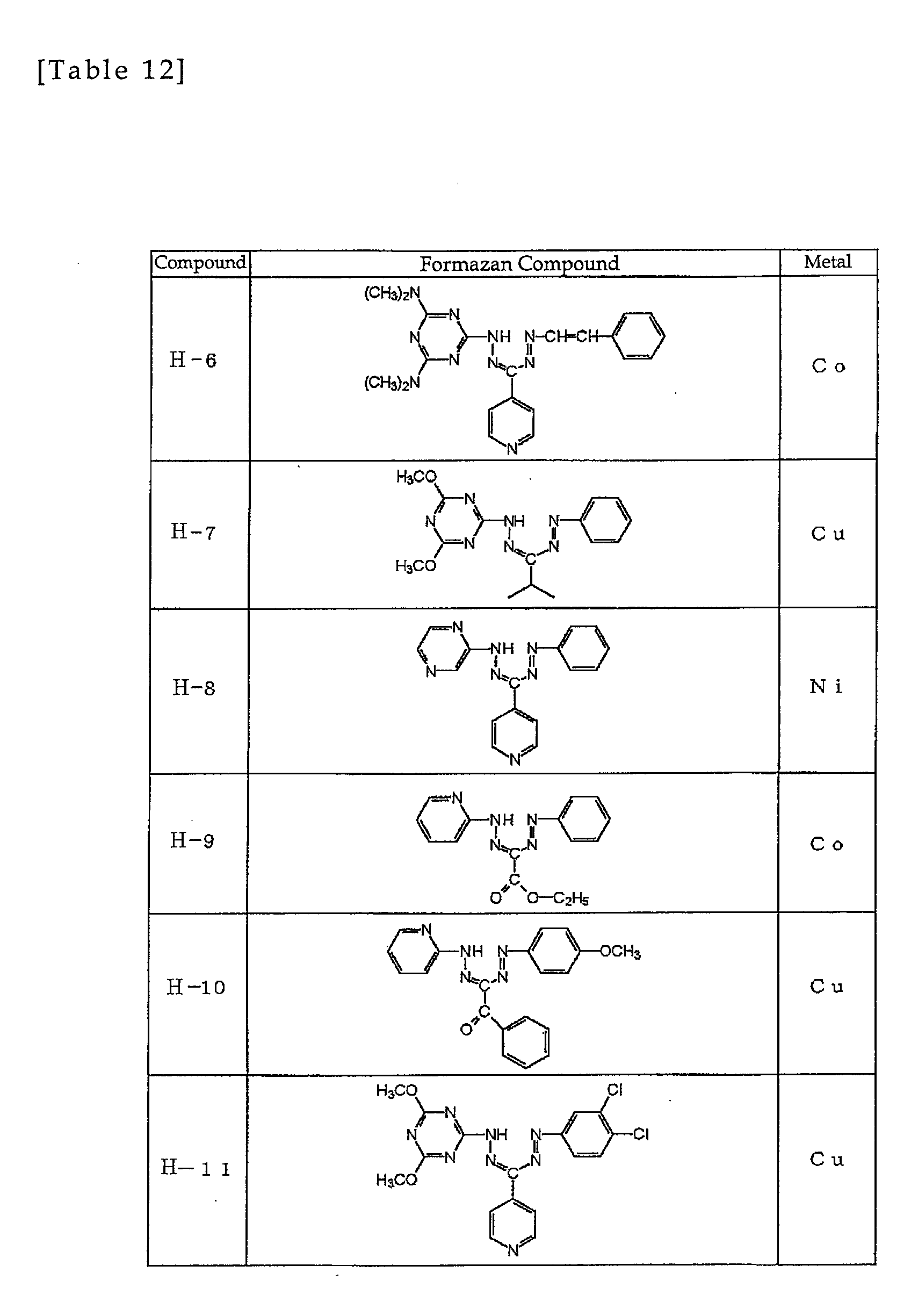
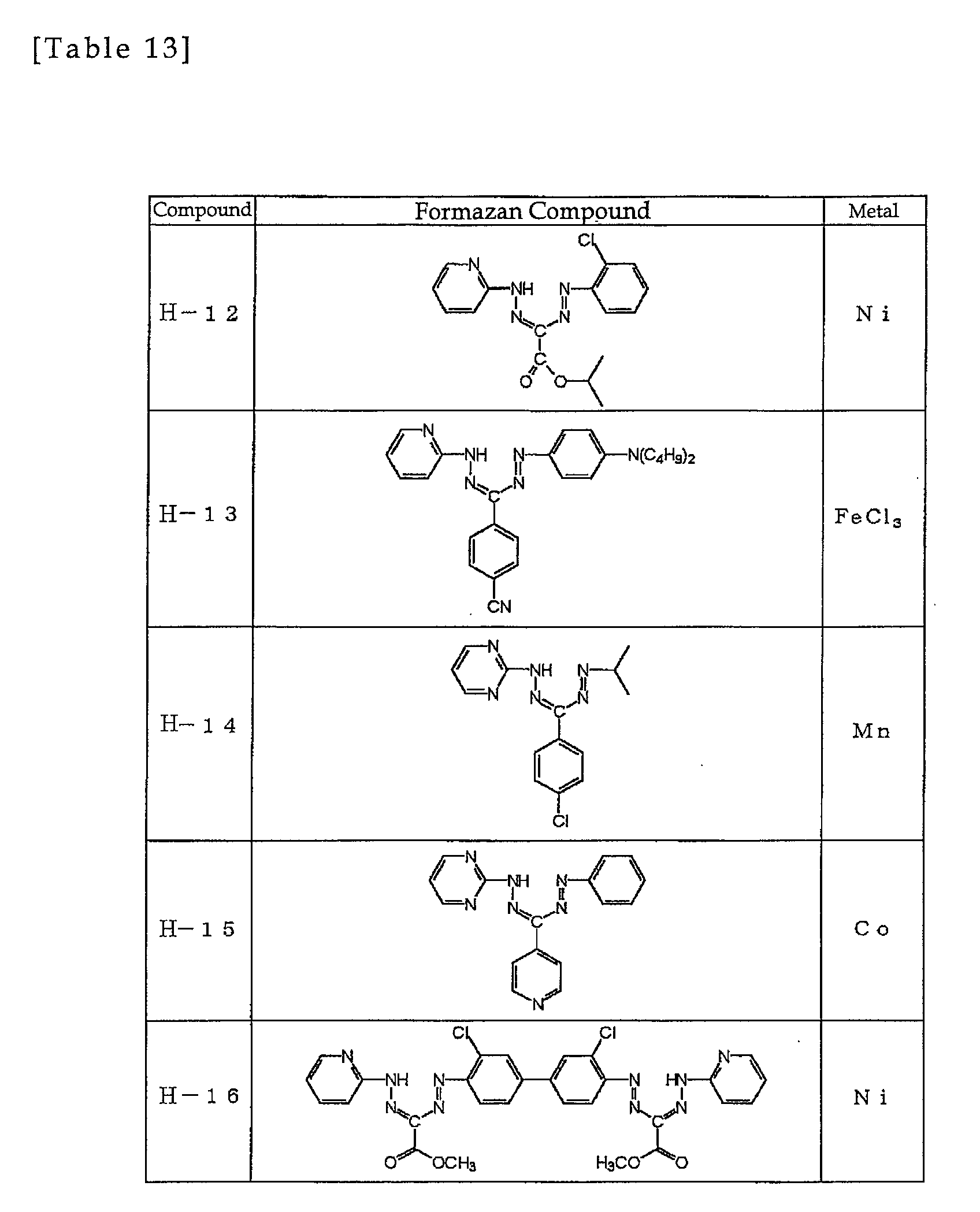


- Upon formation of a recording layer, dye mixtures of the present invention may be used either alone or in combination. In addition to the dye mixture of the present invention, another organic dye may be mixed or stacked in order to improve optical properties, recording sensitivity and signal characteristics.
- The fourth optical recording medium of the present invention has a substrate and at least a recording layer disposed on the substrate, the recording layer comprising at least one squarylium compound, and at least one formazan metal chelate compound which comprises a metal and a formazan compound expressed by the following Formula (D-I):where, Z expresses a residue forming a 5-membered or 6-membered nitrogen-containing heterocyclic ring which may have a substituent by combination with the carbon atom and the nitrogen atom bonded to Z, and may be condensed with another aromatic ring, A expresses an alkyl group which may have a substituent, an aryl group which may have a substituent, an alkylcarbonyl group which may have a substituent, an arylcarbonyl group which may have a substituent, an alkenyl group which may have a substituent, a residue of a heterocyclic ring which may have a substituent, or an alkoxycarbonyl group which may have a substituent; and B expresses an alkyl group which may have a substituent or an aryl group which may have a substituent, and/or another formazan compound expressed by the following formula (D-II):
 where, Z1 and Z2 each expresses a residue forming a 5-membered or 6-membered nitrogen-containing heterocyclic ring which may have a substituent by combination with both the carbon atom and the nitrogen atom bonded to Z1 and Z2, respectively, may be condensed with another aromatic ring; A1 and A2 each independently expresses an alkyl group which may have a substituent, an aryl group which may have a substituent, an alkylcarbonyl group which may have a substituent, an arylcarbonyl group which may have a substituent, an alkenyl group which may have a substituent, a residue of a heterocyclic ring which may have a substituent, or an alkoxycarbonyl group which may have a substituent; B1 and B2 each independently expresses an alkylene group which may have a substituent or an arylene group which may have a substituent; W expresses -CH2- or -SO2-; and m stands for an integer of 0 or 1.
- The squarylium compound is preferably a compound expressed by the below-described formula (D-III) and/or (D-VI).where, R1 and R2 may be the same or may be different, and each expresses a hydrogen atom, an alkyl group which may have a substituent, an aralkyl group which may have a substituent, an aryl group which may have a substituent or a residue of a heterocyclic ring which may have a substituent, or R1 and R2 may form a heterocyclic ring which may have a substituent by combination with the adjacent two carbon atoms; and R3 expresses a compound expressed by one of the following formulae (D-IV) and (D-V):
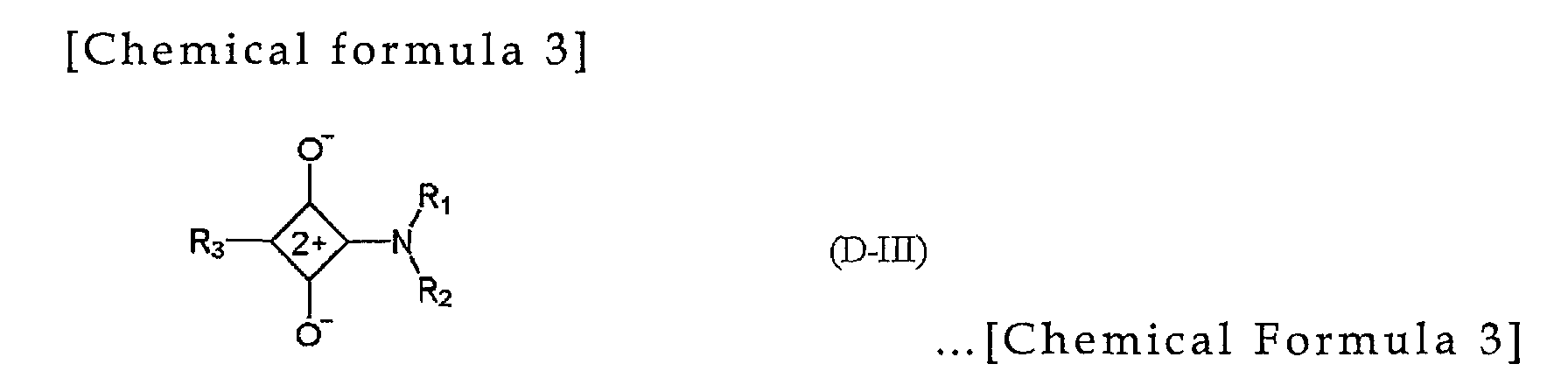 where, R4 and R5 may be the same or may be different and each independently expresses a hydrogen atom or an alkyl group which may have a substituent, or R4 and R5 may form a heterocyclic ring which may have a substituent by combination with the adjacent nitrogen atom; R6, R7, R8 and R9 may be the same or may be different to each other and each independently expresses a hydrogen atom, an alkyl group which may have a substituent, an alkoxy group which may have a substituent, hydroxyl group or a halogen atom, and a pair R4 and R6 or a pair R5 and R7 by combination with the adjacent -N-C-C form a nitrogen-containing heterocyclic ring which may have a substituent:
 where, Q1 expresses a carbon atom or a nitrogen atom, R10 and R11 may be the same or may be different and each independently expresses a hydrogen atom, an alkyl group which may have a substituent, an aryl group which may have a substituent, an aralkyl group which may have a substituent or hydroxyl group (with the proviso that when Q1 expresses a nitrogen atom, R11 does not exist), R12 expresses a hydrogen atom, an aralkyl group which may have a substituent, an aryl group which may have a substituent or an aralkyl group which may have a substituent; R13 and R14 may be the same or may be different and each independently expresses a hydrogen atom, an alkyl group which may have a substituent, an alkoxy group which may have a substituent or a halogen atom, or R13 and R14 may form an alicyclic hydrocarbon ring, an aromatic ring which may have a substituent, or a heterocyclic ring which may have a substituent by combination with the adjacent two carbon atoms; or a compound expressed by the following formula (D-VI):
 where, Q2 expresses a carbon atom or a nitrogen atom, R15 expresses a hydrogen atom, an alkyl group which may have a substituent, an aryl group which may have a substituent or a heterocyclic group which may have a substituent, R16 expresses a hydrogen atom, a halogen atom, an alkyl group which may have a substituent, an alkoxy group which may have a substituent, an aralkyl group which may have a substituent, an aryl group which may have a substituent, amino group which may have a substituent or a heterocyclic group which may have a substituent, R17 and R18 may be the same or may be different and each independently expresses an alkyl group which may have a substituent, or R17 and R18 may form an alicyclic hydrocarbon ring or a heterocyclic group which may have a substituent by combination with the adjacent carbon atom, with the proviso that when Q2 expresses a nitrogen atom, R18 does not exist, R19 expresses a hydrogen atom, an alkyl group which may have a substituent, an aralkyl group which may have a substituent or an aryl group which may have a substituent, R20 expresses a halogen atom, an alkyl group which may have a substituent, an aralkyl group which may have a substituent, an aryl group which may have a substituent, trifluoromethyl group, nitro group, cyano group, or an alkoxy group which may have a substituent, n stands for an integer of 0 to 4 with the proviso that when n stands for an integer of 2 to 4, R20s may be the same or may be different and any adjacent two R20 by combination with the adjacent two carbon atoms may form an aromatic ring which may have a substituent.
- The present invention will hereinafter be described more specifically. The fourth optical recording medium of the present invention is characterized by the use of the above-described squarylium compound and formazan metal chelate compound in combination. To this optical recording medium, the squarylium compound and formazan metal chelate compound are added preferably at a weight ratio of 90:10 to 50:50. Weight ratios within the above-described range are preferred, because the resulting optical recording medium has high light resistance and reflectivity.
- Each of the groups in the formulae (D-I) and (D-II) has the same meaning as defined above in (C-I) and (C-II).
- In the optical recording medium of the present invention, preferred is the use of a laser light of 600 to 720 nm for a recording or reproducing wavelength. In consideration of the optical properties at this wavelength, the squarylium compounds expressed by the formulas (D-III) and (D-VI) are preferred.
- The definition of the groups in the formulas (D-III) to (D-VI) will next be described.
- In the definition of the groups in the formulas (D-III) and (D-VI), examples of the alkyl or the alkyl moiety of the alkoxy group include straight or branched C1-6 alkoxy groups and cyclic C3-8 alkyl groups. Specific examples include methyl group, ethyl group, propyl group, isopropyl group, butyl group, iso-butyl group, sec-butyl group, tert-butyl group, pentyl group, isopentyl group, 1-methylbutyl group, 2-methylbutyl group, tert-pentyl group, hexyl group, cyclopropyl group, cyclobutyl group, cyclopentyl group, cyclohexyl group, cycloheptyl group, and cyclooctyl group.
- Examples of the aryl group and an aryl moiety of the aralkyl group include phenyl group, naphthyl group, and anthryl group.
- Examples of the halogen atom include fluorine atom, chlorine atom, bromine atom, and iodine atom.
- As the heterocyclic ring in the heterocyclic group and the heterocyclic ring formed by a pair of R13 and R14 or R17 and R18 by combination with (two) carbon atoms adjacent thereto, there are aromatic heterocyclic rings and alicyclic heterocyclic rings.
- Examples of the aromatic heterocyclic ring include 5-or 6-membered monocyclic aromatic heterocyclic rings containing at least one atom selected from a nitrogen atom, an oxygen atom, and a sulfur atom, and bicyclic or tricyclic, 3- to 8-membered-ring-condensed aromatic heterocyclic rings containing at least one atom selected from a nitrogen atom, an oxygen atom, and a sulfur atom. Specific examples include pyridine ring, pyrazine ring, pyrimidine ring, pyridazine ring, quinoline ring, isoquinoline ring, phthalazine ring, quinazoline ring, quinoxaline ring, naphthyridine ring, cinnoline ring, pyrrole ring, pyrazole ring, imidazole ring, triazole ring, tetrazole ring, thiophene ring, furan ring, thiazole ring, oxazole ring, indole ring, isoindole ring, indazole ring, benzimidazole ring, benzotriazole ring, benzothiazole ring, benzoxazole ring, purine ring, and carbazole ring.
- Examples of the alicyclic heterocyclic ring include 5-or 6-membered monocyclic alicyclic heterocyclic rings containing at least one atom selected from a nitrogen atom, an oxygen atom, and a sulfur atom, and bicyclic or tricyclic, 3- to 8-membered-ring-condensed alicyclic heterocyclic rings containing at least one atom selected from a nitrogen atom, an oxygen atom, and a sulfur atom. Specific examples include pyrrolidine ring, piperidine ring, piperazine ring, morpholine ring, thiomorpholine ring, homopiperidine ring, homopiperazine ring, tetrahydropyridine ring, tetrahydroquinoline ring, tetrahydroisoquinoline ring, tetrahydrofuran ring, tetrahydropyran ring, dihydrobenzofuran ring, and tetrahydrocarbazole ring.
- As heterocyclic rings formed by R1 and R2 or R4 and R5 by combination with the adjacent nitrogen atom and nitrogen-containing heterocyclic rings formed by R4 and R6 or R5 and R7 by combination with the N-C-C adjacent thereto, nitrogen-containing aromatic heterocyclic rings and nitrogen-containing alicyclic heterocyclic rings can be mentioned as examples.
- Examples of the aromatic heterocyclic ring containing a nitrogen atom include 5- or 6-membered monocyclic aromatic heterocyclic rings containing at least one nitrogen atom, and bicyclic or tricyclic, 3- to 8-membered-ring-condensed aromatic heterocyclic rings containing at least one nitrogen atom. Specific examples include pyridine ring, pyrazine ring, pyrimidine ring, pyridazine ring, quinoline ring, isoquinoline ring, phthalazine ring, quinazoline ring, quinoxaline ring, naphthyridine ring, cinnoline ring, pyrrole ring, pyrazole ring, imidazole ring, triazole ring, tetrazole ring, thiazole ring, oxazole ring, indole ring, isoindole ring, indazole ring, benzimidazole ring, benzotriazole ring, benzothiazole ring, benzoxazole ring, purine ring, and carbazole ring.
- Examples of the nitrogen-containing alicyclic heterocyclic ring include 5- or 6-membered monocyclic alicyclic heterocyclic rings containing at least one nitrogen atom, and dicyclic or tricyclic, 3- to 8-membered-ring-condensed alicyclic heterocyclic rings containing at least one nitrogen atom. Specific examples include pyrrolidine ring, piperidine ring, piperazine ring, morpholine ring, thiomorpholine ring, homopiperidine ring, homopiperazine ring, tetrahydropyridine ring, tetrahydroquinoline ring, tetrahydroisoquinoline ring, and tetrahydrocarbazole ring.
- As the alicyclic hydrocarbon ring formed by R13 and R14 or R17 and R18 by combination with the (two) carbon atoms adjacent thereto, alicyclic C3-8 hydrocarbon rings which may be saturated or unsaturated can be given as examples. Examples include cyclopropane ring, cyclobutane ring, cyclopentane ring, cyclohexane ring, cycloheptane ring, cyclooctane ring, cyclopentene ring, 1,3-cyclopentadiene ring, cyclohexene ring, and cyclohexadiene ring.
- Examples of the aromatic ring formed by R13 and R14 by combination with the two carbon atoms adjacent thereto, and aromatic rings formed by two adjacent R20s by combination with the two carbon atoms adjacent thereto include C6-14 aromatic rings such as benzene, naphthalene, and anthracene.
- The substituents for the aryl group, aralkyl group, heterocyclic group, aromatic ring, nitrogen-containing heterocyclic ring, or heterocyclic ring may be the same or may be different and their number is from one to the permissible number, preferably, 1 to 5. Examples of the substituents include hydroxyl group, carboxyl group, nitro group, alkoxy groups, alkyl groups, aralkyl groups, cyano group, halogen atoms, -N=N-Ar (in which Ar expresses hydroxyl group, carboxyl group, nitro group, an alkoxy group, an alkyl group which may be substituted by a halogen atom, or an aryl group which may be substituted by cyano group or a halogen atom), and -CH=CH-Ar (in which Ar has the same meaning as described above). Examples of the alkyl group, alkoxy group, aralkyl group, aryl group, and halogen atom are similar to those described above.
- The substituents for the alkyl group or alkoxy group may be the same or may be different and their number is from one to the permissible number, preferably, from 1 to 3. Examples of the substituents include hydroxyl group, carboxyl group, nitro group, alkoxy groups, aryl groups, and halogen atoms. Examples of the alkoxy groups, aryl groups and halogen atoms are similar to those described above.
- The amino group may be substituted by one or two substituents which may be the same or may be different. Examples of the substituents include alkyl groups and aryl groups. Examples of the alkyl and aryl groups are similar to those described above, respectively.
- A process for preparing the squarylium compound to be used in the present invention will next be described with the compounds expressed by the formula (D-III) and (D-VI) as examples. The compounds expressed by the formulas (D-III) and (D-VI) may hereinafter be called Compound (D-III) and Compound (D-VI), respectively. This will be equally applied to compounds with another formula number.
-


-

-

-
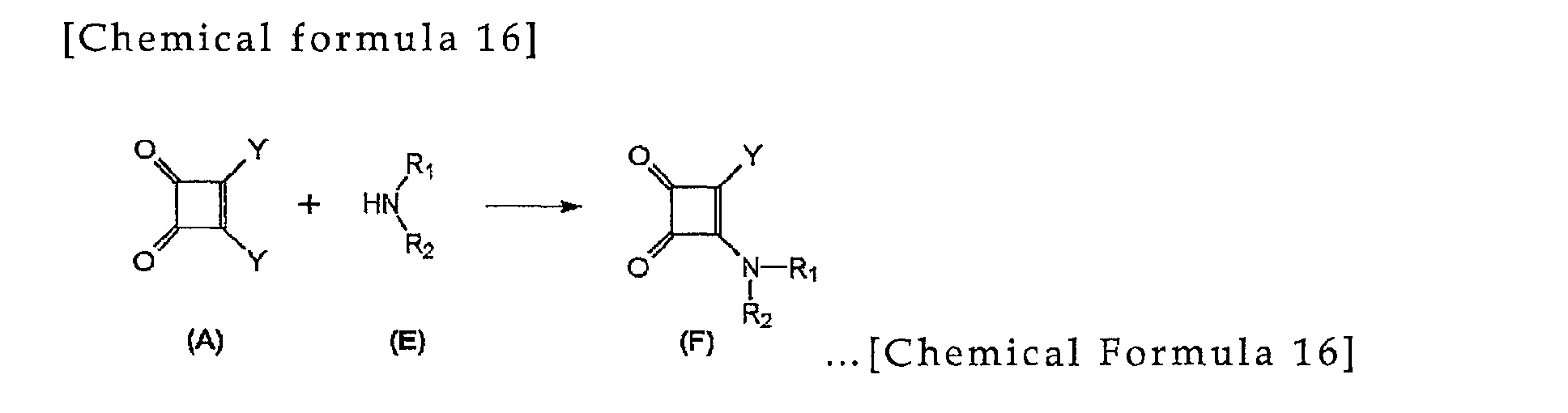
-

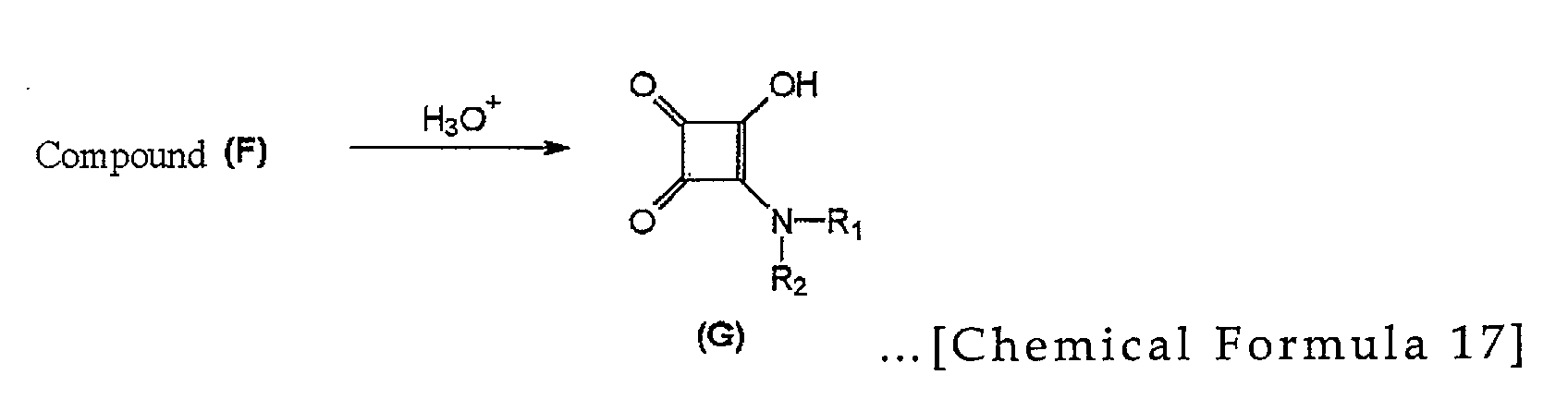
-
Compound (G) + R3-H(B) → Compound (D-III) - In the above-described reaction schemes, R1, R2 and R3 have the same meanings as described above, and Y expresses a halogen atom such as chlorine or bromine, or OR21 (in which, R21 expresses an alkyl group. Specific examples of the alkyl group of R21 are similar to those of the alkyl group in the formulas (D-III) to (D-VI).
- In the reaction scheme (1-a), Compound (C) is available by reacting Compound (A) with 0.4 to 2 times the mole of Compound (B), in the presence of 0.4 to 2 times the mole of a base if necessary, in a solvent at room temperature to the boiling point of the solvent for 1 to 4 hours.
- Examples of the solvent include chloroform, dichloromethane, 1,2-dichloroethane, ethyl acetate, diethyl ether, methyl-tert-butyl ether, tetrahydrofuran, toluene, benzene, dimethylformamide, and dimethyl sulfoxide.
- Examples of the base include organic bases such as quinoline, triethylamine, and pyridine; and inorganic bases such as potassium bicarbonate and sodium bicarbonate.
- In the reaction scheme (1-b), Compound (D) is available by treating Compound (C) in a 50 to 90 vol/wt.% aqueous solution of acetic acid at 90 to 110°C for 1 to 7 hours or in a 50 to 99 wt.% aqueous solution of trifluoroacetic acid at 40 to 60°C for 1 to 3 hours.
- In the reaction scheme (1-c), Compound (D-III) is available by reacting Compound (D) with 0.5 to 2 times the mole of Compound (E), in the presence of 1.0 to 2.0 times the mole of a base if necessary, in a solvent at 80 to 120°C for 1 to 15 hours.
- As the solvent, an alcohol solvent having 2 to 8 carbon atoms such as ethanol, propanol, isopropanol, butanol or octanol is used alone, or a mixed solvent of such an alcohol solvent with benzene or toluene (the mixed solvent containing 50 vol/vol% or greater of the alcohol) is used.
- Examples of the base include organic bases such as quinoline, triethylamine, and pyridine; and inorganic bases such as potassium carbonate, potassium bicarbonate, and sodium bicarbonate.
- In the reaction scheme (2-a), Compound (F) is available in a similar manner to that employed in the reaction scheme (1-a) except for the use of Compound (E) instead of Compound (B).
- In the reaction scheme (2-b), Compound (G) is available in a similar manner to that employed in the reaction scheme (1-b) except for the use of Compound (F) instead of Compound (C).
- In the reaction scheme (2-c), Compound (D-III) is available in a similar manner to that employed in the reaction scheme (1-c) except for the use of Compound (G) and Compound (B) instead of Compound (D) and Compound (E), respectively.
- After completion of the final reaction, Compound (D-III) is isolated and purified, for example, by distilling off the solvent from the reaction product or filtration thereof. If necessary, further purification can be performed by the method (column chromatography, recrystallization, washing with a solvent or the like) ordinarily employed in the synthetic organic chemistry.
-

-

-
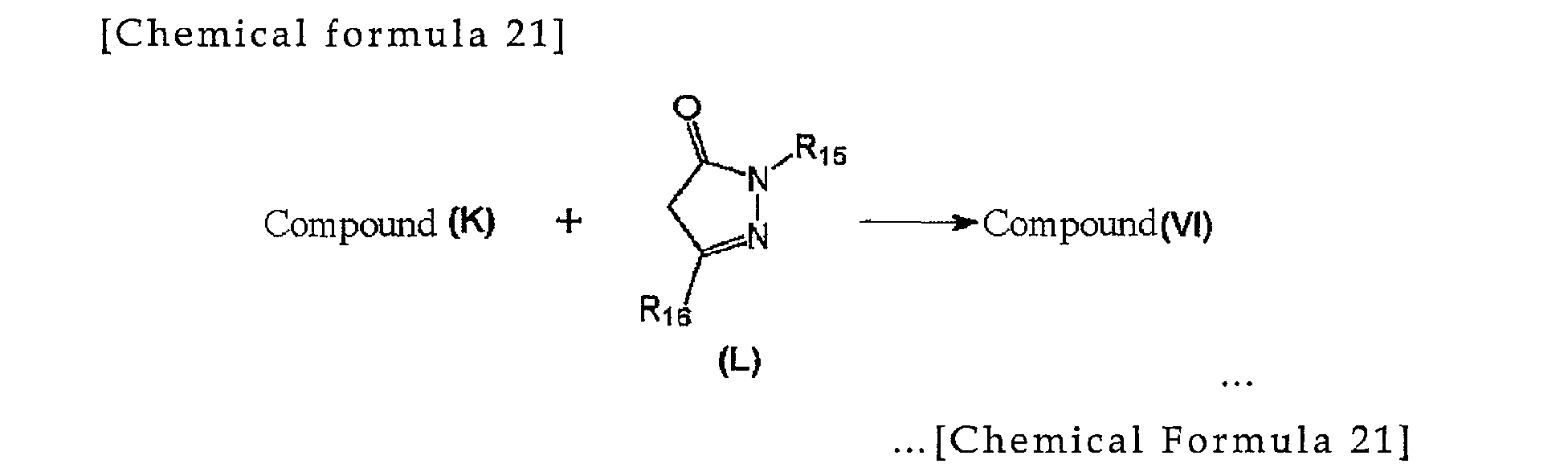
-
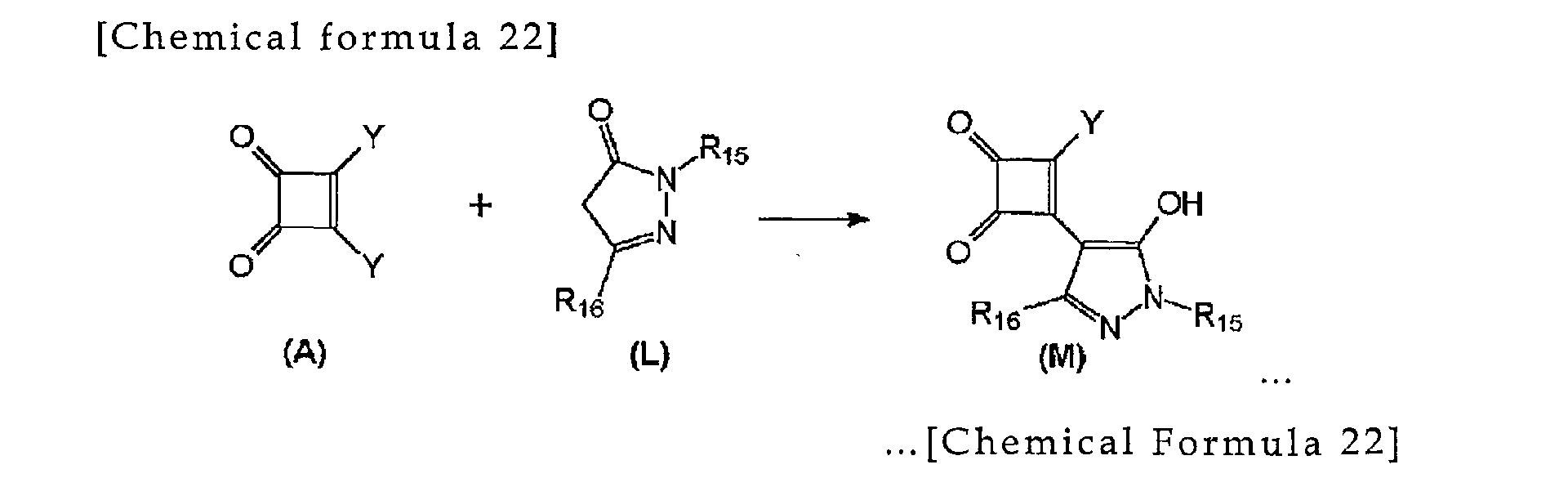
-
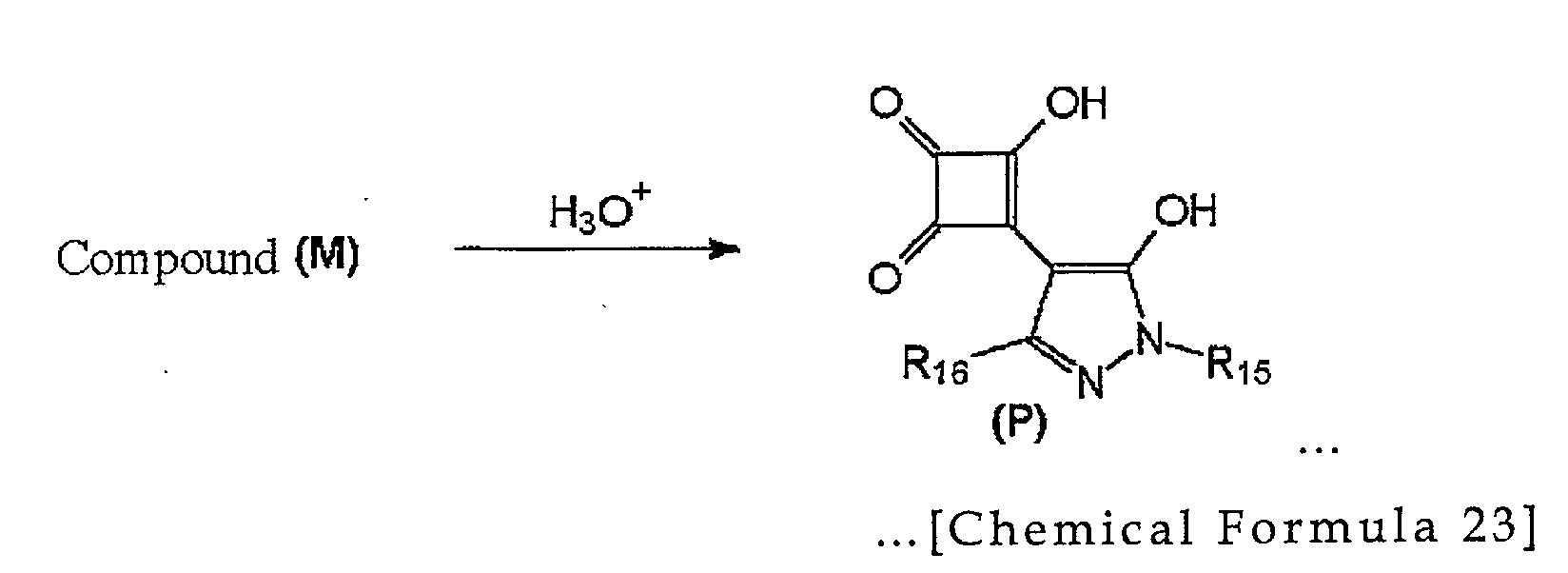
-
- In the above-described reaction schemes, Q2, R15, R16, R17, R18, R19, R20 and n have the same meanings as described above, X expresses a halogen atom such as chlorine, bromine or iodine, a tosyl group or a mesyl group, and Y has the same meaning as described above.
- In the reaction scheme (3-a), Compound (J) is available by reacting Compound (A) with 1 to 2 times the mole of Compound (Ha) or Compound (Hb), in the presence of 1 to 2 times the mole of a base if necessary, in a solvent at 0°C to room temperature for 30 minutes to 70 hours.
- Examples of the solvent usable here include chloroform, dichloromethane, 1,2-dichloroethane, ethyl acetate, diethyl ether, methyl-tert-butyl ether, tetrahydrofuran, toluene, benzene, dimethylformamide and dimethyl sulfoxide.
- Examples of the base include organic bases such as quinoline, triethylamine and pyridine and inorganic bases such as potassium bicarbonate and sodium bicarbonate.
- In the reaction scheme (3-b), Compound (K) is available by treating Compound (J) in a 50 to 90 vol/vol% aqueous acetic acid solution at 90 to 100°C for 1 to 7 hours, or in a 50 to 99 wt.% aqueous solution of trifluoroacetic acid at 45 to 50°C for 1 to 3 hours.
- In the reaction scheme (3-c), Compound (D-VI) is available by reacting Compound (K) with 0.5 to 2 times the mole of Compound (L), in the presence of 0.5 to 2 times the mole of a base if necessary, in a solvent at 80 to 120°C for 1 to 15 hours.
- As the solvent, an alcohol solvent having 2 to 8 carbon atoms such as ethanol, propanol, isopropanol, butanol or octanol is used alone, or a mixed solvent of such an alcohol solvent with benzene or toluene (the mixed solvent containing 50 vol/vol% or greater of the alcohol) is used.
- Examples of the base include organic bases such as quinoline, triethylamine, and pyridine; and inorganic bases such as potassium carbonate, potassium bicarbonate, and sodium bicarbonate.
- In the reaction scheme (4-a), Compound (M) is available in a similar manner to that employed in the reaction scheme (3-a) except for the use of Compound (L) instead of Compound (Ha) or (Hb).
- In the reaction scheme (4-b), Compound (P) is available in a similar manner to that employed in the reaction scheme (3-b) except for the use of Compound (M) instead of Compound (J).
- In the reaction scheme (4-c), Compound (D-VI) is available in a similar manner to that employed in the reaction scheme (3-c) except for the use of Compound (P) and Compound (Ha) or (Hb) instead of Compound (K) and Compound (L), respectively.
- After completion of the final reaction, the reaction product is distilled to remove the solvent therefrom or filtered, followed by, if necessary, further purification by the method (column chromatography, recrystallization, washing with a solvent or the like) ordinarily employed in the synthetic organic chemistry, whereby Compound (D-VI) is isolated and purified.
- Specific examples of the formazan metal chelate compound to be used for the fourth optical recording medium of the present invention are shown below in Tables 17 to 19. In tables, Me, nBu and Ph represent a methyl group, an n-butyl group and a phenyl group, respectively.


- Specific examples of the squarylium compound to be used for the fourth optical recording medium of the present invention are shown below in Tables 20 to 22. In tables, nPr, iPr and Ph represent an n-propyl group, an isopropyl group and a phenyl group, respectively.


- Materials for a recording layer are required to have physical properties such as optical properties, thermal properties and light resistance.
- From the viewpoint of optical properties, it is preferred that the material for a recording layer has a great absorption band on a shorter wavelength region than 600 to 720 nm which is a recording or reproducing wavelength of DVD-R or the like, preferably 630 to 690 nm, and at the same time, the recording or reproducing wavelength exists in the vicinity of a long wavelength end of the above-described absorption band. This means that the material for a recording layer has a large refractive index and a predetermined extinction coefficient at a wavelength of 600 to 720 nm which is a recording or reproducing wavelength.
- More specifically, it is preferred that in a wavelength region ±5 nm of the recording or reproducing wavelength in the vicinity of the long wavelength end of the absorption band, a single recording layer has a refractive index (n) of 1.5 or greater but not greater than 3.0, as great as possible within this range, and an extinction coefficient (k) is 0.02 or greater but not greater than 0.3. When the refractive index (n) is 1.5 or greater, a sufficient optical change occurs, making it possible to enhance the degree of recording modulation. When the refractive index (n) is 3.0 or less, dependence on the wavelength does not increase so that reproduction errors due to the light in the recording or reproducing wavelength region do not occur easily. Further, when the extinction coefficient (k) is 0.02 or greater, recording sensitivity can be improved, and at the same time, when the coefficient (k) is 0.3 or less, a reflectivity of 50% or greater can be easily obtained. The extinction coefficient within the above-described range is therefore preferred.
- In addition, the material preferably has the maximum absorption wavelength (λmax), as measured in the chloroform solution, ranging from 550 to 600 nm. Its refractive index (n) can be made higher when it has a higher adsorptivity so that the material having log ε (ε: molar adsorptivity) of 5 or greater is preferred.
- From the viewpoint of thermal properties, the material for a recording layer has preferably a thermal decomposition point within a specific temperature range. To be more concrete, the decomposition temperature is preferably 350°C or less, more preferably within a range of 250 to 350°C. Decomposition starting temperatures not greater than 350°C do not need an increase in the power of a recording laser light and those of 250°C or greater bring about recording stability. Decomposition starting temperatures within the above-described range are therefore preferred.
- From the viewpoint of light resistance, the recording layer material preferably has reproduction stability even after reproduction is repeated 1 million times or more and has light fastness enough to be free from fading when left indoors.
- The substrate usually has a guide groove having a depth of 1000 to 2500 Å. When a great capacity is necessary, the track pitch of the guide groove is preferably 0.7 to 0.8 µm, although it is usually set at 0.7 to 1.0 µm. The groove width is, at a half bandwidth, preferably 0.18 to 0.40 µm. At the half bandwidth of 0.18 µm or greater, tracking error signals having a sufficient intensity can be attained easily. When the half bandwidth is 0.40 µm or less, spreading of a recorded portion in the width direction can be prevented. The half bandwidth within the above-described range is therefore preferred.
- A description will next be made of the constitution of the optical recording medium of the present invention.
- FIG. 1 illustrates one example of a layer constitution which can be applied to the optical recording medium of the present invention. This is an example of a write-once-read-many optical disc. On a
substrate 1, disposed is arecording layer 2 via a undercoat layer 3 if necessary. A protective layer 4 is disposed on therecording layer 2 if necessary. Ahard coat layer 5 can be disposed on the back side of thesubstrate 1 if necessary. - FIG. 2 illustrates an example of another layer constitution which can be applied to the optical recording medium of the present invention. This is an example of CD-R medium. Over the
recording layer 2 of the constitution as illustrated in FIG. 1, a metalreflective layer 6 is disposed. - FIG. 3 illustrates an example of a further layer constitution (for DVD-R) which can be applied to the optical recording medium of the present invention. In this case, over the protective layer 4 of the constitution as illustrated in FIG. 2, an adhesive layer 8 and a protective substrate 7 are disposed.
- The optical recording medium of the present invention can also be constructed as an air sandwiched structure by hermetically sealing, via another substrate and a space, any two of the above-mentioned recording media as illustrated in FIG. 1 and FIG. 2 with their respective recording layers being disposed inside, or by laminating and adhering the two recording media via the protective layer.
- When the optical recording medium of the present invention is used as DVD-R, it has, as a basic structure, a structure having a first substrate and a second substrate adhered with an adhesive, while interposing a recording layer therebetween. The recording layer may be a single organic dye layer or may have an organic dye layer and a metal reflective layer stacked alternately in order to heighten reflective layer. The recording layer may be laid over a substrate while having an undercoat layer or a protective layer disposed therebetween or they may be stacked alternately for improving the performance. One of the most commonly employed structures comprises a first substrate, an organic dye layer, a metal reflective layer, a protective layer, an adhesive layer and a second substrate.
- When recording or reproducing is carried out from the direction of the substrate, the substrate needs to be transparent to the employed laser beam. Such transparency is not required when recording or reproducing is carried out on the recording layer. In the present invention, when two substrates are used in the sandwiched form and one of these substrates is transparent, transparency of the other substrate is not necessary.
- Examples of the material usable for the substrate include plastics such as polyester, acrylic resin, polyamide, polycarbonate resin, polyolefin resin, phenol resin, epoxy resin, and polyimide; glass; ceramics; and metals.
- Guide grooves or guide pits for tracking may be formed on the surface of the substrate when the substrate is used alone, or on the surface of the first substrate when two substrates are used in the sandwiched structure. Furthermore, pre-formats for address signals may also be formed on the surface of the substrate.
- Information can be recorded in a recording layer by some optical changes in the recording layer caused by exposure to a laser beam. In the first optical recording medium of the present invention, the recording layer is required to contain a mixture of a squarylium metal chelate compound and an azo metal chelate compound comprising an azo compound expressed by the formula (A-I) and a metal; in the second optical recording medium of the present invention, the recording layer is required to contain a mixture of a squarylium metal chelate compound and an azo metal chelate compound comprising an azo compound expressed by the formula (B-1) and a metal; in the third optical recording medium of the present invention, the recording layer is required to contain a mixture of a squarylium metal chelate compound and a formazan metal chelate compound which comprises a formazan compound expressed by the formula (C-I) and/or another formazan compound expressed by the formula (C-2) and a metal; and in the fourth optical recording medium of the present invention, the recording layer is required to contain a mixture of a squarylium compound and a formazan metal chelate compound which comprises a formazan compound expressed by the formula (D-I) and/or another formazan compound expressed by the formula (D-2) and a metal.
- The above-described compounds used in the present invention may be mixed with another organic dye, metal or metal compound or they may be laminated as layers in order to improve the optical properties, recording sensitivity, and signal characteristics.
- Examples of the another organic dye include (poly)methine dye, naphthalocyanine dye, phthalocyanine dye, squarylium dye, croconium dye, pyrillium dye, naphthoquinone dye, anthraquinone (indanthrene) dye, xanthene dye, triphenylmethane dye, azulene dye, tetrahydrocholine dye, phenanthrene dye, and triphenothiazine dye. Further, metal complex compounds may be used. Examples of the metal and metal compound include In, Te, Bi, Se, Sb, Ge, Sn, Al, Be, TeO, SnO, As, and Cd.
- They may be used in the dispersed and mixed form or laminated form.
- With the above-described compounds used in the present invention, various materials, for example, polymers such as ionomer resin, polyamide resin, vinyl resin, natural polymers, silicone, and liquid rubber, and a silane coupling agent may be mixed in the dispersed form. In order to improve the properties of the recording layer, a stabilizer (for example, a transition metal complex), dispersant, flame retardant, lubricant, antistatic, surfactant and/or plasticizer can be used in combination.
- The recording layer can be formed by an ordinarily employed method such as deposition, sputtering, CVD, or solution coating. For the solution coating, the above-described compounds and other materials are dissolved in an organic solvent and the resulting solution is coated by a conventional coating method such as spray coating, roller coating, dip coating, or spin coating.
- Examples of the organic solvent used for forming a recording layer include alcohols such as methanol, ethanol, isopropanol and 2,2,3,3-tetrafluoropropanol; ketones such as acetone, methyl ethyl ketone, and cyclohexanone; amides such as N,N-dimethylformamide and N,N-dimethylacetamide; sulfoxides such as dimethyl sulfoxide; ethers such as tetrahydrofuran, dioxane, diethyl ether, and ethylene glycol monomethyl ether; esters such as methyl acetate and ethyl acetate; aliphatic halogenated hydrocarbons such as chloroform, methylene chloride, dichloroethane, carbon tetrachloride, and trichloroethane; aromatic solvents such as benzene, xylene, monochlorobenzene, and dichlorobenzene; Cellosolves such as methoxy ethanol and ethoxy ethanol; and hydrocarbons such as hexane, pentane, cyclohexane, and methylcyclohexane.
- The recording layer has preferably a thickness ranging from 100 Å to 10 µm, more preferably from 200 Å to 2000 Å.
- The undercoat layer is disposed for the purposes of: (1) improving the adhesion, (2) serving as a barrier layer against water or gases; (3) improving the shelf life of the recording layer, (4) increasing the reflectivity of the recording layer, (5) protecting the substrate from solvents, and (6) forming guide grooves, guide pits, pre-formats, and the like.
- To attain the above-mentioned purpose (1), a variety of polymer compounds such as ionomer resin, polyamide resin, vinyl resin, natural resins, natural polymers, silicone, and liquid rubber; and silane coupling agents may be employed.
- To attain the purposes (2) and (3), inorganic compounds such as SiO, MgF2, SiO2, TiO2, ZnO, TiN, and SiN can be used as well as the above-described polymer materials. In addition, metals and semimetals such as Zn, Cu, Ni, Cr, Ge, Se, Au, Ag, and Al can be used.
- To attain the purpose (4), metals such as Al, Au and Ag, and organic thin films having a metal luster such as methine dye and xanthene dye may be used. To attain the purposes (5) and (6), an ultraviolet-curing resin, a thermosetting resin, and a thermoplastic resin can be used.
- The undercoat layer is formed to have a film thickness of 0.01 to 30 µm, preferably 0.05 to 10 µm.
- The metal reflective layer is made of a metal or semimetal exhibiting a high reflectivity even if it is used alone and is corrosion resistant. Specific examples of such a metal include Au, Ag, Cr, Ni, Al, Fe, and Sn. Of these metals, Au, Ag, and Al are particularly preferred in view of the reflectivity and the productivity. These metals and semimetals may be used either alone or in combination of two as an alloy. The metal reflective layer can be formed, for example, by deposition or sputtering. The reflective layer has a thickness of 50 to 5000 Å, more preferably 100 to 3000 Å.
- The protective layer and the substrate-surface hard coat layer are laid in order to (1) protect the recording layer (or the reflection absorbing layer) from scratches, dust, and contamination, (2) improve the shelf life of the recording layer (or the reflection absorbing layer), and (3) improve the reflectivity. To satisfy these purposes, materials similar to those used for the undercoat layer may be used. As inorganic materials, SiO and SiO2 may be used. Examples of the organic material include heat softening resins, hot-melt resins and ultraviolet-curing resins such as poly(methyl acrylate), polycarbonate, epoxy resin, polystyrene, polyester resin, vinyl resin, cellulose, aliphatic hydrocarbon resin, natural rubber, styrene - butadiene resin, chloroprene rubber, wax, alkyd resin, drying oil, and rosin.
- Of these, ultraviolet-curing resins are most preferred because of excellent productivity.
- The protective layer or the substrate-surface hard coat layer has a thickness of 0.01 to 30 µm, preferably 0.05 to 10 µm. In the present invention, a stabilizer, dispersant, flame retardant, lubricant, antistatic, surfactant, and/or plasticizer may be incorporated in the undercoat layer, the protective layer, or the substrate-surface hard coat layer as in the case of the recording layer.
- The protective substrate needs to be transparent to a laser light to which it is exposed. However, such transparency is unnecessary when the protective substrate is used only for protection. The materials for the protective substrate are utterly same as those for the substrate. For example, plastics such as polyester, acrylic resin, polyamide, polycarbonate resin, polyolefin resin, phenol resin, epoxy resin, and polyimide; glass; ceramics; and metals may be used.
- Any material can be used insofar as two recording media can be adhered therewith. From the viewpoint of the productivity, an ultraviolet-curing adhesive or hot-melt adhesive is preferred.
[Example A] Examples and Comparative Examples of the present invention will hereinafter be described, but the present invention is not limited to or by them. First, Examples of the first optical recording medium of the present invention will be described. Evaluation results of the optical recording media available by Examples and Comparative Examples are shown below in Table 24. Compounds to be used in Examples and Comparative Examples are those described in Tables 1 to 6. - Onto an injection-molded polycarbonate substrate having a thickness of 0.6 mm and being equipped with a guide groove with a depth of 1780 Å, a half bandwidth of 0.37 µm, and a track pitch of 0.74 µm, a solution obtained by dissolving a mixture of Compound (I-1) in the table and Compound (II-1) in the table (refer to Table 23 concerning a mixing ratio of them) in 2,2,3,3-tetrafluoropropanol was applied by a spinner, whereby an organic dye layer having a thickness of 900 Å was formed. A gold reflective layer of 1300 Å thick was then overlaid by sputtering, followed by the formation thereon of a protective layer of 6 µm thick by using an acrylic photopolymer. Another injection molded polycarbonate substrate of 0.6 mm thick was stacked over the protective layer and they were adhered with an acrylic photopolymer, whereby an optical recording medium was obtained.
- In a similar manner to Example A-1 except for the use of raw materials in combination as shown in Table 23, optical recording media were formed.
- In a similar manner to ExampleA-1 except for the use of only Compound (I-15) in Table 2 which was a squarylium metal chelate compound, an optical recording medium was formed.
- In a similar manner to Example A-1 except for the use of only Compound (I-16) in Table 2 which was a squarylium compound, an optical recording medium was formed.
(Mixing ratio of raw materials) Raw materials Azo metal chelate compound Squarylium metal chelate compound Example A-1 I-1 (50) II-1 (50) Example A-2 I-2 (40) II-2 (40), II-9 (20) Example A-3 I-1 (30), I-3 (20) II-3 (50) Example A-4 I-4 (40) II-4 (60) Example A-5 I-5 (30) II-5 (70) Example A-6 I-6 (40) II-6 (60) Example A-7 I-10 (60) II-7 (40) Example A-8 I-16 (40) II-4 (60) Example A-9 I-17 (50) II-13 (50) Example A-10 I-18 (30) II-15 (70) Comp. Ex. 1 - II-15 (100) Comp. Ex. 2 - II-16 (100) *2 - EFM signals (linear velocity: 3.5 m/sec) were recorded in each of these optical recording media in accordance with optimized multi-pulse strategy by exposing it to a semiconductor laser beam having a wavelength of 658 nm and a beam diameter of 0.9 µm, while tracking. The recorded signals were then reproduced using a continuous laser beam having a wavelength of 658 nm (power applied for reproduction: 0.7 mW). The reproduced waveform and jitter were measured.
-
- Light resistance test: 40000 Lux, Xe light, continuous exposure for 20 hours
- Shelf life test: left at 60°C and 90% RH for 600 hours

-
- [Example B] Examples and Comparative Examples of the second optical recording media according to the present invention will hereinafter be described. Evaluation results of the optical recording media available by Examples and Comparative Examples are shown below in Table 26. Compounds to be used in Examples and Comparative Examples are those described in Tables 7 to 10 and Tables 3 to 6, respectively.
- Onto an injection-molded polycarbonate substrate having a thickness of 0.6 mm and being equipped with a guide groove with a depth of 1740 Å, a half bandwidth of 0.36 µm, and a track pitch of 0.74 µm, a solution obtained by dissolving a mixture of Compound (I'-1) and Compound (II-1) (refer to Table 25 concerning a mixing ratio of them) in 2,2,3,3-tetrafluoropropanol was applied by a spinner, whereby an organic dye layer having a thickness of 900 Å was formed. A gold reflective layer of 1300 Å thick was then overlaid by sputtering, followed by the formation thereon of a protective layer of 6 µm thick by using an acrylic photopolymer. Another injection molded polycarbonate substrate of 0.6 mm thick was stacked over the protective layer and they were adhered with an acrylic photopolymer, whereby an optical recording medium was obtained.
- In a similar manner to Example B-1 except for the use of raw materials in combination as shown in Table 25, an optical recording media were formed.
- In a similar manner to Example 1 except for the use of only Compound (II-15) in Table 5 which was a squarylium metal chelate compound, an optical recording medium was formed.
- In a similar manner to Example B-1 except for the use of only Compound (II-16) in Table 5 which was a squarylium compound, an optical recording medium was formed.
(Dye mixing ratio) Raw materials Azo metal chelate compound Squarylium metal chelate compound Example B-1 I'-1 (40) II-1 (60) Example B-2 I'-2 (40) II-2 (40), B-II-9 (20) Example B-3 I'-1 (30), I'-3 (20) II-3 (50) Example B-4 I'-4 (50) II-4 (50) Example B-5 I'-5 (30) II-5 (70) Example B-6 I'-6 (40) II-6 (60) Example B-7 I'-10 (60) II-7 (40) Example B-8 I'-16 (40) II-4 (60) Example B-9 I'-17 (50) II-13 (50) Example B-10 I'-18 (30) II-15 (70) Comp. Ex. 1 - II-15 (100) Comp. Ex. 2 - II-16 (100) *2 - EFM signals (linear velocity: 3.5 m/sec) were recorded in each of these optical recording media in accordance with optimized multi-pulse strategy by exposing it to a semiconductor laser beam having a wavelength of 658 nm and a beam diameter of 0.9 µm, while tracking. The recorded signals were then reproduced using a continuous laser beam having a wavelength of 658 nm (power applied for reproduction: 0.7 mW). The reproduced waveform and jitter were measured.
-
- Light resistance test: 40000 Lux, Xe light, continuous exposure for 20 hours
- Shelf life test: left at 60°C and 90% RH for 600 hours
-
- Onto an injection-molded polycarbonate substrate having a thickness of 0.6 mm and being equipped with a guide groove with a depth of 1750 Å, a half bandwidth of 0.25 µm, and a track pitch of 0.74 µm, a solution obtained by dissolving a mixture of Compound (S-4) in Table 14 and Compound (H-4) in Table 11 (refer to Table 27 concerning a mixing ratio of them) in 2,2,3,3-tetrafluoropropanol was applied by a spinner, whereby an organic dye layer having a thickness of 1000 Å was formed. A reflective layer of 1300 Å thick was then overlaid by sputtering, followed by the formation thereon of a protective layer of 5 µm thick by using an acrylic photopolymer. Another injection molded polycarbonate substrate of 0.6 mm thick was stacked over the protective layer and they were adhered with an acrylic photopolymer, whereby an optical recording medium was obtained.
- In a similar manner to Example 1 except for the use of raw materials in combination as shown in Table 27, optical recording media were formed.
- In a similar manner to Example 1 except for the use of only Compound (S-1) in Table 14 which was a squarylium metal chelate compound, an optical recording medium was formed.
- Evaluation results of these optical recording media are shown in Table 27.
- EFM signals (linear velocity: 3.5 m/sec) were recorded in each of these optical recording media by exposing it to a semiconductor laser beam having a wavelength of 658 nm and a beam diameter of 1.0 µm, while tracking. The recorded signals were then reproduced using a continuous laser beam having a wavelength of 658 nm (power applied for reproduction: 0.7 mW). The reproduced waveform was observed.
-
- Light resistance test: 40000 Lux, Xe light, continuous exposure for 20 hours
- Shelf life test: left at 50°C and 80% RH for 800 hours
-
- [Example D] Examples and Comparative Examples of the fourth optical recording media according to the present invention will hereinafter be described more specifically. Evaluation results of the optical recording media available by these Examples and Comparative Examples are shown in Table 28. Compounds used in Examples and Comparative Examples are those described in Tables 17 to 22.

- Onto an injection-molded polycarbonate substrate having a thickness of 0.6 mm and being equipped with a guide groove with a depth of 1750 Å, a half bandwidth of 0.25 µm, and a track pitch of 0.74 µm, a solution obtained by dissolving a mixture of Compound (H'-5) in Table 17 and Compound (S'-3) in Table 20 (refer to Table 28 concerning a mixing ratio of them) in 2,2,3,3-tetrafluoropropanol was applied by a spinner, whereby an organic dye layer having a thickness of 1000 Å was formed. A gold reflective layer of 1300 Å thick was then overlaid by sputtering, followed by the formation thereon of a protective layer of 5 µm thick by using an acrylic photopolymer. Another injection molded polycarbonate substrate of 0.6 mm thick was stacked over the protective layer and they were adhered with an acrylic photopolymer, whereby an optical recording medium was obtained.
- In a similar manner to Example D-1 except for the use of dye mixtures as described in Table 28, optical recording media were formed.
- In a similar manner to Example D-1 except for the use of only Compound (S'-2) in Talbe 20 which was a squarylium compound, an optical recording medium was formed.
- EFM signals (linear velocity: 3.5 m/sec) were recorded in each of these optical recording media by exposing it to a semiconductor laser beam having a wavelength of 658 nm and a beam diameter of 1.0 µm, while tracking. The recorded signals were then reproduced using a continuous laser beam having a wavelength of 658 nm (power applied for reproduction: 0.7 mW). The reproduced waveform was observed.
-
- Light resistance test: 40000 Lux, Xe light, continuous exposure for 10 hours
- Shelf life test: left at 50°C and 80% RH for 800 hours
-
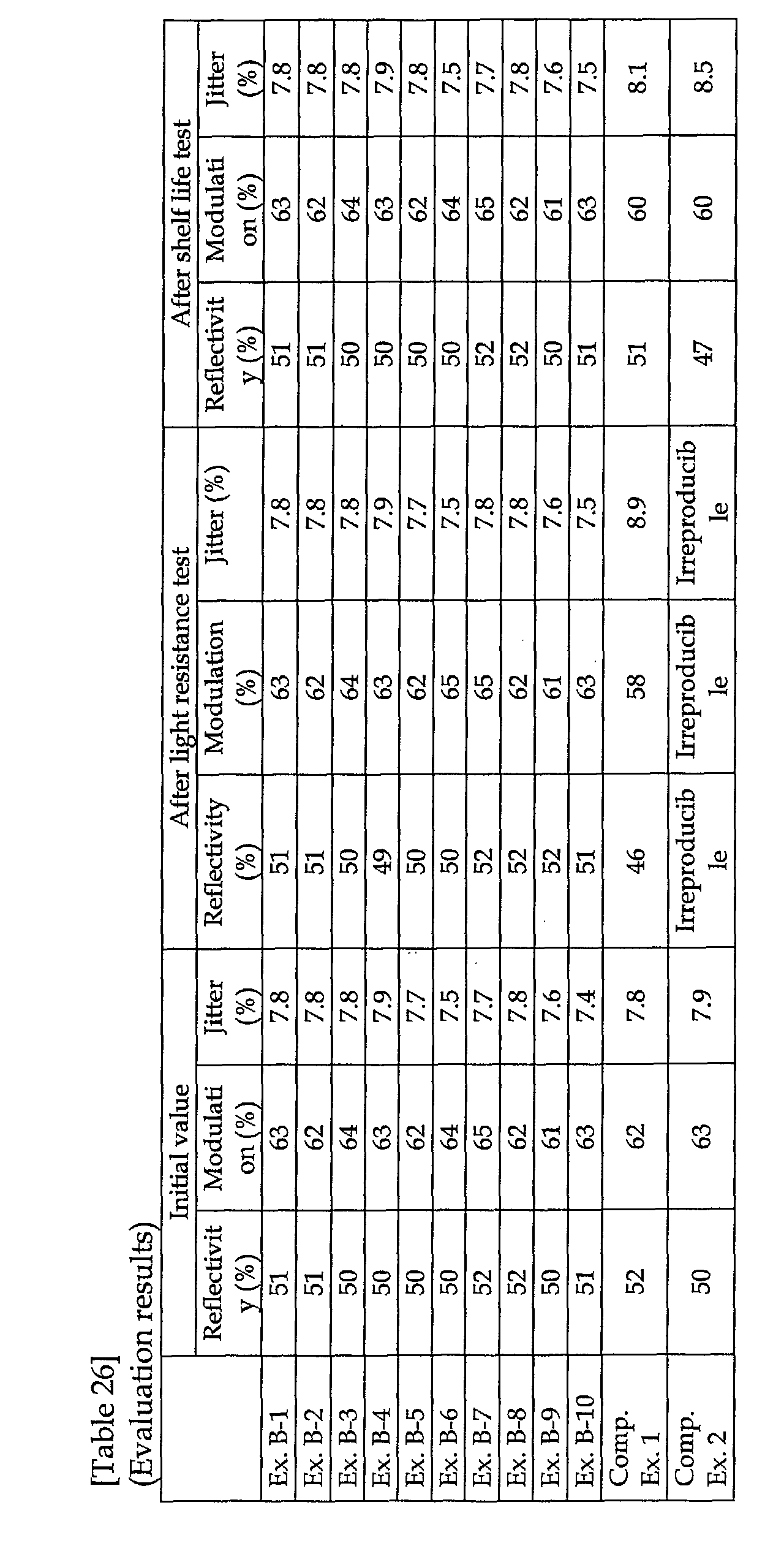
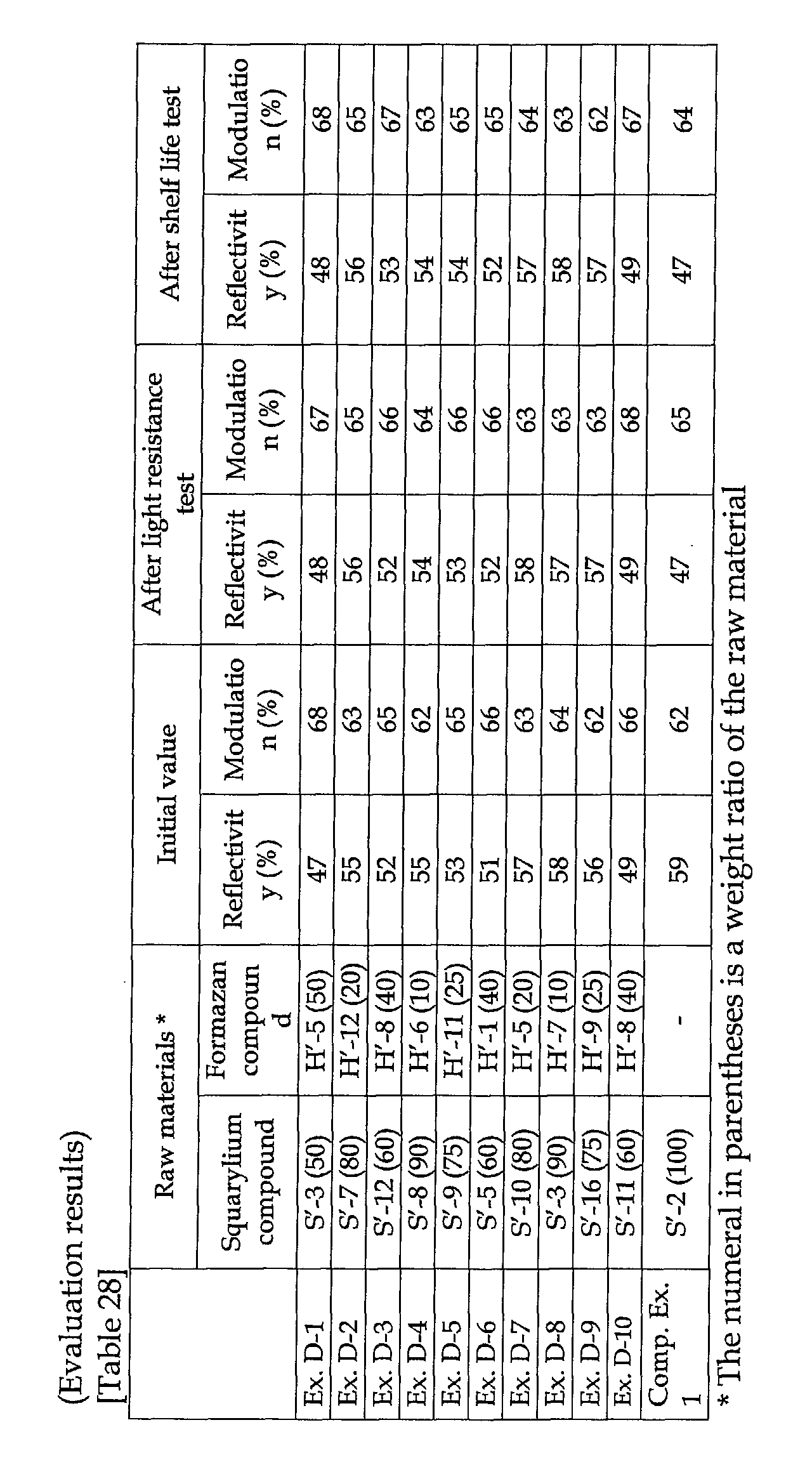
Claims (22)
- An optical recording medium comprising a substrate and at least a recording layer disposed on the substrate, the recording layer comprising:where A and B each independently represents a residue forming one of a) a heterocyclic ring which may comprise a substituent and b) an aromatic ring which may comprise a substituent, by combination with corresponding carbon atoms respectively bonded to A or B, and X represents an active-hydrogen-containing substituent group.at least one squarylium metal chelate compound which comprises a squarylium compound and a metal; andat least one azo metal chelate compound which comprises another metal and an azo compound represented by the following formula (A-I):
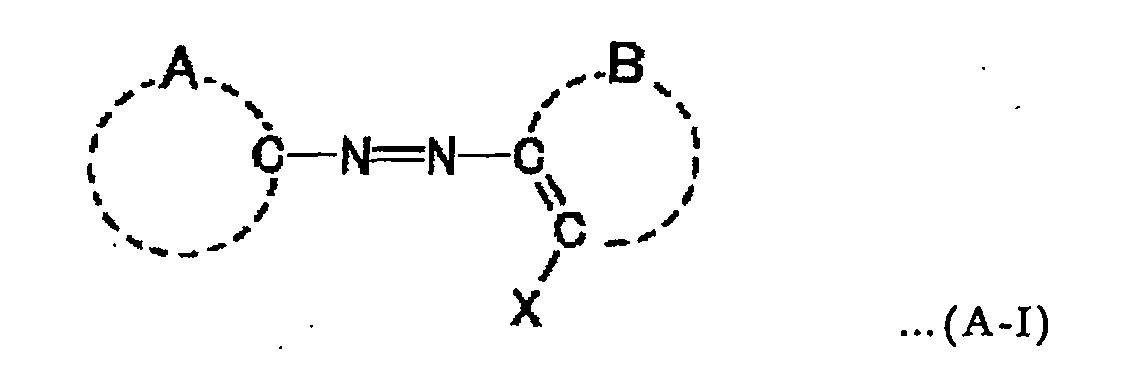
- An optical recording medium having a substrate and at least a recording layer disposed on the substrate, the recording layer comprising:where A represents a residue forming a heterocyclic ring which may have a substituent by combination with both the carbon atom and the nitrogen atom bonded to A, and B represents a residue forming one of a) an aromatic ring which may have a substituent and b) a heterocyclic ring which may have a substituent, by combination with the two carbon atoms bonded to B, and X represents an active-hydrogen-containing substituent group.at least one squarylium metal chelate compound which comprises a squarylium compound and a metal; andat least one azo metal chelate compound which comprises another metal and an azo compound represented by the following formula (B-1):
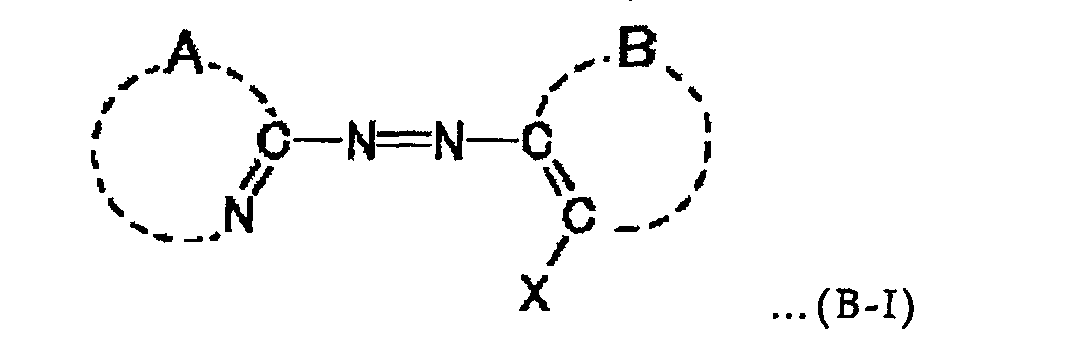
- An optical recording medium according to Claim 1 or 2, characterized in that the squarylium metal chelate compound and the azo metal chelate compound are contained in the recording layer at a weight ratio ranging from 90:10 to 20:80.
- An optical recording medium according to any one of Claims 1-3, characterized in that the metal atom of the azo metal chelate compound is at least one metal atom selected from manganese, cobalt, nickel and copper.
- An optical recording medium according to any one of Claims 1-4, characterized in that the azo metal chelate compound is ionized and forms a salt with another compound ion.
- An optical recording medium according to Claim 5, characterized in that the other compound ion has an amino group.
- An optical recording medium comprising a substrate and at least a recording layer disposed on the substrate, the recording layer comprising:where Z represents a residue forming a 5-membered or 6-membered nitrogen-containing heterocyclic ring which may have a substitutent by combination with the carbon atom and the nitrogen atom bonded to Z, and may be condensed with another aromatic ring; A represents an alkyl group which may have a substituent, an aryl group which may have a substituent, an alkylcarbonyl group which may have a substituent, an arylcarbonyl group which may have a substituent, an alkenyl group which may have a substituent, a heterocyclic residue which may have a substituent, or an alkoxycarbonyl group which may have a substituent; and B represents an alkyl group which may have a substituent, an alkenyl group which may have a substituent or an aryl group which may have a substituent,at least one squarylium metal chelate compound which comprises a squarylium compound and a metal; andat least one formazan metal chelate compound which comprises another metal and at least one of a formazan compound represented by one of the following formulae (C-1) and (C-II):
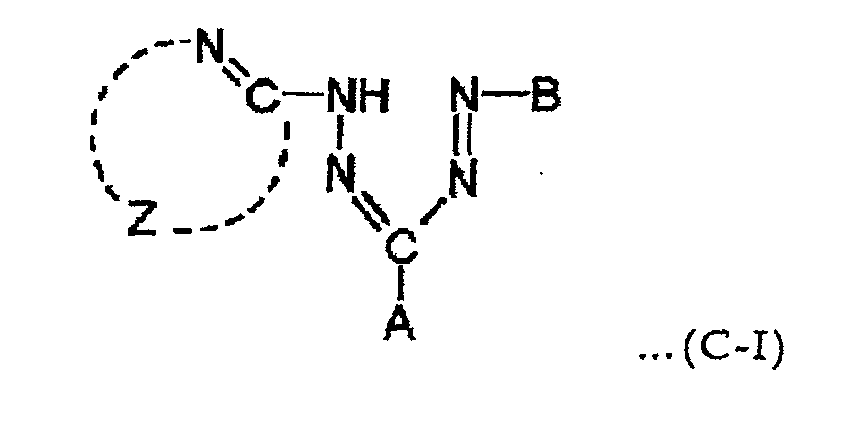 where Z1 and Z2 each represents a residue forming a 5-membered or 6-membered nitrogen-containing heterocyclic ring which may have a substiutent by combination with the carbon atom and the nitrogen atom bonded to Z1 and Z2, respectively, and may be condensed with another aromatic ring; A1 and A2 each independently represents an alkyl group which may have a substituent, an aryl group which may have a substituent, an alkylcarbonyl group which may have a substituent, an arylcarbonyl group which may have a substituent, an alkenyl group which may have a substituent, a heterocyclic residue which may have a substituent, or an alkoxycarbonyl group which may have a substituent; B1 and B2 each independently represents an alkylene group which may have a substituent or an arylene group which may have a substituent; W represents -CH2- or -SO2-; and n is an integer of 0 or 1.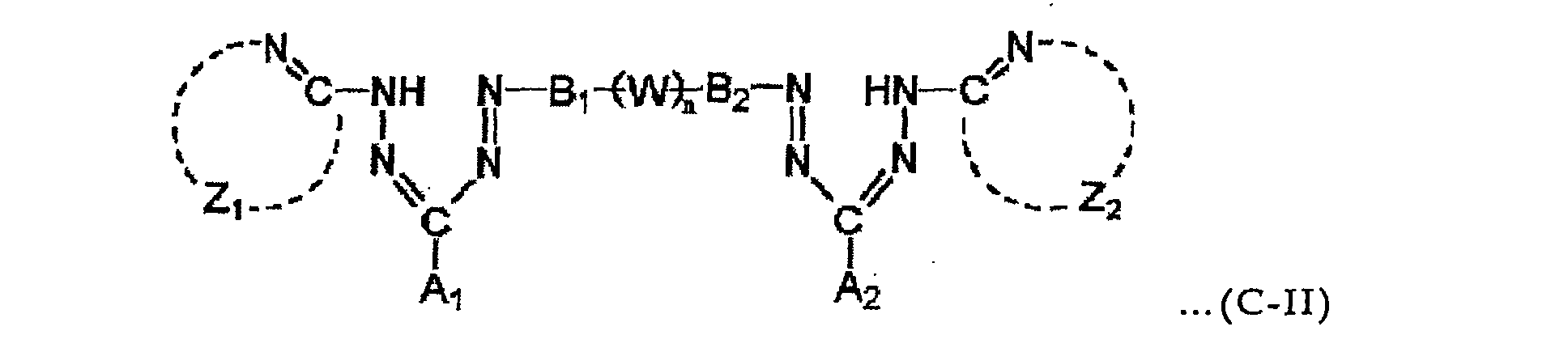
- An optical recording medium according to Claim 7, characterized in that the squarylium metal chelate compound and the formazan metal chelate compound are contained in the recording layer at a weight ratio of 90:10 to 50:50.
- An optical recording medium according to Caim 7 or 8, characterized in that the metal atom of the formazan metal chelate compound is at least one metal atom selected from vanadium, manganese, iron, cobalt, nickel, copper, zinc and palladium, and oxides or halides thereof.
- An optical recording medium according to any one of Claims 1-9, characterized in that the squarylium metal chelate compound is represented by the following formula (A-II):where R1 and R2 are substituent groups which may be the same or different, and each represents a hydrogen atom, an alkyl group which may have a substituent, an aralkyl group which may have a substituent, an aryl group which may have a substituent or a heterocyclic group which may have a substituent; M1 represents a metal atom having a coordination capacity; Z represents an aryl group which may have a substituent, a heterocyclic group which may have a substituent, or Y = CH- (Y representing a heterocyclic group which may have a substituent); and m1 is an integer of 2 or 3.

- An optical recording medium according to Claim 10, characterized in that Z in the formula (A-II) is represented by the following formula (A-II-II):where R3 and R4 may be the same or different and each represents an alkyl group which may have a substituent, or R3 and R4 form an alicyclic hydrocarbon ring or a heterocyclic ring by combination with the adjacent carbon atoms; R5 represents a hydrogen atom, an alkyl group which may have a substituent, an aralkyl group which may have a substituent, or an aryl group which may have a substituent; R6 represents a halogen atom, an alkyl group which may have a substituent, an aralkyl group which may have a substituent, an aryl group which may have a substituent, a nitro group, a cyano group, or an alkoxy group which may have a substituent, n is an integer of 0 to 4, with the proviso that when n is 2 to 4, R6 may be the same or different to each other and may form an aromatic ring which may have a substituent by combination with the adjacent two carbon atoms.

- An optical recording medium according to Claim 10 or 11, characterized in that M1 represents aluminium.
- An optical recording medium comprising a substrate and at least a recording layer disposed on the substrate, the recording layer comprising:where Z represents a residue forming a 5-membered or 6-membered nitrogen-containing heterocyclic ring which may have a substituent by combination with the carbon atom and the nitrogen bonded to Z, and may be condensed with another aromatic ring; A represents an alkyl group which may have a substituent, an aryl group which may have a substituent, an alkylcarbonyl group which may have a substituent, an arylcarbonyl group which may have a substituent, an alkenyl group which may have a substituent, a heterocyclic residue which may have a substituent, or an alkoxycarbonyl group which may have a substituent; and B represents an alkyl group which may have a substituent or aryl group which may have a substituent;at least one squarylium compound; andat least one formazan metal chelate compound which comprises a metal and at least one of a formazan compound represented by one of the following formulae (D-I) and (D-II):
 where Z1 and Z2 each represents a residue forming a 5-membered or 6-membered nitrogen-containing heterocyclic ring which may have a substituent by combination with both the carbon atom and the nitrogen atom bonded to Z1 and Z2, respectively, and may be condensed with another aromatic ring; A1 and A2 each independently represents an alkyl group which may have a substituent, an aryl group which may have a substituent, an alkylcarbonyl group which may have a substituent, an arylcarbonyl group which may have a substituent, an alkenyl group which may have a substituent, a heterocyclic residue which may have a substituent, or an alkoxycarbonyl group which may have a substituent; B1 and B2 each independently represents an alkylene group which may have a substituent or an arylene group which may have a substituent; W represents -CH2- or -SO2-; and m is an integer or 0 or 1.
- An optical recording medium according to Claim 13, characterized in that the squarylium compound and the formazan metal chelate compound are contained in the recording layer at a weight ratio of 90:10 to 50:50.
- An optical recording medium according to Claim 13 or 14, characterized in that the metal atom of the formazan metal chelate compound is at least one selected from vanadium, manganese, iron, cobalt, nickel, copper, zinc and palladium, and oxides or halides thereof.
- An optical recording medium according to any one of Claims 13 - 15, characterized in that the squarylium compound is at least one of a compound represented by one of the following formulae (D-III) and (D-VI):where R1 and R2 may be the same or different, and each represents a hydrogen atom, an alkyl group which may have a substituent, an aralkyl group which may have a substituent, an aryl group which may have a substituent, or a heterocyclic residue which may have a substituent, or R1 and R2 may form a heterocyclic ring which may have a substituent by combination with the adjacent nitrogen atom; and R3 is a compound represented by one of the following formulae (D-IV) and (D-V):
 where R4 and R5 may be the same or different and each independently represents a hydrogen atom or an alkyl group which may have a substituent, or R4 and R5 may form a heterocyclic ring which may have a substituent by combination with the adjacent nitrogen atom; and R6, R7, R8 and R9 may be the same or different and each independently represents a hydrogen atom, an alkyl group which may have a substituent, an alkoxy group which may have a substituent, a hydroxyl group or a halogen atom, a pair R4 and R6 or a pair R5 and R7 may form a nitrogen-containing heterocyclic ring by combination with the adjacent N-C-C, the nitrogen-containing heterocyclic ring which may have a substituent:
 where Q1 represents a carbon atom or a nitrogen atom, R10 and R11 may be the same or different and each independently represents a hydrogen atom an alkyl group which may have a substituent, an aryl group which may have a substituent, an aralkyl group which may have a substitutent or a hydroxyl group, with the proviso that when Q1 represents a nitrogen atom, R11 does not exist, R12 represents a hydrogen atom, an alkyl group which may have a substituent, an aryl group which may have a substituent or an aralkyl group which may have a substituent; R13 and R14 may be the same or different and each independently represents a hydrogen atom, an alkyl group which may have a substituent, an alkoxy group which may have a substituent or a halogen atom, or R13 and R14 may form an alicyclic hydrocarbon ring or an aromatic ring which may have a substituent, or a heterocyclic ring which may have a substituent by combination with the adjacent two carbon atoms;
 where Q2 represents a carbon atom or a nitrogen atom, R15 represents a hydrogen atom, an alkyl group which may have a substituent, an aryl group which may have a substituent or a heterocyclic group which may have a substituent, R16 represents a hydrogen atom, a halogen atom, an alkyl group which may have a substituent, an alkoxy group which may have a substituent, an aralkyl group which may have a substituent, an aryl group which may have a substituent, an amino group which may have a substituent or a heterocyclic group which may have a substituent, R17 and R18 may be the same or different and each independently represents an alkyl group which may have a substituent, or R17 and R18 may form an alicyclic hydrocarbon ring or a heterocyclic ring which may have a substituent by combination with the adjacent carbon atom, with the proviso that if Q2 represents a nitrogen atom, R18 does not exist, R19 represents a hydrogen atom, an alkyl group which may have a substituent, an aralkyl group which may have a substituent, or an aryl group which may have a substituent, R20 represents a halogen atom, an alkyl group which may have a substituent, an aralkyl group which may have a substituent, an aryl group which may have a substituent, a trifluoromethyl group, a nitro group, a cyano group, or an alkoxy group which may have a substituent, n is an integer of 0 to 4, with the proviso that when n is an integer of 2 to 4, the R20s may be the same or different to each other and any adjacent two R20s by combination with the adjacent two carbon atoms may form an aromatic ring which may have a substituent.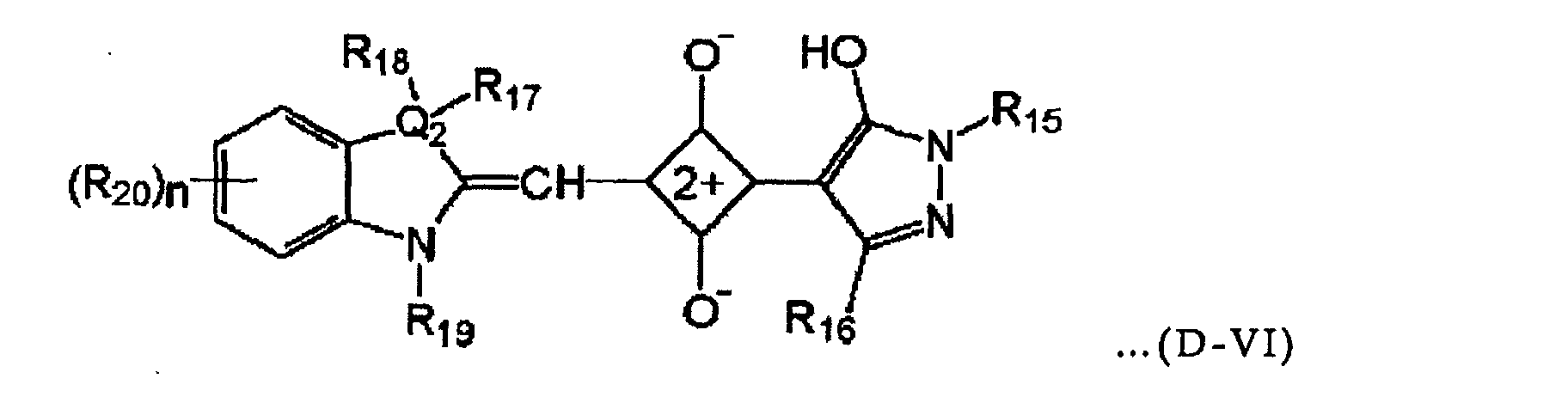
- An optical recording medium according to any one of Claims 1 - 16 characterized in that the refractive index (n) of a single layer of the recording layer is 1.5 ≤ n ≤ 3,0 and the extinction coefficient (k) is 0.02 ≤ k ≤ 0,3 against the light having a wavelength range of a recording or reproducing wavelength ± 5 nm.
- An optical recording medium according to any one of Claims 1 - 17 further comprising a reflective layer containing gold, silver, copper, or aluminium, or an alloy thereof.
- An optical recording medium according to any one of Claims 1 - 18 characterized in that the track pitch on the substrate falls within a range of 0.7 to 0.8 µm, and the groove width at a half bandwidth falls within a range of 0.18 to 0.40 µm.
- An optical recording medium according to any one of Claims 1 - 19 characterized in that the optical recording medium is recordable at a wavelength of 600 to 720 nm.
- An optical recording method comprising the step of exposing an optical recording medium according to any one of Claims 1 - 20 to a light beam having a wavelength of 600 to 720 nm to carry out recording.
- An optical recording device comprising an optical recording medium according to any one of Claims 1 - 20.
Applications Claiming Priority (8)
| Application Number | Priority Date | Filing Date | Title |
|---|---|---|---|
| JP2001180606A JP4094252B2 (en) | 2001-06-14 | 2001-06-14 | Optical recording medium, optical recording method and optical recording apparatus using the same |
| JP2001180475A JP4094250B2 (en) | 2001-06-14 | 2001-06-14 | Optical recording medium, optical recording method and optical recording apparatus using the same |
| JP2001180565A JP4094251B2 (en) | 2001-06-14 | 2001-06-14 | Optical recording medium, optical recording method and optical recording apparatus using the same |
| JP2001180565 | 2001-06-14 | ||
| JP2001180606 | 2001-06-14 | ||
| JP2001180538A JP4156215B2 (en) | 2001-06-14 | 2001-06-14 | Optical recording medium, optical recording method and optical recording apparatus using the same |
| JP2001180475 | 2001-06-14 | ||
| JP2001180538 | 2001-06-14 |
Publications (3)
| Publication Number | Publication Date |
|---|---|
| EP1267338A2 true EP1267338A2 (en) | 2002-12-18 |
| EP1267338A3 EP1267338A3 (en) | 2003-05-28 |
| EP1267338B1 EP1267338B1 (en) | 2010-04-07 |
Family
ID=27482338
Family Applications (1)
| Application Number | Title | Priority Date | Filing Date |
|---|---|---|---|
| EP02013100A Expired - Lifetime EP1267338B1 (en) | 2001-06-14 | 2002-06-13 | Optical recording medium, optical recording method and optical recording device |
Country Status (4)
| Country | Link |
|---|---|
| US (1) | US6737143B2 (en) |
| EP (1) | EP1267338B1 (en) |
| AT (1) | ATE463821T1 (en) |
| DE (1) | DE60235859D1 (en) |
Cited By (6)
| Publication number | Priority date | Publication date | Assignee | Title |
|---|---|---|---|---|
| EP1335357A1 (en) * | 2002-02-12 | 2003-08-13 | Ricoh Company, Ltd. | Optical recording medium, optical recording method and optical recording device |
| EP1449890A1 (en) * | 2003-02-12 | 2004-08-25 | Ricoh Company, Ltd. | Squarylium-metal chelate compounds and optical recording media |
| EP1583090A3 (en) * | 2004-03-31 | 2006-03-08 | Gigastorage Corporation | Dyes for high density optical recording media |
| WO2006053834A3 (en) * | 2004-11-22 | 2006-07-27 | Clariant Int Ltd | Monosubstituted squaric acid metal complex dyes and their use in optical layers for optical data recording |
| EP1892269A1 (en) * | 2006-07-27 | 2008-02-27 | Clariant International Ltd. | Compositions comprising monosubstituted squaric acid metal complex dyes and merocycanine based dyes and their use in optical layers for optical data recording |
| US7368224B2 (en) | 2002-04-08 | 2008-05-06 | Kyowa Hakko Chemical Co., Ltd. | Photopolymerizable composition |
Families Citing this family (11)
| Publication number | Priority date | Publication date | Assignee | Title |
|---|---|---|---|---|
| RU2004118245A (en) * | 2001-11-15 | 2005-09-10 | Циба Спешиалти Кемикэлз Холдинг Инк. (Ch) | WRITTEN OPTICAL HIGH CAPACITY INFORMATION MEDIA CONTAINING METAL COMPLEXES |
| JP4137691B2 (en) * | 2003-04-30 | 2008-08-20 | 株式会社リコー | Optical recording medium |
| WO2005059608A1 (en) | 2003-12-18 | 2005-06-30 | Kyowa Hakko Chemical Co., Ltd. | Filter for electronic display |
| JP2005205874A (en) * | 2003-12-26 | 2005-08-04 | Tdk Corp | Optical recording material and optical recording medium |
| EP1813651A4 (en) * | 2004-11-19 | 2009-08-26 | Kyowa Hakko Chemical Co Ltd | OPTICAL FILTER |
| US7755995B2 (en) | 2005-03-10 | 2010-07-13 | Ricoh Company, Ltd. | Recording and reproducing method for dye-based recordable DVD medium and apparatus for the same |
| WO2006104021A1 (en) * | 2005-03-25 | 2006-10-05 | Ricoh Company, Ltd. | Optical recording medium, and optical recording method and optical recording apparatus thereof |
| US7521562B2 (en) * | 2005-07-27 | 2009-04-21 | Kyowa Hakko Chemical Co., Ltd. | Filters for electronic display devices |
| JP5037155B2 (en) * | 2006-02-21 | 2012-09-26 | 株式会社リコー | Optical information recording medium and manufacturing method thereof |
| JP2008074904A (en) * | 2006-09-19 | 2008-04-03 | Ricoh Co Ltd | SQUARYLIUM COMPOUND AND METAL COMPLEX AND OPTICAL RECORDING MEDIUM, RECORDING / REPRODUCING METHOD, AND OPTICAL RECORDING DEVICE USING THE SAME |
| JP4880488B2 (en) * | 2007-01-12 | 2012-02-22 | 株式会社リコー | Optical recording material, optical recording medium, and optical recording medium recording / reproducing method |
Citations (1)
| Publication number | Priority date | Publication date | Assignee | Title |
|---|---|---|---|---|
| US5500325A (en) | 1993-10-21 | 1996-03-19 | Eastman Kodak Company | Dye mixtures for optical recording layers |
Family Cites Families (103)
| Publication number | Priority date | Publication date | Assignee | Title |
|---|---|---|---|---|
| JPS5782093A (en) | 1980-11-12 | 1982-05-22 | Ricoh Co Ltd | Optical information recording medium |
| JPS5856892A (en) | 1981-10-01 | 1983-04-04 | Ricoh Co Ltd | optical information recording medium |
| JPS58114989A (en) | 1982-12-06 | 1983-07-08 | Ricoh Co Ltd | Light information recording member |
| JPS58112790A (en) | 1981-12-28 | 1983-07-05 | Ricoh Co Ltd | Optical information recording member |
| JPH0613238B2 (en) | 1982-11-08 | 1994-02-23 | 株式会社リコー | Optical information recording medium |
| JPS6089842A (en) | 1983-09-30 | 1985-05-20 | Nec Corp | Optical recording medium |
| JPS6083236A (en) | 1983-10-12 | 1985-05-11 | Ricoh Co Ltd | Optical information recording medium |
| JPS6125886A (en) | 1984-07-17 | 1986-02-04 | Yamamoto Kagaku Gosei Kk | Optical information recording medium |
| DE3537539A1 (en) | 1984-10-23 | 1986-04-24 | Ricoh Co., Ltd., Tokio/Tokyo | Optical information recording material |
| GB8431924D0 (en) | 1984-12-18 | 1985-01-30 | Ici Plc | Optical recording medium |
| JPS61177287A (en) | 1985-02-04 | 1986-08-08 | ヘキスト・セラニーズ・コーポレーション | Information record medium containing chromophore |
| JPS61246091A (en) | 1985-04-24 | 1986-11-01 | Tdk Corp | Optical recording medium |
| US4735839A (en) | 1985-07-10 | 1988-04-05 | Ricoh Co., Ltd. | Optical information recording medium |
| JPH0749231B2 (en) | 1985-08-13 | 1995-05-31 | 三菱化学株式会社 | Optical recording body |
| JPH0724114B2 (en) | 1985-12-12 | 1995-03-15 | 株式会社リコー | Optical information recording medium |
| JPS6337991A (en) | 1986-08-01 | 1988-02-18 | Toyo Ink Mfg Co Ltd | Optical recording medium |
| DE3727201C1 (en) | 1986-08-14 | 1988-03-10 | Ricoh Kk | Coloring phthalide compounds and recording materials containing them as a coloring component |
| JPH01159842A (en) | 1987-12-17 | 1989-06-22 | Matsushita Electric Ind Co Ltd | Optical disk |
| JPH01176585A (en) | 1987-12-29 | 1989-07-12 | Toyo Ink Mfg Co Ltd | Optical recording medium |
| JP2670616B2 (en) | 1988-04-28 | 1997-10-29 | 株式会社リコー | Squarylium compound and optical information recording medium using the same |
| US5149819A (en) | 1988-04-28 | 1992-09-22 | Ricoh Company, Ltd. | Squarylium compounds and optical information recording medium using the same |
| US5002812A (en) | 1988-06-15 | 1991-03-26 | Ricoh Company, Ltd. | Optical information recording medium, information recording method and optical information recording system using the medium |
| JP2710040B2 (en) | 1988-09-01 | 1998-02-10 | 太陽誘電株式会社 | Optical information recording medium |
| JPH07114028B2 (en) | 1988-07-30 | 1995-12-06 | 太陽誘電株式会社 | Optical information recording medium |
| JP2640502B2 (en) | 1988-08-23 | 1997-08-13 | 株式会社リコー | Optical recording medium |
| US5256794A (en) | 1989-12-07 | 1993-10-26 | Ricoh Company, Ltd. | Squarylium compounds |
| US5510229A (en) | 1989-07-12 | 1996-04-23 | Ricoh Company, Ltd. | Optical information recording medium using squarylium compounds |
| JP2859702B2 (en) | 1989-09-25 | 1999-02-24 | 三井化学株式会社 | Phthalonitrile compound |
| JP3015053B2 (en) | 1989-10-12 | 2000-02-28 | キヤノン株式会社 | Optical recording medium |
| JPH03256240A (en) | 1990-03-06 | 1991-11-14 | Ricoh Co Ltd | Optical information recording medium |
| JPH08905B2 (en) | 1990-04-07 | 1996-01-10 | 三井東圧化学株式会社 | Phthalocyanine near infrared absorber and optical recording medium using the same |
| JP2890687B2 (en) | 1990-06-13 | 1999-05-17 | 三菱化学株式会社 | Azo metal chelate dye and optical recording medium using the dye |
| JP3126411B2 (en) | 1990-06-22 | 2001-01-22 | 三井化学株式会社 | Optical recording medium and recording method |
| JPH04113886A (en) | 1990-09-04 | 1992-04-15 | Toyo Ink Mfg Co Ltd | Draw-type optical disc for compact disc or compact disc rom |
| JP3074715B2 (en) | 1990-10-02 | 2000-08-07 | 三菱化学株式会社 | Optical recording medium |
| JP3019469B2 (en) | 1991-06-10 | 2000-03-13 | 三菱化学株式会社 | Optical recording medium |
| JP3016649B2 (en) | 1991-12-20 | 2000-03-06 | 三井化学株式会社 | α-Alkoxyphthalocyanine compound and optical recording medium using the same |
| JP3173056B2 (en) | 1991-09-06 | 2001-06-04 | ソニー株式会社 | Degaussing coil mounting device and CRT device having degaussing coil |
| JPH05116456A (en) | 1991-10-24 | 1993-05-14 | Toyo Ink Mfg Co Ltd | A write-once optical disc compatible with compact discs or compact disc-ROMs |
| JP3175279B2 (en) | 1992-04-02 | 2001-06-11 | 三菱化学株式会社 | Metal chelate compound and optical recording medium using the compound |
| JPH0737272A (en) | 1993-06-25 | 1995-02-07 | Mitsubishi Plastics Ind Ltd | Optical recording medium |
| JPH0751682A (en) | 1993-08-11 | 1995-02-28 | Mitsui Toatsu Chem Inc | Automatic adjustment device for acid or alkali concentration |
| JPH07161069A (en) | 1993-12-07 | 1995-06-23 | Mitsubishi Chem Corp | Optical recording medium |
| JPH07268227A (en) | 1994-03-31 | 1995-10-17 | Tdk Corp | Phthalocyanine dye and optical recording medium using the same |
| JP3389677B2 (en) | 1994-05-27 | 2003-03-24 | 東洋インキ製造株式会社 | Optical recording material and write-once compact disc using the same |
| JPH08156408A (en) | 1994-11-29 | 1996-06-18 | Mitsui Toatsu Chem Inc | Optical recording medium |
| DE69522542D1 (en) | 1994-12-15 | 2001-10-11 | Eastman Kodak Co | Heterocyclic azoaniline dyes, metal complexes of heterocyclic azoaniline dyes and their use in optical elements |
| US5863703A (en) | 1995-02-10 | 1999-01-26 | Ricoh Company, Ltd. | Optical information recording medium using a phthalocyanine compound |
| JP2791944B2 (en) | 1995-02-27 | 1998-08-27 | ティーディーケイ株式会社 | Optical recording medium using formazan metal complex dye and optical stabilization method |
| JPH08295811A (en) | 1995-04-24 | 1996-11-12 | Mitsubishi Chem Corp | Metal chelate compound and optical recording medium using the same |
| JPH08332772A (en) | 1995-06-06 | 1996-12-17 | Mitsubishi Chem Corp | Optical recording medium |
| US5645910A (en) | 1995-06-19 | 1997-07-08 | Eastman Kodak Company | Formazan-cyanine copolymers dyes for optical recording layers and elements |
| US5786123A (en) | 1996-03-19 | 1998-07-28 | Eastman Kodak Company | Optical recording elements comprising a polymeric dye |
| JPH09323478A (en) | 1996-06-06 | 1997-12-16 | Tdk Corp | Optical recording medium |
| JPH09175031A (en) | 1995-07-20 | 1997-07-08 | Mitsui Toatsu Chem Inc | Optical recording medium |
| JP3731244B2 (en) | 1996-04-03 | 2006-01-05 | 三菱化学株式会社 | Optical recording medium and manufacturing method thereof |
| JPH0958123A (en) | 1995-08-22 | 1997-03-04 | Mitsubishi Chem Corp | Optical recording medium |
| JPH106644A (en) | 1996-06-20 | 1998-01-13 | Mitsubishi Chem Corp | Optical recording medium |
| JPH09193546A (en) | 1996-01-18 | 1997-07-29 | Mitsui Toatsu Chem Inc | Optical recording medium |
| JP3648823B2 (en) | 1996-01-18 | 2005-05-18 | 三菱化学株式会社 | Optical recording medium and information recording method |
| JPH09267562A (en) | 1996-01-29 | 1997-10-14 | Ricoh Co Ltd | Optical recording medium |
| US5998093A (en) | 1996-01-29 | 1999-12-07 | Ricoh Company, Ltd. | Optical information recording medium |
| JP3641874B2 (en) | 1996-04-16 | 2005-04-27 | 三菱化学株式会社 | Optical recording medium and recording method |
| JPH09309268A (en) | 1996-05-23 | 1997-12-02 | Mitsubishi Chem Corp | Optical recording medium and information recording method |
| JPH10856A (en) | 1996-06-13 | 1998-01-06 | Mitsubishi Chem Corp | Optical recording medium |
| JP3412078B2 (en) | 1996-06-21 | 2003-06-03 | 株式会社リコー | Optical recording medium |
| JP3486709B2 (en) | 1996-06-21 | 2004-01-13 | 株式会社リコー | Optical recording medium |
| JP3680428B2 (en) | 1996-07-17 | 2005-08-10 | 三菱化学株式会社 | Metal chelate compound and optical recording medium using the metal chelate compound |
| JPH1044606A (en) | 1996-08-06 | 1998-02-17 | Mitsubishi Chem Corp | Optical recording medium |
| JPH1058828A (en) | 1996-08-16 | 1998-03-03 | Mitsui Petrochem Ind Ltd | Optical recording medium |
| JPH1083577A (en) | 1996-09-06 | 1998-03-31 | Fuji Photo Film Co Ltd | Method for manufacturing optical information recording medium |
| JPH1086519A (en) | 1996-09-11 | 1998-04-07 | Ricoh Co Ltd | Optical recording medium |
| JP3443723B2 (en) | 1996-09-19 | 2003-09-08 | コニカ株式会社 | Optical recording media using metal complex methine dye |
| JP3620681B2 (en) | 1996-10-04 | 2005-02-16 | 富士写真フイルム株式会社 | Information recording medium |
| JP3666702B2 (en) | 1996-10-08 | 2005-06-29 | 富士写真フイルム株式会社 | Information recording medium |
| US5773193A (en) | 1996-10-16 | 1998-06-30 | Eastman Kodak Company | Optical recording layers containing no k metallized formazan dyes mixed with symmetrical and unsymmetrical cyanine dyes |
| JPH10119434A (en) | 1996-10-23 | 1998-05-12 | Sony Corp | Optical recording medium |
| JPH10134413A (en) | 1996-10-30 | 1998-05-22 | Hitachi Maxell Ltd | Optical recording medium |
| JPH10149584A (en) | 1996-11-19 | 1998-06-02 | Mitsui Chem Inc | Optical recording medium |
| JPH10149583A (en) | 1996-11-20 | 1998-06-02 | Mitsui Chem Inc | Optical recording medium |
| JP3614586B2 (en) | 1996-11-27 | 2005-01-26 | 三井化学株式会社 | Dipyromethene metal chelate compound and optical recording medium using the same |
| JP3705879B2 (en) | 1996-11-28 | 2005-10-12 | 三井化学株式会社 | Optical recording medium |
| JP3705881B2 (en) | 1996-12-03 | 2005-10-12 | 三井化学株式会社 | Optical recording medium |
| JPH10157301A (en) | 1996-12-05 | 1998-06-16 | Mitsui Chem Inc | Optical recording medium |
| JPH10157302A (en) | 1996-12-05 | 1998-06-16 | Mitsui Chem Inc | Optical recording medium |
| JPH10166739A (en) | 1996-12-11 | 1998-06-23 | Hitachi Maxell Ltd | Optical recording medium |
| JP3654398B2 (en) | 1996-12-13 | 2005-06-02 | 三井化学株式会社 | Optical recording medium |
| JP3705885B2 (en) | 1996-12-20 | 2005-10-12 | 三井化学株式会社 | Optical recording medium |
| JPH10181201A (en) | 1996-12-24 | 1998-07-07 | Mitsui Chem Inc | Optical recording medium |
| JPH10188339A (en) | 1996-12-24 | 1998-07-21 | Mitsui Chem Inc | Optical recording medium |
| JP3705887B2 (en) | 1996-12-25 | 2005-10-12 | 三井化学株式会社 | Optical recording medium |
| JPH10181206A (en) | 1996-12-26 | 1998-07-07 | Ricoh Co Ltd | Optical recording medium |
| JPH10297097A (en) | 1997-04-28 | 1998-11-10 | Ricoh Co Ltd | Optical recording medium |
| WO1999003686A1 (en) | 1997-07-14 | 1999-01-28 | Matsushita Electric Industrial Co., Ltd. | Optical recording medium and method of producing the same |
| JP3659548B2 (en) | 1997-07-22 | 2005-06-15 | 株式会社リコー | Optical recording medium |
| JP3685368B2 (en) | 1998-08-18 | 2005-08-17 | 株式会社リコー | Optical recording medium |
| JP3441410B2 (en) | 1998-10-19 | 2003-09-02 | Tdk株式会社 | Optical recording medium |
| JP2000198273A (en) | 1998-11-05 | 2000-07-18 | Tdk Corp | Optical recording medium |
| JP2000159776A (en) * | 1998-11-27 | 2000-06-13 | Mitsubishi Chemicals Corp | Metal complex, near-infrared absorber containing the same, and filter for plasma display panel |
| JP2000168237A (en) | 1998-12-07 | 2000-06-20 | Tdk Corp | Optical recording medium |
| JP2000190641A (en) | 1998-12-29 | 2000-07-11 | Tdk Corp | Optical recording medium |
| JP4193285B2 (en) * | 1999-06-04 | 2008-12-10 | コニカミノルタホールディングス株式会社 | Color toner |
| JP3933350B2 (en) | 1999-07-06 | 2007-06-20 | 株式会社リコー | Optical recording medium |
-
2002
- 2002-06-11 US US10/166,742 patent/US6737143B2/en not_active Expired - Fee Related
- 2002-06-13 EP EP02013100A patent/EP1267338B1/en not_active Expired - Lifetime
- 2002-06-13 DE DE60235859T patent/DE60235859D1/en not_active Expired - Lifetime
- 2002-06-13 AT AT02013100T patent/ATE463821T1/en not_active IP Right Cessation
Patent Citations (1)
| Publication number | Priority date | Publication date | Assignee | Title |
|---|---|---|---|---|
| US5500325A (en) | 1993-10-21 | 1996-03-19 | Eastman Kodak Company | Dye mixtures for optical recording layers |
Cited By (7)
| Publication number | Priority date | Publication date | Assignee | Title |
|---|---|---|---|---|
| EP1335357A1 (en) * | 2002-02-12 | 2003-08-13 | Ricoh Company, Ltd. | Optical recording medium, optical recording method and optical recording device |
| US6794005B2 (en) | 2002-02-12 | 2004-09-21 | Ricoh Company, Ltd. | Optical recording medium, optical recording method and optical recording device |
| US7368224B2 (en) | 2002-04-08 | 2008-05-06 | Kyowa Hakko Chemical Co., Ltd. | Photopolymerizable composition |
| EP1449890A1 (en) * | 2003-02-12 | 2004-08-25 | Ricoh Company, Ltd. | Squarylium-metal chelate compounds and optical recording media |
| EP1583090A3 (en) * | 2004-03-31 | 2006-03-08 | Gigastorage Corporation | Dyes for high density optical recording media |
| WO2006053834A3 (en) * | 2004-11-22 | 2006-07-27 | Clariant Int Ltd | Monosubstituted squaric acid metal complex dyes and their use in optical layers for optical data recording |
| EP1892269A1 (en) * | 2006-07-27 | 2008-02-27 | Clariant International Ltd. | Compositions comprising monosubstituted squaric acid metal complex dyes and merocycanine based dyes and their use in optical layers for optical data recording |
Also Published As
| Publication number | Publication date |
|---|---|
| EP1267338A3 (en) | 2003-05-28 |
| EP1267338B1 (en) | 2010-04-07 |
| ATE463821T1 (en) | 2010-04-15 |
| US20030157291A1 (en) | 2003-08-21 |
| US6737143B2 (en) | 2004-05-18 |
| DE60235859D1 (en) | 2010-05-20 |
Similar Documents
| Publication | Publication Date | Title |
|---|---|---|
| US6558768B2 (en) | Optical recording medium and optical recording and reading method using the same | |
| US6794005B2 (en) | Optical recording medium, optical recording method and optical recording device | |
| US6737143B2 (en) | Optical recording medium, optical recording method and optical recording device | |
| KR100799523B1 (en) | Squarium compound and optical recording medium prepared using the same | |
| JP4183919B2 (en) | Optical recording medium and optical recording method using the same | |
| JP4183918B2 (en) | Optical recording medium and optical recording method using the same | |
| JP4094250B2 (en) | Optical recording medium, optical recording method and optical recording apparatus using the same | |
| JP4156215B2 (en) | Optical recording medium, optical recording method and optical recording apparatus using the same | |
| JP4137691B2 (en) | Optical recording medium | |
| JP2004244342A (en) | Squarylium metal chelate compound and optical recording medium | |
| JP2003237240A (en) | Optical recording medium | |
| JP2001039032A (en) | Optical information recording medium | |
| JP3739724B2 (en) | Optical recording medium, optical recording method and optical recording apparatus using the same | |
| JP2005319728A (en) | Optical recording medium, recording / reproducing method using the same, and optical recording apparatus | |
| JP4094252B2 (en) | Optical recording medium, optical recording method and optical recording apparatus using the same | |
| JP4094251B2 (en) | Optical recording medium, optical recording method and optical recording apparatus using the same | |
| JP4087194B2 (en) | Optical recording medium, optical recording method, and optical recording apparatus | |
| JP4250021B2 (en) | Optical recording medium, optical recording method and optical recording apparatus using the same | |
| JP3739722B2 (en) | Optical recording medium, optical recording method and optical recording apparatus using the same | |
| JP3866493B2 (en) | Optical recording medium | |
| JP4078145B2 (en) | Optical recording medium | |
| JP4252874B2 (en) | Optical recording medium | |
| JP3866491B2 (en) | Optical recording medium | |
| JP2003300384A (en) | Optical recording medium | |
| CN101166794A (en) | Cationic compound, pigment compound, method of using same, and optical information recording medium |
Legal Events
| Date | Code | Title | Description |
|---|---|---|---|
| PUAI | Public reference made under article 153(3) epc to a published international application that has entered the european phase |
Free format text: ORIGINAL CODE: 0009012 |
|
| AK | Designated contracting states |
Kind code of ref document: A2 Designated state(s): AT BE CH CY DE DK ES FI FR GB GR IE IT LI LU MC NL PT SE TR |
|
| AX | Request for extension of the european patent |
Free format text: AL;LT;LV;MK;RO;SI |
|
| PUAL | Search report despatched |
Free format text: ORIGINAL CODE: 0009013 |
|
| AK | Designated contracting states |
Designated state(s): AT BE CH CY DE DK ES FI FR GB GR IE IT LI LU MC NL PT SE TR |
|
| AX | Request for extension of the european patent |
Extension state: AL LT LV MK RO SI |
|
| 17P | Request for examination filed |
Effective date: 20030717 |
|
| AKX | Designation fees paid |
Designated state(s): AT BE CH CY DE DK ES FI FR GB GR IE IT LI LU MC NL PT SE TR |
|
| RAP1 | Party data changed (applicant data changed or rights of an application transferred) |
Owner name: RICOH COMPANY, LTD. Owner name: KYOWA HAKKO KOGYO CO., LTD. Owner name: KYOWA HAKKO CHEMICAL CO., LTD. |
|
| RAP1 | Party data changed (applicant data changed or rights of an application transferred) |
Owner name: KYOWA HAKKO CHEMICAL CO., LTD. Owner name: RICOH COMPANY, LTD. |
|
| 17Q | First examination report despatched |
Effective date: 20071031 |
|
| GRAP | Despatch of communication of intention to grant a patent |
Free format text: ORIGINAL CODE: EPIDOSNIGR1 |
|
| GRAS | Grant fee paid |
Free format text: ORIGINAL CODE: EPIDOSNIGR3 |
|
| GRAA | (expected) grant |
Free format text: ORIGINAL CODE: 0009210 |
|
| AK | Designated contracting states |
Kind code of ref document: B1 Designated state(s): AT BE CH CY DE DK ES FI FR GB GR IE IT LI LU MC NL PT SE TR |
|
| REG | Reference to a national code |
Ref country code: GB Ref legal event code: FG4D |
|
| REG | Reference to a national code |
Ref country code: CH Ref legal event code: EP |
|
| REG | Reference to a national code |
Ref country code: IE Ref legal event code: FG4D |
|
| REF | Corresponds to: |
Ref document number: 60235859 Country of ref document: DE Date of ref document: 20100520 Kind code of ref document: P |
|
| REG | Reference to a national code |
Ref country code: NL Ref legal event code: VDEP Effective date: 20100407 |
|
| PG25 | Lapsed in a contracting state [announced via postgrant information from national office to epo] |
Ref country code: ES Free format text: LAPSE BECAUSE OF FAILURE TO SUBMIT A TRANSLATION OF THE DESCRIPTION OR TO PAY THE FEE WITHIN THE PRESCRIBED TIME-LIMIT Effective date: 20100718 Ref country code: NL Free format text: LAPSE BECAUSE OF FAILURE TO SUBMIT A TRANSLATION OF THE DESCRIPTION OR TO PAY THE FEE WITHIN THE PRESCRIBED TIME-LIMIT Effective date: 20100407 Ref country code: SE Free format text: LAPSE BECAUSE OF FAILURE TO SUBMIT A TRANSLATION OF THE DESCRIPTION OR TO PAY THE FEE WITHIN THE PRESCRIBED TIME-LIMIT Effective date: 20100407 |
|
| PG25 | Lapsed in a contracting state [announced via postgrant information from national office to epo] |
Ref country code: FI Free format text: LAPSE BECAUSE OF FAILURE TO SUBMIT A TRANSLATION OF THE DESCRIPTION OR TO PAY THE FEE WITHIN THE PRESCRIBED TIME-LIMIT Effective date: 20100407 Ref country code: AT Free format text: LAPSE BECAUSE OF FAILURE TO SUBMIT A TRANSLATION OF THE DESCRIPTION OR TO PAY THE FEE WITHIN THE PRESCRIBED TIME-LIMIT Effective date: 20100407 |
|
| PG25 | Lapsed in a contracting state [announced via postgrant information from national office to epo] |
Ref country code: CY Free format text: LAPSE BECAUSE OF FAILURE TO SUBMIT A TRANSLATION OF THE DESCRIPTION OR TO PAY THE FEE WITHIN THE PRESCRIBED TIME-LIMIT Effective date: 20100407 Ref country code: GR Free format text: LAPSE BECAUSE OF FAILURE TO SUBMIT A TRANSLATION OF THE DESCRIPTION OR TO PAY THE FEE WITHIN THE PRESCRIBED TIME-LIMIT Effective date: 20100708 |
|
| PG25 | Lapsed in a contracting state [announced via postgrant information from national office to epo] |
Ref country code: PT Free format text: LAPSE BECAUSE OF FAILURE TO SUBMIT A TRANSLATION OF THE DESCRIPTION OR TO PAY THE FEE WITHIN THE PRESCRIBED TIME-LIMIT Effective date: 20100809 Ref country code: DK Free format text: LAPSE BECAUSE OF FAILURE TO SUBMIT A TRANSLATION OF THE DESCRIPTION OR TO PAY THE FEE WITHIN THE PRESCRIBED TIME-LIMIT Effective date: 20100407 Ref country code: MC Free format text: LAPSE BECAUSE OF NON-PAYMENT OF DUE FEES Effective date: 20100630 |
|
| REG | Reference to a national code |
Ref country code: CH Ref legal event code: PL |
|
| PLBE | No opposition filed within time limit |
Free format text: ORIGINAL CODE: 0009261 |
|
| STAA | Information on the status of an ep patent application or granted ep patent |
Free format text: STATUS: NO OPPOSITION FILED WITHIN TIME LIMIT |
|
| PG25 | Lapsed in a contracting state [announced via postgrant information from national office to epo] |
Ref country code: BE Free format text: LAPSE BECAUSE OF FAILURE TO SUBMIT A TRANSLATION OF THE DESCRIPTION OR TO PAY THE FEE WITHIN THE PRESCRIBED TIME-LIMIT Effective date: 20100407 |
|
| 26N | No opposition filed |
Effective date: 20110110 |
|
| PG25 | Lapsed in a contracting state [announced via postgrant information from national office to epo] |
Ref country code: IT Free format text: LAPSE BECAUSE OF FAILURE TO SUBMIT A TRANSLATION OF THE DESCRIPTION OR TO PAY THE FEE WITHIN THE PRESCRIBED TIME-LIMIT Effective date: 20100407 |
|
| PG25 | Lapsed in a contracting state [announced via postgrant information from national office to epo] |
Ref country code: CH Free format text: LAPSE BECAUSE OF NON-PAYMENT OF DUE FEES Effective date: 20100630 Ref country code: LI Free format text: LAPSE BECAUSE OF NON-PAYMENT OF DUE FEES Effective date: 20100630 Ref country code: IE Free format text: LAPSE BECAUSE OF NON-PAYMENT OF DUE FEES Effective date: 20100613 |
|
| PGFP | Annual fee paid to national office [announced via postgrant information from national office to epo] |
Ref country code: DE Payment date: 20120622 Year of fee payment: 11 |
|
| PGFP | Annual fee paid to national office [announced via postgrant information from national office to epo] |
Ref country code: GB Payment date: 20120622 Year of fee payment: 11 Ref country code: FR Payment date: 20120705 Year of fee payment: 11 |
|
| PG25 | Lapsed in a contracting state [announced via postgrant information from national office to epo] |
Ref country code: LU Free format text: LAPSE BECAUSE OF NON-PAYMENT OF DUE FEES Effective date: 20100613 |
|
| PG25 | Lapsed in a contracting state [announced via postgrant information from national office to epo] |
Ref country code: TR Free format text: LAPSE BECAUSE OF FAILURE TO SUBMIT A TRANSLATION OF THE DESCRIPTION OR TO PAY THE FEE WITHIN THE PRESCRIBED TIME-LIMIT Effective date: 20100407 |
|
| REG | Reference to a national code |
Ref country code: DE Ref legal event code: R082 Ref document number: 60235859 Country of ref document: DE Representative=s name: MEISSNER, BOLTE & PARTNER GBR, DE |
|
| REG | Reference to a national code |
Ref country code: DE Ref legal event code: R082 Ref document number: 60235859 Country of ref document: DE Representative=s name: MEISSNER, BOLTE & PARTNER GBR, DE |
|
| GBPC | Gb: european patent ceased through non-payment of renewal fee |
Effective date: 20130613 |
|
| REG | Reference to a national code |
Ref country code: DE Ref legal event code: R119 Ref document number: 60235859 Country of ref document: DE Effective date: 20140101 |
|
| REG | Reference to a national code |
Ref country code: FR Ref legal event code: ST Effective date: 20140228 |
|
| PG25 | Lapsed in a contracting state [announced via postgrant information from national office to epo] |
Ref country code: DE Free format text: LAPSE BECAUSE OF NON-PAYMENT OF DUE FEES Effective date: 20140101 Ref country code: GB Free format text: LAPSE BECAUSE OF NON-PAYMENT OF DUE FEES Effective date: 20130613 |
|
| PG25 | Lapsed in a contracting state [announced via postgrant information from national office to epo] |
Ref country code: FR Free format text: LAPSE BECAUSE OF NON-PAYMENT OF DUE FEES Effective date: 20130701 |