EP1266864A1 - Granulate auf Basis von mittels Aerosol mit Aluminiumoxid dotiertem, pyrogen hergestelltem Siliziumdioxid, Verfahren zu ihrer Herstellung und ihre Verwendung - Google Patents
Granulate auf Basis von mittels Aerosol mit Aluminiumoxid dotiertem, pyrogen hergestelltem Siliziumdioxid, Verfahren zu ihrer Herstellung und ihre Verwendung Download PDFInfo
- Publication number
- EP1266864A1 EP1266864A1 EP02006055A EP02006055A EP1266864A1 EP 1266864 A1 EP1266864 A1 EP 1266864A1 EP 02006055 A EP02006055 A EP 02006055A EP 02006055 A EP02006055 A EP 02006055A EP 1266864 A1 EP1266864 A1 EP 1266864A1
- Authority
- EP
- European Patent Office
- Prior art keywords
- aerosol
- silicon dioxide
- doped
- granules
- aluminum oxide
- Prior art date
- Legal status (The legal status is an assumption and is not a legal conclusion. Google has not performed a legal analysis and makes no representation as to the accuracy of the status listed.)
- Ceased
Links
Images
Classifications
-
- C—CHEMISTRY; METALLURGY
- C03—GLASS; MINERAL OR SLAG WOOL
- C03C—CHEMICAL COMPOSITION OF GLASSES, GLAZES OR VITREOUS ENAMELS; SURFACE TREATMENT OF GLASS; SURFACE TREATMENT OF FIBRES OR FILAMENTS MADE FROM GLASS, MINERALS OR SLAGS; JOINING GLASS TO GLASS OR OTHER MATERIALS
- C03C1/00—Ingredients generally applicable to manufacture of glasses, glazes, or vitreous enamels
- C03C1/02—Pretreated ingredients
- C03C1/026—Pelletisation or prereacting of powdered raw materials
-
- B—PERFORMING OPERATIONS; TRANSPORTING
- B01—PHYSICAL OR CHEMICAL PROCESSES OR APPARATUS IN GENERAL
- B01J—CHEMICAL OR PHYSICAL PROCESSES, e.g. CATALYSIS OR COLLOID CHEMISTRY; THEIR RELEVANT APPARATUS
- B01J12/00—Chemical processes in general for reacting gaseous media with gaseous media; Apparatus specially adapted therefor
- B01J12/02—Chemical processes in general for reacting gaseous media with gaseous media; Apparatus specially adapted therefor for obtaining at least one reaction product which, at normal temperature, is in the solid state
-
- B—PERFORMING OPERATIONS; TRANSPORTING
- B01—PHYSICAL OR CHEMICAL PROCESSES OR APPARATUS IN GENERAL
- B01J—CHEMICAL OR PHYSICAL PROCESSES, e.g. CATALYSIS OR COLLOID CHEMISTRY; THEIR RELEVANT APPARATUS
- B01J19/00—Chemical, physical or physico-chemical processes in general; Their relevant apparatus
- B01J19/26—Nozzle-type reactors, i.e. the distribution of the initial reactants within the reactor is effected by their introduction or injection through nozzles
-
- B—PERFORMING OPERATIONS; TRANSPORTING
- B01—PHYSICAL OR CHEMICAL PROCESSES OR APPARATUS IN GENERAL
- B01J—CHEMICAL OR PHYSICAL PROCESSES, e.g. CATALYSIS OR COLLOID CHEMISTRY; THEIR RELEVANT APPARATUS
- B01J2/00—Processes or devices for granulating materials, e.g. fertilisers in general; Rendering particulate materials free flowing in general, e.g. making them hydrophobic
- B01J2/02—Processes or devices for granulating materials, e.g. fertilisers in general; Rendering particulate materials free flowing in general, e.g. making them hydrophobic by dividing the liquid material into drops, e.g. by spraying, and solidifying the drops
- B01J2/04—Processes or devices for granulating materials, e.g. fertilisers in general; Rendering particulate materials free flowing in general, e.g. making them hydrophobic by dividing the liquid material into drops, e.g. by spraying, and solidifying the drops in a gaseous medium
-
- B—PERFORMING OPERATIONS; TRANSPORTING
- B01—PHYSICAL OR CHEMICAL PROCESSES OR APPARATUS IN GENERAL
- B01J—CHEMICAL OR PHYSICAL PROCESSES, e.g. CATALYSIS OR COLLOID CHEMISTRY; THEIR RELEVANT APPARATUS
- B01J21/00—Catalysts comprising the elements, oxides, or hydroxides of magnesium, boron, aluminium, carbon, silicon, titanium, zirconium, or hafnium
- B01J21/06—Silicon, titanium, zirconium or hafnium; Oxides or hydroxides thereof
- B01J21/08—Silica
-
- B—PERFORMING OPERATIONS; TRANSPORTING
- B01—PHYSICAL OR CHEMICAL PROCESSES OR APPARATUS IN GENERAL
- B01J—CHEMICAL OR PHYSICAL PROCESSES, e.g. CATALYSIS OR COLLOID CHEMISTRY; THEIR RELEVANT APPARATUS
- B01J21/00—Catalysts comprising the elements, oxides, or hydroxides of magnesium, boron, aluminium, carbon, silicon, titanium, zirconium, or hafnium
- B01J21/12—Silica and alumina
-
- B—PERFORMING OPERATIONS; TRANSPORTING
- B01—PHYSICAL OR CHEMICAL PROCESSES OR APPARATUS IN GENERAL
- B01J—CHEMICAL OR PHYSICAL PROCESSES, e.g. CATALYSIS OR COLLOID CHEMISTRY; THEIR RELEVANT APPARATUS
- B01J35/00—Catalysts, in general, characterised by their form or physical properties
- B01J35/40—Catalysts, in general, characterised by their form or physical properties characterised by dimensions, e.g. grain size
-
- C—CHEMISTRY; METALLURGY
- C01—INORGANIC CHEMISTRY
- C01B—NON-METALLIC ELEMENTS; COMPOUNDS THEREOF; METALLOIDS OR COMPOUNDS THEREOF NOT COVERED BY SUBCLASS C01C
- C01B33/00—Silicon; Compounds thereof
- C01B33/113—Silicon oxides; Hydrates thereof
- C01B33/12—Silica; Hydrates thereof, e.g. lepidoic silicic acid
-
- C—CHEMISTRY; METALLURGY
- C03—GLASS; MINERAL OR SLAG WOOL
- C03C—CHEMICAL COMPOSITION OF GLASSES, GLAZES OR VITREOUS ENAMELS; SURFACE TREATMENT OF GLASS; SURFACE TREATMENT OF FIBRES OR FILAMENTS MADE FROM GLASS, MINERALS OR SLAGS; JOINING GLASS TO GLASS OR OTHER MATERIALS
- C03C1/00—Ingredients generally applicable to manufacture of glasses, glazes, or vitreous enamels
- C03C1/02—Pretreated ingredients
-
- C—CHEMISTRY; METALLURGY
- C09—DYES; PAINTS; POLISHES; NATURAL RESINS; ADHESIVES; COMPOSITIONS NOT OTHERWISE PROVIDED FOR; APPLICATIONS OF MATERIALS NOT OTHERWISE PROVIDED FOR
- C09K—MATERIALS FOR MISCELLANEOUS APPLICATIONS, NOT PROVIDED FOR ELSEWHERE
- C09K3/00—Materials not provided for elsewhere
- C09K3/14—Anti-slip materials; Abrasives
- C09K3/1409—Abrasive particles per se
-
- B—PERFORMING OPERATIONS; TRANSPORTING
- B01—PHYSICAL OR CHEMICAL PROCESSES OR APPARATUS IN GENERAL
- B01J—CHEMICAL OR PHYSICAL PROCESSES, e.g. CATALYSIS OR COLLOID CHEMISTRY; THEIR RELEVANT APPARATUS
- B01J2219/00—Chemical, physical or physico-chemical processes in general; Their relevant apparatus
- B01J2219/00049—Controlling or regulating processes
- B01J2219/00051—Controlling the temperature
- B01J2219/00074—Controlling the temperature by indirect heating or cooling employing heat exchange fluids
- B01J2219/00087—Controlling the temperature by indirect heating or cooling employing heat exchange fluids with heat exchange elements outside the reactor
- B01J2219/00094—Jackets
-
- B—PERFORMING OPERATIONS; TRANSPORTING
- B01—PHYSICAL OR CHEMICAL PROCESSES OR APPARATUS IN GENERAL
- B01J—CHEMICAL OR PHYSICAL PROCESSES, e.g. CATALYSIS OR COLLOID CHEMISTRY; THEIR RELEVANT APPARATUS
- B01J2219/00—Chemical, physical or physico-chemical processes in general; Their relevant apparatus
- B01J2219/00049—Controlling or regulating processes
- B01J2219/00051—Controlling the temperature
- B01J2219/00074—Controlling the temperature by indirect heating or cooling employing heat exchange fluids
- B01J2219/00119—Heat exchange inside a feeding nozzle or nozzle reactor
-
- B—PERFORMING OPERATIONS; TRANSPORTING
- B01—PHYSICAL OR CHEMICAL PROCESSES OR APPARATUS IN GENERAL
- B01J—CHEMICAL OR PHYSICAL PROCESSES, e.g. CATALYSIS OR COLLOID CHEMISTRY; THEIR RELEVANT APPARATUS
- B01J2219/00—Chemical, physical or physico-chemical processes in general; Their relevant apparatus
- B01J2219/00049—Controlling or regulating processes
- B01J2219/00051—Controlling the temperature
- B01J2219/00157—Controlling the temperature by means of a burner
-
- B—PERFORMING OPERATIONS; TRANSPORTING
- B01—PHYSICAL OR CHEMICAL PROCESSES OR APPARATUS IN GENERAL
- B01J—CHEMICAL OR PHYSICAL PROCESSES, e.g. CATALYSIS OR COLLOID CHEMISTRY; THEIR RELEVANT APPARATUS
- B01J2219/00—Chemical, physical or physico-chemical processes in general; Their relevant apparatus
- B01J2219/00049—Controlling or regulating processes
- B01J2219/00177—Controlling or regulating processes controlling the pH
-
- B—PERFORMING OPERATIONS; TRANSPORTING
- B01—PHYSICAL OR CHEMICAL PROCESSES OR APPARATUS IN GENERAL
- B01J—CHEMICAL OR PHYSICAL PROCESSES, e.g. CATALYSIS OR COLLOID CHEMISTRY; THEIR RELEVANT APPARATUS
- B01J35/00—Catalysts, in general, characterised by their form or physical properties
- B01J35/60—Catalysts, in general, characterised by their form or physical properties characterised by their surface properties or porosity
- B01J35/61—Surface area
- B01J35/613—10-100 m2/g
Definitions
- the invention relates to granules based on Aerosol doped with pyrogenic alumina Silicon dioxide, the process for its production and its Use.
- Pyrogenic silicon dioxide is characterized by extreme Fine particle size, high specific surface area (BET), very high purity, spherical particle shape and the absence of Pores out. Because of these properties find pyrogenic Manufactured silicon dioxide is gaining interest as a carrier for catalysts (Dr. Koth et al., Chem. Ing. Techn. 52, 628 (1980). For this use, it becomes pyrogenic manufactured silicon dioxide by mechanical means for example, tableting machines deformed.
- BET high specific surface area
- the invention relates to granules based on pyrogenically produced silicon dioxide doped with aluminum oxide by means of aerosol and having the following physico-chemical characteristics: Medium grain diameter 10 to 150 ⁇ m BET surface area 25 to 100 m2 / g PH value 3 to 6 tapped density 400 to 1,200 g / l
- the granules can have the following physico-chemical characteristics: Medium grain diameter 15 to 30 ⁇ m BET surface area 60 to 70 m2 / g PH value 4 to 6 tapped density 400 to 650 g / l
- the granules according to the invention can be produced by dispersing pyrogenically prepared silicon dioxide in water using aerosol, spray-dried and optionally the granules obtained at a temperature of 150 to Tempered at 1,100 ° C for a period of 1 to 8 hours.
- the pyrogenically produced silicon dioxide doped by means of aerosol with aluminum oxide can be a pyrogenically produced silicon dioxide doped by means of aerosol with aluminum oxide, in which the base component is a silicon dioxide produced pyrogenically in the manner of flame oxidation or preferably flame hydrolysis, which has a doping component of 1 ⁇ 10 - 4 and up to 20 wt .-%, wherein the doping amount is preferably in the range of 1 to 10,000 ppm and the doping component is a salt or a salt mixture of aluminum or a suspension of an aluminum compound or metallic aluminum or mixtures thereof, the BET Surface of the doped oxide is between 5 and 600 m 2 / g, preferably in the range between 40 and 100 m 2 / g.
- the silicon dioxide according to the invention can have a DBP number of have less than 100g / 100g.
- the pyrogen doped with aluminum oxide by aerosol Silicon dioxide produced can be produced by one into a flame like the one used to make pyrogenic Silicon dioxide according to the type of flame oxidation or preferably flame hydrolysis is used, an aerosol feeds the aerosol before the reaction with the gas mixture flame oxidation or flame hydrolysis mixes homogeneously, then the aerosol-gas mixture in the flame can react and the resulting with aluminum oxide doped pyrogenic silicon dioxide in known Way separated from the gas stream, the manufacture of the Aerosols is used as an aqueous solution, the salts or Salt mixtures of the aluminum or the metal itself in dissolved or suspended form or mixtures thereof contains, the aerosol by nebulization using a Two-substance nozzle or by another type of Aerosol production, preferably by a Aerosol generator after ultrasonic nebulization, will be produced.
- the invention further relates to granules based on pyrogenically produced silicon dioxide doped with aluminum oxide by means of aerosol and having the following physico-chemical characteristics: Medium grain diameter 10 to 160 ⁇ m BET surface area 15 to 100 m 2 / g PH value 3.0 to 9.0 tapped density 400 to 1,200 g / l Carbon content 0.3 to 12.0% by weight
- the granules according to the invention can be produced by aerosol doped with alumina, fumed silica dispersed in water, spray dried and optionally the granules obtained at a temperature of 150 to 1,000 ° C during one Period of time from 1 to 8 h and then silanized.
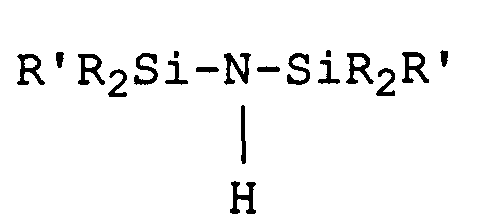
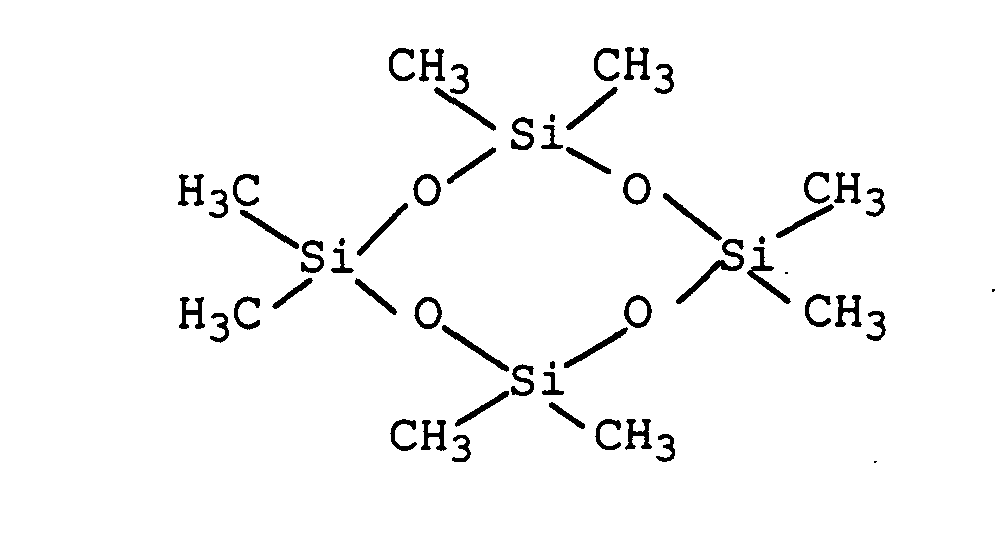
- Halosilanes, alkoxysilanes, Silazanes and / or siloxanes are used.
- the dispersion in water can be a concentration of medium Aerosol doped with pyrogenic alumina Have silicon dioxide from 3 to 50 wt .-%.
- Organic auxiliaries can be added to the dispersion to increase the stability of the dispersion and the Improve particle morphology after spray drying.
- Spray drying can be done at a temperature of 200 up to 600 ° C. You can use atomizers or use a nozzle atomizer.
- the tempering of the granules can be done both at rest Bulk, such as in chamber furnaces, as well as in moving bed, such as rotary tube dryer, carry out.
- the silanization can be done with the same halosilanes, Alkoxysilanes, silazanes and / or siloxanes as above described are carried out, the Silanizing agent optionally in an organic Solvents such as ethanol can be dissolved.
- the silane Si 108 [(CH 3 O) 3 SiC 8 H 17 ] trimethoxyoctylsilane can preferably be used as the silanizing agent.
- the silanization can be done by doing this Granules with the silanizing agent at room temperature sprayed and then the mixture at a temperature from 100 to 400 ° C over a period of 1 to 6 h thermally treated.
- An alternative method of silanizing the granules can be carried out by using the granulate with the Silanizing agent treated in vapor form and the mixture then at a temperature of 200 to 800 ° C thermally treated for a period of 0.5 to 6 h.
- the thermal treatment can take place under protective gas, such as Example nitrogen.
- the silanization can be done in heatable mixers and Dryers with spray devices continuously or to begin with.
- Suitable devices can for Example: ploughshare mixer, plate, fluidized bed or Fluidized bed dryer.
- the conditions at spraying, tempering and silanization can be done the physico-chemical parameters of the granules, such as the specific surface, the grain size distribution, the Tamped density and pH within the specified limits change.
- the granules according to the invention can be used as catalysts and supports for catalysts, as well as in cosmetics, as Sun protection, in silicone rubber, in toner powder, in Varnishes and paints, as abrasives and polishes, as Raw material used for glass and ceramic production become.
- the granules can be made in different ways be modified.
- the granules according to the invention can be used as catalysts and catalyst supports, for example for the following catalytic reactions are used:
- oxifunctionalization of hydrocarbons the oxidation of olefins to epoxides with hydrogen peroxide, alkyl or aryl hydroperoxides, such as tert.
- the granules according to the invention are also as carriers suitable for dyes, odors and active substances.
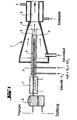
- FIG. 1 shows a schematic representation of the Doping apparatus.
- the heart of the apparatus is a Burner of known design for the production of pyrogenic Oxides.
- the burner 1 consists of the central tube 2, which in the Nozzle 3 opens, from which the main gas flow into the Burner chamber flows and burns there.
- the nozzle 3 is from surrounded by the ring nozzle 4, from which (ring or secondary) Hydrogen flows out.
- the central tube 2 In the central tube 2 is the axial tube 5, the ends a few centimeters in front of the nozzle of the central tube 2. In the axial tube 5, the aerosol is fed.
- the aerosol which consists of an aqueous aluminum chloride solution exists, is in the aerosol generator 6 (Ultrasonic nebulizer).
- the aluminum chloride water aerosol generated in the aerosol generator 6 is by means of a light gas flow passed through the heating zone 7, in which the entrained Water evaporates, being small in the gas phase Salt crystals remain in finely divided form.
- the gas mixture flows out of the nozzle 3 of the burner 1 and burns in the burner chamber and the adjoining one water-cooled flame tube.
- the second gas stream flows out of the axial tube 5 into the Central tube 2.
- the second gas stream consists of the aerosol, which is generated in the aerosol generator 6 by ultrasonic atomization of AlCl 3 solution.
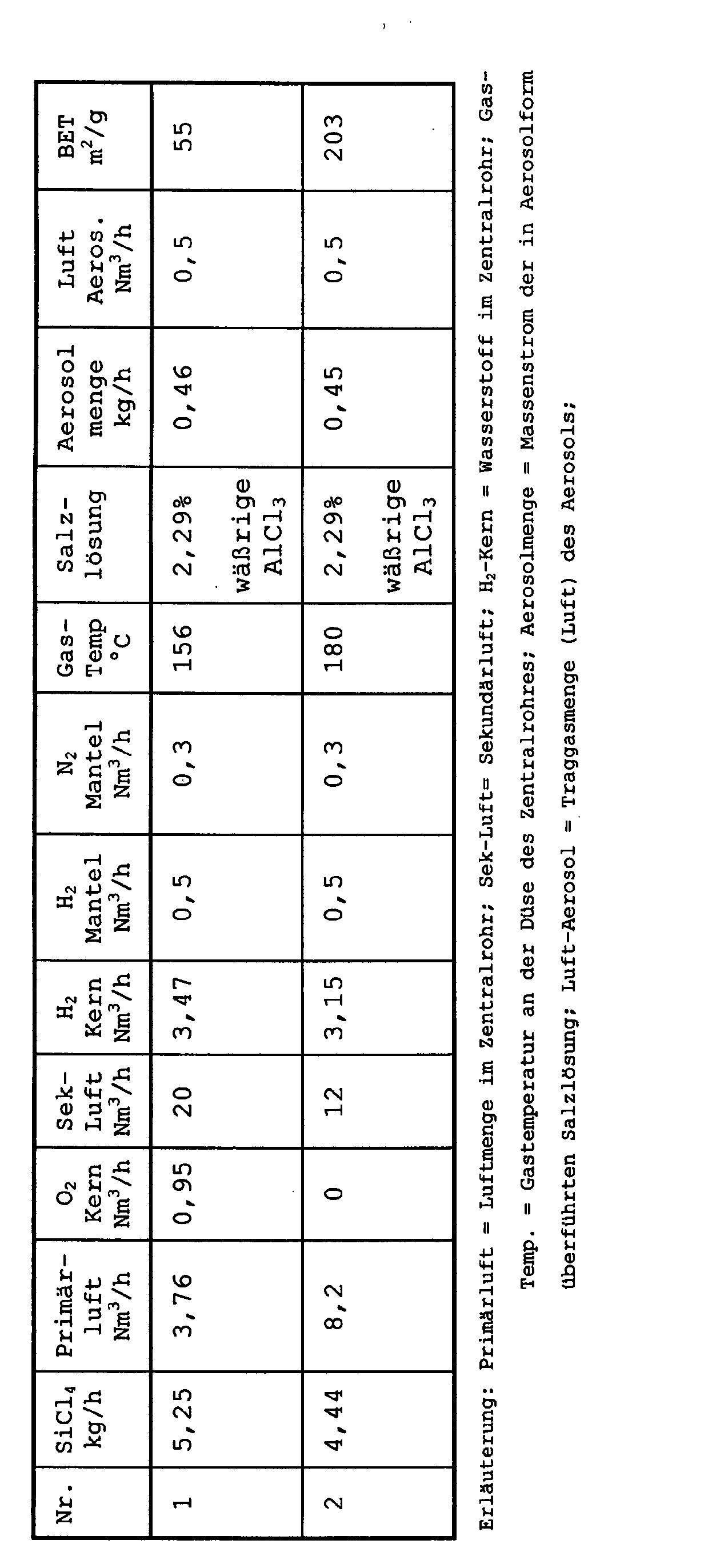
- the aerosol generator 6 atomizes 460 g / h of 2.29 percent aqueous aluminum trichloride solution.
- the aluminum chloride aerosol is passed through the heated line with the aid of the carrier gas of 0.5 Nm 3 / h of air, the aqueous aerosol being converted into a gas and a salt crystal aerosol at temperatures of approximately 180 ° C.
- the temperature of the gas mixture (SiCl 4 -air-hydrogen, water-aerosol) at the burner mouth is 156 ° C.
- reaction gases and those using aerosol with aluminum oxide doped pyrogenic silica are created by applying a Vacuum sucked through the cooling system.
- a cyclone is the solid from the exhaust stream separated.
- the pyrogen doped with aluminum oxide by aerosol Silicon dioxide produced falls as a fine white particle Powder.
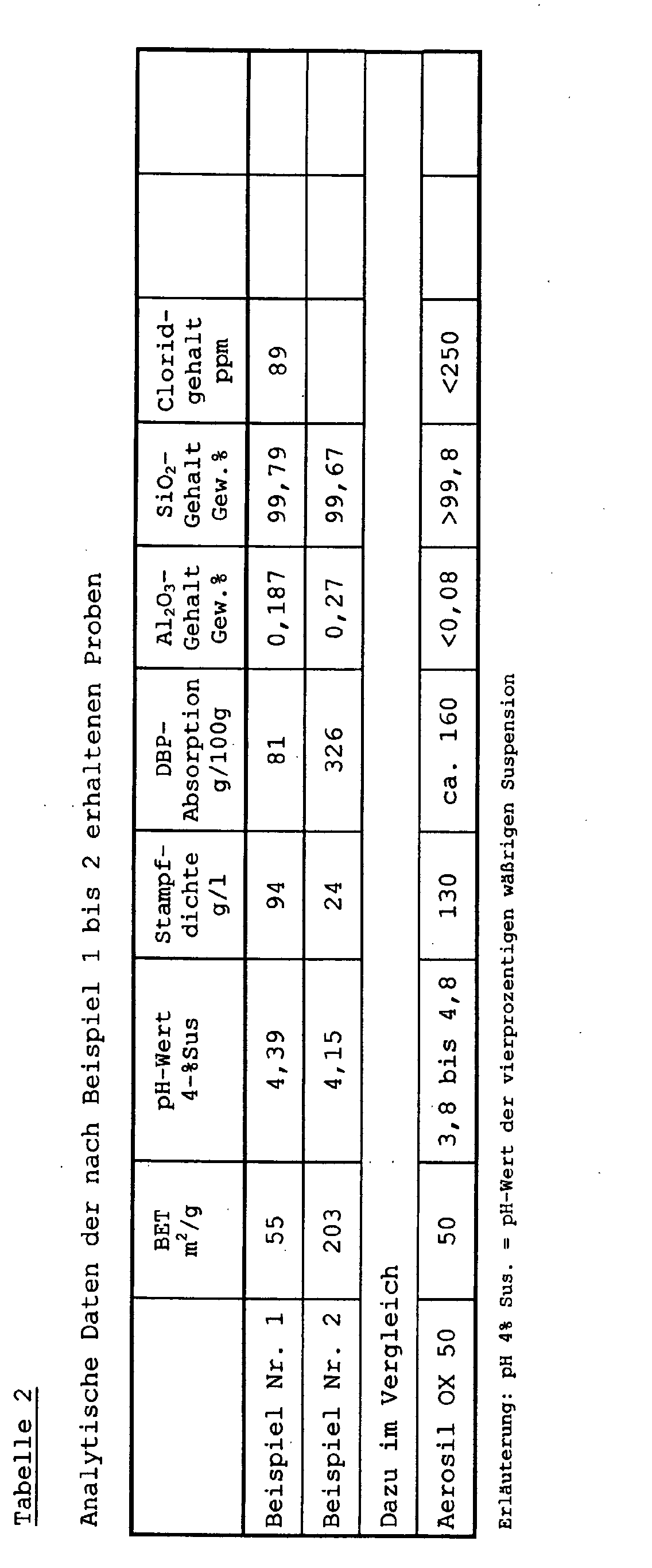
- the BET surface area of the fumed silica doped with aluminum oxide is 55 m 2 / g.
- Example 2 Production of a pyrogenically produced silicon dioxide with a high BET surface area doped with aluminum oxide by means of an aerosol
- the gas mixture flows out of the nozzle 3 of the burner 1 and burns in the burner chamber and the adjoining one water-cooled flame tube.
- the second gas stream flows out of the axial tube 5 into the Central tube 2.
- the second gas stream consists of the aerosol, which is generated by ultrasonic atomization of AlCl 3 solution in the separate atomization unit 6.
- the aerosol generator 6 atomizes 450 g / h of 2.29 percent aqueous aluminum trichloride solution.
- the aluminum chloride aerosol is passed through the heated line with the aid of the carrier gas of 0.5 Nm 3 / h of air, the aqueous aerosol being converted into a gas and a salt crystal aerosol at temperatures of approximately 180 ° C.
- the temperature of the gas mixture (SiCl 4 -air-hydrogen, water-aerosol) at the burner mouth is 180 ° C.
- reaction gases and that by means of aerosol with aluminum oxide doped, pyrogenic silicon dioxide are produced by Application of a vacuum sucked through a cooling system.
- the particle gas flow is raised to approx. 100 to 160 ° C cooled.
- the solid is removed from the Exhaust gas flow separated.
- the pyrogen doped with aluminum oxide by aerosol Silicon dioxide produced falls as a fine white particle Powder.
- a further step if increased Temperature by treatment with air containing water vapor residual hydrochloric acid from the silica away.
- the BET surface area of the pyrogenic silicon dioxide produced which is doped with aluminum oxide by aerosol is 203 m 2 / g.
- the physico-chemical characteristics are compared with the following measurement methods:
- the BET surface is covered with nitrogen in accordance with DIN 66 131 certainly.
- the tamped density (formerly tamped volume) is equal to the quotient of the mass and the volume of a powder after tamping in the tamped volumeter under specified conditions. According to DIN ISO 787 / XI, the tamped density is given in g / cm 3 . Because of the very low tamped density of the pyrogenic oxides, we give the value in g / l. Furthermore, drying and sieving as well as the repetition of the pounding process are omitted.
- 200 ⁇ 10 ml of granules are poured into the measuring cylinder of the ramming volumeter so that no voids remain and the surface is horizontal.
- the mass of the filled sample is determined to the nearest 0.01 g.
- the measuring cylinder with the sample is inserted into the measuring cylinder holder of the ramming volumeter and tamped 1250 times.
- the volume of the pounded pyrogenic oxide is read to the nearest 1 ml.
- the pH is determined in a 4% aqueous dispersion, for hydrophobic granules in water: methanol 1: 1.
- the lid is put on before cooling. A second Drying is not carried out.
- the loss on ignition is determined at 1000 ° C. at this temperature escapes in addition to the physical bound water also the chemically bound water.
- the pyrogenically produced silicon dioxide doped with aluminum oxide by aerosol is dispersed in deionized water.
- a dispersing unit is used that works on the rotor / stator principle.
- the resulting dispersions are spray dried.
- the finished product is separated using a filter or cyclone.
- the spray granules can be tempered in muffle furnaces respectively.
- the spray-dried and possibly tempered granules are placed in a mixer for silanization and with intensive mixing, if necessary first with water and then sprayed with the silanizing agent. After spraying has ended, 15 to 30 min mixed and then 1 to 4 h at 100 to 400 ° C. annealed.
- the water used can be acidified with an acid, for example hydrochloric acid, to a pH of 7 to 1.
- the silanizing agent used can be dissolved in a solvent, such as ethanol.
- Spray drying data for aqueous VP 3375 dispersions Experimental designation Solids content oxide / H 2 O [g / l] Atomization with Speed atomizer disc [rpm] Operating temperature [° C] Exhaust air temperature [° C] Spray dryer 1 150 disc 20000 380 105 Niro SD 12.5 2 150 disc 10000 380 105 Niro SD 12.5 3 150 Dual-substance nozzle - 260 105 Anhydro compact 4 200 Dual-substance nozzle - 260 105 Anhydro compact 5 250 Dual-substance nozzle - 260 105 Anhydro compact 6 300 Dual-substance nozzle - 260 105 Anhydro compact 7 350 Dual-substance nozzle - 260 105 Anhydro compact 8th 450 Dual-substance nozzle - 260 105 Anhydro compact 9
Landscapes
- Chemical & Material Sciences (AREA)
- Organic Chemistry (AREA)
- Chemical Kinetics & Catalysis (AREA)
- Engineering & Computer Science (AREA)
- Materials Engineering (AREA)
- General Chemical & Material Sciences (AREA)
- Life Sciences & Earth Sciences (AREA)
- Geochemistry & Mineralogy (AREA)
- Inorganic Chemistry (AREA)
- Silicon Compounds (AREA)
- Cosmetics (AREA)
- Catalysts (AREA)
- Compositions Of Macromolecular Compounds (AREA)
- Developing Agents For Electrophotography (AREA)
Abstract
Description
| Mittlerer Korndurchmesser | 10 bis 150 µm |
| BET-Oberfläche | 25 bis 100 m2/g |
| pH-Wert | 3 bis 6 |
| Stampfdichte | 400 bis 1.200 g/l |
| Mittlerer Korndurchmesser | 15 bis 30 µm |
| BET-Oberfläche | 60 bis 70 m2/g |
| pH-Wert | 4 bis 6 |
| Stampfdichte | 400 bis 650 g/l |
1.100 °C während eines Zeitraumes von 1 bis 8 h tempert.
| Mittlerer Korndurchmesser | 10 bis 160 µm |
| BET-Oberfläche | 15 bis 100 m2/g |
| pH-Wert | 3,0 bis 9,0 |
| Stampfdichte | 400 bis 1.200 g/l |
| Kohlenstoffgehalt | 0,3 bis 12,0 Gew.-% |

Die Dispergierung ist einfacher.
Für die Granulation sind keine zusätzlichen Hilfsstoffe erforderlich.
Gegenüber dem nichtsprühgetrocknetem mittels Aerosol mit Aluminiumoxid dotiertem, pyrogen hergestelltem Siliziumdioxid, das keine definierte Agglomeratgröße aufweist, hat das erfindungsgemäße Granulat auf Basis von mittels Aerosol mit Aluminiumoxid dotiertem, pyrogen hergestelltem Siliziumdioxid eine definierte Teilchengröße. Das erfindungsgemäße Granulat auf Basis von mittels Aerosol mit Aluminiumoxid dotiertem, pyrogen hergestelltem Siliziumdioxid ermöglicht eine staubfreie Handhabung.
Auf Grund der hohen Stampfdichte ist ein geringerer Verpackungsaufwand für den Transport erforderlich.
Das erfindungsgemäße Granulat auf Basis von mittels Aerosol mit Aluminiumoxid dotiertem, pyrogen hergestelltem Siliziumdioxid kann als Katalysatorträger eingesetzt werden.
Das nichtsprühgetrocknete mittels Aerosol mit Aluminiumoxid dotierte, pyrogen hergestellte Siliziumdioxid ist hierzu nicht geeignet, weil es beispielsweise aus dem Wirbelbett herausgetragen wird.
- Der Einbau von Kationen, wie zum Beispiel H+, Cs+, Seltenerdmetall- oder Edelmetallkationen.
- Einbau von Metallen oder Metalloxiden durch Umsetzung mit geeigneten Precursormolekülen, wie zum Beispiel TiCl4, TiBr4, Ti(OEt)4, TiCp2Cl2 (Cp = Cyclpentadienyl), Mn2(CO)10, Fe(CO)5.
- Einbau von Edelmetallen oder Metall-Oxiden durch Imprägnierung mit Lösungen der Metall- oder Edelmetallsalze.
Die Masse der eingefüllten Probe wird auf 0,01 g genau bestimmt. Der Meßzylinder mit der Probe wird in den Meßzylinderhalter des Stampfvolumeters eingesetzt und 1250 mal gestampft.
Das Volumen des gestampften pyrogenen Oxids wird auf 1 ml genau abgelesen.
- Eichung:
- Vor der pH-Wertmessung wird das Meßgerät mit den Pufferlösungen geeicht. Werden mehrere Messungen hintereinander durchgeführt, genügt eine einmalige Eichung.
Nach Abstellen des Rührers wird der pH-Wert nach einer Standzeit von einer Minute abgelesen. Das Ergebnis wird mit einer Dezimale ausgewiesen.
Ein Verstauben ist sorgfältig zu vermeiden. Als günstig hat es sich erwiesen, wenn die eingewogenen Proben in den noch kalten Muffelofen gestellt werden.
Durch das langsame Aufheizen des Ofens werden stärkere Luftturbulenzen in den Porzellantiegeln vermieden.
Nach Erreichen von 1000 °C wird noch 2 Stunden
weitergeglüht. Anschließend wird mit einem Tiegeldeckel abgedeckt und der Tiegel im Exsikkator über Blaugel der Gewichtsverlust ermittelt.
entstehenden Dispersionen werden sprühgetrocknet. Die Abscheidung des Fertigproduktes erfolgt über Filter oder Zyklon.
| Daten zur Sprühtrocknung von wässrigen VP 3375-Dispersionen | ||||||
| Versuchs-bezeichnung | Feststoff-gehalt Oxid/H2O [g/l] | Zerstäu-bung mit | Drehzahl Zerstäuber-scheibe [UpM] | Betriebs-temperatur [°C] | Abluft-temperatur [°C] | Sprüh-trockner |
| 1 | 150 | Scheibe | 20000 | 380 | 105 | Niro SD 12.5 |
| 2 | 150 | Scheibe | 10000 | 380 | 105 | Niro SD 12.5 |
| 3 | 150 | Zweistoff -düse | - | 260 | 105 | Anhydro Compakt |
| 4 | 200 | Zweistoff -düse | - | 260 | 105 | Anhydro Compakt |
| 5 | 250 | Zweistoff -düse | - | 260 | 105 | Anhydro Compakt |
| 6 | 300 | Zweistoff -düse | - | 260 | 105 | Anhydro Compakt |
| 7 | 350 | Zweistoff -düse | - | 260 | 105 | Anhydro Compakt |
| 8 | 450 | Zweistoff -düse | - | 260 | 105 | Anhydro Compakt |
| 9 | 600 | Zweistoff -düse | - | 260 | 105 | Anhydro Compakt |
| 10 | 600 | Zweistoff -düse | - | 380 | 110 | Niro SD 12.5 |
| 11 | 600 | Zweistoff -düse | - | 420 | 106 | Niro SD 12.5 |
| 12 | 600 | Scheibe | 20000 | 380 | 107 | Niro SD 12.5 |
| Physikalisch-chemische Daten von sprühgetrockneten Produkten | ||||||
| Versuch-bezeichnung | Stampf-dichte [g/l] | Trocknungs-verlust [%] | Glühverlust [%] | pH-Wert | Spez. Oberfläche (BET) [m2/g] | d50-Wert (Cilas) [µm] |
| 1 | 527 | 0,3 | 0,2 | 4,7 | 63 | 18 |
| 2 | 536 | 0,6 | 0,3 | 5,7 | 63 | 24 |
| 3 | 455 | 0,8 | 0,3 | 4,8 | 63 | 19 |
| 4 | 504 | 0,5 | 0,5 | 5,5 | 63 | 21 |
| 5 | 532 | 0,5 | 0,5 | 4,5 | 62 | 26 |
| 6 | 536 | 0,3 | 0,5 | 4,8 | 63 | 22 |
| 7 | 559 | 0,4 | 0,6 | 5,1 | 62 | 25 |
| 8 | 550 | 0,9 | 0,2 | 5,0 | 62 | 23 |
| 9 | 601 | 0,3 | 0,5 | 5,1 | 62 | 21 |
| 10 | 603 | 0,4 | 0,5 | 5,7 | 63 | 18 |
| 11 | 618 | 0,3 | 0,6 | 5,1 | 63 | 24 |
| 12 | 578 | 0,2 | 0,5 | 5,9 | 65 | 23 |
| Oberflächenmodifizierung der sprühtrockneten Produkte | |||||
| Versuch-bezeichnung | Oberflächen-modifizierungs-mittel (OM) | Teile OM / 100 Teile Oxid | Teile H2O / 100 Teile Oxid | Tempertemperatur [°C] | Temperdauer [h] |
| 1 | 10 | 0 | 370 | 2 | |
| 2 | 8 | 2 | 120 | 2 | |
| 3 | 10 | 2 | 140 | 3 | |
| 4 | 7 | 1 | 140 | 2 | |
| 5 | 8 | 1 | 140 | 2 | |
| 6 | 6 | 1 | 130 | 2 |
| Physikalisch-chemische Daten der oberflächenmodifizierten Produkte aus Tabelle 5 | |||||
| Versuchbezeichnung | Stampfdichte [g/l] | pH-Wert | Trocknungsverlust [%] | Glühverlust [%] | C-Gehalt [%] |
| 1 | 655 | 5,2 | 0,3 | 0,3 | 0,4 |
| 2 | 642 | 6,8 | 0,3 | 4,0 | 2,5 |
| 3 | 637 | 7,2 | 0,4 | 1,0 | 0,9 |
| 4 | 645 | 7,5 | 1,0 | 4,3 | 3,9 |
| 5 | 642 | 7,4 | 1,9 | 3,2 | 2,9 |
| 6 | 635 | 10,0 | 0,4 | 3,7 | 0,9 |
Claims (6)
- Granulate auf Basis von mittels Aerosol mit Aluminiumoxid dotiertem, pyrogen hergestelltem Siliziumdioxid mit den folgenden physikalisch-chemischen Kenndaten:
Mittlerer Korndurchmesser 10 bis 150 µm BET-Oberfläche 25 bis 100 m2/g pH-Wert 3 bis 6 Stampfdichte 400 bis 1.200 g/l - Verfahren zur Herstellung der Granulate nach Anspruch 1, dadurch gekennzeichnet, daß man mittels Aerosol mit Aluminiumoxid dotiertes, pyrogen hergestelltes Siliziumdioxid in Wasser dispergiert, sprühtrocknet und gegebenenfalls die erhaltenen Granulate bei einer Temperatur von 150 bis 1.100 °C während eines Zeitraumes von 1 bis 8 h tempert.
- Verfahren nach Anspruch 2, dadurch gekennzeichnet, daß man als mittels Aerosol mit Aluminiumoxid dotiertes, pyrogen hergestelltes Siliziumdioxid ein Siliziumdioxid einsetzt, bei dem die Basiskomponente ein pyrogen nach der Art der Flammenoxidation oder der Flammenhydrolyse hergestelltes Siliziumdioxid ist, das mit einer Dotierungskomponente von 1·10-4 und bis 20 Gew.-% dotiert wurde, wobei die Dotierungsmenge im Bereich von 1 bis 10.000 ppm liegt und die Dotierungskomponente ein Salz oder eine Salzmischung des Aluminiums oder eine Suspension einer Aluminiumverbindung oder metallischen Aluminiums oder Mischungen davon ist, wobei die BET-Oberfläche des dotierten Oxids zwischen 5 und 600 m2/g liegt.
- Granulate auf Basis von mittels Aerosol mit Aluminiumoxid dotiertem, pyrogen hergestelltem Siliziumdioxid mit den folgenden physikalisch-chemischen Kenndaten:
Mittlerer Korndurchmesser 10 bis 160 µm BET-Oberfläche 15 bis 100 m2/g pH-Wert 3,0 bis 9,0 Stampfdichte 400 bis 1.200 g/l Kohlenstoffgehalt 0,3 bis 12,0 Gew.-% - Verfahren zur Herstellung der Granulate nach Anspruch 4, dadurch gekennzeichnet, daß man mittels Aerosol mit Aluminiumoxid dotiertes, pyrogen hergestelltes Siliziumdioxid in Wasser dispergiert, sprühtrocknet, gegebenenfalls die erhaltenen Granulate bei einer Temperatur von 150 bis 1.100 °C während eines Zeitraumes von 1 bis 8 h tempert und anschließend silanisiert.
- Verwendung der Granulate gemäß den Ansprüchen 1 und 4 als Katalysator und Katalysatorträger, sowie in Kosmetika, in Sonnenschutzformulierungen, in Silikonkautschuk, in Tonerpulver, in Lacken und Farbe, als Schleif- und Poliermittel, als Rohstoff für Glasund Keramikherstellung.
Applications Claiming Priority (2)
| Application Number | Priority Date | Filing Date | Title |
|---|---|---|---|
| DE10123950 | 2001-05-17 | ||
| DE10123950A DE10123950A1 (de) | 2001-05-17 | 2001-05-17 | Granulate auf Basis von mittels Aerosol mit Aluminiumoxid dotiertem, pyrogen hergestelltem Siliziumdioxid, Verfahren zu ihrer Herstellung und ihre Verwendung |
Publications (1)
| Publication Number | Publication Date |
|---|---|
| EP1266864A1 true EP1266864A1 (de) | 2002-12-18 |
Family
ID=7685079
Family Applications (1)
| Application Number | Title | Priority Date | Filing Date |
|---|---|---|---|
| EP02006055A Ceased EP1266864A1 (de) | 2001-05-17 | 2002-04-19 | Granulate auf Basis von mittels Aerosol mit Aluminiumoxid dotiertem, pyrogen hergestelltem Siliziumdioxid, Verfahren zu ihrer Herstellung und ihre Verwendung |
Country Status (4)
| Country | Link |
|---|---|
| US (1) | US6752864B2 (de) |
| EP (1) | EP1266864A1 (de) |
| JP (1) | JP2003081626A (de) |
| DE (1) | DE10123950A1 (de) |
Cited By (10)
| Publication number | Priority date | Publication date | Assignee | Title |
|---|---|---|---|---|
| WO2004098830A1 (en) * | 2003-05-09 | 2004-11-18 | Degussa Ag | Dispersion for chemical-mechanical polishing |
| US7014975B2 (en) | 2001-10-18 | 2006-03-21 | Wacker-Chemie Gmbh | Solids surface-modified with amino groups |
| WO2007141196A1 (en) * | 2006-06-02 | 2007-12-13 | Degussa Novara Technology S.P.A. | Pelletized silica |
| WO2008094928A1 (en) * | 2007-01-29 | 2008-08-07 | Evonik Degussa Gmbh | Fumed metal oxides for investment casting |
| DE102007031635A1 (de) | 2007-07-06 | 2009-01-15 | Evonik Degussa Gmbh | Verfahren zur Herstellung von Metalloxidgranulaten |
| KR100904584B1 (ko) * | 2004-11-18 | 2009-06-25 | 에보니크 데구사 게엠베하 | 소수성 실리카 및 실리콘 고무에서의 이것의 용도 |
| EP2500090A1 (de) * | 2011-03-16 | 2012-09-19 | Evonik Degussa GmbH | Silicium-Aluminium-Mischoxidpulver |
| WO2012123292A1 (de) * | 2011-03-16 | 2012-09-20 | Evonik Oxeno Gmbh | Mischoxidzusammensetzungen und verfahren zur herstellung von isoolefinen |
| WO2017103171A1 (de) * | 2015-12-18 | 2017-06-22 | Heraeus Quarzglas Gmbh & Co. Kg | Ammoniakbehandlung von siliziumdioxidpulver bei der herstellung von quarzglas |
| WO2017103170A1 (de) * | 2015-12-18 | 2017-06-22 | Heraeus Quarzglas Gmbh & Co. Kg | Wasserdampfbehandlung von siliziumdioxidpulver bei der herstellung von quarzglas |
Families Citing this family (36)
| Publication number | Priority date | Publication date | Assignee | Title |
|---|---|---|---|---|
| DE19847161A1 (de) * | 1998-10-14 | 2000-04-20 | Degussa | Mittels Aerosol dotiertes pyrogen hergestelltes Siliciumdioxid |
| DE19936478A1 (de) * | 1999-08-03 | 2001-02-15 | Degussa | Sinterwerkstoffe |
| DE10126163A1 (de) * | 2001-05-30 | 2002-12-05 | Degussa | Pharmazeutische Zubereitungen |
| US7069746B2 (en) * | 2001-10-22 | 2006-07-04 | Degussa Ag | Method for producing ultra-high purity, optical quality glass articles |
| DE10337198A1 (de) * | 2003-08-13 | 2005-03-17 | Degussa Ag | Träger auf Basis von Granulaten, die aus pyrogen hergestelltem Siliciumdioxiden hergestellt sind |
| DE102004027493A1 (de) * | 2003-12-19 | 2005-09-22 | Binnewies, Michael, Prof. Dr. | Funktionalisierung oxidischer Partikeloberflächen |
| US20060005877A1 (en) * | 2004-07-06 | 2006-01-12 | General Electric Company | Passivated, dye-sensitized oxide semiconductor electrode, solar cell using same, and method |
| EP1813573A1 (de) * | 2006-01-25 | 2007-08-01 | Degussa GmbH | Verfahren zur Herstellung von Gummimischungen |
| US20100003182A1 (en) * | 2006-06-02 | 2010-01-07 | Lorenzo Costa | Pellitized silica |
| JP5335184B2 (ja) * | 2006-09-21 | 2013-11-06 | 株式会社アドマテックス | 活性シリカ微粒子、その製造方法及び樹脂組成物 |
| JP5205910B2 (ja) * | 2006-10-31 | 2013-06-05 | 三菱マテリアル株式会社 | トリクロロシラン製造装置 |
| DE102007024095A1 (de) * | 2007-05-22 | 2008-11-27 | Evonik Degussa Gmbh | Hydrophobe pyrogen hergestellte Kieselsäure und Silikonkautschukmassen, enthaltend die pyrogene Kieselsäure |
| WO2009061295A1 (en) * | 2007-11-09 | 2009-05-14 | Exxonmobil Research And Engineering Company | Preparation of bulk metallic group viii/group vib metal catalysts |
| US8936772B2 (en) * | 2010-04-08 | 2015-01-20 | Ecolab Usa Inc. | Silica containing particle |
| US8333835B2 (en) | 2010-04-08 | 2012-12-18 | Nalco Company | Sulfur containing silica particle |
| US8845991B2 (en) * | 2010-04-08 | 2014-09-30 | Ecolab Usa Inc. | Silica particle manufacturing process |
| US8974762B2 (en) | 2010-04-08 | 2015-03-10 | Nalco Company | Silica particle manufacturing process |
| US8377194B2 (en) | 2010-04-08 | 2013-02-19 | Nalco Company | Sulfur containing silica particle |
| US8609046B2 (en) | 2011-10-07 | 2013-12-17 | Nalco Company | Gas stream treatment process |
| DE102012215956A1 (de) * | 2012-09-10 | 2014-03-13 | Evonik Industries Ag | Methanolbehandlung von Alumosilicat-haltigen ATAE-Spaltkatalysatoren |
| EP2881367A1 (de) | 2013-12-09 | 2015-06-10 | Evonik Industries AG | Verfahren zur Reduzierung des Staubanteiles von Metalloxidgranulaten |
| TWI813534B (zh) | 2015-12-18 | 2023-09-01 | 德商何瑞斯廓格拉斯公司 | 利用露點監測在熔融烘箱中製備石英玻璃體 |
| KR20180095618A (ko) | 2015-12-18 | 2018-08-27 | 헤래우스 크바르츠글라스 게엠베하 & 컴파니 케이지 | 다중-챔버 가열로에서 실리카 유리체의 제조 |
| EP3390308B1 (de) | 2015-12-18 | 2024-08-28 | Heraeus Quarzglas GmbH & Co. KG | Glasfasern aus quarzglas mit geringem oh-, cl- und al-gehalt |
| EP3390305B1 (de) | 2015-12-18 | 2023-11-15 | Heraeus Quarzglas GmbH & Co. KG | Herstellung von quarzglaskörpern aus siliziumdioxidgranulat |
| JP6984897B2 (ja) | 2015-12-18 | 2021-12-22 | ヘレウス クワルツグラス ゲーエムベーハー ウント コンパニー カーゲー | 石英ガラス調製時のケイ素含有量の増大 |
| WO2017103115A2 (de) | 2015-12-18 | 2017-06-22 | Heraeus Quarzglas Gmbh & Co. Kg | Herstellung eines quarzglaskörpers in einem schmelztiegel aus refraktärmetall |
| JP7044454B2 (ja) | 2015-12-18 | 2022-03-30 | ヘレウス クワルツグラス ゲーエムベーハー ウント コンパニー カーゲー | 石英ガラス調製時の中間体としての炭素ドープ二酸化ケイ素造粒体の調製 |
| EP3390290B1 (de) | 2015-12-18 | 2023-03-15 | Heraeus Quarzglas GmbH & Co. KG | Herstellung eines opaken quarzglaskörpers |
| US10618833B2 (en) | 2015-12-18 | 2020-04-14 | Heraeus Quarzglas Gmbh & Co. Kg | Preparation of a synthetic quartz glass grain |
| WO2017103125A1 (de) | 2015-12-18 | 2017-06-22 | Heraeus Quarzglas Gmbh & Co. Kg | Sprühgranulieren von siliziumdioxid bei der herstellung von quarzglas |
| CN108212571B (zh) * | 2018-02-09 | 2023-09-22 | 中山市瑞驰泰克电子有限公司 | 一种离心雾化装置 |
| EP3822244A1 (de) * | 2019-11-14 | 2021-05-19 | Evonik Operations GmbH | Verfahren zur isomerisierung von olefinen |
| EP3954743A1 (de) | 2020-08-12 | 2022-02-16 | Evonik Operations GmbH | Verwendung von siliziumdioxid zur verbesserung der leitfähigkeit von beschichtungen |
| JP7684030B2 (ja) * | 2020-09-11 | 2025-05-27 | 日本アエロジル株式会社 | 複合無機酸化物粉体、複合無機酸化物粉体を含有する粉体塗料組成物、複合無機酸化物粉体を含有する電子写真のトナー組成物、複合無機酸化物粉体の製造方法 |
| TW202615345A (zh) * | 2024-05-02 | 2026-04-16 | 日商日產化學股份有限公司 | 含低甲醇之氧化矽粒子及有機溶膠與其製造方法 |
Citations (2)
| Publication number | Priority date | Publication date | Assignee | Title |
|---|---|---|---|---|
| EP0725037A1 (de) * | 1995-02-04 | 1996-08-07 | Degussa Ag | Granulate auf Basis von pyrogen hergestelltem Siliciumdioxid, Verfahren zu ihrer Herstellung und ihre Verwendung |
| EP0995718A1 (de) * | 1998-10-14 | 2000-04-26 | Degussa-Hüls Aktiengesellschaft | Mittels Aerosol dotiertes pyrogen hergestelltes Siliciumdioxid |
Family Cites Families (10)
| Publication number | Priority date | Publication date | Assignee | Title |
|---|---|---|---|---|
| NL136036C (de) * | 1963-02-15 | |||
| DE3611449A1 (de) * | 1986-04-05 | 1987-10-15 | Degussa | Grundstoff zur herstellung von keramischen werkstoffen |
| DE19650500A1 (de) * | 1996-12-05 | 1998-06-10 | Degussa | Dotierte, pyrogen hergestellte Oxide |
| JP3993941B2 (ja) * | 1998-10-14 | 2007-10-17 | 株式会社きもと | インクジェット記録材料 |
| EP1148026B1 (de) * | 2000-04-12 | 2016-08-10 | Evonik Degussa GmbH | Dispersionen |
| DE10048616A1 (de) * | 2000-09-30 | 2002-04-11 | Degussa | Dotierte Fällungskieselsäure |
| EP1234800A1 (de) * | 2001-02-22 | 2002-08-28 | Degussa Aktiengesellschaft | Wässrige Dispersion, Verfahren zu ihrer Herstellung und Verwendung |
| DE10109484A1 (de) * | 2001-02-28 | 2002-09-12 | Degussa | Oberflächenmodifizierte, dotierte, pyrogen hergestellte Oxide |
| ATE399740T1 (de) * | 2001-03-24 | 2008-07-15 | Evonik Degussa Gmbh | Mit einer hülle umgebene, dotierte oxidpartikeln |
| DE10205280C1 (de) * | 2002-02-07 | 2003-07-03 | Degussa | Dispersion zum chemisch-mechanischen Polieren |
-
2001
- 2001-05-17 DE DE10123950A patent/DE10123950A1/de not_active Withdrawn
-
2002
- 2002-04-19 EP EP02006055A patent/EP1266864A1/de not_active Ceased
- 2002-05-09 US US10/141,347 patent/US6752864B2/en not_active Expired - Lifetime
- 2002-05-14 JP JP2002138580A patent/JP2003081626A/ja active Pending
Patent Citations (2)
| Publication number | Priority date | Publication date | Assignee | Title |
|---|---|---|---|---|
| EP0725037A1 (de) * | 1995-02-04 | 1996-08-07 | Degussa Ag | Granulate auf Basis von pyrogen hergestelltem Siliciumdioxid, Verfahren zu ihrer Herstellung und ihre Verwendung |
| EP0995718A1 (de) * | 1998-10-14 | 2000-04-26 | Degussa-Hüls Aktiengesellschaft | Mittels Aerosol dotiertes pyrogen hergestelltes Siliciumdioxid |
Cited By (19)
| Publication number | Priority date | Publication date | Assignee | Title |
|---|---|---|---|---|
| US7014975B2 (en) | 2001-10-18 | 2006-03-21 | Wacker-Chemie Gmbh | Solids surface-modified with amino groups |
| EP1304332B2 (de) † | 2001-10-18 | 2010-10-13 | Wacker Chemie AG | Mit Aminogruppen oberflächenmodifizierte Feststoffe |
| WO2004098830A1 (en) * | 2003-05-09 | 2004-11-18 | Degussa Ag | Dispersion for chemical-mechanical polishing |
| KR100904584B1 (ko) * | 2004-11-18 | 2009-06-25 | 에보니크 데구사 게엠베하 | 소수성 실리카 및 실리콘 고무에서의 이것의 용도 |
| WO2007141196A1 (en) * | 2006-06-02 | 2007-12-13 | Degussa Novara Technology S.P.A. | Pelletized silica |
| WO2008094928A1 (en) * | 2007-01-29 | 2008-08-07 | Evonik Degussa Gmbh | Fumed metal oxides for investment casting |
| DE102007031635A1 (de) | 2007-07-06 | 2009-01-15 | Evonik Degussa Gmbh | Verfahren zur Herstellung von Metalloxidgranulaten |
| WO2009007200A3 (en) * | 2007-07-06 | 2009-12-03 | Evonik Degussa Gmbh | Process for preparing metal oxide granules |
| EP2500090A1 (de) * | 2011-03-16 | 2012-09-19 | Evonik Degussa GmbH | Silicium-Aluminium-Mischoxidpulver |
| WO2012123185A1 (de) * | 2011-03-16 | 2012-09-20 | Evonik Degussa Gmbh | Silicium-aluminium-mischoxidpulver |
| WO2012123292A1 (de) * | 2011-03-16 | 2012-09-20 | Evonik Oxeno Gmbh | Mischoxidzusammensetzungen und verfahren zur herstellung von isoolefinen |
| CN103370129A (zh) * | 2011-03-16 | 2013-10-23 | 赢创德固赛有限公司 | 硅-铝混合氧化物粉末 |
| CN103608318A (zh) * | 2011-03-16 | 2014-02-26 | 赢创德固赛有限公司 | 混合氧化物组合物及用于制备异烯烃的方法 |
| US8980784B2 (en) | 2011-03-16 | 2015-03-17 | Evonik Degussa Gmbh | Silicon-aluminum mixed oxide powder |
| CN103370129B (zh) * | 2011-03-16 | 2015-03-18 | 赢创德固赛有限公司 | 硅-铝混合氧化物粉末 |
| US9371255B2 (en) | 2011-03-16 | 2016-06-21 | Evonik Degussa Gmbh | Mixed oxide compositions and process for preparing isoolefins |
| RU2596822C2 (ru) * | 2011-03-16 | 2016-09-10 | Эвоник Дегусса Гмбх | Композиции смешанных оксидов и способ получения изоолефинов |
| WO2017103171A1 (de) * | 2015-12-18 | 2017-06-22 | Heraeus Quarzglas Gmbh & Co. Kg | Ammoniakbehandlung von siliziumdioxidpulver bei der herstellung von quarzglas |
| WO2017103170A1 (de) * | 2015-12-18 | 2017-06-22 | Heraeus Quarzglas Gmbh & Co. Kg | Wasserdampfbehandlung von siliziumdioxidpulver bei der herstellung von quarzglas |
Also Published As
| Publication number | Publication date |
|---|---|
| US20030089279A1 (en) | 2003-05-15 |
| JP2003081626A (ja) | 2003-03-19 |
| US6752864B2 (en) | 2004-06-22 |
| DE10123950A1 (de) | 2002-11-28 |
Similar Documents
| Publication | Publication Date | Title |
|---|---|---|
| DE10123950A1 (de) | Granulate auf Basis von mittels Aerosol mit Aluminiumoxid dotiertem, pyrogen hergestelltem Siliziumdioxid, Verfahren zu ihrer Herstellung und ihre Verwendung | |
| DE10138574A1 (de) | Granulate auf Basis von pyrogen hergestelltem Aluminiumoxid, Verfahren zu ihrer Herstellung und ihre Verwendung | |
| EP0725037B1 (de) | Granulate auf Basis von pyrogen hergestelltem Siliciumdioxid, Verfahren zu ihrer Herstellung und ihre Verwendung | |
| EP1628916B1 (de) | Pyrogen hergestelltes, oberflächenmodifiziertes aluminiumoxid | |
| DE10163938A1 (de) | Flammenhydrolytisch hergestelltes Silicium-Titan-Mischoxidpulver mit an der Oberfläche angereichertem Siliciumdioxid, dessen Herstellung und Verwendung | |
| JP2007519792A (ja) | 二酸化珪素で被覆され、表面変性された非金属/金属酸化物 | |
| EP2824148B1 (de) | Hochdisperse Kieselsäure mit einer hohen positiven Oberflächenladung | |
| KR100413930B1 (ko) | 발열성 이산화티탄계 과립, 이의 제조방법 및 당해 과립을 포함하는 촉매 지지체 | |
| CN1732235A (zh) | 用二氧化硅包覆的二氧化钛 | |
| JP2002194327A (ja) | 酸化鉄−二酸化ケイ素−二酸化チタン混合酸化物、その製法、その使用、および前記混合酸化物含有の皮膚用化粧品 | |
| EP1172334B1 (de) | Herstellungsverfahren von ultrafeinen zinkoxidteilchen | |
| WO2003054089A1 (en) | Granules based on pyrogenically prepared silicon dioxide, a process for their preparation and their use | |
| EP1686093B1 (de) | Pyrogen hergestelltes Siliciumdioxidpulver | |
| EP0038900A1 (de) | Verfahren zur Herstellung pyrogener Kieselsäure | |
| DE19601415A1 (de) | Granulate auf Basis von pyrogen hergestelltem Siliciumdioxid, Verfahren zu ihrer Herstellung und ihre Verwendung | |
| US6413490B1 (en) | Granules based on pyrogenic titanium dioxide and a process for preparing the granules | |
| EP1048617A1 (de) | Silicium-Aluminium-Mischoxid, Verfahren zur dessen Herstellung und die Verwendung des Mischoxids | |
| DE102006061057A1 (de) | Organofunktionelle Silikonharzschichten auf Metalloxiden | |
| EP1162179A1 (de) | Photokatalytisches Verfahren | |
| US6406532B1 (en) | Titanium dioxide powder which contains iron oxide | |
| DE19530031A1 (de) | Poröse monodisperse SiO¶2¶-Partikel | |
| EP1431245A1 (de) | Oberflächenmodifizierte, aerogelartige, strukturierte Kieselsäure | |
| DE10065028A1 (de) | Mit Kalium dotierte pyrogene Oxide | |
| Rodriguez-Carrillo et al. | Flow and Batch Minute-Made Synthesis of Ce-UVM-7 Using Microwave-Assisted Reaction: Scaling-Up, Optical and Catalytic Applications, and Impact Assessment | |
| JP2938103B2 (ja) | トリポリリン酸二水素アルミニウム型層間化合物 |
Legal Events
| Date | Code | Title | Description |
|---|---|---|---|
| PUAI | Public reference made under article 153(3) epc to a published international application that has entered the european phase |
Free format text: ORIGINAL CODE: 0009012 |
|
| 17P | Request for examination filed |
Effective date: 20020316 |
|
| AK | Designated contracting states |
Kind code of ref document: A1 Designated state(s): AT BE CH CY DE DK ES FI FR GB GR IE IT LI LU MC NL PT SE TR |
|
| AX | Request for extension of the european patent |
Free format text: AL;LT;LV;MK;RO;SI |
|
| AKX | Designation fees paid |
Designated state(s): AT BE CH CY DE DK ES FI FR GB GR IE IT LI LU MC NL PT SE TR |
|
| 17Q | First examination report despatched |
Effective date: 20050119 |
|
| RAP1 | Party data changed (applicant data changed or rights of an application transferred) |
Owner name: DEGUSSA GMBH |
|
| RAP1 | Party data changed (applicant data changed or rights of an application transferred) |
Owner name: EVONIK DEGUSSA GMBH |
|
| STAA | Information on the status of an ep patent application or granted ep patent |
Free format text: STATUS: THE APPLICATION HAS BEEN REFUSED |
|
| 18R | Application refused |
Effective date: 20070917 |