EP1264715A2 - Fahrzeugkühlsystem für eine temperaturerhöhende Einrichtung sowie Verfahren zur Kühlung der temperaturerhöhenden Einrichtung - Google Patents
Fahrzeugkühlsystem für eine temperaturerhöhende Einrichtung sowie Verfahren zur Kühlung der temperaturerhöhenden Einrichtung Download PDFInfo
- Publication number
- EP1264715A2 EP1264715A2 EP02006246A EP02006246A EP1264715A2 EP 1264715 A2 EP1264715 A2 EP 1264715A2 EP 02006246 A EP02006246 A EP 02006246A EP 02006246 A EP02006246 A EP 02006246A EP 1264715 A2 EP1264715 A2 EP 1264715A2
- Authority
- EP
- European Patent Office
- Prior art keywords
- vehicle
- evaporator
- cooling system
- air conditioning
- coolant
- Prior art date
- Legal status (The legal status is an assumption and is not a legal conclusion. Google has not performed a legal analysis and makes no representation as to the accuracy of the status listed.)
- Granted
Links
Images





Classifications
-
- B—PERFORMING OPERATIONS; TRANSPORTING
- B60—VEHICLES IN GENERAL
- B60H—ARRANGEMENTS OF HEATING, COOLING, VENTILATING OR OTHER AIR-TREATING DEVICES SPECIALLY ADAPTED FOR PASSENGER OR GOODS SPACES OF VEHICLES
- B60H1/00—Heating, cooling or ventilating devices
- B60H1/00357—Air-conditioning arrangements specially adapted for particular vehicles
- B60H1/00385—Air-conditioning arrangements specially adapted for particular vehicles for vehicles having an electrical drive, e.g. hybrid or fuel cell
-
- B—PERFORMING OPERATIONS; TRANSPORTING
- B60—VEHICLES IN GENERAL
- B60H—ARRANGEMENTS OF HEATING, COOLING, VENTILATING OR OTHER AIR-TREATING DEVICES SPECIALLY ADAPTED FOR PASSENGER OR GOODS SPACES OF VEHICLES
- B60H1/00—Heating, cooling or ventilating devices
-
- B—PERFORMING OPERATIONS; TRANSPORTING
- B60—VEHICLES IN GENERAL
- B60H—ARRANGEMENTS OF HEATING, COOLING, VENTILATING OR OTHER AIR-TREATING DEVICES SPECIALLY ADAPTED FOR PASSENGER OR GOODS SPACES OF VEHICLES
- B60H1/00—Heating, cooling or ventilating devices
- B60H1/00271—HVAC devices specially adapted for particular vehicle parts or components and being connected to the vehicle HVAC unit
- B60H1/00278—HVAC devices specially adapted for particular vehicle parts or components and being connected to the vehicle HVAC unit for the battery
-
- B—PERFORMING OPERATIONS; TRANSPORTING
- B60—VEHICLES IN GENERAL
- B60H—ARRANGEMENTS OF HEATING, COOLING, VENTILATING OR OTHER AIR-TREATING DEVICES SPECIALLY ADAPTED FOR PASSENGER OR GOODS SPACES OF VEHICLES
- B60H1/00—Heating, cooling or ventilating devices
- B60H1/02—Heating, cooling or ventilating devices the heat being derived from the propulsion plant
- B60H1/03—Heating, cooling or ventilating devices the heat being derived from the propulsion plant and from a source other than the propulsion plant
-
- B—PERFORMING OPERATIONS; TRANSPORTING
- B60—VEHICLES IN GENERAL
- B60H—ARRANGEMENTS OF HEATING, COOLING, VENTILATING OR OTHER AIR-TREATING DEVICES SPECIALLY ADAPTED FOR PASSENGER OR GOODS SPACES OF VEHICLES
- B60H1/00—Heating, cooling or ventilating devices
- B60H1/02—Heating, cooling or ventilating devices the heat being derived from the propulsion plant
- B60H1/14—Heating, cooling or ventilating devices the heat being derived from the propulsion plant other than from cooling liquid of the plant
- B60H1/143—Heating, cooling or ventilating devices the heat being derived from the propulsion plant other than from cooling liquid of the plant the heat being derived from cooling an electric component, e.g. electric motors, electric circuits, fuel cells or batteries
-
- B—PERFORMING OPERATIONS; TRANSPORTING
- B60—VEHICLES IN GENERAL
- B60H—ARRANGEMENTS OF HEATING, COOLING, VENTILATING OR OTHER AIR-TREATING DEVICES SPECIALLY ADAPTED FOR PASSENGER OR GOODS SPACES OF VEHICLES
- B60H1/00—Heating, cooling or ventilating devices
- B60H1/32—Cooling devices
- B60H1/3204—Cooling devices using compression
- B60H1/3205—Control means therefor
-
- B—PERFORMING OPERATIONS; TRANSPORTING
- B60—VEHICLES IN GENERAL
- B60H—ARRANGEMENTS OF HEATING, COOLING, VENTILATING OR OTHER AIR-TREATING DEVICES SPECIALLY ADAPTED FOR PASSENGER OR GOODS SPACES OF VEHICLES
- B60H1/00—Heating, cooling or ventilating devices
- B60H1/32—Cooling devices
- B60H1/3204—Cooling devices using compression
- B60H1/3228—Cooling devices using compression characterised by refrigerant circuit configurations
- B60H1/32281—Cooling devices using compression characterised by refrigerant circuit configurations comprising a single secondary circuit, e.g. at evaporator or condenser side
-
- B—PERFORMING OPERATIONS; TRANSPORTING
- B60—VEHICLES IN GENERAL
- B60L—PROPULSION OF ELECTRICALLY-PROPELLED VEHICLES; SUPPLYING ELECTRIC POWER FOR AUXILIARY EQUIPMENT OF ELECTRICALLY-PROPELLED VEHICLES; ELECTRODYNAMIC BRAKE SYSTEMS FOR VEHICLES IN GENERAL; MAGNETIC SUSPENSION OR LEVITATION FOR VEHICLES; MONITORING OPERATING VARIABLES OF ELECTRICALLY-PROPELLED VEHICLES; ELECTRIC SAFETY DEVICES FOR ELECTRICALLY-PROPELLED VEHICLES
- B60L1/00—Supplying electric power to auxiliary equipment of vehicles
- B60L1/003—Supplying electric power to auxiliary equipment of vehicles to auxiliary motors, e.g. for pumps, compressors
-
- B—PERFORMING OPERATIONS; TRANSPORTING
- B60—VEHICLES IN GENERAL
- B60L—PROPULSION OF ELECTRICALLY-PROPELLED VEHICLES; SUPPLYING ELECTRIC POWER FOR AUXILIARY EQUIPMENT OF ELECTRICALLY-PROPELLED VEHICLES; ELECTRODYNAMIC BRAKE SYSTEMS FOR VEHICLES IN GENERAL; MAGNETIC SUSPENSION OR LEVITATION FOR VEHICLES; MONITORING OPERATING VARIABLES OF ELECTRICALLY-PROPELLED VEHICLES; ELECTRIC SAFETY DEVICES FOR ELECTRICALLY-PROPELLED VEHICLES
- B60L1/00—Supplying electric power to auxiliary equipment of vehicles
- B60L1/02—Supplying electric power to auxiliary equipment of vehicles to electric heating circuits
-
- B—PERFORMING OPERATIONS; TRANSPORTING
- B60—VEHICLES IN GENERAL
- B60L—PROPULSION OF ELECTRICALLY-PROPELLED VEHICLES; SUPPLYING ELECTRIC POWER FOR AUXILIARY EQUIPMENT OF ELECTRICALLY-PROPELLED VEHICLES; ELECTRODYNAMIC BRAKE SYSTEMS FOR VEHICLES IN GENERAL; MAGNETIC SUSPENSION OR LEVITATION FOR VEHICLES; MONITORING OPERATING VARIABLES OF ELECTRICALLY-PROPELLED VEHICLES; ELECTRIC SAFETY DEVICES FOR ELECTRICALLY-PROPELLED VEHICLES
- B60L3/00—Electric devices on electrically-propelled vehicles for safety purposes; Monitoring operating variables, e.g. speed, deceleration or energy consumption
- B60L3/0023—Detecting, eliminating, remedying or compensating for drive train abnormalities, e.g. failures within the drive train
-
- B—PERFORMING OPERATIONS; TRANSPORTING
- B60—VEHICLES IN GENERAL
- B60L—PROPULSION OF ELECTRICALLY-PROPELLED VEHICLES; SUPPLYING ELECTRIC POWER FOR AUXILIARY EQUIPMENT OF ELECTRICALLY-PROPELLED VEHICLES; ELECTRODYNAMIC BRAKE SYSTEMS FOR VEHICLES IN GENERAL; MAGNETIC SUSPENSION OR LEVITATION FOR VEHICLES; MONITORING OPERATING VARIABLES OF ELECTRICALLY-PROPELLED VEHICLES; ELECTRIC SAFETY DEVICES FOR ELECTRICALLY-PROPELLED VEHICLES
- B60L3/00—Electric devices on electrically-propelled vehicles for safety purposes; Monitoring operating variables, e.g. speed, deceleration or energy consumption
- B60L3/0023—Detecting, eliminating, remedying or compensating for drive train abnormalities, e.g. failures within the drive train
- B60L3/0046—Detecting, eliminating, remedying or compensating for drive train abnormalities, e.g. failures within the drive train relating to electric energy storage systems, e.g. batteries or capacitors
-
- B—PERFORMING OPERATIONS; TRANSPORTING
- B60—VEHICLES IN GENERAL
- B60L—PROPULSION OF ELECTRICALLY-PROPELLED VEHICLES; SUPPLYING ELECTRIC POWER FOR AUXILIARY EQUIPMENT OF ELECTRICALLY-PROPELLED VEHICLES; ELECTRODYNAMIC BRAKE SYSTEMS FOR VEHICLES IN GENERAL; MAGNETIC SUSPENSION OR LEVITATION FOR VEHICLES; MONITORING OPERATING VARIABLES OF ELECTRICALLY-PROPELLED VEHICLES; ELECTRIC SAFETY DEVICES FOR ELECTRICALLY-PROPELLED VEHICLES
- B60L50/00—Electric propulsion with power supplied within the vehicle
- B60L50/10—Electric propulsion with power supplied within the vehicle using propulsion power supplied by engine-driven generators, e.g. generators driven by combustion engines
- B60L50/16—Electric propulsion with power supplied within the vehicle using propulsion power supplied by engine-driven generators, e.g. generators driven by combustion engines with provision for separate direct mechanical propulsion
-
- B—PERFORMING OPERATIONS; TRANSPORTING
- B60—VEHICLES IN GENERAL
- B60L—PROPULSION OF ELECTRICALLY-PROPELLED VEHICLES; SUPPLYING ELECTRIC POWER FOR AUXILIARY EQUIPMENT OF ELECTRICALLY-PROPELLED VEHICLES; ELECTRODYNAMIC BRAKE SYSTEMS FOR VEHICLES IN GENERAL; MAGNETIC SUSPENSION OR LEVITATION FOR VEHICLES; MONITORING OPERATING VARIABLES OF ELECTRICALLY-PROPELLED VEHICLES; ELECTRIC SAFETY DEVICES FOR ELECTRICALLY-PROPELLED VEHICLES
- B60L50/00—Electric propulsion with power supplied within the vehicle
- B60L50/50—Electric propulsion with power supplied within the vehicle using propulsion power supplied by batteries or fuel cells
- B60L50/52—Electric propulsion with power supplied within the vehicle using propulsion power supplied by batteries or fuel cells characterised by DC-motors
-
- B—PERFORMING OPERATIONS; TRANSPORTING
- B60—VEHICLES IN GENERAL
- B60L—PROPULSION OF ELECTRICALLY-PROPELLED VEHICLES; SUPPLYING ELECTRIC POWER FOR AUXILIARY EQUIPMENT OF ELECTRICALLY-PROPELLED VEHICLES; ELECTRODYNAMIC BRAKE SYSTEMS FOR VEHICLES IN GENERAL; MAGNETIC SUSPENSION OR LEVITATION FOR VEHICLES; MONITORING OPERATING VARIABLES OF ELECTRICALLY-PROPELLED VEHICLES; ELECTRIC SAFETY DEVICES FOR ELECTRICALLY-PROPELLED VEHICLES
- B60L58/00—Methods or circuit arrangements for monitoring or controlling batteries or fuel cells, specially adapted for electric vehicles
- B60L58/10—Methods or circuit arrangements for monitoring or controlling batteries or fuel cells, specially adapted for electric vehicles for monitoring or controlling batteries
- B60L58/24—Methods or circuit arrangements for monitoring or controlling batteries or fuel cells, specially adapted for electric vehicles for monitoring or controlling batteries for controlling the temperature of batteries
- B60L58/26—Methods or circuit arrangements for monitoring or controlling batteries or fuel cells, specially adapted for electric vehicles for monitoring or controlling batteries for controlling the temperature of batteries by cooling
-
- B—PERFORMING OPERATIONS; TRANSPORTING
- B60—VEHICLES IN GENERAL
- B60L—PROPULSION OF ELECTRICALLY-PROPELLED VEHICLES; SUPPLYING ELECTRIC POWER FOR AUXILIARY EQUIPMENT OF ELECTRICALLY-PROPELLED VEHICLES; ELECTRODYNAMIC BRAKE SYSTEMS FOR VEHICLES IN GENERAL; MAGNETIC SUSPENSION OR LEVITATION FOR VEHICLES; MONITORING OPERATING VARIABLES OF ELECTRICALLY-PROPELLED VEHICLES; ELECTRIC SAFETY DEVICES FOR ELECTRICALLY-PROPELLED VEHICLES
- B60L58/00—Methods or circuit arrangements for monitoring or controlling batteries or fuel cells, specially adapted for electric vehicles
- B60L58/30—Methods or circuit arrangements for monitoring or controlling batteries or fuel cells, specially adapted for electric vehicles for monitoring or controlling fuel cells
- B60L58/32—Methods or circuit arrangements for monitoring or controlling batteries or fuel cells, specially adapted for electric vehicles for monitoring or controlling fuel cells for controlling the temperature of fuel cells, e.g. by controlling the electric load
- B60L58/33—Methods or circuit arrangements for monitoring or controlling batteries or fuel cells, specially adapted for electric vehicles for monitoring or controlling fuel cells for controlling the temperature of fuel cells, e.g. by controlling the electric load by cooling
-
- B—PERFORMING OPERATIONS; TRANSPORTING
- B60—VEHICLES IN GENERAL
- B60L—PROPULSION OF ELECTRICALLY-PROPELLED VEHICLES; SUPPLYING ELECTRIC POWER FOR AUXILIARY EQUIPMENT OF ELECTRICALLY-PROPELLED VEHICLES; ELECTRODYNAMIC BRAKE SYSTEMS FOR VEHICLES IN GENERAL; MAGNETIC SUSPENSION OR LEVITATION FOR VEHICLES; MONITORING OPERATING VARIABLES OF ELECTRICALLY-PROPELLED VEHICLES; ELECTRIC SAFETY DEVICES FOR ELECTRICALLY-PROPELLED VEHICLES
- B60L58/00—Methods or circuit arrangements for monitoring or controlling batteries or fuel cells, specially adapted for electric vehicles
- B60L58/40—Methods or circuit arrangements for monitoring or controlling batteries or fuel cells, specially adapted for electric vehicles for controlling a combination of batteries and fuel cells
-
- F—MECHANICAL ENGINEERING; LIGHTING; HEATING; WEAPONS; BLASTING
- F25—REFRIGERATION OR COOLING; COMBINED HEATING AND REFRIGERATION SYSTEMS; HEAT PUMP SYSTEMS; MANUFACTURE OR STORAGE OF ICE; LIQUEFACTION SOLIDIFICATION OF GASES
- F25B—REFRIGERATION MACHINES, PLANTS OR SYSTEMS; COMBINED HEATING AND REFRIGERATION SYSTEMS; HEAT PUMP SYSTEMS
- F25B25/00—Machines, plants or systems, using a combination of modes of operation covered by two or more of the groups F25B1/00 - F25B23/00
- F25B25/005—Machines, plants or systems, using a combination of modes of operation covered by two or more of the groups F25B1/00 - F25B23/00 using primary and secondary systems
-
- F—MECHANICAL ENGINEERING; LIGHTING; HEATING; WEAPONS; BLASTING
- F25—REFRIGERATION OR COOLING; COMBINED HEATING AND REFRIGERATION SYSTEMS; HEAT PUMP SYSTEMS; MANUFACTURE OR STORAGE OF ICE; LIQUEFACTION SOLIDIFICATION OF GASES
- F25B—REFRIGERATION MACHINES, PLANTS OR SYSTEMS; COMBINED HEATING AND REFRIGERATION SYSTEMS; HEAT PUMP SYSTEMS
- F25B30/00—Heat pumps
- F25B30/02—Heat pumps of the compression type
-
- H—ELECTRICITY
- H01—ELECTRIC ELEMENTS
- H01M—PROCESSES OR MEANS, e.g. BATTERIES, FOR THE DIRECT CONVERSION OF CHEMICAL ENERGY INTO ELECTRICAL ENERGY
- H01M8/00—Fuel cells; Manufacture thereof
- H01M8/04—Auxiliary arrangements, e.g. for control of pressure or for circulation of fluids
- H01M8/04007—Auxiliary arrangements, e.g. for control of pressure or for circulation of fluids related to heat exchange
-
- B—PERFORMING OPERATIONS; TRANSPORTING
- B60—VEHICLES IN GENERAL
- B60H—ARRANGEMENTS OF HEATING, COOLING, VENTILATING OR OTHER AIR-TREATING DEVICES SPECIALLY ADAPTED FOR PASSENGER OR GOODS SPACES OF VEHICLES
- B60H1/00—Heating, cooling or ventilating devices
- B60H1/00642—Control systems or circuits; Control members or indication devices for heating, cooling or ventilating devices
- B60H1/00814—Control systems or circuits characterised by their output, for controlling particular components of the heating, cooling or ventilating installation
- B60H1/00878—Control systems or circuits characterised by their output, for controlling particular components of the heating, cooling or ventilating installation the components being temperature regulating devices
- B60H2001/00928—Control systems or circuits characterised by their output, for controlling particular components of the heating, cooling or ventilating installation the components being temperature regulating devices comprising a secondary circuit
-
- B—PERFORMING OPERATIONS; TRANSPORTING
- B60—VEHICLES IN GENERAL
- B60L—PROPULSION OF ELECTRICALLY-PROPELLED VEHICLES; SUPPLYING ELECTRIC POWER FOR AUXILIARY EQUIPMENT OF ELECTRICALLY-PROPELLED VEHICLES; ELECTRODYNAMIC BRAKE SYSTEMS FOR VEHICLES IN GENERAL; MAGNETIC SUSPENSION OR LEVITATION FOR VEHICLES; MONITORING OPERATING VARIABLES OF ELECTRICALLY-PROPELLED VEHICLES; ELECTRIC SAFETY DEVICES FOR ELECTRICALLY-PROPELLED VEHICLES
- B60L2240/00—Control parameters of input or output; Target parameters
- B60L2240/10—Vehicle control parameters
- B60L2240/34—Cabin temperature
-
- B—PERFORMING OPERATIONS; TRANSPORTING
- B60—VEHICLES IN GENERAL
- B60L—PROPULSION OF ELECTRICALLY-PROPELLED VEHICLES; SUPPLYING ELECTRIC POWER FOR AUXILIARY EQUIPMENT OF ELECTRICALLY-PROPELLED VEHICLES; ELECTRODYNAMIC BRAKE SYSTEMS FOR VEHICLES IN GENERAL; MAGNETIC SUSPENSION OR LEVITATION FOR VEHICLES; MONITORING OPERATING VARIABLES OF ELECTRICALLY-PROPELLED VEHICLES; ELECTRIC SAFETY DEVICES FOR ELECTRICALLY-PROPELLED VEHICLES
- B60L2240/00—Control parameters of input or output; Target parameters
- B60L2240/10—Vehicle control parameters
- B60L2240/36—Temperature of vehicle components or parts
-
- B—PERFORMING OPERATIONS; TRANSPORTING
- B60—VEHICLES IN GENERAL
- B60L—PROPULSION OF ELECTRICALLY-PROPELLED VEHICLES; SUPPLYING ELECTRIC POWER FOR AUXILIARY EQUIPMENT OF ELECTRICALLY-PROPELLED VEHICLES; ELECTRODYNAMIC BRAKE SYSTEMS FOR VEHICLES IN GENERAL; MAGNETIC SUSPENSION OR LEVITATION FOR VEHICLES; MONITORING OPERATING VARIABLES OF ELECTRICALLY-PROPELLED VEHICLES; ELECTRIC SAFETY DEVICES FOR ELECTRICALLY-PROPELLED VEHICLES
- B60L2240/00—Control parameters of input or output; Target parameters
- B60L2240/60—Navigation input
- B60L2240/66—Ambient conditions
- B60L2240/662—Temperature
-
- B—PERFORMING OPERATIONS; TRANSPORTING
- B60—VEHICLES IN GENERAL
- B60L—PROPULSION OF ELECTRICALLY-PROPELLED VEHICLES; SUPPLYING ELECTRIC POWER FOR AUXILIARY EQUIPMENT OF ELECTRICALLY-PROPELLED VEHICLES; ELECTRODYNAMIC BRAKE SYSTEMS FOR VEHICLES IN GENERAL; MAGNETIC SUSPENSION OR LEVITATION FOR VEHICLES; MONITORING OPERATING VARIABLES OF ELECTRICALLY-PROPELLED VEHICLES; ELECTRIC SAFETY DEVICES FOR ELECTRICALLY-PROPELLED VEHICLES
- B60L2270/00—Problem solutions or means not otherwise provided for
- B60L2270/44—Heat storages, e.g. for cabin heating
-
- B—PERFORMING OPERATIONS; TRANSPORTING
- B60—VEHICLES IN GENERAL
- B60L—PROPULSION OF ELECTRICALLY-PROPELLED VEHICLES; SUPPLYING ELECTRIC POWER FOR AUXILIARY EQUIPMENT OF ELECTRICALLY-PROPELLED VEHICLES; ELECTRODYNAMIC BRAKE SYSTEMS FOR VEHICLES IN GENERAL; MAGNETIC SUSPENSION OR LEVITATION FOR VEHICLES; MONITORING OPERATING VARIABLES OF ELECTRICALLY-PROPELLED VEHICLES; ELECTRIC SAFETY DEVICES FOR ELECTRICALLY-PROPELLED VEHICLES
- B60L2270/00—Problem solutions or means not otherwise provided for
- B60L2270/46—Heat pumps, e.g. for cabin heating
-
- F—MECHANICAL ENGINEERING; LIGHTING; HEATING; WEAPONS; BLASTING
- F25—REFRIGERATION OR COOLING; COMBINED HEATING AND REFRIGERATION SYSTEMS; HEAT PUMP SYSTEMS; MANUFACTURE OR STORAGE OF ICE; LIQUEFACTION SOLIDIFICATION OF GASES
- F25B—REFRIGERATION MACHINES, PLANTS OR SYSTEMS; COMBINED HEATING AND REFRIGERATION SYSTEMS; HEAT PUMP SYSTEMS
- F25B2400/00—Component parts or details not otherwise provided for in this subclass
- F25B2400/04—Refrigeration circuit bypassing means
- F25B2400/0409—Refrigeration circuit bypassing means for evaporators
-
- F—MECHANICAL ENGINEERING; LIGHTING; HEATING; WEAPONS; BLASTING
- F25—REFRIGERATION OR COOLING; COMBINED HEATING AND REFRIGERATION SYSTEMS; HEAT PUMP SYSTEMS; MANUFACTURE OR STORAGE OF ICE; LIQUEFACTION SOLIDIFICATION OF GASES
- F25B—REFRIGERATION MACHINES, PLANTS OR SYSTEMS; COMBINED HEATING AND REFRIGERATION SYSTEMS; HEAT PUMP SYSTEMS
- F25B5/00—Compression machines, plants or systems, with several evaporator circuits, e.g. for varying refrigerating capacity
- F25B5/02—Compression machines, plants or systems, with several evaporator circuits, e.g. for varying refrigerating capacity arranged in parallel
-
- F—MECHANICAL ENGINEERING; LIGHTING; HEATING; WEAPONS; BLASTING
- F25—REFRIGERATION OR COOLING; COMBINED HEATING AND REFRIGERATION SYSTEMS; HEAT PUMP SYSTEMS; MANUFACTURE OR STORAGE OF ICE; LIQUEFACTION SOLIDIFICATION OF GASES
- F25B—REFRIGERATION MACHINES, PLANTS OR SYSTEMS; COMBINED HEATING AND REFRIGERATION SYSTEMS; HEAT PUMP SYSTEMS
- F25B5/00—Compression machines, plants or systems, with several evaporator circuits, e.g. for varying refrigerating capacity
- F25B5/04—Compression machines, plants or systems, with several evaporator circuits, e.g. for varying refrigerating capacity arranged in series
-
- H—ELECTRICITY
- H01—ELECTRIC ELEMENTS
- H01M—PROCESSES OR MEANS, e.g. BATTERIES, FOR THE DIRECT CONVERSION OF CHEMICAL ENERGY INTO ELECTRICAL ENERGY
- H01M2250/00—Fuel cells for particular applications; Specific features of fuel cell system
- H01M2250/20—Fuel cells in motive systems, e.g. vehicle, ship, plane
-
- H—ELECTRICITY
- H01—ELECTRIC ELEMENTS
- H01M—PROCESSES OR MEANS, e.g. BATTERIES, FOR THE DIRECT CONVERSION OF CHEMICAL ENERGY INTO ELECTRICAL ENERGY
- H01M2250/00—Fuel cells for particular applications; Specific features of fuel cell system
- H01M2250/40—Combination of fuel cells with other energy production systems
- H01M2250/405—Cogeneration of heat or hot water
-
- Y—GENERAL TAGGING OF NEW TECHNOLOGICAL DEVELOPMENTS; GENERAL TAGGING OF CROSS-SECTIONAL TECHNOLOGIES SPANNING OVER SEVERAL SECTIONS OF THE IPC; TECHNICAL SUBJECTS COVERED BY FORMER USPC CROSS-REFERENCE ART COLLECTIONS [XRACs] AND DIGESTS
- Y02—TECHNOLOGIES OR APPLICATIONS FOR MITIGATION OR ADAPTATION AGAINST CLIMATE CHANGE
- Y02B—CLIMATE CHANGE MITIGATION TECHNOLOGIES RELATED TO BUILDINGS, e.g. HOUSING, HOUSE APPLIANCES OR RELATED END-USER APPLICATIONS
- Y02B90/00—Enabling technologies or technologies with a potential or indirect contribution to GHG emissions mitigation
- Y02B90/10—Applications of fuel cells in buildings
-
- Y—GENERAL TAGGING OF NEW TECHNOLOGICAL DEVELOPMENTS; GENERAL TAGGING OF CROSS-SECTIONAL TECHNOLOGIES SPANNING OVER SEVERAL SECTIONS OF THE IPC; TECHNICAL SUBJECTS COVERED BY FORMER USPC CROSS-REFERENCE ART COLLECTIONS [XRACs] AND DIGESTS
- Y02—TECHNOLOGIES OR APPLICATIONS FOR MITIGATION OR ADAPTATION AGAINST CLIMATE CHANGE
- Y02E—REDUCTION OF GREENHOUSE GAS [GHG] EMISSIONS, RELATED TO ENERGY GENERATION, TRANSMISSION OR DISTRIBUTION
- Y02E60/00—Enabling technologies; Technologies with a potential or indirect contribution to GHG emissions mitigation
- Y02E60/30—Hydrogen technology
- Y02E60/50—Fuel cells
-
- Y—GENERAL TAGGING OF NEW TECHNOLOGICAL DEVELOPMENTS; GENERAL TAGGING OF CROSS-SECTIONAL TECHNOLOGIES SPANNING OVER SEVERAL SECTIONS OF THE IPC; TECHNICAL SUBJECTS COVERED BY FORMER USPC CROSS-REFERENCE ART COLLECTIONS [XRACs] AND DIGESTS
- Y02—TECHNOLOGIES OR APPLICATIONS FOR MITIGATION OR ADAPTATION AGAINST CLIMATE CHANGE
- Y02T—CLIMATE CHANGE MITIGATION TECHNOLOGIES RELATED TO TRANSPORTATION
- Y02T10/00—Road transport of goods or passengers
- Y02T10/60—Other road transportation technologies with climate change mitigation effect
- Y02T10/70—Energy storage systems for electromobility, e.g. batteries
-
- Y—GENERAL TAGGING OF NEW TECHNOLOGICAL DEVELOPMENTS; GENERAL TAGGING OF CROSS-SECTIONAL TECHNOLOGIES SPANNING OVER SEVERAL SECTIONS OF THE IPC; TECHNICAL SUBJECTS COVERED BY FORMER USPC CROSS-REFERENCE ART COLLECTIONS [XRACs] AND DIGESTS
- Y02—TECHNOLOGIES OR APPLICATIONS FOR MITIGATION OR ADAPTATION AGAINST CLIMATE CHANGE
- Y02T—CLIMATE CHANGE MITIGATION TECHNOLOGIES RELATED TO TRANSPORTATION
- Y02T10/00—Road transport of goods or passengers
- Y02T10/60—Other road transportation technologies with climate change mitigation effect
- Y02T10/7072—Electromobility specific charging systems or methods for batteries, ultracapacitors, supercapacitors or double-layer capacitors
-
- Y—GENERAL TAGGING OF NEW TECHNOLOGICAL DEVELOPMENTS; GENERAL TAGGING OF CROSS-SECTIONAL TECHNOLOGIES SPANNING OVER SEVERAL SECTIONS OF THE IPC; TECHNICAL SUBJECTS COVERED BY FORMER USPC CROSS-REFERENCE ART COLLECTIONS [XRACs] AND DIGESTS
- Y02—TECHNOLOGIES OR APPLICATIONS FOR MITIGATION OR ADAPTATION AGAINST CLIMATE CHANGE
- Y02T—CLIMATE CHANGE MITIGATION TECHNOLOGIES RELATED TO TRANSPORTATION
- Y02T10/00—Road transport of goods or passengers
- Y02T10/60—Other road transportation technologies with climate change mitigation effect
- Y02T10/72—Electric energy management in electromobility
-
- Y—GENERAL TAGGING OF NEW TECHNOLOGICAL DEVELOPMENTS; GENERAL TAGGING OF CROSS-SECTIONAL TECHNOLOGIES SPANNING OVER SEVERAL SECTIONS OF THE IPC; TECHNICAL SUBJECTS COVERED BY FORMER USPC CROSS-REFERENCE ART COLLECTIONS [XRACs] AND DIGESTS
- Y02—TECHNOLOGIES OR APPLICATIONS FOR MITIGATION OR ADAPTATION AGAINST CLIMATE CHANGE
- Y02T—CLIMATE CHANGE MITIGATION TECHNOLOGIES RELATED TO TRANSPORTATION
- Y02T90/00—Enabling technologies or technologies with a potential or indirect contribution to GHG emissions mitigation
- Y02T90/10—Technologies relating to charging of electric vehicles
- Y02T90/16—Information or communication technologies improving the operation of electric vehicles
-
- Y—GENERAL TAGGING OF NEW TECHNOLOGICAL DEVELOPMENTS; GENERAL TAGGING OF CROSS-SECTIONAL TECHNOLOGIES SPANNING OVER SEVERAL SECTIONS OF THE IPC; TECHNICAL SUBJECTS COVERED BY FORMER USPC CROSS-REFERENCE ART COLLECTIONS [XRACs] AND DIGESTS
- Y02—TECHNOLOGIES OR APPLICATIONS FOR MITIGATION OR ADAPTATION AGAINST CLIMATE CHANGE
- Y02T—CLIMATE CHANGE MITIGATION TECHNOLOGIES RELATED TO TRANSPORTATION
- Y02T90/00—Enabling technologies or technologies with a potential or indirect contribution to GHG emissions mitigation
- Y02T90/40—Application of hydrogen technology to transportation, e.g. using fuel cells
Definitions
- the invention relates to a vehicle cooling system for a temperature increasing device, in particular Traction battery or fuel cell, preferably for an electric or hybrid vehicle with a Establishment involving an air conditioning serving the passenger compartment of the vehicle Air conditioning cooling coolant.
- the invention has for its object a vehicle cooling system of the type mentioned at the beginning create, in which significantly higher amounts of heat are dissipated can be. In particular, no or very little influence from the air temperature in the passenger compartment.
- the coolant is a coolant that in a cooling circuit and for their cooling thermally in the air conditioning refrigeration circuit is involved. While in the prior art the air conditioning system only indirectly for battery cooling is used by a proportion of that of the Air conditioning of the vehicle cooled air to the passenger compartment removed and flow around the battery fed and then into the outside atmosphere is released, the invention sees one direct coupling of the air conditioning system to the one to be cooled temperature increasing device before. According to the invention a cooling circuit is provided, that is, a coolant is circulated and cools doing the establishment. The coolant used is thus after his contact with the facility reused and stands for a new cooling cycle to disposal.
- Coolant used compared to the known Air cooling significantly better heat transfer, Heat absorption and heat transfer properties features.
- a refrigerant is used, which in the course of its Circuit evaporates, then is compressed and condensed and by expansion again the vapor Phase assumes.
- a liquid coolant especially a brine (preferably a water-glysantine mixture) for use.
- brine preferably a water-glysantine mixture
- the liquid coolant can be due to its very good heat transfer to the device, for example to the walls of battery cells large amounts of heat even with a cooling circuit discharge with a relatively small volume flow.
- the coolant has a first heat exchanger coupled with the refrigerant of the air conditioning system.
- a heat exchanger ensures a very good heat transfer between the Coolant and the refrigerant and leads to the mentioned direct coupling of the air conditioning with the Cooling circuit, the media flows of the two circuits are still separate from each other, so not communicate with each other.
- a further development of the invention provides that the coolant always in its physical state maintains. The liquid phase therefore remains during of the entire circulation in the cooling circuit.
- the cooling circuit has at least one circulation pump on. It serves to keep the coolant permanent or at preferably temperature-dependent intervals promote.
- the coolant passes the heat exchanger, which is the thermal coupling to the traction battery manufactures.
- the air conditioning refrigeration circuit has at least one Compressor, at least one condenser, at least an expansion valve and at least one the first evaporator used for air conditioning on.
- the evaporator of the air conditioner is used for Cooling the air of the passenger compartment of the vehicle. It takes the heat from the air in the passenger compartment on.
- the refrigerant vapor coming from the evaporator is compressed in the downstream compressor and condensed in the condenser with a rise in temperature.
- the heat generated is preferably on released the outside air.
- the part belonging to the air conditioning refrigeration circuit of the first heat exchanger forms a second evaporator.
- the refrigerant of the air conditioner partly in the first evaporator and partly, in particular the rest, in the second evaporator evaporated.
- the first evaporator takes the heat out the air in the passenger compartment; the second evaporator serves to record the generated by the facility Warmth.
- Under the "related part" of the first heat exchanger is the area of the first
- the refrigerant of the air conditioning system A corresponding to the cooling circuit other part of the heat exchanger assigned, that guides the coolant flow. To comply with regulations are the two parts of the heat exchanger in the intimate thermal contact, that is, it there is a very good heat transfer.
- the arrangement can be such that the first and second evaporators are separate components or form a structural unit.
- the first and / or the second evaporator each with bypass.
- the respective bypass allows it, the refrigerant in whole or in part at the appropriate Evaporator pass by, so there no or only a correspondingly low heat exchange takes place.
- the setting of the Control or regulating valve is dependent influencing the cooling process of the cooling system Parameters. For example, the Temperature of the temperature increasing device, the outside air temperature and / or the passenger compartment temperature be used.
- the vehicle cooling system can be operated in such a way that in the air conditioning circuit (refrigeration circuit) overheating occurs.
- the refrigerant becomes downstream of the first and / or second evaporator brought to an overheating temperature.
- This is used to control or regulate the Expansion valve influencing evaporation, the between the capacitor and the first or second Evaporator is arranged.
- an Expansion valve can also have multiple expansion valves be provided.
- To record the overheating temperature there is an overheating sensor. This is preferably located at the evaporator outlet. It is used to measure overheating.
- in the Expansion valve is preferably the control or Control of the amount of refrigerant supplied to the evaporator integrated. The regulation or control takes place depending on the overheating measurement.
- the first evaporator is upstream or downstream to the second evaporator.
- the terms refer to "upstream” or "downstream” on the flow direction of the refrigerant the air conditioning. It is therefore alternatively possible that first that of the temperature-increasing Device assigned second evaporator and then that assigned to the passenger compartment of the vehicle first evaporator is flowed through. Alternative is a reverse order is also conceivable. In the in both cases mentioned, the evaporators are thus connected in series. Alternatively, a parallel connection can also be used be provided. This leads to, that a partial volume flow of the refrigerant is the first Evaporator and another partial volume flow or the remaining partial volume flow of the refrigerant passes the second evaporator. With more than two Vaporizers can also be a combination of series and Parallel connection may be provided.
- a further development of the invention sees one with regard the refrigerant flow - downstream of the first evaporator lying third evaporator before, which is part of a second heat exchanger for cooling the temperature-increasing device forms. It is therefore upstream of the first evaporator the second evaporator and downstream the first evaporator the third evaporator (each in the flow direction of the refrigerant the air conditioning system).
- the three evaporators are therefore connected in series.
- the first vaporizer serves to cool the cabin air; the second and third evaporators are used to cool the temperature increasing device.
- the second evaporator thus represents an assembly of the first heat exchanger and forms the third evaporator an assembly of the second heat exchanger.
- everyone the two heat exchangers provide a link between the cooling circuit and the cooling circuit.
- the first and the second heat exchanger each separate Components are or that the first and the second Heat exchanger form a structural unit.
- the cooling circuit for the coolant.
- the coolant in such a case, both from the air conditioning as well as cooled by the cooler mentioned, which is not part of the air conditioning system. Here it can wind, for example Act cooler. With the additional cooler the cooling capacity is increased.
- the cooler can with the first and / or second heat exchanger be connected in parallel or in series.
- the invention relates to a method for cooling a temperature-increasing vehicle device, especially traction battery or fuel cell, preferably for an electric or hybrid vehicle, the vehicle device with a circulated liquid coolant is cooled and a heat exchange of the coolant with the refrigerant one of the air conditioning serving the passenger compartment of the vehicle Air conditioning is done.
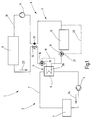
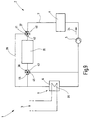
- FIG. 1 shows a vehicle cooling system 1, the a cooling circuit 2 and a cooling circuit respectively Refrigeration circuit 3 has.
- Located in cooling circuit 2 a temperature-increasing device 4, a circulation pump 5 and a first heat exchanger 6.
- the cooling circuit 2 is operated with a coolant 7, promoted by the circulation pump 5 in the circuit becomes.
- the coolant 7 is a brine (especially a water-glysantine mixture).
- the temperature-increasing device 4 can are a vehicle component that is in operation Emits heat.
- a battery rechargeable
- Act fuel cell a powerful battery that generates a very high heat load that dissipate is.
- This heat load can with high drive power (e.g. mountain path) up to 2 kW.
- the battery feeds an electric motor that does that Drives the vehicle.
- this battery represents a traction battery. Is it a pure one Electric vehicle, the above mentioned occur Problems also, but none Internal combustion engine is present, so the drive done only by means of electrical energy.
- Fuel cell vehicles become the main drive designed as an electric motor and from the fuel cell provided.
- the electric motor already mentioned in addition or operated alone to power the fuel cell to support or instead of the fuel cell to use the battery for the drive. All variants mentioned above exist the problem of cooling the battery respectively the fuel cell, i.e. a temperature-increasing one Device whose heat is to be dissipated.
- the invention provides for cooling the temperature-increasing Device 4 to use an air conditioning system 8, that is, the air conditioner 8 serves on the one hand the passenger compartment of the vehicle to temper and it takes over according to the invention the further task of cooling the temperature-increasing Facility 4 to contribute. It can thereby significantly higher heat loads from the device 4 are dissipated as with a pure Air cooling.
- the air conditioning system 8 is shown in FIG illustrated by the refrigeration circuit 3. He points a condenser 9, an expansion valve 10 with an overheating measurement at the evaporator outlet performing overheating sensor 13, an associated Part 11 of the first heat exchanger 6, one first evaporator 12 and a compressor 14 on.
- the expansion valve 10 forms with the overheating detection a structural unit.
- the associated one Forms part 11 of the first heat exchanger 6 with regard to the refrigeration circuit 3, a second evaporator 20.
- the components mentioned are about one Piping system interconnected in the by means of the compressor 14 a refrigerant 15 in Circulation is promoted. It deals with the refrigerant it is preferably R134a.
- Figure 1 shows that in the refrigeration circuit 3 additional two 3-way valves 16 and 17 are arranged, wherein the 3-way valve 16 between the expansion valve 10 and the associated part 11 of the first Heat exchanger 6 is located and a branch 18 to one Bypass 19, which belongs to the associated part 11 of the first heat exchanger 6 is parallel.
- the another 3-way valve 17 lies between the first Evaporator 12 and the second evaporator 20 and has a branch 21, one of which is parallel to the first evaporator 12 lying bypass 22 goes off.
- the expansion valve 10 becomes dependent on the temperature measurement of the overheating sensor 13 regulated or controlled.
- the compressor 14 compresses the refrigerant 15, so that it is in the condenser 9 at high pressure and under Heating condenses, with heat preferably is released to the outside air.
- the coolant 7, the one Cooling liquid is 5 in by means of the circulation pump Conveyed in the direction of arrow 24 so that it is the temperature-increasing device 4 happens and in the process Absorbs heat, that is, the temperature-increasing Device 4 is cooled.
- the coolant 7 then arrives at the first heat exchanger 6, where it is Heat due to the heat exchange function Refrigeration circuit 3 can deliver.
- the coolant 7 always keeps its liquid state in cooling circuit 2 at.
- the bypasses 19 and 22 can be influenced by means of the 3-way valves 16 and 17.
- the entire refrigerant 15 flows through the second Evaporator 20 or there is only a partial flow or no flow at all, ever by how far the bypass 19 is opened.
- the first evaporator 12 can be controlled, of either all of the refrigerant 15 is flowed through or by means of the bypass 22 flows partially or completely.
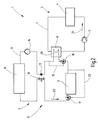
- Figure 2 shows an embodiment in which -in the direction of flow of the refrigerant 15 of the refrigeration circuit 3 viewed (arrow 23) - from the expansion valve 10 coming first the first evaporator 12 and then the second evaporator 20 of the first heat exchanger 6 is flowed through. It is therefore opposite a swapping the embodiment of Figure 1 of the two evaporators 12 and 20 with respect the flow direction of the refrigerant 15 before. Also takes place in the embodiment of Figure 2 overheating of the refrigerant 15, however now in the second evaporator 20.
- the expansion valve 10 corresponding to the overheating controlled or regulated.
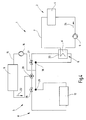
- the embodiment of Figure 3 differs refer to the embodiments of Figures 1 and 2 in that within the refrigeration circuit 3 of first evaporator 12 and second evaporator 20 are connected in parallel to each other.
- the common expansion valve 10 with the first Evaporator 12 and with the second evaporator 20 connects, the mass flows of the refrigerant 15 can be set separately.
- one of the parallel strands switch on or off or on certain Set values.
- the embodiment of Figure 4 differs differs from the embodiment of FIG. 3, that although also a parallel connection of the two evaporators 12 and 20 in the cooling circuit 3 is present, however, the refrigerant mass flows for both evaporators 12, 20 each control or regulate your own expansion valve.
- the two expansion valves are shown in FIG. 4 marked with the reference numerals 26 and 27.
- the arrangement is such that the capacitor 9 coming - the refrigerant 15 first to one 3-way valve 28 passes, from which it to the two Expansion valves 26 and 27 is distributed. hereby the two sub-circuits can be separated set or switch on or off.
- the two expansion valves 26 and 27 can control or to separate regulate, with overheating as the control variable provided at two overheating measurement sites 29 and 30.
- the overheating measuring point 29 is fluidically the first evaporator 12 and the superheat measurement location 30 is fluidically the second evaporator 20 downstream.
- the measurement at the overheating measuring point 29 acts with the expansion valve 26 and the measurement at the overheating measuring point 30 with the expansion valve 27 together. It is through appropriate regulation of the expansion valves 26 and 27, for example possible, same in both sub-circuits Set overheating temperatures. Naturally asymmetrical operation can also be carried out.
- the exemplary embodiment in FIG. 5 sees a coolant-refrigerant temperature exchange both before as well as after the first evaporator 12 before that means the air conditioning evaporator assigned to the air conditioning system 8 (First evaporator 12) is connected downstream the first heat exchanger 6 and upstream to one second heat exchanger 31, for heat exchange leading between a refrigerant 15 third evaporator 32 and the cooling circuit 2 jointly responsible is.
- the refrigerant arrives in detail 15 from the expansion valve 10 to the second evaporator 20 of the first heat exchanger 6, then to the first Evaporator 12 and from there to the third evaporator 32 of the second heat exchanger 31. From there then flows the refrigerant 15 while passing the Overheating sensor 13 of the expansion valve 10 and the compressor 14 to the condenser 9.
- first and the second heat exchanger 6, 31 a common one Form unit, can also - according to Figure 6- be provided that the first and the second heat exchanger 6, 31 form separate components 33 and 34. This results in two separate heat exchangers, the refrigerant side before and after actual air conditioning evaporator (first evaporator 12) are installed.
- the air conditioner 8 significantly affected the compressor 14 needs a larger refrigerant mass flow promote. Furthermore, the capacitor 9 run significantly larger than in air conditioning systems that only cool the Passenger interior of the vehicle are designed. There are only low heat loads from the temperature-increasing Facility 4 before that below from 1 to 1.5 kW, the operation of the air conditioning system is 8 possible without significant impairment. Increases in contrast, the heat input through the temperature-increasing Device 4 to about 2 kW, so it can impairment of the climate performance of the air conditioning system 8 come.
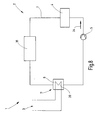
- the cooler 35 in Row to the first heat exchanger 6 is.
- the additional Cooler 35 can preferably be designed as an air cooler be, that is, he is in the wind of the Vehicle arranged and / or is in the cooling air flow a fan.
- the air cooler possibly do not pressurize with air at all, but the cooling of the temperature-increasing Device 4 only with the first heat exchanger 6. In such a case it is however, the cooling air from the passenger compartment is possible to be sucked in, as this is caused by the air conditioning system 8 has a lower temperature level than that Outside air.
- This suction from the passenger compartment preferably takes place whenever the air there is colder than about 25 to 30 ° C. Is the outside air temperature below the temperature range mentioned from 25 to 30 ° C, so it is alternative or additionally also possible to suck in ambient air and thus to flow the cooler 35.
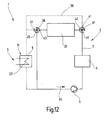
- Figure 9 shows an embodiment in which depending on the heat load and cooling air temperature of the cooler 35 and the first heat exchanger 6 switched on or off or in the coolant volume flow can be adjusted.
- the Zu or respectively Switch off or set the two Heat exchanger (cooler 35, first heat exchanger 6) has especially for a summer respectively Winter operation benefits.
- Summer is high Air temperatures above about 25 to 30 ° C only one pure heat dissipation via the air conditioning circuit (cooling circuit 3) recommended.
- the embodiment of Figure 9 has two 3-way valves 37, 38 on the input and output side of the cooler 35.
- a branch 40, of the 3-way valve 37 stands with the temperature increasing Facility 4 in connection.
- Another Branch 41 leads to the bypass 39.
- a branch 42 of the 3-way valve 37 leads to the inlet of the cooler 35.
- a branch 43 of the 3-way valve 38 leads to the outlet of the cooler 35.
- a branch 44 of the 3-way valve 48 is with the bypass 39 and the first Heat exchanger 6 connected.
- a branch 45 of the 3-way valve 38 leads - bypassing the first Heat exchanger 6- to the circulation pump 5.
- air cooling may be sufficient by means of cooler 35 alone to the heat load of dissipate temperature-increasing device 4, so the operation is carried out according to FIG.
- the Coolant 7 flows through at full volume flow the cooler 35 and from there back to the circulation pump 5.
- the 3-way valve 38 is accordingly set such that the coolant 7 the first heat exchanger 6 bypasses.
Landscapes
- Engineering & Computer Science (AREA)
- Mechanical Engineering (AREA)
- Power Engineering (AREA)
- Thermal Sciences (AREA)
- Physics & Mathematics (AREA)
- Transportation (AREA)
- Sustainable Energy (AREA)
- Life Sciences & Earth Sciences (AREA)
- Sustainable Development (AREA)
- Chemical & Material Sciences (AREA)
- Combustion & Propulsion (AREA)
- General Engineering & Computer Science (AREA)
- Manufacturing & Machinery (AREA)
- Chemical Kinetics & Catalysis (AREA)
- Electrochemistry (AREA)
- General Chemical & Material Sciences (AREA)
- Air-Conditioning For Vehicles (AREA)
- Hybrid Electric Vehicles (AREA)
- Cooling, Air Intake And Gas Exhaust, And Fuel Tank Arrangements In Propulsion Units (AREA)
Abstract
Description
- Figur 1
- ein Fahrzeug-Kühlsystem nach einem ersten Ausführungsbeispiel,
- Figur 2
- ein weiteres Fahrzeug-Kühlsystem nach einem weiteren Ausführungsbeispiel,
- Figur 3
- ein Fahrzeug-Kühlsystem, bei dem eine Parallelschaltung zweiter Verdampfer vorliegt,
- Figur 4
- ein weiteres Ausführungsbeispiel eines Fahrzeug-Kühlsystems,
- Figur 5
- ein Fahrzeug-Kühlsystem, bei dem drei Verdampfer vorgesehen sind,
- Figur 6
- ein der Figur 5 entsprechendes Fahrzeug-Kühlsystem, jedoch mit separierten Verdampfern,
- Figur 7
- ein Abschnitt eines Fahrzeug-Kühlsystems, bei dem im Kühlkreis ein zusätzlicher Kühler für das Kühlmittel angeordnet ist,
- Figur 8
- eine weitere Variante des Ausführungsbeispiels der Figur 7,
- Figur 9
- eine weitere Variante der Ausführungsbeispiele der Figuren 7 und 8,
- Figuren 10 bis 12
- Betriebszustandsdarstellungen des Ausführungsbeispiels der Figur 9.
Claims (18)
- Fahrzeug-Kühlsystem für eine temperaturerhöhende Einrichtung, insbesondere Fahrbatterie oder Brennstoffzelle, vorzugsweise für ein Elektro- oder Hybridfahrzeug, mit einem die Einrichtung unter Einbeziehung einer die Luftkonditionierung der Fahrgastzelle des Fahrzeugs dienenden Klimaanlage kühlenden Kühlmittel, dadurch gekennzeichnet, dass das Kühlmittel (7) eine Kühlflüssigkeit ist, die in einem Kühlkreis (2) geführt wird und zu ihrer Kühlung thermisch in den Kältekreislauf (3) der Klimaanlage (8) eingebunden ist.
- Fahrzeug-Kühlsystem nach Anspruch 1, dadurch gekennzeichnet, dass das Kühlmittel (7) über einen ersten Wärmetauscher (6) mit dem Kältemittel (15) der Klimaanlage (8) gekoppelt ist.
- Fahrzeug-Kühlsystem nach einem der vorhergehenden Ansprüche, dadurch gekennzeichnet, dass die Kühlflüssigkeit (7) stets ihren Aggregatzustand beibehält.
- Fahrzeug-Kühlsystem nach einem der vorhergehenden Ansprüche, dadurch gekennzeichnet, dass der Kühlkreis (2) mindestens eine Umwälzpumpe (5) aufweist.
- Fahrzeug-Kühlsystem nach einem der vorhergehenden Ansprüche, dadurch gekennzeichnet, dass der Kältekreis (3) der Klimaanlage (8) mindestens einen Kompressor (14), mindestens einen Kondensator (9), mindestens ein Expansionsventil (10;26,27) und mindestens einen der Luftkonditionierung dienenden, ersten Verdampfer (12) aufweist.
- Fahrzeug-Kühlsystem nach einem der vorhergehenden Ansprüche, dadurch gekennzeichnet, dass der dem Kältekreis (3) der Klimaanlage (8) zugehörige Teil (11) des ersten Wärmetauschers (6) einen zweiten Verdampfer (20) bildet.
- Fahrzeug-Kühlsystem nach einem der vorhergehenden Ansprüche, dadurch gekennzeichnet, dass der erste und der zweite Verdampfer (12,20) getrennte Bauteile sind oder eine Baueinheit bilden.
- Fahrzeug-Kühlsystem nach einem der vorhergehenden Ansprüche, dadurch gekennzeichnet, dass der erste und/oder der zweite Verdampfer (12,20) mit einem Bypass (19,22) versehen ist/sind.
- Fahrzeug-Kühlsystem nach einem der vorhergehenden Ansprüche, dadurch gekennzeichnet, dass der Bypass oder jeder Bypass (19,22) ein Steuer- oder Regelventil (16,17) aufweist.
- Fahrzeug-Kühlsystem nach einem der vorhergehenden Ansprüche, dadurch gekennzeichnet, dass das Expansionsventil (10;26,27) zwischen dem Kondensator (9) und dem ersten oder zweiten Verdampfer (12,20) angeordnet ist.
- Fahrzeug-Kühlsystem nach einem der vorhergehenden Ansprüche, dadurch gekennzeichnet, dass sich zwischen dem ersten oder zweiten Verdampfer (12,20) und dem Kompressor (14) ein Überhitzungsmeßort für eine das Expansionsventil (10;26,27) steuernde oder regelnde Überhitzungsmessung befindet.
- Fahrzeug-Kühlsystem nach einem der vorhergehenden Ansprüche, dadurch gekennzeichnet, dass der erste Verdampfer (12) stromaufwärts oder stromabwärts zum zweiten Verdampfer (20) liegt.
- Fahrzeug-Kühlsystem nach einem der vorhergehenden Ansprüche, dadurch gekennzeichnet, dass erster und zweiter Verdampfer (12,20) parallel zueinander geschaltet sind.
- Fahrzeug-Kühlsystem nach einem der vorhergehenden Ansprüche, gekennzeichnet durch einen -hinsichtlich der Kältemittelströmung- stromabwärts des ersten Verdampfers (12) liegenden dritten Verdampfer (32), der einen Bestandteil eines zweiten Wärmetauschers (31) zur Kühlung der temperaturerhöhenden Einrichtung (4) bildet.
- Fahrzeug-Kühlsystem nach einem der vorhergehenden Ansprüche, dadurch gekennzeichnet, dass der erste und der zweite Wärmetauscher (6,31) separate Bauteile (33,34) sind oder dass der erste und der zweite Wärmetauscher (6,31) eine Baueinheit bilden.
- Fahrzeug-Kühlsystem nach einem der vorhergehenden Ansprüche, dadurch gekennzeichnet, dass der Kühlkreis (2) mindestens einen zusätzlichen Kühler (35) für das Kühlmittel (7) aufweist.
- Fahrzeug-Kühlsystem nach einem der vorhergehenden Ansprüche, dadurch gekennzeichnet, dass erster und/oder zweiter Wärmetauscher (6,31) und Kühler (35) parallel oder in Reihe geschaltet sind.
- Verfahren zur Kühlung einer temperaturerhöhenden Fahrzeug-Einrichtung, insbesondere Fahrbatterie oder Brennstoffzelle, vorzugsweise für ein Elektrooder Hybridfahrzeug, wobei die Fahrzeug-Einrichtung mit einem in einem Kreislauf geführten flüssigen Kühlmittel gekühlt wird und ein Wärmeaustausch des Kühlmittels mit dem Kältemittel einer der Luftkonditionierung der Fahrgastzelle des Fahrzeugs dienenden Klimaanlage erfolgt.
Applications Claiming Priority (2)
| Application Number | Priority Date | Filing Date | Title |
|---|---|---|---|
| DE10128164A DE10128164A1 (de) | 2001-06-09 | 2001-06-09 | Fahrzeug-Kühlsystem für eine temperaturerhöhende Einrichtung sowie Verfahren zur Kühlung der temperaturerhöhenden Einrichtung |
| DE10128164 | 2001-06-09 |
Publications (4)
| Publication Number | Publication Date |
|---|---|
| EP1264715A2 true EP1264715A2 (de) | 2002-12-11 |
| EP1264715A3 EP1264715A3 (de) | 2003-10-22 |
| EP1264715B1 EP1264715B1 (de) | 2006-04-05 |
| EP1264715B2 EP1264715B2 (de) | 2009-02-11 |
Family
ID=7687836
Family Applications (1)
| Application Number | Title | Priority Date | Filing Date |
|---|---|---|---|
| EP02006246A Expired - Lifetime EP1264715B2 (de) | 2001-06-09 | 2002-03-20 | Fahrzeugkühlsystem für eine temperaturerhöhende Einrichtung sowie Verfahren zur Kühlung der temperaturerhöhenden Einrichtung |
Country Status (5)
| Country | Link |
|---|---|
| US (1) | US6705101B2 (de) |
| EP (1) | EP1264715B2 (de) |
| JP (1) | JP4150770B2 (de) |
| DE (2) | DE10128164A1 (de) |
| ES (1) | ES2261542T5 (de) |
Cited By (16)
| Publication number | Priority date | Publication date | Assignee | Title |
|---|---|---|---|---|
| EP1266779A3 (de) * | 2001-06-15 | 2005-11-23 | Behr GmbH & Co. KG | Fahrzeug-Kühlkreislauf für die Kühlung einer temperaturerhöhenden Einrichtung mittels eines Kuhlmittels |
| EP1669700A1 (de) * | 2004-12-13 | 2006-06-14 | LG Electronics, Inc. | Vorrichtung zum Heizen/Kühlen mit Benutzung der Abwärme einer Brennstoffzelle |
| WO2009062710A1 (de) * | 2007-11-13 | 2009-05-22 | Behr Gmbh & Co. Kg | Vorrichtung zur kühlung einer wärmequelle eines kraftfahrzeugs |
| FR2949386A1 (fr) * | 2009-09-03 | 2011-03-04 | Valeo Systemes Thermiques | Boucle secondaire cooperant avec une installation de ventilation, de chauffache et/ou de climatisation equipant un vehicule automobile. |
| DE102009042774A1 (de) | 2009-09-25 | 2011-03-31 | Behr Gmbh & Co. Kg | System für ein Kraftfahrzeug zum Erwärmen und/oder Kühlen einer Batterie und eines Kraftfahrzeuginnenraumes |
| WO2011061337A1 (de) | 2009-11-23 | 2011-05-26 | Behr Gmbh & Co. Kg | System für ein kraftfahrzeug zum erwärmen und/oder kühlen einer batterie und eines kraftfahrzeuginnenraumes |
| DE102009056083A1 (de) | 2009-11-30 | 2011-06-09 | Wilhelm Karmann Gmbh | Temperierungssystem eines Kraftfahrzeuges mit einem Elektromotor |
| DE102010016588A1 (de) * | 2010-04-22 | 2011-11-24 | Ipetronik Gmbh & Co. Kg | System zum Regeln mindestens einer Temperatur einer Komponente eines Fahrzeugs |
| CN103612570A (zh) * | 2013-09-04 | 2014-03-05 | 奇瑞汽车股份有限公司 | 一种纯电动汽车整车热管理控制系统及其控制方法 |
| CN103806996A (zh) * | 2012-11-05 | 2014-05-21 | 通用电气公司 | 用于发动机驱动单元的集成冷却系统和方法 |
| US9530994B2 (en) | 2008-12-15 | 2016-12-27 | Hanon Systems | Heat exchanger for temperature control of vehicle batteries |
| CN110370889A (zh) * | 2019-06-03 | 2019-10-25 | 武汉格罗夫氢能汽车有限公司 | 一种将燃料电池汽车动力系统废热用于空调采暖的方法 |
| DE102020119730B3 (de) | 2020-07-27 | 2021-09-30 | Deutsches Zentrum für Luft- und Raumfahrt e.V. | Energiewandelanordnung zur Umwandlung chemischer Energie in elektrische Energie und Verfahren zum Betreiben einer Energiewandelanordnung |
| IT202000026747A1 (it) * | 2020-11-09 | 2022-05-09 | Fpt Motorenforschung Ag | Metodo di gestione termica di celle a combustibile di un veicolo |
| CN115431839A (zh) * | 2022-08-18 | 2022-12-06 | 佛山仙湖实验室 | 一种燃料电池汽车整车热管理系统及控制方法 |
| DE102021132036A1 (de) | 2021-12-06 | 2023-06-07 | Audi Aktiengesellschaft | Kühlanordnung zum Kühlen einer Batterie eines Kraftfahrzeugs, Kraftfahrzeug und Verfahren zum Betreiben einer Kühlanordnung |
Families Citing this family (142)
| Publication number | Priority date | Publication date | Assignee | Title |
|---|---|---|---|---|
| US7147071B2 (en) * | 2004-02-04 | 2006-12-12 | Battelle Energy Alliance, Llc | Thermal management systems and methods |
| AU2001249286A1 (en) * | 2000-03-21 | 2001-10-03 | Liebert Corporation | Method and apparatus for cooling electronic enclosures |
| JP3438725B2 (ja) * | 2001-06-08 | 2003-08-18 | 日産自動車株式会社 | 車両用冷却装置 |
| JP4048278B2 (ja) * | 2001-12-21 | 2008-02-20 | ダイムラー・アクチェンゲゼルシャフト | 自動車用空調システムの構築及び制御 |
| US6772603B2 (en) * | 2002-12-20 | 2004-08-10 | Ut-Battelle, Llc | Methods and apparatus for thermal management of vehicle systems and components |
| FR2851503B1 (fr) * | 2003-02-20 | 2008-02-15 | Appareil de ventilation, de chauffage et/ou de climatisation pour habitacle de vehicule automobile a refroidissement simultane d'air et d'un fluide caloporteur | |
| CA2475488C (en) * | 2003-07-24 | 2010-05-04 | Ballard Power Systems Inc. | Systems and methods for controlling cooling fluid temperature in a fuel cell engine |
| JP2007514121A (ja) | 2003-12-05 | 2007-05-31 | リーバート・コーポレイシヨン | 高密度熱負荷のための冷却システム |
| US20050207116A1 (en) * | 2004-03-22 | 2005-09-22 | Yatskov Alexander I | Systems and methods for inter-cooling computer cabinets |
| US7003971B2 (en) * | 2004-04-12 | 2006-02-28 | York International Corporation | Electronic component cooling system for an air-cooled chiller |
| DE102004025831B4 (de) | 2004-05-24 | 2018-10-18 | Volkswagen Ag | Kraftfahrzeug mit einer kühlbaren elektrischen Speichereinrichtung |
| DE102004035879A1 (de) * | 2004-07-23 | 2006-02-16 | Daimlerchrysler Ag | Kühlsystem, insbesondere für ein Kraftfahrzeug, und Verfahren zum Kühlen einer Wärmequelle |
| DE102004038790A1 (de) | 2004-08-09 | 2006-02-23 | Behr Gmbh & Co. Kg | Fahrzeug-Kühlsystem |
| US7455136B2 (en) * | 2004-09-09 | 2008-11-25 | Gm Global Technology Operations, Inc. | Cooling system for a rearward portion of a vehicle and method of cooling |
| FR2875743B1 (fr) * | 2004-09-24 | 2006-11-24 | Valeo Thermique Moteur Sas | Refroidisseur de gaz pour un circuit de climatisation de vehicule automobile. |
| DE102004051608A1 (de) * | 2004-10-23 | 2006-04-27 | Bayerische Motoren Werke Ag | Kühleinrichtung für Fahrzeuge |
| JP4922943B2 (ja) * | 2004-11-14 | 2012-04-25 | リーバート・コーポレイシヨン | 電子部品筐体冷却システムおよび方法 |
| KR100570300B1 (ko) | 2004-12-31 | 2006-04-11 | 위니아만도 주식회사 | 2차유체 순환식 이동형 멀티에어컨 |
| JP4600208B2 (ja) * | 2005-01-20 | 2010-12-15 | 株式会社デンソー | エジェクタを用いたサイクル |
| JP4650108B2 (ja) * | 2005-06-01 | 2011-03-16 | 日産自動車株式会社 | 車両の強電系冷却装置 |
| US7658083B2 (en) * | 2005-07-26 | 2010-02-09 | Ford Global Technologies, Llc | Cooling system and method for cooling a battery in a vehicle |
| EP1929850B1 (de) | 2005-08-04 | 2013-06-19 | Liebert Corporation | Gehäuse für elektronische geräte mit integriertem kühlsystem mit hoher kapazität und backup-ventilationssystem |
| DE102005048241A1 (de) * | 2005-10-07 | 2007-04-12 | Valeo Klimasysteme Gmbh | Zweikreisbatteriekühlsystem |
| JP2007280927A (ja) * | 2005-12-12 | 2007-10-25 | Toyota Motor Corp | 燃料電池の冷却システム |
| US7735331B2 (en) * | 2006-09-20 | 2010-06-15 | Ford Global Technologies, Llc | System and method for controlling temperature of an energy storage device in a vehicle |
| DE102007004979A1 (de) | 2007-02-01 | 2008-08-07 | Daimler Ag | Vorrichtung zur Kühlung einer Hybridfahrzeugbatterie |
| US20080196424A1 (en) * | 2007-02-20 | 2008-08-21 | Behr America, Inc. | Rear evaporator core freeze protection method |
| US20080202741A1 (en) * | 2007-02-23 | 2008-08-28 | Daewoong Lee | Battery cooling device for vehicles and control method thereof |
| US20080295535A1 (en) * | 2007-06-04 | 2008-12-04 | Robinet Kevin J | Active high voltage liquid cooled thermal management system |
| US7939192B2 (en) | 2007-06-20 | 2011-05-10 | Tesla Motors, Inc. | Early detection of battery cell thermal event |
| US9711808B2 (en) * | 2008-03-24 | 2017-07-18 | GM Global Technology Operations LLC | Method for optimized execution of heating tasks in fuel cell vehicles |
| US20090249807A1 (en) * | 2008-04-04 | 2009-10-08 | Gm Global Technology Operations, Inc. | HVAC and Battery Thermal Management for a Vehicle |
| US20090249802A1 (en) * | 2008-04-04 | 2009-10-08 | Gm Global Technology Operations, Inc. | Vehicle HVAC and Battery Thermal Management |
| DE102008035216A1 (de) | 2008-04-19 | 2009-10-22 | Daimler Ag | Kühlanordnung und Verfahren zum Kühlen eines temperaturempfindlichen Aggregats eines Kraftfahrzeugs |
| US8215432B2 (en) | 2008-05-09 | 2012-07-10 | GM Global Technology Operations LLC | Battery thermal system for vehicle |
| DE102008024793A1 (de) | 2008-05-23 | 2009-11-26 | Enerday Gmbh | Batterietemperierung |
| DE102008028290B4 (de) * | 2008-06-16 | 2019-05-16 | Mahle International Gmbh | Einrichtung zur Kühlung eines Kühlmittels, Kreislauf zur Aufladung einer Brennkraftmaschine und Verfahren zum Kühlen eines zur Aufladung einer Brennkraftmaschine vorgesehenen im Wesentlichen gasförmigen Ladefluids |
| US7971447B2 (en) * | 2008-06-27 | 2011-07-05 | Bayerische Motoren Werke Aktiengesellschaft | Control parameters for a high voltage battery cooling strategy |
| US7975757B2 (en) * | 2008-07-21 | 2011-07-12 | GM Global Technology Operations LLC | Vehicle HVAC and RESS thermal management |
| DE102008042587A1 (de) * | 2008-10-02 | 2010-04-08 | Dilo Trading Ag | Netz unabhängiges Kühlsystem und zugehörige Energiespeichereinheit |
| DE102008062176A1 (de) * | 2008-12-13 | 2010-06-17 | Modine Manufacturing Co., Racine | Einrichtung und Verfahren zum Temperieren von elektrischen Elementen |
| FR2940631B1 (fr) * | 2008-12-30 | 2011-08-19 | Renault Sas | Dispositif pour refroidir les batteries d'un vehicule notamment electrique et vehicule equipe d'un tel dispositif |
| EP2383129A4 (de) * | 2009-01-09 | 2013-04-10 | Calsonic Kansei Corp | Klimaanlagensystem für ein fahrzeug |
| US20100175406A1 (en) * | 2009-01-13 | 2010-07-15 | Gm Global Technology Operations, Inc. | Auxiliary Battery Cooling for a Vehicle |
| JP5387129B2 (ja) * | 2009-05-20 | 2014-01-15 | 日産自動車株式会社 | バッテリ温度制御装置 |
| US20120125022A1 (en) * | 2009-07-31 | 2012-05-24 | Carrier Corporation | Cooling system |
| WO2011022290A1 (en) * | 2009-08-17 | 2011-02-24 | Johnson Controls Technology Company | Heat-pump chiller with improved heat recovery features |
| DE102009043316A1 (de) * | 2009-09-28 | 2011-03-31 | Valeo Klimasysteme Gmbh | Verfahren zur Steuerung der Innenraumtemperatur eines elektrisch betriebenen Fahrzeugs und Klimaanlagensystem |
| DE102009048719B4 (de) | 2009-10-09 | 2013-12-12 | Iav Gmbh Ingenieurgesellschaft Auto Und Verkehr | Hilfsaggregat für elektromotorisch betriebene Fahrzeuge |
| DE102009045719A1 (de) * | 2009-10-15 | 2011-04-21 | Robert Bosch Gmbh | Kühlmittelvorrichtung |
| DE102009059982A1 (de) | 2009-12-22 | 2011-06-30 | Volkswagen AG, 38440 | Verfahren zum Temperieren einer Stromquelle eines Fahrzeugs |
| DE102009060860B4 (de) * | 2009-12-30 | 2024-06-27 | Konvekta Aktiengesellschaft | Klimatisierungssystem für ein Fahrzeug sowie Verfahren zum Temperieren |
| KR20110081613A (ko) * | 2010-01-08 | 2011-07-14 | (주)브이이엔에스 | 자동차 |
| WO2011092240A1 (de) | 2010-01-27 | 2011-08-04 | Behr Gmbh & Co. Kg | Wärmeübertrager |
| JP2011225134A (ja) * | 2010-04-21 | 2011-11-10 | Toyota Motor Corp | 車両用冷却システム |
| US9233592B2 (en) * | 2010-07-14 | 2016-01-12 | International Truck Intellectual Property Company, Llc | Climate control system for the interior of an electric drive vehicle |
| DE102010039028B4 (de) * | 2010-08-06 | 2012-05-31 | J. Eberspächer GmbH & Co. KG | Heiz/-Kühl-System für ein elektromotorisch betriebenes Fahrzeug |
| SE535060C2 (sv) * | 2010-08-12 | 2012-04-03 | Scania Cv Ab | Arrangemang för att upprätthålla en önskad driftstemperatur hos ett batteri i ett fordon |
| CN102386459A (zh) * | 2010-08-30 | 2012-03-21 | 张兄文 | 一种电动汽车动力电池的冷却与加热方法及装置 |
| DE102011109055A1 (de) | 2010-09-04 | 2012-03-08 | Volkswagen Ag | Klimaanlage für ein Fahrzeug sowie Verfahren zum Klimatisieren eines Fahrzeugs |
| US8932743B2 (en) * | 2010-09-30 | 2015-01-13 | GM Global Technology Operations LLC | Thermal management controls for a vehicle having a rechargeable energy storage system |
| DE102010048853A1 (de) * | 2010-10-19 | 2012-04-19 | Gm Global Technology Operations Llc (N.D.Ges.D. Staates Delaware) | Klimatisierungssystem für ein Kraftfahrzeug sowie Verfahren zum Betrieb eines Klimatisierungssystems eines Kraftfahrzeuges |
| US8781658B2 (en) * | 2010-10-28 | 2014-07-15 | GM Global Technology Operations LLC | Systems and methods for determining the target thermal conditioning value to control a rechargeable energy storage system |
| ES2986660T3 (es) | 2010-12-29 | 2024-11-12 | Byd Co Ltd | Módulo de batería, sistema de gestión de la temperatura de la batería y vehículo que lo comprende |
| DE102011008653A1 (de) * | 2011-01-14 | 2012-07-19 | Behr Gmbh & Co. Kg | Wärmeübertrager |
| JP2012172917A (ja) * | 2011-02-22 | 2012-09-10 | Nippon Soken Inc | 冷却装置 |
| US9016080B2 (en) * | 2011-03-18 | 2015-04-28 | Denso International America, Inc. | Battery heating and cooling system |
| JP5718710B2 (ja) * | 2011-04-13 | 2015-05-13 | トヨタ自動車株式会社 | 熱交換装置 |
| DE102011075989A1 (de) * | 2011-05-17 | 2012-11-22 | Behr Gmbh & Co. Kg | Vorrichtung und Verfahren zum Kühlen eines Energiespeichers eines Fahrzeugs |
| CA2778026A1 (en) * | 2011-05-26 | 2012-11-26 | Magna E-Car Systems Of America, Inc. | Refrigerant loop for battery electric vehicle with internal heat exchanger for heat exchange with coolant |
| KR20120135771A (ko) * | 2011-06-07 | 2012-12-17 | 엘지전자 주식회사 | 공기 조화기의 실외기 및 그 제어방법 |
| DE102011051624A1 (de) | 2011-07-07 | 2013-01-10 | Dr. Ing. H.C. F. Porsche Aktiengesellschaft | Kühlsystem zum Einsatz in einem Kraftfahrzeug |
| DE102011081886A1 (de) | 2011-08-31 | 2013-02-28 | Behr Gmbh & Co. Kg | Wärmeübertrager |
| JP2013061099A (ja) * | 2011-09-12 | 2013-04-04 | Toyota Motor Corp | 熱交換装置および熱交換装置の制御方法 |
| JP5989328B2 (ja) * | 2011-11-17 | 2016-09-07 | トヨタ自動車株式会社 | 熱交換装置 |
| EP2599651A1 (de) | 2011-12-01 | 2013-06-05 | Magna E-Car Systems GmbH & Co OG | Heiz-/Kühlsystem für eine Batterie eines Kraftfahrzeugs sowie Betriebsverfahren hierfür |
| JP2013184592A (ja) * | 2012-03-08 | 2013-09-19 | Denso Corp | 車両空調用、及び、自動車構成部品温度調整用冷凍サイクル装置 |
| DE112013001769T5 (de) * | 2012-03-28 | 2015-02-12 | Magna E-Car Systems Of America, Inc. | Fahrzeugkühlung mit Expansionsventil mit einstellbarem Durchfluss |
| DE102012218191A1 (de) * | 2012-10-05 | 2014-04-10 | Robert Bosch Gmbh | Wärmetransportanordnung und Verfahren zum Wärmeaustausch in einem Kraftfahrzeug mittels der Wärmetransportanordnung |
| DE102013201109A1 (de) | 2013-01-24 | 2014-07-24 | Behr Gmbh & Co. Kg | Wärmeübertragungseinrichtung |
| US10046617B2 (en) | 2013-02-01 | 2018-08-14 | Ford Global Technologies, Llc | Electric vehicle multi-loop thermal management system |
| FR3002596B1 (fr) * | 2013-02-25 | 2016-05-13 | Renault Sa | Procede et dispositif de rechauffage de carburant pour moteur a combustion interne |
| DE102013004304B4 (de) | 2013-03-13 | 2022-05-12 | Audi Ag | Verfahren zum Kühlen einer Batterie und Batterieanordnung |
| EP2782179B1 (de) * | 2013-03-19 | 2015-09-16 | MAGNA STEYR Engineering AG & Co KG | Verfahren und Vorrichtung zum Betrieb von Brennstoffzellen |
| EP3025887B1 (de) * | 2013-07-26 | 2018-04-25 | Panasonic Intellectual Property Management Co., Ltd. | Klimaanlage für ein fahrzeug |
| DE102014001974B3 (de) | 2014-02-12 | 2015-04-09 | Audi Ag | Verfahren zur Kühlung einer Komponente eines Kraftfahrzeugs, Kühleinrichtung und Kraftfahrzeug |
| DE102014206770A1 (de) * | 2014-04-08 | 2015-10-08 | MAHLE Behr GmbH & Co. KG | Batteriekühleinrichtung und zugehöriges Betriebsverfahren |
| JP6364926B2 (ja) * | 2014-04-24 | 2018-08-01 | 株式会社デンソー | 車両用空調装置 |
| FR3024961B1 (fr) * | 2014-08-19 | 2016-08-12 | Renault Sa | "dispositif de regulation thermique d'une batterie comportant un evaporateur de refroidissement de la batterie et un radiateur de chauffage de la batterie" |
| US9673492B2 (en) * | 2014-09-17 | 2017-06-06 | GM Global Technology Operations LLC | Actively-switched direct refrigerant battery cooling |
| DE102014224298A1 (de) | 2014-11-27 | 2016-06-02 | Schaeffler Technologies AG & Co. KG | Baugruppe für ein Fahrzeug sowie Fahrzeug mit der Baugruppe |
| US10596880B2 (en) * | 2015-05-29 | 2020-03-24 | Thermo King Corporation | Method and system for controlling the release of heat by a temperature control unit |
| KR102364987B1 (ko) * | 2015-07-27 | 2022-02-21 | 한온시스템 주식회사 | 차량용 배터리 냉각 시스템 |
| JP6332193B2 (ja) * | 2015-08-06 | 2018-05-30 | 株式会社デンソー | 車両用空調装置 |
| US9763388B2 (en) * | 2015-09-15 | 2017-09-19 | Cnh Industrial America Llc | Agricultural harvester having a header based heat exchanger |
| US20170087957A1 (en) * | 2015-09-24 | 2017-03-30 | Ford Global Technologies, Llc | Hybrid vehicle with multi-zone cabin cooling and integrated battery cooling |
| KR101703604B1 (ko) | 2015-10-19 | 2017-02-07 | 현대자동차 주식회사 | 차량용 배터리 냉각 시스템 |
| US10297880B2 (en) * | 2016-04-20 | 2019-05-21 | Ford Global Technologies, Llc | Battery thermal management system |
| FR3051509B1 (fr) * | 2016-05-20 | 2018-06-15 | Safran | Systeme reversible pour la dissipation de puissances thermiques generees dans un moteur a turbine a gaz |
| KR101836272B1 (ko) | 2016-06-20 | 2018-03-08 | 현대자동차 주식회사 | 차량용 히트 펌프 시스템 |
| KR101776751B1 (ko) | 2016-06-21 | 2017-09-08 | 현대자동차 주식회사 | 차량용 배터리 냉각 시스템 제어방법 |
| US10293706B2 (en) * | 2016-07-01 | 2019-05-21 | Ford Global Technologies, Llc | Battery coolant circuit control |
| KR102353741B1 (ko) * | 2016-08-22 | 2022-01-20 | 존슨 컨트롤스 테크놀러지 컴퍼니 | 냉장 시스템을 제어하는 시스템 및 방법 |
| KR101875651B1 (ko) | 2016-09-13 | 2018-07-06 | 현대자동차 주식회사 | 차량용 히트 펌프 시스템 |
| US10222134B2 (en) * | 2016-10-06 | 2019-03-05 | Ford Global Technologies, Llc | Dual loop cooling system energy storage and reuse |
| KR101875649B1 (ko) | 2016-10-26 | 2018-07-06 | 현대자동차 주식회사 | 차량용 배터리 냉각 시스템 |
| KR101846911B1 (ko) | 2016-10-31 | 2018-05-28 | 현대자동차 주식회사 | 차량용 히트 펌프 시스템 |
| KR101846908B1 (ko) | 2016-10-31 | 2018-04-10 | 현대자동차 주식회사 | 차량용 히트 펌프 시스템 |
| US10350967B2 (en) * | 2017-03-21 | 2019-07-16 | Hyundai Motor Company | Heat pump system for a vehicle |
| JP6884028B2 (ja) * | 2017-04-26 | 2021-06-09 | サンデン・オートモーティブクライメイトシステム株式会社 | 車両用空気調和装置 |
| KR102399618B1 (ko) * | 2017-05-30 | 2022-05-18 | 현대자동차주식회사 | 차량의 공조시스템 |
| DE102017217685B4 (de) * | 2017-07-12 | 2021-10-14 | Ford Global Technologies, Llc | Anordnung zur Temperierung einer Batterie und weiterer elektrischer Komponenten eines Fahrzeugs, Fahrzeug sowie Verfahren zur Steuerung der Anordnung |
| DE102017118424A1 (de) * | 2017-08-13 | 2019-02-14 | Konvekta Aktiengesellschaft | Kreislaufsystem für ein Brennstoffzellen-Fahrzeug |
| DE102017214356A1 (de) * | 2017-08-17 | 2019-02-21 | Volkswagen Aktiengesellschaft | Klimatisierungsvorrichtung für ein Kraftfahrzeug und Verfahren zu deren Betrieb |
| FR3070557A1 (fr) * | 2017-08-29 | 2019-03-01 | Valeo Systemes Thermiques | Dispositif de connexion electrique pour vehicule automobile refroidi par un circuit de fluide refrigerant |
| JP6894814B2 (ja) * | 2017-09-21 | 2021-06-30 | 日立建機株式会社 | ハイブリッド式作業機械 |
| FR3074265A1 (fr) * | 2017-11-24 | 2019-05-31 | Valeo Systemes Thermiques | Systeme de conditionnement d'air a moyens de modulation du debit d'alimentation d'un echangeur de chaleur |
| FR3074272B1 (fr) * | 2017-11-28 | 2019-10-18 | Valeo Systemes Thermiques | Circuit de gestion thermique d'un vehicule hybride ou electrique |
| FR3077377A1 (fr) * | 2018-01-31 | 2019-08-02 | Valeo Systemes Thermiques | Procede de controle d'un systeme de traitement thermique d'un element d'une chaine de traction electrique de vehicule |
| DE102018201526A1 (de) | 2018-02-01 | 2019-08-01 | Bayerische Motoren Werke Aktiengesellschaft | Speichereinrichtung zum Speichern von elektrischer Energie für ein Kraftfahrzeug, sowie Kraftfahrzeug |
| CN108507230B (zh) * | 2018-06-15 | 2023-12-12 | 兴鼎工程(深圳)有限公司 | 能源综合回收利用系统 |
| DE102018213835B4 (de) * | 2018-08-16 | 2024-07-11 | Bayerische Motoren Werke Aktiengesellschaft | Fahrzeug mit einem Kältemittelkreis |
| CN109461951B (zh) * | 2018-10-23 | 2024-02-06 | 武汉格罗夫氢能汽车有限公司 | 一种新型氢能汽车燃料电池堆的冷却系统 |
| CN110048185B (zh) * | 2019-03-26 | 2022-06-17 | 开沃新能源汽车集团有限公司 | 一种带四通阀的电池包冷却系统布置结构 |
| DE102019204492A1 (de) * | 2019-03-29 | 2020-10-01 | Siemens Mobility GmbH | Verfahren zum Betreiben einer Wärmepumpe, Wärmepumpe, Belüftungsanlage und Fahrzeug |
| DE102019205575A1 (de) * | 2019-04-17 | 2020-10-22 | Mahle International Gmbh | Vorrichtung zur Kühlung einer Fahrzeugbatterie |
| US11448438B2 (en) * | 2019-10-21 | 2022-09-20 | Thermo King Corporation | Transport climate control system with auxilary cooling |
| KR102791479B1 (ko) | 2019-11-12 | 2025-04-03 | 현대자동차 주식회사 | 차량용 히트펌프 시스템 |
| US11267318B2 (en) * | 2019-11-26 | 2022-03-08 | Ford Global Technologies, Llc | Vapor injection heat pump system and controls |
| CN110816213B (zh) * | 2019-11-27 | 2021-03-16 | 安徽江淮汽车集团股份有限公司 | 汽车热泵系统及燃料电池汽车 |
| DE102019220567A1 (de) * | 2019-12-23 | 2021-06-24 | Robert Bosch Gesellschaft mit beschränkter Haftung | Kühlung von Folgefahrzeugen eines Platoons |
| DE102020206529A1 (de) | 2020-05-26 | 2021-12-02 | Ford Global Technologies, Llc | System zum Kühlen einer Batterie eines Kraftfahrzeugs, sowie Kraftfahrzeug |
| KR102896183B1 (ko) | 2020-08-03 | 2025-12-04 | 현대자동차 주식회사 | 차량용 히트펌프 시스템 |
| KR102896186B1 (ko) * | 2020-08-13 | 2025-12-04 | 현대자동차 주식회사 | 차량용 열 관리 시스템 |
| US11592221B2 (en) | 2020-12-22 | 2023-02-28 | Deere & Company | Two-phase cooling system |
| CN113071506B (zh) * | 2021-05-20 | 2022-04-05 | 吉林大学 | 考虑座舱温度的燃料电池汽车能耗优化系统 |
| US12344069B2 (en) * | 2021-08-06 | 2025-07-01 | Robert Bosch Gmbh | Thermal management system for a vehicle |
| CN113954696B (zh) * | 2021-11-25 | 2023-10-13 | 重庆地大工业技术研究院有限公司 | 一种增程式燃料电池汽车热管理集成系统及其控制方法 |
| CN114056052B (zh) * | 2021-12-14 | 2024-03-22 | 智己汽车科技有限公司 | 一种电动汽车热管理回路、控制方法及纯电车辆 |
| US20240157758A1 (en) * | 2022-11-11 | 2024-05-16 | Mahle International Gmbh | Indirect refrigerant cooler |
| DE102024202139A1 (de) * | 2024-03-07 | 2025-09-11 | Stellantis Auto Sas | System zum kühlen einer brennstoffzelle eines kraftfahrzeugs sowie verfahren zum kühlen einer brennstoffzelle |
| DE102025101222A1 (de) * | 2025-01-15 | 2026-07-16 | Deutsches Zentrum für Luft- und Raumfahrt e.V. | Verfahren zum Temperieren eines Akkumulators eines Schienenfahrzeugs, System zur Temperierung eines Akkumulators eines Schienenfahrzeugs und Schienenfahrzeug |
Family Cites Families (13)
| Publication number | Priority date | Publication date | Assignee | Title |
|---|---|---|---|---|
| FR1582229A (de) | 1968-08-02 | 1969-09-26 | ||
| DE9116621U1 (de) * | 1991-07-26 | 1993-04-01 | Fa. J. Eberspächer, 7300 Esslingen | Klimaanlage zum Kühlen von Fahrzeugräumen |
| DE4209188C2 (de) * | 1992-03-20 | 1994-02-03 | Kulmbacher Klimageraete | Anordnung zur Klimatisierung von Räumen, insbesondere der Fahrgastzelle von Kraftfahrzeugen |
| FR2690111B1 (fr) * | 1992-04-16 | 1995-08-18 | Valeo Thermique Habitacle | Procede et dispositif de climatisation d'un vehicule electrique. |
| DE4408960C1 (de) † | 1994-03-16 | 1995-04-27 | Daimler Benz Ag | Vorrichtung zur Kühlung einer Traktionsbatterie |
| US5634349A (en) * | 1994-10-14 | 1997-06-03 | Nippondenso Co., Ltd. | Air conditioner |
| DE19609048C2 (de) * | 1996-03-08 | 1998-04-16 | Daimler Benz Ag | Heizungs- und Klimatisierungseinrichtung für Kraftfahrzeuge |
| DE19818649A1 (de) * | 1998-04-25 | 1999-10-28 | Behr Gmbh & Co | Fahrzeugklimaanlage und deren Verwendung |
| US6059027A (en) * | 1998-11-12 | 2000-05-09 | Daimlerchrysler Corporation | Anti-fog controller for reversible air conditioning and heat pump HVAC system for electric vehicles |
| US6138466A (en) † | 1998-11-12 | 2000-10-31 | Daimlerchrysler Corporation | System for cooling electric vehicle batteries |
| DE19925744A1 (de) | 1999-06-05 | 2000-12-07 | Mannesmann Vdo Ag | Elektrisch angetriebenes Kompressionskältesystem mit überkritischem Prozeßverlauf |
| FR2823704B1 (fr) * | 2001-04-20 | 2003-07-04 | Renault | Dispositif de gestion thermique d'un vehicule automobile |
| FR2825118B1 (fr) * | 2001-05-25 | 2003-10-03 | Renault | Dispositif de gestion thermique d'un vehicule automobile equipe d'une pile a combustible |
-
2001
- 2001-06-09 DE DE10128164A patent/DE10128164A1/de not_active Withdrawn
-
2002
- 2002-03-20 DE DE50206285T patent/DE50206285D1/de not_active Expired - Lifetime
- 2002-03-20 ES ES02006246T patent/ES2261542T5/es not_active Expired - Lifetime
- 2002-03-20 EP EP02006246A patent/EP1264715B2/de not_active Expired - Lifetime
- 2002-04-17 JP JP2002114225A patent/JP4150770B2/ja not_active Expired - Fee Related
- 2002-06-07 US US10/163,423 patent/US6705101B2/en not_active Expired - Lifetime
Cited By (27)
| Publication number | Priority date | Publication date | Assignee | Title |
|---|---|---|---|---|
| EP1266779A3 (de) * | 2001-06-15 | 2005-11-23 | Behr GmbH & Co. KG | Fahrzeug-Kühlkreislauf für die Kühlung einer temperaturerhöhenden Einrichtung mittels eines Kuhlmittels |
| EP1669700A1 (de) * | 2004-12-13 | 2006-06-14 | LG Electronics, Inc. | Vorrichtung zum Heizen/Kühlen mit Benutzung der Abwärme einer Brennstoffzelle |
| CN101855100B (zh) * | 2007-11-13 | 2013-01-09 | 贝洱两合公司 | 汽车热源的冷却装置 |
| WO2009062710A1 (de) * | 2007-11-13 | 2009-05-22 | Behr Gmbh & Co. Kg | Vorrichtung zur kühlung einer wärmequelle eines kraftfahrzeugs |
| US9283826B2 (en) | 2007-11-13 | 2016-03-15 | Mahle International Gmbh | Device for cooling a heat source of a motor vehicle |
| US9530994B2 (en) | 2008-12-15 | 2016-12-27 | Hanon Systems | Heat exchanger for temperature control of vehicle batteries |
| FR2949386A1 (fr) * | 2009-09-03 | 2011-03-04 | Valeo Systemes Thermiques | Boucle secondaire cooperant avec une installation de ventilation, de chauffache et/ou de climatisation equipant un vehicule automobile. |
| WO2011026847A1 (fr) * | 2009-09-03 | 2011-03-10 | Valeo Systemes Thermiques | Boucle secondaire coopérant avec une installation de ventilation, de chauffage et/ou de climatisation équipant un véhicule automobile |
| WO2011036239A1 (de) * | 2009-09-25 | 2011-03-31 | Behr Gmbh & Co. Kg | System für ein kraftfahrzeug zum erwärmen und/ oder kühlen einer batterie und eines kraftfahrzeuginnenraumes |
| US10322617B2 (en) | 2009-09-25 | 2019-06-18 | Mahle International Gmbh | System for a motor vehicle for heating and/or cooling a battery and a motor vehicle interior |
| DE102009042774A1 (de) | 2009-09-25 | 2011-03-31 | Behr Gmbh & Co. Kg | System für ein Kraftfahrzeug zum Erwärmen und/oder Kühlen einer Batterie und eines Kraftfahrzeuginnenraumes |
| WO2011061337A1 (de) | 2009-11-23 | 2011-05-26 | Behr Gmbh & Co. Kg | System für ein kraftfahrzeug zum erwärmen und/oder kühlen einer batterie und eines kraftfahrzeuginnenraumes |
| DE102009056083A1 (de) | 2009-11-30 | 2011-06-09 | Wilhelm Karmann Gmbh | Temperierungssystem eines Kraftfahrzeuges mit einem Elektromotor |
| DE102010016588A1 (de) * | 2010-04-22 | 2011-11-24 | Ipetronik Gmbh & Co. Kg | System zum Regeln mindestens einer Temperatur einer Komponente eines Fahrzeugs |
| CN103806996A (zh) * | 2012-11-05 | 2014-05-21 | 通用电气公司 | 用于发动机驱动单元的集成冷却系统和方法 |
| CN103612570B (zh) * | 2013-09-04 | 2016-03-23 | 奇瑞新能源汽车技术有限公司 | 一种纯电动汽车整车热管理控制系统及其控制方法 |
| CN103612570A (zh) * | 2013-09-04 | 2014-03-05 | 奇瑞汽车股份有限公司 | 一种纯电动汽车整车热管理控制系统及其控制方法 |
| CN110370889A (zh) * | 2019-06-03 | 2019-10-25 | 武汉格罗夫氢能汽车有限公司 | 一种将燃料电池汽车动力系统废热用于空调采暖的方法 |
| DE102020119730B3 (de) | 2020-07-27 | 2021-09-30 | Deutsches Zentrum für Luft- und Raumfahrt e.V. | Energiewandelanordnung zur Umwandlung chemischer Energie in elektrische Energie und Verfahren zum Betreiben einer Energiewandelanordnung |
| EP3945615A1 (de) | 2020-07-27 | 2022-02-02 | Deutsches Zentrum für Luft- und Raumfahrt e.V. | Energiewandelanordnung zur umwandlung chemischer energie in elektrische energie und verfahren zum betreiben einer energiewandelanordnung |
| IT202000026747A1 (it) * | 2020-11-09 | 2022-05-09 | Fpt Motorenforschung Ag | Metodo di gestione termica di celle a combustibile di un veicolo |
| WO2022096966A1 (en) * | 2020-11-09 | 2022-05-12 | Fpt Motorenforschung Ag | Method for thermal management of fuel cells of a vehicle |
| US12286032B2 (en) | 2020-11-09 | 2025-04-29 | Fpt Motorenforschung Ag | Method for thermal management of fuel cells of a vehicle |
| DE102021132036A1 (de) | 2021-12-06 | 2023-06-07 | Audi Aktiengesellschaft | Kühlanordnung zum Kühlen einer Batterie eines Kraftfahrzeugs, Kraftfahrzeug und Verfahren zum Betreiben einer Kühlanordnung |
| WO2023104474A1 (de) | 2021-12-06 | 2023-06-15 | Audi Ag | Kühlanordnung zum kühlen einer batterie eines kraftfahrzeugs, kraftfahrzeug und verfahren zum betreiben einer kühlanordnung |
| DE102021132036B4 (de) | 2021-12-06 | 2024-01-25 | Audi Aktiengesellschaft | Kühlanordnung zum Kühlen einer Batterie eines Kraftfahrzeugs, Kraftfahrzeug und Verfahren zum Betreiben einer Kühlanordnung |
| CN115431839A (zh) * | 2022-08-18 | 2022-12-06 | 佛山仙湖实验室 | 一种燃料电池汽车整车热管理系统及控制方法 |
Also Published As
| Publication number | Publication date |
|---|---|
| DE10128164A1 (de) | 2002-12-12 |
| JP4150770B2 (ja) | 2008-09-17 |
| ES2261542T3 (es) | 2006-11-16 |
| EP1264715B1 (de) | 2006-04-05 |
| US20020184908A1 (en) | 2002-12-12 |
| US6705101B2 (en) | 2004-03-16 |
| JP2002370527A (ja) | 2002-12-24 |
| DE50206285D1 (de) | 2006-05-18 |
| EP1264715A3 (de) | 2003-10-22 |
| EP1264715B2 (de) | 2009-02-11 |
| ES2261542T5 (es) | 2009-06-03 |
Similar Documents
| Publication | Publication Date | Title |
|---|---|---|
| EP1264715B1 (de) | Fahrzeugkühlsystem für eine temperaturerhöhende Einrichtung sowie Verfahren zur Kühlung der temperaturerhöhenden Einrichtung | |
| DE102021131215B4 (de) | Wärmepumpenanordnung mit einem Chiller für batteriebetriebene Fahrzeuge und Verfahren zum Betreiben der Wärmepumpenanordnung | |
| DE102020117471B4 (de) | Wärmepumpenanordnung mit indirekter Batterieerwärmung für batteriebetriebene Kraftfahrzeuge und Verfahren zum Betreiben einer Wärmepumpenanordnung | |
| DE102010042127B4 (de) | Kältemittelkreislauf einer Klimaanlage eines Kraftfahrzeuges | |
| DE102015122721B4 (de) | Klimatisierungssystem eines Kraftfahrzeugs und Verfahren zum Betreiben des Klimatisierungssystems | |
| DE102020111505B4 (de) | Wärmepumpenanordnung für batteriebetriebene Fahrzeuge und Verfahren zum Betreiben einer Wärmepumpenanordnung | |
| DE102013021360B4 (de) | Thermomanagementsystem eines Kraftfahrzeugs und korrespondierendes Verfahren zum Betreiben eines Thermomanagementsystems eines Kraftfahrzeugs | |
| DE102020119339A1 (de) | Wärmepumpensystem für ein Fahrzeug | |
| DE102013214267B4 (de) | Wärmepumpen-Anlage für ein Fahrzeug, insbesondere ein Elektro- oder Hybridfahrzeug | |
| DE102021101127A1 (de) | System zum Klimatisieren der Luft eines Fahrgastraums und zur Wärmeübertragung mit Antriebskomponenten eines Kraftfahrzeugs sowie Verfahren zum Betreiben des Systems | |
| DE102017109309A1 (de) | Klimatisierungssystem eines Kraftfahrzeugs und Verfahren zum Betreiben des Klimatisierungssystems | |
| DE102012105314A1 (de) | Wärmepumpensystem für ein Fahrzeug | |
| DE102013206630A1 (de) | Kühl- und Heizsystem für ein Elektro- oder Hybrid-Fahrzeug sowie Verfahren zum Betreiben eines derartigen Kühl- und Heizsystems | |
| DE102019203292B4 (de) | Verfahren zum Betreiben einer Kälteanlage für ein Fahrzeug mit einem eine Wärmepumpenfunktion aufweisenden Kältemittelkreislauf | |
| DE102013206626A1 (de) | Wärmepumpenanlage sowie Verfahren zur Klimatisierung eines Fahrzeuges | |
| DE102012111672A1 (de) | Kältemittelkreislauf einer Klimaanlage mit Wärmepumpen- und Nachheizfunktionalität | |
| DE102018122675A1 (de) | Thermisches System eines Kraftfahrzeugs und Verfahren zum Betreiben des thermischen Systems | |
| DE102017124811B4 (de) | Klimatisierungssystem zum Konditionieren der Luft eines Fahrgastraums eines Kraftfahrzeugs und Verfahren zum Betreiben des Klimatisierungssystems | |
| DE102018117097A1 (de) | Wärmeübertrageranordnung für ein Klimatisierungssystem und Klimatisierungssystem eines Kraftfahrzeugs sowie Verfahren zum Betreiben des Klimatisierungssystems | |
| DE102016203045A1 (de) | Temperiereinrichtung zum Temperieren eines Innenraums eines Fahrzeugs sowie Verfahren zum Betreiben einer solchen Temperiereinrichtung | |
| DE102020133101A1 (de) | Thermisches System eines Kraftfahrzeugs und Verfahren zum Betreiben des thermischen Systems | |
| DE102018207049B4 (de) | Kälteanlage für ein Fahrzeug mit einem eine Wärmepumpenfunktion aufweisenden Kältemittelkreislauf | |
| DE102022124949A1 (de) | Wärmepumpensystem-steuerungsverfahren für ein fahrzeug | |
| DE102021117787A1 (de) | Kältekreislauf sowie Wärmemanagementsystem und Kraftfahrzeug mit einem solchen | |
| DE102022214069A1 (de) | Klimatisierungsanlage für ein Kraftfahrzeug |
Legal Events
| Date | Code | Title | Description |
|---|---|---|---|
| PUAI | Public reference made under article 153(3) epc to a published international application that has entered the european phase |
Free format text: ORIGINAL CODE: 0009012 |
|
| AK | Designated contracting states |
Kind code of ref document: A2 Designated state(s): AT BE CH CY DE DK ES FI FR GB GR IE IT LI LU MC NL PT SE TR |
|
| AX | Request for extension of the european patent |
Free format text: AL;LT;LV;MK;RO;SI |
|
| PUAL | Search report despatched |
Free format text: ORIGINAL CODE: 0009013 |
|
| AK | Designated contracting states |
Kind code of ref document: A3 Designated state(s): AT BE CH CY DE DK ES FI FR GB GR IE IT LI LU MC NL PT SE TR |
|
| AX | Request for extension of the european patent |
Extension state: AL LT LV MK RO SI |
|
| 17P | Request for examination filed |
Effective date: 20040422 |
|
| AKX | Designation fees paid |
Designated state(s): DE ES FR IT |
|
| 17Q | First examination report despatched |
Effective date: 20040705 |
|
| RAP1 | Party data changed (applicant data changed or rights of an application transferred) |
Owner name: BEHR GMBH & CO. KG |
|
| GRAP | Despatch of communication of intention to grant a patent |
Free format text: ORIGINAL CODE: EPIDOSNIGR1 |
|
| GRAS | Grant fee paid |
Free format text: ORIGINAL CODE: EPIDOSNIGR3 |
|
| GRAA | (expected) grant |
Free format text: ORIGINAL CODE: 0009210 |
|
| AK | Designated contracting states |
Kind code of ref document: B1 Designated state(s): DE ES FR IT |
|
| PG25 | Lapsed in a contracting state [announced via postgrant information from national office to epo] |
Ref country code: IT Free format text: LAPSE BECAUSE OF FAILURE TO SUBMIT A TRANSLATION OF THE DESCRIPTION OR TO PAY THE FEE WITHIN THE PRESCRIBED TIME-LIMIT;WARNING: LAPSES OF ITALIAN PATENTS WITH EFFECTIVE DATE BEFORE 2007 MAY HAVE OCCURRED AT ANY TIME BEFORE 2007. THE CORRECT EFFECTIVE DATE MAY BE DIFFERENT FROM THE ONE RECORDED. Effective date: 20060405 |
|
| REF | Corresponds to: |
Ref document number: 50206285 Country of ref document: DE Date of ref document: 20060518 Kind code of ref document: P |
|
| REG | Reference to a national code |
Ref country code: ES Ref legal event code: FG2A Ref document number: 2261542 Country of ref document: ES Kind code of ref document: T3 |
|
| ET | Fr: translation filed | ||
| PLBI | Opposition filed |
Free format text: ORIGINAL CODE: 0009260 |
|
| PLAX | Notice of opposition and request to file observation + time limit sent |
Free format text: ORIGINAL CODE: EPIDOSNOBS2 |
|
| 26 | Opposition filed |
Opponent name: DAIMLERCHRYSLER AG Effective date: 20070105 |
|
| PLAF | Information modified related to communication of a notice of opposition and request to file observations + time limit |
Free format text: ORIGINAL CODE: EPIDOSCOBS2 |
|
| PLBB | Reply of patent proprietor to notice(s) of opposition received |
Free format text: ORIGINAL CODE: EPIDOSNOBS3 |
|
| PUAH | Patent maintained in amended form |
Free format text: ORIGINAL CODE: 0009272 |
|
| STAA | Information on the status of an ep patent application or granted ep patent |
Free format text: STATUS: PATENT MAINTAINED AS AMENDED |
|
| 27A | Patent maintained in amended form |
Effective date: 20090211 |
|
| AK | Designated contracting states |
Kind code of ref document: B2 Designated state(s): DE ES FR IT |
|
| REG | Reference to a national code |
Ref country code: ES Ref legal event code: DC2A Date of ref document: 20090413 Kind code of ref document: T5 |
|
| REG | Reference to a national code |
Ref country code: DE Ref legal event code: R082 Ref document number: 50206285 Country of ref document: DE Representative=s name: GRAUEL, ANDREAS, DIPL.-PHYS. DR. RER. NAT., DE |
|
| REG | Reference to a national code |
Ref country code: DE Ref legal event code: R082 Ref document number: 50206285 Country of ref document: DE Representative=s name: GRAUEL, ANDREAS, DIPL.-PHYS. DR. RER. NAT., DE Effective date: 20150311 Ref country code: DE Ref legal event code: R081 Ref document number: 50206285 Country of ref document: DE Owner name: MAHLE INTERNATIONAL GMBH, DE Free format text: FORMER OWNER: BEHR GMBH & CO. KG, 70469 STUTTGART, DE Effective date: 20150311 |
|
| REG | Reference to a national code |
Ref country code: FR Ref legal event code: PLFP Year of fee payment: 15 |
|
| REG | Reference to a national code |
Ref country code: FR Ref legal event code: PLFP Year of fee payment: 16 |
|
| REG | Reference to a national code |
Ref country code: FR Ref legal event code: PLFP Year of fee payment: 17 |
|
| PGFP | Annual fee paid to national office [announced via postgrant information from national office to epo] |
Ref country code: GR Payment date: 20190213 Year of fee payment: 10 |
|
| PGFP | Annual fee paid to national office [announced via postgrant information from national office to epo] |
Ref country code: IT Payment date: 20200331 Year of fee payment: 19 |
|
| PGFP | Annual fee paid to national office [announced via postgrant information from national office to epo] |
Ref country code: FR Payment date: 20200401 Year of fee payment: 19 Ref country code: ES Payment date: 20200402 Year of fee payment: 19 |
|
| REG | Reference to a national code |
Ref country code: DE Ref legal event code: R119 Ref document number: 50206285 Country of ref document: DE |
|
| PG25 | Lapsed in a contracting state [announced via postgrant information from national office to epo] |
Ref country code: DE Free format text: LAPSE BECAUSE OF NON-PAYMENT OF DUE FEES Effective date: 20201001 |
|
| PG25 | Lapsed in a contracting state [announced via postgrant information from national office to epo] |
Ref country code: FR Free format text: LAPSE BECAUSE OF NON-PAYMENT OF DUE FEES Effective date: 20210331 |
|
| PG25 | Lapsed in a contracting state [announced via postgrant information from national office to epo] |
Ref country code: IT Free format text: LAPSE BECAUSE OF NON-PAYMENT OF DUE FEES Effective date: 20210320 |
|
| REG | Reference to a national code |
Ref country code: ES Ref legal event code: FD2A Effective date: 20220523 |
|
| PG25 | Lapsed in a contracting state [announced via postgrant information from national office to epo] |
Ref country code: ES Free format text: LAPSE BECAUSE OF NON-PAYMENT OF DUE FEES Effective date: 20210321 |