EP1259120B1 - Verfahren zur isolierung von kollagen aus marinen schwämmen sowie herstellung von nanopartikulärem kollagen und dessen verwendung - Google Patents
Verfahren zur isolierung von kollagen aus marinen schwämmen sowie herstellung von nanopartikulärem kollagen und dessen verwendung Download PDFInfo
- Publication number
- EP1259120B1 EP1259120B1 EP01909798A EP01909798A EP1259120B1 EP 1259120 B1 EP1259120 B1 EP 1259120B1 EP 01909798 A EP01909798 A EP 01909798A EP 01909798 A EP01909798 A EP 01909798A EP 1259120 B1 EP1259120 B1 EP 1259120B1
- Authority
- EP
- European Patent Office
- Prior art keywords
- collagen
- sponges
- sponge
- produced
- producing
- Prior art date
- Legal status (The legal status is an assumption and is not a legal conclusion. Google has not performed a legal analysis and makes no representation as to the accuracy of the status listed.)
- Expired - Lifetime
Links
- 102000008186 Collagen Human genes 0.000 title claims abstract description 140
- 108010035532 Collagen Proteins 0.000 title claims abstract description 140
- 229920001436 collagen Polymers 0.000 title claims abstract description 139
- 238000000034 method Methods 0.000 title claims description 33
- 241000243142 Porifera Species 0.000 claims abstract description 62
- LFQSCWFLJHTTHZ-UHFFFAOYSA-N Ethanol Chemical compound CCO LFQSCWFLJHTTHZ-UHFFFAOYSA-N 0.000 claims abstract description 25
- 239000000463 material Substances 0.000 claims abstract description 18
- 239000007858 starting material Substances 0.000 claims abstract description 13
- 238000002360 preparation method Methods 0.000 claims abstract description 8
- 239000003431 cross linking reagent Substances 0.000 claims abstract description 5
- 239000000284 extract Substances 0.000 claims abstract description 5
- 239000003795 chemical substances by application Substances 0.000 claims description 25
- XLYOFNOQVPJJNP-UHFFFAOYSA-N water Substances O XLYOFNOQVPJJNP-UHFFFAOYSA-N 0.000 claims description 22
- 239000000725 suspension Substances 0.000 claims description 20
- 239000000047 product Substances 0.000 claims description 14
- 239000000969 carrier Substances 0.000 claims description 12
- 210000002569 neuron Anatomy 0.000 claims description 12
- 239000000499 gel Substances 0.000 claims description 11
- 239000004480 active ingredient Substances 0.000 claims description 9
- 208000037265 diseases, disorders, signs and symptoms Diseases 0.000 claims description 9
- 238000004519 manufacturing process Methods 0.000 claims description 9
- 239000000872 buffer Substances 0.000 claims description 8
- 238000005119 centrifugation Methods 0.000 claims description 8
- 238000000338 in vitro Methods 0.000 claims description 7
- 239000003826 tablet Substances 0.000 claims description 7
- 239000002775 capsule Substances 0.000 claims description 6
- 239000006071 cream Substances 0.000 claims description 6
- 210000004400 mucous membrane Anatomy 0.000 claims description 6
- 239000002674 ointment Substances 0.000 claims description 6
- 239000006228 supernatant Substances 0.000 claims description 6
- 208000027418 Wounds and injury Diseases 0.000 claims description 5
- 239000002537 cosmetic Substances 0.000 claims description 5
- 201000010099 disease Diseases 0.000 claims description 5
- 239000000017 hydrogel Substances 0.000 claims description 5
- 239000002244 precipitate Substances 0.000 claims description 5
- SXRSQZLOMIGNAQ-UHFFFAOYSA-N Glutaraldehyde Chemical compound O=CCCCC=O SXRSQZLOMIGNAQ-UHFFFAOYSA-N 0.000 claims description 4
- 239000003889 eye drop Substances 0.000 claims description 4
- 229940012356 eye drops Drugs 0.000 claims description 4
- 239000006260 foam Substances 0.000 claims description 4
- 235000013305 food Nutrition 0.000 claims description 4
- 239000007943 implant Substances 0.000 claims description 4
- 210000004379 membrane Anatomy 0.000 claims description 4
- 239000012528 membrane Substances 0.000 claims description 4
- 239000002088 nanocapsule Substances 0.000 claims description 4
- 210000000056 organ Anatomy 0.000 claims description 4
- 206010052428 Wound Diseases 0.000 claims description 3
- 241000243143 Demospongiae Species 0.000 claims description 2
- 239000007983 Tris buffer Substances 0.000 claims description 2
- 239000004745 nonwoven fabric Substances 0.000 claims description 2
- 230000003137 locomotive effect Effects 0.000 claims 1
- 230000000694 effects Effects 0.000 abstract description 12
- 102000004005 Prostaglandin-endoperoxide synthases Human genes 0.000 abstract description 11
- 108090000459 Prostaglandin-endoperoxide synthases Proteins 0.000 abstract description 11
- 239000002158 endotoxin Substances 0.000 abstract description 7
- 229920006008 lipopolysaccharide Polymers 0.000 abstract description 7
- 238000002955 isolation Methods 0.000 abstract description 6
- 210000001616 monocyte Anatomy 0.000 abstract description 5
- 230000003110 anti-inflammatory effect Effects 0.000 abstract description 4
- 230000003078 antioxidant effect Effects 0.000 abstract description 4
- 241000972624 Chondrosia Species 0.000 abstract description 3
- 239000003963 antioxidant agent Substances 0.000 abstract description 3
- 206010003246 arthritis Diseases 0.000 abstract description 3
- 238000004132 cross linking Methods 0.000 abstract description 3
- 208000006820 Arthralgia Diseases 0.000 abstract description 2
- 238000005406 washing Methods 0.000 abstract description 2
- 229940122204 Cyclooxygenase inhibitor Drugs 0.000 abstract 1
- 230000002456 anti-arthritic effect Effects 0.000 abstract 1
- 230000001088 anti-asthma Effects 0.000 abstract 1
- 230000003178 anti-diabetic effect Effects 0.000 abstract 1
- 230000002682 anti-psoriatic effect Effects 0.000 abstract 1
- 230000001754 anti-pyretic effect Effects 0.000 abstract 1
- 230000003356 anti-rheumatic effect Effects 0.000 abstract 1
- 230000000767 anti-ulcer Effects 0.000 abstract 1
- 239000000924 antiasthmatic agent Substances 0.000 abstract 1
- 239000003472 antidiabetic agent Substances 0.000 abstract 1
- 229960002708 antigout preparations Drugs 0.000 abstract 1
- 239000002221 antipyretic Substances 0.000 abstract 1
- 239000003435 antirheumatic agent Substances 0.000 abstract 1
- 239000000824 cytostatic agent Substances 0.000 abstract 1
- 230000001085 cytostatic effect Effects 0.000 abstract 1
- 230000001804 emulsifying effect Effects 0.000 abstract 1
- 230000001506 immunosuppresive effect Effects 0.000 abstract 1
- 230000010534 mechanism of action Effects 0.000 abstract 1
- 239000002599 prostaglandin synthase inhibitor Substances 0.000 abstract 1
- 210000004027 cell Anatomy 0.000 description 34
- 239000000203 mixture Substances 0.000 description 15
- 239000002245 particle Substances 0.000 description 15
- 235000019441 ethanol Nutrition 0.000 description 14
- KFZMGEQAYNKOFK-UHFFFAOYSA-N Isopropanol Chemical compound CC(C)O KFZMGEQAYNKOFK-UHFFFAOYSA-N 0.000 description 12
- -1 patches Substances 0.000 description 12
- RVBUGGBMJDPOST-UHFFFAOYSA-N 2-thiobarbituric acid Chemical compound O=C1CC(=O)NC(=S)N1 RVBUGGBMJDPOST-UHFFFAOYSA-N 0.000 description 9
- IAZDPXIOMUYVGZ-UHFFFAOYSA-N Dimethylsulphoxide Chemical compound CS(C)=O IAZDPXIOMUYVGZ-UHFFFAOYSA-N 0.000 description 9
- 239000011859 microparticle Substances 0.000 description 9
- 239000002105 nanoparticle Substances 0.000 description 9
- CIWBSHSKHKDKBQ-JLAZNSOCSA-N Ascorbic acid Chemical compound OC[C@H](O)[C@H]1OC(=O)C(O)=C1O CIWBSHSKHKDKBQ-JLAZNSOCSA-N 0.000 description 8
- 241000972619 Chondrosia reniformis Species 0.000 description 8
- BWHMMNNQKKPAPP-UHFFFAOYSA-L potassium carbonate Chemical compound [K+].[K+].[O-]C([O-])=O BWHMMNNQKKPAPP-UHFFFAOYSA-L 0.000 description 8
- 239000000126 substance Substances 0.000 description 8
- FPIPGXGPPPQFEQ-OVSJKPMPSA-N all-trans-retinol Chemical compound OC\C=C(/C)\C=C\C=C(/C)\C=C\C1=C(C)CCCC1(C)C FPIPGXGPPPQFEQ-OVSJKPMPSA-N 0.000 description 7
- 239000013049 sediment Substances 0.000 description 7
- 239000000243 solution Substances 0.000 description 7
- QTBSBXVTEAMEQO-UHFFFAOYSA-N Acetic acid Chemical compound CC(O)=O QTBSBXVTEAMEQO-UHFFFAOYSA-N 0.000 description 6
- KRKNYBCHXYNGOX-UHFFFAOYSA-N citric acid Chemical compound OC(=O)CC(O)(C(O)=O)CC(O)=O KRKNYBCHXYNGOX-UHFFFAOYSA-N 0.000 description 6
- 239000006185 dispersion Substances 0.000 description 6
- 230000012010 growth Effects 0.000 description 6
- NLZUEZXRPGMBCV-UHFFFAOYSA-N Butylhydroxytoluene Chemical compound CC1=CC(C(C)(C)C)=C(O)C(C(C)(C)C)=C1 NLZUEZXRPGMBCV-UHFFFAOYSA-N 0.000 description 5
- 230000001419 dependent effect Effects 0.000 description 5
- 238000000746 purification Methods 0.000 description 5
- FPIPGXGPPPQFEQ-UHFFFAOYSA-N 13-cis retinol Natural products OCC=C(C)C=CC=C(C)C=CC1=C(C)CCCC1(C)C FPIPGXGPPPQFEQ-UHFFFAOYSA-N 0.000 description 4
- IJGRMHOSHXDMSA-UHFFFAOYSA-N Atomic nitrogen Chemical compound N#N IJGRMHOSHXDMSA-UHFFFAOYSA-N 0.000 description 4
- IERHLVCPSMICTF-XVFCMESISA-N CMP group Chemical group P(=O)(O)(O)OC[C@@H]1[C@H]([C@H]([C@@H](O1)N1C(=O)N=C(N)C=C1)O)O IERHLVCPSMICTF-XVFCMESISA-N 0.000 description 4
- 206010015150 Erythema Diseases 0.000 description 4
- WSMYVTOQOOLQHP-UHFFFAOYSA-N Malondialdehyde Chemical compound O=CCC=O WSMYVTOQOOLQHP-UHFFFAOYSA-N 0.000 description 4
- 241001465754 Metazoa Species 0.000 description 4
- XSQUKJJJFZCRTK-UHFFFAOYSA-N Urea Chemical compound NC(N)=O XSQUKJJJFZCRTK-UHFFFAOYSA-N 0.000 description 4
- 239000013543 active substance Substances 0.000 description 4
- 238000007792 addition Methods 0.000 description 4
- 230000015572 biosynthetic process Effects 0.000 description 4
- 244000309466 calf Species 0.000 description 4
- 229920002678 cellulose Polymers 0.000 description 4
- 239000013317 conjugated microporous polymer Substances 0.000 description 4
- GVJHHUAWPYXKBD-UHFFFAOYSA-N d-alpha-tocopherol Natural products OC1=C(C)C(C)=C2OC(CCCC(C)CCCC(C)CCCC(C)C)(C)CCC2=C1C GVJHHUAWPYXKBD-UHFFFAOYSA-N 0.000 description 4
- 208000035475 disorder Diseases 0.000 description 4
- 238000002296 dynamic light scattering Methods 0.000 description 4
- 239000003995 emulsifying agent Substances 0.000 description 4
- 231100000321 erythema Toxicity 0.000 description 4
- 238000009472 formulation Methods 0.000 description 4
- 238000011534 incubation Methods 0.000 description 4
- 230000002757 inflammatory effect Effects 0.000 description 4
- JVTAAEKCZFNVCJ-UHFFFAOYSA-N lactic acid Chemical compound CC(O)C(O)=O JVTAAEKCZFNVCJ-UHFFFAOYSA-N 0.000 description 4
- 229940118019 malondialdehyde Drugs 0.000 description 4
- BDAGIHXWWSANSR-UHFFFAOYSA-N methanoic acid Natural products OC=O BDAGIHXWWSANSR-UHFFFAOYSA-N 0.000 description 4
- 210000003643 myeloid progenitor cell Anatomy 0.000 description 4
- 229910000027 potassium carbonate Inorganic materials 0.000 description 4
- 238000004321 preservation Methods 0.000 description 4
- 230000002110 toxicologic effect Effects 0.000 description 4
- 231100000027 toxicology Toxicity 0.000 description 4
- DGVVWUTYPXICAM-UHFFFAOYSA-N β‐Mercaptoethanol Chemical compound OCCS DGVVWUTYPXICAM-UHFFFAOYSA-N 0.000 description 4
- 241000190208 Axinellidae Species 0.000 description 3
- WVDDGKGOMKODPV-UHFFFAOYSA-N Benzyl alcohol Chemical compound OCC1=CC=CC=C1 WVDDGKGOMKODPV-UHFFFAOYSA-N 0.000 description 3
- 241000283690 Bos taurus Species 0.000 description 3
- PEDCQBHIVMGVHV-UHFFFAOYSA-N Glycerine Chemical compound OCC(O)CO PEDCQBHIVMGVHV-UHFFFAOYSA-N 0.000 description 3
- 206010061218 Inflammation Diseases 0.000 description 3
- DNIAPMSPPWPWGF-UHFFFAOYSA-N Propylene glycol Chemical compound CC(O)CO DNIAPMSPPWPWGF-UHFFFAOYSA-N 0.000 description 3
- FAPWRFPIFSIZLT-UHFFFAOYSA-M Sodium chloride Chemical compound [Na+].[Cl-] FAPWRFPIFSIZLT-UHFFFAOYSA-M 0.000 description 3
- HEMHJVSKTPXQMS-UHFFFAOYSA-M Sodium hydroxide Chemical compound [OH-].[Na+] HEMHJVSKTPXQMS-UHFFFAOYSA-M 0.000 description 3
- 229920002125 Sokalan® Polymers 0.000 description 3
- QAOWNCQODCNURD-UHFFFAOYSA-N Sulfuric acid Chemical compound OS(O)(=O)=O QAOWNCQODCNURD-UHFFFAOYSA-N 0.000 description 3
- IJCWFDPJFXGQBN-RYNSOKOISA-N [(2R)-2-[(2R,3R,4S)-4-hydroxy-3-octadecanoyloxyoxolan-2-yl]-2-octadecanoyloxyethyl] octadecanoate Chemical compound CCCCCCCCCCCCCCCCCC(=O)OC[C@@H](OC(=O)CCCCCCCCCCCCCCCCC)[C@H]1OC[C@H](O)[C@H]1OC(=O)CCCCCCCCCCCCCCCCC IJCWFDPJFXGQBN-RYNSOKOISA-N 0.000 description 3
- 239000002253 acid Substances 0.000 description 3
- 239000002671 adjuvant Substances 0.000 description 3
- 150000001413 amino acids Chemical class 0.000 description 3
- 239000011668 ascorbic acid Substances 0.000 description 3
- 235000010323 ascorbic acid Nutrition 0.000 description 3
- 229960005070 ascorbic acid Drugs 0.000 description 3
- 239000006285 cell suspension Substances 0.000 description 3
- 238000009826 distribution Methods 0.000 description 3
- 239000000839 emulsion Substances 0.000 description 3
- 238000002474 experimental method Methods 0.000 description 3
- 235000019197 fats Nutrition 0.000 description 3
- 238000002523 gelfiltration Methods 0.000 description 3
- 229960000587 glutaral Drugs 0.000 description 3
- 238000000265 homogenisation Methods 0.000 description 3
- 238000001727 in vivo Methods 0.000 description 3
- 230000004054 inflammatory process Effects 0.000 description 3
- 238000011835 investigation Methods 0.000 description 3
- 239000012188 paraffin wax Substances 0.000 description 3
- 230000035515 penetration Effects 0.000 description 3
- 230000000737 periodic effect Effects 0.000 description 3
- 229920001223 polyethylene glycol Polymers 0.000 description 3
- 230000008569 process Effects 0.000 description 3
- 229960003471 retinol Drugs 0.000 description 3
- 235000020944 retinol Nutrition 0.000 description 3
- 239000011607 retinol Substances 0.000 description 3
- 235000011078 sorbitan tristearate Nutrition 0.000 description 3
- PRAKJMSDJKAYCZ-UHFFFAOYSA-N squalane Chemical compound CC(C)CCCC(C)CCCC(C)CCCCC(C)CCCC(C)CCCC(C)C PRAKJMSDJKAYCZ-UHFFFAOYSA-N 0.000 description 3
- 238000012360 testing method Methods 0.000 description 3
- VBICKXHEKHSIBG-UHFFFAOYSA-N 1-monostearoylglycerol Chemical compound CCCCCCCCCCCCCCCCCC(=O)OCC(O)CO VBICKXHEKHSIBG-UHFFFAOYSA-N 0.000 description 2
- JSPUCPNQXKTYRO-LWILDLIXSA-N 2-[[(1r,2s,4as,8as)-1,2,4a,5-tetramethyl-2,3,4,7,8,8a-hexahydronaphthalen-1-yl]methyl]benzene-1,4-diol Chemical compound C([C@@]1(C)[C@H]2[C@](C(=CCC2)C)(C)CC[C@@H]1C)C1=CC(O)=CC=C1O JSPUCPNQXKTYRO-LWILDLIXSA-N 0.000 description 2
- QKNYBSVHEMOAJP-UHFFFAOYSA-N 2-amino-2-(hydroxymethyl)propane-1,3-diol;hydron;chloride Chemical compound Cl.OCC(N)(CO)CO QKNYBSVHEMOAJP-UHFFFAOYSA-N 0.000 description 2
- BANXPJUEBPWEOT-UHFFFAOYSA-N 2-methyl-Pentadecane Chemical compound CCCCCCCCCCCCCC(C)C BANXPJUEBPWEOT-UHFFFAOYSA-N 0.000 description 2
- OSWFIVFLDKOXQC-UHFFFAOYSA-N 4-(3-methoxyphenyl)aniline Chemical compound COC1=CC=CC(C=2C=CC(N)=CC=2)=C1 OSWFIVFLDKOXQC-UHFFFAOYSA-N 0.000 description 2
- 201000004624 Dermatitis Diseases 0.000 description 2
- KCXVZYZYPLLWCC-UHFFFAOYSA-N EDTA Chemical compound OC(=O)CN(CC(O)=O)CCN(CC(O)=O)CC(O)=O KCXVZYZYPLLWCC-UHFFFAOYSA-N 0.000 description 2
- 102000004190 Enzymes Human genes 0.000 description 2
- 108090000790 Enzymes Proteins 0.000 description 2
- DHMQDGOQFOQNFH-UHFFFAOYSA-N Glycine Chemical compound NCC(O)=O DHMQDGOQFOQNFH-UHFFFAOYSA-N 0.000 description 2
- VEXZGXHMUGYJMC-UHFFFAOYSA-N Hydrochloric acid Chemical compound Cl VEXZGXHMUGYJMC-UHFFFAOYSA-N 0.000 description 2
- 241000699660 Mus musculus Species 0.000 description 2
- LRHPLDYGYMQRHN-UHFFFAOYSA-N N-Butanol Chemical compound CCCCO LRHPLDYGYMQRHN-UHFFFAOYSA-N 0.000 description 2
- AMQJEAYHLZJPGS-UHFFFAOYSA-N N-Pentanol Chemical compound CCCCCO AMQJEAYHLZJPGS-UHFFFAOYSA-N 0.000 description 2
- 229910019142 PO4 Inorganic materials 0.000 description 2
- NBIIXXVUZAFLBC-UHFFFAOYSA-N Phosphoric acid Chemical compound OP(O)(O)=O NBIIXXVUZAFLBC-UHFFFAOYSA-N 0.000 description 2
- 201000004681 Psoriasis Diseases 0.000 description 2
- IYFATESGLOUGBX-YVNJGZBMSA-N Sorbitan monopalmitate Chemical compound CCCCCCCCCCCCCCCC(=O)OC[C@@H](O)[C@H]1OC[C@H](O)[C@H]1O IYFATESGLOUGBX-YVNJGZBMSA-N 0.000 description 2
- PRXRUNOAOLTIEF-ADSICKODSA-N Sorbitan trioleate Chemical compound CCCCCCCC\C=C/CCCCCCCC(=O)OC[C@@H](OC(=O)CCCCCCC\C=C/CCCCCCCC)[C@H]1OC[C@H](O)[C@H]1OC(=O)CCCCCCC\C=C/CCCCCCCC PRXRUNOAOLTIEF-ADSICKODSA-N 0.000 description 2
- QAOWNCQODCNURD-UHFFFAOYSA-L Sulfate Chemical compound [O-]S([O-])(=O)=O QAOWNCQODCNURD-UHFFFAOYSA-L 0.000 description 2
- 206010042496 Sunburn Diseases 0.000 description 2
- DKGAVHZHDRPRBM-UHFFFAOYSA-N Tert-Butanol Chemical compound CC(C)(C)O DKGAVHZHDRPRBM-UHFFFAOYSA-N 0.000 description 2
- 229930003427 Vitamin E Natural products 0.000 description 2
- 235000006708 antioxidants Nutrition 0.000 description 2
- YZXBAPSDXZZRGB-DOFZRALJSA-N arachidonic acid Chemical compound CCCCC\C=C/C\C=C/C\C=C/C\C=C/CCCC(O)=O YZXBAPSDXZZRGB-DOFZRALJSA-N 0.000 description 2
- TXJPJZWNYUQWCP-UHFFFAOYSA-N avarol Natural products CC1CCC2(C)C(=CCCC2(C)C1(C)Cc3cc(O)ccc3O)C TXJPJZWNYUQWCP-UHFFFAOYSA-N 0.000 description 2
- 235000013361 beverage Nutrition 0.000 description 2
- 208000005881 bovine spongiform encephalopathy Diseases 0.000 description 2
- 239000004202 carbamide Substances 0.000 description 2
- 238000004113 cell culture Methods 0.000 description 2
- 230000010261 cell growth Effects 0.000 description 2
- 239000001913 cellulose Substances 0.000 description 2
- 238000006243 chemical reaction Methods 0.000 description 2
- 235000015165 citric acid Nutrition 0.000 description 2
- 238000004140 cleaning Methods 0.000 description 2
- 230000001054 cortical effect Effects 0.000 description 2
- 230000003412 degenerative effect Effects 0.000 description 2
- 239000003085 diluting agent Substances 0.000 description 2
- XBDQKXXYIPTUBI-UHFFFAOYSA-N dimethylselenoniopropionate Natural products CCC(O)=O XBDQKXXYIPTUBI-UHFFFAOYSA-N 0.000 description 2
- XEYBRNLFEZDVAW-ARSRFYASSA-N dinoprostone Chemical compound CCCCC[C@H](O)\C=C\[C@H]1[C@H](O)CC(=O)[C@@H]1C\C=C/CCCC(O)=O XEYBRNLFEZDVAW-ARSRFYASSA-N 0.000 description 2
- 229960002986 dinoprostone Drugs 0.000 description 2
- 239000012153 distilled water Substances 0.000 description 2
- 239000003814 drug Substances 0.000 description 2
- 239000003937 drug carrier Substances 0.000 description 2
- 235000019253 formic acid Nutrition 0.000 description 2
- WIGCFUFOHFEKBI-UHFFFAOYSA-N gamma-tocopherol Natural products CC(C)CCCC(C)CCCC(C)CCCC1CCC2C(C)C(O)C(C)C(C)C2O1 WIGCFUFOHFEKBI-UHFFFAOYSA-N 0.000 description 2
- 239000001963 growth medium Substances 0.000 description 2
- 239000012676 herbal extract Substances 0.000 description 2
- ZSIAUFGUXNUGDI-UHFFFAOYSA-N hexan-1-ol Chemical compound CCCCCCO ZSIAUFGUXNUGDI-UHFFFAOYSA-N 0.000 description 2
- 208000027866 inflammatory disease Diseases 0.000 description 2
- 230000005764 inhibitory process Effects 0.000 description 2
- 239000007924 injection Substances 0.000 description 2
- 238000002347 injection Methods 0.000 description 2
- 208000014674 injury Diseases 0.000 description 2
- 239000004310 lactic acid Substances 0.000 description 2
- 235000014655 lactic acid Nutrition 0.000 description 2
- 239000007788 liquid Substances 0.000 description 2
- 229940057995 liquid paraffin Drugs 0.000 description 2
- HQKMJHAJHXVSDF-UHFFFAOYSA-L magnesium stearate Chemical compound [Mg+2].CCCCCCCCCCCCCCCCCC([O-])=O.CCCCCCCCCCCCCCCCCC([O-])=O HQKMJHAJHXVSDF-UHFFFAOYSA-L 0.000 description 2
- 239000002609 medium Substances 0.000 description 2
- 238000000386 microscopy Methods 0.000 description 2
- 229910052757 nitrogen Inorganic materials 0.000 description 2
- 238000011580 nude mouse model Methods 0.000 description 2
- 150000007524 organic acids Chemical class 0.000 description 2
- 239000008188 pellet Substances 0.000 description 2
- NBIIXXVUZAFLBC-UHFFFAOYSA-K phosphate Chemical compound [O-]P([O-])([O-])=O NBIIXXVUZAFLBC-UHFFFAOYSA-K 0.000 description 2
- 239000010452 phosphate Substances 0.000 description 2
- BASFCYQUMIYNBI-UHFFFAOYSA-N platinum Chemical compound [Pt] BASFCYQUMIYNBI-UHFFFAOYSA-N 0.000 description 2
- 229920000058 polyacrylate Polymers 0.000 description 2
- 239000000843 powder Substances 0.000 description 2
- XEYBRNLFEZDVAW-UHFFFAOYSA-N prostaglandin E2 Natural products CCCCCC(O)C=CC1C(O)CC(=O)C1CC=CCCCC(O)=O XEYBRNLFEZDVAW-UHFFFAOYSA-N 0.000 description 2
- 102000004169 proteins and genes Human genes 0.000 description 2
- 108090000623 proteins and genes Proteins 0.000 description 2
- 239000011780 sodium chloride Substances 0.000 description 2
- 235000002639 sodium chloride Nutrition 0.000 description 2
- 239000007787 solid Substances 0.000 description 2
- 239000001589 sorbitan tristearate Substances 0.000 description 2
- 229960004129 sorbitan tristearate Drugs 0.000 description 2
- 238000003756 stirring Methods 0.000 description 2
- 238000013268 sustained release Methods 0.000 description 2
- 239000012730 sustained-release form Substances 0.000 description 2
- MGSRCZKZVOBKFT-UHFFFAOYSA-N thymol Chemical compound CC(C)C1=CC=C(C)C=C1O MGSRCZKZVOBKFT-UHFFFAOYSA-N 0.000 description 2
- 230000000699 topical effect Effects 0.000 description 2
- 239000011709 vitamin E Substances 0.000 description 2
- 235000019165 vitamin E Nutrition 0.000 description 2
- YYGNTYWPHWGJRM-UHFFFAOYSA-N (6E,10E,14E,18E)-2,6,10,15,19,23-hexamethyltetracosa-2,6,10,14,18,22-hexaene Chemical compound CC(C)=CCCC(C)=CCCC(C)=CCCC=C(C)CCC=C(C)CCC=C(C)C YYGNTYWPHWGJRM-UHFFFAOYSA-N 0.000 description 1
- FFJCNSLCJOQHKM-CLFAGFIQSA-N (z)-1-[(z)-octadec-9-enoxy]octadec-9-ene Chemical compound CCCCCCCC\C=C/CCCCCCCCOCCCCCCCC\C=C/CCCCCCCC FFJCNSLCJOQHKM-CLFAGFIQSA-N 0.000 description 1
- ZORQXIQZAOLNGE-UHFFFAOYSA-N 1,1-difluorocyclohexane Chemical compound FC1(F)CCCCC1 ZORQXIQZAOLNGE-UHFFFAOYSA-N 0.000 description 1
- BODMYPYTCKYRSP-UHFFFAOYSA-N 1,1-dioctylcyclohexane Chemical compound CCCCCCCCC1(CCCCCCCC)CCCCC1 BODMYPYTCKYRSP-UHFFFAOYSA-N 0.000 description 1
- UBEIMDKGOYBUKT-FLIQGJDUSA-N 1,2,3-trilinolenoylglycerol Chemical compound CC\C=C/C\C=C/C\C=C/CCCCCCCC(=O)OCC(OC(=O)CCCCCCC\C=C/C\C=C/C\C=C/CC)COC(=O)CCCCCCC\C=C/C\C=C/C\C=C/CC UBEIMDKGOYBUKT-FLIQGJDUSA-N 0.000 description 1
- IXPNQXFRVYWDDI-UHFFFAOYSA-N 1-methyl-2,4-dioxo-1,3-diazinane-5-carboximidamide Chemical compound CN1CC(C(N)=N)C(=O)NC1=O IXPNQXFRVYWDDI-UHFFFAOYSA-N 0.000 description 1
- 229940043268 2,2,4,4,6,8,8-heptamethylnonane Drugs 0.000 description 1
- FKOKUHFZNIUSLW-UHFFFAOYSA-N 2-Hydroxypropyl stearate Chemical compound CCCCCCCCCCCCCCCCCC(=O)OCC(C)O FKOKUHFZNIUSLW-UHFFFAOYSA-N 0.000 description 1
- VPRHEJGLNUDEEH-LWILDLIXSA-N 2-[[(1r,2s,4as,8as)-1,2,4a,5-tetramethyl-2,3,4,7,8,8a-hexahydronaphthalen-1-yl]methyl]cyclohexa-2,5-diene-1,4-dione Chemical compound C([C@@]1(C)[C@H]2[C@](C(=CCC2)C)(C)CC[C@@H]1C)C1=CC(=O)C=CC1=O VPRHEJGLNUDEEH-LWILDLIXSA-N 0.000 description 1
- XZIIFPSPUDAGJM-UHFFFAOYSA-N 6-chloro-2-n,2-n-diethylpyrimidine-2,4-diamine Chemical compound CCN(CC)C1=NC(N)=CC(Cl)=N1 XZIIFPSPUDAGJM-UHFFFAOYSA-N 0.000 description 1
- 208000030507 AIDS Diseases 0.000 description 1
- NIXOWILDQLNWCW-UHFFFAOYSA-N Acrylic acid Chemical compound OC(=O)C=C NIXOWILDQLNWCW-UHFFFAOYSA-N 0.000 description 1
- 235000019489 Almond oil Nutrition 0.000 description 1
- GUBGYTABKSRVRQ-XLOQQCSPSA-N Alpha-Lactose Chemical compound O[C@@H]1[C@@H](O)[C@@H](O)[C@@H](CO)O[C@H]1O[C@@H]1[C@@H](CO)O[C@H](O)[C@H](O)[C@H]1O GUBGYTABKSRVRQ-XLOQQCSPSA-N 0.000 description 1
- HFRPPKGMFYMEJZ-UHFFFAOYSA-N Avarone Natural products CC1CCC2(C)C(=CCCC2(C)C1(C)CC3=CC(=O)C=CC3=O)C HFRPPKGMFYMEJZ-UHFFFAOYSA-N 0.000 description 1
- 208000027496 Behcet disease Diseases 0.000 description 1
- 208000009137 Behcet syndrome Diseases 0.000 description 1
- 206010006811 Bursitis Diseases 0.000 description 1
- KRKNYBCHXYNGOX-UHFFFAOYSA-K Citrate Chemical compound [O-]C(=O)CC(O)(CC([O-])=O)C([O-])=O KRKNYBCHXYNGOX-UHFFFAOYSA-K 0.000 description 1
- 206010009900 Colitis ulcerative Diseases 0.000 description 1
- 206010010741 Conjunctivitis Diseases 0.000 description 1
- 208000011231 Crohn disease Diseases 0.000 description 1
- ZZZCUOFIHGPKAK-UHFFFAOYSA-N D-erythro-ascorbic acid Natural products OCC1OC(=O)C(O)=C1O ZZZCUOFIHGPKAK-UHFFFAOYSA-N 0.000 description 1
- 241001409300 Dysideidae Species 0.000 description 1
- 206010013935 Dysmenorrhoea Diseases 0.000 description 1
- 208000005189 Embolism Diseases 0.000 description 1
- 208000007882 Gastritis Diseases 0.000 description 1
- 206010017943 Gastrointestinal conditions Diseases 0.000 description 1
- 108010010803 Gelatin Proteins 0.000 description 1
- 241000243124 Geodia cydonium Species 0.000 description 1
- 241000243145 Geodiidae Species 0.000 description 1
- 102100039289 Glial fibrillary acidic protein Human genes 0.000 description 1
- 101710193519 Glial fibrillary acidic protein Proteins 0.000 description 1
- WQZGKKKJIJFFOK-GASJEMHNSA-N Glucose Natural products OC[C@H]1OC(O)[C@H](O)[C@@H](O)[C@@H]1O WQZGKKKJIJFFOK-GASJEMHNSA-N 0.000 description 1
- 239000004471 Glycine Substances 0.000 description 1
- 201000005569 Gout Diseases 0.000 description 1
- 208000017604 Hodgkin disease Diseases 0.000 description 1
- 208000010747 Hodgkins lymphoma Diseases 0.000 description 1
- 241000282412 Homo Species 0.000 description 1
- MHAJPDPJQMAIIY-UHFFFAOYSA-N Hydrogen peroxide Chemical compound OO MHAJPDPJQMAIIY-UHFFFAOYSA-N 0.000 description 1
- PMMYEEVYMWASQN-DMTCNVIQSA-N Hydroxyproline Chemical compound O[C@H]1CN[C@H](C(O)=O)C1 PMMYEEVYMWASQN-DMTCNVIQSA-N 0.000 description 1
- 206010020751 Hypersensitivity Diseases 0.000 description 1
- DGAQECJNVWCQMB-PUAWFVPOSA-M Ilexoside XXIX Chemical compound C[C@@H]1CC[C@@]2(CC[C@@]3(C(=CC[C@H]4[C@]3(CC[C@@H]5[C@@]4(CC[C@@H](C5(C)C)OS(=O)(=O)[O-])C)C)[C@@H]2[C@]1(C)O)C)C(=O)O[C@H]6[C@@H]([C@H]([C@@H]([C@H](O6)CO)O)O)O.[Na+] DGAQECJNVWCQMB-PUAWFVPOSA-M 0.000 description 1
- 208000003456 Juvenile Arthritis Diseases 0.000 description 1
- 206010059176 Juvenile idiopathic arthritis Diseases 0.000 description 1
- ONIBWKKTOPOVIA-BYPYZUCNSA-N L-Proline Chemical compound OC(=O)[C@@H]1CCCN1 ONIBWKKTOPOVIA-BYPYZUCNSA-N 0.000 description 1
- GUBGYTABKSRVRQ-QKKXKWKRSA-N Lactose Natural products OC[C@H]1O[C@@H](O[C@H]2[C@H](O)[C@@H](O)C(O)O[C@@H]2CO)[C@H](O)[C@@H](O)[C@H]1O GUBGYTABKSRVRQ-QKKXKWKRSA-N 0.000 description 1
- 239000004166 Lanolin Substances 0.000 description 1
- 235000010643 Leucaena leucocephala Nutrition 0.000 description 1
- 240000007472 Leucaena leucocephala Species 0.000 description 1
- 208000016285 Movement disease Diseases 0.000 description 1
- 241000699666 Mus <mouse, genus> Species 0.000 description 1
- 206010028372 Muscular weakness Diseases 0.000 description 1
- 235000019483 Peanut oil Nutrition 0.000 description 1
- 229920003171 Poly (ethylene oxide) Polymers 0.000 description 1
- 229920002565 Polyethylene Glycol 400 Polymers 0.000 description 1
- 239000002202 Polyethylene glycol Substances 0.000 description 1
- 239000004372 Polyvinyl alcohol Substances 0.000 description 1
- ONIBWKKTOPOVIA-UHFFFAOYSA-N Proline Natural products OC(=O)C1CCCN1 ONIBWKKTOPOVIA-UHFFFAOYSA-N 0.000 description 1
- 239000012980 RPMI-1640 medium Substances 0.000 description 1
- 241000700157 Rattus norvegicus Species 0.000 description 1
- 206010039710 Scleroderma Diseases 0.000 description 1
- 239000004147 Sorbitan trioleate Substances 0.000 description 1
- 241000264873 Spongiidae Species 0.000 description 1
- 229920002472 Starch Polymers 0.000 description 1
- 235000021355 Stearic acid Nutrition 0.000 description 1
- 238000000692 Student's t-test Methods 0.000 description 1
- 241000544062 Suberitidae Species 0.000 description 1
- CZMRCDWAGMRECN-UGDNZRGBSA-N Sucrose Chemical compound O[C@H]1[C@H](O)[C@@H](CO)O[C@@]1(CO)O[C@@H]1[C@H](O)[C@@H](O)[C@H](O)[C@@H](CO)O1 CZMRCDWAGMRECN-UGDNZRGBSA-N 0.000 description 1
- 229930006000 Sucrose Natural products 0.000 description 1
- 241000282887 Suidae Species 0.000 description 1
- 241000282898 Sus scrofa Species 0.000 description 1
- 238000003917 TEM image Methods 0.000 description 1
- 208000000491 Tendinopathy Diseases 0.000 description 1
- 206010043255 Tendonitis Diseases 0.000 description 1
- BHEOSNUKNHRBNM-UHFFFAOYSA-N Tetramethylsqualene Natural products CC(=C)C(C)CCC(=C)C(C)CCC(C)=CCCC=C(C)CCC(C)C(=C)CCC(C)C(C)=C BHEOSNUKNHRBNM-UHFFFAOYSA-N 0.000 description 1
- 239000005844 Thymol Substances 0.000 description 1
- 206010067584 Type 1 diabetes mellitus Diseases 0.000 description 1
- 201000006704 Ulcerative Colitis Diseases 0.000 description 1
- 208000018756 Variant Creutzfeldt-Jakob disease Diseases 0.000 description 1
- 241000700605 Viruses Species 0.000 description 1
- FPIPGXGPPPQFEQ-BOOMUCAASA-N Vitamin A Natural products OC/C=C(/C)\C=C\C=C(\C)/C=C/C1=C(C)CCCC1(C)C FPIPGXGPPPQFEQ-BOOMUCAASA-N 0.000 description 1
- 229930003268 Vitamin C Natural products 0.000 description 1
- LWZFANDGMFTDAV-BURFUSLBSA-N [(2r)-2-[(2r,3r,4s)-3,4-dihydroxyoxolan-2-yl]-2-hydroxyethyl] dodecanoate Chemical compound CCCCCCCCCCCC(=O)OC[C@@H](O)[C@H]1OC[C@H](O)[C@H]1O LWZFANDGMFTDAV-BURFUSLBSA-N 0.000 description 1
- NWGKJDSIEKMTRX-BFWOXRRGSA-N [(2r)-2-[(3r,4s)-3,4-dihydroxyoxolan-2-yl]-2-hydroxyethyl] (z)-octadec-9-enoate Chemical compound CCCCCCCC\C=C/CCCCCCCC(=O)OC[C@@H](O)C1OC[C@H](O)[C@H]1O NWGKJDSIEKMTRX-BFWOXRRGSA-N 0.000 description 1
- 150000007513 acids Chemical class 0.000 description 1
- 239000000654 additive Substances 0.000 description 1
- 230000000996 additive effect Effects 0.000 description 1
- 230000002411 adverse Effects 0.000 description 1
- 239000000556 agonist Substances 0.000 description 1
- 230000001476 alcoholic effect Effects 0.000 description 1
- 150000001298 alcohols Chemical class 0.000 description 1
- 150000001299 aldehydes Chemical class 0.000 description 1
- 125000001931 aliphatic group Chemical group 0.000 description 1
- 239000003513 alkali Substances 0.000 description 1
- 125000005907 alkyl ester group Chemical group 0.000 description 1
- 208000026935 allergic disease Diseases 0.000 description 1
- 239000008168 almond oil Substances 0.000 description 1
- 229910000147 aluminium phosphate Inorganic materials 0.000 description 1
- 210000003423 ankle Anatomy 0.000 description 1
- 229940121363 anti-inflammatory agent Drugs 0.000 description 1
- 239000002260 anti-inflammatory agent Substances 0.000 description 1
- 239000012736 aqueous medium Substances 0.000 description 1
- 239000007864 aqueous solution Substances 0.000 description 1
- 229940114079 arachidonic acid Drugs 0.000 description 1
- 235000021342 arachidonic acid Nutrition 0.000 description 1
- 238000003556 assay Methods 0.000 description 1
- 208000006673 asthma Diseases 0.000 description 1
- 210000001130 astrocyte Anatomy 0.000 description 1
- 208000010668 atopic eczema Diseases 0.000 description 1
- 244000052616 bacterial pathogen Species 0.000 description 1
- 239000002585 base Substances 0.000 description 1
- 235000019445 benzyl alcohol Nutrition 0.000 description 1
- WQZGKKKJIJFFOK-VFUOTHLCSA-N beta-D-glucose Chemical compound OC[C@H]1O[C@@H](O)[C@H](O)[C@@H](O)[C@@H]1O WQZGKKKJIJFFOK-VFUOTHLCSA-N 0.000 description 1
- 230000001588 bifunctional effect Effects 0.000 description 1
- 238000009835 boiling Methods 0.000 description 1
- 210000000988 bone and bone Anatomy 0.000 description 1
- 210000004556 brain Anatomy 0.000 description 1
- 206010006451 bronchitis Diseases 0.000 description 1
- 239000007853 buffer solution Substances 0.000 description 1
- 159000000007 calcium salts Chemical class 0.000 description 1
- 229960001631 carbomer Drugs 0.000 description 1
- 229920003086 cellulose ether Polymers 0.000 description 1
- 230000008859 change Effects 0.000 description 1
- 238000012512 characterization method Methods 0.000 description 1
- 239000007795 chemical reaction product Substances 0.000 description 1
- 150000001805 chlorine compounds Chemical class 0.000 description 1
- 230000001684 chronic effect Effects 0.000 description 1
- 230000007012 clinical effect Effects 0.000 description 1
- 238000002485 combustion reaction Methods 0.000 description 1
- 150000001875 compounds Chemical class 0.000 description 1
- 210000002808 connective tissue Anatomy 0.000 description 1
- 238000013270 controlled release Methods 0.000 description 1
- 239000002285 corn oil Substances 0.000 description 1
- 235000005687 corn oil Nutrition 0.000 description 1
- 235000012343 cottonseed oil Nutrition 0.000 description 1
- 239000002385 cottonseed oil Substances 0.000 description 1
- HPXRVTGHNJAIIH-UHFFFAOYSA-N cyclohexanol Chemical compound OC1CCCCC1 HPXRVTGHNJAIIH-UHFFFAOYSA-N 0.000 description 1
- 230000006378 damage Effects 0.000 description 1
- 239000008121 dextrose Substances 0.000 description 1
- 238000009792 diffusion process Methods 0.000 description 1
- PMMYEEVYMWASQN-UHFFFAOYSA-N dl-hydroxyproline Natural products OC1C[NH2+]C(C([O-])=O)C1 PMMYEEVYMWASQN-UHFFFAOYSA-N 0.000 description 1
- 239000002552 dosage form Substances 0.000 description 1
- 231100000673 dose–response relationship Toxicity 0.000 description 1
- 229940079593 drug Drugs 0.000 description 1
- 238000004945 emulsification Methods 0.000 description 1
- 150000002170 ethers Chemical class 0.000 description 1
- 238000007046 ethoxylation reaction Methods 0.000 description 1
- 239000010408 film Substances 0.000 description 1
- 238000001914 filtration Methods 0.000 description 1
- 235000011389 fruit/vegetable juice Nutrition 0.000 description 1
- JGEMYUOFGVHXKV-OWOJBTEDSA-N fumaraldehyde Chemical compound O=C\C=C\C=O JGEMYUOFGVHXKV-OWOJBTEDSA-N 0.000 description 1
- 239000008273 gelatin Substances 0.000 description 1
- 229920000159 gelatin Polymers 0.000 description 1
- 235000019322 gelatine Nutrition 0.000 description 1
- 235000011852 gelatine desserts Nutrition 0.000 description 1
- 239000003349 gelling agent Substances 0.000 description 1
- 208000007565 gingivitis Diseases 0.000 description 1
- 210000005046 glial fibrillary acidic protein Anatomy 0.000 description 1
- YQEMORVAKMFKLG-UHFFFAOYSA-N glycerine monostearate Natural products CCCCCCCCCCCCCCCCCC(=O)OC(CO)CO YQEMORVAKMFKLG-UHFFFAOYSA-N 0.000 description 1
- SVUQHVRAGMNPLW-UHFFFAOYSA-N glycerol monostearate Natural products CCCCCCCCCCCCCCCCC(=O)OCC(O)CO SVUQHVRAGMNPLW-UHFFFAOYSA-N 0.000 description 1
- 150000002334 glycols Chemical class 0.000 description 1
- 239000008187 granular material Substances 0.000 description 1
- 229940093915 gynecological organic acid Drugs 0.000 description 1
- 229930195733 hydrocarbon Natural products 0.000 description 1
- 150000002430 hydrocarbons Chemical class 0.000 description 1
- 229960002591 hydroxyproline Drugs 0.000 description 1
- 239000001866 hydroxypropyl methyl cellulose Substances 0.000 description 1
- 235000010979 hydroxypropyl methyl cellulose Nutrition 0.000 description 1
- 229920003088 hydroxypropyl methyl cellulose Polymers 0.000 description 1
- UFVKGYZPFZQRLF-UHFFFAOYSA-N hydroxypropyl methyl cellulose Chemical compound OC1C(O)C(OC)OC(CO)C1OC1C(O)C(O)C(OC2C(C(O)C(OC3C(C(O)C(O)C(CO)O3)O)C(CO)O2)O)C(CO)O1 UFVKGYZPFZQRLF-UHFFFAOYSA-N 0.000 description 1
- 230000009610 hypersensitivity Effects 0.000 description 1
- 230000006698 induction Effects 0.000 description 1
- 230000001939 inductive effect Effects 0.000 description 1
- 239000004615 ingredient Substances 0.000 description 1
- 239000003112 inhibitor Substances 0.000 description 1
- 230000002401 inhibitory effect Effects 0.000 description 1
- 238000007912 intraperitoneal administration Methods 0.000 description 1
- 238000001990 intravenous administration Methods 0.000 description 1
- 208000002551 irritable bowel syndrome Diseases 0.000 description 1
- KUVMKLCGXIYSNH-UHFFFAOYSA-N isopentadecane Natural products CCCCCCCCCCCCC(C)C KUVMKLCGXIYSNH-UHFFFAOYSA-N 0.000 description 1
- 239000008101 lactose Substances 0.000 description 1
- 208000032839 leukemia Diseases 0.000 description 1
- 238000011068 loading method Methods 0.000 description 1
- 230000005923 long-lasting effect Effects 0.000 description 1
- 239000006210 lotion Substances 0.000 description 1
- 239000000395 magnesium oxide Substances 0.000 description 1
- CPLXHLVBOLITMK-UHFFFAOYSA-N magnesium oxide Inorganic materials [Mg]=O CPLXHLVBOLITMK-UHFFFAOYSA-N 0.000 description 1
- 235000019359 magnesium stearate Nutrition 0.000 description 1
- AXZKOIWUVFPNLO-UHFFFAOYSA-N magnesium;oxygen(2-) Chemical compound [O-2].[Mg+2] AXZKOIWUVFPNLO-UHFFFAOYSA-N 0.000 description 1
- 238000005259 measurement Methods 0.000 description 1
- YLGXILFCIXHCMC-JHGZEJCSSA-N methyl cellulose Chemical compound COC1C(OC)C(OC)C(COC)O[C@H]1O[C@H]1C(OC)C(OC)C(OC)OC1COC YLGXILFCIXHCMC-JHGZEJCSSA-N 0.000 description 1
- 150000007522 mineralic acids Chemical class 0.000 description 1
- 210000002346 musculoskeletal system Anatomy 0.000 description 1
- 230000036473 myasthenia Effects 0.000 description 1
- 208000031225 myocardial ischemia Diseases 0.000 description 1
- JXTPJDDICSTXJX-UHFFFAOYSA-N n-Triacontane Natural products CCCCCCCCCCCCCCCCCCCCCCCCCCCCCC JXTPJDDICSTXJX-UHFFFAOYSA-N 0.000 description 1
- 229930014626 natural product Natural products 0.000 description 1
- 230000007935 neutral effect Effects 0.000 description 1
- 231100000252 nontoxic Toxicity 0.000 description 1
- 230000003000 nontoxic effect Effects 0.000 description 1
- QIQXTHQIDYTFRH-UHFFFAOYSA-N octadecanoic acid Chemical compound CCCCCCCCCCCCCCCCCC(O)=O QIQXTHQIDYTFRH-UHFFFAOYSA-N 0.000 description 1
- OQCDKBAXFALNLD-UHFFFAOYSA-N octadecanoic acid Natural products CCCCCCCC(C)CCCCCCCCC(O)=O OQCDKBAXFALNLD-UHFFFAOYSA-N 0.000 description 1
- 239000003921 oil Substances 0.000 description 1
- 235000019198 oils Nutrition 0.000 description 1
- 230000003287 optical effect Effects 0.000 description 1
- 235000005985 organic acids Nutrition 0.000 description 1
- 201000008482 osteoarthritis Diseases 0.000 description 1
- 239000007800 oxidant agent Substances 0.000 description 1
- 238000010525 oxidative degradation reaction Methods 0.000 description 1
- 230000001590 oxidative effect Effects 0.000 description 1
- 238000010979 pH adjustment Methods 0.000 description 1
- 230000020477 pH reduction Effects 0.000 description 1
- 238000007911 parenteral administration Methods 0.000 description 1
- 230000001717 pathogenic effect Effects 0.000 description 1
- 239000000312 peanut oil Substances 0.000 description 1
- JLFNLZLINWHATN-UHFFFAOYSA-N pentaethylene glycol Chemical compound OCCOCCOCCOCCOCCO JLFNLZLINWHATN-UHFFFAOYSA-N 0.000 description 1
- 239000000546 pharmaceutical excipient Substances 0.000 description 1
- WVDDGKGOMKODPV-ZQBYOMGUSA-N phenyl(114C)methanol Chemical compound O[14CH2]C1=CC=CC=C1 WVDDGKGOMKODPV-ZQBYOMGUSA-N 0.000 description 1
- IYDGMDWEHDFVQI-UHFFFAOYSA-N phosphoric acid;trioxotungsten Chemical compound O=[W](=O)=O.O=[W](=O)=O.O=[W](=O)=O.O=[W](=O)=O.O=[W](=O)=O.O=[W](=O)=O.O=[W](=O)=O.O=[W](=O)=O.O=[W](=O)=O.O=[W](=O)=O.O=[W](=O)=O.O=[W](=O)=O.OP(O)(O)=O IYDGMDWEHDFVQI-UHFFFAOYSA-N 0.000 description 1
- 239000002504 physiological saline solution Substances 0.000 description 1
- 229910052697 platinum Inorganic materials 0.000 description 1
- 239000004584 polyacrylic acid Substances 0.000 description 1
- 208000005987 polymyositis Diseases 0.000 description 1
- 235000020777 polyunsaturated fatty acids Nutrition 0.000 description 1
- 229920002451 polyvinyl alcohol Polymers 0.000 description 1
- 229920000036 polyvinylpyrrolidone Polymers 0.000 description 1
- 239000001267 polyvinylpyrrolidone Substances 0.000 description 1
- 235000013855 polyvinylpyrrolidone Nutrition 0.000 description 1
- 235000015277 pork Nutrition 0.000 description 1
- 238000001556 precipitation Methods 0.000 description 1
- 235000019260 propionic acid Nutrition 0.000 description 1
- 235000013772 propylene glycol Nutrition 0.000 description 1
- 229940093625 propylene glycol monostearate Drugs 0.000 description 1
- IUVKMZGDUIUOCP-BTNSXGMBSA-N quinbolone Chemical compound O([C@H]1CC[C@H]2[C@H]3[C@@H]([C@]4(C=CC(=O)C=C4CC3)C)CC[C@@]21C)C1=CCCC1 IUVKMZGDUIUOCP-BTNSXGMBSA-N 0.000 description 1
- 230000005855 radiation Effects 0.000 description 1
- 201000003068 rheumatic fever Diseases 0.000 description 1
- 206010039073 rheumatoid arthritis Diseases 0.000 description 1
- 201000000306 sarcoidosis Diseases 0.000 description 1
- 238000004626 scanning electron microscopy Methods 0.000 description 1
- 238000006748 scratching Methods 0.000 description 1
- 230000002393 scratching effect Effects 0.000 description 1
- 210000002966 serum Anatomy 0.000 description 1
- 239000008159 sesame oil Substances 0.000 description 1
- 235000011803 sesame oil Nutrition 0.000 description 1
- 206010040882 skin lesion Diseases 0.000 description 1
- 231100000444 skin lesion Toxicity 0.000 description 1
- 239000011734 sodium Substances 0.000 description 1
- 229910052708 sodium Inorganic materials 0.000 description 1
- 235000010413 sodium alginate Nutrition 0.000 description 1
- 239000000661 sodium alginate Substances 0.000 description 1
- 229940005550 sodium alginate Drugs 0.000 description 1
- 229940035044 sorbitan monolaurate Drugs 0.000 description 1
- 235000011067 sorbitan monolaureate Nutrition 0.000 description 1
- 239000001593 sorbitan monooleate Substances 0.000 description 1
- 235000011069 sorbitan monooleate Nutrition 0.000 description 1
- 229940035049 sorbitan monooleate Drugs 0.000 description 1
- 235000019337 sorbitan trioleate Nutrition 0.000 description 1
- 229960000391 sorbitan trioleate Drugs 0.000 description 1
- 229940032094 squalane Drugs 0.000 description 1
- 229940031439 squalene Drugs 0.000 description 1
- TUHBEKDERLKLEC-UHFFFAOYSA-N squalene Natural products CC(=CCCC(=CCCC(=CCCC=C(/C)CCC=C(/C)CC=C(C)C)C)C)C TUHBEKDERLKLEC-UHFFFAOYSA-N 0.000 description 1
- 238000010186 staining Methods 0.000 description 1
- 239000008107 starch Substances 0.000 description 1
- 235000019698 starch Nutrition 0.000 description 1
- 239000008117 stearic acid Substances 0.000 description 1
- 230000004936 stimulating effect Effects 0.000 description 1
- 239000005720 sucrose Substances 0.000 description 1
- 230000008961 swelling Effects 0.000 description 1
- 208000011580 syndromic disease Diseases 0.000 description 1
- 201000000596 systemic lupus erythematosus Diseases 0.000 description 1
- 239000000454 talc Substances 0.000 description 1
- 229910052623 talc Inorganic materials 0.000 description 1
- 201000004415 tendinitis Diseases 0.000 description 1
- OULAJFUGPPVRBK-UHFFFAOYSA-N tetratriacontan-1-ol Chemical compound CCCCCCCCCCCCCCCCCCCCCCCCCCCCCCCCCCO OULAJFUGPPVRBK-UHFFFAOYSA-N 0.000 description 1
- 238000009210 therapy by ultrasound Methods 0.000 description 1
- 239000010409 thin film Substances 0.000 description 1
- 229960000790 thymol Drugs 0.000 description 1
- 239000003860 topical agent Substances 0.000 description 1
- 231100000331 toxic Toxicity 0.000 description 1
- 230000002588 toxic effect Effects 0.000 description 1
- 231100000419 toxicity Toxicity 0.000 description 1
- 230000001988 toxicity Effects 0.000 description 1
- 231100000041 toxicology testing Toxicity 0.000 description 1
- FGMPLJWBKKVCDB-UHFFFAOYSA-N trans-L-hydroxy-proline Natural products ON1CCCC1C(O)=O FGMPLJWBKKVCDB-UHFFFAOYSA-N 0.000 description 1
- 238000004627 transmission electron microscopy Methods 0.000 description 1
- 150000003626 triacylglycerols Chemical class 0.000 description 1
- YNJBWRMUSHSURL-UHFFFAOYSA-N trichloroacetic acid Chemical compound OC(=O)C(Cl)(Cl)Cl YNJBWRMUSHSURL-UHFFFAOYSA-N 0.000 description 1
- 229960004319 trichloroacetic acid Drugs 0.000 description 1
- LENZDBCJOHFCAS-UHFFFAOYSA-N tris Chemical compound OCC(N)(CO)CO LENZDBCJOHFCAS-UHFFFAOYSA-N 0.000 description 1
- 208000019553 vascular disease Diseases 0.000 description 1
- 235000015112 vegetable and seed oil Nutrition 0.000 description 1
- 239000008158 vegetable oil Substances 0.000 description 1
- 229930003231 vitamin Natural products 0.000 description 1
- 235000013343 vitamin Nutrition 0.000 description 1
- 239000011782 vitamin Substances 0.000 description 1
- 229940088594 vitamin Drugs 0.000 description 1
- 239000011719 vitamin A Substances 0.000 description 1
- 235000019155 vitamin A Nutrition 0.000 description 1
- 239000011718 vitamin C Substances 0.000 description 1
- 235000019154 vitamin C Nutrition 0.000 description 1
- 229940046009 vitamin E Drugs 0.000 description 1
- 229940045997 vitamin a Drugs 0.000 description 1
- 150000003722 vitamin derivatives Chemical class 0.000 description 1
- 238000010626 work up procedure Methods 0.000 description 1
Images


Classifications
-
- A—HUMAN NECESSITIES
- A61—MEDICAL OR VETERINARY SCIENCE; HYGIENE
- A61L—METHODS OR APPARATUS FOR STERILISING MATERIALS OR OBJECTS IN GENERAL; DISINFECTION, STERILISATION OR DEODORISATION OF AIR; CHEMICAL ASPECTS OF BANDAGES, DRESSINGS, ABSORBENT PADS OR SURGICAL ARTICLES; MATERIALS FOR BANDAGES, DRESSINGS, ABSORBENT PADS OR SURGICAL ARTICLES
- A61L27/00—Materials for grafts or prostheses or for coating grafts or prostheses
- A61L27/14—Macromolecular materials
- A61L27/22—Polypeptides or derivatives thereof, e.g. degradation products
- A61L27/24—Collagen
-
- A—HUMAN NECESSITIES
- A23—FOODS OR FOODSTUFFS; TREATMENT THEREOF, NOT COVERED BY OTHER CLASSES
- A23J—PROTEIN COMPOSITIONS FOR FOODSTUFFS; WORKING-UP PROTEINS FOR FOODSTUFFS; PHOSPHATIDE COMPOSITIONS FOR FOODSTUFFS
- A23J1/00—Obtaining protein compositions for foodstuffs; Bulk opening of eggs and separation of yolks from whites
- A23J1/04—Obtaining protein compositions for foodstuffs; Bulk opening of eggs and separation of yolks from whites from fish or other sea animals
-
- A—HUMAN NECESSITIES
- A61—MEDICAL OR VETERINARY SCIENCE; HYGIENE
- A61L—METHODS OR APPARATUS FOR STERILISING MATERIALS OR OBJECTS IN GENERAL; DISINFECTION, STERILISATION OR DEODORISATION OF AIR; CHEMICAL ASPECTS OF BANDAGES, DRESSINGS, ABSORBENT PADS OR SURGICAL ARTICLES; MATERIALS FOR BANDAGES, DRESSINGS, ABSORBENT PADS OR SURGICAL ARTICLES
- A61L15/00—Chemical aspects of, or use of materials for, bandages, dressings or absorbent pads
- A61L15/16—Bandages, dressings or absorbent pads for physiological fluids such as urine or blood, e.g. sanitary towels, tampons
- A61L15/22—Bandages, dressings or absorbent pads for physiological fluids such as urine or blood, e.g. sanitary towels, tampons containing macromolecular materials
- A61L15/32—Proteins, polypeptides; Degradation products or derivatives thereof, e.g. albumin, collagen, fibrin, gelatin
- A61L15/325—Collagen
-
- A—HUMAN NECESSITIES
- A61—MEDICAL OR VETERINARY SCIENCE; HYGIENE
- A61P—SPECIFIC THERAPEUTIC ACTIVITY OF CHEMICAL COMPOUNDS OR MEDICINAL PREPARATIONS
- A61P17/00—Drugs for dermatological disorders
- A61P17/02—Drugs for dermatological disorders for treating wounds, ulcers, burns, scars, keloids, or the like
-
- A—HUMAN NECESSITIES
- A61—MEDICAL OR VETERINARY SCIENCE; HYGIENE
- A61P—SPECIFIC THERAPEUTIC ACTIVITY OF CHEMICAL COMPOUNDS OR MEDICINAL PREPARATIONS
- A61P19/00—Drugs for skeletal disorders
- A61P19/02—Drugs for skeletal disorders for joint disorders, e.g. arthritis, arthrosis
-
- A—HUMAN NECESSITIES
- A61—MEDICAL OR VETERINARY SCIENCE; HYGIENE
- A61P—SPECIFIC THERAPEUTIC ACTIVITY OF CHEMICAL COMPOUNDS OR MEDICINAL PREPARATIONS
- A61P29/00—Non-central analgesic, antipyretic or antiinflammatory agents, e.g. antirheumatic agents; Non-steroidal antiinflammatory drugs [NSAID]
-
- A—HUMAN NECESSITIES
- A61—MEDICAL OR VETERINARY SCIENCE; HYGIENE
- A61P—SPECIFIC THERAPEUTIC ACTIVITY OF CHEMICAL COMPOUNDS OR MEDICINAL PREPARATIONS
- A61P43/00—Drugs for specific purposes, not provided for in groups A61P1/00-A61P41/00
-
- C—CHEMISTRY; METALLURGY
- C08—ORGANIC MACROMOLECULAR COMPOUNDS; THEIR PREPARATION OR CHEMICAL WORKING-UP; COMPOSITIONS BASED THEREON
- C08H—DERIVATIVES OF NATURAL MACROMOLECULAR COMPOUNDS
- C08H1/00—Macromolecular products derived from proteins
-
- C—CHEMISTRY; METALLURGY
- C08—ORGANIC MACROMOLECULAR COMPOUNDS; THEIR PREPARATION OR CHEMICAL WORKING-UP; COMPOSITIONS BASED THEREON
- C08L—COMPOSITIONS OF MACROMOLECULAR COMPOUNDS
- C08L89/00—Compositions of proteins; Compositions of derivatives thereof
-
- C—CHEMISTRY; METALLURGY
- C09—DYES; PAINTS; POLISHES; NATURAL RESINS; ADHESIVES; COMPOSITIONS NOT OTHERWISE PROVIDED FOR; APPLICATIONS OF MATERIALS NOT OTHERWISE PROVIDED FOR
- C09H—PREPARATION OF GLUE OR GELATINE
- C09H1/00—Pretreatment of collagen-containing raw materials for the manufacture of glue
Definitions
- the present application relates to the method described in the claims for the simplified and thus industrially usable isolation of sponge collagen, in particular from marine sponges, in particular from sponges of the class Chondrosiidae, and the production of collagen nanoparticles from collagen.
- the invention further relates to the use of such collagen for the preparation of an agent for in vitro and in vivo influence on cell-dependent processes.
- the application relates to the use of such isolated collagen or Kollagennano- and microparticles for the production of creams, ointments, suspensions, tablets, capsules, including sustained release, implants, patches, foams, etc.
- the collagen produced according to the invention is thus suitable for the preparation of agents for external and internal, preferably oral and topical application in the treatment of inflammatory, in particular cyclooxygenase-dependent diseases in vivo and also for the growth promotion of permanent and neuronal cells in vitro.
- Collagen is a biodegradable and well-tolerated protein and is widely used as a starting material in the pharmaceutical, cosmetics and food chemistry industries.
- Sponge collagen represents a water-insoluble protein which has the typical amino acid composition of known collagen types. For example, glycine represents about every third amino acid and the proportions of proline and hydroxyproline are high.
- Sponge collagen can be isolated by various methods. Up to now, not very practical, fresh material has been used. The purification process for such isolated sponge collagen has heretofore been relatively expensive from an industrial point of view (e.g., gel filtration). The yield was still not satisfactory. For example, from 1000 g sponge material 21 g sponge collagen isolated.
- the object of the present application is therefore to develop a product-oriented isolation method for sponge collagen, which simply and effectively leads in good yields to a product with a high collagen content, whereby a minimal toxicological risk should exist.
- the starting material should be conserved in a cost-effective and practical manner, so that the addition of deep-frozen fresh material as starting material can be dispensed with (as was previously used).
- collagen particles are to be produced which have the smallest possible size, in particular in the micro and nano range.
- This object is achieved according to the invention by introducing the fresh starting sponge material, which need not be frozen, in alcohol, then washing with water and with an extractant, preferably at a pH of 7-12, especially 8-10, especially 9 -95 or 9.5 added, worked up the resulting collagen extract.
- an extractant preferably at a pH of 7-12, especially 8-10, especially 9 -95 or 9.5 added, worked up the resulting collagen extract.
- This is preferably carried out by increasing the pH of the suspension to pH 8-11, in particular 9-10, preferably 9, stirring, centrifuging and subsequently reducing the pH of the supernatant, centrifuging and isolating the precipitate.
- Suitable starting materials are the customary known, in particular marine, sponges, for example Demospongiae [cf. Rupert Riedel, Fauna and Flora of the Mediterranean, published by Paul Parey 1983 ] especially those with a high content of collagen such as sponges of the class Geodiidae, Dysideidae, Spongiidae, Suberitidae, Oscarellidae, Axinellidae and others, especially those from the group of Chondrosiidae, which moreover have a minimal toxicological risk. Particularly preferred are Chondrosiidae or Axinellidae.
- Suitable alcohols are the known straight-chain or branched-chain aliphatic C 1 -C 15 alcohols, such as ethanol, isopropanol, butanol, tert-butanol, pentanol, cyclohexanol, hexanol, etc.
- aromatic alcohols such as thymol and benzyl alcohol and combinations thereof, eg with each other or with the aliphatic alcohols, in particular ethanol or isopropanol, possible.
- C 1 -C 4 aliphatic alcohols are particularly preferred.
- the amount of alcohol depends on the amount of starting material, as it is loaded in alcohol.
- Suitable extractants are, for example, known systems such as Tris-HCl buffer (preferably containing 10 mM EDTA, 8M-urea, 100 mM 2-mercaptoethanol) or alkali-containing Bufferyssteme, eg potassium carbonate-containing, phosphate-containing, nitrogen or sulfate containing buffers with suitable pH.
- the agent is used in excess, based on the weight of the starting material used, in particular in the 2-8 times the amount by weight, in particular 3-6 times and very particularly preferably 5 times the amount used.
- buffers are well known and described for example in the European Pharmacopoeia.
- the pH can be adjusted or reduced by known means. Suitable for this purpose are e.g. Buffer solutions such as the above-mentioned nitrogen, phosphate, sulfate, potassium carbonate or organic buffers such. Acetate- or citrate-containing buffer systems with suitable pH.
- Precipitation of the collagen from the supernatant after centrifugation can be achieved by pH reduction, in particular to values between 2 and 6, in particular 5-3 and very particularly preferably pH 4, by means such as organic acids, eg acetic acid (eg 100%), Citric acid, ascorbic acid, propionic acid, formic acid or lactic acid etc. or by dilute inorganic acids, eg hydrochloric acid, phosphoric acid, sulfuric acid and the like. be achieved.
- organic acids eg acetic acid (eg 100%), Citric acid, ascorbic acid, propionic acid, formic acid or lactic acid etc.
- dilute inorganic acids eg hydrochloric acid, phosphoric acid, sulfuric acid and the like.
- the subsequent isolation of the precipitate can be carried out by re-centrifugation, preferably - as well as in the initial centrifugation - the temperature can be lowered, in particular to values less than 10 ° C - 1 ° C, preferably 6 ° C-1 ° C, in particular 2 ° C.
- the resulting product (collagen sediment) is pure and, if desired, can be lyophilized for preservation.
- Example 2 shows such a freeze-dried product obtained by the process according to the invention, wherein the periodic transverse striation of the collagen filtration typical of collagen is recognized.
- the method is particularly suitable for an industrial 'scaling - up'.
- the cleaning of the isolated sponge collagen could be simplified according to the invention in favor of a practice-oriented method.
- the yield of sponge collagen is about 10-40%, on average 30% very high. Since the sponge species used are not questionable from a toxicological point of view, in particular e.g. when using edible sponges from the families of Chondrosiidae or Axinellidae, it can be assumed that the resulting sponge collagen is well tolerated and from a toxicological point of view for humans largely harmless.
- the isolated sponge collagen against pig, calf and bovine collagen especially significant advantages in terms of BSE problem.
- particle sizes of less than 3 ⁇ m can be achieved for the first time.
- collagen obtained according to previously known methods from starting material of different, for example animal origin as described above from veal, pork, bovine or sponges in particular those obtained from sponges according to the inventive method, dispersed, for example in water and initially homogenized.
- the pH may then be adjusted to pH 7-11, in particular 8-10, preferably 9-10, in particular 9.5, and optionally homogenized, preferably or preferably preferably before the first homogenization.
- emulsifiers such as cetylstearyl alcohol, glycerol monostearate or Span ® 85 (sorbitan trioleate), or analogous products such as Arlacel 85, Span 65 (sorbitan tristearate) Arlacel 65, propylene glycol monostearate, sorbitan monooleate, Span 40, Arlacel 40, Span 20 or optionally O / W emulsifiers of known type (polyethylene glycols having a suitable degree of ethoxylation; such as with HLB value 8-13, such as polyoxyethylene glycol-400 monostearate, oleyl ether, monolaurate, sorbitan monolaurate, sorbitan tristearate) in a weight amount of more than 2 to 5 times the amount of collagen dispersion.
- W / O emulsifiers such as cetylstearyl alcohol, glycerol monostearate or Span ® 85 (sorbitan trioleate), or analogous products such
- fat phase analogous liquid hydrocarbons such as isoparaffin, dioctylcyclohexane (Cetüol® S), Isohexadecane (Arlamol® HD), triglycerides such as Miglyol®, squalane or squalene or mixtures thereof.
- the amount of fat phase is together with the amount of emulsifier as stated, is 2-5 times the amount of collagen.
- the product is cross-linked with an excess, namely more than twice as much as before, ie at least 2 to 6 times the amount by weight, preferably 3-5 times, in particular 4 times, based on the amount of collagen, of crosslinking agents such as bifunctional acid chlorides, aldehydes, especially glutaric dialdehyde (eg a 25% aqueous solution thereof) or maleic dialdehyde or dichloride.
- crosslinking agents such as bifunctional acid chlorides, aldehydes, especially glutaric dialdehyde (eg a 25% aqueous solution thereof) or maleic dialdehyde or dichloride.
- the reaction is worked up in a suitable manner, initially stopped, for example by adding H 2 O 2 .
- a much higher amount by weight than previously used namely 2-6 times, preferably 3-5 times, in particular 4 times, based on the amount of collagen used.
- suitable oxidants such as HNO 3 can be used for termination.
- the workup is done eg by centrifugation, suspension of the sediment in alcohol, eg isopropanol, re-centrifugation and further runs of this cycle.
- the suspension is then carried out with a weak acid, for example ascorbic acid or another organic acid, such as, for example, citric acid, lactic acid, formic acid and the like.
- This sediment is then heated, for example to temperatures> 50 ° C, in particular to 75 ° C, further several hours (eg 24) stirred, centrifuged and washed with water.
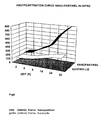
- FIG. 3 shows the size distribution of nanoparticles which were produced as described in Example 3 below. As can be seen, more than 95% of all particles are nanoparticles.
- the smallest particulate collagen can be prepared in which the starting material, which is dispersed in a suitable manner, for example in distilled water, is first homogenized before emulsification and crosslinking.
- the homogenization is suitably carried out by ultrasound treatment, Ultraturrax, or high-pressure homogenizer or micro-fluidizer. After adjustment of the pH, it is preferably possible to homogenise again from pH 4 to pH 8 with potassium carbonate.
- the crosslinking takes place with a higher than previously used amount of crosslinking agent.
- starting material is a collagen, obtained according to the above-described isolation method according to the invention from marine sponges of the family Chondrosiidae.
- This new method of producing the collagen microparticles from collagen especially from sponge collagen, e.g. From marine sponges of the family Chondrosiidae thus enables the production of particles in a size range of 150 nm to 3 microns, in contrast to known methods for the production of collagen, which allows microparticles of only 3-40 microns.
- the collagen and nanoparticulate collagen obtained in the manner according to the invention is widely used in pharmacy, medicine, cosmetics and food chemistry, such as creams, ointments, for use on the skin and mucous membranes, suspensions, tablets, sustained-release capsules, implants, patches, Foam.
- Nonwovens inter alia, for wound covering, active substance carriers in Parenteralia and Enteralia, eye drops, nanocapsules as excipients and carriers for active ingredients through skin and mucous membranes as well as vessels and organ membranes.
- active substance carriers in Parenteralia and Enteralia
- eye drops nanocapsules as excipients and carriers for active ingredients through skin and mucous membranes as well as vessels and organ membranes.
- These agents are prepared in a known manner. The production processes for this purpose are described, for example, in DAB and are known both for the preparation of ointments, creams and tablets, etc., working in customary amounts.
- the collagen prepared according to the invention in particular the nanoparticulate, has an anti-inflammatory action, in particular in the case of topical and also oral as well as intravenous or intraperitoneal administration.
- the agent is inhibitor of cyclooxygenase and has an anti-oxidative effect.
- the anti-inflammatory effect for example in joint complaints, Arthithis and in particular analogous disorders of the musculoskeletal system, especially when the drug is administered orally.
- the above-described in particular marine sponge collagen is suspended as such or freeze-dried in a suitable beverage such as water or juices and administered as a beverage, for example in amounts of 2-10 g, in particular 2-6 and preferably 3-5 g / day.
- Solid, ie powdery or granular collagen, as described below, may preferably be present in an amount of 1-10, in particular 2-8 and very particularly 3-5 g / 250 ml of liquid, preferably water.
- both a penetration enhancement of another active agent or in combination therewith such as a vitamin (vitamin A, C, E or mixtures thereof) or other topically active substances for the treatment of skin such as Avarol, Avaron or herbal extracts such For example, extr. Cepae or Extr. Echinaceae pallidae and in particular an anti-inflammatory can be found.
- the collagen described is suitable for the treatment of skin lesions such as degenerative or damaged by external or internal influences, for example for the treatment of erythema after sunburn, UV radiation or injury, or psoriasis. Also for the below-mentioned indications of this type, the agent is suitable.
- the topical agent may be in the form of ointments, creams, lotions of known or, in particular, in the form of a gel such as e.g. As a hydrogel, for example based on polyacrylate or an oleogel eg water and Eucerin present.
- a gel such as e.g. As a hydrogel, for example based on polyacrylate or an oleogel eg water and Eucerin present.
- the oleogels from a water and a fat phase used are based in particular on Eucerinum anhydricum, a basis of wool wax alcohols and paraffin, wherein the proportion of water and the basis can vary.
- hydrogels can be prepared by the use of gelling agent and water, the former being selected in particular from natural products such as cellulose derivatives such as cellulose esters and ethers, for example hydroxyethyl hydroxypropyl derivatives, eg Tylose, or also from synthetic products such as polyacrylic acid derivatives such as carbopol or carbomer such as P934, P940, P941.
- the gels comprise in each case 0.01-30 g per 100 g gel, in particular 0.01-10 g and very particularly 0.01-8 g and preferably 0.1-5 g collagen, that is 0.01-30, 0.01-10; 0, 01-8; 0.1-5%.
- an agent which does not reduce the side effects of the agents heretofore used for the treatment of inflammatory diseases, e.g. NSDAl's have and in particular orally well tolerated.
- inflammation and inflammatory-related disorders include arthritis, including rheumatoid arthritis, spinal ankle disorders, gout, systemic lupus erythematosis, osteoarthritis and juvenile arthritis; Asthma, bronchitis, menstrual cramps, tendinitis, bursitis and skin related conditions such as psoriasis, eczema, burns and dermatitis.
- the agents described are also useful in the treatment of gastrointestinal conditions such as inflammatory bowel disorder, Crohn's disease, gastritis, irritable bowel syndrome and ulcerative colitis; for the treatment of inflammation in diseases such as vascular disease, periarteritis, Hodgkin's disease, scleroderma, rheumatic fever, Type I diabetes, myasthenia granvis, sarcoidosis, nephrectic syndrome, Behcet's syndrome, polymyositis, gingivitis, hypersensitivity, conjunctivitis, post-injury swelling, myocardial ischemia, etc.
- diseases such as vascular disease, periarteritis, Hodgkin's disease, scleroderma, rheumatic fever, Type I diabetes, myasthenia granvis, sarcoidosis, nephrectic syndrome, Behcet's syndrome, polymyositis, gingivitis, hypersensitivity, conjunctiv
- this invention encompasses a class of compositions comprising a collagen prepared as described, especially marine sponge collagen, especially nanoparticulate, together with one or more non-toxic pharmaceutically acceptable carriers and / or diluents and / or adjuvants (collectively referred to herein as "carrier”). -materials) and optionally other active ingredients.
- carrier non-toxic pharmaceutically acceptable carriers and / or diluents and / or adjuvants
- carrier non-toxic pharmaceutically acceptable carriers and / or diluents and / or adjuvants
- carrier non-toxic pharmaceutically acceptable carriers and / or diluents and / or adjuvants
- carrier non-toxic pharmaceutically acceptable carriers and / or diluents and / or adjuvants
- carrier non-toxic pharmaceutically acceptable carriers and / or diluents and / or adjuvants
- the agents according to the invention may be administered as mentioned in any suitable way and in a dose which is effective for the
- the agent may also be administered by injection as a composition wherein, for example, saline, dextrose or water is suitable Carriers can be used.
- Carriers can be used.
- the amount of the agent administered and the dosage regimen for treating a condition with the agent described will depend on a variety of factors, including the patient's age, weight, sex and medical condition, severity of the disease, route of administration and frequency of administration and the particular compound used, and therefore may vary widely.
- the agents of the invention may usually be combined with one or more adjuvants suitable for the indicated route of administration.
- the described collagen product When administered per os, the described collagen product may also be mixed with lactose, sucrose, starch powder, cellulose esters or alkanoic acids, cellulose alkyl esters, talc, stearic acid, magnesium stearate, magnesium oxide, sodium and calcium salts of phosphoric and sulfuric acids, gelatin, acacia, sodium alginate, Glycols polyvinylpyrrolidone and / or polyvinyl alcohol and then tabletted or encapsulated for ease of administration.
- Such capsules or tablets may contain a controlled release formulation as may be present in a dispersion of the agent in hydroxypropylmethylcellulose.
- Formulations for parenteral administration may be in the form of aqueous or non-aqueous isotonic sterile injection solutions or suspensions. These solutions and suspensions may be prepared from sterile powders or granules with one or more of the carriers or diluents as they have been called for Use in the formulations for oral administration.
- the agents may be dissolved in water, polyethylene glycol, propylene glycol, ethanol, corn oil, cottonseed oil, peanut oil, sesame oil, benzyl alcohol, sodium chloride and / or various buffers. Other adjuvants and modes of administration are known.
- the collagen described above is used in the cell suspension in an amount of 0.01-150 .mu.g / ml, in particular 0.1-100 .mu.g / ml and very particularly 1-60 .mu.g / ml of cell suspension.
- Particularly suitable cells for growth promotion are permanent cells such as CEM cells or neuronal cells such as cortical cells.
- the collagen is either added in solid form to the cell sample and is present as a suspension or it is in alkaline aqueous medium (pH greater than 7, in particular greater than 8), placed in the sample vessel, then acidified until the collagen precipitates and then the cell sample is added.
- the sponge material is collected, crushed into pieces and immediately placed in ethanol for preservation.
- the sponge pieces are distilled three times with aqua. washed and homogenized with a blender.
- the comminuted material is mixed with five times the weight of extractant (pH 9: 5, 10 mM EDTA, 8 M urea, 100 mM 2-mercaptoethanol).
- the pH of the resulting dark brown suspension is adjusted from pH 7 to pH 9 with Tris. This suspension is stirred for 24 h at room temperature and then centrifuged (5000 g , 6 min, 2 ° C). The pellet is discarded.
- the pH of the supernatant is adjusted to pH 4 with acetic acid 100%.
- a precipitate formed which is collected (20000 g , 20 min, 2 ° C).
- the pellet is mixed with water and centrifuged again (20,000 g , 10 min, 2 ° C). This gives a clear, lightly colored supernatant and the purified collagen sediment, which can be freeze-dried for preservation.
- the yield of collagen is about 30% (freeze-dried collagen sediment relative to freeze-dried sponge material).
- the freeze-dried collagen sample is negatively contrasted for examination with a 2% phosphotungstic acid according to the so-called single droplet method (cf. JR Harris, Negative staining and cryoelectron microscopy. The thin film techniques. Royal Microscopic Society Microscopy Handbook no. 35. BIOS Scientific Publishers Ltd., Oxford, UK .)
- the enlargement shows the typical collagen-like periodic transverse striation of the collagen fibrils in the TEM image according to FIG. 1
- a 0.75% sponge collagen dispersion is prepared by adding distilled water to the freeze-dried material and homogenizing with an Ultra-Turrax. The pH of the dispersion is adjusted to pH 9.5 with potassium carbonate. The dispersion is then homogenized a second time with the Ultraturrax.
- the emulsion is centrifuged (30 minutes / 10444 g), the oily supernatant discarded and the sediment suspended in 50% 2-propanol. Subsequently, the suspension is centrifuged again. This cleaning step is repeated. The obtained CMP sediment is suspended in a 4% aqueous ascorbic acid solution. This suspension is heated (75 ° C, 30 minutes) to destroy residual amounts of oxidizing substances. The batch is stirred for 24 h on a magnetic stirrer at room temperature. Subsequently, the CMP are purified by centrifugation (30 minutes, 10444 g) and then washed twice with water.
- the material is freeze-dried.
- the yield of CMP is about 10%.
- the collagen microparticles were coated with about 4 nm thick platinum film and examined with the scanning electron microscope SE 4500 Hitachi S.
- the size of the spherical collagen particles is 120 to 300 nm (FIG. 2)
- Particle size determination was performed by photon correlation spectroscopy (PCS).
- PCS photon correlation spectroscopy
- the freeze-dried sponge collagen was redistilled in filtered water. (pH 9.8, adjusted with K 2 CO 3 ) before the measurement resuspended.
- the result was a particle size distribution of 150 nm to 3 microns. While the lower limit coincides quite well with the results of scanning electron microscopy, the upper range of 3 ⁇ m is significantly above the value of 300 nm. This could be due to agglomerates that form when redispersed in water and can not be dissolved even in the ultrasonic bath ,
- TSA Thio-barbituric acid
- the assay is based on the formation of a 532 nm measurable reaction product of thio-barbituric acid (TBA) with malondialdehyde (MDA), which i.a. in the oxidative degradation of polyunsaturated fatty acids, such as those contained in trilinolenine (Sigma) arises.
- TSA thio-barbituric acid
- MDA malondialdehyde
- Trilinolenin and the test substances, sponge collagen from Chondrisa reniformis prepared as described in Example 1 and butylhydroxytoluene [BHT] are dissolved in DMSO. 400 ⁇ l of trililonenin are incubated in 2 ml of HAM F10 medium for 4 hours at 37 ° C. in the presence of DMSO as a control or DMSO-containing substance solutions.
- TBA-reactive material 1.0 ml of the incubation mixture is taken and mixed with 1.5 ml of TBA solution (0.67% in 0.05 M NaOH) and 1.5 ml of tri-chloroacetic acid (20%) , After a 60 minute incubation in a boiling water bath, the samples are cooled and centrifuged for 10 minutes at 2000 rpm. The optical density is determined at 532 nm. Fresh tetramethoxipropane, from which MDA is produced under the experimental conditions, serves as calibration standard. The results are calculated as ⁇ mol MDA equivalents. Triple determinations are made.
- collagen from Chondrosia reniformis inhibits the formation of TBA reactive material. This was not known yet.
- the potency is about 50% of the standard substance BHT.
- Collagen from Chondrosia reniformis shows moderate effects with a flat dose-response relationship in the tested concentration range.
- Cyclooxygenase activity was determined in monocytes in the presence or absence of the agonist lipopolysaccharide [LPS] (L-4130, Sigma, St. Louis).
- LPS lipopolysaccharide
- human monocytes were maintained at a density of 10 6 cells per ml in RPMI 1640 medium for 24 h. Subsequently, 30 ⁇ M arachidonic acid was added to the cultures, and the enzyme activity was measured 30 minutes later by the production rate of prostaglandin E2.
- cyclooxygenase activity increases from 88 to 243 pg PGE 2 per 10 6 cells within 30 minutes.
- Increasing concentrations of sponge collagen from Chondrosia reniformis increase the stimulating effect of LPS on cyclooxygenase.
- the induction of cyclooxygenase is reduced to 61%.
- Sponge collagen rapidly reduced erythema during the first few hours after the erythema inducing event.
- the single application had a long-lasting inhibitory effect up to 5 hours.
- known topically anti-inflammatory agents e.g. Vitamin E, avarol, avarone or herbal extracts, such as e.g. Extr. Cepae or Extr. Echinaceae pallidae.
- CEM cells permanent human leukemia cells
- CEM cells [ Sechoy et al., Exp. Cell Res. 185: 122, 1989 and Avramis et al., AIDS 3: 417, 1989 ] were either not treated with sponge collagen (control) or incubated with different concentrations thereof.
- the investigation parameter was cell growth.
- CEM cells were used at a concentration of 0.2 x 10 8 cells / ml culture medium to inoculate the culture. After 4 days of incubation, the density of CEM cells was 1.9 x 10 8 cells / ml. This value formed the control value. After a further 4 days, the cell density was determined again.
- Cortical cells were prepared from brains of neonatal Wistar rats and maintained under cell culture conditions. MEM medium (with 10% horse serum) was used as the culture medium and incubated in a 90% air and 10% CO2 atmosphere. After usually 48 hours incubation in culture, the cells were used for the experiments. The cultures contain predominantly (over 70%) neurons and about 20% GFAP-positive astrocytes ( Müller et al .: Europ. J. Pharmacol. - Molec. Pharmacol. Sect. 226: 209-214, 1992 ). After a further 4 days, the cell density was then measured in the experiment.
- sponge collagen does not adversely affect the growth rates of permanent cells and neuronal cells in primary cell culture.
- CEM cells and neuronal cells significantly increase their growth rates above control values (p ⁇ 0.001). Only at concentrations around 100 ⁇ g / ml there is no further increase in growth.
- the collagen according to the invention on the one hand inhibits, for example, monocyte-dependent cells and enzymes derived therefrom, such as cycloxygenase, without being toxic and on the other hand acting to promote growth on permanent cells and neuronal cells.
- collagen produced according to the invention is useful not only for the in vivo treatment of particular cyclooxygenase-dependent diseases, but in particular also for preferably in vitro influencing permanent or neuronal cells. It can be used here in the amounts indicated above, in particular between 0.01, preferably 0.1 and 100 .mu.g / ml cell suspension.
Landscapes
- Health & Medical Sciences (AREA)
- Chemical & Material Sciences (AREA)
- Life Sciences & Earth Sciences (AREA)
- Medicinal Chemistry (AREA)
- Organic Chemistry (AREA)
- Engineering & Computer Science (AREA)
- General Health & Medical Sciences (AREA)
- Chemical Kinetics & Catalysis (AREA)
- Veterinary Medicine (AREA)
- Public Health (AREA)
- Animal Behavior & Ethology (AREA)
- Polymers & Plastics (AREA)
- Materials Engineering (AREA)
- General Chemical & Material Sciences (AREA)
- Nuclear Medicine, Radiotherapy & Molecular Imaging (AREA)
- Pharmacology & Pharmacy (AREA)
- Biochemistry (AREA)
- Epidemiology (AREA)
- Dermatology (AREA)
- Bioinformatics & Cheminformatics (AREA)
- Biophysics (AREA)
- Rheumatology (AREA)
- Marine Sciences & Fisheries (AREA)
- Hematology (AREA)
- Food Science & Technology (AREA)
- Transplantation (AREA)
- Zoology (AREA)
- Oral & Maxillofacial Surgery (AREA)
- Pain & Pain Management (AREA)
- Orthopedic Medicine & Surgery (AREA)
- Immunology (AREA)
- Physical Education & Sports Medicine (AREA)
- Medicines That Contain Protein Lipid Enzymes And Other Medicines (AREA)
- Medicinal Preparation (AREA)
- Cosmetics (AREA)
- Peptides Or Proteins (AREA)
- Materials For Medical Uses (AREA)
- Medicines Containing Material From Animals Or Micro-Organisms (AREA)
- Medicines Containing Plant Substances (AREA)
Description
- Die vorliegende Anmeldung betrifft das in den Ansprüchen beschriebene Verfahren zur vereinfachten und damit industriell nutzbaren Isolierung von Schwammkollagen, insbesondere aus marinen Schwämmen, insbesondere aus Schwämmen der Klasse der Chondrosiidae, sowie die Herstellung von Kollagennanopartikeln aus Kollagen.
Die Erfindung betrifft ferner die Verwendung von derartigem Kollagen zur Herstellung eines Mittels zur in-vitro- und in-vivo-Beeinflussung von zellabhängigen Vorgängen.
Insbesondere betrifft die Anmeldung die Verwendung von derart isoliertem Kollagen bzw. von Kollagennano- und -mikropartikeln zur Herstellung von Cremes, Salben, Suspensionen, Tabletten, Kapseln, auch mit verzögerter Freisetzung, Implantate, Pflastern, Schäumen u.a. zur Wundabdeckung, Wirkstoffträger in Parenteralia und Enteralia, Augentropfen, Nanokapseln als Wirkstoffträger und Carrier für Wirkstoffe durch Haut und Schleimhäute sowie Gefäß und Organmembranen.
Das erfindungsgemäß hergestellte Kollagen eignet sich insofern zur Herstellung von Mitteln zur äußeren und inneren vorzugsweise oralen und topischen Anwendung bei der Behandlung entzündlicher, insbesondere auch Cyclooxygenase-abhängiger Erkrankungen in vivo sowie ferner zur Wachstumsförderung von permanenten und neuronalen Zellen in vitro.. - Kollagen ist ein bioabbaubares und gut verträgliches Protein und findet als Ausgangsmaterial breite Anwendung in der pharmazeutischen Industrie, Kosmetik und Lebensmittelchemie.
- Bislang wurde Kollagen aus Tierhäuten - und Knochen von Schweinen, Kälbern und Rindern gewonnen. Dabei stellte die Möglichkeit, den Anwender durch pathogene Keime, Viren und vor allen Dingen mit BSE (Bovine - spongiforme - Enzephalopathie) zu infizieren, einen entscheidenden Nachteil dar.
- Schwämme sind über 600 Millionen Jahre alt und stellen somit die ältesten Vertreter aus der Gruppe der Metazoen dar. Wie alle vielzelligen Tiere besitzen Schwämme das Bindegewebsprotein Kollagen. Schwammkollagen stellt ein wasserunlösliches Protein dar, welches die typische Aminosäurezusammensetzung von bekannten Kollagentypen besitzt. So stellt u.a. Glycin etwa jede dritte Aminosäure dar und die Anteile an Prolin sowie Hydroxyprolin sind hoch..
- Schwammkollagen kann nach verschiedenen Methoden isoliert werden. Dabei wurde bislang, wenig praxisnah, Frischmaterial eingesetzt. Das Reinigungsverfahren für derartig isoliertes Schwammkollagen war bislang aus industrieller Sicht meist relativ aufwendig (z.B. Gelfiltration). Auch die Ausbeute war noch nicht zufriedenstellend. So wurden z.B. aus 1000 g Schwamm-Material 21 g Schwammkollagen isoliert.
- Dies beschreiben B. Diehl Seufert et al. in J.Cell Sc. 79, 271-85 (1985). Die Isolierung von Kollagen aus dem Schwamm Geodia cydonium und Chondrosia renifornis mit natürlicher Aminosäurezusammensetzung unter Vermeidung von Denaturierungsreagentien erfolgt durch Suspendierung von homogenisiertem frischen Material in Tris-HCl Puffer, pH-Wert Einstellung auf 9, Zentrifugation und Homogenisierung. Die Reinigung erfolgt durch Gelfiltration, wobei wie erwähnt 1,7 bzw. 3,1% Kollagen erhalten werden.
- Es besteht daher Bedarf an einem einfachen und wirtschaftlichen Verfahren zur Isolierung von Kollagen aus Schwämmen, wobei die Nachteile für aus tierischem Ausgangsmaterial gewonnenem Kollagen vermieden und gleichzeitig hohe Ausbeuten erzielt werden.
- Darüberhinaus ist es von Vorteil, insbesondere kleinstpartikuläres Kollagen herzustellen.
- Die Herstellung von Kollagenmikropartikeln wurde bisher für natives Kalbskollagen beschrieben. Es war dabei jedoch nur möglich, Mikropartikel im Grössenbereich von 3 bis 40 µm herzustellen, so wie in B. Rössler, J. Kreuter und D. Scherer Collagen microparticles, preparation and properties, J. Microencapsulation, Vol. 12, No. 1, 49-57 (1995) beschrieben. Dieser Grössenbereich ist für pharmazeutische und kosmetische Anwendungen aber weniger geeignet. Bei einer intravenösen Anwendung besteht die Gefahr einer Embolie, bei der Anwendung auf der Haut oder am Auge wird die Freigabe von daran gebundenen Stoffen verlangsamt, sodass diese nicht innerhalb nützlicher Zeit erfolgt, das heisst, bevor die Zubereitung abgewaschen, bzw. durch Drainage aus dem Auge entfernt wird. Ausserdem kann durch die relativ grosse Teilchengrösse ein unangenehmes kratzendes Gefühl erzeugt werden. Aus diesem Grunde ist es notwendig, den Grössenbereich zu beschränken, das heisst unter 3 µm oder kleiner zu halten.
- Aufgabe vorliegender Anmeldung ist es daher, eine produktorientierte Isolierungsmethode für Schwammkollagen zu entwickeln, welche einfach und effektiv in guten Ausbeuten zu einem Produkt mit hohem Kollagenanteil führt, wobei ein minimales toxikologisches Risiko bestehen soll. Gleichzeitig soll das Ausgangsmaterial kostengünstig und praxisnah konserviert sein, so dass dabei auf die Zugabe von tiefgefrorenem Frischmaterial als Ausgangsmaterial verzichtet werden kann (wie es bisher eingesetzt war).
- Ferner sollen Kollagenpartikel hergestellt werden, die eine möglichst geringe Grösse, insbesondere im mikro- und nano-Bereich, aufweisen.
- Diese Aufgabe wird erfindungsgemäss gelöst, indem man das frische Ausgangsschwammmaterial, welches nicht gefroren sein muss, in Alkohol einlegt, anschliessend mit Wasser wäscht und mit einem Extraktionsmittel, vorzugsweise bei einem pH-Wert von 7-12, insbesondere 8-10, ganz besonders 9-95 bzw. 9,5 versetzt, den resultierenden Kollagenextrakt aufarbeitet. Dies erfolgt vorzugsweise durch Erhöhung des pH-Wertes der Suspension auf pH 8-11, insbesondere 9-10, bevorzugt 9, Rühren, Zentrifugation und anschliessende durch Verringerung des pH-Wertes des Überstands, Zentrifugation und Isolierung des Präzipitats.
- Durch diese Vorgehensweise erübrigt sich eine weitere Aufreinigung wie z.B. durch Gelfiltration oder ähnliches. Dabei wird gereinigtes Kollagenprodukt, welches gewünschtenfalls zur Konservierung gefriergetrocknet werden kann, in einer hohen Ausbeute erhalten.
- Als Ausgangsmaterial eignen sich die üblichen bekannten, insbesondere marinen Schwämme wie z.B. Demospongiae [Rupert Riedel, Fauna und Flora des Mittelmeeres, Verlag Paul Parey 1983] insbesondere solche mit hohem Kollagenanteil wie z.B. Schwämme der Klasse der Geodiidae, Dysideidae, Spongiidae, Suberitidae, Oscarellidae, Axinellidae und anderen, ganz besonders solches aus der Gruppe der Chondrosiidae, die darüberhinaus ein minimales toxikologisches Risiko aufweisen. Insbesondere bevorzugt sind Chondrosiidae oder auch Axinellidae.
- Als Alkohol eignen sich die bekannten geradkettigen oder verzweigtkettigen aliphatischen C1-C15 Alkohole wie Ethanol, Isopropanol, Butanol, Tert.Butanol, Pentanol, Cyclohexanol, Hexanol etc. Darüberhinaus sind auch Zusätze von aromatischen Alkoholen wie Thymol sowie Benzylalkohol und Kombinationen hiervon, z.B. unter einander oder mit den aliphatischen Alkoholen, insbesondere Ethanol oder Isopropanol, möglich.
- Besonders bevorzugt sind C1-C4 aliphatische Alkohole, und insbesondere Ethanol. Die Menge an Alkohol richtet sich nach der Menge an Ausgangsmaterial, da dieses in Alkohol eingelegt wird.
- Als Extraktionsmittel eignen sich z.B. bekannte Systeme wie z.B. Tris-HCl Puffer (vorzugsweise enthaltend 10 mM EDTA, 8M-urea, 100 mM-2-mercaptoethanol) oder Alkalihaltige Puffersyssteme, z.B. Kaliumkarbonat-haltige, Phosphat-haltige, Stickstoff- bzw. Sulfat-haltige Puffer mit geeignetem pH-Wert. Das Mittel wird dabei im Überschuss bezogen auf das Gewicht des eingesetzten Ausgangsmaterials, insbesondere in der 2-8-fachen Gewichtsmenge, insbesondere der 3-6-fachen und ganz besonders bevorzugt der 5-fachen Menge, eingesetzt.
Solche Puffer sind allgemein bekannt und beispielsweise im Europäischen Arzneibuch beschrieben. - Der pH-Wert kann mit bekannten Mitteln eingestellt bzw. reduziert werden. Hierzu eignen sich z.B. Pufferlösungen wie die oben genannten Stickstoff-, Phosphat, Sulfat-, Kaliumcarbonat-haltigen bzw. organischen Puffer wie z.B. Acetat- oder Citrat-haltige Puffersysteme mit geeignetem pH-Wert.
- Das Ausfällen des Kollagens aus dem Überstand nach der Zentrifugation kann durch pH-Wert Reduktion, insbesondere auf Werte zwischen 2 und 6, insbesondere 5-3 und ganz besonders bevorzugt pH 4 durch entsprechende Mittel wie organische Säuren, z.B. Essigsäure (z.B. 100%), Zitronensäure, Ascorbinsäure, Propionsäure, Ameisensäure oder Milchsäure etc. oder durch verdünnte anorganische Säuren, z.B. Salzsäure, Phosphorsäure, Schwefelsäure u.ä. erreicht werden. Die nachfolgende Isolierung des Präzipitats kann durch erneute Zentrifugation erfolgen, wobei vorzugsweise - wie auch bei der anfänglichen Zentrifugation - die Temperatur abgesenkt werden kann, insbesondere auf Werte kleiner 10°C - 1°C, bevorzugt 6°C-1 °C, insbesondere 2°C.
- Das erhaltene Produkt (Kollagensediment) ist rein, und kann gewünschtenfalls zur Konservierung gefriergetrocknet werden.
- Fig. 1 (vgl. Beispiel 2) zeigt ein solches nach dem erfindungsgemässen Verfahren erhaltenes gefriergetrocknetes Produkt, wobei man die für Kollagen typische periodische Querstreifung der Kollagenfiltration erkennt.
- Mit dem erfindungsgemässen Verfahren ist es somit möglich, in hohen Ausbeuten reines Kollagen ohne aufwendige Reinigungsschritte zu erhalten.
- Überraschenderweise zeigte sich, dass die für Kollagen typischen Merkmale wie periodische Querstreifung der Fibrillen vorhanden bleibt und damit nativ ist.
- Das Verfahren eignet sich insbesondere für ein industrielles 'scaling - up'. Die Reinigung des isolierten Schwammkollagens konnte erfindungsgemäss zugunsten eines praxisorientierten Verfahrens vereinfacht werden. Die Ausbeute an Schwammkollagen liegt mit ca. 10-40 %, durchschnittlich 30% sehr hoch. Da die eingesetzten Schwammspezies aus toxikologischer Sicht nicht bedenklich sind, insbesondere z.B. bei Verwendung essbarer Schwämme aus den Familien der Chondrosiidae oder Axinellidae, kann angenommen werden, dass das so erhaltene Schwammkollagen gut verträglich und aus toxikologischer Sicht für den Menschen weitestgehend unbedenklich ist. Darüber hinaus besitzt das isolierte Schwammkollagen gegenüber Schweine-, Kalbs- und Rinderkollagen vor allem erhebliche Vorteile in Bezug auf die BSE-Problematik.
- Wie erwähnt ist es von Vorteil, Kollagenmaterial in besonders kleiner Partikelgrösse herzustellen. Bisher wurde hierzu natives Kalbskollagen emulgiert und mit Glutardialdehydlösung quervernetzt. Die erhaltenen Partikel wiesen eine Grösse von 3-40 µm auf.
- Erfindungsgemäss können nun erstmals Partikelgrössen von kleiner 3 µm erzielt werden.
- Hierzu wird Kollagen, erhalten nach bisher bekannten Verfahren aus Ausgangsmaterial unterschiedlicher, z.B. tierischer Herkunft wie oben geschildert aus Kalb, Schwein, Rind, oder Schwämmen insbesondere solches erhalten aus Schwämmen nach dem erfindunsgemäßen Verfahren, dispergiert, z.B. in Wasser und zunächst homogenisiert. Der pH-Wert kann vorzugsweise dann oder gegebenenfalls vorzugsweise vor der ersten Homogenisierung auf pH 7-11, insbesondere 8-10, bevorzugt 9-10 insbesondere 9,5 eingestellt und nochmals homogenisiert werden. Anschliessend wird emulgiert, durch Zugabe eines Emulgators und einer Fettphase wie z.B. durch Zugabe von Paraffin und Span ® oder z.B. durch andere W/O-Emulgatoren wie Cetylstearylalkohol, Glycerinmonostearat oder Span ® 85 (Sorbitantrioleat),
oder analoge Produkte wie Arlacel 85, Span 65 (Sorbitantristearat) Arlacel 65, Propylenglykolmonostearat, Sorbitanmonooleat, Span 40, Arlacel 40, Span 20 oder gegebenenfalls O/W-Emulgatoren bekannter Art (Polyethylenglycole mit geeignetem Ethoxylierungsgrad;
wie z.B mit HLB-Wert 8-13, wie z.B. Polyoxyethylenglykol-400--monostearat, -oleylether, -monolaurat,-sorbitanmonolaurat, -sorbitantristearat)
in einer Gewichtsmenge von mehr als der 2 bis 5-fachen Menge der Kollagendispersion. Neben Paraffin eignen sich als Fettphase analoge flüssige Kohlenwasserstoffe wie z.B. Isoparaffin, Dioctylcyclohexan(Cetüol® S), Isohexadecane (Arlamol® HD), Triglyceride wie Miglyol®, Squalan oder Squalen oder Mischungen hiervon.Die Menge an Fettphase ist zusammen mit der Menge an Emulgator angegeben und beträgt wie erwähnt das 2-5-fache der Kollagenmenge.
Anschließend wird das Produkt quervernetzt mit einem Überschuss, nämlich der mehr als doppelten Menge wie bisher, also mindestens der 2 bis 6-fachen Gewichtsmenge, vorzugsweise 3-5-fachen, insbesondere 4-fachen, bezogen auf die eingesetzte Kollagenmenge, an Vernetzungsmittel wie z.B. bifunktionelle Säurechloride, Aldehyde, insbesondere Glutardialdehyd (z.B. eine 25%-ige wässrige Lösung hiervon) oder Maleinsäuredialdehyd oder -dichlorid. - Die Reaktion wird in geeigneter Weise aufgearbeitet, zunächst z.B. durch Zugabe von H2O2 abgebrochen. Hierbei wird eine weitaus höhere Gewichtsmenge als bisher eingesetzt, nämlich die 2-6-fache, bevorzugt 3-5-fache, insbesondere 4-fache, bezogen auf die eingesetzte Kollagenmenge. Alternativ können auch andere bekannte geeignete Oxidationsmittel wie z.B. HNO3 zum Abbruch eingesetzt werden. Die Aufarbeitung erfolgt z.B. durch Zentrifugation, Suspendierung des Sediments in Alkohol, z.B. Isopropanol, erneute Zentrifugation und weitere Durchläufe dieses Zyklus. Im letzten Zyklus erfolgt dann die Suspendierung mit einer schwachen Säure z.B. Ascorbinsäure oder einer anderen organischen Säure, wie z.B. Citronensäure, Milchsäure, Ameisensäure u.ä. Dieses Sediment wird dann erhitzt, z.B. auf Temperaturen > 50°C, insbesondere auf 75°C, weiterhin mehrstündig (z.B. 24) gerührt, zentrifugiert und mit Wasser gewaschen.
- Das erhaltene Material kann gefriergetrocknet werden.
In Fig.3 ist die Größenverteilung von Nanopartikeln, welche wie im nachfolgenden Beispiel 3 beschrieben, hergestellt wurden, dargestellt. Wie hieraus ersichtlich ist, sind mehr als 95% aller Teilchen Nanopartikel.
Überraschenderweise kann auf die oben geschilderte Art kleinstpartikuläres Kollagen hergestellt werden, in dem das Ausgangsmaterial, welches in geeigneter Weise dispergiert wird, z.B. in destilliertem Wasser, zunächst vor der Emulgierung und Vernetzung homogenisiert wird. Die Homogenisierung erfolgt dabei geeigneterweise durch Ultraschallbehandlung, Ultraturrax, oder Hochdruck-Homogenisierer bzw. Micro-Fluidizer. Vorzugsweise kann nach Einstellung des pH-Wertes z.B. mit Kaliumcarbonat von pH 4 auf pH 8 erneut homogenisiert werden. Die Vernetzung erfolgt mit einer höheren als bisher eingesetzten Menge an Vernetzungsmittel. - Besonders bevorzugt ist als Ausgangsmaterial ein Kollagen, erhalten nach dem oben geschilderten erfindungsgemäßen Isolierverfahren aus marinen Schwämmen der Familie der Chondrosiidae.
- Dieses neue Verfahren zur Herstellung der Kollagenmikropartikel aus Kollagen, insbesondere aus Schwammkollagen wie z.B. aus marinen Schwämmen der Familie der Chondrosiidae ermöglicht somit die Produktion von Partikeln in einem Grössenbereich von 150 nm bis 3 µm, im Unterschied zu bekannten Verfahren zur Herstellung von Kollagen, das Mikropartikel von nur 3 - 40 µm ermöglicht.
- Das auf die erfindungsgemässe Weise erhaltene Kollagen und nanopartikuläre Kollagen findet breite Anwendung in der Pharmazie, Medizin, Kosmetik und Lebensmittelchemie wie z.B. Cremes, Salben, zur Anwendung auf Haut und Schleimhäuten, Suspensionen, Tabletten, Kapseln, auch mit verzögerter Freisetzung, Implantate, Pflastern, Schäumen.
- Schwämmen. Vliesen u.a. zur Wundabdeckung, Wirkstoffträger in Parenteralia und Enteralia, Augentropfen, Nanokapseln als Wirkstoffträger und Carrier für Wirkstoffe durch Haut und Schleimhäute sowie Gefäß und Organmembranen. Diese Mittel werden auf bekannte Weise hergestellt. Die Herstellungsverfahren hierfür sind z.B. im DAB beschrieben und bekannt sowohl zur Herstellung von Salben, Cremes als auch von Tabletten etc., wobei in üblichen Mengen gearbeitet wird.
Überraschenderweise zeigte sich, dass das erfindungsgemäß hergestellte Kollagen, insbesondere das nanopartikuläre, eine entzündungshemmende Wirkung insbesondere bei topischer und auch bei oraler neben der intravenösen oder intraperitonealen Anwendung aufweist. Dabei zeigte sich, dass das Mittel Inhibitor von Cyclooxygenase ist sowie eine anti-oxidative Wirkung hat. Besonders überrschend ist dabei die entzündungshemmende Wirkung z.B. bei Gelenkbeschwerden, Arthithis und insbesondere analogen Erkrankungen des Bewegungsapparates, besonders wenn das Mittel oral verabreicht wird. Dazu wird das oben beschriebene insbesondere marine Schwammkollagen als solches oder gefriergetrocknet in einem geeigneten Getränk wie Wasser oder Säften suspendiert und als Getränk verabreicht, z.B. in Mengen von 2-10g, insbesondere 2-6 und bevorzugt 3-5g/Tag. Dabei kann festes also pulverförmiges oder granulietes Kollagen wie unten beschrieben vorzugsweise in einer Menge von 1-10, insbesondere 2-8 und ganz besonders 3-5g/250ml Flüssigkeit, vorzugsweise Wasser vorliegen.
Als topisch verabreichbares Mittel kann sowohl eine Penetrationsverstärkung eines anderen aktiven Mittels bzw. in Kombination hiermit wie z.B. eines Vitamins (Vitamin A,C,E oder deren Mischungen) oder anderen topisch wirksamen Stoffen zur Behandlung von Haut wie Avarol, Avaron oder pflanzliche Extrakte, wie z.B. Extr. Cepae oder Extr. Echinaceae pallidae als auch insbesondere eine Entzündungshemmung festgestellt werden. Insbesondere eignet sich das beschriebene Kollagen zur Behandlung von Hautveränderungen wie z.B. degenerativer Art oder durch äußere oder innere Einflüsse geschädigt, z.B. zur Behandlung von Erythemen nach Sonnenbrand, UV-Bestrahlung oder Verletzungen, oder Psoriasis. Auch für die unten genannten Indikationen dieser Art ist das Mittel geeignet. Das topische Mittel kann in Form von Salben, Cremes, Lotionen bekannter Grundlage oder insbesondere in Form eines Gels wie z. B. eines Hydrogels z.B. auf Basis von Polyacrylat oder eines Oleogels z.B. aus Wasser und Eucerin vorliegen.
Die eingesetzten Oleogele aus einer Wasser- und einer Fettphase basieren insbesondere auf Eucerinum anhydricum, einer Grundlage aus Wollwachsalkoholen und Paraffin, wobei der Anteil an Wasser und der Grundlage variieren kann. Ferner können weitere lipophile Bestandteile zur Beeinflussung der Konsistenz beigefügt sein, wie z.B. Glycerin, Polyethlylenglykole unterschiedlicher Kettenlängen, z.B. PEG400, pflanzliche Öle, wie z.B. Mandelöl, flüssiges Paraffin, Neutralöl u.a..Solche rezepturen sind allgemein bekannt und im DAB10 oder im Europäischen Arzneibuch, aktuelle Ausgabe,z.B.2000 beschrieben. Die Hydrogele können hergestellt werden durch Einsatz von Gelbildner und Wasser, wobei erstere insbesondere ausgewählt werden aus natürlichen Produkten wie CelluloseDerivaten, wie Zellulose-Ester und -Ether, z.B. Hydroxyethyl- Hydroxypropyl-Derivate, z.B. Tylose, oder auch aus sythetischen Produkten wie Polyacrylsäure-Derivate, wie Carbopol oder Carbomer, wie z.B. P934, P940, P941. Sie können nach bekannten Vorschriften, die in den gängigen Arzneibüchern beschrieben sind wie z.B. DA810 oder Europäisches Arzneibuch, aktuelle Ausgabe,z.B.2000, aus alkoholischen Suspensionen durch Basenzusatz für die Gelbildung hergestellt bzw polymerisiert werden.
Die Gele umfassen jeweils pro 100g Gel 0,01-30g, insbersondere 0,01-10g und ganz besonderes 0,01-8g und bevorzugt 0,1-5g Kollagen, also entsprechend 0,01-30;0,01-10; 0, 01-8; 0,1-5%. - Somit kann ein Mittel bereitgestellt werden, welches nicht die Nebenwirkungen der bisher zur Behandlung entzündlicher Erkrankungen eingesetzten Mittel wie z.B. NSDAl's aufweisen und insbesondere oral gut verträglich sind.
- Die oben beschriebenen Mittel sind daher geeignet für Zusammensetzungen zur Behandlung von Entzündung in einem Lebewesen und zur Behandlung von anderen entzündungsbedingten Störungen. Beispiele für Entzündungen und entzündungsanaloge Störungen sind Arthritis, einschließlich rheumatoide Arthritis, Wirbelsäulengelenkleiden, Gicht, systemische Lupuserythematose, Osteoarthritis und Jugendarthritis; weiterhin Asthma, Bronchitis, Menstruationskrämpfen, Sehnenentzündung, Bursitis und mit der Haut zusammenhängenden Zuständen wie Psoriasis, Ekzeme, Verbrennungen und Dermatitis. Die beschriebenen Mittel sind auch zur Behandlung von Magen-Darm-Zuständen, wie entzündliche Darmstörung, Crohn's Krankheit, Gastritis, Reizdarmsyndrom und ulcerative Kolitis;zur Behandlung von Entzündung in Erkrankungen wie vasculären Erkrankungen, Periarteritis, Hodgkin'sche Krankheit, Sclerödem, rheumatisches Fieber, Typ I-Diabetis, Myasthenia granvis, Sarcoidose, nephtrotisches Syndrom, Behcet's Syndrom, Polymyositis, Zahnfleischentzündung, Hypersensibilität, Bindehautentzündung, nach Verletzung auftretende Schwellung, Myocardialischämie usw.
- Außerdem wird von dieser Erfindung eine Klasse von Zusammensetzungen umfaßt, enthaltend ein wie beschrieben hergestelltes Kollagen, insbesondere marines Schwammkollagen, insbesondere nanopartikuläres, zusammen mit einem oder mehreren nichttoxischen pharmazeutisch verträglichen Trägern und/oder Verdünnungsmitteln und/oder Adjuvantien (zusammenfassend im vorliegenden als "Träger"-materialien bezeichnet) und gegebenenfalls andere Wirkstoffe. Die erfindungsgmäßen Mittel können wie erwähnt verabreicht werden auf jedem geeigneten Weg und in einer Dosis, die für die beabsichtigte Behandlung wirksam ist. Das Mittel kann beispielsweise intravasculär, intraperitoneal, subkutan, intramusculär, insbesondere oral oder topisch verareicht werden.
Zur oralen Verabreichung kann das Mittel in Form von beispielsweise einer Tablette, Kapsel oder Suspension Dabei wird vorzugsweise das-Mittel in Form einer Dosierungseinheit hergestellt.Das Mittel kann außerdem durch Injektion verabreicht werden als eine Zusammensetzung, worin beispielsweise Kochsalzlösung, Dextrose oder Wasser als ein geeigneter Träger verwendet werden können.
Die Menge des verabreichten Mittels und der Dosierungsplan zur Behandlung eines krankhaften Zustandes mit dem beschriebenen Mittel hängen von einer Vielzahl von Faktoren ab, einschließlich dem Alter, Gewicht, Geschlecht und medizinischem Zustand des Patienten, der Schwere der Erkrankung, der Verabreichungsroute und der Häufigkeit der Verabreichung und der jeweiligen verwendeten Verbindung, und kann deshalb.weitestgehend schwanken. Die erfindungsgemäßen Mittel können gewöhnlich kombiniert mit einem oder mehreren Adjuvantien, die sich für die angegebene Verabreichungsroute eignen. Wenn per os verabreicht wird, kann das beschriebene Kollagenprodukt auch vermischt werden mit Lactose, Saccharose, Stärkepulver, Celluloseester oder Alkansäuren, Cellulosealkylester, Talk, Stearinsäure, Magnesiumstearat, Magnesiumoxid, Natrium- und Calciumsalzen von Phosphor- und Schwefelsäuren, Gelatine, Akaziengummi, Natriumalginat, Glykole Polyvinylpyrrolidon und/oder Polyvinylalkohol und dann tablettiert oder verkapselt werden zur einfachen Verabreichung. Solche Kapseln oder Tabletten können eine kontrollierte Freigabeformulierung enthalten, wie sie gegeben sein kann in einer Dispersion des Mittels in Hydroxypropylmethylcellulose. Formulierungen für die parenterale Verabreichung können in Form von wäßrigen oder nicht-wäßrigen isotonischen sterilen Injektionslösungen oder Suspensionen vorliegen. Diese Lösungen und Suspensionen können hergestellt werden aus sterilen Pulvern oder Granulaten mit einem oder mehreren der Träger oder Verdünnungsmittel, wie sie genannt wurden für die Verwendung in den Formulierungen für orale Verabreichung. Die Mittel können gelöst sein in Wasser, Polyethylenglykol, Propylenglykol, Ethanol, Maisöl, Baumwollsamenöl, Erdnußöl, Sesamöl, Benzylalkohol, Natriumchlorid und/oder verschiedenen Puffern. Andere Adjuvantien und Arten der Verabreichung sind bekannt.
Als Mittel zur Beeinflüssung von zellabhängigen Vorgängen in vitro wird das oben beschriebene Kollagen in der Zellsuspension in einer Menge von 0,01-150µg/ml, insbesondere 0,1-100µg/ml und ganz besonders 1-60µg/ml Zellsuspension eingesetzt. Als Zellen zur Wachstumsförderung eignen sich besonders permanente Zellen wie CEM-Zellen oder neuronale Zellen wie kortikale Zellen. Als Kollagen eignet sich entweder das direkt isolierte wie oben beschrieben oder das erfindungsgemäß nanopartikuläre gemäß vorliegender Anmeldung.Das Kollagen wird dabei entweder in fester Form der Zellprobe zugefügt und liegt als Suspension vor oder es wird in alkalischen wäßrigem Milieu (pH-Wert größer 7, insbesondere größer 8) gelöst, in das Probengefäß gegeben, sodann angesäuert, bis das Kollagen ausfällt und dann die Zellprobe hinzugesetzt. - Die Erfindung wird anhand der nachfolgenden Beispiele näher erläutert.
- Das Schwamm-Material wird gesammelt, in grobe Stücke zerkleinert und sofort zur Konservierung in Ethanol eingelegt. Die Schwammstücke werden dreimal mit Aqua dest. gewaschen und mit einem Mixer homogenisiert. Das zerkleinerte Material wird mit der fünffachen Gewichtsmenge an Extraktionsmittel (pH 9:5; 10 mM-EDTA, 8. M-urea, 100 mM-2-mercaptoethanol) versetzt. Der pH-Wert der resultierenden dunkelbraunen Suspension wird mit Tris von pH 7 auf pH 9 eingestellt. Diese Suspension wird 24 h bei Raumtemperatur gerührt und anschliessend zentrifugiert (5000 g , 6 min, 2°C). Das Pellet wird verworfen. Der pH-Wert des Überstandes wird mit Essigsäure 100% auf pH 4 eingestellt. Es bildete sich ein Präzipitat, das gesammelt wird (20000 g , 20 min, 2°C). Das Pellet wird mit Wasser versetzt und nochmals zentrifugiert (20000 g , 10 min, 2°C). Man erhält einen klaren, leicht gefärbten Überstand sowie das gereinigte Kollagensediment, welches zur Konservierung gefriergetrocknet werden kann.
- Die Ausbeute an Kollagen liegt bei etwa 30 % (gefriergetrocknetes Kollagensediment im Verhältnis zu gefriergetrocknetem Schwamm-Material).
- Die gegfriergetrocknete Kollagenprobe wird zur Untersuchung mit einer 2% igen Phosphorwolframsäure nach der sogenannten single droplet Methode negativ kontrastiert (vgl. J.R. Harris, Negative staining and cryoelectron microscopy. The thin film techniques. Royal Microscopical Society Microscopy Handbook No. 35. BIOS Scientific Publishers Ltd., Oxford, U.K.)
- In der Vergrösserung erkennt man die für Kollagen typische, periodische Querstreifung der Kollagenfibrillen in der TEM-Aufnahme gemäss Fig. 1
- Zunächst wird eine 0,75 % ige Schwammkollagen-Dispersion hergestellt, indem das gefriergetrocknete Material mit destilliertem Wasser versetzt und mit einem Ultra-Turrax homogenisiert wird. Der pH-Wert der Dispersion wird mit Kaliumcarbonat auf pH 9,5 eingestellt. Anschliessend wird die Dispersion ein zweites Mal mit dem Ultraturrax homogenisiert.
- Man stellt eine Mischung aus 10 g Span® und 250 g flüssigem Paraffin her und fügt 85 ml der 0,75 % igen Kollagendispersion hinzu. Diese Mischung wird 10 Minuten bei etwa 6000 rpm mit einem Ultraturrax (Ika-Werk, Staufen, Germany) emulgiert. Anschliessend wird die Emulsion ununterbrochen mit einem Flügelrührer gerührt. Zur Quervernetzung der Kollagenketten gibt man 12 g einer 25 % igen wässrigen Glutardialdehyd-Lösung hinzu. Man beendet diese Reaktion nach 12 Minuten durch Zugabe von 16 g einer 30 % igen wässrigen Wasserstoffperoxid-Lösung. Danach lässt man den Ansatz weitere 15 Minuten rühren. Die Emulsion wird mit 100 ml 2-propanol verdünnt.
- Zur Reinigung der CMPs wird die Emulsion zentrifugiert (30 Minuten / 10444 g), der ölige Überstand verworfen und das Sediment in 50 % 2-propanol suspendiert. Anschliessend wird die Suspension wieder zentrifugiert. Dieser Reinigungsschritt wird wiederholt. Das erhaltene CMP-Sediment wird in einer 4 % igen wässrigen Ascorbinsäure-Lösung suspendiert. Man erhitzt diese Suspension (75° C, 30 Minuten), um Restmengen an oxidierenden Substanzen zu zerstören. Der Ansatz wird für 24 h auf einem Magnetrührer bei Raumtemperatur gerührt. Anschliessend werden die CMP durch Zentrifugation (30 Minuten, 10444 g) gereinigt und anschliessend zweimal mit Wasser gewaschen.
- Das Material wird gefriergetrocknet. Die Ausbeute an CMP liegt bei etwa 10 %.
- Die Kollagenmikropartikel wurden mit einem etwa 4 nm dicken Platinfilm beschichtet und mit dem Rasterelektronenmikroskop SE 4500 Hitachi S untersucht. Die Grösse der sphärischen Kollagenpartikel liegt bei 120 bis 300 nm (Fig. 2)
- Die Partikelgrössenbestimmung wurde mit Hilfe der Photonenkorrelationsspektroskopie (PCS) durchgeführt. Das gefriergetrocknete Schwammkollagen wurde in gefiltertem Aqua bidest. (pH 9.8, eingestellt mit K2CO3) vor der Messung resuspendiert. Es ergab sich eine Partikelgrössenverteilung von 150 nm bis 3 µm. Während sich die untere Grenze recht gut mit den Ergebnissen der Rasterelektronenmikroskopie deckt, liegt der obere Bereich mit 3 µm deutlich über dem Wert von 300 nm. Dies könnte an Agglomeraten liegen, die sich beim redispergieren in Wasser bilden und sich auch im Ultraschallbad nicht auflösen lassen.
- In Fig.3 ist die Größenverteilung der gemäß beispiel 3 hergestellten und in Fig.2 gezeigten Nanopartikel dargestellt. Wie hieraus ersichtlich ist, sind mehr als 95% aller Teilchen Nanopartikel, 25% aller Teilchen weisen einen mittleren Durchmesser von 50nm auf und mehr als 70% liegen im Bereich von 300nm (Abzisse=Durchmesser der Teilchen [nm], Ordinate=%Anteile).
- Der Test beruht auf der Bildung eines bei 532 nm meßbaren Reaktionsproduktes von Thio-Barbitursäure (TBA) mit Malondialdehyd (MDA), das u.a. beim oxidativen Abbau von mehrfach ungesättigten Fettsäuren, wie sie im Trilinolenin (Sigma) enthalten sind, entsteht.
- Trilinolenin und die Versuchssubstanzen, Schwammkollagen aus Chondrisa reniformis hergestellt wie in Beispiel 1 beschrieben und Butylhydroxytoluol [BHT] werden in DMSO gelöst.
400 µl Trililonenin werden in 2 ml HAM F10 - Medium 4 Stunden lang bei 37° C in Gegenwart von DMSO als Kontrolle oder DMSO - haltigen Substanzlösungen inkubiert. - Zur Bestimmung des gesamten TBA-reaktiven Materials werden 1,0 ml des Inkubationsansatzes entnommen und mit 1,5 ml TBA- Lösung (0,67% in 0,05 M NaOH) sowie 1,5 ml Tri-chloressigsäure (20%) gemischt.
Nach 60 minütiger Inkubation in einem kochenden Wasserbad werden die Proben abgekühlt und 10 Minuten bei 2000 U/Min zentrifugiert. Die optische Dichte wird bei 532 nm bestimmt. Frisches Tetramethoxipropan, aus dem unter den Versuchsbedingungen MDA entsteht dient als Eichstandard. Die Ergebnisse werden als µmol MDA - Equivalente berechnet. Es werden Dreifachbestimmungen durchgeführt. - Tabelle1: Wirkung von Schwammkollagen im Thio-Barbitursäure (TBA) - Antioxydanstest (% Hemmung (± SD) der Bildung von TBA reaktivem Material im Vergleich mit BHT als Standardsubstanz)
Tabelle 1 Substanz Konzentration [µM] 5 10 20 50 BHT 71 (±1,5) 73 (±2,1) 79 (±0,3) 85 (±0,5) Kollagen* 18 (±1,3) 37 (±2,3) 41 (±3,9) 47 (±1,8) *Kollagen = Kollagen aus Chondrosia reniformis - Überraschenderweise hemmt Kollagen aus Chondrosia reniformis die Bildung von TBAreaktivem Material. Dies war bisher nicht bekannt. Die Wirkungsstärke beträgt etwa 50% der Standardsubstanz BHT. Kollagen aus Chondrosia reniformis zeigt im geprüften Konzentrationsbereich mittelstarke Wirkungen mit flachverlaufender Dosiswirkungsbeziehung.
- Die Cyclooxygenaseaktivität wurde in Monozyten in Gegenwart oder Abwesenheit des Agonisten Lipopolysaccharid [LPS] (L-4130; Sigma, St.Louis) bestimmt. Hierzu wurden menschliche Monozyten in einer Dichte von 106-Zellen pro ml in RPMI-1640-Medium für 24 h gehalten. Anschließend wurden 30 µM Arachidonsäure zu den Kulturen gegeben und die Enzymaktivität 30 Minuten später anhand der Produktionsrate von Prostaglandin E2 gemessen.
- Effekt von Schwammkollagen, herstellt wie in Beispiel 1 beschrieben, auf die Cyclooxygenaseaktivität in menschlichen Monozyten.
Die Werte stellen Mittelwerte (± S.D.) von fünf unabhängigen Ergebnissen dar.Tabelle 2 Zusatz Kollagen Cyclooxygenase-Aktivität von LPS (µg/ml) (pg PGE2/106 Zellen) kein 0 88 ± 10 1 71 ± 9 5 52 ± 6 LPS 0 243 ± 22 0.5 187 ± 19 1.0 79 ± 7 5.0 61 ± 7 - Nach Zusatz von LPS kommt es zu einer Steigerung der Cyclooxygenaseaktivität von 88 auf 243 pg PGE 2 pro 106 Zellen innerhalb von 30 Minuten. Steigende Konzentrationen von Schwammkollagen aus Chondrosia reniformis heben den stimulierenden Effekt von LPS auf die Cyclooxygenase vermehrt auf. Bei einer Konzentration von 3 µg/ml wird die Induktion der Cyclooxygenase auf 61% herabgesetzt.
- Der Schwamm Chondrosia reniformis wird noch in heutiger Zeit gegessen. 10 Patienten mit chronischer Arthritis stimmten daher der oralen Behandlung zu, 5g Kollagen aus Chondrosia reniformis, hergestellt wie in Beispiel 1 beschrieben, über einen Zeitraum von 4 Wochen dreimal täglich suspendiert in einem Getränk einzunehmen. Alle Patienten berichteten übereinstimmend nach kurzer Zeit von einem Rückgang der Schmerzen in den Gelenken und von einer verbesserten Beweglichkeit.
- Aus dem Kollagen von Chondrosia reniformis gewonnene Nanopartikel, hergestellt wie in Biespiel 3 beschrieben, wurden mit 14C-markierten Retinol beladen [Beladungsrate 15%] und in ein Oleogel aus Wasser/Eucerin wie oben beschrieben (Kollagen:1 %, als 10%ige Suspension zugesetzt) eingearbeitet.
- Diffusionszellen nach Franz [n=6] wurden mit physiologischer Salzlösung gefüllt und die Akzeptorzellen mit einem frisch präparierten Stück Haut von Nacktmäusen abgedeckt. 100mg des mit 14C-markierten Retinol beladenen Gels wurden auf die Hautstücke aufgebracht. Als Kontrollen [n=6] dienten entsprechende Gele mit 14C-markiertem gelösten Retinol.
Nach 2, 4, 8, 16, 24 und 36 Stunden wurde die 14C-Aktivität in der Akzeptorzelle bestimmt. - Die Ergebnisse sind in Figur 4 dargestellt und belegen deutlich die Überlegenheit von Schwammkollagen-Nanopartikeln in der Penetration von Mäusehaut im Vergleich mit einem Hydrogel, das die markierte Substanz nur in gelöster Form enthält.
- Die Untersuchungen wurden an freiwilligen Probanden durchgeführt, die akut unter Sonnenbrand [n=7] oder Verbrennungen [n=3] litten. Schwammkollagen-Nanopartikel [1 %] gemäß Beispiel 3 in einem Polyacrylatgel, hergestellt wie oben beschrieben (1%Kollagen, als 10%ige Suspension zugesetzt) wurden topisch verabfolgt.
Die klinische Wirkung des applizierten Gels auf die UV- oder Verbrennungs-bedingte Veränderung der Haut wurde 1 Stunde nach der großflächigen Applikation des Gels, sowie 2, 4, 6 und 24 Stunden später makroskopisch beurteilt und die Befindlichkeit der Patienten abgefragt. - Schwammkollagen verminderte das Erythem rasch während den ersten Stunden nach dem Erythemauslösenden Ereignis. Die einmalige Applikation besaß eine langanhaltende Hemmwirkung bis zu 5 Stunden. Diese konnte dadurch verstärkt werden, daß bekannte topisch Entzündungshemmende Stoffe in die Nanopartikel eingearbeitet wurden, wie z.B. Vitamin E, Avarol, Avaron oder pflanzliche Extrakte, wie z.B. Extr. Cepae oder Extr. Echinaceae pallidae.
- Zur Bestimmung der Toxizität wurden die Einflüsse von Schwammkollagen auf das zelluläre Wachstum in Kultur wurde an einer permanenten Zellinie und an frisch präparierten neuronalen Zellen untersucht.
- CEM-Zellen [Sechoy et al., Exp. Cell Res. 185: 122, 1989 und Avramis et al., AIDS 3: 417, 1989] wurden entweder nicht mit Schwammkollagen behandelt (Kontrollprobe) oder mit unterschiedlichen Konzentrationen hiervon inkubiert.
Untersuchungsparameter war das Zellwachstum. CEM-Zellen wurden in einer Konzentration von 0,2 x 10⁸ Zellen/ml Kultur-Medium zum Beimpfen der Kultur verwendet. Nach 4-tägiger Inkubation betrug die Dichte der CEM-Zellen 1,9 x 10⁸ Zellen/ml. Dieser Wert bildete den Kontrollwert. Nach weiteren 4 Tagen wurde die Zelldichte erneut bestimmt. - Kortikale Zellen (Neurone) wurden aus Gehirnen von neugeborenen Wistar-Ratten präpariert und unter Zellkulturbedingungen gehalten. Als Kulturmedium wurde MEM-Medium (mit 10% Pferdeserum) verwendet und bei einer 90%igen Luft- und 10%igen CO2-Atmosphäre inkubiert. Nach gewöhnlich 48 Stunden Inkubation in Kultur wurden die Zellen für die Experimente eingesetzt. Die Kulturen enthalten in überwiegender Konzentration (über 70%) Neurone und etwa 20% GFAP-positive Astrozyten (Müller et al.: Europ. J. Pharmacol. - Molec. Pharmacol. Sect. 226: 209-214, 1992). Nach weiteren 4 Tagen wurde sodann die Zelldichte im Versuch gemessen.
Die Ergebnisse sind in Tabelle 3 dargestellt:Tabelle 3: Konzentration des Schwammkollagens (µg/ml) Zellkonzentration x 1.000.000/ml Kontrolle 0 1,9 ± 0,24 1. CEM-Zellen 0,1 2,0 ± 0,2 1,0 2,5 ± 0,3 1 0,0 2,9 ± 0,3 100,0 2,7 ± 0,2 2. Neuronale Zellen 0,1 2,3 ± 0,2 1,0 2,7 ± 0,3 10,0 3,4 ± 0,2 100,0 2,5 ± 0,2 - Die Ergebnisse der Tabelle stellen Mittelwerte von 6 parallelen Experimenten mit den Standardabweichungen dar. Die Signifikanz wurde durch dem Student's t-Test ermittelt (Sachs, L.: Angewandte Statistik. Berlin: Springer-Verlag; pp. 209-216; 1984).
- Es ist ersichtlich, daß Schwammkollagen keine negativen Auswirkungen auf die Wachstumsraten von permanenten Zellen und neuronalen Zellen in primärer Zellkultur ausübt. Andererseits steigern CEM-Zellen und Neuronale Zellen in Gegenwart von Schwammkollagen ihre Wachstumsraten über Kontrollwerte significant (p < 0.001). Erst bei Konzentrationen um 100 µg/ml kommt es zu keiner weiteren Wachstumssteigerung.
- Hieraus ist ersichtlich, dass das erfindungsgemäße Kollagen einerseits auf z.B.Monocytenabhängige Zellen und hiervon ableitbare Enzyme wie Cycloxygenase inhibierend wirkt, ohne toxisch zu sein und andererseits auf permanente Zellen und neuronale Zellen wachstumsfördernd wirkt. Somit ist erfindungsgemäß hergestelltes Kollagen nicht nur zur in-vivo-Behandlung besonders Cyclooxygenase-abhängiger Erkrankungen verwendbar, sondern insbesondere auch zur vorzugsweise in vitro-Beeinflussung permanenter oder neuronaler Zellen. Es kann hierbei eingesetzt werden in den oben angegebenen Mengen, insbesondere zwischen 0,01, bevorzugt 0,1 und 100µg/ml Zellsuspension.
Claims (22)
- Verfahren zur Isolierung von Kollagen aus marinen Schwämmen, dadurch gekennzeichnet, dass man das Ausgangsmaterial in Alkohol einlegt, anschließend wäscht, mit einem Extraktionsmittel behandelt und den so erhaltenen Kollagenextrakt aufarbeitet.
- Verfahren nach Anspruch 1, dadurch gekennzeichnet, dass man Schwammkollagen aus Demospongiae, bevorzugt Chondrosiidae, isoliert.
- Verfahren nach einem der Anspruch 1 oder 2, dadurch gekennzeichnet, dass man als Alkohol Ethanol verwendet
- Verfahren nach einem der Ansprüche 1 bis 3, dadurch gekennzeichnet, dass man als Extraktionsmittel basische Puffersysteme, bevorzugt Tris- Puffer, verwendet.
- Verfahren nach einem der Ansprüche 1 bis 4, dadurch gekennzeichnet, dass man das Extraktionsmittel in einem Überschuss, bezogen auf die Gewichtsmenge an Schwamm- Ausgangmaterial einsetzt.
- Verfahren nach einem der Ansprüche 1 bis 5, dadurch gekennzeichnet, dass man zur Aufarbeitung den pH- Wert des Kollagenextraktes erhöht, die Suspension rührt, zentrifugiert, den Überstand ansäuert und das Präzipitat isoliert.
- Verfahren nach einem der Ansprüche 1 bis 6, dadurch gekennzeichnet, dass man das isolierte Kollagenprodukt gefriergetrocknet.
- Verfahren gemäß einem der Ansprüche 1 bis 7, dadurch gekennzeichnet, dass man das Ausgangsschwammmaterial in Alkohol einlegt, anschließend mit Wasser wäscht, und mit einem Extraktionsmittel bei einem pH- Wert von 7-12 versetzt und den resultierenden Kollagenextrakt aufarbeitet.
- Natives, bei pH 8-11 im Überstand einer Zentrifugation vorliegendes Kollagen aus Schwämmen, erhältlich nach dem Verfahren gemäß Anspruch 8.
- Kollagen gemäß Anspruch 9 zur Anwendung in der Pharmazie, Medizin, Kosmetik, Lebensmittelchemie.
- Verwendung eines Kollagenproduktes, hergestellt nach dem Verfahren gemäß einem der Ansprüche 1 bis 8 zur Herstellung von Cremes, Salben, Suspensionen, Tabletten, Kapseln, Implantaten, Pflastern, Schäumen, Wirkstoffträgern in Parenteralia und Enteralia, Augentropfen, Nanokapseln für Wirkstoffträger, Carrier für Wirkstoffe durch Haut, Schleimhäute, Gefäß und Organmembranen.
- Verfahren zur Herstellung von nanopartikulärern Kollagen aus marinen Schwämmen, dadurch gekennzeichnet, dass man als Ausgangskollagenmaterial ein Kollagenprodukt, hergestellt nach dem Verfahren gemäß einem der Ansprüche 1 bis 8, dispergiert und homogenisiert, anschließend emulgiert und mit einem Überschuss an Vernetzungsmittel vernetzt und anschließend aufarbeitet.
- Verfahren nach Anspruch 12, dadurch gekennzeichnet, dass man Kollagen, erhalten aus den Schwämmen der Klasse Chondrosiidae einsetzt.
- Verfahren nach einem der Ansprüche 12 bis 13, dadurch gekennzeichnet, dass man als Vernetzungsmittel Glutardialdehyd einsetzt.
- Nanopartikuläres Kollagen aus Schwämmen, erhältlich nach dem Verfahren gemäß einem der Ansprüche 12 bis 14.
- Kollagen gemäß Anspruch 15 zur Anwendung in der Pharmazie, Medizin, Kosmetik, Lebensmittelchemie.
- Verwendung eines Kollagenproduktes gemäß Anspruch 15 oder hergestellt gemäß Anspruch 12-14 zur Herstellung von Cremes, Salben, zur Anwendung auf die Haut und Schleimhaut, Suspensionen, Tabletten, Kapseln, Implantate, Pflastern, Schäumen, Schwämmen, Vliesen, zur Wundabdeckung, Nanokapseln als Wirkstoffträger, Wirkstoffträger in Parenteralia und Enteralia, Augentropfen, Carrier für Wirkstoffe durch Haut, Schleimhäute, Gefäß und Organmembranen.
- Verwendung gemäß Anspruch 17 zur Herstellung eines oral verabreichbaren Mittels zur Behandlung von Erkrankungen des Bewegungsapparates.
- Verwendung gemäß Anspruch 17 zur Herstellung eines topisch verabreichbaren Mittels in Form eines Oleo- oder Hydrogels.
- Verwendung eines Kollagenproduktes hergestellt gemäß Anspruch 1-8 oder 12-14 oder des Kollagenprodukts gemäß Anspruch 9 oder 15 als biochemisches Mittel zur in vitro- wachstumsfördemden Anwendung bei permanenten und neuronalen Zellen.
- Gel in Form eines Oleogels oder Hydrogels, enthaltend Wasser, Gelgrundlage sowie natives Kollagen aus Schwämmen gemäß Anspruch 9 oder hergestellt nach dem Verfahren gemäß einem der Anspruche 1 bis 8 oder daraus erhaltenes Nanokollagen gemäß Anspruch 15 oder hergestellt gemäß den Ansprüchen 12 bis 14.
- Kollagensuspension, enthaltend natives Kollagen gemäß Anspruch 9 oder hergestellt nach dem Verfahren gemäß einem der Ansprüche 1 bis 8, oder daraus erhaltenes Nanokollagen gemäß Anspruch 15 oder hergestellt gemäß Anspruch 12 bis 14, in Wasser in einer Menge von 1-10 g Kollagen /250 ml.
Applications Claiming Priority (3)
| Application Number | Priority Date | Filing Date | Title |
|---|---|---|---|
| DE10010113A DE10010113B4 (de) | 2000-03-03 | 2000-03-03 | Natives Schwammkollagen, Verfahren zu seiner Isolierung und seine Verwendung, sowie natives nanopartikuläres Schwammkollagen, Verfahren zu seiner Herstellung und seine Verwendung |
| DE10010113 | 2000-03-03 | ||
| PCT/EP2001/002228 WO2001064046A2 (de) | 2000-03-03 | 2001-02-28 | Verfahren zur isolierung von schwammkollagen sowie herstellung von nanopartikulärem kollagen und dessen verwendung |
Publications (2)
| Publication Number | Publication Date |
|---|---|
| EP1259120A2 EP1259120A2 (de) | 2002-11-27 |
| EP1259120B1 true EP1259120B1 (de) | 2007-08-29 |
Family
ID=7633202
Family Applications (1)
| Application Number | Title | Priority Date | Filing Date |
|---|---|---|---|
| EP01909798A Expired - Lifetime EP1259120B1 (de) | 2000-03-03 | 2001-02-28 | Verfahren zur isolierung von kollagen aus marinen schwämmen sowie herstellung von nanopartikulärem kollagen und dessen verwendung |
Country Status (7)
| Country | Link |
|---|---|
| US (1) | US20030032601A1 (de) |
| EP (1) | EP1259120B1 (de) |
| JP (1) | JP2003526715A (de) |
| AT (1) | ATE371375T1 (de) |
| AU (1) | AU2001237417A1 (de) |
| DE (2) | DE10010113B4 (de) |
| WO (1) | WO2001064046A2 (de) |
Cited By (1)
| Publication number | Priority date | Publication date | Assignee | Title |
|---|---|---|---|---|
| EP2842550A1 (de) | 2013-08-29 | 2015-03-04 | KliniPharm GmbH | Schwammkollagen umfassende Zubereitungen mit definiertem in vivo-Freisetzungsprofil vor allem im Colon, deren Herstellung und Verwendung |
Families Citing this family (30)
| Publication number | Priority date | Publication date | Assignee | Title |
|---|---|---|---|---|
| US7711601B2 (en) | 2001-07-11 | 2010-05-04 | Mark Pratt | Audio/video automated payment facility |
| DE10154979B4 (de) * | 2001-10-31 | 2005-03-10 | Coty Bv | Kosmetikum mit erhöhter Feuchthaltewirkung |
| AU2003223852A1 (en) | 2002-02-28 | 2003-09-09 | Wolf-Dieter Juelich | Micro/nanoparticle obtained from lipid-containing marine organisms for use in pharmaceutics and cosmetics |
| RU2214827C1 (ru) * | 2002-03-15 | 2003-10-27 | Открытое акционерное общество "СПб.-Технология" | Способ получения коллагена для лечения патологий тканей организма |
| EP1663104B1 (de) | 2002-07-01 | 2014-02-12 | Maria Villani | Therapeutische zusamensetzungen auf spongilla-basis zur behandlung und prävention von acne |
| PL190737B1 (pl) | 2002-10-15 | 2006-01-31 | Przybylski Jozef Edward | Sposób otrzymywania kolagenu biologicznie aktywnego ze skór ryb łososiowatych |
| US20060173733A1 (en) * | 2005-01-07 | 2006-08-03 | Mark Fancher | System and method for centralized parking management |
| DE102005063438A1 (de) * | 2005-02-24 | 2007-12-27 | Lohmann & Rauscher Gmbh & Co. Kg | Verfahren zur Herstellung von porösen Schwämmen aus gereinigtem marinem Kollagen |
| DE102005017845A1 (de) | 2005-04-18 | 2006-10-19 | Lohmann & Rauscher Gmbh & Co. Kg | Autosterile, antiseptische Kollagenzubereitungen, ihre Verwendung und Verfahren zu ihrer Herstellung |
| EP1741453A3 (de) * | 2005-07-07 | 2007-01-17 | Nipro Corporation | Collagensubstrat, dessen Herstellung und Verwendung |
| DE102005041414A1 (de) * | 2005-08-26 | 2007-03-01 | Technische Universität Dresden | Glasschwammkollagen, Verfahren zu dessen Herstellung und Verwendung |
| DE102006038252A1 (de) * | 2006-08-16 | 2008-02-21 | Lohmann & Rauscher Gmbh & Co. Kg | Zubereitung mit marinem Kollagen zur Proteinasehemmung |
| US20080175807A1 (en) | 2007-01-24 | 2008-07-24 | Fujifilm Corporation | Composition for hair |
| JP2008201767A (ja) * | 2007-01-24 | 2008-09-04 | Fujifilm Corp | 頭髪用組成物 |
| JP2008255020A (ja) * | 2007-04-02 | 2008-10-23 | Fujifilm Corp | 抗老化皮膚外用剤 |
| JP2009091298A (ja) * | 2007-10-10 | 2009-04-30 | Asuka Corporation:Kk | 皮膚改善化粧料 |
| ES2710498T3 (es) | 2007-12-26 | 2019-04-25 | Mark A Pinsky | Formulaciones de colágeno para la mejora del cuidado de la piel |
| IE20080211A1 (en) * | 2008-03-20 | 2009-11-25 | Nat Univ Ireland | Biodegradable nanoshells for delivery of therapeutic and/or imaging molecules |
| DE102008036576A1 (de) | 2008-07-31 | 2010-02-04 | Gelita Ag | Partikel aus Kollagenmaterial und Verfahren zur Herstellung |
| US20100113352A1 (en) * | 2008-11-06 | 2010-05-06 | Elliott Millstein | Retinol formulations and methods for their use |
| KR101201134B1 (ko) * | 2010-01-19 | 2012-11-13 | 영남대학교 산학협력단 | 해면 추출물을 유효성분으로 함유하는 염증성 질환 예방 및 치료용 약학조성물 |
| US8951598B2 (en) * | 2010-05-07 | 2015-02-10 | Empire Technology Development Llc | Nanoscale collagen particles and membranes |
| JP2010184941A (ja) * | 2010-06-01 | 2010-08-26 | Maria Villani | 皮膚疾患の処置および予防のための海綿動物ベースの治療用組成物 |
| ES2492672T3 (es) | 2010-12-02 | 2014-09-10 | Medskin Solutions Dr. Suwelack Ag | Colágeno para su uso en el tratamiento de enfermedades cutáneas |
| WO2013015674A1 (en) * | 2011-07-25 | 2013-01-31 | Holista Biotech Sdn Bhd | Collagen nanostructures |
| ITGE20130040A1 (it) * | 2013-04-18 | 2014-10-19 | Univ Degli Studi Genova | Metodo per la produzione di collagene marino ricombinante e organismo capace di produrre detto collagene marino |
| WO2015042170A1 (en) | 2013-09-17 | 2015-03-26 | Wayne State University | Compositions and uses of combinations of dim-related indoles and selected anti-androgen compounds |
| US9538127B2 (en) | 2013-10-04 | 2017-01-03 | Denison Parking, Inc. | Remote customer assistance system having two-way audio and video interface |
| KR101760045B1 (ko) | 2014-04-08 | 2017-07-20 | (주)파이온텍 | 해면에서 얻은 천연 바이오 스폰지로부터 미세침의 정제 및 추출 방법 |
| CN111744052B (zh) * | 2019-03-27 | 2021-07-09 | 厦门大学 | 一种海绵质止血材料的制备方法 |
Family Cites Families (10)
| Publication number | Priority date | Publication date | Assignee | Title |
|---|---|---|---|---|
| DE2943520C2 (de) * | 1979-10-27 | 1982-05-19 | Fa. Carl Freudenberg, 6940 Weinheim | Verfahren zur Herstellung von Kollagenschwamm für medizinische oder kosmetische Zwecke |
| US4743695A (en) * | 1984-02-08 | 1988-05-10 | The Board Of Regents For The University Of Oklahoma | Tedanolide |
| US4829000A (en) * | 1985-08-30 | 1989-05-09 | The United States Of America As Represented By The Secretary Of The Department Of Health And Human Services | Reconstituted basement membrane complex with biological activity |
| JPH07100B2 (ja) * | 1990-01-31 | 1995-01-11 | グンゼ株式会社 | コラーゲンスポンジの乾燥法 |
| DE4038887A1 (de) * | 1990-12-06 | 1992-07-02 | Lohmann Therapie Syst Lts | Verfahren zur herstellung von kollagenpartikeln und ihre verwendung als wirkstofftraeger |
| IL105529A0 (en) * | 1992-05-01 | 1993-08-18 | Amgen Inc | Collagen-containing sponges as drug delivery for proteins |
| DE19739031A1 (de) * | 1997-09-05 | 1999-03-11 | Suwelack Nachf Dr Otto | Mittel zur peroralen Verabreichung, seine Herstellung und Verwendung |
| GB2329181B (en) * | 1997-09-11 | 2002-03-13 | Johnson & Johnson Medical | Bioabsorbable Wound Dressing Materials |
| EP1029892B1 (de) * | 1999-02-10 | 2002-06-05 | Dr. Suwelack Skin & Health Care AG | Beta-1,3-Glucan aus Euglena enthaltendes gefriergetrocknetes Erzeugnis, seine Herstellung und Verwendung |
| US6287340B1 (en) * | 1999-05-14 | 2001-09-11 | Trustees Of Tufts College | Bioengineered anterior cruciate ligament |
-
2000
- 2000-03-03 DE DE10010113A patent/DE10010113B4/de not_active Expired - Fee Related
-
2001
- 2001-02-28 EP EP01909798A patent/EP1259120B1/de not_active Expired - Lifetime
- 2001-02-28 AT AT01909798T patent/ATE371375T1/de active
- 2001-02-28 DE DE50112931T patent/DE50112931D1/de not_active Expired - Lifetime
- 2001-02-28 JP JP2001562954A patent/JP2003526715A/ja not_active Withdrawn
- 2001-02-28 WO PCT/EP2001/002228 patent/WO2001064046A2/de not_active Ceased
- 2001-02-28 AU AU2001237417A patent/AU2001237417A1/en not_active Abandoned
- 2001-02-28 US US10/204,873 patent/US20030032601A1/en not_active Abandoned
Non-Patent Citations (1)
| Title |
|---|
| None * |
Cited By (2)
| Publication number | Priority date | Publication date | Assignee | Title |
|---|---|---|---|---|
| EP2842550A1 (de) | 2013-08-29 | 2015-03-04 | KliniPharm GmbH | Schwammkollagen umfassende Zubereitungen mit definiertem in vivo-Freisetzungsprofil vor allem im Colon, deren Herstellung und Verwendung |
| DE102013014417A1 (de) | 2013-08-29 | 2015-03-05 | Klinipharm Gmbh | Schwammkollagen umfassende Zubereitungen mit definiertem in vivo-Freisetzungsprofil vor allem im Colon, deren Herstellung und Verwendung |
Also Published As
| Publication number | Publication date |
|---|---|
| DE10010113A1 (de) | 2001-09-13 |
| WO2001064046A3 (de) | 2002-03-14 |
| DE10010113B4 (de) | 2009-05-07 |
| EP1259120A2 (de) | 2002-11-27 |
| WO2001064046A2 (de) | 2001-09-07 |
| AU2001237417A1 (en) | 2001-09-12 |
| ATE371375T1 (de) | 2007-09-15 |
| DE50112931D1 (de) | 2007-10-11 |
| US20030032601A1 (en) | 2003-02-13 |
| JP2003526715A (ja) | 2003-09-09 |
Similar Documents
| Publication | Publication Date | Title |
|---|---|---|
| EP1259120A2 (de) | Verfahren zur isolierung von schwammkollagen sowie herstellung von nanopartikulärem kollagen und dessen verwendung | |
| DE69528258T2 (de) | Haiknorpelextrakte mit antiangiogenischer wirkung und einem effekt auf tumorregression und verfahren zur herstellung derselben | |
| DE60027463T2 (de) | Pharmazeutische zusammensetzungen enthaltend resveratrol und verwendungen davon | |
| DE69728818T2 (de) | Äusserliche Hautpflegemittel | |
| EP2744474B1 (de) | Medizinische hautschutz-zusammensetzung mit einer die hautbarriere verbessernden wirkstoffkombination | |
| DE2721831A1 (de) | Entzuendungshemmende, topisch anzuwendende arzneipraeparate | |
| DE10036871A1 (de) | Dispersionen zur Formulierung wenig oder schwer löslicher Wirkstoffe | |
| DE19916896A1 (de) | Teilchen mit kleiner Dimension, die eine Wand aus einem Gemisch von vernetzten Proteinen und Polysacchariden aufweisen, die an der Oberfläche mit Metallionen cheltbildende Hydroxamgruppen enthalten, Verfahren zu ihrer Herstellung und ihre verschiedenen Verwendungen insbesondere in der kosmetischen, pharmazeutischen und Nahrungsmittelindustrie | |
| DE2437845A1 (de) | Pharmazeutisches, dispergierbares, sitosterine enthaltendes pulver und verfahren zu seiner herstellung | |
| DE69431965T2 (de) | Wirkstoff gegen fettsucht | |
| CH647147A5 (de) | Praeparat fuer die oertliche behandlung der akne. | |
| DE69806962T2 (de) | FSNMU als entzündungshemmende Mittel in den oberflächen Geweben von Säugetieren | |
| DE69807097T2 (de) | Aktiver synergistischer komplex und kosmetisches und/oder pharmazeutisches produkt das diesen komplex enthält | |
| EP2255821A1 (de) | Mikro-/Nanopartikel aus lipidhaltigen marinen Organismen für Pharmazie und Kosmetik | |
| WO1998051275A1 (de) | Hautpflegemittel | |
| DE69926881T2 (de) | Zubereitungen zur aknebehandlung | |
| AT406935B (de) | Verfahren zur herstellung eines öligen präparates | |
| CN1795926A (zh) | 治疗皮肤症状的方法 | |
| DE60015156T2 (de) | Verwendung von enzymatischen austerfleischhydrolysaten zur herstellung von antiradikalischen zusammensetzungen | |
| JP2014141478A (ja) | 皮膚外用剤又は化粧料の刺激緩和剤及び刺激緩和方法 | |
| DE69402259T2 (de) | Zusammensetzungen enthaltend 8-Hydroxychinolin zur Behandlung hyperproliferativer Hautkrankheiten | |
| CA2353071A1 (en) | Oil bodies as topical delivery vehicles for active agents | |
| JPH0532556A (ja) | 皮膚外用剤 | |
| DE2143570C3 (de) | Arzneimittel zur Bekämpfung von Leberegelinfektionen bei Säugern | |
| US9931309B2 (en) | Curcumin-sophorolipid complex |
Legal Events
| Date | Code | Title | Description |
|---|---|---|---|
| PUAI | Public reference made under article 153(3) epc to a published international application that has entered the european phase |
Free format text: ORIGINAL CODE: 0009012 |
|
| 17P | Request for examination filed |
Effective date: 20020827 |
|
| AK | Designated contracting states |
Kind code of ref document: A2 Designated state(s): AT BE CH CY DE DK ES FI FR GB GR IE IT LI LU MC NL PT SE TR |
|
| AX | Request for extension of the european patent |
Free format text: AL;LT;LV;MK;RO;SI |
|
| 17Q | First examination report despatched |
Effective date: 20041125 |
|
| GRAP | Despatch of communication of intention to grant a patent |
Free format text: ORIGINAL CODE: EPIDOSNIGR1 |
|
| RTI1 | Title (correction) |
Free format text: METHOD FOR ISOLATING COLLAGEN FROM MARINE SPONGE AND PRODUCING NANOPARTICULATE COLLAGEN, AND THE USE THEREOF |
|
| GRAS | Grant fee paid |
Free format text: ORIGINAL CODE: EPIDOSNIGR3 |
|
| GRAA | (expected) grant |
Free format text: ORIGINAL CODE: 0009210 |
|
| AK | Designated contracting states |
Kind code of ref document: B1 Designated state(s): AT BE CH CY DE DK ES FI FR GB GR IE IT LI LU MC NL PT SE TR |
|
| REG | Reference to a national code |
Ref country code: GB Ref legal event code: FG4D Free format text: NOT ENGLISH |
|
| REG | Reference to a national code |
Ref country code: CH Ref legal event code: EP |
|
| REG | Reference to a national code |
Ref country code: IE Ref legal event code: FG4D Free format text: LANGUAGE OF EP DOCUMENT: GERMAN |
|
| REF | Corresponds to: |
Ref document number: 50112931 Country of ref document: DE Date of ref document: 20071011 Kind code of ref document: P |
|
| REG | Reference to a national code |
Ref country code: CH Ref legal event code: NV Representative=s name: BOVARD AG PATENTANWAELTE |
|
| GBT | Gb: translation of ep patent filed (gb section 77(6)(a)/1977) |
Effective date: 20071121 |
|
| REG | Reference to a national code |
Ref country code: GR Ref legal event code: EP Ref document number: 20070403462 Country of ref document: GR |
|
| ET | Fr: translation filed | ||
| PG25 | Lapsed in a contracting state [announced via postgrant information from national office to epo] |
Ref country code: FI Free format text: LAPSE BECAUSE OF FAILURE TO SUBMIT A TRANSLATION OF THE DESCRIPTION OR TO PAY THE FEE WITHIN THE PRESCRIBED TIME-LIMIT Effective date: 20070829 Ref country code: ES Free format text: LAPSE BECAUSE OF FAILURE TO SUBMIT A TRANSLATION OF THE DESCRIPTION OR TO PAY THE FEE WITHIN THE PRESCRIBED TIME-LIMIT Effective date: 20071210 Ref country code: NL Free format text: LAPSE BECAUSE OF FAILURE TO SUBMIT A TRANSLATION OF THE DESCRIPTION OR TO PAY THE FEE WITHIN THE PRESCRIBED TIME-LIMIT Effective date: 20070829 |
|
| NLV1 | Nl: lapsed or annulled due to failure to fulfill the requirements of art. 29p and 29m of the patents act | ||
| REG | Reference to a national code |
Ref country code: IE Ref legal event code: FD4D |
|
| PG25 | Lapsed in a contracting state [announced via postgrant information from national office to epo] |
Ref country code: DK Free format text: LAPSE BECAUSE OF FAILURE TO SUBMIT A TRANSLATION OF THE DESCRIPTION OR TO PAY THE FEE WITHIN THE PRESCRIBED TIME-LIMIT Effective date: 20070829 |
|
| PGFP | Annual fee paid to national office [announced via postgrant information from national office to epo] |
Ref country code: CH Payment date: 20080206 Year of fee payment: 8 |
|
| PG25 | Lapsed in a contracting state [announced via postgrant information from national office to epo] |
Ref country code: PT Free format text: LAPSE BECAUSE OF FAILURE TO SUBMIT A TRANSLATION OF THE DESCRIPTION OR TO PAY THE FEE WITHIN THE PRESCRIBED TIME-LIMIT Effective date: 20080129 Ref country code: IE Free format text: LAPSE BECAUSE OF FAILURE TO SUBMIT A TRANSLATION OF THE DESCRIPTION OR TO PAY THE FEE WITHIN THE PRESCRIBED TIME-LIMIT Effective date: 20070829 |
|
| PGFP | Annual fee paid to national office [announced via postgrant information from national office to epo] |
Ref country code: LU Payment date: 20080227 Year of fee payment: 8 |
|
| PG25 | Lapsed in a contracting state [announced via postgrant information from national office to epo] |
Ref country code: SE Free format text: LAPSE BECAUSE OF FAILURE TO SUBMIT A TRANSLATION OF THE DESCRIPTION OR TO PAY THE FEE WITHIN THE PRESCRIBED TIME-LIMIT Effective date: 20071129 |
|
| PLBE | No opposition filed within time limit |
Free format text: ORIGINAL CODE: 0009261 |
|
| STAA | Information on the status of an ep patent application or granted ep patent |
Free format text: STATUS: NO OPPOSITION FILED WITHIN TIME LIMIT |
|
| 26N | No opposition filed |
Effective date: 20080530 |
|
| PGFP | Annual fee paid to national office [announced via postgrant information from national office to epo] |
Ref country code: BE Payment date: 20080215 Year of fee payment: 8 |
|
| PG25 | Lapsed in a contracting state [announced via postgrant information from national office to epo] |
Ref country code: MC Free format text: LAPSE BECAUSE OF NON-PAYMENT OF DUE FEES Effective date: 20080228 |
|
| PG25 | Lapsed in a contracting state [announced via postgrant information from national office to epo] |
Ref country code: CY Free format text: LAPSE BECAUSE OF FAILURE TO SUBMIT A TRANSLATION OF THE DESCRIPTION OR TO PAY THE FEE WITHIN THE PRESCRIBED TIME-LIMIT Effective date: 20070829 |
|
| BERE | Be: lapsed |
Owner name: SCHATTON, WOLFGANG Effective date: 20090228 |
|
| REG | Reference to a national code |
Ref country code: CH Ref legal event code: PL |
|
| PG25 | Lapsed in a contracting state [announced via postgrant information from national office to epo] |
Ref country code: CH Free format text: LAPSE BECAUSE OF NON-PAYMENT OF DUE FEES Effective date: 20090228 Ref country code: LI Free format text: LAPSE BECAUSE OF NON-PAYMENT OF DUE FEES Effective date: 20090228 |
|
| PG25 | Lapsed in a contracting state [announced via postgrant information from national office to epo] |
Ref country code: BE Free format text: LAPSE BECAUSE OF NON-PAYMENT OF DUE FEES Effective date: 20090228 |
|
| PG25 | Lapsed in a contracting state [announced via postgrant information from national office to epo] |
Ref country code: TR Free format text: LAPSE BECAUSE OF FAILURE TO SUBMIT A TRANSLATION OF THE DESCRIPTION OR TO PAY THE FEE WITHIN THE PRESCRIBED TIME-LIMIT Effective date: 20070829 |
|
| PG25 | Lapsed in a contracting state [announced via postgrant information from national office to epo] |
Ref country code: IT Free format text: LAPSE BECAUSE OF NON-PAYMENT OF DUE FEES Effective date: 20080229 |
|
| PG25 | Lapsed in a contracting state [announced via postgrant information from national office to epo] |
Ref country code: LU Free format text: LAPSE BECAUSE OF NON-PAYMENT OF DUE FEES Effective date: 20090228 |
|
| REG | Reference to a national code |
Ref country code: FR Ref legal event code: PLFP Year of fee payment: 16 |
|
| REG | Reference to a national code |
Ref country code: FR Ref legal event code: PLFP Year of fee payment: 17 |
|
| PGFP | Annual fee paid to national office [announced via postgrant information from national office to epo] |
Ref country code: FR Payment date: 20170213 Year of fee payment: 17 |
|
| PGFP | Annual fee paid to national office [announced via postgrant information from national office to epo] |
Ref country code: GB Payment date: 20170222 Year of fee payment: 17 Ref country code: AT Payment date: 20170201 Year of fee payment: 17 |
|
| PGFP | Annual fee paid to national office [announced via postgrant information from national office to epo] |
Ref country code: DE Payment date: 20180221 Year of fee payment: 18 |
|
| PGFP | Annual fee paid to national office [announced via postgrant information from national office to epo] |
Ref country code: GR Payment date: 20180215 Year of fee payment: 18 |
|
| REG | Reference to a national code |
Ref country code: AT Ref legal event code: MM01 Ref document number: 371375 Country of ref document: AT Kind code of ref document: T Effective date: 20180228 |
|
| GBPC | Gb: european patent ceased through non-payment of renewal fee |
Effective date: 20180228 |
|
| PG25 | Lapsed in a contracting state [announced via postgrant information from national office to epo] |
Ref country code: AT Free format text: LAPSE BECAUSE OF NON-PAYMENT OF DUE FEES Effective date: 20180228 |
|
| REG | Reference to a national code |
Ref country code: FR Ref legal event code: ST Effective date: 20181031 |
|
| PG25 | Lapsed in a contracting state [announced via postgrant information from national office to epo] |
Ref country code: GB Free format text: LAPSE BECAUSE OF NON-PAYMENT OF DUE FEES Effective date: 20180228 Ref country code: FR Free format text: LAPSE BECAUSE OF NON-PAYMENT OF DUE FEES Effective date: 20180228 |
|
| REG | Reference to a national code |
Ref country code: DE Ref legal event code: R119 Ref document number: 50112931 Country of ref document: DE |
|
| PG25 | Lapsed in a contracting state [announced via postgrant information from national office to epo] |
Ref country code: GR Free format text: LAPSE BECAUSE OF NON-PAYMENT OF DUE FEES Effective date: 20190904 |
|
| PG25 | Lapsed in a contracting state [announced via postgrant information from national office to epo] |
Ref country code: DE Free format text: LAPSE BECAUSE OF NON-PAYMENT OF DUE FEES Effective date: 20190903 |