EP1246196A2 - Doppelbit MONOS Speicherzellgebrauch für breite Programbandbreite - Google Patents
Doppelbit MONOS Speicherzellgebrauch für breite Programbandbreite Download PDFInfo
- Publication number
- EP1246196A2 EP1246196A2 EP02368025A EP02368025A EP1246196A2 EP 1246196 A2 EP1246196 A2 EP 1246196A2 EP 02368025 A EP02368025 A EP 02368025A EP 02368025 A EP02368025 A EP 02368025A EP 1246196 A2 EP1246196 A2 EP 1246196A2
- Authority
- EP
- European Patent Office
- Prior art keywords
- bit line
- voltage
- memory cell
- program
- storage site
- Prior art date
- Legal status (The legal status is an assumption and is not a legal conclusion. Google has not performed a legal analysis and makes no representation as to the accuracy of the status listed.)
- Granted
Links
- LPQOADBMXVRBNX-UHFFFAOYSA-N ac1ldcw0 Chemical compound Cl.C1CN(C)CCN1C1=C(F)C=C2C(=O)C(C(O)=O)=CN3CCSC1=C32 LPQOADBMXVRBNX-UHFFFAOYSA-N 0.000 title claims description 40
- 238000000034 method Methods 0.000 claims abstract description 37
- 150000004767 nitrides Chemical class 0.000 claims description 29
- 238000002347 injection Methods 0.000 claims description 15
- 239000007924 injection Substances 0.000 claims description 15
- 238000009792 diffusion process Methods 0.000 claims description 14
- 239000002784 hot electron Substances 0.000 claims description 4
- 239000002184 metal Substances 0.000 claims description 3
- 239000013589 supplement Substances 0.000 claims description 3
- 230000008878 coupling Effects 0.000 claims 3
- 238000010168 coupling process Methods 0.000 claims 3
- 238000005859 coupling reaction Methods 0.000 claims 3
- 230000002401 inhibitory effect Effects 0.000 claims 3
- 238000009826 distribution Methods 0.000 description 9
- 238000010586 diagram Methods 0.000 description 6
- 101100396152 Arabidopsis thaliana IAA19 gene Proteins 0.000 description 4
- 101100274486 Mus musculus Cited2 gene Proteins 0.000 description 4
- 101150096622 Smr2 gene Proteins 0.000 description 4
- 102100039292 Cbp/p300-interacting transactivator 1 Human genes 0.000 description 3
- 101000888413 Homo sapiens Cbp/p300-interacting transactivator 1 Proteins 0.000 description 3
- 230000005684 electric field Effects 0.000 description 3
- 239000003990 capacitor Substances 0.000 description 2
- 230000007423 decrease Effects 0.000 description 2
- 230000007246 mechanism Effects 0.000 description 2
- 230000008520 organization Effects 0.000 description 2
- 230000008569 process Effects 0.000 description 2
- 230000005689 Fowler Nordheim tunneling Effects 0.000 description 1
- 101001056128 Homo sapiens Mannose-binding protein C Proteins 0.000 description 1
- 102100026553 Mannose-binding protein C Human genes 0.000 description 1
- 238000003491 array Methods 0.000 description 1
- 230000008901 benefit Effects 0.000 description 1
- 230000009977 dual effect Effects 0.000 description 1
- 230000000694 effects Effects 0.000 description 1
- 238000001803 electron scattering Methods 0.000 description 1
- 238000010893 electron trap Methods 0.000 description 1
- 230000006870 function Effects 0.000 description 1
- 230000006872 improvement Effects 0.000 description 1
- 101150035614 mbl-1 gene Proteins 0.000 description 1
- 230000005055 memory storage Effects 0.000 description 1
- 238000011017 operating method Methods 0.000 description 1
- 230000035945 sensitivity Effects 0.000 description 1
- 239000000758 substrate Substances 0.000 description 1
- 230000002459 sustained effect Effects 0.000 description 1
Images


Classifications
-
- G—PHYSICS
- G11—INFORMATION STORAGE
- G11C—STATIC STORES
- G11C16/00—Erasable programmable read-only memories
- G11C16/02—Erasable programmable read-only memories electrically programmable
- G11C16/04—Erasable programmable read-only memories electrically programmable using variable threshold transistors, e.g. FAMOS
-
- G—PHYSICS
- G11—INFORMATION STORAGE
- G11C—STATIC STORES
- G11C16/00—Erasable programmable read-only memories
- G11C16/02—Erasable programmable read-only memories electrically programmable
- G11C16/04—Erasable programmable read-only memories electrically programmable using variable threshold transistors, e.g. FAMOS
- G11C16/0466—Erasable programmable read-only memories electrically programmable using variable threshold transistors, e.g. FAMOS comprising cells with charge storage in an insulating layer, e.g. metal-nitride-oxide-silicon [MNOS], silicon-oxide-nitride-oxide-silicon [SONOS]
- G11C16/0475—Erasable programmable read-only memories electrically programmable using variable threshold transistors, e.g. FAMOS comprising cells with charge storage in an insulating layer, e.g. metal-nitride-oxide-silicon [MNOS], silicon-oxide-nitride-oxide-silicon [SONOS] comprising two or more independent storage sites which store independent data
-
- G—PHYSICS
- G11—INFORMATION STORAGE
- G11C—STATIC STORES
- G11C16/00—Erasable programmable read-only memories
- G11C16/02—Erasable programmable read-only memories electrically programmable
- G11C16/06—Auxiliary circuits, e.g. for writing into memory
- G11C16/10—Programming or data input circuits
Definitions
- This invention relates to nonvolatile memory storage and in particular to MONOS memory.
- FIG. 1A and 1B show schematics of two examples for the MONOS type of memory cell.
- FIG. 1A shows a diffusion bit arrangement and FIG.
- bit lines vertically connect the bit diffusions of the memory cell, and are separated by three transistors in series: one control gate memory transistor, one word gate select transistor, and another control gate memory transistor.
- Word gates act as memory cell selectors and are shared between adjacent memory cells. The word gates are connected horizontally by word lines.
- Control gates have an underlying oxynitride-oxide (ONO) film in which it is possible to trap electrons to store data.
- ONO oxynitride-oxide
- FIG. 2 A cross section of one word line is shown in FIG. 2.
- CELL1 Within a single memory cell, CELL1, there is a control gate CG1, and a bit diffusion BL1, as well as two half word gates.
- the control gate CG1 Underneath the control gate CG1 there are two memory nitride storage sites (NSS) M2 and M3. Electrons are injected into the storage sites to increase the threshold voltage of the device containing M2 and M3, and by doing such, program the storage site.
- the injection mechanism for the twin MONOS cell is called ballistic channel hot electron (CHE), since the nitride storage site and the channel region underneath are very short. Electron injection efficiency is very high, on the order of 1E-4, because the short channel allows less energy attenuation by electron to electron scattering.
- CHE ballistic channel hot electron
- More conventional planar floating gate devices using CHE have injection efficiencies on the order of 1E-6 to 1E-10. High voltages are required during program. These high voltages are provided by charge pump circuits. Conventional devices using CHE are characterized by high program currents in the order of 100uA/cell and program times that are often in the tens and hundreds of microseconds. The number of cells that can be programmed at once is limited; therefore, the number of cells is limited by the charge pump maximum current.
- a high electric field is applied between the control gate CG1 and the bit diffusion BL1 in order to induce either Fowler-Nordheim tunneling or Hot Hole injection, or a combination thereof, through the oxide between the nitride and the diffusion.
- a negative voltage of approximately -2V is applied to the control gate CG1
- a positive high voltage of approximately 4V is applied to the bit diffusion BL1.
- the two nitride storage sites which share the same control gate and the same bit diffusion may be programmed independently of each other.
- An example of program conditions for a twin MONOS memory array cross section are given in FIG. 3.
- the control gate CG1 is raised to +5V.
- the voltage of bit diffusion BL1 is determined by the program data.
- the bit line is connected to a program data latch.
- the diffusion BL1 is raised to +5V if the cell is to be programmed to a logical "0". Otherwise if the program data is a logical "1 ", the voltage of BL1 is 0V.
- the adjacent right side bit line BL2 is grounded.
- the channel under the word gate is opened and electrons are injected from the channel into the nitride of the selected storage site M3.
- the left adjacent bit line BL0 and the adjacent left control gate CG0 are grounded to prevent current from flowing between BL0 and BL1, when the threshold of the M1 storage site is greater than zero.
- the two control gates CG[N] and CG[N+1] are raised to 3V and 5V, respectively, in order to program one of the nitride storage sites in a memory cell.
- the adjacent control gates CG[N-I] and CG[N+2] must be grounded, As illustrated in prior implementations of twin MONOS memory arrays, the minimum control gate decode is for four cells.
- the minimum bit line decode unit is also four cells, and the adjacent bit line next to the selected cell may need to be raised to near the word line voltage in order to protect against an over-erased cell current during program.
- FIG. 4 gives an example of voltage conditions for memory cell CELL1 during erase.
- a negative voltage of around -2V is applied to the control gate CG1 and a positive voltage of around 5V is applied to the bit line BL1.
- Electrons are ejected from the nitride storage layer to the bit line.
- Patent Application 10/005,932, date December 5, 2001 is directed to other possible erase mechanisms such as hot hole erase combined with word line voltage assistance.
- By biasing the selected word line to a negative voltage and the other word lines to a positive voltage erase can be accelerated for the selected word line and inhibited for the unselected lines.
- a characteristic of the short channel nitride storage region which is implemented in the twin MONOS cell, is that program efficiency and erase efficiency can be very high.
- bit line selector gates to select sub-bit lines to reduce bit line capacitance. It is yet another objective of the present invention to use a higher voltage with a reduced bit line capacitance to program the nitride storage sites of a MONOS memory cell. It is still yet another objective of the present invention to use the charge on bit line capacitance to supplement a high voltage source or charge pump by supplying a portion of the programming current needed for a cell, and thereby reducing the current requirements of the charge pump or high voltage source. It is also another objective of the present invention to borrow capacitance from unselected bit lines to create enough capacitance to provide a total charge for a program operation. It is also yet another objective of the present invention to disconnect the source of bit line charge from a bit line being programmed and then using the bit line charge to program the sites of a twin MONOS memory cell.
- the present invention introduces a new method of memory cell organization and usage in which two nitride storage sites within one memory cell can be independently programmed in one operation.
- the program width can be doubled compared to the prior art program implementation, since the minimum decode unit changes from four cells to two cells.
- Two nitride storage sites within a single memory cell can be independently programmed within a single operation by fixing the bit line voltage of the selected cell to a high voltage, and then determining the voltage conditions of the left and right adjacent bit lines based on the program data.
- Two adjacent memory elements under the same control gate can be independently programmed and at once doubling the program bandwidth compared to the prior art programming method.
- Program bandwidth is determined by the quotient of data width divided by programming speed. In order to improve program bandwidth, it is necessary to both increase the number of cells that are programmed at once, and reduce the time that it takes to program. This invention provides methods to improve program bandwidth.
- program width is caused by charge pump current limitations, which can be circumvented due to the high injection efficiency of the twin MONOS device. Also, the program data latch does not need to output high voltages, which reduces circuit complexity.
- the use of a source follower or drain current load device to limit bit line current during programming is also an approach to control and reduce programming current requirements and lessen the strain on the charge pumps.
- Voltages applied to unselected cells adjacent to a selected cell provide a source of current to program a selected cell.
- bit line of an adjacent cell is at approximately 0V a current will flow between the bit line of the selected cell and the bit line of the unselected cell, thereby programming the nitride storage site in the selected cell that is above the area of current flow.
- bit line of the adjacent unselected cell is about or above the word line voltage there is no current flow and the nitride storage site of the selected cell is not programmed.
- the capacitance of bit lines are used to provide a source of high energy electrons to program the storage sites of the MONOS memory cells. Capacitance of unselected bit lines is coupled to a selected bit line to provide sufficient energy to program a storage site. This is done by using bit line gates that select portions of a bit line and provide the capability of sharing unselected bit lines with a selected bit line so that the capacitance of the unselected bit line can be used to provide energy for the programming of the memory cell connected to the selected bit line.
- Bit line(s) that provide current to program a memory cell are first charged to a high voltage.
- a switch gate connecting the source of charge to the bit line(s) can be opened and the charge on the bit line(s) is used to program the nitride storage sites of the memory cell. If the bit line charge is not used as the total source of high energy electrons to program a memory cell, the bit line charge can be used to reduce the demands on current from the high voltage source.
- the switch gate can be used as a source follower to control the voltage to the bit line, which allows more tolerance for voltage fluctuations of the high voltage source, while still maintaining excellent controllability
- the two nitride storage sites within a single memory cell can be selected together as a unit during erase, program and read operation.
- a single memory cell can be erased as described in the prior arts section.
- erase time is fast and can be implemented dynamically, by applying the positive and negative voltages on the selected bit line and control gate line, respectively, and then letting them float.
- the two sites are independently read within a single operation by fixing the bit line voltage of the selected cell to a low voltage, applying a select voltage to the selected control gate, overriding the control gates that are adjacent to the cell, and then raising the word gate voltage.
- the voltages or currents of the two bit lines on both sides of the selected bit line can be monitored by two separate sense amplifiers to determine the memory state of the two storage regions.
- FIG. 5A shows the voltage conditions for programming two nitride storage sites in a twin MONOS memory cell simultaneously.
- the corresponding schematic for the diffusion bit array implementation is shown in FIG. 5B, where M0, M1, M2, M3, M4, M5, M6 and M7 are nitride storage sites of cells connected to a word line WL0 and having bit lines BL0, BL1, BL2, and BL3 and control gates CG0, CG1, CG2 and CG3.
- Memory cell CELL1 is the selected cell, which contains nitride storage sites M2 and M3.
- a high voltage (5V) is applied to CG1
- an override voltage (3V) is applied to CG0 and CG2
- the bit line BL1 is raised to a high voltage (5V)
- a decoder controls separate program latches to connect voltages to BL0 and BL2 depending upon the program value of M2 and M3, respectively. If the data to be programmed is a logical "0", the voltage for BL0 or BL2 is 0V, and when the word line is enabled, program current flows between the 0V bit line to the high voltage (5V) BL1.
- the bit line voltage for BL0 and BL2 is set to a voltage about or greater than the selected word line WL0 voltage, which is about 1.2V, in order to inhibit the program current.
- the bit line voltage condition for a logical "1" is considered "program inhibit”.
- the bit line decoder can control the bit line voltages for BL0 and BL2 separately, and the data of both nitride storage sites M2 and M3 can be independently programmed in the same program operation.
- the total charge needed for a program operation is on the order of several hundred electrons.
- Program speeds of less than one microsecond at program currents of a few microamperes are possible at the high injection rates. Therefore, it becomes possible to use the bit line capacitance as a source of the charge needed for electron injection, minimizing dependence on the charge pump current limit.
- FIG. 5B shows a schematic diagram of an implementation of the "dynamic program " concept in which the bit lines SBL0, SBL1 and SBL2 and the control gate lines CG0, CG1 and CG2 are supplied with the appropriate voltages for programming CELL1, which contains nitride storage sites M2 and M3.
- Switches MSG0 and MSG2 connect either 0V or 1.5V (as noted in FIG. 5A) to the bit lines SBL0 and SBL2 that are adjacent to the bit line SBL1 of Cell1.
- a switch SGX connecting the high bit line voltage (+5V) to the bit line SBL1 can be disconnected. Programming occurs without any further supply of 5V to the memory cell bit line SBL1 because the bit line capacitance Csb1 provides the necessary charge.
- the present invention focuses on the use of the bit line capacitance for the "dynamic program” concept, as well as “dynamically assisted program” concept.
- the charge stored on the bit line takes on a supplementary role.
- a high voltage source or a charge pump may be used to provide the high 5V needed during program, but the current requirement is less because the bit line capacitance supplements the current from the charge pump.
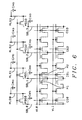
- FIG. 6 shows a schematic diagram in which the bit lines are subdivided by bit line select transistors MSG0, MSG1, MSG2 and MSG3.
- the bit line select transistors MSG0, MSG1, MSG2 and MSG3 connect between sub bit lines SBL0, SBL1, SBL2 and SBL3, respectively, and main bit lines MBL0, MBL1, MBL2 and MBL3, respectively, whenever the select gate signal SGBL is high.
- a third embodiment of this invention another approach to increase program bandwidth comes from maximizing the number of programming cells programmed at once, which is usually limited by the programming current and the current capacity from a charge pump.
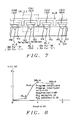
- the programming current As seen in the measured programming characteristics of the device, with a width of 0.4um, shown in FIG. 8, when the word voltage is close to the word gate threshold, the programming current is below 1 uA. Programming speed is slower at this lower current, but quickly increases at program currents of around a few microamperes. However, if the current increases past 30uA, the programming speed starts to falls. According to these un-optimized hardware results, a programming current of 2-3uA (about 5uA/um) is the best programming current to maximize the number of cells being programmed for a limited current charge pump.
- program current can also be controlled by a bit line current source.
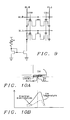
- FIG. 9 shows an implementation in which a small constant current source is placed at the end of the twin MONOS source bit line BL0.
- the reference voltage Vref is supplied from a current source, which has been calibrated to the optimum low programming current.
- the bit line decoder needs to be able to: I) connect the selected and unselected bit lines together, and 2) the two adjacent bit lines next to the unselected bit line should be raised to a voltage near the selected word gate voltage (approximately 1.2V) in order to program inhibit the cell associated with the unselected bit line whose capacitance is being "borrowed".
- the number of cells located between the selected and unselected bit line must be at least four.
- the minimum bit line decode unit is eight cells.
- FIG. 10A shows a cross-section of the electron storage site region.
- the control gate and bit diffusion are biased with 5V.
- the highest energy peaks slightly inside the n-junction.
- the trapped electron distribution in the nitride storage sites will be similar to the temperature distribution and follow the dotted line curve shown in FIG. 10B.
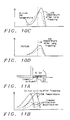
- FIG. 10D is shown the distributions of CHE temperature and electron distribution after the electron trapping process has been sustained for a period of time. It can be seen that most of the majority of the electrons are trapped on the side above the n-junction, which do not contribute as effectively to threshold shift, because of the high n concentration. Also, when the injection point is near the junction edge, wear out of the bottom oxide is a concern.
- Vcg> ⁇ 6.5V drain bias + Vt and including substrate sensitivities
- the peak electric field is shifted left, closer to the gap between the word and control gate, as shown in FIG. 11A.
- the higher control gate voltage creates an electron inversion layer near the gap, which traps electrons in a more ideal location, directly above the control gate channel.
- Another advantage of the higher control gate voltage is that by filling the trap sites across the channel region, pin point wear out is avoided, which provides better endurance and reliability.
- Vcg higher than (Vd+Vt) provides better electron distribution, which in turn results in better turn off characteristics as well as faster programming speed and better endurance.
Landscapes
- Engineering & Computer Science (AREA)
- Microelectronics & Electronic Packaging (AREA)
- Read Only Memory (AREA)
- Non-Volatile Memory (AREA)
- Semiconductor Memories (AREA)
- Use Of Switch Circuits For Exchanges And Methods Of Control Of Multiplex Exchanges (AREA)
Applications Claiming Priority (6)
| Application Number | Priority Date | Filing Date | Title |
|---|---|---|---|
| US27587001P | 2001-03-15 | 2001-03-15 | |
| US275870P | 2001-03-15 | ||
| US27915101P | 2001-03-27 | 2001-03-27 | |
| US279151P | 2001-03-27 | ||
| US28875601P | 2001-05-04 | 2001-05-04 | |
| US288756P | 2001-05-04 |
Publications (3)
| Publication Number | Publication Date |
|---|---|
| EP1246196A2 true EP1246196A2 (de) | 2002-10-02 |
| EP1246196A3 EP1246196A3 (de) | 2007-07-04 |
| EP1246196B1 EP1246196B1 (de) | 2010-02-17 |
Family
ID=27402765
Family Applications (1)
| Application Number | Title | Priority Date | Filing Date |
|---|---|---|---|
| EP02368025A Expired - Lifetime EP1246196B1 (de) | 2001-03-15 | 2002-03-14 | Doppelbit MONOS Speicherzellgebrauch für breite Programbandbreite |
Country Status (7)
| Country | Link |
|---|---|
| US (1) | US6459622B1 (de) |
| EP (1) | EP1246196B1 (de) |
| JP (1) | JP4153222B2 (de) |
| KR (1) | KR20030009082A (de) |
| AT (1) | ATE458249T1 (de) |
| DE (1) | DE60235335D1 (de) |
| TW (1) | TW548841B (de) |
Cited By (2)
| Publication number | Priority date | Publication date | Assignee | Title |
|---|---|---|---|---|
| WO2004072981A1 (en) * | 2003-02-06 | 2004-08-26 | Sandisk Corporation | System and method for programming cells in non-volatile integrated memory devices |
| US7630237B2 (en) | 2003-02-06 | 2009-12-08 | Sandisk Corporation | System and method for programming cells in non-volatile integrated memory devices |
Families Citing this family (32)
| Publication number | Priority date | Publication date | Assignee | Title |
|---|---|---|---|---|
| US6531350B2 (en) * | 2001-02-22 | 2003-03-11 | Halo, Inc. | Twin MONOS cell fabrication method and array organization |
| JP3640175B2 (ja) * | 2001-04-13 | 2005-04-20 | セイコーエプソン株式会社 | 不揮発性半導体記憶装置 |
| JP4715024B2 (ja) * | 2001-05-08 | 2011-07-06 | セイコーエプソン株式会社 | 不揮発性半導体記憶装置のプログラム方法 |
| TW508590B (en) * | 2001-05-09 | 2002-11-01 | Macronix Int Co Ltd | Operating method of flash memory with symmetrical dual channel |
| JP2002334588A (ja) * | 2001-05-11 | 2002-11-22 | Seiko Epson Corp | 不揮発性半導体記憶装置のプログラム方法 |
| DE60226100D1 (de) | 2001-07-06 | 2008-05-29 | Halo Lsi Design & Device Tech | Bitzeilen-Selektions-Dekodierung und Schaltung für Doppelbitspeicher mit Doppelbitselektion |
| EP1274095A3 (de) | 2001-07-06 | 2005-05-25 | Halo Lsi Design and Device Technology Inc. | Doppel-MONOS-Zellenmatrix mit Metall-Bitleitungsorganisation und Einzelzellenbetrieb |
| US6631089B1 (en) | 2001-07-06 | 2003-10-07 | Halo Lsi, Inc. | Bit line decoding scheme and circuit for dual bit memory array |
| EP1274093A3 (de) | 2001-07-06 | 2004-12-08 | Halo Lsi Design and Device Technology Inc. | Ein Steuergatterdekodierer für Doppel-MONOS-Speicher mit Zwei-Bit-Lösch-Fähigkeit |
| US6925007B2 (en) | 2001-10-31 | 2005-08-02 | Sandisk Corporation | Multi-state non-volatile integrated circuit memory systems that employ dielectric storage elements |
| US6897522B2 (en) * | 2001-10-31 | 2005-05-24 | Sandisk Corporation | Multi-state non-volatile integrated circuit memory systems that employ dielectric storage elements |
| JP3867624B2 (ja) * | 2002-06-06 | 2007-01-10 | セイコーエプソン株式会社 | 不揮発性半導体記憶装置およびその駆動方法 |
| US8216930B2 (en) | 2006-12-14 | 2012-07-10 | Stats Chippac, Ltd. | Solder joint flip chip interconnection having relief structure |
| TWI478254B (zh) | 2003-11-10 | 2015-03-21 | 恰巴克有限公司 | 引線上凸塊之倒裝晶片互連 |
| US9029196B2 (en) | 2003-11-10 | 2015-05-12 | Stats Chippac, Ltd. | Semiconductor device and method of self-confinement of conductive bump material during reflow without solder mask |
| US8574959B2 (en) | 2003-11-10 | 2013-11-05 | Stats Chippac, Ltd. | Semiconductor device and method of forming bump-on-lead interconnection |
| US8129841B2 (en) | 2006-12-14 | 2012-03-06 | Stats Chippac, Ltd. | Solder joint flip chip interconnection |
| US8026128B2 (en) | 2004-11-10 | 2011-09-27 | Stats Chippac, Ltd. | Semiconductor device and method of self-confinement of conductive bump material during reflow without solder mask |
| US20060216860A1 (en) | 2005-03-25 | 2006-09-28 | Stats Chippac, Ltd. | Flip chip interconnection having narrow interconnection sites on the substrate |
| USRE47600E1 (en) | 2003-11-10 | 2019-09-10 | STATS ChipPAC Pte. Ltd. | Semiconductor device and method of forming electrical interconnect with stress relief void |
| WO2005109438A2 (en) * | 2004-05-06 | 2005-11-17 | Halo Lsi, Inc. | Non-volatile memory dynamic operations |
| JP5007017B2 (ja) * | 2004-06-30 | 2012-08-22 | ルネサスエレクトロニクス株式会社 | 半導体装置の製造方法 |
| US8841779B2 (en) | 2005-03-25 | 2014-09-23 | Stats Chippac, Ltd. | Semiconductor device and method of forming high routing density BOL BONL and BONP interconnect sites on substrate |
| US7272040B2 (en) * | 2005-04-29 | 2007-09-18 | Infineon Technologies Ag | Multi-bit virtual-ground NAND memory device |
| KR100727411B1 (ko) * | 2005-12-29 | 2007-06-13 | 삼성전자주식회사 | 오픈 비트라인 구조의 메모리 셀 어레이를 가지는 반도체메모리 장치의 승압전압 발생회로 및 승압전압 발생방법 |
| KR100902008B1 (ko) * | 2007-02-09 | 2009-06-12 | 삼성전자주식회사 | 메모리 셀에 멀티 비트 데이터를 저장하는 플래시 메모리를 포함한 메모리 시스템 |
| US8320191B2 (en) | 2007-08-30 | 2012-11-27 | Infineon Technologies Ag | Memory cell arrangement, method for controlling a memory cell, memory array and electronic device |
| JP5164520B2 (ja) * | 2007-10-19 | 2013-03-21 | ルネサスエレクトロニクス株式会社 | 不揮発性半導体メモリ及びデータプログラム/消去方法 |
| JP5355980B2 (ja) * | 2008-09-29 | 2013-11-27 | 株式会社東芝 | 不揮発性半導体記憶装置及びその駆動方法 |
| JP5462461B2 (ja) * | 2008-09-30 | 2014-04-02 | 株式会社東芝 | 不揮発性半導体記憶装置及びその駆動方法 |
| US9947687B2 (en) | 2016-06-08 | 2018-04-17 | Micron Technology, Inc. | Memory cells comprising a programmable field effect transistor having a reversibly programmable gate insulator |
| US10790304B2 (en) | 2018-07-26 | 2020-09-29 | Micron Technology, Inc. | Integrated assemblies comprising ferroelectric transistors and non-ferroelectric transistors |
Citations (3)
| Publication number | Priority date | Publication date | Assignee | Title |
|---|---|---|---|---|
| WO2001017030A1 (en) | 1999-08-27 | 2001-03-08 | Macronix America, Inc. | Non-volatile memory structure for twin-bit storage and methods of making same |
| US6248633B1 (en) | 1999-10-25 | 2001-06-19 | Halo Lsi Design & Device Technology, Inc. | Process for making and programming and operating a dual-bit multi-level ballistic MONOS memory |
| US6255166B1 (en) | 1999-08-05 | 2001-07-03 | Aalo Lsi Design & Device Technology, Inc. | Nonvolatile memory cell, method of programming the same and nonvolatile memory array |
Family Cites Families (3)
| Publication number | Priority date | Publication date | Assignee | Title |
|---|---|---|---|---|
| US6215148B1 (en) * | 1998-05-20 | 2001-04-10 | Saifun Semiconductors Ltd. | NROM cell with improved programming, erasing and cycling |
| US6388293B1 (en) | 1999-10-12 | 2002-05-14 | Halo Lsi Design & Device Technology, Inc. | Nonvolatile memory cell, operating method of the same and nonvolatile memory array |
| US6172905B1 (en) * | 2000-02-01 | 2001-01-09 | Motorola, Inc. | Method of operating a semiconductor device |
-
2002
- 2002-03-14 DE DE60235335T patent/DE60235335D1/de not_active Expired - Lifetime
- 2002-03-14 EP EP02368025A patent/EP1246196B1/de not_active Expired - Lifetime
- 2002-03-14 AT AT02368025T patent/ATE458249T1/de not_active IP Right Cessation
- 2002-03-15 JP JP2002072030A patent/JP4153222B2/ja not_active Expired - Lifetime
- 2002-03-15 TW TW091104888A patent/TW548841B/zh active
- 2002-03-15 US US10/099,030 patent/US6459622B1/en not_active Expired - Lifetime
- 2002-03-15 KR KR1020020014098A patent/KR20030009082A/ko not_active Withdrawn
Patent Citations (3)
| Publication number | Priority date | Publication date | Assignee | Title |
|---|---|---|---|---|
| US6255166B1 (en) | 1999-08-05 | 2001-07-03 | Aalo Lsi Design & Device Technology, Inc. | Nonvolatile memory cell, method of programming the same and nonvolatile memory array |
| WO2001017030A1 (en) | 1999-08-27 | 2001-03-08 | Macronix America, Inc. | Non-volatile memory structure for twin-bit storage and methods of making same |
| US6248633B1 (en) | 1999-10-25 | 2001-06-19 | Halo Lsi Design & Device Technology, Inc. | Process for making and programming and operating a dual-bit multi-level ballistic MONOS memory |
Non-Patent Citations (1)
| Title |
|---|
| MA, Y ET AL.: "A Dual-Bit Split-gate EEPROM (DSG) Cell in Contactless ARRAY for Single-VCC High Density Flash Memories", TECHNICAL- DIGEST OF THE INTERNATIONAL ELECTRON DEVICES MEETING, 11 December 1994 (1994-12-11), pages 57 - 60 |
Cited By (5)
| Publication number | Priority date | Publication date | Assignee | Title |
|---|---|---|---|---|
| WO2004072981A1 (en) * | 2003-02-06 | 2004-08-26 | Sandisk Corporation | System and method for programming cells in non-volatile integrated memory devices |
| US6856551B2 (en) | 2003-02-06 | 2005-02-15 | Sandisk Corporation | System and method for programming cells in non-volatile integrated memory devices |
| JP2006518530A (ja) * | 2003-02-06 | 2006-08-10 | サンディスク コーポレイション | 不揮発性集積記憶装置のセルをプログラムするシステムおよび方法 |
| US7630237B2 (en) | 2003-02-06 | 2009-12-08 | Sandisk Corporation | System and method for programming cells in non-volatile integrated memory devices |
| US8014197B2 (en) | 2005-08-02 | 2011-09-06 | Sandisk Technologies Inc. | System and method for programming cells in non-volatile integrated memory devices |
Also Published As
| Publication number | Publication date |
|---|---|
| JP2003036683A (ja) | 2003-02-07 |
| US6459622B1 (en) | 2002-10-01 |
| KR20030009082A (ko) | 2003-01-29 |
| EP1246196B1 (de) | 2010-02-17 |
| EP1246196A3 (de) | 2007-07-04 |
| JP4153222B2 (ja) | 2008-09-24 |
| ATE458249T1 (de) | 2010-03-15 |
| US20020131304A1 (en) | 2002-09-19 |
| TW548841B (en) | 2003-08-21 |
| DE60235335D1 (de) | 2010-04-01 |
Similar Documents
| Publication | Publication Date | Title |
|---|---|---|
| EP1246196B1 (de) | Doppelbit MONOS Speicherzellgebrauch für breite Programbandbreite | |
| US7046553B2 (en) | Fast program to program verify method | |
| US6282124B1 (en) | Method of erasing a flash EEPROM memory cell array optimized for low power consumption | |
| EP0819308B1 (de) | Flash-programmation | |
| US6828618B2 (en) | Split-gate thin-film storage NVM cell | |
| EP0902438B1 (de) | Verfahren zur Löschung und Programmierung eines Speichers in Kleinspannungs-Anwendungen und Anwendungen mit geringer Leistung | |
| US6760253B2 (en) | Non-volatile semiconductor memory device and method of driving the same | |
| JP2001506063A (ja) | 不揮発性pmos2トランジスタメモリセル及びアレイ | |
| WO1998044565A1 (en) | A scalable flash eeprom memory cell and array | |
| EP0616333B1 (de) | Verfahren zur Vorspannung einer nichtflüchtigen Flash-EEPROM-Speicheranordnung | |
| EP1258007B1 (de) | Wortleitungstreiber für flash speicher in lesemodus | |
| EP0656627A2 (de) | Eine regelbare Schwellspannungsschaltung | |
| US20030164517A1 (en) | Nonvolatile semiconductor memory device | |
| US6243299B1 (en) | Flash memory system having fast erase operation | |
| EP0616332B1 (de) | Nichtflüchtige Flash-EEPROM-Speicheranordnung | |
| US6141252A (en) | Voltage regulation for integrated circuit memory | |
| CN1319149C (zh) | 用于宽编程的双金属/多晶硅氧化物氮化物氧化物硅存储器单元 | |
| US6768683B1 (en) | Low column leakage flash memory array | |
| JPS62185298A (ja) | 不揮発性半導体記憶装置及びその駆動方法 |
Legal Events
| Date | Code | Title | Description |
|---|---|---|---|
| PUAI | Public reference made under article 153(3) epc to a published international application that has entered the european phase |
Free format text: ORIGINAL CODE: 0009012 |
|
| AK | Designated contracting states |
Kind code of ref document: A2 Designated state(s): AT BE CH CY DE DK ES FI FR GB GR IE IT LI LU MC NL PT SE TR |
|
| AX | Request for extension of the european patent |
Free format text: AL;LT;LV;MK;RO;SI |
|
| PUAL | Search report despatched |
Free format text: ORIGINAL CODE: 0009013 |
|
| AK | Designated contracting states |
Kind code of ref document: A3 Designated state(s): AT BE CH CY DE DK ES FI FR GB GR IE IT LI LU MC NL PT SE TR |
|
| AX | Request for extension of the european patent |
Extension state: AL LT LV MK RO SI |
|
| 17P | Request for examination filed |
Effective date: 20080104 |
|
| AKX | Designation fees paid |
Designated state(s): AT BE CH CY DE DK ES FI FR GB GR IE IT LI LU MC NL PT SE TR |
|
| 17Q | First examination report despatched |
Effective date: 20080724 |
|
| GRAP | Despatch of communication of intention to grant a patent |
Free format text: ORIGINAL CODE: EPIDOSNIGR1 |
|
| GRAS | Grant fee paid |
Free format text: ORIGINAL CODE: EPIDOSNIGR3 |
|
| GRAA | (expected) grant |
Free format text: ORIGINAL CODE: 0009210 |
|
| AK | Designated contracting states |
Kind code of ref document: B1 Designated state(s): AT BE CH CY DE DK ES FI FR GB GR IE IT LI LU MC NL PT SE TR |
|
| REG | Reference to a national code |
Ref country code: GB Ref legal event code: FG4D |
|
| REG | Reference to a national code |
Ref country code: CH Ref legal event code: EP |
|
| REG | Reference to a national code |
Ref country code: IE Ref legal event code: FG4D |
|
| REF | Corresponds to: |
Ref document number: 60235335 Country of ref document: DE Date of ref document: 20100401 Kind code of ref document: P |
|
| REG | Reference to a national code |
Ref country code: NL Ref legal event code: VDEP Effective date: 20100217 |
|
| PG25 | Lapsed in a contracting state [announced via postgrant information from national office to epo] |
Ref country code: ES Free format text: LAPSE BECAUSE OF FAILURE TO SUBMIT A TRANSLATION OF THE DESCRIPTION OR TO PAY THE FEE WITHIN THE PRESCRIBED TIME-LIMIT Effective date: 20100528 Ref country code: PT Free format text: LAPSE BECAUSE OF FAILURE TO SUBMIT A TRANSLATION OF THE DESCRIPTION OR TO PAY THE FEE WITHIN THE PRESCRIBED TIME-LIMIT Effective date: 20100617 |
|
| PG25 | Lapsed in a contracting state [announced via postgrant information from national office to epo] |
Ref country code: AT Free format text: LAPSE BECAUSE OF FAILURE TO SUBMIT A TRANSLATION OF THE DESCRIPTION OR TO PAY THE FEE WITHIN THE PRESCRIBED TIME-LIMIT Effective date: 20100217 Ref country code: FI Free format text: LAPSE BECAUSE OF FAILURE TO SUBMIT A TRANSLATION OF THE DESCRIPTION OR TO PAY THE FEE WITHIN THE PRESCRIBED TIME-LIMIT Effective date: 20100217 |
|
| PG25 | Lapsed in a contracting state [announced via postgrant information from national office to epo] |
Ref country code: NL Free format text: LAPSE BECAUSE OF FAILURE TO SUBMIT A TRANSLATION OF THE DESCRIPTION OR TO PAY THE FEE WITHIN THE PRESCRIBED TIME-LIMIT Effective date: 20100217 Ref country code: MC Free format text: LAPSE BECAUSE OF NON-PAYMENT OF DUE FEES Effective date: 20100331 Ref country code: BE Free format text: LAPSE BECAUSE OF FAILURE TO SUBMIT A TRANSLATION OF THE DESCRIPTION OR TO PAY THE FEE WITHIN THE PRESCRIBED TIME-LIMIT Effective date: 20100217 Ref country code: CY Free format text: LAPSE BECAUSE OF FAILURE TO SUBMIT A TRANSLATION OF THE DESCRIPTION OR TO PAY THE FEE WITHIN THE PRESCRIBED TIME-LIMIT Effective date: 20100217 Ref country code: GR Free format text: LAPSE BECAUSE OF FAILURE TO SUBMIT A TRANSLATION OF THE DESCRIPTION OR TO PAY THE FEE WITHIN THE PRESCRIBED TIME-LIMIT Effective date: 20100518 Ref country code: SE Free format text: LAPSE BECAUSE OF FAILURE TO SUBMIT A TRANSLATION OF THE DESCRIPTION OR TO PAY THE FEE WITHIN THE PRESCRIBED TIME-LIMIT Effective date: 20100217 |
|
| REG | Reference to a national code |
Ref country code: CH Ref legal event code: PL |
|
| PLBE | No opposition filed within time limit |
Free format text: ORIGINAL CODE: 0009261 |
|
| STAA | Information on the status of an ep patent application or granted ep patent |
Free format text: STATUS: NO OPPOSITION FILED WITHIN TIME LIMIT |
|
| 26N | No opposition filed |
Effective date: 20101118 |
|
| GBPC | Gb: european patent ceased through non-payment of renewal fee |
Effective date: 20100517 |
|
| PG25 | Lapsed in a contracting state [announced via postgrant information from national office to epo] |
Ref country code: DK Free format text: LAPSE BECAUSE OF FAILURE TO SUBMIT A TRANSLATION OF THE DESCRIPTION OR TO PAY THE FEE WITHIN THE PRESCRIBED TIME-LIMIT Effective date: 20100217 Ref country code: IE Free format text: LAPSE BECAUSE OF NON-PAYMENT OF DUE FEES Effective date: 20100314 |
|
| PG25 | Lapsed in a contracting state [announced via postgrant information from national office to epo] |
Ref country code: LI Free format text: LAPSE BECAUSE OF NON-PAYMENT OF DUE FEES Effective date: 20100331 Ref country code: CH Free format text: LAPSE BECAUSE OF NON-PAYMENT OF DUE FEES Effective date: 20100331 |
|
| PG25 | Lapsed in a contracting state [announced via postgrant information from national office to epo] |
Ref country code: IT Free format text: LAPSE BECAUSE OF FAILURE TO SUBMIT A TRANSLATION OF THE DESCRIPTION OR TO PAY THE FEE WITHIN THE PRESCRIBED TIME-LIMIT Effective date: 20100217 |
|
| PG25 | Lapsed in a contracting state [announced via postgrant information from national office to epo] |
Ref country code: GB Free format text: LAPSE BECAUSE OF NON-PAYMENT OF DUE FEES Effective date: 20100517 |
|
| PGFP | Annual fee paid to national office [announced via postgrant information from national office to epo] |
Ref country code: DE Payment date: 20110401 Year of fee payment: 10 Ref country code: FR Payment date: 20110414 Year of fee payment: 10 |
|
| PG25 | Lapsed in a contracting state [announced via postgrant information from national office to epo] |
Ref country code: LU Free format text: LAPSE BECAUSE OF NON-PAYMENT OF DUE FEES Effective date: 20100314 |
|
| PG25 | Lapsed in a contracting state [announced via postgrant information from national office to epo] |
Ref country code: TR Free format text: LAPSE BECAUSE OF FAILURE TO SUBMIT A TRANSLATION OF THE DESCRIPTION OR TO PAY THE FEE WITHIN THE PRESCRIBED TIME-LIMIT Effective date: 20100217 |
|
| REG | Reference to a national code |
Ref country code: FR Ref legal event code: ST Effective date: 20121130 |
|
| PG25 | Lapsed in a contracting state [announced via postgrant information from national office to epo] |
Ref country code: FR Free format text: LAPSE BECAUSE OF NON-PAYMENT OF DUE FEES Effective date: 20120402 |
|
| REG | Reference to a national code |
Ref country code: DE Ref legal event code: R119 Ref document number: 60235335 Country of ref document: DE Effective date: 20121002 |
|
| PG25 | Lapsed in a contracting state [announced via postgrant information from national office to epo] |
Ref country code: DE Free format text: LAPSE BECAUSE OF NON-PAYMENT OF DUE FEES Effective date: 20121002 |