EP1240237B1 - Flüssiginitiator zur beschleunigten durchführung der anionischen lactampolymerisation, verfahren zu dessen herstellung und verwendung - Google Patents
Flüssiginitiator zur beschleunigten durchführung der anionischen lactampolymerisation, verfahren zu dessen herstellung und verwendung Download PDFInfo
- Publication number
- EP1240237B1 EP1240237B1 EP00993516A EP00993516A EP1240237B1 EP 1240237 B1 EP1240237 B1 EP 1240237B1 EP 00993516 A EP00993516 A EP 00993516A EP 00993516 A EP00993516 A EP 00993516A EP 1240237 B1 EP1240237 B1 EP 1240237B1
- Authority
- EP
- European Patent Office
- Prior art keywords
- liquid initiator
- lactam
- isocyanate
- liquid
- base
- Prior art date
- Legal status (The legal status is an assumption and is not a legal conclusion. Google has not performed a legal analysis and makes no representation as to the accuracy of the status listed.)
- Expired - Lifetime
Links
- 239000007788 liquid Substances 0.000 title claims abstract description 62
- 239000003999 initiator Substances 0.000 title claims abstract description 50
- 125000000129 anionic group Chemical group 0.000 title claims abstract description 7
- 238000000034 method Methods 0.000 title claims description 38
- 238000004519 manufacturing process Methods 0.000 title claims description 14
- 238000012693 lactam polymerization Methods 0.000 title abstract description 6
- 239000003795 chemical substances by application Substances 0.000 claims abstract description 55
- 239000012948 isocyanate Substances 0.000 claims abstract description 34
- 150000002513 isocyanates Chemical class 0.000 claims abstract description 33
- 150000001875 compounds Chemical class 0.000 claims abstract description 20
- 150000003951 lactams Chemical class 0.000 claims description 44
- 239000002585 base Substances 0.000 claims description 34
- -1 anionic lactam Chemical class 0.000 claims description 24
- 238000006243 chemical reaction Methods 0.000 claims description 22
- 239000008187 granular material Substances 0.000 claims description 16
- 239000000047 product Substances 0.000 claims description 16
- 229920000642 polymer Polymers 0.000 claims description 15
- DGTNSSLYPYDJGL-UHFFFAOYSA-N phenyl isocyanate Chemical compound O=C=NC1=CC=CC=C1 DGTNSSLYPYDJGL-UHFFFAOYSA-N 0.000 claims description 11
- 239000007795 chemical reaction product Substances 0.000 claims description 10
- 239000000203 mixture Chemical class 0.000 claims description 10
- 150000001408 amides Chemical class 0.000 claims description 9
- 125000001931 aliphatic group Chemical group 0.000 claims description 8
- 125000004432 carbon atom Chemical group C* 0.000 claims description 8
- SECXISVLQFMRJM-UHFFFAOYSA-N N-Methylpyrrolidone Chemical compound CN1CCCC1=O SECXISVLQFMRJM-UHFFFAOYSA-N 0.000 claims description 7
- 239000000654 additive Substances 0.000 claims description 7
- KQWGXHWJMSMDJJ-UHFFFAOYSA-N cyclohexyl isocyanate Chemical class O=C=NC1CCCCC1 KQWGXHWJMSMDJJ-UHFFFAOYSA-N 0.000 claims description 7
- ZFSLODLOARCGLH-UHFFFAOYSA-N isocyanuric acid Chemical compound OC1=NC(O)=NC(O)=N1 ZFSLODLOARCGLH-UHFFFAOYSA-N 0.000 claims description 7
- 125000003118 aryl group Chemical group 0.000 claims description 6
- 239000003513 alkali Substances 0.000 claims description 5
- 150000001718 carbodiimides Chemical class 0.000 claims description 5
- 150000003857 carboxamides Chemical class 0.000 claims description 5
- 238000010924 continuous production Methods 0.000 claims description 5
- 125000005842 heteroatom Chemical group 0.000 claims description 5
- 125000004435 hydrogen atom Chemical group [H]* 0.000 claims description 5
- 239000000178 monomer Substances 0.000 claims description 5
- 125000004122 cyclic group Chemical group 0.000 claims description 4
- 239000011261 inert gas Substances 0.000 claims description 4
- VKAMZEDHHWTTNZ-UHFFFAOYSA-N 1-octylazepan-2-one Chemical compound CCCCCCCCN1CCCCCC1=O VKAMZEDHHWTTNZ-UHFFFAOYSA-N 0.000 claims description 3
- 230000002378 acidificating effect Effects 0.000 claims description 3
- 150000001298 alcohols Chemical class 0.000 claims description 3
- 150000001768 cations Chemical class 0.000 claims description 3
- 238000007598 dipping method Methods 0.000 claims description 3
- 238000006386 neutralization reaction Methods 0.000 claims description 3
- 229910052698 phosphorus Inorganic materials 0.000 claims description 3
- 239000002904 solvent Substances 0.000 claims description 3
- UPMLOUAZCHDJJD-UHFFFAOYSA-N 4,4'-Diphenylmethane Diisocyanate Chemical class C1=CC(N=C=O)=CC=C1CC1=CC=C(N=C=O)C=C1 UPMLOUAZCHDJJD-UHFFFAOYSA-N 0.000 claims description 2
- WPPOGHDFAVQKLN-UHFFFAOYSA-N N-Octyl-2-pyrrolidone Chemical compound CCCCCCCCN1CCCC1=O WPPOGHDFAVQKLN-UHFFFAOYSA-N 0.000 claims description 2
- 238000005266 casting Methods 0.000 claims description 2
- 230000007717 exclusion Effects 0.000 claims description 2
- 150000004678 hydrides Chemical class 0.000 claims description 2
- 238000001746 injection moulding Methods 0.000 claims description 2
- PZYDAVFRVJXFHS-UHFFFAOYSA-N n-cyclohexyl-2-pyrrolidone Chemical compound O=C1CCCN1C1CCCCC1 PZYDAVFRVJXFHS-UHFFFAOYSA-N 0.000 claims description 2
- 229920000151 polyglycol Polymers 0.000 claims description 2
- 239000010695 polyglycol Substances 0.000 claims description 2
- 229910052717 sulfur Inorganic materials 0.000 claims description 2
- 150000003672 ureas Chemical class 0.000 claims 2
- SNDGLCYYBKJSOT-UHFFFAOYSA-N 1,1,3,3-tetrabutylurea Chemical group CCCCN(CCCC)C(=O)N(CCCC)CCCC SNDGLCYYBKJSOT-UHFFFAOYSA-N 0.000 claims 1
- UWHSPZZUAYSGTB-UHFFFAOYSA-N 1,1,3,3-tetraethylurea Chemical group CCN(CC)C(=O)N(CC)CC UWHSPZZUAYSGTB-UHFFFAOYSA-N 0.000 claims 1
- AVQQQNCBBIEMEU-UHFFFAOYSA-N 1,1,3,3-tetramethylurea Chemical group CN(C)C(=O)N(C)C AVQQQNCBBIEMEU-UHFFFAOYSA-N 0.000 claims 1
- 239000005057 Hexamethylene diisocyanate Chemical class 0.000 claims 1
- 239000005058 Isophorone diisocyanate Chemical class 0.000 claims 1
- KXBFLNPZHXDQLV-UHFFFAOYSA-N [cyclohexyl(diisocyanato)methyl]cyclohexane Chemical class C1CCCCC1C(N=C=O)(N=C=O)C1CCCCC1 KXBFLNPZHXDQLV-UHFFFAOYSA-N 0.000 claims 1
- 239000004202 carbamide Substances 0.000 claims 1
- 238000009750 centrifugal casting Methods 0.000 claims 1
- JXCHMDATRWUOAP-UHFFFAOYSA-N diisocyanatomethylbenzene Chemical class O=C=NC(N=C=O)C1=CC=CC=C1 JXCHMDATRWUOAP-UHFFFAOYSA-N 0.000 claims 1
- 238000001125 extrusion Methods 0.000 claims 1
- RRAMGCGOFNQTLD-UHFFFAOYSA-N hexamethylene diisocyanate Chemical class O=C=NCCCCCCN=C=O RRAMGCGOFNQTLD-UHFFFAOYSA-N 0.000 claims 1
- 230000002401 inhibitory effect Effects 0.000 claims 1
- 150000002500 ions Chemical class 0.000 claims 1
- NIMLQBUJDJZYEJ-UHFFFAOYSA-N isophorone diisocyanate Chemical class CC1(C)CC(N=C=O)CC(C)(CN=C=O)C1 NIMLQBUJDJZYEJ-UHFFFAOYSA-N 0.000 claims 1
- WCYWZMWISLQXQU-UHFFFAOYSA-N methyl Chemical compound [CH3] WCYWZMWISLQXQU-UHFFFAOYSA-N 0.000 claims 1
- 125000005498 phthalate group Chemical class 0.000 claims 1
- 238000001175 rotational moulding Methods 0.000 claims 1
- 238000005507 spraying Methods 0.000 claims 1
- 125000005207 tetraalkylammonium group Chemical group 0.000 claims 1
- 238000007614 solvation Methods 0.000 abstract description 4
- 239000012084 conversion product Substances 0.000 abstract 1
- 238000006116 polymerization reaction Methods 0.000 description 51
- OKKJLVBELUTLKV-UHFFFAOYSA-N Methanol Chemical compound OC OKKJLVBELUTLKV-UHFFFAOYSA-N 0.000 description 42
- WQDUMFSSJAZKTM-UHFFFAOYSA-N Sodium methoxide Chemical compound [Na+].[O-]C WQDUMFSSJAZKTM-UHFFFAOYSA-N 0.000 description 42
- 239000000243 solution Substances 0.000 description 25
- LFQSCWFLJHTTHZ-UHFFFAOYSA-N Ethanol Chemical compound CCO LFQSCWFLJHTTHZ-UHFFFAOYSA-N 0.000 description 20
- 238000002474 experimental method Methods 0.000 description 18
- 239000003054 catalyst Substances 0.000 description 14
- 235000019441 ethanol Nutrition 0.000 description 14
- QTBSBXVTEAMEQO-UHFFFAOYSA-N Acetic acid Chemical compound CC(O)=O QTBSBXVTEAMEQO-UHFFFAOYSA-N 0.000 description 12
- QOSSAOTZNIDXMA-UHFFFAOYSA-N Dicylcohexylcarbodiimide Chemical compound C1CCCCC1N=C=NC1CCCCC1 QOSSAOTZNIDXMA-UHFFFAOYSA-N 0.000 description 11
- 239000011734 sodium Substances 0.000 description 11
- 150000001732 carboxylic acid derivatives Chemical class 0.000 description 10
- IJGRMHOSHXDMSA-UHFFFAOYSA-N Atomic nitrogen Chemical compound N#N IJGRMHOSHXDMSA-UHFFFAOYSA-N 0.000 description 8
- 230000000694 effects Effects 0.000 description 8
- DGAQECJNVWCQMB-PUAWFVPOSA-M Ilexoside XXIX Chemical compound C[C@@H]1CC[C@@]2(CC[C@@]3(C(=CC[C@H]4[C@]3(CC[C@@H]5[C@@]4(CC[C@@H](C5(C)C)OS(=O)(=O)[O-])C)C)[C@@H]2[C@]1(C)O)C)C(=O)O[C@H]6[C@@H]([C@H]([C@@H]([C@H](O6)CO)O)O)O.[Na+] DGAQECJNVWCQMB-PUAWFVPOSA-M 0.000 description 7
- LRHPLDYGYMQRHN-UHFFFAOYSA-N N-Butanol Chemical compound CCCCO LRHPLDYGYMQRHN-UHFFFAOYSA-N 0.000 description 7
- 229910052784 alkaline earth metal Inorganic materials 0.000 description 7
- 238000002156 mixing Methods 0.000 description 7
- 229910052708 sodium Inorganic materials 0.000 description 7
- 238000009835 boiling Methods 0.000 description 6
- 239000000835 fiber Substances 0.000 description 6
- 229910052757 nitrogen Inorganic materials 0.000 description 6
- 238000002360 preparation method Methods 0.000 description 6
- 239000011541 reaction mixture Substances 0.000 description 6
- 239000003381 stabilizer Substances 0.000 description 6
- 238000005829 trimerization reaction Methods 0.000 description 6
- 150000001412 amines Chemical class 0.000 description 5
- 230000015572 biosynthetic process Effects 0.000 description 5
- MOMGDEWWZBKDDR-UHFFFAOYSA-M sodium;3,4,5,6-tetrahydro-2h-azepin-7-olate Chemical compound [Na+].O=C1CCCCC[N-]1 MOMGDEWWZBKDDR-UHFFFAOYSA-M 0.000 description 5
- OYNOCRWQLLIRON-UHFFFAOYSA-N 1-n,3-n-bis(2,2,6,6-tetramethylpiperidin-4-yl)benzene-1,3-dicarboxamide Chemical compound C1C(C)(C)NC(C)(C)CC1NC(=O)C1=CC=CC(C(=O)NC2CC(C)(C)NC(C)(C)C2)=C1 OYNOCRWQLLIRON-UHFFFAOYSA-N 0.000 description 4
- MZRVEZGGRBJDDB-UHFFFAOYSA-N N-Butyllithium Chemical compound [Li]CCCC MZRVEZGGRBJDDB-UHFFFAOYSA-N 0.000 description 4
- 150000001342 alkaline earth metals Chemical class 0.000 description 4
- 238000004458 analytical method Methods 0.000 description 4
- 230000005595 deprotonation Effects 0.000 description 4
- 238000010537 deprotonation reaction Methods 0.000 description 4
- GUVUOGQBMYCBQP-UHFFFAOYSA-N dmpu Chemical compound CN1CCCN(C)C1=O GUVUOGQBMYCBQP-UHFFFAOYSA-N 0.000 description 4
- FBUKVWPVBMHYJY-UHFFFAOYSA-N nonanoic acid Chemical compound CCCCCCCCC(O)=O FBUKVWPVBMHYJY-UHFFFAOYSA-N 0.000 description 4
- 239000012071 phase Substances 0.000 description 4
- 239000007787 solid Substances 0.000 description 4
- 239000007858 starting material Substances 0.000 description 4
- 238000003860 storage Methods 0.000 description 4
- NGKIIKNJVVBNNE-UHFFFAOYSA-N 11-methyldodecan-1-amine Chemical compound CC(C)CCCCCCCCCCN NGKIIKNJVVBNNE-UHFFFAOYSA-N 0.000 description 3
- WVDDGKGOMKODPV-UHFFFAOYSA-N Benzyl alcohol Chemical compound OCC1=CC=CC=C1 WVDDGKGOMKODPV-UHFFFAOYSA-N 0.000 description 3
- LYCAIKOWRPUZTN-UHFFFAOYSA-N Ethylene glycol Chemical compound OCCO LYCAIKOWRPUZTN-UHFFFAOYSA-N 0.000 description 3
- PEDCQBHIVMGVHV-UHFFFAOYSA-N Glycerine Chemical compound OCC(O)CO PEDCQBHIVMGVHV-UHFFFAOYSA-N 0.000 description 3
- KEAYESYHFKHZAL-UHFFFAOYSA-N Sodium Chemical compound [Na] KEAYESYHFKHZAL-UHFFFAOYSA-N 0.000 description 3
- 150000004703 alkoxides Chemical class 0.000 description 3
- 150000001450 anions Chemical class 0.000 description 3
- XITRBUPOXXBIJN-UHFFFAOYSA-N bis(2,2,6,6-tetramethylpiperidin-4-yl) decanedioate Chemical compound C1C(C)(C)NC(C)(C)CC1OC(=O)CCCCCCCCC(=O)OC1CC(C)(C)NC(C)(C)C1 XITRBUPOXXBIJN-UHFFFAOYSA-N 0.000 description 3
- BTANRVKWQNVYAZ-UHFFFAOYSA-N butan-2-ol Chemical compound CCC(C)O BTANRVKWQNVYAZ-UHFFFAOYSA-N 0.000 description 3
- 230000001419 dependent effect Effects 0.000 description 3
- 150000004985 diamines Chemical class 0.000 description 3
- 125000005442 diisocyanate group Chemical group 0.000 description 3
- 239000000945 filler Substances 0.000 description 3
- 238000005470 impregnation Methods 0.000 description 3
- 239000000155 melt Substances 0.000 description 3
- 238000002844 melting Methods 0.000 description 3
- 230000008018 melting Effects 0.000 description 3
- 229910052751 metal Inorganic materials 0.000 description 3
- 239000002184 metal Substances 0.000 description 3
- 230000003647 oxidation Effects 0.000 description 3
- 238000007254 oxidation reaction Methods 0.000 description 3
- 239000002245 particle Substances 0.000 description 3
- BDERNNFJNOPAEC-UHFFFAOYSA-N propan-1-ol Chemical compound CCCO BDERNNFJNOPAEC-UHFFFAOYSA-N 0.000 description 3
- 239000003223 protective agent Substances 0.000 description 3
- 150000003839 salts Chemical group 0.000 description 3
- 238000007493 shaping process Methods 0.000 description 3
- 229910000104 sodium hydride Inorganic materials 0.000 description 3
- 238000006467 substitution reaction Methods 0.000 description 3
- 238000003786 synthesis reaction Methods 0.000 description 3
- OBETXYAYXDNJHR-SSDOTTSWSA-M (2r)-2-ethylhexanoate Chemical compound CCCC[C@@H](CC)C([O-])=O OBETXYAYXDNJHR-SSDOTTSWSA-M 0.000 description 2
- ZMGMDXCADSRNCX-UHFFFAOYSA-N 5,6-dihydroxy-1,3-diazepan-2-one Chemical class OC1CNC(=O)NCC1O ZMGMDXCADSRNCX-UHFFFAOYSA-N 0.000 description 2
- RTZKZFJDLAIYFH-UHFFFAOYSA-N Diethyl ether Chemical compound CCOCC RTZKZFJDLAIYFH-UHFFFAOYSA-N 0.000 description 2
- 101100326757 Drosophila melanogaster Capr gene Proteins 0.000 description 2
- OWIKHYCFFJSOEH-UHFFFAOYSA-N Isocyanic acid Chemical compound N=C=O OWIKHYCFFJSOEH-UHFFFAOYSA-N 0.000 description 2
- OFOBLEOULBTSOW-UHFFFAOYSA-N Malonic acid Chemical compound OC(=O)CC(O)=O OFOBLEOULBTSOW-UHFFFAOYSA-N 0.000 description 2
- IMNFDUFMRHMDMM-UHFFFAOYSA-N N-Heptane Chemical compound CCCCCCC IMNFDUFMRHMDMM-UHFFFAOYSA-N 0.000 description 2
- 239000005643 Pelargonic acid Substances 0.000 description 2
- 239000012190 activator Substances 0.000 description 2
- WNLRTRBMVRJNCN-UHFFFAOYSA-N adipic acid Chemical compound OC(=O)CCCCC(O)=O WNLRTRBMVRJNCN-UHFFFAOYSA-N 0.000 description 2
- 229910052783 alkali metal Inorganic materials 0.000 description 2
- 150000001340 alkali metals Chemical class 0.000 description 2
- OBETXYAYXDNJHR-UHFFFAOYSA-N alpha-ethylcaproic acid Natural products CCCCC(CC)C(O)=O OBETXYAYXDNJHR-UHFFFAOYSA-N 0.000 description 2
- 238000010539 anionic addition polymerization reaction Methods 0.000 description 2
- WPYMKLBDIGXBTP-UHFFFAOYSA-N benzoic acid Chemical compound OC(=O)C1=CC=CC=C1 WPYMKLBDIGXBTP-UHFFFAOYSA-N 0.000 description 2
- 238000000576 coating method Methods 0.000 description 2
- 239000002131 composite material Substances 0.000 description 2
- 230000001934 delay Effects 0.000 description 2
- NAQMVNRVTILPCV-UHFFFAOYSA-N hexane-1,6-diamine Chemical compound NCCCCCCN NAQMVNRVTILPCV-UHFFFAOYSA-N 0.000 description 2
- FUZZWVXGSFPDMH-UHFFFAOYSA-N hexanoic acid Chemical compound CCCCCC(O)=O FUZZWVXGSFPDMH-UHFFFAOYSA-N 0.000 description 2
- 125000002887 hydroxy group Chemical group [H]O* 0.000 description 2
- 239000004611 light stabiliser Substances 0.000 description 2
- 239000000463 material Substances 0.000 description 2
- 239000011159 matrix material Substances 0.000 description 2
- 229910052987 metal hydride Inorganic materials 0.000 description 2
- 150000004681 metal hydrides Chemical class 0.000 description 2
- 150000002762 monocarboxylic acid derivatives Chemical class 0.000 description 2
- 238000000465 moulding Methods 0.000 description 2
- 230000003287 optical effect Effects 0.000 description 2
- ISWSIDIOOBJBQZ-UHFFFAOYSA-N phenol group Chemical group C1(=CC=CC=C1)O ISWSIDIOOBJBQZ-UHFFFAOYSA-N 0.000 description 2
- 229920005862 polyol Polymers 0.000 description 2
- 150000003077 polyols Chemical class 0.000 description 2
- 239000012429 reaction media Substances 0.000 description 2
- 239000012312 sodium hydride Substances 0.000 description 2
- RPACBEVZENYWOL-XFULWGLBSA-M sodium;(2r)-2-[6-(4-chlorophenoxy)hexyl]oxirane-2-carboxylate Chemical compound [Na+].C=1C=C(Cl)C=CC=1OCCCCCC[C@]1(C(=O)[O-])CO1 RPACBEVZENYWOL-XFULWGLBSA-M 0.000 description 2
- 238000003756 stirring Methods 0.000 description 2
- 239000000126 substance Substances 0.000 description 2
- 229920001169 thermoplastic Polymers 0.000 description 2
- 239000004416 thermosoftening plastic Substances 0.000 description 2
- 238000011144 upstream manufacturing Methods 0.000 description 2
- ODIGIKRIUKFKHP-UHFFFAOYSA-N (n-propan-2-yloxycarbonylanilino) acetate Chemical compound CC(C)OC(=O)N(OC(C)=O)C1=CC=CC=C1 ODIGIKRIUKFKHP-UHFFFAOYSA-N 0.000 description 1
- WHIVNJATOVLWBW-PLNGDYQASA-N (nz)-n-butan-2-ylidenehydroxylamine Chemical compound CC\C(C)=N/O WHIVNJATOVLWBW-PLNGDYQASA-N 0.000 description 1
- CYSGHNMQYZDMIA-UHFFFAOYSA-N 1,3-Dimethyl-2-imidazolidinon Chemical compound CN1CCN(C)C1=O CYSGHNMQYZDMIA-UHFFFAOYSA-N 0.000 description 1
- RYHBNJHYFVUHQT-UHFFFAOYSA-N 1,4-Dioxane Chemical compound C1COCCO1 RYHBNJHYFVUHQT-UHFFFAOYSA-N 0.000 description 1
- JETYEYTVNWNEID-UHFFFAOYSA-N 1,6-diisocyanatohexane;5-isocyanato-1-(isocyanatomethyl)-1,3,3-trimethylcyclohexane Chemical class O=C=NCCCCCCN=C=O.CC1(C)CC(N=C=O)CC(C)(CN=C=O)C1 JETYEYTVNWNEID-UHFFFAOYSA-N 0.000 description 1
- BMVXCPBXGZKUPN-UHFFFAOYSA-N 1-hexanamine Chemical compound CCCCCCN BMVXCPBXGZKUPN-UHFFFAOYSA-N 0.000 description 1
- CPPGZWWUPFWALU-UHFFFAOYSA-N 1-isocyanato-3-methylbenzene Chemical compound CC1=CC=CC(N=C=O)=C1 CPPGZWWUPFWALU-UHFFFAOYSA-N 0.000 description 1
- OQURWGJAWSLGQG-UHFFFAOYSA-N 1-isocyanatopropane Chemical compound CCCN=C=O OQURWGJAWSLGQG-UHFFFAOYSA-N 0.000 description 1
- LTMRRSWNXVJMBA-UHFFFAOYSA-L 2,2-diethylpropanedioate Chemical compound CCC(CC)(C([O-])=O)C([O-])=O LTMRRSWNXVJMBA-UHFFFAOYSA-L 0.000 description 1
- OVOUKWFJRHALDD-UHFFFAOYSA-N 2-[2-(2-acetyloxyethoxy)ethoxy]ethyl acetate Chemical compound CC(=O)OCCOCCOCCOC(C)=O OVOUKWFJRHALDD-UHFFFAOYSA-N 0.000 description 1
- BKOOMYPCSUNDGP-UHFFFAOYSA-N 2-methylbut-2-ene Chemical group CC=C(C)C BKOOMYPCSUNDGP-UHFFFAOYSA-N 0.000 description 1
- IGSBHTZEJMPDSZ-UHFFFAOYSA-N 4-[(4-amino-3-methylcyclohexyl)methyl]-2-methylcyclohexan-1-amine Chemical compound C1CC(N)C(C)CC1CC1CC(C)C(N)CC1 IGSBHTZEJMPDSZ-UHFFFAOYSA-N 0.000 description 1
- NSPMIYGKQJPBQR-UHFFFAOYSA-N 4H-1,2,4-triazole Chemical compound C=1N=CNN=1 NSPMIYGKQJPBQR-UHFFFAOYSA-N 0.000 description 1
- 239000005711 Benzoic acid Substances 0.000 description 1
- 0 C*[C@](CC(N(C)*)=O)** Chemical compound C*[C@](CC(N(C)*)=O)** 0.000 description 1
- 229920000049 Carbon (fiber) Polymers 0.000 description 1
- 238000004566 IR spectroscopy Methods 0.000 description 1
- WHXSMMKQMYFTQS-UHFFFAOYSA-N Lithium Chemical compound [Li] WHXSMMKQMYFTQS-UHFFFAOYSA-N 0.000 description 1
- FYYHWMGAXLPEAU-UHFFFAOYSA-N Magnesium Chemical compound [Mg] FYYHWMGAXLPEAU-UHFFFAOYSA-N 0.000 description 1
- ZWXPDGCFMMFNRW-UHFFFAOYSA-N N-methylcaprolactam Chemical compound CN1CCCCCC1=O ZWXPDGCFMMFNRW-UHFFFAOYSA-N 0.000 description 1
- 102100035593 POU domain, class 2, transcription factor 1 Human genes 0.000 description 1
- 101710084414 POU domain, class 2, transcription factor 1 Proteins 0.000 description 1
- 239000004952 Polyamide Substances 0.000 description 1
- ZLMJMSJWJFRBEC-UHFFFAOYSA-N Potassium Chemical compound [K] ZLMJMSJWJFRBEC-UHFFFAOYSA-N 0.000 description 1
- 238000005299 abrasion Methods 0.000 description 1
- 239000002253 acid Substances 0.000 description 1
- 230000010933 acylation Effects 0.000 description 1
- 238000005917 acylation reaction Methods 0.000 description 1
- 239000000853 adhesive Substances 0.000 description 1
- 230000001070 adhesive effect Effects 0.000 description 1
- 239000001361 adipic acid Substances 0.000 description 1
- 235000011037 adipic acid Nutrition 0.000 description 1
- 150000001335 aliphatic alkanes Chemical class 0.000 description 1
- 125000000217 alkyl group Chemical group 0.000 description 1
- 230000009435 amidation Effects 0.000 description 1
- 238000007112 amidation reaction Methods 0.000 description 1
- 125000003368 amide group Chemical group 0.000 description 1
- 238000013459 approach Methods 0.000 description 1
- 150000001540 azides Chemical class 0.000 description 1
- 238000010923 batch production Methods 0.000 description 1
- 230000009286 beneficial effect Effects 0.000 description 1
- 235000010233 benzoic acid Nutrition 0.000 description 1
- 235000019445 benzyl alcohol Nutrition 0.000 description 1
- 230000001588 bifunctional effect Effects 0.000 description 1
- 235000013877 carbamide Nutrition 0.000 description 1
- 239000004917 carbon fiber Substances 0.000 description 1
- 230000015556 catabolic process Effects 0.000 description 1
- 230000003197 catalytic effect Effects 0.000 description 1
- 238000003776 cleavage reaction Methods 0.000 description 1
- 239000013065 commercial product Substances 0.000 description 1
- 230000000295 complement effect Effects 0.000 description 1
- 238000004132 cross linking Methods 0.000 description 1
- 150000004292 cyclic ethers Chemical class 0.000 description 1
- 125000000113 cyclohexyl group Chemical group [H]C1([H])C([H])([H])C([H])([H])C([H])(*)C([H])([H])C1([H])[H] 0.000 description 1
- 230000006735 deficit Effects 0.000 description 1
- 238000006731 degradation reaction Methods 0.000 description 1
- 230000003111 delayed effect Effects 0.000 description 1
- 238000013461 design Methods 0.000 description 1
- 238000011161 development Methods 0.000 description 1
- 230000018109 developmental process Effects 0.000 description 1
- 150000001991 dicarboxylic acids Chemical class 0.000 description 1
- KORSJDCBLAPZEQ-UHFFFAOYSA-N dicyclohexylmethane-4,4'-diisocyanate Chemical compound C1CC(N=C=O)CCC1CC1CCC(N=C=O)CC1 KORSJDCBLAPZEQ-UHFFFAOYSA-N 0.000 description 1
- MTHSVFCYNBDYFN-UHFFFAOYSA-N diethylene glycol Chemical compound OCCOCCO MTHSVFCYNBDYFN-UHFFFAOYSA-N 0.000 description 1
- 239000000975 dye Substances 0.000 description 1
- 230000008030 elimination Effects 0.000 description 1
- 238000003379 elimination reaction Methods 0.000 description 1
- 125000001033 ether group Chemical group 0.000 description 1
- LRMHFDNWKCSEQU-UHFFFAOYSA-N ethoxyethane;phenol Chemical compound CCOCC.OC1=CC=CC=C1 LRMHFDNWKCSEQU-UHFFFAOYSA-N 0.000 description 1
- 238000013401 experimental design Methods 0.000 description 1
- 239000000284 extract Substances 0.000 description 1
- 238000000605 extraction Methods 0.000 description 1
- 239000004744 fabric Substances 0.000 description 1
- 230000002349 favourable effect Effects 0.000 description 1
- 239000012467 final product Substances 0.000 description 1
- 239000011888 foil Substances 0.000 description 1
- 238000009472 formulation Methods 0.000 description 1
- 239000003365 glass fiber Substances 0.000 description 1
- 239000012760 heat stabilizer Substances 0.000 description 1
- 230000007062 hydrolysis Effects 0.000 description 1
- 238000006460 hydrolysis reaction Methods 0.000 description 1
- 230000003301 hydrolyzing effect Effects 0.000 description 1
- 229910052738 indium Inorganic materials 0.000 description 1
- 238000002347 injection Methods 0.000 description 1
- 239000007924 injection Substances 0.000 description 1
- CWYNVVGOOAEACU-UHFFFAOYSA-N iron (II) ion Substances [Fe+2] CWYNVVGOOAEACU-UHFFFAOYSA-N 0.000 description 1
- 239000007791 liquid phase Substances 0.000 description 1
- 229910052744 lithium Inorganic materials 0.000 description 1
- RLSSMJSEOOYNOY-UHFFFAOYSA-N m-cresol Chemical compound CC1=CC=CC(O)=C1 RLSSMJSEOOYNOY-UHFFFAOYSA-N 0.000 description 1
- 229910052749 magnesium Inorganic materials 0.000 description 1
- 239000011777 magnesium Substances 0.000 description 1
- 238000005259 measurement Methods 0.000 description 1
- 229940100630 metacresol Drugs 0.000 description 1
- 239000002923 metal particle Substances 0.000 description 1
- VNWKTOKETHGBQD-UHFFFAOYSA-N methane Chemical compound C VNWKTOKETHGBQD-UHFFFAOYSA-N 0.000 description 1
- 239000000401 methanolic extract Substances 0.000 description 1
- 239000006082 mold release agent Substances 0.000 description 1
- 150000002763 monocarboxylic acids Chemical class 0.000 description 1
- YIMHRDBSVCPJOV-UHFFFAOYSA-N n'-(2-ethoxyphenyl)-n-(2-ethylphenyl)oxamide Chemical compound CCOC1=CC=CC=C1NC(=O)C(=O)NC1=CC=CC=C1CC YIMHRDBSVCPJOV-UHFFFAOYSA-N 0.000 description 1
- JCNCSCMYYGONLU-UHFFFAOYSA-N n,n'-bis(2-methylphenyl)methanediimine Chemical compound CC1=CC=CC=C1N=C=NC1=CC=CC=C1C JCNCSCMYYGONLU-UHFFFAOYSA-N 0.000 description 1
- NZMAJUHVSZBJHL-UHFFFAOYSA-N n,n-dibutylformamide Chemical compound CCCCN(C=O)CCCC NZMAJUHVSZBJHL-UHFFFAOYSA-N 0.000 description 1
- AJFDBNQQDYLMJN-UHFFFAOYSA-N n,n-diethylacetamide Chemical compound CCN(CC)C(C)=O AJFDBNQQDYLMJN-UHFFFAOYSA-N 0.000 description 1
- HNHVTXYLRVGMHD-UHFFFAOYSA-N n-butyl isocyanate Chemical compound CCCCN=C=O HNHVTXYLRVGMHD-UHFFFAOYSA-N 0.000 description 1
- VWBWQOUWDOULQN-UHFFFAOYSA-N nmp n-methylpyrrolidone Chemical compound CN1CCCC1=O.CN1CCCC1=O VWBWQOUWDOULQN-UHFFFAOYSA-N 0.000 description 1
- 239000002667 nucleating agent Substances 0.000 description 1
- XNGIFLGASWRNHJ-UHFFFAOYSA-N o-dicarboxybenzene Natural products OC(=O)C1=CC=CC=C1C(O)=O XNGIFLGASWRNHJ-UHFFFAOYSA-N 0.000 description 1
- QUAMTGJKVDWJEQ-UHFFFAOYSA-N octabenzone Chemical compound OC1=CC(OCCCCCCCC)=CC=C1C(=O)C1=CC=CC=C1 QUAMTGJKVDWJEQ-UHFFFAOYSA-N 0.000 description 1
- NMRPBPVERJPACX-UHFFFAOYSA-N octan-3-ol Chemical compound CCCCCC(O)CC NMRPBPVERJPACX-UHFFFAOYSA-N 0.000 description 1
- 150000002894 organic compounds Chemical class 0.000 description 1
- 125000003854 p-chlorophenyl group Chemical group [H]C1=C([H])C(*)=C([H])C([H])=C1Cl 0.000 description 1
- 239000003208 petroleum Substances 0.000 description 1
- 150000003022 phthalic acids Chemical class 0.000 description 1
- 239000004014 plasticizer Substances 0.000 description 1
- 229920002647 polyamide Polymers 0.000 description 1
- 230000000379 polymerizing effect Effects 0.000 description 1
- 229920000909 polytetrahydrofuran Polymers 0.000 description 1
- 229910052700 potassium Inorganic materials 0.000 description 1
- 239000011591 potassium Substances 0.000 description 1
- 239000002244 precipitate Substances 0.000 description 1
- 239000002243 precursor Substances 0.000 description 1
- 238000012545 processing Methods 0.000 description 1
- 230000001737 promoting effect Effects 0.000 description 1
- 125000001436 propyl group Chemical group [H]C([*])([H])C([H])([H])C([H])([H])[H] 0.000 description 1
- RUOJZAUFBMNUDX-UHFFFAOYSA-N propylene carbonate Chemical compound CC1COC(=O)O1 RUOJZAUFBMNUDX-UHFFFAOYSA-N 0.000 description 1
- 239000002994 raw material Substances 0.000 description 1
- 230000003014 reinforcing effect Effects 0.000 description 1
- 239000012783 reinforcing fiber Substances 0.000 description 1
- 230000007017 scission Effects 0.000 description 1
- ODZPKZBBUMBTMG-UHFFFAOYSA-N sodium amide Chemical compound [NH2-].[Na+] ODZPKZBBUMBTMG-UHFFFAOYSA-N 0.000 description 1
- QDRKDTQENPPHOJ-UHFFFAOYSA-N sodium ethoxide Chemical compound [Na+].CC[O-] QDRKDTQENPPHOJ-UHFFFAOYSA-N 0.000 description 1
- KEAYESYHFKHZAL-IGMARMGPSA-N sodium-23 atom Chemical compound [23Na] KEAYESYHFKHZAL-IGMARMGPSA-N 0.000 description 1
- 239000012453 solvate Substances 0.000 description 1
- 238000004528 spin coating Methods 0.000 description 1
- 230000002269 spontaneous effect Effects 0.000 description 1
- 230000006641 stabilisation Effects 0.000 description 1
- 238000011105 stabilization Methods 0.000 description 1
- 230000003068 static effect Effects 0.000 description 1
- 239000013589 supplement Substances 0.000 description 1
- 230000000153 supplemental effect Effects 0.000 description 1
- 230000035900 sweating Effects 0.000 description 1
- 238000012360 testing method Methods 0.000 description 1
- NONOKGVFTBWRLD-UHFFFAOYSA-N thioisocyanate group Chemical group S(N=C=O)N=C=O NONOKGVFTBWRLD-UHFFFAOYSA-N 0.000 description 1
- DVKJHBMWWAPEIU-UHFFFAOYSA-N toluene 2,4-diisocyanate Chemical class CC1=CC=C(N=C=O)C=C1N=C=O DVKJHBMWWAPEIU-UHFFFAOYSA-N 0.000 description 1
- 231100000331 toxic Toxicity 0.000 description 1
- 230000002588 toxic effect Effects 0.000 description 1
- IAQRGUVFOMOMEM-ONEGZZNKSA-N trans-but-2-ene Chemical group C\C=C\C IAQRGUVFOMOMEM-ONEGZZNKSA-N 0.000 description 1
- 230000001960 triggered effect Effects 0.000 description 1
- 230000007306 turnover Effects 0.000 description 1
- 210000001170 unmyelinated nerve fiber Anatomy 0.000 description 1
- AVWRKZWQTYIKIY-UHFFFAOYSA-N urea-1-carboxylic acid Chemical compound NC(=O)NC(O)=O AVWRKZWQTYIKIY-UHFFFAOYSA-N 0.000 description 1
- XLYOFNOQVPJJNP-UHFFFAOYSA-N water Substances O XLYOFNOQVPJJNP-UHFFFAOYSA-N 0.000 description 1
- 238000009736 wetting Methods 0.000 description 1
Images


Classifications
-
- C—CHEMISTRY; METALLURGY
- C08—ORGANIC MACROMOLECULAR COMPOUNDS; THEIR PREPARATION OR CHEMICAL WORKING-UP; COMPOSITIONS BASED THEREON
- C08G—MACROMOLECULAR COMPOUNDS OBTAINED OTHERWISE THAN BY REACTIONS ONLY INVOLVING UNSATURATED CARBON-TO-CARBON BONDS
- C08G69/00—Macromolecular compounds obtained by reactions forming a carboxylic amide link in the main chain of the macromolecule
- C08G69/02—Polyamides derived from amino-carboxylic acids or from polyamines and polycarboxylic acids
- C08G69/08—Polyamides derived from amino-carboxylic acids or from polyamines and polycarboxylic acids derived from amino-carboxylic acids
- C08G69/14—Lactams
- C08G69/16—Preparatory processes
- C08G69/18—Anionic polymerisation
-
- Y—GENERAL TAGGING OF NEW TECHNOLOGICAL DEVELOPMENTS; GENERAL TAGGING OF CROSS-SECTIONAL TECHNOLOGIES SPANNING OVER SEVERAL SECTIONS OF THE IPC; TECHNICAL SUBJECTS COVERED BY FORMER USPC CROSS-REFERENCE ART COLLECTIONS [XRACs] AND DIGESTS
- Y10—TECHNICAL SUBJECTS COVERED BY FORMER USPC
- Y10T—TECHNICAL SUBJECTS COVERED BY FORMER US CLASSIFICATION
- Y10T428/00—Stock material or miscellaneous articles
- Y10T428/29—Coated or structually defined flake, particle, cell, strand, strand portion, rod, filament, macroscopic fiber or mass thereof
- Y10T428/2982—Particulate matter [e.g., sphere, flake, etc.]
Definitions
- the invention relates to a novel liquid initiator for accelerated polymerization of lactam, its preparation, its use as well as the utensils made therefrom.
- Liquid catalysts for the polymerization of lactam have been known for some time. They contain additives to sodium caprolactamate, which cause it at Room temperature is liquid. These catalysts accelerate the polymerization is not sufficient and must be used in relatively high concentration. Examples are DE 2 230 732 C3 and EP 0 438 762 B1. With DE 16 602 683 and DE 19 602 684 first described liquid catalysts, which additionally an accelerating effect on the polymerization exercise.
- storage-stable liquid systems are of great interest, which blocks contain the processing behavior as well as the final product properties affect positively, such as demolding the finished parts facilitate or even the oxidation, heat and improve weathering stability.
- the task is carried out with respect to the liquid system the features of claim 1 with respect to the Manufacturing method by the features of claim 20 solved.
- the polymer granules are through defining the characterizing features of claim 26.
- the use of FI is specified in claim 31.
- the dependent claims show advantageous developments on.
- the invention thus relates to a liquid initiator, a process for its preparation and use.
- the initiator of the invention thus replaces the the prior art previously known multicomponent systems.
- the initiator inherently contains this the necessary structural elements to contact upon Lactam both the catalyst and the activator to build.
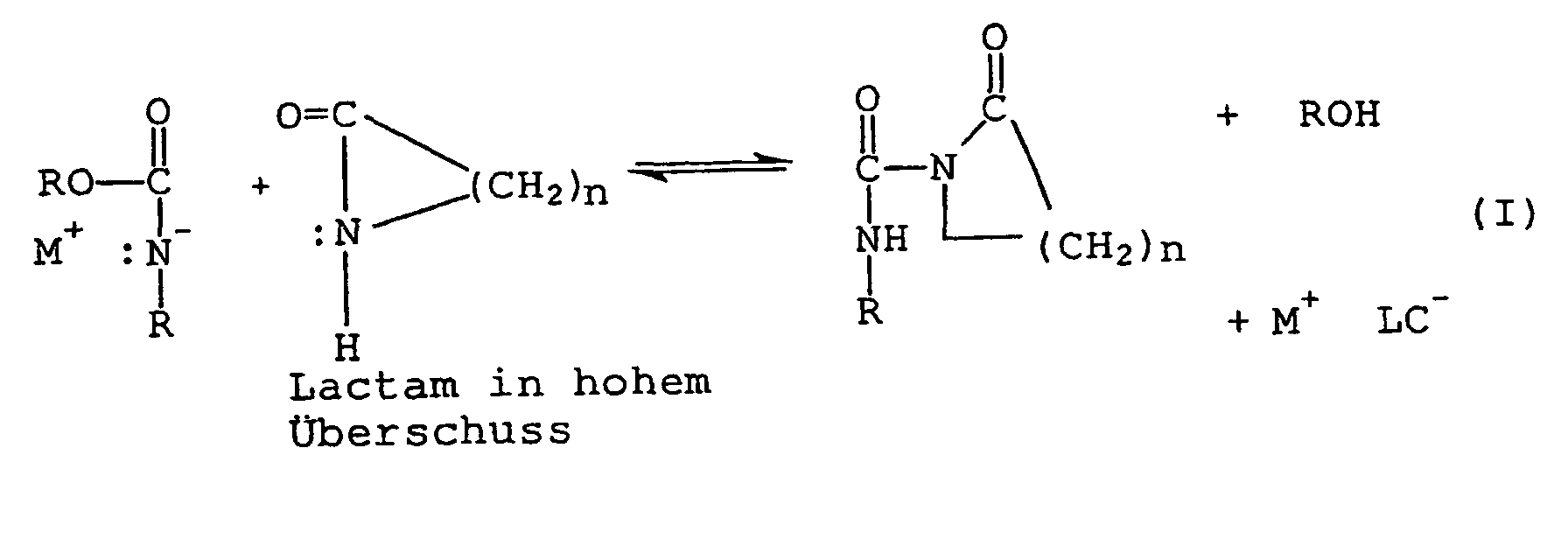
- Characteristic of the initiator according to the invention is that which is necessary for the anionic polymerization of lactam Metal lactamate is not present but is first formed in a prior reaction.
- reaction I HOR wherein the formed alcohol and M + LC - mean metal-lactamate.
- the substitution reaction may slow down and the polymerization of lactam sets only with a time delay.
- the initiator of the invention is suitable especially good for the formation of polylactam as a matrix for composites or highly filled Products.
- protic compound P that fulfills additional tasks in the finished product, such as e.g. the stabilization against heat and weathering damage or in addition the demolding behavior of the finished part, it may e.g. due to steric hindrance or insufficient basicity for adequate deprotonation of lactam, too Delays in the course of polymerization come.
- protic Links e.g. a share the intended additional task and a share a sufficiently rapid polymerization safely.
- carboxylic acid amides are preferable to choose carboxylic acid amides as protic Compound, since its substitutable H atom in the essentially the same acidity as lactam as cyclic Has carboxylic acid amide.
- carboxylic acid amides the higher molecular weight delayed by lactam can be replaced afterwards as an additional task in particular the demolding behavior of the finished part improve and stability against weathering and heat removal cause.
- suitable solvating agents S are especially aliphatic cycloaliphatic and aromatic organic compounds having solvating structural elements which have no acidic H atoms.
- Solvating structural elements in the sense of the invention are, for example, heteroatoms and hetero groups of the type: -O-, -CO-, -O-CO-O-, -SO 2 -, -CO-NR-, -CO-O-, -NR-CO-O-, -NO-, -CN-, - RN-CO-NR-, -NR-, -P (OR) 3 -, -PO (OR) 3 - and phenol ether.
- the lines on the structural elements mean the chemical bonds of the structural elements in the organic compound containing the solvating agent represents and a solvating agent molecule contain several solvating structural elements can.
- the solvating agent may also be a mixture of several Solvatmaschineskomponenten be.
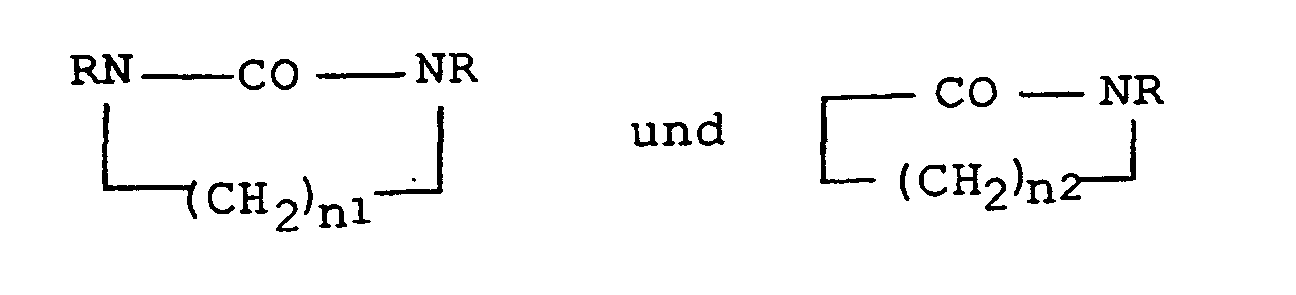
- Suitable solvation components are in particular N-alkylated, cyclic carboxylic acid amides such as N-alkylated Lactam-4, -5 and -6, for example, N-methyl, N-hexyl, N-cyclohexyl and N-octylpyrrolidone as well as N-octyl and N-methylcaprolactam and complete N-alkylated, especially cyclic urea derivatives, wherein the alkyl radical, R, 1-12 contain C atoms can.
- N-alkylated, cyclic carboxylic acid amides such as N-alkylated Lactam-4, -5 and -6, for example, N-methyl, N-hexyl, N-cyclohexyl and N-octylpyrrolidone as well as N-octyl and N-methylcaprolactam and complete N-alkylated, especially cyclic urea derivatives, wherein the alkyl radical,
- n 1 2 and 3 and n 2 is 3-5 and R is an alkyl radical having 1-12 C atoms, which may also contain hetero groups and heteroatoms such as -O- is.
- Suitable, non-cyclic urea derivatives and acid amides are e.g. Tetraalkylurea, e.g. tetrabutyl, Diethylacetamide and dibutylformamide.
- solvating agents are, for example, the cyclic propylene carbonate, etherified polyols, for example the basic structure H 3 CO- (CH 2 -CH 2 -O) n -CH 3 having a molecular weight of up to about 1500, esterified polyglycols such as di- and triethylene glycol diacetate, liquid phthalic acid esters and cyclic ethers such as dioxane. Frequently mixtures of the described solvating agents are also used.
- the solvating agent, S must be able with the help of its solvating structural elements the deprotonated reaction product of isocyanate with P and in particular to solvate the cation in this way, that a liquid at room temperature, storage stable Product is created. Furthermore, it is sufficiently stable to serve as a reaction medium. It must be at the trigger the polymerization of lactam, depending on the selected Process variant, boiling high enough to none Blistering of the melt to cause or even, for. in a continuous procedure, e.g. in a twin-screw extruder, according to sufficient volatility be partially or completely removed can. These are suitable depending on the intended application method both high and low boiling Components S.
- the Solvation component by compounds with special To extend effect. These may e.g. help the polylactam after polymerization against the effects of light, heat and oxidation to protect.
- components in small portions which are a nucleating or exerting effect in the polylactam are often desirable, as are additives with softening Effect, e.g. o-phthalic acid ester, complete esterified polyols e.g. of ethylene glycol or glycerol with acetic acid.
- additives include e.g. optical Brighteners and so-called tracers.
- the necessary Amount used is checked and state of the art and can the technical datasheets to such Products are removed.
- the protic compound P, and the base, B are common to look at, but in the case of the present Invention P prefers in the strongly basic, deprotonated form used.
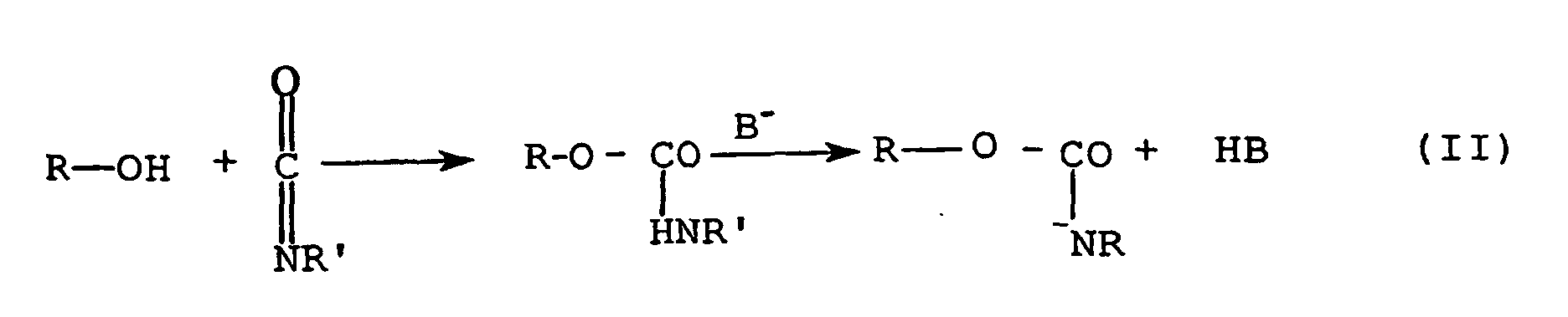
- Reaction Sequence II This can be represented by Reaction Sequence II. wherein the reaction takes place in the selected solvating agent and the protonated base (example methanol) is removed, for example by vacuum.
- P is first reacted via a reaction strong base in the also basic, anionic Transferred form and then as an anion with the Isocyanate reacted.
- Suitable protonic compounds, with sufficient azides H are e.g. Alcohol from C number 1 up to 5.
- Suitable representatives are e.g. Methanol, ethanol, Propanol, especially suitable P are also carboxamides.
- Methanol, ethanol, Propanol, especially suitable P are also carboxamides.
- They can significantly increase the start-up phase of the polymerization influence and additional tasks in the finished part take over, such as improve the demolding behavior.
- Building blocks for carboxylic acid amides are monomers with 1-20 C atoms e.g.
- Mono and diamines such as hexylamine, Cylcohexylamine, isotridecyclamine, diaminohexane and ether group-containing mono- and diamines as well as mono- and dicarboxylic acids such as acetic acid, 2-ethylhexanoic acid, Pelargonic acid and adipic acid.
- mono- and dicarboxylic acids such as acetic acid, 2-ethylhexanoic acid, Pelargonic acid and adipic acid.
- To low molecular weight To provide carboxylic acid amides is e.g. one Monoamine with a monocarboxylic acid or a diamine with 2 molar monocarboxylic acid or a dicarboxylic acid reacted with 2 moles of monoamine.
- Suitable Amines e.g. directly also amide groups included can and the polylactam against heat and To stabilize the action of light, wie.z.B. the commercial products Nylostab S-EED® from Clariant as well Tinuvin 770® from Ciba SC, as well as the OH groups containing stabilizers Chimassorb 81® and Tinuvin 571® also from Ciba SC.
- the chemical Structures of these compounds are shown in Fig. 1 to 4 shown.
- the stabilizer Nylostab and Tinuvin 770 (Fig. 1) are also called “hindered amine light stabilizer "(HALS).
- stabilizers are only exemplified stabilizers, because sterically hindered amines and hydroxy groups, in particular phenolic OH containing Stabilizers are essential classes of compounds, as heat and light stabilizers for polyamides serve.
- suitable addition compounds, P are e.g. Butanone oxime, malonic acid esters such as Diethyl malonate, azo compounds such as 1,2,4-triazole and 3.5-dimethylpyrazole. Soche connections should only make up a share of P and only in combination be used with methylate.
- Base B for deprotonation e.g. according to reaction 2 must have sufficient basicity for the course of the reaction and preferably after deprotonation of the protic agent under heat and vacuum can be deducted continuously.
- it can, for example the methylate, directly as P act and attach to the isocyanate I.
- Preferred bases have an alkali metal, alkaline earth metal or tetraalkylammonium cation and an alkoxide, Amide, hydride or alkylate as anion. Is this Anion, e.g. Alcoholate, it can directly adduct the attachment form.
- alkali and alkaline earth metal alcoholates especially methylates and ethylates, e.g. sodium and -ethylate or alcoholates of lithium, Potassium and magnesium or also tetralkylammonium alcoholate,
- Metal hydrides e.g. Sodium hydride, metal alkyls such as. Butyllithium, amides, e.g. sodium amide, or alkali and alkaline earth metals, the e.g. can be activated by means of iron (II) ions.
- Is used as base a low molecular weight alkoxide of alkali or alkaline earth metal, e.g. sodium methylate, used, it is advantageously solved directly in the corresponding alcohol added during and after implemented via heat and vacuum action is removed again.
- This concept can also be for others of the listed bases, e.g. butyl lithium, dissolved in heptane, can be applied.
- monoisocyanates and diisocyanates, and thioisocyanates containing an aliphatic, cycloaliphatic, aromatic or aliphatic-aromatic Have basic structure and the aromatic Structure e.g. halogenated and alkylated, be used.
- liquid isocyanates are phenyl isocyanate and substituted phenyl isocyanates, cyclohexyl isocyanate, Tolylene diisocyanate, hexamethylene diisocyanate Isophorone diisocyanate and diphenylmethane diisocyanate and diecyclohexylmethane diisocyanate.
- isocyanates cyclize in a basic medium, especially if they have no steric hindrance, often for example to isocyanurates or another structure such as allophanate.
- this structure is then generally destroyed again and P - reacts with the isocyanate (reaction I, structure on the left).
- reaction I structure on the left.
- a major example is the phenyl isocyanate and substituted, aromatic Monoisocyante.
- isocyanurates e.g. Tripropylisocyanurat or Triphenylisocyanurat use, wherein in basic environment of each isocyanurate with cleavage is able to acylate three lactams.
- the liquid initiator FI can also be a reaction product be up to 50% of the isocyanate by a Carbodiimide has been replaced.
- the carbodiimide can an aliphatic, cycloaliphatic, aromatic or Have aliphatic-aromatic structure.
- the initiator may also have property and application related Additives, Z, which the polymerization not or only little or predictable influence be added in a defined proportion.
- additives are e.g. Mold release agent, heat, Light and oxidation stabilizers, wetting and adhesives to fillers, defoamers, nucleating agents, Tracers, optical brighteners, plasticizers and dyes. Their recommended application concentration can mostly from the technical data sheets taken to such products.
- Preferred additives should not be acidic H atoms have.
- reaction product according to the invention is obtained in such a way that the components B: P: I in a molar ratio to each other of 0.2 to 1.1: 0.2 to 4: 1 are used.
- a preferred one Molar ratio of B: P: I is 0.8 to 1.1: 0.8 to 1.2: 1.
- the invention further relates to a method for Preparation of the above-described reaction product.
- Basic component of the accelerating-acting liquid initiator F is always the solvation component S, which largely as the reaction medium used for the production of FK.
- the production takes place at RT to 140 ° C under inert gas and exclusion of moisture.
- aromatic monoisocyanate e.g. Phenyl isocyanate
- trimerization reaction leading to isocyanurate first, by Addition of a catalytic amount of base, e.g. Sodium methylate, targeted by.
- base e.g. Sodium methylate
- a higher molecular weight P in solve a proportion of S and adding B, such as e.g. Convert NaOMe to salt form by mixing the resulting alcohol via heat and vacuum action completely removed, and you put the anionic P then adds to the solution of the trimerized I.
- B such as e.g. Convert NaOMe to salt form by mixing the resulting alcohol via heat and vacuum action completely removed, and you put the anionic P then adds to the solution of the trimerized I.
- the liquid initiators are used for the polymerization of Lactam in continuous or discontinuous Method used.
- the inventive, lactam-free and storage-stable FI can the Reinlactamschmelze in a concentration be added of about 0.3-10 wt .-%, where already lower concentrations of 0.5-3.0 wt% to polylactam lead with excellent properties.
- lactam-12 and lactam-6 and mixtures thereof are Especially suitable, lactam-12 and lactam-6 and mixtures thereof, with polylactam having excellent Hydrolysis stability and very good mechanical Properties results.
- the lactam melt e.g. Lactam 6 at temperatures from 100 ° C to 200 ° C continuously in a defined volume fraction, e.g. above a continuous mixing unit of Fa.
- the FI can in principle be continuous or discontinuous be applied.
- discontinuous Addition is especially at lactam-6 and a temperature the lactam melt of about 100 to 180 ° C suitable for use; continuous addition in continuous Processes, especially for lactam-12, preferably in the polymerization process on the twin-screw extruder (170-300 ° C).
- FI types according to the invention can thus be preferred to be applied selectively in continuous processes and lead to products with an interesting Property profile.
- the resulting moldings are characterized from by good mechanical values, in particular a high toughness and breaking strength, low Abrasion, good weather resistance and a hitherto unattainable resistance to hydrolytic Degradation.
- the invention further relates to a polymer granules producible by continuous or discontinuous anionic polymerization of lactam with a Liquid initiator as described above (claims 26 to 30).
- the granules according to the invention are preferably made from lactam-6 and / or lactam-12.
- the liquid initiator can be in a concentration of 0.3-10 % By weight, preferably 0.5-3% by weight.
- the Process parameters for the preparation of the polymer granules correspond to those as above in the Method described.
- the polymer granules after the Invention is preferred with a twin-screw extruder produced.
- polymer granules are excellent storage stability.
- the polymer granules can then subsequently with shaping tools to various products are further processed.
- Exemplary here is the production of pipes, Profiles, films, fibers, cables, sheaths or Filaments, or even dipping and coating processes, e.g. of preheated metal particles, wherein all processes preferably operated under inert gas to be called.
- the lactam polymerization using inventive FI is also suitable for direct production of moldings (claim 31) in continuous and batch processes such as e.g. the Pultrusion process directly to profiles or long fiber reinforced Granules, which are subsequently thermoplastic, as usual with long fiber granules, in particular by injection molding, further processed can be, and wherein the fibers are preferably glass fibers or C-fibers are.
- Other methods are RTM processes, Monomer casting, spin and spin casting as well as the continuous polymerization on a twin-screw extruder to granules or also with subsequent shaping tools, e.g. for the direct production of pipes, profiles, foils, Fibers, cables, sheathing or filaments, or also of dipping and coating processes; e.g. from preheated metal parts being used in all processes is preferably carried out under inert gas.
- bases B (which can also act as capping agents) NaOMe sodium 54 Close sodium hydride 24 Na-M Metallic sodium 23 NaOEt sodium 68 * Commercial products of the company Ciba SC, Basel ** Commercial product of the company Clariant, Basel
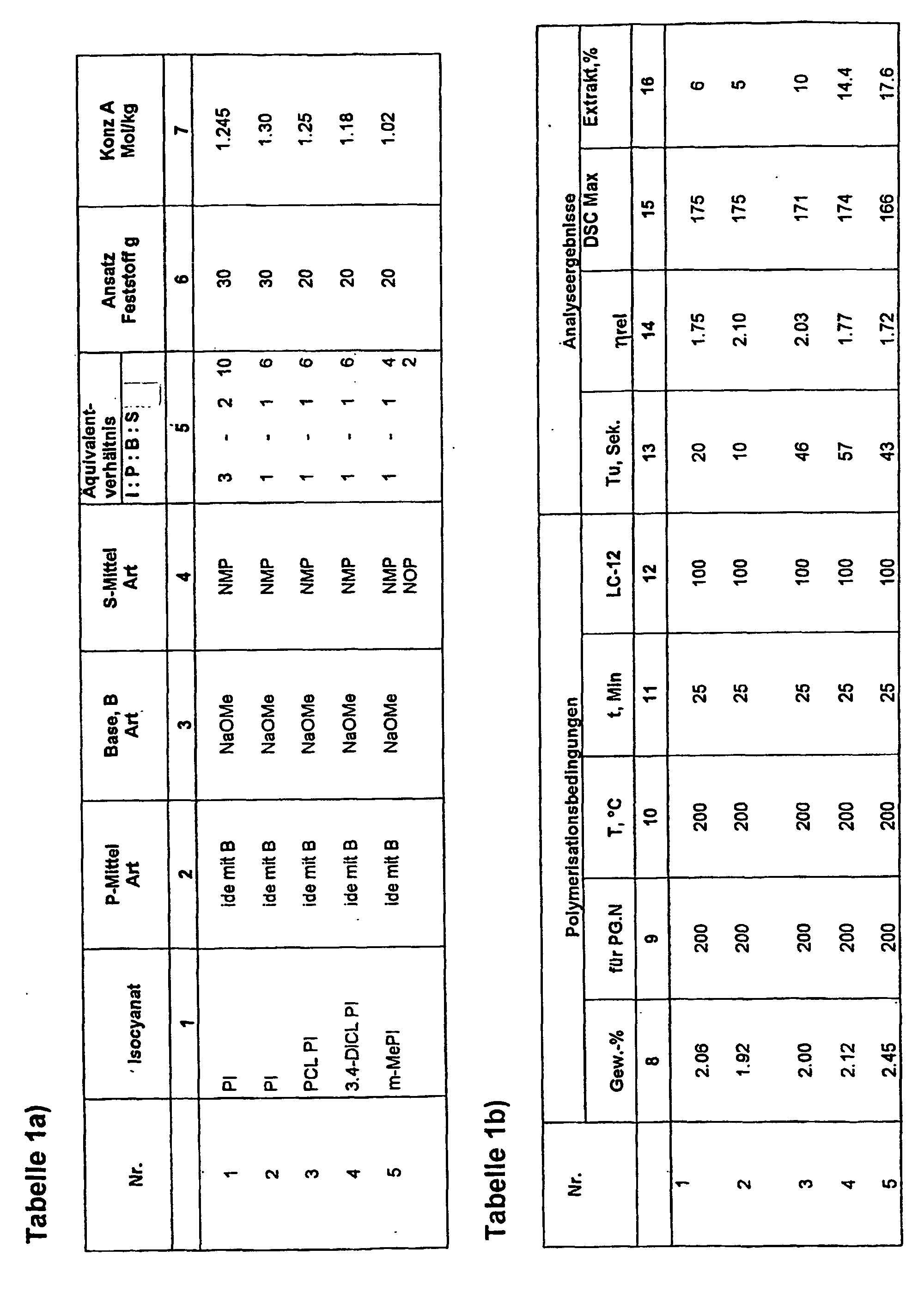
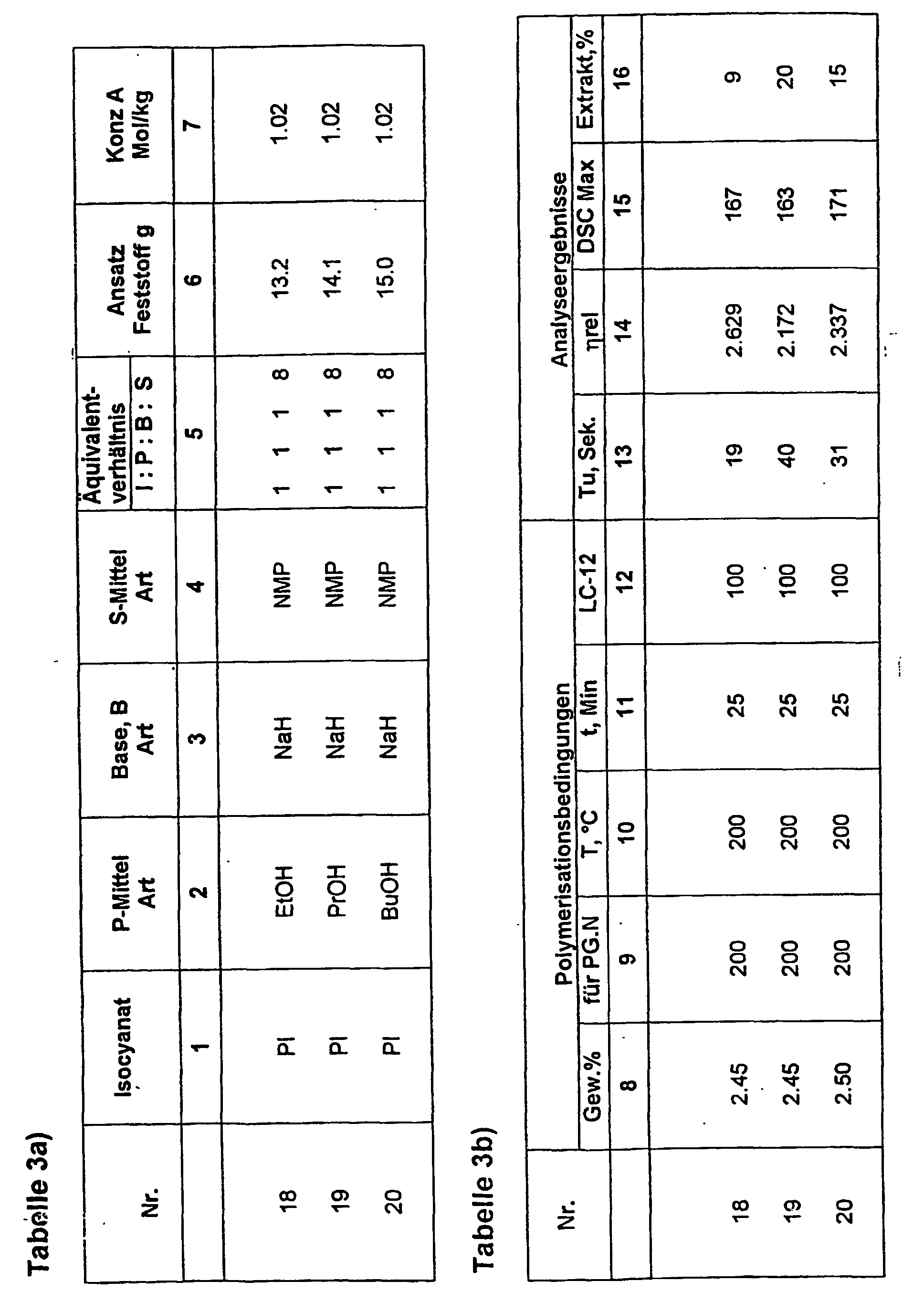
- Example 1 to 5 describes the preparation and use of liquid initiators, FI, for the polymerization of lactam, especially lactam-12 the basis of different isocyanates. It has aromatic isocyanate, e.g. Phenyl isocyanate dissolved in a solvating agent, on basification, a trimerization reaction goes through to the isocyanurate.
- aromatic isocyanate e.g. Phenyl isocyanate dissolved in a solvating agent, on basification, a trimerization reaction goes through to the isocyanurate.
- the solvating agent S becomes 2% of the base portion provided and preheated to about 80 ° C. After that is added in portions, the isocyanate, and the Addition controlled so that the temperature of the reaction mass does not rise above 110 ° C. Because of the relative high heat of the trimerization reaction must This reaction step is always carefully controlled become. After completion of Isocyanurat Guess, the e.g. can be followed by IR spectroscopy and after about 1 hour has ended, the reaction solution is allowed to stand Cool to about 80 ° C and then dripping Sodium methylate as about 30% solution in methanol at a temperature of the reaction mixture of about 80 ° C, while the methanol is continuously under Deducts the vacuum effect.
- This characteristic time for the respective FI, designated T u is entered in column 13 in the table.
- the mixture is then polymerized without stirring to completion, the polymerisate, which is present as a disc, and then measured on Bohrs Georghnen, depending on the objective and needs, the relative solution viscosity of a 0.5 percent solution in metacresol, the melting point maximum determined by the DSC method or the sample is extracted with methanol and the extraction residue is determined graphimetrically.
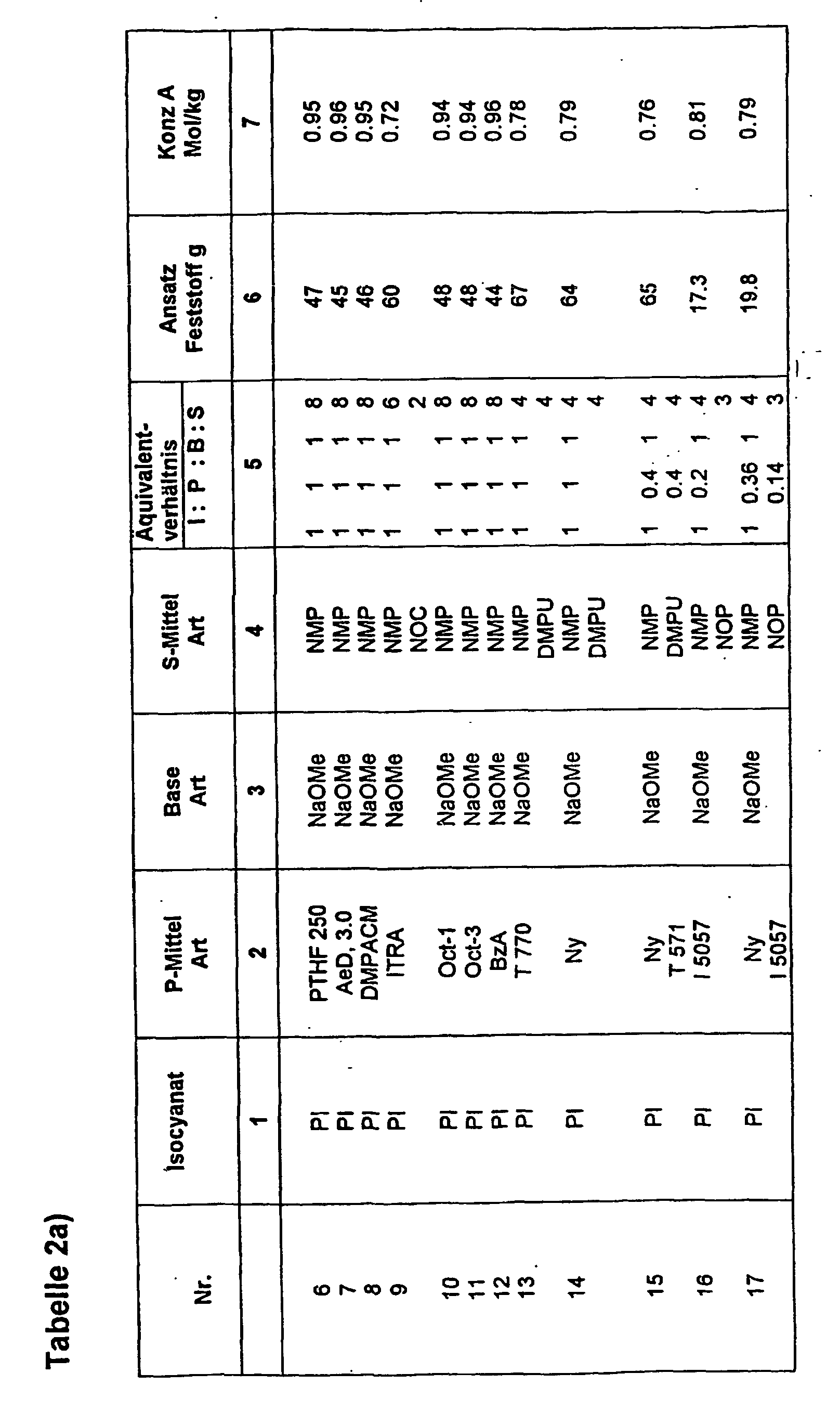
- Table 2 shows examples 6 to 17 of liquid initiators based on phenyl isocyanate with various protic agents, whereby again table 2a) the stoichiometric ratio of the starting materials and table 2b) the polymerization conditions and the analysis results.
- aromatic isocyanate, (phenyl isocyanate), in the trimerized isocyanurate form in the P agent, in particular NMP (solution a) was used, and parallel to this, the P agents were dissolved in a supplemental amount of S agents and with the base NaOMe converted into their salt form. Stoichiometric proportions of a) were then combined with deprotonated, solvated P agent in S and allowed to afterreaction to result in FI with stoichiometry according to Table 2a).
- solution a To prepare solution a), the procedure was as follows. In 693 g of NMP were added for basal sites Dissolve 4.75 g of NaOMe and heat the solution to 80 ° C. Then, 208g PI slowly became within half Hour so dropped that the temperature of the solution did not rise above 110 ° C (positive heat of the Trimerization reaction) and then at 80-100 ° C Allowed to react for 0.5 h so that all PI in the Isocyanuratform was transferred. The reaction mixture was then in identical portions, each containing 0.175 mol of trimerized PI, split.
- reaction mixture preheated to 80 ° C a) with the separately prepared solution of deprotonated P, combined in S and ca. 10 min. at 80 - 100 ° C left to react, and the formed FI then cooled to room temperature and for the Polymerization experiments used.
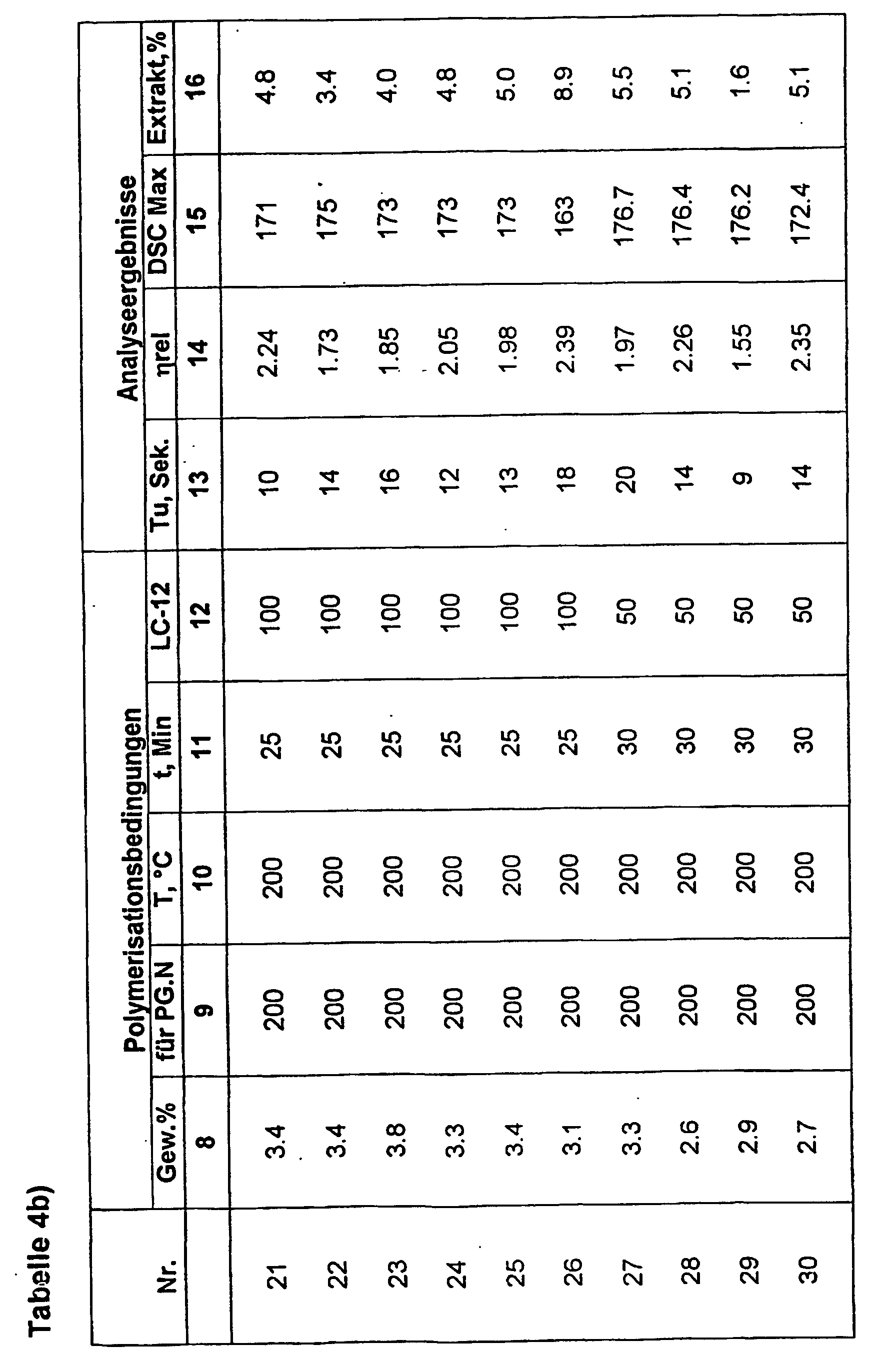
- acylation component in FI was on the one hand again separately prepared, trimerized phenyl isocyanate used (solution a); see examples 6 - 17) and in experiments 27-29 directly the aliphatic Cyclohexyl isocyanate and in experiment 29 the aliphatic Dicyclohexyl diisocyanate used.
- the resulting liquid initiators show a total Good behavior regarding triggering and expiration the polymerization of lactam-12. This could be due to the fact that linear carboxylic acid amide approximately the same acidity with respect to the eliminable H atoms are like the lactams.
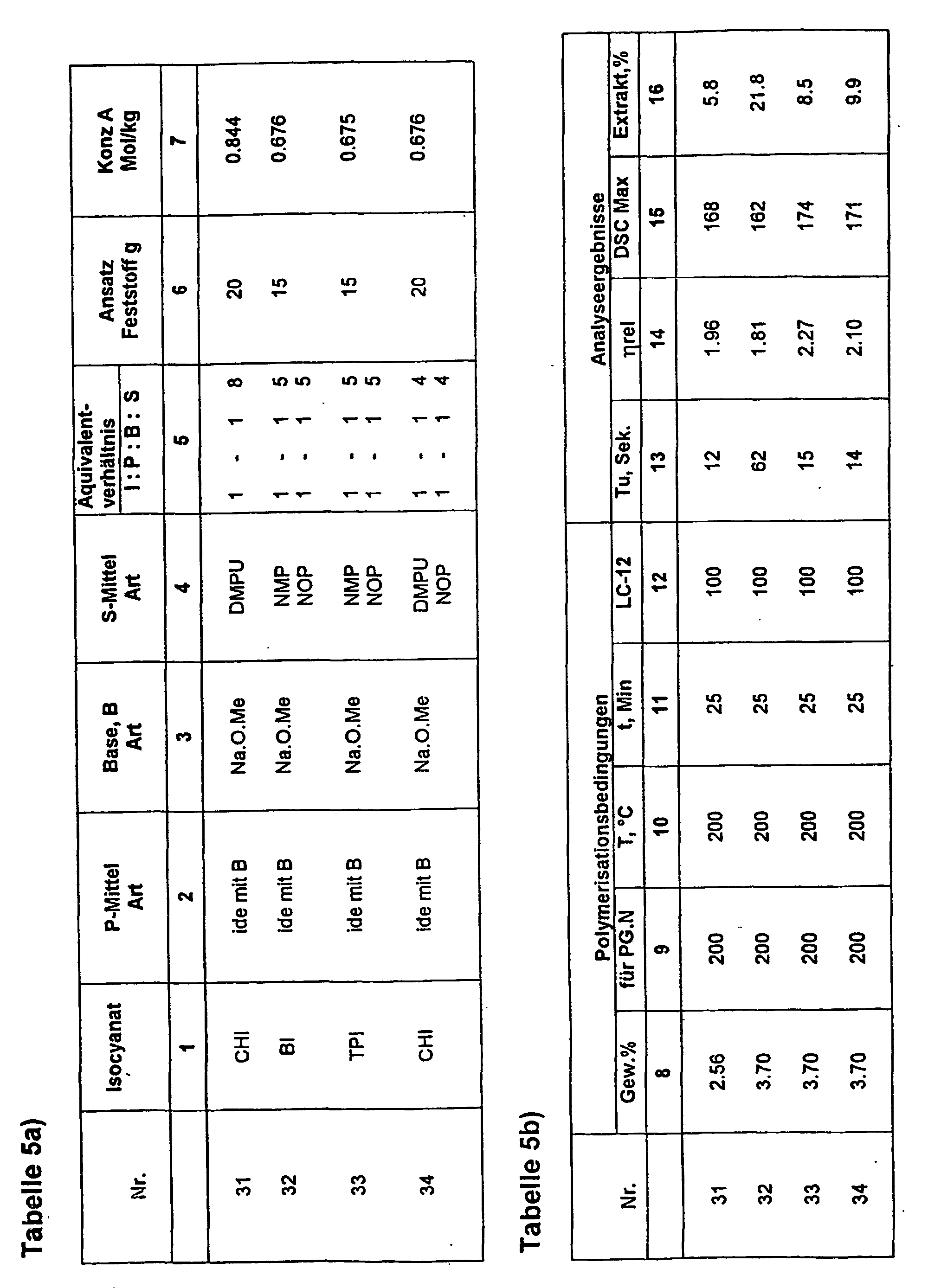
- liquid initiator CHI base
- solution a the total amount of NaOMe introduced into the DMPU portion and residual methanol completely removed.
- cyclohexyl isocyanate, CHI dissolved in NOP at 80 ° C and then added with stirring in solution a) and until stirred to clarify the reaction mixture, then cooled to room temperature.
- lactam-6 with FI was also tested 1, 16 and 17 and an addition of FI accordingly 0.5 equiv .-% based on lactam-6 reacted to polylactam.
- the lactam was dried carefully.
- the polymerization was identical to the conditions at lactam-12, ie for 30 minutes at 200 ° C.
- the products of experiment 1 resp. 16 and 17 have residual lactam contents of 6.6, 8.9 and 9.3 wt .-% and SMP maxima in the DSC of about 215 ° C and show spontaneous detachment from the vessel wall.
Landscapes
- Chemical & Material Sciences (AREA)
- Health & Medical Sciences (AREA)
- Chemical Kinetics & Catalysis (AREA)
- Medicinal Chemistry (AREA)
- Polymers & Plastics (AREA)
- Organic Chemistry (AREA)
- Polyamides (AREA)
- Polyurethanes Or Polyureas (AREA)
Description
-O-, -CO-, -O-CO-O-, -SO2-, -CO-NR-, -CO-O-, -NR-CO-O-, -NO-, -CN-, -RN-CO-NR-, -NR-, -P(OR)3-, -PO(OR)3- sowie Phenoläther.
In Tabelle b) welche Polymerisationsversuche beinhaltet, bedeuten:
| bei den Solvatisierungsmitteln, S: | Äquivalentgewichte | |
| NMP | N-Methylpyrrolidon | 99 |
| NOP | N-Octylpyrrolidon | 197 |
| NOC | N-Octylcaprolactam | 225 |
| DMEU | Dimethylethylenharnstoff | 114 |
| DMPU | Dimethylpropylenharnstoff | 128 |
| bei den Isocyanaten | ||
| PI | Phenylisocyanat | 119 |
| PCLPI | p-Chlorphenylisocyanat | 154 |
| 3.4-DiCLPI | 3.4-Dichlorphenylisocyanat | 188 |
| mMEPI | m-Tolylisocyanat | 133 |
| W | Methylen-bis(4-isocyanatocyclohexan) | 131 |
| CHI | Cyclohexylisocyanat | 125 |
| BI | Butylisocyanat | 99 |
| TPI | Tripropylisocyanurat | 85 |
| Bei den protischen Mitteln P | ||
| PTHF250 | Aminterminiertes Polytetrahydrofuran | 125 |
| AeD, 3.0 | 4.7.10 Trioxatridecan-1.13-diamin | 110 |
| DMPACM | 3,3' Dimethyl-4,4'diaminodicyclohexylmethan | 119 |
| ITRA | Isotridecylamin | 199 |
| EtOH | Äthylalkohol | 46 |
| PrOH | Propylalkohol | 60 |
| BuOH | 1-Butanol | 74 |
| BuOH.2 | 2-Butanol | 74 |
| BzA | Benzylalkohol | 108 |
| Oct-1; Oct-3 | Octanol-1;Octanol-3 | 130 |
| T770 | Tinuvin 770* | 240 |
| T312 | Tinuvin 312* | 312 |
| T571 | Tinuvin 571 | 394 |
| 15057 | lrganox 5057* | 393 |
| Ny | Nylostab S-EED** | 221 |
| Bei Carbonsäureamiden als P-Mittel | ||
| Bz. AeD3.O | 214 | |
| Bz AeD3.O | 241 | |
| Ac.ITRA | ||
| Bz. ITRA | 303 | |
| Et.hs.HMD | 184 | |
| Capr.AeD3.O | 208 | |
| Pel.HMD | 198 | |
| Ac.HMD | 100 |
| Bz | = Benzoesäure, | AC = Essigsäure, |
| Et.hs | = 2-Äthyl-hexansäure | |
| Capr | = Capronsäure Pel. | = Pelargonsäure |
| AeD, 3.0 | = 4.7.10.-Trioxatridecan-1.13-diamin, | |
| ITRA | = Isotridecylamin | |
| HMD | = 1,6 Diaminohexan |
| NaOMe | Natriumethylat | 54 |
| NaH | Natriumhydrid | 24 |
| Na-M | Metallisches Natrium | 23 |
| NaOEt | Natriummethylat | 68 |
| * Handelsprodukte der Firma Ciba SC, Basel | ||
| ** Handelsprodukt der Firma Clariant, Basel |
Für die gesamte Versuchsreihe wurde aromatisches Isocyanat, (Phenylisocyanat), in der trimerisierten Isocyanuratform im P-Mittel, insbesondere NMP (Lösung a) verwendet, und parallel dazu die P-Mittel in einem ergänzenden Anteil an S-Mittel gelöst und mit der Base NaOMe in ihre Salzform überführt. Stöchimetrische Anteile von a) wurden sodann mit deprotoniertem, solvatisiertem P-Mittel in S so vereinigt und zur Nachreaktion gebracht, dass FI mit Stöchiometrie gemäss Tabelle 2a) resultiert.


Claims (30)
- Flüssiginitiator für die Durchführung der anionischen Lactampolymerisation,
dadurch gekennzeichnet, daß
er ein Umsetzungsprodukt von Isocyanat I mit einer protischen Verbindung P die ausgewählt ist aus Alkoholen mit 1 bis 5 C-Atomen, Carbonsäureamiden, und/oder sterisch gehinderten aliphatischen Aminen und einer Base B in einem aprotischen Solvatisierungsmittel S enthält. - Flüssiginitiator nach Anspruch 1, dadurch gekennzeichnet, daß das Isocyanat eine aliphatische, cycloaliphatische, aromatische oder aliphatisch-aromatische Grundstruktur besitzt.
- Flüssiginitiator nach Anspruch 2, dadurch gekennzeichnet, daß das I ausgewählt ist aus Phenylisocyanat und substituierten Phenylisocyanaten, Cyclohexylisocyanat, Toluylendiisocyanat, Isophorondiisocyanat, Diphenylmethandiisocyanat, Dicyclohexylmethandiisocyanat und Hexamethylendiisocyanat oder Mischungen hiervon.
- Flüssiginitiator nach Anspruch 2 oder 3, dadurch gekennzeichnet, daß die Isocyanate vollständig oder teilweise in cyclisierter Form vorliegen.
- Flüssiginitiator nach mindestens einem der Ansprüche 1 bis 4, dadurch gekennzeichnet, daß er ein Umsetzungsprodukt enthält bei dem das Isocyanat durch 1-50 Äquivalentprozent Carbodiimid ersetzt worden ist.
- Flüssiginitiator nach mindestens einem der Ansprüche 1 bis 5, dadurch gekennzeichnet, daß die protische Verbindung P eine pkA > 13 aufweist und ggf. in deprotonierter Form vorliegt.
- Flüssiginitiator nach Anspruch 6, dadurch gekennzeichnet, daß die Carbonsäureamide aus linearen und/oder cyclischen Monomeren mit 2-20 C-Atomen aufgebaut sind.
- Flüssiginitiator nach mindestens einem der Ansprüche 1 bis 7, dadurch gekennzeichnet, daß das Kation der Base B ein Alkali- oder Erdalkaliion oder Tetraalkylammonium ist und die Base ausgewählt ist aus Alkoholat, Amid, Hydrid oder Alkylanion.
- Flüssiginitiator nach Anspruch 8, dadurch gekennzeichnet, daß die Base B ein Alkali- oder Erdalkalialkoholat ist.
- Flüssiginitiator nach mindestens einem der Ansprüche 1 bis 9, dadurch gekennzeichnet, daß das S eine aliphatische, cycloaliphatische oder aromatische organische Verbindung ist, die solvatisierende Strukturelemente besitzt, die keine aziden H-Atome aufweisen.
- Flüssiginitiatoren nach Anspruch 10, dadurch gekennzeichnet, daß S eine polare aprotische Verbindung ausgewählt aus der Gruppe veretherte Polyglykole, flüssige Phthalsäureester, N-alkylierte Harnstoff-Verbindungen, N-alkylierte Carbonsäureamide oder deren Gemische ist.
- Flüssiginitiator nach Anspruch 11, dadurch gekennzeichnet, daß die Harnstoffverbindung ein Tetraalkylharnstoff mit 1-12 C-Atomen ist, insbesondere ausgewählt aus der Gruppe Tetramethylharnstoff, Tetraethylharnstoff, Tetrabutylharnstoff oder eine cyclische Struktur gemäß der allgemeinen Formel Iin welcher R ein Alkylrest mit 1-5 C-Atomen, insbesondere ein Methylrest ist und wobei n 2 oder 3 ist.

- Flüssiginitiator nach Anspruch 11, dadurch gekennzeichnet, daß S ein cyclisches 5-7 gliedriges N-alkyliertes Carbonsäureamid ist und der Alkyrest 1-12 C-Atome besitzt, wobei auch Heteroatome enthalten sein können.
- Flüssiginitiator nach Anspruch 11, dadurch gekennzeichnet, daß S N-Methylpyrrolidon, N-Octylpyrrolidon, N Cyclohexylpyrrolidon, N-Octylcaprolactam oder ein Gemisch hiervon ist.
- Flüssiginitiator nach Anspruch 11, dadurch gekennzeichnet, daß das Solvatisierungsmittel ein Gemisch aus Harnstoffderivat und Säureamid ist.
- Flüssiginitiator nach mindestens einem der Ansprüche 1 bis 15, dadurch gekennzeichnet, daß er zusätzlich herstellungs- und/oder verwendungsbedingte Zusätze enthält.
- Flüssiginitiator nach mindestens einem der Ansprüche 1 bis 16, dadurch gekennzeichnet, daß das Umsetzungsprodukt erhalten worden ist mit der Maßgabe, daß B:P:I im Verhältnis von 0,2-1,1:0,2-4:1 eingesetzt worden ist.
- Flüssiginitiator nach Anspruch 17, dadurch gekennzeichnet, daß das Molverhältnis B:P:I 0,8-1,1:0,8-1,2:1 ist.
- Verfahren zur Herstellung eines Flüssiginitators nach mindestens einem der Ansprüche 1 bis 18, dadurch gekennzeichnet, daß das Umsetzungsprodukt im Solvatisierungsmittel S unter Inertgas und Feuchtigkeitsausschluß bei Raumtemperatur bis 140 °C hergestellt wird, wobei niedermolekulare Lösemittel für die Base und Neutralisationsprodukte der Base, insbesondere niedermolekulare Alkohole entfernt werden.
- Verfahren nach Anspruch 19, dadurch gekennzeichnet, daß in einem vorgelagerten Schritt die protische Verbindung P mit der Base B umgesetzt wird, so daß P in basischer Form vorliegt und so dann die deprotonisierte Verbindung P in der basischen Form dem im Solvatisierungsmittel S gelösten Isocyanat zugegeben wird.
- Verfahren nach Anspruch 19 oder 20, dadurch gekennzeichnet, daß in einem vorgelagerten Verfahrensschritt das Isocyanat einer Cyclisierung zum Isocyanurat unterzogen und dann anschließend die Reaktionsstufe mit stöchiometrischer Bäsenzugabe fortgeführt wird.
- Verfahren nach mindestens einem der Ansprüche 19 bis 21, dadurch gekennzeichnet, daß man getrennt in einem Anteil Solvatisierungsmittel S P löst und P über Basezugabe B in die anionische Salzform überführt und flüchtige Reaktionsprodukte sowie die Polymerisation behindernde Löse- und Solvatisierungsmittelbestandteile entfernt und daß man danach das Isocyanat im Solvatisierungsmittel S und die deprotonierte Verbindung gelöst im Solvatisierungsmittel S zusammenfügt und zum Flüssiginitiator umsetzt.
- Verfahren nach Anspruch 19, dadurch gekennzeichnet, daß man das Isocyanat I mit der protischen Verbindung P umsetzt und dieses verkappte Isocyanat anschließend mit Hilfe einer Base deprotoniert und so zum FI umsetzt.
- Verfahren nach Anspruch 22 oder 23, dadurch gekennzeichnet, daß das Isocyanat bevorzugt in der trimerisierten Form eingesetzt wird.
- Polymergranulat herstellbar durch kontinuierliche oder diskontinuierliche anionische Polymerisation von Lactam mit einem Flüssiginitiator nach mindestens einem der Ansprüche 1 bis 18.
- Polymergranulat nach Anspruch 25, dadurch gekennzeichnet, daß als Lactam Lactam-6 und/oder Lactam-12 verwendet worden ist.
- Polymergranulat nach Anspruch 25 oder 26, dadurch gekennzeichnet, daß der Lactamschmelze der Flüssiginitiator in einer Konzentration von 0,3-10 Gew.-% zugefügt worden ist.
- Polymergranulat nach Anspruch 27, dadurch gekennzeichnet, daß eine Konzentration von 0,5-3 Gew.-% eingestellt worden ist.
- Polymergranulat nach mindestens einem der Ansprüche 25 bis 28, dadurch gekennzeichnet, daß das Polymergranulat kontinuierlich auf einem Doppelwellenextruder hergestellt worden ist.
- Verwendung des Flüssiginitiators nach einem der Ansprüche 1 oder 18, zur direkten Herstellung von Gebrauchsgegenständen aus Polylactam in einem diskontinuierlichen oder kontinuierlichen Prozess der Art Monomerguss, Extrusion, Schleuderguss, Spritzguss, Rotationsguss, Pultrusions-, Tauch- und Sprühverfahren, wobei der Flüssiginitiator jeweils der Lactamschmelze zugefügt ist.
Applications Claiming Priority (3)
| Application Number | Priority Date | Filing Date | Title |
|---|---|---|---|
| DE19961819 | 1999-12-21 | ||
| DE19961819A DE19961819C2 (de) | 1999-12-21 | 1999-12-21 | Flüssiginitiator zur beschleunigten Durchführung der anionischen Lactampolymerisation, Verfahren zu dessen Herstellung und Verwendung |
| PCT/EP2000/012053 WO2001046293A1 (de) | 1999-12-21 | 2000-11-30 | Flüssiginitiator zur beschleunigten durchführung der anionischen lactampolymerisation, verfahren zu dessen herstellung und verwendung |
Publications (2)
| Publication Number | Publication Date |
|---|---|
| EP1240237A1 EP1240237A1 (de) | 2002-09-18 |
| EP1240237B1 true EP1240237B1 (de) | 2005-09-28 |
Family
ID=7933678
Family Applications (1)
| Application Number | Title | Priority Date | Filing Date |
|---|---|---|---|
| EP00993516A Expired - Lifetime EP1240237B1 (de) | 1999-12-21 | 2000-11-30 | Flüssiginitiator zur beschleunigten durchführung der anionischen lactampolymerisation, verfahren zu dessen herstellung und verwendung |
Country Status (8)
| Country | Link |
|---|---|
| US (1) | US6881819B2 (de) |
| EP (1) | EP1240237B1 (de) |
| JP (1) | JP2003518180A (de) |
| KR (1) | KR100673145B1 (de) |
| AT (1) | ATE305484T1 (de) |
| AU (1) | AU781875B2 (de) |
| DE (2) | DE19961819C2 (de) |
| WO (1) | WO2001046293A1 (de) |
Families Citing this family (7)
| Publication number | Priority date | Publication date | Assignee | Title |
|---|---|---|---|---|
| DE10129049A1 (de) * | 2001-06-15 | 2003-06-26 | Ems Chemie Ag | Flüssigkatalysator |
| DE10247470A1 (de) * | 2002-10-11 | 2004-04-29 | Ems-Chemie Ag | Abbaustabiles Polyamid und Verfahren zu dessen Herstellung |
| DE10341811B4 (de) * | 2003-09-10 | 2006-09-28 | Ems-Chemie Ag | Katalysatorlösung zur Durchführung der anionischen Lactampolymerisation, Verfahren zu deren Herstellung und Polyamidformmasse |
| US7951912B2 (en) | 2005-08-26 | 2011-05-31 | Wisconsin Alumni Research Foundation | Poly-β-peptides from functionalized β-lactam monomers and antibacterial compositions containing same |
| KR102020485B1 (ko) | 2013-01-11 | 2019-09-11 | 삼성디스플레이 주식회사 | 블록 공중합체, 그 형성 방법 및 패턴 형성 방법 |
| CN104693059A (zh) * | 2013-12-09 | 2015-06-10 | 中国科学院兰州化学物理研究所 | 二乙酰己二胺诱导分化剂的晶型及其制备方法和应用 |
| CZ305870B6 (cs) * | 2014-12-18 | 2016-03-23 | Univerzita Pardubice | Způsob přípravy biodegradovatelných polymerů, biodegradovatelné polymery a jejich použití |
Family Cites Families (10)
| Publication number | Priority date | Publication date | Assignee | Title |
|---|---|---|---|---|
| GB1099759A (en) | 1966-12-28 | 1968-01-17 | Du Pont | Caprolactam compositions and use thereof |
| DE2230732C3 (de) | 1972-06-23 | 1982-03-25 | Bayer Ag, 5090 Leverkusen | Verfahren zur Herstellung von Polyamiden durch die Polymerisation von Lactamen und Katalysatorlösungen hierfür |
| DE4002260A1 (de) | 1990-01-26 | 1991-08-01 | Basf Ag | Katalysatorloesung fuer die anionische polymerisation von lactamen und deren verwendung fuer die anionische polymerisation von caprolactam |
| DE19603305C2 (de) * | 1996-01-25 | 1999-07-22 | Inventa Ag | Flüssiges Mehrkomponentensystem zur Durchführung der anionischen Lactampolymerisation |
| DE19602683C1 (de) | 1996-01-25 | 1997-09-18 | Inventa Ag | Flüssigsystem zur Durchführung der anionischen Lactampolymerisation |
| DE19603302C2 (de) * | 1996-01-25 | 1999-09-02 | Inventa Ag | Verfahren zur aktivierten anionischen Lactampolymerisation |
| DE19603303C2 (de) * | 1996-01-25 | 1999-07-22 | Inventa Ag | Kontinuierliches Verfahren zur aktivierten anionischen Lactampolymerisation |
| DE19602684C1 (de) | 1996-01-25 | 1997-08-28 | Inventa Ag | Flüssiges System zur Durchführung der anionischen Lactampolymerisation |
| DE19715679C2 (de) | 1997-04-15 | 1999-06-02 | Inventa Ag | Verfahren zur Herstellung eines katalytisch wirkenden Flüssigsystems zur Auslösung der anionischen Lactam-Polymerisation |
| FR2814466B1 (fr) * | 2000-09-22 | 2003-01-10 | Atofina | Procede de polymerisation anionique de lactames |
-
1999
- 1999-12-21 DE DE19961819A patent/DE19961819C2/de not_active Expired - Fee Related
-
2000
- 2000-11-30 DE DE50011263T patent/DE50011263D1/de not_active Expired - Fee Related
- 2000-11-30 JP JP2001547198A patent/JP2003518180A/ja not_active Withdrawn
- 2000-11-30 EP EP00993516A patent/EP1240237B1/de not_active Expired - Lifetime
- 2000-11-30 US US10/168,591 patent/US6881819B2/en not_active Expired - Fee Related
- 2000-11-30 AU AU28386/01A patent/AU781875B2/en not_active Ceased
- 2000-11-30 WO PCT/EP2000/012053 patent/WO2001046293A1/de not_active Ceased
- 2000-11-30 AT AT00993516T patent/ATE305484T1/de not_active IP Right Cessation
- 2000-11-30 KR KR1020027007910A patent/KR100673145B1/ko not_active Expired - Fee Related
Also Published As
| Publication number | Publication date |
|---|---|
| KR100673145B1 (ko) | 2007-01-22 |
| JP2003518180A (ja) | 2003-06-03 |
| ATE305484T1 (de) | 2005-10-15 |
| KR20020063244A (ko) | 2002-08-01 |
| DE19961819A1 (de) | 2001-07-05 |
| EP1240237A1 (de) | 2002-09-18 |
| DE19961819C2 (de) | 2002-11-14 |
| US20030149229A1 (en) | 2003-08-07 |
| AU2838601A (en) | 2001-07-03 |
| DE50011263D1 (de) | 2006-02-09 |
| US6881819B2 (en) | 2005-04-19 |
| WO2001046293A1 (de) | 2001-06-28 |
| AU781875B2 (en) | 2005-06-16 |
Similar Documents
| Publication | Publication Date | Title |
|---|---|---|
| EP0872508B1 (de) | Verfahren zur Herstellung eines lagerstabilen Flüssigsystems zur Durchführung der anionischen Lactam-Polymerisation | |
| DE102005023419B4 (de) | Polyamid-Oligomere und deren Verwendung | |
| DE1067591B (de) | Verfahren zur Beschleunigung der ionischen Polymerisation von mehr als sechs Ringglieder enthaltenden Lactamen | |
| EP3470452A1 (de) | Verfahren zur herstellung von gusspolyamiden | |
| EP1240237B1 (de) | Flüssiginitiator zur beschleunigten durchführung der anionischen lactampolymerisation, verfahren zu dessen herstellung und verwendung | |
| EP0786483A2 (de) | Verfahren zur aktivierten anionischen Lactampolymerisation | |
| DE202012012693U1 (de) | Zusammensetzung für die anionische Polymerisation von Lactamen | |
| EP0786486B1 (de) | Flüssiges Mehrkomponentensystem für die anionische Lactampolymerisation | |
| DE19602683C1 (de) | Flüssigsystem zur Durchführung der anionischen Lactampolymerisation | |
| EP1514887B1 (de) | Katalysatorlösung zur Durchführung der anionischen Lactampolymerisation, Verfahren zur deren Herstellung und Polyamidformmasse | |
| EP1242507B1 (de) | Flüssiginitiator zur beschleunigten durchführung der anionischen lactampolymerisation, verfahren zu dessen herstellung und verwendung | |
| EP0288894B1 (de) | Alpha-amino-epsilon-caprolactam modifizierte Polyamide | |
| EP1266925B1 (de) | Flüssigkatalysator | |
| WO2018041642A1 (de) | Verfahren zur herstellung eines polyamids mit kaliumlactamat | |
| DE1301112C2 (de) | Verfahren zur Herstellung von Formkoerpern auf der Basis von Polyamiden | |
| DE1745238A1 (de) | Polyamid bildende,lagerfaehige Gemische aus Lactamen und Katalysatoren | |
| DE1187372B (de) | Verfahren zur Herstellung von Polyamiden | |
| DE68910407T2 (de) | Verfahren zur Herstellung von modifizierten schlagfesten Polyamiden. | |
| US4261881A (en) | Poly-2-pyrrolidone composition having improved stability and method of extruding | |
| DE19603304C2 (de) | Verwendung von Oxazolin-Verbindungen als Aktivator zur Auslösung der anionischen Lactampolymerisation | |
| EP3670575A1 (de) | Verfahren zur herstellung eines katalysatorsystems, katalysatorsystem, und dessen verwendung für die herstellung von gusspolyamid |
Legal Events
| Date | Code | Title | Description |
|---|---|---|---|
| PUAI | Public reference made under article 153(3) epc to a published international application that has entered the european phase |
Free format text: ORIGINAL CODE: 0009012 |
|
| 17P | Request for examination filed |
Effective date: 20020618 |
|
| AK | Designated contracting states |
Kind code of ref document: A1 Designated state(s): AT BE CH CY DE DK ES FI FR GB GR IE IT LI LU MC NL PT SE TR |
|
| AX | Request for extension of the european patent |
Free format text: AL;LT;LV;MK;RO;SI |
|
| GRAP | Despatch of communication of intention to grant a patent |
Free format text: ORIGINAL CODE: EPIDOSNIGR1 |
|
| GRAS | Grant fee paid |
Free format text: ORIGINAL CODE: EPIDOSNIGR3 |
|
| GRAA | (expected) grant |
Free format text: ORIGINAL CODE: 0009210 |
|
| AK | Designated contracting states |
Kind code of ref document: B1 Designated state(s): AT BE CH CY DE DK ES FI FR GB GR IE IT LI LU MC NL PT SE TR |
|
| PG25 | Lapsed in a contracting state [announced via postgrant information from national office to epo] |
Ref country code: FI Free format text: LAPSE BECAUSE OF FAILURE TO SUBMIT A TRANSLATION OF THE DESCRIPTION OR TO PAY THE FEE WITHIN THE PRESCRIBED TIME-LIMIT Effective date: 20050928 Ref country code: IE Free format text: LAPSE BECAUSE OF FAILURE TO SUBMIT A TRANSLATION OF THE DESCRIPTION OR TO PAY THE FEE WITHIN THE PRESCRIBED TIME-LIMIT Effective date: 20050928 Ref country code: TR Free format text: LAPSE BECAUSE OF FAILURE TO SUBMIT A TRANSLATION OF THE DESCRIPTION OR TO PAY THE FEE WITHIN THE PRESCRIBED TIME-LIMIT Effective date: 20050928 |
|
| REG | Reference to a national code |
Ref country code: GB Ref legal event code: FG4D Free format text: NOT ENGLISH |
|
| REG | Reference to a national code |
Ref country code: CH Ref legal event code: NV Representative=s name: TROESCH SCHEIDEGGER WERNER AG Ref country code: CH Ref legal event code: EP |
|
| REG | Reference to a national code |
Ref country code: IE Ref legal event code: FG4D Free format text: LANGUAGE OF EP DOCUMENT: GERMAN |
|
| PG25 | Lapsed in a contracting state [announced via postgrant information from national office to epo] |
Ref country code: CY Free format text: LAPSE BECAUSE OF FAILURE TO SUBMIT A TRANSLATION OF THE DESCRIPTION OR TO PAY THE FEE WITHIN THE PRESCRIBED TIME-LIMIT Effective date: 20051130 Ref country code: AT Free format text: LAPSE BECAUSE OF NON-PAYMENT OF DUE FEES Effective date: 20051130 Ref country code: BE Free format text: LAPSE BECAUSE OF NON-PAYMENT OF DUE FEES Effective date: 20051130 Ref country code: LU Free format text: LAPSE BECAUSE OF NON-PAYMENT OF DUE FEES Effective date: 20051130 Ref country code: MC Free format text: LAPSE BECAUSE OF NON-PAYMENT OF DUE FEES Effective date: 20051130 |
|
| PG25 | Lapsed in a contracting state [announced via postgrant information from national office to epo] |
Ref country code: GR Free format text: LAPSE BECAUSE OF FAILURE TO SUBMIT A TRANSLATION OF THE DESCRIPTION OR TO PAY THE FEE WITHIN THE PRESCRIBED TIME-LIMIT Effective date: 20051228 Ref country code: SE Free format text: LAPSE BECAUSE OF FAILURE TO SUBMIT A TRANSLATION OF THE DESCRIPTION OR TO PAY THE FEE WITHIN THE PRESCRIBED TIME-LIMIT Effective date: 20051228 Ref country code: DK Free format text: LAPSE BECAUSE OF FAILURE TO SUBMIT A TRANSLATION OF THE DESCRIPTION OR TO PAY THE FEE WITHIN THE PRESCRIBED TIME-LIMIT Effective date: 20051228 |
|
| PG25 | Lapsed in a contracting state [announced via postgrant information from national office to epo] |
Ref country code: ES Free format text: LAPSE BECAUSE OF FAILURE TO SUBMIT A TRANSLATION OF THE DESCRIPTION OR TO PAY THE FEE WITHIN THE PRESCRIBED TIME-LIMIT Effective date: 20060108 |
|
| GBT | Gb: translation of ep patent filed (gb section 77(6)(a)/1977) |
Effective date: 20051221 |
|
| REF | Corresponds to: |
Ref document number: 50011263 Country of ref document: DE Date of ref document: 20060209 Kind code of ref document: P |
|
| PG25 | Lapsed in a contracting state [announced via postgrant information from national office to epo] |
Ref country code: PT Free format text: LAPSE BECAUSE OF FAILURE TO SUBMIT A TRANSLATION OF THE DESCRIPTION OR TO PAY THE FEE WITHIN THE PRESCRIBED TIME-LIMIT Effective date: 20060228 |
|
| REG | Reference to a national code |
Ref country code: IE Ref legal event code: FD4D |
|
| ET | Fr: translation filed | ||
| PLBE | No opposition filed within time limit |
Free format text: ORIGINAL CODE: 0009261 |
|
| STAA | Information on the status of an ep patent application or granted ep patent |
Free format text: STATUS: NO OPPOSITION FILED WITHIN TIME LIMIT |
|
| 26N | No opposition filed |
Effective date: 20060629 |
|
| BERE | Be: lapsed |
Owner name: EMS-CHEMIE A.G. Effective date: 20051130 |
|
| PGFP | Annual fee paid to national office [announced via postgrant information from national office to epo] |
Ref country code: DE Payment date: 20071123 Year of fee payment: 8 Ref country code: NL Payment date: 20071119 Year of fee payment: 8 |
|
| PGFP | Annual fee paid to national office [announced via postgrant information from national office to epo] |
Ref country code: IT Payment date: 20071123 Year of fee payment: 8 Ref country code: CH Payment date: 20071015 Year of fee payment: 8 |
|
| PGFP | Annual fee paid to national office [announced via postgrant information from national office to epo] |
Ref country code: FR Payment date: 20071122 Year of fee payment: 8 Ref country code: GB Payment date: 20071120 Year of fee payment: 8 |
|
| REG | Reference to a national code |
Ref country code: CH Ref legal event code: PL |
|
| GBPC | Gb: european patent ceased through non-payment of renewal fee |
Effective date: 20081130 |
|
| PG25 | Lapsed in a contracting state [announced via postgrant information from national office to epo] |
Ref country code: NL Free format text: LAPSE BECAUSE OF NON-PAYMENT OF DUE FEES Effective date: 20090601 |
|
| NLV4 | Nl: lapsed or anulled due to non-payment of the annual fee |
Effective date: 20090601 |
|
| PG25 | Lapsed in a contracting state [announced via postgrant information from national office to epo] |
Ref country code: IT Free format text: LAPSE BECAUSE OF NON-PAYMENT OF DUE FEES Effective date: 20081130 |
|
| REG | Reference to a national code |
Ref country code: FR Ref legal event code: ST Effective date: 20090731 |
|
| PG25 | Lapsed in a contracting state [announced via postgrant information from national office to epo] |
Ref country code: DE Free format text: LAPSE BECAUSE OF NON-PAYMENT OF DUE FEES Effective date: 20090603 Ref country code: LI Free format text: LAPSE BECAUSE OF NON-PAYMENT OF DUE FEES Effective date: 20081130 Ref country code: CH Free format text: LAPSE BECAUSE OF NON-PAYMENT OF DUE FEES Effective date: 20081130 |
|
| PG25 | Lapsed in a contracting state [announced via postgrant information from national office to epo] |
Ref country code: GB Free format text: LAPSE BECAUSE OF NON-PAYMENT OF DUE FEES Effective date: 20081130 |
|
| PG25 | Lapsed in a contracting state [announced via postgrant information from national office to epo] |
Ref country code: FR Free format text: LAPSE BECAUSE OF NON-PAYMENT OF DUE FEES Effective date: 20081130 |