EP1230209B1 - Stabile salze neuartiger derivate von 3,3-diphenylpropylaminen - Google Patents
Stabile salze neuartiger derivate von 3,3-diphenylpropylaminen Download PDFInfo
- Publication number
- EP1230209B1 EP1230209B1 EP00989857A EP00989857A EP1230209B1 EP 1230209 B1 EP1230209 B1 EP 1230209B1 EP 00989857 A EP00989857 A EP 00989857A EP 00989857 A EP00989857 A EP 00989857A EP 1230209 B1 EP1230209 B1 EP 1230209B1
- Authority
- EP
- European Patent Office
- Prior art keywords
- acid
- phenyl
- formula
- diisopropylamino
- compound
- Prior art date
- Legal status (The legal status is an assumption and is not a legal conclusion. Google has not performed a legal analysis and makes no representation as to the accuracy of the status listed.)
- Expired - Lifetime
Links
- 0 CC(C)*([*-])(CCC(c1ccccc1)c1cc(COC)ccc1OC(*)=O)C(C)* Chemical compound CC(C)*([*-])(CCC(c1ccccc1)c1cc(COC)ccc1OC(*)=O)C(C)* 0.000 description 5
- LAPCBEFVTNSDFY-HXUWFJFHSA-N CC(C)N(CC[C@H](c1ccccc1)c(cc(cc1)C(OC)=O)c1O)C(C)C Chemical compound CC(C)N(CC[C@H](c1ccccc1)c(cc(cc1)C(OC)=O)c1O)C(C)C LAPCBEFVTNSDFY-HXUWFJFHSA-N 0.000 description 1
- JGFZNNIVVJXRND-UHFFFAOYSA-N CCN(C(C)C)C(C)C Chemical compound CCN(C(C)C)C(C)C JGFZNNIVVJXRND-UHFFFAOYSA-N 0.000 description 1
Images

Classifications
-
- C—CHEMISTRY; METALLURGY
- C07—ORGANIC CHEMISTRY
- C07C—ACYCLIC OR CARBOCYCLIC COMPOUNDS
- C07C219/00—Compounds containing amino and esterified hydroxy groups bound to the same carbon skeleton
- C07C219/26—Compounds containing amino and esterified hydroxy groups bound to the same carbon skeleton having esterified hydroxy groups bound to carbon atoms of at least one six-membered aromatic ring and amino groups bound to acyclic carbon atoms or to carbon atoms of rings other than six-membered aromatic rings of the same carbon skeleton
-
- C—CHEMISTRY; METALLURGY
- C07—ORGANIC CHEMISTRY
- C07C—ACYCLIC OR CARBOCYCLIC COMPOUNDS
- C07C215/00—Compounds containing amino and hydroxy groups bound to the same carbon skeleton
- C07C215/46—Compounds containing amino and hydroxy groups bound to the same carbon skeleton having hydroxy groups bound to carbon atoms of at least one six-membered aromatic ring and amino groups bound to acyclic carbon atoms or to carbon atoms of rings other than six-membered aromatic rings of the same carbon skeleton
- C07C215/48—Compounds containing amino and hydroxy groups bound to the same carbon skeleton having hydroxy groups bound to carbon atoms of at least one six-membered aromatic ring and amino groups bound to acyclic carbon atoms or to carbon atoms of rings other than six-membered aromatic rings of the same carbon skeleton with amino groups linked to the six-membered aromatic ring, or to the condensed ring system containing that ring, by carbon chains not further substituted by hydroxy groups
- C07C215/54—Compounds containing amino and hydroxy groups bound to the same carbon skeleton having hydroxy groups bound to carbon atoms of at least one six-membered aromatic ring and amino groups bound to acyclic carbon atoms or to carbon atoms of rings other than six-membered aromatic rings of the same carbon skeleton with amino groups linked to the six-membered aromatic ring, or to the condensed ring system containing that ring, by carbon chains not further substituted by hydroxy groups linked by carbon chains having at least three carbon atoms between the amino groups and the six-membered aromatic ring or the condensed ring system containing that ring
-
- A—HUMAN NECESSITIES
- A61—MEDICAL OR VETERINARY SCIENCE; HYGIENE
- A61P—SPECIFIC THERAPEUTIC ACTIVITY OF CHEMICAL COMPOUNDS OR MEDICINAL PREPARATIONS
- A61P13/00—Drugs for disorders of the urinary system
-
- A—HUMAN NECESSITIES
- A61—MEDICAL OR VETERINARY SCIENCE; HYGIENE
- A61P—SPECIFIC THERAPEUTIC ACTIVITY OF CHEMICAL COMPOUNDS OR MEDICINAL PREPARATIONS
- A61P13/00—Drugs for disorders of the urinary system
- A61P13/02—Drugs for disorders of the urinary system of urine or of the urinary tract, e.g. urine acidifiers
-
- A—HUMAN NECESSITIES
- A61—MEDICAL OR VETERINARY SCIENCE; HYGIENE
- A61P—SPECIFIC THERAPEUTIC ACTIVITY OF CHEMICAL COMPOUNDS OR MEDICINAL PREPARATIONS
- A61P13/00—Drugs for disorders of the urinary system
- A61P13/06—Anti-spasmodics
-
- A—HUMAN NECESSITIES
- A61—MEDICAL OR VETERINARY SCIENCE; HYGIENE
- A61P—SPECIFIC THERAPEUTIC ACTIVITY OF CHEMICAL COMPOUNDS OR MEDICINAL PREPARATIONS
- A61P13/00—Drugs for disorders of the urinary system
- A61P13/10—Drugs for disorders of the urinary system of the bladder
-
- A—HUMAN NECESSITIES
- A61—MEDICAL OR VETERINARY SCIENCE; HYGIENE
- A61P—SPECIFIC THERAPEUTIC ACTIVITY OF CHEMICAL COMPOUNDS OR MEDICINAL PREPARATIONS
- A61P25/00—Drugs for disorders of the nervous system
- A61P25/08—Antiepileptics; Anticonvulsants
-
- A—HUMAN NECESSITIES
- A61—MEDICAL OR VETERINARY SCIENCE; HYGIENE
- A61P—SPECIFIC THERAPEUTIC ACTIVITY OF CHEMICAL COMPOUNDS OR MEDICINAL PREPARATIONS
- A61P43/00—Drugs for specific purposes, not provided for in groups A61P1/00-A61P41/00
-
- C—CHEMISTRY; METALLURGY
- C07—ORGANIC CHEMISTRY
- C07C—ACYCLIC OR CARBOCYCLIC COMPOUNDS
- C07C219/00—Compounds containing amino and esterified hydroxy groups bound to the same carbon skeleton
- C07C219/26—Compounds containing amino and esterified hydroxy groups bound to the same carbon skeleton having esterified hydroxy groups bound to carbon atoms of at least one six-membered aromatic ring and amino groups bound to acyclic carbon atoms or to carbon atoms of rings other than six-membered aromatic rings of the same carbon skeleton
- C07C219/28—Compounds containing amino and esterified hydroxy groups bound to the same carbon skeleton having esterified hydroxy groups bound to carbon atoms of at least one six-membered aromatic ring and amino groups bound to acyclic carbon atoms or to carbon atoms of rings other than six-membered aromatic rings of the same carbon skeleton having amino groups bound to acyclic carbon atoms of the carbon skeleton
-
- C—CHEMISTRY; METALLURGY
- C07—ORGANIC CHEMISTRY
- C07C—ACYCLIC OR CARBOCYCLIC COMPOUNDS
- C07C229/00—Compounds containing amino and carboxyl groups bound to the same carbon skeleton
- C07C229/38—Compounds containing amino and carboxyl groups bound to the same carbon skeleton having amino groups bound to acyclic carbon atoms and carboxyl groups bound to carbon atoms of six-membered aromatic rings of the same carbon skeleton
-
- C—CHEMISTRY; METALLURGY
- C07—ORGANIC CHEMISTRY
- C07B—GENERAL METHODS OF ORGANIC CHEMISTRY; APPARATUS THEREFOR
- C07B2200/00—Indexing scheme relating to specific properties of organic compounds
- C07B2200/07—Optical isomers
Definitions
- the present invention relates to high purity, crystalline, stable compounds of novel derivatives of 3,3-diphenylpropylamines in the form of their salts and process for their preparation.
- these novel prodrugs are characterized by improved pharmacokinetic properties compared to Oxybutynin and tolterodine.
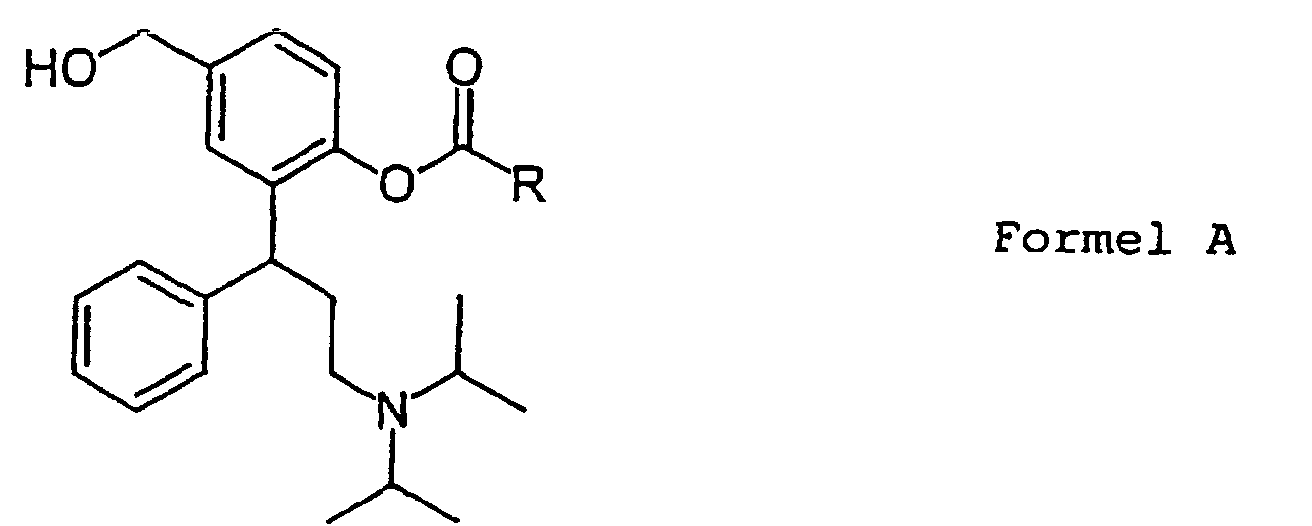
- Preferred compounds from the group of these novel derivatives of 3,3-diphenylpropylamines are esters of aliphatic or aromatic carboxylic acids having the general formula A mentioned below in which R has the meaning of C 1 -C 6 -alkyl, C 3 -C 10 -cycloalkyl or unsubstituted or substituted phenyl. They may be in the form of their optical isomers, as racemate mixtures and in the form of their individual enantiomers.
- salts of the compounds of general formula A obtained by solutions of the compounds of formula A (base part) with solutions of acids in each case suitable solvents, however, prove the salts obtained as solid are consistent amorphous and / or hygroscopic and are also of the usual Solvents are not readily crystallizable.
- such Salts have too low a chemical stability to processed as valuable pharmaceutical active ingredients galenically to be able to.
- Another object of the present invention is to Process for producing such high-purity, crystalline, stable compounds in the form of their salts available too put.
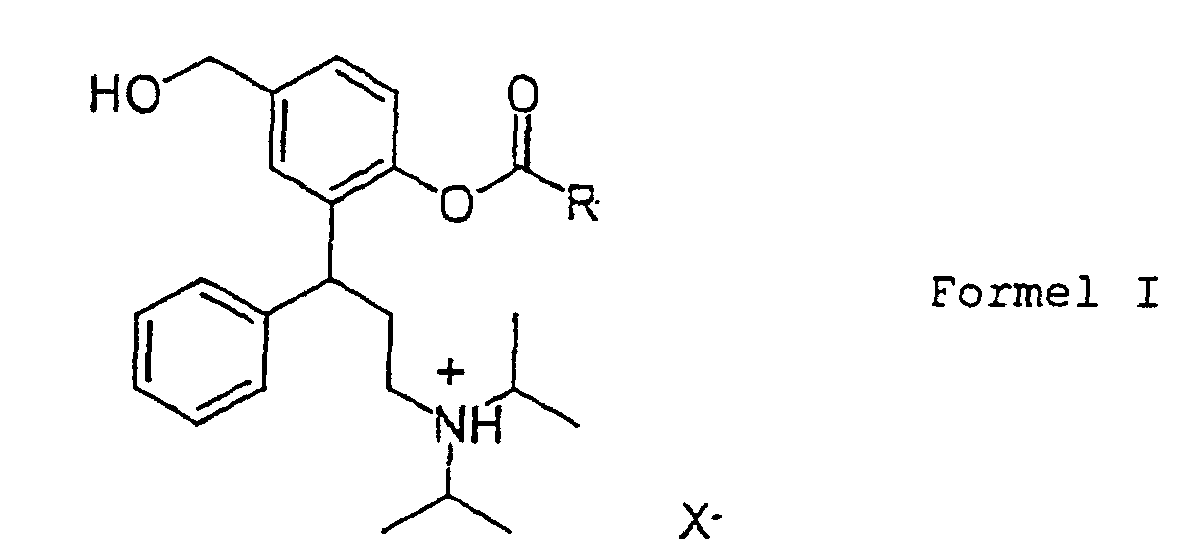
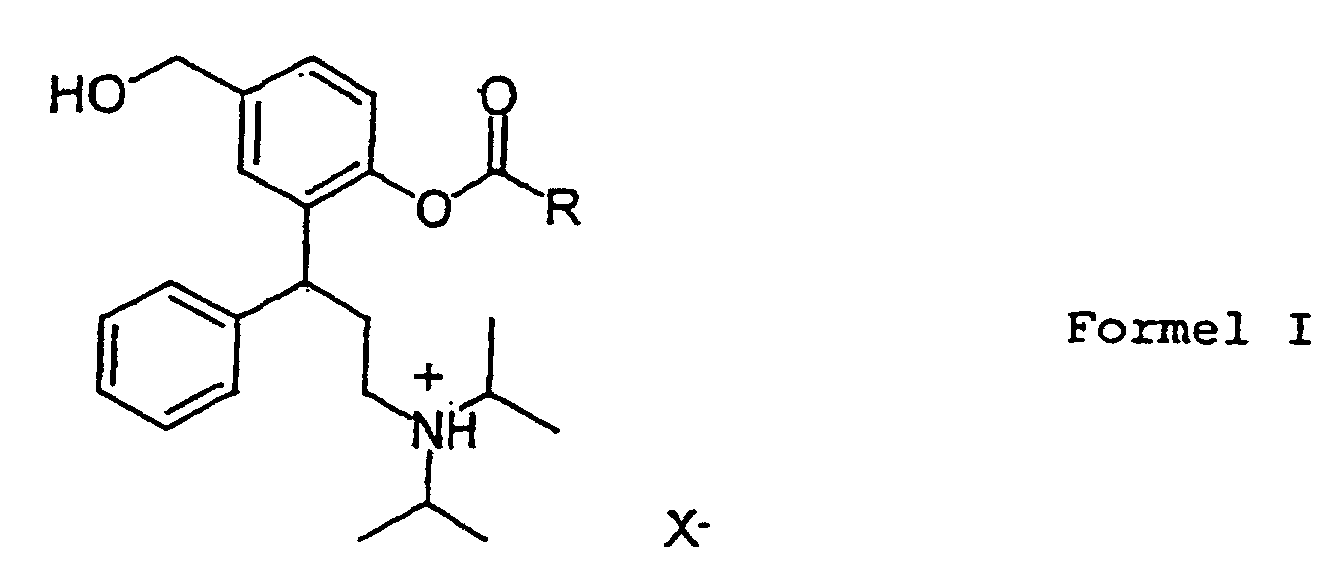
- This object has been achieved by providing high-purity, crystalline, stable compounds of 3,3-diphenylpropylamines in the form of their salts of general formula I, wherein R is C 1 -C 6 alkyl, C 3 -C 10 cycloalkyl, substituted or unsubstituted phenyl and X - is the acid radical of a physiologically acceptable inorganic or organic acid.
- the salts of general formula I may contain the respective acid radical X - of the acids mentioned below:
- Hydrochloric acid hydrobromic acid, phosphoric acid, sulfuric acid, Nitric acid, acetic acid, propionic acid, palmitic acid, Stearic acid, maleic acid, fumaric acid, oxalic acid, succinic acid, DL-malic acid, L - (-) - malic acid, D - (+) - malic acid, DL-tartaric acid, L - (+) - tartaric acid, D - (-) - tartaric acid, citric acid, L-aspartic acid, L - (+) - ascorbic acid, D - (+) - glucuronic acid, 2-Oxopropionic acid (pyruvic acid), furan-2-carboxylic acid (Pyruvic acid), benzoic acid, 4-hydroxybenzoic acid, salicylic acid, Vanillic acid, 4-hydroxycinnamic acid, gallic acid, Hippuric acid (N-benzoylglycine), aceturic acid (N-ace
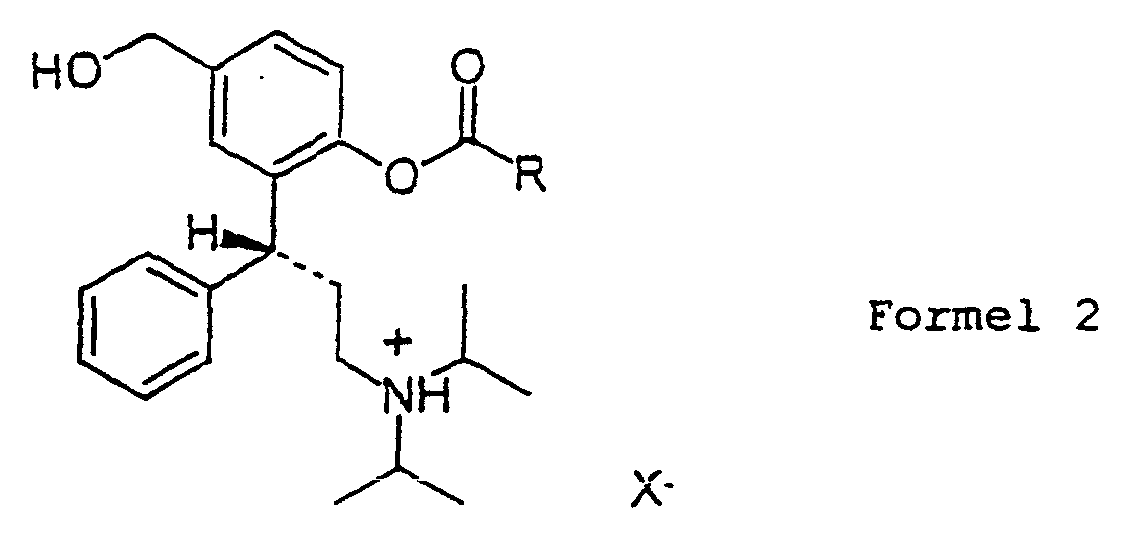
- R-configured compounds of general formula 2 are provided, wherein R is C 1 -C 6 alkyl, C 3 -C 10 cycloalkyl, substituted or unsubstituted phenyl and X - is the acid radical of a physiologically acceptable inorganic or organic acid.
- the compounds in the form of their salts of general formula 2 may contain the respective acid radical X - of the acids mentioned below:
- Hydrochloric acid hydrobromic acid, phosphoric acid, sulfuric acid, Nitric acid, acetic acid, propionic acid, palmitic acid, Stearic acid, maleic acid, fumaric acid, oxalic acid, succinic acid, DL-malic acid, L - (-) - malic acid, D - (+) - malic acid, DL-tartaric acid, L - (+) - tartaric acid, D - (-) - tartaric acid, citric acid, L-aspartic acid, L - (+) - ascorbic acid, D - (+) - glucuronic acid, 2-Oxopropionic acid (pyruvic acid), furan-2-carboxylic acid (Pyruvic acid), benzoic acid, 4-hydroxybenzoic acid, salicylic acid, Vanillic acid, 4-hydroxycinnamic acid, gallic acid, Hippuric acid (N-benzoylglycine), aceturic acid (N-ace
- R is cyclopropyl, cyclobutyl, cyclopentyl, cyclohexyl, 4- (1-cyclopropylmethanoyloxy) -phenyl, 4- (1-cyclobutylmethanoyloxy) -phenyl, 4- (1-cyclohexylmethanoyloxy) -phenyl or 4- (2,2-dimethyl-propanoyloxy) -phenyl and X is - chloride.
- alkyl preferably a straight-chain or branched-chain Hydrocarbon group having 1 to 6 carbon atoms. Particularly preferred are methyl, ethyl, propyl, isopropyl, Butyl, isobutyl, pentyl and hexyl.
- cycloalkyl denotes cyclic hydrocarbon groups which are 3 to 10 Have carbon atoms which are also suitable substituents may contain instead of the hydrogen atoms.
- phenyl refers to a -C 6 H 5 group which may be substituted or unsubstituted. Suitable substituents may be, for example, alkyl, alkoxy, halogen, nitro and amine.
- alkoxy has, based on the alkyl part, the same meaning as stated above for "alkyl". Suitable halogens are fluorine, chlorine, bromine and iodine atoms.
- the present invention also includes methods of preparation the compounds of the general formula according to the invention I.
- the process is characterized by chemo- and regioselectivity and high yield.
- the acids hydrochloric acid, hydrobromic acid, Phosphoric acid, sulfuric acid, nitric acid, acetic acid, Propionic acid, palmitic acid, stearic acid, maleic acid, Fumaric acid, oxalic acid, succinic acid, DL-malic acid, L - (-) - malic acid, D - (+) - malic acid, DL-tartaric acid, L - (+) - tartaric acid, D - (-) - tartaric acid, citric acid, L-aspartic acid, L - (+) - ascorbic acid, D - (+) - glucuronic acid, 2-oxopropionic acid (Pyruvic acid), furan-2-carboxylic acid (pyruvic acid), Benzoic acid, 4-hydroxybenzoic acid, salicylic acid, vanillic acid, 4-hydroxycinnamic acid, gallic acid, hippur
- the acids hydrochloric acid, Hydrobromic acid, phosphoric acid, sulfuric acid, nitric acid, Acetic acid, propionic acid, palmitic acid, stearic acid, Maleic acid, fumaric acid, oxalic acid, succinic acid, DL-malic acid, L - (-) - malic acid, D - (+) - malic acid, DL-tartaric acid, L - (+) - tartaric acid, D - (-) - tartaric acid, citric acid, L-aspartic acid, L - (+) - ascorbic acid, D - (+) - glucuronic acid, 2-Oxopropionic acid (pyruvic acid), furan-2-carboxylic acid (Pyruvic acid), benzoic acid, 4-hydroxybenzoic acid, Salicylic acid, vanillic acid, 4-hydroxycinnamic acid, Gallic acid, hippuric acid (
- R has the meaning of C 1 -C 6 -alkyl, in particular isopropyl, C 3 -C 10 -cycloalkyl or unsubstituted or substituted phenyl.
- reaction scheme 1 This is based on reaction scheme 1 (see FIG. 1). in which reactions with R-configured compounds, without being limited thereto become.
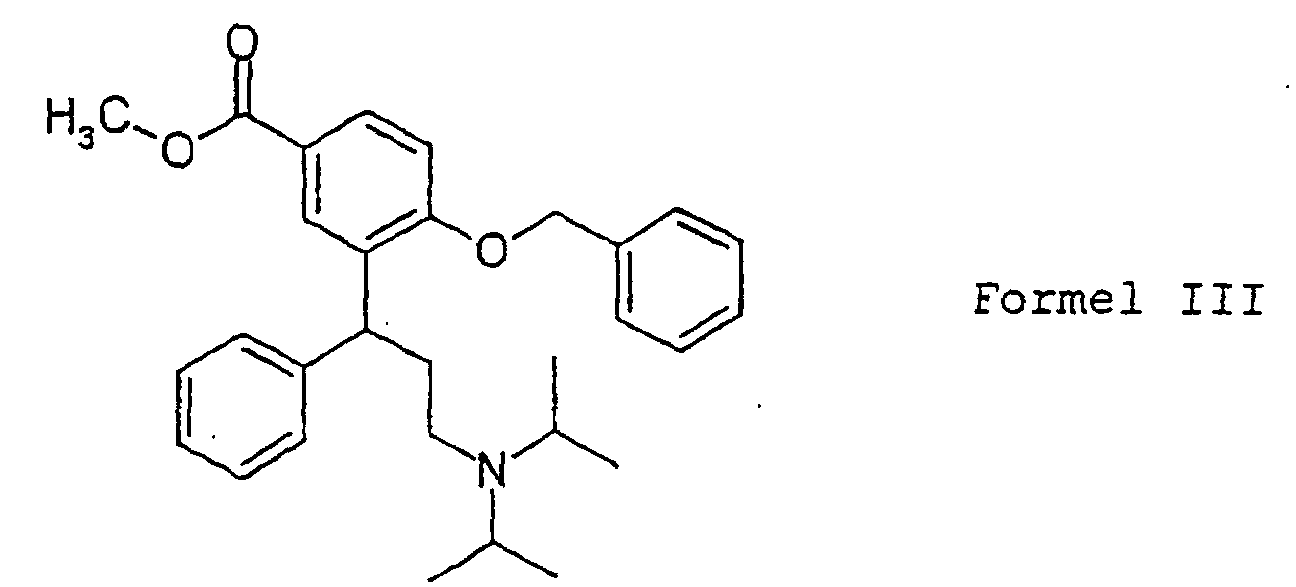
- Reaction is the precursor 3 (R - (-) - 4-benzyloxy-3- (3-diisopropylamino-1-phenyl-propyl) benzoic acid methyl ester) crystalline and pure.
- Precursor 3 is by conventional methods - eg BBr 3 , AlCl 3 - but preferably by means of hydrogen gas over Raney nickel in methanol as a solvent at room temperature (RT) to 5 (R - (-) - 3- (3-diisopropylamino-phenyl-propyl ) -4-hydroxy-benzoic acid methyl ester) cleaved. This occurs in a highly pure, crystalline form (mp 143.7 ° C).
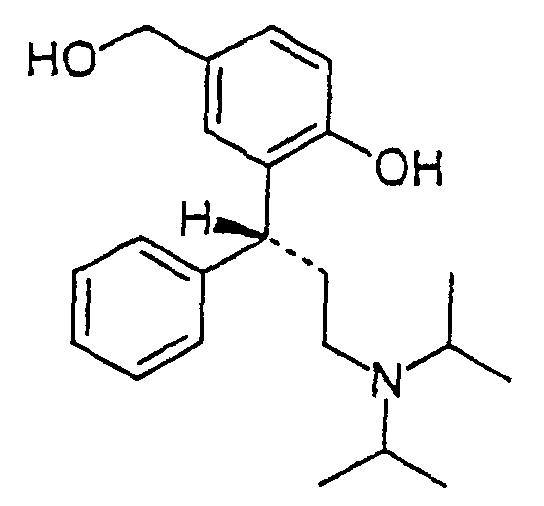
- a suitable reducing agent eg NaBH 4 / EtOH - preferably LiAlH 4 in an inert solvent at low temperatures (-78 ° C to + 10 ° C) and the compound 6 (R - (+) - 2- ( 3-diisopropylamino-1-phenylpropyl) -4-hydroxymethylphenol).
- the compound 6 is obtained highly pure and can be crystallized from a suitable solvent such as ethyl acetate.
- the colorless finely crystalline material has a melting point of 102.3 ° C. This is surprising in that compound 6 is described in the art as an amorphous solid.
- This salt shows a sharp melting point of 103 ° C, is stable at RT, not hygroscopic, and does not close Crystalline solvent. It can be recrystallized as often as desired.
- the product 2b After recrystallization, the product 2b has a Melting point range of 97 - 106 ° C on.
- the product 2b can be particularly advantageous by the following variant of the inverse reaction procedure, starting from the compound 6 of Reaction Scheme 1 directly to be obtained.
- the product 2b is thus without addition of a external acid-scavenging base available as follows is explained.
- the compounds of the general formulas I according to the invention and 2 are suitable as bulk material.
- the aforementioned compounds III, V, VI, 3, 5, 6 and 7 are suitable especially for use as each high purity, crystalline, stable intermediate in the production of pharmaceutically useful compounds.
- these compounds are suitable for use as an intermediate in the preparation of R - (+) - 2- (3-diisopropylamino-1-phenylpropyl) -4-hydroxymethylphenyl isobutyric acid ester Hydrogen fumarate and R - (+) - 2- (3-diisopropylamino-1-phenylpropyl) -4-hydroxymethylphenyl isobutyric acid ester Hydrochloride hydrate.
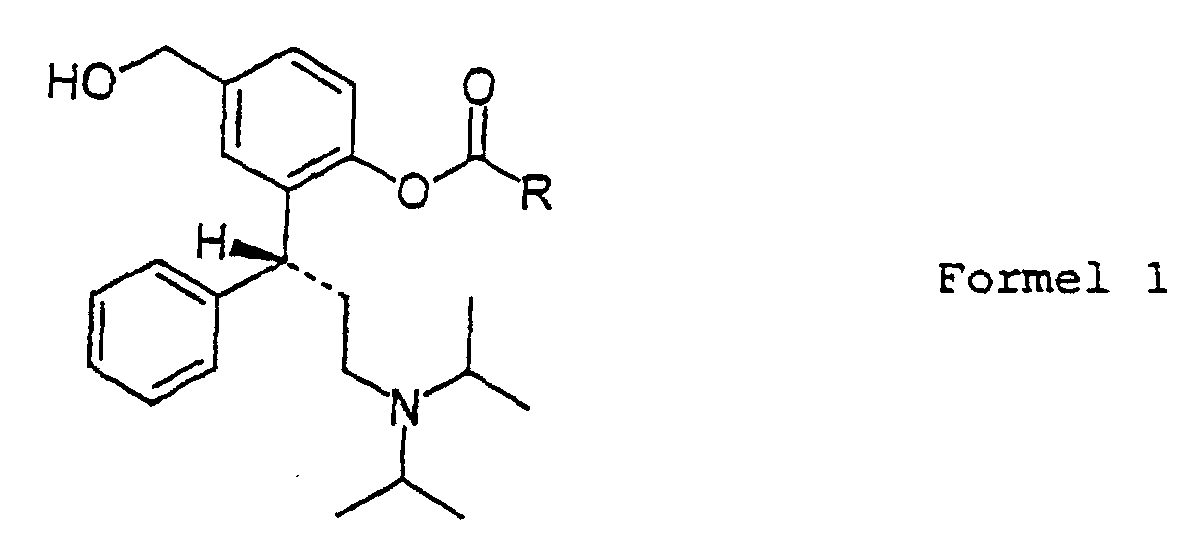
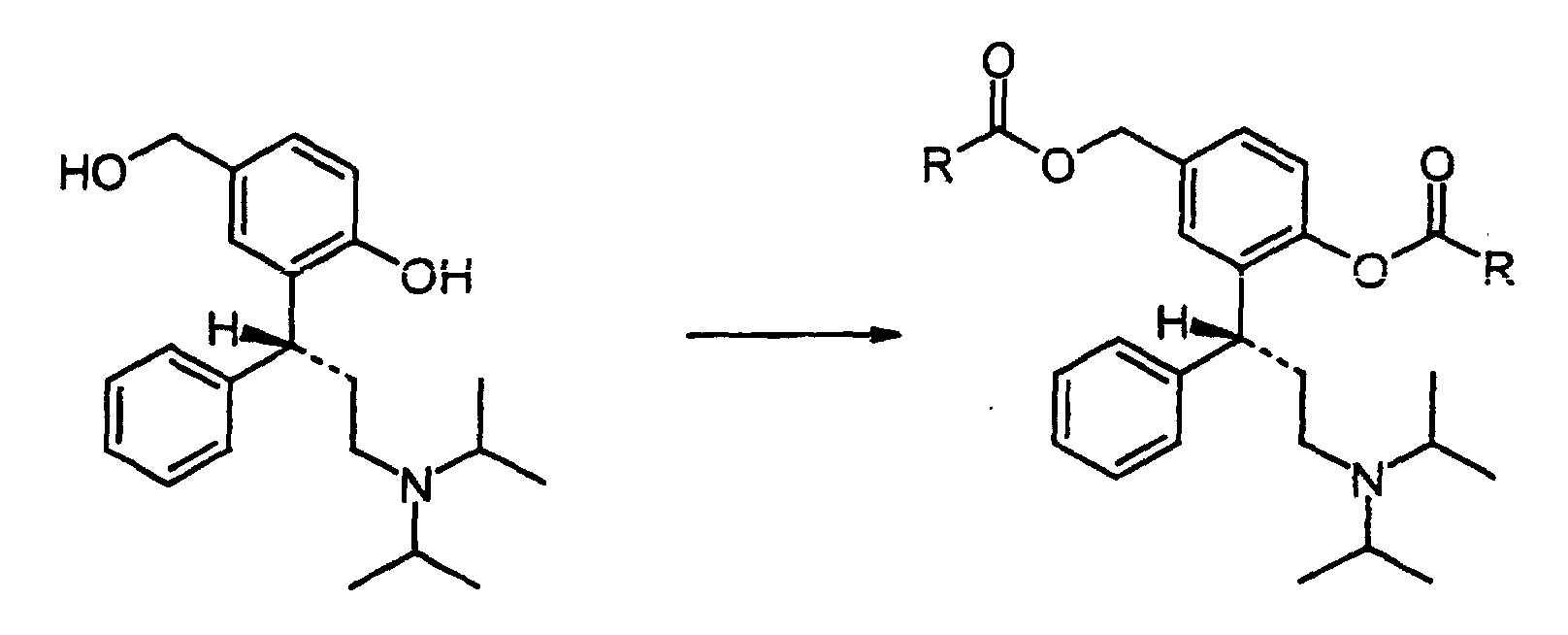
- the method can be carried out particularly advantageously be by adding a compound of general formula 6 (see Reaction Scheme 1) with one equivalent of isobutyryl chloride in the presence of triethylamine using a the respective solvents ethyl acetate, dichloromethane, tetrahydrofuran, Acetonitrile or toluene regio- and chemoselective to R - (+) - 2- (3-diisopropylamino-1-phenylpropyl) -4-hydroxymethylphenyl isobutyric acid ester is implemented.
- R - (+) - 2 - (3-diisopropylarnino-1-phenylpropyl) -4-hydroxymethylphenylisobutterklader for reaction with fumaric acid or hydrochloric acid to form the respective salt.
- Thin layer chromatography (TLC, R f indicated) was performed on 5x10 cm of E. Merck silica gel (60F254), stains visualized by fluorescence quenching or alkaline potassium permanganate solution prilling.
- Eluent systems were: (1), n-hexane / acetone / triethylamine (70/20/10, v / v-%); (2), toluene / acetone / methanol / acetic acid (70/5/20/5, v / v-%).
- optical rotations were measured at a wavelength of 589.3 nm (sodium D-line), at room temperature using the solvent ethanol (instrument: Perkin Elmer Polarimeter Type 241), Melting points (m.p., in ° C) are uncorrected and were determined on the Mettler FP 1 instrument or differential thermal analysis (DSC) on the Perkin Elmer model DSC7, "Pyris” evaluation software.
- UV / VIS measurements were carried out on the spectrophotometer model Lambda 7 (Perkin-Elmer) at a layer thickness of 1 cm. Indicated is the specific absorption of a 1% solution (A 1% 1 cm ).
- GC-MS Gas chromatography-mass spectrometry
- m / z-values and relative intensity with respect to the basision (%) was with a Finnigan TSQ 700 Triple Mass Spectrometer in positive (P-CI) or negative (N-CI) chemical ionization measurement with methane or ammonia as reactant gas or via electron impact ionization added. Hydroxy compounds were used as Measured trimethylsilyl ether derivatives.
- Coupled liquid chromatography-mass spectrometry (LC-MS): Waters Integrity System, Thermabeam Mass Detector (EI, 70 eV), m / z values and relative intensity (%) over a mass range of 50-500 a.m.u. specified.
- bracketed Arabic numbers (3), (4), (5), (6) refer to the identical names in Reaction Scheme 1.
- the fancy colorless crystals are filtered off with a little cyclohexane / 2-butanone (90:10, Vol .-%) and dried in vacuo at 30 ° C. you receives 44.6 g (83.1% of theory) of the hydrogen fumarate salt of the R - (+) - 2- (3-diisopropylamino-1-phenylpropyl) -4-hydroxymethylphenyl isobutyric acid ester in the form of colorless platelets.
- IR 3380, 2978, 2939, 2878, 2692, 2514, 1756, 1702, 1680, 1618, 1496, 1468, 1226, 1040, 1019, 806,
- the batch is washed successively with 5 ml of water, aqueous 0.1N hydrochloric acid, 5 ml of 5% aqueous sodium bicarbonate solution, Washed 5 ml of water, over sodium sulfate dried, and after filtration to dryness concentrated. Subsequently, in a high vacuum to constant weight dried.
- R CH 2 C (CH 3 ) 3
- R 4- (C 2 H 5 CO 2 ) -C 6 H 4
- R 4- (iC 3 H 7 CO 2 ) -C 6 H 4
- R 4- ( tC 4 H 9 CO 2 ) -C 6 H 4
- R 4- (cC 3 H 5 CO 2 ) -C 6 H 4
- R 4- (cC 4 H 7 CO 2 ) -C 6 H 4
- R 4- (cC 6 H 11 CO 2 ) -C 6 H 4
- the batch is taken successively with 100 ml each Water, aqueous 0.1N hydrochloric acid, 5 ml of 5% aqueous Sodium bicarbonate solution, 5 ml of water, over Dried sodium sulfate, and after filtration to Dry concentrated. Subsequently, in a high vacuum until the Constant weight dried.
- Hydrogen fumarate salt colorless syrup, 94.4% HPLC grade.
- 13 C-NMR (CDCl3) 17.89, 18.07, 18.94, 18.97, 19.13, 31.22, 33.93, 34.13, 41.78, 45.62, 53.93, 65.33, 122.93, 126.82, 127.45, 127.53, 127.91, 128.75, 134. 74, 135.29, 135.42, 142.04, 148.44, 170.24, 175.71, 176.79.
- R 4- (tC 4 H 9 CO 2 ) -C 6 H 4
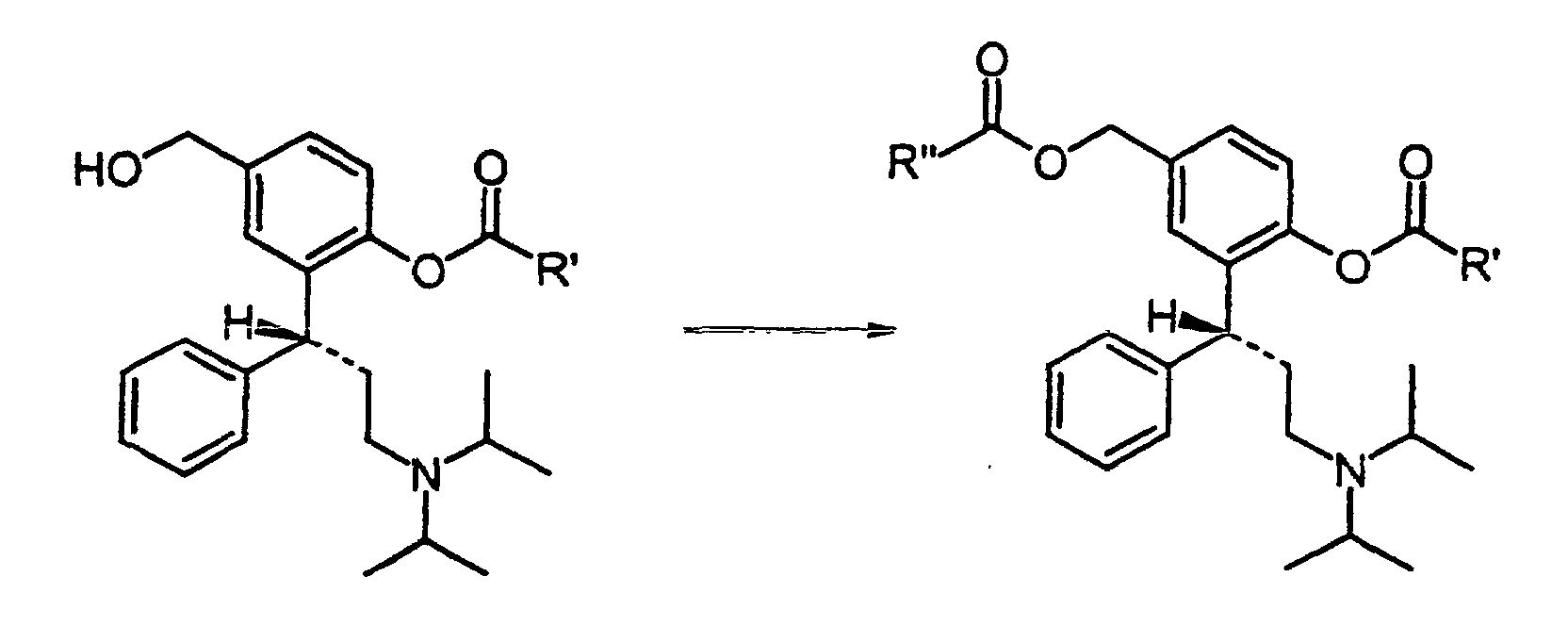
- R ' is not equal to R "
- R ' CH (CH 3 ) 2
Landscapes
- Chemical & Material Sciences (AREA)
- Organic Chemistry (AREA)
- Health & Medical Sciences (AREA)
- General Health & Medical Sciences (AREA)
- Veterinary Medicine (AREA)
- General Chemical & Material Sciences (AREA)
- Medicinal Chemistry (AREA)
- Nuclear Medicine, Radiotherapy & Molecular Imaging (AREA)
- Bioinformatics & Cheminformatics (AREA)
- Pharmacology & Pharmacy (AREA)
- Life Sciences & Earth Sciences (AREA)
- Animal Behavior & Ethology (AREA)
- Engineering & Computer Science (AREA)
- Public Health (AREA)
- Chemical Kinetics & Catalysis (AREA)
- Urology & Nephrology (AREA)
- Pain & Pain Management (AREA)
- Biomedical Technology (AREA)
- Neurology (AREA)
- Neurosurgery (AREA)
- Organic Low-Molecular-Weight Compounds And Preparation Thereof (AREA)
- Acyclic And Carbocyclic Compounds In Medicinal Compositions (AREA)
- Low-Molecular Organic Synthesis Reactions Using Catalysts (AREA)
- Catalysts (AREA)
- Luminescent Compositions (AREA)
- Detergent Compositions (AREA)
- Pharmaceuticals Containing Other Organic And Inorganic Compounds (AREA)
Description


- R-(+)-2-(3-Diisopropylamino-1-phenylpropyl)-4-hydroxymethylphenylisobuttersäureester Hydrogenfumarat und
- R-(+)-2-(3-Diisopropylamino-1-phenylpropyl)-4-hydroxymethylphenylisobuttersäureester Hydrochlorid Hydrat.






- 3 =
- R-(-)-4-Benzyloxy-3-(3-diisopropylamino-1-phenylpropyl)-benzoesäure- methylester
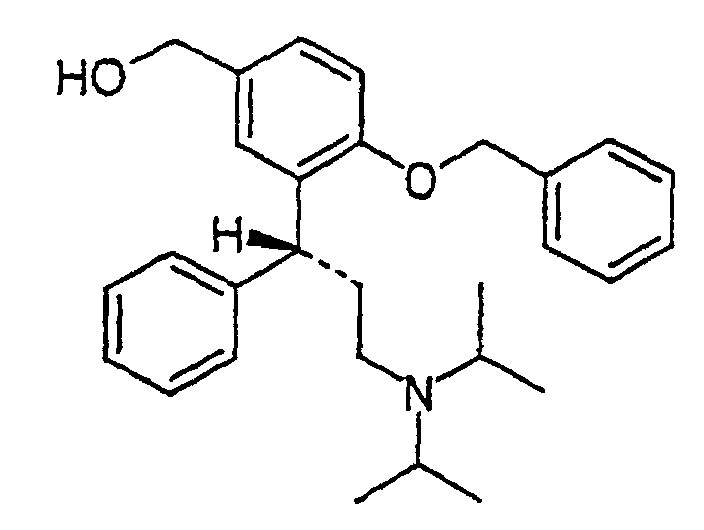
- 4 =
- R-(+)-[4-Benzyloxy-3-(3-diisopropylamino-1-phenylpropyl)-pheayl]-methanol
- 5 =
- R-(-)-3-(3-Diisopropylamino-phenyl-propyl)-4-hydroxybenzoesäuremethylester
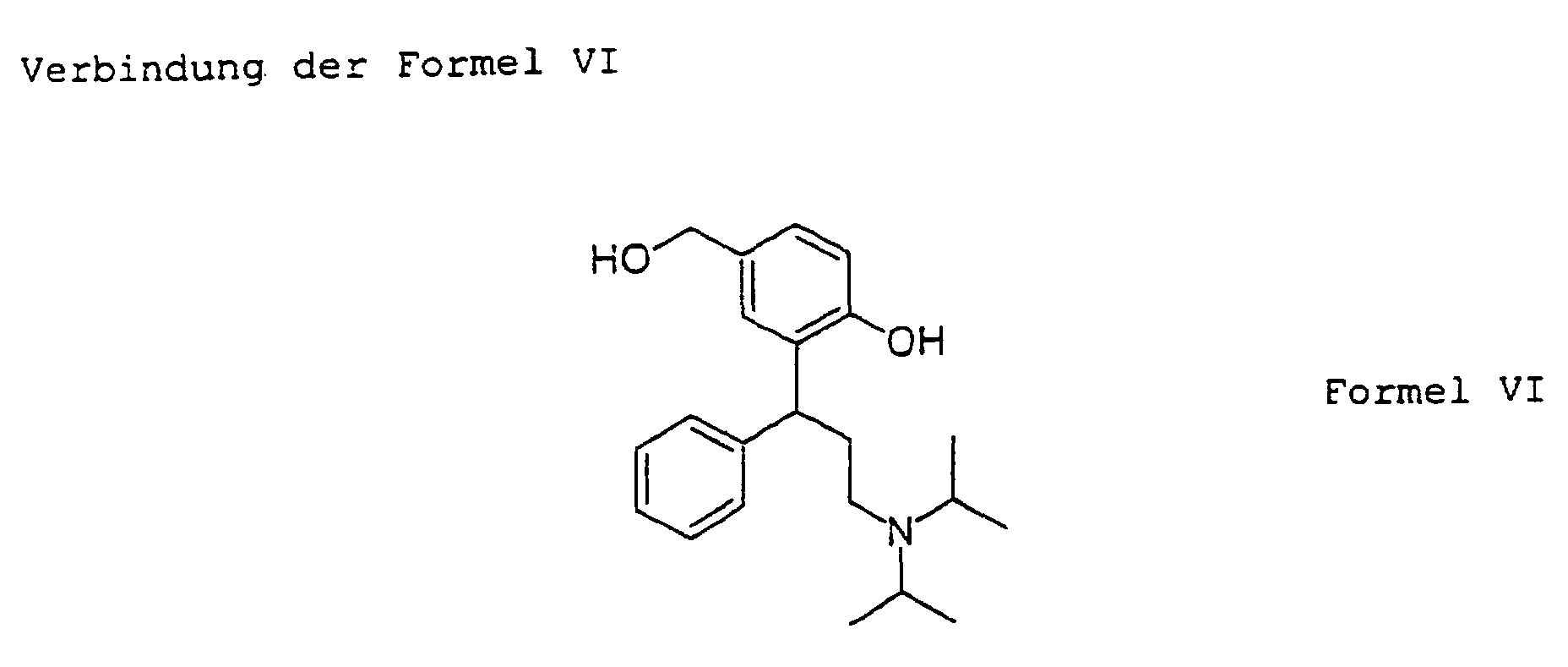
- 6 =
- R-(+)-2-(3-Diisopropylamino-1-phenylpropyl)-4-hydroxymethylphenol
- 1 =
- R-(+)-2-(3-Diisopropylamino-1-phenylpropyl)-4-hydroxymethylphenyl-isobuttersäureester
- 2a =
- R-(+)-2-(3-Diisopropylamino-1-phenylpropyl)-4-hydroxymethylphenyl-isobuttersäureester Hydrochlorid Hydrat
- 2b =
- R-(+)-2-(3-Diisopropylamino-1-phenylpropyl)-4-hydroxymethylphenyl-isobuttersäureester Hydrogenfumarat




Schmelzpunkte (Schmp., in °C) sind unkorrigiert und wurden am Gerät Mettler FP 1 bestimmt, bzw. Differentialthermoanalyse (DSC) am Perkin Elmer Modell DSC7, Auswertungssoftware "Pyris".

DC (1) : 0.58
13C-NMR (CDCl3): 20.55, 20.65, 36.83, 41.84, 43.83, 51.82, 70.12, 111.09, 122.46, 125.28, 127.49, 128.02, 128.35, 128.50, 129.22, 129.49, 133.20, 136.39, 144.51, 159.87, 167.09.
13C-NMR (CDCl3): 20.53, 20.61, 36.87, 41.65, 44.14, 48.82, 65.12, 70.09, 111.80, 125.77, 125.97, 126.94, 127.55, 128.08, 128.37, 128.44, 133.27, 134.05, 134.27, 137.21, 144.84.

[I]D 20 = - 26. 6 (c = 0. 93, Ethanol).
13C-NMR (CDCl3): 18.74, 19.21, 19.62, 33.12, 39.68, 42.36, 48.64, 51.42, 117.99, 120.32, 126.23, 127.81, 128.85, 129.39, 130.26, 132.21, 144.06, 162.43, 167.35.
DC (1) : 0.57
[I]D 20 = + 21.3 (c = 1.0, Ethanol).
13C-NMR (CDCl3) : 19.58, 19.96, 33.30, 39.52, 42.10, 48.00, 65.40, 118.58, 126.31, 126.57, 127.16, 127.54, 128.57, 132.63, 132.83, 144.55, 155.52.


13C-NMR (CDCl3): 20.45, 20.59, 22.54, 25.70, 36,74, 42.18, 43.27, 43.96, 48.90, 64.67, 122.66, 125.60, 126.20, 126.79, 127.95, 128.37, 136.83, 138.86, 143.83, 147.82, 171.37.
DC (1): 0.76.
13 C-NMR (CDCl3): 20.40, 20.53, 29.73, 30.99, 36.62, 42.17, 44.01, 47.60, 49.01, 64.65, 122.64, 125.60, 126.20, 126.80, 127.96, 128.36, 136.85, 138.90, 143.80, 147.82, 170.55.
DC (1): 0.75.
13C-NMR (DMSO-d6 =39.7 ppm): 16.52, 16.68, 17.98, 18.11, 26.87, 31.46, 41.71, 45.33, 53.89, 53.98, 62.65, 122.61, 122.97, 125.94, 126.09, 126.57, 126.75, 127.87, 128.58, 131.80, 134.94, 141.02, 142.69,' 147.17, 155.32,' 163.92, 176.21.
13C-NMR (DMSO-d6 =39.7 ppm): 173.02, 172.49, 172.37, 153.10, 147.12, 142.72, 142.03, 140.78, 136.60, 134.79, 134.35, 129.55, 129.13, 128.80, 128.67, 127.87, 126.96, 126.74, 125.94, 125.84, 124.37, 123.71, 122.80, 62.64, 53.92, 45.34, 41.65, 31.44, 18.05, 16.66, 12.84, 9.58, 9.28, 8.49, 7.89.
13C-NMR (DMSO-d6 =39.7 ppm): 173.53, 147.12, 142.81, 140.74, 134.77, 128.65, 127.81, 126.74, 125.99, 125.87, 122.75, 62.63, 53.92, 45.34, 41.42, 37.38, 31.54, 25.04, 24.92, 18.03, 16.68, 16.61.
13C-NMR (DMSO-d6 =39.7 ppm): 174.80, 147.22, 142.86, 140.76, 134.72, 128.66, 127.80, 126.73, 126.04, 125.88, 122.71, 62.62, 53.94, 45.37, 43.24, 41.39, 31.54, 29.78, 29.59, 25.64, 25.59, 18.07, 16.64.
13C-NMR(DMSO-d6 =39.7 ppm):
174.08, 147.15, 142.85, 140.77, 134.78, 128.66, 127.77, 126.74, 126.06, 125.87, 122.69, 62.61, 53.91, 45.36, 42.26, 41.24, 31.53, 28.74, 28.62, 25.48, 25.04, 24.98, 18.05, 16.67, 16.60.
1H-NMR (DMSO-d6): 9.87 (s, 1H mit D2O austauschbar, NH), 8.19-8.12 (m, 2H, Phenyl-H), 7.55 (d, J = 1.0 Hz, 1H, Phenyl-H3), 7.41-7.13 (m, 9H, Phenyl-H), 5.28 (br s, 1H mit D2O austauschbar, OH), 4.53 (s, 2H, CH2), 4.23 (t, J = 7.6 Hz, 1H, CH), 3.61-3.50 (m, 2H, 2 × CH(CH3)2), 2.97-2.74 (m, 2H, CH2) , 2.67 (q, J = 7.4 Hz, 2H, CH2), 2.56-2.43 (m, 2H, CH2), 1.23-1.13 (m, 15H, 2 × CH(CH 3)2, CH3).
1H-NMR (DMSO-d6) : 9.73 (s, 1H mit D2O austauschbar, NH), 8.19-8.12 (m, 2H, Phenyl-H), 7.55 (d, J = 1.4 Hz, 1H, Phenyl-H3), 7.42-7.14 (m, 9H, Phenyl-H), 5.27 (br s, 1H mit D2O austauschbar, OH), 4.53 (s, 2H, CH2), 4.23 (t, J = 7.5 Hz, 1H, CH), 3.61-3.50 (m, 2H, 2 × CH(CH3)2), 2.99-2.78 (m, 3H, CH2, CH(CH3)2), 2.54-2.47 (m, 2H, CH2), 1.29-1.13 (m, 18H, 3 × CH(CH 3)2).
1H-NMR (DMSO-d6): 8.19-8.12 (m, 2H, Phenyl-H), 7.45-7.33 (m, 3H, Phenyl-H), 7.25-7.09 (m, 7H, Phenyl-H), 5.20 (t, J = 5.6 Hz, 1H, OH), 4.50 (d, J = 5.6 Hz, 2H, CH2) , 4.20 (t, J = 7.5 Hz, 1H, CH), 2.95-2.80 (m, 2H, 2 × CH(CH3)2), 2.38-2.25 (m, 2H, CH2), 2.09-2.03 (m, 2H, CH2), 1.33 (s, 9H, (CH3)3), 0.82-0.76 (m, 12H, 2 × CH (CH 3)2).
1H-NMR (CDCl3): 8.22-8.16 (m, 2H, Phenyl-H), 8.02 (d, J = 1.8 Hz, 1H, Phenyl-H), 7.27-7.02 (m, 9H, Phenyl-H), 4.83-4.60 ('m', 2H, CH2), 4.01-3.94 (m, 1H, CH), 3.66-3.54 (m, 2H), 3.18-2.80 (m, 3H), 2.53-2.44 (m, 1H) (2 × CH2, 2 × CH(CH3)2), 1.43-1.25 (m, 21H, (CH3)3, 2 × CH(CH 3)2).
1H-NMR (DMSO-d6): 9.04 (s, 1H mit D2O austauschbar, NH), 8.15-8.09 (m, 2H, Phenyl-H), 7.53 ('d', 1H, Phenyl-H3), 7.42-7.13 (m, 9H, Phenyl-H), 5.25 (br s, 1H mit D2O austauschbar, OH), 4.52 (s, 2H, CH2), 4.23 (t, J = 7.5 Hz, 1H, CH), 3.62-3.53 (m, 2H, 2 × CH(CH3)2), 3.05-2.70 (m, 2H, CH2), 2.51-2.37 (m, 2H, CH2), 2.01-1.89 (m, 1H, Cyclopropyl-CH), 1.20-1.05 (m, 16H, 2 × CH(CH3)2, 2 × Cyclopropyl-CH2).
1H-NMR (DMSO-d6) : 9.50 (s, 1H mit D2O austauschbar, NH), 8.17-8.12 (m, 2H, Phenyl-H), 7.54 (d, J = 1.4 Hz, 1H, Phenyl-H3), 7.42-7.14 (m, 9H, Phenyl-H), 5.25 (br s, 1H mit D2O austauschbar, OH), 4.52 (s, 2H, CH2), 4.23 (t, J = 7.5 Hz, 1H, CH), 3.62-3.47 (m, 3H, Cyclobutyl-CH), 2 × CH(CH3)2), 3.00-2.70 (m, 2H, CH2), 2.51-2.26 (m, 6H, CH2, 2 × Cyclobutyl-CH2), 2.10-1.85 (m, 2H, Cyclobutyl-CH2), 1.22-1.12 (m, 12H, 2 × CH(CH 3)2).
1H-NMR (DMSO-d6): 9.34 (s, 1H, mit D2O austauschbar, NH), 8.16-8.12 (m, 2H, Phenyl-H), 7.54 (d, J = 1.4 Hz, 1H, Phenyl-H3), 7.39-7.14 (m, 9H, Phenyl-H), 5.26 ('t', 1H, mit D2O austauschbar, OH), 4.53 (d, J = 4.2 Hz, 2H, CH2), 4.22 (t, J = 7.5 Hz, 1H, CH), 3.62-3.48 (m, 2H, 2 × CH(CH3)2), 3.00-2.60 (m, 3H, Cyclohexyl-CH), CH2), 2.51-2.40 (m, 2H, CH2), 2.07-1.98 (m, 2H, Cyclohexyl-CH2), 1.80-1.11 (m, 20H, 4 × Cyclohexyl-CH2), 2 × CH (CH 3)2)
13C-NMR (CDCl3): 20.36, 20.69, 20.94, 20.99, 36.41, 42.27, 43.69, 48.79, 65.89, 122.89, 126.28, 127.17, 127.92, 128.36, 133.69, 136.95, 143.61, 148.46, 168.97, 170.76.
LC-MS: 425 (15%, M+), 410 (97%), 382 (4%), 308 (3%), 266 (7%), 223 (27%), 195 (13%), 165 (8%), 114 (100%).
[α]D 20 = -33.1 (c = 1, CH3CN).
DC (1): 0.79.
13C-NMR (CDCl3): 20.30, 25.17, 25.58, 25.73, 28.97, 29.12, 41.70, 43.15, 44.03, 48.64, 65.37, 122.67, 125.88, 126.24, 127.06, 127.31, 127.90, 128.37, 134,03, 136.85, 143.55, 148.33, 174.20, 175.72.
DC (1): 0.96.
13 C-NMR (CDCl3): 18.96, 19.08, 20.59, 33.98, 34.20, 36.86, 41.72, 43.72, 48.72, 65.58, 122.65, 126.19, 126.73, 127.91, 128.11, 128.36, 133.91, 136.96, 143.81, 148.41, 175.15, 176.77.
DC (1): 0.74.
13C-NMR (CDCl3) : 17.89,
18.07, 18.94, 18.97, 19.07, 31.22, 33:93, 34.13, 41.78, 45.62, 53.93, 65.33, 122.93, 126.82, 127.45, 127.53, 127.91, 128.75, 134. 74, 135.29, 135.42, 142.04, 148.44, 170.24, 175.71, 176.79.
13C-NMR (DMSO-d6): 16.49, 16.71, 17.97, 18.06, 26.84, 31.36, 38.45, 41.70, 45.24, 53.79, 53.96, 55.09, 66.11, 122.47, 122.62, 123.59, 126.42, 126.83, 127.21, 127.70, 127.88, 128.02, 128.62, 131.17, 131.86, 134.48, 135.64, 142.52, 148.35, 154.86, 155.39, 163.80, 165.09, 176.14, 176.19.
DC (1): 0.56
13C-NMR (CDCl3) : 19.12, 20.65, 21.05, 34.24, 37.02, 41.79, 43.79, 48.72, 65.98, 122.75, 125.98, 126.22, 127.94, 128.39, 128.84, 133.55, 137.04, 143.84, 148.58, 170.84, 175.18.
13C-NMR (CDCl3): 16.89, 17.04, 18.31, 18.92, 20.95, 31.49, 34.07, 41,64, 46.17, 54.55, 65.49, 122.91, 126.61, 126.93, 127.48, 127.83, 128.74, 134.50, 134.88, 141.61, 148.44, 170.67, 175.63.
[α]D 20 = +14.6 (c = 1, CHCl3).
Claims (17)
- Verbindungen der allgemeinen Formel Iworin R für C1-C6-alkyl, C3-C10-cycloalkyl, substituiertes oder unsubstituiertes Phenyl steht und X- der Säurerest einer physiologisch verträglichen anorganischen oder organischen Säure ist.
- Verbindungen nach Anspruch 1, dadurch gekennzeichnet, daß X- jeweils ein Säurerest der Salzsäure, Bromwasserstoffsäure, Phosphorsäure, Schwefelsäure, Salpetersäure, Essigsäure, Propionsäure, Palmitinsäure, Stearinsäure, Maleinsäure, Fumarsäure, Oxalsäure, Bernsteinsäure, DL-Äpfelsäure, L-(-)-Äpfelsäure, D-(+)-Äpfelsäure, DL-Weinsäure, L-(+)-Neinsäure, D-(-)-Weinsäure, Citronensäure, L-Asparaginsäure, L-(+)-Ascorbinsäure, D-(+)-Glucuronsäure, 2-Oxopropionsäure (Brenztraubensäure), Furan-2-carbonsäure (Brenzschleimsäure), Benzoesäure, 4-Hydroxybenzoesäure, Salicylsäure, Vanillinsäure, 4-Hydroxyzimtsäure, Gallussäure, Hippursäure (N-Benzoyl-glycin), Acetursäure (N-Acetylglycin), Phloretinsäure (3-(4-Hydroxyphenyl)-propionsäure), Phthalsäure, Methansulphönsäure oder der Orotsäure ist.
- Verbindungen nach Ansprüchen 1 und 2, dadurch gekennzeichnet, daß sie die allgemeine Formel 2 besitzen,worin R für C1-C6-alkyl, C3-C10-cycloalkyl, substituiertes oder unsubstituiertes Phenyl steht und X- der Säurerest einer physiologisch verträglichen anorganischen oder organischen Säure ist.

- Verbindungen nach Anspruch 3, dadurch gekennzeichnet, daß X- jeweils ein Säurerest der Salzsäure, Bromwasserstoffsäure, Phosphorsäure, Schwefelsäure, Salpetersäure, Essigsäure, Propionsäure, Palmitinsäure, Stearinsäure, Maleinsäure, Fumarsäure, Oxalsäure, Bernsteinsäure, DL-Äpfelsäure, L-(-)-Äpfelsäure, D-(+)-Äpfelsäure, DL-Weinsäure, L-(+)-Weinsäure, D-(-)-Weinsäure, Citronensäure, L-Asparaginsäure, L-(+)-Ascorbinsäure, D-(+)-Glucuronsäure, 2-Oxopropionsäure (Brenztraubensäure), Furan-2-carbonsäure (Brenzschleimsäure); Benzoesäure, 4-Hydroxybenzoesäure, Salicylsäure, Vanillinsäure, 4-Hydroxyzimtsäure, Gallussäure, Hippursäure (N-Benzoyl-glycin), Acetursäure (N-Acetylglycin), Phloretinsäure (3-(4-Hydroxyphenyl)-propionsäure), Phthalsäure, Methansulphonsäure oder der Orotsäure ist.
- Verbindungen nach Ansprüchen 3 und 4, dadurch gekennzeichnet, daß sie R-(+)-2-(3-(Diisopropylainino-1-phenylpropyl)-4-hydroxymethyl-phenylisobuttersäureesterhydrogenfumarat, R-(+)-2-(3-(Diisopropylamino-1-phenylpropyl)-4-hydroxymethylphenylisobuttersäureester-hydrochloridhydrat sind.
- Verbindungen nach Ansprüchen 3 und 4, dadurch gekennzeichnet, daß R für Cyclopropyl, Cyclobutyl, Cyclopentyl, Cyclohexyl, 4-(1-Cyclopropyl-methanoyloxy)-phenyl, 4-(1-Cyclobutyl-methanoyioxy) -phenyl, 4- (1-Cyclohexyl-methanoyloxy)-phenyl oder 4-(2,2-Dimethyl-propanoyloxy)-phenyl steht und X- Chlorid bedeutet.
- Verbindungen nach Ansprüchen 1 bis 6 in Form eines Schüttgutes.
- Verfahren zur Herstellung von Verbindungen der allgemeinen Formel Iworin R für C1-C6-alkyl, C3-C10-cycloalkyl, substituiertes oder unsubstituiertes Phenyl steht und X- für den Säurerest einer physiologisch verträglichen anorganischen oder organischen Säure steht, dadurch gekennzeichnet, daß
 a) eine Verbindung der Formel IIImit einem Hydrierungsmittel zur Bildung einer Verbindung der Formel V
 gespalten wird, worauf
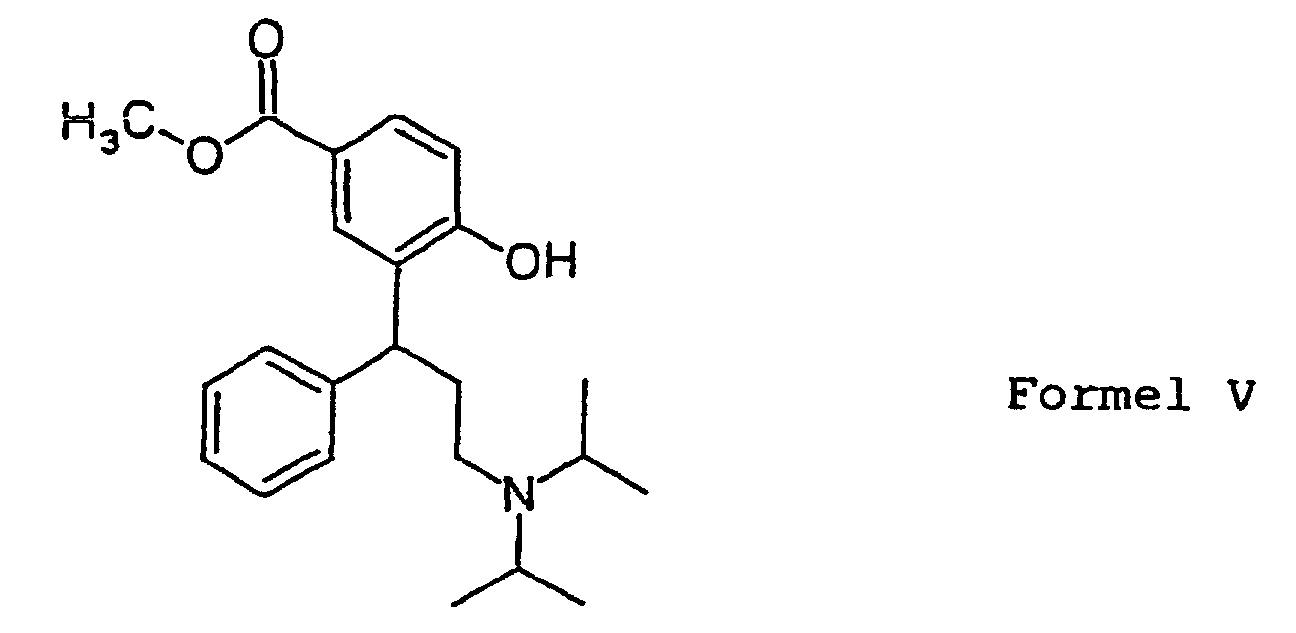 b) die so erhaltene Verbindung der Formel V mit einem Reduktionsmittel umgesetzt wird, um eine Verbindung der Formel VIzu ergeben, die
 c) mit einem Acylierungsmittel umgesetzt wird, um eine Verbindung der Formel Azu erhalten, worin R die oben genannte Bedeutung hat, die
 d) mit einer physiologisch verträglichen anorganischen oder organischen Säure unter Bildung einer Verbindung der Formel Iumgesetzt wird, worin R für C1-C6-alkyl, C3-C10-cycloalkyl, unsubstituiertes oder substituiertes Phenyl steht und X- für den Säurerest einer physiologisch verträglichen anorganischen oder organischen Säure steht.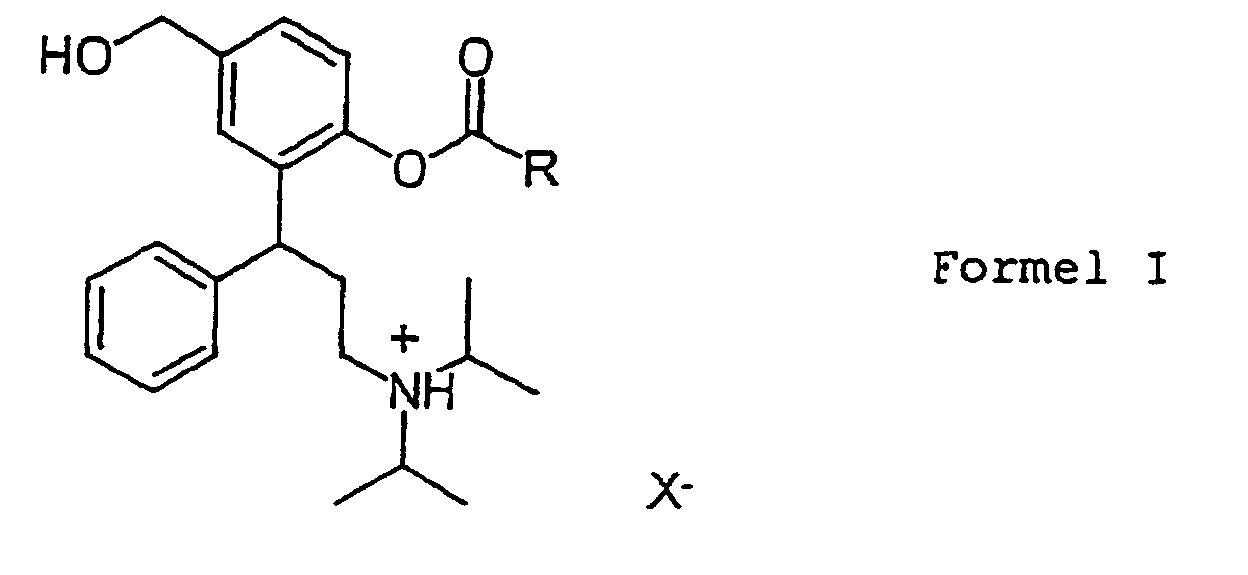
- Verfahren nach Anspruch 8, dadurch gekennzeichnet, daß zur Herstellung der Verbindungen der allgemeinen Formel I die Säuren Salzsäure, Bromwasserstoffsäure, Phosphorsäure, Schwefelsäure, Salpetersäure, Essigsäure, Propionsäure, Palmitinsäure, Stearinsäure, Maleinsäure, Fumarsäure, Oxalsäure, Bernsteinsäure, DL-Äpfelsäure, L-(-) -Äpfelsäure, D-(+)-Äpfelsäure, DL-Weinsäure, L-(+)-Weinsäure, D-(-)-Weinsäure, Citronensäure, L-Asparaginsäure, L-(+)-Ascorbinsäure, D-(+)-Glucuronsäure, 2-Oxopropionsäure (Brenztraubensäure), Furan-2-carbonsäure (Brenzschleimsäure) Benzoesäure, 4-Hydroxybenzoesäure, Salicylsäure, Vanillinsäure, 4-Hydroxyzimtsäure, Gallussäure, Hippursäure (N-Benzoyl-glycin), Acetursäure (N-Acetylglycin), Phloretinsäure (3-(4-Hydroxyphenyl)-propionsäure), Phthalsäure, Methansulphonsäure oder Orotsäure verwendet werden.
- Verfahren zur Herstellung von Verbindungen der allgemeinen Formel 2worin R für C1-C6-alkyl, C3-C10-cycloalkyl, substituiertes oder unsubstituiertes Phenyl steht und X- für den Säurerest einer physiologisch verträglichen anorganischen oder organischen Säure steht, dadurch gekennzeichnet, daß
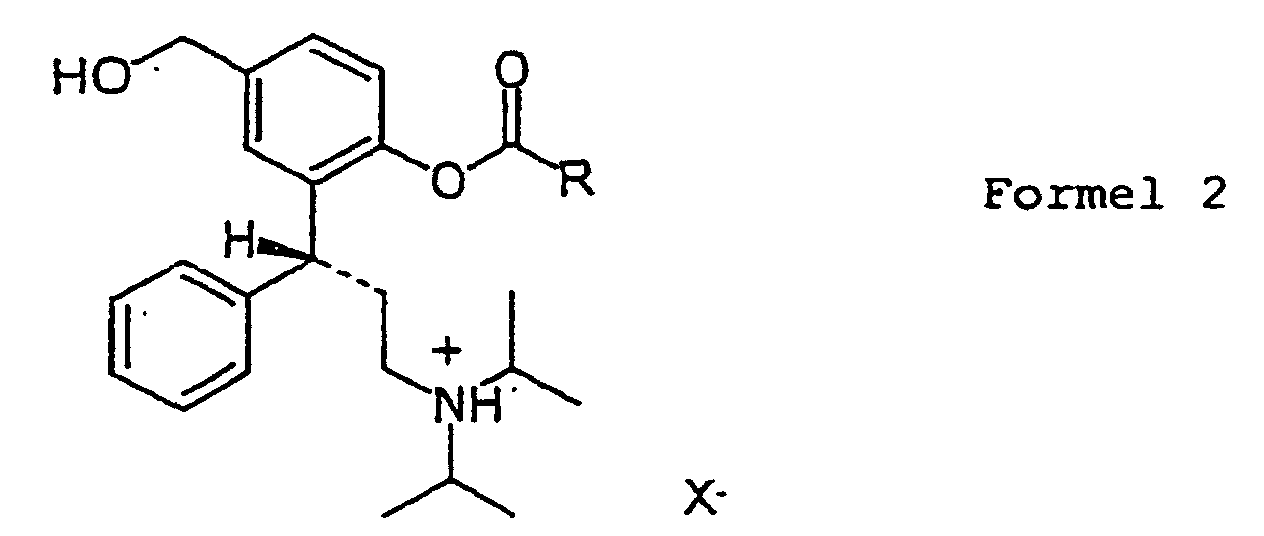 a) eine Verbindung der Formel 3mit einem Hydrierungsmittel zur Bildung einer Verbindung der Formel 5
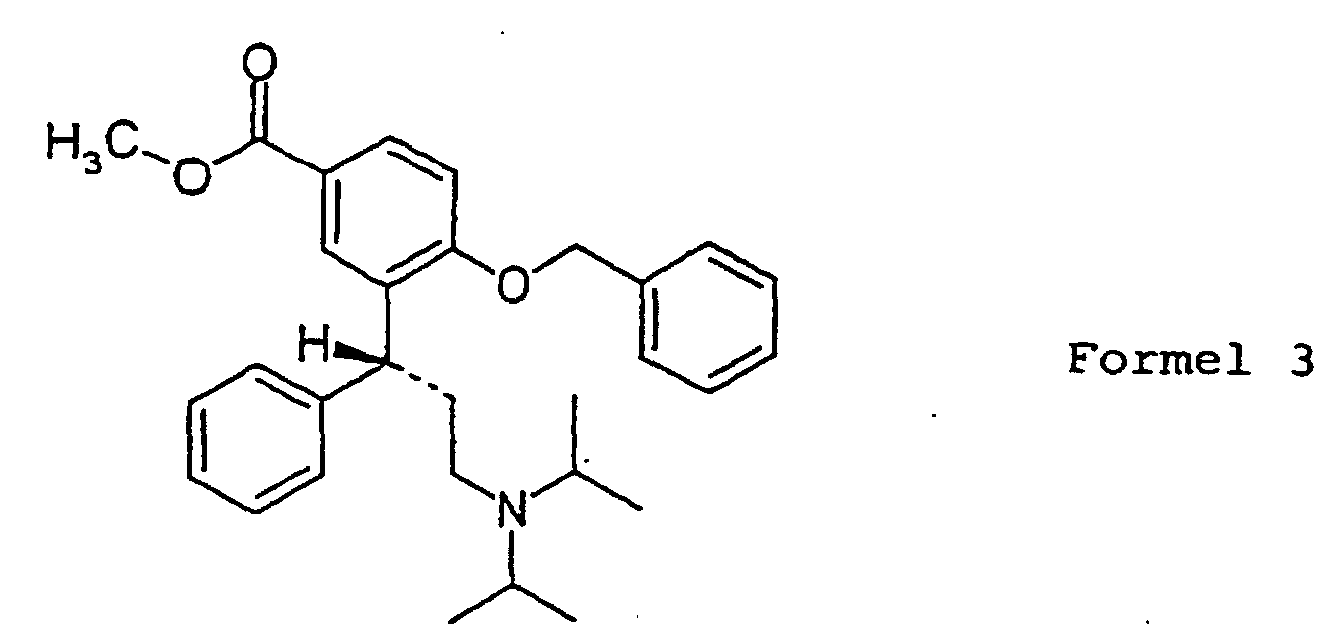 gespalten wird, worauf
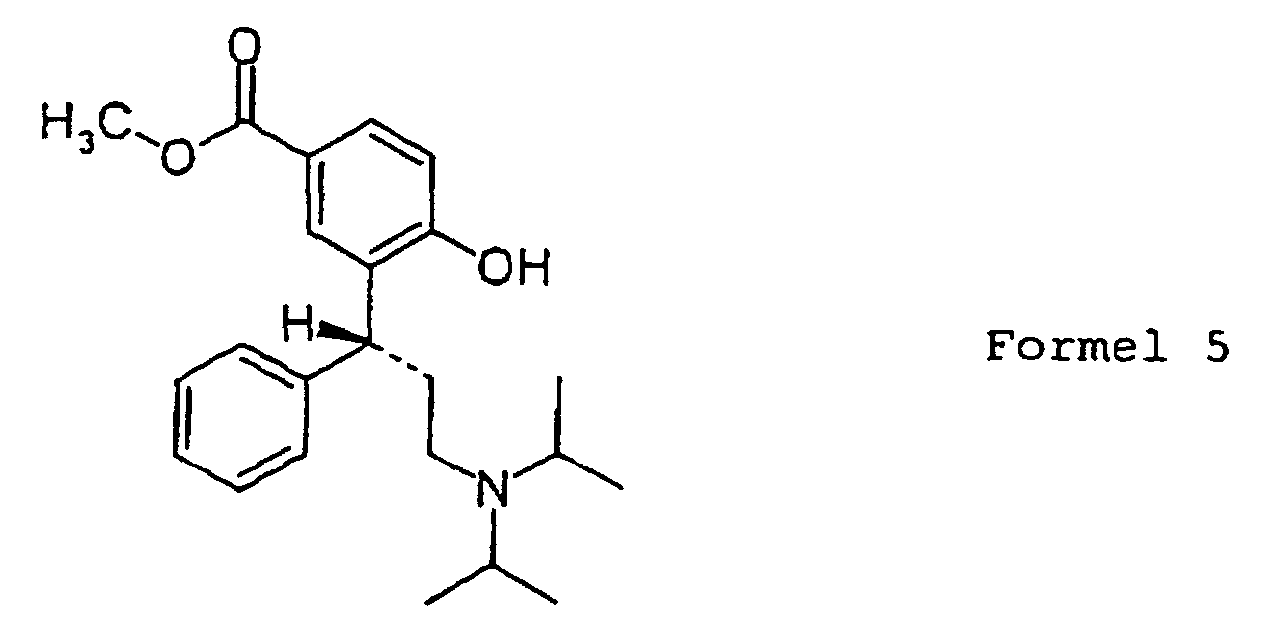 b) die so erhaltene Verbindung der Formel 5 mit einem Reduktionsmittel umgesetzt wird, um eine Verbindung der Formel 6zu ergeben, die
 c) mit einem Acylierungsmittel umgesetzt wird, um eine Verbindung der Formel 1zu erhalten, worin R die oben genannte Bedeutung hat, die
 d) mit einer physiologisch verträglichen anorganischen oder organischen Säure unter Bildung einer Verbindung der Formel 2umgesetzt wird, worin R für C1-C6-alkyl, C3-C10-cycloalkyl, unsubstituiertes oder substituiertes Phenyl steht und X- für den Säurerest einer physiologisch verträglichen anorganischen oder organischen Säure steht.
- Verfahren nach Anspruch 10, dadurch gekennzeichnet, daß zur Herstellung der Verbindungen der allgemeinen Formel 2 die Säuren Salzsäure, Bromwasserstoffsäure, Phosphorsäure, Schwefelsäure, Salpetersäure, Essigsäure, Propionsäure, Palmitinsäure, Stearinsäure, Maleinsäure, Fumarsäure, Oxalsäure, Bernsteinsäure, DL-Äpfelsäure, L-(-)-Apfelsäure, D- (+) -Äpfelsäure, DL-Weinsäure, L-(+)-Weinsäure, D-(-)-Weinsäure, Citronensäure, L-Asparaginsäure, L-(+)-Ascorbinsäure, D-(+)-Glucuronsäure, 2-Oxopropionsäure (Brenztraubensäure), Furan-2-carbonsäure (Brenzschleimsäure) Benzoesäure, 4-Hydroxybenzoesäure, Salicylsäure, Vanillinsäure, 4-Hydroxyzimtsäure, Gallussäure, Hippursäure (N-Benzoyl-glycin), Acetursäure (N-Acetylglycin), Phloretinsäure (3-(4-Hydroxyphenyl)-propionsäure), Phthalsäure, Methansulphonsäure oder Orotsäure verwendet werden.
- Verfahren nach Ansprüchen 8 bis 11, dadurch gekennzeichnet, daß als Hydrierungsmittel vorzugsweise Raney-Nickel/H2 in Methanol als Lösungsmittel verwendet wird.
- Verfahren nach Ansprüchen 8 bis 11, dadurch gekennzeichnet, daß als Reduktionsmittel NaBH4/EtOH, vorzugsweise LiAlH4/THF verwendet werden.
- Verfahren nach Ansprüchen 8 bis 11, dadurch gekennzeichnet, daß als Acylierungsmittel Isobutyrylchlorid und als Base Triethylamin verwendet werden.
- Verfahren nach Ansprüchen 10 bis 14, dadurch gekennzeichnet, daß eine Verbindung der Formel 6 mit einem Äquivalent Isobutyrylchlorid in Gegenwart von Triethylamin unter Verwendung eines der jeweiligen Lösungsmittel Ethylacetat, Dichlormethan, Tetrahydrofuran, Acetonitril oder Toluol regio- und chemoselektiv zu R-(+)-2-(3-Diisopropylamino-1-phenylpropyl)-4-hydroxymethylphenylisobuttersäureester umgesetzt wird.
- Verfahren nach Ansprüchen 10 bis 15, dadurch gekennzeichnet, daß R-(+)-2-(3-Diisopropylamino-1-phenylpropyl)-4-hydroxymethylphenylisobuttersäureester und Fumarsäure oder Salzsäure unter Bildung des jeweiligen Salzes umgesetzt werden.
- Verfahren nach Ansprüchen 10 bis 13 zur Herstellung von R-(+)-2-(3-Diisopropylamino-1-phenyl-propyl)-4-hydroxymethylphenylisobuttersäureester Hydrochlorid Hydrat, dadurch gekennzeichnet, daß die phenolische Veresterung von R-(+)-2-(3-Diisopropylamino-1-phenylpropyl)-4-hydroxymethylphenol (6) ohne Zusatz einer externen Base durchgeführt wird, indem Lösungen von (6) in Lösungen von Isobuttersäurechlorid, die mindestens 1 Moläquivalent Wasser enthalten, zugetropft werden, um direkt ein entsprechendes stabiles, hydrathaltiges Hydrochlorid zu erhalten.
Priority Applications (6)
| Application Number | Priority Date | Filing Date | Title |
|---|---|---|---|
| EP06011207A EP1690536B1 (de) | 1999-11-16 | 2000-11-15 | Verwendung von r-(+)-2-(3-diisopropylamino-1-phenylpropyl)-4-hydroxy-methyl-Phenylisobuttersäureester Hydrogenfumarat zur Behandlung von Harndrang-Inkontinenz und anderen spasmogenen Leiden |
| SI200030890T SI1481964T1 (sl) | 1999-11-16 | 2000-11-15 | Stabilne soli novovrstnih derivatov 3,3-difenilpropilaminov |
| EP04018487A EP1481964B1 (de) | 1999-11-16 | 2000-11-15 | Stabile Salze neuartiger derivative von 3,3-Diphenylpropylaminen |
| SI200030617T SI1230209T1 (en) | 1999-11-16 | 2000-11-15 | Stable salts of novel derivatives of 3,3-diphenylpropylamines |
| DK04018487T DK1481964T3 (da) | 1999-11-16 | 2000-11-15 | Stabile salte af hidtil ukendte derivater af 3,3-diphenylpropylaminer |
| CY20061101493T CY1106204T1 (el) | 1999-11-16 | 2006-10-18 | Σταθepα αλατα καινοφανων παραγωγων 3,3-διφαινυλοπροπυλαμινων |
Applications Claiming Priority (3)
| Application Number | Priority Date | Filing Date | Title |
|---|---|---|---|
| DE19955190A DE19955190A1 (de) | 1999-11-16 | 1999-11-16 | Stabile Salze neuartiger Derivate von 3,3-Diphenylpropylaminen |
| DE19955190 | 1999-11-16 | ||
| PCT/EP2000/011309 WO2001035957A1 (de) | 1999-11-16 | 2000-11-15 | Stabile salze neuartiger derivate von 3,3-diphenylpropylaminen |
Related Child Applications (3)
| Application Number | Title | Priority Date | Filing Date |
|---|---|---|---|
| EP04018487A Division EP1481964B1 (de) | 1999-11-16 | 2000-11-15 | Stabile Salze neuartiger derivative von 3,3-Diphenylpropylaminen |
| EP04018487A Division-Into EP1481964B1 (de) | 1999-11-16 | 2000-11-15 | Stabile Salze neuartiger derivative von 3,3-Diphenylpropylaminen |
| EP06011207A Division-Into EP1690536B1 (de) | 1999-11-16 | 2000-11-15 | Verwendung von r-(+)-2-(3-diisopropylamino-1-phenylpropyl)-4-hydroxy-methyl-Phenylisobuttersäureester Hydrogenfumarat zur Behandlung von Harndrang-Inkontinenz und anderen spasmogenen Leiden |
Publications (3)
| Publication Number | Publication Date |
|---|---|
| EP1230209A2 EP1230209A2 (de) | 2002-08-14 |
| EP1230209B1 true EP1230209B1 (de) | 2005-01-12 |
| EP1230209B3 EP1230209B3 (de) | 2011-10-05 |
Family
ID=7929277
Family Applications (3)
| Application Number | Title | Priority Date | Filing Date |
|---|---|---|---|
| EP06011207A Expired - Lifetime EP1690536B1 (de) | 1999-11-16 | 2000-11-15 | Verwendung von r-(+)-2-(3-diisopropylamino-1-phenylpropyl)-4-hydroxy-methyl-Phenylisobuttersäureester Hydrogenfumarat zur Behandlung von Harndrang-Inkontinenz und anderen spasmogenen Leiden |
| EP00989857A Expired - Lifetime EP1230209B3 (de) | 1999-11-16 | 2000-11-15 | Stabile salze neuartiger derivate von 3,3-diphenylpropylaminen |
| EP04018487A Expired - Lifetime EP1481964B1 (de) | 1999-11-16 | 2000-11-15 | Stabile Salze neuartiger derivative von 3,3-Diphenylpropylaminen |
Family Applications Before (1)
| Application Number | Title | Priority Date | Filing Date |
|---|---|---|---|
| EP06011207A Expired - Lifetime EP1690536B1 (de) | 1999-11-16 | 2000-11-15 | Verwendung von r-(+)-2-(3-diisopropylamino-1-phenylpropyl)-4-hydroxy-methyl-Phenylisobuttersäureester Hydrogenfumarat zur Behandlung von Harndrang-Inkontinenz und anderen spasmogenen Leiden |
Family Applications After (1)
| Application Number | Title | Priority Date | Filing Date |
|---|---|---|---|
| EP04018487A Expired - Lifetime EP1481964B1 (de) | 1999-11-16 | 2000-11-15 | Stabile Salze neuartiger derivative von 3,3-Diphenylpropylaminen |
Country Status (30)
| Country | Link |
|---|---|
| US (1) | US6858650B1 (de) |
| EP (3) | EP1690536B1 (de) |
| JP (6) | JP4083431B2 (de) |
| KR (2) | KR100536095B1 (de) |
| CN (1) | CN1215045C (de) |
| AT (3) | ATE286872T1 (de) |
| AU (1) | AU778132B2 (de) |
| BR (1) | BRPI0015610C1 (de) |
| CA (1) | CA2389749C (de) |
| CY (2) | CY1106204T1 (de) |
| CZ (2) | CZ302497B6 (de) |
| DE (5) | DE19955190A1 (de) |
| DK (3) | DK1481964T3 (de) |
| EA (1) | EA005588B1 (de) |
| ES (3) | ES2270240T3 (de) |
| GE (1) | GEP20084430B (de) |
| HK (1) | HK1045148B (de) |
| HU (2) | HU227608B1 (de) |
| IL (2) | IL149567A0 (de) |
| IS (2) | IS2124B (de) |
| MX (1) | MXPA02004603A (de) |
| NO (2) | NO323920B1 (de) |
| NZ (1) | NZ519230A (de) |
| PL (1) | PL201422B1 (de) |
| PT (3) | PT1690536E (de) |
| SI (3) | SI1230209T1 (de) |
| SK (3) | SK287430B6 (de) |
| UA (2) | UA73324C2 (de) |
| WO (1) | WO2001035957A1 (de) |
| ZA (1) | ZA200203315B (de) |
Cited By (2)
| Publication number | Priority date | Publication date | Assignee | Title |
|---|---|---|---|---|
| WO2007140986A1 (en) * | 2006-06-09 | 2007-12-13 | Schwarz Pharma Ltd | Synthesis of phenolic esters of hydroxymethyl phenols |
| WO2011050961A1 (de) | 2009-10-30 | 2011-05-05 | Ratiopharm Gmbh | Zusammensetzung enthaltend fesoterodin und ballaststoffe |
Families Citing this family (46)
| Publication number | Priority date | Publication date | Assignee | Title |
|---|---|---|---|---|
| EP0957073A1 (de) * | 1998-05-12 | 1999-11-17 | Schwarz Pharma Ag | 3,3-Diphenylpropylaminderivate |
| DE19955190A1 (de) * | 1999-11-16 | 2001-06-21 | Sanol Arznei Schwarz Gmbh | Stabile Salze neuartiger Derivate von 3,3-Diphenylpropylaminen |
| DE10028443C1 (de) * | 2000-06-14 | 2002-05-29 | Sanol Arznei Schwarz Gmbh | Verfahren zur Herstellung von 3,3-Diarylpropylaminen, (R,S)- und (R)-4-Phenyl-2-chromanon-6-carbonsäure sowie (R)-4-Phenyl-2-chromanon-carbonsäure-cinchonidinsalz und deren Verwendung zur Herstellung eines rechtsdrehenden Hydroxybenzylalkohols und von pharmazeutischen Zusammensetzungen |
| DE10315878B4 (de) * | 2003-04-08 | 2009-06-04 | Schwarz Pharma Ag | Vorrichtung zur transdermalen Verabreichung von Fesoterodin und Verwendung |
| DE10315917A1 (de) * | 2003-04-08 | 2004-11-18 | Schwarz Pharma Ag | Hochreine Basen von 3,3-Diphenylpropylaminmonoestern |
| WO2005012227A2 (en) * | 2003-08-05 | 2005-02-10 | Ranbaxy Laboratories Limited | Process for preparation of 2-(3-diisopropylamino-1-phenylpropyl)-4-hydroxymethyl-phenol, a metabolite of tolterodine |
| ES2235648B1 (es) * | 2003-12-22 | 2006-11-01 | Ragactives, S.L. | Procedimiento para la obtencion de tolterodina. |
| US8034823B2 (en) * | 2005-02-22 | 2011-10-11 | Savvipharm Inc | Method of increasing drug oral bioavailability and compositions of less toxic orotate salts |
| KR100647068B1 (ko) | 2005-09-15 | 2006-11-23 | 하나제약 주식회사 | 라세믹n,n-디이소프로필-3-(2-히드록시-5-메틸페닐)-3-페닐프로판아민의 제조방법 |
| CA2651978C (en) * | 2006-05-24 | 2011-06-07 | Pfizer Limited | Process for the production of benzopyran-2-ol derivatives |
| KR101453318B1 (ko) * | 2006-05-31 | 2014-10-21 | 유씨비 매뉴팩처링 아일랜드 리미티드 | 치환 히드록시메틸 페놀의 새로운 합성 |
| EP1862449A1 (de) * | 2006-05-31 | 2007-12-05 | Schwarz Pharma Ltd. | Verkürzte Synthese von substituierten Hydroxymethylphenolen |
| IES20060424A2 (en) | 2006-06-08 | 2007-10-31 | Schwarz Pharma Ltd | Accelerated synthesis of (3-Diisopropylamino-1-phenylpropyl)-4-(hydroxymethyl)phenol and its phenolic monoesters |
| US7807715B2 (en) | 2006-06-09 | 2010-10-05 | Ucb Pharma Gmbh | Pharmaceutical compositions comprising fesoterodine |
| ATE517619T1 (de) * | 2006-06-09 | 2011-08-15 | Ucb Pharma Gmbh | Stabilisierte pharmazeutische zusammensetzung mit fesoterodin |
| KR101488740B1 (ko) | 2006-06-12 | 2015-02-03 | 유씨비 파마 게엠베하 | 새로운 키랄 중간체, 그 키랄 중간체의 제조방법 및 톨테로딘, 페소테로딘 또는 그 활성대사물질의 제조에서 그키랄 중간체의 사용 |
| IES20060435A2 (en) | 2006-06-12 | 2007-12-12 | Schwarz Pharma Ltd | Shortened synthesis using paraformaldehyde or trioxane |
| WO2009037569A2 (en) * | 2007-09-21 | 2009-03-26 | Actavis Group Ptc Ehf | An improved process for the preparation of fesoterodine |
| US20100297241A1 (en) * | 2007-10-01 | 2010-11-25 | Actavis Group Ptc Ehf | Amorphous Fesoterodine Fumarate |
| EP2294047A2 (de) * | 2008-04-04 | 2011-03-16 | Actavis Group PTC EHF | Neues mandelatsalz von fesoterodin |
| US20110171274A1 (en) * | 2008-07-21 | 2011-07-14 | Actavis Group Ptc Ehf | Fesoterodine Substantially Free of Dehydroxy Impurity |
| IT1392082B1 (it) * | 2008-12-10 | 2012-02-09 | Chemi Spa | Nuove forme solide della fesoterodina fumarato |
| MX2011011937A (es) | 2009-05-11 | 2012-01-27 | Ratiopharm Gmbh | Desfesoterodina en la forma de una sal del acido tartarico. |
| IT1394219B1 (it) * | 2009-05-15 | 2012-06-01 | Chemi Spa | Metodo di preparazione di fesoterodina fumarato di elevata purezza. |
| IT1394217B1 (it) * | 2009-05-15 | 2012-06-01 | Chemi Spa | Metodo di preparazione di fesoterodina e/o fesoterodina fumarato. |
| KR20120053027A (ko) | 2009-09-03 | 2012-05-24 | 테바 기오기스제르갸르 자르트쾨렌 뮈쾨되 레스즈베니타르사사그 | 페소테로딘 푸마레이트 및 페소테로딘 염기의 결정형 |
| IT1396373B1 (it) * | 2009-10-29 | 2012-11-19 | Dipharma Francis Srl | Procedimento per la preparazione di fesoterodina. |
| US20110124903A1 (en) * | 2009-11-20 | 2011-05-26 | Actavis Group Ptc Ehf | Solid state forms of fesoterodine intermediates |
| IT1397521B1 (it) * | 2009-12-21 | 2013-01-16 | Dipharma Francis Srl | Procedimento per la preparazione di fesoterodina con un basso contenuto di impurezze. |
| IT1397920B1 (it) * | 2010-02-08 | 2013-02-04 | Dipharma Francis Srl | Forma cristallina di fesoterodina fumarato e procedimento per la sua preparazione |
| US20130172411A1 (en) | 2010-03-22 | 2013-07-04 | Cadila Healthcare Limited | Stable pharmaceutical compositions comprising fesoterodine |
| AU2011245499B2 (en) | 2010-04-30 | 2014-09-25 | Merck Sharp & Dohme Corp. | Novel beta 3 adrenergic receptor agonists |
| WO2011141932A2 (en) | 2010-05-11 | 2011-11-17 | Intas Pharmaceuticals Limited | Process for preparation of phenolic monoesters of hydroxymethyl phenols |
| WO2011145019A1 (en) * | 2010-05-17 | 2011-11-24 | Orchid Chemicals And Pharmaceuticals Limited | Improved process for diphenylpropylamine derivatives |
| IT1401451B1 (it) | 2010-06-10 | 2013-07-26 | Chemi Spa | Nuovo processo di preparazione di 2-idrossi-4-fenil-3,4-diidro-2h-cromen-6-il-metanolo e (r)-2-[3-(diisopropilammino)-1-fenilpropil]-4-(idrossimetil)fenolo. |
| WO2011158257A1 (en) | 2010-06-18 | 2011-12-22 | Panacea Biotec Ltd | Preparation process of fesoterodine and intermediates |
| US9012678B2 (en) * | 2010-08-25 | 2015-04-21 | Cadila Healthcare Limited | Processes for the preparation of fesoterodine |
| IT1403094B1 (it) | 2010-12-09 | 2013-10-04 | Dipharma Francis Srl | Procedimento per la preparazione di fesoterodina o un suo sale |
| WO2012098560A2 (en) * | 2011-01-17 | 2012-07-26 | Msn Laboratories Limited | Process for the preparation of muscarinic receptor antagonist |
| TWI590821B (zh) | 2011-01-18 | 2017-07-11 | 輝瑞有限公司 | 固體分子分散液 |
| EP2508173A1 (de) | 2011-04-08 | 2012-10-10 | LEK Pharmaceuticals d.d. | Stabile pharmazeutische Zusammensetzung mit Fesoterodin |
| EP2508175A1 (de) | 2011-04-08 | 2012-10-10 | LEK Pharmaceuticals d.d. | Pharmazeutische Zusammensetzung enthaltend Fesoterodin oder ein Salz oder ein Solvat davon |
| CA2873721C (en) | 2012-05-04 | 2021-06-22 | Crystal Pharma, S.A.U. | Process for the preparation of optically active 3,3-diphenylpropylamines |
| ITMI20121232A1 (it) | 2012-07-16 | 2014-01-17 | Cambrex Profarmaco Milano Srl | Procedimento per la preparazione di 2-(3-n,n-diisopropilamino-1-fenilpropil)-4-idrossimetil-fenolo e suoi derivati |
| TR201721437A2 (tr) | 2017-12-25 | 2019-07-22 | Sanovel Ilac Sanayi Ve Ticaret Anonim Sirketi | Fesoterodi̇ni̇n modi̇fi̇ye salim sağlayan formülasyonlari |
| WO2022090235A1 (en) * | 2020-10-27 | 2022-05-05 | Wella Germany Gmbh | 2-methoxymethyl-p-phenylenediamine in cosmetic grade quality |
Family Cites Families (9)
| Publication number | Priority date | Publication date | Assignee | Title |
|---|---|---|---|---|
| ZA817863B (en) * | 1980-11-14 | 1983-06-29 | Lilly Co Eli | (-)n-methyl-3-(2-methylphenoxy)-3-phenylpropylamnie,antidepressant |
| IL66831A0 (en) * | 1981-10-05 | 1982-12-31 | Kefalas As | Indane derivatives |
| SE8800207D0 (sv) * | 1988-01-22 | 1988-01-22 | Kabivitrum Ab | Nya aminer, deras anvendning och framstellning |
| ATE140213T1 (de) * | 1990-03-08 | 1996-07-15 | Fujisawa Pharmaceutical Co | N-monosubstituierte cyclopentenylamine, ein verfahren zu ihrer herstellung, und ihre verwendung als medikament |
| JPH0483431A (ja) * | 1990-07-26 | 1992-03-17 | Seiko Epson Corp | 選択呼出受信機 |
| SE9203318D0 (sv) | 1992-11-06 | 1992-11-06 | Kabi Pharmacia Ab | Novel 3,3-diphenylpropylamines, their use and preparation |
| SE9701144D0 (sv) * | 1997-03-27 | 1997-03-27 | Pharmacia & Upjohn Ab | Novel compounds, their use and preparation |
| EP0957073A1 (de) * | 1998-05-12 | 1999-11-17 | Schwarz Pharma Ag | 3,3-Diphenylpropylaminderivate |
| DE19955190A1 (de) * | 1999-11-16 | 2001-06-21 | Sanol Arznei Schwarz Gmbh | Stabile Salze neuartiger Derivate von 3,3-Diphenylpropylaminen |
-
1999
- 1999-11-16 DE DE19955190A patent/DE19955190A1/de not_active Ceased
- 1999-11-16 DE DE29923134U patent/DE29923134U1/de not_active Expired - Lifetime
-
2000
- 2000-11-15 CA CA002389749A patent/CA2389749C/en not_active Expired - Lifetime
- 2000-11-15 DK DK04018487T patent/DK1481964T3/da active
- 2000-11-15 AU AU26667/01A patent/AU778132B2/en not_active Expired
- 2000-11-15 HU HU0900587A patent/HU227608B1/hu unknown
- 2000-11-15 CN CNB008157057A patent/CN1215045C/zh not_active Expired - Lifetime
- 2000-11-15 DE DE50013365T patent/DE50013365D1/de not_active Expired - Lifetime
- 2000-11-15 SI SI200030617T patent/SI1230209T1/xx unknown
- 2000-11-15 MX MXPA02004603A patent/MXPA02004603A/es active IP Right Grant
- 2000-11-15 EP EP06011207A patent/EP1690536B1/de not_active Expired - Lifetime
- 2000-11-15 BR BRPI0015610A patent/BRPI0015610C1/pt not_active IP Right Cessation
- 2000-11-15 ES ES04018487T patent/ES2270240T3/es not_active Expired - Lifetime
- 2000-11-15 NZ NZ519230A patent/NZ519230A/en not_active IP Right Cessation
- 2000-11-15 ES ES00989857T patent/ES2236032T7/es active Active
- 2000-11-15 SK SK657-2002A patent/SK287430B6/sk not_active IP Right Cessation
- 2000-11-15 DE DE50015163T patent/DE50015163D1/de not_active Expired - Lifetime
- 2000-11-15 AT AT00989857T patent/ATE286872T1/de active
- 2000-11-15 AT AT06011207T patent/ATE395056T1/de active
- 2000-11-15 IL IL14956700A patent/IL149567A0/xx unknown
- 2000-11-15 PT PT06011207T patent/PT1690536E/pt unknown
- 2000-11-15 SI SI200030890T patent/SI1481964T1/sl unknown
- 2000-11-15 ES ES06011207T patent/ES2303708T3/es not_active Expired - Lifetime
- 2000-11-15 UA UA2002043609A patent/UA73324C2/uk unknown
- 2000-11-15 AT AT04018487T patent/ATE337293T1/de active
- 2000-11-15 PT PT00989857T patent/PT1230209E/pt unknown
- 2000-11-15 EP EP00989857A patent/EP1230209B3/de not_active Expired - Lifetime
- 2000-11-15 KR KR10-2002-7006306A patent/KR100536095B1/ko not_active Expired - Fee Related
- 2000-11-15 WO PCT/EP2000/011309 patent/WO2001035957A1/de not_active Ceased
- 2000-11-15 EA EA200200511A patent/EA005588B1/ru not_active IP Right Cessation
- 2000-11-15 CZ CZ20060247A patent/CZ302497B6/cs not_active IP Right Cessation
- 2000-11-15 KR KR1020057018318A patent/KR100563149B1/ko not_active Expired - Lifetime
- 2000-11-15 DE DE50009239T patent/DE50009239D1/de not_active Expired - Lifetime
- 2000-11-15 SK SK5024-2013A patent/SK288384B6/sk not_active IP Right Cessation
- 2000-11-15 DK DK06011207T patent/DK1690536T3/da active
- 2000-11-15 SI SI200030998T patent/SI1690536T1/sl unknown
- 2000-11-15 CZ CZ20021343A patent/CZ302967B6/cs not_active IP Right Cessation
- 2000-11-15 DK DK00989857T patent/DK1230209T3/da active
- 2000-11-15 SK SK5027-2010A patent/SK288185B6/sk not_active IP Right Cessation
- 2000-11-15 PL PL356766A patent/PL201422B1/pl unknown
- 2000-11-15 HU HU0204034A patent/HU228197B1/hu unknown
- 2000-11-15 JP JP2001537950A patent/JP4083431B2/ja not_active Expired - Lifetime
- 2000-11-15 PT PT04018487T patent/PT1481964E/pt unknown
- 2000-11-15 EP EP04018487A patent/EP1481964B1/de not_active Expired - Lifetime
- 2000-11-15 US US10/130,214 patent/US6858650B1/en not_active Expired - Lifetime
- 2000-11-15 HK HK02106545.5A patent/HK1045148B/zh not_active IP Right Cessation
-
2002
- 2002-04-19 IS IS6351A patent/IS2124B/xx unknown
- 2002-04-25 ZA ZA200203315A patent/ZA200203315B/xx unknown
- 2002-05-09 IL IL149567A patent/IL149567A/en active IP Right Grant
- 2002-05-15 NO NO20022314A patent/NO323920B1/no not_active IP Right Cessation
-
2005
- 2005-01-17 UA UAA200500434A patent/UA77322C2/uk unknown
-
2006
- 2006-03-29 IS IS8382A patent/IS2673B/is unknown
- 2006-10-18 CY CY20061101493T patent/CY1106204T1/el unknown
- 2006-11-22 NO NO20065380A patent/NO332637B1/no not_active IP Right Cessation
-
2007
- 2007-02-22 JP JP2007042774A patent/JP2007137895A/ja active Pending
- 2007-11-07 GE GEAP200710360A patent/GEP20084430B/en unknown
-
2008
- 2008-07-08 CY CY20081100712T patent/CY1110389T1/el unknown
-
2010
- 2010-04-22 JP JP2010098844A patent/JP5650924B2/ja not_active Expired - Lifetime
- 2010-04-22 JP JP2010098845A patent/JP5503393B2/ja not_active Expired - Lifetime
-
2011
- 2011-04-25 JP JP2011096911A patent/JP5290351B2/ja not_active Expired - Lifetime
-
2013
- 2013-11-05 JP JP2013229622A patent/JP5717824B2/ja not_active Expired - Lifetime
Cited By (2)
| Publication number | Priority date | Publication date | Assignee | Title |
|---|---|---|---|---|
| WO2007140986A1 (en) * | 2006-06-09 | 2007-12-13 | Schwarz Pharma Ltd | Synthesis of phenolic esters of hydroxymethyl phenols |
| WO2011050961A1 (de) | 2009-10-30 | 2011-05-05 | Ratiopharm Gmbh | Zusammensetzung enthaltend fesoterodin und ballaststoffe |
Also Published As
Similar Documents
| Publication | Publication Date | Title |
|---|---|---|
| EP1230209B3 (de) | Stabile salze neuartiger derivate von 3,3-diphenylpropylaminen | |
| EP0822935B1 (de) | Verfahren zur herstellung von enantiomerenreinen tropasäureestern | |
| EP0728735B1 (de) | Verfahren zur Herstellung von racemischen Aminoalkoholen | |
| KR100486394B1 (ko) | 3,3-디페닐-프로필아민의 신규한 유도체의 안정한 염 | |
| DE102004035034A1 (de) | Racematspaltung von p-Hydroxyphenyl-2-alkoxy-propionsäuren | |
| HK1067114B (en) | Stable salts of novel derivatives of 3,3-diphenylpropylamines |
Legal Events
| Date | Code | Title | Description |
|---|---|---|---|
| PUAI | Public reference made under article 153(3) epc to a published international application that has entered the european phase |
Free format text: ORIGINAL CODE: 0009012 |
|
| 17P | Request for examination filed |
Effective date: 20020507 |
|
| AK | Designated contracting states |
Kind code of ref document: A2 Designated state(s): AT BE CH CY DE DK ES FI FR GB GR IE IT LI LU MC NL PT SE TR |
|
| AX | Request for extension of the european patent |
Free format text: AL PAYMENT 20020507;LT PAYMENT 20020507;LV PAYMENT 20020507;MK PAYMENT 20020507;RO PAYMENT 20020507;SI PAYMENT 20020507 |
|
| 17Q | First examination report despatched |
Effective date: 20030820 |
|
| GRAP | Despatch of communication of intention to grant a patent |
Free format text: ORIGINAL CODE: EPIDOSNIGR1 |
|
| GRAS | Grant fee paid |
Free format text: ORIGINAL CODE: EPIDOSNIGR3 |
|
| GRAA | (expected) grant |
Free format text: ORIGINAL CODE: 0009210 |
|
| AK | Designated contracting states |
Kind code of ref document: B1 Designated state(s): AT BE CH CY DE DK ES FI FR GB GR IE IT LI LU MC NL PT SE TR |
|
| AX | Request for extension of the european patent |
Extension state: AL LT LV MK RO SI |
|
| REG | Reference to a national code |
Ref country code: GB Ref legal event code: FG4D Free format text: NOT ENGLISH |
|
| REG | Reference to a national code |
Ref country code: CH Ref legal event code: NV Representative=s name: SERVOPATENT GMBH Ref country code: CH Ref legal event code: EP |
|
| REF | Corresponds to: |
Ref document number: 50009239 Country of ref document: DE Date of ref document: 20050217 Kind code of ref document: P |
|
| REG | Reference to a national code |
Ref country code: IE Ref legal event code: FG4D Free format text: GERMAN |
|
| REG | Reference to a national code |
Ref country code: GR Ref legal event code: EP Ref document number: 20050401130 Country of ref document: GR |
|
| REG | Reference to a national code |
Ref country code: SE Ref legal event code: TRGR |
|
| GBT | Gb: translation of ep patent filed (gb section 77(6)(a)/1977) |
Effective date: 20050404 |
|
| REG | Reference to a national code |
Ref country code: HK Ref legal event code: GR Ref document number: 1045148 Country of ref document: HK |
|
| REG | Reference to a national code |
Ref country code: DK Ref legal event code: T3 |
|
| REG | Reference to a national code |
Ref country code: PT Ref legal event code: SC4A Free format text: AVAILABILITY OF NATIONAL TRANSLATION Effective date: 20050328 |
|
| REG | Reference to a national code |
Ref country code: ES Ref legal event code: FG2A Ref document number: 2236032 Country of ref document: ES Kind code of ref document: T3 |
|
| PLBE | No opposition filed within time limit |
Free format text: ORIGINAL CODE: 0009261 |
|
| ET | Fr: translation filed | ||
| 26N | No opposition filed |
Effective date: 20051013 |
|
| REG | Reference to a national code |
Ref country code: LT Ref legal event code: ND9D Free format text: PRODUCT NAME: FESOTERODINUM; REG. NO/DATE: EU/1/07/386/001-010 20070420 Spc suppl protection certif: PA2007008 Filing date: 20070921 Ref country code: LT Ref legal event code: SPCF Free format text: PRODUCT NAME: FESOTERODINUM; REGISTRATION NO/DATE: EU/1/07/386/001 - EU/1/07/386/010 20070420 Spc suppl protection certif: PA2007008 Filing date: 20070921 Expiry date: 20201115 |
|
| REG | Reference to a national code |
Ref country code: SI Ref legal event code: SPCF Ref document number: 1230209 Country of ref document: SI Kind code of ref document: T1 Free format text: PRODUCT NAME: FESOTERODINE FUMARATE; NATIONAL AUTHORISATION NUMBER: EU/1/07/386/001-010; DATE OF NATIONAL AUTHORISATION: 20070420; AUTHORITY FOR NATIONAL AUTHORISATION: EU Spc suppl protection certif: 200740014 Filing date: 20071005 |
|
| REG | Reference to a national code |
Ref country code: CH Ref legal event code: PFA Owner name: SCHWARZ PHARMA AG Free format text: SCHWARZ PHARMA AG#ALFRED-NOBEL-STRASSE 10#40789 MONHEIM (DE) -TRANSFER TO- SCHWARZ PHARMA AG#ALFRED-NOBEL-STRASSE 10#40789 MONHEIM (DE) |
|
| REG | Reference to a national code |
Ref country code: SI Ref legal event code: SPCG Ref document number: 1230209 Country of ref document: SI Kind code of ref document: T1 Free format text: PRODUCT NAME: FESOTERODINE FUMARATE; NATIONAL AUTHORISATION NUMBER: EU/1/07/386/001-010; DATE OF NATIONAL AUTHORISATION: 20070420; AUTHORITY FOR NATIONAL AUTHORISATION: EU Spc suppl protection certif: 200740014 Filing date: 20071005 Expiry date: 20201115 Extension date: 20220420 |
|
| REG | Reference to a national code |
Ref country code: LT Ref legal event code: SPCG Free format text: PRODUCT NAME: FESOTERODINUM; REGISTRATION NO/DATE: EU/1/07/386/001 - EU/1/07/386/010 20070420 Spc suppl protection certif: PA2007008,C1230209 Filing date: 20070921 Expiry date: 20201115 Extension date: 20220420 Ref country code: LT Ref legal event code: SPCG Free format text: PRODUCT NAME: FESOTERODINUM; REGISTRATION NO/DATE: EU/1/07/386/001 - EU/1/07/386/010 20070420 Spc suppl protection certif: PA2007008,C1230209 Filing date: 20070921 Expiry date: 20201115 Extension date: 20220424 |
|
| PLCP | Request for limitation filed |
Free format text: ORIGINAL CODE: EPIDOSNLIM1 |
|
| PLCQ | Request for limitation of patent found admissible |
Free format text: ORIGINAL CODE: 0009231 |
|
| LIM1 | Request for limitation found admissible |
Free format text: SEQUENCE NO: 1; FILED AFTER OPPOSITION PERIOD Filing date: 20101207 |
|
| PLCO | Limitation procedure: reply received to communication from examining division + time limit |
Free format text: ORIGINAL CODE: EPIDOSNLIR3 |
|
| PLCR | Communication despatched that request for limitation of patent was allowed |
Free format text: ORIGINAL CODE: 0009245 |
|
| REG | Reference to a national code |
Ref country code: DE Ref legal event code: R056 Ref document number: 50009239 Country of ref document: DE Effective date: 20110518 Ref country code: DE Ref legal event code: R097 Ref document number: 50009239 Country of ref document: DE Effective date: 20110518 |
|
| PLCN | Payment of fee for limitation of patent |
Free format text: ORIGINAL CODE: EPIDOSNRAL3 |
|
| PUAM | (expected) publication of b3 document |
Free format text: ORIGINAL CODE: 0009410 |
|
| STAA | Information on the status of an ep patent application or granted ep patent |
Free format text: STATUS: THE PATENT HAS BEEN LIMITED |
|
| REG | Reference to a national code |
Ref country code: CH Ref legal event code: AEN Free format text: BESCHRAENKUNGANTRAG GUTGEHEISSEN |
|
| REG | Reference to a national code |
Ref country code: CH Ref legal event code: PFA Owner name: UCB PHARMA GMBH Free format text: SCHWARZ PHARMA AG#ALFRED-NOBEL-STRASSE 10#40789 MONHEIM (DE) -TRANSFER TO- UCB PHARMA GMBH#ALFRED-NOBEL-STRASSE 10#40789 MONHEIM (DE) |
|
| REG | Reference to a national code |
Ref country code: NL Ref legal event code: T3 |
|
| REG | Reference to a national code |
Ref country code: NL Ref legal event code: TD Effective date: 20120111 |
|
| REG | Reference to a national code |
Ref country code: SI Ref legal event code: SP73 Owner name: UCB PHARMA GMBH; DE Effective date: 20120210 |
|
| REG | Reference to a national code |
Ref country code: FR Ref legal event code: CJ Effective date: 20120307 Ref country code: FR Ref legal event code: CD Owner name: SCHWARZ PHARMA GMBH Effective date: 20120307 |
|
| REG | Reference to a national code |
Ref country code: GR Ref legal event code: EP Ref document number: 20120400025 Country of ref document: GR Effective date: 20120305 |
|
| REG | Reference to a national code |
Ref country code: AT Ref legal event code: HC Ref document number: 286872 Country of ref document: AT Kind code of ref document: T Owner name: UCB PHARMA GMBH, DE Effective date: 20120518 |
|
| REG | Reference to a national code |
Ref country code: FR Ref legal event code: PLFP Year of fee payment: 16 |
|
| REG | Reference to a national code |
Ref country code: FR Ref legal event code: PLFP Year of fee payment: 17 |
|
| REG | Reference to a national code |
Ref country code: DE Ref legal event code: R088 Ref document number: 50009239 Country of ref document: DE |
|
| REG | Reference to a national code |
Ref country code: CH Ref legal event code: NV Representative=s name: E. BLUM AND CO. AG PATENT- UND MARKENANWAELTE , CH Ref country code: CH Ref legal event code: PLI Free format text: EXCLUSIVE LICENCE Name of requester: PFIZER INC., US |
|
| REG | Reference to a national code |
Ref country code: LU Ref legal event code: QB Name of requester: PFIZER INC. Effective date: 20170830 |
|
| REG | Reference to a national code |
Ref country code: FR Ref legal event code: PLFP Year of fee payment: 18 |
|
| REG | Reference to a national code |
Ref country code: NL Ref legal event code: QB Free format text: DETAILS LICENCE OR PLEDGE: LICENCE, NEW LICENCE REGISTRATION Name of requester: PFIZER LNC. Effective date: 20170928 |
|
| REG | Reference to a national code |
Ref country code: ES Ref legal event code: GD2A Effective date: 20180117 |
|
| REG | Reference to a national code |
Ref country code: BE Ref legal event code: QB Free format text: DETAILS LICENCE: LICENCE, ENREGISTREMENT D'UNE NOUVELLE LICENCE Name of requester: PFIZER INC. Effective date: 20180201 |
|
| REG | Reference to a national code |
Ref country code: FR Ref legal event code: CL Name of requester: PFIZER INC., US Effective date: 20180315 |
|
| REG | Reference to a national code |
Ref country code: SI Ref legal event code: SPCD Ref document number: 1230209 Country of ref document: SI Kind code of ref document: T1 Free format text: PRODUCT NAME: FESOTERODINE FUMARATE; NATIONAL AUTHORISATION NUMBER: EU/1/07/386/001-010; DATE OF NATIONAL AUTHORISATION: 20070420; AUTHORITY FOR NATIONAL AUTHORISATION: EU Spc suppl protection certif: 200740014 Filing date: 20071005 Expiry date: 20201115 Extension date: 20220424 |
|
| REG | Reference to a national code |
Ref country code: FR Ref legal event code: PLFP Year of fee payment: 19 |
|
| REG | Reference to a national code |
Ref country code: SI Ref legal event code: SPC1 Ref document number: 1230209 Country of ref document: SI Kind code of ref document: T1 Free format text: PRODUCT NAME: FESOTERODINE FUMARATE; NATIONAL AUTHORISATION NUMBER: EU/1/07/386/001-010; DATE OF NATIONAL AUTHORISATION: 20070420; AUTHORITY FOR NATIONAL AUTHORISATION: EU Spc suppl protection certif: 200740014 Filing date: 20071005 |
|
| PGFP | Annual fee paid to national office [announced via postgrant information from national office to epo] |
Ref country code: LU Payment date: 20191111 Year of fee payment: 20 |
|
| PGFP | Annual fee paid to national office [announced via postgrant information from national office to epo] |
Ref country code: CY Payment date: 20191112 Year of fee payment: 20 Ref country code: FI Payment date: 20191111 Year of fee payment: 20 Ref country code: SE Payment date: 20191111 Year of fee payment: 20 Ref country code: DE Payment date: 20191105 Year of fee payment: 20 Ref country code: PT Payment date: 20191114 Year of fee payment: 20 Ref country code: IE Payment date: 20191111 Year of fee payment: 20 Ref country code: NL Payment date: 20191114 Year of fee payment: 20 Ref country code: MC Payment date: 20191028 Year of fee payment: 20 |
|
| PGFP | Annual fee paid to national office [announced via postgrant information from national office to epo] |
Ref country code: BE Payment date: 20191017 Year of fee payment: 20 Ref country code: IT Payment date: 20191108 Year of fee payment: 20 Ref country code: ES Payment date: 20191202 Year of fee payment: 20 Ref country code: GR Payment date: 20191011 Year of fee payment: 20 Ref country code: FR Payment date: 20191014 Year of fee payment: 20 Ref country code: DK Payment date: 20191112 Year of fee payment: 20 |
|
| PGFP | Annual fee paid to national office [announced via postgrant information from national office to epo] |
Ref country code: AT Payment date: 20191025 Year of fee payment: 20 Ref country code: TR Payment date: 20191112 Year of fee payment: 20 Ref country code: CH Payment date: 20191116 Year of fee payment: 20 |
|
| PGFP | Annual fee paid to national office [announced via postgrant information from national office to epo] |
Ref country code: GB Payment date: 20191115 Year of fee payment: 20 |
|
| REG | Reference to a national code |
Ref country code: DE Ref legal event code: R071 Ref document number: 50009239 Country of ref document: DE |
|
| REG | Reference to a national code |
Ref country code: NL Ref legal event code: MK Effective date: 20201114 |
|
| REG | Reference to a national code |
Ref country code: CH Ref legal event code: PL |
|
| REG | Reference to a national code |
Ref country code: GB Ref legal event code: PE20 Expiry date: 20201114 |
|
| REG | Reference to a national code |
Ref country code: FI Ref legal event code: MAE |
|
| REG | Reference to a national code |
Ref country code: IE Ref legal event code: MK9A |
|
| REG | Reference to a national code |
Ref country code: AT Ref legal event code: MK07 Ref document number: 286872 Country of ref document: AT Kind code of ref document: T Effective date: 20201115 Ref country code: BE Ref legal event code: MK Effective date: 20201115 |
|
| PG25 | Lapsed in a contracting state [announced via postgrant information from national office to epo] |
Ref country code: GB Free format text: LAPSE BECAUSE OF EXPIRATION OF PROTECTION Effective date: 20201114 Ref country code: PT Free format text: LAPSE BECAUSE OF EXPIRATION OF PROTECTION Effective date: 20201125 Ref country code: IE Free format text: LAPSE BECAUSE OF EXPIRATION OF PROTECTION Effective date: 20201115 |
|
| REG | Reference to a national code |
Ref country code: ES Ref legal event code: FD2A Effective date: 20210303 |
|
| PG25 | Lapsed in a contracting state [announced via postgrant information from national office to epo] |
Ref country code: ES Free format text: LAPSE BECAUSE OF EXPIRATION OF PROTECTION Effective date: 20201116 |
|
| REG | Reference to a national code |
Ref country code: LT Ref legal event code: SPCX Free format text: PRODUCT NAME: FESOTERODINUM; REGISTRATION NO/DATE: EU/1/07/386/001 - EU/1/07/386/010 20070420 Spc suppl protection certif: PA2007008,C1230209 Filing date: 20070921 Expiry date: 20201115 Extension date: 20220424 Effective date: 20220424 |
|
| REG | Reference to a national code |
Ref country code: DK Ref legal event code: EUP Expiry date: 20201115 |