EP1220501B1 - Group creation for wireless communication terminals - Google Patents
Group creation for wireless communication terminals Download PDFInfo
- Publication number
- EP1220501B1 EP1220501B1 EP01660224A EP01660224A EP1220501B1 EP 1220501 B1 EP1220501 B1 EP 1220501B1 EP 01660224 A EP01660224 A EP 01660224A EP 01660224 A EP01660224 A EP 01660224A EP 1220501 B1 EP1220501 B1 EP 1220501B1
- Authority
- EP
- European Patent Office
- Prior art keywords
- wireless
- group
- wireless terminal
- terminal
- user
- Prior art date
- Legal status (The legal status is an assumption and is not a legal conclusion. Google has not performed a legal analysis and makes no representation as to the accuracy of the status listed.)
- Expired - Lifetime
Links
- 238000004891 communication Methods 0.000 title claims description 73
- 238000000034 method Methods 0.000 claims description 26
- 230000008569 process Effects 0.000 claims description 8
- 230000008878 coupling Effects 0.000 claims description 5
- 238000010168 coupling process Methods 0.000 claims description 5
- 238000005859 coupling reaction Methods 0.000 claims description 5
- 230000005540 biological transmission Effects 0.000 claims description 4
- 238000012790 confirmation Methods 0.000 claims 1
- 230000001413 cellular effect Effects 0.000 description 14
- 238000010586 diagram Methods 0.000 description 7
- 238000012546 transfer Methods 0.000 description 6
- 230000004913 activation Effects 0.000 description 3
- 230000015572 biosynthetic process Effects 0.000 description 3
- 230000006870 function Effects 0.000 description 3
- 238000005516 engineering process Methods 0.000 description 2
- 230000011664 signaling Effects 0.000 description 2
- 230000036772 blood pressure Effects 0.000 description 1
- 230000008859 change Effects 0.000 description 1
- 239000004020 conductor Substances 0.000 description 1
- 239000003989 dielectric material Substances 0.000 description 1
- 230000000977 initiatory effect Effects 0.000 description 1
- 238000012986 modification Methods 0.000 description 1
- 230000004048 modification Effects 0.000 description 1
- 238000012544 monitoring process Methods 0.000 description 1
- 230000000644 propagated effect Effects 0.000 description 1
- 230000036387 respiratory rate Effects 0.000 description 1
- 230000004044 response Effects 0.000 description 1
- 230000001960 triggered effect Effects 0.000 description 1
Images





Classifications
-
- H—ELECTRICITY
- H04—ELECTRIC COMMUNICATION TECHNIQUE
- H04W—WIRELESS COMMUNICATION NETWORKS
- H04W4/00—Services specially adapted for wireless communication networks; Facilities therefor
- H04W4/06—Selective distribution of broadcast services, e.g. multimedia broadcast multicast service [MBMS]; Services to user groups; One-way selective calling services
- H04W4/08—User group management
-
- H—ELECTRICITY
- H04—ELECTRIC COMMUNICATION TECHNIQUE
- H04B—TRANSMISSION
- H04B13/00—Transmission systems characterised by the medium used for transmission, not provided for in groups H04B3/00 - H04B11/00
- H04B13/005—Transmission systems in which the medium consists of the human body
-
- H—ELECTRICITY
- H04—ELECTRIC COMMUNICATION TECHNIQUE
- H04M—TELEPHONIC COMMUNICATION
- H04M1/00—Substation equipment, e.g. for use by subscribers
- H04M1/72—Mobile telephones; Cordless telephones, i.e. devices for establishing wireless links to base stations without route selection
- H04M1/724—User interfaces specially adapted for cordless or mobile telephones
- H04M1/72403—User interfaces specially adapted for cordless or mobile telephones with means for local support of applications that increase the functionality
- H04M1/72409—User interfaces specially adapted for cordless or mobile telephones with means for local support of applications that increase the functionality by interfacing with external accessories
- H04M1/72412—User interfaces specially adapted for cordless or mobile telephones with means for local support of applications that increase the functionality by interfacing with external accessories using two-way short-range wireless interfaces
-
- H—ELECTRICITY
- H04—ELECTRIC COMMUNICATION TECHNIQUE
- H04W—WIRELESS COMMUNICATION NETWORKS
- H04W40/00—Communication routing or communication path finding
- H04W40/24—Connectivity information management, e.g. connectivity discovery or connectivity update
- H04W40/246—Connectivity information discovery
-
- H—ELECTRICITY
- H04—ELECTRIC COMMUNICATION TECHNIQUE
- H04W—WIRELESS COMMUNICATION NETWORKS
- H04W40/00—Communication routing or communication path finding
- H04W40/24—Connectivity information management, e.g. connectivity discovery or connectivity update
- H04W40/26—Connectivity information management, e.g. connectivity discovery or connectivity update for hybrid routing by combining proactive and reactive routing
-
- H—ELECTRICITY
- H04—ELECTRIC COMMUNICATION TECHNIQUE
- H04W—WIRELESS COMMUNICATION NETWORKS
- H04W40/00—Communication routing or communication path finding
- H04W40/24—Connectivity information management, e.g. connectivity discovery or connectivity update
- H04W40/32—Connectivity information management, e.g. connectivity discovery or connectivity update for defining a routing cluster membership
-
- H—ELECTRICITY
- H04—ELECTRIC COMMUNICATION TECHNIQUE
- H04W—WIRELESS COMMUNICATION NETWORKS
- H04W8/00—Network data management
- H04W8/005—Discovery of network devices, e.g. terminals
-
- H—ELECTRICITY
- H04—ELECTRIC COMMUNICATION TECHNIQUE
- H04W—WIRELESS COMMUNICATION NETWORKS
- H04W92/00—Interfaces specially adapted for wireless communication networks
- H04W92/16—Interfaces between hierarchically similar devices
- H04W92/18—Interfaces between hierarchically similar devices between terminal devices
Definitions
- the invention relates to a group communication method and a device, a method for forming of a group of terminal devices.
- PDAs personal digital assistants
- pagers pagers
- PANs Personal Area Networks
- a low-frequency carrier is used.
- a prototype PAN system allows users to exchange electronic business cards by shaking hands.
- PAN devices are used in worn objects. They are watches, credit cards, eyeglasses, identification badges, belts, waist packs, and shoe insert. Head-mounted PAN devices include headphones, hearing aids, microphones, and head-mounted displays. Shirt pocket PAN devices operate as identification badges. The wristwatch operates as a location for a display, a microphone, a camera, and a speaker. PAN devices incorporating sensors provide medical monitoring for bodily functions (heartbeat, blood pressure, and respiratory rate). Wallet-based PAN devices store information and identify the possessor. Shoe inserts are self-powered and provide a data-link to remote PAN devices located in the workstations and floor transponders that detect the location and identity of people.
- cellular telephone systems providing mobile telephone services.
- the cellular telephone systems provide services that allow subscribers of these systems to increase their accessibility and be reachable, potentially at all times, and as long as the subscribers remain in the service areas covered by their systems.
- a person desiring to contact the cellular subscriber would simply dial the phone number of the cellular subscriber to contact the subscriber at the subscriber's cellular telephone. As long as the cellular subscriber kept the cellular telephone powered on the subscriber would be accessible when located within the coverage area of the cellular system.
- a group call is a conference call in which all participants may talk in turn and hear one another.
- An individual mobile radio may belong to a plurality of groups programmed into the mobile radio. The system keeps a file on the base stations associated with the group number of each group.
- a group call may cover one, several or all base stations within the area of a mobile exchange or a plurality of mobile exchanges.
- SMS Short message services
- GSM Global System for Mobile communications
- GPRS General Packet Radio Service
- a patent application EP 1 024 626 discloses a method, an apparatus, and a communication system for the exchange of information in a networked pervasive environment. Therewith an authenticated and secure session can be achieved. Therefore are used a first device and at least a remote second device. A unidirectional wireless communication channel between the first device and the remote second device is initiated, whereby a sequence via the unidirectional wireless communication channel from the first device to the remote second device is sent in order to furnish the remote second device with encryption information. An encrypted response is sent via a wireless broadcast medium to the first device by using said encryption information for encryption.
- a wireless communication terminal and a method for creation or establishment of a group.
- a wireless communication terminal for group communication with at least one other wireless terminal, the terminal comprising:
- a wireless communication terminal for group communication with at least one other wireless terminal, characterized in that the terminal comprising:
- the wireless communication link is preferably a low power radio frequency link, such as a Bluetooth link.
- the establishment of the group is saved in the memory of each terminal device of the group, whereafter activation of a group communication, such as making a group phone call, or a group messaging in the form of sending text messages or images to the whole group, can be done by activation of the group communication to that particular group.
- the memory can be arranged in a similar manner as a telephone directory in a mobile phone or as is known as the Contacts directory in e.g. the Nokia 9110 Communicator.
- a vicinity of the wireless terminals is detected using the communication over the wireless link. Detecting a vicinity of the wireless terminals includes entering a group creation mode in at least two of the wireless terminal. After the user has entered the mode, the method includes inquiring the vicinity of the wireless terminals using the wireless communication to transmit a message from the wireless terminal that has first entered the mode to the second wireless terminal that has entered the mode. The message includes information about the first wireless terminal that initiates the process and it may further include information about the group creation.
- the entering the group-creating mode preferably includes touching an electrode located on or being in connection to the terminal.
- the entering into the group creation mode may also include selecting the mode from a menu of the wireless terminal or pressing a particular button.
- detecting the physical contact between the users preferably includes transferring a signal via the physical contact between the users of the wireless terminals using the first circuit in the wireless terminals.
- the transferred signal is generated in a signal transceiver, such as a PAN transceivver.
- the generated signal is transferred to a body of the first user from an electrode connected to the signal transceiver and to a body of a second user when the users are physically connected.
- a transceiver at the wireless terminal of the second user detects the generated signal.
- the signal is received via the bodies of possibly other physically connected users to respective transceivers in their terminals by touching an electrode at their respective terminals.
- the signal is preferably a low-frequency signal, e.g. less than one megahertz.
- the physical contact may include a handshake. It may also include another type of contact between the users that may allow the signal to pass between the users.
- the establishment of the group of the physically connected user of the wireless terminals may be confirmed using a message that may be transmitted using
- a wireless terminal for enabling users to form a group communication.
- the wireless terminal includes a first circuit or transceiver which is connected to the central controller of the terminal.
- the first circuit is used for communication between at least two users of a wireless terminal when there is a physical contact between the users in order to form a group.
- the wireless terminal includes a second circuit or transceiver which is connected to the central controller.
- the second circuit is for a wireless group communication between the at least two wireless terminals of the established group.
- the second circuit is preferably a short-range radio transceiver.
- the first circuit is preferably a PAN transceiver and a group creation electrode.
- the first circuit may include a switch to trigger the communication.
- the switch may also trigger the creation of the group.
- the central controller may include a processor (CPU), a memory, an input and an output.
- the physical contact between at least two users may be a handshake between the persons.
- the physical contact may also be another type of contact between the users that allows the signal to pass between the users.
- the physical contact may be any contact between the users that enables a small electrical current to flow from a first body of a first user to a second body(s) of a second user(s).
- the physical contact may also be any contact where a body can exchange digital information coupling capacitively small currents through the body.
- the signal may be a low frequency signal that can be electric current.
- wireless terminals establish a communication group.
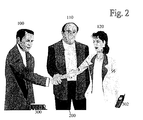
- a user 100 has a wireless terminal 300 in his possession.
- the group has at least two, but preferably several wireless terminals, for example, wireless terminal 300, 301, and 302.
- Wireless terminal 300 may, for example, be a mobile, a Personal Digital Assistant (PDA), a laptop computer, or any other terminal equipped with a short-range radio communication transceiver or low-power radio communication transceiver.
- An arm 101 (111 and 121 respectively) of user 100 (110 and 120) may be used in group creation to transfer a signal between the users when the users have a physical connection.
- One of the wireless terminals, e.g. wireless terminal 300 may function as a master that may have administrative tasks in the group creation.
- a physical contact 200 is illustrated. Users 100, 110, and 120 touch one another by their hands whereby a physical contact 200 between the users 100, 110, and 120 is established.
- the physical connection 200 preferably allows a signal to transfer between the users 100, 110, and 120 by capacitively coupling small currents (picoampers) through the body caused by the contact.
- the source of the signal can be a PAN transceiver in contact with an electrode that one of the users touches (and likewise the signal may be received by a PAN transceiver that another one of the user is in touch with via an electrode).
- the signal or signals may be transmitted via physical contact 200 between, for example, user 100 and user 120, in which case only users 100 and 120 would be included in the group, but user 110 would be excluded.
- the signal or signals may also be transmitted via physical contact 200 between all users 100, 110 and 120 under any kind of combination of users, such as by a chain contact.
- the signal may be transferred from user 100 to users 110 and 120 concurrently.
- the signal may be transferred from user 120 via physical contact 200 to user 100.
- Physical contact 200 may, for example, be a handshake, touching another user's body by touching another user's skin, or any other contact between users where human body can exchange digital information by capacitively coupling small currents (picoampers) through the body.
- User 100 may hold wireless terminal 300.
- User 100 can also press an electrode located on the terminal 300 or connected to the terminal (e.g.
- Respectively user 120 may hold wireless terminal 302 and hold a finger on an electrode or sensor which will receive the signal transmitted from the electrode of terminal 300.
- the user 120 may have an electrode or sensor connected to his body (e.g. to his chest) where the electrode is connected by wire to terminal 302. Every user that is to participate in the group to be established should touch the electrode of his terminal at the same time as being in contact with another user so that a signal is transmitted from one terminal (from the electrode) and received at the other terminals (at their respective electrodes) using the users as a signal transfer medium.
- user 110 would also need to touch the electrode of his terminal to become a member of the group when in physical contact with the other users 100 and 120.
- Wireless terminal 300 may have a short-range radio communication circuit or transceiver, which here will be called the second circuit.
- the second circuit is for example a Low Power Radio Frequency (LPRF) transceiver 310 such as a Bluetooth transceiver, utilising an antenna 320, which is connected to the transceiver 310 for radio transmission of information over a radio link.
- LPRF Low Power Radio Frequency
- the wireless terminal may have another antenna (not shown) that can be used to transmit information relating to other radio communication than short-range radio communication, for example, it may be the antenna for communication over a cellular mobile telephone network.
- a central controller CC 330 is connected to LP transceiver 310. It may include components that are used to control and operate wireless terminal 300 such as a Central Processor Unit (CPU) 331, a RAM memory 332, input / output (I/O) electronics 333, and be connected to a user interface 334 comprising e.g. a keypad and display. Further a PAN transceiver 340 is connected to the CC 330. In following the PAN transceiver is called a first circuit.
- the first circuit may include a group creation electrode 350.
- the PAN transceiver 340 may be used to send and receive signals that are transferred through human bodies and possibly through physical contact 200.
- Group creation electrode 350 may be used to couple a surface of human body such as a finger to establish a connection, for example, from a first PAN transceiver (located e.g. in wireless terminal 300 in Fig. 2 ) and first user's body to second user's body and thereby to a second PAN transceiver (located e.g. in wireless terminal 302 in Fig. 2 ).
- a ground or earth may be used to establish a circuit that may enable signal (current) to transfer between the users.
- the return path, earth/ground may include conductors and dielectrics in the environment that are in close proximity to the PAN transmitters.
- the earth ground may be electrically isolated to prevent shorting of the communication circuit.
- the wireless terminal 300 preferably also includes a power source such as a chargeable and releasable battery 370.
- the user interface 334 of the wireless terminal 300 preferably includes control buttons for controlling other functions of the terminal, for example, browsing the menu or selecting icons, as well as a display for display messages and information relating to the establishment of a group as well as relating to a group communication taking place.
- a controller 342 is connected to a transceiver 343 and to a switch 344.
- the controller 342 can trigger the transceiver 343 to send a signal and it may activate 343 transceiver either to send or receive the signal.
- the switch 344 is used to indicate controller 342 to trigger the transceiver 343 to transmit and receive.
- the switch 344 is connected to an electrode 350.
- the electrode 350 may shuttle being attached to switch 344.
- the switch 344 indicates controller 342 to give a command to transceiver 343 to turn on for transceiving a signal.
- Switch 344 may have a restoring force such as a spring to set the electrode 350 to the standby mode when, for example, the user has lifted his finger from the electrode 350.
- FIG. 4B another embodiment of a PAN transceiver 340' is illustrated.
- a controller 342 is connected to the transceiver 343.
- the controller may set transceiver 343 to send the signal or it may activate transceiver 343 either to send or receive the signal.
- an electrode 350 is connected directly to the transceiver 343.
- the electrode 350 may also have a connection (not shown) to controller 342.
- the PAN transceiver 340' may now be triggered or activated to transmit a signal that will be conducted to the body of the person via the electrode 350.
- the activation can be done by detecting the user touching the electrode, which could be done by e.g. detecting change of capacity at the electrode with the controller 342.
- the signal transmitted from the electrode 350 is for example a ping signal.
- the ping signal is preferably a low-frequency signal (less that one megahertz), for example, about 100 - 1000 KHz AC pulse.
- the length of the signal will be such that it may be transferable and detectable.
- a low frequency carrier is used so no energy is propagated, minimizing remote eavesdropping and interference by neighboring PANs.
- the transmitted ping signal may be used for inquiring or pinging information by transmitting it from a first wireless user terminal to a second wireless user terminal (there can be more users and terminals than just two).
- the purpose of transmitting the ping signal is to prepare for a second communication so that the second circuit communication, for example a Bluetooth communication, would not require an inquiry or an extra inquiry when initiating the communication. This speeds up the Bluetooth communication and the setting up of the connection does not consume band of the Bluetooth frequency.
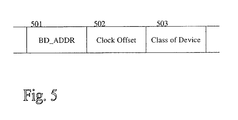
- the signal includes an identifier of the transmitting transceiver, such as an address of second circuit, for example a Bluetooth address 501.
- each Bluetooth transceiver is allocated a unique 48-bit Bluetooth device address (BD_ADDR).
- the signal may also, though not necessarily, include a clock offset 502.
- Clock offset 502 is used for synchronization with other units.
- the signal may also, though not necessarily, include a class of device 503 such as is known from Bluetooth. Class of device 503 may be 24-bit field containing the class of device of the unit that sends the Frequency Hop Synchronization (FHS) packet.
- FHS Frequency Hop Synchronization
- the user 100 may enter a group creation mode at wireless terminal 300 (step 600).
- the user 100 enters the group creation mode by touching or pressing the electrode 350.
- the user 100 may enter the group creation mode by selecting the mode from a menu of the wireless terminal 100.
- the user terminal 300 inquires other terminals that may be presence, for example, wireless terminals 301 and 302 (see Fig. 1 ) that are in the vicinity (step 610).
- the user terminal 300 transmits a message to the terminals that are located within an operation range of the terminal, such as terminals 301 and 302 by the second circuit transmission (i.e. preferably over Bluetooth).
- the wireless user terminal 300 that transmits the first inquiring message may be termed as a master.
- the master terminal 300 receives a reply message from the devices that are able to establish the group and that are located within the range.
- the master terminal selects at least one of the terminals 301 and 302 and sends a message over the wireless link indicating the selection to the terminals 301 and 302 via second circuit transmission.
- the users confirm the group formation by physical contact 200 of the users (100, 110, 120) and the master terminal 300 sends a signal such as a ping signal to wireless terminals 301 and 302 (step 630).
- the physical contact 200 may be, for example, a handshake, touching by a finger other user's skin, or any kind of contact between users that may provide current (signal) to flow between the bodies of the users.
- an electric circuit Via the physical contact an electric circuit is completed, allowing pico amp signal to pass from the transmitter of the first circuit of the master user (100) through the body of the master user (100), to the body of the other user(s) (110 and/or 120), and to the receiver of the other user(s) terminal(s) (301 and/or 302), such as to PAN transceiver 340 in terminals 301 and 302.
- the users 100, 110, 120 and the electrodes 350 are coupled.
- a portion of the user's body, for example, a finger should touch the group creation electrodes 350 at this point (step 630). This process step may really confirm that there exists physical contact 200 between the users of the group (or that are to form the group).
- the user terminals detect the received signal and register it.
- the master terminal 300 sends a query to each wireless terminal(s) (301 and/or 302) to ensure each terminal (that participated in the preparation for establishing a group in step 610) successfully received the ping signal (step 640). If some wireless terminal(s) (301 and/or 302) has not received the ping signal, the master 300 will send that terminal a request to send the signal (step 650) or to verify that that terminal does not want to participate in the group. If a particular terminal has not responded by sending a message (over the wireless communication) to the master 300, that terminal is excluded from the group (or could be separately agreed to become a member of the group by a separate wireless communication between the master and that terminal).
- the master 300 may continue the loop of steps 640 and 650 until the pinging process has been determined successful by replies from the other terminals.
- the group is established using communication over the second circuit (step 660).
- the master 300 informs at step 670 the other wireless terminals (310 and/or 302) about the successful group creation preferably by use of the second circuit communication. Having established the group the group information is stored in the memory of the central controller CC, such as in a telephone directory like group directory.
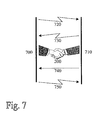
- a signalling diagram of an establishment of a group is illustrated.
- user terminal node 700 i.e. a first wireless user terminal transmits a message 720 by use of the second circuit (e.g. Bluetooth) of the terminal.
- the message includes information about the establishment of the group, and can further include information about the transmitter, protocols, devices, etc.
- Another user terminal node 710 i.e. a second wireless user terminal receives and detects the message likewise by use of the second circuit of the second user terminal. Users then form a physical contact 200 between each other.
- User terminal node 710 then sends signal 740 to user terminal node 700 over the established physical contact 200 using the first circuit.
- User terminal node 700 receives over the physical contact and detects this signal 740 using the first circuit (e.g. PAN transceiver).
- User terminal node 710 transmits a message 750 to user terminal node 700 to acknowledge the group formation.
- the group creation may not require the physical connection of all users at the same time, but in steps. For example, let us assume that wireless terminal (a) will send a ping signal, that will be received at wireless terminals (b) and (d), but not at wireless terminal (c). Next, wireless terminal (c) will send a ping signal that will be received and detected at wireless terminals (b) and (d), but not at wireless terminal (a), so there is missing a direct contact between terminals (a) and (c). However, since there is a connection from wireless terminals (a) and (c) to wireless terminals (b) and (d), there is an indirect connection between (a) and (c) indicating the group establishment. Thus all four terminals (a) - (d) will be forming the group although not all users were in physical contact at the same time, but at different times.
- the order and the amount of the signals and messages may vary.
- the users may have come in physical contact 200 with one another, whereby first wireless terminal sends a signal by the first circuit (PAN), and the group may be formed based on the trigger signal sent by the PAN transceiver.
- the first wireless terminal may send the message by use of the second circuit and the second wireless user terminal receives it over the wireless communication (Bluetooth) and users then establish physical contact 200 and send the group creation signal to first wireless terminal by the circuit (PAN).
- the first wireless terminal receives the group creation signal and confirm the establishment of the group by transmitting the confirming message to second wireless terminal by use of the second circuit (Bluetooth).
- the first wireless terminal may send the message using the second circuit and a second and a third wireless terminal receive the message and reply to it.
- the second wireless terminal may now send a signal to first and third wireless terminals via the established physical contact 200 between the users of the wireless terminals. After the signal is sent, the wireless terminals may communicate several messages between themselves using the second circuit and finally the group may be formed and communication may continue.
- the menu at the display of a wireless user terminal is shown when the user selects the group creation mode.
- the wireless user terminal 300 preferably has a user interface 334' having a display where the menu is shown to the user.
- Command "Others” may indicate the selection of some other command than those relating to the group formation, for example, edit short-range network settings.
- wireless terminal 300 sends the inquiring message and the group establishment continues as described above.
- the information of the terminals that are about to establish the group is shown.
- a text "BT1 BT2 BT3" "Establish group?".
- the text shows the user that wireless terminals 1, 2, and 3 may form a group.
- the user acting now as the master may decide whether he wants to establish the group.
- the user may also decide whether he wants to exclude some terminal from the group.
- the user of the master terminal may also be allowed to cancel the establishment of the group.
- the identifier used in the signal may be a phone number or International mobile Equipment Identity (IMEI) and the second circuit and further the second circuit communication in the group may be Global Standard for Mobile / Groupe Speciale Mobile (GSM), General Packet Radio (GPRS) or Universal Mobile Telephone System (UMTS).
- GSM Global Standard for Mobile / Groupe Speciale Mobile
- GPRS General Packet Radio
- UMTS Universal Mobile Telephone System
Landscapes
- Engineering & Computer Science (AREA)
- Computer Networks & Wireless Communication (AREA)
- Signal Processing (AREA)
- Human Computer Interaction (AREA)
- Multimedia (AREA)
- Mobile Radio Communication Systems (AREA)
- Small-Scale Networks (AREA)
Applications Claiming Priority (2)
| Application Number | Priority Date | Filing Date | Title |
|---|---|---|---|
| FI20002861A FI110560B (fi) | 2000-12-27 | 2000-12-27 | Ryhmän muodostaminen langattomille kommunikaatiopäätelaitteille |
| FI20002861 | 2000-12-27 |
Publications (3)
| Publication Number | Publication Date |
|---|---|
| EP1220501A2 EP1220501A2 (en) | 2002-07-03 |
| EP1220501A3 EP1220501A3 (en) | 2003-12-17 |
| EP1220501B1 true EP1220501B1 (en) | 2008-07-23 |
Family
ID=8559819
Family Applications (1)
| Application Number | Title | Priority Date | Filing Date |
|---|---|---|---|
| EP01660224A Expired - Lifetime EP1220501B1 (en) | 2000-12-27 | 2001-12-07 | Group creation for wireless communication terminals |
Country Status (5)
| Country | Link |
|---|---|
| US (1) | US7082316B2 (enExample) |
| EP (1) | EP1220501B1 (enExample) |
| JP (1) | JP4065379B2 (enExample) |
| DE (1) | DE60134946D1 (enExample) |
| FI (1) | FI110560B (enExample) |
Cited By (5)
| Publication number | Priority date | Publication date | Assignee | Title |
|---|---|---|---|---|
| CN102265534A (zh) * | 2008-12-23 | 2011-11-30 | 皇家飞利浦电子股份有限公司 | 组合身体耦合通信和射频通信 |
| US11212326B2 (en) * | 2016-10-31 | 2021-12-28 | Microsoft Technology Licensing, Llc | Enhanced techniques for joining communication sessions |
| US11256392B2 (en) | 2019-11-01 | 2022-02-22 | Microsoft Technology Licensing, Llc | Unified interfaces for paired user computing devices |
| US11304246B2 (en) | 2019-11-01 | 2022-04-12 | Microsoft Technology Licensing, Llc | Proximity-based pairing and operation of user-specific companion devices |
| US11546391B2 (en) | 2019-11-01 | 2023-01-03 | Microsoft Technology Licensing, Llc | Teleconferencing interfaces and controls for paired user computing devices |
Families Citing this family (174)
| Publication number | Priority date | Publication date | Assignee | Title |
|---|---|---|---|---|
| US9269511B2 (en) * | 2001-06-29 | 2016-02-23 | Peter Ar-Fu Lam | Hand controlled electronics toy article |
| JP4215968B2 (ja) * | 2001-07-10 | 2009-01-28 | シャープ株式会社 | 通信システム、その通信システムに用いられる端末、その端末における通信方法およびその端末において通信するためのプログラム |
| EP1466261B1 (en) | 2002-01-08 | 2018-03-07 | Seven Networks, LLC | Connection architecture for a mobile network |
| US20030162556A1 (en) * | 2002-02-28 | 2003-08-28 | Libes Michael A. | Method and system for communication between two wireless-enabled devices |
| US8224985B2 (en) | 2005-10-04 | 2012-07-17 | Sony Computer Entertainment Inc. | Peer-to-peer communication traversing symmetric network address translators |
| US8060626B2 (en) * | 2008-09-22 | 2011-11-15 | Sony Computer Entertainment America Llc. | Method for host selection based on discovered NAT type |
| US7917468B2 (en) | 2005-08-01 | 2011-03-29 | Seven Networks, Inc. | Linking of personal information management data |
| US7853563B2 (en) | 2005-08-01 | 2010-12-14 | Seven Networks, Inc. | Universal data aggregation |
| US8468126B2 (en) | 2005-08-01 | 2013-06-18 | Seven Networks, Inc. | Publishing data in an information community |
| JP4156531B2 (ja) * | 2003-02-03 | 2008-09-24 | 富士フイルム株式会社 | 通信機器 |
| US7724705B2 (en) | 2003-03-14 | 2010-05-25 | Nokia Corporation | Wireless transfer of data |
| US20040242210A1 (en) * | 2003-05-29 | 2004-12-02 | Roberto Tagliabue | System and method for communication of visual messages |
| US20040242266A1 (en) * | 2003-05-29 | 2004-12-02 | Roberto Tagliabue | Apparatus and method for communication of visual messages |
| FR2860668B1 (fr) * | 2003-10-06 | 2006-01-06 | Valeo Securite Habitacle | Systeme d'identification a badge a courant circulant a travers le corps a deux modes de detection |
| ATE423364T1 (de) * | 2003-12-18 | 2009-03-15 | Gemalto Sa | System zum identifizieren eines individuums in einer elektronischen transaktion |
| US8639819B2 (en) | 2004-02-05 | 2014-01-28 | Nokia Corporation | Ad-hoc connection between electronic devices |
| EP1717963B1 (en) | 2005-04-25 | 2010-04-14 | Sony Ericsson Mobile Communications AB | Electronic equipment for a wireless communication system and method for operating an electronic equipment for a wireless communication system |
| US7769409B2 (en) * | 2004-06-23 | 2010-08-03 | Sony Computer Entertainment America Inc. | Network participant status evaluation |
| US20060073856A1 (en) * | 2004-09-09 | 2006-04-06 | Lundberg Steven W | Remoted vibrating element for a mobile phone |
| DE102004047759B3 (de) * | 2004-09-30 | 2006-06-01 | Siemens Audiologische Technik Gmbh | Verwendung eines Hörhilfegerätesystems mit wenigstens zwei Hörhilfegeräten |
| WO2006038434A1 (ja) * | 2004-10-05 | 2006-04-13 | Takaharu Sekine | 作業状態検知装置 |
| US7441271B2 (en) | 2004-10-20 | 2008-10-21 | Seven Networks | Method and apparatus for intercepting events in a communication system |
| US8010082B2 (en) | 2004-10-20 | 2011-08-30 | Seven Networks, Inc. | Flexible billing architecture |
| US7706781B2 (en) | 2004-11-22 | 2010-04-27 | Seven Networks International Oy | Data security in a mobile e-mail service |
| US10750327B2 (en) | 2004-11-23 | 2020-08-18 | Kodiak Networks Inc | Method for multiplexing media streams to optimize network resource usage for push-to-talk-over-cellular service |
| US9485787B2 (en) | 2005-05-24 | 2016-11-01 | Kodiak Networks, Inc. | Method to achieve a fully acknowledged mode communication (FAMC) in push-to-talk-over-cellular (PoC) |
| US10178513B2 (en) | 2004-11-23 | 2019-01-08 | Kodiak Networks, Inc. | Relay-mode and direct-mode operations for push-to-talk-over-cellular (PoC) using WiFi-technologies |
| US10057105B2 (en) | 2004-11-23 | 2018-08-21 | Kodiak Networks, Inc. | Architecture framework to realize push-to-X services using cloudbased storage services |
| US10111055B2 (en) | 2004-11-23 | 2018-10-23 | Kodiak Networks, Inc. | Optimized methods for large group calling using unicast and multicast transport bearer for PoC |
| US9913300B2 (en) | 2011-12-14 | 2018-03-06 | Kodiak Networks, Inc. | Push-to-talk-over-cellular (PoC) |
| US10116691B2 (en) | 2004-11-23 | 2018-10-30 | Kodiak Networks, Inc. | VoIP denial-of-service protection mechanisms from attack |
| US10367863B2 (en) | 2004-11-23 | 2019-07-30 | Kodiak Networks Inc. | Method for providing dynamic quality of service for push-to-talk service |
| US8498660B2 (en) * | 2009-03-30 | 2013-07-30 | Kodiak Networks, Inc. | Enhanced group calling features for connected portfolio services in a wireless communications network |
| US9137646B2 (en) | 2004-11-23 | 2015-09-15 | Kodiak Networks, Inc. | Method and framework to detect service users in an insufficient wireless radio coverage network and to improve a service delivery experience by guaranteed presence |
| FI117152B (fi) | 2004-12-03 | 2006-06-30 | Seven Networks Internat Oy | Sähköpostiasetusten käyttöönotto matkaviestimelle |
| US20060136015A1 (en) * | 2004-12-08 | 2006-06-22 | Duck-Gun Park | Human body communication device, human body communication system and method using the same |
| WO2006087670A1 (en) | 2005-02-17 | 2006-08-24 | Koninklijke Philips Electronics N.V. | Device capable of being operated within a network, network system, method of operating a device within a network, program element, and computer-readable medium |
| US7877703B1 (en) | 2005-03-14 | 2011-01-25 | Seven Networks, Inc. | Intelligent rendering of information in a limited display environment |
| JP4586618B2 (ja) | 2005-04-18 | 2010-11-24 | ソニー株式会社 | 人体通信システム及び通信装置 |
| US7684815B2 (en) * | 2005-04-21 | 2010-03-23 | Microsoft Corporation | Implicit group formation around feed content for mobile devices |
| US7796742B1 (en) | 2005-04-21 | 2010-09-14 | Seven Networks, Inc. | Systems and methods for simplified provisioning |
| US8438633B1 (en) | 2005-04-21 | 2013-05-07 | Seven Networks, Inc. | Flexible real-time inbox access |
| US20060282332A1 (en) * | 2005-04-28 | 2006-12-14 | Pfleging Gerald W | Method for transmitting a wireless receipt to a personal digital device |
| US7577459B2 (en) * | 2005-05-11 | 2009-08-18 | Nokia Corporation | Establishing a communication link |
| US9743266B2 (en) | 2005-05-23 | 2017-08-22 | Invention Science Fund I, Llc | Device pairing via device to device contact |
| US7865140B2 (en) * | 2005-06-14 | 2011-01-04 | The Invention Science Fund I, Llc | Device pairing via intermediary device |
| EP1894340A2 (en) * | 2005-06-08 | 2008-03-05 | Koninklijke Philips Electronics N.V. | Deterministic key pre-distribution for mobile body sensor networks |
| WO2006136660A1 (en) | 2005-06-21 | 2006-12-28 | Seven Networks International Oy | Maintaining an ip connection in a mobile network |
| US8069166B2 (en) | 2005-08-01 | 2011-11-29 | Seven Networks, Inc. | Managing user-to-user contact with inferred presence information |
| KR100723307B1 (ko) * | 2005-10-25 | 2007-05-30 | 한국전자통신연구원 | 통신 장치 |
| KR100785769B1 (ko) * | 2005-12-08 | 2007-12-18 | 한국전자통신연구원 | 보안 여부나 전송 거리에 따른 주파수를 사용하는 통신 장치 |
| KR100772525B1 (ko) * | 2005-12-08 | 2007-11-01 | 한국전자통신연구원 | 접촉 기반의 서비스 제공 방법, 장치 및 이를 이용하는시스템 |
| US7525425B2 (en) * | 2006-01-20 | 2009-04-28 | Perdiem Llc | System and method for defining an event based on relationship between an object location and a user-defined zone |
| US20090070472A1 (en) * | 2006-01-18 | 2009-03-12 | Koninklijke Philips Electronics N. V. | Automatic and secure configuration of wireless medical networks |
| WO2007096810A1 (en) | 2006-02-24 | 2007-08-30 | Koninklijke Philips Electronics N.V. | Wireless body sensor network |
| US7769395B2 (en) | 2006-06-20 | 2010-08-03 | Seven Networks, Inc. | Location-based operations and messaging |
| CN101444020B (zh) * | 2006-05-08 | 2012-11-14 | 皇家飞利浦电子股份有限公司 | 将应用数据从第一设备传递到第二设备的方法以及一种数据传递系统 |
| WO2008015627A1 (en) * | 2006-07-31 | 2008-02-07 | Koninklijke Philips Electronics N.V. | Method and system for configuring a network and network management device |
| US20080120555A1 (en) * | 2006-11-21 | 2008-05-22 | Intermec Ip Corp. | Wireless device grouping via common attribute |
| KR20080052373A (ko) * | 2006-12-06 | 2008-06-11 | 한국전자통신연구원 | 인체통신을 이용한 미디어 광고 서비스 제공 장치 및 그방법 |
| US7782890B2 (en) * | 2006-12-22 | 2010-08-24 | Magix Ag | System and method for dynamic mobile communication |
| US20100144268A1 (en) * | 2007-02-14 | 2010-06-10 | Kaba Ag | System and portable device for transmitting identification signals |
| US7995478B2 (en) * | 2007-05-30 | 2011-08-09 | Sony Computer Entertainment Inc. | Network communication with path MTU size discovery |
| US8693494B2 (en) | 2007-06-01 | 2014-04-08 | Seven Networks, Inc. | Polling |
| US8805425B2 (en) | 2007-06-01 | 2014-08-12 | Seven Networks, Inc. | Integrated messaging |
| WO2008151624A1 (en) * | 2007-06-13 | 2008-12-18 | Widex A/S | Hearing aid system establishing a conversation group among hearing aids used by different users |
| CN101536550A (zh) * | 2007-06-13 | 2009-09-16 | 唯听助听器公司 | 在多个助听器之间建立会话分组的系统和方法 |
| US8838152B2 (en) | 2007-11-30 | 2014-09-16 | Microsoft Corporation | Modifying mobile device operation using proximity relationships |
| US7856501B2 (en) | 2007-12-04 | 2010-12-21 | Sony Computer Entertainment Inc. | Network traffic prioritization |
| US8364181B2 (en) | 2007-12-10 | 2013-01-29 | Seven Networks, Inc. | Electronic-mail filtering for mobile devices |
| US8793305B2 (en) | 2007-12-13 | 2014-07-29 | Seven Networks, Inc. | Content delivery to a mobile device from a content service |
| US9002828B2 (en) | 2007-12-13 | 2015-04-07 | Seven Networks, Inc. | Predictive content delivery |
| US9002263B2 (en) | 2007-12-20 | 2015-04-07 | Koninklijke Philips N.V. | Switching between multiple coupling modes |
| CN101904120A (zh) | 2007-12-21 | 2010-12-01 | 罗姆股份有限公司 | 信息交换装置 |
| US8107921B2 (en) | 2008-01-11 | 2012-01-31 | Seven Networks, Inc. | Mobile virtual network operator |
| US8862657B2 (en) | 2008-01-25 | 2014-10-14 | Seven Networks, Inc. | Policy based content service |
| US20090193338A1 (en) | 2008-01-28 | 2009-07-30 | Trevor Fiatal | Reducing network and battery consumption during content delivery and playback |
| WO2009105115A2 (en) * | 2008-02-22 | 2009-08-27 | T-Mobile Usa, Inc. | Data exchange initiated by tapping devices |
| US7856506B2 (en) | 2008-03-05 | 2010-12-21 | Sony Computer Entertainment Inc. | Traversal of symmetric network address translator for multiple simultaneous connections |
| US20090233548A1 (en) * | 2008-03-13 | 2009-09-17 | Sony Ericsson Mobile Communications Ab | Skin-based information transfer between mobile devices |
| JP4666319B2 (ja) * | 2008-03-31 | 2011-04-06 | Necシステムテクノロジー株式会社 | 生体装着型データ通信装置 |
| JP5131016B2 (ja) * | 2008-04-30 | 2013-01-30 | 富士通株式会社 | 無線通信装置及び通信制御方法 |
| US8179232B2 (en) * | 2008-05-05 | 2012-05-15 | Round Rock Research, Llc | RFID interrogator with adjustable signal characteristics |
| US8787947B2 (en) | 2008-06-18 | 2014-07-22 | Seven Networks, Inc. | Application discovery on mobile devices |
| US8078158B2 (en) | 2008-06-26 | 2011-12-13 | Seven Networks, Inc. | Provisioning applications for a mobile device |
| JP5389801B2 (ja) * | 2008-06-30 | 2014-01-15 | パナソニック株式会社 | 無線通信システム、通信端末、管理端末、通信方法、及び集積回路 |
| US8909759B2 (en) | 2008-10-10 | 2014-12-09 | Seven Networks, Inc. | Bandwidth measurement |
| US8624836B1 (en) | 2008-10-24 | 2014-01-07 | Google Inc. | Gesture-based small device input |
| KR101582686B1 (ko) * | 2009-03-02 | 2016-01-05 | 엘지전자 주식회사 | 아이템 표시 방법 및 이를 적용한 이동 통신 단말기 |
| JP5195637B2 (ja) * | 2009-05-21 | 2013-05-08 | 富士通株式会社 | Ban用センサの無線通信装置及び方法 |
| KR20100126958A (ko) * | 2009-05-25 | 2010-12-03 | 삼성전자주식회사 | 멀티 디바이스 제어 방법 및 장치 |
| US20100321159A1 (en) * | 2009-06-18 | 2010-12-23 | Authentec, Inc. | Touch based data communication using biometric finger sensor and associated methods |
| US9571208B2 (en) | 2009-08-18 | 2017-02-14 | Rohm Co., Ltd. | Input/output device, mobile device, and information displaying device |
| JP2011128809A (ja) * | 2009-12-16 | 2011-06-30 | Rohm Co Ltd | 情報入力装置および情報出力装置 |
| JP2013009019A (ja) * | 2009-10-07 | 2013-01-10 | Ad-Sol Nissin Corp | データ通信システム |
| US8666812B1 (en) * | 2009-11-10 | 2014-03-04 | Google Inc. | Distributing content based on transaction information |
| TW201209697A (en) | 2010-03-30 | 2012-03-01 | Michael Luna | 3D mobile user interface with configurable workspace management |
| US20110307565A1 (en) * | 2010-06-09 | 2011-12-15 | Brian Szady | Group messaging integration system, method and apparatus |
| GB2500333B (en) | 2010-07-26 | 2014-10-08 | Seven Networks Inc | Mobile application traffic optimization |
| EP3407673B1 (en) | 2010-07-26 | 2019-11-20 | Seven Networks, LLC | Mobile network traffic coordination across multiple applications |
| US8838783B2 (en) | 2010-07-26 | 2014-09-16 | Seven Networks, Inc. | Distributed caching for resource and mobile network traffic management |
| WO2012018477A2 (en) | 2010-07-26 | 2012-02-09 | Seven Networks, Inc. | Distributed implementation of dynamic wireless traffic policy |
| KR101244016B1 (ko) * | 2010-07-30 | 2013-03-14 | 주식회사 팬택 | 인체통신 네트워크 시스템에서 다중 접촉 패턴을 인식하는 장치 및 방법 |
| KR101261687B1 (ko) * | 2010-08-09 | 2013-05-06 | 주식회사 팬택 | 인체통신을 이용한 방송 시스템 및 그 방법 |
| US9330196B2 (en) | 2010-11-01 | 2016-05-03 | Seven Networks, Llc | Wireless traffic management system cache optimization using http headers |
| US8326985B2 (en) | 2010-11-01 | 2012-12-04 | Seven Networks, Inc. | Distributed management of keep-alive message signaling for mobile network resource conservation and optimization |
| US9060032B2 (en) | 2010-11-01 | 2015-06-16 | Seven Networks, Inc. | Selective data compression by a distributed traffic management system to reduce mobile data traffic and signaling traffic |
| US8204953B2 (en) | 2010-11-01 | 2012-06-19 | Seven Networks, Inc. | Distributed system for cache defeat detection and caching of content addressed by identifiers intended to defeat cache |
| CN103620576B (zh) | 2010-11-01 | 2016-11-09 | 七网络公司 | 适用于移动应用程序行为和网络条件的缓存 |
| WO2012060995A2 (en) | 2010-11-01 | 2012-05-10 | Michael Luna | Distributed caching in a wireless network of content delivered for a mobile application over a long-held request |
| US8166164B1 (en) | 2010-11-01 | 2012-04-24 | Seven Networks, Inc. | Application and network-based long poll request detection and cacheability assessment therefor |
| WO2012071384A2 (en) | 2010-11-22 | 2012-05-31 | Michael Luna | Optimization of resource polling intervals to satisfy mobile device requests |
| EP2596658B1 (en) | 2010-11-22 | 2018-05-09 | Seven Networks, LLC | Aligning data transfer to optimize connections established for transmission over a wireless network |
| KR101330262B1 (ko) * | 2010-12-14 | 2013-11-15 | 주식회사 팬택 | 데이터 변환이 가능한 인체 통신 단말 장치 및 방법 |
| US9325662B2 (en) | 2011-01-07 | 2016-04-26 | Seven Networks, Llc | System and method for reduction of mobile network traffic used for domain name system (DNS) queries |
| US20120189140A1 (en) * | 2011-01-21 | 2012-07-26 | Apple Inc. | Audio-sharing network |
| US20130013697A1 (en) * | 2011-02-14 | 2013-01-10 | Yasuhiro Tsuchida | Group generation device |
| EP2700020A4 (en) | 2011-04-19 | 2015-01-07 | Seven Networks Inc | SHARING DEVICE RESOURCES FOR NETWORK RESOURCE CONSERVATION |
| EP2702500B1 (en) | 2011-04-27 | 2017-07-19 | Seven Networks, LLC | Detecting and preserving state for satisfying application requests in a distributed proxy and cache system |
| US20120278431A1 (en) | 2011-04-27 | 2012-11-01 | Michael Luna | Mobile device which offloads requests made by a mobile application to a remote entity for conservation of mobile device and network resources and methods therefor |
| JP5936024B2 (ja) * | 2011-06-07 | 2016-06-15 | 国立大学法人 筑波大学 | 生体間接触データ測定装置及び生体間接触データ測定システム及び生体間接触データ測定方法 |
| WO2013015994A1 (en) | 2011-07-27 | 2013-01-31 | Seven Networks, Inc. | Monitoring mobile application activities for malicious traffic on a mobile device |
| US8736878B2 (en) | 2011-11-23 | 2014-05-27 | Canon U.S.A., Inc. | System and method for obtaining an electronic document |
| EP2789138B1 (en) | 2011-12-06 | 2016-09-14 | Seven Networks, LLC | A mobile device and method to utilize the failover mechanisms for fault tolerance provided for mobile traffic management and network/device resource conservation |
| US8918503B2 (en) | 2011-12-06 | 2014-12-23 | Seven Networks, Inc. | Optimization of mobile traffic directed to private networks and operator configurability thereof |
| WO2013086455A1 (en) | 2011-12-07 | 2013-06-13 | Seven Networks, Inc. | Flexible and dynamic integration schemas of a traffic management system with various network operators for network traffic alleviation |
| WO2013086447A1 (en) | 2011-12-07 | 2013-06-13 | Seven Networks, Inc. | Radio-awareness of mobile device for sending server-side control signals using a wireless network optimized transport protocol |
| WO2013090821A1 (en) | 2011-12-14 | 2013-06-20 | Seven Networks, Inc. | Hierarchies and categories for management and deployment of policies for distributed wireless traffic optimization |
| WO2013090834A1 (en) | 2011-12-14 | 2013-06-20 | Seven Networks, Inc. | Operation modes for mobile traffic optimization and concurrent management of optimized and non-optimized traffic |
| US9021021B2 (en) | 2011-12-14 | 2015-04-28 | Seven Networks, Inc. | Mobile network reporting and usage analytics system and method aggregated using a distributed traffic optimization system |
| WO2013103988A1 (en) | 2012-01-05 | 2013-07-11 | Seven Networks, Inc. | Detection and management of user interactions with foreground applications on a mobile device in distributed caching |
| CA2804368C (en) | 2012-02-01 | 2018-03-13 | Kodiak Networks, Inc. | Wifi interworking solutions for push-to-talk-over-cellular (poc) |
| US9203864B2 (en) | 2012-02-02 | 2015-12-01 | Seven Networks, Llc | Dynamic categorization of applications for network access in a mobile network |
| WO2013116852A1 (en) | 2012-02-03 | 2013-08-08 | Seven Networks, Inc. | User as an end point for profiling and optimizing the delivery of content and data in a wireless network |
| US8812695B2 (en) | 2012-04-09 | 2014-08-19 | Seven Networks, Inc. | Method and system for management of a virtual network connection without heartbeat messages |
| GB2512950B (en) | 2012-04-10 | 2015-07-15 | Seven Networks Inc | Intelligent customer service/call center services enhanched using real-time and historical mobile application and traffic-related statistics collected by |
| WO2014011216A1 (en) | 2012-07-13 | 2014-01-16 | Seven Networks, Inc. | Dynamic bandwidth adjustment for browsing or streaming activity in a wireless network based on prediction of user behavior when interacting with mobile applications |
| US9369606B2 (en) | 2012-09-12 | 2016-06-14 | Xerox Corporation | Automated pairing of multifunction devices and external devices |
| US9161258B2 (en) | 2012-10-24 | 2015-10-13 | Seven Networks, Llc | Optimized and selective management of policy deployment to mobile clients in a congested network to prevent further aggravation of network congestion |
| US9307493B2 (en) | 2012-12-20 | 2016-04-05 | Seven Networks, Llc | Systems and methods for application management of mobile device radio state promotion and demotion |
| US9313609B2 (en) | 2012-12-28 | 2016-04-12 | Joseph Nicholi Prencipe | Contact information social exchange method and system |
| US9271238B2 (en) | 2013-01-23 | 2016-02-23 | Seven Networks, Llc | Application or context aware fast dormancy |
| US8874761B2 (en) | 2013-01-25 | 2014-10-28 | Seven Networks, Inc. | Signaling optimization in a wireless network for traffic utilizing proprietary and non-proprietary protocols |
| US9326185B2 (en) | 2013-03-11 | 2016-04-26 | Seven Networks, Llc | Mobile network congestion recognition for optimization of mobile traffic |
| EP2811770A1 (en) * | 2013-06-07 | 2014-12-10 | Gemalto SA | Pairing device |
| KR102166719B1 (ko) | 2013-06-27 | 2020-10-16 | 삼성전자주식회사 | 전자장치 및 전자장치를 이용한 정보교환 방법 |
| CN108990063A (zh) * | 2013-06-28 | 2018-12-11 | 日本电气株式会社 | 通信系统、网络和用户设备及其通信方法 |
| US9065765B2 (en) | 2013-07-22 | 2015-06-23 | Seven Networks, Inc. | Proxy server associated with a mobile carrier for enhancing mobile traffic management in a mobile network |
| EP3025529B1 (en) | 2013-07-23 | 2018-04-11 | Kodiak Networks, Inc. | Radio access network aware service push-to-talk-over-cellular networks |
| CN104919392B (zh) * | 2013-08-14 | 2018-02-13 | 宇龙计算机通信科技(深圳)有限公司 | 可穿戴设备和数据传输方法 |
| EP3078135B1 (en) | 2013-12-05 | 2019-12-11 | Sony Corporation | Pairing consumer electronic devices using a cross-body communications protocol |
| US9332377B2 (en) | 2013-12-05 | 2016-05-03 | Sony Corporation | Device and method for control of data transfer in local area network |
| US9351100B2 (en) | 2013-12-05 | 2016-05-24 | Sony Corporation | Device for control of data transfer in local area network |
| EP3078157B1 (en) | 2013-12-05 | 2020-04-08 | Sony Corporation | A wearable device and a method for storing credentials associated with an electronic device in said wearable device |
| CN103809750A (zh) * | 2014-02-08 | 2014-05-21 | 北京智谷睿拓技术服务有限公司 | 一种基于穿戴式设备的信息交互方法及穿戴式设备 |
| US9667353B2 (en) * | 2014-07-11 | 2017-05-30 | Sony Corporation | Methods of providing body area network communications when a user touches a button of a wireless electronic device, and related wireless electronic devices and wearable wireless electronic devices |
| US9674883B2 (en) | 2014-07-23 | 2017-06-06 | Sony Mobile Communications Inc. | System, an object and a method for grouping of objects in a body area network |
| EP3186692B1 (en) * | 2014-08-27 | 2019-09-25 | Sony Corporation | A system, an object and a method for grouping of objects in a body area network |
| GB2533793B (en) * | 2014-12-30 | 2019-04-17 | Gen Electric | Method and system for verifying wireless connection between medical devices |
| US10362074B2 (en) | 2015-02-03 | 2019-07-23 | Kodiak Networks, Inc | Session management and notification mechanisms for push-to-talk (PTT) |
| US9842329B2 (en) | 2015-02-13 | 2017-12-12 | Sony Corporation | Body area network for secure payment |
| CA2971107C (en) | 2015-05-07 | 2020-10-20 | Kodiak Networks, Inc. | System and method for data synchronization |
| WO2017062627A1 (en) | 2015-10-06 | 2017-04-13 | Kodiak Networks, Inc. | System and method for improved push-to-talk communication performance |
| CA3000202C (en) | 2015-10-06 | 2022-05-31 | Kodiak Networks, Inc. | System and method for media encoding scheme (mes) selection |
| GB2561722B (en) | 2015-10-23 | 2021-10-20 | Kodiak Networks Inc | System and method for content messaging |
| US10838502B2 (en) * | 2016-03-29 | 2020-11-17 | Microsoft Technology Licensing, Llc | Sharing across environments |
| DE112017002108B4 (de) | 2016-04-22 | 2026-02-26 | Kodiak Networks Inc. | System und verfahren für push-to-talk (ptt) -ein-tastendruck-rufe |
| US10555370B2 (en) | 2016-09-28 | 2020-02-04 | Kodiak Networks, Inc. | System and method for push-to-talk (PTT) in high latency networks |
| US10257669B2 (en) | 2016-12-01 | 2019-04-09 | Kodiak Networks, Inc. | PTX data analytic engine notifying group list of detected risk event |
| US10630529B2 (en) | 2016-12-29 | 2020-04-21 | Kodiak Networks, Inc. | System and method for push-to-talk (PTT) in mobile edge computing (MEC) |
| US10341823B2 (en) | 2016-12-30 | 2019-07-02 | Kodiak Networks Inc. | System and method for direct mode push to talk communication protocols |
| CN109618406B (zh) * | 2019-03-01 | 2019-07-05 | 展讯通信(上海)有限公司 | 无线连接方法、设备组、系统 |
| US11184742B2 (en) * | 2020-04-20 | 2021-11-23 | Motorola Solutions, Inc. | Method and apparatus for determining an approver for requesting permission to join a dynamically-created talkgroup |
| US10999227B1 (en) * | 2020-07-06 | 2021-05-04 | TraDove, Inc. | Systems and methods for electronic group exchange of digital business cards during video conference, teleconference or meeting at social distance |
Family Cites Families (16)
| Publication number | Priority date | Publication date | Assignee | Title |
|---|---|---|---|---|
| US5471646A (en) * | 1994-08-01 | 1995-11-28 | Motorola, Inc. | Method for establishing a user defined radio talk group in a trunked radio communication system |
| US5511232A (en) * | 1994-12-02 | 1996-04-23 | Motorola, Inc. | Method for providing autonomous radio talk group configuration |
| GB9521241D0 (en) * | 1995-10-17 | 1995-12-20 | Robinson Alan W | Personnel identification system |
| US5796827A (en) * | 1996-11-14 | 1998-08-18 | International Business Machines Corporation | System and method for near-field human-body coupling for encrypted communication with identification cards |
| US6223018B1 (en) * | 1996-12-12 | 2001-04-24 | Nippon Telegraph And Telephone Corporation | Intra-body information transfer device |
| SE9604805L (sv) * | 1996-12-27 | 1998-06-28 | Ericsson Telefon Ab L M | En mobil kommunikationsenhet |
| EP0986874A2 (en) | 1997-06-02 | 2000-03-22 | Motorola, Inc. | Method for authorizing couplings between devices in a capability addressable network |
| US6104913A (en) * | 1998-03-11 | 2000-08-15 | Bell Atlantic Network Services, Inc. | Personal area network for personal telephone services |
| FI982490A0 (fi) * | 1998-11-18 | 1998-11-18 | Nokia Corp | Menetelmä ja järjestelmä viestintää varten |
| US6542717B1 (en) * | 1999-01-20 | 2003-04-01 | International Business Machines Corporation | System and method for optimizing personal area network (PAN) electrostatic communication |
| EP1024626A1 (en) * | 1999-01-27 | 2000-08-02 | International Business Machines Corporation | Method, apparatus, and communication system for exchange of information in pervasive environments |
| US6275500B1 (en) * | 1999-08-09 | 2001-08-14 | Motorola, Inc. | Method and apparatus for dynamic control of talk groups in a wireless network |
| US6347095B1 (en) * | 1999-11-15 | 2002-02-12 | Pango Networks, Inc. | System, devices and methods for use in proximity-based networking |
| JP2001144661A (ja) * | 1999-11-17 | 2001-05-25 | Sony Corp | データ送信装置およびデータ受信装置 |
| US6430395B2 (en) * | 2000-04-07 | 2002-08-06 | Commil Ltd. | Wireless private branch exchange (WPBX) and communicating between mobile units and base stations |
| JP2001344352A (ja) * | 2000-05-31 | 2001-12-14 | Toshiba Corp | 生活支援装置および生活支援方法および広告情報提供方法 |
-
2000
- 2000-12-27 FI FI20002861A patent/FI110560B/fi not_active IP Right Cessation
-
2001
- 2001-12-07 EP EP01660224A patent/EP1220501B1/en not_active Expired - Lifetime
- 2001-12-07 DE DE60134946T patent/DE60134946D1/de not_active Expired - Lifetime
- 2001-12-20 US US10/027,501 patent/US7082316B2/en not_active Expired - Lifetime
- 2001-12-27 JP JP2001396674A patent/JP4065379B2/ja not_active Expired - Fee Related
Cited By (7)
| Publication number | Priority date | Publication date | Assignee | Title |
|---|---|---|---|---|
| CN102265534A (zh) * | 2008-12-23 | 2011-11-30 | 皇家飞利浦电子股份有限公司 | 组合身体耦合通信和射频通信 |
| CN102265534B (zh) * | 2008-12-23 | 2014-08-20 | 皇家飞利浦电子股份有限公司 | 组合身体耦合通信和射频通信 |
| US11212326B2 (en) * | 2016-10-31 | 2021-12-28 | Microsoft Technology Licensing, Llc | Enhanced techniques for joining communication sessions |
| US11310294B2 (en) | 2016-10-31 | 2022-04-19 | Microsoft Technology Licensing, Llc | Companion devices for real-time collaboration in communication sessions |
| US11256392B2 (en) | 2019-11-01 | 2022-02-22 | Microsoft Technology Licensing, Llc | Unified interfaces for paired user computing devices |
| US11304246B2 (en) | 2019-11-01 | 2022-04-12 | Microsoft Technology Licensing, Llc | Proximity-based pairing and operation of user-specific companion devices |
| US11546391B2 (en) | 2019-11-01 | 2023-01-03 | Microsoft Technology Licensing, Llc | Teleconferencing interfaces and controls for paired user computing devices |
Also Published As
| Publication number | Publication date |
|---|---|
| FI20002861A0 (fi) | 2000-12-27 |
| JP2002261702A (ja) | 2002-09-13 |
| US7082316B2 (en) | 2006-07-25 |
| FI110560B (fi) | 2003-02-14 |
| US20020128030A1 (en) | 2002-09-12 |
| FI20002861L (fi) | 2002-06-28 |
| EP1220501A2 (en) | 2002-07-03 |
| EP1220501A3 (en) | 2003-12-17 |
| DE60134946D1 (de) | 2008-09-04 |
| JP4065379B2 (ja) | 2008-03-26 |
Similar Documents
| Publication | Publication Date | Title |
|---|---|---|
| US7082316B2 (en) | Group creation for wireless communication terminal | |
| EP1255383B1 (en) | Method for wireless communication of a first communications device with a second communications device, and communications device and computer program product for implementing the method | |
| US6018665A (en) | Wireless terminal with auxilary desktop unit | |
| US7242905B2 (en) | Method of information sharing between cellular and local wireless communication systems | |
| EP1389388B1 (en) | Method for protecting privacy when using a bluetooth device | |
| EP1609281B1 (en) | Method and device for identifying and pairing bluetooth devices | |
| EP1469659B1 (en) | A short-range radio terminal adapted for data streaming and real time services | |
| US7734306B2 (en) | Wireless device authentication at mutual reduced transmit power | |
| JP4446394B2 (ja) | 携帯機器を用いた通信用外部装置へのコンタクト情報割り当てのためのシステムおよび方法 | |
| CN101120527B (zh) | 能在网络内部工作的设备、网络系统、在网络内部操作设备的方法 | |
| US20040203381A1 (en) | Method and apparatus for data transfer | |
| EP1422873A1 (en) | INFORMATION PROCESSING APPARATUS AND METHOD, AND RECORDING MEDIUM | |
| JP2002544727A (ja) | 通信システム | |
| US20070263560A1 (en) | Push-to-talk over cellular group set-up and handling using near field communication (NFC) | |
| EP2294872A1 (en) | System and method for automatically switching connection of a wireless interface | |
| JP2002186022A (ja) | ウェアブル端末システム | |
| JPH0226140A (ja) | コードレス電話方式 | |
| CN113329381A (zh) | 一种建立蓝牙连接的方法及电子设备 | |
| US20030054767A1 (en) | Method and apparatus for using wireless network enabled devices over existing wired telephone networks | |
| EP0921668A2 (en) | TDMA communication method and system | |
| CA2420250A1 (en) | System and method for redirecting data to a wireless device over a plurality of communication paths | |
| US5867790A (en) | Radio communication system with enhanced connection processing | |
| US6453171B1 (en) | Dual-mode telephone system | |
| JP2000339575A (ja) | 無線式センサ装置およびセンサシステム | |
| JP3584248B2 (ja) | 移動通信端末の受け台 |
Legal Events
| Date | Code | Title | Description |
|---|---|---|---|
| PUAI | Public reference made under article 153(3) epc to a published international application that has entered the european phase |
Free format text: ORIGINAL CODE: 0009012 |
|
| AK | Designated contracting states |
Kind code of ref document: A2 Designated state(s): AT BE CH CY DE DK ES FI FR GB GR IE IT LI LU MC NL PT SE TR |
|
| AX | Request for extension of the european patent |
Free format text: AL;LT;LV;MK;RO;SI |
|
| PUAL | Search report despatched |
Free format text: ORIGINAL CODE: 0009013 |
|
| AK | Designated contracting states |
Kind code of ref document: A3 Designated state(s): AT BE CH CY DE DK ES FI FR GB GR IE IT LI LU MC NL PT SE TR |
|
| AX | Request for extension of the european patent |
Extension state: AL LT LV MK RO SI |
|
| RIC1 | Information provided on ipc code assigned before grant |
Ipc: 7H 04Q 7/38 B Ipc: 7H 04L 12/56 A |
|
| 17P | Request for examination filed |
Effective date: 20040417 |
|
| 17Q | First examination report despatched |
Effective date: 20040618 |
|
| AKX | Designation fees paid |
Designated state(s): DE FR GB NL |
|
| 17Q | First examination report despatched |
Effective date: 20040618 |
|
| GRAP | Despatch of communication of intention to grant a patent |
Free format text: ORIGINAL CODE: EPIDOSNIGR1 |
|
| GRAS | Grant fee paid |
Free format text: ORIGINAL CODE: EPIDOSNIGR3 |
|
| GRAA | (expected) grant |
Free format text: ORIGINAL CODE: 0009210 |
|
| AK | Designated contracting states |
Kind code of ref document: B1 Designated state(s): DE FR GB NL |
|
| REG | Reference to a national code |
Ref country code: GB Ref legal event code: FG4D |
|
| REF | Corresponds to: |
Ref document number: 60134946 Country of ref document: DE Date of ref document: 20080904 Kind code of ref document: P |
|
| PLBE | No opposition filed within time limit |
Free format text: ORIGINAL CODE: 0009261 |
|
| STAA | Information on the status of an ep patent application or granted ep patent |
Free format text: STATUS: NO OPPOSITION FILED WITHIN TIME LIMIT |
|
| 26N | No opposition filed |
Effective date: 20090424 |
|
| PGFP | Annual fee paid to national office [announced via postgrant information from national office to epo] |
Ref country code: FR Payment date: 20101224 Year of fee payment: 10 |
|
| PGFP | Annual fee paid to national office [announced via postgrant information from national office to epo] |
Ref country code: GB Payment date: 20101201 Year of fee payment: 10 |
|
| GBPC | Gb: european patent ceased through non-payment of renewal fee |
Effective date: 20111207 |
|
| REG | Reference to a national code |
Ref country code: FR Ref legal event code: ST Effective date: 20120831 |
|
| PG25 | Lapsed in a contracting state [announced via postgrant information from national office to epo] |
Ref country code: GB Free format text: LAPSE BECAUSE OF NON-PAYMENT OF DUE FEES Effective date: 20111207 |
|
| PGFP | Annual fee paid to national office [announced via postgrant information from national office to epo] |
Ref country code: NL Payment date: 20121208 Year of fee payment: 12 |
|
| PG25 | Lapsed in a contracting state [announced via postgrant information from national office to epo] |
Ref country code: FR Free format text: LAPSE BECAUSE OF NON-PAYMENT OF DUE FEES Effective date: 20120102 |
|
| REG | Reference to a national code |
Ref country code: NL Ref legal event code: V1 Effective date: 20140701 |
|
| PG25 | Lapsed in a contracting state [announced via postgrant information from national office to epo] |
Ref country code: NL Free format text: LAPSE BECAUSE OF NON-PAYMENT OF DUE FEES Effective date: 20140701 |
|
| REG | Reference to a national code |
Ref country code: DE Ref legal event code: R082 Ref document number: 60134946 Country of ref document: DE Representative=s name: BECKER, KURIG, STRAUS, DE Ref country code: DE Ref legal event code: R081 Ref document number: 60134946 Country of ref document: DE Owner name: NOKIA TECHNOLOGIES OY, FI Free format text: FORMER OWNER: NOKIA CORP., 02610 ESPOO, FI |
|
| PGFP | Annual fee paid to national office [announced via postgrant information from national office to epo] |
Ref country code: DE Payment date: 20151201 Year of fee payment: 15 |
|
| REG | Reference to a national code |
Ref country code: DE Ref legal event code: R119 Ref document number: 60134946 Country of ref document: DE |
|
| PG25 | Lapsed in a contracting state [announced via postgrant information from national office to epo] |
Ref country code: DE Free format text: LAPSE BECAUSE OF NON-PAYMENT OF DUE FEES Effective date: 20170701 |
|
| REG | Reference to a national code |
Ref country code: DE Ref legal event code: R082 Ref document number: 60134946 Country of ref document: DE Representative=s name: BARKHOFF REIMANN VOSSIUS, DE Ref country code: DE Ref legal event code: R081 Ref document number: 60134946 Country of ref document: DE Owner name: WSOU INVESTMENTS, LLC, LOS ANGELES, US Free format text: FORMER OWNER: NOKIA TECHNOLOGIES OY, ESPOO, FI |