EP1183946B1 - Dual-bearing reel anti-reverse mechanism - Google Patents
Dual-bearing reel anti-reverse mechanism Download PDFInfo
- Publication number
- EP1183946B1 EP1183946B1 EP01307096A EP01307096A EP1183946B1 EP 1183946 B1 EP1183946 B1 EP 1183946B1 EP 01307096 A EP01307096 A EP 01307096A EP 01307096 A EP01307096 A EP 01307096A EP 1183946 B1 EP1183946 B1 EP 1183946B1
- Authority
- EP
- European Patent Office
- Prior art keywords
- spool
- reel
- dual
- reverse mechanism
- rotary member
- Prior art date
- Legal status (The legal status is an assumption and is not a legal conclusion. Google has not performed a legal analysis and makes no representation as to the accuracy of the status listed.)
- Expired - Lifetime
Links
- 230000007246 mechanism Effects 0.000 title claims abstract description 93
- 230000009977 dual effect Effects 0.000 title claims abstract description 23
- 238000004873 anchoring Methods 0.000 claims description 14
- 230000002441 reversible effect Effects 0.000 claims description 4
- 230000002093 peripheral effect Effects 0.000 description 5
- 230000005540 biological transmission Effects 0.000 description 4
- 238000012423 maintenance Methods 0.000 description 3
- 239000002184 metal Substances 0.000 description 3
- 230000004044 response Effects 0.000 description 3
- OKTJSMMVPCPJKN-UHFFFAOYSA-N Carbon Chemical compound [C] OKTJSMMVPCPJKN-UHFFFAOYSA-N 0.000 description 2
- 230000002159 abnormal effect Effects 0.000 description 2
- 239000004519 grease Substances 0.000 description 2
- 238000004804 winding Methods 0.000 description 2
- 241000251468 Actinopterygii Species 0.000 description 1
- 238000005299 abrasion Methods 0.000 description 1
- 230000009471 action Effects 0.000 description 1
- 230000001154 acute effect Effects 0.000 description 1
- 229910052799 carbon Inorganic materials 0.000 description 1
- 230000015556 catabolic process Effects 0.000 description 1
- 238000006731 degradation reaction Methods 0.000 description 1
- 230000000994 depressogenic effect Effects 0.000 description 1
- 230000000694 effects Effects 0.000 description 1
- 230000003028 elevating effect Effects 0.000 description 1
- 238000007730 finishing process Methods 0.000 description 1
- 229910002804 graphite Inorganic materials 0.000 description 1
- 239000010439 graphite Substances 0.000 description 1
- 239000000314 lubricant Substances 0.000 description 1
- 239000000463 material Substances 0.000 description 1
- 238000012986 modification Methods 0.000 description 1
- 230000004048 modification Effects 0.000 description 1
- 230000000149 penetrating effect Effects 0.000 description 1
- 239000011347 resin Substances 0.000 description 1
- 229920005989 resin Polymers 0.000 description 1
- 230000000452 restraining effect Effects 0.000 description 1
- 230000000717 retained effect Effects 0.000 description 1
- 238000007789 sealing Methods 0.000 description 1
- 229910001220 stainless steel Inorganic materials 0.000 description 1
- 239000010935 stainless steel Substances 0.000 description 1
- 229910001256 stainless steel alloy Inorganic materials 0.000 description 1
- 238000011144 upstream manufacturing Methods 0.000 description 1
Images


Classifications
-
- A—HUMAN NECESSITIES
- A01—AGRICULTURE; FORESTRY; ANIMAL HUSBANDRY; HUNTING; TRAPPING; FISHING
- A01K—ANIMAL HUSBANDRY; AVICULTURE; APICULTURE; PISCICULTURE; FISHING; REARING OR BREEDING ANIMALS, NOT OTHERWISE PROVIDED FOR; NEW BREEDS OF ANIMALS
- A01K89/00—Reels
- A01K89/015—Reels with a rotary drum, i.e. with a rotating spool
- A01K89/0155—Antibacklash devices
-
- A—HUMAN NECESSITIES
- A01—AGRICULTURE; FORESTRY; ANIMAL HUSBANDRY; HUNTING; TRAPPING; FISHING
- A01K—ANIMAL HUSBANDRY; AVICULTURE; APICULTURE; PISCICULTURE; FISHING; REARING OR BREEDING ANIMALS, NOT OTHERWISE PROVIDED FOR; NEW BREEDS OF ANIMALS
- A01K89/00—Reels
- A01K89/01—Reels with pick-up, i.e. with the guiding member rotating and the spool not rotating during normal retrieval of the line
- A01K89/0117—Anti-reverse mechanisms
-
- A—HUMAN NECESSITIES
- A01—AGRICULTURE; FORESTRY; ANIMAL HUSBANDRY; HUNTING; TRAPPING; FISHING
- A01K—ANIMAL HUSBANDRY; AVICULTURE; APICULTURE; PISCICULTURE; FISHING; REARING OR BREEDING ANIMALS, NOT OTHERWISE PROVIDED FOR; NEW BREEDS OF ANIMALS
- A01K89/00—Reels
- A01K89/015—Reels with a rotary drum, i.e. with a rotating spool
-
- A—HUMAN NECESSITIES
- A01—AGRICULTURE; FORESTRY; ANIMAL HUSBANDRY; HUNTING; TRAPPING; FISHING
- A01K—ANIMAL HUSBANDRY; AVICULTURE; APICULTURE; PISCICULTURE; FISHING; REARING OR BREEDING ANIMALS, NOT OTHERWISE PROVIDED FOR; NEW BREEDS OF ANIMALS
- A01K89/00—Reels
- A01K89/02—Brake devices for reels
- A01K89/033—Brake devices for reels with a rotary drum, i.e. for reels with a rotating spool
-
- A—HUMAN NECESSITIES
- A01—AGRICULTURE; FORESTRY; ANIMAL HUSBANDRY; HUNTING; TRAPPING; FISHING
- A01K—ANIMAL HUSBANDRY; AVICULTURE; APICULTURE; PISCICULTURE; FISHING; REARING OR BREEDING ANIMALS, NOT OTHERWISE PROVIDED FOR; NEW BREEDS OF ANIMALS
- A01K89/00—Reels
- A01K89/02—Brake devices for reels
- A01K89/033—Brake devices for reels with a rotary drum, i.e. for reels with a rotating spool
- A01K89/045—Spool bearing brake
-
- A—HUMAN NECESSITIES
- A01—AGRICULTURE; FORESTRY; ANIMAL HUSBANDRY; HUNTING; TRAPPING; FISHING
- A01K—ANIMAL HUSBANDRY; AVICULTURE; APICULTURE; PISCICULTURE; FISHING; REARING OR BREEDING ANIMALS, NOT OTHERWISE PROVIDED FOR; NEW BREEDS OF ANIMALS
- A01K89/00—Reels
- A01K89/02—Brake devices for reels
- A01K89/033—Brake devices for reels with a rotary drum, i.e. for reels with a rotating spool
- A01K89/051—Adjustable pressure pawls, e.g. braking clickers
-
- A—HUMAN NECESSITIES
- A01—AGRICULTURE; FORESTRY; ANIMAL HUSBANDRY; HUNTING; TRAPPING; FISHING
- A01K—ANIMAL HUSBANDRY; AVICULTURE; APICULTURE; PISCICULTURE; FISHING; REARING OR BREEDING ANIMALS, NOT OTHERWISE PROVIDED FOR; NEW BREEDS OF ANIMALS
- A01K89/00—Reels
- A01K89/015—Reels with a rotary drum, i.e. with a rotating spool
- A01K89/0192—Frame details
Definitions
- the present invention relates to anti-reverse mechanisms; in particular to dual-bearing reel anti-reverse mechanisms for governing rotation, in the line reel-out direction, of the spool mounted rotatively in the reel body of the dual-bearing reel.
- anti-reverse mechanisms for prohibiting when the drag is on, rotation in the line reel-out direction of a link member co-operational with the spool, are fitted to drag devices in dual-bearing reels.
- the anti-reverse mechanism is fitted to the handle shaft.
- the anti-reverse mechanism is provided on the spool shaft or the drag disk(s).
- Ratchet-type anti-reverse mechanisms are generally employed in the type of anti-reverse mechanisms used in lever-drag reel braking devices.
- Ratchet-type anti-reverse mechanisms have: a rotary member fitted non-rotatably to the link member, and on the outer periphery of which circumferentially spaced teeth are formed; pawls fitted on the reel body pivotally between a contact posture in which they contact, and a separated posture in which they are parted away from, the teeth on the rotary member; and urging members that urge the pawls toward the contact posture.
- the pawls are disposed with the leading ends downstream from the pivot centers in the line take-up direction.
- the urging members are constituted by a thin plate element bent into a C-shape, and are fixedly fitted onto the pawls. The tips of the pair of urging members grasp the rotary member by elastic contact on either lateral surface of the rotary member.
- anti-reverse mechanisms furnished with this sort of friction-based urging member when the rotary member rotates in the line take-up direction, the pawls are urged under friction toward the separated posture, and when it rotates in the line reel-out direction, urged under friction toward the separated posture. The clicking sound is therefore not produced during line take-up.
- Frictional force will not be produced between the urging members and the rotary member if the urging members deform, which means that the pawls cannot be urged normally. Consequently, the anti-reverse mechanism will not function normally.
- a dual-bearing reel anti-reverse mechanism of the type disclosed in the preamble of Claim 1 is known from US4899953, US5601246, US3989204 and US 5415359.
- An object of the present invention is in an anti-reverse mechanism furnished with urging members that under friction with the rotary member urge the pawls, to keep the urging members from deforming when the link member is removed/attached.
- a dual-bearing reel anti-reverse mechanism the is a mechanism for governing rotation of the dual-bearing reel spool, rotatively fitted in the reel body, in the line reeling -out direction, and is furnished with: a rotary member, a pawl member, anchoring means, and urging means.
- a circumferentially spaced plurality of teeth is formed on the outer periphery of rotary member, which is fitted non-rotatably yet free to shift axially onto a link member for linking with the spool.
- the pawl member is mounted on the reel body to allow its leading end to pivot between a contact posture in which the leading end contacts, and a separated posture in which it is parted away from, the teeth.
- the pawl member is mounted such that when the leading end is disposed in the contact posture, it prohibits rotation of the rotary member in the line reel-out direction.
- the anchoring means is an expedient provided on the reel body to anchor the rotary member against the reel body.
- the urging means is fitted to the pawl member and urges the pawl member toward the separated posture when the rotary member is rotated in the line wind-in direction. When the rotary member is rotated in the line reel-out direction, the urging means urges the rotary member toward the contact posture.
- the rotary member is fitted free to shift axially onto the link member but at the same time is anchored to the reel body by the anchoring means. Therefore during removal/attachment the rotary member stays in the reel body and does not shift axially. Accordingly, the urging member fitted to the pawl member is not liable to deform when the link member is removed/attached.
- a dual-bearing reel anti-reverse mechanism is the urging means in the mechanism in the foregoing first aspect, being provided on the pawl member and having a grasping member that resiliently grasps either lateral face of the rotary member.
- the grasping member though resiliently grasping either lateral face of the rotary member is unlikely to deform when the linking member is removed/attached.
- the reliability of the urging function is improved.
- a dual-bearing reel anti-reverse mechanism is the anchoring means in the mechanism in the foregoing first or second aspects, anchoring the pawl member against the reel body.
- the pawl member is in addition to the rotary member anchored, the pivotal support structure for the pawl on the reel body is simplified.
- a dual-bearing reel anti-reverse mechanism is, in the mechanism set forth in any of the first through third aspects, further furnished with alignment means enabling the rotary member to align with respect to the reel body so as to match the rotational axis of the rotary member and the rotational axis of the link member.
- the rotary member is aligned when fitted to the reel body, which makes it easier to put in the rotary member during assembly.
- a dual-bearing reel anti-reverse mechanism is the anchoring means in the mechanism in any of the foregoing first through fourth aspects, being a plate-shaped member fixed to the reel body, and disposed with one end in a position opposing the lateral face of said rotary member that is reverse to the reel body.
- the anchoring means is constituted by a plate-shaped component, and therefore the constitution of the anchoring means is simple.
- a dual-bearing reel anti-reverse mechanism is the link member in the mechanism in any of the foregoing first through fifth aspects, being the spool shaft rotatively supporting the spool.
- an anti-reverse mechanism employed in a lever-drag type drag mechanism deformation of the urging member is prevented.
- a dual-bearing reel anti-reverse mechanism is the link member in the mechanism in any of the foregoing first through sixth aspects, being the shaft for the spool-cranking handle.
- an anti-reverse mechanism employed in star-drag type drag mechanism deformation of the urging member is prevented.
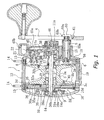
- a dual-bearing reel in which an embodiment of the present invention is adapted is a lever-drag reel furnished with: a cylindrical reel unit 1, a spool shaft 2 mounted rotatively in the central part of the reel unit 1, a spool 3 rotatively but axially immovably supported on the spool shaft 2, and a handle 4 disposed laterally on the reel unit 1.
- the lever drag reel is provided with: a rotation transmission mechanism 6 for transmitting to the spool 3 rotation of the handle 4, a lever drag mechanism 7 for braking rotation of the spool 3 in its line reeling-out direction, a spool-locking mechanism 8 for locking the spool 3, and an anti-reverse mechanism 9 for restraining rotation of the lever drag mechanism 7 in the reeling-out direction.
- the reel unit 1 has: a left/right pair of plate-shaped side plates 10, 11 made of metal; and a perforated cylindrical reel body 12, made of metal, to either end of which the side plates 10, 11 are joined coaxially by spigot joints and fastened by a plurality of fastening bolts 13. Harness lugs 14 of a pair, used for supporting the reel with the body, are mounted in between the side plates 10, 11 and the reel body 12.
- Harness lugs 14 of a pair used for supporting the reel with the body, are mounted in between the side plates 10, 11 and the reel body 12.
- the approximately central portions of the side plates 10, 11 rotatively support either end of the spool shaft 2.
- a cylindrical bearing accommodating portion 10a that protrudes inward is formed in the central portion of the inside face of the left side plate 10.
- a finishing process that takes away bulk is carried out on the inner margin 10d of the spigot joint section of the left side plate 10, by undercutting the inner margin in a way that avoids the fastening bolts 13.
- This serves to make the reel unit 1 lightweight.
- a boss 11a protruding axially outward is formed in the central portion of the right side plate 11 (handle 4 side) for supporting the spool shaft 2; and on the periphery of the boss 11a, a thick-walled, disk-shaped bearing block 15 for mounting the handle shaft 5 of the handle 4 is screwed fast.
- the under portion of the reel body 12 is provided with a rod attachment part 19 for mounting the reel onto a fishing rod.
- the spool shaft 2 is rotatively supported in the side plates 10 and 11 on the reel unit 1. Also, spaced axially inward thereof are two bearings 32a, 32b disposed at either end of the spool 3, by which the spool 3 is rotatively supported.
- the bearing 31a on the left side is accommodated by the bearing accommodating portion 10a formed on the left side plate 10.
- the bearing 31b on the right side is mounted in the boss 11a formed on the right side plate 11.
- the components of a drag shifting mechanism 38 (described later) for the lever drag mechanism 7 adjoins the right side of the bearing 31b outer race on the right end of the spool shaft 2.
- a pinion gear 17 (described later) for the rotation transmission mechanism 6 adjoins the left side of the bearing 31b inner race.
- the anti-reverse mechanism 9 adjoins the right side of the bearing 31a inner race on the left end of the spool shaft 2.
- the inside face of the side plate 10 abuts the left end of the outer race.
- the spool 3 abuts on the left side of the outer race of the right-side bearing 32b that supports the spool 3.
- four disk springs 34 abut on the right side of the inner race via a washer (not shown).
- the disk springs 34 are provided in order to make the drag force adjustable over a broad range with respect to pivot of the brake operating lever (described below), without the drag force elevating abruptly.
- a later described friction disk 36 in the lever drag mechanism 7 via a return spring 47 abuts on the left side of the inner race of the left bearing 32a that supports the spool 3.
- the right side of the outer race abuts on the spool 3.
- the spool 3 has a bobbin trunk 3a, and flanges 3b that are formed integrally with the bobbin trunk 3a on either end.
- the spool-locking mechanism 8 is provided outward of the flange 3b on the right side (handle-mounting side) in Fig. 1.
- a brake disk 35 for the lever drag mechanism 7 is mounted outward of the flange 3b on the left side in Fig. 1.
- the outer periphery of the left flange 3b is formed into a cylindrical portion 3d extending outward in the spool shaft direction, for attaching a cover 39 for covering the brake disk 35.
- the inner peripheral surface 3e of the cylindrical part 3d is finished by undercutting to take away bulk. This serves to make the spool 3 lightweight and reduces the inertia of the spool 3.
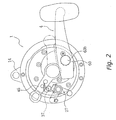
- the spool-locking mechanism 8 permits rotation of the spool 3 in the line wind-in direction, and locks it from rotating in the line reeling-out direction, and as shown in Fig. 2, is disposed neighboring the rear of the reel unit 1.
- the spool-locking mechanism 8, as shown in Fig. 3 and 4 is provided with: a locking piece 21 mounted on the reel unit 1 allowing it to shift between an advanced position (Fig. 4A) and a retracted position (Fig. 4B); a lock shifting mechanism 22 that shifts the locking piece 21 between the advanced position and the retracted position; and locking recesses 23, provided on the outside . surface of a flange 3b, and into which the tip of the locking piece 21 is engageable when advanced into the advanced position.
- the locking piece 21 has a shifting member 25 fitted, in an accommodating member 24 fixed to the side plate 11, to allow it to shift along an axis parallel to the spool shaft 2.
- the shifting member 25, which is a rod-shaped, has, from the leading-end side, a locking protrusion 25a, a brim 25b, a shaft 25c, and chamfered portions 25d.
- the upstream side in the line reel-out direction (indicated by the arrow in Fig. 4) of the locking protrusion 25a, which is a protrusion for engagement with the locking recesses 23, is formed at an acute angle, and the downstream side at an a obtuse angle.
- the brim 25b is for interlocking with a coil spring 26 that is component of the lock shifting mechanism 22.
- the coil spring 26 is disposed inside the accommodating member 24 around the shaft 25c of the shifting member 25. The coil spring 26 urges the shifting member 25 toward the locking recesses 23.
- the shaft 25c is supported permitting it to shift axially in the accommodating member 24.
- the shaft 25c is also non-rotatably interlocked with the accommodating member 24 by the chamfered portions 25d. That is, a rounded notch 24a into which the chamfered portions 25d can interlock is formed in one end of the accommodating member 24.
- the shifting member 25 is mounted to the reel unit 1 non-rotatably yet allowed to shift axially.
- a radially extending through-hole 25e is formed in the shifting member 25 at the rear end of the chamfered portions 25d.
- a cam pin 30 that is a component of the lock shifting mechanism 22 is fitted in the through-hole 25e. The cam pin 30 also acts as a locator for the shifting member 25 on the advanced-position end.
- the locking recesses 23 are constituted by cut-outs, circumferentially spaced along the rotational direction, in a lock plate 28.
- the lock plate 28 is a ring-shaped plate that is fastened to the outer surface of the right flange 3b on the spool 3 in Fig. 1.
- an annular recessed escape portion 3c is formed opposing the locking recesses 23. Forming the escape portion 3c in this fashion lets the locking protrusion 25a of the shifting member 25 penetrate the locking recess 23.
- the handle 4 is fastened by a fastening bolt 60 to the protruding end of the cylindrical handle shaft 5, which runs parallel to the spool shaft 2.
- a brim 60a is formed on the fastening bolt 60. Twelve circumferentially spaced arcuate recesses 60b are formed on the brim 60a, and is locked in place by a screw 61, the head of which engages a recess 60b.
- the handle shaft 5 is rotatively mounted in a cylindrical member 15a inserted into the bearing block 15 frontward below the boss portion 11a.
- a main gear 16 is mounted non-rotatably to the tip of the handle shaft 5.
- the lever drag mechanism 7 includes: the brake disk 35, which is mounted on the outside face of the Fig. 1 left-side flange 3b on the spool 3; the friction disk 36, which is disposed for contacting the brake disk 35; and the drag shifting mechanism 38, which is for reciprocatingly shifting the spool 3 and the friction disk 36 in the spool axial direction.
- the brake disk 35 is for example a washer-shaped disk member made of stainless steel, and is mounted non-rotatably with respect to the spool 3 on the outside face of the left-side flange 3b on the spool 3 by means of a radially inward, circumferentially spaced plurality of attaching screws 40 disposed on the lateral surface.
- An attaching portion 35a for attaching the screws 40 on the brake disk 35 is annularly depressed below the radial outward portion. This keeps the drag area, in particular the radially outward drag area, from being restricted, which makes the maximum diameter of the brake disk 35 corresponding to the outer diameter of the spool 3 usable.
- the friction disk 36 is disposed opposing the brake disk 35.
- a ring-shaped friction plate 36a made of abrasion-resistant material, for example carbon graphite or fiber-reinforced resin, is fastened to the surface of the friction disk 36 that opposes the brake disk 35, by an appropriate fastening means, such as screws.
- a tubular boss portion 36b that protrudes axially outward; and a pin 2a, which is fitted into the spool shaft 2, penetrating through the spool shaft 2 diametrically, interlocks with the boss portion 36b. Accordingly, the friction disk 36 is mounted on the spool shaft 2 non-rotatably and rotates together with the spool shaft 2.
- a ratchet wheel 50 in the anti-reverse mechanism 9 is fitted, non-rotatably yet free to shift axially, to the Fig. 1 left-end surface of the boss portion 36b on the friction disk 36.
- a cover member 39 covers the friction disk 36.
- the boss portion 36b on the friction disk 36 passes through the cover member 39 and extends toward the bearing 31a.
- a sealing member 39a is interposed between the penetrated part of the cover member 39 and the boss portion 36b.
- the ratchet wheel 50 is mounted non-rotatably yet free to shift axially outward (to the left in Fig. 1) by a suitable interlocking means, for example by serrations, to the outer peripheral surface of the boss portion 36b on the friction disk 36. Consequently the ratchet wheel 50 is mounted via the friction disk 36 to the spool shaft 2 (one example of a link member), non-rotatably yet free to shift axially.
- the ratchet wheel 50 has a ring-shaped abutting member 54 coaxially fitted to its Fig. 1 left-side face.
- the abutting member 54 abuts on the right-side end face of the bearing 31a inner race, and on its outer peripheral surface is an alignment portion 54a disposed adjacent the inner peripheral surface of the bearing accommodating portion 10a.
- an alignment portion 54a disposed adjacent the inner peripheral surface of the bearing accommodating portion 10a.
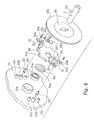
- the ratchet wheel 50 is anchored to the side plate 10 by a pair of braces 55.
- the braces 55 are plate-like members made of metal, for example a stainless steel alloy, with the one ends 55a fastened to the side plate 10.
- the braces 55 are formed into central portions 55b, bent from the first end portions 55a out toward the friction disk 36 into a crank-shape spanning the ratchet pawls 51, and are formed into fastening portions 55c, bent in toward the side plate 10a into a crank-shape.
- the fastening portions 55c are also fastened to the side plate 10. Further, the other ends 55d are formed bent into a crank-shape crooking from the fastening portions 55c toward the ratchet wheel.
- the other ends 55d are disposed in a position opposing the ratchet wheel 50 lateral surface on the friction disk 36 side.
- the ratchet wheel 50 is anchored by these other ends 55d.
- the ratchet pawls 51 are anchored, and their axial travel restrained, by the central portions 55b.
- the pair of ratchet pawls 51 is disposed in positions that are point-symmetrical with respect to the spool shaft axis, and is mounted to the inside surface of the side plate 10 free to pivot between a contact posture, in which they are in contact with the saw-teeth 50a, and a separated posture, in which they are separated from the saw teeth 50a.
- the tips of the ratchet pawls 51 are disposed downstream from the pivotal axes in the line take-up direction R of the ratchet wheel 50.
- a pair of pawl bosses 10b, for pivotally mounting the ratchet pawls 51, is formed on the side plate 10 in symmetrical positions astride the bearing accommodating member 10a.
- two attachment bosses 10c are formed astride the pawl bosses 10b of the pair.
- Pivot pins 53 for mounting the ratchet pawls 51 pivotally to the side plate 10 are fitted into the pawl bosses 10b.
- the pivot pins 53 are anchored by the braces 55, which restrains their axial travel.
- the two attachment bosses 10c are provided for fastening the braces 55 by screwing fast the one ends 55a and the fastening portions 55c to the side plate 10.
- a grasping member (one example of an urging means) 52 which is bent over into a C-shape, is fitted on and fastened to the central portion of the ratchet pawls 51.
- a pair of tips 52a on the grasping member 52 grasps the ratchet wheel 50 by resiliently contacting either lateral face of the ratchet wheel 50.
- the grasping members 52 urge the ratchet pawls 51 into the separated posture under friction with the ratchet wheel 50.
- the urged ratchet pawls 51 come into contact with the braces 55 and are retained in the separated position.
- the friction disk 36 cannot shift in the axially outward direction of the spool shaft (leftward in Fig. 1), i.e., in the direction parting away from the brake disk 35; and meanwhile it is permitted by the anti-reverse mechanism 9 to rotate in the line take-up direction but prohibited from rotating in the line reel-out direction.
- a gap opens between the friction plate 36a on the friction disk 36, and the brake disk 35; and in the braked state as shown above the spool-shaft axis in Fig. 1, the two adhere.
- the drag force is changed by adjusting the degree of adherence.
- the drag shifting mechanism 38 includes: a brake handling lever 45 provided pivotally on the reel unit 1; a pressing mechanism 46, which, in response to pivoting the brake handling lever 45 clockwise in Fig. 2, presses against the spool 3 and the brake disk 35 and shifts them leftward in Fig. 1; and a return spring 47, which is disposed between the friction disk 36 and the spool 3, and shifts the spool rightward in Fig. 1 in response to the brake handling lever 45 moving counterclockwise in Fig. 2.
- the return spring 47 is fitted circumferentially about the spool shaft 2, in the compressed state in between the friction disk 36 and the bearing 32a; and the friction disk 36 urges the brake disk 35 (the spool 3) into the separated direction, urging the brake disk 35 (the spool 3) rightward in Fig. 1.
- the brake handling lever 45 is mounted to the reel unit 1 free to pivot between the brake release position, as shown by the solid line in Fig. 2, and the maximum braking position, indicated by phantom lines.
- the brake handling lever 45 includes a lever portion 45a that is pivotally mounted to the boss portion 11a, and a knob portion 45b that is fastened to the tip end of the lever portion 45a.
- the base end of the lever portion 45a interlocks non-rotatably with the pressing mechanism 46.
- the ratchet wheel 50 when a fish is caught on the tackle and the spool 3 spins in the line reel-out direction, the ratchet wheel 50 also rotates in the line reeling-out direction.
- the graspers 52 under friction with the ratchet wheel 50 are yanked in the line reeling-out direction, reverse to the line reeling-in direction R. Consequently, the ratchet pawls 51 are urged into the contact posture by the graspers 52 and pivot into the contact posture.
- the ratchet wheel 50 when the spool 3 is rotated in the line reeling-out direction, the ratchet wheel 50 is prohibited from rotating in the line reeling-out direction. Consequently the friction disk 36 is stopped from rotating in the line reeling-out direction, and the set drag force is applied to the spool 3.
- the handle 4 When winding fishing line onto the spool, the handle 4 is rotated in the line take-up direction. Doing so transmits the handle 4 rotation to the spool 3 via the handle shaft 5, the main gear 16, the pinion gear 17, the spool shaft 2, and the lever drag mechanism 7, rotating the spool 3.
- the locking lever 27 is pivoted from the position indicated by solid lines in Fig. 2 into the position indicated by phantom lines. This causes the shifting member 25 urged by the coil spring 26 to advance into the advanced position, interlocking the locking protrusion 25a with a locking recess 23, and locking the spool 3 against rotation in the line reeling-out direction.
- the fishing rod is pointed toward the tackle and tugged directly back. Doing this breaks the snag, or the snagged fishing hook(s), fishing line or tangle therein, so that the terminal tackle or a portion of the tackle may be recovered.
- the shifting member 25 undergoes force by the brim 25b and the shaft 25c coming into contact with the accommodating member 24.
- the spool 3 is locked by engagement of the shifting member 25 with a locking recess 23 provided on the spool 3, which means that the spool 3 is locked directly and that the spool-locking mechanism 8 is less likely to damaged or deformed, even if acted upon by abnormal force.
- providing the locking recesses 23 on the outside face of the flange 3b disposes the locking recesses 23 in a section that is equal to or greater than the normal winding diameter of the fishing line when the fishing line is being reeled out. For this reason, the force acting on the shifting member 25 is equal to or less than the tension on the fishing line. This makes it even more unlikely that the spool-locking mechanism 8 will be broken or deformed.
- the locking protrusion 25a is obtuse-angled on its downstream side on the line reeling-out direction, and because the shifting member 25 is urged by the coil spring 26, when the spool 3 rotates in the line take-up direction the shifting member 25 is pressed by the locking recesses 23 and shifts into the retracted position.
- the shifting member 25 is pressed by the locking recesses 23 and shifts into the retracted position.
- a rotary member is fitted free to shift axially onto a link member, and meanwhile is anchored against the reel body by anchoring means.
- the rotary member therefore stays in the reel body and does not shift axially.
- the urging members to which the pawls are fitted are not liable to deform when the link member is removed/attached.
Landscapes
- Life Sciences & Earth Sciences (AREA)
- Environmental Sciences (AREA)
- Animal Husbandry (AREA)
- Biodiversity & Conservation Biology (AREA)
- Storing, Repeated Paying-Out, And Re-Storing Of Elongated Articles (AREA)
- Magnetic Bearings And Hydrostatic Bearings (AREA)
- Braking Arrangements (AREA)
- Replacement Of Web Rolls (AREA)
Applications Claiming Priority (2)
| Application Number | Priority Date | Filing Date | Title |
|---|---|---|---|
| JP2000261523 | 2000-08-30 | ||
| JP2000261523A JP4381580B2 (ja) | 2000-08-30 | 2000-08-30 | 両軸受リールの逆転防止機構 |
Publications (2)
| Publication Number | Publication Date |
|---|---|
| EP1183946A1 EP1183946A1 (en) | 2002-03-06 |
| EP1183946B1 true EP1183946B1 (en) | 2004-10-13 |
Family
ID=18749351
Family Applications (1)
| Application Number | Title | Priority Date | Filing Date |
|---|---|---|---|
| EP01307096A Expired - Lifetime EP1183946B1 (en) | 2000-08-30 | 2001-08-21 | Dual-bearing reel anti-reverse mechanism |
Country Status (9)
| Country | Link |
|---|---|
| US (1) | US6517021B2 (enExample) |
| EP (1) | EP1183946B1 (enExample) |
| JP (1) | JP4381580B2 (enExample) |
| KR (1) | KR100722538B1 (enExample) |
| CN (1) | CN1225165C (enExample) |
| AT (1) | ATE279103T1 (enExample) |
| AU (1) | AU779135B2 (enExample) |
| DE (1) | DE60106355T2 (enExample) |
| TW (1) | TW504368B (enExample) |
Families Citing this family (14)
| Publication number | Priority date | Publication date | Assignee | Title |
|---|---|---|---|---|
| JP4381733B2 (ja) * | 2003-06-26 | 2009-12-09 | 株式会社シマノ | 両軸受リール |
| US6634586B1 (en) * | 2002-07-02 | 2003-10-21 | Liang-Jen Chang | Anti-reversional mechanism for trolling reel |
| US7198219B1 (en) * | 2005-05-27 | 2007-04-03 | Harout Alajajyan | Fishing reel transmission |
| US7128287B1 (en) * | 2005-11-10 | 2006-10-31 | Okuma Fishing Tackle Co. Ltd. | Fishing reel |
| GB2461876B (en) * | 2008-07-14 | 2011-03-09 | Lead Innovations | Retracting dog lead with manual override |
| KR101126546B1 (ko) * | 2009-06-26 | 2012-03-26 | 주식회사 도요엔지니어링 | 낚시용 베이트 릴의 클러치 기구 |
| JP5961378B2 (ja) * | 2011-12-22 | 2016-08-02 | 株式会社シマノ | 両軸受リールのドラグ調整装置 |
| JP6200287B2 (ja) * | 2013-11-14 | 2017-09-20 | シマノコンポネンツ マレーシア エスディーエヌ.ビーエッチディー. | 両軸受リール |
| JP6467218B2 (ja) * | 2014-12-19 | 2019-02-06 | 株式会社シマノ | 両軸受リール |
| JP6518514B2 (ja) * | 2015-05-28 | 2019-05-22 | 株式会社シマノ | 両軸受リール |
| JP6886344B2 (ja) * | 2017-05-17 | 2021-06-16 | 株式会社シマノ | 両軸受リール |
| JP7086827B2 (ja) * | 2018-12-14 | 2022-06-20 | 株式会社シマノ | 釣用リール用キャップ |
| CN113049487B (zh) * | 2021-03-22 | 2022-03-18 | 北京航空航天大学 | 一种求取倾斜滚柱式摩擦盘摩擦系数的试验系统及方法 |
| US12484564B2 (en) | 2022-01-27 | 2025-12-02 | TrikaUSA Inc. | Anti-reverse mechanism for fishing reel |
Family Cites Families (7)
| Publication number | Priority date | Publication date | Assignee | Title |
|---|---|---|---|---|
| US3989204A (en) * | 1968-01-05 | 1976-11-02 | Carpano & Pons S.A. | Fly fishing reel |
| GB2206022B (en) * | 1987-05-23 | 1991-04-17 | Shimano Industrial Co | Double-bearing fishing reel |
| US5201870A (en) * | 1990-12-14 | 1993-04-13 | Newell Carl W | Reverse stop rachet and pawl for a fishing reel |
| US5415359A (en) * | 1991-02-05 | 1995-05-16 | Ikuta; Takeshi | Fishing reel |
| JP2957882B2 (ja) * | 1994-02-22 | 1999-10-06 | ダイワ精工株式会社 | 魚釣用リ−ル |
| US6056223A (en) * | 1996-08-21 | 2000-05-02 | Kirby; Thomas Glen | Drag mounted spring for spin-cast reels |
| AUPO185596A0 (en) * | 1996-08-23 | 1996-09-19 | Jarvis Walker Pty Ltd | A spinning reel for fishing |
-
2000
- 2000-08-30 JP JP2000261523A patent/JP4381580B2/ja not_active Expired - Fee Related
-
2001
- 2001-06-15 TW TW090114624A patent/TW504368B/zh not_active IP Right Cessation
- 2001-07-06 KR KR1020010040247A patent/KR100722538B1/ko not_active Expired - Fee Related
- 2001-08-21 DE DE60106355T patent/DE60106355T2/de not_active Expired - Lifetime
- 2001-08-21 EP EP01307096A patent/EP1183946B1/en not_active Expired - Lifetime
- 2001-08-21 AT AT01307096T patent/ATE279103T1/de not_active IP Right Cessation
- 2001-08-22 AU AU63593/01A patent/AU779135B2/en not_active Ceased
- 2001-08-23 US US09/934,517 patent/US6517021B2/en not_active Expired - Lifetime
- 2001-08-30 CN CNB011258934A patent/CN1225165C/zh not_active Expired - Fee Related
Also Published As
| Publication number | Publication date |
|---|---|
| DE60106355T2 (de) | 2006-02-02 |
| TW504368B (en) | 2002-10-01 |
| US20020023978A1 (en) | 2002-02-28 |
| ATE279103T1 (de) | 2004-10-15 |
| CN1341354A (zh) | 2002-03-27 |
| EP1183946A1 (en) | 2002-03-06 |
| CN1225165C (zh) | 2005-11-02 |
| JP4381580B2 (ja) | 2009-12-09 |
| KR100722538B1 (ko) | 2007-05-28 |
| AU779135B2 (en) | 2005-01-06 |
| DE60106355D1 (de) | 2004-11-18 |
| KR20020017946A (ko) | 2002-03-07 |
| US6517021B2 (en) | 2003-02-11 |
| JP2002065129A (ja) | 2002-03-05 |
| AU6359301A (en) | 2002-03-07 |
Similar Documents
| Publication | Publication Date | Title |
|---|---|---|
| EP1181864B1 (en) | Dual-Bearing reel spool-locking mechanism | |
| US6517021B2 (en) | Dual-bearing reel anti-reverse mechanism | |
| KR101010970B1 (ko) | 양 베어링 릴의 클러치 조작 부재 | |
| US10010061B2 (en) | Spinning reel | |
| EP0639328B1 (en) | Spinning reel for fishing | |
| KR20150056031A (ko) | 양 베어링 릴 | |
| JP2002218870A (ja) | 釣り用リールのシール構造 | |
| US7163167B2 (en) | One way clutch for spinning reel | |
| TW201532516A (zh) | 紡車式捲線器 | |
| JP2006025763A (ja) | 釣り用リールのハンドル組立体 | |
| JP4324268B2 (ja) | 両軸受リールの制動装置 | |
| TW201336407A (zh) | 紡車式捲線器及紡車式捲線器的牽引力切換裝置 | |
| JP4834240B2 (ja) | 両軸受リールのドラグ調整機構 | |
| JP6842756B2 (ja) | 魚釣り用リール | |
| JP2004222559A (ja) | 魚釣り用リールのハンドル装置 | |
| JP4266719B2 (ja) | スピニングリールのロータ制動装置 | |
| JP4365981B2 (ja) | 両軸受リールのハンドル軸支持構造 | |
| JP3711312B2 (ja) | スピニングリール | |
| JP4313891B2 (ja) | 両軸受リールのドラグカバー取付構造 | |
| JP2011050399A (ja) | 両軸受リールのドラグ調整機構 | |
| JP2018186758A (ja) | 両軸受け型魚釣り用リール | |
| JP2000213567A (ja) | 釣り具リ―ル用クラッチ | |
| JP3542749B2 (ja) | 魚釣用スピニングリール | |
| JPH1189485A (ja) | スピニングリール | |
| JP2003047373A (ja) | スピニングリールのリール本体 |
Legal Events
| Date | Code | Title | Description |
|---|---|---|---|
| PUAI | Public reference made under article 153(3) epc to a published international application that has entered the european phase |
Free format text: ORIGINAL CODE: 0009012 |
|
| AK | Designated contracting states |
Kind code of ref document: A1 Designated state(s): AT BE CH CY DE DK ES FI FR GB GR IE IT LI LU MC NL PT SE TR |
|
| AX | Request for extension of the european patent |
Free format text: AL;LT;LV;MK;RO;SI |
|
| 17P | Request for examination filed |
Effective date: 20020227 |
|
| 17Q | First examination report despatched |
Effective date: 20031020 |
|
| GRAP | Despatch of communication of intention to grant a patent |
Free format text: ORIGINAL CODE: EPIDOSNIGR1 |
|
| AKX | Designation fees paid |
Designated state(s): AT BE CH CY DE DK ES FI FR GB GR IE IT LI LU MC NL PT SE TR |
|
| GRAS | Grant fee paid |
Free format text: ORIGINAL CODE: EPIDOSNIGR3 |
|
| GRAA | (expected) grant |
Free format text: ORIGINAL CODE: 0009210 |
|
| AK | Designated contracting states |
Kind code of ref document: B1 Designated state(s): AT BE CH CY DE DK ES FI FR GB GR IE IT LI LU MC NL PT SE TR |
|
| PG25 | Lapsed in a contracting state [announced via postgrant information from national office to epo] |
Ref country code: AT Free format text: LAPSE BECAUSE OF FAILURE TO SUBMIT A TRANSLATION OF THE DESCRIPTION OR TO PAY THE FEE WITHIN THE PRESCRIBED TIME-LIMIT Effective date: 20041013 Ref country code: TR Free format text: LAPSE BECAUSE OF FAILURE TO SUBMIT A TRANSLATION OF THE DESCRIPTION OR TO PAY THE FEE WITHIN THE PRESCRIBED TIME-LIMIT Effective date: 20041013 Ref country code: LI Free format text: LAPSE BECAUSE OF FAILURE TO SUBMIT A TRANSLATION OF THE DESCRIPTION OR TO PAY THE FEE WITHIN THE PRESCRIBED TIME-LIMIT Effective date: 20041013 Ref country code: FI Free format text: LAPSE BECAUSE OF FAILURE TO SUBMIT A TRANSLATION OF THE DESCRIPTION OR TO PAY THE FEE WITHIN THE PRESCRIBED TIME-LIMIT Effective date: 20041013 Ref country code: CH Free format text: LAPSE BECAUSE OF FAILURE TO SUBMIT A TRANSLATION OF THE DESCRIPTION OR TO PAY THE FEE WITHIN THE PRESCRIBED TIME-LIMIT Effective date: 20041013 |
|
| REG | Reference to a national code |
Ref country code: GB Ref legal event code: FG4D |
|
| REG | Reference to a national code |
Ref country code: CH Ref legal event code: EP |
|
| REG | Reference to a national code |
Ref country code: IE Ref legal event code: FG4D |
|
| REF | Corresponds to: |
Ref document number: 60106355 Country of ref document: DE Date of ref document: 20041118 Kind code of ref document: P |
|
| PG25 | Lapsed in a contracting state [announced via postgrant information from national office to epo] |
Ref country code: SE Free format text: LAPSE BECAUSE OF FAILURE TO SUBMIT A TRANSLATION OF THE DESCRIPTION OR TO PAY THE FEE WITHIN THE PRESCRIBED TIME-LIMIT Effective date: 20050113 Ref country code: GR Free format text: LAPSE BECAUSE OF FAILURE TO SUBMIT A TRANSLATION OF THE DESCRIPTION OR TO PAY THE FEE WITHIN THE PRESCRIBED TIME-LIMIT Effective date: 20050113 Ref country code: DK Free format text: LAPSE BECAUSE OF FAILURE TO SUBMIT A TRANSLATION OF THE DESCRIPTION OR TO PAY THE FEE WITHIN THE PRESCRIBED TIME-LIMIT Effective date: 20050113 |
|
| PG25 | Lapsed in a contracting state [announced via postgrant information from national office to epo] |
Ref country code: ES Free format text: LAPSE BECAUSE OF FAILURE TO SUBMIT A TRANSLATION OF THE DESCRIPTION OR TO PAY THE FEE WITHIN THE PRESCRIBED TIME-LIMIT Effective date: 20050124 |
|
| REG | Reference to a national code |
Ref country code: CH Ref legal event code: PL |
|
| PGFP | Annual fee paid to national office [announced via postgrant information from national office to epo] |
Ref country code: FR Payment date: 20050712 Year of fee payment: 5 |
|
| PGFP | Annual fee paid to national office [announced via postgrant information from national office to epo] |
Ref country code: NL Payment date: 20050808 Year of fee payment: 5 |
|
| PLBE | No opposition filed within time limit |
Free format text: ORIGINAL CODE: 0009261 |
|
| STAA | Information on the status of an ep patent application or granted ep patent |
Free format text: STATUS: NO OPPOSITION FILED WITHIN TIME LIMIT |
|
| PG25 | Lapsed in a contracting state [announced via postgrant information from national office to epo] |
Ref country code: CY Free format text: LAPSE BECAUSE OF FAILURE TO SUBMIT A TRANSLATION OF THE DESCRIPTION OR TO PAY THE FEE WITHIN THE PRESCRIBED TIME-LIMIT Effective date: 20050821 |
|
| PG25 | Lapsed in a contracting state [announced via postgrant information from national office to epo] |
Ref country code: IE Free format text: LAPSE BECAUSE OF NON-PAYMENT OF DUE FEES Effective date: 20050822 |
|
| PGFP | Annual fee paid to national office [announced via postgrant information from national office to epo] |
Ref country code: BE Payment date: 20050826 Year of fee payment: 5 |
|
| PG25 | Lapsed in a contracting state [announced via postgrant information from national office to epo] |
Ref country code: MC Free format text: LAPSE BECAUSE OF NON-PAYMENT OF DUE FEES Effective date: 20050831 |
|
| PGFP | Annual fee paid to national office [announced via postgrant information from national office to epo] |
Ref country code: LU Payment date: 20050916 Year of fee payment: 5 |
|
| ET | Fr: translation filed | ||
| 26N | No opposition filed |
Effective date: 20050714 |
|
| REG | Reference to a national code |
Ref country code: IE Ref legal event code: MM4A |
|
| PG25 | Lapsed in a contracting state [announced via postgrant information from national office to epo] |
Ref country code: BE Free format text: LAPSE BECAUSE OF NON-PAYMENT OF DUE FEES Effective date: 20060831 |
|
| PG25 | Lapsed in a contracting state [announced via postgrant information from national office to epo] |
Ref country code: NL Free format text: LAPSE BECAUSE OF NON-PAYMENT OF DUE FEES Effective date: 20070301 |
|
| NLV4 | Nl: lapsed or anulled due to non-payment of the annual fee |
Effective date: 20070301 |
|
| REG | Reference to a national code |
Ref country code: FR Ref legal event code: ST Effective date: 20070430 |
|
| BERE | Be: lapsed |
Owner name: *SHIMANO INC. Effective date: 20060831 |
|
| PG25 | Lapsed in a contracting state [announced via postgrant information from national office to epo] |
Ref country code: PT Free format text: LAPSE BECAUSE OF NON-PAYMENT OF DUE FEES Effective date: 20050313 |
|
| PG25 | Lapsed in a contracting state [announced via postgrant information from national office to epo] |
Ref country code: FR Free format text: LAPSE BECAUSE OF NON-PAYMENT OF DUE FEES Effective date: 20060831 |
|
| PG25 | Lapsed in a contracting state [announced via postgrant information from national office to epo] |
Ref country code: LU Free format text: LAPSE BECAUSE OF NON-PAYMENT OF DUE FEES Effective date: 20060821 |
|
| PGFP | Annual fee paid to national office [announced via postgrant information from national office to epo] |
Ref country code: DE Payment date: 20090814 Year of fee payment: 9 Ref country code: GB Payment date: 20090818 Year of fee payment: 9 |
|
| PGFP | Annual fee paid to national office [announced via postgrant information from national office to epo] |
Ref country code: IT Payment date: 20090818 Year of fee payment: 9 |
|
| GBPC | Gb: european patent ceased through non-payment of renewal fee |
Effective date: 20100821 |
|
| PG25 | Lapsed in a contracting state [announced via postgrant information from national office to epo] |
Ref country code: IT Free format text: LAPSE BECAUSE OF NON-PAYMENT OF DUE FEES Effective date: 20100821 |
|
| REG | Reference to a national code |
Ref country code: DE Ref legal event code: R119 Ref document number: 60106355 Country of ref document: DE Effective date: 20110301 |
|
| PG25 | Lapsed in a contracting state [announced via postgrant information from national office to epo] |
Ref country code: DE Free format text: LAPSE BECAUSE OF NON-PAYMENT OF DUE FEES Effective date: 20110301 |
|
| PG25 | Lapsed in a contracting state [announced via postgrant information from national office to epo] |
Ref country code: GB Free format text: LAPSE BECAUSE OF NON-PAYMENT OF DUE FEES Effective date: 20100821 |