EP1182934B1 - Verfahren und vorrichtung zur behandlung von milch, insbesondere von muttermilch - Google Patents
Verfahren und vorrichtung zur behandlung von milch, insbesondere von muttermilch Download PDFInfo
- Publication number
- EP1182934B1 EP1182934B1 EP00935139A EP00935139A EP1182934B1 EP 1182934 B1 EP1182934 B1 EP 1182934B1 EP 00935139 A EP00935139 A EP 00935139A EP 00935139 A EP00935139 A EP 00935139A EP 1182934 B1 EP1182934 B1 EP 1182934B1
- Authority
- EP
- European Patent Office
- Prior art keywords
- milk
- container
- heat source
- temperature
- period
- Prior art date
- Legal status (The legal status is an assumption and is not a legal conclusion. Google has not performed a legal analysis and makes no representation as to the accuracy of the status listed.)
- Expired - Lifetime
Links
Images


Classifications
-
- A—HUMAN NECESSITIES
- A23—FOODS OR FOODSTUFFS; TREATMENT THEREOF, NOT COVERED BY OTHER CLASSES
- A23B—PRESERVATION OF FOODS, FOODSTUFFS OR NON-ALCOHOLIC BEVERAGES; CHEMICAL RIPENING OF FRUIT OR VEGETABLES
- A23B11/00—Preservation of milk or dairy products
- A23B11/10—Preservation of milk or milk preparations
- A23B11/12—Preservation of milk or milk preparations by heating
- A23B11/13—Preservation of milk or milk preparations by heating the materials being loose unpacked
-
- A—HUMAN NECESSITIES
- A23—FOODS OR FOODSTUFFS; TREATMENT THEREOF, NOT COVERED BY OTHER CLASSES
- A23C—DAIRY PRODUCTS, e.g. MILK, BUTTER OR CHEESE; MILK OR CHEESE SUBSTITUTES; PREPARATION THEREOF
- A23C9/00—Milk preparations; Milk powder or milk powder preparations
- A23C9/20—Dietetic milk products not covered by groups A23C9/12 - A23C9/18
- A23C9/206—Colostrum; Human milk
Definitions
- the present invention relates to a method of treatment of milk, in particular of breastmilk, in which the milk is in a container is heated briefly.
- the invention further relates to a device for implementation this procedure.
- Such methods and apparatus are generally known from Known in the art. They serve for storage or later use certain milk or breastmilk aggravate and / or infectious microorganisms from the milk remove. Such methods are e.g. under the term pasteurization known.
- CMV cytomegalovirus
- CMV in pumped breast milk inactivate to prevent the transmission and an early and thus frequent symptomatic infection in premature babies avoid.
- DE 480 452 describes a method and a corresponding Device for sterilizing milk that is exclusively suitable for large scale purposes.
- this known Device practically full-filled vessels are heat-treated, so that temperature gradients form regularly, therefore a long-term heat treatment with accordingly tempered water is provided, which with the above described disadvantages.
- the Container at least during heating so set in motion is that on its inner wall, a milk film is formed
- the Container / the milk for heating for a first period of time a first heat source set to a first temperature, then for a second period one on a second Temperature located second heat source and finally to Cool down for a third period of time to a third temperature adjusted third heat source is exposed
- the first Heat source is formed by a hot air source.
- the inventors of the present application have recognized that by the movement of the container during the action of heat prevents the formation of internal temperature gradients because the entire milk volume is heated evenly. However, this means that no denaturing of ingredients takes place and much of the immunological properties the milk is preserved. On the other hand, the Inventors a complete inactivation of infectious microorganisms, in particular of CMV as well as of e.g. Staphylococcus aureus. Also a use in the veterinary field e.g. in zoological gardens and in rare mammals is possible.
- the new method and the new device are above In addition, particularly suitable for very small quantities of milk, because Local overheating of the milk is due to the movement of the milk Container prevented.
- the container is preferably at least during the heating set in rotation at a speed above about 150 U / min, preferably above about 250 U / min, on preferably about 300 rpm.
- the inventors have found that such rotational speeds for the formation of a very uniform milk film on the inside of the container, with the inserted Temperatures and times for a guaranteed elimination even high doses of virus in small individual quantities of milk to care.
- the container / breast milk is used for heating for a first Time span of a first temperature set to a first temperature Heat source, then for a second period one on one second temperature located second heat source and finally, to cool down for a third period of time exposed to a third temperature set third heat source.
- the heating and cooling rate individually adjusting the milk so that a denaturation of ingredients by sudden temperature changes is avoided.
- one Slow warm-up phase selectable even with small quantities of milk ensures a gentle and even heating.
- the third heat source is formed by a cooled water bath.
- the first heat source is a hot air source, in whose air jet the moving container is immersed, wherein preferably the air jet into a chamber with a Is passed opening for immersion of the moving container.
- the container is so immersed in an air bath.
- the hot air source an air source, such as a fan whose Air jet is passed along a heating resistor.
- Construction can be a source of cold air as a third heat source be provided, which includes a fan whose air jet over e.g. a Pelltierelement is passed, a semiconductor element, the low temperatures by applying current to one side generated.
- air sources If used instead of water baths air sources The problem of dripping water is eliminated the container lifted out of the respective water bath "tows away". It is particularly preferred if the first Heat source through a hot air source and the third heat source is formed by a cooled water bath.
- the second heat source is the ambient air is.
- the inventors of the present application have recognized that in Application of the method according to the invention not only the elimination even very high doses of virus in small quantities of milk 20 ml is allowed, but that the far-reaching structural Integrity of the milk cells can be ensured by what microscopic examination by means of vital staining and LDH release was detected in whey. Further shows the new method no reduction of the total protein and the albumin in the Whey on. True, the activity of alkaline phosphatase and the lipase temperature sensitive, the lipase activity, the a key role in fat absorption in the preterm infant is attributed to the new method, however by about a factor of 3 greater than after a Holder pasteurization (30 minutes, 62 ° C). In addition, the concentration vitamins B12 and folic acid are not reduced, and the Concentration of sIgA is only slightly reduced.
- the container is a glass flask, preferably a glass round bottom flask.
- the container is a volume which is at least about ten times larger than the volume the milk.
- a horizontally and vertically movable receptacle for the container comprising a rotating drive for the container, preferably at the receptacle a latching holder for the container, more preferably for a piston neck of a Glass bulb is provided.
- the temperature sensor is included not co-rotating, preferably resiliently attached to the recording.
- the snap-in holder is a quick mounting and dismounting the glass bulb in the device possible.
- the temperature the milk is not only at one point in the container, but over the entire circumference of the container measured what to a temperature average leads.
- the temperature sensor on the receptacle is advantageously ensures that there is no damage to the temperature sensor comes when it rests against the container inner wall and the rotating container is not exactly rotationally symmetrical.
- Native milk from lactating, CMV-seronegative mothers is pumped out and aliquoted into 20 ml samples. To this sample becomes a defined amount of virus added from the virus strain CMV AD 169, to produce milk samples with a defined viral load.
- breast milk was a CMV seropositive nursing mother tested.
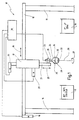
- the device 10 comprises two water baths 12 and 13, above which are supported on two posts 14, 15 a Portal beam 16 extends.
- a carriage 17 On the gantry 16 is slidable a carriage 17 is mounted, which has a motor 18 in Direction of a double arrow 19 is movable.
- a 20 height adjustable in the direction of a double arrow Rod 21 is provided in its lifting movement is controlled by a motor 22, which also on the car 17 is stored.
- the rod 21 carries a rotary holder 23, in which a glass bulb 24 is clamped.
- the rod 21 has a motor 25 over which the glass bulb about its vertical axis 26 can be rotated, what indicated by an arrow 27.
- a temperature sensor 28 is also attached, which protrudes into the glass bulb 24 and possibly resiliently whose inner wall 29 rests.
- the glass bulb 24 is a prepared as above Sample of breast milk 32 to be treated, which has a volume of approx. 20 ml, wherein at 33 the volume at standstill of Glass piston 24 is indicated.
- the glass bulb 24 When the glass bulb 24 is rotated by the motor 25 is, forms the breast milk on the inner wall 29 of the glass bulb 24 an indicated at 34 milk film, the about the Half of the inner wall 29 is covered.
- This training of milk film is achieved in that the glass bulb 24 is about ten times Volume as the breast milk 32, in the given Case a volume of 250 ml (glass round bottom flask with grinding), which rotates at a speed of about 300 rev / min.
- the glass bulb 24 is now in a the two water baths 12, 13 are immersed, wherein the Immersion depth is chosen so that the glass bulb 24 up to his neck 35 in the water of the respective water bath 12 or 13 is immersed.
- the sequence control takes place via a control circuit 36, with the motors 18, 22 and 25 as well as the temperature sensor 28, who in the experimental stage the respective Temperature of breast milk indicates.
- the new process is now such that initially in a fresh glass flask 24 the desired amount of breast milk, in 20 ml is entered in the selected example.
- the glass bulb 24 is then clamped in the rotary holder 23 and means of the motor 25 at a speed of about 300 rpm in rotation offset, so that the milk film 34 is formed.
- the glass bulb 24 for the purpose of rapid heat exchange up to his neck 35 immersed in the water bath 12, which is heated to 85-90 ° C. is.
- the glass bulb 24 remains in the water bath for 20/25 seconds 12 and then automatically raised again.
- the temperature the milk film is then at 68/70 ° C.
- the glass bulb 24 is then immersed in the water bath 13, which has a temperature of 2-4 ° C.
- the still rotating glass bulb 24 for about 20 seconds, whereupon the mother's milk 32 again reaches a temperature of approx. 30 ° C has taken.
- the whole inactivation cycle only takes about one Minute, so that the new device also suitable for clinics is where many individual milk samples in a row and without Danger of cross-contamination must be heat-inactivated. Because - as already mentioned - in the daily routine of the clinic may not be a temperature sensor 28 is required, or the temperature sensor 28th is only used intermittently to review the process, After treatment of a first milk sample, only the Flask taken and replaced by a new, with a new one Milk sample filled flasks are replaced. In this way can quickly inactivate a large number of milk samples in succession become.
- the milk samples thus treated are then placed in small containers such as. stored small milk bottle, whereupon the used Glass flasks are cleaned and sterilized, so that they can be used again.
- the temperature sensor can be easily determined.
- the device 10 is moreover not only for use suitable for use in a clinic but can also be used by mothers at home.
- the method not only the CMV infectivity excluded, including other infectious microorganisms, such as. Staphylococcus aureus, can be inactivated become.
- FIG. 2 another device 40 is shown for treatment of milk is suitable.
- the device 40 has a base frame 41 with adjustable feet 42 on. On the base frame 41, a vertical rail 43 is arranged, at a cross member 44 is mounted vertically movable. Parallel to the cross member 44, a carriage 45 is horizontally movable. On the carriage 45, the glass bulb 24 is fixed so that he can be rotated as it is already related was described with Fig. 1.
- a temperature display 46 is also integrated, on the measured temperature with the temperature sensor 28 is shown. Furthermore, 41 is still in the base frame an operating device 47 integrated.
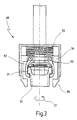
- the glass bulb 24 is on the carriage 45 by means of a receptacle 48th attached, which is shown in Fig. 3 in the neck.
- the receptacle 48 detects the glass bulb 24, at the neck region a circumferential bead 51 is provided.
- the glass bulb 24 is held by hinged brackets 52, the bead 51st spread.
- the brackets 26 are vertical against the force a spring 53 movable.
- the recording 48 along the arrow 27 set in rotation, which also causes the glass bulb 24 rotates and the milk film on the inner wall of the Glass bulb is formed.
- Air bath 56 are used, which in schematic, cut Side view in Fig. 4 is shown.
- the air bath 56 comprises a chamber 57 to which an air source 58 is connected is that directs an air jet 59 into the interior of the chamber 57.
- an upper opening 61 is provided, through through the glass bulb 24 into the chamber 57 and thus in the air jet 59 can be immersed.
- the air source 58 includes a fan 62, which together with a Motor 63 forms a fan that the air flow 59 via a Temperature element 64 conducts, which via terminals 65 with power is supplied.
- the temperature member 64 is either a heating resistor or a Pelltierelement, so that the air bath 56, the water bath 12th and / or can replace the water bath 13.
- Example 2 For comparison, samples were used as in Example 1 were subjected to a Holder pasteurization, ie in each case heated to 62.5 ° C for 30 minutes.
- the rate measured by the inventors of the present application the remaining infectivity was also at ten days of storage at -20 ° C still 20%, which is significantly higher than in of the literature.
- the inventors of the present application attribute this to the fact that it is the measurement methods in the still described in the earlier literature lacking sensitivity was lacking today.
- the milk is fractionated after inactivation and for the Detection of the cell-free and low-fat whey fraction used.
- Hamprecht et al. Detection of cytomegalovirus DNA in human milk cells and cell free whey milk by nested PCR, Journal of Virological Methods, 1998, Vol. 70, pages 167-176 the advantage of using the whey fraction over the treated Nativmilch to the effect that the cytotoxicity of native milk in cell culture falsifies the measurement results.
- 1-2 ml of breast milk is added at 400 x g for 10 minutes Centrifuged room temperature, the creamy top layer is discarded and the cloudy supernatant is again at 400 x g for 10 Centrifuged for a few minutes. After that, cell debris of the supernatant collected by centrifugation at 3200xg for 10 minutes and the resulting supernatant through a 0.22 ⁇ m filter Pore size (Sartorius) filtered. The filtered whey is used for used in vitro cell culture assays.
- the cells used are human foreskin fibroblasts (HFF) with an adherence time of 4-5 hours.
- the culture carriers are microtiter plates with 2.5 ⁇ 10 4 HFF / microculture / 100 ⁇ l MEM-5% FCS as medium. Eight replicas were used per sample.
- CMV-IEA Intermediate Early gene antigen
- RNA pp67 mRNA by means of a nucleic acid sequence-based amplification, NASBA for short, as described by Compten, Nature, 350: 91-92, 1991.
- NASBA nucleic acid sequence-based amplification
- infected nuclei form Plaques arising from each one infected fibroblast cell develop.
- Table 1 shows the results of the experiments from Examples 1-3, indicating in each case the titer of the virus solution, the type of inactivation, the duration of the cell culture assay, the number of infected cells, the detected IE DNA and the detected pp67 m. RNA, which in contrast to CMV infection stands for CMV disease.
- Selected test results for Examples 1-3 TCID 50/100 .mu.l sample inactivation assay IEA + / total IE DNA pp67 mRNA 10 5 ZK-control - 15 h 76/76 ./. ./. Whey spiked - 15 h 22/103 ./. ./. Whey spiked 10 "72 ° C 15 h 0/116 ./.
- Whey spiked - 5d 24/77 ./. ./. Whey spiked 3d-20 ° C 5d 45/333 ./. ./. Whey spiked 10d-20 ° C 5d 73/361 ./. ./. 10 4 ZK-control - 18h - ./. ./. Whey spiked 18h-20 ° C 18h 220 / well ./. ./. ZK control cell culture control (without sample)
- Whey spiked whey added with CMV AD 169
- the short term heat inactivation method shows no reduction of total protein and albumin in whey.
- temperature Sensitive is the activity of alkaline phosphatase and the lipase.
- the lipase activity which plays a key role attributed to fat absorption in the preterm infant is, however, in the new process about the Factor 3 greater than after Holder pasteurization.
- the lipase activity also becomes an important antiviral protective effect attributed so that the new process has distinct advantages over the Holder pasteurization has.
- the concentration of vitamins B12 and folic acid is controlled by the new procedures not reduced. It also shows that sIgA is largely heat stable, however, by both heat inactivation steps is slightly reduced. The cryoinactivation On the other hand, it does not affect the sIgA level.
Landscapes
- Life Sciences & Earth Sciences (AREA)
- Engineering & Computer Science (AREA)
- Chemical & Material Sciences (AREA)
- Food Science & Technology (AREA)
- Polymers & Plastics (AREA)
- Wood Science & Technology (AREA)
- Zoology (AREA)
- Health & Medical Sciences (AREA)
- Nutrition Science (AREA)
- Dairy Products (AREA)
- Cookers (AREA)
Description
- Fig. 1
- ein erstes Ausführungsbeispiel der neuen Vorrichtung in stark schematischer Seitenansicht;
- Fig. 2
- ein zweites Ausführungsbeispiel der neuen Vorrichtung in Seitenansicht;
- Fig. 3
- eine vergrößerte Seitenansicht einer Aufnahme für einen Glaskolben; und
- Fig. 4
- eine schematische Seitenansicht eines bei den Vorrichtungen der Fig. 1 und 2 verwendbaren Luftbades.
| Ausgewählte Versuchsergebnisse zu den Beispielen 1-3 | ||||||
| TCID50/100 µl | Probe | Inaktivierung | Assay | IEA+/Gesamt | IE-DNA | pp67 mRNA |
| 105 | ZK-Kontrolle | - | 15 h | 76/76 | ./. | ./. |
| Molke spiked | - | 15 h | 22/103 | ./. | ./. | |
| Molke spiked | 10" 72°C | 15 h | 0/116 | ./. | ./. | |
| Spender | Molke | - | 5d | 4/104 | ./. | ./. |
| CMV- | Molke | 10" 72°C | 5d | 0/120 | ./. | ./. |
| seropositiv | Molke | 20" 72°C | 5d | 0/124 | ./. | ./. |
| 104 | ZK-Kontrolle | - | 6d | - | + | + |
| Molke spiked | - | 6d | Konfl.Plaques | + | + | |
| Molke spiked | 5" 72°C | 6d | /well | + | - | |
| Molke spiked | 10" 72°C | 6d | /well | + | - | |
| Molke spiked | 30' 62°C | 6d | /well | + | - | |
| 103 | ZK-Kontrolle | - | 6d | - | + | + |
| Molke spiked | - | 6d | 6 Plaques/well | + | + | |
| Molke spiked | 5" 72°C | 6d | /well | + | - | |
| Molke spiked | 10" 72°C | 6d | /well | + | - | |
| 104 | ZK-Kontrolle | - | 5d | 324/324 | ./. | ./. |
| Molke spiked | - | 5d | 24/77 | ./. | ./. | |
| Molke spiked | 3d-20°C | 5d | 45/333 | ./. | ./. | |
| Molke spiked | 10d-20°C | 5d | 73/361 | ./. | ./. | |
| 104 | ZK-Kontrolle | - | 18h | - | ./. | ./. |
| Molke spiked | 18h-20°C | 18h | 220/well | ./. | ./. | |
| ZK-Kontrolle = Zellkultur- Kontrolle (ohne Probe) | ||||||
| Molke spiked = mit CMV AD 169 versetzte Molke |

Claims (22)
- Verfahren zur Behandlung von Milch, insbesondere von Muttermilch (32), bei dem die Milch in einem Behälter kurzzeitig erhitzt wird, der Behälter zumindest während des Erhitzens derart in Bewegung gesetzt wird, daß sich an seiner Innenwand (29) ein Milchfilm (32) ausbildet, der Behälter/die Milch zum Aufheizen für eine erste Zeitspanne einer auf eine erste Temperatur eingestellten ersten Wärmequelle, dann für eine zweite Zeitspanne einer auf einer zweiten Temperatur befindlichen zweiten Wärmequelle und schließlich zum Abkühlen für eine dritte Zeitspanne einer auf eine dritte Temperatur eingestellten dritten Wärmequelle ausgesetzt wird,
dadurch gekennzeichnet, daß die erste Wärmequelle durch eine Heißluftquelle gebildet wird. - Verfahren nach Anspruch 1, dadurch gekennzeichnet, daß die zweite Wärmequelle die Umgebungsluft ist.
- Verfahren nach Anspruch 1 oder 2, dadurch gekennzeichnet, daß die dritte Wärmequelle durch ein gekühltes Wasserbad gebildet wird.
- Verfahren nach einem der Ansprüche 1 bis 3, dadurch gekennzeichnet, daß der bewegte Behälter in einen Luftstrahl (59) der ersten Wärmequelle eingetaucht wird.
- Verfahren nach Anspruch 4, dadurch gekennzeichnet, daß der Luftstrahl (59) in eine Kammer (57) mit einer Öffnung (61) zum Eintauchen des bewegten Behälters geleitet wird.
- Verfahren nach einem der Ansprüche 1 bis 5, dadurch gekennzeichnet, daß die dritte Wärmequelle eine Temperatur aufweist, die kleiner als 10 °C ist.
- Verfahren nach einem der Ansprüche 1 bis 6, dadurch gekennzeichnet, daß die erste Zeitspanne größer als 15 Sekunden ist.
- Verfahren nach einem der Ansprüche 1 bis 7, dadurch gekennzeichnet, daß die zweite Zeitspanne kleiner als 15 Sekunden ist.
- Verfahren nach einem der Ansprüche 1 bis 8, dadurch gekennzeichnet, daß die dritte Zeitspanne größer als 10 Sekunden ist.
- Verfahren nach einem der Ansprüche 1 bis 9, dadurch gekennzeichnet, daß der Behälter mit einer Drehzahl oberhalb von ca. 150 U/min, vorzugsweise oberhalb von ca. 250 U/min, weiter vorzugsweise von ca. 300 U/min in Rotation versetzt wird.
- Verfahren nach einem der Ansprüche 1 bis 10, dadurch gekennzeichnet, daß der Behälter ein Glaskolben (24), vorzugsweise ein Glasrundkolben ist.
- Verfahren nach einem der Ansprüche 1 bis 11, dadurch gekennzeichnet, daß der Behälter ein Volumen aufweist, das mindestens ca. zehnmal größer ist als das Volumen der Milch.
- Verfahren nach einem der Ansprüche 1 bis 12, dadurch gekennzeichnet, daß die Milch bezüglich ihrer Temperatur überwacht wird.
- Vorrichtung zur Behandlung von Milch, vorzugsweise von Muttermilch (32), in der die Milch in einem Behälter kurzzeitig erhitzt wird, mit zumindest einer ersten Wärmequelle zum Aufheizen der Milch und einer Vorrichtung, um den Behälter in Bewegung zu versetzen und den sich bewegenden, vorzugsweise rotierenden Behälter der Wärmequelle für eine bestimmte Zeitspanne auszusetzen, und einer weiteren Wärmequelle zum Abkühlen der Milch,
dadurch gekennzeichnet, daß die erste Wärmequelle durch eine Heißluftquelle gebildet ist. - Vorrichtung nach Anspruch 14, dadurch gekennzeichnet, daß die weitere Wärmequelle durch ein gekühltes Wasserbad gebildet ist.
- Vorrichtung nach Anspruch 14 oder 15, dadurch gekennzeichnet, daß die Heißluftquelle ein Luftbad (56) ist, in dessen Luftstrahl (59) der sich bewegende, vorzugsweise rotierende Behälter durch die Vorrichtung eintauchbar ist.
- Vorrichtung nach Anspruch 16, dadurch gekennzeichnet, daß das Luftbad (56) eine Kammer (57) umfaßt, in die der Luftstrahl (59) eingeleitet wird, und die eine Öffnung (61) zum Eintauchen des Behälters aufweist.
- Vorrichtung nach einem der Ansprüche 14 bis 17, gekennzeichnet durch einen in die Milch ragenden Temperaturfühler (28).
- Vorrichtung nach einem der Ansprüche 14 bis 18, gekennzeichnet durch eine horizontal und vertikal verfahrbare Aufnahme (23, 48) für den Behälter, die einen rotierenden Antrieb (25) für den Behälter aufweist.
- Vorrichtung nach Anspruch 19, dadurch gekennzeichnet, daß die Aufnahme (48) eine Rasthalterung (52, 53, 54) für den Behälter, vorzugsweise für einen Kolbenhals eines Glaskolbens (42) aufweist.
- Vorrichtung nach Anspruch 20, dadurch gekennzeichnet, daß der Temperaturfühler (28) nicht mitrotierend in der Aufnahme (48) befestigt ist.
- Vorrichtung nach Anspruch 20 oder 21, dadurch gekennzeichnet, daß der Temperaturfühler (28) federnd an der Aufnahme (48) befestigt ist.
Applications Claiming Priority (5)
| Application Number | Priority Date | Filing Date | Title |
|---|---|---|---|
| DE19925497A DE19925497A1 (de) | 1999-06-04 | 1999-06-04 | Verfahren und Vorrichtung zur Pasteurisierung von Muttermilch |
| DE19925497 | 1999-06-04 | ||
| DE19929130 | 1999-06-25 | ||
| DE19929130A DE19929130A1 (de) | 1999-06-25 | 1999-06-25 | Verfahren und Vorrichtung zur Behandlung von Milch, insbesondere von Muttermilch |
| PCT/EP2000/004880 WO2000074494A2 (de) | 1999-06-04 | 2000-05-29 | Verfahren und vorrichtung zur behandlung von milch, insbesondere von muttermilch |
Publications (3)
| Publication Number | Publication Date |
|---|---|
| EP1182934A2 EP1182934A2 (de) | 2002-03-06 |
| EP1182934B1 true EP1182934B1 (de) | 2005-07-27 |
| EP1182934B8 EP1182934B8 (de) | 2005-10-19 |
Family
ID=26053634
Family Applications (1)
| Application Number | Title | Priority Date | Filing Date |
|---|---|---|---|
| EP00935139A Expired - Lifetime EP1182934B8 (de) | 1999-06-04 | 2000-05-29 | Verfahren und vorrichtung zur behandlung von milch, insbesondere von muttermilch |
Country Status (6)
| Country | Link |
|---|---|
| US (2) | US7754259B2 (de) |
| EP (1) | EP1182934B8 (de) |
| AT (1) | ATE300184T1 (de) |
| AU (1) | AU5073300A (de) |
| DE (1) | DE50010832D1 (de) |
| WO (1) | WO2000074494A2 (de) |
Families Citing this family (9)
| Publication number | Priority date | Publication date | Assignee | Title |
|---|---|---|---|---|
| ATE300184T1 (de) * | 1999-06-04 | 2005-08-15 | Univ Eberhard Karls | Verfahren und vorrichtung zur behandlung von milch, insbesondere von muttermilch |
| FR2843709B1 (fr) * | 2002-08-23 | 2005-05-06 | Valois Sa | Equipement de montage pour monter un organe de distribution sur un col de recipient |
| DE102004013834A1 (de) * | 2004-03-16 | 2005-10-06 | Eberhard-Karls-Universität Tübingen Universitätsklinikum | Verfahren und Vorrichtung zur Behandlung von Milch, insbesondere von Muttermilch |
| EP2007211B1 (de) * | 2006-03-30 | 2012-08-22 | Medela Holding AG | Verfahren zur behandlung von menschlicher milch |
| US20080075819A1 (en) * | 2006-09-22 | 2008-03-27 | Medela Holding Ag | Treatment of mother's milk |
| US20070261566A1 (en) * | 2006-05-08 | 2007-11-15 | Varney James R | Mixing and dispensing granular food products and liquid |
| FR2972902B1 (fr) * | 2011-03-24 | 2013-04-12 | Hsc | Dispositif de pasteurisation de lait maternel |
| ES2600873B1 (es) * | 2015-08-11 | 2017-11-22 | Fundación Para La Investigación Biomédica Del Hospital 12 De Octubre | Pasteurizador en continuo para leche humana |
| KR102046487B1 (ko) * | 2017-11-15 | 2019-11-19 | 건국대학교 글로컬산학협력단 | 모유 살균기 및 모유 살균 장치 |
Family Cites Families (31)
| Publication number | Priority date | Publication date | Assignee | Title |
|---|---|---|---|---|
| US2734826A (en) * | 1956-02-14 | Method of and apparatus for sterilizing infants formula | ||
| US1369345A (en) * | 1915-02-18 | 1921-02-22 | Chemical Foundation Inc | Process and apparatus for sterilizing milk and other liquids |
| US1447251A (en) | 1918-12-09 | 1923-03-06 | Kitchen Joseph Moses Ward | Method of treating milk |
| DE480452C (de) * | 1922-12-08 | 1929-08-01 | Robert Rafn | Verfahren zum Sterilisieren von Milch und aehnlichen Fluessigkeiten |
| GB332950A (en) | 1929-03-26 | 1930-07-28 | Arthur Graham Enock | Improvements in and relating to pasteurisation or sterilisation plant |
| US1823637A (en) * | 1930-01-24 | 1931-09-15 | Kirk K Wright | Process of and apparatus for pasteurizing |
| GB363048A (en) | 1930-10-21 | 1931-12-17 | Arthur Guy Enock | Improvements in the pasteurisation of milk and other substances and apparatus therefor |
| US2086324A (en) * | 1933-07-24 | 1937-07-06 | Adolf Berglein | Sterilizing liquids |
| US2388103A (en) | 1942-07-22 | 1945-10-30 | Sealtest Inc | Sterilization of evaporated milk in glass containers |
| GB634434A (en) * | 1945-01-05 | 1950-03-22 | Melotte Ecremeuses | Improvements in the treatment of milk and cream |
| GB655198A (en) * | 1947-09-30 | 1951-07-11 | Allied Lab Inc | Process and apparatus for the irradiation of liquids |
| US2926094A (en) * | 1957-07-16 | 1960-02-23 | Robert J Herbold | A method of processing and sterilizing milk |
| US3934042A (en) | 1973-07-13 | 1976-01-20 | William Patrick De Stoutz | Method and apparatus for the irradiative treatment of beverages |
| GB1591821A (en) | 1978-05-23 | 1981-06-24 | Rolfe P | Temperature treatment of an article |
| USRE32695E (en) * | 1979-04-12 | 1988-06-14 | Dasi Industries, Inc. | Method and apparatus for treating fluent materials |
| FR2500948A1 (fr) * | 1981-03-02 | 1982-09-03 | Commissariat Energie Atomique | Sterilisateur de liquides par irradiation |
| US4376096A (en) | 1981-11-02 | 1983-03-08 | Rincon Industries, Inc. | Heating unit for disinfecting purposes |
| US4851250A (en) * | 1986-06-09 | 1989-07-25 | Bronnert Herve X | Method for sterilizing liquid food products |
| US5154940A (en) | 1989-04-27 | 1992-10-13 | The Procter & Gamble Company | Method for rapidly heating or cooking a food product |
| RU2000058C1 (ru) * | 1990-12-14 | 1993-09-07 | Квасенков О,И., Артамонов Н.А., Горшенин П.А., Кась нов Г.И, | Способ стерилизации жидких продуктов |
| IT1247067B (it) | 1991-01-14 | 1994-12-12 | Cartigliano Off Spa | Metodo ed apparato per il condizionamento di prodotti biologici |
| US6120824A (en) | 1995-05-16 | 2000-09-19 | Mendez; Alejandro | Process for the natural aseptic packaging of fruit products and dairy products for extending shelf life without refrigeration |
| US5797313A (en) | 1998-02-11 | 1998-08-25 | Rothley; Tamara | Electronic baby formula preparation and storage device |
| DE19925497A1 (de) | 1999-06-04 | 2000-12-07 | Klaus Lauf | Verfahren und Vorrichtung zur Pasteurisierung von Muttermilch |
| ATE300184T1 (de) | 1999-06-04 | 2005-08-15 | Univ Eberhard Karls | Verfahren und vorrichtung zur behandlung von milch, insbesondere von muttermilch |
| DE19929130A1 (de) | 1999-06-25 | 2000-12-28 | Univ Eberhard Karls | Verfahren und Vorrichtung zur Behandlung von Milch, insbesondere von Muttermilch |
| US6276264B1 (en) | 1999-10-25 | 2001-08-21 | Dairy Tech Inc | Portable batch pasteurizer |
| DK200000159U3 (da) | 2000-05-04 | 2000-08-25 | Solarit Aps | Apparat til portionsvis varmebehandling af mælk |
| US6617552B1 (en) | 2002-09-16 | 2003-09-09 | Randall Wade Taylor | System and method for warming premature infant feedings |
| US7186430B2 (en) | 2003-11-20 | 2007-03-06 | Feldmeier Equipment, Inc. | UHT pasteurizer with regeneration |
| DE102004013834A1 (de) | 2004-03-16 | 2005-10-06 | Eberhard-Karls-Universität Tübingen Universitätsklinikum | Verfahren und Vorrichtung zur Behandlung von Milch, insbesondere von Muttermilch |
-
2000
- 2000-05-29 AT AT00935139T patent/ATE300184T1/de active
- 2000-05-29 EP EP00935139A patent/EP1182934B8/de not_active Expired - Lifetime
- 2000-05-29 WO PCT/EP2000/004880 patent/WO2000074494A2/de not_active Ceased
- 2000-05-29 DE DE50010832T patent/DE50010832D1/de not_active Expired - Lifetime
- 2000-05-29 AU AU50733/00A patent/AU5073300A/en not_active Abandoned
-
2005
- 2005-12-16 US US11/303,866 patent/US7754259B2/en not_active Expired - Fee Related
-
2010
- 2010-07-09 US US12/833,875 patent/US20100294141A1/en not_active Abandoned
Also Published As
| Publication number | Publication date |
|---|---|
| EP1182934A2 (de) | 2002-03-06 |
| EP1182934B8 (de) | 2005-10-19 |
| WO2000074494A2 (de) | 2000-12-14 |
| US20060159817A1 (en) | 2006-07-20 |
| DE50010832D1 (de) | 2005-09-01 |
| US20100294141A1 (en) | 2010-11-25 |
| WO2000074494A3 (de) | 2001-04-05 |
| ATE300184T1 (de) | 2005-08-15 |
| US7754259B2 (en) | 2010-07-13 |
| AU5073300A (en) | 2000-12-28 |
Similar Documents
| Publication | Publication Date | Title |
|---|---|---|
| DE69432351T2 (de) | Verfahren zum sterilisieren von produkten | |
| DE2813984C2 (de) | ||
| DE3209127C2 (de) | ||
| CH644520A5 (de) | Verfahren zur herstellung eines die proliferation und differenzierung menschlicher granulopoetischer stammzellen stimulierenden faktors. | |
| US20100294141A1 (en) | Method and device for the treatment of milk, especially breast milk | |
| DE3805459A1 (de) | Verfahren zur sterilisation von blut, plasma, blut- und plasmaderivaten, zellsuspensionen oder dgl. | |
| DE1692300C3 (de) | Verwendung eines durch Verdünnen von Sahne hergestellten Milchproduktes | |
| DE69002606T3 (de) | Methode zur Wärmebehandlung von Laktoferrin ohne seine physiologische Aktivität zu verlieren. | |
| DE2828073C2 (de) | Verfahren zum Kultivieren von Viren | |
| DE112018006568T5 (de) | Krankheitserregerreduzierte Thrombozytenzusammensetzungen und verwandte Verfahren | |
| DE19929130A1 (de) | Verfahren und Vorrichtung zur Behandlung von Milch, insbesondere von Muttermilch | |
| McKinney | QUANTITATIVE AND PURIFICATION METHODS IN VIRUS STUDIES¹ | |
| DE102004001188A1 (de) | Vorrichtung und Verfahren zum Bestimmen des Gesundheitsstatus eines Tieres | |
| DE3689580T2 (de) | Kurzzeitiges Hochtemperatur-Heizungsverfahren zur Sterilisation von hitzeempfindlichen biologischen Flüssigkeiten. | |
| DE69229446T2 (de) | Verfahren für die wärmebehandlung eines flüssigen milchproduktes | |
| DE3883395T2 (de) | Sterilisationskontrolle von lebensmitteln durch einführen einer unschädlichen nicht keimfreien komponente. | |
| Langlois et al. | The effects of processing and storage of dairy products on chlorinated insecticide residues: II. Endrin, dieldrin, and heptachlor | |
| DE4039721A1 (de) | Verfahren zur herstellung eines pasteurisierten und eisenfreien human-transferrins und seine verwendung | |
| EP1725117B1 (de) | Verfahren und vorrichtung zur behandlung von milch, insbesondere von muttermilch | |
| Fleming et al. | Assay of serum and whole blood folate by a modified aseptic addition technique | |
| DE102008048166A1 (de) | Substrat zur Ernährung sanguisuger Anneliden | |
| DE4404680A1 (de) | Antimikrobielle Zusammensetzung zur Herstellung von Saugern | |
| AT410218B (de) | Verfahren zur herstellung eines qualitätsgesicherten pools biologischer proben | |
| Gupta | Studies on food poisoning organisms in paneer | |
| JP4132151B2 (ja) | プリオンの不活化方法 |
Legal Events
| Date | Code | Title | Description |
|---|---|---|---|
| PUAI | Public reference made under article 153(3) epc to a published international application that has entered the european phase |
Free format text: ORIGINAL CODE: 0009012 |
|
| 17P | Request for examination filed |
Effective date: 20011129 |
|
| AK | Designated contracting states |
Kind code of ref document: A2 Designated state(s): AT BE CH CY DE DK ES FI FR GB GR IE IT LI LU MC NL PT SE |
|
| AX | Request for extension of the european patent |
Free format text: AL;LT;LV;MK;RO;SI |
|
| 17Q | First examination report despatched |
Effective date: 20030626 |
|
| GRAP | Despatch of communication of intention to grant a patent |
Free format text: ORIGINAL CODE: EPIDOSNIGR1 |
|
| GRAS | Grant fee paid |
Free format text: ORIGINAL CODE: EPIDOSNIGR3 |
|
| GRAA | (expected) grant |
Free format text: ORIGINAL CODE: 0009210 |
|
| AK | Designated contracting states |
Kind code of ref document: B1 Designated state(s): AT BE CH CY DE DK ES FI FR GB GR IE IT LI LU MC NL PT SE |
|
| PG25 | Lapsed in a contracting state [announced via postgrant information from national office to epo] |
Ref country code: IE Free format text: LAPSE BECAUSE OF FAILURE TO SUBMIT A TRANSLATION OF THE DESCRIPTION OR TO PAY THE FEE WITHIN THE PRESCRIBED TIME-LIMIT Effective date: 20050727 Ref country code: FI Free format text: LAPSE BECAUSE OF FAILURE TO SUBMIT A TRANSLATION OF THE DESCRIPTION OR TO PAY THE FEE WITHIN THE PRESCRIBED TIME-LIMIT Effective date: 20050727 Ref country code: NL Free format text: LAPSE BECAUSE OF FAILURE TO SUBMIT A TRANSLATION OF THE DESCRIPTION OR TO PAY THE FEE WITHIN THE PRESCRIBED TIME-LIMIT Effective date: 20050727 Ref country code: IT Free format text: LAPSE BECAUSE OF FAILURE TO SUBMIT A TRANSLATION OF THE DESCRIPTION OR TO PAY THE FEE WITHIN THE PRESCRIBED TIME-LIMIT;WARNING: LAPSES OF ITALIAN PATENTS WITH EFFECTIVE DATE BEFORE 2007 MAY HAVE OCCURRED AT ANY TIME BEFORE 2007. THE CORRECT EFFECTIVE DATE MAY BE DIFFERENT FROM THE ONE RECORDED. Effective date: 20050727 |
|
| REG | Reference to a national code |
Ref country code: GB Ref legal event code: FG4D Free format text: NOT ENGLISH |
|
| REG | Reference to a national code |
Ref country code: CH Ref legal event code: EP |
|
| REG | Reference to a national code |
Ref country code: IE Ref legal event code: FG4D Free format text: LANGUAGE OF EP DOCUMENT: GERMAN |
|
| REF | Corresponds to: |
Ref document number: 50010832 Country of ref document: DE Date of ref document: 20050901 Kind code of ref document: P |
|
| RIN2 | Information on inventor provided after grant (corrected) |
Inventor name: LAUF, KLAUS Inventor name: HAMPRECHT, KLAUS Inventor name: SPEER, CHRISTIAN P. Inventor name: JAHN, GERHARD Inventor name: MASCHMANN, JENS |
|
| PG25 | Lapsed in a contracting state [announced via postgrant information from national office to epo] |
Ref country code: DK Free format text: LAPSE BECAUSE OF FAILURE TO SUBMIT A TRANSLATION OF THE DESCRIPTION OR TO PAY THE FEE WITHIN THE PRESCRIBED TIME-LIMIT Effective date: 20051027 Ref country code: SE Free format text: LAPSE BECAUSE OF FAILURE TO SUBMIT A TRANSLATION OF THE DESCRIPTION OR TO PAY THE FEE WITHIN THE PRESCRIBED TIME-LIMIT Effective date: 20051027 Ref country code: GR Free format text: LAPSE BECAUSE OF FAILURE TO SUBMIT A TRANSLATION OF THE DESCRIPTION OR TO PAY THE FEE WITHIN THE PRESCRIBED TIME-LIMIT Effective date: 20051027 |
|
| REG | Reference to a national code |
Ref country code: CH Ref legal event code: NV Representative=s name: TROESCH SCHEIDEGGER WERNER AG |
|
| PG25 | Lapsed in a contracting state [announced via postgrant information from national office to epo] |
Ref country code: ES Free format text: LAPSE BECAUSE OF FAILURE TO SUBMIT A TRANSLATION OF THE DESCRIPTION OR TO PAY THE FEE WITHIN THE PRESCRIBED TIME-LIMIT Effective date: 20051107 |
|
| GBT | Gb: translation of ep patent filed (gb section 77(6)(a)/1977) |
Effective date: 20051028 |
|
| PG25 | Lapsed in a contracting state [announced via postgrant information from national office to epo] |
Ref country code: PT Free format text: LAPSE BECAUSE OF FAILURE TO SUBMIT A TRANSLATION OF THE DESCRIPTION OR TO PAY THE FEE WITHIN THE PRESCRIBED TIME-LIMIT Effective date: 20051227 |
|
| NLV1 | Nl: lapsed or annulled due to failure to fulfill the requirements of art. 29p and 29m of the patents act | ||
| REG | Reference to a national code |
Ref country code: IE Ref legal event code: FD4D |
|
| ET | Fr: translation filed | ||
| PG25 | Lapsed in a contracting state [announced via postgrant information from national office to epo] |
Ref country code: MC Free format text: LAPSE BECAUSE OF NON-PAYMENT OF DUE FEES Effective date: 20060531 |
|
| PLBE | No opposition filed within time limit |
Free format text: ORIGINAL CODE: 0009261 |
|
| STAA | Information on the status of an ep patent application or granted ep patent |
Free format text: STATUS: NO OPPOSITION FILED WITHIN TIME LIMIT |
|
| 26N | No opposition filed |
Effective date: 20060428 |
|
| PG25 | Lapsed in a contracting state [announced via postgrant information from national office to epo] |
Ref country code: LU Free format text: LAPSE BECAUSE OF NON-PAYMENT OF DUE FEES Effective date: 20060529 |
|
| PG25 | Lapsed in a contracting state [announced via postgrant information from national office to epo] |
Ref country code: CY Free format text: LAPSE BECAUSE OF FAILURE TO SUBMIT A TRANSLATION OF THE DESCRIPTION OR TO PAY THE FEE WITHIN THE PRESCRIBED TIME-LIMIT Effective date: 20050727 |
|
| REG | Reference to a national code |
Ref country code: FR Ref legal event code: TQ Owner name: EBERHARD-KARLS-UNIVERSITAET TUEBING Effective date: 20111214 Ref country code: FR Ref legal event code: TQ Owner name: KLAUS HAMPRECHT, DE Effective date: 20111214 |
|
| REG | Reference to a national code |
Ref country code: GB Ref legal event code: 732E Free format text: REGISTERED BETWEEN 20120112 AND 20120118 |
|
| REG | Reference to a national code |
Ref country code: CH Ref legal event code: PUE Owner name: VIREX GMBH, DE Free format text: FORMER OWNER: EBERHARD-KARLS-UNIVERSITAET TUEBINGEN UNIVERSITAETSKLINIKUM, DE |
|
| REG | Reference to a national code |
Ref country code: DE Ref legal event code: R082 Ref document number: 50010832 Country of ref document: DE Representative=s name: WITTE, WELLER & PARTNER, DE Effective date: 20130321 Ref country code: DE Ref legal event code: R081 Ref document number: 50010832 Country of ref document: DE Owner name: VIREX GMBH, DE Free format text: FORMER OWNER: EBERHARD-KARLS-UNIVERSITAET TUEBINGEN UNIVERSITAETSKLINIKUM, 72076 TUEBINGEN, DE Effective date: 20130321 Ref country code: DE Ref legal event code: R082 Ref document number: 50010832 Country of ref document: DE Representative=s name: WITTE, WELLER & PARTNER PATENTANWAELTE MBB, DE Effective date: 20130321 |
|
| PGFP | Annual fee paid to national office [announced via postgrant information from national office to epo] |
Ref country code: BE Payment date: 20130530 Year of fee payment: 14 |
|
| REG | Reference to a national code |
Ref country code: AT Ref legal event code: PC Ref document number: 300184 Country of ref document: AT Kind code of ref document: T Owner name: VIREX GMBH, DE Effective date: 20131008 |
|
| PGFP | Annual fee paid to national office [announced via postgrant information from national office to epo] |
Ref country code: GB Payment date: 20140618 Year of fee payment: 15 |
|
| PGFP | Annual fee paid to national office [announced via postgrant information from national office to epo] |
Ref country code: FR Payment date: 20140610 Year of fee payment: 15 |
|
| GBPC | Gb: european patent ceased through non-payment of renewal fee |
Effective date: 20150529 |
|
| REG | Reference to a national code |
Ref country code: FR Ref legal event code: ST Effective date: 20160129 |
|
| PG25 | Lapsed in a contracting state [announced via postgrant information from national office to epo] |
Ref country code: GB Free format text: LAPSE BECAUSE OF NON-PAYMENT OF DUE FEES Effective date: 20150529 |
|
| PG25 | Lapsed in a contracting state [announced via postgrant information from national office to epo] |
Ref country code: FR Free format text: LAPSE BECAUSE OF NON-PAYMENT OF DUE FEES Effective date: 20150601 |
|
| PG25 | Lapsed in a contracting state [announced via postgrant information from national office to epo] |
Ref country code: BE Free format text: LAPSE BECAUSE OF NON-PAYMENT OF DUE FEES Effective date: 20140531 |
|
| PGFP | Annual fee paid to national office [announced via postgrant information from national office to epo] |
Ref country code: CH Payment date: 20170519 Year of fee payment: 18 |
|
| PGFP | Annual fee paid to national office [announced via postgrant information from national office to epo] |
Ref country code: AT Payment date: 20170522 Year of fee payment: 18 |
|
| PGFP | Annual fee paid to national office [announced via postgrant information from national office to epo] |
Ref country code: DE Payment date: 20180726 Year of fee payment: 19 |
|
| REG | Reference to a national code |
Ref country code: CH Ref legal event code: PL |
|
| REG | Reference to a national code |
Ref country code: AT Ref legal event code: MM01 Ref document number: 300184 Country of ref document: AT Kind code of ref document: T Effective date: 20180529 |
|
| PG25 | Lapsed in a contracting state [announced via postgrant information from national office to epo] |
Ref country code: AT Free format text: LAPSE BECAUSE OF NON-PAYMENT OF DUE FEES Effective date: 20180529 |
|
| PG25 | Lapsed in a contracting state [announced via postgrant information from national office to epo] |
Ref country code: CH Free format text: LAPSE BECAUSE OF NON-PAYMENT OF DUE FEES Effective date: 20180531 Ref country code: LI Free format text: LAPSE BECAUSE OF NON-PAYMENT OF DUE FEES Effective date: 20180531 |
|
| REG | Reference to a national code |
Ref country code: DE Ref legal event code: R119 Ref document number: 50010832 Country of ref document: DE |
|
| PG25 | Lapsed in a contracting state [announced via postgrant information from national office to epo] |
Ref country code: DE Free format text: LAPSE BECAUSE OF NON-PAYMENT OF DUE FEES Effective date: 20191203 |