EP1168434B1 - Verfahren zur Herstellung von metallisierten Verbindungsstrukturen in einem integrierten Schaltkreis - Google Patents
Verfahren zur Herstellung von metallisierten Verbindungsstrukturen in einem integrierten Schaltkreis Download PDFInfo
- Publication number
- EP1168434B1 EP1168434B1 EP01401542A EP01401542A EP1168434B1 EP 1168434 B1 EP1168434 B1 EP 1168434B1 EP 01401542 A EP01401542 A EP 01401542A EP 01401542 A EP01401542 A EP 01401542A EP 1168434 B1 EP1168434 B1 EP 1168434B1
- Authority
- EP
- European Patent Office
- Prior art keywords
- dielectric layer
- contact
- trench
- layer
- etching
- Prior art date
- Legal status (The legal status is an assumption and is not a legal conclusion. Google has not performed a legal analysis and makes no representation as to the accuracy of the status listed.)
- Expired - Lifetime
Links
Images



Classifications
-
- H—ELECTRICITY
- H10—SEMICONDUCTOR DEVICES; ELECTRIC SOLID-STATE DEVICES NOT OTHERWISE PROVIDED FOR
- H10W—GENERIC PACKAGES, INTERCONNECTIONS, CONNECTORS OR OTHER CONSTRUCTIONAL DETAILS OF DEVICES COVERED BY CLASS H10
- H10W20/00—Interconnections in chips, wafers or substrates
- H10W20/01—Manufacture or treatment
-
- H—ELECTRICITY
- H10—SEMICONDUCTOR DEVICES; ELECTRIC SOLID-STATE DEVICES NOT OTHERWISE PROVIDED FOR
- H10W—GENERIC PACKAGES, INTERCONNECTIONS, CONNECTORS OR OTHER CONSTRUCTIONAL DETAILS OF DEVICES COVERED BY CLASS H10
- H10W20/00—Interconnections in chips, wafers or substrates
- H10W20/01—Manufacture or treatment
- H10W20/031—Manufacture or treatment of conductive parts of the interconnections
- H10W20/032—Manufacture or treatment of conductive parts of the interconnections of conductive barrier, adhesion or liner layers
- H10W20/033—Manufacture or treatment of conductive parts of the interconnections of conductive barrier, adhesion or liner layers in openings in dielectrics
-
- H—ELECTRICITY
- H10—SEMICONDUCTOR DEVICES; ELECTRIC SOLID-STATE DEVICES NOT OTHERWISE PROVIDED FOR
- H10P—GENERIC PROCESSES OR APPARATUS FOR THE MANUFACTURE OR TREATMENT OF DEVICES COVERED BY CLASS H10
- H10P50/00—Etching of wafers, substrates or parts of devices
- H10P50/20—Dry etching; Plasma etching; Reactive-ion etching
- H10P50/28—Dry etching; Plasma etching; Reactive-ion etching of insulating materials
- H10P50/282—Dry etching; Plasma etching; Reactive-ion etching of insulating materials of inorganic materials
- H10P50/283—Dry etching; Plasma etching; Reactive-ion etching of insulating materials of inorganic materials by chemical means
-
- H—ELECTRICITY
- H10—SEMICONDUCTOR DEVICES; ELECTRIC SOLID-STATE DEVICES NOT OTHERWISE PROVIDED FOR
- H10W—GENERIC PACKAGES, INTERCONNECTIONS, CONNECTORS OR OTHER CONSTRUCTIONAL DETAILS OF DEVICES COVERED BY CLASS H10
- H10W20/00—Interconnections in chips, wafers or substrates
- H10W20/01—Manufacture or treatment
- H10W20/031—Manufacture or treatment of conductive parts of the interconnections
- H10W20/069—Manufacture or treatment of conductive parts of the interconnections by forming self-aligned vias or self-aligned contact plugs
-
- H—ELECTRICITY
- H10—SEMICONDUCTOR DEVICES; ELECTRIC SOLID-STATE DEVICES NOT OTHERWISE PROVIDED FOR
- H10W—GENERIC PACKAGES, INTERCONNECTIONS, CONNECTORS OR OTHER CONSTRUCTIONAL DETAILS OF DEVICES COVERED BY CLASS H10
- H10W20/00—Interconnections in chips, wafers or substrates
- H10W20/01—Manufacture or treatment
- H10W20/071—Manufacture or treatment of dielectric parts thereof
-
- H—ELECTRICITY
- H10—SEMICONDUCTOR DEVICES; ELECTRIC SOLID-STATE DEVICES NOT OTHERWISE PROVIDED FOR
- H10W—GENERIC PACKAGES, INTERCONNECTIONS, CONNECTORS OR OTHER CONSTRUCTIONAL DETAILS OF DEVICES COVERED BY CLASS H10
- H10W20/00—Interconnections in chips, wafers or substrates
- H10W20/01—Manufacture or treatment
- H10W20/071—Manufacture or treatment of dielectric parts thereof
- H10W20/081—Manufacture or treatment of dielectric parts thereof by forming openings in the dielectric parts
- H10W20/084—Manufacture or treatment of dielectric parts thereof by forming openings in the dielectric parts for dual-damascene structures
-
- H—ELECTRICITY
- H10—SEMICONDUCTOR DEVICES; ELECTRIC SOLID-STATE DEVICES NOT OTHERWISE PROVIDED FOR
- H10W—GENERIC PACKAGES, INTERCONNECTIONS, CONNECTORS OR OTHER CONSTRUCTIONAL DETAILS OF DEVICES COVERED BY CLASS H10
- H10W20/00—Interconnections in chips, wafers or substrates
- H10W20/01—Manufacture or treatment
- H10W20/071—Manufacture or treatment of dielectric parts thereof
- H10W20/081—Manufacture or treatment of dielectric parts thereof by forming openings in the dielectric parts
- H10W20/084—Manufacture or treatment of dielectric parts thereof by forming openings in the dielectric parts for dual-damascene structures
- H10W20/088—Manufacture or treatment of dielectric parts thereof by forming openings in the dielectric parts for dual-damascene structures involving partial etching of via holes
-
- H—ELECTRICITY
- H10—SEMICONDUCTOR DEVICES; ELECTRIC SOLID-STATE DEVICES NOT OTHERWISE PROVIDED FOR
- H10W—GENERIC PACKAGES, INTERCONNECTIONS, CONNECTORS OR OTHER CONSTRUCTIONAL DETAILS OF DEVICES COVERED BY CLASS H10
- H10W20/00—Interconnections in chips, wafers or substrates
- H10W20/01—Manufacture or treatment
- H10W20/071—Manufacture or treatment of dielectric parts thereof
- H10W20/081—Manufacture or treatment of dielectric parts thereof by forming openings in the dielectric parts
- H10W20/084—Manufacture or treatment of dielectric parts thereof by forming openings in the dielectric parts for dual-damascene structures
- H10W20/0888—Manufacture or treatment of dielectric parts thereof by forming openings in the dielectric parts for dual-damascene structures wherein via-level dielectrics are compositionally different than trench-level dielectrics
Definitions
- the present invention relates to a method of forming metallization and contact structures in an integrated circuit, using a "dual damascene"-like procedure.
- One method of preparation involves the use of self-aligned contact (SAC) technology, which may comprise forming an opening through a dielectric material to an active region of a semiconductor device, wherein a gate structure adjacent to the active region may be protected during the contact opening etching step by encapsulation with a material which may have a lower etching rate than that of the surrounding dielectric material.
- SAC self-aligned contact
- Two or more SACs may be electrically connected by a local trench which may be formed by patterning a metal layer, such that the metal layer electrically connects the SACs, followed by depositing and optionally planarizing a dielectric material.
- a “damascene” metallization layer is an alternative to the patterned metal layer described above.
- a “damascene” metal layer is one where a trench or trough is formed in a dielectric material layer, then the trench is filled with a conductive metal. Damascene processes are becoming more widely used in semiconductor processing.
- Yen U.S. 5,861,676 reports a method of forming interconnects and contacts between elements in a semiconductor or integrated circuit.
- Avanzino et al. U.S. 5,795,823 reports the fabrication of conductive lines and connecting vias using dual damascene with only one mask pattern. This is also reported by Avanzino et al. in U.S. 5,614,765.
- Dai U.S. 5,877,076 reports a dual damascene process using opposite type two-layered photoresist.
- Dai U.S. 5,882,996 discloses a method for patterning dual damascene interconnections using a developer soluble ARC interstitial layer.
- Huang et al. U.S. 5,635,423 reports a modified dual damascene process in which an initial opening in a trench dielectric is enlarged while simultaneously extending a via opening through an etch stop layer and a via dielectric.
- JP2000106436 discloses a method of forming interconnects and contacts by SAC technology and WO 00/22671 discloses a method of forming interconnects and contacts by dual damascene technology.
- One embodiment of the present invention involves a method of preparing interconnects and self-aligned contact structures using a dual damascene process.
- Another embodiment of the present invention involves a dual damascene method of l S forming metallization and self-aligned contact structures to active regions of a semiconductor device controlled by a gate structure.
- Another embodiment of the present invention involves a dual damascene method of forming metallization and contact structures to an active region of a semiconductor device, controlled by a gate structure, in which the gate is protected during etching of the contact hole.
- Another embodiment of the present invention involves a dual damacene method of forming metallization and contact structures to an active region of a semiconductor device controlled by a gate structure in which the gate may be protected from etching during etching of the contact hole and in which etching of the trench dielectric is timed and which may be stopped before substantial etching of the contact dielectric occurs.
- Another embodiment of the present invention involves a dual damascene method of forming metallization and contact structures to an active region of a semiconductor device controlled by a gate structure in which the gate may be protected from etching during etching of the contact hole and in which etching of the contact hole through the contact dielectric layer may be conducted in the absence of a patterned photoresist.
- a multi-level substrate comprising active regions and dielectric layers is etched to form both a trench and contact hole in which alignment of the contact hole mask is given processing latitudes using SAC techniques.
- a multi-level substrate to be processed according to the present invention may be prepared according to conventional methods known to those of ordinary skill in the art.
- Suitable substrates comprising active regions, gate structures and dielectric layers may be prepared by conventional methods known to those of ordinary skill in the art.
- Non-limiting examples of active regions to which an opening may be formed include a source or a drain region of a silicon, germanium or GaAs substrate (which may be lightly, heavily and/or very heavily doped with conventional N-dopants [such as nitrogen, phosphorous, arsenic, antimony, bismuth, tellurium, sulfur, mixtures thereof etc.] or P-dopants [such as B, Al, Ga, In, mixtures thereof, etc.]), silicide source and drain regions, metallization or conductive (metal) interconnect structures, field oxide regions, gate and/or word line structures (which may comprise [doped] polysilicon and/or a conventional metal silicide located in the first functional layer of a conductive material, above the substrate), etc.
- N-dopants such as nitrogen, phosphorous, arsenic, antimony, bismuth, tellurium, sulfur, mixtures thereof etc.
- P-dopants such as B, Al, Ga, In, mixtures thereof, etc.
- Suitable gate structures include those known to those of ordinary skill in the art, and which by way of example may comprise a MOS structure, a floating gate/control gate structure (e.g. for a non-volatile transistor), a SONOS transistor, etc.
- spacers which may prevent or inhibit etching of the gate or metallization structure while etching the contact hole, and which may protect conventional lightly doped source/drain structures during (source/drain) well implants.
- Suitable spacers may be formed by conventional methods known to those of ordinary skill in the art, such as depositing a dielectric spacer material by LPCVD or PECVD, followed by anisotropically etching the dielectric spacer material to form the spacer.
- a suitable dielectric spacer material may be selected by those of ordinary skill in the art and may provide a lower rate of etching relative to the surrounding contact dielectric material.
- one suitable spacer material comprises a nitride such as silicon nitride (e.g. when the contact dielectric comprises an oxide) or a silicon oxide (e.g. when the contact dielectric comprises a nitride or a second compositionally distinct oxide).
- the spacer layer will have a width, measured at the base, of from about 100 to about 1,500 ⁇ , generally about 500 ⁇ to 800 ⁇ .
- the etch rate of the contact dielectric material may also be desirable for the etch rate of the contact dielectric material to differ sufficiently from that of the gate structure (particularly the cap dielectric) under the conditions for etching the contact opening to avoid substantial etching of the gate structure and/or cap dielectric.
- a protective cap dielectric layer over the gate from a material such as silicon nitride to increase the difference in etch rates between the contact dielectric layer and the gate structure.
- Suitable contact dielectric materials are deposited over the gate structure (and optionally planarized) by conventional methods known to those of ordinary skill in the art. Suitable contact dielectric materials may be selected by those of ordinary skill in the art such that the etching rate of the contact dielectric is sufficiently greater than that of the dielectric spacer material surrounding the gate structure under the conditions used to etch the contact dielectric to permit relatively complete etching of the contact dielectric material without substantial etching of the dielectric spacer material (and/or while reliably protecting the gate 12 from the contact hole etch process).
- the contact dielectric layer may comprise one or more layers of dielectric materials such as silicon dioxide or a doped silicate glass such as fluorosilicate glass (FSG), borosilicate glass (BSG), phosphosilicate glass (PSG) and/or borophosphosilicate glass (BPSG).
- the contact dielectric material may be subject to a reflow step for densification and/or planarization after deposition.
- the contact dielectric material may be further planarized, for example by isotropic etching, annealing or chemical mechanical polishing (CMP), by processes known to those skilled in the art.
- the contact dielectric material comprises a layer of PSG containing an atomic % of P (relative to the sum of P atoms and Si atoms) of 1-15%, preferably 3-12%, more preferably 5-11%.
- the final thickness of the contact dielectric layer is not particularly limited, but preferably is within the range of about 0.3 to 3.0 ⁇ m, more preferably 0.4 to 2.0 ⁇ m, even more preferably 0.5 to 1.0 ⁇ m.
- a typical value for a 0.18 ⁇ m gate width technology may be 0.6 ⁇ m.
- the contact dielectric layer may comprise a single dielectric material or multiple layers of the same or different dielectric materials.
- a trench dielectric material of the same, or preferably greater, thickness as the interconnect structure to be formed therein. Suitable trench dielectric materials may exhibit a higher rate of etching than the underlying contact dielectric material, under the conditions used to etch the trench dielectric.
- AlN aluminum oxynitrides
- boron- and/or phosphorous-doped aluminates and aluminosilicates boron- and/or phosphorous-doped aluminates and aluminosilicates.
- the trench dielectric material is formed by plasma assisted vapor pyrolysis of TEOS (also known as tetraethylorthosilicate or tetraethoxysilane), which vapor may further include trimethylborate (TMB) as a boron source and/or phosphine as a phosphorus source, at a pressure of from about 0.3 to about 1 torr (40-133 Pa) and at a temperature of approximately 640-660°C.
- TEOS also known as tetraethylorthosilicate or tetraethoxysilane
- TMB trimethylborate
- the thickness of trench dielectric layer is not particularly limited, but preferably is within the range of about 0.06 to 3.0 ⁇ m, more preferably 0.10 to 1.5 ⁇ m, even more preferably 0.15 to 1.0 ⁇ m. For a process having a 0.18 ⁇ m gate width, the trench thickness may be about 0.20 ⁇ m.
- the trench dielectric layer may comprise a single dielectric material, however, it may also comprise multiple layers of the same or different dielectric materials.
- a semiconductor structure comprising (i) a contact dielectric layer 1 surrounding a gate structure 3 which includes gate 12 , "cap” dielectric 13 , and (optionally) spacers 2 , (ii) an overlying trench dielectric layer 4 and (iii) an anti-reflective coating layer 14.
- An active region may lie in the substrate but adjacent to the gate structure 3.
- a trench may be formed in the trench dielectric layer of the semiconductor structure by conventional photolithographic and etching techniques.
- an anti-reflective coating (ARC) layer 14 may be deposited on the exposed surface of the trench dielectric material prior to depositing a photoresist layer 5 for forming a trench mask (see Figure 2).
- One suitable ARC may comprise a bottom anti-reflective coating (BARC), which may be an organic material such as those commercially available from Brewer Science (Rolla, Mo.), Clariant, Hitachi, or Tokyo Ohka (see for example, Singer, Semiconductor International March 1999, vol. 22 (3), pp. 55 59.
- an inorganic dielectric layer such as a dielectric ARC layer (e.g., SiO x N y , or DARC TM , available from Applied Materials, Santa Clara, CA), a sacrificial ARC layer (e.g TiN) or a multilayered structure comprising the previously mentioned ARC layer materials, may be employed.
- the dielectric ARC layer may be of a thickness of from about 200 ⁇ to about 1,000 ⁇ , typically 300 ⁇ to 700 ⁇ .
- a photoresist layer for patterning the trench dielectric may be formed on the trench dielectric or ARC layer by conventional methods known to those of ordinary skill in the art, such as by spin coating.
- the resist material may then be conventionally patterned.
- Negative resist materials may contain chemically inert polymer components such as rubber and/or photoreactive agents that react with light to form cross-links, e.g. with the rubber. When placed in an organic developer solvent, the unexposed and unpolymerized resist dissolves, leaving a polymeric pattern in the exposed regions.
- the preparation and deposition of negative resist materials is within the level of skill of one of ordinary skill in the art and can be performed without undue experimentation.
- Specific non-limiting examples of negative resist systems include cresol epoxy novolac-based negative resists, as well as negative resists containing one or more photoreactive polymers as described in Kirk Othmer Encyclopedia of Chemical Technology, 3rd Edition, vol 17, entitled “Photoreactive Polymers", pages 680-708.
- Positive resists have photoreactive components that are destroyed in the regions exposed to light. Typically the resist is removed in an aqueous alkaline solution, where the exposed region dissolves away.
- the preparation and deposition of positive resist materials is within the level of skill of one of ordinary skill in the art and can be performed without undue experimentation.
- suitable positive resist systems include Shipley XP9402, JSR KRK-K2G and JSR KRF-L7 positive resists, as well as positive resists containing one or more photoreactive polymers as described in Kirk-Othmer Encyclopedia of Chemical Technology, 3rd Edition, vol. 17, entitled “Photoreactive Polymers", pages 680-708.
- resist materials are also described by Bayer et al , IBM Tech. Discl. Bull (USA) Vol. 22, No. 5 Oct. 1979, pp 1855; Tabei , U.S. 4,613,404; Taylor et al , J. Vac. Sci. Technol. B. Vol. 13, No. 6, 1995, pp 3078-3081; Argitis et al , J. Vac. Sci. Technol. B. Vol. 13, No. 6, 1995, pp 3030-3034; Itani et aL J. Vac. Sci. Technol. B. Vol. 13, No: 6, 1995 pp 3026-3029; Ohfuji et al , J. Vac. Sci. Technol. B. Vol. 13, No.
- the photoresist layer may be patterned by conventional lithography steps known to those of ordinary skill in the art, such as by exposing the photoresist layer to radiation passed through a photolithography mask. Such selective exposure, followed by conventional developing, can produce a trench pattern, corresponding to the wiring pattern of a metallization structure.
- selected portions of the photoresist material can be removed by developing with a suitable developer/solvent, and the resulting pattern may be heated (e.g., by baking in a furnace) prior to subsequent etching.
- a photoresist is deposited and patterned to form a trench (or local interconnect) mask 5 as illustrated in Figure 2.
- the exposed ARC layer 14 and trench dielectric material layer 4 may be etched under conditions which remove the exposed trench dielectric material 4 without substantially etching the underlying contact dielectric material 1 .
- Specific conditions may be selected by those of ordinary skill in the art and may differ depending on the depth of the trench and the nature or composition of the trench (and optionally the contact) dielectric layer(s).
- the trench dielectric material 4 may be effectively etched without substantial etching of the underlying contact dielectric layer.
- the backside of the wafer may be cooled with He at a pressure of 5-20 Torr (667-2670Pa), preferably about 14 Torr (1870Pa).
- suitable etching conditions are as described in co-pending application U.S. Serial No. 09/326,432 by Qiao and Nulty, the relevant portions of which are hereby incorporated by reference.
- the etching gases may be those typically used by those of ordinary skill in the art in conventional reactive ion etching.
- etching gas refers to the components of the gas or gas mixture which produce active components of the plasma which etches the dielectric. Flow rates of etching gases described herein do not include oxygen or carrier gases, unless otherwise indicated.
- the total flow rate of etching gas step is typically 5 to 500 SCCM, more preferably 15 to 300 SCCM and even more preferably 25 to 250 SCCM. Of this flow, up to 450 SCCM, preferably from 4 to 200 SCCM, may comprise a carrier gas such as Ne, Kr, Xe, CO, CO 2 , SO 2 , He, Ar, N 2 and mixtures thereof.
- a carrier gas such as Ne, Kr, Xe, CO, CO 2 , SO 2 , He, Ar, N 2 and mixtures thereof.
- the total flow rate of etching gas before striking the plasma is about the same or slightly more than the total flow rate of etching gas that may be used during an optional flash strike step or subsequent etch phase(s) or step(s) of the process. Suitable conditions are disclosed in U.S. Patent Nos. 5,468,342 and or 5,562,801.
- an etching rate may be determined, and etching under the selected set of conditions may be conducted for a time sufficient to substantially remove trench dielectric layer 4 to a predetermined depth (but at least without etching the contact dielectric material 1 ).
- the determination of the conditions and time(s) that provide such an etch is within the level of skill of those of ordinary skill in the art, and will typically take into consideration the thickness and composition of the trench dielectric layer and the parameters of the plasma.
- Suitable etchant gas may comprise C 2 H 2 F 4 , CHF 3 , C 4 F 8 and CF 4 , etching approximately 2,000 ⁇ of a 3,000 ⁇ thick trench dielectric layer.
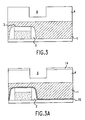
- the result is a trench 6 formed in the trench dielectric layer 4.
- the trench photoresist mask 5 may be removed by conventional methods known to those of ordinary skill in the art ( Figure 3 and 3B), and a contact opening mask 7 may be formed thereon (see Figures 4, 4(A), 4(B) and 5).
- Figure 3B an optional etch stop layer 15 of silicon nitride is illustrated. Formation of such an etch stop layer is within the level of skill of those of ordinary skill in the art, without undue experimentation.
- Suitable photoresist materials for, and methods of forming, the contact opening mask are as described above for the trench mask.
- the pattern formed in the contact opening mask is typically a circular pattern, corresponding to the desired shape of the contact. Patterning of the contact opening mask may be performed under suitable conditions known to those of ordinary skill in the art.
- a BARC layer as described above may also be used to enhance the patterning resolution of the contact hole mask.
- the exposed portions of the trench dielectric layer and the BARC or inorganic anti-reflective coating layer are removed, typically by etching.
- the trench dielectric material may be etched in the manner described above, and optionally, in a manner that is selective or non-selective with regard to the ARC and/or contact dielectric layer(s). Removal of the ARC layer may be under similar conditions used to etch an undoped silicate glass, for a total etch time of about 10 seconds.
- Non-limiting exemplary etching conditions for removing the BARC layer comprise exposing the portions of the BARC layer to be etched to a plasma comprising CHF 3 and/or CF 4 , optionally in the presence of F-134 (preferably a mixture thereof) at a pressure of about 5-200 mTorr (0.68-26.7Pa) and a power of 100-1,000 watts in the absence of Ar. Backside cooling with He at a pressure of 2-30 Torr (267-4000Pa) in the absence of a magnetic field is preferred.
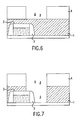
- FIG. 5 A top view of the structure of Figure 4 is illustrated in Figure 5, in which the side walls of the trench 6 formed in the trench dielectric layer 4 are shown, through the hole in the contact mask 7 .
- the exposed portion of the trench dielectric 4 may be removed under conditions as previously described for the removal of trench dielectric material. This may occur without substantial etching of the contact dielectric when the trench etch is selective for the trench dielectric relative to the contact dielectric. In one embodiment, at least some of the trench dielectric material below the trench 6 remains over the contact dielectric layer 1. In this embodiment, the contact dielectric layer underlying the trench 6 in regions other than those regions being etched is protected from etching by the overlying trench dielectric layer 4 during etching of the contact opening (the so-called "hard mask” embodiment).
- the trench dielectric layer 4 may be used as a "hard mask” for forming the contact opening in the contact dielectric, after removing (i.e., in the absence of) the patterned contact photoresist mask.
- the contact mask 7 is used to pattern an opening in the trench dielectric layer 4 to expose the region(s) of the contact dielectric layer overlying the active region of the substrate to which the contact opening will be formed, then the contact mask 7 is removed prior to etching the contact opening through the contact dielectric layer 1 .
- the semiconductor structure comprises a trench dielectric layer, patterned with a trench 6 and an opening 8 to form a contact opening in the contact dielectric layer 1.
- conditions should include (a) a trench dielectric thickness which is greater than the trench depth (preferably by ⁇ 100 ⁇ , more preferably by ⁇ 200 ⁇ , and even more preferably by ⁇ 300 ⁇ (typically by about 1,000 ⁇ )) and (b) the contact dielectric material having a substantially different etch rate than the trench dielectric material when either material is etched.
- an etch rate for a first material is "substantially different” from the etch rate for a second material (alternatively, the etch may be considered “selective") if the ratio of the two etch rates is ⁇ 5:1, more preferably ⁇ 10:1, even more preferably ⁇ 15:1.
- the trench layer 6 Prior to etching the contact openings, the trench layer 6 (and optionally opening 8 ) may be cleaned by plasma cleaning by a conventional oxygen plasma etch (which may optionally contain CF 4 ) then by a conventional sulfuric acid based wet cleaning.
- a conventional oxygen plasma etch which may optionally contain CF 4
- a conventional sulfuric acid based wet cleaning may be cleaned by plasma cleaning by a conventional sulfuric acid based wet cleaning.
- Conditions for self-aligned contact etching may include one or more of the conditions listed in Table 1 below: Table 1 Condition General Range Preferred Range RF power (W) 100-1,500 400-600 pressure (mTorr) 10-300 30-80 He cooling pressure (T) 2-30 5-10 C 2 H 2 F 4 (sccm) 1-50 3-10 CHF 3 (sccm) 0-200 20-50 Ar (sccm) 0-200 50-150 C 4 F 8 (sccm) 0-50 0-5 Magnetic field (Gauss) 0-50 10-30
- Carbon monoxide may optionally be present.
- the contact dielectric layer 1 is etched to form a contact opening 9 to an underlying active region of the semiconductor substrate adjacent to gate structure 3.
- the patterned trench dielectric layer 4 may function as a "hard mask" for the contact dielectric layer 1 . Greater tolerance to mask alignment errors during the patterning of opening 8 in trench dielectric layer 4 is afforded by self-aligned contact (SAC) techniques.
- Etching the contact dielectric 1 using the trench dielectric 4 as a hard mask may be accomplished under conditions known to those of ordinary skill in the art.
- the etching gas(es) which may be the same as or different from the etching gas(es) for the trench etch step (but which are preferably selected to provide a selective etch), may be selected from those listed above for the trench etch step, and are selected from those that are useful in conventional reactive ion etching.
- the trench dielectric layer 4 may be etched to any predetermined depth (but preferably to a depth of from about 0.5x to about 1.3x, preferably from about 0.7x to about 1.1x, where x is the thickness of the trench dielectric layer), and during the contact etch step, the contact opening mask 7 remains over the portions of the trench and contact dielectric layers not to be etched.
- the contact opening wall may be formed with a sloped profile (not illustrated in Figure 6).
- the selectivity of etching the trench dielectric material relative to the contact dielectric material is not critical, and can be as low as 1:1.
- the etching gas(ses) may be the same as or different from the etching gas(ses) described above for the trench and/or contact opening etch steps.
- the contact opening mask 7 may be removed by conventional methods known to those of ordinary skill in the art, the result being illustrated in Figure 7.
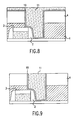
- Figure 8 illustrates the device after depositing a bulk conductive material 11 in the contact opening and trench.
- an optional liner, wetting and/or barrier layer 10 may be formed prior to deposition of the bulk conductive material 11.
- the layer 10 may promote adherence of the conductive material to the dielectric material(s), as well as to a material or active region therebelow (e.g., a conductive material such as tungsten, WSi x or Al or doped polysilicon).
- the layer 10 may also act as a barrier to prevent or inhibit diffusion between the bulk conductive material and the underlying substrate.
- Layer 10 may also comprise a single layer of material or multiple layers of the same or different materials with independently selected chemical compositions and thicknesses.
- Non-limiting examples of suitable liner/wetting/barrier layer materials include titanium, zirconium, hafnium, tantalum, chromium, molybdenum, tungsten, copper, nickel, cobalt, noble metals such as ruthenium, rhodium, palladium, osmium, iridium, platinum, gold and silver, alloys thereof such as titanium-tungsten, aluminum-titanium or aluminum-silicon, and conductive nitrides thereof, such as tantalum nitride and titanium nitride.
- the liner/wetting/barrier layer is titanium, a conventional titanium-tungsten alloy or titanium nitride.
- RTA rapid thermal annealing
- the liner/wetting/barrier layer may be deposited by conventional methods known to those of ordinary skill in the art such as chemical or plasma vapor deposition, ionized metal plasma, sputtering, etc. Deposition may also be by a collimated process.
- the thickness of the liner/wetting/barrier layer is typically from about 50 to about 1000 ⁇ thick, preferably from 100 to about 600 ⁇ thick, more preferably from 150 to about 500 ⁇ thick. Typically, the thickness is 700 ⁇ as measured at a flat surface outside the contact.
- the thickness at the sidewall is typically 0.1 x the flat surface thickness, and the thickness at the bottom to the contact is typically 0.5 x the flat surface thickness.
- the liner layer may be deposited in an amount sufficient to cover the entire exposed surface of the wafer, within the scope of the present invention, it is preferably deposited in an amount sufficient to cover the uppermost surface of the dielectric layer, the side walls and bottom of the opening.
- the deposition be conducted in a directional manner. Directional deposition may be conducted by conventional methods known to those of ordinary skill in the art, for example by collimated sputtering or by Ion Metal Plasma (IMP) methods.
- the collimation filter may have cells with a 1:1 aspect ratio (height:diameter) or greater.
- a separate barrier layer may be formed in addition to a liner/adhesive layer.
- a separate barrier layer of TiN or TiW is preferred.
- Such a barrier layer may be formed by methods known to those of ordinary skill in the art without undue experimentation.
- a conductive material which is not particularly limited and which may include, for example aluminum, tungsten, copper, titanium, alloys and silicides thereof, etc., preferably aluminum, copper and/or tungsten, more preferably tungsten.
- a conductive material which is not particularly limited and which may include, for example aluminum, tungsten, copper, titanium, alloys and silicides thereof, etc., preferably aluminum, copper and/or tungsten, more preferably tungsten.
- Non limiting examples include an Al-0.5% Cu alloy, an Al-Si-0.5% Cu alloy, Al, Al-Ge, Al-Si-Ge, W, Cu and Cu alloys.
- the conductive material is W.
- Suitable deposition conditions are those known to those of ordinary skill in the art and may comprise depositing a single bulk layer of conductive material.
- Deposition may be conducted using an otherwise conventional physical vapor deposition apparatus, such as a commercially available sputtering apparatus, such as an ENDURA sputtering system by Applied Materials of Santa Clara, California.
- a layer of bulk metal e.g., Al or W
- SiH 4 is added to the deposition atmosphere, and nucleation of the conductive material occurs.
- the distance from the sputtering target material to the wafer surface is generally from about 1' to about 2".
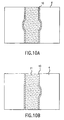
- Final processing may comprise planarizing the conductive material 11 and optional liner/wetting layer 10 , by methods known to those of ordinary skill in the art, such as by chemical-mechanical polishing, the result being illustrated in Figures 9, 10(A) and 10(B), where Figures 10(A) and 10(B) illustrate a top view of the structure illustrated in Figure 9, Figure 10(B) specifically illustrating misalignment of the contact opening with the underlying conductive region, which none the less demonstrates effective formation of SAC metallization. Effective SAC metallization may also arise from the semiconductor device illustrated in Figure 4(B).
- the conductive material is preferably planarized until its uppermost surface is substantially coplanar with an uppermost surface of the trench dielectric layer.
- the method may further comprise depositing an interlayer dielectric layer over the (coplanar) conductive material and trench dielectric layer by methods known to those skilled in the art.
- An interlayer dielectric comprising silicon nitride may be used as an interface between layers of a stacked structure (multilayered structure) comprising borderless contacts.
- the preferred interlayer dielectric layer comprises a TEOS layer, any suitable dielectric material from those described above for the trench dielectric layer may be selected.
- a low k dielectric may be used, as well as silicon nitride (or etch stop material) for borderless contacts.
- a plurality of layers e.g. BARC, low k, protective
- the interlayer dielectric layer which may be from 1000 to 5000 ⁇ thick, may then be planarized by methods known to those skilled in the art prior to further processing, for example by reflowing or chemical mechanical polishing.
- the present invention also relates to an integrated circuit containing the above-described structure(s).
- This application describes a method of simultaneously forming metallization and contact structures in an integrated circuit using a timed-etch procedure.
- the present application describes an etching procedure for making contact openings and trench structures through multiple layers of dielectric materials.
- the present application describes an etching procedure for making contact openings and trench structures through multiple layers of dielectric materials. It is within the scope of the present invention, to use an analogous method to simultaneously form metallization and contacts or vias to an underlying metallization structure.
Landscapes
- Internal Circuitry In Semiconductor Integrated Circuit Devices (AREA)
- Electrodes Of Semiconductors (AREA)
- Drying Of Semiconductors (AREA)
- Insulated Gate Type Field-Effect Transistor (AREA)
Claims (18)
- Verfahren zur Bildung von Metallisierung und Kontaktstrukturen in einem integrierten Schaltkreis, umfassend in aufeinanderfolgender Reihenfolge:a) man ätzt eine dielektrische Trenchschicht, die in aufeinandorfoigender Reihenfolge enthält:i) ein Halbleitersubstrat, enthaltend einen aktiven Bereich, eine Gate-Struktur darüber und dielektrische Abstandstücke benachbart zu der Gate-Struktur;ii) eine dielektrische Kontaktschicht; undiii) eine dielektrische Trenchschicht;zur Bildung eines Trenchs in der dielektrischen Trenchschicht unter Ätzbedingungen, die nicht die dielektrische Kontaktschicht ätzt;b) man ätzt die dielektrische Kontaktschicht unter Bedingungen, die die Gate-Struktur nicht beschädigen, zur Bildung einer ersten Kontaktöffnung, die einen Bereich des Halbleitersubstrats und einen Teil von mindestens einem der dielektrischen Abstandsstücke freilegt; undc) man lagert ein leitfähiges Material in die Kontaktöffnung und in den Trench ab.
- Verfahren nach Anspruch 1, welches weiterhin umfasst:man bildet eine zweite Kontaktöffnung der dielektrischentrenchschicht entsprechend der ersten Kontaktöffnung.
- Verfahren nach Anspruch 2, wobei während des Ätzens der dielektrischen Kontaktschicht die Verbundstruktur eine dielektrische Kontaktöffnungsmaske aufweist.
- Verfahren nach Anspruch 2, wobei während des Ätzens der dielektrischen Kontaktschicht die Verbundstruktur weiterhin ein Fotoresist-Material aufweist.
- Verfahren nach Anspruch 2, wobei die dielektrische Trenchschicht eine Dicke von wenigstens 100 Å größer als diejenige des Trenchs besitzt.
- Verfahren nach Anspruch 1, wobei das Ätzen der dielektrischen Kontaktschicht unter Bedingungen ausgeführt wird, die eine Ätzrate von wenigstens 5:1 bezogen auf die der Gate-Struktur ergeben.
- Verfahren nach Anspruch 1, wobei man eine Einlage-, Benetzungs- und/oder Grenzschicht bildet in der genannten ersten Kontaktöffnung des Trenchs.
- Verfahren nach Anspruch 7, wobei die Einlage-, Benetzungs- und/oder Grenzschicht eine Dicke von 50 Å bis 1 000 Å besitzt.
- Verfahren nach Anspruch 1, wobei die Einlage-, Benetzungs- und/oder Grenzschicht Material aus der folgenden Gruppe enthält: Titan, Zirkon, Hafnium, Tantal, Chrom, Molybden, Wolfram, Kupfer, Nickel, Kobalt, Ruthenium, Rhodium, Palladium, Osmium, Iridium, Platin, Gold, Silber, Titan-Wolfram, Tantalnitrid und Titannitrid.
- Verfahren nach Anspruch 1, wobei das leitfähige Material aus der Gruppe bestehend aus Wolfram, Aluminium, Kupfer und Legierungen aus einem der genannten Metalle besteht.
- Verfahren nach Anspruch 1, weiterhin umfassend: man entfernt das leitfähige Material, bis seine oberste Oberfläche planar mit der obersten Oberfläche der dielektrischen Trenchschicht ist.
- Verfahren nach Anspruch 11, weiterhin umfassend: man lagert eine dielektrische Zwischenschicht über das coplanare leitfähige Material und die dielektrische Trenchschicht ab.
- Verfahren nach Anspruch 1, wobei die Verbundstruktur weiterhin eine Antireflektionsschicht aufweist, die zwischen der dielektrischen Trenchschicht und dem gemusterten Fotoresist angeordnet ist.
- Verfahren nach Anspruch 13, wobei die Antireflektionsbeschichtung eine organische Antireflektionsbeschichtung umfasst.
- Verfahren nach Anspruch 13, wobei die Antireflektionsschicht eine dielektrische Antireflektionsbeschichtung umfasst.
- Verfahren nach Anspruch 1, wobei die dielektrische Trenchschicht eine Silikatglas-Unterschicht umfasst.
- Verfahren nach Anspruch 1, wobei die dielektrische Kontaktschicht ein dotiertes Silikatglas umfasst.
- Verfahren nach Anspruch 17, wobei die dotierte dielektrische Kontaktschicht aus Siliziumoxid ein Glas der folgenden Gruppe enthält: ein Phosphorsilikatglas, ein Borophosphosilikatglas und ein Fluoursilikatglas.
Applications Claiming Priority (2)
| Application Number | Priority Date | Filing Date | Title |
|---|---|---|---|
| US09/593,967 US6635566B1 (en) | 2000-06-15 | 2000-06-15 | Method of making metallization and contact structures in an integrated circuit |
| US593967 | 2000-06-15 |
Publications (3)
| Publication Number | Publication Date |
|---|---|
| EP1168434A2 EP1168434A2 (de) | 2002-01-02 |
| EP1168434A3 EP1168434A3 (de) | 2003-11-05 |
| EP1168434B1 true EP1168434B1 (de) | 2007-04-11 |
Family
ID=24376952
Family Applications (1)
| Application Number | Title | Priority Date | Filing Date |
|---|---|---|---|
| EP01401542A Expired - Lifetime EP1168434B1 (de) | 2000-06-15 | 2001-06-14 | Verfahren zur Herstellung von metallisierten Verbindungsstrukturen in einem integrierten Schaltkreis |
Country Status (7)
| Country | Link |
|---|---|
| US (2) | US6635566B1 (de) |
| EP (1) | EP1168434B1 (de) |
| JP (1) | JP3637000B2 (de) |
| KR (1) | KR100421154B1 (de) |
| DE (1) | DE60127767T2 (de) |
| SG (1) | SG99903A1 (de) |
| TW (1) | TW580753B (de) |
Families Citing this family (30)
| Publication number | Priority date | Publication date | Assignee | Title |
|---|---|---|---|---|
| US6635566B1 (en) * | 2000-06-15 | 2003-10-21 | Cypress Semiconductor Corporation | Method of making metallization and contact structures in an integrated circuit |
| US7183222B2 (en) * | 2000-09-01 | 2007-02-27 | Cypress Semiconductor Corporation | Dual damascene structure and method of making |
| CA2378278C (en) * | 2001-03-26 | 2008-11-18 | Kabushiki Kaisha Toshiba | Positive electrode active material and nonaqueous electrolyte secondary battery |
| AU2002337812A1 (en) * | 2001-10-31 | 2003-05-12 | Tokyo Electron Limited | Method of etching high aspect ratio features |
| DE10201448A1 (de) * | 2002-01-16 | 2003-07-24 | Infineon Technologies Ag | Durchgangskontakt und Verfahren zum Herstellen desselben |
| US7078334B1 (en) * | 2002-06-06 | 2006-07-18 | Cypress Semiconductor Corporation | In situ hard mask approach for self-aligned contact etch |
| US6751125B2 (en) | 2002-11-04 | 2004-06-15 | Freescale Semiconductor, Inc. | Gate voltage reduction in a memory read |
| KR100878498B1 (ko) * | 2002-12-30 | 2009-01-15 | 주식회사 하이닉스반도체 | 트랜지스터 제조방법 |
| KR100478498B1 (ko) * | 2003-01-30 | 2005-03-28 | 동부아남반도체 주식회사 | 반도체 소자의 금속 배선 형성 방법 |
| KR100485388B1 (ko) * | 2003-02-28 | 2005-04-27 | 삼성전자주식회사 | 트렌치 형성 방법 및 이를 이용한 반도체 장치의 제조 방법 |
| TW200527485A (en) * | 2004-01-30 | 2005-08-16 | Semiconductor Leading Edge Tec | Multilayered wiring structure, method of forming buried wiring, semiconductor device, method of manufacturing semiconductor device, semiconductor mounted device, and method of manufacturing semiconductor mounted device |
| KR100613392B1 (ko) * | 2004-12-23 | 2006-08-17 | 동부일렉트로닉스 주식회사 | 자기 정렬 콘택홀 형성 방법 |
| US7429524B2 (en) * | 2005-09-14 | 2008-09-30 | Texas Instruments Incorporated | Transistor design self-aligned to contact |
| US20080116494A1 (en) * | 2006-11-20 | 2008-05-22 | Matthias Goldbach | Method for manufacturing a semiconductor device |
| US7786019B2 (en) * | 2006-12-18 | 2010-08-31 | Applied Materials, Inc. | Multi-step photomask etching with chlorine for uniformity control |
| US7858513B2 (en) * | 2007-06-18 | 2010-12-28 | Organicid, Inc. | Fabrication of self-aligned via holes in polymer thin films |
| US7888169B2 (en) * | 2007-12-26 | 2011-02-15 | Organicid, Inc. | Organic semiconductor device and method of manufacturing the same |
| DE102010028458A1 (de) * | 2010-04-30 | 2011-11-03 | Globalfoundries Dresden Module One Llc & Co. Kg | Halbleiterbauelement mit Kontaktelementen und Metallsilizidgebieten, die in einer gemeinsamen Prozesssequenz hergestellt sind |
| US9048296B2 (en) | 2011-02-11 | 2015-06-02 | International Business Machines Corporation | Method to fabricate copper wiring structures and structures formed thereby |
| US9034703B2 (en) | 2012-09-13 | 2015-05-19 | International Business Machines Corporation | Self aligned contact with improved robustness |
| US8728927B1 (en) * | 2012-12-10 | 2014-05-20 | International Business Machines Corporation | Borderless contacts for semiconductor transistors |
| WO2015096581A1 (zh) * | 2013-12-23 | 2015-07-02 | 伍震威 | 用于功率半导体装置的场板结构及其制造方法 |
| US9478508B1 (en) * | 2015-06-08 | 2016-10-25 | Raytheon Company | Microwave integrated circuit (MMIC) damascene electrical interconnect for microwave energy transmission |
| DE102015112135B4 (de) * | 2015-07-24 | 2023-04-06 | Kennametal Inc. | Verdampferkörper mit Titanhydridbeschichtung, Verfahren zu dessen Herstellung und Verwendung |
| US10163797B2 (en) * | 2015-10-09 | 2018-12-25 | Taiwan Semiconductor Manufacturing Company, Ltd. | Forming interlayer dielectric material by spin-on metal oxide deposition |
| US9704754B1 (en) * | 2016-09-22 | 2017-07-11 | International Business Machines Corporation | Self-aligned spacer for cut-last transistor fabrication |
| US10510851B2 (en) * | 2016-11-29 | 2019-12-17 | Taiwan Semiconductor Manufacturing Company, Ltd. | Low resistance contact method and structure |
| US10522644B1 (en) | 2018-06-21 | 2019-12-31 | Globalfoundries Inc. | Different upper and lower spacers for contact |
| US10685869B2 (en) * | 2018-10-19 | 2020-06-16 | Taiwan Semiconductor Manufacturing Company Ltd. | Semiconductor device and method of forming the same |
| US11211254B2 (en) * | 2019-12-19 | 2021-12-28 | Stmicroelectronics Pte Ltd | Process for integrated circuit fabrication using a buffer layer as a stop for chemical mechanical polishing of a coupled dielectric oxide layer |
Family Cites Families (33)
| Publication number | Priority date | Publication date | Assignee | Title |
|---|---|---|---|---|
| US4789648A (en) | 1985-10-28 | 1988-12-06 | International Business Machines Corporation | Method for producing coplanar multi-level metal/insulator films on a substrate and for forming patterned conductive lines simultaneously with stud vias |
| US4954142A (en) | 1989-03-07 | 1990-09-04 | International Business Machines Corporation | Method of chemical-mechanical polishing an electronic component substrate and polishing slurry therefor |
| US4933743A (en) | 1989-03-11 | 1990-06-12 | Fairchild Semiconductor Corporation | High performance interconnect system for an integrated circuit |
| JPH03198327A (ja) * | 1989-12-26 | 1991-08-29 | Fujitsu Ltd | 半導体装置の製造方法 |
| US5093279A (en) | 1991-02-01 | 1992-03-03 | International Business Machines Corporation | Laser ablation damascene process |
| US5262354A (en) | 1992-02-26 | 1993-11-16 | International Business Machines Corporation | Refractory metal capped low resistivity metal conductor lines and vias |
| US5292689A (en) | 1992-09-04 | 1994-03-08 | International Business Machines Corporation | Method for planarizing semiconductor structure using subminimum features |
| US5312777A (en) | 1992-09-25 | 1994-05-17 | International Business Machines Corporation | Fabrication methods for bidirectional field emission devices and storage structures |
| US5371047A (en) | 1992-10-30 | 1994-12-06 | International Business Machines Corporation | Chip interconnection having a breathable etch stop layer |
| US5397741A (en) | 1993-03-29 | 1995-03-14 | International Business Machines Corporation | Process for metallized vias in polyimide |
| JP3297220B2 (ja) * | 1993-10-29 | 2002-07-02 | 株式会社東芝 | 半導体装置の製造方法および半導体装置 |
| JP2765478B2 (ja) * | 1994-03-30 | 1998-06-18 | 日本電気株式会社 | 半導体装置およびその製造方法 |
| US5496771A (en) | 1994-05-19 | 1996-03-05 | International Business Machines Corporation | Method of making overpass mask/insulator for local interconnects |
| JP3555333B2 (ja) * | 1996-05-30 | 2004-08-18 | ソニー株式会社 | 半導体装置の製造方法 |
| US5726100A (en) * | 1996-06-27 | 1998-03-10 | Micron Technology, Inc. | Method of forming contact vias and interconnect channels in a dielectric layer stack with a single mask |
| US6010955A (en) * | 1996-09-23 | 2000-01-04 | Kabushiki Kaisha Toshiba | Electrical connection forming process for semiconductor devices |
| JPH11145305A (ja) * | 1997-11-07 | 1999-05-28 | Toshiba Corp | 半導体装置の製造方法 |
| KR19990062003A (ko) | 1997-12-31 | 1999-07-26 | 김영환 | 반도체장치의 다층 금속배선 형성방법 |
| JPH11220025A (ja) * | 1998-02-03 | 1999-08-10 | Rohm Co Ltd | 半導体装置およびその製造方法 |
| US6080661A (en) * | 1998-05-29 | 2000-06-27 | Philips Electronics North America Corp. | Methods for fabricating gate and diffusion contacts in self-aligned contact processes |
| US6121098A (en) * | 1998-06-30 | 2000-09-19 | Infineon Technologies North America Corporation | Semiconductor manufacturing method |
| US6380096B2 (en) * | 1998-07-09 | 2002-04-30 | Applied Materials, Inc. | In-situ integrated oxide etch process particularly useful for copper dual damascene |
| US6180472B1 (en) * | 1998-07-28 | 2001-01-30 | Matsushita Electrons Corporation | Method for fabricating semiconductor device |
| JP3301994B2 (ja) * | 1998-07-28 | 2002-07-15 | 松下電器産業株式会社 | 半導体装置の製造方法 |
| JP2000091440A (ja) * | 1998-09-08 | 2000-03-31 | Hitachi Ltd | 半導体集積回路装置の製造方法 |
| US6228758B1 (en) * | 1998-10-14 | 2001-05-08 | Advanced Micro Devices, Inc. | Method of making dual damascene conductive interconnections and integrated circuit device comprising same |
| US6165898A (en) * | 1998-10-23 | 2000-12-26 | Taiwan Semiconductor Manufacturing Company | Dual damascene patterned conductor layer formation method without etch stop layer |
| JP2000164707A (ja) * | 1998-11-27 | 2000-06-16 | Sony Corp | 半導体装置およびその製造方法 |
| US6287951B1 (en) * | 1998-12-07 | 2001-09-11 | Motorola Inc. | Process for forming a combination hardmask and antireflective layer |
| JP2001244347A (ja) * | 2000-02-29 | 2001-09-07 | Seiko Epson Corp | 半導体装置およびその製造方法 |
| US6544850B1 (en) * | 2000-04-19 | 2003-04-08 | Infineon Technologies Ag | Dynamic random access memory |
| US6635566B1 (en) * | 2000-06-15 | 2003-10-21 | Cypress Semiconductor Corporation | Method of making metallization and contact structures in an integrated circuit |
| US6399512B1 (en) * | 2000-06-15 | 2002-06-04 | Cypress Semiconductor Corporation | Method of making metallization and contact structures in an integrated circuit comprising an etch stop layer |
-
2000
- 2000-06-15 US US09/593,967 patent/US6635566B1/en not_active Expired - Lifetime
-
2001
- 2001-05-25 SG SG200103139A patent/SG99903A1/en unknown
- 2001-06-14 DE DE60127767T patent/DE60127767T2/de not_active Expired - Fee Related
- 2001-06-14 EP EP01401542A patent/EP1168434B1/de not_active Expired - Lifetime
- 2001-06-14 KR KR10-2001-0033430A patent/KR100421154B1/ko not_active Expired - Fee Related
- 2001-06-15 JP JP2001181502A patent/JP3637000B2/ja not_active Expired - Fee Related
- 2001-06-15 TW TW090114590A patent/TW580753B/zh not_active IP Right Cessation
-
2003
- 2003-10-21 US US10/689,034 patent/US20040082182A1/en not_active Abandoned
Also Published As
| Publication number | Publication date |
|---|---|
| TW580753B (en) | 2004-03-21 |
| JP2002016139A (ja) | 2002-01-18 |
| KR20010113010A (ko) | 2001-12-24 |
| US6635566B1 (en) | 2003-10-21 |
| JP3637000B2 (ja) | 2005-04-06 |
| KR100421154B1 (ko) | 2004-03-03 |
| DE60127767T2 (de) | 2007-12-27 |
| DE60127767D1 (de) | 2007-05-24 |
| EP1168434A2 (de) | 2002-01-02 |
| SG99903A1 (en) | 2003-11-27 |
| US20040082182A1 (en) | 2004-04-29 |
| EP1168434A3 (de) | 2003-11-05 |
Similar Documents
| Publication | Publication Date | Title |
|---|---|---|
| US6399512B1 (en) | Method of making metallization and contact structures in an integrated circuit comprising an etch stop layer | |
| US6635566B1 (en) | Method of making metallization and contact structures in an integrated circuit | |
| US6756302B1 (en) | Low temperature metallization process | |
| US6919266B2 (en) | Copper technology for ULSI metallization | |
| KR100527206B1 (ko) | 반사 방지 식각 중지층을 포함하는 반도체 디바이스 제조 방법 | |
| US7176571B2 (en) | Nitride barrier layer to prevent metal (Cu) leakage issue in a dual damascene structure | |
| US20020031906A1 (en) | Defect and etch rate control in trench etch for dual damascene patterning of low-k dielectrics | |
| US20020164865A1 (en) | Semiconductor device and manufacturing method thereof | |
| JP2002043419A (ja) | 半導体装置の製造方法及び半導体装置 | |
| EP1103073A1 (de) | Herstellungsverfahren für metallverbindungen | |
| US6114233A (en) | Dual damascene process using low-dielectric constant materials | |
| US6689690B2 (en) | Semiconductor device manufacturing method of forming an etching stopper film on a diffusion prevention film at a higher temperature | |
| US20050140012A1 (en) | Method for forming copper wiring of semiconductor device | |
| US7179734B2 (en) | Method for forming dual damascene pattern | |
| EP1460677A2 (de) | Ätzen einer BARC-Schicht mit einem selektiven Ätzmittel und einem hochpolymerisierenden Gas zur Kontrolle der Kritischen Dimension (CD) | |
| US7214612B2 (en) | Dual damascene structure and fabrication thereof | |
| KR100438630B1 (ko) | 반도체 장치의 제조방법 | |
| US6410417B1 (en) | Method of forming tungsten interconnect and vias without tungsten loss during wet stripping of photoresist polymer | |
| US7199038B2 (en) | Method for fabricating semiconductor device | |
| US7132306B1 (en) | Method of forming an interlevel dielectric layer employing dielectric etch-back process without extra mask set | |
| US7326645B2 (en) | Methods for forming copper interconnect of semiconductor devices | |
| JPH08181146A (ja) | 半導体装置の製造方法 | |
| KR100483202B1 (ko) | 반도체 소자의 제조 방법 | |
| KR100268515B1 (ko) | 접촉구형성방법 | |
| KR20020055179A (ko) | 반도체소자의 알루미늄 합금 박막 제조 방법 |
Legal Events
| Date | Code | Title | Description |
|---|---|---|---|
| PUAI | Public reference made under article 153(3) epc to a published international application that has entered the european phase |
Free format text: ORIGINAL CODE: 0009012 |
|
| 17P | Request for examination filed |
Effective date: 20010619 |
|
| AK | Designated contracting states |
Kind code of ref document: A2 Designated state(s): AT BE CH CY DE DK ES FI FR GB GR IE IT LI LU MC NL PT SE TR |
|
| AX | Request for extension of the european patent |
Free format text: AL;LT;LV;MK;RO;SI |
|
| PUAL | Search report despatched |
Free format text: ORIGINAL CODE: 0009013 |
|
| AK | Designated contracting states |
Kind code of ref document: A3 Designated state(s): AT BE CH CY DE DK ES FI FR GB GR IE IT LI LU MC NL PT SE TR |
|
| AX | Request for extension of the european patent |
Extension state: AL LT LV MK RO SI |
|
| AKX | Designation fees paid |
Designated state(s): DE FR GB NL |
|
| 17Q | First examination report despatched |
Effective date: 20040617 |
|
| GRAP | Despatch of communication of intention to grant a patent |
Free format text: ORIGINAL CODE: EPIDOSNIGR1 |
|
| GRAS | Grant fee paid |
Free format text: ORIGINAL CODE: EPIDOSNIGR3 |
|
| GRAA | (expected) grant |
Free format text: ORIGINAL CODE: 0009210 |
|
| AK | Designated contracting states |
Kind code of ref document: B1 Designated state(s): DE FR GB NL |
|
| REG | Reference to a national code |
Ref country code: GB Ref legal event code: FG4D |
|
| REF | Corresponds to: |
Ref document number: 60127767 Country of ref document: DE Date of ref document: 20070524 Kind code of ref document: P |
|
| ET | Fr: translation filed | ||
| PLBE | No opposition filed within time limit |
Free format text: ORIGINAL CODE: 0009261 |
|
| STAA | Information on the status of an ep patent application or granted ep patent |
Free format text: STATUS: NO OPPOSITION FILED WITHIN TIME LIMIT |
|
| 26N | No opposition filed |
Effective date: 20080114 |
|
| PGFP | Annual fee paid to national office [announced via postgrant information from national office to epo] |
Ref country code: NL Payment date: 20081024 Year of fee payment: 8 |
|
| PGFP | Annual fee paid to national office [announced via postgrant information from national office to epo] |
Ref country code: DE Payment date: 20081031 Year of fee payment: 8 |
|
| PGFP | Annual fee paid to national office [announced via postgrant information from national office to epo] |
Ref country code: FR Payment date: 20081018 Year of fee payment: 8 |
|
| PGFP | Annual fee paid to national office [announced via postgrant information from national office to epo] |
Ref country code: GB Payment date: 20081029 Year of fee payment: 8 |
|
| GBPC | Gb: european patent ceased through non-payment of renewal fee |
Effective date: 20090614 |
|
| NLV4 | Nl: lapsed or anulled due to non-payment of the annual fee |
Effective date: 20100101 |
|
| REG | Reference to a national code |
Ref country code: FR Ref legal event code: ST Effective date: 20100226 |
|
| PG25 | Lapsed in a contracting state [announced via postgrant information from national office to epo] |
Ref country code: FR Free format text: LAPSE BECAUSE OF NON-PAYMENT OF DUE FEES Effective date: 20090630 |
|
| PG25 | Lapsed in a contracting state [announced via postgrant information from national office to epo] |
Ref country code: GB Free format text: LAPSE BECAUSE OF NON-PAYMENT OF DUE FEES Effective date: 20090614 |
|
| PG25 | Lapsed in a contracting state [announced via postgrant information from national office to epo] |
Ref country code: DE Free format text: LAPSE BECAUSE OF NON-PAYMENT OF DUE FEES Effective date: 20100101 |
|
| PG25 | Lapsed in a contracting state [announced via postgrant information from national office to epo] |
Ref country code: NL Free format text: LAPSE BECAUSE OF NON-PAYMENT OF DUE FEES Effective date: 20100101 |