EP1167460A1 - Verfahren zur Herstellung von Disazokondensationspigmenten in Mikroreaktoren - Google Patents
Verfahren zur Herstellung von Disazokondensationspigmenten in Mikroreaktoren Download PDFInfo
- Publication number
- EP1167460A1 EP1167460A1 EP01114630A EP01114630A EP1167460A1 EP 1167460 A1 EP1167460 A1 EP 1167460A1 EP 01114630 A EP01114630 A EP 01114630A EP 01114630 A EP01114630 A EP 01114630A EP 1167460 A1 EP1167460 A1 EP 1167460A1
- Authority
- EP
- European Patent Office
- Prior art keywords
- microreactor
- suspension
- acid
- acid chloride
- pigment
- Prior art date
- Legal status (The legal status is an assumption and is not a legal conclusion. Google has not performed a legal analysis and makes no representation as to the accuracy of the status listed.)
- Granted
Links
- 239000000049 pigment Substances 0.000 title claims abstract description 40
- 125000000664 diazo group Chemical group [N-]=[N+]=[*] 0.000 title claims abstract description 28
- 238000009833 condensation Methods 0.000 title claims description 33
- 230000005494 condensation Effects 0.000 title claims description 33
- 238000000034 method Methods 0.000 title claims description 27
- 238000002360 preparation method Methods 0.000 title claims description 6
- NGNBDVOYPDDBFK-UHFFFAOYSA-N 2-[2,4-di(pentan-2-yl)phenoxy]acetyl chloride Chemical compound CCCC(C)C1=CC=C(OCC(Cl)=O)C(C(C)CCC)=C1 NGNBDVOYPDDBFK-UHFFFAOYSA-N 0.000 claims abstract description 30
- USVVENVKYJZFMW-ONEGZZNKSA-N (e)-carboxyiminocarbamic acid Chemical compound OC(=O)\N=N\C(O)=O USVVENVKYJZFMW-ONEGZZNKSA-N 0.000 claims abstract description 16
- 230000008878 coupling Effects 0.000 claims abstract description 16
- 238000010168 coupling process Methods 0.000 claims abstract description 16
- 238000005859 coupling reaction Methods 0.000 claims abstract description 16
- 239000002253 acid Substances 0.000 claims abstract description 11
- 150000004982 aromatic amines Chemical class 0.000 claims abstract description 11
- 150000004984 aromatic diamines Chemical class 0.000 claims abstract description 7
- 238000006243 chemical reaction Methods 0.000 claims description 33
- 239000000725 suspension Substances 0.000 claims description 26
- 238000006149 azo coupling reaction Methods 0.000 claims description 16
- 230000015572 biosynthetic process Effects 0.000 claims description 16
- -1 1,4-phenylene, 2-chloro-5-methyl-1,4-phenylene, 2,5-dichloro-1,4-phenylene, 2,5-dimethyl-1,4-phenylene, 2-chloro-1 , 4-phenylene Chemical group 0.000 claims description 11
- 238000006193 diazotization reaction Methods 0.000 claims description 11
- 238000006482 condensation reaction Methods 0.000 claims description 8
- 239000000460 chlorine Substances 0.000 claims description 7
- ZAMOUSCENKQFHK-UHFFFAOYSA-N Chlorine atom Chemical compound [Cl] ZAMOUSCENKQFHK-UHFFFAOYSA-N 0.000 claims description 5
- 125000003118 aryl group Chemical group 0.000 claims description 5
- 125000002496 methyl group Chemical group [H]C([H])([H])* 0.000 claims description 5
- 239000003960 organic solvent Substances 0.000 claims description 5
- 150000001412 amines Chemical class 0.000 claims description 4
- 229910052801 chlorine Inorganic materials 0.000 claims description 4
- 239000001257 hydrogen Substances 0.000 claims description 4
- 229910052739 hydrogen Inorganic materials 0.000 claims description 4
- 125000004178 (C1-C4) alkyl group Chemical group 0.000 claims description 3
- 239000012954 diazonium Substances 0.000 claims description 3
- 150000001989 diazonium salts Chemical class 0.000 claims description 3
- 150000007522 mineralic acids Chemical class 0.000 claims description 3
- 125000004958 1,4-naphthylene group Chemical group 0.000 claims description 2
- 150000003863 ammonium salts Chemical class 0.000 claims description 2
- 239000003795 chemical substances by application Substances 0.000 claims description 2
- 150000001875 compounds Chemical class 0.000 claims description 2
- 125000000449 nitro group Chemical group [O-][N+](*)=O 0.000 claims description 2
- 238000005755 formation reaction Methods 0.000 claims 2
- 125000004435 hydrogen atom Chemical class [H]* 0.000 claims 2
- 238000004519 manufacturing process Methods 0.000 abstract description 12
- RFFLAFLAYFXFSW-UHFFFAOYSA-N 1,2-dichlorobenzene Chemical compound ClC1=CC=CC=C1Cl RFFLAFLAYFXFSW-UHFFFAOYSA-N 0.000 description 45
- FYSNRJHAOHDILO-UHFFFAOYSA-N thionyl chloride Chemical compound ClS(Cl)=O FYSNRJHAOHDILO-UHFFFAOYSA-N 0.000 description 14
- 238000002156 mixing Methods 0.000 description 11
- 239000000243 solution Substances 0.000 description 11
- 239000000376 reactant Substances 0.000 description 9
- OKKJLVBELUTLKV-UHFFFAOYSA-N Methanol Chemical compound OC OKKJLVBELUTLKV-UHFFFAOYSA-N 0.000 description 6
- ZMXDDKWLCZADIW-UHFFFAOYSA-N N,N-Dimethylformamide Chemical compound CN(C)C=O ZMXDDKWLCZADIW-UHFFFAOYSA-N 0.000 description 6
- 239000000047 product Substances 0.000 description 6
- 239000002904 solvent Substances 0.000 description 6
- XLYOFNOQVPJJNP-UHFFFAOYSA-N water Substances O XLYOFNOQVPJJNP-UHFFFAOYSA-N 0.000 description 6
- 239000000463 material Substances 0.000 description 5
- ALKYHXVLJMQRLQ-UHFFFAOYSA-N 3-Hydroxy-2-naphthoate Chemical compound C1=CC=C2C=C(O)C(C(=O)O)=CC2=C1 ALKYHXVLJMQRLQ-UHFFFAOYSA-N 0.000 description 4
- ZUVPLKVDZNDZCM-UHFFFAOYSA-N 3-chloro-2-methylaniline Chemical compound CC1=C(N)C=CC=C1Cl ZUVPLKVDZNDZCM-UHFFFAOYSA-N 0.000 description 4
- 150000001732 carboxylic acid derivatives Chemical class 0.000 description 4
- AVYGCQXNNJPXSS-UHFFFAOYSA-N 2,5-dichloroaniline Chemical compound NC1=CC(Cl)=CC=C1Cl AVYGCQXNNJPXSS-UHFFFAOYSA-N 0.000 description 3
- QTBSBXVTEAMEQO-UHFFFAOYSA-N Acetic acid Chemical compound CC(O)=O QTBSBXVTEAMEQO-UHFFFAOYSA-N 0.000 description 3
- KRKNYBCHXYNGOX-UHFFFAOYSA-N citric acid Chemical compound OC(=O)CC(O)(C(O)=O)CC(O)=O KRKNYBCHXYNGOX-UHFFFAOYSA-N 0.000 description 3
- 150000004985 diamines Chemical class 0.000 description 3
- 239000012530 fluid Substances 0.000 description 3
- 239000007788 liquid Substances 0.000 description 3
- 239000002184 metal Substances 0.000 description 3
- 229910052751 metal Inorganic materials 0.000 description 3
- 239000000203 mixture Substances 0.000 description 3
- OCJBOOLMMGQPQU-UHFFFAOYSA-N 1,4-dichlorobenzene Chemical compound ClC1=CC=C(Cl)C=C1 OCJBOOLMMGQPQU-UHFFFAOYSA-N 0.000 description 2
- DMGFVJVLVZOSOE-UHFFFAOYSA-N 3-amino-4-chlorobenzoic acid Chemical compound NC1=CC(C(O)=O)=CC=C1Cl DMGFVJVLVZOSOE-UHFFFAOYSA-N 0.000 description 2
- UFHFLCQGNIYNRP-UHFFFAOYSA-N Hydrogen Chemical compound [H][H] UFHFLCQGNIYNRP-UHFFFAOYSA-N 0.000 description 2
- NBIIXXVUZAFLBC-UHFFFAOYSA-N Phosphoric acid Chemical compound OP(O)(O)=O NBIIXXVUZAFLBC-UHFFFAOYSA-N 0.000 description 2
- JUJWROOIHBZHMG-UHFFFAOYSA-N Pyridine Chemical compound C1=CC=NC=C1 JUJWROOIHBZHMG-UHFFFAOYSA-N 0.000 description 2
- 239000007864 aqueous solution Substances 0.000 description 2
- 238000010923 batch production Methods 0.000 description 2
- 230000033228 biological regulation Effects 0.000 description 2
- 239000007809 chemical reaction catalyst Substances 0.000 description 2
- MVPPADPHJFYWMZ-UHFFFAOYSA-N chlorobenzene Chemical compound ClC1=CC=CC=C1 MVPPADPHJFYWMZ-UHFFFAOYSA-N 0.000 description 2
- 229940117389 dichlorobenzene Drugs 0.000 description 2
- 238000010438 heat treatment Methods 0.000 description 2
- 150000002431 hydrogen Chemical class 0.000 description 2
- 239000000976 ink Substances 0.000 description 2
- NYGZLYXAPMMJTE-UHFFFAOYSA-M metanil yellow Chemical group [Na+].[O-]S(=O)(=O)C1=CC=CC(N=NC=2C=CC(NC=3C=CC=CC=3)=CC=2)=C1 NYGZLYXAPMMJTE-UHFFFAOYSA-M 0.000 description 2
- 238000010327 methods by industry Methods 0.000 description 2
- BXICAEQXJKTNSD-UHFFFAOYSA-N n-[5-chloro-2-methyl-4-(3-oxobutanoylamino)phenyl]-3-oxobutanamide Chemical compound CC(=O)CC(=O)NC1=CC(Cl)=C(NC(=O)CC(C)=O)C=C1C BXICAEQXJKTNSD-UHFFFAOYSA-N 0.000 description 2
- LQNUZADURLCDLV-UHFFFAOYSA-N nitrobenzene Chemical compound [O-][N+](=O)C1=CC=CC=C1 LQNUZADURLCDLV-UHFFFAOYSA-N 0.000 description 2
- 239000003973 paint Substances 0.000 description 2
- 239000002245 particle Substances 0.000 description 2
- 239000004033 plastic Substances 0.000 description 2
- 229920003023 plastic Polymers 0.000 description 2
- 150000003254 radicals Chemical class 0.000 description 2
- 239000011347 resin Substances 0.000 description 2
- 229920005989 resin Polymers 0.000 description 2
- 150000003839 salts Chemical class 0.000 description 2
- 238000013341 scale-up Methods 0.000 description 2
- 239000007787 solid Substances 0.000 description 2
- 239000000126 substance Substances 0.000 description 2
- 125000002023 trifluoromethyl group Chemical group FC(F)(F)* 0.000 description 2
- AVQQQNCBBIEMEU-UHFFFAOYSA-N 1,1,3,3-tetramethylurea Chemical compound CN(C)C(=O)N(C)C AVQQQNCBBIEMEU-UHFFFAOYSA-N 0.000 description 1
- BRPSAOUFIJSKOT-UHFFFAOYSA-N 2,3-dichloroaniline Chemical compound NC1=CC=CC(Cl)=C1Cl BRPSAOUFIJSKOT-UHFFFAOYSA-N 0.000 description 1
- QAYVHDDEMLNVMO-UHFFFAOYSA-N 2,5-dichlorobenzene-1,4-diamine Chemical compound NC1=CC(Cl)=C(N)C=C1Cl QAYVHDDEMLNVMO-UHFFFAOYSA-N 0.000 description 1
- VKTTYIXIDXWHKW-UHFFFAOYSA-N 2-chloro-5-(trifluoromethyl)aniline Chemical compound NC1=CC(C(F)(F)F)=CC=C1Cl VKTTYIXIDXWHKW-UHFFFAOYSA-N 0.000 description 1
- AKCRQHGQIJBRMN-UHFFFAOYSA-N 2-chloroaniline Chemical compound NC1=CC=CC=C1Cl AKCRQHGQIJBRMN-UHFFFAOYSA-N 0.000 description 1
- LBGGAUWOOUUZMV-UHFFFAOYSA-N 2-chloroethyl 3-amino-4-methylbenzoate Chemical compound CC1=CC=C(C(=O)OCCCl)C=C1N LBGGAUWOOUUZMV-UHFFFAOYSA-N 0.000 description 1
- RLCZBUOZNFAZLK-UHFFFAOYSA-N 3-hydroxynaphthalene-2-carbonyl chloride Chemical compound C1=CC=C2C=C(C(Cl)=O)C(O)=CC2=C1 RLCZBUOZNFAZLK-UHFFFAOYSA-N 0.000 description 1
- PBGKNXWGYQPUJK-UHFFFAOYSA-N 4-chloro-2-nitroaniline Chemical compound NC1=CC=C(Cl)C=C1[N+]([O-])=O PBGKNXWGYQPUJK-UHFFFAOYSA-N 0.000 description 1
- RXQNKKRGJJRMKD-UHFFFAOYSA-N 5-bromo-2-methylaniline Chemical compound CC1=CC=C(Br)C=C1N RXQNKKRGJJRMKD-UHFFFAOYSA-N 0.000 description 1
- KLSJWNVTNUYHDU-UHFFFAOYSA-N Amitrole Chemical compound NC1=NC=NN1 KLSJWNVTNUYHDU-UHFFFAOYSA-N 0.000 description 1
- WOWRPYOQOPLPTC-UHFFFAOYSA-N CCCC1C2=C1CCC2 Chemical compound CCCC1C2=C1CCC2 WOWRPYOQOPLPTC-UHFFFAOYSA-N 0.000 description 1
- KXDHJXZQYSOELW-UHFFFAOYSA-N Carbamic acid Chemical compound NC(O)=O KXDHJXZQYSOELW-UHFFFAOYSA-N 0.000 description 1
- BVKZGUZCCUSVTD-UHFFFAOYSA-L Carbonate Chemical compound [O-]C([O-])=O BVKZGUZCCUSVTD-UHFFFAOYSA-L 0.000 description 1
- VEXZGXHMUGYJMC-UHFFFAOYSA-N Hydrochloric acid Chemical compound Cl VEXZGXHMUGYJMC-UHFFFAOYSA-N 0.000 description 1
- OFOBLEOULBTSOW-UHFFFAOYSA-N Malonic acid Chemical compound OC(=O)CC(O)=O OFOBLEOULBTSOW-UHFFFAOYSA-N 0.000 description 1
- FXHOOIRPVKKKFG-UHFFFAOYSA-N N,N-Dimethylacetamide Chemical compound CN(C)C(C)=O FXHOOIRPVKKKFG-UHFFFAOYSA-N 0.000 description 1
- SECXISVLQFMRJM-UHFFFAOYSA-N N-Methylpyrrolidone Chemical compound CN1CCCC1=O SECXISVLQFMRJM-UHFFFAOYSA-N 0.000 description 1
- JCXJVPUVTGWSNB-UHFFFAOYSA-N Nitrogen dioxide Chemical class O=[N]=O JCXJVPUVTGWSNB-UHFFFAOYSA-N 0.000 description 1
- 229910019142 PO4 Inorganic materials 0.000 description 1
- QAOWNCQODCNURD-UHFFFAOYSA-L Sulfate Chemical compound [O-]S([O-])(=O)=O QAOWNCQODCNURD-UHFFFAOYSA-L 0.000 description 1
- 238000009825 accumulation Methods 0.000 description 1
- 239000008351 acetate buffer Substances 0.000 description 1
- 230000002378 acidificating effect Effects 0.000 description 1
- 239000000654 additive Substances 0.000 description 1
- 229910000147 aluminium phosphate Inorganic materials 0.000 description 1
- 239000008346 aqueous phase Substances 0.000 description 1
- 239000007900 aqueous suspension Substances 0.000 description 1
- 150000004945 aromatic hydrocarbons Chemical class 0.000 description 1
- 239000007853 buffer solution Substances 0.000 description 1
- BVKZGUZCCUSVTD-UHFFFAOYSA-N carbonic acid Chemical compound OC(O)=O BVKZGUZCCUSVTD-UHFFFAOYSA-N 0.000 description 1
- 239000003054 catalyst Substances 0.000 description 1
- 230000033077 cellular process Effects 0.000 description 1
- 239000000919 ceramic Substances 0.000 description 1
- 239000007795 chemical reaction product Substances 0.000 description 1
- 150000008280 chlorinated hydrocarbons Chemical class 0.000 description 1
- 239000007979 citrate buffer Substances 0.000 description 1
- 238000001816 cooling Methods 0.000 description 1
- 239000013078 crystal Substances 0.000 description 1
- 150000001991 dicarboxylic acids Chemical class 0.000 description 1
- 238000005516 engineering process Methods 0.000 description 1
- 150000002148 esters Chemical class 0.000 description 1
- LYCAIKOWRPUZTN-UHFFFAOYSA-N ethylene glycol Natural products OCCO LYCAIKOWRPUZTN-UHFFFAOYSA-N 0.000 description 1
- 239000011521 glass Substances 0.000 description 1
- WGCNASOHLSPBMP-UHFFFAOYSA-N hydroxyacetaldehyde Natural products OCC=O WGCNASOHLSPBMP-UHFFFAOYSA-N 0.000 description 1
- 238000009413 insulation Methods 0.000 description 1
- 230000003993 interaction Effects 0.000 description 1
- 150000002739 metals Chemical class 0.000 description 1
- UTAJOMREBNYBAJ-UHFFFAOYSA-N n-[2,5-dichloro-4-(3-oxobutanoylamino)phenyl]-3-oxobutanamide Chemical compound CC(=O)CC(=O)NC1=CC(Cl)=C(NC(=O)CC(C)=O)C=C1Cl UTAJOMREBNYBAJ-UHFFFAOYSA-N 0.000 description 1
- NPISXGVUUHHCHZ-UHFFFAOYSA-N n-[2,5-dimethyl-4-(3-oxobutanoylamino)phenyl]-3-oxobutanamide Chemical compound CC(=O)CC(=O)NC1=CC(C)=C(NC(=O)CC(C)=O)C=C1C NPISXGVUUHHCHZ-UHFFFAOYSA-N 0.000 description 1
- 150000002825 nitriles Chemical class 0.000 description 1
- 150000007524 organic acids Chemical class 0.000 description 1
- 235000005985 organic acids Nutrition 0.000 description 1
- 239000011368 organic material Substances 0.000 description 1
- 239000013618 particulate matter Substances 0.000 description 1
- NBIIXXVUZAFLBC-UHFFFAOYSA-K phosphate Chemical compound [O-]P([O-])([O-])=O NBIIXXVUZAFLBC-UHFFFAOYSA-K 0.000 description 1
- 239000010452 phosphate Substances 0.000 description 1
- 230000019612 pigmentation Effects 0.000 description 1
- NQIWSFLRVNIRJU-UHFFFAOYSA-N propan-2-yl 3-amino-4-methylbenzoate Chemical compound CC(C)OC(=O)C1=CC=C(C)C(N)=C1 NQIWSFLRVNIRJU-UHFFFAOYSA-N 0.000 description 1
- UMJSCPRVCHMLSP-UHFFFAOYSA-N pyridine Natural products COC1=CC=CN=C1 UMJSCPRVCHMLSP-UHFFFAOYSA-N 0.000 description 1
- 239000011541 reaction mixture Substances 0.000 description 1
- 238000007789 sealing Methods 0.000 description 1
- 239000013049 sediment Substances 0.000 description 1
- 229910052710 silicon Inorganic materials 0.000 description 1
- 239000010703 silicon Substances 0.000 description 1
- 229910001220 stainless steel Inorganic materials 0.000 description 1
- 239000010935 stainless steel Substances 0.000 description 1
- 239000007858 starting material Substances 0.000 description 1
- 238000003756 stirring Methods 0.000 description 1
- 230000001629 suppression Effects 0.000 description 1
- 239000004094 surface-active agent Substances 0.000 description 1
- 238000011144 upstream manufacturing Methods 0.000 description 1
Images

Classifications
-
- C—CHEMISTRY; METALLURGY
- C09—DYES; PAINTS; POLISHES; NATURAL RESINS; ADHESIVES; COMPOSITIONS NOT OTHERWISE PROVIDED FOR; APPLICATIONS OF MATERIALS NOT OTHERWISE PROVIDED FOR
- C09B—ORGANIC DYES OR CLOSELY-RELATED COMPOUNDS FOR PRODUCING DYES, e.g. PIGMENTS; MORDANTS; LAKES
- C09B67/00—Influencing the physical, e.g. the dyeing or printing properties of dyestuffs without chemical reactions, e.g. by treating with solvents grinding or grinding assistants, coating of pigments or dyes; Process features in the making of dyestuff preparations; Dyestuff preparations of a special physical nature, e.g. tablets, films
- C09B67/006—Preparation of organic pigments
-
- C—CHEMISTRY; METALLURGY
- C09—DYES; PAINTS; POLISHES; NATURAL RESINS; ADHESIVES; COMPOSITIONS NOT OTHERWISE PROVIDED FOR; APPLICATIONS OF MATERIALS NOT OTHERWISE PROVIDED FOR
- C09B—ORGANIC DYES OR CLOSELY-RELATED COMPOUNDS FOR PRODUCING DYES, e.g. PIGMENTS; MORDANTS; LAKES
- C09B43/00—Preparation of azo dyes from other azo compounds
- C09B43/32—Preparation of azo dyes from other azo compounds by reacting carboxylic or sulfonic groups, or derivatives thereof, with amines; by reacting keto-groups with amines
- C09B43/38—Preparation of azo dyes from other azo compounds by reacting carboxylic or sulfonic groups, or derivatives thereof, with amines; by reacting keto-groups with amines by reacting two or more ortho-hydroxy naphthoic acid dyes with polyamines
-
- B—PERFORMING OPERATIONS; TRANSPORTING
- B01—PHYSICAL OR CHEMICAL PROCESSES OR APPARATUS IN GENERAL
- B01J—CHEMICAL OR PHYSICAL PROCESSES, e.g. CATALYSIS OR COLLOID CHEMISTRY; THEIR RELEVANT APPARATUS
- B01J19/00—Chemical, physical or physico-chemical processes in general; Their relevant apparatus
- B01J19/0093—Microreactors, e.g. miniaturised or microfabricated reactors
-
- C—CHEMISTRY; METALLURGY
- C09—DYES; PAINTS; POLISHES; NATURAL RESINS; ADHESIVES; COMPOSITIONS NOT OTHERWISE PROVIDED FOR; APPLICATIONS OF MATERIALS NOT OTHERWISE PROVIDED FOR
- C09B—ORGANIC DYES OR CLOSELY-RELATED COMPOUNDS FOR PRODUCING DYES, e.g. PIGMENTS; MORDANTS; LAKES
- C09B43/00—Preparation of azo dyes from other azo compounds
- C09B43/32—Preparation of azo dyes from other azo compounds by reacting carboxylic or sulfonic groups, or derivatives thereof, with amines; by reacting keto-groups with amines
-
- B—PERFORMING OPERATIONS; TRANSPORTING
- B01—PHYSICAL OR CHEMICAL PROCESSES OR APPARATUS IN GENERAL
- B01J—CHEMICAL OR PHYSICAL PROCESSES, e.g. CATALYSIS OR COLLOID CHEMISTRY; THEIR RELEVANT APPARATUS
- B01J2219/00—Chemical, physical or physico-chemical processes in general; Their relevant apparatus
- B01J2219/00781—Aspects relating to microreactors
- B01J2219/00783—Laminate assemblies, i.e. the reactor comprising a stack of plates
-
- B—PERFORMING OPERATIONS; TRANSPORTING
- B01—PHYSICAL OR CHEMICAL PROCESSES OR APPARATUS IN GENERAL
- B01J—CHEMICAL OR PHYSICAL PROCESSES, e.g. CATALYSIS OR COLLOID CHEMISTRY; THEIR RELEVANT APPARATUS
- B01J2219/00—Chemical, physical or physico-chemical processes in general; Their relevant apparatus
- B01J2219/00781—Aspects relating to microreactors
- B01J2219/00851—Additional features
- B01J2219/00858—Aspects relating to the size of the reactor
- B01J2219/0086—Dimensions of the flow channels
-
- B—PERFORMING OPERATIONS; TRANSPORTING
- B01—PHYSICAL OR CHEMICAL PROCESSES OR APPARATUS IN GENERAL
- B01J—CHEMICAL OR PHYSICAL PROCESSES, e.g. CATALYSIS OR COLLOID CHEMISTRY; THEIR RELEVANT APPARATUS
- B01J2219/00—Chemical, physical or physico-chemical processes in general; Their relevant apparatus
- B01J2219/00781—Aspects relating to microreactors
- B01J2219/00873—Heat exchange
-
- B—PERFORMING OPERATIONS; TRANSPORTING
- B01—PHYSICAL OR CHEMICAL PROCESSES OR APPARATUS IN GENERAL
- B01J—CHEMICAL OR PHYSICAL PROCESSES, e.g. CATALYSIS OR COLLOID CHEMISTRY; THEIR RELEVANT APPARATUS
- B01J2219/00—Chemical, physical or physico-chemical processes in general; Their relevant apparatus
- B01J2219/00781—Aspects relating to microreactors
- B01J2219/00889—Mixing
-
- B—PERFORMING OPERATIONS; TRANSPORTING
- B01—PHYSICAL OR CHEMICAL PROCESSES OR APPARATUS IN GENERAL
- B01J—CHEMICAL OR PHYSICAL PROCESSES, e.g. CATALYSIS OR COLLOID CHEMISTRY; THEIR RELEVANT APPARATUS
- B01J2219/00—Chemical, physical or physico-chemical processes in general; Their relevant apparatus
- B01J2219/00781—Aspects relating to microreactors
- B01J2219/0095—Control aspects
- B01J2219/00984—Residence time
Definitions
- the present invention is in the field of disazo condensation pigments.
- the group of disazo condensation pigments is Compounds that are made up of two monoazo compounds that have one aromatic diaminocarbonamide bridge are linked.
- Disazo condensation pigments are technically conventional in one multi-stage batch process in reaction vessels by mixing the Depending on the reaction step, reaction components in the aqueous phase or in Solvents.
- Another method is the continuous mixing of the suspensions or Solutions of aqueous-alkaline coupling components with aqueous acidic Diazo component in mixing nozzles (DE-OS 1 644 117, DE-OS 1 544 453) as final reaction stage.
- the basic process steps in the production of disazo condensation pigments are the diazotization of aromatic or heteroaromatic amines, the azo coupling reaction and, as a characteristic of this pigment class, the acid chloride formation of aromatic mono- or dicarboxylic acids with subsequent condensation with aromatic mono- or diamines.
- the order of the reaction steps can be different: For example, a monoazocarboxylic acid can be obtained by coupling from a diazotized aromatic amine and 2-hydroxynaphthalene-3-carboxylic acid, which is then condensed with a diamine after conversion to the carboxylic acid chloride.
- a disazodicarboxylic acid is obtained which, after conversion to the dicarboxylic acid chloride, is condensed with two equivalents of an aromatic amine.
- Another variant is the condensation of two equivalents of 2-hydroxynaphthalene-3-carboxylic acid chloride with an aromatic diamine and a final coupling with diazotized amine to give the disazo condensation pigment.
- disazo condensation pigments an aftertreatment in water / solvents may be necessary to achieve the desired crystal properties.
- control of process parameters is like Temperature, time and especially the mixing, essential for the purity, Quality and the constant quality of the products.
- a difficulty with these The process is the scale-up of new laboratory-scale products in the industrial scale.
- the present invention was therefore based on the object of a method for To find production of disazo condensation pigments, in which the Allowing process parameters to be optimally controlled, improved mixing the reactants are given and the scale-up is easy to do.
- Microreactors for carrying out chemical reactions are made from stacks of structured plates constructed and in DE 39 26 466 C2 and US 5,534,328 described.
- US 5,811,062 it is pointed out that microchannel reactors preferably used for reactions that do not use materials or Need or produce solids that can clog the microchannels.
- microreactors surprisingly become Implementation of diazotization, azo coupling, carboxylic acid chloride formation and the condensation reaction of the carboxylic acid chloride with an amine Production of disazo condensation pigments are suitable.
- microreactor used here stands for micro and Mini reactors that are only due to the dimensions and structure of the Distinguish reaction channel structures.
- microreactors such as those from the cited documents or from publications of the Institut für Mikrotechnik Mainz GmbH, Germany, are known, or commercially available microreactors, such as the Selecto TM based on Cytos TM from Cellular Process Chemistry GmbH, Frankfurt / Main.
- the invention therefore relates to a method for producing Disazo condensation pigments by diazotization of an aromatic amine, Azo coupling with a coupling component to an azo carboxylic acid or Azodicarboxylic acid, formation of an azocarboxylic acid chloride or Azodicarboxylic acid dichloride, and condensation of the azocarboxylic acid chloride with an aromatic diamine or azodicarboxylic acid dichloride with one aromatic amine, characterized in that the acid chloride formation and / or the condensation, and if appropriate the diazotization and if appropriate the azo coupling, in a microreactor.
- the procedure is such that the one in one Solvents dissolved or suspended starting products continuously and preferably in equivalent or possibly twice equivalent amounts Microreactor feeds.
- Both reaction catalysts and those in auxiliaries used in classic pigment production processes, such as resins, Surfactants and other additives also in the process according to the invention be used.
- the rest Ar means, for example: 1,4-phenylene, 2-chloro-5-methyl-1,4-phenylene, 2,5-dichloro-1,4-phenylene, 2,5-dimethyl-1,4-phenylene, 2-chloro-1, 4-phenylene, 2,2'-dichloro-1,4-biphenylene, benzanilide-4,4'-diyl, 1,4-biphenylene and 1,4-naphthylene.
- diazo components are: 2-chloroaniline, 2,5-dichloroaniline, 2,3-dichloroaniline, 2-nitro-4-chloroaniline, 2-chloro-5-trifluoromethylaniline, 3-amino-4-chlorobenzoic acid isopropyl ester, 3-Amino-4-methyl-benzoic acid (2-chloroethyl) -ester; 2-amino-terephthal Acidiisopropylester; 3-Amino-4-chloro-benzoic acid.
- Examples of coupling components are: 2-hydroxynaphthalene-3-carboxylic acid; 1-chloro-2,5-bisacetoacetylamino-4-methylbenzene, 1,4-dichloro-2,5-bisacetoacetylamino-benzene and 1,4-dimethyl-2,5-bisacetoacetylamino-benzene.
- the diazo component can be diazotized by customary methods.
- the amine to be diazotized or its ammonium salt preferably its hydrochloride or sulfate
- the solution or suspension obtained is introduced continuously into the microreactor ( Educt stream A).
- a solution or suspension, preferably an aqueous solution or suspension, of a diazotizing agent, preferably NaNO 2 or nitrosylsulfuric acid is continuously introduced into the microreactor (educt stream B).
- feed stream A and B are continuously mixed with one another and converted into a diazonium salt.
- the azo coupling with the coupling component defined above can be carried out by customary methods.
- a solution or suspension of a diazonium salt (educt stream C) and a solution or suspension of a coupling component (educt stream D) are continuously introduced into the microreactor, where they are continuously mixed with one another and reacted.
- the azo coupling is preferably carried out in aqueous solution, but it can also organic solvents, optionally used in a mixture with water aromatic hydrocarbons, chlorinated hydrocarbons, Glycol ethers, nitriles, esters, dimethylformamide, dimethylacetamide, Tetramethyl urea and N-methyl pyrrolidone.
- the azo coupling produces an azocarboxylic acid or azodicarboxylic acid, which in the next step is converted into an azocarboxylic acid chloride or azodicarboxylic acid dichloride.
- the azocarboxylic acid or azodicarboxylic acid is preferably dissolved or suspended in an inert organic solvent, for example chlorobenzene, dichlorobenzene or nitrobenzene, and the solution or suspension obtained is introduced continuously into the microreactor (educt stream E).
- an inorganic acid chloride preferably thionyl chloride, optionally diluted in the same solvent as the acid chloride, is continuously introduced into the microreactor (educt stream F).
- feed stream E and F are continuously mixed with one another and brought to reaction.
- a solution or suspension of the azocarboxylic acid chloride or azodicarboxylic acid dichloride (educt stream G) and a solution or suspension of the aromatic diamine or aromatic amine (educt stream H) are introduced continuously into the microreactor, where they are continuously mixed with one another and reacted.
- the four steps of diazotization, azo coupling, acid chloride formation and condensation can each be carried out in (serially connected) microreactors, or one, two or three of these steps are carried out in a conventional manner.
- the condensation reaction is carried out in the microreactor, or the acid chloride formation is carried out in the microreactor and the condensation is carried out in a conventional manner.
- Microreactors with two or more reaction zones can also be used for the individual reaction steps.
- a microreactor is made up of several stacked and together connected platelets built, on the surfaces of which micromechanically generated structures are located, the interaction of reaction spaces form to perform chemical reactions. It's at least one through that System through channel included that with the inlet and the outlet connected is.
- the flow rates of the material flows are limited in terms of equipment, for example by the depending on the geometric design of the microreactor. It it is desirable that the reaction in the microreactor is complete, it can but also join a dwelling zone, in order to find a necessary one Create dwell time.
- the flow rates are expediently between 0.05 ml / min and 5 l / min, preferably between 0.05 ml / min and 500 ml / min, particularly preferably between 0.05 ml / min and 250 ml / min, and in particular between 0.1 ml / min and 100 ml / min.
- the present microreaction system is a procedural module made up of six microstructured sheet metal layers stacked on top of one another and connected to one another and each with a cover plate (DP) and base plate (BP), which is held under pressure or firmly connected by the assembly in order to press sealing surfaces between the plates.
- DP cover plate
- BP base plate
- the present microreaction system contains two heat exchangers for cooling and / or heating medium, a mixing zone for mixing the reactants and a short residence time.
- W1 heat exchanger
- the feed streams flowing separately into plate (E) are preheated.
- the mixing of the educt streams then takes place in the plates (M), which form a common volume.
- the residence zone (R) the reaction mixture is brought to the desired reaction temperature using the heat exchanger (W2), so that the desired chemical reaction can take place.
- the microreaction system is operated continuously, the amounts of fluid mixed in each case being in the micro ( ⁇ l) to milliliter (ml) range.
- the dimensions of the microstructured areas within the reactor are decisive for the production of disazo condensation pigments in this microreaction system.
- microstructures must be selected to be large enough that particulate matter in particular can pass through without problems and so that the channels do not become blocked.
- the smallest clear width of the microstructures should be about ten times larger than the diameter of the largest pigment particles.
- appropriate geometrical design must be used to ensure that there are no dead water zones, such as dead ends or sharp corners, in which pigment particles can sediment, for example. Continuous paths without corners or with round corners are therefore preferred.
- the structures must be small enough to take advantage of the inherent advantages of microreaction technology, namely excellent heat control, laminar flow, diffusive mixing and low internal volume.
- the clear width of the solution- or suspension-carrying channels is expediently 5 to 10000 ⁇ m, preferably 5 to 2000 ⁇ m, particularly preferably 10 to 800 ⁇ m, in particular 20 to 700 ⁇ m.
- the clear width of the heat exchanger channels depends primarily on the clear width of the liquid- or suspension-carrying channels and is expediently less than or equal to 10000 ⁇ m, preferably less than or equal to 2000 ⁇ m, in particular less than or equal to 800 ⁇ m.
- the lower limit of the clear width of the heat exchanger channels is not critical and is limited at most by the pressure increase of the heat exchanger liquid to be pumped and by the need for optimal heat supply or removal.
- the six sheet metal layers lying on top of each other and tightly connected are preferably from above with all heat exchange fluids and reactants fed.
- the product and the heat exchanger fluids are removed preferably also upwards.
- the eventual supply of third and fourth on the Reaction of liquids involved e.g. Catalysts in acid chloride formation, is realized via a T-branch located directly in front of the reactor, i.e. one reactant at a time can participate in the reaction with the others Liquids are mixed.
- Checking the required concentrations and Flows are preferably carried out using precision piston pumps and a computer-controlled regulation made.
- the reaction temperature is about Integrated sensors monitored and with the help of the regulation and one Thermostats / cryostats monitored and controlled.
- the production of mixtures of feedstocks to material flows can also take place beforehand in micromixers or in upstream mixing zones. It can also feedstocks in downstream mixing zones or in downstream micromixers or reactors can be added.
- the system used here is made of stainless steel; other materials such as Examples include glass, ceramics, silicon, plastics or other metals used.
- buffer solutions can be fed to the educt streams, preferably of organic acids and their salts, for example acetic acid / acetate buffer, citric acid / citrate buffer, or of inorganic acids and their salts, such as phosphoric acid / phosphate or carbonic acid / carbonate.
- azocarboxylic acid chloride or azodicarboxylic acid dichloride temperatures from 20 to 160 ° C., preferably from 80 ° C. to 120 ° C., for the condensation temperatures from 20 to 250 ° C., preferably from 80 to 200 ° C.
- solutions can be fed to the educt streams, which preferably contain reaction catalysts, such as N, N-dimethylformamide or pyridine, for example in the formation of acid chloride.
- the process according to the invention enables high reaction rates to be achieved by means of significantly higher reaction temperatures than in the batch process. Another advantage is the suppression of incomplete reactions, which lead to an increased proportion of monoazo compounds in the end product. Due to the high heat transfer rate during the short residence time in the micro or mini reactor, the reactants can be subjected to a short thermal load within a narrowly defined time window.
- Disazo condensation pigments can be produced by the process according to the invention. Mixtures of disazo condensation pigments can also be produced.
- the disazo condensation pigments prepared according to the invention can be used for Pigmentation of high molecular organic materials natural or use synthetic origin, e.g. B. of plastics, resins, paints, Paints or electrophotographic toners and developers, as well as from Inks and inks.
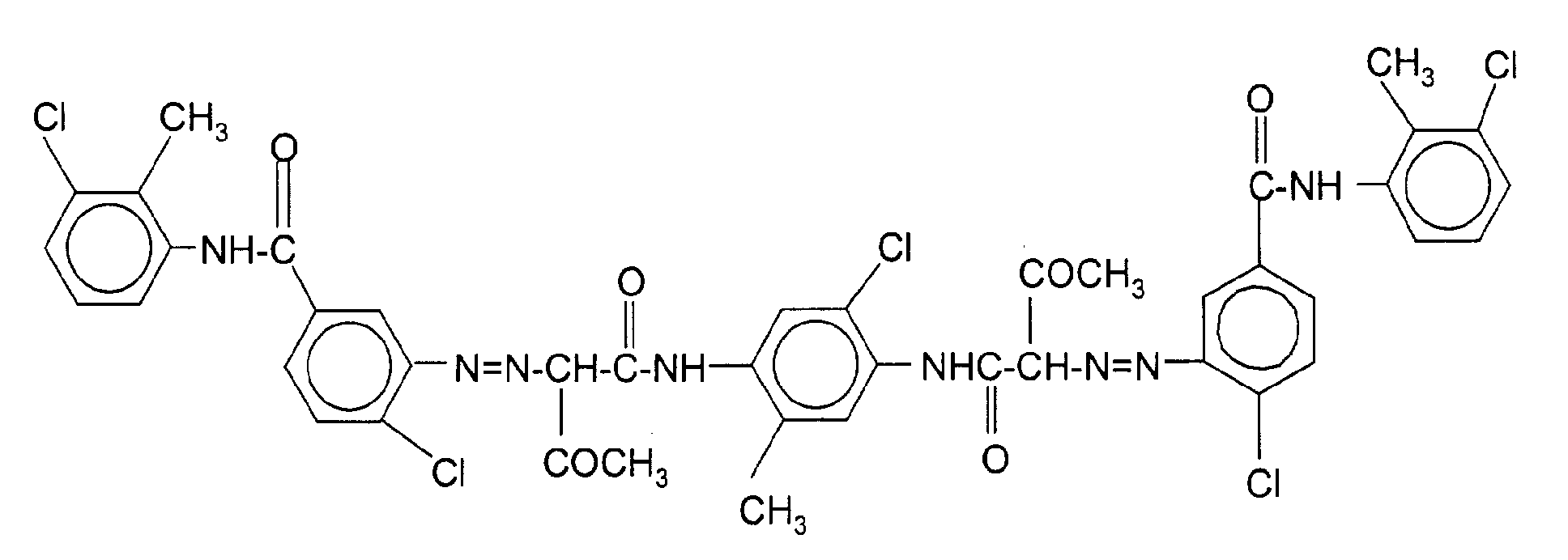
- 36.1 g of the dry monoazocarboxylic acid obtained by conventional batch coupling or coupling in the conventional microreactor or in the microreactor diazotized 2,5-dichloroaniline and 2-hydroxynaphthalene-3-carboxylic acid are in 280 ml of 1,2-dichlorobenzene and 18 g of thionyl chloride for 4 h with stirring at 110 ° C. heated. Then it is cooled to 80 ° C. and excess thionyl chloride, distilled off together with a little 1,2-dichlorobenzene in vacuo.
- the suspension of the acid chloride obtained from a) is mixed with 1,2-dichlorobenzene adjusted to a volume of 300 ml and stirred at 80 ° C. 8.9 g 1,4-diamino-2,5-dichlorobenzene are dissolved in 200 ml of 1,2-dichlorobenzene, then the volume adjusted to 300 ml with 1,2-dichlorobenzene and the solution added 80 ° C stirred. Then over calibrated piston pumps with a flow rate of 6 ml / min in each of the reactant inputs of the microreactor Suspension of the acid chloride and the solution of the diamine are pumped. The actual condensation reaction takes place in the reactor room.
- 36.1 g of the dry monoazocarboxylic acid obtained by conventional batch coupling or coupling in the conventional microreactor or in the microreactor diazotized 2,5-dichloroaniline and 2-hydroxynaphthalene-3-carboxylic acid, are in 250 ml of 1,2-dichlorobenzene suspended, the suspension is with 1,2-dichlorobenzene set to 300 ml. This suspension is calibrated over a Piston pumps with a flow rate of 6 ml / min via the educt inlet A) des Pumped microreactor.
- the suspension of the acid chloride obtained from a) and 14.2 g of 3-chloro-2-methylaniline, dissolved in 300 ml of 1,2-dichlorobenzene, are each heated to 80 ° C. and via calibrated piston pumps with a flow rate of 6 ml / min in each case pumped into the respective reactant inputs of the microreactor.
- the actual condensation reaction takes place in the reactor room.
- a thermostat is connected to the heat exchanger circuit of the microreactor, which sets a reaction temperature of 180 ° C.
- the pigment suspension emerging from the reactor is collected in a flask, suction filtered, washed with hot 1,2-dichlorobenzene, then with methanol and finally with water and dried in vacuo at 80.degree.
Landscapes
- Chemical & Material Sciences (AREA)
- Organic Chemistry (AREA)
- Chemical Kinetics & Catalysis (AREA)
- Physical Or Chemical Processes And Apparatus (AREA)
- Organic Low-Molecular-Weight Compounds And Preparation Thereof (AREA)
Abstract
Description
Bei Disazokondensationspigmenten kann eine Nachbehandlung in Wasser/Lösungsmitteln zur Erzielung der gewünschten Kristalleigenschaften erforderlich sein.
In der DE 3 926 466 C2 werden chemische Reaktionen von zwei chemischen Stoffen mit starker Wärmetönung in einem Mikroreaktor beschrieben.



1,4-Phenylen, 2-Chloro-5-methyl-1,4-phenylen, 2,5-Dichloro-1,4-phenylen, 2,5-Dimethyl-1,4-phenylen, 2-Chloro-1,4-phenylen, 2,2'-Dichlor-1,4-biphenylen, Benzanilid-4,4'-diyl, 1,4-Biphenylen und 1,4-Naphthylen.
Im Falle, dass die Diazotierung im Mikroreaktor durchgeführt wird, wird das zu diazotierende Amin oder dessen Ammoniumsalz, vorzugsweise dessen Hydrochlorid oder Sulfat, vorzugsweise in Wasser und/oder einem organischen Lösemittel gelöst oder suspendiert und die erhaltene Lösung oder Suspension kontinuierlich in den Mikroreaktor eingeleitet (Eduktstrom A).
Gleichzeitig wird eine Lösung oder Suspension, vorzugsweise eine wässrige Lösung oder Suspension, eines Diazotierungsmittels, vorzugsweise NaNO2 oder Nitrosylschwefelsäure, kontinuierlich in den Mikroreaktor eingeleitet (Eduktstrom B). Im Innern des Mikroreaktors werden Eduktstrom A und B kontinuierlich miteinander vermischt und zu einem Diazoniumsalz umgesetzt.
Im Falle, dass die Azokupplung im Mikroreaktor durchgeführt wird, wird eine Lösung oder Suspension eines Diazoniumsalzes (Eduktstrom C) und eine Lösung oder Suspension einer Kupplungskomponente (Eduktstrom D) kontinuierlich in den Mikroreaktor eingeleitet, dort miteinander kontinuierlich vermischt und zur Reaktion gebracht.
Im Falle, dass die Säurechloridbildung im Mikroreaktor durchgeführt wird, wird die Azocarbonsäure oder Azodicarbonsäure vorzugsweise in einem inerten organischen Lösemittel, beispielsweise Chlorbenzol, Dichlorbenzol oder Nitrobenzol gelöst oder suspendiert und die erhaltene Lösung oder Suspension kontinuierlich in den Mikroreaktor eingeleitet (Eduktstrom E). Gleichzeitig wird ein anorganisches Säurechlorid, vorzugsweise Thionylchlorid, gegebenenfalls verdünnt im gleichen Lösungsmittel wie das Säurechlorid, kontinuierlich in den Mikroreaktor eingeleitet (Eduktstrom F). Im Innern des Mikroreaktors werden Eduktstrom E und F kontinuierlich miteinander vermischt und zur Reaktion gebracht.
Zur erfindungsgemäßen Durchführung der Kondensationsreaktion wird eine Lösung oder Suspension des Azocarbonsäurechlorids oder Azodicarbonsäuredichlorids (Eduktstrom G) und eine Lösung oder Suspension des aromatischen Diamins oder aromatischen Amins (Eduktstrom H) kontinuierlich in den Mikroreaktor eingeleitet, dort miteinander kontinuierlich vermischt und zur Reaktion gebracht.
Es können auch Mikroreaktoren mit zwei oder mehreren Reaktionszonen für die einzelnen Reaktionsschritte verwendet werden.
Das vorliegende Mikroreaktionssystem ist ein aus sechs, aufeinander gestapelten und miteinander verbundenen mikrostrukturierten Blechlagen und je einer Deckelplatte (DP) und Bodenplatte (BP) aufgebautes verfahrenstechnisches Modul, das durch den Zusammenbau unter Druck gehalten oder fest verbunden wird, um Abdichtflächen zwischen den Platten zusammenzupressen.
Mit Hilfe des Wärmetauschers (W1) werden die in Platte (E) getrennt einströmenden Eduktströme vortemperiert. In den Platten (M), die ein gemeinsames Volumen bilden, findet dann die Vermischung der Eduktströme statt. In der Verweilzone (R) wird das Reaktionsgemisch mit Hilfe des Wärmetauschers (W2) auf die gewünschte Reaktionstemperatur gebracht, so dass die gewünschte chemische Reaktion stattfinden kann.
Das Mikroreaktionssystem wird kontinuierlich betrieben, wobei sich die jeweils miteinander zur Vermischung gebrachten Fluidmengen im Mikro- (µl) bis Milliliter (ml) -Bereich bewegen.
Entscheidend für die Herstellung von Disazokondensationspigmenten in diesem Mikroreaktionssystem sind die Dimensionen der mikrostrukturierten Bereiche innerhalb des Reaktors. Diese müssen so groß gewählt sein, dass insbesondere Feststoffteilchen problemlos passieren können und so keine Verstopfung der Kanäle auftritt. Die kleinste lichte Weite der Mikrostrukturen sollte ca. zehnmal größer sein als der Durchmesser der größten Pigmentteilchen. Weiterhin muss durch entsprechende geometrische Gestaltung Sorge getragen werden, dass keine Totwasserzonen, wie z.B. Sackgassen oder scharfe Ecken, in denen z.B. Pigmentteilchen sedimentieren können, vorhanden sind. Bevorzugt sind daher kontinuierliche Bahnen ohne Ecken oder mit runden Ecken. Die Strukturen müssen klein genug sein, um die immanenten Vorteile der Mikroreaktionstechnik auszunutzen, nämlich hervorragende Wärmekontrolle, laminare Strömung, diffusives Mischen und geringes internes Volumen.
Die lichte Weite der Wärmetauscherkanäle richtet sich in erster Linie nach der lichten Weite der flüssigkeits- oder suspensionsführenden Kanälen und ist zweckmäßigerweise kleiner oder gleich 10000 µm, vorzugsweise kleiner oder gleich 2000 µm, insbesondere kleiner oder gleich 800 µm. Die Untergrenze der lichten Weite der Wärmetauscherkanäle ist unkritisch und wird allenfalls durch den Druckanstieg der zu pumpenden Wärmetauscherflüssigkeit und von der Notwendigkeit der optimalen Wärmezufuhr oder -abfuhr begrenzt.
- Wärmetauscherstrukturen:
- Kanalbreite ∼600 µm
Kanalhöhe ∼250 µm - Mischer und Verweilzeit:
- Kanalbreite ∼600 µm
Kanalhöhe ∼500 µm
Für die Diazotierungsreaktion als auch für die Azokupplung können den Eduktströmen Pufferlösungen zugeführt werden, vorzugsweise von organischen Säuren und deren Salzen, z.B. Essigsäure/Acetat-Puffer, Zitronensäure/Citrat-Puffer, oder von anorganischen Säuren und deren Salzen, wie z.B. Phosphorsäure/Phosphat oder Kohlensäure/Carbonat.
Für die Säurechloridbildung als auch für die Kondensation können den Eduktströmen Lösungen zugeführt werden, die vorzugsweise Reaktionskatalysatoren, wie beispielsweise bei der Säurechloridbildung N,N-Dimethylformamid oder Pyridin, enthalten.
Nach dem erfindungsgemäßen Verfahren lassen sich Disazokondensationspigmente herstellen. Es können auch Gemische von Disazokondensatonspigmenten hergestellt werden.
Claims (12)
- Verfahren zur Herstellung von Disazokondensationspigmenten durch Diazotierung eines aromatischen Amins, Azokupplung mit einer Kupplungskomponente zu einer Azocarbonsäure oder Azodicarbonsäure, Bildung eines Azocarbonsäurechlorids oder Azodicarbonsäuredichlorids, und Kondensation des Azocarbonsäurechlorids mit einem aromatischen Diamin oder des Azodicarbonsäuredichlorids mit einem aromatischen Amin, dadurch gekennzeichnet, dass man die Säurechloridbildung und/oder die Kondensation, und ggf. die Diazotierung und ggf. die Azokupplung, in einem Mikröreaktor durchführt.
- Verfahren nach Anspruch 1, dadurch gekennzeichnet, dass das Disazokondensationspigment eine Verbindung der Formel (1) oder (2) ist
 worin
worin D ein Rest einer Diazokomponente undAr ein aromatischer Rest bedeuten.
 - Verfahren nach Anspruch 1 oder 2, dadurch gekennzeichnet, dass D einen Rest der Formel (a) oder (b) bedeutet,worin
 R1, R2 und R3 gleich oder verschieden sind und die Bedeutung Wasserstoff, Methyl, Chlor, CF3 oder 4'-Chlorphenoxy haben;R4 und R5 gleich oder verschieden sind und Wasserstoff, Chlor, Methyl, CF3, COOCH2CH2Cl, COO(C1-C4)alkyl oder Nitro bedeuten.
 - Verfahren nach mindestens einem der Ansprüche 1 bis 3, dadurch gekennzeichnet, dass
Ar 1,4-Phenylen, 2-Chloro-5-methyl-1,4-phenylen, 2,5-Dichloro-1,4-phenylen, 2,5-Dimethyl-1,4-phenylen, 2-Chloro-1,4-phenylen, 2,2'-Dichlor-1,4-biphenylen Benzanilid-4,4'-diyl, 1,4-Biphenlen oder 1,4-Naphthylen bedeutet. - Verfahren nach mindestens einem der Ansprüche 1 bis 4, dadurch gekennzeichnet, dass das Disazokondensationspigment C.I. Pigment Yellow 93, 94, 95, 128, 166; C.I. Pigment Orange 31, 55; C.I. Pigment Red 139, 140, 141, 143, 144, 166, 214, 217, 218, 220, 221, 242, 248, 262; C.I. Pigment Brown 23 oder 42 ist.
- Verfahren nach mindestens einem der Ansprüche 1 bis 5, dadurch gekennzeichnet, dass die Diazotierung im Mikroreaktor durchgeführt wird, indem man das zu diazotierende Amin oder dessen Ammoniumsalz, sowie eine Lösung oder Suspension eines Diazotierungsmittels kontinuierlich in den Mikroreaktor einleitet, im Innern des Mikroreaktors kontinuierlich miteinander vermischt und zur Reaktion bringt.
- Verfahren nach mindestens einem der Ansprüche 1 bis 6, dadurch gekennzeichnet, dass die Azokupplung im Mikroreaktor durchgeführt wird, indem man eine Lösung oder Suspension eines kupplungsfähigen Diazoniumsalzes, sowie eine Lösung oder Suspension einer Azokupplungskomponente kontinuierlich in den Mikroreaktor einleitet, im Innern des Mikroreaktors kontinuierlich miteinander vermischt und zur Reaktion bringt.
- Verfahren nach mindestens einem der Ansprüche 1 bis 7, dadurch gekennzeichnet, dass die Säurechloridbildung im Mikroreaktor durchgeführt wird, indem man eine Lösung oder Suspension einer Azocarbonsäure oder einer Azodicarbonsäure in einem organischen Lösemittel, sowie ein anorganisches Säurechlorid kontinuierlich in den Mikroreaktor einleitet, im Innern des Mikroreaktors kontinuierlich miteinander vermischt und zur Reaktion bringt.
- Verfahren nach mindestens einem der Ansprüche 1 bis 8, dadurch gekennzeichnet, dass die Kondensationsreaktion im Mikroreaktor durchgeführt wird, indem man eine Lösung oder Suspension eines Azocarbonsäurechlorids oder Azocarbondisäuredichlorids, und eine Lösung oder Suspension eines aromatischen Diamins oder aromatischen Amins kontinuierlich in den Mikroreaktor einleitet, im Innern des Mikroreaktors kontinuierlich miteinander vermischt und zur Reaktion bringt.
- Verfahren nach mindestens einem der Ansprüche 1 bis 9, dadurch gekennzeichnet, dass man zur Durchführung von zwei oder mehreren der Schritte Diazotierung, Azokupplung, Säurechloridbildung und Kondensationsreaktion zwei oder mehrere Mikroreaktoren hintereinanderschaltet oder Mikroreaktoren mit zwei oder mehreren Reaktionszonen verwendet.
- Verfahren nach mindestens einem der Ansprüche 1 bis 10, dadurch gekennzeichnet, dass die eingeleiteten Lösungen oder Suspensionen im Innern des Mikroreaktors mit Hilfe eines oder mehrerer Wärmetauscher auf Reaktionstemperatur gebracht werden.
- Verfahren nach mindestens einem der Ansprüche 1 bis 11, dadurch gekennzeichnet, dass die Konzentrationen, Flussraten und Temperaturen über im Mikroreaktor integrierte Sensoren und Regelkreise erfasst und kontrolliert werden.
Applications Claiming Priority (2)
| Application Number | Priority Date | Filing Date | Title |
|---|---|---|---|
| DE10032019 | 2000-07-01 | ||
| DE10032019A DE10032019A1 (de) | 2000-07-01 | 2000-07-01 | Verfahren zur Herstellung von Disazokondensationspigmenten in Mikroreaktoren |
Publications (2)
| Publication Number | Publication Date |
|---|---|
| EP1167460A1 true EP1167460A1 (de) | 2002-01-02 |
| EP1167460B1 EP1167460B1 (de) | 2004-05-06 |
Family
ID=7647429
Family Applications (1)
| Application Number | Title | Priority Date | Filing Date |
|---|---|---|---|
| EP01114630A Expired - Lifetime EP1167460B1 (de) | 2000-07-01 | 2001-06-19 | Verfahren zur Herstellung von Disazokondensationspigmenten in Mikroreaktoren |
Country Status (9)
| Country | Link |
|---|---|
| US (1) | US6437104B1 (de) |
| EP (1) | EP1167460B1 (de) |
| JP (1) | JP2002038043A (de) |
| KR (1) | KR100755886B1 (de) |
| CN (1) | CN1249172C (de) |
| CZ (1) | CZ296138B6 (de) |
| DE (2) | DE10032019A1 (de) |
| ES (1) | ES2220629T3 (de) |
| TW (1) | TWI231307B (de) |
Cited By (1)
| Publication number | Priority date | Publication date | Assignee | Title |
|---|---|---|---|---|
| EP2228410A1 (de) * | 2009-03-11 | 2010-09-15 | Clariant International Ltd. | C.I. Pigment Red 112 mit verbesserter Dispergierbarkeit |
Families Citing this family (34)
| Publication number | Priority date | Publication date | Assignee | Title |
|---|---|---|---|---|
| US20030078558A1 (en) * | 1999-02-10 | 2003-04-24 | Hamzeh Karami | Disposable pant type absorbent article with improved fasteners and method of making same |
| US7135266B2 (en) * | 2000-02-09 | 2006-11-14 | Clariant Finance (Bvi) Limited | Preparation of azo colorants in microreactors and their use in electrophotographic toners and developers, powder coatings, ink jet inks and electronic medias |
| DE10028104A1 (de) * | 2000-06-07 | 2001-12-13 | Clariant Gmbh | Verfahren zur Herstellung von Diketopyrrologyrrol-Pigmenten |
| DE10028754A1 (de) | 2000-06-09 | 2001-12-13 | Clariant Gmbh | Verfahren zur Herstellung von alkoholischen Lösungen von Alkalialkoholaten |
| EP1642885B1 (de) | 2000-08-29 | 2009-11-11 | Biocon Limited | Verwendung einer pharmazeutischen Zusammensetzung mit einem Para-Aminophenylessigsäurederivat für die Behandlung von entzündlichen Erkrankungen des Magen-Darmtrakts |
| DE10139664A1 (de) * | 2001-08-11 | 2003-02-20 | Clariant Gmbh | Verfahren zur Herstellung von Aryl- und Alkyl-Bor-Verbindungen in Mikroreaktoren |
| DE10140857A1 (de) * | 2001-08-21 | 2003-03-06 | Clariant Gmbh | Verfahren zur Herstellung von Aryl- und Alkyl-Bor-Verbindungen in Mikroreaktoren |
| US8048924B2 (en) | 2001-08-29 | 2011-11-01 | Biocon Limited | Methods and compositions employing 4-aminophenylacetic acid compounds |
| DE10143189A1 (de) * | 2001-09-04 | 2003-03-20 | Clariant Gmbh | Verfahren und Vorrichtung zur prozeßbegleitenden Reinigung von Mikro-und Minireaktoren |
| DE10303581A1 (de) * | 2003-01-30 | 2004-08-12 | Clariant Gmbh | Acetoacetylierung von Alkoholen, Thiolen und Aminen im Mikroreaktor |
| DE10317451A1 (de) * | 2003-04-16 | 2004-11-18 | Degussa Ag | Reaktor für heterogen katalysierte Reaktionen |
| JP4587757B2 (ja) * | 2003-09-22 | 2010-11-24 | 富士フイルム株式会社 | 有機顔料微粒子およびその製造方法 |
| EP2058373A3 (de) | 2003-09-22 | 2010-06-02 | FUJIFILM Corporation | Organische Pigmentfeinpartikel und Verfahren zu deren Herstellung |
| DE102004019561A1 (de) * | 2004-04-22 | 2005-11-10 | Clariant Gmbh | Verfahren zur Herstellung hochreiner Azofarbmittel |
| HUE028158T2 (en) | 2004-07-07 | 2016-12-28 | Biocon Ltd | Synthesis of bound immunoregulatory compounds |
| DE602005024824D1 (de) * | 2004-09-08 | 2010-12-30 | Pacific Scient Energetic Materials Co | Verfahren zur herstellung von substituierten tetrazolen aus aminotetrazolen |
| EP1693423B1 (de) | 2005-01-14 | 2012-12-05 | FUJIFILM Corporation | Feine organische Pigmentpartikel und Verfahren zu deren Herstellung |
| TWI392708B (zh) * | 2005-04-19 | 2013-04-11 | Dainichiseika Color Chem | 顏料分散劑及其使用 |
| JP5001529B2 (ja) | 2005-06-10 | 2012-08-15 | 富士フイルム株式会社 | 有機顔料微粒子の製造方法 |
| CN100455345C (zh) * | 2006-07-17 | 2009-01-28 | 南京工业大学 | 复合换热式微反应器 |
| JP4743068B2 (ja) | 2006-09-29 | 2011-08-10 | 富士フイルム株式会社 | 有機顔料微粒子の製造方法 |
| US7563318B1 (en) | 2008-07-02 | 2009-07-21 | Xerox Corporation | Method of making nanoscale particles of AZO pigments in a microreactor or micromixer |
| JP5747289B2 (ja) * | 2011-03-30 | 2015-07-15 | 東洋インキScホールディングス株式会社 | アゾ顔料の製造方法 |
| CN102618063B (zh) * | 2012-03-09 | 2013-11-20 | 大连理工大学 | 水溶性偶氮染料的螺旋管混沌混合的连续化制备方法 |
| CN102796394B (zh) * | 2012-07-24 | 2014-05-07 | 浙江龙盛集团股份有限公司 | 一种染料连续偶合及能量利用方法 |
| EP2948435B1 (de) | 2013-01-22 | 2017-08-30 | Pacific Scientific Energetic Materials Company | Einfaches verfahren zur herstellung von 5-nitrotetrazolaten mit einem strömungssystem |
| JP6179121B2 (ja) * | 2013-02-20 | 2017-08-16 | 東洋インキScホールディングス株式会社 | カラーフィルタ用着色剤、着色組成物、およびカラーフィルタ |
| CN104031401B (zh) * | 2014-05-16 | 2016-08-24 | 山东宇虹新颜料股份有限公司 | 一种c.i.颜料黄128的制备方法 |
| US9598380B2 (en) | 2014-06-12 | 2017-03-21 | Sri International | Facile method for preparation of 5-nitrotetrazolates using a batch system |
| EP3245194B1 (de) | 2015-01-16 | 2019-05-01 | Pacific Scientific Energetic Materials Company | Verfahren und kontiuierliches strömungssystem zur herstellung von natrium 5-nitrotetrazolat mit einem umsatz von mindestens 100 gramm/stunde und einer temperatur von 10-30 °c |
| CN105670339A (zh) * | 2016-01-14 | 2016-06-15 | 上虞大新色彩化工有限公司 | 一种c.i.颜料黄12的制备方法 |
| US10464908B2 (en) | 2016-09-07 | 2019-11-05 | Pacific Scientific Energetic Materials Company | Purification of flow sodium 5-nitrotetrazolate solutions with copper modified cation exchange resin |
| JP6172488B1 (ja) * | 2017-02-28 | 2017-08-02 | 東洋インキScホールディングス株式会社 | カラーフィルタ用着色剤、着色組成物、およびカラーフィルタ |
| CN110787747B (zh) * | 2019-10-16 | 2020-09-29 | 天津大学 | 一种管状微型混合器及其用于偶氮颜料的连续化制备方法 |
Citations (5)
| Publication number | Priority date | Publication date | Assignee | Title |
|---|---|---|---|---|
| DE1544453A1 (de) * | 1964-11-26 | 1970-04-02 | Ciba Geigy | Verfahren zur Herstellung von Disazopigmenten |
| DE1644117A1 (de) * | 1966-09-09 | 1970-10-29 | Ciba Geigy | Verfahren zur Herstellung von Disazopigmenten |
| DD246257A1 (de) * | 1986-01-21 | 1987-06-03 | Akad Wissenschaften Ddr | Verfahrenstechnische mikroapparaturen und verfahren zu ihrer herstellung |
| DE3926466A1 (de) * | 1989-08-10 | 1991-02-14 | Messerschmitt Boelkow Blohm | Mikroreaktor zur durchfuehrung chemischer reaktionen mit starker waermetoenung |
| US5534328A (en) * | 1993-12-02 | 1996-07-09 | E. I. Du Pont De Nemours And Company | Integrated chemical processing apparatus and processes for the preparation thereof |
Family Cites Families (7)
| Publication number | Priority date | Publication date | Assignee | Title |
|---|---|---|---|---|
| DE246257C (de) | ||||
| JPS60186573A (ja) * | 1984-03-07 | 1985-09-24 | Mitsubishi Pencil Co Ltd | メタリツク調の色彩を有するインキ |
| JPH02210360A (ja) * | 1989-02-09 | 1990-08-21 | Mitsubishi Kasei Corp | イエロートナー |
| US5811062A (en) * | 1994-07-29 | 1998-09-22 | Battelle Memorial Institute | Microcomponent chemical process sheet architecture |
| JPH1112508A (ja) * | 1997-06-20 | 1999-01-19 | Fuji Shikiso Kk | インクジェットプリンター用インク |
| JP4207236B2 (ja) * | 1998-02-09 | 2009-01-14 | 住友化学株式会社 | 縮合アゾ顔料誘導体及びそれを含有する顔料組成物 |
| WO2001059013A1 (de) * | 2000-02-09 | 2001-08-16 | Clariant International Ltd | Verfahren zur herstellung von azofarbmitteln in mikroreaktoren |
-
2000
- 2000-07-01 DE DE10032019A patent/DE10032019A1/de not_active Withdrawn
-
2001
- 2001-06-19 EP EP01114630A patent/EP1167460B1/de not_active Expired - Lifetime
- 2001-06-19 JP JP2001184775A patent/JP2002038043A/ja not_active Withdrawn
- 2001-06-19 ES ES01114630T patent/ES2220629T3/es not_active Expired - Lifetime
- 2001-06-19 DE DE50102181T patent/DE50102181D1/de not_active Expired - Fee Related
- 2001-06-28 US US09/894,342 patent/US6437104B1/en not_active Expired - Fee Related
- 2001-06-29 CN CNB011218673A patent/CN1249172C/zh not_active Expired - Fee Related
- 2001-06-29 CZ CZ20012426A patent/CZ296138B6/cs not_active IP Right Cessation
- 2001-06-29 TW TW090116053A patent/TWI231307B/zh not_active IP Right Cessation
- 2001-06-30 KR KR1020010038824A patent/KR100755886B1/ko not_active Expired - Fee Related
Patent Citations (5)
| Publication number | Priority date | Publication date | Assignee | Title |
|---|---|---|---|---|
| DE1544453A1 (de) * | 1964-11-26 | 1970-04-02 | Ciba Geigy | Verfahren zur Herstellung von Disazopigmenten |
| DE1644117A1 (de) * | 1966-09-09 | 1970-10-29 | Ciba Geigy | Verfahren zur Herstellung von Disazopigmenten |
| DD246257A1 (de) * | 1986-01-21 | 1987-06-03 | Akad Wissenschaften Ddr | Verfahrenstechnische mikroapparaturen und verfahren zu ihrer herstellung |
| DE3926466A1 (de) * | 1989-08-10 | 1991-02-14 | Messerschmitt Boelkow Blohm | Mikroreaktor zur durchfuehrung chemischer reaktionen mit starker waermetoenung |
| US5534328A (en) * | 1993-12-02 | 1996-07-09 | E. I. Du Pont De Nemours And Company | Integrated chemical processing apparatus and processes for the preparation thereof |
Cited By (2)
| Publication number | Priority date | Publication date | Assignee | Title |
|---|---|---|---|---|
| EP2228410A1 (de) * | 2009-03-11 | 2010-09-15 | Clariant International Ltd. | C.I. Pigment Red 112 mit verbesserter Dispergierbarkeit |
| US8062416B2 (en) | 2009-03-11 | 2011-11-22 | Clariant Finance (Bvi) Limited | Pigment red 112 with enhanced dispersibility |
Also Published As
| Publication number | Publication date |
|---|---|
| CZ296138B6 (cs) | 2006-01-11 |
| KR100755886B1 (ko) | 2007-09-06 |
| CN1330115A (zh) | 2002-01-09 |
| DE50102181D1 (de) | 2004-06-09 |
| DE10032019A1 (de) | 2002-01-10 |
| EP1167460B1 (de) | 2004-05-06 |
| TWI231307B (en) | 2005-04-21 |
| ES2220629T3 (es) | 2004-12-16 |
| CZ20012426A3 (cs) | 2002-03-13 |
| KR20020004840A (ko) | 2002-01-16 |
| CN1249172C (zh) | 2006-04-05 |
| US20020058794A1 (en) | 2002-05-16 |
| JP2002038043A (ja) | 2002-02-06 |
| US6437104B1 (en) | 2002-08-20 |
Similar Documents
| Publication | Publication Date | Title |
|---|---|---|
| EP1167460B1 (de) | Verfahren zur Herstellung von Disazokondensationspigmenten in Mikroreaktoren | |
| EP1257602B1 (de) | Verfahren zur herstellung von azofarbmitteln in mikroreaktoren | |
| EP1167461B1 (de) | Verfahren zur Konditionierung von organischen Pigmenten | |
| EP1162240B1 (de) | Verfahren zur Herstellung von Diketopyrrolopyrrol-Pigmenten | |
| EP1740658A1 (de) | Hochreine naphthol as-pigmente | |
| WO2005105927A1 (de) | Verfahren zur herstellung hochreiner azofarbmittel | |
| EP1363975B1 (de) | Verfahren und vorrichtung zur kontinuierlichen rodox-regelung bei azokupplungen | |
| EP1195411A1 (de) | Verfahren zur Herstellung von Azofarbmitteln | |
| EP2349552A1 (de) | Modularer reaktor | |
| CN116041202B (zh) | 一种连续流反应器合成2-甲氧基-4-硝基乙酰苯胺的方法 | |
| DE3850413T2 (de) | Verfahren zur kontinuierlichen herstellung von aromatischen diazoniumfluorid-salzen. | |
| DE10143189A1 (de) | Verfahren und Vorrichtung zur prozeßbegleitenden Reinigung von Mikro-und Minireaktoren | |
| EP1123735A2 (de) | Mikroreaktor für Reaktionsmedien in Form einer Suspension | |
| DE10001317A1 (de) | Reaktion von Carbonylverbindungen mit metallorganischen Reagenzien | |
| DE10040100A1 (de) | Verfahren zur Herstellung von Azofarbmitteln in Mikroreaktoren | |
| DE10005550A1 (de) | Verfahren zur Herstellung von Azofarbmitteln in Mikroreaktoren | |
| CN112979540A (zh) | 重氮偶合工艺 | |
| DE2361433A1 (de) | Schwer loesliche diazoverbindungen, ihre herstellung und verwendung | |
| DE3839849A1 (de) | Monoazopigmente, verfahren zu ihrer herstellung und ihre verwendung | |
| CH432690A (de) | Verfahren zur Herstellung von Azofarbstoffen | |
| DD207920A1 (de) | Verfahren zur herstellung eines monoazofarbstoffes | |
| DE2515662A1 (de) | Wasserloesliche azofarbstoffe | |
| DE1644159A1 (de) | Azofarbstoffe und Verfharen zu deren Herstellung | |
| CH398839A (de) | Verfahren zur Herstellung von Azofarbstoffen |
Legal Events
| Date | Code | Title | Description |
|---|---|---|---|
| PUAI | Public reference made under article 153(3) epc to a published international application that has entered the european phase |
Free format text: ORIGINAL CODE: 0009012 |
|
| AK | Designated contracting states |
Kind code of ref document: A1 Designated state(s): AT BE CH CY DE DK ES FI FR GB GR IE IT LI LU MC NL PT SE TR |
|
| AX | Request for extension of the european patent |
Free format text: AL;LT;LV;MK;RO;SI |
|
| 17P | Request for examination filed |
Effective date: 20020702 |
|
| AKX | Designation fees paid |
Free format text: AT BE CH CY DE DK ES FI FR GB GR IE IT LI LU MC NL PT SE TR |
|
| RIN1 | Information on inventor provided before grant (corrected) |
Inventor name: ALFTER, FRANK, DR. Inventor name: NICKEL, UWE, DR. Inventor name: KUND, KLAUS, DR. |
|
| 17Q | First examination report despatched |
Effective date: 20021126 |
|
| GRAP | Despatch of communication of intention to grant a patent |
Free format text: ORIGINAL CODE: EPIDOSNIGR1 |
|
| GRAS | Grant fee paid |
Free format text: ORIGINAL CODE: EPIDOSNIGR3 |
|
| RAP1 | Party data changed (applicant data changed or rights of an application transferred) |
Owner name: CLARIANT FINANCE (BVI) LIMITED |
|
| GRAA | (expected) grant |
Free format text: ORIGINAL CODE: 0009210 |
|
| RBV | Designated contracting states (corrected) |
Designated state(s): CH DE ES FR GB IT LI |
|
| RIN1 | Information on inventor provided before grant (corrected) |
Inventor name: NICKEL, UWE, DR. Inventor name: KUND, KLAUS, DR. Inventor name: ALFTER, FRANK, DR. |
|
| AK | Designated contracting states |
Kind code of ref document: B1 Designated state(s): CH DE ES FR GB IT LI |
|
| REG | Reference to a national code |
Ref country code: GB Ref legal event code: FG4D Free format text: NOT ENGLISH |
|
| REG | Reference to a national code |
Ref country code: CH Ref legal event code: EP |
|
| REF | Corresponds to: |
Ref document number: 50102181 Country of ref document: DE Date of ref document: 20040609 Kind code of ref document: P |
|
| REG | Reference to a national code |
Ref country code: IE Ref legal event code: FG4D Free format text: GERMAN |
|
| GBT | Gb: translation of ep patent filed (gb section 77(6)(a)/1977) |
Effective date: 20040721 |
|
| REG | Reference to a national code |
Ref country code: ES Ref legal event code: FG2A Ref document number: 2220629 Country of ref document: ES Kind code of ref document: T3 |
|
| REG | Reference to a national code |
Ref country code: IE Ref legal event code: FD4D |
|
| ET | Fr: translation filed | ||
| PLBE | No opposition filed within time limit |
Free format text: ORIGINAL CODE: 0009261 |
|
| STAA | Information on the status of an ep patent application or granted ep patent |
Free format text: STATUS: NO OPPOSITION FILED WITHIN TIME LIMIT |
|
| 26N | No opposition filed |
Effective date: 20050208 |
|
| PGFP | Annual fee paid to national office [announced via postgrant information from national office to epo] |
Ref country code: DE Payment date: 20070414 Year of fee payment: 7 |
|
| PGFP | Annual fee paid to national office [announced via postgrant information from national office to epo] |
Ref country code: CH Payment date: 20070427 Year of fee payment: 7 |
|
| PGFP | Annual fee paid to national office [announced via postgrant information from national office to epo] |
Ref country code: ES Payment date: 20070430 Year of fee payment: 7 |
|
| PGFP | Annual fee paid to national office [announced via postgrant information from national office to epo] |
Ref country code: GB Payment date: 20070521 Year of fee payment: 7 |
|
| PGFP | Annual fee paid to national office [announced via postgrant information from national office to epo] |
Ref country code: IT Payment date: 20070625 Year of fee payment: 7 |
|
| PGFP | Annual fee paid to national office [announced via postgrant information from national office to epo] |
Ref country code: FR Payment date: 20070424 Year of fee payment: 7 |
|
| REG | Reference to a national code |
Ref country code: CH Ref legal event code: PL |
|
| GBPC | Gb: european patent ceased through non-payment of renewal fee |
Effective date: 20080619 |
|
| REG | Reference to a national code |
Ref country code: FR Ref legal event code: ST Effective date: 20090228 |
|
| PG25 | Lapsed in a contracting state [announced via postgrant information from national office to epo] |
Ref country code: DE Free format text: LAPSE BECAUSE OF NON-PAYMENT OF DUE FEES Effective date: 20090101 |
|
| PG25 | Lapsed in a contracting state [announced via postgrant information from national office to epo] |
Ref country code: LI Free format text: LAPSE BECAUSE OF NON-PAYMENT OF DUE FEES Effective date: 20080630 Ref country code: CH Free format text: LAPSE BECAUSE OF NON-PAYMENT OF DUE FEES Effective date: 20080630 Ref country code: GB Free format text: LAPSE BECAUSE OF NON-PAYMENT OF DUE FEES Effective date: 20080619 |
|
| REG | Reference to a national code |
Ref country code: ES Ref legal event code: FD2A Effective date: 20080620 |
|
| PG25 | Lapsed in a contracting state [announced via postgrant information from national office to epo] |
Ref country code: IT Free format text: LAPSE BECAUSE OF NON-PAYMENT OF DUE FEES Effective date: 20080619 Ref country code: FR Free format text: LAPSE BECAUSE OF NON-PAYMENT OF DUE FEES Effective date: 20080630 |
|
| PG25 | Lapsed in a contracting state [announced via postgrant information from national office to epo] |
Ref country code: ES Free format text: LAPSE BECAUSE OF NON-PAYMENT OF DUE FEES Effective date: 20080620 |