EP1144760B1 - Dispositif et procede de fixation entre un element de construction et un cable de structure - Google Patents
Dispositif et procede de fixation entre un element de construction et un cable de structure Download PDFInfo
- Publication number
- EP1144760B1 EP1144760B1 EP99961108A EP99961108A EP1144760B1 EP 1144760 B1 EP1144760 B1 EP 1144760B1 EP 99961108 A EP99961108 A EP 99961108A EP 99961108 A EP99961108 A EP 99961108A EP 1144760 B1 EP1144760 B1 EP 1144760B1
- Authority
- EP
- European Patent Office
- Prior art keywords
- cable
- housing
- wedging structure
- construction element
- wedging
- Prior art date
- Legal status (The legal status is an assumption and is not a legal conclusion. Google has not performed a legal analysis and makes no representation as to the accuracy of the status listed.)
- Expired - Lifetime
Links
- 238000000034 method Methods 0.000 title claims abstract description 11
- 239000000725 suspension Substances 0.000 title claims description 16
- 230000006835 compression Effects 0.000 claims abstract description 29
- 238000007906 compression Methods 0.000 claims abstract description 29
- 230000005540 biological transmission Effects 0.000 claims abstract description 12
- 238000010276 construction Methods 0.000 claims description 23
- 239000000463 material Substances 0.000 claims description 19
- 229920003023 plastic Polymers 0.000 claims description 7
- 239000004033 plastic Substances 0.000 claims description 7
- 230000000295 complement effect Effects 0.000 claims description 5
- 239000004744 fabric Substances 0.000 claims description 2
- 239000000470 constituent Substances 0.000 claims 1
- 239000011152 fibreglass Substances 0.000 claims 1
- 238000010586 diagram Methods 0.000 description 8
- 229920001903 high density polyethylene Polymers 0.000 description 7
- 239000004700 high-density polyethylene Substances 0.000 description 7
- 230000000694 effects Effects 0.000 description 5
- 230000008901 benefit Effects 0.000 description 4
- 239000002184 metal Substances 0.000 description 3
- 230000000149 penetrating effect Effects 0.000 description 3
- 230000001681 protective effect Effects 0.000 description 3
- 229920001971 elastomer Polymers 0.000 description 2
- 239000000806 elastomer Substances 0.000 description 2
- 239000013536 elastomeric material Substances 0.000 description 2
- 239000000203 mixture Substances 0.000 description 2
- 210000000056 organ Anatomy 0.000 description 2
- 229920001084 poly(chloroprene) Polymers 0.000 description 2
- 241000422252 Cales Species 0.000 description 1
- 239000004952 Polyamide Substances 0.000 description 1
- 230000001464 adherent effect Effects 0.000 description 1
- 239000000853 adhesive Substances 0.000 description 1
- 230000001070 adhesive effect Effects 0.000 description 1
- 230000003321 amplification Effects 0.000 description 1
- 238000004873 anchoring Methods 0.000 description 1
- 238000005452 bending Methods 0.000 description 1
- 239000011230 binding agent Substances 0.000 description 1
- 238000006243 chemical reaction Methods 0.000 description 1
- 238000006073 displacement reaction Methods 0.000 description 1
- 239000013013 elastic material Substances 0.000 description 1
- 239000002657 fibrous material Substances 0.000 description 1
- 239000003365 glass fiber Substances 0.000 description 1
- 239000008187 granular material Substances 0.000 description 1
- 238000009434 installation Methods 0.000 description 1
- 238000000465 moulding Methods 0.000 description 1
- 238000003199 nucleic acid amplification method Methods 0.000 description 1
- 239000002245 particle Substances 0.000 description 1
- 229920002647 polyamide Polymers 0.000 description 1
- 238000009417 prefabrication Methods 0.000 description 1
- 230000000284 resting effect Effects 0.000 description 1
- 230000000717 retained effect Effects 0.000 description 1
- 238000007789 sealing Methods 0.000 description 1
- 239000007787 solid Substances 0.000 description 1
- 230000009466 transformation Effects 0.000 description 1
Images

Classifications
-
- E—FIXED CONSTRUCTIONS
- E01—CONSTRUCTION OF ROADS, RAILWAYS, OR BRIDGES
- E01D—CONSTRUCTION OF BRIDGES, ELEVATED ROADWAYS OR VIADUCTS; ASSEMBLY OF BRIDGES
- E01D19/00—Structural or constructional details of bridges
- E01D19/16—Suspension cables; Cable clamps for suspension cables ; Pre- or post-stressed cables
Definitions
- the present invention relates to the field of the use of cables in construction works.
- structural cable as used herein also covers a bundle or group of individual cables substantially parallel to each other others, each individual cable can itself be composed of one or several elementary strands.
- the cable, or individual cables can be naked or individually sheathed, or consist of a mixture of these two types.
- the cable may possibly be contained globally in a external protective sheath filled with an adherent material. In the case of a cable formed by a group of individual cables, these can be direct contact with each other, or be spaced from each other.
- the invention can in particular be implemented in bridges suspended comprising one or more carrying cables to be immobilized in relation to certain elements (pylon tops %), and which must be attached certain other elements (hanger lines, integral portions apron ).
- the invention can also be applied to the field of prestressing, the structural cable then consisting of a cable tensioned to exert prestressing efforts on a concrete or other structure, and to which certain elements of the structure can be fixed.
- the interface that the cable presents to its environment is most often defined by generators essentially parallel to the longitudinal direction. Under these conditions, to prevent relative longitudinal movements between the cable and the element, we are led to exert a transverse tightening force on the cable in order to obtain friction sufficient at the interface.
- clamps comprising two (or more) shells, urged towards each other at by means of bolts or the like.
- the inside of the shells has a shape corresponding to the external interface of the cable possibly supplemented by filling inserts.
- German patent 869 977 it was proposed to secure the fixing a hanger to the carrying cable of a suspension bridge by adding corner effect jaws at both ends of a necklace made up of several shells tightened against each other by bolts.
- This security is very relative since the wedge effect is largely lost in the event of loss of tightening of the shell assembly bolts due to creep or fatigue.
- the distribution of the clamping forces is poorly controlled in the event of tightening these bolts.
- this device presents the problems size and weight usually posed by this type of necklaces.
- An object of the present invention is to provide a method of attachment which distributes the forces transmitted to the structural cable well.
- the invention thus provides a device for fixing between an element of construction and a structural cable, comprising a rigid housing connected to the building element and consisting of a single piece which surrounds completely a section of the cable, a wedging structure arranged between the cable and the housing, and force transmission means arranged to exert a longitudinal compression force, parallel to the cable, on the wedging structure, the wedging structure being pressed against the cable and the housing under the action of the longitudinal compression force, to provide resistance to the movement of the housing and the element construction parallel to the cable.
- the cable is gripped by the friction resulting from the pressure of orthogonal contact generated by the longitudinal compression of the structure contained between the rigid outer casing and the cable passing through it.
- the means of force transmission make it possible to control the good holding the fixing and the precise positioning of the housing relative to the cable.
- a minimum compression force may be applied before mounting final device, or during this assembly before loading.
- the wedging structure must naturally have resistance sufficient for compression and shear. Its longitudinal displacement when applying compression results in uniform radial tightening of the cable.
- This wedging structure can be composed of rigid elements such as tapered keys, which generate the tightening force during the application of axial compression, due to the reaction exerted by the orifice frustoconical of the housing in which they are engaged.
- a only end of the housing has a frustoconical orifice receiving a frustoconical jaw biased towards the opposite end of the housing. So, during the application of the force, the jaw does not rub on the cable. It is rather the case which moves towards the end of the largest section of the jaw to press it against the cable without damaging the cable.
- Homogeneous transmission of forces at the interface between the structure jamming and the cable can be further facilitated when the structure of entrapment undergoes a certain deformation at the moment when the means of force transmission exert controlled longitudinal compression.
- This deformation can consist of a limited creep of the material forming the wedging structure, which may in particular have the form of a frustoconical jaw. Limited creep can also occur at the level of housing or insert disposed around a rigid frustoconical jaw.
- the deformation is due to the character intrinsically deformable of all or part of the wedging structure housed between the housing and the cable.
- This structure can then include a elastic material, a granular material, a fibrous material, or even a mixture of such materials, and it can be made in one or more rooms. It has the property of expanding in the direction (s) orthogonal to the compression direction (s), either by intrinsic elastic movement either by the movement of individual particles (fibrous and / or granular) relative to each other or to a binder.
- the structure deformable has a fairly high shear strength when it is compressed between the case and the cable, in order to oppose relative longitudinal movements thereof.
- the housing serves as a support for the wedging structure and as a connection with the element to be fixed to the cable. It’s a single piece, for example cylindrical with circular or polygonal base, which completely surrounds a cable section. This case can be made of metal or any other material sufficiently rigid. It has the advantage of being relatively constitutional lightly.
- the means of force transmission may include one or more several members extending parallel to the cable, tensioned by clamping means for exerting the longitudinal compression force at ends of the wedging structure. These tension members (bolts, prestressing strands or any other suitable member) may pass to through, or around, the wedging structure the outside of the case.
- the means of force transmission can still include a nut screwed into a thread integral with the housing and applied against one end of the wedging structure.
- a fixing device between a building element and a structural cable includes a rigid housing connected to the building element and surrounding the cable, a structure of jamming comprising at least one deformable material, disposed between the cable and the housing, and force transmission means arranged for exert a longitudinal compression force, parallel to the cable, on the wedging structure, the wedging structure being pressed against the cable and the housing under the action of the longitudinal compression force, to provide resistance to the movement of the housing and the element construction parallel to the cable.
- the means of effort transmission can be in accordance with those previously mentioned. Alternatively, they can be arranged to transform a component longitudinal of the load exerted on the cable by the construction element in longitudinal compression of the deformable structure.
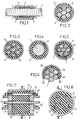
- Figures 1 and 2 show a fixing device installed around a cable 1, or group of cables.
- the element to be fixed is attached, by means suitable not shown, to a cylindrical housing 2.
- a deformable wedging structure 3 having, in the example shown, the shape of an elastomeric sleeve, is placed around the cable 1 inside the cylindrical housing 2.
- Two support pieces 4, which can be form of rings, are respectively applied to the two ends of the deformable structure 3, penetrating inside the cylindrical housing 2.
- a longitudinal compression force F is exerted on the deformable structure 3 through the two support pieces 4. In the example shown, the force F is applied to each of the two parts 4 at the two ends of the case 2.
- the deformable structure 3 is housed between the cable and the housing 2 with some radial clearance. When it is stressed in compression by the force F, it expands radially so that it is pressed inwards against the cable 1 and outwards against the cylindrical housing 2. It thus provides a friction between the cable 1 and the housing 2 to which the element to be fixed is attached. Yes the axial compression force F is sufficient, and if the structure 3 has a appropriate shear strength, this friction enables the desired fixing, preventing relative longitudinal movements between the cable 1 and box 2.
- the cable 1 is constituted by an assembly of strands juxtaposed 6.
- Each strand 6 can itself be composed of several elementary sons.
- the deformable structure 3 has a shape complementary to the volume located between the periphery of the cable and the inside of the case 2. This shape can be obtained by molding the deformable structure 3, or by deformation of an elastomeric sleeve of original cylindrical shape.
- the strands 6 constituting the cable 1 do not are not juxtaposed, but spaced from each other.
- the elastomeric material of the deformable structure 3 is also found in the intervals between the strands 6.
- the cable 1 is constituted by a wire solid metal, of cylindrical section.
- the deformable structure 3 can then simply have the shape of a cylindrical sleeve.
- the cable 1 is constituted by a strand composed of seven twisted metallic wires 7, protected by a sheath in plastic material 8, with an adhesive material 9, for example an elastomer, between the wires 7 and the sheath 8.
- an adhesive material 9 for example an elastomer
- Such a strand is described in the patent application European 0 855 471.
- the deformable cylindrical sleeve 3 then rests against the sheath 8 of the strand. The friction of this sleeve 3 on the housing 2 and the sheath 8 provides the desired fixation, together with the adhesion of the material 9 on the wires 7 and the sheath 8.
- the housing 2 is a part monobloc of generally cylindrical shape.
- the basis of this cylindrical shape is circular in the examples shown, but note that it could also be different, especially polygonal.
- the fact that the case 2 is a single piece allows it to be relatively light in constitution for a fastening resistant to a given load, in particular lighter than if it were formed by assembling several shells, like necklaces conventional.
- the housing 2a to which is attached the element to be fixed may surround the cable 1 only partially.
- the cable 1 is surrounded over approximately 240 °, which allows the installation of the housing 2a without having to put it on beforehand on cable 1, which can facilitate mounting in certain cases.
- Inwardly directed edges 2b are located at the ends of the perimeter the housing to maintain the deformable structure between the cable and The box.
- Figure 6 also shows that the deformable structure 3 can consist of several elements 3a, 3b arranged around the cable 1.
- Figures 7 and 8 show a possible embodiment of the means of transmitting longitudinal compression in the case of a cable having a structure of the type shown in FIG. 3.
- the deformable structure 3 consists of a block of elastomeric material traversed by seven cylindrical channels 11 of diameter slightly greater than the diameter of the seven strands 6 constituting the cable, and by three other cylindrical channels 12 distributed symmetrically on the section of the case and intended to receive three threaded rods 13 of slightly smaller diameter.
- the threaded rods 13 pass through corresponding holes provided in the support pieces 4.
- the rods 13 protrude at both ends of the housing 1, where they receive nuts 14. Tightening these nuts tension the rods 13 so as to apply longitudinal compression to the deformable structure 3. Under the effect of this compression, the deformable structure 3 is supported on the inside of the case 2 and tightens the strands 6.
- the threaded rods 13 could pass outside the deformable structure 3, through the wall of the housing 2 or outside thereof. These rods could still be replaced by other organs working in tension, such as prestressing strands anchored to their ends by conical keys.
- the structure of deformable wedge includes several (three in the example shown) sections of deformable material 3c, 3d, 3e arranged successively along of the cable 1.
- the end sections 3c, 3e are stressed in compression by the support pieces 4, while rigid inserts 15 are placed between the adjacent sections.
- These inserts 15 extend radially between the cable and the housing. They can in particular be in the form of rings. Their role is to limit the creep of the deformable material of the wedging structure from the side of cable 1 where the transverse loads are applied to the side opposite. They provide support for cable 1 if such creep occurs, and a once this support is produced, the creep ceases since the deformable material is almost no longer used transversely.
- the inserts 15 and the support pieces 4 have radial clearances relative to the cable 1, adjusted so that it follows a constant or substantially radius of curvature constant when resting on these inserts, to minimize bending undesirable.
- the compression force longitudinal is applied to only one side of the housing 16.
- the deformable structure 3 is retained by a portion integral with the housing 16, such as for example a flange 17 directed inward.
- the support piece 18, in the form of a ring based on the deformable structure 3 has a flange 19 directed towards the outside and provided with holes receiving bolts 21 fixed to the housing. The tightening the nuts 22 on the bolts 21 then makes it possible to compress the structure 3 between the flange 17 and the support rings 18.
- the fixing device shown in Figure 10 includes a adjustment member penetrating inside the housing 16 transversely to the cable direction.
- This organ consists of a screw 23 which can be penetrated more or less deeply in the housing 16 to vary the volume available for the deformable structure 3, which makes it possible to vary the tightening provided.
- the cable 1 consists, as indicated in reference to FIG. 5, in one or more strands protected by a sheath individual 8 made of plastic, for example high-density polyethylene density (HDPE), and the deformable structure 3 is made of elastomer, for example neoprene.
- An intermediate rigid layer 24 is disposed between the deformable structure 3 and the sheath 8 of the cable, to take account of the coefficient poor friction between HDPE and neoprene.
- This layer 24 can in particular be made of HDPE, the coefficient of friction HDPE / HDPE being better.
- the intermediate layer 24 On its outer face, i.e. towards the structure deformable 3, the intermediate layer 24 has reliefs transverse to the cable direction, such as streaks 25, to increase friction.
- FIG. 11 shows a variant of the embodiment according to FIG. 10, in which the intermediate rigid layer 26 ends, on the edge side internal 17 of the housing 16, by an external rim 26a. Edges 17 and 26a are in axial abutment against each other, and the deformable structure 3 is compressed longitudinally between the rim 26a and the support ring 18 which biases direction of said edges the end of the wedging structure opposite to that which is in abutment against the rim 26a. This ensures radial tightening between the housing 3 and the intermediate layer 26, the latter transmitting the tightening to cable 1.
- the only interface working in friction is that between layer 26 and cable 1, which eliminates any problem of slip which could occur on the surface of the deformable material.
- Figures 12 and 13 show embodiments in which the effort of longitudinal compression applied to the deformable structure results from a transformation of the longitudinal component of the load C exerted on the cable by the element to be fixed.
- the cable 1 is in the inclined position, and the load C is directed vertically.
- an annular stop 27 is fixed on the cable 1, by exerting a moderate tightening on the latter.
- the lower end of the deformable structure 3 is supported on this stop 27, and its upper end on an inner rim 28 integral with the housing 29.
- the load C transmitted to the housing 29 by the element to be fixed has a longitudinal component C L directed from the upper end to the lower end of the deformable structure. This component C L urges the flange 28 towards the deformable structure 3, which is compressed between the stop 27 and the flange 28. It should be noted that the slip resistance offered by the device is greater than that provided for the single stop 27 attached to the cable.
- the element to be fixed 31 is attached to a lever 32 articulated at its opposite end on a support 33 secured to the housing 34, the hinge axis A being horizontal and perpendicular to the cable 1.
- a intermediate zone of the lever 32 is applied against a support piece 35 penetrating into the housing 34 where it exerts the longitudinal compression force at one end of the deformable structure, the opposite end of which abuts against a flange 36 integral with the housing 34 , as shown by the tearing off of the case in the figure.
- This arrangement transmits the longitudinal component C L of the load to the deformable structure 3, with an amplification depending on the dimensions of the lever 32.
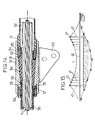
- the housing 50 In the fixing device shown in FIG. 14, the housing 50, generally cylindrical in shape, is crossed by an axial frustoconical orifice 51. In the case of a hanger attachment collar, a rib 52 is welded outside the cylindrical housing 50 to receive a yoke fixed at the end top of the hanger.
- the cylindrical housing 50 further comprises two internal threads 53, 54 on either side of the frustoconical orifice 51.
- the thread 53 is formed at the periphery of a cylindrical recess 55 formed above the orifice frustoconical 51 (to the left of Figure 13).
- This orifice 55 receives the end lower of a sheath element 56, provided with a radial shoulder 57.
- a nut 58 externally threaded bears against the shoulder 57 and cooperates with the thread 53 to connect the sheath element 56 to the housing 50.
- the thread 54 is formed at the periphery of another recess cylindrical 60 formed below the frustoconical orifice 51.
- This thread 54 receives a complementary external thread 61 formed at one end upper of another section of sheath 62 in order to connect this section of sheath 62 in case 50.
- the sheath sections 56, 62 extend between two consecutive collars on the carrying cable.
- the sheath sections 62 connected on the sides lower housings 50 have a diameter slightly greater than that of sheath sections 56 connected on the upper sides of the housings.
- These two sheath sections 56, 62 overlap over a certain length in the interval between two collars. This telescopic overlap allows shorten the sheath between the collars to facilitate mounting, and allow differential expansions between materials.
- the frustoconical orifice 51 of the housing 50 receives a frustoconical jaw complementary 64 which performs the wedging between the cable and the housing.
- the jaw 64 can be made up of several sectors separate angles, for example three in number.
- the jaw 64 is stressed by a nut 65 provided with a thread exterior cooperating with thread 54.
- the nut 65 is screwed into the recess 60 in order to push the jaw 64 towards the end upper of smaller diameter of the frustoconical orifice 51.
- the jaw 64 is thus finds it compressed longitudinally between its frustoconical interface with the housing 50 and its rear end urged by the nut 65.
- the fixing device according to FIG. 14 is always in safety condition, due to self-wedging operation including in cases where there may be a slight upward movement of the hanger.
- the assembly is also self-wedging in case of overload accidental on the hanger.
- the force transmission nut 65 is tightened by means of a tool suitable, such as a hook wrench, to a predefined torque to ensure sufficient tightening between cable 1 and housing 50.
- the tightening efficiency can be increased by filling gaps between strands with inserts curvilinear plastic (see EP-A-0 789 110).
- inserts curvilinear plastic see EP-A-0 789 110.
- the frustoconical jaw 64 can be produced plastic, for example HDPE or polyamide, and the volume it occupies is confined.
- nut 65 has a configuration suitable also for preventing the creep of the jaw material.
- FIG 15 schematically illustrates a suspension bridge having one or more several carrying cables 1 equipped with fixing devices according to the invention.
- the carrying cable 1 is anchored at both ends of the bridge, and it passes over pylons 40.
- Lines 41 are hung on the carrying cable for support the deck 42 of the bridge.
- the lines 41 are fixed to the carrying cable at their upper ends which are attached to housings 43 forming part fixing devices of the type described above. These devices prevent the vertical lines 41 from sliding along the cable under the effect of the component parallel to the cable of the load exerted vertically by the deck 42.
- the building element connected to the housing 43 can be directly a portion secured to the deck.
- the carrying cable 1 is deflected at the top of the pylons 40, where the tensile force may be asymmetrical. We can therefore be led to block the cable to prevent it from sliding relative to the pylons. For that, we install at the top of the pylons 40 of the boxes 44 which surround the cable 1 to block this with respect to the pylons as previously described.
Landscapes
- Architecture (AREA)
- Civil Engineering (AREA)
- Structural Engineering (AREA)
- Engineering & Computer Science (AREA)
- Bridges Or Land Bridges (AREA)
- Installation Of Indoor Wiring (AREA)
- Suspension Of Electric Lines Or Cables (AREA)
- Joining Of Building Structures In Genera (AREA)
- Mutual Connection Of Rods And Tubes (AREA)
- Laying Of Electric Cables Or Lines Outside (AREA)
- Flexible Shafts (AREA)
- Supports For Pipes And Cables (AREA)
- Details Of Connecting Devices For Male And Female Coupling (AREA)
- Multi-Conductor Connections (AREA)
- Ropes Or Cables (AREA)
Description
- la figure 1 est un schéma de principe, en coupe longitudinale, d'un dispositif de fixation selon la présente invention ;
- les figures 2 à 5 sont des schémas en coupe transversale de différents modes de réalisation du dispositif de la figure 1 et la figure 6 est un schéma d'un dispositif non revendiqué ;
- la figure 7 est un schéma en coupe longitudinale, suivant le plan VII-VII indiqué sur la figure 8, d'un autre exemple de dispositif de fixation selon l'invention ;
- la figure 8 est un schéma en coupe transversale de ce dispositif, suivant le plan VIII-VIII indiqué sur la figure 7 ;
- les figures 9 à 12 sont des schémas en coupe longitudinale d'autres exemples de dispositifs de fixation ;
- la figure 13 est un schéma en élévation d'une autre variante de réalisation ;
- la figure 14 est une vue en coupe longitudinale d'une autre variante de réalisation d'un dispositif selon l'invention ; et
- la figure 15 est un schéma d'un pont suspendu selon l'invention.
- on découpe les tronçons de gaine 56, 62, et on soude à leurs extrémités les pièces de raccordement comportant les rebords 57 et les filetages 61 ;
- on découpe à la longueur exacte les torons constitutifs du câble 1 ;
- on marque précisément sur les torons la position de chaque boítier 50 pour l'accrochage des suspentes 41 et/ou la pose au sommet des pylônes 40 ;
- on enfile autour du câble les tronçons de gaine 56, 62, les écrous 58, 65, les mors 64, les boítiers 50 et les cales optionnelles 66, dans l'ordre approprié depuis une extrémité du câble ou les deux ;
- on amène chaque boítier 50 à l'emplacement spécifié sur le câble et après avoir engagé le mors 64 dans son orifice 51, on l'enfonce en appliquant le serrage requis au moyen de l'écrou 65 ;
- après avoir serré l'écrou 65, on engage l'extrémité de l'élément de gaine 56 et la cale optionnelle 66 dans l'évidement 55, et on raccorde cet élément de gaine 56 au boítier 50 au moyen de l'écrou 58 ; sur le côté opposé du boítier 50, on engage également l'élément de gaine 62 en vissant son extrémité filetée 61 dans l'évidement 60 ;
- après avoir mis en place tous les boítiers de cette manière, on installe le câble en position sur les pylônes, et on procède aux ancrages des extrémités des torons puis à l'accrochage des suspentes.
Claims (27)
- Dispositif de fixation entre un élément de construction (40, 41) et un câble de structure (1), comprenant un boítier rigide (2 ; 16 ; 50) destiné à être relié à l'élément de construction et entourant le câble, une structure de coincement (3 ; 54) disposée entre le câble et le boítier, et des moyens (4.13.14 ; 17.18.21,22 ; 65) de transmission d'effort agencés pour exercer un effort de compression longitudinale (F), parallèlement au câble, sur la structure de coincement, la structure de coincement étant pressée contre le câble et le boítier sous l'action de l'effort de compression longitudinale, de façon à offrir une résistance au mouvement du boítier et de l'élément de construction parallèlement au câble, caractérisé en ce que le boítier est une pièce monobloc qui entoure complètement un tronçon du câble.
- Dispositif selon la revendication 1, dans lequel la structure de coincement (3) comprend au moins un matériau déformable.
- Dispositif selon la revendication 2, dans lequel la structure de coincement comprend plusieurs tronçons en matériau déformabie (3c, 3d, 3e) disposés le long de la direction longitudinale et séparés par des inserts (15) s'étendant radialement entre le câble (1) et le boítier (2).
- Dispositif selon la revendication 1, dans lequel la structure de coincement comprend un mors tronconique (64) engagé dans un orifice tronconique complémentaire (51) formé à l'intérieur du boítier (50), et les moyens (65) de transmission d'effort sont appliqués contre l'extrémité de plus grange section du mors tronconique afin de solliciter le mors en direction de l'extrémité de plus petite section de l'orifice tronconique.
- Dispositif selon la revendication 4, dans lequel une extrémité seulement du boítier (50) présente un orifice tronconique (51) recevant un mors (64) sollicité en direction de l'extrémité opposée du boítier.
- Dispositif selon la revendication 4 ou 5, dans lequel le mors (64) est en matière plastique.
- Dispositif selon l'une quelconque des revendications 4 à 6, comprenant au moins une cale (66) appliquée contre l'extrémité de plus petite section du mors tronconique (64).
- Dispositif selon l'une quelconque des revendications 1 à 7, dans lequel le boítier est pourvu de moyens (53, 54) de raccordement continu d'une gaine extérieure (56, 62) entourant le câble (1).
- Dispositif selon la revendication 8, dans lequel lesdits moyens de raccordement comprennent d'une part un premier filetage intérieur (53) formé à une première extrémité du boítier pour recevoir une extrémité d'un premier tronçon de gaine (56) et un écrou fileté extérieurement (58) pour la fixation dudit premier tronçon de gaine au boítier, et d'autre part un second filetage intérieur (54) formé à une extrémité opposée du boítier pour recevoir une extrémité filetée extérieurement (61) d'un second tronçon de gaine (62).
- Dispositif selon l'une quelconque des revendications 1 à 9 dans lequel les moyens de transmission d'effort comprennent au moins un organe (13 ; 21) s'étendant parallèlement au câble (1), mis en tension par des moyens de serrage (14 ; 22) pour exercer l'effort de compression longitudinale aux extrémités de la structure de coincement (3).
- Dispositif selon la revendication 10, dans lequel ledit organe (13) passe à travers la structure de coincement (3).
- Dispositif selon la revendication 10, dans lequel ledit organe passe autour de la structure de coincement (3), à travers ou à l'extérieur du boítier (2).
- Dispositif selon l'une quelconque des revendications 1 à 9, dans lequel les moyens de transmission d'effort comprennent au moins un écrou (65) vissé dans un filetage (54) solidaire du boítier (50) et appliqué contre une extrémité de la structure de coincement (64).
- Dispositif selon l'une quelconque des revendications 1 à 9, dans lequel les moyens (27,28 ; 32,35,36) de transmission d'effort sont agencés pour transformer une composante longitudinale (CL) de la charge exercée sur le câble (1) par l'élément de construction en une compression longitudinale de la structure de coincement (3).
- Dispositif selon la revendication 14, dans lequel les moyens de transmission d'effort comprennent une butée (27) fixée au câble, contre laquelle une première extrémité de la structure de coincement (3) prend appui, et une partie (28) solidaire du boítier (29) prenant appui contre une seconde extrémité de la structure de coincement opposée à la première extrémité, la composante longitudinale (CL) de la charge exercée sur le câble par l'élément de construction étant dirigée de la seconde extrémité vers la première extrémité.
- Dispositif selon la revendication 14, dans lequel le boítier (34) présente un rebord interne (35) contre lequel une première extrémité de la structure de coincement (3) prend appui, et dans lequel les moyens de transmission d'effort comprennent un levier (32) articulé sur une partie (33) solidaire du boítier, par l'intermédiaire duquel l'élément de construction (31) est relié au boítier, et un organe de transmission (35) prenant appui contre une seconde extrémité de la structure de coincement opposée à la première extrémité et sur lequel une portion du levier applique l'effort de compression longitudinale en réponse à la charge exercée par l'élément de construction.
- Dispositif selon l'une quelconque des revendications 1 à 16, dans lequel un tissu de fibres de verre est interposé entre le câble (1) et la structure de coincement et/ou entre des torons constitutifs du câble.
- Dispositif selon l'une quelconque des revendications 1 à 17, dans lequel le câble (1) est protégé par au moins une gaine (8) en matière plastique. et dans lequel une couche rigide intermédiaire (24, 26) est disposée entre la structure de coincement (3) et la gaine du câble.
- Dispositif selon la revendication 18, dans lequel la structure de coincement (3) est déformable, et dans lequel la couche intermédiaire (24) présente, vers la structure de coincement déformable (3), des reliefs (25) transversaux à la direction du câble (1).
- Dispositif selon la revendication 18, dans lequel la couche rigide intermédiaire (26) est pourvue d'un rebord radial externe (26a) contre lequel est appliquée une première extrémité de la structure de coincement (3), dans lequel ledit rebord de la couche rigide intermédiaire est en butée axiale contre un rebord radial interne (17) du boítier (16), et dans lequel les moyens de transmission d'effort comprennent des moyens (18, 19, 21, 22) pour comprimer la structure de coincement en sollicitant en direction desdits rebords une seconde extrémité de la structure de coincement opposée à la première extrémité.
- Procédé de fixation d'un élément de construction (41) à un câble de structure (1), dans lequel on dispose autour du câble un boítier rigide (2 ; 16 ; 50) destiné à transmettre au câble une charge de l'élément de construction, le boítier rigide consistant en une pièce monobloc qui entoure complètement un tronçon du câble, on place une structure de coincement (3 ; 64) entre le câble et le boítier, et on comprime la structure de coincement longitudinalement, parallèlement au câble, avant d'appliquer la charge de l'élément de construction, afin que la structure de coincement soit pressée contre le câble et le boítier de façon à offrir une résistance au mouvement du boítier et de l'élément de construction parallèlement au câble.
- Procédé de fixation d'un câble de structure (1) à un élément de construction (40), dans lequel on dispose autour du câble un boítier rigide (2 ; 16 ; 50) destiné à appliquer à l'élément de construction une charge transmise par le câble, le boítier rigide consistant en une pièce monobloc qui entoure complètement un tronçon du câble, on place une structure de coincement (3 ; 64) entre le câble et le boítier, et on comprime la structure de coincement longitudinalement, parallèlement au câble, avant d'appliquer la charge, afin que la structure de coincement soit pressée contre le câble et le boítier de façon à offrir une résistance au mouvement du câble par rapport au boítier et à l'élément de construction.
- Procédé selon la revendication 21 ou 22, dans lequel la structure de coincement (3) comprend au moins un matériau déformable.
- Procédé selon la revendication 21 ou 22, dans lequel la structure de coincement comprend un mors tronconique (64) qu'on engage dans un orifice tronconique complémentaire (51) formé à l'intérieur du boítier (50), et dans lequel on comprime longitudinalement le mors tronconique en appliquant à son extrémité de plus grande section un effort d'enfoncement en direction de l'extrémité de plus petite section de l'orifice tronconique.
- Procédé selon la revendication 24, dans lequel on engage un mors (64) par une extrémité seulement du boítier (50), le mors étant sollicité en direction de l'extrémité opposée du boítier.
- Pont suspendu, comprenant au moins un câble porteur (1) et des éléments de construction pour soutenir un tablier du pont, certains au moins des éléments de construction (40,41) étant fixés par rapport au câble porteur au moyen de dispositifs selon l'une quelconque des revendications 1 à 20.
- Pont suspendu selon la revendication 26, dans lequel les éléments de construction fixés par rapport au câble porteur (1) au moyen desdits dispositifs comprennent des sommets de pylônes (40) du pont où le câble porteur est dévié, et/ou des suspentes (41) reliées au tablier du pont, et/ou des portions du tablier du pont.
Priority Applications (2)
| Application Number | Priority Date | Filing Date | Title |
|---|---|---|---|
| EP99961108A EP1144760B1 (fr) | 1998-12-24 | 1999-12-20 | Dispositif et procede de fixation entre un element de construction et un cable de structure |
| EP02026161A EP1284324B1 (fr) | 1998-12-24 | 1999-12-20 | Dispositif et procédé de fixation entre un element de construction et un cable de structure, et pont suspendu comportant de tels dispositifs |
Applications Claiming Priority (6)
| Application Number | Priority Date | Filing Date | Title |
|---|---|---|---|
| FR9816448 | 1998-12-24 | ||
| FR9816448 | 1998-12-24 | ||
| EP99401563A EP1013830A1 (fr) | 1998-12-24 | 1999-06-23 | Dispositif et procédé de fixation entre un element de construction et un cable de structure, et pont suspendu comportant de tels dispositifs |
| EP99401563 | 1999-06-23 | ||
| EP99961108A EP1144760B1 (fr) | 1998-12-24 | 1999-12-20 | Dispositif et procede de fixation entre un element de construction et un cable de structure |
| PCT/FR1999/003200 WO2000039401A1 (fr) | 1998-12-24 | 1999-12-20 | Dispositif et procede de fixation entre un element de construction et un cable de structure |
Related Child Applications (1)
| Application Number | Title | Priority Date | Filing Date |
|---|---|---|---|
| EP02026161A Division EP1284324B1 (fr) | 1998-12-24 | 1999-12-20 | Dispositif et procédé de fixation entre un element de construction et un cable de structure, et pont suspendu comportant de tels dispositifs |
Publications (2)
| Publication Number | Publication Date |
|---|---|
| EP1144760A1 EP1144760A1 (fr) | 2001-10-17 |
| EP1144760B1 true EP1144760B1 (fr) | 2003-03-19 |
Family
ID=9534512
Family Applications (3)
| Application Number | Title | Priority Date | Filing Date |
|---|---|---|---|
| EP99401563A Withdrawn EP1013830A1 (fr) | 1998-12-24 | 1999-06-23 | Dispositif et procédé de fixation entre un element de construction et un cable de structure, et pont suspendu comportant de tels dispositifs |
| EP99961108A Expired - Lifetime EP1144760B1 (fr) | 1998-12-24 | 1999-12-20 | Dispositif et procede de fixation entre un element de construction et un cable de structure |
| EP02026161A Expired - Lifetime EP1284324B1 (fr) | 1998-12-24 | 1999-12-20 | Dispositif et procédé de fixation entre un element de construction et un cable de structure, et pont suspendu comportant de tels dispositifs |
Family Applications Before (1)
| Application Number | Title | Priority Date | Filing Date |
|---|---|---|---|
| EP99401563A Withdrawn EP1013830A1 (fr) | 1998-12-24 | 1999-06-23 | Dispositif et procédé de fixation entre un element de construction et un cable de structure, et pont suspendu comportant de tels dispositifs |
Family Applications After (1)
| Application Number | Title | Priority Date | Filing Date |
|---|---|---|---|
| EP02026161A Expired - Lifetime EP1284324B1 (fr) | 1998-12-24 | 1999-12-20 | Dispositif et procédé de fixation entre un element de construction et un cable de structure, et pont suspendu comportant de tels dispositifs |
Country Status (13)
| Country | Link |
|---|---|
| US (2) | US6523207B1 (fr) |
| EP (3) | EP1013830A1 (fr) |
| JP (1) | JP3730513B2 (fr) |
| KR (1) | KR100519495B1 (fr) |
| AT (2) | ATE426064T1 (fr) |
| AU (1) | AU1783500A (fr) |
| BR (1) | BR9916832A (fr) |
| CA (1) | CA2356819C (fr) |
| DE (2) | DE69940615D1 (fr) |
| DK (2) | DK1144760T3 (fr) |
| ES (2) | ES2194539T3 (fr) |
| PT (2) | PT1144760E (fr) |
| WO (1) | WO2000039401A1 (fr) |
Cited By (1)
| Publication number | Priority date | Publication date | Assignee | Title |
|---|---|---|---|---|
| RU236779U1 (ru) * | 2025-04-22 | 2025-08-21 | Общество С Ограниченной Ответственностью Научно - Техническая Фирма "Техно - Альянс Электроникс" | Устройство для крепления электрических кабелей |
Families Citing this family (36)
| Publication number | Priority date | Publication date | Assignee | Title |
|---|---|---|---|---|
| EP1013830A1 (fr) * | 1998-12-24 | 2000-06-28 | Freyssinet International Stup | Dispositif et procédé de fixation entre un element de construction et un cable de structure, et pont suspendu comportant de tels dispositifs |
| FR2798408B1 (fr) * | 1999-09-15 | 2002-01-18 | Freyssinet Int Stup | Cable a fils paralleles pour structure d'ouvrage de construction, ancrage d'un tel cable, et procede d'ancrage |
| FR2825389B1 (fr) * | 2001-05-29 | 2008-02-01 | Baudin Chateauneuf | Ouvrage comportant une charge suspendue a un cable porteur entoure d'une gaine extrudee |
| EP1411170A1 (fr) * | 2002-10-15 | 2004-04-21 | Fatzer Ag | Tendon, notamment pour suspendre des éléments de construction et sa méthode de fabrication |
| FR2849070B1 (fr) * | 2002-12-18 | 2005-03-04 | Freyssinet Int Stup | Procede de montage d'un hauban |
| ATE458089T1 (de) * | 2003-03-24 | 2010-03-15 | Freyssinet | Kabel für bauwerke |
| DK1629154T5 (da) * | 2003-06-02 | 2008-10-27 | Freyssinet | Fremgangsmåde til forankring af paralleltrådskabler |
| RU2247190C1 (ru) * | 2003-07-09 | 2005-02-27 | Ситников Сергей Львович | Устройство усиления моста |
| FR2862073B1 (fr) * | 2003-11-12 | 2007-11-23 | Freyssinet Int Stup | Dispositif pour amortir les vibrations d'une nappe de haubans d'un ouvrage de construction et procede d'amortissement associe |
| RU2266996C2 (ru) * | 2004-03-09 | 2005-12-27 | Шестериков Владимир Иванович | Устройство усиления моста |
| US7195417B2 (en) * | 2004-07-21 | 2007-03-27 | Honeywell International, Inc. | Composite tie rod |
| FR2883376B1 (fr) * | 2005-03-17 | 2007-06-15 | Fressinet Internat Stup | Procede de detection de rupture au sein d'une structure et systeme pour la mise en oeuvre du procede |
| US20060241197A1 (en) * | 2005-04-25 | 2006-10-26 | Velsicol Chemical Corporation | Plasticizer compositions for flexible closed cell foams |
| US7415746B2 (en) * | 2005-12-01 | 2008-08-26 | Sc Solutions | Method for constructing a self anchored suspension bridge |
| ES2317743B1 (es) * | 2006-06-30 | 2010-02-05 | Tecnicas Del Pretensado Y Servicios Auxiliares, S.L. | Sistema de estanqueidad para anclajes en puentes atirantados. |
| KR100816059B1 (ko) * | 2007-03-27 | 2008-03-24 | 케이블텍 주식회사 | 케이블 댐퍼 |
| KR100930114B1 (ko) * | 2009-05-22 | 2009-12-07 | 케이블텍 주식회사 | 케이블 간격 유지 장치 |
| KR101066997B1 (ko) | 2009-05-26 | 2011-09-22 | 주식회사 두배시스템 | 신축성 시그널 케이블 어셈블리 및 이를 구비한 지반 조사용 로드 어셈블리 |
| CN101787676B (zh) * | 2010-02-08 | 2011-12-07 | 法尔胜集团有限公司 | 缆索内置光纤光栅应变传感器的安装方法 |
| FR2968681B1 (fr) * | 2010-12-08 | 2015-05-29 | Soletanche Freyssinet | Dispositif de deviation d'un cable de structure tel qu'un hauban, et ouvrage ainsi equipe |
| FR2973818B1 (fr) * | 2011-04-07 | 2017-06-02 | Soletanche Freyssinet | Procede et dispositif de protection de l'extremite d'un cable ancre |
| US8474219B2 (en) | 2011-07-13 | 2013-07-02 | Ultimate Strength Cable, LLC | Stay cable for structures |
| US20120260590A1 (en) * | 2011-04-12 | 2012-10-18 | Lambert Walter L | Parallel Wire Cable |
| CN103078207B (zh) * | 2012-12-28 | 2015-04-22 | 泰州市航宇电器有限公司 | 一种具有螺钉防脱屏蔽线夹机构的圆形连接器插头 |
| GB2514621B (en) * | 2013-05-31 | 2020-04-15 | Vsl Int Ag | Cable anchorage |
| CN105507148A (zh) * | 2014-09-26 | 2016-04-20 | 上海建科预应力技术工程有限公司 | 一种悬索桥的索夹与吊杆的连接结构 |
| CH710269A2 (de) * | 2014-10-17 | 2016-04-29 | Fatzer Ag Drahtseilfabrik | Vorspannlitze, insbesondere für statische Verbauungen. |
| CN104594179B (zh) * | 2015-02-06 | 2016-06-08 | 中建三局集团有限公司 | 一种纵向双吊杆自锚式叠合梁悬索桥吊杆张力的控制方法 |
| CN105421231B (zh) * | 2015-12-25 | 2017-03-15 | 招商局重庆交通科研设计院有限公司 | 桥梁用cfrp筋拉索群锚锚具及制作工艺 |
| CN105972015B (zh) * | 2016-07-29 | 2017-12-29 | 温岭市锦鹏日用品有限公司 | 一种托架承载锁定组件 |
| CN106015857B (zh) * | 2016-07-29 | 2017-12-26 | 浦江升广科技有限责任公司 | 一种安全托架承载锁定组件 |
| US11248676B2 (en) * | 2018-06-07 | 2022-02-15 | Preformed Line Products Co. | Vibration damper |
| CN112411376B (zh) * | 2020-12-07 | 2022-09-30 | 柳州市邱姆预应力机械有限公司 | 拉索抗滑装置及其安装方法 |
| CN113718664B (zh) * | 2021-09-15 | 2023-03-03 | 中铁一局集团有限公司 | 一种不等跨钢箱梁斜拉桥跨营业线盖梁顶转体施工方法 |
| CN114941288B (zh) * | 2022-03-16 | 2023-05-09 | 中铁九桥工程有限公司 | 一种悬索桥散索套施工方法 |
| CN119800847B (zh) * | 2025-01-08 | 2025-10-17 | 中交第二航务工程局有限公司 | 一种非对称索力张拉快速固定装置及使用方法 |
Family Cites Families (20)
| Publication number | Priority date | Publication date | Assignee | Title |
|---|---|---|---|---|
| US440490A (en) * | 1890-11-11 | Construction of bridges | ||
| US511605A (en) * | 1893-12-26 | Frederick | ||
| US1293383A (en) * | 1917-07-20 | 1919-02-04 | Warren S Eaton | Cable-coupling. |
| AT126831B (de) * | 1929-10-17 | 1932-02-10 | Felten & Guilleaume Carlswerk | Verfahren und Vorrichtung zur Herabsetzung der Dehnung bei Drahtseilen. |
| US1811154A (en) * | 1930-01-10 | 1931-06-23 | Williamsport Wire Rope Company | Fitting for light duty suspension hangers |
| US2057328A (en) * | 1933-11-16 | 1936-10-13 | Cordova Joaquin Pedrero | Sectional cable suspension assembly |
| US2011168A (en) * | 1934-05-01 | 1935-08-13 | Roeblings John A Sons Co | Suspension bridge |
| DE869977C (de) * | 1942-03-13 | 1953-03-09 | Gutehoffnungshuette Oberhausen | Schelle, insbesondere zum Verbinden der Haengeseile mit den Tragseilen bei Haengebruecken od. dgl. |
| US2748407A (en) * | 1951-12-26 | 1956-06-05 | Bethlehem Steel Corp | Wedge fillers for suspension bridge cables |
| US3531811A (en) * | 1968-10-15 | 1970-10-06 | Bethlehem Steel Corp | Method for erecting parallel-wire bridge strand |
| DE3114532C1 (de) * | 1981-04-10 | 1982-11-04 | Willy Habegger AG, 3600 Thun | Haengebruecke |
| DE3138819C2 (de) * | 1981-09-30 | 1986-10-23 | Dyckerhoff & Widmann AG, 8000 München | Verfahren zur Montage eines zwischen seinen Verankerungsstellen frei gespannt verlaufenden Zuggliedes, insbesondere eines Schrägkabels für eine Schrägkabelbrücke |
| DE3434620A1 (de) * | 1984-09-21 | 1986-04-03 | Dyckerhoff & Widmann AG, 8000 München | Abstuetzung eines freien zugglieds, vorzugsweise eines schraegseils einer schraegseilbruecke |
| DE29506476U1 (de) * | 1995-04-15 | 1996-08-14 | Dyckerhoff & Widmann AG, 81902 München | Vorrichtung zur Verwendung beim Einführen der einzelnen Zugelemente eines frei gespannten Zugglieds |
| FR2739113B1 (fr) * | 1995-09-26 | 1997-12-05 | Freyssinet Int Stup | Toron individuellement protege pour ouvrage de genie civil suspendu, ouvrage incluant de tels torons, et procede de fabrication |
| FR2744467B1 (fr) * | 1996-02-06 | 1998-04-03 | Freyssinet Int Stup | Dispositif de suspension pour ouvrage de genie civil et procede de construction |
| US6138309A (en) * | 1997-12-10 | 2000-10-31 | Board Of Regents Of University Of Nebraska | Tension members for erecting structures |
| FR2780127B1 (fr) * | 1998-06-19 | 2000-09-08 | Freyssinet Int Stup | Procede et dispositif d'accrochage d'un element transmetteur de charge sur un cable, et pont suspendu comportant de tels dispositifs |
| EP1013830A1 (fr) * | 1998-12-24 | 2000-06-28 | Freyssinet International Stup | Dispositif et procédé de fixation entre un element de construction et un cable de structure, et pont suspendu comportant de tels dispositifs |
| US6292967B1 (en) * | 1999-09-14 | 2001-09-25 | Construction Technology Laboratories, Inc. | TMD-damped stay cable and method and TMD |
-
1999
- 1999-06-23 EP EP99401563A patent/EP1013830A1/fr not_active Withdrawn
- 1999-12-20 BR BR9916832-4A patent/BR9916832A/pt not_active IP Right Cessation
- 1999-12-20 DK DK99961108T patent/DK1144760T3/da active
- 1999-12-20 CA CA002356819A patent/CA2356819C/fr not_active Expired - Fee Related
- 1999-12-20 EP EP99961108A patent/EP1144760B1/fr not_active Expired - Lifetime
- 1999-12-20 PT PT99961108T patent/PT1144760E/pt unknown
- 1999-12-20 US US09/869,225 patent/US6523207B1/en not_active Expired - Lifetime
- 1999-12-20 DE DE69940615T patent/DE69940615D1/de not_active Expired - Lifetime
- 1999-12-20 KR KR10-2001-7008151A patent/KR100519495B1/ko not_active Expired - Fee Related
- 1999-12-20 AU AU17835/00A patent/AU1783500A/en not_active Abandoned
- 1999-12-20 ES ES99961108T patent/ES2194539T3/es not_active Expired - Lifetime
- 1999-12-20 JP JP2000591281A patent/JP3730513B2/ja not_active Expired - Fee Related
- 1999-12-20 AT AT02026161T patent/ATE426064T1/de not_active IP Right Cessation
- 1999-12-20 EP EP02026161A patent/EP1284324B1/fr not_active Expired - Lifetime
- 1999-12-20 DE DE69906145T patent/DE69906145T2/de not_active Expired - Lifetime
- 1999-12-20 ES ES02026161T patent/ES2324397T3/es not_active Expired - Lifetime
- 1999-12-20 AT AT99961108T patent/ATE234968T1/de not_active IP Right Cessation
- 1999-12-20 WO PCT/FR1999/003200 patent/WO2000039401A1/fr not_active Ceased
- 1999-12-20 PT PT02026161T patent/PT1284324E/pt unknown
- 1999-12-20 DK DK02026161T patent/DK1284324T3/da active
-
2002
- 2002-12-12 US US10/317,294 patent/US6715176B2/en not_active Expired - Fee Related
Cited By (1)
| Publication number | Priority date | Publication date | Assignee | Title |
|---|---|---|---|---|
| RU236779U1 (ru) * | 2025-04-22 | 2025-08-21 | Общество С Ограниченной Ответственностью Научно - Техническая Фирма "Техно - Альянс Электроникс" | Устройство для крепления электрических кабелей |
Also Published As
| Publication number | Publication date |
|---|---|
| WO2000039401A1 (fr) | 2000-07-06 |
| EP1144760A1 (fr) | 2001-10-17 |
| US6715176B2 (en) | 2004-04-06 |
| ATE426064T1 (de) | 2009-04-15 |
| DK1284324T3 (da) | 2009-07-20 |
| CA2356819A1 (fr) | 2000-07-06 |
| JP2002533595A (ja) | 2002-10-08 |
| DE69940615D1 (de) | 2009-04-30 |
| ATE234968T1 (de) | 2003-04-15 |
| PT1284324E (pt) | 2009-07-14 |
| PT1144760E (pt) | 2003-08-29 |
| ES2194539T3 (es) | 2003-11-16 |
| BR9916832A (pt) | 2001-09-25 |
| EP1284324A2 (fr) | 2003-02-19 |
| EP1013830A1 (fr) | 2000-06-28 |
| US20030086755A1 (en) | 2003-05-08 |
| ES2324397T3 (es) | 2009-08-06 |
| DK1144760T3 (da) | 2003-07-21 |
| KR20010086155A (ko) | 2001-09-08 |
| DE69906145T2 (de) | 2004-02-05 |
| DE69906145D1 (de) | 2003-04-24 |
| KR100519495B1 (ko) | 2005-10-07 |
| AU1783500A (en) | 2000-07-31 |
| JP3730513B2 (ja) | 2006-01-05 |
| CA2356819C (fr) | 2006-12-19 |
| EP1284324B1 (fr) | 2009-03-18 |
| EP1284324A3 (fr) | 2003-02-26 |
| US6523207B1 (en) | 2003-02-25 |
Similar Documents
| Publication | Publication Date | Title |
|---|---|---|
| EP1144760B1 (fr) | Dispositif et procede de fixation entre un element de construction et un cable de structure | |
| EP1131512B1 (fr) | Dispositif d'ancrage pour fixer un cable de structure a un element de construction | |
| EP1181422B1 (fr) | Dispositif d'ancrage d'un cable de structure | |
| CA2301102C (fr) | Procede et dispositif d'accrochage d'un element transmetteur de charge sur un cable, et pont suspendu comportant de tels dispositifs | |
| EP0323285B2 (fr) | Perfectionnements aux ensembles constitués par un hauban et sa structure d'ancrage | |
| BE1015078A5 (fr) | Methode de suspension d'outillage. | |
| FR2729230A1 (fr) | Dispositif de fixation, de reprise de masse et d'etancheite pour cable optique | |
| EP0855471B1 (fr) | Toron individuellement protégé pour ouvrage de génie civil suspendu, ouvrage incluant de tels torons, et procédé de fabrication | |
| EP1131492B1 (fr) | Systeme de connexion d'un cable a une structure d'ouvrage de construction | |
| EP1561049A1 (fr) | Dispositif d'ancrage sur paroi pour la fixation d'elements de nature quelconque | |
| FR2791373A1 (fr) | Dispositif pour fixer un cable de structure a un element de construction | |
| EP0597765B1 (fr) | Boîte d'encastrement pour suspension d'un lustre à un plafond | |
| EP0221817A2 (fr) | Dispositif d'agrafage pour la jonction des courroies, procédé de jonctionnement utilisant ce dispositif et courroie jonctionnée selon ce procédé | |
| FR2707435A1 (fr) | Dispositif d'ancrage pour câble aérien autoporté. | |
| FR2555832A1 (fr) | Dispositif de traction controlee pour la fixation de cables aeriens sur pylones | |
| FR2783645A1 (fr) | Dispositif d'ancrage pour ligne aerienne | |
| FR2575498A1 (fr) | Dispositif d'ancrage de cables, notamment de haubans de ponts | |
| FR2484584A1 (fr) | Dispositif de serrage pour cable de haubanage a plusieurs torons | |
| FR2563385A3 (fr) | Manchon de protection pour la suspension de faisceaux de cables relativement fragiles | |
| FR2922978A1 (fr) | Serre cable anti-torsion | |
| FR3055644A1 (fr) | Dispositif de fixation d'un organe d'ancrage de securite sur une couverture d'une toiture d'un batiment | |
| FR2590959A1 (fr) | Presse-etoupe adaptable a la traversee d'une cloison par une canalisation cylindrique | |
| FR2571556A1 (fr) | Dispositif pour hisser un cable du sol a son point d'ancrage sur un pylone | |
| FR2730318A1 (fr) | Dispositif d'extremite pour cable optique | |
| FR2642449A1 (fr) | Perfectionnements aux ponts a haubans et plus particulierement a leurs pylones et haubans |
Legal Events
| Date | Code | Title | Description |
|---|---|---|---|
| PUAI | Public reference made under article 153(3) epc to a published international application that has entered the european phase |
Free format text: ORIGINAL CODE: 0009012 |
|
| 17P | Request for examination filed |
Effective date: 20010611 |
|
| AK | Designated contracting states |
Kind code of ref document: A1 Designated state(s): AT BE CH CY DE DK ES FI FR GB GR IE IT LI LU MC NL PT SE |
|
| AX | Request for extension of the european patent |
Free format text: AL;LT;LV;MK;RO;SI |
|
| GRAH | Despatch of communication of intention to grant a patent |
Free format text: ORIGINAL CODE: EPIDOS IGRA |
|
| GRAH | Despatch of communication of intention to grant a patent |
Free format text: ORIGINAL CODE: EPIDOS IGRA |
|
| GRAA | (expected) grant |
Free format text: ORIGINAL CODE: 0009210 |
|
| AK | Designated contracting states |
Designated state(s): AT BE CH CY DE DK ES FI FR GB GR IE IT LI LU MC NL PT SE |
|
| PG25 | Lapsed in a contracting state [announced via postgrant information from national office to epo] |
Ref country code: NL Free format text: LAPSE BECAUSE OF FAILURE TO SUBMIT A TRANSLATION OF THE DESCRIPTION OR TO PAY THE FEE WITHIN THE PRESCRIBED TIME-LIMIT Effective date: 20030319 Ref country code: IT Free format text: LAPSE BECAUSE OF FAILURE TO SUBMIT A TRANSLATION OF THE DESCRIPTION OR TO PAY THE FEE WITHIN THE PRESCRIBED TIME-LIMIT;WARNING: LAPSES OF ITALIAN PATENTS WITH EFFECTIVE DATE BEFORE 2007 MAY HAVE OCCURRED AT ANY TIME BEFORE 2007. THE CORRECT EFFECTIVE DATE MAY BE DIFFERENT FROM THE ONE RECORDED. Effective date: 20030319 Ref country code: IE Free format text: LAPSE BECAUSE OF FAILURE TO SUBMIT A TRANSLATION OF THE DESCRIPTION OR TO PAY THE FEE WITHIN THE PRESCRIBED TIME-LIMIT Effective date: 20030319 Ref country code: GR Free format text: LAPSE BECAUSE OF FAILURE TO SUBMIT A TRANSLATION OF THE DESCRIPTION OR TO PAY THE FEE WITHIN THE PRESCRIBED TIME-LIMIT Effective date: 20030319 Ref country code: FI Free format text: LAPSE BECAUSE OF FAILURE TO SUBMIT A TRANSLATION OF THE DESCRIPTION OR TO PAY THE FEE WITHIN THE PRESCRIBED TIME-LIMIT Effective date: 20030319 Ref country code: AT Free format text: LAPSE BECAUSE OF FAILURE TO SUBMIT A TRANSLATION OF THE DESCRIPTION OR TO PAY THE FEE WITHIN THE PRESCRIBED TIME-LIMIT Effective date: 20030319 |
|
| REG | Reference to a national code |
Ref country code: GB Ref legal event code: FG4D Free format text: NOT ENGLISH |
|
| REG | Reference to a national code |
Ref country code: CH Ref legal event code: EP |
|
| REG | Reference to a national code |
Ref country code: IE Ref legal event code: FG4D Free format text: FRENCH |
|
| REF | Corresponds to: |
Ref document number: 69906145 Country of ref document: DE Date of ref document: 20030424 Kind code of ref document: P |
|
| REG | Reference to a national code |
Ref country code: SE Ref legal event code: TRGR |
|
| GBT | Gb: translation of ep patent filed (gb section 77(6)(a)/1977) | ||
| REG | Reference to a national code |
Ref country code: DK Ref legal event code: T3 |
|
| LTIE | Lt: invalidation of european patent or patent extension |
Effective date: 20030319 |
|
| NLV1 | Nl: lapsed or annulled due to failure to fulfill the requirements of art. 29p and 29m of the patents act | ||
| REG | Reference to a national code |
Ref country code: IE Ref legal event code: FD4D Ref document number: 1144760E Country of ref document: IE |
|
| REG | Reference to a national code |
Ref country code: ES Ref legal event code: FG2A Ref document number: 2194539 Country of ref document: ES Kind code of ref document: T3 |
|
| PG25 | Lapsed in a contracting state [announced via postgrant information from national office to epo] |
Ref country code: LU Free format text: LAPSE BECAUSE OF NON-PAYMENT OF DUE FEES Effective date: 20031220 Ref country code: CY Free format text: LAPSE BECAUSE OF FAILURE TO SUBMIT A TRANSLATION OF THE DESCRIPTION OR TO PAY THE FEE WITHIN THE PRESCRIBED TIME-LIMIT Effective date: 20031220 |
|
| PG25 | Lapsed in a contracting state [announced via postgrant information from national office to epo] |
Ref country code: MC Free format text: LAPSE BECAUSE OF NON-PAYMENT OF DUE FEES Effective date: 20031231 Ref country code: LI Free format text: LAPSE BECAUSE OF NON-PAYMENT OF DUE FEES Effective date: 20031231 Ref country code: CH Free format text: LAPSE BECAUSE OF NON-PAYMENT OF DUE FEES Effective date: 20031231 |
|
| PLBE | No opposition filed within time limit |
Free format text: ORIGINAL CODE: 0009261 |
|
| STAA | Information on the status of an ep patent application or granted ep patent |
Free format text: STATUS: NO OPPOSITION FILED WITHIN TIME LIMIT |
|
| 26N | No opposition filed |
Effective date: 20031222 |
|
| REG | Reference to a national code |
Ref country code: CH Ref legal event code: PL |
|
| PGFP | Annual fee paid to national office [announced via postgrant information from national office to epo] |
Ref country code: PT Payment date: 20111205 Year of fee payment: 13 Ref country code: SE Payment date: 20111124 Year of fee payment: 13 |
|
| REG | Reference to a national code |
Ref country code: PT Ref legal event code: MM4A Free format text: LAPSE DUE TO NON-PAYMENT OF FEES Effective date: 20130620 |
|
| PG25 | Lapsed in a contracting state [announced via postgrant information from national office to epo] |
Ref country code: SE Free format text: LAPSE BECAUSE OF NON-PAYMENT OF DUE FEES Effective date: 20121221 |
|
| PG25 | Lapsed in a contracting state [announced via postgrant information from national office to epo] |
Ref country code: PT Free format text: LAPSE BECAUSE OF NON-PAYMENT OF DUE FEES Effective date: 20130620 |
|
| PGFP | Annual fee paid to national office [announced via postgrant information from national office to epo] |
Ref country code: DK Payment date: 20131121 Year of fee payment: 15 |
|
| PGFP | Annual fee paid to national office [announced via postgrant information from national office to epo] |
Ref country code: GB Payment date: 20131125 Year of fee payment: 15 Ref country code: DE Payment date: 20131121 Year of fee payment: 15 |
|
| PGFP | Annual fee paid to national office [announced via postgrant information from national office to epo] |
Ref country code: ES Payment date: 20131209 Year of fee payment: 15 Ref country code: BE Payment date: 20131121 Year of fee payment: 15 |
|
| PG25 | Lapsed in a contracting state [announced via postgrant information from national office to epo] |
Ref country code: BE Free format text: LAPSE BECAUSE OF NON-PAYMENT OF DUE FEES Effective date: 20141231 |
|
| REG | Reference to a national code |
Ref country code: DE Ref legal event code: R119 Ref document number: 69906145 Country of ref document: DE |
|
| REG | Reference to a national code |
Ref country code: DK Ref legal event code: EBP Effective date: 20141231 |
|
| GBPC | Gb: european patent ceased through non-payment of renewal fee |
Effective date: 20141220 |
|
| PG25 | Lapsed in a contracting state [announced via postgrant information from national office to epo] |
Ref country code: GB Free format text: LAPSE BECAUSE OF NON-PAYMENT OF DUE FEES Effective date: 20141220 Ref country code: DE Free format text: LAPSE BECAUSE OF NON-PAYMENT OF DUE FEES Effective date: 20150701 |
|
| REG | Reference to a national code |
Ref country code: FR Ref legal event code: PLFP Year of fee payment: 17 |
|
| REG | Reference to a national code |
Ref country code: ES Ref legal event code: FD2A Effective date: 20160126 |
|
| PG25 | Lapsed in a contracting state [announced via postgrant information from national office to epo] |
Ref country code: DK Free format text: LAPSE BECAUSE OF NON-PAYMENT OF DUE FEES Effective date: 20141231 |
|
| PG25 | Lapsed in a contracting state [announced via postgrant information from national office to epo] |
Ref country code: ES Free format text: LAPSE BECAUSE OF NON-PAYMENT OF DUE FEES Effective date: 20141221 |
|
| REG | Reference to a national code |
Ref country code: FR Ref legal event code: PLFP Year of fee payment: 18 |
|
| REG | Reference to a national code |
Ref country code: FR Ref legal event code: PLFP Year of fee payment: 19 |
|
| PGFP | Annual fee paid to national office [announced via postgrant information from national office to epo] |
Ref country code: FR Payment date: 20181127 Year of fee payment: 20 |