EP1138092B1 - Als separatoren in elektrochemischen zellen geeignete verbundkörper - Google Patents
Als separatoren in elektrochemischen zellen geeignete verbundkörper Download PDFInfo
- Publication number
- EP1138092B1 EP1138092B1 EP99955945A EP99955945A EP1138092B1 EP 1138092 B1 EP1138092 B1 EP 1138092B1 EP 99955945 A EP99955945 A EP 99955945A EP 99955945 A EP99955945 A EP 99955945A EP 1138092 B1 EP1138092 B1 EP 1138092B1
- Authority
- EP
- European Patent Office
- Prior art keywords
- polymer
- composite
- layer
- acid
- groups
- Prior art date
- Legal status (The legal status is an assumption and is not a legal conclusion. Google has not performed a legal analysis and makes no representation as to the accuracy of the status listed.)
- Expired - Lifetime
Links
- 0 *C(**c(cc1)ccc1C(c1ccccc1)=O)I=O Chemical compound *C(**c(cc1)ccc1C(c1ccccc1)=O)I=O 0.000 description 2
- GUDBPARGZHCZIX-UHFFFAOYSA-N C=CC(NCCCOC(Oc(cc1)ccc1C(c1ccccc1)=O)=O)=O Chemical compound C=CC(NCCCOC(Oc(cc1)ccc1C(c1ccccc1)=O)=O)=O GUDBPARGZHCZIX-UHFFFAOYSA-N 0.000 description 1
- LTYBJDPMCPTGEE-UHFFFAOYSA-N C=CC(Oc(cc1)ccc1C(c1ccccc1)=O)=O Chemical compound C=CC(Oc(cc1)ccc1C(c1ccccc1)=O)=O LTYBJDPMCPTGEE-UHFFFAOYSA-N 0.000 description 1
Images


Classifications
-
- H—ELECTRICITY
- H01—ELECTRIC ELEMENTS
- H01M—PROCESSES OR MEANS, e.g. BATTERIES, FOR THE DIRECT CONVERSION OF CHEMICAL ENERGY INTO ELECTRICAL ENERGY
- H01M4/00—Electrodes
- H01M4/02—Electrodes composed of, or comprising, active material
- H01M4/62—Selection of inactive substances as ingredients for active masses, e.g. binders, fillers
- H01M4/621—Binders
-
- H—ELECTRICITY
- H01—ELECTRIC ELEMENTS
- H01M—PROCESSES OR MEANS, e.g. BATTERIES, FOR THE DIRECT CONVERSION OF CHEMICAL ENERGY INTO ELECTRICAL ENERGY
- H01M50/00—Constructional details or processes of manufacture of the non-active parts of electrochemical cells other than fuel cells, e.g. hybrid cells
- H01M50/40—Separators; Membranes; Diaphragms; Spacing elements inside cells
- H01M50/409—Separators, membranes or diaphragms characterised by the material
- H01M50/449—Separators, membranes or diaphragms characterised by the material having a layered structure
-
- H—ELECTRICITY
- H01—ELECTRIC ELEMENTS
- H01M—PROCESSES OR MEANS, e.g. BATTERIES, FOR THE DIRECT CONVERSION OF CHEMICAL ENERGY INTO ELECTRICAL ENERGY
- H01M10/00—Secondary cells; Manufacture thereof
- H01M10/05—Accumulators with non-aqueous electrolyte
- H01M10/052—Li-accumulators
-
- H—ELECTRICITY
- H01—ELECTRIC ELEMENTS
- H01M—PROCESSES OR MEANS, e.g. BATTERIES, FOR THE DIRECT CONVERSION OF CHEMICAL ENERGY INTO ELECTRICAL ENERGY
- H01M50/00—Constructional details or processes of manufacture of the non-active parts of electrochemical cells other than fuel cells, e.g. hybrid cells
- H01M50/40—Separators; Membranes; Diaphragms; Spacing elements inside cells
- H01M50/403—Manufacturing processes of separators, membranes or diaphragms
-
- H—ELECTRICITY
- H01—ELECTRIC ELEMENTS
- H01M—PROCESSES OR MEANS, e.g. BATTERIES, FOR THE DIRECT CONVERSION OF CHEMICAL ENERGY INTO ELECTRICAL ENERGY
- H01M50/00—Constructional details or processes of manufacture of the non-active parts of electrochemical cells other than fuel cells, e.g. hybrid cells
- H01M50/40—Separators; Membranes; Diaphragms; Spacing elements inside cells
- H01M50/409—Separators, membranes or diaphragms characterised by the material
- H01M50/411—Organic material
- H01M50/414—Synthetic resins, e.g. thermoplastics or thermosetting resins
-
- H—ELECTRICITY
- H01—ELECTRIC ELEMENTS
- H01M—PROCESSES OR MEANS, e.g. BATTERIES, FOR THE DIRECT CONVERSION OF CHEMICAL ENERGY INTO ELECTRICAL ENERGY
- H01M50/00—Constructional details or processes of manufacture of the non-active parts of electrochemical cells other than fuel cells, e.g. hybrid cells
- H01M50/40—Separators; Membranes; Diaphragms; Spacing elements inside cells
- H01M50/409—Separators, membranes or diaphragms characterised by the material
- H01M50/411—Organic material
- H01M50/414—Synthetic resins, e.g. thermoplastics or thermosetting resins
- H01M50/417—Polyolefins
-
- H—ELECTRICITY
- H01—ELECTRIC ELEMENTS
- H01M—PROCESSES OR MEANS, e.g. BATTERIES, FOR THE DIRECT CONVERSION OF CHEMICAL ENERGY INTO ELECTRICAL ENERGY
- H01M50/00—Constructional details or processes of manufacture of the non-active parts of electrochemical cells other than fuel cells, e.g. hybrid cells
- H01M50/40—Separators; Membranes; Diaphragms; Spacing elements inside cells
- H01M50/409—Separators, membranes or diaphragms characterised by the material
- H01M50/411—Organic material
- H01M50/414—Synthetic resins, e.g. thermoplastics or thermosetting resins
- H01M50/426—Fluorocarbon polymers
-
- H—ELECTRICITY
- H01—ELECTRIC ELEMENTS
- H01M—PROCESSES OR MEANS, e.g. BATTERIES, FOR THE DIRECT CONVERSION OF CHEMICAL ENERGY INTO ELECTRICAL ENERGY
- H01M50/00—Constructional details or processes of manufacture of the non-active parts of electrochemical cells other than fuel cells, e.g. hybrid cells
- H01M50/40—Separators; Membranes; Diaphragms; Spacing elements inside cells
- H01M50/46—Separators, membranes or diaphragms characterised by their combination with electrodes
-
- H—ELECTRICITY
- H01—ELECTRIC ELEMENTS
- H01M—PROCESSES OR MEANS, e.g. BATTERIES, FOR THE DIRECT CONVERSION OF CHEMICAL ENERGY INTO ELECTRICAL ENERGY
- H01M50/00—Constructional details or processes of manufacture of the non-active parts of electrochemical cells other than fuel cells, e.g. hybrid cells
- H01M50/40—Separators; Membranes; Diaphragms; Spacing elements inside cells
- H01M50/489—Separators, membranes, diaphragms or spacing elements inside the cells, characterised by their physical properties, e.g. swelling degree, hydrophilicity or shut down properties
- H01M50/491—Porosity
-
- H—ELECTRICITY
- H01—ELECTRIC ELEMENTS
- H01M—PROCESSES OR MEANS, e.g. BATTERIES, FOR THE DIRECT CONVERSION OF CHEMICAL ENERGY INTO ELECTRICAL ENERGY
- H01M10/00—Secondary cells; Manufacture thereof
- H01M10/05—Accumulators with non-aqueous electrolyte
- H01M10/052—Li-accumulators
- H01M10/0525—Rocking-chair batteries, i.e. batteries with lithium insertion or intercalation in both electrodes; Lithium-ion batteries
-
- Y—GENERAL TAGGING OF NEW TECHNOLOGICAL DEVELOPMENTS; GENERAL TAGGING OF CROSS-SECTIONAL TECHNOLOGIES SPANNING OVER SEVERAL SECTIONS OF THE IPC; TECHNICAL SUBJECTS COVERED BY FORMER USPC CROSS-REFERENCE ART COLLECTIONS [XRACs] AND DIGESTS
- Y02—TECHNOLOGIES OR APPLICATIONS FOR MITIGATION OR ADAPTATION AGAINST CLIMATE CHANGE
- Y02E—REDUCTION OF GREENHOUSE GAS [GHG] EMISSIONS, RELATED TO ENERGY GENERATION, TRANSMISSION OR DISTRIBUTION
- Y02E60/00—Enabling technologies; Technologies with a potential or indirect contribution to GHG emissions mitigation
- Y02E60/10—Energy storage using batteries
-
- Y—GENERAL TAGGING OF NEW TECHNOLOGICAL DEVELOPMENTS; GENERAL TAGGING OF CROSS-SECTIONAL TECHNOLOGIES SPANNING OVER SEVERAL SECTIONS OF THE IPC; TECHNICAL SUBJECTS COVERED BY FORMER USPC CROSS-REFERENCE ART COLLECTIONS [XRACs] AND DIGESTS
- Y02—TECHNOLOGIES OR APPLICATIONS FOR MITIGATION OR ADAPTATION AGAINST CLIMATE CHANGE
- Y02P—CLIMATE CHANGE MITIGATION TECHNOLOGIES IN THE PRODUCTION OR PROCESSING OF GOODS
- Y02P70/00—Climate change mitigation technologies in the production process for final industrial or consumer products
- Y02P70/50—Manufacturing or production processes characterised by the final manufactured product
-
- Y—GENERAL TAGGING OF NEW TECHNOLOGICAL DEVELOPMENTS; GENERAL TAGGING OF CROSS-SECTIONAL TECHNOLOGIES SPANNING OVER SEVERAL SECTIONS OF THE IPC; TECHNICAL SUBJECTS COVERED BY FORMER USPC CROSS-REFERENCE ART COLLECTIONS [XRACs] AND DIGESTS
- Y10—TECHNICAL SUBJECTS COVERED BY FORMER USPC
- Y10T—TECHNICAL SUBJECTS COVERED BY FORMER US CLASSIFICATION
- Y10T428/00—Stock material or miscellaneous articles
- Y10T428/249921—Web or sheet containing structurally defined element or component
- Y10T428/249953—Composite having voids in a component [e.g., porous, cellular, etc.]
-
- Y—GENERAL TAGGING OF NEW TECHNOLOGICAL DEVELOPMENTS; GENERAL TAGGING OF CROSS-SECTIONAL TECHNOLOGIES SPANNING OVER SEVERAL SECTIONS OF THE IPC; TECHNICAL SUBJECTS COVERED BY FORMER USPC CROSS-REFERENCE ART COLLECTIONS [XRACs] AND DIGESTS
- Y10—TECHNICAL SUBJECTS COVERED BY FORMER USPC
- Y10T—TECHNICAL SUBJECTS COVERED BY FORMER US CLASSIFICATION
- Y10T428/00—Stock material or miscellaneous articles
- Y10T428/249921—Web or sheet containing structurally defined element or component
- Y10T428/249994—Composite having a component wherein a constituent is liquid or is contained within preformed walls [e.g., impregnant-filled, previously void containing component, etc.]
-
- Y—GENERAL TAGGING OF NEW TECHNOLOGICAL DEVELOPMENTS; GENERAL TAGGING OF CROSS-SECTIONAL TECHNOLOGIES SPANNING OVER SEVERAL SECTIONS OF THE IPC; TECHNICAL SUBJECTS COVERED BY FORMER USPC CROSS-REFERENCE ART COLLECTIONS [XRACs] AND DIGESTS
- Y10—TECHNICAL SUBJECTS COVERED BY FORMER USPC
- Y10T—TECHNICAL SUBJECTS COVERED BY FORMER US CLASSIFICATION
- Y10T428/00—Stock material or miscellaneous articles
- Y10T428/249921—Web or sheet containing structurally defined element or component
- Y10T428/249994—Composite having a component wherein a constituent is liquid or is contained within preformed walls [e.g., impregnant-filled, previously void containing component, etc.]
- Y10T428/249998—Indefinite plurality of similar impregnated thin sheets [e.g., "decorative laminate" type, etc.]
-
- Y—GENERAL TAGGING OF NEW TECHNOLOGICAL DEVELOPMENTS; GENERAL TAGGING OF CROSS-SECTIONAL TECHNOLOGIES SPANNING OVER SEVERAL SECTIONS OF THE IPC; TECHNICAL SUBJECTS COVERED BY FORMER USPC CROSS-REFERENCE ART COLLECTIONS [XRACs] AND DIGESTS
- Y10—TECHNICAL SUBJECTS COVERED BY FORMER USPC
- Y10T—TECHNICAL SUBJECTS COVERED BY FORMER US CLASSIFICATION
- Y10T428/00—Stock material or miscellaneous articles
- Y10T428/25—Web or sheet containing structurally defined element or component and including a second component containing structurally defined particles
- Y10T428/254—Polymeric or resinous material
-
- Y—GENERAL TAGGING OF NEW TECHNOLOGICAL DEVELOPMENTS; GENERAL TAGGING OF CROSS-SECTIONAL TECHNOLOGIES SPANNING OVER SEVERAL SECTIONS OF THE IPC; TECHNICAL SUBJECTS COVERED BY FORMER USPC CROSS-REFERENCE ART COLLECTIONS [XRACs] AND DIGESTS
- Y10—TECHNICAL SUBJECTS COVERED BY FORMER USPC
- Y10T—TECHNICAL SUBJECTS COVERED BY FORMER US CLASSIFICATION
- Y10T428/00—Stock material or miscellaneous articles
- Y10T428/31504—Composite [nonstructural laminate]
-
- Y—GENERAL TAGGING OF NEW TECHNOLOGICAL DEVELOPMENTS; GENERAL TAGGING OF CROSS-SECTIONAL TECHNOLOGIES SPANNING OVER SEVERAL SECTIONS OF THE IPC; TECHNICAL SUBJECTS COVERED BY FORMER USPC CROSS-REFERENCE ART COLLECTIONS [XRACs] AND DIGESTS
- Y10—TECHNICAL SUBJECTS COVERED BY FORMER USPC
- Y10T—TECHNICAL SUBJECTS COVERED BY FORMER US CLASSIFICATION
- Y10T428/00—Stock material or miscellaneous articles
- Y10T428/31504—Composite [nonstructural laminate]
- Y10T428/31551—Of polyamidoester [polyurethane, polyisocyanate, polycarbamate, etc.]
- Y10T428/31565—Next to polyester [polyethylene terephthalate, etc.]
-
- Y—GENERAL TAGGING OF NEW TECHNOLOGICAL DEVELOPMENTS; GENERAL TAGGING OF CROSS-SECTIONAL TECHNOLOGIES SPANNING OVER SEVERAL SECTIONS OF THE IPC; TECHNICAL SUBJECTS COVERED BY FORMER USPC CROSS-REFERENCE ART COLLECTIONS [XRACs] AND DIGESTS
- Y10—TECHNICAL SUBJECTS COVERED BY FORMER USPC
- Y10T—TECHNICAL SUBJECTS COVERED BY FORMER US CLASSIFICATION
- Y10T428/00—Stock material or miscellaneous articles
- Y10T428/31504—Composite [nonstructural laminate]
- Y10T428/31551—Of polyamidoester [polyurethane, polyisocyanate, polycarbamate, etc.]
- Y10T428/31573—Next to addition polymer of ethylenically unsaturated monomer
- Y10T428/3158—Halide monomer type [polyvinyl chloride, etc.]
-
- Y—GENERAL TAGGING OF NEW TECHNOLOGICAL DEVELOPMENTS; GENERAL TAGGING OF CROSS-SECTIONAL TECHNOLOGIES SPANNING OVER SEVERAL SECTIONS OF THE IPC; TECHNICAL SUBJECTS COVERED BY FORMER USPC CROSS-REFERENCE ART COLLECTIONS [XRACs] AND DIGESTS
- Y10—TECHNICAL SUBJECTS COVERED BY FORMER USPC
- Y10T—TECHNICAL SUBJECTS COVERED BY FORMER US CLASSIFICATION
- Y10T428/00—Stock material or miscellaneous articles
- Y10T428/31504—Composite [nonstructural laminate]
- Y10T428/31551—Of polyamidoester [polyurethane, polyisocyanate, polycarbamate, etc.]
- Y10T428/31573—Next to addition polymer of ethylenically unsaturated monomer
- Y10T428/31583—Nitrile monomer type [polyacrylonitrile, etc.]
-
- Y—GENERAL TAGGING OF NEW TECHNOLOGICAL DEVELOPMENTS; GENERAL TAGGING OF CROSS-SECTIONAL TECHNOLOGIES SPANNING OVER SEVERAL SECTIONS OF THE IPC; TECHNICAL SUBJECTS COVERED BY FORMER USPC CROSS-REFERENCE ART COLLECTIONS [XRACs] AND DIGESTS
- Y10—TECHNICAL SUBJECTS COVERED BY FORMER USPC
- Y10T—TECHNICAL SUBJECTS COVERED BY FORMER US CLASSIFICATION
- Y10T428/00—Stock material or miscellaneous articles
- Y10T428/31504—Composite [nonstructural laminate]
- Y10T428/31551—Of polyamidoester [polyurethane, polyisocyanate, polycarbamate, etc.]
- Y10T428/31573—Next to addition polymer of ethylenically unsaturated monomer
- Y10T428/31587—Hydrocarbon polymer [polyethylene, polybutadiene, etc.]
-
- Y—GENERAL TAGGING OF NEW TECHNOLOGICAL DEVELOPMENTS; GENERAL TAGGING OF CROSS-SECTIONAL TECHNOLOGIES SPANNING OVER SEVERAL SECTIONS OF THE IPC; TECHNICAL SUBJECTS COVERED BY FORMER USPC CROSS-REFERENCE ART COLLECTIONS [XRACs] AND DIGESTS
- Y10—TECHNICAL SUBJECTS COVERED BY FORMER USPC
- Y10T—TECHNICAL SUBJECTS COVERED BY FORMER US CLASSIFICATION
- Y10T428/00—Stock material or miscellaneous articles
- Y10T428/31504—Composite [nonstructural laminate]
- Y10T428/31721—Of polyimide
-
- Y—GENERAL TAGGING OF NEW TECHNOLOGICAL DEVELOPMENTS; GENERAL TAGGING OF CROSS-SECTIONAL TECHNOLOGIES SPANNING OVER SEVERAL SECTIONS OF THE IPC; TECHNICAL SUBJECTS COVERED BY FORMER USPC CROSS-REFERENCE ART COLLECTIONS [XRACs] AND DIGESTS
- Y10—TECHNICAL SUBJECTS COVERED BY FORMER USPC
- Y10T—TECHNICAL SUBJECTS COVERED BY FORMER US CLASSIFICATION
- Y10T428/00—Stock material or miscellaneous articles
- Y10T428/31504—Composite [nonstructural laminate]
- Y10T428/31725—Of polyamide
Definitions
- the present invention relates to composite bodies, which are in particular as Separators for electrochemical cells, preferably rechargeable cells and especially lithium batteries and lithium ion batteries are suitable Separators or electrochemical cells per se, and a method for Manufacture of these composite bodies.
- Electrochemical, in particular rechargeable, cells are generally known, for example from "Ullmann's Encyclopedia of Industrial Chemistry '', 5th Ed., Vol A3, VCH Verlagsgesellschaft mbH, Weinheim, 1985, pages 343-397.
- lithium batteries and the lithium ion batteries especially as secondary cells due to their high specific energy storage density a special position.
- Such cells contain, in the cathode, as described, inter alia, in the above quotation from “Ullmann”, lithiated manganese, cobalt, vanadium or nickel mixed oxides, such as those in the simplest stoichiometric case as LiMn 2 O 4 , LiCoO 2 , LiV 2 O 5 or LiNiO 2 can be described.
- these mixed oxides react reversibly with the expansion of the lithium ions from the crystal lattice, in which the metal ions such as manganese, cobalt or Nickel ions are oxidized.
- This reaction can be Use electrochemical cell to store electricity by using the lithium ions receiving connection, i.e. the anode material, and the lithium-containing Mixed oxide, i.e. the cathode material, separated by an electrolyte which the lithium ions migrate from the mixed oxide into the anode material (Charging).
- the compounds suitable for the reversible storage of lithium ions are usually on lead electrodes by means of a binder fixed.
- Solid electrolytes and separators are known to consist of one Carrier material in which a dissociable, containing lithium cations Compound to increase lithium ion conductivity and usually other additives such as solvents can be incorporated.
- Microporous films have been proposed as separators for some time.
- So GB 2 027 637 describes a microporous film which has a matrix with 40 to 90 vol .-% of a polyolefin, 10 to 60 vol .-% of an inorganic filler and further components, as defined in each case, includes.
- the one described therein Matrix has 30 to 95 vol .-% vacancies, based on the film volume and represents a separator for lead accumulators.
- a two-layer battery separator with shutdown characteristics is described in EP-B 0 715 364.
- the battery separator described there has a first one microporous membrane with a shutdown function made of one material is made of polyethylene, a blend that is essentially polyethylene comprises, and a copolymer of polyethylene is selected; furthermore he points a second microporous membrane with a strength function on that a material that is made of polypropylene, a blend that in essential polypropylene, and a copolymer of polypropylene is selected.
- this separator has one improved mechanical strength and compared to the prior art Through energy on.
- a three-layer battery separator with shutdown characteristics is described in EP-A 0 718 901.
- This separator comprises first and third microporous ones Polypropylene membrane, which in turn is a microporous polyethylene membrane including the first and third membranes having greater puncture resistance and have a higher melting point than the second membrane.
- a composite polymer electrolyte in membrane form which is an ion-conducting Polymer gel applied to a matrix material made of a porous polytetrafluoroethylene membrane is described in EP-A-0 708 791.
- the present invention was primary the task of providing a separator, which also has a Shutdown mechanism and also has a form stability at high Temperature (> 150 ° C) and a further improved mechanical strength and also has excellent ion-conducting properties.
- composition and contained in the at least one first layer their manufacture is now described in detail below.
- the solid I is preferably selected from the group consisting of an inorganic solid, preferably an inorganic basic Solid, selected from the group consisting of oxides, mixed oxides, Carbonates, silicates, sulfates, phosphates, amides, imides, nitrides and Carbides of the elements of I., II., III. or IV. main group or IV. Subgroup of the periodic table; a polymer selected from the group consisting of polyethylene, polypropylene, polystyrene, polytetrafluoroethylene, Polyvinylidene fluoride, polyamides, polyimides; a solid dispersion containing such a polymer; Glass flour, nanoglass particles, such as B.
- Monosper® (Merck), microglass particles, such as B. Spheriglas® (from Potters-Ballotini), Nanowhiskers and a mixture of two or more thereof, being a composition is obtained as a solid electrolyte and / or separator can be used.
- Oxides such as. B. silicon dioxide, Aluminum oxide, magnesium oxide or titanium dioxide, mixed oxides, for example the elements silicon, calcium, aluminum, magnesium, titanium; Silicates such as B. ladder, chain, layer and scaffold silicates, such as. B. talc, pyrophyllite, Muscovite, phlogopite, amphibole, nesocilicate, pyroxene, sorosilicate, zeolite, Feldspars, wollastonite, especially hydrophobized wollastonite, mica, phyllosilicates; Sulfates, e.g. B.
- alkali and alkaline earth metal sulfates carbonates, for example alkali and alkaline earth metal carbonates, such as. B. calcium, Magnesium or barium carbonate or lithium, potassium or sodium carbonate; Phosphates, for example apatites; amides; imides; nitrides; Carbide; Polymers such as z. B. polyethylene, polypropylene, polystyrene, polytetrafluoroethylene, polyvinylidene fluoride, Polyamides, polyimides, or other thermoplastics, thermosets or Microgels, cross-linked polymer particles, such as. B. Agfaperl®, solid dispersions, in particular those containing the abovementioned polymers, and mixtures from two or more of the above solids.
- B. Agfaperl® solid dispersions, in particular those containing the abovementioned polymers, and mixtures from two or more of the above solids.
- inorganic Li ion conductors can be used as solid I Solids, preferably an inorganic basic Li-ion conductive solid be used.
- Lithium borates such as. B. Li 4 B 6 O 11 * xH 2 O, Li 3 (BO 2 ) 3 , Li 2 B 4 O 7 * xH 2 O, LiBO 2 , where x can be a number from 0 to 20; Lithium aluminates, such as. B. Li 2 O * Al 2 O 3 * H 2 O, Li 2 Al 2 O 4 , LiAlO 2 ; Lithium aluminosilicates, such as. B.
- lithium-containing zeolites lithium-containing zeolites, feldspar, feldspar representatives, phyllo and inosilicates, and in particular LiAlSi 2 O 6 (spodumene), LiAlSi 4 O 10 (petullite), LiAlSiO 4 (eucryptite), mica, such as. B.
- Lithium zeolites in particular those in the form of fibers, sheets or cubes, in particular those having the general formula Li 2 / z O * Al 2 O 3 * xSiO 2 * yH 2 O where z corresponds to the valency, x 1, 8 to about 12 and y is 0 to about 8; Lithium carbides, e.g. B. Li 2 C 2 , Li 4 C; Li 3 N; Lithium oxides and mixed oxides, such as. B.
- Hydrophobicized solids I are preferred as solids I, further preferred hydrophobized compounds of the type mentioned above are used
- Basic solids are particularly suitable. Under basic solids should be understood to mean those whose mixture with a liquid, Water-containing diluent, which itself has a pH of at most 7 has a higher pH than this diluent.
- the solids should advantageously be in the liquid used as the electrolyte be largely insoluble and electrochemically inert in the battery medium.
- Solids I having a primary particle size of 5 nm to are particularly suitable 20 ⁇ m, preferably 0.01 to 10 ⁇ m and in particular 0.1 to 5 ⁇ m, the specified particle sizes determined by electron microscopy become.
- the melting point of the pigments is preferably above that for the electrochemical cell usual operating temperature, with melting points of over 120 ° C, in particular over 150 ° C, has proven to be particularly favorable to have.
- the pigments can be symmetrical with respect to their outer shape, i. H. on Size ratio height: width: length (aspect ratio) of approximately 1 have and as spheres, granules, almost round structures, but also in Fon of any polyhedra, such as B. as cuboid, tetrahedron, hexahedron, Octahedron or as a bipyramid, or distorted or asymmetrical, i.e. H. a size ratio of height: width: length (aspect ratio) of not equal to 1 have and z. B.
- asymmetrical tetrahedra as needles, asymmetrical tetrahedra, asymmetrical Bipyramids, asymmetrical hexahedra or octahedra, platelets, discs or as fibrous structures are present.
- the solids are asymmetrical particles the upper limit for the primary particle size given above on the smallest axis.
- composition used according to the invention comprises 1 to 95% by weight, preferably 15 to 90% by weight, more preferably 25 to 85% by weight, in particular 50 to 80% by weight of a solid I, and 5 to 99% by weight, preferably 10 to 85% by weight, more preferably 15 to 75% by weight, in particular 20 to 50 wt .-% of the polymeric binder II.
- This polymeric binder II comprises 1 to 100% by weight of at least one Polymers IIa, the chain, end and / or side reactive groups (RG) has that thermally and / or under UV radiation to crosslinking reactions are capable, and 0 to 99% by weight of at least one polymer or copolymer (IIb), which is free of reactive groups RG.
- all of the polymers IIa can be thermally and / or low-energy Radiation, preferably used under UV-crosslinkable polymers, the chain, end and / or side reactive groups (RG), preferably Reactive groups RGa or RGb or RGa and RGb have, over which, under Heat and / or radiation activation can crosslink the polymers.
- RG reactive groups
- Polymer IIa is more preferably a polymer which is in each case chain, end and / or laterally at least a first reactive group RGa and at least has a group RGb which is different from RGa and is co-reactive with RGa, im Average of all polymer molecules at least one RGa and one RGb is available.
- the polymer IIa can be formed from a mixture of several Polymers, some of which have only RGa and some of which only have RGb.
- the polymer IIa can be formed from a mixture of several Polymers, some of which have only RGa and some of which only have RGb and other polymers that have both RGa and RGb.
- the polymer IIa is formed from a uniform polymer class, preferably from the class of polyacrylates. But they are also blends different polymer classes possible
- the polymer IIa includes both polymeric and oligomeric substances as well Mixtures of polymeric and oligomeric substances.
- the oligomeric and / or polymeric basic structure of the polymers IIa comprises known polymers such as. B. are built by -C-C links, which can also have double and / or triple bonds, and by Ether, ester, urethane, amide, imide, imidazole, ketone, sulfide, sulfone, Acetal, urea, carbonate and siloxane linkages.
- oligomeric or polymeric basic structure can be linear, be branched-chain, ring-shaped or dendrimer.
- the polymers IIa used according to the invention can be obtained by Polymerization, polyaddition or polycondensation of monomer units in addition to the groups via which the polymer structure takes place, RGa and / or RGb aurweise, so that functionalized polymers IIa according to the invention already at the Polymer production are formed.
- the polymers IIa according to the invention can furthermore be obtained by polymer-analogous implementation of functional polymers with compounds that RGa and / or RGb and at least one further group having the functional groups of the oligomeric or polymeric basic structure react can.
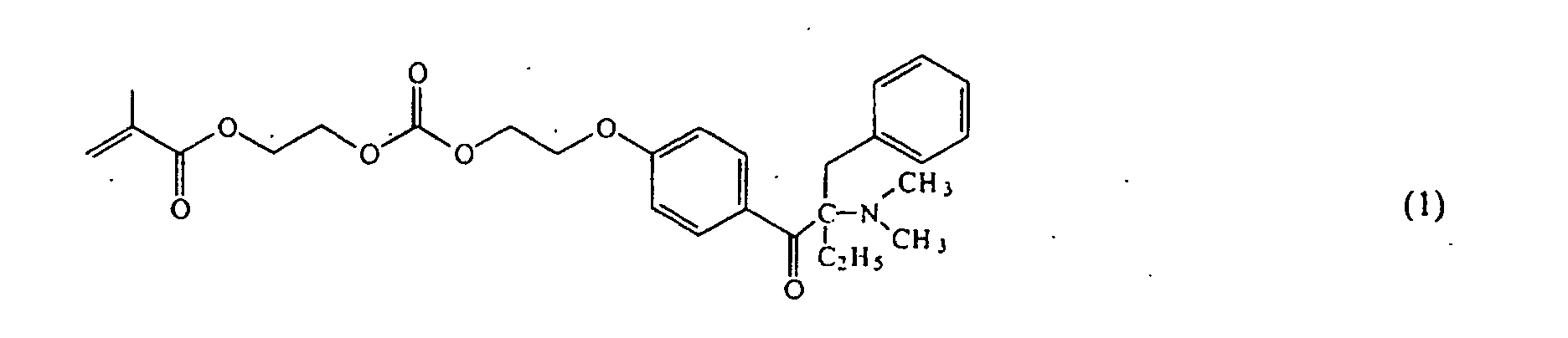
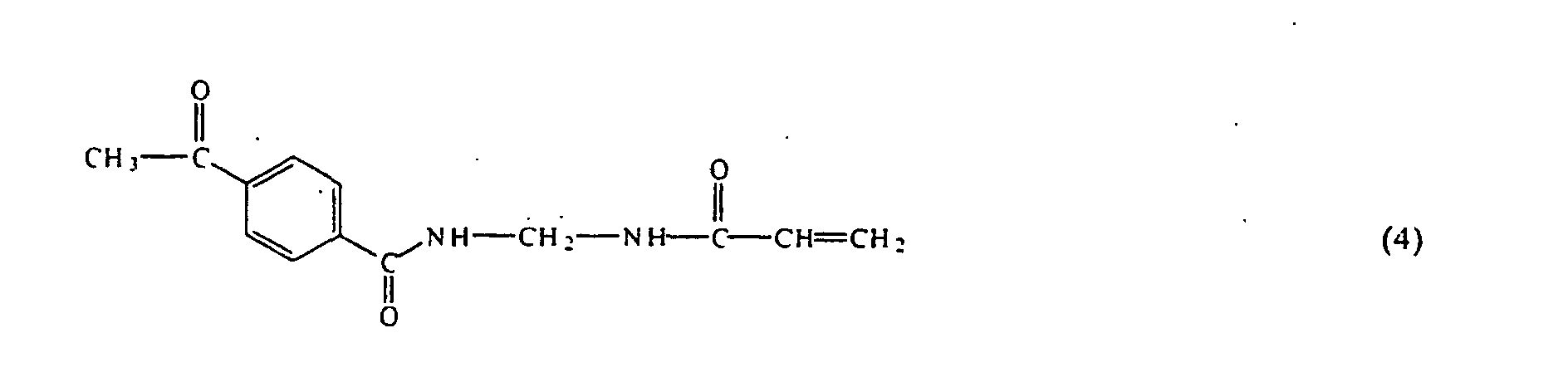
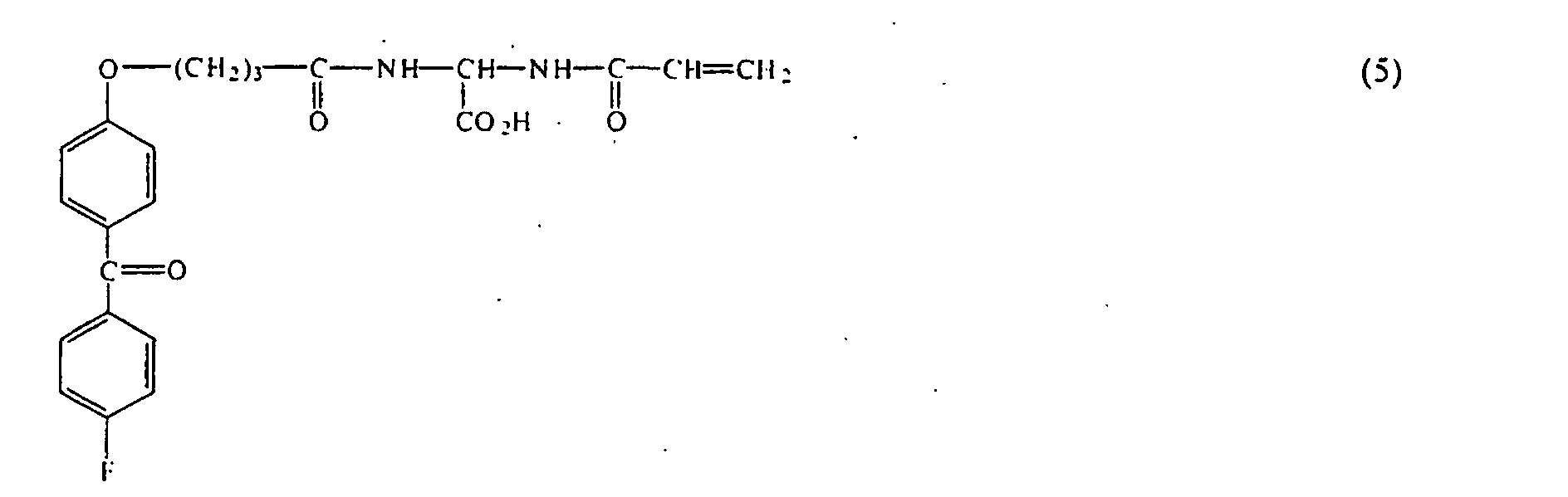
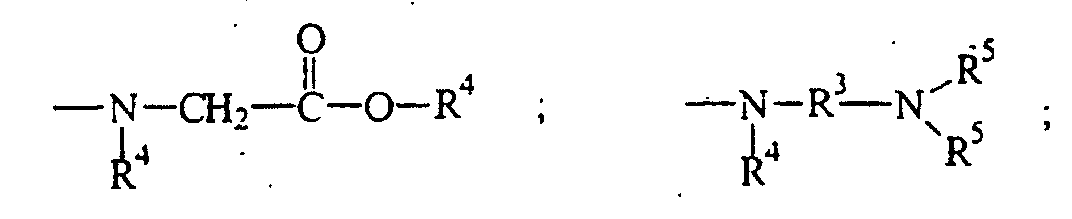
- Groups RGa are groups which have structures which are capable of hydrogen abstraction under high-energy radiation, preferably UV light in the triplet-excited state (photo-initiator groups of the Norrish II type known from the literature). Such structures are known to those skilled in the art from photochemistry. The corresponding acrylate (derivative) compounds which have such structures are also listed here. Further details regarding these compounds can be found in US Pat. No. 5,558,911, the content of which in this regard is incorporated in full by reference into the context of this application. Of course, other monomers, oligomers or polymers which have such structures RGa can also be used according to the invention.
- Benzophenone groups are preferred as RGa. Particularly high UV reactivity is achieved in polyacrylates with benzophenone derivatives, in which the Benzophenone group bound to the polymer main chain via a spacer group is. Particularly preferred polyacrylates can be obtained by copolymerization with Acrylates of formulas 24 to 26 and formula 34.
- RGa Another inexpensive and preferred option RGa in polymers the reaction of hydroxybenzophenones, preferably 4-hydroxybenzophenone, is to be introduced with the epoxy groups of a polymer, preferably the Addition of 4-hydroxybenzophenone to polyacrylates with proportions of glycidyl (meth) acrylate.
- Another elegant method is the reaction of an adduct one mole of diisocyanate with one mole of 4-hydroxybenzophenone with one Polymer that has free hydroxyl groups.
- a preferred method of introducing RGa into polyester is Use of benzophenone carboxylic acids or benzophenone carboxylic acid anhydrides in the case of polycondensation or the implementation or esterification of polymers with hydroxyl groups, epoxy groups, isocyanate groups and / or amino groups with benzophenone carboxylic acids or benzophenone carboxylic acid anhydrides.
- Groups RGb are groups with excited Norrish II photoinitiator groups can interact. As such interactions is particularly the Hydrogen transfer to the Norrish II structure is known to the person skilled in the art, so that radicals are formed, both with the H donor and with the abstracting Norrish II structure. Is about a radical combination a direct crosslinking of the polymers is possible. Another is the start of one radical initiated polymerization of e.g. B. polymerizable functional Group RGb z. B. maleate, fumarate, (meth) acrylate, allyl, epoxy, alkenyl, Cycloalkenyl, vinyl ether, vinyl ester, vinylaryl and cinnamate groups the photochemically generated radicals possible.
- RGb which interact as R donors with RGa are preferred, i. H. double bond free systems.
- One of the advantages inherent in the system is the small one These systems are sensitive to interference because they are one, compared to unsaturated ones UV systems decreased reactivity to the other components of the Show overall recipe. Of course, the (joint) use is unsaturated substances are therefore not excluded and in individual cases one Optimization task.
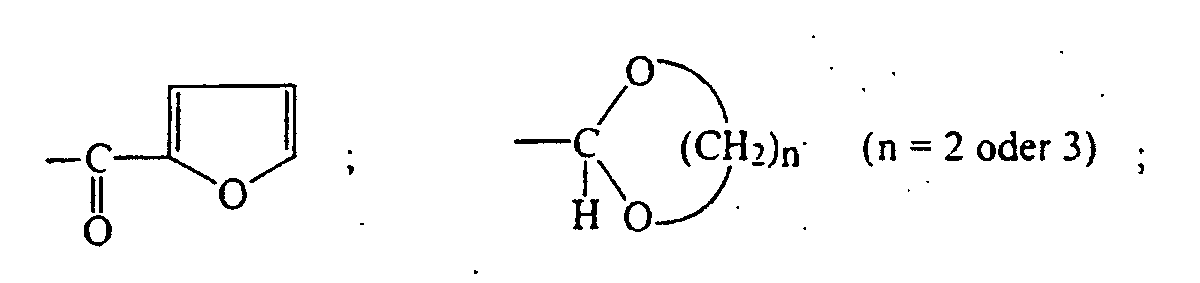
- H donor groups are skilled in the art of photochemistry known. There are basically groups that have a small amount of hydrogen Have binding energy, especially groups with hydrogen atoms one Binding energy below 397 kJ / mol.
- Examples are amine, furfuryl, tetrahydrofurfuryl, isobornyl, isoalkyl compounds and compounds which have groups of the following structures:
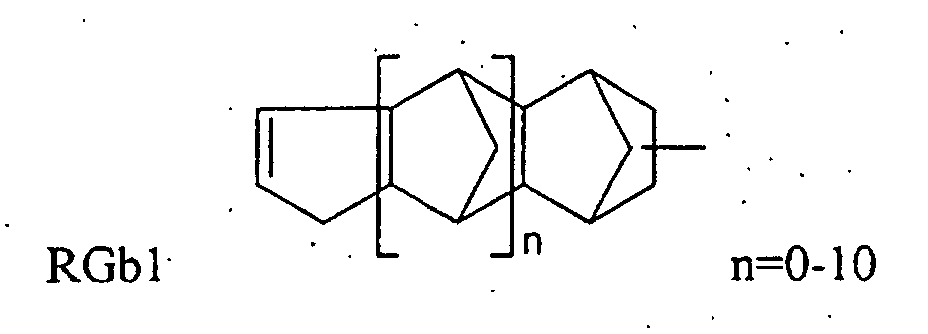
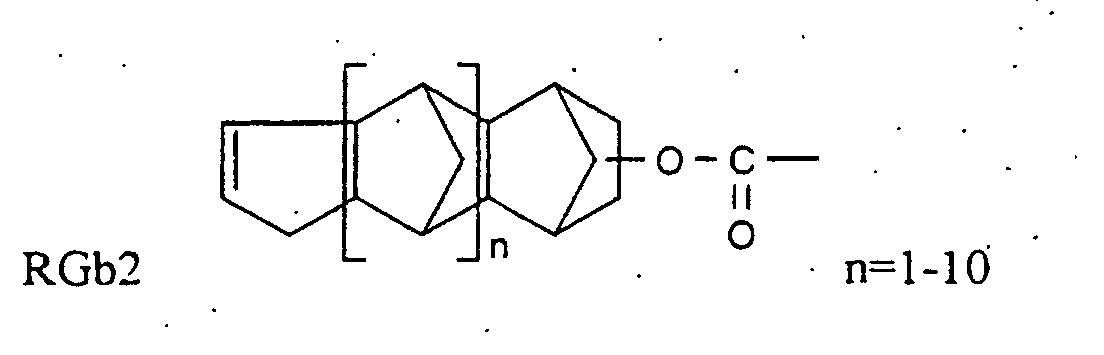
- dihydrodicyclopentadienol and dihydrodicyclopentadienol acrylate are commercially available and are suitable for introducing the particularly preferred RGb structures.
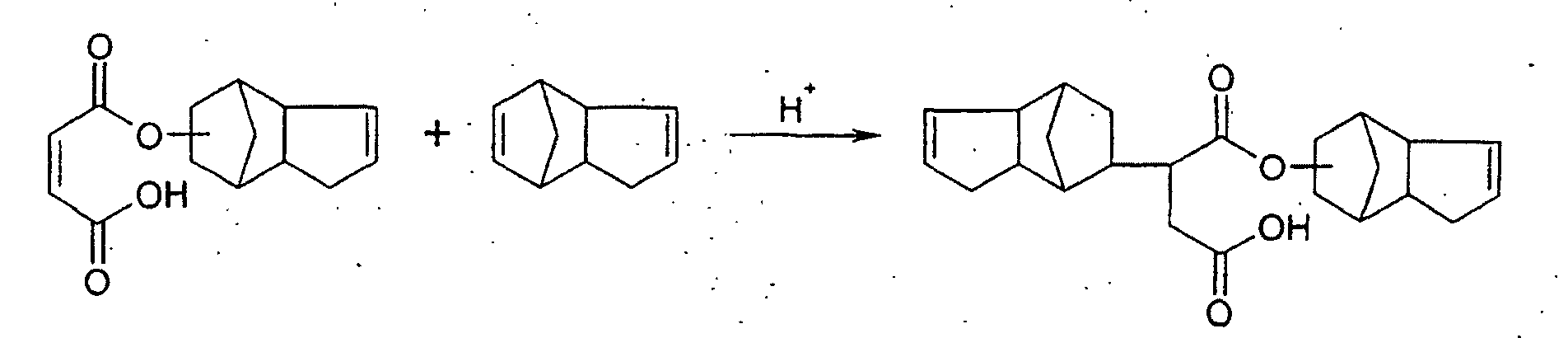
- Hydroxy-functional compounds for introducing groups according to the general formula RGb1 are dihydrodicyclopentadienyl alcohol and preferably the adducts of DCPD with glycols which are inexpensively accessible under acid catalysis and according to the formula scheme below
- RGb Also of interest as RGb are endomethylene tetrahydrophthalic acid structures which, for. B. are generally accessible by the addition of CPD to the maleate groups.
- the oligomeric and / or polymeric basic structure of the polymers IIa includes the known polymers such as. B. are built by -C-C links, which can also have double and / or triple bonds, and by Ether, ester, urethane, amide, imide, imidazole, ketone, sulfide, sulfone, Acetal, urea, carbonate and siloxane linkages under the proviso of in the head of the more precisely defined functionalizations.
- Polyesters, polyethers, polyurethanes are preferred and are particularly preferred Polyacrylates used.
- polyesters are saturated and unsaturated polyester resins
- polyester resins Carboxylic acids with ⁇ 2 carboxyl groups and / or their anhydrides and / or their Esters and hydroxyl compounds with ⁇ 2 OH groups in question. It can too monofunctional connections are used to e.g. B. that To regulate the molecular weight of the polycondensates.
- carboxylic acid components such.
- B. ⁇ , ⁇ -ethylenically unsaturated Carboxylic acids, such as maleic acid, maleic anhydride, fumaric acid, itaconic acid, Citraconic acid, saturated aliphatic carboxylic acids or their anhydrides, such as Succinic acid, adipic acid, suberic acid, sebacic acid, azelaic acid, natural Fatty acids and polymerized natural fatty acids such as linseed oil fatty acid, dimer and Polymer linseed fatty acid, castor oil, castor oil fatty acid, saturated cycloaliphatic Carboxylic acids or their anhydrides, such as tetrahydrophthalic acid, Hexahydrophthalic acid, endomethylene tetrahydrophthalic acid, norbornenedicarboxylic acid, aromatic carboxylic acids or their anhydrides, such as phthalic acid in their Isomer forms, including tri- and tetracarboxylic acids
- hydroxyl components such.
- B. optionally alkoxylated, at least dihydric aliphatic and / or cycloaliphatic alcohols such as ethylene glycol, Propylene glycol, polyethylene glycols, polypropylene glycols, butanediol isomers, Hexanediol, trimethylolpropane, pentaerythritol, neopentyl glycol, cyclohexanedimethanol, Bisphenol A, hydrogenated bisphenol A, OH-polyfunctional polymers, such as hydroxyl group-modified polybutadienes or hydroxyl group-bearing Polyurethane prepolymers, glycerin, mono- and diglycerides of saturated and unsaturated fatty acids, especially monoglycerides of linseed oil or Sunflower oil in question.
- dihydric aliphatic and / or cycloaliphatic alcohols such as ethylene glycol, Propylene glycol, poly
- unsaturated alcohols also come in The question of how polyfunctional hydroxyl compounds (partially) etherified with allyl alcohol, z. B. trimethylolethane monoallyl ether, trimethylol ethane diallyl ether, Trimethylolpropane monoallyl ether, trimethylol propane diallyl ether, pentaerythritol monoallyl ether, Pentaerythritol diallyl ether, butene-2-diol-1,4 and alkoxylated Butene-2-diol-1,4.
- polyester in the sense of the present invention also fall polycondensates which, in addition to the ester groups, amide and / or Have imide groups, such as by using amino compounds be preserved.
- modified polyesters are e.g. B. by DE-A-15700273 and DE-A-17200323. If endomethylene tetrahydrophthalic acid and tetrahydrophthalic acid structures, via the imides of these Acids with hydroxyalkyamines, as they are called, are introduced here RGb in the sense of this invention.
- the double bonds of the unsaturated polyesters used can also DCPD can be attached, thereby enabling endomethylene tetrahydrophthalic acid structures to incorporate, which represent RGb in the sense of this invention.
- These endomethylene tetrahydrophthalic acid structures can be attached to the chain double bonds of the polyester and / or at terminal Double bonds, such as z. B. about substances according to the general formula 3 be introduced.
- the double bonds from the unsaturated Dicarboxylic acids and / or unsaturated diols are chain-linked RGb in the sense the invention.
- the RG can be introduced by cocondensation and / or by polymer-analogous reactions take place on polyesters with functional groups.
- cocondensation examples are the use of trimethylolpropane di and monoallyl ether, pentaerythritol di- and monoallyl ether, butene-2-diol-1,4, alkoxylated butene-2-diol-1,4, allyl alcohol and compounds according to Formulas 3, 4, 5, 7, 8.
- the co-condensation of is preferred for the introduction of RGa Benzophenone carboxylic acids or their anhydrides.
- The is more preferred Addition of the reaction products of hydroxybenzophenones with a Excess diisocyanates with hydroxy-functional polyesters.
- RGb can also be converted into hydroxy-functional polyesters introduce.
- Diisocyanates with isocyanate groups are preferred for this purpose different reactivity, e.g. B. isophorone diisocyanate or 1,4-tolylene diisocanate, with a semi-equivalent amount of e.g. B. hydroxyacrylates, Hydroxyvinyl ethers, hydroxyallyl esters, hydroxyallyl ethers, hydroxy-DCPD compounds implemented according to formulas AGb4 and AGb6 and these Reaction products then with the hydroxy-functional polyesters for the reaction brought.
- hydroxy-functional substances can also simultaneously hydroxyl-functional substances of different types are used.
- Poly (meth) acrylate resins which are functionalized according to the invention with RG represent another important class of polymers according to the invention and are characterized by Copolymerization of acrylic esters, optionally with other copolymerizable ones Connections.
- poly (meth) acrylate resins according to the invention can also be used in Solvents are made.
- Another advantageous method for The production of poly (meth) acrylates is the solvent-free, radical one Bulk polymerization in the stirred reactor, possibly under pressure or in continuous flow reactors at temperatures above Melting temperature of the polymers formed.
- components for the construction of poly (meth) acrylate resins are the known esters of acrylic acid and methacrylic acid with. aliphatic, cycloaliphatic, araliphatic and aromatic alcohols with 1 to 40 Suitable carbon atoms, such as. B.
- Other components are monomers which can be copolymerized by free radicals, such as styrene, 1-methylstyrene, 4-tert-butylstyrene, 2-chlorostyrene, vinyl esters of Fatty acids with 2 to 20 carbon atoms, such as vinyl acetate, vinyl propionate, Vinyl ethers of alkanols having 2 to 20 carbon atoms, such as vinyl isobutyl ether, Vinyl chloride, vinylidene chloride, vinyl alkyl ketones, dienes, such as Butadiene and isoprene and esters of maleic and crotonic acid in question.
- free radicals such as styrene, 1-methylstyrene, 4-tert-butylstyrene, 2-chlorostyrene, vinyl esters of Fatty acids with 2 to 20 carbon atoms, such as vinyl acetate, vinyl propionate, Vinyl ethers of alkanols having 2 to 20 carbon atoms, such as
- Suitable monomers are also cyclic vinyl compounds, such as vinyl pyridine, 2-methyl-1-vinylimidazole, 1-vinylimidazole, 5-vinylpyrrolidone and N-vinylpyrrolidone. Allylic unsaturated monomers can also be used be such.
- the installation of the RG can be done by copolymerization in the manufacture of the Polyacrylates or by subsequent polymer-analogous reaction.
- Good polymerizable compounds which have groups RGb are e.g. B. Dihydrodicyclopentadienol (meth) acrylate, dihydrodicyclopentadienyl ethacrylate and dihydrodicyclopentadienyl cinnamate.
- Well polymerizable compounds, the other groups have a polymer-analog functionalization is possible, for.
- Epoxy groups are e.g. B. for Introduction of acrylic double bonds by reaction with (Meth) acrylic acid (RGb) and / or for the introduction of vinyl ether groups (RGb) by reaction with aminovinyl ether compounds, such as. B. Diethanolamine divinyl ether or the introduction of benzophenone groups (RGa) Reaction with hydroxy and / or aminobenzophenones suitable.
- Polyurethanes that are functionalized with RG according to the invention provide one represent further important polymer class according to the invention and are based on the A person skilled in the art from polyfunctional, mostly difunctional Isocyanates and polyhydroxy and / or polyamino compounds obtained. Also it is possible to use RGa and / or RGb directly when building the polyurethanes to be installed or subsequently introduced into functional polyurethanes. The chemical reactants are essentially the same as for the previously described polymers. RGa are preferred over the Use of functional benzophenone compounds and RGb via Hydroxy-DCPD compounds introduced according to formulas RGb4 and RGb6.
- Polymer IIa according to the invention is produced in accordance with generally known methods Rules and is known to the polymer expert, what z. B. hiring a desired molecular weight through the use of regulating or monofunctional feedstocks or the setting of a desired one Glass transition temperature by balancing hard / soft components concerns.
- Polymers IIb can also be used and copolymers can be used as polymers IIa, provided that they are used with Reaction groups RG, in particular RGa and / or RGb are provided.
- RGa and / or RGb are provided.
- here are polymers and RG provided with reaction groups Copolymers of halogen-containing olefinic compounds (group 4f)).
- the polymers IIa used according to the invention are preferably crosslinked by high-energy radiation, especially by UV light. It is in the in most cases no additional photo initiator additive is required, d. H. the fabrics are self-photo-crosslinking with a particular advantage of its low inhibition Air is. But it is not excluded that other commercially available photo initiators add. Furthermore, many polymers IIa can also be thermally crosslinked. Especially high thermal crosslinkability is in the presence of peroxides and / or C-clabils Substances of the benzpinacole type in unsaturated systems that additionally have DCPD groups. Such systems are e.g. T. also thermally curable without peroxides. A preferred fast networking is achieved by combined use of heat and UV light, e.g. B. by Combination of IR and UV sources.
- copolymers IIb used according to the invention can, depending on Production method containing the monomers distributed statistically, or as block copolymers available.
- Polymers IIa and IIb are more conventional, well known to those skilled in the art polymerized in a known manner, preferably radically polymerized.
- the Polymers IIa and IIb can be either high molecular weight or oligomeric or as Mixtures of these are used.
- the proportion of polymer IIa in polymeric binder II is generally 1 to 100% by weight, preferably 20 to 80% by weight, more preferably 30 to 60 Wt .-%.
- the proportion of polymer IIb in the polymer is correspondingly Binder II in general 0 to 99% by weight, preferably 20 to 80% by weight and more preferably 40 to 70% by weight.
- the present invention preferably relates to composite bodies with a first Layer comprising the following compositions:
- compositions as defined above wherein the polymer IIa chain, end and / or laterally has at least one reactive group RGa which thermally and / or under UV radiation in the triplet excited state Hydrogen abstraction is capable, and chain, end and / or side at least one group RGb different from RGa and co-reactive with RGa has, with on average all polymer molecules at least one each Group RGa and a group RGb is present.
- compositions as defined above wherein the polymer IIa is a polymer or Is a copolymer of an acrylate or methacrylate, and reactive groups RGa, the Contain benzophenone units, and reactive groups RGb that Contain dihydrodicyclopentadiene units.
- polymer IIb is selected from the group consisting of a polymer or copolymer of vinyl chloride, Acrylonitrile, vinylidene fluoride; a copolymer of vinyl chloride and Vinylidene chloride, vinyl chloride and acrylonitrile, vinylidene fluoride and Hexafluoropropylene, vinylidene fluoride with hexafluoropropylene; one Terpolymer of vinylidene fluoride and hexafluoropropylene and one member the group consisting of vinyl fluoride, tetrafluoroethylene and trifluoroethylene.
- compositions as defined above wherein the polymer IIa is a polymer or Is a copolymer of an acrylate or methacrylate, and reactive groups RGa, the Contain benzophenone units, and reactive groups RGb, the dihydrodicyclopentadiene units contain, and the polymer IIb Copolymer of vinylidene fluoride and hexafluoropropylene.
- compositions used according to the invention can furthermore have one Plasticizer III included. However, it can also be used without a plasticizer become.
- the proportion of plasticizer III is based on the Composition, 0.1 to 100 wt .-%, preferably 0.5 to 50 wt .-% and in particular 1 to 20% by weight.
- plasticizer III z. B. those described in DE-A 198 19 752 Plasticizers are used, with dimethyl carbonate, diethyl carbonate, Dipropyl carbonate, ethylene carbonate, 1,2-propylene carbonate, 1,3-propylene carbonate, organic phosphorus compounds, especially phosphates and phosphonates, such as z. B. trimethyl phosphate, triethyl phosphate, tripropyl phosphate, tributyl phosphate, Tris (2-ethylhexyl) phosphate, polyalkylene oxide ether and ester, e.g. B. diglyme, Triglyme and tetradlyme compounds, polymeric plasticizers, such as. B. thermoplastic polyurethanes or polyamides, and mixtures thereof are preferred are.
- compositions used according to the invention can be in one inorganic or organic, preferably an organic liquid Diluents are dissolved or dispersed, the inventive Mixture have a viscosity of preferably 100 to 50,000 mPas should, and then in a manner known per se, such as spray coating, Casting, dipping, spin coating, roller coating, printing in high, low or low Flat printing or screen printing, applied to a carrier material become. Further processing can be carried out as usual, e.g. B. by removal the diluent and harden the mixture.
- Aliphatic ethers are particularly suitable as organic diluents Tetrahydrofuran and dioxane, hydrocarbons, in particular Hydrocarbon mixtures such as gasoline, toluene and xylene, aliphatic esters, especially ethyl acetate and butyl acetate and ketones, especially acetone, Ethyl methyl ketone and cyclohexanone, as well as DMF and NMP. It can too Combinations of such diluents can be used.
- the carrier material used is that which is usually used for electrodes Materials, preferably metals such as aluminum and copper, into consideration.
- Temporary intermediate carriers, such as foils, can also be used in particular Polyester films such as polyethylene terephthalate films can be used.
- Such Films can advantageously have a separating layer, preferably made of polysiloxanes be provided.
- the separators can also be produced thermoplastic, for example by injection molding, melt casting, pressing, kneading or extrusion optionally with a subsequent calendering step according to the invention used composition take place.
- composition used according to the invention can remove volatile components such as solvents or plasticizers become.
- composition used according to the invention can be crosslinked in a manner known per se, for example by irradiation with ionic or ionizing radiation, electron beam, preferably with an acceleration voltage between 20 and 2,000 kV and a radiation dose between 5 and 50 Mrad, UV or visible light, where in the usual way advantageously an initiator such as benzil dimethyl ketal or 1,3,5-trimethylbenzoyltriphenylphosphine oxide is added in amounts of in particular at most 1% by weight, based on the polymer IIa, and the crosslinking can be carried out within generally from 0.5 to 15 minutes; by thermal crosslinking via free-radical polymerization, preferably at temperatures above 60 ° C., an initiator such as azo-bis-isobutyronitrile being advantageously obtained in amounts of generally at most 5% by weight, preferably 0.05 to 1% by weight can add to the polymer IIa; by electrochemically induced polymerization; or are carried out by ionic polymerization, for example by acid-
- the above-described crosslinking can, but does not have to, take place under inert gas.
- the exposure time can be controlled so that either complete crosslinking takes place or only briefly with UV light be pre-irradiated so that only partial crosslinking takes place.
- the at least bringing a first layer together with the at least one second layer all known methods of bringing together according to the invention such layers can be used. So the application of the first layer on the second layer by non-pressure processes, such as. B. Pour or doctoring the starting material for the first layer and by processing methods under pressure, such as B. extruding, laminating, in particular Hot lamination, lamination, calendering or pressing.
- the composite bodies produced in this way by radiation, electrochemically or thermally be cross-linked or hardened.
- the starting material for the at least one first layer initially completely or partially thermally are crosslinked or hardened and then, as described above, without pressure or under pressure with the second layer used according to the invention be brought together.
- the at least a first layer in the form of a film and the conventional one Separator in the form of a film to be brought together happens preferably by lamination, with temperatures generally in the range from about 100 to about 160 ° C, preferably from about 115 to about 140 ° C can be used (hot lamination), the exactly used one Temperatures especially from the conventional separator used depend. For example, when using polypropylene films at slightly higher temperatures than when using Polyethylene films are worked. Even in the manufacture of the Composite body by lamination can be the composition of the first layer fully or partially cross-linked and that obtained after lamination Composite bodies networked again as required or directly without Post-crosslinking can be used.
- the composite body according to the invention When using the composite body according to the invention as a separator in an electrochemical cell is the composite body with conventional Anodes and cathodes combined.
- the latter substances can partially or completely in the production of the composite body according to the invention added or introduced after the production of the same.
- the generally known conductive salts can be used as conductive salts.
- organic electrolytic solvents As organic electrolytic solvents, the above come under "Plasticizers" discussed compounds in question, preferably the usual organic electrolytes, preferably esters such as ethylene carbonate, Propylene carbonate, dimethyl carbonate and diethyl carbonate or mixtures thereof Connections are used.
- organic electrolytes preferably esters such as ethylene carbonate, Propylene carbonate, dimethyl carbonate and diethyl carbonate or mixtures thereof Connections are used.
- the composite bodies according to the invention advantageously have a thickness of 5 to 500 microns, preferably 10 to 500 microns, more preferably 10 to 200 microns and in particular 15 to 100 microns.
- the composite body can be combined with the anodes and cathodes electrochemical cell are assembled, which in turn is a fixed Represents composite.
- This composite advantageously has a total thickness of 30 to 2000 ⁇ m, in particular a total thickness of 50 to 1000 ⁇ m.
- the at least one first layer is preferably on a temporary Carrier manufactured.
- temporary carriers such as B. a release film made of a polymer or preferably coated paper, such as. B. a siliconized polyester film be used.
- the production of this first layer is also on one permanent carrier, such as B. an arrester electrode or even without Carrier possible.
- Bringing together or producing the layers defined above is carried out by non-pressure processes for coating or producing foils, such as B. casting or doctoring, and by processing methods under pressure, such as B. extrusion, lamination, in particular hot lamination, lamination, Calendering or pressing. If necessary, the so produced Composite body by radiation, electrochemically or thermally cross-linked or be hardened.
- the composite body can act as a separator with the anode foil and / or Cathode foil are laminated together at temperatures> 80 ° C. It is it is easily possible, e.g. B. the composite body according to the invention on a to laminate conventional anode or cathode, using a composite anode or Cathode / separator is obtained, which in turn with a conventional cathode or anode can be combined.
- a composite anode / separator / cathode as described above can also be used without the use of a carrier or the arrester electrodes are produced because the composite body according to the invention containing at least a first and at least one second layer, as defined above, in itself one for the Sufficient mechanical stability when used in electrochemical cells has.
- the filling of such composites or the electrochemical cell with one Electrolyte and conductive salt can be used both before bringing them together preferably after the layers have been brought together, if appropriate after the Contact with suitable discharge electrodes, e.g. B. a metal foil and even after introducing the composite body or the composite into a Battery housings are made using the special microporous structure of the layers in the composite body according to the invention, in particular due to the Presence of the solid (I) defined above, suction of the electrolyte and the conductive salt and the displacement of the air in the pores.
- the Filling can take place at temperatures from 0 ° C to approximately 100 ° C of the electrolyte used.
- the electrochemical cells according to the invention can in particular be used as auto-, Device or flat battery, on-board battery, battery for static applications, and Battery used for electric traction.
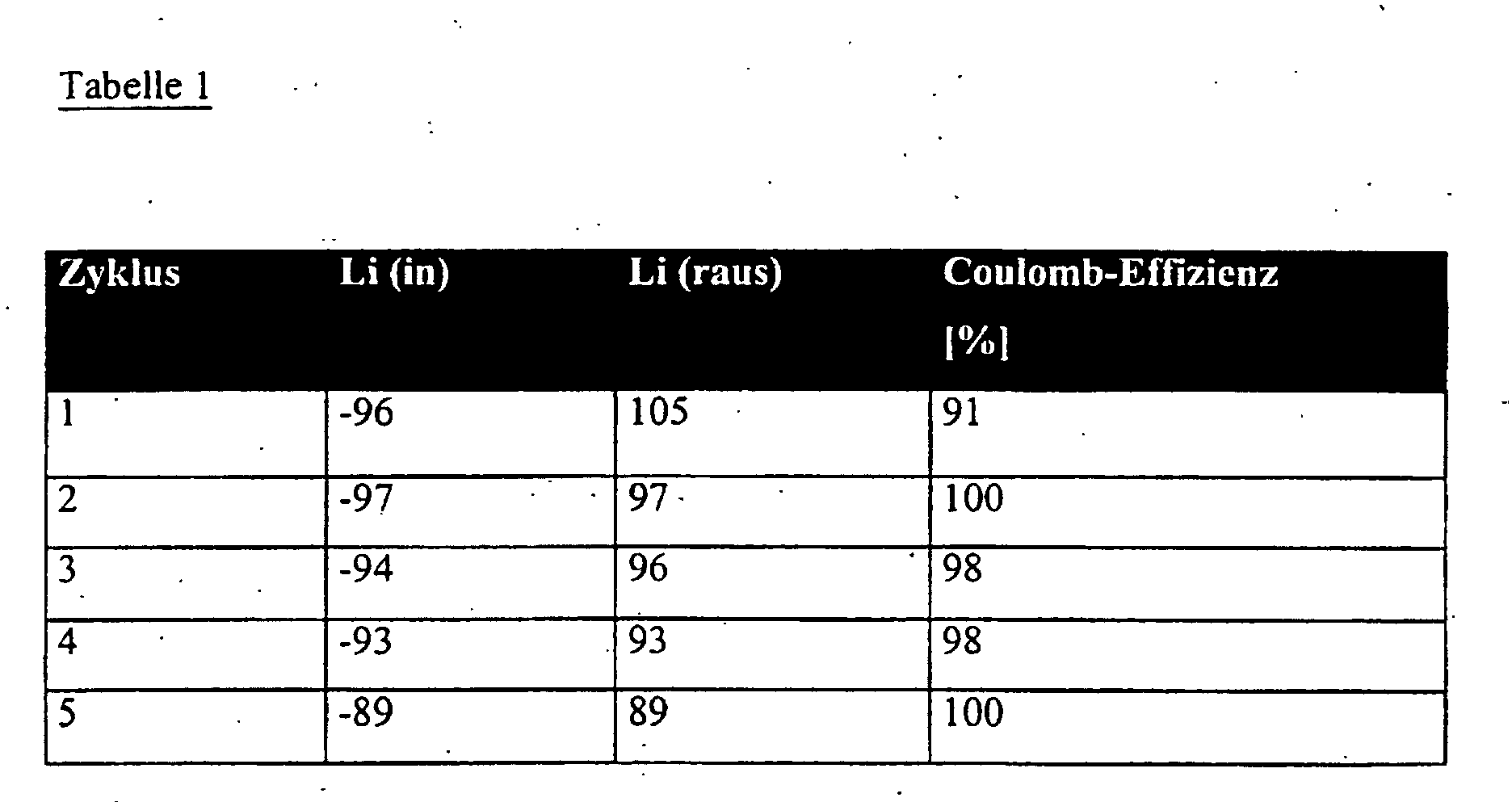
- Figures 1 to 5 each represent the results of the cyclization (Voltage: 4.15 V) of the electrochemicals obtained according to Examples 1 to 5 Cells.
- an inlet I consisting of a mixture of 100 g lauryl, 300 g dihydrodicyclopentadienyl, 120 g glycidyl 480 g Ethylhexyl acrylate and 2 g Mercaptoethanol
- an inlet II consisting of 30 g Wako V 59 (Azostarter V 59) and 200 g xylene started at the same time.
- Feed I was within 1.5 hours and feed II within 2 hours drove into the template.
- the temperature was between 80 and 90 ° C held.
- the mixture was then left to react at 90 ° C. for 3 hours.
- composition thus obtained was then applied using a doctor blade a casting gap of 500 microns applied to a carrier material at 60 ° C, the Solvent removed within 5 min and after removing the dried coating obtained an approximately 27 microns thick film.
- the film thus obtained was at a laminator roll temperature of 115 ° C with a commercial microporous PE film 8 ⁇ m thick (Celgard®) laminated together without further additives.
- A was used for lamination Laminator from Ibico used. After lamination was complete the layer laminated to the microporous PE film for 5 minutes at a distance of 5 cm under a field. made of superactin fluorescent tubes (TL 09, Philips) photocrosslinked.
- the composite body obtained in this way was used as a separator and assembled together with LiCoO 2 as cathode and graphite as anode to form a "sandwich" cell.
- LiPF 6 as the conductive salt
- a 1: 1 mixture of ethylene carbonate and diethylene carbonate as the liquid electrolyte
- a composite body was produced analogously to Example 1 using PA1 as the crosslinking system, but the film initially obtained was exposed for 2 seconds under the conditions according to Example 1 and then brought together with the PE film in accordance with Example 1. The composite body thus obtained was then UV-exposed as in Example 1 and used as a separator.
- Table 2 and Fig. 3 show the results of the investigations regarding the electrochemical activity. Cycle no.
- Example 2 a film was produced according to Example 1 and in unexposed Condition laminated on an anode (graphite on Cu foil) at 140 ° C and so composite obtained with an 8 ⁇ m thick microporous PE film (Celgard®) Laminated at 115 ° C.
- dimethylaminopyrridine 0.83 g was knife-coated onto a microporous polyolefin film (Celgard® 2300), dried at RT and cured photochemically as described in Example 1 and dried in vacuo ( ⁇ 0.1 mbar).
- a suspension consisting of 30 g Kynarflex® 2801 20 g Aerosil® 12.5 g dibutyl phthalate 200 g acetone was knife-coated onto a microporous polyolefin film (Celgard® 2300) and dried at RT. The composite body was then extracted several times with diethyl ether.
Landscapes
- Chemical & Material Sciences (AREA)
- Chemical Kinetics & Catalysis (AREA)
- Electrochemistry (AREA)
- General Chemical & Material Sciences (AREA)
- Engineering & Computer Science (AREA)
- Manufacturing & Machinery (AREA)
- Secondary Cells (AREA)
- Cell Separators (AREA)
- Laminated Bodies (AREA)
- Compositions Of Macromolecular Compounds (AREA)
- Addition Polymer Or Copolymer, Post-Treatments, Or Chemical Modifications (AREA)
- Macromonomer-Based Addition Polymer (AREA)
Description



































2-, 3- und 4-Hydroxybenzophenon, 2-Hydroxy-5-methylhydroxybenzophenon,
2-Hydroxy-4-methoxybenzophenon, 2-Hydroxy-4-octyloxybenzophenon, 2-Hydroxy-4-dodecyloxybenzophenon, 2-Hydroxy-5-chlorohydroxybenzophenon, 2-Hydroxy-4-methoxy-4'-methylbenzophenon, 2-Hydroxy-4-methoxy-4'-chlorobenzophenon,
4-Hydroxy-3-methylbenzophenon, 4-Hydroxy-4'-methoxybenzophenon, 4-Hydroxy-4'-chlorobenzophenon, 4-Hydroxy-4'-fluorobenzophenon, 4-Hydroxy-4'-cyanobenzophenon, 4-Hydroxy-2',4'-dimethoxybenzophenon, 2,2',4,4'- und 2,4-Dihydroxybenzophenon, 4-tert.-Butyl-2,4-dihydroxybenzophenon, 2,2'-Dihydroxy-4-methoxy-benzophenon, 2,2'-Dihydroxy-4-octoxybenzophenon, 2,2'-Dihydroxy-4,4'-dimethoxy-benzophenon, 2,4,4'-, 2,3,4- und 2,4,6-Trihydroxybenzophenon, 2,2,'-, 4,4'-, 2,3,4,4'- und 2,3',4,4'-Tetrahydroxybenzophenon, 2-, 3- und 4-Amino-benzophenon, 2-Amino-4-methylbenzophenon, 2-Amino-6-methylbenzophenon, 2-Amino-4'-methylbenzophenon, 2-Amino-4'-chloro-5-fluorobenzophenon, 2-Amino-5-chlorobenzophenon, 2-Amino-5-bromobenzophenon, 2-Amino-5-methylbenzophenon, 2-Amino-N-ethylbenzophenon, 2-Amino-2',5'-dimethylbenzophenon, 4-Amino-2-chlorobenzophenon, 4-Amino-4'-methoxybenzophenon, 3,4-, 4,4'- und 3,3'-Diaminobenzophenon, 4,4'-Bis(methylamino)benzophenon, 3,3',4,4'-Tetraaminobenzophenon, 2-, 3- und 4-Benzoylbenzoesäure, 2-Benzoyl-3'methylbenzoesäure, 2-Benzoyl-4'-Ethylbenzoesäure, 2-Benzoyl-3,6-dimethylbenzoesäure; 2-Benzoyl-2',6'-dimethylbenzoesäure, 2-Benzoyl-3',4'dimethylbenzoesäure, 2-Benzoyl-2',4',6-dimethylbenzoesäure, 2-Benzoyl-phydroxybenzoesäure, 2-Benzoyl-4'-methyl-3'-chlorobenzoesäure, 2-Benzoyl-6-chlorobenzoesäure, 4-Benzoyl-4'-isopropylbenzoesäure, 4-Benzoyl-4'chlorobenzoesäure, 4-Benzoyl-4'-(2-carboxypropyl)benzoesäure, 2,4-, 3,4- und 4,4'-Benzophenondicarbonsäure, 2',3,4-, 3,3',4- und 3,4,4'-Benzophenontricarbonsäure, 3,3',4,4'-Benzophenontetracarbonsäure und -tetracarbonsäuredianhydrid, 2-Hydroxy-4-methoxy-5-sulfobenzophenon, 4-(4-Carboxyphenyloxy)benzophenon, 4-(3,4-Bis(carboxy)-phenyloxy)benzophenon und das entsprechende Anhydrid, 4'-(4-Carboxyphenyloxy)-benzophenon-4-carbonsäure, 4'-(4-Carboxyphenyloxy)-benzophenon-3,4-dicarbonsäure und das entsprechende Anhydrid, 4'-(3,4-Bis(carboxy)-phenyloxy)-benzophenon-2,4- und -3,4-dicarbonsäure und die entsprechenden Anhydride, 4-(4-Cyanobenzoyl)-thiophenol, 4-(2-Hydroxyethoxy)phenyl-(2-hydroxy-2-propyl)keton, 4-(2-Aminoethoxy)phenyl-(2-hydroxy-2-propyl)keton, 4-(2-Hydroxycarbonylmethoxy)phenyl-(2-hydroxy-2-propyl)keton, 4-(2-Isocyanatoethoxy)phenyl-(2-hydroxy-2-propyl)keton, 4-(2-Isocyanatomethoxy)phenyl-(2-hydroxy-2-propyl)keton, 2-([2-]6-Isocyanatohexylaminocar-bonyloxy)ethoxylthioxanthon, Phenylglyoxylsäure.
mit
Die Polyesterole sind zweckmäßigerweise überwiegend lineare Polymere mit endständigen OH-Gruppen, bevorzugt solche mit zwei oder drei, insbesondere zwei OH-Endgruppen. Die Säurezahl der Polyesterole ist kleiner als 10 und vorzugsweise kleiner als 3. Die Polyesterole lassen sich in einfacher Weise durch Veresterung von aliphatischen oder aromatischen Dicarbonsäuren mit 4 bis 15 C-Atomen, vorzugsweise 4 bis 6 C-Atomen, mit Glycolen, bevorzugt Glycolen mit 2 bis 25 C-Atomen oder durch Polymerisation von Lactonen mit 3 bis 20 C-Atomen herstellen. Als Dicarbonsäuren lassen sich beispielsweise Glutarsäure, Pimelinsäure, Korksäure, Sebacinsäure, Dodecansäure und vorzugsweise Adipinsäure und Bernsteinsäure einsetzen. Geeignete aromatische Dicarbonsäuren sind Terephthalsäure, Isophthalsäure, Phthalsäure oder Gemische aus diesen Dicarbonsäuren mit anderen Dicarbonsäuren, z. B. Diphensäure, Sebacinsäure, Bernsteinsäure und Adipinsäure. Die Dicarbonsäuren können einzeln oder als Gemische verwendet werden. Zur Herstellung der Polyesterole kann es gegebenenfalls vorteilhaft sein, anstelle der Dicarbonsäuren die entsprechenden Säurederivate, wie Carbonsäureanhydride oder Carbonsäurechloride zu verwenden. Beispiele für geeignete Glycole sind Diethylenglycol, 1,5-Pentandiol, 1,10-Decandiol und 2,2,4-Trimethylpentandiol-1,5. Vorzugsweise verwendet werden 1,2-Ethandiol, 1,3-Propandiol, 2-Methyl-1,3-propandiol,1,4-Butandiol, 1,6-Hexandiol, 2,2-Dimethylpropandiol-1,3, 1,4-Dimethylolcyclohexan, 1,4-Diethanolcyclohexan und ethoxylierte oder propoxylierte Produkte des 2,2-Bis-(4-hydroxyphenylen)-propan (Bisphenol A). Je nach den gewünschten Eigenschaften der Polyurethane können die Polyole alleine oder als Gemisch in verschiedenen Mengenverhältnissen verwendet werden. Als Lactone für die Herstellung der Polyesterole eignen sich z. B. α,α-Dimethyl-β-propiolacton, γ-Butyrolacton und vorzugsweise ε-Caprolacton.
Die Polyetherole sind im wesentlichen lineare, endständige Hydroxylgruppen aufweisende Substanzen, die Etherbindungen enthalten. Geeignete Polyetherole können leicht durch Polymerisation von cyclischen Ethern, wie Tetrahydrofuran, oder durch Umsetzung von einem oder mehreren Alkylenoxiden mit 2 bis 4. C-Atomen im Alkylenrest mit einem Startermolekül, das zwei aktive Wasserstoffatome im Alkylenrest gebunden enthält, hergestellt werden. Als Alkylenoxide seien beispielsweise Ethylenoxid, 1,2-Propylenoxid, Epichlorhydrin, 1,2-Butylenoxid, 2,3-Butylenoxid genannt. Die Alkylenoxide können einzeln, alternierend nacheinander oder als Mischung verwendet werden. Als Startermolekül kommen beispielsweise Wasser, Glycole wie Ethylenglycol, Propylenglycol, 1,4-Butandiol und 1,6-Hexandiol, Amine wie Ethylendiamin, Hexamethylendiamin und 4,4'-Diamino-diphenylmethan und Aminoalkohole wie Ethanolamin in Betracht. Geeignete Polyesterole und Polyetherole sowie deren Herstellung sind beispielsweise in EP-B 416 386, geeignete Polycarbonatdiole, vorzugsweise solche auf 1,6-Hexandiol-Basis, sowie deren Herstellung beispielsweise in US-A 4 131 731 beschrieben.
In Mengen bis zu 30 Gew.-% bezogen auf Gesamtmasse der Alkohole können vorteilhaft aliphatische Diole mit 2 bis 20, vorzugsweise 2 bis 10 C-Atomen, wie 1,2-Ethandiol, 1,3-Propandiol, 1,4-Butandiol, 1,6-Hexandiol, 1,5-Pentandiol, 1,10-Decandiol, 2-Methyl-1,3-propandiol, 2,2-Dimethyl-1,3-propandiol, 2-Methyl-2-butyl-1,3-propandiol, 2,2-Dimethyl-1,4-butandiol, 1,4-Dimethylolcyclohexan, Hydroxypivalinsäureneopentylglycolester, Diethylenglycol, Triethylenglycol und Methyldiethanolamin oder aromatisch-aliphatische oder aromatisch-cycloaliphatische Diole mit 8 bis 30 C-Atomen eingesetzt werden, wobei als aromatische Strukturen heterocyclische Ringsysteme oder vorzugsweise isocyclische Ringsysteme wie Naphthalin- oder insbesondere Benzolderivate wie Bisphenol A, zweifach symmetrisch ethoxyliertes Bisphenol A, zweifach symmetrisch propoxyliertes Bisphenol A, höher ethoxylierte oder propoxylierte Bisphenol A-Derivate oder Bisphenol F-Derivate sowie Mischungen solcher Verbindungen in Betracht kommen.
In Mengen bis zu 5 Gew.-%, bezogen auf Gesamtmasse der Alkohole, können vorteilhaft aliphatische Triole mit 3 bis 15, vorzugsweise 3 bis 10 C-Atomen, wie Trimethylolpropan oder Glycerin, das Reaktionsprodukt solcher Verbindungen mit Ethylenoxid und/oder Propylenoxid sowie Mischungen solcher Verbindungen in Betracht kommen.
Die mehrwertigen Alkohole können funktionelle Gruppen, beispielsweise neutrale Gruppen wie Siloxangruppen, basische Gruppen wie insbesondere tertiäre Aminogruppen oder saure Gruppen oder deren Salze oder Gruppen, die leicht in saure Gruppen übergehen, tragen, die über einen mehrwertigen Alkohol eingeführt werden. Vorzugsweise kann man Diolkomponenten, die solche Gruppen tragen, wie N-Methyldiethanolamin, N,N-Bis(hydroxyethyl)aminomethylphosphonsäurediethylester oder N,N-Bis(hydroxyethyl)-2-aminoessigsäure-(3-sulfopropyl)-ester oder Dicarbonsäuren, die solche Gruppen tragen und für die Herstellung von Polyesterolen verwendet werden können, wie 5-Sulfoisophthalsäure, verwenden.
Saure Gruppen sind besonders die Phosphorsäure-, Phosphonsäure-, Schwefelsäure-, Sulfonsäure-, Carboxyl-, oder Ammoniumgruppe.
Gruppen, die leicht in saure Gruppen übergehen, sind beispielsweise die Estergruppe oder Salze, vorzugsweise der Alkalimetalle wie Lithium, Natrium oder Kalium.
- Separatoren auf der Basis von mikroporösen Polyolefinfolien, wie sie beispielsweise unter den Handelsnamen Celgard®, Hipore® käuflich erhältlich sind und u. a. in der EP-A 0 718 901 sowie der EP-B 0 715 364, die beide vollumfänglich in den Kontext der vorliegenden Anmeldung durch Bezugnahme aufgenommen werden; dabei sind Polyethylen- und Polypropylen-Folien, sowie Folien, die Blends aus Polyethylen bzw. Polypropylen mit weiteren Polymeren enthalten, ebenfalls gut verwendbar;
- mikroporöse Polytetrafluorethylen (PTFE)-Folien der Firma Goretex, wie sie beispielsweise in der EP-A 0 798 791, die ebenfalls durch Bezugnahme in den Kontext der vorliegenden Anmeldung einbezogen wird, beschrieben sind;
- Vliese, Fasern, sowie nicht gewebte Textilverbundstoffe, sogenannte "Nonwovens", die allesamt unter Verwendung von faserförmigen Polymermaterialien, wie z. B. Polyolefin-, Polyamid- und Polyester-Fasern hergestellt werden können;
- Folien, die unter dem Handelsnamen Nafion® erhältlich sind;
- Folien auf der Basis eine Copolymerisats aus Vinylidendifluorid und Hexafluorpropen, wie sie beispielsweise in der US 5 540 741 und der US 5 478 668 beschrieben sind;
- füllstoffhaltige, durch Extrusion erhältliche Homo-, Block- und
Copolymere, hergestellt aus
- (a) olefinischen Kohlenwasserstoffen, wie z. B. Ethylen, Propylen, Butylen, Isobuten, Propen, Hexen oder höhere Homologen, Butadien, Cyclopenten, Cyclohexen, Norbornen, Vinylcyclohexan;
- (b) aromatische Kohlenwasserstoffe wie z. B. Styrol und Methylstyrol;
- (c) Acrylsäure- oder Methacrylsäureester, wie Methyl-, Ethyl-, Propyl-, Isopro-pyl-, Butyl-, Isobutyl-, Hexyl-, Octyl-, Decyl-, Dodecyl-, 2-Ethylhexyl, Cyclohexyl-, Benzyl-, Trifluoromethyl-, Hexafluoropropyl-, Tetrafluoropropylacrylat bzw. -methacrylat;
- (d) Acrylnitril, Methacrylnitril, N-Methylpyrrolidon, N-Vinylimidazol, Vinylacetat;
- (e) Vinylether, wie z. B. Methyl-, Ethyl-, Propyl-, Isopropyl-, Butyl-, Isobutyl-, Hexyl-, Octyl,, Decyl-, Dodecyl-, 2-Ethylhexyl, Cyclohexyl, Benzyl-, Trifluoromethyl-, Hexafluoropropyl-, Tetrafluoropropylvinylether;
- (f) halogenhaltigen olefinischen Verbindungen wie Vinylchlorid, Vinylfluorid, Vinylidenfluorid, Vinylidenchlorid, Hexafluoropropen, Trifluoropropen, 1,2-Dichloroethen, 1,2-Difluoroethen, Tetrafluoroethen.
- bedingt durch die Kombination eines konventionellen Separators und der einen Feststoff (I) enthaltenden Zusammensetzung wird ein Verbundkörper erhalten, der außerordentliche mechanische Stabilität, insbesondere eine ausgezeichnete Formstabilität und eine verbesserte Druckfestigkeit aufweist;
- der erfindungsgemäße Verbundkörper kann bei der Batterieherstellung auf handelsüblichen Wickelautomaten, wie sie dort verwendet werden, problemlos eingesetzt werden;
- der erfindungsgemäße Verbundkörper stellt einen Separator mit Abschalt-Mechanismus (Shutdown-Mechanismus) dar.
| 100 g | Laurylacrylat, |
| 300 g | Dihydrodicyclopentadienylacrylat, |
| 120 g | Glycidylmethacrylat, |
| 480 g | Ethylhexylacrylat und |
| 2 g | Mercaptoethanol, und |
| 30 g | Wako V 59 (Azostarter V 59) und |
| 200 g | Xylol |
166 g 4-Hydroxybenzophenon und
0,83 g Dimethylaminopyridin
zugesetzt. Man ließ 2 bis 3 Stunden weiter reagieren, bis ein Epoxid-Wert von < 0,01 erreicht war.
| Zyklus Nr. | Halbzyklus | Stromdichte [mA/cm2] | spezifische Kapazität [mAh/g] | |
| Ladung | Entladung | |||
| 1 | c (Li raus) | 0,5 | 111,6 | |
| d (Li in) | -1,0 | 89,1 | ||
| 2 | c (Li raus) | 0,5 | 94,8 | |
| d (Li in) | -1,0 | 88,3 | ||
| 3 | c (Li raus) | 0,5 | 89,2 | |
| d (Li in) | -1,0 | 85,5 | ||
| 4 | c (Li raus) | 0,5 | 85,7 | |
| d (Li in) | -1,0 | 83,5 | ||
| 5 | c (Li raus) | 0,5 | 84,6 | |
| d (Li in) | -1,0 | 82,1 | ||
| 6 | c (Li raus) | 0,5 | 82,9 | |
| c (Li raus) | 0,25 | 6,4 | ||
| d (Li in) | -3,0 | 59,5 | ||
| 7 | c (Li raus) | 1,0 | 48,7 | |
| d (Li in) | -2,0 | 66,7 | ||
| 8 | c (Li raus) | 1,0 | 65,0 | |
| d (Li in) | -2,0 | 66,6 | ||
| 9 | c (Li raus) | 1,0 | 66,7 | |
| d (Li in) | -2,0 | 65,8 | ||
| 10 | c (Li raus) | 1,0 | 66,1 | |
| d (Li in) | -2,0 | 64,7 | ||
| 11 | c (Li raus) | 1,0 | 65,1 | |
| d (Li in) | -2,0 | 63,6 | ||
| 12 | c (Li raus) | 0,5 | 72,5 | |
| c (Li raus) | 0,25 | 6,0 |
| Zyklus Nr. | Halbzyklus | Stromdichte [mA/cm2] | spezifische Kapazität [mAh/g] | |
| Ladung | Entladung | |||
| 1 | c (Li raus) | 0,5 | 126,0 | |
| d (Li in) | -1,0 | 97,9 | ||
| 2 | c (Li raus) | 0,5 | 100,3 | |
| d (Li in) | -1,0 | 97,2 | ||
| 3 | c (Li raus) | 0,5 | 100,8 | |
| d (Li in) | -1,0 | 96,9 | ||
| 4 | c (Li raus) | 0,5 | 99,5 | |
| d (Li in) | -1,0 | 96,2 | ||
| 5 | c (Li raus) | 0,5 | 99,0 | |
| d (Li in) | -1,0 | 95,5 | ||
| 6 | c (Li raus) | 0,5 | 97,6 | |
| c (Li raus) | 0,25 | 5,4 | ||
| d (Li in) | -3,0 | 91,1 | ||
| 7 | c (Li raus) | 1,0 | 83,7 | |
| d (Li in) | -2,0 | 88,4 | ||
| 8 | c (Li raus) | 1,0 | 89,3 | |
| d (Li in) | -2,0 | 88,1 | ||
| 9 | c (Li raus) | 1,0 | 89,9 | |
| d (Li in) | -2,0 | 88,0 | ||
| 10 | c (Li raus) | 1,0 | 89,6 | |
| d (Li in) | -2,0 | 87,5 | ||
| 11 | c (Li raus) | 1,0 | 88,6 | |
| d (Li in) | -2,0 | 86,8 | ||
| 12 | c (Li raus) | 0,5 | 94,5 | |
| c (Li raus) | 0,25 | 4,5 |
| Zyklus Nr. | Halbzyklus | Stromdichte [mA/cm2] | spezifische Kapazität [mAh/g] | |
| Ladung | Entladung | |||
| 1 | c (Li raus) | 0,5 | 108,4 | |
| d (Li in) | -1,0 | 81,2 | ||
| 2 | c (Li raus) | 0,5 | 91,0 | |
| d (Li in) | -1,0 | 83,7 | ||
| 3 | c (Li raus) | 0,5 | 88,4 | |
| d (Li in) | -1,0 | 81,7 | ||
| 4 | c (Li raus) | 0,5 | 85,4 | |
| d (Li in) | -1,0 | 79,7 | ||
| 5 | c (Li raus) | 0,5 | 82,1 | |
| d (Li in) | -1,0 | 77,0 | ||
| 6 | c (Li raus) | 0,5 | 77,9 | |
| c (Li raus) | 0,25 | 4,2 | ||
| d (Li in) | -3,0 | 62,3 | ||
| 7 | c (Li raus) | 1,0 | 49,3 | |
| d (Li in) | -2,0 | 51,8 | ||
| 8 | c (Li raus) | 1,0 | 49,9 | |
| d (Li in) | -2,0 | 47,2 | ||
| 9 | c (Li raus) | 1,0 | 46,6 | |
| d (Li in) | -2,0 | 43,9 | ||
| 10 | c (Li raus) | 1,0 | 43,7 | |
| d (Li in) | -2,0 | 41,3 | ||
| 11 | c (Li raus) | 1,0 | 41,1 | |
| d (Li in) | -2,0 | 38,8 | ||
| 12 | c (Li raus) | 0,5 | 54,3 | |
| c (Li raus) | 0,25 | 5,0 |
| 20 g | Wollastonit Tremin® 800 EST |
| 34 g | Xylol |
| 6 g | Kynarflex® 2801 |
| 2,9 g | Tris(2-ethylhexyl)phosphat |
| 15 g | Aceton |
| 4,6 g | einer Lösung, bestehend aus |
| 100 g | Laurylacrylat |
| 300 g | Dihydrodicyclopentadienylacrylat |
| 120 g | Glycidylmethacrylat |
| 480 g | Ethylhexylacrylat |
| 2 g | Mercaptoethanol |
| 30 g | Wako® V79 |
| 200 g | Xylol |
| 166 g | 4-Hydroxybenzophenon. |
| 0,83 g | Dimethylaminopyrridin |
| 30 g | Kynarflex® 2801 |
| 20 g | Aerosil® |
| 12,5 g | Dibutylphtalat |
| 200 g | Aceton |
Claims (11)
- Verbundkörper, umfassend mindestens eine Schicht, die eine Zusammensetzung enthaltendumfaßt, wobei die mindestens eine Schicht auf mindestens eine zweite Schicht, umfassend mindestens einen konventionellen Separator, aufgebracht ist,(a) 1 bis 99 Gew.-% eines Feststoffs (I) mit einer Primärpartikelgröße von 5 nm bis 100 µm oder ein Gemisch aus mindestens zwei Feststoffen,(b) 99 bis 1 Gew.- % eines polymeren Bindemittels (II), das umfaßt:(IIa) 1 bis 100 Gew.-% eines Polymers oder Copolymers (IIa), das ketten-, end- und/oder seitenständig Reaktivgruppen (RG) aufweist, die thermisch und/oder unter UV-Strahlung zu Vernetzungsreaktionen fähig sind, und(IIb) 0 bis 99 Gew.-% mindestens eines Polymers oder Copolymers {IIb), das frei ist von Reaktivgruppen RG,
dadurch gekennzeichnet, daß
der konventionelle Separator ausgewählt wird aus der Gruppe bestehend aus:Separatoren auf der Basis von mikroporösen Polyolefin-Folien; mikroporösen Polytetrafluorethylen (PTFE)-Folien; Vliese, Fasern und nicht gewebte. Textilverbundstoffe, herstellbar unter Verwendung von faserförmigen Polymermaterialien; Nafion®-Folien; Folien auf der Basis eines Copolymerisats aus Vinylidendifluorid und Hexafluorpropen;füllstoffhaltige, durch Extrusion erhältliche Homo-, Block- und Copolymere, hergestellt aus olefinischen Kohlenwasserstoffen, aromatischen Kohlenwasserstoffen, Acrylsäure- oder Methacrylsäureestern, Acrylnitril, Methacrylnitril, N-Methylpyrrolidon, N-Vinylimidazol, Vinylacetat, Vinylethern, oder halogenhaltigen olefinischen Verbindungen, wobei als Füllstoffe in diesen Polymeren Feststoffe (I) eingesetzt werden. - Verbundkörper nach Anspruch 1, wobei der mindestens eine konventionelle Separator ausgewählt wird aus der Gruppe bestehend aus einer mikroporösen Polyolefin-Folie und einer Polytetrafluorethylen-Folie.
- Verbundkörper nach Anspruch 1 oder 2, wobei der Feststoff I ausgewählt wird aus der Gruppe bestehend aus einem anorganischen Feststoff, ausgewählt aus der Gruppe bestehend aus Oxiden, Mischoxiden, Silicaten, Sulfaten, Carbonaten, Phosphaten, Nitriden, Amiden, Imiden und Carbiden der Elemente der I., II., III. oder IV. Hauptgruppe oder der IV. Nebengruppe des Periodensystems; einem Polymer, ausgewählt aus der Gruppe bestehend aus Polyethylen, Polypropylen, Polystyrol, Polytetrafluorethylen, Polyvinylidenfluorid; Polyamiden; Polyimiden; und einer Feststoffdispersion enthaltend ein derartiges Polymer; und einem Gemisch aus zwei oder mehr davon.
- Verbundkörper nach einem der Ansprüche 1 bis 3, wobei das Polymer IIa ketten-, end- und/oder seitenständig mindestens eine Reaktivgruppe RGa aufweist, die thermisch und/oder unter UV-Strahlung im Triplett angeregten Zustand zur Wasserstoffabstraktion befähigt ist, und ketten-, end- und/oder seitenständig mindestens eine von RGa verschiedene, mit RGa coreaktive Gruppe RGb aufweist, wobei im Durchschnitt aller Polymermoleküle mindestens je eine Gruppe RGa und eine Gruppe RGb vorhanden ist, wobei die Gruppe RGb ausgewählt wird unter Gruppen, die mit angeregten Norrish II-Photoinitiator-Gruppen wechselwirken können.
- Verbundkörper nach einem der Ansprüche 1 bis 4, wobei das Polymet IIa ein Polymer oder Copolymer eines Acrylats oder Methacrylats ist, und Reaktivgruppen RGa, die Benzophenon-Einheiten enthalten, und Reaktivgruppen RGb, die Dihydrodicyclopentadien-Einheiten enthalten, aufweist.
- Verbundkörper nach einem der Ansprüche 1 bis 5, wobei das Polymer IIb ausgewählt wird aus der Gruppe bestehend aus einem Polymer oder Copolymer des Vinylchlorids, Acrylnitrils, Vinylidenfluorids; einem Copolymer aus Vinychlorid und Vinylidenchlorid, Vinylchlorid und Acrylonitril, Vinylidenfluorid und Hexafluropropylen, Vinylidenfluorid mit Hexafluoropropylen; einem Terpolymer aus Vinylidenfluorid und Hexafluorpropylen sowie einem Mitglied der Gruppe bestehend aus Vinylfluorid, Tetrafluorethylen und Trifluorethylen.
- Verbundkörper nach einem der Ansprüche 1 bis 6, wobei das Polymer IIa ein Polymer wie in Anspruch 5 definiert ist, und das Polymer IIb ein Copolymer aus Vinylidenfluorid und Hexafluorpropylen ist.
- Verwendung mindestens einer Verbundkörpers gemäß einem der Ansprüche 1 bis 7 als Separator.
- Elektrochemische Zelle, umfassend einen Separator gemäß Anspruch 8.
- Verfahren zur Herstellung eines Verbundkörpers gemäß einem der Ansprüche 1 bis 7, das die folgenden Stufen umfaßt:(I) Herstellen mindestens einer ersten Schicht, wie in einem der Ansprüche 1 bis 7 definiert;(II) anschließendes Zusammenbringen der mindestens einen ersten Schicht mit der mindestens einen zweiten Schicht, umfassend den mindestens einen konventionellen Separator.
- Verfahren nach Anspruch 10, wobei das Zusammenbringen der mindestens einen Schicht und der mindestens einen zweiten Schicht, umfassend mindestens einen Separator, durch Auftakeln der mindestens einen Schicht auf den mindestens einen konventionellen Separator oder durch Laminieren, vorzugsweise Heißlaminieren, der mindestens einen Schicht auf den mindestens einen Separator erfolgt.
Applications Claiming Priority (3)
| Application Number | Priority Date | Filing Date | Title |
|---|---|---|---|
| DE19850826A DE19850826A1 (de) | 1998-11-04 | 1998-11-04 | Als Separatoren in elektrochemischen Zellen geeignete Verbundkörper |
| DE19850826 | 1998-11-04 | ||
| PCT/EP1999/008369 WO2000026977A1 (de) | 1998-11-04 | 1999-11-02 | Als separatoren in elektrochemischen zellen geeignete verbundkörper |
Publications (2)
| Publication Number | Publication Date |
|---|---|
| EP1138092A1 EP1138092A1 (de) | 2001-10-04 |
| EP1138092B1 true EP1138092B1 (de) | 2002-09-25 |
Family
ID=7886662
Family Applications (1)
| Application Number | Title | Priority Date | Filing Date |
|---|---|---|---|
| EP99955945A Expired - Lifetime EP1138092B1 (de) | 1998-11-04 | 1999-11-02 | Als separatoren in elektrochemischen zellen geeignete verbundkörper |
Country Status (12)
| Country | Link |
|---|---|
| US (1) | US6632561B1 (de) |
| EP (1) | EP1138092B1 (de) |
| JP (1) | JP2002529891A (de) |
| KR (1) | KR100688402B1 (de) |
| CN (1) | CN100477340C (de) |
| AU (1) | AU1268900A (de) |
| BR (1) | BR9915069B1 (de) |
| CA (1) | CA2348917C (de) |
| DE (2) | DE19850826A1 (de) |
| ES (1) | ES2184511T3 (de) |
| TW (1) | TW457738B (de) |
| WO (1) | WO2000026977A1 (de) |
Cited By (2)
| Publication number | Priority date | Publication date | Assignee | Title |
|---|---|---|---|---|
| US9159979B2 (en) | 2008-02-20 | 2015-10-13 | Carl Freudenberg Kg | Nonwoven fabric having cross-linking material |
| US9172074B2 (en) | 2007-09-07 | 2015-10-27 | Carl Freudenberg Kg | Nonwoven material with particle filler |
Families Citing this family (121)
| Publication number | Priority date | Publication date | Assignee | Title |
|---|---|---|---|---|
| DE19819752A1 (de) * | 1998-05-04 | 1999-11-11 | Basf Ag | Für elektrochemische Zellen geeignete Zusammensetzungen |
| DE19916109A1 (de) * | 1999-04-09 | 2000-10-12 | Basf Ag | Als Separatoren in elektrochemischen Zellen geeignete Verbundkörper |
| US6432586B1 (en) | 2000-04-10 | 2002-08-13 | Celgard Inc. | Separator for a high energy rechargeable lithium battery |
| FR2822296A1 (fr) * | 2001-03-19 | 2002-09-20 | Atofina | Elements de batteries lithium-ion fabriques a partir d'une poudre microcomposite a base d'une charge et d'un fluoropolymere |
| DE10143889B4 (de) * | 2001-09-07 | 2013-11-14 | Dilo Trading Ag | Verfahren zum Herstellen von Separatoren als Zwischenschicht zwischen der Anode und Kathode und Verwendung dieser Separatoren zum Herstellen von Batteriesystemen |
| DE10143898B4 (de) * | 2001-09-07 | 2005-07-14 | Carl Freudenberg Kg | Alkalische Zelle oder Batterie |
| DE10219423A1 (de) * | 2002-05-02 | 2003-11-20 | Varta Microbattery Gmbh | Verfahren zur Herstellung eines galvanischen Elements |
| CA2458378C (en) * | 2002-06-14 | 2013-04-02 | Toray Industries, Inc. | Porous membrane and method of manufacturing the same |
| DE10238945B4 (de) * | 2002-08-24 | 2013-01-03 | Evonik Degussa Gmbh | Elektrischer Separator mit Abschaltmechanismus, Verfahren zu dessen Herstellung, Verwendung des Separators in Lithium-Batterien und Batterie mit dem Separator |
| TWI319586B (en) * | 2002-11-08 | 2010-01-11 | Nippon Chemicon | Electrolytic condenser |
| DE10255122A1 (de) * | 2002-11-26 | 2004-06-03 | Creavis Gesellschaft Für Technologie Und Innovation Mbh | Langzeitstabiler Separator für eine elektrochemische Zelle |
| DE10255121B4 (de) | 2002-11-26 | 2017-09-14 | Evonik Degussa Gmbh | Separator mit asymmetrischem Porengefüge für eine elektrochemische Zelle |
| FR2850966B1 (fr) | 2003-02-10 | 2005-03-18 | Rhodia Polyamide Intermediates | Procede de fabrication de composes dinitriles |
| US20040166415A1 (en) * | 2003-02-21 | 2004-08-26 | Celgard Inc. | Oxidation resistant separator for a battery |
| FR2854891B1 (fr) | 2003-05-12 | 2006-07-07 | Rhodia Polyamide Intermediates | Procede de preparation de dinitriles |
| US7781063B2 (en) * | 2003-07-11 | 2010-08-24 | Siemens Energy, Inc. | High thermal conductivity materials with grafted surface functional groups |
| US7033670B2 (en) | 2003-07-11 | 2006-04-25 | Siemens Power Generation, Inc. | LCT-epoxy polymers with HTC-oligomers and method for making the same |
| JP4662533B2 (ja) * | 2003-08-26 | 2011-03-30 | 日東電工株式会社 | 電池用セパレータのための反応性ポリマー担持多孔質フィルムとそれを用いる電池の製造方法 |
| EP1739770B1 (de) * | 2004-04-19 | 2011-12-07 | Panasonic Corporation | Herstellungsverfahren einer lithiumionen-sekundärbatterie |
| US20050277721A1 (en) | 2004-06-15 | 2005-12-15 | Siemens Westinghouse Power Corporation | High thermal conductivity materials aligned within resins |
| US7776392B2 (en) | 2005-04-15 | 2010-08-17 | Siemens Energy, Inc. | Composite insulation tape with loaded HTC materials |
| US7553438B2 (en) * | 2004-06-15 | 2009-06-30 | Siemens Energy, Inc. | Compression of resin impregnated insulating tapes |
| US20050274774A1 (en) * | 2004-06-15 | 2005-12-15 | Smith James D | Insulation paper with high thermal conductivity materials |
| US8216672B2 (en) * | 2004-06-15 | 2012-07-10 | Siemens Energy, Inc. | Structured resin systems with high thermal conductivity fillers |
| US7553781B2 (en) * | 2004-06-15 | 2009-06-30 | Siemens Energy, Inc. | Fabrics with high thermal conductivity coatings |
| US7592045B2 (en) * | 2004-06-15 | 2009-09-22 | Siemens Energy, Inc. | Seeding of HTC fillers to form dendritic structures |
| US20080050580A1 (en) * | 2004-06-15 | 2008-02-28 | Stevens Gary C | High Thermal Conductivity Mica Paper Tape |
| ES3010715T3 (en) * | 2004-07-07 | 2025-04-04 | Lg Energy Solution Ltd | New organic/inorganic composite porous film and electrochemical device prepared thereby |
| JP4846717B2 (ja) * | 2004-09-02 | 2011-12-28 | エルジー・ケム・リミテッド | 有無機複合多孔性フィルム及びこれを用いる電気化学素子 |
| EP3745494A1 (de) * | 2004-09-02 | 2020-12-02 | Lg Chem, Ltd. | Organischer/anorganischer poröser verbundfilm und dadurch hergestellte elektrochemische vorrichtung |
| WO2006062153A1 (ja) * | 2004-12-08 | 2006-06-15 | Hitachi Maxell, Ltd. | 電気化学素子用セパレータおよび電気化学素子 |
| US20060216596A1 (en) * | 2005-03-25 | 2006-09-28 | Michael Cheiky | PTFE copolymer and binding for coating cathode particles |
| US7651963B2 (en) * | 2005-04-15 | 2010-01-26 | Siemens Energy, Inc. | Patterning on surface with high thermal conductivity materials |
| US7846853B2 (en) * | 2005-04-15 | 2010-12-07 | Siemens Energy, Inc. | Multi-layered platelet structure |
| US7655295B2 (en) | 2005-06-14 | 2010-02-02 | Siemens Energy, Inc. | Mix of grafted and non-grafted particles in a resin |
| US7781057B2 (en) | 2005-06-14 | 2010-08-24 | Siemens Energy, Inc. | Seeding resins for enhancing the crystallinity of polymeric substructures |
| US7851059B2 (en) * | 2005-06-14 | 2010-12-14 | Siemens Energy, Inc. | Nano and meso shell-core control of physical properties and performance of electrically insulating composites |
| US20070026221A1 (en) * | 2005-06-14 | 2007-02-01 | Siemens Power Generation, Inc. | Morphological forms of fillers for electrical insulation |
| US7955661B2 (en) * | 2005-06-14 | 2011-06-07 | Siemens Energy, Inc. | Treatment of micropores in mica materials |
| US8357433B2 (en) * | 2005-06-14 | 2013-01-22 | Siemens Energy, Inc. | Polymer brushes |
| EP1770817A3 (de) * | 2005-09-29 | 2007-12-05 | Air Products and Chemicals, Inc. | Metalloxid Nanoteilchen mit Lithium enthaltender Oberfläche für Elektrolyten für Lithiumbatterien |
| US8110074B1 (en) * | 2005-10-03 | 2012-02-07 | Neckers Douglas C | Photochemical method for producing hydrocarbons |
| KR100686848B1 (ko) * | 2005-10-11 | 2007-02-26 | 삼성에스디아이 주식회사 | 리튬 이차 전지 |
| ES2532982T3 (es) | 2005-10-18 | 2015-04-06 | Invista Technologies S.À.R.L. | Proceso de preparación de 3-aminopentanonitrilo |
| CN102244221A (zh) * | 2005-12-08 | 2011-11-16 | 日立麦克赛尔株式会社 | 电化学元件用隔板 |
| EP1996598B1 (de) | 2006-03-17 | 2013-10-16 | Invista Technologies S.à.r.l. | Verfahren zur reinigung von triorganophosphiten durch bearbeitung mit einem basischen zusatz |
| WO2007147167A2 (en) * | 2006-06-16 | 2007-12-21 | Porous Power Technologies, Llc | Optimized microporous structure of electrochemical cells |
| US7919646B2 (en) | 2006-07-14 | 2011-04-05 | Invista North America S.A R.L. | Hydrocyanation of 2-pentenenitrile |
| KR101117753B1 (ko) * | 2006-09-07 | 2012-03-12 | 히다치 막셀 가부시키가이샤 | 전지용 세퍼레이터와 그 제조방법 및 리튬 2차 전지 |
| US7547847B2 (en) * | 2006-09-19 | 2009-06-16 | Siemens Energy, Inc. | High thermal conductivity dielectric tape |
| KR100951698B1 (ko) * | 2007-02-02 | 2010-04-07 | 한양대학교 산학협력단 | 리튬 이차 전지용 세퍼레이터, 이의 제조방법 및 이를포함하는 리튬 이차 전지 |
| JP2008210686A (ja) * | 2007-02-27 | 2008-09-11 | Sanyo Electric Co Ltd | 非水電解質二次電池及びその製造方法 |
| WO2008114727A1 (ja) * | 2007-03-15 | 2008-09-25 | Hitachi Maxell, Ltd. | 電気化学素子用セパレータ、電気化学素子用電極および電気化学素子 |
| KR100966024B1 (ko) | 2007-04-24 | 2010-06-24 | 주식회사 엘지화학 | 이종의 세퍼레이터를 구비한 전기화학소자 |
| EP2146930A2 (de) | 2007-05-14 | 2010-01-27 | INVISTA Technologies S.à.r.l. | Hocheffizienter reaktor und entsprechendes verfahren |
| TWI560928B (en) * | 2012-01-20 | 2016-12-01 | Prologium Technology Co Ltd | Electricity supply system and ceramic separator thereof |
| WO2008157218A1 (en) | 2007-06-13 | 2008-12-24 | Invista Technologies S.A.R.L. | Process for improving adiponitrile quality |
| KR101002161B1 (ko) | 2007-11-29 | 2010-12-17 | 주식회사 엘지화학 | 다공성 코팅층이 형성된 세퍼레이터, 그 제조방법 및 이를 구비한 전기화학소자 |
| CN101910119B (zh) | 2008-01-15 | 2013-05-29 | 因温斯特技术公司 | 用于制备和精制3-戊烯腈,和用于精制2-甲基-3-丁烯腈的方法 |
| WO2009091790A1 (en) | 2008-01-15 | 2009-07-23 | Invista Technologies S.A.R.L. | Hydrocyanation of pentenenitriles |
| US20090208832A1 (en) * | 2008-02-17 | 2009-08-20 | Porous Power Technologies, Llc | Lamination Configurations for Battery Applications Using PVDF Highly Porous Film |
| US20090227163A1 (en) * | 2008-03-05 | 2009-09-10 | Bernard Perry | Protective Apparel with Porous Material Layer |
| US20090226683A1 (en) * | 2008-03-05 | 2009-09-10 | Bernard Perry | Porous Material Uses in Furniture |
| US20090223155A1 (en) * | 2008-03-05 | 2009-09-10 | Bernard Perry | Building Construction Applications for Porous Material |
| US20090222995A1 (en) * | 2008-03-05 | 2009-09-10 | Bernard Perry | Bedding Applications for Porous Material |
| US8247621B2 (en) | 2008-10-14 | 2012-08-21 | Invista North America S.A.R.L. | Process for making 2-secondary-alkyl-4,5-di-(normal-alkyl)phenols |
| KR100884622B1 (ko) * | 2008-10-21 | 2009-02-23 | 한양대학교 산학협력단 | 리튬 이차 전지용 세퍼레이터, 이의 제조방법 및 이를 포함하는 리튬 이차 전지 |
| JP2010108732A (ja) * | 2008-10-30 | 2010-05-13 | Hitachi Ltd | リチウム二次電池 |
| JP5195341B2 (ja) | 2008-11-19 | 2013-05-08 | Tdk株式会社 | リチウムイオン二次電池用セパレータ及びリチウムイオン二次電池 |
| US9276246B2 (en) * | 2009-05-20 | 2016-03-01 | Samsung Electronics Co., Ltd. | Treatment and adhesive for microporous membranes |
| KR101125013B1 (ko) * | 2009-07-29 | 2012-03-27 | 한양대학교 산학협력단 | 이온성 고분자를 포함하는 가교형 세라믹 코팅 분리막의 제조 방법, 이로부터 제조된 세라믹 코팅 분리막 및 이를 채용한 리튬이차전지 |
| JP5615920B2 (ja) | 2009-08-07 | 2014-10-29 | インヴィスタ テクノロジーズ エスアエルエル | ジエステルを形成するための水素化およびエステル化 |
| WO2011019187A2 (ko) * | 2009-08-10 | 2011-02-17 | 주식회사 엘지화학 | 리튬 이차전지 |
| US10439188B2 (en) | 2009-08-10 | 2019-10-08 | Lg Chem, Ltd. | Lithium secondary battery |
| US8906548B2 (en) * | 2009-10-07 | 2014-12-09 | Miltec Corporation | Actinic and electron beam radiation curable electrode binders and electrodes incorporating same |
| JP5590521B2 (ja) * | 2009-11-06 | 2014-09-17 | 独立行政法人産業技術総合研究所 | リチウム二次電池用正極活物質及びその製造方法 |
| JP2011192565A (ja) * | 2010-03-16 | 2011-09-29 | Nitto Denko Corp | 電池用セパレータ |
| KR101187767B1 (ko) | 2010-03-17 | 2012-10-05 | 주식회사 엘지화학 | 세퍼레이터 및 이를 구비한 전기화학소자 |
| KR101262880B1 (ko) * | 2010-03-23 | 2013-05-09 | 주식회사 엘지화학 | 세퍼레이터, 그 제조방법 및 이를 구비한 전기화학소자 |
| WO2011124347A1 (de) | 2010-03-29 | 2011-10-13 | Schott Ag | Komponenten für batteriezellen mit anorganischen bestandteilen geringer thermischer leitfähigkeit |
| DE102010013295A1 (de) | 2010-03-29 | 2011-09-29 | Schott Ag | Komponenten für Batteriezellen mit anorganischen Bestandteilen geringer thermischer Leitfähigkeit |
| DE102010013294A1 (de) | 2010-03-29 | 2011-09-29 | Schott Ag | Komponenten für Batteriezellen mit anorganischen Bestandteilen geringer thermischer Leitfähigkeit |
| DE102010013293A1 (de) | 2010-03-29 | 2011-09-29 | Schott Ag | Komponenten für Batteriezellen mit anorganischen Bestandteilen geringer thermischer Leitfähigkeit |
| CN103229328B (zh) | 2010-09-22 | 2016-09-07 | 达拉米克有限责任公司 | 用于怠速启停车辆的改进的隔板、电池、系统及方法 |
| KR20200100869A (ko) * | 2010-09-22 | 2020-08-26 | 다라믹 엘엘씨 | 개선된 납산 배터리 분리기, 배터리 및 그와 관련된 방법 |
| KR102173880B1 (ko) * | 2010-09-22 | 2020-11-04 | 다라믹 엘엘씨 | 아이들 스타트 스톱 차량을 위한 개선된 분리막, 배터리, 시스템 및 방법 |
| WO2012053286A1 (ja) * | 2010-10-21 | 2012-04-26 | 日立マクセルエナジー株式会社 | 電気化学素子用セパレータとその製造方法、電気化学素子用電極および電気化学素子 |
| US9525165B2 (en) | 2011-03-07 | 2016-12-20 | Samsung Sdi Co., Ltd. | Electrode for rechargeable lithium battery and rechargeable lithium battery including the same |
| WO2013042235A1 (ja) * | 2011-09-22 | 2013-03-28 | 株式会社日立製作所 | 電気化学素子用セパレータ、その製造方法および電気化学素子 |
| KR101275775B1 (ko) * | 2011-09-27 | 2013-06-17 | 주식회사 엘지화학 | 우수한 제조 공정성과 안전성의 이차전지 |
| US20130149589A1 (en) * | 2011-12-07 | 2013-06-13 | Oliver Gronwald | Electrochemical cells comprising a nitrogen-containing polymer |
| WO2013100023A1 (ja) * | 2011-12-28 | 2013-07-04 | 株式会社村田製作所 | 耐熱性樹脂、接着剤、絶縁性接着層、セパレータ、固体電解質および蓄電デバイス |
| CN103247768A (zh) * | 2012-02-07 | 2013-08-14 | 辉能科技股份有限公司 | 一种电能供应单元及其陶瓷隔离层 |
| KR101711982B1 (ko) * | 2012-03-22 | 2017-03-03 | 삼성에스디아이 주식회사 | 세퍼레이터 및 리튬 이차 전지 |
| TW201351757A (zh) * | 2012-06-11 | 2013-12-16 | Enerage Inc | 電化學隔離膜結構及其製作方法 |
| CN103579561B (zh) | 2012-07-25 | 2017-08-15 | 三星Sdi株式会社 | 用于可再充电锂电池的隔板和包括其的可再充电锂电池 |
| DE102012107848A1 (de) | 2012-08-27 | 2014-05-28 | Karlsruher Institut für Technologie | Mehrlagiger Separator für eine elektrochemische Zelle |
| KR101535199B1 (ko) * | 2012-11-30 | 2015-07-09 | 주식회사 엘지화학 | 개선된 분산성을 갖는 슬러리 및 그의 용도 |
| CN104157810B (zh) * | 2013-05-15 | 2017-02-08 | 比亚迪股份有限公司 | 一种隔膜、其制备方法及一种锂离子电池 |
| CN103474697B (zh) * | 2013-09-10 | 2016-09-07 | 东莞新能源科技有限公司 | 一种凝胶聚合物锂离子电池 |
| US9680143B2 (en) * | 2013-10-18 | 2017-06-13 | Miltec Uv International Llc | Polymer-bound ceramic particle battery separator coating |
| US9761854B2 (en) | 2013-12-13 | 2017-09-12 | Samsug SDI Co., Ltd. | Spirally-wound electrode assembly for rechargeable lithium battery and rechargeable lithium battery including same |
| JP2014135288A (ja) * | 2014-03-14 | 2014-07-24 | Nitto Denko Corp | 電池用セパレータ |
| JP5680241B2 (ja) * | 2014-03-14 | 2015-03-04 | 日東電工株式会社 | 電池用セパレータ |
| JP2017527093A (ja) | 2014-07-18 | 2017-09-14 | ミルテック ユーヴィー インターナショナル,エルエルシーMiltec Uv International, Llc | セラミック粒子がuvまたはeb硬化ポリマー結合されたリチウム二次電池セパレーター、その生産方法 |
| KR101778242B1 (ko) * | 2014-12-19 | 2017-09-13 | 주식회사 엘지화학 | 스택-폴딩형 전극조립체 및 이를 포함하는 전기화학소자 |
| KR20160115599A (ko) | 2015-03-27 | 2016-10-06 | 삼성에스디아이 주식회사 | 리튬 이차 전지용 세퍼레이터 및 이를 포함하는 리튬 이차 전지 |
| KR102374874B1 (ko) * | 2015-10-30 | 2022-03-16 | 도아고세이가부시키가이샤 | 비수전해질 이차전지 전극용 바인더 및 그 제조 방법, 및 그 용도 |
| JPWO2017104760A1 (ja) * | 2015-12-16 | 2018-10-04 | 積水化学工業株式会社 | 合成樹脂微多孔フィルム及びその製造方法、蓄電デバイス用セパレータ、並びに蓄電デバイス |
| CN107910476B (zh) * | 2017-11-06 | 2021-09-03 | 上海恩捷新材料科技有限公司 | 一种陶瓷复合锂离子电池隔膜及其制备方法 |
| US10950836B2 (en) * | 2018-01-24 | 2021-03-16 | GM Global Technology Operations LLC | Separators for lithium-containing electrochemical cells and methods of making the same |
| RU188681U1 (ru) * | 2018-12-29 | 2019-04-22 | Федеральное государственное бюджетное образовательное учреждение высшего образования "Волгоградский государственный технический университет" (ВолгГТУ) | Устройство для сварки неплавящимся электродом с применением ультразвуковых колебаний |
| US11094998B2 (en) * | 2019-06-19 | 2021-08-17 | GM Global Technology Operations LLC | Ceramic-coated separators for lithium-containing electrochemical cells and methods of making the same |
| EP4053235B1 (de) * | 2019-12-18 | 2025-08-27 | LG Energy Solution, Ltd. | Herstellungsverfahren für eine elektrode unter verwendung eines überzugsbands mit anorganischer schicht |
| KR20220122625A (ko) * | 2019-12-27 | 2022-09-02 | 니폰 제온 가부시키가이샤 | 전기 화학 디바이스용 부재의 제조 또는 리사이클 방법, 전기 화학 디바이스의 제조 방법, 전기 화학 디바이스용 부재, 그리고 전기 화학 디바이스 |
| CN111653712B (zh) * | 2020-05-21 | 2021-09-28 | 上海恩捷新材料科技有限公司 | 一种电化学装置隔离膜及其制备方法 |
| CN116762193A (zh) * | 2021-01-29 | 2023-09-15 | 株式会社吴羽 | 非水电解质二次电池用粘合剂、电极合剂、电极以及非水电解质二次电池 |
| CN113540693A (zh) * | 2021-07-20 | 2021-10-22 | 无锡恩捷新材料科技有限公司 | 一种锂电池隔板 |
| KR20230077053A (ko) * | 2021-11-25 | 2023-06-01 | 주식회사 엘지에너지솔루션 | 단락 검사용 전지, 그 제조 방법 및 전지 안전성 분석 방법 |
| KR20230122467A (ko) * | 2022-02-14 | 2023-08-22 | 주식회사 엘지에너지솔루션 | 전기화학소자용 세퍼레이터, 이의 제조방법, 및 상기 세퍼레이터를 구비한 전기화학소자 |
| KR102893515B1 (ko) * | 2023-05-18 | 2025-12-02 | 한국화학연구원 | 방향환 함유 공중합체 및 이를 포함하는 조성물 |
Family Cites Families (9)
| Publication number | Priority date | Publication date | Assignee | Title |
|---|---|---|---|---|
| AU524460B2 (en) | 1978-08-11 | 1982-09-16 | Asahi Kasei Kogyo Kabushiki Kaisha | Microporous film |
| DE4413436A1 (de) * | 1994-04-18 | 1995-10-19 | Basf Lacke & Farben | Verfahren zur Lackierung von Gegenständen unter Verwendung strahlungshärtbarer Pulverlacke |
| US5565281A (en) * | 1994-12-02 | 1996-10-15 | Hoechst Celanese Corporation | Shutdown, bilayer battery separator |
| TW297171B (de) | 1994-12-20 | 1997-02-01 | Hoechst Celanese Corp | |
| WO1997015623A1 (en) * | 1995-10-27 | 1997-05-01 | Daikin Industries, Ltd. | Resin composition, molding produced using the same, and process for producing the same |
| DE19612286A1 (de) * | 1996-03-28 | 1997-10-02 | Basf Ag | Für elektrochemische Zellen geeignete Polymerisate |
| DE19612769A1 (de) * | 1996-03-29 | 1997-10-02 | Basf Ag | Als Trägermaterial für Festelektrolyten oder Separatoren für elektrochemische Zellen geeignete Gemische |
| EP0898316A4 (de) * | 1997-01-16 | 2005-05-25 | Mitsubishi Paper Mills Ltd | Separator für nichtwässrige elektrolytbatterie, dessen herstellung und seine verwendung in einer solchen batterie |
| DE19835615A1 (de) * | 1998-08-06 | 2000-02-10 | Basf Ag | Für elektrochemische Zellen geeignete Zusammensetzungen |
-
1998
- 1998-11-04 DE DE19850826A patent/DE19850826A1/de not_active Withdrawn
-
1999
- 1999-10-28 TW TW088118670A patent/TW457738B/zh not_active IP Right Cessation
- 1999-11-02 ES ES99955945T patent/ES2184511T3/es not_active Expired - Lifetime
- 1999-11-02 EP EP99955945A patent/EP1138092B1/de not_active Expired - Lifetime
- 1999-11-02 KR KR1020017005554A patent/KR100688402B1/ko not_active Expired - Fee Related
- 1999-11-02 DE DE59902883T patent/DE59902883D1/de not_active Expired - Lifetime
- 1999-11-02 AU AU12689/00A patent/AU1268900A/en not_active Abandoned
- 1999-11-02 WO PCT/EP1999/008369 patent/WO2000026977A1/de not_active Ceased
- 1999-11-02 CN CNB998150215A patent/CN100477340C/zh not_active Expired - Fee Related
- 1999-11-02 CA CA002348917A patent/CA2348917C/en not_active Expired - Fee Related
- 1999-11-02 JP JP2000580256A patent/JP2002529891A/ja not_active Ceased
- 1999-11-02 US US09/830,265 patent/US6632561B1/en not_active Expired - Fee Related
- 1999-11-02 BR BRPI9915069-7A patent/BR9915069B1/pt not_active IP Right Cessation
Cited By (2)
| Publication number | Priority date | Publication date | Assignee | Title |
|---|---|---|---|---|
| US9172074B2 (en) | 2007-09-07 | 2015-10-27 | Carl Freudenberg Kg | Nonwoven material with particle filler |
| US9159979B2 (en) | 2008-02-20 | 2015-10-13 | Carl Freudenberg Kg | Nonwoven fabric having cross-linking material |
Also Published As
| Publication number | Publication date |
|---|---|
| WO2000026977A1 (de) | 2000-05-11 |
| AU1268900A (en) | 2000-05-22 |
| US6632561B1 (en) | 2003-10-14 |
| JP2002529891A (ja) | 2002-09-10 |
| ES2184511T3 (es) | 2003-04-01 |
| KR20010100979A (ko) | 2001-11-14 |
| DE59902883D1 (de) | 2002-10-31 |
| CN100477340C (zh) | 2009-04-08 |
| CA2348917A1 (en) | 2000-05-11 |
| BR9915069A (pt) | 2001-07-17 |
| TW457738B (en) | 2001-10-01 |
| BR9915069B1 (pt) | 2011-02-08 |
| DE19850826A1 (de) | 2000-05-11 |
| KR100688402B1 (ko) | 2007-03-09 |
| CN1331843A (zh) | 2002-01-16 |
| CA2348917C (en) | 2010-01-19 |
| EP1138092A1 (de) | 2001-10-04 |
Similar Documents
| Publication | Publication Date | Title |
|---|---|---|
| DE19850826A1 (de) | Als Separatoren in elektrochemischen Zellen geeignete Verbundkörper | |
| EP1109841B1 (de) | Für elektrochemische zellen geeignete zusammensetzungen | |
| EP1088007B1 (de) | Für elektrochemische zellen geeignete zusammensetzungen | |
| EP1183743A1 (de) | Als separatoren in elektrochemischen zellen geeignete verbundkörper | |
| DE19916043A1 (de) | Verbundkörper geeignet zur Verwendung als Lithiumionenbatterie | |
| EP0970529B1 (de) | Verfahren zur herstellung von formkörpern für lithiumionenbatterien | |
| TW466793B (en) | Membrane suitable for electrochemical cells | |
| EP1261048B1 (de) | Elektroden/Separator-Laminat für galvanische Elemente und Verfahren zur dessen Herstellung | |
| EP2104957A1 (de) | Galvanisches element mit einem geklebten verbund aus elektroden und separator | |
| EP1169744B1 (de) | Nass-in-nass-beschichtungsverfahren zur herstellung von verbundkörpern, die zur verwendung in lithiumionenbatterien geeignet sind | |
| WO2020120310A1 (de) | Separator für elektrochemische energiespeicher und wandler | |
| MXPA01004441A (en) | Composite bodies used as separators in electrochemical cells | |
| MXPA00010761A (en) | Compositions suitable for electrochemical cells |
Legal Events
| Date | Code | Title | Description |
|---|---|---|---|
| PUAI | Public reference made under article 153(3) epc to a published international application that has entered the european phase |
Free format text: ORIGINAL CODE: 0009012 |
|
| 17P | Request for examination filed |
Effective date: 20010427 |
|
| AK | Designated contracting states |
Kind code of ref document: A1 Designated state(s): AT BE CH CY DE DK ES FI FR GB GR IE IT LI LU MC NL PT SE |
|
| AX | Request for extension of the european patent |
Free format text: AL;LT;LV;MK;RO;SI |
|
| GRAG | Despatch of communication of intention to grant |
Free format text: ORIGINAL CODE: EPIDOS AGRA |
|
| 17Q | First examination report despatched |
Effective date: 20011120 |
|
| GRAG | Despatch of communication of intention to grant |
Free format text: ORIGINAL CODE: EPIDOS AGRA |
|
| GRAH | Despatch of communication of intention to grant a patent |
Free format text: ORIGINAL CODE: EPIDOS IGRA |
|
| GRAH | Despatch of communication of intention to grant a patent |
Free format text: ORIGINAL CODE: EPIDOS IGRA |
|
| GRAA | (expected) grant |
Free format text: ORIGINAL CODE: 0009210 |
|
| AK | Designated contracting states |
Kind code of ref document: B1 Designated state(s): DE ES FR GB IT |
|
| REG | Reference to a national code |
Ref country code: GB Ref legal event code: FG4D Free format text: NOT ENGLISH |
|
| REG | Reference to a national code |
Ref country code: IE Ref legal event code: FG4D Free format text: GERMAN |
|
| REF | Corresponds to: |
Ref document number: 59902883 Country of ref document: DE Date of ref document: 20021031 |
|
| GBT | Gb: translation of ep patent filed (gb section 77(6)(a)/1977) |
Effective date: 20021105 |
|
| REG | Reference to a national code |
Ref country code: ES Ref legal event code: FG2A Ref document number: 2184511 Country of ref document: ES Kind code of ref document: T3 |
|
| ET | Fr: translation filed | ||
| REG | Reference to a national code |
Ref country code: IE Ref legal event code: FD4D Ref document number: 1138092E Country of ref document: IE |
|
| PLBE | No opposition filed within time limit |
Free format text: ORIGINAL CODE: 0009261 |
|
| STAA | Information on the status of an ep patent application or granted ep patent |
Free format text: STATUS: NO OPPOSITION FILED WITHIN TIME LIMIT |
|
| 26N | No opposition filed |
Effective date: 20030626 |
|
| PGFP | Annual fee paid to national office [announced via postgrant information from national office to epo] |
Ref country code: ES Payment date: 20091201 Year of fee payment: 11 Ref country code: DE Payment date: 20091029 Year of fee payment: 11 |
|
| PGFP | Annual fee paid to national office [announced via postgrant information from national office to epo] |
Ref country code: IT Payment date: 20091112 Year of fee payment: 11 Ref country code: GB Payment date: 20091028 Year of fee payment: 11 Ref country code: FR Payment date: 20091123 Year of fee payment: 11 |
|
| GBPC | Gb: european patent ceased through non-payment of renewal fee |
Effective date: 20101102 |
|
| REG | Reference to a national code |
Ref country code: DE Ref legal event code: R119 Ref document number: 59902883 Country of ref document: DE Effective date: 20110601 Ref country code: DE Ref legal event code: R119 Ref document number: 59902883 Country of ref document: DE Effective date: 20110531 |
|
| REG | Reference to a national code |
Ref country code: FR Ref legal event code: ST Effective date: 20110801 |
|
| PG25 | Lapsed in a contracting state [announced via postgrant information from national office to epo] |
Ref country code: DE Free format text: LAPSE BECAUSE OF NON-PAYMENT OF DUE FEES Effective date: 20110531 |
|
| PG25 | Lapsed in a contracting state [announced via postgrant information from national office to epo] |
Ref country code: FR Free format text: LAPSE BECAUSE OF NON-PAYMENT OF DUE FEES Effective date: 20101130 |
|
| PG25 | Lapsed in a contracting state [announced via postgrant information from national office to epo] |
Ref country code: GB Free format text: LAPSE BECAUSE OF NON-PAYMENT OF DUE FEES Effective date: 20101102 |
|
| PG25 | Lapsed in a contracting state [announced via postgrant information from national office to epo] |
Ref country code: IT Free format text: LAPSE BECAUSE OF NON-PAYMENT OF DUE FEES Effective date: 20101102 |
|
| REG | Reference to a national code |
Ref country code: ES Ref legal event code: FD2A Effective date: 20120411 |
|
| PG25 | Lapsed in a contracting state [announced via postgrant information from national office to epo] |
Ref country code: ES Free format text: LAPSE BECAUSE OF NON-PAYMENT OF DUE FEES Effective date: 20101103 |