EP1104812A1 - Für das gpm-Gen kodierende Nukleotidsequenzen - Google Patents
Für das gpm-Gen kodierende Nukleotidsequenzen Download PDFInfo
- Publication number
- EP1104812A1 EP1104812A1 EP00123955A EP00123955A EP1104812A1 EP 1104812 A1 EP1104812 A1 EP 1104812A1 EP 00123955 A EP00123955 A EP 00123955A EP 00123955 A EP00123955 A EP 00123955A EP 1104812 A1 EP1104812 A1 EP 1104812A1
- Authority
- EP
- European Patent Office
- Prior art keywords
- polynucleotide
- sequence
- gene
- amino acid
- dna
- Prior art date
- Legal status (The legal status is an assumption and is not a legal conclusion. Google has not performed a legal analysis and makes no representation as to the accuracy of the status listed.)
- Withdrawn
Links
- 108091028043 Nucleic acid sequence Proteins 0.000 title claims description 14
- 108090000623 proteins and genes Proteins 0.000 claims abstract description 50
- 150000001413 amino acids Chemical class 0.000 claims abstract description 38
- 108091033319 polynucleotide Proteins 0.000 claims abstract description 37
- 102000040430 polynucleotide Human genes 0.000 claims abstract description 37
- 239000002157 polynucleotide Substances 0.000 claims abstract description 37
- 238000004519 manufacturing process Methods 0.000 claims abstract description 16
- 229920001184 polypeptide Polymers 0.000 claims abstract description 15
- 108090000765 processed proteins & peptides Proteins 0.000 claims abstract description 14
- 102000004196 processed proteins & peptides Human genes 0.000 claims abstract description 14
- 241000186031 Corynebacteriaceae Species 0.000 claims abstract description 11
- 239000002773 nucleotide Substances 0.000 claims abstract description 7
- 125000003729 nucleotide group Chemical group 0.000 claims abstract description 7
- 230000000295 complement effect Effects 0.000 claims abstract description 5
- KDXKERNSBIXSRK-YFKPBYRVSA-N L-lysine Chemical compound NCCCC[C@H](N)C(O)=O KDXKERNSBIXSRK-YFKPBYRVSA-N 0.000 claims description 42
- 238000000034 method Methods 0.000 claims description 29
- 108020004414 DNA Proteins 0.000 claims description 26
- 239000004472 Lysine Substances 0.000 claims description 23
- 235000019766 L-Lysine Nutrition 0.000 claims description 15
- 244000005700 microbiome Species 0.000 claims description 15
- 238000003752 polymerase chain reaction Methods 0.000 claims description 14
- 239000012634 fragment Substances 0.000 claims description 10
- WPLOVIFNBMNBPD-ATHMIXSHSA-N subtilin Chemical compound CC1SCC(NC2=O)C(=O)NC(CC(N)=O)C(=O)NC(C(=O)NC(CCCCN)C(=O)NC(C(C)CC)C(=O)NC(=C)C(=O)NC(CCCCN)C(O)=O)CSC(C)C2NC(=O)C(CC(C)C)NC(=O)C1NC(=O)C(CCC(N)=O)NC(=O)C(CC(C)C)NC(=O)C(NC(=O)C1NC(=O)C(=C/C)/NC(=O)C(CCC(N)=O)NC(=O)C(CC(C)C)NC(=O)C(C)NC(=O)CNC(=O)C(NC(=O)C(NC(=O)C2NC(=O)CNC(=O)C3CCCN3C(=O)C(NC(=O)C3NC(=O)C(CC(C)C)NC(=O)C(=C)NC(=O)C(CCC(O)=O)NC(=O)C(NC(=O)C(CCCCN)NC(=O)C(N)CC=4C5=CC=CC=C5NC=4)CSC3)C(C)SC2)C(C)C)C(C)SC1)CC1=CC=CC=C1 WPLOVIFNBMNBPD-ATHMIXSHSA-N 0.000 claims description 8
- 241000186216 Corynebacterium Species 0.000 claims description 7
- 150000007523 nucleic acids Chemical group 0.000 claims description 7
- 150000008575 L-amino acids Chemical class 0.000 claims description 6
- 230000000694 effects Effects 0.000 claims description 6
- 241000894006 Bacteria Species 0.000 claims description 5
- 238000009396 hybridization Methods 0.000 claims description 5
- 239000013600 plasmid vector Substances 0.000 claims description 5
- 230000008569 process Effects 0.000 claims description 5
- 238000012262 fermentative production Methods 0.000 claims description 4
- 238000002955 isolation Methods 0.000 claims description 4
- GHSJKUNUIHUPDF-UHFFFAOYSA-N s-(2-aminoethyl)-l-cysteine Chemical compound NCCSCC(N)C(O)=O GHSJKUNUIHUPDF-UHFFFAOYSA-N 0.000 claims description 4
- 239000000523 sample Substances 0.000 claims description 4
- 230000007850 degeneration Effects 0.000 claims description 3
- 238000000855 fermentation Methods 0.000 claims description 3
- 230000004151 fermentation Effects 0.000 claims description 3
- 230000002068 genetic effect Effects 0.000 claims description 3
- 230000035772 mutation Effects 0.000 claims description 3
- 108091000044 4-hydroxy-tetrahydrodipicolinate synthase Proteins 0.000 claims description 2
- 101710088194 Dehydrogenase Proteins 0.000 claims description 2
- 108010053763 Pyruvate Carboxylase Proteins 0.000 claims description 2
- 102100039895 Pyruvate carboxylase, mitochondrial Human genes 0.000 claims description 2
- 108020004511 Recombinant DNA Proteins 0.000 claims description 2
- 101150033985 TPI gene Proteins 0.000 claims description 2
- 102000005924 Triose-Phosphate Isomerase Human genes 0.000 claims description 2
- 108700015934 Triose-phosphate isomerases Proteins 0.000 claims description 2
- 230000006696 biosynthetic metabolic pathway Effects 0.000 claims description 2
- 230000015572 biosynthetic process Effects 0.000 claims description 2
- 101150011371 dapA gene Proteins 0.000 claims description 2
- 101150073818 gap gene Proteins 0.000 claims description 2
- 230000007935 neutral effect Effects 0.000 claims description 2
- 101150047627 pgk gene Proteins 0.000 claims description 2
- 101150096049 pyc gene Proteins 0.000 claims description 2
- 229910019142 PO4 Inorganic materials 0.000 claims 2
- 239000010452 phosphate Substances 0.000 claims 2
- 102100025591 Glycerate kinase Human genes 0.000 claims 1
- 238000009825 accumulation Methods 0.000 claims 1
- 108010086476 glycerate kinase Proteins 0.000 claims 1
- 230000037353 metabolic pathway Effects 0.000 claims 1
- 101150110333 opcA gene Proteins 0.000 claims 1
- 239000013598 vector Substances 0.000 abstract description 12
- 241000186254 coryneform bacterium Species 0.000 abstract 2
- KCRZDTROFIOPBP-UHFFFAOYSA-N phosphono 2,3-dihydroxypropanoate Chemical compound OCC(O)C(=O)OP(O)(O)=O KCRZDTROFIOPBP-UHFFFAOYSA-N 0.000 abstract 1
- 241000186226 Corynebacterium glutamicum Species 0.000 description 36
- 239000013612 plasmid Substances 0.000 description 30
- 239000000047 product Substances 0.000 description 27
- 235000001014 amino acid Nutrition 0.000 description 25
- 229940024606 amino acid Drugs 0.000 description 25
- 229960003646 lysine Drugs 0.000 description 22
- 108091008146 restriction endonucleases Proteins 0.000 description 21
- 241000588724 Escherichia coli Species 0.000 description 12
- 229930027917 kanamycin Natural products 0.000 description 10
- 229960000318 kanamycin Drugs 0.000 description 10
- SBUJHOSQTJFQJX-NOAMYHISSA-N kanamycin Chemical compound O[C@@H]1[C@@H](O)[C@H](O)[C@@H](CN)O[C@@H]1O[C@H]1[C@H](O)[C@@H](O[C@@H]2[C@@H]([C@@H](N)[C@H](O)[C@@H](CO)O2)O)[C@H](N)C[C@@H]1N SBUJHOSQTJFQJX-NOAMYHISSA-N 0.000 description 10
- 229930182823 kanamycin A Natural products 0.000 description 10
- KDXKERNSBIXSRK-UHFFFAOYSA-N Lysine Natural products NCCCCC(N)C(O)=O KDXKERNSBIXSRK-UHFFFAOYSA-N 0.000 description 8
- 235000018977 lysine Nutrition 0.000 description 8
- 239000002609 medium Substances 0.000 description 8
- 239000000203 mixture Substances 0.000 description 8
- 230000010076 replication Effects 0.000 description 8
- 229920001817 Agar Polymers 0.000 description 7
- 239000008272 agar Substances 0.000 description 7
- 235000018102 proteins Nutrition 0.000 description 7
- 102000004169 proteins and genes Human genes 0.000 description 7
- 238000012163 sequencing technique Methods 0.000 description 7
- 241001485655 Corynebacterium glutamicum ATCC 13032 Species 0.000 description 6
- LFQSCWFLJHTTHZ-UHFFFAOYSA-N Ethanol Chemical compound CCO LFQSCWFLJHTTHZ-UHFFFAOYSA-N 0.000 description 6
- FAPWRFPIFSIZLT-UHFFFAOYSA-M Sodium chloride Chemical compound [Na+].[Cl-] FAPWRFPIFSIZLT-UHFFFAOYSA-M 0.000 description 6
- 238000013459 approach Methods 0.000 description 6
- 238000010367 cloning Methods 0.000 description 6
- 102000039446 nucleic acids Human genes 0.000 description 6
- 108020004707 nucleic acids Proteins 0.000 description 6
- 238000011160 research Methods 0.000 description 6
- 102000004190 Enzymes Human genes 0.000 description 5
- 108090000790 Enzymes Proteins 0.000 description 5
- 241000644323 Escherichia coli C Species 0.000 description 5
- 210000004027 cell Anatomy 0.000 description 5
- 238000005516 engineering process Methods 0.000 description 5
- 239000001963 growth medium Substances 0.000 description 5
- 239000013605 shuttle vector Substances 0.000 description 5
- 102000002260 Alkaline Phosphatase Human genes 0.000 description 4
- 108020004774 Alkaline Phosphatase Proteins 0.000 description 4
- IJGRMHOSHXDMSA-UHFFFAOYSA-N Atomic nitrogen Chemical compound N#N IJGRMHOSHXDMSA-UHFFFAOYSA-N 0.000 description 4
- 108010029692 Bisphosphoglycerate mutase Proteins 0.000 description 4
- 102000012410 DNA Ligases Human genes 0.000 description 4
- 108010061982 DNA Ligases Proteins 0.000 description 4
- 241000238557 Decapoda Species 0.000 description 4
- WQZGKKKJIJFFOK-GASJEMHNSA-N Glucose Natural products OC[C@H]1OC(O)[C@H](O)[C@@H](O)[C@@H]1O WQZGKKKJIJFFOK-GASJEMHNSA-N 0.000 description 4
- PEDCQBHIVMGVHV-UHFFFAOYSA-N Glycerine Chemical compound OCC(O)CO PEDCQBHIVMGVHV-UHFFFAOYSA-N 0.000 description 4
- 108091034117 Oligonucleotide Proteins 0.000 description 4
- NBIIXXVUZAFLBC-UHFFFAOYSA-N Phosphoric acid Chemical compound OP(O)(O)=O NBIIXXVUZAFLBC-UHFFFAOYSA-N 0.000 description 4
- JLCPHMBAVCMARE-UHFFFAOYSA-N [3-[[3-[[3-[[3-[[3-[[3-[[3-[[3-[[3-[[3-[[3-[[5-(2-amino-6-oxo-1H-purin-9-yl)-3-[[3-[[3-[[3-[[3-[[3-[[5-(2-amino-6-oxo-1H-purin-9-yl)-3-[[5-(2-amino-6-oxo-1H-purin-9-yl)-3-hydroxyoxolan-2-yl]methoxy-hydroxyphosphoryl]oxyoxolan-2-yl]methoxy-hydroxyphosphoryl]oxy-5-(5-methyl-2,4-dioxopyrimidin-1-yl)oxolan-2-yl]methoxy-hydroxyphosphoryl]oxy-5-(6-aminopurin-9-yl)oxolan-2-yl]methoxy-hydroxyphosphoryl]oxy-5-(6-aminopurin-9-yl)oxolan-2-yl]methoxy-hydroxyphosphoryl]oxy-5-(6-aminopurin-9-yl)oxolan-2-yl]methoxy-hydroxyphosphoryl]oxy-5-(6-aminopurin-9-yl)oxolan-2-yl]methoxy-hydroxyphosphoryl]oxyoxolan-2-yl]methoxy-hydroxyphosphoryl]oxy-5-(5-methyl-2,4-dioxopyrimidin-1-yl)oxolan-2-yl]methoxy-hydroxyphosphoryl]oxy-5-(4-amino-2-oxopyrimidin-1-yl)oxolan-2-yl]methoxy-hydroxyphosphoryl]oxy-5-(5-methyl-2,4-dioxopyrimidin-1-yl)oxolan-2-yl]methoxy-hydroxyphosphoryl]oxy-5-(5-methyl-2,4-dioxopyrimidin-1-yl)oxolan-2-yl]methoxy-hydroxyphosphoryl]oxy-5-(6-aminopurin-9-yl)oxolan-2-yl]methoxy-hydroxyphosphoryl]oxy-5-(6-aminopurin-9-yl)oxolan-2-yl]methoxy-hydroxyphosphoryl]oxy-5-(4-amino-2-oxopyrimidin-1-yl)oxolan-2-yl]methoxy-hydroxyphosphoryl]oxy-5-(4-amino-2-oxopyrimidin-1-yl)oxolan-2-yl]methoxy-hydroxyphosphoryl]oxy-5-(4-amino-2-oxopyrimidin-1-yl)oxolan-2-yl]methoxy-hydroxyphosphoryl]oxy-5-(6-aminopurin-9-yl)oxolan-2-yl]methoxy-hydroxyphosphoryl]oxy-5-(4-amino-2-oxopyrimidin-1-yl)oxolan-2-yl]methyl [5-(6-aminopurin-9-yl)-2-(hydroxymethyl)oxolan-3-yl] hydrogen phosphate Polymers Cc1cn(C2CC(OP(O)(=O)OCC3OC(CC3OP(O)(=O)OCC3OC(CC3O)n3cnc4c3nc(N)[nH]c4=O)n3cnc4c3nc(N)[nH]c4=O)C(COP(O)(=O)OC3CC(OC3COP(O)(=O)OC3CC(OC3COP(O)(=O)OC3CC(OC3COP(O)(=O)OC3CC(OC3COP(O)(=O)OC3CC(OC3COP(O)(=O)OC3CC(OC3COP(O)(=O)OC3CC(OC3COP(O)(=O)OC3CC(OC3COP(O)(=O)OC3CC(OC3COP(O)(=O)OC3CC(OC3COP(O)(=O)OC3CC(OC3COP(O)(=O)OC3CC(OC3COP(O)(=O)OC3CC(OC3COP(O)(=O)OC3CC(OC3COP(O)(=O)OC3CC(OC3COP(O)(=O)OC3CC(OC3COP(O)(=O)OC3CC(OC3CO)n3cnc4c(N)ncnc34)n3ccc(N)nc3=O)n3cnc4c(N)ncnc34)n3ccc(N)nc3=O)n3ccc(N)nc3=O)n3ccc(N)nc3=O)n3cnc4c(N)ncnc34)n3cnc4c(N)ncnc34)n3cc(C)c(=O)[nH]c3=O)n3cc(C)c(=O)[nH]c3=O)n3ccc(N)nc3=O)n3cc(C)c(=O)[nH]c3=O)n3cnc4c3nc(N)[nH]c4=O)n3cnc4c(N)ncnc34)n3cnc4c(N)ncnc34)n3cnc4c(N)ncnc34)n3cnc4c(N)ncnc34)O2)c(=O)[nH]c1=O JLCPHMBAVCMARE-UHFFFAOYSA-N 0.000 description 4
- 229940041514 candida albicans extract Drugs 0.000 description 4
- 239000008103 glucose Substances 0.000 description 4
- 238000011534 incubation Methods 0.000 description 4
- 230000002018 overexpression Effects 0.000 description 4
- 239000012138 yeast extract Substances 0.000 description 4
- DVLFYONBTKHTER-UHFFFAOYSA-N 3-(N-morpholino)propanesulfonic acid Chemical compound OS(=O)(=O)CCCN1CCOCC1 DVLFYONBTKHTER-UHFFFAOYSA-N 0.000 description 3
- QTBSBXVTEAMEQO-UHFFFAOYSA-N Acetic acid Chemical compound CC(O)=O QTBSBXVTEAMEQO-UHFFFAOYSA-N 0.000 description 3
- 239000006142 Luria-Bertani Agar Substances 0.000 description 3
- 102000011025 Phosphoglycerate Mutase Human genes 0.000 description 3
- KWYUFKZDYYNOTN-UHFFFAOYSA-M Potassium hydroxide Chemical compound [OH-].[K+] KWYUFKZDYYNOTN-UHFFFAOYSA-M 0.000 description 3
- HEMHJVSKTPXQMS-UHFFFAOYSA-M Sodium hydroxide Chemical compound [OH-].[Na+] HEMHJVSKTPXQMS-UHFFFAOYSA-M 0.000 description 3
- 238000000246 agarose gel electrophoresis Methods 0.000 description 3
- 235000011114 ammonium hydroxide Nutrition 0.000 description 3
- 238000004458 analytical method Methods 0.000 description 3
- QVGXLLKOCUKJST-UHFFFAOYSA-N atomic oxygen Chemical compound [O] QVGXLLKOCUKJST-UHFFFAOYSA-N 0.000 description 3
- 238000004113 cell culture Methods 0.000 description 3
- 239000002299 complementary DNA Substances 0.000 description 3
- 239000013601 cosmid vector Substances 0.000 description 3
- 238000004520 electroporation Methods 0.000 description 3
- 235000019441 ethanol Nutrition 0.000 description 3
- 239000013604 expression vector Substances 0.000 description 3
- 239000000284 extract Substances 0.000 description 3
- 239000000499 gel Substances 0.000 description 3
- 230000006872 improvement Effects 0.000 description 3
- 238000010369 molecular cloning Methods 0.000 description 3
- 239000001301 oxygen Substances 0.000 description 3
- 229910052760 oxygen Inorganic materials 0.000 description 3
- 239000011780 sodium chloride Substances 0.000 description 3
- 239000000126 substance Substances 0.000 description 3
- YBJHBAHKTGYVGT-ZKWXMUAHSA-N (+)-Biotin Chemical compound N1C(=O)N[C@@H]2[C@H](CCCCC(=O)O)SC[C@@H]21 YBJHBAHKTGYVGT-ZKWXMUAHSA-N 0.000 description 2
- OWEGMIWEEQEYGQ-UHFFFAOYSA-N 100676-05-9 Natural products OC1C(O)C(O)C(CO)OC1OCC1C(O)C(O)C(O)C(OC2C(OC(O)C(O)C2O)CO)O1 OWEGMIWEEQEYGQ-UHFFFAOYSA-N 0.000 description 2
- GUBGYTABKSRVRQ-XLOQQCSPSA-N Alpha-Lactose Chemical compound O[C@@H]1[C@@H](O)[C@@H](O)[C@@H](CO)O[C@H]1O[C@@H]1[C@@H](CO)O[C@H](O)[C@H](O)[C@H]1O GUBGYTABKSRVRQ-XLOQQCSPSA-N 0.000 description 2
- QGZKDVFQNNGYKY-UHFFFAOYSA-N Ammonia Chemical compound N QGZKDVFQNNGYKY-UHFFFAOYSA-N 0.000 description 2
- NLXLAEXVIDQMFP-UHFFFAOYSA-N Ammonia chloride Chemical compound [NH4+].[Cl-] NLXLAEXVIDQMFP-UHFFFAOYSA-N 0.000 description 2
- VHUUQVKOLVNVRT-UHFFFAOYSA-N Ammonium hydroxide Chemical compound [NH4+].[OH-] VHUUQVKOLVNVRT-UHFFFAOYSA-N 0.000 description 2
- 241001517047 Corynebacterium acetoacidophilum Species 0.000 description 2
- 241000807905 Corynebacterium glutamicum ATCC 14067 Species 0.000 description 2
- 241000133018 Corynebacterium melassecola Species 0.000 description 2
- 241000337023 Corynebacterium thermoaminogenes Species 0.000 description 2
- FBPFZTCFMRRESA-FSIIMWSLSA-N D-Glucitol Natural products OC[C@H](O)[C@H](O)[C@@H](O)[C@H](O)CO FBPFZTCFMRRESA-FSIIMWSLSA-N 0.000 description 2
- 241001646716 Escherichia coli K-12 Species 0.000 description 2
- 229930091371 Fructose Natural products 0.000 description 2
- 239000005715 Fructose Substances 0.000 description 2
- RFSUNEUAIZKAJO-ARQDHWQXSA-N Fructose Chemical compound OC[C@H]1O[C@](O)(CO)[C@@H](O)[C@@H]1O RFSUNEUAIZKAJO-ARQDHWQXSA-N 0.000 description 2
- WHUUTDBJXJRKMK-UHFFFAOYSA-N Glutamic acid Natural products OC(=O)C(N)CCC(O)=O WHUUTDBJXJRKMK-UHFFFAOYSA-N 0.000 description 2
- DHMQDGOQFOQNFH-UHFFFAOYSA-N Glycine Chemical compound NCC(O)=O DHMQDGOQFOQNFH-UHFFFAOYSA-N 0.000 description 2
- 102000004195 Isomerases Human genes 0.000 description 2
- 108090000769 Isomerases Proteins 0.000 description 2
- ROHFNLRQFUQHCH-YFKPBYRVSA-N L-leucine Chemical compound CC(C)C[C@H](N)C(O)=O ROHFNLRQFUQHCH-YFKPBYRVSA-N 0.000 description 2
- GUBGYTABKSRVRQ-QKKXKWKRSA-N Lactose Natural products OC[C@H]1O[C@@H](O[C@H]2[C@H](O)[C@@H](O)C(O)O[C@@H]2CO)[C@H](O)[C@@H](O)[C@H]1O GUBGYTABKSRVRQ-QKKXKWKRSA-N 0.000 description 2
- 239000007993 MOPS buffer Substances 0.000 description 2
- CSNNHWWHGAXBCP-UHFFFAOYSA-L Magnesium sulfate Chemical compound [Mg+2].[O-][S+2]([O-])([O-])[O-] CSNNHWWHGAXBCP-UHFFFAOYSA-L 0.000 description 2
- GUBGYTABKSRVRQ-PICCSMPSSA-N Maltose Natural products O[C@@H]1[C@@H](O)[C@H](O)[C@@H](CO)O[C@@H]1O[C@@H]1[C@@H](CO)OC(O)[C@H](O)[C@H]1O GUBGYTABKSRVRQ-PICCSMPSSA-N 0.000 description 2
- 108091000080 Phosphotransferase Proteins 0.000 description 2
- 229920002472 Starch Polymers 0.000 description 2
- CZMRCDWAGMRECN-UGDNZRGBSA-N Sucrose Chemical compound O[C@H]1[C@H](O)[C@@H](CO)O[C@@]1(CO)O[C@@H]1[C@H](O)[C@@H](O)[C@H](O)[C@@H](CO)O1 CZMRCDWAGMRECN-UGDNZRGBSA-N 0.000 description 2
- 229930006000 Sucrose Natural products 0.000 description 2
- QAOWNCQODCNURD-UHFFFAOYSA-N Sulfuric acid Chemical compound OS(O)(=O)=O QAOWNCQODCNURD-UHFFFAOYSA-N 0.000 description 2
- XSQUKJJJFZCRTK-UHFFFAOYSA-N Urea Chemical compound NC(N)=O XSQUKJJJFZCRTK-UHFFFAOYSA-N 0.000 description 2
- 240000008042 Zea mays Species 0.000 description 2
- 235000005824 Zea mays ssp. parviglumis Nutrition 0.000 description 2
- 235000002017 Zea mays subsp mays Nutrition 0.000 description 2
- 241000319304 [Brevibacterium] flavum Species 0.000 description 2
- 229910000147 aluminium phosphate Inorganic materials 0.000 description 2
- 235000019728 animal nutrition Nutrition 0.000 description 2
- 238000010923 batch production Methods 0.000 description 2
- WQZGKKKJIJFFOK-VFUOTHLCSA-N beta-D-glucose Chemical compound OC[C@H]1O[C@@H](O)[C@H](O)[C@@H](O)[C@@H]1O WQZGKKKJIJFFOK-VFUOTHLCSA-N 0.000 description 2
- GUBGYTABKSRVRQ-QUYVBRFLSA-N beta-maltose Chemical compound OC[C@H]1O[C@H](O[C@H]2[C@H](O)[C@@H](O)[C@H](O)O[C@@H]2CO)[C@H](O)[C@@H](O)[C@@H]1O GUBGYTABKSRVRQ-QUYVBRFLSA-N 0.000 description 2
- 238000010364 biochemical engineering Methods 0.000 description 2
- 239000001913 cellulose Substances 0.000 description 2
- 235000010980 cellulose Nutrition 0.000 description 2
- 229920002678 cellulose Polymers 0.000 description 2
- 238000006243 chemical reaction Methods 0.000 description 2
- 239000013611 chromosomal DNA Substances 0.000 description 2
- 235000005822 corn Nutrition 0.000 description 2
- 235000014113 dietary fatty acids Nutrition 0.000 description 2
- 239000003814 drug Substances 0.000 description 2
- 239000012636 effector Substances 0.000 description 2
- 230000007613 environmental effect Effects 0.000 description 2
- 238000000605 extraction Methods 0.000 description 2
- 229930195729 fatty acid Natural products 0.000 description 2
- 239000000194 fatty acid Substances 0.000 description 2
- 150000004665 fatty acids Chemical class 0.000 description 2
- 238000001502 gel electrophoresis Methods 0.000 description 2
- 230000014509 gene expression Effects 0.000 description 2
- 235000013922 glutamic acid Nutrition 0.000 description 2
- 239000004220 glutamic acid Substances 0.000 description 2
- 235000011187 glycerol Nutrition 0.000 description 2
- IPCSVZSSVZVIGE-UHFFFAOYSA-N hexadecanoic acid Chemical compound CCCCCCCCCCCCCCCC(O)=O IPCSVZSSVZVIGE-UHFFFAOYSA-N 0.000 description 2
- 238000001802 infusion Methods 0.000 description 2
- 238000004255 ion exchange chromatography Methods 0.000 description 2
- 101150109249 lacI gene Proteins 0.000 description 2
- 239000008101 lactose Substances 0.000 description 2
- 235000013379 molasses Nutrition 0.000 description 2
- FEMOMIGRRWSMCU-UHFFFAOYSA-N ninhydrin Chemical compound C1=CC=C2C(=O)C(O)(O)C(=O)C2=C1 FEMOMIGRRWSMCU-UHFFFAOYSA-N 0.000 description 2
- 229910052757 nitrogen Inorganic materials 0.000 description 2
- 238000012856 packing Methods 0.000 description 2
- 102000020233 phosphotransferase Human genes 0.000 description 2
- 101150060030 poxB gene Proteins 0.000 description 2
- 230000001105 regulatory effect Effects 0.000 description 2
- 238000012552 review Methods 0.000 description 2
- 150000003839 salts Chemical class 0.000 description 2
- 239000000600 sorbitol Substances 0.000 description 2
- 239000008107 starch Substances 0.000 description 2
- 235000019698 starch Nutrition 0.000 description 2
- 239000005720 sucrose Substances 0.000 description 2
- 235000000346 sugar Nutrition 0.000 description 2
- 230000009466 transformation Effects 0.000 description 2
- 238000011144 upstream manufacturing Methods 0.000 description 2
- 239000011782 vitamin Substances 0.000 description 2
- 235000013343 vitamin Nutrition 0.000 description 2
- 229940088594 vitamin Drugs 0.000 description 2
- 229930003231 vitamin Natural products 0.000 description 2
- PAWQVTBBRAZDMG-UHFFFAOYSA-N 2-(3-bromo-2-fluorophenyl)acetic acid Chemical compound OC(=O)CC1=CC=CC(Br)=C1F PAWQVTBBRAZDMG-UHFFFAOYSA-N 0.000 description 1
- OSJPPGNTCRNQQC-UWTATZPHSA-N 3-phospho-D-glyceric acid Chemical compound OC(=O)[C@H](O)COP(O)(O)=O OSJPPGNTCRNQQC-UWTATZPHSA-N 0.000 description 1
- HRPVXLWXLXDGHG-UHFFFAOYSA-N Acrylamide Chemical compound NC(=O)C=C HRPVXLWXLXDGHG-UHFFFAOYSA-N 0.000 description 1
- 101100298079 African swine fever virus (strain Badajoz 1971 Vero-adapted) pNG2 gene Proteins 0.000 description 1
- ATRRKUHOCOJYRX-UHFFFAOYSA-N Ammonium bicarbonate Chemical compound [NH4+].OC([O-])=O ATRRKUHOCOJYRX-UHFFFAOYSA-N 0.000 description 1
- 239000004254 Ammonium phosphate Substances 0.000 description 1
- 108700029181 Bacteria lipase activator Proteins 0.000 description 1
- 108010023063 Bacto-peptone Proteins 0.000 description 1
- 241000908115 Bolivar Species 0.000 description 1
- 244000060011 Cocos nucifera Species 0.000 description 1
- 235000013162 Cocos nucifera Nutrition 0.000 description 1
- 241000595586 Coryne Species 0.000 description 1
- 108010081616 FAD-dependent malate dehydrogenase Proteins 0.000 description 1
- 108700007698 Genetic Terminator Regions Proteins 0.000 description 1
- 102000005731 Glucose-6-phosphate isomerase Human genes 0.000 description 1
- 108010070600 Glucose-6-phosphate isomerase Proteins 0.000 description 1
- 239000004471 Glycine Substances 0.000 description 1
- QNAYBMKLOCPYGJ-REOHCLBHSA-N L-alanine Chemical compound C[C@H](N)C(O)=O QNAYBMKLOCPYGJ-REOHCLBHSA-N 0.000 description 1
- CKLJMWTZIZZHCS-REOHCLBHSA-N L-aspartic acid Chemical compound OC(=O)[C@@H](N)CC(O)=O CKLJMWTZIZZHCS-REOHCLBHSA-N 0.000 description 1
- 239000004395 L-leucine Substances 0.000 description 1
- 235000019454 L-leucine Nutrition 0.000 description 1
- BVHLGVCQOALMSV-JEDNCBNOSA-N L-lysine hydrochloride Chemical compound Cl.NCCCC[C@H](N)C(O)=O BVHLGVCQOALMSV-JEDNCBNOSA-N 0.000 description 1
- 102000003960 Ligases Human genes 0.000 description 1
- 108090000364 Ligases Proteins 0.000 description 1
- TYBWABJIIOVYOR-UHFFFAOYSA-N OCC(C(O)=O)OP(=O)=O Chemical class OCC(C(O)=O)OP(=O)=O TYBWABJIIOVYOR-UHFFFAOYSA-N 0.000 description 1
- 108700026244 Open Reading Frames Proteins 0.000 description 1
- 235000021314 Palmitic acid Nutrition 0.000 description 1
- 235000019483 Peanut oil Nutrition 0.000 description 1
- 239000001888 Peptone Substances 0.000 description 1
- 108010080698 Peptones Proteins 0.000 description 1
- 101100462488 Phlebiopsis gigantea p2ox gene Proteins 0.000 description 1
- 108010019653 Pwo polymerase Proteins 0.000 description 1
- LCTONWCANYUPML-UHFFFAOYSA-M Pyruvate Chemical compound CC(=O)C([O-])=O LCTONWCANYUPML-UHFFFAOYSA-M 0.000 description 1
- 108010042687 Pyruvate Oxidase Proteins 0.000 description 1
- 235000019764 Soybean Meal Nutrition 0.000 description 1
- 235000021355 Stearic acid Nutrition 0.000 description 1
- QAOWNCQODCNURD-UHFFFAOYSA-L Sulfate Chemical compound [O-]S([O-])(=O)=O QAOWNCQODCNURD-UHFFFAOYSA-L 0.000 description 1
- 235000019486 Sunflower oil Nutrition 0.000 description 1
- JZRWCGZRTZMZEH-UHFFFAOYSA-N Thiamine Natural products CC1=C(CCO)SC=[N+]1CC1=CN=C(C)N=C1N JZRWCGZRTZMZEH-UHFFFAOYSA-N 0.000 description 1
- FZNCGRZWXLXZSZ-CIQUZCHMSA-N Voglibose Chemical compound OCC(CO)N[C@H]1C[C@](O)(CO)[C@@H](O)[C@H](O)[C@H]1O FZNCGRZWXLXZSZ-CIQUZCHMSA-N 0.000 description 1
- 108010084455 Zeocin Proteins 0.000 description 1
- 150000007513 acids Chemical class 0.000 description 1
- 239000011543 agarose gel Substances 0.000 description 1
- 238000013019 agitation Methods 0.000 description 1
- 235000004279 alanine Nutrition 0.000 description 1
- 229910021529 ammonia Inorganic materials 0.000 description 1
- 239000001099 ammonium carbonate Substances 0.000 description 1
- 235000012501 ammonium carbonate Nutrition 0.000 description 1
- 235000019270 ammonium chloride Nutrition 0.000 description 1
- 229910000148 ammonium phosphate Inorganic materials 0.000 description 1
- 235000019289 ammonium phosphates Nutrition 0.000 description 1
- BFNBIHQBYMNNAN-UHFFFAOYSA-N ammonium sulfate Chemical compound N.N.OS(O)(=O)=O BFNBIHQBYMNNAN-UHFFFAOYSA-N 0.000 description 1
- 229910052921 ammonium sulfate Inorganic materials 0.000 description 1
- 235000011130 ammonium sulphate Nutrition 0.000 description 1
- 229960000723 ampicillin Drugs 0.000 description 1
- AVKUERGKIZMTKX-NJBDSQKTSA-N ampicillin Chemical compound C1([C@@H](N)C(=O)N[C@H]2[C@H]3SC([C@@H](N3C2=O)C(O)=O)(C)C)=CC=CC=C1 AVKUERGKIZMTKX-NJBDSQKTSA-N 0.000 description 1
- 230000003321 amplification Effects 0.000 description 1
- 238000005571 anion exchange chromatography Methods 0.000 description 1
- 239000003242 anti bacterial agent Substances 0.000 description 1
- 230000000340 anti-metabolite Effects 0.000 description 1
- 229940088710 antibiotic agent Drugs 0.000 description 1
- 239000002518 antifoaming agent Substances 0.000 description 1
- 229940100197 antimetabolite Drugs 0.000 description 1
- 239000002256 antimetabolite Substances 0.000 description 1
- 235000003704 aspartic acid Nutrition 0.000 description 1
- 150000007514 bases Chemical class 0.000 description 1
- 230000009286 beneficial effect Effects 0.000 description 1
- OQFSQFPPLPISGP-UHFFFAOYSA-N beta-carboxyaspartic acid Natural products OC(=O)C(N)C(C(O)=O)C(O)=O OQFSQFPPLPISGP-UHFFFAOYSA-N 0.000 description 1
- 230000003115 biocidal effect Effects 0.000 description 1
- 230000004071 biological effect Effects 0.000 description 1
- 229960002685 biotin Drugs 0.000 description 1
- 235000020958 biotin Nutrition 0.000 description 1
- 239000011616 biotin Substances 0.000 description 1
- 238000009395 breeding Methods 0.000 description 1
- 230000001488 breeding effect Effects 0.000 description 1
- 239000004202 carbamide Substances 0.000 description 1
- 150000001720 carbohydrates Chemical class 0.000 description 1
- 235000014633 carbohydrates Nutrition 0.000 description 1
- 230000015556 catabolic process Effects 0.000 description 1
- 230000008859 change Effects 0.000 description 1
- 239000003795 chemical substances by application Substances 0.000 description 1
- 210000000349 chromosome Anatomy 0.000 description 1
- 150000001875 compounds Chemical class 0.000 description 1
- 238000010276 construction Methods 0.000 description 1
- 230000001276 controlling effect Effects 0.000 description 1
- 238000012364 cultivation method Methods 0.000 description 1
- 239000012228 culture supernatant Substances 0.000 description 1
- 230000007547 defect Effects 0.000 description 1
- 238000001212 derivatisation Methods 0.000 description 1
- 238000001514 detection method Methods 0.000 description 1
- MNNHAPBLZZVQHP-UHFFFAOYSA-N diammonium hydrogen phosphate Chemical compound [NH4+].[NH4+].OP([O-])([O-])=O MNNHAPBLZZVQHP-UHFFFAOYSA-N 0.000 description 1
- AIUDWMLXCFRVDR-UHFFFAOYSA-N dimethyl 2-(3-ethyl-3-methylpentyl)propanedioate Chemical class CCC(C)(CC)CCC(C(=O)OC)C(=O)OC AIUDWMLXCFRVDR-UHFFFAOYSA-N 0.000 description 1
- ZPWVASYFFYYZEW-UHFFFAOYSA-L dipotassium hydrogen phosphate Chemical compound [K+].[K+].OP([O-])([O-])=O ZPWVASYFFYYZEW-UHFFFAOYSA-L 0.000 description 1
- 238000002474 experimental method Methods 0.000 description 1
- 239000003925 fat Substances 0.000 description 1
- 235000019197 fats Nutrition 0.000 description 1
- 230000005021 gait Effects 0.000 description 1
- 239000007789 gas Substances 0.000 description 1
- 238000010353 genetic engineering Methods 0.000 description 1
- LXJXRIRHZLFYRP-UHFFFAOYSA-N glyceraldehyde 3-phosphate Chemical compound O=CC(O)COP(O)(O)=O LXJXRIRHZLFYRP-UHFFFAOYSA-N 0.000 description 1
- 102000006602 glyceraldehyde-3-phosphate dehydrogenase Human genes 0.000 description 1
- 108020004445 glyceraldehyde-3-phosphate dehydrogenase Proteins 0.000 description 1
- 230000034659 glycolysis Effects 0.000 description 1
- 239000003630 growth substance Substances 0.000 description 1
- 230000001939 inductive effect Effects 0.000 description 1
- 208000015181 infectious disease Diseases 0.000 description 1
- 150000002484 inorganic compounds Chemical class 0.000 description 1
- 229910010272 inorganic material Inorganic materials 0.000 description 1
- 230000003834 intracellular effect Effects 0.000 description 1
- 229910000358 iron sulfate Inorganic materials 0.000 description 1
- BAUYGSIQEAFULO-UHFFFAOYSA-L iron(2+) sulfate (anhydrous) Chemical compound [Fe+2].[O-]S([O-])(=O)=O BAUYGSIQEAFULO-UHFFFAOYSA-L 0.000 description 1
- 229960003136 leucine Drugs 0.000 description 1
- -1 linoleic acid, alcohols Chemical class 0.000 description 1
- 101150044424 lysE gene Proteins 0.000 description 1
- 229910052943 magnesium sulfate Inorganic materials 0.000 description 1
- 235000019341 magnesium sulphate Nutrition 0.000 description 1
- 235000013372 meat Nutrition 0.000 description 1
- 239000013028 medium composition Substances 0.000 description 1
- 239000002207 metabolite Substances 0.000 description 1
- 229910052751 metal Inorganic materials 0.000 description 1
- 239000002184 metal Substances 0.000 description 1
- 150000002739 metals Chemical class 0.000 description 1
- 239000013586 microbial product Substances 0.000 description 1
- 230000002906 microbiologic effect Effects 0.000 description 1
- 238000012986 modification Methods 0.000 description 1
- 230000004048 modification Effects 0.000 description 1
- 229910000402 monopotassium phosphate Inorganic materials 0.000 description 1
- 235000019796 monopotassium phosphate Nutrition 0.000 description 1
- 101150094267 mqo gene Proteins 0.000 description 1
- 238000002703 mutagenesis Methods 0.000 description 1
- 231100000350 mutagenesis Toxicity 0.000 description 1
- ZIUHHBKFKCYYJD-UHFFFAOYSA-N n,n'-methylenebisacrylamide Chemical compound C=CC(=O)NCNC(=O)C=C ZIUHHBKFKCYYJD-UHFFFAOYSA-N 0.000 description 1
- WQEPLUUGTLDZJY-UHFFFAOYSA-N n-Pentadecanoic acid Natural products CCCCCCCCCCCCCCC(O)=O WQEPLUUGTLDZJY-UHFFFAOYSA-N 0.000 description 1
- 238000003199 nucleic acid amplification method Methods 0.000 description 1
- 235000015097 nutrients Nutrition 0.000 description 1
- QIQXTHQIDYTFRH-UHFFFAOYSA-N octadecanoic acid Chemical compound CCCCCCCCCCCCCCCCCC(O)=O QIQXTHQIDYTFRH-UHFFFAOYSA-N 0.000 description 1
- OQCDKBAXFALNLD-UHFFFAOYSA-N octadecanoic acid Natural products CCCCCCCC(C)CCCCCCCCC(O)=O OQCDKBAXFALNLD-UHFFFAOYSA-N 0.000 description 1
- 235000014593 oils and fats Nutrition 0.000 description 1
- 238000002515 oligonucleotide synthesis Methods 0.000 description 1
- 150000007524 organic acids Chemical class 0.000 description 1
- 235000005985 organic acids Nutrition 0.000 description 1
- 125000001477 organic nitrogen group Chemical group 0.000 description 1
- 238000012261 overproduction Methods 0.000 description 1
- 239000000312 peanut oil Substances 0.000 description 1
- 235000019319 peptone Nutrition 0.000 description 1
- 229940066779 peptones Drugs 0.000 description 1
- 230000002093 peripheral effect Effects 0.000 description 1
- 101150053253 pgi gene Proteins 0.000 description 1
- CWCMIVBLVUHDHK-ZSNHEYEWSA-N phleomycin D1 Chemical compound N([C@H](C(=O)N[C@H](C)[C@@H](O)[C@H](C)C(=O)N[C@@H]([C@H](O)C)C(=O)NCCC=1SC[C@@H](N=1)C=1SC=C(N=1)C(=O)NCCCCNC(N)=N)[C@@H](O[C@H]1[C@H]([C@@H](O)[C@H](O)[C@H](CO)O1)O[C@@H]1[C@H]([C@@H](OC(N)=O)[C@H](O)[C@@H](CO)O1)O)C=1N=CNC=1)C(=O)C1=NC([C@H](CC(N)=O)NC[C@H](N)C(N)=O)=NC(N)=C1C CWCMIVBLVUHDHK-ZSNHEYEWSA-N 0.000 description 1
- 229930029653 phosphoenolpyruvate Natural products 0.000 description 1
- DTBNBXWJWCWCIK-UHFFFAOYSA-N phosphoenolpyruvic acid Chemical compound OC(=O)C(=C)OP(O)(O)=O DTBNBXWJWCWCIK-UHFFFAOYSA-N 0.000 description 1
- PJNZPQUBCPKICU-UHFFFAOYSA-N phosphoric acid;potassium Chemical compound [K].OP(O)(O)=O PJNZPQUBCPKICU-UHFFFAOYSA-N 0.000 description 1
- 238000013492 plasmid preparation Methods 0.000 description 1
- 238000007747 plating Methods 0.000 description 1
- 229920001522 polyglycol ester Polymers 0.000 description 1
- 238000001121 post-column derivatisation Methods 0.000 description 1
- 235000011118 potassium hydroxide Nutrition 0.000 description 1
- 239000002243 precursor Substances 0.000 description 1
- 238000012545 processing Methods 0.000 description 1
- 238000005215 recombination Methods 0.000 description 1
- 230000006798 recombination Effects 0.000 description 1
- 230000002787 reinforcement Effects 0.000 description 1
- 230000003252 repetitive effect Effects 0.000 description 1
- 239000012266 salt solution Substances 0.000 description 1
- 238000012216 screening Methods 0.000 description 1
- 238000007086 side reaction Methods 0.000 description 1
- 235000011121 sodium hydroxide Nutrition 0.000 description 1
- 159000000000 sodium salts Chemical class 0.000 description 1
- 239000000243 solution Substances 0.000 description 1
- 239000004455 soybean meal Substances 0.000 description 1
- 239000003549 soybean oil Substances 0.000 description 1
- 235000012424 soybean oil Nutrition 0.000 description 1
- 238000001228 spectrum Methods 0.000 description 1
- 239000008117 stearic acid Substances 0.000 description 1
- 239000000758 substrate Substances 0.000 description 1
- 239000002600 sunflower oil Substances 0.000 description 1
- 239000000725 suspension Substances 0.000 description 1
- 230000009897 systematic effect Effects 0.000 description 1
- 235000019157 thiamine Nutrition 0.000 description 1
- KYMBYSLLVAOCFI-UHFFFAOYSA-N thiamine Chemical compound CC1=C(CCO)SCN1CC1=CN=C(C)N=C1N KYMBYSLLVAOCFI-UHFFFAOYSA-N 0.000 description 1
- 229960003495 thiamine Drugs 0.000 description 1
- 239000011721 thiamine Substances 0.000 description 1
- 230000004102 tricarboxylic acid cycle Effects 0.000 description 1
- 239000012137 tryptone Substances 0.000 description 1
- 150000003722 vitamin derivatives Chemical class 0.000 description 1
Images


Classifications
-
- C—CHEMISTRY; METALLURGY
- C12—BIOCHEMISTRY; BEER; SPIRITS; WINE; VINEGAR; MICROBIOLOGY; ENZYMOLOGY; MUTATION OR GENETIC ENGINEERING
- C12N—MICROORGANISMS OR ENZYMES; COMPOSITIONS THEREOF; PROPAGATING, PRESERVING, OR MAINTAINING MICROORGANISMS; MUTATION OR GENETIC ENGINEERING; CULTURE MEDIA
- C12N15/00—Mutation or genetic engineering; DNA or RNA concerning genetic engineering, vectors, e.g. plasmids, or their isolation, preparation or purification; Use of hosts therefor
- C12N15/09—Recombinant DNA-technology
- C12N15/11—DNA or RNA fragments; Modified forms thereof; Non-coding nucleic acids having a biological activity
- C12N15/52—Genes encoding for enzymes or proenzymes
-
- C—CHEMISTRY; METALLURGY
- C12—BIOCHEMISTRY; BEER; SPIRITS; WINE; VINEGAR; MICROBIOLOGY; ENZYMOLOGY; MUTATION OR GENETIC ENGINEERING
- C12N—MICROORGANISMS OR ENZYMES; COMPOSITIONS THEREOF; PROPAGATING, PRESERVING, OR MAINTAINING MICROORGANISMS; MUTATION OR GENETIC ENGINEERING; CULTURE MEDIA
- C12N9/00—Enzymes; Proenzymes; Compositions thereof; Processes for preparing, activating, inhibiting, separating or purifying enzymes
- C12N9/90—Isomerases (5.)
-
- C—CHEMISTRY; METALLURGY
- C12—BIOCHEMISTRY; BEER; SPIRITS; WINE; VINEGAR; MICROBIOLOGY; ENZYMOLOGY; MUTATION OR GENETIC ENGINEERING
- C12P—FERMENTATION OR ENZYME-USING PROCESSES TO SYNTHESISE A DESIRED CHEMICAL COMPOUND OR COMPOSITION OR TO SEPARATE OPTICAL ISOMERS FROM A RACEMIC MIXTURE
- C12P13/00—Preparation of nitrogen-containing organic compounds
- C12P13/04—Alpha- or beta- amino acids
-
- C—CHEMISTRY; METALLURGY
- C12—BIOCHEMISTRY; BEER; SPIRITS; WINE; VINEGAR; MICROBIOLOGY; ENZYMOLOGY; MUTATION OR GENETIC ENGINEERING
- C12P—FERMENTATION OR ENZYME-USING PROCESSES TO SYNTHESISE A DESIRED CHEMICAL COMPOUND OR COMPOSITION OR TO SEPARATE OPTICAL ISOMERS FROM A RACEMIC MIXTURE
- C12P13/00—Preparation of nitrogen-containing organic compounds
- C12P13/04—Alpha- or beta- amino acids
- C12P13/08—Lysine; Diaminopimelic acid; Threonine; Valine
Definitions
- the invention relates to coding for the gpm gene Nucleotide sequences and methods for fermentative Production of amino acids, especially L-lysine under Use of coryneform bacteria in which the gpm gene is reinforced.
- Amino acids especially L-lysine
- the inventors set themselves the task of creating new ones Measures to improve fermentative production of To provide amino acids, in particular L-lysine.
- Amino acids especially L-lysine
- L-lysine can be found in the Human medicine, in the pharmaceutical industry and especially used in animal nutrition. It exists hence a general interest in new improved ones Process for the production of amino acids, in particular L-lysine to provide.
- the invention also relates to polynucleotides which are in the essentially consist of a polynucleotide sequence which are available through hybridization screening a corresponding gene bank that contains the complete gene the polynucleotide sequence according to SEQ ID No. 1 contains with a probe that the sequence of the said Polynucleotides according to SEQ ID No. 1 or a fragment thereof contains and isolation of said DNA sequence.
- Polynucleotide sequences according to the invention are suitable as hybridization probes for RNA, cDNA and DNA to cDNA isolate in full length for phosphoglycerates Encode mutase and isolate such cDNA or genes that a high similarity of the sequence with that of the Have phosphoglycerate mutase gene.
- Polynucleotide sequences according to the invention are still suitable as a primer for the production of DNA from genes which encode phosphoglycerate mutase through the polymerase chain reaction (PCR).
- PCR polymerase chain reaction
- Such oligonucleotides serving as probes or primers contain at least 30, preferably at least 20, whole particularly preferably at least 15 consecutive Bases. Oligonucleotides with a are also suitable Length of at least 40 or 50 base pairs.
- Isolated means from its natural environment separated out.
- Polynucleotide generally refers to Polyribonucleotides and polydeoxyribonucleotides, wherein it unmodified RNA or DNA or modified RNA or DNA can act.
- Polypeptides means peptides or proteins, the two or more linked via peptide bonds Contain amino acids.
- polypeptides according to the invention include a polypeptide according to SEQ ID No. 2, especially those with the biological activity of phosphoglycerate mutase and also those that are at least 70% identical to the Polypeptide according to SEQ ID No. 2, preferably at least 80% and especially those with at least 90% to 95% identity the polypeptide according to SEQ ID No. 2 and the above Have activity.
- the invention further relates to a method for fermentative production of amino acids, in particular L-lysine, using coryneform bacteria that in particular already produce an amino acid, and in those the nucleotide sequences coding for the gpm gene amplified, especially overexpressed.
- reinforcement describes in this context the increase in the intracellular activity of one or of several enzymes in a microorganism, which are caused by the corresponding DNA can be encoded, for example by the copy number of the gene or genes increases, a strong Promoter used or a gene used for a corresponding enzyme with a high activity is encoded and where appropriate, combined these measures.
- L-amino acids especially L-lysine from glucose, sucrose, lactose, fructose, maltose, Molasses, starch, cellulose or from glycerin and ethanol produce.
- coryneformer Bacteria act in particular of the genus Corynebacterium.
- the species Corynebacterium glutamicum to be called in the professional world is known for its ability to produce L-amino acids to produce.
- the inventors succeeded in creating the new one for the enzyme Phosphoglycerate mutase (EC 5.4.2.1) encoding gpm gene from Isolate C. glutamicum.
- E. coli can also use plasmids as pBR322 (Bolivar, Life Sciences, 25, 807-818 (1979)) or pUC9 (Viera et al., 1982, Gene, 19: 259-268) become.
- E. coli strains are particularly suitable as hosts, the restriction and recombination defect.
- An example of this is the strain DH5amcr, that of Grant et al. (Proceedings of the National Academy of Sciences USA, 87 (1990) 4645-4649).
- suitable vectors are subcloned and then sequenced be, as it is e.g. B. Sanger et al. (Proceedings of the National Academy of Sciences of the United States of America, 74: 5463-5467, 1977).
- the new one coding for the gpm gene DNA sequence obtained from C. glutamicum which is identified as SEQ ID No. 1 is part of the present invention. Farther was from the present DNA sequence with the above methods described the amino acid sequence of the corresponding protein derived. In SEQ ID No. 2 is the resulting amino acid sequence of the gpm gene product shown.
- Coding DNA sequences resulting from SEQ ID No. 1 through which result in degeneracy of the genetic code also part of the invention. are in the same way DNA sequences labeled SEQ ID No. 1 or parts of SEQ ID No. 1 hybridize part of the invention.
- Experts are still conservative amino acid exchanges such as B. Exchange of glycine for alanine or Aspartic acid versus glutamic acid in proteins as "Sense mutations" known to none fundamental change in the activity of the protein lead, d. H. are functionally neutral. It is also known that changes at the N and / or C terminus of a protein not significantly impair its function or even can stabilize. The specialist can find information on this among others with Ben-Bassat et al.
- DNA sequences labeled with SEQ ID No. 1 or parts of SEQ ID No. 1 hybrid part of the Invention.
- DNA sequences are part of the Invention by the polymerase chain reaction (PCR) using primers that are from SEQ ID No. 1 result.
- PCR polymerase chain reaction
- Such oligonucleotides have typically a length of at least 15 base pairs.
- coryneform bacteria after Overexpression of the gpm gene in an improved manner Produce amino acids in particular L-lysine.
- the number of copies of the corresponding genes can be increased, or it can Promoter and regulatory region or the Ribosome binding site located upstream of the Structural gene located to be mutated.
- expression cassettes act upstream of the Structural gene can be installed.
- promoters By inducible It is also possible for promoters to express in Increase the course of fermentative L-lysine production. Through measures to extend the lifespan of m-RNA expression is also improved. Will continue by preventing the breakdown of the enzyme protein as well increases enzyme activity.
- the genes or gene constructs can either in plasmids with different Number of copies are available or integrated in the chromosome and be amplified. Alternatively, a Overexpression of the relevant genes by changing the Media composition and cultural management can be achieved.
- the gpm gene according to the invention was exemplified with the help overexpressed by plasmids.
- Suitable plasmids are those in coryne forms Bacteria are replicated.
- Numerous well-known Plasmid vectors such as e.g. B. pZl (Menkel et al., Applied and Environmental Microbiology (1989) 64: 549-554), pEKExl (Eikmanns et al., Gene 102: 93-98 (1991)) or pHS2-1 (Sonnen et al., Gene 107: 69-74 (1991)) are based on the cryptic plasmids pHM1519, pBL1 or pGAl.
- Other Plasmid vectors such as e.g. B.
- a plasmid by means of which the gpm gene can be overexpressed is the E. coli C. glutamicum shuttle expression vector pXKgpmexp.
- the vector contains the replication region rep of the plasmid pGA1 including the replication effector from (US-A-5,175,108; Nesvera et al., Journal of Bacteriology 179, 1525-1532 (1997)), the kanamycin resistance gene aph (3 ') - IIa Escherichia coli, the origin of replication, the trc promoter, the termination regions T1 and T2, the lacI q gene (repressor of the lac operon from E.
- the shuttle expression vector pXKgpmexp is shown in FIG. 2 shown.
- amino acids in particular L-lysine
- it can be used for the production of amino acids, in particular L-lysine, may be advantageous in addition to the gpm gene one or more enzymes of the respective biosynthetic pathway, glycolysis, anaplerotic, the citric acid cycle or overexpress amino acid export.
- the microorganisms produced according to the invention can continuously or discontinuously in a batch process (Set cultivation) or in fed batch (feed process) or repeated fed batch process (repetitive feed process) for the purpose of producing amino acids, in particular L-lysine.
- Set cultivation or in fed batch (feed process) or repeated fed batch process (repetitive feed process) for the purpose of producing amino acids, in particular L-lysine.
- feed process or in the textbook by Storhas (bioreactors and peripheral facilities (Vieweg Verlag, Braunschweig / Wiesbaden, 1994)).
- the culture medium to be used must be in a suitable manner The requirements of the respective tribes meet. Descriptions of culture media of various microorganisms are in the "Manual of Methods for General Bacteriology" of the American Society for Bacteriology (Washington D.C., USA, 1981) included. Sugar and Carbohydrates such as B. glucose, sucrose, lactose, Fructose, maltose, molasses, starch and cellulose, oils and Fats such as B. soybean oil, sunflower oil, peanut oil and Coconut fat, fatty acids such as B. palmitic acid, stearic acid and linoleic acid, alcohols such as e.g. B. glycerin and ethanol and organic acids such as B.
- Sugar and Carbohydrates such as B. glucose, sucrose, lactose, Fructose, maltose, molasses, starch and cellulose
- oils and Fats such as B. soybean oil, sunflower oil, peanut oil and Coconut fat,
- acetic acid can be used. These substances can be used individually or as a mixture become.
- Organic nitrogen can be used as the nitrogen source containing compounds such as peptones, yeast extract, Meat extract, malt extract, corn steep liquor, Soybean meal and urea or inorganic compounds such as ammonium sulfate, ammonium chloride, ammonium phosphate, Ammonium carbonate and ammonium nitrate can be used.
- the Nitrogen sources can be used individually or as a mixture be used.
- Phosphoric acid, Potassium dihydrogen phosphate or dipotassium hydrogen phosphate or the corresponding sodium salts are used.
- the culture medium must also contain salts of metals such as B.
- the feedstocks mentioned can be used for culture in the form of a one-off approach or appropriately to be fed during cultivation.
- Basic compounds are used to control the pH of the culture such as sodium hydroxide, potassium hydroxide, ammonia or Ammonia water or acidic compounds such as phosphoric acid or sulfuric acid used in a suitable manner.
- Antifoam agents such as e.g. B. fatty acid polyglycol esters.
- B. Antibiotics are added. To aerobic conditions oxygen or oxygen are maintained containing gas mixtures such.
- the method according to the invention is used for fermentative purposes Production of amino acids, especially L-lysine.
- Chromosomal DNA from Corynebacterium glutamicum ATCC 13032 was as described by Tauch et al. (1995, plasmid 33: 168-179) described isolated and partially cleaved with the restriction enzyme Sau3AI (Amersham Pharmacia, Freiburg, Germany, product description Sau3AI, code no. 27-0913-02). The DNA fragments were dephosphorylated with shrimp alkaline phosphatase (Roche Molecular Biochemicals, Mannheim, Germany, product description SAP, code no. 1758250). The DNA of the Cosmid vector SuperCosl (Wahl et al.
- the cosmid DNA treated in this way was mixed with the treated ATCC13032 DNA and the mixture was treated with T4 DNA ligase (Amersham Pharmacia, Freiburg, Germany, product description T4 DNA ligase, code no.27-0870-04) .
- the ligation mixture was then packaged in phages using the Gigapack II XL Packing Extract (Stratagene, La Jolla, USA, product description Gigapack II XL Packing Extract, Code no. 200217).
- the E. coli strain NM554 Raleigh et al. 1988, Nucleic Acid Research 16: 1563-1575
- the cells were taken up in 10 mM MgSO 4 and mixed with an aliquot of the phage suspension.
- the cosmid DNA of a single colony was obtained with the Qiaprep Spin Miniprep Kit (Product No. 27106, Qiagen, Hilden, Germany) isolated according to the manufacturer 's instructions and with the Restriction enzyme Sau3AI (Amersham Pharmacia, Freiburg, Germany, Product Description Sau3AI, Product No. 27-0913-02) partially split.
- the DNA fragments were made with shrimp alkaline phosphatase (Roche Molecular Biochemicals, Mannheim, Germany, product description SAP, Product No. 1758250) dephosphorylated.
- To Isolation was carried out by gel electrophoresis the cosmid fragments in the size range from 1500 to 2000 bp with the QiaExII Gel Extraction Kit (Product No.
- the DNA of the sequencing vector pZero-1 purchased from Invitrogen (Groningen, Netherlands, Product Description Zero Background Cloning Kit, Product No. K2500-01) was with the restriction enzyme BamHI (Amersham Pharmacia, Freiburg, Germany, Product description BamHI, Product No. 27-0868-04) split.
- BamHI Amersham Pharmacia, Freiburg, Germany, Product description BamHI, Product No. 27-0868-04
- the ligation of the cosmid fragments in the Sequencing vector pZero-1 was as described by Sambrook et al. (1989, Molecular Cloning: A laboratory Manual, Cold Spring Harbor) performed, the DNA mixture with T4 ligase (Pharmacia Biotech, Freiburg, Germany) via Was incubated overnight. This ligation mixture was subsequently into the E.
- the nucleotide sequence obtained is shown in SEQ ID No. 1 shown. Analysis of the nucleotide sequence revealed a open reading frame of 744 base pairs, which as a gpm gene was designated. The gpm gene encodes a protein of 248 amino acids.
- the primers shown were made by ARK Scientific GmbH Biosystems (Darmstadt, Germany) synthesized and according to the standard PCR method from Innis et al. (PCR protocols. A guide to methods and applications, 1990, Academic Press) with Pwo polymerase from Roche Diagnostics GmbH (Mannheim, Germany) the PCR reaction carried out. With the help of the polymerase chain reaction allow the primers to amplify an approximately 0.77 kb large DNA fragment that carries the gpm gene.
- the approx. 0.77 kb gpm fragment was extracted from the agarose gel with the QiaExII Gel Extraction Kit (Product No. 20021, Qiagen, Hilden, Germany) isolated.
- the E. coli - C. glutamicum shuttle vector pEC-XK99E was constructed according to the prior art.
- the vector contains the replication region rep of the plasmid pGA1 including the replication effector from (US-A-5,175,108; Nesvera et al., Journal of Bacteriology 179, 1525-1532 (1997)), the kanamycin resistance gene aph (3 ') - IIa Escherichia coli (Beck et al. (1982), Gene 19: 327-336), the origin of replication, the trc promoter, the termination regions T1 and T2, the lacI q gene (repressor of the lac operon from E.
- the constructed E. coli - C. glutamicum shuttle vector pEC-XK99E was determined by electroporation (Liebl et al., 1989, FEMS Microbiology Letters, 53: 299-303) in C. glutamicum DSM5715 transferred.
- the selection of the Transformants were carried out on LBHIS agar consisting of 18.5 g / l Brain-Heart Infusion Boullion, 0.5 M sorbitol, 5 g / l Bacto-Trypton, 2.5 g / l Bacto-Yeast-Extract, 5 g / l NaCl and 18 g / l Bacto agar supplemented with 25 mg / l kanamycin had been. Incubation was carried out at 33 ° C for 2 days.
- Plasmid DNA was made from a transformant according to the usual Methods isolated (Peters-Wendisch et al., 1998, Microbiology, 144, 915 - 927), with the Restriction endonuclease cut HindIII and that Plasmid by subsequent agarose gel electrophoresis checked.
- the plasmid construct thus obtained was called pEC-XK99E ( Figure 1).
- the by electroporation of the Plasmids pEC-XK99E in the C.glutamicum strain DSM5715 obtained strain was called DSM5715 / pEC-XK99E and as DSM 13455 at the German Collection for Microorganisms and cell cultures (DSMZ, Braunschweig, Germany) according to Budapest contract deposited.
- the E. coli-C described in Example 3.2 was used as the vector.
- glutamicum shuttle vector pEC-XK99E used.
- DNA of this plasmid was with the restriction enzyme Ecl136II completely split and then shrimp alkaline phosphatase (Roche Diagnostics GmbH, Mannheim, Germany, Product Description SAP, Product No. 1758250) dephosphorylated.
- the one obtained by means of PCR described in Example 3.1 0.77 kb gpm fragment was prepared with the Vector pEC-XK99E mixed and the approach with T4 DNA ligase (Amersham Pharmacia, Freiburg, Germany, Product description T4 DNA ligase, code no.27-0870-04) treated.
- the ligation approach was in the E. coli strain DH5a (Hanahan, In: DNA cloning. A practical approach. Vol. I. IRL-Press, Oxford, Washington DC, USA).
- the selection of plasmid-carrying cells was carried out by Plating out the transformation approach on LB agar (Lennox, 1955, Virology, 1: 190) with 25 mg / l kanamycin.
- Plasmid DNA was extracted from a Transformants with the Qiaprep Spin Miniprep Kit (Product No. 27106, Qiagen, Hilden, Germany) according to the manufacturer's instructions isolated and with the restriction enzymes EcoRI and XbaI split the plasmid by subsequent agarose gel electrophoresis to check.
- the plasmid obtained was called pXKgpmexp. It is shown in Figure 2.
- the strain DSM5715 was with the plasmid pXKgpmexp under Application of the by Liebl et al., (FEMS Microbiology Letters, 53: 299-303 (1989)) described electroporation method transformed
- the transformants were selected on LBHIS agar consisting of 18.5 g / l brain-heart infusion Boullion, 0.5 M sorbitol, 5 g / l bacto-tryptone, 2.5 g / l Bacto-yeast extract, 5 g / l NaCl and 18 g / l Bacto agar, the was supplemented with 25 mg / l kanamycin. The Incubation was carried out for 2 days at 33 ° C.
- Plasmid DNA was made from a transformant according to the usual Methods isolated (Peters-Wendisch et al., 1998, Microbiology, 144, 915 - 927), with the Restriction endonucleases EcoRI and XbaI cut and the plasmid by subsequent agarose gel electrophoresis checked. The strain obtained became DSM5715 / pXKgpmexp called.
- the C. glutamicum strain obtained in Example 4 DSM5715 / pXKgpmexp was used in a production of lysine cultivated suitable nutrient medium and the lysine content in the Culture supernatant determined.
- the strain was first incubated on agar plate with the appropriate antibiotic (brain-heart agar with kanamycin (25 mg / l)) for 24 hours at 33 ° C.
- the appropriate antibiotic brassin-heart agar with kanamycin (25 mg / l)
- a pre-culture was inoculated (10 ml medium in 100 ml Erlenmeyer flask).
- the complete medium CgIII was used as the medium for the preculture.
- Medium Cg III NaCl 2.5 g / l Bacto peptone 10 g / l Bacto yeast extract 10 g / l Glucose (separately autoclaved) 2% (w / v)
- Kanamycin 25 mg / l was added to this.
- the preculture was incubated for 16 hours at 33 ° C. at 240 rpm on the shaker.
- a main culture was inoculated from this preculture so that the initial OD (660 nm) of the main culture was 0.1.
- the medium MM was used for the main culture.
- CSL, MOPS and the salt solution were adjusted to pH 7 with ammonia water and autoclaved. Then the sterile substrate and vitamin solutions were added, as well as the dry autoclaved CaCO 3 .
- the cultivation is carried out in a volume of 10 ml in a 100 ml Erlenmeyer flasks with baffles. Kanamycin (25th mg / l) added. Cultivation took place at 33 ° C and 80% Humidity.
- the OD was measured at a measuring wavelength of 660 nm with the Biomek 1000 (Beckmann Instruments GmbH, Kunststoff) determined.
- the amount of lysine formed was included an amino acid analyzer from Eppendorf-BioTronik (Hamburg, Germany) by ion exchange chromatography and post-column derivatization with ninhydrin detection certainly.
- Table 1 shows the result of the experiment. tribe OD (660) Lysine HCl g / l DSM5715 6.8 13.68 DSM5715 / pXKgpmexp 7.3 14.35
Landscapes
- Chemical & Material Sciences (AREA)
- Life Sciences & Earth Sciences (AREA)
- Organic Chemistry (AREA)
- Engineering & Computer Science (AREA)
- Health & Medical Sciences (AREA)
- Zoology (AREA)
- Wood Science & Technology (AREA)
- Genetics & Genomics (AREA)
- Bioinformatics & Cheminformatics (AREA)
- Biotechnology (AREA)
- General Engineering & Computer Science (AREA)
- Microbiology (AREA)
- Biochemistry (AREA)
- General Health & Medical Sciences (AREA)
- Biomedical Technology (AREA)
- Molecular Biology (AREA)
- Chemical Kinetics & Catalysis (AREA)
- General Chemical & Material Sciences (AREA)
- Medicinal Chemistry (AREA)
- Plant Pathology (AREA)
- Physics & Mathematics (AREA)
- Biophysics (AREA)
- Preparation Of Compounds By Using Micro-Organisms (AREA)
- Micro-Organisms Or Cultivation Processes Thereof (AREA)
- Measuring Or Testing Involving Enzymes Or Micro-Organisms (AREA)
Abstract
Die Erfindung betrifft ein isoliertes Polynukleotid, enthaltend eine Polynukleotidsequenz, ausgewählt aus der Gruppe a) Polynukleotid, das mindestens zu 70 % identisch ist mit einem Polynukleotid, das für ein Polypeptid kodiert, das die Aminosäuresequenz von SEQ ID No. 2 enthält, b) Polynukleotid, das für ein Polypeptid kodiert, das eine Aminosäuresequenz enthält, die zu mindestens 70 % identisch ist mit der Aminosäuresequenz von SEQ ID No.2, c) Polynukleotid, das komplementär ist zu den Polynukleotiden von a) oder b), und d) Polynukleotid, enthaltend mindestens 15 aufeinanderfolgende Basen der Polynukleotidsequenz von a), b) oder c), und Verfahren zur fermentativen Herstellung von L-Aminosäuren unter Verstärkung des gpm-Gens.
Description
Gegenstand der Erfindung sind für das gpm-Gen kodierende
Nukleotidsequenzen und Verfahren zur fermentativen
Herstellung von Aminosäuren, insbesondere L-Lysin unter
Verwendung von coryneformen Bakterien, in denen das gpm-Gen
verstärkt wird.
Aminosäuren, insbesondere L-Lysin, finden in der
Humanmedizin und in der pharmazeutischen Industrie,
insbesondere aber in der Tierernährung Anwendung.
Es ist bekannt, daß Aminosäuren durch Fermentation von
Stämmen coryneformer Bakterien, insbesondere
Corynebacterium glutamicum hergestellt werden. Wegen der
großen Bedeutung wird ständig an der Verbesserung der
Herstellverfahren gearbeitet. Verfahrensbesserungen können
fermentationstechnische Maßnahmen wie z. B. Rührung und
Versorgung mit Sauerstoff, oder die Zusammensetzung der
Nährmedien wie z. B. die Zuckerkonzentration während der
Fermentation, oder die Aufarbeitung zur Produktform durch
z. B. Ionenaustauschchromatographie oder die intrinsischen
Leistungseigenschaften des Mikroorganismus selbst
betreffen.
Zur Verbesserung der Leistungseigenschaften dieser
Mikroorganismen werden Methoden der Mutagenese, Selektion
und Mutantenauswahl angewendet. Auf diese Weise erhält man
Stämme, die resistent gegen Antimetabolite wie z. B. das
Lysin-Analogon S-(2-Aminoethyl)-Cystein oder auxotroph für
regulatorisch bedeutsame Metabolite sind und L-Lysin
produzieren.
Seit einigen Jahren werden ebenfalls Methoden der
rekombinanten DNA-Technik zur Stammverbesserung Aminosäure
produzierender Stämme von Corynebacterium eingesetzt, indem
man einzelne Aminosäure-Biosynthesegene amplifiziert und
die Auswirkung auf die Aminosäure-Produktion untersucht.
Übersichtsartikel hierzu findet man unter anderem bei
Kinoshita ("Glutamic Acid Bacteria", in: Biology of
Industrial Microorganisms, Demain and Solomon (Eds.),
Benjamin Cummings, London, UK, 1985, 115-142), Hilliger
(BioTec 2, 40-44 (1991)), Eggeling (Amino Acids 6:261-272
(1994)), Jetten und Sinskey (Critical Reviews in
Biotechnology 15, 73-103 (1995)) und Sahm et al. (Annuals
of the New York Academy of Science 782, 25-39 (1996)).
Die Erfinder haben sich zur Aufgabe gestellt, neue
Maßnahmen zur verbesserten fermentativen Herstellung von
Aminosäuren insbesondere L-Lysin bereitzustellen.
Aminosäuren insbesondere L-Lysin finden in der
Humanmedizin, in der pharmazeutischen Industrie und
insbesondere in der Tierernährung Anwendung. Es besteht
daher ein allgemeines Interesse daran, neue verbesserte
Verfahren zur Herstellung von Aminosäuren insbesondere L-Lysin
bereitzustellen.
Wenn im folgenden L-Lysin oder Lysin erwähnt werden, sind
damit nicht nur die Base sondern auch die Salze wie z. B.
Lysin-Monohydrochlorid oder Lysin-Sulfat gemeint.
Gegenstand der Erfindung ist ein isoliertes Polynukleotid
aus coryneformen Bakterien, enthaltend eine
Polynukleotidsequenz, ausgewählt aus der Gruppe
Gegenstand der Erfindung ist ebenfalls das Polynukleotid
gemäß Anspruch 1, wobei es sich bevorzugt um eine
replizierbare DNA handelt, enthaltend:
Gegenstand der Erfindung sind ebenso Polynukleotide, die im
wesentlichen aus einer Polynukleotidsequenz bestehen, die
erhältlich sind durch Screening mittels Hybridisierung
einer entsprechenden Genbank, die das vollständige Gen mit
der Polynukleotidsequenz entsprechend SEQ ID No. 1 enthält,
mit einer Sonde, die die Sequenz des genannten
Polynukleotids gemäß SEQ ID No. 1 oder ein Fragment davon
enthält und Isolierung der genannten DNA-Sequenz.
Polynukleotidsequenzen gemäß der Erfindung sind geeignet
als Hybridisierungs-Sonden für RNA, cDNA und DNA, um cDNA
in voller Länge zu isolieren, die für Phosphoglycerate
Mutase kodieren und solche cDNA oder Gene zu isolieren, die
eine hohe Ähnlichkeit der Sequenz mit der des
Phosphoglycerate Mutase-Gens aufweisen.
Polynukleotidsequenzen gemäß der Erfindung sind weiterhin
geeignet als Primer zur Herstellung von DNA von Genen, die
für Phosphoglycerate Mutase kodieren, durch die Polymerase-Kettenreaktion
(PCR).
Solche als Sonden oder Primer dienende Oligonukleotide
enthalten mindestens 30, bevorzugt mindestens 20, ganz
besonders bevorzugt mindestens 15 aufeinanderfolgende
Basen. Geeignet sind ebenfalls Oligonukleotide mit einer
Länge von mindestens 40 oder 50 Basenpaaren.
"Isoliert" bedeutet aus seinem natürlichen Umfeld
herausgetrennt.
"Polynukleotid" bezieht sich im allgemeinen auf
Polyribonukleotide und Polydeoxyribonukleotide, wobei es
sich um nicht modifizierte RNA oder DNA oder modifizierte
RNA oder DNA handeln kann.
Unter "Polypeptiden" versteht man Peptide oder Proteine,
die zwei oder mehr über Peptidbindungen verbundene
Aminosäuren enthalten.
Die Polypeptide gemäß Erfindung schließen ein Polypeptid
gemäß SEQ ID No. 2, insbesondere solche mit der
biologischen Aktivität der Phosphoglycerate Mutase und auch
solche ein, die zu wenigstens 70 % identisch sind mit dem
Polypeptid gemäß SEQ ID No. 2, bevorzugt zu wenigstens 80%
und besonders die zu wenigstens 90 % bis 95 % Identität mit
dem Polypeptid gemäß SEQ ID No. 2 und die genannte
Aktivität aufweisen.
Die Erfindung betrifft weiterhin ein Verfahren zur
fermentativen Herstellung von Aminosäuren, insbesondere L-Lysin,
unter Verwendung von coryneformen Bakterien, die
insbesondere bereits eine Aminosäure produzieren, und in
denen die für das gpm-Gen kodierenden Nukleotidsequenzen
verstärkt, insbesondere überexprimiert werden.
Der Begriff "Verstärkung" beschreibt in diesem Zusammenhang
die Erhöhung der intrazellulären Aktivität eines oder
mehrerer Enzyme in einem Mikroorganismus, die durch die
entsprechende DNA kodiert werden, indem man beispielsweise
die Kopienzahl des Gens bzw. der Gene erhöht, einen starken
Promotor verwendet oder ein Gen verwendet, das für ein
entsprechendes Enzym mit einer hohen Aktivität kodiert und
gegebenenfalls diese Maßnahmen kombiniert.
Die Mikroorganismen, die Gegenstand der vorliegenden
Erfindung sind, können L-Aminosäuren, insbesondere L-Lysin
aus Glucose, Saccharose, Lactose, Fructose, Maltose,
Melasse, Stärke, Cellulose oder aus Glycerin und Ethanol
herstellen. Es kann sich um Vertreter coryneformer
Bakterien insbesondere der Gattung Corynebacterium handeln.
Bei der Gattung Corynebacterium ist insbesondere die Art
Corynebacterium glutamicum zu nennen, die in der Fachwelt
für ihre Fähigkeit bekannt ist, L-Aminosäuren zu
produzieren.
Geeignete Stämme der Gattung Corynebacterium, insbesondere
der Art Corynebacterium glutamicum, sind die zum Beispiel
bekannten Wildtypstämme
- Corynebacterium glutamicum FERM-P 1709
- Brevibacterium flavum FERM-P 1708
- Brevibacterium lactofermentum FERM-P 1712
- Corynebacterium glutamicum FERM-P 6463
- Corynebacterium glutamicum FERM-P 6464 und
- Corynebacterium glutamicum DSM5715.
Den Erfindern gelang es, das neue, für das Enzym
Phosphoglycerate Mutase (EC 5.4.2.1) kodierende gpm-Gen von
C. glutamicum zu isolieren.
Zur Isolierung des gpm-Gens oder auch anderer Gene von C.
glutamicum wird zunächst eine Genbank dieses
Mikroorganismus in E. coli angelegt. Das Anlegen von
Genbanken ist in allgemein bekannten Lehrbüchern und
Handbüchern niedergeschrieben. Als Beispiel seien das
Lehrbuch von Winnacker: Gene und Klone, Eine Einführung in
die Gentechnologie (Verlag Chemie, Weinheim, Deutschland,
1990) oder das Handbuch von Sambrook et al.: Molecular
Cloning, A Laboratory Manual (Cold Spring Harbor Laboratory
Press, 1989) genannt. Eine sehr bekannte Genbank ist die
des E. coli K-12 Stammes W3110, die von Kohara et al. (Cell
50, 495-508 (1987)) in λ-Vektoren angelegt wurde. Bathe et
al. (Molecular and General Genetics, 252:255-265, 1996)
beschreiben eine Genbank von C. glutamicum ATCC13032, die
mit Hilfe des Cosmidvektors SuperCos I (Wahl et al., 1987,
Proceedings of the National Academy of Sciences USA,
84:2160-2164) im E. coli K-12 Stamm NM554 (Raleigh et al.,
1988, Nucleic Acids Research 16:1563-1575) angelegt wurde.
Börmann et al. (Molecular Microbiology 6(3), 317-326))
wiederum beschreiben eine Genbank von C. glutamicum
ATCC13032 unter Verwendung des Cosmids pHC79 (Hohn und
Collins, Gene 11, 291-298 (1980)). Zur Herstellung einer
Genbank von C. glutamicum in E. coli können auch Plasmide
wie pBR322 (Bolivar, Life Sciences, 25, 807-818 (1979))
oder pUC9 (Viera et al., 1982, Gene, 19:259-268) verwendet
werden. Als Wirte eignen sich besonders solche E. coliStämme,
die restriktions- und rekombinationsdefekt sind.
Ein Beispiel hierfür ist der Stamm DH5amcr, der von Grant
et al. (Proceedings of the National Academy of Sciences
USA, 87 (1990) 4645-4649) beschrieben wurde. Die mit Hilfe
von Cosmiden klonierten langen DNA-Fragmente können
anschließend wiederum in gängige für die Sequenzierung
geeignete Vektoren subkloniert und anschließend sequenziert
werden, so wie es z. B. bei Sanger et al. (Proceedings of
the National Academy of Sciences of the United States of
America, 74:5463-5467, 1977) beschrieben ist.
Auf diese Weise wurde die neue für das Gen gpm kodierende
DNA-Sequenz von C. glutamicum erhalten, die als SEQ ID No.
1 Bestandteil der vorliegenden Erfindung ist. Weiterhin
wurde aus der vorliegenden DNA-Sequenz mit den oben
beschriebenen Methoden die Aminosäuresequenz des
entsprechenden Proteins abgeleitet. In SEQ ID No. 2 ist die
sich ergebende Aminosäuresequenz des gpm-Genproduktes
dargestellt.
Kodierende DNA-Sequenzen, die sich aus SEQ ID No. 1 durch
die Degeneriertheit des genetischen Codes ergeben, sind
ebenfalls Bestandteil der Erfindung. In gleicher Weise sind
DNA-Sequenzen, die mit SEQ ID No. 1 oder Teilen von SEQ ID
No. 1 hybridisieren Bestandteil der Erfindung. In der
Fachwelt sind weiterhin konservative Aminosäureaustausche
wie z. B. Austausch von Glycin gegen Alanin oder von
Asparaginsäure gegen Glutaminsäure in Proteinen als
,,Sinnmutationen" (sense mutations) bekannt, die zu keiner
grundsätzlichen Veränderung der Aktivität des Proteins
führen, d. h. funktionsneutral sind. Weiterhin ist bekannt,
daß Änderungen am N- und/oder C-Terminus eines Proteins
dessen Funktion nicht wesentlich beeinträchtigen oder sogar
stabilisieren können. Angaben hierzu findet der Fachmann
unter anderem bei Ben-Bassat et al. (Journal of
Bacteriology 169:751-757 (1987)), bei O'Regan et al. (Gene
77:237-251 (1989)), bei Sahin-Toth et al. (Protein Sciences
3:240-247 (1994)), bei Hochuli et al. (Bio/Technology
6:1321-1325 (1988)) und in bekannten Lehrbüchern der
Genetik und Molekularbiologie. Aminosäuresequenzen, die
sich in entsprechender Weise aus SEQ ID NO. 2 ergeben, sind
ebenfalls Bestandteil der Erfindung.
In gleicher Weise sind DNA-Sequenzen, die mit SEQ ID No. 1
oder Teilen von SEQ ID No. 1 hybridisieren Bestandteil der
Erfindung. Schließlich sind DNA-Sequenzen Bestandteil der
Erfindung, die durch die Polymerase-Kettenreaktion (PCR)
unter Verwendung von Primern hergestellt werden, die sich
aus SEQ ID No. 1 ergeben. Derartige Oligonukleotide haben
typischerweise eine Länge von mindestens 15 Basenpaaren.
Anleitungen zur Identifizierung von DNA-Sequenzen mittels
Hybridisierung findet der Fachmann unter anderem im
Handbuch "The DIG System Users Guide for Filter
Hybridization" der Firma Boehringer Mannheim GmbH
(Mannheim, Deutschland, 1993) und bei Liebl et al.
(International Journal of Systematic Bacteriology (1991)
41: 255-260). Anleitungen zur Amplifikation von DNA-Sequenzen
mit Hilfe der Polymerase-Kettenreaktion (PCR)
findet der Fachmann unter anderem im Handbuch von Gait:
Oligonukleotide synthesis: a practical approach (IRL Press,
Oxford, UK, 1984) und bei Newton und Graham: PCR (Spektrum
Akademischer Verlag, Heidelberg, Deutschland, 1994).
Die Erfinder fanden heraus, daß coryneforme Bakterien nach
Überexpression des gpm-Gens in verbesserter Weise
Aminosäuren insbesondere L-Lysin produzieren.
Zur Erzielung einer Überexpression kann die Kopienzahl der
entsprechenden Gene erhöht werden, oder es kann die
Promotor- und Regulationsregion oder die
Ribosomenbindungsstelle, die sich stromaufwärts des
Strukturgens befindet, mutiert werden. In gleicher Weise
wirken Expressionskassetten, die stromaufwärts des
Strukturgens eingebaut werden. Durch induzierbare
Promotoren ist es zusätzlich möglich, die Expression im
Verlaufe der fermentativen L-Lysin-Produktion zu steigern.
Durch Maßnahmen zur Verlängerung der Lebensdauer der m-RNA
wird ebenfalls die Expression verbessert. Weiterhin wird
durch Verhinderung des Abbaus des Enzymproteins ebenfalls
die Enzymaktivität verstärkt. Die Gene oder Genkonstrukte
können entweder in Plasmiden mit unterschiedlicher
Kopienzahl vorliegen oder im Chromosom integriert und
amplifiziert sein. Alternativ kann weiterhin eine
Überexpression der betreffenden Gene durch Veränderung der
Medienzusammensetzung und Kulturführung erreicht werden.
Anleitungen hierzu findet der Fachmann unter anderem bei
Martin et al. (Bio/Technology 5, 137-146 (1987)), bei
Guerrero et al. (Gene 138, 35-41 (1994)), Tsuchiya und
Morinaga (Bio/Technology 6, 428-430 (1988)), bei Eikmanns
et al. (Gene 102, 93-98 (1991)), in der Europäischen
Patentschrift EPS 0 472 869, im US Patent 4,601,893, bei
Schwarzer und Pühler (Bio/Technology 9, 84-87 (1991), bei
Reinscheid et al. (Applied and Environmental Microbiology
60, 126-132 (1994)), bei LaBarre et al. (Journal of
Bacteriology 175, 1001-1007 (1993)), in der Patentanmeldung
WO 96/15246, bei Malumbres et al. (Gene 134, 15 - 24
(1993)), in der japanischen Offenlegungsschrift JP-A-10-229891,
bei Jensen und Hammer (Biotechnology and
Bioengineering 58, 191-195 (1998)), bei Makrides
(Microbiological Reviews 60:512-538 (1996)) und in
bekannten Lehrbüchern der Genetik und Molekularbiologie.
Beispielhaft wurde das erfindungsgemäße gpm-Gen mit Hilfe
von Plasmiden überexprimiert.
Als Plasmide eignen sich solche, die in coryneformen
Bakterien repliziert werden. Zahlreiche bekannte
Plasmidvektoren wie z. B. pZl (Menkel et al., Applied and
Environmental Microbiology (1989) 64: 549-554), pEKExl
(Eikmanns et al., Gene 102:93-98 (1991)) oder pHS2-1
(Sonnen et al., Gene 107:69-74 (1991)) beruhen auf den
kryptischen Plasmiden pHM1519, pBL1 oder pGAl. Andere
Plasmidvektoren wie z. B. solche, die auf pCG4 (US-A
4,489,160) oder pNG2 (Serwold-Davis et al., FEMS
Microbiology Letters 66, 119-124 (1990)) oder pAGl (US-A
5,158,891) beruhen, können in gleicher Weise verwendet
werden.
Ein Beispiel für ein Plasmid, mit Hilfe dessen das gpm-Gen
überexprimiert werden kann, ist der E.coli-C.glutamicum
Shuttle-Expressionsvektor pXKgpmexp. Der Vektor enthält die
Replikationsregion rep des Plasmids pGA1 einschließlich des
Replikationseffectors per (US-A- 5,175,108; Nesvera et al.,
Journal of Bacteriology 179, 1525-1532 (1997)), das
Kanamycin-Resistenzgen aph(3')-IIa aus Escherichia coli,
den Replikationsursprung, den trc-Promotor, die
Terminationsregionen T1 und T2, das lacIq-Gen (Repressor
des lac-Operons von E.coli) und eine
Mehrfachklonierschnittstelle (multiple cloning site, mcs)
(Norrander, J.M. et al. Gene 26, 101-106 (1983)) des
Plasmids pTRC99A (Amann et al. (1988), Gene 69: 301-315).
Der Shuttle-Expressionsvektor pXKgpmexp ist in Figur 2
dargestellt.
Zusätzlich kann es für die Produktion von Aminosäuren,
insbesondere L-Lysin, vorteilhaft sein, neben dem gpm-Gen
eines oder mehrere Enzyme des jeweiligen Biosyntheseweges,
der Glykolyse, der Anaplerotik, des Zitronensäure-Zyklus
oder des Aminosäure-Exports zu überexprimieren.
So kann beispielsweise für die Herstellung von L-Lysin
- gleichzeitig das für die Dihydrodipicolinat-Synthase kodierende dapA-Gen (EP-B 0 197 335), oder
- gleichzeitig das für die Glyceraldehyd-3-Phosphat Dehydrogenase kodierende gap-Gen (Eikmanns (1992). Journal of Bacteriology 174:6076-6086), oder
- gleichzeitig das für die Triosephosphat Isomerase kodierende tpi-Gen(Eikmanns (1992). Journal of Bacteriology 174:6076-6086), oder
- gleichzeitig das für die 3-Phosphoglycerat Kinase kodierende pgk-Gen(Eikmanns (1992). Journal of Bacteriology 174:6076-6086), oder
- gleichzeitig das für die Pyruvat Carboxylase kodierende pyc-Gen(Eikmanns (1992). Journal of Bacteriology 174:6076-6086), oder
- gleichzeitig das für den Lysin-Export kodierende lysE-Gen (DE-A-195 48 222)
- gleichzeitig das für die Malat-Chinon-Oxidoreduktase kodierende mqo-Gen (Molenaar et al. (1998), European Journal of Biochemistry 254: 395-403),
- das für das zwal-Gen (DE: 19959328.0, DSM 13115)
Weiterhin kann es für die Produktion von Aminosäuren,
insbesondere L-Lysin, vorteilhaft sein, zusätzlich zur
Verstärkung des gpm-Gens gleichzeitig
- das für die Phosphoenolpyruvat-Carboxykinase kodierende pck-Gen (DE 199 50 409.1, DSM 13047), oder
- das für die Glucose-6-Phosphat Isomerase kodierende pgiGen (US 09/396,478, DSM 12969), oder
- das für die Pyruvat-Oxidase kodierende poxB Gen (DE: 19951975.7, DSM 13114), oder
- das zwa2-Gen (DE: 19959327.2, DSM 13113)
Weiterhin kann es für die Produktion von Aminosäuren,
insbesondere L-Lysin, vorteilhaft sein, neben der
Überexpression des gpm-Gens unerwünschte Nebenreaktionen
auszuschalten (Nakayama: "Breeding of Amino Acid Producing
Micro-organisms", in: Overproduction of Microbial Products,
Krumphanzl, Sikyta, Vanek (eds.), Academic Press, London,
UK, 1982).
Die erfindungsgemäß hergestellten Mikroorganismen können
kontinuierlich oder diskontinuierlich im batch - Verfahren
(Satzkultivierung) oder im fed batch (Zulaufverfahren) oder
repeated fed batch Verfahren (repetitives Zulaufverfahren)
zum Zwecke der Produktion von Aminosäuren, insbesondere
L-Lysin, kultiviert werden. Eine Zusammenfassung über
bekannte Kultivierungsmethoden sind im Lehrbuch von Chmiel
(Bioprozesstechnik 1. Einführung in die
Bioverfahrenstechnik (Gustav Fischer Verlag, Stuttgart,
1991)) oder im Lehrbuch von Storhas (Bioreaktoren und
periphere Einrichtungen (Vieweg Verlag,
Braunschweig/Wiesbaden, 1994)) beschrieben.
Das zu verwendende Kulturmedium muß in geeigneter Weise den
Ansprüchen der jeweiligen Stämme genügen. Beschreibungen
von Kulturmedien verschiedenener Mikroorganismen sind im
Handbuch "Manual of Methods for General Bacteriology" der
American Society for Bacteriology (Washington D.C., USA,
1981) enthalten. Als Kohlenstoffquelle können Zucker und
Kohlehydrate wie z. B. Glucose,-Saccharose, Lactose,
Fructose, Maltose, Melasse, Stärke und Cellulose, Öle und
Fette wie z. B. Sojaöl, Sonnenblumenöl, Erdnussöl und
Kokosfett, Fettsäuren wie z. B. Palmitinsäure, Stearinsäure
und Linolsäure, Alkohole wie z. B. Glycerin und Ethanol und
organische Säuren wie z. B. Essigsäure verwendet werden.
Diese Stoffe können einzeln oder als Mischung verwendet
werden. Als Stickstoffquelle können organische Stickstoff
haltige Verbindungen wie Peptone, Hefeextrakt,
Fleischextrakt, Malzextrakt, Maisquellwasser,
Sojabohnenmehl und Harnstoff oder anorganische Verbindungen
wie Ammoniumsulfat, Ammoniumchlorid, Ammoniumphosphat,
Ammoniumcarbonat und Ammoniumnitrat verwendet werden. Die
Stickstoffquellen können einzeln oder als Mischung
verwendet werden. Als Phosphorquelle können Phosphorsäure,
Kaliumdihydrogenphosphat oder Dikaliumhydrogenphosphat oder
die entsprechenden Natrium haltigen Salze verwendet werden.
Das Kulturmedium muß weiterhin Salze von Metallen enthalten
wie z. B. Magnesiumsulfat oder Eisensulfat, die für das
Wachstum notwendig sind. Schließlich können essentielle
Wuchsstoffe wie Aminosäuren und Vitamine zusätzlich zu den
oben genannten Stoffen eingesetzt werden. Dem Kulturmedium
können überdies geeignete Vorstufen zugesetzt werden. Die
genannten Einsatzstoffe können zur Kultur in Form eines
einmaligen Ansatzes hinzugegeben oder in geeigneter Weise
während der Kultivierung zugefüttert werden.
Zur pH - Kontrolle der Kultur werden basische Verbindungen
wie Natriumhydroxid, Kaliumhydroxid, Ammoniak bzw.
Ammoniakwasser oder saure Verbindungen wie Phosphorsäure
oder Schwefelsäure in geeigneter Weise eingesetzt. Zur
Kontrolle der Schaumentwicklung können Antischaummittel wie
z. B. Fettsäurepolyglykolester eingesetzt werden. Zur
Aufrechterhaltung der Stabilität von Plasmiden können dem
Medium geeignete selektiv wirkende Stoffe wie z. B.
Antibiotika hinzugefügt werden. Um aerobe Bedingungen
aufrechtzuerhalten werden Sauerstoff oder Sauerstoff
haltige Gasmischungen wie z. B. Luft in die Kultur
eingetragen. Die Temperatur der Kultur liegt normalerweise
bei 20°C bis 45°C und vorzugsweise bei 25°C bis 40°C. Die
Kultur wird solange fortgesetzt, bis sich ein Maximum an
Lysin gebildet hat. Dieses Ziel wird normalerweise
innerhalb von 10 Stunden bis 160 Stunden erreicht.
Die Analyse von L-Lysin kann durch
Anionenaustauschchromatographie mit anschließender
Ninhydrin Derivatisierung erfolgen, so wie bei Spackman et
al. (Analytical Chemistry, 30, (1958), 1190) beschrieben.
Folgende Mikroorganismen wurden bei der Deutschen Sammlung
für Mikrorganismen und Zellkulturen (DSMZ, Braunschweig,
Deutschland) am 17.04.2000 gemäß Budapester Vertrag
hinterlegt:
- Corynebacterium glutamicum Stamm DSM5715/pXKgpmexp als DSM 13456
- Corynebacterium glutamicum Stamm DSM5715/pEC-XK als DSM 13455
Das erfindungsgemäße Verfahren dient zur fermentativen
Herstellung von Aminosäuren, insbesondere L-Lysin.
Die vorliegende Erfindung wird im folgenden anhand von
Ausführungsbeispielen näher erläutert.
Chromosomale DNA aus Corynebacterium glutamicum ATCC 13032
wurde wie bei Tauch et al. (1995, Plasmid 33:168-179)
beschrieben isoliert und mit dem Restriktionsenzym Sau3AI
(Amersham Pharmacia, Freiburg, Deutschland,
Produktbeschreibung Sau3AI, Code no. 27-0913-02) partiell
gespalten. Die DNA-Fragmente wurden mit shrimp alkalischer
Phosphatase (Roche Molecular Biochemicals, Mannheim,
Deutschland, Produktbeschreibung SAP, Code no. 1758250)
dephosphoryliert. Die DNA des Cosmid-Vektors SuperCosl
(Wahl et al. (1987) Proceedings of the National Academy of
Sciences USA 84:2160-2164), bezogen von der Firma
Stratagene (La Jolla, USA, Produktbeschreibung SuperCosl
Cosmid Vektor Kit, Code no. 251301) wurde mit dem
Restriktionsenzym XbaI (Amersham Pharmacia, Freiburg,
Deutschland, Produktbeschreibung XbaI, Code no. 27-0948-02)
gespalten und ebenfalls mit shrimp alkalischer Phosphatase
dephosphoryliert. Anschließend wurde die Cosmid-DNA mit dem
Restriktionsenzym BamHI (Amersham Pharmacia, Freiburg,
Deutschland, Produktbeschreibung BamHI, Code no. 27-0868-04)
gespalten. Die auf diese Weise behandelte Cosmid-DNA
wurde mit der behandelten ATCC13032-DNA gemischt und der
Ansatz mit T4-DNA-Ligase (Amersham Pharmacia, Freiburg,
Deutschland, Produktbeschreibung T4-DNA-Ligase, Code no.27-0870-04)
behandelt. Das Ligationsgemisch wurde anschließend
mit Hilfe des Gigapack II XL Packing Extracts (Stratagene,
La Jolla, USA, Produktbeschreibung Gigapack II XL Packing
Extract, Code no. 200217) in Phagen verpackt. Zur Infektion
des E. coli Stammes NM554 (Raleigh et al. 1988, Nucleic
Acid Research 16:1563-1575) wurden die Zellen in 10 mM
MgSO4 aufgenommen und mit einem Aliquot der
Phagensuspension vermischt. Infektion und Titerung der
Cosmidbank wurden wie bei Sambrook et al. (1989, Molecular
Cloning: A Laboratory Manual, Cold Spring Harbor)
beschrieben durchgeführt, wobei die Zellen auf LB-Agar
(Lennox, 1955, Virology, 1:190) mit 100 mg/l Ampicillin
ausplattiert wurden. Nach Inkubation über Nacht bei 37°C
wurden rekombinante Einzelklone selektioniert.
Die Cosmid-DNA einer Einzelkolonie wurde mit dem Qiaprep
Spin Miniprep Kit (Product No. 27106, Qiagen, Hilden,
Germany) nach Herstellerangaben isoliert und mit dem
Restriktionsenzym Sau3AI (Amersham Pharmacia, Freiburg,
Deutschland, Produktbeschreibung Sau3AI, Product No. 27-0913-02)
partiell gespalten. Die DNA-Fragmente wurden mit
shrimp alkalischer Phosphatase (Roche Molecular
Biochemicals, Mannheim, Deutschland, Produktbeschreibung
SAP, Product No. 1758250) dephosphoryliert. Nach
gelelektrophoretischer Auftrennung erfolgte die Isolierung
der Cosmidfragmente im Größenbereich von 1500 bis 2000 bp
mit dem QiaExII Gel Extraction Kit (Product No. 20021,
Qiagen, Hilden, Germany). Die DNA des Sequenziervektors
pZero-1 bezogen von der Firma Invitrogen (Groningen,
Niederlande, Produktbeschreibung Zero Background Cloning
Kit, Product No. K2500-01) wurde mit dem Restriktionsenzym
BamHI (Amersham Pharmacia, Freiburg, Deutschland,
Produktbeschreibung BamHI, Product No. 27-0868-04)
gespalten. Die Ligation der Cosmidfragmente in den
Sequenziervektor pZero-1 wurde wie von Sambrook et al.
(1989, Molecular Cloning: A laboratory Manual, Cold Spring
Harbor) beschrieben durchgeführt, wobei das DNA-Gemisch mit
T4-Ligase (Pharmacia Biotech, Freiburg, Deutschland) über
Nacht inkubiert wurde. Dieses Ligationsgemisch wurde
anschließend in den E. coli Stamm DH5aMCR (Grant, 1990,
Proceedings of the National Academy of Sciences U.S.A.,
87:4645-4649) elektroporiert (Tauch et al. 1994, FEMS
Microbiol Letters, 123:343-7) und auf LB-Agar (Lennox,
1955, Virology, 1:190) mit 50 mg/l Zeocin ausplattiert. Die
Plasmidpräparation der rekombinanten Klone erfolgte mit dem
Biorobot 9600 (Product No. 900200, Qiagen, Hilden,
Deutschland). Die Sequenzierung erfolgte nach der Dideoxy-Kettenabbruch-Methode
von Sanger et al. (1977, Proceedings
of the National Academy of Sciences U.S.A., 74:5463-5467)
mit Modifikationen nach Zimmermann et al. (1990, Nucleic
Acids Research, 18:1067). Es wurde der "RR dRhodamin
Terminator Cycle Sequencing Kit" von PE Applied
Biosystems(Product No. 403044, Weiterstadt, Deutschland)
verwendet. Die gelelektrophoretische Auftrennung und
Analyse der Sequenzierreaktion erfolgte in einem
"Rotiphorese NF Acrylamid/Bisacrylamid" Gel (29:1) (Product
No. A124.1, Roth, Karlsruhe, Germany) mit dem "ABI Prism
377" Sequenziergerät von PE Applied Biosystems
(Weiterstadt, Deutschland).
Die erhaltenen Roh-Sequenzdaten wurden anschließend unter
Anwendung des Staden-Programpakets (1986, Nucleic Acids
Research, 14:217-231) Version 97-0 prozessiert. Die
Einzelsequenzen der pZerol-Derivate wurden zu einem
zusammenhängenden Contig assembliert. Die computergestützte
Kodierbereichsanalyse wurden mit dem Programm XNIP (Staden,
1986, Nucleic Acids Research, 14:217-231) angefertigt.
Weitere Analysen wurden mit den "BLAST search programs"
(Altschul et al., 1997, Nucleic Acids Research, 25:3389-3402),
gegen die non-redundant Datenbank des "National
Center for Biotechnology Information" (NCBI, Bethesda, MD,
USA) durchgeführt.
Die erhaltene Nukleotidsequenz ist in SEQ ID No. 1
dargestellt. Die Analyse der Nukleotidsequenz ergab ein
offenes Leseraster von 744 Basenpaaren, welches als gpm-Gen
bezeichnet wurde. Das gpm-Gen kodiert für ein Protein von
248 Aminosäuren.
Aus dem Stamm ATCC 13032 nach der Methode von Eikmanns et
al. (Microbiology 140: 1817-1828 (1994)) chromosomale DNA
isoliert. Aufgrund der aus Beispiel 2 für C. glutamicum
bekannten Sequenz des gpm-Gens wurden die folgenden
Oligonukleotide für die Polymerase Kettenreaktion
ausgewählt:

Die dargestellten Primer wurden von der Firma ARK
Scientific GmbH Biosystems (Darmstadt, Deutschland)
synthetisiert und nach der Standard-PCR-Methode von Innis
et al. (PCR protocols. A guide to methods and applications,
1990, Academic Press) mit Pwo-Polymerase der Firma Roche
Diagnostics GmbH (Mannheim, Deutschland) die PCR Reaktion
durchgeführt. Mit Hilfe der Polymerase-Kettenreaktion
ermöglichen die Primer die Amplifikation eines ca. 0,77 kb
großen DNA-Fragmentes, welches das gpm-Gen trägt.
Das ca. 0,77 kb große gpm Fragment wurde aus dem Agarosegel
mit dem QiaExII Gel Extraction Kit (Product No. 20021,
Qiagen, Hilden, Germany) isoliert.
Nach dem Stand der Technik wurde der E. coli - C.
glutamicum Shuttle - Vektor pEC-XK99E konstruiert. Der
Vektor enthält die Replikationsregion rep des Plasmides
pGA1 einschließlich des Replikationseffectors per (US-A-5,175,108;
Nesvera et al., Journal of Bacteriology 179,
1525-1532 (1997)), das Kanamycin-Resistenzgen aph(3')-IIa
aus Escherichia coli (Beck et al. (1982), Gene 19: 327-336),
den Replikationsursprung, den trc-Promotor, die
Terminationsregionen T1 und T2, das lacIq-Gen (Repressor
des lac-Operons von E.coli) und eine
Mehrfachklonierschnittstelle (multiple cloning site, mcs)
(Norrander, J.M. et al. Gene 26, 101-106 (1983)) des
Plasmids pTRC99A (Amann et al. (1988), Gene 69: 301-315).
Der konstruierte E. coli - C. glutamicum Shuttle - Vektor
pEC-XK99E wurde mittels Elektroporation (Liebl et al.,
1989, FEMS Microbiology Letters, 53:299-303) in C.
glutamicum DSM5715 transferiert. Die Selektion der
Transformanten erfolgte auf LBHIS Agar bestehend aus 18,5
g/l Brain-Heart Infusion Boullion, 0,5 M Sorbitol, 5 g/l
Bacto-Trypton, 2,5 g/l Bacto-Yeast-Extract, 5 g/l NaCl und
18 g/l Bacto-Agar, der mit 25 mg/l Kanamycin supplementiert
worden war. Die Inkubation erfolgte für 2 Tage bei 33°C.
Plasmid DNA wurde aus einer Transformante nach den üblichen
Methoden isoliert (Peters-Wendisch et al., 1998,
Microbiology, 144, 915 - 927), mit der
Restriktionsendonuklease HindIII geschnitten und das
Plasmid durch anschließende Agarosegel-Elektrophorese
überprüft.
Das so erhaltene Plasmidkonstrukt wurde als pEC-XK99E
(Figur 1) bezeichnet. Der durch Elektroporation des
Plasmides pEC-XK99E in den C.glutamicum-Stamm DSM5715
erhaltene Stamm wurde DSM5715/pEC-XK99E genannt und als
DSM 13455 bei der Deutschen Sammlung für Mikroorganismen
und Zellkulturen (DSMZ, Braunschweig, Deutschland) gemäß
Budapester Vertrag hinterlegt.
Als Vektor wurde der in Beispiel 3.2 beschriebene E. coli-C.
glutamicum Shuttle-Vektor pEC-XK99E verwendet. DNA
dieses Plasmids wurde mit dem Restriktionsenzymen Ecl136II
vollständig gespalten und anschließend mit shrimp
alkalischer Phosphatase (Roche Diagnostics GmbH, Mannheim,
Deutschland, Produktbeschreibung SAP, Product No. 1758250)
dephosphoryliert.
Das in Beispiel 3.1 beschriebene, mittels PCR gewonnene
0,77 kb große gpm-Fragment wurde mit dem vorbereiteten
Vektor pEC-XK99E gemischt und der Ansatz mit T4-DNA-Ligase
(Amersham Pharmacia, Freiburg, Deutschland,
Produktbeschreibung T4-DNA-Ligase, Code no.27-0870-04)
behandelt. Der Ligationsansatz wurde in den E. coli Stamm
DH5a (Hanahan, In: DNA cloning. A practical approach. Vol.
I. IRL-Press, Oxford, Washington DC, USA) transformiert.
Die Selektion von Plasmid-tragenden Zellen erfolgte durch
Ausplattieren des Transformationsansatzes auf LB-Agar
(Lennox, 1955, Virology, 1:190) mit 25 mg/l Kanamycin. Nach
Inkubation über Nacht bei 37°C wurden rekombinante
Einzelklone selektioniert. Plasmid DNA wurde aus einer
Transformante mit dem Qiaprep Spin Miniprep Kit (Product
No. 27106, Qiagen, Hilden, Germany) nach Herstellerangaben
isoliert und mit den Restriktionsenzymen EcoRI und XbaI
gespalten, um das Plasmid durch anschließende Agarosegel-Elektrophorese
zu überprüfen. Das erhaltene Plasmid wurde
pXKgpmexp genannt. Es ist in Figur 2 dargestellt.
Der Stamm DSM5715 wurde mit dem Plasmid pXKgpmexp unter
Anwendung der von Liebl et al., (FEMS Microbiology Letters,
53:299-303 (1989)) beschriebenen Elektroporationsmethode
transformiert Die Selektion der Transformanten erfolgte auf
LBHIS Agar bestehend aus 18,5 g/l Brain-Heart Infusion
Boullion, 0,5 M Sorbitol, 5 g/l Bacto-Trypton, 2,5 g/l
Bacto-Yeast-Extract, 5 g/l NaCl und 18 g/l Bacto-Agar, der
mit 25 mg/l Kanamycin supplementiert worden war. Die
Inkubation erfolgte für 2 Tage bei 33°C.
Plasmid DNA wurde aus einer Transformante nach den üblichen
Methoden isoliert (Peters-Wendisch et al., 1998,
Microbiology, 144, 915 - 927), mit den
Restriktionsendonukleasen EcoRI und XbaI geschnitten und
das Plasmid durch anschließende Agarosegel-Elektrophorese
überprüft. Der erhaltene Stamm wurde DSM5715/pXKgpmexp
genannt.
Folgender Mikroorganismus wurde bei der Deutschen Sammlung
für Mikrorganismen und Zellkulturen (DSMZ, Braunschweig,
Deutschland) gemäß Budapester Vertrag hinterlegt:
- Corynebacterium glutamicum Stamm DSM5715/pXKgpmexp als DSM 13456.
Der in Beispiel 4 erhaltene C. glutamicum Stamm
DSM5715/pXKgpmexp wurde in einem zur Produktion von Lysin
geeigneten Nährmedium kultiviert und der Lysingehalt im
Kulturüberstand bestimmt.
Dazu wurde der Stamm zunächst auf Agarplatte mit dem
entsprechenden Antibiotikum (Hirn-Herz-Agar mit Kanamycin
(25 mg/l)) für 24 Stunden bei 33°C inkubiert. Ausgehend von
dieser Agarplattenkultur wurde eine Vorkultur angeimpft (10
ml Medium im 100 ml Erlenmeyerkolben). Als Medium für die
Vorkultur wurde das Vollmedium CgIII verwendet.
| Medium Cg III | |
| NaCl | 2,5 g/l |
| Bacto-Pepton | 10 g/l |
| Bacto-Yeast-Extrakt | 10 g/l |
| Glucose (getrennt autoklaviert) | 2% (w/v) |
Der pH-Wert wurde auf pH 7.4
eingestellt
eingestellt
Diesem wurde Kanamycin (25 mg/l) zugesetzt. Die Vorkultur
wurde 16 Stunden bei 33°C bei 240 rpm auf dem Schüttler
inkubiert. Von dieser Vorkultur wurde eine Hauptkultur
angeimpft, so daß die Anfangs-OD (660nm) der Hauptkultur
0,1 betrug. Für die Hauptkultur wurde das Medium MM
verwendet.
| Medium MM | |
| CSL (Corn Steep Liquor) | 5 g/l |
| MOPS (Morpholinopropansulfonsäure) | 20 g/l |
| Glucose (getrennt autoklaviert) | 50 g/l |
| (NH4)2SO4 | 25 g/l |
| KH2PO4 | 0, 1 g/l |
| MgSO4 * 7 H2O | 1,0 g/l |
| CaCl2 * 2 H2O | 10 mg/l |
| FeSO4 * 7 H2O | 10 mg/l |
| MnSO4 * H2O | 5,0mg/l |
| Biotin (sterilfiltriert) | 0,3 mg/l |
| Thiamin * HCl (sterilfiltriert) | 0,2 mg/l |
| L-Leucin. (sterilfiltriert) | 0,1 g/l |
| CaCO3 | 25 g/l |
CSL, MOPS und die Salzlösung wurden mit Ammoniakwasser auf
pH 7 eingestellt und autoklaviert. Anschließend wurden die
sterilen Substrat- und Vitaminlösungen zugesetzt, sowie das
trocken autoklavierte CaCO3.
Die Kultivierung erfolgt in 10 ml Volumen in einem 100 ml
Erlenmeyerkolben mit Schikanen. Es wurde Kanamycin (25
mg/l) zugesetzt. Die Kultivierung erfolgte bei 33°C und 80%
Luftfeuchte.
Nach 72 Stunden wurde die OD bei einer Meßwellenlänge von
660 nm mit dem Biomek 1000 (Beckmann Instruments GmbH,
München) ermittelt. Die gebildete Lysinmenge wurde mit
einem Aminosäureanalysator der Firma Eppendorf-BioTronik
(Hamburg, Deutschland) durch Ionenaustauschchromatographie
und Nachsäulenderivatisierung mit Ninhydrindetektion
bestimmt.
In Tabelle 1 ist das Ergebnis des Versuchs dargestellt.
| Stamm | OD(660) | Lysin-HCl g/l |
| DSM5715 | 6,8 | 13,68 |
| DSM5715/pXKgpmexp | 7,3 | 14,35 |
Folgende Figuren sind beigefügt:
Die verwendeten Abkürzungen und Bezeichnungen haben
folgende Bedeutung:
- per:
- Gen zur Kontrolle der Kopienzahl aus pGA1
- oriE:
- Plasmidkodierter Replikationsursprung von E. coli
- rep:
- Plasmidkodierter Replikationsursprung aus C. glutamicum Plasmid pGAl
- Ptrc:
- trc-Promotor aus pTRC99A
- T1, T2:
- Terminatorregionen 1 und 2 aus pTRC99A
- lacIq:
- Repressor-Gen des Lac-Operon
- Kan:
- Resistenzgen für Kanamycin
- gpm:
- gpm-Gen von C.glutamicum
- EcoRI:
- Schnittstelle des Restriktionsenzyms EcoRI
- Ecl136II:
- Schnittstelle des Restriktionsenzyms Ecl136II
- HindIII:
- Schnittstelle des Restriktionsenzyms HindIII
- KpnI:
- Schnittstelle des Restriktionsenzyms KpnI
- SalI:
- Schnittstelle des Restriktionsenzyms SalI
- SmaI:
- Schnittstelle des Restriktionsenzyms SmaI
- PstI:
- Schnittstelle des Restriktionsenzyms PstI
- BamHI:
- Schnittstelle des Restriktionsenzyms BamHI
- NcoI:
- Schnittstelle des Restriktionsenzyms NcoI
- XbaI:
- Schnittstelle des Restriktionsenzyms XbaI
- XmaI:
- Schnittstelle des Restriktionsenzyms XmaI
- SacI:
- Schnittstelle des Restriktionsenzyms SacI

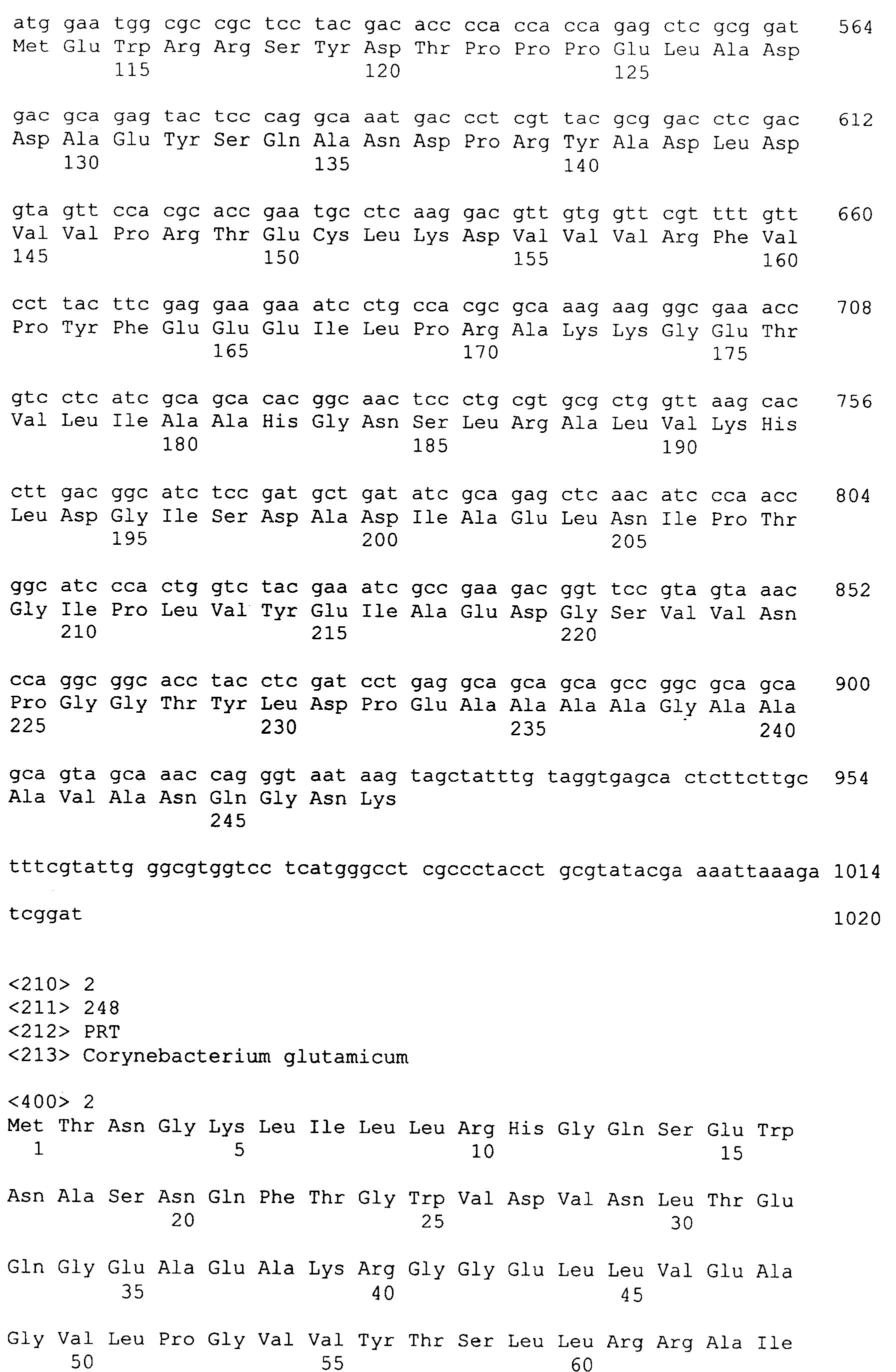
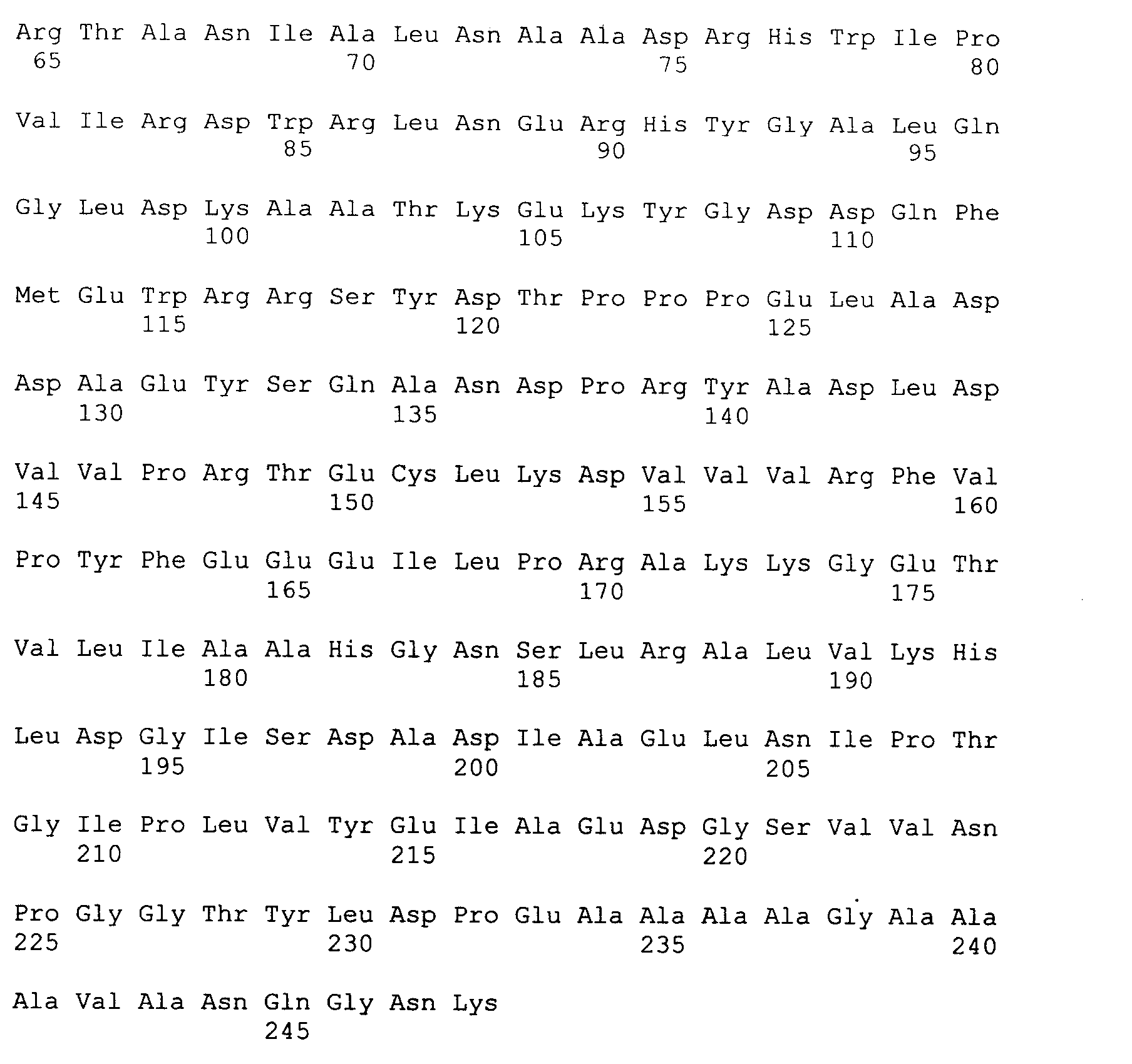
Claims (20)
- Isoliertes Polynukleotid aus coryneformen Bakterien, enthaltend eine Polynukleotidsequenz, ausgewählt aus der Gruppea) Polynukleotid, das mindestens zu 70 % identisch ist mit einem Polynukleotid, das für ein Polypeptid kodiert, das die Aminosäuresequenz von SEQ ID No. 2 enthält,b) Polynukleotid, das für ein Polypeptid kodiert, das eine Aminosäuresequenz enthält, die zu mindestens 70 % identisch ist mit der Aminosäuresequenz von SEQ ID No.2,c) Polynukleotid, das komplementär ist zu den Polynukleotiden von a) oder b), unde) Polynukleotid, enthaltend mindestens 15 aufeinanderfolgende Basen der Polynukleotidsequenz von a), b) oder c).
- Polynukleotid gemäß Anspruch 1,
wobei das Polynukleotid eine in coryneformen Bakterien replizierbare, bevorzugt rekombinante DNA ist. - Polynukleotid gemäß Anspruch 1,
wobei das Polynukleotid eine RNA ist. - Polynukleotid gemäß Anspruch 2,
enthaltend die Nukleinsäuresequenz wie in SEQ ID No. 1 dargestellt. - Replizierbare DNA gemäß Anspruch 2,
enthaltend(i) die Nukleotidsequenz, gezeigt in SEQ ID No. 1, oder(ii) mindestens eine Sequenz, die der Sequenz (i) innerhalb des Bereichs der Degeneration des genetischen Codes entspricht, oder(iii) mindestens eine Sequenz, die mit der zur Sequenz (i) oder (ii) komplementären Sequenz hybridisiert, und gegebenenfalls(iv) funktionsneutrale Sinnmutationen in (i). - Polynukleotidsequenz gemäß Anspruch 2, das für ein Polypeptid kodiert, das die Aminosäuresequenz in SEQ ID No. 2 darstellt, enthält.
- Verfahren zur fermentativen Herstellung von L-Aminosäuren, insbesondere L-Lysin,
dadurch gekennzeichnet,
daß man folgende Schritte durchführt:a) Fermentation der die L-Lysin produzierenden coryneformen Bakterien, in denen man zumindest das gpm-Gen oder dafür kodierende Nukleotidsequenzen verstärkt, insbesondere überexprimiert.b) Anreicherung von der L-Aminosäure im Medium oder in den Zellen der Bakterien undc) Isolieren von der L-Aminosäure. - Verfahren gemäß Anspruch 7,
dadurch gekennzeichnet,
daß man Bakterien einsetzt, in denen man zusätzlich weitere Gene des Biosyntheseweges der gewünschten L-Aminosäure verstärkt. - Verfahren gemäß Anspruch 7,
dadurch gekennzeichnet,
daß man Bakterien einsetzt, in denen die Stoffwechselwege zumindest teilweise ausgeschaltet sind, die die Bildung des L-Lysins verringern. - Verfahren gemäß Anspruch 7,
dadurch gekennzeichnet,
daß man einen mit einem Plasmidvektor transformierten Stamm einsetzt, und der Plasmidvektor die für das gpm-Gen kodierende Nukleotidsequenz trägt. - Verfahren gemäß einem oder mehreren der Ansprüche 7 bis 10,
dadurch gekennzeichnet,
daß man coryneforme Bakterien verwendet, die L-Lysin herstellen. - Verfahren gemäß Anspruch 8,
dadurch gekennzeichnet,
daß gleichzeitig das für die Dihydrodipicolinat-Synthase kodierende dapA-Gen überexprimiert wird. - Verfahren gemäß Anspruch 8,
dadurch gekennzeichnet,
daß gleichzeitig ein S-(2-Aminoethyl)-Cystein-Resistenz vermittelndes DNA-Fragment amplifiziert wird. - Verfahren gemäß Anspruch 8,
dadurch gekennzeichnet,
daß gleichzeitig das für die Gyceraldehyd-3-Phosphat Dehydrogenase kodierende gap-Gen überexprimiert wird. - Verfahren gemäß Anspruch 8,
dadurch gekennzeichnet,
daß gleichzeitig das für die Triosephosphat Isomerase kodierende tpi-Gen überexprimiert wird. - Verfahren gemäß Anspruch 8,
dadurch gekennzeichnet,
daß gleichzeitig das für die 3-Phosphatglycerat Kinase kodierende pgk-Gen überexprimiert wird. - Verfahren gemäß Anspruch 8,
dadurch gekennzeichnet,
daß gleichzeitig das für die Pyruvat Carboxylase kodierende pyc-Gen überexprimiert wird. - Verwendung von Polynukleotidsequenzen gemäß Anspruch 1 als Primer zur Herstellung der DNA von Genen, die eine dem opcA-Gen entsprechende Wirkung entfalten, durch die Polymerase-Kettenreaktion.
- Verwendung von Polynukleotidsequenzen gemäß Anspruch 1 als Hybridisierungssonde.
- Coryneforme Mikroorganismen, insbesondere der Gattung Corynebacterium, transformiert durch die Einführung der replizierbaren DNA gemäß einem der Ansprüche 1 oder 5.
Applications Claiming Priority (2)
| Application Number | Priority Date | Filing Date | Title |
|---|---|---|---|
| DE19958160A DE19958160A1 (de) | 1999-12-02 | 1999-12-02 | Neue für das gpm-Gen codierende Nukleotidsequenzen |
| DE19958160 | 1999-12-02 |
Publications (1)
| Publication Number | Publication Date |
|---|---|
| EP1104812A1 true EP1104812A1 (de) | 2001-06-06 |
Family
ID=7931210
Family Applications (1)
| Application Number | Title | Priority Date | Filing Date |
|---|---|---|---|
| EP00123955A Withdrawn EP1104812A1 (de) | 1999-12-02 | 2000-11-03 | Für das gpm-Gen kodierende Nukleotidsequenzen |
Country Status (15)
| Country | Link |
|---|---|
| US (1) | US7306939B2 (de) |
| EP (1) | EP1104812A1 (de) |
| JP (1) | JP2001197891A (de) |
| KR (1) | KR20010062075A (de) |
| CN (1) | CN1304999A (de) |
| AU (1) | AU7177300A (de) |
| BR (1) | BR0005699A (de) |
| CA (1) | CA2325594A1 (de) |
| DE (1) | DE19958160A1 (de) |
| HU (1) | HUP0004782A2 (de) |
| ID (1) | ID28564A (de) |
| MX (1) | MXPA00010969A (de) |
| PL (1) | PL344236A1 (de) |
| SK (1) | SK17952000A3 (de) |
| ZA (1) | ZA200007083B (de) |
Cited By (1)
| Publication number | Priority date | Publication date | Assignee | Title |
|---|---|---|---|---|
| WO2002101055A3 (en) * | 2001-06-13 | 2003-07-17 | Degussa | Process for the preparation of d-pantothenic acid and/or salts thereof |
Families Citing this family (1)
| Publication number | Priority date | Publication date | Assignee | Title |
|---|---|---|---|---|
| CN106434733B (zh) * | 2016-08-01 | 2019-09-27 | 江南大学 | 一种适用于谷氨酸棒杆菌的表达载体及其应用 |
Citations (4)
| Publication number | Priority date | Publication date | Assignee | Title |
|---|---|---|---|---|
| EP0197335A1 (de) * | 1985-03-12 | 1986-10-15 | Kyowa Hakko Kogyo Co., Ltd. | Verfahren zur Herstellung von L-Lysin |
| EP0955368A2 (de) * | 1998-03-18 | 1999-11-10 | Ajinomoto Co., Ltd. | L-Glutaminsaüre herstellendes Bakterium und Verfahren zur Herstellung von Glutaminsaüre |
| EP1038970A2 (de) * | 1999-03-25 | 2000-09-27 | Ajinomoto Co., Inc. | Verfahren zur Herstellung von L-Glutaminsäure |
| WO2001000844A2 (en) * | 1999-06-25 | 2001-01-04 | Basf Aktiengesellschaft | Corynebacterium glutamicum genes encoding proteins involved in carbon metabolism and energy production |
Family Cites Families (2)
| Publication number | Priority date | Publication date | Assignee | Title |
|---|---|---|---|---|
| US7270984B1 (en) * | 1999-06-25 | 2007-09-18 | Basf Aktiengesellschaft | Polynucleotides encoding a 6-phosphogluconolactonase polypeptide from corynebacterium glutamicum |
| JP4623825B2 (ja) | 1999-12-16 | 2011-02-02 | 協和発酵バイオ株式会社 | 新規ポリヌクレオチド |
-
1999
- 1999-12-02 DE DE19958160A patent/DE19958160A1/de not_active Withdrawn
-
2000
- 2000-11-03 EP EP00123955A patent/EP1104812A1/de not_active Withdrawn
- 2000-11-08 MX MXPA00010969A patent/MXPA00010969A/es unknown
- 2000-11-15 ID IDP20000985D patent/ID28564A/id unknown
- 2000-11-22 AU AU71773/00A patent/AU7177300A/en not_active Abandoned
- 2000-11-27 SK SK1795-2000A patent/SK17952000A3/sk unknown
- 2000-11-29 JP JP2000363631A patent/JP2001197891A/ja active Pending
- 2000-11-29 US US09/725,178 patent/US7306939B2/en not_active Expired - Fee Related
- 2000-11-30 CA CA002325594A patent/CA2325594A1/en not_active Abandoned
- 2000-11-30 ZA ZA200007083A patent/ZA200007083B/xx unknown
- 2000-12-01 PL PL00344236A patent/PL344236A1/xx not_active Application Discontinuation
- 2000-12-01 KR KR1020000072550A patent/KR20010062075A/ko not_active Withdrawn
- 2000-12-01 HU HU0004782A patent/HUP0004782A2/hu unknown
- 2000-12-01 CN CN00134608A patent/CN1304999A/zh active Pending
- 2000-12-04 BR BR0005699-5A patent/BR0005699A/pt not_active IP Right Cessation
Patent Citations (4)
| Publication number | Priority date | Publication date | Assignee | Title |
|---|---|---|---|---|
| EP0197335A1 (de) * | 1985-03-12 | 1986-10-15 | Kyowa Hakko Kogyo Co., Ltd. | Verfahren zur Herstellung von L-Lysin |
| EP0955368A2 (de) * | 1998-03-18 | 1999-11-10 | Ajinomoto Co., Ltd. | L-Glutaminsaüre herstellendes Bakterium und Verfahren zur Herstellung von Glutaminsaüre |
| EP1038970A2 (de) * | 1999-03-25 | 2000-09-27 | Ajinomoto Co., Inc. | Verfahren zur Herstellung von L-Glutaminsäure |
| WO2001000844A2 (en) * | 1999-06-25 | 2001-01-04 | Basf Aktiengesellschaft | Corynebacterium glutamicum genes encoding proteins involved in carbon metabolism and energy production |
Non-Patent Citations (1)
| Title |
|---|
| WHITE P J ET AL: "PHOSPHOGLYCERATE MUTASE FROM STREPTOMYCES-COELICOLOR A32 PURIFICATION AND CHARACTERIZATION OF THE ENZYME AND CLONING AND SEQUENCE ANALYSIS OF THE GENE", JOURNAL OF BACTERIOLOGY, vol. 174, no. 2, 1992, pages 434 - 440, XP000990937, ISSN: 0021-9193 * |
Cited By (1)
| Publication number | Priority date | Publication date | Assignee | Title |
|---|---|---|---|---|
| WO2002101055A3 (en) * | 2001-06-13 | 2003-07-17 | Degussa | Process for the preparation of d-pantothenic acid and/or salts thereof |
Also Published As
| Publication number | Publication date |
|---|---|
| HU0004782D0 (de) | 2001-02-28 |
| ID28564A (id) | 2001-06-07 |
| US7306939B2 (en) | 2007-12-11 |
| JP2001197891A (ja) | 2001-07-24 |
| SK17952000A3 (sk) | 2002-02-05 |
| ZA200007083B (en) | 2001-06-07 |
| PL344236A1 (en) | 2001-06-04 |
| DE19958160A1 (de) | 2001-06-07 |
| CA2325594A1 (en) | 2001-06-02 |
| AU7177300A (en) | 2001-06-07 |
| MXPA00010969A (es) | 2002-05-23 |
| CN1304999A (zh) | 2001-07-25 |
| BR0005699A (pt) | 2001-07-31 |
| US20020002275A1 (en) | 2002-01-03 |
| KR20010062075A (ko) | 2001-07-07 |
| HUP0004782A2 (en) | 2002-10-28 |
Similar Documents
| Publication | Publication Date | Title |
|---|---|---|
| EP1111062B1 (de) | Für das zwa1-Gen codierende Nukleotidsequenzen | |
| EP1106693A1 (de) | Für das zwa2-Protein codierende Nukleotidsequenzen | |
| EP1090998A1 (de) | Für das eno-Gen codierende Nukleotidsequenzen | |
| EP1136559B1 (de) | Für das dapC-Gen kodierende Nukleotidsequenzen und Verfahren zur Herstellung von L-Lysin | |
| DE19943587A1 (de) | Neue für das dapF-Gen codierende Nukleotidsequenzen | |
| DE10044681A1 (de) | Neue für das lldD2-Gen kodierende Nukleotidsequenzen | |
| DE60132341T2 (de) | Isolierung und sequenzierung vom gen ptsi aus c. glutamicum | |
| DE60127116T2 (de) | Für das glbo-gen kodierende nukleotidsequenzen aus corynebacterium glutamicum | |
| DE10045497A1 (de) | Neue für das ppsA-Gen kodierende Nukleotidsequenzen | |
| EP1118666A2 (de) | Für das ptsH-Gen codierende Nukleotidsequenzen aus Corynebacterium glutamicum | |
| EP1106694A1 (de) | Für das glk-Gen codierende Nukleotidsequenzen | |
| EP1106622A2 (de) | Neue für das pfkA-Gen codierende Nukleotidsequenzen | |
| EP1103613A1 (de) | Für das pfk-Gen codierende Nukleotidsequenzen | |
| DE10046625A1 (de) | Neue für das ndkA-Gen kodierende Nukleotidsequenzen | |
| US7306939B2 (en) | Nucleotide sequences encoding the gpm gene | |
| DE10023400A1 (de) | Neue für das acp-Gen kodierende Nukleotidsequenzen | |
| DE60120724T2 (de) | Rekombinante coryneformbakterie die glyceraldehyde-3-phosphate dehydrogenase -2 überexprimieren , und verfahren zur herstellung von l-lysine | |
| DE10032173A1 (de) | Neue für das plsC-Gen kodierende Nukleotidsequenzen | |
| DE10037612A1 (de) | Neue für das rpi-Gen kodierende Nukleotidsequenzen | |
| DE10037611A1 (de) | Neue für das rpe-Gen kodierende Nuleotidsequenzen | |
| DE10021828A1 (de) | Neue für das cdsA-Gen kodierende Nukleotidsequenzen | |
| DE10021832A1 (de) | Neue für das cma-Gen kodierende Nukleotidsequenzen | |
| DE10011922A1 (de) | Neue für das pfkA-Gen codierende Nukleotidsequenzen | |
| DE19947792A1 (de) | Neue für das Irp Gen codierende Nukleotidsequenzen | |
| DE10021831A1 (de) | Neue für das fadD15-Gen kodierende Nukleotidsequenzen |
Legal Events
| Date | Code | Title | Description |
|---|---|---|---|
| PUAI | Public reference made under article 153(3) epc to a published international application that has entered the european phase |
Free format text: ORIGINAL CODE: 0009012 |
|
| 17P | Request for examination filed |
Effective date: 20001103 |
|
| AK | Designated contracting states |
Kind code of ref document: A1 Designated state(s): AT BE CH CY DE DK ES FI FR GB GR IE IT LI LU MC NL PT SE TR |
|
| AX | Request for extension of the european patent |
Free format text: AL;LT;LV;MK;RO;SI |
|
| AKX | Designation fees paid |
Free format text: AT BE CH CY DE DK ES FI FR GB GR IE IT LI LU MC NL PT SE TR |
|
| STAA | Information on the status of an ep patent application or granted ep patent |
Free format text: STATUS: THE APPLICATION IS DEEMED TO BE WITHDRAWN |
|
| 18D | Application deemed to be withdrawn |
Effective date: 20060601 |