EP1092769A2 - Polypeptid-Tag's für den Nachweis und die Aufreinigung von Polypeptiden - Google Patents
Polypeptid-Tag's für den Nachweis und die Aufreinigung von Polypeptiden Download PDFInfo
- Publication number
- EP1092769A2 EP1092769A2 EP00117845A EP00117845A EP1092769A2 EP 1092769 A2 EP1092769 A2 EP 1092769A2 EP 00117845 A EP00117845 A EP 00117845A EP 00117845 A EP00117845 A EP 00117845A EP 1092769 A2 EP1092769 A2 EP 1092769A2
- Authority
- EP
- European Patent Office
- Prior art keywords
- polypeptide
- tag
- expression vector
- antibody
- sequence
- Prior art date
- Legal status (The legal status is an assumption and is not a legal conclusion. Google has not performed a legal analysis and makes no representation as to the accuracy of the status listed.)
- Granted
Links
Images
Classifications
-
- C—CHEMISTRY; METALLURGY
- C07—ORGANIC CHEMISTRY
- C07K—PEPTIDES
- C07K14/00—Peptides having more than 20 amino acids; Gastrins; Somatostatins; Melanotropins; Derivatives thereof
- C07K14/005—Peptides having more than 20 amino acids; Gastrins; Somatostatins; Melanotropins; Derivatives thereof from viruses
-
- C—CHEMISTRY; METALLURGY
- C07—ORGANIC CHEMISTRY
- C07K—PEPTIDES
- C07K16/00—Immunoglobulins [IG], e.g. monoclonal or polyclonal antibodies
- C07K16/44—Immunoglobulins [IG], e.g. monoclonal or polyclonal antibodies against material not provided for elsewhere, e.g. haptens, metals, DNA, RNA, amino acids
-
- C—CHEMISTRY; METALLURGY
- C12—BIOCHEMISTRY; BEER; SPIRITS; WINE; VINEGAR; MICROBIOLOGY; ENZYMOLOGY; MUTATION OR GENETIC ENGINEERING
- C12P—FERMENTATION OR ENZYME-USING PROCESSES TO SYNTHESISE A DESIRED CHEMICAL COMPOUND OR COMPOSITION OR TO SEPARATE OPTICAL ISOMERS FROM A RACEMIC MIXTURE
- C12P21/00—Preparation of peptides or proteins
- C12P21/02—Preparation of peptides or proteins having a known sequence of two or more amino acids, e.g. glutathione
-
- C—CHEMISTRY; METALLURGY
- C07—ORGANIC CHEMISTRY
- C07K—PEPTIDES
- C07K2317/00—Immunoglobulins specific features
- C07K2317/60—Immunoglobulins specific features characterized by non-natural combinations of immunoglobulin fragments
- C07K2317/62—Immunoglobulins specific features characterized by non-natural combinations of immunoglobulin fragments comprising only variable region components
- C07K2317/622—Single chain antibody (scFv)
-
- C—CHEMISTRY; METALLURGY
- C07—ORGANIC CHEMISTRY
- C07K—PEPTIDES
- C07K2319/00—Fusion polypeptide
-
- C—CHEMISTRY; METALLURGY
- C12—BIOCHEMISTRY; BEER; SPIRITS; WINE; VINEGAR; MICROBIOLOGY; ENZYMOLOGY; MUTATION OR GENETIC ENGINEERING
- C12N—MICROORGANISMS OR ENZYMES; COMPOSITIONS THEREOF; PROPAGATING, PRESERVING, OR MAINTAINING MICROORGANISMS; MUTATION OR GENETIC ENGINEERING; CULTURE MEDIA
- C12N2770/00—MICROORGANISMS OR ENZYMES; COMPOSITIONS THEREOF; PROPAGATING, PRESERVING, OR MAINTAINING MICROORGANISMS; MUTATION OR GENETIC ENGINEERING; CULTURE MEDIA ssRNA viruses positive-sense
- C12N2770/00011—Details
- C12N2770/00022—New viral proteins or individual genes, new structural or functional aspects of known viral proteins or genes
Definitions
- the present invention relates to polypeptide tags used for isolation, purification as well as for the detection of polypeptides.
- the present invention also relates to expression vectors that encode a fusion polypeptide that includes a tag54 epitope and a desired polypeptide, and the use of such Expression vectors for the expression of the fusion polypeptides.
- polypeptides remains a challenge. This applies especially when the expressed polypeptide is irrespective of the one used Expression system is to be detected and purified.
- epitope taggings For the analysis or purification of polypeptides, the technique of so-called “epitope taggings" used, in which by means of molecular biological techniques a specific epitope is attached to a polypeptide of interest and that during expression the resulting fusion peptide is then isolated by means of antibodies directed against the "tag".
- the primary sequence of any polypeptide is made more recombinant Techniques extended by a few amino acids specific to the antibody be recognized. The existence of one is therefore crucial for success specific and high affinity antibody with known recognition sequence, which the Specifically recognizes sequence without cross-reactivity with other protein sequences.
- TMV 54K protein a specific region of the TMV 54K protein (cf. Padgett et al. "Analysis of a Tobacco Mosaic Virus Strain capable of overcoming N gene-mediated resistance"; Plant Cell 5 (1993), 577 -586), in particular the amino acid sequence between amino acids 405 and 410 of the TMV 54K protein is outstandingly suitable as a "tag", since antibodies with high affinity can be produced against this region and cross-reactivity with cellular epitopes of bacterial and eukaryotic origin is essentially absent.
- a DNA sequence encoding a polypeptide of interest is also inserted into the expression vector inserted in such a way that both DNA sequences form a uniform reading frame and a fusion polypeptide is prepared that contains the polypeptide of interest and the "tag" contains.
- the "tag" at the N- or C-terminal end, or within the Fusion polypeptide are present and possibly from the polypeptide by one of or spacers consisting of several amino acids.
- the expression vectors usually contain the elements that are usual for them, such as promoter, Polylinker to facilitate the cloning of foreign sequences, leader sequences for Control of the fusion peptide out of the cell, etc.
- the vectors are under Consideration of the requirements of the desired expression system selected.
- the vectors pGEMEX, pUC derivatives, pGEX-2T, pET derivatives, pQE8 are used, all of which are already widely used as Expression vectors are used.
- the vectors pY100, Ycpad1, pPIC9K and pPICz can be used, while the vectors pKCR, pEFBOS, cDM8 and pCEV4 can be used for expression in animal cells.
- the vector pAL76 and pSS derivatives can be used for expression in plants, while expression in insect cells is achieved, for example, using the baculovirus expression vector pAcSGNT-A can be.
- the person skilled in the art can, on the basis of his general specialist knowledge, the respective DNA sequences for the polypeptide tag or the polypeptide of interest in the Insert expression vector so that expression of the fusion peptide is achieved or can be optimized. It may be preferred that the polypeptide tag coding DNA sequence before inserting the DNA for the polypeptide into the Expression vector is inserted. It is also clear to the person skilled in the art that, owing to the Degeneration of the genetic code can be changed in such a way that DNA for example a codon-optimized DNA sequence for the respective expression system to provide.
- Methods and cells are also known to the person skilled in the art for producing fusion polypeptides express.
- Examples of such cells include the E. coli strains HB101, DH1, JM101, JM109 and BL21, the yeasts Saccharomyces cerevisae and Pichia pastoris, the animal yeasts Cell lines L 3T3, FM3A, CHO, COS, Vera and HeLa, as well as the insect cell line Sf9. Further can Monocotyledoneae and Dicotyledoneae, both as a plant and in cell suspension culture be used.
- the present invention provides an anti-polypeptide according to the invention targeted antibodies.
- the molecular weight of a protein can be determined, its cellular Localization, post-translational modifications or interactions with others Factors without the need for protein-specific antibodies, and one Purification of proteins can be carried out easily (affinity chromatography).
- the antibody can be a polyclonal or monoclonal antibody or the "tag" binding fragment thereof, with a monoclonal antibody being preferred.
- This can be prepared by customary methods known to those skilled in the art. Should polyclonal or monoclonal antibodies are produced, then it is advantageous to animals, especially rabbits to receive polyclonal antibodies, and mice to receive monoclonal antibodies with the corresponding fusion polypeptide or a fragment of which contains the corresponding epitope or with the purified epitope immunize. The animals can be boosted further using the same antigens.
- fusion peptides containing the polypeptide tag according to the invention can or a mixture of the fusion polypeptide used first and one or more new fusion polypeptides can be used to boost.
- spleen cells from the immunized animals are analyzed known methods fused with myeloma cells.
- an antibody according to the invention can be synthetic, where appropriate parts, which are not necessary for the recognition of the polypeptide tag according to the invention, entirely or partially missing or these parts are replaced by others that the antibody give other favorable properties.
- monoclonal antibodies For the production of synthetic antibodies, for example, monoclonal antibodies. To do this, the antigen binding regions the monoclonal antibody is analyzed and used for detection necessary and unnecessary parts are identified. The necessary parts can then be modified and all or part of the unnecessary eliminated or be replaced by parts that give the antibodies other favorable properties. Parts outside the binding regions of the antibodies can also be modified, eliminated or be replaced.
- the antibodies according to the invention are distinguished by the fact that they use the inventive Polypeptide Tag can recognize and bind any fusion polypeptides.
- the Antibodies are therefore suitable for the rapid detection of the expression of such Fusion polypeptides, which can be carried out in any method, especially in a Western blot, an ELISA, an immunoprecipitation or a Immunofluorescence.
- the antibodies according to the invention can be labeled or in Can be used in combination with labeled antibodies directed against these.
- the antibodies according to the invention can be used for the corresponding Purify fusion polypeptides from, for example, cell extracts.
- a bond of Antibodies to the "tag” can occur in a wide pH range, for example in a range from about pH 3 to about 10.
- the present invention furthermore provides a kit which contains an expression vector, with which a desired polypeptide can be expressed in a specific system.
- the expression vector preferably already contains the DNA sequence for the polypeptide tag according to the invention, so that the person skilled in the art only has the polypeptide of Must bring interest in the expression vector.
- the polypeptide tag coding DNA sequence can be provided separately so that the user can decide at which point of the resulting fusion polypeptide the "tag" should appear.
- the kit also contains an antibody directed against the tag according to the invention as well as customary auxiliaries, such as buffers, carriers, marker compounds and controls.
- mAb 54-1 a monoclonal antibody, was generated against the viral TMV 54K protein.
- Female Balb / c mice were used for the immunization, a fusion protein of TMV 54K with GST (glutathione-S-transferase) obtained from transformed E. coli cells being used as the antigen.
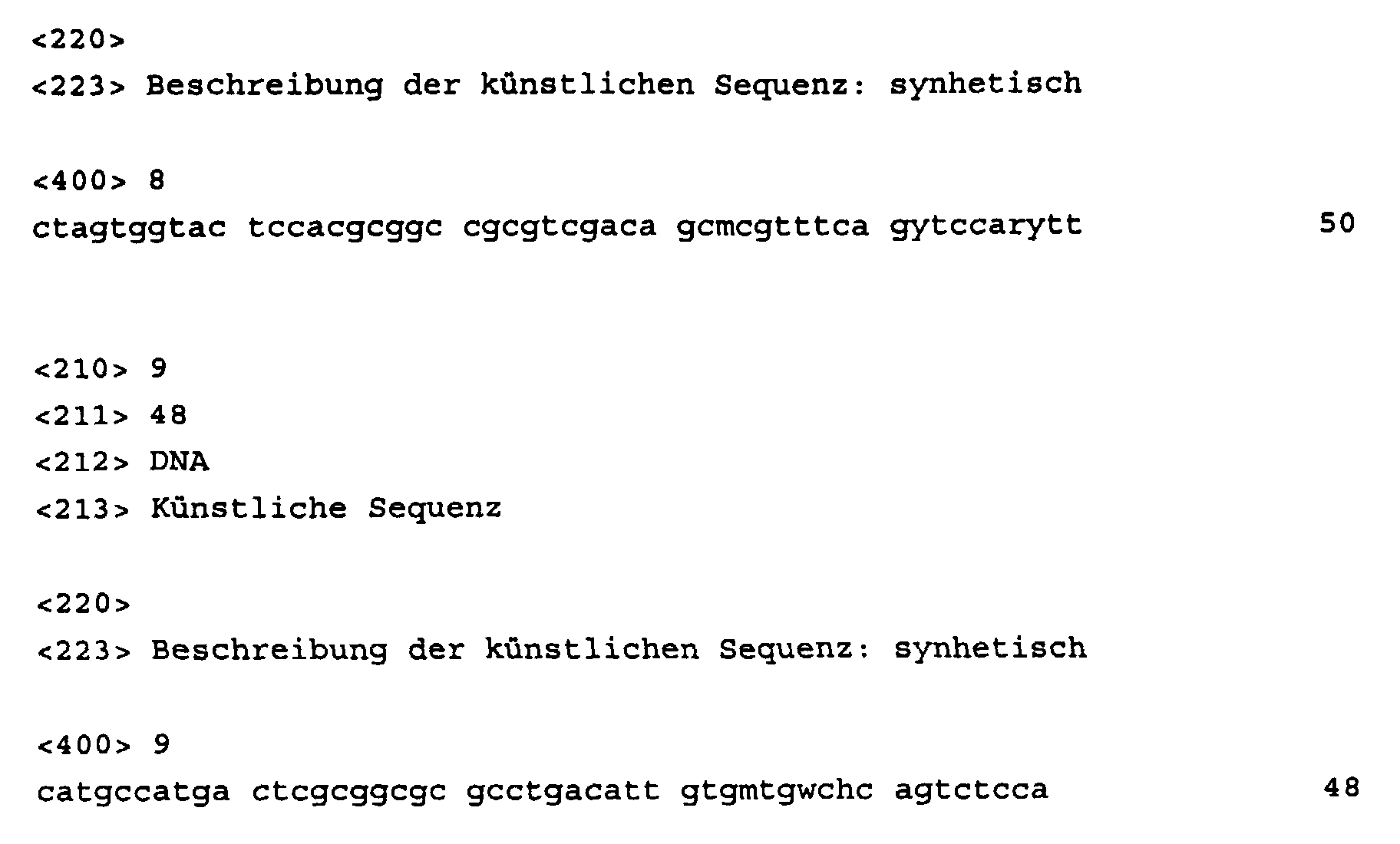
- variable domains of the heavy chain (V H ) and the light chain (V L ) were cloned by RT-PCR using the following oligonucleotides:
- nucleotide sequences obtained in this way were expressed in the form of so-called “single chain antibodies” (scFv) in E. coli (Winter G. and Milstein C., Nature 349 (1991), 293-299).
- scFv single chain antibodies
- phage library was created in order to identify linear and structural epitopes using the so-called peptide display.
- the phage libraries created express an indefinite 9 amino acid peptide at the N-terminus of Lambda gene VIII.
- One library presented linear peptides, the other closed peptides.
- the libraries were hybridized to the affinity-purified monoclonal antibody (20 ⁇ g per round of selection) using a standard protocol (Cortese et al., Supra). In the first round of the selection, 5 ⁇ 10 12 phages were incubated in 1 ml of PBS with immobilized antigen (16 hours, 4 ° C.).
- binding phages were eluted with 1 ml Glycine-HCl pH 2.2 and 0.1% (w / v) BSA (10min, 20 ° C), neutralized with 60 ⁇ l 2M Tris and then used to infect E. coli.
- the phage titer was then determined by plating 100 ⁇ l of infected cells onto 2 ⁇ TY-amp plates. Enrichment factors were determined using a parallel BSA control. Monoclonal phages from the third round of selection were checked for their reactivity in the phageelisa.
- the positively selected phages obtained in this way were sequenced.
- the respectively received Sequences were compared and the consensus sequence was determined.
- epitopes have been used as a means of detection for plants and bacteria derived recombinant proteins built into commercially available vectors.
- the epitope tag-54 was fused "in frame" to the C-terminus of the antibody fragment scFv24.
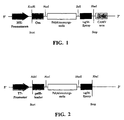
- the C-terminal c-myc and His6 fragment was removed from the vector pscFv24CM (Zimmermann et. Al, Molecular Breeding 4 (1998), 369-379) and replaced by the SalI / XbaI tag-54 fragment (FIG. 1 ).
- the complete expression cassette in the plant expression vector pSSH1 (Kay R.
- Both constructs were transient in Nicotiana tabaccum cv. Petite Havana SR1 leaves were transformed and after three days of incubation, the soluble proteins were isolated by grinding the tobacco leaves in mortars in the extraction buffer (200mM Tris-HCl pH 7.5, 5mM EDTA, Tween 20, 0.1mM DTT).
- the expression and enrichment of the recombinant proteins was determined by means of ELISA and Western blot detected on day 54 using the antibody mAb 54-1.
- ELISA Western blot detected on day 54 using the antibody mAb 54-1.
- the ELISA could for the construct pscFv24-54tag 1375ng and for the construct pscFv24-54tagK 26480 ng of functional scFv24 per gram of sheet material can be recorded.
- both recombinant proteins can be specifically detected.
- 20 ⁇ l of those isolated from the tobacco leaves were isolated soluble proteins separated in an SDS polyacrylamide gel, onto a Nitrocellulose membrane transferred (Maniatis, supra) and the recombinant proteins scFv24-54tag and scFv24-54tagK detected as follows: 1) mAb 54-1 (0.8mg / ml and Diluted 1: 5,000), 2) a goat anti mouse antibody labeled with alkaline phosphatase (0.6mg / ml diluted 1: 5,000), 3) NBT / BCIP staining reagent.
- the vector pET22b (Novagen, Ca, USA) was modified in such a way that it enables "in-frame" cloning of the GST protein in fusion with the tag-54 (FIG. 2).
- the tag54 epitope was cloned into the bacterial expression vector pGEX5x-3 (Pharmacia, SE) and expressed as a GST (glutathione-S-transferase) fusion peptide (GST-tag54) using transformed E. coli BL21 cells.
- the E. coli cells were grown at 30 ° C. to an OD 600 nm of 0.8 with shaking and then induced with 1 mM IPTG.
- the cells were obtained by centrifugation (4000 xg, 4 ° C).
- the cells were lysed by means of ultrasound, whereupon 30 ⁇ g of protein A purified monoclonal antibody mAK 54-1 were added to 10 ml of bacterial lysate
- the GST-Tag54 / mAK 54-1 association product formed was isolated by means of a GST affinity purification (Pharmacia, SE) and eluted from the matrix by means of reduced glutathione.
- the complex was separated by gel electrophoresis using SDS-PAA gel electrophoresis, the light and heavy chain antibodies and the GST-tag54 protein being detected on the Coomasie blue stained gel.
Landscapes
- Chemical & Material Sciences (AREA)
- Organic Chemistry (AREA)
- Life Sciences & Earth Sciences (AREA)
- Health & Medical Sciences (AREA)
- Molecular Biology (AREA)
- General Health & Medical Sciences (AREA)
- Genetics & Genomics (AREA)
- Proteomics, Peptides & Aminoacids (AREA)
- Biochemistry (AREA)
- Engineering & Computer Science (AREA)
- Medicinal Chemistry (AREA)
- Biophysics (AREA)
- Wood Science & Technology (AREA)
- Zoology (AREA)
- Biotechnology (AREA)
- General Engineering & Computer Science (AREA)
- Bioinformatics & Cheminformatics (AREA)
- Microbiology (AREA)
- Immunology (AREA)
- General Chemical & Material Sciences (AREA)
- Chemical Kinetics & Catalysis (AREA)
- Virology (AREA)
- Gastroenterology & Hepatology (AREA)
- Peptides Or Proteins (AREA)
- Preparation Of Compounds By Using Micro-Organisms (AREA)
Abstract
Description
bzw.
| 402 | 403 | 404 | 405 | 406 | 407 | 408 | 409 | 410 | 411 | 412 | 413 | |
| 54K-protein: | K | H | I | K | D | W | E | H | L | E | E | F |
| A2/A9/B8/C9: | K | R | K | D | G | E | H | W | L | |||
| A6/B5/F8/H1: | R | Q | A | K | S | W | S | S | L | |||
| G5: | Y | Q | A | K | E | W | S | N | L | |||
| H10: | K | D | W | E | H | R | V | P | S | |||
| Konsensus-sequenz : | K | D | W | E/S | H | L |
Beide Konstrukte wurden transient in Nicotiana tabaccum cv. Petite Havanna SR1 Blättern transformiert und nach dreitägiger Inkubation wurden die löslichen Proteine durch Verreiben der Tabakblätter in Mörsern im Extraktionspuffer (200mM Tris-HCl pH 7.5, 5mM EDTA, Tween 20, 0.1mM DTT) isoliert.


Claims (15)
- Polypeptid-Tag, das die folgende Aminosäuresequenz aufweistbzw. eine von der vorstehend angegebenen Sequenz durch Ersatz einer oder mehrerer Aminosäuren abgeleiteten Sequenz, bei der die dreidimensionale bzw. Tertiärstruktur im wesentlichen erhalten bleibt.Lys-Asp-Trp-Glu-His-Leu
- Polypeptid-Tag nach Anspruch 1, das die folgenden Aminosäuresequenz aufweistbzw. eine von der vorstehend angegebenen Sequenz durch Ersatz einer oder mehrerer Aminosäuren abgeleiteten Sequenz, bei der die dreidimensionale bzw. Tertiärstruktur im wesentlichen erhalten bleibt.Lys-His-Ile-Lys-Asp-Trp-Glu-His-Leu-Glu-Glu-Phe
- Expressionsvektor, kodierend ein Fusionspolypeptid, das ein gewünschtes Polypeptid und ein Polypeptid-Tag nach einem der Ansprüche 1 oder 2 umfaßt.
- Expressionsvektor nach Anspruch 3, wobei das Polypeptid-Tag von dem gewünschten Polypeptid durch einen Abstandshalter getrennt ist.
- Expressionsvektor nach Anspruch 3 oder 4, wobei das Polypeptid-Tag von der folgenden DNA-Sequenz kodiert ist:bzw. einer davon abweichenden DNA-Sequenz, die ein Polypeptid-Tag nach Anspruch 1 kodiert.AAG GAC TGG GAG CAC
- Expressionsvektor nach Anspruch 3 oder 4, wobei das Polypeptid-Tag von der folgenden DNA-Sequenz kodiert ist:bzw. einer davon abweichenden DNA-Sequenz, die ein Polypeptid-Tag nach Anspruch 2 kodiert.AAG CAC ATC AAG GAC TGG GAG CAC CTC GAA GAG TTC
- Expressionsvektor nach einem der Ansprüche 3 bis 6, wobei das Polypeptid-Tag am N- oder C-Terminus oder innerhalb des Polypeptids vorliegt.
- Fusionspolypeptid, das von einem Expressionsvektor nach einem der Ansprüche 3 bis 7 kodiert ist.
- Antikörper oder ein Fragment davon, der gegen ein Polypeptid-Tag nach einem der Ansprüche 1 oder 2 gerichtet ist.
- Antikörper nach Anspruch 9, wobei der Antikörper monoklonal ist.
- Verwendung eines Polypeptid-Tags nach Anspruch 1 oder 2 zur Isolierung und/oder zum Nachweis eines Polypeptids.
- Verwendung eines Expressionsvektors nach einem der Ansprüche 3 bis 7 zur Herstellung und/oder Isolierung eines Polypeptids.
- Verwendung eines Antikörpers nach Anspruch 9 oder 10 zur Reinigung und/oder Isolierung und/oder zum Nachweis eines Polypeptids.
- Verwendung eines Antikörpers nach einem der Ansprüche 9 oder 10 zur Diagnostik von TMV-Infektionen.
- Kit, umfassend, einen Expressionsvektor nach einem der Ansprüche 3 bis 7 und ggf. einen Antikörper nach einem der Ansprüche 9 oder 10.
Applications Claiming Priority (4)
| Application Number | Priority Date | Filing Date | Title |
|---|---|---|---|
| DE19949855 | 1999-10-15 | ||
| DE19949855 | 1999-10-15 | ||
| DE10019473 | 2000-04-19 | ||
| DE10019473A DE10019473A1 (de) | 1999-10-15 | 2000-04-19 | Polypeptid-Tag's für den Nachweis und die Aufreinigung von Polypeptiden |
Publications (3)
| Publication Number | Publication Date |
|---|---|
| EP1092769A2 true EP1092769A2 (de) | 2001-04-18 |
| EP1092769A3 EP1092769A3 (de) | 2001-12-12 |
| EP1092769B1 EP1092769B1 (de) | 2008-10-29 |
Family
ID=26005389
Family Applications (1)
| Application Number | Title | Priority Date | Filing Date |
|---|---|---|---|
| EP20000117845 Expired - Lifetime EP1092769B1 (de) | 1999-10-15 | 2000-08-18 | Polypeptid-Tag's für den Nachweis und die Aufreinigung von Polypeptiden |
Country Status (1)
| Country | Link |
|---|---|
| EP (1) | EP1092769B1 (de) |
Cited By (2)
| Publication number | Priority date | Publication date | Assignee | Title |
|---|---|---|---|---|
| CN110172451A (zh) * | 2019-05-05 | 2019-08-27 | 昆明理工大学 | 一种高通量分离噬菌体的方法 |
| JP2019533988A (ja) * | 2016-09-01 | 2019-11-28 | メタックス インスティトゥート フュア ディエーテティック ゲーエムベーハーMetax Institut Fuer Diaetetik Gmbh | Pku治療のためのフェニルアラニン非含有タンパク質 |
Family Cites Families (1)
| Publication number | Priority date | Publication date | Assignee | Title |
|---|---|---|---|---|
| BR9915543A (pt) * | 1998-10-16 | 2001-08-14 | Fraunhofer Ges Forschung | Resistência a doenças por plantas mediada por patogenicidas moleculares |
-
2000
- 2000-08-18 EP EP20000117845 patent/EP1092769B1/de not_active Expired - Lifetime
Cited By (2)
| Publication number | Priority date | Publication date | Assignee | Title |
|---|---|---|---|---|
| JP2019533988A (ja) * | 2016-09-01 | 2019-11-28 | メタックス インスティトゥート フュア ディエーテティック ゲーエムベーハーMetax Institut Fuer Diaetetik Gmbh | Pku治療のためのフェニルアラニン非含有タンパク質 |
| CN110172451A (zh) * | 2019-05-05 | 2019-08-27 | 昆明理工大学 | 一种高通量分离噬菌体的方法 |
Also Published As
| Publication number | Publication date |
|---|---|
| EP1092769A3 (de) | 2001-12-12 |
| EP1092769B1 (de) | 2008-10-29 |
Similar Documents
| Publication | Publication Date | Title |
|---|---|---|
| DE69233008T2 (de) | Fusionierung von Peptiden und Proteinen mit Thioredoxin und thioredoxin-ähnlichen Molekülen | |
| DE3880739T2 (de) | Expression von menschlichem proapolipoprotein a-1. | |
| WO1991018983A1 (de) | Komplexes virales antigen von hiv-1 bindendes rekombinantes protein | |
| DE3875043T2 (de) | Immunogenes produkt, erhalten durch expression in einer rekombinanten hefe, und verfahren zu seiner reinigung. | |
| EP1141271B1 (de) | Selektion von monoklonalen antikörpern | |
| DE19717893A1 (de) | Monofunktionelle Glycosyltransferasen | |
| EP1092769B1 (de) | Polypeptid-Tag's für den Nachweis und die Aufreinigung von Polypeptiden | |
| DE19850718C1 (de) | Zellpermeabilität-vermittelndes Polypeptid | |
| DE69324345T2 (de) | Expression von osteogenem faktor op-1 in mit rekombinantem baculovirus infizierten spodoptera frugiperda-zellen | |
| DE19521046C1 (de) | Protein mit DNase-Aktivität | |
| DE10019473A1 (de) | Polypeptid-Tag's für den Nachweis und die Aufreinigung von Polypeptiden | |
| DE19611234C1 (de) | Tyrosin-Phosphatase-verwandtes Protein | |
| EP1015583B1 (de) | Srcr domäne-enthaltendes protein | |
| DE19825621C2 (de) | Protein zur Regulation von Apoptose | |
| DE19650758C1 (de) | PKD1-Fragmente mit Bindungsregionen für PKD1-spezifische Antikörper | |
| WO1999006577A2 (de) | Mittel zur expression und zum nachweis eines ein hpol-epitop und ein polypeptid umfassenden fusionspolypeptids | |
| DE19856882C1 (de) | Spermatogenese-Protein | |
| DE19847364C1 (de) | Tumor-Protein | |
| DE19816186A1 (de) | GDNF-kodierende DNA, Teile davon und GDNF-Varianten | |
| DE19845277C1 (de) | Transmembran-Protein | |
| DE19730997C1 (de) | SRCR Domäne-enthaltendes Protein | |
| DE19534763C1 (de) | FMR1-verwandtes Protein | |
| WO1999055876A2 (de) | Polypeptid mit immunogenen eigenschaften und veränderten biologischen funktionen eines proteins | |
| WO1998044103A2 (de) | Protein zur inhibierung von apoptose | |
| DE19818680C1 (de) | DNA-Doppelstrangbruch-Reparatur-Protein |
Legal Events
| Date | Code | Title | Description |
|---|---|---|---|
| PUAI | Public reference made under article 153(3) epc to a published international application that has entered the european phase |
Free format text: ORIGINAL CODE: 0009012 |
|
| AK | Designated contracting states |
Kind code of ref document: A2 Designated state(s): AT BE CH CY DE DK ES FI FR GB GR IE IT LI LU MC NL PT SE |
|
| AX | Request for extension of the european patent |
Free format text: AL;LT;LV;MK;RO;SI |
|
| PUAL | Search report despatched |
Free format text: ORIGINAL CODE: 0009013 |
|
| AK | Designated contracting states |
Kind code of ref document: A3 Designated state(s): AT BE CH CY DE DK ES FI FR GB GR IE IT LI LU MC NL PT SE |
|
| AX | Request for extension of the european patent |
Free format text: AL;LT;LV;MK;RO;SI |
|
| 17P | Request for examination filed |
Effective date: 20020415 |
|
| AKX | Designation fees paid |
Free format text: AT BE CH CY DE DK ES FI FR GB GR IE IT LI LU MC NL PT SE |
|
| RAP1 | Party data changed (applicant data changed or rights of an application transferred) |
Owner name: FRAUNHOFER-GESELLSCHAFT ZUR FOERDERUNG DERANGEWAND |
|
| RAP1 | Party data changed (applicant data changed or rights of an application transferred) |
Owner name: FRAUNHOFER-GESELLSCHAFT ZUR FOERDERUNG DER ANGEWAN |
|
| 17Q | First examination report despatched |
Effective date: 20070713 |
|
| GRAP | Despatch of communication of intention to grant a patent |
Free format text: ORIGINAL CODE: EPIDOSNIGR1 |
|
| GRAS | Grant fee paid |
Free format text: ORIGINAL CODE: EPIDOSNIGR3 |
|
| GRAA | (expected) grant |
Free format text: ORIGINAL CODE: 0009210 |
|
| AK | Designated contracting states |
Kind code of ref document: B1 Designated state(s): AT BE CH CY DE DK ES FI FR GB GR IE IT LI LU MC NL PT SE |
|
| REG | Reference to a national code |
Ref country code: GB Ref legal event code: FG4D Free format text: NOT ENGLISH |
|
| REG | Reference to a national code |
Ref country code: CH Ref legal event code: EP |
|
| REG | Reference to a national code |
Ref country code: IE Ref legal event code: FG4D Free format text: LANGUAGE OF EP DOCUMENT: GERMAN |
|
| REF | Corresponds to: |
Ref document number: 50015422 Country of ref document: DE Date of ref document: 20081211 Kind code of ref document: P |
|
| NLV1 | Nl: lapsed or annulled due to failure to fulfill the requirements of art. 29p and 29m of the patents act | ||
| PG25 | Lapsed in a contracting state [announced via postgrant information from national office to epo] |
Ref country code: ES Free format text: LAPSE BECAUSE OF FAILURE TO SUBMIT A TRANSLATION OF THE DESCRIPTION OR TO PAY THE FEE WITHIN THE PRESCRIBED TIME-LIMIT Effective date: 20090209 |
|
| PG25 | Lapsed in a contracting state [announced via postgrant information from national office to epo] |
Ref country code: NL Free format text: LAPSE BECAUSE OF FAILURE TO SUBMIT A TRANSLATION OF THE DESCRIPTION OR TO PAY THE FEE WITHIN THE PRESCRIBED TIME-LIMIT Effective date: 20081029 Ref country code: FI Free format text: LAPSE BECAUSE OF FAILURE TO SUBMIT A TRANSLATION OF THE DESCRIPTION OR TO PAY THE FEE WITHIN THE PRESCRIBED TIME-LIMIT Effective date: 20081029 Ref country code: PT Free format text: LAPSE BECAUSE OF FAILURE TO SUBMIT A TRANSLATION OF THE DESCRIPTION OR TO PAY THE FEE WITHIN THE PRESCRIBED TIME-LIMIT Effective date: 20090330 |
|
| REG | Reference to a national code |
Ref country code: IE Ref legal event code: FD4D |
|
| PG25 | Lapsed in a contracting state [announced via postgrant information from national office to epo] |
Ref country code: DK Free format text: LAPSE BECAUSE OF FAILURE TO SUBMIT A TRANSLATION OF THE DESCRIPTION OR TO PAY THE FEE WITHIN THE PRESCRIBED TIME-LIMIT Effective date: 20081029 Ref country code: IE Free format text: LAPSE BECAUSE OF FAILURE TO SUBMIT A TRANSLATION OF THE DESCRIPTION OR TO PAY THE FEE WITHIN THE PRESCRIBED TIME-LIMIT Effective date: 20081029 |
|
| PG25 | Lapsed in a contracting state [announced via postgrant information from national office to epo] |
Ref country code: IT Free format text: LAPSE BECAUSE OF FAILURE TO SUBMIT A TRANSLATION OF THE DESCRIPTION OR TO PAY THE FEE WITHIN THE PRESCRIBED TIME-LIMIT Effective date: 20081029 Ref country code: SE Free format text: LAPSE BECAUSE OF FAILURE TO SUBMIT A TRANSLATION OF THE DESCRIPTION OR TO PAY THE FEE WITHIN THE PRESCRIBED TIME-LIMIT Effective date: 20090129 |
|
| PLBE | No opposition filed within time limit |
Free format text: ORIGINAL CODE: 0009261 |
|
| STAA | Information on the status of an ep patent application or granted ep patent |
Free format text: STATUS: NO OPPOSITION FILED WITHIN TIME LIMIT |
|
| 26N | No opposition filed |
Effective date: 20090730 |
|
| BERE | Be: lapsed |
Owner name: FRAUNHOFER-GESELLSCHAFT ZUR FORDERUNG DER ANGEWAN Effective date: 20090831 |
|
| PG25 | Lapsed in a contracting state [announced via postgrant information from national office to epo] |
Ref country code: MC Free format text: LAPSE BECAUSE OF NON-PAYMENT OF DUE FEES Effective date: 20090831 |
|
| PG25 | Lapsed in a contracting state [announced via postgrant information from national office to epo] |
Ref country code: BE Free format text: LAPSE BECAUSE OF NON-PAYMENT OF DUE FEES Effective date: 20090831 |
|
| PG25 | Lapsed in a contracting state [announced via postgrant information from national office to epo] |
Ref country code: GR Free format text: LAPSE BECAUSE OF FAILURE TO SUBMIT A TRANSLATION OF THE DESCRIPTION OR TO PAY THE FEE WITHIN THE PRESCRIBED TIME-LIMIT Effective date: 20090130 |
|
| PG25 | Lapsed in a contracting state [announced via postgrant information from national office to epo] |
Ref country code: AT Free format text: LAPSE BECAUSE OF NON-PAYMENT OF DUE FEES Effective date: 20090818 |
|
| PG25 | Lapsed in a contracting state [announced via postgrant information from national office to epo] |
Ref country code: LU Free format text: LAPSE BECAUSE OF NON-PAYMENT OF DUE FEES Effective date: 20090818 |
|
| PG25 | Lapsed in a contracting state [announced via postgrant information from national office to epo] |
Ref country code: CY Free format text: LAPSE BECAUSE OF FAILURE TO SUBMIT A TRANSLATION OF THE DESCRIPTION OR TO PAY THE FEE WITHIN THE PRESCRIBED TIME-LIMIT Effective date: 20081029 |
|
| REG | Reference to a national code |
Ref country code: FR Ref legal event code: PLFP Year of fee payment: 17 |
|
| REG | Reference to a national code |
Ref country code: FR Ref legal event code: PLFP Year of fee payment: 18 |
|
| REG | Reference to a national code |
Ref country code: FR Ref legal event code: PLFP Year of fee payment: 19 |
|
| PGFP | Annual fee paid to national office [announced via postgrant information from national office to epo] |
Ref country code: DE Payment date: 20190822 Year of fee payment: 20 Ref country code: FR Payment date: 20190822 Year of fee payment: 20 |
|
| PGFP | Annual fee paid to national office [announced via postgrant information from national office to epo] |
Ref country code: GB Payment date: 20190827 Year of fee payment: 20 |
|
| PGFP | Annual fee paid to national office [announced via postgrant information from national office to epo] |
Ref country code: CH Payment date: 20190826 Year of fee payment: 20 |
|
| REG | Reference to a national code |
Ref country code: DE Ref legal event code: R071 Ref document number: 50015422 Country of ref document: DE |
|
| REG | Reference to a national code |
Ref country code: CH Ref legal event code: PL |
|
| REG | Reference to a national code |
Ref country code: GB Ref legal event code: PE20 Expiry date: 20200817 |
|
| PG25 | Lapsed in a contracting state [announced via postgrant information from national office to epo] |
Ref country code: GB Free format text: LAPSE BECAUSE OF EXPIRATION OF PROTECTION Effective date: 20200817 |