EP1080122B1 - Polymeric materials formed using blends of electron donors - Google Patents
Polymeric materials formed using blends of electron donors Download PDFInfo
- Publication number
- EP1080122B1 EP1080122B1 EP99922932A EP99922932A EP1080122B1 EP 1080122 B1 EP1080122 B1 EP 1080122B1 EP 99922932 A EP99922932 A EP 99922932A EP 99922932 A EP99922932 A EP 99922932A EP 1080122 B1 EP1080122 B1 EP 1080122B1
- Authority
- EP
- European Patent Office
- Prior art keywords
- catalyst
- mfr
- blend
- dcpms
- ptes
- Prior art date
- Legal status (The legal status is an assumption and is not a legal conclusion. Google has not performed a legal analysis and makes no representation as to the accuracy of the status listed.)
- Expired - Lifetime
Links
- 239000000203 mixture Substances 0.000 title claims description 33
- 239000000463 material Substances 0.000 title description 14
- JWCYDYZLEAQGJJ-UHFFFAOYSA-N dicyclopentyl(dimethoxy)silane Chemical compound C1CCCC1[Si](OC)(OC)C1CCCC1 JWCYDYZLEAQGJJ-UHFFFAOYSA-N 0.000 claims description 48
- NBXZNTLFQLUFES-UHFFFAOYSA-N triethoxy(propyl)silane Chemical compound CCC[Si](OCC)(OCC)OCC NBXZNTLFQLUFES-UHFFFAOYSA-N 0.000 claims description 48
- -1 polypropylene Polymers 0.000 claims description 32
- 239000004743 Polypropylene Substances 0.000 claims description 30
- 229920001155 polypropylene Polymers 0.000 claims description 29
- 238000006116 polymerization reaction Methods 0.000 claims description 21
- 238000000034 method Methods 0.000 claims description 18
- 229920000642 polymer Polymers 0.000 claims description 17
- 229910052719 titanium Inorganic materials 0.000 claims description 15
- 239000010936 titanium Substances 0.000 claims description 15
- 239000011954 Ziegler–Natta catalyst Substances 0.000 claims description 14
- RTAQQCXQSZGOHL-UHFFFAOYSA-N Titanium Chemical compound [Ti] RTAQQCXQSZGOHL-UHFFFAOYSA-N 0.000 claims description 13
- 239000003426 co-catalyst Substances 0.000 claims description 13
- QQONPFPTGQHPMA-UHFFFAOYSA-N propylene Natural products CC=C QQONPFPTGQHPMA-UHFFFAOYSA-N 0.000 claims description 12
- 125000004805 propylene group Chemical group [H]C([H])([H])C([H])([*:1])C([H])([H])[*:2] 0.000 claims description 12
- 229920001519 homopolymer Polymers 0.000 claims description 11
- 229920001577 copolymer Polymers 0.000 claims description 10
- 239000004711 α-olefin Substances 0.000 claims description 10
- 239000011949 solid catalyst Substances 0.000 claims description 9
- LIKMAJRDDDTEIG-UHFFFAOYSA-N 1-hexene Chemical compound CCCCC=C LIKMAJRDDDTEIG-UHFFFAOYSA-N 0.000 claims description 8
- FYYHWMGAXLPEAU-UHFFFAOYSA-N Magnesium Chemical compound [Mg] FYYHWMGAXLPEAU-UHFFFAOYSA-N 0.000 claims description 7
- 229910052749 magnesium Inorganic materials 0.000 claims description 7
- 239000011777 magnesium Substances 0.000 claims description 7
- VXNZUUAINFGPBY-UHFFFAOYSA-N 1-Butene Chemical compound CCC=C VXNZUUAINFGPBY-UHFFFAOYSA-N 0.000 claims description 6
- TWRXJAOTZQYOKJ-UHFFFAOYSA-L Magnesium chloride Chemical group [Mg+2].[Cl-].[Cl-] TWRXJAOTZQYOKJ-UHFFFAOYSA-L 0.000 claims description 6
- 239000000178 monomer Substances 0.000 claims description 6
- AFFLGGQVNFXPEV-UHFFFAOYSA-N 1-decene Chemical compound CCCCCCCCC=C AFFLGGQVNFXPEV-UHFFFAOYSA-N 0.000 claims description 4
- JRZJOMJEPLMPRA-UHFFFAOYSA-N 1-nonene Chemical compound CCCCCCCC=C JRZJOMJEPLMPRA-UHFFFAOYSA-N 0.000 claims description 4
- 229910052736 halogen Inorganic materials 0.000 claims description 4
- YWAKXRMUMFPDSH-UHFFFAOYSA-N pentene Chemical compound CCCC=C YWAKXRMUMFPDSH-UHFFFAOYSA-N 0.000 claims description 4
- 229910001629 magnesium chloride Inorganic materials 0.000 claims description 3
- 230000000379 polymerizing effect Effects 0.000 claims description 3
- ZGEGCLOFRBLKSE-UHFFFAOYSA-N 1-Heptene Chemical compound CCCCCC=C ZGEGCLOFRBLKSE-UHFFFAOYSA-N 0.000 claims 2
- KWKAKUADMBZCLK-UHFFFAOYSA-N 1-octene Chemical compound CCCCCCC=C KWKAKUADMBZCLK-UHFFFAOYSA-N 0.000 claims 2
- 125000005843 halogen group Chemical group 0.000 claims 2
- TVMXDCGIABBOFY-UHFFFAOYSA-N n-Octanol Natural products CCCCCCCC TVMXDCGIABBOFY-UHFFFAOYSA-N 0.000 claims 1
- 229910052739 hydrogen Inorganic materials 0.000 description 29
- 239000001257 hydrogen Substances 0.000 description 29
- UFHFLCQGNIYNRP-UHFFFAOYSA-N Hydrogen Chemical compound [H][H] UFHFLCQGNIYNRP-UHFFFAOYSA-N 0.000 description 28
- 239000003054 catalyst Substances 0.000 description 28
- 230000004044 response Effects 0.000 description 11
- 238000011065 in-situ storage Methods 0.000 description 6
- VLKZOEOYAKHREP-UHFFFAOYSA-N n-Hexane Chemical compound CCCCCC VLKZOEOYAKHREP-UHFFFAOYSA-N 0.000 description 6
- BOTDANWDWHJENH-UHFFFAOYSA-N Tetraethyl orthosilicate Chemical compound CCO[Si](OCC)(OCC)OCC BOTDANWDWHJENH-UHFFFAOYSA-N 0.000 description 5
- SJJCABYOVIHNPZ-UHFFFAOYSA-N cyclohexyl-dimethoxy-methylsilane Chemical compound CO[Si](C)(OC)C1CCCCC1 SJJCABYOVIHNPZ-UHFFFAOYSA-N 0.000 description 5
- 238000002844 melting Methods 0.000 description 5
- 229920005629 polypropylene homopolymer Polymers 0.000 description 5
- 230000008569 process Effects 0.000 description 5
- IJGRMHOSHXDMSA-UHFFFAOYSA-N Atomic nitrogen Chemical compound N#N IJGRMHOSHXDMSA-UHFFFAOYSA-N 0.000 description 4
- 150000001875 compounds Chemical class 0.000 description 4
- 230000008018 melting Effects 0.000 description 4
- 239000007787 solid Substances 0.000 description 4
- VOITXYVAKOUIBA-UHFFFAOYSA-N triethylaluminium Chemical compound CC[Al](CC)CC VOITXYVAKOUIBA-UHFFFAOYSA-N 0.000 description 4
- 230000000694 effects Effects 0.000 description 3
- 238000005755 formation reaction Methods 0.000 description 3
- 229920001580 isotactic polymer Polymers 0.000 description 3
- 239000007788 liquid Substances 0.000 description 3
- 238000005259 measurement Methods 0.000 description 3
- 229920005606 polypropylene copolymer Polymers 0.000 description 3
- 239000000047 product Substances 0.000 description 3
- 229920000576 tactic polymer Polymers 0.000 description 3
- CRSBERNSMYQZNG-UHFFFAOYSA-N 1-dodecene Chemical compound CCCCCCCCCCC=C CRSBERNSMYQZNG-UHFFFAOYSA-N 0.000 description 2
- WSSSPWUEQFSQQG-UHFFFAOYSA-N 4-methyl-1-pentene Chemical compound CC(C)CC=C WSSSPWUEQFSQQG-UHFFFAOYSA-N 0.000 description 2
- 239000004322 Butylated hydroxytoluene Substances 0.000 description 2
- NLZUEZXRPGMBCV-UHFFFAOYSA-N Butylhydroxytoluene Chemical compound CC1=CC(C(C)(C)C)=C(O)C(C(C)(C)C)=C1 NLZUEZXRPGMBCV-UHFFFAOYSA-N 0.000 description 2
- 239000004215 Carbon black (E152) Substances 0.000 description 2
- IMNFDUFMRHMDMM-UHFFFAOYSA-N N-Heptane Chemical compound CCCCCCC IMNFDUFMRHMDMM-UHFFFAOYSA-N 0.000 description 2
- 125000003118 aryl group Chemical group 0.000 description 2
- 230000015572 biosynthetic process Effects 0.000 description 2
- 229940095259 butylated hydroxytoluene Drugs 0.000 description 2
- 235000010354 butylated hydroxytoluene Nutrition 0.000 description 2
- 239000012986 chain transfer agent Substances 0.000 description 2
- 238000001816 cooling Methods 0.000 description 2
- 230000007423 decrease Effects 0.000 description 2
- 230000001747 exhibiting effect Effects 0.000 description 2
- 238000002474 experimental method Methods 0.000 description 2
- 150000002367 halogens Chemical group 0.000 description 2
- 238000001746 injection moulding Methods 0.000 description 2
- 238000004519 manufacturing process Methods 0.000 description 2
- 230000007246 mechanism Effects 0.000 description 2
- 229910052757 nitrogen Inorganic materials 0.000 description 2
- 150000003377 silicon compounds Chemical class 0.000 description 2
- 239000000243 solution Substances 0.000 description 2
- VGGSQFUCUMXWEO-UHFFFAOYSA-N Ethene Chemical compound C=C VGGSQFUCUMXWEO-UHFFFAOYSA-N 0.000 description 1
- 239000005977 Ethylene Substances 0.000 description 1
- OFOBLEOULBTSOW-UHFFFAOYSA-N Malonic acid Chemical compound OC(=O)CC(O)=O OFOBLEOULBTSOW-UHFFFAOYSA-N 0.000 description 1
- BLRPTPMANUNPDV-UHFFFAOYSA-N Silane Chemical compound [SiH4] BLRPTPMANUNPDV-UHFFFAOYSA-N 0.000 description 1
- 150000001299 aldehydes Chemical class 0.000 description 1
- 125000005234 alkyl aluminium group Chemical group 0.000 description 1
- 125000000217 alkyl group Chemical group 0.000 description 1
- 229910052782 aluminium Inorganic materials 0.000 description 1
- 150000001408 amides Chemical class 0.000 description 1
- 150000001412 amines Chemical class 0.000 description 1
- 150000004945 aromatic hydrocarbons Chemical class 0.000 description 1
- RBFQJDQYXXHULB-UHFFFAOYSA-N arsane Chemical class [AsH3] RBFQJDQYXXHULB-UHFFFAOYSA-N 0.000 description 1
- 229920001585 atactic polymer Polymers 0.000 description 1
- 239000006227 byproduct Substances 0.000 description 1
- 125000004432 carbon atom Chemical group C* 0.000 description 1
- 230000000052 comparative effect Effects 0.000 description 1
- 230000003247 decreasing effect Effects 0.000 description 1
- 230000001419 dependent effect Effects 0.000 description 1
- 150000005690 diesters Chemical class 0.000 description 1
- 238000000113 differential scanning calorimetry Methods 0.000 description 1
- 229940069096 dodecene Drugs 0.000 description 1
- 150000002148 esters Chemical class 0.000 description 1
- 150000002170 ethers Chemical class 0.000 description 1
- 239000000835 fiber Substances 0.000 description 1
- 239000012467 final product Substances 0.000 description 1
- 230000004927 fusion Effects 0.000 description 1
- 239000008187 granular material Substances 0.000 description 1
- 238000010438 heat treatment Methods 0.000 description 1
- 150000002431 hydrogen Chemical class 0.000 description 1
- 238000002347 injection Methods 0.000 description 1
- 239000007924 injection Substances 0.000 description 1
- 150000002576 ketones Chemical class 0.000 description 1
- 150000002681 magnesium compounds Chemical class 0.000 description 1
- 229910052751 metal Inorganic materials 0.000 description 1
- 239000002184 metal Substances 0.000 description 1
- 229910052987 metal hydride Inorganic materials 0.000 description 1
- 150000004681 metal hydrides Chemical class 0.000 description 1
- 238000012986 modification Methods 0.000 description 1
- 230000004048 modification Effects 0.000 description 1
- 150000002825 nitriles Chemical class 0.000 description 1
- 150000007524 organic acids Chemical class 0.000 description 1
- 235000005985 organic acids Nutrition 0.000 description 1
- 150000003003 phosphines Chemical class 0.000 description 1
- 150000008039 phosphoramides Chemical class 0.000 description 1
- 230000000704 physical effect Effects 0.000 description 1
- 239000002685 polymerization catalyst Substances 0.000 description 1
- 229920000098 polyolefin Polymers 0.000 description 1
- 238000012545 processing Methods 0.000 description 1
- 229920005604 random copolymer Polymers 0.000 description 1
- 150000003839 salts Chemical class 0.000 description 1
- 229910000077 silane Inorganic materials 0.000 description 1
- 229920006301 statistical copolymer Polymers 0.000 description 1
- 150000001629 stilbenes Chemical class 0.000 description 1
- 235000021286 stilbenes Nutrition 0.000 description 1
- 230000026676 system process Effects 0.000 description 1
- 150000007970 thio esters Chemical class 0.000 description 1
- 150000003568 thioethers Chemical class 0.000 description 1
- 229910052723 transition metal Inorganic materials 0.000 description 1
- 150000003624 transition metals Chemical class 0.000 description 1
- MCULRUJILOGHCJ-UHFFFAOYSA-N triisobutylaluminium Chemical compound CC(C)C[Al](CC(C)C)CC(C)C MCULRUJILOGHCJ-UHFFFAOYSA-N 0.000 description 1
- JLTRXTDYQLMHGR-UHFFFAOYSA-N trimethylaluminium Chemical compound C[Al](C)C JLTRXTDYQLMHGR-UHFFFAOYSA-N 0.000 description 1
Images


Classifications
-
- C—CHEMISTRY; METALLURGY
- C08—ORGANIC MACROMOLECULAR COMPOUNDS; THEIR PREPARATION OR CHEMICAL WORKING-UP; COMPOSITIONS BASED THEREON
- C08F—MACROMOLECULAR COMPOUNDS OBTAINED BY REACTIONS ONLY INVOLVING CARBON-TO-CARBON UNSATURATED BONDS
- C08F10/00—Homopolymers and copolymers of unsaturated aliphatic hydrocarbons having only one carbon-to-carbon double bond
- C08F10/04—Monomers containing three or four carbon atoms
- C08F10/06—Propene
Definitions
- This invention relates to novel, high flexural moduli polymeric materials, i.e., in situ polymerized polypropylene homopolymers, formed by a single stage polymerization process conducted in the presence of a blend of electron donor materials.
- novel polypropylene homopolymers can be further used to make high impact polypropylene copolymers.
- the present inventors have discovered that by using a blend of a first donor material and a second electron donor material each having different hydrogen responses and stereoregulating properties, an olefin polymer exhibiting an unusually good balances of impact resistance, flexural strength and processability can be provided.
- the physical properties of homopolymers of propylene formed by typical Ziegler-Natta polymerization are highly dependent on the stereoregularity of the polymer itself.
- Highly stereoregular polymers are generally crystalline, provide desirable high flexural moduli and are formed with a suitable choice of electron donor.
- These highly crystalline polymers also display high melting points, but innately exhibit low melt flow rates (MFR) that render them generally unsuitable for applications that require high processing rates, such as in injection molding, oriented films and thermobond fibers.
- MFR melt flow rates
- conventional polypropylene homopolymer and copolymer products formed from highly crystalline polypropylenes lack sufficient impact resistance for many intended uses.
- a single base catalyst e.g., a magnesium chloride supported base Ziegler-Natta catalyst
- any number of electron donor materials each of which, or combinations of which, will lead to a specific level of stereoregularity and MFR.
- One of the properties of electron donors is that the polypropylene MFR, at the same reactor hydrogen level, decreases with increasing polypropylene stereoregularity caused by the donor. Additional hydrogen is required to reach desirable MFRs when highly stereoregulating donors are employed.
- copolymer herein, is intended to mean those polymeric materials often known as impact copolymers.
- Impact copolymers typically include homopolymer polypropylene (homo PP) and an ethylene-propylene copolymer component. All references to the term copolymer are intended to include only impact copolymers (ICP) and not statistical or random copolymers. The production of such ICP's is discussed in Polypropylene Handbook, pg. 92, Hansen Publishers.
- MFR/hydrogen response is typically used to express the efficiency of hydrogen as a chain transfer agent in the polymerization catalyst system process.
- a catalyst system with higher MFR/hydrogen response will generally produce higher MFR polypropylene at a fixed hydrogen concentration.
- the maximum MFR in the plant or process is defined by the MFR/hydrogen response of the catalyst system and the maximum H 2 levels achievable.
- MFR polypropylene has been required for larger scale injection molding processes producing items such as automotive or appliance parts.
- Such MFR's are typically in the range of from 30-100 dg/min. for copolymers, and 75- 180 dg/min. for homopolymers.
- Crystallinity of polypropylene is defined by the catalyst system. To compare the ability of catalyst systems to produce higher crystallinity polypropylene, crystallinity of the polypropylene at fixed MFR can be used, because crystallinity of polypropylene increases with MFR of the polypropylene. Crystallinity is usually evaluated with heat of fusion (defined herein by ( ⁇ H m ) or alternatively heat of melting) from DSC (Differential Scanning Calorimeter) measurements.
- heat of fusion defined herein by ( ⁇ H m ) or alternatively heat of melting
- U.S. Patent No. 5,652,303 ('303) to Ishimaru et al. suggests a method of forming a polypropylene in which propylene monomer is polymerized in the presence of a catalyst system including a solid titanium based Ziegler-Natta catalyst having an internal electron donor component, an organoaluminum compound co-catalyst and a blend of at least two electron donors including an electron donor (A) and an electron donor (B) wherein a relationship between the MFR (a) of homopropylene obtained by using electron donor (A), together with the specified titanium catalyst and organo-aluminum co-catalyst; and the MFR (b) of homopropylene obtained by using electron donor (B), together with the same catalyst and co-catalyst is defined by the equation: log [MFR(b)/MFR(a)] ⁇ 1.5.
- MWD molecular weight distribution
- Novel in situ polymerized materials e.g., polypropylene
- novel in situ polymerized materials with substantial degrees of crystallinity and high MFRs can be produced in a single stage polymerization conducted in the presence of certain supported Ziegler-Natta catalysts and a blend of two electron donors including 2.5 to less than 50 mol.% dicyclopentyldimethoxysilane (DCPMS) and greater than 50 mol.% propyltriethoxysilane (PTES) based on total molest of electron donors.
- DCPMS dicyclopentyldimethoxysilane
- PTES propyltriethoxysilane
- high MFRs were exhibited only by lesser stereoregular polymers having a higher amorphous content than desireable.
- the method includes the subjection of an ⁇ -olefin (e.g., propylene, 1-butene, 1-pentene, 1-hexene, and the like) to a single stage polymerization in the presence of a supported Ziegler-Natta catalyst and a blend of two electron donors including 2.5 to less than 50 mol.% dicyclopentyldimethoxysilane (DCPMS) and greater than 50 mol.% propyltriethoxysilane (PTES) based on the total moles of the electron donors.
- an ⁇ -olefin e.g., propylene, 1-butene, 1-pentene, 1-hexene, and the like
- DCPMS dicyclopentyldimethoxysilane
- PTES propyltriethoxysilane
- Another aspect of the present invention is a blend comprising a Ziegler-Natta catalyst and a first and second electron donor, said blend containing from 2.5 mol.% to less than 50 mol.% of dicyclopentyldimethoxysilane (DCPMS) and greater than 50 mol.% of propyltriethoxysilane (PTES), based on the total moles of the electron donors.
- DCPMS dicyclopentyldimethoxysilane
- PTES propyltriethoxysilane
- the homopolymer of the single stage, in situ polymerization process of certain embodiments of the present invention simultaneously display high flexural moduli (nucleated homopolymer exhibiting flexural moduli in the range of 220 - 315 K psi, preferably 280 - 315 K psi) (with a ⁇ H m in the range of from 95-120 J/g) normally associated with highly crystalline polymers, a high melt flow rate (MFRs) normally associated with less stereoregular polymers and a relatively narrow molecular weight distribution (MWD), generally in the range of from 3-6, preferably 3.5 - 5.5.
- MFRs melt flow rate
- MWD molecular weight distribution
- novel homopolymer components are formed in a process where, for example, propylene is subjected to a single stage polymerization in the presence of a Ziegler-Natta catalyst and a blend of two electron donors including about 2.5 to less than 50 mol.% dicyclopentyldimethoxysilane (DCPMS) and greater than about 50 mol.% propyltriethoxysilane (PTES).
- DCPMS dicyclopentyldimethoxysilane
- PTES propyltriethoxysilane
- Certain Ziegler-Natta catalysts useful in the practice of the present invention are a solid titanium supported catalyst systems described in US-A-4990479 and US-A-5159021.
- the Ziegler-Natta catalyst can be obtained by: (1) suspending a dialkoxy magnesium compound in an aromatic hydrocarbon that is liquid at ambient temperatures; (2) contacting the dialkoxy magnesium-hydrocarbon composition with a titanium halide and with a diester of an aromatic dicarboxylic acid; and (3) contacting the resulting functionalized dialkoxy magnesium-hydrocarbon composition of step (2) with additional titanium halide.
- a particularly suitable solid catalyst component is a catalyst solid sold by TOHO Titanium Company, Ltd. under the trade name of THC-C-133. Such a catalyst is used to exemplify the invention, other titanium supported catalyst systems are contemplated. Other catalyst use mechanisms are contemplated. Including, but not limited to, batch prepolymerization, in situ prepolymerization and other such mechanisms.
- Certain supported Ziegler-Natta catalysts may be used in combination with a co-catalyst.
- the co-catalyst is preferably an organoaluminum compound that is halogen free.
- Suitable halogen free organoaluminum compounds are, in particular, branched unsubstituted alkylaluminum compounds of the formula AlR 3 , where R denotes an alkyl radical having 1 to 10 carbon atoms, such as for example, trimethylaluminum, triethylaluminum, triisobutylaluminum and tridiisobutylaluminum.
- TEAL triethylaluminum
- Electron donors are typically used in two ways in the formation of Ziegler-Natta catalysts and catalyst systems.
- An internal electron donor may be used in the formation reaction of the catalyst as the transition metal halide is reacted with the metal hydride or metal alkyl.
- Examples of internal electron donors include amines, amides, ethers, esters, aromatic esters, ketones, nitriles, phosphines, stilbenes, arsines, phosphoramides, thioethers, thioesters, aldehydes, alcoholates, and salts of organic acids.
- an external electron donor is also used in combination with a catalyst. External electron donors generally affect the level of stereoregularity and MFR in polymerization reactions.
- External electron donor materials include but are not limited to, organic silicon compounds, e.g. tetraethoxysilane (TEOS), methylcyclohexyldimethoxysilane (MCMS), propyltriethoxysilane (PTES) and dicyclopentyldimethoxysilane (DCPMS).
- TEOS tetraethoxysilane
- MCMS methylcyclohexyldimethoxysilane
- PTES propyltriethoxysilane
- DCPMS dicyclopentyldimethoxysilane
- the blend of electron donors of the present invention is a blend of external electron donors used as stereoregulators, in combination with Ziegler-Natta catalysts. Therefore, except when otherwise indicated, the term "electron donor”, as used herein, refers specifically to external electron donor materials.
- the external electron donors act to control stereoregularity, which affects the amount of isotactic versus atactic polymers produced in a given system.
- the more stereoregular isotactic polymer is more crystalline, which leads to a material with a higher flexural modulus.
- Highly crystalline, isotactic polymers also display lower MFRs, as a consequence of a reduced hydrogen response during polymerization.
- the stereoregulating capability and hydrogen response of a given electron donor are directly and inversely related.
- the DCPMS donor has a substantially lower hydrogen response than the PTES donor, but produces a significantly higher level of stereoregularity than PTES.
- DCPMS is more stereoregulating, and will, at an equal reactor hydrogen pressure, provide a higher level of crystallinity and lower MFR than the lesser stereoregulating PTES donor.
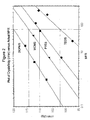
- the X-axis represents the actual MFR that is obtained when using the specified polymerization donors, with all experiments carried out at 140-mmole of hydrogen, as shown in the experimental section (B).
- the Y-axis represents the corresponding crystallinity (based on DSC heat-of-melting values, ⁇ H m ) for a polymer having an MFR of 70 for each specified donor.
- the Y-values were obtained from a separate set of experiments, where the amount of hydrogen used during the polymerization was varied at different levels, in order to obtain a plot of the MFR versus the crystallinity ( Figures 2 and 3). It is important to compare the crystallinity at a fixed MFR value because the polypropylene product applications are designed based largely on MFR specifications , because crystallinity of polypropylene increases with MFR of the polypropylene. For the individual donors, an almost linear plot is obtained, which shows a decreasing crystallinity with MFR, when going from DCPMS to MCMS, PTES, and TEOS, respectively.
- the dotted line shows that at a constant hydrogen pressure, for any given MFR, a blend of PTES and DCPMS containing 2.5 mol.% to less than 50 mol.% DCPMS and more than 50 mol.% PTES provides a higher level of crystallinity than would be expected from the average hydrogen response of such a blend, represented by the continuum of the solid line of Fig. 1. This improved degree of crystallinity relative to MFR is not realized when the blend contains less than 2.5 mol.% DCPMS or less than 50 mol.% PTES.
- the reactor temperature was raised from room temperature to 70°C, and the polymerization reaction was allowed to continue for one hour. After the polymerization period, the excess propylene was vented out of the reactor and the remaining polymer was collected and dried under a vacuum oven.
- the polymer was pelletized with 500 ppm butylated hydroxy toluene (BHT) and samples were taken for MFR, MWD molecular weight distribution, and DSC measurements.
- BHT butylated hydroxy toluene
- Tables I, II and III show the results the polymerization used to generate Figures 1, 2, and 3. Effects of Donor Type on PP-Crystallinity ( ⁇ Hm) and MFR-Capability Sample No. Donor Type H 2 (mmole) MFR ⁇ Hm (J/g) @ 70-MFR 18270-87 DCPMS 140 3.43 119.8 19987-125 MCMS 140 19.5 113.8 18270-37 PTES 140 59.2 110.0 11373-135-32 TEOS 140 229.9 107.0 Effects of Mixed-Donor Type on PP-Crystallinity ( ⁇ Hm) and MFR-Capability Sample No.
- Table VI illustrates the relationship of ⁇ Hm with other cyrstallinity measurements such as heptane insulubles (%HI) and polymer isotactic sequence sequence length (MRL-meso run length) as measured by NMR. Relationship Between ⁇ Hm with HI and MRL Sample No.
- the catalyst system and donor blend are chosen such that a relationship between a first melt flow rate of a homopolymer formed by polymerizing an alpha-olefin monomer in the presence of a Ziegler-Natta catalyst system and a first electron donor (MFR (a)), and a second melt flow rate of a homopolymer formed by polymerizing an ⁇ -olefin monomer in the presence of the Ziegler-Natta catalyst system and a second electron donor (MFR (b)), is defined by the equation; 1.2 ⁇ log [MFR(b)/MFR(a)] ⁇ 1.4.
- the ⁇ -olefin is chosen from the group consisting of a propylene, 4-methyl-1-pentene, 1-hexene, 1-butene, 1-hexene, 1-decene, 1-dodecene, 1-nonene, and mixtures thereof.
- the comonomer may include ethylene.
- Propylene is the preferred ⁇ -olefin.
- DCPMS is the preferred electron donor corresponding to a first electron donor
- PTES is the preferred second electron donor.
Landscapes
- Chemical & Material Sciences (AREA)
- Health & Medical Sciences (AREA)
- Chemical Kinetics & Catalysis (AREA)
- Medicinal Chemistry (AREA)
- Polymers & Plastics (AREA)
- Organic Chemistry (AREA)
- Transition And Organic Metals Composition Catalysts For Addition Polymerization (AREA)
- Addition Polymer Or Copolymer, Post-Treatments, Or Chemical Modifications (AREA)
- Graft Or Block Polymers (AREA)
Applications Claiming Priority (5)
| Application Number | Priority Date | Filing Date | Title |
|---|---|---|---|
| US8549898P | 1998-05-14 | 1998-05-14 | |
| US09/079,425 US6087459A (en) | 1998-05-14 | 1998-05-14 | Polymeric materials formed using blends of electron donors |
| US85498P | 1998-05-14 | ||
| US79425 | 1998-05-14 | ||
| PCT/US1999/010307 WO1999058585A1 (en) | 1998-05-14 | 1999-05-11 | Polymeric materials formed using blends of electron donors |
Publications (2)
| Publication Number | Publication Date |
|---|---|
| EP1080122A1 EP1080122A1 (en) | 2001-03-07 |
| EP1080122B1 true EP1080122B1 (en) | 2004-01-07 |
Family
ID=26761990
Family Applications (1)
| Application Number | Title | Priority Date | Filing Date |
|---|---|---|---|
| EP99922932A Expired - Lifetime EP1080122B1 (en) | 1998-05-14 | 1999-05-11 | Polymeric materials formed using blends of electron donors |
Country Status (7)
| Country | Link |
|---|---|
| EP (1) | EP1080122B1 (enExample) |
| JP (1) | JP2002514666A (enExample) |
| CN (1) | CN1138794C (enExample) |
| CA (1) | CA2327427C (enExample) |
| DE (1) | DE69914076T2 (enExample) |
| ES (1) | ES2211087T3 (enExample) |
| WO (1) | WO1999058585A1 (enExample) |
Families Citing this family (15)
| Publication number | Priority date | Publication date | Assignee | Title |
|---|---|---|---|---|
| AU2003245297A1 (en) | 2002-06-14 | 2003-12-31 | Union Carbide Chemicals And Plastics Technology Corporation ; | Catalyst composition and polymerization process using mixtures of electron donors |
| ES2335409T3 (es) | 2003-06-24 | 2010-03-26 | UNION CARBIDE CHEMICALS & PLASTICS TECHNOLOGY LLC | Composicion catalitica y proceso de polimerizacion usando mezcla de donadores y electrones de tipo silano. |
| WO2005030815A1 (en) | 2003-09-23 | 2005-04-07 | Dow Global Technologies Inc. | Self limiting catalyst composition and propylene polymerization process |
| WO2005035596A1 (en) | 2003-09-23 | 2005-04-21 | Dow Global Technologies Inc. | Catalyst composition with monocarboxylic acid ester internal donor and propylene polymerization process |
| JP2007505984A (ja) | 2003-09-23 | 2007-03-15 | ユニオン・カーバイド・ケミカルズ・アンド・プラスティックス・テクノロジー・コーポレイション | モノカルボン酸エステル内部供与体を有する自己消滅性触媒組成物及びプロピレン重合方法 |
| US7381779B2 (en) | 2003-09-23 | 2008-06-03 | Dow Global Technologies Inc | Self limiting catalyst composition with dicarboxylic acid ester internal donor and propylene polymerization process |
| WO2010021762A1 (en) * | 2008-08-21 | 2010-02-25 | Dow Global Technologies Inc. | Catalyst composition with mixed selectivity control agent and polymerisation method using it |
| MX347799B (es) | 2007-08-24 | 2017-05-15 | W R Grace & Co -Conn | Sistema de catalizador auto-limitante con proporcion de aluminio a sca controlada y metodo. |
| CN102453163B (zh) * | 2010-10-21 | 2014-02-05 | 中国石油化工股份有限公司 | 丙烯聚合物的制备方法及由该方法制备的丙烯聚合物 |
| CN103382234B (zh) * | 2012-05-04 | 2016-04-06 | 中国石油天然气股份有限公司 | 聚丙烯的制备方法 |
| CN104650268A (zh) * | 2013-11-22 | 2015-05-27 | 中国石油天然气股份有限公司 | 一种高熔融指数聚1-丁烯的制备方法 |
| WO2017025330A1 (en) | 2015-08-07 | 2017-02-16 | Sabic Global Technologies B.V. | Process for the polymerization of olefins |
| EP3331923B1 (en) * | 2015-08-07 | 2021-02-17 | SABIC Global Technologies B.V. | Process for the polymerization of olefins |
| US10696756B2 (en) | 2015-08-07 | 2020-06-30 | Sabic Global Technologies B.V. | Process for the polymerization of olefins |
| KR102415349B1 (ko) * | 2021-11-18 | 2022-07-01 | 대한유화 주식회사 | 초고분자량 폴리프로필렌의 제조방법 |
Family Cites Families (12)
| Publication number | Priority date | Publication date | Assignee | Title |
|---|---|---|---|---|
| JP2825909B2 (ja) * | 1989-03-02 | 1998-11-18 | 三井化学株式会社 | オレフィンの重合方法およびオレフィン重合用触媒 |
| CA2011188C (en) * | 1989-03-02 | 2000-01-18 | Naoshi Ishimaru | Process for polymerizing olefins and catalyst for polymerizing olefins |
| TW300235B (enExample) * | 1992-12-04 | 1997-03-11 | Mitsui Petroleum Chemicals Ind | |
| JPH06248019A (ja) * | 1993-02-24 | 1994-09-06 | Mitsui Petrochem Ind Ltd | オレフィン重合用触媒およびオレフィンの重合方法 |
| DE69434077T2 (de) * | 1993-12-07 | 2006-03-02 | Sumitomo Chemical Co. Ltd. | Verwendung von Polypropylen für die Herstellung einer biaxial orientierten Folie und so durch Strecken hergestellte Folie |
| CN1085219C (zh) * | 1994-02-04 | 2002-05-22 | 埃克森美孚化学专利公司 | 用于烯烃聚合的二元给体催化剂体系 |
| JPH07309913A (ja) * | 1994-05-19 | 1995-11-28 | Tokuyama Corp | ポリプロピレン |
| DE69520332T2 (de) * | 1994-11-25 | 2001-08-09 | Japan Polyolefins Co. Ltd., Tokio/Tokyo | Katalysator zur Polymerisation von Olefinen und Verfahren zur Herstellung von Polyolefinen unter dessen Verwendung |
| KR100430512B1 (ko) * | 1995-08-31 | 2004-07-23 | 도요다 지도샤 가부시끼가이샤 | 프로필렌-에틸렌공중합체조성물및이의제조방법 |
| JPH09241318A (ja) * | 1996-03-04 | 1997-09-16 | Tonen Corp | 広い分子量分布を有するポリオレフィンの製造方法 |
| FI104080B1 (fi) * | 1996-05-15 | 1999-11-15 | Borealis As | Olefiinien polymerointiin tarkoitettu stereospesifinen katalyyttisysteemi ja monivaiheiset polymerointiprosessit, joissa tätä systeemiä käytetään |
| JP3580639B2 (ja) * | 1996-06-04 | 2004-10-27 | 出光石油化学株式会社 | ポリプロピレン樹脂 |
-
1999
- 1999-05-11 CA CA002327427A patent/CA2327427C/en not_active Expired - Fee Related
- 1999-05-11 EP EP99922932A patent/EP1080122B1/en not_active Expired - Lifetime
- 1999-05-11 CN CNB998059943A patent/CN1138794C/zh not_active Expired - Lifetime
- 1999-05-11 JP JP2000548387A patent/JP2002514666A/ja active Pending
- 1999-05-11 WO PCT/US1999/010307 patent/WO1999058585A1/en not_active Ceased
- 1999-05-11 ES ES99922932T patent/ES2211087T3/es not_active Expired - Lifetime
- 1999-05-11 DE DE69914076T patent/DE69914076T2/de not_active Expired - Lifetime
Also Published As
| Publication number | Publication date |
|---|---|
| CA2327427A1 (en) | 1999-11-18 |
| CN1138794C (zh) | 2004-02-18 |
| DE69914076T2 (de) | 2004-08-26 |
| DE69914076D1 (de) | 2004-02-12 |
| EP1080122A1 (en) | 2001-03-07 |
| ES2211087T3 (es) | 2004-07-01 |
| JP2002514666A (ja) | 2002-05-21 |
| WO1999058585A1 (en) | 1999-11-18 |
| CA2327427C (en) | 2008-09-02 |
| CN1300299A (zh) | 2001-06-20 |
Similar Documents
| Publication | Publication Date | Title |
|---|---|---|
| US6087459A (en) | Polymeric materials formed using blends of electron donors | |
| KR101441018B1 (ko) | 프로필렌 단일중합체 성분을 포함하는 폴리프로필렌 조성물 | |
| JP4217155B2 (ja) | プロピレンランダム共重合体及びその製造方法 | |
| US4950720A (en) | Modified polypropylene, process for making and article made from the same | |
| CN101687951B (zh) | 丁烯-1三元共聚物和它们的制备方法 | |
| JP5227165B2 (ja) | プロピレン/エチレンコポリマー及びその製造方法 | |
| EP1080122B1 (en) | Polymeric materials formed using blends of electron donors | |
| EP2638080B1 (en) | Improved process for polymerising propylene | |
| US6566294B2 (en) | Multi-donor catalyst system for the polymerization of olefins | |
| US20080207835A1 (en) | Heterophasic Polymer Composition and Process for its Preparation | |
| US20110245446A1 (en) | Catalyst system for polypropylene copolymers | |
| US7183234B2 (en) | Multi-donor catalyst system for the polymerization of olefins | |
| EP4524165A1 (en) | Solid catalyst for polypropylene production and method for production of block copolymer | |
| HK1039493A (en) | Polymeric materials formed using blends of electron donors |
Legal Events
| Date | Code | Title | Description |
|---|---|---|---|
| PUAI | Public reference made under article 153(3) epc to a published international application that has entered the european phase |
Free format text: ORIGINAL CODE: 0009012 |
|
| 17P | Request for examination filed |
Effective date: 20001207 |
|
| AK | Designated contracting states |
Kind code of ref document: A1 Designated state(s): BE DE ES FR GB IT NL |
|
| RAP1 | Party data changed (applicant data changed or rights of an application transferred) |
Owner name: EXXONMOBIL CHEMICAL PATENTS INC. |
|
| 17Q | First examination report despatched |
Effective date: 20020826 |
|
| GRAH | Despatch of communication of intention to grant a patent |
Free format text: ORIGINAL CODE: EPIDOS IGRA |
|
| GRAS | Grant fee paid |
Free format text: ORIGINAL CODE: EPIDOSNIGR3 |
|
| GRAA | (expected) grant |
Free format text: ORIGINAL CODE: 0009210 |
|
| AK | Designated contracting states |
Kind code of ref document: B1 Designated state(s): BE DE ES FR GB IT NL |
|
| REG | Reference to a national code |
Ref country code: GB Ref legal event code: FG4D |
|
| REF | Corresponds to: |
Ref document number: 69914076 Country of ref document: DE Date of ref document: 20040212 Kind code of ref document: P |
|
| REG | Reference to a national code |
Ref country code: ES Ref legal event code: FG2A Ref document number: 2211087 Country of ref document: ES Kind code of ref document: T3 |
|
| ET | Fr: translation filed | ||
| PLBE | No opposition filed within time limit |
Free format text: ORIGINAL CODE: 0009261 |
|
| STAA | Information on the status of an ep patent application or granted ep patent |
Free format text: STATUS: NO OPPOSITION FILED WITHIN TIME LIMIT |
|
| 26N | No opposition filed |
Effective date: 20041008 |
|
| PGFP | Annual fee paid to national office [announced via postgrant information from national office to epo] |
Ref country code: NL Payment date: 20090527 Year of fee payment: 11 Ref country code: ES Payment date: 20090527 Year of fee payment: 11 |
|
| PGFP | Annual fee paid to national office [announced via postgrant information from national office to epo] |
Ref country code: IT Payment date: 20090516 Year of fee payment: 11 |
|
| PGFP | Annual fee paid to national office [announced via postgrant information from national office to epo] |
Ref country code: BE Payment date: 20090619 Year of fee payment: 11 |
|
| BERE | Be: lapsed |
Owner name: *EXXONMOBIL CHEMICAL PATENTS INC. Effective date: 20100531 |
|
| REG | Reference to a national code |
Ref country code: NL Ref legal event code: V1 Effective date: 20101201 |
|
| PG25 | Lapsed in a contracting state [announced via postgrant information from national office to epo] |
Ref country code: IT Free format text: LAPSE BECAUSE OF NON-PAYMENT OF DUE FEES Effective date: 20100511 Ref country code: NL Free format text: LAPSE BECAUSE OF NON-PAYMENT OF DUE FEES Effective date: 20101201 Ref country code: BE Free format text: LAPSE BECAUSE OF NON-PAYMENT OF DUE FEES Effective date: 20100531 |
|
| REG | Reference to a national code |
Ref country code: ES Ref legal event code: FD2A Effective date: 20110715 |
|
| PG25 | Lapsed in a contracting state [announced via postgrant information from national office to epo] |
Ref country code: ES Free format text: LAPSE BECAUSE OF NON-PAYMENT OF DUE FEES Effective date: 20110705 |
|
| PG25 | Lapsed in a contracting state [announced via postgrant information from national office to epo] |
Ref country code: ES Free format text: LAPSE BECAUSE OF NON-PAYMENT OF DUE FEES Effective date: 20100512 |
|
| REG | Reference to a national code |
Ref country code: FR Ref legal event code: PLFP Year of fee payment: 18 |
|
| REG | Reference to a national code |
Ref country code: FR Ref legal event code: PLFP Year of fee payment: 19 |
|
| REG | Reference to a national code |
Ref country code: FR Ref legal event code: PLFP Year of fee payment: 20 |
|
| PGFP | Annual fee paid to national office [announced via postgrant information from national office to epo] |
Ref country code: GB Payment date: 20180328 Year of fee payment: 20 |
|
| PGFP | Annual fee paid to national office [announced via postgrant information from national office to epo] |
Ref country code: DE Payment date: 20180507 Year of fee payment: 20 |
|
| PGFP | Annual fee paid to national office [announced via postgrant information from national office to epo] |
Ref country code: FR Payment date: 20180416 Year of fee payment: 20 |
|
| REG | Reference to a national code |
Ref country code: DE Ref legal event code: R071 Ref document number: 69914076 Country of ref document: DE |
|
| REG | Reference to a national code |
Ref country code: GB Ref legal event code: PE20 Expiry date: 20190510 |
|
| PG25 | Lapsed in a contracting state [announced via postgrant information from national office to epo] |
Ref country code: GB Free format text: LAPSE BECAUSE OF EXPIRATION OF PROTECTION Effective date: 20190510 |