EP1028097A2 - Kohlenfaserverbundwerkstoffe - Google Patents
Kohlenfaserverbundwerkstoffe Download PDFInfo
- Publication number
- EP1028097A2 EP1028097A2 EP00102628A EP00102628A EP1028097A2 EP 1028097 A2 EP1028097 A2 EP 1028097A2 EP 00102628 A EP00102628 A EP 00102628A EP 00102628 A EP00102628 A EP 00102628A EP 1028097 A2 EP1028097 A2 EP 1028097A2
- Authority
- EP
- European Patent Office
- Prior art keywords
- carbon fiber
- matrix
- skeletal part
- fiber composite
- carbon
- Prior art date
- Legal status (The legal status is an assumption and is not a legal conclusion. Google has not performed a legal analysis and makes no representation as to the accuracy of the status listed.)
- Granted
Links
Images



Classifications
-
- C—CHEMISTRY; METALLURGY
- C04—CEMENTS; CONCRETE; ARTIFICIAL STONE; CERAMICS; REFRACTORIES
- C04B—LIME, MAGNESIA; SLAG; CEMENTS; COMPOSITIONS THEREOF, e.g. MORTARS, CONCRETE OR LIKE BUILDING MATERIALS; ARTIFICIAL STONE; CERAMICS; REFRACTORIES; TREATMENT OF NATURAL STONE
- C04B41/00—After-treatment of mortars, concrete, artificial stone or ceramics; Treatment of natural stone
- C04B41/009—After-treatment of mortars, concrete, artificial stone or ceramics; Treatment of natural stone characterised by the material treated
-
- C—CHEMISTRY; METALLURGY
- C04—CEMENTS; CONCRETE; ARTIFICIAL STONE; CERAMICS; REFRACTORIES
- C04B—LIME, MAGNESIA; SLAG; CEMENTS; COMPOSITIONS THEREOF, e.g. MORTARS, CONCRETE OR LIKE BUILDING MATERIALS; ARTIFICIAL STONE; CERAMICS; REFRACTORIES; TREATMENT OF NATURAL STONE
- C04B35/00—Shaped ceramic products characterised by their composition; Ceramics compositions; Processing powders of inorganic compounds preparatory to the manufacturing of ceramic products
- C04B35/515—Shaped ceramic products characterised by their composition; Ceramics compositions; Processing powders of inorganic compounds preparatory to the manufacturing of ceramic products based on non-oxide ceramics
- C04B35/56—Shaped ceramic products characterised by their composition; Ceramics compositions; Processing powders of inorganic compounds preparatory to the manufacturing of ceramic products based on non-oxide ceramics based on carbides or oxycarbides
- C04B35/565—Shaped ceramic products characterised by their composition; Ceramics compositions; Processing powders of inorganic compounds preparatory to the manufacturing of ceramic products based on non-oxide ceramics based on carbides or oxycarbides based on silicon carbide
- C04B35/573—Shaped ceramic products characterised by their composition; Ceramics compositions; Processing powders of inorganic compounds preparatory to the manufacturing of ceramic products based on non-oxide ceramics based on carbides or oxycarbides based on silicon carbide obtained by reaction sintering or recrystallisation
-
- C—CHEMISTRY; METALLURGY
- C04—CEMENTS; CONCRETE; ARTIFICIAL STONE; CERAMICS; REFRACTORIES
- C04B—LIME, MAGNESIA; SLAG; CEMENTS; COMPOSITIONS THEREOF, e.g. MORTARS, CONCRETE OR LIKE BUILDING MATERIALS; ARTIFICIAL STONE; CERAMICS; REFRACTORIES; TREATMENT OF NATURAL STONE
- C04B35/00—Shaped ceramic products characterised by their composition; Ceramics compositions; Processing powders of inorganic compounds preparatory to the manufacturing of ceramic products
- C04B35/622—Forming processes; Processing powders of inorganic compounds preparatory to the manufacturing of ceramic products
- C04B35/626—Preparing or treating the powders individually or as batches ; preparing or treating macroscopic reinforcing agents for ceramic products, e.g. fibres; mechanical aspects section B
- C04B35/628—Coating the powders or the macroscopic reinforcing agents
- C04B35/62844—Coating fibres
- C04B35/62857—Coating fibres with non-oxide ceramics
- C04B35/62873—Carbon
-
- C—CHEMISTRY; METALLURGY
- C04—CEMENTS; CONCRETE; ARTIFICIAL STONE; CERAMICS; REFRACTORIES
- C04B—LIME, MAGNESIA; SLAG; CEMENTS; COMPOSITIONS THEREOF, e.g. MORTARS, CONCRETE OR LIKE BUILDING MATERIALS; ARTIFICIAL STONE; CERAMICS; REFRACTORIES; TREATMENT OF NATURAL STONE
- C04B35/00—Shaped ceramic products characterised by their composition; Ceramics compositions; Processing powders of inorganic compounds preparatory to the manufacturing of ceramic products
- C04B35/71—Ceramic products containing macroscopic reinforcing agents
- C04B35/78—Ceramic products containing macroscopic reinforcing agents containing non-metallic materials
- C04B35/80—Fibres, filaments, whiskers, platelets, or the like
-
- C—CHEMISTRY; METALLURGY
- C04—CEMENTS; CONCRETE; ARTIFICIAL STONE; CERAMICS; REFRACTORIES
- C04B—LIME, MAGNESIA; SLAG; CEMENTS; COMPOSITIONS THEREOF, e.g. MORTARS, CONCRETE OR LIKE BUILDING MATERIALS; ARTIFICIAL STONE; CERAMICS; REFRACTORIES; TREATMENT OF NATURAL STONE
- C04B41/00—After-treatment of mortars, concrete, artificial stone or ceramics; Treatment of natural stone
- C04B41/45—Coating or impregnating, e.g. injection in masonry, partial coating of green or fired ceramics, organic coating compositions for adhering together two concrete elements
- C04B41/50—Coating or impregnating, e.g. injection in masonry, partial coating of green or fired ceramics, organic coating compositions for adhering together two concrete elements with inorganic materials
- C04B41/5053—Coating or impregnating, e.g. injection in masonry, partial coating of green or fired ceramics, organic coating compositions for adhering together two concrete elements with inorganic materials non-oxide ceramics
- C04B41/5057—Carbides
- C04B41/5059—Silicon carbide
-
- C—CHEMISTRY; METALLURGY
- C04—CEMENTS; CONCRETE; ARTIFICIAL STONE; CERAMICS; REFRACTORIES
- C04B—LIME, MAGNESIA; SLAG; CEMENTS; COMPOSITIONS THEREOF, e.g. MORTARS, CONCRETE OR LIKE BUILDING MATERIALS; ARTIFICIAL STONE; CERAMICS; REFRACTORIES; TREATMENT OF NATURAL STONE
- C04B41/00—After-treatment of mortars, concrete, artificial stone or ceramics; Treatment of natural stone
- C04B41/80—After-treatment of mortars, concrete, artificial stone or ceramics; Treatment of natural stone of only ceramics
- C04B41/81—Coating or impregnation
- C04B41/85—Coating or impregnation with inorganic materials
- C04B41/87—Ceramics
-
- C—CHEMISTRY; METALLURGY
- C04—CEMENTS; CONCRETE; ARTIFICIAL STONE; CERAMICS; REFRACTORIES
- C04B—LIME, MAGNESIA; SLAG; CEMENTS; COMPOSITIONS THEREOF, e.g. MORTARS, CONCRETE OR LIKE BUILDING MATERIALS; ARTIFICIAL STONE; CERAMICS; REFRACTORIES; TREATMENT OF NATURAL STONE
- C04B2235/00—Aspects relating to ceramic starting mixtures or sintered ceramic products
- C04B2235/02—Composition of constituents of the starting material or of secondary phases of the final product
- C04B2235/30—Constituents and secondary phases not being of a fibrous nature
- C04B2235/42—Non metallic elements added as constituents or additives, e.g. sulfur, phosphor, selenium or tellurium
- C04B2235/428—Silicon
-
- C—CHEMISTRY; METALLURGY
- C04—CEMENTS; CONCRETE; ARTIFICIAL STONE; CERAMICS; REFRACTORIES
- C04B—LIME, MAGNESIA; SLAG; CEMENTS; COMPOSITIONS THEREOF, e.g. MORTARS, CONCRETE OR LIKE BUILDING MATERIALS; ARTIFICIAL STONE; CERAMICS; REFRACTORIES; TREATMENT OF NATURAL STONE
- C04B2235/00—Aspects relating to ceramic starting mixtures or sintered ceramic products
- C04B2235/02—Composition of constituents of the starting material or of secondary phases of the final product
- C04B2235/50—Constituents or additives of the starting mixture chosen for their shape or used because of their shape or their physical appearance
- C04B2235/52—Constituents or additives characterised by their shapes
- C04B2235/5208—Fibers
- C04B2235/5216—Inorganic
- C04B2235/524—Non-oxidic, e.g. borides, carbides, silicides or nitrides
- C04B2235/5248—Carbon, e.g. graphite
-
- C—CHEMISTRY; METALLURGY
- C04—CEMENTS; CONCRETE; ARTIFICIAL STONE; CERAMICS; REFRACTORIES
- C04B—LIME, MAGNESIA; SLAG; CEMENTS; COMPOSITIONS THEREOF, e.g. MORTARS, CONCRETE OR LIKE BUILDING MATERIALS; ARTIFICIAL STONE; CERAMICS; REFRACTORIES; TREATMENT OF NATURAL STONE
- C04B2235/00—Aspects relating to ceramic starting mixtures or sintered ceramic products
- C04B2235/02—Composition of constituents of the starting material or of secondary phases of the final product
- C04B2235/50—Constituents or additives of the starting mixture chosen for their shape or used because of their shape or their physical appearance
- C04B2235/52—Constituents or additives characterised by their shapes
- C04B2235/5208—Fibers
- C04B2235/5268—Orientation of the fibers
-
- C—CHEMISTRY; METALLURGY
- C04—CEMENTS; CONCRETE; ARTIFICIAL STONE; CERAMICS; REFRACTORIES
- C04B—LIME, MAGNESIA; SLAG; CEMENTS; COMPOSITIONS THEREOF, e.g. MORTARS, CONCRETE OR LIKE BUILDING MATERIALS; ARTIFICIAL STONE; CERAMICS; REFRACTORIES; TREATMENT OF NATURAL STONE
- C04B2235/00—Aspects relating to ceramic starting mixtures or sintered ceramic products
- C04B2235/70—Aspects relating to sintered or melt-casted ceramic products
- C04B2235/74—Physical characteristics
- C04B2235/75—Products with a concentration gradient
-
- C—CHEMISTRY; METALLURGY
- C04—CEMENTS; CONCRETE; ARTIFICIAL STONE; CERAMICS; REFRACTORIES
- C04B—LIME, MAGNESIA; SLAG; CEMENTS; COMPOSITIONS THEREOF, e.g. MORTARS, CONCRETE OR LIKE BUILDING MATERIALS; ARTIFICIAL STONE; CERAMICS; REFRACTORIES; TREATMENT OF NATURAL STONE
- C04B2235/00—Aspects relating to ceramic starting mixtures or sintered ceramic products
- C04B2235/70—Aspects relating to sintered or melt-casted ceramic products
- C04B2235/74—Physical characteristics
- C04B2235/76—Crystal structural characteristics, e.g. symmetry
- C04B2235/762—Cubic symmetry, e.g. beta-SiC
-
- C—CHEMISTRY; METALLURGY
- C04—CEMENTS; CONCRETE; ARTIFICIAL STONE; CERAMICS; REFRACTORIES
- C04B—LIME, MAGNESIA; SLAG; CEMENTS; COMPOSITIONS THEREOF, e.g. MORTARS, CONCRETE OR LIKE BUILDING MATERIALS; ARTIFICIAL STONE; CERAMICS; REFRACTORIES; TREATMENT OF NATURAL STONE
- C04B2235/00—Aspects relating to ceramic starting mixtures or sintered ceramic products
- C04B2235/70—Aspects relating to sintered or melt-casted ceramic products
- C04B2235/74—Physical characteristics
- C04B2235/77—Density
-
- C—CHEMISTRY; METALLURGY
- C04—CEMENTS; CONCRETE; ARTIFICIAL STONE; CERAMICS; REFRACTORIES
- C04B—LIME, MAGNESIA; SLAG; CEMENTS; COMPOSITIONS THEREOF, e.g. MORTARS, CONCRETE OR LIKE BUILDING MATERIALS; ARTIFICIAL STONE; CERAMICS; REFRACTORIES; TREATMENT OF NATURAL STONE
- C04B2235/00—Aspects relating to ceramic starting mixtures or sintered ceramic products
- C04B2235/70—Aspects relating to sintered or melt-casted ceramic products
- C04B2235/80—Phases present in the sintered or melt-cast ceramic products other than the main phase
-
- Y—GENERAL TAGGING OF NEW TECHNOLOGICAL DEVELOPMENTS; GENERAL TAGGING OF CROSS-SECTIONAL TECHNOLOGIES SPANNING OVER SEVERAL SECTIONS OF THE IPC; TECHNICAL SUBJECTS COVERED BY FORMER USPC CROSS-REFERENCE ART COLLECTIONS [XRACs] AND DIGESTS
- Y10—TECHNICAL SUBJECTS COVERED BY FORMER USPC
- Y10T—TECHNICAL SUBJECTS COVERED BY FORMER US CLASSIFICATION
- Y10T428/00—Stock material or miscellaneous articles
- Y10T428/249921—Web or sheet containing structurally defined element or component
- Y10T428/249924—Noninterengaged fiber-containing paper-free web or sheet which is not of specified porosity
- Y10T428/249927—Fiber embedded in a metal matrix
-
- Y—GENERAL TAGGING OF NEW TECHNOLOGICAL DEVELOPMENTS; GENERAL TAGGING OF CROSS-SECTIONAL TECHNOLOGIES SPANNING OVER SEVERAL SECTIONS OF THE IPC; TECHNICAL SUBJECTS COVERED BY FORMER USPC CROSS-REFERENCE ART COLLECTIONS [XRACs] AND DIGESTS
- Y10—TECHNICAL SUBJECTS COVERED BY FORMER USPC
- Y10T—TECHNICAL SUBJECTS COVERED BY FORMER US CLASSIFICATION
- Y10T428/00—Stock material or miscellaneous articles
- Y10T428/249921—Web or sheet containing structurally defined element or component
- Y10T428/249924—Noninterengaged fiber-containing paper-free web or sheet which is not of specified porosity
- Y10T428/249928—Fiber embedded in a ceramic, glass, or carbon matrix
-
- Y—GENERAL TAGGING OF NEW TECHNOLOGICAL DEVELOPMENTS; GENERAL TAGGING OF CROSS-SECTIONAL TECHNOLOGIES SPANNING OVER SEVERAL SECTIONS OF THE IPC; TECHNICAL SUBJECTS COVERED BY FORMER USPC CROSS-REFERENCE ART COLLECTIONS [XRACs] AND DIGESTS
- Y10—TECHNICAL SUBJECTS COVERED BY FORMER USPC
- Y10T—TECHNICAL SUBJECTS COVERED BY FORMER US CLASSIFICATION
- Y10T428/00—Stock material or miscellaneous articles
- Y10T428/30—Self-sustaining carbon mass or layer with impregnant or other layer
-
- Y—GENERAL TAGGING OF NEW TECHNOLOGICAL DEVELOPMENTS; GENERAL TAGGING OF CROSS-SECTIONAL TECHNOLOGIES SPANNING OVER SEVERAL SECTIONS OF THE IPC; TECHNICAL SUBJECTS COVERED BY FORMER USPC CROSS-REFERENCE ART COLLECTIONS [XRACs] AND DIGESTS
- Y10—TECHNICAL SUBJECTS COVERED BY FORMER USPC
- Y10T—TECHNICAL SUBJECTS COVERED BY FORMER US CLASSIFICATION
- Y10T428/00—Stock material or miscellaneous articles
- Y10T428/31—Surface property or characteristic of web, sheet or block
Definitions
- the present invention relates to carbon fiber composite materials suitably usable for aerospace materials, and, more particularly, to carbon fiber composite materials less in mass reduction caused by atomic oxygen and excellent in endurance.
- the object of the present invention is to provide carbon fiber composite materials suitably usable as new aerospace materials which are much smaller in mass reduction caused by atomic oxygen and superior in endurance as compared with conventional graphite or C/C composites.
- the present invention provides, as the first materials, carbon fiber composite materials, characterized by being used as aerospace materials and comprising a skeletal part and a matrix integrally formed around the skeletal part, said skeletal part being mainly composed of carbon fiber bundles and silicon carbide and metallic silicon formed in the carbon fiber bundles and/or on the outer surface of the carbon fiber bundles and said matrix being mainly composed of silicon carbide and metallic silicon.
- the first carbon fiber composite materials may contain a carbon component other than carbon fibers in the carbon fiber bundles. Furthermore, there may be also suitably used those which have such a composition that the content of the metallic silicon has a gradient of increasing from inside of the skeletal part toward the outer surface of the skeletal part, and/or from the outer surface of the skeletal part toward the outer surface of the matrix, and/or from the outer surface of the matrix toward inside of the matrix.
- Such materials can be obtained by arranging in nearly parallel with each other a plurality of yarns each of which comprises a bundle mainly composed of carbon fibers and a resin coated on the outer surface of the bundle, forming them into a sheet, laminating a plurality of the sheets in the form of multi-layer, heat-treating the laminate in a non-oxidizing atmosphere, and impregnating with metallic silicon to form integrally a skeletal part and a matrix.
- the present invention also provides, as the second materials, carbon fiber composite materials, characterized by being used as aerospace materials and comprising a skeletal part and a matrix integrally formed around the skeletal part with a porosity of 0.5-5% and a two-peak type distribution of average pore diameter, said skeletal part being formed of carbon fibers and a carbon component other than carbon fibers and/or silicon carbide, said matrix being formed of silicon carbide at least 50% of which is of ⁇ type.
- the matrix is preferably formed along the surface of the skeletal part, and furthermore the matrix is also preferred to have such an inclined composition of the content of silicon increasing in proportion to the distance from the surface of the skeletal part. Moreover, the matrix preferably forms a continuous three-dimensional network structure.
- the skeletal part preferably comprises a laminate obtained by two-dimensionally arranging at least a plurality of preformed yarns comprising carbon fibers and a carbon component other than carbon fibers in nearly parallel with each other thereby obtaining sheets and laminating a desired number of the sheets so that the longer directions of the preformed yarns alternately cross at right angles.
- first and second carbon fiber composite materials it is also preferred that a silicon carbide film is formed on the surface.
- the first carbon fiber composite material of the present invention mainly comprises a skeletal part and a matrix formed around the skeletal part.
- the skeletal part and the matrix are formed integrally with each other, and naturally they have a continuous form.
- the composite material is divided into the skeletal part and the matrix, taking into consideration the materials used when the suitable production method mentioned later is employed and the stages for forming each part in processing steps, and taking into account that the carbon fiber composite material of the present invention can be easily explained by dividing it into the skeletal part and the matrix.
- the skeletal part mainly comprises carbon fiber bundles and silicon carbide (SiC) and metallic silicon (metallic Si) formed in the carbon fiber bundles and/or on the outer surface of the carbon fiber bundles.
- the carbon fibers there may be suitably used pitch carbon fibers made from petroleum pitch or coal tar pitch and PAN carbon fibers made from acrylonitrile fibers. These carbon fibers used preferably have a fiber diameter of about 10 ⁇ m, and, preferably, several hundred to several ten thousand of these carbon fibers are bundled to make a fiber bundle.
- a powdery binder, pitch, carbon, coke or the like is contained in the bundled carbon fibers and, if necessary; a phenolic resin powder or the like is contained, and, if further necessary; a binder (which means binder, pitch, carbon, coke, phenolic resin powder or the like) is applied to the surface of the bundled carbon fibers, thereby to form a carbon fiber bundle, and then a flexible film comprising a plastic such as thermoplastic resin is formed on the outer surface of the bundle. That is, it is also preferred that the carbon fiber bundle contains a carbon component other than carbon fibers.
- preformed yarn is hereinafter referred to as "preformed yarn".
- SiC or metallic Si in the skeletal part can be produced by further molding the preformed yarns into a given shape, then heat-treating (firing) in a non-oxidizing atmosphere so that the binder and others contained in the preformed yarns remain as carbon components, and impregnating the yarns with molten metallic Si.
- Molding of the preformed yarns can be carried out, for example, by arranging the preformed yarns in nearly parallel with each other, laminating the layers of the preformed yarns so that the longer directions of the fibers in the respective layers cross at right angles or laminating the layers of the preformed yarns which are previously knitted crosswise and molded into sheets, and molding the laminate by hot press or the like.
- the preformed yarns can be packed in a mold of a given shape and subjected to press molding.
- it is also preferred to fill a thermoplastic resin such as phenolic resin or epoxy resin and tar or pitch between the preformed yarns or between layers laminated.
- the carbon produced by the heat treatment in a non-oxidizing atmosphere is preferably in the form of graphitized carbon powders, and the graphitization can be performed by controlling the heat-treating conditions.
- Molten metallic SiC chemically reacts with carbon to produce SiC, and the metallic Si remains between the produced SiC or between carbon fibers.
- the skeletal part has such a structure that it is mainly composed of carbon fiber bundles and Si component (which means the whole compounds containing Si as a constituting element) is present inside the carbon fiber bundles and on the surface of the carbon fiber bundles.
- metallic Si is present mainly in the vicinity of the surface of the carbon fiber bundles, whereby structure and chemical and mechanical characteristics of the carbon fiber bundles are retained.
- Metallic Si is also a component of the matrix and, therefore, is continuously present through the skeletal part and the matrix.
- the carbon fiber bundle formed by firing the preformed yarn in a non-oxidizing atmosphere and impregnating with metallic Si and including a phase mainly composed of SiC formed through carbonization of the resin film is hereinafter referred to as "yarn". Accordingly, the skeletal part in the carbon fiber composite material of the present invention comprises the yarns.
- the matrix of the first carbon fiber composite material of the present invention is mainly composed of SiC and metallic Si.
- SiC silicon carbide
- metallic Si metallic Si
- the first carbon fiber composite material of the present invention having the above-mentioned skeletal part and matrix is hereinafter referred to as "Si-C/C", and examples of the Si-C/C will be explained in more detail referring to Fig. 1 ⁇ Fig. 3.
- Fig. 1 is an oblique view showing one embodiment of Si-C/C7 and shows one form of arrangement of yarns 2A ⁇ 2B, namely, a structure of the skeletal part of Si-C/C7. Therefore, in order to dearly disclose the state of arrangement of yarns 2A ⁇ 2B, metallic Si and others which constitute the matrix are not described in Fig. 1. Naturally, the state of arrangement of yarns 2A ⁇ 2B is the same as the state of arrangement of preformed yarns in making a molded body using the preformed yarns.
- Si-C/C7 has such a structure that sheets 1B ⁇ 1D ⁇ 1F comprising a plurality of yarns 2B which are arranged in nearly parallel with each other and of which fiber length directions are in nearly parallel with X-axis direction of a three-dimensional rectangular coordinates and sheets 1A ⁇ 1C ⁇ 1E comprising a plurality of yarns 2A which are arranged in nearly parallel with each other and of which fiber length directions are in nearly parallel with Y-axis direction are alternately laminated in vertical direction which is Z-axis direction.
- Fig. 2(a) is a cross-sectional view taken along the line IIa-IIa of Fig. 1
- Fig. 2(b) is a cross-sectional view taken along the line IIb-IIb of Fig. 1.
- a skeletal part in the form of three-dimensional lattice mainly composed of 2A ⁇ 2B is formed by laminating sheets 1A- 1F. Since sheets 1A- 1F are pressed in the direction of lamination in molding of the preformed yarns, the cross-section of the yarns 2A ⁇ 2B formed is of nearly flatted elliptical shape.
- Fig. 3 is a partial enlargement of Fig. 2(a).
- matrix 8A is formed in the space between adjacent yarns 2A, and matrix 8A extends along the surface of yam 2A in Y-axis direction in parallel with the surface of yam 2A.
- matrix 8B is formed in the space between adjacent yams 2B, and matrix 8B extends along the surface of yarn 2B in X-axis direction in parallel with the surface of yarn 2B.
- Matrices 8A ⁇ 8B are mainly composed of metallic Si-SiC composite phases 5A ⁇ 5B which are less in carbon content than SiC phases 4A ⁇ 4B which are surface phases of yams 2A ⁇ 2B.
- the boundary between the SiC phases 4A ⁇ 4B and the metallic Si-SiC composite phases 5A ⁇ 5B is not necessarily dear as shown in Fig. 3, and is not needed to be dear and is variable depending on the surface properties of resin film of the preformed yarns.
- the proportion of metallic Si and SiC present in matrices 8A ⁇ 8B can be varied by the material filled between the preformed yarns in molding of them.
- Matrices 8A ⁇ 8B extend along the surface of yams 2A ⁇ 2B narrowly, preferably linearly and cross at right angles with each other.
- Matrix 8A in sheets 1A ⁇ 1C ⁇ 1E and matrix 8B in sheets 1B ⁇ 1D ⁇ 1F which cross at right angles with the sheets 1A ⁇ 1C ⁇ 1E are respectively connected at the space between yarn 2A and yarn 2B.
- matrices 8A ⁇ 8B form a three-dimensional lattice as a whole.
- SiC phases 4A ⁇ 4B are mainly phases formed by the reaction of the resin film of the preformed yams with active carbon produced and form a skeletal part of Si-C/C7 together with carbon fiber bundles 3.
- the SiC phases 4A ⁇ 4B may partially contain metallic Si.
- SiC phases 4A ⁇ 4B are also formed between yarns 2A ⁇ 2B which are adjacent to each other in upward and downward direction.
- a suitable method for producing such Si-C/C7 is as follows. First, a give amount of metallic Si is put on a molded body (laminate) comprising the preformed yarns, followed by keeping it at a temperature of 1100- 1400°C which is lower than the melting point of metallic Si in a non-oxidizing atmosphere such as inert gas to carbonize resin film or binder of the preformed yarns.
- the resin film of the yarns is carbonized to leave long and narrow open pores in the spaces between the carbon fiber bundles, and the metallic Si penetrates into the inner part of the laminate along the open pores.
- the metallic Si begins to react with the carbon produced from the resin film of the preformed yarns, and, hence, carbonization reaction gradually takes place from the surface side of the carbon fiber bundles to form SiC.
- the molten metallic Si of high temperature first contacts and reacts with carbon of high activity produced upon heat decomposition of the resin film or the organic binders added to the carbon fiber bundles to produce SiC while it can hardly directly contact with the carbon fibers and, as a result, the carbon fiber bundles and the structure of the carbon fibers are hardly broken. In this way, mechanical strength of the carbon fiber can be assured.
- the matrix can contain some intermediate phases between a phase in which metallic Si remains nearly purely and a nearly pure SiC phase. Furthermore, considering the step of impregnation of metallic Si into the skeletal part, it is also supposed that portions differing in content of metallic Si or SiC are present also in the skeletal part.
- the skeletal part and the matrix can have layers changing in composition in such an inclined manner that the content of metallic Si increases from the inner portion toward the outer surface of the skeletal part, and/or increases from the outer surface of the skeletal part toward the outer surface of the matrix, and/or increases from the outer surface of the matrix toward the inner portion of the matrix.
- Presence of such layers inclined in composition exhibits the effect to relax the stress based on the thermal characteristics of the constituting materials and is preferred for the material characteristics.
- the aerospace materials are specifically structural materials used for space structures such as artificial satellites, rockets, spacecrafts, and space stations.
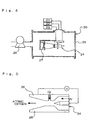
- Fig. 4 shows construction of a test apparatus 20 which tests the reactivity of Si-C/C with atomic oxygen.
- the inside of chamber 25 can be in the state of a given reduced pressure using vacuum pump 26, and in the chamber there is provided an atomic oxygen generating device 24 which is connected to gas supply device 21, voltage device 22 and cooling device 23.
- a DC arc jet as shown in Fig. 5 is used as the atomic oxygen generating device 24 .
- argon (Ar) gas is used as a working fluid, and oxygen (O 2 ) gas smaller in the amount than the Ar gas is introduced from downstream side of discharging part raised in temperature by arc discharge, thereby heat-dissociating the O 2 gas into atomic state.
- oxygen (O 2 ) gas smaller in the amount than the Ar gas is introduced from downstream side of discharging part raised in temperature by arc discharge, thereby heat-dissociating the O 2 gas into atomic state.
- the thus produced atomic oxygen is accelerated by nozzle 28 together with Ar gas and test specimen 27 is irradiated with the atomic oxygen.
- flux of the atomic oxygen irradiated to the test piece is 1.4 ⁇ 10 20 atms/cm -2 /s.
- the irradiation rate is calculated from the thrust of the arc jet measured, and is about 2.1 ⁇ 0.4 km/s. Therefore, collision energy in this case is 0.38 ⁇ 0.14 eV.
- the Si-C/C (density: 2.0 g/cm 3 ) of the present invention were used the Si-C/C (density: 2.0 g/cm 3 ) of the present invention, and, for comparison, commercially available isotropic high-density graphite (density: 1.82 g/cm 3 ) and C/C composite (density: 1.70 g/cm 3 ).
- Thst temperature was 310 K and 345 K
- irradiation time of the atomic oxygen was 20-40 minutes, and loss of mass of the specimen after irradiation was considered to be caused by the atomic oxygen.
- Fig. 6 shows relation between the irradiation time of the atomic oxygen and the loss of mass. It is clear that substantially no loss of mass occurred for both the graphite and C/C at a temperature of 315 K. In Fig. 6, the plots overlapped at 315 K.
- the loss of mass in the above-mentioned test is considered to be due to oxidation of the materials, and thus it is considered that the better aerospace materials can be obtained by using materials higher in oxidation resistance.
- the present invention provides the second carbon fiber composite material as explained below.
- the second carbon fiber composite material also has a structure comprising a skeletal part and a matrix formed integrally around the skeletal part.
- the skeletal part is formed of carbon fibers and a carbon component other than carbon fibers and/or SiC.
- the matrix comprises SiC, and at least 50% of the SiC is of ⁇ type.
- the second carbon fiber composite material has a porosity of 0.5-5% and a two-peak type distribution of average pore diameter.
- the second carbon fiber composite material having the above characteristics can be obtained by carrying out the heat treatment to such an extent that the metallic Si present in the first carbon fiber composite material disappears. Therefore, the second carbon fiber composite material is hereinafter referred to as "SiC-C/C".
- materials and method for the production of SiC-C/C are basically the same as in the production of the first carbon fiber composite material, and the matrix is usually formed along the surface of the skeletal part. Furthermore, a matrix of continuous three-dimensional net-work structure is formed in SiC-C/C produced using a laminate which is formed by alternately laminating sheets comprising preformed yarns arranged in parallel with each other in such a manner that the longer directions of the preformed yarns in the alternate sheets cross at right angles.
- the matrix of SiC-C/C can contain some different phases from SiC-based phase comprising carbon containing a very small amount of silicon bonded thereto to a pure SiC phase.
- the matrix contains metallic Si in an amount of only 0.3% by weight or less which is a limit of detection by X-ray. That is, the matrix typically comprises SiC phase, but this SiC phase can contain SiC-based phase in which content of silicon changes in inclined manner.
- SiC-C/C has the structure in which the matrix mainly composed of SiC phase is formed between the yarns which form the skeletal part, namely, has the structure of the surface of the yarns being strengthened by the SiC phase or the SiC-based phase. Furthermore, as explained hereinafter as to the method for the production of SiC-C/C, pores of relatively large pore diameter of about 100 ⁇ m as a median are formed in the central portion of the matrix. Therefore, the stress applied to SiC-C/C is scattered by this pore portion to give excellent mechanical strength and impact resistance.
- SiC-C/C contains substantially no metallic Si, and, hence, shows oxidation resistance superior to that of the above-mentioned Si-C/C and thus is more preferred as aerospace materials.
- SiC-C/C may contain at least one material selected from the group consisting of boron nitride, boron, copper, bismuth, titanium, chromium, tungsten and molybdenum, and these materials are preferably supplied as being contained in the carbon fiber bundles.
- SiC-C/C various molded bodies such as laminates formed of preformed yarns are prepared and fired in a non-oxidizing atmosphere to obtain sintered bodies subjected to carbonization treatment. Then, temperature of the sintered bodies is raised to 1450-2500°C, preferably 1700-1800°C to melt metallic Si and impregnate the molten metallic Si into open pores of the sintered bodies.
- the thus obtained samples may be Si-C/C containing a large amount of metallic Si or ones containing only a slight amount of metallic Si depending on the impregnation temperature and time of the metallic Si.
- the impregnation treatment with metallic Si is preferably carried out under a firing furnace inner pressure in the range of 0.1-10 hPa.
- SiC-based phase is formed and simultaneously pores of relatively large pore diameter of about 100 ⁇ m ⁇ are formed inside the matrix from which metallic Si has escaped.
- the pores are formed at the positions of the composite phases 5A ⁇ 5B in Fig. 2. About 1 hour is sufficient for this treatment, and the sample can be made to a state of no metallic Si being present by this heating treatment at high temperature and under normal pressure.
- the SiC-C/C has the feature that the pore diameter has a two-peak type distribution, and porosity is about 0.5-5% though it depends on the form of the preformed yarns used.
- the carbon fiber composite materials have been explained hereabove, and when these materials are subjected to working such as cutting or grinding, the composition of the portion exposed at the surface may sometimes differ depending on the working direction and working depth.
- Such SiC film can be formed by chemical vapor deposition methods such as CVD and CVI, slurry coating method or the like.
- the carbon fiber composite materials of the present invention are superior in oxidation resistance and very small in weight reduction caused by atomic oxygen and show excellent endurance. Furthermore, they have a gravity nearly the same as graphite or C/C. Therefore, they can be suitably used as aerospace materials, for example, structural materials for space structures such as artificial satellites, rockets, spacecrafts and space stations, whereby life of space structures can be prolonged.
- carbon fiber composite materials which have a structure comprising a skeletal part and a matrix formed integrally around the skeletal part, said skeletal part being mainly composed of carbon fiber bundles and silicon carbide and metallic silicon formed in the carbon fiber bundles and/or on the outer surface of the carbon fiber bundles and said matrix being mainly composed of silicon carbide and metallic silicon, and carbon fiber composite materials which have a structure comprising a skeletal part and a matrix formed integrally around the skeletal part and have a porosity of 0.5-5% and a two-peak type distribution of average pore diameter, said skeletal part being formed of carbon fibers and a carbon component other than the carbon fibers and/or silicon carbide, and said matrix being formed of silicon carbide at least 50% of which is of ⁇ type.
- These carbon fiber composite materials are suitable for the uses as aerospace materials.
Landscapes
- Chemical & Material Sciences (AREA)
- Engineering & Computer Science (AREA)
- Ceramic Engineering (AREA)
- Materials Engineering (AREA)
- Structural Engineering (AREA)
- Organic Chemistry (AREA)
- Manufacturing & Machinery (AREA)
- Inorganic Chemistry (AREA)
- Chemical Kinetics & Catalysis (AREA)
- Ceramic Products (AREA)
- Manufacture Of Alloys Or Alloy Compounds (AREA)
Applications Claiming Priority (6)
| Application Number | Priority Date | Filing Date | Title |
|---|---|---|---|
| JP3197999 | 1999-02-09 | ||
| JP3197999 | 1999-02-09 | ||
| JP31378899 | 1999-11-04 | ||
| JP31378899 | 1999-11-04 | ||
| JP2000003499 | 2000-01-12 | ||
| JP2000003499A JP4450919B2 (ja) | 1999-02-09 | 2000-01-12 | 炭素繊維複合材料 |
Publications (3)
| Publication Number | Publication Date |
|---|---|
| EP1028097A2 true EP1028097A2 (de) | 2000-08-16 |
| EP1028097A3 EP1028097A3 (de) | 2000-12-27 |
| EP1028097B1 EP1028097B1 (de) | 2004-12-22 |
Family
ID=27287537
Family Applications (1)
| Application Number | Title | Priority Date | Filing Date |
|---|---|---|---|
| EP00102628A Expired - Lifetime EP1028097B1 (de) | 1999-02-09 | 2000-02-08 | Kohlenfaserverbundwerkstoffe |
Country Status (4)
| Country | Link |
|---|---|
| US (1) | US6413640B1 (de) |
| EP (1) | EP1028097B1 (de) |
| JP (1) | JP4450919B2 (de) |
| DE (1) | DE60016818T2 (de) |
Cited By (3)
| Publication number | Priority date | Publication date | Assignee | Title |
|---|---|---|---|---|
| US7549840B2 (en) | 2005-06-17 | 2009-06-23 | General Electric Company | Through thickness reinforcement of SiC/SiC CMC's through in-situ matrix plugs manufactured using fugitive fibers |
| US7754126B2 (en) | 2005-06-17 | 2010-07-13 | General Electric Company | Interlaminar tensile reinforcement of SiC/SiC CMC's using fugitive fibers |
| US20180072631A1 (en) * | 2015-12-08 | 2018-03-15 | Edward J.A. Pope | Fast-densified ceramic matrix composite |
Families Citing this family (7)
| Publication number | Priority date | Publication date | Assignee | Title |
|---|---|---|---|---|
| JP4647053B2 (ja) * | 1999-02-09 | 2011-03-09 | 日本碍子株式会社 | SiC−C/Cコンポジット複合材料、その用途、およびその製造方法 |
| JP4772239B2 (ja) * | 2001-10-02 | 2011-09-14 | ポリマテック株式会社 | 黒鉛化炭素粉末及び熱伝導性複合材料組成物 |
| KR100624094B1 (ko) * | 2004-05-28 | 2006-09-19 | 주식회사 데크 | 탄소섬유 강화 세라믹 복합체 제조방법 |
| US7572741B2 (en) | 2005-09-16 | 2009-08-11 | Cree, Inc. | Methods of fabricating oxide layers on silicon carbide layers utilizing atomic oxygen |
| DE102006009388B4 (de) | 2006-03-01 | 2009-02-26 | Audi Ag | Vorrichtung zur Silicierung von kohlenstoffhaltigen Werkstoffen und darin durchführbares Verfahren |
| JP5052803B2 (ja) * | 2006-03-24 | 2012-10-17 | 日本碍子株式会社 | 複合材ブレーキおよびその製造方法 |
| IL191258A0 (en) * | 2008-05-05 | 2009-05-04 | Gigi Simovich | Composite ballistic ceramic armor and method for making the same |
Family Cites Families (3)
| Publication number | Priority date | Publication date | Assignee | Title |
|---|---|---|---|---|
| GB1457757A (en) | 1973-11-28 | 1976-12-08 | Secr Defence | Carbon fibre/carbon composite materials impregnated with silicon |
| KR100458023B1 (ko) | 1997-10-09 | 2004-11-26 | 니뽄 가이시 가부시키가이샤 | 섬유복합재료 및 그 제조방법 |
| EP0926111B2 (de) * | 1997-12-16 | 2005-08-24 | Ngk Insulators, Ltd. | Faserverbundwerkstoff und seine Verwendung |
-
2000
- 2000-01-12 JP JP2000003499A patent/JP4450919B2/ja not_active Expired - Lifetime
- 2000-02-04 US US09/499,004 patent/US6413640B1/en not_active Expired - Lifetime
- 2000-02-08 DE DE2000616818 patent/DE60016818T2/de not_active Expired - Lifetime
- 2000-02-08 EP EP00102628A patent/EP1028097B1/de not_active Expired - Lifetime
Cited By (5)
| Publication number | Priority date | Publication date | Assignee | Title |
|---|---|---|---|---|
| US7549840B2 (en) | 2005-06-17 | 2009-06-23 | General Electric Company | Through thickness reinforcement of SiC/SiC CMC's through in-situ matrix plugs manufactured using fugitive fibers |
| US7754126B2 (en) | 2005-06-17 | 2010-07-13 | General Electric Company | Interlaminar tensile reinforcement of SiC/SiC CMC's using fugitive fibers |
| US20180072631A1 (en) * | 2015-12-08 | 2018-03-15 | Edward J.A. Pope | Fast-densified ceramic matrix composite |
| US10464849B2 (en) | 2015-12-08 | 2019-11-05 | Edward J. A. Pope | Fast-densified ceramic matrix composite and fabrication method |
| US10774007B2 (en) * | 2015-12-08 | 2020-09-15 | Edward J. A. Pope | Fast-densified ceramic matrix composite |
Also Published As
| Publication number | Publication date |
|---|---|
| EP1028097A3 (de) | 2000-12-27 |
| US6413640B1 (en) | 2002-07-02 |
| JP2001192270A (ja) | 2001-07-17 |
| DE60016818T2 (de) | 2005-12-08 |
| EP1028097B1 (de) | 2004-12-22 |
| JP4450919B2 (ja) | 2010-04-14 |
| DE60016818D1 (de) | 2005-01-27 |
Similar Documents
| Publication | Publication Date | Title |
|---|---|---|
| KR102492434B1 (ko) | 다층 코팅이 적용된 내산화성 탄소 복합재 제조방법 및 이에 의해 제조된 내산화성 탄소 복합재 | |
| US6355206B1 (en) | Sic-C/C composite material, uses thereof, and method for producing the same | |
| JP5209630B2 (ja) | クラックの回復および偏向のためのマトリックス相を含むセラミックスマトリックス複合材料から部品を製造する方法 | |
| RU2084425C1 (ru) | Способ получения изделий из углерод-карбидокремниевого композиционного материала и углерод-карбидокремниевый композиционный материал | |
| EP1353885B1 (de) | Wärme-isolierendes system mit variierender faserdichte | |
| US6447893B2 (en) | Fibrous composite material and process for producing the same | |
| EP1028097B1 (de) | Kohlenfaserverbundwerkstoffe | |
| JP2000327441A (ja) | 複合炭素質断熱材及びその製造方法 | |
| CN112573937A (zh) | 一种C/C-SiC-Cu复合材料及其制备方法 | |
| US5380556A (en) | Part made of a carbon-carbon composite with an SIC surface-treated matrix resistant to oxidation and a process for producing it | |
| JP2000081062A (ja) | ブレーキ用部材 | |
| KR102258338B1 (ko) | 탄소 복합재의 제조방법 | |
| KR20200045723A (ko) | 용융 함침법을 이용한 탄소복합재 제조방법 | |
| JP3562989B2 (ja) | 溶射層を有する複合材およびその製造方法 | |
| JP2000052461A (ja) | 加工性に優れた窯道具 | |
| JP2000288916A (ja) | 研磨処理用治具 | |
| RU2780174C1 (ru) | Способ изготовления двумерно армированного углерод-карбидного композиционного материала на основе углеродного волокнистого наполнителя со смешанной углерод-карбидной матрицей | |
| GB2250516A (en) | Fiber-containing composite | |
| JP2001146485A (ja) | 粉末焼成用トレー | |
| JP2000026165A (ja) | 耐圧滑り材料、耐圧滑り部材、耐圧滑り部材を用いた圧縮ガス緊急放出装置およびエアバッグ装置 | |
| CN121363602A (zh) | 一种碳陶复合材料及其制备方法、刹车盘和车辆 | |
| JP2000256064A (ja) | 高耐酸化性Si含浸複合材料およびその製造方法 | |
| JPH03221443A (ja) | 耐食性耐酸化性材料およびその製造方法 | |
| JP2007255623A (ja) | 複合材ブレーキ | |
| JP2000026164A (ja) | 耐圧滑り材料、耐圧滑り部材、耐圧滑り部材を用いた圧縮ガス緊急放出装置およびエアバッグ装置 |
Legal Events
| Date | Code | Title | Description |
|---|---|---|---|
| PUAI | Public reference made under article 153(3) epc to a published international application that has entered the european phase |
Free format text: ORIGINAL CODE: 0009012 |
|
| AK | Designated contracting states |
Kind code of ref document: A2 Designated state(s): DE FR GB |
|
| AX | Request for extension of the european patent |
Free format text: AL;LT;LV;MK;RO;SI |
|
| PUAL | Search report despatched |
Free format text: ORIGINAL CODE: 0009013 |
|
| AK | Designated contracting states |
Kind code of ref document: A3 Designated state(s): AT BE CH CY DE DK ES FI FR GB GR IE IT LI LU MC NL PT SE |
|
| AX | Request for extension of the european patent |
Free format text: AL;LT;LV;MK;RO;SI |
|
| RIC1 | Information provided on ipc code assigned before grant |
Free format text: 7C 04B 35/80 A, 7C 04B 35/573 B, 7F 04D 7/06 B, 7C 04B 38/00 B, 7C 04B 41/87 B |
|
| 17P | Request for examination filed |
Effective date: 20010508 |
|
| AKX | Designation fees paid |
Free format text: DE FR GB |
|
| 17Q | First examination report despatched |
Effective date: 20021024 |
|
| GRAP | Despatch of communication of intention to grant a patent |
Free format text: ORIGINAL CODE: EPIDOSNIGR1 |
|
| GRAS | Grant fee paid |
Free format text: ORIGINAL CODE: EPIDOSNIGR3 |
|
| GRAA | (expected) grant |
Free format text: ORIGINAL CODE: 0009210 |
|
| AK | Designated contracting states |
Kind code of ref document: B1 Designated state(s): DE FR GB |
|
| REG | Reference to a national code |
Ref country code: GB Ref legal event code: FG4D |
|
| REF | Corresponds to: |
Ref document number: 60016818 Country of ref document: DE Date of ref document: 20050127 Kind code of ref document: P |
|
| PLBE | No opposition filed within time limit |
Free format text: ORIGINAL CODE: 0009261 |
|
| STAA | Information on the status of an ep patent application or granted ep patent |
Free format text: STATUS: NO OPPOSITION FILED WITHIN TIME LIMIT |
|
| ET | Fr: translation filed | ||
| 26N | No opposition filed |
Effective date: 20050923 |
|
| REG | Reference to a national code |
Ref country code: FR Ref legal event code: PLFP Year of fee payment: 16 |
|
| REG | Reference to a national code |
Ref country code: FR Ref legal event code: PLFP Year of fee payment: 17 |
|
| REG | Reference to a national code |
Ref country code: FR Ref legal event code: PLFP Year of fee payment: 18 |
|
| REG | Reference to a national code |
Ref country code: FR Ref legal event code: PLFP Year of fee payment: 19 |
|
| PGFP | Annual fee paid to national office [announced via postgrant information from national office to epo] |
Ref country code: DE Payment date: 20190129 Year of fee payment: 20 Ref country code: GB Payment date: 20190206 Year of fee payment: 20 Ref country code: FR Payment date: 20190111 Year of fee payment: 20 |
|
| REG | Reference to a national code |
Ref country code: DE Ref legal event code: R071 Ref document number: 60016818 Country of ref document: DE |
|
| REG | Reference to a national code |
Ref country code: GB Ref legal event code: PE20 Expiry date: 20200207 |
|
| PG25 | Lapsed in a contracting state [announced via postgrant information from national office to epo] |
Ref country code: GB Free format text: LAPSE BECAUSE OF EXPIRATION OF PROTECTION Effective date: 20200207 |