EP1010460B1 - Stabile Emulsionen aus überbasischen gellierten Substraten mit Tensiden und wässrigen Flüssigkeiten - Google Patents
Stabile Emulsionen aus überbasischen gellierten Substraten mit Tensiden und wässrigen Flüssigkeiten Download PDFInfo
- Publication number
- EP1010460B1 EP1010460B1 EP99310113A EP99310113A EP1010460B1 EP 1010460 B1 EP1010460 B1 EP 1010460B1 EP 99310113 A EP99310113 A EP 99310113A EP 99310113 A EP99310113 A EP 99310113A EP 1010460 B1 EP1010460 B1 EP 1010460B1
- Authority
- EP
- European Patent Office
- Prior art keywords
- oil
- acid
- composition
- mixture
- alcohol
- Prior art date
- Legal status (The legal status is an assumption and is not a legal conclusion. Google has not performed a legal analysis and makes no representation as to the accuracy of the status listed.)
- Expired - Lifetime
Links
- 239000007788 liquid Substances 0.000 title claims description 27
- 239000000839 emulsion Substances 0.000 title claims description 15
- 239000004094 surface-active agent Substances 0.000 title claims description 14
- 239000000758 substrate Substances 0.000 title 1
- 239000000203 mixture Substances 0.000 claims description 169
- 239000000463 material Substances 0.000 claims description 127
- KFZMGEQAYNKOFK-UHFFFAOYSA-N Isopropanol Chemical compound CC(C)O KFZMGEQAYNKOFK-UHFFFAOYSA-N 0.000 claims description 103
- XLYOFNOQVPJJNP-UHFFFAOYSA-N water Substances O XLYOFNOQVPJJNP-UHFFFAOYSA-N 0.000 claims description 69
- 229910052751 metal Inorganic materials 0.000 claims description 46
- 239000002184 metal Substances 0.000 claims description 46
- ZQPPMHVWECSIRJ-KTKRTIGZSA-N oleic acid group Chemical group C(CCCCCCC\C=C/CCCCCCCC)(=O)O ZQPPMHVWECSIRJ-KTKRTIGZSA-N 0.000 claims description 44
- 239000002253 acid Substances 0.000 claims description 43
- 239000003921 oil Substances 0.000 claims description 39
- 235000019198 oils Nutrition 0.000 claims description 39
- 235000019441 ethanol Nutrition 0.000 claims description 37
- ZXEKIIBDNHEJCQ-UHFFFAOYSA-N isobutanol Chemical compound CC(C)CO ZXEKIIBDNHEJCQ-UHFFFAOYSA-N 0.000 claims description 36
- LFQSCWFLJHTTHZ-UHFFFAOYSA-N Ethanol Chemical compound CCO LFQSCWFLJHTTHZ-UHFFFAOYSA-N 0.000 claims description 34
- 125000004432 carbon atom Chemical group C* 0.000 claims description 32
- 239000007787 solid Substances 0.000 claims description 32
- 235000015112 vegetable and seed oil Nutrition 0.000 claims description 28
- 239000008158 vegetable oil Substances 0.000 claims description 28
- QTBSBXVTEAMEQO-UHFFFAOYSA-N Acetic acid Chemical compound CC(O)=O QTBSBXVTEAMEQO-UHFFFAOYSA-N 0.000 claims description 27
- 239000002585 base Substances 0.000 claims description 27
- 235000002639 sodium chloride Nutrition 0.000 claims description 26
- 235000019484 Rapeseed oil Nutrition 0.000 claims description 24
- 150000003839 salts Chemical class 0.000 claims description 23
- -1 sorbitan ester Chemical class 0.000 claims description 21
- 239000010690 paraffinic oil Substances 0.000 claims description 20
- 229910052500 inorganic mineral Inorganic materials 0.000 claims description 17
- 229940035429 isobutyl alcohol Drugs 0.000 claims description 17
- 235000010755 mineral Nutrition 0.000 claims description 17
- 239000011707 mineral Substances 0.000 claims description 17
- 235000015096 spirit Nutrition 0.000 claims description 17
- 150000007513 acids Chemical class 0.000 claims description 16
- UFTFJSFQGQCHQW-UHFFFAOYSA-N triformin Chemical compound O=COCC(OC=O)COC=O UFTFJSFQGQCHQW-UHFFFAOYSA-N 0.000 claims description 16
- 125000001931 aliphatic group Chemical group 0.000 claims description 15
- OYPRJOBELJOOCE-UHFFFAOYSA-N Calcium Chemical compound [Ca] OYPRJOBELJOOCE-UHFFFAOYSA-N 0.000 claims description 14
- 239000011575 calcium Substances 0.000 claims description 14
- 229910052791 calcium Inorganic materials 0.000 claims description 14
- 239000003240 coconut oil Substances 0.000 claims description 13
- 235000019864 coconut oil Nutrition 0.000 claims description 13
- 235000013305 food Nutrition 0.000 claims description 13
- WRIDQFICGBMAFQ-UHFFFAOYSA-N (E)-8-Octadecenoic acid Natural products CCCCCCCCCC=CCCCCCCC(O)=O WRIDQFICGBMAFQ-UHFFFAOYSA-N 0.000 claims description 12
- LQJBNNIYVWPHFW-UHFFFAOYSA-N 20:1omega9c fatty acid Natural products CCCCCCCCCCC=CCCCCCCCC(O)=O LQJBNNIYVWPHFW-UHFFFAOYSA-N 0.000 claims description 12
- QSBYPNXLFMSGKH-UHFFFAOYSA-N 9-Heptadecensaeure Natural products CCCCCCCC=CCCCCCCCC(O)=O QSBYPNXLFMSGKH-UHFFFAOYSA-N 0.000 claims description 12
- OKKJLVBELUTLKV-UHFFFAOYSA-N Methanol Chemical compound OC OKKJLVBELUTLKV-UHFFFAOYSA-N 0.000 claims description 12
- 239000005642 Oleic acid Substances 0.000 claims description 12
- ZQPPMHVWECSIRJ-UHFFFAOYSA-N Oleic acid Natural products CCCCCCCCC=CCCCCCCCC(O)=O ZQPPMHVWECSIRJ-UHFFFAOYSA-N 0.000 claims description 12
- QXJSBBXBKPUZAA-UHFFFAOYSA-N isooleic acid Natural products CCCCCCCC=CCCCCCCCCC(O)=O QXJSBBXBKPUZAA-UHFFFAOYSA-N 0.000 claims description 12
- 235000019486 Sunflower oil Nutrition 0.000 claims description 11
- 238000010438 heat treatment Methods 0.000 claims description 11
- 150000007524 organic acids Chemical class 0.000 claims description 11
- 229920006395 saturated elastomer Polymers 0.000 claims description 11
- 239000002600 sunflower oil Substances 0.000 claims description 11
- IJGRMHOSHXDMSA-UHFFFAOYSA-N Atomic nitrogen Chemical compound N#N IJGRMHOSHXDMSA-UHFFFAOYSA-N 0.000 claims description 10
- 239000003549 soybean oil Substances 0.000 claims description 10
- 235000012424 soybean oil Nutrition 0.000 claims description 10
- 235000011054 acetic acid Nutrition 0.000 claims description 9
- 150000001732 carboxylic acid derivatives Chemical class 0.000 claims description 9
- LRHPLDYGYMQRHN-UHFFFAOYSA-N N-Butanol Chemical compound CCCCO LRHPLDYGYMQRHN-UHFFFAOYSA-N 0.000 claims description 8
- OYHQOLUKZRVURQ-HZJYTTRNSA-N linoleic acid group Chemical group C(CCCCCCC\C=C/C\C=C/CCCCC)(=O)O OYHQOLUKZRVURQ-HZJYTTRNSA-N 0.000 claims description 8
- 229910052784 alkaline earth metal Inorganic materials 0.000 claims description 7
- IPCSVZSSVZVIGE-UHFFFAOYSA-N hexadecanoic acid Chemical compound CCCCCCCCCCCCCCCC(O)=O IPCSVZSSVZVIGE-UHFFFAOYSA-N 0.000 claims description 7
- 238000002360 preparation method Methods 0.000 claims description 7
- ULQISTXYYBZJSJ-UHFFFAOYSA-N 12-hydroxyoctadecanoic acid Chemical compound CCCCCCC(O)CCCCCCCCCCC(O)=O ULQISTXYYBZJSJ-UHFFFAOYSA-N 0.000 claims description 6
- 235000019482 Palm oil Nutrition 0.000 claims description 6
- DNIAPMSPPWPWGF-UHFFFAOYSA-N Propylene glycol Chemical compound CC(O)CO DNIAPMSPPWPWGF-UHFFFAOYSA-N 0.000 claims description 6
- 235000019485 Safflower oil Nutrition 0.000 claims description 6
- 125000001183 hydrocarbyl group Chemical group 0.000 claims description 6
- 239000002540 palm oil Substances 0.000 claims description 6
- 150000003904 phospholipids Chemical class 0.000 claims description 6
- 235000005713 safflower oil Nutrition 0.000 claims description 6
- 239000003813 safflower oil Substances 0.000 claims description 6
- DGAQECJNVWCQMB-PUAWFVPOSA-M Ilexoside XXIX Chemical compound C[C@@H]1CC[C@@]2(CC[C@@]3(C(=CC[C@H]4[C@]3(CC[C@@H]5[C@@]4(CC[C@@H](C5(C)C)OS(=O)(=O)[O-])C)C)[C@@H]2[C@]1(C)O)C)C(=O)O[C@H]6[C@@H]([C@H]([C@@H]([C@H](O6)CO)O)O)O.[Na+] DGAQECJNVWCQMB-PUAWFVPOSA-M 0.000 claims description 5
- FYYHWMGAXLPEAU-UHFFFAOYSA-N Magnesium Chemical compound [Mg] FYYHWMGAXLPEAU-UHFFFAOYSA-N 0.000 claims description 5
- 238000007664 blowing Methods 0.000 claims description 5
- 239000003112 inhibitor Substances 0.000 claims description 5
- 239000011777 magnesium Substances 0.000 claims description 5
- 229910052749 magnesium Inorganic materials 0.000 claims description 5
- 239000002480 mineral oil Substances 0.000 claims description 5
- 235000010446 mineral oil Nutrition 0.000 claims description 5
- 229910052757 nitrogen Inorganic materials 0.000 claims description 5
- 239000011734 sodium Substances 0.000 claims description 5
- 229910052708 sodium Inorganic materials 0.000 claims description 5
- 244000060011 Cocos nucifera Species 0.000 claims description 4
- 235000013162 Cocos nucifera Nutrition 0.000 claims description 4
- ZLMJMSJWJFRBEC-UHFFFAOYSA-N Potassium Chemical compound [K] ZLMJMSJWJFRBEC-UHFFFAOYSA-N 0.000 claims description 4
- FAPWRFPIFSIZLT-UHFFFAOYSA-M Sodium chloride Chemical compound [Na+].[Cl-] FAPWRFPIFSIZLT-UHFFFAOYSA-M 0.000 claims description 4
- 235000021355 Stearic acid Nutrition 0.000 claims description 4
- BTANRVKWQNVYAZ-UHFFFAOYSA-N butan-2-ol Chemical compound CCC(C)O BTANRVKWQNVYAZ-UHFFFAOYSA-N 0.000 claims description 4
- 239000000828 canola oil Substances 0.000 claims description 4
- 235000019519 canola oil Nutrition 0.000 claims description 4
- 235000005687 corn oil Nutrition 0.000 claims description 4
- 239000002285 corn oil Substances 0.000 claims description 4
- 235000012343 cottonseed oil Nutrition 0.000 claims description 4
- 239000002385 cottonseed oil Substances 0.000 claims description 4
- XBDQKXXYIPTUBI-UHFFFAOYSA-N dimethylselenoniopropionate Natural products CCC(O)=O XBDQKXXYIPTUBI-UHFFFAOYSA-N 0.000 claims description 4
- 238000001704 evaporation Methods 0.000 claims description 4
- 230000008020 evaporation Effects 0.000 claims description 4
- 239000002736 nonionic surfactant Substances 0.000 claims description 4
- QIQXTHQIDYTFRH-UHFFFAOYSA-N octadecanoic acid Chemical compound CCCCCCCCCCCCCCCCCC(O)=O QIQXTHQIDYTFRH-UHFFFAOYSA-N 0.000 claims description 4
- OQCDKBAXFALNLD-UHFFFAOYSA-N octadecanoic acid Natural products CCCCCCCC(C)CCCCCCCCC(O)=O OQCDKBAXFALNLD-UHFFFAOYSA-N 0.000 claims description 4
- 239000004006 olive oil Substances 0.000 claims description 4
- 235000008390 olive oil Nutrition 0.000 claims description 4
- 230000003647 oxidation Effects 0.000 claims description 4
- 238000007254 oxidation reaction Methods 0.000 claims description 4
- 239000011591 potassium Substances 0.000 claims description 4
- 229910052700 potassium Inorganic materials 0.000 claims description 4
- FGIUAXJPYTZDNR-UHFFFAOYSA-N potassium nitrate Chemical compound [K+].[O-][N+]([O-])=O FGIUAXJPYTZDNR-UHFFFAOYSA-N 0.000 claims description 4
- BDERNNFJNOPAEC-UHFFFAOYSA-N propan-1-ol Chemical compound CCCO BDERNNFJNOPAEC-UHFFFAOYSA-N 0.000 claims description 4
- CDBYLPFSWZWCQE-UHFFFAOYSA-L sodium carbonate Substances [Na+].[Na+].[O-]C([O-])=O CDBYLPFSWZWCQE-UHFFFAOYSA-L 0.000 claims description 4
- 239000008117 stearic acid Substances 0.000 claims description 4
- RZRNAYUHWVFMIP-KTKRTIGZSA-N 1-oleoylglycerol Chemical compound CCCCCCCC\C=C/CCCCCCCC(=O)OCC(O)CO RZRNAYUHWVFMIP-KTKRTIGZSA-N 0.000 claims description 3
- 229940114072 12-hydroxystearic acid Drugs 0.000 claims description 3
- 239000004322 Butylated hydroxytoluene Substances 0.000 claims description 3
- NLZUEZXRPGMBCV-UHFFFAOYSA-N Butylhydroxytoluene Chemical compound CC1=CC(C(C)(C)C)=C(O)C(C(C)(C)C)=C1 NLZUEZXRPGMBCV-UHFFFAOYSA-N 0.000 claims description 3
- WHXSMMKQMYFTQS-UHFFFAOYSA-N Lithium Chemical compound [Li] WHXSMMKQMYFTQS-UHFFFAOYSA-N 0.000 claims description 3
- 235000021314 Palmitic acid Nutrition 0.000 claims description 3
- 235000004443 Ricinus communis Nutrition 0.000 claims description 3
- 239000003945 anionic surfactant Substances 0.000 claims description 3
- 229910052788 barium Inorganic materials 0.000 claims description 3
- DSAJWYNOEDNPEQ-UHFFFAOYSA-N barium atom Chemical compound [Ba] DSAJWYNOEDNPEQ-UHFFFAOYSA-N 0.000 claims description 3
- 235000012216 bentonite Nutrition 0.000 claims description 3
- 235000010354 butylated hydroxytoluene Nutrition 0.000 claims description 3
- 229940095259 butylated hydroxytoluene Drugs 0.000 claims description 3
- 239000004359 castor oil Substances 0.000 claims description 3
- 235000019438 castor oil Nutrition 0.000 claims description 3
- 239000003093 cationic surfactant Substances 0.000 claims description 3
- 235000013312 flour Nutrition 0.000 claims description 3
- ZEMPKEQAKRGZGQ-XOQCFJPHSA-N glycerol triricinoleate Natural products CCCCCC[C@@H](O)CC=CCCCCCCCC(=O)OC[C@@H](COC(=O)CCCCCCCC=CC[C@@H](O)CCCCCC)OC(=O)CCCCCCCC=CC[C@H](O)CCCCCC ZEMPKEQAKRGZGQ-XOQCFJPHSA-N 0.000 claims description 3
- 229910052744 lithium Inorganic materials 0.000 claims description 3
- WQEPLUUGTLDZJY-UHFFFAOYSA-N n-Pentadecanoic acid Natural products CCCCCCCCCCCCCCC(O)=O WQEPLUUGTLDZJY-UHFFFAOYSA-N 0.000 claims description 3
- 235000000346 sugar Nutrition 0.000 claims description 3
- DNIAPMSPPWPWGF-VKHMYHEASA-N (+)-propylene glycol Chemical compound C[C@H](O)CO DNIAPMSPPWPWGF-VKHMYHEASA-N 0.000 claims description 2
- YPFDHNVEDLHUCE-UHFFFAOYSA-N 1,3-propanediol Substances OCCCO YPFDHNVEDLHUCE-UHFFFAOYSA-N 0.000 claims description 2
- OWEGMIWEEQEYGQ-UHFFFAOYSA-N 100676-05-9 Natural products OC1C(O)C(O)C(CO)OC1OCC1C(O)C(O)C(O)C(OC2C(OC(O)C(O)C2O)CO)O1 OWEGMIWEEQEYGQ-UHFFFAOYSA-N 0.000 claims description 2
- MLXZFCNGEWQIAB-UHFFFAOYSA-N 14-hydroxyicosanoic acid Chemical compound CCCCCCC(O)CCCCCCCCCCCCC(O)=O MLXZFCNGEWQIAB-UHFFFAOYSA-N 0.000 claims description 2
- GUBGYTABKSRVRQ-XLOQQCSPSA-N Alpha-Lactose Chemical compound O[C@@H]1[C@@H](O)[C@@H](O)[C@@H](CO)O[C@H]1O[C@@H]1[C@@H](CO)O[C@H](O)[C@H](O)[C@H]1O GUBGYTABKSRVRQ-XLOQQCSPSA-N 0.000 claims description 2
- WQZGKKKJIJFFOK-QTVWNMPRSA-N D-mannopyranose Chemical compound OC[C@H]1OC(O)[C@@H](O)[C@@H](O)[C@@H]1O WQZGKKKJIJFFOK-QTVWNMPRSA-N 0.000 claims description 2
- HMFHBZSHGGEWLO-SOOFDHNKSA-N D-ribofuranose Chemical compound OC[C@H]1OC(O)[C@H](O)[C@@H]1O HMFHBZSHGGEWLO-SOOFDHNKSA-N 0.000 claims description 2
- 229930091371 Fructose Natural products 0.000 claims description 2
- 239000005715 Fructose Substances 0.000 claims description 2
- RFSUNEUAIZKAJO-ARQDHWQXSA-N Fructose Chemical compound OC[C@H]1O[C@](O)(CO)[C@@H](O)[C@@H]1O RFSUNEUAIZKAJO-ARQDHWQXSA-N 0.000 claims description 2
- WQZGKKKJIJFFOK-GASJEMHNSA-N Glucose Natural products OC[C@H]1OC(O)[C@H](O)[C@@H](O)[C@@H]1O WQZGKKKJIJFFOK-GASJEMHNSA-N 0.000 claims description 2
- GUBGYTABKSRVRQ-QKKXKWKRSA-N Lactose Natural products OC[C@H]1O[C@@H](O[C@H]2[C@H](O)[C@@H](O)C(O)O[C@@H]2CO)[C@H](O)[C@@H](O)[C@H]1O GUBGYTABKSRVRQ-QKKXKWKRSA-N 0.000 claims description 2
- 241001072282 Limnanthes Species 0.000 claims description 2
- GUBGYTABKSRVRQ-PICCSMPSSA-N Maltose Natural products O[C@@H]1[C@@H](O)[C@H](O)[C@@H](CO)O[C@@H]1O[C@@H]1[C@@H](CO)OC(O)[C@H](O)[C@H]1O GUBGYTABKSRVRQ-PICCSMPSSA-N 0.000 claims description 2
- 241000390166 Physaria Species 0.000 claims description 2
- PYMYPHUHKUWMLA-LMVFSUKVSA-N Ribose Natural products OC[C@@H](O)[C@@H](O)[C@@H](O)C=O PYMYPHUHKUWMLA-LMVFSUKVSA-N 0.000 claims description 2
- 229910052783 alkali metal Inorganic materials 0.000 claims description 2
- 150000001340 alkali metals Chemical class 0.000 claims description 2
- 150000001342 alkaline earth metals Chemical class 0.000 claims description 2
- HMFHBZSHGGEWLO-UHFFFAOYSA-N alpha-D-Furanose-Ribose Natural products OCC1OC(O)C(O)C1O HMFHBZSHGGEWLO-UHFFFAOYSA-N 0.000 claims description 2
- WQZGKKKJIJFFOK-PHYPRBDBSA-N alpha-D-galactose Chemical compound OC[C@H]1O[C@H](O)[C@H](O)[C@@H](O)[C@H]1O WQZGKKKJIJFFOK-PHYPRBDBSA-N 0.000 claims description 2
- 150000001413 amino acids Chemical class 0.000 claims description 2
- WQZGKKKJIJFFOK-VFUOTHLCSA-N beta-D-glucose Chemical compound OC[C@H]1O[C@@H](O)[C@H](O)[C@@H](O)[C@@H]1O WQZGKKKJIJFFOK-VFUOTHLCSA-N 0.000 claims description 2
- GUBGYTABKSRVRQ-QUYVBRFLSA-N beta-maltose Chemical compound OC[C@H]1O[C@H](O[C@H]2[C@H](O)[C@@H](O)[C@H](O)O[C@@H]2CO)[C@H](O)[C@@H](O)[C@@H]1O GUBGYTABKSRVRQ-QUYVBRFLSA-N 0.000 claims description 2
- 235000019282 butylated hydroxyanisole Nutrition 0.000 claims description 2
- ZBCBWPMODOFKDW-UHFFFAOYSA-N diethanolamine Chemical compound OCCNCCO ZBCBWPMODOFKDW-UHFFFAOYSA-N 0.000 claims description 2
- 238000004821 distillation Methods 0.000 claims description 2
- 229930182830 galactose Natural products 0.000 claims description 2
- 239000008103 glucose Substances 0.000 claims description 2
- RZRNAYUHWVFMIP-HXUWFJFHSA-N glycerol monolinoleate Natural products CCCCCCCCC=CCCCCCCCC(=O)OC[C@H](O)CO RZRNAYUHWVFMIP-HXUWFJFHSA-N 0.000 claims description 2
- 150000002314 glycerols Chemical class 0.000 claims description 2
- 235000019534 high fructose corn syrup Nutrition 0.000 claims description 2
- 239000001257 hydrogen Substances 0.000 claims description 2
- 229910052739 hydrogen Inorganic materials 0.000 claims description 2
- 125000004435 hydrogen atom Chemical class [H]* 0.000 claims description 2
- 239000008101 lactose Substances 0.000 claims description 2
- 229920000166 polytrimethylene carbonate Polymers 0.000 claims description 2
- 239000004323 potassium nitrate Substances 0.000 claims description 2
- 235000010333 potassium nitrate Nutrition 0.000 claims description 2
- 235000019260 propionic acid Nutrition 0.000 claims description 2
- 235000013772 propylene glycol Nutrition 0.000 claims description 2
- IUVKMZGDUIUOCP-BTNSXGMBSA-N quinbolone Chemical compound O([C@H]1CC[C@H]2[C@H]3[C@@H]([C@]4(C=CC(=O)C=C4CC3)C)CC[C@@]21C)C1=CCCC1 IUVKMZGDUIUOCP-BTNSXGMBSA-N 0.000 claims description 2
- 229910000029 sodium carbonate Inorganic materials 0.000 claims description 2
- 235000017550 sodium carbonate Nutrition 0.000 claims description 2
- 239000011780 sodium chloride Substances 0.000 claims description 2
- 239000004255 Butylated hydroxyanisole Substances 0.000 claims 1
- 244000020551 Helianthus annuus Species 0.000 claims 1
- 235000003222 Helianthus annuus Nutrition 0.000 claims 1
- UIIMBOGNXHQVGW-DEQYMQKBSA-M Sodium bicarbonate-14C Chemical compound [Na+].O[14C]([O-])=O UIIMBOGNXHQVGW-DEQYMQKBSA-M 0.000 claims 1
- CZBZUDVBLSSABA-UHFFFAOYSA-N butylated hydroxyanisole Chemical group COC1=CC=C(O)C(C(C)(C)C)=C1.COC1=CC=C(O)C=C1C(C)(C)C CZBZUDVBLSSABA-UHFFFAOYSA-N 0.000 claims 1
- 229940043253 butylated hydroxyanisole Drugs 0.000 claims 1
- 239000012141 concentrate Substances 0.000 claims 1
- 235000008504 concentrate Nutrition 0.000 claims 1
- 235000013311 vegetables Nutrition 0.000 claims 1
- 239000003039 volatile agent Substances 0.000 claims 1
- CURLTUGMZLYLDI-UHFFFAOYSA-N Carbon dioxide Chemical compound O=C=O CURLTUGMZLYLDI-UHFFFAOYSA-N 0.000 description 48
- 238000006243 chemical reaction Methods 0.000 description 48
- AXCZMVOFGPJBDE-UHFFFAOYSA-L calcium dihydroxide Chemical compound [OH-].[OH-].[Ca+2] AXCZMVOFGPJBDE-UHFFFAOYSA-L 0.000 description 38
- 239000000920 calcium hydroxide Substances 0.000 description 38
- 229910001861 calcium hydroxide Inorganic materials 0.000 description 38
- PEDCQBHIVMGVHV-UHFFFAOYSA-N Glycerine Chemical compound OCC(O)CO PEDCQBHIVMGVHV-UHFFFAOYSA-N 0.000 description 32
- 239000000047 product Substances 0.000 description 32
- CTQNGGLPUBDAKN-UHFFFAOYSA-N O-Xylene Chemical compound CC1=CC=CC=C1C CTQNGGLPUBDAKN-UHFFFAOYSA-N 0.000 description 29
- 238000000034 method Methods 0.000 description 29
- 229910002092 carbon dioxide Inorganic materials 0.000 description 24
- 239000001569 carbon dioxide Substances 0.000 description 23
- KJFMBFZCATUALV-UHFFFAOYSA-N phenolphthalein Chemical compound C1=CC(O)=CC=C1C1(C=2C=CC(O)=CC=2)C2=CC=CC=C2C(=O)O1 KJFMBFZCATUALV-UHFFFAOYSA-N 0.000 description 22
- 239000003925 fat Substances 0.000 description 20
- 235000019197 fats Nutrition 0.000 description 20
- 238000010992 reflux Methods 0.000 description 18
- 238000003756 stirring Methods 0.000 description 18
- 239000003795 chemical substances by application Substances 0.000 description 17
- 238000001879 gelation Methods 0.000 description 16
- 239000002904 solvent Substances 0.000 description 16
- 239000000499 gel Substances 0.000 description 15
- 150000001735 carboxylic acids Chemical class 0.000 description 14
- 235000011187 glycerol Nutrition 0.000 description 13
- 230000008569 process Effects 0.000 description 13
- 239000000194 fatty acid Substances 0.000 description 10
- 229930195729 fatty acid Natural products 0.000 description 10
- 150000004665 fatty acids Chemical class 0.000 description 10
- 239000000843 powder Substances 0.000 description 10
- 239000000126 substance Substances 0.000 description 10
- 150000001298 alcohols Chemical class 0.000 description 9
- 235000014113 dietary fatty acids Nutrition 0.000 description 9
- VLKZOEOYAKHREP-UHFFFAOYSA-N n-Hexane Chemical compound CCCCCC VLKZOEOYAKHREP-UHFFFAOYSA-N 0.000 description 9
- 229940078552 o-xylene Drugs 0.000 description 9
- 239000012071 phase Substances 0.000 description 9
- BVKZGUZCCUSVTD-UHFFFAOYSA-L Carbonate Chemical compound [O-]C([O-])=O BVKZGUZCCUSVTD-UHFFFAOYSA-L 0.000 description 7
- 230000002378 acidificating effect Effects 0.000 description 7
- 125000003342 alkenyl group Chemical group 0.000 description 7
- BRPQOXSCLDDYGP-UHFFFAOYSA-N calcium oxide Chemical compound [O-2].[Ca+2] BRPQOXSCLDDYGP-UHFFFAOYSA-N 0.000 description 7
- 239000000292 calcium oxide Substances 0.000 description 7
- ODINCKMPIJJUCX-UHFFFAOYSA-N calcium oxide Inorganic materials [Ca]=O ODINCKMPIJJUCX-UHFFFAOYSA-N 0.000 description 7
- 150000002148 esters Chemical class 0.000 description 7
- LYCAIKOWRPUZTN-UHFFFAOYSA-N Ethylene glycol Chemical compound OCCO LYCAIKOWRPUZTN-UHFFFAOYSA-N 0.000 description 6
- WMFOQBRAJBCJND-UHFFFAOYSA-M Lithium hydroxide Chemical compound [Li+].[OH-] WMFOQBRAJBCJND-UHFFFAOYSA-M 0.000 description 6
- URLKBWYHVLBVBO-UHFFFAOYSA-N Para-Xylene Chemical group CC1=CC=C(C)C=C1 URLKBWYHVLBVBO-UHFFFAOYSA-N 0.000 description 6
- 238000006386 neutralization reaction Methods 0.000 description 6
- 239000002245 particle Substances 0.000 description 6
- 229920000136 polysorbate Polymers 0.000 description 6
- 150000003626 triacylglycerols Chemical class 0.000 description 6
- IUVCFHHAEHNCFT-INIZCTEOSA-N 2-[(1s)-1-[4-amino-3-(3-fluoro-4-propan-2-yloxyphenyl)pyrazolo[3,4-d]pyrimidin-1-yl]ethyl]-6-fluoro-3-(3-fluorophenyl)chromen-4-one Chemical compound C1=C(F)C(OC(C)C)=CC=C1C(C1=C(N)N=CN=C11)=NN1[C@@H](C)C1=C(C=2C=C(F)C=CC=2)C(=O)C2=CC(F)=CC=C2O1 IUVCFHHAEHNCFT-INIZCTEOSA-N 0.000 description 5
- ISWSIDIOOBJBQZ-UHFFFAOYSA-N Phenol Chemical compound OC1=CC=CC=C1 ISWSIDIOOBJBQZ-UHFFFAOYSA-N 0.000 description 5
- 125000000217 alkyl group Chemical group 0.000 description 5
- 150000007942 carboxylates Chemical class 0.000 description 5
- 238000001035 drying Methods 0.000 description 5
- 230000000694 effects Effects 0.000 description 5
- 239000003995 emulsifying agent Substances 0.000 description 5
- RTZKZFJDLAIYFH-UHFFFAOYSA-N ether Substances CCOCC RTZKZFJDLAIYFH-UHFFFAOYSA-N 0.000 description 5
- 238000004519 manufacturing process Methods 0.000 description 5
- 239000011541 reaction mixture Substances 0.000 description 5
- 239000011343 solid material Substances 0.000 description 5
- 239000003963 antioxidant agent Substances 0.000 description 4
- 230000008901 benefit Effects 0.000 description 4
- 239000006185 dispersion Substances 0.000 description 4
- 239000012530 fluid Substances 0.000 description 4
- 235000021474 generally recognized As safe (food) Nutrition 0.000 description 4
- 235000021473 generally recognized as safe (food ingredients) Nutrition 0.000 description 4
- 238000011194 good manufacturing practice Methods 0.000 description 4
- 125000002887 hydroxy group Chemical group [H]O* 0.000 description 4
- 150000002736 metal compounds Chemical class 0.000 description 4
- 150000002739 metals Chemical class 0.000 description 4
- 238000002156 mixing Methods 0.000 description 4
- 150000002894 organic compounds Chemical class 0.000 description 4
- JNYAEWCLZODPBN-JGWLITMVSA-N (2r,3r,4s)-2-[(1r)-1,2-dihydroxyethyl]oxolane-3,4-diol Chemical class OC[C@@H](O)[C@H]1OC[C@H](O)[C@H]1O JNYAEWCLZODPBN-JGWLITMVSA-N 0.000 description 3
- OYHQOLUKZRVURQ-NTGFUMLPSA-N (9Z,12Z)-9,10,12,13-tetratritiooctadeca-9,12-dienoic acid Chemical compound C(CCCCCCC\C(=C(/C\C(=C(/CCCCC)\[3H])\[3H])\[3H])\[3H])(=O)O OYHQOLUKZRVURQ-NTGFUMLPSA-N 0.000 description 3
- VTYYLEPIZMXCLO-UHFFFAOYSA-L Calcium carbonate Chemical group [Ca+2].[O-]C([O-])=O VTYYLEPIZMXCLO-UHFFFAOYSA-L 0.000 description 3
- KWYUFKZDYYNOTN-UHFFFAOYSA-M Potassium hydroxide Chemical compound [OH-].[K+] KWYUFKZDYYNOTN-UHFFFAOYSA-M 0.000 description 3
- HEMHJVSKTPXQMS-UHFFFAOYSA-M Sodium hydroxide Chemical compound [OH-].[Na+] HEMHJVSKTPXQMS-UHFFFAOYSA-M 0.000 description 3
- NWGKJDSIEKMTRX-AAZCQSIUSA-N Sorbitan monooleate Chemical compound CCCCCCCC\C=C/CCCCCCCC(=O)OC[C@@H](O)[C@H]1OC[C@H](O)[C@H]1O NWGKJDSIEKMTRX-AAZCQSIUSA-N 0.000 description 3
- PRXRUNOAOLTIEF-ADSICKODSA-N Sorbitan trioleate Chemical compound CCCCCCCC\C=C/CCCCCCCC(=O)OC[C@@H](OC(=O)CCCCCCC\C=C/CCCCCCCC)[C@H]1OC[C@H](O)[C@H]1OC(=O)CCCCCCC\C=C/CCCCCCCC PRXRUNOAOLTIEF-ADSICKODSA-N 0.000 description 3
- YXFVVABEGXRONW-UHFFFAOYSA-N Toluene Chemical compound CC1=CC=CC=C1 YXFVVABEGXRONW-UHFFFAOYSA-N 0.000 description 3
- 238000010521 absorption reaction Methods 0.000 description 3
- 150000007933 aliphatic carboxylic acids Chemical class 0.000 description 3
- 125000000129 anionic group Chemical group 0.000 description 3
- 230000003078 antioxidant effect Effects 0.000 description 3
- 125000003118 aryl group Chemical group 0.000 description 3
- 229910052728 basic metal Inorganic materials 0.000 description 3
- 238000009835 boiling Methods 0.000 description 3
- 238000001816 cooling Methods 0.000 description 3
- 239000003814 drug Substances 0.000 description 3
- 239000012535 impurity Substances 0.000 description 3
- 239000011159 matrix material Substances 0.000 description 3
- 230000007935 neutral effect Effects 0.000 description 3
- 235000010482 polyoxyethylene sorbitan monooleate Nutrition 0.000 description 3
- 229920000053 polysorbate 80 Polymers 0.000 description 3
- 238000004904 shortening Methods 0.000 description 3
- 229910001220 stainless steel Inorganic materials 0.000 description 3
- 239000010935 stainless steel Substances 0.000 description 3
- 238000010561 standard procedure Methods 0.000 description 3
- 235000021122 unsaturated fatty acids Nutrition 0.000 description 3
- 239000003981 vehicle Substances 0.000 description 3
- CUNWUEBNSZSNRX-RKGWDQTMSA-N (2r,3r,4r,5s)-hexane-1,2,3,4,5,6-hexol;(z)-octadec-9-enoic acid Chemical compound OC[C@H](O)[C@@H](O)[C@H](O)[C@H](O)CO.OC[C@H](O)[C@@H](O)[C@H](O)[C@H](O)CO.CCCCCCCC\C=C/CCCCCCCC(O)=O.CCCCCCCC\C=C/CCCCCCCC(O)=O.CCCCCCCC\C=C/CCCCCCCC(O)=O CUNWUEBNSZSNRX-RKGWDQTMSA-N 0.000 description 2
- OOCCDEMITAIZTP-QPJJXVBHSA-N (E)-cinnamyl alcohol Chemical compound OC\C=C\C1=CC=CC=C1 OOCCDEMITAIZTP-QPJJXVBHSA-N 0.000 description 2
- VBICKXHEKHSIBG-UHFFFAOYSA-N 1-monostearoylglycerol Chemical compound CCCCCCCCCCCCCCCCCC(=O)OCC(O)CO VBICKXHEKHSIBG-UHFFFAOYSA-N 0.000 description 2
- IIZPXYDJLKNOIY-JXPKJXOSSA-N 1-palmitoyl-2-arachidonoyl-sn-glycero-3-phosphocholine Chemical compound CCCCCCCCCCCCCCCC(=O)OC[C@H](COP([O-])(=O)OCC[N+](C)(C)C)OC(=O)CCC\C=C/C\C=C/C\C=C/C\C=C/CCCCC IIZPXYDJLKNOIY-JXPKJXOSSA-N 0.000 description 2
- WRMNZCZEMHIOCP-UHFFFAOYSA-N 2-phenylethanol Chemical compound OCCC1=CC=CC=C1 WRMNZCZEMHIOCP-UHFFFAOYSA-N 0.000 description 2
- 240000002791 Brassica napus Species 0.000 description 2
- LRKATBAZQAWAGV-UHFFFAOYSA-N Hexatriacontylic acid Chemical compound CCCCCCCCCCCCCCCCCCCCCCCCCCCCCCCCCCCC(O)=O LRKATBAZQAWAGV-UHFFFAOYSA-N 0.000 description 2
- VEXZGXHMUGYJMC-UHFFFAOYSA-N Hydrochloric acid Chemical compound Cl VEXZGXHMUGYJMC-UHFFFAOYSA-N 0.000 description 2
- AMQJEAYHLZJPGS-UHFFFAOYSA-N N-Pentanol Chemical compound CCCCCO AMQJEAYHLZJPGS-UHFFFAOYSA-N 0.000 description 2
- 229920001213 Polysorbate 20 Polymers 0.000 description 2
- 229920001214 Polysorbate 60 Polymers 0.000 description 2
- 241000282849 Ruminantia Species 0.000 description 2
- UIIMBOGNXHQVGW-UHFFFAOYSA-M Sodium bicarbonate Chemical compound [Na+].OC([O-])=O UIIMBOGNXHQVGW-UHFFFAOYSA-M 0.000 description 2
- IYFATESGLOUGBX-YVNJGZBMSA-N Sorbitan monopalmitate Chemical compound CCCCCCCCCCCCCCCC(=O)OC[C@@H](O)[C@H]1OC[C@H](O)[C@H]1O IYFATESGLOUGBX-YVNJGZBMSA-N 0.000 description 2
- HVUMOYIDDBPOLL-XWVZOOPGSA-N Sorbitan monostearate Chemical compound CCCCCCCCCCCCCCCCCC(=O)OC[C@@H](O)[C@H]1OC[C@H](O)[C@H]1O HVUMOYIDDBPOLL-XWVZOOPGSA-N 0.000 description 2
- 239000004147 Sorbitan trioleate Substances 0.000 description 2
- 229930006000 Sucrose Natural products 0.000 description 2
- HCHKCACWOHOZIP-UHFFFAOYSA-N Zinc Chemical compound [Zn] HCHKCACWOHOZIP-UHFFFAOYSA-N 0.000 description 2
- 150000001447 alkali salts Chemical class 0.000 description 2
- 125000003545 alkoxy group Chemical group 0.000 description 2
- XXROGKLTLUQVRX-UHFFFAOYSA-N allyl alcohol Chemical compound OCC=C XXROGKLTLUQVRX-UHFFFAOYSA-N 0.000 description 2
- 150000008064 anhydrides Chemical class 0.000 description 2
- 239000010775 animal oil Substances 0.000 description 2
- 239000008346 aqueous phase Substances 0.000 description 2
- 239000003849 aromatic solvent Substances 0.000 description 2
- 125000004429 atom Chemical group 0.000 description 2
- 150000003818 basic metals Chemical class 0.000 description 2
- 230000015572 biosynthetic process Effects 0.000 description 2
- 229910052799 carbon Inorganic materials 0.000 description 2
- 125000002091 cationic group Chemical group 0.000 description 2
- 239000002537 cosmetic Substances 0.000 description 2
- 239000003599 detergent Substances 0.000 description 2
- 210000002249 digestive system Anatomy 0.000 description 2
- 239000002270 dispersing agent Substances 0.000 description 2
- NOPFSRXAKWQILS-UHFFFAOYSA-N docosan-1-ol Chemical compound CCCCCCCCCCCCCCCCCCCCCCO NOPFSRXAKWQILS-UHFFFAOYSA-N 0.000 description 2
- UKMSUNONTOPOIO-UHFFFAOYSA-N docosanoic acid Chemical compound CCCCCCCCCCCCCCCCCCCCCC(O)=O UKMSUNONTOPOIO-UHFFFAOYSA-N 0.000 description 2
- LQZZUXJYWNFBMV-UHFFFAOYSA-N dodecan-1-ol Chemical compound CCCCCCCCCCCCO LQZZUXJYWNFBMV-UHFFFAOYSA-N 0.000 description 2
- POULHZVOKOAJMA-UHFFFAOYSA-N dodecanoic acid Chemical compound CCCCCCCCCCCC(O)=O POULHZVOKOAJMA-UHFFFAOYSA-N 0.000 description 2
- 229940079593 drug Drugs 0.000 description 2
- 239000003778 fat substitute Substances 0.000 description 2
- 235000013341 fat substitute Nutrition 0.000 description 2
- 239000007789 gas Substances 0.000 description 2
- 239000003349 gelling agent Substances 0.000 description 2
- 238000012239 gene modification Methods 0.000 description 2
- 235000021472 generally recognized as safe Nutrition 0.000 description 2
- 230000005017 genetic modification Effects 0.000 description 2
- 235000013617 genetically modified food Nutrition 0.000 description 2
- 125000005842 heteroatom Chemical group 0.000 description 2
- 238000010348 incorporation Methods 0.000 description 2
- 125000000959 isobutyl group Chemical group [H]C([H])([H])C([H])(C([H])([H])[H])C([H])([H])* 0.000 description 2
- 238000002955 isolation Methods 0.000 description 2
- 239000000787 lecithin Substances 0.000 description 2
- 235000010445 lecithin Nutrition 0.000 description 2
- 229940067606 lecithin Drugs 0.000 description 2
- 239000000314 lubricant Substances 0.000 description 2
- IVSZLXZYQVIEFR-UHFFFAOYSA-N m-xylene Chemical group CC1=CC=CC(C)=C1 IVSZLXZYQVIEFR-UHFFFAOYSA-N 0.000 description 2
- VTHJTEIRLNZDEV-UHFFFAOYSA-L magnesium dihydroxide Chemical compound [OH-].[OH-].[Mg+2] VTHJTEIRLNZDEV-UHFFFAOYSA-L 0.000 description 2
- 239000000347 magnesium hydroxide Substances 0.000 description 2
- 229910001862 magnesium hydroxide Inorganic materials 0.000 description 2
- 125000002496 methyl group Chemical group [H]C([H])([H])* 0.000 description 2
- 230000004048 modification Effects 0.000 description 2
- 238000012986 modification Methods 0.000 description 2
- 125000002347 octyl group Chemical group [H]C([*])([H])C([H])([H])C([H])([H])C([H])([H])C([H])([H])C([H])([H])C([H])([H])C([H])([H])[H] 0.000 description 2
- 235000021313 oleic acid Nutrition 0.000 description 2
- 239000011368 organic material Substances 0.000 description 2
- 239000002530 phenolic antioxidant Substances 0.000 description 2
- 229920001515 polyalkylene glycol Polymers 0.000 description 2
- 229920005862 polyol Polymers 0.000 description 2
- 150000003077 polyols Chemical class 0.000 description 2
- 235000010486 polyoxyethylene sorbitan monolaurate Nutrition 0.000 description 2
- 238000012545 processing Methods 0.000 description 2
- 239000011347 resin Substances 0.000 description 2
- 229920005989 resin Polymers 0.000 description 2
- 235000019337 sorbitan trioleate Nutrition 0.000 description 2
- 229960000391 sorbitan trioleate Drugs 0.000 description 2
- 239000007858 starting material Substances 0.000 description 2
- 239000005720 sucrose Substances 0.000 description 2
- 239000000454 talc Substances 0.000 description 2
- 229910052623 talc Inorganic materials 0.000 description 2
- 235000012222 talc Nutrition 0.000 description 2
- 239000003784 tall oil Substances 0.000 description 2
- 125000000999 tert-butyl group Chemical group [H]C([H])([H])C(*)(C([H])([H])[H])C([H])([H])[H] 0.000 description 2
- 239000002562 thickening agent Substances 0.000 description 2
- 231100000331 toxic Toxicity 0.000 description 2
- 230000002588 toxic effect Effects 0.000 description 2
- 150000004670 unsaturated fatty acids Chemical class 0.000 description 2
- 239000012855 volatile organic compound Substances 0.000 description 2
- 239000008096 xylene Substances 0.000 description 2
- 229910052725 zinc Inorganic materials 0.000 description 2
- 239000011701 zinc Substances 0.000 description 2
- YAXFUGXYZKDQFU-UHFFFAOYSA-N 1,2-didodecyl-3,4,4a,5,6,7,8,8a-octahydro-2h-naphthalene-1-carboxylic acid Chemical class C1CCCC2C(C(O)=O)(CCCCCCCCCCCC)C(CCCCCCCCCCCC)CCC21 YAXFUGXYZKDQFU-UHFFFAOYSA-N 0.000 description 1
- RYCNUMLMNKHWPZ-SNVBAGLBSA-N 1-acetyl-sn-glycero-3-phosphocholine Chemical compound CC(=O)OC[C@@H](O)COP([O-])(=O)OCC[N+](C)(C)C RYCNUMLMNKHWPZ-SNVBAGLBSA-N 0.000 description 1
- GYSCBCSGKXNZRH-UHFFFAOYSA-N 1-benzothiophene-2-carboxamide Chemical compound C1=CC=C2SC(C(=O)N)=CC2=C1 GYSCBCSGKXNZRH-UHFFFAOYSA-N 0.000 description 1
- HYFLWBNQFMXCPA-UHFFFAOYSA-N 1-ethyl-2-methylbenzene Chemical compound CCC1=CC=CC=C1C HYFLWBNQFMXCPA-UHFFFAOYSA-N 0.000 description 1
- FDPYUFACKYXEAP-UHFFFAOYSA-N 10-methyltetradecanoic acid Chemical compound CCCCC(C)CCCCCCCCC(O)=O FDPYUFACKYXEAP-UHFFFAOYSA-N 0.000 description 1
- PHDVPEOLXYBNJY-KTKRTIGZSA-N 2-(2-hydroxyethoxy)ethyl (z)-octadec-9-enoate Chemical compound CCCCCCCC\C=C/CCCCCCCC(=O)OCCOCCO PHDVPEOLXYBNJY-KTKRTIGZSA-N 0.000 description 1
- HZAXFHJVJLSVMW-UHFFFAOYSA-N 2-Aminoethan-1-ol Chemical compound NCCO HZAXFHJVJLSVMW-UHFFFAOYSA-N 0.000 description 1
- YGZFYDFBHIDIBH-UHFFFAOYSA-N 2-[bis(2-hydroxyethyl)amino]icosan-1-ol Chemical compound CCCCCCCCCCCCCCCCCCC(CO)N(CCO)CCO YGZFYDFBHIDIBH-UHFFFAOYSA-N 0.000 description 1
- CNPVJWYWYZMPDS-UHFFFAOYSA-N 2-methyldecane Chemical compound CCCCCCCCC(C)C CNPVJWYWYZMPDS-UHFFFAOYSA-N 0.000 description 1
- GPWWXKMSPDGDBQ-UHFFFAOYSA-N 2-octadecylbenzoic acid Chemical compound CCCCCCCCCCCCCCCCCCC1=CC=CC=C1C(O)=O GPWWXKMSPDGDBQ-UHFFFAOYSA-N 0.000 description 1
- AHEOTLHCWRYRBD-UHFFFAOYSA-N 3-ethylhexadecanoic acid Chemical compound CCCCCCCCCCCCCC(CC)CC(O)=O AHEOTLHCWRYRBD-UHFFFAOYSA-N 0.000 description 1
- XZIIFPSPUDAGJM-UHFFFAOYSA-N 6-chloro-2-n,2-n-diethylpyrimidine-2,4-diamine Chemical compound CCN(CC)C1=NC(N)=CC(Cl)=N1 XZIIFPSPUDAGJM-UHFFFAOYSA-N 0.000 description 1
- DSIUZBLIPJBAMZ-UHFFFAOYSA-N 8-methyl-octadecanoic acid Chemical compound CCCCCCCCCCC(C)CCCCCCC(O)=O DSIUZBLIPJBAMZ-UHFFFAOYSA-N 0.000 description 1
- FUDUTAVRRCALAT-UHFFFAOYSA-N 9-methyl-octadecanoic acid Chemical compound CCCCCCCCCC(C)CCCCCCCC(O)=O FUDUTAVRRCALAT-UHFFFAOYSA-N 0.000 description 1
- VHUUQVKOLVNVRT-UHFFFAOYSA-N Ammonium hydroxide Chemical compound [NH4+].[OH-] VHUUQVKOLVNVRT-UHFFFAOYSA-N 0.000 description 1
- 235000021357 Behenic acid Nutrition 0.000 description 1
- BVKZGUZCCUSVTD-UHFFFAOYSA-M Bicarbonate Chemical compound OC([O-])=O BVKZGUZCCUSVTD-UHFFFAOYSA-M 0.000 description 1
- BTBUEUYNUDRHOZ-UHFFFAOYSA-N Borate Chemical compound [O-]B([O-])[O-] BTBUEUYNUDRHOZ-UHFFFAOYSA-N 0.000 description 1
- 244000060924 Brassica campestris Species 0.000 description 1
- 235000005637 Brassica campestris Nutrition 0.000 description 1
- 235000011293 Brassica napus Nutrition 0.000 description 1
- 235000004977 Brassica sinapistrum Nutrition 0.000 description 1
- 0 C*CC1C(C)OCC1C Chemical compound C*CC1C(C)OCC1C 0.000 description 1
- 229910021532 Calcite Inorganic materials 0.000 description 1
- 235000002566 Capsicum Nutrition 0.000 description 1
- OKTJSMMVPCPJKN-UHFFFAOYSA-N Carbon Chemical compound [C] OKTJSMMVPCPJKN-UHFFFAOYSA-N 0.000 description 1
- 239000004215 Carbon black (E152) Substances 0.000 description 1
- RYGMFSIKBFXOCR-UHFFFAOYSA-N Copper Chemical compound [Cu] RYGMFSIKBFXOCR-UHFFFAOYSA-N 0.000 description 1
- FBPFZTCFMRRESA-FSIIMWSLSA-N D-Glucitol Natural products OC[C@H](O)[C@H](O)[C@@H](O)[C@H](O)CO FBPFZTCFMRRESA-FSIIMWSLSA-N 0.000 description 1
- GHVNFZFCNZKVNT-UHFFFAOYSA-N Decanoic acid Natural products CCCCCCCCCC(O)=O GHVNFZFCNZKVNT-UHFFFAOYSA-N 0.000 description 1
- LCGLNKUTAGEVQW-UHFFFAOYSA-N Dimethyl ether Chemical compound COC LCGLNKUTAGEVQW-UHFFFAOYSA-N 0.000 description 1
- 241000196324 Embryophyta Species 0.000 description 1
- IAYPIBMASNFSPL-UHFFFAOYSA-N Ethylene oxide Chemical compound C1CO1 IAYPIBMASNFSPL-UHFFFAOYSA-N 0.000 description 1
- 241000287828 Gallus gallus Species 0.000 description 1
- 241000208818 Helianthus Species 0.000 description 1
- 241000490472 Helianthus sp. Species 0.000 description 1
- UFHFLCQGNIYNRP-UHFFFAOYSA-N Hydrogen Chemical compound [H][H] UFHFLCQGNIYNRP-UHFFFAOYSA-N 0.000 description 1
- 241001465754 Metazoa Species 0.000 description 1
- 240000008790 Musa x paradisiaca Species 0.000 description 1
- 235000018290 Musa x paradisiaca Nutrition 0.000 description 1
- 229910002651 NO3 Inorganic materials 0.000 description 1
- NHNBFGGVMKEFGY-UHFFFAOYSA-N Nitrate Chemical compound [O-][N+]([O-])=O NHNBFGGVMKEFGY-UHFFFAOYSA-N 0.000 description 1
- GRYLNZFGIOXLOG-UHFFFAOYSA-N Nitric acid Chemical compound O[N+]([O-])=O GRYLNZFGIOXLOG-UHFFFAOYSA-N 0.000 description 1
- 239000006002 Pepper Substances 0.000 description 1
- 235000016761 Piper aduncum Nutrition 0.000 description 1
- 235000017804 Piper guineense Nutrition 0.000 description 1
- 244000203593 Piper nigrum Species 0.000 description 1
- 235000008184 Piper nigrum Nutrition 0.000 description 1
- 229920003171 Poly (ethylene oxide) Polymers 0.000 description 1
- 229920001219 Polysorbate 40 Polymers 0.000 description 1
- DBMJMQXJHONAFJ-UHFFFAOYSA-M Sodium laurylsulphate Chemical compound [Na+].CCCCCCCCCCCCOS([O-])(=O)=O DBMJMQXJHONAFJ-UHFFFAOYSA-M 0.000 description 1
- CZMRCDWAGMRECN-UGDNZRGBSA-N Sucrose Chemical compound O[C@H]1[C@H](O)[C@@H](CO)O[C@@]1(CO)O[C@@H]1[C@H](O)[C@@H](O)[C@H](O)[C@@H](CO)O1 CZMRCDWAGMRECN-UGDNZRGBSA-N 0.000 description 1
- NINIDFKCEFEMDL-UHFFFAOYSA-N Sulfur Chemical compound [S] NINIDFKCEFEMDL-UHFFFAOYSA-N 0.000 description 1
- 244000186561 Swietenia macrophylla Species 0.000 description 1
- LWZFANDGMFTDAV-BURFUSLBSA-N [(2r)-2-[(2r,3r,4s)-3,4-dihydroxyoxolan-2-yl]-2-hydroxyethyl] dodecanoate Chemical compound CCCCCCCCCCCC(=O)OC[C@@H](O)[C@H]1OC[C@H](O)[C@H]1O LWZFANDGMFTDAV-BURFUSLBSA-N 0.000 description 1
- 239000000654 additive Substances 0.000 description 1
- 230000002411 adverse Effects 0.000 description 1
- 238000013019 agitation Methods 0.000 description 1
- 125000003158 alcohol group Chemical group 0.000 description 1
- 230000001476 alcoholic effect Effects 0.000 description 1
- 150000001338 aliphatic hydrocarbons Chemical class 0.000 description 1
- 239000003513 alkali Substances 0.000 description 1
- 150000008044 alkali metal hydroxides Chemical class 0.000 description 1
- 125000000304 alkynyl group Chemical group 0.000 description 1
- OOCCDEMITAIZTP-UHFFFAOYSA-N allylic benzylic alcohol Natural products OCC=CC1=CC=CC=C1 OOCCDEMITAIZTP-UHFFFAOYSA-N 0.000 description 1
- 150000001408 amides Chemical class 0.000 description 1
- 239000000908 ammonium hydroxide Substances 0.000 description 1
- 150000003863 ammonium salts Chemical class 0.000 description 1
- 239000002280 amphoteric surfactant Substances 0.000 description 1
- 229940069428 antacid Drugs 0.000 description 1
- 239000003159 antacid agent Substances 0.000 description 1
- QVGXLLKOCUKJST-UHFFFAOYSA-N atomic oxygen Chemical compound [O] QVGXLLKOCUKJST-UHFFFAOYSA-N 0.000 description 1
- OGBUMNBNEWYMNJ-UHFFFAOYSA-N batilol Chemical class CCCCCCCCCCCCCCCCCCOCC(O)CO OGBUMNBNEWYMNJ-UHFFFAOYSA-N 0.000 description 1
- 229940116226 behenic acid Drugs 0.000 description 1
- 229960000686 benzalkonium chloride Drugs 0.000 description 1
- 229960001950 benzethonium chloride Drugs 0.000 description 1
- UREZNYTWGJKWBI-UHFFFAOYSA-M benzethonium chloride Chemical compound [Cl-].C1=CC(C(C)(C)CC(C)(C)C)=CC=C1OCCOCC[N+](C)(C)CC1=CC=CC=C1 UREZNYTWGJKWBI-UHFFFAOYSA-M 0.000 description 1
- CADWTSSKOVRVJC-UHFFFAOYSA-N benzyl(dimethyl)azanium;chloride Chemical compound [Cl-].C[NH+](C)CC1=CC=CC=C1 CADWTSSKOVRVJC-UHFFFAOYSA-N 0.000 description 1
- 239000003833 bile salt Substances 0.000 description 1
- 229940093761 bile salts Drugs 0.000 description 1
- 239000011230 binding agent Substances 0.000 description 1
- 229920001222 biopolymer Polymers 0.000 description 1
- 239000007844 bleaching agent Substances 0.000 description 1
- 230000036760 body temperature Effects 0.000 description 1
- 230000005587 bubbling Effects 0.000 description 1
- KTUQUZJOVNIKNZ-UHFFFAOYSA-N butan-1-ol;hydrate Chemical compound O.CCCCO KTUQUZJOVNIKNZ-UHFFFAOYSA-N 0.000 description 1
- 239000006227 byproduct Substances 0.000 description 1
- 229910052793 cadmium Inorganic materials 0.000 description 1
- BDOSMKKIYDKNTQ-UHFFFAOYSA-N cadmium atom Chemical compound [Cd] BDOSMKKIYDKNTQ-UHFFFAOYSA-N 0.000 description 1
- 235000012839 cake mixes Nutrition 0.000 description 1
- 229910000019 calcium carbonate Inorganic materials 0.000 description 1
- FNAQSUUGMSOBHW-UHFFFAOYSA-H calcium citrate Chemical compound [Ca+2].[Ca+2].[Ca+2].[O-]C(=O)CC(O)(CC([O-])=O)C([O-])=O.[O-]C(=O)CC(O)(CC([O-])=O)C([O-])=O FNAQSUUGMSOBHW-UHFFFAOYSA-H 0.000 description 1
- 150000001721 carbon Chemical group 0.000 description 1
- 229910002090 carbon oxide Inorganic materials 0.000 description 1
- 239000003054 catalyst Substances 0.000 description 1
- 238000005119 centrifugation Methods 0.000 description 1
- 230000003749 cleanliness Effects 0.000 description 1
- 239000008199 coating composition Substances 0.000 description 1
- 230000000052 comparative effect Effects 0.000 description 1
- 239000008139 complexing agent Substances 0.000 description 1
- 238000009833 condensation Methods 0.000 description 1
- 230000005494 condensation Effects 0.000 description 1
- 150000004696 coordination complex Chemical class 0.000 description 1
- 229910052802 copper Inorganic materials 0.000 description 1
- 239000010949 copper Substances 0.000 description 1
- 125000002704 decyl group Chemical group [H]C([H])([H])C([H])([H])C([H])([H])C([H])([H])C([H])([H])C([H])([H])C([H])([H])C([H])([H])C([H])([H])C([H])([H])* 0.000 description 1
- 238000000502 dialysis Methods 0.000 description 1
- 235000015872 dietary supplement Nutrition 0.000 description 1
- 201000010099 disease Diseases 0.000 description 1
- 208000037265 diseases, disorders, signs and symptoms Diseases 0.000 description 1
- 229960000735 docosanol Drugs 0.000 description 1
- 238000002036 drum drying Methods 0.000 description 1
- QYDYPVFESGNLHU-UHFFFAOYSA-N elaidic acid methyl ester Natural products CCCCCCCCC=CCCCCCCCC(=O)OC QYDYPVFESGNLHU-UHFFFAOYSA-N 0.000 description 1
- 229920001971 elastomer Polymers 0.000 description 1
- 238000005516 engineering process Methods 0.000 description 1
- 125000001033 ether group Chemical group 0.000 description 1
- 125000001495 ethyl group Chemical group [H]C([H])([H])C([H])([H])* 0.000 description 1
- 230000001747 exhibiting effect Effects 0.000 description 1
- 238000000605 extraction Methods 0.000 description 1
- 238000001914 filtration Methods 0.000 description 1
- 235000012041 food component Nutrition 0.000 description 1
- 239000005417 food ingredient Substances 0.000 description 1
- 235000003599 food sweetener Nutrition 0.000 description 1
- 235000021588 free fatty acids Nutrition 0.000 description 1
- 238000004108 freeze drying Methods 0.000 description 1
- 239000007863 gel particle Substances 0.000 description 1
- 230000008570 general process Effects 0.000 description 1
- 239000011521 glass Substances 0.000 description 1
- YQEMORVAKMFKLG-UHFFFAOYSA-N glycerine monostearate Natural products CCCCCCCCCCCCCCCCCC(=O)OC(CO)CO YQEMORVAKMFKLG-UHFFFAOYSA-N 0.000 description 1
- 229960005150 glycerol Drugs 0.000 description 1
- SVUQHVRAGMNPLW-UHFFFAOYSA-N glycerol monostearate Natural products CCCCCCCCCCCCCCCCC(=O)OCC(O)CO SVUQHVRAGMNPLW-UHFFFAOYSA-N 0.000 description 1
- 150000002327 glycerophospholipids Chemical class 0.000 description 1
- 125000003976 glyceryl group Chemical group [H]C([*])([H])C(O[H])([H])C(O[H])([H])[H] 0.000 description 1
- 239000004519 grease Substances 0.000 description 1
- 230000036541 health Effects 0.000 description 1
- 230000007407 health benefit Effects 0.000 description 1
- 208000019622 heart disease Diseases 0.000 description 1
- 125000003187 heptyl group Chemical group [H]C([*])([H])C([H])([H])C([H])([H])C([H])([H])C([H])([H])C([H])([H])C([H])([H])[H] 0.000 description 1
- XXMIOPMDWAUFGU-UHFFFAOYSA-N hexane-1,6-diol Chemical compound OCCCCCCO XXMIOPMDWAUFGU-UHFFFAOYSA-N 0.000 description 1
- 239000008240 homogeneous mixture Substances 0.000 description 1
- 238000000265 homogenisation Methods 0.000 description 1
- 230000036571 hydration Effects 0.000 description 1
- 238000006703 hydration reaction Methods 0.000 description 1
- 229930195733 hydrocarbon Natural products 0.000 description 1
- 150000002430 hydrocarbons Chemical class 0.000 description 1
- 238000005984 hydrogenation reaction Methods 0.000 description 1
- 230000007062 hydrolysis Effects 0.000 description 1
- 238000006460 hydrolysis reaction Methods 0.000 description 1
- 238000011065 in-situ storage Methods 0.000 description 1
- 239000011261 inert gas Substances 0.000 description 1
- 239000012442 inert solvent Substances 0.000 description 1
- 238000002329 infrared spectrum Methods 0.000 description 1
- 239000004615 ingredient Substances 0.000 description 1
- 125000001449 isopropyl group Chemical group [H]C([H])([H])C([H])(*)C([H])([H])[H] 0.000 description 1
- 239000008141 laxative Substances 0.000 description 1
- 230000002475 laxative effect Effects 0.000 description 1
- 235000020778 linoleic acid Nutrition 0.000 description 1
- OYHQOLUKZRVURQ-IXWMQOLASA-N linoleic acid Natural products CCCCC\C=C/C\C=C\CCCCCCCC(O)=O OYHQOLUKZRVURQ-IXWMQOLASA-N 0.000 description 1
- 150000004668 long chain fatty acids Chemical class 0.000 description 1
- 235000004213 low-fat Nutrition 0.000 description 1
- 235000013310 margarine Nutrition 0.000 description 1
- 125000002960 margaryl group Chemical group [H]C([*])([H])C([H])([H])C([H])([H])C([H])([H])C([H])([H])C([H])([H])C([H])([H])C([H])([H])C([H])([H])C([H])([H])C([H])([H])C([H])([H])C([H])([H])C([H])([H])C([H])([H])C([H])([H])C([H])([H])[H] 0.000 description 1
- 230000007246 mechanism Effects 0.000 description 1
- 230000008018 melting Effects 0.000 description 1
- 238000002844 melting Methods 0.000 description 1
- QSHDDOUJBYECFT-UHFFFAOYSA-N mercury Chemical compound [Hg] QSHDDOUJBYECFT-UHFFFAOYSA-N 0.000 description 1
- 229910052753 mercury Inorganic materials 0.000 description 1
- 239000005300 metallic glass Substances 0.000 description 1
- QYDYPVFESGNLHU-KHPPLWFESA-N methyl oleate Chemical compound CCCCCCCC\C=C/CCCCCCCC(=O)OC QYDYPVFESGNLHU-KHPPLWFESA-N 0.000 description 1
- 229940073769 methyl oleate Drugs 0.000 description 1
- CNCMVGXVKBJYNU-UHFFFAOYSA-N methyl oxane-4-carboxylate Chemical compound COC(=O)C1CCOCC1 CNCMVGXVKBJYNU-UHFFFAOYSA-N 0.000 description 1
- 235000013336 milk Nutrition 0.000 description 1
- 239000008267 milk Substances 0.000 description 1
- 210000004080 milk Anatomy 0.000 description 1
- 230000003020 moisturizing effect Effects 0.000 description 1
- 150000002763 monocarboxylic acids Chemical class 0.000 description 1
- LPUQAYUQRXPFSQ-DFWYDOINSA-M monosodium L-glutamate Chemical compound [Na+].[O-]C(=O)[C@@H](N)CCC(O)=O LPUQAYUQRXPFSQ-DFWYDOINSA-M 0.000 description 1
- 235000013923 monosodium glutamate Nutrition 0.000 description 1
- 239000004223 monosodium glutamate Substances 0.000 description 1
- 150000005209 naphthoic acids Chemical class 0.000 description 1
- 229910017604 nitric acid Inorganic materials 0.000 description 1
- 125000005187 nonenyl group Chemical group C(=CCCCCCCC)* 0.000 description 1
- 150000005830 nonesterified fatty acids Chemical class 0.000 description 1
- 125000001400 nonyl group Chemical group [H]C([*])([H])C([H])([H])C([H])([H])C([H])([H])C([H])([H])C([H])([H])C([H])([H])C([H])([H])C([H])([H])[H] 0.000 description 1
- 230000000050 nutritive effect Effects 0.000 description 1
- 229940049964 oleate Drugs 0.000 description 1
- 239000003605 opacifier Substances 0.000 description 1
- 235000005985 organic acids Nutrition 0.000 description 1
- 230000001590 oxidative effect Effects 0.000 description 1
- 229910052760 oxygen Inorganic materials 0.000 description 1
- 239000001301 oxygen Substances 0.000 description 1
- 229940023569 palmate Drugs 0.000 description 1
- 150000002942 palmitic acid derivatives Chemical class 0.000 description 1
- 125000002958 pentadecyl group Chemical group [H]C([*])([H])C([H])([H])C([H])([H])C([H])([H])C([H])([H])C([H])([H])C([H])([H])C([H])([H])C([H])([H])C([H])([H])C([H])([H])C([H])([H])C([H])([H])C([H])([H])C([H])([H])[H] 0.000 description 1
- 229940059574 pentaerithrityl Drugs 0.000 description 1
- WXZMFSXDPGVJKK-UHFFFAOYSA-N pentaerythritol Chemical compound OCC(CO)(CO)CO WXZMFSXDPGVJKK-UHFFFAOYSA-N 0.000 description 1
- 230000000737 periodic effect Effects 0.000 description 1
- 239000000825 pharmaceutical preparation Substances 0.000 description 1
- WVDDGKGOMKODPV-ZQBYOMGUSA-N phenyl(114C)methanol Chemical compound O[14CH2]C1=CC=CC=C1 WVDDGKGOMKODPV-ZQBYOMGUSA-N 0.000 description 1
- 229940067107 phenylethyl alcohol Drugs 0.000 description 1
- 150000003017 phosphorus Chemical class 0.000 description 1
- 239000010695 polyglycol Substances 0.000 description 1
- 229920000151 polyglycol Polymers 0.000 description 1
- 239000000256 polyoxyethylene sorbitan monolaurate Substances 0.000 description 1
- 239000002244 precipitate Substances 0.000 description 1
- 238000001556 precipitation Methods 0.000 description 1
- 239000012429 reaction media Substances 0.000 description 1
- 230000009467 reduction Effects 0.000 description 1
- 230000001105 regulatory effect Effects 0.000 description 1
- 239000013557 residual solvent Substances 0.000 description 1
- WBHHMMIMDMUBKC-XLNAKTSKSA-N ricinelaidic acid Chemical compound CCCCCC[C@@H](O)C\C=C\CCCCCCCC(O)=O WBHHMMIMDMUBKC-XLNAKTSKSA-N 0.000 description 1
- 229960003656 ricinoleic acid Drugs 0.000 description 1
- FEUQNCSVHBHROZ-UHFFFAOYSA-N ricinoleic acid Natural products CCCCCCC(O[Si](C)(C)C)CC=CCCCCCCCC(=O)OC FEUQNCSVHBHROZ-UHFFFAOYSA-N 0.000 description 1
- 210000004767 rumen Anatomy 0.000 description 1
- 238000000926 separation method Methods 0.000 description 1
- 229910000030 sodium bicarbonate Inorganic materials 0.000 description 1
- 235000017557 sodium bicarbonate Nutrition 0.000 description 1
- 235000019333 sodium laurylsulphate Nutrition 0.000 description 1
- 238000007711 solidification Methods 0.000 description 1
- 230000008023 solidification Effects 0.000 description 1
- 229940035044 sorbitan monolaurate Drugs 0.000 description 1
- 235000011067 sorbitan monolaureate Nutrition 0.000 description 1
- 235000011071 sorbitan monopalmitate Nutrition 0.000 description 1
- 239000001570 sorbitan monopalmitate Substances 0.000 description 1
- 229940031953 sorbitan monopalmitate Drugs 0.000 description 1
- 239000001587 sorbitan monostearate Substances 0.000 description 1
- 235000011076 sorbitan monostearate Nutrition 0.000 description 1
- 229940035048 sorbitan monostearate Drugs 0.000 description 1
- 229960005078 sorbitan sesquioleate Drugs 0.000 description 1
- 239000000600 sorbitol Substances 0.000 description 1
- 238000001694 spray drying Methods 0.000 description 1
- 125000001424 substituent group Chemical group 0.000 description 1
- 150000005846 sugar alcohols Polymers 0.000 description 1
- 150000008163 sugars Chemical class 0.000 description 1
- BDHFUVZGWQCTTF-UHFFFAOYSA-M sulfonate Chemical compound [O-]S(=O)=O BDHFUVZGWQCTTF-UHFFFAOYSA-M 0.000 description 1
- 150000003463 sulfur Chemical class 0.000 description 1
- 229910052717 sulfur Inorganic materials 0.000 description 1
- 239000011593 sulfur Substances 0.000 description 1
- 239000000375 suspending agent Substances 0.000 description 1
- 239000000725 suspension Substances 0.000 description 1
- 239000003765 sweetening agent Substances 0.000 description 1
- 239000003760 tallow Substances 0.000 description 1
- 238000012360 testing method Methods 0.000 description 1
- TUNFSRHWOTWDNC-HKGQFRNVSA-N tetradecanoic acid Chemical compound CCCCCCCCCCCCC[14C](O)=O TUNFSRHWOTWDNC-HKGQFRNVSA-N 0.000 description 1
- 239000010409 thin film Substances 0.000 description 1
- 230000009974 thixotropic effect Effects 0.000 description 1
- 230000000699 topical effect Effects 0.000 description 1
- 230000002110 toxicologic effect Effects 0.000 description 1
- 231100000027 toxicology Toxicity 0.000 description 1
- 125000005040 tridecenyl group Chemical group C(=CCCCCCCCCCCC)* 0.000 description 1
- 125000002889 tridecyl group Chemical group [H]C([*])([H])C([H])([H])C([H])([H])C([H])([H])C([H])([H])C([H])([H])C([H])([H])C([H])([H])C([H])([H])C([H])([H])C([H])([H])C([H])([H])C([H])([H])[H] 0.000 description 1
- PHYFQTYBJUILEZ-IUPFWZBJSA-N triolein Chemical compound CCCCCCCC\C=C/CCCCCCCC(=O)OCC(OC(=O)CCCCCCC\C=C/CCCCCCCC)COC(=O)CCCCCCC\C=C/CCCCCCCC PHYFQTYBJUILEZ-IUPFWZBJSA-N 0.000 description 1
- 125000005065 undecenyl group Chemical group C(=CCCCCCCCCC)* 0.000 description 1
- 125000002948 undecyl group Chemical group [H]C([*])([H])C([H])([H])C([H])([H])C([H])([H])C([H])([H])C([H])([H])C([H])([H])C([H])([H])C([H])([H])C([H])([H])C([H])([H])[H] 0.000 description 1
- 235000021081 unsaturated fats Nutrition 0.000 description 1
- 239000000052 vinegar Substances 0.000 description 1
- 235000021419 vinegar Nutrition 0.000 description 1
- 238000009736 wetting Methods 0.000 description 1
- 239000000080 wetting agent Substances 0.000 description 1
- 150000003738 xylenes Chemical class 0.000 description 1
Classifications
-
- C—CHEMISTRY; METALLURGY
- C09—DYES; PAINTS; POLISHES; NATURAL RESINS; ADHESIVES; COMPOSITIONS NOT OTHERWISE PROVIDED FOR; APPLICATIONS OF MATERIALS NOT OTHERWISE PROVIDED FOR
- C09K—MATERIALS FOR MISCELLANEOUS APPLICATIONS, NOT PROVIDED FOR ELSEWHERE
- C09K23/00—Use of substances as emulsifying, wetting, dispersing, or foam-producing agents
- C09K23/017—Mixtures of compounds
Definitions
- the present invention relates to stable emulsion compositions.
- the emulsion compositions conveniently have their source from vegetable oils which may be converted to thickened compositions by overbasing.
- the thickened compositions desirably when combined with certain surfactants and aqueous liquids have utility in foods, pharmaceuticals and personal care products.
- partially hydrogenated fats are widely used in the food industry in shortening, icings, margarines, etc.
- partial hydrogenation also creates undesirable "trans" unsaturated fatty acids which have adverse effects on health.
- overbased materials to thicken oil and provide the consistency of a hydrogenated fat without creating any "trans" unsaturated fatty acids is described.
- this invention can be useful in delivering antacids and other nutritional supplements in oil soluble form for pharmaceutical applications.
- calcium whether in antacid form or not, is supplied in a water soluble form.
- Carboxylic acids which may be derived from vegetable oils are overbased to provide a gel-like composition.
- overbasing enables the incorporation of higher than stoichiometric amounts of basic salts such as calcium hydroxide, lithium hydroxide or magnesium hydroxide to a fatty acid.
- U.S. Pat. No. 3,892,881 (Lissant, July 1, 1975) relates to non-Newtonian cosmetic, nutritive and pharmaceutical preparations exemplified by stable high internal phase ratio emulsions.
- High internal phase ratio emulsions possess radically different properties from those of the low or medium internal phase ratio types. Specifically, they are non-Newtonian in nature exhibiting a yield value phenomenon and a decrease in the effective viscosity with shear rate. In contrast to gels which require significant time periods to recover their body when subject to shear, high internal phase ratio emulsions recover to high viscosities almost instantaneously.
- U.S. Patent No. 4,229,309 (Cheng et al., October 21, 1980) relates to a facile method of preparing stable, fluid magnesium - containing dispersions which comprise heating Mg(OH) 2 above its hydration temperature in the presence of a fluid of low volatility containing a dispersing agent soluble in said fluid.
- U.S. Pat. No. 4,310,516 (Chang et al., January 12, 1982) is directed to an anhydrous pseudoplastic and thixotropic oleaginous vehicle and the method by which it is prepared. More particularly, the anhydrous oleaginous vehicle is an anhydrous oleagenous material which is thickened by at least one solid emulsifying agent having an HLB not in excess of 12 and is prepared by mixing the oleaginous material and emulsifying agent at elevated temperature and then cooling the mixture over a temperature range of at least about 15°C., said range encompassing the melting or pour point of the agent.
- U.S. Pat. No. 5,102,680 (Glass et al., April 7, 1992) relates to a reduced fat ready-to-spread frosting composition
- a sweetening agent comprising a sweetening agent; reduced levels of a defined triglyceride high solids index shortening; high levels of particular emulsifiers; about 0.1 to 1.0 wt. % of a selected high strength gelling agent; and elevated moisture levels.
- the shortening system is characterized by a high solid fat index.
- the frosting composition has a density of about 0.95-1.20 g/cc, contains less than about 6% total fat, and is further characterized in that the weight ratio of triglyceride to emulsifier is about 1:0.3-0.5.
- U.S. Pat. No. 5,127,953 (Hamaguchi, July 7, 1992) is directed to a fat or oil composition in powdery or granular form and a process for producing the same. More particularly, this reference is concerned with a composition comprising a fat or oil, a base material having the fat or oil included therein by occlusion or absorption and a polyol having at least two hydroxyl groups, which composition is in the form of a powder or granular having a water content, a maximum particle diameter, an average particle diameter and an angle of repose in specific ranges.
- the fat or oil composition of this reference has its fat or oil component well included therein by occlusion or absorption irrespective of whether the fat or oil component is liquid, semisolid or solid and has excellent handling characteristics because it has good flowability.
- the composition is also advantageous in that when it is contacted with water, the fat or oil is quickly separated without forming an unfavorable emulsion with water leading to benefits in use for various food products.
- U.S. Pat. No. 5,132,123 (Laiho et al., July 21, 1992) relates to a feed and to a process for its production. According to the process, a fatty substance is converted to the form of a metal salt of a fatty acid or fatty acids, and is combined with a carrier such as a concentrated feed. In the salt form, the salt is protected in such a way that it will not disturb the disintegration taking place in the rumen of a ruminant, but it is, nevertheless, exploitable by the digestive system of the animal. What is essential in the reference is that the metal salt is formed into a three-dimensional matrix so that substantially liquid fat or fatty acids remain in the cavities of the matrix.
- the fat is fluid and it can be transferred and batched like a liquid. It is possible to use vegetable oils which contain unsaturated fats and fatty acids for the production of a feed, whereby the fats and fatty acids can be caused, by means of the protection, to pass through the digestive system of a ruminant to the milk produced.
- U.S. Pat. No. 5,158,796 (Bernhardt et al., October 27, 1992) is directed to a composition of matter comprising: (a) an edible, non-absorbable, non-digestible low calorie fat material having non-Newtonian pseudoplastic properties at body temperature; and (b) an edible, absorbable, digestible food material which acts as a solvent for the fat material.
- the rheological properties of the fat material are defined in terms of thixotropy, yield point, thioxotropic area, and liquid/solid stability.
- the composition is useful as a fat substitute in low calorie food products.
- the composition provides a non-waxy taste in the mouth, and a laxative side effect is avoided.
- U.S. Pat. No. 5,314,921 discloses a composition containing non-esterified fatty acids having 14-18 carbon atoms, monoglycerides which are monoesters of glycerol and fatty acids having 14-18 carbon atoms, lysophosphatidylcholine in which the fatty acid moiety has 14-18 carbon atoms and bicarbonate.
- the compositions can optionally also contain bile salts.
- These compositions form submicron size colloidal particles and can act as vehicles for transporting orally administered drugs, sources of calories in the form of readily absorbable fats and as particles for topical application to the skin. A method of making these particles is also described.
- U.S. Pat. No. 5,401,424 (Vinci et al., March 28, 1995) is directed to gelled overbased materials prepared by mixing an overbased composition of a metal salt of an organic acid material containing at least 8 carbon atoms, a metal salt of an organic acid material containing fewer than 6 carbon atoms, and a metal carbonate in an oleophilic medium, with an alcohol or an alcohol-water mixture, and heating the mixture.
- U.S. Pat. No. 5,652,011 (Heertje et al., July 29, 1997) provides a new way of structuring the aqueous phase of spreads and dressings.
- the formation of a mesomorphic phase can give rise to a firm texture and consistency. It has been found that if the aqueous phase of a spread or dressing contains a combination of such a mesomorphic phase and a specific amount of biopolymer this provides inter alia superior low fat products which are less grainy and/or which have a reduced tendency to lose moisture.
- U.S. Pat. No. 5,661,189 (Grieveson et al., August 26, 1997) is directed to an aqueous liquid cleansing and moisturizing composition
- a surface active agent selected from anionic, nonionic, zwitterionic and cationic surface active agents and mixtures thereof; a benefit agent having a weight average particle size in the range 50 to 500 microns; and a thickening agent.
- the thickening agent is added to the benefit agent in amount from 1 to 50% wt., based on the benefit agent.
- a stable emulsion composition which comprises
- stable emulsion refers to emulsion compositions that do not agglomerate, coagulate or precipitate.
- Overbased materials which are contained in an oleophilic medium, are well known materials.
- Overbasing also referred to as superbasing or hyperbasing, is a means for supplying a large quantity of basic material in a form which is soluble or dispersible in oil.
- Overbased products have been long used in lubricant technology to provide detergent additives.
- Overbased materials are single phase, homogeneous systems characterized by a metal content in excess of that which would be present according to the stoichiometry of the metal and the particular acidic organic compound reacted with the metal.
- the amount of excess metal is commonly expressed in terms of metal ratio.
- the term "metal ratio" is the ratio of the total equivalents of the metal to the equivalents of the acidic organic compound.
- a neutral metal salt has a metal ratio of one.
- a salt having 4.5 times as much metal as present in a neutral salt will have metal excess of 3.5 equivalents, or a ratio of 4.5.
- the basic salts of the present invention have a metal ratio of 1.5 to 30, preferably 2 to 15, and more preferably 5 to 12.
- the overbased materials are prepared by reacting an acidic material, normally an acidic gas such as SO 2 or CO 2 , and most commonly carbon dioxide, with a mixture comprising an acidic organic compound, a reaction medium normally comprising an oleophilic medium, a stoichiometric excess of a metal base, and preferably a promoter.
- an acidic material normally an acidic gas such as SO 2 or CO 2 , and most commonly carbon dioxide
- a reaction medium normally comprising an oleophilic medium, a stoichiometric excess of a metal base, and preferably a promoter.
- the oleophilic medium used for preparing and containing overbased materials will normally be an inert solvent for the acidic organic material.
- the oleophilic medium can be an organic material which is readily soluble or miscible with oiL
- the oleophilic medium of the present invention is a food grade paraffinic oil or a food grade mineral spirits such as Isopar G available from Exxon.
- the acidic organic compounds useful in making overbased compositions include carboxylic acids.
- the carboxylic acids useful in making overbased salts are aliphatic carboxylic acids. These carboxylic acids include lower molecular weight carboxylic acids as well as higher molecular weight carboxylic acids (e.g. having more than 8 or more carbon atoms).
- Carboxylic acids are preferably soluble in the oleophilic medium.
- the number of carbon atoms in a carboxylic acid of the present invention should be at least about 8, e.g., 8 to 40, preferably 10 to 30, and more preferably 10 to 24.
- the carboxylic acids include saturated and unsaturated acids.
- useful acids include dodecanoic acid, decanoic acid, tall oil acid, 10-methyl-tetradecanoic acid, 3-ethyl-hexadecanoic acid, and 8-methyl-octadecanoic acid, palmitic acid, stearic acid, myristic acid, oleic acid, linoleic acid, behenic acid, hexatriacontanoic acid, 12-hydroxystearic acid, 9-methylstearic acid, dichlorostearic acid, ricinoleic acid, lesquerellic acid, stearyl-benzoic acid, eicosanyl-substituted naphthoic acid, dilauryl-decahydronaphthalene carboxylic acid, mixtures of any of these acids, their alkali and alkaline earth metal salts, their ammonium salts, their anhydrides, and/or their esters, trigly
- the metal compounds useful in making the basic metal salts are generally any Group I or Group II metal compounds (CAS version of the Periodic Table of the Elements).
- the Group I metals of the metal compound include alkali metals (sodium, potassium, lithium, etc.) as well as Group IB metals such as copper.
- the Group I metals are preferably sodium, potassium, and lithium, more preferably sodium or potassium, and most preferably sodium.
- the Group II metals of the metal base include the alkaline earth metals (magnesium, calcium, barium, etc.) as well as the Group IIB metals such as zinc or cadmium.
- the Group II metals are magnesium, calcium, barium, or zinc, preferably magnesium or calcium, and most preferably calcium.
- the metal compounds are delivered as metal salts.
- the anionic portion of the salt can be hydroxyl, oxide, carbonate, borate, nitrate, etc.
- Promoters are chemicals which are sometimes employed to facilitate the incorporation of metal into the basic metal compositions.
- the chemicals useful as promoters are water, ammonium hydroxide, organic acids of up to about 8 carbon atoms, nitric acid, hydrochloric acid, metal complexing agents such as alkyl salicylaldoxime, and alkali metal hydroxides such as lithium hydroxide, sodium hydroxide and potassium hydroxide, and mono- and polyhydric alcohols of up to about 30 carbon atoms.
- the alcohols include methanol, ethanol, isopropyl alcohol, butyl alcohol, isobutyl alcohol, dodecanol, behenyl alcohol, ethylene glycol, monomethylether of ethylene glycol, hexamethylene glycol, glycerol, pentaerythritol, benzyl alcohol, phenylethyl alcohol, aminoethanol, cinnamyl alcohol, allyl alcohol, and the like.
- the monohydric alcohols having up to about 10 carbon atoms and mixtures of methanol with higher monohydric alcohols. It is characteristic of promoters that they are normally employed in low quantities, normally at less than 1-2% by weight of the reaction mixture for promoters which are not later removed. Thus they do not normally constitute an appreciable portion of the acid functionality of the composition, but serve rather a role more as a catalyst for the overbasing process.
- the organic acid material to be overbased normally is brought together in an inert oleophilic medium, with the metal base, the promoter, and the carbon dioxide (introduced by bubbling gaseous carbon dioxide into the mixture), and a chemical reaction ensues.
- the reaction temperature is usually about 27 - 159°C (80° - 300°F), more often about 38 - 93°C (100° - 200°F).
- the exact nature of the resulting overbased product is not known, but it can be described as a single phase homogeneous mixture of the solvent and either (1) a metal complex formed from the metal base, the carbon dioxide, and the organic acid and/or (2) an amorphous metal salt formed from the reaction of the carbon dioxide with the metal base and the organic acid.
- the overbased material can be described as a mixture of a metal salt of an organic acid material with a metal carbonate.
- One aspect of the present invention relates to an improved process for preparing overbased material which can be used to form the gels which are described in greater detail below.
- the process which is described below can be advantageously used for overbasing saturated and unsaturated carboxylic acids suitable for preparing overbased carboxylates.
- One aspect of the invention therefore, relates specifically to the overbasing of carboxylic acids or their reactive equivalents, containing at least 8 carbon atoms in the acid portion, and in particular containing 12 to 24 carbon atoms in the acid portion.
- carboxylic acids examples include the monocarboxylic acids of coconut acid, hydrogenated palmitic acid, hydrogenated castor acid, stearic acid, oleic acid, linoleic acid, 12-hydroxystearic acid, and 14-hydroxyarachidic acid; other such acids will be apparent to one skilled in the art.
- the acid to be overbased can be present as the acid itself, or it can be supplied in the form of an alternative source for such acid, that is, another material which will react under the conditions of the overbasing to produce the desired overbased product, possibly by means of forming the actual acid as an intermediate in situ.
- suitable acid sources include the acids themselves as well as esters, amides, anhydrides, and salts of the acids.
- a preferred acid source is the vegetable oil based on the acid, e.g., palm oil, or coconut oil.
- the source can likewise be an animal oil, e.g., tallow, lard or chicken fat.
- the carboxylic acid is a mixture of acids obtained from an animal oil triglyceride or a vegetable oil triglyceride or a genetically modified vegetable oil triglyceride of the formula wherein R 1 , R 2 and R 3 are independently saturated or unsaturated aliphatic hydrocarbyl groups that contain from about 7 to about 23 carbon atoms.
- R 1 , R 2 and R 3 are independently saturated or unsaturated aliphatic hydrocarbyl groups that contain from about 7 to about 23 carbon atoms.
- the aliphatic groups have at least a 60 percent monounsaturated character and the oleic acid moiety:linoleic acid moiety ratio is from about 2 up to about 90.
- the oils are believed to be saponified to form the salt, which is then overbased, although the present invention is not intended to be limited by any such theoretical explanation.
- hydrocarbyl group or "hydrocarbyl substituent” as used herein denotes a radical having a carbon atom directly attached to the remainder of the molecule.
- the aliphatic hydrocarbyl groups include the following:
- Naturally occurring triglycerides are vegetable oil triglycerides.
- the preferred vegetable oil triglycerides comprise sunflower oil, corn oil, cottonseed oil, safflower oil, coconut oil, soybean oil, rapeseed oil, olive oil, canola oil, palm oil, or castor oil.
- the natural oil is a genetically modified vegetable oil.
- R 1 , R 2 and R 3 are aliphatic groups that contain from 7 to about 23 carbon atoms and have a monounsaturated character of at least 60 percent, preferably at least 70 percent and most preferably at least 80 percent.
- Naturally occurring triglycerides having utility in this invention are exemplified by vegetable oils that are genetically modified such that oil produced by the plants contain a higher than normal oleic acid content.
- Normal sunflower oil has an oleic acid content of 18-40 percent.
- R 1 , R 2 and R 3 groups are heptadecenyl groups and the R 1 COO-, R 2 COO-, and R 3 COO- that are attached to the 1,2,3-propanetriyl group are the residue of an oleic acid molecule.
- U.S. Patent No. 4,627,192 and 4,743,402 are herein incorporated by reference for their disclosure to the preparation of high oleic sunflower oil.
- a triglyceride comprised exclusively of an oleic acid moiety has an oleic acid content of 100% and consequently a monounsaturated content of 100%.
- the triglyceride is made up of acid moieties that are 70% oleic acid, 10% stearic acid, 13% palmitic acid, and 7% linoleic acid, the monounsaturated content is 70%.
- the preferred triglyceride oils are high oleic (at least 60 percent) acid triglyceride oils.
- Typical high oleic that is, genetically modified vegetable oils employed within the instant invention are high oleic safflower oil, high oleic corn oil, high oleic rapeseed oil, high oleic sunflower oil, high oleic canola oil, high oleic cottonseed oil, high oleic lesquerella oil, high oleic meadowfoam oil, and high oleic palm oil and high oleic soybean oil.
- Preferred are high oleic sunflower oil, high oleic rapeseed oil, high oleic soybean oil and high oleic safflower oil.
- a most preferred high oleic vegetable oil is high oleic sunflower oil obtained from Helianthus sp. This product is available from The Lubrizol Corporation, Wickliffe, Ohio as LZ 7631.
- LZ 7631 is a high oleic triglyceride wherein the acid moieties comprise about 80 percent oleic acid.
- Another preferred high oleic vegetable oil is high oleic canola oil obtained from Brassica campestris or Brassica napus, also available from The Lubrizol Corporation as LZ 7633. Within this oil, the acid moieties comprise about 65-70 percent oleic acid.
- olive oil is excluded as a genetically modified vegetable oil in this invention.
- the oleic acid content of olive oil typically ranges from 65-85 percent. This content, however, is not achieved through genetic modification, but rather is naturally occurring.
- genetically modified vegetable oils have high oleic acid contents at the expense of the di- and tri- unsaturated acids.
- a normal sunflower oil has from 20-40 percent oleic acid moieties and from 50-70 percent linoleic acid moieties. This gives a 90 percent content of mono- and di- unsaturated acid moieties (20+70) or (40+50).
- Genetically modifying vegetable oils generate a low di- or tri- unsaturated moiety (polyunsaturated) vegetable oil.
- the genetically modified oils of this invention have an oleic acid moiety:linoleic acid moiety ratio of from about 2 up to about 90.
- a 60 percent oleic acid moiety content and 30 percent linoleic acid moiety content of a triglyceride oil gives a ratio of 2.
- a triglyceride oil made up of an 80 percent oleic acid moiety and 10 percent linoleic acid moiety gives a ratio of 8.
- a triglyceride oil made up of a 90 percent oleic acid moiety and 1 percent linoleic acid moiety gives a ratio of 90.
- the ratio for normal sunflower oil is about 0.5 (30 percent oleic acid moiety and 60 percent linoleic acid moiety).
- genetically modified sunflower oil genetically modified rapeseed oil, genetically modified soybean oil or genetically modified safflower oil can be prepared so that the aliphatic groups do not have more than 4.5 percent saturated character. Oils that have a saturated character of 4.5 percent or less are classified as zero saturate oils. Zero saturate oils have certain health benefits, one of which is that their consumption has been linked to a reduction in heart disease.
- the overbasing reaction for this aspect of the present invention is accomplished using a metal base, as in ordinary overbasing reactions.
- Suitable metal bases include those described above, preferably calcium hydroxide or calcium oxide.
- a promoter or other customary chemicals can be used, as described above.
- the overbasing process for saturated carboxylic acids and their equivalents is accomplished using a solvent or medium in which the acid source, the basic metal source, and any additional materials such as alcohol promoters are dissolved or suspended.
- the medium for the present aspect of the invention is a polar oleophilic medium.
- polar oleophilic medium is meant a material which is compatible with oil yet has sufficient polar or polarizable character to provide a measure of solubility or compatibility with the aforementioned acids or acid sources. Ordinary mineral oil or mineral spirits are sometimes not sufficiently polar to provide optimum solution or suspension of the saturated acids.
- some aromatic solvents do have a suitable degree of polarity along with a suitable boiling point to permit the use of higher carbonation temperature.
- a useful range is 2.4 to 10, preferably 2.5 to 6.
- An example of an aromatic material having a suitable degree of polarity is ortho-xylene.
- overbased materials can be prepared from stearic, palmitic, and 12-hydroxystearic, and other saturated acids and their rective equivalents in a readily usable form.
- the aromatic material selected to serve as the medium should not be toxic and should not have functionality which would interfere with the overbasing reaction, i.e., the material should be inert under the conditions of the reaction. For this reason materials such as phenol would be inappropriate as solvents, since phenol is toxic and would itself react with the base employed to form a salt.
- a practical temperature limitation in a carbonation reaction is the boiling point at ambient pressure of a promoter material, such as isopropyl alcohol (b.p. 82°C).
- the carbonation of the mixture of the present aspect of the invention is preferably conducted at a temperature within a range of 70 to 95°C, and more preferably 80 to 85°C, preferably in ortho-xylene (which has a normal boiling point of 144°C). Overbasing by this preferred process avoids problems of solidification or formation of high viscosity material, before, during, or after the carbonation reaction.
- the product in ortho-xylene is generally a liquid, even at concentrations of 50% or more.
- overbased carboxylate once prepared is then gelled, which means that the overbased carboxylate is converted to a gel.
- This conversion to a gel is effected by conventional gelation methods.
- These ordinary overbased carboxylates can be gelled. i.e., converted into a gel-like or colloidal structure, by homogenizing a "conversion agent" and the overbased carboxylate starting material.
- the amount of carbonated overbased material normally will comprise 1 to 70 weight percent, and preferably 10 to 50 weight percent, of the overall composition to be gelled.
- conversion agent is intended to describe a class of very diverse materials which possess the property of being able to convert the Newtonian homogeneous, single-phase, overbased materials into non-Newtonian colloidal disperse systems.
- the mechanism by which conversion is accomplished is not completely understood. However, with the exception of carbon dioxide, these conversion agents generally possess active hydrogens.
- the conversion agents include lower aliphatic carboxylic acids, water, aliphatic alcohols, polyethoxylated materials such as polyglycols, phosphorus acids, sulfur acids, and carbon dioxide (particularly in combination with water). Mixtures of two or more of these conversion agents are also useful.
- Particularly useful conversion agents are alcohols having less than about twelve carbons while the lower alkanols, i.e., alkanols having less than about eight carbon atoms are preferred for reasons of economy and effectiveness in the process.
- the conversion agent is ethyl, isopropyl or isobutyl alcohol, or a mixture of such alcohol with water.
- a mixture of water and one or more of the alcohols is known to be especially effective for converting the overbased materials to colloidal disperse systems.
- Any water-alcohol combination is effective but a very effective combination is a mixture of one or more alcohols and water in a weight ratio of alcohol to water of from about 0.05:1 to about 24:1.
- Preferably at least one lower alkanol is present in the alcohol component of these water-alkanol mixtures.
- Water-alkanol mixtures wherein the alcoholic portion is one or more lower alkanols are especially suitable.
- Homogenization, and thus gelation is normally achieved by vigorous agitation of the conversion agent and the overbased starting materials, preferably at the reflux temperature or a temperature slightly below the reflux temperature, commonly 25°C to 150°C or slightly higher.
- the concentration of the conversion agent necessary to achieve conversion of the overbased material is preferably within the range of 1% to 60%, and more preferably 5 to 30%, based upon the weight of the overbased material.
- the carbonated overbased material in an oleophilic medium mixture (i), described above is admixed with (ii) an alcohol or alcohol-water mixture, in a weight ratio of 1:1 to 4:1, preferably about 2:1.
- the alcohols employed are ethyl alcohol, isopropyl alcohol or isobutyl alcohol. A preferred alcohol is isobutyl alcohol.
- the amount of the alcohol or alcohol water mixture (ii) is preferably about 5 to about 30 percent by weight of the overbased composition of (i).
- the mixture is agitated by stirring or by other means to effect good dispersion of all the components, and the mixture is heated. Heating to a temperature of 60 to 100°C is normally sufficient to effect gelation of the mixture, normally within a period of minutes, e.g. 0.25-24 hours, typically 1-8 hours.
- the gelled material obtained thereby may be used without further treatment.
- Removal of volatile materials need not be limited to removal of the conversion agents, however. It is possible, for instance, to completely isolate the solid components of the gelled material as dry or nearly dry solids. (In this context the term “solid” or “solids” includes not only sensibly dry materials, but also materials with a high solids content which still contain a relatively small amount of residual liquid.) Isolation of solids can be effected by preparing the composition in an oleophilic medium which is a volatile organic compound.
- volatile as used in this context describes a material which can be removed by distillation or evaporation. Xylenes, for example, would be considered volatile organic compounds.
- Heating of the gel to a suitable temperature and/or subjecting it to vacuum can lead to removal of the volatile oleophilic medium to the extent desired.
- Typical methods of drying include bulk drying, vacuum pan drying, spray drying, flash stripping, thin film drying, vacuum double drum drying, indirect heat rotary drying, and freeze drying.
- Other methods of isolation of the solids can also be employed, and some of those methods do not require that the oleophilic medium be a volatile material.
- the volatile material has FDA GRAS status.
- such methods as dialysis, precipitation, extraction, filtration, and centrifugation can be employed to isolate the solid components of the gel.
- the solid material thus isolated may be stored or transported in this form and later recombined with an appropriate amount of a medium such as an oleophilic medium (e.g. an oil).
- a medium such as an oleophilic medium (e.g. an oil).
- the redispersion into oil can be accomplished more readily when the solid material is not dried to absolute dryness, i.e. when a small amount of solvent remains in the composition.
- an appropriate amount of an oil such as a mineral oil, a natural oil such as vegetable oil e.g. coconut oil or the like, or synthetic oil, or a surfactant, can be present in the nominally dry powder to aid in dispersion.
- the residual solvent, oil, or surfactant can preferably be present in amounts of 0.5 to 15 percent by weight, preferably 5 to 10 percent by weight.
- the solid materials when dispersed in an appropriate medium, can provide a gel, a coating composition, a grease, another lubricant, or any of the materials which can be prepared from the originally gelled material.
- the solid materials can also be used without redispersion as gellants.
- the first step in one embodiment of this modified process is the preparation of a gel in a volatile polar, oleophilic medium as described in greater detail above.
- the oil or other material which is desired as the replacement medium.
- the volatile material has FDA GRAS status.
- the replacement medium comprises a vegetable oil, a genetically modified vegetable oil or white mineral oil.
- the original medium (along with any other volatile components) can be removed by heating or evaporation or stripping, leaving behind the less volatile replacement medium containing the overbased gel particles.
- the two liquid media can be separated by other physical or chemical methods appropriate to the specific combination of materials at hand, which will be apparent to one skilled in the art.
- Distilled tall oil fatty acid 1056 kg (2329 pounds), is placed in a reactor and combined with 1108 kg (2443 lb.) of 100 Neutral paraffinic oil and 190 kg (418 lb.) of calcium hydroxide.
- the mixture is heated with stirring to 95-100°C and held for 1 hour.
- the mixture is cooled to and maintained at 50-55°C; 103 kg (277 lb.) of a commercial isobutyl/amyl alcohol mixture and 256 kg (564 lb.) of calcium hydroxide are added.
- Carbon dioxide is bubbled into the mixture for 1 to 1.5 hours until a base number to phenolphthalein of 0-10 is reached.
- Calcium hydroxide 92 g, is added and similarly carbonated to a final base number of 0-10.
- the mixture is heated to 140°C to remove isopropyl alcohol and water of reaction.
- the material is cooled to ambient temperature and centrifuged for 1 hour at 1800 rpm to remove impurities and 93g of SC-100 is added to adjust the material to 51% non-volatile materials.
- the resulting product is an overbased calcium rapeseed acid in SC-100.
- a 5 L 4-necked resin flask Charged to a 5 L 4-necked resin flask is 900 parts (3.1 equivalents) soybean oil, 1800 parts mineral spirits, and 85 parts glycerine.
- the flask is fitted with a stainless steel banana blade stirrer, a stainless steel subsurface gas inlet tube, a stainless steel thermowell, and a sidearm with a glass condenser.
- the contents are heated to 60°C and 95 parts (2.57 equivalents) calcium hydroxide are added and the temperature is increased to reflux (about 155°C). Reflux is maintained until the neutralization number is about 10 basic (about 2 hours).
- the batch is cooled to 60°C and 90 parts isopropyl alcohol and 168 parts (4.54 equivalents) calcium hydroxide are added.
- Carbon dioxide is bubbled beneath the surface at 57 L (2 cubic feet) per hour to a neutralization number of between 7-12 basic.
- the sequence is repeated 2 more times using 98 parts isopropyl alcohol and 168 parts (4.54 equivalents) calcium hydroxide while blowing with carbon dioxide at 57 L (2 cubic feet) per hour to a neutralization number of between 7 and 12 basic, except the last increment is blown with carbon dioxide to less than 5 basic.
- 125 parts of soybean oil are added, and alcohol and water are stripped off by heating the contents to 120°C. At 50°C the contents are clarified by dissolving in 3100 parts hexane and centrifuging the resultant solution at 1800 rpm for 1 hour.
- the liquid is decanted away from the solids and the liquid contents are then stripped at 130°C at 2.7 kPa (20 mm mercury).
- the product obtained is an overbased calcium soyate in mineral spirits.
- Example A3 To a 3 L 4-necked resin flask fitted with the equipment of Example A3 is charged 584 parts (2.0 equivalents) soybean oil, 600 parts 100 N paraffinic oil, and 65 parts glycerine. The contents are heated to 60°C and 82.5 parts (2.2 equivalents) calcium hydroxide are added and the temperature is increased to reflux (about 155°C). Reflux is maintained until a neutralization number is about 10 basic (about 2 hours). The batch is cooled to 60°C and 100 parts isopropyl alcohol and 127 parts (3.4 equivalents) calcium hydroxide are added. Carbon dioxide is bubbled beneath the surface at 57 L (2 cubic feet) per hour to a neutralization number of about 7-12.
- the sequence is repeated 2 more times using 50 parts isopropyl alcohol and 127 parts (3.4 equivalents) calcium hydroxide while blowing with carbon dioxide at 57 L (2 cubic feet) per hour to a neutralization number of between 7-12, except the last increment is blown to less than 5.
- the contents are stripped of water and alcohol by heating to 70°C while blowing with nitrogen at 28 L (1 cubic foot) per hour and later under a vacuum at 2.7 kPa (20 mm Hg).
- the product obtained is an overbased calcium soyate in 100 N paraffinic oil.
- Example A4 is repeated except that methyl oleate is used in place of soybean oil.
- the product is an overbased oleate in oil.
- Another 124.9 g calcium hydroxide is added and carbonated at the same rate to the same base number; a final charge of 124.9 g calcium hydroxide is added and similarly carbonated.
- the mixture is heated to 140°C to remove the isopropyl alcohol and water of reaction.
- the material is cooled to 50°C, 1000 g of hexane is added and mixed, and the mixture centrifuged for 1 hour at 1600 rpm.
- the decantate is stripped to 139°C to remove the hexane, leaving 1721 g of the product.
- the product is an overbased calcium coconut acid in o-xylene.
- Another 111 g calcium hydroxide is added and carbonated at the same rate to the same base number; a final charge of 111 g calcium hydroxide is added and similarly carbonated.
- the mixture is heated to 140°C to remove the isopropyl alcohol and water of reaction.
- the material is cooled to 50°C and centrifuged for 1 hour at 1800 rpm to remove impurities.
- the product is an overbased calcium hydrogenated palmate in o-xylene.
- Example A7 is repeated except that in place of coconut oil, 436 g of hydrogenated castor oil is used.
- the product obtained is an overbased calcium hydrogenated castor acid in o-xylene.
- a reactor is charged with 1725 grams of mineral spirits, 1254 grams (5.75 equivalents) of coconut oil, 148 grams of isobutyl alcohol, and 24 grams of water. Stirring is begun and added is 223 grams of calcium hydroxide (6.03 equivalents) and the contents are stirred and heated to 99-110°C. and held at that temperature until a base number (phenolphthalein) of 4.7-14.1 is reached. To the mixture is added 2104 grams of mineral spirits and the temperature adjusted and maintained at 70-85°C. Carbonation is carried out in seven increments. Each increment includes 155 grams (4.19 equivalent) of calcium hydroxide and blowing of carbon dioxide into the reaction mixture. About 90 grams of carbon dioxide is used during each increment.
- a reactor is charged with 915 grams of SC-100, 665 grams (3.05 equivalents) of coconut oil, 146 grams of isobutyl alcohol, and 110 grams of water. The contents are stirred and 102 grams of calcium oxide (3.64 equivalents) is then added and heated to 99-110°C. and held at that temperature until a base number (phenolphthalein) of 17-27 is reached. To the mixture are added 938 grams of SC-100 solvent, 79 grams of calcium oxide (2.82 equivalents), and 61 grams of isobutyl alcohol while cooling the reaction mixture to 82°C.
- the balance of the calcium oxide (352 grams; 12.57 equivalents) needed for overbasing is charged to a covered, nitrogen-blanketed solids hopper which uses a screw feeder to continuously deliver the calcium oxide to the reactor.
- the screw feeder is started and adjusted to deliver calcium oxide to the reactor at the rate of 14 grams/hour.
- Carbon dioxide is simultaneously bubbled slowly into the reaction mixture at the rate of 11 grams/hour so as to maintain a base number (phenolphthalein) of approximately 65.
- the mixture is carbonated at 70-82°C. After about 25 hours all the carbon oxide has been charged to the reactor.
- Carbon dioxide is continued to be bubbled below the surface for about six more hours to a base number (phenolphthalein) of about 4-7.
- Two 66 gram charges of isobutyl alcohol are added to the mixture at 2 hours and at 4 hours after the end of the calcium oxide addition.
- Example A1 Into a reaction flask is placed 1181 g of the overbased material of Example A1 and combined with 1297 g of 100 N paraffinic oil, 372 g of commercial isobutyl/amyl alcohol mixture, and 124 g of water. The mixture is heated with stirring to reflux at approximately 92°C and held for 81 ⁇ 2 hours The mixture is allowed to cool overnight to ambient temperature. The material is reheated to reflux; after 1 additional hour, the material is gelled as indicated by an increase in viscosity; there also appears an absorption band at 873 cm -1 in the IR spectrum, characteristic of calcite. The mixture is held at reflux for approximately 2 hours after gelation is complete and then heated to 160°C to remove water and isobutanol gelation solvents. The remaining material is cooled to ambient temperature. The product obtained is a tan, opaque grease-like material.
- Example A1 Nine hundred grams of the overbased material of Example A1 is placed in a reaction flask and combined with 750 g paraffinic bright stock, 750 g of a 500 N paraffinic oil, 240 g of isopropyl alcohol, 60 g water, and 40 g calcium hydroxide. This mixture is heated with stirring to 50°C over 0.5 hours, at which time a mixture of 60 g acetic acid and 60 g water is added dropwise over 0.5 hours at 50-65°C. After the addition is complete, the materials are stirred and heated to reflux at approximately 82°C. After the material is maintained at reflux for approximately 1.5 hours, the materials have gelled, as indicated by an increase in viscosity and separation of the alcohol and water from the bulk of the mixture.
- the materials are held at reflux with stirring for approximately 1 hour after the gelation is complete and then heated to 160°C to remove the water and isopropyl alcohol gelation solvents.
- the resulting material is cooled with stirring to 80°C or less.
- the product obtained is a clear brown grease-like material.
- Example A2 Eleven hundred twelve grams of the overbased material of Example A2 and 333 g of 100 N paraffinic oil are placed in a reaction vessel, heated to 150°C, and vacuum stripped, 4.7 kPa (35 mm Hg), to dryness to remove the SC-100. The mixture is cooled to 50°C and the procedure of Example A18 is repeated, except 65 g of calcium hydroxide is used. The product obtained is a clear, brown grease-like material.
- Example A6 Eight hundred grams of the overbased material of Example A6, 148 g of paraffinic bright stock, and 252 g of 500 N paraffinic oil are placed in a reaction vessel, heated to 150°C, and vacuum stripped, 4.7 kPa (35 mm Hg) to dryness to remove the mineral spirits. The mixture is cooled to 50°C and the procedure of Example A18 is repeated except that 473 g of paraffinic bright stock, 806 g of 500 N paraffinic oil, 300 g of isopropyl alcohol, 75 g of water, 37 g of calcium hydroxide, and a solution of 63 g acetic acid and 75 g of water are used. The product obtained is a clear brown grease-like material.
- Example A13 is repeated except that in place of 900 g of the material of Example A1, 841 g of the material of Example A4 and 59 g of 100 N paraffinic oil are used.
- Example A16 is repeated except that in place of the material of Example A4, the material of Example A5 is used.
- Example A13 is repeated except that in place of paraffinic bright stock and 500 N paraffinic oil, rapeseed oil is used.
- the amounts of materials are 1350 g of the material of Example A1, 66 g of 100 N paraffinic oil, 1416 g of rapeseed oil, 270 g of isopropyl alcohol, 70 g of water, 97.5 g of calcium hydroxide, and a solution of 90 g acetic acid and 65 g of water.
- 896 g of rapeseed oil is added and the mixture stirred for 0.5 hour.
- the product obtained is a tan, translucent grease-like material.
- Example A14 is repeated except that in place of paraffinic bright stock and 500 N paraffinic oil, rapeseed oil is used.
- Example A5 is repeated except that in place of paraffinic bright stock and 500 N paraffinic oil, rapeseed oil is used.
- the amounts used are 600 g of the material of Example A3, 500 g of rapeseed oil (in the first addition), 415 g of rapeseed oil (in the second addition), 140 g of isopropyl alcohol, 30 g of water, 27.8 g of calcium hydroxide, and a solution of 47.6 g of acetic acid and 40 g of water.
- Example A16 is repeated except that in place of paraffinic bright stock and 500 N paraffinic oil, rapeseed oil is used.
- Example A17 is repeated except that in place of paraffinic bright stock and 500 N paraffinic oil, rapeseed oil is used.
- Example A3 Six hundred grams of the overbased material of Example A3 is placed in a reaction flask and combined with 600 g mineral spirits, and thereafter treated as in Example A13 with 140 g of isopropyl alcohol, 30 g of water, 27.6 g of calcium hydroxide, and a solution of 47.6 g of acetic acid and 40 g water. After the contents have been heated to 160°C to remove the isopropyl alcohol and water, 915 g of rapeseed oil is added and the contents are vacuum stripped to dryness at 4.7 kPa (35 mm Hg), to remove the mineral spirits. Rapeseed oil, 343 g, is added while cooling to 80°C or less, to give a grease-like material.
- Example A7 The overbased material of Example A7, 6021 g, is placed in a reaction flask and combined with 1611 g o-xylene, 763 g isopropyl alcohol, 191 g water, and 199.5 g calcium hydroxide. The mixture is heated with stirring to 50°C over 0.5 hours, at which time a mixture of 163.5 g acetic acid and 191 g water is added dropwise over 0.5 hours at 50-65°C. After the addition is complete, the mixture is heated to reflux, approximately 82°C, and maintained at that temperature for 1.5 hours, at which time gellation is complete. The materials are maintained at reflux for approximately an additional 1 hour after gelation is complete and then heated to 140°C to remove the water and isopropyl alcohol. Coconut oil, 309 g, is added. The material is cooled to ambient temperature to give a stiff gel with approximately 45% non-volatile materials.
- the overbased material from Example A8, 777 g is placed in a reaction flask with 223 g of o-xylene, 100 g of isopropyl alcohol, 25 g of water, and 35.5 g of calcium hydroxide.
- the mixture is heated with stirring to 50°C over 0.25 hours, at which time a mixture of 41.4 g acetic acid and 25 g of water is added dropwise over 0.15 hours at 50-60°C.
- the mixture is heated to reflux, 82°C, and held for 1.5 hours until gelation is complete.
- the materials are maintained at reflux for 1 hour after gelation is complete and then heated to 132°C to remove water and isopropyl alcohol.
- Coconut oil, 43.7 g is added.
- the mixture is cooled to ambient temperature to give a stiff gel with approximately 45.3% non-volatile materials.
- Example A9 738 g
- the overbased material from Example A9, 738 g is placed in a reaction flask with 100 g isopropyl alcohol and 50 g water.
- the mixture is heated with stirring to reflux, 82°C, and held for 10 hours over 2 days at that temperature, at which time the gelation is complete.
- Four hundred g of o-xylene is added and the mixture is held at reflux for 1 additional hour.
- the mixture is then heated to 140°C to remove the water and isopropyl alcohol.
- Coconut oil, 30 g is added and the mixture is cooled to ambient temperature to give a very stiff gel with approximately 32% non-volatile materials.
- Example A10 To the contents of Example A10 is charged 506 grams of isobutyl alcohol and 189 grams of water to form a mixture. The mixture is heated to 82°C. for gelation. About 1416 grams of mineral spirits are added when about 80% of total carbonate is converted from the amorphous to the crystalline form (as determined by the IR). Another 2192 grams of mineral spirits are added when 90-100% of the carbonate is converted to the crystalline form. The mixture is heated to 126°C. to remove the water and isobutyl alcohol. About 1949 grams of distillate is recovered. About 1356 grams of mineral spirits is added to adjust the level of solids to about 25% (i.e. 25% solids, 75% liquids). The contents are cooled to room temperature to obtain a grease-like material.
- Example A11 To the contents of Example A11 is charged 800 grams of SC-100 solvent, 344 grams of isobutyl alcohol, and 259 grams of water to form a mixture. The mixture is heated to 88°C. for gelation. About 1300 grams of SC-100 solvent is added when about 80% of total carbonate is converted to the crystalline form (as determined by the IR). When 90-100% of the carbonate is converted from the amorphous to the crystalline form, the gelation is complete. The reaction mixture is heated to 126°C. to remove the water and isobutyl alcohol. About 800 grams of SC-100 solvent is added during this process to lower viscosity. About 2435 grams of distillate is recovered. About 1400 grams of SC-100 solvent is added to adjust the level of solids to about 25% (i.e. 25% solids, 75% liquids).
- Example A27 To 4730 grams of the product of Example A27 is charged 1690 grams of rapeseed oil. The mixture is heated with stirring and vacuum is applied to remove 1527 grams of mineral spirits at 70°C. Then 1528 grams of rapeseed oil are added and vacuum is applied to remove 773 grams of mineral spirits at 80-100°C. About 584 grams of rapeseed oil are added and vacuum is applied to remove 1151 grams of mineral spirits at 100-170°C. Obtained is a grease-like material that is about 25% saponified, overbased, and gelled coconut oil in rapeseed oil.
- Example A24 is repeated except that at the end of the procedure the material is transferred to a tray and vacuum dried at 4.7 kPa (35 mm Hg) at 70-80°C to obtain a powder.
- Example A25 is repeated, except at the end of the procedure the material is transferred to a tray and vacuum dried at 47 kPa (35 mm Hg) at 70-80°C to obtain a powder.
- Example A26 is repeated except at thte end of the procedure the material is transferred to a tray an vacuum dried at 4.7 kPa (35 mm Hg) at 70-80°C to obtain a powder.
- Example A30 The powder from Example A30, 810 g, is placed in a reaction flask and combined with 2790 g of 800 N mineral oil. The mixture is heated with stirring to 175°C under nitrogen over 3 hours, then cooled to ambient temperature. The mixture is milled twice on a 3-roll mill, and the product obtained is a grease-like material.
- Example A33 is repeated using rapeseed oil in place of 800 N paraffinic oil.
- Example A33 is repeated except that the powder from Example A40 is used.
- Example A35 is repeated using rapeseed oil in place of 800 N paraffinic oil.
- Example A20 The ingredients of Example A20 are combined except that the overbased material of Example A13 is replaced by an equivalent amount of a calcium carbonate overbased mahogany sulfonate having a metal ratio of 10. The mixture is heated to with stirring until the gelation occurs, after which the composition is treated as in Example A11.
- Surfactants act as wetting, dispersing, suspending and binding agents. Surfactants are useful as emulsifiers and in detergents and personal care products.
- the surfactants can be of the non-ionic, cationic, anionic, amphoteric or zwitterionic type.
- Non-ionic surfactants include ethylene oxide condensates in which at least one terminal group is terminated by condensation with an alcohol, alkylphenol or long chain fatty acid.
- the non-ionic surfactants also include esters of sorbitol, polyalkylene glycols, ester or partial ester of polyalkylene glycol, an ester or partial ester of a polyol, e.g.
- glycerol monooleate diglycerol monooleate, glycerol monostearate, polyoxy stearate, and sucrose fatty acid esters.
- anionic surfactants are stearyltriethanolamine and sodium lauryl sulfate.
- cationic surfactants are benzalkonium chloride and benzethonium chloride.
- amphoteric surfactants are the phosphoglycerides, also known as phospholipids. A particularly useful phospholipid is lecithin.
- Specific surfactants having utility as (B) are sorbitan esters, phospholipids and glycerol monooleates.
- the sorbitan esters are of the formula wherein R 4 is an aliphatic group containing from 7 up to about 23 carbon atoms and the sum of w, x, y and z is either zero or from 10-60 or, preferably, from 18-22.
- R 4 is an alkenyl group containing from 11 up to about 23 carbon atoms and most preferably R 4 is a heptadecenyl group.
- Span® and Tween® Surfactants within the pureview of the above structure are identified as Span® and Tween®.
- Span 20 is sorbitan monolaurate
- Span 40 is sorbitan monopalmitate
- Span 60 is sorbitan monostearate
- Span 80 is sorbitan monoleate
- Span 83 is sorbitan sesquioleate
- Span 85 is sorbitan trioleate.
- the Tween materials are derived from the Span products by adding polyoxyethylene chains to the nonesterified hydroxyls. In the Tween series, the sum of w, x, y and z is 20.
- Tween 20 is polyoxyethylene (20) sorbitan monolaurate
- Tween 40 is polyoxyethylene (20) sorbitan monopalmitate
- Tween 60 is polyoxyethylene (20) sorbitan monostearate
- Tween 80 is polyoxyethylene (20) sorbitan monooleate
- Tween 85 is polyoxyethylene (20) sorbitan trioleate.
- the Span and Tween products are available from Altas Chemical Co. Especially preferred are Span 80 and Tween 80.
- the phospholipids are of the formula wherein R 2 and R 3 are aliphatic groups independently containing from 7 to about 23 carbon atoms, preferably from 15 to 21 carbon atoms, and G is selected from the group consisting of hydrogen,
- a preferred phospholipid is lecithin where G is
- the partially esterified aliphatic ester of glycerol has the formula wherein R 2 and R 3 are independently aliphatic groups that contain from 7 up to about 23 carbon atoms.
- Aliphatic esters of glycerol are prepared by reacting 1 or 2 moles of a carboxylic acid R 2 COOH/R 3 COOH with 1 mole of glycerol to form respectively a glycerol mono-ester or glycerol di-ester or by selective hydrolysis of a triglyceride.
- R 2 and R 3 are a mixture of alkyl and alkenyl groups wherein the alkenyl groups are at least 60 percent with the remainder being alkyl groups. Most preferably R 2 and R 3 contain at least 75 percent alkenyl groups.
- the alkenyl group is a heptadecenyl group.
- the third essential component of this invention is an aqueous liquid.
- the aqueous liquid is water or water with at least one liquid that is soluble or partially soluble in water to give a solution such that the aqueous liquid comprises at least 30 percent by weight, preferably at least 50 percent by weight and, most preferably, at least 60 percent by weight of water and the remainder being liquids soluble or partially soluble in water.
- compositions of this invention may also include at least one of a solute, a suspended solid or an oxidation inhibitor. Both the solute and the suspended solid are solid materials. Solutes having utility in this invention are of the ionic and non-ionic types. A non-exhaustive list of these solutes is as follows:
- the suspended solid comprises e.g., flour, bentonites, talc or silicas.
- the purpose of the suspended solid depends on the utility of the application, e.g., flour for cake mixes and talc and bentonites for personal care and cosmetics.
- the suspended solid does not immediately settle away from the emulsion composition. The settling rate depends upon the solid employed as well as the viscosity of the emulsion compositions.
- the oxidative inhibitor is of the formula wherein R 5 is an alkyl group containing from 1 to 8 carbon atoms, R 6 is an alkyl group containing from 1 to 4 carbon atoms, a is an integer of from 1 to 4 and b is zero or one.
- the antioxidant is an ether and in the preferred ether, R 5 is t-butyl, a is 1 and R 6 is methyl, such that the preferred ether antioxidant is butylated hydroxy anisole (BHA).
- the antioxidant is phenolic and in the preferred phenolic antioxidant, R 5 is t-butyl, a is 2 and R 6 is methyl, such that the preferred phenolic antioxidant is butylated hydroxy toluene (BHT).
- BHT butylated hydroxy toluene
- antioxidants are present in the composition of this invention, they are present at a level of not more than 0.5% by weight, preferably not more than 0.1% by weight and most preferably not more than 0.05% by weight.
- compositions of the present invention comprising components (A), (B) and (C), as well as the optional solute, suspended solids, and oxidation inhibitor are useful in foods, pharmaceticals and personal care products.
- GMP Good Manufacturing Practice
- 21 CFR Part 110 a means to assure a clean product which is of purity suitable for its intended use, does not transmit biological disease agents and avoids adulteration.
- the regulations list specific and general requirements on cleanliness and suitability of personnel, utensils and equipment, operations, grounds and facilities and measures to insure that processing controls are adequate. It is common practice for manufacturers to meet GMP with documented standard operating procedures (SOP) and check-lists and control charts to indicate compliance with the SOP on an hourly or daily basis, or on each batch as required.
- SOP documented standard operating procedures
- compositions of this invention may be regulated by the United States Food and Drug Administration with GRAS status.
- GRAS means "generally recognized as safe.” Their safety is generally based on extensive toxicological test data or based on use experience for an extended period of time, but their use may be limited. It is impracticable to list all substances that are generally recognized as safe for their intended use. However, by way of illustration, such common food ingredients as salt, pepper, vinegar, baking powder and monosodium glutamate are safe for their intended use. A list of approved substances can be found in 21 CFR Parts 170 to 199, published by the Office of Federal Register National Archives and Records Administration. When the composition comprises components (A), (B) and (C), the following states the ranges of these components in parts by weight. Component Generally Preferred Most Preferred A 30-60 40-55 45-50 B 2-8 4-8 5-7 C 30-60 40-55 45-50
- composition comprises components (A), (B) and (C) and a solute
- component (A), (B) and (C) and a solute the following states the ranges of these components in parts by weight.
- Component Generally Preferred Most Preferred A 27-45 30-40 35-40 B 2-8 4-8 4-6 C 27-45 30-40 35-40 Solute 15-25 18-23 19-21
- composition comprises components (A), (B) and (C) and a suspended solid
- component Generally Preferred Most Preferred A 27-45 30-40 35-40 B 2-8 4-8 4-6 C 27-45 30-40 35-40 Suspended Solid 15-25 18-23 19-21
- Added to a quart bottle are 200g of the product of Example A29 and 25g Span 80.
- the contents are mixed using a twin propeller blade variable speed mixer until the contents are homogeneous.
- the bottle is rotated by hand to assist mixing.
- 200g water is slowly added while mixing vigorously until homogeneous to give a cake icing-like product.
- Example 1 The procedure of Example 1 is repeated except after the water addition, 100g confectioners powdered sugar is added over 5 minutes until homogeneous to give a cake icing-like product.
Landscapes
- Chemical & Material Sciences (AREA)
- Engineering & Computer Science (AREA)
- Materials Engineering (AREA)
- Organic Chemistry (AREA)
- Colloid Chemistry (AREA)
- Lubricants (AREA)
- Fats And Perfumes (AREA)
Claims (14)
- Zusammensetzung einer stabilen Emulsion mit(A) einer überalkalisierten, erstarrten Metallzusammensetzung, hergestellt durch Ausbildung eines Gemischs von (i) einem carbonisierten, überalkalisierten Material mit einem Metallverhältnis von 1,5 bis 30 in einem nahrungsmittelgeeigneten Paraffinöl oder einem nahrungsmittelgeeigneten oleophilen Mineralspiritusmedium, wobei das Mineral ein Metallsalz von wenigstens einem Material einer organischen Säure, welches eine Carbonsäure umfaßt, die wenigstens 8 Kohlenstoffatome enthält, enthält, und (ii) einem Alkohol oder einem Alkohol-Wasser-Gemisch, wobei der Alkohol Ethylalkohol, Isopropylalkohol oder Isobutylalkohol ist,(B) einem Tensid, welches anionische Tenside, kationische Tenside oder nichtionische Tenside umfaßt, und(C) einer wäßrigen Flüssigkeit, welche Wasser oder Wasser mit wenigstens einer Flüssigkeit, die in Wasser löslich oder teilweise löslich ist, umfaßt.
- Zusammensetzung nach Anspruch 1, wobei das carbonisierte, überalkalisierte Material hergestellt wird, indem man ein Gemisch von wenigstens einem Material einer organischen Säure, die wenigstens 8 Kohlenstoffatome enthält, oder einem reaktiven Äquivalent davon mit einem stöchiometrischen Überschuß einer Metallbase umsetzt und das Gemisch carbonisiert.
- Zusammensetzung nach Anspruch 1 oder Anspruch 2, wobei das Metall des Metallsalzes des Materials der organischen Säure ein Alkalimetall, welches Lithium, Natrium oder Kalium umfaßt, oder ein Erdalkalimetall, welches Magnesium, Calcium oder Barium umfaßt, ist.
- Zusammensetzung nach einem der vorangegangenen Ansprüche, wobei die Carbonsäure ein Gemisch von Säuren ist, das aus einem Gemüseöltriglycerid der folgenden Formel erhalten wurde,worin R1, R2 und R3 unabhängig voneinander gesättigte oder ungesättigte aliphatische Hydrocarbylgruppen sind, die etwa 7 bis etwa 23 Kohlenstoffatome enthalten, wobei die Gemüseöle Sonnenblumenöl, Rapsöl, Canolaöl, Maisöl, Baumwollsamenöl, Distelöl, Olivenöl, Castoröl, Sojabohnenöl, Palmöl oder Kokosnußöl sind.

- Zusammensetzung nach einem der Ansprüche 1 bis 4, wobei die Carbonsäure ein Gemisch aus Säuren von einem genetisch modifizierten Gemüseöltriglycerid der folgenden Formel istworin R1, R2 und R3 unabhängig voneinander gesättigte oder ungesättigte aliphatische Hydrocarbylgruppen sind, die etwa 7 bis etwa 23 Kohlenstoffatome enthalten und wenigstens 60% einfach ungesättigten Charakter besitzen und wobei das Ölsäurerest:Linolsäurerest-Verhältnis von etwa 2 bis etwa 90 beträgt, wobei die genetisch modifizierten Gemüseöle genetisch modifiziertes Distelöl, genetisch modifiziertes Maisöl, genetisch modifiziertes Rapsöl, genetisch modifiziertes Sonnenblumenöl, genetisch modifiziertes Sojabohnenöl, genetisch modifiziertes Baumwollsamenöl, genetisch modifiziertes Lesquerellaöl, genetisch modifiziertes Sumpfblumenöl und genetisch modifiziertes Palmöl sind.

- Zusammensetzung nach einem der Ansprüche 1 bis 4, wobei die Carbonsäure Kokossäure, Palmitinsäure, Castorsäure, Stearinsäure, 12-Hydroxystearinsäure, Ölsäure oder 14-Hydroxyarachinsäure ist.
- Zusammensetzung nach einem der vorangegangenen Ansprüche, wobei die Menge des Alkohols oder des Alkohol-Wasser-Gemischs von (ii) etwa 5 bis 30 Gew.-% der Zusammensetzung von (i) beträgt und wobei das Gemisch von (i) und (ii) auf etwa 60 bis 100°C erhitzt wird.
- Zusammensetzung nach einem der vorangegangenen Ansprüche, wobei die Herstellung der erstarrten Zusammensetzung (A) weiterhin die Stufe umfaßt, bei der man das Gemisch auf etwa 100 bis 200°C unter Einblasen von Stickstoff oder unter Vakuum erhitzt nach dem Erhitzen auf 60 bis 100°C, um flüchtige Stoffe aus dem Gemisch zu entfernen.
- Zusammensetzung nach einem der vorangegangenen Ansprüche, wobei die Herstellung der erstarrten Zusammensetzung (A) weiterhin die Stufe umfaßt, bei der man wenigstens einen erheblichen Teil des oleophilen Mediums durch Destillation oder Verdampfen entfernt und einen resultierenden Feststoff isoliert.
- Zusammensetzung nach einem der vorangegangenen Ansprüche, wobei die Herstellung der Zusammensetzung umfaßt, daß man die überalkalisierte, erstarrte Metallzusammensetzung mit einem Ersatzmedium mischt und das oleophile Medium entfernt, wobei das Ersatzmedium ein Gemüseöl, ein genetisch modifiziertes Gemüseöl oder weißes Mineralöl ist.
- Zusammensetzung nach einem der vorangegangenen Ansprüche, wobei in (B) das Tensid Sorbitanester der folgenden Formel umfaßt,worin R4 eine aliphatische Gruppe ist, die 7 bis zu etwa 23 Kohlenstoffatome enthält, und wobei die Summe von w, x, y und z entweder Null oder von 10 bis 60 beträgt, oder ein Phospholipid der folgenden Formel,
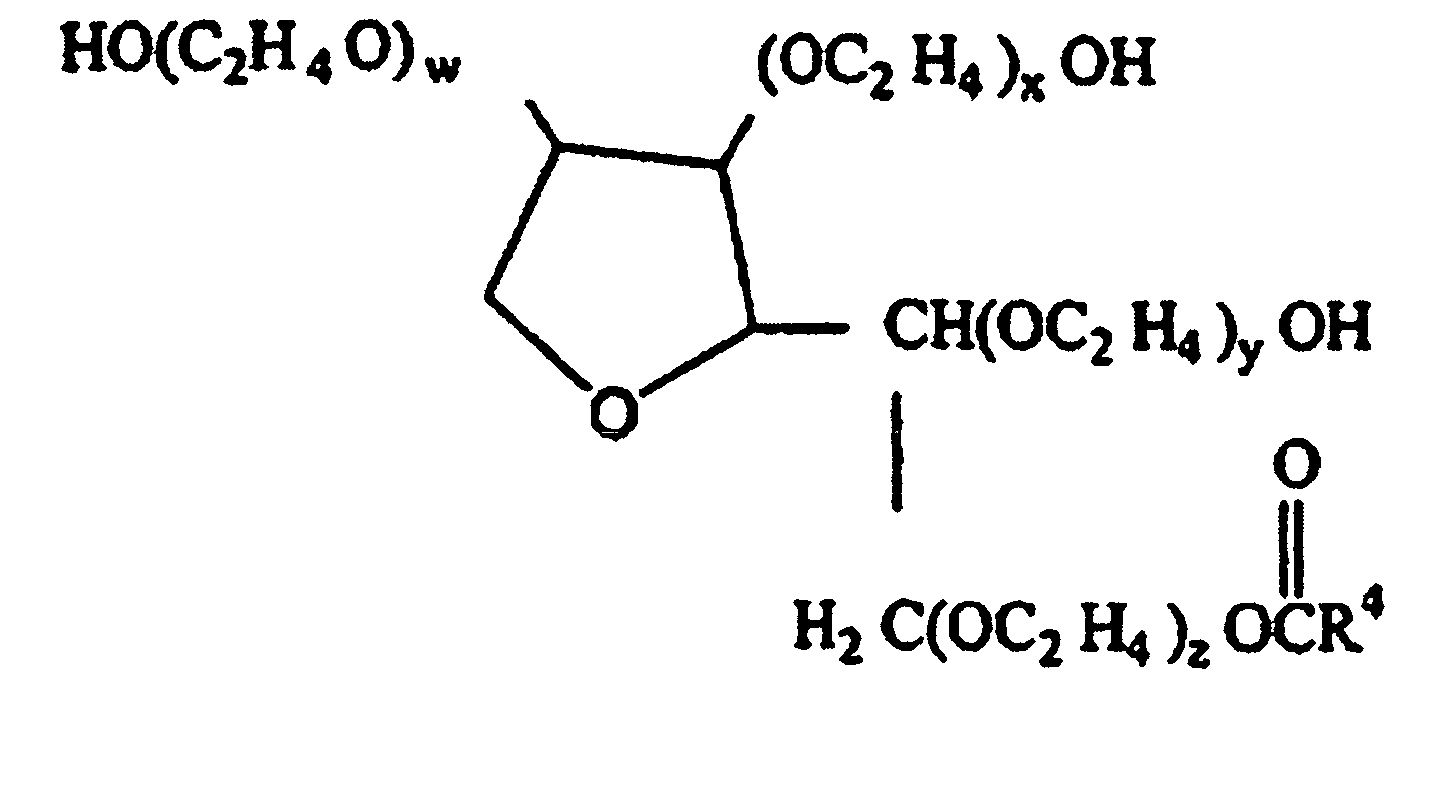 worin R2 und R3 aliphatische Gruppen sind, die unabhängig voneinander 7 bis etwa 23 Kohlenstoffatome enthalten, und wobei G aus der Gruppe ausgewählt ist, bestehend aus Wasserstoff,
 oder
oder
Glycerolmonooleat. - Zusammensetzung nach einem der vorangegangenen Ansprüche, wobei die wenigstens eine lösliche oder teilweise lösliche Flüssigkeit Methylalkohol, Ethylalkohol, n-Propylalkohol, Isopropylalkohol, n-Butylalkohol, Isobutylalkohol, sec-Butylalkohol, Essigsäure, Propionsäure, Propylenglycol, 1,3-Propandiol, Glycerolester von Säuren, die nicht mehr als 5 Kohlenstoffatome enthalten, viel Fructose enthaltenden Maissirup oder Diethanolamin umfaßt.
- Zusammensetzung nach einem der vorangegangenen Ansprüche, welche weiterhin wenigstens einen gelösten Stoff enthält, welcher ionische oder nichtionische Zusammensetzungen umfaßt, wobei der ionische gelöste Stoff eine Aminosäure oder ein Salz, welches Natriumchlorid, Natriumbicarbonat, Natriumcarbonat oder Kaliumnitrat umfaßt, ist und wobei der nichtionische gelöste Stoff ein Zucker, welcher Glucose, Fructose, Mannose, Ribose, Galactose, Maltose oder Lactose umfaßt, ist,
einen suspendierten Feststoff, wobei der suspendierte Feststoff Mehl, Bentonite oder Silikamaterialien umfaßt,
einen Oxidationshemmer, wobei der Oxidationshemmer butyliertes Hydroxyanisol oder butyliertes Hydroxytoluol ist. - Zusammensetzung nach einem der vorangegangenen Ansprüche in der Form eines Konzentrats, welches wenigstens 20 Gew.-% eines Gemüseöls oder eines genetisch modifizierten Gemüseöls enthält.
Applications Claiming Priority (2)
| Application Number | Priority Date | Filing Date | Title |
|---|---|---|---|
| US213855 | 1998-12-17 | ||
| US09/213,855 US6172122B1 (en) | 1998-12-17 | 1998-12-17 | Stable emulsions from gelled overbased substrates with surfactants and aqueous liquids |
Publications (3)
| Publication Number | Publication Date |
|---|---|
| EP1010460A2 EP1010460A2 (de) | 2000-06-21 |
| EP1010460A3 EP1010460A3 (de) | 2001-01-17 |
| EP1010460B1 true EP1010460B1 (de) | 2005-10-26 |
Family
ID=22796773
Family Applications (1)
| Application Number | Title | Priority Date | Filing Date |
|---|---|---|---|
| EP99310113A Expired - Lifetime EP1010460B1 (de) | 1998-12-17 | 1999-12-15 | Stabile Emulsionen aus überbasischen gellierten Substraten mit Tensiden und wässrigen Flüssigkeiten |
Country Status (8)
| Country | Link |
|---|---|
| US (1) | US6172122B1 (de) |
| EP (1) | EP1010460B1 (de) |
| AR (1) | AR021593A1 (de) |
| AT (1) | ATE307665T1 (de) |
| AU (1) | AU6447699A (de) |
| BR (1) | BR9906200A (de) |
| CA (1) | CA2292251A1 (de) |
| DE (1) | DE69927914T2 (de) |
Families Citing this family (39)
| Publication number | Priority date | Publication date | Assignee | Title |
|---|---|---|---|---|
| US20040146521A1 (en) * | 1999-06-01 | 2004-07-29 | Schenk Dale B. | Prevention and treatment of synucleinopathic disease |
| US6585820B2 (en) * | 2001-07-06 | 2003-07-01 | Fleet Capital Corporation | Water-resistant gypsum formulations |
| US7030066B1 (en) | 2001-11-12 | 2006-04-18 | Charles Piskoti | Wetting composition for high temperature metal surfaces, and method of making the same |
| DE10344699B4 (de) * | 2002-09-28 | 2016-06-09 | Ebm-Papst St. Georgen Gmbh & Co. Kg | Anordnung und Verfahren zur Wärmeabfuhr von einem zu kühlenden Bauteil |
| US7294189B2 (en) * | 2002-10-09 | 2007-11-13 | Hexion Specialty Chemicals, Inc. | Wax emulsion preservative compositions and method of manufacture |
| BR0315220B1 (pt) * | 2002-10-11 | 2014-07-29 | Hexion Specialty Chemicals, Inc. | Emulsão útil em propiciar resistência à água a um produto de gesso e método para fabricação da mesma |
| US20080014194A1 (en) * | 2003-10-31 | 2008-01-17 | Elan Pharmaceuticals, Inc. | Prevention and Treatment of Synucleinopathic and Amyloidogenic Disease |
| US9034337B2 (en) | 2003-10-31 | 2015-05-19 | Prothena Biosciences Limited | Treatment and delay of outset of synucleinopathic and amyloidogenic disease |
| US8697082B2 (en) * | 2002-11-01 | 2014-04-15 | Neotope Biosciences Limited | Prevention and treatment of synucleinopathic and amyloidogenic disease |
| TW200509968A (en) * | 2002-11-01 | 2005-03-16 | Elan Pharm Inc | Prevention and treatment of synucleinopathic disease |
| US8506959B2 (en) * | 2002-11-01 | 2013-08-13 | Neotope Biosciences Limited | Prevention and treatment of synucleinopathic and amyloidogenic disease |
| AU2003237440B2 (en) * | 2002-11-13 | 2010-09-09 | Hexion Specialty Chemicals, Inc. | Emulsions for composite materials |
| AU2003251402B2 (en) | 2002-12-20 | 2011-01-20 | Momentive Specialty Chemicals Inc. | Water-resistant additives for gypsum wood fiber products |
| US20050020455A1 (en) * | 2003-03-04 | 2005-01-27 | Richard Mapp | Film forming and mechanical lubricant combination |
| US7569526B2 (en) * | 2003-04-08 | 2009-08-04 | Crompton Corporation | Anti-oxidants in soluble oil base for metal working fluids |
| US7358331B2 (en) * | 2003-05-19 | 2008-04-15 | Elan Pharmaceuticals, Inc. | Truncated fragments of alpha-synuclein in Lewy body disease |
| EP1628930A4 (de) * | 2003-06-05 | 2011-08-24 | Hexion Specialty Chemicals Inc | Gipsprodukte und herstellungsverfahren dafür |
| WO2005047860A2 (en) | 2003-11-08 | 2005-05-26 | Elan Pharmaceuticals, Inc. | Antibodies to alpha-synuclein |
| AU2005200152B2 (en) * | 2004-01-16 | 2009-04-23 | Archer-Daniels-Midland Company | Improved color in film-forming compositions |
| US7374610B2 (en) * | 2006-04-25 | 2008-05-20 | Hexion Specialty Chemicals, Inc. | Wax emulsions for gypsum products |
| US8114822B2 (en) | 2006-10-24 | 2012-02-14 | Chemtura Corporation | Soluble oil containing overbased sulfonate additives |
| PL2118300T3 (pl) * | 2007-02-23 | 2015-11-30 | Prothena Biosciences Ltd | Zapobieganie i leczenie synukleinopatii i amyloidozy |
| US8147833B2 (en) * | 2007-02-23 | 2012-04-03 | Neotope Biosciences Limited | Prevention and treatment of synucleinopathic and amyloidogenic disease |
| US8968466B2 (en) | 2011-08-22 | 2015-03-03 | Momentive Specialty Chemicals Inc. | Sizing and rheology agents for gypsum stucco systems for water resistant panel production |
| US8932401B2 (en) | 2011-08-22 | 2015-01-13 | Momentive Specialty Chemicals Inc. | Sizing and rheology agents for gypsum stucco systems for water resistant panel production |
| US9976101B2 (en) | 2011-10-31 | 2018-05-22 | Nch Corporation | Method of manufacturing calcium sulfonate greases using delayed addition of non-aqueous converting agents |
| US9976102B2 (en) | 2011-10-31 | 2018-05-22 | Nch Corporation | Composition and method of manufacturing calcium sulfonate greases using alkali metal hydroxide and delayed addition of non-aqueous converting agents |
| EP2641474A1 (de) * | 2012-03-20 | 2013-09-25 | Cargill Inc. | Stark ölhaltige Fraktionen von Palmöl |
| US9382403B2 (en) * | 2014-07-16 | 2016-07-05 | Polymer Additives, Inc. | Phenol-free overbased alkaline earth metal carboxylate |
| CN104359736B (zh) * | 2014-11-18 | 2017-01-18 | 青岛源之林农业科技开发有限公司 | 一种用于制作鲜湿面制品的面粉的检测方法 |
| KR20180023887A (ko) | 2015-03-25 | 2018-03-07 | 캔들-라이트 컴퍼니, 엘엘씨 | 다중불포화도가 낮은 식물성유 및 젤화제를 포함하는 양초 제품 |
| US10087387B2 (en) | 2016-05-18 | 2018-10-02 | Nch Corporation | Composition and method of manufacturing calcium magnesium sulfonate greases |
| US10392577B2 (en) | 2016-05-18 | 2019-08-27 | Nch Corporation | Composition and method of manufacturing overbased sulfonate modified lithium carboxylate grease |
| US10087388B2 (en) | 2016-05-18 | 2018-10-02 | Nch Corporation | Composition and method of manufacturing calcium sulfonate and calcium magnesium sulfonate greases using a delay after addition of facilitating acid |
| US10519393B2 (en) | 2016-05-18 | 2019-12-31 | Nch Corporation | Composition and method of manufacturing calcium magnesium sulfonate greases |
| US10087391B2 (en) | 2016-05-18 | 2018-10-02 | Nch Corporation | Composition and method of manufacturing calcium magnesium sulfonate greases without a conventional non-aqueous converting agent |
| US12331261B2 (en) | 2018-11-20 | 2025-06-17 | Nch Corporation | Composition and method of manufacturing sulfonate-based greases using a glycerol derivative |
| US11661563B2 (en) | 2020-02-11 | 2023-05-30 | Nch Corporation | Composition and method of manufacturing and using extremely rheopectic sulfonate-based greases |
| CN113797814A (zh) * | 2020-06-17 | 2021-12-17 | 江西盛创新能源科技有限公司 | 一种锂电池负极电池材料原料混匀装置 |
Family Cites Families (23)
| Publication number | Priority date | Publication date | Assignee | Title |
|---|---|---|---|---|
| US3242079A (en) * | 1962-04-06 | 1966-03-22 | Lubrizol Corp | Basic metal-containing thickened oil compositions |
| US3492231A (en) * | 1966-03-17 | 1970-01-27 | Lubrizol Corp | Non-newtonian colloidal disperse system |
| GB1028063A (en) * | 1962-04-06 | 1966-05-04 | Lubrizol Corp | Grease composition |
| US3766067A (en) * | 1966-03-17 | 1973-10-16 | Lubrizol Corp | Calcium containing micellar complexes |
| CA949055A (en) * | 1968-05-08 | 1974-06-11 | Continental Oil Company | Method for preparing highly basic grease and rust inhibiting compositions |
| US3892881A (en) | 1968-12-18 | 1975-07-01 | Petrolite Corp | Non-Newtonian nutritive compositions |
| JPS5272707A (en) * | 1975-12-15 | 1977-06-17 | Karonaito Kagaku Kk | Preparation of additive for perbasic lubricating oil |
| US4229309A (en) | 1977-07-18 | 1980-10-21 | Petrolite Corporation | Magnesium-containing dispersions |
| US4310516A (en) | 1980-02-01 | 1982-01-12 | Block Drug Company Inc. | Cosmetic and pharmaceutical vehicle thickened with solid emulsifier |
| US4468339B1 (en) * | 1982-01-21 | 1989-05-16 | Aqueous compositions containing overbased materials | |
| US4627192B1 (en) * | 1984-11-16 | 1995-10-17 | Sigco Res Inc | Sunflower products and methods for their production |
| US5158796A (en) | 1986-02-20 | 1992-10-27 | The Procter & Gamble Company | Polyol fatty acid polyester compositions with improved taste |
| JP2601300B2 (ja) | 1987-04-06 | 1997-04-16 | 旭化成工業株式会社 | 粉状または粒状油脂およびその製造方法 |
| US5132123A (en) | 1988-11-17 | 1992-07-21 | Stiven Laiho | Feed and a process for its production |
| DE69109297T2 (de) | 1990-08-13 | 1995-11-09 | David W. Byfield Mass. Yesair | Gemischte lipid-bicarbonat-kolloidale partikel zur abgabe von arzneien und kalorien. |
| US5652011A (en) | 1990-11-23 | 1997-07-29 | Van Den Bergh Foods Co., Division Of Conopco, Inc. | Low fat spreads and dressings |
| US5102680A (en) | 1991-04-16 | 1992-04-07 | General Mills, Inc. | Reduced fat ready-to-spread frosting |
| GB9121736D0 (en) * | 1991-10-14 | 1991-11-27 | Exxon Chemical Patents Inc | Improved overbased carboxylates |
| US5194270A (en) | 1991-12-20 | 1993-03-16 | Kraft General Foods, Inc. | Calcium citrate-vegetable oil compositions |
| US5300242A (en) * | 1992-03-05 | 1994-04-05 | The Lubrizol Corporation | Metal overbased and gelled natural oils |
| US5401424A (en) | 1993-10-04 | 1995-03-28 | The Lubrizol Corporation | Mixed carboxylate overbased gels |
| GB9414574D0 (en) | 1994-07-19 | 1994-09-07 | Unilever Plc | Detergent composition |
| US5919741A (en) * | 1998-01-20 | 1999-07-06 | The Lubrizol Corporation | Overbased carboxylate gels |
-
1998
- 1998-12-17 US US09/213,855 patent/US6172122B1/en not_active Expired - Lifetime
-
1999
- 1999-12-09 AR ARP990106260A patent/AR021593A1/es unknown
- 1999-12-10 CA CA002292251A patent/CA2292251A1/en not_active Abandoned
- 1999-12-13 AU AU64476/99A patent/AU6447699A/en not_active Abandoned
- 1999-12-15 AT AT99310113T patent/ATE307665T1/de not_active IP Right Cessation
- 1999-12-15 EP EP99310113A patent/EP1010460B1/de not_active Expired - Lifetime
- 1999-12-15 DE DE69927914T patent/DE69927914T2/de not_active Expired - Fee Related
- 1999-12-15 BR BR9906200-3A patent/BR9906200A/pt not_active Application Discontinuation
Also Published As
| Publication number | Publication date |
|---|---|
| EP1010460A2 (de) | 2000-06-21 |
| DE69927914T2 (de) | 2006-07-20 |
| DE69927914D1 (de) | 2005-12-01 |
| CA2292251A1 (en) | 2000-06-17 |
| BR9906200A (pt) | 2001-02-06 |
| US6172122B1 (en) | 2001-01-09 |
| AU6447699A (en) | 2000-06-22 |
| AR021593A1 (es) | 2002-07-31 |
| EP1010460A3 (de) | 2001-01-17 |
| ATE307665T1 (de) | 2005-11-15 |
Similar Documents
| Publication | Publication Date | Title |
|---|---|---|
| US6172122B1 (en) | Stable emulsions from gelled overbased substrates with surfactants and aqueous liquids | |
| US7387786B2 (en) | Food additive compositions containing sterol esters, solubilizing agents, dispersants and antioxidants | |
| JP3946163B2 (ja) | 長鎖多不飽和脂肪酸の含有量が高い材料の調製方法 | |
| JPH0249719A (ja) | 易水分散・可溶性能を有する油溶性ビタミン粉末 | |
| JPH0516812B2 (de) | ||
| JP2995855B2 (ja) | 油中水型乳化物および保水性改善剤 | |
| JP3596134B2 (ja) | 油脂組成物 | |
| JP4326153B2 (ja) | 乾燥動物飼料を調製する方法 | |
| JPH09110635A (ja) | 微細エマルション組成物 | |
| EP2403360B1 (de) | Formulierung von astaxanthin-derivaten und deren verwendung iii | |
| US6399801B1 (en) | Dry powder lithium carboxylates | |
| CA2241144C (en) | Stable, low-viscosity feedstuff dispersion of molasses and a fat or an oil or an acid from fat or oil or a mixture thereof | |
| JP3561571B2 (ja) | 酸化防止剤製剤 | |
| US4001141A (en) | Cosmetic emulsifiers | |
| US2851357A (en) | Animal feed emulsion and process | |
| FR2754193A1 (fr) | Procede pour reduire la viscosite d'une solution aqueuse d'un ester gras de saccharose et procede de dispersion utilisant un tel ester gras | |
| JP2009079011A (ja) | ソフトカプセル充填用液状組成物 | |
| JP3174424B2 (ja) | 結晶化粉末マルチトールの製法 | |
| CN1135169A (zh) | 冷水可乳化的制剂 | |
| JPH0367548B2 (de) | ||
| JPH07274842A (ja) | 酸化安定性の良い飼料 | |
| JP4582823B2 (ja) | 油溶性物質が可溶化ないし分散されてなる水性組成物 | |
| JP5295695B2 (ja) | 増粘ゲル化剤 | |
| US5132123A (en) | Feed and a process for its production | |
| EP0369971B1 (de) | Futter und Verfahren zu dessen Herstellung |
Legal Events
| Date | Code | Title | Description |
|---|---|---|---|
| PUAI | Public reference made under article 153(3) epc to a published international application that has entered the european phase |
Free format text: ORIGINAL CODE: 0009012 |
|
| AK | Designated contracting states |
Kind code of ref document: A2 Designated state(s): AT BE CH CY DE DK ES FI FR GB GR IE IT LI LU MC NL PT SE |
|
| AX | Request for extension of the european patent |
Free format text: AL;LT;LV;MK;RO;SI |
|
| PUAL | Search report despatched |
Free format text: ORIGINAL CODE: 0009013 |
|
| AK | Designated contracting states |
Kind code of ref document: A3 Designated state(s): AT BE CH CY DE DK ES FI FR GB GR IE IT LI LU MC NL PT SE |
|
| AX | Request for extension of the european patent |
Free format text: AL;LT;LV;MK;RO;SI |
|
| RIC1 | Information provided on ipc code assigned before grant |
Free format text: 7B 01F 17/34 A, 7B 01F 17/00 B |
|
| 17P | Request for examination filed |
Effective date: 20010625 |
|
| AKX | Designation fees paid |
Free format text: AT BE CH CY DE DK ES FI FR GB GR IE IT LI LU MC NL PT SE |
|
| 17Q | First examination report despatched |
Effective date: 20040817 |
|
| GRAP | Despatch of communication of intention to grant a patent |
Free format text: ORIGINAL CODE: EPIDOSNIGR1 |
|
| GRAS | Grant fee paid |
Free format text: ORIGINAL CODE: EPIDOSNIGR3 |
|
| GRAA | (expected) grant |
Free format text: ORIGINAL CODE: 0009210 |
|
| AK | Designated contracting states |
Kind code of ref document: B1 Designated state(s): AT BE CH CY DE DK ES FI FR GB GR IE IT LI LU MC NL PT SE |
|
| PG25 | Lapsed in a contracting state [announced via postgrant information from national office to epo] |
Ref country code: NL Free format text: LAPSE BECAUSE OF FAILURE TO SUBMIT A TRANSLATION OF THE DESCRIPTION OR TO PAY THE FEE WITHIN THE PRESCRIBED TIME-LIMIT Effective date: 20051026 Ref country code: LI Free format text: LAPSE BECAUSE OF FAILURE TO SUBMIT A TRANSLATION OF THE DESCRIPTION OR TO PAY THE FEE WITHIN THE PRESCRIBED TIME-LIMIT Effective date: 20051026 Ref country code: IT Free format text: LAPSE BECAUSE OF FAILURE TO SUBMIT A TRANSLATION OF THE DESCRIPTION OR TO PAY THE FEE WITHIN THE PRE;WARNING: LAPSES OF ITALIAN PATENTS WITH EFFECTIVE DATE BEFORE 2007 MAY HAVE OCCURRED AT ANY TIME BEFORE 2007. THE CORRECT EFFECTIVE DATE MAY BE DIFFERENT FROM THE ONE RECORDED.SCRIBED TIME-LIMIT Effective date: 20051026 Ref country code: FI Free format text: LAPSE BECAUSE OF FAILURE TO SUBMIT A TRANSLATION OF THE DESCRIPTION OR TO PAY THE FEE WITHIN THE PRESCRIBED TIME-LIMIT Effective date: 20051026 Ref country code: CH Free format text: LAPSE BECAUSE OF FAILURE TO SUBMIT A TRANSLATION OF THE DESCRIPTION OR TO PAY THE FEE WITHIN THE PRESCRIBED TIME-LIMIT Effective date: 20051026 Ref country code: BE Free format text: LAPSE BECAUSE OF FAILURE TO SUBMIT A TRANSLATION OF THE DESCRIPTION OR TO PAY THE FEE WITHIN THE PRESCRIBED TIME-LIMIT Effective date: 20051026 Ref country code: AT Free format text: LAPSE BECAUSE OF FAILURE TO SUBMIT A TRANSLATION OF THE DESCRIPTION OR TO PAY THE FEE WITHIN THE PRESCRIBED TIME-LIMIT Effective date: 20051026 |
|
| REG | Reference to a national code |
Ref country code: GB Ref legal event code: FG4D |
|
| REG | Reference to a national code |
Ref country code: CH Ref legal event code: EP |
|
| PGFP | Annual fee paid to national office [announced via postgrant information from national office to epo] |
Ref country code: NL Payment date: 20051116 Year of fee payment: 7 |
|
| REG | Reference to a national code |
Ref country code: IE Ref legal event code: FG4D |
|
| REF | Corresponds to: |
Ref document number: 69927914 Country of ref document: DE Date of ref document: 20051201 Kind code of ref document: P |
|
| PG25 | Lapsed in a contracting state [announced via postgrant information from national office to epo] |
Ref country code: IE Free format text: LAPSE BECAUSE OF NON-PAYMENT OF DUE FEES Effective date: 20051215 Ref country code: CY Free format text: LAPSE BECAUSE OF FAILURE TO SUBMIT A TRANSLATION OF THE DESCRIPTION OR TO PAY THE FEE WITHIN THE PRESCRIBED TIME-LIMIT Effective date: 20051215 |
|
| PG25 | Lapsed in a contracting state [announced via postgrant information from national office to epo] |
Ref country code: MC Free format text: LAPSE BECAUSE OF NON-PAYMENT OF DUE FEES Effective date: 20051231 Ref country code: LU Free format text: LAPSE BECAUSE OF NON-PAYMENT OF DUE FEES Effective date: 20051231 |
|
| PG25 | Lapsed in a contracting state [announced via postgrant information from national office to epo] |
Ref country code: SE Free format text: LAPSE BECAUSE OF FAILURE TO SUBMIT A TRANSLATION OF THE DESCRIPTION OR TO PAY THE FEE WITHIN THE PRESCRIBED TIME-LIMIT Effective date: 20060126 Ref country code: GR Free format text: LAPSE BECAUSE OF FAILURE TO SUBMIT A TRANSLATION OF THE DESCRIPTION OR TO PAY THE FEE WITHIN THE PRESCRIBED TIME-LIMIT Effective date: 20060126 Ref country code: DK Free format text: LAPSE BECAUSE OF FAILURE TO SUBMIT A TRANSLATION OF THE DESCRIPTION OR TO PAY THE FEE WITHIN THE PRESCRIBED TIME-LIMIT Effective date: 20060126 |
|
| PG25 | Lapsed in a contracting state [announced via postgrant information from national office to epo] |
Ref country code: ES Free format text: LAPSE BECAUSE OF FAILURE TO SUBMIT A TRANSLATION OF THE DESCRIPTION OR TO PAY THE FEE WITHIN THE PRESCRIBED TIME-LIMIT Effective date: 20060206 |
|
| PG25 | Lapsed in a contracting state [announced via postgrant information from national office to epo] |
Ref country code: PT Free format text: LAPSE BECAUSE OF FAILURE TO SUBMIT A TRANSLATION OF THE DESCRIPTION OR TO PAY THE FEE WITHIN THE PRESCRIBED TIME-LIMIT Effective date: 20060327 |
|
| NLV1 | Nl: lapsed or annulled due to failure to fulfill the requirements of art. 29p and 29m of the patents act | ||
| REG | Reference to a national code |
Ref country code: CH Ref legal event code: PL |
|
| ET | Fr: translation filed | ||
| PLBE | No opposition filed within time limit |
Free format text: ORIGINAL CODE: 0009261 |
|
| STAA | Information on the status of an ep patent application or granted ep patent |
Free format text: STATUS: NO OPPOSITION FILED WITHIN TIME LIMIT |
|
| 26N | No opposition filed |
Effective date: 20060727 |
|
| REG | Reference to a national code |
Ref country code: IE Ref legal event code: MM4A |
|
| PGFP | Annual fee paid to national office [announced via postgrant information from national office to epo] |
Ref country code: GB Payment date: 20061222 Year of fee payment: 8 |
|
| PGFP | Annual fee paid to national office [announced via postgrant information from national office to epo] |
Ref country code: DE Payment date: 20070131 Year of fee payment: 8 |
|
| PGFP | Annual fee paid to national office [announced via postgrant information from national office to epo] |
Ref country code: FR Payment date: 20071217 Year of fee payment: 9 |
|
| GBPC | Gb: european patent ceased through non-payment of renewal fee |
Effective date: 20071215 |
|
| PG25 | Lapsed in a contracting state [announced via postgrant information from national office to epo] |
Ref country code: DE Free format text: LAPSE BECAUSE OF NON-PAYMENT OF DUE FEES Effective date: 20080701 |
|
| PG25 | Lapsed in a contracting state [announced via postgrant information from national office to epo] |
Ref country code: GB Free format text: LAPSE BECAUSE OF NON-PAYMENT OF DUE FEES Effective date: 20071215 |
|
| REG | Reference to a national code |
Ref country code: FR Ref legal event code: ST Effective date: 20090831 |
|
| PG25 | Lapsed in a contracting state [announced via postgrant information from national office to epo] |
Ref country code: FR Free format text: LAPSE BECAUSE OF NON-PAYMENT OF DUE FEES Effective date: 20081231 |