EP0979822B1 - Verfahren zur Herstellung von 2-Carbamoyl-Pyridinen - Google Patents
Verfahren zur Herstellung von 2-Carbamoyl-Pyridinen Download PDFInfo
- Publication number
- EP0979822B1 EP0979822B1 EP99114893A EP99114893A EP0979822B1 EP 0979822 B1 EP0979822 B1 EP 0979822B1 EP 99114893 A EP99114893 A EP 99114893A EP 99114893 A EP99114893 A EP 99114893A EP 0979822 B1 EP0979822 B1 EP 0979822B1
- Authority
- EP
- European Patent Office
- Prior art keywords
- pyridine
- methoxy
- pyrimidine
- phenoxy
- reaction
- Prior art date
- Legal status (The legal status is an assumption and is not a legal conclusion. Google has not performed a legal analysis and makes no representation as to the accuracy of the status listed.)
- Expired - Lifetime
Links
- 0 *c(cn1)ccc1S(N)(=O)=O Chemical compound *c(cn1)ccc1S(N)(=O)=O 0.000 description 2
Classifications
-
- C—CHEMISTRY; METALLURGY
- C07—ORGANIC CHEMISTRY
- C07D—HETEROCYCLIC COMPOUNDS
- C07D401/00—Heterocyclic compounds containing two or more hetero rings, having nitrogen atoms as the only ring hetero atoms, at least one ring being a six-membered ring with only one nitrogen atom
- C07D401/02—Heterocyclic compounds containing two or more hetero rings, having nitrogen atoms as the only ring hetero atoms, at least one ring being a six-membered ring with only one nitrogen atom containing two hetero rings
- C07D401/04—Heterocyclic compounds containing two or more hetero rings, having nitrogen atoms as the only ring hetero atoms, at least one ring being a six-membered ring with only one nitrogen atom containing two hetero rings directly linked by a ring-member-to-ring-member bond
-
- A—HUMAN NECESSITIES
- A61—MEDICAL OR VETERINARY SCIENCE; HYGIENE
- A61P—SPECIFIC THERAPEUTIC ACTIVITY OF CHEMICAL COMPOUNDS OR MEDICINAL PREPARATIONS
- A61P43/00—Drugs for specific purposes, not provided for in groups A61P1/00-A61P41/00
-
- A—HUMAN NECESSITIES
- A61—MEDICAL OR VETERINARY SCIENCE; HYGIENE
- A61P—SPECIFIC THERAPEUTIC ACTIVITY OF CHEMICAL COMPOUNDS OR MEDICINAL PREPARATIONS
- A61P9/00—Drugs for disorders of the cardiovascular system
-
- A—HUMAN NECESSITIES
- A61—MEDICAL OR VETERINARY SCIENCE; HYGIENE
- A61P—SPECIFIC THERAPEUTIC ACTIVITY OF CHEMICAL COMPOUNDS OR MEDICINAL PREPARATIONS
- A61P9/00—Drugs for disorders of the cardiovascular system
- A61P9/10—Drugs for disorders of the cardiovascular system for treating ischaemic or atherosclerotic diseases, e.g. antianginal drugs, coronary vasodilators, drugs for myocardial infarction, retinopathy, cerebrovascula insufficiency, renal arteriosclerosis
-
- A—HUMAN NECESSITIES
- A61—MEDICAL OR VETERINARY SCIENCE; HYGIENE
- A61P—SPECIFIC THERAPEUTIC ACTIVITY OF CHEMICAL COMPOUNDS OR MEDICINAL PREPARATIONS
- A61P9/00—Drugs for disorders of the cardiovascular system
- A61P9/12—Antihypertensives
-
- C—CHEMISTRY; METALLURGY
- C07—ORGANIC CHEMISTRY
- C07D—HETEROCYCLIC COMPOUNDS
- C07D401/00—Heterocyclic compounds containing two or more hetero rings, having nitrogen atoms as the only ring hetero atoms, at least one ring being a six-membered ring with only one nitrogen atom
- C07D401/14—Heterocyclic compounds containing two or more hetero rings, having nitrogen atoms as the only ring hetero atoms, at least one ring being a six-membered ring with only one nitrogen atom containing three or more hetero rings
Definitions
- the present invention is concerned with a novel process for the carbamoylation of substituted pyridines, especially with a process for the preparation of compounds of formula I wherein R 4 to R 8 represent hydrogen, lower-alkoxy or halogen; or optionally salts thereof.
- the process according to the present invention is useful for the preparation of endothelin receptor inhibitors which can be used for the treatment of disorders associated with endothelin receptor activities, especially circulatory disorders such as hypertension, ischaemia, vasospasms and angina pectoris.
- the process according to the present invention is characterized in that a substituted pyridine, preferably a compound of formula II wherein R 4 to R 8 represent hydrogen, lower-alkoxy or halogen; or optionally salts thereof is reacted with formamide and an oxidizing agent in the presence of 15 to 40 mol% iron (II)salt in an acidic aqueous medium.
- a substituted pyridine preferably a compound of formula II wherein R 4 to R 8 represent hydrogen, lower-alkoxy or halogen; or optionally salts thereof is reacted with formamide and an oxidizing agent in the presence of 15 to 40 mol% iron (II)salt in an acidic aqueous medium.
- lower refers to a group consisting of one to seven, preferably one to four carbon atom(s), unless otherwise indicated.
- lower-alkyl refers to a branched or straight chain monovalent alkyl radical of one to seven carbon atoms, preferably one to four carbon atoms. This term is further exemplified by such radicals as methyl, ethyl, n-propyl, isopropyl, i-butyl, n-butyl, t-butyl and the like.
- lower-alkoxy refers to the group -O-R', where R' is a lower-alkyl.
- halogen refers to fluoro, chloro, bromo and iodo, with chloro being preferred.
- aryl refers to a monovalent carbocyclic aromatic radical (e.g. phenyl), optionally substituted, independently, with halogen, lower-alkyl, lower-alkoxy, lower-alkylenedioxy, carboxy, trifluoromethyl.
- lower-aralkyl refers to a lower-alkyl group substituted by aryl, e.g. phenyl or substituted phenyl, preferably benzyl.
- heterocyclyl refers to mono- or bicyclic, 5- and 6-membered heterocycles having oxygen, nitrogen or sulphur as the hetero atom, such as 2- and 3-furyl, 2-, 4- and 5-pyrimidinyl, 2-, 3- and 4-pyridyl, 1,2- and 1,4-diazinyl, 2- and 3-thienyl, oxazolyl, thiazolyl, imidazolyl, benzofuranyl, benzothienyl, purinyl, quinolyl, isoquinolyl and quinazolyl, which residues can be substituted by 1 or 2 lower-alkyl groups.
- heterocyclyl is a pyridyl residue or a substituted pyridyl residue.
- substituted phenyl refers to a phenyl group which is mono-, di- or trisubstituted, independently, with halogen, lower-alkyl, lower-alkoxy, lower-alkylenedioxy, carboxy, trifluoromethyl.
- substituted pyridyl refers to a pyridyl group which is mono-, di- or trisubstituted, independently, with halogen, lower-alkyl, lower-alkoxy, lower-alkylenedioxy, carboxy, trifluoromethyl.
- lower-alkylenedioxy refers to the group -O-(CH 2 ) n -O-, wherein n is an integer of two to seven, preferably an integer of two to four.
- salts embraces alkali salts such as Na or K salts or alkaline earth metal salts such as Ca or Mg salts or salts with amines such as monoethanolamine as well as salts with inorganic or organic acids such as hydrochloric acid, hydrobromic acid, nitric acid, sulphuric acid, phosphoric acid, citric acid, formic acid, maleic acid, acetic acid, succinic acid, tartaric acid, methanesulphonic acid, p-toluenesulphonic acid, which are non-toxic to living organisms.
- alkali salts such as Na or K salts or alkaline earth metal salts such as Ca or Mg salts or salts with amines such as monoethanolamine as well as salts with inorganic or organic acids such as hydrochloric acid, hydrobromic acid, nitric acid, sulphuric acid, phosphoric acid, citric acid, formic acid, maleic acid, acetic acid, succinic acid, tarta
- the present invention provides a process for the preparation of compounds of the formula I wherein R 4 to R 8 represent hydrogen, lower-alkoxy or halogen; characterized in that the process comprises the reaction of a compound of formula II wherein R 4 to R 8 represent hydrogen, lower-alkoxy or halogen; or optionally salts thereof with formamide and an oxidizing agent in an aqueous acid solution in the presence of 15 to 40 mol% iron(II)salts concerning compounds of formula II. If desired, the compounds of formula I may be obtained as salts.
- the reaction is performed with an iron(II)salt comprising an anion selected from chloride, bromide, sulfate, phosphate, tetrafluoroborate, or hexafluoroborate.
- Another preferred aspect is the reaction in the presence of 20 to 30 mol% iron(II)salts concerning compounds of formula II.
- the reaction is performed at a temperature of 0°C to 35°C, preferably at a temperature of 0°C to 20°C, more preferably at a temperature of 0°C to 10 °C.
- the oxidizing agent is hydrogen peroxide.
- reaction is performed in the presence of about 1.5 to 2.5 mol, preferably about 2 mol of the oxidizing agent (with respect to the compound of formula II).
- the aqueous acid solution may be an inorganic or organic acid solution, e.g. a sulfonic acid solution.
- reaction refers to the conversion of 5-(2-methoxy-phenoxy)-2-pyridine-4-yl-pyrimidine-4,6-diole to 4- [4,6-dihydroxy-5-(2-methoxy-phenoxy)-pyrimidine-2-yl]-pyridine-2-carboxylic acid amide using the reaction conditions as described above.
- the process for the preparation of compounds of formula VI may comprise the following steps:
- a compound of formula I as defined above may be converted into a compound of formula III wherein
- reaction type is known in the art and may be performed under basic conditions for example in the presence of a coupling agent, e.g. 1,4-diazobicyclo[2.2.2]octane, together with potassium carbonate in acetone.
- a coupling agent e.g. 1,4-diazobicyclo[2.2.2]octane
- the compound of formula IV as defined above may be reacted under basic conditions with a compound of the formula H-O-C(R a R b ) n -OR 9 , wherein R 9 , R 10 , R a , R b , and n have the significance as defined above, followed by a reaction with hydrazine hydrate and a nitrite salt as defined above.
- basic conditions means in the presence of a base, preferably in the presence of a metal hydroxide, more preferably in the presence of sodium hydroxide.
- R 3 is preferably -O(CH 2 ) n OH and n is preferably 2.
- R 1 is lower alkyl; R 2 is tetrazolyl; R 3 is 2-hydroxy-ethoxy; R 4 to R 7 are hydrogen and R 8 is lower alkoxy. More particularly preferred is the process wherein R 1 is methyl or isopropyl; R 2 is tetrazolyl; R 3 is 2-hydroxy-ethoxy; R 4 to R 7 are hydrogen and R 8 is methoxy.
- a particularly preferred embodiment of the present invention is the process for the preparation of 5-methyl-pyridine-2-sulfonic acid [6-(2-hydroxy-ethoxy)-5-(2-methoxyphenoxy)-2-[2-(1H-tetrazole-5-yl)-pyridine-4-yl]-pyrimidine-4-yl]-amide or salts thereof using the reaction conditions as described above characterized in that the process comprises
- Step d) comprises
- sequence of the corresponding reactions of steps aa) and bb) may optionally be exchanged.
- Another particularly preferred embodiment of the present invention is the process for the preparation of 5-isopropyl-pyridine-2-sulfonic acid [6-(2-hydroxy-ethoxy)-5-(2-methoxy-phenoxy)-2-[2-(1H-tetrazole-5-yl)-pyridine-4-yl]-pyrimidine-4-yl]-amide or salts thereof using the reaction conditions as described above characterized in that the process comprises the steps a) and b) as described above followed by
- Step d) comprises
- sequence of the corresponding reactions of steps aa) and bb) may optionally be exchanged.
- R 4 to R 7 represent hydrogen and R 8 represents lower alkoxy. More particularly preferred is 4-[4,6-dihydroxy-5-(2-methoxy-phenoxy)-pyrimidine-2-yl]-pyridine-2-carboxylic acid amide and salts thereof.
- Another embodiment of the present invention are compounds of the formula III and their salts: wherein
- R 4 to R 7 represent hydrogen
- R 8 represents lower alkoxy
- hal represents chloro
- More particularly preferred is 4-[4,6-dichloro-5-(2-methoxy-phenoxy)-pyrimidine-2-yl]-pyridine-2-carbonitrile and salts thereof.
- R 1 represents methyl or isopropyl
- R 4 to R 7 represent hydrogen
- R 8 represents lower alkoxy
- hal represents chloro.
- 5-methyl-pyridine-2-sulfonic acid [6-chloro-2-(2-cyano-pyridine-4-yl)-5-(2-methoxyphenoxy)-pyrimidine-4-yl]-amide and salts thereof as well as 5-isopropyl-pyridine-2-sulfonic acid [6-chloro-2-(2-cyano-pyridine-4-yl)-5-(2-methoxy-phenoxy)-pyrimidine-4-yl]-amide and salts thereof.
- the compounds of formula VI as defined above can be converted in a manner known per se into pharmaceutically acceptable salts.
- the compounds of formulas I to IV as defined above can be optionally obtained as salts, for example as pharmaceutically acceptable salts, or of course as other salts, which do not necessarily have to be pharmaceutically acceptable.
- the compounds which are used as starting materials in the present invention are known from WO 9619459 or can be prepared in analogy to the methods described therein.
- the preparation of the starting compounds comprises the reaction of 4-amidino-pyridine hydrochloride with a corresponding dimethyl- or diethyl(2-methoxyphenoxy)malonate.
- the mixture was stirred at 20°C for 1 hr, then 140 ml of de-ionized water were added and the suspension was stirred at 0°C for 1 hr.
- the solid was filtered, firstly washed with 80 ml of de-ionized water and thereafter with 80 ml of t-butylmethylether. Then the solid was dried at 70°C and 2000 Pa for 16 hr.
- the crude product (23.4 g) was taken up with 117 ml of tetrahydrofuran for 1 hr. After filtration at 0°C the crystallized product was washed with 25 ml of t-butylmethylether and was then dried at 70°C, 2000 Pa for 16 hr.
- the solid was filtered off under suction, washed with 150 ml of de-ionized water and dried at 70°C, 2000 Pa for 17 hr.
- the solid was filtered off under suction, firstly washed with 25 ml of dioxane and thereafter with 25 ml of ethanol. Then the solid was dried at 50°C, 2000 Pa for 23 hr.
- the resulting ammonium salt (10.4 g, 17.5 mmol) was suspended in 50 ml of methanol and thereafter 6.5 ml (35 mmol) of a 5.4 N sodium methylate solution were added. The solution was heated (reflux) for 3 hr, cooled down slowly to 20°C and then to 0°C. The solid was separated by filtering, washed with 10 ml of ice-cold methanol and dried at 70°C, 2000 Pa for 17 hr.
- the resulting suspension was allowed to cool down to 20°C and was stirred at 20°C for 20 hr and thereafter at 0°C for 2.5 hr. Then the solid was filtered off and dried at 70°C, 2000 Pa for 18 hr. There were obtained 14.2 g of mono ammonium salt with a HPLC purity of 96.2% (w/w).
- the solid was heated (reflux) in 70 ml of methanol, cooled down slowly to 20°C and stirred at 20°C for 19 hr and thereafter at 0°C for 2 hr. Then the solid was filtered off and dried at 70°C, 2000 Pa for 19 hr.
Landscapes
- Chemical & Material Sciences (AREA)
- Organic Chemistry (AREA)
- Health & Medical Sciences (AREA)
- Engineering & Computer Science (AREA)
- Bioinformatics & Cheminformatics (AREA)
- Public Health (AREA)
- General Health & Medical Sciences (AREA)
- Chemical Kinetics & Catalysis (AREA)
- General Chemical & Material Sciences (AREA)
- Medicinal Chemistry (AREA)
- Nuclear Medicine, Radiotherapy & Molecular Imaging (AREA)
- Pharmacology & Pharmacy (AREA)
- Life Sciences & Earth Sciences (AREA)
- Animal Behavior & Ethology (AREA)
- Veterinary Medicine (AREA)
- Cardiology (AREA)
- Heart & Thoracic Surgery (AREA)
- Urology & Nephrology (AREA)
- Vascular Medicine (AREA)
- Pharmaceuticals Containing Other Organic And Inorganic Compounds (AREA)
- Plural Heterocyclic Compounds (AREA)
- Pyridine Compounds (AREA)
Claims (23)
- Verfahren zur Herstellung von Verbindungen der Formel Iwobei R4 bis R8 Wasserstoff, C1-7-Alkoxy oder Halogen darstellen;

oder gegebenenfalls Salzen davon, dadurch gekennzeichnet, dass das Verfahren das Umsetzen einer Verbindung der Formel IIwobei R4 bis R8 Wasserstoff, C1-7-Alkoxy oder Halogen darstellen;
oder gegebenenfalls Salzen davon, mit Formamid in einer wässrigen, sauren Lösung in Gegenwart von 15 bis 40 Mol-% Eisen(II)-Salzen, bezogen auf Verbindung II, und einem Oxidationsmittel umfasst. - Verfahren gemäß Anspruch 1, dadurch gekennzeichnet, dass die Umsetzung mit einem Eisen(II)-Salz durchgeführt wird, welches ein Anion umfasst, ausgewählt aus Chlorid, Bromid, Sulfat, Phosphat, Tetrafluorborat oder Hexafluorborat.
- Verfahren gemäß einem der Ansprüche 1 bis 2, dadurch gekennzeichnet, dass die Umsetzung in einem Temperaturbereich von 0°C bis 35°C durchgeführt wird.
- Verfahren gemäß einem der Ansprüche 1 bis 3, dadurch gekennzeichnet, dass die Umsetzung in Gegenwart von 20 bis 30 Mol-% Eisen(II)-Salzen, bezogen auf Verbindung II, durchgeführt wird.
- Verfahren gemäß einem der Ansprüche 1 bis 4, dadurch gekennzeichnet, dass das Oxidationsmittel Wasserstoffperoxid ist.
- Verfahren gemäß einem der Ansprüche 1 bis 5, gefolgt von Umwandeln einer Verbindung der Formel I wie in Anspruch 1 definiert in eine Verbindung der Formel III wobei
R4 bis R8 Wasserstoff, C1-7-Alkoxy oder Halogen darstellen; und
Hal Halogen darstellt;
oder gegebenenfalls Salzen davon, dadurch gekennzeichnet, dass die Verbindung der Formel I mit einem wasserentfernenden und halogenierenden Mittel, ausgewählt aus POCl3, PCl5 und SOCl2, umgesetzt wird. - Verfahren gemäß Anspruch 6, dadurch gekennzeichnet, dass das wasserentfernende und halogenierende Mittel POCl3 ist.
- Verfahren gemäß einem der Ansprüche 6 bis 7, gefolgt von Umwandeln einer Verbindung der Formel III wie in Anspruch 6 definiert in eine Verbindung der Formel IVwobei

R1 C1-7-Alkyl darstellt;
R4 bis R8 Wasserstoff, C1-7-Alkoxy oder Halogen darstellen; und
Hal Halogen darstellt;
oder gegebenenfalls Salzen davon, dadurch gekennzeichnet, dass die Verbindung der Formel III mit einer Verbindung der Formel Vumgesetzt wird, wobei R1 C1-7-Alkyl darstellt.
- Verfahren gemäß Anspruch 8, gefolgt von Umwandeln einer Verbindung der Formel IV wie in Anspruch 8 definiert in eine Verbindung der Formel VIwobei
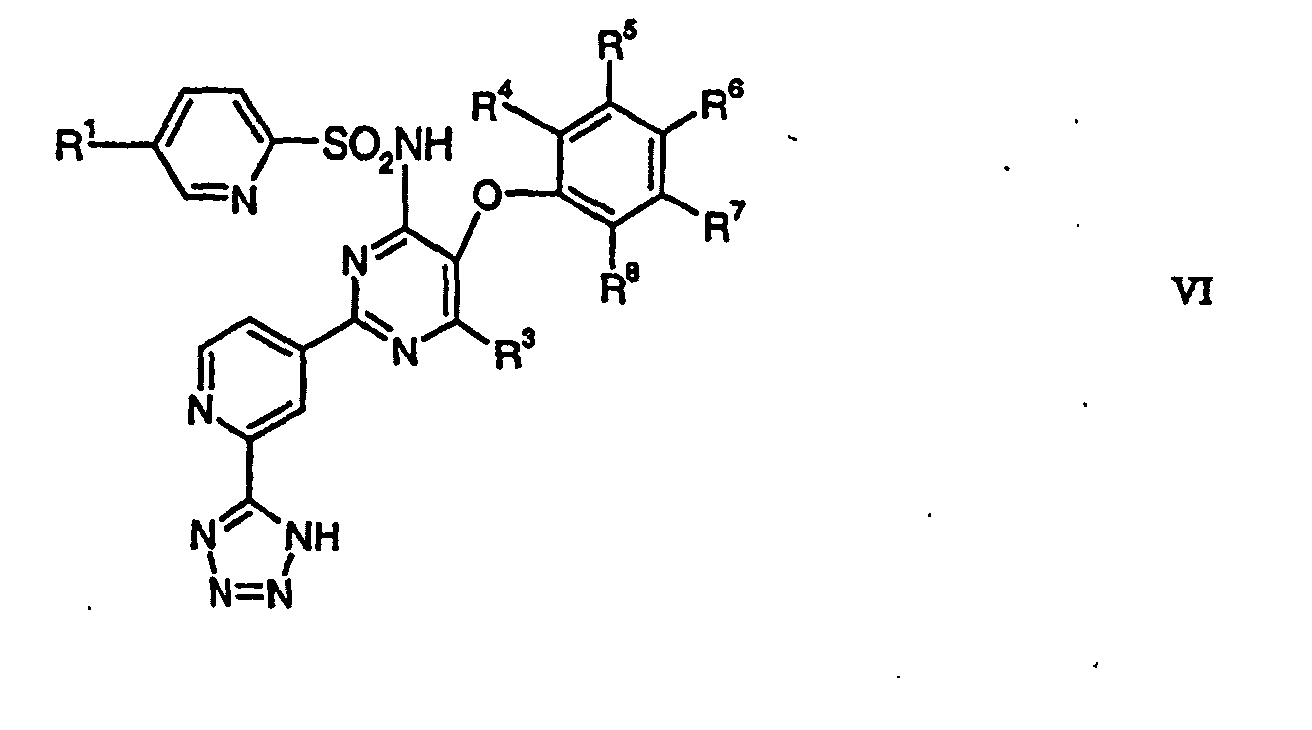
R1 C1-7-Alkyl darstellt;
R3 -O-(CRaRb)n-OR9 darstellt;
R4 bis R8 Wasserstoff, C1-7-Alkoxy oder Halogen darstellen;
R9 Wasserstoff, Aryl, Aryl-C1-7-alkyl, Heterocyclyl oder einen Rest -C(O)NHR10 darstellt;
R10 C1-7-Alkyl, Phenyl, substituiertes Phenyl, Pyridyl oder substituiertes Pyridyl darstellt;
Ra und Rb Wasserstoff oder C1-7-Alkyl darstellen; und
n 2, 3 oder 4 darstellt;
oder Salzen davon, dadurch gekennzeichnet, dass die Verbindung der Formel IV mit Hydrazinhydrat und einem Nitritsalz umgesetzt wird, gefolgt von einer Umsetzung unter basischen Bedingungen mit einer Verbindung der Formel H-O-C(RaRb)n-OR9, wobei R9, R10, Ra, Rb und n die vorstehend definierte Bedeutung aufweisen,
wobei
der Begriff "Aryl" einen einwertigen carbocylischen, aromatischen Rest bedeutet, welcher gegebenenfalls unabhängig mit Halogen, C1-7-Alkyl, C1-7-Alkoxy, C2-7-Alkylendioxy, Carboxy oder Trifluormethyl substituiert ist;
der Begriff "Heterocyclyl" mono- oder bicyclische, 5- und 6-gliedrige Heterocyclen mit Sauerstoff, Stickstoff oder Schwefel als das Heteroatom bedeutet, gegebenenfalls substituiert mit einem oder zwei C1-7-Alkylresten;
der Begriff "substituiertes Phenyl" einen Phenylrest bedeutet, welcher unabhängig mit Halogen, C1-7-Alkyl, C1-7-Alkoxy, C2-7-Alkylendioxy, Carboxy oder Trifluormethyl mono-, di- oder trisubstituiert ist;
der Begriff "substituiertes Pyridyl" einen Pyridylrest bedeutet, welcher unabhängig mit Halogen, C1-7-Alkyl, C1-7-Alkoxy, C2-7-Alkylendioxy, Carboxy oder Trifluormethyl mono-, di- oder trisubstituiert ist. - Verfahren gemäß Anspruch 9, dadurch gekennzeichnet, dass die Verbindung der Formel IV mit einer Verbindung der Formel H-O-C(RaRb)n-OR9 umgesetzt wird, wobei R9, R10, Ra, Rb und n die vorstehend definierte Bedeutung aufweisen, gefolgt von einer Umsetzung mit Hydrazinhydrat und einem Nitritsalz.
- Verfahren gemäß einem der Ansprüche 1 bis 10, dadurch gekennzeichnet, dass R1 Methyl ist, R2 Tetrazolyl ist, R3 2-Hydroxyethoxy ist, R4 bis R7 Wasserstoff sind und R8 Methoxy ist.
- Verfahren gemäß einem der Ansprüche 1 bis 10, dadurch gekennzeichnet, dass R1 Isopropyl ist, R2 Tetrazolyl ist, R3 2-Hydroxyethoxy ist, R4 bis R7 Wasserstoff sind und R8 Methoxy ist.
- Verfahren zur Herstellung von 4-[4,6-Dihydroxy-5-(2-methoxyphenoxy)pyrimidin-2-yl]pyridin-2-carbonsäureamid, dadurch gekennzeichnet, dass das Verfahren das Umsetzen von 5-(2-Methoxyphenoxy)-2-pyridin-4-yl-pyrimidin-4,6-diol gemäß einem der Ansprüche 1 bis 5 umfasst.
- Verfahren zur Herstellung von 5-Methylpyridin-2-sulfonsäure-[6-(2-hydroxyethoxy)-5-(2-methoxyphenoxy)-2-[2-(1H-tetrazol-5-yl)pyridin-4-yl]pyrimidin-4-yl]amid oder Salzen davon, dadurch gekennzeichnet, dass das Verfahrena) das Umsetzen von 5-(2-Methoxyphenoxy)-2-pyridin-4-yl-pyrimidin-4,6-diol in 4-[4,6-Dihydroxy-5-(2-methoxyphenoxy)pyrimidin-2-yl]pyridin-2-carbonsäureamid gemäß einem der Ansprüche 1 bis 5,b) das Umsetzen von 4-[4,6-Dihydroxy-5-(2-methoxyphenoxy)pyrimidin-2-yl]pyridin-2-carbonsäureamid in 4-[4,6-Dichlor-5-(2-methoxyphenoxy)pyrimidin-2-yl]pyridin-2-carbonitril gemäß einem der Ansprüche 6 bis 7,c) das Umsetzen von 4-[4,6-Dichlor-5-(2-methoxyphenoxy)pyrimidin-2-yl]pyridin-2-carbonitril in 5-Methylpyridin-2-sulfonsäure-[6-chlor-2-(2-cyanopyridin-4-yl)-5-(2-methoxyphenoxy)pyrimidin-4-yl]amid gemäß Anspruch 8,d) das Umsetzen von 5-Methylpynidin-2-sulfonsäure-[6-chlor-2-(2-cyanopyridin-4-yl)-5-(2-methoxyphenoxy)pyrimidin-4-yl] amid in 5-Methylpyridin-2-sulfonsäure-[6-(2-hydroxyethoxy)-5-(2-methoxyphenoxy)-2-[2-(1H-tetrazol-5-yl)pyridin-4-yl]pyrimidin-4-yl]amid oder Salzen davon gemäß einem der Ansprüche 9 bis 10 umfasst.
- Verfahren gemäß Anspruch 14, dadurch gekennzeichnet, dass Schritt d) des Anspruchs 14wobei die Abfolge der entsprechenden Umsetzungen der Schritte aa) und bb) gegebenenfalls ausgetauscht werden kann.aa) das Umsetzen von 5-Methylpyridin-2-sulfonsäure-[6-chlor-2-(2-cyanopyridin-4-yl)-5-(2-methoxyphenoxy)pyrimidin-4-yl]amid in 5-Methylpyridin-2-sulfonsäure-[6-chlor-2-[2-(hydraziniminomethyl)pyridin-4-yl]-5-(2-methoxyphenoxy)pyrimidin-4-yl]amid durch Umsetzen mit Hyrazin, gefolgt von Umwandeln des Reaktionsprodukts in 5-Methylpyridin-2-sulfonsäure-[6-chlor-5-(2-methoxy-phenoxy)-2-[2-(1H-tetrazol-5-yl)pyridin-4-yl]pyrimidin-4-yl]amid oder Salzen davon durch Umsetzen mit einem Alkalinitrit, z.B. Natriumnitrit; undbb) das Umsetzen von 5-Methylpyridin-2-sulfonsäure-[6-chlor-5-(2-methoxyphenoxy)-2-[2-(1H-tetrazol-5-yl)pyridin-4-yl]pyrimidin-4-yl]amid in 5-Methylpyridin-2-sulfonsäure-[6-(2-hydroxyethoxy)-5-(2-methoxyphenoxy)-2-[2-(1H-tetrazol-5-yl)-pyridin-4-yl]pyrimidin-4-yl]amid oder Salzen davon durch Umsetzen mit Ethylenglycol umfasst,
- Verfahren zur Herstellung von 5-Isoproylpyridin-2-sulfonsäure-[6-(2-hydroxyethoxy)-5-(2-methoxyphenoxy)-2-[2-(1H-tetrazol-5-yl)pyridin-4-yl]pyrimidin-4-yl]amid oder Salzen davon, dadurch gekennzeichnet, dass das Verfahrena) das Umsetzen von 5-(2-Methoxyphenoxy)-2-pyridin-4-yl-pyrimidin-4,6-diol in 4-[4,6-Dihydroxy-5-(2-methoxyphenoxy)pyrimidin-2-yl]pyridin-2-carbonsäureamid gemäß einem der Ansprüche 1 bis 5,b) das Umsetzen von 4-[4,6-Dihydroxy-5-(2-methoxyphenoxy)pyrimidin-2-yl]pyridin-2-carbonsäureamid in 4-[4,6-Dichlor-5-(2-methoxyphenoxy)pyrimidin-2-yl]-pyridin-2-carbonitril gemäß einem der Ansprüche 6 bis 7,c) das Umsetzen von 4-[4,6-Dichlor-5-(2-methoxyphenoxy)pyrimidin-2-yl]pyridin-2-carbonitril in 5-Isopropylpyridin-2-sulfonsäure-[6-chlor-2-(2-cyanopyridin-4-yl)-5-(2-methoxyphenoxy)pyrimidin-4-yl]amid gemäß Anspruch 8,d) das Umsetzen von 5-Isopropylpyridin-2-sulfonsäure-[6-chlor-2-(2-cyanopyridin-4-yl)-5-(2-methoxyphenoxy)pyrimidin-4-yl]amid in 5-Isopropylpyridin-2-sulfonsäure-[6-(2-hydroxyethoxy)-5-(2-methoxyphenoxy)-2-[2-(1H-tetrazol-5-yl)pyridin-4-yl]pyrimidin-4-yl]amid oder Salzen davon gemäß einem der Ansprüche 9 bis 10 umfasst.
- Verfahren gemäß Anspruch 16, dadurch gekennzeichnet, dass Schritt d) des Anspruchs 16wobei die Abfolge der entsprechenden Umsetzungen der Schritte aa) und bb) gegebenenfalls ausgetauscht werden kann.aa) das Umsetzen von 5-Methylpyridin-2-sulfonsäure-[6-chlor-2-(2-cyanopyridin-4-yl)-5-(2-methoxyphenoxy)pyrimidin-4-yl]amid in 5-Methylpyridin-2-sulfonsäure-[6-chlor-2-[2-(hydraziniminomethyl)pyridin-4-yl]-5-(2-methoxyphenoxy)pyrimidin-4-yl]amid durch Umsetzen mit Hydrazin, gefolgt von Umwandeln des Reaktionsprodukts in 5-Methylpyridin-2-sulfonsäure-[6-chlor-5-(2-methoxyphenoxy)-2-[2-(1H-tetrazol-S-yl)pyridin-4-yl]pyrimidin-4-yl]amid oder Salzen davon durch Umsetzen mit einem Alkalinitrit, z.B. Natriumnitrit; undbb) das Umsetzen von 5-Methylpyridin-2-sulfonsäure-[6-chlor-5-(2-methoxyphenoxy)-2-[2-(1H-tetrazol-5-yl)pyridin-4-yl]pyrimidin-4-yl]amid in 5-Methylpyridin-2-sulfonsäure-[6-(2-hydroxyethoxy)-5-(2-methoxyphenoxy)-2-[2-(lH-tetrazol-5-yl)-pyridin-4-yl]pyrimidin-4-yl]amid oder Salzen davon durch Umsetzen mit Ethylenglycol umfasst,
- Verwendung des Verfahrens gemäß einem der Ansprüche 1 bis 17 zur Herstellung von Verbindungen der Formel VIwobei
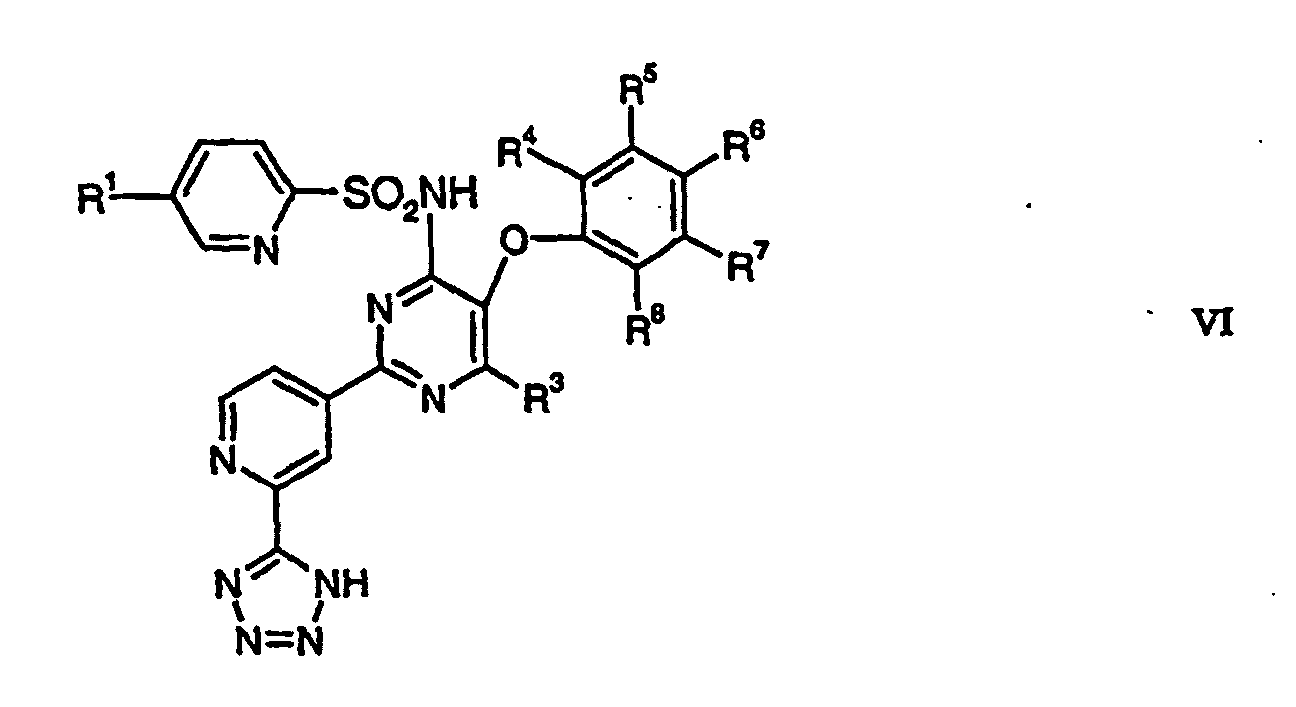
R1 C1-7-Alkyl darstellt;
R3 -O-(CRaRb)n-OR9 darstellt;
R4 bis R8 Wasserstoff, C1-7-Alkoxy oder Halogen darstellen;
R9 Wasserstoff, Aryl, Aryl-C1-7-alkyl, Heterocyclyl oder einen Rest -C(O)NHR10 darstellt;
R10 C1-7-Alkyl, Phenyl, substituiertes Phenyl, Pyridyl oder substituiertes Pyridyl darstellt;
Ra und Rb Wasserstoff oder C1-7-Alkyl darstellen;
und pharmazeutisch verträglichen Salzen davon,
wobei
der Begriff "Aryl" einen einwertigen carbocylischen, aromatischen Rest bedeutet, welcher gegebenenfalls unabhängig mit Halogen, C1-7-Alkyl, C1-7-Alkoxy, C2-7-Alkylendioxy, Carboxy oder Trifluormethyl substituiert ist;
der Begriff "Heterocyclyl" mono- oder bicyclische, 5- und 6-gliedrige Heterocyclen mit Sauerstoff, Stickstoff oder Schwefel als das Heteroatom bedeutet, gegebenenfalls substituiert mit einem oder zwei C1-7-Alkylresten;
der Begriff "substituiertes Phenyl" einen Phenylrest bedeutet, welcher unabhängig mit Halogen, C1-7-Alkyl, C1-7-Alkoxy, C2-7-Alkylendioxy, Carboxy oder Trifluormethyl mono-, di- oder trisubstituiert ist;
der Begriff "substituiertes Pyridyl" einen Pyridylrest bedeutet, welcher unabhängig mit Halogen, C1-7-Alkyl, C1-7-Alkoxy, C2-7-Alkylendioxy, Carboxy oder Trifluormethyl mono-, di- oder trisubstituiert ist. - Verwendung gemäß Anspruch 18 zur Herstellung von 5-Methylpyridin-2-sulfonsäure-[6-(2-hydroxyethoxy)-5-(2-methoxyphenoxy)-2-[2-(1H-tetrazol-5-yl)pyridin-4-yl]pyrimidin-4-yl]amid und pharmazeutisch verträglichen Salzen davon.
- Verwendung gemäß Anspruch 18 zur Herstellung von 5-Isopropylpyridin-2-sulfonsäure-[6-(2-hydroxyethoxy)-5-(2-methoxyphenoxy)-2-[2-(1H-tetrazol-5-yl)pyridin-4-yl]pyrimidin-4-yl]amid und pharmazeutisch verträglichen Salzen davon.
- Verbindung der Formel Iwobei R4 bis R8 Wasserstoff, C1-7-Alkoxy oder Halogen darstellen.

- Verbindung der Formel IIIwobei
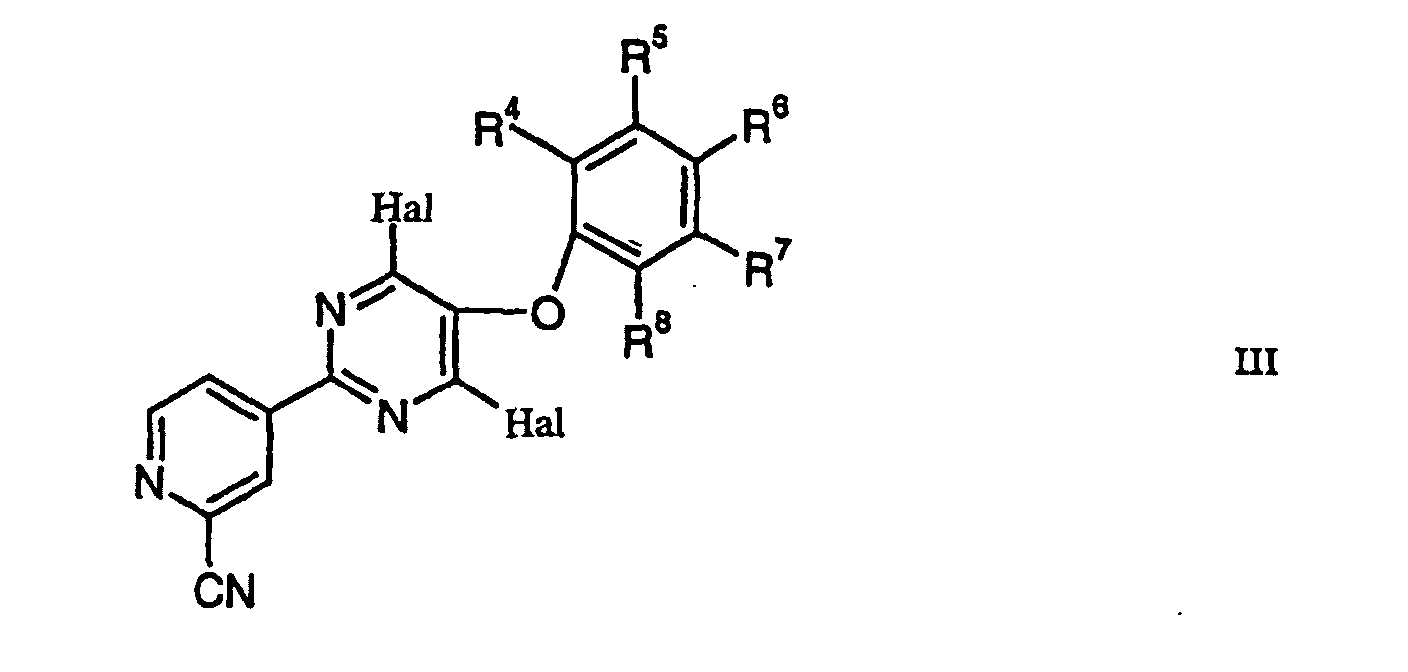
R4 bis R8 Wasserstoff, C1-7-Alkoxy oder Halogen darstellen; und
Hal Halogen darstellt. - Verbindung der Formel IVwobei

R1 C1-7-Alkyl darstellt;
R4 bis R8 Wasserstoff, C1-7-Alkoxy oder Halogen darstellen; und
Hal Halogen darstellt.
Priority Applications (1)
| Application Number | Priority Date | Filing Date | Title |
|---|---|---|---|
| EP99114893A EP0979822B1 (de) | 1998-08-10 | 1999-07-30 | Verfahren zur Herstellung von 2-Carbamoyl-Pyridinen |
Applications Claiming Priority (3)
| Application Number | Priority Date | Filing Date | Title |
|---|---|---|---|
| EP98114978 | 1998-08-10 | ||
| EP98114978 | 1998-08-10 | ||
| EP99114893A EP0979822B1 (de) | 1998-08-10 | 1999-07-30 | Verfahren zur Herstellung von 2-Carbamoyl-Pyridinen |
Publications (2)
| Publication Number | Publication Date |
|---|---|
| EP0979822A1 EP0979822A1 (de) | 2000-02-16 |
| EP0979822B1 true EP0979822B1 (de) | 2005-11-30 |
Family
ID=8232437
Family Applications (1)
| Application Number | Title | Priority Date | Filing Date |
|---|---|---|---|
| EP99114893A Expired - Lifetime EP0979822B1 (de) | 1998-08-10 | 1999-07-30 | Verfahren zur Herstellung von 2-Carbamoyl-Pyridinen |
Country Status (10)
| Country | Link |
|---|---|
| US (1) | US6103902A (de) |
| EP (1) | EP0979822B1 (de) |
| JP (1) | JP3344972B2 (de) |
| KR (1) | KR100362081B1 (de) |
| CN (1) | CN1117746C (de) |
| AT (1) | ATE311382T1 (de) |
| CA (1) | CA2279796C (de) |
| DE (1) | DE69928610T2 (de) |
| DK (1) | DK0979822T3 (de) |
| ES (1) | ES2252894T3 (de) |
Families Citing this family (5)
| Publication number | Priority date | Publication date | Assignee | Title |
|---|---|---|---|---|
| US6670362B2 (en) | 2000-09-20 | 2003-12-30 | Pfizer Inc. | Pyridazine endothelin antagonists |
| JP6811717B2 (ja) * | 2015-02-25 | 2021-01-13 | ファーマシェン エス.エー. | トピロキソスタット及びその中間体の調製のための方法 |
| CN105669542A (zh) * | 2016-03-08 | 2016-06-15 | 南京师范大学 | 一种直接催化氧化法合成吡啶伯酰胺化合物的方法 |
| CN116456984A (zh) * | 2020-11-05 | 2023-07-18 | 爱杜西亚药品有限公司 | 克拉生坦二钠盐的稳定结晶水合物 |
| KR20240121242A (ko) | 2021-12-17 | 2024-08-08 | 넥세라 파마 씨오., 엘티디. | 클라조센탄 디소듐 염, 이의 제조 및 이를 포함하는 약학 조성물 |
Family Cites Families (1)
| Publication number | Priority date | Publication date | Assignee | Title |
|---|---|---|---|---|
| TW313568B (de) * | 1994-12-20 | 1997-08-21 | Hoffmann La Roche |
-
1999
- 1999-07-30 DE DE69928610T patent/DE69928610T2/de not_active Expired - Lifetime
- 1999-07-30 ES ES99114893T patent/ES2252894T3/es not_active Expired - Lifetime
- 1999-07-30 EP EP99114893A patent/EP0979822B1/de not_active Expired - Lifetime
- 1999-07-30 DK DK99114893T patent/DK0979822T3/da active
- 1999-07-30 AT AT99114893T patent/ATE311382T1/de active
- 1999-08-06 CA CA002279796A patent/CA2279796C/en not_active Expired - Lifetime
- 1999-08-09 KR KR1019990032563A patent/KR100362081B1/ko not_active Expired - Lifetime
- 1999-08-09 CN CN99117533A patent/CN1117746C/zh not_active Expired - Lifetime
- 1999-08-09 US US09/370,817 patent/US6103902A/en not_active Expired - Lifetime
- 1999-08-10 JP JP22600399A patent/JP3344972B2/ja not_active Expired - Lifetime
Also Published As
| Publication number | Publication date |
|---|---|
| ATE311382T1 (de) | 2005-12-15 |
| JP3344972B2 (ja) | 2002-11-18 |
| DK0979822T3 (da) | 2006-03-27 |
| DE69928610T2 (de) | 2006-08-10 |
| DE69928610D1 (de) | 2006-01-05 |
| CA2279796A1 (en) | 2000-02-10 |
| US6103902A (en) | 2000-08-15 |
| ES2252894T3 (es) | 2006-05-16 |
| CN1117746C (zh) | 2003-08-13 |
| EP0979822A1 (de) | 2000-02-16 |
| JP2000063377A (ja) | 2000-02-29 |
| KR100362081B1 (ko) | 2002-11-23 |
| CA2279796C (en) | 2003-09-30 |
| KR20000017194A (ko) | 2000-03-25 |
| CN1245803A (zh) | 2000-03-01 |
Similar Documents
| Publication | Publication Date | Title |
|---|---|---|
| JP7539451B2 (ja) | アミノピリミジン誘導体を調製するための改善されたプロセス | |
| US8558000B2 (en) | 4-pyridinone compounds and their use for cancer | |
| TW201609670A (zh) | 5-氟-4-亞胺基-3-(烷基/經取代烷基)-1-(芳基磺醯基)-3,4-二氫嘧啶-2(1h)-酮及其製備方法(二) | |
| JP2006517235A (ja) | N−アリールカルバミン酸エステルとハロ−ヘテロアリールとを反応させることによるn−ヘテロアリール−n−アリール−アミンの調製のためのプロセスおよび類似のプロセス | |
| KR20070058689A (ko) | 인다졸 화합물의 제조 방법 | |
| JP5265562B2 (ja) | イマチニブおよびその中間体の調製方法 | |
| JP2753659B2 (ja) | ピラゾール誘導体 | |
| AU2019400738B2 (en) | Pharmaceutical process and intermediates | |
| JP2005504800A (ja) | ピリミジノン化合物及びその薬剤として許容される塩の製造方法 | |
| KR820002136B1 (ko) | 2-아미노 피리미돈 화합물의 제조방법 | |
| CA2279796C (en) | Process for the preparation of substituted pyridines | |
| EP1412331B1 (de) | Verfahren zur herstellung von 4-amino-2,5-bisheterocyclylchinazolinen | |
| RU2090558C1 (ru) | 5,6-дизамещенные 3-пиридилметиламмоний галогениды, способ их получения и способы получения 5-(замещенный метил)-2,3-пиридиндикарбоновых кислот | |
| JP6705458B2 (ja) | トリアゾール化合物の製造方法 | |
| KR100654265B1 (ko) | 4-(헤테로아릴-메틸)-할로겐-1(2h)-프탈라지논의 제조 방법 | |
| KR20060020082A (ko) | 2-아미노피리딘 유도체의 제조방법 | |
| CN100579965C (zh) | 通过使n-芳基氨基甲酸酯与卤代杂芳基反应制备n-杂芳基-n-芳基胺的方法和类似方法 | |
| MXPA99007328A (en) | Process for the preparation of substitute pyridine | |
| CA2287394A1 (en) | Methods for synthesizing 2-substituted imidazoles | |
| JP3161690B2 (ja) | 2−メルカプトイミダゾール縮合環化合物の製造法 | |
| KR100457473B1 (ko) | 테트라히드로이미다조퀴놀린아민의제조방법 | |
| JPH06234743A (ja) | 置換された硝酸2,3−ジカルボキシピリジニウム | |
| JPS5818383A (ja) | ベンゾジアゼピン化合物の新規製造方法 | |
| KR20060087891A (ko) | 8-(2-피리미디닐)-8-아자-5-아조니아스피로[4.5]데칸설포네이트 염을 이용하여 아자피론 또는 그의 염을제조하는 방법 및 상기 방법에 사용되는 중간체 | |
| JPS6145622B2 (de) |
Legal Events
| Date | Code | Title | Description |
|---|---|---|---|
| PUAI | Public reference made under article 153(3) epc to a published international application that has entered the european phase |
Free format text: ORIGINAL CODE: 0009012 |
|
| AK | Designated contracting states |
Kind code of ref document: A1 Designated state(s): AT BE CH CY DE DK ES FI FR GB GR IE IT LI LU MC NL PT SE |
|
| AX | Request for extension of the european patent |
Free format text: AL;LT;LV;MK;RO;SI |
|
| 17P | Request for examination filed |
Effective date: 20000815 |
|
| AKX | Designation fees paid |
Free format text: AT BE CH CY DE DK ES FI FR GB GR IE IT LI LU MC NL PT SE |
|
| 17Q | First examination report despatched |
Effective date: 20031105 |
|
| GRAP | Despatch of communication of intention to grant a patent |
Free format text: ORIGINAL CODE: EPIDOSNIGR1 |
|
| GRAS | Grant fee paid |
Free format text: ORIGINAL CODE: EPIDOSNIGR3 |
|
| GRAA | (expected) grant |
Free format text: ORIGINAL CODE: 0009210 |
|
| AK | Designated contracting states |
Kind code of ref document: B1 Designated state(s): AT BE CH DE DK ES FR GB IE IT LI NL |
|
| REG | Reference to a national code |
Ref country code: GB Ref legal event code: FG4D Ref country code: CH Ref legal event code: EP |
|
| REG | Reference to a national code |
Ref country code: IE Ref legal event code: FG4D |
|
| REF | Corresponds to: |
Ref document number: 69928610 Country of ref document: DE Date of ref document: 20060105 Kind code of ref document: P |
|
| REG | Reference to a national code |
Ref country code: DK Ref legal event code: T3 |
|
| REG | Reference to a national code |
Ref country code: ES Ref legal event code: FG2A Ref document number: 2252894 Country of ref document: ES Kind code of ref document: T3 |
|
| ET | Fr: translation filed | ||
| PLBE | No opposition filed within time limit |
Free format text: ORIGINAL CODE: 0009261 |
|
| STAA | Information on the status of an ep patent application or granted ep patent |
Free format text: STATUS: NO OPPOSITION FILED WITHIN TIME LIMIT |
|
| 26N | No opposition filed |
Effective date: 20060831 |
|
| REG | Reference to a national code |
Ref country code: FR Ref legal event code: PLFP Year of fee payment: 18 |
|
| REG | Reference to a national code |
Ref country code: FR Ref legal event code: PLFP Year of fee payment: 19 |
|
| REG | Reference to a national code |
Ref country code: FR Ref legal event code: PLFP Year of fee payment: 20 |
|
| PGFP | Annual fee paid to national office [announced via postgrant information from national office to epo] |
Ref country code: NL Payment date: 20180627 Year of fee payment: 20 Ref country code: IE Payment date: 20180625 Year of fee payment: 20 |
|
| PGFP | Annual fee paid to national office [announced via postgrant information from national office to epo] |
Ref country code: FR Payment date: 20180620 Year of fee payment: 20 |
|
| PGFP | Annual fee paid to national office [announced via postgrant information from national office to epo] |
Ref country code: DE Payment date: 20180618 Year of fee payment: 20 Ref country code: IT Payment date: 20180710 Year of fee payment: 20 Ref country code: ES Payment date: 20180801 Year of fee payment: 20 Ref country code: GB Payment date: 20180625 Year of fee payment: 20 |
|
| PGFP | Annual fee paid to national office [announced via postgrant information from national office to epo] |
Ref country code: CH Payment date: 20180725 Year of fee payment: 20 Ref country code: BE Payment date: 20180719 Year of fee payment: 20 Ref country code: DK Payment date: 20180626 Year of fee payment: 20 Ref country code: AT Payment date: 20180625 Year of fee payment: 20 |
|
| REG | Reference to a national code |
Ref country code: DE Ref legal event code: R071 Ref document number: 69928610 Country of ref document: DE |
|
| REG | Reference to a national code |
Ref country code: NL Ref legal event code: MK Effective date: 20190729 |
|
| REG | Reference to a national code |
Ref country code: DK Ref legal event code: EUP Effective date: 20190730 |
|
| REG | Reference to a national code |
Ref country code: CH Ref legal event code: PL |
|
| REG | Reference to a national code |
Ref country code: GB Ref legal event code: PE20 Expiry date: 20190729 Ref country code: IE Ref legal event code: MK9A |
|
| REG | Reference to a national code |
Ref country code: BE Ref legal event code: MK Effective date: 20190730 |
|
| REG | Reference to a national code |
Ref country code: AT Ref legal event code: MK07 Ref document number: 311382 Country of ref document: AT Kind code of ref document: T Effective date: 20190730 |
|
| PG25 | Lapsed in a contracting state [announced via postgrant information from national office to epo] |
Ref country code: IE Free format text: LAPSE BECAUSE OF EXPIRATION OF PROTECTION Effective date: 20190730 |
|
| PG25 | Lapsed in a contracting state [announced via postgrant information from national office to epo] |
Ref country code: GB Free format text: LAPSE BECAUSE OF EXPIRATION OF PROTECTION Effective date: 20190729 |
|
| REG | Reference to a national code |
Ref country code: ES Ref legal event code: FD2A Effective date: 20220107 |
|
| PG25 | Lapsed in a contracting state [announced via postgrant information from national office to epo] |
Ref country code: ES Free format text: LAPSE BECAUSE OF EXPIRATION OF PROTECTION Effective date: 20190731 |