EP0971497A2 - Verfahren und Vorrichtung für den Empfang von digitalen Rundfunkprogrammen mit digitalen Audiodaten und Zusatzdaten und Verfahren und Vorrichting für die Aufzeichnung dieser Daten auf einem Datenträger - Google Patents
Verfahren und Vorrichtung für den Empfang von digitalen Rundfunkprogrammen mit digitalen Audiodaten und Zusatzdaten und Verfahren und Vorrichting für die Aufzeichnung dieser Daten auf einem Datenträger Download PDFInfo
- Publication number
- EP0971497A2 EP0971497A2 EP99303111A EP99303111A EP0971497A2 EP 0971497 A2 EP0971497 A2 EP 0971497A2 EP 99303111 A EP99303111 A EP 99303111A EP 99303111 A EP99303111 A EP 99303111A EP 0971497 A2 EP0971497 A2 EP 0971497A2
- Authority
- EP
- European Patent Office
- Prior art keywords
- recording
- information
- additional information
- audio data
- data
- Prior art date
- Legal status (The legal status is an assumption and is not a legal conclusion. Google has not performed a legal analysis and makes no representation as to the accuracy of the status listed.)
- Withdrawn
Links
Images


Classifications
-
- H—ELECTRICITY
- H04—ELECTRIC COMMUNICATION TECHNIQUE
- H04N—PICTORIAL COMMUNICATION, e.g. TELEVISION
- H04N21/00—Selective content distribution, e.g. interactive television or video on demand [VOD]
- H04N21/40—Client devices specifically adapted for the reception of or interaction with content, e.g. set-top-box [STB]; Operations thereof
- H04N21/43—Processing of content or additional data, e.g. demultiplexing additional data from a digital video stream; Elementary client operations, e.g. monitoring of home network or synchronising decoder's clock; Client middleware
- H04N21/435—Processing of additional data, e.g. decrypting of additional data, reconstructing software from modules extracted from the transport stream
-
- G—PHYSICS
- G11—INFORMATION STORAGE
- G11B—INFORMATION STORAGE BASED ON RELATIVE MOVEMENT BETWEEN RECORD CARRIER AND TRANSDUCER
- G11B20/00—Signal processing not specific to the method of recording or reproducing; Circuits therefor
- G11B20/10—Digital recording or reproducing
-
- G—PHYSICS
- G11—INFORMATION STORAGE
- G11B—INFORMATION STORAGE BASED ON RELATIVE MOVEMENT BETWEEN RECORD CARRIER AND TRANSDUCER
- G11B20/00—Signal processing not specific to the method of recording or reproducing; Circuits therefor
- G11B20/10—Digital recording or reproducing
- G11B20/10527—Audio or video recording; Data buffering arrangements
-
- G—PHYSICS
- G11—INFORMATION STORAGE
- G11B—INFORMATION STORAGE BASED ON RELATIVE MOVEMENT BETWEEN RECORD CARRIER AND TRANSDUCER
- G11B27/00—Editing; Indexing; Addressing; Timing or synchronising; Monitoring; Measuring tape travel
- G11B27/02—Editing, e.g. varying the order of information signals recorded on, or reproduced from, record carriers
- G11B27/031—Electronic editing of digitised analogue information signals, e.g. audio or video signals
- G11B27/034—Electronic editing of digitised analogue information signals, e.g. audio or video signals on discs
-
- G—PHYSICS
- G11—INFORMATION STORAGE
- G11B—INFORMATION STORAGE BASED ON RELATIVE MOVEMENT BETWEEN RECORD CARRIER AND TRANSDUCER
- G11B27/00—Editing; Indexing; Addressing; Timing or synchronising; Monitoring; Measuring tape travel
- G11B27/10—Indexing; Addressing; Timing or synchronising; Measuring tape travel
- G11B27/19—Indexing; Addressing; Timing or synchronising; Measuring tape travel by using information detectable on the record carrier
- G11B27/28—Indexing; Addressing; Timing or synchronising; Measuring tape travel by using information detectable on the record carrier by using information signals recorded by the same method as the main recording
- G11B27/32—Indexing; Addressing; Timing or synchronising; Measuring tape travel by using information detectable on the record carrier by using information signals recorded by the same method as the main recording on separate auxiliary tracks of the same or an auxiliary record carrier
- G11B27/327—Table of contents
- G11B27/329—Table of contents on a disc [VTOC]
-
- H—ELECTRICITY
- H04—ELECTRIC COMMUNICATION TECHNIQUE
- H04H—BROADCAST COMMUNICATION
- H04H60/00—Arrangements for broadcast applications with a direct linking to broadcast information or broadcast space-time; Broadcast-related systems
- H04H60/27—Arrangements for recording or accumulating broadcast information or broadcast-related information
-
- H—ELECTRICITY
- H04—ELECTRIC COMMUNICATION TECHNIQUE
- H04H—BROADCAST COMMUNICATION
- H04H60/00—Arrangements for broadcast applications with a direct linking to broadcast information or broadcast space-time; Broadcast-related systems
- H04H60/68—Systems specially adapted for using specific information, e.g. geographical or meteorological information
- H04H60/73—Systems specially adapted for using specific information, e.g. geographical or meteorological information using meta-information
- H04H60/74—Systems specially adapted for using specific information, e.g. geographical or meteorological information using meta-information using programme related information, e.g. title, composer or interpreter
-
- H—ELECTRICITY
- H04—ELECTRIC COMMUNICATION TECHNIQUE
- H04N—PICTORIAL COMMUNICATION, e.g. TELEVISION
- H04N21/00—Selective content distribution, e.g. interactive television or video on demand [VOD]
- H04N21/20—Servers specifically adapted for the distribution of content, e.g. VOD servers; Operations thereof
- H04N21/23—Processing of content or additional data; Elementary server operations; Server middleware
- H04N21/235—Processing of additional data, e.g. scrambling of additional data or processing content descriptors
-
- H—ELECTRICITY
- H04—ELECTRIC COMMUNICATION TECHNIQUE
- H04N—PICTORIAL COMMUNICATION, e.g. TELEVISION
- H04N21/00—Selective content distribution, e.g. interactive television or video on demand [VOD]
- H04N21/40—Client devices specifically adapted for the reception of or interaction with content, e.g. set-top-box [STB]; Operations thereof
- H04N21/43—Processing of content or additional data, e.g. demultiplexing additional data from a digital video stream; Elementary client operations, e.g. monitoring of home network or synchronising decoder's clock; Client middleware
- H04N21/436—Interfacing a local distribution network, e.g. communicating with another STB or one or more peripheral devices inside the home
- H04N21/43622—Interfacing an external recording device
-
- H—ELECTRICITY
- H04—ELECTRIC COMMUNICATION TECHNIQUE
- H04N—PICTORIAL COMMUNICATION, e.g. TELEVISION
- H04N21/00—Selective content distribution, e.g. interactive television or video on demand [VOD]
- H04N21/40—Client devices specifically adapted for the reception of or interaction with content, e.g. set-top-box [STB]; Operations thereof
- H04N21/43—Processing of content or additional data, e.g. demultiplexing additional data from a digital video stream; Elementary client operations, e.g. monitoring of home network or synchronising decoder's clock; Client middleware
- H04N21/439—Processing of audio elementary streams
-
- H—ELECTRICITY
- H04—ELECTRIC COMMUNICATION TECHNIQUE
- H04N—PICTORIAL COMMUNICATION, e.g. TELEVISION
- H04N21/00—Selective content distribution, e.g. interactive television or video on demand [VOD]
- H04N21/80—Generation or processing of content or additional data by content creator independently of the distribution process; Content per se
- H04N21/81—Monomedia components thereof
- H04N21/8126—Monomedia components thereof involving additional data, e.g. news, sports, stocks, weather forecasts
- H04N21/8133—Monomedia components thereof involving additional data, e.g. news, sports, stocks, weather forecasts specifically related to the content, e.g. biography of the actors in a movie, detailed information about an article seen in a video program
-
- H—ELECTRICITY
- H04—ELECTRIC COMMUNICATION TECHNIQUE
- H04N—PICTORIAL COMMUNICATION, e.g. TELEVISION
- H04N21/00—Selective content distribution, e.g. interactive television or video on demand [VOD]
- H04N21/80—Generation or processing of content or additional data by content creator independently of the distribution process; Content per se
- H04N21/83—Generation or processing of protective or descriptive data associated with content; Content structuring
- H04N21/84—Generation or processing of descriptive data, e.g. content descriptors
-
- G—PHYSICS
- G11—INFORMATION STORAGE
- G11B—INFORMATION STORAGE BASED ON RELATIVE MOVEMENT BETWEEN RECORD CARRIER AND TRANSDUCER
- G11B2220/00—Record carriers by type
- G11B2220/20—Disc-shaped record carriers
- G11B2220/25—Disc-shaped record carriers characterised in that the disc is based on a specific recording technology
- G11B2220/2525—Magneto-optical [MO] discs
- G11B2220/2529—Mini-discs
Definitions
- the present invention relates to apparatuses for receiving audio data distributed by digital broadcasting, and more particularly, to a technology for writing additional information, such as for example the title, performer information, and others, concerning a musical piece into a recording medium when the audio data is recorded in the recording medium.
- Digital satellite broadcasting has been widely used.
- the digital satellite broadcasting which employs moving picture experts group phase 2 (MPEG2) for data compression, is more immune to noise and fading and achieves higher-quality signal transfer than analog broadcasting.
- MPEG2 moving picture experts group phase 2
- multiple channels can be used.
- Some music channels provide programs in which audio data is multiplexed with additional audio information.
- a program of a music channel When such a program of a music channel is received, the sound of a musical piece is output from a speaker connected to a receiving unit and performer information, the title of the musical piece, elapsed performance time information are displayed on the screen of a TV receiver connected to the receiving unit.
- an MD Mini Disc
- the present invention has been made in consideration of the above situations. Accordingly, it is an object of at least preferred embodiments of the present invention to provide a data receiving and recording method and a data receiving apparatus which allow additional audio information to be automatically recorded in a recording medium when audio data with which the additional audio information is multiplexed and distributed is received and recorded in the recording medium.
- Another object of at least preferred embodiments of the present invention is to provide a data receiving and recording method and a data receiving apparatus which allow the start of recording in synchronization with the start of a musical piece, the stop of recording in synchronization with the end of the musical piece, and recording of the delimitation signals of the musical piece when audio data with which additional audio information is multiplexed and distributed is received and recorded in a recording medium.
- Still another object of at least preferred embodiments of the present invention is to provide a data receiving and recording method and a data receiving apparatus which allow a program name or a channel name to be automatically recorded in a recording medium when audio data with which a broadcasting station name and the program name are multiplexed and distributed is received and recorded in the recording medium.
- One aspect of the invention provides a data receiving and recording method for receiving a broadcasting program in which the audio data of a musical piece and additional information are multiplexed and distributed, by a receiver and for recording the received audio data into a recording medium in a recording apparatus, including the steps of: selecting a transfer path for transferring the additional information received by the receiver to the recording apparatus; recording the audio data into the recording medium; and automatically writing the additional information transferred through the selected transfer path into a predetermined area of the recording medium, simultaneously with the recording of the audio data.
- Another aspect of the invention provides a data receiving and recording method for receiving a broadcasting program in which the audio data of a musical piece and additional information are multiplexed and distributed, by a receiver and for recording the received audio data into a recording medium in a recording apparatus, including the steps of: monitoring the matching of elapsed performance time information and performance time information included in the received additional information, by the receiver; and generating a control signal which controls the recording start and the recording stop of the audio data for the recording apparatus when the elapsed performance time information matches the performance time information.
- a further aspect of the invention provides a data receiving apparatus for receiving a broadcasting program in which the audio data of a musical piece and additional information are multiplexed and distributed and for controlling a recording apparatus so as to record the received audio data into a recording medium, including: selecting means for selecting a transfer path for transferring the received additional information to the recording apparatus; audio-data transfer means for transferring the audio data to the recording apparatus; and additional-information transfer means for transferring the additional information received through the selected transfer path to the recording apparatus, simultaneously with the transfer of the audio data.
- a further aspect of the invention provides a data receiving apparatus for receiving a broadcasting program in which the audio data of a musical piece and additional information are multiplexed and distributed and for controlling a recording apparatus so as to record the received audio data into a recording medium, including: monitoring means for monitoring the matching of elapsed performance time information and performance time information included in the received additional information; and generating a control signal which controls the recording start and the recording stop of the audio data for the recording apparatus when the elapsed performance time information matches the performance time information.
- a transfer path for transferring the additional information received by the receiver to the recording apparatus is selected; the audio data is recorded into the recording medium; and the additional information transferred through the selected transfer path is automatically written into a predetermined area of the recording medium, simultaneously with the recording of the audio data.
- the receiver monitors the matching of elapsed performance time information and performance time information included in the received additional information and generates a control signal which controls the recording start and the recording stop of the audio data for the recording apparatus when the elapsed performance time information matches the performance time information.
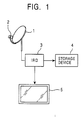
- Fig. 1 is a view showing a structure of a digital-satellite-broadcasting receiving system according to one embodiment of the present invention.
- the digital-satellite-broadcasting receiving system is provided with an antenna 1, an integrated receiver decoder (IRD) 3, a storage device 4, and a TV receiver 5.
- IRD integrated receiver decoder
- the antenna 1 receives a signal sent through a satellite (not shown).
- a converter 2 mounted on the antenna 1 converts the received signal to a signal having a predetermined frequency and sends it to the IRD 3.
- the IRD 3 selects the signal of a predetermined channel and demodulates video data and audio data.
- the IRD 3 also generates a screen for the additional audio information of the distributed audio data and an electric program guide (EPG).
- EPG electric program guide
- the output of the IRD 3 is sent to the TV receiver 5.
- the storage device 4 stores the received audio data.
- An MD recorder and a digital audio tape (DAT) recorder for example, can be used as the storage device 4. In the following description, an MD recorder is used as the storage device 4.
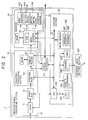
- Fig. 2 is a functional block diagram of the IRD 3 shown in Fig. 1. As shown in this figure, the IRD 3 is formed of a received-signal processing section 10, a digital interface section 20, and a control section 30.
- the received-signal processing section 10 includes a tuner 11, a front end 12, a transport processing section 13, and a decoder 14.
- the tuner 11 selects one carrier among a plurality of carriers in an intermediate frequency signal obtained from the converter 2.
- the control section 30, described later, receives an instruction of the user of the IRD 3 through a key input interface 301 or a remote commander interface 302 and sends the corresponding control signal to the tuner 11 for carrier selection.
- the front end 12 applies conversion, demodulation, and bit error correction to a signal obtained from the tuner 11 to form a digital signal.
- the transport processing section 13 is formed of a descrambler 131 for releasing scrambling applied to a scrambled signal and a demultiplexer 132 for separating the desired data stream and section data from a multiplexed transport stream.
- the input transport stream is once stored in a DRAM connected to the demultiplexer 132 during this separation processing.
- the streams and the section referred to mean packetized elementary streams (PESs) and a section specified in ITU-T Rec H.220 and ISO/IEC 13818-11 (hereinafter called an MPEG system), respectively.
- PESs packetized elementary streams
- MPEG system ISO/IEC 13818-11
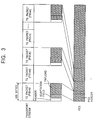
- Fig. 3 shows a conceptual view of the transport stream.
- the transport stream is a collection of transport packets (hereinafter called TS packets) each having a fixed length of 188 bytes.
- TS packets transport packets
- a PES and section data are divided into a plurality of TS packets and transferred.
- a TS packet is formed of a header, an adaptation field, and a payload. Audio data, video data, and additional audio information are stored in a payload.
- a packet ID (hereinafter called PID) for identifying each stream or section is stored in a header.
- Fig. 4 shows a concept of filtering in the demultiplexer 132.
- the demultiplexer 132 is provided with a PID filter 132A and a section data filter 132B.
- the PID filter 132A checks the PID of an input TS packet, separates video data and audio data, and send them to the decoder 14.
- the PID filter 132A also separates additional audio information and sends it to the control section 30.
- the PID filter 132A further separates section data and sends it to the section filter 132B.
- the section filter 132B separates the desired section data and sends it to the control section 30.
- the TS packets having a PID of "k" are separated and reconfigured as a PES.
- the decoder 14 is provided with an MPEG decoder 141, an NTSC encoder 142, a D-A converter 143, and an optical, digital, audio interface section 144.
- the video data sent from the demultiplexer 132 is decoded by the MPEG decoder 141, converted to a signal having an NTSC format by the NTSC encoder 142, and output, for example, to the TV receiver 5.
- the audio data sent from the demultiplexer is decoded by the MPEG decoder 141, and sent to the D-A converter 143 and the optical, digital, audio interface section 144.
- An analog audio signal obtained by digital-to-analog conversion by the D-A converter 143 is output, for example, to the TV receiver 5.
- the optical, digital, audio interface section 144 converts to an optical, digital, audio signal having the IEC 958 format and outputs, for example, to the MD recorder.
- the video data and audio data input to the MPEG decoder 141 are once stored in a DRAM connected to the MPEG decoder 141 in decoding.
- the digital interface section 20 controls digital-data transfer with an external digital unit connected through an IEEE 1394 external bus 21, such as an MD recorder. Specifically, according to a control signal sent from the control section 30, the digital interface section 20 sends a command to the external digital unit through the external bus 21 as an asynchronous packet, and also sends the MPEG stream of descrambled, demultiplexed or multiplexed (before demultiplexed) video and sound as an isochronous packet. A digital audio signal decoded by the MPEG decoder 141 can be sent as an isochronous packet. The digital interface section 20 can also send video data and audio data received through the IEEE 1394 external bus 21 to the demultiplexer 132 and the MPEG decoder 141.
- the control section 30 is provided with a CPU 305, a work memory 306 connected to the CPU 305 through an internal bus 31, and the key interface 301, the remote commander interface 302, an infrared interface 303, and a timer 304 all connected to the CPU 305.
- the CPU 305 interprets a user instruction obtained from the key interface 301 and the remote commander interface 302, and controls each section so as to have a required condition.
- the infrared interface 303 is connected to an infrared light emitting section 307.
- the CPU 305 uses the infrared light emitting section 307 through the infrared interface 303 to output a remote control signal to control the operation of an external electronic unit, such as an MD recorder.
- EPG information which is transferred as section data of a transport stream, is sent from the demultiplexer 132 through the internal bus 31 and developed in the work memory 306, converted to have the format specified by the user, and output to the TV receiver 5 with the use of an on-screen display (OSD) function in the MPEG decoder 141.
- OSD on-screen display
- an interface is called an I/F.
- program clock reference (PCR) information for generating reference clock information is transferred in a TS packet.
- Which TS packet (a TS packet having which PID) includes PCR is written in section data called a program map table (PMT).
- PMT program map table
- PCR is loaded into a system time clock (STC) counter 132C in the demultiplexer 132 of the IRD 3 and an STC is generated.
- STC system time clock
- the PES of the video data and audio data separated by the PID filter 132A of the demultiplexer 132 has a presentation time stamp (PTS) indicating a presentation time after decoding.
- PTS presentation time stamp
- a filter decoder 141B separates the PTS attached to the PES
- a comparator 141C compares the PTS with the value of the STC counter 141A, and when they match, an output buffer 141D outputs the video data and audio data decoded by the filter decoder 141B.
- recording control of the MD recorder and TOC writing are achieved through the external bus 21 or the infrared I/F 303 in the standard IRD 3, described above. Additional audio information will be described first.
- Figs. 6A and 6B show an encoding syntax of additional audio information used in digital satellite broadcasting.
- a PES packet is described according to the syntax of MPEG2, and figures indicate the numbers of bits used.
- Fig. 6B shows an example of data_unit_id shown in Fig. 6A.
- the transferred data includes the performance time of a musical piece, the elapsed performance time of the musical piece, the title of the musical piece in Japanese, the performer's name in Japanese, the title of the musical piece in katakana and alphanumerals, the performer's name in katakana and alphanumerals, and multi-purpose information in Japanese.
- the data is written according to the character system specified separately.
- the performance time of a musical piece indicates the total performance time period of the musical piece currently being broadcasted.
- the elapsed performance time of the musical piece indicates the elapsed time period of the musical piece currently being broadcasted. Therefore, when the performance time of the musical piece matches the elapsed performance time of the musical piece, the corresponding musical piece has just finished. Since PES packets including these pieces of information are transferred at an interval of 2 to 15 seconds in operations, while the elapsed performance time of the musical piece is not being obtained, the control section 30 activates the timer 304 to interpolate the time.
- the title of the musical piece in Japanese and the performer's name in Japanese indicate the title and the performer's name of the musical piece currently being broadcasted, expressed with the use of characters which include kanji characters and em-width hiragana characters.
- the title of the musical piece in katakana and alphanumerals and the performer's name in katakana and alphanumerals indicate the title and the performer's name of the musical piece currently being broadcasted, expressed with the use of en-width katakana characters and en-width alphanumeric characters.
- the CPU 305 controls the demultiplexer 132 to set such that the PID filter 132A filters a PES packet which stores additional audio information.
- the CPU 305 receives an interrupt indicating that the target PES packet arrives, from the demultiplexer 132, the CPU 305 receives additional audio information and its PTS in the work memory 306.
- the CPU 305 compares the received PTS with the STC in the demultiplexer 132. When they match, the CPU 305 outputs the corresponding additional audio information to the TV receiver 5 through the OSD in the MPEG decoder 141.
- the additional audio information is appropriately shaped.
- variable counter 307 formed in the work memory 306 and to reset the timer 304 used for interpolation. Until the elapsed time information of another musical piece is obtained, every time the timer 304 counts one second, the variable counter 307 is incremented by one second and the value thereof is output as the elapsed performance time information.
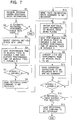
- Fig. 7 is a flowchart of processing in the case [1], described above.
- the performance time of the musical piece currently being broadcasted is set in the variable counter 308 as a variable A
- the elapsed performance time is set in the variable counter 307 as a variable B
- the variable counter 307 is interpolated as required with the use of the timer 304.
- the control section 30 asks the user if automatic recording is performed (in a step S2). In other words, it is inquired whether TOC data is sent to an MD recorder when a musical piece is recorded and the data is automatically recorded in an MD. At the same time, the user is asked whether recording into the MD recorder is automatically started and stopped by detecting the start and the end of a musical piece, or delimitations of tracks are performed. These inquiries may be performed in advance in setting items on a menu, or may be performed on pop-up messages displayed when recording is performed.
- control section 30 asks the user in the same way which control method is used in recording (in a step S3).
- each of a recording start command, a recording stop command, a track delimitation command, and a TOC input command is sent to the MD recorder in an asynchronous packet with the use of the corresponding command in an audio/video control digital I/F command set (A/VC digital interface command set).
- Digital audio data is sent in the IEC 958 format to the MD recorder in an isochronous packet.
- an infrared command signal is sent with the use of MD-recorder category codes.
- Audio data is obtained as an analog audio output sent from the D-A converter 143, or as an optical digital output obtained by converting the digital audio output decoded by the MPEG decoder 141 to the IEC 958 format.
- the CPU 305 stores the performance time of a musical piece in the variable A and the elapsed performance time of the musical piece in the variable B (step S4).
- the CPU 305 compares the variable A with the variable B and waits until they match (in a step S5).
- a recording start command is sent to the MD recorder in the control method (through the digital I/F or the infrared I/F) instructed by the user (in a step S6) to start recording.
- the additional audio information of another musical piece that has just started is written into the work memory 306 (in steps S7 and S8).
- the obtained title of the musical piece in katakana and alphanumerals and the obtained performer's name in katakana and alphanumerals are converted to an sjis format (in a step S9), and sent to the MD recorder with the use of a TOC writing command through the interface (digital I/F or infrared I/F) corresponding to the selected control method (in a step S10).
- a space character is inserted between the title of the musical piece in katakana and alphanumerals and the performer's name in katakana and alphanumerals.
- the transmitted data in katakana and alphanumerals is written into a TOC1 area of the MD.
- the title of the musical piece in Japanese and the performer's name in Japanese can be written in the MD in the same way as for the title of the musical piece in katakana and alphanumerals and the performer's name in katakana and alphanumerals.
- These pieces of Japanese-character data is written into a TOC4 area of the MD.
- the CPU 305 compares the variable A with the variable B again and waits until they match (in a step S11). When they match (the reply is YES in the step S11), since it means that the musical piece has just finished, it is determined whether the user specifies a recording-finish instruction (in a step S12). In other words, the user specifies a recording-finish instruction during recording when only one musical piece is recorded, and the user specifies a recording-finish instruction while the musical piece to be last recorded is being recorded, when a plurality of musical pieces are recorded.
- a recording-stop command is sent to the MD recorder through the digital I/F section 20 or the infrared I/F 303 (in a step S13). If a recording-finish instruction is not specified (when a plurality of musical pieces are recorded), a track-delimitation command is sent instead of a recording-stop command (in a step S14). Until a recording-finish instruction is specified (the reply is YES in the step S12), a TOC writing command and a track-delimitation command are repeatedly sent every time a musical piece starts.
- TOC data writing it is also possible to ask the user to specify in advance that only the title of a musical piece is written, only the performer's name is written, or both are written. In Fig. 7, until a recording-finish instruction is specified, continuous recording of musical pieces is possible. It may also be possible to ask the user to specify in advance to send a recording-stop command when recording of one musical piece is finished.
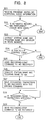
- Fig. 8 is a flowchart of processing in the case [2], described above.
- the control section 30 asks the user if automatic recording is performed (in a step S22). In other words, the user is asked whether the station name and the program name from which receiving is being performed is automatically written into the TOC of the MD.
- the CPU 305 controls the demultiplexer 132 such that the station name and the program name from which receiving is being performed is extracted by the section data filter 132B and developed in the work memory 306 (in a step S23).
- the station name is stored in a service description table (SDT)
- the program name is stored in an event information table (EIT).
- step S24 When the user specifies an instruction to the CPU 305 with the use of the remote commander (not shown) of the IRD 3 so that audio data is recorded into the MD, whether TOC writing is performed through the digital I/F section 20 is checked (in a step S24). When only the infrared-I/F control method is available, the processing is terminated. When the digital-I/F control method is available (the reply is YES in the step S24), a recording-start command is sent to the MD recorder through the digital I/F (in a step S25).
- the station name and the program name extracted and developed in the work memory 306 are converted to the sjis format (in a step S26), and a TOC writing command is sent to the MD recorder through the digital I/F (in a step S27).
- This TOC data is written into the TOC4 area of the MD.
- the station name and the program name are written in characters which include kanji and em-width hiragana characters in the same way as for the title of a musical piece in Japanese and the performer's name in Japanese. Therefore, when the method for controlling the MD recorder through the digital I/F is selected, the data can be sent though the digital I/F.
- the infrared-I/F control method When the infrared-I/F control method is selected, however, since the data cannot be transferred, it cannot be recorded into the MD. If the station name and the program name are transferred with the use of en-width katakana and en-width alphanumeric characters, these pieces of data can be transferred through the infrared interface and recorded into the TOC1 area of the MD.
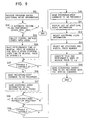
- Fig. 9 is a flowchart of processing in the case [3], described before. Since steps S31 to S36 are basically the same as the steps S1 to S6 in the flowchart shown in Fig. 7, descriptions thereof will be omitted to avoid repetition.
- a recording-stop command is sent to the MD recorder (in a step S40).
- the list of the additional audio information stored in the work memory 306 is displayed on the TV receiver 5 with the use of a menu and a command from the remote commander (in a step S41).
- the user selects one from the displayed list with the use of a key on the remote commander (in a step S42), and specifies an MD recorder to be used for recording and the transfer position in the TOC when a plurality of MD recorders are connected (in a step S43).
- the CPU 305 converts the title of the musical piece in katakana and alphanumerals and the performer's name in katakana and alphanumerals, selected by the user, to the sjis format (in a step S44), and transmits to the specified MD recorder with the use of a TOC writing command (in a step S45).
- the digital satellite broadcasting receiving unit receives a program. It is not necessarily a digital satellite broadcasting program when data similar to the above-described additional audio information is multiplexed and distributed. If additional audio information is multiplexed in a vertical blanking period in a video signal, an analog terrestrial broadcasting receiving unit can also be used. Methods other than the digital I/F method and the infrared I/F method may be used for controlling an MD recorder if each of recording start, recording stop, recording of delimitations on tracks, and TOC data writing is allowed.
- recording start/stop is automatically controlled in a recording apparatus, and TOC information can also be automatically written. Even if additional audio information is not multiplexed, a broadcasting station name and program information can be automatically written as TOC information. In addition, after audio data is recorded, TOC information can be easily written.
Landscapes
- Engineering & Computer Science (AREA)
- Signal Processing (AREA)
- Multimedia (AREA)
- Television Signal Processing For Recording (AREA)
- Signal Processing For Digital Recording And Reproducing (AREA)
- Television Systems (AREA)
- Input Circuits Of Receivers And Coupling Of Receivers And Audio Equipment (AREA)
- Circuits Of Receivers In General (AREA)
Applications Claiming Priority (2)
| Application Number | Priority Date | Filing Date | Title |
|---|---|---|---|
| JP11452498 | 1998-04-24 | ||
| JP11452498 | 1998-04-24 |
Publications (2)
| Publication Number | Publication Date |
|---|---|
| EP0971497A2 true EP0971497A2 (de) | 2000-01-12 |
| EP0971497A3 EP0971497A3 (de) | 2005-04-13 |
Family
ID=14639920
Family Applications (1)
| Application Number | Title | Priority Date | Filing Date |
|---|---|---|---|
| EP99303111A Withdrawn EP0971497A3 (de) | 1998-04-24 | 1999-04-22 | Verfahren und Vorrichtung für den Empfang von digitalen Rundfunkprogrammen mit digitalen Audiodaten und Zusatzdaten und Verfahren und Vorrichting für die Aufzeichnung dieser Daten auf einem Datenträger |
Country Status (3)
| Country | Link |
|---|---|
| US (3) | US6324126B1 (de) |
| EP (1) | EP0971497A3 (de) |
| KR (1) | KR100627987B1 (de) |
Cited By (2)
| Publication number | Priority date | Publication date | Assignee | Title |
|---|---|---|---|---|
| EP1286541B1 (de) * | 2000-04-14 | 2012-05-02 | Nippon Telegraph And Telephone Corporation | Verfahren, system und vorrichtung zum erfassen von informationen bezüglich rundsendeinformationen |
| CN112637790A (zh) * | 2021-01-14 | 2021-04-09 | 三门核电有限公司 | 一种高噪音区实现有效信息通信的方法及系统 |
Families Citing this family (17)
| Publication number | Priority date | Publication date | Assignee | Title |
|---|---|---|---|---|
| USRE48056E1 (en) | 1991-12-23 | 2020-06-16 | Blanding Hovenweep, Llc | Ergonomic man-machine interface incorporating adaptive pattern recognition based control system |
| US5903454A (en) | 1991-12-23 | 1999-05-11 | Hoffberg; Linda Irene | Human-factored interface corporating adaptive pattern recognition based controller apparatus |
| USRE47908E1 (en) | 1991-12-23 | 2020-03-17 | Blanding Hovenweep, Llc | Ergonomic man-machine interface incorporating adaptive pattern recognition based control system |
| US6850252B1 (en) | 1999-10-05 | 2005-02-01 | Steven M. Hoffberg | Intelligent electronic appliance system and method |
| USRE46310E1 (en) | 1991-12-23 | 2017-02-14 | Blanding Hovenweep, Llc | Ergonomic man-machine interface incorporating adaptive pattern recognition based control system |
| US10361802B1 (en) | 1999-02-01 | 2019-07-23 | Blanding Hovenweep, Llc | Adaptive pattern recognition based control system and method |
| JPH11225292A (ja) * | 1998-02-04 | 1999-08-17 | Sony Corp | デジタル放送受信装置および受信方法 |
| US6600908B1 (en) | 1999-02-04 | 2003-07-29 | Hark C. Chan | Method and system for broadcasting and receiving audio information and associated audio indexes |
| JP4126214B2 (ja) * | 2002-09-24 | 2008-07-30 | ブラザー工業株式会社 | ラベルテープの印字装置 |
| US7631326B2 (en) * | 2002-12-26 | 2009-12-08 | Microsoft Corporation | Synchronization mechanism for multimedia captioning and audio description |
| US20040165481A1 (en) * | 2003-02-24 | 2004-08-26 | Ismail Ibric | Radio with a visual and auditory personality that can be programmed to record future broadcasts |
| US7676737B2 (en) | 2003-04-10 | 2010-03-09 | Microsoft Corporation | Synchronization mechanism and the implementation for multimedia captioning and audio descriptions |
| KR100429688B1 (ko) * | 2003-06-21 | 2004-05-03 | 주식회사 휴맥스 | 모자이크 이피지 서비스에서의 오디오 송신 및 수신방법 |
| JP4063212B2 (ja) * | 2003-12-09 | 2008-03-19 | ソニー株式会社 | 情報記録再生装置および情報記録方法 |
| KR100670588B1 (ko) * | 2005-07-27 | 2007-01-17 | 삼성전자주식회사 | 녹화신호 처리장치 및 그 제어방법 |
| US20070219937A1 (en) * | 2006-01-03 | 2007-09-20 | Creative Technology Ltd | Automated visualization for enhanced music playback |
| US10108395B2 (en) * | 2016-04-14 | 2018-10-23 | Antonio Torrini | Audio device with auditory system display and methods for use therewith |
Family Cites Families (18)
| Publication number | Priority date | Publication date | Assignee | Title |
|---|---|---|---|---|
| JPS6374231A (ja) * | 1986-09-17 | 1988-04-04 | Matsushita Electric Ind Co Ltd | デジタル放送符号化装置 |
| US4887308A (en) * | 1987-06-26 | 1989-12-12 | Dutton Bradley C | Broadcast data storage and retrieval system |
| US5214792A (en) * | 1989-09-27 | 1993-05-25 | Alwadish David J | Broadcasting system with supplemental data transmission and storge |
| US5239540A (en) * | 1990-11-27 | 1993-08-24 | Scientific-Atlanta, Inc. | Method and apparatus for transmitting, receiving and communicating digital data signals with corresponding program data signals which describe the digital data signals |
| US5408686A (en) * | 1991-02-19 | 1995-04-18 | Mankovitz; Roy J. | Apparatus and methods for music and lyrics broadcasting |
| US5161251A (en) * | 1991-02-19 | 1992-11-03 | Mankovitz Roy J | Apparatus and methods for providing text information identifying audio program selections |
| US5134719A (en) * | 1991-02-19 | 1992-07-28 | Mankovitz Roy J | Apparatus and methods for identifying broadcast audio program selections in an FM stereo broadcast system |
| GB9301686D0 (en) * | 1993-01-28 | 1993-03-17 | Philips Electronics Uk Ltd | Data recording and/or reproducing |
| JPH06268615A (ja) * | 1993-03-11 | 1994-09-22 | Sanyo Electric Co Ltd | Fm多重放送送信装置及びfm多重放送受信装置 |
| US5577266A (en) * | 1993-04-08 | 1996-11-19 | Digital D.J. Inc. | Broadcast system with associated data capabilities |
| DE4414298A1 (de) * | 1994-04-23 | 1995-10-26 | Polygram Manufacturing & Distr | Verfahren zur Übertragung von digitalen Informationen über einen Übertragungskanal |
| JP3644455B2 (ja) * | 1994-09-29 | 2005-04-27 | ソニー株式会社 | 番組情報放送方式、番組情報表示方法および受信装置 |
| JPH08306126A (ja) * | 1995-04-28 | 1996-11-22 | Casio Comput Co Ltd | 多重情報受信装置および多重情報送信装置 |
| US5659366A (en) * | 1995-05-10 | 1997-08-19 | Matsushita Electric Corporation Of America | Notification system for television receivers |
| JPH09161375A (ja) * | 1995-12-07 | 1997-06-20 | Sony Corp | ディスク再生装置 |
| US5777997A (en) * | 1996-03-07 | 1998-07-07 | Hughes Electronics Corporation | Method and system for transmitting audio-associated text information in a multiplexed transmission stream |
| JPH1055656A (ja) * | 1996-08-08 | 1998-02-24 | Sony Corp | 受信情報記録システム |
| US6041023A (en) * | 1999-03-29 | 2000-03-21 | Lakhansingh; Cynthia | Portable digital radio and compact disk player |
-
1999
- 1999-04-20 US US09/294,970 patent/US6324126B1/en not_active Expired - Fee Related
- 1999-04-22 EP EP99303111A patent/EP0971497A3/de not_active Withdrawn
- 1999-04-23 KR KR1019990014599A patent/KR100627987B1/ko not_active Expired - Fee Related
-
2001
- 2001-09-27 US US09/965,580 patent/US6493291B2/en not_active Expired - Fee Related
- 2001-09-27 US US09/965,456 patent/US20020021625A1/en not_active Abandoned
Cited By (3)
| Publication number | Priority date | Publication date | Assignee | Title |
|---|---|---|---|---|
| EP1286541B1 (de) * | 2000-04-14 | 2012-05-02 | Nippon Telegraph And Telephone Corporation | Verfahren, system und vorrichtung zum erfassen von informationen bezüglich rundsendeinformationen |
| CN112637790A (zh) * | 2021-01-14 | 2021-04-09 | 三门核电有限公司 | 一种高噪音区实现有效信息通信的方法及系统 |
| CN112637790B (zh) * | 2021-01-14 | 2021-11-26 | 三门核电有限公司 | 一种高噪音区实现有效信息通信的方法及系统 |
Also Published As
| Publication number | Publication date |
|---|---|
| KR100627987B1 (ko) | 2006-09-27 |
| US20020021625A1 (en) | 2002-02-21 |
| KR19990083437A (ko) | 1999-11-25 |
| US6493291B2 (en) | 2002-12-10 |
| EP0971497A3 (de) | 2005-04-13 |
| US6324126B1 (en) | 2001-11-27 |
| US20020021626A1 (en) | 2002-02-21 |
Similar Documents
| Publication | Publication Date | Title |
|---|---|---|
| US6324126B1 (en) | Method for recording an audio broadcast multiplexed with accompanying program information | |
| US6366731B1 (en) | Digital broadcast receiving/recording apparatus and method | |
| US20030118322A1 (en) | Method for replaying a broadcast program in a digital broadcast receiver | |
| KR100405975B1 (ko) | Pvr에서의 스트림 점프 방법 | |
| JP2005167782A (ja) | デジタル放送の記録方法及びデジタル放送受信装置 | |
| EP1266521B1 (de) | System und verfahren zur sofortigen wiederholung mit mehreren perspektiven | |
| KR19980023115A (ko) | 브이시알의 하이라이트 녹화처리 시스템 및 처리방법 | |
| EP1001629B1 (de) | Empfänger | |
| JP3872915B2 (ja) | デコーダ装置 | |
| JP4366912B2 (ja) | 復号装置及び復号方法 | |
| JPH10178614A (ja) | ディジタル放送信号の受信および記録再生装置 | |
| US7653289B1 (en) | Stream converting method and apparatus thereof, and stream recording method and apparatus thereof | |
| EP1542232A1 (de) | Informationsaufzeichnungs- und wiedergabegerät und Informationsaufzeichnungsverfahren | |
| JP2000011605A (ja) | デ―タ受信記録方法およびデ―タ受信装置 | |
| KR100331826B1 (ko) | 방송영상 인덱스 방법 및 티브이의 방송 프로그램 송수신장치 | |
| JP2001309255A (ja) | デジタルテレビ放送受信機 | |
| JP3877539B2 (ja) | 放送受信装置 | |
| JP2004088366A (ja) | デジタル放送受信機およびデジタル放送システム | |
| JP2001309271A (ja) | 受信装置、表示装置及び記録装置 | |
| KR100601623B1 (ko) | Epg 데이터 시간 표시 장치 그 방법 | |
| JP2000032415A (ja) | 受信装置 | |
| JP2001024612A (ja) | 放送監視装置 | |
| JP3341647B2 (ja) | ディジタル情報記録方法および記録再生方法 | |
| KR100210486B1 (ko) | 통합 수신기겸 디코더와 디지탈 저장매체사이의 인터페이스 장치 및 방법 | |
| JP3815361B2 (ja) | ディジタル放送信号の受信および記録再生装置 |
Legal Events
| Date | Code | Title | Description |
|---|---|---|---|
| PUAI | Public reference made under article 153(3) epc to a published international application that has entered the european phase |
Free format text: ORIGINAL CODE: 0009012 |
|
| AK | Designated contracting states |
Kind code of ref document: A2 Designated state(s): AT BE CH CY DE DK ES FI FR GB GR IE IT LI LU MC NL PT SE |
|
| AX | Request for extension of the european patent |
Free format text: AL;LT;LV;MK;RO;SI |
|
| PUAL | Search report despatched |
Free format text: ORIGINAL CODE: 0009013 |
|
| AK | Designated contracting states |
Kind code of ref document: A3 Designated state(s): AT BE CH CY DE DK ES FI FR GB GR IE IT LI LU MC NL PT SE |
|
| AX | Request for extension of the european patent |
Extension state: AL LT LV MK RO SI |
|
| 17P | Request for examination filed |
Effective date: 20050922 |
|
| AKX | Designation fees paid |
Designated state(s): DE FR GB |
|
| STAA | Information on the status of an ep patent application or granted ep patent |
Free format text: STATUS: THE APPLICATION IS DEEMED TO BE WITHDRAWN |
|
| 18D | Application deemed to be withdrawn |
Effective date: 20101102 |