EP0966075B1 - Elektrischer Steckverbinder und dessen Herstellungsverfahren - Google Patents
Elektrischer Steckverbinder und dessen Herstellungsverfahren Download PDFInfo
- Publication number
- EP0966075B1 EP0966075B1 EP99304646A EP99304646A EP0966075B1 EP 0966075 B1 EP0966075 B1 EP 0966075B1 EP 99304646 A EP99304646 A EP 99304646A EP 99304646 A EP99304646 A EP 99304646A EP 0966075 B1 EP0966075 B1 EP 0966075B1
- Authority
- EP
- European Patent Office
- Prior art keywords
- terminals
- row
- carriers
- plane
- housing
- Prior art date
- Legal status (The legal status is an assumption and is not a legal conclusion. Google has not performed a legal analysis and makes no representation as to the accuracy of the status listed.)
- Expired - Lifetime
Links
- 238000004519 manufacturing process Methods 0.000 title claims description 12
- 239000000969 carrier Substances 0.000 claims description 31
- 238000000465 moulding Methods 0.000 claims description 17
- 229920003023 plastic Polymers 0.000 claims description 10
- 239000004033 plastic Substances 0.000 claims description 10
- 238000000034 method Methods 0.000 claims description 5
- 238000010008 shearing Methods 0.000 claims description 4
- 238000009877 rendering Methods 0.000 claims description 2
- 238000003780 insertion Methods 0.000 description 3
- 230000037431 insertion Effects 0.000 description 3
- 238000005304 joining Methods 0.000 description 3
- 229920000122 acrylonitrile butadiene styrene Polymers 0.000 description 2
- 238000005520 cutting process Methods 0.000 description 2
- 239000002184 metal Substances 0.000 description 2
- 229920005989 resin Polymers 0.000 description 2
- 239000011347 resin Substances 0.000 description 2
- 238000010276 construction Methods 0.000 description 1
- 230000005405 multipole Effects 0.000 description 1
- 230000000630 rising effect Effects 0.000 description 1
Images


Classifications
-
- H—ELECTRICITY
- H01—ELECTRIC ELEMENTS
- H01R—ELECTRICALLY-CONDUCTIVE CONNECTIONS; STRUCTURAL ASSOCIATIONS OF A PLURALITY OF MUTUALLY-INSULATED ELECTRICAL CONNECTING ELEMENTS; COUPLING DEVICES; CURRENT COLLECTORS
- H01R43/00—Apparatus or processes specially adapted for manufacturing, assembling, maintaining, or repairing of line connectors or current collectors or for joining electric conductors
- H01R43/20—Apparatus or processes specially adapted for manufacturing, assembling, maintaining, or repairing of line connectors or current collectors or for joining electric conductors for assembling or disassembling contact members with insulating base, case or sleeve
- H01R43/24—Assembling by moulding on contact members
-
- H—ELECTRICITY
- H01—ELECTRIC ELEMENTS
- H01R—ELECTRICALLY-CONDUCTIVE CONNECTIONS; STRUCTURAL ASSOCIATIONS OF A PLURALITY OF MUTUALLY-INSULATED ELECTRICAL CONNECTING ELEMENTS; COUPLING DEVICES; CURRENT COLLECTORS
- H01R13/00—Details of coupling devices of the kinds covered by groups H01R12/70 or H01R24/00 - H01R33/00
- H01R13/40—Securing contact members in or to a base or case; Insulating of contact members
- H01R13/405—Securing in non-demountable manner, e.g. moulding, riveting
-
- Y—GENERAL TAGGING OF NEW TECHNOLOGICAL DEVELOPMENTS; GENERAL TAGGING OF CROSS-SECTIONAL TECHNOLOGIES SPANNING OVER SEVERAL SECTIONS OF THE IPC; TECHNICAL SUBJECTS COVERED BY FORMER USPC CROSS-REFERENCE ART COLLECTIONS [XRACs] AND DIGESTS
- Y10—TECHNICAL SUBJECTS COVERED BY FORMER USPC
- Y10T—TECHNICAL SUBJECTS COVERED BY FORMER US CLASSIFICATION
- Y10T29/00—Metal working
- Y10T29/49—Method of mechanical manufacture
- Y10T29/49002—Electrical device making
- Y10T29/49117—Conductor or circuit manufacturing
- Y10T29/49204—Contact or terminal manufacturing
- Y10T29/49208—Contact or terminal manufacturing by assembling plural parts
-
- Y—GENERAL TAGGING OF NEW TECHNOLOGICAL DEVELOPMENTS; GENERAL TAGGING OF CROSS-SECTIONAL TECHNOLOGIES SPANNING OVER SEVERAL SECTIONS OF THE IPC; TECHNICAL SUBJECTS COVERED BY FORMER USPC CROSS-REFERENCE ART COLLECTIONS [XRACs] AND DIGESTS
- Y10—TECHNICAL SUBJECTS COVERED BY FORMER USPC
- Y10T—TECHNICAL SUBJECTS COVERED BY FORMER US CLASSIFICATION
- Y10T29/00—Metal working
- Y10T29/49—Method of mechanical manufacture
- Y10T29/49002—Electrical device making
- Y10T29/49117—Conductor or circuit manufacturing
- Y10T29/49204—Contact or terminal manufacturing
- Y10T29/49208—Contact or terminal manufacturing by assembling plural parts
- Y10T29/4922—Contact or terminal manufacturing by assembling plural parts with molding of insulation
-
- Y—GENERAL TAGGING OF NEW TECHNOLOGICAL DEVELOPMENTS; GENERAL TAGGING OF CROSS-SECTIONAL TECHNOLOGIES SPANNING OVER SEVERAL SECTIONS OF THE IPC; TECHNICAL SUBJECTS COVERED BY FORMER USPC CROSS-REFERENCE ART COLLECTIONS [XRACs] AND DIGESTS
- Y10—TECHNICAL SUBJECTS COVERED BY FORMER USPC
- Y10T—TECHNICAL SUBJECTS COVERED BY FORMER US CLASSIFICATION
- Y10T29/00—Metal working
- Y10T29/49—Method of mechanical manufacture
- Y10T29/49002—Electrical device making
- Y10T29/49117—Conductor or circuit manufacturing
- Y10T29/49204—Contact or terminal manufacturing
- Y10T29/49208—Contact or terminal manufacturing by assembling plural parts
- Y10T29/49222—Contact or terminal manufacturing by assembling plural parts forming array of contacts or terminals
Definitions
- the present invention relates to an insert-moulded electrical connector and the production method thereof.
- a prior multipole appliance connector one end of which is attached to a printed circuit board prior to use, has a plurality of terminals installed in a connector housing; these terminals are aligned in rows in order to save space, etc., and these rows are distributed in multiple layers on the side of the connector fitting with a corresponding connector.
- Contact members extend from each terminal on the side of the connector attached to the printed wiring board. These contact members need to be aligned in a single plane so as to be attached by wire bonding with contact points aligned on the edge of the printed circuit board.
- each terminal is formed individually in a shape such that one end can be positioned in the multiple layers and the contact points of the other end can be positioned in a single plane.
- the housing in which attachment holes for these terminals are aligned is formed separately.
- Each terminal is attached by being press-fitted into a corresponding attachment hole, with the tab protruding.
- the present invention has been developed after taking the above problem into consideration and aims to present an appliance connector with a simplified production, and the production method thereof.
- an insert-moulded electrical connector having a housing, a first row of spaced terminals each having first ends in a first plane and each having a respective contact member in a common plane, and a second row of spaced terminals interspersed within said first row and each having first ends in second plane and each having a respective contact member in said common plane, said terminals having successive right angle portions and being fixed and located as said housing is moulded about said right angled portions.
- the terminals may be in two or more mutually parallel planes, but what is important is that the contact members thereof are uni-planar for connection to the edge of a printed circuit board.
- the connector may further include a position fixing member for the terminals, each terminal being located in a respective aperture of the position fixing member.
- This position fixing member may also be insert-moulded into the housing.
- the invention also provides a method of manufacturing an electrical connector having on one side a row of terminals in a single plane, and another side two or more rows of terminals in spaced planes, the method comprising the steps of:
- the method may include the preliminary step of forming mutually alignable apertures in the common carriers, and aligning those apertures in the mould with mould alignment pins. Such an arrangement ensures precise location and positioning prior to insert moulding.
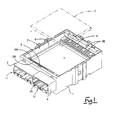
- FIG. 1 An embodiment of the present invention is explained below with the aid of Figures 1 to 9 .
- This embodiment illustrates a connector suitable for use in a control box of an automobile.
- a main body 1 of the control box is made from plastic by moulding, and an upper face thereof forms a square box shape in which a recess 2 is provided.
- Two hoods 3 and 4 are formed side by side in a unified manner on a side face of the main body 1, this side being the left anterior side face in Figure 1 .
- Rows of terminals 15A and 15B are provided as upper and lower layers within the hood 3 located on the far side, this forming a first connector member 11.
- rows of terminals 35 are provided as upper and lower layers within the hood 4, this forming a second connector member 31.
- Rows of contact members 5 and 6 are formed within the recess 2 of the upper face, the row of contact members 5 being on the side wall directly behind the connector members 11 and 31, and the row of contact members 6 being on the opposite side wall.
- a supporting frame 8 is formed between the rows of contact members 5 and 6, this supporting a printed circuit board 7.
- Contact members 18A and 18B are horizontally aligned within the row of contact members 5 located at the closer side, these contact members 18A and 18B extending from tabs 16A and 16B of the first connector member 11.
- Contact members 38 are horizontally aligned within the row of contact members 6 located at the farther side, these contact members 38 extending from tabs of the second connector member 31.
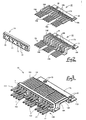
- the first connector member 11 is provided with an upper bus bar 12, a lower bus bar 13, and a position fixing plate 14.
- the upper bus bar 12 is formed by press forming an electrically conductive metal sheet, and the twelve pictured tabs 16A which comprise the upper row of terminals 15A are connected in a unified manner by a carrier 17A.
- the twelve tabs 16A are divided into three groups each comprising four tabs, the tabs 16A within each group being horizontally aligned with a prescribed distance between each tab, and with a wider distance separating the groups from one another.
- the contact members 18A extend from the posterior of each tab 16A.
- the contact members 18A after being formed sideways to the extent required, extend in a posterior direction and are consequently horizontally aligned in a manner whereby the space between each adjoining contact member 18A is greater than the space which separates the contact members 18B (to be described later) of the lower bus bar 13.
- One end of each contact member 18A is formed again at right-angles so as to protrude in a downwards and posterior direction, and is connected to the carrier 17A by a connecting member 19A.
- position fixing holes 20 are formed on both ends of the carrier 17A.
- the lower bus bar 13 is also formed by press forming an electrically conductive metal sheet, and the twelve pictured tabs 16B which comprise the lower row of terminals 15B are connected in a unified manner by a carrier 17B.
- the twelve tabs 16B are also divided into three groups each comprising four tabs, the tabs 16B within each group being horizontally aligned with a prescribed distance between each tab, and with a wider distance separating the groups from one another.
- the upper and lower bus bars 12 and 13 are placed together, the upper and lower rows of terminals 15A and 15B mutually correspond and are separated by a prescribed distance.
- the contact members 18B extend from the posterior of each tab 16B.
- these contact members 18B are horizontally aligned and fit between the contact members 18A of the upper bus bar 12.
- the contact members 18B are formed sideways from the posterior end portion of each tab 16B to the extent required, these then being raised to a height equivalent to that of the corresponding space between the upper and lower rows of terminals 15A and 15B, and then being made to extend in a posterior direction.
- the extending end of each contact member 18B is formed twice at right-angles so as to extend in a downwards and posterior direction, and is connected to the carrier 17B by a connecting member 19B.
- the carrier 17B is stepped downwards, the size of this step corresponding to the thickness of the carrier 17B.
- Position fixing holes 20 are formed on both ends of the carrier 17B, the location of these corresponding to that of the position fixing holes 20 in the carrier 17A of the upper bus bar 12.
- the carriers 17A and 17B of the upper and lower bus bars 12 and 13 are positioned one above the other with the position fixing holes 20 being together, the upper and lower rows of terminals 15A and 15B correspond with each other, separated by a prescribed distance, and the contact members 18A or 18B are aligned along a plane by mutually fitting together.
- a position fixing plate 14 is made from a plastic such as PBT resin or ABS resin, and the upper and lower rows of terminals 15A and 15B of the upper and lower bus bars 12 and 13 are inserted therethrough. Insertion holes 22 are aligned on the plate 14 to allow the upper and lower tabs 16A and 16B to be inserted. Moreover, window holes 23 pass through the plastic at prescribed locations between the insertion holes 22.
- the upper and lower bus bars 12 and 13 are positioned one above the other by aligning the carriers 17A and 17B as described above, and then the tabs 16A and 16B are inserted through the corresponding insertion holes 22 of the plate 14 as far as the base of the upper and lower rows of terminals 15A and 15B.
- the upper and lower bus bars 12 and 13 are joined together in a unified manner by the plate 14 and form an insert 25.
- This insert 25 comprises the upper and lower rows of terminals 15A and 15B corresponding to each other and separated by a prescribed distance, and the contact members 18A and 18B aligned along a plane.
- the position fixing holes 20 of the upper and lower carriers 17A and 17B match together.
- a first moulded member 27 is formed in which a housing 26 is moulded around the insert 25.
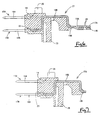
- a forming die such as that in Figure 4 .
- This forming die comprises, for example: a fixed lower mould 41; an upper mould 42 above the lower mould 41 and capable of being moved up and down; and a moveable mould 43 located to the left of the lower mould 41 and the upper mould 42 and capable of being moved to the left and right.
- a moulding cavity 44 for moulding the housing 26 is formed on the joining faces of the three moulds 41, 42 and 43.
- Fitting holes 45 are formed on the joining face of the moveable mould 43, the upper and lower tabs 16A and 16B fitting therein. Further, pins 46, pins 47, and pins 48 protrude upwards from the upper face of the lower mould 41.
- the pins 46 fit with the position fixing holes 20 of the carriers 17A and 17B, the pins 47 support the lower faces of the contact members 18A and 18B, and the pins 48 protrude upwards so as to extend along the posterior of the upwards-rising portion of the contact members 18B of the lower bus bar 13.
- the forming die is positioned in an open state as shown in Figure 4 , and the insert 25 is positioned on the upper face of the lower mould 41, with the position fixing holes 20 of the carriers 17A and 17B being fitted onto the pins 46, the lower faces of the contact members 18A and 18B making contact with the pins 47, and the posterior faces of the rising portion of the contact members 18B extending along the pins 48.
- the tabs 16A and 16B are fitted into the fitting holes 45, the moveable mould 43 is moved in a rightwards direction relative to Figure 4 , and the upper mould 42 is lowered.
- the forming die is thereby closed and the moulding cavity 44 is formed between the joining faces of the moulds 41, 42 and 43.
- molten plastic such as ABS resin etc.
- the forming die is opened after the plastic has hardened and, as shown in Figures 6 and 8 , the first moulded member 27 with the housing 26 being moulded around the insert 25 is removed.
- the housing 26 surrounds the base of the upper and lower rows of terminals 15A and 15B and supports the lower side faces of the contact members 18A and 18B which are aligned horizontally.
- the plastic has entered the window holes 23 of the plate 14, thereby unifying the housing 26 and the plate 14.
- a plurality of bosses 28 protrude from the upper face of the portion of the housing 26 surrounding the base of the rows of terminals 15A and 15B, these bosses 28 being used for binding when secondary moulding (to be explained later) is performed.
- the carriers 17A and 17B of the two bus bars 12 and 13 are cut off and removed. Specifically, this cutting off occurs on a portion slightly behind the lower edge of the descending portion of the connecting members 19A and 19B, these connecting members 19A and 19B connecting the contact members 18A and 18B to the carriers 17A and 17B.
- the portions extending behind the connecting members 19A and 19B are aligned along an identical face, and consequently the carriers 17A and 17B can be cut off by supporting this portion in the mould and press shearing a single time.
- Figures 7 and 9 show the first moulded member 27 after the carriers 17A and 17B have been cut off.
- the second connector member 31 which will be explained in less detail, is prepared by providing two rows of tabs 35 as upper and lower layers. Horizontally aligned contact members 38 protruding from the tabs are grouped together to form an insert, a housing surrounding the insert is formed within a first moulded member, and carriers are cut off in the same manner as above.
- the first moulded members of the first connector member 11 and the second connector member 31, the carriers of both having been cut off, are joined together in a unified manner in a prescribed position, this forming another insert which is secondary moulded to form the main body 1 of the control box shown in Figure 1 .
- a simplification of the production process results from using insert moulding to form a connector (first moulded member 27) whereby the terminals 15A and 15B are provided in two layers on one side of the housing 26 so as to form the insert 25 during the moulding of the main body 1 of the control box, and the other side of the housing 26 has contact members 18A and 18B aligned along a face.
- the upper and lower bus bars 12 and 13 comprising the first moulded member 27 are formed in a unified manner and joined by the carriers 17A and 17B respectively, these carriers 17A and 17B being cut off and removed after the first moulded member 27 has been moulded.
- handling is convenient during the production process, such as when the bus bars 12 and 13 are joined together, etc.
- these are joined together with the portions of the carriers 17A and 17B to be cut off being one above the other and, consequently, the carriers 17A and 17B can be cut off by shearing a single time.
- the carriers 17A and 17B are one above the other prior to being cut off, and the upper and lower bus bars 12 and 13 are in a contacting state.
- the upper and lower bus bars 12 and 13 are in a non-contacting state after the carriers 17A and 17B are cut off.
- the position fixing holes 20 are provided on both carriers 17A and 17B, these matching together when the carries 17A and 17B are joined together.
- the pins 46 in the moulding cavity 44 of the forming die fit into these position fixing holes 20, and the position of the carriers 17A and 17B within the moulding cavity 44 is thereby easily fixed.
- the plate 14 is fitted onto the base of the upper and lower rows of terminals 15A and 15B, thereby preventing the tabs 16A and 16B from shifting position whole, for example, receiving pressure from the resin during moulding. The position of the tabs 16A and 16B is thereby reliably maintained during production.
Landscapes
- Engineering & Computer Science (AREA)
- Manufacturing & Machinery (AREA)
- Connector Housings Or Holding Contact Members (AREA)
- Manufacturing Of Electrical Connectors (AREA)
- Coupling Device And Connection With Printed Circuit (AREA)
Claims (8)
- Einsatzgeformter elektrischer Verbinder mit einem Gehäuse (26), einer ersten Reihe von beabstandeten Anschlüssen (15A), von denen jeder erste Enden in einer ersten Ebene und von denen jeder ein jeweiliges Kontaktelement (18A) in einer gemeinsamen Ebene aufweist, und einer zweiten Reihe von beabstandeten Anschlüssen (15B), die in der ersten Reihe verteilt sind, von denen jeder erste Enden in einer zweiten Ebene und von denen jeder ein jeweiliges Kontaktelement (18B) in der gemeinsamen Ebene aufweist, wobei die Anschlüsse aufeinanderfolgende rechtwinklige Abschnitte aufweisen sowie fixiert und angeordnet werden, wenn das Gehäuse (26) um die rechtwinkligen Abschnitte geformt wird.
- Verbinder nach Anspruch 1, wobei die ersten und zweiten Reihen von Anschlüssen (15A, 15B) in wechselseitig parallelen Ebenen sind.
- Verbinder nach einem vorhergehenden Anspruch, des Weiteren umfassend ein Positionsfixierelement (14) für die Anschlüsse (15A, 15B), wobei das Positionsfixierelement (14) eine Mehrzahl von Öffnungen (22) in den ersten und zweiten Ebenen aufweist und jeder der Anschlüsse durch eine jeweilige der Öffnungen hindurchgeht.
- Verbinder nach einem vorhergehenden Anspruch, wobei die ersten und zweiten Reihen von Anschlüssen jeweils mit gemeinsamen Trägern (17A, 17B) verbunden sind.
- Verbinder nach Anspruch 4, wobei die Kontaktelemente (18A, 18B) mit den gemeinsamen Trägern (17A, 17B) durch jeweilige Verbindungselemente (19A, 19B) verbunden sind und die Verbindungselemente in einer gemeinsamen Ebene liegen.
- Verfahren zum Herstellen eines elektrischen Verbinders mit einer Reihe von Anschlüssen in einer einzelnen Ebene auf der einen Seite und zwei oder mehr Reihen von Anschlüssen in beabstandeten Ebenen auf der anderen Seite, wobei das Verfahren die nachfolgenden Schritte umfasst:(a) Bilden einer ersten Reihe von beabstandeten Anschlüssen mit Verbindungsenden in einer Verbindungsebene, wobei die Anschlüsse einen gemeinsamen Erstreihenträger an den Verbindungsenden aufweisen,(b) Bilden einer zweiten Reihe von beabstandeten Anschlüssen mit Verbindungsenden in einer Verbindungsebene, wobei die Anschlüsse einen gemeinsamen Zweitreihenträger an den Verbindungsenden aufweisen,(c) übereinander erfolgendes Anordnen der Träger derart, dass die ersten und zweiten Reihen von Anschlüssen benachbart zu den Trägern verteilt sind,(d) Bilden eines Kunststoffgehäuses zum Fixieren und Anordnen der Anschlüsse durch Einsatzformen um rechtwinklige Abschnitte der Anschlüsse, und(e) Scheren der Träger von den ersten und zweiten Reihen von Anschlüssen, wodurch jeder der Anschlüsse elektrisch unabhängig wird und in dem Gehäuse fixiert bleibt.
- Verfahren nach Anspruch 6, umfassend die nachfolgenden zusätzlichen Schritte:(c2) Anordnen eines Positionsfixierelementes über den Anschlüssen, wobei das Positionsfixierelement eine jeweilige Öffnung für jeden der Anschlüsse aufweist, und(d2) Einsatzformen des Positionsfixierelementes, wenn das Kunststoffgehäuse gebildet wird.
- Verfahren nach Anspruch 6 oder 7, umfassend die nachfolgenden Schritte:(a2, b2) Bereitstellen von ausgerichteten Öffnungen in den gemeinsamen Trägern; und(d3) Bereitstellen von Ausrichtstiften in einer Kunststoffform zur Anordnung in den Öffnungen während des Einsatzformens, wodurch eine Relativbewegung der Anschlüsse während des Einsatzformens verhindert wird.
Applications Claiming Priority (2)
| Application Number | Priority Date | Filing Date | Title |
|---|---|---|---|
| JP16988398 | 1998-06-17 | ||
| JP16988398A JP3405201B2 (ja) | 1998-06-17 | 1998-06-17 | 機器用コネクタの製造方法 |
Publications (2)
| Publication Number | Publication Date |
|---|---|
| EP0966075A1 EP0966075A1 (de) | 1999-12-22 |
| EP0966075B1 true EP0966075B1 (de) | 2008-05-14 |
Family
ID=15894731
Family Applications (1)
| Application Number | Title | Priority Date | Filing Date |
|---|---|---|---|
| EP99304646A Expired - Lifetime EP0966075B1 (de) | 1998-06-17 | 1999-06-15 | Elektrischer Steckverbinder und dessen Herstellungsverfahren |
Country Status (5)
| Country | Link |
|---|---|
| US (1) | US6217393B1 (de) |
| EP (1) | EP0966075B1 (de) |
| JP (1) | JP3405201B2 (de) |
| CN (1) | CN1134863C (de) |
| DE (1) | DE69938694D1 (de) |
Families Citing this family (17)
| Publication number | Priority date | Publication date | Assignee | Title |
|---|---|---|---|---|
| SG80641A1 (en) * | 1999-08-30 | 2001-05-22 | Fci Singapore Ltd | Method for manufacturing electrical connectors for enhancing coplanarity |
| DE10045073B4 (de) * | 2000-09-12 | 2005-03-03 | Siemens Ag | Steckerelement und zugehöriges Herstellungsverfahren |
| DE10120362A1 (de) * | 2001-04-26 | 2002-11-21 | Integrated Electronic Systems Sys Consulting Gmbh | Spritzgussformteil |
| JP2002343475A (ja) * | 2001-05-21 | 2002-11-29 | Nagano Fujitsu Component Kk | Stmコネクタ及びその製造方法 |
| US6832936B2 (en) * | 2002-10-17 | 2004-12-21 | Molex Incorporated | Terminal module for electrical connector |
| US6692273B1 (en) * | 2002-12-31 | 2004-02-17 | Hon Hai Precision Ind. Co., Ltd. | Straddle mount connector |
| KR100796731B1 (ko) | 2006-08-02 | 2008-01-21 | 이승희 | 전기접속단자 블랭크 및 그 포장방법 |
| US7371118B2 (en) * | 2006-08-25 | 2008-05-13 | Hon Hai Precision Ind. Co., Ltd | Electrical connector assembly with reduced crosstalk and electromaganetic interference |
| DE102006062313A1 (de) * | 2006-12-27 | 2008-07-03 | Robert Bosch Gmbh | Elektrische Steckerleiste |
| JP5632217B2 (ja) * | 2010-07-08 | 2014-11-26 | 矢崎総業株式会社 | コネクタのインサート成形方法 |
| JP6057069B2 (ja) * | 2013-01-30 | 2017-01-11 | 第一精工株式会社 | 集合型電気コネクタ及び集合型電気コネクタ製造方法 |
| CN104733977A (zh) * | 2013-12-18 | 2015-06-24 | 江苏景联电子科技有限公司 | 连接器的制造方法 |
| US20160344118A1 (en) * | 2015-05-19 | 2016-11-24 | Ching-Ho (NMI) Hsieh | Separable Electrical Connector and Method of Making It |
| CN105655839A (zh) * | 2016-01-26 | 2016-06-08 | 沈阳兴华航空电器有限责任公司 | 一种接触体镶嵌塑压密封方法 |
| JP6390663B2 (ja) | 2016-05-18 | 2018-09-19 | 第一精工株式会社 | 電気コネクタ及びその製造方法 |
| USD840030S1 (en) | 2016-06-02 | 2019-02-05 | Intarcia Therapeutics, Inc. | Implant placement guide |
| JP2019176675A (ja) * | 2018-03-29 | 2019-10-10 | 日本電産株式会社 | モータ |
Family Cites Families (5)
| Publication number | Priority date | Publication date | Assignee | Title |
|---|---|---|---|---|
| US3391456A (en) * | 1965-04-30 | 1968-07-09 | Sylvania Electric Prod | Multiple segment array making |
| US4602830A (en) * | 1984-09-20 | 1986-07-29 | Amp Incorporated | Double row electrical connector |
| US4639056A (en) * | 1985-05-31 | 1987-01-27 | Trw Inc. | Connector construction for a PC board or the like |
| US5201662A (en) | 1991-08-23 | 1993-04-13 | Molex Incorporated | Electrical connector for mounting on a printed circuit board |
| US5267875A (en) * | 1993-04-27 | 1993-12-07 | The Whitaker Corporation | Electrical connector assembly |
-
1998
- 1998-06-17 JP JP16988398A patent/JP3405201B2/ja not_active Expired - Fee Related
-
1999
- 1999-06-11 CN CNB991090179A patent/CN1134863C/zh not_active Expired - Fee Related
- 1999-06-15 EP EP99304646A patent/EP0966075B1/de not_active Expired - Lifetime
- 1999-06-15 DE DE69938694T patent/DE69938694D1/de not_active Expired - Lifetime
- 1999-06-16 US US09/333,975 patent/US6217393B1/en not_active Expired - Lifetime
Also Published As
| Publication number | Publication date |
|---|---|
| DE69938694D1 (de) | 2008-06-26 |
| CN1239338A (zh) | 1999-12-22 |
| JP2000012170A (ja) | 2000-01-14 |
| US6217393B1 (en) | 2001-04-17 |
| CN1134863C (zh) | 2004-01-14 |
| JP3405201B2 (ja) | 2003-05-12 |
| EP0966075A1 (de) | 1999-12-22 |
Similar Documents
| Publication | Publication Date | Title |
|---|---|---|
| EP0966075B1 (de) | Elektrischer Steckverbinder und dessen Herstellungsverfahren | |
| EP1356550B1 (de) | Verbinderformverfahren und davon abgeschirmter Verbinder in Plattenbauweise | |
| US6065951A (en) | Mold for use in manufacturing an electrical connector | |
| US6007387A (en) | Connector producing method and a connector produced by insert molding | |
| EP1014501A1 (de) | Elektrischer Verteilerkasten, dessen Herstellungsmethode, Verdrahtungssammelschiene für einen elektrischen Verteilerkasten und die Herstellungsmethode | |
| EP3761462B1 (de) | Herstellungsverfahren eines elektrischen verbinders und elektrischer verbinder | |
| US5611699A (en) | Tape-carrier-type electrical connector and method of manufacturing same | |
| US6368158B1 (en) | Electric connector having integrally molded terminals and guide pins | |
| US6517386B2 (en) | Electrical connector and method of making the same | |
| US6000971A (en) | Multi-stage connector and method for producing and assembling the same | |
| CN1088929C (zh) | 电连接器的制造方法及其产品 | |
| JPH10255950A (ja) | 電気コネクタの製造法 | |
| JPH11345675A (ja) | 電気コネクタの製造方法 | |
| EP0702434B1 (de) | Vergossener elektrischer Steckverbinder | |
| US20010031584A1 (en) | Hybrid plug housing and process for its production | |
| HK1038649A1 (zh) | 凹入式连接器及其制造方法 | |
| JPH07282912A (ja) | 端子列体およびその製造方法 | |
| EP0907987A1 (de) | Elektrischer verbinder | |
| JP2003070131A (ja) | ジャンクションボックスおよび該ジャンクションボックスのケース成形方法 | |
| JPH03122988A (ja) | 電気ターミナルを形成する方法 | |
| JPH033448B2 (de) |
Legal Events
| Date | Code | Title | Description |
|---|---|---|---|
| PUAI | Public reference made under article 153(3) epc to a published international application that has entered the european phase |
Free format text: ORIGINAL CODE: 0009012 |
|
| 17P | Request for examination filed |
Effective date: 19990706 |
|
| AK | Designated contracting states |
Kind code of ref document: A1 Designated state(s): DE FR GB IT |
|
| AX | Request for extension of the european patent |
Free format text: AL;LT;LV;MK;RO;SI |
|
| AKX | Designation fees paid |
Free format text: DE FR GB IT |
|
| GRAP | Despatch of communication of intention to grant a patent |
Free format text: ORIGINAL CODE: EPIDOSNIGR1 |
|
| GRAS | Grant fee paid |
Free format text: ORIGINAL CODE: EPIDOSNIGR3 |
|
| GRAA | (expected) grant |
Free format text: ORIGINAL CODE: 0009210 |
|
| AK | Designated contracting states |
Kind code of ref document: B1 Designated state(s): DE FR GB IT |
|
| REG | Reference to a national code |
Ref country code: GB Ref legal event code: FG4D |
|
| REF | Corresponds to: |
Ref document number: 69938694 Country of ref document: DE Date of ref document: 20080626 Kind code of ref document: P |
|
| PGFP | Annual fee paid to national office [announced via postgrant information from national office to epo] |
Ref country code: IT Payment date: 20080625 Year of fee payment: 10 |
|
| PGFP | Annual fee paid to national office [announced via postgrant information from national office to epo] |
Ref country code: GB Payment date: 20080618 Year of fee payment: 10 |
|
| PLBE | No opposition filed within time limit |
Free format text: ORIGINAL CODE: 0009261 |
|
| STAA | Information on the status of an ep patent application or granted ep patent |
Free format text: STATUS: NO OPPOSITION FILED WITHIN TIME LIMIT |
|
| 26N | No opposition filed |
Effective date: 20090217 |
|
| GBPC | Gb: european patent ceased through non-payment of renewal fee |
Effective date: 20090615 |
|
| PG25 | Lapsed in a contracting state [announced via postgrant information from national office to epo] |
Ref country code: GB Free format text: LAPSE BECAUSE OF NON-PAYMENT OF DUE FEES Effective date: 20090615 |
|
| PGFP | Annual fee paid to national office [announced via postgrant information from national office to epo] |
Ref country code: FR Payment date: 20100709 Year of fee payment: 12 |
|
| PGFP | Annual fee paid to national office [announced via postgrant information from national office to epo] |
Ref country code: DE Payment date: 20100610 Year of fee payment: 12 |
|
| PG25 | Lapsed in a contracting state [announced via postgrant information from national office to epo] |
Ref country code: IT Free format text: LAPSE BECAUSE OF NON-PAYMENT OF DUE FEES Effective date: 20090615 |
|
| REG | Reference to a national code |
Ref country code: FR Ref legal event code: ST Effective date: 20120229 |
|
| REG | Reference to a national code |
Ref country code: DE Ref legal event code: R119 Ref document number: 69938694 Country of ref document: DE Effective date: 20120103 |
|
| PG25 | Lapsed in a contracting state [announced via postgrant information from national office to epo] |
Ref country code: FR Free format text: LAPSE BECAUSE OF NON-PAYMENT OF DUE FEES Effective date: 20110630 Ref country code: DE Free format text: LAPSE BECAUSE OF NON-PAYMENT OF DUE FEES Effective date: 20120103 |