EP0959262A1 - Asbestosfreier Scheibenbremsbelag für Fahrzeuge - Google Patents
Asbestosfreier Scheibenbremsbelag für Fahrzeuge Download PDFInfo
- Publication number
- EP0959262A1 EP0959262A1 EP99303875A EP99303875A EP0959262A1 EP 0959262 A1 EP0959262 A1 EP 0959262A1 EP 99303875 A EP99303875 A EP 99303875A EP 99303875 A EP99303875 A EP 99303875A EP 0959262 A1 EP0959262 A1 EP 0959262A1
- Authority
- EP
- European Patent Office
- Prior art keywords
- disc brake
- brake pad
- zeolite
- silicone
- fibers
- Prior art date
- Legal status (The legal status is an assumption and is not a legal conclusion. Google has not performed a legal analysis and makes no representation as to the accuracy of the status listed.)
- Granted
Links
Images
Classifications
-
- F—MECHANICAL ENGINEERING; LIGHTING; HEATING; WEAPONS; BLASTING
- F16—ENGINEERING ELEMENTS AND UNITS; GENERAL MEASURES FOR PRODUCING AND MAINTAINING EFFECTIVE FUNCTIONING OF MACHINES OR INSTALLATIONS; THERMAL INSULATION IN GENERAL
- F16D—COUPLINGS FOR TRANSMITTING ROTATION; CLUTCHES; BRAKES
- F16D69/00—Friction linings; Attachment thereof; Selection of coacting friction substances or surfaces
- F16D69/02—Composition of linings ; Methods of manufacturing
- F16D69/025—Compositions based on an organic binder
- F16D69/026—Compositions based on an organic binder containing fibres
Definitions
- This invention relates to a non-asbestos disc brake pad for automobiles (hereinafter referred to as "disc brake pad”).
- disc brakes As a braking system for automobiles, there are used disc brakes, in which a disc brake pad is used as a braking part.
- JP-A 2-132175 discloses a non-asbestos friction material which is a mixture comprising a fibrous base material such as metal fibers, inorganic fibers and organic fibers; a binder including a thermosetting resin such as a phenol resin; and as a friction adjusting agent a lubricant such as graphite, antimony trisulfide, etc, a powder of metal such as iron, copper, brass, etc., a filler such as barium sulfate, calcium carbonate, etc.
- an organic friction adjusting agent such as cashew dust, acrylonitrile-butadiene rubber (NBR), styrene-butadiene rubber (SBR), etc.
- NBR acrylonitrile-butadiene rubber
- SBR styrene-butadiene rubber
- the present invention provides a disc brake pad for automobiles obtained by using a composition comprising a fibrous base material except for asbestos, a binder and a friction adjusting agent, wherein a silicone modified resin is contained as a part or whole of the binder, and zeolite is contained as a part of the friction adjusting agent.
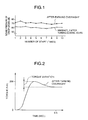
- Fig. 1 is a graph showing a relationship between the number of start and the sound pressure of creep groan of a car equipped with a prior art disc brake pad after parking overnight and immediately after running several hours.
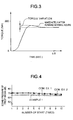
- Fig. 2 is a graph showing the results of measuring torque variation using a test piece of the prior art disc brake pad at a sliding surface of disc rotor adsorbing water after parking overnight.
- Fig. 3 is a graph showing the results of measuring torque variation using a test piece of the prior art disc brake pad at a sliding surface of disc rotor adsorbing water immediately after running several hours.
- Fig. 4 is a graph showing a relationship between the number of start and the sound pressure of creep groan of cars equipped with the disc brake pads obtained in Example 1 and Comparative Examples 1 and 2 after parking overnight.
- the present inventors have studied earnestly causes for generating creep groan of cars using prior art disc brake pads and found the following facts.
- a main cause for generating the creep groan seems to be that when a car is parked overnight, a transfer film formed on a disc rotor surface adsorbs water, which generate rust between the disc rotor and the transfer film; and when the car is driven again, the transfer film is peeled off at the initial time of driving, resulting in increasing the noise level of the creep groan.
- the present inventors prepared disc brake pads from the friction material having a composition as shown in Table 1 and subjected to various tests.
- Material Proportion (vol.%) Phenol resin 20 Aramid fibers 10 Alumina ⁇ silica fibers 5 Potassium titanate fibers 15 Copper fibers 5 Graphite 3 Antimony trisulfide 2 Cashew dust 15 Isoprene rubber powder 5 Barium sulfate 20
- Fig. 1 is a graph showing a relationship between the number of start and the sound pressure of creep groan. More in detail, a car parking overnight, and a car immediately after running for several hours (i.e. after braking 200 times with a temperature before braking of 130°C, initial speed at braking of 60 km/hr, and brake deceleration of 0.3 G), respectively, are started slowly while relaxing a brake pedal, then stopped, and started slowly again while relaxing the brake pedal, and repeating this step 10 times, while measuring the sound pressure of creep groan generated at the time of relaxing the brake pedal using a sound-level meter.
- the car after parking overnight shows the highest sound pressure of 75 dB at the second start.
- the car immediately after running several hours shows the sound pressure of as low as 63 dB at the maximum sound pressure of creep groan.
- the source of generation of the creep groan seems to be the stick slip vibration at the disc rotor sliding surface at the start of the vehicle.
- the present inventors measured the torque variation (a difference between static coefficient of friction and dynamic coefficient of friction) using test pieces of disc brake pads at the sliding surface of a disc rotor adsorbing water after parking overnight, and at the sliding surface of a disc rotor immediately after running several hours. The results are shown in Figs. 2 and 3.
- the present inventors found that in order to prevent the transfer film from adsorbing water or to remove the water once adsorbed in the transfer film, it was effective to use a silicone modified resin as a part or whole of the binder and zeolite as a part of the friction adjusting agent. By doing this, it was possible to provide a disc brake pad capable of lowering the sound pressure of creep groan. Thus, the present invention has been accomplished.
- the disc brake pad for automobiles of the present invention is obtained by using a composition comprising a fibrous base material except for asbestos, a binder and a friction adjusting agent, wherein a silicone modified resin is contained as a part or whole of the binder, and zeolite is contained as a part of the friction adjusting agent.
- the resulting disc brake pad of the present invention when the silicone modified resin is contained in the composition in an amount of 3 to 30% by volume, the resulting disc brake pad is excellent in thermal fade phenomenon.
- the silicone modified resin is obtained by reacting silicone oil or silicone rubber with a novolak phenol resin, or obtained by finely dispersing silicone oil or silicone rubber in a novolak phenol resin, moldability of the disc brake pad is further improved.
- the resulting disc brake pad is improved in removing the water once adsorbed.
- the resulting disc brake pad is remarkably effective for preventing the generation of brake noise such as so-called brake squeal with about 2000 to 10,000 Hz.
- the resulting disc brake pad is improved in removing the water once adsorbed.
- conventional binders can be used and there is no particular limitation thereto.
- the silicone modified resin it is preferable to use a resin obtained by reacting silicone oil or silicone rubber with a novolak phenol resin, or a resin obtained by finely dispersing silicone oil or silicone rubber in a novolak phenol resin.
- the amount of the silicone modified resin in the composition is in an amount of preferably 3 to 30% by volume, more preferably 10 to 25% by volume.
- silicone oil or silicone rubber In order to react the silicone oil or silicone rubber with the novolak phenol resin, it is sufficient to add silicone oil or silicone rubber to heated novolak phenol resin and to mix well so as to react each other according to a conventional method. Further, in order to finely disperse the silicone oil or silicone rubber in the novolak phenol resin, it is sufficient to add the silicone oil or silicone rubber to the novolak phenol resin, followed by stirring the mixture so as not to react each other, or even if reacted in a very slight amount.
- zeolite should be used in the present invention in order to improve water removing properties.
- zeolite either synthetic or natural zeolite can be used.
- the water absorption rate of the zeolite is preferably 5% or more, more preferably 12% or more.
- the water absorption rate of the zeolite is obtained as follows. Zeolite heat treated at 600°C for 1 hour is allowed to stand under standard conditions (at 21°C and a relative humidity of 65%) until the temperature of the zeolite becomes 50°C or less, followed by measurement of the weight (A) simultaneously. After measuring, the zeolite is allowed to stand at 50°C and a relative humidity of 90% for 6 hours, followed by measurement of the weight (B).
- the amount of the zeolite in the composition is preferably 0.5 to 20% by volume, more preferably 2 to 10% by volume.
- zeolite there is no particular limit to the shape of zeolite, but it is preferable to have an average particle size of 1 to 50 ⁇ m, more preferably 1 to 10 ⁇ m.
- the fibrous base material there can be used any fibers except for asbestos.
- the fibrous base material are organic fibers such as aramide fibers, acrylic fibers, phenol fibers, etc.; inorganic fibers such as glass fibers, ceramic fibers, rock wool, potassium titanate fibers, etc.; and metal fibers such as steel fibers, copper fibers, brass fibers, bronze fibers, etc. These fibers can be used alone or as a mixture thereof.
- the amount of the fibrous base material in the composition is preferably 20 to 50% by volume, more preferably 25 to 45% by volume.
- the binder there can be used a polyimide resin, a furan resin, etc. in addition to the silicone modified resin.
- the amount of the additional binder component in the composition is 10 to 30% by volume, more preferably 15 to 25% by volume.
- the friction adjusting agent there can be used, in addition to the zeolite, inorganic friction adjusting agents such as graphite, antimony trisulfide, molybdenum disulfide, barium sulfate, potassium carbonate, magnesium carbonate, etc.; organic friction adjusting agents such as cathew dust, acrylic rubber, isoprene rubber, NBR, SBR, etc.; metal powders such as iron powder, brass powder, tin powder, zinc powder, etc.; and grinding materials such as mica, alumina, silica, zircon, mullite, talc, clay, etc. These friction adjusting agents can be used alone or as a mixture thereof.
- inorganic friction adjusting agents such as graphite, antimony trisulfide, molybdenum disulfide, barium sulfate, potassium carbonate, magnesium carbonate, etc.
- organic friction adjusting agents such as cathew dust, acrylic rubber, isoprene rubber, NBR, SBR, etc.
- Total amount of the friction adjusting agents in the composition is preferably 20 to 70% by volume, more preferably 35 to 55% by volume.
- the percent by volume of each component is obtained by dividing the weight of the component by the density of the component.
- the disc brake pad of the present invention can be obtained by uniformly mixing the composition comprising a fibrous base material except for asbestos (preferably 20 to 50% by volume), a binder (preferably 10 to 30% by volume), and a friction adjusting agent (preferably 20 to 70% by volume), a total being 100% by volume, preforming the mixed composition, inserting a back metal and the preformed composition into a mold, molding under pressure with heating, and heat treating the molded article.
- the heating temperature at the molding is preferably 130 to 170°C, more preferably 140 to 160°C.
- the pressure at the molding is preferably 20 to 60 MPa, more preferably 30 to 50 MPa.
- the temperature at the heat treatment is preferably 100 to 300°C, more preferably 150 to 250°C.
- Components shown in Table 2 were mixed uniformly in a mixer, followed by preform. Each preformed composition was placed in a mold together with a back metal and molded at 140°C under a pressure of 40 MPa for 10 minutes, followed by heat treatment at 200°C for 6 hours to give a disc brake pad.
- silicone modified resin a resin obtained by reaction silicone rubber with novolak phenol resin (RS 2210MB, a trade name, mfd. by Mitsui Chemicals, Inc.) was used.
- zeolite synthetic zeolite having a water (moisture) absorption rate of 9% and an average particle size of 2 ⁇ m was used.
- Example 1 Comparative Example 1 Binder Silicone modified resin 20 20 Aramide fibers 10 10 Fibrous Alumina Silica fibers 5 5 base Potassium titanate fibers 15 15 material Copper fibers 5 5 Graphite 3 3 Friction Antimony trisulfide 2 2 adjust- Cashew dust 15 15 agent Isoprene rubber powders 5 5 Barium sulfate 15 15 Zeolite 5 0 Note)
- Example 1 The disc brake pad of Example 1 and that of Comparative Example 1 were built in each car and subjected to a test for measuring a sound level of creep groan after parking (standing) overnight.
- the creep groan was evaluated by starting each car slowly while relaxing the brake pedal, stopping the car, and then starting the car again slowly while relaxing the brake pedal, repeating this step 10 times, while measuring the sound pressure of creep groan generated at the time of relaxing the brake pedal using a sound-level meter.
- the disc brake pad of Example 1 showed as low as 68 dB at maximum, while the disc brake pad of Comparative Example 1 showed as high as 72 dB at maximum.
- the torque variation at the disc rotor sliding surface using the disc brake pad of Example 1 was as small as 23 Nm, while the torque variation of the disc brake pad of Comparative Example 1 was as high as 35 Nm.
- a disc brake pad was produced in the same manner as described in Example 1 using the composition as shown in Table 3.
- Material Proportion (vol.%) Phenol resin 20
- Aramide fibers 10
- Alumina ⁇ silica fibers 5
- Potassium titanate fibers 15
- Copper fibers 5
- Antimony trisulfide 2
- Cashew dust 15
- Isoprene rubber powder 5
- the resulting disc brake pad was built in a car and subjected to measurement of the sound pressure of creep groan in the same manner as described in Example 1. Further, the torque variation of the disc brake pad at the disc rotor sliding surface adsorbing water after parking overnight was as large as 35 Nm.
- Example 1 Comparative Example 1 Comparative Example 2 67 71 72 Sound 68 72 71 pressure 68 72 72 of 68 72 71 creep 68 72 71 groan 67 71 69 (dB) 67 71 69 66 70 69 66 69 68 66 69 68 Maximum (dB) 68 72 72
- the disc brake pad of the present invention is improved so as to lower the sound pressure of creep groan and make the torque variation small.
- the disc brake pad of the present invention obtained from the composition wherein the silicone modified resin is used as a part or whole of the binder, and zeolite is used as a part of the friction adjusting agent, is effective for preventing the transfer film from contacting with water, or for removing the water once adsorbed in the transfer film so as to lower the sound pressure of creep groan.
- the disc brake pad of the present invention is very suitable for use industrially.
- the disc brake pad of the present invention obtained from the composition containing 3 to 30% by volume of silicone modified resin is excellent in thermal fade phenomenon in addition to the above-mentioned features.
- the disc brake pad of the present invention obtained from the composition wherein as the silicone modified resin a resin obtained by reacting silicone oil or silicone rubber with a novolak phenol resin, or obtained by finely dispersing silicone oil or silicone rubber in a novolak phenol resin, shows the features mentioned above with excellent molding properties.
- the disc brake pad of the present invention obtained from the composition containing zeolite having a water (moisture) absorption rate of 5% or more is excellent in removing water in addition to the features mentioned above.
- the disc brake pad of the present invention obtained from the composition containing 0.5 to 20% by volume of zeolite is remarkably effective for preventing the generation of brake noise such as so-called brake squeal of about 2000 to 10,000 Hz in addition to the features mentioned above.
- the disc brake pad of the present invention obtained from the composition containing zeolite having an average particle size of 1 to 50 ⁇ m is excellent in removing water in addition to the features mentioned above.
Landscapes
- Engineering & Computer Science (AREA)
- General Engineering & Computer Science (AREA)
- Mechanical Engineering (AREA)
- Braking Arrangements (AREA)
- Manufacture Of Macromolecular Shaped Articles (AREA)
Applications Claiming Priority (4)
| Application Number | Priority Date | Filing Date | Title |
|---|---|---|---|
| JP13519098 | 1998-05-18 | ||
| JP13519098 | 1998-05-18 | ||
| JP17545998A JP4246813B2 (ja) | 1998-05-18 | 1998-06-23 | 自動車用非石綿ディスクブレーキパッド |
| JP17545998 | 1998-06-23 |
Publications (2)
| Publication Number | Publication Date |
|---|---|
| EP0959262A1 true EP0959262A1 (de) | 1999-11-24 |
| EP0959262B1 EP0959262B1 (de) | 2003-01-08 |
Family
ID=26469098
Family Applications (1)
| Application Number | Title | Priority Date | Filing Date |
|---|---|---|---|
| EP99303875A Expired - Lifetime EP0959262B1 (de) | 1998-05-18 | 1999-05-18 | Asbestosfreier Scheibenbremsbelag für Fahrzeuge |
Country Status (4)
| Country | Link |
|---|---|
| US (1) | US6220404B1 (de) |
| EP (1) | EP0959262B1 (de) |
| JP (1) | JP4246813B2 (de) |
| DE (1) | DE69904775T2 (de) |
Cited By (10)
| Publication number | Priority date | Publication date | Assignee | Title |
|---|---|---|---|---|
| EP1160481A1 (de) * | 2000-06-02 | 2001-12-05 | Nisshinbo Industries Inc. | Verfahren zur Herstellung von Reibungsmaterial und Reibungsmaterial |
| WO2003027529A1 (en) * | 2001-09-25 | 2003-04-03 | Honeywell International Inc. | Friction materials containing silicones for control of moisture sensitivity and noise generation |
| WO2003102440A1 (de) * | 2002-05-31 | 2003-12-11 | Tmd Friction Europe Gmbh | Einrichtung zum erfassen der spritzwassermenge, der ein bremsbelag auf nasser fahrbahn ausgesetzt ist |
| CN102141101A (zh) * | 2010-12-29 | 2011-08-03 | 莱州鲁达刹车片有限公司 | 环保型高速轿车刹车片及其温压工艺 |
| WO2012169545A1 (ja) * | 2011-06-07 | 2012-12-13 | 日立化成工業株式会社 | ノンアスベスト摩擦材組成物 |
| IT202100008807A1 (it) | 2021-04-08 | 2022-10-08 | Itt Italia Srl | Composizione di materiale d'attrito e pastiglia freno associata |
| IT202100029270A1 (it) | 2021-11-19 | 2023-05-19 | Brembo Spa | Materiale di attrito e relativa pastiglia per freni a disco |
| IT202200013012A1 (it) | 2022-06-20 | 2023-12-20 | Itt Italia Srl | Composizione di materiale d'attrito ed elemento d'attrito associato |
| IT202200023793A1 (it) | 2022-11-18 | 2024-05-18 | Itt Italia Srl | Composizione di materiale d'attrito migliorata ed elemento d'attrito associato |
| WO2026083277A1 (en) | 2024-10-16 | 2026-04-23 | Itt Italia S.R.L. | Improved friction material composition and associated friction element |
Families Citing this family (20)
| Publication number | Priority date | Publication date | Assignee | Title |
|---|---|---|---|---|
| EP1225365A1 (de) * | 2001-01-12 | 2002-07-24 | Nisshinbo Industries, Inc. | Asbestfreies Reibungsmaterialien |
| WO2002059553A2 (en) * | 2001-01-23 | 2002-08-01 | Southwest Research Institute | Novel methods and blends for controlling rehology and transition temperature of liquid crystals |
| JP2002226834A (ja) * | 2001-01-30 | 2002-08-14 | Nisshinbo Ind Inc | 非石綿系摩擦材 |
| JP4875823B2 (ja) * | 2002-12-04 | 2012-02-15 | 日清紡ホールディングス株式会社 | 非石綿系摩擦材 |
| US20040146702A1 (en) * | 2003-01-29 | 2004-07-29 | Xinming Shao | Pure iron fiber based friction material product |
| JP4089509B2 (ja) * | 2003-05-22 | 2008-05-28 | 日立化成工業株式会社 | 摩擦材組成物及び摩擦材組成物を用いた摩擦材 |
| FR2858672B1 (fr) * | 2003-08-07 | 2006-10-13 | Valeo Materiaux Friction | Garniture de frottement et procede de fabrication d'une telle garniture de frottement |
| US20060151268A1 (en) * | 2005-01-12 | 2006-07-13 | Sunil Kesavan | Copper-free non-asbestos organic friction material |
| JP2009275063A (ja) * | 2008-05-12 | 2009-11-26 | Akebono Brake Ind Co Ltd | 摩擦材 |
| US8863917B2 (en) | 2008-10-03 | 2014-10-21 | Federal-Mogul Products, Inc. | Friction material for brakes |
| US8172051B2 (en) * | 2008-10-03 | 2012-05-08 | Federal-Mogul Products, Inc. | Friction material for brakes |
| US20100084232A1 (en) * | 2008-10-03 | 2010-04-08 | Federal-Mogul Products, Inc. | Friction material for brakes |
| JP5540395B2 (ja) * | 2009-06-12 | 2014-07-02 | 曙ブレーキ工業株式会社 | 摩擦材 |
| KR101318486B1 (ko) * | 2010-11-19 | 2013-10-16 | 히타치가세이가부시끼가이샤 | 비석면 마찰재 조성물, 이를 이용한 마찰재 및 마찰 부재 |
| EP2641954A4 (de) * | 2010-11-19 | 2017-12-13 | Hitachi Chemical Company, Ltd. | Asbestfreie reibungsmaterialzusammensetzung sowie reibungsmaterial und reibungselement damit |
| JP5895366B2 (ja) * | 2011-06-07 | 2016-03-30 | 日立化成株式会社 | ノンアスベスト摩擦材組成物 |
| JP5895367B2 (ja) * | 2011-06-07 | 2016-03-30 | 日立化成株式会社 | ノンアスベスト摩擦材組成物 |
| CN112409008B (zh) * | 2019-08-22 | 2022-11-11 | 山东道普安制动材料有限公司 | 一种抗磨损碳/陶刹车材料的制备方法 |
| JP7540648B2 (ja) | 2020-08-20 | 2024-08-27 | 横浜ゴム株式会社 | ゴム構造体の仕様決定方法およびゴム構造体の製造方法並びにゴム構造体 |
| US12025198B2 (en) | 2021-03-30 | 2024-07-02 | Robert Bosch Gmbh | Antimony free and copper free ceramic friction material composition |
Citations (7)
| Publication number | Priority date | Publication date | Assignee | Title |
|---|---|---|---|---|
| JPS4921544A (de) | 1972-05-05 | 1974-02-26 | ||
| JPH01158238A (ja) * | 1987-12-16 | 1989-06-21 | Hitachi Chem Co Ltd | 摩擦材組成物 |
| JPH02132175A (ja) | 1988-11-11 | 1990-05-21 | Nisshinbo Ind Inc | 摩擦材 |
| US5563196A (en) * | 1993-12-28 | 1996-10-08 | Nsk-Warner Kabushiki Kaisha | Wet frictional material |
| RU2081133C1 (ru) * | 1996-07-17 | 1997-06-10 | Юрий Николаевич Васильев | Композиция для безасбестового фрикционного материала |
| RU2081129C1 (ru) * | 1996-07-17 | 1997-06-10 | Юрий Николаевич Васильев | Природные цеолиты в качестве добавки, стабилизирующей коэффициент трения фрикционных материалов |
| EP0807766A1 (de) * | 1996-05-17 | 1997-11-19 | Borg-Warner Automotive, Inc. | Zweischichtiges Reibungsmaterial |
Family Cites Families (4)
| Publication number | Priority date | Publication date | Assignee | Title |
|---|---|---|---|---|
| US5078909A (en) * | 1989-05-23 | 1992-01-07 | Sasaki Chemicals Co., Ltd. | Moisture-absorbent compositions and molded items |
| DE69115030T2 (de) * | 1991-01-07 | 1996-04-18 | Mizusawa Industrial Chem | Verfahren zur formgebung und zum brennen von zeolith-pulver. |
| JP2816774B2 (ja) * | 1991-03-29 | 1998-10-27 | 日本石油株式会社 | フェノール樹脂、その樹脂の製造法および封止材用エポキシ樹脂組成物 |
| US6027708A (en) * | 1998-09-08 | 2000-02-22 | Council Of Scientific & Industrial Research | Process for the synthesis of flyash based zeolite-Y |
-
1998
- 1998-06-23 JP JP17545998A patent/JP4246813B2/ja not_active Expired - Lifetime
-
1999
- 1999-05-10 US US09/307,781 patent/US6220404B1/en not_active Expired - Lifetime
- 1999-05-18 DE DE69904775T patent/DE69904775T2/de not_active Expired - Lifetime
- 1999-05-18 EP EP99303875A patent/EP0959262B1/de not_active Expired - Lifetime
Patent Citations (7)
| Publication number | Priority date | Publication date | Assignee | Title |
|---|---|---|---|---|
| JPS4921544A (de) | 1972-05-05 | 1974-02-26 | ||
| JPH01158238A (ja) * | 1987-12-16 | 1989-06-21 | Hitachi Chem Co Ltd | 摩擦材組成物 |
| JPH02132175A (ja) | 1988-11-11 | 1990-05-21 | Nisshinbo Ind Inc | 摩擦材 |
| US5563196A (en) * | 1993-12-28 | 1996-10-08 | Nsk-Warner Kabushiki Kaisha | Wet frictional material |
| EP0807766A1 (de) * | 1996-05-17 | 1997-11-19 | Borg-Warner Automotive, Inc. | Zweischichtiges Reibungsmaterial |
| RU2081133C1 (ru) * | 1996-07-17 | 1997-06-10 | Юрий Николаевич Васильев | Композиция для безасбестового фрикционного материала |
| RU2081129C1 (ru) * | 1996-07-17 | 1997-06-10 | Юрий Николаевич Васильев | Природные цеолиты в качестве добавки, стабилизирующей коэффициент трения фрикционных материалов |
Non-Patent Citations (3)
| Title |
|---|
| DATABASE WPI Section Ch Week 8931, Derwent World Patents Index; Class A81, AN 89-223260, XP002110755 * |
| DATABASE WPI Section Ch Week 9807, Derwent World Patents Index; Class A12, AN 98-075487, XP002110754 * |
| DATABASE WPI Section Ch Week 9807, Derwent World Patents Index; Class A60, AN 98-075484, XP002110756 * |
Cited By (15)
| Publication number | Priority date | Publication date | Assignee | Title |
|---|---|---|---|---|
| EP1160481A1 (de) * | 2000-06-02 | 2001-12-05 | Nisshinbo Industries Inc. | Verfahren zur Herstellung von Reibungsmaterial und Reibungsmaterial |
| WO2003027529A1 (en) * | 2001-09-25 | 2003-04-03 | Honeywell International Inc. | Friction materials containing silicones for control of moisture sensitivity and noise generation |
| WO2003102440A1 (de) * | 2002-05-31 | 2003-12-11 | Tmd Friction Europe Gmbh | Einrichtung zum erfassen der spritzwassermenge, der ein bremsbelag auf nasser fahrbahn ausgesetzt ist |
| AU2003233322B2 (en) * | 2002-05-31 | 2006-10-19 | Tmd Friction Europe Gmbh | Device for detecting the amount of splash water to which a brake pad is subjected on a wet roadway |
| US7360409B2 (en) * | 2002-05-31 | 2008-04-22 | Tmd Friction Services Gmbh | Device for detecting the amount of splash water to which a brake pad is subjected on a wet roadway |
| CN102141101A (zh) * | 2010-12-29 | 2011-08-03 | 莱州鲁达刹车片有限公司 | 环保型高速轿车刹车片及其温压工艺 |
| WO2012169545A1 (ja) * | 2011-06-07 | 2012-12-13 | 日立化成工業株式会社 | ノンアスベスト摩擦材組成物 |
| IT202100008807A1 (it) | 2021-04-08 | 2022-10-08 | Itt Italia Srl | Composizione di materiale d'attrito e pastiglia freno associata |
| WO2022215031A1 (en) | 2021-04-08 | 2022-10-13 | Itt Italia S.R.L. | Friction material composition and associated brake pad |
| IT202100029270A1 (it) | 2021-11-19 | 2023-05-19 | Brembo Spa | Materiale di attrito e relativa pastiglia per freni a disco |
| IT202200013012A1 (it) | 2022-06-20 | 2023-12-20 | Itt Italia Srl | Composizione di materiale d'attrito ed elemento d'attrito associato |
| WO2023248122A1 (en) | 2022-06-20 | 2023-12-28 | Itt Italia S.R.L. | Friction material composition and associated friction element |
| IT202200023793A1 (it) | 2022-11-18 | 2024-05-18 | Itt Italia Srl | Composizione di materiale d'attrito migliorata ed elemento d'attrito associato |
| WO2024105609A1 (en) | 2022-11-18 | 2024-05-23 | Itt Italia S.R.L. | Improved friction material composition and associated friction element |
| WO2026083277A1 (en) | 2024-10-16 | 2026-04-23 | Itt Italia S.R.L. | Improved friction material composition and associated friction element |
Also Published As
| Publication number | Publication date |
|---|---|
| DE69904775D1 (de) | 2003-02-13 |
| JP4246813B2 (ja) | 2009-04-02 |
| EP0959262B1 (de) | 2003-01-08 |
| US6220404B1 (en) | 2001-04-24 |
| JP2000038571A (ja) | 2000-02-08 |
| DE69904775T2 (de) | 2003-10-02 |
Similar Documents
| Publication | Publication Date | Title |
|---|---|---|
| EP0959262B1 (de) | Asbestosfreier Scheibenbremsbelag für Fahrzeuge | |
| KR101024476B1 (ko) | 마찰재 조성물 및 마찰재 조성물을 사용한 마찰재 | |
| KR100560379B1 (ko) | 비석면계 마찰재 | |
| JP5691125B2 (ja) | 摩擦材組成物、これを用いた摩擦材及び摩擦部材 | |
| JP2002266915A (ja) | 自動車用非石綿ディスクブレーキパッド | |
| JP2000234086A (ja) | 非石綿摩擦材 | |
| JPH1161105A (ja) | 摩擦材 | |
| JP2000154371A (ja) | 自動車用非石綿ディスクブレーキパッド | |
| JP3797464B2 (ja) | 摩擦材組成物及び摩擦材組成物を用いた摩擦材 | |
| JP4123456B2 (ja) | 摩擦材組成物及び摩擦材組成物を用いた摩擦材 | |
| JPH10330732A (ja) | 摩擦材組成物及び該摩擦材組成物を用いた摩擦材 | |
| JP2002097285A (ja) | 摩擦材 | |
| JP2004155843A (ja) | 非石綿系摩擦材 | |
| JPH05320622A (ja) | 摩擦材 | |
| JP2878120B2 (ja) | ブレーキパッド | |
| JP2002097451A (ja) | アルミディスクローター用摩擦材 | |
| JP2004204904A (ja) | ブレーキライニング | |
| JP3838400B2 (ja) | 摩擦材組成物及び摩擦材組成物を用いた摩擦材 | |
| JP2002097455A (ja) | 摩擦材組成物及び摩擦材組成物を用いた摩擦材 | |
| JP2000026839A (ja) | 摩擦材組成物、摩擦材組成物の製造法及び摩擦材組成物を用いた摩擦材 | |
| JP2000160135A (ja) | 摩擦材組成物及び該摩擦材組成物を用いた摩擦材 | |
| JPH08209115A (ja) | ブレーキパッド用摩擦材組成物 | |
| JP2005009620A (ja) | ブレーキライニング | |
| JP2000319635A (ja) | 摩擦材組成物及び摩擦材組成物を用いた摩擦材 | |
| JP2000219750A (ja) | ブレーキ用摩擦材 |
Legal Events
| Date | Code | Title | Description |
|---|---|---|---|
| PUAI | Public reference made under article 153(3) epc to a published international application that has entered the european phase |
Free format text: ORIGINAL CODE: 0009012 |
|
| 17P | Request for examination filed |
Effective date: 19990527 |
|
| AK | Designated contracting states |
Kind code of ref document: A1 Designated state(s): DE GB |
|
| AX | Request for extension of the european patent |
Free format text: AL;LT;LV;MK;RO;SI |
|
| AKX | Designation fees paid |
Free format text: DE GB |
|
| GRAG | Despatch of communication of intention to grant |
Free format text: ORIGINAL CODE: EPIDOS AGRA |
|
| GRAG | Despatch of communication of intention to grant |
Free format text: ORIGINAL CODE: EPIDOS AGRA |
|
| GRAH | Despatch of communication of intention to grant a patent |
Free format text: ORIGINAL CODE: EPIDOS IGRA |
|
| 17Q | First examination report despatched |
Effective date: 20020628 |
|
| GRAH | Despatch of communication of intention to grant a patent |
Free format text: ORIGINAL CODE: EPIDOS IGRA |
|
| GRAA | (expected) grant |
Free format text: ORIGINAL CODE: 0009210 |
|
| AK | Designated contracting states |
Kind code of ref document: B1 Designated state(s): DE GB |
|
| REG | Reference to a national code |
Ref country code: GB Ref legal event code: FG4D |
|
| REF | Corresponds to: |
Ref document number: 69904775 Country of ref document: DE Date of ref document: 20030213 Kind code of ref document: P |
|
| PLBE | No opposition filed within time limit |
Free format text: ORIGINAL CODE: 0009261 |
|
| STAA | Information on the status of an ep patent application or granted ep patent |
Free format text: STATUS: NO OPPOSITION FILED WITHIN TIME LIMIT |
|
| 26N | No opposition filed |
Effective date: 20031009 |
|
| PGFP | Annual fee paid to national office [announced via postgrant information from national office to epo] |
Ref country code: GB Payment date: 20180329 Year of fee payment: 20 |
|
| PGFP | Annual fee paid to national office [announced via postgrant information from national office to epo] |
Ref country code: DE Payment date: 20180508 Year of fee payment: 20 |
|
| REG | Reference to a national code |
Ref country code: DE Ref legal event code: R071 Ref document number: 69904775 Country of ref document: DE |
|
| REG | Reference to a national code |
Ref country code: GB Ref legal event code: PE20 Expiry date: 20190517 |
|
| PG25 | Lapsed in a contracting state [announced via postgrant information from national office to epo] |
Ref country code: GB Free format text: LAPSE BECAUSE OF EXPIRATION OF PROTECTION Effective date: 20190517 |