EP0950366A2 - Verkaufstray - Google Patents
Verkaufstray Download PDFInfo
- Publication number
- EP0950366A2 EP0950366A2 EP99106841A EP99106841A EP0950366A2 EP 0950366 A2 EP0950366 A2 EP 0950366A2 EP 99106841 A EP99106841 A EP 99106841A EP 99106841 A EP99106841 A EP 99106841A EP 0950366 A2 EP0950366 A2 EP 0950366A2
- Authority
- EP
- European Patent Office
- Prior art keywords
- tray
- tray according
- objects
- noses
- cardboard
- Prior art date
- Legal status (The legal status is an assumption and is not a legal conclusion. Google has not performed a legal analysis and makes no representation as to the accuracy of the status listed.)
- Granted
Links
- 210000001331 nose Anatomy 0.000 claims abstract description 26
- 239000004033 plastic Substances 0.000 claims description 8
- 229920003023 plastic Polymers 0.000 claims description 8
- 235000003560 Valerianella locusta Nutrition 0.000 claims description 5
- 240000004668 Valerianella locusta Species 0.000 claims description 5
- 239000000123 paper Substances 0.000 claims description 5
- 239000006260 foam Substances 0.000 claims description 3
- 229920006329 Styropor Polymers 0.000 claims description 2
- 239000002537 cosmetic Substances 0.000 claims description 2
- 239000003814 drug Substances 0.000 claims description 2
- 229940127554 medical product Drugs 0.000 claims description 2
- 238000004806 packaging method and process Methods 0.000 description 13
- 239000000463 material Substances 0.000 description 7
- -1 medical products Substances 0.000 description 3
- 235000013305 food Nutrition 0.000 description 2
- 238000004519 manufacturing process Methods 0.000 description 2
- 239000004698 Polyethylene Substances 0.000 description 1
- 239000004743 Polypropylene Substances 0.000 description 1
- 239000004793 Polystyrene Substances 0.000 description 1
- 239000000969 carrier Substances 0.000 description 1
- 235000019504 cigarettes Nutrition 0.000 description 1
- 235000009508 confectionery Nutrition 0.000 description 1
- 230000007613 environmental effect Effects 0.000 description 1
- 229920006248 expandable polystyrene Polymers 0.000 description 1
- 238000012856 packing Methods 0.000 description 1
- 229920000728 polyester Polymers 0.000 description 1
- 229920000573 polyethylene Polymers 0.000 description 1
- 229920001155 polypropylene Polymers 0.000 description 1
- 229920002223 polystyrene Polymers 0.000 description 1
- 229920006327 polystyrene foam Polymers 0.000 description 1
- 239000004753 textile Substances 0.000 description 1
Images
Classifications
-
- B—PERFORMING OPERATIONS; TRANSPORTING
- B65—CONVEYING; PACKING; STORING; HANDLING THIN OR FILAMENTARY MATERIAL
- B65D—CONTAINERS FOR STORAGE OR TRANSPORT OF ARTICLES OR MATERIALS, e.g. BAGS, BARRELS, BOTTLES, BOXES, CANS, CARTONS, CRATES, DRUMS, JARS, TANKS, HOPPERS, FORWARDING CONTAINERS; ACCESSORIES, CLOSURES, OR FITTINGS THEREFOR; PACKAGING ELEMENTS; PACKAGES
- B65D25/00—Details of other kinds or types of rigid or semi-rigid containers
- B65D25/02—Internal fittings
- B65D25/10—Devices to locate articles in containers
- B65D25/107—Grooves, ribs, or the like, situated on opposed walls and between which the articles are located
-
- A—HUMAN NECESSITIES
- A47—FURNITURE; DOMESTIC ARTICLES OR APPLIANCES; COFFEE MILLS; SPICE MILLS; SUCTION CLEANERS IN GENERAL
- A47F—SPECIAL FURNITURE, FITTINGS, OR ACCESSORIES FOR SHOPS, STOREHOUSES, BARS, RESTAURANTS OR THE LIKE; PAYING COUNTERS
- A47F3/00—Show cases or show cabinets
- A47F3/14—Display trays or containers
-
- B—PERFORMING OPERATIONS; TRANSPORTING
- B65—CONVEYING; PACKING; STORING; HANDLING THIN OR FILAMENTARY MATERIAL
- B65D—CONTAINERS FOR STORAGE OR TRANSPORT OF ARTICLES OR MATERIALS, e.g. BAGS, BARRELS, BOTTLES, BOXES, CANS, CARTONS, CRATES, DRUMS, JARS, TANKS, HOPPERS, FORWARDING CONTAINERS; ACCESSORIES, CLOSURES, OR FITTINGS THEREFOR; PACKAGING ELEMENTS; PACKAGES
- B65D1/00—Rigid or semi-rigid containers having bodies formed in one piece, e.g. by casting metallic material, by moulding plastics, by blowing vitreous material, by throwing ceramic material, by moulding pulped fibrous material or by deep-drawing operations performed on sheet material
- B65D1/34—Trays or like shallow containers
- B65D1/36—Trays or like shallow containers with moulded compartments or partitions
-
- B—PERFORMING OPERATIONS; TRANSPORTING
- B65—CONVEYING; PACKING; STORING; HANDLING THIN OR FILAMENTARY MATERIAL
- B65D—CONTAINERS FOR STORAGE OR TRANSPORT OF ARTICLES OR MATERIALS, e.g. BAGS, BARRELS, BOTTLES, BOXES, CANS, CARTONS, CRATES, DRUMS, JARS, TANKS, HOPPERS, FORWARDING CONTAINERS; ACCESSORIES, CLOSURES, OR FITTINGS THEREFOR; PACKAGING ELEMENTS; PACKAGES
- B65D5/00—Rigid or semi-rigid containers of polygonal cross-section, e.g. boxes, cartons or trays, formed by folding or erecting one or more blanks made of paper
- B65D5/42—Details of containers or of foldable or erectable container blanks
- B65D5/44—Integral, inserted or attached portions forming internal or external fittings
- B65D5/50—Internal supporting or protecting elements for contents
Definitions
- the invention relates to a sales exhibitor, in particular for inclusion several small packs or items.
- So-called sales trays are known which are used to hold objects, e.g. products packed in individual boxes.
- the boxes are in arranged in a bowl-shaped, open top tray.
- This tray is in the Sales shop presented visually appealing to the customer who comes out of the tray can remove individual boxes. Through the tray one reaches that the boxes bundled and always in an orderly arrangement.
- the webs can carry small projections, the front and the Support the rear surfaces of the packaging or objects. This will make the Distance between the packaging and thus the space requirement is even greater.
- the object of the invention was to avoid these disadvantages and a sales tray without intermediate webs or largely without intermediate webs.
- the invention relates to a tray with holding devices for the intended Objects, which is characterized in that it is used as holding devices has noses on its side walls. They are on the inside of the Side walls.
- tabs or tabs or tab-like projections support and hold the inserted objects on their edges or in the area of their edges. she can also be called knobs or cams.
- the tray according to the invention is preferably a flat, bowl-shaped, in particular rectangular sales exhibitor and can also be used as a display be designated.
- it can be used as a receptacle for smaller ones Sales articles, in particular cardboard or cardboard boxes or plastic containers to serve.
- the lugs are arranged so that they are, for example, in the area between two perpendicular edges of two consecutive, e.g. touching objects or packaging. Doing so for example between the back wall of a first object and the Front wall of a second object, or between two such Packaging, in the area of the edges a narrow, e.g. wedge-like joint formed that opens towards the side wall, in which the nose according to the invention centers is arranged, which abuts the edges and the edges or the edge area of two touching objects or packaging supports and holds, whereby So a nose supports two touching objects or packaging and holds.
- Items or packaging have e.g. rounded or beveled Edges that allow the nose of the invention to engage, if two Objects or packaging are arranged closely one behind the other, or themselves touch by placing a front wall and a rear wall together.
- Cardboard or cardboard boxes are particularly suitable for this type of arrangement.
- the tray according to the invention is preferably used to hold the aforementioned Items used.
- the outer side walls of the object lie in this on the outer side walls of the tray, as in the above described arrangement.
- the objects do not touch and
- the rear wall and the front wall are preferably at a distance from each other that corresponds to the width of the retaining lug.
- the edges lie on the side edges of the Noses on.
- Sharp-edged plastic articles are particularly suitable for this type of arrangement.
- the noses or retaining lugs according to the invention are preferably in pairs arranged symmetrically opposite each other and the tray is then used for recording of objects with a square or rectangular base.
- the distance of the Noses from each other on the side wall of the tray correspond to the depth of the Objects and depends on the edge shape. Even with irregularly shaped ones Base area, the position of the retaining lugs can be adapted to the position of the edges.
- this distance is between two side by side Noses e.g. between the middle of the nose.
- this distance is e.g. between the side edges of two adjacent noses.
- the tray according to the invention can optionally, e.g. depending on size and weight of the objects, have one or more intermediate webs.
- the tray has five pairs of noses and can thus carry six items.
- a rectangular tray is particularly preferred four pairs of noses and an intermediate bridge in the middle, which is a (fifth) pair of noses replaced.
- These preferred trays can be used with both hands at the same time twice Insert three objects together. This will make it Assembly by hand is very simplified and accelerated.
- the inside of the front wall and the rear wall of the Trays and the side surfaces of intermediate webs each advantageously have at least one, but preferably at least two, projections on the front or back surfaces of the set items or packaging press and hold them together and hold them.
- projections can, for example, like that noses according to the invention executed and attached.
- the noses according to the invention are preferably cylindrical, round or semicircular but also angular bulges or projections of the side walls of the Trays designed that protrude into the interior of the tray. But you can also, in Considered cross-section, triangular or polygonal.
- the height of the lugs and intermediate bars can vary from the bottom surface of the tray extend to the top of the tray wall.
- the height of the nose or the Intermediate web approximately two thirds of the height of the side wall.
- the tray can be in this Shape can be loaded more easily and quickly.
- the height of the side walls of a tray is, for example, 1-2 cm, preferably 1.5 cm, e.g. with a rectangular base of 7x11 cm.
- the width of one Retaining nose can then be about 3-5 mm and it can be about 2 mm over the surface pop out of the side wall.
- Such a tray is e.g. for the storage of especially suitable for lighter packaging.
- the tray according to the invention is preferred as directional "tray is formed by choosing the strength of the holding lug differently and thus giving the tray a preferred direction (front / rear).
- the first holding lug pair which is adjacent to the front wall of the tray and the first pack or the article with the front or holds the facing front, more strongly designed to ensure a particularly stable stand, even if the subsequent packings have already been removed.
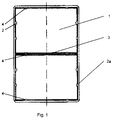
- These noses are designated by 2a in Fig. 1. In this way, the important sales information for the get fuller trays behind.
- Holding lugs that are a few tenths of a millimeter or larger are often sufficient Jump out one to two millimeters more and / or be wider and / or higher are, but in particular project more and / or are higher.
- FIG. 1 A particularly advantageous is shown in FIG. 1 described below Execution explained in more detail without wishing to restrict the invention.
- Figure 1 shows a sales tray according to the invention in plan view.
- the Lugs 2 according to the invention are located on the inside of the side walls of the tray 1 different sizes and 2a (retaining lugs) for the six to be accommodated Objects.
- the retaining nose 2a and the opposite nose are preferably used for this purpose stronger than the other retaining lugs 2.
- This is through the intermediate web 3 Split the tray in the middle so that a front and a rear partial shell are formed. It can hold three items each.
- the front wall, the The rear wall and the side walls of the intermediate web carry projections 4 which create the front or back surfaces of the objects.
- Objects without intermediate webs can be fixed in the tray according to the invention and removed, without thereby fixing the remaining Objects is affected.
- the noses or retaining lugs according to the invention ensure individual removal without the stability of the remaining containers to affect.
- the tray is suitable, for example, for holding objects, packs, boxes, bags that are offered upright in a small footprint and that would fall over without a holder.
- cosmetics, medical products, pharmaceuticals and products of the food or luxury food industry can advantageously be offered, for example plasters, for example in flat cardboard boxes, cigarettes, confectionery, but also games, sound and image carriers, cassettes, diskettes, electronic components, Office supplies or textiles.
- the tray according to the invention can be produced, for example, from plastic, cardboard, cardboard, corrugated cardboard, paper mache or paper mache.
- Suitable plastics are, for example, polyethylene, polyester, polypropylene, polystyrene, foamed plastics, in particular rigid foams, for example foamed polystyrene, in particular rigid polystyrene foam, or EPS foams, for example Styropor®.
- the material can be transparent or colored. Foamed materials offer high strength and low weight and protect sensitive objects. Paper mache or paper mache is also particularly suitable for these reasons, for example, since the holding lugs can be molded from this material much better than intermediate webs and the environmental impact of this material is low.
- Trays according to the invention can be used with less material and also more easily be produced because there are no intermediate webs.
- the material saving is also with the Disposal is advantageous and therefore saves resources.
- the trays can be loaded more easily and quickly, especially by hand. They also take up less space because the width of the intermediate webs is 1-3mm can be saved several times.
Landscapes
- Engineering & Computer Science (AREA)
- Mechanical Engineering (AREA)
- Ceramic Engineering (AREA)
- Packages (AREA)
- Details Of Rigid Or Semi-Rigid Containers (AREA)
- Table Equipment (AREA)
Abstract
Description

Auf diese Weise können vorteilhaft Kosmetika, Medical-Produkte, Pharmazeutika und Produkte der Lebensmittel- oder Genußmittelindustrie angeboten werden, z.B. Pflaster, z.B. in flachen Kartonschachteln, Zigaretten, Süßwaren, aber auch Spiele, Ton- und Bildträger, Kassetten, Disketten, elektronische Bauteile, Büromaterialien oder Textilien.
Geeignete Kunststoffe sind z.B. Polyethylen, Polyester, Polypropylen, Polystyrol, geschäumte Kunststoffe, insbesondere Hartschaumstoffe, z.B. geschäumtes Polystyrol, insbesondere Polystyrolhartschaum oder EPS-Schaumstoffe, z.B. Styropor®. Das Material kann durchsichtig oder farbig sein. Geschäumte Materialien bieten hohe Festigkeit bei niedrigem Gewicht und schützen empfindliche Gegenstände. Auch Papiermaché oder Pappmaché ist z.B. aus diesen Gründen besonders geeignet, da die Haltenasen sich aus diesem Material viel besser formen lassen als Zwischenstege und die Umweltbelastung bei diesem Material gering ist.
Claims (7)
- Tray mit Haltevorrichtungen für die vorgesehenen Gegenstände, dadurch gekennzeichnet, daß es als Haltevorrichtungen an seinen Seitenwänden Nasen besitzt.
- Tray gemäß Anspruch 1, dadurch gekennzeichnet, daß die Nasen paarweise gegenüberliegend symmetrisch angeordnet sind.
- Tray gemäß Anspruch 1 oder 2, dadurch gekennzeichnet, daß es vorzugsweise rechteckig ist und vier Nasenpaare und einen, vorzugsweise in der Mitte angeordneten, Zwischensteg besitzt.
- Tray gemäß den Ansprüchen 1 bis 3, dadurch gekennzeichnet, daß das erste Haltenasenpaar, das der Vorderwand benachbart ist, größer ausgebildet ist.
- Tray gemäß den Ansprüchen 1 bis 4, dadurch gekennzeichnet, daß es aus Kunststoff, Pappmaché oder geschäumtem Kunststoff, insbesondere EPS-Schaumstoff, z.B. Styropor® hergestellt ist.
- Verwendung des Trays gemäß den Ansprüchen 1 bis 5 für Gegenstände mit abgerundeten oder abgeschrägten Kanten, insbesondere für Kartonschachtein oder Faltschachteln.
- Verwendung des Trays gemäß den Ansprüchen 1 bis 5 für verpackte Kosmetika, Medical-Produkte und Pharmazeutika, beispielsweise Pflaster, die insbesondere in Faltschachteln oder Kartonschachteln verpackt sind.
Applications Claiming Priority (2)
| Application Number | Priority Date | Filing Date | Title |
|---|---|---|---|
| DE1998116249 DE19816249A1 (de) | 1998-04-14 | 1998-04-14 | Verkaufstray |
| DE19816249 | 1998-04-14 |
Publications (3)
| Publication Number | Publication Date |
|---|---|
| EP0950366A2 true EP0950366A2 (de) | 1999-10-20 |
| EP0950366A3 EP0950366A3 (de) | 2000-09-27 |
| EP0950366B1 EP0950366B1 (de) | 2007-06-13 |
Family
ID=7864324
Family Applications (1)
| Application Number | Title | Priority Date | Filing Date |
|---|---|---|---|
| EP19990106841 Expired - Lifetime EP0950366B1 (de) | 1998-04-14 | 1999-04-07 | Verkaufstray |
Country Status (3)
| Country | Link |
|---|---|
| EP (1) | EP0950366B1 (de) |
| DE (2) | DE19816249A1 (de) |
| ES (1) | ES2287992T3 (de) |
Cited By (2)
| Publication number | Priority date | Publication date | Assignee | Title |
|---|---|---|---|---|
| CN102963593A (zh) * | 2012-12-08 | 2013-03-13 | 张家港市天江精密模具制造有限公司 | 抗震型化妆品包装盒 |
| USD1115451S1 (en) | 2024-12-10 | 2026-03-03 | GoTo Foods LLC | Cake display tray |
Families Citing this family (1)
| Publication number | Priority date | Publication date | Assignee | Title |
|---|---|---|---|---|
| DE202014007430U1 (de) | 2014-09-11 | 2014-11-13 | Kornwestheimr Bio-Marketing Gmbh | Verpackungsanordnung |
Family Cites Families (5)
| Publication number | Priority date | Publication date | Assignee | Title |
|---|---|---|---|---|
| US2967002A (en) * | 1956-07-02 | 1961-01-03 | Delmar R Lammers | Protective tray for cartons |
| DE7436808U (de) * | 1974-11-05 | 1975-02-13 | Osthushenrich Kg | Tray fuer mehrere Behaelter |
| US4616762A (en) * | 1985-04-02 | 1986-10-14 | Ekco Products, Inc. | Disposable cooking pan |
| US4863094A (en) * | 1988-08-08 | 1989-09-05 | Morrow Marvin D | Two piece tray |
| DE29503625U1 (de) * | 1995-03-03 | 1995-04-27 | Siemens AG, 80333 München | Tablar zur Aufnahme von Ladungsgut |
-
1998
- 1998-04-14 DE DE1998116249 patent/DE19816249A1/de not_active Withdrawn
-
1999
- 1999-04-07 EP EP19990106841 patent/EP0950366B1/de not_active Expired - Lifetime
- 1999-04-07 DE DE59914371T patent/DE59914371D1/de not_active Expired - Fee Related
- 1999-04-07 ES ES99106841T patent/ES2287992T3/es not_active Expired - Lifetime
Cited By (2)
| Publication number | Priority date | Publication date | Assignee | Title |
|---|---|---|---|---|
| CN102963593A (zh) * | 2012-12-08 | 2013-03-13 | 张家港市天江精密模具制造有限公司 | 抗震型化妆品包装盒 |
| USD1115451S1 (en) | 2024-12-10 | 2026-03-03 | GoTo Foods LLC | Cake display tray |
Also Published As
| Publication number | Publication date |
|---|---|
| EP0950366A3 (de) | 2000-09-27 |
| DE59914371D1 (de) | 2007-07-26 |
| DE19816249A1 (de) | 1999-10-21 |
| ES2287992T3 (es) | 2007-12-16 |
| EP0950366B1 (de) | 2007-06-13 |
Similar Documents
| Publication | Publication Date | Title |
|---|---|---|
| DE69828039T2 (de) | Umwandelbare verpackungsausgabevorrichtung | |
| DE60205230T2 (de) | Behälter zum aufbewahren und spenden eines produkts | |
| CH442137A (de) | Transport- und Schaupackung für auf Trägerplatten befestigte Kleingegenstände | |
| EP0505687B1 (de) | Verpackung zur Präsentation quaderförmiger Waren | |
| DE9413673U1 (de) | Faltpackung für Waren | |
| EP0455593A1 (de) | Verpackung für stossempfindliche Gebrauchsgüter | |
| EP3583040B1 (de) | Faltschachtel aus karton | |
| DE19532162C2 (de) | Verpackung aus Karton und Verfahren zur Herstellung einer Verpackung | |
| EP0950366B1 (de) | Verkaufstray | |
| DE29602301U1 (de) | Verpackungsanordnung | |
| DE29603563U1 (de) | Sammelpackung und Folie als Sammelelement | |
| EP0473909B1 (de) | Behälter zum Aufnehmen eines Stapels von Wareneinheiten | |
| DE4339645A1 (de) | Faltschachtel | |
| AT392620B (de) | Einstueckiger zuschnitt fuer eine transport- und schauverpackung fuer z.b. in schachteln gelagerte waren | |
| EP0423754B1 (de) | Versand- und Verkaufsbehälter | |
| DE4140773C2 (de) | Faltzuschnitt für eine Verkaufsverpackung | |
| CH680280A5 (en) | Small piece goods package - comprises top and bottom portions with alternating deep and shallow recesses and offset | |
| EP4313783B1 (de) | Messerverpackung | |
| DE9306644U1 (de) | Verpackung für formstabile Gegenstände | |
| DE2923228A1 (de) | Verpackung fuer gluehbirnen | |
| EP0942876B1 (de) | Verfahren zur stapelung von mit nicht selbsttragenden gebinden befüllbaren umverpackungen mit trays und stülpdeckeln | |
| DE7540673U (de) | Verpackungsschale | |
| DE8412387U1 (de) | Aus Pappe, Wellpappe oder ähnlichem faltbarem Material bestehender Zuschnitt zur Herstellung von quaderförmigen Verpackungsbehältnissen | |
| DE29509114U1 (de) | Doppelkammer-Ampullenverpackung | |
| DE4136798A1 (de) | Blisterverpackung |
Legal Events
| Date | Code | Title | Description |
|---|---|---|---|
| PUAI | Public reference made under article 153(3) epc to a published international application that has entered the european phase |
Free format text: ORIGINAL CODE: 0009012 |
|
| AK | Designated contracting states |
Kind code of ref document: A2 Designated state(s): DE ES FR GB IT SE |
|
| AX | Request for extension of the european patent |
Free format text: AL;LT;LV;MK;RO;SI |
|
| PUAL | Search report despatched |
Free format text: ORIGINAL CODE: 0009013 |
|
| AK | Designated contracting states |
Kind code of ref document: A3 Designated state(s): AT BE CH CY DE DK ES FI FR GB GR IE IT LI LU MC NL PT SE |
|
| AX | Request for extension of the european patent |
Free format text: AL;LT;LV;MK;RO;SI |
|
| 17P | Request for examination filed |
Effective date: 20010303 |
|
| AKX | Designation fees paid |
Free format text: DE ES FR GB IT SE |
|
| 17Q | First examination report despatched |
Effective date: 20040216 |
|
| GRAP | Despatch of communication of intention to grant a patent |
Free format text: ORIGINAL CODE: EPIDOSNIGR1 |
|
| GRAS | Grant fee paid |
Free format text: ORIGINAL CODE: EPIDOSNIGR3 |
|
| GRAA | (expected) grant |
Free format text: ORIGINAL CODE: 0009210 |
|
| AK | Designated contracting states |
Kind code of ref document: B1 Designated state(s): DE ES FR GB IT SE |
|
| REG | Reference to a national code |
Ref country code: GB Ref legal event code: FG4D Free format text: NOT ENGLISH |
|
| REF | Corresponds to: |
Ref document number: 59914371 Country of ref document: DE Date of ref document: 20070726 Kind code of ref document: P |
|
| PG25 | Lapsed in a contracting state [announced via postgrant information from national office to epo] |
Ref country code: SE Free format text: LAPSE BECAUSE OF FAILURE TO SUBMIT A TRANSLATION OF THE DESCRIPTION OR TO PAY THE FEE WITHIN THE PRESCRIBED TIME-LIMIT Effective date: 20070913 |
|
| GBT | Gb: translation of ep patent filed (gb section 77(6)(a)/1977) |
Effective date: 20070828 |
|
| ET | Fr: translation filed | ||
| REG | Reference to a national code |
Ref country code: ES Ref legal event code: FG2A Ref document number: 2287992 Country of ref document: ES Kind code of ref document: T3 |
|
| PLBE | No opposition filed within time limit |
Free format text: ORIGINAL CODE: 0009261 |
|
| PG25 | Lapsed in a contracting state [announced via postgrant information from national office to epo] |
Ref country code: IT Free format text: LAPSE BECAUSE OF FAILURE TO SUBMIT A TRANSLATION OF THE DESCRIPTION OR TO PAY THE FEE WITHIN THE PRESCRIBED TIME-LIMIT Effective date: 20070613 |
|
| 26N | No opposition filed |
Effective date: 20080314 |
|
| GBPC | Gb: european patent ceased through non-payment of renewal fee |
Effective date: 20080407 |
|
| PG25 | Lapsed in a contracting state [announced via postgrant information from national office to epo] |
Ref country code: DE Free format text: LAPSE BECAUSE OF NON-PAYMENT OF DUE FEES Effective date: 20081101 |
|
| REG | Reference to a national code |
Ref country code: FR Ref legal event code: ST Effective date: 20081231 |
|
| PG25 | Lapsed in a contracting state [announced via postgrant information from national office to epo] |
Ref country code: FR Free format text: LAPSE BECAUSE OF NON-PAYMENT OF DUE FEES Effective date: 20080430 |
|
| REG | Reference to a national code |
Ref country code: ES Ref legal event code: FD2A Effective date: 20080408 |
|
| PG25 | Lapsed in a contracting state [announced via postgrant information from national office to epo] |
Ref country code: GB Free format text: LAPSE BECAUSE OF NON-PAYMENT OF DUE FEES Effective date: 20080407 |
|
| PG25 | Lapsed in a contracting state [announced via postgrant information from national office to epo] |
Ref country code: ES Free format text: LAPSE BECAUSE OF NON-PAYMENT OF DUE FEES Effective date: 20080408 |
|
| PLAA | Information modified related to event that no opposition was filed |
Free format text: ORIGINAL CODE: 0009299DELT |
|
| PLBE | No opposition filed within time limit |
Free format text: ORIGINAL CODE: 0009261 |
|
| STAA | Information on the status of an ep patent application or granted ep patent |
Free format text: STATUS: NO OPPOSITION FILED WITHIN TIME LIMIT |
|
| R26N | No opposition filed (corrected) |
Effective date: 20080314 |
|
| RIN2 | Information on inventor provided after grant (corrected) |
Inventor name: HUENE, KARL-HEINRICH Inventor name: WEHMANN, MARTIN |