EP0948565B1 - Vernetzbare mischungen und ein verfahren zu deren herstellung - Google Patents
Vernetzbare mischungen und ein verfahren zu deren herstellung Download PDFInfo
- Publication number
- EP0948565B1 EP0948565B1 EP97952952A EP97952952A EP0948565B1 EP 0948565 B1 EP0948565 B1 EP 0948565B1 EP 97952952 A EP97952952 A EP 97952952A EP 97952952 A EP97952952 A EP 97952952A EP 0948565 B1 EP0948565 B1 EP 0948565B1
- Authority
- EP
- European Patent Office
- Prior art keywords
- component
- mixture according
- crosslinkable mixture
- components
- platinum
- Prior art date
- Legal status (The legal status is an assumption and is not a legal conclusion. Google has not performed a legal analysis and makes no representation as to the accuracy of the status listed.)
- Expired - Lifetime
Links
- 0 CCC(C)(OC1C(*)=C(*)C(*)=C(C)C1C)P Chemical compound CCC(C)(OC1C(*)=C(*)C(*)=C(C)C1C)P 0.000 description 1
Classifications
-
- C—CHEMISTRY; METALLURGY
- C08—ORGANIC MACROMOLECULAR COMPOUNDS; THEIR PREPARATION OR CHEMICAL WORKING-UP; COMPOSITIONS BASED THEREON
- C08K—Use of inorganic or non-macromolecular organic substances as compounding ingredients
- C08K5/00—Use of organic ingredients
- C08K5/49—Phosphorus-containing compounds
- C08K5/51—Phosphorus bound to oxygen
- C08K5/52—Phosphorus bound to oxygen only
- C08K5/524—Esters of phosphorous acids, e.g. of H3PO3
- C08K5/526—Esters of phosphorous acids, e.g. of H3PO3 with hydroxyaryl compounds
-
- C—CHEMISTRY; METALLURGY
- C08—ORGANIC MACROMOLECULAR COMPOUNDS; THEIR PREPARATION OR CHEMICAL WORKING-UP; COMPOSITIONS BASED THEREON
- C08K—Use of inorganic or non-macromolecular organic substances as compounding ingredients
- C08K5/00—Use of organic ingredients
- C08K5/49—Phosphorus-containing compounds
- C08K5/51—Phosphorus bound to oxygen
Definitions
- the present invention relates to crosslinkable mixtures and a process for their preparation.
- addition-crosslinking silicone rubber systems the problem generally arises that the reactive mixture once produced has a finite curing rate even at room temperature. This is particularly noticeable when the machines are idle for a long time due to technical malfunctions or other causes.
- the reactive silicone rubber mixture in the machine can also cross-link at room temperature, which results in very complex cleaning work before restarting. For this reason, there has long been a need on the market for addition-crosslinking silicone rubber systems which ideally do not cure at room temperature and have the highest possible reaction rate under processing conditions.
- so-called inhibitors are usually added to the rubber systems.
- One group of inhibitors are organophosphorus compounds.
- DE-A-3 635 236 describes the use of cyclometallized platinum phosphite complexes to increase the storage stability at room temperature.
- the catalyst inhibitor complexes mentioned therein increase the pot life at room temperature, but have the disadvantage that they are complex to produce, which is associated with additional production costs.
- EP-A-662 490 (US 5380812) generally describes organophosphorus compounds as inhibitors in addition-crosslinking silicone systems.
- DE-P 19532316.5 describes crosslinkable addition-crosslinking mixtures which, in addition to a hydrosilylation catalyst, contain an organophosphorus compound and an inhibitor.
- the setting described there using a two-component system is complex. Mixtures which have a complete inhibition at room temperature and the complete non-influence on the reaction rate under curing conditions with an additive have hitherto not been known.
- the object was therefore to provide suitable mixtures which are also suitable for rapid, addition-crosslinking silicone systems contribute to the activity of the catalyst Reduce room temperature without increasing the curing times under reaction conditions extend.
- the mixing should be as simple as possible, i.e. from as few components as possible, be constructed.
- Component a) in the sense of the invention is preferably a cyclic, linear or branched polysiloxane which consists of units of the general formula (II) (R 3 ) a (R 4 ) b SiO (4-ab) / 2) is constructed.
- R 3 is a C 2 -C 8 alkenyl radical, for example vinyl, allyl, 1-butenyl, 1-hexenyl etc.
- the alkenyl radicals can be bonded to silicon atoms within the chain or at the end thereof.
- R 4 is a monovalent, saturated hydrocarbon radical with up to 10 carbon atoms from the group of substituted and unsubstituted alkyl, aryl and arylalkyl radicals.
- Examples of the monovalent radicals R 4 are methyl, ethyl, propyl, isopropyl, butyl, octyl, etc., cyclobutyl, cyclopentyl, cyclohexyl, etc., phenyl, tolyl, xylyl, naphthyl, etc. benzyl, phenylethyl, phenylpropyl.
- the integers a and b are 0 ⁇ a ⁇ 3 and 0 ⁇ b ⁇ 3 and 0 ⁇ a + b ⁇ 4.
- a is 0 or 1.
- R4 of the present invention some or all of the hydrogen atoms can pass through Fluorine and / or chlorine, bromine or iodine atoms or cyano radicals can be substituted.
- R4 can also be a chloromethyl, trifluoropropyl, chlorophenyl, dibromophenyl, cyanoethyl, cyanopropyl or cyanopropyl radical, for example.
- the molar proportion of unsaturated radicals of the type R 3 can be chosen as desired.
- the molar proportion of unsaturated radicals of the type R 3 should preferably be between 10 -3 and 10 mmol per gram.
- the viscosity of component a) is preferably between 10 -3 and 1,000,000 Pa.s at 25 ° C.
- Component b) for the purposes of the present invention is a polysiloxane which consists of units of the general formula (III) H c (R 4 ) d SiO (4-cd) / 2 is built up, wherein R 4 has already been defined above and R 4 may optionally also have the meaning of R 3 .
- the stoichiometric indices c and d are integers with 0 d d 3 3 and 0 c c 2 2 and 0 c c + d 4. 4. 0 c c 1 1 is preferred.
- the molar proportion of hydrogen atoms directly bonded to a silicon atom in component b) can be chosen as desired.
- Component b) preferably has a molar proportion of directly to a silicon atom bound hydrogen atoms between 0.01 and 17 mmol, especially preferably between 0.1 and 17 mmol and very particularly preferably between 1 and 17 mmol per gram of component b).
- components a) and should preferably b) are present in such a ratio that the molar ratio of direct hydrogen atoms (SiH) bonded to a silicon atom in component b) the unsaturated residues (Si-vinyl) in component a) are between 0.05 and 20, particularly preferably between 0.5 and 10 and very particularly preferably between 1 and 5.
- Component c) in the sense of the invention preferably comprises the elements platinum, rhodium, iridium, nickel, ruthenium and / or palladium in elementary form on a carrier substance or in the form of their compounds.
- Platinum compounds or platinum complexes such as, for example, H 2 PtCl 6 , platinum-olefin complexes, platinum-alcoholate complexes, platinum-vinylsiloxane complexes or else elemental platinum on a carrier substance, such as, for example, are preferred.
- Component c) is particularly preferably a platinum-vinylsiloxane complex.
- Platinum-vinylsiloxane complexes preferably have at least 2 olefinically unsaturated double bonds in the siloxane, see, for example, US Pat. No. 3,715,334.
- siloxane also includes polysiloxanes, i.e. for example vinyl polysiloxanes.
- the proportion of component c) in the total mixture should preferably be between 1 and 1000 ppm, particularly preferably between 1 and 500 ppm and entirely are particularly preferably between 1 and 100 ppm.
- the aliphatic radicals mentioned can be linear or branched; if appropriate, the H atoms contained therein can be replaced by groups such as -NH2, -COOH, -F, -Br, -Cl, -CN, -C 6 H 5 , -C 6 H 4 (CH 3 ) to be replaced.
- Component d) of the present invention is preferably in one Quantities from 1 ppm to 50,000 ppm, based on the total weight of the Mixture, added, particularly preferably 10 ppm to 10,000 ppm and very particularly preferably between 20 ppm and 2000 ppm.
- Components d) are e.g. according to the in methods of the organ. Chemistry, Huben-Weil, Volume XII / 2, 1964, 4th edition, p.59-61, described method can be produced.
- Auxiliaries (component e)) for the purposes of the invention are, for example, polysiloxane resins which are composed of building blocks of the general formulas (II) and (III), fillers which have a positive influence on the mechanical and electrical properties of the cured mixture according to the invention, such as pyrogenic and precipitated ones Silicas with a BET surface area of 50 to 500 m 2 / g.
- Such fillers can be surface-modified, for example with organosilicon compounds.
- the modification can also be achieved during incorporation into the polymer by adding, for example, ⁇ , ⁇ -OH end-stopped oligo- or polysiloxanes or hexamethyldisilazane or 1,3-divinyl-1,1,3,3-tetramethyldisilazane with the addition of water.
- Substances such as diatomaceous earth, finely divided quartz powder, amorphous silicas or carbon blacks as well as Al (OH) 3 , ceramizable oxides and the like can also be used as fillers. be used.
- the mixtures according to the invention contain additionally water or an organic solvent.
- components a) and b) are present in such a ratio, that the SiH: Si-vinyl ratio is between 0.1 and 10, the content of component c) between 1 and 1000 ppm, the content of component d) is between 0.0001 and 5%, the quantities given relate to the total weight of the mixture.
- This invention also relates to a process for the preparation of the invention crosslinkable mixtures.
- Components a) are preferably and d) mixed, then component c) added and finally the component b) added. It is also possible to produce a mixture of a) and b), the addition of b) and finally c). The dosing of the component c) ensures (in addition to the composition) a reduction in the reaction rate.
- the invention also relates to the use of phosphorus compounds Formula I as an inhibitor and the use of a mixture of at least one Phosphorus compound of formula I and a Pt compound or Pt elementary Control of crosslinking speed in addition crosslinking silicone systems.
- connections used can be defined as follows: description Chem. Composition viscosity Si-Vi content Si-H content Polysiloxane A M Vi 2 D n 1000 Pa s 0.005 mmol g -1 - Polysiloxane B M 2 D n D Vi m 1150 Pa s 0.024 mmol g -1 - Polysiloxane C M 2 D n D H m 35 mPa s - 4.3 mmol g -1 Polysiloxane D M Vi 2 D n 10 Pa s 0.05 mmol g -1 -
- the parts of the basic mixture given in Table 1 were added below Listed amounts of inhibitor batch and catalyst batch added.
- the amount of catalyst batch was chosen so that the content of metallic Pt in all mixtures 10 ppm, based on the weight of the total mixture, was.
- the amount of inhibitor batch was chosen so that the molar ratio of organic phosphorus Compound to Pt complex was 2: 1 in all mixtures.
Landscapes
- Chemical & Material Sciences (AREA)
- Chemical Kinetics & Catalysis (AREA)
- Medicinal Chemistry (AREA)
- Polymers & Plastics (AREA)
- Organic Chemistry (AREA)
- Health & Medical Sciences (AREA)
- Compositions Of Macromolecular Compounds (AREA)
- Processes Of Treating Macromolecular Substances (AREA)
- Detergent Compositions (AREA)
- Silicon Polymers (AREA)
- Addition Polymer Or Copolymer, Post-Treatments, Or Chemical Modifications (AREA)
- Pharmaceuticals Containing Other Organic And Inorganic Compounds (AREA)
- Organic Low-Molecular-Weight Compounds And Preparation Thereof (AREA)
- Transition And Organic Metals Composition Catalysts For Addition Polymerization (AREA)
- Organic Insulating Materials (AREA)
Description
Bei der Verwendung additionsvernetzender Siliconkautschuksysteme taucht allgemein das Problem auf, daß die einmal hergestellte reaktive Mischung auch bei Raumtemperatur eine endliche Aushärtegeschwindigkeit besitzt. Dies macht sich insbesondere dann störend bemerkbar, wenn die Maschinen aufgrund technischer Störungen oder anderer Ursachen längere Zeit stillstehen. In so einem Fall kann die in den Maschinen befindliche reaktive Siliconkautschukmischung auch bei Raumtemperatur vernetzen, was sehr aufwendige Reinigungsarbeiten vor der Wiederinbetriebnahme zur Folge hat.
Aus diesem Grund besteht am Markt seit langer Zeit der Bedarf nach additionsvernetzenden Siliconkautschuksystemen, die idealerweise bei Raumtemperatur überhaupt nicht aushärten und bei Verarbeitungsbedingungen eine möglichst hohe Reaktionsgeschwindigkeit haben.
Zur Realisierung dieses Zieles werden üblicherweise sogenannte Inhibitoren den Kautschuksystemen zugesetzt. Eine Gruppe von Inhibitoren sind phosphororganische Verbindungen. So wird beispielsweise in DE-A-3 635 236 die Verwendung cyclometallisierter Platinphosphitkomplexe zur Erhöhung der Lagerstabilität bei Raumtemperatur beschrieben. Die dort erwähnten Katalysatorinhibitorkomplexe erhöhen die Topfzeit bei Raumtemperatur, haben jedoch den Nachteil, daß sie aufwendig herzustellen sind, was mit zusätzlichen Kosten bei der Produktion verbunden ist. In EP-A-662 490 (US 5380812) werden allgemein phosphororganische Verbindungen als Inhibitoren in additionsvernetzenden Siliconsystemen beschrieben. Die dort erwähnten aliphatischen und aromatischen Phosphine haben jedoch den Nachteil, daß sie bei Verarbeitungsbedingungen (T = 120 bis 170°C) eine deutliche Verlangsamung der Reaktionsgeschwindigkeit verursachen. In DE-P 19532316.5 werden vernetzbare additionsvernetzende Mischungen beschrieben, die neben einem Hydrosilylierungskatalysator eine phosphororganische Verbindung und einen Inhibitor enthalten. Die dort beschriebene Einstellung über eine 2-Komponentensystem ist jedoch aufwendig. Mischungen, die eine völlige Inhibierung bei Raumtemperatur und die völlige Nichtbeeinflussung der Reaktionsgeschwindigkeit unter Aushärtebedingungen mit einem Zusatzstoff aufweisen, sind bislang nicht bekannt.
und
- M:
- (CH3)3SiO1/2
- D:
- (CH3)2SiO2/2
- T:
- (CH3)SiO3/2
- MVi:
- (CH2=CH)(CH3)2SiO1/2
- DVi:
- (CH2=CH)(CH3)SiO2/2
- Q:
- SiO4/2
- MH:
- H(CH3)2SiO1/2
- DH:
- H(CH3)SiO2/2
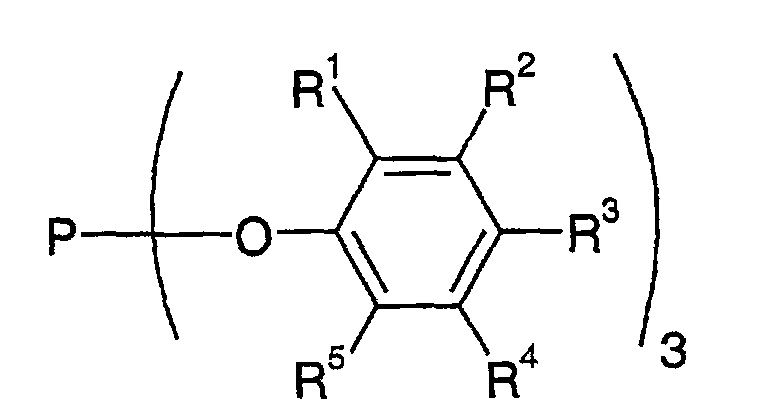
R1, R2, R3, R4, R5 = H, CnH2n+1 und n = 1-15, CaH2a-1 und a = 3-15 und/oder CnP2n+1,
wobei
R1, R2, R3, R4 und R5 gleich oder verschieden sein können und nicht alle Reste R1, R2, R3, R4 und R5 = H sind, und worin die genannten aliphatischen Reste linear oder verzweigt sind.
daß das Verhältnis SiH:Si-Vinyl zwischen 0,1 und 10,
der Gehalt an Komponente c) zwischen 1 und 1000 ppm,
der Gehalt an Komponente d) zwischen 0,0001 bis 5 % liegt,
wobei sich die Mengenangaben jeweils auf das Gesamtgewicht der Mischung beziehen.
| Bezeichnung | Chem. Zusammensetzung | Viskosität | Si-Vi-Gehalt | Si-H-Gehalt |
| Polysiloxan A | MVi 2Dn | 1000 Pa s | 0,005 mmol g-1 | - |
| Polysiloxan B | M2DnDVi m | 1150 Pa s | 0,024 mmol g-1 | - |
| Polysiloxan C | M2DnDH m | 35 mPa s | - | 4,3 mmol g-1 |
| Polysiloxan D | MVi 2Dn | 10 Pa s | 0,05 mmol g-1 | - |
- 99,88 Gew.-% Polysiloxan D und
- 0,22 Gew.-% Pt (in Form eines Vinylsiloxankomplexes)
| Einsatzmengen, angegeben in Gew.-Teilen | |||
| Einwaagen an | R = Phenyl | R = 4-tert.-Butylphenyl | R = 2,4-ditert.-Butylphenyl |
| Grundmischung | 95,6 | 93,5 | 91,2 |
| Inhibitorbatch | 4,2 | 6,5 | 8,8 |
| Katalysatorbatch | 0,5 | 0,5 | 0,5 |
| R = | t60-Zeit bei T = 140 °C |
| Phenyl | 19,73 |
| 4-tert.-Butylphenyl | 9,69 |
| 2,4-di-tert.-Butylphenyl | 1,22 |
Claims (7)
- Vernetzbare Mischung, enthaltend als Komponentena) mindestens ein Polysiloxan, das über mindestens zwei olefinisch oder acetylenisch ungesättigte Mehrfachbindungen verfügt,b) mindestens ein Polyhydrogensiloxan, das über mindestens zwei direkt an das Silizium gebundene Wasserstoffatome verfügt,c) mindestens eine die Hydrosilylierung katalysierende Substanz,d) mindestens eine Phosphorverbindung der allgemeinen Formelmit

R1, R2, R3, R4, R5 = H, CnH2n+1 und n = 1-15, CaH2a-1 und a = 3-15 und/oder CnF2n+1,
wobei
R1, R2, R3, R4 und R5 gleich oder verschieden sein können und nicht alle Reste R1, R2, R3, R4 und R5 = H sind, und worin die genannten aliphatischen Reste linear oder verzweigt sind und die darin enthaltenen H-Atome gegebenenfalls durch die Gruppen ausgewählt aus -NH2, -COOH, -F, -Br, -Cl, -CN, -C6H5, -C6H4(CH3) ersetzt sein können,
unde) gegebenenfalls weitere Hilfsstoffe. - Vernetzbare Mischung nach Anspruch 1, dadurch gekennzeichnet, daß die Komponente c) eine Pt-Verbindung oder Platinkomplexe oder elementares Platin auf einer Trägersubstanz ist.
- Vernetzbare Mischung nach einem der Ansprüche 1 oder 2, dadurch gekennzeichnet, daß Komponente c) ein Platin-Vinylsiloxankomplex ist, in dem das Siloxan über mindestens zwei olefinisch ungesättigte Doppelbindungen verfügt.
- Vernetzbare Mischung nach einem oder mehreren der Ansprüche 1 bis 3, dadurch gekennzeichnet, daß diese zusätzlich Wasser enthalten kann.
- Vernetzbare Mischung nach einem oder mehreren der Ansprüche 1 bis 3, dadurch gekennzeichnet, daß diese zusätzlich ein organisches Lösungsmittel enthalten kann.
- Vernetzbare Mischung nach einem oder mehreren der Ansprüche 1 bis 5, dadurch gekennzeichnet, daß die Komponenten a) und b) in einem solchen Mengenverhältnis vorliegen, daß das Verhältnis SiH:Si-Vinyl zwischen 0,01 und 300 beträgt, der Gehalt an Komponente c) zwischen 0,1 und 1000 ppm, der Gehalt an Komponente d) zwischen 0,0001% bis 5 % liegt, wobei sich die Mengenangaben jeweils auf das Gesamtgewicht der Mischung beziehen.
- Verfahren zur Herstellung einer vernetzbaren Mischung nach einem oder mehreren der Ansprüche 1 bis 6, dadurch gekennzeichnet, daß die Komponenten a) und d) vermischt, anschließend die Komponenten c) und zuletzt die Komponente b) zugegeben werden.
Applications Claiming Priority (3)
| Application Number | Priority Date | Filing Date | Title |
|---|---|---|---|
| DE19654690 | 1996-12-30 | ||
| DE19654690 | 1996-12-30 | ||
| PCT/EP1997/007084 WO1998029497A1 (de) | 1996-12-30 | 1997-12-17 | Vernetzbare mischungen und ein verfahren zu deren herstellung |
Publications (2)
| Publication Number | Publication Date |
|---|---|
| EP0948565A1 EP0948565A1 (de) | 1999-10-13 |
| EP0948565B1 true EP0948565B1 (de) | 2003-05-21 |
Family
ID=7816401
Family Applications (1)
| Application Number | Title | Priority Date | Filing Date |
|---|---|---|---|
| EP97952952A Expired - Lifetime EP0948565B1 (de) | 1996-12-30 | 1997-12-17 | Vernetzbare mischungen und ein verfahren zu deren herstellung |
Country Status (20)
| Country | Link |
|---|---|
| US (1) | US6300455B1 (de) |
| EP (1) | EP0948565B1 (de) |
| JP (2) | JP4181639B2 (de) |
| KR (1) | KR20000069773A (de) |
| AT (1) | ATE240987T1 (de) |
| AU (1) | AU741611B2 (de) |
| BR (1) | BR9714444A (de) |
| CA (1) | CA2276010A1 (de) |
| DE (1) | DE59710143D1 (de) |
| ES (1) | ES2200214T3 (de) |
| HU (1) | HUP0000784A3 (de) |
| ID (1) | ID22339A (de) |
| IL (1) | IL130466A0 (de) |
| NO (1) | NO317290B1 (de) |
| PL (1) | PL189704B1 (de) |
| SI (1) | SI20077A (de) |
| SK (1) | SK89399A3 (de) |
| TR (1) | TR199901506T2 (de) |
| WO (1) | WO1998029497A1 (de) |
| ZA (1) | ZA9711636B (de) |
Cited By (2)
| Publication number | Priority date | Publication date | Assignee | Title |
|---|---|---|---|---|
| EP2050768A1 (de) * | 2007-10-02 | 2009-04-22 | Wacker Chemie AG | Härtbare Siliconzusammensetzungen |
| WO2010009755A1 (en) * | 2008-07-21 | 2010-01-28 | Momentive Performance Materials Gmbh | Curable silicone compositions comprising aryl-phosphites |
Families Citing this family (17)
| Publication number | Priority date | Publication date | Assignee | Title |
|---|---|---|---|---|
| HUP0000784A3 (en) * | 1996-12-30 | 2001-02-28 | Ge Bayer Silicones Gmbh & Co | Cross-linkable mixtures and method for producing same |
| FR2847900B1 (fr) * | 2002-12-02 | 2006-06-09 | Rhodia Chimie Sa | Ensemble catalytique pour hydrosilylation, son procede de preparation et composition silicone l'incorporant |
| WO2003092890A2 (fr) * | 2002-04-29 | 2003-11-13 | Rhodia Chimie | Ensemble catalytique pour hydrosilylation, son procede de preparation et compositions silicone l'incorporant |
| FR2838985B1 (fr) * | 2002-04-29 | 2005-03-18 | Rhodia Chimie Sa | Ensemble catalytique pour hydrosilylation et compositions silicone l'incorporant |
| FR2848215B1 (fr) * | 2002-12-04 | 2006-08-04 | Rhodia Chimie Sa | Composition elastomere silicone, adhesive, monocomposante et reticulable par polyaddition |
| US7067570B2 (en) * | 2002-12-10 | 2006-06-27 | Shin-Etsu Chemical Co., Ltd. | One-part organopolysiloxane gel composition |
| JP4530147B2 (ja) * | 2004-08-25 | 2010-08-25 | 信越化学工業株式会社 | 一液型オルガノポリシロキサンゲル組成物 |
| CN101208069B (zh) * | 2005-06-22 | 2012-05-02 | 3M创新有限公司 | 具有改进贮存行为的亲水化可固化的硅树脂印模材料 |
| DE102006016753A1 (de) * | 2006-04-10 | 2007-10-11 | Wacker Chemie Ag | Vernetzbare Massen auf der Basis von Organosiliciumverbindungen |
| JP2007308581A (ja) * | 2006-05-18 | 2007-11-29 | Shin Etsu Chem Co Ltd | 付加硬化型シリコーンゴム組成物の硬化方法及び付加硬化型シリコーンゴム組成物 |
| JP2009091403A (ja) * | 2007-10-04 | 2009-04-30 | Shin Etsu Chem Co Ltd | 付加硬化型シリコーンゴム組成物及びその硬化方法 |
| JP2009220384A (ja) * | 2008-03-17 | 2009-10-01 | Shin Etsu Chem Co Ltd | シリコーンゴム薄膜被覆層の形成方法、及びシリコーンゴム薄膜被覆物品 |
| MX2013002549A (es) | 2010-09-06 | 2013-09-02 | Bluestar Silicones France | Rodillo comprimible para impresora. |
| WO2014130603A1 (en) | 2013-02-25 | 2014-08-28 | 3M Innovative Properties Company | Stabilized dental impression composition, kit of parts and use thereof |
| TW201625754A (zh) * | 2014-11-21 | 2016-07-16 | 艾倫塔斯有限公司 | 單一成份、儲存穩定、可硬化之聚矽氧組成物 |
| US11667791B2 (en) * | 2019-07-25 | 2023-06-06 | Shin-Etsu Chemical Co., Ltd. | One-pack type curable silicone gel composition and cured silicone gel |
| JP2025518040A (ja) | 2022-05-25 | 2025-06-12 | モメンティブ パフォーマンス マテリアルズ ゲーエムベーハー | 新規な置換ホスファイト遷移金属化合物 |
Family Cites Families (5)
| Publication number | Priority date | Publication date | Assignee | Title |
|---|---|---|---|---|
| JPS5950256B2 (ja) * | 1979-07-27 | 1984-12-07 | 東芝シリコ−ン株式会社 | 硬化性ポリシロキサン組成物 |
| US5036117A (en) * | 1989-11-03 | 1991-07-30 | Dow Corning Corporation | Heat-curable silicone compositions having improved bath life |
| US5380812A (en) * | 1994-01-10 | 1995-01-10 | Dow Corning Corporation | One part curable compositions containing deactivated hydrosilation catalyst and method for preparing same |
| DE19532316C1 (de) * | 1995-09-01 | 1997-05-22 | Bayer Ag | Vernetzbare Polysiloxan-Mischungen, ein Verfahren zur Herstellung und deren Verwendung |
| HUP0000784A3 (en) * | 1996-12-30 | 2001-02-28 | Ge Bayer Silicones Gmbh & Co | Cross-linkable mixtures and method for producing same |
-
1997
- 1997-12-17 HU HU0000784A patent/HUP0000784A3/hu unknown
- 1997-12-17 SK SK893-99A patent/SK89399A3/sk unknown
- 1997-12-17 ID IDW990604A patent/ID22339A/id unknown
- 1997-12-17 ES ES97952952T patent/ES2200214T3/es not_active Expired - Lifetime
- 1997-12-17 SI SI9720092A patent/SI20077A/sl not_active IP Right Cessation
- 1997-12-17 PL PL97334880A patent/PL189704B1/pl unknown
- 1997-12-17 AT AT97952952T patent/ATE240987T1/de not_active IP Right Cessation
- 1997-12-17 WO PCT/EP1997/007084 patent/WO1998029497A1/de not_active Ceased
- 1997-12-17 US US09/319,846 patent/US6300455B1/en not_active Expired - Lifetime
- 1997-12-17 EP EP97952952A patent/EP0948565B1/de not_active Expired - Lifetime
- 1997-12-17 BR BR9714444A patent/BR9714444A/pt not_active Application Discontinuation
- 1997-12-17 DE DE59710143T patent/DE59710143D1/de not_active Expired - Lifetime
- 1997-12-17 KR KR1019997005912A patent/KR20000069773A/ko not_active Withdrawn
- 1997-12-17 TR TR1999/01506T patent/TR199901506T2/xx unknown
- 1997-12-17 AU AU56637/98A patent/AU741611B2/en not_active Expired
- 1997-12-17 IL IL13046697A patent/IL130466A0/xx unknown
- 1997-12-17 JP JP52957998A patent/JP4181639B2/ja not_active Expired - Lifetime
- 1997-12-17 CA CA002276010A patent/CA2276010A1/en not_active Abandoned
- 1997-12-29 ZA ZA9711636A patent/ZA9711636B/xx unknown
-
1999
- 1999-06-25 NO NO19993163A patent/NO317290B1/no not_active IP Right Cessation
-
2008
- 2008-02-04 JP JP2008023873A patent/JP2008189928A/ja active Pending
Cited By (2)
| Publication number | Priority date | Publication date | Assignee | Title |
|---|---|---|---|---|
| EP2050768A1 (de) * | 2007-10-02 | 2009-04-22 | Wacker Chemie AG | Härtbare Siliconzusammensetzungen |
| WO2010009755A1 (en) * | 2008-07-21 | 2010-01-28 | Momentive Performance Materials Gmbh | Curable silicone compositions comprising aryl-phosphites |
Also Published As
| Publication number | Publication date |
|---|---|
| SI20077A (sl) | 2000-04-30 |
| PL334880A1 (en) | 2000-03-27 |
| ATE240987T1 (de) | 2003-06-15 |
| US6300455B1 (en) | 2001-10-09 |
| NO317290B1 (no) | 2004-10-04 |
| BR9714444A (de) | 2000-03-21 |
| EP0948565A1 (de) | 1999-10-13 |
| JP2001508096A (ja) | 2001-06-19 |
| SK89399A3 (en) | 2000-01-18 |
| WO1998029497A1 (de) | 1998-07-09 |
| ES2200214T3 (es) | 2004-03-01 |
| PL189704B1 (pl) | 2005-09-30 |
| JP4181639B2 (ja) | 2008-11-19 |
| TR199901506T2 (xx) | 1999-09-21 |
| CA2276010A1 (en) | 1998-07-09 |
| IL130466A0 (en) | 2000-06-01 |
| AU741611B2 (en) | 2001-12-06 |
| ID22339A (id) | 1999-09-30 |
| HUP0000784A3 (en) | 2001-02-28 |
| HUP0000784A2 (en) | 2000-07-28 |
| NO993163L (no) | 1999-06-25 |
| NO993163D0 (no) | 1999-06-25 |
| KR20000069773A (ko) | 2000-11-25 |
| ZA9711636B (en) | 1998-07-08 |
| AU5663798A (en) | 1998-07-31 |
| JP2008189928A (ja) | 2008-08-21 |
| DE59710143D1 (de) | 2003-06-26 |
Similar Documents
| Publication | Publication Date | Title |
|---|---|---|
| WO1998029497A1 (de) | Vernetzbare mischungen und ein verfahren zu deren herstellung | |
| EP0011714B1 (de) | Verfahren zum Anlagern von Si-H-Verbindungen an aliphatische Mehrfachbindung | |
| DE2644555C2 (de) | ||
| EP0761759B1 (de) | Vernetzbare Siliconzusammensetzungen, ein Verfahren zur Herstellung und deren Verwendung | |
| DE2646726C2 (de) | Die Anlagerung verzögerndes Mittel bei der durch Platinkatalysator geförderten und bei Raumtemperatur erfolgenden Anlagerung von Si-gebundenem Wasserstoff an mindestens 50 Si-Atome je Molekul und aliphatische Mehrfachbindungen enthaltendes Organopolysiloxan | |
| DE2423531C3 (de) | Verfahren zur Herstellung von zu Elastomeren härtbaren Organopolysiloxanmassen | |
| DE2644551A1 (de) | Loesungsmittelbestaendige kalthaertende silikonkautschuk-massen | |
| DE60316102T2 (de) | Einkomponentige Organopolysiloxangelzusammensetzung | |
| DE3827487C2 (de) | Organopolysiloxanmasse | |
| DE19620572A1 (de) | Harze geringen Molekulargewichtes und mit einem hohen Vinylgehalt zum Spritzgießen | |
| EP0158141B1 (de) | Platin, Organopolysiloxan und Füllstoff enthaltende Pasten | |
| DE3103705A1 (de) | "platin-siloxan-komplex-katalysator und diesen katalysator enthaltende zubereitungen" | |
| DE69702370T2 (de) | Härtbare Fluorosiloxanzusammensetzung und Verfahren zur Steuerung der Initiierung und der Dauer der Härtung | |
| DE19757221A1 (de) | Vernetzbare Mischungen, ein Verfahren zu deren Herstellung und deren Verwendung | |
| DE1570446C3 (de) | Verfahren zur Herstellung von Organosiloxanblockmisch polymeren | |
| DE2836058A1 (de) | Verfahren zur herstellung von platinhaltigen organopolysiloxangelen | |
| DE1909761C3 (de) | Entflammungsresistente, silanolgruppenfreie Organopolysiloxan-Formmasse | |
| DE1242362B (de) | Verfahren zur Herstellung von Organopolysiloxanelastomeren | |
| WO2010028969A1 (de) | Siliconelastomere mit verbesserter einreissfestigkeit | |
| DE69510840T2 (de) | Härtbare Organopolysiloxanzusammensetzungen | |
| DE69822585T2 (de) | Verfahren zur Herstellung mit substituierten Silethylengruppen teilweise endblockierter Polydiorganosiloxane | |
| DE2724822C2 (de) | ||
| EP0138103A2 (de) | RTV-Siliconpasten | |
| DE3642058A1 (de) | Hydrosilylierungskatalysator, verfahren zu seiner herstellung und seine verwendung | |
| EP1215247A1 (de) | Härtbare Organopolysiloxanmassen |
Legal Events
| Date | Code | Title | Description |
|---|---|---|---|
| PUAI | Public reference made under article 153(3) epc to a published international application that has entered the european phase |
Free format text: ORIGINAL CODE: 0009012 |
|
| 17P | Request for examination filed |
Effective date: 19990729 |
|
| AK | Designated contracting states |
Kind code of ref document: A1 Designated state(s): AT BE CH DE DK ES FI FR GB IT LI NL SE |
|
| 17Q | First examination report despatched |
Effective date: 20000613 |
|
| GRAH | Despatch of communication of intention to grant a patent |
Free format text: ORIGINAL CODE: EPIDOS IGRA |
|
| GRAH | Despatch of communication of intention to grant a patent |
Free format text: ORIGINAL CODE: EPIDOS IGRA |
|
| GRAA | (expected) grant |
Free format text: ORIGINAL CODE: 0009210 |
|
| AK | Designated contracting states |
Designated state(s): AT BE CH DE DK ES FI FR GB IT LI NL SE |
|
| PG25 | Lapsed in a contracting state [announced via postgrant information from national office to epo] |
Ref country code: NL Free format text: LAPSE BECAUSE OF FAILURE TO SUBMIT A TRANSLATION OF THE DESCRIPTION OR TO PAY THE FEE WITHIN THE PRESCRIBED TIME-LIMIT Effective date: 20030521 |
|
| REG | Reference to a national code |
Ref country code: GB Ref legal event code: FG4D Free format text: NOT ENGLISH |
|
| REG | Reference to a national code |
Ref country code: CH Ref legal event code: EP |
|
| REF | Corresponds to: |
Ref document number: 59710143 Country of ref document: DE Date of ref document: 20030626 Kind code of ref document: P |
|
| PG25 | Lapsed in a contracting state [announced via postgrant information from national office to epo] |
Ref country code: SE Free format text: LAPSE BECAUSE OF FAILURE TO SUBMIT A TRANSLATION OF THE DESCRIPTION OR TO PAY THE FEE WITHIN THE PRESCRIBED TIME-LIMIT Effective date: 20030821 Ref country code: DK Free format text: LAPSE BECAUSE OF FAILURE TO SUBMIT A TRANSLATION OF THE DESCRIPTION OR TO PAY THE FEE WITHIN THE PRESCRIBED TIME-LIMIT Effective date: 20030821 |
|
| GBT | Gb: translation of ep patent filed (gb section 77(6)(a)/1977) | ||
| NLV1 | Nl: lapsed or annulled due to failure to fulfill the requirements of art. 29p and 29m of the patents act | ||
| PG25 | Lapsed in a contracting state [announced via postgrant information from national office to epo] |
Ref country code: AT Free format text: LAPSE BECAUSE OF NON-PAYMENT OF DUE FEES Effective date: 20031217 |
|
| PG25 | Lapsed in a contracting state [announced via postgrant information from national office to epo] |
Ref country code: LI Free format text: LAPSE BECAUSE OF NON-PAYMENT OF DUE FEES Effective date: 20031231 Ref country code: CH Free format text: LAPSE BECAUSE OF NON-PAYMENT OF DUE FEES Effective date: 20031231 Ref country code: BE Free format text: LAPSE BECAUSE OF NON-PAYMENT OF DUE FEES Effective date: 20031231 |
|
| REG | Reference to a national code |
Ref country code: ES Ref legal event code: FG2A Ref document number: 2200214 Country of ref document: ES Kind code of ref document: T3 |
|
| PLBE | No opposition filed within time limit |
Free format text: ORIGINAL CODE: 0009261 |
|
| STAA | Information on the status of an ep patent application or granted ep patent |
Free format text: STATUS: NO OPPOSITION FILED WITHIN TIME LIMIT |
|
| ET | Fr: translation filed | ||
| 26N | No opposition filed |
Effective date: 20040224 |
|
| BERE | Be: lapsed |
Owner name: *GE BAYER SILICONES G.M.B.H. & CO. K.G. Effective date: 20031231 |
|
| REG | Reference to a national code |
Ref country code: CH Ref legal event code: PL |
|
| REG | Reference to a national code |
Ref country code: FR Ref legal event code: PLFP Year of fee payment: 19 |
|
| REG | Reference to a national code |
Ref country code: FR Ref legal event code: PLFP Year of fee payment: 20 |
|
| PG25 | Lapsed in a contracting state [announced via postgrant information from national office to epo] |
Ref country code: IT Free format text: LAPSE BECAUSE OF NON-PAYMENT OF DUE FEES Effective date: 20151217 |
|
| PGFP | Annual fee paid to national office [announced via postgrant information from national office to epo] |
Ref country code: GB Payment date: 20161228 Year of fee payment: 20 Ref country code: FI Payment date: 20161229 Year of fee payment: 20 |
|
| PGFP | Annual fee paid to national office [announced via postgrant information from national office to epo] |
Ref country code: FR Payment date: 20161227 Year of fee payment: 20 Ref country code: ES Payment date: 20161227 Year of fee payment: 20 |
|
| PGFP | Annual fee paid to national office [announced via postgrant information from national office to epo] |
Ref country code: DE Payment date: 20161229 Year of fee payment: 20 |
|
| PG25 | Lapsed in a contracting state [announced via postgrant information from national office to epo] |
Ref country code: IT Free format text: LAPSE BECAUSE OF NON-PAYMENT OF DUE FEES Effective date: 20151217 |
|
| PGFP | Annual fee paid to national office [announced via postgrant information from national office to epo] |
Ref country code: IT Payment date: 20161222 Year of fee payment: 20 |
|
| PGRI | Patent reinstated in contracting state [announced from national office to epo] |
Ref country code: IT Effective date: 20170710 |
|
| REG | Reference to a national code |
Ref country code: DE Ref legal event code: R071 Ref document number: 59710143 Country of ref document: DE |
|
| REG | Reference to a national code |
Ref country code: GB Ref legal event code: PE20 Expiry date: 20171216 |
|
| PG25 | Lapsed in a contracting state [announced via postgrant information from national office to epo] |
Ref country code: GB Free format text: LAPSE BECAUSE OF EXPIRATION OF PROTECTION Effective date: 20171216 |
|
| REG | Reference to a national code |
Ref country code: ES Ref legal event code: FD2A Effective date: 20180508 |
|
| PG25 | Lapsed in a contracting state [announced via postgrant information from national office to epo] |
Ref country code: ES Free format text: LAPSE BECAUSE OF EXPIRATION OF PROTECTION Effective date: 20171218 |