EP0946409B1 - Verfahren zur herstellung von wasserstoffperoxid - Google Patents
Verfahren zur herstellung von wasserstoffperoxid Download PDFInfo
- Publication number
- EP0946409B1 EP0946409B1 EP97945830A EP97945830A EP0946409B1 EP 0946409 B1 EP0946409 B1 EP 0946409B1 EP 97945830 A EP97945830 A EP 97945830A EP 97945830 A EP97945830 A EP 97945830A EP 0946409 B1 EP0946409 B1 EP 0946409B1
- Authority
- EP
- European Patent Office
- Prior art keywords
- reaction
- hydrogen
- catalyst
- reactor
- hydrogen peroxide
- Prior art date
- Legal status (The legal status is an assumption and is not a legal conclusion. Google has not performed a legal analysis and makes no representation as to the accuracy of the status listed.)
- Expired - Lifetime
Links
- MHAJPDPJQMAIIY-UHFFFAOYSA-N Hydrogen peroxide Chemical compound OO MHAJPDPJQMAIIY-UHFFFAOYSA-N 0.000 title claims abstract description 70
- 238000004519 manufacturing process Methods 0.000 title claims abstract description 15
- 238000000034 method Methods 0.000 title claims description 38
- 230000008569 process Effects 0.000 title claims description 29
- 239000003054 catalyst Substances 0.000 claims abstract description 69
- 229910052739 hydrogen Inorganic materials 0.000 claims abstract description 39
- 239000001257 hydrogen Substances 0.000 claims abstract description 39
- KDLHZDBZIXYQEI-UHFFFAOYSA-N Palladium Chemical compound [Pd] KDLHZDBZIXYQEI-UHFFFAOYSA-N 0.000 claims abstract description 38
- UFHFLCQGNIYNRP-UHFFFAOYSA-N Hydrogen Chemical compound [H][H] UFHFLCQGNIYNRP-UHFFFAOYSA-N 0.000 claims abstract description 35
- 239000012429 reaction media Substances 0.000 claims abstract description 29
- QVGXLLKOCUKJST-UHFFFAOYSA-N atomic oxygen Chemical compound [O] QVGXLLKOCUKJST-UHFFFAOYSA-N 0.000 claims abstract description 27
- 229910052760 oxygen Inorganic materials 0.000 claims abstract description 27
- 239000001301 oxygen Substances 0.000 claims abstract description 27
- 229910052763 palladium Inorganic materials 0.000 claims abstract description 18
- 238000006243 chemical reaction Methods 0.000 claims description 38
- 239000007789 gas Substances 0.000 claims description 20
- 239000012495 reaction gas Substances 0.000 claims description 19
- XLYOFNOQVPJJNP-UHFFFAOYSA-N water Substances O XLYOFNOQVPJJNP-UHFFFAOYSA-N 0.000 claims description 18
- 229910052751 metal Inorganic materials 0.000 claims description 16
- 239000002184 metal Substances 0.000 claims description 16
- OKKJLVBELUTLKV-UHFFFAOYSA-N Methanol Chemical compound OC OKKJLVBELUTLKV-UHFFFAOYSA-N 0.000 claims description 15
- 239000000203 mixture Substances 0.000 claims description 14
- 239000007788 liquid Substances 0.000 claims description 9
- 239000002253 acid Substances 0.000 claims description 7
- QTBSBXVTEAMEQO-UHFFFAOYSA-N Acetic acid Chemical compound CC(O)=O QTBSBXVTEAMEQO-UHFFFAOYSA-N 0.000 claims description 6
- 229910000510 noble metal Inorganic materials 0.000 claims description 5
- BASFCYQUMIYNBI-UHFFFAOYSA-N platinum Chemical compound [Pt] BASFCYQUMIYNBI-UHFFFAOYSA-N 0.000 claims description 4
- 230000003197 catalytic effect Effects 0.000 claims description 3
- 229910052709 silver Inorganic materials 0.000 claims description 3
- 239000004332 silver Substances 0.000 claims description 3
- RYGMFSIKBFXOCR-UHFFFAOYSA-N Copper Chemical compound [Cu] RYGMFSIKBFXOCR-UHFFFAOYSA-N 0.000 claims description 2
- BQCADISMDOOEFD-UHFFFAOYSA-N Silver Chemical compound [Ag] BQCADISMDOOEFD-UHFFFAOYSA-N 0.000 claims description 2
- 229910052802 copper Inorganic materials 0.000 claims description 2
- 239000010949 copper Substances 0.000 claims description 2
- PCHJSUWPFVWCPO-UHFFFAOYSA-N gold Chemical compound [Au] PCHJSUWPFVWCPO-UHFFFAOYSA-N 0.000 claims description 2
- 229910052737 gold Inorganic materials 0.000 claims description 2
- 239000010931 gold Substances 0.000 claims description 2
- 229910052741 iridium Inorganic materials 0.000 claims description 2
- GKOZUEZYRPOHIO-UHFFFAOYSA-N iridium atom Chemical compound [Ir] GKOZUEZYRPOHIO-UHFFFAOYSA-N 0.000 claims description 2
- 229910052697 platinum Inorganic materials 0.000 claims description 2
- 229910052703 rhodium Inorganic materials 0.000 claims description 2
- 239000010948 rhodium Substances 0.000 claims description 2
- MHOVAHRLVXNVSD-UHFFFAOYSA-N rhodium atom Chemical compound [Rh] MHOVAHRLVXNVSD-UHFFFAOYSA-N 0.000 claims description 2
- GBMDVOWEEQVZKZ-UHFFFAOYSA-N methanol;hydrate Chemical compound O.OC GBMDVOWEEQVZKZ-UHFFFAOYSA-N 0.000 claims 1
- 230000001476 alcoholic effect Effects 0.000 abstract description 3
- 239000004744 fabric Substances 0.000 description 21
- 239000000243 solution Substances 0.000 description 14
- 238000000576 coating method Methods 0.000 description 10
- QAOWNCQODCNURD-UHFFFAOYSA-N Sulfuric acid Chemical compound OS(O)(=O)=O QAOWNCQODCNURD-UHFFFAOYSA-N 0.000 description 8
- 150000002739 metals Chemical class 0.000 description 8
- 229910000831 Steel Inorganic materials 0.000 description 7
- 230000015572 biosynthetic process Effects 0.000 description 7
- 239000011248 coating agent Substances 0.000 description 7
- 238000005755 formation reaction Methods 0.000 description 7
- 239000012071 phase Substances 0.000 description 7
- 239000010959 steel Substances 0.000 description 7
- CSCPPACGZOOCGX-UHFFFAOYSA-N Acetone Chemical compound CC(C)=O CSCPPACGZOOCGX-UHFFFAOYSA-N 0.000 description 6
- IJGRMHOSHXDMSA-UHFFFAOYSA-N Atomic nitrogen Chemical compound N#N IJGRMHOSHXDMSA-UHFFFAOYSA-N 0.000 description 6
- VEXZGXHMUGYJMC-UHFFFAOYSA-N Hydrochloric acid Chemical compound Cl VEXZGXHMUGYJMC-UHFFFAOYSA-N 0.000 description 6
- NBIIXXVUZAFLBC-UHFFFAOYSA-N Phosphoric acid Chemical compound OP(O)(O)=O NBIIXXVUZAFLBC-UHFFFAOYSA-N 0.000 description 6
- RTZKZFJDLAIYFH-UHFFFAOYSA-N Diethyl ether Chemical compound CCOCC RTZKZFJDLAIYFH-UHFFFAOYSA-N 0.000 description 5
- 239000012153 distilled water Substances 0.000 description 5
- 239000002360 explosive Substances 0.000 description 5
- 239000000835 fiber Substances 0.000 description 5
- 238000000465 moulding Methods 0.000 description 5
- LFQSCWFLJHTTHZ-UHFFFAOYSA-N Ethanol Chemical compound CCO LFQSCWFLJHTTHZ-UHFFFAOYSA-N 0.000 description 4
- UORVGPXVDQYIDP-UHFFFAOYSA-N borane Chemical compound B UORVGPXVDQYIDP-UHFFFAOYSA-N 0.000 description 4
- 238000010924 continuous production Methods 0.000 description 4
- 238000004880 explosion Methods 0.000 description 4
- 150000002431 hydrogen Chemical class 0.000 description 4
- 239000000463 material Substances 0.000 description 4
- 238000002156 mixing Methods 0.000 description 4
- JHJLBTNAGRQEKS-UHFFFAOYSA-M sodium bromide Chemical compound [Na+].[Br-] JHJLBTNAGRQEKS-UHFFFAOYSA-M 0.000 description 4
- CPELXLSAUQHCOX-UHFFFAOYSA-M Bromide Chemical compound [Br-] CPELXLSAUQHCOX-UHFFFAOYSA-M 0.000 description 3
- WSFSSNUMVMOOMR-UHFFFAOYSA-N Formaldehyde Chemical compound O=C WSFSSNUMVMOOMR-UHFFFAOYSA-N 0.000 description 3
- KFZMGEQAYNKOFK-UHFFFAOYSA-N Isopropanol Chemical compound CC(C)O KFZMGEQAYNKOFK-UHFFFAOYSA-N 0.000 description 3
- 229910004298 SiO 2 Inorganic materials 0.000 description 3
- 150000007513 acids Chemical class 0.000 description 3
- 229910000147 aluminium phosphate Inorganic materials 0.000 description 3
- 239000012876 carrier material Substances 0.000 description 3
- KRKNYBCHXYNGOX-UHFFFAOYSA-N citric acid Chemical compound OC(=O)CC(O)(C(O)=O)CC(O)=O KRKNYBCHXYNGOX-UHFFFAOYSA-N 0.000 description 3
- 230000000694 effects Effects 0.000 description 3
- -1 for example Substances 0.000 description 3
- 238000005470 impregnation Methods 0.000 description 3
- 229910052757 nitrogen Inorganic materials 0.000 description 3
- 239000003960 organic solvent Substances 0.000 description 3
- TWNQGVIAIRXVLR-UHFFFAOYSA-N oxo(oxoalumanyloxy)alumane Chemical compound O=[Al]O[Al]=O TWNQGVIAIRXVLR-UHFFFAOYSA-N 0.000 description 3
- 229910018072 Al 2 O 3 Inorganic materials 0.000 description 2
- OKTJSMMVPCPJKN-UHFFFAOYSA-N Carbon Chemical compound [C] OKTJSMMVPCPJKN-UHFFFAOYSA-N 0.000 description 2
- OAKJQQAXSVQMHS-UHFFFAOYSA-N Hydrazine Chemical compound NN OAKJQQAXSVQMHS-UHFFFAOYSA-N 0.000 description 2
- XEEYBQQBJWHFJM-UHFFFAOYSA-N Iron Chemical compound [Fe] XEEYBQQBJWHFJM-UHFFFAOYSA-N 0.000 description 2
- 229910045601 alloy Inorganic materials 0.000 description 2
- 239000000956 alloy Substances 0.000 description 2
- 239000007864 aqueous solution Substances 0.000 description 2
- 239000012298 atmosphere Substances 0.000 description 2
- 229910000085 borane Inorganic materials 0.000 description 2
- 239000000969 carrier Substances 0.000 description 2
- 238000006555 catalytic reaction Methods 0.000 description 2
- 238000000354 decomposition reaction Methods 0.000 description 2
- HPNMFZURTQLUMO-UHFFFAOYSA-N diethylamine Chemical compound CCNCC HPNMFZURTQLUMO-UHFFFAOYSA-N 0.000 description 2
- 238000001035 drying Methods 0.000 description 2
- 238000001704 evaporation Methods 0.000 description 2
- 239000006260 foam Substances 0.000 description 2
- 239000011888 foil Substances 0.000 description 2
- 239000011261 inert gas Substances 0.000 description 2
- 229910052500 inorganic mineral Inorganic materials 0.000 description 2
- 239000007791 liquid phase Substances 0.000 description 2
- 238000012423 maintenance Methods 0.000 description 2
- BDAGIHXWWSANSR-UHFFFAOYSA-N methanoic acid Natural products OC=O BDAGIHXWWSANSR-UHFFFAOYSA-N 0.000 description 2
- 239000011707 mineral Substances 0.000 description 2
- 238000006053 organic reaction Methods 0.000 description 2
- 238000012856 packing Methods 0.000 description 2
- 150000002940 palladium Chemical class 0.000 description 2
- ACVYVLVWPXVTIT-UHFFFAOYSA-N phosphinic acid Chemical class O[PH2]=O ACVYVLVWPXVTIT-UHFFFAOYSA-N 0.000 description 2
- 238000002360 preparation method Methods 0.000 description 2
- 239000000047 product Substances 0.000 description 2
- 239000012266 salt solution Substances 0.000 description 2
- 238000000926 separation method Methods 0.000 description 2
- 238000004544 sputter deposition Methods 0.000 description 2
- 239000003381 stabilizer Substances 0.000 description 2
- 229910001220 stainless steel Inorganic materials 0.000 description 2
- 239000000126 substance Substances 0.000 description 2
- 239000000725 suspension Substances 0.000 description 2
- 238000002207 thermal evaporation Methods 0.000 description 2
- OSWFIVFLDKOXQC-UHFFFAOYSA-N 4-(3-methoxyphenyl)aniline Chemical compound COC1=CC=CC(C=2C=CC(N)=CC=2)=C1 OSWFIVFLDKOXQC-UHFFFAOYSA-N 0.000 description 1
- 229920000049 Carbon (fiber) Polymers 0.000 description 1
- 229910052684 Cerium Inorganic materials 0.000 description 1
- VEXZGXHMUGYJMC-UHFFFAOYSA-M Chloride anion Chemical compound [Cl-] VEXZGXHMUGYJMC-UHFFFAOYSA-M 0.000 description 1
- 229910019932 CrNiMo Inorganic materials 0.000 description 1
- 102000002322 Egg Proteins Human genes 0.000 description 1
- 108010000912 Egg Proteins Proteins 0.000 description 1
- 229920000877 Melamine resin Polymers 0.000 description 1
- ZOKXTWBITQBERF-UHFFFAOYSA-N Molybdenum Chemical compound [Mo] ZOKXTWBITQBERF-UHFFFAOYSA-N 0.000 description 1
- 229910000792 Monel Inorganic materials 0.000 description 1
- 229910001252 Pd alloy Inorganic materials 0.000 description 1
- 239000004952 Polyamide Substances 0.000 description 1
- 239000004698 Polyethylene Substances 0.000 description 1
- 239000004743 Polypropylene Substances 0.000 description 1
- 229910001260 Pt alloy Inorganic materials 0.000 description 1
- VYPSYNLAJGMNEJ-UHFFFAOYSA-N Silicium dioxide Chemical compound O=[Si]=O VYPSYNLAJGMNEJ-UHFFFAOYSA-N 0.000 description 1
- 229910000639 Spring steel Inorganic materials 0.000 description 1
- RTAQQCXQSZGOHL-UHFFFAOYSA-N Titanium Chemical compound [Ti] RTAQQCXQSZGOHL-UHFFFAOYSA-N 0.000 description 1
- 238000005299 abrasion Methods 0.000 description 1
- 230000002378 acidificating effect Effects 0.000 description 1
- 230000004913 activation Effects 0.000 description 1
- BFNBIHQBYMNNAN-UHFFFAOYSA-N ammonium sulfate Chemical compound N.N.OS(O)(=O)=O BFNBIHQBYMNNAN-UHFFFAOYSA-N 0.000 description 1
- 229910052921 ammonium sulfate Inorganic materials 0.000 description 1
- 235000011130 ammonium sulphate Nutrition 0.000 description 1
- PYKYMHQGRFAEBM-UHFFFAOYSA-N anthraquinone Natural products CCC(=O)c1c(O)c2C(=O)C3C(C=CC=C3O)C(=O)c2cc1CC(=O)OC PYKYMHQGRFAEBM-UHFFFAOYSA-N 0.000 description 1
- 150000004056 anthraquinones Chemical class 0.000 description 1
- 239000012431 aqueous reaction media Substances 0.000 description 1
- 238000010923 batch production Methods 0.000 description 1
- 230000008901 benefit Effects 0.000 description 1
- 239000004917 carbon fiber Substances 0.000 description 1
- 239000000919 ceramic Substances 0.000 description 1
- GWXLDORMOJMVQZ-UHFFFAOYSA-N cerium Chemical compound [Ce] GWXLDORMOJMVQZ-UHFFFAOYSA-N 0.000 description 1
- 239000007795 chemical reaction product Substances 0.000 description 1
- 239000003638 chemical reducing agent Substances 0.000 description 1
- 239000011651 chromium Substances 0.000 description 1
- VNNRSPGTAMTISX-UHFFFAOYSA-N chromium nickel Chemical compound [Cr].[Ni] VNNRSPGTAMTISX-UHFFFAOYSA-N 0.000 description 1
- 239000008119 colloidal silica Substances 0.000 description 1
- 239000000498 cooling water Substances 0.000 description 1
- 238000005260 corrosion Methods 0.000 description 1
- 230000007797 corrosion Effects 0.000 description 1
- 230000009849 deactivation Effects 0.000 description 1
- 238000006731 degradation reaction Methods 0.000 description 1
- 238000000151 deposition Methods 0.000 description 1
- 230000008021 deposition Effects 0.000 description 1
- 238000011161 development Methods 0.000 description 1
- 239000006185 dispersion Substances 0.000 description 1
- 238000009826 distribution Methods 0.000 description 1
- 210000003278 egg shell Anatomy 0.000 description 1
- 238000005868 electrolysis reaction Methods 0.000 description 1
- 238000005566 electron beam evaporation Methods 0.000 description 1
- 230000008020 evaporation Effects 0.000 description 1
- 238000001125 extrusion Methods 0.000 description 1
- 239000003925 fat Substances 0.000 description 1
- 238000001914 filtration Methods 0.000 description 1
- 238000010285 flame spraying Methods 0.000 description 1
- 235000019253 formic acid Nutrition 0.000 description 1
- 150000008282 halocarbons Chemical class 0.000 description 1
- 229910052736 halogen Inorganic materials 0.000 description 1
- 150000002367 halogens Chemical class 0.000 description 1
- 229910000856 hastalloy Inorganic materials 0.000 description 1
- 238000010438 heat treatment Methods 0.000 description 1
- 229910052742 iron Inorganic materials 0.000 description 1
- 230000007774 longterm Effects 0.000 description 1
- WSFSSNUMVMOOMR-NJFSPNSNSA-N methanone Chemical compound O=[14CH2] WSFSSNUMVMOOMR-NJFSPNSNSA-N 0.000 description 1
- 239000011733 molybdenum Substances 0.000 description 1
- 229910000476 molybdenum oxide Inorganic materials 0.000 description 1
- 239000010955 niobium Substances 0.000 description 1
- GUCVJGMIXFAOAE-UHFFFAOYSA-N niobium atom Chemical compound [Nb] GUCVJGMIXFAOAE-UHFFFAOYSA-N 0.000 description 1
- 229910000484 niobium oxide Inorganic materials 0.000 description 1
- 229910052756 noble gas Inorganic materials 0.000 description 1
- 150000002835 noble gases Chemical class 0.000 description 1
- 239000013110 organic ligand Substances 0.000 description 1
- 239000003791 organic solvent mixture Substances 0.000 description 1
- 230000003647 oxidation Effects 0.000 description 1
- 238000007254 oxidation reaction Methods 0.000 description 1
- 238000010525 oxidative degradation reaction Methods 0.000 description 1
- 230000001590 oxidative effect Effects 0.000 description 1
- VVRQVWSVLMGPRN-UHFFFAOYSA-N oxotungsten Chemical class [W]=O VVRQVWSVLMGPRN-UHFFFAOYSA-N 0.000 description 1
- GPNDARIEYHPYAY-UHFFFAOYSA-N palladium(ii) nitrate Chemical compound [Pd+2].[O-][N+]([O-])=O.[O-][N+]([O-])=O GPNDARIEYHPYAY-UHFFFAOYSA-N 0.000 description 1
- 239000002245 particle Substances 0.000 description 1
- 238000002161 passivation Methods 0.000 description 1
- 238000005191 phase separation Methods 0.000 description 1
- 239000004033 plastic Substances 0.000 description 1
- 229920003023 plastic Polymers 0.000 description 1
- 229920002647 polyamide Polymers 0.000 description 1
- 229920000728 polyester Polymers 0.000 description 1
- 229920000573 polyethylene Polymers 0.000 description 1
- 229920001155 polypropylene Polymers 0.000 description 1
- 229920002635 polyurethane Polymers 0.000 description 1
- 239000004814 polyurethane Substances 0.000 description 1
- 229920000915 polyvinyl chloride Polymers 0.000 description 1
- 239000004800 polyvinyl chloride Substances 0.000 description 1
- 238000012545 processing Methods 0.000 description 1
- 230000035484 reaction time Effects 0.000 description 1
- 238000004064 recycling Methods 0.000 description 1
- 230000009467 reduction Effects 0.000 description 1
- 238000007788 roughening Methods 0.000 description 1
- 150000003839 salts Chemical class 0.000 description 1
- 229910002027 silica gel Inorganic materials 0.000 description 1
- 239000012279 sodium borohydride Substances 0.000 description 1
- 229910000033 sodium borohydride Inorganic materials 0.000 description 1
- 239000007787 solid Substances 0.000 description 1
- 239000003930 superacid Substances 0.000 description 1
- 238000003786 synthesis reaction Methods 0.000 description 1
- GUVRBAGPIYLISA-UHFFFAOYSA-N tantalum atom Chemical compound [Ta] GUVRBAGPIYLISA-UHFFFAOYSA-N 0.000 description 1
- 229910001936 tantalum oxide Inorganic materials 0.000 description 1
- 238000005496 tempering Methods 0.000 description 1
- 238000007669 thermal treatment Methods 0.000 description 1
- 238000001149 thermolysis Methods 0.000 description 1
- 239000010936 titanium Substances 0.000 description 1
- 229910052719 titanium Inorganic materials 0.000 description 1
- 238000004448 titration Methods 0.000 description 1
- 229910052723 transition metal Inorganic materials 0.000 description 1
- 150000003624 transition metals Chemical class 0.000 description 1
- 229910001930 tungsten oxide Inorganic materials 0.000 description 1
- 230000007306 turnover Effects 0.000 description 1
- 238000009281 ultraviolet germicidal irradiation Methods 0.000 description 1
- 238000007738 vacuum evaporation Methods 0.000 description 1
- 238000003466 welding Methods 0.000 description 1
- 238000009736 wetting Methods 0.000 description 1
- 238000004804 winding Methods 0.000 description 1
Images
Classifications
-
- B—PERFORMING OPERATIONS; TRANSPORTING
- B01—PHYSICAL OR CHEMICAL PROCESSES OR APPARATUS IN GENERAL
- B01J—CHEMICAL OR PHYSICAL PROCESSES, e.g. CATALYSIS OR COLLOID CHEMISTRY; THEIR RELEVANT APPARATUS
- B01J8/00—Chemical or physical processes in general, conducted in the presence of fluids and solid particles; Apparatus for such processes
- B01J8/02—Chemical or physical processes in general, conducted in the presence of fluids and solid particles; Apparatus for such processes with stationary particles, e.g. in fixed beds
- B01J8/04—Chemical or physical processes in general, conducted in the presence of fluids and solid particles; Apparatus for such processes with stationary particles, e.g. in fixed beds the fluid passing successively through two or more beds
- B01J8/0492—Feeding reactive fluids
-
- C—CHEMISTRY; METALLURGY
- C01—INORGANIC CHEMISTRY
- C01B—NON-METALLIC ELEMENTS; COMPOUNDS THEREOF; METALLOIDS OR COMPOUNDS THEREOF NOT COVERED BY SUBCLASS C01C
- C01B15/00—Peroxides; Peroxyhydrates; Peroxyacids or salts thereof; Superoxides; Ozonides
- C01B15/01—Hydrogen peroxide
- C01B15/029—Preparation from hydrogen and oxygen
-
- B—PERFORMING OPERATIONS; TRANSPORTING
- B01—PHYSICAL OR CHEMICAL PROCESSES OR APPARATUS IN GENERAL
- B01J—CHEMICAL OR PHYSICAL PROCESSES, e.g. CATALYSIS OR COLLOID CHEMISTRY; THEIR RELEVANT APPARATUS
- B01J19/00—Chemical, physical or physico-chemical processes in general; Their relevant apparatus
- B01J19/24—Stationary reactors without moving elements inside
- B01J19/2455—Stationary reactors without moving elements inside provoking a loop type movement of the reactants
- B01J19/2465—Stationary reactors without moving elements inside provoking a loop type movement of the reactants externally, i.e. the mixture leaving the vessel and subsequently re-entering it
-
- B—PERFORMING OPERATIONS; TRANSPORTING
- B01—PHYSICAL OR CHEMICAL PROCESSES OR APPARATUS IN GENERAL
- B01J—CHEMICAL OR PHYSICAL PROCESSES, e.g. CATALYSIS OR COLLOID CHEMISTRY; THEIR RELEVANT APPARATUS
- B01J19/00—Chemical, physical or physico-chemical processes in general; Their relevant apparatus
- B01J19/24—Stationary reactors without moving elements inside
- B01J19/248—Reactors comprising multiple separated flow channels
- B01J19/2485—Monolithic reactors
-
- B—PERFORMING OPERATIONS; TRANSPORTING
- B01—PHYSICAL OR CHEMICAL PROCESSES OR APPARATUS IN GENERAL
- B01J—CHEMICAL OR PHYSICAL PROCESSES, e.g. CATALYSIS OR COLLOID CHEMISTRY; THEIR RELEVANT APPARATUS
- B01J19/00—Chemical, physical or physico-chemical processes in general; Their relevant apparatus
- B01J19/26—Nozzle-type reactors, i.e. the distribution of the initial reactants within the reactor is effected by their introduction or injection through nozzles
-
- B—PERFORMING OPERATIONS; TRANSPORTING
- B01—PHYSICAL OR CHEMICAL PROCESSES OR APPARATUS IN GENERAL
- B01J—CHEMICAL OR PHYSICAL PROCESSES, e.g. CATALYSIS OR COLLOID CHEMISTRY; THEIR RELEVANT APPARATUS
- B01J8/00—Chemical or physical processes in general, conducted in the presence of fluids and solid particles; Apparatus for such processes
- B01J8/02—Chemical or physical processes in general, conducted in the presence of fluids and solid particles; Apparatus for such processes with stationary particles, e.g. in fixed beds
- B01J8/04—Chemical or physical processes in general, conducted in the presence of fluids and solid particles; Apparatus for such processes with stationary particles, e.g. in fixed beds the fluid passing successively through two or more beds
- B01J8/0446—Chemical or physical processes in general, conducted in the presence of fluids and solid particles; Apparatus for such processes with stationary particles, e.g. in fixed beds the fluid passing successively through two or more beds the flow within the beds being predominantly vertical
- B01J8/0449—Chemical or physical processes in general, conducted in the presence of fluids and solid particles; Apparatus for such processes with stationary particles, e.g. in fixed beds the fluid passing successively through two or more beds the flow within the beds being predominantly vertical in two or more cylindrical beds
- B01J8/0453—Chemical or physical processes in general, conducted in the presence of fluids and solid particles; Apparatus for such processes with stationary particles, e.g. in fixed beds the fluid passing successively through two or more beds the flow within the beds being predominantly vertical in two or more cylindrical beds the beds being superimposed one above the other
-
- B—PERFORMING OPERATIONS; TRANSPORTING
- B01—PHYSICAL OR CHEMICAL PROCESSES OR APPARATUS IN GENERAL
- B01J—CHEMICAL OR PHYSICAL PROCESSES, e.g. CATALYSIS OR COLLOID CHEMISTRY; THEIR RELEVANT APPARATUS
- B01J2208/00—Processes carried out in the presence of solid particles; Reactors therefor
- B01J2208/00008—Controlling the process
- B01J2208/00017—Controlling the temperature
- B01J2208/00106—Controlling the temperature by indirect heat exchange
- B01J2208/00265—Part of all of the reactants being heated or cooled outside the reactor while recycling
- B01J2208/00283—Part of all of the reactants being heated or cooled outside the reactor while recycling involving reactant liquids
-
- B—PERFORMING OPERATIONS; TRANSPORTING
- B01—PHYSICAL OR CHEMICAL PROCESSES OR APPARATUS IN GENERAL
- B01J—CHEMICAL OR PHYSICAL PROCESSES, e.g. CATALYSIS OR COLLOID CHEMISTRY; THEIR RELEVANT APPARATUS
- B01J2208/00—Processes carried out in the presence of solid particles; Reactors therefor
- B01J2208/00008—Controlling the process
- B01J2208/00017—Controlling the temperature
- B01J2208/00389—Controlling the temperature using electric heating or cooling elements
- B01J2208/00398—Controlling the temperature using electric heating or cooling elements inside the reactor bed
-
- B—PERFORMING OPERATIONS; TRANSPORTING
- B01—PHYSICAL OR CHEMICAL PROCESSES OR APPARATUS IN GENERAL
- B01J—CHEMICAL OR PHYSICAL PROCESSES, e.g. CATALYSIS OR COLLOID CHEMISTRY; THEIR RELEVANT APPARATUS
- B01J2208/00—Processes carried out in the presence of solid particles; Reactors therefor
- B01J2208/00008—Controlling the process
- B01J2208/00017—Controlling the temperature
- B01J2208/00389—Controlling the temperature using electric heating or cooling elements
- B01J2208/00407—Controlling the temperature using electric heating or cooling elements outside the reactor bed
Definitions
- the present invention relates to a method for manufacturing of hydrogen peroxide solutions with a hydrogen peroxide content of at least 2.5% by weight by reacting hydrogen and Oxygen by a continuous process on catalysts, which contain palladium as the active component.
- Another problem is the selectivity of the reaction.
- the hydrogen peroxide formation reaction competes with the formation of water.
- the catalysts suitable for the formation of hydrogen peroxide from the elements also catalyze the degradation reaction of the hydrogen peroxide in the presence of excess hydrogen in accordance with the following reaction equation: H 2 O 2 + H 2 ⁇ 2H 2 O.
- This selectivity problem can be solved by continuously Process works at high flow rates. However, this has the consequence that the hydrogen peroxide concentrations obtained in the discharge become too low for an economical use of this process at a low reaction rate. In addition, abrasion problems on the catalyst occur when the flow rates are too high, which leads to shortened downtimes and thus also to economic disadvantages of this process.
- No. 4,009,252 discloses an optimal ratio of O 2 to H 2 in the range from 1.5: 1 to 20: 1, ie in the explosive range, for the formation of hydrogen peroxide from hydrogen and oxygen on palladium-containing catalysts.
- the reaction is carried out according to the batch process, the space-time yields achieved are not satisfactory.
- WO 92/04277 describes the reaction of hydrogen with oxygen in a filled with aqueous catalyst suspension Tubular reactor.
- the gas mixtures used are preferably in Explosion range. Due to a high flow rate of the Reaction medium (> 1m / sec) ensures that the reaction gas in the form of small bubbles completely in the reaction medium is dispersed, so that an explosive reaction of the reaction gas not possible. After a single run of the Reaction zone obtained hydrogen peroxide concentrations are below 1% by weight. Higher yields can only be achieved by repeated Pass through the reaction zone. As problematic turns out that the catalyst is used in the form of a suspension becomes. This requires complex filtration and recycling measures, where catalyst losses are inevitable.
- Reaction tubes which are suitable for the required reaction pressure are - in the examples, pressure values above 80 bar are disclosed - are comparatively expensive. The above procedure is therefore classified as very expensive.
- US Pat. No. 5,500,202 and EP-A 579 109 describe a continuous process for producing hydrogen peroxide by reacting H 2 / O 2 gas mixtures over a stationary, powdery catalyst (particle sizes in the range from 10 ⁇ m to 250 ⁇ m) in a trickle bed -Reactor.
- nitrogen is added to the reaction gas as an inert gas.
- the aqueous hydrogen peroxide solutions obtained in this way only have concentrations in the range from 3 to 5% by weight.
- the turnover based on hydrogen is only in the range of 25 - 35%. No information is given on the life of the catalyst. Because of the strong heat development, reactors with a maximum. Internal diameter of 30 mm recommended. For industrial use, several 1000 of these tubular reactors would have to be installed, which entails high investment costs.
- US-A 4,336,238 and US-A 4,336,239 describe the implementation from hydrogen and oxygen to hydrogen peroxide on palladium-containing Catalysts in organic solvents or solvent mixtures, which may also contain water.
- the process described can reduce the proportion of hydrogen be reduced in the reaction gas, however, the hydrogen peroxide concentrations obtained of maximum 2.4% by weight when used of reaction gas mixtures containing less than 5 vol% hydrogen included, too low for an economical application.
- the use of organic solvents has an advantageous effect on the catalyst life. After 285 hours of operation however, the catalyst activity is 69% of the original Declined in value, what an industrial application is still too low.
- US-A 4,389,390 describes a similar one Process wherein the catalyst is released from the support has been recovered by activated carbon filters. Another The advantage of this method is that removal of the catalyst from the reaction medium the tendency of Hydrogen peroxide for decomposition is reduced. However no hydrogen peroxide solutions in continuous operation obtained a content above 2.1% by weight.
- the catalysts used should have a long service life.
- This object was achieved by a continuous process which comprises the reaction of hydrogen and oxygen in water and / or C 1 -C 3 -alkanols as the reaction medium on shaped catalyst bodies which contain palladium as the active component.
- the present invention thus relates to a process for the preparation of hydrogen peroxide solutions with a hydrogen peroxide content of at least 2.5% by weight, by continuous reaction of hydrogen and oxygen over catalysts which contain palladium as the active component, which is characterized in that the Reaction in water and / or C 1 -C 3 -alkanols as the reaction medium takes place on shaped catalyst bodies in the form of ordered catalysts installed in the reactor, the reaction gas containing oxygen and hydrogen being passed through the reactor in cocurrent with the liquid reaction phase.
- Shaped catalyst bodies are to be understood as catalysts, at which the catalytically active component is on the surface specially shaped carrier.
- Such carriers can be conventional Packings, such as Raschig rings, saddle bodies, Pall @ rings, Wire spirals or wire mesh rings that are made of different Materials that are suitable for a coating with the active Components are suitable (see also Römpp-Chemie-Lexikon, 9th edition, p. 1453f.).
- the one with the catalytically active component Provided packing is in the reactor as a loose bed given.
- Preferred moldings have channels with hydraulic Radii (for definition see VDI Heat Atlas, section LE1) in Range from 1 to 10 mm.
- shaped catalyst bodies are more ordered in shape Packs are installed in the reactor and due to a Large number of flow channels covering a large surface area on their volume, have used.
- Such moldings are in the following referred to as catalyst monoliths.
- Suitable reactors are for example in EP-A 068 862, EP-A 201 614 and EP-A 448 884.
- the catalyst monoliths or the monolithic supports are in usually from fabrics, knitted fabrics, foils, expanded metals and / or Sheets built up. Monolithic supports can also, as in U.S. 4,364,888 and U.S. 4,333,896 Extrusion. As monolithic supports too Shaped body suitable, which is built from open-cell foams are. These foams can be made of ceramic, melamine resins, for example or polyurethane.
- catalyst monoliths built up from fabrics are special because they are in the reactor of the liquid reaction medium flow well and thus enable high sales speeds.
- Suitable fabrics are constructed, for example, from fibers of oxidic materials, such as Al 2 O 3 and / or SiO 2 , or from plastic fibers, such as, for example, polyamide, polyester, polyvinyl chloride, polyethylene, polypropylene, polytetraflurethylene fibers or carbon fibers.
- plastic fibers such as, for example, polyamide, polyester, polyvinyl chloride, polyethylene, polypropylene, polytetraflurethylene fibers or carbon fibers.
- fabric-shaped catalyst supports which are constructed from weavable metal wires, for example from iron, spring steel, Hastelloy, Monel, silver, chromium steel, chromium-nickel steel or titanium.
- Tissue-shaped catalyst carriers are particularly preferred, which are made from weave wires of high-alloy stainless steels or metals that protect themselves from further corrosion by forming a passivation layer, for example Cr steels, CrNi steels, CrNiTi steels and CrNiMo steels or heat-resistant steels material numbers 1.4016, 1.4767, 1.4401, 2.4610, 1.4765, 1.4847, 1.4301, 1.4742.
- Fabrics can be made differently from the wires and fibers mentioned Manufacture weave, such as smooth fabrics, twill fabrics, Braid fabrics, five-shaft atlas fabrics and other special weaves. These fabrics are preferred to form multi-layered tissue associations summarized. Suitable tissue-shaped, monolithic Catalyst supports are described in EP-A 498 435.
- Particularly suitable catalyst monoliths consist of several layers corrugated, kinked and / or smooth fabric built up like that are arranged that adjacent layers more or less closed Form channels.
- the hydraulic diameter of the channels is preferably in the range from 1 to 10 mm, in particular from 1.5 to 3 mm (as defined in VDI Heat Atlas, section LE1). These channels can be straight or curved.
- Monoliths in which the tissues partially or entirely through sheet metal, knitted fabric or expanded metal can also be used.
- Such monoliths are preferably installed in the reactor so that the channels inclined against the flow direction of the reaction medium are.
- the fabric layers themselves are preferably parallel built into the flow direction in the reactor.
- Units are preferably installed so that the flow channels against the flow direction are alternately inclined in opposite directions.
- the units are preferably installed so that the fabric layers two consecutive units an angle of preferably take about 90 ° to each other.
- Corrugated winding modules or kinked and possibly also flat fabric layers are also suitable.
- the coating of the catalyst carrier with the catalytically active Components are made using the methods that are customary for them (see below). In the case of monolithic supports made from fabrics, foils, sheets, and knitted fabrics or expanded metals are built up, the coating takes place usually before further processing to the catalyst monolith. However, it can also be carried out on the preformed carrier. Should the fabrics be stretched in insert frames and if necessary are then combined into catalyst cells, it is recommended to coat the fabric in the unprocessed Condition.
- the catalytically active component can contain further metals, preferably noble metals and in particular platinum, rhodium, iridium, copper, silver and / or gold as promoters.
- the ratio of palladium / promoter metal is preferably in the range from 100: 1 to 1:10 and in particular in the range from 10: 1 to 1: 1.
- the palladium and any promoter metals that are present usually make up 5 ⁇ 10 -4 to 1% by weight and in particular 10 -3 to 0.15% by weight, based on the total catalyst mass (support + active component).
- the active component is generally applied by an impregnation or impregnation step, which is generally followed by a drying and activation step.
- an impregnation or impregnation step which is generally followed by a drying and activation step.
- Such techniques are described for example in DE-A 22 56 195 or in DE-A 23 17 560, to which reference is made in full here.
- Catalysts are also suitable, in which an active aluminum oxide layer and then a coating of palladium are applied to a metal support. The oxide layer is produced by immersing the carrier in a dispersion of active aluminum oxide and subsequent tempering at an elevated temperature.
- DE-A 41 13 525 describes a method for coating surfaces in complex geometric structures with noble metals, in a first step by wetting the structures with a solution which contains complexes of the metals with organic ligands and then these complexes by UV Irradiation destroyed. In this way, nets, tiles, fibers, bodies with a honeycomb, sponge-like or porous structure can be provided with stable noble metal coatings, regardless of the chemical nature of the surface.
- This coating process is also suitable for the production of the catalyst monoliths according to the invention.
- Coatings suitable according to the invention can be obtained in the manner described in EP-A 374 099 by impregnating the catalyst support with suitable palladium (0) complexes and subsequent thermolysis of these complexes.
- Reetz et al. (Angew. Chem. 1995, 107, 2956-2958) describes the coating of SiO 2 or Al 2 O 3 surfaces with preformed palladium clusters. In this way, very thin layers of the active component (Eggshell catalysts) are obtained even on porous surfaces.
- Catalyst monoliths suitable according to the invention can also be produced in this way. Metals can also be applied to thermally stable catalyst supports by the flame spraying process (see P.
- the catalytically active component can also be applied by evaporating metals onto the catalyst support in vacuo.
- Vacuum evaporation techniques include thermal evaporation, flash evaporation, cathode sputtering and sputtering.
- the thermal evaporation can be done by direct or indirect electrical heating.
- Electron beam evaporation is preferably used for this method.
- the fabric-shaped catalyst supports according to the invention can be coated continuously or batchwise by these processes. For further details, reference is made to EP-A 198 435.
- the process described in DE-A 41 21 418 for applying Pd or Pt alloys to metal surfaces is also suitable for the preparation of the catalysts according to the invention.
- Palladium and optionally the promoters are preferably applied to the catalyst support by electrolytic, in particular by electrochemical, deposition from corresponding metal salt solutions.
- Particularly suitable reducing agents are hydrazine, citric acid, ethanol, salts of hypophosphorous acid, for example NaH 2 PO 2 , formaldehyde, formic acid, boranates such as sodium borohydride, or stabilized borane solutions such as complexes of borane with diethyl ether, diethylamine or diethylamine (see also A. Laus in Mater. Sci.Eng. A 146 (1991) 33.49; see also Dechema conference report XXIXth annual meeting of German catalytic experts, Friedrichroda, March 1996, p. 66).
- Oxide layers on metallic supports can also by treatment with mineral acids, e.g. Hydrochloric acid or Sulfuric acid. Through the "roughening" achieved the metallic surface becomes the cementation of the active component, especially with electrolytic or electrochemical Separation, improved.
- the catalyst systems obtained by the processes described from carrier and active component / promoters can then by thermal treatment at temperatures from 200 to 900 ° C, preferably 400 to 700 ° C, are formed.
- This thermal Aftertreatment can be in oxidizing, inert or also run in a reducing atmosphere. Especially with polymetallic Systems becomes formation in a reducing atmosphere preferred, since lighter alloys are formed.
- Tube reactors are particularly preferred, in which cylindrical catalyst units are fitted because there can be a steady flow, what particularly good reaction management allowed.
- the reaction is usually carried out with the reactor flooded.
- Water and / or C 1 -C 3 -alkanols preferably water and / or methanol, serve as the reaction medium. If water is used as the reaction medium, up to 20% by weight of the alcohol, preferably methanol, can be added to it. If an alcoholic reaction medium is used, it can contain 40% by weight, preferably up to 20% by weight and particularly preferably up to 5% by weight of water. Water is very particularly preferably used as the sole reaction medium.
- acids the pKa value of which is preferably less than that of acetic acid, in particular mineral acids such as sulfuric acid, phosphoric acid or hydrochloric acid, are added to the reaction medium.
- the acid concentration is usually at least 10 -4 mol / liter, preferably 10 -3 to 10 -1 mol / liter. Furthermore, traces of bromide or chloride are generally added in concentrations of 1 to 1000 ppm, preferably 5 to 300 ppm. However, other stabilizers such as formaldehyde can also be used.
- the reaction gas which in addition to hydrogen and oxygen can also contain inert gases such as nitrogen or noble gases, generally has O 2 : H 2 ratios in the range from 2: 1 to 1000: 1. Molar ratios in the range from 5: 1 to 100: 1 are preferred and particularly preferably in the range from 20: 1 to 50: 1.
- the oxygen used in the reaction gas can also be added to the reaction gas in the form of air.
- the reaction gas is circulated.
- the molar ratio in the fresh gas mixture is close to the stoichiometry, preferably in the range from 1.5: 1 to 0.5: 1.
- the molar ratio O 2 : H 2 in the cycle gas should be in the range from 5: 1 to 1000: 1, preferably in the range from 20: 1 to 100: 1.
- the reaction can be carried out at normal pressure and also under excess pressure up to 200 bar.
- the pressure is preferably 10 to 100 bar, in particular 10 to 80 bar.
- the reaction temperature can be in the range from 0 to 60 ° C, preferably in the range from 20 to 50 ° C.
- the partial pressures of the reaction gases in the reaction gas mixture in the reactor and in the circulating gas are preferably selected such that the hydrogen concentration is below the lower explosion limit under reaction conditions.
- Reaction gas and reaction medium are in cocurrent led to each other, preferably the liquid phase, the continuous gas and the reaction gas forms the discontinuous phase.
- the preferred vertical reactor structure standing reactor
- reaction gas and reaction medium preferably in cocurrent from the bottom to passed through the top of the reactor.
- hydrogen can have a or several intermediate feeds downstream from the feed point of oxygen or air are fed to the reactor.
- the empty tube speed of reaction gas and reaction medium is in the range of 50 to 1000 m / h, preferably in the range of 150 to 300 m / h.
- the described process can be used to generate hydrogen peroxide solutions with hydrogen contents above 2.5% by weight, preferably produce in the range of 5 to 25% by weight.
- the concentration can by preselecting the material flows in the desired manner become.
- the selectivity of hydrogen peroxide formation is always above 65%, preferably ⁇ 75%. Long-term studies have shown that even after more than 40 days of operation little or no decrease in catalyst activity and selectivity is evident.
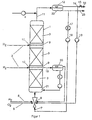
- FIG. 1 shows an example of a reactor system with the one arranged upright Reactor 1, in which several through intermediate feeds 2 layers 3 separated from hydrogen by fabric-like structures Catalyst monoliths are mounted.
- a gas-liquid distributor e.g. a mixing nozzle 6 in the circular liquid 7 in the form of bubbles distributed.
- a mixing nozzle 6 in the circular liquid 7 in the form of bubbles distributed.
- a separate mixing nozzle can be used - a partial flow 8 of the hydrogen.
- Further subsets 2 of hydrogen are volume-controlled via distribution devices 9 at the intermediate feed points 10 between the catalyst layers 3 fed in.
- the two-phase reactor discharge 11 removed and separated in a separation vessel 12.
- the gas phase is via a compressor 13 - or less Height of the reactor preferably directly - via the mixing nozzle 6 am added again at the bottom of the reactor.
- a partial stream 14 of the Gases is used to limit the enrichment of inert components led into the exhaust line 16 via a pressure maintenance 15.
- the Liquid is cooled with cooling water via a heat exchanger 17 and via the pump 18 again at the lower end of the reactor fed in.
- intermediate withdrawals 19 are also possible to provide the two-phase reactor contents along the reactor, perform a phase separation 20 and both phases - the liquid phase cooled - again at a lower point 21 of the reactor fully close.
- the liquid reaction product 22 is a partial stream 23 removed from the phase separator 12 at the upper end of the reactor.
- a corrugated and a smooth mesh made of V4A steel (1.4571, mesh size 180 ⁇ m, wire diameter 146 ⁇ m) was placed on top of each other and a cylindrical monolith with a height of 5 cm and a diameter of 5 cm also rolled. The ends the nets were fixed by welding spots.
- the network plane spacing the smooth mesh was at least 1 mm.
- the monolithic support was successively treated with acetone and distilled water and then dried.
- the monolith was then treated with a solution of 25% by weight of concentrated hydrochloric acid and 75% by weight of distilled water at 60 ° C. for 30 minutes and rinsed with distilled water.
- the monolith treated in this way was placed in 150 ml of distilled water.
- a 270 ml autoclave with stirrer and thermostat serves as the reaction vessel and pressure maintenance of 50 bar.
- this autoclave became the catalyst monolith produced in I around the stirrer axis centered installed so that it is evenly through the stirrer is supplied with liquid and gas.
- Located in the reactor floor there are supply lines for oxygen, hydrogen and the reaction medium.
- In the reactor cover there is a derivative from which the Product / gas mixture is continuously removed. After deducting the Volumes for all internals stood an effective reaction volume of 208 ml available.
- the reaction medium consisted of methanol, the 0.4% by weight sulfuric acid, 0.1% by weight phosphoric acid and 6 ppm bromide (in the form of sodium bromide) have been added. With the reaction medium the reactor flooded. Then a current of 72.8 g / h reaction medium, 48.6 l / h oxygen and 5.5 l / h hydrogen (Gases based on normal conditions) through the reactor. At the The product / gas mixture was removed continuously from the reactor lid.
- the conversion based on hydrogen was 76% (according to the determination of the hydrogen content in the exhaust gas) with a selectivity of 82%.
- the concentration of the methanolic hydrogen peroxide solution thus prepared was 7% by weight (titration with KMnO 4 0.1 N).
- H 2 O 2 was carried out under comparable conditions as in Example 1 for 1000 hours.
- a total of 2.9 kg of hydrogen peroxide was obtained as a methanolic solution with a concentration of 4% by weight.
- a catalyst monolith was produced from V4A mesh with a palladium coating. This molding was then hydrogenated at 70 ° C. and 50 bar with hydrogen, treated with methanolic H 2 O 2 solution at 20 ° C. and dried with nitrogen. The catalyst molding was then installed in the autoclave from II.
- the reaction was carried out analogously to Example 1: the reaction medium was passed through the reactor at a rate of 214.5 g / h, oxygen at 145.8 l / h and hydrogen at 16.2 l / h at 42.2 ° C. The conversion based on H 2 was 84%, with a selectivity of 75%.
- the concentration of the methanolic hydrogen peroxide solution produced was 7% by weight.
- Example 3 The same catalyst as in Example 3 was used.
- the conversion based on H 2 was 90% with a selectivity of 68%.
- the concentration of the hydrogen peroxide solution thus prepared was 2.7% by weight.
- the same catalyst as in Example 3 was used.
- the Reaction medium consisted of water, the 0.4 wt .-% sulfuric acid, 0.1% by weight phosphoric acid and 6 ppm bromide (in the form of sodium bromide) were added.
- the conversion, based on hydrogen, was made by obtained a hydrogen determination of the exhaust gas and was 43% with a selectivity of 70%.
- the concentration of the so produced Hydrogen peroxide solution was 5.6% by weight.
Landscapes
- Chemical & Material Sciences (AREA)
- Organic Chemistry (AREA)
- Chemical Kinetics & Catalysis (AREA)
- Inorganic Chemistry (AREA)
- Catalysts (AREA)
- Organic Low-Molecular-Weight Compounds And Preparation Thereof (AREA)
- Pharmaceuticals Containing Other Organic And Inorganic Compounds (AREA)
- Oxygen, Ozone, And Oxides In General (AREA)
Description
Claims (15)
- Verfahren zur Herstellung von Wasserstoffperoxid-Lösungen mit einem Wasserstoffperoxid-Gehalt von wenigstens 2,5 Gew%, durch kontinuierliche Umsetzung von Wasserstoff und Sauerstoff an Katalysatoren, die als aktive Komponente Palladium enthalten, dadurch gekennzeichnet, daß die Umsetzung in Wasser und/oder C1-C3-Alkanolen als Reaktionsmedium an Katalysatorformkörpern in Form geordneter, in den Reaktor eingebauter Katalysatoren erfolgt, wobei das Reaktionsgas, enthaltend Sauerstoff und Wasserstoff, im Gleichstrom mit der flüssigen Reaktionsphase durch den Reaktor geführt wird.
- Verfahren nach Anspruch 1, dadurch gekennzeichnet, daß die Katalysatorformkörper aus Geweben aufgebaut sind.
- Verfahren nach Anspruch 2, dadurch gekennzeichnet, daß das Gewebe aus Metall besteht.
- Verfahren nach einem der vorhergehenden Ansprüche, dadurch gekennzeichnet, daß die aktive Komponente neben Palladium weitere Edelmetalle als Promotoren enthält.
- Verfahren nach Anspruch 4, dadurch gekennzeichnet, daß das Molverhältnis von Palladium zu Promotormetall im Bereich von 100:1 bis 1:10 liegt.
- Verfahren nach Anspruch 4 oder 5, dadurch gekennzeichnet, daß die Promotoren ausgewählt sind unter Platin, Rhodium, Iridium, Kupfer, Silber und Gold.
- Verfahren nach einem der vorhergehenden Ansprüche, dadurch gekennzeichnet, daß man den Sauerstoff in Form von Luft verwendet.
- Verfahren nach einem der vorhergehenden Ansprüche, dadurch gekennzeichnet, daß das Molverhältnis O2:H2 im Abgas oberhalb 20:1 liegt.
- Verfahren nach einem der Ansprüche 1 bis 8, dadurch gekennzeichnet, daß das Reaktionsgas im Kreis geführt wird.
- Verfahren nach Anspruch 9, dadurch gekennzeichnet, daß das Molverhältnis O2:H2 im Kreisgas im Bereich von 20:1 bis 50:1 liegt.
- Verfahren nach einem der vorhergehenden Ansprüche, dadurch gekennzeichnet, daß die Umsetzung bei Temperaturen im Bereich von 0°C bis 80°C erfolgt.
- Verfahren nach einem der vorhergehenden Ansprüche, dadurch gekennzeichnet, daß die Umsetzung bei Drücken im Bereich von 10 bis 100 bar durchgeführt wird.
- Verfahren nach einem der vorhergehenden Ansprüche, dadurch gekennzeichnet, daß es sich bei dem Reaktionsmedium um Wasser, Methanol oder um Methanol/Wasser-Mischungen handelt.
- Verfahren nach einem der vorhergehenden Ansprüche, dadurch gekennzeichnet, daß dem Reaktionsmedium Säuren mit einem pKa-Wert unterhalb dem der Essigsäure zugesetzt werden.
- Verfahren nach Anspruch 1, wobei das Reaktionsgas im Reaktor die diskontinuierliche Phase und die flüssige Reaktionsphase die kontinuierliche Phase bildet.
Applications Claiming Priority (3)
| Application Number | Priority Date | Filing Date | Title |
|---|---|---|---|
| DE19642770 | 1996-10-16 | ||
| DE19642770A DE19642770A1 (de) | 1996-10-16 | 1996-10-16 | Verfahren zur Herstellung von Wasserstoffperoxid |
| PCT/EP1997/005659 WO1998016463A1 (de) | 1996-10-16 | 1997-10-15 | Verfahren zur herstellung von wasserstoffperoxid |
Publications (2)
| Publication Number | Publication Date |
|---|---|
| EP0946409A1 EP0946409A1 (de) | 1999-10-06 |
| EP0946409B1 true EP0946409B1 (de) | 2003-01-08 |
Family
ID=7808965
Family Applications (1)
| Application Number | Title | Priority Date | Filing Date |
|---|---|---|---|
| EP97945830A Expired - Lifetime EP0946409B1 (de) | 1996-10-16 | 1997-10-15 | Verfahren zur herstellung von wasserstoffperoxid |
Country Status (12)
| Country | Link |
|---|---|
| US (1) | US6375920B2 (de) |
| EP (1) | EP0946409B1 (de) |
| JP (1) | JP2001501904A (de) |
| KR (1) | KR100520741B1 (de) |
| CN (1) | CN1180977C (de) |
| AT (1) | ATE230705T1 (de) |
| AU (1) | AU725799B2 (de) |
| BR (1) | BR9711924A (de) |
| CA (1) | CA2268091A1 (de) |
| DE (2) | DE19642770A1 (de) |
| ES (1) | ES2191203T3 (de) |
| WO (1) | WO1998016463A1 (de) |
Cited By (1)
| Publication number | Priority date | Publication date | Assignee | Title |
|---|---|---|---|---|
| RU235237U1 (ru) * | 2025-04-09 | 2025-06-25 | Общество с ограниченной ответственностью "НС-Ойл" | Полочный реактор жидкофазной этерификации глицерина уксусной кислотой на гетерогенном катализаторе |
Families Citing this family (50)
| Publication number | Priority date | Publication date | Assignee | Title |
|---|---|---|---|---|
| FR2774674B1 (fr) * | 1998-02-10 | 2000-03-24 | Atochem Elf Sa | Procede de preparation d'une solution aqueuse de peroxyde d'hydrogene directement a partir d'hydrogene et d'oxygene et dispositif permettant sa mise en oeuvre |
| DE19857137A1 (de) | 1998-12-11 | 2000-06-15 | Bayer Ag | Integriertes Verfahren zur Herstellung von Epoxiden aus Olefinen |
| DE19912733A1 (de) | 1999-03-20 | 2000-09-21 | Degussa | Verfahren zur Herstellung von Wasserstoffperoxid durch Direktsynthese |
| DE19936276A1 (de) * | 1999-08-02 | 2001-02-08 | Basf Ag | Vorrichtung und Verfahren zur isothermen Durchführung von heterogen katalysierten Dreiphasenreaktionen |
| IT1318549B1 (it) * | 2000-06-01 | 2003-08-27 | Eni Spa | Processo per la produzioni in continuo di acqua ossigenata. |
| IT1318550B1 (it) | 2000-06-01 | 2003-08-27 | Eni Spa | Catalizzatore e processo per la sintesi diretta di acqua ossigenata. |
| IT1318679B1 (it) * | 2000-08-11 | 2003-08-27 | Enichem Spa | Processo per la produzione di acqua ossigenata. |
| DE10048844A1 (de) * | 2000-10-02 | 2002-04-11 | Basf Ag | Verfahren zur Herstellung von Platinmetall-Katalysatoren |
| KR100383218B1 (ko) * | 2000-10-26 | 2003-05-12 | 한국화학연구원 | 과산화수소의 직접적 제조방법 |
| US6468496B2 (en) * | 2000-12-21 | 2002-10-22 | Arco Chemical Technology, L.P. | Process for producing hydrogen peroxide |
| FR2818562A1 (fr) * | 2000-12-22 | 2002-06-28 | Messier Bugatti | Cartouche catalytique et application a des installations pour la mise en oeuvre de reactions chimiques catalysees |
| WO2002051778A1 (en) | 2000-12-27 | 2002-07-04 | Corning Incorporated | Flow control in a three-phase monolithic catalyst reactor |
| DE10118460A1 (de) * | 2001-04-12 | 2002-10-17 | Basf Ag | Verfahren zur Herstellung von organischen Wasserstoffperoxidlösungen |
| ITMI20011016A1 (it) * | 2001-05-17 | 2002-11-17 | Enichem Spa | Sintesi diretta di acqua ossigenata in un nuovo sitema solvente multicomponente |
| DE10134470A1 (de) * | 2001-07-16 | 2003-01-30 | Basf Ag | Verfahren zur Herstellung von Wasserstoffperoxid aus Wasserstoff und Sauerstoff |
| ITMI20011688A1 (it) * | 2001-08-02 | 2003-02-02 | Enichem Spa | Catalizzatore e suo impiego nella sintesi di acqua ossigenata |
| DE10153546A1 (de) | 2001-10-30 | 2003-05-22 | Degussa | Direktsynthese von Wasserstoffperoxid und deren Integration in Oxidationsprozesse |
| US7147833B2 (en) * | 2002-03-25 | 2006-12-12 | Huckins Harold A | Method for producing hydrogen peroxide from hydrogen and oxygen |
| DE10240129B4 (de) | 2002-08-30 | 2004-11-11 | Basf Ag | Integriertes Verfahren zur Synthese von Propylenoxid |
| US7067103B2 (en) * | 2003-03-28 | 2006-06-27 | Headwaters Nanokinetix, Inc. | Direct hydrogen peroxide production using staged hydrogen addition |
| US7011807B2 (en) * | 2003-07-14 | 2006-03-14 | Headwaters Nanokinetix, Inc. | Supported catalysts having a controlled coordination structure and methods for preparing such catalysts |
| US7045479B2 (en) * | 2003-07-14 | 2006-05-16 | Headwaters Nanokinetix, Inc. | Intermediate precursor compositions used to make supported catalysts having a controlled coordination structure and methods for preparing such compositions |
| US7144565B2 (en) * | 2003-07-29 | 2006-12-05 | Headwaters Nanokinetix, Inc. | Process for direct catalytic hydrogen peroxide production |
| US20050201925A1 (en) * | 2004-03-09 | 2005-09-15 | Bi Le-Khac | Process for making hydrogen peroxide |
| DE102004023766A1 (de) | 2004-05-11 | 2005-12-01 | Degussa Ag | Verfahren zur Direktsynthese von Wasserstoffperoxid |
| US7396795B2 (en) * | 2005-08-31 | 2008-07-08 | Headwaters Technology Innovation, Llc | Low temperature preparation of supported nanoparticle catalysts having increased dispersion |
| US7718158B2 (en) * | 2005-10-13 | 2010-05-18 | Lyondell Chemical Technology, L.P. | Polymer-encapsulated ion-exchange resin |
| US7528269B2 (en) * | 2005-12-20 | 2009-05-05 | Lyondell Chemical Technology, L.P. | Process for oxidizing organic compounds |
| US7718710B2 (en) * | 2006-03-17 | 2010-05-18 | Headwaters Technology Innovation, Llc | Stable concentrated metal colloids and methods of making same |
| US7357909B2 (en) * | 2006-06-28 | 2008-04-15 | Lyondell Chemical Technology, L.P. | Process for producing hydrogen peroxide |
| US7563742B2 (en) | 2006-09-22 | 2009-07-21 | Headwaters Technology Innovation, Llc | Supported nickel catalysts having high nickel loading and high metal dispersion and methods of making same |
| US8232439B2 (en) | 2007-05-31 | 2012-07-31 | Basf Se | Use of isoalkane mixtures for dedusting construction chemistry products |
| JP5405031B2 (ja) * | 2008-03-06 | 2014-02-05 | AzエレクトロニックマテリアルズIp株式会社 | シリカ質膜の製造に用いる浸漬用溶液およびそれを用いたシリカ質膜の製造法 |
| CN102015798B (zh) | 2008-05-07 | 2014-03-05 | 巴斯夫欧洲公司 | α-烯烃/异丁烯二嵌段共聚物 |
| EP2406210A1 (de) | 2009-03-09 | 2012-01-18 | Basf Se | Verfahren zur herstellung substituierter 2-nitrobiphenyle |
| US8459275B2 (en) * | 2009-09-23 | 2013-06-11 | Ecolab Usa Inc. | In-situ cleaning system |
| KR101764923B1 (ko) * | 2010-03-29 | 2017-08-04 | 에스케이이노베이션 주식회사 | 고분자 전해질 박막이 형성된 고정상에 표면 개질된 금속 나노 입자가 고정된 촉매 및 그 제조방법 |
| WO2012040407A1 (en) | 2010-09-22 | 2012-03-29 | Daramic Llc | Batteries, separators, components, and compositions with heavy metal removal capability and related methods |
| US8937037B2 (en) | 2011-03-02 | 2015-01-20 | Ecolab Usa Inc. | Electrochemical enhancement of detergent alkalinity |
| WO2013160163A1 (en) | 2012-04-27 | 2013-10-31 | Solvay Sa | Hydrogenation catalysts, method for making same and use thereof for preparing hydrogen peroxide |
| BR112014029819A2 (pt) | 2012-06-27 | 2017-06-27 | Solvay | catalisadores de hidrogenação, método para produção dos mesmos e processo para preparação de peróxido de hidrogênio |
| EP2705901A1 (de) | 2012-09-06 | 2014-03-12 | Solvay SA | Hydrierkatalysatoren, deren Herstellungsverfahren und Verwendung zur Herstellung von Wasserstoffperoxid |
| CN103170368B (zh) * | 2013-04-09 | 2015-03-04 | 福州大学 | 一种可见光催化合成h2o2催化剂及其制备方法和应用 |
| RU2526460C1 (ru) * | 2013-04-24 | 2014-08-20 | Федеральное государственное автономное образовательное учреждение высшего образования "Новосибирский национальный исследовательский государственный университет" (Новосибирский государственный университет, НГУ) | Способ приготовления катализатора и способ получения пероксида водорода |
| DE102013108832A1 (de) * | 2013-08-15 | 2015-03-05 | Karlsruher Institut für Technologie | Verfahren und Vorrichtung zur Durchführung einer Reaktion zwischen mindestens zwei Reaktanden |
| DE102014209114A1 (de) | 2014-05-14 | 2015-11-19 | Evonik Degussa Gmbh | Verfahren zur Herstellung von Wasserstoffperoxid |
| CN106630100B (zh) * | 2016-12-30 | 2019-11-19 | 华中科技大学 | 一种垃圾渗沥液处理方法、装置和系统 |
| WO2019156684A1 (en) * | 2018-02-12 | 2019-08-15 | Solugen, Inc. | Hydrogen peroxide production method, system, and apparatus |
| CN109289713B (zh) * | 2018-10-18 | 2021-04-20 | 辽宁石油化工大学 | 一种蚊香盘管等温反应器及使用方法 |
| EP3897898A2 (de) | 2018-12-21 | 2021-10-27 | Prodose | Verfahren zur herstellung von reinem sauerstoff und wasserstoffperoxid |
Family Cites Families (39)
| Publication number | Priority date | Publication date | Assignee | Title |
|---|---|---|---|---|
| GB1414133A (en) | 1971-11-18 | 1975-11-19 | Johnson Matthey Co Ltd | Catalysis |
| US3873469A (en) | 1972-04-12 | 1975-03-25 | Corning Glass Works | Support coatings for catalysts |
| JPS514097A (en) | 1974-07-02 | 1976-01-13 | Tokuyama Soda Kk | Kasankasuisono seizohoho |
| US4151914A (en) | 1978-07-24 | 1979-05-01 | Franklin Container Corporation | Shipping and storage container for rolls |
| US4333896A (en) | 1980-05-12 | 1982-06-08 | Corning Glass Works | Method and apparatus for extruding honeycomb structures with skins thereon involving the use of an adjustable extension die mask |
| US4335092A (en) * | 1980-10-10 | 1982-06-15 | Air Products And Chemicals, Inc. | Synthesis of hydrogen peroxide |
| US4389390A (en) | 1980-10-10 | 1983-06-21 | Air Products And Chemicals, Inc. | Process for producing hydrogen peroxide |
| US4336238A (en) | 1980-10-10 | 1982-06-22 | Air Products And Chemicals, Inc. | Process for producing hydrogen peroxide |
| US4336239A (en) * | 1980-10-10 | 1982-06-22 | Air Products And Chemicals, Inc. | Synthesis of hydrogen peroxide |
| US4364888A (en) | 1981-05-04 | 1982-12-21 | Corning Glass Works | Method and apparatus for extruding a honeycomb structure |
| US4471014A (en) | 1981-06-30 | 1984-09-11 | Atomic Energy Of Canada Limited | Ordered bed packing module |
| DE3137169A1 (de) | 1981-09-18 | 1983-03-31 | Degussa Ag, 6000 Frankfurt | Katalysator fuer die verbrennung von in abgasen alkoholbetriebener verbrennungskraftmaschinen enthaltenen schadstoffen, verfahren zur herstellung des katalysators und verwendung |
| DE3513726A1 (de) | 1985-04-17 | 1986-10-23 | Basf Ag, 6700 Ludwigshafen | Verfahren zur herstellung von katalysatoren fuer die abgasentgiftung |
| EP0201614B1 (de) | 1985-05-14 | 1989-12-27 | GebràDer Sulzer Aktiengesellschaft | Reaktor zum Durchführen von heterogenen, katalysierten chemischen Reaktionen |
| US4889705A (en) * | 1988-05-13 | 1989-12-26 | E. I. Du Pont De Nemours And Company | Hydrogen peroxide method using optimized H+ and BR- concentrations |
| US4832938A (en) | 1988-05-13 | 1989-05-23 | E. I. Du Pont De Nemours And Company | Hydrogen peroxide production method using platinum/palladium catalysts |
| US5030742A (en) | 1988-12-16 | 1991-07-09 | Ciba-Geigy Corporation | Ultrathin layers of palladium(O) complexes |
| US5352645A (en) | 1989-04-14 | 1994-10-04 | E. I. Du Pont De Nemours And Company | Silica microspheres, method of improving attrition resistance and use |
| US5128114A (en) | 1989-04-14 | 1992-07-07 | E. I. Du Pont De Nemours And Company | Silica microspheres, method of improving attrition resistance |
| EP0437836B1 (de) | 1989-12-27 | 1995-05-17 | Nec Corporation | Optische Halbleitervorrichtung |
| ES2072403T3 (es) | 1990-03-30 | 1995-07-16 | Koch Eng Co Inc | Estructura y metodo para la reaccion catalitica de chorros de fluido en un aparato de transferencia de masa. |
| US5194242A (en) | 1990-09-11 | 1993-03-16 | E. I. Du Pont De Nemours And Company | Process for the production of hydrogen peroxide from hydrogen and oxygen |
| JP3111479B2 (ja) | 1991-02-08 | 2000-11-20 | ソニー株式会社 | 光磁気記録媒体 |
| DE4127918A1 (de) * | 1991-03-05 | 1992-09-10 | Interox Int Sa | Verfahren zur herstellung von wasserstoffperoxid |
| BE1004650A3 (fr) * | 1991-03-05 | 1993-01-05 | Interox Internat Sa | Synthese directe de peroxyde d'hydrogene par catalyse heterogene, catalyseur pour ladite synthese et procede de preparation dudit catalyseur. |
| US5643850A (en) | 1991-03-09 | 1997-07-01 | Forschungszentrum Julich Gmbh | Process for the production of a catalyst layer on a carrier material and catalyst with a catalyst layer for the removal of hydrogen from a hydrogen and oxygen-containing gas mixture |
| US5525570A (en) | 1991-03-09 | 1996-06-11 | Forschungszentrum Julich Gmbh | Process for producing a catalyst layer on a carrier and a catalyst produced therefrom |
| EP0504741B1 (de) | 1991-03-20 | 1994-12-28 | Mitsubishi Gas Chemical Company, Inc. | Verfahren zur Herstellung von Wasserstoffsuperoxyd |
| DE4113525C2 (de) | 1991-04-25 | 1995-08-03 | Heraeus Noblelight Gmbh | Verfahren zur Metallisierung von Flächen von Bauelementen und ihre Verwendung |
| BE1005443A3 (fr) * | 1991-10-14 | 1993-07-27 | Solvay Interox | Synthese directe de peroxyde d'hydrogene par catalyse heterogene, catalyseur pour ladite synthese et procede de preparation dudit catalyseur. |
| JPH05124803A (ja) | 1991-10-31 | 1993-05-21 | Mitsubishi Gas Chem Co Inc | 過酸化水素の製造方法 |
| US5338531A (en) * | 1992-01-21 | 1994-08-16 | Chuang Karl T | Production of hydrogen peroxide |
| JPH05270806A (ja) | 1992-03-25 | 1993-10-19 | Mitsubishi Gas Chem Co Inc | 過酸化水素の製造方法 |
| BE1006078A3 (fr) | 1992-07-15 | 1994-05-10 | Solvay Interox | Procede pour la fabrication de peroxyde d'hydrogene par synthese directe a partir d'hydrogene et d'oxygene. |
| BR9305759A (pt) * | 1992-11-20 | 1997-01-28 | Showa Denko Kk | Processo para a produçao de peróxido de hidrogenio |
| DE69407653T2 (de) | 1993-05-06 | 1998-05-07 | Mitsubishi Gas Chemical Co | Verfahren zur Herstellung von Wasserstoffsuperoxyd |
| US5500297A (en) | 1993-08-09 | 1996-03-19 | The Trustees Of Princeton University | Electron acceptor compositions technical field |
| JPH082904A (ja) * | 1994-06-20 | 1996-01-09 | Mitsubishi Gas Chem Co Inc | 過酸化水素の製造法 |
| AU710994B2 (en) | 1994-08-16 | 1999-10-07 | Princeton Advanced Technology, Inc. | Method and apparatus for producing hydrogen peroxide from hydrogen and oxygen |
-
1996
- 1996-10-16 DE DE19642770A patent/DE19642770A1/de not_active Withdrawn
-
1997
- 1997-10-15 ES ES97945830T patent/ES2191203T3/es not_active Expired - Lifetime
- 1997-10-15 EP EP97945830A patent/EP0946409B1/de not_active Expired - Lifetime
- 1997-10-15 US US09/284,247 patent/US6375920B2/en not_active Expired - Fee Related
- 1997-10-15 AU AU51191/98A patent/AU725799B2/en not_active Ceased
- 1997-10-15 DE DE59709121T patent/DE59709121D1/de not_active Expired - Fee Related
- 1997-10-15 WO PCT/EP1997/005659 patent/WO1998016463A1/de not_active Ceased
- 1997-10-15 CA CA002268091A patent/CA2268091A1/en not_active Abandoned
- 1997-10-15 JP JP10518023A patent/JP2001501904A/ja not_active Ceased
- 1997-10-15 AT AT97945830T patent/ATE230705T1/de not_active IP Right Cessation
- 1997-10-15 CN CNB971806578A patent/CN1180977C/zh not_active Expired - Fee Related
- 1997-10-15 KR KR10-1999-7003187A patent/KR100520741B1/ko not_active Expired - Fee Related
- 1997-10-15 BR BR9711924-5A patent/BR9711924A/pt not_active IP Right Cessation
Cited By (1)
| Publication number | Priority date | Publication date | Assignee | Title |
|---|---|---|---|---|
| RU235237U1 (ru) * | 2025-04-09 | 2025-06-25 | Общество с ограниченной ответственностью "НС-Ойл" | Полочный реактор жидкофазной этерификации глицерина уксусной кислотой на гетерогенном катализаторе |
Also Published As
| Publication number | Publication date |
|---|---|
| CN1240406A (zh) | 2000-01-05 |
| BR9711924A (pt) | 2000-04-25 |
| EP0946409A1 (de) | 1999-10-06 |
| KR20000049107A (ko) | 2000-07-25 |
| WO1998016463A1 (de) | 1998-04-23 |
| JP2001501904A (ja) | 2001-02-13 |
| CN1180977C (zh) | 2004-12-22 |
| US20010003578A1 (en) | 2001-06-14 |
| CA2268091A1 (en) | 1998-04-23 |
| DE19642770A1 (de) | 1998-04-23 |
| AU725799B2 (en) | 2000-10-19 |
| DE59709121D1 (de) | 2003-02-13 |
| ATE230705T1 (de) | 2003-01-15 |
| KR100520741B1 (ko) | 2005-10-12 |
| ES2191203T3 (es) | 2003-09-01 |
| AU5119198A (en) | 1998-05-11 |
| US6375920B2 (en) | 2002-04-23 |
Similar Documents
| Publication | Publication Date | Title |
|---|---|---|
| EP0946409B1 (de) | Verfahren zur herstellung von wasserstoffperoxid | |
| DE19915681A1 (de) | Verfahren zur Herstellung von Platinmetall-Katalysatoren | |
| EP0005737B1 (de) | Verfahren zur Herstellung von cycloaliphatischen Carbonsäureestern | |
| EP0879642B1 (de) | Polybetain-stabilisierte, palladiumhaltige Nanopartikel, ein Verfahren zu ihrer Herstellung sowie daraus hergestellte Katalysatoren zur Gewinnung von Vinylacetat. | |
| EP0754664B1 (de) | Verfahren zur Herstellung von Alkenen durch partielle Hydrierung von Alkinen an Festbett-Palladium-Katalysatoren | |
| EP0412415B1 (de) | Palladiumkatalysatoren | |
| DE10050709A1 (de) | Verfahren zur Hydrierung von unsubstituierten oder alkylsubstituierten Aromaten unter Verwendung eines Katalysators mit einem strukturierten oder monolithischen Träger | |
| EP0944578B1 (de) | Verfahren zur herstellung von aromatischen aminen durch gasphasenhydrierung | |
| DE2844294C2 (de) | Metallischer Katalysator | |
| EP1110932B1 (de) | Verfahren zur Herstellung von C10-C30-Alkenen durch partielle Hydrierung von Alkinen an Festbett-Palladium-Trägerkatalysatoren | |
| WO2018054740A1 (de) | Verfahren zur bereitstellung eines katalysatorfestbetts, das dotierte strukturierte katalysatorformkörper enthält | |
| EP1457476A1 (de) | Selktivhydrierung von cyclododecatrien zu cyclododecen | |
| EP0909204B1 (de) | Verfahren zur katalytischen destillation | |
| DE3229905A1 (de) | Festbett-katalysator | |
| DE19815639A1 (de) | Verfahren zur Herstellung von Zuckeralkoholen | |
| EP0975578B1 (de) | Herstellung von aromatischen aminen mittels neuer hydrierkatalysatoren | |
| EP1027282A1 (de) | Verfharen zur hydrierung einer anthrachinon-verbindung | |
| EP1036761A1 (de) | Verfahren zur Herstellung von Lachgas |
Legal Events
| Date | Code | Title | Description |
|---|---|---|---|
| PUAI | Public reference made under article 153(3) epc to a published international application that has entered the european phase |
Free format text: ORIGINAL CODE: 0009012 |
|
| 17P | Request for examination filed |
Effective date: 19990415 |
|
| AK | Designated contracting states |
Kind code of ref document: A1 Designated state(s): AT BE CH DE DK ES FI FR GB IT LI NL SE |
|
| 17Q | First examination report despatched |
Effective date: 19991122 |
|
| GRAG | Despatch of communication of intention to grant |
Free format text: ORIGINAL CODE: EPIDOS AGRA |
|
| GRAG | Despatch of communication of intention to grant |
Free format text: ORIGINAL CODE: EPIDOS AGRA |
|
| GRAH | Despatch of communication of intention to grant a patent |
Free format text: ORIGINAL CODE: EPIDOS IGRA |
|
| GRAH | Despatch of communication of intention to grant a patent |
Free format text: ORIGINAL CODE: EPIDOS IGRA |
|
| GRAA | (expected) grant |
Free format text: ORIGINAL CODE: 0009210 |
|
| AK | Designated contracting states |
Kind code of ref document: B1 Designated state(s): AT BE CH DE DK ES FI FR GB IT LI NL SE |
|
| REF | Corresponds to: |
Ref document number: 230705 Country of ref document: AT Date of ref document: 20030115 Kind code of ref document: T |
|
| REG | Reference to a national code |
Ref country code: GB Ref legal event code: FG4D Free format text: NOT ENGLISH |
|
| REG | Reference to a national code |
Ref country code: CH Ref legal event code: EP |
|
| REG | Reference to a national code |
Ref country code: CH Ref legal event code: NV Representative=s name: SCHMAUDER & PARTNER AG PATENTANWALTSBUERO |
|
| REF | Corresponds to: |
Ref document number: 59709121 Country of ref document: DE Date of ref document: 20030213 Kind code of ref document: P |
|
| GBT | Gb: translation of ep patent filed (gb section 77(6)(a)/1977) |
Effective date: 20030217 |
|
| PG25 | Lapsed in a contracting state [announced via postgrant information from national office to epo] |
Ref country code: DK Free format text: LAPSE BECAUSE OF FAILURE TO SUBMIT A TRANSLATION OF THE DESCRIPTION OR TO PAY THE FEE WITHIN THE PRESCRIBED TIME-LIMIT Effective date: 20030408 |
|
| REG | Reference to a national code |
Ref country code: SE Ref legal event code: TRGR |
|
| REG | Reference to a national code |
Ref country code: ES Ref legal event code: FG2A Ref document number: 2191203 Country of ref document: ES Kind code of ref document: T3 |
|
| ET | Fr: translation filed | ||
| PG25 | Lapsed in a contracting state [announced via postgrant information from national office to epo] |
Ref country code: AT Free format text: LAPSE BECAUSE OF NON-PAYMENT OF DUE FEES Effective date: 20031015 |
|
| PLBE | No opposition filed within time limit |
Free format text: ORIGINAL CODE: 0009261 |
|
| STAA | Information on the status of an ep patent application or granted ep patent |
Free format text: STATUS: NO OPPOSITION FILED WITHIN TIME LIMIT |
|
| 26N | No opposition filed |
Effective date: 20031009 |
|
| PGFP | Annual fee paid to national office [announced via postgrant information from national office to epo] |
Ref country code: NL Payment date: 20051003 Year of fee payment: 9 |
|
| PGFP | Annual fee paid to national office [announced via postgrant information from national office to epo] |
Ref country code: SE Payment date: 20051005 Year of fee payment: 9 |
|
| PGFP | Annual fee paid to national office [announced via postgrant information from national office to epo] |
Ref country code: FR Payment date: 20051010 Year of fee payment: 9 |
|
| PGFP | Annual fee paid to national office [announced via postgrant information from national office to epo] |
Ref country code: GB Payment date: 20051012 Year of fee payment: 9 |
|
| PGFP | Annual fee paid to national office [announced via postgrant information from national office to epo] |
Ref country code: FI Payment date: 20051013 Year of fee payment: 9 |
|
| PGFP | Annual fee paid to national office [announced via postgrant information from national office to epo] |
Ref country code: DE Payment date: 20051014 Year of fee payment: 9 Ref country code: CH Payment date: 20051014 Year of fee payment: 9 |
|
| PGFP | Annual fee paid to national office [announced via postgrant information from national office to epo] |
Ref country code: ES Payment date: 20051129 Year of fee payment: 9 |
|
| PGFP | Annual fee paid to national office [announced via postgrant information from national office to epo] |
Ref country code: BE Payment date: 20051221 Year of fee payment: 9 |
|
| PG25 | Lapsed in a contracting state [announced via postgrant information from national office to epo] |
Ref country code: FI Free format text: LAPSE BECAUSE OF NON-PAYMENT OF DUE FEES Effective date: 20061015 |
|
| PG25 | Lapsed in a contracting state [announced via postgrant information from national office to epo] |
Ref country code: SE Free format text: LAPSE BECAUSE OF NON-PAYMENT OF DUE FEES Effective date: 20061016 |
|
| PG25 | Lapsed in a contracting state [announced via postgrant information from national office to epo] |
Ref country code: LI Free format text: LAPSE BECAUSE OF NON-PAYMENT OF DUE FEES Effective date: 20061031 Ref country code: CH Free format text: LAPSE BECAUSE OF NON-PAYMENT OF DUE FEES Effective date: 20061031 |
|
| PGFP | Annual fee paid to national office [announced via postgrant information from national office to epo] |
Ref country code: IT Payment date: 20061031 Year of fee payment: 10 |
|
| PG25 | Lapsed in a contracting state [announced via postgrant information from national office to epo] |
Ref country code: NL Free format text: LAPSE BECAUSE OF NON-PAYMENT OF DUE FEES Effective date: 20070501 Ref country code: DE Free format text: LAPSE BECAUSE OF NON-PAYMENT OF DUE FEES Effective date: 20070501 |
|
| REG | Reference to a national code |
Ref country code: CH Ref legal event code: PL |
|
| EUG | Se: european patent has lapsed | ||
| GBPC | Gb: european patent ceased through non-payment of renewal fee |
Effective date: 20061015 |
|
| NLV4 | Nl: lapsed or anulled due to non-payment of the annual fee |
Effective date: 20070501 |
|
| REG | Reference to a national code |
Ref country code: FR Ref legal event code: ST Effective date: 20070629 |
|
| PG25 | Lapsed in a contracting state [announced via postgrant information from national office to epo] |
Ref country code: GB Free format text: LAPSE BECAUSE OF NON-PAYMENT OF DUE FEES Effective date: 20061015 |
|
| BERE | Be: lapsed |
Owner name: *BASF A.G. Effective date: 20061031 |
|
| REG | Reference to a national code |
Ref country code: ES Ref legal event code: FD2A Effective date: 20061016 |
|
| PG25 | Lapsed in a contracting state [announced via postgrant information from national office to epo] |
Ref country code: FR Free format text: LAPSE BECAUSE OF NON-PAYMENT OF DUE FEES Effective date: 20061031 Ref country code: ES Free format text: LAPSE BECAUSE OF NON-PAYMENT OF DUE FEES Effective date: 20061016 |
|
| PG25 | Lapsed in a contracting state [announced via postgrant information from national office to epo] |
Ref country code: IT Free format text: LAPSE BECAUSE OF NON-PAYMENT OF DUE FEES Effective date: 20071015 Ref country code: BE Free format text: LAPSE BECAUSE OF FAILURE TO SUBMIT A TRANSLATION OF THE DESCRIPTION OR TO PAY THE FEE WITHIN THE PRESCRIBED TIME-LIMIT Effective date: 20061031 |