EP0944544B2 - Verfahren und anordnung zum fördern von individuell gehaltenen produkten - Google Patents
Verfahren und anordnung zum fördern von individuell gehaltenen produkten Download PDFInfo
- Publication number
- EP0944544B2 EP0944544B2 EP97913069A EP97913069A EP0944544B2 EP 0944544 B2 EP0944544 B2 EP 0944544B2 EP 97913069 A EP97913069 A EP 97913069A EP 97913069 A EP97913069 A EP 97913069A EP 0944544 B2 EP0944544 B2 EP 0944544B2
- Authority
- EP
- European Patent Office
- Prior art keywords
- conveying
- elements
- path
- paths
- holding
- Prior art date
- Legal status (The legal status is an assumption and is not a legal conclusion. Google has not performed a legal analysis and makes no representation as to the accuracy of the status listed.)
- Expired - Lifetime
Links
Images



Classifications
-
- B—PERFORMING OPERATIONS; TRANSPORTING
- B65—CONVEYING; PACKING; STORING; HANDLING THIN OR FILAMENTARY MATERIAL
- B65H—HANDLING THIN OR FILAMENTARY MATERIAL, e.g. SHEETS, WEBS, CABLES
- B65H29/00—Delivering or advancing articles from machines; Advancing articles to or into piles
- B65H29/58—Article switches or diverters
- B65H29/60—Article switches or diverters diverting the stream into alternative paths
-
- B—PERFORMING OPERATIONS; TRANSPORTING
- B65—CONVEYING; PACKING; STORING; HANDLING THIN OR FILAMENTARY MATERIAL
- B65H—HANDLING THIN OR FILAMENTARY MATERIAL, e.g. SHEETS, WEBS, CABLES
- B65H29/00—Delivering or advancing articles from machines; Advancing articles to or into piles
- B65H29/003—Delivering or advancing articles from machines; Advancing articles to or into piles by grippers
-
- B—PERFORMING OPERATIONS; TRANSPORTING
- B65—CONVEYING; PACKING; STORING; HANDLING THIN OR FILAMENTARY MATERIAL
- B65H—HANDLING THIN OR FILAMENTARY MATERIAL, e.g. SHEETS, WEBS, CABLES
- B65H2301/00—Handling processes for sheets or webs
- B65H2301/30—Orientation, displacement, position of the handled material
- B65H2301/32—Orientation of handled material
- B65H2301/323—Hanging
-
- B—PERFORMING OPERATIONS; TRANSPORTING
- B65—CONVEYING; PACKING; STORING; HANDLING THIN OR FILAMENTARY MATERIAL
- B65H—HANDLING THIN OR FILAMENTARY MATERIAL, e.g. SHEETS, WEBS, CABLES
- B65H2301/00—Handling processes for sheets or webs
- B65H2301/40—Type of handling process
- B65H2301/44—Moving, forwarding, guiding material
- B65H2301/447—Moving, forwarding, guiding material transferring material between transport devices
- B65H2301/4471—Grippers, e.g. moved in paths enclosing an area
-
- B—PERFORMING OPERATIONS; TRANSPORTING
- B65—CONVEYING; PACKING; STORING; HANDLING THIN OR FILAMENTARY MATERIAL
- B65H—HANDLING THIN OR FILAMENTARY MATERIAL, e.g. SHEETS, WEBS, CABLES
- B65H2405/00—Parts for holding the handled material
- B65H2405/50—Gripping means
- B65H2405/56—Gripping means releasably connected to transporting means
Definitions
- the invention is in the field of conveyor technology and relates to a method for conveying individually held products according to the preamble of the first independent claim, and an arrangement for Implementation of the method according to the preamble of the corresponding independent claim.
- the products to be considered below are considered to be individual and may be individual Because of essentially continuously conveyed through a network of conveyor lines. Through this promotion will be For example, the products are taken from a manufacturing process to stations where they are processed individually be transferred from one processing station to another processing station or through processing stations, in which they are processed during continuous support.
- An example for products to be handled in this way are printed products which, starting from the printing press, are replaced by a wide variety of different types Processing stations are further processed and made ready for shipment.
- the arrangements for conveying piece goods described above are particularly suitable for product streams, which are conveyed with substantially unchanged product sequence over longer conveyor lines.
- the Arrangements are robust and easy to operate even at very high flow rates and the return of the holding means is realizable without specific control on a simple backward run.
- the invention is now the task of a method for promoting individually held products show that combines the advantages of the systems described above, but largely eliminates their disadvantages.
- the method should be largely independent of variations in form with respect to the promotional Products, it should also be applicable for very high flow rates and it should be better than known such Procedures in various areas, through which the products are to be promoted, to a variety of conveying tasks be customizable. Furthermore, it is the object of the invention to provide an arrangement for carrying out the method create which arrangement can be easily adapted to a variety of local transport tasks and also easily expandable is.
- the method according to the invention is based on assigning a holding element to each product to be conveyed, which holding element holds the product in a defined manner and which holding element together with the product travels the entire predetermined for the product conveying path, which conveyor from a series consists of conveyor lines.
- the holding elements are coupled to the conveyor for parts that are along a specific conveyor line are movable, or on guides that extend along a specific conveyor line.
- the holding elements each have at least one first coupling part, with the aid of which they are connected to second coupling parts can be coupled, each second coupling part assigned to a specific conveyor line substantially and is movable along this.
- the holding elements with Help the first coupling parts and on guides that extend along a conveyor line, coupled become.
- a product to be conveyed is held by a holding element and the holding element is by means of the first coupling part to a movable along the conveying path second Coupling part or coupled to a along the conveying path extending guide, wherein the coupling part or, a conveying element on which it is arranged, or the holding element is driven by suitable means.
- the holding element In Transfer areas, ie in places where the product from one conveyor line to another conveyor line is guided, the holding element, from the movable on the one conveyor line second coupling part or corresponding guide decoupled and to a movable on the other conveyor section second coupling part or coupled to a corresponding leadership, this transfer can affect all products of a stream or only individual.
- the advantage of the method is, on the one hand, that the products to be conveyed are taken only once which significantly reduces the risk of damage and makes the process largely independent will depend on the exact shape of the products.
- the movable on conveyor lines second coupling parts can, for example, in equidistant manner Be arranged conveyor chains. If holding elements are coupled to such a conveyor chain, it corresponds in their function of a known conveyor chain, as described above.
- the second coupling parts can also be arranged on links of chains with variable link distances or they can be completely independent be arranged from each other movable conveyor elements. Depending on the way the second coupling parts along a certain conveyor line are movable, and appropriate drive means are interpreted and arranged.
- conveyor lines with second coupling parts movable thereon in addition to the conveyor lines with second coupling parts movable thereon, in an inventive Arrangement also be provided conveyor lines on which the holding elements without coupling movable are, for example, the fact that their first coupling parts slide in appropriately designed guides, for example, powered by gravity. Such additional conveyor lines are particularly suitable for a non-continuous promotion, so for example for buffer lines and for return routes.
- Another advantage of the inventive method and the inventive arrangement is in that in processes in which it is advantageous to individually identify the products, the means of identification not on the products themselves but on the holding elements can be arranged and thereby the conveyor system Do not leave with the products, but with the circulating in the holding elements in the system.
- Denieri Mittelzur Identification are, for example, contactlessly writable and readable electronic units.
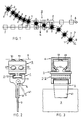
- FIG. 1 schematically shows a first exemplary variant of the method according to the invention with reference to a very limited network with only two conveyor lines A and B in a transfer area U and its immediate surroundings.
- the two conveyor lines are shown schematically by lines with arrow (conveying direction).
- second coupling parts 2 are movable, which are shown schematically as white squares.
- first coupling parts 1 are shown schematically as black circles.
- a holding element which holding element holds a product 3.
- the product (seen from the back in FIG. 1) is, for example, a printed product, ie a newspaper, a magazine or a brochure or an intermediate product for one of the products mentioned.
- FIG. 1 can be understood, for example, as a bird's eye view, that is to say the conveying paths A and B, coupling parts 1 and 2 and the holding elements are above the suspended conveyed products 3rd arranged.
- the representation can just as well be understood as a side view, that is, the products 3 are held laterally, the conveyor line A comes from above and the conveyor line B goes down. Also Mixed forms are readily conceivable.
- the second coupling parts 2 with constant distances from each other for example moved on articulated chain links arranged moves.
- the second coupling parts 2 no constant distances from each other, that is, they are for example loose interconnected conveyor elements or arranged on individual conveyor elements.
- the transfer area U synchronization means (not shown), with the help of the second Coupling 2 on the conveyor line A at least in the transfer area U with the second coupling parts 2 on the conveyor line B synchronized or clocked into the transfer area.
- the holding elements with the first coupling parts 1 are on the supply side (in the figure on the left) to Transfer area U coupled to the movable on the conveyor section A second coupling parts 2.
- On the conveying side (in the figure on the right) of the transfer area U are the holding elements or first coupling parts 1 are coupled to second coupling parts 2 on the conveyor line B and are on this further promoted.
- the transfer area U are in addition to synchronization means for the synchronization of the second coupling parts 2 of the two conveyor lines A and B to provide means by which the movement of the holding elements or the first coupling parts 1 transversely to the conveying direction (arrow Q) are moved, for example, correspondingatsungskulissen, as indicated by the dot-dash lines a and b.
- the Means for the transverse movement designed to be controlled accordingly. In appropriate arrangements can as Means for transverse movement also be exploited gravity.
- locking means are also provided, with the help of which two are coupled together Clutch parts 1 and 2 are locked together.
- Clutch parts 1 and 2 are locked together.
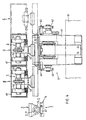
- FIGs 2 and 3 show an exemplary embodiment of a holding element 4 with a first coupling part 1 and a conveying element 5, which in a guide 6 (defined conveying path) is movable and on which a second coupling part 2 is arranged.
- Holding element 4 and conveying element 5 are shown in FIG. 2 with a viewing direction transverse to the conveying direction, in FIG. 3 with a viewing direction parallel to the conveying direction.
- FIG. 2 and 3 equipped holding elements 4 and conveying elements 5 are applicable in a process variant according to Figure 1.
- the pair shown in Figures 2 and 3 of mutually cooperating coupling parts (1/2) consists from a part with an outwardly narrowing groove 11 and a comb 12 with a narrowed neck area 13, wherein groove 11 and comb 12 have matched cross sections and at least in a transfer area extend substantially transversely to the conveying direction, such that the comb 12 transversely to the conveying direction can be pushed out of the groove 11.
- the holding element 4 has, for example, a gripper 41, with which a printed product 3 gripped and is held.
- grippers are well known, for example by the publication CH-569197 and US-3948551 (F62).
- the conveyor element 5 has, for example, two groups of three balls 51, with the help of it in a corresponding guide channel 61 is movable in rolling.
- Such conveying elements 5 are in the publication EP-0387318 and US-5074678 described.
- two guide channels 61 are guided parallel to each other and become the conveying elements 5 synchronized such that always a pair of conveying elements with aligned combs 12 promoted by the transfer area.
- the distance between the guide channels 61 is in the transfer area chosen such that the distance between two moving synchronously through the transfer area Combing 12 of two synchronously moving conveyor elements 5 is smaller than the length of a groove 11 of a Hatleetementes 4.
- the holding element 4 from the comb 12 of a conveyor element 5 slidable on the comb 12 of the other conveying element 5 these means all through the transfer area subsidized holding element can push or are controlled so that they only specific the Slide holding means.
- These means are for examplesecuritysungskulissen or magnet systems, in particular are suitable as controllable funds. .
- FIG. 4 shows another embodiment of holding elements 4 and conveying elements 5, which can be coupled to one another by a pair of coupling parts (FIGS. 1 and 2) as a representation of a further transfer region through which three conveying paths A, B and C lead (view parallel to the conveying direction).
- the holding element 4 in turn has a gripper 41, which holds a product 3 and which can be activated or deactivated to grasp a product or to release it by means of control rollers 42.
- the conveying element 5 is a link of a link chain which is movable on rollers 52 in a guide channel 61.
- the groove 11 On the holding element 4 is a comb 12 as the first coupling part 1, on the conveying element 5 as a second coupling part 2 a groove 11 arranged (coupling parts with respect to the embodiment according to Figures 2 and 3 reversed).
- the groove 11 consists of a pipe segment and the Head portion of the comb 12 of a tube whose outer diameter to the inner diameter of the pipe segment is tuned.
- the holding element 4 further comprises control rollers 43 which are for pushing the comb 12 of the groove 11 of a Conveying element 5 in the groove of another conveyor element on corresponding scenes (not shown) roll.
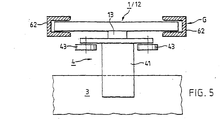
- FIG. 5 shows how a holding element 4 can be moved along an additional conveying path G, which additional conveying path has no second coupling parts.
- the retaining element 4 substantially corresponds to the retaining element of Figure 4 and is equipped with control rollers 43 and a comb 12 as the first coupling part 1.
- the comb 12, which serves for coupling to a second coupling part, has a neck region 13 which extends only over a central part of the comb length, so that the lateral regions of the comb 12 are free tube ends. With these free tube ends, the holding element 4 can slide on both sides in corresponding, for example, U-shaped guide rails 62, which can represent a further conveying variant for a specific area (eg buffer path) of an inventive conveyor arrangement.
- a return path for empty holding elements can be realized in such a manner, wherein the holding elements are advantageously driven by gravity or by other, for example, pushing drive means.
- FIG. 6 schematically shows a further transfer region U with two conveying paths A and B.
- retaining elements of which only the first coupling parts in the form of combs 12 are shown, are provided in corresponding grooves 11 of conveying elements 5.1 of the conveying path A in grooves 11 of FIG Sliding elements 5.2 of the conveying path B, wherein the grooves 11 and combs 12 extend at least in the transfer area U substantially transverse to the conveying direction.
- the conveying elements 5.1 which are movable on the conveying path A, are connected to one another in a chain, such that their distances are invariable.
- the conveying elements 5.2 are free, that is not with each other connected elements.
- the conveying elements 5.1 and 5.2 are designed for automatic synchronization.
- the Chain of the conveying elements 5.1 has for this purpose between the conveying elements concave docking sites 53, in the convex Docking 54 of the conveyor elements 5.2 fit.
- the free conveying elements 5.2 are now so against the chain led by conveying elements 5.1 that ever a convex docking 54 of a free conveyor element 5.2 in a concave docking point 53 between two connected conveying elements 5.1 is docked in a kind of positive locking.
- the free conveyor elements 5.2 are docked via the connected and driven conveyor elements 5.1 promoted at least over the transfer area U, while retaining elements, for example, from the connected 5.1 conveying elements are pushed onto the free conveying elements 52, as shown in the figure 6.
- FIG. 8 shows a further variant of a transfer area, which is operated essentially according to the same method variant as the transfer area of FIG. 1.
- two conveyor lines A and B are shown, on which second coupling parts 2 (white squares) are movable.
- a plurality of transverse conveyor elements 7 are arranged, which are synchronized with the conveying elements of the conveyor lines A and B along a third conveyor line D movable.
- a first transfer U.1 the holding elements (only first coupling parts 1 shown as black circles) with the products 3 each passed to a cross conveyor element 7 by the first coupling part 1 of the holding element from the coupling part 2 of the conveyor line A decoupled and on the cross conveyor element is pushed.
- the transverse conveying element 7 differs from the conveying element in that, instead of a second coupling part 2, it has a guide on which the first coupling part 1 of the holding element is displaceable essentially transversely to the general conveying direction.
- a control link (shown schematically are provided by the dot-dash line a), which control block also the two handovers U.1 and U.2 can control.
- the cross conveyor elements 7 for the transverse promotion of the holding elements are specially equipped with appropriate drive means.
- FIG. 9 shows a three-dimensional representation of the same transfer area as FIG. 8. Only first coupling parts 1, second coupling parts 2 of the conveying paths A and B and a transverse guide 71 of a transverse conveying element are shown.
- the coupling parts 1 and 2 correspond to the coupling parts shown in Figures 2 and 3.
- the transverse guide 71 of the transverse conveyor element is essentially a comb 12 with a narrowed neck portion 13 having the same cross-section as the comb 12, the second coupling part 2, but it is usually longer than this.
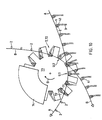
- FIG. 10 schematically shows an application of the transfer region with transverse conveying, as has already been described in connection with FIGS. 8 and 9.
- the cross conveyor elements 7 are in this case axially extending compartments 72 of a processing drum 73.
- the product-conveying conveyor line A, the drum 73 and the products weganinde conveyor line B are arranged vertically staggered one behind the other to the paper plane of Figure 10, such that the transverse conveying substantially runs perpendicular to the plane of the paper and the first transfer U.1 in a front axial region of the drum 73, the second transfer U.2 is performed in a rear axial portion of the drum.
- the products 3 are held by grippers 41 by means of first coupling parts 1 to second coupling parts 2 coupled fed along the conveyor line A.
- first coupling parts 1 are decoupled from the second coupling parts 2 and the products together Retaining elements (gripper 41 and first coupling part 1) pushed into a respective compartment 72 of the drum 73, or each first Clutch member 1 is slid onto a transverse guide 71 provided on the bottom of each compartment 72.
- the drum rotates (arrow D)
- the holding elements for example, further along the transverse guides 71 in the axial Moved towards the drum 73 and the products 3, for example, by a processing station 74th promoted and edited in it.
- second transfer U.2 on the other end of the drum 73, the processed products held by the grippers 41 by means of the first coupling parts 1 on second coupling parts coupled to the conveyor line B and conveyed away.
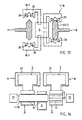
- FIG. 11 shows a further exemplary variant of the method according to the invention on the basis of a transfer area U, through which two conveyor lines A and B are guided.
- This variant of the method differs from the method variant according to FIGS. 1 and 8 in that the holding elements 4 each have at least two first coupling parts 1, being coupled to a second coupling part for delivery with one of the first coupling parts.
- the transverse movement Q of the holding elements 4 during transfer is unnecessary with such a variant of the method.
- FIG. 12 shows, viewed in the direction parallel to the conveying direction, a transfer region in which holding elements 4 with products 3 can be transferred from a conveying path A to a conveying path B (or vice versa) according to the second variant of the method (FIG. 11).
- the first coupling parts 1, of which each holding element 4 has two, have the form of connecting pieces 14, which are arranged aligned in opposite directions on the holding element 4.
- the on along the originallystrekken movable conveyor elements 5 arranged second coupling parts 2 are coupling gripper 15, the Gripping nozzles 14 are designed.
- the coupling gripper 15 can be activated or deactivated are.
- the person skilled in grippers and control means for their activation or deactivation are known from Conveyor systems according to the prior art, with which grippers products are taken and held. such Grippers have to be adapted accordingly for a function as second coupling parts 2 (coupling gripper).
- nozzle 14 and grippers 15 can as the first coupling parts 1 and second coupling parts 2 in the process variant according to Figure 11 a variety of known coupling parts are used, which in one Transfer area are controlled accordingly.
- FIG. 13 shows a further variant of first and second coupling parts for the process variant according to FIG. 11.
- a transfer region with two conveying sections A and B is shown (viewing direction parallel to the conveying direction), which defines conveying paths through a respective guide 63 extending along the conveying path are.
- the first coupling parts 1 of the holding elements 4 are designed as runners, which can be coupled to the guide rail and slide or roll on it.
- the guide 63 thus not only defines the conveying path but is simultaneously a second coupling part 2 for each support element 4 to be conveyed along the conveying path, wherein at each location of the conveying path a different area of the guide serves as a second coupling part and thereby the coupling can be moved along the conveying path ,
- Each holding element 4 has two first coupling parts 1 in the form of couplers which can be coupled to the guide 63 16 on.
- the runners 16 consist of two rotor parts 16.1 and 16.2, with suitable control means and optionally with return means in a closed state around the guide 63 and in a open state can be brought.
- the travelers 16 roll on rollers 20 on the guide 63 or they glide on her.
- Embodiments are also conceivable in which the guide 63 is simultaneously drive means, i. along the conveying path is moved, and the first coupling parts 1 not as a rotor but as clamping parts are, with the help of the retaining elements 4 are clamped to the guide.
- FIG. 14 again shows a third variant of the method according to the invention on the basis of a representation of a transfer area.
- two conveyor lines A and B with guide channels 61, wherein in the guide channels 61, as shown in more detail in Figure 4, conveying elements 5 are movable.
- Second coupling parts 2, which have an opening 17 oriented transversely to the conveying direction, are arranged on the conveying elements.
- the holding element 4 has a continuous same opening 17.
- the first coupling part 1 is a bolt 18 which has a cross-section matched to the openings 17 and which is displaceable transversely to the conveying direction (arrow Q) in these openings.
- the holding element is coupled to a conveying element 5 which is movable on the conveying path A or to a conveying element 5 which is movable on the conveying path B.
- openings 17 could also correspondingly extending, outwardly narrowing grooves be provided.
- drive means for the transverse movement Q of the bolt 18 in this case at least partially a magnetic material, for example, according to controllable electromagnet 19 for Application come.
- the method variant according to FIG. 14, in which a first coupling part which can be displaced transversely to the conveying direction is used, is a variant that lies between the variants according to Figures 1 and 11 according to FIG.
- the retaining element 4 has only a first coupling part 1 or bolt 18 (variant of Figure 1), but that is Retaining element 4 is not transversely displaced to the conveying direction during the transfer (variant Figure 11).
Landscapes
- Engineering & Computer Science (AREA)
- Mechanical Engineering (AREA)
- Specific Conveyance Elements (AREA)
- Discharge By Other Means (AREA)
- Supplying Of Containers To The Packaging Station (AREA)
- Lining Or Joining Of Plastics Or The Like (AREA)
- Branching, Merging, And Special Transfer Between Conveyors (AREA)
- Intermediate Stations On Conveyors (AREA)
- Separation, Sorting, Adjustment, Or Bending Of Sheets To Be Conveyed (AREA)
- Slide Fasteners (AREA)
- Lining And Supports For Tunnels (AREA)
Description
- Figur 1
- ein Übergabebereich als Illustration einer ersten, beispielhaften Verfahrensvariante;
- Figuren 2 bis 4
- beispielhafte Halteelemente mit ersten Kupplungsteilen und entsprechende zweite Kupplungsteile zur Durchführung der Verfahrensvariante gemäss Figur 1;
- Figur 5
- ein Beispiel einer zusätzlichen Förderstrecke für Halteelemente gemäss Figur 4;
- Figur 6
- ein Beispiel für die Synchronisation von Fördermitteln in einem Übergabebereich;
- figur 7
- gestrichen
- Figuren 8 bis 10
- weitere Übergabebereiche für die Verfahrensvariante gemäss Figur 1;
- Figur 11
- ein Übergabebereich zur Illustration einer zweiten, beispielhaften Verfahrensvariante;
- Figuren 12 und 13
- beispielhafte Halteelemente mit ersten Kupplungsteilen und entsprechende zweite Kupplungsteile zur Durchführung der Verfahrensvariante gemäss Figur 11;
- Figur 14
- ein Übergabebereich zur Illustration einer dritten, beispielhaften Verfahrensvariante.
Claims (23)
- Verfahren zum Fördern einer grossen Zahl von mindestens ähnlichen Produkten (3) in einem Netz von Förderstrecken (A, B, C, D), wobei die Produkte (3) für die Förderung in einer Förderrichtung entlang einer der Förderstrecken (A, B, C, D) von je einem Halteelement (4) individuell gehalten werden und das Halteelement (4) mittels eines ersten Kupplungsteils (1) an einem entlang dieser einen Förderstrecke (A, B, C, D) bewegbaren Förderelement (5) mit einem zweiten Kupplungsteil (2) angekoppelt ist und wobei zum Übergeben der Produkte (3) von der einen Förderstrecke auf eine andere Förderstrecke (B) das Haltelement (4) in einem Übergabebereich (U) vom Förderelement (5) der einen Förderstrecke entkoppelt und an dem Förderelement (5) der anderen Förderstrecke angekoppelt wird, dadurch gekennzeichnet, dass im Übergabebereich (U) die eine und die andere Förderstrecke parallel verlaufen und je zwei Förderelemente (5) derart synchron gefördert werden, dass ihre zweiten Kupplungsteile (2) die als Kamme oder Nuten ausgebildet sind, quer zur Förderrichtung aufeinander ausgerichtet sind, und dass zur Entkoppelung und Ankoppelung das Halteelement (4) auf den zwei aufeinander ausgerichteten, zweiten Kupplungsteilen (2) und quer zur Förderrichtung verschoben wird.
- Verfahren nach Anspruch 1, dadurch gekennzeichnet, dass die Förderelemente (5) einer der Förderstrecken (D) als Querförderelemente (7) ausgebildet sind und je einen als Querführungen (71) ausgestalteten, ersten Kupplungsteil (1) aufweisen und dass in einem ersten Übergabebereich (U.1) das Halteelement (4) quer zur Förderrichtung auf die Querführung (71) verschoben und in einem zweiten Übergabebereich (U.2) wiederum quer zur Förderrichtung von der Querführungen weg verschoben wird.
- Verfahren nach Anspruch 2, dadurch gekennzeichnet, dass das Halteelement (4), während es an das Querförderelement (7) gekoppelt ist, von der Querführung (71) geführt im wesentlichen quer zur Förderrichtung verschoben oder das vom Halteelement (4) geförderte Produkt (3) bearbeitet wird.
- Verfahren zum Fördern einer grossen Zahl von mindestens ähnlichen Produkten (3) in einem Netz von Förderstrecken (A, B, C), wobei die Produkte (3) für die Förderung in einer Förderrichtung entlang einer der Förderstrecken (A, B, C) von je einem Halteelement (4) individuell gehalten werden und das Halteelement (4) mittels eines ersten Kupplungsteils (1) an einem entlang dieser einen Förderstrecke (A, B, C) bewegbaren Förderelement (5) mit einem zweiten Kupplungsteil (2) angekoppelt ist und wobei zum Übergeben der Produkte (3) von der einen Förderstrecke auf eine andere Förderstrecke (B) das Haltelement (4) in einem Übergabebereich (U) vom Förderelement (5) der einen Förderstrecke entkoppelt und an dem Förderelement (5) der anderen Förderstrecke angekoppelt wird, dadurch gekennzeichnet, dass im Übergabebereich (U) die eine und die andere Förderstrecke parallel verlaufen und je zwei Förderelemente (5) derart synchron gefördert werden, dass ihre zweiten Kupplungsteile (2), die als Offnung oder Nut ausgebildet sind, quer zur Förderrichtung aufeinander ausgerichtet sind, und dass zur Entkoppelung und Ankoppelung der erste Kupplungsteil (1) auf den zwei aufeinander ausgerichteten, zweiten Kupplungsteilen (2) und quer zur Förderrichtung verschoben wird.
- Verfahren zum Fördern einer grossen Zahl von mindestens ähnlichen Produkten (3) in einem Netz von Förderstrecken (A, B, C), wobei die Produkte (3) für die Förderung in einer Förderrichtung entlang einer der Förderstrecken (A, B, C) von je einem Halteelement (4) individuell gehalten werden und das Halteelement (4) mittels eines ersten Kupplungsteils (1) an einem entlang dieser einen Förderstrecke (A, B, C) bewegbaren Förderelement (5) mit zweiten Kupplungsteilen (2) angekoppelt ist und wobei zum Übergeben der Produkte (3) von der einen Förderstrecke auf eine andere Förderstrecke das Haltelement (4) in einem Übergabebereich (U) vom Förderelement (5) der einen Förderstrecke entkoppelt und an das Förderelement (5) der anderen Förderstrecke angekoppelt wird, dadurch gekennzeichnet, dass im Übergabebereich (U) die eine und die andere Förderstrecke parallel verlaufen und die Förderelemente (5) derart synchron gefördert werden, dass sie quer zur Förderrichtung aufeinander ausgerichtet sind, dass die Halteelemente mindestens zwei erste Kupplungsteile aufweisen und dass zur Entkoppelung und Ankoppelung von den zwei aufeinander ausgerichteten, zweiten Kupplungsteilen der eine in einen offenen Zustand und der andere in einen geschlossenen Zustand gebracht wird.
- Verfahren nach Anspruch 5, dadurch gekennzeichnet, dass die Halteelemente (4) an ein Förderelement (5) der einen Förderstrecke angekoppelt in den Übergabebereich (U) bewegt, im Übergabebereich an einem Förderelement (5) der anderen Förderstrecke angekoppelt und dann vom Förderelement (5) der einen Förderstrecke entkoppelt werden.
- Verfahren nach einem der Ansprüche 1 bis 6, dadurch gekennzeichnet, dass die Halteelemente (4) auf zusätzlichen Förderstrecken (G) gefördert werden, wobei sie in entsprechenden Führungen (62) gleiten.
- Verfahren zum Fördern einer grossen Zahl von mindestens ähnlichen Produkten (3) in einem Netz von Förderstrecken (A, B, C, D), wobei die Produkte (3) für die Förderung in einer Förderrichtung entlang einer der Förderstrecken (A, B, C) von je einem Halteelement (4) individuell gehalten werden und das Halteelement (4) mittels eines ersten Kupplungsteils (1) an einer sich entlang dieser einen Förderstrecke (A, B, C) erstreckenden Führung (63) angekoppelt ist und wobei zum Übergeben der Produkte (3) von der einen Förderstrecke auf eine andere Förderstrecke das Haltelement (4) in einem Übergabebereich (U) von der Führung (63) der einen Förderstrecke entkoppelt und an der Führung (63) der anderen Förderstrecke angekoppelt wird, dadurch gekennzeichnet, dass im Übergabebereich (U) die eine und die andere Förderstrecke parallel verlaufen, dass die Haltemittel (4) je zwei erste Kupplungsteile (1) aufweisen und dass zur Entkoppelung und Ankoppelung von den zwei ersten Kupplungsteilen der eine in einen offenen Zustand und der andere in einen geschlossenen Zustand gebracht wird.
- Verfahren nach Anspruch 8, dadurch gekennzeichnet, dass die Halteelemente (4) an die Führung (63) der einen Förderstrecke angekoppelt in den Übergabebereich (U) gefördert werden, dass sie dann an die Führung (63) der anderen Förderstrecke angekoppelt und dann von der Führung (63) der einen Förderstrecke entkoppelt werden.
- Verfahren nach einem der Ansprüche 1 bis 9, dadurch gekennzeichnet, dass von entlang der einen Förderstrecke (A) in den Übergabebereich (U) geförderten Halteelementen (4) alle oder spezifische einzelne auf die andere Förderstrecke (B) übergeben werden.
- Verfahren nach einem der Ansprüche 1 bis 10, dadurch gekennzeichnet, dass die Halteelemente (4) auf den Förderstrecken (A, B, C, D) mit konstanten oder mit variierbaren Abständen gefördert werden.
- Anordnung zur Durchführung des Verfahrens nach Anspruch 1, welche Anordnung ein Netz von definierten Förderstrecken (A, B, C, D) und entlang der Förderstrecken in einer Förderrichtung bewegbare Halteelemente (4) zum gehaltenen Fördern der Produkte (3) entlang der Förderstrecken (A, B, C, D) aufweist, wobei die Halteelemente zur Förderung entlang einer der Förderstrecken (A, B, C, D) je einen ersten Kupplungsteil (1) aufweisen, mit dem sie an einem zweiten Kupplungsteil (2) je eines entlang dieser einen Förderstrecke bewegbaren Förderelementes (5) angekoppelbar sind und wobei die Haltelemente (4) in Übergabebereichen (U) von den Förderelementen (5) der einen Förderstrecke abkoppelbar und an die Förderelemente (5) einer anderen Förderstrecke ankoppelbar sind, dadurch gekennzeichnet, dass in den Übergabebereichen (U) die eine und die andere Förderstrecke parallel verlaufen und je zwei Förderelemente (5) derart synchron, antreibbar sind, dass ihre Kupplungsteile (2), die als Kamm oder Nut ausgebildet sind quer zu den Förderrichtungen aufeinander ausgerichtet sind, und dass in den Übergabebereichen (U) Steuermittel (a, b, 43) vorgesehen sind, die für eine Verschiebung der Halteelemente (4) auf den zwei aufeinander ausgerichtete Kupplungsteilen (2) und quer zur Förderrichtung ausgerüstet sind.
- Anordnung nach Anspruch 12, dadurch gekennzeichnet, dass die ersten Kupplungsteile (1) und die zweiten Kupplungsteile (2) sich gegen aussen verengende Nuten (11) und auf die Nuten abgestimmte Kämme (12) mit einem verengten Halsbereich (13) sind.
- Anordnung nach Anspruch 13, dadurch gekennzeichnet, dass die Förderelemente (5) einer der Förderstrecken (D) als Querförderelemente (7) ausgebildet sind, wobei die Querförderelemente je eine Querführung (71) zur Führung der ersten Kupplungsteile (1) im wesentlichen quer zur Förderrichtung aufweisen, und dass die Steuermittel in einem ersten Übergabebereich (U.1) für eine Verschiebung der an den Halteelementen (4) angeordneten Nuten (11) oder Kämme (12) in die Querführungen (71) und in einem zweiten Übergabebereich (U.2) für eine Verschiebung von Querführungen (71) weg ausgerüstet sind.
- Anordnung zur Durchführung des Verfahrens nach Anspruch 4, welche Anordnung ein Netz von definierten Förderstrecken (A, B, C) und entlang der Förderstrecken in einer Förderrichtung bewegbare Halteelemente (4) zum gehaltenen Fördern der Produkte (3) entlang der Förderstrecken (A, B, C) aufweist, wobei die Halteelemente zur Förderung entlang einer der Förderstrecken (A, B, C) je einen ersten Kupplungsteil (1) aufweisen, mit dem sie an einem zweiten Kupplungsteil (2) je eines entlang dieser einen Förderstrecke bewegbaren Förderelementes (5) angekoppelbar sind und wobei die Haltelemente (4) in Übergabebereichen (U) von den Förderelementen (5) der einen Förderstrecke abkoppelbar und an die Förderelemente (5) einer anderen Förderstrecke ankoppelbar sind, dadurch gekennzeichnet, dass in den Übergabebereichen (U) die eine und die andere Förderstrecke parallel verlaufen und je zwei Förderelemente (5) derart synchron antreibbar sind, dass ihre Kupplungsteile (2), die als Offnung oder Nut ausgebildet sind quer zu den Förderrichtungen aufeinander ausgerichtet sind, und dass in den Übergabebereichen (U) Steuermittel (19) vorgesehen sind, die für eine Verschiebung der ersten Kupplungsteile (1) in je zwei aufeinander ausgerichteten Kupplungsteilen (2) und quer zur Förderrichtung ausgerüstet sind.
- Anordnung nach Anspruch 15, dadurch gekennzeichnet, dass der verschiebbare, erste Kupplungsteil (1) ein in einer entsprechenden Öffnung (17) des Halteelementes (4) verschiebbarer Bolzen (18) ist und dass die Förderelemente (5) zweite Kupplungsteile (2) aufweisen, die als entsprechende Öffnung (17) oder Nut ausgebildet sind.
- Anordnung zur Durchführung des Verfahrens nach Anspruch 5, welche Anordnung ein Netz von definierten Förderstrecken (A, B, C) und entlang der Förderstrecken in einer Förderrichtung bewegbare Halteelemente (4) zum gehaltenen Fördern der Produkte (3) entlang der Förderstrecken (A, B, C) aufweist, wobei die Halteelemente zur Förderung entlang einer der Förderstrecken (A, B, C) je einen ersten Kupplungsteil (1) aufweisen, mit dem sie an einem zweiten Kupplungsteil je eines entlang dieser einen Förderstrecke bewegbaren Förderelementes (5) angekoppelbar sind und wobei die Haltelemente (4) in Übergabebereichen (U) von den Förderelementen (5) der einen Förderstrecke abkoppelbar und an die Förderelemente (5) einer anderen Förderstrecke ankoppelbar sind, dadurch gekennzeichnet, dass in den Übergabebereichen (U) die eine und die andere Förderstrecke parallel verlaufen und je zwei Förderelemente (5) derart synchron antreibbar sind, dass ihre zweiten Kupplungsteile quer zur Förderrichtung aufeinander ausgerichtet sind, dass die Halteelemente einen weiteren ersten Kupplungsteil aufweisen und dass in den Übergabebereichen (U) Steuermittel vorgesehen sind, die für die Steuerung von zweiten Kupplungsteilen in einen offenen und in einen geschlossenen Zustand ausgerüstet sind.
- Anordnung nach Anspruch 17, dadurch gekennzeichnet, dass die Steuermittel ausgerüstet sind, um den einen der ersten Kupplungsteile (1) von einem zweiten Kupplungsteil (2) eines Förderelementes (5) der einen Förderstrecke abzukoppeln und vor der Abkoppelung den anderen der ersten Kupplungsteile an einen zweiten Kupplungsteil (2) eines Förderelementes (5) der anderen Förderstrecke anzukoppeln.
- Anordnung nach Anspruch 18, dadurch gekennzeichnet, dass die ersten Kupplungsteile (1) Stutzen (14) und die zweiten Kupplungsteile (2) in einen offenen und einen geschlossenen Zustand bringbare Kupplungsgreifer (15) sind.
- Anordnung nach einem der Ansprüche 12 bis 19, dadurch gekennzeichnet, dass die Förderelemente (5) gelenkig miteinander verbundene Kettenglieder mit unveränderlichen, gleichen Abständen sind, dass die Förderelemente (5) flexibel miteinander verbundene Kettenglieder mit variierbaren Abständen sind und/oder dass die Förderelemente (5) nicht miteinander verbunden und individuell entlang von Förderstrecken bewegbar sind.
- Anordnung nach einem der Ansprüche 12 bis 20, dadurch gekennzeichnet, dass zusätzliche Förderstrecken (G) vorgesehen sind, entlang deren sich Führungen (62) erstrecken, in denen Halteelemente (4) gleitend oder rollend bewegbar sind.
- Anordnung zur Durchführung des Verfahrens nach Anspruch 8, welche Anordnung ein Netz von definierten Förderstrecken (A, B, C) und entlang der Förderstrecken in einer Förderrichtung bewegbare Halteelemente (4) zum gehaltenen Fördern der Produkte (3) entlang der Förderstrecken (A, B, C) aufweist, wobei die Halteelemente zur Förderung entlang einer der Förderstrecken (A, B, C) je einen ersten Kupplungsteil (1) aufweisen, mit dem sie an einer sich entlang dieser einen Förderstrecke erstreckenden Führung (63) angekoppelbar sind und wobei die Haltelemente (4) in Übergabebereichen (U) von der Führung (63) der einen Förderstrecke abkoppelbar und an die Führung (63) einer anderen Förderstrecke ankoppelbar sind, dadurch gekennzeichnet, dass in den Übergabebereichen (U) die eine und die andere Förderstrecke parallel verlaufen, dass die Halteelemente (4) je einen weiteren ersten Kupplungsteil aufweisen und dass in den Übergabebereichen (U) Steuermittel vorgesehen sind, die für die Steuerung der ersten Kupplungsteile (1) in einen offenen und in einen geschlossenen Zustand ausgerüstet sind.
- Anordnung nach Anspruch 22, dadurch gekennzeichnet, dass die ersten Kupplungsteile (1) zweiteilige Läufer (16) sind, wobei die beiden Läuferteile (16.1 und 16.2) um die Führung (63) schliessbar sind.
Priority Applications (1)
| Application Number | Priority Date | Filing Date | Title |
|---|---|---|---|
| DK97913069T DK0944544T4 (da) | 1996-12-13 | 1997-11-26 | Fremgangsmåde og anordning til transport af individuelt holdte produkter |
Applications Claiming Priority (3)
| Application Number | Priority Date | Filing Date | Title |
|---|---|---|---|
| CH306996 | 1996-12-13 | ||
| CH306996 | 1996-12-13 | ||
| PCT/CH1997/000444 WO1998025845A1 (de) | 1996-12-13 | 1997-11-26 | Verfahren und anordnung zum fördern von individuell gehaltenen produkten |
Publications (3)
| Publication Number | Publication Date |
|---|---|
| EP0944544A1 EP0944544A1 (de) | 1999-09-29 |
| EP0944544B1 EP0944544B1 (de) | 2001-10-24 |
| EP0944544B2 true EP0944544B2 (de) | 2005-03-16 |
Family
ID=4247940
Family Applications (1)
| Application Number | Title | Priority Date | Filing Date |
|---|---|---|---|
| EP97913069A Expired - Lifetime EP0944544B2 (de) | 1996-12-13 | 1997-11-26 | Verfahren und anordnung zum fördern von individuell gehaltenen produkten |
Country Status (13)
| Country | Link |
|---|---|
| US (2) | US6302262B1 (de) |
| EP (1) | EP0944544B2 (de) |
| JP (1) | JP4030071B2 (de) |
| CN (1) | CN1093832C (de) |
| AT (1) | ATE207446T1 (de) |
| AU (1) | AU740456B2 (de) |
| BR (1) | BR9713578A (de) |
| CA (1) | CA2274808C (de) |
| DE (1) | DE59705111D1 (de) |
| ES (1) | ES2167724T5 (de) |
| NO (1) | NO312952B1 (de) |
| RU (1) | RU2188150C2 (de) |
| WO (1) | WO1998025845A1 (de) |
Families Citing this family (15)
| Publication number | Priority date | Publication date | Assignee | Title |
|---|---|---|---|---|
| US6007064A (en) * | 1997-10-08 | 1999-12-28 | Heidelberg Web Press, Inc. | Singularizer with magnetically diverted gripper conveyor and method of singularizing |
| DK0990535T3 (da) | 1998-09-28 | 2004-03-22 | Grapha Holding Ag | Fremgangsmåde til fremstilling af trykte produkter ved indstikning af i det mindste et delprodukt i et hovedprodukt og indretning til gennemførelse af fremgangsmåden |
| EP1044907A3 (de) * | 1999-04-14 | 2002-05-29 | Heidelberger Druckmaschinen Aktiengesellschaft | Transportsystem für Bedruckstoffbogen |
| US6321897B1 (en) * | 1999-11-24 | 2001-11-27 | Heidelberger Druckmaschinen, Ag | Recyclable pocket system for printed products |
| DE50108003D1 (de) * | 2000-04-20 | 2005-12-15 | Ferag Ag | Einrichtung zum transportieren von gegenständen |
| TWI348450B (en) * | 2003-11-13 | 2011-09-11 | Applied Materials Inc | Break-away positioning conveyor mount for accommodating conveyor belt bends |
| EP1693322A1 (de) * | 2005-02-21 | 2006-08-23 | Ferag AG | Fördersystem mit auf Laufrollen entlang einer Führung rollenden Förderelementen und Verfahren zur Herstellung der Laufrollen |
| US20080072548A1 (en) * | 2006-09-05 | 2008-03-27 | Peter Guttinger | Continuous loading system |
| EP1914033B1 (de) * | 2006-10-16 | 2011-04-20 | Soudronic AG | Fördervorrichtungen für Gegenstände mit verschiedenen Grössen ; Schweisseinrichtung mit einer solchen Fördervorrichtung ; Verfahren zum Schweissen von Dosenzargen mit verschiedenen Grössen |
| AU2007345138A1 (en) * | 2007-01-22 | 2008-07-31 | Ferag Ag | Method and device for combining overlapping flows |
| TW201021940A (en) * | 2008-12-05 | 2010-06-16 | Leader Extrusion Machinery Ind Co Ltd | Pull chain clamp mechanism featuring transverse stretching for plastic plate forming sheet |
| US8459625B1 (en) * | 2009-03-31 | 2013-06-11 | Honda Motor Co., Ltd. | Device for securing vehicle body to conveyor carrier |
| CH704134A1 (de) | 2010-11-26 | 2012-05-31 | Ferag Ag | Fördersystem, förderelement und führungskanal. |
| CH705451A1 (de) | 2011-08-30 | 2013-03-15 | Ferag Ag | Verfahren, Anlage und Fördereinheit zum Bereitstellen von Gruppen von Produkten. |
| TWI817118B (zh) * | 2020-06-09 | 2023-10-01 | 瑞士商巴柏斯特麥克斯合資公司 | 片材加工單元和片材加工機 |
Citations (4)
| Publication number | Priority date | Publication date | Assignee | Title |
|---|---|---|---|---|
| US3006453A (en) † | 1957-05-20 | 1961-10-31 | Radio Steel & Mfg Co | Conveyer transfer mechanism |
| DE2340827A1 (de) † | 1973-08-11 | 1975-03-06 | Eisenmann Kg Maschinenbaugesel | Vorrichtung zum transportieren mit gehaengen |
| GB2273288A (en) † | 1992-12-11 | 1994-06-15 | Heidelberger Druckmasch Ag | Retarding sheets delivered to stack |
| EP0827929A1 (de) † | 1996-09-09 | 1998-03-11 | Heidelberger Druckmaschinen Aktiengesellschaft | Vorrichtung zum Transportieren flacher Produkte zu Weiterverarbeitungseinrichtungen oder Auslagestationen |
Family Cites Families (17)
| Publication number | Priority date | Publication date | Assignee | Title |
|---|---|---|---|---|
| NL259417A (de) * | 1959-12-23 | |||
| US3204756A (en) * | 1962-12-11 | 1965-09-07 | Otto Hansel G M B H | Apparatus for the intermittent transport of workpieces, especially for the feeding of wrappers, labels, or the like in wrapping machines |
| FR2424864A1 (fr) * | 1978-05-03 | 1979-11-30 | Bedin Jean | Dispositif de transfert de bouteilles ou flacons, sur les machines de conditionnement |
| AT366328B (de) * | 1980-11-07 | 1982-04-13 | Voest Alpine Ag | Anlage zum abstellen der fahrbetriebsmittel einer umlaufseilbahn |
| US4638906A (en) * | 1985-11-19 | 1987-01-27 | Harris Graphics Corporation | Conveyor assembly |
| US4917227A (en) * | 1986-09-11 | 1990-04-17 | Kabushiki Kaisha Toshiba | Conveyance system for article container case |
| NL8900870A (nl) | 1989-04-07 | 1990-11-01 | Meyn Maschf | Inrichting voor het vanaf een eerste transporteur naar een tweede transporteur overbrengen van voorwerpen. |
| US5007624A (en) * | 1989-05-25 | 1991-04-16 | Am International Incorporated | Sheet material handling apparatus and method |
| WO1994000372A1 (en) | 1992-06-22 | 1994-01-06 | Nilas A/S | Method and system for successive transferring of objects between hanging conveyors |
| DE4344941A1 (de) | 1993-12-27 | 1995-06-29 | Mannesmann Ag | Verfahren und Einrichtung zum Übergeben, Fördern und Wiederabgeben von Stückgut, insbesondere zum Kommissionieren von Kartonagen unterschiedlicher Größen |
| IT1279951B1 (it) * | 1995-06-15 | 1997-12-23 | Oam Spa | Unita' di trasferimento di prodotti |
| DE19532281A1 (de) | 1995-09-01 | 1997-03-06 | Guehring Egon | Transfersystem |
| US5769949A (en) * | 1996-05-02 | 1998-06-23 | Chs Acquisition Corp. | Automated coating process |
| US5927471A (en) | 1997-09-22 | 1999-07-27 | Heffner; Samuel J. | Glide for freezer transport |
| US6007064A (en) * | 1997-10-08 | 1999-12-28 | Heidelberg Web Press, Inc. | Singularizer with magnetically diverted gripper conveyor and method of singularizing |
| US5927472A (en) | 1997-10-15 | 1999-07-27 | Eisenmann Corporation | Conveyor transfer unit |
| DE19800630A1 (de) | 1998-01-09 | 1999-07-15 | Wf Logistik Gmbh | Fördereinrichtung mit einem Übernahmeförderer zur Übernahme von Fördergutträgern von einem Hängeförderer |
-
1997
- 1997-11-26 CN CN97181772A patent/CN1093832C/zh not_active Expired - Fee Related
- 1997-11-26 US US09/319,855 patent/US6302262B1/en not_active Expired - Lifetime
- 1997-11-26 AT AT97913069T patent/ATE207446T1/de not_active IP Right Cessation
- 1997-11-26 WO PCT/CH1997/000444 patent/WO1998025845A1/de not_active Ceased
- 1997-11-26 AU AU50459/98A patent/AU740456B2/en not_active Ceased
- 1997-11-26 JP JP52605598A patent/JP4030071B2/ja not_active Expired - Fee Related
- 1997-11-26 CA CA002274808A patent/CA2274808C/en not_active Expired - Fee Related
- 1997-11-26 ES ES97913069T patent/ES2167724T5/es not_active Expired - Lifetime
- 1997-11-26 EP EP97913069A patent/EP0944544B2/de not_active Expired - Lifetime
- 1997-11-26 BR BR9713578-0A patent/BR9713578A/pt not_active IP Right Cessation
- 1997-11-26 RU RU99112478/12A patent/RU2188150C2/ru not_active IP Right Cessation
- 1997-11-26 DE DE59705111T patent/DE59705111D1/de not_active Expired - Lifetime
-
1999
- 1999-06-09 NO NO19992792A patent/NO312952B1/no not_active IP Right Cessation
-
2001
- 2001-04-27 US US09/844,903 patent/US6382397B2/en not_active Expired - Lifetime
Patent Citations (4)
| Publication number | Priority date | Publication date | Assignee | Title |
|---|---|---|---|---|
| US3006453A (en) † | 1957-05-20 | 1961-10-31 | Radio Steel & Mfg Co | Conveyer transfer mechanism |
| DE2340827A1 (de) † | 1973-08-11 | 1975-03-06 | Eisenmann Kg Maschinenbaugesel | Vorrichtung zum transportieren mit gehaengen |
| GB2273288A (en) † | 1992-12-11 | 1994-06-15 | Heidelberger Druckmasch Ag | Retarding sheets delivered to stack |
| EP0827929A1 (de) † | 1996-09-09 | 1998-03-11 | Heidelberger Druckmaschinen Aktiengesellschaft | Vorrichtung zum Transportieren flacher Produkte zu Weiterverarbeitungseinrichtungen oder Auslagestationen |
Also Published As
| Publication number | Publication date |
|---|---|
| BR9713578A (pt) | 2000-03-14 |
| ATE207446T1 (de) | 2001-11-15 |
| JP2001505859A (ja) | 2001-05-08 |
| RU2188150C2 (ru) | 2002-08-27 |
| JP4030071B2 (ja) | 2008-01-09 |
| ES2167724T3 (es) | 2002-05-16 |
| CN1246100A (zh) | 2000-03-01 |
| CN1093832C (zh) | 2002-11-06 |
| CA2274808C (en) | 2007-04-03 |
| NO312952B1 (no) | 2002-07-22 |
| DE59705111D1 (de) | 2001-11-29 |
| US6382397B2 (en) | 2002-05-07 |
| ES2167724T5 (es) | 2005-10-16 |
| NO992792D0 (no) | 1999-06-09 |
| EP0944544A1 (de) | 1999-09-29 |
| AU740456B2 (en) | 2001-11-01 |
| EP0944544B1 (de) | 2001-10-24 |
| WO1998025845A1 (de) | 1998-06-18 |
| US20010030105A1 (en) | 2001-10-18 |
| CA2274808A1 (en) | 1998-06-18 |
| US6302262B1 (en) | 2001-10-16 |
| NO992792L (no) | 1999-08-09 |
| AU5045998A (en) | 1998-07-03 |
Similar Documents
| Publication | Publication Date | Title |
|---|---|---|
| EP2792626B1 (de) | Gruppierverfahren und -vorrichtung | |
| EP0944544B1 (de) | Verfahren und anordnung zum fördern von individuell gehaltenen produkten | |
| DE19854629B4 (de) | Automatisiertes Lager | |
| EP0574851B1 (de) | Raumtrennwand aus verfahrbaren Wandelementen | |
| EP1118564B1 (de) | Fördervorrichtung | |
| EP0491902B1 (de) | Vorrichtung zum aus- u. einschleusen von kleingut aus einem transportband | |
| DE19853685B4 (de) | Vorrichtung zum Umsetzen eines Gegenstandes | |
| DE102007059611A1 (de) | Verfahren und Vorrichtung zum Transportieren von Objekten | |
| EP2035283A1 (de) | Vorrichtung zur behandlung von flexiblen schlauchartigen gebilden mit wenigstens einer öffnung | |
| EP1169249B1 (de) | Verfahren und vorrichtung zur stückgutförderung | |
| DE102020207680A1 (de) | Verfahren und Vorrichtung zum Puffern von Behältern | |
| CH705451A1 (de) | Verfahren, Anlage und Fördereinheit zum Bereitstellen von Gruppen von Produkten. | |
| EP3693299B1 (de) | Vorrichtung zum kontinuierlichen fördern von fördergut und verfahren zum kontinuierlichen fördern von fördergut | |
| EP3398886A1 (de) | Objekttransportvorrichtung | |
| EP2210841A2 (de) | Fördervorrichtung aufweisend Richtnocken | |
| EP1163175B1 (de) | Verfahren zur förderung von stückgut und fördersystem zur durchführung des verfahrens | |
| WO1997015513A1 (de) | Vorrichtung zum ausziehen von rollpaletten in der kompakt-lagertechnik, sowie rollpalette hierfür | |
| DE1237020B (de) | Haengefoerderanlage | |
| EP1042205A1 (de) | Verfahren sowie eine vorrichtung zur speicherung von transportelementen | |
| DE102020117827B3 (de) | Förderanlage mit linearen Achsvorrichtungen | |
| EP0737642A2 (de) | Kräuselmaschine | |
| EP0611256A1 (de) | Transportsystem mit Transportketten | |
| DE102014000865B4 (de) | Fördereinrichtung | |
| CH655916A5 (de) | Vorrichtung zum herstellen einer verbindung zwischen jeweils zwei stationen einer mindestens drei stationen aufweisenden anlage. | |
| EP0949176A2 (de) | Bogenfördereinrichtung mit Aufteilsystem für Greifermodule |
Legal Events
| Date | Code | Title | Description |
|---|---|---|---|
| PUAI | Public reference made under article 153(3) epc to a published international application that has entered the european phase |
Free format text: ORIGINAL CODE: 0009012 |
|
| 17P | Request for examination filed |
Effective date: 19990701 |
|
| AK | Designated contracting states |
Kind code of ref document: A1 Designated state(s): AT BE CH DE DK ES FI FR GB IT LI NL SE |
|
| GRAG | Despatch of communication of intention to grant |
Free format text: ORIGINAL CODE: EPIDOS AGRA |
|
| GRAG | Despatch of communication of intention to grant |
Free format text: ORIGINAL CODE: EPIDOS AGRA |
|
| GRAH | Despatch of communication of intention to grant a patent |
Free format text: ORIGINAL CODE: EPIDOS IGRA |
|
| 17Q | First examination report despatched |
Effective date: 20010313 |
|
| GRAH | Despatch of communication of intention to grant a patent |
Free format text: ORIGINAL CODE: EPIDOS IGRA |
|
| GRAA | (expected) grant |
Free format text: ORIGINAL CODE: 0009210 |
|
| AK | Designated contracting states |
Kind code of ref document: B1 Designated state(s): AT BE CH DE DK ES FI FR GB IT LI NL SE |
|
| REF | Corresponds to: |
Ref document number: 207446 Country of ref document: AT Date of ref document: 20011115 Kind code of ref document: T |
|
| REG | Reference to a national code |
Ref country code: CH Ref legal event code: EP |
|
| REF | Corresponds to: |
Ref document number: 59705111 Country of ref document: DE Date of ref document: 20011129 |
|
| REG | Reference to a national code |
Ref country code: CH Ref legal event code: NV Representative=s name: FREI PATENTANWALTSBUERO |
|
| REG | Reference to a national code |
Ref country code: GB Ref legal event code: IF02 |
|
| REG | Reference to a national code |
Ref country code: DK Ref legal event code: T3 |
|
| GBT | Gb: translation of ep patent filed (gb section 77(6)(a)/1977) |
Effective date: 20020204 |
|
| ET | Fr: translation filed | ||
| REG | Reference to a national code |
Ref country code: ES Ref legal event code: FG2A Ref document number: 2167724 Country of ref document: ES Kind code of ref document: T3 |
|
| PLBI | Opposition filed |
Free format text: ORIGINAL CODE: 0009260 |
|
| PLBF | Reply of patent proprietor to notice(s) of opposition |
Free format text: ORIGINAL CODE: EPIDOS OBSO |
|
| 26 | Opposition filed |
Opponent name: HEIDELBERGER DRUCKMASCHINEN AG Effective date: 20020717 |
|
| NLR1 | Nl: opposition has been filed with the epo |
Opponent name: HEIDELBERGER DRUCKMASCHINEN AG |
|
| PLBF | Reply of patent proprietor to notice(s) of opposition |
Free format text: ORIGINAL CODE: EPIDOS OBSO |
|
| RDAE | Information deleted related to despatch of communication that patent is revoked |
Free format text: ORIGINAL CODE: EPIDOSDREV1 |
|
| RDAF | Communication despatched that patent is revoked |
Free format text: ORIGINAL CODE: EPIDOSNREV1 |
|
| PUAH | Patent maintained in amended form |
Free format text: ORIGINAL CODE: 0009272 |
|
| STAA | Information on the status of an ep patent application or granted ep patent |
Free format text: STATUS: PATENT MAINTAINED AS AMENDED |
|
| 27A | Patent maintained in amended form |
Effective date: 20050316 |
|
| AK | Designated contracting states |
Kind code of ref document: B2 Designated state(s): AT BE CH DE DK ES FI FR GB IT LI NL SE |
|
| REG | Reference to a national code |
Ref country code: CH Ref legal event code: AEN Free format text: AUFRECHTERHALTUNG DES PATENTES IN GEAENDERTER FORM |
|
| NLR2 | Nl: decision of opposition |
Effective date: 20050316 |
|
| REG | Reference to a national code |
Ref country code: DK Ref legal event code: T4 |
|
| REG | Reference to a national code |
Ref country code: SE Ref legal event code: RPEO |
|
| NLR3 | Nl: receipt of modified translations in the netherlands language after an opposition procedure | ||
| GBTA | Gb: translation of amended ep patent filed (gb section 77(6)(b)/1977) | ||
| REG | Reference to a national code |
Ref country code: ES Ref legal event code: DC2A Date of ref document: 20050616 Kind code of ref document: T5 |
|
| ET3 | Fr: translation filed ** decision concerning opposition | ||
| PGFP | Annual fee paid to national office [announced via postgrant information from national office to epo] |
Ref country code: NL Payment date: 20081113 Year of fee payment: 12 |
|
| PGFP | Annual fee paid to national office [announced via postgrant information from national office to epo] |
Ref country code: AT Payment date: 20081114 Year of fee payment: 12 |
|
| PGFP | Annual fee paid to national office [announced via postgrant information from national office to epo] |
Ref country code: BE Payment date: 20090126 Year of fee payment: 12 |
|
| BERE | Be: lapsed |
Owner name: *FERAG A.G. Effective date: 20091130 |
|
| REG | Reference to a national code |
Ref country code: NL Ref legal event code: V1 Effective date: 20100601 |
|
| PG25 | Lapsed in a contracting state [announced via postgrant information from national office to epo] |
Ref country code: AT Free format text: LAPSE BECAUSE OF NON-PAYMENT OF DUE FEES Effective date: 20091126 |
|
| PG25 | Lapsed in a contracting state [announced via postgrant information from national office to epo] |
Ref country code: NL Free format text: LAPSE BECAUSE OF NON-PAYMENT OF DUE FEES Effective date: 20100601 Ref country code: BE Free format text: LAPSE BECAUSE OF NON-PAYMENT OF DUE FEES Effective date: 20091130 |
|
| PGFP | Annual fee paid to national office [announced via postgrant information from national office to epo] |
Ref country code: DK Payment date: 20121120 Year of fee payment: 16 |
|
| PGFP | Annual fee paid to national office [announced via postgrant information from national office to epo] |
Ref country code: FI Payment date: 20121113 Year of fee payment: 16 |
|
| PGFP | Annual fee paid to national office [announced via postgrant information from national office to epo] |
Ref country code: SE Payment date: 20121120 Year of fee payment: 16 |
|
| REG | Reference to a national code |
Ref country code: DK Ref legal event code: EBP Effective date: 20131130 |
|
| REG | Reference to a national code |
Ref country code: SE Ref legal event code: EUG |
|
| PG25 | Lapsed in a contracting state [announced via postgrant information from national office to epo] |
Ref country code: SE Free format text: LAPSE BECAUSE OF NON-PAYMENT OF DUE FEES Effective date: 20131127 Ref country code: FI Free format text: LAPSE BECAUSE OF NON-PAYMENT OF DUE FEES Effective date: 20131126 |
|
| PG25 | Lapsed in a contracting state [announced via postgrant information from national office to epo] |
Ref country code: DK Free format text: LAPSE BECAUSE OF NON-PAYMENT OF DUE FEES Effective date: 20131130 |
|
| REG | Reference to a national code |
Ref country code: FR Ref legal event code: PLFP Year of fee payment: 19 |
|
| PGFP | Annual fee paid to national office [announced via postgrant information from national office to epo] |
Ref country code: IT Payment date: 20151125 Year of fee payment: 19 Ref country code: DE Payment date: 20151119 Year of fee payment: 19 Ref country code: GB Payment date: 20151118 Year of fee payment: 19 |
|
| PGFP | Annual fee paid to national office [announced via postgrant information from national office to epo] |
Ref country code: FR Payment date: 20151119 Year of fee payment: 19 Ref country code: ES Payment date: 20151111 Year of fee payment: 19 |
|
| PGFP | Annual fee paid to national office [announced via postgrant information from national office to epo] |
Ref country code: CH Payment date: 20160203 Year of fee payment: 19 |
|
| REG | Reference to a national code |
Ref country code: DE Ref legal event code: R119 Ref document number: 59705111 Country of ref document: DE |
|
| REG | Reference to a national code |
Ref country code: CH Ref legal event code: PL |
|
| GBPC | Gb: european patent ceased through non-payment of renewal fee |
Effective date: 20161126 |
|
| PG25 | Lapsed in a contracting state [announced via postgrant information from national office to epo] |
Ref country code: LI Free format text: LAPSE BECAUSE OF NON-PAYMENT OF DUE FEES Effective date: 20161130 Ref country code: CH Free format text: LAPSE BECAUSE OF NON-PAYMENT OF DUE FEES Effective date: 20161130 |
|
| REG | Reference to a national code |
Ref country code: FR Ref legal event code: ST Effective date: 20170731 |
|
| PG25 | Lapsed in a contracting state [announced via postgrant information from national office to epo] |
Ref country code: FR Free format text: LAPSE BECAUSE OF NON-PAYMENT OF DUE FEES Effective date: 20161130 Ref country code: IT Free format text: LAPSE BECAUSE OF NON-PAYMENT OF DUE FEES Effective date: 20161126 |
|
| PG25 | Lapsed in a contracting state [announced via postgrant information from national office to epo] |
Ref country code: GB Free format text: LAPSE BECAUSE OF NON-PAYMENT OF DUE FEES Effective date: 20161126 Ref country code: DE Free format text: LAPSE BECAUSE OF NON-PAYMENT OF DUE FEES Effective date: 20170601 |
|
| REG | Reference to a national code |
Ref country code: ES Ref legal event code: FD2A Effective date: 20180507 |
|
| PG25 | Lapsed in a contracting state [announced via postgrant information from national office to epo] |
Ref country code: ES Free format text: LAPSE BECAUSE OF FAILURE TO SUBMIT A TRANSLATION OF THE DESCRIPTION OR TO PAY THE FEE WITHIN THE PRESCRIBED TIME-LIMIT Effective date: 20011024 |
|
| PG25 | Lapsed in a contracting state [announced via postgrant information from national office to epo] |
Ref country code: ES Free format text: LAPSE BECAUSE OF FAILURE TO SUBMIT A TRANSLATION OF THE DESCRIPTION OR TO PAY THE FEE WITHIN THE PRESCRIBED TIME-LIMIT Effective date: 20161127 |
|
| RIC2 | Information provided on ipc code assigned after grant |
Ipc: B65H 29/04 20060101AFI19980925BHEP Ipc: B65H 29/60 20060101ALI19980925BHEP |